
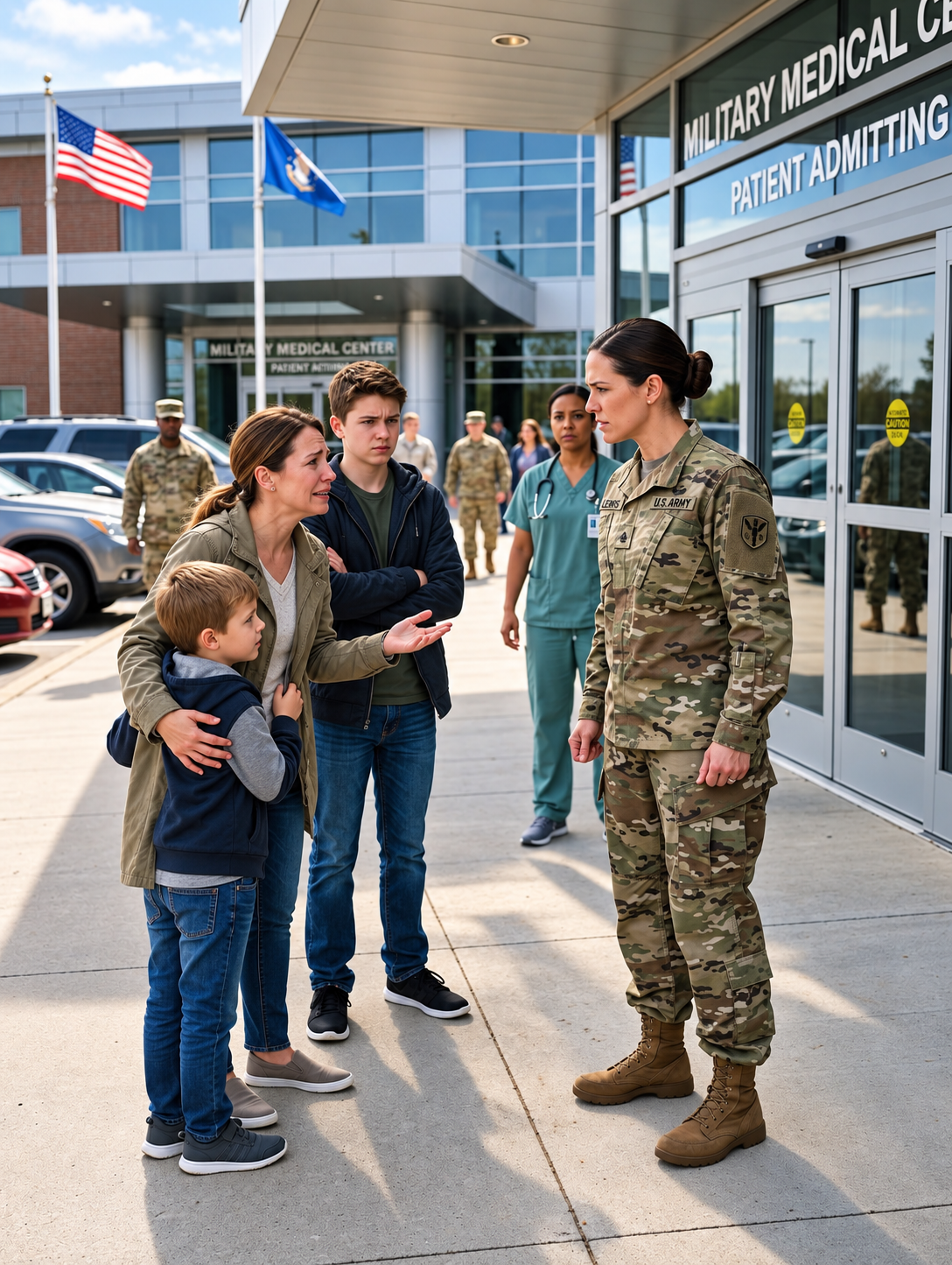
PART 1 TITLE: Trapped Behind the Gates of My Military Base, I Watched My Husband Make a Choice That Changed Everything I Believed About Our Marriage
The woman had her head against my husband’s shoulder when he answered my video call. I recognized the living room behind them before I could make sense of what I was seeing. My mother’s faded blue quilt lay across the sofa, my father’s old brass lamp illuminated the corner, and my Army promotion photograph stood on the mantelpiece. Everything was familiar except the woman whose fingers were moving casually across Evan’s shirt. Outside my office window, rain struck the glass. Somewhere beyond the building, a military vehicle reversed with three sharp beeps. My mother was lying on her kitchen floor with chest pain, and I had called the one person I believed would help her.
“Evan, listen carefully. Mom has collapsed. She’s having trouble breathing, and the neighbor says her chest hurts. The base is locked down. I need you to get her to Mason Ridge Medical Center.” I spoke slowly, partly because the connection was unreliable and partly because I could feel myself losing control of my breathing. “Please. Don’t waste any time.” Evan looked at the woman beside him. She lifted her head, apparently waiting for him to respond. Instead of reaching for his keys, he settled farther into the cushions. His expression held the mild annoyance of someone being interrupted during a television program.
“I’m not getting involved in that,” he said. “You’ll have to find somebody else.” For several seconds, I stared at him, wondering whether he had misunderstood the seriousness of the situation. “She’s eighty-two, Evan. She could be having a heart attack.” He glanced toward the woman again. “And what exactly do you expect me to do about it? She’s your mother, Clara. Deal with it.” The woman looked down at her hands. Neither of them asked whether Mom was conscious, whether help was coming, or whether I needed them to call someone.
Something inside me became very still. I had spent twenty-two years in the Army learning to respond when circumstances went wrong. I knew how to keep my voice level while equipment failed, roads closed, orders changed, and frightened people demanded answers. That training could not explain why the man who had shared my bed for nearly eighteen years was sitting beside another woman while refusing to help my mother. I watched him for one final moment, searching his face for even a trace of concern. There was none. “All right,” I said. Then I disconnected the call.
My name is Clara Carter. I was forty-five years old, serving as a logistics officer at Fort Briar near the Kentucky–Tennessee border. My rank was major, and my responsibilities frequently involved ensuring that other people received what they needed before a problem became a crisis. I had been deployed overseas, worked through emergencies, and spent enough nights away from home to understand the strain military service could place on a family. Until that evening, I had also believed my marriage, though imperfect, rested on an understanding neither distance nor exhaustion could destroy.
The day had begun with unpleasant coffee and an argument over transport schedules. By late afternoon, a security incident had brought movement across the installation to a halt. Vehicles were being checked, exits were restricted, and no one was permitted to leave without authorization. I was finishing an equipment report when my phone vibrated at 6:42 p.m. The name on the screen was Mrs. Nolan, my mother’s neighbor. She was seventy-nine, a small woman with a determined voice who had lived beside my parents for more than twenty years. She never called during my duty hours unless something mattered.
“Clara, sweetheart, I need you to listen.” Her breathing was uneven. “Your mother’s fallen in the kitchen. She was trying to reach the telephone, and she couldn’t get up. She’s saying something’s pressing on her chest.” I stood so abruptly that my chair rolled backward and struck the filing cabinet. “Is she awake?” I asked. “Yes, but she looks dreadful. She’s very pale.” Behind Mrs. Nolan’s voice, I heard my mother protesting that she only needed a moment to catch her breath. I knew that tone. It was the voice she used when she was frightened and wanted everyone else to pretend otherwise.
My mother, Margaret Lowe, had never been particularly good at accepting help. Since my father’s death, she had insisted on remaining in the brick house where they had raised me. She tended roses along the front walk, swept her porch every morning, and carried grocery bags that were too heavy for her wrists. At eighty-two, she still corrected anyone who treated her like a helpless old woman. Her independence was one of the things I loved about her. That night, hearing her weak voice in the background, I was afraid the same stubbornness might keep her from receiving the care she needed.
I told Mrs. Nolan to stay with her and keep the phone nearby. Then I walked directly to my commanding officer’s office. He understood the situation before I finished explaining it. At 6:51 p.m., we made the formal request for emergency release. He contacted the appropriate personnel, but the security restrictions were still in effect. Nobody could promise how soon the installation would reopen. My commander offered to keep trying. I thanked him, then stepped into the corridor and leaned against the wall, looking at the distance between Fort Briar and my mother’s house on my phone.
Under ordinary circumstances, I could have driven there myself. I knew the turns without needing directions, from the highway exit to the little road behind the pharmacy. I knew which porch step creaked and where Mom kept her spare key. But those gates were closed, and no amount of determination would open them. I needed somebody who was already outside. That was when I thought of Evan. Our house was less than half an hour from Mom’s, and he knew her neighborhood as well as I did. He had accompanied her to medical appointments before. Surely he would understand.
I remembered our first Christmas together, when Evan had spent an afternoon helping my father repair a leaking kitchen pipe. He had come home with wet sleeves and a satisfied grin, announcing that he had saved the family a plumbing bill. Years later, when my father became ill, Evan sometimes collected prescriptions or brought dinner to my parents. Those small acts had mattered to me. They suggested that he regarded my family as his own. I held on to those memories while the video connection rang, believing I was about to ask a familiar kindness from someone who had given it willingly before.
Instead, his face appeared beside a stranger’s. The woman was younger than I was, with dark hair falling around her shoulders and bare feet tucked beneath her on my sofa. She wore an oversized sweater I did not recognize. Evan had one arm along the back of the couch, close enough to make their relationship unmistakable. For a brief instant, I thought I might have called the wrong number. Then he said my name. His voice was steady, his posture relaxed, and I understood that he had answered knowing exactly what I would see.
I had no time to ask who she was. Even if Evan had offered an explanation, it would not have mattered then. My mother needed medical care, and every minute spent confronting him was a minute taken from her. I told him what had happened. He refused. There was nothing left to negotiate. I ended the call before he could add another insult, then stood in the corridor with my phone against my chest. The humiliation would come later. So would the anger. For the moment, I needed a driver.
I contacted a cousin who occasionally helped Mom with errands, but she was traveling out of state. Her closest friend had stopped driving at night because of poor eyesight. The pastor was conducting an evening service and could not immediately be reached. Mrs. Nolan was too frail to manage Mom’s weight, and I did not want her attempting to carry an injured woman down the porch steps. I made one call after another, repeating the same information until the words began to sound mechanical. Each conversation ended with sympathy, regret, or another telephone number.
When I reached Mrs. Nolan again, she sounded close to tears. “She’s still talking, Clara, but not as much. She says the pain’s going into her arm.” In the background, Mom told her not to frighten me. That almost undid me. Even lying on the floor, my mother was trying to protect me from worry. “Tell her I’m arranging help,” I said. “And please don’t let her convince you that she’s fine.” Mrs. Nolan promised she wouldn’t. I asked her to keep watching Mom’s breathing and follow the emergency guidance she had been given while we worked on transportation.
Then I remembered Arthur Reed. Arthur had delivered mail throughout my mother’s neighborhood for nearly thirty years before retiring. My father used to call him the only man who could identify every dog on the route by its bark. Even after retirement, Arthur continued visiting old neighbors. Sometimes he arrived with tomatoes from his garden; sometimes he brought a repaired lamp, a box of peaches, or a newspaper someone had missed. Mom spoke of him with the affection reserved for people who offered companionship without making a ceremony of it.
I found his number in the emergency contacts I had organized after Dad died. My hands were shaking enough that I pressed the wrong contact before finding the correct one. Arthur answered almost immediately, sounding as though he had been interrupted halfway through supper. “Clara? This is unexpected. Everything all right over there?” I told him Mom had collapsed and that I was unable to leave the base. I asked whether he could go to her house. I was already preparing to explain the circumstances, apologize for the inconvenience, and offer to reimburse him for fuel.
“Give me a minute to get my boots,” Arthur said. “I’ll head straight over.” I stopped talking. “Arthur, I don’t know how to thank you.” He made a dismissive sound. “You can do that when Margaret is safely in a hospital bed. Send me any information I need.” I gave him Mrs. Nolan’s number and the address of Mason Ridge Medical Center. He repeated both to be certain, then ended the call. There had been no argument about whose responsibility Mom was. No request for reassurance that the trip would be convenient. He simply agreed to help.
While Arthur drove, I returned to my office and spread my mother’s medical information across the desk. I found her medication list, the name of her cardiologist, and the insurance details. I checked each item twice because doing something precise kept my thoughts from drifting back to the living room. The image of Evan and the woman returned anyway: the way her hand rested on his chest, the brass lamp illuminating them, the easy familiarity of their bodies. I wondered how long she had been there and how many times I had spoken to my husband while she listened nearby.
Twenty-five minutes after Arthur agreed to help, Mrs. Nolan called. He had reached the house. I heard a door close, followed by Arthur’s voice speaking gently to Mom. “Margaret, it’s Arthur. We’re getting you looked at.” My mother said something about causing trouble, her words faint but still unmistakably annoyed. Arthur told her that after all the years she had corrected his gardening advice, he was hardly going to complain about one drive. I put my hand over my mouth. The sound that escaped me was half a laugh and half a sob.
He took care not to hurry her unnecessarily. Mrs. Nolan gathered Mom’s handbag and medication list while Arthur helped arrange her safe transfer. By 7:46 p.m., they were on their way to the medical center. I remained on the telephone until I heard the truck door close, then called the hospital to explain that an elderly cardiac patient was coming. The receiving staff took the information efficiently. I gave them my number and asked that someone contact me when they knew more. Once the call ended, I sat at my desk with no further task to perform.
The waiting was harder than the phone calls. Logistics usually offered a measurable problem: a missing shipment, a delayed vehicle, a shortage that could be solved by moving resources from one place to another. I could not move myself through a locked gate. I could not shorten the road Arthur was driving or persuade Mom’s heart to recover by staring at a clock. I checked the time, watched the screen go dark, then checked it again. Eventually I walked to the corridor window, where rainwater gathered along the sill and distant runway lights blurred into pale streaks.
A doctor from Mason Ridge Medical Center finally called. I answered before the first ring finished. He told me my mother had suffered a heart attack, but the damage appeared limited. She was stable and receiving treatment. Arthur had brought her in soon enough for the team to intervene before the situation became much worse. I listened closely as the doctor described the initial findings and the plan to monitor her heart. The medical language was familiar in outline, but it was difficult to absorb when the patient was the woman who had raised me.
“Would another delay have been dangerous?” I asked. The doctor paused before answering. “Her condition was serious, Major Carter. Timely treatment made a meaningful difference. We don’t want patients with these symptoms waiting at home.” I thanked him and requested the information needed for follow-up communication. When we finished, I kept holding the phone even though the line was silent. My mother was alive. I should have felt only relief. Instead, relief arrived tangled with the knowledge that her survival had depended on a retired mail carrier after my husband had refused to leave his sofa.
I made it to the vending machine before the tears came. The corridor was nearly empty, and the machine’s compressor made a low, steady noise. I pressed my palms against my eyes, embarrassed by the intensity of the release. A young sergeant walked past, glanced at me, and kept going. A minute later, he returned with a paper cup of coffee. He placed it on the narrow ledge beside me. “Ma’am,” he said quietly, then left without asking anything. I was grateful for his discretion. I had spent years looking after soldiers who needed help. That evening, one of them recognized that I needed a small kindness of my own.
After I regained my composure, I contacted Arthur. He was sitting in a hospital waiting area, still wearing his work jacket. He told me Mom had complained about the temperature and asked whether someone could turn down the television. “That’s a good sign,” he said. “She was ordering us around before they even finished checking her.” I asked whether he needed money for parking or fuel. He laughed. “Clara, I’ve known your family longer than you’ve been wearing that uniform. I didn’t come here to submit an invoice.” His refusal was so ordinary that it hurt.
It was 9:11 p.m. when I opened my financial accounts to check what money was available for Mom’s recovery. I had intended to look at her insurance arrangements, possible medication costs, and anything I might need to cover personally. Instead, a charge caught my attention. Riverton Chophouse. Two hundred eighteen dollars and sixty-three cents. The transaction had been processed at 7:18 that evening, while I was scrambling to find someone to help my mother. The restaurant was expensive, the kind Evan suggested for anniversaries and then complained about when the bill arrived.
I opened the transaction details. The amount was consistent with a dinner for two, drinks, and dessert. It had been charged to an account in my name, using a card Evan was authorized to carry. I looked again at the time. He had not been too busy to go out. He had been unwilling to interrupt his plans for Mom. I pictured him at a polished restaurant table while Arthur searched for his boots, while Mrs. Nolan knelt beside my mother, while I sat behind a locked military gate trying to hold my voice steady.
For several minutes, I studied older statements. There were other restaurant payments, fuel purchases inconsistent with the driving Evan claimed to be doing, and charges I had previously accepted without asking questions. His late meetings returned to me with uncomfortable clarity. So did the habit he had developed of turning his telephone face down whenever I entered a room. I had questioned him occasionally, and every time he supplied a plausible explanation. I had wanted our marriage to be sound, so I had treated each explanation as sufficient. That night, the receipts looked different.
The woman on the sofa had exposed more than infidelity. She had shown me the ease with which Evan occupied my home, enjoyed the things I provided, and dismissed an emergency that did not inconvenience him personally. I remembered his expression when I mentioned Mom’s age. He had been unmoved. I remembered how the woman looked away, not from surprise but from discomfort. I did not know her name yet. I did not know how long the relationship had lasted. But I knew that Evan had shown no interest in whether my mother survived the evening.
I opened the secure folder containing the legal and financial documents Dana Cole had helped me prepare. Dana was my attorney, and her advice during the previous year had encouraged me to understand exactly how our property was held. At the time, the planning had seemed prudent rather than urgent. Now those records offered a way to prevent further damage without touching anything that rightfully belonged to Evan. I sent Dana a brief message requesting that she proceed according to the instructions we had already discussed. Then I reviewed the authorizations attached to my individual accounts.
I was not interested in emptying our household account or inventing a punishment. There would be time for a fair division of marital property, and I had no intention of interfering with that process. What I could not accept was allowing Evan unrestricted use of assets that had always belonged separately to me. I made the necessary requests through the proper channels and preserved copies of every confirmation. My hands were steady now. It was not because I had stopped hurting. The practical work simply gave the hurt somewhere to go.
Before leaving my office, I checked my phone one last time. There was no message asking about Margaret, no missed call from Evan, no suggestion that he regretted refusing to help. I thought of the promises we had made eighteen years earlier, the nights I had crossed oceans to return home, and the countless times I had rearranged my own life to accommodate his needs. I had believed those efforts were the ordinary work of marriage. Perhaps some of them had been. But a marriage could not survive if only one person believed the work belonged to both.
I went to my quarters, placed Mom’s hospital contact information beside the bed, and set my telephone so that her care team could still reach me. Before sleeping, I checked that the documents I had sent to Dana were complete. I did not write Evan an angry message. I did not ask the woman to explain herself. There was nothing I could say that would make my mother’s ordeal less frightening or undo his refusal. I had asked for help, and he had given me his answer. Now I would make decisions based on it.
The last thing I saw before turning out the light was a confirmation that the changes to my accounts had been received. I put the phone facedown and closed my eyes. Across the state, my mother was alive because Arthur Reed had answered when I called. In my house, Evan was enjoying a life whose financial arrangements he had never bothered to understand. By morning, he would begin discovering the difference between possessing a card and owning the money behind it.
END PART 1
PART 2 TITLE: Thirty-Eight Calls Before Sunrise Exposed What My Husband Feared Losing Most, and the Financial Truth He Had Never Bothered to Learn
The telephone was vibrating against my metal nightstand when I opened my eyes. For a disoriented moment, I was certain something had happened to my mother. I reached for the screen with a cold rush of dread, expecting to see the hospital’s number. Instead, Evan’s name appeared above a wall of notifications. There were thirty-eight missed calls, twenty-one voicemail messages, and a long sequence of texts that had begun shortly after midnight. I sat upright, my bare feet touching the cold floor, and searched the notifications for any mention of Margaret. There was none.
The earliest message demanded that I telephone him. An hour later, another accused me of playing games. By the middle of the night, the language had grown sharper. He wanted to know why his payment cards were failing and whether I had interfered with the accounts. Near three o’clock, the threats gave way to questions. One voicemail consisted of him asking me to pick up, followed by several seconds of breathing before the recording ended. The final message sounded almost pleading. He had not called to ask whether my mother survived. He had called because his money had stopped working.
I listened to only enough to understand his concern. Then I closed the messages and telephoned Mason Ridge Medical Center. A nurse in the cardiac unit told me Mom had slept reasonably well and that her vital signs were improving. She had complained about her breakfast, particularly the oatmeal, and asked whether there was any possibility of getting a decent cup of coffee. The nurse sounded amused. “She’s quite particular,” she said. “That’s her normal condition,” I replied. We spoke briefly about medication and the doctor’s planned review before she offered to let me speak with Mom.
“Clara?” My mother’s voice was hoarse but unmistakably hers. “Have you considered what they feed people in hospitals?” I shut my eyes and smiled. “Good morning to you too.” She described the oatmeal with such offended precision that I almost laughed aloud. I told her she had frightened me badly, and for a moment neither of us spoke. Then she said, more softly, “I know, sweetheart. I’m sorry.” I told her there was nothing to apologize for. She had needed help, and helping her was not an inconvenience. I wanted her to hear that clearly.
Mom was quiet for a moment before asking where Evan had been. I looked at the unopened messages on my screen. “I’ll explain when I can sit beside you,” I said. “Clara, don’t hide something because you think my heart can’t take it.” She had always been perceptive, even when I wished she weren’t. I assured her that I would tell her the truth, but not while she was exhausted and surrounded by nurses. She accepted that reluctantly, then reminded me to eat breakfast. Even from a hospital bed, she retained the instinct to look after her daughter.
Twenty minutes later, Judith Carter called. Judith was Evan’s mother, a woman I had known for almost two decades. She had always been courteous to my parents, though she tended to defend her son before learning what he had done. I answered because I assumed she might finally be calling about Margaret. Instead, her first question concerned Evan’s finances. He had telephoned her before dawn, she said, claiming his card had been rejected at a gas station and that several accounts were no longer accessible. Judith wanted an explanation.
“What happened between you two?” she asked. Her voice was careful, as though she were trying not to sound accusatory. I stood beside the narrow window and watched an early delivery truck move along the service road. “Your son refused to help my mother when she was having a heart attack,” I said. Judith did not immediately respond. “He told me there was some disagreement,” she answered. “That you became upset and started blocking his accounts.” I let those words settle before telling her that the disagreement she described had taken place while Margaret was lying on her kitchen floor.
Judith asked whether I had frozen all of Evan’s money. “No,” I said. “I haven’t touched his individual accounts, and I haven’t emptied our joint household account. I’ve stopped him using certain assets that are mine.” She wanted to know why I would take such action without discussing it with him. I reminded her that he had been unwilling to discuss my mother’s emergency while sitting beside another woman in our living room. A long silence followed. Then I asked her to speak to Evan about where he had been, whom he had been with, and why he had not helped.
I knew Judith would recognize the significance of Margaret’s illness. Mom had hosted her for Christmas dinners, sent food when she was recovering from surgery, and remembered the anniversary of Judith’s husband’s death. Once, when Judith had been too unwell to shop, Margaret had arranged groceries despite being older herself. These were not strangers separated by a family dispute. They had shared tables and years. If Judith wanted to understand what had happened, she needed to begin with the woman whose life had been in danger, not with her son’s rejected payment card.
After the call, I opened the financial records stored on my computer. My father had died the previous year, leaving Mom and me responsible for sorting decades of documents. There had been insurance papers in old envelopes, bank statements tucked into drawers, property records, and tax documents held together with brittle rubber bands. I had always been organized professionally, but handling Dad’s affairs revealed how vulnerable a family could become when important information was scattered. It also made me confront the uncomfortable possibility that someday I might be the person whose records others had to untangle.
Dana Cole had helped us complete that work. She was methodical, practical, and unusually patient with clients who preferred not to discuss money. During our meetings, she explained the difference between property inherited from family, assets acquired before marriage, and funds built through shared marital efforts. She advised me to keep clear records and create an estate plan that reflected both my mother’s needs and my own retirement intentions. I had listened because my father had spent his life working for what he owned, and I wanted to handle his legacy responsibly.
With Dana’s assistance, I established a revocable trust and organized the interests that belonged separately to me. My father’s lake cabin was placed within that structure, along with qualifying investments I had accumulated before marriage and documentation of my separate contribution to our residence. My plans for a small consulting business after retirement were also reflected in the estate paperwork. Dana had been careful to distinguish those matters from assets that might properly be considered marital property. Nothing about the arrangement was designed to erase Evan’s legitimate interests.
Evan knew the meetings were taking place. Dana’s appointments appeared on our calendar, and I had invited him to attend. Several times, I left folders on the kitchen table for him to review. He usually glanced at the first page and pushed the documents aside, saying I understood financial details better than he did. I remembered one particular evening when he signed paperwork while watching television. I asked whether he wanted me to explain anything. He shook his head without taking his eyes from the screen. “You’re good at this,” he said. “I trust you to handle it.”
That trust had seemed affectionate at the time. Now I understood how conveniently it had served him. He was happy to enjoy a house without studying the ownership records. He liked inviting friends to the lake cabin, but never asked why it remained associated with my father’s estate. He used cards on which he was listed as an authorized user and rarely distinguished between shared money and funds that belonged separately to me. When he spoke about our finances in public, everything became something he possessed. When bills arrived, the responsibility quietly returned to my desk.
I had tolerated that imbalance for years. When Evan’s truck payment came due after an expensive weekend, I transferred money to prevent a late fee. When he forgot a bill, I handled it. I remembered dates, balanced accounts, arranged insurance renewals, and tracked documents through deployments. He sometimes joked that marrying a logistics officer had been the best financial decision he ever made. People laughed because the remark sounded affectionate. I laughed too, though eventually I began noticing how much of our marriage depended on my ability to anticipate problems he did not consider his responsibility.
The warning signs had grown harder to ignore during the previous nine months. Evan began coming home later, explaining that work required additional meetings. His truck accumulated mileage that did not fit the journeys he described. Restaurant charges appeared on nights when he claimed to have eaten at his desk. I asked about some of them, and he always supplied an answer before I finished the question. He had driven a colleague home. A client had needed dinner. He had stopped for fuel on the other side of town because prices were better there.
The explanations were individually plausible. That was what made the pattern difficult to confront. A single late evening could be innocent. So could an unfamiliar receipt or a telephone turned away during dinner. I had no interest in becoming a suspicious wife who examined every movement her husband made. Yet I noticed myself hesitating before checking statements, almost afraid of confirming what the entries suggested. I began to understand that wanting a marriage to be sound did not make it sound. Sometimes it only made the evidence easier to overlook.
Months before the emergency, I discussed those concerns with Dana. I did not accuse Evan of a crime or ask her to engineer a financial trap. I asked what would happen if I decided our marriage could no longer continue. Dana explained the legal process, the disclosures we would owe each other, and the records that would establish which assets were separate and which were marital. We prepared the necessary documents but did not file them. I was still uncertain. Part of me wanted to believe Evan was merely careless, distracted, or unhappy about the time my career demanded.
That uncertainty ended when I saw the woman on my sofa. I had no proof then of how long the relationship had continued, but I no longer needed to argue with myself about whether it existed. The refusal to help Margaret made the decision even clearer. Immediately after the video call, while searching for someone to drive Mom, I had accessed Dana’s secure portal and authorized the steps we had previously discussed. Those steps did not depend on anger. They depended on legal rights, existing documents, and the recognition that waiting could expose my separate assets to further spending.
I revoked Evan’s authorized-user status on two accounts that belonged solely to me. I arranged for my military salary to be deposited into an individual account rather than continuing to supply funds automatically to an arrangement he had come to rely upon. I preserved the balance and records of our shared household checking account so the marital finances could be addressed properly. Finally, I instructed Dana to proceed with the divorce petition. Every confirmation was saved. I had spent my career maintaining records because people could disagree about what happened, but records could establish what had actually been done.
At lunch, Dana telephoned to confirm that the petition had been filed. She had also received confirmation concerning the access changes. I sat alone in the officers’ dining area, moving food around a plate I had little appetite to finish. “He can still use his own accounts?” I asked. “Of course,” Dana replied. “His money remains his. Joint assets will be handled through the legal process. The restrictions concern access you are entitled to withdraw.” I told her I did not want anything belonging to Evan. I wanted only to stop financing conduct that had already cost me my trust in him.
Dana let me speak without interruption. Then she reminded me that protecting an asset was not the same as confiscating someone else’s property. She also warned me not to respond emotionally to any threatening communications from Evan. Everything relevant could be preserved and handled through counsel. I appreciated the clarity of her advice. In the Army, orders and responsibilities were documented for a reason. In my marriage, I had too often allowed affection to substitute for clear expectations. I had hoped that if I was generous enough, Evan would eventually become equally considerate. I was finished making that bargain.
By midafternoon, more messages arrived from him. A grocery purchase had failed. He wanted to know why the account he normally used for his truck expenses no longer contained my latest salary deposit. Then he demanded access to the lake cabin calendar. I remembered him mentioning a possible summer trip several weeks earlier, though he had been vague about the company. At the time, I assumed he was discussing plans with friends. Now, after seeing the woman in my living room, I wondered whether he had been promising her a holiday in a house that was not his.
There was something revealing about the order of his complaints. He had mentioned the rejected card before my mother’s health. He was more concerned about his truck than the hospital. He wanted entry to the cabin schedule while the woman whose family owned that property was still recovering from a heart attack. I did not need to tell him how shameful the priorities appeared. I saved the messages in their original form. Each one added another piece to a picture I had spent years refusing to see.
When I had the opportunity, I called Arthur again. He had returned home late the previous evening and was already planning to visit Margaret after lunch. I asked him whether she had seemed frightened during the journey. He hesitated, then said she had held her handbag tightly and repeatedly asked whether I was all right. “She worries about you more than herself,” he told me. “Always has.” I stared down at my hand, remembering the phone conversation in which Mom had apologized for collapsing. I wished I could have sat beside her in that truck.
Arthur described how Mrs. Nolan had waited with Mom until he arrived and how the hospital staff had taken over quickly. He did not make himself the hero of the evening. Whenever I thanked him, he redirected the conversation toward Margaret’s recovery. I thought about the difference between his quiet assistance and Evan’s attempts to calculate what he stood to lose. Arthur had surrendered his evening without asking for anything. Evan had refused a short drive because someone else’s emergency interrupted his pleasure. Money had nothing to do with the character of either choice.
That evening, Judith sent me a message. She had asked Evan about the incident, but he claimed I was exaggerating and that the hospital situation had never been as urgent as I suggested. The words made my stomach tighten. He had been told about the collapse and the chest pain. He knew I was physically prevented from leaving the base. Now he was revising the facts to make his decision seem reasonable. I forwarded Judith the basic information confirming Mom’s hospitalization, without sharing private medical details she did not need. Then I put the phone away.
I spent the rest of the evening reviewing the documents Dana had prepared for the divorce. The procedure would not be simple merely because I believed my reasons were sound. We had a long marriage, a home with both separate and marital interests, retirement assets, and ordinary debts. Evan was entitled to a fair legal accounting, even if his conduct had destroyed my affection. I reminded myself of that distinction whenever anger rose. I was not trying to turn betrayal into a financial contest. I wanted to leave without permitting him to rewrite the ownership of everything I had worked for.
A photograph from our wedding appeared in a folder while I searched for an older property document. Evan stood beside me, smiling broadly, one hand resting at the small of my back. My father was visible behind us, laughing at something outside the frame. For a long time, I looked at the photograph. I could still remember how hopeful I had felt that day. I did not believe every happy moment had been false. People could share genuine affection and still become capable of serious cruelty. That understanding made the loss more painful, not less.
I put the photograph aside and returned to the financial statements. The cabin had belonged to Dad. My individual investments were documented. The marital portion of the house would be calculated according to the applicable rules and evidence. Evan had his own employment income, retirement savings, and obligations. None of those facts depended on whether he could persuade his mother that I was vindictive. I took some comfort in their precision. Numbers could not determine whether a person had loved me, but they could stop a dishonest argument from becoming an ownership claim.
Shortly before I went to bed, Evan left another voicemail. His voice was louder than it had been that morning. He insisted that being married meant he was entitled to half of everything associated with me. He referred to the house, the cabin, and investments as though the papers would automatically confirm his expectations. He accused me of setting him up and demanded that I reverse the changes immediately. I saved the recording and forwarded it to Dana. Then I placed the phone on the desk and looked at the quiet room around me.
For eighteen years, Evan had enjoyed the security of a marriage without taking the trouble to understand its responsibilities. He knew the location of my credit cards but not the ownership of the funds behind them. He could describe the view from my father’s cabin but not explain why it belonged to a trust. He knew how to borrow the appearance of stability while leaving me to maintain the structure beneath it. His thirty-eight calls had not changed my decision. They had confirmed that the first thing he missed was not his wife. It was access to the life she had made possible.
I switched off the desk lamp. Mom was recovering, Dana had begun the legal process, and every relevant record was preserved. For the first time since the lockdown, I could think about the days ahead without waiting for Evan to approve my choices. There were still questions about the woman, the unexplained expenses, and the money he appeared to have been spending elsewhere. I expected those answers would come during the divorce. What I did not yet understand was that Evan’s financial troubles reached beyond our marriage, and that another family had already been persuaded to trust property he never owned.
END PART 2
PART 3 TITLE: As My Husband’s Carefully Managed Life Began to Unravel, His Own Mother Asked the Question He Could Not Bring Himself to Answer
For three days, I allowed my telephone to ring without answering Evan. I continued speaking with the hospital, my mother, Arthur, and Dana, but everyone else could wait. The silence felt unfamiliar, almost physical. During eighteen years of marriage, I had trained myself to remain reachable. If Evan misplaced something, he called. If a payment was due, he called. If he was embarrassed at a family gathering or needed an excuse for arriving late, he expected me to find a solution. Now his messages arrived without an immediate answer, and I discovered how often I had interrupted my own life to make his easier.
I had not recognized that pattern while living inside it. At the time, it looked like cooperation. When he forgot Judith’s birthday, I ordered flowers and signed both our names. When he spent too much before an insurance payment, I covered the difference and mentioned it only once. If he offended someone during dinner, I later explained that work had been difficult or that he had misunderstood the conversation. These were small acts, scattered over years. Together they had made me responsible for nearly every uncomfortable consequence of his decisions. Withdrawing from that role felt strange, but I no longer wanted to maintain a peace that existed only because I absorbed the damage.
The messages continued arriving. Sometimes Evan sounded furious. At other times, he spoke softly, insisting we could straighten everything out if I would just come home and talk. Not once did he offer a clear explanation for the woman I had seen. He referred to her as a misunderstanding, an unfortunate situation, something that had become exaggerated because I was upset about my mother. I saved those recordings with the others. The contrast between his calm rejection of Margaret’s emergency and his desperation over his accounts remained impossible to ignore. He was capable of urgency. He simply reserved it for himself.
On Friday morning, Arthur called while I was reviewing an equipment inventory. He had visited Margaret the previous evening and had spoken with her nurse again that morning. Her condition was improving, he said, although she remained irritated by the restrictions placed on her activity. She had attempted to straighten the blanket at the foot of her hospital bed and argued that the staff were folding it incorrectly. “That sounds like Mom,” I said. Arthur gave a quiet laugh. “The nurse told her she needed to rest. Your mother informed the nurse that tidiness was not a competitive sport and could be achieved without raising one’s pulse.”
I leaned back in my chair and allowed myself to enjoy the image. Margaret had always maintained that a properly made bed could improve a difficult morning. Even during my childhood, when money was tight and Dad was working long hours, she kept our little house orderly. She believed neatness was a form of respect for the people living there, not a performance for visitors. Hearing that she was arguing about hospital blankets reassured me more than another general statement about her recovery. It meant some of her ordinary energy had returned. Arthur waited until I finished asking about her medication before telling me something else.
“Evan came by your mother’s place yesterday,” he said. My chair stopped rocking. “Why?” Arthur explained that he had been checking the property with Mrs. Nolan when Evan appeared carrying a large bouquet of flowers. He knocked repeatedly and asked whether Margaret had returned from the hospital. When Arthur informed him that she was still receiving care, Evan said he wanted to leave the flowers and a card inside. He had also asked whether Arthur knew how to reach me. Arthur told him he did, but that he would not become a messenger for conversations I had chosen not to have.
I asked whether Evan had mentioned the emergency. Arthur was silent long enough to make me uneasy. “He said you were making a difficult situation worse,” he eventually answered. “Then he suggested that Margaret was probably fine and that everybody should stop exaggerating.” My fingers tightened around the phone. Arthur continued in a measured voice. “I told him your mother had suffered a heart attack, and that I was the one who drove her to Mason Ridge. I asked him whether he understood how frightened she had been.” Evan apparently responded by saying he hadn’t realized the situation was so serious.
I could imagine Arthur’s expression. He was not an argumentative man, but he had a way of holding a silence until someone heard the foolishness of what they had just said. According to Arthur, he had asked Evan a simple question: if an eighty-two-year-old woman collapsed with chest pain, what additional information would make the situation urgent? Evan offered no answer. Instead, he requested again that the flowers be placed inside the house. Arthur called Margaret at the hospital. When she learned who had sent them, she instructed him to leave them outside with the rubbish rather than decorate her home with an apology she had not requested.
Arthur sounded faintly embarrassed as he repeated her instructions. I was not surprised. Mom had always distrusted extravagant gestures offered immediately after careless behavior. She preferred someone remembering to collect her prescriptions over receiving expensive flowers when she was already angry. “Did you really put them beside the trash?” I asked. Arthur said he had moved them under the porch roof first because rain was threatening. Later, after speaking to Margaret again, he placed them where she had directed. I could hear his reluctance to waste perfectly good flowers, but he had respected her decision.
Evan had often approached apologies as transactions. After forgetting an anniversary, he purchased jewelry. Following a particularly hurtful remark, he suggested dinner at a good restaurant. Once, after missing a family gathering I had repeatedly reminded him about, he booked a weekend away and seemed genuinely bewildered when I remained disappointed. I had usually accepted the gestures because I wanted the uncomfortable moment to pass. Now I understood that accepting a present had often become a substitute for discussing why the hurtful behavior happened. The flowers on Mom’s porch were another attempt to purchase an end to an argument he did not want to understand.
Before hanging up, Arthur asked whether I was managing well at the base. His concern caught me off guard. Most people assumed that because I wore a uniform and held a senior position, I would know what to do with any problem. I told him the truth: I was working, sleeping poorly, and waiting for permission to come home. “That’s understandable,” he said. Then he offered to check the house again before collecting Mom’s things for her eventual discharge. I thanked him, and this time he accepted without joking. The quiet exchange reminded me that kindness did not always require elaborate language.
Later that afternoon, Dana called with news about the divorce. Evan had retained an attorney, and his legal representative had requested records concerning the trust, the cabin, and the ownership of our residence. I was not surprised he had sought counsel. He was entitled to do so, and Dana had repeatedly explained that the division of property would require disclosure from both sides. What interested me was the speed with which he had shifted from insisting I answer the phone to demanding a detailed understanding of assets he had ignored for years. Evidently the account restrictions had finally made the documents important to him.
Dana explained that the initial correspondence from Evan’s attorney described the case as involving a substantial collection of marital property. The records, however, were more complicated than Evan apparently expected. My father’s lake cabin had passed through inheritance and was held in the trust. Certain investment accounts predated the marriage or had maintained documented separate ownership. Our residence included a marital interest, but the contribution from my inheritance had been recorded. Retirement benefits required their own calculations, including portions accumulated during our marriage. Nothing could simply be divided according to Evan’s assumption that marriage erased every distinction.
I asked Dana whether the process would become contentious. “It may,” she answered. “But disagreement doesn’t change the records.” She explained that his attorney had requested another meeting with Evan after reviewing the preliminary information. I pictured my husband sitting across a desk while someone described the difference between property he had enjoyed and property he legally owned. For years, he had dismissed my insistence on careful documentation as unnecessary fuss. Now the details he had refused to learn were determining the scope of his financial claims. There was no satisfaction in that realization, only a grim recognition of how preventable the confusion had been.
I reminded Dana that I wanted the marital portion of the house handled fairly. I also wanted the retirement calculations to reflect the appropriate legal treatment, even if the result was less favorable to me than Evan deserved emotionally. Dana assured me that was precisely how we would proceed. I had no desire to spend the next several years fighting over furniture or using legal expenses to punish him. Whatever remained of our relationship, I intended to leave the marriage with my conduct intact. Evan’s betrayal did not give me permission to become dishonest about the things we had shared.
That evening, I gathered the receipts and records that might prove important later. Some were mundane: utility payments, property tax notices, insurance renewals. Others had become significant because of the questions surrounding Evan’s spending. I organized them by date and saved copies in the appropriate folder. It was tedious work, and I was grateful for that. Every item had an identifiable place. The work allowed me to concentrate on something that could be completed, unlike the question of how a man I once loved had become capable of watching my mother’s suffering with indifference.
The following morning, Judith telephoned again. She sounded tired, and I could hear the clink of a spoon against a cup. Evan had come to her house shortly after six, asking for money. At first, she assumed he was facing an ordinary cash shortage, the kind I had covered in the past. When she suggested using the household account, he admitted that very little remained there. Judith asked what had happened to the money. He would not tell her. His refusal troubled her enough that she began examining what he had said about our separation.
“He told me you suddenly decided to leave him,” Judith said. I looked down at the financial papers in front of me. “Did he mention why?” She hesitated. “He said you haven’t been happy for a long time. That your military work changed you.” I pressed a fingertip against the edge of the desk. My work had been demanding, certainly. There had been deployments, field exercises, missed holidays, and nights when I returned home too tired for conversation. I had never pretended otherwise. But Evan had chosen to marry a soldier, and for years he had proudly presented my career as an achievement we shared.
Judith continued carefully. According to Evan, I had become controlling about money, emotionally unavailable, and unwilling to make room for his needs. He claimed the marriage had been deteriorating because I valued my responsibilities at Fort Briar more than the relationship. I listened without interrupting. Some marriages did suffer under the pressure of military service, and I knew couples who had worked hard to survive those difficulties. But a genuine grievance would not explain why Evan brought another woman into our home and refused to help Margaret when I could not leave the installation.
“What did you say when he told you that?” I asked Judith. She admitted she had initially believed him. He was her son, and she was accustomed to hearing his version of disagreements first. She had suggested that he give me time to calm down, believing I had acted impulsively. But then she remembered what I had told her about Margaret’s emergency. She asked Evan where he had been that evening and whether he had known my mother was seriously ill. He began talking about how demanding I could be, how often I expected favors, and how exhausted he had felt.
Judith interrupted him. She wanted a direct answer. Had I asked him to take Margaret to the hospital? He acknowledged that I had. Had he refused? He said the situation was complicated. Judith asked what could possibly make it complicated. Evan became angry and accused her of taking my side. “And then?” I asked. Judith took a slow breath. “Then I asked him whether he would have acted the same way if it had been me on the floor.” She paused. “Clara, he couldn’t look at me. He didn’t answer at all.”
I said nothing. Judith had always defended Evan’s shortcomings as impatience, carelessness, or a tendency to speak before thinking. This time, she had encountered something those explanations could not excuse. I knew it hurt her. Parents spend years teaching their children how to treat other people, and there must be a particular kind of grief in discovering that those lessons have been abandoned. Still, her pain did not erase what Evan had done. I was willing to hear it, but I could not make myself responsible for repairing the relationship between a mother and her adult son.
“I think I’ve been making excuses for him,” Judith said at last. She sounded embarrassed. “He’s always been good at making me feel that someone else started the trouble.” I remembered family dinners when she had quietly asked me to overlook a careless remark or excuse his absence from an important occasion. I had usually agreed. Perhaps both of us had been trying to preserve the same image of him. “He makes his own decisions,” I replied. “You can love him without defending those decisions.” Judith was silent for a while before thanking me.
Then she asked about Margaret. For the first time since the crisis, our conversation became about the person who had nearly died. I told her Mom was stable, that the doctors were hopeful, and that Arthur continued visiting. Judith asked whether flowers would be appropriate. I thought of the bouquet beside the rubbish and almost smiled. “She’d probably prefer a phone call when she’s rested,” I said. Judith agreed. Before hanging up, she apologized for failing to ask about Margaret sooner. There was nothing dramatic in her voice, only an unmistakable sense of shame.
The rest of the weekend passed slowly. I telephoned Mom several times, listening as she described small victories: walking a short distance with assistance, persuading a nurse to bring her reading glasses, and finally receiving soup she considered edible. She knew something had happened between Evan and me, but she did not press while we were separated. I told her I would explain everything when I arrived. Each evening, Arthur sent a brief update after visiting the hospital or checking the house. Mrs. Nolan had collected Mom’s mail and watered the plants. Their quiet coordination made me feel less helpless.
On Sunday night, I packed a small bag even though the lockdown had not officially ended. I folded civilian clothes, added the medication organizer I had purchased for Mom, and placed copies of her medical information in an envelope. My commander had been working to obtain emergency leave once the security restrictions permitted departures. I knew the authorization could still be delayed. Nevertheless, arranging the bag gave me the small comfort of preparing for an eventual journey. I left it beside the door, where I could see it whenever I looked up from my desk.
Monday morning brought the news I had been waiting for. The installation’s restrictions were lifted, and my request for five days of emergency leave was approved. I thanked my commander, collected my things, and completed the necessary departure procedures. As I drove away from Fort Briar, the familiar guard post disappeared in the rearview mirror. I had left that installation hundreds of times before, sometimes for ordinary weekends and sometimes for journeys that would take me across the world. This departure felt different. I was returning to my family, but the place I had called home no longer offered the reassurance it once had.
The highway was wet from overnight rain. Trucks threw mist across my windshield, and the sky remained low and gray. I kept both hands on the wheel and resisted the urge to drive faster. Mom was stable. Arthur knew I was coming. Dana had the necessary records. There was no emergency left that could be solved by reckless speed. Yet the closer I came to familiar roads, the more difficult it became to ignore the anxiety tightening my shoulders. I would soon have to see the house where Evan had sat with another woman. I was not ready to decide what that would feel like.
I had almost reached the county line when an unfamiliar number appeared on the dashboard display. For a moment, I considered letting it ring. I had received enough unexpected calls to last a lifetime. Then I remembered that the hospital sometimes used different outgoing lines, and I answered through the hands-free system. A woman spoke my name. Her voice was softer than I expected, with a nervous hesitation that suggested she had rehearsed the opening more than once. “Is this Clara Carter?” she asked. I confirmed that it was.
She paused long enough for me to hear traffic on her end. Then she said, “My name is Serena Blake.” I did not recognize the name, but there was something in her hesitation that made me tighten my grip on the steering wheel. Before I could ask how she had obtained my number, she added, “I’m the woman you saw with Evan.” The cars ahead slowed, and I eased into the right lane, concentrating on the road. Suddenly the stranger from my living room had a name and a voice. She had called while I was still trying to reach my mother.
“I know you probably don’t want to speak to me,” Serena said. “But there’s something you need to understand about what Evan told me.” I drove toward the next safe place to pull over. Her breathing sounded uneven through the speakers. I had imagined confronting this woman, though every version of that imaginary conversation had felt useless. Now she was offering information without being asked. “What did he tell you?” I said. The answer came quietly. “He told me you two were already separated. And he told me the divorce was almost finished.”
I pulled into a service area and parked beneath a tree whose leaves were beginning to turn. The engine idled while I stared through the windshield. I had expected excuses, perhaps a request that I not blame her. Instead, Serena began describing promises Evan had made about his future, his finances, and the property he intended to share with her. I listened without interrupting. Then she mentioned the lake cabin my father had left me. Evan had promised her a summer there. For the first time, I understood that his deception involved more than hidden dinners and an affair.
END PART 3
PART 4 TITLE: The Woman From My Living Room Finally Told Me What Evan Had Promised Her, Just Before He Turned My Military Career Against Me
“He said it was his place,” Serena told me. I could hear her breathing through the car speakers as she explained what Evan had said about the lake cabin. According to him, it was one of several properties he controlled, a place where they would spend long weekends once his divorce was finalized. He had shown her photographs of the dock, the porch, and the narrow path leading from the house to the water. I recognized the images she described. Some were photographs I had taken during visits with my father. Evan had used them to create an impression of wealth and independence that the ownership records did not support.
I looked through the windshield at the wet pavement. “The cabin belonged to my father,” I said. “It was inherited by me. Evan has never owned it.” Serena was quiet. When she spoke again, she sounded more embarrassed than surprised. “I know that now.” I asked how long she had been seeing him. She hesitated, as though the answer itself might be enough to end the conversation. I waited. I had reached the point where I no longer wanted reassurance or carefully softened versions of events. I wanted facts, even when they were unpleasant.
She explained that Evan had approached her months earlier and described himself as a man whose marriage had effectively ended. He claimed we lived separate lives and remained legally connected only because untangling our finances would take time. I remembered him returning home from late meetings, kissing my cheek, and asking what I had made for dinner. While I arranged his appointments and paid household bills, he had apparently been telling another woman that I was already part of his past. The knowledge made me feel strangely absent from my own marriage, as though he had rewritten our lives while I was still living mine.
Serena said she had believed his account because he spoke with such confidence. When she asked whether his wife knew about the separation, he told her I was relieved to be free of the relationship. He portrayed himself as the person responsible for maintaining our home and financial stability while I pursued my military career. I almost interrupted to correct him, but there was no point. She had seen enough by now to question his version. “Did you ever ask to speak to me?” I said. Serena admitted she had not. He had discouraged direct contact, claiming it would make an already difficult divorce unnecessarily painful.
Her discomfort was evident, but it did not erase her responsibility for accepting a convenient story without checking it. I was angry that she had sat in my house, surrounded by my family’s possessions, while I believed my husband was waiting for me to return. Still, I could hear how carefully Evan had constructed the lie. He presented his absence from my daily life as proof that we were separated. The very deployments and training assignments he had once celebrated became useful details in his account. My commitment to the Army provided him with an explanation for why his wife was not home to contradict him.
Then Serena told me why she had called. Her parents had loaned Evan fifteen thousand dollars. He claimed the money was needed temporarily while funds from an investment became available. The loan was presented as a short bridge between an existing financial commitment and an expected payment. Evan had shown her father photographs of our residence and the lake cabin as evidence that he possessed substantial property. Serena’s father believed the loan was low risk because Evan appeared to have more than enough resources to repay it. I closed my eyes for a moment, thinking of how easily confidence could become a substitute for evidence.
“Was anything written down?” I asked. Serena said her father had kept the transfer confirmation and copies of messages concerning repayment. Evan had given several explanations for the delay, each one slightly different from the last. At first, he claimed the investment settlement had been postponed. Later, he blamed banking procedures. When his cards began failing, he assured Serena that I was acting maliciously and that his attorney would soon restore access to the money. That was when she began asking questions about the accounts and properties he had described. His answers no longer fit together.
I rested my forehead briefly against the steering wheel. I had known Evan could be evasive. I had not understood the extent to which he relied on other people’s willingness to believe him. He had presented inherited property as though it belonged to him, used photographs to support his claims, and borrowed money against a financial picture he could not substantiate. The person sitting beside him during my video call had not merely witnessed his refusal to help Margaret. She had also been drawn into a false account of my marriage and assets.
“Did you know he was still living with me?” I asked. Serena answered that he had explained our shared address as a temporary necessity while the divorce proceeded. He claimed one of us usually stayed elsewhere, and my military duties made the arrangement practical. I thought of the clean sheets I had left on our bed, the groceries I bought before returning to Fort Briar, and the notes I placed on the refrigerator reminding him about appointments. None of those details belonged to a household whose marriage had already ended. Yet Serena had accepted the explanation until the financial consequences reached her family.
I asked her what she wanted from me. She did not answer immediately. Finally, she said her father expected the fifteen thousand dollars to be repaid, but she understood I was not responsible for Evan’s promises. She had called because she wanted me to know what he had been telling people. I appreciated that distinction. I would not assume responsibility for a loan I had neither requested nor authorized. Nor would I become the person who managed Evan’s embarrassment while the people he had misled tried to recover their money.
Serena told me she had packed her belongings and left him that morning. She had also obtained Dana’s contact information and sent my attorney copies of their messages, photographs, and other records. I asked why she had decided to cooperate. “Because I don’t know what else he’s lied about,” she said. “And because your mother was in the hospital while I was sitting on your couch.” Her voice cracked slightly on the final sentence. I did not offer reassurance. The image of her hand against Evan’s chest was still too fresh. But I thanked her for sending the records.
While we spoke, a notification appeared from Dana. She had received Serena’s material and would review it for relevance to the divorce and financial disclosures. I ended the call and opened the message after shutting off the engine. There were screenshots of conversations, hotel confirmations, photographs, and references to trips Evan had never mentioned to me. The dates reached back nine months. I could now connect some of those records with the unexplained restaurant charges and late evenings that had troubled me. There was no longer any uncertainty about the relationship’s duration.
I studied one photograph longer than the others. Evan was standing beside Serena outside a hotel, wearing the jacket I had bought him for our anniversary. His expression was relaxed, the familiar smile I had once considered reassuring. I remembered the afternoon I purchased that jacket, how carefully I had chosen the color because I knew what suited him. Seeing it in the photograph did not make the gift meaningless, but it changed what the memory contained. I put the phone down and watched a truck pull into the service area. I needed to continue driving, yet the ordinary movements around me seemed distant.
The emotional questions would not be settled by documents. I could establish where he had been, when the affair began, and which financial claims were inaccurate. None of those facts would explain why Evan had felt entitled to build another life while asking me to maintain the one we shared. I realized I was still searching for a version of his behavior that might become understandable if I gathered enough information. Perhaps I would never find one. Perhaps the refusal to help Mom was not an inexplicable exception but the clearest expression of priorities I had been overlooking for years.
I returned to the highway and drove toward Mason Ridge. As the familiar buildings appeared, I felt my attention shift from Evan back to Margaret. She had spent several days in a hospital bed while I remained behind the gates of Fort Briar. I wanted to see the color in her face, hear her complain about the food, and confirm with my own eyes that Arthur had reached her in time. For all the distress surrounding my marriage, that remained the most important truth of the week. My mother was alive, and I was finally close enough to hold her hand.
She was sitting near the hospital window when I entered her room. A pale blue robe covered her shoulders, and the morning newspaper lay folded across her lap. Sunlight caught the silver strands in her hair. For a moment, she seemed smaller than I remembered, the hospital bed making her look fragile in a way I had rarely allowed myself to imagine. Then she saw me. Her face changed, and she held out both hands before I could say anything. I crossed the room and embraced her carefully, mindful of the monitoring equipment and the tenderness she might still be experiencing.
I recognized the scent of her peppermint lotion beneath the hospital soap. She had used it for years, keeping a small bottle near the kitchen sink and another beside her bed. The familiar smell brought back memories of childhood illnesses when she sat beside me through the night, checking my temperature with the back of her hand. I held her longer than usual. She patted my shoulder, apparently understanding that I needed the embrace as much as she did. When I finally stepped away, she studied my face with the direct attention that had always made dishonesty difficult.
“You look exhausted,” she said. I admitted I had slept badly. She tilted her head, examining my hair. “You’ve also let the gray show again.” I laughed despite myself. “I drove all this way, and that’s what you notice?” Mom reached for her glasses. “I notice everything. It’s one of the few advantages of getting old.” Her humor was gentle, but I could see the effort behind it. She tired quickly when she spoke and occasionally paused to catch her breath. I pulled a chair closer and sat where she could reach me without stretching.
The cardiologist came later that morning to discuss her recovery. The damage to her heart had been limited, and the immediate danger had passed. She would need medication, follow-up appointments, and changes to her activity and diet. The doctor emphasized the importance of responding quickly if concerning symptoms returned. Mom listened attentively until he mentioned restrictions on heavy lifting and strenuous gardening. She began negotiating almost immediately. He reminded her that recovery required patience. She informed him that patience was a virtue she preferred to practice in moderation.
I watched their exchange with affection and concern. Mom had always treated medical instructions as something to understand rather than accept without discussion. The cardiologist remained patient, explaining why the limitations mattered and which activities she could resume gradually. I took notes so we would not have to rely on memory later. When he left, Mom inspected my handwriting. “Your father would have written the same thing three times,” she said. I smiled. Dad had been cautious about anything involving her health. He would have been frightened by the heart attack, but he would also have trusted her to fight her way back to ordinary life.
That afternoon, she asked me to tell her everything about Evan. I began with the call from Mrs. Nolan and the unsuccessful attempt to leave the base. I described reaching Evan by video, seeing Serena beside him, and asking him to take her to the hospital. I did not dramatize his response. I repeated what he had said and explained that Arthur had driven her instead. Mom looked down at her hands, which rested on the newspaper. For several seconds, she did not speak. Then she asked whether Evan had inquired about her afterward. I shook my head.
She turned toward the window. “I suspected something was wrong,” she said. Arthur had told her that I sounded frightened during the telephone calls. She knew I would not have asked an elderly neighbor to help her if someone younger and closer had been willing. What she had not understood was why Evan was absent. She had assumed he was working or unable to reach the house. “He knew I was on the floor?” she asked. I told her that I had explained the collapse and chest pain clearly. She nodded slowly, absorbing the answer.
Mom had known Evan since before our wedding. She had welcomed him into our family, included him at holidays, and defended him when relatives suggested my military career would make marriage difficult. Dad had also treated him with generosity. I remembered the two men repairing things together and laughing at jokes I never found particularly funny. The realization that Evan had disregarded Margaret’s emergency hurt partly because of those memories. She had never asked him for much. A short drive to a hospital was among the simplest acts of loyalty he could have offered.
I told her about Serena’s call, the nine-month affair, and the loan from Serena’s parents. Mom listened without interrupting. When I explained that the lake cabin had been presented as Evan’s property, she closed her eyes briefly. Dad had loved that cabin. He spent years repairing the dock, repainting the walls, and tending the narrow strip of ground beside the porch. Some of my happiest memories were attached to it. The idea that Evan had used photographs of the place to support financial promises to another woman felt like a separate violation, though it did not surprise Mom as much as I expected.
“He always liked being admired,” she said eventually. I asked whether she had noticed something I had missed. Mom shook her head. “I saw that he enjoyed attention. I didn’t know he’d become willing to hurt people to keep it.” Her distinction mattered. It would have been easy to reinterpret every pleasant memory as evidence of deception, but she refused to pretend she had always known the truth. She had liked Evan and believed he loved me. Now she was revising that belief because his actions demanded it. I found comfort in her willingness to judge him by what had actually happened.
The following day, I drove Mom home. We stopped briefly at the small diner where Dad used to take us after church. She ordered tomato soup and a grilled cheese sandwich, then informed me that hospital food had lowered her expectations so thoroughly that almost anything tasted wonderful. I watched her eat slowly and reminded her to follow the cardiologist’s dietary instructions. She raised an eyebrow. “You sound like your father.” I told her that was the highest compliment she could give me. Her expression softened, and for a while we sat quietly, remembering him.
Arthur was outside the house when we arrived, standing on a short ladder beneath the porch light. He had noticed the fixture flickering and decided to replace it before Mom came home. Mrs. Nolan had left the front walk swept and the mail neatly stacked inside. I helped Mom from the car while Arthur climbed down and carried her overnight bag. She immediately objected to the amount of work he had done. He replied that he expected payment in pecan pie before Thanksgiving. When he suggested two pies, she informed him that excessive demands were a poor way to negotiate with a recovering patient.
Inside, the house greeted us with familiar sounds. The refrigerator hummed, an old clock ticked in the hallway, and one loose floorboard creaked beneath Arthur’s boots. I opened the curtains while he checked the smoke detectors. Mom settled into her favorite chair, looking around as though confirming that everything remained exactly where she had left it. I placed her medication schedule near the telephone and arranged the follow-up appointments. She watched me with mild disapproval. “I know how to use a calendar,” she said. “I know you do. This one’s for both of us,” I answered.
After Arthur left, I began putting groceries away. Mom watched from the doorway, leaning lightly against the frame. She asked whether Serena had truly believed Evan was separated. I told her I thought he had lied convincingly, but that Serena had also accepted explanations that suited her. Mom considered this before asking how I felt about the other woman leaving him. It was a question I had not wanted to examine. I set a can of soup on the shelf and stood there for a moment, looking at the neat row of labels.
“I don’t know what I feel,” I admitted. “I’m angry that she sat in my house. I feel sorry for the position she put herself in, and I don’t know how much of Evan’s story she chose not to question. I’m relieved she sent the evidence, but I don’t like being relieved about anything connected to her.” Mom moved closer and placed her hand over mine. She reminded me that emotions did not have to arrive neatly sorted. I could be angry, disappointed, grateful for useful information, and still uncertain about the people involved. None of those reactions required me to excuse what had happened.
Then she asked whether I hated Evan. I thought about the years we had shared: our wedding, the airport reunions, the ordinary evenings, the difficult conversations we sometimes managed well. I remembered his smile in the hotel photograph and his expression during the video call. “No,” I said finally. “I don’t think I hate him. I just don’t know what to do with the man I thought I married.” Mom considered that for a while. “You don’t have to make his old promises fit his new behavior,” she said. “You can remember the good days without pretending they answer for what he did.”
We spent the afternoon settling her back into the house. I changed the sheets, prepared simple meals, and carried things downstairs that she would otherwise have climbed to retrieve. Mom inspected her roses through the front window and complained that several branches needed pruning. I promised we would take care of them after her next appointment. She reluctantly agreed. Arthur stopped by again with vegetables from his garden and stayed long enough to make sure she was comfortable. Watching them discuss ordinary matters at the kitchen table, I felt the first trace of peace I had experienced since the night of the emergency.
That peace lasted until Dana called. She had received Evan’s formal response to the divorce petition. I stepped into the kitchen so Mom would not have to hear every detail. Dana explained that Evan was challenging the account of how our marriage had ended. His position was that my military career had created a long pattern of emotional distance and that my repeated absences had effectively destroyed the relationship before his involvement with Serena. I listened, remembering how proudly he had introduced me at promotion ceremonies, how often he had displayed photographs of me in uniform, and how readily he had enjoyed the financial security of my career.
For years, he had referred to me as his wife, the major, whenever he wanted to impress someone. He had attended formal events, accepted congratulations, and encouraged friends to admire the life we had built. Now the same service had become his explanation for betraying me. I knew our marriage had not been effortless. Long assignments could strain affection, and there were times I had been absent when I wished I could have been home. But difficult schedules did not prevent a person from remaining honest. They certainly did not require him to refuse emergency assistance to a woman who had treated him like family.
Dana said the response also characterized me as excessively controlling about our finances. Evan claimed I had used my greater knowledge of our accounts to create an unfair imbalance of power. I looked at the medication organizer on Mom’s counter and thought about the countless financial responsibilities I had handled because he refused to learn them. I had invited him to meetings, shared records, and explained documents. His lack of attention was now being presented as something I had imposed upon him. Dana assured me that the records would allow us to address the allegations appropriately.
Then her voice changed slightly. “There’s another development, Clara.” I waited. Dana told me Evan had retained a private investigator. At first, I assumed he wanted someone to review our assets or confirm information relevant to the divorce. That was not what she meant. The investigator had been hired to examine my conduct, my activities outside the base, and any personal relationships Evan might use to support his claims. I stood very still, listening to the refrigerator motor switch off. My husband had been unfaithful for nine months, but he was now searching for evidence that would make me appear responsible for the collapse of our marriage.
I asked Dana whether I should alter my routine. She advised me to continue behaving normally, preserve relevant communications, and inform her about any improper or intrusive conduct. I had nothing to conceal. My days would be spent taking Mom to medical appointments, collecting prescriptions, checking on her recovery, and completing the responsibilities that remained from my leave. If Evan believed those activities would expose some hidden wrongdoing, he would be disappointed. Still, the idea of being watched by someone hired to build a case against me was unpleasant.
When the call ended, I remained beside the kitchen window. My uniform jacket was hanging inside the SUV, ready for the day I would return to Fort Briar. Mom was in the sitting room, asking Arthur whether he had remembered to bring the tomatoes he promised. Their voices drifted through the doorway, warm and unguarded. I thought of Evan telling people that I had abandoned him for my career while he had abandoned my mother during a medical emergency. His version of events could not coexist comfortably with the records, and perhaps that was why he needed a different story.
I placed the telephone on the counter and opened the folder Dana had helped me organize. It contained the call times, account records, hospital information, and the documents establishing how our property was owned. I was no longer trying to persuade Evan to understand what he had done. I could not control the stories he told other people, but I could remain precise about the facts. By hiring someone to investigate me, he had made a decision that would bring another witness into the matter. I did not yet know what that person would discover or what Evan had instructed him to seek.
Mom called from the next room, asking whether I wanted tea. I closed the folder and went to join her. Arthur was sitting near the window, and the late sunlight had reached the photographs on the mantel. For a little while, we discussed dinner and whether the roses could wait until the weekend. Nothing about that conversation would interest a private investigator. It was simply the life I had always tried to protect. Yet Evan’s latest decision meant our dispute was no longer confined to money and betrayal. He was preparing to question the very loyalty I had shown my family, and I intended to make sure that every accusation met the full weight of the truth.
END PART 4
PART 5 TITLE: The Man My Husband Hired to Uncover My Secrets Spent Four Days Watching Me, Then Revealed a Plan Far More Disturbing Than Infidelity
The gray sedan appeared across from my mother’s house on Tuesday morning, just after eight. I noticed it while rinsing the breakfast dishes, a nondescript vehicle parked beneath the maple tree at the edge of Mrs. Nolan’s property. Its windshield reflected the pale sky, concealing the driver’s face. I might have forgotten it entirely if the engine had not remained running for nearly twenty minutes. By the time Mom finished her tea, the same car was still there. I looked at the medication schedule on the counter, then returned my attention to the window. Evan had hired someone to investigate me. Apparently, that person had already begun his work.
I did not immediately assume the driver was dangerous. People parked along that street for ordinary reasons, and I knew how easily suspicion could distort harmless details. But the sedan remained in place throughout the morning, moving only when I left to collect a prescription. It followed at a distance that was neither particularly discreet nor aggressively close. At the pharmacy, I watched its reflection appear in the glass storefront. The driver remained inside while I waited for Mom’s medication. When I returned to my SUV, he lifted a newspaper high enough to hide most of his face.
I called Dana from the parking lot. She listened to my description and asked whether the man had approached me, interfered with my movements, or entered private property. He had done none of those things. She advised me to document what I observed and avoid unnecessary confrontation. A licensed investigator, she explained, could generally observe someone from public places, but that did not give him unlimited freedom to intrude. I photographed the vehicle where it was parked, recorded the time, and drove home by my usual route. I refused to reorganize my life around Evan’s suspicions.
Mom noticed the car before I mentioned it. She was sitting beside the front window with her reading glasses balanced halfway down her nose when I returned. “That fellow has been staring at our house long enough to memorize the curtains,” she observed. I told her I believed Evan had hired him. Her expression changed from curiosity to irritation. “He’s paying someone to watch you bring me soup?” she asked. I admitted that appeared to be the arrangement. She folded her newspaper and looked toward the street again. “Well, I hope the man charges by the hour. At least somebody should benefit from Evan’s foolishness.”
By Wednesday, the routine had become absurdly predictable. I drove Mom to her cardiology follow-up, stopped for groceries, collected a refill, and returned to her house before lunch. The sedan appeared outside the medical building and later near the supermarket entrance. Its driver occasionally consulted his phone and took photographs through the windshield. Once, while standing beside a newsstand, he held a newspaper at an angle that made reading it nearly impossible. Arthur, who had come to help carry groceries, watched the performance with unconcealed amusement. “I delivered mail for thirty years,” he said. “I’ve seen dogs hide behind thinner trees.”
Arthur wanted to know whether he should invite the stranger inside. I told him absolutely not. He suggested carrying over a cup of coffee, then wondered aloud whether the investigator might appreciate instructions on proper surveillance. Mom, who had been listening from the kitchen, warned him not to encourage foolishness. Their exchange made me laugh for the first time that morning. Still, beneath the humor was something unpleasant. A man was being paid to search my ordinary activities for evidence that my husband’s conduct could somehow be blamed on me. I could not help wondering what story Evan expected him to discover.
The answer seemed obvious when I examined Evan’s recent messages. He had repeatedly suggested that I must have been involved with another man or hiding financial arrangements he did not understand. Sometimes he implied I had been preparing to leave him for months. At other times, he accused me of treating the Army as a substitute for family. The contradictions no longer surprised me. If he could demonstrate that I was unfaithful, deceptive, or neglectful, he might persuade himself that his own affair was a response rather than a betrayal. I understood the temptation to defend a wounded self-image. I did not accept the dishonesty.
My days offered little material for scandal. At seven, I helped Margaret organize her morning medication and made breakfast while she reviewed the newspaper. We walked short distances when the weather permitted, following her doctor’s recommendations. I completed military paperwork remotely when authorized, kept in touch with my unit, and checked the dates of Mom’s next appointments. Arthur occasionally stopped by with vegetables or an item he had repaired. Mrs. Nolan visited in the afternoons. If an investigator wanted evidence of a secret romance or extravagant spending, he had chosen a remarkably unrewarding assignment.
Mom’s recovery gave those routines meaning. She could now walk from the kitchen to the mailbox without needing to stop, although I still accompanied her. She had learned to take her blood pressure at approximately the same time each morning, and she was beginning to understand which activities left her unnecessarily tired. I watched her struggle with the indignity of accepting assistance. Once, she reached for a heavy bag of soil before catching my expression and withdrawing her hand. “Don’t look so pleased,” she told me. “I’m only agreeing because the doctor has a convincing argument.”
Her frustration was understandable. She had spent most of her life caring for other people, including my father through his final illness. Being the person who needed attention did not come naturally to her. I tried to give her choices rather than instructions whenever possible. She selected our meals, decided when visitors could come, and supervised me when I watered the roses. I could see how much that independence mattered. Evan’s investigator had no way of understanding the hours we spent negotiating these small adjustments. Through his camera, they were merely errands and conversations.
Meanwhile, Evan was contacting relatives with a considerably more dramatic account. A cousin telephoned to ask whether it was true that I had abandoned my husband without warning. An aunt had heard that I emptied our accounts and refused to provide him with money for basic necessities. Someone else believed I had started the divorce because Evan objected to my spending habits. The stories differed in their details, but they shared a convenient foundation: I had acted unfairly, and Evan had been left to cope with the consequences.
I resisted the urge to telephone everyone who repeated the rumors. Dana had explained that our financial records would be available through the appropriate legal process, and I saw no benefit in turning family conversations into competing statements. When someone asked a direct question, I answered factually. I had not taken Evan’s money. He retained his individual accounts and access to the properly maintained marital funds. I had withdrawn his authorization to spend from accounts that belonged separately to me. Beyond that, I saw no reason to discuss our divorce at a dinner table where the facts would be rearranged by the following morning.
Judith called on Thursday evening. She had heard several versions of Evan’s story and wanted to know whether I was safe. I appreciated that she asked about my welfare before mentioning her son. She admitted that Evan had been visiting relatives, claiming that I had become controlling and impossible to satisfy. He had even suggested I was concealing another relationship. Judith sounded weary as she repeated the allegation. “I asked him whether he had any evidence,” she said. “He told me he was working on it.” I looked toward the window, where the gray sedan was parked again. “I know,” I answered.
Judith hesitated before asking whether I had considered reconciling. I told her I had considered the question seriously before filing, but my decision stood. Her son had concealed an affair, misrepresented our finances, and refused help to my mother during a medical emergency. Now he was attempting to discredit me rather than accept what he had done. Judith did not argue. She asked whether Margaret was feeling better, and we spent several minutes discussing her recovery. When the conversation ended, I thought about how much had changed since Judith first telephoned to complain about rejected payment cards.
I had a practical problem of my own to resolve. Evan still occupied our marital residence, and several personal items remained there. I needed uniforms, documents, photographs, and belongings connected to my father’s estate. Dana recommended arranging retrieval through written communication rather than arriving unexpectedly. We compiled an inventory and sent a proposed time. I did not want an argument on the doorstep, particularly while the divorce proceedings were becoming more contentious. Evan responded that I had no right to dictate when I entered our home. His attorney subsequently agreed to arrange an orderly exchange.
The distinction mattered to me. Although I no longer intended to live with Evan, the house had been my home for years. I remembered painting the kitchen, choosing curtains, and carrying furniture upstairs after our wedding. I could not make those memories disappear simply because I had discovered the affair. At the same time, I did not want to stand in the living room where Serena had rested against him and argue over objects we had once selected together. I asked Dana to ensure the retrieval covered only clearly identified personal property and anything both sides had agreed could be collected.
On Friday, the investigator appeared outside Mom’s house again. By then, Arthur had taken to raising his hand in greeting whenever he passed the car. The gesture was unmistakably deliberate, and I told him to stop encouraging the man. Arthur replied that ignoring somebody who spent four days sitting outside a neighbor’s house would be impolite. Mom agreed with him, though she was grinning. Their humor helped me, but it also reminded me how visible our lives were in that neighborhood. People noticed who came and went. They remembered acts of kindness as easily as gossip.
Saturday morning, Arthur arrived with a basket of tomatoes and news from the community bank. He had encountered Evan near the entrance, speaking to several acquaintances. According to Arthur, Evan was explaining that my military ambitions had gradually destroyed our marriage. He described himself as a devoted husband who had been displaced by my career. Arthur had listened until someone asked whether I had really deserted my family. Then he stepped forward and corrected the account. He explained that the base had been under lockdown, that Margaret had suffered a heart attack, and that I had been desperately searching for someone to take her to the hospital.
“What did Evan say?” I asked. Arthur placed the basket on the kitchen counter and considered his answer. “Very little after that.” He described asking Evan why an elderly neighbor had needed to provide transportation when Margaret’s son-in-law lived nearby. Evan had looked around at the small gathering, then said the situation had been misunderstood. Arthur offered to explain further. Evan declined and walked away. The story was not particularly dramatic, but I pictured the scene clearly: the man who delivered our family’s mail for decades refusing to let Evan disguise a choice he had witnessed the consequences of.
Mom began laughing, then pressed a hand gently against her chest. I immediately asked whether she was uncomfortable. She waved me away and assured me the sensation came from laughing too hard, not pain. Still, I watched her carefully until she settled. “Arthur,” she said, “you should have let him finish embarrassing himself.” Arthur replied that he had no intention of standing around while someone made false statements about her daughter. He spoke without theatrical anger. To him, correcting a lie was as straightforward as replacing a broken lightbulb.
By Sunday afternoon, word of Margaret’s return had spread beyond her immediate neighbors. Several people arrived with food, flowers, or offers to help. A woman from church brought a low-sodium soup after asking about dietary restrictions. Another neighbor delivered cornbread and stayed to discuss Dad’s old vegetable garden. I suspected some had also heard the rumors about Evan. Yet most avoided discussing the divorce unless I mentioned it first. They were there because my mother had been ill, and because years of ordinary acquaintance had created obligations nobody needed to explain.
I remembered how often I had visited during leave to help Mom maintain the house. I had cleaned gutters with Dad before he died, repaired a dripping faucet, and spent long afternoons cutting grass while Mom supervised from the porch. People in the neighborhood had seen those things. They had also watched Arthur bring produce from his garden and Mrs. Nolan collect mail when someone was away. The evidence of care was not hidden in a bank statement. It existed in remembered habits, repeated over years. Evan had underestimated how many people could distinguish the truth from his more convenient account.
The neighborhood’s support relieved me, but I did not enjoy the thought of Evan becoming a subject of public ridicule. I had loved him for nearly eighteen years. Watching his reputation unravel did not give those years back. I knew there were people who would always prefer his version and others who would condemn him without understanding every circumstance. Neither reaction was under my control. I was determined not to turn a private divorce into an entertainment for acquaintances. The law would decide the property questions. The people who knew us would make their own judgments.
On Monday afternoon, I left the supermarket carrying two bags of groceries and a packet of batteries for Mom’s blood pressure monitor. The gray sedan was parked near the far end of the lot. Its driver stood beside the door, wearing a dark jacket and holding a small notebook. When I approached my SUV, he stepped forward, remaining far enough away that I had space to move. “Major Carter?” he asked. I stopped beside the cart. He introduced himself as Daniel Ross and confirmed that Evan had retained him. His expression suggested the conversation was uncomfortable for him.
I told him that any legal or financial questions should go through Dana. Daniel nodded. “I’m not here to ask you for information,” he said. “I’m ending the assignment, and I wanted to explain why.” I studied him carefully. He was in his early fifties, with tired eyes and a manner that was more reserved than threatening. He admitted that Evan had asked him to look for evidence of an extramarital relationship or concealed financial activity. Daniel had found nothing supporting either allegation during the period he observed me. I told him I was not surprised.
He looked toward the parked cars before continuing. “There was another request.” I waited, one hand resting on the shopping cart. Daniel said Evan had asked whether Margaret’s age and recent hospitalization could provide a basis for questioning her mental competence. Specifically, he wanted to know whether her judgment could be challenged in connection with the trust and the transfer of property following my father’s death. For a moment, I thought I had misunderstood. My mother had suffered a cardiac event. Her doctors had not raised concerns about her ability to understand her affairs.
“Did he actually ask you to investigate whether she could be declared incompetent?” I said. Daniel answered carefully. Evan had not supplied evidence of cognitive impairment. He had asked Daniel to find information that might be used to support such a claim. Daniel told him that an investigator could gather legitimate facts but could not manufacture a medical condition. Evan persisted, suggesting that an eighty-two-year-old woman who had recently suffered a heart attack might be vulnerable to accusations of poor judgment. Daniel had declined to pursue the request.
I felt an anger unlike the exhaustion that had accompanied the affair. Evan had not been satisfied with blaming my career or disputing our assets. He was now looking for a way to use Margaret’s health against decisions involving property that had belonged to her and my father. The woman he had refused to help during a medical emergency had become useful to him as a potential target. I thought of Mom at home, carefully organizing her medication and negotiating with Arthur about tomatoes. Her recovery was still fragile. She deserved protection from the stress of another manufactured conflict.
Daniel said he had informed Evan that the assignment was ending. He was prepared to provide a factual written account of his observations and the troubling request, subject to appropriate legal procedures. I asked him to contact Dana directly rather than continue discussing the matter in a parking lot. He agreed and gave me his business card. There was no dramatic confession, no secret recording produced from his pocket. Only a man explaining that the work he had been hired to perform had crossed a line he was unwilling to follow.
I loaded the groceries into the SUV and remained beside the open driver’s door for a minute after Daniel left. Cars moved through the parking lot. Someone pushed a cart with a squeaking wheel toward the entrance. A child complained about having to wear a jacket. The ordinary scene made Evan’s proposed attack on Margaret seem even more grotesque. I had expected him to fight over money. I had not expected him to question an elderly woman’s independence without evidence simply because he disliked the legal arrangements protecting her family’s property.
Dana answered my call immediately. I told her what Daniel had said, giving her his contact details and a precise account of the conversation. She asked me not to speculate about his motives or Evan’s intentions beyond what had actually been reported. We would need an appropriately documented statement before relying on the information. She also advised us to preserve Margaret’s existing medical and estate-planning records and avoid burdening her with unnecessary confrontations. I agreed. My mother’s health was not an argument to be staged for Evan’s benefit.
When I returned home, Margaret was reading beside the window. She glanced at the grocery bags and asked why I had bought so much fruit. I told her the doctor wanted more variety in her meals. She accused me of attempting to replace every enjoyable food with an apple. For a moment, I wanted to join her in that harmless argument and forget the conversation in the parking lot. Instead, I put the bags away, made tea, and told her that Evan was attempting to question the circumstances surrounding our family trust.
She listened without interrupting. Then she set down her cup and asked what evidence he had. “None that I’ve been shown,” I said. Her eyes narrowed. She had managed family finances for decades, cared for my father during his illness, and worked patiently with Dana to organize the estate. She understood the documents she had signed. The idea that Evan might portray her as incapable angered her more than the prospect of a legal hearing. “He didn’t bother asking whether I was alive,” she said. “Now he’s interested in whether I can think. How convenient.”
I told her Dana was handling the issue and that nobody would be allowed to pressure her into unnecessary discussions. Mom studied me for a moment. “Don’t try to protect me by treating me as though I can’t understand what’s happening,” she said. I acknowledged the point. Protecting her did not mean excluding her from decisions concerning her own affairs. She asked that Dana be permitted to speak with her directly whenever appropriate. I agreed, then reached across the table and took her hand. Her fingers were warm and steady.
That evening, Dana confirmed that Daniel had contacted her. She would arrange for his account to be documented and evaluate how it could properly be used during the proceedings. I looked at the familiar house around me, at Dad’s photograph on the mantel and Mom’s medication organizer beside the telephone. Until that day, I had hoped the divorce could be resolved with straightforward financial disclosures and as little hostility as possible. Evan’s latest maneuver made that hope difficult to sustain. I instructed Dana to preserve every relevant record and require all further substantive communication through counsel. Whatever Evan intended to challenge, he would now have to confront evidence rather than silence.
END PART 5
PART 6 TITLE: At the November Settlement Conference, My Husband’s Lawyer Heard the Emergency Timeline That Turned His Accusations Against the Woman He Had Refused to Help
The courthouse corridor smelled of floor polish and damp wool when I arrived on the second Thursday in November. Rain had begun before sunrise, leaving a thin film of water on the stone steps and darkening the coats of people entering through the security doors. Dana walked beside me with a leather portfolio under her arm. I carried a smaller folder containing documents I had reviewed so many times that I could recall the order without opening it. The conference was supposed to address our property, debts, and possible settlement. I had prepared for numbers. I knew the emotions would be harder to contain.
Evan was already in the meeting room when we entered. He sat beside his attorney beneath an unpleasant fluorescent light, his hands folded on the table. The expensive watch he had worn for years was absent. His shirt was clean but poorly pressed, and his face looked thinner than I remembered. I noticed these things automatically, then felt ashamed of how readily my mind began comparing the man before me with the husband who had once greeted me at airports after long assignments. Whatever distress he was experiencing, I could not forget the choices that brought us there.
He looked up when I took my seat. For an instant, his expression softened, and I recognized the familiar impulse to reassure him. It was almost startling. I had spent so many years smoothing difficult moments between us that my body still prepared to do it before my judgment intervened. I placed the folder on the table, opened my notebook, and turned toward the mediator. Evan lowered his eyes. There was no greeting, no whispered question about Margaret’s health, and no attempt to speak privately. Our communication had been restricted to counsel since Daniel Ross disclosed the request concerning Mom.
The mediator began by explaining the purpose of the conference. We were there to determine whether the outstanding matters could be resolved without a contested trial. The discussion would cover property classifications, financial disclosures, retirement interests, personal debts, and any necessary arrangements concerning the marital residence. She spoke in a calm, even voice, treating each issue as a question requiring documentation. I appreciated the structure. The life Evan and I had shared was emotionally complicated, but the legal process required us to identify the assets and obligations that could be fairly divided.
Dana opened with the property records. My father’s lake cabin had been inherited and transferred into the trust under documented arrangements. Certain investments had been accumulated before marriage or maintained as separate property. Our home contained both a marital interest and a traceable contribution from my inheritance. The distinction would affect the allocation, but neither attorney treated the entire residence as belonging exclusively to one person. Retirement funds required careful calculations according to the periods in which the benefits were earned. I listened as each account and ownership record was described.
Evan’s attorney asked several questions about the trust’s creation and the timing of transfers. Dana answered with dates, signatures, and supporting documents. She explained that the estate planning had followed my father’s death and had been undertaken with Margaret’s participation. Evan had received notice of meetings and opportunities to review the relevant arrangements. Where his signature or acknowledgment was required, the records reflected it. I did not look at him while Dana spoke. I was remembering evenings when he pushed folders aside and told me that paperwork was my responsibility.
The discussion moved to our shared finances. Evan had legitimate claims involving marital property, and I did not dispute them merely because I was hurt. I had asked Dana to make that clear from the beginning. I wanted my own assets protected, but I would not pretend that eighteen years of marriage had produced nothing jointly. The household checking account had remained available through the separation, and I had preserved statements showing its activity. Any question about personal expenses, shared debts, or reimbursement would be addressed through the records rather than assumptions.
Evan’s attorney raised the issue of his reduced access to certain accounts. Dana explained that he had been an authorized user on two accounts held solely in my name and that I had withdrawn that authorization after discovering the affair. My military salary had been redirected to an individual account, while the previously shared funds remained identifiable. Evan shifted in his chair and whispered something to his attorney. I could see that he was uncomfortable hearing the distinction made openly. During our marriage, he had spoken as though the entire financial arrangement belonged to him as much as it belonged to me.
For nearly an hour, the conversation remained technical. Pages were exchanged, figures checked, and questions answered. I wrote notes only when a point required later clarification. At one stage, the mediator asked whether both sides understood the proposed treatment of certain debts. Evan’s attorney indicated that additional documentation concerning his individual obligations had been produced. I thought of Serena’s parents and the fifteen thousand dollars they had loaned him. That matter involved people outside our marriage, and Dana was careful not to suggest I could simply decide its legal treatment by refusing involvement.
The emotional part of the conference began when Evan’s attorney addressed responsibility for the marriage’s breakdown. He described prolonged absences caused by military service, periods of limited communication, and what Evan characterized as increasing emotional distance. According to their position, my career had taken priority over our relationship for years, creating circumstances in which Evan felt neglected and isolated. I listened without interrupting. I knew that service demands could create loneliness. I also knew that loneliness did not explain the secrecy, financial misrepresentations, or the refusal to help my mother.
Dana allowed the attorney to finish. Then she opened a second folder, one devoted to the evening Margaret suffered her heart attack. She explained that the record contained call logs, the installation’s movement restrictions, communications concerning my emergency leave request, financial transactions, and medical documentation obtained with appropriate authorization. The information was relevant because Evan’s account of abandonment depended on portraying my conduct as indifferent to family responsibilities. Dana intended to establish what had actually happened when those responsibilities became urgent.
She began with Mrs. Nolan’s call at 6:42 p.m. The record showed that my mother had collapsed in her kitchen and was experiencing chest pain. Mrs. Nolan described her as pale, weak, and unable to rise without assistance. I remembered the sound of my neighbor’s voice that evening. It had trembled as she asked me what to do. Hearing the circumstances repeated in that conference room, with strangers studying the documents, brought back a sudden sensation of helplessness. I pressed my hands together beneath the table.
Dana next described my request for emergency release from Fort Briar at 6:51 p.m. The installation had been under temporary lockdown because of a security incident, and my commander had attempted to obtain permission for me to leave. The restrictions prevented immediate departure. Dana produced the relevant confirmation, establishing that my inability to reach Margaret had not been voluntary. Evan’s attorney examined the document closely. I noticed that he made a note in the margin before setting it down. The room was quiet except for the turning of pages.
At approximately 6:58, I had initiated the video call to Evan. Dana explained that I told him Margaret had collapsed with chest pain and urgently needed transportation to Mason Ridge Medical Center. Evan was approximately twenty-six minutes from her house under normal driving conditions. By around 7:03, the conversation had ended after he refused the request. I remembered his relaxed posture, Serena sitting against his chest, and the familiar brass lamp illuminating our living room. No written record could reproduce the feeling of seeing those things together, but the timing and circumstances were clear.
The next document concerned the charge at Riverton Chophouse. At 7:18 p.m., a payment of two hundred eighteen dollars and sixty-three cents was processed through an account on which Evan had been an authorized user. The restaurant was expensive, and the charge had occurred during the period I was searching for someone to assist my mother. Dana made no elaborate accusation about what he had ordered or how the evening had unfolded. She simply identified the transaction and its place in the sequence. Its significance required very little explanation.
Finally, she addressed Arthur’s intervention. Mrs. Nolan had confirmed his arrival at Margaret’s home, and the records established that he transported her to Mason Ridge Medical Center at approximately 7:46 p.m. The hospital determined that Margaret had suffered a heart attack and began treatment. The medical evidence supported the importance of timely intervention. Dana noted that Arthur had responded after receiving my request despite having no legal obligation to provide the transportation. He had interrupted his evening, gone to Margaret’s house, and ensured she reached medical professionals.
The mediator reviewed the documents. Evan stared at the table, one hand resting near an untouched glass of water. His attorney asked whether he disputed the sequence of events. Evan cleared his throat and said he had not known Margaret was suffering a heart attack. The remark caused a painful tightness in my chest. I remembered telling him she had collapsed, that her chest hurt, and that I needed him to act quickly. Nobody had known the precise diagnosis before the hospital examination. That uncertainty was the reason she needed urgent medical attention, not a justification for delaying it.
Dana asked whether he disputed being told about the collapse and chest pain. Evan acknowledged that I had mentioned those symptoms, but insisted the situation had sounded less serious than it later proved to be. He said he assumed another person would help. The mediator asked whether he had contacted anyone to confirm that assistance was available. He had not. Evan then suggested that I could have arranged emergency transportation without involving him. The statement ignored how desperately I had been searching for help and how readily he could have made the short journey himself.
I wanted to tell him that Arthur had not possessed special medical knowledge either. He had simply listened to my request and recognized that a frightened woman needed assistance. The difference was not expertise. It was willingness. But I remained silent while Dana continued the questioning. The records were stronger without an argument between spouses competing for the mediator’s sympathy. I watched Evan become increasingly uncomfortable as each explanation led back to a decision he could not reasonably attribute to anyone else.
Serena’s material was addressed next. Dana had reviewed the messages and identified those relevant to the proceedings. They established the length of the affair, the assurances Evan had given about our supposed separation, and his claims concerning property he did not own. His attorney acknowledged receipt of the documents but cautioned against treating every statement made during a personal relationship as a definitive financial representation. Dana agreed that each item should be considered according to its relevance. She did not need to exaggerate the evidence. The communications already contradicted Evan’s assertion that our divorce had been anticipated by both parties.
The fifteen-thousand-dollar loan from Serena’s parents was also discussed. Evan had described assets belonging to my family while seeking money from them. Dana made clear that repayment was a separate matter requiring proper legal treatment and that I had neither participated in nor authorized the borrowing. Evan’s attorney asked for time to review the supporting documentation. I understood that the loan could create further complications for Evan, particularly if he had relied upon property he could not claim as his own. But my objective remained the fair resolution of our marriage, not the management of every debt he had accumulated.
Then Dana placed Daniel Ross’s written statement before the mediator. I saw Evan’s posture change before she explained its contents. His back straightened, and he looked sharply toward his attorney. Dana identified Daniel as the investigator Evan had retained to examine my activities. His documented observations did not support the allegation that I was conducting an affair or concealing an alternative domestic life. Instead, he had observed me caring for Margaret, collecting medication, attending appointments, and completing ordinary family responsibilities.
Dana continued to the portion of Daniel’s statement that had concerned me most. He reported that Evan asked him to explore whether Margaret’s age and hospitalization could be used to question her mental capacity in relation to the trust and estate arrangements. Evan interrupted before Dana finished. He denied intending to harm Margaret and insisted he had merely asked whether the documents were legally sound. His attorney placed a hand near his arm, signaling that he should allow the explanation to conclude. Evan stopped speaking, but his expression had grown tight with anger.
The mediator asked for clarification about the statement’s scope. Dana explained that Daniel’s report recorded the request as he understood it and that we were not asking the conference to determine a medical question on that evidence alone. There was no diagnosis of cognitive impairment, and Margaret’s health records did not support the claims Evan appeared to contemplate. The estate-planning documents had been prepared with professional assistance. If Evan wished to make a formal challenge, he would need evidence and an appropriate legal basis rather than speculation arising from a heart attack.
Evan protested that he had been excluded from the family finances. I finally looked directly at him. His face was flushed, and his fingers kept moving against the edge of the table. I remembered the evenings when I offered to explain the trust, the retirement accounts, and the contributions to our home. He had refused because the details bored him. Now he was claiming that his ignorance had been imposed upon him. I asked whether he remembered being invited to Dana’s office after my father died. He said I had already made every decision by then.
I reminded him that the documents, meeting notices, and correspondence showed otherwise. He had been able to read them, ask questions, or obtain independent advice. He had chosen not to participate. Evan replied that I had always handled money in a way that made him feel unnecessary. I considered that statement carefully. Perhaps my competence had sometimes made him uncomfortable. Perhaps I had assumed he preferred being spared responsibilities because he repeatedly said he did. But discomfort did not justify inventing ownership, concealing debts, or pretending that Margaret’s judgment was doubtful.
“You knew the arrangements could protect you if we divorced,” he said. His accusation came quietly, as though he had finally discovered the reason for a carefully designed betrayal. I looked at the table for a moment before answering. I told him the arrangements had been made after my father’s death because responsible adults needed to organize their affairs. I had not predicted that he would begin another relationship or disregard my mother during a medical crisis. Planning for uncertainty was not the same thing as arranging for him to fail.
For the first time since entering the room, I spoke about what had hurt me most. I told Evan I could accept that our marriage had difficulties. We had been apart during assignments, experienced disappointments, and sometimes communicated badly. Those were problems we could have discussed. But the evening Margaret collapsed, I was frightened and unable to reach her. I asked for a simple act of help, and he declined while another woman sat beside him. Later, he made calls because his financial access had changed. He had never shown comparable urgency about Margaret’s survival.
Evan looked away. The mediator allowed a brief silence before asking whether the parties needed a recess. His attorney requested a private conference, and Dana agreed. We gathered our papers and stepped into the corridor. My legs felt unexpectedly tired. I had been sitting for less than two hours, yet the process had required me to revisit the most frightening night of my recent life in front of people whose responsibility was to examine evidence rather than offer comfort. I understood the necessity, but that did not make the experience painless.
Judith was standing beside a courthouse window. I had not expected her to attend. She held a folded tissue in one hand and looked as though she had been crying. When she saw me, she crossed the corridor slowly. “Clara,” she said, “I read the timeline.” Her voice was unsteady. I did not know what to say. Judith had heard about Margaret’s emergency before, but seeing the precise sequence in writing seemed to have changed something. She described how Evan had told her that I deserted him and that the financial restrictions were vindictive. She admitted she had believed him initially because he was her son.
Judith looked down at the tissue. She said Margaret had welcomed Evan into her home, fed him at family celebrations, and treated him with affection long after my father died. She could not understand why he had refused such a simple request. I told her that the decision belonged to Evan and that she could not answer for him. She shook her head, tears gathering again. She was not asking me to excuse him, she explained. She was trying to acknowledge that she had defended behavior she should have questioned. I accepted her apology without promising that our relationship would return to what it had been.
The mediator’s assistant opened the conference-room door and informed us that Evan and his attorney were ready to resume. Judith stepped aside. Through the doorway, I could see Evan sitting with his shoulders lowered, listening while his lawyer spoke quietly into his ear. Something in his expression had changed. He no longer appeared certain that accusations about my career would secure a better result. Dana closed her portfolio and glanced at me. I knew what we were prepared to offer: a documented, legally fair division that protected separate property while recognizing legitimate marital interests. The question was whether Evan would finally accept the difference between what he wanted and what the records established.
END PART 6
PART 7 TITLE: When My Husband Finally Understood What the Documents Meant, Eighteen Years of Marriage Came Down to a Decision Neither of Us Could Undo
We returned to the conference room after twenty minutes. Evan’s attorney entered first, carrying a notepad covered with hurried writing. Evan followed a few steps behind, his face pale and his shoulders rounded. He avoided looking at me as he sat down. The mediator waited until everyone was settled, then asked whether the private discussion had clarified our positions. Evan’s attorney placed both hands on the table and said his client was prepared to consider a negotiated settlement. The change in tone was unmistakable. Before the recess, they had been defending accusations. Now they wanted to examine terms.
Dana opened the settlement proposal we had prepared before the conference. She had insisted on making it fair rather than severe, even when I was angry enough to believe Evan deserved neither generosity nor patience. The proposed agreement protected property that legally belonged separately to me while recognizing the assets and obligations created during our marriage. I had no interest in taking Evan’s retirement account, claiming his personal belongings, or leaving him without a reasonable share of our marital property. I wanted a clean division that both of us could live with without spending years in court.
The lake cabin would remain mine through the trust. Its history was documented, from my father’s original purchase to the inheritance arrangements completed after his death. Evan had visited it often, entertained friends there, and occasionally referred to it as though he owned the property. None of those habits had changed the legal record. Dana explained the distinction without hostility. Evan looked down at the table while she spoke. I wondered whether he was remembering the summers we spent repairing the porch or the promises he had made Serena about staying there. I could no longer know which memories mattered to him.
The house we had shared required a more complicated calculation. My inheritance had contributed substantially to the original purchase, and that contribution had been documented. But the home had also been maintained and financed during our marriage. Dana explained how the proposed allocation reflected those different interests. Evan was entitled to the recognized marital portion, and I was prepared to resolve that interest through an agreed financial arrangement. He would not be left empty-handed. He simply would not receive half the value of property that the records showed had never been entirely marital.
Retirement accounts were addressed separately. My military benefits involved years of service before and during the marriage, while Evan had accumulated retirement savings through his own employment. Rather than prolonging the dispute through competing demands, the proposal used the necessary calculations and negotiated offsets so that each of us could retain our own retirement arrangements. Dana emphasized that the figures had been reviewed according to the applicable rules. I watched Evan’s attorney study the schedule. He asked several questions, checked his notes, and eventually acknowledged that the method was understandable.
Individual debts would remain with the person responsible for them under the proposed allocation, subject to the required disclosures and any legal obligations that could not be changed by our private agreement. I was particularly concerned about the money Evan had borrowed from Serena’s family. I had neither approved nor participated in that transaction. Serena’s father would be entitled to pursue repayment through appropriate channels, but I would not voluntarily assume the consequences of promises Evan had made using photographs of my family’s property. The distinction was recorded carefully.
Dana also confirmed that I was not requesting spousal support. Evan looked up at that, apparently surprised. He had spent weeks describing me as someone determined to ruin him financially, and I suspected he had begun believing his own account. But I had not asked for a punitive settlement. I wanted the separate assets protected, the shared property divided fairly, and the marriage dissolved. Whatever sadness followed would be mine to manage. Whatever debts remained would have to be addressed according to responsibility and law.
“That’s everything?” Evan asked. His voice sounded uncertain. Dana confirmed that those were the essential terms, subject to final drafting and review. He frowned and looked toward his attorney. “She isn’t asking for more?” The question might once have made me angry. Instead, I felt an unexpected weariness. I had spent years trying to prove that I was his partner rather than his opponent. Even now, after everything that had happened, he seemed to interpret my decisions through the possibility of financial gain.
I told him I had never entered the marriage expecting to profit from its ending. I had wanted companionship, honesty, and a person who would take responsibility when life became difficult. I had believed we were building something that belonged to both of us emotionally, regardless of how particular assets were classified. The money mattered because we needed an orderly separation, but it was not the reason I had filed. Evan stared at me, his expression difficult to read. I had no wish to humiliate him. I simply wanted the conversation to reflect what had actually been lost.
He said he had thought I was attempting to destroy everything he possessed. I considered how often he had accused me of that in his messages. His financial distress was real, but it had been intensified by the discovery that he could no longer spend my separate funds as freely as before. I reminded him that his own income, legitimate property interests, and retirement savings remained his. I had not taken them away. What changed was his ability to rely on me without my agreement. He looked toward his attorney again, but the attorney said nothing.
The mediator asked whether either side wished to raise another substantive objection. Evan’s lawyer requested clarification about a few valuation dates and the treatment of a particular account. Dana supplied the relevant statements. The exchange lasted perhaps fifteen minutes. It was ordinary legal work, far removed from the emotional upheaval that brought us into the room. I found myself watching the mediator’s pen move across her notes and wondering how many marriages she had seen end over circumstances nobody could fully summarize in a court file.
At length, Evan accepted the proposed framework. The attorneys would finalize the calculations, prepare the written agreement, and submit it through the appropriate process. His acceptance did not mean he suddenly agreed with my account of every event. It did not mean he had developed remorse or understood the pain he had caused. It meant he was willing to proceed without continuing the contested fight over the property. After weeks of threats and accusations, that practical decision mattered. It offered an opportunity to conclude the legal dispute without further damage.
When the mediator adjourned the conference, I gathered my papers slowly. Evan remained seated. I could feel him watching me, and for a moment I expected him to ask for a private conversation. He did not. Perhaps his attorney had advised against it. Perhaps he finally understood that the old method of approaching me with an emotional appeal would not work. I closed my folder, thanked the mediator, and followed Dana into the corridor. The rain had stopped, and a weak light was beginning to show through the courthouse windows.
Judith was waiting near the entrance. She asked whether the meeting had gone reasonably well, and I told her we had reached the basis for an agreement. Relief crossed her face, followed by something more complicated. She loved her son, and she knew that his life would be less comfortable after the divorce. At the same time, she had finally stopped asking me to rescue him from consequences he had created. She touched my arm briefly and asked whether Margaret would be strong enough to attend Thanksgiving dinner at home.
I said Mom was improving and that her cardiologist was pleased with her progress. Judith offered to send something for the meal. I thanked her, though I explained that Margaret already had more food planned than three people could reasonably finish. Judith smiled faintly. We stood together for a moment, two women who had shared holidays for nearly two decades and were now learning how to speak without the marriage that connected us. I did not know whether we would remain close. I was content to let that question settle naturally rather than demand an immediate answer.
The following week, Dana arranged for me to collect my personal belongings from the marital house. Evan agreed to be elsewhere during the scheduled visit, and a neutral person was present while I gathered the items identified in advance. I had expected to feel relief as soon as I entered. Instead, the familiar smell of furniture polish and the slight squeak of the front door unsettled me. The house looked almost exactly as it had when I left for Fort Briar. Yet I could no longer move through the rooms without remembering what had happened there.
I collected uniforms, personal documents, family photographs, and a few belongings from my father’s estate. The brass lamp was carefully wrapped and placed in a box. I took the framed photograph from my promotion ceremony, remembering the day Evan had stood beside me smiling while my commander offered congratulations. Then I entered the living room. Mom’s blue quilt lay folded across the sofa, precisely where I had seen it during the video call. I stood looking at it for a long time before lifting it into my arms.
The quilt had taken Margaret months to make. She chose the fabric herself, cutting pieces at the kitchen table while Dad listened to baseball games on the radio. Several squares came from old shirts and dresses she could not bear to discard. One narrow strip belonged to a dress I wore during a summer visit home when I was in my twenties. Its value was not financial. It held the patient work of a woman who had always believed that useful things could also carry memories. I folded it carefully and placed it with my belongings.
By the time I finished, the boxes occupied only a small portion of the SUV. I had imagined that leaving the house would require sorting every object and arguing over things we both wanted. Instead, I found that most of what mattered to me could be carried in a few containers. The remaining furniture and household items would be handled according to the settlement. I walked through the rooms once more, checking that I had not forgotten anything. Then I stepped outside and closed the door without looking back.
Mom was sitting at the kitchen table when I arrived with the boxes. She noticed the quilt immediately. I placed it across the back of her chair, and she ran her fingers over one of the blue squares. “I wondered when you’d bring this home,” she said. I told her I had not known whether I could look at it comfortably. She understood without asking for details. Then she examined the stitching near one corner and complained that she should have repaired it years earlier. I smiled. Even the most painful memories could not prevent her from noticing a loose thread.
Over the following weeks, the attorneys completed the written agreement. There were routine questions about valuations, account statements, and the timing of transfers. I responded when Dana requested information and otherwise continued working at Fort Briar. Margaret remained at home, with Arthur and Mrs. Nolan checking on her regularly. Her strength improved, though she still tired more easily than before the heart attack. I visited whenever my schedule permitted. Sometimes we discussed the divorce. More often, we talked about groceries, appointments, and whether Arthur had remembered to cover his tomatoes before the first frost.
The final hearing took place several weeks after the settlement conference. I wore a dark jacket and carried the completed documents in a slim folder. Evan arrived with his attorney and sat several seats away. He looked tired, but he no longer appeared intent on arguing over every detail. The judge reviewed the agreement, asked the necessary questions, and confirmed that the terms had been accepted. The hearing was brief. I answered clearly when addressed, listening to the formal language as the court brought our eighteen-year marriage to an end.
When the judge signed the order, I felt something shift inside me. It was not triumph. I had imagined that the legal conclusion might bring immediate relief, but the first sensation was a quiet sadness. Eighteen years contained more than one betrayal. They held birthdays, ordinary breakfasts, family losses, airport reunions, and countless evenings that would never be recorded in a settlement agreement. Some of those memories were genuinely happy. The fact that our marriage had ended did not require me to deny them. It only required me to accept that they could no longer determine my future.
Outside the courtroom, Dana shook my hand. She told me the agreement was finalized and that the remaining administrative steps could be completed without another confrontation. I thanked her for helping me remain practical when emotion might have led to unnecessary conflict. She replied that the documents had done their job, but that I had made the decisions. I looked toward the courthouse doors, where people were entering with their own disputes and uncertainties. I knew how fortunate I was to leave with my financial independence intact. Not everyone who experienced a broken marriage had that protection.
Arthur was waiting in the parking lot beside his old pickup. He had insisted on collecting me because he did not think I should spend the afternoon alone after the hearing. When he saw me, he straightened from the truck and studied my face. I told him the divorce was final. He nodded once, opened the passenger door, and informed me that Margaret had spent the morning making pecan pie. His manner was so matter-of-fact that I felt an unexpected wave of gratitude. He did not ask me to celebrate or explain how I felt. He simply offered me a ride home.
The kitchen smelled of butter, toasted pecans, and cinnamon when we arrived. Mom was standing beside the counter, arranging plates while Arthur carried in vanilla ice cream. She scolded him for leaving the container in the truck too long, and he defended himself by pointing out that frozen dessert was less important than arriving safely. Their argument had the familiar rhythm of people who understood one another well enough not to take every complaint seriously. I sat at the table and listened, relieved that nobody expected me to deliver a speech about the day.
We ate pie and discussed ordinary things. Mom wanted to know whether the weather would allow her to work in the garden before winter. Arthur complained about a damaged mailbox and claimed he could repair it with materials already in his garage. I told them about a young officer at Fort Briar who had recently earned a promotion. For an entire evening, Evan’s name did not come up. I realized how restful that felt. Our conversation did not revolve around a crisis someone else had created, and nobody was asking me to make the problem disappear.
After Arthur left, Mom and I washed the dishes. She stood beside me drying plates, moving carefully but with more energy than she had shown in weeks. She asked whether I believed I would someday forgive Evan. I considered the question rather than answering quickly. I did not wish him harm, and I hoped he might eventually understand how deeply his actions had affected other people. But I could not imagine returning to the relationship or pretending his behavior was an isolated lapse. He had lied repeatedly, placed his comfort above Margaret’s emergency, and tried to exploit her health during our legal dispute.
I told Mom that I wanted to stop carrying anger without reopening the door to Evan. She dried a plate and set it in the cupboard. “Then do that,” she said. “You don’t owe anybody a different answer just because they would find it more comfortable.” Her simplicity made me smile. I had spent months wondering how I ought to feel, as though the end of a marriage required a particular emotional conclusion. Mom seemed to understand that I could acknowledge the past honestly and still refuse further involvement. The decision was mine.
During the months that followed, I heard occasional news about Evan. Serena’s father pursued legal action to recover the fifteen thousand dollars. Evan eventually sold his truck to cover part of his obligations and moved into a smaller apartment. Judith told me he was taking additional contract work and beginning counseling. I listened politely when she mentioned those developments, but I did not ask for more details. His circumstances were no longer mine to manage. I hoped he would repay what he owed and treat people more responsibly. Beyond that, I had no role in rebuilding his life.
My own future required attention. I had served in the Army for more than twenty-two years, and retirement was approaching. Before the divorce, I imagined discussing that transition with Evan, perhaps spending more time at the lake cabin while developing the consulting work I had planned. Now the decisions belonged to me. I spoke with my commander about the remaining months of service and began completing the necessary paperwork. I wanted to finish my obligations properly, support the officers who would assume my responsibilities, and leave the organization that had shaped most of my adult life with gratitude rather than regret.
One evening, after submitting another set of retirement documents, I walked outside my quarters at Fort Briar. The air was cold, and the parade ground lay quiet beneath the lights. I thought about the night I had stood behind those gates while Margaret struggled to breathe, unable to help her myself. That memory would always belong to the installation, but it no longer defined everything I saw there. I had worked hard, served people I respected, and learned skills I would carry into civilian life. The next chapter was beginning to take shape, and for the first time in years, I would choose where home would be.
END PART 7
PART 8 TITLE: Eight Months After the Divorce, I Left the Army and Discovered That the Most Important Mission of My Life Had Nothing to Do With Rank
The morning of my retirement ceremony began with a light wind moving across the parade ground at Fort Briar. I stood inside a quiet room adjusting the collar of my uniform, taking longer than necessary over details I had managed almost without thought for years. My reflection looked familiar, but the occasion did not. After twenty-three years of service, I was preparing to leave the Army. I had attended many retirement ceremonies, sometimes presenting awards and sometimes standing among the assembled officers. Until that morning, I had not understood how strange it would feel to be the person saying goodbye.
Eight months had passed since the divorce became final. The immediate turmoil had receded, leaving an ordinary life that I was gradually learning to direct without considering Evan’s preferences. I worked, visited Margaret, completed retirement requirements, and spent weekends planning what I would do at the lake cabin. There were still difficult days. Occasionally, an old photograph or familiar restaurant would bring back an unexpected memory. But those moments no longer compelled me to examine my telephone or wonder whether Evan had changed his mind about us. I had stopped measuring my future against his decisions.
Soldiers I had served with gathered beneath a brightening sky. Some were younger officers I had mentored, while others had traveled from previous assignments to attend. I recognized familiar faces in the crowd, including people who had worked beside me through difficult missions and long nights. Their presence meant more than the formal decorations arranged around the ceremony area. We had shared responsibilities that required trust, sometimes under circumstances where mistakes carried serious consequences. Those experiences had shaped my understanding of loyalty long before my marriage tested it.
Margaret sat near the front, wearing a dark blue dress and a light cardigan. She had insisted on attending despite the travel, and her cardiologist had approved the journey with sensible precautions. Arthur sat beside her, holding the handbag she had handed him while she adjusted her glasses. He looked slightly uncomfortable in his good jacket, though Mom had assured him the occasion required it. I saw them speaking quietly as the ceremony began. The sight steadied me. They were the two people who had helped me through the hardest night of the previous year.
My commander spoke about my service, mentioning assignments, leadership responsibilities, and the work I had done preparing other soldiers to succeed. I listened with an odd mixture of pride and embarrassment. There were accomplishments worth remembering, but I also knew how many people contributed to every successful mission. Logistics had never been the work of one person. Equipment arrived because someone checked it, drove it, repaired it, recorded it, or made certain the destination was correct. I had spent years learning to recognize those contributions, especially when the people responsible rarely received public praise.
When my commander presented the retirement flag, I accepted it with both hands. The folded fabric felt heavier than I expected. I looked toward the soldiers standing in formation and thought of the first day I had entered military training, frightened and determined not to show it. I remembered the exhaustion of early assignments, the difficult decisions, and the satisfaction of solving problems that initially appeared impossible. The Army had demanded much from me, but it had also given me purpose, discipline, and friendships I would carry long after I stopped wearing the uniform.
After the formalities, people gathered for photographs and conversations. One young sergeant thanked me for helping him through a difficult assignment. An officer I had mentored asked whether retirement meant I would finally stop checking my email before sunrise. I told him I intended to try, although neither of us believed I would immediately abandon twenty-three years of habits. Mom insisted on several photographs, correcting my posture even while I stood in uniform. Arthur carried the flowers and quietly reminded her not to exhaust herself before lunch.
As we left the installation, I turned for one final look at the gates. During my career, they had represented departures, returns, security, and the necessary separation between duty and ordinary life. On the night Margaret collapsed, they had also represented helplessness. I had been responsible for complex operations but unable to travel to my own mother’s kitchen. Now the gates were open, and I could leave without orders requiring me to return. The freedom felt unfamiliar. I was grateful for it, though I knew I would miss the structure I had lived within for so long.
I moved into my father’s lake cabin shortly afterward. It was a modest place, built for comfort rather than display, with a porch that leaned slightly toward the water and old cabinets that needed repainting. The dock complained whenever someone stepped on its third board. Dad had always promised to replace it, but he usually found another repair that seemed more urgent. I decided to preserve as much of the cabin’s character as possible while making the necessary improvements. It had been part of my childhood, and I wanted it to become a home rather than a museum of memories.
The mornings were my favorite. Sunlight reached the water before it touched the porch, spreading across the lake in shifting bands. Birds gathered near the reeds, and the air carried the faint smell of wet wood and leaves. I made coffee, opened the windows, and sat outside with a notebook. At first, I filled it with lists of repairs and practical tasks. Gradually, I began writing down ideas for the consulting work I might undertake. I had spent so many years responding to schedules created by other people that learning to organize an unhurried day required deliberate effort.
I brought Mom’s blue quilt to the cabin, though I did not immediately place it across the porch swing. For a while, it remained folded inside a cedar chest, surrounded by other things that had belonged to my parents. I could appreciate the workmanship again, but the memory of Evan’s video call still intruded whenever I saw that particular shade of blue. I did not force myself to change the association. Some memories loosened slowly. I knew the quilt had belonged to my family long before that evening, and I trusted that one day it would feel entirely ours again.
Mom visited nearly every weekend. Her recovery had progressed well, though she remained careful with her medication and regular appointments. She returned to tending her roses and finally agreed that smaller bags of soil were more sensible than the heavy ones she had always purchased. Arthur drove her when I could not collect her, and sometimes he stayed for lunch or helped with repairs. Before long, he had a coffee mug in my kitchen that nobody else used. It was an ordinary gesture, but it made the cabin feel more welcoming.
One Saturday, Arthur spent most of the morning repairing a loose section of the dock. I brought him water and found him kneeling beside a weathered board, examining a screw that had rusted almost beyond recognition. He complained about the condition of the wood while admitting that Dad had done a respectable job with the original construction. I sat nearby and watched him work. The scene reminded me of the countless times my father had repaired household things while I handed him tools. For several minutes, I listened to the lake moving against the posts and allowed the memory to settle.
Then I asked Arthur something I had wondered about since Margaret’s emergency. Why had he agreed to help so quickly that night? I reminded him that he had been at home, preparing his supper, with no obligation to leave. He could have explained that he was too old to manage the situation or suggested that somebody else should take responsibility. Instead, he collected his boots and drove to her house without hesitation. Arthur looked up from the dock, apparently puzzled that I considered his response unusual. He wiped his hands on a cloth before answering.
“Margaret needed somebody,” he said. “You were doing everything you could from where you were. I happened to be close enough to help.” I told him that many people would have considered the disruption inconvenient. He shrugged. “Your mother has spent years looking after her neighbors. You’ve done the same whenever you were home. I wasn’t doing anything extraordinary.” Then he returned to the board. His lack of self-importance affected me more deeply than a polished explanation might have. He genuinely believed that helping was simply what people should do when they were able.
I remained on the dock after Arthur carried his tools away. His answer brought back the phone calls I had made while trapped at Fort Briar. I remembered Mrs. Nolan kneeling beside Margaret, Arthur answering from his kitchen, and the young sergeant leaving coffee near the vending machine without asking questions. None of those people had performed a grand gesture. Each had recognized a need and responded within their means. I had spent years coordinating supplies and transportation for military operations. The principle was familiar, but I had rarely considered how much difference organized practical assistance could make in ordinary civilian lives.
Six months after retirement, I began volunteering with a local transportation program serving older residents and veterans. The organization helped people reach routine medical appointments when family members were unavailable or public transport was inadequate. I completed the necessary screening and orientation, then began accepting scheduled rides. The work was straightforward: arrive at the agreed time, help passengers travel safely, wait when arrangements required it, and make certain they returned home. I liked its usefulness. There were no elaborate promises, only a responsibility that could be fulfilled through preparation and attention.
My first passenger was Arthur Bell, a seventy-eight-year-old widower who wore a faded baseball cap and carried a carefully folded appointment letter in his shirt pocket. He apologized as soon as I arrived, explaining that his daughter normally arranged his transportation but lived two states away. He apologized again when I helped him place his walking stick in the vehicle. I told him there was nothing to apologize for and confirmed the address of the clinic. He seemed surprised that I had arrived early. I explained that I preferred to allow extra time rather than make him worry about missing his appointment.
During the drive, Arthur Bell told me about his daughter, who called every evening to ask whether he had eaten properly and remembered his medication. He spoke of her with affection and mild exasperation. “She worries more than I do,” he said. I told him I understood. When he learned I had no children, he asked how I could know what that kind of worry felt like. The question was innocent. I considered my answer while watching the traffic ahead. I told him about my mother, whose health had frightened me badly while I was unable to reach her.
I did not describe the affair or the divorce. Those details were not necessary. I explained that being far away from someone you love can make ordinary delays feel unbearable. Sometimes a telephone call is the only thing you can offer, and sometimes you need another person to help because you physically cannot be there. Arthur Bell nodded slowly. He said his daughter worried most on appointment days because she could never be certain whether transportation would arrive. I promised to make sure the office knew he had arrived safely, following the program’s communication procedures.
When I collected him afterward, he was waiting near the clinic entrance with his cap in his hands. He thanked me several times during the return journey, then asked whether I would be driving him to his next appointment. I explained that assignments depended on the schedule, but the program would do its best to provide a reliable driver. His disappointment revealed a weakness in the system. A passenger could have a pleasant experience with one volunteer yet still feel uncertain about the next journey. That evening, I asked the coordinator how cancellations, unavailable drivers, and last-minute changes were handled.
The organization had committed people but limited administrative resources. Volunteers maintained their own schedules, and the coordinator spent many mornings telephoning drivers to resolve conflicts. Appointments were sometimes accepted without adequate consideration of travel time, distance, or accessibility needs. The system worked because individuals were generous, but it was vulnerable when somebody became ill or could not complete a trip. I recognized the pattern immediately. In the Army, I had encountered similar weaknesses on a much larger scale. Good intentions were valuable, but reliable service required planning that anticipated ordinary disruptions.
With the coordinator’s permission, I helped revise the scheduling process. We established clearer appointment records, practical route groupings, and a method for confirming rides in advance. Volunteers were encouraged to report conflicts early, and backup drivers could be identified when available. Emergency contact information was handled more consistently, with attention to privacy and the limits of the program. We were not replacing ambulance services or promising medical assistance we could not provide. We were making ordinary transportation more dependable for people who had few alternatives.
The improvements were modest at first. A missed telephone message became less likely to leave a passenger waiting. Volunteers knew where they were expected to go and whom to contact if plans changed. A driver who became unavailable could alert the coordinator without having to telephone several people personally. I found satisfaction in those details. During military service, successful logistics often meant that nobody noticed a problem because it had been prevented. The same principle applied here, though the passengers were older men and women carrying appointment letters instead of soldiers awaiting equipment.
Over the following year, the program grew. More volunteers offered their time, including several retired service members who welcomed a practical way to remain involved in their communities. I helped organize routes and contact procedures while continuing to drive whenever possible. Some passengers talked throughout the journey. Others preferred silence. A few apologized constantly for needing assistance, and I learned to respond without making their gratitude embarrassing. I began to recognize familiar houses, clinic entrances, and the particular concerns of people who had spent their lives being independent.
Margaret followed the work with interest. She occasionally suggested ways to make the service more comfortable for elderly passengers, most of which came from her own experiences recovering from the heart attack. She reminded me that people might hesitate to ask for help if they believed they were inconveniencing others. Arthur agreed and offered to volunteer when his schedule permitted. I told him he was already responsible for more repairs and garden deliveries than any reasonable person should attempt. He dismissed my concern, then asked whether the program needed someone who knew every back road in the county.
Mom and Arthur continued spending time together. They gardened, shared meals, and argued over matters neither considered serious. Arthur believed his fertilizer mixture could improve every plant in Tennessee. Mom maintained that his tomatoes succeeded largely because the weather was kind to him. Their friendship became a familiar part of my life, and I noticed how naturally they looked after one another. When Margaret had an appointment, Arthur asked whether she needed a ride. When he developed a cough, she telephoned to remind him to rest. Neither made elaborate statements about devotion. They simply paid attention.
People occasionally asked whether their companionship had become romantic. Mom responded with dignity, explaining that she had no interest in returning to the uncertainties of courtship at her age. Arthur maintained that he was still trying to arrange a satisfactory dinner without being criticized for his table manners. I found their exchanges amusing, but I was also touched by what lay beneath them. After my marriage, I had become wary of relationships that demanded admiration or unquestioning trust. Mom and Arthur seemed content to show affection through reliable habits. They did not need ownership to make their bond meaningful.
News of Evan reached me less frequently. Serena’s father continued pursuing repayment of the money he had loaned, and I understood that Evan had sold his truck to satisfy part of the obligation. He had moved into a small apartment and was working additional hours. Judith telephoned occasionally, generally to ask about Margaret or exchange ordinary news. Once, she mentioned that Evan was attending counseling and appeared to be confronting some of his behavior. I hoped the process would help him, but I did not ask her to provide updates. His progress was no longer a responsibility I could take on.
Judith eventually asked whether I would consider speaking with him again. I told her I had no plans to do so. The answer did not come from anger. Too much had happened for a conversation to restore what was lost, and I had built a life that no longer depended on Evan’s willingness to acknowledge the truth. Judith accepted my response without arguing. Before ending the call, she thanked me for continuing to treat her kindly despite the divorce. I told her she had always been welcome to speak with me about Margaret and the ordinary things that had once connected our families.
By the second anniversary of the divorce, the lake cabin had become the center of my life. The cabinets were painted, the dock repaired, and the porch comfortable enough for long afternoons with a book. My volunteer work occupied several mornings each week, and the consulting plans remained available when I wanted to pursue them. I saw Mom regularly, spent time with friends, and no longer felt compelled to fill every quiet hour with tasks. There were still moments of loneliness, but they were different from the loneliness I had experienced while married. They did not require me to pretend someone beside me was paying attention.
One cool afternoon, I returned from a volunteer shift and found a plain envelope among the mail. It bore my name and the cabin’s address, written in a hand I recognized before examining the postmark. Evan had formed his capital letters in the same peculiar way for as long as I had known him. There was no return address, only the familiar handwriting of the man I had not spoken with since the divorce proceedings. I placed the envelope on the kitchen counter beside my keys. For nearly an hour, I left it untouched while the afternoon light moved slowly across the floor.
I made tea, checked a volunteer schedule, and carried a basket of laundry upstairs. The letter remained where I had placed it. I did not feel the old impulse to answer immediately or prepare myself to manage Evan’s emotions. Whatever he had written, it could not change the property settlement, the lost years, or the night Margaret nearly died. Yet I found myself curious about whether he had finally learned to describe his own choices without making someone else responsible for them. Before sunset, I returned to the kitchen, sat down with the envelope, and carefully opened it.
END PART 8
PART 9 TITLE: Two Years After Our Divorce, My Former Husband Sent a Letter That Finally Explained the Thirty-Eight Calls I Had Refused to Answer
Evan’s handwriting had not changed. The letters leaned slightly to the right, with the same heavy pressure on the downstrokes and the same peculiar way he crossed his capital T. I unfolded the three pages at my kitchen table while the evening sun moved across the lake outside. For nearly two years, I had heard about his life only through occasional remarks from Judith. Now his words lay in front of me, written without a lawyer’s assistance or the protective distance of a telephone screen. The first sentence surprised me. He was not asking for anything.
He began by acknowledging that he had no right to expect a response. He knew our marriage was over, the property settlement was complete, and I had asked that he stop contacting me. He wrote that he had considered sending the letter several times but had delayed because he was uncertain whether his reasons were selfish. I read that passage twice. The Evan I remembered had rarely hesitated before making his needs known. When something troubled him, he expected an immediate conversation, preferably one in which I would help him feel better before we addressed the actual problem.
The next paragraph concerned the evening Margaret suffered her heart attack. He described answering my video call while Serena sat beside him, hearing me explain that Mom had collapsed, and deciding that the emergency was an interruption he did not want to deal with. He did not pretend he misunderstood the symptoms. He did not blame the poor connection or the military lockdown. He admitted that he heard the fear in my voice and understood I was asking for urgent help. He had simply been unwilling to leave the life he was secretly enjoying.
I lowered the pages to the table. That admission was more difficult to read than another excuse would have been. For two years, I had lived with the knowledge that Evan refused to help, but some part of me still wondered whether he had persuaded himself the situation was less serious than I believed. His letter removed that possibility. He knew my mother needed assistance. He knew I was trapped behind the gates at Fort Briar. He also knew there was a woman beside him whom I had never met. Helping Margaret would have required him to abandon his comfortable evening and acknowledge the responsibility he was trying to escape.
Evan wrote that after I disconnected, Serena asked whether he intended to call back. He told her I was exaggerating and that someone else would handle the situation. Then they continued with their evening. He admitted that he had been more concerned about explaining my unexpected call to Serena than about finding out whether Margaret reached a hospital. I remembered the charge from Riverton Chophouse, the two hundred eighteen dollars and sixty-three cents that appeared on my statement while Arthur was preparing to collect Mom. The amount had remained fixed in my memory, an ordinary restaurant bill attached to an extraordinary failure.
The letter turned next to the thirty-eight calls. Evan explained that he had discovered the restrictions when he attempted to use one of my accounts later that evening. At first, he believed there had been a temporary banking problem. When another transaction failed and he realized his access had been withdrawn, he became angry. He tried contacting me repeatedly, expecting that I would correct the situation as I had corrected so many financial problems before. As the night continued, his anger gave way to fear. He had begun to understand how much of his lifestyle depended on money and arrangements he did not control.
He acknowledged that he did not call to ask whether Margaret survived. His own words were painfully precise. He had called because he was frightened of losing access to money, comfort, and the appearance of success. He wrote that he had treated the marriage as a structure that would continue supporting him regardless of how little care he invested in it. When I refused to answer, he assumed I was punishing him. Only later did he recognize that I had stopped rescuing him from the consequences of his decisions. I stared at that sentence for a long time.
For years, I had wanted Evan to understand how much invisible work our marriage required. I wanted him to notice the appointments I remembered, the bills I paid, and the family obligations I managed while meeting my military responsibilities. I had not wanted gratitude for every ordinary task. I wanted him to recognize that our life functioned because somebody attended to details. Now, after the marriage had ended, he was describing precisely what I had tried to explain. The recognition offered no restoration. It arrived after the trust necessary to act upon it had disappeared.
He wrote about Serena without attempting to make her responsible for his behavior. He admitted telling her that we were separated, that the divorce was nearly complete, and that the house and lake cabin belonged to him. He confessed that he enjoyed being admired as a financially secure man whose success was entirely his own. The photographs of my father’s property had supported that image. He had treated those photographs as evidence of ownership because he liked the assumptions they encouraged. I remembered Serena’s embarrassed voice when she told me what she had believed.
The fifteen-thousand-dollar loan from Serena’s parents occupied almost an entire page. Evan admitted that he had borrowed money while creating a misleading impression of his assets. He described the eventual repayment process, including selling his truck and making installments from additional contract work. The obligation had been resolved several months before he wrote to me, he said, and he had apologized to Serena’s parents directly. I did not know whether they accepted that apology. I was relieved that they had recovered their money, but I reminded myself that the debt had never been mine to manage.
Then came the passage that made me set the letter aside. Evan addressed his attempt to challenge Margaret’s competence. He admitted asking Daniel Ross to investigate whether her age and hospitalization could be used to undermine the estate arrangements. He wrote that he had convinced himself he was searching for a legal remedy to unfair financial treatment. Looking back, he recognized that he had been trying to turn a vulnerable person’s illness into an advantage. He had refused Margaret’s request for assistance, then considered using the consequences of her medical emergency against her.
I walked to the kitchen sink and filled a glass with water. Outside, the lake was nearly motionless. A pair of ducks moved through the reeds near the dock, leaving narrow ripples behind them. I watched until they disappeared around the bend. I had thought the letter would reopen my anger. Instead, the strongest feeling was sadness. Evan had needed to lose a marriage, financial security, and the trust of people who cared about him before he began describing his actions without excuses. Nothing about that realization made me wish to return.
When I resumed reading, he described counseling. He had begun attending after the divorce, initially hoping someone would confirm that he had been treated unfairly. His counselor apparently challenged him to examine the difference between feeling neglected and choosing to deceive another person. Evan wrote that he often used dissatisfaction as permission to avoid responsibility. If he felt lonely, he considered an affair understandable. If he felt financially insecure, he justified exaggerating his assets. If somebody confronted him, he searched for a flaw in their behavior that would make his choices seem reasonable.
I had heard those explanations throughout our marriage, though I had not recognized them as a pattern until the end. Evan could transform almost any disagreement into a discussion about something I had failed to provide. A missed dinner became evidence that my career mattered more than our relationship. A question about spending became an accusation that I distrusted him. His unwillingness to review financial documents became proof that I controlled everything. The pattern had been exhausting, and eventually I learned to avoid arguments by resolving problems before he noticed them.
He wrote that his counselor had asked him to describe the emergency call without mentioning my military career, the financial arrangements, or his dissatisfaction with our marriage. He found the exercise unexpectedly difficult. Each time he attempted to explain why he refused, he reached for another person’s behavior. Finally, he had been forced to state the decision without qualifications: an elderly woman needed urgent medical assistance, and he chose not to help. Reading those words, I could almost hear the quiet that must have followed in the counselor’s office.
Evan also acknowledged that our marriage contained genuine difficulties. My deployments had been hard on both of us, and there were periods when we struggled to communicate. He did not withdraw those observations. Instead, he admitted that the difficulties had been opportunities for honest conversation, counseling, or separation. They had not required him to deceive Serena, misuse my financial resources, or disregard Margaret’s emergency. That distinction mattered more to me than any attempt to portray our marriage as entirely happy until the final night.
Near the end, he apologized for the rumors he had spread among relatives and acquaintances. He said he had corrected several false statements, particularly the claim that I abandoned him without explanation and the suggestion that my mother lacked the judgment necessary to manage her affairs. Judith had encouraged him to make those corrections, though he admitted he resisted at first. He had disliked surrendering the version of events in which he appeared injured and misunderstood. Eventually, he wrote, he realized that protecting his reputation through lies only prolonged the damage he had caused.
The final paragraphs were brief. Evan said he did not expect reconciliation, financial assistance, or even forgiveness. He wished Margaret continued good health and thanked Arthur for helping her when he had refused. He acknowledged that I had completed my Army service with distinction and hoped I was enjoying retirement. He did not mention the lake cabin as a place he had once enjoyed. He did not ask for a photograph, a telephone call, or a meeting. He ended by saying that the consequences of his actions belonged to him and that I owed him nothing.
I read the letter once more before folding it. The admission was imperfect. It could not tell me whether Evan had become reliably considerate or whether he would behave differently during another crisis. Words written in private were not the same as conduct sustained over years. Still, I recognized something I had rarely heard from him during our marriage: responsibility expressed without an immediate request for compensation. I did not dismiss the effort simply because it arrived too late for us. But I also did not confuse it with a reason to reopen the relationship.
The next morning, I telephoned Dana. We had not needed to speak regularly since the divorce, but she had always told me to contact her if a legal matter involving Evan arose. I described the letter and asked whether I needed to respond to anything concerning property or obligations. She explained that the agreement remained final and that the letter did not create a new duty. If I wished, I could preserve it with the other correspondence and leave the matter there. I thanked her, relieved that no new financial complication had emerged.
I considered showing Margaret the letter immediately, then decided to speak with her first. She had made remarkable progress since the heart attack, but I did not want to surprise her with an emotional document during an ordinary visit. When she arrived at the cabin that weekend, I waited until we had finished lunch. Arthur was outside inspecting the repaired dock, and Mom was sitting comfortably on the porch with a cup of tea. I told her Evan had written and that part of the letter concerned his treatment of her.
Mom looked out toward Arthur before answering. She asked whether Evan was requesting money. I told her he was not. Then she asked whether he wanted me to return. Again, I said no. Her shoulders relaxed slightly. “Then what does he want?” she asked. I explained that he appeared to be acknowledging responsibility for what happened. She considered this while turning her teacup slowly between her hands. Finally, she said she would like to read the portions that concerned her, if I was comfortable sharing them.
I brought the letter outside and sat beside her while she read. She moved slowly through the pages, occasionally adjusting her glasses. When she reached the description of the emergency call, she paused and looked toward the water. I could see her remembering the kitchen floor, the pain in her chest, and the fear she had tried to conceal from Mrs. Nolan. She continued without speaking. When she reached the passage about Daniel Ross and the attempt to question her competence, her expression tightened. She read that paragraph a second time.
Afterward, she folded the pages neatly and handed them back. “He’s finally calling his decisions by their proper names,” she said. I asked whether the apology changed how she felt about him. She looked at me with mild surprise. “I didn’t need him to admit what happened in order to know it happened.” The answer stayed with me. Mom had never been uncertain about her experience. She had felt the pain, accepted Arthur’s help, and lived through the recovery. Evan’s acknowledgment might matter to his conscience, but it did not determine the truth of her life.
She said she was glad if counseling had helped him become more responsible. She did not wish him misery, and she hoped he would treat the people around him better in the future. But she had no desire to invite him back into her home or arrange a meeting simply because he was ready to apologize. The relationship had been damaged by actions, not by a failure to find the right words. Mom spoke quietly, without bitterness. Her certainty reassured me. I had been afraid she might feel obliged to reconcile out of courtesy.
Arthur returned from the dock carrying a small bag of rusted screws. He noticed the folded letter in my hand but did not ask about it. Mom informed him that the third board no longer squeaked, which she considered evidence that he had finally completed a repair properly. Arthur replied that he had intentionally preserved the squeak for years because it warned people when someone approached the porch. Their familiar argument resumed, and I placed Evan’s letter inside my notebook. I was grateful that the afternoon could return to ordinary conversation.
That night, after Mom and Arthur had gone home, I sat alone on the porch. The cabin was quiet except for the occasional movement of water against the dock. I considered writing Evan a response. Part of me wanted to acknowledge that I had read his apology and that I appreciated his willingness to stop blaming other people. Another part understood that even a courteous reply might reopen a relationship I had worked carefully to conclude. I was not afraid of him. I simply did not need another conversation to explain my decision.
I wrote a short note on a blank page, then left it overnight. In the morning, I read it again. It thanked him for acknowledging what happened, wished him well, and asked that he respect the distance between us. The words were accurate, but I recognized that I was still trying to manage how he would feel when he received them. I tore the page from the notebook and placed it in the recycling basket. There was no need to turn my silence into another carefully softened explanation.
The letter itself went into the folder containing the final divorce documents. I kept it because it was part of the record, not because I intended to read it repeatedly. Then I opened my volunteer schedule and confirmed the rides arranged for the coming week. Three passengers needed transportation to medical appointments, and one driver had requested a change because of a family commitment. I spent the next hour adjusting the assignments. The work required attention, and I gave it willingly. Evan’s apology had answered a question from my past. It did not require me to abandon the life I had built.
Later that afternoon, Mom called to ask whether I had repaired the screen door. I told her Arthur was bringing the necessary parts on Tuesday. She reminded me to measure the frame before he arrived, then asked if I had eaten properly. We spoke for several minutes about the garden, the weather, and the upcoming volunteer fundraiser. Before hanging up, she said she was glad I had read the letter. “Not because you needed his permission to move on,” she added, “but because you can stop wondering whether he ever understood.” I looked at the quiet kitchen and realized she was right.
I had spent years believing that if I could explain something clearly enough, Evan would respond with the consideration I hoped to receive. The emergency had shown me the limits of that belief. Now he had finally offered an explanation without asking me to rescue him. I could recognize the effort while remaining separate from him. For the first time, I understood that an apology could be meaningful without leading to reconciliation. I closed the folder, put it away, and went outside to prepare the porch for the visitors arriving the following weekend.
END PART 9
PART 10 TITLE: A Missed Hospital Ride Forced Me to Confront the Limits of Good Intentions, and I Finally Understood What My Mother’s Emergency Had Taught Me
The trouble began with an empty driveway and a telephone that nobody answered. I was reviewing the volunteer transportation schedule on a Tuesday morning when our coordinator, Helen Morris, called from the program office. One of our regular passengers, eighty-one-year-old Walter Jenkins, had been waiting outside his house for nearly forty minutes. His driver had not arrived, and the telephone number listed on the schedule went straight to voicemail. Walter’s appointment was approaching, and he was too embarrassed to ask his daughter for help because she had already rearranged her workday twice that month. Helen wanted to know whether I could collect him.
I checked the distance, looked at the appointments already assigned to me, and told her I could reach Walter in about twenty minutes. I called the clinic to explain the delay and ask whether his appointment could still be accommodated. Then I contacted another volunteer, who agreed to take over my afternoon passenger. The changes were manageable, but they required six telephone calls and more than half an hour of attention. As I drove toward Walter’s house, I could not stop thinking about how easily a missed pickup might become something more serious for a person without another means of transportation.
Walter was standing on the porch when I arrived, holding an old leather folder against his chest. He wore a brown cardigan and shoes polished so carefully that their surfaces reflected the morning light. He apologized before I had reached the steps. I told him the delay belonged to the program, not to him, and that we had already spoken with the clinic. He shook his head, embarrassed by the attention. “I should’ve called my daughter,” he said. “She worries enough already.” I helped him into the vehicle and assured him that he had done exactly what the program asked.
During the drive, Walter explained that the appointment concerned his heart medication. He had experienced dizziness recently, and his doctor wanted to review the dosage. He spoke matter-of-factly, but I noticed how often he looked at the clock. I asked whether he felt unwell at that moment. He said he was comfortable and had experienced no new symptoms that morning. I reminded him that our program provided routine transportation rather than emergency medical care and that he should call emergency services if he developed urgent symptoms. He nodded, apparently relieved that I was speaking plainly rather than treating him as helpless.
The clinic was able to see Walter, though his appointment began later than planned. While I waited outside, I received a message from Helen. The original driver had suffered a sudden family emergency and believed another volunteer had agreed to cover the route. That second volunteer had never received a confirmed assignment. Nobody had been deliberately negligent. Two people had misunderstood a conversation, and our procedures had allowed the misunderstanding to remain unnoticed until a passenger stood waiting. I knew the kind of error. In military logistics, an assignment that existed only in someone’s memory was an assignment waiting to fail.
Walter returned from his appointment carrying a revised medication schedule. He thanked me so many times that I finally asked him to stop apologizing for needing the service. He looked out the window for a while before explaining that he had spent most of his adult life being the person other people called when something broke. He repaired farm equipment, drove neighbors to appointments, and helped his wife through a long illness. Since her death, accepting assistance felt like evidence that he had become a burden. I recognized the feeling from Margaret’s early recovery.
I told Walter about the difficulty Mom had experienced when she first returned home after her heart attack. She had spent decades managing her household and helping other people. Suddenly she needed someone to carry groceries and remind her not to lift heavy objects. She had disliked the change, but she eventually learned that asking for help did not erase her independence. Walter considered that, then asked whether she had returned to gardening. I smiled. “With more enthusiasm than the doctor originally recommended.” He laughed and said he might enjoy meeting her someday.
After taking him home, I drove directly to the program office. Helen was sitting at her desk surrounded by schedules, volunteer applications, and a telephone that seemed determined to ring whenever she lifted a pen. She looked exhausted. I told her Walter had reached his appointment and was home safely. Then we reviewed what happened. The problem was not that our volunteers lacked compassion. They were generous people who gave up personal time and used their own vehicles to help strangers. But the system depended too heavily on informal assumptions.
Helen explained that demand had increased substantially since we revised the scheduling procedures. More residents were using the service, and several clinics had begun referring patients who struggled to arrange transportation. The growth was encouraging, but it exposed limits we had not addressed. We lacked enough backup drivers for certain routes, and cancellations sometimes reached the coordinator only after a passenger had been waiting. The existing software was basic, and confirmation procedures still relied on telephone conversations that could be misunderstood.
I studied the scheduling board while Helen answered another call. Different colored notes represented passengers, drivers, destinations, and special requirements. It reminded me of the early days of a deployment operation before the planning team established a common system. Everyone knew part of the situation, but nobody could see the entire picture at once. I had spent years helping organizations prevent exactly that kind of confusion. The challenge was smaller now, but the responsibility felt just as real. A missed appointment could affect someone’s health, finances, and confidence in accepting help.
When Helen finished the call, I asked whether the board would support a more formal operating plan. We had previously improved individual procedures, but we had never reviewed the program’s capacity as a whole. Helen admitted that the organization had been too busy meeting immediate needs to conduct that assessment. She was concerned about the cost of expansion, particularly because the program relied on donations and volunteer time. I suggested beginning with the information we already possessed: the number of trips, cancellation frequency, geographic coverage, and periods when demand exceeded our available drivers.
Over the following two weeks, I worked with Helen and several volunteers to examine those records. We discovered that certain medical facilities accounted for a disproportionate number of trips, especially during early morning hours. Some drivers regularly crossed the same roads while carrying different passengers to neighboring clinics. Other routes were difficult to cover because they required longer journeys or accommodations that not every vehicle could provide. The information did not suggest incompetence. It showed that a successful small service had grown beyond the informal methods that originally sustained it.
We presented the findings to the program’s board. I had expected the meeting to be straightforward, but several members worried that new procedures would discourage volunteers. They feared turning a friendly community service into something bureaucratic and burdensome. I understood the concern. People offered their time because they wanted to help, not because they wished to complete endless forms. I explained that the goal was to reduce unnecessary complications, not create them. A clear confirmation process could protect volunteers from last-minute confusion as much as it protected passengers from missed rides.
One board member asked why we needed such careful planning when most appointments were routine. I thought of Walter standing on his porch with his leather folder. I also thought of Margaret lying on her kitchen floor while I searched desperately for someone available to help. The situations were not identical, and I was careful to distinguish them. A medical emergency required trained emergency responders, not a volunteer transportation program. But both experiences demonstrated the importance of knowing who was responsible for a task and whether that person had actually accepted it.
I explained that reliability was not the enemy of kindness. A volunteer who arrived at the right place, at the right time, with the necessary information could offer genuine comfort to someone already anxious about medical care. Conversely, an unconfirmed promise could leave a person waiting in uncertainty. I had learned this during military service, but the lesson became personal when Arthur answered my call from Fort Briar. He did not say he would try to find someone. He accepted the responsibility, obtained the details, and acted.
The board approved a limited trial of the revised procedures. We would confirm assignments individually, maintain a small pool of available backup drivers, and contact passengers in advance when possible. We also introduced a clearer escalation process when a driver failed to arrive. For symptoms suggesting a medical emergency, volunteers would be instructed to contact emergency services rather than attempt treatment or urgent transport themselves. These were practical measures, not dramatic innovations. Their value would be measured by whether they reduced confusion for the people relying on us.
Margaret became one of my most useful critics. When I showed her the draft passenger information sheet, she put on her reading glasses and immediately found several problems. The print was too small, the instructions used unfamiliar terminology, and the telephone number was buried near the bottom. She reminded me that some passengers might have limited vision or little patience for complicated forms. “You can write the finest instructions in Tennessee,” she said, “but they won’t help if the person receiving them can’t find the important part.”
I revised the sheet while she watched. We placed the contact number prominently at the top, used larger type, and simplified the explanation of confirmations and cancellations. Mom inspected the new version and approved it with the satisfaction of a person who had successfully corrected an officer. Arthur, who had been listening from the kitchen, said he hoped she would not begin reviewing all the county’s official paperwork. Margaret replied that the county might benefit from a little outside assistance. Their familiar teasing made the work feel less like an administrative project and more like a shared undertaking.
The trial produced useful results. Missed pickups became less frequent, and volunteers reported fewer unexpected changes. Passengers appreciated receiving clearer confirmation of their arrangements. Helen was able to spend less time locating missing information and more time handling actual problems. We still encountered difficulties, particularly when several volunteers became unavailable at once, but the new system made those limitations visible sooner. I learned that progress did not require eliminating every uncertainty. It required recognizing which uncertainties could be anticipated and responding responsibly to the ones that remained.
One afternoon, Walter returned to the office carrying a small tin of homemade oatmeal cookies. He wanted to thank the volunteers for helping him attend three consecutive appointments without another delay. Helen accepted the gift and placed it in the break room, where it disappeared before the end of the day. Walter asked whether I had been involved in changing the schedule. I admitted I had helped. He looked pleased and said his daughter no longer telephoned the night before every appointment to make certain someone would arrive. That detail mattered more to me than the cookies.
His daughter later sent a short message thanking the program for giving her father greater independence. She explained that she loved him deeply but could not always leave work to drive several hours for routine appointments. Knowing that he had reliable transportation allowed her to focus on their conversations rather than spend them worrying about logistics. I remembered how helpless I felt during the lockdown, and I understood the relief she described. Family members could care profoundly about one another while being physically unable to meet every need. A dependable community could help close the distance.
As the transportation program became more established, other local organizations began asking about our scheduling methods. A nearby veterans’ group wanted assistance developing a similar volunteer arrangement. A community clinic asked whether we could help improve communication between appointment staff and transportation coordinators. I accepted a few invitations to explain our procedures, though I remained careful not to promise more than we could deliver. My military experience was useful, but civilian organizations had their own limitations, budgets, and legal responsibilities. I was still learning how to adapt rather than simply instruct.
The consulting work I had imagined before retirement began taking shape through those conversations. Instead of pursuing large commercial contracts immediately, I focused on helping small organizations improve practical systems. I reviewed processes, identified avoidable failures, and suggested changes that could be maintained without expensive technology. Some work was paid, some was voluntary, and I kept the boundaries clear. The arrangement suited me. I could use skills developed during twenty-three years in uniform while choosing projects whose benefits were visible in ordinary people’s lives.
That balance was important because I had no intention of replacing one overwhelming career with another. At Fort Briar, I had often worked long hours because military responsibilities demanded them. In retirement, I wanted to spend time with Mom, maintain the cabin, and enjoy the freedom to walk beside the lake without checking my telephone every few minutes. I knew how easily my habit of accepting responsibility could grow beyond reasonable limits. During marriage, that habit had encouraged me to manage problems Evan should have addressed himself. I was determined not to recreate the same imbalance through charitable work.
Helen and I agreed on defined hours for my involvement. Other volunteers received training to maintain the scheduling system, and responsibilities were distributed so the program would not depend on my constant availability. I enjoyed teaching people how to solve problems rather than becoming the only person who knew how to solve them. The approach was familiar from my military service, where a successful leader prepared others to continue the mission after a change of command. It was equally important in an organization that depended on volunteers whose personal circumstances could change unexpectedly.
Mom approved when I told her about the arrangement. “Good,” she said. “I was beginning to think you might retire from the Army just to join another one.” We were sitting on the cabin porch, watching Arthur inspect the vegetable beds he had planted near the fence. I admitted that I sometimes missed the pace of my old work. Mom reminded me that I had earned the right to choose how I spent my days. She had never questioned my commitment to service, but she wanted me to understand that usefulness did not require exhaustion.
We talked for a while about the night of her heart attack. It had been more than three years, yet certain details remained vivid to both of us. Mom remembered the cold tiles beneath her shoulder and Mrs. Nolan’s frightened voice. I remembered the locked gates, the video call, and the long wait for confirmation that Arthur had reached her house. Neither of us dwelled on Evan. His refusal was part of the event, but it was no longer the only part we remembered. We spoke more often about the people who acted.
Arthur joined us after washing his hands. He listened as Mom described how she had attempted to persuade him she did not need the hospital. He laughed and said she had been a remarkably uncooperative passenger. She insisted that he had driven too carefully. He replied that transporting a woman who argued about every bump in the road required special caution. I watched them exchange familiar accusations and wondered how different our lives might have become if Arthur had not answered the telephone that evening. The thought still frightened me, but it also strengthened my gratitude.
After dinner, Mom asked whether I regretted not answering Evan’s letter. I told her I had considered writing, but eventually decided that silence was the most appropriate response. She nodded. I explained that I believed his apology might have been sincere, yet I did not want to become responsible for encouraging his progress or reassuring him that he was forgiven. He had acknowledged his conduct, and I had read his words. That could be enough. Mom agreed that healing did not require every relationship to be restored.
The conversation reminded me of something I had learned while reorganizing the transportation program. Responsibility could be shared, but it could not be transferred merely because one person was more competent or willing than another. Volunteers needed clear assignments. Passengers needed honest information. Family members needed permission to ask for help without surrendering their independence. The same principle applied to my marriage. For years, I had accepted responsibilities that belonged to Evan because it seemed easier than confronting the consequences of his neglect.
When I returned to the program office the next morning, Helen had placed the revised scheduling plan in a binder beside her desk. The cover listed the procedures and the names of the people trained to maintain them. My name appeared among several others rather than at the top. I was pleased by that. The system would continue functioning when I took a weekend away or spent an afternoon helping Margaret with her garden. I had not built another arrangement that depended on rescuing everyone myself.
Before leaving, I checked the coming week’s schedule. Walter had an appointment on Thursday, and his driver had already confirmed the assignment. Two other passengers had arranged trips to nearby clinics, and a backup volunteer was available if circumstances changed. I closed the binder and went home. The afternoon was clear, and the lake was bright beneath the sun. For years, I had measured my value by how many problems I could solve. I was beginning to understand that the better measure was whether the people around me could continue safely and confidently without needing me to hold everything together.
END PART 10
PART 11 TITLE: When My Mother Asked to Review the Documents My Husband Had Tried to Challenge, She Made a Decision That Changed How I Saw Our Future
Margaret called on a Thursday morning and asked whether Dana Cole was still practicing law. The question caught me off guard. I was standing in my kitchen with a mug of coffee, preparing to review a transportation schedule before driving into town. Mom usually began our conversations with the weather, the garden, or a complaint about something Arthur had repaired incorrectly. She did not ordinarily ask about attorneys before breakfast. I set down the mug and asked whether something was wrong. She assured me she felt well, then said she wanted to review her estate documents.
I asked what had prompted the decision. Mom explained that she had been sorting papers in my father’s old desk and discovered several folders connected to their wills, property records, and medical preferences. Some were outdated. Others had been prepared after Dad died, when grief made ordinary decisions more difficult. She wanted to make certain everything reflected her present wishes. “I’m eighty-five, Clara,” she said. “I don’t want you searching through drawers someday, wondering what I intended. Your father and I should have been better organized before he became ill.”
I understood immediately. Dad’s death had required months of paperwork, repeated telephone calls, and visits to offices where people spoke about his life in terms of documents and account numbers. We had managed the process, but it was exhausting. Mom had been grieving while learning which arrangements could be handled easily and which needed additional information. I remembered sitting beside her at the kitchen table, surrounded by old envelopes, and promising that we would put things in order. We had made considerable progress with Dana’s help. Now Mom wanted to complete the work on her own terms.
I telephoned Dana and arranged an appointment. She remembered Margaret well and said she would be pleased to review the existing documents. When I told Mom the date, she asked whether I intended to attend. I said I would if she wanted me there, but that the decisions were hers. She approved of the answer. “Good,” she said. “I don’t want you marching into that office with a list of things you’ve already decided.” I laughed, though the warning was fair. Years of military leadership had made me efficient at organizing other people’s problems. Sometimes efficiency could feel like control to the person receiving it.
On the morning of the appointment, I drove to Mom’s house and found her seated at the dining table with three labeled folders. She had placed her reading glasses beside a yellow notepad and written questions in the careful handwriting I remembered from childhood birthday cards. One folder contained financial records, another medical information, and the third her personal instructions. She had even included a list of household repairs that might need attention if she became unable to manage them herself. I looked at the arrangement and told her she was more prepared than most people half her age.
Mom accepted the compliment without smiling. “I know what people say about old women,” she replied. “They think we’re confused because we walk slowly or need somebody to carry a heavy bag.” I recognized the source of her irritation. Evan had attempted to use her heart attack and age to question her ability to manage her affairs. Although his effort had failed, the insult had remained with her. She wanted the documents reviewed not because she feared an immediate legal challenge, but because she valued the right to make informed decisions about her own life.
Dana greeted her warmly and began by asking what she hoped to accomplish. Mom explained that she wanted her medical preferences clear, her estate arrangements current, and the responsibilities of anyone helping her properly defined. Dana listened without interrupting. She asked questions directly to Margaret rather than turning automatically toward me. I appreciated that courtesy. My mother was an adult with decades of experience managing a household and making financial decisions. She deserved professional attention that recognized her judgment rather than treating my presence as a substitute for it.
We reviewed the existing trust documents first. The arrangements concerning my father’s lake cabin remained sound, and the ownership records were complete. Dana explained that the property had already been addressed during my divorce and that Evan possessed no continuing claim through our former marriage. Mom nodded, evidently satisfied. She then asked several questions about the remainder of her estate, including personal possessions and funds she wished to distribute according to her own priorities. Dana answered carefully, distinguishing decisions that required legal documents from those that could be expressed through ordinary instructions.
I watched Mom work through the questions, occasionally pausing to consult her notes. Her memory was sharp, but she did not pretend to recall details she could not verify. When she needed a date, she opened the appropriate folder. When a financial figure was uncertain, she asked Dana to check the record rather than guessing. Those habits had helped her manage family responsibilities for decades. Seeing them in the attorney’s office made Evan’s earlier attempt to portray her as incompetent seem especially dishonest. Age had changed her stamina, not her right to understand and direct her affairs.
The conversation moved to medical planning. Mom wanted her healthcare preferences documented so that decisions would not depend on hurried conversations during an emergency. She remembered lying on the kitchen floor, unable to stand, while Mrs. Nolan searched for help. At the hospital, she had been exhausted and frightened, uncertain about which questions she should ask. She was grateful for the treatment she received, but she wanted me to know how to represent her wishes if she became unable to speak for herself. Dana explained the relevant documents and encouraged us to discuss them fully.
Mom asked me to serve as her healthcare representative if that became necessary. I felt the weight of the request more deeply than I expected. I had spent years making difficult professional decisions, but representing my mother’s medical wishes was different. It required listening to her preferences rather than assuming I knew what was best. I told her I would accept, provided we continued discussing her priorities and reviewed them whenever her wishes changed. She reached across the table and touched my hand. “That’s exactly what I want,” she said.
We also discussed emergency contacts. Arthur and Mrs. Nolan lived nearby, but neither should be expected to provide medical care beyond their abilities. Mom agreed that urgent symptoms required emergency services and that neighbors could assist with communication and practical support while trained responders handled treatment. We prepared an updated contact list with my number, her physicians, medication information, and the people she trusted to help. The plan was simple, but it reduced the uncertainty that had frightened both of us during the night at Fort Briar.
After the appointment, we stopped at a café near the courthouse. Mom ordered tea and half a sandwich, then insisted that I take the larger portion because she was not particularly hungry. I refused the familiar arrangement and persuaded her to eat what she wanted. She watched me with amusement. “You used to do whatever I told you when you were six,” she said. I reminded her that I had also once painted the bathroom wall with strawberry jam. She smiled and admitted that obedience had never been my strongest childhood quality.
While we ate, she asked whether reviewing the documents had made me uncomfortable. I admitted it had. Planning for a future in which she might need more assistance forced me to confront the possibility of losing her someday. I knew she was eighty-five and that health could change without warning. Still, there was a difference between understanding mortality in principle and discussing specific responsibilities with someone whose presence had shaped every stage of my life. Mom listened patiently, then reminded me that avoiding the subject would not keep either of us younger.
She told me about the conversations she and Dad had avoided during his final illness. They loved each other deeply, but there were things neither wanted to say aloud. They postponed discussions about finances and care because the questions seemed to acknowledge a future they were not ready to face. Later, Mom regretted those delays. She had managed, but the uncertainty added unnecessary strain to an already painful time. “I’m not asking you to prepare for losing me tomorrow,” she said. “I’m asking you to make sure we understand each other while we still have the luxury of an ordinary afternoon.”
Her words remained with me during the drive home. For years, I had associated preparation with danger, duty, and the prevention of loss. Mom was describing something gentler. Preparing responsibly could allow people to enjoy the present without leaving every difficult question unanswered. The documents did not make our relationship colder or more formal. They gave us permission to speak honestly about matters we might otherwise avoid. I realized that the same principle had shaped the transportation program: clear arrangements helped people trust that assistance would be available when circumstances changed.
A few weeks later, Helen asked whether Margaret would consider speaking to our volunteers during an orientation meeting. The program had improved significantly, but some drivers still struggled with the delicate balance between helping passengers and preserving their independence. Helen believed Mom’s perspective could be useful. I hesitated before asking her. I did not want to turn her heart attack into a public lesson without her consent. Yet Margaret had always enjoyed speaking plainly about practical matters, and I suspected she would appreciate the opportunity to correct a few assumptions about older people.
She agreed after asking how long she would need to speak. Helen suggested ten minutes. Mom said fifteen would be better because people tended to ask questions only after she had explained something properly. Arthur offered to accompany her, claiming he wanted to hear whether she would mention his excellent driving. She told him that if he behaved himself, she might describe the occasion on which he saved her life without complaining about the bumps in the road. He accepted the terms, though he warned that she was likely to exaggerate his shortcomings.
The orientation took place in a modest community room behind the program office. About two dozen volunteers attended, including several people who had recently joined. Helen introduced Mom as someone with direct experience relying on others during a medical crisis and subsequent recovery. Margaret approached the front of the room slowly, carrying a page of handwritten notes. She adjusted her glasses, thanked everyone for volunteering, and began by explaining how difficult it had been to ask for assistance after spending most of her life helping other people.
She described the embarrassment of needing someone to carry groceries, the frustration of being told not to lift heavy objects, and the anxiety of waiting for transportation to medical appointments. She explained that older passengers did not necessarily want elaborate sympathy. They wanted clear information, dependable arrangements, and the courtesy of being addressed as adults. When a volunteer asked how best to help someone who insisted they did not need assistance, Mom suggested offering specific choices rather than issuing orders. “People appreciate help more when it doesn’t come wrapped in a lecture,” she said.
Then she spoke about the evening she suffered her heart attack. She described the pain, Mrs. Nolan’s concern, and Arthur’s arrival. She did not mention Evan by name. She said only that the first person her daughter contacted had not been willing to help and that a neighbor responded when asked. The room grew quiet. Mom looked toward Arthur, who was sitting near the back, and thanked him for coming without hesitation. He lowered his head, embarrassed by the attention. She continued by explaining that his willingness mattered, but so did recognizing the seriousness of her symptoms and getting appropriate medical treatment.
Afterward, several volunteers approached her. One woman said she had recently begun driving an elderly neighbor to appointments and sometimes worried about doing too much. Another asked how to encourage passengers to share important accessibility needs without feeling burdensome. Mom answered thoughtfully, drawing on her own experience rather than pretending to know every situation. I watched with pride as people listened to her. She was not a helpless patient whose story existed to demonstrate my devotion. She was a capable woman offering practical knowledge gained through a frightening experience.
Arthur later complained that Margaret had neglected to mention how carefully he maintained his truck. She told him the volunteers had come to learn about transportation, not admire his engine. Their familiar exchange drew laughter from several people nearby. I stood beside Helen, watching the room gradually empty. The meeting had accomplished more than I expected. It reminded volunteers that every passenger arrived with a history, preferences, and dignity that could be overlooked when the schedule became busy. The lesson could not be reduced to a checklist, but it could influence how people used the procedures we had developed.
That evening, Mom and I returned to the cabin for dinner. Arthur stayed long enough to help carry supplies from the car, then left to feed a neighbor’s dog. Mom sat on the porch while I prepared vegetables in the kitchen. Through the open window, I could hear her turning the pages of a gardening magazine. She had spoken publicly about one of the most frightening nights of her life and now appeared content to consider which flowers might survive the coming winter. I admired her ability to give the memory its proper place without allowing it to dominate every conversation.
After dinner, she asked whether I thought her remarks had been useful. I told her they were among the most valuable things our volunteers had heard. She accepted the compliment, then asked whether I had noticed that she did not mention Evan. I said I had. Mom explained that the emergency had become an important part of her life, but she did not want every retelling to revolve around the person who failed her. Arthur and Mrs. Nolan had acted. Medical professionals had treated her. She had worked through months of recovery. Those people and choices deserved attention too.
I thought of the nights when Evan’s betrayal occupied nearly every moment of my attention. I had replayed his refusal, examined receipts, and tried to understand how someone I trusted could behave with such indifference. Those questions had been necessary while I decided whether to remain married. But they were no longer the center of our lives. Mom had recovered enough to speak confidently before a room full of volunteers. I had retired from the Army and developed a new purpose. Arthur continued appearing with vegetables, repairs, and practical kindness.
Before going home, Margaret walked with me to the cedar chest where I stored the family quilt. She asked whether I still kept it folded away. I admitted that I did. The association with Evan’s video call had faded, but I had not quite managed to place it where I would see it every day. Mom lifted the lid and ran her hand over the blue fabric. She pointed out a square made from Dad’s old work shirt, then another cut from a dress she wore on a summer trip when I was young. Each piece carried a memory that existed long before my marriage.
She told me about making the quilt during the winter Dad was recovering from surgery. He spent evenings in his chair while she worked at the kitchen table, sometimes asking why she continued sewing when she could buy a blanket for less money. She always answered that the point was not the price. She wanted something useful that would remain in the family. Dad eventually stopped teasing and began helping her select pieces from old clothing. I pictured them together, choosing colors beneath the kitchen light while snow fell outside.
I had almost forgotten that history. For too long, the quilt had represented the evening I discovered Evan’s affair. Yet it contained years of work, affection, and ordinary family life that had nothing to do with him. Mom watched while I lifted it from the chest and carried it toward the porch. I spread it across the swing, smoothing the fabric over the wooden seat. In the afternoon light, the blues appeared warmer than I remembered. One corner still held the small uneven stitch Mom had noticed after the divorce.
She examined the quilt, then looked at me. “That’s better,” she said. I asked whether she wanted me to repair the loose stitch. She considered the question and shook her head. Dad had helped her finish that corner, she explained, and the crooked stitching was his contribution. I left it untouched. We sat together on the porch swing, the quilt beneath us, watching the lake darken as evening approached. For the first time since the video call, I could look at the fabric without seeing Evan’s living room.
When Mom prepared to leave, she placed her hand against my cheek and told me she was pleased with the life I had made. She did not mention money, the divorce settlement, or my military decorations. She spoke about the cabin, the transportation program, and the fact that I seemed comfortable in my own company. I thanked her, though her words made me unexpectedly emotional. She smiled and reminded me that retirement did not mean I had to stop learning. Then she collected her handbag and went outside, where Arthur was waiting to drive her home.
After their truck disappeared down the road, I returned to the porch. The quilt lay across the swing, and the brass lamp from my father’s house stood beside the window, casting a soft light over the floorboards. Both objects had been present during the worst evening of my marriage. Neither belonged to that memory alone. I sat down, pulled the quilt over my knees, and listened to the water against the dock. I had finally stopped allowing Evan’s betrayal to determine what the familiar things in my life meant.
END PART 11
PART 12 TITLE: On the Anniversary of the Night My Mother Nearly Died, I Returned to the Place Where Everything Had Changed and Made One Final Choice
The first frost arrived quietly, whitening the grass beside the lake and leaving a thin crust of ice along the porch railing. I woke before sunrise out of habit, made coffee, and opened the kitchen window a few inches to let in the cold air. Across the water, mist drifted above the reeds. The cabin was still, except for the old refrigerator and the occasional creak of timber settling as the temperature changed. I stood there remembering the first winter after the divorce, when silence had felt unfamiliar and every unexpected telephone call made my stomach tighten.
That morning, my phone rang while I was preparing breakfast. The screen showed Margaret’s name. I answered immediately, as I always did, but the old rush of fear no longer came automatically. She wanted to know whether I had remembered that Arthur was bringing the repaired garden gate to the cabin. I assured her I had written it on the calendar. She then asked whether I had eaten anything more substantial than coffee. I admitted I had not. “Twenty-three years in the Army,” she said, “and you still need someone to remind you about breakfast.” I laughed and promised to make eggs.
Mom was approaching her eighty-sixth birthday. Her cardiologist continued to monitor her carefully, and she followed the treatment plan with more patience than anyone had expected during her first weeks after the heart attack. She still disliked restrictions on heavy lifting, though she had become skilled at persuading other people to carry things for her. Her roses remained a source of pride, and she kept a notebook recording which varieties survived the changing seasons. I sometimes worried when she mentioned a new ache or unusual fatigue, but I had learned not to transform every ordinary discomfort into a crisis.
Arthur remained part of our daily lives. He had stopped accepting some of the longer transportation assignments because his knees complained after too many hours behind the wheel, but he continued helping with shorter routes and household repairs. He had recently begun teaching younger volunteers how to inspect their vehicles before long journeys. His lessons were practical and occasionally entertaining. He believed every strange engine noise deserved attention and that anyone who ignored a dashboard warning light was inviting an expensive education. The younger drivers listened because his advice came from decades of experience rather than a manual.
The transportation program had grown steadily without becoming dependent on one person. Helen now worked with a small team of coordinators, several of whom had learned the scheduling procedures I helped develop. Volunteers received clearer assignments, passengers were informed of changes promptly, and the organization had established reliable relationships with local clinics and community groups. The system was not perfect, but it continued improving. I was proudest of the fact that I could take several days away without returning to a desk covered in unresolved problems.
One morning, Helen called to tell me that a volunteer had become unavailable because of a family emergency. Before I could offer to rearrange my schedule, she explained that the backup process had worked. Another driver accepted the assignment, the passenger received confirmation, and the appointment proceeded without delay. Helen was not asking me to solve anything. She was sharing news because she knew I would appreciate it. After we hung up, I stood for a moment with the phone in my hand, smiling at the simplicity of the result.
I remembered the night at Fort Briar when a single emergency had exposed the absence of someone I believed I could rely upon. There had been no dependable backup in my marriage because I had assumed Evan would respond when the need was serious enough. The transportation program now operated differently. Responsibilities were clear, people understood their limitations, and assistance did not depend on one individual’s generosity at precisely the right moment. We could not guarantee that every circumstance would unfold perfectly, but we had reduced the number of failures caused by confusion or avoidable neglect.
The anniversary of Mom’s heart attack was approaching, and I wanted to mark it without turning the day into a gloomy commemoration. I asked whether she would enjoy dinner at the cabin with Arthur and Mrs. Nolan. She agreed, provided I promised not to give a speech about how fortunate we were that she remained alive. “I’m perfectly aware that I survived,” she said. “I was there.” I told her the evening would involve good food, pleasant company, and no formal remarks. She seemed satisfied, though she asked whether I intended to make the pecan pie or purchase one from the bakery.
I chose to make it myself. Dad had loved pecan pie, and Mom always claimed that his preference had encouraged her to improve the recipe over the years. I found her handwritten instructions in an old cookbook, the pages worn at the corners and marked with faint spots of butter. There were measurements, substitutions, and several comments added in pencil. One note warned against leaving the pie unattended because Dad had once sampled the filling before it went into the oven. I smiled at the memory and placed the cookbook beside the mixing bowl.
As I prepared the ingredients, I thought about how much had happened since the evening Margaret collapsed. The sequence still seemed impossible when I considered it all at once: the locked military installation, the video call, Serena beside Evan, his refusal, Arthur’s journey, the hospital, the financial disclosures, the divorce, and my eventual retirement. Yet the events no longer felt like one continuous emergency. Each belonged to a particular period of my life. The legal conflict had ended. My military career had concluded. Mom had recovered. I had settled into a different rhythm.
There were still consequences for Evan, though I knew less about them than I once might have expected. Judith occasionally mentioned his work and his efforts to live more carefully. She had told me that he continued counseling and had repaid the debt to Serena’s family. I hoped he remained committed to changing his behavior. But I no longer searched for updates or asked whether he regretted the divorce. His letter was stored with the legal records, and I had not read it again since placing it there. I had accepted the apology for what it was: an acknowledgment, not a doorway.
I sometimes wondered how different our lives might have been if Evan had answered my emergency call with ordinary concern. He could have left the house, gone to Margaret, and helped arrange the urgent medical attention she needed. The affair would still have existed, and the financial deception would still have required confrontation. But his refusal removed the uncertainty I might otherwise have carried for months. I had seen him make a consequential choice when another person’s welfare was at stake. No explanation afterward could erase the clarity of that moment.
For years, I had believed that patience could compensate for nearly any weakness in a marriage. I was willing to work through disappointment, fatigue, and disagreements because I understood that long relationships were rarely effortless. That belief was not entirely mistaken. Patience mattered, as did compromise and forgiveness. But none of those virtues required accepting sustained dishonesty or allowing another person to avoid responsibility indefinitely. I had learned the distinction painfully, and I was determined to carry it into the rest of my life without becoming suspicious of everyone who offered kindness.
The work with the transportation program helped me preserve that balance. I met people who kept their promises, acknowledged mistakes, and accepted reasonable boundaries. Volunteers sometimes canceled because of illness or family emergencies, and we adjusted the schedule without treating those changes as moral failures. Passengers occasionally became impatient, and we listened without promising things the program could not provide. The relationships were built on ordinary honesty. I found that reassuring. One person’s betrayal had not changed the basic decency of the people around me.
On the afternoon of the anniversary dinner, Mrs. Nolan arrived first. She was moving more slowly than she had on the night of Margaret’s emergency, but her voice remained brisk and determined. She carried a dish of roasted vegetables and immediately asked whether I had prepared enough food. I told her I had. She inspected the kitchen anyway, declaring that I had inherited Mom’s habit of cooking for twice the number of people expected. I accepted the observation as a compliment and helped her remove her coat.
Arthur arrived shortly afterward with Margaret beside him. Mom wore a soft green cardigan and carried a paper bag containing fresh rolls. Arthur held the repaired gate latch in one hand and a small bouquet of late-season flowers in the other. When I asked who the flowers were for, he said they were intended for the kitchen table. Mom corrected him, explaining that he had brought them because he knew she liked having flowers near the window. He pretended to object to her interpretation, but he placed the bouquet exactly where she indicated.
We ate dinner beside the windows overlooking the lake. The conversation moved easily from the garden to Arthur’s latest repairs, then to Mrs. Nolan’s complaints about the new road markings near her house. Mom described a recent visit to her cardiologist, including an argument over whether she could resume certain gardening tasks. She had apparently negotiated permission for several activities while accepting that others remained unwise. Arthur accused her of treating medical appointments like business meetings. She replied that clear questions usually produced better answers than silent agreement.
After dinner, I brought out the pecan pie. Mom examined the crust before taking a bite. She chewed thoughtfully, then announced that I had nearly matched Dad’s favorite version. I asked what was missing. She smiled and said I needed another twenty years of practice. Arthur declared the pie excellent, which prompted Mom to accuse him of making himself unpopular with the cook’s mother. Their teasing continued until Mrs. Nolan laughed so hard that she had to put down her fork. I sat back and watched them, grateful for the familiar comfort of people who knew one another well.
Later, while Arthur washed the dishes despite Margaret’s objections, Mrs. Nolan asked whether I remembered her first telephone call from Mom’s kitchen floor. I told her I remembered almost every word. She looked down at her hands and said she had been frightened that evening. She worried that she might misunderstand Mom’s symptoms or fail to explain the situation properly. I reached across the table and thanked her for staying beside Margaret and contacting me quickly. She shook her head, embarrassed. “I was only doing what anybody should have done,” she said.
Arthur heard us and turned from the sink. “That’s what I told her,” he said, gesturing toward me with a dish towel. Mom looked between them and shook her head. “You two keep insisting everything was ordinary,” she said. “It didn’t feel ordinary from where I was lying.” The room grew quiet for a moment. Then she thanked both of them for helping her reach the hospital. She spoke without ceremony, but I saw Mrs. Nolan’s eyes fill with tears. Arthur looked down at the plate in his hands and resumed drying it with unnecessary concentration.
I had promised Mom there would be no formal speeches, so I did not attempt one. Instead, I told them how much their friendship meant to our family. Mrs. Nolan had remained with Margaret when she could not stand. Arthur had answered my call and acted. Both continued helping during her recovery. I could never repay those decisions through a single dinner, and they had never requested repayment. But I wanted them to know that their kindness was remembered. Mom nodded quietly, and nobody tried to make the moment larger than it needed to be.
After our guests left, Margaret stayed for the evening. She said she wanted to sit on the porch a little longer before Arthur returned to collect her. I brought two blankets outside and lowered the porch light so we could see the lake. The air was cold enough that our breath appeared faintly in front of us. Mom settled into the swing beneath the quilt she had made years earlier. I sat beside her, adjusting the fabric across her knees. She looked comfortable, though she insisted I bring another cushion for her back.
For a while, we watched the moonlight move across the water. Then Mom asked whether I still thought about the night Evan refused to help. I told her I did, though not with the same intensity. The memory returned occasionally, usually when someone mentioned an emergency or when I heard about another family struggling to arrange medical transportation. But it no longer occupied my thoughts every morning. I had stopped wondering what I might have said differently during the video call. I knew the request had been clear, and I knew that another person had answered when Evan would not.
Mom asked whether I ever regretted ending the marriage. I considered the question carefully. There were things I missed about the life we once shared. Eighteen years could not disappear without leaving familiar absences, and some memories remained tender. But missing a period of life was not the same as regretting the decision that ended it. I told her I had no wish to return to a relationship in which I could not trust my husband’s honesty or depend on his concern during an emergency. The sadness had become part of my history rather than a reason to reverse course.
She nodded, then looked toward the old brass lamp visible through the kitchen window. Dad had bought it before I was born, and it had stood in several family rooms over the decades. Evan had once joked that its appearance belonged in a museum. I had defended it because I loved the warm light and the memories attached to it. During the video call, it illuminated the woman sitting beside him. For a long time afterward, I could not look at the lamp without remembering that image. Now it stood in my cabin, and I rarely thought about him when I switched it on.
I mentioned that to Mom. She smiled and ran her hand over the quilt. “Your father would be pleased,” she said. I asked whether she meant the lamp or the quilt. “Both,” she replied. “He never cared much for fashionable things. He wanted them to last.” I looked through the window at the familiar brass base and the soft circle of light on the kitchen floor. Dad had left us objects that were useful, ordinary, and full of personal history. Evan’s betrayal had briefly overshadowed those memories, but it had not altered where the objects came from or why I treasured them.
Mom grew quiet. I could hear the distant call of a bird near the shoreline and the soft movement of water beneath the dock. Eventually, she said she was glad I had built a life that suited me rather than rushing into another relationship to prove I had recovered. I admitted that I sometimes felt lonely, particularly during holidays when the cabin was empty. But I had also discovered a pleasure in making decisions without negotiating every preference. I could work, rest, travel, or spend time with friends according to what mattered to me. The freedom was not always exciting, but it was peaceful.
She asked whether I intended to remain involved with the transportation program indefinitely. I told her I expected to continue as long as I could contribute usefully, though I would gradually allow other people to assume more responsibility. I wanted to travel, perhaps visit former colleagues, and spend time exploring places I had passed through during military assignments without ever having an opportunity to enjoy them. Mom approved of the idea, then asked whether I planned to take her somewhere warm during the winter. I promised to consider it if her doctors agreed she was fit to travel.
Arthur returned shortly before ten. He knocked softly rather than using the doorbell, concerned that Margaret might have fallen asleep. When he stepped onto the porch, she immediately accused him of being early. He checked his watch and informed her that he was precisely on time. I helped her gather her handbag and cardigan while Arthur folded the spare blanket. Before leaving, Mom embraced me and held on a moment longer than usual. “I’m proud of you,” she said quietly. I thanked her, suddenly unable to find a better answer.
After their truck disappeared, I remained outside with the quilt around my shoulders. The air had grown colder, and frost was beginning to form along the railing. I thought about the day I received the call from Mrs. Nolan, the panic of hearing that Margaret was on the floor, and the helplessness of being trapped behind military gates. I remembered how carefully I had controlled my voice while asking Evan to help. I remembered his refusal and my own brief answer. At the time, I had not known that those few seconds would bring an eighteen-year marriage to its end.
Yet the end of the marriage had not been the end of my story. It had been the beginning of a difficult process: protecting my mother’s care, separating our finances, confronting evidence I wished had never existed, and learning how to live without constantly adjusting myself around Evan. I had completed my Army service, moved to the lake cabin, and found work that gave practical expression to skills I had developed over decades. None of those changes happened because I planned a dramatic reinvention. They happened because I made one necessary decision, then another, until the days began to belong to me again.
I thought, too, about the thirty-eight calls. Evan had believed that enough ringing would eventually compel me to answer and restore the arrangement he depended upon. Years earlier, I might have done exactly that. I would have explained the situation, softened my anger, and searched for a compromise before allowing him to experience discomfort. That night, I did something different. I made certain my mother received help, documented what had happened, and stopped allowing my husband’s wishes to determine my actions. I had not known how much courage that change would require.
Inside the cabin, my telephone vibrated on the kitchen counter. It was a message from Helen confirming that the following day’s transportation assignments were covered. I read it, replied with a brief thank-you, and put the phone down. There was nothing I needed to rearrange and nobody waiting for me to rescue an unfinished task. I switched off the kitchen light, leaving Dad’s brass lamp glowing beside the window, and returned to the porch. The quilt was warm around my shoulders, the lake was quiet, and the house felt completely my own.
I sat for another few minutes before going inside. The memory of Evan’s refusal remained, but it no longer controlled the meaning of that night. When I thought of Margaret lying on the kitchen floor, I also remembered Mrs. Nolan staying beside her, Arthur collecting his boots, and the hospital staff treating her in time. The story was not only about the man who failed us. It was also about the people who responded, the woman who survived, and the life I was able to build afterward. I closed the porch door, turned the lock, and went to bed knowing there was no call I needed to return.
END PART 12
