
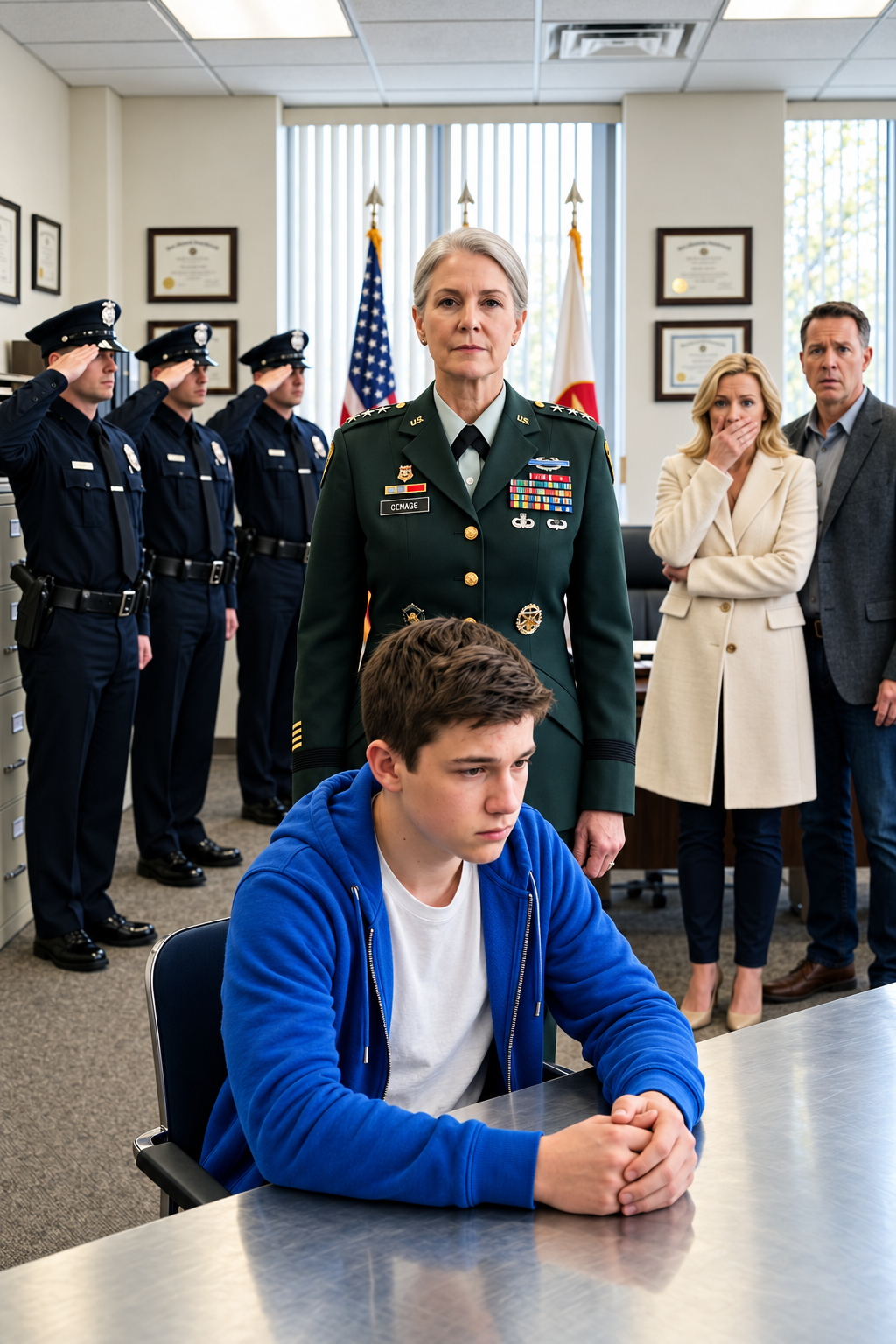
PART 1 TITLE: At 2:47 in the Morning, a Frightened Grandson Called the One Person Who Had Never Stopped Listening to Him
“Grandma, please don’t hang up. Lydia told the police I attacked her, and Dad believes every word. I’m at the station, and I don’t know what they’re going to do to me.” Noah’s voice came through the telephone in a strained whisper, interrupted by the unmistakable sound of someone struggling to keep from crying. Eleanor Grant sat upright before she was fully awake. The digital clock beside her bed showed 2:47 a.m. For a moment, she heard only her grandson’s uneven breathing and the faint murmur of voices somewhere behind him.
“I’m listening, sweetheart. Tell me exactly where you are.” Eleanor reached for her glasses, pushing aside the paperback that had slipped from her hands before she fell asleep. Her bedroom was cold enough that she could feel it through her nightgown. Noah tried to speak, stopped, and took several hurried breaths. “Lincoln Park police station,” he finally managed. “They said somebody from the District Attorney’s Office might have to get involved. Lydia says I pushed her down the stairs. Dad keeps telling everyone she’s telling the truth.”
Eleanor placed both feet on the floor. A familiar alertness settled over her, the kind she had once experienced when a telephone rang during a night shift and a stranger’s safety depended on what she did next. She had spent thirty-two years with Chicago’s Major Crimes Unit before retiring. During those years, she had listened to frightened witnesses, furious suspects, and grieving parents. She knew that a trembling voice did not automatically establish innocence. She also knew the difference between someone searching for a convincing explanation and someone terrified that the truth would never be heard.
“Before we discuss what Lydia told them, I need to know whether you’re hurt.” There was a pause, followed by the soft scrape of fabric against the receiver. “My eyebrow,” Noah answered. “She had this heavy candlestick. I was trying to get past her, and she swung it. I moved, but it caught me here.” Eleanor closed her eyes briefly. “Did anyone examine the injury?” “They put a bandage over it. There was blood on my shirt. Dad saw it, but Lydia said I hurt myself when I attacked her.”
“Was an ambulance called?” Eleanor asked. Noah said someone had checked the wound and that a further examination might be necessary. She told him not to touch the dressing or attempt to clean anything from his clothes. The old investigator in her was already organizing questions, but the grandmother had to fight the urge to drive straight to her son’s house and demand an explanation. Noah was alone in a police station at an hour when most children were asleep, and his father had apparently decided whose account mattered before asking how his own son had been injured.
“Listen carefully, Noah. Until I arrive, don’t let anyone pressure you into giving an account you aren’t ready to give. Tell the officer you’re a minor and that you want an appropriate adult with you. Don’t sign anything you don’t understand. If someone asks a question, you can tell them you’d like legal advice first.” Eleanor kept her voice calm and deliberate. She was not issuing orders as a commander. She was giving a frightened boy enough practical instructions to help him through the next twenty minutes without making his situation worse.
“Grandma?” His voice sounded younger than it had at Christmas, when she had last managed to speak with him for more than a few minutes. “What if Dad won’t let me come with you?” Eleanor stared at the dark window across her bedroom. She could make no promise about an outcome that would depend on officers, family arrangements, and the facts yet to be established. “We’ll deal with that when I get there,” she told him. “Right now, I need you to stay somewhere the officers can see you. Don’t argue with Lydia. Don’t try to convince your father while everyone is upset.”
Noah swallowed audibly. “He said he didn’t raise me to hurt women.” The words landed with a force Eleanor had not anticipated. Mark had always been capable of anger, especially when embarrassed or frightened, but she remembered him as a father who once carried Noah on his shoulders through a crowded street fair because the little boy was afraid of being separated from him. Eleanor wanted to ask what had happened to that father. Instead, she asked whether Noah could see an officer nearby and whether the officer knew he was speaking to his grandmother.
“He’s at the desk. Lydia’s with Dad. They’re not sitting with me.” There was a distant sound of footsteps, and Noah lowered his voice still further. “She keeps looking over like she wants me to stop talking.” Eleanor rose and crossed to the closet. “Then we’ll finish this conversation. Put your phone away safely and stay in your seat. If you feel threatened, tell the officer. I’ll be there shortly.” Noah hesitated. “You’re really coming?” She had to steady herself against the closet door. “Of course I am.”
The call ended after one final promise that she would come. Eleanor stood motionless for several seconds, staring at the dark screen. Then she began dressing. She chose charcoal trousers, an old gray sweater, and comfortable shoes that would allow her to move quickly despite the persistent pain in her right knee. She pulled her hair into a neat knot, washed her face with cold water, and took her car keys from the dish beside the kitchen entrance. On her way out, she stopped at the bottom drawer of her writing desk.
Inside lay a brown leather wallet worn smooth along the edges. The retirement identification was still there, alongside the shield she had carried for years. Eleanor considered leaving it behind. She had no authority to interfere in an active investigation, and she had no intention of pretending otherwise. But her former colleagues would recognize her, and she wanted the people handling Noah’s case to understand that she knew the difference between a proper inquiry and a conclusion reached too early. She slipped the wallet into her coat pocket and switched off the kitchen light.
Outside, Chicago was nearly deserted. A thin wind moved along the sidewalk, dragging scraps of paper against parked cars. Eleanor unlocked her sedan and lowered herself behind the wheel, adjusting the seat before starting the engine. The dashboard glowed blue against her hands. She entered the station’s address into the navigation system, though she knew the route well enough. She had driven those streets for decades, sometimes after terrible nights that left her desperate to see daylight. This time, the person waiting at the end of the journey was her grandson.
Noah had been seven when his mother died. Eleanor remembered the hospital corridor, the pale morning light reflected on polished floors, and Mark sitting with his elbows on his knees while a physician spoke quietly beside him. She remembered Noah asking why everyone was whispering. Nobody had known how to explain death to him in words that would make sense. During the first difficult months, he spent much of his time at Eleanor’s house while Mark struggled to return to work and establish some kind of routine. The arrangement was meant to be temporary, but it became one of the central attachments of Noah’s childhood.
She could still picture the boy standing in her bedroom doorway, wearing pajamas covered in small blue stars. He would wait until she looked up from her book before asking whether she thought his mother remembered him. Eleanor had never found an answer that satisfied either of them. She would invite him beneath the quilt and let him talk until exhaustion overtook his questions. He insisted that the hallway lamp remain on. Sometimes, when she woke in the morning, she found him curled around the same stuffed bear his mother had given him years earlier.
Mark usually came on Sundays to take him home. At first Noah greeted those visits eagerly, running to the front window whenever he heard a car slow down. Other Sundays, especially after a difficult week, he clung to Eleanor’s arm and asked to remain for one more night. Mark often agreed. He was trying to care for a child while enduring a loss neither of them could fully describe. Eleanor had understood his limitations then. She had helped with groceries, school schedules, and the ordinary details of family life, believing her son would eventually find his footing.
Years passed, and their arrangement changed. Noah grew taller and became increasingly independent, though he still liked spending weekends at Eleanor’s house. He helped her carry groceries, repaired the loose latch on her garden gate, and filled the bird feeder outside the kitchen window. He developed a habit of drawing buildings in a battered sketchbook, usually while sitting at the same table where he once completed his spelling exercises. Eleanor kept spare pencils in a cup for him. His visits were never elaborate occasions. He seemed happiest when he could simply exist without having to explain himself.
Then Mark met Lydia. Eleanor remembered their first dinner together, when Lydia arrived carrying a bakery box tied with ribbon and complimented the furniture before taking off her coat. She was attractive, composed, and attentive to Mark in ways that initially relieved Eleanor. She asked Noah about school and listened politely when he spoke about his drawings. Eleanor had seen families struggle after remarriage, particularly when a child was still grieving a parent. She wanted Lydia to feel welcome rather than inspected. She invited her to lunch several times and bought her a blue blouse for Christmas.
For a while, the relationship appeared promising. Lydia drove Noah to school when Mark worked early. She attended a parent meeting and remembered the name of one of his teachers. Eleanor thanked her for taking an interest. She also tried not to interfere with the decisions being made in Mark’s home. A new marriage needed space, she told herself, and Noah needed an opportunity to develop his own relationship with his stepmother. Looking back, Eleanor wondered whether her determination to avoid becoming an intrusive mother-in-law had made her too willing to accept assurances that everything was fine.
The first troubling comment had sounded ordinary enough. Lydia mentioned during a family meal that Noah had recently become argumentative. Mark nodded, clearly embarrassed. Eleanor asked whether something specific had happened, but Lydia only smiled and said teenage moods could be exhausting. A few weeks later, Lydia described Noah as manipulative, claiming he used the memory of his mother whenever he wanted something his father had refused. Eleanor glanced at her grandson, who had gone very still. He did not defend himself. He pushed a piece of potato around his plate and asked to be excused.
Other remarks followed. According to Lydia, Noah deliberately created tension before important family occasions. He resented seeing Mark happy. He preferred Eleanor’s house because she never enforced rules. Whenever Eleanor questioned those claims, Lydia produced a plausible explanation, often accompanied by an affectionate hand on Mark’s arm. The details were difficult to verify. A missed assignment could be ordinary forgetfulness. A canceled weekend could result from schoolwork or family commitments. Eleanor had spent her career insisting that suspicions required evidence, and she refused to abandon that principle simply because she disliked the direction in which the family was moving.
Nevertheless, Noah’s behavior changed. He began declining invitations he had once accepted without hesitation. When Eleanor called on Friday evenings, he sometimes sounded distracted, answering with a few hurried words before ending the conversation. Lydia explained that he was busy with school. Mark said his son needed to learn responsibility instead of depending on his grandmother for everything. Eleanor tried suggesting shorter visits or meeting at a nearby restaurant. There always seemed to be a reason those arrangements could not work. Eventually, weeks passed between occasions when she saw him in person.
One afternoon, Eleanor found Noah standing beside her car after a family birthday lunch. Lydia and Mark were still inside the restaurant. Noah had his hands pushed deep into his jacket pockets, and he kept glancing toward the entrance. “Are you doing all right?” Eleanor asked. He nodded too quickly. When she offered to take him somewhere for the afternoon, he looked at her with an expression she had difficulty forgetting. He almost said something. Then Lydia appeared at the doorway and called his name. Noah turned away before Eleanor could ask another question.
Eleanor raised her concerns with Mark that evening. She told him Noah seemed withdrawn and that Lydia’s descriptions did not match the boy she knew. Mark became defensive almost immediately. He accused her of encouraging Noah to avoid responsibility and said Lydia was working harder than anyone understood to maintain order in their household. “You only see him when he’s on his best behavior,” he told her. Eleanor asked whether he had considered that Noah might behave differently because he felt differently in the two homes. Mark ended the conversation by saying he would handle his own family.
Those words had remained between them for months. Eleanor respected a parent’s responsibility, but she did not believe marriage gave adults the right to disregard a child’s distress. She considered contacting Noah’s school, yet she also knew that acting without clear information could provoke greater conflict at home. She continued reaching out. She sent birthday cards, invitations, and short messages reminding Noah that he was welcome. Some received brief replies. Others went unanswered. She kept a record of the canceled visits because the excuses had begun to repeat themselves. More than once, she considered driving over and insisting on speaking to him privately.
The road ahead opened as Eleanor reached Lake Shore Drive. Streetlights formed long reflections across the pavement, and the dark expanse of Lake Michigan lay beyond the barrier. She remembered something Noah had said several weeks earlier during a rare telephone conversation. He had asked whether she still had the blue quilt from his childhood. When she answered yes, he laughed awkwardly and said he had only been curious. Now she wondered whether the question had been a cautious attempt to find out whether there was still a place for him if he needed one.
Her phone remained silent on the passenger seat. Eleanor checked it at a red light, resisting the temptation to call Noah again. She did not want him reprimanded for speaking while officers were questioning him, and she had already given him the essential instructions. Her mind returned to his injury. A heavy candlestick, a wound near the eyebrow, an accusation that he had shoved Lydia down the stairs. Those facts could fit several possible sequences, and Eleanor was not prepared to declare any one of them established. What disturbed her most was that Mark apparently treated the accusation against his son as settled while Noah’s injury remained unexplained.
She also knew how much damage could be done during the first hour after a violent family confrontation. People spoke over one another. Someone with confidence could become the center of attention while a quieter person withdrew. Once a version of events entered an official report, correcting it required patience and reliable evidence. Eleanor had seen investigations recover from early mistakes, but she had also seen the consequences when officers stopped asking questions because a convenient account seemed sufficient. Noah would need more than his grandmother’s certainty. He would need someone to listen closely enough to establish what had actually happened.
At 3:05 a.m., Eleanor turned onto the street leading toward the station. She passed a closed convenience store, a row of empty parking spaces, and a delivery truck idling beside the curb. A police vehicle stood outside the building with its engine running. Through the glass entrance, she could make out a reception counter and a young uniformed officer sitting beneath fluorescent lights. Eleanor parked, gathered her handbag, and remained seated for a moment. She could feel the old ache in her knee, but something deeper troubled her. She had spent years recognizing danger in strangers. Tonight she was about to confront what might have happened inside her own family.
She stepped onto the pavement and walked toward the entrance. The building’s windows reflected her gray sweater and the dark coat she had thrown over it. She no longer looked like the woman whose arrival once made detectives straighten in their chairs. That did not matter. What mattered was the child somewhere beyond those doors, probably sitting with his injured face lowered while adults discussed his future. Eleanor pushed the glass door open. The young officer glanced up from his paperwork, beginning the routine greeting used for visitors arriving after hours.
She approached the counter and gave Noah’s full name. When the officer asked what relationship she had to him, Eleanor reached into her coat and took out the old leather wallet. The metal shield caught the overhead light as she opened it. The officer’s eyes moved from the identification to her face. He stopped writing. His expression changed so abruptly that Eleanor knew he recognized her, even though they had never met. He rose halfway from his chair, and she heard him draw in a breath before speaking.
END PART 1
PART 2 TITLE: Inside a Chicago Station, a Retired Commander Faced Her Son’s Certainty and Found One Detail His Wife Could Not Explain
“Commander Grant?” The young officer’s voice was scarcely louder than the humming lights above his desk. Eleanor recognized the reaction, though she had never enjoyed it. She had trained enough officers during her final years in service that her name still circulated through parts of the department. Some remembered her investigations. Others remembered the exacting standards she expected from anyone working beneath her command. Tonight, however, she was not interested in her reputation. “I’m retired,” she said, closing the leather wallet. “I’m here as Noah Grant’s grandmother. Please tell me where he is.”
The officer recovered his composure and glanced toward the waiting area. “He’s with family, ma’am. We’ve been taking statements concerning a domestic disturbance.” Eleanor followed his gaze. At the far end of the room, Noah sat alone in a molded plastic chair, his backpack resting between his shoes. A white dressing covered part of his left eyebrow, and a faint stain marked the collar of his sweatshirt. His shoulders were drawn inward, as though he had been trying to occupy as little space as possible. Eleanor could see his hands trembling even from across the room.
Mark stood several feet away near a vending machine, his arms folded tightly across his chest. Lydia sat beside him, wearing a pale coat over carefully coordinated clothes. Her hair was still neatly arranged despite the late hour. One hand rested against her side, and a tissue lay folded in her lap. She appeared distressed whenever someone looked directly at her, but between those moments Eleanor noticed how attentively she watched the officers. Lydia saw Eleanor almost immediately. Her posture stiffened, though the expression she offered was one of injured surprise rather than anger.
Noah raised his head when he heard Eleanor’s shoes against the floor. Recognition crossed his face, followed by something so unguarded that she felt the effort it cost him not to run toward her. She went directly to him and crouched beside his chair, ignoring the protest from her knee. Up close, the injury looked worse. Dried blood remained near the edge of the dressing, and the skin around his eye had begun to swell. “May I see how you’re doing?” she asked. Noah nodded, but when she reached toward the bandage, he instinctively moved his head away.
Eleanor withdrew her hand at once. “All right. I won’t touch it.” Noah stared at her, embarrassed by his reaction. She placed her palm on the empty chair beside him instead. “You don’t have to apologize. Have you been dizzy? Any trouble seeing?” He shook his head. “It stings when I move my forehead.” She told him she would make sure the injury received the attention it needed. He looked down at the sleeve of his sweatshirt and rubbed the fabric between his fingers. His breathing was quieter than it had been on the telephone, though he remained visibly frightened.
Mark crossed the waiting room before Eleanor could ask another question. “Mom, why are you involving yourself in this?” His voice was low and controlled, but his expression suggested he had been preparing the sentence since seeing her enter. Eleanor straightened slowly. “Because Noah called me after being brought to a police station with an injured face,” she answered. “I didn’t know you were coming,” Mark said. “He shouldn’t have dragged you out of bed.” Eleanor looked at him for several seconds. She had taught him to drive in a parking lot not far from this building. She could scarcely recognize the reasoning he was using now.
“Did you know he was hurt when he called me?” she asked. Mark’s gaze moved briefly toward Noah. “Of course I knew. Nobody’s ignoring that. But there’s more to the situation than what he told you.” Lydia rose from her chair and approached them, keeping one hand pressed to her ribs. “Eleanor, I wish you hadn’t come into this without speaking to us first. Everyone is upset. Noah has been difficult for weeks, and tonight he lost control.” Her delivery was gentle, almost apologetic. Eleanor noticed that she directed most of her words toward the officer standing behind the counter.
“Then I’d like to hear what happened from each of you,” Eleanor replied. Lydia gave a tired sigh. “We were having a family disagreement. He became furious when Mark refused to let him spend the weekend at your house. Things escalated, and he pushed me near the staircase. I could have been seriously hurt.” Mark nodded, apparently relieved that Lydia had taken over the explanation. “That’s essentially what happened,” he said. “Noah’s been getting increasingly hostile. I warned him earlier that he couldn’t keep speaking to Lydia the way he does.”
Noah looked up sharply. “I didn’t push her.” His voice shook, but he kept his eyes on his father. Mark’s face tightened. “We’ve already discussed this. You’re making things worse by refusing to accept responsibility.” Noah opened his mouth and then closed it again. Eleanor recognized the movement: the calculation of someone deciding whether correcting a false statement would bring another reprimand. She stepped slightly to one side, placing herself where Noah could see her without having to look past Mark. “I’d like him to finish speaking,” she said. “That shouldn’t be a problem if we’re trying to understand what happened.”
Lydia folded her arms. “You know how persuasive he can be. He tells you whatever he thinks will make you take his side.” Eleanor turned toward her. “You believe he deliberately invented an account involving that wound?” Lydia hesitated. “Children exaggerate when they’re emotional. He might have bumped into something during the struggle.” Eleanor considered the wording. The story was already changing from a deliberate attack to a struggle involving uncertain movements. She did not challenge Lydia on that point yet. Instead, she looked toward the officer at the desk and asked whether Noah had been informed of his rights and whether arrangements had been made for an appropriate adult to be present if further formal questioning was required.
The young officer explained that initial information had been collected and that Captain Miller was reviewing the circumstances. Eleanor thanked him and requested a chance to speak with Noah without interruption. Mark looked offended. “I’m his father.” “Yes,” Eleanor said. “And right now he’s afraid to contradict you.” The sentence stopped Mark briefly. He glanced toward his son, then away again. Lydia opened her mouth, but Eleanor continued before she could speak. “I’m not asking anyone to declare a conclusion. I’m asking that Noah be heard without being corrected after every sentence.”
The officer offered them a quieter space near the interview rooms. Captain Miller had not yet returned, so Eleanor remained in the waiting area where staff could observe. She sat beside Noah rather than standing over him. “Start before the argument,” she said. “Tell me about the weekend.” Noah stared at the floor. “I asked Dad at dinner if I could visit you. I hadn’t been over for a long time, and I thought maybe this weekend would work because I don’t have much homework.” He glanced at Mark. “You said we’d talk about it after you changed.”
Mark rubbed his forehead. “I said we’d consider it.” Noah nodded without arguing. “You went upstairs. Lydia followed me when I left the kitchen.” He paused, looking toward his stepmother. Lydia shook her head as though listening to something tiresome. Eleanor waited. Eventually Noah continued. “She said I was making Dad feel guilty on purpose. She said I kept trying to split the family apart and that he was getting tired of it.” His voice dropped on the last phrase. “I told her I only wanted two nights away. That’s when she started saying I wasn’t going to have a choice much longer.”
“What choice did she mean?” Eleanor asked. Noah rubbed his palms against his trousers. “She said Dad was thinking about sending me to stay with relatives in Ohio. She told me maybe that would teach me to appreciate what I had.” Mark’s expression changed. “I never said that,” he muttered. Lydia responded immediately. “We talked about how difficult things had become. I might have mentioned that other family members could help if he kept refusing our rules.” Noah shook his head. “You said you’d make sure he sent me away. That’s not the same thing.”
Eleanor studied Mark. She could see that Noah’s account contained information he had apparently never been given. “Had you actually discussed sending your son to Ohio?” she asked. Mark hesitated. “Only as an option. Lydia thought a change of environment might be good for him.” “Did Noah know that?” “We hadn’t made any decisions.” Eleanor allowed the answer to stand. What concerned her was not merely the possibility of another living arrangement. It was that Lydia had used a discussion between adults to frighten a child who was already anxious about being separated from his family.
“Tell me what happened after she mentioned Ohio,” Eleanor said. Noah drew a long breath. “I told her I wasn’t going anywhere unless Dad told me himself. She said I had no right to make demands. I tried to walk past her because I didn’t want another argument.” His hand moved toward the dressing. “She was standing near the little table in the hallway. There’s a metal candlestick on it. She picked it up while she was talking.” Lydia made an impatient noise. “I was moving things off the table because he was throwing his arms around.” Noah looked startled. “I wasn’t.”
Eleanor turned toward Lydia. “You say Noah pushed you toward the stairs?” Lydia lifted her chin. “Yes. I nearly fell.” “Were you holding the candlestick at that moment?” “I don’t remember every second. I was frightened.” Eleanor accepted that memory could be fragmented after a frightening event. She also knew that people sometimes remembered the parts most favorable to them with surprising precision. “Then let’s take it one detail at a time. When Noah pushed you, which hand did he use?” Lydia frowned. “What difference does that make?” “It may help clarify where each of you was standing.”
“Both hands,” Lydia replied after a short pause. “He put both hands against me.” Noah’s fingers tightened around his sleeve. “I had one hand over my face,” he said quietly. Mark turned toward him. “At what point?” “After she hit me. I kept my hand there because it was bleeding.” Eleanor looked between them. “And you’re saying the alleged push happened after that injury?” Noah nodded. Lydia’s lips pressed together. “It happened quickly. He could have moved his hand. I couldn’t possibly remember every motion.” Eleanor made no triumphant gesture. The answer did not conclusively establish what happened, but it introduced a question that required investigation.
Mark seemed uncertain for the first time since Eleanor had arrived. He looked at Noah’s bandage, then at Lydia’s hand resting against her side. “You told me he pushed you before you picked up the candlestick,” he said. Lydia turned sharply. “Because that’s what I remember. Are you suggesting I’m lying?” Mark immediately lowered his gaze. Eleanor saw the familiar exchange unfold: a straightforward question became an accusation of disloyalty, leaving the person who asked it struggling to defend his intentions. She had encountered that pattern in interviews before. Seeing her son respond to it was considerably more painful.
An older officer emerged from the corridor carrying a folder. He stopped when he recognized Eleanor. “Commander Grant.” She turned. “Captain Miller. I didn’t realize you were working nights.” He offered a tired smile. “Neither did I when I accepted this assignment.” His attention moved to Noah and then to the two adults standing nearby. Something in his expression changed. “I’ve reviewed the initial report,” he said. “Would you mind stepping into my office for a moment?” Eleanor glanced at Noah before answering. “Only if he knows where I’ll be, and only if someone remains available to him.”
Miller spoke to the desk officer, asking him to keep the waiting area under observation. Eleanor leaned toward Noah. “I’m going a few steps down the hall. You can see the office from here.” Noah nodded and pulled his backpack closer with his feet. She noticed the movement but did not question it. His possessions were probably the only familiar things he had brought from home. As she stood, Lydia moved beside Mark and whispered something Eleanor could not hear. Mark looked troubled rather than reassured. The captain held the office door open, and Eleanor followed him inside.
Miller waited until the door was mostly closed before speaking. His office was small, crowded with folders and a coat hanging from the back of a chair. A paper cup of coffee sat untouched beside his computer. “I’ve got conflicting accounts,” he began. “Your grandson has a visible injury, and Mrs. Grant reports being pushed. We don’t have an independent witness to the actual contact.” Eleanor nodded. “Then the evidence matters.” Miller gave her a long look. “That’s why I wanted you to see something. We tried to obtain footage from the hallway security system at their residence.”
Eleanor moved closer to the desk as Miller brought up the notes. The property had cameras positioned to cover parts of the interior hallway, including the area near the staircase. Ordinarily, such footage might have helped establish the sequence of events. But the system was listed as unavailable for the relevant period. “When did it stop working?” Eleanor asked. Miller turned the screen slightly. “A malfunction was logged at 11:08 p.m. The emergency call was made at 2:39 a.m.” Eleanor examined the two times. More than three hours separated them, and the reported malfunction had occurred well before anyone contacted emergency services.
“Who reported the malfunction?” she asked. Miller shook his head. “We don’t have that information confirmed yet. The technical records still need to be obtained. There could be a routine explanation, but the timing means we have to examine it.” Eleanor agreed. She had seen equipment fail at inconvenient moments, and she knew coincidence was not a crime. Yet the missing footage mattered because the two accounts could not both be entirely correct. “Preserve whatever system records are available,” she advised. “And make sure nobody assumes the absence of video supports either person.”
Miller sat back. “There are other things that concern me. The boy’s injury needs to be fully documented. I’m also not comfortable with how much pressure he’s under from the adults involved.” Eleanor looked through the office window. Mark stood near the far wall, rubbing his hands together. Lydia had shifted closer to the entrance, where she could see the corridor. Noah remained seated, his backpack balanced against his legs. The scene appeared ordinary until Eleanor noticed Lydia’s gaze moving repeatedly between Miller’s office and the boy. She was paying more attention to what might happen next than to her husband’s distress.
Eleanor remembered Lydia’s remarks about Noah being manipulative, irresponsible, and determined to damage the marriage. Each accusation had been presented as a concern for the household. Yet the boy Eleanor had known since birth was sitting silently in a police station, afraid to contradict his father. She reminded herself that affection was not evidence, and that the investigation had to remain fair. Even so, she could no longer dismiss the possibility that Lydia’s stories had served a purpose beyond describing Noah’s behavior. The missing camera footage made the need for independent evidence more urgent.
“Has anyone asked Noah whether he has messages or other material related to what happened?” Eleanor asked. Miller glanced toward the window. “We haven’t completed that part of the interview. The first priority was separating accounts and getting the injury looked at.” Eleanor nodded. “He may have something relevant. Don’t let anyone search his belongings without following the proper procedure, but give him a chance to tell you what he has.” Miller agreed. They turned toward the door, ready to return to the waiting area and continue the inquiry in a more orderly way.
Before Eleanor moved, she noticed Noah bend over his backpack. He appeared to be searching for something beneath a school notebook. Lydia saw the movement almost immediately. Her expression changed. She took one hurried step toward him, then stopped when the desk officer glanced up. Mark said something, but she did not answer. Eleanor watched the color drain from Lydia’s face as Noah’s fingers closed around an object inside the bag. It was the first time that night Lydia had looked genuinely frightened, and her attention was fixed not on Noah’s injury but on what he was about to take out.
END PART 2
PART 3 TITLE: The Boy Reached for a Cracked Phone, and His Stepmother’s Carefully Prepared Account Began to Come Apart Before Anyone Pressed Play
Eleanor opened Captain Miller’s office door just as Lydia moved toward Noah. The sudden movement was unmistakable. Until that moment, Lydia had been carefully presenting herself as the injured adult trying to manage a difficult family crisis. Now she was crossing the waiting room with an urgency that had nothing to do with her supposed injuries. Noah looked up, startled, and pulled his backpack closer. “What are you doing?” Lydia demanded. “You don’t need to be going through that right now.” The desk officer rose, uncertain whether he was witnessing another argument or something more serious.
Miller stepped into the corridor. “Mrs. Grant, please return to your seat.” Lydia stopped but did not sit down. “He has things in that bag that belong to our household,” she said. “I purchased most of his school supplies. I don’t want him losing anything important.” Eleanor glanced at the backpack. It was a faded black canvas bag with one broken zipper pull and a small ink stain near the front pocket. Whatever Lydia had paid for it, Noah had been carrying it to school for years. Her sudden concern over its contents seemed difficult to reconcile with her indifference to the wound above his eye.
Eleanor sat beside her grandson. “Noah, were you looking for something you wanted the captain to see?” He nodded without meeting her eyes. “My phone.” Mark frowned. “You had your phone this whole time? I thought you weren’t supposed to be using it after the argument.” Noah swallowed. “They let me call Grandma. Then I put it away.” Lydia gave a short laugh that sounded strained. “Of course he called you. That’s always what he does when he wants somebody to defend him.” Eleanor ignored the accusation and asked Noah whether there was something specific on the device.
“I think there might be,” he answered. His uncertainty was genuine. He had not been reaching for a carefully prepared defense. He seemed afraid that what he remembered saving might no longer exist. Eleanor leaned closer. “You don’t have to explain everything at once. Tell Captain Miller what you believe is there.” Noah looked toward the captain, then at Mark. The boy’s face tightened. “Earlier tonight, before everything happened, I was sending Grandma a message. Lydia came into the hallway and started arguing with me. I opened the recorder because I knew what she’d say afterward.”
For several seconds, nobody spoke. Mark stared at his son. “You recorded Lydia?” Noah nodded. “I didn’t know how else to make you understand.” His father started to respond, but Lydia interrupted. “That’s unbelievable. He was secretly recording conversations in our own home?” She turned toward Miller. “Surely you can see what kind of behavior we’re dealing with. He’s been trying to create problems between us for months.” Eleanor watched Noah’s face. The boy did not appear pleased with himself. His shoulders sagged, and he looked almost ashamed that he had taken the precaution.
Miller addressed Lydia calmly. “Nobody is drawing a conclusion from that information alone. But if the recording relates to the incident, we need to understand what it contains.” Lydia shook her head. “He could have manipulated it. There are applications that let people change voices and cut conversations apart. I don’t know what he’s been doing with that phone.” Eleanor noticed how quickly Lydia had developed an explanation for material she had not yet heard. A recording could certainly be altered, and its authenticity would need examination. But the possibility of alteration was not a reason to refuse to look at potentially relevant evidence.
Noah opened the backpack and searched beneath a mathematics workbook. He withdrew a smartphone with a cracked corner and a protective case whose blue edges had begun to peel. Eleanor recognized it immediately. She had bought him the case for his birthday, choosing the color because it matched the quilt he used to keep on her guest bed. Noah balanced the device in his injured hand. His fingers trembled badly enough that he nearly dropped it. Before he could unlock the screen, Lydia extended her hand. “Give that to your father. We can sort out whatever is on there at home.”
“No,” Noah said. The word was almost inaudible, but Eleanor heard it. Lydia stared at him as though he had committed a serious offense simply by refusing. “Excuse me?” Noah moved the phone behind his knee. “I want the captain to see it.” Mark shifted his weight, visibly uncomfortable. Under ordinary circumstances, he might have ordered his son to obey Lydia. Eleanor watched him struggle with that impulse. “Noah,” he began, “you can’t just—” Miller raised one hand. “Mr. Grant, allow him to explain what he has. We’ll determine the appropriate procedure for reviewing it.”
Lydia moved forward again. The desk officer stepped into the open space between her and Noah, and Miller asked her firmly to remain where she was. She looked at Mark, apparently expecting him to object to being told what his wife could and could not do. Mark did not move. He was looking at the phone. Eleanor suspected he was beginning to understand something his son had been trying to communicate for months: Noah did not trust the adults in his home to treat his words fairly. That loss of trust had become so complete that he had felt compelled to preserve evidence of an ordinary household conversation.
Noah tried to enter his passcode. He made a mistake, erased the numbers, and began again. The screen rejected the second attempt as well. His breathing became shallow. “I know the code,” he said quickly. “My hands are just shaking.” Eleanor placed her hand on the armrest beside him. “There’s no rush. You can take a moment.” He closed his eyes and slowly counted his breaths. On the third attempt, the screen unlocked. He navigated through several applications until he found the recording folder. His thumb hovered above the most recent file, and he stared at its title.
“That’s it,” he whispered. Miller moved close enough to examine the screen without touching the device. He asked Noah when he had started recording and whether anything had been changed afterward. Noah shook his head. “I pressed record when she started talking. I put the phone in my sweatshirt pocket because I didn’t want her to grab it. After she hit me, I couldn’t think properly. I don’t remember stopping the recording.” He glanced toward Lydia. “I was scared it wouldn’t be there anymore.” His stepmother stood rigidly beside Mark, her tissue twisted into a narrow strip.
Eleanor considered the weight of Noah’s explanation. Recording someone secretly raised questions about consent, privacy, and the circumstances under which the file had been created. She would not pretend those questions were insignificant. Still, what mattered immediately was that Noah appeared to possess information that might help clarify a disputed violent incident. She asked Miller whether he wanted to document the file before listening. He agreed, and the desk officer made a note of the device and the circumstances in which Noah had produced it. They would preserve the original rather than relying on anyone’s recollection of its contents.
Lydia watched the process with growing agitation. “You’re turning this into an investigation of me,” she said. Miller looked at her. “We’re investigating what happened in your home. That includes the allegations you’ve made and the injury your stepson sustained.” She glanced at Mark. “You can’t seriously be comfortable with this.” Mark’s response came after a long pause. “If there’s a recording, we should hear it.” Eleanor saw Lydia’s expression harden. She had expected resistance from her husband on her behalf. Instead, for the first time that night, he had supported a step that might challenge her account.
Noah positioned the phone so its speaker faced the adults gathered around him. His hand was still shaking, and Eleanor offered to hold it while he pressed the controls. He declined with a small movement of his head. This was something he wanted to do himself. Miller asked everyone to remain quiet while the file played. Lydia opened her mouth, apparently preparing another objection, but the captain reminded her that she would have an opportunity to respond afterward. The room settled. Somewhere behind the reception counter, an old refrigerator compressor began humming.
The recording opened with several seconds of muffled movement. Fabric scraped against the microphone. A door closed, followed by footsteps on a hard floor. Eleanor recognized the acoustics of the narrow hallway from her visits to Mark’s house. Noah had once shown her where he kept his schoolbag beside the staircase, and she could picture the small table with the decorative candlestick on it. The first words were difficult to distinguish. Then Lydia’s voice emerged clearly enough that Mark straightened. It was familiar, but the tenderness she usually displayed in front of other adults was entirely absent.
“So this is your latest idea? You think you can keep running to Eleanor whenever things don’t go your way?” The voice from the phone was sharper than the one Lydia had used in the station. Noah’s recorded answer sounded hesitant. “I asked if I could visit her. That’s all.” Lydia responded with a bitter laugh. “You know perfectly well what you’re doing. Every time your father and I start having a peaceful week, you find some reason to make him feel guilty.” Eleanor looked toward Mark. His gaze remained fixed on the phone.
On the recording, Noah tried to explain that he had not seen his grandmother properly in weeks. Lydia dismissed the explanation. “You don’t care how much trouble you cause. You want him to believe we’re treating you badly so he’ll feel sorry for you.” Noah answered that he was not asking his father to choose between them. He only wanted to spend a weekend in a place where he felt comfortable. Lydia’s response came quickly. “You keep acting as though this house isn’t good enough. Perhaps you should live somewhere else and discover what real rules look like.”
A faint sound of movement followed. Eleanor could hear Noah shift his position, perhaps attempting to walk away. Lydia continued before he could escape the argument. She accused him of exploiting the memory of his mother and using his grandmother’s affection to avoid expectations at home. “You know how to make people pity you,” she said. “You learned that when you were little, and you’ve been doing it ever since.” Eleanor felt an ache move through her chest. She remembered the seven-year-old boy who could not sleep without the hallway lamp burning. Hearing that grief used against him made her press her fingers into the chair.
Mark seemed to recognize the cruelty before he understood its implications. He looked at Lydia, who shook her head and whispered that the recording had been taken out of context. Yet she made no attempt to explain what circumstances could justify the words. On the phone, Noah’s recorded voice became unsteady. “I’m not trying to make anybody feel sorry for me. I just want to see Grandma.” Lydia answered that he would not be allowed to divide the household any longer. Her tone was not that of a tired parent setting a boundary. It carried the certainty of someone who believed she controlled every outcome.
Then came the reference to Ohio. Lydia told Noah that his father had already considered sending him to relatives and that she could make the idea seem necessary. “He trusts me when I tell him what’s happening here,” she said. “If I explain that you’re becoming impossible to manage, he’ll listen.” Noah asked whether Mark had really agreed to send him away. Lydia replied that the decision would become much easier if Noah kept challenging her. Mark lowered his gaze. Eleanor saw him remembering their conversation in the waiting room, when he had insisted no decision had been made.
The recorded Noah spoke again, barely above a whisper. “You keep telling Dad things I never did.” Lydia challenged him to prove it. She listed occasions when Mark had believed her version of an argument and reminded him that his father was tired of his behavior. Noah said he had tried to explain before, but Mark would not let him finish. Lydia responded that adults were responsible for deciding what happened in the family. Then she said something that made Eleanor turn toward her son: she could convince Mark that Noah’s emotions had become so unstable that sending him away would be the responsible choice.
Mark’s face changed. He was no longer listening with the guarded expression of a father trying to evaluate a disciplinary disagreement. He seemed to be recognizing conversations he had once accepted without question. Eleanor remembered how frequently Lydia had described Noah as emotionally troubled, difficult, and in need of stricter supervision. Those claims had not appeared suddenly. They had been repeated until they became part of the family’s explanation for every disagreement. Now, for the first time, Mark was hearing his wife describe how she intended to use his trust against his son. He leaned forward but did not interrupt.
On the recording, Noah asked Lydia to let him return to his room. She told him to remain where he was. The footsteps became more distinct, followed by a light metallic sound. Eleanor pictured the decorative candlestick and tried not to interpret the noise before hearing what followed. Noah’s voice sharpened with alarm. “Why are you holding that?” Lydia told him to stop acting frightened. He asked her to put it down. There was a short silence, interrupted by the sound of fabric rubbing against the microphone as he apparently moved away.
“Please move,” Noah said on the recording. “I don’t want to fight.” Lydia accused him of threatening her by approaching the staircase. He insisted he was only trying to get past. Then came the unmistakable sound of sudden movement, followed by a heavy knock and Noah crying out. The microphone scraped loudly against something, perhaps his sweatshirt or the wall. Eleanor felt herself straighten. She had heard enough recordings during her career to know that sound alone could not establish the exact physical movement involved. Nevertheless, the sequence contradicted Lydia’s description of a boy who had initiated an unprovoked attack.
For several seconds, the recording captured Noah breathing rapidly. He asked Lydia why she had struck him. She responded with an accusation, insisting he had forced the situation by refusing to obey. Noah said his face was bleeding. Lydia told him to stop exaggerating and warned that his father would not be pleased when he heard about the confrontation. A quieter voice, unmistakably Noah’s, asked whether she intended to tell Mark what had happened. Lydia’s reply was cold. She said Mark already knew how difficult Noah could be and that he would trust his wife over a child who had been causing problems for months.
The final moments were confused. Eleanor heard hurried footsteps, another door opening, and Noah calling for his father. Lydia’s voice rose as though she were suddenly frightened. She shouted that Noah had pushed her and ordered him to stay away. The change in her delivery was abrupt enough that Eleanor glanced at Miller. He was listening intently, his expression unreadable. A male voice could be heard in the distance, followed by overlapping speech that was too distorted to identify clearly. Then the file ended. The phone returned to its recording list, leaving only the fluorescent lights and the low hum of the refrigerator.
Noah kept his thumb on the edge of the phone. Nobody spoke at first. Eleanor could see that listening had cost him nearly as much as remembering. He stared at the floor, apparently waiting for the adults to announce that the recording meant nothing. Lydia broke the silence. “This is absurd. There’s no way of knowing whether he changed it.” Miller replied that the file would require examination and that he was not going to make an evidentiary ruling in the waiting room. Still, he acknowledged that the material raised serious questions about the statements already given.
Mark turned toward his wife. His expression was no longer angry in the way it had been when he first approached Eleanor. He looked bewildered, as if something he had relied on for years had abruptly become impossible to recognize. “You told me he came at you,” he said. Lydia lifted her chin. “He did.” Mark glanced at Noah’s dressing, then at the phone. “I heard you threaten him. I heard him ask you to put something down.” Lydia reached for Mark’s sleeve, but he moved his arm away. It was a small motion, almost involuntary, and Eleanor noticed it.
“Mark, you know what he’s like,” Lydia said. “He’s been trying to turn you against me since we married.” For years, that argument had ended their disagreements. Eleanor watched her son search his wife’s face, waiting for an explanation that could reconcile what he had just heard with everything he had been told. None came. Lydia repeated that Noah could not be trusted, then accused Eleanor of orchestrating the entire situation. Mark scarcely seemed to hear her. He looked toward Noah, who remained motionless in the chair, and said in a voice stripped of anger, “I heard what you said to him, Lydia.”
Eleanor saw the moment her son understood that this was not simply another dispute between his wife and his child. Whatever further investigation established about the physical struggle, the recording had revealed deliberate threats and an intention to exploit his trust. He had spent months treating Noah’s pleas as evidence of disobedience. Now those same pleas were coming from a speaker, beyond the reach of Lydia’s interruptions. Mark looked directly at his son. Noah raised his eyes reluctantly, with none of the relief Eleanor might once have expected. The boy was waiting to discover whether his father would believe him this time.
END PART 3
PART 4 TITLE: When the Recording Stopped, a Father Had to Hear the Son He Had Repeatedly Chosen Not to Believe
The silence following Mark’s words was interrupted by Lydia’s sharp intake of breath. She stared at her husband as though he had betrayed her. “You’re accepting his version over mine because of one recording?” she demanded. Mark did not respond immediately. He was looking at Noah’s injured eyebrow. The dressing had shifted slightly, exposing the bruised skin beneath it. Eleanor watched him take in the injury properly for what seemed to be the first time. Until then, he had treated the bandage as an unfortunate detail within Lydia’s larger accusation. Now he was beginning to ask how it had come to be there.
“Why didn’t you tell me you threatened to send him away?” Mark asked. Lydia looked toward the officers, apparently aware that the conversation was drawing attention. “We discussed getting him help. You’re making it sound as though I was plotting something terrible.” Mark shook his head. “You said you could convince me he was unstable. You said I’d take your word for it.” Lydia answered that she had been frustrated and had said things she did not mean. Eleanor understood that people sometimes spoke harshly during arguments. But Lydia’s words had described a course of action, and Noah’s behavior suggested he had been living with the consequences.
Noah finally spoke. “Dad, I tried to tell you.” His voice was so quiet that Mark moved closer to hear him. “I told you she said things when you weren’t around. I told you she kept threatening to send me away.” Mark opened his mouth, perhaps to explain why he had dismissed those conversations, but stopped. Noah’s eyes filled. “Every time I tried, you asked what I’d done to upset her. You never asked why I was scared.” Eleanor felt her throat tighten. She had expected Noah to be angry. Instead, he sounded exhausted by the work of trying to make his own father understand him.
Mark took a step toward his son. Noah immediately leaned back. The movement was slight, but Mark noticed and stopped. “I’m sorry,” he said. Noah looked down. “You said that before, when you yelled at me for calling Grandma without asking. Then the next week you believed her again.” Mark lowered his hands. He seemed to understand that an apology could not erase the history Noah was describing. The boy had heard promises before. What he wanted now was evidence that something would be different, and his father had given him very little reason to expect it.
Lydia made an impatient sound. “I can’t believe I’m being treated like a criminal after everything I’ve done for this family.” She looked at the captain. “Do you know how much work it takes to raise a child who constantly rejects you?” Mark turned toward her, but she continued. She listed meals she had cooked, school journeys she had made, clothes she had purchased, and sacrifices she believed had gone unappreciated. Her voice grew louder as she spoke. Finally, she complained that she had rearranged her entire life to care for a boy who was not biologically hers.
Noah’s face drained of color. Eleanor recognized the expression. She had seen him react that way at the birthday lunch when Lydia called him difficult, and again during the telephone conversation when he had mentioned the blue quilt. He had heard some version of that accusation before. Eleanor looked at Lydia. “You chose to marry a man who already had a son,” she said. “Noah wasn’t a debt you acquired and could demand repayment for.” Lydia stared at her, furious. Mark said nothing. The absence of his customary defense seemed to disturb his wife more than Eleanor’s words.
Captain Miller intervened before the argument continued. He told Lydia that investigators needed to clarify several aspects of the incident and that she would be speaking separately with an officer. Lydia protested that she had already explained what happened. Miller replied that the new information required additional questions. She asked to speak privately with Mark first. The captain refused for the time being, explaining that statements should be obtained independently. Lydia looked at her husband again, apparently expecting him to challenge the decision. Mark remained beside the empty chair, staring at the floor.
An officer escorted Lydia toward a room farther down the corridor. She walked slowly at first, holding her side and looking over her shoulder. When Mark failed to follow, her pace quickened. Eleanor watched until the door closed. She had expected Lydia to continue defending her account, and she knew the investigation was far from complete. But the atmosphere in the waiting area changed once she was gone. Noah loosened his grip on his backpack. Mark sat opposite them, leaning forward with his hands clasped. For the first time since Eleanor arrived, nobody was telling the boy what he ought to feel.
Miller explained that Noah’s phone would need to be preserved as potential evidence. The officers would document its condition and follow the appropriate procedures for obtaining and examining the recording. Noah looked alarmed. “Will I lose it?” he asked. Miller assured him that the device would be handled through the evidence process and returned when it could properly be released. He could not promise a particular date. Noah hesitated before surrendering it. Eleanor knew the phone was more than an electronic object to him. It had given him a way to preserve his own experience when he no longer trusted anyone to describe it accurately.
Before handing it over, Noah glanced at Eleanor. “What if they say the recording isn’t enough?” She could hear the fear beneath the question. “Then the investigation continues,” she said. “They’ll look at the other evidence, the medical information, and everyone’s statements. You don’t have to prove everything by yourself tonight.” Noah frowned. “But if I hadn’t recorded her, nobody would believe me.” Eleanor reached for his hand. “I listened to you before I knew that file existed.” His eyes filled again. “You did,” he whispered, as though recognizing that fact for the first time.
He bent forward abruptly, pressing one hand over his mouth. Eleanor moved beside him and rested her palm against the back of his head. Noah tried to contain himself, but his shoulders shook. There was no dramatic outburst, only the uneven breathing of a boy who had spent too long holding himself together. Eleanor let him cry without insisting that everything would be all right. She could not promise him that. There would be difficult conversations, legal decisions, and perhaps painful discoveries ahead. For the moment, she could offer a chair beside him and the certainty that he would not have to face those things alone.
Mark watched them from across the room. Once, he had known how to comfort Noah. Eleanor remembered the two of them repairing a bicycle together, laughing over a stubborn wheel that refused to fit into place. She remembered Mark kneeling beside his son’s bed after a nightmare and waiting until the boy fell asleep again. Those memories made the present scene more difficult, not less. Mark had not always been an indifferent father. He had become one gradually, explaining away small failures until they formed a pattern. Eleanor hoped he understood that Noah could not simply return to trusting him because Lydia’s account had been challenged.
“I didn’t realize how bad things were,” Mark said. Eleanor looked at him. “Noah told you he was unhappy.” Mark rubbed his face with both hands. “I thought he was having trouble accepting the marriage. Lydia kept telling me he needed boundaries.” Eleanor waited until he looked up. “You were entitled to set reasonable rules. You were not entitled to stop listening when he said something was happening to him.” Mark’s eyes reddened. He began to speak, then shook his head. Eleanor could see how badly he wanted an explanation that would reduce his responsibility. None would change what Noah had experienced.
“I thought he wanted me to choose,” Mark admitted. “Every argument seemed to turn into a question about whether I loved him or Lydia more.” Eleanor considered her response carefully. “He asked to visit his grandmother. He asked to keep his belongings. He asked you to hear his side of a disagreement. Those aren’t demands that a father reject his wife. They’re ordinary needs.” Mark stared at his clasped hands. “Lydia made it sound different.” “And when Noah said it was different,” Eleanor replied, “you treated that as another reason not to believe him.”
Mark looked toward his son. “I failed to protect you.” Noah wiped his face with his sleeve. He did not answer, and Eleanor did not urge him to. The boy had spent months being expected to accommodate the emotional needs of adults. He should not have to console his father now. Mark appeared to understand that, at least for the moment. He remained seated rather than crossing the room again. His regret was visible, but Eleanor knew regret could become another burden if Noah was made responsible for relieving it.
Captain Miller returned to explain the next stage of the inquiry. Investigators would take a more detailed statement from Noah, including what had happened before and after the physical confrontation. Because of Noah’s age and the circumstances, the captain wanted an appropriate adult present, someone the boy trusted. He addressed the question directly to Noah rather than Mark. “Would you be more comfortable speaking with your grandmother here?” Noah nodded immediately. “Yes, please.” Eleanor felt Mark shift in his chair. She was grateful he did not object.
They entered a small interview room with pale walls, a rectangular table, and a box of tissues beside a paper cup filled with pens. Eleanor sat slightly behind Noah so he could speak for himself. Miller began with straightforward questions about the evening. He asked where Noah had been before the argument, what he remembered about the candlestick, and how he had received the injury. Noah answered slowly, sometimes stopping to correct a detail. He did not appear interested in making Lydia sound worse than the recording suggested. When uncertain about a particular movement, he said so. Eleanor noticed the care he took not to claim more than he remembered.
As the account progressed, Noah described incidents that had occurred long before the confrontation. He spoke about assignments that disappeared from his schoolbag, only to reappear after Lydia had reported him irresponsible. He described being blamed for disrespectful remarks he insisted he had never made. Sometimes Lydia would tell Mark that Noah had refused to complete a task even though he had already done it. Mark would then punish him, and Noah would spend the rest of the evening trying to establish what had actually happened. Eventually, he said, arguing became more exhausting than accepting the punishment.
The canceled visits to Eleanor’s house followed a similar pattern. Noah explained that he had repeatedly asked to spend time with his grandmother. Lydia often told him Mark had refused, then later told Mark that Noah had changed his mind. On other occasions, she said Eleanor was too busy or unwell to see him. Noah had not known whom to believe. He assumed that if Eleanor truly wanted him there, she would find a way to contact him. Eleanor lowered her eyes when he said that. She remembered every unanswered message, every invitation that disappeared into silence, and the growing fear that her grandson no longer wanted her company.
Noah described how the situation had affected school. He sometimes arrived tired after arguments that continued late into the evening. He had begun avoiding friends because he never knew whether he would be allowed to attend their gatherings. A school counselor had asked whether anything was troubling him at home. He had considered talking but worried that the conversation might reach his father and lead to another confrontation with Lydia. He said he had once started to explain the tension, then stopped when he imagined what would happen afterward. Miller made notes without interrupting.
The captain asked whether Noah had ever been frightened of physical harm before that night. Noah considered the question for a long time. “Mostly I was afraid she’d make Dad hate me,” he answered. Eleanor felt the words settle heavily in the room. He explained that Lydia rarely needed to raise her voice in front of Mark. She could suggest that Noah was becoming aggressive, ungrateful, or emotionally troubled, and his father would respond with another lecture. Noah had begun studying Lydia’s moods, trying to determine when it was safest to ask for something or remain silent. He had come to believe that keeping peace meant asking for as little as possible.
When Miller reached the physical confrontation, Noah described seeing Lydia pick up the candlestick and trying to move away from her. He remembered the sharp impact near his eyebrow, the unexpected warmth of blood running toward his eye, and his hand pressing instinctively against the wound. He could not describe every movement that followed. He remembered shouting for Mark and hearing Lydia accuse him of pushing her. His father came downstairs, saw Lydia distressed, and immediately demanded an explanation from Noah. Before Noah could finish, Mark told him to stop making excuses. Later, emergency services were contacted, and the family was brought into the police investigation.
An officer arranged for the injury to be documented and for further medical assessment as appropriate. Eleanor remained nearby while Noah answered the necessary questions. He seemed particularly worried that describing Lydia’s behavior might make people think he had wanted to cause trouble. He repeatedly clarified that he had only asked to leave for the weekend. Eleanor understood why he emphasized that detail. For months, Lydia had persuaded him that even an ordinary request for time with his grandmother was an act of disloyalty. The argument had grown from that simple wish into an incident that could have permanently changed his life.
When the interview concluded, Noah looked at Captain Miller with a seriousness that made him seem older than his years. “Am I going to be arrested?” he asked. Miller put down his pen. “We still have procedures to complete, and I’m not going to make promises that belong to other people. But the information we’ve collected gives us substantial reason to examine your account as someone who may have been harmed, not simply as the person your stepmother accused.” Noah nodded slowly. He appeared relieved, though the habit of expecting punishment had not disappeared.
Miller explained that the immediate priority was ensuring Noah had somewhere safe to stay while the investigation continued. Mark stood when they returned to the waiting area. “He can come home with me,” he said. “Lydia and I won’t be in the same room with him. I’ll make sure he’s safe.” Eleanor looked at Noah before answering. His fingers had already closed around her sleeve. The boy’s expression was not one of indecision. He was frightened by the idea of returning to the house, even with Lydia temporarily kept away.
“Not tonight, Mark,” Eleanor said. Her son looked wounded. “He’s my child.” “Yes,” she answered. “And that means you need to consider what he wants after everything he’s experienced.” Mark turned toward Noah. “Would you rather stay with Grandma?” Noah nodded, his eyes fixed on the floor. The answer seemed to cost Mark something. He stood still for several seconds, then took a slow breath. “All right,” he said. “If that’s what makes you comfortable, you can go with her.” Eleanor recognized the effort required for him to accept the decision without argument. It was a beginning, but nothing more.
The necessary arrangements were completed with the officers. Eleanor signed the paperwork required for Noah to leave in her care for the night, and the captain explained that further contact might be needed as investigators reviewed the evidence. Noah gathered his backpack and the few belongings he had brought from home. He moved cautiously, avoiding sudden movements that aggravated his injury. Eleanor took his coat from the chair and helped him slip into it. The ordinary gesture seemed to steady him. He had spent the night being questioned and accused. Now someone was attending to whether he was warm enough to go outside.
Mark approached them near the entrance. “Noah, before you leave…” His son stopped but did not turn fully toward him. Mark swallowed. “I’m sorry I didn’t listen. I should have believed that something was wrong.” Noah looked at him. “You had lots of chances,” he said. Mark nodded, visibly struggling to respond. “I know.” Noah adjusted the strap of his backpack. “I kept trying to tell you because I wanted things to get better. I wasn’t trying to make you unhappy.” Mark’s face tightened. “I understand that now.” Noah’s eyes filled again. “You should’ve understood it before.”
Eleanor stood beside them, resisting the impulse to soften the exchange. She loved her son. She could see that he was suffering, and she knew he might spend years confronting what his decisions had allowed. But Noah deserved to say what had happened without being asked to make the truth easier for his father. Mark finally stepped away, giving them room to pass. He said he would do whatever was necessary to make the situation right. Noah did not answer. Eleanor knew that no statement made in a police station could establish whether Mark would follow through once the immediate shock had faded.
Outside, the first traces of morning had begun to lighten the eastern sky. The cold air caught Noah by surprise, and he pulled his coat tighter around himself. Eleanor unlocked the car and waited while he settled into the passenger seat. He held his backpack on his lap rather than placing it on the floor. She noticed that he kept one hand against the top of it as though someone might try to take it away. Eleanor started the engine, adjusted the heat, and drove from the station without asking him to talk. He had already spent hours explaining himself. For the moment, he needed to know that silence would not be held against him.
They traveled several blocks before Noah spoke. “Grandma, do you think Mom would be angry with Dad?” Eleanor kept her eyes on the road. She had anticipated many questions, but not that one. She considered Noah’s mother, the patient young woman who had once spent an entire rainy afternoon helping him decorate a cardboard castle. “I think she’d be terribly upset that you were frightened and felt alone,” Eleanor said. “She would want your father to understand what happened and take responsibility for it. And she’d want you to know that none of this means you did something wrong by asking for help.”
Noah stared through the windshield. “I really tried to make her like me,” he said. He described keeping his bedroom tidy, finishing assignments early, and avoiding arguments even when Lydia made remarks that hurt him. He had stopped requesting visits to Eleanor because the subject created so much tension. He thought that if he became easy enough to live with, his father might stop being disappointed in him. Eleanor listened as he listed the small accommodations he had made. Each was ordinary in isolation. Together, they described a boy gradually surrendering pieces of his life to prevent someone else’s anger.
“I kept thinking maybe I was the problem,” Noah admitted. “Dad was always saying Lydia worked hard for us. I thought maybe I just didn’t appreciate things properly.” Eleanor signaled and pulled into a quiet parking space beside a closed neighborhood shop. She turned off the radio, which had been playing so softly she had barely noticed it. Then she faced him. “You’ve had responsibilities, and I’m sure you’ve made mistakes like anyone your age. But you were never responsible for making an adult treat you with respect. You didn’t have to earn the right to be heard.”
Noah looked at her for a long moment. “I missed coming to your house,” he whispered. Eleanor felt tears gather behind her eyes. She had held herself together through the telephone call, the drive, the questioning, and the recording. That simple admission came closer to breaking her composure than anything else. She told him she had kept inviting him, even when the messages went unanswered. She explained that Lydia had often reported that Noah was too busy or unwilling to visit. Noah shook his head slowly. “She told me you were getting tired of me. She said I was too old to keep bothering you.”
Eleanor reached across the center console and took his hand. “I never became tired of you. I was worried about you, and I didn’t know how to reach you without making things harder at home.” Noah looked down at their joined hands. “I thought maybe you’d stopped trying.” Eleanor shook her head. “No. I didn’t know everything that was happening, and I wish I’d understood sooner. But I never stopped wanting you here.” Noah covered his eyes with his free hand. She gave him time to gather himself, listening to the traffic passing at the far end of the street.
After several minutes, he lowered his hand. “Can I stay with you for a while? Not just tonight?” Eleanor studied his face. He looked exhausted, his injured eyebrow swollen above the edge of the bandage. Yet there was something different in his expression. For the first time since the telephone call, he was asking for something without immediately apologizing for wanting it. Eleanor knew future arrangements would need to be worked out through the proper channels, but she could answer the question he was really asking. “We’ll make sure you’re somewhere safe,” she said. “And my home is open to you for as long as you need it.”
Noah leaned back against the seat, still holding her hand. Eleanor waited until he was ready before pulling away from the curb. The streets were beginning to fill with commuters, delivery vehicles, and people heading into ordinary Tuesday routines. Across the city, lights were coming on in apartment windows. Nothing outside suggested that a family had fractured in a police station only minutes earlier. Eleanor knew that by afternoon there would be phone calls, explanations, and decisions neither she nor Noah could avoid. But she also knew something had changed. Her grandson had finally been heard, and he would not be returning that morning to the house where he had learned to fear speaking.
END PART 4
PART 5 TITLE: By Sunrise, Noah Had a Safe Place to Sleep, but His Father Was About to Discover How Long the Deception Had Lasted
The first thing Noah did when they reached Eleanor’s house was stop in the doorway. He stood with his backpack hanging from one shoulder, staring at the narrow hallway as though he expected something to have changed since his last visit. The brass hooks beside the entrance still held Eleanor’s gardening coat. A small ceramic bowl contained loose keys and coins. From the kitchen came the familiar ticking of the clock above the stove. Noah looked toward the stairs, then back at his grandmother. “You didn’t change anything,” he said. Eleanor set down her handbag. “Not much. The kitchen faucet leaks occasionally, but otherwise the house has been behaving itself.”
He tried to smile. The effort made the swollen skin around his eyebrow tighten, and he winced. Eleanor took his coat and hung it beside hers. She could see exhaustion settling into his movements now that the immediate danger had passed. At the station, he had remained alert because he did not know what might happen next. Here, surrounded by things he recognized, he seemed uncertain what to do with the freedom to relax. Eleanor led him into the kitchen and offered him water. He accepted the glass with both hands, drinking slowly while she watched the clock approach five in the morning.
“Are you hungry?” she asked. Noah shook his head, then hesitated. “Maybe a little.” Eleanor opened the refrigerator. There were eggs, a small container of leftover potatoes, milk, and the apple preserves she had made at the end of summer. She offered toast rather than a full breakfast. Noah sat at the kitchen table while the toaster warmed, his backpack resting against his chair. He kept glancing toward the window. When headlights swept across the curtains, his shoulders stiffened. Eleanor noticed but did not comment immediately. She placed the plate in front of him and sat across the table.
“Lydia doesn’t have a reason to come here,” she said. Noah stopped chewing. “What if Dad tells her where I am?” Eleanor considered how much reassurance she could honestly offer. Lydia already knew Eleanor’s address. Pretending otherwise would only make Noah more frightened if she appeared. “Your father knows you’re staying with me. Captain Miller knows as well. If Lydia comes here and causes trouble, I’ll contact the police. You won’t have to speak to her.” Noah nodded, though his fingers remained tightly curled around his glass. He looked toward the window once more before returning to his breakfast.
Upstairs, Eleanor had kept the guest bedroom ready for years. The blue quilt lay folded across the foot of the bed, its edges softened by repeated washing. A wooden shelf held several books Noah had loved when he was younger, including a collection of illustrated mysteries with cracked spines. Eleanor had considered replacing the furniture after he stopped visiting regularly, but every time she entered the room, she found some excuse to postpone it. Now Noah stood beside the bed and ran his fingers over the quilt. “I thought you might have given this away,” he murmured.
“Your mother helped me choose that fabric,” Eleanor answered. Noah looked at her. She pointed to the faded blue squares patterned with tiny white boats. “She said you used to fall asleep watching the sailboats at the lake. We bought the material together one Saturday.” Noah lowered himself onto the bed. He touched one of the squares, following the outline of a boat with his fingertip. Eleanor had not intended to speak about his mother so soon after the night he had endured, but she could see that the memory had steadied him. He asked whether she still had any photographs from that afternoon. She said they could look for them another day.
Before leaving him to rest, Eleanor brought a clean towel, a glass of water, and the old lamp with the cream-colored shade. She asked whether he wanted the bedroom door open or closed. Noah thought about it. “Open a little, please.” She adjusted it until a strip of hallway light fell across the floor. The request reminded her painfully of his childhood, but she kept her expression neutral. He was not seven anymore, and she would not make him feel ashamed for needing something familiar. When she returned to check on him a few minutes later, he had fallen asleep without changing out of his sweatshirt.
Eleanor covered him carefully, avoiding his injured face, and stepped into the hallway. Downstairs, she opened a notebook and began recording the information she needed to keep organized: the time of Noah’s telephone call, the station visit, Captain Miller’s instructions, the medical follow-up, and Mark’s agreement that Noah would remain with her temporarily. She did not write conclusions about Lydia. Years of investigations had taught her the importance of separating observations from assumptions. At the bottom of the page, she wrote one sentence that belonged to neither category: Noah was afraid to go home.
Her telephone rang shortly after seven. Mark’s name appeared on the screen. Eleanor considered allowing the call to go unanswered, but she knew that refusing contact would not help them arrange Noah’s care. She answered in the kitchen, where her grandson could not overhear. Mark sounded as though he had been awake all night. “How is he?” Eleanor looked toward the staircase. “Sleeping. His eyebrow needs another examination, and I’m arranging that this morning.” Mark was quiet for a moment. “I should have taken him to the hospital myself.” Eleanor let the admission stand. There was little value in assuring him he had done everything possible.
Mark asked whether he could visit. Eleanor told him Noah needed rest and that any meeting should happen only when the boy felt ready. Her son exhaled sharply. “I understand why he’s upset. But I’m still his father, Mom. I need to talk to him.” Eleanor moved the notebook away from her coffee cup. “Then begin by showing him that you can respect an answer he doesn’t want to give you. He’s spent months being told how to feel and what to say. Don’t make this morning another example.” Mark was silent. When he spoke again, his voice had lost its defensive edge.
“Lydia keeps calling me,” he said. “She’s saying the police misunderstood everything. Her sister thinks I should hire someone to challenge the recording.” Eleanor glanced at the clock. “You need legal advice, Mark, but not for the purpose of deciding which version makes your marriage look better. Find out what your responsibilities are toward Noah. Cooperate with the investigation. And don’t discuss his statement with Lydia.” Mark said he had already contacted a lawyer. Eleanor was relieved, though she suspected the advice would be difficult for him to hear. “There’s something else,” he added. “I found a folder in Lydia’s desk.”
Eleanor sat down. “What kind of folder?” Mark hesitated. “Copies of Noah’s school reports. Notes about arguments. Dates when she says he threatened her. Some of the dates don’t make sense.” Eleanor remembered Noah describing missing assignments and incidents that appeared to have been reported differently from how they occurred. “Don’t alter anything,” she said. “And don’t start searching through her private materials without legal advice. Tell your lawyer and Captain Miller what you’ve found, including where it was kept.” Mark seemed surprised by her restraint. “You don’t want to know what’s in it?” “Of course I do. But I want it handled properly more than I want to satisfy my curiosity.”
After ending the call, Eleanor contacted the medical clinic and explained that Noah had sustained a head injury during a family confrontation. The receptionist advised an appropriate examination and helped arrange an appointment that morning. Eleanor then telephoned the school to report his absence. She said only that a serious family matter had occurred and that Noah was receiving medical attention. The office administrator asked whether someone should contact his father. Eleanor explained that Mark remained his legal parent and that temporary arrangements were being coordinated. She requested the school counselor’s contact information, intending to discuss how Noah could return without becoming the subject of gossip.
By nine, Noah was awake. Eleanor heard him moving upstairs, then the sound of the bathroom faucet. When he entered the kitchen, he had changed into an old T-shirt she kept in the guest room for visiting relatives. It was slightly too large and hung loosely from his shoulders. He looked at the breakfast dishes and then at the telephone beside her notebook. “Did Dad call?” he asked. Eleanor nodded. “He wanted to know how you were.” Noah’s expression became guarded. “Did he ask me to come home?” “No. I told him you’d speak with him when you were ready.” He seemed surprised that the conversation had ended there.
At the clinic, the physician examined the wound, assessed Noah for signs of a more serious head injury, and reviewed the symptoms that would require immediate medical attention. Eleanor remained beside him with his permission. The examination established that the injury needed careful treatment and follow-up, but it could not independently prove which account of the confrontation was correct. Eleanor appreciated the distinction. Noah had spent the night hearing adults speak as though a medical finding could settle every question. What the physician could do was document the injury accurately, explain how it should be cared for, and help ensure that Noah was physically safe.
While they waited for the paperwork, Noah sat beside Eleanor near a window overlooking the clinic parking lot. A small boy across the room was building a tower from plastic blocks while his father read a magazine. Each time the tower fell, the father looked up and helped rebuild it. Noah watched them without speaking. Eleanor noticed his attention but did not ask what he was thinking. After a while, he said, “Dad used to take me places like this when I was little.” She looked at him. “I remember.” Noah swallowed. “I don’t know when he stopped acting like that.”
Eleanor wished she could give him a simple answer. She had watched Mark become increasingly absorbed in preserving the peace of his marriage, but she could not identify a single moment when that concern had overtaken his responsibility to his son. “Sometimes people make one poor decision, then another,” she said. “After a while, admitting the mistake means looking at all the decisions that came before it. Some people avoid that because they’re frightened of what they’ll find.” Noah considered her words. “Do you think Dad’s afraid?” “I think he has reasons to be ashamed. What matters is what he does with that feeling.”
They returned home around noon. Noah ate a bowl of soup and went upstairs to rest again. Eleanor was rinsing dishes when Captain Miller called. His voice was professional, and he began by asking whether Noah had received medical attention. She confirmed that he had and offered to provide the appropriate documentation through the investigation. Miller then explained that detectives had begun examining the electronic evidence connected with the incident. The original phone recording had been preserved, and the department was taking steps to verify its timing and integrity. Eleanor listened without interrupting. She knew the work might take time and that preliminary findings should not be mistaken for final conclusions.
“There’s also the security system,” Miller continued. “We have reason to believe the recorded malfunction wasn’t simply a random equipment failure.” Eleanor set the dish towel on the counter. “What have you established?” He explained that investigators had requested the relevant account and service records. The initial material suggested that the system had been deliberately placed into a disabled state rather than losing power unexpectedly. They had not yet established who was responsible. “It’s important we don’t get ahead of the evidence,” Miller cautioned. Eleanor agreed. A system log could show an action without proving whose hand had performed it.
Miller asked whether Mark had mentioned any documents connected with previous allegations against Noah. Eleanor told him her son had found a folder and that she had instructed him to consult counsel and the investigators before handling it further. The captain thanked her. He then asked whether Noah would be comfortable with a follow-up interview in the coming days. Eleanor said she would discuss it with the boy and make appropriate arrangements. Before ending the call, Miller paused. “I know you want answers, Commander. We’re working toward them.” Eleanor looked at the notebook on her table. “I want the truth to be established properly,” she replied. “That’s what matters.”
That afternoon, Mark sent a message asking whether Noah needed clothing, school materials, or medication from the house. Eleanor showed the message to her grandson rather than answering for him. Noah asked for his sketchbook, a dark green sweatshirt, his mathematics folder, and a small wooden box from the top shelf of his closet. Eleanor repeated the list to Mark. A few minutes later, he asked whether there was anything else. Noah considered it and shook his head. “That’s enough.” Eleanor sent the response exactly as he requested. She would not use the errand as an excuse to reopen a conversation he was not ready to have.
The wooden box puzzled her. She remembered seeing it years earlier, but Noah had never explained what he kept inside. He noticed her looking at the message. “It’s Mom’s stuff,” he said. “A bracelet, some photographs, and the little card she wrote when I started school.” Eleanor nodded. Noah turned away, uncomfortable with the attention. “Lydia said I was getting too old to keep things like that in my room. She wanted me to put it in storage.” Eleanor felt her jaw tighten. “Those things belong to you. You can keep them wherever you feel comfortable.” Noah looked relieved, though he said nothing more.
Mark arrived near four with two bags and the wooden box carefully wrapped in a towel. Eleanor met him at the front door. He looked older than he had twenty-four hours earlier. His shirt was wrinkled, and dark circles had formed beneath his eyes. He carried the bags inside but did not attempt to go upstairs. “Is he awake?” he asked. Eleanor nodded. “He’s drawing in the guest room.” Mark looked toward the staircase. “Could you ask whether he’d like to see me?” She appreciated that he asked rather than assuming permission. “I’ll tell him you’re here. He can decide.”
Noah came downstairs several minutes later, stopping near the bottom step when he saw his father. Mark placed the bags on the hallway floor. “I brought the things you asked for,” he said. Noah approached slowly and checked the wooden box. He opened it just far enough to see the bracelet and photographs inside, then closed the lid. “Thanks,” he murmured. Mark looked at him with an expression Eleanor could not immediately interpret. “I found your green sweatshirt under some laundry. I washed it.” Noah nodded again. They stood in uncomfortable silence, neither knowing how to bridge the distance that had opened between them.
“I spoke with my lawyer,” Mark said eventually. “He thinks we should arrange things properly while the police investigate. If you’re comfortable staying here, I won’t ask you to come home.” Noah looked at Eleanor, then back at his father. “Even if Lydia says I’m doing it to punish her?” Mark’s face tightened. “This isn’t about punishing anybody. You need to feel safe.” The answer was imperfect but important. Noah seemed to consider whether he could trust it. He finally nodded. “I want to stay.” Mark accepted the decision without argument. Eleanor noticed the effort, and she suspected Noah did as well.
Mark remained by the front door, turning his car keys between his fingers. “There’s something I need to tell you,” he said. Eleanor waited. “I found notes Lydia wrote about you. Some are supposed to describe things you did at school or at home. I don’t recognize all of them.” Noah’s expression changed. “She kept a notebook,” he said. “She used to write things after we argued.” Mark looked startled. Noah continued, “Sometimes she’d tell me she was putting another incident in my file. She said if Dad ever got tired of me, she’d have enough proof to send me away.”
Eleanor saw Mark’s shoulders drop. “I thought she was keeping track of discipline problems,” he said. Noah stared at him. “She told you she was making a file about me?” Mark admitted that Lydia had shown him notes on several occasions. She presented them as a record of concerns, especially when Noah disagreed with something she wanted. Mark had treated the documents as objective because they were written down. Eleanor recognized the danger. A carefully maintained record could appear persuasive even when its entries reflected only one person’s accusations. She wondered how many family decisions had been based on those pages.
Before Mark could explain further, his telephone rang. Lydia’s name appeared on the screen. He stared at it, then silenced the call. A second call followed almost immediately. Mark stepped toward the porch, looking torn between answering and allowing it to ring. Eleanor watched Noah retreat instinctively toward the stairs. He had recognized the name from across the room. Mark noticed his reaction and switched the phone off entirely. “I won’t discuss you with her,” he said. Noah did not answer, but his shoulders relaxed slightly. It was the first time Eleanor had seen her son interrupt Lydia’s influence without being prompted.
Mark left after a few more minutes, promising to coordinate further arrangements through counsel. Eleanor watched his car disappear before returning inside. Noah had taken the wooden box upstairs. She found him sitting cross-legged on the guest bed with the photographs spread across the quilt. One showed his mother holding him beside a lake. Another captured Mark laughing while Noah rode on his shoulders. He held the second picture for a long time. Eleanor sat beside him, careful not to disturb the others. “He looks happy,” Noah said. “He was,” she answered. “He loved being your father.”
“Do you think he still does?” Noah asked. Eleanor looked at the photograph. “Yes. But loving someone doesn’t mean you’ve treated them well. Your father has to face that.” Noah traced the outline of Mark’s face with one finger. “I wish he could go back to being like this.” Eleanor felt the same longing, but she understood that the photograph represented a time that could not be recovered exactly. “He may become someone you can trust again,” she said. “That depends on whether he changes what he does, not just what he says.” Noah placed the photograph carefully back inside the box.
That evening, Eleanor prepared a simple dinner. Noah helped peel potatoes, standing beside her at the kitchen counter as he had done years earlier. They spoke about his schoolwork and the novel he was reading, avoiding the investigation for a while. He seemed grateful to discuss something ordinary. After dinner, they watched an old detective film, though Eleanor found herself criticizing the implausible evidence handling under her breath. Noah laughed for the first time since his arrival. It was brief and surprised, and he covered his mouth afterward as though laughter might be inappropriate. Eleanor pretended not to notice the tears that rose in her eyes.
Shortly before ten, her telephone rang again. Captain Miller was calling from the station. Eleanor stepped into the kitchen while Noah remained on the sofa. Miller explained that the service provider had supplied additional preliminary information about the hallway security system. Investigators were still verifying the account records, but one detail had changed the direction of their inquiry. The system had not merely stopped transmitting at 11:08 p.m. An administrative command had been entered to disable the camera feed, and the command was associated with a registered household device.
Eleanor gripped the edge of the counter. “Which device?” Miller paused before answering. “A tablet registered under Lydia Grant’s user profile. That doesn’t establish who physically used it, but it gives us a specific action to investigate.” Eleanor glanced toward the living room. Noah was sitting beneath the lamp, looking through one of his old mystery books. His face was calmer now, though the white dressing remained visible above his eye. Miller continued, “There’s another reason I wanted to call. The command wasn’t entered during the emergency. It was issued more than three hours before anyone reported the assault.” Eleanor looked at the clock. Someone had arranged for the hallway cameras to stop recording long before the confrontation that brought Noah to the police station.
END PART 5
PART 6 TITLE: A Hidden Folder, a Disabled Camera, and an Old School Report Exposed the Months of Planning Behind Noah’s Isolation
Eleanor did not tell Noah about the security log that night. The information was significant, but it remained preliminary, and she had no intention of turning his brief period of peace into another interrogation. She thanked Captain Miller, wrote down the details he had provided, and returned to the living room. Noah had fallen asleep with the mystery book open against his chest. The bedside lamp from the guest room would have been a more comfortable place for him, but Eleanor hesitated to wake him. She covered him with a blanket and sat in the armchair opposite, listening to the soft, steady sound of his breathing.
The following morning, Noah found her at the kitchen table with two cups of tea. He had slept longer than Eleanor expected and seemed slightly embarrassed about it. “I didn’t mean to fall asleep downstairs,” he said. She pushed a plate of toast toward him. “The sofa has been putting people to sleep for twenty years. I blame the cushions.” Noah smiled, then touched the dressing near his eyebrow. The swelling had begun to settle, although a dark bruise remained. He asked whether anything had happened with the police. Eleanor told him investigators were examining the camera records and that she would explain more when the information was confirmed.
Noah looked at his plate. “She always checked the cameras.” Eleanor stopped stirring her tea. “Lydia?” He nodded. “She used to get notifications on her tablet. If I went into the kitchen after she told me to stay in my room, she’d know.” Eleanor kept her voice neutral. “Did you ever see her change the settings?” Noah thought for a moment. “Once. She said the notifications were annoying her, so she turned something off. But I don’t know if it was the cameras or just the alerts.” Eleanor appreciated his uncertainty. It was precisely the kind of distinction investigators needed. She asked whether he would be willing to tell Captain Miller, and Noah agreed.
The doorbell rang while they were clearing the breakfast dishes. Eleanor looked through the front window before opening the door. A courier stood on the porch holding a large envelope. The delivery required a signature. Inside were documents from Mark’s lawyer concerning Noah’s temporary living arrangement. Eleanor read them carefully at the kitchen table, noting which decisions Mark was authorizing and which remained subject to further agreement. The paperwork allowed her to handle routine school matters and medical appointments for the immediate future. It was not a permanent custody order, and Eleanor would not pretend that it was.
Noah sat beside her while she read. “Does this mean Dad doesn’t want me anymore?” he asked. Eleanor turned the envelope over and placed it aside. “It means he’s agreeing that you can stay here while things are being worked out. You’re not being given away.” Noah examined the signature at the bottom of one page. “Lydia used to say he’d get tired of being responsible for me.” Eleanor felt the familiar anger rising, but she kept her voice level. “Your father is responsible for you whether you live under his roof or mine. That doesn’t change because he’s made mistakes.”
Later that morning, Eleanor contacted the school counselor, Ms. Bell, whose name she had received from the office. She explained the family situation in general terms and asked how Noah could return to classes without being forced to discuss the investigation with teachers or classmates. Ms. Bell listened carefully. She already knew Noah had been struggling, although her understanding of the circumstances was incomplete. She asked whether Eleanor could bring him in for a private meeting before he returned to the normal schedule. Eleanor agreed, provided Noah was comfortable. When she told him about the appointment, he grew quiet but did not refuse.
“Did she tell you what I said last time?” he asked. Eleanor shook her head. “She didn’t discuss your private conversations. She only said she’d like to help.” Noah rubbed the edge of his sleeve. “I almost told her about Lydia. I thought about it for a long time.” Eleanor sat beside him. “What stopped you?” He gave a small shrug. “She asked if things were difficult at home. I said Dad and Lydia argued with me sometimes. Then I remembered Lydia saying she’d find out if I complained about her at school.” Eleanor could see how carefully the threat had been designed. Noah had feared not merely punishment, but the discovery that he had tried to seek help.
At the school, Ms. Bell greeted them in a small office decorated with student artwork and photographs of previous graduating classes. She spoke directly to Noah, asking whether he preferred Eleanor to remain. He nodded. The counselor did not immediately question him about the confrontation. Instead, she asked how he had been sleeping, whether he felt comfortable returning to class, and whether he wanted teachers to know anything about his injury. Noah answered cautiously at first. Eleanor remained quiet, allowing him to establish his own relationship with the woman who might support him through the months ahead.
After several minutes, Ms. Bell retrieved notes from their earlier conversations. She explained that Noah had previously described tension at home, including concerns about being blamed for incidents he did not understand. She had attempted to arrange a follow-up meeting, but Noah had canceled it. He looked embarrassed. “Lydia found the appointment card in my backpack,” he said. “She asked why I needed to talk to a counselor when I had parents at home.” Ms. Bell’s expression remained composed, but Eleanor noticed her pen stop moving. Noah continued, “She said if I told school people lies, Dad would have to take it seriously.”
Ms. Bell asked whether Noah remembered what he had originally wanted to discuss. He thought about it. “She took my history project,” he said. “I finished it on Sunday, but Monday morning it was gone. Lydia said I must have lost it because my room was messy. Dad grounded me because he thought I’d lied about finishing it.” Eleanor remembered hearing a version of that incident months earlier. Mark had complained that Noah was careless with schoolwork. She had suggested helping him organize his assignments, but Lydia said he needed to learn consequences. Now Noah described finding the project later inside a storage cabinet he rarely used.
“Did you tell your father where you found it?” Ms. Bell asked. Noah nodded. “He said I probably put it there and forgot. Lydia said I was trying to accuse her because I didn’t want to admit I was irresponsible.” He twisted his hands together. “I didn’t know how to prove anything. It was just my word.” Eleanor considered how thoroughly repeated accusations could undermine a child’s confidence. Noah had not merely been punished for incidents he disputed. He had been taught that even discovering evidence in his favor would be interpreted as further dishonesty. The result was visible in the way he apologized before answering perfectly ordinary questions.
Ms. Bell explained that her notes from the earlier meeting documented Noah’s distress and his fear of creating further conflict at home. They did not establish that Lydia had taken the project or deliberately misrepresented events, but they showed that Noah’s concerns were not newly invented after the police became involved. With the appropriate procedures and permissions, those records could be made available to investigators if requested. Eleanor thanked her. The distinction mattered. She did not want the counselor pressured into declaring conclusions beyond her knowledge. The value of the notes lay in their dates, consistency, and the fact that Noah had spoken about the problems long before the confrontation.
When they left the school, Noah carried a revised assignment schedule and permission to return gradually if he needed it. In the car, he stared at the papers for several minutes. “She remembered,” he said. Eleanor glanced toward him. “Ms. Bell?” He nodded. “I thought she’d forgotten because I never went back.” Eleanor turned into a quieter street. “She listened. Sometimes help doesn’t happen as quickly as it should, but the fact that she wrote down what you told her means your words weren’t lost.” Noah looked out the window. “I wish I’d finished talking to her.” Eleanor did not tell him what he should have done. He had been a frightened child making decisions under pressure from the adults responsible for him.
That afternoon, Mark called again. Eleanor could hear traffic in the background. He said he was leaving a meeting with his lawyer and wanted to ask whether he could bring more of Noah’s belongings over. Eleanor asked what he had found. Mark hesitated. “The folder I mentioned. There’s more in it than I understood.” He explained that Lydia had kept dated descriptions of supposed incidents, copies of disciplinary notices, and drafts of letters discussing Noah’s behavior. Some documents were addressed to relatives in Ohio. Others appeared intended for professionals who might evaluate whether Noah should remain at home.
“Have any of those letters actually been sent?” Eleanor asked. Mark said he did not know. He had contacted the relatives named in the folder and learned that Lydia had already spoken to them about the possibility of Noah staying there. “She told them he was becoming dangerous,” he said. “They thought I knew everything.” Eleanor looked toward the living room, where Noah was arranging his pencils beside a sketchbook. “Did you know she had contacted them?” Mark answered quietly. “No. I knew she wanted to discuss other living arrangements, but I didn’t know she’d started preparing them.”
Eleanor asked whether Mark had told Captain Miller. He said his lawyer was arranging to provide the relevant information and establish how it had been obtained. He sounded reluctant to continue, and Eleanor suspected there was something else. After a pause, he admitted that Lydia had prepared a statement for him to sign. The document described Noah as increasingly unpredictable and suggested that the family might require professional intervention to protect everyone in the household. Mark had not signed it, but he had read it. “I thought she was worried,” he said. “I didn’t realize she’d already written down what she wanted me to say.”
“Why didn’t you sign?” Eleanor asked. Mark took a long breath. “Some of the incidents weren’t things I’d seen. I told her I couldn’t personally confirm them.” Eleanor closed her eyes briefly. That small hesitation had prevented him from formally endorsing allegations he could not substantiate, but it had not protected Noah from living beneath their weight. “You need to explain that to the investigators,” she said. “And Mark, don’t decide which papers are useful. Give your lawyer the complete context.” Her son agreed. Before ending the call, he asked whether Noah had been drawing again. Eleanor looked through the doorway. “Yes,” she answered. “He’s working on something at the table.”
Mark remained on the line. “He used to draw every evening,” he said. Eleanor waited. “Lydia told me he’d stopped because he was wasting too much time on it. She said he needed more discipline.” Eleanor glanced at the scattered pencils and the concentration on Noah’s face. She remembered the boy drawing buildings with intricate windows, imagining rooms he could arrange however he pleased. “He’s always found comfort in drawing,” she said. Mark sighed. “I should have remembered that.” Eleanor did not disagree. There were too many things he should have remembered, and she was tired of naming them.
That evening, Noah showed her what he had been working on. It was a drawing of her kitchen, but the proportions were unusually careful. He had included the chipped tile beside the stove, the hanging copper pans, and the uneven wooden chair that always rocked slightly when someone leaned back. Through the drawn window, he had placed the bird feeder and the narrow garden path. Eleanor studied it for a long time. “You even remembered the crack in the windowsill,” she said. Noah smiled. “I wanted it to look like the real place.” She asked whether she could frame it. He seemed pleased, though he told her he wanted to finish the shadows first.
After dinner, they searched for the photographs of his mother choosing fabric for the blue quilt. Eleanor found them in an old album stored in the hall cupboard. Noah sat beside her on the floor while she turned the pages. His mother appeared in one photograph holding a bolt of blue cloth against her shoulder, laughing at something outside the frame. In another, she stood beside Eleanor at the sewing machine. Noah touched the edge of the photograph. “She looks younger than I remember,” he said. Eleanor nodded. “Photographs do that. They preserve people at an age the rest of us move beyond.”
Noah asked whether his mother had ever been angry with Mark. Eleanor smiled faintly. “Of course. They were married. They disagreed about money, housework, and whether your father should keep repairing a car that ought to have been retired.” Noah laughed. “Did they shout?” Eleanor considered the question. “Sometimes they raised their voices. But they apologized, and they tried to listen to each other.” Noah looked down at the album. “Dad and Lydia didn’t do that much.” Eleanor resisted the urge to comment on the marriage. “What did you usually do when they argued?” she asked. “I went to my room,” he answered. “Sometimes they were arguing about me, so I couldn’t stop listening.”
Later that night, after Noah had gone upstairs, Eleanor received a call from Captain Miller. He confirmed that investigators had obtained additional information from the security provider. The command to disable the hallway cameras had been entered through the household account, using a tablet associated with Lydia. The technical records showed no ordinary power failure at the time. The system had responded to an instruction, and that instruction had been accepted successfully. Investigators still needed to establish who physically operated the tablet, but the evidence made the initial description of a spontaneous malfunction increasingly difficult to maintain.
Miller also explained that the disabled cameras had not necessarily lost all information. Some systems retained event records, thumbnails, or short cached segments even when live recording was turned off. The provider was examining what remained available. Eleanor understood that such material might help reconstruct movements around the time of the confrontation, although there was no guarantee useful footage survived. “We’re also reviewing the emergency call,” Miller said. “The timing and the descriptions given to the dispatcher may matter.” Eleanor remembered the recorded accusation Lydia shouted after Noah was injured. She suspected the sequence of those statements might become important.
The captain then asked whether Mark had mentioned the folder of reports. Eleanor confirmed that he had and explained that her son was working with counsel to provide it. Miller said investigators were interested in the documents’ creation dates and any communications showing how they had been used. He was careful not to treat the folder itself as proof of wrongdoing. Parents and guardians sometimes kept legitimate records of behavioral concerns. The question was whether the entries were accurate and whether the documents had been prepared to support a predetermined allegation. Eleanor agreed. “A record is only as reliable as the person creating it,” she said.
The next morning, Mark arrived unexpectedly, though he called from the driveway rather than ringing the bell. Eleanor met him outside. He held a thin envelope and looked as though he had barely slept. “My lawyer told me to share this with the police,” he said. “I wanted you to know before they spoke to Noah about it.” Eleanor asked what the envelope contained. Mark withdrew a copy of a letter Lydia had drafted to relatives in Ohio. It described Noah as dangerous, emotionally unstable, and increasingly aggressive toward her. Near the bottom, Lydia had written that Mark agreed their household could no longer manage him.
Eleanor read the passage twice. The wording was polished, almost formal, and presented unverified accusations as settled facts. “When was this prepared?” she asked. Mark pointed to the date. It was three weeks before the incident at the staircase. Eleanor looked up. “She was already describing him as dangerous?” Mark nodded. “There’s another draft from earlier in the summer. She kept adding things.” Eleanor examined the pages. Some incidents were vague. Others were dated and described in precise language. The pattern suggested that Lydia had been building an account over time, one that could be presented to people unfamiliar with what Noah had actually experienced.
Mark leaned against the car. “I believed her because she always had details,” he said. Eleanor folded the letter carefully and returned it. “Details can make a story sound convincing. That doesn’t make them accurate.” Mark rubbed his forehead. “I know that now.” Eleanor looked at him. “You had doubts before. You told Noah he was wrong even when you hadn’t seen what happened.” Mark’s eyes reddened. “I kept thinking that if I defended Lydia, the arguments would stop. I thought I was keeping the family together.” Eleanor let the words settle before answering. “You were keeping the appearance of peace. Noah was paying for it.”
Mark stood silently for a long time. A delivery truck passed at the corner, its engine rattling against the quiet street. Then he said, “There’s something else in the folder. I didn’t understand it until this morning.” Eleanor waited. Mark explained that one of the reports described an incident supposedly occurring on a Saturday afternoon when Noah had threatened Lydia during an argument in the kitchen. The report was detailed, including the words he had allegedly spoken and the way he had moved toward her. Mark had accepted it at the time because Lydia seemed upset. But while reviewing the date, he realized Noah had not been home that afternoon.
“Where was he?” Eleanor asked. Mark looked at her. “At a school art exhibition. I drove him there myself and stayed until it ended. We didn’t get home until evening.” Eleanor felt the significance of the discrepancy immediately. This was not simply a contested memory of an argument. It was a specific allegation describing an event that could not have occurred as written if Mark’s recollection was accurate. “Do you have confirmation?” she asked. Mark nodded. “Photographs. A school program. My parking receipt. I found them after I checked the date.”
Eleanor looked toward the house. Noah was visible through the front window, seated at the kitchen table with his sketchbook. He had once been so proud of that exhibition. He had sent Eleanor photographs of his drawings because she had been unable to attend. She remembered his excitement, his carefully chosen shirt, and the message thanking her for encouraging him. Now an entirely different account had been attached to the same day, one that portrayed him as aggressive and unstable. Eleanor turned back to Mark. “You need to preserve those records and give them to Miller,” she said. “All of them.”
Mark nodded, but he did not move toward his car. He looked at the window again. “Mom, what if this wasn’t just Lydia losing her temper?” Eleanor studied him. “What do you mean?” Mark held the envelope against his chest. “She was writing these things months before the fight. She spoke to relatives without telling me. She prepared a statement for me to sign. And the cameras were turned off before the police were called.” His voice trembled. “What if she was trying to make something happen that would finally give her a reason to get rid of him?”
Eleanor had considered the possibility, but hearing her son say it aloud was different. For months, he had defended Lydia against every concern raised by Noah. Now he was asking whether the woman he trusted had deliberately arranged circumstances in which his son could be blamed. Eleanor refused to offer certainty before the evidence supported it. “That’s what the investigation has to establish,” she said. “But you can no longer pretend these are isolated misunderstandings.” Mark looked at the envelope in his hands. “I don’t think they are,” he whispered.
They were still standing beside the driveway when Eleanor’s telephone rang. Captain Miller’s name appeared on the screen. She answered immediately. The captain’s voice was controlled, but she could hear the seriousness beneath it. The technicians examining the camera system had recovered a small amount of data from the evening of the incident. It did not cover the entire confrontation, and it would require verification. Nevertheless, it appeared to show a person entering the hallway shortly before the cameras were disabled, carrying the tablet associated with Lydia’s account.
Eleanor looked at Mark, whose expression changed as he listened to her side of the conversation. Miller continued, “There’s another detail. The final cached image from that camera shows someone standing beside the table where the candlestick was kept.” Eleanor felt a cold pressure beneath her ribs. “Can you identify the person?” she asked. Miller paused. “The image appears to show Lydia. And she’s holding the candlestick.” Eleanor remained silent. The camera had captured only a moment, not the violence that followed hours later. But that moment placed Lydia beside the object Noah said she later used against him, at the precise time someone was arranging for the recording system to go dark.
END PART 6
PART 7 TITLE: The Photograph from the Disabled Camera Forced Mark to Question Every Written Accusation He Had Accepted as Fact
Mark stood beside Eleanor’s driveway with the envelope pressed against his chest. He had heard enough of the telephone conversation to understand that Captain Miller had found something important, but Eleanor did not repeat the details until the call ended. She explained that technicians had recovered a cached image apparently showing Lydia near the hallway table with the candlestick, shortly before the cameras were disabled. Mark stared at the pavement. A narrow crack ran beneath his shoes, filled with weeds that had survived Eleanor’s attempts to remove them. “She told me the cameras were broken,” he said at last. “She said the system had been acting strangely for weeks.”
Eleanor slipped her telephone into her coat pocket. “Did you ever see evidence of that?” Mark thought for a moment. “Sometimes the alerts stopped appearing on her tablet. She complained about the application freezing.” He rubbed the back of his neck. “I never checked. Lydia handled the security account because she was usually home when deliveries came.” Eleanor understood that arrangement. Plenty of households assigned ordinary tasks to whichever adult found them convenient. The issue was not that Lydia controlled the cameras. It was whether she had deliberately disabled them before the confrontation and then presented the interruption as an unexpected malfunction.
Mark looked toward the front window, where Noah had been drawing moments earlier. “If she turned them off, she knew something was going to happen.” Eleanor shook her head. “We don’t know that yet. She might claim she disabled them for another reason. The image shows a moment, not an intention.” Mark looked almost frustrated by her caution. “You heard the recording. You saw what she wrote about him.” “Yes,” Eleanor answered. “And those things give us serious reasons to question her account. We don’t need to claim more than the evidence proves.”
Her son lowered his head. “I spent months doing exactly that. I heard one person speak with confidence and treated everything she said as fact.” Eleanor recognized the irony, but she did not turn it into a lecture. Mark was finally beginning to understand how thoroughly he had surrendered his judgment. He had allowed Lydia’s certainty to replace his own observations. Worse, he had used that borrowed certainty against Noah. Eleanor looked at the envelope in his hands. “Take those records to your lawyer and Captain Miller,” she said. “Give them the exhibition photographs as well.”
Mark nodded. Before leaving, he asked whether Eleanor thought Noah would ever forgive him. She watched a passing car disappear around the corner before answering. “I don’t know. Forgiveness isn’t something you can arrange through an apology or a conversation. Noah needs to see that you’ll protect him even when doing so is uncomfortable.” Mark glanced toward the house again. “I want to make things right.” Eleanor studied his exhausted face. “Then stop trying to find the sentence that makes him trust you. Begin making decisions he can trust.”
After Mark drove away, Eleanor returned to the kitchen. Noah was still at the table, sharpening a pencil over a folded newspaper. He looked up immediately. “Was that Dad?” She nodded. “He brought some information to discuss.” Noah examined her face. “About Lydia?” Eleanor pulled out the chair opposite him. “Yes. Investigators are checking the security system, and your father found some records that don’t match things he remembers.” Noah placed the pencil down. “Does he believe me now?” Eleanor considered the question carefully. “He has told me he does. What matters is that he continues acting accordingly.”
Noah looked disappointed by the absence of a more definite answer. Eleanor understood. He had spent so much time trying to convince Mark that he wanted a single moment when the question would be settled forever. She asked whether he wanted to know more about the camera records. He nodded, and she explained what the investigators had found, making clear that the image had not yet established everything about the evening. Noah listened without interrupting. When she mentioned Lydia standing beside the table with the candlestick, his fingers tightened around the pencil.
“She used to move that thing when she was angry,” he said. Eleanor waited. “It was supposed to be decorative. Dad bought it at some antique shop. Lydia kept saying it was too heavy for the little table, but she never put it anywhere else.” Noah looked toward the window. “Sometimes she’d pick it up while telling me to stay where I was. She never hit me with it before that night.” Eleanor asked whether he remembered when those earlier incidents occurred. He shook his head. “Not exactly. I remember one time after dinner, but I don’t know the date.”
Eleanor encouraged him to tell Miller what he remembered without forcing the details into a timeline he could not support. Noah nodded. Then he picked up his sketchbook and turned to a drawing of a house with a wide front porch. “I used to think that if I became old enough, I’d just move somewhere nobody could order me around.” Eleanor looked at the drawing. The house had several windows, carefully shaded, and a small tree beside the path. “Where would you build it?” she asked. Noah shrugged. “Somewhere quiet. Maybe near water.”
The following afternoon, Noah returned to school for two classes. Eleanor drove him there and walked with him as far as the counselor’s office. He had asked her not to accompany him into the classroom, and she respected the request. Ms. Bell greeted him warmly and explained that his teachers knew he had experienced a difficult family situation but did not need details. Noah seemed relieved. He was especially concerned about questions concerning the dressing above his eyebrow. Ms. Bell offered to help him decide what he wanted to say. He chose a simple explanation: he had been injured at home and was recovering.
Eleanor waited in her car for a while after he entered the building. She remembered dropping him off for his first day of elementary school, when he had insisted on carrying a backpack nearly as large as his body. His mother had taken photographs from the sidewalk while Mark adjusted the straps. The memory arrived without warning, and Eleanor felt grief rise beneath her ribs. Noah’s mother had trusted Mark with their child. Eleanor did not know what she would have said about the last several years, but she could imagine her anger at the way Noah’s distress had been dismissed.
When Noah emerged later, he looked tired but less anxious. He had spoken with his art teacher, who had kept one of his drawings displayed near the classroom door. Two classmates had asked whether he was all right. Noah told them he had hurt his eyebrow and needed a few days to recover. They accepted the explanation and moved on to discussing homework. He seemed almost astonished. “Nobody made it a big thing,” he told Eleanor as he fastened his seat belt. She smiled. “Sometimes people are willing to let us have privacy if we give them the chance.”
On the drive home, Noah mentioned the school exhibition Mark had attended. His teacher had asked whether he wanted to submit another drawing for the next display. Eleanor told him she thought he should. He stared through the windshield for several blocks before speaking. “That was the day Lydia said I threatened her.” Eleanor glanced toward him. “Your father found a report with that date.” Noah nodded. “I remember because she was angry I got home late. Dad took me for ice cream afterward, and she said we should have come straight home.” He paused. “She wrote something in her notebook that evening.”
Eleanor asked whether he remembered the argument described in the report. “There wasn’t one when she said there was,” he answered. “I wasn’t even there that afternoon.” His voice gained strength as he spoke. “I thought Dad might remember eventually. We were at the exhibition together. He took pictures. But when I brought it up later, he said Lydia wouldn’t write things down unless they happened.” Noah looked at his hands. “After a while, I started wondering whether I was remembering the dates wrong.”
Eleanor kept both hands steady on the wheel. She understood the particular damage of having one’s memory repeatedly questioned by trusted adults. A child relied on parents to help distinguish what had happened from what had been imagined or misunderstood. Noah had instead been taught to mistrust his own recollection whenever it contradicted Lydia’s. The exhibition photographs mattered because they anchored one disputed incident to a public event. Eleanor hoped investigators could verify the timeline. More importantly, she hoped Noah would begin understanding that his uncertainty had not necessarily meant he was mistaken.
At home, a message from Mark was waiting. He had provided the school exhibition records and relevant documents to his lawyer, who was coordinating their delivery to investigators. He also wrote that he had arranged to stay elsewhere temporarily rather than continue living with Lydia. Eleanor read the message twice. The decision was significant, but she did not mistake it for an automatic solution. Mark had separated himself from his wife for the immediate future; he would still need to establish boundaries, cooperate with the inquiry, and rebuild his relationship with his son through consistent behavior.
She showed Noah the message. He read it silently, then handed the telephone back. “Does that mean they’re getting divorced?” he asked. Eleanor shook her head. “Your father hasn’t told me what he’ll decide about his marriage. He’s staying elsewhere while things are investigated.” Noah considered the information. “If he goes back to her, will I have to go back too?” Eleanor sat beside him. “Any future living arrangement has to take your safety and needs seriously. Your father has agreed that you’re staying here for now, and we’re getting the proper advice to protect that arrangement.”
Noah studied the table. “I don’t want him to get divorced because of me.” Eleanor turned toward him. “Whatever happens between your father and Lydia will be their responsibility. Your job isn’t to hold their marriage together.” Noah looked up. “She always said I was trying to break them apart.” “And hearing that often enough made you feel responsible for whether they stayed together,” Eleanor replied. He nodded. She took his hand. “You were a child asking for ordinary things. Adults are responsible for the choices they make in response.”
That evening, Eleanor received another call from Captain Miller. Investigators had completed an initial comparison of the audio file with the available device information. The recording appeared to have been created on Noah’s phone at a time consistent with his account. They had found no immediate indication that the file had been assembled from separate recordings, although further technical examination was continuing. Eleanor thanked him. She understood that digital evidence could be complex, and she appreciated that the officers were resisting pressure to announce conclusions before the work was complete.
Miller then explained that detectives were examining the emergency call alongside the statements given at the station. The dispatcher had recorded Lydia reporting that Noah pushed her near the staircase. In the background, a younger voice could be heard protesting that Lydia had struck him. The recording did not provide a complete account of the physical encounter, but it showed that Noah disputed her accusation before officers arrived. That mattered because Lydia had initially suggested he invented his version after realizing how serious the consequences might be. The call showed that his protest had begun much earlier.
“There’s something else,” Miller said. “We have evidence that Mrs. Grant was preparing to arrange alternate accommodation for Noah before that night. We’re trying to establish exactly what was communicated to the relatives.” Eleanor glanced toward the staircase. “Mark found drafts in her folder.” “Yes. His lawyer has provided some of them. We’re also examining the messages sent around the time the security system was disabled.” Eleanor felt her attention sharpen. “There were messages at that hour?” Miller explained that investigators had obtained records indicating communications with the relatives in Ohio before the emergency call.
Eleanor asked whether the messages revealed anything about Lydia’s intentions. Miller paused. “They suggest she was trying to present Noah’s removal from the household as an agreed family decision. But we have to establish whether Mark actually consented.” Eleanor remembered the unsigned statement her son had discovered. She also remembered his insistence that no final decision had been made. “He told me he hadn’t signed anything,” she said. Miller confirmed that Mark had made the same statement to investigators. The captain then explained that a communication sent to the relatives appeared to include Mark’s name as though he had formally approved the arrangement.
Eleanor looked toward the living room, where Noah was working on another drawing. She could hear the faint scratch of pencil against paper. “What exactly did the message say?” she asked. Miller would not quote the complete document while its authenticity and circumstances remained under review, but he explained the essential issue. Lydia had transmitted a statement representing that both adults agreed Noah required removal from the home. It was sent during the same period when the cameras were being disabled. The timing did not prove that the subsequent confrontation was planned, but it gave investigators a reason to examine whether the two events were connected.
After the call, Eleanor telephoned Mark. He answered from a hotel room, judging by the hollow acoustics and the faint sound of a television. She told him Miller had mentioned a communication sent to the relatives bearing his apparent approval. Mark became quiet. “I didn’t authorize that,” he said. Eleanor asked whether he had ever agreed in writing that Noah should be removed. “No. Lydia showed me a draft and wanted me to sign it. I said we needed to talk about it more.” He took a breath. “She was angry. She said I was undermining her after she’d spent months trying to help him.”
“Did you ever give her permission to use your name?” Eleanor asked. Mark answered immediately. “No.” Then he hesitated. “I let her handle household paperwork all the time. Sometimes she’d send emails saying we both agreed to something, and I didn’t object because it was ordinary stuff. Appointments, deliveries, that kind of thing.” Eleanor recognized the distinction. Informal permission to manage routine family matters did not amount to authorization to approve a child’s removal from the home. “You need to explain the whole arrangement to your lawyer,” she said. “Including the occasions when she used your name with your knowledge.”
Mark was silent for a while. Then he said, “I used to think Lydia was organized. She always had a list, a schedule, a folder. I thought that meant she understood things better than I did.” Eleanor looked at the notebook she had begun keeping after Noah’s telephone call. “Being organized is useful,” she replied. “But a well-arranged file can contain falsehoods just as easily as a messy one.” Mark gave a tired laugh without amusement. “I know.” He sounded older than Eleanor remembered. “Everywhere I look now, I find another thing I accepted without checking.”
Eleanor asked whether he had spoken to Noah since leaving her house. Mark said he had sent one message wishing him a good day at school but had not received a reply. “I don’t want to pressure him,” he added. Eleanor told him that was appropriate. He asked whether he should send another apology. She advised him to wait. Repeating the same words could become a demand for reassurance, especially when Noah had already made his feelings clear. “Use this time to make sure the investigation has everything you know,” she said. “Your son needs actions more than another message.”
The next day, Mark met with his lawyer and provided a detailed account of how Lydia had used his name in household communications. He identified documents he had reviewed, documents he had refused to sign, and statements he could not personally verify. He also supplied the school exhibition records and explained why they contradicted one of Lydia’s written allegations. Eleanor did not attend the meeting. She was determined not to become the person directing her son’s defense or shaping his testimony. If he was going to take responsibility, he had to do so without relying on her to tell him what to admit.
That afternoon, Mark called again. This time his voice sounded steadier. “I signed a corrected statement,” he said. Eleanor sat down. “About what?” “What I actually saw that night. When I came downstairs, Lydia was upset and Noah was bleeding. I didn’t see him push her. I didn’t see her hit him. I believed her because she told me he’d attacked her.” Mark paused. “I put that in writing. I also explained that the report from the exhibition day doesn’t match where Noah and I actually were.”
Eleanor looked through the kitchen doorway. Noah was helping her sort photographs into an album, working carefully so the older pictures would not bend. “That must have been difficult,” she said. Mark exhaled. “It was. My lawyer asked me whether I’d ever witnessed the things Lydia described. I had to admit how often I hadn’t.” Eleanor waited. “I kept saying I trusted her judgment,” Mark continued. “Then he asked whether I’d applied the same trust to Noah. I couldn’t answer.” Eleanor closed her eyes. Her son had finally encountered the question she had been asking him for months.
Before they ended the call, Mark mentioned a new development. His lawyer had received a copy of the communication sent to the relatives in Ohio. It included a signed acknowledgment stating that Mark agreed Noah’s behavior made alternate accommodation necessary. Mark had examined the signature. It resembled his usual signature closely enough that someone unfamiliar with it might accept it, but he insisted he had not placed it there or authorized its use. His lawyer was arranging for the document to be examined, and Mark intended to provide a formal denial to investigators.
Eleanor asked when the communication had been sent. Mark read the timestamp aloud. It was 11:16 p.m. on the night of the confrontation, eight minutes after the security system had been disabled. Eleanor remained motionless. The document did not describe the later alleged push down the stairs, but it showed Lydia presenting Noah’s removal as an approved decision while the household cameras were being switched off. Mark seemed to understand the implication at the same instant. “She wasn’t reacting to what happened at two in the morning,” he said. “She was already trying to send him away.”
Eleanor looked at the staircase, remembering Noah standing there with his wooden box, afraid that his father no longer wanted him. She thought about the months of accusations, the school reports, the canceled visits, and the repeated threats that relatives in Ohio would take him away. None of those details had been isolated after all. Together, they pointed toward a sustained effort to establish a particular account of the boy’s behavior. The physical confrontation had occurred within that pattern, and Lydia had apparently been documenting the outcome she wanted long before Noah was injured.
Mark’s voice broke. “She used my name to make it look like I wanted him gone.” Eleanor remained silent. “He believed me when I said he was causing problems,” Mark continued. “He believed I wanted to send him away because I kept agreeing with her. I made it possible for her to do this.” Eleanor heard the full weight of responsibility in his words. “Then tell the investigators everything,” she said. Mark answered without hesitation. “I will. Even the parts that make me look terrible.” He ended the call, leaving Eleanor with the knowledge that her son had finally chosen the truth over the protection of his own reputation.
END PART 7
PART 8 TITLE: When Lydia Tried to Turn an Old Lie into a Legal Record, Noah Finally Chose How His Story Would Be Told
By Monday morning, the bruise above Noah’s eye had begun to change color. The deep purple near his eyebrow had faded to yellow at the edges, and the dressing was no longer necessary except when he wanted to protect the healing skin. Eleanor noticed that he examined the injury in the bathroom mirror each morning, tilting his head to see whether it was becoming less visible. She asked whether it still hurt. “Only when I press it,” he said. Then, after a pause, “I wish people couldn’t see it.” Eleanor understood. The wound was evidence of what had happened, but Noah did not want every stranger to see a reminder of the worst night of his life.
He had returned to most of his classes by then, although Ms. Bell continued meeting with him privately. Eleanor drove him to school and picked him up afterward, arranging her errands around the schedule. Noah seemed to enjoy the predictability. He left his mathematics folder on the kitchen table every evening, placed his shoes beneath the coat rack, and began reminding Eleanor when the bird feeder needed filling. Small routines gave him a sense of control he had not experienced in months. Yet certain habits remained. He still asked permission before opening the refrigerator and apologized whenever he accidentally made noise upstairs.
Eleanor tried not to turn every habit into a conversation about Lydia. Sometimes she simply told him where the clean glasses were or reminded him that he was allowed to make a sandwich without asking. Other times, when Noah seemed receptive, she asked what had made him cautious. One afternoon, he explained that Lydia disliked anyone eating outside scheduled meals. She said it showed poor self-control, even when Noah came home hungry after school. Eleanor listened, then pointed toward the fruit bowl. “There’s no rule against having an apple at four o’clock in this house.” Noah smiled faintly and took one.
The apparent simplicity of those exchanges troubled Eleanor. Noah had not arrived with dramatic demands or an expectation that everyone would reorganize life around him. He seemed surprised by ordinary consideration. When she asked which vegetables he preferred with dinner, he initially told her to choose whatever was easiest. When she offered two different films for them to watch, he shrugged and said either would be fine. Gradually, she encouraged him to express a preference. He began choosing the music while they cooked and selecting books from the library. The changes were small, but Eleanor recognized their importance.
Mark continued maintaining his distance from Noah while cooperating with the investigation. He sent messages only occasionally and did not complain when replies were brief or absent. He had arranged for his lawyer to handle communications concerning the temporary living arrangement. Through Eleanor, he provided money for Noah’s expenses and asked whether anything else was needed. Eleanor accepted the practical support but refused to present it as evidence that forgiveness was owed. Mark was fulfilling responsibilities he had always had. The work of rebuilding trust would require much more than paying bills or sending supplies.
On Monday afternoon, Captain Miller called to arrange another meeting. Investigators had completed additional examinations of the phone recording and security records. They wanted Noah to review certain aspects of his statement, with appropriate support present, and to determine whether he recognized details captured in the available evidence. Eleanor explained the request to him after school. Noah looked uneasy. “Do they think I said something wrong?” he asked. She shook her head. “They have more information now, and they want to make sure they understand it accurately.” He considered this. “Will Lydia be there?” “No. You’ll be speaking separately.”
Noah agreed to the appointment, but Eleanor could see that the decision cost him effort. That evening, he worked on his drawing while she prepared dinner. He erased one window repeatedly, dissatisfied with the proportions. Finally, he set the pencil down. “What if they ask me why I recorded her?” Eleanor stopped cutting vegetables. “Then you can tell them the reason you told me. You were afraid your account wouldn’t be believed.” Noah looked at the paper. “She always said recording people was sneaky.” Eleanor dried her hands. “People can have different opinions about recording conversations. The investigators will determine how the evidence can be used. But seeking help because you were frightened doesn’t make you responsible for what happened.”
At the station the following morning, Captain Miller greeted them personally. The building looked different in daylight. Sunlight fell through the entrance windows, and the reception desk was crowded with ordinary paperwork. Eleanor recognized the young officer who had been working when she arrived after Noah’s telephone call. He offered her a respectful nod before returning to his work. Noah noticed. “He knows you,” he whispered. Eleanor smiled. “Apparently my reputation lasted longer than I expected.” Noah looked curious. “Were you really that strict?” “Ask me after you’ve finished your homework,” she replied, and he laughed softly.
Miller led them to the same interview room they had used before. This time Noah sat more comfortably, although he kept his backpack beside his chair. The captain explained that investigators had verified important aspects of the original audio file’s timing and found no indication in the examinations completed so far that the recording had been assembled to create a false sequence. He was careful to explain that the recording did not answer every question about physical movement. Nevertheless, it provided a contemporaneous account of the argument and contradicted several assertions Lydia had made.
Noah listened closely. “So they know I didn’t make it up?” he asked. Miller considered his answer. “We have evidence supporting important parts of what you told us. That’s different from saying every question has been resolved. But you should understand that your account is being taken seriously.” Noah nodded. Eleanor could see relief settling into his face, though he still appeared uncertain whether the adults might change their minds. She remembered the first night, when he had asked whether he would be arrested. The investigation was now examining him as a possible victim, but it would take time for him to stop expecting punishment.
Miller then discussed the hallway cameras. Technicians had confirmed that an administrative command disabled the relevant recording functions at 11:08 p.m. The action came from an account and device associated with Lydia, and the recovered image showed her near the table where the candlestick was kept shortly before the interruption. Investigators had also established that the system continued receiving power. The initial report of an unexplained malfunction was therefore inconsistent with the technical records. Miller emphasized that identifying the account did not, by itself, prove every aspect of the event, but the evidence had become increasingly specific.
Noah looked at the photograph displayed on a monitor. It was grainy, and the angle captured only part of the hallway. Lydia stood near the small table, holding the candlestick in one hand and looking toward something outside the frame. Noah leaned forward. “That’s her tablet,” he said, pointing toward a rectangular object beneath her other arm. Miller asked what made him think so. Noah described the distinctive protective case, which had a cracked corner and a small sticker Lydia had placed near the camera. The captain recorded the observation and asked whether anyone else in the household used that tablet.
“Sometimes Dad borrowed it,” Noah answered. “But Lydia usually kept it with her.” He paused. “She didn’t like me touching it.” Miller asked whether the tablet was normally stored near the staircase. Noah shook his head. “She kept it in the kitchen or upstairs. She carried it around when she was checking deliveries.” He studied the photograph again. “Why was she standing there that late?” Eleanor could not answer. Miller explained that investigators were trying to determine precisely what the image showed and why the cameras were disabled. Noah looked at the screen for several more seconds before leaning back.
The captain moved to another topic. Investigators had reviewed the written records Lydia maintained about Noah’s behavior. Several entries described incidents Mark had not witnessed. One specific allegation had been contradicted by documentation placing Noah at the school art exhibition with his father. Miller asked Noah whether he remembered that day. Noah described the drawings, the teachers he had met, and the ice cream Mark bought afterward. He remembered Lydia being irritated when they returned home, but he did not recall any argument matching the one in her report. The captain asked him to distinguish what he remembered from what he had learned later, and Noah did so carefully.
Eleanor listened while her grandson spoke. She was proud of his willingness to acknowledge uncertainty rather than fill gaps with guesses. Yet she was also saddened that he had become so practiced at defending his memory. Most teenagers would have considered the exhibition a pleasant school event. Noah now had to explain where he had stood, who had accompanied him, and why a report describing him as threatening could not be accurate. He answered without exaggeration. When Miller thanked him for being precise, Noah gave a small nod. The recognition seemed to matter more than any elaborate praise.
The interview turned to the communication sent to relatives in Ohio. Miller explained that investigators had received a statement apparently representing Mark’s agreement to Noah’s removal from the household. Mark had denied approving or signing it. Noah stared at the table. “She told me Dad had already decided,” he whispered. Eleanor reached toward him but stopped before touching his hand. She wanted him to choose whether he needed comfort. After a moment, Noah placed his hand beside hers. She covered it gently. Miller waited until he was ready before continuing.
Noah described the conversations in which Lydia told him he would be sent away if he continued challenging her. She sometimes spoke as though the decision had already been made, then later told him she was giving him one final opportunity to improve his behavior. He said he had become afraid to ask Mark directly because Lydia would accuse him of trying to divide the household. When he eventually raised the subject, Mark treated his questions as another sign of hostility toward his stepmother. Noah looked toward Eleanor. “That’s when I started thinking there wasn’t any point telling him things anymore.”
Miller asked whether Noah had ever seen the statement sent to Ohio. He shook his head. “No. She just kept talking about it.” The captain explained that investigators would examine the document’s origin and the circumstances under which Mark’s name appeared on it. Eleanor understood that the inquiry had moved beyond determining the sequence of a single physical confrontation. The reports, the messages, and the camera records raised questions about a longer pattern of conduct. She also knew that legal findings would require reliable evidence and appropriate procedures. She did not want Noah to mistake a promising investigation for an outcome already guaranteed.
After the interview, Miller asked Eleanor to remain for a brief conversation while Noah sat nearby with another staff member. The captain explained that Lydia had obtained legal representation and continued disputing Noah’s account. Her lawyer had raised concerns about the recording and suggested that the family conflict had been mischaracterized. Eleanor was unsurprised. Lydia was entitled to respond to the allegations and seek counsel. Miller said investigators were evaluating the competing claims and that the evidence would be reviewed by the appropriate authorities. He would not speculate about charges or promise a particular result.
“There is one thing you should know,” he added. “Mrs. Grant has continued asserting that Noah is dangerous and that she needs protection from him.” Eleanor looked toward the waiting area. Her grandson was sitting quietly, examining a pamphlet about community services. Miller continued, “Those assertions may lead to further legal proceedings. Your son’s lawyer is aware, and it’s important that Noah’s living arrangements remain properly documented.” Eleanor nodded. She had anticipated that Lydia might attempt to preserve her original account through formal channels. What concerned her was the possibility that Noah would again become the subject of an official document based on statements he disputed.
Eleanor telephoned Mark after leaving the station. He had already spoken with his lawyer about Lydia’s position and was preparing to address any attempt to restrict Noah’s contact with him or alter the temporary arrangement. He sounded exhausted but firm. “I’m not going to support a claim that Noah is dangerous when I don’t have evidence for it,” he said. Eleanor asked whether he understood that Lydia might accuse him of abandoning her. “She already has,” he answered. “She says I’ve let my mother turn me against my own wife.” Eleanor looked at Noah through the car window. “You need to make your decisions based on what you know, not on whom you’re afraid of disappointing.”
Mark told her he intended to continue living separately. He had also instructed his lawyer to communicate with Lydia’s representative about household matters rather than engaging in private arguments. Eleanor approved of the boundary. She remembered how easily Lydia had redirected questions into accusations of disloyalty. Mark seemed to recognize that pattern now. “Every time I try to discuss the evidence, she asks whether I still love her,” he said. “Then I end up defending myself instead of talking about Noah.” Eleanor answered, “You can address your marriage separately. Noah’s safety isn’t something to negotiate away to end an argument.”
That afternoon, Eleanor took Noah to a small park near her house. The trees had begun to shed their leaves, and the paths were scattered with damp patches where rain had collected. Noah carried his sketchbook and chose a bench overlooking a pond. Ducks moved through the water, leaving narrow trails on its surface. Eleanor sat beside him while he drew. For a while, neither spoke. She appreciated the quiet more than she had expected. During her years as an investigator, silence often meant waiting for someone to answer a difficult question. With Noah, it could simply mean two people enjoying the same afternoon.
After finishing the outline of the pond, Noah closed his sketchbook. “Grandma, what happens if Lydia gets in trouble?” Eleanor turned toward him. “That depends on what investigators establish and what the legal process decides.” He watched a duck disappear beneath the overhanging branches. “Will Dad blame me?” Eleanor considered the fear behind the question. Mark had already begun accepting responsibility, but Noah had lived through enough reversals to mistrust any improvement. “Your father is responsible for how he responds,” she said. “You’ve told the truth as carefully as you can. Whatever happens next won’t be something you caused by speaking.”
Noah pressed his palms against the bench. “I don’t want her to go to prison just because I didn’t like living with her.” Eleanor felt a sharp sadness. Even now, he was searching for a way to avoid being responsible for someone else’s consequences. She turned toward him. “You haven’t asked anyone to punish Lydia because you disliked her. You described an injury, threats, and things you believe she did. Investigators are responsible for deciding what the evidence supports. The courts handle any legal consequences. You don’t have to carry that decision.” Noah listened, his expression gradually softening.
He was quiet for several minutes before asking another question. “What if Dad really changes?” Eleanor looked across the pond. “Then you’ll be able to see it over time. He’ll listen when you disagree. He’ll respect your boundaries. He’ll make decisions based on facts instead of accepting accusations automatically.” Noah thought about this. “Would I have to live with him again?” “Not simply because he says he’s changed,” Eleanor answered. “Any decision about where you live will need to consider what’s safe and appropriate. And your feelings matter.” Noah nodded, apparently relieved that he did not have to decide his entire future that afternoon.
When they returned home, a message from Mark was waiting. He asked whether Noah would be willing to meet him in a neutral place, perhaps the following weekend, with Eleanor present if that made him more comfortable. Eleanor showed the message without commenting. Noah read it twice. “Can I think about it?” he asked. She nodded. “Of course.” He placed the telephone on the table and went upstairs to finish his homework. Eleanor left the message unanswered until he was ready. She suspected Mark would find the uncertainty difficult, but patience was part of the responsibility he had finally begun accepting.
That evening, Mark called to report another development. His lawyer had reviewed the material Lydia sent to the relatives, including the acknowledgment bearing his name. The available information suggested that the document had been prepared and transmitted through accounts Lydia ordinarily controlled. Further examination was necessary to determine exactly how the signature had been applied, but Mark had provided a formal statement denying that he signed or authorized it. He also supplied examples of his genuine signature for comparison. Eleanor listened carefully, aware that the matter could have serious consequences beyond the family dispute.
Mark then told her that he had been asked to provide additional testimony about the months leading up to the confrontation. This time, investigators wanted a detailed account of the incidents Lydia had reported, what he personally witnessed, and how those reports affected his decisions about Noah. He had already begun preparing with his lawyer. “Some of it is going to make me look terrible,” he said. Eleanor leaned against the kitchen counter. “Then tell it accurately anyway.” Mark answered, “That’s what I’m going to do.” His voice was quiet, but Eleanor heard no attempt to excuse himself.
Before ending the call, Mark asked whether Eleanor could tell Noah something. She waited. “Tell him I understand why he doesn’t trust me. Tell him I’m not going to ask him to pretend everything is normal.” Eleanor looked toward the staircase. “You can tell him yourself when he’s ready to speak with you,” she answered. Mark accepted that. He added that he was grateful Noah had reached her that night. Eleanor closed her eyes briefly. She remembered the frightened whisper, the clock showing 2:47, and the terrible uncertainty in her grandson’s voice. “So am I,” she said.
The following morning, Captain Miller called with a more consequential update. Investigators had completed enough of their initial evidence review to present the case for further prosecutorial consideration. The recording, medical documentation, camera-system records, inconsistent written allegations, and additional witness information would be evaluated together. The captain made clear that the decision concerning charges belonged to the appropriate legal authorities. He also explained that Noah might be asked to provide further testimony if proceedings advanced. Eleanor listened, her attention settling on the implications for her grandson rather than the possible outcome for Lydia.
“Does Noah have to decide whether this goes forward?” she asked. Miller answered that decisions about prosecution were not solely his responsibility, although his account and willingness to participate could become important. The captain said he wanted Noah to understand the process without feeling pressured by either side of the family. Eleanor appreciated the care in his explanation. She asked whether they could arrange a conversation with someone experienced in supporting young witnesses. Miller agreed. After ending the call, Eleanor remained seated for several minutes. Noah was upstairs getting ready for school, unaware that the investigation was reaching a stage where his words might be heard in a formal proceeding.
She told him about the update that afternoon. Noah listened without interrupting. He asked whether the authorities had already decided Lydia was guilty, and Eleanor explained that they had not. He asked whether he might have to speak in a courtroom. She said that was possible, though no one had told them it would definitely happen. He looked frightened, but he did not withdraw as he had during earlier conversations. Instead, he asked how testimony worked and whether someone could help him understand the questions. Eleanor promised that they would make sure he received appropriate guidance and that he would never be expected to navigate the process alone.
Noah sat quietly at the kitchen table after she finished. Outside, the evening light had begun to fade, casting long shadows across the garden. He looked at his sketchbook, then at the photographs of his mother tucked inside the wooden box nearby. Eleanor gave him time. Finally, he said, “I spent so long wishing somebody would listen. Now that people are listening, I’m scared of what happens next.” Eleanor sat opposite him. “You can be frightened and still decide what you want to say,” she answered. “Being brave doesn’t mean the situation stops being difficult.”
Noah looked directly at her. “If they ask me to tell it again, I want to do it.” Eleanor felt a complicated mixture of pride and concern. “Are you sure?” He nodded. “Not because I want Lydia hurt. And not because I want Dad to feel worse.” He paused, choosing his words with the care that had become familiar during the investigation. “I want them to understand that it wasn’t just one fight. I kept asking for help, and every time I tried, somebody told me I was the problem.” Eleanor reached across the table and took his hand.
He tightened his fingers around hers. “I don’t want to spend the rest of my life being afraid that somebody will tell a lie about me and everyone will believe it.” Eleanor held his gaze. She could not promise that the world would always be fair or that the legal process would unfold exactly as they hoped. She could promise to stand beside him, help him find appropriate support, and respect his right to tell what had happened in his own words. Noah looked toward the window again, where the last daylight was disappearing behind the neighboring houses. “Then I want to tell the whole story,” he said. “Even the parts Dad doesn’t want to hear.”
END PART 8
PART 9 TITLE: The Investigators Asked Noah to Tell His Story Again, but This Time His Father Would Have to Answer for His Silence
Noah’s decision remained with Eleanor long after the dishes had been washed and the kitchen lights turned off. He wanted to tell everything, including the details that would force his father to confront how often he had dismissed him. She understood the courage behind those words, but she also knew how difficult the next stage might become. It was one thing to speak about frightening experiences across a familiar kitchen table. It was another to describe them to people who would examine dates, compare statements, and ask questions designed to distinguish memory from assumption. Noah deserved preparation, not encouragement that made the process sound easier than it was.
The following morning, Eleanor contacted Captain Miller and explained that Noah was willing to participate in further interviews. She asked whether the department could arrange for someone experienced in supporting young witnesses to explain the procedure beforehand. Miller agreed and provided the name of a victim advocate assigned to the case. Her name was Caroline Mercer, and she had spent years helping families navigate criminal investigations. Eleanor spoke with her later that afternoon. Caroline was calm, practical, and careful not to promise outcomes. She explained that Noah could ask for breaks, say when he did not understand a question, and distinguish between something he remembered and something another person had told him.
When Eleanor passed along the information, Noah sat at the kitchen table with his mathematics homework spread before him. He listened while she described Caroline’s role, then asked whether the advocate would tell him what answers to give. Eleanor shook her head. “She’s there to help you understand the process, not decide what your story should be.” Noah looked relieved. “Lydia always said people could make you say things without realizing it.” Eleanor pulled out a chair. “That’s one reason accurate questions matter. Nobody should be putting words into your mouth, including people who believe you.”
They met Caroline two days later in a quiet room away from the station’s main waiting area. She introduced herself without asking Noah to recount the confrontation immediately. Instead, she explained what information investigators already had, what questions remained, and why they might ask about events he had described before. She emphasized that he could say he did not know an answer. Noah listened closely. When she mentioned that a recorded interview might be preserved as evidence, he looked toward Eleanor. “Will Lydia get to hear it?” Caroline answered that some material could eventually be disclosed through the legal process, but safeguards and procedures governed how that happened.
Noah considered the answer. “I don’t want her hearing things and then telling Dad I’m lying again.” Caroline acknowledged the concern without dismissing it. She explained that investigators would consider statements alongside independent evidence and that Mark was now providing information separately. Noah lowered his eyes. “He believed her before.” Eleanor wanted to tell him that Mark would never make the same mistake again, but she had learned how costly premature reassurance could become. Caroline simply said, “Your father’s past decisions are part of what investigators need to understand. You aren’t responsible for protecting him from difficult questions.”
The interview began with Noah describing the months preceding the attack. He spoke about the canceled visits, the missing school assignments, and the repeated warnings that he would be sent to relatives in Ohio. He explained how Lydia sometimes made accusations in front of Mark and then acted affectionate once his father sided with her. He remembered standing in the kitchen after arguments, wondering which version of events Mark would repeat the next morning. The pattern was so familiar that Noah had eventually stopped attempting to defend himself. He learned to apologize for things he insisted he had not done because the alternative was another evening of conflict.
Caroline asked what he had hoped would happen when he requested the weekend at Eleanor’s house. Noah looked surprised by the simplicity of the question. “I wanted to come here,” he said. “I thought maybe we could make pancakes and go to the lake if it wasn’t raining.” He paused. “I knew Lydia wouldn’t like it, but I thought Dad might say yes because I hadn’t visited for a long time.” Eleanor remembered buying extra flour the week before, hoping he might finally be allowed to stay. She had no idea that such an ordinary request would become the argument leading to his injury.
When Noah described the candlestick, his voice became strained. He remembered Lydia standing near the hallway table, holding the heavy object as she spoke. He had asked her to put it down. He remembered the sudden movement and the painful impact above his eye, followed by blood slipping between his fingers. He could not say precisely where her feet had been or how the candlestick moved after striking him. Caroline did not push him to supply details he lacked. Instead, she asked what happened next. Noah described Lydia accusing him of pushing her and calling for Mark while Noah was still trying to understand what had happened.
“I thought he’d see the blood and know something was wrong,” Noah said. His hands were folded so tightly that the knuckles had turned pale. “But he looked at Lydia first. She was crying and telling him I’d attacked her. He asked me what I’d done.” Eleanor felt an ache behind her sternum. She had heard Noah describe that moment before, but the simple order of events made it particularly painful. His father had entered the hallway and seen his injured child. Instead of beginning with the injury, he had begun with an accusation. Noah continued, “I kept saying she hit me. He told me to stop making excuses.”
After nearly an hour, Caroline suggested a break. Noah accepted immediately. Eleanor accompanied him into a small sitting area, where a water dispenser stood beside a shelf of pamphlets. He filled a paper cup and drank half of it before speaking. “I thought I would remember more,” he said. Eleanor sat beside him. “You remembered what you could. You don’t need to fill in things that aren’t clear.” Noah stared into the cup. “What if the parts I can’t remember are the important parts?” She answered carefully. “Then the investigators will have to consider the other evidence. Nobody should expect you to remember every second of a frightening incident.”
When they returned, Caroline asked about the recording. Noah explained that he had started using his phone after several earlier conversations were disputed. The first time he considered recording Lydia, he had been too frightened she would notice. On the night of the attack, he opened the application while she was speaking, intending to capture enough of the argument to show Mark how differently she behaved when he was absent. He had not planned for a physical confrontation. He had expected another lecture, another threat about Ohio, and another evening when his father would believe Lydia’s account. Eleanor saw Caroline make a careful note of that distinction.
The conversation ended with Noah describing the telephone call to Eleanor from the station. He admitted that he had been afraid she might refuse to come because Mark had spent months telling him his grandmother was encouraging his bad behavior. Caroline asked why he had called anyway. Noah looked at Eleanor. “Because when I was little, she always came if I needed her.” Eleanor lowered her gaze to the table. She remembered every occasion when he had waited at her door with a scraped knee or a broken toy. She had not realized those ordinary moments of reliability would become the reason he reached for his telephone during the worst night of his life.
While Noah completed the interview, Mark was providing his own account through a separate process. His lawyer accompanied him, and investigators asked him to distinguish incidents he had personally witnessed from allegations Lydia had described afterward. Mark admitted that he had often treated her written notes as objective evidence without seeking Noah’s explanation. He acknowledged that Lydia had repeatedly accused his son of trying to disrupt their marriage. He also described the occasions when Noah attempted to correct those accusations and Mark dismissed the attempts as further defiance. The questioning forced him to confront decisions he could no longer explain as simple misunderstandings.
Mark was asked specifically about the evening of the assault. He confirmed that he had been upstairs when the physical confrontation occurred and had not witnessed Noah push Lydia or Lydia strike Noah. When he entered the hallway, his son was bleeding, and Lydia was accusing him of violence. Mark acknowledged that he immediately adopted Lydia’s account. He had later repeated that account to officers as though he knew the underlying events firsthand. Now he corrected the distinction formally. He had seen the aftermath. He had not seen the act Lydia described.
The investigators also reviewed the report concerning the school art exhibition. Mark provided photographs showing Noah standing beside his drawings, a dated program, and a parking receipt. Together, the records contradicted the claim that Noah had threatened Lydia at home during the afternoon described in her report. Mark confirmed that he had been with Noah at the exhibition and afterward. He recalled Lydia being upset when they returned late, but he had never seen the violent behavior documented in her notes. The discrepancy became more significant because the report was not merely inaccurate about a minor detail. It described an encounter that apparently could not have occurred as written.
By the end of his interview, Mark had stopped attempting to soften his responsibility. He told investigators that Lydia often used his desire to preserve the marriage to discourage him from questioning her. He also acknowledged that he had allowed it. When he described Noah asking to visit Eleanor, he admitted that he sometimes refused before even discussing the request with his son. He had come to associate those visits with arguments because Lydia claimed they undermined her authority. The investigator asked whether Noah had ever threatened him personally. Mark thought for a long time before answering that he could not recall a single credible threat.
That admission carried more weight than Mark expected. For months, he had spoken about his son as though Noah’s behavior had become dangerous. Yet when asked to identify a specific incident he had personally witnessed, he could describe ordinary teenage disagreements, occasional frustration, and periods of withdrawal. He could not substantiate the pattern of aggression Lydia had recorded. Mark understood then how easily he had converted another person’s accusations into his own convictions. The knowledge left him ashamed, but the investigator reminded him that accurate testimony mattered more than explanations designed to protect his image.
Several days later, Eleanor received a call from Mark. He had finished reviewing the transcript of his statement with his lawyer and wanted to tell her something. “I finally saw how often I said Lydia told me,” he explained. “It was almost every answer. Lydia told me he refused. Lydia told me he threatened her. Lydia told me he was trying to divide us.” Eleanor sat by the kitchen window, watching Noah rake leaves along the garden path. “What did you actually know?” she asked. Mark was quiet. “Far less than I thought.”
Eleanor allowed the silence to remain. Mark eventually said he had arranged counseling for himself. He wanted help understanding why he had ignored Noah’s distress and why disagreement with Lydia had felt so threatening. Eleanor approved of the decision but cautioned him against using therapy as another announcement Noah was expected to reward. “Do the work because it needs doing,” she said. “He may notice the changes eventually.” Mark agreed. He then asked whether Noah had mentioned the possibility of meeting him. Eleanor said her grandson was still thinking about it. Mark did not press.
Meanwhile, investigators received additional information from the relatives in Ohio. Lydia had contacted them repeatedly during the preceding months, describing Noah as increasingly difficult and suggesting that Mark would soon need their assistance. The relatives had not understood that the arrangement was being discussed without Noah’s knowledge or clear agreement from his father. One relative, Mark’s cousin Daniel, provided copies of messages and explained that Lydia had presented the situation as an urgent family problem requiring discretion. He had initially believed she was trying to help a struggling household.
Daniel’s account became particularly important because of a message sent shortly after the cameras were disabled. At 11:19 p.m., three minutes after Lydia transmitted the statement bearing Mark’s disputed signature, she wrote that the situation with Noah would soon become impossible to ignore. She added that Mark would finally understand why the boy could not remain in the home. Daniel had assumed Lydia was referring to an argument that had already occurred. Investigators now examined the message in light of the later confrontation and the deliberate interruption of the hallway recording system.
Captain Miller explained the discovery to Eleanor during another call. He was careful to distinguish what the message established from what it merely suggested. It demonstrated that Lydia was actively pressing for Noah’s removal hours before the emergency call. It also showed that she expected Mark’s position to change. It did not prove that she intended to injure Noah or fabricate a violent incident. Eleanor appreciated the caution, though the sequence troubled her deeply. The same evening had included a disabled camera, a document bearing an unauthorized signature, and a communication suggesting that something would soon force Mark’s hand.
When Eleanor told Mark about the message, he sounded physically ill. “She said I would understand after that night?” he asked. Eleanor repeated the substance without embellishment. He remained quiet. Then he remembered a conversation from earlier that evening. Lydia had told him she was tired of discussing Noah’s behavior and that he would soon have to make a final decision. Mark had assumed she meant another serious conversation about household rules. He now wondered whether she had already decided how that conversation would end. Eleanor urged him to tell investigators about the memory while being clear that he had not recognized its possible significance at the time.
Mark provided the information through his lawyer. He described Lydia’s remarks, the tension surrounding Noah’s request to visit Eleanor, and his own failure to intervene before going upstairs. He also disclosed that Lydia had previously complained about the hallway cameras recording too much household activity. She considered them intrusive when they captured her movements, yet insisted they were necessary when she wanted to verify Noah’s behavior. Mark had treated those contradictory preferences as ordinary complaints about technology. In retrospect, he understood why the investigators might want to examine them.
A week after Noah’s recorded interview, Eleanor received an envelope from the office assisting with his temporary care arrangements. Inside were documents confirming that Mark had agreed to extend the arrangement while the criminal investigation continued. Eleanor read every page before discussing it with Noah. The agreement provided stability for school, medical appointments, and daily life, but it did not permanently transfer parental rights. Noah listened carefully as she explained. “So Dad can’t suddenly tell me to come home tomorrow?” he asked. Eleanor pointed to the relevant provision and explained that any changes would require the appropriate process and consideration of his welfare.
Noah looked relieved. He asked whether Mark had been angry about signing the documents. Eleanor shook her head. “He told me he wanted you to have some peace while everything is being worked out.” Noah studied the papers. “That sounds more like the old Dad,” he said. Eleanor looked at him. “What do you mean?” He shrugged. “Before Lydia, he used to ask what I wanted sometimes. Not always, but sometimes.” He placed the documents on the table. “I hope he remembers how.” Eleanor did not answer immediately. She wanted the same thing, but hope would have to coexist with patience.
That evening, Noah asked whether he could send Mark a message. Eleanor handed him the telephone without asking what he intended to write. He spent several minutes thinking before typing a short note saying he was doing better at school and appreciated the clothing and books his father had brought. He did not say he had forgiven him. He did not agree to come home. He simply offered a small piece of ordinary information. Mark replied that he was glad to hear it and hoped Noah enjoyed his art class. He added that there was no need to answer immediately. Noah read the message twice, then put the telephone away.
The next morning, Captain Miller contacted Eleanor with another update. The signature on the statement sent to Ohio was being examined alongside documents Mark had genuinely signed. Investigators had also obtained information about the electronic file from which the statement originated. Its history suggested that Lydia had prepared and revised the document herself, including the section representing Mark’s approval. The final version had been transmitted from an account associated with her. Mark continued to deny authorizing his signature, and the examination was being conducted independently of his denial.
Eleanor asked whether Lydia had been questioned about the document. Miller confirmed that investigators had raised the issue through the proper channels and that her lawyer disputed the interpretation of the records. Lydia maintained that she had acted in good faith to address serious problems in the household. She also continued to insist that Noah had assaulted her. The captain explained that the case was approaching a stage when prosecutors would need to assess which allegations could be supported by admissible evidence. Eleanor thanked him. She had spent enough years in criminal investigations to know that a troubling pattern and a provable charge were not always the same thing.
That afternoon, Noah accompanied Eleanor to the grocery store. He pushed the cart while she selected vegetables, then stopped beside a shelf of pancake mix. “Could we make pancakes on Saturday?” he asked. Eleanor smiled. “We certainly can.” He placed the box in the cart, then hesitated. “Could Dad come for breakfast?” Eleanor looked at him carefully. “Would you feel comfortable with that?” Noah considered the question. “Maybe. If you’re there. And if he doesn’t bring up Lydia every five minutes.” Eleanor nodded. “We can make those expectations clear before he comes.”
They were unloading groceries when Mark telephoned. Eleanor mentioned Noah’s invitation, making clear that her grandson could change his mind. Mark became quiet. “He really asked?” Eleanor confirmed it. “Then I’ll come if he still wants me there,” he said. Eleanor could hear emotion in his voice, but she was grateful he did not turn it into a dramatic declaration. They agreed on a short visit, with Eleanor present and no pressure to discuss the investigation. After ending the call, she found Noah arranging the pancake mix on the pantry shelf. He looked up. “Did Dad say yes?” She nodded. Noah smiled cautiously.
That evening, as Eleanor was preparing for bed, another message arrived from Captain Miller. He asked whether she could speak with him the following morning about a development in the case. The message contained no details, and Eleanor did not call at such a late hour. Instead, she placed her telephone on the bedside table and looked toward the hallway where Noah was sleeping. She had learned to distrust the temptation to anticipate every outcome. Still, the recent evidence suggested that the investigation was reaching a consequential point. For the first time, Lydia’s carefully maintained account was being examined against records she had not controlled.
The following morning, Miller explained that prosecutors had decided to move forward with formal proceedings concerning the alleged assault and related conduct supported by the evidence. The precise charges and their disposition would be determined through the legal process, but the case was no longer merely a dispute between family members under preliminary investigation. Eleanor listened as he described the next steps, including possible testimony and the arrangements available to support Noah. She understood the significance without feeling triumphant. Whatever happened to Lydia, the proceedings would require Noah to revisit experiences he had struggled to survive.
After the call, Eleanor found Noah sitting by the kitchen window. He had already set out three plates for Saturday’s breakfast, although the visit was still days away. She told him about the decision and explained what it meant in ordinary language. Noah listened, his hands resting on the table. He asked whether Lydia would know he had participated in the investigation. Eleanor told him that the case would involve the evidence and statements collected, including his account. He nodded slowly. “Then she knows I didn’t stay quiet,” he said.
Eleanor sat beside him. “Yes.” Noah looked toward the three plates, then at the sunlight falling across the floor. “I used to think she’d always be able to make everyone believe her,” he said. “I thought even if I told the truth, she’d find a way to make it sound like I was lying.” Eleanor considered the long months that had brought him to that belief. “She’s been able to influence people who trusted her,” she answered. “But that doesn’t mean she controls the evidence, or what you remember, or what happens next.” Noah nodded, looking older than he had when he first arrived at her door.
Then he reached for the third plate and adjusted it so that it stood evenly between the other two. Eleanor watched the small movement and understood what it represented. Noah was not choosing between absolute trust and permanent rejection. He was considering whether his father might earn a place at the table again. The decision belonged to him, and Eleanor would not hurry it. Outside, the garden trees moved gently in the morning wind. Inside, three plates waited on a kitchen table where a frightened boy had once been afraid to ask for anything at all.
END PART 9
PART 10 TITLE: At the Breakfast Table Where Noah Once Felt Safe, His Father Faced a Question No Apology Could Easily Answer
Saturday arrived with a thin layer of frost on Eleanor’s garden fence. The kitchen windows had clouded from the heat of the stove, and the scent of coffee drifted through the house. Noah stood at the counter mixing pancake batter, measuring the milk with an attention usually reserved for his drawings. He had been awake since seven despite having spent much of Friday evening insisting that breakfast would be nothing unusual. Eleanor noticed that he checked the clock repeatedly. She resisted commenting. It was difficult enough for him to invite Mark without being made conscious of how much the visit mattered.
At eight forty-five, Noah asked whether they had enough plates. Eleanor pointed toward the table, where three place settings were already arranged. He inspected them as though uncertain. Then he moved the syrup closer to the center and straightened the folded napkins. Eleanor recognized the nervous energy that had once driven him to sharpen pencils until they became too short to use. “Your father isn’t coming to inspect the kitchen,” she said. Noah gave a reluctant smile. “I know.” He looked at the clock again. “I just don’t want anything to go wrong.”
Mark arrived five minutes before nine. He carried a small paper bag from the bakery Noah had liked as a child. Eleanor opened the door and found him standing on the porch in a dark sweater, his hands tucked awkwardly around the bag. He looked uncertain whether to embrace her, enter, or remain outside until invited. She stepped aside. “Come in. Noah’s making pancakes.” Mark looked toward the kitchen. “He still remembers how?” Eleanor raised an eyebrow. “He never forgot. He simply hasn’t had many chances to make them here.”
Noah appeared in the doorway with a wooden spoon in his hand. For a moment, father and son looked at one another without speaking. Mark’s eyes moved instinctively toward the healing mark above Noah’s eyebrow, then away. “Good morning,” he said. Noah nodded. “Morning.” Mark held out the bakery bag. “I brought those cinnamon rolls you used to like.” Noah accepted it and examined the label. “Thanks.” Eleanor could see both struggling not to fill the silence with explanations. She suggested that Mark take off his coat and help set the food on the table.
Breakfast began with ordinary conversation. Mark asked about school, and Noah told him his art teacher had encouraged him to submit a drawing for another exhibition. Mark listened carefully. He asked what Noah intended to draw, but when his son shrugged, he did not press. Eleanor served pancakes and passed the syrup. They discussed a broken traffic light, the early frost, and a neighborhood dog that had developed a habit of chasing delivery bicycles. The conversation was cautious, but it was not entirely uncomfortable. Noah even laughed when Eleanor described her latest unsuccessful attempt to keep squirrels away from the bird feeder.
Halfway through breakfast, Mark looked at the drawing propped against the kitchen wall. It showed Eleanor’s house in careful perspective, including the garden path and the slightly crooked porch railing. “You did that?” he asked. Noah nodded. Mark leaned closer. “The proportions are remarkable. You’ve gotten better since the last exhibition.” Noah’s expression changed. Eleanor saw how much the compliment meant, perhaps because Mark had so rarely acknowledged his drawings during the preceding year. “I’ve been practicing,” Noah said. Mark looked at him. “I’m sorry I stopped paying attention.”
The apology altered the atmosphere. Noah lowered his fork and stared at his plate. Eleanor considered redirecting the conversation, but she had promised not to shield Mark from difficult moments. Noah finally looked up. “You didn’t just stop paying attention,” he said. Mark put down his coffee cup. “I know.” Noah hesitated, then continued. “Lydia used to say drawing was a waste of time. When she threw out my sketches, you said I should have cleaned my room.” Mark’s face tightened. “I remember.” Noah swallowed. “You didn’t ask why she’d thrown them away.”
Mark looked toward the drawing again. “I should have.” Noah shook his head. “You keep saying that.” His voice was controlled, but Eleanor could hear the exhaustion beneath it. “You say you should have listened, or you should have asked. But I needed you to do those things when I was living there.” Mark lowered his gaze. Eleanor remained seated, though her instinct was to comfort both of them. Noah continued, “I don’t know how I’m supposed to believe things are different just because you’re sorry now.”
For several seconds, only the clock above the stove could be heard. Mark folded his hands on the table. “You don’t have to believe me today,” he said. “I know I’ve made promises before and broken them. I can’t explain away what I did.” Noah studied him, waiting for another qualification. Mark continued, “I let Lydia decide what kind of person you were, and I treated her opinion as more important than what you told me. I was supposed to protect you. Instead, I helped make you afraid to speak.” His voice shook, but he did not ask Noah to comfort him.
Noah looked down at the untouched pancake on his plate. “Why did you believe her?” he asked. Mark took a long breath. “At first, I thought she understood things I was missing. She was confident, and I felt overwhelmed. After a while, questioning her meant admitting I’d made mistakes before. I didn’t want to face that.” Noah considered the answer. “So it was easier to think I was lying?” Mark closed his eyes briefly. “Yes,” he said. “And that was terribly unfair to you.”
Eleanor watched Noah absorb the admission. For months, he had been told that his distress resulted from his own behavior. Now his father was acknowledging that the accusations had served an adult’s need to avoid conflict. Noah did not immediately forgive him. He reached for his glass of water and drank slowly. Then he said, “I wanted you to come when I called for help that night.” Mark’s eyes filled. “I know.” Noah looked directly at him. “Grandma came. You were already there, and you still didn’t help me.”
Mark covered his mouth with one hand. He seemed on the verge of crying, but when he lowered it, he spoke steadily. “You’re right.” Noah looked surprised. Perhaps he had expected his father to defend himself again. Mark continued, “I can’t change that night. But I can stop denying what happened. I’ve told the investigators everything I know, including the things that make me ashamed.” Noah looked toward Eleanor. She nodded slightly, confirming that Mark had been cooperating. The boy turned back to his father. “Will you still tell the truth if Lydia gets angry?”
The question seemed to reach Mark more deeply than any accusation. He did not answer immediately. Then he said, “Yes. Even if she never forgives me. Even if it means the marriage ends.” Noah watched him carefully. “And if people think you’re a bad father?” Mark looked at the scar above his son’s eyebrow. “They may have good reasons to question my decisions. I have to accept that.” Eleanor felt something loosen in her chest. For the first time, Mark was not trying to persuade Noah that he remained a good father. He was accepting that his son had reason to doubt him.
After breakfast, Noah offered to show Mark his latest drawings. They sat at the kitchen table while Eleanor washed dishes, leaving them within sight but giving them space to talk. Mark turned the pages slowly, asking questions about shading and perspective. Noah explained how he had learned to draw reflections in water and why he preferred buildings with older architectural details. The conversation was ordinary, almost tentative. Eleanor noticed that Mark did not interrupt or redirect it toward the investigation. For nearly half an hour, he simply listened to something his son enjoyed.
When Mark prepared to leave, Noah accompanied him to the front door. They stood beneath the coat rack where Eleanor kept her gardening jacket. Mark asked whether another visit might be possible sometime. Noah considered the question. “Maybe next weekend,” he said. “But I don’t want to talk about Lydia every time.” Mark nodded. “We don’t have to.” Noah hesitated before adding, “And I don’t want you telling me I have to come home because you’re lonely.” Mark’s expression tightened with pain, but he answered without argument. “I won’t.”
The visit ended without an embrace. Mark thanked Eleanor for breakfast and stepped onto the porch. Noah watched him walk toward his car, then closed the door. Eleanor was drying her hands when he returned to the kitchen. “That was strange,” he said. She smiled faintly. “I imagine it was.” He sat down and looked at the empty third plate. “I liked talking about drawing with him.” Eleanor pulled out a chair. “You can appreciate that part of the morning without deciding everything else is fixed.” Noah nodded. “I think that’s what I want.”
During the following week, the legal proceedings became more complicated. Lydia’s attorney challenged the interpretation of several pieces of evidence and argued that the family conflict had been distorted by long-standing tensions. Counsel also questioned the circumstances surrounding Noah’s recording and the extent to which its contents could be relied upon. Eleanor was unsurprised. She knew the legal process required competing claims to be examined, not simply accepted because one side appeared more sympathetic. What mattered was whether the evidence remained consistent when tested.
Captain Miller explained that prosecutors were considering the original assault allegation alongside Lydia’s subsequent statements and the disputed documentation. The department had preserved the available electronic records, including the administrative action affecting the cameras and the transmission history of the document sent to Ohio. An independent examination had also been requested concerning Mark’s purported signature. Eleanor listened closely. She did not need a dramatic confession from Lydia to recognize the importance of those records. Their value lay in the dates and actions they documented without depending solely on anyone’s recollection.
A few days later, Mark received notice that Lydia was seeking protective measures based on her continued claim that Noah posed a danger to her. His lawyer explained the appropriate response and began preparing the relevant evidence for review. Mark called Eleanor, sounding angry and frightened. “She’s still saying he attacked her,” he said. “After everything that’s come out.” Eleanor reminded him that the claim would need to be addressed through the proper legal process. “Don’t contact her directly to argue,” she advised. “And don’t put Noah in the middle.”
Mark took the advice. He provided his attorney with the corrected statement he had given investigators, records placing him upstairs during the confrontation, and documentation of Noah’s injury. He also described the pattern of allegations he had repeated without witnessing them. His lawyer coordinated the response, ensuring that Mark’s position was represented accurately. Eleanor was relieved that her son no longer attempted to settle serious disagreements privately with Lydia. Their previous arguments had too often ended with Mark apologizing for asking questions. This time, the evidence would be examined beyond the confines of their marriage.
The hearing concerning Lydia’s requested protection took place several weeks later. Eleanor attended with Mark, while Noah remained at school after being assured that his presence was not required for that proceeding. The courtroom was smaller than Eleanor expected, with plain benches and a worn wooden rail separating the public seating from the participants. Lydia arrived beside her attorney, wearing a dark suit. She did not look toward Eleanor. Mark sat quietly beside his lawyer, reviewing the documents in front of him. Eleanor could see his hands trembling slightly beneath the table.
Lydia maintained that Noah had behaved aggressively and that she feared further contact. Her attorney emphasized the emotional strain within the household and argued that Lydia had been attempting to manage an increasingly difficult situation. Mark’s lawyer responded by distinguishing allegations from incidents supported by evidence. The hearing considered the medical documentation, the circumstances surrounding the audio recording, and the fact that Mark had not witnessed the alleged push. Eleanor watched Lydia carefully. She appeared composed until questions turned toward the sequence of events preceding the emergency call.
When the issue of the security cameras arose, Lydia’s explanation became less certain. She acknowledged using the household tablet but disputed the suggestion that she had disabled the system to conceal anything. She described the interruption as part of routine adjustments made when notifications became troublesome. The available technical records, however, showed a deliberate administrative action rather than an ordinary equipment failure. The decision-maker did not treat that discrepancy as proof of every allegation against her, but it complicated her effort to present the household disturbance as an entirely one-sided attack.
Mark gave a brief account of what he had personally observed. He confirmed that he had not seen Noah push Lydia and that his son was bleeding when he reached the hallway. He acknowledged initially believing Lydia’s accusation and explained that he had since corrected his statement after hearing the recording and reviewing other evidence. Lydia looked toward him with an expression Eleanor could not interpret. Mark did not avoid her gaze, but neither did he soften his answers. He spoke carefully, distinguishing what he knew from what he had merely assumed.
The request for protective measures against Noah was not granted on the evidence presented. Eleanor felt relief but no satisfaction in watching Lydia leave the courtroom. The decision did not resolve the criminal case, nor did it establish a final judgment about every disputed fact. It did, however, prevent Lydia from using that proceeding to formalize her portrayal of Noah as a dangerous child. Mark remained seated for several moments after the hearing, staring at the empty space where his wife had stood. Eleanor wondered whether he was mourning the marriage or the years he had spent refusing to see what was happening.
Outside the courtroom, Mark stopped beside a stone column and rubbed his face. “She looked at me like I was the one betraying her,” he said. Eleanor waited. “A year ago, I would have apologized before we even got home.” He looked toward the courthouse steps. “I would have told Noah to make peace, even if he hadn’t done anything.” Eleanor saw the recognition settle into him. “What would you do now?” she asked. Mark answered without hesitation. “I’d listen to my son. And I’d make sure he was safe before worrying about whether Lydia was upset.”
That afternoon, Mark told Eleanor he had instructed his lawyer to begin the process of ending the marriage. The decision had not come easily. He had spent weeks remembering good moments alongside the evidence of serious wrongdoing, trying to reconcile the woman he believed he married with the conduct now under investigation. Eleanor did not tell him he should have acted sooner. She knew the legal and emotional consequences would unfold over time. But she was relieved that he had stopped treating the preservation of his marriage as more important than Noah’s well-being.
When Eleanor told Noah about the hearing, she explained the outcome without making Lydia sound powerless or defeated. The legal proceedings were continuing, and important questions remained unresolved. Noah listened carefully. “So she can’t make me go back?” he asked. Eleanor reassured him that the temporary arrangement remained in place and that any changes would require proper consideration. He nodded, then asked whether Mark had testified. She told him his father had spoken about what he actually witnessed. Noah seemed thoughtful. “He said he’d tell the truth even if she got angry,” he murmured. “I guess he did.”
The following evening, Captain Miller telephoned with the results of another examination. The electronic history of the statement sent to Ohio showed that the disputed acknowledgment had been assembled using material from an earlier document. The signature graphic matched one appearing on a household form Mark had genuinely signed months before. Investigators were still establishing how the copied image had been incorporated, but the finding strongly supported Mark’s assertion that he had not signed the new statement himself.
Eleanor felt the significance immediately. Lydia had not merely described Mark’s supposed agreement in a message. The available evidence suggested that his signature had been reproduced on a document giving the appearance of formal authorization. This strengthened the concern that Noah’s removal had been pursued without his father’s informed consent. Miller explained that prosecutors would assess the finding alongside the communications, the disabled-camera records, and the alleged assault. Eleanor thanked him and ended the call, understanding that the investigation had moved beyond competing memories of a family argument.
When Mark learned about the signature comparison, he remained silent for a long time. Finally, he said, “I signed that old household form because Lydia asked me to. I didn’t even read it carefully.” Eleanor could hear the shame in his voice. “The fact that you trusted your wife with ordinary paperwork doesn’t mean you authorized her to use your signature elsewhere,” she answered. Mark took a breath. “I know. But I keep thinking about how easy I made it for her to decide things without me.” Eleanor did not contradict him. His failure to question Lydia had been part of the family’s larger problem.
The next morning, Mark met with the investigators again and confirmed that the signature on the Ohio statement had been used without his knowledge or permission. He also provided additional examples of documents he had signed legitimately, helping establish the difference between his ordinary consent and the disputed acknowledgment. His testimony was clear and direct. He did not attempt to protect Lydia from scrutiny, nor did he exaggerate what he could prove. Eleanor understood that this consistency mattered. Mark was finally doing the work of telling the truth even when it exposed his own negligence.
Several days later, prosecutors formally notified the relevant parties that the case would proceed on the evidence gathered. The allegations concerning Lydia’s conduct were now subject to court proceedings, and Noah would receive information about any testimony requested from him. Caroline Mercer contacted Eleanor to explain the next steps and reassure Noah that he would have support throughout the process. Eleanor did not celebrate when she received the notice. She sat at her desk, reading the documents carefully, aware that the legal system could establish accountability but could not restore the childhood Noah had already lost.
That evening, Noah found her looking through the papers. He asked whether the case was getting closer to court. Eleanor nodded. “It is.” He sat opposite her and folded his hands. “I’m still willing to tell them what happened,” he said. She studied him. “You don’t have to prove anything to me by being brave.” Noah shook his head. “That’s not why.” He glanced toward the staircase, then back at his grandmother. “I want Dad to hear the whole truth while other people are listening. I want him to understand what it was like when nobody believed me.”
Eleanor reached across the desk and took his hand. She could see that Noah was no longer asking only for protection from Lydia. He was asking for his father to recognize the full extent of the harm caused by refusing to listen. The distinction mattered. Legal proceedings might determine responsibility for specific acts, but the relationship between Mark and Noah would require a different form of accountability. Eleanor squeezed his hand gently. “Then when the time comes,” she said, “you’ll tell the truth in your own words. And your father will have to decide what he does with it.”
END PART 10
PART 11 TITLE: Under Oath, Lydia Could No Longer Interrupt Noah, and the Question She Had Avoided Finally Reached Her in Court
By the time Noah entered the courthouse to give evidence, autumn had given way to winter. The trees outside Eleanor’s house stood bare, and the mornings had grown cold enough that Noah wore the dark green sweatshirt Mark had brought from home beneath his coat. Months had passed since the night of the confrontation, yet the wound above his eyebrow remained faintly visible. Eleanor had offered to accompany him through every stage of the proceedings. On the morning he was due to testify, he accepted her arm as they approached the courthouse entrance.
Caroline Mercer met them inside. She had already explained the courtroom procedures during several preparation meetings, but she reviewed the most important points again. Noah should listen to each question, answer only what he knew, and ask for clarification whenever something was confusing. He did not have to guess about events he could not remember. Eleanor watched him nod. He had grown more comfortable speaking about the case, but his hands still trembled slightly whenever Lydia’s name arose. Caroline noticed and gave him time to settle before they continued.
Mark was waiting near the courtroom doors with his lawyer. He stood when he saw them, looking first at Eleanor and then at Noah. “Good morning,” he said. Noah nodded. Their relationship had changed during the intervening weeks. Mark had continued visiting Eleanor’s house occasionally, and the conversations were no longer entirely strained. They discussed school, drawings, and ordinary family memories, but Noah remained cautious about physical affection and future promises. Mark had learned not to push. Now, seeing his son’s pale face, he seemed tempted to offer reassurance. Instead, he simply said, “I’ll tell the truth when they ask me.”
Noah looked at him. “Even if they ask why you believed her?” Mark nodded. “Especially then.” The answer appeared to steady Noah more than any promise about the trial’s outcome could have done. Eleanor watched them stand together for a moment, father and son separated by years of damage neither could repair quickly. Mark eventually stepped aside so Noah could enter with Caroline. Eleanor followed, taking a seat where her grandson would be able to see her when he testified.
The courtroom was quieter than Noah expected. Papers rustled. Attorneys spoke in low voices. A court officer moved between the tables, checking documents and directing people toward their seats. Lydia sat beside her defense attorney, wearing a navy jacket and an expression of deliberate composure. She looked toward Mark once, but he did not respond. Eleanor noticed Noah’s shoulders stiffen when he saw her. Caroline leaned close and spoke quietly. Noah took a breath, adjusted his coat, and looked toward the bench rather than toward his stepmother.
The prosecution presented the case through evidence gathered over the preceding months. The court heard about the confrontation in the hallway, the injury Noah sustained, and the statements made afterward. The phone recording was examined in the context of its technical history, while investigators explained how it had been preserved and assessed. The prosecution also introduced relevant security-system records and documentation concerning the disputed arrangement to send Noah to Ohio. Eleanor followed the proceedings closely. She knew the importance of establishing what each exhibit proved rather than allowing the accumulation of troubling details to substitute for careful reasoning.
When Noah was called to testify, he stood so abruptly that his chair scraped the floor. He looked embarrassed by the noise, but Caroline gave him an encouraging glance. Eleanor remained still as he approached the witness stand. She remembered carrying him into her house after his mother’s funeral, when he had been too exhausted to walk from the car. Now he was old enough to speak under oath about events that had shaken his trust in the adults closest to him. She wished he had never needed such courage.
The prosecutor began with ordinary questions about Noah’s age, school, and family. Noah answered clearly. He described living with Mark and Lydia, visiting Eleanor less frequently after the marriage, and the arguments that followed his requests to spend weekends away from home. He explained that Lydia sometimes accused him of behavior he disputed and that Mark usually accepted her account. He did not portray every day as miserable. He acknowledged that Lydia had driven him to school, prepared meals, and sometimes treated him kindly. Eleanor was relieved by his willingness to describe the complicated reality rather than flatten it into a simple account of uninterrupted cruelty.
Then the questions moved to the night of the incident. Noah described asking Mark for permission to spend the weekend with Eleanor. He explained that Lydia confronted him afterward and accused him of trying to divide the family. His voice became quieter when he reached the threat about Ohio. He remembered Lydia holding the candlestick, asking her to put it down, and trying to move past her. The prosecutor asked what happened next. Noah swallowed. “She swung it toward me. It hit me above my eye. I put my hand there because it hurt, and then I felt blood.”
He paused, and the courtroom remained silent. The prosecutor asked whether Noah had pushed Lydia before the blow. “No,” he answered. She asked whether he had pushed her afterward. Noah looked down for a moment. “I was trying to get away. I don’t remember every movement, but I didn’t attack her.” He explained that Lydia began shouting that he had pushed her and that Mark came downstairs. The prosecutor asked what his father did. Noah looked briefly toward Mark. “He believed her. He told me to stop lying before he heard what happened.”
Eleanor felt Mark shift on the bench behind her. Noah continued without looking back. He described the terror of realizing that his father might allow the police to treat him as the aggressor. He remembered the bandage, the station’s fluorescent lights, and Lydia watching him while he tried to decide whom to call. When asked why he contacted Eleanor, he answered simply. “Because she always listened to me.” Eleanor lowered her eyes. The words were not delivered dramatically, but she felt them more deeply than any elaborate declaration could have reached her.
During cross-examination, Lydia’s attorney questioned Noah about recording private conversations. He acknowledged that he had started the recording without telling Lydia. Asked whether he wanted to make her look bad, he answered that he wanted Mark to hear how she spoke when he was absent. The attorney suggested he had been angry about being denied a visit. Noah agreed that he was upset but distinguished frustration from violence. “I was angry that I couldn’t see Grandma,” he said. “I wasn’t trying to hurt Lydia.” He did not become argumentative, even when the questions were uncomfortable.
The defense also asked about inconsistencies in Noah’s recollection of the hallway. He admitted that he could not describe every movement after the candlestick struck him. He remembered touching his face and trying to leave. When asked whether he might have brushed against Lydia, he said it was possible during the confusion, but he did not remember deliberately pushing her. Eleanor recognized the significance of the answer. Noah could have denied any physical contact whatsoever, but he refused to claim certainty he did not possess. He was telling the truth as he remembered it, not constructing the strongest possible accusation.
Mark testified later that day. He described entering the hallway after hearing raised voices and finding Noah bleeding while Lydia accused him of pushing her. He admitted that he believed Lydia immediately because he had accepted her descriptions of Noah’s behavior for months. The prosecutor asked whether Mark had witnessed the alleged push. “No,” he answered. She asked whether he had witnessed Noah threaten Lydia on the occasions documented in her folder. Mark said that many of those incidents had been reported to him afterward and that he could not personally verify them.
When the prosecutor asked about the school exhibition, Mark’s composure faltered. He explained that Lydia had written a report alleging Noah behaved aggressively at home during an afternoon when Mark and Noah were attending a school event together. Photographs and other records established their presence at the exhibition. Mark had once repeated Lydia’s allegation without checking the date. “I trusted the report because my wife had written it,” he said. “I didn’t compare it with what I actually knew.” His voice tightened. “I should have.”
The defense questioned Mark about his relationship with Eleanor and whether family pressure had influenced his decision to change his account. Mark acknowledged that his mother had always been close to Noah, but he rejected the suggestion that she had invented evidence or directed his statements. He explained that he reconsidered his position after hearing the recording and reviewing records that contradicted Lydia’s allegations. “My mother didn’t make me change my testimony,” he said. “The evidence made me realize how much I’d ignored.” Eleanor remained motionless. She had waited months to hear her son distinguish loyalty from truth.
The examination turned to the statement sent to Ohio. Mark confirmed that he had not signed or authorized the document representing his agreement to Noah’s removal. He identified the earlier household form bearing his genuine signature and explained how Lydia ordinarily managed household paperwork. The prosecution introduced the electronic examination showing that a signature image from the older form appeared in the disputed statement. Mark was asked whether he had given Lydia permission to reproduce his signature for that purpose. “No,” he answered. “I hadn’t agreed to send my son away.”
The court also heard from an investigator who explained the chronology of the security-system records. At 11:08 p.m., an administrative command disabled the relevant hallway cameras. Shortly afterward, the statement bearing Mark’s disputed approval was sent to relatives in Ohio. The emergency call was not placed until 2:39 a.m. The recovered image appeared to show Lydia near the table holding the candlestick shortly before the camera interruption. The investigator carefully acknowledged the limitations of the image. It did not show the later assault, but the technical records contradicted the explanation that the system had simply malfunctioned without anyone’s intervention.
Daniel, the relative in Ohio, provided evidence about the communications he received from Lydia. He described her repeated claims that Noah was becoming increasingly dangerous and that Mark wanted help arranging another place for him to live. Daniel had believed those representations because Lydia wrote with confidence and referred to detailed incidents. He explained that the message sent at 11:19 p.m. caused him no immediate concern at the time. Only later did he understand its significance. Lydia had suggested that events would soon make Noah’s removal unavoidable, hours before anyone contacted emergency services.
Throughout the testimony, Lydia remained mostly expressionless. Eleanor watched her occasionally lean toward her attorney and whisper something. When Mark testified, Lydia stared at him for long stretches, but he avoided responding. The proceedings moved slowly, with objections and questions about what evidence could properly be considered. Eleanor knew that a courtroom was not a place where a person’s expression could be treated as proof of guilt. Lydia was entitled to challenge the allegations. What mattered was whether her account could withstand comparison with the evidence.
When Lydia eventually testified, she began by describing the difficulties of joining a family still grieving Noah’s mother. She said she had tried to establish boundaries and encourage responsibility, but that Noah resented her presence. She acknowledged that she sometimes spoke harshly during arguments. She maintained, however, that she had acted out of fear during the confrontation. According to her account, Noah became increasingly agitated, moved toward her near the staircase, and created a situation in which she believed she might be hurt.
The prosecutor questioned her about the candlestick. Lydia initially emphasized that she had been holding it because she was moving objects from the hallway table. Asked whether she had used it to strike Noah, she hesitated. Her attorney objected to the phrasing of the question, and the court addressed the objection before the examination continued. The prosecutor then asked Lydia to explain how Noah received the wound above his eye. Lydia said she believed he had been injured during the struggle. Eleanor listened carefully. It was essentially the explanation Lydia had offered at the station.
The prosecutor referred to the audio recording. The court had already heard Noah ask Lydia to put down the object, followed by a sudden impact and his accusation that she had struck him. Lydia maintained that the recording did not capture everything happening in the hallway. The prosecutor agreed that audio alone could not show every physical movement. She then asked why Lydia had not mentioned the candlestick as the possible cause of Noah’s injury during her initial statement. Lydia said she had been frightened and confused. The prosecutor allowed her answer to stand before moving to the next question.
The examination continued through Lydia’s written reports. She was asked about the allegation dated on the afternoon of Noah’s art exhibition. Lydia said she might have recorded the wrong date. The prosecutor asked whether she remembered the alleged threatening behavior itself. Lydia described an argument in the kitchen, but could not identify another specific day when it occurred. She acknowledged that she had not checked the date against Mark’s whereabouts. The court was left to consider whether the discrepancy resulted from carelessness, confusion, or deliberate fabrication.
Questions about the Ohio statement followed. Lydia acknowledged preparing documents concerning possible alternate accommodation. She said she believed Mark supported the general idea, although he had not agreed to a final arrangement. When asked about the copied signature, she initially stated that she did not remember precisely how the document had been assembled. The prosecutor presented the electronic history and asked whether Lydia had used Mark’s signature from an earlier form. After consulting with her attorney, Lydia admitted that she had inserted a signature image into the document, while maintaining that she believed she was accurately representing their discussions.
Mark lowered his head. Eleanor could see that the admission had affected him, even after months of preparation. He had suspected the signature was unauthorized, but hearing Lydia acknowledge placing it there confirmed how easily his trust had been used to create an appearance of agreement. The prosecutor asked whether Lydia had told Daniel that Mark had not actually signed the statement. She answered that she had assumed his support was understood. The court heard the explanation without treating it as a substitute for the missing authorization.
Finally, the prosecutor returned to the physical confrontation. Lydia was asked to describe what she did with the candlestick after Noah approached her. She said she raised it because she felt threatened. The prosecutor asked whether she had moved the object toward Noah. Lydia hesitated for several seconds. Her attorney glanced toward her, but she continued. “I may have swung it to keep him away,” she said. The prosecutor asked whether the movement could have struck him above the eye. Lydia looked toward the floor. “Yes,” she answered. “But I didn’t mean to hurt him.”
The courtroom remained quiet. Eleanor looked toward Noah, seated beside Caroline. He stared straight ahead, his hands folded together. He had waited months for Lydia to acknowledge what she had denied at the station. The admission did not establish every question of intent or self-defense, but it changed the shape of the dispute. Lydia could no longer maintain that Noah’s injury had nothing to do with the candlestick she was holding. Mark looked at his son, then lowered his gaze again.
The prosecutor asked one final question about Lydia’s initial accusation. If she knew she had swung the candlestick toward Noah, why had she told Mark that the boy was responsible for the violence without mentioning her own action? Lydia’s expression tightened. “Because I thought he was going to attack me,” she answered. The prosecutor allowed the response to stand. Eleanor understood that the court would have to decide whether the explanation was consistent with the recording, the injury, the surrounding evidence, and Lydia’s previous statements. There would be no shortcut around that responsibility.
During the recess, Mark approached Noah in the corridor. Eleanor remained nearby but did not intervene. Her son stood several feet away, allowing Noah room to leave if he wished. “You were right,” Mark said. Noah looked at him. “About what?” Mark swallowed. “You told me she hit you. I saw the blood. I should have listened.” Noah’s eyes filled, but his voice remained steady. “I kept telling you.” Mark nodded. “I know.” For the first time, the words seemed to carry the full weight of everything he had failed to do.
Noah looked through the courthouse window at the winter sky. “I don’t know if I can forgive you for that night,” he said. Mark’s face tightened, but he did not argue. “I understand.” Noah turned back toward him. “But I’m glad you told the truth today.” Mark nodded, unable to speak immediately. Eleanor watched her son accept a measure of gratitude without treating it as forgiveness. The distinction was important. Noah was beginning to recognize the difference between acknowledging a good decision and erasing the harm that preceded it.
When the proceedings resumed, Eleanor returned to her seat. The court had heard competing accounts, technical evidence, testimony concerning the disputed records, and Lydia’s acknowledgment that she had swung the candlestick. The remaining questions would be assessed through the legal process. Eleanor felt neither victorious nor relieved enough to relax. She had spent months helping Noah reach this point, and she knew the consequences would extend beyond any ruling. But as her grandson sat beside Caroline, looking toward the front of the courtroom rather than at his shoes, Eleanor recognized a change. He was no longer waiting for someone to give him permission to speak.
END PART 11
PART 12 TITLE: After the Court Finally Heard the Truth, Eleanor Discovered That Saving Noah Was Only the Beginning of Bringing Him Home
The final arguments took place on a gray morning when sleet tapped against the courthouse windows. Eleanor sat beside Mark, watching the attorneys organize their papers for the last time. Noah was not required to attend that session, and he had chosen to remain at school with the support of Ms. Bell. Eleanor respected his decision. He had already given his evidence and answered difficult questions. He did not need to spend another day listening to adults debate whether his fear had been justified. For the first time in months, he had chosen an ordinary school day over the proceedings that had come to dominate his life.
The prosecution drew together the evidence without relying on Lydia’s demeanor or the family’s emotions. Noah’s account had remained consistent in its central details. The recording captured his request that Lydia put down the candlestick, the sudden impact, and his immediate accusation that she had struck him. His injury was documented medically. The security records contradicted the explanation that the cameras had failed unexpectedly. The false entries in Lydia’s reports and the unauthorized use of Mark’s signature established serious concerns about the reliability of her representations. Each piece had limitations, but the chronology gave them significance when considered together.
The defense maintained that Lydia had been frightened and that her actions occurred during a confrontation whose precise physical movements were not fully captured. Her attorney argued that the recording could not show whether Noah had moved toward her in a threatening way. Eleanor listened without visible reaction. She had spent her career understanding why evidence had to withstand scrutiny. Noah had acknowledged uncertainty about parts of the struggle, and the court was entitled to consider that uncertainty. What mattered was whether Lydia’s explanation remained credible in light of the available record.
The decision was delivered after the court completed its deliberations. Eleanor heard the findings with a composure that surprised her. Lydia was found responsible for the unlawful assault on Noah, and the proceedings also established serious wrongdoing connected with her false account and the documentation used to support it. The court rejected the suggestion that Noah had been shown to be the aggressor Lydia described. The deliberate camera interruption and disputed signature were considered in the broader assessment of her conduct. Eleanor closed her eyes briefly, not from triumph, but from the release of tension she had carried since the telephone rang at 2:47 that morning.
Mark sat motionless beside her. His face had lost its color. For months, he had been forced to recognize the difference between the woman he believed he married and the actions established through the investigation. Now that recognition had become part of a formal judgment. Eleanor expected him to appear relieved, but he looked devastated. She understood why. The ruling confirmed that his son had been harmed inside a home Mark was responsible for keeping safe. It also confirmed how badly Mark’s misplaced trust had affected his judgment. The verdict could hold Lydia accountable, but it could not remove his responsibility for the months before the attack.
Lydia showed little emotion when the findings were announced. She leaned toward her attorney and spoke quietly, then sat back with her hands folded. Eleanor did not search her face for remorse. She had learned long ago that visible reactions were unreliable measures of what someone understood or regretted. What mattered was that Lydia could no longer expect an untested accusation to determine Noah’s future. The court had heard the evidence and reached its conclusions. Further orders and consequences would follow through the appropriate process, including restrictions intended to protect Noah from unwanted contact.
When Eleanor telephoned Noah afterward, he answered from a quiet room at school. Ms. Bell had arranged for him to receive the news privately. Eleanor explained the decision in language he could understand, avoiding legal terms that might confuse or frighten him. Noah listened without interrupting. Then he asked, “They believed me?” Eleanor looked through the courthouse window at the wet pavement below. “They examined the evidence,” she answered. “And they found that Lydia was responsible for hurting you. The claim that you attacked her wasn’t supported in the way she said it was.”
Noah remained silent for so long that Eleanor checked whether the call had disconnected. Finally, he spoke. “I thought I’d be happier.” His voice sounded small. Eleanor sat down on a bench near the corridor. “You don’t have to feel any particular way.” He took a breath. “I’m glad they know what happened. But I keep thinking about how everything was before.” Eleanor understood. Legal accountability could establish important facts and protect him from further harm, but it could not give him back the evenings he had spent frightened in his own bedroom or the months when he believed his father wanted him gone.
“Can we still make dinner together tonight?” Noah asked. The ordinary request brought tears to Eleanor’s eyes. “Of course,” she said. “What would you like?” He thought for a moment. “The soup with potatoes and carrots. And maybe those rolls you made last week.” Eleanor smiled. “I’ll see what we have.” Noah hesitated before ending the call. “Grandma?” “Yes, sweetheart?” “Thanks for coming that night.” Eleanor pressed her fingers against her eyes. “There was never any question.”
The sentencing process brought formal consequences for Lydia, including court-imposed penalties and restrictions on contact with Noah. The misuse of Mark’s signature and the misleading communications to the relatives in Ohio were addressed through the legal proceedings and associated corrective records. Mark worked with his lawyer to ensure that no document falsely representing his approval could be used to determine Noah’s living arrangements. Eleanor was grateful for the practical protections, though she knew that a court order was only one part of rebuilding a stable life.
The records sent to Ohio were corrected, and the relatives who had received Lydia’s accusations were informed that the allegations could not be treated as established facts. Daniel contacted Mark personally to apologize for accepting the account without speaking to Noah. Mark told him that the greater responsibility was his own. He had been present in the household and had still failed to investigate his son’s distress. Daniel asked whether he could write Noah a letter. Mark passed the request to Eleanor, who let Noah decide. The boy accepted a short letter but did not want further discussion. His wishes were respected.
Mark’s divorce proceedings continued separately. The marriage ended after the necessary legal arrangements were completed, and he established a home of his own. Eleanor did not celebrate the separation. She had once welcomed Lydia into the family and hoped the marriage would bring stability after years of grief. Its end represented another loss, even though it was necessary for Mark to move forward responsibly. He spoke about the marriage with increasing clarity during counseling, acknowledging both the ways Lydia had misled him and the choices he had made independently. He no longer described himself as someone who had simply been deceived.
Noah remained with Eleanor under a formal arrangement that allowed him to continue school, receive medical care, and live without pressure to return to the house where he had been injured. Mark retained his responsibilities as Noah’s father and participated in decisions concerning his welfare. The arrangement was reviewed as time passed, with attention to Noah’s safety and wishes. Eleanor insisted that nobody treat his residence as a reward or punishment. He was not staying with her because he had defeated Lydia or rejected Mark. He was staying because he needed a stable place to recover.
At first, Mark visited every other weekend. He brought groceries, helped Eleanor repair the garden gate, and sometimes drove Noah to his art lessons. Their conversations remained cautious. There were occasions when Noah became frustrated or withdrew, especially if Mark mentioned a memory from the period when Lydia lived with them. Mark learned to accept those moments without demanding reassurance. If Noah did not want to talk, he allowed the silence. When his son asked a difficult question, he answered without shifting responsibility to Lydia. The progress was slow enough that an outsider might not have noticed it, but Eleanor did.
One afternoon, several months after the court’s decision, Mark accompanied Noah to an art supply store. They returned carrying pencils, charcoal, and a large pad of heavy paper. Noah hurried into the kitchen to show Eleanor what they had purchased. Mark followed, smiling as his son explained the difference between the paper textures. Eleanor watched him listen. He did not interrupt or glance at his telephone. When Noah finished, Mark asked whether he could see the drawing that had inspired the purchase. Noah nodded and led him upstairs. Eleanor remained in the kitchen, allowing them a moment of privacy.
Later, Mark found her washing dishes. He stood beside the sink for several seconds before speaking. “He showed me the room he wants to draw,” he said. Eleanor smiled. “The guest room?” Mark nodded. “The one with the blue quilt.” He looked toward the staircase. “I didn’t realize how much that room meant to him.” Eleanor dried her hands. “He spent a lot of his childhood feeling safe there.” Mark’s expression became troubled. “And then he had to come back because I failed him.” Eleanor considered his words. “You can’t change why he returned,” she said. “But you can help make sure he never has to be frightened of telling you what he needs again.”
Mark nodded. He had learned to accept that advice without treating it as another accusation. He was no longer searching for a moment when Eleanor would declare him forgiven. Instead, he asked what practical steps might help Noah feel more comfortable during their visits. Sometimes Eleanor had suggestions. Other times, she told him to ask his son. Mark gradually became more willing to hear answers that disappointed him. Eleanor regarded that change as more meaningful than the apologies he had offered during the first weeks after the incident.
Noah continued meeting with Ms. Bell and receiving support outside school. Some days were easier than others. He occasionally woke from dreams in which he was back in the hallway, unable to make his father understand what had happened. At other times, he became anxious when someone raised a voice nearby. Eleanor learned to recognize the signs without drawing unnecessary attention to them. She encouraged him to speak about his feelings when he wished, but she also made room for ordinary teenage irritations, unfinished homework, and arguments about bedtime. Recovery was not a performance he had to complete for the adults around him.
By spring, Noah had begun spending an occasional afternoon at Mark’s new home. He helped choose a desk for his room there and placed a few drawings on the wall. The visits remained flexible, and Noah returned to Eleanor’s house whenever he wanted. Mark did not interpret the arrangement as rejection. He understood that trust could grow only if Noah believed his choices would be respected. Eleanor noticed that her grandson began speaking about his father’s home without the guarded language he once used. It was not yet the place he wanted to live permanently, but it had become somewhere he could imagine feeling comfortable.
The next school art exhibition took place on a clear afternoon in early May. Eleanor arrived with Mark and found Noah standing beside a drawing framed in dark wood. The picture showed a narrow bedroom with a blue quilt folded across the bed. A lamp burned in the hallway beyond the open door, casting a soft rectangle of light across the floor. There were no people in the drawing. Yet Eleanor recognized the room immediately. Noah had captured every detail, including the old bookshelf, the worn rug, and the small window overlooking the garden.
The title beneath the frame read, “A Place to Come Home.” Eleanor stared at it for a long time. Mark stood beside her, his hands in his pockets. Neither spoke until Noah approached. He looked nervous. “Do you like it?” Eleanor turned toward him. “Very much.” Mark studied the drawing. “You remembered the light in the hallway,” he said. Noah nodded. “Grandma used to leave it on when I was little. She still did when I came back.” His father looked at the picture again. Eleanor could see him understanding what the light represented: not rescue from every difficulty, but the certainty that someone would be there when Noah needed them.
Mark asked whether Noah had considered drawing the room at his new house. Noah thought for a moment. “Maybe someday,” he said. Mark smiled. “I’d like that.” Eleanor watched the exchange with quiet satisfaction. There was no sudden embrace or declaration that everything had returned to normal. Noah was still living with her, and Mark was still learning how to be the father his son needed. But the possibility of another safe room no longer seemed impossible. That was enough for the afternoon.
After the exhibition, they walked to a nearby restaurant for an early dinner. Noah chose the table and ordered without looking to Mark for approval. He spoke excitedly about the other students’ artwork, describing a sculpture made from discarded metal and a painting that used unusual shades of green. Mark listened, asking questions when he did not understand. Eleanor watched them from across the table. A year earlier, such an ordinary conversation might have been interrupted by Lydia’s complaints or Mark’s insistence that Noah was being difficult. Now there was room for the boy’s enthusiasm without anyone treating it as a problem.
On the way home, Noah asked whether they could stop by the lake. Mark agreed, and Eleanor suggested a short walk along the water. The evening was cool, with a light breeze moving across the surface. Noah walked ahead for a while, examining the boats moored near the shore. Eleanor and Mark followed at a comfortable distance. After several minutes, her son spoke quietly. “I think about that night all the time,” he said. Eleanor looked toward Noah. “So do I.” Mark lowered his eyes. “I don’t know whether I’ll ever stop feeling ashamed.” Eleanor considered the question. “Perhaps you shouldn’t forget it. But you can make sure the lesson changes what you do.”
Mark nodded slowly. “I used to think being a good father meant keeping the family together,” he said. “I thought if I could stop the arguments, everything would work out.” Eleanor watched Noah crouch beside the water, sketching something in a small notebook. “Sometimes keeping a family together means recognizing when something inside it is hurting someone,” she answered. Mark looked at his son. “I understand that now.” Eleanor hoped he did. More importantly, she had begun seeing evidence of it in the way he treated Noah.
Noah returned to them carrying his notebook. He showed Mark a quick drawing of the boats, then turned toward Eleanor. “Can we make pancakes tomorrow?” he asked. She smiled. “Of course.” He looked at his father. “You can come too, if you want.” Mark’s expression softened. “I’d like that very much.” Noah nodded as though the matter were settled and began walking toward the car. Eleanor followed, watching the two of them discuss whether blueberries belonged in pancake batter. Their disagreement was ordinary, playful, and free of fear.
That evening, Eleanor sat at her kitchen table after Noah had gone upstairs. The house was quiet except for the clock above the stove. She looked at the notebook she had started on the morning of his telephone call. Its pages contained dates, appointments, and reminders from a period when every decision had seemed consequential. She no longer needed to consult most of them. The legal proceedings had reached their outcome, the false records had been challenged and corrected, and Noah’s living arrangements were secure. The notebook remained because Eleanor wanted to remember the care required to protect a child whose words had been repeatedly dismissed.
She closed it and placed it in the drawer beside her old identification wallet. The metal shield inside had once represented the authority she carried through years of investigations. But on the night Noah called, the most important thing she brought to the station was not her former rank. It was her willingness to believe that his fear deserved attention and that the truth could be established without sacrificing him to the convenience of an adult’s story. She had been useful because she understood how to ask questions, but she had come because she was his grandmother.
Upstairs, Noah called down the staircase. “Grandma, are you coming to say goodnight?” Eleanor rose, smiling at the familiar request. Her knee ached as she climbed, and she held the banister carefully. At the top, Noah stood in the doorway of the guest room wearing the same oversized T-shirt he had borrowed on his first morning back. The blue quilt lay across the bed, and the hallway lamp cast its soft light onto the floor. Eleanor paused beside him. “Everything all right?” she asked. Noah nodded. “Yeah. I just wanted to say goodnight.”
She kissed his forehead, careful of the faint scar, and turned toward the stairs. Noah stopped her with a quiet voice. “Grandma?” She looked back. “Thank you for never getting tired of me.” Eleanor felt the words settle in the silence between them. She crossed the room and drew him into her arms. This time, he embraced her without hesitation. “I never could,” she whispered. Noah held her for another moment before stepping back. His eyes were bright, but he was smiling.
Eleanor left the door partly open and walked down the hallway. Behind her, Noah switched off the bedside lamp, leaving only the familiar strip of light across the floor. He no longer needed it every night, but Eleanor would keep it burning whenever he asked. Downstairs, she prepared the pancake batter for morning and placed three clean plates on the counter. The house was no longer a refuge from a danger nobody believed existed. It had become a place where Noah could speak, disagree, grow, and decide what kind of relationship he wanted with his father. The night he called at 2:47 a.m. had changed their lives, but it no longer defined all that remained ahead.
END PART 12
