
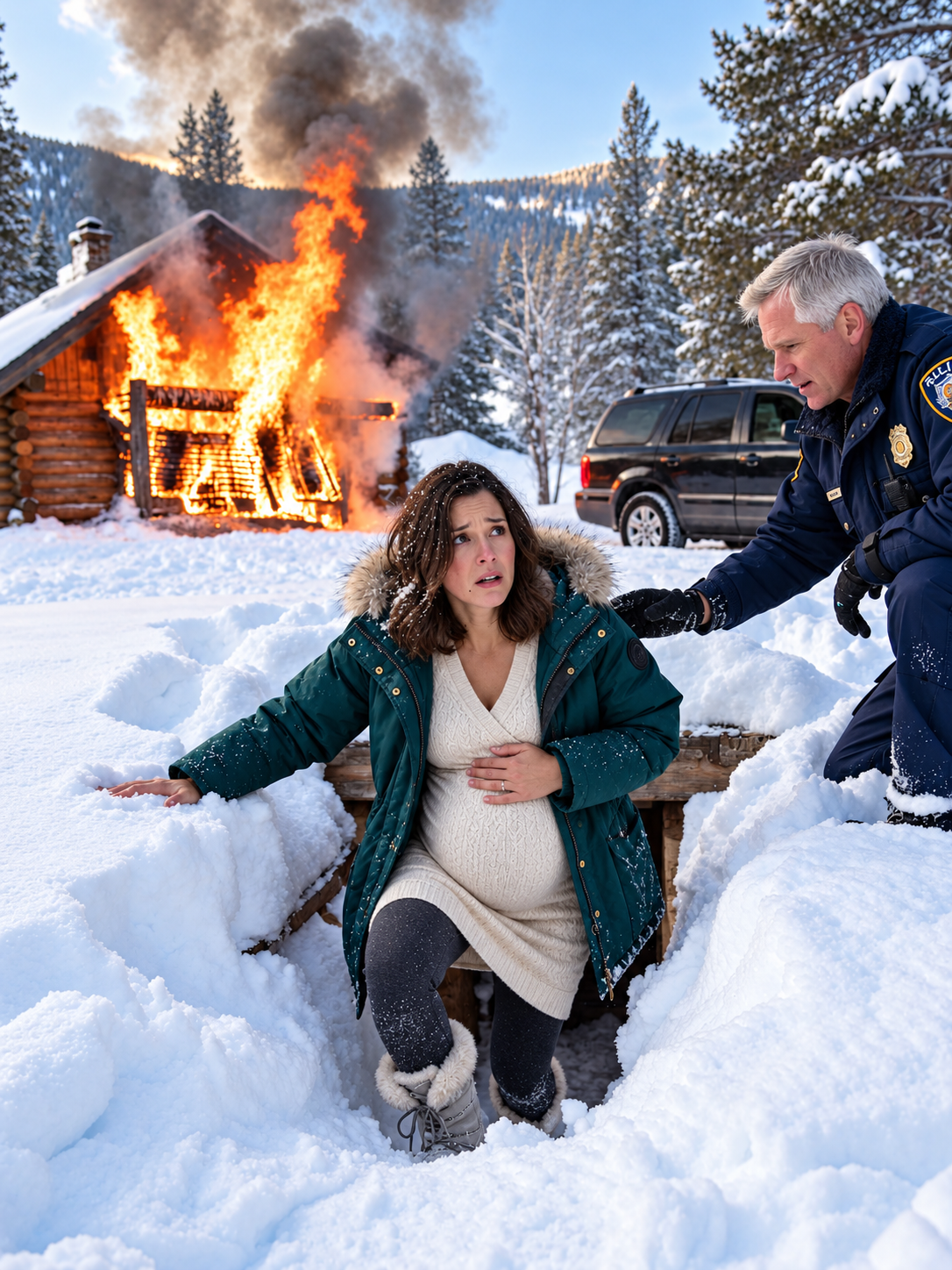
PART 1 TITLE: The Chain Across the Door and the Stranger Who Recognized My Mother Before I Could Tell Him My Name
The first thing I noticed was the heat beneath my bedroom door. The second was that my husband had disappeared. At 2:17 in the morning, the cabin should have been silent except for the furnace and the occasional groan of snow settling on the roof. Instead, something cracked beyond the hallway, followed by a dull rushing sound. I sat upright, pressing one hand against my eight-month-pregnant belly. Orange light moved across the floorboards. I called for Grant, expecting him to answer from the kitchen. No one did.
I had fallen asleep beside him only a few hours earlier. He had kissed my forehead, adjusted the extra pillow behind my back, and reminded me that the mountain air would help me rest. Those gestures came back to me as I pushed the blankets aside. My ankles were swollen, my lower back ached, and getting out of bed required an awkward effort that had become familiar during the final weeks of pregnancy. I reached for the lamp. Nothing happened. The electricity was already gone.
The smell hit me when I opened the bedroom door. Smoke rolled along the ceiling, gathering around the wooden beams my mother had insisted on keeping when she renovated the cabin. I dragged the sleeve of my nightshirt over my mouth and called Grant again. His phone charger was still beside the bed, but his phone was missing. The bedroom window overlooked the steep northern slope, where deep snow covered the rocks below. The front entrance was closer. I moved toward it, holding the wall for balance.
Grant Morgan had brought me to Cedar Ridge for what he described as one peaceful weekend before our son arrived. I was thirty-five, and for months my days had revolved around prenatal appointments, executive meetings, and preparing a nursery. Our baby, Noah, was due in several weeks. My mother, Evelyn Hart, had left me this property and sixty-eight percent of Northstar Air Rescue, the medical aviation company she had spent most of her adult life building. Grant was Northstar’s chief financial officer. I had trusted him with the company’s finances and, until that night, with nearly everything that mattered to me.
The front door refused to open. I turned the handle again, then pulled with both hands. The latch released, but the door moved barely an inch before something metallic rattled outside. Through the narrow gap, I saw a heavy chain drawn tightly across the exterior handles. For a moment, I assumed an old security fitting had somehow caught. Then I remembered that Grant had inspected the porch before we went to bed. He had told me he was checking for ice.
I hurried through the dining room toward the kitchen entrance. Smoke had already thickened near the ceiling, and the refrigerator stood dark. I grabbed the back-door handle and shoved my shoulder against the wood. It did not move. Through the small window, I could see a timber braced against the outside of the frame. Someone had deliberately secured both exits. I stood there with my fingers around the handle, trying to understand why a person would do that to a house containing his pregnant wife.
A loud pop came from the ceiling. Heat struck the side of my face, and I backed away. My phone showed no service. I tried an emergency call anyway, walking toward the dining-room windows, but the connection failed. Beyond the glass, the porch light illuminated the driveway and the dark shape of Grant’s SUV. I saw movement near the vehicle. Relief rose so quickly that I nearly cried. I hurried toward the window and began striking it with my palm.
Grant stepped into the light, wearing his heavy gray coat. Beside him stood Brooke Ellis, Northstar’s director of strategic planning. Her white winter coat caught the porch light, making her unmistakable against the darkness. I knew Brooke from board presentations and company dinners. She had helped us plan our expansion into neighboring counties. Seeing her with my husband in the middle of the night was confusing enough. Seeing the way they stood together, close and familiar, frightened me for reasons I did not yet want to name.
I shouted Grant’s name until my throat burned. He turned toward the window. He could see me. I knew he could because his gaze moved from my face to the smoke gathering behind me. Brooke reached for his arm. She looked toward the cabin, then back at him, speaking too quietly for me to hear. I struck the glass again. Grant did not approach the door. He simply stood there, watching me struggle to make myself understood.
Then Brooke raised her voice. Even through the window, I caught enough of her words to understand that she had expected me to remain asleep. Her fingers tightened around Grant’s sleeve. He answered in the measured tone he used when an employee questioned a financial decision. He mentioned the propane installation and said investigators would find an explanation in the damaged equipment. I stared at his mouth as he spoke. He sounded less like a man confronting an emergency than someone reviewing the details of a plan.
I knew what he was counting on. Several years earlier, when Northstar had expanded its fleet, our advisers had recommended a large personal insurance policy because my controlling ownership represented such a significant financial interest. The coverage amounted to thirty million dollars, with Grant named as the primary beneficiary. I had never been comfortable discussing my own death as a business risk. Grant had treated the subject as ordinary financial housekeeping, an unpleasant detail responsible adults had to manage.
But the insurance was only part of it. My mother’s shares, the company she had created with two helicopters and a rented hangar, were worth far more than the policy. Grant had spent years learning every corner of Northstar’s financial structure. He understood its lenders, its board, and the voting arrangements. He also understood how exhausted I had become during pregnancy. Standing on that side of the glass, I realized that every vulnerability he knew about me had suddenly become useful to him.
Brooke glanced toward my abdomen. She asked something about the baby. Grant’s reply reached me with terrible clarity. He did not expect anyone to conduct a separate investigation into our child’s death if we were both found inside the same fire. I felt Noah shift beneath my hand. The movement was small, almost ordinary, and for a second it was the only real thing in the world. My husband had already imagined the two of us as bodies in the wreckage.
I screamed again, not because I believed Grant would rescue me, but because some part of me still needed him to acknowledge what he was doing. Brooke turned away first. Grant touched her elbow and guided her toward the passenger side of the SUV. He opened the door for her, waited until she had climbed in, and walked around the hood. Even then, I expected him to look back. Instead, the engine started, the headlights swept across the trees, and the vehicle reversed down the driveway.
I remember the taillights vanishing between the pines. I remember noticing that Grant had cleared the snow from the windshield before leaving. The thought was absurdly specific, but it stayed with me. He had prepared the vehicle carefully while I slept. The fire had not begun as an accident. The blocked doors were not mistakes. My husband had planned a journey away from the cabin and had prepared to leave me behind.
A burning fragment dropped from the ceiling near the staircase. I stepped back as sparks scattered across the floor. Panic made my breathing shallow, and the smoke punished every attempt to inhale. I tried to break the dining-room window with a heavy ceramic vase. The vase shattered in my hands, leaving the glass intact. The window’s security glazing had seemed sensible when we installed it. Now it made the outside world look close enough to touch and impossibly far away.
Then a memory surfaced, so old that I could almost hear my mother’s voice before I remembered her words. I was nine years old, standing barefoot in the pantry while she moved jars from a wooden shelf. She had shown me a concealed opening behind the storage cabinets. Cedar Ridge had been built during the Cold War by a man who believed every remote property needed a private escape route. My mother had kept the passage functional, although she rarely spoke about it.
She had made me crawl through the entrance once, carrying a flashlight and wearing my winter coat. I remembered complaining about the dust and asking whether we could use it as a secret clubhouse. She had crouched beside me and explained that the passage was for emergencies, not games. At the time, I had been more interested in the old wooden latch than her warning. Thirty-six? No. Twenty-six years had passed since that afternoon, but I could still picture the notch she had carved into the release.
I pushed into the pantry, coughing so violently that I had to grip the countertop. Glass jars fell and broke around my feet as I emptied the lower shelves. My hands shook, and I could barely see through the smoke. For an awful moment, I thought the wall had been rebuilt and the opening removed. Then my fingertips found an uneven strip of wood. I pressed beneath it. Something shifted inside the panel.
The hidden door opened a few inches, revealing a narrow black space that smelled of damp earth and old lumber. I stared at it, measuring the opening against my body. At eight months pregnant, I could barely bend to tie my shoes. The passage had seemed cramped when I was a child. Behind me, flames were spreading through the dining room, consuming the curtains and climbing the walls. I understood that the tunnel might trap me. Staying where I was would certainly kill us.
I lowered myself carefully onto my knees. The floor felt painfully hard beneath them. I slid one shoulder through the opening, twisted sideways, and pulled my hips after it. My belly pressed against the edge of the frame. I stopped, fighting the urge to push harder. Then I exhaled slowly and adjusted my position until I could move forward. The passage allowed barely enough space for my arms and the curve of my abdomen.
Once inside, I could no longer see the kitchen. The fire made a hollow, continuous roar behind the panel. I moved with my elbows, pushing through loose dirt and splintered wood. Somewhere above me, something heavy collapsed. The vibration traveled through the walls and into my chest. I had no flashlight; my phone’s screen provided only a weak blue glow. I held it between my fingers and kept moving toward the darkness ahead.
The air was colder farther inside, but it was not clean. Dust scratched my throat, and my breathing became a series of painful, shallow pulls. My lower back tightened. A cramp moved across my abdomen, then eased. I had experienced practice contractions before, but this felt different. Fear sharpened every sensation. I put a hand against my belly and whispered Noah’s name. It was the first time I had spoken directly to him since seeing Grant drive away.
I thought about the nursery waiting at home: pale green walls, a wooden crib my mother had purchased before she died, and the quilt I had still not finished arranging across the chair. I had spent weeks worrying about choosing the right pediatrician and organizing maternity coverage at Northstar. Now I wanted only to hear my child breathe. I crawled through the tunnel, counting movements because counting gave my mind something to do besides imagine what would happen if I stopped.
The passage turned slightly uphill. I remembered my mother explaining that the exit opened beyond the nearest stand of trees, where snow and fallen branches often concealed the hatch. I had forgotten how long the tunnel was. My elbows burned. At one point, I caught my sleeve on a protruding nail and thought I had become stuck. I carefully pulled backward, freed the fabric, and moved forward again. Behind me, the heat was beginning to seep into the passage.
When I reached the hatch, I pressed upward with both hands. It resisted. I pushed again, and a thin line of moonlight appeared around one corner. Snow had frozen against the outer rim. I braced my shoulder against the wood and forced it open a little farther. Powder fell over my face. I coughed, blinked, and dragged myself through the opening onto the forest floor.
The cold was immediate and punishing. I lay in the snow for several seconds, unable to move. Above the trees, the sky was clear, crowded with stars. Behind me, our cabin burned with a brightness that made the surrounding trunks look black. Flames poured from the upper windows. Glass burst outward, breaking the silence with sharp reports. The building my mother had loved was being consumed, and I was lying less than a hundred yards away, alive only because of something she had insisted I remember.
I tried to stand. A strong contraction bent me forward before I could straighten my knees. I gripped the frozen ground and waited for it to pass. My nightshirt was damp, my bare feet had almost no feeling, and the smoke had left my chest aching. I could not see the main road from where I lay. Grant’s SUV was gone. I wondered whether anyone had noticed the fire and whether the emergency system my mother once maintained still worked.
Another contraction came. This one lasted longer. I knew enough about pregnancy to understand that severe stress and smoke exposure could put my baby in danger, but understanding did nothing to ease the fear. I tried the phone again. The screen lit briefly before the battery indicator appeared in red. I held it above my head, hoping for a signal. Nothing. I began dragging myself through the snow toward the service track that ran around the property.
Somewhere among the trees, an engine sounded. At first I thought it was the fire shifting through the timber. Then a white beam swept across the ground. A tracked emergency vehicle moved slowly along the lower slope, its lights catching the smoke rising above the cabin. I tried to call out but produced only a hoarse rasp. I raised one arm and waved. The beam moved past me. I felt a wave of despair so strong that it almost took away the last of my strength.
The light swung back. The vehicle stopped, and a man climbed out, carrying a medical pack. He was older, with silver hair visible beneath his cap and the purposeful movements of someone accustomed to bad conditions. He reached me quickly, knelt in the snow, and checked my breathing before asking my name. I tried to answer. He put a thermal blanket around my shoulders, spoke into his radio, and told someone that he had located a pregnant woman with possible smoke inhalation and active labor.
He said his name was Nathan Cole. His jacket carried the insignia of Cedar Ridge Emergency Response, and his voice had the clipped steadiness of a man who had spent years directing people through emergencies. Later I would learn that he had once worked as a smokejumper and had continued into wildfire investigation and emergency aviation. At that moment, I knew only that his hands were warm through his gloves and that he was arranging a helicopter while keeping me conscious.
Nathan asked whether anyone else had been inside the cabin. I tried to tell him about Grant and Brooke, but another contraction interrupted me. He listened without forcing me to continue, then adjusted the blanket around my neck. As he did, his gloved fingers brushed the silver locket hanging against my chest. It had belonged to my mother. I wore it almost every day, especially since becoming pregnant. Its small oval case had been polished smooth by decades of handling.
Nathan looked at the locket for a long moment. He asked whether he could see the photograph inside. I almost refused, confused by the question, but there was something in his face that made me nod. He opened the clasp carefully. Within the silver frame was a faded photograph of my mother at twenty-two, her hair loose around her shoulders and her smile uncertain. Nathan stared at it. His expression changed so completely that I forgot about the cold for an instant.
He said my mother’s first name as though he were speaking to someone standing nearby. I confirmed that the woman in the photograph was Evelyn Hart. Nathan took a slow breath and looked directly at me. He asked how old I was. When I answered, his eyes filled with tears he made no attempt to hide. The man who had remained calm beside a burning cabin suddenly seemed unable to find his words.
I heard the approaching helicopter and felt another contraction tighten across my abdomen. Nathan moved closer, shielding my face from the wind and falling snow. He asked whether Evelyn had ever spoken of a young man she knew before I was born. I shook my head. My mother had told me very little about my biological father. According to the story I had grown up with, he had left before she knew she was pregnant and had never returned.
Nathan looked down at the photograph again. His voice was almost lost beneath the approaching rotors when he told me that he had loved my mother many years ago, before joining a smokejumper training program. He said she had written to him afterward with news that had destroyed him. The letter claimed their child had not survived. He had believed her, carried that grief for decades, and never known there was a daughter to search for.
The helicopter’s searchlight washed across the snow as the medical crew hurried toward us. Nathan closed the locket and placed it gently back against my chest. I wanted to ask a hundred questions, but my lungs hurt, my vision was blurring, and the pain in my abdomen had become almost continuous. I gripped his sleeve before the paramedics lifted me onto the stretcher. He bent close enough for me to hear him clearly. “Evelyn told me our child was gone,” he said. “But you’re here. And I think you’re the daughter I was never allowed to know.”
END PART 1
PART 2 TITLE: My Son Was Breathing Behind Glass While My Husband Prepared a Funeral for Two People He Had Failed to Kill
When I opened my eyes, my hands were bandaged and my baby was gone from my body. I reached instinctively for my abdomen, felt the unfamiliar emptiness beneath the hospital blanket, and tried to sit up. Pain cut across my lower stomach. A monitor began sounding beside the bed. I could hear someone speaking near the doorway, but the words made no sense. I had gone to sleep at Cedar Ridge with Noah moving beneath my ribs. Now I was in a hospital room, connected to tubes, with no idea whether my son had survived.
A nurse hurried toward me and gently pressed a hand against my shoulder. She introduced herself, but I interrupted before she could finish. I asked where my baby was. My voice sounded damaged, barely more than a whisper. She told me that Noah had been delivered by emergency cesarean section shortly after I arrived. He was premature and receiving care in the neonatal intensive care unit. He was breathing with assistance, and the doctors considered his condition stable. I made her repeat the last word because I was afraid I had misunderstood.
For several minutes, I could do nothing except cry. The tears hurt my chest, and every attempt to take a deep breath triggered a cough. The nurse lowered the bed, checked the oxygen tubing, and waited without asking me to compose myself. She explained that I had suffered smoke inhalation, dehydration, burns across my palms, and significant physical stress before going into premature labor. The surgical team had acted quickly because Noah’s heart rate had become concerning during my transfer.
I asked whether I could see him. The nurse said the doctors wanted to assess my breathing and blood pressure first, then arrange a supervised visit when I was strong enough. She promised to bring me an update from the neonatal unit. When she stepped away, I stared at the ceiling and tried to picture my son inside an incubator. I had imagined holding him against my chest immediately after birth. Instead, strangers had carried him away while I was unconscious, and I could not even remember hearing his first cry.
The room was quiet except for the ventilation system and the soft sounds of the monitors. Beyond the window, the mountains were barely visible through low gray clouds. I had no idea how far I was from Cedar Ridge or how many hours had passed. My wedding ring remained on my finger. It looked strange against the swelling and the edge of the bandage. I remembered Grant watching me through the cabin window, and a wave of nausea moved through me that had nothing to do with the surgery.
A doctor arrived and introduced herself as part of the team responsible for my recovery. She explained that the smoke had irritated my airways but that imaging and repeated examinations had not shown the severe lung injury they had feared. The burns on my hands would need follow-up care. My abdominal incision required rest, and the premature delivery meant I would need additional monitoring. She spoke plainly, without promising that recovery would be easy. I appreciated that more than I could express.
When I asked how the rescuers had found me, she said a man named Nathan Cole had contacted emergency services after locating me near the cabin. He had remained at the hospital and had requested permission to speak with me when I was ready. I remembered his face, the silver locket, and his extraordinary claim about my mother. I asked whether he was still there. The doctor said he was waiting nearby, but there were other visitors who needed to speak with me first.
The first was a woman wearing a dark jacket with a sheriff’s badge clipped near the collar. She introduced herself as Elena Shaw, the sheriff responsible for the Cedar Ridge investigation. She did not approach my bed immediately. Instead, she asked whether I was physically comfortable enough to answer some questions. I said yes, although the truth was that I wanted every moment to bring me closer to Noah. She pulled up a chair and placed a recording device on the bedside table.
Sheriff Shaw explained that my identity and location had been restricted at the hospital. Only the necessary medical staff and a small investigative team knew I was alive. Grant had not been informed that I had survived, and no one from Northstar had been contacted on my behalf. A security officer was posted outside the private room, and access would remain controlled while investigators assessed the threat. When I asked whether Grant thought I was dead, she looked at me carefully before answering.
She told me that my husband had reported me missing after the fire. According to his statement, he had left the cabin during the night to purchase medication in Bozeman. When he returned, he supposedly found the building burning and could not locate me. He claimed he had tried to reach the front entrance but had been forced back by the flames. The fire had damaged much of the structure, and rescuers had initially been unable to enter every section safely.
I listened without interrupting. Grant had a talent for creating stories that sounded ordinary when told in his composed, reasonable voice. An anxious husband leaving for medicine was more believable than a financial executive locking his pregnant wife inside a burning house. He had chosen a lie that depended on everyone assuming he was concerned about my health. The thought made me remember all the evenings when he had offered to handle my responsibilities because I was tired.
I told Sheriff Shaw exactly what I had seen. I described the chain across the front entrance, the timber bracing the kitchen door, the smoke, and Grant standing beside Brooke. I explained how she had reacted when she realized I was awake and what I had heard about the propane system. When I repeated his remark about there being no separate investigation for our baby, I had to stop speaking. The sheriff did not hurry me. She simply moved the water closer and waited.
Then she asked about the tunnel. I described the concealed pantry panel and the route leading toward the tree line. My mother had shown it to me when I was a child, and as far as I knew, Grant had never entered it. We used Cedar Ridge occasionally, but he had little affection for the property. He complained about the unreliable reception, the remote roads, and the work needed to keep an older mountain cabin maintained. I had always believed his dislike was a matter of personal taste.
Sheriff Shaw wanted to know whether anyone else might have known about the hidden exit. I mentioned the original builders and my mother, but I could think of no one living who had been told about it. She said investigators would examine the surviving portions of the structure as soon as the firefighters allowed access. They would also inspect the outside doors and retrieve any available electronic records. She explained that my account was important, but evidence independent of my memory would be essential.
I asked whether she could arrest Grant immediately. She answered that the investigation was moving quickly and that they were working with prosecutors to establish the strongest possible case. She did not want to expose my location through a premature confrontation, especially while I was recovering and Noah was vulnerable. Her caution frustrated me. I had seen my husband walk away from us. I knew what he intended. Yet I understood, beneath the anger, that proving it would require more than my certainty.
When the sheriff left, Nathan Cole entered the room. He had changed out of his rescue jacket and wore a dark sweater over a checked shirt. Without the emergency lights and snow around him, he looked like an ordinary man in his early sixties, except for the deep lines beside his eyes and a small scar near his jaw. He stopped several feet from my bed, as though approaching too closely would be an intrusion.
He asked how I was feeling. I told him the doctors believed Noah would recover, and he closed his eyes briefly in relief. Then I asked the question I had been holding since the rescue. I wanted to know what he had meant when he recognized my mother’s photograph. Nathan pulled a chair closer but remained standing until I invited him to sit. He placed his hands on his knees, looked toward the window, and began telling me about a part of Evelyn Hart’s life I had never known.
He had met my mother when they were young, long before Northstar existed. She was determined, opinionated, and fascinated by aircraft, even though her family considered aviation an unsuitable obsession. Nathan was training for work in wildfire suppression and hoped to become a smokejumper. They had spent a summer together, and he had believed they would build a life once his training stabilized. Shortly before he left, Evelyn learned she was pregnant.
Nathan said his training assignment had taken him away from home for several months. During that period, a letter arrived in my mother’s handwriting. It told him that she had lost the pregnancy and could not bear to continue their relationship. He tried to contact her, but she had moved and his messages went unanswered. Eventually, he accepted that she did not want to see him. The grief remained, he said, but he learned to carry it without discussing it.
I asked why my mother had never mentioned him. Nathan looked at me for a long time before admitting that he did not know. He had spent decades believing their child had died. He had no photograph of a baby, no record of a birth, and no reason to suspect Evelyn had raised a daughter. When he saw the locket in the snow, the resemblance between the young woman in the photograph and the woman lying beside the burning cabin had unsettled him immediately.
I wanted to believe him. I also wanted to protect myself from another deception. Less than a day earlier, I had learned that the man I married was capable of leaving our unborn child to die. Now a stranger was telling me that my mother had concealed the identity of my father. I had loved her deeply, but the possibility that she had lied about something so fundamental hurt in a way I was not prepared to examine.
Nathan seemed to recognize my hesitation. He did not ask me to trust him or suggest that our connection excused thirty-five missing years. Instead, he explained how he had come to be near Cedar Ridge that night. He managed a mountain emergency-response organization that maintained remote monitoring equipment and coordinated rescue operations in difficult terrain. My mother had arranged a monitoring agreement for the cabin before her death. When the property’s emergency system registered a serious alarm, his team responded.
I asked why Evelyn would have contacted him after so long. Nathan shifted in his chair. He said my mother had reached out near the end of her life, but he did not want to tell me her story in fragments while I was exhausted and medicated. There were documents he believed I needed to see. He promised not to withhold anything he knew, although he admitted there were still parts he did not understand himself. His restraint made the conversation more difficult and, strangely, more believable.
That afternoon, a nurse helped me make my first brief visit to Noah. I traveled through the hospital in a wheelchair, holding a pillow against my abdomen whenever the chair crossed an uneven section of flooring. The neonatal unit was warmer than my room and filled with the muted electronic sounds of equipment. A nurse led me to an incubator near the window. Inside lay a small baby wearing a knitted cap, surrounded by carefully arranged tubing and monitors.
Noah was smaller than I had imagined. His fingers were thin and slightly curled, and a narrow oxygen tube rested beneath his nose. His chest rose and fell with a rhythm I watched so closely that I forgot to breathe. The nurse explained each monitor, then showed me how to place my hand gently against his body through the incubator opening. His skin was warm. I touched the back of his hand with one finger and felt him move.
I told him that I was there. My voice shook. I had promised myself during the fire that I would keep him safe, but I had not managed to protect him from being born under these circumstances. The nurse assured me that premature babies often required assistance while they adjusted to breathing and feeding outside the womb. She did not minimize his condition, but she pointed out the signs the team considered encouraging. I listened carefully, determined to understand everything.
When I returned to my room, Sheriff Shaw was waiting with an update. Grant had begun arranging a public memorial. No body had been recovered, and there was no death certificate, but he had described the event as a gathering to honor my life and the son everyone believed we had lost. He had contacted Northstar employees, invited representatives from the aviation community, and asked the company’s communications department to coordinate photographs and statements for the press.
The speed disturbed the sheriff. There were still active search procedures, and the fire investigation had not been completed. Yet Grant was speaking publicly as if my death were established. He had also contacted the insurance company and begun asking questions about the documentation necessary to move forward with a claim. The insurer had not approved payment, and without a legal declaration of death, he could not collect. Nevertheless, his requests showed how quickly his attention had shifted from searching for me to managing what came afterward.
Northstar was already feeling the consequences. As chief financial officer, Grant had access to operational accounts and considerable influence over senior managers. He was telling employees that I had privately discussed succession plans and that he intended to provide continuity during a painful transition. Several board members had requested legal advice before granting him any additional authority. Others, according to the sheriff, seemed reluctant to challenge a man who was presenting himself as a grieving husband.
I thought about my mother standing in the company’s original hangar, explaining to me that an aircraft could not be dispatched simply because someone with authority wanted it in the air. Pilots, medical crews, and mechanics all had to trust the chain of decisions behind each mission. She believed a rescue company carried a responsibility beyond its balance sheet. Grant knew the language of that responsibility. I had heard him use it in board meetings. Now he was using it to strengthen his claim over her life’s work.
Sheriff Shaw asked whether there were documents that might limit Grant’s power if I were missing or incapacitated. I told her our attorneys maintained trust and ownership records, but I had left the details to the legal department during the final months of pregnancy. My mother had been particular about the company structure, especially after becoming ill. I remembered her insisting on several meetings that Grant complained were unnecessary. At the time, I had assumed she was simply having difficulty surrendering control.
Nathan had been quiet through most of the conversation. When I mentioned those meetings, he leaned forward. He asked whether my mother had ever explained why she retained separate arrangements for Cedar Ridge and Northstar. I told him she believed personal property should remain insulated from business disputes. He nodded but looked troubled. Then he asked the sheriff whether investigators had cleared the site sufficiently to examine the hidden passage from the outside.
The sheriff said the main fire was contained, although parts of the structure remained unsafe. Nathan explained that Evelyn had once spoken about a concealed storage space connected to the old escape tunnel. He had never entered it, and he did not know precisely what it held. Until that moment, he had treated the information as another example of her habit of preparing for emergencies. After hearing my account of Grant’s behavior, he was no longer sure the hiding place was merely precautionary.
I asked whether he believed my mother had expected something to happen at Cedar Ridge. Nathan did not answer immediately. He looked at the bandages on my hands and then at the photograph of Noah the neonatal nurse had left beside my bed. When he finally spoke, his voice was low and deliberate. He said Evelyn had been concerned about the questions Grant was asking before her death. Questions concerning the cabin, its security systems, and ownership arrangements that should never have interested him so intensely.
The room seemed colder as I considered what he was telling me. My mother had died almost two years earlier, yet her concerns appeared to reach directly into the terrible night I had just survived. I thought of the chain across the door and the look on Grant’s face as he watched me struggle. Nathan stood and told Sheriff Shaw he wanted to accompany investigators to Cedar Ridge as soon as they allowed it. Before leaving, he turned back toward me. “Your mother was preparing for something, Lena,” he said. “I think it’s time we found out what she knew.”
END PART 2
PART 3 TITLE: The Key Hidden in My Mother’s Locket Opened a Box That My Husband Had Been Counting on the Fire to Destroy
Nathan returned to Cedar Ridge with the investigators the following morning. I remained in the hospital, where every hour seemed divided between medical examinations and waiting for news about Noah. By then, the worst of the smoke irritation had begun to ease, but I could not walk more than a few steps without feeling exhausted. Sheriff Shaw had warned me that the search might take time. The cabin was badly damaged, and evidence technicians had to document the remains before disturbing anything that could explain how the fire started.
At breakfast, I watched a local television report about the blaze. The footage showed the shell of the building against the white mountains, its roof largely collapsed and its windows blackened. A reporter identified me as the missing owner of Northstar Air Rescue and described the search as ongoing. Grant appeared briefly in a recorded statement. His face was pale, and he spoke about the overwhelming kindness of the community. He said he wanted everyone to remember how much I cared about our son.
I turned the television off before the segment ended. Seeing him perform sorrow in public made my stomach tighten. I had lived beside that face for years. I knew how his mouth changed when he was disappointed and how he pressed his lips together before delivering unpleasant financial news. In the interview, he used the same careful expression he wore during difficult board discussions. Nothing about his appearance suggested the man I had watched abandon a burning house.
I thought about calling someone at Northstar. Several employees had worked alongside my mother since the company was small enough for everyone to share one office. They would believe me, I told myself. Then I remembered the sheriff’s warning. Anyone I contacted might react publicly or confront Grant before investigators secured the evidence. I had always been someone who answered problems by picking up the telephone and making decisions. Now my most important responsibility was to remain unseen.
The waiting became harder after the neonatal nurse called with an update. Noah was maintaining his temperature, and his oxygen requirements had decreased slightly. The team was encouraged, although he still needed careful observation. I asked whether I could visit him again. They arranged a short period beside the incubator later that afternoon. Until then, I watched the clock and tried not to imagine everything that could have happened if Nathan’s rescue vehicle had passed through the forest a few minutes later.
Just after noon, Sheriff Shaw contacted my room. She said the search team had entered the tunnel through the exterior hatch. Much of the passage had survived because it ran beneath compacted earth and stone. They had located an old storage recess behind a removable section of masonry, well away from the areas most damaged by heat. Inside was a small metal container designed to resist extreme temperatures. Its outer surface was dirty but intact, and it was secured with a lock.
She asked whether I knew what the container held. I said no. My mother had never mentioned storing documents underground, and I could not remember seeing a metal box when she showed me the passage. Sheriff Shaw explained that the investigators had photographed its location and recorded the recovery. Nathan had recognized the type of container from equipment Evelyn once used at remote operations sites. He believed it might contain papers important to the ownership investigation.
When Nathan arrived later, he carried no dramatic announcement. He stood beside my bed with Sheriff Shaw while she explained that the box had been recovered and examined under the investigation’s evidence procedures. They had not forced the lock because Nathan suspected Evelyn had left the key somewhere accessible to me. He asked whether he could examine the silver locket again. I unclasped it and placed it in his palm, remembering how my mother had occasionally opened it without looking at the photograph.
Nathan turned the locket over beneath the bedside lamp. A narrow seam ran along the inner edge, so fine that I had always assumed it was part of the decorative metalwork. Using the tip of a small tool, he lifted a hidden cover behind the photograph. A tiny brass key rested inside. I stared at it, embarrassed by how little I knew about an object I had worn for years. My mother had placed it around my neck shortly before she entered the hospital for her final treatment.
I remembered that day clearly. She had been sitting by the window in her hospital room, irritated because someone had delivered tea instead of coffee. She asked me to wear the locket and complained when I suggested putting it in a jewelry box for safekeeping. I thought she wanted me to remember her. She had held my hand and said that some things became useful only when a person was ready to understand them. I had dismissed the remark as the sort of solemn statement people made when they knew they were dying.
Sheriff Shaw arranged for the locked container to be brought to the hospital after it was documented. She wanted me present when it was opened, both because the contents appeared to belong to my family and because my knowledge might help identify important records. Nathan placed the key into the lock, then stepped aside so I could turn it myself. The mechanism resisted briefly before releasing with a small, ordinary click. After everything I had endured, the sound seemed almost absurdly quiet.
Inside were folders wrapped in protective material, several sets of company documents, and three envelopes sealed with my mother’s personal stationery. One envelope carried my name in her unmistakable handwriting. Another was addressed to Nathan. The third bore instructions for Northstar’s independent legal trustee. Each had been placed carefully inside the container, separated from the business records by sheets of plain paper. My mother had organized the contents with the same precision she brought to aircraft maintenance logs.
I reached for the envelope addressed to me. My fingertips were still tender beneath the bandages, so Nathan offered to open it. I shook my head and used the edge of a plastic ruler to break the seal. The paper inside was folded twice. I recognized the faint lavender scent of my mother’s stationery and felt an unexpected longing for something as simple as hearing her clear her throat before making a difficult announcement.
She began by acknowledging that she had withheld important truths about my life. She wrote that fear had influenced choices she had made when she was young and that she had spent years convincing herself those choices could not be undone. She wanted me to know that she had loved me, but she did not ask me to excuse the things she had hidden. Reading those first paragraphs brought back Nathan’s expression in the snow. I understood that the letter contained the explanation he had waited decades to hear.
Before I could continue, Sheriff Shaw suggested that we examine the business documents because they might require immediate action. She had good reason. Grant was moving quickly toward control of Northstar, and a properly executed document could prevent the board from treating his authority as automatic. I folded my mother’s letter carefully and placed it on the bed beside me. The decision felt disloyal for a moment, but my mother had always taught me to deal with an immediate danger before examining the damage it had caused.
The largest folder contained an amended trust agreement and supporting corporate records. My mother’s signature appeared on several pages, along with the signatures of attorneys and witnesses. The amendment addressed circumstances in which I became missing, incapacitated, or presumed dead under suspicious conditions. It explicitly prevented Grant from exercising my controlling voting rights on my behalf in such an event. An independent trustee would temporarily manage the voting authority while my ownership remained protected.
I asked Sheriff Shaw to read the provision aloud again. For years, I had believed my mother’s complicated legal arrangements reflected her reluctance to relinquish responsibility. Now I understood their practical importance. Grant could continue performing his existing financial duties only to the extent that company rules allowed, but he could not simply absorb my sixty-eight percent ownership or direct it through a temporary claim of succession. The trust required an independent process that he could not control.
The documents also named Noah as my contingent heir. The provision applied in circumstances affecting my ownership after my death, subject to the terms of the trust. My mother had anticipated the possibility that I might one day have a child, long before I became pregnant. I ran my fingers over the paragraph and felt a surge of grief. She had been planning for a grandson she would never meet. Whatever else she had concealed, she had tried to ensure that he could not easily be deprived of his inheritance.
I asked whether Grant could challenge the amendment. Sheriff Shaw said the board’s lawyers would need to verify and interpret the documents, but the provision appeared specifically designed to prevent the transfer of control he was seeking. She arranged for authenticated copies to reach the appropriate legal representatives through secure channels. Nathan watched quietly while she worked. I noticed that his attention kept returning to the letter resting beside my hand.
When we were alone, I asked him whether my mother had ever told him about Grant. Nathan said Evelyn had raised concerns during their last conversations. At first, he had believed she was simply protective of the business she built. Then she asked him unusually specific questions about the cabin’s emergency systems, including how a remote alarm could function if the main power failed. She wanted the satellite monitoring service maintained and tested without depending on anyone at Northstar to authorize a response.
I remembered Grant becoming irritated when he discovered the annual monitoring expense. He had called it unnecessary because we visited Cedar Ridge only a few times each year. I had agreed that the cost seemed high, but I had refused to cancel something my mother considered important. Grant never raised the issue again. At the time, his silence felt like compromise. Now I wondered whether he had decided it would be easier to work around the system than persuade me to remove it.
Nathan told me that Evelyn had contacted him roughly two months before her death. The call had taken him completely by surprise. He had not spoken with her in decades. She asked whether they could meet, and when they did, she admitted that the child he believed had died was alive. She told him he had a daughter and showed him a photograph of me. Nathan had been furious at first, then overwhelmed. He wanted to contact me immediately.
My mother had asked him to give her time. She said she needed to explain the history herself and wanted to settle the company arrangements before introducing a truth that could change our family. Nathan agreed reluctantly. Three weeks after their meeting, Evelyn died. I looked at him, unable to conceal my distress. He had been given a daughter and then told to remain outside her life until someone else decided the moment was right. My mother had asked him to bear another separation.
Nathan said he wrote to me after the funeral. His first letter explained who he was and included his contact information. When no answer came, he sent another. He was careful not to describe the letters as demands. He wanted me to decide whether we should meet. Eventually, he assumed I had received them and wanted nothing to do with him. He had no wish to force himself into the life of a woman grieving her mother’s death.
I told him I had never seen a single letter. The silence that followed felt larger than the room. Nathan looked toward the closed door, then asked who handled my correspondence during the months following Evelyn’s funeral. I answered without thinking. Grant had taken over most household arrangements because I was overwhelmed by probate matters and the demands of running Northstar. He had sorted the mail, coordinated legal appointments, and encouraged me to concentrate on work.
I remembered a conversation shortly after the funeral when Grant mentioned receiving a confusing inquiry from someone who claimed to have known my mother. He dismissed the sender as a person hoping to obtain money from her estate. I had been too exhausted to ask questions. Nathan’s jaw tightened when I described it. He did not accuse Grant outright, but I saw the conclusion forming in his face. My husband may have kept more than financial information from me.
That possibility led me back to my mother’s letter. I unfolded it and continued reading. She described Grant asking for the original blueprints of Cedar Ridge during the final months of her illness. He had also requested details about the propane installation and the property alarm. When she questioned him, he claimed that he wanted to renovate the cabin before our next long visit. He presented the questions as an attempt to improve a neglected family property.
My mother wrote that the requests had troubled her. Grant was a financial executive, not someone who ordinarily involved himself in building maintenance. He disliked Cedar Ridge and had never expressed enthusiasm for remodeling it. Yet he repeatedly returned to the same subjects, especially the location of the equipment and the methods used to monitor the property. She began making inquiries of her own, reviewing security arrangements and speaking privately with attorneys about my vulnerability as Northstar’s majority owner.
The letter did not claim that Evelyn had known Grant intended to set a fire. She admitted that she lacked evidence of a specific crime. What frightened her was the pattern of his interest and his efforts to learn which safeguards could be bypassed. She also described the pressure he placed on me to leave more operational authority in his hands. Reading her words, I recalled the subtle arguments we had during the final year of her illness. Grant had characterized her concerns as the suspicions of a woman struggling to accept that she was no longer in complete control.
I had defended him. That realization was painful enough that I had to put the letter down. My mother had never been an easy person to disagree with, and Grant had encouraged me to interpret every disagreement as proof that she did not respect my judgment. I had wanted peace between them. To obtain it, I had repeatedly reassured him that I trusted his intentions. There were moments when I had even asked Evelyn to stop questioning him, unaware that she might have been trying to warn me.
Nathan watched me struggle with those memories. He did not tell me I should have listened to my mother. Instead, he pointed out that Grant had spent years constructing a reputation for reliability and that people who trusted him had every reason to believe his explanations. I appreciated the absence of judgment, but I could not escape the knowledge that my mother had seen something I had missed. Her precautions had protected my shares, yet they had not prevented Grant from taking me into the mountains.
Sheriff Shaw returned to collect the relevant documents for the attorneys. She told us investigators were recovering information from the remaining security equipment and the property’s remote monitoring accounts. Some devices had been destroyed, but not every record had been stored inside the cabin. Grant apparently believed the fire would destroy the physical evidence. The possibility of surviving electronic records gave the sheriff reason to hope that my testimony could be corroborated.
I asked whether the fire investigators had identified its point of origin. She said the analysis was ongoing, although early findings had raised questions about the propane system and the distribution of damage. She would not speculate before the technicians completed their work. What she could confirm was that there were signs both exits had been obstructed from the outside. The front-door hardware had been found with remnants of the chain still attached. I closed my eyes, feeling the metal rattle beneath my hands again.
After the sheriff left, I unfolded the final page of my mother’s letter. The handwriting grew smaller near the bottom, as though she had tried to fit too much into the remaining space. She described her fear that she might die before explaining the amended trust and the questions she had been unable to resolve. She asked me not to assume that familiar people were incapable of frightening acts simply because they had spent years behaving kindly.
One sentence near the end had been marked twice with dark ink. I read it silently, then again aloud for Nathan. My mother had written that if Grant ever insisted on taking me back to Cedar Ridge and a fire occurred there, I must never accept an accidental explanation without demanding an independent investigation. Beneath the warning, she had added a short instruction: the answers were likely to survive somewhere beyond the flames. Nathan looked at me across the bed, and for the first time I understood that my mother had feared this exact journey long before Grant invited me to the cabin.
END PART 3
PART 4 TITLE: The Records Survived the Flames, but the Woman Who Helped Trap Me Inside Would Decide Whether My Husband Escaped
Grant had prepared for the cabin to burn. He had not prepared for the information stored outside it. When Sheriff Shaw returned to my room with the first digital evidence report, she placed several printed pages on the table and asked me to examine the timestamps. The technicians had recovered records from the remote security server, including commands issued through the property’s exterior access system. At 2:11 that morning, Grant’s phone had activated the security controls. Six minutes later, I had awakened to smoke.
The report showed repeated attempts to operate the doors from inside the cabin after the system was secured. I remembered twisting the handle while the chain rattled outside. The investigators had photographed the damaged front entrance and the remains of the chain. They had also found evidence that the kitchen door had been braced externally. No reasonable explanation accounted for both exits being obstructed while a pregnant woman slept inside. The electronic record made the physical findings still more difficult to dismiss.
There was more. A trail camera mounted near the service road had recorded Grant’s SUV leaving Cedar Ridge with two occupants. The image was grainy, but the vehicle’s distinctive rear lights and identifying details were visible, along with a reliable timestamp. It contradicted his statement that he had already driven toward Bozeman before the fire began. Another photograph showed the vehicle passing the same location earlier that evening. Investigators were examining the images alongside traffic records and the timing of the emergency response.
Sheriff Shaw handed me a separate report concerning a corporate purchasing card assigned to Brooke Ellis. Two days before the fire, the card had been used to buy additional propane. The purchase had been recorded under an expense category associated with company events. Brooke had authority to make such purchases for Northstar, but there was no scheduled event requiring fuel at Cedar Ridge. The transaction alone could have an innocent explanation. Combined with everything else, it raised an obvious question about why she had needed the propane.
I studied the documents until the numbers blurred. Grant had controlled our household expenses, Northstar’s financial reports, and many of the systems we used to organize daily life. He always described his attention to detail as a form of protection. Seeing the trail of electronic records made me realize how much of that same information could now be used against him. He had believed he understood every system well enough to make his departure appear ordinary. He had overlooked the fact that systems remember.
Sheriff Shaw explained that the evidence was being reviewed with prosecutors. She had requested additional financial and communications records and was coordinating with fire investigators to establish the full sequence of events. The cabin’s structural damage complicated portions of the physical investigation, but the surviving information was significant. She emphasized that no single record carried the entire case. The strength came from the way the timestamps, purchases, damaged doors, and witness statements supported one another.
I asked whether Grant knew what they had found. She said investigators had not disclosed the details. He continued speaking publicly as if the fire were a tragic accident, while privately pressing ahead with his plans for Northstar. His insurance claim remained unresolved because no death had been legally established. He had also demanded greater access to company decisions, explaining that someone needed to protect the business during the uncertainty surrounding my disappearance.
Northstar’s attorneys had received the amended trust. After reviewing it, the board refused Grant’s demand for immediate control of my voting rights. The company could continue operating through its established management structure, but the independent trustee would oversee the authority assigned under the amendment. Grant responded by claiming that the arrangement reflected outdated concerns from my mother’s final illness. He insisted that I had wanted him to assume a larger leadership role.
That argument unsettled me because it was partly built from conversations we had actually shared. Grant had asked repeatedly what would happen if I needed several months away from the company after Noah’s birth. I told him I trusted the existing executive team and expected the board to support them. He had interpreted my willingness to delegate work as permission to enlarge his authority. Now he was turning those private discussions into evidence of intentions I had never expressed.
The sheriff informed me that Grant had scheduled an emergency board meeting for the afternoon following my memorial. He wanted the directors to approve a temporary leadership arrangement, citing the need for stability and reassurance. Several board members were uneasy, but he was contacting them individually. The timing was deliberate. By the time employees and community members left the memorial service, he hoped to have built enough sympathy to overcome objections in the boardroom.
I knew how those meetings worked. A polished presentation, a limited agenda, and pressure to demonstrate unity could move even cautious directors toward decisions they might later regret. Grant understood the company and the people serving on its board. He knew which directors disliked public disagreement and which valued efficiency above confrontation. If he appeared composed while everyone else was grieving, he could make resistance look irresponsible.
The legal amendment prevented him from acquiring my ownership directly, but I did not want him using the company’s ordinary decision-making process to accomplish part of the same goal. I asked the sheriff whether the trustee could require additional scrutiny of the proposed leadership arrangements. She said the company’s attorneys were already addressing that concern. The law could protect the shares, but Northstar’s employees and patients still needed responsible people making everyday decisions while I recovered.
That evening, Nathan visited after I returned from seeing Noah. He brought a small cup of coffee, then remembered I was taking medication and offered to have it replaced with tea. I smiled for the first time that day. He seemed embarrassed by the mistake. I told him the smell was enough. We sat together while the last light disappeared behind the mountains, and he described the rescue operation in greater detail.
He had been at the emergency-response station when the alert from Cedar Ridge arrived. The monitoring system registered an abnormal condition and triggered a notification through the satellite connection. When attempts to verify the situation received no response, he had dispatched a team and taken the tracked vehicle toward the property himself. The roads were difficult, and the fire was already visible through the trees when he approached. He had been searching the perimeter for anyone who might have escaped when his light caught movement near the tunnel exit.
I asked why my mother had insisted on the satellite arrangement. Nathan said she understood the dangers of isolated buildings. Standard telephone lines could fail, cellular reception was unreliable, and fire could destroy electrical systems before anyone noticed. With her aviation experience, she valued redundant communications. Yet he admitted that her repeated concern about Cedar Ridge had been unusual. She checked the monitoring contract personally even while illness made ordinary business matters increasingly exhausting.
We spoke about Evelyn for a long time. Nathan remembered her stubbornness, her impatience with people who explained things she already understood, and her habit of writing calculations on whatever paper was nearest. I recognized all those traits. He also described a younger woman who had once driven him to a training airfield before sunrise because she wanted to watch aircraft take off in the cold morning air. I had never heard that story. For a while, I could almost see my mother as someone other than the formidable woman who raised me.
Then Nathan asked whether the investigators had found the letters he sent after her funeral. I told him there was still no record of their delivery to me. The question carried an uncomfortable possibility neither of us wanted to discuss. Grant had been responsible for sorting our mail during those months. Nathan did not accuse him of intercepting anything, but he said he had retained copies and postal information. If necessary, he would provide them to the investigators.
I considered what knowing Nathan earlier might have changed. He understood emergency aviation, wildfire investigation, and the risks associated with remote properties. My mother had founded Northstar using many of the same principles. The two of them would have had years of shared experience to discuss. Grant, who resented outside scrutiny of company finances, might have considered Nathan an unwelcome influence. I could not prove that my husband had kept us apart, but the idea no longer seemed unreasonable.
On the third night after the fire, Sheriff Shaw received a telephone call that changed the investigation. Brooke Ellis had contacted her office and asked to speak through an attorney. She sounded frightened and said Grant was blaming her for decisions they had made together. According to the sheriff, he was claiming that Brooke had purchased propane for a Northstar retreat without his involvement. He had also suggested that she had visited Cedar Ridge independently and failed to tell him.
Brooke understood what those accusations meant. Grant was preparing an explanation in which she became responsible for the suspicious purchases and perhaps the entire fire. Until then, she had remained beside him while he conducted interviews and organized the memorial. She had been participating in the public display of grief, helping maintain the appearance of a loyal colleague supporting a devastated family. Now she realized that the man she had helped might be willing to sacrifice her to protect himself.
Her attorney arranged a formal interview. Sheriff Shaw told me that Brooke was cooperating, but that her willingness to provide information did not erase her own involvement. I understood the distinction. I had seen her beside Grant outside the cabin. She knew I was awake and had not opened either door. Whatever fear she now felt for herself could not excuse what she had done to Noah and me.
Later, the sheriff allowed me to watch selected portions of the recorded interview. Brooke sat at a plain table with a paper cup of water in front of her. Without makeup and the confident posture I knew from company meetings, she looked exhausted. She admitted that her relationship with Grant had become romantic eleven months before the fire. He had told her his marriage was deteriorating, that I no longer understood the business, and that Northstar needed leadership willing to make difficult decisions.
Brooke said Grant had discussed the thirty-million-dollar insurance policy and the possibility that my death would eventually leave him in control of significant assets. At first, she had treated those remarks as bitter fantasies from a man unhappy in his marriage. Later, according to her statement, he began speaking more concretely about the cabin, the propane system, and the need for an alibi. She admitted helping him create a false account of where he had been that night.
When Sheriff Shaw asked whether she had known I would be trapped inside, Brooke stared at her hands. She said Grant had assured her I would be asleep and would not awaken during the fire. She had accepted his assurance despite understanding what it meant. The sheriff pressed her on that point, asking whether she had considered the possibility that I might wake, become injured, or try to escape. Brooke could not provide an answer that made her actions less deliberate.
I watched the interview in silence. I had wanted to know why Brooke was there. Now I understood that she had chosen to participate because she believed a future with Grant would give her professional power and financial security. She had placed those ambitions above my life and Noah’s. Her distress on the recording did not make me feel sorry for her. It showed that consequences had finally reached someone who previously expected to escape them.
Then Brooke’s attorney produced an audio file. She had recorded a conversation in Grant’s vehicle after becoming concerned that he might blame her if their plan failed. In the recording, Grant discussed the memorial as an opportunity to convince people that the search for me should end. He spoke about securing authority at Northstar, waiting for the required legal determination, and collecting the insurance proceeds. His tone was casual, as though he were explaining the next phase of a corporate acquisition.
Brooke asked what would happen if firefighters discovered that I had escaped. Grant dismissed the possibility. He said I was too far along in pregnancy to move quickly and that the mountain terrain would make survival almost impossible. He had calculated my physical limitations and assumed they would prevent me from reaching safety. Listening to him, I remembered crawling through dirt with one hand beneath my belly. I wondered whether he had ever imagined the pain as something real, rather than merely a factor in his plan.
I stopped the recording before it finished. My hands were trembling, and I did not want to hear his voice again. Grant had not simply made a terrible decision during an emergency. He had anticipated the fire, prepared the exits, constructed an alibi, and considered how my death could be converted into money and corporate control. Brooke had helped him. Their conversation gave investigators evidence of intentions that the physical records alone could not fully establish.
Sheriff Shaw told me prosecutors were moving forward with arrest warrants for both of them. Brooke’s cooperation would be considered, but her participation in the attempted killing remained central to the case. She had agreed to continue appearing beside Grant at the memorial while deputies prepared to act. The sheriff would coordinate the timing carefully so that Grant could not flee or destroy additional records before he was taken into custody.
Nathan wanted me to remain at the hospital. He argued that the investigators had enough evidence to arrest Grant without placing me in a crowded public setting. I had undergone emergency surgery, my lungs were still recovering, and Noah needed me. Everything Nathan said was reasonable. Yet I could not bear the thought of Grant standing before Northstar’s employees, speaking about my mother’s legacy, and presenting himself as the guardian of a company he had tried to steal through my death.
I told Nathan that I did not intend to confront Grant alone. I wanted to be present only after the deputies secured him, and I would follow whatever medical restrictions were necessary. I wanted the people who trusted him to hear from me that I had survived and that Noah was alive. More importantly, I wanted Grant to understand that the woman he had decided was too weak to escape a burning cabin still had a voice in what happened to her family.
My doctor was reluctant when I explained the request. She examined my incision, reviewed my breathing measurements, and asked whether I understood how exhausting the trip might be. I said I did. After discussing the plan with the sheriff and hospital staff, she agreed to a brief supervised outing under strict conditions. I would travel in a wheelchair, avoid unnecessary physical strain, and return directly afterward. Medical personnel would remain available, and I was not to attempt anything that jeopardized my recovery.
That evening, Sheriff Shaw showed me the memorial’s preliminary livestream feed. The chapel had been decorated with white lilies, framed photographs, and Northstar’s blue-and-silver emblem. A red winter coat I had worn during one of my final public appearances hung beside a display honoring my work. At the front stood a polished casket. It was empty, of course. No one had recovered my body because I was alive, but Grant had arranged a ceremony intended to make my absence seem permanent.
I studied the photographs until I recognized one from my childhood. My mother and I stood beside Northstar’s first helicopter, both of us squinting against the afternoon sun. I remembered her taking my hand before the photographer began and telling me that someday I might be responsible for everything she had built. I had laughed because I was young and thought the future was an enormous distance away. Now that picture had been placed beside a coffin by the man who wanted to inherit her company through my death.
The livestream test ended. I looked at the dark screen and felt an exhaustion that went deeper than the surgery. Five days earlier, I had believed I was preparing for motherhood with a husband who loved me. Since then, I had learned that he had betrayed me, tried to kill me, and treated our son as an obstacle to his plans. I had also discovered that my mother had hidden a father from me and had left behind warnings about the man I married. Everything familiar seemed to require a second examination.
The following morning, Sheriff Shaw arrived with a garment bag containing a plain black dress. Nathan accompanied her, carrying the medical supplies my doctor had insisted we bring. They reviewed the route to the chapel and the arrangement for the rear entrance. Deputies would be stationed throughout the building before the service began. I would wait in a private room until Grant was secured, and no one outside the small team would know I was there beforehand.
I dressed slowly, taking care not to put pressure on the surgical incision. The black fabric felt strange against my skin. It was clothing chosen for a funeral, but the person being mourned was standing in front of the mirror. I touched the silver locket around my neck and thought of my mother. Her decisions had left me with questions I might never fully resolve, yet the passage, the monitoring system, and the amended trust had all played a part in keeping my son and me alive.
Before leaving the hospital, I asked for one final visit to Noah. The neonatal nurse brought me beside his incubator and allowed me a few quiet minutes. His tiny fingers moved when I placed my hand near him. I told him I was going somewhere briefly and would come back. I did not know when I would be able to explain what had happened to his father. For now, he needed the truth in its simplest form: I had survived, and I intended to remain.
Nathan waited near the door when I returned to the hallway. He offered his arm as I settled into the wheelchair. I was not ready to call him my father, and I still had questions about the choices he and my mother had made. But when I looked at him, I saw the man who had driven into a burning forest while Grant drove away from it. Trust, I was learning, could begin with something much smaller than certainty. It could begin with someone remaining when leaving would have been easier.
At the chapel, Sheriff Shaw’s team guided us through a quiet service entrance. I could hear the distant murmur of people gathering, the shuffle of programs being distributed, and soft music coming from the sanctuary. On a monitor in the private room, Grant appeared near the front of the chapel. He straightened his jacket, leaned toward Brooke, and adjusted the microphone. His expression was composed. He seemed entirely confident that everyone had accepted his version of my death.
Sheriff Shaw confirmed that the deputies were in position. Nathan stood behind my wheelchair, and I placed my hand over the locket beneath my dress. I watched Grant step toward the empty casket as the music faded. He was preparing to speak to hundreds of people about a wife he believed he had successfully buried. I looked toward the closed rear door and made my decision. Once the officers moved, I would enter that chapel, face the man who had tried to erase me, and take back the right to tell my own story.
END PART 4
PART 5 TITLE: When the Chapel Doors Opened and My Husband Saw the Woman He Had Buried, His Carefully Rehearsed Grief Began to Fail
The first gasp came from a woman standing near the back of the chapel. She had been holding a folded memorial program against her chest, but when she recognized me, the paper slipped from her fingers and landed beside the pew. Another mourner turned to see what had frightened her. Then three more people rose. The movement traveled toward the front of the room, accompanied by the scrape of shoes against polished wood. I stood just inside the open doors, leaning on Nathan Cole’s arm, watching two hundred people slowly realize that the woman they had gathered to mourn was standing among them.
Grant was still speaking when he noticed the disturbance. From where I stood, I could see the impatience cross his face before recognition replaced it. He had positioned himself beside the empty casket, one hand resting on its polished surface, with Northstar Air Rescue’s blue-and-silver emblem displayed behind him. Only moments earlier, he had announced that Brooke Ellis would help him lead the company I had inherited from my mother. Now he stared down the aisle, his mouth slightly open, searching my face for some explanation that would make what he was seeing less impossible.
I had imagined this moment from my hospital bed, but imagination had been kinder to my body. The surgical incision beneath my dress pulled whenever I moved. Smoke had damaged my lungs, leaving each deep breath rough and uncomfortable. My burned hands were wrapped in thin medical dressings, and Nathan had insisted that the wheelchair remain nearby. I could feel Sheriff Elena Shaw behind me, close enough to intervene if Grant moved toward us. None of that mattered when I saw him grip the podium. For the first time since the fire, my husband looked afraid.
Someone whispered my name. A pilot from Northstar moved into the aisle, his expression so openly bewildered that I nearly reached for him. Several people began crying. Others held up their phones, uncertain whether they should record what was happening or call for help. I recognized nurses whose emergency flights I had authorized, board members who had attended my mother’s funeral, and employees who had known me since I was a teenager. Their presence reminded me why I had agreed to come despite the doctors’ objections. Grant was not merely trying to steal my money. He had come here to inherit my voice.
“Lena?” he said at last. The microphone caught the single word and carried it through the chapel. It was the same voice that had called me sweetheart over breakfast, promised to assemble Noah’s crib, and reminded me to take my prenatal vitamins. Five nights earlier, I had heard that voice outside the burning cabin at Cedar Ridge, calmly explaining how a propane accident would make him wealthy. I had wondered since then whether I would recognize the man I married beneath the man who tried to kill me. Standing there, I understood that I had never truly known him.
I started walking. Nathan matched my pace without pulling me forward, allowing me to lean against his forearm whenever the floor seemed to tilt. Sheriff Shaw stayed several steps behind. The room had become so quiet that I could hear the faint mechanical hum of the ventilation system. Grant stepped away from the podium, then stopped when he noticed two deputies standing near the side doors. He looked toward the rear entrance, where another deputy had taken position. Only then did he understand that my appearance was not an accident. Whatever he had planned for this memorial, the ending no longer belonged to him.
Brooke stood near the front row wearing a black dress and a narrow silver bracelet I recognized from a Northstar holiday dinner. She had once sat across from me at a conference table, arguing that our rescue teams needed more reliable mountain-weather data. I had supported her promotion because she seemed serious about the work. Now her eyes followed me with a mixture of fear and exhaustion. Sheriff Shaw had told me that Brooke was cooperating with investigators, yet seeing her brought back the white winter coat, the hand covering her mouth, and the terrible moment when she had understood I was awake inside the cabin.
I stopped beside the casket. Up close, its glossy finish reflected the chapel lights and the blurred shapes of the people gathered behind us. Grant had chosen white flowers, framed photographs, and a printed program describing my life as though it were complete. There was even a picture of me standing beside one of Northstar’s helicopters, visibly pregnant, my hand resting over Noah. I looked at that photograph for several seconds. Down the hallway of a private hospital forty miles away, my son was alive in an incubator, struggling through the first days of a life his father had tried to prevent.
“You told them I was gone,” I said. My voice sounded thinner than I wanted, but the microphone was close enough to carry it. Grant looked from my face to the dress, then toward Nathan. He tried to smile. It was a small, automatic movement, almost convincing in its familiarity. “Lena, thank God,” he said, taking a step toward me. “We thought we’d lost you.” A deputy shifted beside the aisle. Grant noticed, and the smile disappeared. I raised one bandaged hand before he could come closer. “Don’t touch me.”
His expression changed again, settling into an injured tenderness I had seen him use during arguments when he wanted other people to believe I was being unreasonable. “You’ve been through something terrible,” he said. “You need to sit down. We can talk about whatever you think happened.” He glanced at the gathered mourners, measuring their reactions. I realized he was attempting to transform a public accusation into a private medical emergency. If he could convince everyone that the fire had confused me, he might still leave the chapel as the devoted husband confronting his traumatized wife.
I remembered the first time I had seen that expression. Years earlier, I had challenged a financial report he presented to the board because several consulting expenses seemed unusually high. Grant had put his arm around my shoulders afterward and told me I was exhausted from managing too many responsibilities. At the time, I had accepted his concern as affection. Later, he had begun offering to handle difficult conversations on my behalf. My mother had disliked that arrangement, though she rarely explained why. Standing beside my own casket, I could finally see how carefully Grant had practiced speaking over me.
“I’m not confused,” I told him. “I remember waking at Cedar Ridge. I remember the chain on the door and the kitchen exit that wouldn’t open. I remember seeing you beside the SUV.” His eyes moved toward Brooke. She stared at the carpet. “You heard me calling for help,” I continued. “You knew I was inside with Noah.” Grant shook his head, addressing the congregation rather than me. “She was suffering from smoke inhalation. People become disoriented. You all understand that.” Nobody answered. His voice grew louder. “This is a medical issue, not something we should be discussing here.”
Sheriff Shaw came forward, but I asked for one moment. She had warned me that any statement I made could eventually be examined by Grant’s attorneys. We had agreed that the arrest would proceed regardless of whether I spoke. I reached into the pocket of my dress and took out my phone. My hand trembled as I placed it on the casket. Grant watched the movement carefully. I saw him recognize the expression on Brooke’s face before he understood what it meant. She had recorded him after he threatened to make her responsible for the fire. Investigators had preserved the original recording, and Sheriff Shaw had authorized a short excerpt for the service.
The speakers carried his voice into the room. It was unmistakably Grant: casual, confident, irritated by Brooke’s questions. He explained that once the memorial was finished, people would stop searching for me. He expected to gain control of Northstar, wait for the legal finding that I had died, and collect the thirty-million-dollar insurance benefit. A woman near the front covered her mouth. Someone else whispered a sharp curse. Grant remained completely still until the recording ended. Then he turned toward Brooke with an expression so cold that she moved backward without appearing to realize she was doing it.
“You recorded our conversation?” he asked. His question came before any denial, and the damage was immediate. Several board members looked at one another. A Northstar mechanic standing beside the front pew said, quietly but audibly, “You left her there?” Grant whipped his head toward him. “You don’t understand what’s happening.” The mechanic did not move. He was a man who had spent years repairing helicopters that carried critically ill children between hospitals. His face had changed from confusion to a kind of exhausted disgust. “I think I understand enough,” he replied.
Sheriff Shaw stepped between us. She identified herself and told Grant that he was under arrest in connection with the Cedar Ridge fire, the attempt on my life, the conspiracy that had endangered Noah, and the insurance scheme. Her tone was controlled, almost ordinary. That made the moment more frightening than any shouted accusation could have. A deputy approached from Grant’s left. Grant raised both hands and demanded to call his attorney. Sheriff Shaw told him he would have that opportunity. When the deputy reached for his wrist, Grant jerked away and nearly knocked over the arrangement of lilies beside the casket.
“This was Brooke’s idea,” he said, pointing toward her. “She bought the propane. She knew the equipment. She arranged everything.” Brooke closed her eyes. I remembered what Sheriff Shaw had told me about their investigation: Brooke had purchased additional propane on her company card, helped construct a false alibi, and stood outside the cabin while I begged for someone to open the door. Her cooperation did not erase any of those decisions. But Grant had apparently believed she would remain loyal even after discovering that he intended to sacrifice her to protect himself. He was learning, too late, what it felt like to be disposable.
Brooke finally spoke. “You told me the alarm system had been disabled.” The words came out so quietly that some people leaned forward to hear. Grant stared at her. “Not another word,” he said. She looked toward Sheriff Shaw instead. “You told me she wouldn’t wake up.” The chapel seemed to contract around that sentence. A woman began sobbing near the back. I felt Nathan’s arm tense beneath my hand. I did not look at him. My attention remained fixed on Grant because I wanted to see whether he would show even a flicker of remorse. He looked furious, but not ashamed.
I thought of the pantry passage, the scrape of dirt against my knees, and the frozen hatch beyond the tree line. My mother had shown me that route when I was nine, warning me that it existed for emergencies, not games. She had also arranged Cedar Ridge’s satellite monitoring service before she died. Nathan’s team had received the alarm, and he had found me collapsed in the snow after escaping the burning cabin. If my mother had not left those protections in place, Grant might have succeeded. But she had also left behind a sealed letter suggesting that she knew he was dangerous long before I recognized it.
“Tell them why you needed me dead,” I said. Grant laughed once, harshly. “You want to do this in front of everyone?” He gestured around the room. “Fine. Tell them how you took every disagreement about the company personally. Tell them how I spent years cleaning up after you.” He turned toward the board members. “She inherited Northstar. I actually kept it operating.” I saw the chairman draw himself upright. Grant had no idea that the amended trust my mother had hidden at Cedar Ridge had already blocked his attempt to claim my voting rights during my disappearance.
“You kept the finances,” I replied. “My mother built the company. Our pilots and medical crews keep it operating. You handled the accounts because I trusted you.” Grant’s mouth tightened at that word. “Trusted me?” he repeated. “You never understood what it cost to run that business.” He was still trying to reach the people he believed might defend him. I could see him calculating whether the financial argument might distract from the audio recording. He needed the room to believe that our marriage had been an ordinary struggle over power, not a murder arranged to obtain an insurance payment and control of my inheritance.
Sheriff Shaw signaled to the deputies. Grant’s opportunity to perform for the congregation had ended. One officer secured his right wrist while the other reached for his left. Grant resisted just enough to draw frightened murmurs from the nearest pews. Then he looked past me toward Nathan. It happened quickly, but I recognized the instant his attention settled on the silver-haired man supporting my weight. Something in his expression changed. He stopped struggling, and a smile began to form. Unlike the grief he had performed throughout the ceremony, this expression looked completely genuine.
“Ask him,” Grant said. I frowned. “Ask him what?” He tilted his head toward Nathan, studying my face as though he had found a weakness in an otherwise solid wall. “Ask your new rescuer why Evelyn spent thirty-five years keeping you away from him.” Nathan went still. The shift was slight, no more than a tightening of his fingers around my forearm, but I felt it immediately. My mother had never told me about Nathan Cole. Only after he rescued me did he explain that he had loved her before my birth and had been told their child had died.
Grant saw my uncertainty and pressed harder. “You think your mother was protecting you? You have no idea what she did.” Sheriff Shaw ordered him to remain silent. He ignored her. “And you have no idea why he stayed away all those years.” I turned toward Nathan. His face had lost color, and he was looking at Grant with an expression I could not interpret. I had spent the previous days wondering whether Nathan was really my biological father. We had not yet received confirmation. I had also wondered why, after discovering I was alive, he had never appeared at my door.
The deputies began leading Grant away, but he continued speaking over his shoulder. “There are things in Evelyn’s past that neither of them wants you to know.” Then he looked directly at Nathan. “You should have told her before I did.” Nathan did not answer. I watched Grant disappear through the side entrance, still wearing the expensive black suit I had bought for our fifth anniversary. The chapel doors closed behind the deputies. Only then did I become aware of how much pressure I had been putting on my injured legs. Nathan guided me toward the wheelchair before my knees gave way.
People approached in hesitant groups. A nurse from Northstar touched my shoulder and began to cry. The chairman of the board promised that Grant would not return to his position. Someone asked about Noah, and for the first time that morning, speaking my son’s name brought a little warmth into the room. I told them he was alive, premature but receiving excellent care. The news spread quickly. Several people who had been preparing to mourn a mother and child began hugging one another. I was grateful for their concern, yet every conversation felt distant. Grant’s final accusation remained between Nathan and me.
Brooke was escorted toward a separate exit to meet with investigators. She paused when she passed my wheelchair. Her eyes were red, and I could see where she had rubbed the skin beneath them. “Lena,” she said. “I know there’s nothing I can say.” I studied her for a moment. Less than a week earlier, she had watched me pound against a locked window while smoke filled the cabin. Whatever fear she was experiencing now, she was still alive to experience it. “Then don’t try to make me feel better,” I answered. “Tell the investigators everything. Every detail.” She nodded and followed the deputy outside.
Sheriff Shaw asked whether I wanted to give another statement before returning to the hospital. I told her I had nothing to add about the arrest. Instead, I asked whether Grant had mentioned Nathan during his earlier interviews. She hesitated, then said he had repeatedly described Nathan as an opportunist who wanted access to my mother’s estate. He had offered no evidence, but he seemed unusually familiar with Nathan’s background. That disturbed me. Grant had supposedly known nothing about my mother’s old relationship until the rescue. Nathan, meanwhile, had told me he had written several letters after her death. I had never seen one.
The chapel staff began clearing the room. Someone had placed the fallen memorial program on a pew beside me. I picked it up and studied the photograph on its cover. In the picture, Grant stood behind me at a Northstar fundraiser, his hand resting on my shoulder while I smiled into the camera. We had looked like a happy couple. I wondered how many people had seen that photograph and believed they understood our marriage. I placed the program facedown. I did not want to carry it home, but I also could not bear to leave it inside the casket.
Nathan wheeled me toward the rear entrance. Outside, the cold air caught in my lungs, bringing back the smell of burning timber and the sight of orange light spreading across the cabin ceiling. He noticed me struggling and stopped beside the waiting medical vehicle. “You need to get back to Noah,” he said. His voice was gentle, but something had entered it that I had not heard before. He sounded like a man preparing for a difficult conversation. I looked at his weathered hands, at the small scar near his jaw, and at the silver hair that had been dusted with snow when he found me.
“Did my mother lie to you?” I asked. Nathan looked toward the empty parking spaces beyond the chapel. After a long silence, he nodded. “Yes.” I waited. He rubbed one hand over his face, then lowered himself onto the seat beside my wheelchair. “But there’s more to it than the letter I received. Evelyn was afraid of someone, Lena. I didn’t understand how much until years later.” My heart began to beat harder. “Who?” I asked. He looked back at me. “Your grandfather, Charles Hart. And before you decide what that means, you need to read the last letter your mother left.”
END PART 5
PART 6 TITLE: My Mother’s Final Letter Revealed Why She Had Hidden My Father, but One Missing Piece Suggested My Husband Already Knew Everything
By the time we reached the hospital, the light outside had faded into a dull gray. Nathan helped me from the vehicle while a nurse brought the wheelchair to the entrance. Every movement reminded me that I had undergone emergency surgery only days earlier, yet the pain seemed almost separate from the thoughts crowding my head. Grant was in custody. Brooke had begun cooperating with investigators. Northstar’s board had refused to surrender control to the man who tried to kill me. Those should have been reasons to feel safe. Instead, I kept hearing Grant’s final words about my mother, and I knew I would not sleep until I understood them.
I asked to see Noah before returning to my room. The neonatal intensive care unit smelled faintly of disinfectant and warmed plastic. Inside his incubator, my son lay beneath a pale blanket, his tiny chest lifting with the steady rhythm of assisted breathing. One of his hands had escaped the folds of the fabric. I slipped a finger through the opening of the incubator and watched him curl his fingers around it. The nurse explained that his oxygen requirements had decreased slightly since morning. It was a small improvement, but I held onto it with a desperation I could scarcely express.
Nathan waited beyond the glass doors while I sat beside Noah. He had never assumed that saving my life entitled him to a place in it. Since the night at Cedar Ridge, he had answered my questions when I asked them and remained quiet when I needed him to. I was beginning to recognize that restraint as something meaningful. Grant had filled every silence with explanations, assurances, and instructions. Nathan seemed content to let me make my own decisions, even when those decisions hurt him. Still, I had seen his reaction inside the chapel. There was something he had not yet told me.
When I finally asked him to come inside, he entered carrying the sealed envelope from my mother’s metal box. We had recovered the box from the emergency tunnel beneath the burned cabin, where she had hidden company records, an amended trust, and letters intended to be opened after her death. The tiny key had been concealed inside the silver locket she gave me years earlier. I had already read her warning about Grant and Cedar Ridge, but another envelope remained. Nathan placed it beside my chair without opening it. “She addressed this one to you,” he said. “I don’t know everything she wrote.”
The paper was cream-colored, thick, and slightly uneven at the edges. My mother had always preferred stationery to email when something mattered. I remembered receiving handwritten notes from her during business trips, usually reminding me to eat properly or asking whether I had remembered a birthday. Her handwriting leaned gently to the right, becoming smaller whenever she was trying to fit one more thought onto a page. Seeing it again hurt more than I expected. I had already buried her. I had believed that the questions left unanswered by her death were ordinary ones, the kind everyone carries after losing a parent.
The letter began with an apology. My mother wrote that she had spent most of her life trying to protect me from a decision she made when she was twenty-two. She had told herself that the truth would cause unnecessary pain, then allowed that explanation to harden into silence. She admitted that she had once loved a young man named Nathan Cole, who was training to become a smokejumper. They had imagined a simple future together, one that required very little money and far more courage than either possessed at the time. Then she discovered she was pregnant, and her father learned about the relationship.
Charles Hart had been a man whose influence reached far beyond our family. My memories of him were limited to polished shoes, expensive watches, and the uncomfortable feeling that everyone adjusted their behavior when he entered a room. He had died when I was young. I remembered his insistence that children should speak only when asked questions and the way my mother became quieter during family visits. As a child, I had interpreted those moments as respect. Reading her letter, I began to understand that fear can survive long after the person who inspires it has left the room.
My grandfather considered Nathan unsuitable for his daughter. He dismissed his work as reckless and his family background as insignificant. When my mother refused to end the relationship, Charles threatened to use his business connections to destroy Nathan’s career before it began. He also warned that if she tried to raise the baby with him, his attorneys would make certain she lost the ability to decide where her child lived. My mother had been frightened by how calmly he described those possibilities. He never shouted, she wrote. He presented the destruction of her future as a practical arrangement that could still be avoided.
I lowered the paper. “Could he really have done that?” Nathan pulled a chair closer but did not sit until I nodded. “I don’t know whether he could have taken you,” he said. “I know he could have made Evelyn believe it.” He explained that Charles had connections in several state agencies and enough money to keep a legal dispute alive for years. Nathan had been young, working toward a dangerous career with little financial security. My grandfather had made certain Evelyn understood the difference between their resources. “She thought she was choosing the only way to keep you,” Nathan said.
While Nathan was away for training, my mother wrote a letter claiming that the pregnancy had ended in miscarriage. Charles delivered it to Nathan personally. Soon afterward, he arranged for my mother to move to another state, where I was eventually born. Nathan had believed the letter because he recognized her handwriting. There were no telephone calls to contradict it, no relatives willing to intervene, and no reason for him to imagine that the woman he loved had been threatened into announcing the death of a living child. He carried that grief for decades without knowing it was based on a lie.
“Did you ever try to find her?” I asked. He nodded. “Twice, in the first year. I wrote. The letters came back. Later, I heard she’d moved again.” He paused and looked toward Noah’s incubator. “I thought she wanted a life without me, and I wasn’t going to punish her for that.” His voice remained steady, though the hand resting on his knee had tightened. I realized that he had spent thirty-five years believing he had lost a child before birth. I had spent those same years believing there was no father worth asking about. Neither of us had chosen that absence.
My mother wrote that secrecy became easier with time, not because it hurt less, but because every passing year made an honest explanation more difficult. She built Northstar Air Rescue from two helicopters and a rented hangar, eventually creating the company that shaped nearly every part of my childhood. She surrounded herself with pilots, medical crews, mechanics, and people who considered rescuing strangers an ordinary day’s work. Yet she could not bring herself to contact the man she had told his child was dead. She feared that I would see her decision not as sacrifice, but as betrayal.
I remembered how strongly she had encouraged me to become independent. She insisted that I learn enough about aircraft maintenance to recognize a dishonest repair estimate, enough about medicine to respect the crews we employed, and enough about finance to question anyone who claimed numbers were too complicated to explain. She rarely raised her voice. When I disappointed her, she usually became quiet and asked what I had learned. At times, I had found her expectations exhausting. Now I wondered whether every lesson had been shaped by the childhood she had tried to prevent me from repeating.
The letter changed when she began writing about Grant. During the last months of her life, he had repeatedly asked about Cedar Ridge, particularly the property’s original plans, propane system, and emergency monitoring arrangements. He claimed he was considering improvements that would make the cabin safer for our growing family. But my mother could not understand why a chief financial officer needed such detailed knowledge of a remote mountain property. She had challenged him, and he had responded with the same charming impatience I knew so well. He assured her that she was worrying unnecessarily.
My mother had worried anyway. She reviewed her estate documents, spoke privately with an attorney, and amended the trust governing her Northstar shares. If I disappeared under suspicious circumstances, Grant would not be able to exercise my voting rights. An independent trustee would hold temporary authority while my ownership remained protected. Noah was named as my contingent heir. Reading those provisions earlier had helped me understand why the board rejected Grant’s demand for control. Now, with the rest of her letter in my hands, I realized those safeguards had not been ordinary estate planning. My mother had been preparing for a danger she could not yet prove.
She also contacted Nathan. Two months before her death, she found him through Cedar Ridge Emergency Response, the organization he operated after decades working in wildfire response and emergency aviation. She told him that the baby he believed had died was alive, grown, and expecting a child of her own. Nathan recalled that conversation with painful precision. “She asked whether I hated her,” he said. “I told her I didn’t know what I felt. Then she said she needed a little time to explain everything to you herself.” He had agreed because he believed they had waited long enough already.
My mother arranged for Nathan’s company to monitor the satellite alarm at Cedar Ridge. She knew the property was isolated, with unreliable mobile service during winter storms. She also knew the emergency tunnel, originally constructed during the Cold War, offered a possible escape if the doors became unusable. Nathan had accepted the monitoring agreement without revealing their relationship to anyone at Northstar. My mother intended to tell me about him after the trust documents were finalized and Grant’s access to certain company decisions had been reviewed. Three weeks after speaking with Nathan, she died from cancer-related complications.
I read that passage several times. Cancer had already taken so much from her during those final weeks that I had assumed every unfinished conversation concerned the company or her treatment. I remembered one afternoon in the hospital when she asked me whether I believed a person could do something terrible for reasons that seemed loving at the time. I had thought she was speaking about difficult medical decisions. I told her that intentions mattered, but they could not erase the consequences of what someone had done. She looked at me for a long time afterward and said she hoped I would remember that.
“I wish she’d trusted me,” I whispered. Nathan nodded, his gaze fixed on the letter. “So do I.” He did not tell me that my mother had done the right thing. He did not attempt to convert her fear into virtue or insist that I forgive her because she was gone. He simply sat beside me while I considered the life we might have had. I could not recover a childhood with two parents, nor could he recover the first time I walked or spoke. We could only decide whether the years ahead would be shaped by the same silence.
There was another question I could not ignore. “You said you wrote to me after her funeral.” Nathan looked up. “I did.” He explained that once Evelyn had died, he no longer believed he should wait indefinitely. His first letter introduced himself cautiously, describing how he had known my mother and why he wanted to speak with me. He enclosed an old photograph of the two of them, taken long before I was born. When no answer came, he waited several weeks and wrote again. He sent additional letters over the following months, each shorter and less demanding than the one before.
“I thought you were choosing not to meet me,” he said. “I was disappointed, but I respected it.” His words unsettled me more than anger would have. I had been grieving my mother during that period, struggling to adjust to her absence while Grant assumed more responsibility for Northstar’s financial operations. He had handled much of our household correspondence because I could barely face opening another sympathy card. I remembered how he would bring the important envelopes to my desk and assure me he had dealt with everything else. At the time, I had thanked him for protecting me from another exhausting task.
I asked Nathan whether he had copies. “Every letter,” he replied. “I kept them in a folder with the returned correspondence from years ago.” He paused. “The newer ones were never returned.” I stared at him. My mother had contacted Nathan before her death. He had written to me repeatedly afterward. Yet I had never seen a single message. Grant had organized my mother’s affairs with remarkable efficiency, telling me that the estate attorney had already reviewed everything and that there was no reason to reopen painful matters. I had trusted him to distinguish necessary information from things that would only cause distress.
A nurse approached to check Noah’s monitors. I moved aside so she could work, but my thoughts remained fixed on the missing letters. Grant had wanted my mother’s original Cedar Ridge plans. He had also wanted to know about the satellite alarm, apparently without realizing that she had transferred its monitoring to Nathan’s organization. He had spent months convincing me that he understood the company better than I did. If he had known Nathan existed, and if he had recognized the connection between Nathan’s work and Northstar’s operations, he might have seen him as a threat long before the fire.
I asked Sheriff Shaw to come to the hospital. She arrived after speaking with the investigators searching Grant’s office under a warrant. When I explained Nathan’s letters, she did not seem surprised. “We’ve been examining his correspondence and company records,” she said. “Your husband’s financial activities gave us reason to review how he controlled information coming into the office.” She asked Nathan for the approximate dates of his mailings, the address he used, and whether he had received any responses. He provided everything he could remember. Then she stepped into the corridor to make a call.
While we waited, Nathan stood near the window overlooking the hospital parking area. A fine layer of snow had begun collecting on the parked cars. He told me that he had once considered driving to Northstar’s headquarters and asking to see me directly. He had even parked across the street one afternoon but changed his mind. “You were grieving,” he said. “And Evelyn had left you a company to manage. I didn’t want our first meeting to feel like another person making demands.” I imagined him sitting there with the knowledge that I was his daughter, uncertain whether I wanted him in my life.
Sheriff Shaw returned nearly an hour later. She closed the door behind her, glanced toward Noah, and lowered her voice. Investigators had found a locked private safe in Grant’s executive office. Inside were financial documents, several personal items, and five unopened envelopes addressed to me. They were all from Nathan. None had been forwarded to my home or placed among my mother’s estate papers. The earliest envelope contained an old photograph and a copy of the confession Evelyn had given Nathan before her death. Every letter was dated. Every letter had been kept.
For a moment, I could not speak. I had suspected that Grant might have discarded the correspondence without reading it, treating it as another unwanted interruption. But he had preserved the envelopes inside a safe reserved for material he wanted to control. Sheriff Shaw explained that they would be entered into evidence and examined alongside the office records. She could not yet say exactly when he learned what the letters contained. Still, the dates established that Nathan had tried to contact me repeatedly and that the messages had reached Grant’s custody.
I looked at Nathan, who had gone quiet beside the window. We had spent days trying to understand why my mother had concealed the truth, but there was another betrayal hidden inside that history. After her death, a man who knew I had lost one parent had deliberately prevented me from discovering the other. He had allowed me to believe that no one remained who could answer my questions about Evelyn’s early life. The earliest letter was nearly two years old. Grant had not simply been surprised to see Nathan at the memorial. He had been afraid of him for a long time.
END PART 6
PART 7 TITLE: The Letters My Husband Hid Led Investigators Into Northstar’s Finances, Where His Plan to Steal My Future Had Begun Years Earlier
The morning after Grant’s arrest, Sheriff Shaw returned with copies of the letters recovered from his office safe. The originals had been secured as evidence, each envelope photographed and documented before investigators examined its contents. I sat upright in my hospital bed with a pillow pressed against my abdomen while she arranged the copies on the tray in front of me. Nathan remained beside the window. He had offered to leave, but I asked him to stay. If there were more things I did not understand about my family, I wanted him close enough to answer questions instead of allowing another person to decide what I should know.
The first letter was surprisingly ordinary. Nathan introduced himself, explained that he had known my mother when they were young, and said he hoped I might be willing to meet him someday. He had not begun by announcing that he was my father. Instead, he enclosed a photograph of himself standing beside Evelyn outside a small training facility, both wearing heavy jackets and smiling into bright sunlight. My mother looked barely older than a college student. Her hair was tied loosely behind her head, and one hand rested on Nathan’s shoulder. I had never seen her look quite so unguarded.
In the second letter, Nathan acknowledged that his introduction might have been unsettling. He said he would answer any questions about his past with Evelyn and would understand if I preferred to communicate through an attorney. The third was shorter. He mentioned Cedar Ridge, the emergency monitoring agreement, and a conversation he believed my mother had intended to share with me. By the fifth, he was no longer asking for a meeting. He simply said that if I ever needed him, I could reach him through his emergency response organization. Each letter ended with his name and a telephone number.
I read them in order, then returned to the first. Grant had kept those words from me during the most difficult period of my life. After my mother’s funeral, I had spent many evenings sitting in her office at Northstar, surrounded by files and photographs, wishing I could ask her one more question. Grant had found me there more than once. He would turn off the desk lamp, tell me I was exhausting myself, and lead me home. I had believed his tenderness was helping me survive the loss. Now I knew he had been deciding which parts of my mother’s life I was allowed to discover.
“What would you have done if I’d answered?” I asked Nathan. He studied the photograph before replying. “I would have asked you where you wanted to meet. Somewhere you felt comfortable. I’d have told you what I knew and answered the rest as well as I could.” His answer was so simple that it hurt. No elaborate reunion, no sudden claim on my inheritance, no demand to be called father. He had imagined a conversation. Grant had treated even that possibility as dangerous enough to prevent.
Sheriff Shaw waited until I set the letters aside before explaining why investigators considered them important. Nathan had spent more than thirty years working in wildfire investigations, emergency aviation, and disaster response. His experience extended beyond rescuing people from dangerous situations. He understood operational records, safety systems, contractor relationships, and the ways equipment failures could be misrepresented. Northstar employed specialists in similar fields, but Nathan’s independence would have made him difficult for Grant to influence. A man with that background might have asked questions about the company’s expenses that I had been too trusting to ask.
“Your husband was already under financial pressure,” Sheriff Shaw said. “We’re finding evidence that the pressure did not begin with the insurance policy.” She opened a separate folder, careful not to place any confidential documents where hospital staff could see them. The folder contained summaries of financial records investigators had obtained from Northstar’s systems and Grant’s office. Some transactions were legitimate operating expenses. Others involved consulting agreements that appeared to provide little measurable value. Several were linked to business contacts associated with Brooke Ellis. The pattern extended back well before the weekend at Cedar Ridge.
I recognized the category immediately. Northstar frequently hired outside consultants for regulatory compliance, equipment procurement, expansion planning, and specialized operational reviews. Those arrangements required careful documentation because our flights involved aircraft, medical personnel, and patients whose lives depended on reliable systems. As chief financial officer, Grant had the authority to evaluate invoices and recommend payments within approved budgets. I had relied on him to ensure that such expenditures were necessary. Brooke, as director of strategic planning, often worked with outside firms on new initiatives. Their responsibilities gave them repeated opportunities to present transactions as routine.
Sheriff Shaw showed me a consulting summary bearing Grant’s approval. The document described an aviation efficiency study, but its supporting materials were incomplete. Another agreement referred to strategic planning work that several Northstar employees could not remember receiving. Investigators had also identified payments routed through entities connected to Brooke’s professional contacts. The records did not establish that every suspicious invoice was fraudulent. They did, however, reveal enough inconsistencies to justify a deeper investigation. I felt an unfamiliar anger as I examined the signatures. My name appeared on the executive approval chain, though I had never seen some of the underlying work.
“I signed the operating budget,” I said. My voice was rough from smoke inhalation, but the words came clearly. “Not these individual agreements.” Sheriff Shaw nodded. “That’s one of the distinctions the auditors are examining.” I stared at the figures. Grant had often told me that I worried too much about the details and failed to appreciate the broader strategy. He had used the same argument whenever I questioned consulting expenses. My mother had taught me to ask where money went, but I had allowed my husband to convince me that asking him was a form of distrust.
Nathan moved closer to the bed. “An honest financial officer expects questions,” he said. “Especially in a company responsible for medical flights.” He did not pretend to know every detail of Northstar’s accounting. Instead, he asked which independent audits had reviewed the expenditures and whether the board received complete information about affiliated vendors. I answered as best I could. We had undergone regular financial reviews, but Grant controlled much of the documentation provided for those examinations. Until the fire, I had never considered that the person assembling the records might also be the person concealing what they showed.
The discovery forced a difficult decision. Sheriff Shaw explained that investigators would need broader access to Northstar’s financial systems and communications. Our attorneys had already been contacted, and the independent trustee appointed under my mother’s amended trust was prepared to cooperate. Yet opening those records might expose failures in our internal oversight and damage the confidence of employees, medical partners, and families who depended on our services. I could not pretend otherwise. Northstar was not an investment account that could be frozen without consequences. Our aircraft still carried patients, and our crews still reported for dangerous flights.
I thought of the people who had attended my memorial. A mother whose child Northstar had transported after a highway accident had stood near the back. Two pilots had waited outside the chapel to speak with me, their uniforms partially visible beneath their winter coats. They had come because they believed in the company my mother built. I refused to let Grant’s crimes become an excuse for abandoning them. “Give the investigators what they need,” I told Sheriff Shaw. “But coordinate with the trustee and our attorneys so emergency operations continue. Every patient transfer still matters.”
She watched me for a moment before closing the folder. “You understand this could uncover more than we’re discussing today?” I nodded. “Then we find it.” The decision frightened me because I could not predict where the examination would lead. Grant had managed Northstar’s finances for years. If he had concealed improper transactions, the investigation might force me to acknowledge mistakes I had made by trusting him. But I had already spent five days being treated as a dead woman because he believed he could control the story. I would not allow fear of embarrassment to protect him now.
The following afternoon, the chairman of Northstar’s board joined a secure meeting from the company’s headquarters. The independent trustee and two members of the finance committee participated. I remained in my hospital room, with Nathan quietly adjusting the microphone when my damaged voice became difficult to hear. The chairman began by assuring me that Grant’s authority had been suspended and that no change in my ownership would occur without proper legal review. The amended trust had prevented the emergency transfer he had sought. I thanked him, then asked what steps the board was taking to examine its own oversight failures.
There was a long pause. The chairman admitted that Grant had repeatedly described my absence as a temporary obstacle to decisions already approved. He had pressed for emergency authority while portraying the amended trust as an unnecessary complication created by my mother’s illness. Some directors had been uncomfortable with his urgency, particularly because no death certificate existed and my disappearance remained under investigation. When the trust documents arrived, they refused to grant him control. Yet several had initially been willing to consider his proposal because he had presented himself as the only executive capable of managing the company during the crisis.
I asked them to establish independent financial oversight immediately. The committee would examine consulting agreements, identify conflicts of interest, and review the approval procedures Grant had administered. The trustee would retain the authority provided by my mother’s documents while I recovered. Nobody objected. Still, I understood that agreeing during a crisis was easier than accepting the uncomfortable work that followed. I requested written reporting and direct access to the findings. My mother’s company had become too large for any one person to govern through personal relationships, even when those relationships appeared trustworthy.
After the meeting, Nathan asked whether I wanted to rest. Instead, I asked him about the night he found me. We had discussed the rescue several times, but I had been recovering from surgery and overwhelmed by everything I learned. Now I wanted to understand the precise sequence. Nathan explained that Cedar Ridge’s satellite alarm had transmitted an emergency signal to his organization’s monitoring system. The location and nature of the alert warranted an immediate response. He was close enough to take a tracked vehicle toward the property while other responders coordinated with firefighters and medical transport crews.
“The signal told us there was trouble at the cabin,” he said. “It didn’t tell us you were outside.” He had approached through the trees because fire and snow made the usual access dangerous. When he saw movement near the old tunnel exit, he stopped the vehicle and followed the beam of his light. He found me collapsed beside the hatch, barely conscious, with contractions already beginning. I remembered the brightness of the light and the pressure of his hands checking whether I could breathe. Until that moment, I had believed I was going to die without anyone knowing where to find me.
I asked whether Grant could have disabled the satellite alarm. Nathan considered the question carefully. “Not without knowing where the independent equipment was installed and how it communicated,” he said. “He might have thought cutting the main power would stop everything.” Investigators had already established that Grant’s phone activated the exterior locking system at 2:11 a.m., six minutes before I woke. The cabin’s normal electrical supply had failed, and the exits were obstructed. The satellite equipment, installed separately, had continued operating. My mother’s insistence on independent monitoring had created the opening that saved us.
That evening, Sheriff Shaw called with another development. Investigators had completed preliminary comparisons between several consulting invoices and the work Northstar employees reported receiving. Multiple agreements required further examination because deliverables were missing or their descriptions overlapped with work already performed by company staff. Brooke’s business contacts appeared in the supporting documentation, and correspondence showed that Grant had taken an unusually personal interest in ensuring certain payments proceeded without delay. The records were now being reviewed by financial investigators rather than the ordinary accounting team.
I asked whether Brooke had explained the transactions. Sheriff Shaw said her attorney was arranging additional interviews. Brooke had already admitted the affair, her role in the false alibi, and her awareness of Grant’s expectation that the insurance money would eventually be paid. Her recorded conversation had helped establish that he anticipated profiting from my death. But her knowledge of the earlier financial transactions required separate questioning. I felt no desire to speak with her myself. The woman I had once promoted could answer to investigators, just as Grant would. I no longer needed personal apologies from people who had treated my life as an obstacle.
The examination also changed how I understood Grant’s interest in the trust. My mother’s documents protected my ownership and temporarily removed voting authority from anyone seeking to benefit from my suspicious disappearance. Without those safeguards, Grant might have tried to persuade the board that he should manage Northstar while probate and other legal questions proceeded. He had also expected the life insurance policy to become payable once a legal finding of death could be obtained. He had spoken of both outcomes as though they were automatic. In reality, each depended on rules and institutions he believed he could manipulate.
I returned to Nathan’s letters that night. Their dates overlapped with the period during which investigators believed Grant’s questionable consulting arrangements were expanding. If Nathan had entered my life, he might have learned about Northstar through ordinary family conversations. He might also have noticed equipment contracts, emergency aviation expenses, or safety arrangements that deserved scrutiny. Grant had chosen to prevent even the possibility of that connection. The more I considered it, the clearer the pattern became. He did not merely want my wealth. He wanted to remain the person who decided what information reached me.
On the fourth day after the memorial, Sheriff Shaw visited with a more complete preliminary financial assessment. She made no promises about what prosecutors could ultimately establish, but the investigators had confirmed that suspicious consulting payments preceded Grant’s effort to obtain the insurance benefit. Some appeared connected to Brooke’s professional network, and the arrangements required closer examination for fraud and misuse of company funds. The discovery gave investigators a possible motive that was older than the fire. Grant had not suddenly become dangerous because he saw an opportunity to collect thirty million dollars. He had been protecting secrets already buried inside Northstar’s accounts.
I asked how much money might have been diverted. Sheriff Shaw would not speculate before the forensic review was completed. What mattered, she said, was that the documented irregularities could expose Grant to serious financial consequences and remove him from his position. His attempt to take control after my supposed death would have helped him protect both his access to the company and the records under investigation. The insurance payment would have supplied personal wealth independent of his job. The arrangement had offered him a way to escape the consequences of what he had already done.
After she left, I sat beside Noah’s incubator with my mother’s silver locket in my hand. She had hidden a key inside it, a letter inside the metal box, and safeguards inside a trust I had once considered overly cautious. I had believed her secrecy was the central tragedy of our family. Now I saw how easily Grant had exploited that silence. He had kept Nathan away, controlled the flow of information, and turned my trust into protection for his own conduct. The fire was not the beginning of his scheme. It was the solution he had chosen when his earlier deception became too dangerous to maintain.
END PART 7
PART 8 TITLE: The DNA Results Confirmed the Family My Mother Had Hidden, While My Husband’s Case Reached a Decision He Could No Longer Control
The DNA results arrived on a Thursday morning, nearly two weeks after I had walked into my own memorial. I was sitting beside Noah’s incubator when the hospital social worker brought me a sealed envelope. Nathan had provided his sample without hesitation, but he had made it clear that the outcome would not change his willingness to help me. He said the test belonged to me, not to his hopes. Even so, when I saw the laboratory’s name printed across the envelope, I felt the weight of thirty-five years settle into my hands. There was a difference between suspecting the truth and seeing it established in writing.
I waited until Nathan arrived before opening it. He entered carrying two cups of coffee, one of which he placed on the small table beside my chair. The other remained untouched in his hand when he noticed the envelope. “Is that what I think it is?” he asked. I nodded. He sat down slowly and folded his hands together. For a moment, neither of us spoke. Noah shifted beneath his blanket, making a small movement with his mouth before settling again. The quiet sounds of the NICU continued around us, indifferent to the question that had shaped our lives without our knowledge.
The report confirmed that Nathan Cole was my biological father. I read the conclusion twice, then handed him the page. He studied it for several seconds, his thumb resting against the lower corner. I watched the muscles in his jaw tighten. He had faced wildfires, flown into dangerous weather, and spent decades responding to emergencies, yet the words on that page seemed to leave him without the slightest idea of what to do. He lowered the paper carefully onto his knee. “Well,” he said at last, his voice unsteady. “Evelyn was telling the truth.”
I had expected to cry, but my first feeling was something quieter. Relief came mixed with grief, curiosity, and an unexpected sense of disorientation. My mother had been the center of my family for as long as I could remember. Now the history I thought I understood had acquired another person, another set of memories, and an entire life that had continued without me. Nathan was not a stranger anymore, but neither was he someone I could automatically recognize as a father. I reached across the space between our chairs and took his hand. He held mine without saying anything.
“I don’t know what to call you yet,” I admitted. Nathan gave a small, almost apologetic smile. “Nathan is fine.” He glanced toward Noah. “I don’t expect you to make up thirty-five years because a laboratory sent us a report.” I looked down at our joined hands. His skin was rough from years of outdoor work, and there was a pale scar near his wrist. I had inherited my mother’s dark eyes and much of her face. For the first time, I wondered which parts of my appearance, my habits, or even my stubbornness might have come from the man sitting beside me.
The nurse arrived to check Noah’s oxygen levels, and Nathan immediately moved aside to give her room. My son had been making gradual progress. His breathing was stronger, and the medical team had begun discussing how his care would change as he grew more stable. I had learned to measure hope in tiny improvements: a better number on a monitor, a longer period without assistance, the quiet reassurance of a nurse who had seen many premature infants grow stronger. The pregnancy had ended in terror, and Noah’s first days had unfolded beneath hospital lights, but he was alive. That fact remained more important than anything Grant had taken from us.
Nathan watched the nurse adjust the blanket around my son. “Would it be all right if I stayed a little longer?” he asked. I moved the empty chair closer to the incubator. “You can stay.” He sat beside me, studying Noah with the same careful attention he had given me after the rescue. I wondered what my mother might have felt if she could have witnessed the three of us together. Perhaps she would have been relieved. Perhaps she would have been ashamed. I was no longer certain that understanding her fear required me to excuse everything she had done.
Later that afternoon, I spoke with the attorney overseeing my mother’s amended trust. She explained that the provisions protecting my voting rights remained in effect and that the independent trustee would continue managing the relevant responsibilities while I recovered. Grant’s arrest had not automatically resolved every corporate issue. Northstar still needed stable financial leadership, reliable operational oversight, and assurance that suspicious transactions could not continue. The board had already restricted access for people connected to the questionable consulting arrangements. Further decisions would depend on the investigation rather than personal accusations.
I appreciated that distinction more than I would have before the fire. Grant had used suspicion as a weapon whenever someone challenged him. He implied that questions about finances were insults, that disagreement demonstrated disloyalty, and that I owed him unquestioning confidence because we were married. I did not want to replace his behavior with a different kind of arbitrary authority. If Northstar was going to survive what he had done, its employees needed procedures that applied to everyone. The company’s future could not depend on whether I liked or distrusted the person sitting across from me.
The independent financial review was gathering momentum. Investigators had identified consulting agreements linked to Brooke’s business contacts, questionable supporting documentation, and irregular approval procedures that allowed Grant to exercise substantial influence over payments. The audit had not yet established the full scope of the losses. Still, the evidence suggested that financial misconduct had created a powerful reason for him to maintain control of company records. My mother’s suspicions, Nathan’s interrupted letters, and the attempted insurance scheme now formed parts of the same history. Grant had spent years protecting his authority. When that authority seemed threatened, he tried to make my disappearance permanent.
Brooke’s attorney contacted Sheriff Shaw to arrange further cooperation. I learned about it during a meeting with investigators and the prosecutor assigned to the case. Brooke had acknowledged her affair with Grant, her participation in constructing his alibi, and her knowledge that he intended to obtain my insurance proceeds. She had also admitted helping him prepare for the night at Cedar Ridge. Her account did not portray her as an innocent woman deceived about an ordinary business arrangement. She understood that Grant wanted me dead, even if she later tried to convince herself that his statements were threats he would never carry out.
The prosecutor explained that Brooke’s cooperation could influence the sentence she eventually received, but it would not erase her responsibility. The distinction mattered to me. I had no desire to watch someone suffer simply because I was angry. Yet I could not accept a version of events in which fear of Grant excused standing beside him while a pregnant woman cried for help. Brooke had possessed opportunities to refuse, warn me, or contact authorities. She had chosen instead to remain with him. Now she was choosing to cooperate because the consequences had finally reached her.
Investigators reviewed the audio recording again, comparing it with the smart-lock logs, trail-camera footage, and records of the propane purchase. The digital evidence established that Grant’s phone activated the exterior security system at 2:11 a.m. The cabin’s doors had been obstructed, and the vehicle had left Cedar Ridge with two people inside. The recording captured Grant discussing the memorial, control of Northstar, and the eventual insurance payment. Brooke’s statements provided additional context about their preparations. Together, the evidence presented a far more complete account than any single witness could have supplied.
I asked whether Grant had offered a new explanation. Sheriff Shaw said he continued to deny responsibility for planning the fire and had attempted to blame Brooke. He also maintained that my recollection had been affected by smoke exposure and trauma. The prosecutor reminded me that those claims would be examined through the normal legal process. Medical records documented my injuries and the emergency delivery. Investigators had collected physical evidence from the cabin and preserved the electronic records. Grant’s assertions would have to be considered against that evidence, not accepted simply because he repeated them.
Hearing that he still questioned my memory unsettled me. I knew what I had seen outside the cabin. I remembered the white winter coat, the glow of the fire against the SUV, and Grant’s expression as I struck the window. Yet part of me had spent years yielding to his certainty. Whenever we disagreed, he spoke as though my recollection was incomplete and his interpretation was the only reasonable one. The habit did not disappear merely because I had survived an attempt on my life. I found myself reviewing the events again, searching for details that would make my account impossible to dismiss.
Nathan noticed my silence afterward. He suggested we walk slowly through the hospital courtyard, where the paths had been cleared of snow. The doctor had encouraged short periods of movement as my recovery progressed. We went outside with a nurse nearby, and I stopped beneath the bare branches of a small tree. Cold air touched the scarred skin of my hands. “I keep hearing him say I’m confused,” I admitted. Nathan stood beside me without interrupting. “I know what happened. But I spent so long believing him when he said I misunderstood things.”
“You don’t have to remember every second perfectly,” Nathan said. “You need to tell the truth about what you know.” He looked toward the distant mountains. “Investigators don’t build a case by asking one person to carry every detail. They compare what people say with what the evidence shows.” His words were practical rather than comforting, and that made them easier to accept. I had been treating my memory as though it were the only thing standing between Grant and freedom. In reality, my mother’s safeguards, the recorded conversation, and the physical evidence existed independently of his attempts to undermine me.
During the weeks that followed, Noah continued to improve. The medical team gradually reduced the assistance he needed, and I learned how to care for him without allowing my fear to dictate every movement. I spent hours watching nurses demonstrate feeding techniques, checking his temperature, and practicing the ordinary tasks I had imagined performing at home. Some days were harder than others. I became exhausted easily, and sudden noises occasionally brought back the cabin. When I woke from dreams of smoke, I reached instinctively for my abdomen before remembering that Noah was safe in the NICU.
Nathan became a steady presence during that period. He brought coffee, helped me understand the mountains around Cedar Ridge, and answered questions about his life without turning our conversations into lessons about what I had missed. He spoke about the people he had worked with, the emergencies that stayed with him, and the years when he believed he would never have a child. Sometimes he described my mother as she had been at twenty-two, a young woman who laughed more freely than the disciplined executive I remembered. Those stories were gifts, though some left me grieving for a version of her I would never meet.
One afternoon, he showed me a photograph he had kept from his smokejumper training. He stood beside a small aircraft with several other men, his hair dark and his expression almost recklessly confident. I studied the young man in the picture, trying to connect him with the silver-haired rescuer who had carried me through the snow. “Did you ever marry?” I asked. He shook his head. “No. I had people in my life, and I cared about some of them very much. But marriage never happened.” He did not blame my mother. He spoke as someone describing a life that had included happiness and disappointment without being defined entirely by either.
I asked whether he resented the years she had taken from us. Nathan considered the question for a long time. “Some days I do,” he admitted. “I’m angry that she thought she couldn’t tell me. I’m angry that her father frightened her enough to make that choice. But I also know she was young, and she believed she was protecting you.” He looked at me. “Understanding her doesn’t mean pretending she caused no harm.” I thought about the letter my mother had left inside the metal box. She had been trying to explain herself, but she had also finally acknowledged that the truth belonged to me.
The financial investigation continued as Northstar adjusted to Grant’s absence. The independent trustee provided oversight, and the board established procedures for reviewing outside contracts and payments that had previously passed through his office. The company’s rescue operations remained active. Pilots still departed before dawn, nurses still prepared patients for difficult transfers, and mechanics still worked through the night when an aircraft needed attention. Knowing that ordinary work continued helped me endure the slower pace of the legal case. Grant had wanted the company to become the prize awarded for my death. Instead, its people were demonstrating how much existed beyond him.
Several months after the fire, the prosecutors requested a meeting to discuss the progress of the case. By then, I was physically stronger, though certain movements still reminded me of the surgery and burns. Noah had made important progress, and I had begun imagining our life outside hospital walls without immediately feeling afraid. The investigators had assembled the recordings, electronic records, financial findings, photographs, and witness statements into a documented account of the crime. Grant’s defense attorneys had access to the evidence through the legal process. A resolution was not yet certain, but the possibility that he could simply persuade everyone to accept his version of events had diminished sharply.
The prosecutor explained that Brooke had agreed to testify about her participation in the scheme and the discussions she had witnessed. Her cooperation would not spare her from criminal consequences, but it meant Grant could no longer rely on her silence. The case against him included attempted murder, conspiracy, aggravated arson, and allegations concerning the insurance scheme. Financial investigators were also continuing their examination of Northstar’s consulting transactions. I listened carefully, asking questions whenever I did not understand the procedures. I refused to let legal language become another way that important decisions were made without me.
Near the end of the meeting, the prosecutor asked whether I was prepared to testify if the case went to trial. My attorney explained that I could take time to consider the request and that any testimony would be arranged with appropriate attention to my recovery. I looked at the folder containing the records from Cedar Ridge. It included photographs of the ruined cabin, the exterior locking evidence, and the location where Nathan had found me. I had avoided looking at some of those images because they returned me too easily to the night of the fire. But avoiding them forever would not change what had happened.
“Yes,” I said. “I’ll testify if I’m needed.” The prosecutor studied me, making certain I understood what that could involve. I told her I did. Grant’s attorneys might question my memory, my judgment, and the decisions I had made at Northstar. They might attempt to portray our marriage as troubled in ways that explained his behavior without proving his crimes. I could not control every question or every interpretation. What I could do was tell the truth, support it with the evidence, and refuse to allow him to decide the meaning of my survival.
That evening, Nathan came to my room with an update from Noah’s medical team. My son was growing stronger, and the conversations about eventually bringing him home were becoming more concrete. I held the DNA report in one hand and the prosecutor’s written summary in the other. One document confirmed the family I had never known. The other described the case against the man who had tried to destroy the family I was building. Nathan took the papers when I asked him to and placed them carefully on the table. He did not tell me which one mattered more.
I looked toward Noah, sleeping peacefully beneath a soft blanket, and thought about the life waiting beyond the courtroom. I still had a marriage to end, a company to protect, and a complicated relationship with my mother’s memory to understand. Nathan and I had only begun learning how to be part of each other’s lives. None of those things would be resolved by a single verdict. But when the prosecutor called again to confirm that Brooke’s testimony had been secured and the case would proceed, I felt something change. Grant no longer controlled the witnesses, the records, or the decisions ahead. For the first time, I could imagine facing him without needing him to admit what he had done.
END PART 8
PART 9 TITLE: When My Husband Learned I Was Prepared to Testify, His Lawyers Made an Offer That Revealed What He Feared Most
The first letter from Grant’s attorney arrived on the morning Noah’s doctors told me he might soon be ready to leave the hospital. I was standing beside my son’s incubator, listening to a nurse explain his latest feeding schedule, when my phone vibrated against the windowsill. The message came through my own attorney, who had received a formal request concerning the criminal case. Grant wanted to explore a negotiated resolution. Until then, he had insisted that I was confused about the fire and that Brooke Ellis had acted without his knowledge. Now, faced with the evidence collected against him, he was apparently reconsidering how much of his story he wanted examined in court.
I read the message twice before answering. The nurse had finished explaining Noah’s progress and was waiting to see whether I had questions. I apologized and asked her to repeat the final instructions. She spoke slowly, pointing to the chart beside his bed. His breathing had improved, his temperature was becoming easier to regulate, and his weight was moving in the right direction. There were still milestones to meet before discharge, but the team was beginning to discuss practical preparations for home. I looked from the chart to my phone. The contrast between those two pieces of news made me feel strangely unsteady.
For months, my life had revolved around what Grant might do next. Investigators had collected records, attorneys had filed documents, and I had prepared myself to describe the night at Cedar Ridge before a jury. I had imagined sitting across from him in a courtroom while his defense questioned whether I had misunderstood what I saw. Now there was a possibility that he would avoid a trial by admitting enough responsibility to secure an agreement. I could not decide immediately whether that prospect relieved or disappointed me. I wanted the truth established, but I also wanted to stop waking each morning with his name waiting somewhere in my thoughts.
Nathan found me sitting beside Noah with the message still open. He had brought a small bag containing clean baby clothes, including a blue cotton sleeper that looked impossibly small even against his hands. He noticed my expression and placed the bag on a chair. “Something happened?” he asked. I told him about the attorney’s letter. He did not offer an opinion immediately. Instead, he pulled up a chair and asked whether the prosecutor had explained what a plea agreement could involve. I shook my head. “Not yet. All I know is that Grant suddenly wants to talk.” Nathan looked toward Noah. “Then make certain he doesn’t turn the conversation into another way of controlling you.”
That afternoon, I met with the prosecutor and Sheriff Elena Shaw in a private conference room near the hospital. They explained that Grant’s defense team had asked to discuss the evidence and the possibility of a guilty plea. Nothing had been agreed upon, and the prosecution was continuing its preparations. I would still need to be ready to testify if negotiations failed. The prosecutor wanted me to understand that a resolution could save Noah and me from the uncertainty of a long trial, but it would not necessarily provide the public confrontation I had once imagined. I asked her what mattered most in deciding whether an agreement was acceptable.
“The facts he acknowledges, the charges he accepts, and the sentence the court can impose,” she replied. She spoke carefully, making certain I understood that the decision belonged to the legal authorities and ultimately the judge, not to me alone. I was entitled to explain the harm caused by the crime and to make my concerns known, but I could not dictate the outcome. That frustrated me more than I expected. For so long, Grant had made decisions that changed my life without consulting me. Even now, his possible admission would move through a process governed by rules I did not fully understand.
Sheriff Shaw opened a folder containing the final technical findings from Cedar Ridge. She explained that investigators had reconstructed the sequence of the fire using the smart-lock records, the condition of the doors, the trail camera, and the equipment recovered from the ruins. The exterior locking system had been activated from Grant’s phone before I woke. The failed attempts to open the doors from inside occurred afterward. Investigators had also documented the obstruction of the kitchen exit and the propane-related evidence Brooke helped them locate. The record left little room for an accidental fire followed by a misunderstanding.
The prosecutor asked me to review the timeline again. At 2:11 a.m., Grant’s phone activated the exterior locks. At 2:17, I woke to smoke. I tried the front door and found it secured from outside. I reached the kitchen exit and discovered it had been blocked. Through the window, I saw Grant and Brooke beside the SUV. Then they left. The trail camera recorded the vehicle’s departure, contradicting Grant’s claim that he was in Bozeman obtaining medication. I had repeated those events many times, yet seeing them arranged beside independent evidence made the sequence feel less like a nightmare and more like something that had occurred in the ordinary world.
There was a detail I had almost forgotten. During my original statement, I mentioned that Brooke had grabbed Grant’s sleeve and protested that I was awake. Investigators had compared that recollection with the recording Brooke later supplied. In it, Grant referred to my physical condition and dismissed the possibility that I could escape. The prosecutor explained that the recording was particularly important because it demonstrated his expectation that I would remain trapped. His belief did not depend on the precise cause of the fire. He had assumed that my pregnancy, the blocked doors, and the isolation of Cedar Ridge would prevent me from reaching safety.
I asked whether he had learned about the emergency tunnel. Sheriff Shaw said investigators had found no evidence that he knew its entrance or exit. My mother’s original plans had identified the passage, but the versions Grant accessed appeared incomplete. The metal box had been concealed inside the tunnel behind a stone panel, beyond the area anyone using the ordinary cabin rooms would notice. My mother had preserved that knowledge without sharing it with Grant. The thought left me with mixed feelings. Her habit of withholding information had hurt Nathan and me for decades, yet her refusal to reveal every detail of Cedar Ridge had saved my life.
After the meeting, I returned to the NICU and found Nathan sitting beside Noah. He had been reading aloud from a small paperback book, his voice quiet enough not to disturb the neighboring infants. When he saw me, he closed it and stood. I told him about the evidence and Grant’s possible plea. He listened without interrupting. Then I asked him whether he thought my mother had known Grant would eventually try to kill me. Nathan considered the question seriously. “I think she knew something about him frightened her,” he answered. “But knowing a man is dangerous and knowing exactly what he will do are different things.”
That distinction stayed with me. I had spent much of my recovery imagining that my mother had recognized every part of Grant’s scheme and prepared the trust, the satellite monitoring agreement, and the emergency passage as an elaborate defense. Perhaps she had understood more than she revealed. Perhaps she had only noticed the questions he asked about Cedar Ridge and sensed that his interest was wrong. She had never left a complete explanation. The letters gave me her fears and regrets, not the certainty of a woman who could see the future. I had to stop demanding that her choices answer questions she never lived long enough to face.
Two days later, Brooke’s attorney confirmed that she had completed another interview with investigators. Her cooperation now extended to the questionable consulting agreements that had appeared in Northstar’s financial review. According to the prosecutor, she had helped Grant connect company funds with outside contractors whose work was poorly documented or duplicated services already provided by Northstar employees. She acknowledged that some arrangements benefited people within her professional network and that Grant had insisted on handling certain approvals personally. Financial investigators would determine the full extent of any theft and prepare the appropriate charges. The findings helped establish why Grant had become so desperate to maintain his authority.
I was not surprised to learn that Brooke had participated in more than the fire. What unsettled me was the length of time she had spent moving through Northstar’s offices while hiding her relationship with Grant. I remembered greeting her in the hallway, discussing weather-monitoring equipment, and trusting her reports during board meetings. She had occasionally complained that safety procedures slowed strategic expansion. I had treated those remarks as ordinary frustration. Now I wondered how many conversations she had steered away from subjects Grant wanted concealed. The question mattered professionally, but I refused to let it become an excuse for questioning every employee who had ever disagreed with me.
The independent trustee arranged for additional safeguards while the investigation continued. Northstar’s financial approvals were being separated among qualified officers rather than concentrated in a single executive’s hands. Outside contracts received independent review, and employees were given a protected process for reporting concerns. I participated in the planning from the hospital whenever my health allowed. Those meetings were uncomfortable because they exposed weaknesses in a company I had believed was exceptionally well managed. But the people who spoke most candidly were often those who had been waiting for someone to listen. A maintenance supervisor described how questions about vendor invoices had previously been dismissed as interference with executive decisions.
His account reminded me of a meeting two years earlier, shortly after my mother’s death. A technician had asked why Northstar was hiring an outside aviation consultant to review procedures our own senior staff had already developed. Grant answered before I could examine the question. He said the company needed independent expertise and that employees should concentrate on their assigned responsibilities. I remembered accepting that explanation because I was exhausted and wanted the meeting to end. The technician had not argued. He simply closed his notebook. I now understood how much important information can disappear when people learn that asking a question carries a professional cost.
I requested a private conversation with the trustee and the chairman of the board. I wanted the review to examine leadership failures, not merely the transactions Grant and Brooke had arranged. Both men initially assured me that the company had acted appropriately once the amended trust prevented Grant from assuming control. I acknowledged that decision, then asked why earlier warnings about unusual consulting expenses had not reached the finance committee. The chairman admitted that the board had relied too heavily on Grant’s summaries and on my apparent confidence in him. I could not absolve myself of that failure simply because my husband had exploited it.
“The company cannot become safer by pretending this was only one dishonest man,” I told them. “He had opportunities because our systems allowed them.” The trustee agreed to recommend a formal review of procurement, reporting, and executive authority. We discussed how to protect employees who raised concerns and how to prevent operational staff from being excluded from decisions involving aircraft safety. It was not an exciting conversation. Nobody shouted, and no dramatic revelation interrupted us. But when the meeting ended, I felt I had made a more meaningful choice for Northstar than anything I could have accomplished by humiliating Grant in public.
Noah reached another milestone that week. His nurses began preparing us for longer periods of ordinary care, including feeding and holding him outside the incubator under supervision. I had already held him several times, but I still approached each opportunity with exaggerated caution. The first time he settled against my chest without the familiar arrangement of tubes and wires surrounding him, I cried so suddenly that the nurse offered to take him back. I shook my head. Noah was warm, lighter than I had imagined a baby could be, and surprisingly determined when he wanted to turn his face toward my voice.
Nathan watched from the doorway. He had never asked to hold Noah. Even after the DNA test confirmed our relationship, he seemed reluctant to claim privileges I had not offered. I remembered the first day in the hospital when he explained that my mother had told him their child was dead. His voice had been controlled, but the loss beneath it was unmistakable. Now his grandson was alive in front of him, and he stood several feet away with his hands in his pockets. I looked toward the nurse, who nodded after checking Noah’s condition. Then I asked Nathan to come closer.
“Would you like to hold him?” I asked. He looked at me as though he wanted to be certain he had heard correctly. “Are you sure?” I nodded. The nurse helped him sit near the hospital window and showed him how to support Noah’s head. He followed every instruction with the concentration of someone handling something infinitely more important than anything he had rescued from a fire. I lowered Noah carefully into his arms. My son made a small protesting sound, then settled against Nathan’s chest. For several moments, Nathan did not speak or move beyond the gentle adjustment of his hands beneath the blanket.
The afternoon sunlight reached across the floor and touched his face. I saw tears gathering in his eyes before he lowered his head. “He has Evelyn’s eyes,” he whispered. I studied Noah’s face and then Nathan’s. There was something familiar in the shape of their brows, though perhaps I was simply searching for connections I had been denied. “He has yours too,” I replied. Nathan looked up. He had spent months offering help without asking for a place in my family. I rested my hand lightly against his shoulder. “You can hold your grandson,” I told him. He bent toward Noah, and his shoulders shook.
We stayed beside the window until the nurse needed to return Noah to his bed. Nathan handed him back with obvious reluctance, though he smiled when my son caught briefly at his sleeve. Afterward, we sat together in the quiet room. I did not call him Dad. I still was not certain when that word would feel natural. But watching him hold Noah had changed something between us. My mother had spent decades protecting me from a relationship she believed might threaten our safety. I had just watched that relationship become part of the safety I wanted for my son.
The following morning, the prosecutor called with news of an important change in Grant’s position. His defense attorneys had reviewed the recordings and the physical evidence, including the smart-lock history, the trail-camera footage, and Brooke’s anticipated testimony. They were now discussing a plea agreement that would require Grant to admit his role in planning the fire and acknowledge that he knowingly endangered Noah and me. The proposed sentence would keep him imprisoned for decades. Nothing had been finalized, and the prosecutor emphasized that the court would still have to approve any agreement. Nevertheless, Grant’s earlier insistence that everything was Brooke’s fault appeared to be weakening.
I asked whether he was willing to acknowledge the insurance scheme. The prosecutor said the discussions included his expectation of profiting from my death and his efforts to assume control of Northstar. Financial charges connected to the consulting arrangements were also being examined. Some matters could be resolved within the larger agreement, while others required further documentation. I wanted the record to reflect what he had actually done, not simply provide a convenient description that allowed him to portray the fire as an impulsive mistake. He had prepared the scene, left me inside, and then arranged a memorial before anyone had found my body.
My attorney asked whether I wanted to submit a written victim impact statement. I agreed, but the first draft I attempted sounded nothing like me. I began with the fire, described the fear, and tried to explain what it meant to wake in a hospital without knowing whether Noah had survived. The words seemed either too distant or too dramatic. I kept deleting sentences. Finally, I placed the laptop aside and wrote by hand. I described the small ordinary things Grant had taken: my confidence in the safety of our home, the last weeks of pregnancy I expected to spend preparing for my son, and the ability to trust a familiar voice in the darkness.
I also wrote about Northstar. Grant had tried to claim the company as though its value could be measured entirely in shares, insurance proceeds, and executive authority. He had ignored the people whose work gave it meaning. I described the pilots who left their families during storms, the nurses who steadied frightened patients, and the mechanics whose attention to tiny defects prevented disasters. He had turned their work into a story about his inheritance. I wanted the court to understand that the harm extended beyond my injuries. His decisions had shaken the trust of people who depended on one another to make life-and-death judgments.
When I finished, I read the statement aloud to Nathan. He listened from the chair beside Noah’s bed, occasionally glancing at the handwritten pages. I expected him to suggest a stronger ending or ask me to describe my suffering in greater detail. Instead, he said, “You don’t need to prove that it hurt.” I looked at him. “I know,” I answered, though I had not known until he said it. We sat quietly for a while. Then I folded the pages and placed them in an envelope addressed to the prosecutor. I had spent years allowing Grant to define which of my reactions were reasonable. I would not ask his permission to describe what he had done.
Three days later, the prosecutor contacted me again. Grant had authorized his attorneys to pursue the proposed agreement. He was prepared to enter a guilty plea under terms that carried a lengthy prison sentence and required a factual admission concerning the planned fire. The prosecution would not abandon its preparations until the agreement was signed and accepted by the court. I thanked her, then asked for a copy of the factual statement as soon as it could be shared with me. I wanted to read the words Grant would be required to acknowledge. His voice had controlled so much of my life; I needed to know whether this time he would finally speak without disguising the truth.
That night, I stood beside Noah’s bed and watched the monitors blink softly in the dimmed NICU. Beyond the window, snow was falling over the hospital parking lot. Nathan had gone home after promising to return in the morning, and the room was quiet except for the familiar sounds of medical equipment. I thought about the empty casket, the chained door, the letters Grant had hidden, and the months I had spent preparing to testify. The possibility of an agreement did not make those memories disappear. It did, however, change the decision waiting ahead. Grant could continue insisting that I was confused, or he could acknowledge his crimes before a judge. For the first time, his lawyers were asking how much truth he was willing to tell.
END PART 9
PART 10 TITLE: My Husband Finally Admitted What He Had Done at Cedar Ridge, but Hearing the Truth in Court Changed What I Wanted From Justice
Grant’s written admission reached my attorney six days after the prosecutor first told me he was considering a plea agreement. I opened the document at my kitchen table while Noah slept in a portable bassinet beside me. We had brought him home from the hospital two days earlier, carrying enough medical instructions to fill a binder and enough anxiety to make every quiet moment feel suspicious. I had barely slept since his discharge. Whenever he settled into a deep sleep, I found myself leaning close to confirm the movement of his chest. Now I sat surrounded by feeding supplies and folded blankets, reading the account of how his father had tried to kill us.
The document was written in formal, restrained language. It identified Grant’s actions before the fire, his use of the cabin’s exterior security system, his participation in arranging the conditions that trapped me inside, and his departure from Cedar Ridge with Brooke. It described his expectation that the fire would be treated as an accident and that my apparent death would eventually allow him to collect a thirty-million-dollar insurance payment. It also acknowledged his intention to use my disappearance to gain authority over Northstar. I read the pages slowly, searching for the sentences in which he might finally accept responsibility without hiding behind another person’s actions.
One paragraph stopped me. Grant admitted that he knew I was pregnant and understood that trapping me inside the cabin created a grave danger to both Noah and me. I placed the document on the table and looked toward the bassinet. My son was sleeping with one fist curled beside his cheek, unaware of the words that had just changed the legal record of his life. I remembered Grant standing outside the kitchen window, his expression calm as Brooke protested that I was awake. He had looked directly toward the house before leaving. For months, he had suggested that my injuries had distorted what I remembered. Now his own proposed admission contradicted him.
I had imagined that reading those words would produce satisfaction. Instead, I felt an exhaustion so deep that I lowered my head onto my folded arms. The statement confirmed what I already knew. Grant had not misunderstood the danger or acted in a moment of confusion. He had chosen a place where I trusted him, arranged the circumstances, and left without helping when he realized I was awake. The admission did not reveal some hidden reason that made the cruelty comprehensible. It simply described a series of decisions made by a man who believed he had found a profitable way to dispose of his wife.
Nathan arrived shortly afterward with groceries. He found me at the kitchen table, the pages spread around an untouched cup of tea. I handed him the statement. He read it standing beside the counter, then pulled out a chair and sat across from me. For a long time, neither of us spoke. Finally, he asked how I felt about the proposed agreement. I told him that I was relieved Grant might spend decades in prison, but part of me still wanted him to answer a question nobody had been able to explain. “Why wasn’t our life enough?” I asked. Nathan looked down at the paper. “I don’t think his answer would give you anything you could live with.”
I disliked that response because I suspected he was right. For years, I had explained Grant’s ambition as evidence that he wanted to create a better future for us. When he worked late, I praised his dedication. When he became irritable about financial decisions, I blamed the pressure of running a large company. He had gradually transformed my willingness to trust him into a weakness he could exploit. No explanation he offered now could make that process reasonable. Even if he described fear, greed, or resentment, those feelings would not account for his willingness to watch Noah and me die.
My attorney called that afternoon to discuss the agreement’s terms. The prosecution intended to proceed with the plea only if Grant’s admission accurately reflected the evidence and the punishment remained substantial. The agreement covered the violent offenses surrounding Cedar Ridge and acknowledged the intended insurance fraud. The financial investigation into Northstar’s consulting arrangements had supplied additional evidence of his motive. Some aspects of that misconduct would be resolved through related legal proceedings and financial remedies. I asked whether the agreement would prevent him from portraying himself as an innocent husband in a future interview. My attorney explained that no court order could control every statement he might make, but his sworn admission would become part of the public record.
Brooke’s case was being resolved separately. Her cooperation had allowed investigators to locate evidence, authenticate important conversations, and establish the planning behind the fire. She accepted responsibility for her participation, including helping prepare the false alibi and remaining with Grant while I was trapped. Her testimony and guilty plea would result in a reduced sentence, though she would still face imprisonment. The prosecutor did not ask me to forgive her. She simply explained that cooperation had consequences within the justice system, just as criminal conduct did. I was grateful that Brooke had finally told the truth, but gratitude did not erase what she had chosen before the fire.
The evening before the plea hearing, I practiced reading my victim impact statement aloud. Noah lay in his bassinet nearby, occasionally moving his hands beneath the blanket. I had revised the statement several times, removing explanations that seemed intended to persuade Grant rather than the court. I no longer wanted him to understand how badly he had hurt me. I wanted the record to show the consequences of his actions. I described Noah’s emergency birth, the weeks of intensive care, my physical recovery, and the loss of trust that affected even the safest rooms in my home.
At one point, I stopped and crossed out a sentence. I had written that Grant destroyed our family. It sounded true when I first composed it, but looking toward Noah, I realized it was not precise enough. Grant had destroyed our marriage and the future I imagined sharing with him. He had not destroyed the family that remained. My son was alive. Nathan was becoming part of our lives. The people who worked at Northstar had refused to surrender the company to a man who treated it as an inheritance he could claim through murder. I replaced the sentence with a description of what we had survived and what could never be restored.
Nathan offered to accompany me to the courthouse. I accepted without pretending that I would be able to manage everything alone. In the months since the fire, I had learned how often independence was confused with refusing help. My mother had encouraged me to be strong, but she had also taught me, unintentionally, to keep difficult truths hidden until I knew what to do with them. I did not want to repeat that pattern. I arranged for a trusted nurse to stay with Noah during the hearing and asked Nathan to sit beside me. Those decisions were small, but they were mine.
The courthouse was colder than I expected. The entrance smelled of wet wool and floor polish, and people moved through the security checkpoint with the ordinary impatience of anyone beginning a long day. I recognized two Northstar employees near the elevators. They greeted me quietly without asking questions. One had attended the memorial; I remembered his face when I walked through the chapel doors. He told me the crews were thinking of Noah and me. I thanked him, then followed Nathan toward the courtroom. Seeing familiar people there made the case feel less like a private nightmare and more like an event that had affected an entire community.
Grant entered wearing jail clothing rather than the tailored suits he had favored at Northstar. His hair was shorter, and his face appeared thinner, though he still carried himself with the stiffness of a man determined not to look defeated. For a moment, I saw the husband who used to stand beside me at company dinners, offering polished speeches about responsibility and family. Then he turned toward the counsel table, and the resemblance disappeared. He did not look in my direction immediately. When he finally did, his expression remained carefully blank. I wondered whether he had practiced that face, too.
The judge reviewed the agreement in open court, questioning Grant to establish that he understood the rights he was surrendering and the consequences of his plea. His attorney stood beside him, occasionally referring to documents arranged in a neat stack. Grant answered in a low voice. He confirmed that he had reviewed the terms and understood the sentence that could be imposed. The judge asked additional questions about whether he was pleading voluntarily. I listened closely, remembering the many times Grant had insisted that another person was responsible for his choices. Here, at least, the questions required him to speak for himself.
When the prosecutor read the factual basis, the room became silent. She described the preparation at Cedar Ridge, the obstruction of the exits, the activation of the locking system, and the deliberate departure from the property while I remained inside. She outlined the evidence: the electronic records, the trail-camera footage, Brooke’s account, the propane purchase, and Grant’s recorded discussion of the insurance payment. She also explained how my mother’s independent satellite monitoring service and the hidden emergency passage had allowed rescuers to find me. The sequence was presented without dramatic language. Its simplicity made it almost unbearable.
The judge turned toward Grant and asked whether he admitted the conduct described. He looked down at the paper in front of him. Then he said, “Yes.” I felt Nathan’s hand settle gently over mine. The judge continued asking questions, ensuring that the plea was supported by the facts and that Grant understood what he was acknowledging. He admitted knowing I was in the cabin. He admitted participating in the plan that left the exits unusable. He admitted that he expected to benefit financially from my death. His answers were brief, but each carried more weight than the speeches he had delivered during our marriage.
I searched his face for some indication that he understood what he had done to Noah. He avoided looking toward me. When the prosecutor referred to my pregnancy and the emergency delivery, Grant’s attention remained fixed on the table. I found myself remembering the ultrasound appointment when he first heard Noah’s heartbeat. He had smiled, squeezed my hand, and asked the technician whether our son was growing normally. I had believed that moment mattered to him. Perhaps it had, in some limited way. But whatever affection he once felt had not prevented him from choosing money and control over our lives.
The court accepted the guilty plea after completing its examination of the agreement. The judge made clear that the charges and the proposed punishment reflected grave, deliberate conduct. The sentencing hearing would follow the necessary review, and my victim impact statement would be considered before the final judgment. I had known the process would unfold in stages, yet hearing the plea accepted left me unexpectedly shaken. There would be no trial in which I stood before a jury and described the fire. Grant had admitted enough to spare me that experience. I had spent months preparing to face his accusations, and now the confrontation I had feared would not happen.
Outside the courtroom, reporters waited beyond the restricted area. My attorney advised me that I did not need to make a statement. I agreed. Northstar’s communications team had already prepared a brief factual announcement confirming that Grant no longer held any role in the company and that emergency operations continued without interruption. The public record would speak for itself. I had no interest in turning my survival into a performance for strangers. During the memorial, I had entered a room because Grant was attempting to speak for me. I did not need to spend the rest of my life answering every question his crimes might inspire.
The sentencing hearing took place several weeks later. By then, Noah was settling into a predictable routine at home, though I still woke often to check on him. Nathan came early that morning and found me folding a clean blanket into the diaper bag even though our nurse would be staying with Noah. I set it aside when he pointed out that I had already packed everything she needed. He did not laugh at me. Instead, he asked whether I wanted breakfast. I said I could not eat, then accepted a piece of toast when he placed it on the counter. The familiar gesture steadied me more than any speech could have.
At sentencing, I read the statement I had written beside Noah’s hospital bed. My voice faltered when I described waking after the emergency cesarean and believing for one terrible moment that my child had died. I paused, took a sip of water, and continued. I told the court about the months of medical care, the fear that returned when I smelled smoke, and the responsibility of rebuilding a company whose financial controls had been compromised by someone I trusted. I did not call Grant a monster. I described what he had done, because the facts were devastating without requiring a name.
When I finished, the judge thanked me and asked whether I needed assistance returning to my seat. I shook my head and walked back beside Nathan. Grant remained still at the defense table. He did not offer an apology. His attorney spoke about his prior professional history and urged the court to consider the agreement’s negotiated terms. The prosecutor emphasized the planning involved, the vulnerability of the intended victims, and the evidence that Grant expected substantial financial benefits. I listened without looking away. For once, I was not trying to interpret his feelings. The hearing concerned his actions.
The judge imposed a sentence that would keep Grant imprisoned for decades. The final judgment reflected the seriousness of the attempted murder, the planned fire, the conspiracy, and the insurance-related conduct acknowledged in his plea. The court also addressed the relevant financial obligations under the legal proceedings. Grant’s attorneys had known the sentence contemplated by the agreement, but seeing the judgment pronounced made the consequences unmistakable. He was not returning to Northstar. He would not be walking into our kitchen, calling me confused, or telling our employees that he had inherited the right to make decisions for them.
I had imagined feeling triumphant when the sentence was announced. Instead, I felt the peculiar emptiness that follows a long emergency when the immediate danger has passed but the body has not yet understood. Nathan remained beside me while the court completed its business. Grant was escorted away without turning toward us. I watched the doorway close and realized I was not waiting for him to look back. The man who had once occupied nearly every part of my adult life was leaving the room, and I had nothing left to ask him. Whatever reasons he might offer would not alter the sentence or restore the years we had shared.
The insurance company formally confirmed that no payment would be made under the thirty-million-dollar policy. Because I was alive, the death benefit had never become payable, and the criminal findings eliminated any basis for Grant to profit from his scheme. His anticipated access to Northstar’s ownership had also failed. My mother’s amended trust had protected my voting rights during the period when I was unable to exercise them, and the independent trustee continued overseeing the relevant responsibilities while I recovered. Grant had planned to receive money and control in exchange for my death. Instead, his actions had become evidence against him.
Brooke’s cooperation resulted in a reduced sentence compared with the punishment she might otherwise have faced, but she did not leave the case without consequences. She accepted responsibility for helping prepare the scheme and for remaining involved after learning what Grant intended. I did not attend every hearing concerning her case. The prosecutor provided updates through my attorney, and I reviewed the final documents when they became available. I understood that Brooke’s recorded conversation had helped establish the truth. I also understood that she had made the recording to protect herself when Grant threatened to sacrifice her. Both things could be true without making her innocent.
With the criminal case resolved, my attorney began completing the legal steps required to end my marriage. The divorce proceedings were complicated by the financial investigation, but the fundamental decision was no longer in doubt. I requested arrangements that protected Noah’s interests and kept Grant from exercising authority over my personal affairs. The courts would determine the legal details, and I followed my attorney’s advice rather than attempting to settle everything through anger. I no longer viewed divorce as evidence that I had failed to preserve a family. The family had been endangered by Grant’s choices. Ending the marriage was part of protecting what remained.
The independent audit at Northstar continued after the sentencing. Investigators had already established that suspicious consulting transactions were connected to Grant and Brooke’s professional activities, but the full accounting required additional work. The board agreed to recover improperly diverted funds where possible and cooperate with the authorities reviewing the financial misconduct. Several contracts were suspended, and individuals involved in the questionable arrangements were removed from decision-making responsibilities. I asked to receive regular reports without returning to full-time work before my maternity leave ended. Noah needed me, and my recovery was not something I could accelerate through determination alone.
One evening, after Noah had fallen asleep, Nathan and I sat at the kitchen table with a photograph of my mother between us. It was the picture he had enclosed in his first letter, the one Grant kept hidden in his safe. Evelyn stood beside a young Nathan, her head tilted toward his shoulder, smiling with a freedom I had rarely seen during her later years. I asked him whether he thought she would have approved of the decisions I was making for Northstar. He studied the photograph. “She would probably have had opinions,” he said, and I laughed for the first time that day. “Strong ones,” I agreed.
Then I asked whether he would come with me to Cedar Ridge when I was ready. Nathan’s expression became serious. The burned property had remained closed during the investigation, and I had not returned since the rescue. Firefighters and investigators had documented the ruins, recovered the evidence, and secured the emergency passage. The remaining structure was unsafe, and the surrounding land bore the scars of the fire. Nathan offered to arrange a visit after the authorities released the site. I told him I did not want to rebuild the cabin. He looked surprised but did not question me. I had inherited the property from my mother, but I no longer wanted the old house restored as though nothing had happened.
I walked upstairs to check on Noah before explaining further. He was sleeping peacefully in his crib, one hand resting beside his face. On the dresser lay my mother’s silver locket, the tiny key still tucked inside its hidden compartment. I picked it up and thought about the alarm that had reached Nathan through the snow. My mother had arranged that protection without telling me, just as she had hidden so many other truths. The secrecy had caused terrible harm, but the emergency system itself had saved us. I returned to the kitchen with the locket in my palm. “I want Cedar Ridge to become something useful,” I told Nathan. “Something that protects people without requiring them to keep secrets.”
END PART 10
PART 11 TITLE: I Returned to the Mountain Where My Husband Tried to Kill Me and Found a Different Purpose for My Mother’s Most Important Secret
The road to Cedar Ridge looked unfamiliar in the early spring sunlight. Snow still occupied the shadows beneath the pines, but the exposed ground had begun to soften, and narrow streams of meltwater crossed the gravel. Nathan drove slowly, keeping his eyes on the uneven road while I watched the trees through the passenger window. I had made this journey many times with Grant, usually talking about repairs, business problems, or the quiet weekend ahead. Now the road seemed longer. I recognized certain bends and outcrops of stone, yet each familiar landmark brought a memory I would have preferred not to carry.
We stopped at the locked gate near the property boundary. Investigators had released the site after completing their examination, and a contractor had already removed some of the unstable debris. The sheriff’s office had provided instructions about the remaining hazards, so Nathan and I would not enter the burned structure or approach the damaged foundations. He unlocked the gate and waited while I stepped out of the vehicle. The air smelled of damp earth and old smoke. The latter was faint, carried from somewhere near the blackened clearing, but it was enough to make my chest tighten. I stopped with one hand against the open car door.
Nathan noticed without turning the moment into an emergency. “We can leave,” he said. “You don’t have to prove anything by walking up there.” I looked toward the narrow road leading to the cabin. During the fire, I had crawled through the emergency passage with Noah still inside me, convinced that the next breath might be my last. The property had become part of my recovery whether I returned or not. I wanted to see it in daylight, without Grant, without flames, and without anyone deciding when I was permitted to leave. “I’d like to keep going,” I said.
The clearing opened before us several minutes later. Where the cabin had stood, there was now a blackened foundation surrounded by disturbed soil and carefully marked debris. I recognized the stone chimney and part of the kitchen wall, both scarred by heat. The porch where Grant had stood was gone. Beyond the foundation, a few surviving trees carried dark marks along their lower trunks. The mountain itself seemed indifferent to the destruction. Birds moved through the branches, and water dripped from melting snow. I had expected the place to feel entirely ruined. Instead, the ordinary life continuing around it unsettled me almost as much as the damage.
We remained behind the safety markers while Nathan pointed toward the distant tree line. “The tunnel exit is over there,” he said. I followed his gesture to a cluster of rocks partially hidden by low branches. I could not see the hatch from where we stood. When I escaped, the night had been filled with smoke and blowing snow, and the ground seemed to move beneath me whenever a contraction came. I remembered the sound of the hatch scraping open and the sensation of cold air against my face. For months, those memories had arrived without warning. Standing in the sunlight, I could finally place them within an actual landscape.
I asked Nathan whether he remembered finding me. He looked toward the rocks. “I remember the light catching your blanket first,” he said. “I thought someone had dropped equipment near the trees. Then you moved.” His voice became quieter. “You were trying to stand. I told you not to.” I remembered very little of that exchange. My strongest impression was the weight of his hands as he wrapped the thermal blanket around me and checked my breathing. I had not known who he was. He had not known whether I would survive. Yet he had continued working until the medical team arrived, refusing to leave me alone in the snow.
Nathan told me he had returned to Cedar Ridge several times during the investigation, first with firefighters and later with Sheriff Shaw’s team. He had examined the tunnel, identified the independent satellite equipment, and helped explain how the emergency signal reached his organization. He had also stood beside the ruined cabin wondering what would have happened if he had been farther away that night. I recognized the question because I had asked myself similar things. What if my mother had never shown me the passage? What if I had forgotten the hidden release? What if the hatch had frozen completely shut?
“We could spend the rest of our lives counting the things that almost happened,” I said. Nathan considered that, then nodded. “I know.” His answer did not erase the fear, but it allowed us to stand together without pretending that survival had been inevitable. The investigation had shown how close Grant came to succeeding. It had also demonstrated that the protections my mother arranged were not accidents. The hidden passage, the separate monitoring equipment, and the amended trust had each served a purpose when the ordinary structures around me failed. Her decisions could not repair the harm she had done to our family, but they had given us a chance to have one.
I walked along the edge of the clearing until I reached a flat stone overlooking the valley. My mother used to sit there with her morning coffee, watching the first light move across the trees. When I was young, she told me that mountains taught people to respect limits they could not negotiate with. I had rolled my eyes at those remarks, convinced she was turning every family trip into a lecture about responsibility. Now I understood something different. She had built her company around the recognition that people become vulnerable when distance, weather, or injury place help beyond their reach. Cedar Ridge had nearly proved that lesson in the worst possible way.
“I don’t want another cabin here,” I told Nathan. He stood beside me, looking down toward the foundation. “What do you want?” I thought of the satellite alert that had reached his monitoring team after Grant cut the cabin’s normal power. I thought of isolated homes scattered across the mountains, occupied by elderly couples, seasonal workers, and families whose mobile phones could become useless during winter storms. Some could afford reliable emergency equipment. Others made do with aging radios or simply hoped they would never need help. My mother had purchased protection for us because she understood the danger. I wanted that protection to reach people who could not afford it.
I explained the idea slowly as we walked back toward the vehicle. Northstar could establish a mountain safety program in my mother’s name, funding satellite alarms and emergency-location systems for vulnerable households in remote communities. The program would need to include installation, training, and the ongoing costs of monitoring. Giving someone equipment without ensuring it worked during an actual emergency would accomplish very little. We would also need clear eligibility standards so assistance reached the people most at risk rather than those with the strongest connections. Nathan listened carefully, occasionally asking questions about how the program would be financed.
He asked whether I intended to operate it through Northstar. I said I wanted the company to support it, provided the board approved the structure and the finances remained transparent. I had learned too much about hidden transactions to begin another project on the strength of personal trust alone. The program would require an independently reviewed budget, outside expertise, and documented agreements with any service providers. Nathan’s organization already possessed relevant experience, but that created an obvious conflict because he was my father. I wanted his advice, not preferential treatment. He agreed immediately and offered to step back from any procurement decisions.
When we returned to the car, I looked once more toward the burned foundation. I felt no sudden peace. The kitchen window remained vivid in my memory, along with the sight of Grant turning away while I screamed for help. I doubted that those images would ever disappear entirely. But the property no longer seemed to exist only as the place where he tried to end my life. It also held the tunnel my mother had taught me to use, the alarm that summoned Nathan, and the stretch of snow where Noah and I were found. Those facts belonged to Cedar Ridge, too.
My maternity leave ended several weeks later. By then, Noah was growing steadily, and his doctors were pleased with his progress. I had arranged a gradual return to work rather than stepping immediately into the schedule I kept before the fire. Nathan offered practical help with transportation and appointments, while a trusted caregiver supported us during the hours I spent at Northstar. I was still learning how to balance recovery, motherhood, and leadership without treating exhaustion as proof of dedication. My first morning back, I stood outside the headquarters for several minutes, watching employees move through the glass entrance before finally going inside.
The receptionist recognized me immediately. She stood, smiled, and then looked embarrassed by the tears gathering in her eyes. I thanked her and asked how her children were doing. We spoke briefly about ordinary things before I continued toward the elevators. I appreciated the conversation more than the speeches prepared for my return. Northstar had remained active throughout my absence, and the employees had done the difficult work of keeping patients moving while investigators examined the company. I did not want to enter as a survivor expecting applause. I wanted to understand what had changed, what still needed attention, and how to ensure our people could work safely.
The chairman of the board met me in the conference room where Grant had once presented his quarterly reports. The furniture was unchanged, but the atmosphere felt different. Financial documents were arranged in clearly labeled folders, and the independent trustee sat beside the company’s outside counsel. The forensic review had identified executives whose roles in questionable consulting arrangements required removal from positions of authority. Some had knowingly approved unsupported payments; others had ignored serious deficiencies after repeated warnings. The board had already taken interim steps, but final employment decisions were waiting for my return and the completion of the relevant procedures.
I reviewed the findings with the oversight committee. Grant and Brooke had benefited from financial arrangements that diverted company money through consulting agreements, and the evidence showed that weaknesses in procurement allowed those transactions to continue. The losses were significant, though smaller than Northstar’s overall value. That distinction did not make the misconduct acceptable. Money diverted from a medical aviation company was money unavailable for training, maintenance, equipment, and patient services. I requested legal review of every proposed termination and insisted that the findings distinguish deliberate misconduct from ordinary mistakes. I wanted accountability supported by evidence, not a public purge driven by anger.
Over the following days, executives directly connected to Grant’s hidden transactions were removed from their positions. Contracts with implicated outside entities were terminated or suspended according to the review’s recommendations, and recovery efforts continued through appropriate legal channels. I appointed a new financial oversight committee with authority to examine significant payments independently and report concerns directly to the board. No executive would be allowed to control the approval process, supporting documentation, and internal reporting for the same high-risk transactions. The changes were not intended to make every employee suspicious of colleagues. They were designed to prevent trust from becoming the only protection against abuse.
One afternoon, the maintenance supervisor who had questioned an unnecessary consulting arrangement two years earlier requested a meeting. He arrived carrying a small notebook with worn edges. I remembered him sitting quietly at the end of the conference table while Grant dismissed his concerns. Before he could speak, I apologized for failing to follow up on his original question. He looked uncomfortable and told me he had not come seeking an apology. He wanted to know whether the new reporting process would protect employees who challenged executive decisions. I told him the procedures were being developed with independent oversight and asked him to review them from an operational perspective.
He studied the draft policy for several minutes before pointing to a paragraph about reporting financial concerns. “This says employees may contact the committee,” he observed. “It doesn’t say what happens if their supervisor is the person they’re worried about.” I looked at the wording and realized he was right. We discussed an independent reporting route, protections against retaliation, and a process for documenting how concerns were investigated. I asked him to identify other areas where the proposed language failed to address real workplace pressures. His recommendations improved the policy. More importantly, the conversation demonstrated that the company would need to change its habits, not simply its documents.
The return to Northstar was physically harder than I expected. Some afternoons, I felt strong enough to forget the surgery and smoke injuries until fatigue caught me suddenly. I sometimes found myself standing outside Grant’s former office, unable to enter without remembering the letters hidden inside his safe. The room had been cleared and reassigned, but the space still carried associations I could not dismiss through logic. I spoke with a counselor about the persistent fear and learned ways to recognize when an ordinary workplace event was bringing back the fire. I also began allowing myself to leave early when I needed rest.
At home, Noah was discovering his own voice. He had developed a determined little cry whenever his bottle was delayed, and he often relaxed when Nathan spoke to him in a low, familiar tone. Watching them together made me conscious of the years my father and I had lost, but the sadness no longer overwhelmed every moment. Sometimes Nathan told stories while changing Noah’s clothes, describing a mountain rescue or the peculiar habits of birds near his house. Other times he simply held him while I answered emails. We had not yet become the family either of us might have imagined. We were becoming the family available to us now.
I introduced the mountain safety proposal at a scheduled board meeting near the end of my first month back. The presentation included estimates for equipment, installation, monitoring, maintenance, and outreach to remote households. I proposed establishing the Evelyn Hart Mountain Safety Program on the Cedar Ridge property rather than rebuilding the cabin. The site could support training and public education activities once it was cleared and assessed as safe. Northstar would fund emergency-location systems and satellite alarms for eligible residents who could not afford reliable protection. The proposal connected directly with our experience in medical rescue without requiring the company to abandon its primary responsibilities.
The finance committee questioned the costs. One director asked whether the company should undertake a new charitable initiative while it was still recovering from financial misconduct. I had anticipated the objection. I explained that the project would begin as a limited program with an independently reviewed budget and measurable safety outcomes. It would not use funds needed for aircraft maintenance, medical operations, or employee obligations. The company could also seek partnerships with local emergency organizations and grant providers. I wanted the program to succeed because it was practical, not because my personal history made everyone reluctant to question it.
Another director raised the relationship between Nathan and Cedar Ridge Emergency Response. I explained that Nathan’s organization had monitored the alarm that saved my life, but that connection would not guarantee a contract. All technical providers would be evaluated through transparent procedures, and neither Nathan nor I would participate in decisions where our relationship created a conflict. Nathan had already agreed to those boundaries. The director nodded and asked whether we could obtain independent verification of equipment performance. I welcomed the request. Six months earlier, questions about a favored executive’s business relationships might have been treated as disloyal. Now they were part of doing the work properly.
The board approved funding for a carefully controlled first phase of the Evelyn Hart Mountain Safety Program. The initial work would assess equipment requirements, identify vulnerable households through appropriate community partners, and establish reliable maintenance and monitoring arrangements. The Cedar Ridge site would be evaluated for safe public use rather than reconstructed as a private retreat. The oversight committee would review expenditures and outcomes before any expansion. When the vote concluded, I did not feel the rush of victory I once associated with winning support for a project. I felt the quieter satisfaction of having submitted an idea to serious scrutiny and watched it become stronger.
After the meeting, the chairman remained behind. He told me that my mother had once argued with him about Northstar’s obligation to serve remote communities that generated little revenue. She believed the company had a responsibility to consider lives that might otherwise be neglected because of distance or cost. He admitted that she could be difficult during those conversations. I smiled. That sounded like the woman I knew. Then he said something that stayed with me. “Evelyn expected people to challenge her. She didn’t always enjoy it, but she usually listened.” I thought of the technician whose concerns Grant had silenced and hoped I could learn to listen more consistently than I had before.
That evening, I brought the approved proposal home and placed it beside my mother’s silver locket. Nathan was in the living room with Noah, helping him settle after a feeding. When I told him the board had approved the first phase, he smiled and asked what the next step would be. I explained that independent technical reviews and community partnerships had to come before any installations. He nodded, pleased that the process was being taken seriously. Then Noah began fussing, and our conversation stopped while Nathan adjusted the blanket around him. The interruption was so ordinary that I found myself smiling.
Later, after Noah was asleep, I opened the photograph of my mother and Nathan on my phone. I studied their young faces and wondered what Evelyn would have thought about Cedar Ridge becoming a public safety project. She might have worried about the cost, argued about the equipment, or insisted on personally examining the location of every installation. But I believed she would have understood the purpose. She had left me a company, a mountain property, and a history full of decisions I was still trying to understand. I could not change the past. I could decide what her resources would make possible for other families.
The next morning, I signed the authorization beginning the program’s first phase. It was an ordinary administrative document requiring several signatures and a detailed accounting of approved expenditures. I read every page before signing, asked one question about the monitoring renewal provisions, and returned the corrected version to the committee. Then I looked out my office window toward the mountains. Somewhere beyond them stood the remains of the cabin where Grant expected my story to end. Soon, the same land would help protect people who had never heard my name. I placed the signed authorization in the outgoing folder and returned to work.
END PART 11
PART 12 TITLE: The First Alarm Installed in My Mother’s Name Brought Me Back to Cedar Ridge, Where Our Family Finally Began Living Without Secrets
The first household enrolled in the Evelyn Hart Mountain Safety Program stood eleven miles beyond the nearest paved road. Nathan and I arrived on a clear morning in late summer, following a small installation team along a gravel track bordered by tall grass and scattered pines. The house belonged to an elderly couple who had lived in the valley for more than forty years. Their nearest neighbor was several miles away, and mobile service disappeared long before the road reached their property. When winter storms arrived, they sometimes went days without reliable communication. I had read those facts in the application, but seeing the distance for myself made them more important than any figure in the program’s budget.
The woman who answered the door introduced herself as Margaret. She wore a faded green cardigan and held a kitchen towel in one hand. Her husband, Walter, remained near the stove, where a kettle was beginning to whistle. They had been skeptical when a community health worker first mentioned the program. Margaret admitted that they could not afford the equipment and monthly monitoring costs, but she had worried that accepting assistance would require them to reveal private financial information to strangers. I explained that eligibility was reviewed through established community partners and that their personal information would remain protected. She listened carefully before inviting us inside.
The technicians installed the emergency-location equipment near a window with a clear view of the sky, then demonstrated the alarm system’s operation. They explained how the device communicated independently of the household’s usual telephone service and how maintenance checks would be arranged. Walter asked what would happen if the power failed. One technician showed him the backup supply and the steps required to verify that it remained functional. Margaret wanted to know whether pressing the alarm accidentally would bring emergency vehicles rushing to the house. The technician explained the monitoring procedure without making promises that local conditions could not support.
I watched Margaret practice using the device until she was comfortable. She pressed the test control, listened to the confirmation, and then repeated the process without assistance. Walter stood beside her, studying the small instruction card attached near the unit. There was nothing dramatic about the installation. No helicopter appeared above the trees, no sudden emergency justified the expense, and no one made a speech about how many lives might someday be saved. Yet I found the ordinary nature of the moment deeply satisfying. The equipment was being installed before disaster arrived. That was precisely the point.
When the technicians finished, Margaret asked why Northstar had chosen to support households like theirs. I could have given the explanation prepared for community meetings: improved access to emergency-location technology, reduced communication barriers, and a commitment to safety in isolated areas. Instead, I told her that someone I loved had once arranged a similar system for a remote cabin. It helped rescuers find me when I could not call for assistance. I did not describe the fire or the husband who caused it. Margaret looked at me for a moment, then nodded toward the device. “Well, I’m glad she thought of it,” she said.
“So am I,” I answered. The simplicity of her response stayed with me as we left the property. My mother’s decision had been shaped by fear, and her silence had caused years of unnecessary separation. But she had also understood a practical danger and taken steps to address it. For a long time, I had felt compelled to decide whether that made her a good mother or a dishonest one. I was beginning to accept that those descriptions could exist together. She had loved me. She had failed to trust me with the truth. She had also helped save my life. None of those facts erased the others.
The program expanded gradually through partnerships with community health organizations, emergency responders, and independently selected technical providers. We prioritized households where isolation, limited income, and communication difficulties created substantial risks. Every installation included training and arrangements for maintenance. The oversight committee examined the spending regularly, ensuring that the project did not divert resources from Northstar’s medical operations. Some applications were more complicated than expected, particularly where geography interfered with equipment performance. We delayed installations when technical assessments showed that a proposed solution would not work reliably. I had learned the danger of allowing good intentions to substitute for evidence.
Nathan participated only in ways that respected the boundaries we established. He provided general advice about mountain emergencies and helped identify questions our independent technical reviewers needed to consider. His organization did not receive preferential access to program funding, and decisions involving potential conflicts were handled without us. He occasionally teased me about the length of our procurement documents, but he never suggested that we relax the safeguards. Once, after reviewing a particularly detailed maintenance schedule, he said, “Your mother would have approved of how many questions you’re asking.” I smiled. “She would have asked three more.”
At Northstar, the independent financial committee completed the central portion of its review. The findings confirmed that Grant and Brooke had used consulting arrangements to divert company resources and conceal improper transactions. Some funds were recoverable through legal and financial proceedings; other losses would remain part of the cost of the misconduct. We reported the findings through the appropriate corporate channels and continued cooperating with the authorities. I refused to describe the review as a complete repair. Money could be accounted for, contracts terminated, and executives removed, but rebuilding trust required more than correcting a balance sheet.
Employees were beginning to test the new reporting procedures. A flight operations supervisor raised concerns about an equipment supplier whose maintenance documentation was consistently late. Under the old system, that question might have been dismissed as an inconvenience. This time, the concern was documented, reviewed, and resolved through the appropriate committee. The supplier provided the missing records, and the process established clearer requirements for future deliveries. Nothing criminal was uncovered. I considered that an encouraging result. A healthy system was not one that discovered wrongdoing every week. It was one where people could ask necessary questions without fearing the consequences.
My relationship with Northstar had changed as well. Before the fire, I sometimes measured my value by how many decisions passed across my desk and how quickly I could resolve them. Grant had encouraged that habit whenever it allowed him to control the details I did not examine. Now I delegated work more carefully, insisted on accessible records, and accepted that qualified employees needed room to challenge my assumptions. There were days when the slower procedures frustrated me. I still caught myself wanting to approve an urgent expenditure based on someone’s confident explanation. When that happened, I remembered the unopened letters in Grant’s safe and asked for the supporting information.
The legal consequences of the fire remained visible in quieter ways. Grant was serving the sentence imposed after his guilty plea, and the thirty-million-dollar insurance policy had paid nothing. Brooke’s cooperation had reduced her punishment, but she was also facing the consequences of her participation. My divorce proceedings had reached their necessary legal resolution, and the arrangements protecting Noah were in place. I received official communications through my attorney when required, but I no longer followed every development connected to Grant. Knowing where he was and what the court had decided was enough. I did not need his daily circumstances to become part of my life.
One afternoon, my attorney asked whether I wanted to receive a personal letter Grant had attempted to send through the appropriate channels. I looked at the envelope information she provided and felt the familiar pressure beneath my ribs. For several moments, I considered asking her to forward it. Perhaps he had finally written an apology. Perhaps he wanted to explain why he believed I should forgive him. Then I realized that either possibility would invite me back into a conversation I had already spent years trying to escape. I instructed her to retain the correspondence according to the legal requirements. I did not read it.
I told Nathan about the decision that evening while he helped me prepare Noah’s dinner. My son was sitting in his high chair, determined to smear mashed vegetables across the tray rather than eat them. Nathan listened as he cleaned a spoon with a paper towel. “Do you think I should have read it?” I asked. He considered the question while Noah reached for his sleeve. “Would reading it have helped you make a decision you still needed to make?” I shook my head. Nathan handed Noah the clean spoon. “Then I think you’ve answered your own question.”
I appreciated that he did not tell me what a strong person would do. Grant had frequently described strength as agreement with his judgment, and I was still unlearning the habit of searching other people’s faces before trusting my own decisions. Nathan was different, though not perfect. He could be stubborn about mountain safety, impatient with unnecessary paperwork, and reluctant to ask for help even when he was exhausted. We disagreed sometimes. Those disagreements no longer frightened me. They were ordinary moments between two adults learning one another’s habits, not evidence that love required someone to surrender.
Noah adored him. Whenever Nathan arrived, my son stretched his arms toward him and made a determined sound that was not yet a word. Nathan would crouch beside the play mat and wait for Noah to crawl toward him, occasionally pretending to be surprised by how quickly he moved. Their relationship developed through those small repetitions. It did not depend on the DNA report we had received months earlier or on the dramatic circumstances of our first meeting. The report had established a biological fact. The evenings Nathan spent rocking Noah through difficult naps were building something more personal.
Sometimes I wondered how different my childhood might have been if my mother had allowed Nathan to know me. I imagined him attending school performances, teaching me about the mountains, or sitting across from Evelyn during ordinary arguments about money and bedtime. Those imagined scenes could become painful if I let them. I could not recover them, and Nathan could not either. Once, when I told him that I regretted the years we had lost, he said he did too. Then he asked what kind of birthday cake Noah should have when the time came. The question was unexpectedly helpful. It brought our attention back to a future we could actually share.
As the safety program approached its first public demonstration at Cedar Ridge, contractors completed the necessary clearing and stabilization work. The burned cabin had not been rebuilt. Instead, a modest outdoor education area was established on a safe portion of the property, with space for emergency communication demonstrations and training sessions. The old tunnel entrance remained secured and inaccessible to visitors. I insisted that the site not become a curiosity devoted to the fire. It would be a place where residents and responders could learn about emergency planning, communications equipment, and the importance of maintaining reliable ways to request help.
The morning of the demonstration, I arrived with Nathan and Noah before the visitors. The grass had grown over much of the disturbed ground, though the dark stone of the old foundation remained visible beyond the cleared area. A small sign identified the Evelyn Hart Mountain Safety Program and explained its purpose. There were no large portraits of my mother, no elaborate memorial display, and nothing about Grant. I had declined the suggestion that the project should use the story of my survival in promotional materials. The people receiving assistance did not need to know the details of my marriage to understand why emergency equipment mattered.
Community representatives gathered beneath a temporary canopy while technicians prepared a live demonstration of the monitoring system. Northstar employees helped visitors examine the equipment and learn how the devices communicated when ordinary mobile networks were unavailable. Nathan spoke with several local responders about winter access problems and the importance of accurate location information. I watched him from a short distance, Noah resting against my shoulder. There was something deeply familiar about his concentration. He had spent much of his life helping people survive dangerous situations. Now that work had become part of our family’s ordinary conversations.
The chairman of Northstar’s board asked whether I would say a few words before the demonstration began. I had prepared a short statement about the program’s funding, eligibility, and partnerships. Standing before the small gathering, I looked toward the trees beyond the clearing. I remembered crawling beneath those trees in darkness, expecting every breath to be my last. Then I looked at the people waiting to learn about the equipment. Some were elderly. Others represented families living far from medical assistance. I understood that the program belonged to them now, not to the private history that had inspired it.
I thanked the people who had developed the program, from the independent reviewers to the community workers who helped identify households needing assistance. I explained that reliable emergency communication could make an important difference when distance, weather, and limited infrastructure delayed help. I also acknowledged my mother. Evelyn Hart had built Northstar around the belief that geography should not determine whether a person had access to urgent care. The program carried that principle into homes where reaching assistance could be difficult. I did not describe her as perfect. I described something she had believed strongly enough to build a company around it.
Afterward, a woman approached with her teenage son and asked whether the program might eventually reach a remote area where her mother lived alone. I directed her to the application team, who could explain the eligibility process and arrange a technical assessment. She thanked me and returned to the information table. It was an ordinary exchange, but it reminded me of how much work remained. A successful demonstration did not guarantee that every household would receive help. The program would need funding, maintenance, honest evaluation, and the willingness to admit when a system did not meet its promises.
Nathan joined me near the edge of the clearing once the visitors began leaving. Noah had fallen asleep against my shoulder, his cheek warm beneath my hand. We stood looking toward the place where the cabin used to be. “Do you wish you’d rebuilt it?” Nathan asked. I shook my head. I had loved Cedar Ridge as a child, and losing the house still hurt in ways I had not expected. But rebuilding the rooms would not bring back the innocence I associated with them. The land had survived. Its usefulness did not depend on restoring every wall. “I think this is what it needed to become,” I said.
Nathan looked toward the sign bearing my mother’s name. “Evelyn would have been proud of you.” I watched a breeze move through the grass before answering. “I hope so. But I don’t think I need to know anymore.” He turned toward me, curious. I explained that for much of my life, I had measured important decisions against what my mother might approve. After her death, I had tried to understand every secret she left behind, hoping the explanations would tell me how to feel about her. Now I knew enough to hold the truth without allowing it to make every decision for me.
We returned home before evening. Noah woke during the drive and spent the final miles making quiet sounds to himself. When we reached the house, Nathan carried the equipment bag inside while I took my son upstairs. His room was warm, with pale curtains moving slightly in the breeze from an open window. I changed him into his pajamas, fed him, and settled him in the crib. He watched me for a moment before closing his eyes. On the dresser stood my mother’s silver locket. The tiny key remained inside, though the metal box it once opened was now part of the records preserved from Cedar Ridge.
I picked up the locket and opened it. Evelyn’s photograph had faded slightly along the edges, but her expression remained familiar. For years, that image had represented nearly everything I knew about family. After Nathan found me, it became evidence of a history I had never been told. Later, the key hidden inside it led to the documents that protected Northstar and revealed my mother’s concerns. The locket had been a gift, a secret, and a means of survival. Now, resting in my palm beside Noah’s crib, it was simply something I wanted my son to know about when he was old enough to understand.
I would tell Noah about Evelyn. I would tell him how she built Northstar, how she could be demanding and generous, and how she sometimes confused keeping someone safe with deciding what they were allowed to know. I would tell him about Nathan, who believed his daughter had died until an extraordinary night brought us together. And when Noah was old enough to ask about Grant, I would answer honestly, choosing words appropriate to his age without disguising the harm his father had caused. I did not want my son to grow up inside a story polished so carefully that the truth could no longer be seen.
Nathan appeared at the bedroom doorway and asked whether Noah was asleep. I nodded and stepped into the hallway. We went downstairs, where the kitchen still carried the faint smell of dinner. He poured two glasses of water while I folded a blanket left over the back of a chair. For a moment, I watched him perform those ordinary movements and felt a familiar sadness about the years we had lost. Then he asked whether I wanted to come to his house the following weekend and see the photographs he had kept from his early wildfire assignments. “I’d like that,” I said.
He smiled and reached for his jacket. Before he left, I touched his arm. The word had been forming in my thoughts for months, arriving unexpectedly whenever he helped with Noah or sat beside me during a difficult conversation. I had resisted saying it because I feared it might imply a closeness we had not yet earned. Now I understood that a relationship did not have to be complete before it could be named. “Goodnight, Dad,” I said. Nathan became very still. His eyes filled, but he did not make the moment into something larger than I intended. He simply kissed my forehead and answered, “Goodnight, Lena.”
After he left, I checked the locks and turned out the downstairs lights. There had been a time when darkness inside a house made me feel trapped. I still had difficult nights, and the smell of smoke could return me to Cedar Ridge without warning. Recovery had not made me fearless. It had taught me that fear did not have to decide every part of my life. I knew where the exits were. I had people I could call. Most importantly, I was no longer married to someone who used my uncertainty as an opportunity to control me.
I went upstairs once more before bed. Noah was sleeping with one hand beside his face, his breathing quiet and steady. I placed the silver locket on the dresser where he would someday be able to examine it and ask questions. Outside, the evening wind moved through the trees. At Cedar Ridge, emergency equipment was now reaching families who had never known my mother. At Northstar, the people she trusted with her life’s work were building stronger systems than the ones Grant had exploited. And in my home, the father I had only recently discovered had become someone my son recognized with joy.
Grant once stood beside an empty casket and told two hundred people that my life was over. He believed the fire had erased the future I wanted and left him free to claim what remained. He had been wrong about the cabin, wrong about the company, and wrong about the people who would come looking for us. But his greatest mistake was believing that surviving him would become the central purpose of my life. That night, I closed Noah’s bedroom door gently and walked down the hallway toward my own room. The house was quiet. My son was safe. Tomorrow was waiting, and I had every intention of being there.
END PART 12
