
PART 1 TITLE: The Night My Daughter Admitted She Was Afraid To Tell Her Father She Hurt, I Finally Understood What Her Silence Had Been Hiding
The first thing I noticed was the bathroom light shining beneath the door. It was nearly eleven on a Tuesday night, and I had gone upstairs expecting to find my fifteen-year-old daughter asleep. Instead, I heard a faint sound that made me stop in the hallway. It wasn’t quite a cry. It was the unsteady breathing of someone trying desperately not to make any noise. When I opened the door, Grace was sitting on the cold tile with her knees drawn toward her chest. One arm was pressed against her lower abdomen, and her face was so pale that I barely recognized her.
“Grace, sweetheart, what happened?” I dropped beside her, nearly knocking over the little wastebasket next to the sink. She straightened immediately, as though I had caught her doing something forbidden. “Nothing, Mom. I’m fine.” Her voice was thin, and the effort of speaking made her close her eyes. I reached for her forehead, then moved my hand to her shoulder. Her sweatshirt was damp around the collar. “You’re not fine. Tell me where it hurts.” She hesitated, glancing toward the open doorway. That small movement frightened me almost as much as her condition.
“Please don’t tell Dad,” she said. I thought I had misunderstood. Daniel was downstairs watching television. We had been married for seventeen years, and whatever difficulties existed between us, I had always believed that our daughter’s well-being came before everything else. “Why wouldn’t I tell him?” I asked. Grace twisted the cuff of her gray sweatshirt around her fingers. Her eyes filled, but she kept her voice low. “Because he gets angry when I say I’m hurting. He thinks I just want everyone looking at me.” She lowered her head. “So I stopped telling him.”
My name is Rebecca Mitchell. I was forty-one that autumn, old enough to recognize a frightened child and, I had thought, experienced enough to understand the difference between an ordinary family disagreement and something genuinely dangerous. Yet I sat on that bathroom floor feeling as though I were hearing about a household I had never visited. Grace was not a girl who sought attention through complaints. She was more likely to hide an injury than interrupt someone else’s plans. Somehow, during the weeks before that conversation, I had allowed my husband’s certainty to become more persuasive than the evidence right in front of me.
Grace had always filled our home with activity. Her colored pencils were scattered across the kitchen table, volleyball shoes appeared beside the stairs, and Saturday afternoons often ended with flour on the countertops because she wanted to bake something new. She loved drawing faces, particularly the expressions people made when they believed nobody was watching. She noticed things I missed. If I came home looking exhausted, she would quietly put the kettle on without being asked. When she broke her wrist after falling from her bicycle at eleven, she apologized repeatedly because we had to leave dinner unfinished. Making a spectacle of herself was simply not her nature.
The trouble began with an ache low on the right side of her abdomen. At first, Grace mentioned it casually while clearing the breakfast dishes. She thought perhaps she had strained something during volleyball practice. The discomfort faded for a day or two, then returned during an evening when she was working on a drawing. She shifted in her chair, pressed her palm against her side, and tried to keep sketching. When I suggested calling our doctor, Daniel dismissed the idea before Grace could answer. “She’s been training hard,” he said. “Give her a little time to recover.”
There had been occasions when Daniel was the more practical parent. I worried about fevers, school problems, and whether Grace was getting enough sleep. He preferred explanations that required little disruption. In our early marriage, that difference sometimes balanced us. But over time, his practicality had hardened into impatience. A question he considered unnecessary was treated as criticism. A disagreement could turn an ordinary dinner into a tense evening. I learned to choose when to challenge him, often telling myself that an argument avoided was a kindness to everyone in the house. It took me far too long to recognize what Grace was learning from watching me.
Daniel was a senior sales executive at a regional construction company. His work demanded long hours, frequent calls, and a steady confidence that served him well with clients. He liked schedules and measurable results. Problems, in his view, were supposed to have straightforward solutions. If something interfered with his plans, he became restless and sharp-tongued. Outside our home, people described him as reliable and generous. He remembered birthdays, made large gestures at family celebrations, and could be charming with people he had just met. None of those qualities prepared me for the coldness he showed when our daughter needed help he found inconvenient.
One evening, Grace came downstairs while Daniel was watching a game. I had been folding laundry nearby, and I remember the sound of the commentator’s voice filling the living room. Grace stood beside the sofa, holding herself unusually still. “Dad, my stomach is hurting again. It’s worse than before.” Daniel glanced at her briefly. “What did you eat today?” She told him about lunch at school and the toast she had managed that afternoon. “Well, there’s your answer,” he replied. “Start paying attention to your food instead of assuming something terrible is happening.”
Grace tried to explain that the pain did not feel like an upset stomach. Sometimes it spread around toward her back. Sometimes she could barely concentrate until it passed. Daniel turned down the television with an exaggerated movement and stared at her. “Every time we settle one thing, you find something else to worry about. You’re fifteen, Grace. You don’t need an audience for every little discomfort.” I saw her face change. She did not argue, and that should have alarmed me. She said she was going upstairs, walked carefully toward the staircase, and waited until she was out of his sight before resting a hand against the wall.
I followed her a few minutes later. She was sitting on her bed with her sketchbook open, although the pencil lay untouched across the page. I asked if she wanted me to make an appointment. “Maybe later,” she answered. When I reminded her that she had sounded worried downstairs, she shrugged and turned the page. I mistook that retreat for improvement. I even told myself she might feel better after some rest. Looking back, I can see how carefully she had studied both of us. Her father’s anger made her afraid to speak; my desire to soothe the situation taught her that the quickest way to end a disagreement was to say nothing.
In the following weeks, small pieces of her usual life began disappearing. First, she skipped a volleyball practice because she was tired. Then she asked to sit out another. Her coach sent a polite message asking whether everything was all right. Grace assured us that she simply needed a break. Her appetite diminished, and the favorite meals she once requested remained half-finished. At night, I occasionally heard movement from her room long after she should have been sleeping. When I checked, I found her curled beneath the covers with a heating pad pressed against her abdomen. She always offered some version of the same explanation: she would be better tomorrow.
I began to notice how loosely her jeans fitted. At breakfast, she sometimes pushed cereal around the bowl until I stopped watching. She had always enjoyed talking about her teammates, but now questions about school received short answers. Daniel attributed the changes to adolescence. “She’s growing up,” he said one morning as he reached for his car keys. “Teenagers go through phases. The more attention you give this, the longer it’ll last.” I wanted him to be right because the alternative was frightening. Yet his explanation did nothing to account for the pain that woke our daughter from sleep.
I brought up the possibility of medical care again after finding Grace bent over the kitchen counter one afternoon. Daniel was reviewing emails on his phone. “She needs to be examined,” I said. “This isn’t going away.” He looked up with an expression of annoyance, as though I had interrupted an important calculation. “I’ve already taken care of it.” I stopped. “What do you mean?” He told me he had brought Grace to a clinic while I was working and that the staff had found no reason for concern. According to him, they had advised rest and ordinary adjustments to her routine.
Relief came so quickly that I almost missed the evasiveness in his answer. I asked which clinic they had visited. He named the general area rather than a specific office. I asked whether there were instructions we should follow. He said nothing had been necessary beyond sensible eating and enough sleep. When I wondered whether she needed medication, he shook his head. “Rebecca, they didn’t find anything that required treatment. That’s the point.” His tone suggested that continuing the conversation would be unreasonable. I had been worried for days. I wanted the reassuring account to be true, and so I accepted it.
When I asked whether he had received paperwork, he put his phone facedown and stared at me. “Are you checking up on me now?” I said that wasn’t what I intended. “Then why are you asking for a report as if I can’t take my own daughter to a doctor?” Grace was in the next room, close enough to hear. I lowered my voice and told him I was only trying to understand what the medical professional had recommended. Daniel pushed back his chair. “I handled it. Can we please stop turning every stomachache into a family conference?” I let the conversation end. That surrender would later become one of the hardest memories to live with.
What I did not know was that five weeks before our second hospital visit, Grace had become ill during a school day. The school nurse had contacted Daniel because I was attending a conference outside town. He collected her and brought her to a hospital emergency department, not merely a neighborhood clinic. The doctor examining Grace had found something that required further investigation. Additional imaging and a specialist appointment were recommended. Daniel had been told that the evaluation was incomplete. But when he returned home, he gave me a version of the visit in which the doctors had essentially dismissed her symptoms.
At the time, I had no access to that missing conversation. I knew only what my husband chose to repeat and what Grace seemed reluctant to discuss. I remember phoning her from the conference hotel that evening. She sounded tired. I asked whether she was feeling better, and she said her father had taken her to be checked. “Did they figure out what’s happening?” I asked. There was a pause. “Dad says I shouldn’t worry about it.” I assumed she was repeating a reassuring medical opinion. I told her I loved her and promised we would talk properly when I returned. Neither of us understood how much was being concealed in those few words.
Once I was back home, Grace seemed uncomfortable whenever I asked about that appointment. She said she could not remember every detail. I knew she disliked disagreements with Daniel, but I interpreted her silence as embarrassment about the attention her symptoms had received. It is difficult to admit how eagerly I accepted small explanations that spared me from confronting larger questions. I had become accustomed to measuring the atmosphere in our home before choosing my words. Grace, who had grown up observing that habit, had become even better at it than I was.
The evening I found her on the bathroom floor began ordinarily enough. Daniel had arrived home irritated by a meeting that had lasted too long. He complained about a client who wanted changes to an agreement and barely noticed that Grace had not finished dinner. She sat across from him, moving food around her plate while answering his questions about school. At one point, she pressed her elbow against the edge of the table and inhaled sharply. I asked whether she was uncomfortable. She smiled at once. “Just tired.” Daniel continued talking. I saw her glance toward him before taking another small bite.
After dinner, Grace said she needed to finish homework. I brought a basket of clean clothes upstairs and noticed the light beneath her bedroom door. I assumed she was studying. Nearly two hours later, when I went to remind her about bedtime, her room was empty. Her phone lay on the desk beside an unfinished drawing. That was when I heard the strained breathing from the bathroom. I had seen her look pale before, but never like that. Her lips had lost their usual color, and she seemed exhausted by the simple act of lifting her head. I knew, before she said anything, that the situation had gone beyond an ordinary stomachache.
Sitting beside her on the floor, I asked her to describe the pain as accurately as she could. She pointed to the lower right side of her abdomen. It was sometimes a heavy ache, she explained, but on certain nights it became sharp and difficult to ignore. The heating pad helped only a little. “How long has it been this bad?” I asked. She looked toward the door again. “A while.” I asked why she had not told me. Her expression crumpled. “I tried telling Dad. He says I make everything sound worse than it is.” She swallowed before adding that she had begun wondering whether she was imagining some of it herself.
I felt an immediate urge to go downstairs and demand an explanation from Daniel. My body shifted before I caught myself. Grace noticed and reached for my wrist. “Please, Mom. Don’t start a fight.” The fear in her face stopped me. I had thought our arguments were private disagreements between adults. Yet here was our daughter, visibly ill, worrying more about provoking her father’s temper than about the pain she was enduring. I stayed beside her. “I’m not going to turn this into an argument tonight,” I said. “But I am going to make sure you get proper medical care.”
She stared at me for several seconds, searching my expression. “Even if Dad says we shouldn’t?” I had spent years finding compromises, and the familiar instinct to soften my answer rose automatically. I could have said that we would discuss it with him. I could have suggested waiting another day. Instead, I answered without qualification. “Yes. Even if he disagrees.” Grace began crying then, quietly at first, as though she were embarrassed by the sound. I drew her against me, careful not to press on her abdomen, and felt how tense her shoulders remained even after she understood I was not angry.
I asked whether the pain was getting suddenly worse, whether she felt faint, and whether she needed help standing. I was prepared to seek emergency treatment immediately if she deteriorated. She said the sharpest part had eased, though the ache remained. I helped her slowly to her feet and walked with her to her bedroom. We sat together while she drank a little water and settled against her pillows. I stayed long enough to see her breathing become steadier. Before turning out the bedside light, I told her that we would seek medical attention the next day and that she did not need to persuade me that she was sick.
Downstairs, Daniel was still watching television. I stood in the doorway for a moment, listening to the game and looking at the man I had trusted to share the responsibility of raising our daughter. He asked whether Grace had finished her homework. I said she was resting. “Good,” he replied. “She needs to stop staying up so late.” He did not ask about her pain. I considered telling him what she had confessed, but I could still feel her fingers tightening around my wrist when she begged me not to argue. I went into the kitchen instead and found the hospital information saved in my phone.
I hardly slept. I checked on Grace twice during the night, listening at her door before entering. On my final visit, she was awake, watching the shadows move across the ceiling. I sat on the edge of the mattress and reminded her of our plan. “You won’t change your mind?” she asked. “No.” She turned onto her back and studied me with an expression I had not seen since she was much younger. “I thought you’d say Dad knew best.” The sentence stayed with me after she closed her eyes. I realized that my daughter had no reason to assume I would protect her from a decision her father had already made.
By morning, Daniel had left for work. Grace insisted she could manage school for a few hours, partly because she had an assignment to submit and partly because she did not want another discussion at home. I watched her put on her shoes, moving slowly when she bent to tie the laces. Before she left, I told her I would collect her early. She looked surprised that the promise still stood in daylight. I squeezed her shoulder and said I would be there. Once she had gone, I called the hospital and began arranging the evaluation without consulting my husband.
I had no idea that Daniel had already walked through those same hospital doors with our daughter five weeks earlier. I did not know that a physician’s written recommendation had been left unanswered or that Grace had been trying to make sense of information her father refused to explain. I knew only that something was wrong, that my daughter was frightened, and that our family had spent too long discussing whether she was entitled to feel what she felt. The following afternoon, when I signed her out of school, I believed I was finally taking the first necessary step toward finding an answer. I did not yet understand that the hospital would also reveal a secret about my marriage.
END PART 1
PART 2 TITLE: I Took My Daughter To The Hospital Without Telling Her Father, And A Technician’s Silence Exposed The First Crack In His Story
Grace was waiting outside the school office when I arrived. She had her backpack slung over one shoulder and a folded sheet of paper clutched in her hand. The receptionist gave me the sign-out form, and I wrote my name beneath the space marked parent or guardian. It was such an ordinary task that I almost resented its simplicity. For weeks, I had allowed a serious decision about my daughter’s health to become a dispute I was reluctant to enter. Now the only thing standing between us and an examination was a signature. When I handed back the pen, Grace asked quietly whether I had told her father.
“Not yet,” I said. She looked toward the entrance, where students were moving between classes beneath a gray afternoon sky. “He’s going to be upset when he finds out.” I could not honestly promise otherwise. Daniel disliked learning about decisions after they had been made, especially decisions he believed should have been his. I told her that his reaction was something I would handle, not something she needed to carry. She studied me a moment longer, then nodded and followed me outside. Walking to the car, I noticed that she kept one hand near her right hip, moving carefully whenever the ground sloped.
The drive to the hospital usually took about twenty minutes. That afternoon, every traffic signal seemed to remain red longer than it should. Grace sat with her seat belt pulled away slightly from her abdomen. I asked whether the pressure was uncomfortable, and she adjusted the strap. “It’s okay like this.” For a while, we listened to the subdued noise of the radio. Then she asked whether the doctors might keep her there. I told her I could not know until someone examined her. She turned toward the window. “I don’t want to miss more school.” I knew she was thinking about much more than her assignments.
I reminded her that schoolwork could be made up and volleyball could wait. She gave a small, humorless laugh. “Coach probably thinks I’ve quit.” I glanced at her. “Is that what you’re worried about?” She pulled at a loose thread on her sleeve. “I just hate everyone asking where I’ve been.” There was a time when she would have talked eagerly through the whole journey, telling me about a difficult class or something funny that happened at practice. Now every answer seemed measured. She had become careful with her words, and I understood that caution had followed her out of our house.
At a stoplight, I asked what she remembered about the earlier clinic visit Daniel had mentioned. Grace looked at her lap. “Not much.” I said she could tell me anything, even if it seemed unimportant. She pressed her lips together before answering. “Dad said the doctor didn’t think it was a big deal.” I asked whether a nurse had given her any instructions. She shook her head. “He talked to Dad about some things.” Her shoulders lifted in a small shrug. “Dad said it was handled.” I did not press further. Her discomfort was obvious, and I wanted her to reach the hospital feeling that she could speak freely.
The emergency department was busy but orderly when we arrived. A child was crying near the reception desk, and a television mounted above the waiting area played a program no one seemed to be watching. The air carried the familiar odor of cleaning products and coffee. I gave the receptionist Grace’s information, explained that she had persistent lower abdominal pain that had been worsening, and answered several questions about her symptoms. Grace sat beside me, holding her backpack on her knees. Each time someone called a name, she lifted her head. I kept one hand resting against the back of her chair.
When a nurse invited us into a private examination area, I expected questions about when the pain began and whether it had changed. The nurse asked those things, but she directed many of the questions to Grace rather than allowing me to answer for her. I watched my daughter struggle initially with the unfamiliar attention. She said the pain came and went. The nurse asked where it was strongest. Grace pointed to her right lower abdomen. When asked whether it interfered with eating, sleeping, or school, she admitted that sometimes it did all three. She looked at me after the last answer, as if checking whether she had said too much.
I wanted to tell her that she did not have to look for permission, but I did not want to interrupt the nurse’s careful questions. Instead, I nodded once. The nurse asked Grace to rate the pain she was experiencing and whether there had been episodes more severe than the present one. Grace described the nights when she could not get comfortable and the sudden stabbing sensation that sometimes made her stop moving. I had heard fragments of those descriptions before. Hearing them gathered into one account, without Daniel’s interruptions, made me realize how much her everyday life had been affected.
The nurse explained that the medical team would evaluate several possible causes and decide which tests were appropriate. Grace was given a hospital identification band, and blood samples were collected. She looked away from the needle while I stood nearby. Once the nurse left, she asked whether her father would be able to see what the hospital was doing. “He’s still your parent,” I answered, choosing my words carefully, “but right now, we’re concentrating on getting you examined.” She nodded without seeming entirely reassured. I wondered how a fifteen-year-old had learned to associate a medical appointment with the prospect of being reprimanded.
While we waited, Grace took out her sketchbook. She opened it to a page of unfinished drawings, then closed it again. I asked whether she wanted to talk about anything else. She rubbed her thumb along the notebook’s cardboard edge. “What if they don’t find anything?” I asked what she meant. “What if it’s just something normal, and I made everyone worry?” I was startled by the seriousness of the question. She wasn’t asking whether she would be healthy. She was asking whether seeking help could turn out to be an offense. I told her that a careful examination would be worthwhile regardless of its outcome.
She looked doubtful. I reminded her of the broken wrist she had suffered years earlier. At first, she had insisted it was only a bruise because she didn’t want to leave dinner. I asked whether the X-ray had made her injury real or had simply helped us understand it. “It was already broken,” she answered. “Exactly. This pain belongs to you whether someone else can see it or not.” Grace stared at the notebook. The explanation seemed to settle somewhere inside her, although she did not smile. A few minutes later, she asked whether I thought the doctor would take her seriously. I said I expected them to listen and that I would speak up if they did not.
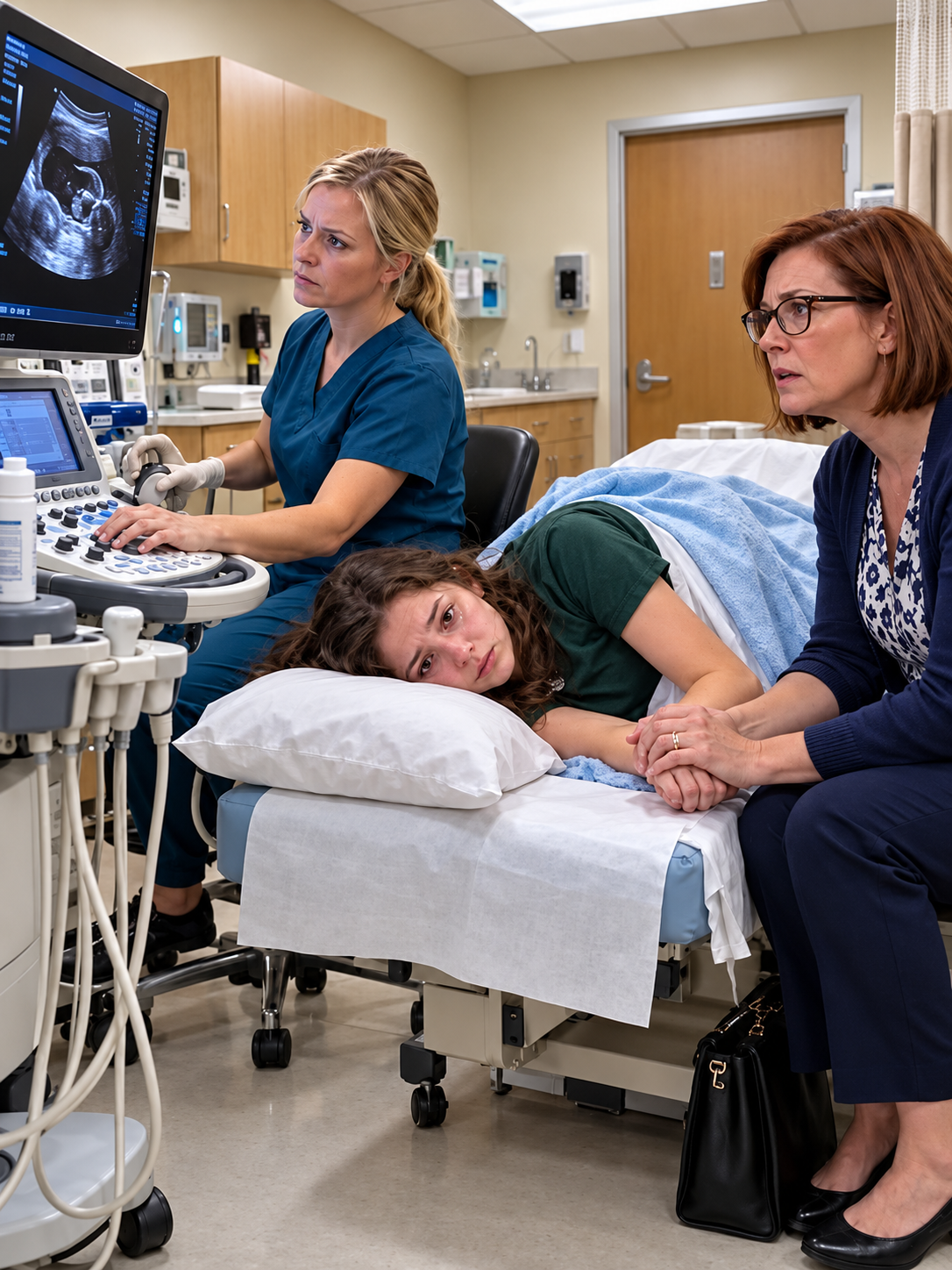
When we were taken for an ultrasound, Grace grew visibly nervous. The examination room was dimmer than the hallway, with a monitor beside the bed and a narrow space for my chair. A technician greeted us and explained what she would be doing. Grace climbed onto the examination bed with her shoes still in her hands, and the disposable covering made a dry rustling noise beneath her. I placed the shoes on the floor and helped her adjust the hem of her sweatshirt. She whispered that the room was cold. I found a blanket and tucked it loosely around her legs.
The technician began moving the ultrasound probe carefully over Grace’s abdomen, studying the screen as she worked. At first, she asked straightforward questions. Was the discomfort constant today? Did one side hurt more than the other? Had Grace experienced any sudden changes? Grace answered softly, occasionally wincing when the probe moved over a tender area. The technician adjusted the controls, recorded several images, and asked her to breathe normally. I watched the monitor for a moment, seeing patterns of light and shadow that meant nothing to me. I had no desire to interpret images without medical training. I wanted only to hear that the examination was proceeding normally.
For several minutes, the technician’s manner remained conversational. She mentioned that she needed to collect different views and reassured Grace that she could say if anything hurt. Then, while studying one particular area, she stopped speaking. Her attention narrowed to the screen. She changed the probe’s angle and took another series of images. The soft clicking of the controls seemed suddenly louder. Grace turned her head toward me. I tried to keep my expression calm, but I had noticed the change too. It was not a dramatic gesture. It was the absence of the ordinary conversation that had made the examination feel manageable.
I asked whether she had found something concerning. The technician paused before answering. She said that the radiologist needed to interpret the images and that the physician would discuss any findings with us. Her tone was professional, neither reassuring nor alarmed. I understood why she could not give a diagnosis, but that did not make the silence easier. She continued recording images, taking care when Grace said a particular position hurt. At one point, she asked my daughter to remain as still as possible. Grace gripped the edge of the blanket, and I moved my chair closer so she could hold my hand.
The examination seemed much longer after that. I began noticing details I had ignored: the ticking sound of a wall clock, the wheels of a cart moving outside the door, the way Grace watched the technician’s face instead of the monitor. She had become practiced at detecting whether adults were displeased with her. I did not want her to mistake the technician’s concentration for irritation. “You’re doing all right,” I murmured. Grace nodded, but her fingers were cold. When the technician finally finished, she helped Grace clean away the gel and explained that we would return to the examination area while the images were reviewed.
Back in the room, Grace pulled her sweatshirt down over her hands. A nurse came to check on her and asked whether she needed anything for comfort. I tried to draw Grace into conversation about the drawings she had left in her school bag, but she kept glancing toward the door. Eventually she asked why the technician had gone quiet. I told her the technician was examining something carefully and that we needed the doctor to explain what it meant. “You think it’s bad,” she said. I took a moment before answering. “I think we came here because something needs attention. I don’t know what the results show yet.”
Grace leaned back against the pillow. “Dad said doctors always make everything sound scarier than it is.” The comment came out so quietly that I nearly missed it. I asked whether Daniel had said that after taking her to the clinic. She nodded. “He said you can waste an entire day listening to people talk about tests you don’t need.” I thought of the vague answers he had given me, the paperwork he resented being asked about, and the way he had treated Grace’s pain as an interruption. For the first time, I felt uneasy not merely about his judgment, but about whether he had given me the truth.
I could still imagine innocent explanations. Perhaps the clinic had recommended something routine, and Daniel had misunderstood. Perhaps there had been a suggestion to return if symptoms persisted, and he had assumed Grace would improve. I had no evidence yet that he had deliberately concealed anything. But one question troubled me: why had Grace come home from that visit less willing to describe her pain than before? If medical professionals had reassured her, why did she seem so afraid of what another doctor might say? I looked at the unopened sketchbook beside her and began to suspect that something important had been lost between the appointment and our home.
A nurse entered to tell us that a physician would speak with us shortly. Grace asked whether that meant she could go home afterward. The nurse explained that the doctor would first review the results and discuss the next steps. Once she left, I checked the time. Daniel usually finished work later in the afternoon, although his schedule varied with meetings. I considered calling him to say where we were. The thought brought back Grace’s frightened request from the bathroom floor. She had agreed to come because I promised that her symptoms would be taken seriously. I was not going to introduce an argument before we had even heard the results.
Approximately twenty minutes after the ultrasound, the examination room door opened. The man who entered introduced himself as Dr. Andrew Collins. He had a composed manner and carried himself with the deliberate calm of someone accustomed to delivering information families might find difficult. He greeted Grace directly, asked how she was feeling, and took a moment to make sure she was comfortable. Then he turned toward the door and closed it gently. I remember that simple movement with extraordinary clarity. Until then, I had been worrying about what the scan might show. The closed door told me that our conversation was going to require privacy.
Dr. Collins pulled a chair closer rather than standing over us. He said he had reviewed the ultrasound and Grace’s available medical history. Before discussing the current findings, however, he wanted to clarify an earlier encounter. “Rebecca, was Grace’s father the person who accompanied her to the hospital several weeks ago?” I stared at him. I knew Daniel had mentioned an appointment, but not a hospital emergency department. “He told me he brought her to be checked,” I said. “I wasn’t there.” Dr. Collins glanced briefly toward Grace, then back to me. He asked what Daniel had told me about the visit.
I explained that my husband had described the examination as reassuring. According to Daniel, Grace had been advised to rest and make ordinary changes to her eating and sleeping habits. The doctor listened without interrupting. Then he asked whether I had been informed that additional testing was recommended. I looked at Grace. Her gaze had dropped to the hem of her sweatshirt. “No,” I answered. “What additional testing?” Dr. Collins turned his attention to the computer. “I want to show you something,” he said. “It may help explain why we’re concerned about the symptoms she’s having now.”
The screen displayed an earlier hospital record. I recognized Grace’s name immediately. Beneath it was a date from five weeks before. The visit had taken place during my conference, when the school nurse had contacted Daniel because our daughter was in considerable pain. The notes described an evaluation that had not reached a final conclusion. Initial findings had raised enough concern for the physician to recommend more detailed imaging and specialist follow-up. A section of the record identified Daniel Mitchell as the accompanying parent. I read that part twice, hoping I had misunderstood what was in front of me.
Dr. Collins explained that the recommendation for further evaluation had remained in Grace’s medical history. He was not making an accusation or assuming that he knew why the follow-up had not occurred. He needed to understand what had happened because the same symptoms had continued and become more severe. I told him that Daniel had never mentioned an abnormal finding or an unfinished evaluation. The words sounded unreal as I spoke them. Grace was looking at me now, and I could see how frightened she was by my surprise. She had apparently believed that the adults around her already understood what the first hospital had found.
I asked Dr. Collins to confirm the date. He did. I asked whether the note truly recommended further imaging rather than simple observation at home. He showed me the relevant section again and explained the distinction. The clinical team had wanted a closer examination of a finding that could not safely be characterized from the initial tests alone. No definitive diagnosis had been made at that first visit. That was precisely why the additional investigation mattered. I thought of Daniel telling me there was nothing requiring treatment, and of Grace lying awake with a heating pad while I assumed a physician had already ruled out a serious problem.
My daughter shifted on the examination bed, and the paper beneath her rustled. “Mom?” she whispered. I turned immediately. Her eyes moved between me and the doctor. “Am I in trouble?” The question was so unexpected that I struggled to answer. She was sitting in a hospital after weeks of worsening pain, yet she still feared that the missing appointment might somehow be her responsibility. I moved beside her and told her that she had done nothing wrong. Dr. Collins waited until she was settled before continuing. I could see that he wanted to discuss the latest images, but I needed a moment to absorb the record on the screen.
I had believed that Daniel and I shared the information necessary to make decisions about our daughter’s health. We disagreed about other things, sometimes painfully, but I had never imagined he would withhold a doctor’s recommendation while telling me the matter had already been settled. The record did not yet explain his reasons. It did establish that our daughter had been sent home with a problem that remained unresolved. I remembered asking him for paperwork and being made to feel unreasonable. I remembered Grace becoming quieter after the visit. For weeks, I had mistaken his confidence for knowledge and her silence for reassurance.
When Dr. Collins turned back to the current ultrasound, he warned us that there was something else we needed to discuss. His expression remained controlled, but he was no longer asking questions about family communication. He was preparing to explain a medical finding. I reached for Grace’s hand, feeling her fingers tighten around mine. The previous record had already changed what I understood about my husband. Whatever appeared on the new images would tell us what his decision might have cost our daughter. I looked at the monitor as Dr. Collins selected the next image and began to speak.
END PART 2
PART 3 TITLE: The Doctor Showed Us What Was Growing Inside Grace, And Her Father’s Hidden Decision Became More Frightening With Every Answer
Dr. Collins adjusted the position of the monitor so both Grace and I could see it. The image was a confusion of gray shapes to me, but he indicated a particular area near the right side of her pelvis. He explained that the ultrasound showed a substantial mass associated with the region of her right ovary. It was not possible to identify its exact nature from this examination alone. More detailed imaging and an assessment by specialists were necessary. I listened carefully, trying to separate what he knew from what remained uncertain. The word mass settled heavily in the room.
I asked him to explain what it might mean. Dr. Collins said that ovarian cysts and other masses could develop in adolescents and that many were noncancerous. Some could nevertheless cause considerable pain or lead to complications that required urgent treatment. The size and location of what they were seeing, together with Grace’s worsening symptoms, made further evaluation important. He did not speak as though disaster were inevitable. Neither did he offer easy reassurance. His precision frightened me because I was accustomed to Daniel dismissing uncertainty with a confident sentence. Here was someone willing to admit what he did not yet know.
Grace had been staring at the screen. She turned toward Dr. Collins and asked the question I had been afraid to form. “Could it be cancer?” Her voice was barely audible, but she did not look away. The doctor moved his chair slightly closer. He explained that the images did not establish a cancer diagnosis and that there were several possible explanations. He would not speculate beyond the available evidence. Further investigation would help the team decide what treatment was needed. I was grateful that he addressed her directly. For once, my daughter did not have to hear adults discussing her body as though she were absent.
I wanted to reach across the room and somehow remove the fear from her face. Instead, I held her hand and asked Dr. Collins what needed to happen next. He described additional imaging and an urgent consultation with the gynecology team. He was concerned not only about the mass itself but also about the possibility of complications affecting the ovary. One concern was torsion, a condition in which the ovary could twist and compromise its blood supply. Severe or changing pain could be especially important in that situation. I looked at Grace, remembering the nights when she had been unable to find a comfortable position.
“Would you have wanted these tests five weeks ago?” I asked. Dr. Collins considered the question before answering. The initial physician had recommended further investigation because the earlier examination had identified an abnormality requiring clarification. He could not tell us what the results would have shown at that time or whether the finding had changed since then. He could say that persistent and worsening symptoms made prompt assessment necessary now. His careful answer left no room for the comforting certainty Daniel had given us. Our daughter had been living with an unresolved medical concern while the recommended examination remained undone.
I looked again at the earlier record. There were clinical observations, a recommendation for additional testing, and a documented plan for follow-up. It was not a complicated message disguised in technical language. A physician had wanted Grace’s condition investigated further. Daniel had known that much. I had spent weeks believing the absence of treatment meant the absence of a medical problem. Now I understood that the reassuring conclusion had come from my husband, not from the hospital. I felt anger rise, but Grace was watching me closely. I did not want her to see another adult become overwhelmed while she waited for help.
Dr. Collins told us he would arrange the next examinations and ask the appropriate specialists to review the findings. Before leaving, he asked Grace whether she had any other symptoms or questions she had not yet mentioned. She hesitated, then described the sharp episodes that sometimes radiated toward her back and the way she had struggled to sleep. He thanked her for explaining. It was such a simple exchange, yet I watched her shoulders loosen slightly. Her descriptions were being received as information. No one accused her of exaggerating. The doctor made notes, explained that the team would continue evaluating her, and left us alone for a few minutes.
I sat beside Grace on the examination bed. She had pulled her knees up slightly, careful not to put pressure on the painful area. For a while, neither of us spoke. Then I asked whether she could tell me more about the first hospital visit. She looked reluctant, and I told her she could take her time. “Dad said there wasn’t anything to worry about,” she began. I asked what the doctor had actually told her. She twisted the sleeve of her sweatshirt around her fingers. “He said they wanted to check something more closely. Dad didn’t like that.”
She explained that the trouble had started during school. The pain had become difficult enough that she was sent to the nurse’s office, where she lay down and waited for someone to collect her. Because I was away at the conference, the nurse called Daniel. He arrived and took her to the emergency department. Grace remembered the examination and the initial tests. She also remembered the physician speaking about the need for more images and another doctor who might need to see her. She had not understood all the medical terms. What she remembered most clearly was the change in her father’s expression when he realized more time would be required.
According to Grace, Daniel had become impatient because he had an important work meeting. He told the nurse they could not remain at the hospital indefinitely and said he would make arrangements for the recommended testing later. Grace did not know whether the meeting could have been rescheduled. She knew only that her father had spoken sharply and that they had gone home without completing the suggested follow-up. “He said they’d made it sound worse than it was,” she told me. “He said they probably wanted to do extra tests because they didn’t know what else to say.”
I asked whether Daniel had mentioned an appointment after that day. Grace shook her head. She had asked him about it once when the pain returned and again after another difficult night. Both times, he became irritated. Eventually, he told her to stop making a fuss. “He said there wasn’t any reason to keep bringing it up.” She spoke without resentment, almost as though she were describing a rule she had accepted. That frightened me more than if she had been angry. She had started believing that the doctor’s concern was less important than her father’s confidence and that mentioning her pain was a kind of disobedience.
“Why didn’t you tell me?” I asked, regretting the question the moment it left my mouth. Grace looked down. “I thought you knew.” I waited. “Dad said he told you everything. And when you asked how I was feeling, I figured you agreed with him.” She wiped her eyes with the sleeve of her sweatshirt. “I didn’t want you both to be annoyed with me.” My throat tightened. I remembered calling her from the hotel after the first visit, my relief when she said her father had handled things, and my failure to ask what the doctor had actually recommended. Grace had not deliberately hidden anything from me. She had trusted us to understand each other.
I apologized for failing to recognize how much trouble she was having. She tried to interrupt, saying I had been busy and that she should have explained things better. I stopped her gently. “You told us you were hurting. You did what you were supposed to do.” Her face crumpled. She said she had begun to wonder whether she was making the pain worse by thinking about it. I remembered her curled on the bathroom floor, whispering because she did not want to upset Daniel. I moved carefully beside her and put an arm around her shoulders. She cried against me, and I held her without trying to hurry her into feeling better.
We were still sitting together when my phone began vibrating in my pocket. Daniel’s name appeared on the screen. I stared at it, then silenced the call. Grace noticed. “Is that Dad?” I nodded. She looked toward the door as if expecting him to appear. I explained that I would speak to him when I was ready and that she did not need to answer questions about the appointment. The phone rang again. This time I stepped away long enough to read a message. Daniel had heard from the school that I had collected Grace early. He wanted to know why I had not consulted him.
I told him we were at the hospital and that the medical team was evaluating her symptoms. His reply arrived almost immediately. He accused me of ignoring what he had already explained and suggested that I was frightening Grace unnecessarily. I read the message twice, hearing his familiar impatience in every sentence. Before that afternoon, I might have tried to reassure him or soften my response. Instead, I wrote that the physician had found the record from the earlier hospital visit and that we would need to discuss why the recommended tests had never been arranged. I pressed send and watched the screen.
There was no immediate reply. For several minutes, the phone remained silent. I returned to Grace and asked whether she wanted water. She shook her head. Her attention was fixed on the door, waiting for the next person who might explain what was happening. I sat down beside her and told her that the doctors were arranging further examinations. She asked if the mass meant she would need an operation. I said surgery was one possibility being considered, but that the specialists would explain what they recommended once they had reviewed everything. It was difficult to offer an answer that contained uncertainty without making uncertainty sound like danger.
Then my phone rang again. Daniel. Grace saw his name and looked away. I told her I would take the call in the hallway and return in a moment. Outside the examination room, I stood near a wall where people would not have to walk around me. When I answered, Daniel began speaking before I could say hello. He accused me of allowing doctors to make a simple complaint into something frightening. I asked what he thought had been exaggerated. He said Grace was young, anxious, and increasingly inclined to interpret ordinary discomfort as serious illness. He sounded irritated that I had disrupted his understanding of the situation.
I interrupted him. “Daniel, they’ve found something near her ovary. They want more imaging and a specialist to assess it.” His response changed. There was a noticeable pause, followed by a quieter question about what exactly the doctor had said. I explained that the finding could not yet be identified and that the team was concerned because Grace’s pain had become worse. Daniel exhaled slowly. Then he admitted that the first hospital had mentioned a possible abnormality in the same area. He described it as an uncertain finding, something he had believed was unlikely to matter. I gripped the phone harder.
“You knew they were looking at that area?” I asked. He told me nothing had been confirmed and that the first physician had recommended additional testing mostly as a precaution. I asked why he had not told me. Daniel became defensive. He said he had been trying to spare us unnecessary worry. According to him, there was no point alarming the entire family over something the doctors could not explain. I reminded him that uncertainty had been the reason for further examination, not a reason to ignore the recommendation. He answered that I was misunderstanding how these things worked.
I leaned against the wall, suddenly aware of how tired I felt. I asked whether he had made any attempt to arrange the specialist appointment. He did not answer directly. Instead, he spoke about his workload, the demands of important clients, and how difficult it had been to take time away from work. He said we could not spend every week going from one appointment to another whenever Grace complained. I closed my eyes for a moment. The hospital had not suggested repeated appointments without purpose. There had been a specific medical concern requiring investigation. He was still discussing the inconvenience of finding out what was wrong.
I told him that Grace had suffered for weeks. Daniel responded that she had complained about a great many things lately and that I needed to consider how much of her behavior was genuine illness and how much came from wanting reassurance. The familiar accusation, repeated even after I had told him about the scan, made something inside me settle. I had spent years trying to find the right words to persuade him without making him angry. Now I understood that the argument itself was distracting us from the person who needed help. I said his name firmly and told him I would not listen to him belittle her symptoms again.
Daniel went quiet for a moment. Then he reminded me that he was Grace’s father and had every right to be involved in decisions about her treatment. I said that being her father did not excuse ignoring the recommendations of medical professionals or withholding information from me. He accused me of speaking as though I alone understood our daughter’s needs. I looked through the window in the examination room door. Grace was sitting upright, watching the hallway with a frightened expression. I told him that she was receiving medical attention and that I intended to remain beside her while the doctors determined what needed to be done.
He asked whether I had considered the cost of all the testing. I told him that expense could be discussed when we knew what treatment Grace required. Our daughter’s immediate health was not something I would postpone because an appointment was inconvenient. Daniel began describing how much pressure he was under at work. I said I was aware of his responsibilities, but they did not explain why he had hidden a recommendation concerning our child. His voice grew harder. He told me that I was making him sound like a negligent parent. I replied that I was asking him to account for a decision he had made without either of us understanding the consequences.
For a moment, I expected him to acknowledge what had happened. Perhaps he would say he had been afraid, or that he had misjudged the symptoms, or that he had convinced himself the problem would disappear. Instead, he asked why I had taken Grace out of school without telling him. The conversation had returned to his authority rather than her condition. I realized there was nothing productive left to say. I told him I would inform him when the medical team had established the treatment plan. Then I ended the call before he could begin another argument.
My hands trembled when I lowered the phone. People passed in the corridor carrying medical charts and cups of coffee. Somewhere nearby, a cart rattled across the floor. The hospital continued functioning around me while I tried to absorb what I had learned. Daniel had not merely misunderstood a doctor’s reassurance. He knew further investigation had been recommended. He knew Grace continued to have pain. Instead of helping her seek answers, he had chosen to treat her symptoms as an annoyance and had allowed me to believe the matter was settled. I could not yet decide what that meant for our marriage. I knew what it meant for the next few hours.
When I returned to the examination room, Grace looked up immediately. “Is he angry?” I sat beside her and took her hand. “He’s upset,” I answered. “But you don’t need to manage that.” She studied my expression. “Are you upset with me?” I shook my head. “I’m worried about what’s happening to your body, and I’m angry that you were made to feel you couldn’t tell us. Those are different things.” Grace seemed to consider the distinction. She asked whether her father was coming to the hospital. I said I did not know, but promised that I would make sure she had the space to receive care without being pressured or blamed.
A nurse entered with information about the next examination. The doctors wanted more detailed images before the specialist consultation. She explained where we would be going and asked Grace whether she felt able to walk or preferred assistance. Grace said she could manage if she moved slowly. I helped her gather her belongings and steadied her as she stood. On the way down the corridor, she leaned slightly toward me when the pain sharpened. I matched her pace without comment. For once, she did not apologize for needing to stop. That small change told me she was beginning to believe my promise.
We reached the imaging department, where another member of the medical team reviewed the preparation and answered our questions. Grace asked again whether the doctors were looking for cancer. I let the professional explain what the examination could establish and what might remain uncertain until further assessment. I did not interrupt or substitute my own reassurance for an answer I could not honestly give. Watching my daughter listen, I understood that courage did not require someone to pretend that nothing frightening was happening. It required enough trust to ask difficult questions and remain present for the answers.
As Grace was prepared for additional imaging, I thought of Daniel describing the first hospital visit as a waste of time. I thought of the five weeks that had passed, the abandoned volleyball practices, the missed sleep, and the way her clothing had begun hanging loosely from her shoulders. There was no way to know what the earlier testing might have changed. But there was no longer any doubt that the opportunity to investigate had been lost. When a member of the team told me the specialist would review the new findings that afternoon, I understood that we were moving toward a decision Daniel had spent weeks avoiding.
Grace looked back at me just before the examination began. Her expression was frightened but steady. I told her I would be close by and that we would listen to the doctors together. She nodded, then asked the question I had been trying not to think about. “Mom, if they say I need surgery, will you let them help me?” I looked at her and answered that we would understand the recommendation and make sure she received the care she needed. She released a slow breath. I stood beside her until the staff asked me to move, knowing that when the next results arrived, our lives might change in ways neither of us could yet imagine.
END PART 3
PART 4 TITLE: When The Specialists Recommended Surgery, My Husband Finally Revealed Why He Had Ignored The Warning Signs And Left Our Daughter Suffering
By late afternoon, the additional imaging had given the medical team a clearer picture of the problem. The mass associated with Grace’s right ovary was large enough to require surgical evaluation. The physicians explained that the images could guide their decisions, but they could not establish every detail of its nature. Some questions would be answered only during surgery or after laboratory testing of the removed tissue. I listened with a notepad open in my lap, writing down words I barely knew how to spell. Grace sat close beside me. Each time someone described a possible treatment, she looked at me before turning back to the doctor.
The team did not present surgery as a casual recommendation. They discussed the size of the mass, the persistent pain, and the risk of complications. They explained the need to balance prompt treatment with careful preservation of healthy tissue wherever possible. I asked whether delaying the operation might give us time to seek other opinions or allow Grace to recover from the exhaustion of that day. The answer was measured. Given the findings and her symptoms, they believed continued hospital observation and timely surgical treatment were appropriate. They wanted to avoid exposing her to unnecessary additional risk while the underlying problem remained unresolved.
Grace listened quietly until the physicians finished. Then she asked whether the operation would leave her with a large scar. It was such a fifteen-year-old question, practical and vulnerable at once, that I almost smiled. The doctor explained that the surgical team would discuss the planned approach, including what could affect the incision and recovery. Nothing was promised beyond what they could reasonably know. Grace nodded and asked whether she would have to stay overnight. When she learned that she would be admitted for monitoring and preparation, she looked toward the window. She had expected to return home with a prescription or some instructions. Instead, she was being given a hospital room.
I asked whether she wanted me to contact anyone. She shook her head at first. Then she mentioned her volleyball coach and the assignment she had handed in that morning. I told her we could deal with school once the immediate decisions were made. She said she did not want everyone on the team finding out before she knew what was happening. I agreed to respect that. It was important to give her some control over the ordinary parts of her life while so much else was being decided for her. The medical team needed to guide her treatment, but she could still choose whom to tell and how much to share.
We were moved to a hospital room that evening. The bed stood beneath a narrow window, and the overhead lights were brighter than Grace liked. A nurse showed us how to call for assistance and explained the monitoring that would continue through the night. Grace placed her sketchbook on the bedside table beside a small cup of water. I helped her settle the blanket around her legs and found a place for her school bag. The room seemed both unfamiliar and strangely ordinary, with its plastic chair, folded linens, and steady background noise. I knew families made difficult decisions in rooms like this every day. Knowing that did not make ours feel less frightening.
Dr. Elena Ramirez, the specialist responsible for discussing the surgical plan, arrived later that evening. She introduced herself to Grace first and asked whether she would prefer her mother to remain throughout the conversation. Grace said yes. Dr. Ramirez took a seat beside the bed rather than remaining near the doorway. Her voice was calm and direct. She explained the findings in language Grace could follow, checking occasionally to see whether she understood. I noticed that she did not rush into a recommendation before listening to my daughter describe the pain herself. She treated Grace’s account as an essential part of the medical picture.
Grace told her about the aching sensation that had gradually become harder to ignore, the sharp episodes, and the nights when she had relied on a heating pad. Dr. Ramirez asked follow-up questions without displaying impatience. When Grace said she had stopped mentioning the pain at home because she was afraid of bothering people, the specialist paused. She told Grace that reporting symptoms was an important way of helping the medical team understand what was happening. A person did not have to prove they were suffering enough before asking for care. Grace looked at her for several seconds, then dropped her eyes. I saw her fingers loosen around the edge of the blanket.
Dr. Ramirez explained that the surgical team would evaluate the mass and remove it as safely as possible. Their intention was to preserve healthy ovarian tissue if the operative findings allowed. She also made clear that the exact approach could depend on what they encountered. I asked about recovery, possible complications, and how the surgery might affect Grace in the future. The specialist answered each question carefully. I was grateful for her willingness to explain uncertainty without making it sound as though nobody knew what they were doing. Grace listened more attentively with each answer, occasionally interrupting to clarify something she had not understood.
Then she asked about volleyball. “Will I get to play again?” Dr. Ramirez’s expression softened. She explained that the immediate goal was to treat the problem safely and help Grace recover. Her return to physical activity would depend on healing and her follow-up assessments, but the team hoped she would eventually resume the activities she enjoyed. Grace looked relieved that the question had been taken seriously. For the first time since arriving at the hospital, she began talking about the school gym, her teammates, and how much she missed being on the court. I watched her face come alive briefly, and the sight made me ache with gratitude and fear at once.
After Dr. Ramirez left, Grace asked whether I thought the doctors could save her ovary. I told her they intended to protect healthy tissue wherever medically possible, but that I did not want to promise an outcome before the operation. She accepted that answer more readily than I expected. Perhaps hearing honest uncertainty from several professionals had made it easier for her to distinguish caution from dismissal. She asked if I would stay until she fell asleep. I assured her I would. We settled into the quiet that follows a long medical conversation, both of us trying to absorb information that had arrived faster than we could process it.
I thought about calling my younger sister, Claire. She had always been close to Grace, and I knew she would come if I asked. But before making that call, I wanted to understand whether Daniel intended to arrive. He had not contacted me since our conversation in the hallway. I sent him a brief message explaining that the doctors had confirmed a large ovarian mass, admitted Grace for observation, and recommended surgery. I included the hospital information and said that we needed to respect Grace’s emotional state while decisions were being made. I did not ask his permission. I informed him of the plan because he was her father, and because the medical team needed accurate information and appropriate involvement from the adults responsible for her care.
Grace fell asleep for a short while. I remained beside her, studying the shape of her face against the pillow. She looked younger than she had in months. Without the effort of pretending to be well, the exhaustion beneath her eyes was unmistakable. I remembered how she had once returned from volleyball practice talking so quickly about a game that I had barely been able to follow her. I remembered the afternoons when she spread drawings across the kitchen table and asked me which expression looked most realistic. Those memories were not distant, yet they seemed to belong to a time before she learned to hide her pain.
When Daniel appeared in the doorway later that night, I knew immediately that he was angry. His jaw was tight, and he was holding his phone as if he had been using it all the way through the hospital corridors. He glanced at Grace, then looked at me. His first question was why nobody had informed him sooner that she was being admitted. His voice was louder than I wanted in the quiet room. Grace opened her eyes and shifted against the pillow. I stood before he could continue. “We’ll talk outside,” I said. Daniel frowned, but I moved toward the door and waited for him to follow.
He looked past me at Grace. “This whole thing has gotten far more complicated than necessary,” he said. I saw our daughter pull the blanket higher. Her expression changed from sleepy confusion to the guarded fear I had begun recognizing too well. I stepped between them and repeated that we needed to speak privately. Daniel hesitated, then followed me into the corridor. Once we were away from the doorway, I told him the doctors had recommended surgery because the mass was significant and her symptoms had worsened. He interrupted with a question about whether anyone had explained why all the testing had been necessary.
I described the specialist’s assessment and what we knew about the risks. Daniel listened with visible impatience. Then he lowered his voice and said I was making him look terrible in front of the hospital staff. For a moment, I simply stared at him. Our daughter was facing an operation, and he was concerned about how he appeared. I asked why that was his first response. He said he had not meant it that way. He claimed he was being treated as though he had deliberately endangered Grace, when he had only been trying to avoid unnecessary medical procedures. I reminded him that the recommendation for further evaluation had been documented five weeks earlier.
Daniel rubbed his forehead and looked toward the nurses’ station. “Do you have any idea what this kind of treatment costs?” he asked. I told him that we had health insurance and that we could review the financial details with the appropriate hospital staff. He answered that insurance did not make every expense disappear. There would be deductibles, uncovered services, and time away from work. His frustration seemed genuine, but it was directed toward the burden of the problem rather than the suffering it had caused. I asked whether concern about money was why he had never arranged the appointment. He did not answer immediately.
Eventually, he admitted that he had been worried about expenses. His company had also been reviewing employee performance, and he felt his position depended on maintaining his numbers and appearing consistently available. The first hospital visit had already disrupted an important workday. Arranging further appointments meant losing more time during a period when he believed every absence could count against him. He had persuaded himself that the initial finding was probably harmless. When Grace continued complaining, he became irritated because the symptoms challenged the conclusion he had chosen. It was easier, he admitted indirectly, to believe she was exaggerating than to confront a problem he did not know how to manage.
I listened without interrupting. I understood the pressure of supporting a household and the anxiety that financial uncertainty could create. I understood that Daniel had spent years measuring his worth through professional success. But none of that explained why he had concealed information from me or dismissed Grace when she continued asking for help. “You could have told me,” I said. “We could have worked out the appointments together. You didn’t have to decide alone.” He insisted that he had expected the pain to resolve. I asked what he had planned to do when it didn’t. He looked away instead of answering.
I thought of Grace describing how she had questioned her own senses. “Did you ever think about what she was hearing when you told her she was exaggerating?” I asked. Daniel said she knew he loved her. I shook my head. “She knows you’re her father. That’s not the same as knowing you’ll listen when she’s frightened.” He argued that he had only wanted her to become more resilient and stop assuming the worst. I reminded him that she had tried to endure the pain quietly for weeks. “She did exactly what you demanded,” I said. “She stopped talking about it. And the problem didn’t go away.”
Daniel’s expression hardened. He accused me of encouraging Grace to mistrust him. He said I was using the situation to turn our daughter against her father and that a family could not function if one parent undermined the other’s decisions. I had heard variations of that argument throughout our marriage. Usually, I would have attempted to explain my intentions until he no longer felt challenged. This time, I refused to follow him into a debate about authority. I told him that Grace was receiving necessary care and that I would not permit her to be blamed or pressured while she was preparing for surgery.
He asked whether I intended to prevent him from seeing his own daughter. I said I wanted her wishes about visitors and her need for a calm environment to be respected. The hospital staff could help us manage those arrangements while she was being treated. Daniel looked offended, as though I had suggested something outrageous. I reminded him of the way she had stiffened when he entered her room and of the things she had told me about being afraid to mention her pain. He said she was too young to understand how difficult adult decisions could be. I answered that she was old enough to know when someone made her afraid to speak.
A nurse approached as our voices began attracting attention. I lowered mine and explained that I wanted guidance on supporting Grace’s preferences about visits while her care continued. The nurse listened and said she would help the team understand Grace’s concerns and the arrangements appropriate for her treatment. Daniel stood nearby, visibly frustrated. When I turned toward him, he asked whether I expected him simply to leave. I told him that he could speak with the medical team about her condition, but that I would not bring him back into the room to argue with her. I wanted our daughter to be able to rest without wondering what accusation she might hear next.
Daniel remained silent for a moment. Then he said I was making decisions I might regret. His words were quiet, but the familiar warning beneath them was unmistakable. I felt the old instinct to apologize, to reassure him, to make the evening less difficult. I did not act on it. I told him that our daughter was the person facing surgery in the morning and that every decision I made that night would be guided by what she needed. He looked at me for several seconds before turning away. Shortly afterward, he left the hospital. I watched him disappear around the corridor without attempting to stop him.
When I returned to Grace’s room, she was awake. She did not ask what Daniel had said. Instead, she asked whether he was still angry with her. I sat beside the bed and explained that his reaction was not her responsibility. She studied me carefully, as though she wanted to believe the answer but had not yet learned how. Then she asked if I was angry with him. I told her I was upset about the decisions he had made and the information he had withheld. “Does that mean you’ll get divorced?” she whispered. The question surprised me because I had barely allowed myself to consider it. I told her I didn’t know what would happen to our marriage, but she did not have to solve that question.
Grace reached for my hand. “I don’t want everyone fighting because I’m sick.” I moved closer and told her that the conflict had not been caused by her illness. Adults were responsible for their own decisions, including the decisions they made when someone depended on them. She looked down at our joined hands. I could tell that she was still trying to separate her pain from the arguments it had provoked. I explained that she could love her father and still be upset with him. She could want her parents to get along without being responsible for making that happen. For the first time, she did not immediately try to defend him.
Later, when the room had grown quiet, I called Claire and told her what was happening. My sister listened as I described the mass, the recommended operation, and the earlier hospital record Daniel had concealed. She asked practical questions first: whether Grace was comfortable, when surgery was planned, and whether I had eaten. Then she said she would come in the morning. I was grateful that she did not try to explain Daniel’s behavior or tell me how to feel about it. She asked what I needed, and I told her that I was frightened. Claire said she would be there, and for the first time that day, I allowed myself to believe I would not have to face everything alone.
The night passed in fragments. Nurses entered periodically to check Grace and monitor her condition. She slept for short stretches, waking when a movement caused discomfort or when someone needed to speak with her. I remained close, sometimes sitting in the chair and sometimes standing beside the bed. Each time she opened her eyes, she looked for me. I began answering before she could ask, reminding her that I was still there. It was a small promise, but one I could keep without hesitation. The hospital room became a place where we could acknowledge fear without needing to hide it for someone else’s comfort.
Before dawn, Grace asked me whether surgery would make the pain stop. I told her that treating the mass was intended to address the underlying problem, but that the doctors would explain what recovery might involve afterward. She nodded and watched the pale light forming around the window. After a while, she said she wished she had insisted on another appointment sooner. I felt a painful tightening in my chest. I reminded her that she had told us she was hurting and that the responsibility for arranging medical care belonged to the adults looking after her. She considered my words, then asked me to promise that I would believe her if she ever became sick again.
I took both her hands in mine. “You won’t have to convince me by getting worse,” I said. “We’ll listen, and we’ll find out what’s happening.” Grace studied my face as if memorizing the answer. Then she released my hands and reached for the small sketchbook on her bedside table. She opened it to a blank page but did not begin drawing. Instead, she rested the pencil against the paper and asked me to sit close until the surgical team came. I moved my chair beside her bed. Whatever happened during the operation, she would not face it believing that her pain was an inconvenience or that speaking about it required anyone’s permission.
When the morning nurse arrived to begin preparing her for surgery, Grace put down the pencil and took a long, unsteady breath. She listened to the instructions, asked one final question about when I would see her afterward, and looked toward me for reassurance. I told her I would be there when the medical team allowed me back. She nodded and reached for my hand. The decision Daniel had postponed for five weeks was now moving forward, and the outcome remained uncertain. As the staff began preparing her for the operating room, I understood that the surgery might save far more than our daughter’s health. It would force us to confront the truth about the family she would return to when she woke.
END PART 4
PART 5 TITLE: The Night Before My Daughter’s Surgery, My Husband Finally Revealed What Had Mattered More to Him Than Her Pain
The specialist had barely finished explaining the operation when Grace asked whether someone would have to cut her open. Her voice was so quiet that Dr. Elena Ramirez leaned forward to hear her. I sat beside the hospital bed, holding my daughter’s hand beneath the blanket, and watched the doctor consider how to answer a frightened fifteen-year-old without hiding anything important. Outside the room, a cart rattled across the tiled corridor. Grace flinched at the sound. She had spent weeks pretending not to hurt, and now everything around her seemed designed to remind her that the pain had been real all along.
Dr. Ramirez pulled her chair closer. She explained that the images showed a large mass associated with Grace’s right ovary and that the team needed to remove it before it caused further damage. They would choose the safest surgical approach after reviewing the images and her condition. Their intention was to preserve as much healthy tissue as possible. Grace listened without interrupting. When the doctor finished, she looked at me rather than at her. I recognized that expression. She wanted to ask whether I was afraid, but she was still trying to protect me from the answer.
“Will it hurt afterward?” Grace asked. Dr. Ramirez nodded. “You’ll have discomfort while you heal, and we’ll help you manage it. I won’t promise something I can’t guarantee. What I can promise is that we will listen when you tell us how you feel.” Grace’s fingers tightened around mine. It was the first time since our arrival that she had looked directly at someone in a white coat without shrinking into herself. The doctor handed her a tissue, although she had not yet begun crying. That small gesture seemed to give her permission.
When Dr. Ramirez left, Grace stared at the folded blanket covering her legs. “Dad’s going to say we’re making too much of this.” I reached for the water cup on her bedside table, partly because I needed something to do with my hands. “Your father doesn’t get to decide whether a medical condition exists,” I told her. “The doctors have examined you. They’ve shown us what’s happening. We’re following their advice.” She nodded, but the hesitation remained in her face. Years of hearing one parent’s certainty had made it difficult for her to trust another person’s reassurance, even when that person was me.
A nurse came to review the preparations for the next morning. She checked Grace’s identification bracelet, explained when she would need to stop eating, and asked whether we had any questions. Grace asked about anesthesia. I asked about the expected length of the operation and how I would be updated. We both wrote things down on the back of an envelope because our memories had become unreliable under the weight of everything we had heard. I noticed that Grace watched the nurse’s pen each time she made a note. Written information had acquired a new significance for both of us.
After the nurse left, Grace asked for her phone. She scrolled through messages from her volleyball teammates, who had noticed her absence from practice. One girl had sent a photograph of an empty place on the bench with a message telling Grace to hurry back. My daughter gave a brief laugh, then winced and pressed her palm against her right side. The laugh disappeared so quickly that I felt it more sharply than if she had cried. “You don’t have to answer anybody tonight,” I said. She shook her head. “I want them to know I’m here. I just don’t know what to tell them.”
We settled on a short message saying she was in the hospital and would need some time to recover. It was her decision how much to share. That mattered to me now in a way I had not fully understood before. For weeks, adults had talked around Grace, interpreted her symptoms for her, and made decisions without explaining them. Daniel had gone further and concealed the very information she needed. I had been too willing to accept his version. Sitting beside her bed, I understood that rebuilding her confidence would require more than telling her she could speak. I would have to demonstrate that her words changed what happened next.
My phone vibrated just after seven. Daniel’s name appeared on the screen, followed by another message asking when we intended to come home. I had already told him that Grace was being admitted, and he had acknowledged the information. Yet he still seemed to think the hospital visit was a disagreement I could end by collecting our daughter and driving back. I typed that surgery had been recommended for the morning. Three dots appeared almost immediately. Then came his reply: “We need to discuss this before anybody agrees to anything.” I looked at Grace, who was concentrating on her teammates’ messages, and put the phone facedown.
Daniel called twice before I answered. I stepped into the corridor so Grace would not have to hear another argument. He opened with a question about who had authorized the operation. I told him the specialist had reviewed the findings, explained the risks, and recommended treatment. “You can’t make a decision like that because one doctor frightens you,” he said. I kept my voice low. “It wasn’t one doctor, Daniel. It’s the emergency physician, the imaging team, and the specialist. They are all concerned. Grace is being monitored because this isn’t something we can keep ignoring.”
He asked whether I had considered the cost. For a moment I thought I had misunderstood him. I reminded him that we had health insurance. He launched into an explanation about deductibles, expenses, and the possibility of receiving bills for services he believed were unnecessary. He spoke with the same clipped assurance he used when discussing sales figures at the construction company. I could picture him pacing the kitchen, one hand resting on his hip, waiting for me to recognize the practicality of his position. The more he talked, the less I heard about Grace. I finally interrupted and asked whether he wanted to know how frightened she was.
There was a pause, followed by a tired exhalation. “I know she’s upset. But we’ve made it worse by treating every complaint as an emergency.” The words landed with a familiarity that made me feel cold. Even after the doctors had found a mass, even after they had recommended surgery, he was speaking as though Grace’s greatest problem was her behavior. I told him I would not discuss canceling treatment. If he wanted information, he could speak with the medical team and ask his questions respectfully. He said he was coming to the hospital. Before I could answer, the call ended.
I returned to the room and found Grace trying to rearrange her pillow without moving her abdomen. I helped her sit more comfortably and tucked the blanket around her feet. She watched me for a moment. “Was that Dad?” I said yes. She looked toward the door. “Is he angry?” The question was so automatic that I almost answered it automatically too. Instead, I sat down. “He isn’t handling this well,” I said. “But you are not responsible for his reaction.” Grace traced the stitching on her blanket. “He always says I’m making things harder.” I told her that needing medical care was not a personal failure, no matter how inconvenient someone else found it.
Around eight, Daniel appeared in the doorway wearing his office clothes. His tie was loosened, and he carried his car keys in one hand. He surveyed the monitor, the medication chart, and the hospital bracelet on Grace’s wrist before looking at me. “Why didn’t someone call me when they decided to keep her?” he demanded. The nurse, who was adjusting an intravenous line, paused. I answered that I had already informed him. He dismissed that with a movement of his hand and turned to Grace. “Well, this has certainly become a bigger production than anybody expected.”
Grace drew her shoulders inward. I saw her fingers disappear beneath the blanket and knew immediately that she was trying not to react. The nurse finished checking the line and asked whether Grace needed anything. My daughter shook her head. Daniel began asking how long she would be away from school and whether the surgery was absolutely necessary. I could have joined the discussion, tried to soften his questions, and translated his irritation into something less frightening. I had done that for years. Instead, I stood and asked him to step outside. When he ignored me, I repeated the request without raising my voice.
In the corridor, Daniel looked toward the nurses’ station and lowered his voice. “Do you realize how this looks? You made a decision behind my back, and now I’m the last person to know what’s happening in my own family.” I studied his face, searching for some sign that fear was hiding beneath his anger. Perhaps it was. But fear did not excuse the way he had spoken to Grace. “Our daughter has a mass that needs removing,” I said. “You were told five weeks ago that she needed further investigation. You said the hospital had found nothing important. Now you’re worried about how you look.”
He rubbed his forehead and looked away. “I didn’t say there was absolutely nothing.” I reminded him of the conversation in our kitchen, when he had assured me that a doctor recommended rest and better eating habits. I remembered asking for paperwork and hearing him accuse me of questioning his competence as a father. He now described that conversation as a misunderstanding. I told him it wasn’t. He had withheld the follow-up recommendation, ignored Grace’s continued pain, and allowed us both to believe the matter had been settled. Those were decisions, not vague impressions we had somehow formed independently.
For several seconds Daniel said nothing. Then he moved toward a row of empty chairs, sat down, and rested his elbows on his knees. The confidence drained from his expression, though not the defensiveness. He explained that he had been under pressure at work. His department’s performance was being reviewed, and he was worried about his position. The first hospital visit had already cost him several hours. When the physician recommended further testing, Daniel had thought about missed meetings and medical bills. He told himself the initial findings might turn out to be insignificant. He believed he could postpone the follow-up until things settled down.
“And when they didn’t settle down?” I asked. He stared at the floor. I reminded him that Grace had stopped practicing volleyball, that her clothes had grown loose, and that she spent evenings curled beneath a heating pad. He said he’d believed she was anxious and focusing too much on the discomfort. “She kept bringing it up,” he added. “I thought if we stopped making such a fuss, she’d stop worrying about it.” He spoke as though repetition made a symptom less credible. I waited until he finally looked at me. “She stopped bringing it up to you,” I said. “That isn’t the same as getting better.”
Something in his expression tightened. “I never wanted her to suffer.” I believed he preferred that version of himself. Perhaps he even believed it sincerely. But I had heard enough explanations that began with good intentions and ended with Grace sitting alone in pain. “What you wanted doesn’t change what happened,” I replied. “She asked for help, and you taught her that asking would bring punishment. Then you let me believe you had already taken care of it.” He opened his mouth, closed it again, and looked toward the room where our daughter was waiting.
Daniel asked whether I intended to tell Grace that he had made a mistake. I told him she already knew something had gone wrong because she had been present during the first hospital visit. She remembered the doctor discussing more imaging. She remembered her father promising to arrange it. He seemed surprised that those details had stayed with her. I wondered whether he had considered her too young to understand or simply too obedient to speak. “She doesn’t need us arguing over whose version is correct,” I said. “She needs honest answers about what happens to her body.”
He leaned back and crossed his arms. “You’re turning her against me.” It was a familiar accusation, one he reached for whenever I disagreed with him about something important. For seventeen years, the possibility of a prolonged argument had often persuaded me to change the subject. Now the threat felt smaller than the hospital room behind us. “I’m not asking her to choose sides,” I said. “I’m asking you to stop telling her that pain is a character flaw.” He looked past me toward the nurses’ station, where two staff members were speaking quietly over a chart.
I told him that I would not permit another conversation in which Grace was mocked, blamed, or pressured to minimize her symptoms. If he wanted to support her, he could begin by asking what she needed and listening to the answer. Daniel said I had no right to dictate how he spoke to his child. “Then we need help deciding what is appropriate,” I replied. I was surprised by how calmly I said it. I had not planned a speech or rehearsed an ultimatum. I had simply reached a place where the old method of accommodating his anger was no longer possible.
When I went back into the room, Grace’s eyes moved immediately to the doorway behind me. “Is he coming in?” she asked. Her voice revealed the answer she hoped for. I told her we could decide together whether she wanted another visit that evening. She thought for a long moment, twisting the corner of her blanket. “Not right now,” she said. “I’m tired.” I informed the nurse that Grace needed rest and that we wanted her wishes about visitors respected. The nurse responded without surprise, explaining that the team would help maintain a calm environment while continuing her medical care.
Daniel was still in the corridor when I returned. I told him that Grace wanted to rest and was not ready for another conversation. He looked offended. “She’s my daughter.” I answered that I knew exactly who he was. I also knew she was frightened, physically uncomfortable, and facing surgery the following morning. He started to argue, then seemed to notice that I was not preparing to negotiate. “Fine,” he said. “Tell her I came.” I promised to tell her he had been there. I did not promise to change the reason she had asked him to leave.
After he walked away, I stood near the window at the end of the hall. The parking lot below was washed in white light, and cars moved slowly through the entrance lane. I should have felt victorious for finally refusing to retreat. Instead, I felt exhausted. I thought about all the dinners when Daniel had dismissed Grace’s complaints, all the times I had tried to reassure her afterward, and the afternoon I accepted his vague description of a medical appointment because asking more questions would have started an argument. I could not undo those choices by confronting him once.
I went to the nurses’ station and asked for copies of the available medical information and instructions about accessing the complete records. I wanted the chronology in front of me rather than filtered through anyone’s assurances. A staff member explained the procedure and helped me identify the entries concerning the earlier visit and the tests ordered that day. I wrote the dates in my notebook. The first hospital encounter, five weeks before. The recommendation for additional imaging. The absence of a completed follow-up. The new scans. The surgical recommendation. Seeing them together made Daniel’s omissions impossible to minimize.
When I returned to Grace, she was sitting upright and examining the identification bracelet around her wrist. “He left?” she asked. I nodded. She was silent for several seconds. Then she said, “I know you told him to go because of me.” I pulled my chair close. “I asked him to leave because you needed peace, and because he wasn’t helping.” She looked doubtful. “I don’t want you two to get divorced.” I felt the weight of seventeen years of marriage settle between us. “You don’t need to solve our marriage tonight,” I told her. “Your job is to rest and tell us what you need.”
She looked toward the dark window. “What if the surgery doesn’t work?” I answered as carefully as I could. The doctors had explained what they expected to do, what they would watch for, and why treating the mass was important. There were uncertainties, and I would not pretend otherwise. But the team had a plan, and we would ask questions whenever we needed to. Grace listened, then asked whether I would be there when she woke up. I promised to be waiting for her. She held my hand until a nurse returned to check her vital signs.
Later, after the lights were dimmed, Grace told me something I had not known. On the day Daniel first brought her to the hospital, she had heard the physician mention further testing and had wanted to ask what it meant. Her father was standing near the door, looking at his phone. When they reached the car, she asked whether they would return. He told her not to start worrying about things she didn’t understand. She had interpreted that as an instruction not to ask again. “I thought if it was important, he’d tell you,” she whispered.
I stayed quiet for a moment because I did not want my anger to become another burden she carried. Then I told her that adults could make serious mistakes, including mistakes about things they should have understood. The responsibility for those mistakes remained with the adults. Grace asked whether I was angry with her father. “Yes,” I said. “I’m angry about what he did. I’m also worried about you, and I love you. Those feelings can exist together.” She seemed relieved that I had not tried to invent a kinder explanation. She rolled onto her back carefully and closed her eyes.
Shortly before midnight, I stood beside the bed and watched Grace sleep. Her gray hoodie lay folded on the chair, and her sketchbook rested inside her bag. I thought about the girl who used to arrive home from volleyball practice talking so quickly that she barely stopped to breathe. She was still here, beneath the hospital blanket, though fear had made her seem smaller. I placed my notebook with the medical records inside my bag. Tomorrow the surgeons would remove the mass. Afterward, whatever the pathology showed, I would have to confront something that no operation could repair for us.
END PART 5
PART 6 TITLE: While Surgeons Worked to Save My Daughter, Three Hours in a Hospital Waiting Room Forced Me to Face an Uncomfortable Truth
At six the following morning, a nurse entered Grace’s room carrying fresh supplies and a clipboard. I had been awake for most of the night, listening to the rhythm of the monitor and the occasional footsteps outside. Grace stirred when the nurse checked her bracelet. For a moment she looked confused, as if she expected to see her bedroom ceiling. Then her eyes settled on the intravenous line beside her, and I watched her remember. She turned toward me. “Is it time?” I moved closer and smoothed the hair away from her forehead. “They’re getting everything ready.”
Grace had not been allowed to eat since the night before, and she complained that her mouth felt dry. The nurse checked the instructions and helped her with the permitted preparation before surgery. I watched every small movement with an intensity I could not control. Someone adjusted the bed. Someone reviewed her medication information. Another staff member checked her name and date of birth. These were ordinary precautions, performed countless times every day, but I found myself grateful for each question. The people caring for Grace were not assuming they knew what she needed. They were verifying it.
Dr. Ramirez came in before the operating team arrived. She looked rested, although I doubted she had slept much more than I had. She reviewed the planned procedure again, explained that the surgeons would remove the mass and assess the surrounding tissue, and reminded us that they would protect healthy ovarian tissue whenever it was safely possible. She did not promise an outcome before seeing what was inside. Grace asked whether she would have a scar. The doctor described the possibilities without dismissing the question as unimportant. I appreciated that she recognized a fifteen-year-old could worry about her appearance and her health at the same time.
Before leaving, Dr. Ramirez asked whether Grace had any other concerns. My daughter hesitated. “What happens if you can’t save the ovary?” The room seemed to contract around the question. The doctor sat beside her and explained that the surgical team would make every reasonable effort to preserve healthy tissue, but their first responsibility was to keep her safe. She described the decisions they might face in language Grace could understand. My daughter listened with her hands clasped in her lap. She looked frightened, but she was no longer being told that fear itself was evidence of exaggeration.
When we were alone again, Grace pulled her blanket higher. “Mom, what if I’m different afterward?” I asked what she meant. She shrugged, embarrassed. “I don’t know. What if something is wrong with me forever?” I moved my chair until our knees were almost touching. I told her we would take the recovery one step at a time and ask the doctors about anything that troubled her. I could not know every answer. Neither could she. But uncertainty did not mean she had to face it alone. She turned that over for a while, then reached for my hand.
The transport team arrived shortly afterward. I walked beside the bed through a corridor that smelled of disinfectant and fresh coffee. Grace watched the overhead lights pass one after another. Near the restricted area, a nurse explained where I would wait and how the team would contact me. My daughter looked from the doors to my face. I bent close enough to hear her whisper, “Don’t let Dad tell them I’m making this up.” I felt a painful tightening in my chest. “He cannot erase what the doctors have found,” I told her. “And I won’t let anyone ignore you.”
She held my fingers for another moment before the nurse gently explained that it was time. I stepped aside as they moved her through the doors. Grace turned her head once and tried to smile. I smiled back, although my mouth felt strangely stiff. The doors closed, and I remained where I was until someone asked whether I needed directions to the waiting area. Only then did I notice that I had been gripping the strap of my bag so tightly that my hand ached. Inside were the medical records, the envelope covered with questions, and Grace’s sketchbook, which she had asked me to keep safe.
The family waiting room had blue upholstered chairs arranged around low tables. A television hung in one corner with its sound turned almost off. I chose a seat facing the doors and placed my bag on the floor between my feet. I had imagined that once Grace was in surgery, I would have nothing to do but wait. Instead, I found myself calculating how long it had been since she first mentioned the pain, how many evenings she had missed practice, and how many opportunities we had lost because I believed Daniel when he said a doctor had already evaluated her.
I opened the notebook I had filled the previous night. The dates were there in plain handwriting. Five weeks earlier, Grace had been taken to the emergency department after pain interrupted her school day. A physician had identified an abnormality and recommended more investigation. Daniel had brought her home and promised to arrange the follow-up. Instead, the recommendation had disappeared into a story about ordinary stomachaches. I ran a finger along the edge of the paper. The facts looked simple when separated from his arguments. That simplicity made them harder to bear.
My younger sister, Claire, arrived carrying two paper cups of coffee. Her hair was still damp from the shower, and her coat was buttoned incorrectly. She set one cup beside me, looked at my face, and sat down without asking the question everyone had already asked too many times. For several minutes we listened to the television’s faint murmur. Then she said, “Have you heard anything?” I shook my head. Claire wrapped both hands around her cup. “All right. Then I’ll sit here until you do.” It was an ordinary sentence. It was also exactly what I needed.
Claire had always approached trouble differently from me. When something was wrong, she wanted facts, practical steps, and a clear understanding of what could be done. I tended to look for ways to make everyone comfortable before discussing the problem itself. Growing up, I sometimes considered her directness unnecessarily sharp. Sitting beside her in the hospital, I began to appreciate how much effort I had spent avoiding difficult conversations that should have happened. She noticed the notebook in my lap and asked whether those were the hospital records. I nodded and gave her the outline without trying to soften Daniel’s part in it.
She listened while I explained the first visit, the recommended follow-up, and the admission he had eventually made about missing work and worrying over expenses. She did not interrupt. When I finished, I said that I should have insisted on seeing the original paperwork. Claire watched me carefully. “You believed the man you married when he told you he’d taken your child to a doctor,” she said. “That doesn’t make his decision yours.” I wanted to accept her words, but I knew the answer was more complicated. I had seen Grace getting worse. I had also seen how readily Daniel dismissed her.
“I knew she was hurting,” I said. “I saw her stop playing volleyball. I saw her eating less. I knew that explanation didn’t fit what was happening.” Claire put her coffee down. “Then ask yourself what you’re going to do differently. You can’t go back to that first appointment.” She was not absolving me of responsibility or inviting me to drown in it. She was insisting that guilt had to become something useful. I looked toward the doors and thought of Grace asking whether I would be there when she woke. That was the first promise I needed to keep.
Nearly an hour passed before a member of the surgical team provided an update. Grace was undergoing the planned procedure, and there was nothing at that point requiring a change in the information we had been given. I thanked the staff member and repeated the message to Claire, although she had heard it herself. She nodded and opened a packet of crackers she had brought from home. I tried one, found I could hardly swallow it, and placed the rest on the table. My body seemed determined to react to every ordinary thing as though it were difficult.
During the second hour, my phone lit up with Daniel’s name. He wanted to know whether Grace had gone into surgery and whether anyone had given me an update. I sent the information I had. He called immediately afterward. I considered letting it ring, then answered because I knew he was still entitled to accurate information about our daughter. He asked whether I thought the doctors might have removed the mass unnecessarily. I looked across the room at a family waiting quietly together. “She’s in surgery because specialists determined treatment was needed,” I said. “Please don’t turn this into another argument.”
Daniel began to explain that he was simply asking reasonable questions. I told him there was nothing wrong with questions, provided he was willing to listen to the answers. He asked whether he should come to the hospital. I said he could request information from the medical team and that we would need to respect Grace’s wishes about visitors after she woke. He was silent for a moment. Then he said, “You really are going to make everything difficult now, aren’t you?” I ended the call after telling him I would share the next medical update. I did not apologize for the boundary.
Claire had heard enough to understand what happened. She did not ask whether I was reconsidering my marriage. Instead, she said that Grace could stay with her whenever she needed a quiet place to recover. I looked at my sister in surprise. “You don’t have to offer that.” She lifted one shoulder. “I know. I’m offering because I want to.” I thought of her spare bedroom with the little desk beneath the window, a room Grace had loved using for drawing during summer visits. For the first time, I allowed myself to consider that bringing Grace home after surgery did not necessarily mean returning immediately to our familiar house.
The third hour moved with maddening slowness. I watched the doors each time they opened. I checked the time, then forced myself not to check again for several minutes. Claire talked about small practical things: collecting clothes, arranging food, making sure I ate something before driving. The details were unremarkable, but they gave shape to a future I had been afraid to imagine. Finally, Dr. Ramirez appeared in the doorway. I recognized her before she said a word. I stood so quickly that my coffee tipped across the table. Claire caught the cup before it fell completely, but I barely noticed.
Dr. Ramirez smiled as she approached. “Grace is stable,” she said. “The surgery went well.” I had been waiting for those words, yet when they arrived, I could not immediately respond. My knees felt unreliable, and I reached for the back of a chair. The doctor waited while I steadied myself. Then she explained that the team had removed a large cystic mass from the ovarian area. They had been able to preserve healthy tissue, which had been an important goal from the beginning. I asked her to repeat that last part. She did, patiently, and I found myself breathing more easily.
There was still an important uncertainty. Tissue samples had been sent for laboratory analysis, and the final pathology report would take several days. Dr. Ramirez explained that imaging and the appearance during surgery offered useful information, but neither could replace the examination of the removed tissue. I asked whether she suspected cancer. She answered without pretending to know more than the evidence allowed. Many such masses were benign, she reminded me, but the report would provide the definitive information. I wrote down her explanation even though my hand was trembling. I had learned what happened when reassuring words were mistaken for confirmed findings.
Claire thanked the doctor and asked about Grace’s recovery. We were told she would be monitored after anesthesia and that the nurses would contact me when I could visit. We discussed pain control, mobility, and the importance of follow-up appointments. I asked how we would recognize symptoms that required urgent attention after discharge. The doctor assured me that the team would provide written instructions tailored to Grace’s condition. I listened closely. I wanted to understand the plan before we left the hospital, not simply remember that someone had told me everything would probably be fine.
After Dr. Ramirez left, Claire handed me a stack of paper towels to clean the coffee from the table. I laughed unexpectedly, a short, exhausted sound. “I spilled the whole thing.” Claire looked at the dark stain spreading across the napkins. “You did. She said Grace was stable, and you forgot how cups work.” The absurdity of it made me laugh again. Then I began crying. I tried to apologize, but Claire moved her chair closer and put her arm around my shoulders. She let me cry without explaining what the tears meant. Relief had arrived, but fear had not disappeared.
It was some time before a nurse came to tell me Grace was awake enough for a short visit. I left Claire in the waiting area and followed the nurse through another set of doors. My daughter looked pale against the pillow, her hair spread untidily around her face. Her eyes were closed, but she moved slightly when I approached. I took her hand, careful not to disturb the equipment beside her. “Grace?” Her eyelids fluttered. “Mom?” I bent toward her. “I’m right here.” She looked at me for several seconds as though confirming that I was real.
Her first question was whether the operation had worked. I told her the doctors had removed the mass and that Dr. Ramirez was pleased with how the surgery had gone. I explained that they had preserved healthy tissue and that we were still waiting for the laboratory report. Grace absorbed the information slowly. Her voice was thick with sleep. “So they actually found something?” I felt the familiar ache in my chest. Even after surgery, she was still looking for proof that the pain had deserved attention. “They found the problem they were treating,” I said. “And they took it seriously.”
She closed her eyes for a moment, then opened them again. “Does that mean I’m allowed to stop being dramatic?” The words came out with the faintest suggestion of a joke, but her eyes were searching mine. I pulled my chair closer. “You were never being dramatic,” I told her. “You described something happening in your body. You asked for help. The fact that someone refused to believe you doesn’t change what you experienced.” Her mouth trembled. She whispered that she had begun to think the pain was somehow her fault because she could not make it disappear.
I wanted to explain that she had nothing to prove, but I knew she had heard versions of that reassurance before. So I asked what she felt at that moment. She considered it seriously. “Sore,” she said. “And tired. A little sick.” I repeated the information to the nurse, who assessed her and explained what could be done to keep her comfortable. Grace watched the exchange. No one sighed. No one accused her of exaggerating. The nurse thanked her for describing the symptoms and told her to speak up if anything changed. I saw my daughter relax against the pillow.
While Grace rested, I sat beside her and thought about the questions she had been afraid to ask for five weeks. Had the first doctor suspected the same mass? Would earlier imaging have changed the course of her treatment? We might never know exactly how those weeks affected the condition, and I would not invent certainty where none existed. What I did know was that Grace had suffered unnecessarily and had learned to doubt herself. The surgery could remove the physical problem. It could not, by itself, repair the lessons her father had taught her about remaining silent.
When Claire came to see her, Grace managed a sleepy smile. My sister placed the sketchbook on the bedside table and told her that the drawings were waiting whenever she felt strong enough. Grace glanced at the cover. “Did Mom look inside?” Claire looked at me with exaggerated suspicion. I shook my head. “Not without asking.” Grace smiled a little more openly. She reached toward the book, touched its corner, and let her hand fall back onto the blanket. It was a tiny gesture, but it reminded me that there were parts of her life she had protected from the illness, and those parts would still be waiting as she healed.
That evening, after Grace had settled into her room, I received another message from Daniel asking when we would know whether the mass was dangerous. I informed him that the operation had gone well, healthy tissue had been preserved, and the pathology report would take several days. He replied with a single sentence expressing relief that the surgery was over. I wanted to believe he was beginning to understand the seriousness of what had happened. But I did not answer immediately. For the moment, relief about the operation was enough. Understanding required something more substantial than a message.
Before I turned off the bedside lamp, Grace asked whether she could return to volleyball when she recovered. I told her Dr. Ramirez expected us to discuss activity gradually at follow-up visits and that we would follow her advice. Grace looked disappointed, then thoughtful. “I don’t care if I have to sit on the bench for a while,” she said. “I just want to go back.” I tucked the blanket around her carefully. The request was ordinary and wonderfully specific. She was imagining a future beyond the hospital, beyond pain, beyond the question of whether anyone believed her.
After she fell asleep, I opened my notebook again. I wrote down what Dr. Ramirez had said about the successful surgery and the pending laboratory results. Beneath it, I added another note for myself: Ask Grace how she feels before deciding what she needs. I closed the notebook and looked at my daughter, whose breathing had become slow and even. The surgeons had done what they could. We now had to wait for the final diagnosis. Somewhere between the relief of seeing her awake and the dread of that unfinished report, I understood that our family would not return unchanged to the life we had known.
END PART 6
PART 7 TITLE: The Test Results Finally Brought Relief, but My Husband’s Reaction Exposed the Damage He Still Refused to Understand
On the third day after surgery, Grace was sitting upright in bed when Dr. Ramirez returned with the pathology report. I recognized the folder in her hand before she spoke. For three days, I had tried to behave normally while waiting for an answer that seemed capable of changing everything. I had helped Grace walk short distances, kept track of her medications, and listened while nurses explained the recovery instructions. Beneath each ordinary task was the same unanswered question. When the doctor came through the doorway, Grace stopped talking and reached instinctively for my hand.
Dr. Ramirez pulled a chair beside the bed and told us the laboratory examination had confirmed that the mass was benign. For a moment I could only stare at her. Then I asked whether that meant there was no cancer. She nodded and repeated the finding in terms both Grace and I could understand. I covered my mouth with one hand. Relief struck so suddenly that I began crying before I had managed to thank her. Beside me, Grace let out a shaky breath and pressed her face against my shoulder. Neither of us said anything for a while.
The doctor allowed us that moment before continuing. She explained that a benign diagnosis did not mean the mass had been harmless or that the operation had been unnecessary. Its size, the ongoing pain, and the possibility of complications had justified treatment. Removing it had addressed the physical problem, and the successful preservation of healthy tissue was encouraging. Grace wiped her cheeks with the edge of a tissue and asked whether she would need more surgery. Dr. Ramirez explained that nothing in the current findings suggested another operation was planned, although follow-up care remained important.
I asked what we should watch for during recovery. The doctor reviewed the importance of attending appointments, following activity restrictions, and reporting concerning symptoms rather than trying to endure them. She directed us to the written discharge instructions and told Grace that questions about discomfort were always welcome. My daughter studied her for a moment. “Even if it turns out to be nothing?” she asked. Dr. Ramirez answered that seeking help appropriately was not a waste of anyone’s time. Grace nodded slowly. I wondered how many times she would need to hear that before she believed it without hesitation.
When the doctor left, I called Claire. My sister answered before the second ring. I told her the report was benign, and for several seconds she was silent. Then I heard her release a long breath. “That’s wonderful,” she said. Her voice sounded unsteady. She asked how Grace was doing and whether the doctors had explained the next steps. We talked about practical arrangements for bringing her home and making sure she had a comfortable place to recover. Claire offered to pick up anything we needed. I thanked her, realizing how much easier it was to accept help when it came without judgment.
Grace wanted to tell her friends herself. She took her phone and began writing a message, stopping every few words to ask how much detail was necessary. I told her that she could share whatever felt comfortable. Eventually she sent a simple explanation that the surgery had gone well and the test results were good. Almost immediately, her phone began vibrating with replies. She smiled at one of the messages and showed me a photograph of her volleyball teammates holding up a handmade sign. I felt relief watching her expression soften. For several minutes, she was simply a teenager reading messages from people who missed her.
Daniel was the next person I informed. I sent him the medical update, explaining that the mass was benign, the procedure had been successful, and Grace still needed careful recovery. His reply appeared less than five minutes later. He said the result proved that everyone had worried unnecessarily and reminded me that he had never believed it was cancer. I read the message twice, searching for some acknowledgment of the surgery, the pain, or the weeks of unanswered questions. There was none. His relief seemed to depend on treating the favorable diagnosis as evidence that his earlier decisions had been reasonable.
I put the phone down and walked to the window. The parking lot below was busy with visitors arriving for afternoon appointments. I watched a woman help an elderly man out of a car, adjusting his coat before offering her arm. It was an ordinary act of care, performed without discussion. I thought of Daniel’s explanation that he had been too occupied with work to arrange further testing. He had spoken about hours lost, possible bills, and obligations at the office. None of those concerns had disappeared simply because the pathology report was reassuring. Neither had the consequences of his choices.
Grace noticed that I had become quiet. “Did you tell Dad?” she asked. I said yes. She waited, then asked whether he was happy. “He’s relieved about the results,” I answered. She looked down at her hands. “Does he think the surgery was stupid?” I sat beside her and asked why she thought that. She shrugged. “Because he said the doctors were making it into something bigger than it was.” I wanted to protect her from another dismissive remark, but I also knew that pretending Daniel had changed would leave her confused when his behavior failed to match my assurances.
“The doctors treated a real medical problem,” I said. “They made decisions based on what they found, and they explained those decisions to us. Your father’s opinion doesn’t change the diagnosis.” Grace studied the blanket for a moment. “Then why does he act like we did something wrong?” I couldn’t offer an answer that would make sense of his behavior without excusing it. “I think he finds it difficult to admit how serious his mistake was,” I told her. “That’s something he has to work through. It isn’t something you need to fix for him.”
She was quiet for a while. Then she asked whether she would have to explain herself to him when she went home. I told her that she would not be expected to defend the medical care she had received. As I said it, I realized that the promise required a decision I had been postponing. Returning to our house would mean returning to Daniel’s presence and his familiar way of ending disagreements by exhausting everyone else. Grace needed rest, regular medication, and the confidence to report pain without fear. I could not provide that while asking her to navigate her father’s anger.
Claire had already offered her spare bedroom, and I knew Grace was comfortable there. I asked how she would feel about spending some time with her aunt while she recovered. Her expression changed almost immediately. “At Aunt Claire’s?” I nodded. “We could stay there together for a little while.” She considered it, then asked whether it meant Daniel was angry with us. I told her it wasn’t a punishment for anyone. It was a way to give her a calm place to heal while I worked through some decisions. She seemed relieved, although she tried not to show it too openly.
Later that afternoon, after reviewing the discharge arrangements with the nursing staff, I collected copies of the records available to me and organized the paperwork in a folder. There were instructions about follow-up visits, medications, activity limits, and symptoms that should prompt a call to the medical team. I checked each page before placing it in my bag. I also kept the documentation of the original hospital visit. I had no intention of allowing another important medical recommendation to disappear into a conversation that Daniel later claimed we had misunderstood.
I arranged for Grace to stay with Claire while I returned home to speak with Daniel. My sister arrived and helped gather Grace’s belongings. The girl who had barely wanted anyone to notice her pain now asked careful questions about how much walking she should attempt and whether she could sit upright long enough to draw. Claire listened to the instructions and repeated them back to her without impatience. Watching the two of them, I saw that recovery would require a kind of daily trust: Grace would need to believe she could say when something hurt, and the adults around her would need to respond.
Before leaving, I sat beside Grace and explained where I was going. She immediately looked worried. “Are you going to fight with Dad?” I told her I hoped to speak calmly, but there were matters that couldn’t remain unaddressed. “Is it because of what he did?” she asked. I said that it was partly about the hospital visit and partly about how we had handled disagreements in our family for years. She considered that answer. Then she said, “Please don’t let him say this was all my fault.” I promised her I would not.
The drive home felt unfamiliar despite the roads being the same ones I traveled every week. I passed the grocery store where Grace liked to choose ingredients for our Saturday baking and the intersection where Daniel usually complained about traffic. Those small reminders of our ordinary life made the conversation ahead more difficult. I did not want to destroy the family Grace loved. I wanted her to grow up in a home where she could describe pain without being humiliated. For years, I had treated those two desires as inseparable. Now I could no longer assume they were.
Daniel was sitting at the kitchen table when I arrived. He looked tired, and an untouched cup of coffee stood beside his phone. I placed the medical folder between us. He glanced at it, then at me. “I suppose you’ve come to tell me how wrong I was.” I pulled out a chair. “I’ve come because we need to discuss what happened and what changes now.” He gave a short sigh and leaned back. I opened the folder to the earlier hospital record, showing the date and the recommendation for additional investigation. He looked at the page without reaching for it.
I asked him to explain why he had told me that no follow-up was needed. He said he had already admitted making a mistake. I told him that forgetting a date or misunderstanding an instruction would have been a mistake. Concealing a recommendation, repeatedly dismissing Grace’s symptoms, and letting weeks pass without arranging the next appointment were a series of choices. He objected to the word “concealing.” I pointed to the record and reminded him of the questions I had asked after the first visit. He had not simply failed to volunteer information. He had actively discouraged me from seeking it.
Daniel’s face tightened. He said he had been trying to prevent Grace from becoming frightened. I asked whether he remembered her crying in the bathroom or spending evenings with a heating pad against her abdomen. He said she had always been sensitive. I looked at him for a long moment. “She’s fifteen,” I said. “She’s allowed to be frightened. She’s allowed to ask for help. You don’t protect a child from fear by convincing her she can’t trust what her own body is telling her.” He lowered his eyes, but he did not answer.
I told him that the favorable pathology report did not vindicate his decision. The mass had been real, the pain had been real, and surgery had been necessary. Even if the outcome had been different, withholding medical advice would still have been wrong. He rubbed his hands together and said that I seemed determined to make him the villain of everything that had happened. I shook my head. “I don’t need a villain. I need a father who can acknowledge what he did without trying to make our daughter feel unreasonable.”
He asked what I expected him to do. I said that I expected him to stop minimizing Grace’s experience, to take responsibility for failing to arrange care, and to understand that her trust would not return simply because he wanted it to. I also told him that I needed time to reconsider our marriage. He stared at me as though I had announced something completely unrelated to our conversation. “You’re going to walk away from seventeen years because of one incident?” he asked. I thought about all the times I had encouraged Grace to stay quiet rather than upset him. “This incident showed me a pattern I can no longer ignore.”
Daniel pushed his chair away from the table. “I worked hard to give this family a good life.” I agreed that he had worked hard. Then I told him that providing financial stability did not excuse dismissing a child’s health. He began listing responsibilities, sacrifices, and pressures I knew were real. I let him finish. Those things mattered, but they were not the whole measure of parenthood. “Grace needed you to believe she was hurting,” I said. “You were more concerned about what treating her might cost. Whatever your intentions, that is what she experienced.”
I explained that Grace and I would stay temporarily with Claire during recovery. Daniel demanded to know whether I had already told our daughter we were leaving. I said we had discussed the arrangement because it directly affected her and because she deserved to understand where she would be staying. He accused me of using her illness to gain an advantage in our marriage. I felt the old impulse to defend every detail of my decision. Instead, I told him that I was not negotiating Grace’s need for a calm recovery. The arrangement was temporary, and the larger questions would require careful thought.
I also told him I intended to seek legal advice about our parental responsibilities and medical decision-making. He looked genuinely startled. “You’re bringing lawyers into this?” I explained that I needed to understand how to prevent important medical information from being withheld in the future. Seeking advice did not mean I had already decided every question about our marriage. It meant I was no longer prepared to rely on informal assurances alone. Daniel looked at the folder again. For the first time that evening, he seemed unable to find an immediate argument.
The silence that followed was uncomfortable but necessary. I noticed the small scratch on the table where Grace had once dragged a baking tray across the wood. The house was full of evidence that we had lived a family life together: photographs on the refrigerator, school certificates, coats hanging near the door. None of those things was false. We had shared birthdays, vacations, and quiet evenings. Daniel had also made our daughter afraid to tell him when she was in pain. I could acknowledge the good without allowing it to cancel the harm.
Eventually, Daniel asked whether Grace wanted to see him. I answered that she needed time and that I would not pressure her into a conversation before she was ready. He looked down at his hands. I told him he could begin by thinking seriously about the effect of his words and by seeking help rather than demanding immediate forgiveness. He did not promise anything. He merely nodded once. I could not tell whether he was considering what I had said or waiting for me to change my mind. I had spent too many years trying to interpret his silences, and I refused to do it again.
I packed a small bag with clothes and personal items, then went upstairs to collect the things Grace had requested. Her room looked almost painfully ordinary. A volleyball lay beside her desk, and unfinished sketches were scattered across the surface. I picked up her favorite pencils and an oversized sweatshirt. Before leaving, I stood in the doorway and imagined how the room might have looked if the pain had continued untreated. That possibility had occupied too much of my mind since the hospital. I reminded myself that Grace was recovering, that the doctors had removed the mass, and that the decisions ahead had to be guided by the life we could protect now.
When I reached Claire’s house, the porch light was on. My sister opened the door before I knocked and stepped aside to let me enter. Grace was resting in the spare bedroom with a pillow beneath her knees. She looked up when I appeared. “Did everything go okay?” she asked. I sat beside her and told her the conversation had been difficult but necessary. She searched my face, then nodded. “Are we staying here tonight?” I said yes. Her shoulders relaxed. Claire called from the kitchen to ask whether we wanted soup, and for a moment the evening became wonderfully ordinary.
After Grace had eaten and settled back against her pillows, she reached for my hand. “Mom, I’m glad we came here,” she said. I told her I was glad too. She hesitated before adding, “I still love Dad.” I squeezed her fingers. “You can love him and still need space from him.” She considered that carefully. Outside, rain began tapping against the window. I stayed beside her until she fell asleep, knowing that the test results had answered our most frightening medical question. The harder question—how trust could exist in our family after what Daniel had done—was only beginning to demand an answer.
END PART 7
PART 8 TITLE: As My Daughter Slowly Recovered, a Letter From Her Father Forced Her to Decide Whether an Apology Could Mean Anything
The first morning at Claire’s house, I woke to the sound of someone moving carefully along the hallway. I found Grace standing outside the spare bedroom, one hand resting against the wall and the other pressed lightly over her abdomen. Her hair was tangled from sleep, and she looked embarrassed when she saw me. “I was going to get water,” she said. I asked how she felt. She hesitated before admitting that getting out of bed had hurt more than she expected. I helped her settle into a chair and brought her a glass. The old version of our mornings would have begun with her apologizing for waking me. This time, I made sure she understood that asking for help was the right thing to do.
Claire had prepared the spare bedroom with clean sheets, extra pillows, and a small table where Grace could keep her medication schedule and sketchbook. The room overlooked the backyard, and morning sunlight fell across the desk beneath the window. It was quieter than our house, but Grace seemed unsure how to behave in the unfamiliar calm. She asked permission before moving a pillow or opening a drawer. Claire noticed and told her that she was a guest, not a patient who needed approval for every small decision. Grace gave a faint smile. I knew my sister meant well, but I also recognized how long it might take before my daughter stopped expecting criticism whenever she needed something.
During the first week, I followed the discharge instructions closely. I checked Grace’s temperature when recommended, kept track of her medications, and made sure she rested between short periods of activity. When she complained of discomfort, I asked specific questions about where it hurt and whether anything had changed. The medical team had explained which symptoms were expected during healing and which required attention. I wanted to respond thoughtfully rather than panic. Just as importantly, I wanted Grace to see that describing her condition would lead to useful action, not an argument about whether she was telling the truth.
One afternoon, she was sitting at Claire’s desk when she suddenly went still. Her pencil hovered above the page. I asked what was wrong, and she answered that she felt a pulling sensation near the surgical area. Then she immediately added that it was probably nothing. I walked over and asked her to describe it without trying to judge how serious it was. She looked uncomfortable, as though she feared giving the wrong answer. We reviewed her recovery instructions together and contacted the medical team when we needed clarification. The response was calm and practical. Afterward, Grace seemed almost surprised that the conversation had not become a confrontation.
That evening, as Claire washed dishes in the kitchen, Grace asked whether I thought she complained too much. The question appeared without warning. I was folding a blanket and stopped with it halfway across my lap. “What makes you ask?” She shrugged and said she had been thinking about how often she mentioned pain during the weeks before surgery. Sometimes she had felt it several times a day. Sometimes she had wanted to talk about it and stopped herself. “Maybe Dad got tired of hearing it,” she said. I placed the blanket aside. “Being tired of hearing about a problem doesn’t make the problem disappear,” I told her. “You weren’t wrong to ask for help.”
She looked down at her hands. “He acted like I could stop it if I tried harder.” I asked whether she remembered what Dr. Ramirez had said about the mass. Grace nodded. We talked about the findings, the operation, and the fact that a medical condition did not become less real because someone found its symptoms inconvenient. I could see her trying to reconcile what she now knew with what she had believed for weeks. The doctors had confirmed her pain, but the emotional habit of doubting herself remained. I had expected the surgery to bring relief. I was beginning to understand that relief and trust would not necessarily return together.
At her first follow-up appointment, Dr. Ramirez examined her healing incisions and reviewed her recovery. Grace asked about returning to school, carrying her books, and eventually participating in volleyball again. The doctor explained that progress would be gradual and that activity needed to match the stage of healing. My daughter listened carefully, then asked whether she should report discomfort even when she thought it might be ordinary soreness. Dr. Ramirez said yes and explained how the team distinguished expected recovery symptoms from concerns that needed further evaluation. Grace wrote the answer in a small notebook. I noticed she no longer looked ashamed of asking.
We left the appointment with an updated recovery plan and a clearer understanding of what the coming weeks might involve. In the car, Grace studied the printed instructions. “She didn’t seem annoyed,” she said. I asked who she meant. “Dr. Ramirez. I asked a lot of questions.” I kept my eyes on the road. “That’s part of her job, sweetheart. She needs to know what you’re experiencing.” Grace folded the paper carefully and placed it in her bag. “Dad always made questions feel like an argument.” I wanted to say something that would make that memory less painful. Instead, I told her she had noticed something important.
As the days passed, Grace spent more time drawing. She preferred the desk beneath Claire’s window, where she could watch birds hopping across the fence without leaving her chair. At first, her pictures were small and unfinished. She would sketch a figure, erase the face, and begin again. Sometimes she worked for an hour without showing anyone what she had made. I respected her privacy. After so many weeks in which adults had discussed her body and medical decisions, having something entirely under her control seemed valuable. When she invited me to look, I looked. When she closed the sketchbook, I let it remain closed.
Daniel called regularly. I gave him accurate updates about Grace’s recovery and medical appointments, but I did not hand her the phone without asking. Sometimes she wanted to speak to him for a few minutes. Other times she shook her head and returned to her drawing. He initially responded with disappointment, asking why she was avoiding him. I explained that she was still recovering and that rebuilding a relationship could not be accomplished by insisting on immediate conversations. He seemed frustrated by the uncertainty. I reminded him that Grace had lived with uncertainty for five weeks while he ignored her requests for further medical care.
During one telephone conversation, Daniel asked whether we had decided when we were returning home. I told him that Grace’s recovery was progressing, but I was not ready to make that decision. He said the house felt empty and that he missed having us there. I believed him. He had been accustomed to a family routine in which our presence was constant and disagreements eventually faded because I made them fade. Now there was no shared dinner table to restore the appearance of normality. “I miss parts of our life too,” I told him. “But missing something isn’t the same as knowing how to repair it.”
I had begun seeking legal advice about medical decision-making and our responsibilities as parents. I wanted to understand what arrangements might be available if we continued living separately and how to make sure Grace’s care was never again delayed because one parent withheld important information. The consultation did not magically resolve anything. It gave me questions to consider, records to preserve, and practical steps to discuss before making permanent decisions. I left feeling more informed but no less aware of the complexity of seventeen years of marriage. Protecting Grace required steadiness, not a dramatic declaration made in anger.
Claire watched me sorting papers at the kitchen table one evening and brought over a fresh cup of tea. “You can’t solve the next ten years tonight,” she said. I smiled faintly. “I know.” She glanced toward the hallway, where Grace was listening to music while sketching. “Then deal with what’s in front of you. She’s healing. She feels safe enough to tell you when something hurts. That’s progress.” I looked at the medical folder, now divided into carefully labeled sections. For the first time, I recognized that my desire for complete certainty had grown out of the weeks when I possessed so little reliable information. Some decisions would require time.
Grace’s return to school was gradual. On her first morning back, she stood in front of Claire’s hallway mirror adjusting her sweatshirt over her clothes. She worried that someone might ask about the surgery or treat her differently because she had been absent. I told her she could answer questions briefly, share more with trusted friends, or decline to discuss details. We had already reviewed her activity restrictions and the arrangements needed to support her recovery. Still, she lingered by the front door with her bag in one hand. “What if I get tired?” she asked. “Then we’ll follow the plan and make adjustments,” I said.
When I collected her that afternoon, she looked exhausted but pleased. She had spoken with her closest friends and learned that her teachers were helping her manage missed assignments. A classmate had carried some books for her without making a fuss. Grace described these things while eating a small snack in the passenger seat. Then she admitted she had worried about needing to sit down during the day. “I didn’t want everyone thinking I was weak.” I told her recovery required listening to her body, not proving she could ignore it. She gave me a thoughtful look. “I think I’m going to have to learn that again.”
The emotional effects became clearer as her physical strength returned. Sometimes an ordinary stomachache made Grace tense with fear. At other times, she ignored mild discomfort because she worried that reporting it would bring back the arguments she remembered. She could explain that the mass had been removed and the pathology report was reassuring, yet she still struggled to trust her own reactions. When she admitted this, I arranged counseling with a qualified professional experienced in working with adolescents. I explained that counseling was not a punishment or proof that something was wrong with her character. It was another form of support while she recovered.
Grace was reluctant before her first appointment. She asked whether the counselor would tell Daniel everything she said. We discussed the confidentiality arrangements appropriate to her age and the limits the counselor would explain. I told her she deserved a place where she could speak honestly, and that I would not demand a report afterward. When she came out of the session, she was quiet. On the drive home, I resisted the urge to ask what they had discussed. After several minutes she said, “It was okay.” I nodded. That was all she wanted to share, and I let it be enough.
Over the following weeks, counseling became part of her routine alongside medical follow-ups and school. Occasionally she brought something home to think about. Once, she told me the counselor had asked how she decided whether a feeling was important enough to mention. Grace had realized she usually imagined Daniel’s reaction before considering what she actually needed. I listened as she explained this, careful not to turn her private work into another lesson. She was beginning to identify habits that had developed over years, and those discoveries belonged to her. The fact that she wanted to discuss them with me was a sign of trust I did not take lightly.
Meanwhile, Daniel’s attitude began changing in small, uneven ways. During our conversations, he became less quick to insist that the surgery had been an overreaction. He asked more specific questions about the recovery plan and stopped suggesting that the favorable pathology report meant the original symptoms had been insignificant. I was glad to hear the difference, but I did not confuse changed language with restored trust. He still struggled when I mentioned how frightened Grace had been. Sometimes he fell silent. Sometimes he tried to explain how stressed he had felt at work. I reminded him that his circumstances might explain his choices without excusing them.
Eventually, Daniel told me he had begun attending individual counseling. He said he wanted to understand why he became defensive whenever someone questioned his judgment. I was cautious about the announcement. He had made promises before, often when he sensed that an argument might have lasting consequences. I asked whether he intended to continue even if Grace did not immediately want more contact with him. He answered that he did. I told him I hoped he meant it. What mattered now was not how convincingly he could describe change during one conversation, but whether his behavior would remain different when nobody rewarded him for the effort.
A few days later, Daniel asked whether he could write Grace a letter. He said he was having trouble finding words that did not sound like another explanation. I told him he could write it, but Grace would decide whether to read it. He agreed. When the envelope arrived, I placed it on the desk in Claire’s spare bedroom and told her what it was. She stared at her father’s handwriting for several seconds. “Do I have to open it?” she asked. “No,” I said. “You can leave it there until you’re ready. You can also decide not to read it at all.”
For two days, the envelope remained untouched. Grace moved it once to make room for her sketchbook, then returned it to the same corner of the desk. I never asked whether she had made a decision. On the third evening, while Claire was preparing dinner, Grace came into the kitchen carrying the unopened letter. She sat across from me and asked whether I thought Daniel meant what he had written. I told her I didn’t know exactly what the letter said because I hadn’t read it. “Do you think he’s really sorry?” she asked. I considered the question. “I think he may be beginning to understand. But an apology is only one part of taking responsibility.”
She looked at the envelope. “What if I read it and I get mad?” I told her that anger was not a reason to avoid understanding what someone wanted to say, but neither did she have to force herself to hear it before she was ready. She could stop reading whenever she wanted. Grace considered that, then carefully opened the envelope. She unfolded the pages and began reading while I remained nearby. I did not watch her face for every reaction. Instead, I returned to the dish towel I had been folding, giving her room to experience the words without feeling observed.
The letter was longer than I expected. Grace read it slowly, turning one page and then another. At one point she stopped and pressed her lips together. When she finished, she remained seated with the pages in her hands. I waited. Eventually she told me Daniel had written about taking her to the hospital five weeks before our second visit. He acknowledged that the doctors had recommended further investigation and that he had failed to arrange it. He admitted he had been wrong to tell her the pain was exaggerated. Most importantly, he had written that she should never have been made to feel ashamed for asking for medical help.
Grace traced the fold in the paper with her thumb. “He says he thought he was protecting me from worrying.” I asked how that explanation felt to her. She frowned. “I was already worried. I was the one who hurt.” I nodded. She turned to another page and said that Daniel had also apologized for making her afraid to speak. For a moment her expression softened. Then she looked angry again. “Why couldn’t he say that when I first asked him?” I had no answer that would make the lost weeks disappear. I told her she was allowed to ask him that question if she ever wanted to.
She folded the letter and placed it on the table. “I want to believe him,” she said. “But I keep remembering him telling me to stop making a big deal out of everything.” Her voice trembled. “I thought maybe something was wrong with me because I couldn’t make the pain stop.” I moved closer, but I waited before touching her shoulder. She looked up. “I know the doctors found something. I know I’m getting better. But sometimes I still hear him saying those things.” I told her that understanding what happened and recovering from it could take different amounts of time.
Grace leaned back in her chair. “Is it bad that I’m still mad at him?” I shook my head. “No. He hurt your trust. You don’t have to pretend that disappeared because he apologized.” She looked toward the window, where evening had begun to darken Claire’s backyard. Then she asked whether wanting to believe him meant she had already forgiven him. I explained that she could hope he would change while remaining uncertain about whether she could rely on him. She could love him, be angry with him, and need distance. None of those feelings canceled the others.
She looked relieved, but another question followed almost immediately. “Do I have to forgive him soon?” I put the dish towel aside and took her hand. “There isn’t a deadline,” I said. “You can decide what you need, and you can change your mind as you learn whether his actions match his words.” She studied my face. “Even if he gets upset?” I answered that Daniel was responsible for managing his own feelings. Grace was responsible for being honest about hers. She did not have to offer forgiveness to protect someone else from discomfort. For a moment, she simply sat with that answer.
Then she leaned forward and hugged me. I held her carefully, mindful that she was still regaining her strength after surgery. The letter remained on the table, neither accepted nor rejected. I understood that we were not reaching the end of a problem. We were learning how to live without pretending that every difficult feeling required an immediate solution. Grace would continue her recovery, attend counseling, and decide what kind of relationship she wanted with her father. Daniel would have to demonstrate change through patience and responsibility rather than words alone. And I would have to keep the promise I had made when I first brought her to the hospital: whenever my daughter said something was wrong, I would listen before deciding what I wanted to believe.
END PART 8
PART 9 TITLE: After Reading Her Father’s Apology, My Daughter Asked One Question That Made Me Reconsider Everything I Thought Forgiveness Required
Grace stayed beside me long after Claire had called us to dinner. Her father’s letter lay folded on the kitchen table, its edges no longer perfectly aligned. She had read every word, but I could tell she was still deciding what those words meant. Outside, the evening rain had stopped, leaving thin streams of water beneath the gutters. I could hear Claire moving dishes in the kitchen. Grace finally lifted her head from my shoulder and looked at the envelope. “Mom, if somebody says they’re sorry, does that mean you have to trust them again?” She asked it carefully, as though the answer might determine something she wasn’t ready to say.
I considered how often I had confused an apology with the end of a disagreement. Throughout our marriage, Daniel sometimes admitted that he had spoken too sharply or reacted badly, and I accepted those admissions because I wanted us to return to ordinary life. I rarely asked whether anything had actually changed. Now Grace was asking a more precise question than I had ever asked myself. “No,” I told her. “An apology tells you someone recognizes what they did. Trust comes from seeing whether they behave differently afterward.” She frowned thoughtfully. “So I can believe he’s sorry and still not believe he’ll listen next time?” I nodded.
She sat quietly with that distinction. Then she asked whether Daniel might become angry if she didn’t answer his letter. I told her he was responsible for managing that disappointment. She did not owe him an immediate response. Grace looked relieved but uncertain. “He said he misses me,” she whispered. “I miss him too. I miss when we used to watch movies together, before every conversation turned into something I was doing wrong.” I remembered those evenings. Daniel would make popcorn, Grace would steal the warm pieces from the bowl, and the three of us would argue cheerfully about which film to watch. Missing those moments did not make the later harm imaginary.
Claire appeared in the doorway carrying a dish towel. She took one look at Grace’s face and quietly asked whether we wanted dinner in the kitchen or on trays in the spare bedroom. Grace chose the kitchen. While we ate, she told Claire about a drawing she wanted to finish and a science assignment that had become more complicated during her absence. Nobody mentioned the letter again. I noticed the effort it took her to rejoin an ordinary conversation. She was still learning that an emotional question could remain unresolved without requiring everyone to organize the rest of the evening around it.
After Grace went to bed, I read through the medical records once more. The papers had become familiar, but I continued returning to the date of the first hospital visit. Five weeks had separated that appointment from the afternoon when Dr. Andrew Collins discovered the missing follow-up recommendation. On the original chart, Daniel’s name appeared beside the information identifying the accompanying parent. Beneath it were observations about persistent abdominal pain and the need for additional investigation. The record did not describe a child pretending to be sick. It documented symptoms requiring medical attention. I wondered how many times Grace had doubted herself during the interval between those two visits.
The following morning, I received a call from Daniel. He asked whether Grace had received the envelope. I confirmed that she had. He hesitated before asking whether she had read it. I told him she had, but that anything she wanted to say in response belonged to her. He sounded disappointed. “I spent a long time trying to get that right,” he said. I looked through the window at Grace sitting beneath the backyard tree, carefully balancing her sketchbook on her knees. “I understand that writing it was difficult,” I answered. “Reading it wasn’t easy for her either. Please give her time.” He was quiet for several seconds before agreeing.
I had expected him to ask when he could see her. Instead, he asked how she was feeling physically. I explained that the incisions were healing, although she still tired easily and needed to follow her activity restrictions. He wanted to know whether she had another appointment scheduled. I gave him the date and offered to share the written recovery instructions again. He said he already had them and had been reviewing the information. It was a small change in how he spoke about her health, and I noticed it. But I was careful not to transform one responsible question into proof that the underlying problem had been resolved.
That afternoon, Grace asked whether I still loved Daniel. We were folding laundry in Claire’s living room, and she was matching socks while I handled the heavier basket. I had been expecting the question for weeks. “I have a lot of feelings about your father,” I said. “Some of them come from the good years we shared. Some come from what happened recently. I’m trying to understand what those feelings mean for our future.” She examined a pair of mismatched socks before asking whether love could disappear because someone made a bad choice. I told her love and trust were connected, but they weren’t identical.
Grace considered that answer. “I think I still love him,” she said. “I just don’t feel comfortable when he tells me what I should be feeling.” She spoke without anger, almost as if she were describing something she had noticed in a drawing. I told her that was a useful distinction and that she could bring it to her counselor if she wanted. She nodded and placed another pair of socks on the pile. Then she surprised me by asking whether Daniel’s counselor might teach him to listen. “He can learn,” I replied. “But he has to choose to practice what he learns, especially when it’s difficult.”
At her next counseling appointment, Grace carried the folded letter in her bag. She had told me she wanted to discuss it but wasn’t sure whether she would read it aloud. I reminded her that she could make that choice privately. When she emerged afterward, she looked tired but less burdened. On the drive home, she told me they had talked about the difference between forgiving someone and allowing that person to make decisions for her. She had also discussed how frightened she became whenever she imagined disagreeing with Daniel. I listened without asking for details she hadn’t volunteered.
Then Grace said something I hadn’t expected. “I think I want to tell Dad how it felt when he wouldn’t believe me.” I kept both hands on the steering wheel and asked whether she meant writing a letter or speaking to him. She wasn’t sure. “I don’t want to scream at him,” she said. “But I don’t want him thinking the operation was the only bad part.” I told her she could take time to decide how to communicate. Her feelings deserved to be expressed, but she did not need to expose herself to another argument. We could discuss what would make the conversation feel safe.
Later that evening, she sat at Claire’s desk with a blank sheet of paper. I passed the doorway several times without entering. Finally, she called me in and asked whether I could help her start. I sat on the edge of the bed, leaving the chair and desk to her. “You could begin with the thing you most want him to understand,” I suggested. She stared at the page. Then she wrote a sentence, crossed it out, and tried again. When she became frustrated, I asked whether she wanted a break. She shook her head. “I’ve spent so much time not saying anything. I want to get this right.”
She worked on the letter for nearly an hour. Occasionally she read a sentence aloud and asked whether it sounded mean. I told her that describing something painful wasn’t cruel simply because the listener might feel uncomfortable. She wrote about the bathroom floor, the heating pad, and the nights when she lay awake wondering whether she had invented the pain. She described how she had stopped telling her father when something hurt because she knew he would sigh or accuse her of wanting attention. Those memories were difficult for her to put into words. I could see it in the way she paused after each paragraph.
When she finally let me read the finished pages, I was struck by how little anger they contained. Grace wrote plainly, almost cautiously, about what had happened. She explained that the worst part hadn’t been the hospital or the surgery. It had been believing that her pain made her troublesome. She said she wanted a father who could listen without deciding in advance whether her feelings were reasonable. At the end, she wrote that she wasn’t ready to forgive everything or return to the way things had been. She wanted him to understand that before asking her to behave as though nothing had changed.
I asked whether she was certain she wanted to send it. Grace nodded, then hesitated. “What if he answers and says I remember it wrong?” I told her that she could choose not to read his response immediately and that I would help her maintain whatever boundary she set. We discussed the possibility that he might disagree, become defensive, or respond thoughtfully. None of those possibilities changed what she had experienced. Grace folded the pages carefully and placed them in an envelope. She addressed it in her own handwriting. Then she gave it to me and asked whether I would deliver it.
I drove to our house the following afternoon while Grace stayed with Claire. Daniel answered the door with his phone in his hand. He looked surprised to see me carrying an envelope. When I explained that Grace had written something for him, he reached for it immediately. I kept hold of it long enough to explain that she wasn’t asking for a debate. She wanted him to read her words, consider them, and avoid rushing her into another conversation. He nodded, although I could see impatience flickering across his face. “Of course,” he said. “I just want to know what she’s thinking.”
I watched him turn the envelope over and recognize Grace’s handwriting. His expression changed. For a moment he looked like the father I remembered from her childhood, the man who had kept every handmade birthday card in a desk drawer. Then he looked toward the kitchen. “Would you stay while I read it?” he asked. I considered the request. “This is between you and Grace,” I said. “I don’t think you need an audience.” He looked disappointed but accepted the answer. Before leaving, I reminded him that she wanted time rather than an immediate reply.
As I turned toward the door, Daniel asked whether I thought our marriage could recover. I stopped with my hand on the knob. There had been moments during the past weeks when I imagined returning home, unpacking our bags, and discovering that enough had changed to make ordinary life possible again. There were other moments when I remembered the hospital corridor and the way he had described Grace’s condition as an embarrassment. “I don’t know,” I said. “I need to see more than apologies. I need to understand whether we can disagree without somebody being punished for it.” Daniel looked down at the envelope and said he understood.
Driving back, I thought about the difference between uncertainty and indecision. I had spent years making quick concessions because unresolved tension frightened me. Now I was allowing a question to remain open until I had enough information to answer it. That was uncomfortable, but it wasn’t irresponsible. Grace needed stable care, clear communication, and adults who could tolerate difficult emotions without treating them as emergencies. My marriage needed the same examination, though its future could not be determined by a medical test or a single conversation. I was beginning to accept that some forms of clarity emerged slowly.
When I returned to Claire’s house, Grace asked whether Daniel had read the letter. I told her he had received it but that I hadn’t stayed. She seemed relieved. “I don’t want you telling me what he says unless I ask,” she said. I agreed. Then she asked whether she had been too harsh. I reminded her that she had described her experiences honestly and respectfully. She walked to the kitchen window and looked outside for a moment. “It feels strange,” she admitted. “Usually I spend all day worrying about whether he’ll be upset. Today I just want to finish my drawing.”
That evening, Daniel sent me a brief message confirming that he had read Grace’s letter. He said it had been painful to understand how frightened she had become and that he needed to discuss it with his counselor before responding. He asked me to tell her he wouldn’t pressure her to talk. I read the message carefully. For once, he had resisted the urge to defend himself immediately. I forwarded only the information Grace had agreed to receive. She glanced at the screen, nodded, and returned to her sketchbook. Her response was neither dramatic nor forgiving. It was simply the choice to continue with her evening.
The next week brought encouraging news at Grace’s medical follow-up. Dr. Ramirez was pleased with her recovery and explained that she could gradually increase ordinary activities within the recommended limits. Volleyball remained a longer-term goal, and Grace listened without complaint when the doctor emphasized that returning too quickly could interfere with healing. She asked specific questions about walking, school, and carrying her belongings. I watched her consult the notes she had prepared. She was no longer waiting for adults to guess what worried her. She was becoming an active participant in her own care.
After the appointment, we stopped at a bookstore so Grace could choose a new sketchbook. She wandered slowly through the aisles, holding several notebooks against her chest before settling on one with thick, unlined pages. At the register, she asked whether she could buy a yellow marker as well. I thought nothing of it until we reached the car and she explained that she was working on a drawing involving bad weather. “I keep making the sky too dark,” she said. “I think it needs something brighter.” I smiled and told her I was curious to see it whenever she felt like sharing.
The following weekend, Daniel asked whether Grace might be willing to meet him somewhere outside the house. He suggested a café near Claire’s neighborhood, where she could leave whenever she wanted. I told him I would discuss the idea with her without presenting it as an obligation. Grace listened carefully when I brought it up. She asked whether I would stay and whether Daniel would be allowed to argue about her letter. I said we could agree on those boundaries before making any plans. She considered it for a long time, then asked whether she could think about it until the next morning.
The next day, she came downstairs carrying her sketchbook and a piece of toast. She sat beside me at the table and said she was willing to meet him, provided I remained nearby. She wanted him to understand that she wasn’t going because she had forgiven everything. She was going because she wanted to see whether he could hear what she had written without correcting her. I told her that was reasonable. We discussed how she could end the visit if she became uncomfortable. Grace suggested a simple phrase: “I think I’ve had enough for today.” She practiced saying it once, then laughed nervously at herself.
I contacted Daniel and explained the conditions. The meeting would be brief, held in a public place, and focused on listening rather than resolving our marriage or demanding reassurance from Grace. I would remain present because that was what she wanted. Daniel agreed. He asked whether he could bring her a gift. I told him the most meaningful thing he could offer was his attention. He was quiet for a moment before saying that he understood. We arranged a time for the following afternoon. Afterward, I sat with the phone in my hand, aware that the decision marked a new stage in Grace’s recovery.
That night, I found her lying on the bed with the new sketchbook open beside her. She wasn’t drawing. I asked whether she was worried about seeing Daniel. She nodded. “What if he seems nice and then goes back to the same thing?” I sat beside her. “You don’t have to decide what the rest of your relationship will look like tomorrow,” I told her. “You’re going to have one conversation. You can notice how it feels and decide what you want afterward.” She looked thoughtful. “So tomorrow doesn’t have to fix everything?” I shook my head. “No. It doesn’t.”
Grace closed the sketchbook and slipped it beneath her pillow. She asked whether I thought Daniel would listen. I told her I hoped he would, but that hoping wasn’t the same as knowing. She accepted the answer more easily than I expected. Then she rolled carefully onto her side and reached for the light switch. At the doorway, I turned back and saw her watching me. “Mom?” she said. “If he starts telling me what I meant, can I really leave?” I told her yes. She nodded once and turned off the light. The next afternoon, she would have the opportunity to speak to her father without surrendering her right to be heard.
END PART 9
PART 10 TITLE: At Their First Meeting Since the Hospital, My Daughter Discovered Whether Her Father Could Hear the Truth Without Defending Himself
The café was nearly empty when Grace and I arrived. A woman sat near the window reading a newspaper, and two students were sharing a plate of pastries beneath the television. I had chosen a table close to the entrance so Grace wouldn’t feel trapped if she wanted to leave. She stood beside me for a moment, studying the room, then selected the chair facing the door. I ordered her a warm drink and placed my phone facedown on the table. She wore the gray hoodie she had pulled over her hands during those frightening hours at the hospital. Today, she kept both hands visible.
Daniel arrived five minutes early. He paused in the doorway when he saw us, looking uncertain in a way I had rarely witnessed during our marriage. Usually he entered rooms as though he expected everyone else to adjust to his presence. This time he approached slowly and asked whether he could sit down. Grace nodded. He greeted her quietly, then thanked her for agreeing to meet him. He looked at me, perhaps expecting an introduction or reassurance. I said nothing. This conversation belonged to Grace, and I wanted her to discover whether she could occupy the space without my translating every difficult moment.
For a while they spoke about ordinary things. Daniel asked how school was going and whether she had finished the science assignment she had mentioned during an earlier phone call. Grace explained that she was catching up with her classmates and still getting tired by the end of the day. He nodded and asked whether the doctors expected her energy to improve. She described the recovery plan, including the restrictions that remained in place. I noticed that Daniel listened without interrupting. When she finished, he asked one follow-up question and waited for the answer. The simplicity of the exchange made me unexpectedly emotional.
Then Grace reached into her pocket and unfolded a small sheet of paper. She had written several points she wanted to remember. Daniel noticed the page and went still. “I wanted to talk about my letter,” she said. He nodded. She looked down at the first line, then back at him. “I wasn’t trying to make you feel bad. I needed you to understand why I stopped talking to you about the pain.” Daniel opened his mouth, but stopped himself. Grace continued. “Every time I told you something hurt, you acted annoyed. Eventually I thought being quiet was better than asking you to help.”
Daniel lowered his eyes. “I know I made you feel that way,” he said. Grace shook her head slightly. “It wasn’t just a feeling. I really stopped telling you things.” The correction was gentle but firm. He looked up. For a moment I saw the familiar defensive expression forming, the tightening around his mouth that usually came before an argument. He took a breath and rested his hands on the table. “You’re right,” he said. “You changed what you told me because of how I reacted. I’m sorry.” Grace watched him closely, as though waiting for the explanation that usually followed.
She told him about the night she sat on the bathroom floor trying to decide whether to call for help. She remembered how frightened she felt when the pain spread toward her back, and how she had worried that interrupting dinner would make him angry. Daniel’s expression changed as she described pressing the heating pad against her abdomen and waiting for the discomfort to lessen. She explained that she had begun to wonder whether she was weak because other people seemed able to tolerate ordinary stomachaches without complaining. She had not understood why her body continued hurting despite her efforts to ignore it.
Daniel reached toward her hand, then stopped before touching it. “I should have listened,” he said. “I should have arranged the follow-up imaging after that first hospital visit. I knew the doctor wanted more information, and I convinced myself we could put it off.” Grace looked down at her notes. “But you told me the doctor thought I was exaggerating.” He nodded slowly. “I shouldn’t have told you that. It wasn’t true.” I watched my daughter’s face as she absorbed the admission. The truth was painful, but it also confirmed that her memories had not been mistaken.
Grace asked why he hadn’t told me about the follow-up recommendation. Daniel looked at me briefly before answering. “I didn’t want another argument about taking time away from work,” he said. “I was worried about my job and the medical bills. I told myself the doctors were being overly cautious.” Grace frowned. “But I was still hurting.” He nodded. “I know.” She leaned forward slightly. “Then why were you more worried about work than about me?” The question was direct enough that Daniel seemed to lose his prepared words. He looked toward the window and remained silent.
I felt the old urge to soften the moment. I could have explained the pressure Daniel had been facing or reminded Grace that her father had been frightened too. Instead, I stayed quiet. Daniel finally looked at his daughter. “I made a choice I shouldn’t have made,” he said. “I put my worries ahead of getting you the help you needed. I don’t have a good excuse for that.” Grace blinked several times. She had expected him to argue, and his refusal to do so left her uncertain about what to say next. She folded the paper in her hands and glanced at me.
“Do I have to say anything?” she asked. I shook my head. Daniel moved back in his chair. “No,” he said. “You don’t have to make me feel better about this.” Grace looked surprised by the answer. For several seconds nobody spoke. Then she asked whether he still thought the surgery had been unnecessary because the mass was benign. His expression tightened again. “I was relieved it wasn’t cancer,” he began. She interrupted quietly. “That’s not what I asked.” Daniel looked at her, then at the folded sheet in her hands. He admitted that he had used the favorable result to avoid facing how serious his earlier decision had been.
Grace stared at her drink. “The operation wasn’t for attention,” she said. Daniel shook his head. “No. It wasn’t.” Her eyes filled with tears, but she continued. “I kept asking you because I didn’t know what else to do. I couldn’t make it stop hurting.” Daniel’s face crumpled briefly before he regained control. “I understand that now,” he said. Grace looked at him with an expression I couldn’t quite read. “I wish you’d understood when I was asking,” she replied. He nodded without attempting to correct her. For the first time, the regret seemed to remain where it belonged.
The conversation lasted less than half an hour. Grace eventually folded her notes and placed them back in her pocket. She looked tired, although she had said everything she came to say. “I think I’ve had enough for today,” she told him. Daniel glanced at me, then returned his attention to her. “All right,” he said. “Thank you for talking to me.” He did not ask for a hug. He did not insist that she promise another visit. Grace stood slowly, adjusting the strap of her bag. Before leaving, she looked at him and said, “I’m glad you listened.” His reply was almost inaudible. “I’m glad you told me.”
Outside, the afternoon air was cool, and Grace walked beside me toward the car without speaking. I unlocked the doors and waited while she settled into her seat. She stared through the windshield for several minutes before fastening her seat belt. “That was weird,” she said at last. I asked what she meant. “He didn’t argue. I kept waiting for him to say I was remembering it wrong.” I told her I had noticed the difference too. She looked thoughtful. “It felt better, but I still don’t feel ready to go home.” I assured her that the meeting had not changed our living arrangements or the decisions we still needed to make.
During the drive, Grace asked whether I thought Daniel had finally understood. I told her that he had acknowledged important things he had previously denied. That mattered, but understanding would also be reflected in how he behaved during future disagreements. She nodded. Then she said, “I think I believed he was sorry before. I just needed to know whether he’d let me explain why I was hurt.” I glanced at her briefly. The distinction was one she had arrived at herself. She wasn’t demanding a perfect father or a flawless apology. She was asking for enough respect to describe her own experience without being corrected.
The following day, Daniel sent a short message thanking Grace for meeting him. He did not ask for another appointment or suggest that they should move on from the past. Grace read it and placed her phone aside. Later, she told me she might want to talk with him again eventually, but not immediately. I accepted that. We had spent so long organizing family life around Daniel’s discomfort that I was determined not to repeat the pattern by pressuring Grace to reward his progress. She deserved to determine the pace of her own emotional recovery, just as the medical team had helped her determine the pace of her physical recovery.
As the weeks passed, Grace’s strength improved. She could walk longer distances without becoming tired, and her discomfort decreased as the surgical area healed. She continued attending follow-up appointments, bringing her notebook and asking questions about what she could safely do. Dr. Ramirez was pleased with her progress but reminded her that returning to sports would require gradual preparation. Grace listened more patiently than I expected. I think the experience of being taken seriously had changed how she approached instructions. She no longer treated limitations as accusations that she was weak. She understood that recovery was something she participated in rather than something she had to prove.
At school, she began spending lunch periods with her volleyball teammates again. They told her about practices she had missed and the mistakes everyone had made while learning a new rotation. Grace laughed when she repeated their stories at dinner. Sometimes she felt left behind, particularly when she watched videos of matches she hadn’t been able to attend. Claire suggested that she could support the team by keeping score or helping organize equipment until she was cleared for more activity. Grace liked the idea. It gave her a way to belong without pretending her body was ready for something the doctors had not yet approved.
One afternoon, I found her sitting cross-legged on the floor beside her bed, sorting through old photographs. She had pictures from volleyball tournaments, birthday parties, and summer afternoons at Claire’s house. In one photograph, Daniel stood beside her after a school match, grinning while she held up a participation medal. Grace studied it for a long time. I asked whether she wanted to talk. She said she was remembering how proud he had seemed that day. “I don’t understand how somebody can be nice about one thing and so wrong about another,” she admitted. I told her that people could contain both kindness and harmful habits, and that recognizing the kindness didn’t require ignoring the harm.
She placed the photograph back in the box. “Do you think he’ll stay different?” I told her I didn’t know. Daniel was attending counseling and making changes in how he communicated, but time would show whether those changes lasted. Grace considered that. “I don’t want to spend my whole life checking whether he’s going to get angry,” she said. The statement was so plain that I felt it settle heavily between us. I told her she shouldn’t have to. Whether she chose frequent contact, occasional visits, or more distance for a while, we would make decisions with her well-being in mind. She nodded and returned to sorting the photographs.
Two months after surgery, we attended another appointment with Dr. Ramirez. Grace had prepared a list of questions about returning to physical activity, and the doctor reviewed her recovery before discussing what she could safely attempt. She approved a gradual return to light exercise and limited participation in volleyball practice, with clear restrictions and instructions to stop if symptoms appeared. Grace tried to remain composed, but her face brightened immediately. “So I can go to practice?” she asked. Dr. Ramirez smiled. “You can begin easing back into the activities we’ve discussed. Remember, gradual means gradual.” Grace promised she would follow the plan.
On the drive home, Grace held the updated instructions like a permission slip to rejoin a world she had been missing. She asked whether we could stop for a new pair of athletic socks because the ones in her sports bag had become tangled with other clothes. I agreed. At the store, she moved carefully between the shelves, comparing colors and choosing a pair with small yellow stripes. She seemed pleased by the ordinary decision. The surgery had interrupted so many routines that buying socks felt like evidence that life was becoming recognizable again.
The first practice back was more emotional than I anticipated. I sat in the bleachers while Grace entered the gym, her ponytail swinging against the collar of her sweatshirt. Her teammates greeted her loudly enough that she blushed. The coach spoke with her about the restrictions and gave her a limited role appropriate to her recovery. She joined the warm-up activities she had been cleared to attempt, stopping when instructed and observing the more demanding drills from the side. I watched her listen, laugh, and move cautiously with a concentration that seemed entirely new. She was learning how to enjoy activity without treating every limit as a defeat.
At one point, she misjudged a simple movement and stopped to steady herself. My heart jumped before I could control it. I watched her speak to the coach, take a short rest, and return only to the activities she had been cleared to perform. Nothing dramatic happened. No emergency followed. Yet the small sequence mattered to me. Grace had noticed how her body felt, communicated it, and received a practical response. I realized that I was witnessing the kind of confidence the hospital experience had nearly taken from her. She no longer needed to disguise discomfort to remain part of the group.
When practice ended, she collected her bag and walked toward the bleachers with her cheeks flushed and her eyes bright. “That was so good,” she said before I could ask. She talked all the way to the car about her teammates, the coach’s instructions, and how strange it felt to be back in the gym. Then she paused and looked at me. “Can we get ice cream?” I smiled. It had been one of our favorite traditions before everything changed. “Of course,” I said. She leaned back against the seat, looking content in a way I hadn’t seen for months.
We stopped at the small shop near the school and ordered our usual flavors. The weather was mild enough to sit outside, so we chose a table beneath a faded red awning. Grace placed her bag beside her chair and began eating with the enthusiasm of someone who had been waiting all afternoon. She told me about a teammate who had accidentally sent a volleyball into the equipment cupboard and another who insisted that the gym floor had become more slippery during her absence. I laughed, enjoying the easy rhythm of her voice. For several minutes, the conversation required nothing from either of us.
Then Grace stopped moving her spoon. She looked at the people passing along the sidewalk, then back at me. “Mom, can I ask you something?” I nodded. “Why didn’t Dad believe me?” The question was familiar, but something about the way she asked it had changed. She wasn’t trembling or apologizing. She was looking for an answer that would help her understand the contradiction between a father who loved her and a father who had refused to listen when she was frightened. I set my spoon down and considered how to respond without inventing reasons that excused his behavior.
“Your father decided what he wanted to believe before he understood what was happening,” I said. “He was worried about work and money, and he let those worries matter more than investigating your symptoms. Then, instead of admitting he had made a bad decision, he kept dismissing what you told him.” Grace stared at the melting edge of her ice cream. “Was it because I complained too much?” I shook my head. “No. You were describing pain. It was his responsibility to take that seriously, regardless of how often you needed to say it.”
She was quiet for a moment. “What if something hurts again?” I reached across the table and rested my hand beside hers. “Then you tell me. We’ll listen, decide what needs attention, and get help when it’s necessary.” She looked directly into my eyes. “Even if Dad says it’s nothing?” I remembered Dr. Collins turning the monitor toward me, the earlier record appearing on the screen, and the awful realization that five weeks had passed while my daughter learned to stay silent. “Even then,” I said. “Nobody gets to make you ignore what your body is telling you.”
Grace studied my face, as though searching for the hesitation she might once have expected. There wasn’t any. She nodded and returned to her ice cream. After a moment, she looked up again. “I think I believe you,” she said. My throat tightened. I wanted to tell her that she could always trust me, but I knew promises became meaningful through repeated action. I had already failed to ask enough questions once. So I told her I would keep listening and that she should tell me if I ever made her feel otherwise. She gave me a small, serious smile.
We stayed until the shadows stretched across the pavement and the ice cream had melted into thin pools at the bottom of our cups. Grace talked about volleyball again, and I listened without trying to turn the afternoon into a lesson. On the drive home, she rested her head against the window, tired but happy. I looked at her reflection and thought about how much had changed since the night I found her sitting on the bathroom floor. Her recovery was continuing. Her relationship with Daniel remained uncertain. But she had returned to the gym, asked difficult questions, and discovered that she could expect honest answers.
When we reached Claire’s house, Grace carried her sports bag inside and went directly to the spare bedroom. I followed a few minutes later to remind her about resting after the afternoon’s activity. She was sitting at the desk with her sketchbook open, drawing a figure beneath a wide, dark sky. I could see a patch of bright yellow near the center of the page, but she closed the book before I could examine it. “It’s not finished,” she said with a shy smile. I told her that was fine. She leaned back in the chair and looked out at the fading daylight. “I think I’m starting to feel like myself again.”
END PART 10
PART 11 TITLE: As Normal Life Began Returning, I Faced the One Decision My Daughter’s Recovery Could Never Make for Me
The morning after Grace returned to volleyball practice, I found her asleep with her sketchbook open beside the pillow. Her hair was spread across the sheets, and one hand rested on the blanket near her abdomen. For a moment I stood in the doorway, watching the slow rise and fall of her breathing. The afternoon at the gym had taken more energy than she expected, and she had gone to bed early after dinner. I resisted the impulse to wake her and ask whether she felt sore. The medical team had given us clear guidance about recovery, and she had shown that she knew how to speak up when something changed. My task now included learning when to step back.
Downstairs, Claire was making coffee and reading messages on her phone. She glanced toward the hallway and asked whether Grace was still sleeping. I nodded. My sister poured a cup for me and moved a pile of mail aside so I could sit at the kitchen table. “You look like you didn’t sleep much,” she said. I admitted that I had spent part of the night thinking about Daniel and the decisions I had postponed. Grace was recovering well. Her medical appointments were becoming less frequent, and she had begun reclaiming the routines she loved. The practical reasons for staying with Claire were changing, even though the emotional reasons remained.
Claire listened while I explained that I was considering what living separately might mean beyond the immediate recovery period. I had spoken with a lawyer and understood more about the questions we would need to address, but understanding the possibilities had not made choosing among them easy. I still cared about Daniel. I also remembered how often our home had required silence from one person to preserve another person’s comfort. “You don’t have to decide because Grace can play volleyball again,” Claire said. “Her recovery doesn’t erase what happened. And it doesn’t tell you what you should do about your marriage.” I stared into my coffee, knowing she was right.
Later that morning, Grace appeared in the doorway wearing her oversized sweatshirt and carrying the sketchbook against her chest. She looked sleepy but cheerful. I asked how she felt after practice. She thought for a moment before answering that her legs were tired, but the surgical area felt comfortable. She had already checked the recovery instructions to make sure she was following the activity guidance. I told her I was pleased she had paid attention to how she felt and hadn’t pushed herself beyond the restrictions. She smiled and asked whether we had any waffles left. Claire pointed toward the stove, and the conversation shifted naturally to breakfast.
I watched Grace eat, amused by how much pleasure she took in a meal she had once been too uncomfortable to finish. Her appetite had returned gradually, along with her energy and her interest in ordinary plans. She asked whether Claire could help her choose a frame for one of her drawings and whether we could bake cookies over the weekend. I agreed to both. Beneath my happiness was a quieter realization. Grace had begun recovering some of the ease that disappeared during the weeks of untreated pain. It had taken careful medical treatment, patient emotional support, and repeated evidence that she would be heard.
That afternoon, Daniel called to discuss our living arrangements. He said he understood why we had needed space immediately after the hospital, but he hoped we might eventually consider returning home. I listened while he explained the work he had been doing in counseling. He had begun recognizing how often he treated disagreement as disrespect and how quickly he became defensive when someone questioned his decisions. He said he understood that those habits had affected both Grace and me. For the first time, he spoke about the pattern without describing it as a misunderstanding that other people had created.
I appreciated the change, but I told him I couldn’t make a decision based solely on his account of his progress. “I need to see how you handle difficult conversations over time,” I said. “And Grace needs to feel safe expressing herself without having to monitor your mood.” Daniel was quiet. Then he asked whether I was saying that nothing he did would ever be enough. The familiar accusation was close enough that I felt my shoulders tighten. Before I could respond, he stopped himself. “That’s not fair,” he said. “I’m doing it again, aren’t I?” I waited. “You’re trying to explain what you need, and I’m making it about whether I’m being judged.”
The admission surprised me. I told him that recognizing the reaction was useful, but the next step was learning not to act on it. He agreed. Then he asked whether we could discuss practical arrangements for Grace’s medical care while the larger decisions remained open. I said that was necessary regardless of what happened to our marriage. He suggested that both parents receive medical information directly whenever appropriate, rather than relying on one person to summarize important findings. I agreed, with the understanding that Grace’s privacy and participation in her own care would be respected. We would also make sure recommended appointments were actually scheduled and documented.
We discussed how to communicate about medical appointments, treatment instructions, and decisions requiring parental involvement. The conversation was awkward at first. Daniel had always preferred informal arrangements, often assuming that whoever handled a task would tell the other person what mattered. After the hospital, I could no longer accept that approach for Grace’s health. I wanted clear records and confirmation that follow-up recommendations had been addressed. Daniel acknowledged that my concern was reasonable. He did not ask me to trust his memory or reassure me that the problem would never happen again. Instead, he agreed to a more transparent process.
When the call ended, I sat for a moment with my notebook open. It contained the names of physicians, appointment dates, and questions I had gathered since Grace’s surgery. I added the decisions Daniel and I had discussed. Then I closed the cover. The simple act felt different from the frantic note-taking I had done in the hospital waiting room. Back then, I wrote everything down because I was afraid important information might disappear again. Now I was using the notebook to organize care and make responsibilities clear. Fear had not vanished, but it was no longer the only reason I asked questions.
I explained the new arrangement to Grace that evening. She was sitting on the couch drawing while Claire prepared dinner. I told her that Daniel and I had agreed to communicate more clearly about her medical care and that she would continue to have a voice in discussions affecting her health. She looked up from the page. “Does that mean Dad gets to decide whether I need help again?” I shook my head. “It means we both need to take your concerns seriously and follow appropriate medical advice. If something feels wrong, you can tell me, him, or another trusted adult. You won’t have to depend on one person deciding whether you deserve attention.”
Grace considered that answer. “What if I tell him and he doesn’t believe me?” I told her she could come directly to me, and that I would not accept a medical recommendation being concealed or ignored again. She nodded but looked troubled. “I don’t want to have to keep proving things,” she said. I sat beside her. “You shouldn’t have to. That’s why we’re changing how decisions are handled.” She returned to her drawing, but I noticed that she listened more closely whenever I discussed appointments or medical paperwork afterward. Trust was becoming something she could observe in ordinary procedures rather than something adults simply promised.
A few days later, Daniel asked whether Grace might want another short visit. This time, he suggested meeting at the park near Claire’s house, where she could walk or sit depending on how she felt. I told him I would ask her. Grace considered the invitation and decided she wanted to go, provided I came along. She also wanted to bring her sketchbook. I asked whether she planned to show him her drawings. She shrugged. “Maybe. I just like having something to do with my hands when I’m nervous.” I understood. During difficult conversations, the small physical act of holding a pencil gave her a sense of control.
We met Daniel on a Saturday afternoon. The park was busy with families, and a group of children were playing near the swings. He arrived carrying two bottles of water and offered one to Grace. She accepted it and sat on a bench while I remained nearby. The conversation began awkwardly, with questions about school and volleyball. Daniel asked whether she was enjoying being back at practice. Grace described the limited activities she was permitted to do and said she hoped to return to full participation when the doctor approved it. He listened and asked whether she found the restrictions frustrating.
“A little,” she admitted. “But I don’t want to hurt myself by doing too much.” Daniel nodded. “That sounds sensible.” She glanced at him, perhaps surprised that he hadn’t suggested she was being overly cautious. Then she opened her sketchbook and showed him a drawing of the gym from the bleachers. It was detailed, with lines marking the volleyball court and tiny figures positioned near the net. Daniel studied it carefully. “You remembered where everybody was standing,” he said. Grace smiled. “I drew it from memory after practice.” He looked genuinely impressed and asked how long it had taken.
For nearly twenty minutes, they talked about drawing and school without returning to the hospital. I remained close enough to hear but resisted participating unless Grace invited me. She showed Daniel another sketch, this one of Claire’s backyard after the rain. He noticed the way she had shaded the fence and asked whether she had learned the technique in art class. She explained that she had been experimenting on her own. I saw a familiar warmth between them, something that had existed before fear began shaping their conversations. It was encouraging, but I reminded myself that one comfortable afternoon did not resolve the history behind us.
As we prepared to leave, Daniel asked whether he could attend one of Grace’s volleyball practices. He said he wouldn’t interfere or pressure her to participate beyond what the coach and doctor allowed. Grace looked at me, then back at him. “Maybe another time,” she said. Daniel nodded. “That’s fine.” He did not ask her to reconsider. He thanked her for showing him the drawings and said he hoped she had a good week at school. Grace offered a brief hug before stepping away. It was her choice, made without prompting. I saw Daniel’s eyes fill, but he didn’t make a speech or ask for more.
On the drive home, Grace seemed thoughtful rather than upset. She said she had enjoyed talking to Daniel about drawing because he hadn’t tried to tell her how she should feel. I asked whether the visit had been comfortable. “Mostly,” she said. “I was nervous before we got there, but I wasn’t scared the whole time.” She paused, then added that she still remembered how he used to speak when she was sick. I told her that both experiences could be true. She nodded. “I think I can like seeing him sometimes without pretending everything is fixed.” I told her that sounded like a reasonable way to proceed.
That evening, I received a message from Daniel thanking me for bringing Grace to the park. He said he understood that the visit didn’t mean we were returning home or that the problems in our marriage had been resolved. He also mentioned that he had discussed our earlier conversation with his counselor and was trying to notice when he became defensive. I read the message without the rush of relief I might once have felt. The words were encouraging, but I was learning to evaluate them alongside behavior rather than treating them as a guarantee. I replied that Grace had enjoyed parts of the afternoon and that we would continue moving at a pace appropriate for her.
As the weeks continued, I began addressing my own habits more deliberately. I had spent so long anticipating Daniel’s reactions that I often rehearsed conversations before they happened, preparing explanations for choices that required none. When Claire asked where I wanted to have dinner, I caught myself considering which answer would cause the least inconvenience rather than what I actually preferred. The realization embarrassed me. I began working on communicating more directly, especially when I disagreed with someone. It wasn’t dramatic. Sometimes it meant simply saying that I needed time to think rather than offering immediate agreement to end a conversation.
I also spoke with a counselor about my part in the family pattern. I wanted to understand why keeping the peace had become more important to me than addressing problems when they first appeared. The discussions were uncomfortable, particularly when I thought about the afternoon Daniel told me he’d already taken Grace to a clinic. I remembered accepting his explanation because I dreaded another argument. My counselor helped me distinguish between responsibility for my own decisions and responsibility for Daniel’s deception. I could acknowledge that I should have sought further information without excusing the fact that he had deliberately withheld it.
One evening, I told Grace that I was also speaking with someone who helped people work through difficult situations. She looked surprised. “You mean a counselor?” I nodded. She considered that for a moment. “Does that mean you’re sad?” I smiled slightly. “Sometimes. It also means I’m trying to understand some things and make better decisions.” Grace seemed satisfied. Then she said, “I like that you don’t pretend you already know everything anymore.” The comment startled me. I asked what she meant. She explained that I used to answer questions quickly, even when I wasn’t sure. Now I sometimes admitted that I needed more information.
Her observation stayed with me. I had once believed that being a good parent required giving reassuring answers immediately. During the hospital crisis, I learned how dangerous reassurance could become when it replaced careful attention to facts. Grace had needed doctors who explained uncertainty honestly. She also needed a mother willing to say that a question mattered even when the answer wasn’t available yet. I couldn’t protect her from every frightening possibility, but I could stop pretending that confidence was the same as knowledge. That seemed particularly important as she grew older and began making more decisions independently.
At her next medical appointment, Grace asked Dr. Ramirez whether the kind of mass she had experienced could return. The doctor discussed follow-up care and explained what they would monitor, without offering guarantees beyond what the evidence supported. Grace listened carefully and asked whether new symptoms should be evaluated even if they resembled ordinary discomfort. Dr. Ramirez encouraged her to report concerning changes rather than trying to diagnose herself. I watched my daughter write down the answers. She had not asked me to speak for her. When the appointment ended, she thanked the doctor and checked that she understood the next step in the plan.
Outside the hospital, Grace stopped near the entrance and looked back at the building. It was the first time she had done so without visibly tensing. “I used to hate this place,” she said. I asked whether she still did. She shook her head. “Not really. I was scared when we came here, but everybody listened.” She adjusted her bag on her shoulder. “I think what scared me more was not knowing whether I was allowed to ask for help.” I looked at her, remembering the gray hoodie pulled over her hands and the frightened expression she wore when Dr. Collins opened the earlier medical record.
That afternoon, Grace asked whether she could keep copies of her own recovery instructions and notes from appointments in a folder at Claire’s house. I helped her organize them. She labeled sections for appointments, questions, and medical information she wanted to understand better. It was a simple project, but I was pleased by the independence behind it. She wasn’t trying to become her own doctor or assume responsibilities that belonged to adults. She was learning that information about her health was something she had a right to understand and discuss. She placed the folder beside her sketchbook and smiled at the neat stack of papers.
Daniel and I continued discussing the future of our marriage, but I refused to set a deadline simply because other people found the uncertainty uncomfortable. We agreed that Grace’s relationship with each of us should not depend on whether we remained together. He continued counseling, and I continued mine. There were still difficult conversations, moments of defensiveness, and questions neither of us could answer. I did not pretend those problems had disappeared. Yet I also recognized that I no longer felt compelled to end every disagreement with reassurance. We could leave a conversation unfinished and return to it when we were ready to speak responsibly.
One evening, after Grace had gone to bed, I sat with Claire at the kitchen table. She asked whether I regretted leaving the house. I thought about the question before answering. I missed familiar routines, the garden I had planted, and the ordinary convenience of having our belongings in one place. I sometimes missed Daniel’s companionship too. But I did not regret creating a space where Grace could recover without being afraid to describe her symptoms. Claire nodded. “Then you’ve already learned something important about what you need.” I looked toward the hallway, where Grace’s bedroom light had just gone out.
Before I went upstairs, I received a message from Grace even though she was only a few rooms away. She had sent a photograph of a drawing she was working on, asking whether I liked the color of the umbrella. The image showed a small figure beneath a broad dark sky, with a bright yellow shape occupying the center of the page. I told her I loved the contrast and asked whether she planned to finish it soon. She replied that she needed to work on the rain. I smiled at the screen. She was creating something that belonged entirely to her, and I was learning to appreciate the unfinished parts without demanding an explanation.
I put my phone down and opened the notebook where I kept our family’s practical arrangements. The pages contained appointments, legal questions, and notes from conversations I still needed to have. At the top of a fresh page, I wrote one sentence for myself: We do not have to return to the old arrangement to prove that we are healing. I studied it for a moment, then closed the cover. Grace’s recovery had shown me what change could look like when it was supported by care, honesty, and time. My marriage remained uncertain, but I was no longer willing to sacrifice those things merely to make uncertainty disappear.
END PART 11
PART 12 TITLE: Months After the Doctor Uncovered the Hidden Record, My Daughter Showed Me a Drawing That Revealed What She Had Finally Reclaimed
By the time autumn settled around Claire’s house, Grace had begun leaving her sketchbook on the kitchen table again. During the weeks immediately after surgery, she kept it close, almost hidden, opening it only when she was certain no one would interrupt. Now pages covered with pencil marks and bright patches of color appeared beside the fruit bowl, on the arm of the couch, and near the window where she liked to watch the rain. Sometimes she invited us to look. Sometimes she worked in silence while Claire prepared dinner. The change was small enough that someone outside our family might never have noticed. To me, it meant Grace was becoming comfortable taking up space again.
Her physical recovery continued under Dr. Ramirez’s guidance. The incisions had healed, her appetite was good, and she had gradually regained the energy she needed for school and ordinary activities. She was still rebuilding her strength and following restrictions as they were adjusted by the medical team. Volleyball remained one of her greatest pleasures, although she understood that returning to full participation would require patience. She no longer apologized when she needed to rest. If an activity made her uncomfortable, she stopped and explained what she was feeling. That simple habit had taken more courage than any of the adults around her fully understood.
One Saturday morning, I drove her to practice and watched from the bleachers as she joined her teammates. The gym smelled of polished wood and rubber soles, and the familiar squeak of shoes echoed across the floor. Grace listened carefully to her coach, participated in the activities she had been cleared to attempt, and stepped aside when she needed a break. She laughed when a teammate made a mistake and accepted a bottle of water without insisting she was perfectly fine. I noticed how easily she moved between enjoyment and caution. She was learning that knowing her limits did not make her less capable.
Daniel had asked whether he could attend a practice sometime, but Grace still preferred keeping those afternoons for herself and me. She hadn’t rejected the idea permanently. She simply wanted to enjoy volleyball without worrying about whether someone was evaluating her recovery or interpreting her expressions. I respected that. Daniel had been disappointed when I told him, but he accepted her decision. He continued attending counseling and maintaining contact at the pace she was comfortable with. Their relationship was not restored to what it had once been. It was beginning to develop a different kind of honesty, one that required him to tolerate answers he might not like.
After practice, Grace climbed into the car with her hair damp around her temples and began describing a drill she hoped to participate in more fully when the doctor approved it. She spoke quickly, pausing only to take a drink of water. I listened as she explained the positions, the movements, and the mistakes her teammates had made. There had been a time when she barely spoke during car rides because she was exhausted by pain and afraid that discussing it would lead to another argument at home. Hearing her talk without hesitation was one of the most meaningful signs of recovery I had experienced.
When we reached Claire’s driveway, Grace asked whether we could bake chocolate-chip cookies that afternoon. I agreed, and she immediately began listing the ingredients she wanted to use. We had baked together since she was little, usually on Saturdays when Daniel was occupied with work or errands. During the weeks before surgery, she had lost interest in the ritual. Standing for long periods made her uncomfortable, and eating had become difficult. Now she wanted to measure flour, break eggs, and argue about whether the dough needed more chocolate. I checked that she was rested enough for the activity, then let her lead.
In the kitchen, she moved carefully between the counter and the table. I handled the heavier mixing bowl while she measured ingredients and inspected the recipe. Claire joined us briefly, stealing a few chocolate chips before Grace caught her. My daughter laughed and accused her aunt of sabotaging the batch. The sound filled the room so naturally that I stopped stirring for a moment. I didn’t want Grace to notice my expression, so I looked down at the dough. There was nothing remarkable about three people making cookies. That was precisely why the afternoon mattered.
While the first tray baked, Grace sat at the table and asked whether we were ever going back to our house. The question no longer carried the same immediate fear it had during the first weeks after surgery. She sounded curious, even practical. I told her that Daniel and I were still discussing our marriage and that I couldn’t promise a particular outcome. She considered that before asking whether we would have to move somewhere else if we stayed separated. I explained that I was exploring what arrangements would make sense in the longer term and that she would be kept informed about changes affecting her.
Grace looked thoughtful. “I don’t want you to stay with Dad just because you think I need both of you in the same house.” I turned toward her. She was examining a small lump of cookie dough on the edge of the spoon. “I like seeing him sometimes,” she continued. “But I don’t want everybody pretending things are fine just so we can have dinner together.” I sat across from her. I told her that decisions about our marriage belonged to Daniel and me, not to her. Her feelings mattered, but she was not responsible for keeping us together or separating us. She nodded, though I could see she was still considering the answer.
Then she asked whether I was happy. It was such a simple question that I struggled to respond. I was relieved about her health, grateful for Claire’s support, and encouraged by the changes I had begun making in my own life. I also felt sad about the damage to my marriage and uncertain about the future. “I’m doing better than I was,” I said. “Some days are difficult, but I’m learning how to handle them.” Grace looked at me for a moment. “I think that’s how I feel too,” she said. The oven timer rang before I could answer, and we both stood to check the cookies.
Later, I found myself thinking about how quickly I had once tried to resolve every uncomfortable conversation. If Grace asked whether her father loved her, I used to answer with examples of good things he had done. If she told me he had hurt her feelings, I explained that he was stressed or tired. I believed I was protecting their relationship. In reality, I was teaching her to doubt the part of herself that recognized when something wasn’t right. I could not change those earlier conversations. I could only respond differently now, allowing her questions to remain difficult without rushing to make everyone comfortable.
Daniel and I had begun speaking more openly about the habits that shaped our marriage. During one conversation, he admitted that he often interpreted my requests for information as criticism. He said that when I asked about Grace’s first hospital visit, he felt accused of being an inadequate father and became determined to defend himself. I reminded him that my questions were reasonable and that the medical record had shown he knew follow-up was needed. He agreed. For once, he did not ask me to understand his feelings before acknowledging my right to have asked. The conversation was uncomfortable, but it did not become a contest.
I told him that I was glad he had begun recognizing those reactions, yet I needed more time before deciding whether we could rebuild a marriage together. He said he understood, although I could hear disappointment in his voice. We discussed the importance of keeping Grace out of our disagreements and allowing her relationship with each parent to develop without pressure. Daniel agreed that he would not ask her to carry messages between us or seek reassurance about whether I intended to return home. It was a practical agreement, but it mattered. Grace had spent too much time managing emotions that never should have been her responsibility.
For several weeks, their contact remained modest. Daniel called occasionally, asked about school, and listened when Grace chose to describe her activities. Sometimes she showed him a drawing during a brief visit. Sometimes she preferred not to talk. He didn’t always handle the uncertainty perfectly. There were moments when he sounded disappointed or began offering advice she hadn’t requested. But he had become more willing to notice those reactions and correct them. Grace was learning that she could disagree with him without automatically losing the conversation. Neither of them pretended that a few better exchanges erased the weeks when he had failed to listen.
One afternoon, Grace came home from school and told me she had spoken with Daniel about a project in art class. He had suggested a technique she didn’t want to use, and she had told him so. She expected him to insist that his idea was better, but he had simply asked why she preferred her original approach. Grace described the exchange with mild astonishment. “He actually wanted to know,” she said. I smiled and asked how that felt. She considered it. “Normal, I guess. But a good kind of normal.” She went upstairs to finish her assignment, leaving me to think about how unfamiliar ordinary respect had become.
I continued attending counseling and working through my own tendency to avoid disagreement. Some sessions left me feeling lighter; others forced me to examine decisions I wished I could change. I spoke about the conference that had taken me out of town when Grace first became ill at school. I described Daniel collecting her and taking her to the emergency department, then returning home with a version of events that omitted the recommendation for further imaging. I remembered how relieved I felt when he assured me that the doctors weren’t concerned. That relief had been so welcome that I failed to investigate the inconsistencies.
My counselor encouraged me to examine what I had learned from the experience without allowing regret to become my only response. I could not retroactively attend the first appointment or force Daniel to tell the truth five weeks earlier. I could acknowledge that I should have pursued the paperwork and responded more firmly to Grace’s worsening symptoms. I could also recognize that Daniel’s concealment was his decision. Those truths belonged together. Accepting responsibility for my own actions did not require accepting responsibility for his. I began to understand that distinction more deeply each time I returned to the hospital record.
I still remembered Dr. Collins standing beside the monitor and turning the older entry toward me. The date had been visible above the notes, and Daniel’s name appeared as the parent who accompanied Grace. The physician had asked how long her father had known about the concern. At first, I misunderstood the question because I had not known there was anything to know. Then the earlier record appeared, and the pieces of the preceding five weeks fell into place. I remembered Grace sitting beside me with the sleeves of her gray hoodie pulled over her hands, waiting to see how I would respond.
That image continued to trouble me more than the medical bills, the arguments, or even the sleepless nights before surgery. Grace had been carrying two burdens. One was physical pain from a condition that required treatment. The other was the belief that she had somehow caused trouble by experiencing it. Daniel had made her afraid to describe her symptoms, and I had failed to recognize how completely that fear had silenced her. When she finally told me what he had been saying, I had a choice. I could continue protecting the appearance of family harmony, or I could take her words seriously enough to act.
I knew now that taking her to the hospital had been only the beginning. The medical team had identified and treated the ovarian mass, but restoring her confidence required repeated evidence that adults would listen. She had needed honest answers from Dr. Ramirez, reassurance without false promises, and room to express anger toward her father without being shamed. She had needed counseling, patience, and ordinary days in which nobody treated her discomfort as a personal failing. I had needed to stop measuring our family’s health by how seldom anyone argued. A quiet household could still contain a frightened child.
One evening, Grace asked to look through the medical folder with me. She had seen the recovery instructions many times, but now she wanted to understand the chronology of the earlier appointments. I hesitated because I didn’t want the records to become another source of anxiety, but she was asking thoughtful questions and had already discussed her concerns in counseling. We sat together at Claire’s kitchen table, and I explained the sequence without overwhelming her with details. The first hospital visit, the recommended follow-up, the missing appointment, the later imaging, and the surgery were all documented. Nothing about the record suggested that her pain had been imaginary.
Grace studied the date of the first visit. “That’s when Dad said they told him I was being dramatic,” she said. I nodded. She looked at the paper again, then asked whether I wished I had known sooner. I told her that I did, and that I regretted not checking the information more carefully when her symptoms continued. She considered my answer. “I wish I’d told you everything,” she said. I shook my head gently. “You were a child who had been given misleading information by someone you trusted. You shouldn’t have had to investigate your own medical care.” She looked relieved but remained thoughtful.
She touched the edge of the folder and asked whether she could keep a copy of the important information in her own records. I agreed and helped her organize the pages. We talked about how to ask questions during medical appointments and how to seek help when symptoms were concerning. I reminded her that understanding her health did not mean she had to become responsible for managing every decision alone. Doctors and trusted adults were there to help. Grace nodded. Then she closed the folder and asked whether she could put it away. I said yes. The papers had served their purpose for the evening.
The following weekend, rain moved through the neighborhood shortly after breakfast. It began lightly, tapping against the kitchen window before growing heavier. Claire had gone to the grocery store, and Grace was sitting at the table with her sketchbook and a row of colored markers. I was sorting mail when she asked whether I wanted to see something she had finished. I set the envelopes aside and moved into the chair beside her. She turned the sketchbook toward me without explaining it. The drawing showed a young girl standing beneath a dark storm cloud, holding a vivid yellow umbrella over her head.
The picture was more detailed than the sketches she had shown me during her recovery. The sky was heavy with layered shades of gray, and rain slanted across the page in thin diagonal lines. The girl stood with her feet planted firmly on the ground. Her face was small but carefully drawn, and she looked outward rather than downward. The umbrella was the brightest object in the scene, its yellow surface standing out against the dark background. I studied the drawing for a long moment. “It’s beautiful,” I said. “What made you choose the umbrella?”
Grace looked at the page, then at me. “It’s about knowing something is happening even when somebody tells you it isn’t,” she said. She tapped the dark lines of rain with one finger. “If you’re getting soaked, you shouldn’t have to stand there arguing about whether it’s raining. You can open your umbrella.” I stared at the picture again. The meaning was so clear that I felt an ache in my chest. I remembered her asking whether she was being dramatic after surgery, as though removing the mass might finally prove she had been allowed to complain. Now she had found a different way to understand what happened.
I asked whether the girl in the drawing was supposed to be her. Grace considered it. “A little,” she said. “But I think it could be anybody who knows something is wrong and gets told not to talk about it.” She turned the page toward herself and examined the yellow umbrella. “I used to think if Dad said I was okay, then I had to be okay. Even when I wasn’t.” Her voice was steady. “I don’t think that anymore.” I reached for her hand. She let me hold it for a moment, then smiled and returned to adding a few final marks beneath the umbrella.
I wanted to tell her how proud I was, but the words felt inadequate. She had endured pain, surgery, frightening uncertainty, and the discovery that her father had withheld important medical information. She had also navigated the complicated feelings that followed his apology, allowing herself to love him without pretending his choices were harmless. Now she was sitting at a kitchen table drawing a girl who protected herself from a storm. I realized that Grace no longer needed to convince me that her feelings were real. She was learning to trust them herself. That was something no adult could give her through reassurance alone.
When Claire returned from the grocery store, Grace showed her the drawing. My sister studied it carefully and asked whether she could frame a copy for the hallway. Grace looked delighted but said she wanted to make a few adjustments first. Claire agreed without question. I watched them discuss the picture’s colors and composition, smiling at the ordinary seriousness with which Grace approached her work. The drawing did not need to become a symbol displayed for everyone to admire. It was her creation, and she could decide what happened to it. That right to choose seemed as important as the meaning she had placed inside the image.
Later that afternoon, Daniel called to ask how Grace was doing. I told him she was well and enjoying her weekend. He asked whether she wanted to speak, and I checked with her before passing along the invitation. She chose to talk for a few minutes. I heard her describe the drawing and explain that she was considering entering it in an art assignment at school. Daniel listened and asked whether she wanted his opinion about the colors. She said she had already decided what she liked. He laughed softly and told her that was fair. Their conversation ended without tension, and Grace returned to her desk looking comfortable rather than relieved that it was over.
Afterward, I asked how the call had felt. Grace shrugged. “Good,” she said. Then she added, “I’m not ready for everything to go back to normal, but I think he’s trying.” I told her she didn’t need to decide anything beyond what felt appropriate now. She nodded and asked whether I thought Daniel and I would eventually live together again. I answered truthfully that I still didn’t know. We were continuing to work through our problems, and whatever happened would be decided carefully. Grace listened without becoming distressed. She had begun accepting uncertainty as something that could exist without threatening her safety.
That evening, we ate dinner with Claire while rain continued falling beyond the windows. Grace talked about school, volleyball, and a drawing technique she wanted to practice. She asked for a second helping of vegetables, laughed when Claire teased her about leaving no room for dessert, and offered to help clear the table. There was nothing extraordinary about the scene. No dramatic announcement, no final confrontation, no sudden solution to every family problem. Yet I could see how far we had come. My daughter was participating in life again without constantly measuring whether her needs might inconvenience someone else.
After dinner, she returned to the kitchen table to finish the last details of her drawing. I sat nearby with my notebook, reviewing a few practical matters for the coming week. At one point, Grace looked up and asked whether I could help her find a sharper pencil. I handed her one without interrupting what I was doing. She thanked me and continued working. The exchange was so ordinary that I almost missed its importance. Months earlier, she had been afraid to tell me that pain was making her life difficult. Now she asked for what she needed without embarrassment, confident that a reasonable request would receive a reasonable response.
I watched her finish the final line of rain. Then she set the pencil down and leaned back to examine the page. “I think it’s done,” she said. She turned the sketchbook toward me again. The yellow umbrella shone beneath the dark sky, and the girl holding it looked steady on her feet. Grace smiled at the picture, satisfied. I smiled too. Our future remained uncertain in ways I could not control. Daniel’s efforts would have to continue, and my decisions about our marriage would require time. But the central question that had brought us to the hospital had finally received its answer. Grace’s pain had been real. She had deserved help. And she deserved to be believed.
Before she went to bed, Grace slipped the sketchbook beneath her arm and came over to hug me. I held her close, remembering the first evening she whispered that she had stopped telling her father when something hurt. I could not promise that life would never frighten her again or that every person she encountered would recognize the importance of her words. I could promise something more practical and more enduring. I would listen carefully, ask questions when answers were unclear, and act when her well-being required it. I would not let the desire for an easy explanation become more important than what was happening in front of me.
When Grace finally went upstairs, I remained at the kitchen table for a few minutes. The house was quiet except for the rain and the faint movement of dishes as Claire finished cleaning up. I thought once more about the medical record Dr. Collins had found, the five missing weeks, and the choices that had followed. Daniel had concealed important information. Grace had hidden her pain because she feared his reaction. I had nearly allowed both silences to continue because I wanted to believe our family was fine. The day I took her to the hospital, those silences began to end. Everything that followed had required us to live differently.
I turned off the kitchen light and walked toward the stairs. Above me, Grace was humming softly in her room. I paused to listen, then continued upstairs without disturbing her. She was recovering well, drawing again, returning gradually to the activities she loved, and learning that she could trust her own voice. Whatever happened to my marriage, that progress would remain my priority. I could not rewrite the five weeks we had lost. But I could make sure that the lesson Grace carried forward was not that asking for help made her difficult. It was that her words mattered, her pain deserved attention, and she never had to remain silent to be worthy of care.
END PART 12
