
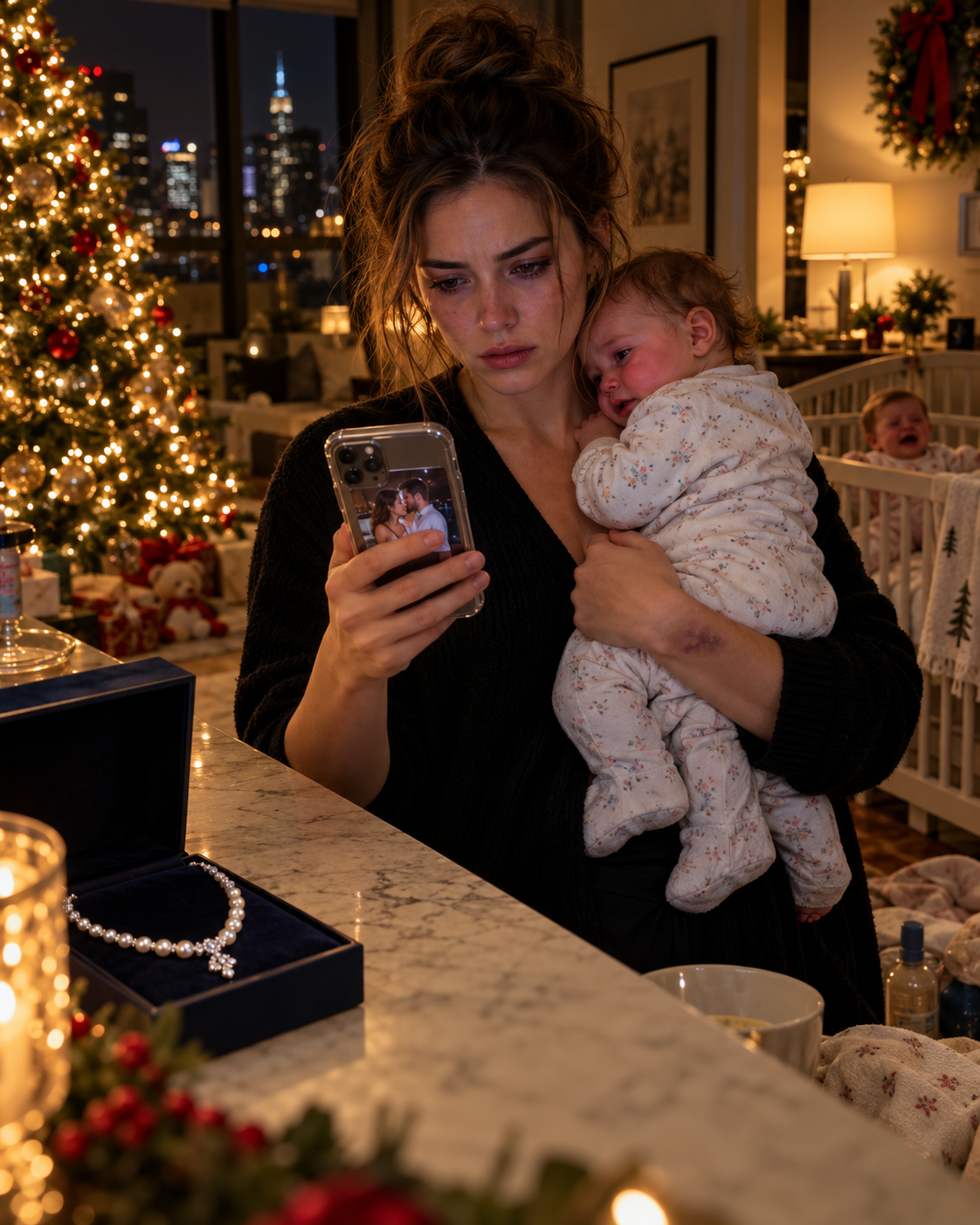
 PART 1 TITLE: The Photograph My Husband Sent at Eleven Forty-Seven Exposed His Affair, but an Old Promise from My Grandmother Held a Greater Secret
At 11:47 p.m. on Christmas Eve, my husband sent me a photograph from a hotel bedroom. He was lying against white pillows, bare-chested, with a blonde woman curled beside him. His wedding ring was plainly visible on the hand resting against her waist. I stood in our kitchen staring at the screen while our eleven-month-old twins struggled with fevers in the nursery. Six hours earlier, I had begged Cole to stay home. By morning, the apartment he considered entirely his would be empty of everything I cared about.
My name is Lauren Bennett. Before I married Cole, I worked as a senior financial analyst, maintained my own savings, and rarely needed anyone to make decisions for me. I had been raised by people who believed independence was something to practice, not simply admire. Somewhere during three years of marriage, that woman had disappeared beneath a schedule of feedings, sleepless nights, household restrictions, and endless attempts to avoid upsetting my husband. I had never imagined that a photograph could make her begin to return.
Noah was asleep against my shoulder when the message arrived. His little face felt hot against my neck, and his breathing carried the rough, uneven sound of a baby fighting a winter illness. Lily had been crying in her crib for nearly twenty minutes. I was trying to warm a bottle while holding the thermometer beneath my son’s arm. The kitchen counter was crowded with medicine, folded towels, and instructions from the pediatrician. Beyond the windows, Manhattan glittered with Christmas decorations. Inside, I was barely managing to keep two miserable children comfortable.
That afternoon, Cole had stood near the front door fastening an expensive watch around his wrist. I told him Noah’s temperature had risen again and that Lily was refusing most of her milk. He barely looked up. He said the children probably had the same seasonal illness everyone else was catching. When I explained that I had already spoken with the pediatrician, he told me to follow the instructions and stop worrying. I asked him to cancel his evening engagement. He adjusted his coat and said he had important clients expecting him.
I remember asking one final time because Noah had begun crying in my arms. Cole looked at the baby, then at me, with an expression I knew too well. He said I had wanted children and should be able to manage an evening without making him feel guilty. When I tried to explain that I wasn’t asking him to solve everything, only to help, he opened the door. His last instruction was to avoid calling unless there was a genuine emergency. I spent the next several hours wondering whether I had asked too much.
Now I understood where those indispensable clients had been waiting. The photograph showed a hotel suite decorated for Christmas. There were two champagne glasses on the bedside table, a silver tray containing strawberries, and a woman’s evening dress draped over an upholstered chair. Cole looked relaxed in a way I had not seen at home for months. The woman beside him had blonde hair, pale skin, and a familiar smile. I enlarged the image once, hoping I had mistaken her identity. I had not. Her name was Sierra Vaughn.
I knew Sierra from company dinners and charity functions. Cole had introduced her as someone who assisted with important business relationships. She was elegant, attentive, and unusually interested in my family. At an anniversary dinner several months earlier, she had asked whether my grandmother still owned property downtown. I found the question strange, but Cole interrupted before I could answer. Later, he said Sierra was simply curious about real estate. Looking at her beside him in that hotel bed, I remembered the conversation with an uncomfortable new clarity.
My first impulse was to call Cole. I wanted to hear him explain the photograph, even though there was nothing reasonable to explain. I wanted to ask how long he had been seeing Sierra and whether she knew our children were sick. But when I opened his contact information, my fingers stopped. Two nights earlier, during an argument about a household expense, he had gripped my wrist so tightly that bruises remained beneath my sleeve. He had apologized the following morning, then suggested I should not have challenged him when he was tired.
I set Noah carefully in his crib and checked Lily’s temperature. She was warm but responsive, protesting when I moved the blanket away from her feet. I offered her a little milk, and she drank enough to settle against my shoulder. The familiar work of caring for them kept my hands occupied while my thoughts raced. I could not afford to fall apart with two sick babies depending on me. Whatever I decided about my marriage, their medical care came first.
After settling Lily, I returned to the kitchen and examined the photograph again. This time I noticed something I had overlooked. The message had arrived without any explanation beyond a few careless words that suggested Cole had been sending it to someone else. Perhaps he had selected my contact by mistake. Perhaps he was too distracted to notice. I had spent years believing my husband was careful about everything. Yet there he was, exposing himself with one thoughtless movement of his thumb.
I saved the original image without altering it and made a separate copy. Then I photographed the bruising around my wrist. The marks were fading, but they were still visible beneath the kitchen light. I remembered how Cole had once accused me of making an ordinary disagreement sound like a crime. He was talented at persuading me that my memories were unreliable. Evidence felt different. A photograph could not tell the entire truth, but it could preserve something he might later deny.
My thoughts turned to my grandmother, Evelyn Bennett. She had died four years earlier, after a life spent building businesses, protecting her family, and quietly helping people who needed a second chance. As a child, I had considered her almost impossibly capable. She could negotiate a complicated contract before lunch and spend the afternoon teaching me to make cinnamon toast. She disliked waste, pretension, and anyone who expected kindness to be mistaken for obedience. Most of all, she believed a woman should always retain the means to make her own choices.
Before my wedding, Grandmother had insisted that I keep certain inherited assets protected under a family trust. Cole had not objected openly. He was charming during the meetings, thanked the attorneys for their work, and assured Grandmother that my independence mattered to him. Only later did he begin complaining about the arrangement. He called it old-fashioned, unnecessary, and insulting to a husband who wanted to provide for his family. I gradually stopped discussing it because every conversation ended with him questioning whether I trusted him.
There was one person Grandmother had told me to contact if I ever felt trapped. His name was Daniel Harris, and he had managed her legal affairs for decades. I knew him from family gatherings, where he wore conservative suits and always brought a dessert from the same bakery. At my grandmother’s funeral, he had pressed a card into my palm and told me to keep his number somewhere Cole could not misplace it. At the time, I thought he was being overly cautious. That night, I searched through my old email until I found his private number.
It was after midnight when I called. I expected voicemail. Instead, Daniel answered on the fourth ring, his voice thick with sleep but immediately alert when he recognized me. I apologized for disturbing him on Christmas Eve. He interrupted gently and asked whether I was physically safe. The question startled me because I had not mentioned anything about Cole’s temper. I told him I was home with the twins and that Cole was away. Then, with more difficulty than I expected, I described the photograph.
Daniel listened without interrupting. When I finished, he asked whether Cole had ever restricted my access to money. I told him about the household account, the canceled credit card, and the allowance Cole claimed was necessary to control unnecessary spending. He asked whether my husband had threatened me when I disagreed. I looked toward the nursery and admitted that he had. Daniel did not sound shocked, but his voice became more precise. He asked me to describe what happened during the argument that left marks on my wrist.
For several minutes, I struggled to explain an event I had spent two days trying to minimize. Cole had been angry because I questioned a charge on our joint account. He insisted it was business-related and accused me of invading his privacy. When I said I wanted to see the statement, he grabbed my wrist and pulled me away from his laptop. I stumbled against the kitchen counter. Afterward, he told me I had frightened him by behaving unpredictably. Listening to myself describe it, I realized how much effort I had invested in making his conduct sound less serious.
Daniel asked whether I had somewhere else to stay. My mother lived outside the city, but Cole knew her address and had often threatened to involve her whenever we argued. I admitted I was afraid he would follow me. Daniel said the trust had provisions for emergencies involving threats, financial coercion, or attempts to obtain control through improper means. He explained that Grandmother had instructed her advisers to maintain an independent route for requesting protection. I remembered hearing a brief explanation years earlier, but I had never examined the provision closely.
He explained that activating the emergency arrangements would require formal documentation and an independent review. It would not magically dissolve my marriage or determine custody of the twins. It could, however, prevent certain delegated financial permissions from being used while the trustees investigated disputed transactions. Daniel could also arrange legal assistance and temporary accommodation. He asked whether I wanted him to begin. I looked down at the photograph of Cole and Sierra, then toward the nursery where Lily had started whimpering again.
I told Daniel that I wanted the protections activated. Saying it aloud felt more serious than deciding to leave after an argument. It meant involving people outside my marriage and allowing them to examine things Cole had insisted were private. Daniel repeated my decision to make sure he understood. Then I heard papers shifting and the quiet clicking of his computer keyboard. He told me that an associate would help coordinate the necessary steps, and that I should not confront Cole or sign any more documents before receiving independent advice.
His reference to documents unsettled me. Three weeks earlier, Cole had brought home a thick folder and placed it beside my dinner plate. I was feeding Noah and trying to stop Lily from pulling a bowl onto the floor. Cole said the papers were routine business matters that needed my signature before the end of the year. When I asked why my name appeared on company documents, he told me they concerned household assets and standard financial planning. He spoke with the impatience of someone explaining something obvious to a child.
I had signed two pages before Lily began crying hard enough to make me abandon the folder. Cole’s expression changed instantly. He accused me of deliberately delaying his work and asked whether I enjoyed making him look incompetent in front of his partners. I offered to finish later, but he snatched the pages away. The following morning, the folder had disappeared. I assumed he had found another way to complete whatever needed doing. Until Daniel mentioned signatures, I had not thought about those papers again.
When I told him, Daniel became silent. I could hear a faint movement, as though he had set down his pen. Then he asked whether I remembered the names of any companies printed on the documents. I could not. I remembered an address, several boxes marked for initials, and Cole’s insistence that the matter was urgent. Daniel asked whether anyone had witnessed my signatures. No one had. He wanted to know if I had attended a notary’s office. I told him I had not signed anything outside our apartment.
Daniel said he needed to review the originals before drawing conclusions. But then he asked another question that made me feel cold despite the warmth of the kitchen. Had Cole ever asked to borrow my passport, identification, or documents connected to Grandmother’s trust? I remembered giving him my passport during the summer because he claimed a travel agent needed it for a family holiday. The holiday never happened. I had also allowed him to scan an old trust summary after he said his accountant needed to understand our financial position.
Daniel asked me to listen carefully. He said there had been inquiries about assets connected to the Bennett Family Trust and that an independent review was already underway. He would explain more once he had verified the records. I asked whether he believed Cole had done something illegal. Daniel refused to speculate, but his measured tone frightened me more than an immediate accusation would have. He asked me to preserve the photograph, messages, and any papers I could safely access without delaying care for the twins.
Before ending the call, Daniel told me that my grandmother had left a sealed letter to be opened under specific circumstances. He had never discussed its contents with me because she wanted me to live my life without interference. Now the conditions for reviewing it might have been met. I stared at the framed photograph of Grandmother beside our Christmas tree. I had always believed her trust was an inheritance arrangement, a precaution against ordinary financial risks. Daniel’s next words suggested she had feared something more personal. Someone, he said, had been trying to use assets bearing my family name, and my husband might not have had the authority he claimed.
END PART 1
PART 2 TITLE: My Husband Had Made Me Account for Every Dollar, While Documents Hidden Inside Our Marriage Pointed Toward Millions I Never Authorized
After Daniel ended the call, I stood motionless beside the kitchen counter. The apartment was quiet except for the humming refrigerator and the soft sounds coming from the nursery monitor. Cole’s photograph remained on my phone, though I could no longer look at it without thinking about the other documents Daniel had mentioned. An affair was something I understood, however painfully. Financial records bearing my name, agreements I barely remembered, and a legal warning prepared by my grandmother were more difficult to grasp. I had lived with a man who measured every expense I made. Now I wondered what he had been doing with money I never saw.
Our apartment occupied a high floor in a building where the lobby smelled of expensive flowers and the staff recognized residents by name. Cole loved the address. He loved the impression it created when clients visited, and he never tired of mentioning the view. The furniture had been selected by a decorator, the floors were polished stone, and the dining table was large enough to seat twelve people. Yet I had spent much of the previous year feeling guilty about purchasing ordinary things. Cole had made extravagance his identity and restraint my responsibility.
The change had happened gradually enough that I once struggled to explain it. When we first met, I had been proud of my work. I enjoyed finding errors in complicated financial reports, identifying patterns other people missed, and presenting difficult conclusions in language executives could understand. Cole said he admired my intelligence. He appeared at my office with coffee when I worked late and asked thoughtful questions about my projects. I fell in love partly because he seemed comfortable with the person I already was. I mistook his interest in my work for respect that would endure.
After we married, his compliments developed conditions. He praised me for being ambitious, then complained that my career left too little time for our relationship. When I received recognition at work, he celebrated in public but asked privately whether I intended to compete with him forever. If I challenged one of his business ideas, he accused me of treating him like a subordinate. Eventually I learned to choose my words carefully. I stopped offering opinions he had not requested, though I still believed we were experiencing the ordinary adjustments of marriage.
My pregnancy made it easier for Cole to persuade me that the arrangement should change. Carrying twins was exhausting, and the doctors wanted me to take additional precautions. Cole suggested I begin maternity leave early. When I worried about stepping away from my career, he reminded me that our children would be young only once. He presented staying home as a privilege and returning to work as a choice that might deprive our family of something essential. I wanted to be present for my babies. I did not realize I was also surrendering control over how that decision would affect my future.
Noah and Lily arrived early. Noah required several days of neonatal care, while Lily needed assistance breathing after birth. I remember fluorescent hospital lights, monitors, and the helpless feeling of watching strangers perform tasks I could not do for my children. Cole handled calls to insurers and hospital administrators. I was grateful because I was frightened and recovering from childbirth. When we finally brought the twins home, I was too exhausted to question how much authority he had assumed over the rest of our lives.
Months later, I discovered that my former employer had offered a flexible arrangement allowing me to resume part-time work. The message had been sent to an email account Cole could access while I was recovering. He never mentioned it. Instead, he told me the company had moved on and that asking for my position back would be embarrassing. I believed him until I met a former colleague who mentioned the unanswered offer. Cole said there must have been a misunderstanding. When I became upset, he accused me of caring more about a job than our children.
Our finances changed in the same quiet fashion. First, Cole suggested using one shared account for household expenses. Then he began managing transfers and paying the bills. He said there was no point in keeping several cards active when his accountant could oversee everything. Eventually my access to the main account became limited. I received a fixed amount for groceries, pharmacy purchases, and expenses relating to the twins. When prices increased, he expected me to explain why. He could spend thousands on a business dinner without discussion, while I had to justify replacing a broken bottle warmer.
I remembered standing in a pharmacy one rainy afternoon, holding a package of infant medicine and discovering that my card had been declined. The cashier waited politely while I called Cole. He answered from a restaurant, irritated that I had interrupted him. He said I had exceeded the weekly amount and asked why I could not plan ahead. Only after I explained that one of the babies was sick did he authorize another transfer. I returned home ashamed, though I had done nothing irresponsible. The memory stayed with me because he later described the incident as proof that I needed supervision.
The household records were stored on Cole’s laptop and synchronized through an account I could no longer access freely. I knew some statements also arrived by email. While the twins slept, I searched my own messages for copies. Most concerned routine purchases, but several carried attached monthly reports. I opened one and saw the familiar columns Cole used when discussing our budget. Groceries, household staff, transportation, medical expenses. Beneath them was a line containing my name, treated as though I were a department whose costs required reduction.
I scrolled through the figures. My spending had been reviewed month by month, with notes questioning ordinary purchases. A pediatric appointment was marked for clarification. A replacement pair of shoes appeared under unnecessary personal expenses. One entry mentioned that future discretionary payments should be reduced. I photographed the screen and sent the records to the secure address Daniel provided. My hands were trembling, not because the amounts were enormous, but because the document revealed the way Cole had organized our household. He saw himself as the person who approved my needs.
While searching for additional records, I found messages from a business accountant whose name I recognized. Several referenced Project Evergreen, an initiative Cole had mentioned at dinners throughout the autumn. He described it as a private investment opportunity involving commercial property redevelopment. Whenever he spoke about it, he became animated. He claimed it would establish his company as a major player and that influential investors were interested. I had heard so much about his expected success that I stopped asking questions. Now I noticed repeated requests for updated collateral schedules and ownership verification.
One email referred to a guarantor whose authorization had not been completed. Another mentioned the importance of finalizing documents before the end of December. The language was familiar from my years as an analyst. It suggested negotiations in which a lender wanted assurance that someone or something valuable could support an obligation. I did not have access to the complete transaction records, and I resisted the urge to invent conclusions. Still, the timing troubled me. Cole had pressured me to sign paperwork shortly before Christmas, and these messages described a deal approaching its final stage.
I remembered a conversation from September. Cole had asked whether Grandmother’s old house was still held by the trust. I told him that Daniel managed those details and that the property had not been sold. Cole wanted to know whether the trust owned other real estate. When I admitted I was uncertain, he laughed and suggested it was absurd for me to have an inheritance I could not describe precisely. He offered to arrange a meeting with his accountant. I declined because Grandmother had always insisted that independent advisers handle her estate. Cole did not speak to me for the rest of that evening.
Shortly after midnight, Cole’s name appeared on my screen. The first message asked whether I was awake. When I did not answer, he sent another demanding to know why I was ignoring him. The third accused me of attempting to start an argument. I watched the messages appear while sitting beside Lily’s crib. He had not asked how the babies were feeling. He had not mentioned coming home. Even after sending me a photograph of himself with another woman, his first concern seemed to be whether I would respond when summoned.
I considered writing that I knew everything. I imagined describing the photograph in detail and asking him to explain Sierra’s presence. Then I remembered Daniel’s advice. Cole could become frightening when he felt challenged, and I was alone with two children who could not protect themselves. Responding would give him time to construct an explanation or return before I had arranged somewhere safe to go. I silenced the conversation and continued gathering identification, clothing, medication, diapers, and the children’s important documents.
I found the twins’ birth certificates in a drawer beside the nursery. The passports were kept in a locked cabinet in Cole’s study, but I had access to the key. Before entering, I called Daniel and explained what I intended to collect. He told me to take only what I could access safely and to avoid damaging anything or searching places that might delay our departure. My children’s paperwork mattered more than proving every suspicion that night. I retrieved the documents, then left the study without disturbing the files arranged on his desk.
There was a framed wedding photograph above the cabinet. Cole stood beside me in a dark suit, looking proud and affectionate. I remembered how he held my hand during the ceremony and promised that we would face every difficulty together. The memory hurt because I had believed him completely. I was not yet ready to decide whether every tender moment had been false. I knew only that whatever love had existed between us could not excuse the person he had become. That realization was painful enough without rewriting the past to make leaving easier.
Daniel called again a little after half past midnight. He confirmed that the independent administration process had been initiated according to the trust’s procedures and that relevant institutions would be notified about disputed permissions. He was careful about what those safeguards could accomplish. They would not instantly freeze every financial account connected to Cole, and they would not determine whether a crime had occurred. They could prevent the trust from relying on questionable claims of authority while its advisers investigated. For the first time that night, I felt that someone other than my husband could examine the facts.
Daniel also told me that a woman named Miriam Ellis would contact me to help with transportation. She worked with a professional security service retained for situations requiring discretion and practical assistance. I asked how I would recognize her. Daniel gave me a phrase my grandmother had chosen years earlier: Blue roses bloom in winter. I covered my mouth when I heard it. Grandmother had used those words whenever I declared something impossible. When I was seven and terrified of riding a bicycle without training wheels, she repeated them until I finally pushed off down the driveway.
Daniel then asked whether I remembered Patricia Vale, Cole’s chief financial officer. I pictured a dark-haired woman who attended his company functions but rarely participated in the boasting that dominated the conversations. At a charity dinner in October, Patricia had approached me near the coatroom and asked whether we could speak privately. Before I could respond, Cole appeared, placed a firm hand against my lower back, and told her the accounting team needed her attention. Afterward, he described Patricia as unstable and said she was likely to leave the company.
I asked Daniel why he was mentioning her. He told me Patricia had contacted his office the previous day about transactions involving a company connected to Cole. She believed documents had been prepared using my identity in connection with a proposed borrowing arrangement. Daniel emphasized that the materials required independent verification. Patricia’s concerns were serious, but he would not treat them as established facts until the original records were examined. I remembered her anxious expression at the charity dinner and wondered how long she had been trying to warn me.
The possibility made the room seem suddenly unfamiliar. For years, Cole had described his business as thriving. He wore expensive watches, entertained investors at private clubs, and spoke about growth with absolute confidence. He had recently purchased a new car despite criticizing the cost of the children’s formula. I wondered whether the apparent prosperity had been genuine or whether it existed to reassure creditors and impress people who might otherwise ask difficult questions. I had once been paid to recognize financial inconsistencies. Inside my marriage, I had stopped looking.
Another message arrived from Cole. This one instructed me not to embarrass him by involving my family. It was followed by a warning that he would not tolerate accusations based on a misunderstanding. I read it twice. He still had not acknowledged the photograph or asked about the twins. I forwarded the message to Daniel. Whatever Cole believed about my silence, I was no longer trying to persuade him to be reasonable. I was preparing to leave before he returned.
At 12:52 a.m., someone knocked on the apartment door. Three measured knocks were followed by a short pause and two more. I checked the peephole. A woman with short silver hair stood outside wearing a dark winter coat. She introduced herself as Miriam Ellis and said Daniel Harris had asked her to assist me. I kept the door locked and asked for the phrase. She answered correctly without hesitation. When I finally opened the door, her eyes moved briefly over the packed bags, the thermometer on the counter, and the exhausted child against my shoulder.
Miriam did not ask why I had waited so long or whether I had considered forgiving Cole. She asked what the twins needed and whether their doctor had advised further examination. I told her I wanted both babies assessed again before we settled anywhere for the night. She nodded, helped me finish packing, and arranged the carriers beside the door. While she folded the stroller, she noticed the bruises beneath my sleeve. She said nothing about them until I asked whether Daniel would need photographs. Then she quietly confirmed that preserving the evidence was sensible.
As we prepared to leave, I looked once more toward the Christmas tree. Wrapped presents lay beneath its lowest branches, some bearing Noah’s name and others Lily’s. I had imagined their first Christmas morning surrounded by photographs, laughter, and the kind of ordinary happiness I had spent months trying to create. Instead, I was carrying them out into a freezing night with a stranger helping me manage their blankets and medicine. I could not promise them a perfect future. I could only make the next decision carefully.
Miriam lifted the last bag and asked whether I was ready. My phone vibrated again, but I did not look at it. I checked the twins’ clothing, made sure Noah’s hat covered his ears, and turned off the kitchen light. For a moment, I held the apartment key in my palm, remembering how proud Cole had been when he first placed it in my hand. Then I closed the door. The lock clicked behind us. For the first time since my wedding, I was leaving my husband’s home without asking when he expected me back.
END PART 2
PART 3 TITLE: Before Christmas Morning, I Took My Feverish Twins to Safety and Discovered the Eight-Million-Dollar Promise My Husband Had Hidden Behind Our Marriage
The service elevator descended slowly toward the parking garage. Noah rested against my chest in his carrier while Lily slept in the stroller beside Miriam. The fluorescent lights made everything look strangely ordinary. A maintenance worker carrying a toolbox stepped into the elevator two floors below us, wished us a quiet Christmas, and returned to studying his phone. I wanted to tell him that my husband was sleeping with another woman and that I might be leaving my marriage forever. Instead, I thanked him and adjusted Noah’s blanket.
Miriam’s vehicle was waiting near the garage exit. She helped secure both infant seats, checked the straps, and placed the medical bag where I could reach it. As we pulled away, I looked upward toward our apartment. The windows were indistinguishable from dozens of others in the building. Somewhere behind one of them stood the enormous Christmas tree Cole had ordered because he wanted our home to look impressive. I remembered spending an entire afternoon asking him to help me choose ornaments for the babies. He had been too busy to look.
We drove through streets nearly deserted by traffic. Storefronts glowed beneath garlands and strings of white lights. Snow collected along the curbs, and the tires hissed against wet pavement. Miriam asked which hospital I preferred. I explained that the twins’ pediatrician had already spoken with me and that I wanted a clinician to assess them again because their symptoms had persisted. She called ahead while I watched Noah sleeping. His cheeks were still flushed. I was grateful that he had settled, but I could not relax until someone examined him.
At the pediatric emergency department, the nurse checked both babies’ temperatures, breathing, hydration, and general condition. Noah protested the examination with surprising strength. Lily watched the nurse suspiciously before beginning to cry. I answered questions about their symptoms, feeding, and medication. For the first time in hours, I was able to concentrate on something straightforward. The doctor listened, examined them carefully, and recommended monitoring and follow-up based on the findings. Neither child appeared to need immediate admission, though we were given clear instructions about circumstances that would require urgent reassessment.
When the examination was finished, I sat in a curtained room holding Lily while Noah slept in a nearby bassinet. The hospital smelled of antiseptic, warm linens, and coffee. Somewhere beyond the curtain, a child was complaining about a bandage. I was exhausted enough that the floor seemed to move beneath me. Miriam brought a sandwich and a cup of tea from the cafeteria. She placed them beside me and said I should eat while I had the opportunity. The instruction sounded so much like something Grandmother would have said that I almost smiled.
I took two bites before my phone lit up. Cole was calling. I watched the screen until it stopped, then another call arrived immediately. His first message demanded to know where I was. The next asked why my location sharing had been disabled. Then he accused me of trying to punish him on Christmas Eve. I realized that he might still believe I was sitting at home, waiting for an explanation. He had no idea that the children and I had already left the apartment.
I used the opportunity to contact Daniel and confirm that the twins had received medical attention. He asked whether we were safe and whether Cole had made any direct threats. I forwarded the messages. Daniel recommended that communication about the children proceed through appropriate legal channels while temporary safety arrangements were established. He reminded me that parental rights, custody, and the trust’s protections were separate matters requiring proper legal advice. I appreciated his caution. I did not want to create more problems for Noah and Lily through an impulsive decision made in anger.
At 2:41 a.m., Cole called again. This time he left a voicemail. His voice sounded irritated rather than worried. He said he had been trying to reach me and that ignoring him would only make things worse. He warned me not to turn one unfortunate incident into a family crisis. I played the message once, saved it, and put the phone down. The word unfortunate stayed with me. He could apparently describe his own betrayal without naming it, as though the trouble lay in my reaction rather than his conduct.
A few minutes later, a new photograph arrived. It showed the nursery at home. Both cribs were empty. The little Christmas stockings were visible above the changing table, and the rocking chair had been pushed away from the window. Cole had returned sooner than expected. Beneath the image, he demanded to know why I had taken his children. Another message followed, giving me twenty minutes to reveal our location. My stomach tightened. I had anticipated anger, but the possessive language frightened me in a way the earlier messages had not.
I showed Miriam the screen. She read the message without changing her expression, then asked whether I wanted her to call Daniel. I nodded. While she spoke, I watched Lily’s tiny fingers open and close around the edge of her blanket. I had spent months measuring my actions against Cole’s possible reactions. Even now, far from the apartment, I could feel the familiar urge to apologize before he became angrier. I set the phone facedown and concentrated on the children’s breathing until the feeling became manageable.
Through Daniel, I sent a brief communication confirming that the twins were safe, had received medical care, and remained with me. It provided no live location and made no accusations about the affair. Cole’s response was immediate. He wanted to know why I had involved an attorney. Then he warned that I would regret making him look foolish. I stared at the words, thinking about how rarely he had used that tone when speaking to other people. With clients, he was patient. With strangers, he was polished. With me, he demanded obedience.
Daniel called shortly after three. He had received new information from Patricia Vale about a financing meeting scheduled for December 26. A private lender expected documents supporting a significant business loan. The transaction had been presented as secured by assets that Cole claimed I had agreed to make available. Daniel wanted to know whether I had authorized any such arrangement. I said no. I had never approved using my inheritance to guarantee a business obligation, and I had never attended a meeting with a lender concerning Project Evergreen.
Then Daniel told me the proposed amount. Eight million dollars. I repeated the figure because I thought I had misunderstood him. Eight million was not a routine banking adjustment or a harmless accounting error. It was the kind of commitment that could change the financial future of an entire family. Daniel explained that the loan had not necessarily been completed and that the documents still required authentication. But Patricia had seen references to the Bennett Family Trust in materials circulated during the negotiations.
I pressed my hand against the wall beside the hospital corridor. The figure made no sense beside the life Cole had imposed on me. He questioned the price of groceries and demanded explanations for pharmacy purchases. He had once refused to increase my household allowance because he said the company needed to conserve cash. At the same time, he was discussing millions of dollars with private lenders. I thought of the luxury dinners, the expensive cars, and the constant promises that he would soon be more successful than anyone had imagined.
Daniel said Patricia believed Cole’s business had been experiencing serious financial difficulties. The company’s outward appearance did not reflect the pressure accumulating behind the scenes. Creditors wanted repayment, expensive commitments continued, and Project Evergreen was being presented as an opportunity that could attract new financing. The proposed loan might provide temporary relief while exposing whatever assets supported it to substantial risk. Daniel would not describe the company as insolvent without reviewing the accounts, but he was concerned that Cole had concealed material facts from both his family and prospective lenders.
I remembered a dinner several weeks earlier when Cole described Evergreen as his greatest achievement. He spoke about commercial redevelopment, private investors, and a future in which he would no longer need to worry about money. When I asked whether the project involved significant borrowing, he laughed and said I had become too cautious during maternity leave. Sierra sat beside him that evening, listening with an expression I mistook for admiration. Now I wondered whether she knew the financing details and whether her relationship with Cole had anything to do with the arrangement.
Daniel asked about the folder Cole had brought home three weeks earlier. I explained again that I signed two pages without understanding their significance and that I had never completed the remaining paperwork. He wanted a description of the signatures and asked whether I had been alone with Cole. I told him I had. Daniel said the distinction mattered. The fact that I signed certain documents did not necessarily mean I had consented to every transaction later associated with them. The original pages, accompanying explanations, and surrounding communications would need careful examination.
Then he asked whether my passport had ever been taken to a notary or copied for financial identification. I remembered giving it to Cole during the summer. He had told me his travel agent needed information for a family vacation. We never went on the trip. When I asked about it, he said the schedule had become impossible. Daniel explained that copies of identification might have been included in transaction files, but their presence would not establish that I had authorized a particular agreement. What mattered was who had used the documents and under what circumstances.
The possibility that someone had presented me as a consenting participant disturbed me more deeply than the amount of money. I understood financial risk. I had spent years studying companies and identifying obligations hidden beneath optimistic projections. I also understood how important a genuine signature could be. Someone might attempt to transform a household agreement into evidence of broader financial permission. I asked Daniel whether he believed Cole had forged my name. He said the available information justified an investigation but not a conclusion. His refusal to exaggerate made the situation feel more real.
By the time we left the hospital, the sky was still dark. Miriam drove toward a temporary residence arranged through the trust. I expected another luxurious property, but the house stood on a quiet street outside the city, surrounded by tall trees and modest neighboring homes. There was a wooden porch, a small front garden, and a lamp burning beside the entrance. Snow had gathered along the steps. No one would have mistaken it for Cole’s idea of success. I felt relieved as soon as I saw it.
Inside, the rooms were warm and practical. Two travel cribs had been prepared in a bedroom, and the kitchen contained enough food for several days. A humidifier stood on a low table beside folded towels and clean blankets. Miriam helped settle Noah and Lily, then showed me where to find supplies. She said Daniel would visit when he could and that I should sleep if the babies allowed it. She did not offer promises about what would happen next. She simply made the house function around what we needed.
Once the twins were resting, I sat on the edge of the guest bed and looked at the two little bodies beneath their blankets. Noah’s hand rested near his face, and Lily’s hair had curled with perspiration. Their first Christmas morning was approaching, yet nothing about it resembled the celebration I had planned. I thought about the gifts beneath the tree, the stockings on the nursery wall, and my mother’s expectation that we would visit later that day. Then I remembered Cole standing beside Sierra in the photograph, smiling as though he had no responsibilities waiting at home.
I began to cry. The tears came quietly at first, then with a force I could not control. I cried for my children because they deserved a father who had wanted to be there when they were sick. I cried for my career, for the friends I had neglected, and for the woman who once trusted herself to make difficult decisions. I cried because I had loved Cole, and a part of me still remembered the man who brought flowers to my office. Leaving did not make those memories disappear.
Miriam found me sitting on the floor beside the bed. She lowered herself into a chair and waited. Eventually I told her that I felt foolish for ignoring so many signs. She said I could examine what happened later, with people qualified to help me understand it. At that moment, the important facts were that the children had received medical care and we were somewhere safe. I wanted to argue, but I was too tired. She brought me a glass of water, checked the locks, and left me to rest.
At 5:38 a.m., my phone received an email from an address I did not recognize. The subject warned that I needed to understand who Sierra Vaughn was. I nearly ignored it, assuming it might be another intrusion into a night already crowded with revelations. Then I opened the attachment. It contained a photograph taken at a charity gala. Cole and Sierra stood together beside an older man with silver hair. I recognized him from several business dinners and from a conversation at our wedding reception. His name was Victor Vaughn.
Victor was Sierra’s father. I knew he had business interests, though Cole had never explained precisely how they overlapped. The accompanying message was signed by Patricia Vale. She apologized for contacting me privately and said she had tried to raise concerns for months. She asked me to discuss Project Evergreen with Daniel Harris and warned me against signing anything else. I forwarded the email to Daniel without responding. Then I opened the second attachment, a corporate ownership chart showing relationships among several companies involved in the proposed financing.
Cole’s name appeared on one branch of the chart, Victor Vaughn’s on another. Near the bottom was a section describing a proposed guarantor. The name printed there was Lauren Evelyn Bennett, my full maiden name. Beside it was the amount Daniel had mentioned: eight million dollars. The authorization status indicated that final execution was still pending. For several seconds, I could do nothing but stare at the page. Cole had not simply been considering a business loan. He had placed my name inside a transaction I had never agreed to support.
Then I enlarged the hotel photograph once more. I studied Sierra’s face, the champagne glasses, the jewelry around her throat, and the way her hand rested against Cole’s chest. On one finger was a delicate platinum band. I could not tell what it meant. What I did know was that her father appeared in documents connected to the loan, while she was sharing my husband’s bed on the night before Christmas. The affair and the financial arrangement might be separate, but I could no longer assume they were unrelated. I called Daniel and told him about the ownership chart. He answered immediately and said he was coming to the house with the papers my grandmother had sealed years earlier.
END PART 3
PART 4 TITLE: My Grandmother Had Protected a Fortune I Never Understood, and the Names in Cole’s Secret Financing Papers Began to Explain Her Warning
By six o’clock on Christmas morning, the house was quiet. Noah and Lily were sleeping in the bedroom, their temperatures having eased after the night of medical care. Miriam sat at the kitchen table reviewing practical arrangements for the day. She had prepared tea and left a plate of toast beneath a clean napkin. I stood beside the window watching snow collect along the garden fence. For the first time in years, there was no husband nearby waiting to criticize how I spent my morning. Yet the freedom felt unfamiliar because I had no idea what danger might follow.
I examined Patricia’s attachments again, resisting the temptation to make the documents say more than they did. My name was printed on a financing chart, but I had not seen the original agreements. Victor Vaughn’s involvement was apparent, though the extent of his control remained unclear. Cole had described him as a sophisticated investor who knew how to structure difficult deals. I remembered meeting Victor during our wedding reception. He complimented Grandmother’s business achievements and asked several questions about property she owned. At the time, I assumed he was making conversation.
The memory grew more troubling as I considered the other occasions when Victor appeared. He attended a charity fundraiser with Cole shortly before Project Evergreen was announced. He joined us for dinner during the summer and spoke at length about commercial developments. Sierra was present that evening, attentive whenever my grandmother’s name arose. I remembered her remark about downtown properties and Cole’s swift interruption. Nothing in those conversations established wrongdoing, but together they suggested that my inheritance had attracted more attention than I realized. I wished I had asked different questions.
At 6:07, headlights swept across the front garden. A dark sedan stopped outside, and Daniel Harris climbed out carrying a leather briefcase. He wore a heavy overcoat, and his silver hair was damp with melting snow. When Miriam opened the door, he thanked her, then looked toward me. For a moment, his professional composure softened. He had known me since childhood, and I could see him taking in my sleepless face, the borrowed clothes, and the traces of bruising around my wrist. He asked first about the babies.
I told him they had been examined and were resting. He nodded, set his briefcase on the table, and asked whether I had eaten. I gave him an impatient look that made him smile briefly. Then he explained that my grandmother had given him specific instructions concerning the trust. He wanted me to understand what the documents could protect and what remained uncertain. He would not promise that Cole would lose everything, nor would he use an unverified suspicion to predict criminal charges. His responsibility was to establish facts and protect my lawful interests.
Daniel opened a folder containing the emergency administration provisions. He showed me the sections that required additional review of disputed authorizations and limited reliance on permissions whose validity was being questioned. The trust had its own administrators and independent financial accounts. Cole was not a trustee. Marriage had not made him the owner of Grandmother’s assets. Nevertheless, certain papers might have been used to suggest that I could pledge or otherwise influence property held under the trust. The difference between actual authority and claimed authority had become critically important.
I asked whether the emergency clause had already stopped the December 26 transaction. Daniel said notices had been sent to the relevant institutions, requesting verification and preservation of records. Any lender considering the proposed collateral would need to examine the dispute carefully. He could not guarantee an immediate or universal freeze, but the arrangement was no longer proceeding without challenge. I thought about Cole’s confidence when he placed the folder beside my dinner plate. He had behaved as though my signature were a minor inconvenience standing between him and something he deserved.
Then Daniel told me that Grandmother’s estate was larger than I had been led to understand. I stared at him, uncertain why he would mention the total value when our immediate concern involved forged or disputed documents. I knew about the old family house, several rental properties, and a portfolio of investments that provided income for future generations. Cole had estimated the inheritance at approximately two million dollars, and I had never corrected him because I did not know the complete figures myself. Daniel opened another folder and turned a valuation summary toward me.
Grandmother had retained a controlling interest in Bennett Development Partners, a company holding commercial buildings, residential properties, and development interests. Professional managers handled the operations during her later years. The shares and other holdings were administered within the trust, subject to obligations, restrictions, and changing market values. Daniel explained the structure patiently, identifying the assets and the boundaries of my beneficial interest. I recognized several property names from conversations I had overheard as a child, but I had not realized they belonged to a business arrangement that continued long after Grandmother retired.
The estimated value of the trust assets was approximately thirty-one million dollars. I read the number twice. It was not money sitting in a bank account waiting for me to spend. It represented ownership interests, properties, investments, and obligations that required responsible management. Even so, the scale stunned me. Grandmother had made me work during school holidays, pay for my own car insurance, and compare prices at grocery stores. She had never allowed wealth to become an excuse for carelessness. I had understood those lessons without realizing just how wealthy she had been.
I asked why she had kept the extent of the estate private. Daniel said she believed money attracted people who were interested in what a person possessed rather than who that person was. She wanted me to develop professional judgment and choose relationships without feeling that everyone was evaluating my inheritance. I remembered her disapproval when Cole complained about the trust before our wedding. She had listened to him politely, then invited me onto the porch. She asked whether I believed he could accept a decision he did not control. I had laughed and told her she worried too much.
Now the question seemed painfully important. Cole believed I depended on him for everything, yet his business had apparently been considering the use of assets he did not own. The contrast was difficult to absorb. I had spent months apologizing for ordinary purchases while he pursued financing linked to a fortune that remained beyond his legal control. I asked Daniel whether Grandmother had known he might attempt something like this. Daniel said she had not predicted any specific act. She simply understood that people sometimes tested the boundaries of property arrangements when their own interests were threatened.
He reached into his briefcase and removed a thick envelope. My grandmother’s handwriting covered the front, and my name appeared beneath a note instructing Daniel to release it if I requested help under the emergency provisions. The envelope had been sealed for years. I touched the paper carefully, recognizing the slightly uneven strokes she developed after her stroke. Memories came unexpectedly: her kitchen, the scent of lemon polish, the sound of her bracelets as she stirred cake batter, and the way she listened to me without rushing to give advice.
I opened the envelope and unfolded several pages. The letter began with Grandmother’s hope that I would never need to read it. She wrote that she wanted me to have a marriage filled with mutual respect and ordinary happiness. If I was opening the letter because I felt unsafe or powerless, she wanted me to remember that I had existed as a complete person before anyone called me a wife. Love, she explained, should not require a person to abandon the ability to think independently, seek advice, or leave when remaining became harmful.
I read the passage several times before continuing. Grandmother acknowledged that no family could be protected from every mistake or disappointment. She did not instruct me to hate my husband or assume that every conflict revealed malicious intentions. Instead, she urged me to distinguish between ordinary disagreements and repeated behavior that stripped another person of freedom. She wrote about the importance of evidence, trustworthy advisers, and choices made carefully rather than in anger. The words sounded like her voice at the kitchen table, practical even when discussing something painful.
Near the end, she described why the trust included procedures for emergencies. She had seen women become trapped because they lacked access to money, documentation, or independent legal advice. She did not want an inheritance to imprison me through complicated arrangements or expose me to people seeking control. The purpose of the safeguards was to preserve choices. At the bottom, she had written the phrase that Miriam used at my apartment door: Blue roses bloom in winter. I pressed the letter against the table and waited for the tightness in my throat to ease.
Daniel gave me time before opening another file. He said Grandmother had also asked him to preserve records from an earlier inquiry involving business interests connected to people in Cole’s circle. She had never obtained enough evidence to justify accusing anyone of wrongdoing. The matter remained unresolved, and she did not want suspicions to determine my marriage. But she had wanted the documents retained in case similar issues arose later. I asked whether Cole knew about the inquiry. Daniel said he could not establish what my husband knew at the time.
The original file contained proposals, correspondence, financial summaries, and draft agreements concerning investments in commercial property. Some were years old, while others had been updated during subsequent reviews. Daniel explained that the documents did not prove fraud merely because familiar names appeared. What concerned him was the similarity between certain earlier proposals and the structure now being considered for Project Evergreen. My grandmother’s family assets appeared repeatedly as potential sources of collateral or support, though the trustees had never authorized the arrangements described in the drafts.
I studied an ownership diagram that included entities controlled by Victor Vaughn. The names were different from those in Patricia’s attachment, but the proposed relationships looked familiar. Funds would pass through privately held companies before reaching a redevelopment venture. A guarantor could be asked to support obligations without controlling how the borrowed money was used. I recognized the risks immediately. If financial disclosures were incomplete or ownership interests misunderstood, the arrangement could expose participants to obligations they had not anticipated.
Daniel asked me what I remembered about Victor. I described the wedding reception, the charity dinner, and the conversations about Grandmother’s properties. I also mentioned Sierra’s question during our anniversary dinner. Daniel wrote down the details without interrupting. When I finished, he asked whether Sierra had ever contacted me independently about the trust. I said she had not. She had always seemed interested in Cole’s work and our family, but nothing more. I felt foolish admitting that I had considered her friendly. Daniel reminded me that social behavior and financial involvement were different questions requiring different evidence.
At 7:11 a.m., Cole called again. Daniel was sitting opposite me, reviewing one of the documents. I asked whether answering would complicate matters. He said I could speak to my husband if I felt comfortable, but I should not discuss confidential financial records, make promises, or negotiate under pressure. I placed the phone on speaker. Cole’s voice came through loudly enough that Miriam looked up from the adjoining room. He demanded to know where I had gone and accused me of taking the twins to frighten him.
I told him the children were safe and had been examined by a doctor. He interrupted, asking why I had not informed him before leaving. I explained that I had attempted to reach him earlier in the evening when the babies needed help. He ignored the answer and demanded our location. I said communication about the children could go through the appropriate channels until we had discussed temporary arrangements. He laughed sharply and asked whether I imagined an attorney could interfere with his rights as their father.
I kept my voice low. I said I was not trying to erase him from the children’s lives. I was taking steps to ensure their care and safety. Then Cole mentioned the photograph. He called it a misunderstanding, saying Sierra had taken it while they were drinking and that nothing should be decided because of one foolish image. I asked whether he expected me to believe they had not been together in that hotel room. He paused before admitting that he had made a mistake. His apology came so quickly that it sounded like an attempt to end the subject rather than acknowledge the harm.
Cole then changed direction. He suggested we could discuss everything privately after I returned home, and he promised to explain the photograph properly. When I refused, his voice hardened. He reminded me that the apartment, household accounts, and most of our expenses were in his control. He asked how I expected to manage the twins without him. I looked across the table at Daniel, who remained silent. For years, that question had been enough to make me retreat. This time, I told Cole that I was not returning that morning.
For a moment, neither of us spoke. Then Cole asked whether I had contacted Daniel Harris. I had not mentioned Daniel’s name. The question startled me because I had expected Cole to be concerned primarily about the children and the affair. I replied that I had obtained legal advice. Cole demanded to know what I had told him and whether I had discussed business documents. I asked why my private conversation with an attorney mattered more to him than the condition of his children. He did not answer.
Instead, he warned me that involving outside advisers could damage arrangements I did not understand. He referred to deadlines, partners, and money that other people had already committed. I asked whether he meant Project Evergreen. The silence that followed was different from his earlier pauses. Then he told me never to discuss his business affairs with strangers. I ended the call before he could say anything more. My hands were trembling, but I felt no urge to call back and apologize.
Daniel waited until I had put the phone down. Then he asked me to repeat Cole’s exact words about outside advisers and financial deadlines. I did my best, and he made careful notes. He explained that the lender’s meeting was still scheduled for December 26 and that the ownership and authorization documents needed immediate attention. I asked what would happen if Cole tried to proceed despite the dispute. Daniel said the trustees and legal advisers would take appropriate steps, including seeking judicial relief if necessary. The priority was verifying the evidence before the transaction could create further complications.
Miriam entered with fresh tea, and we checked on the twins before returning to the documents. Noah was sleeping peacefully. Lily had woken briefly, taken some milk, and settled again. Their small, ordinary needs gave the morning a rhythm I could understand. I washed a bottle at the kitchen sink while Daniel spoke quietly on the phone with his colleagues. Through the window, I watched the neighboring houses begin to wake. Families would be preparing breakfast and opening presents. I was preparing to challenge a financial arrangement that might have been built around my identity.
When Daniel finished his call, he placed a newly received preliminary transaction summary on the table. Several earlier attempts to obtain authorization had been delayed or rejected because the documents did not satisfy the required conditions. The final proposed transaction remained under review. He pointed to an entry associated with Project Evergreen, then explained that the supporting correspondence identified several participants whose roles needed investigation. One name appeared beside a request for updated ownership information and a copy of the proposed guarantor’s identification.
I recognized it immediately. Sierra Vaughn. The woman in the hotel photograph was not merely connected to my husband through an affair. Her name also appeared in correspondence associated with the financing arrangement. That did not establish what she knew, who had authorized the request, or whether she had participated in any improper conduct. But it gave the investigators a concrete connection to examine. I looked at Daniel and asked him to obtain the original messages and transaction records. He nodded and added the request to his notes.
Then he turned one final page toward me. It contained a scanned signature attributed to Lauren Evelyn Bennett, dated several months earlier. The form suggested I had acknowledged financial information connected to the proposed investment. I knew the date immediately. I had been at the hospital with Lily that afternoon, waiting for test results after a respiratory illness. I had not attended a business meeting, signed a financing document, or authorized anyone to sign on my behalf. I told Daniel exactly where I had been. He looked at the page, then reached for his phone to request the original record and its authentication history.
END PART 4
PART 5 TITLE: THE FILE MY GRANDMOTHER NEVER WANTED ME TO OPEN
The morning after Christmas, I woke to the sound of Lily stirring in the portable crib beside my bed. For several seconds, I lay still beneath an unfamiliar quilt, listening to the small movements of my daughter’s hands against the mattress. Noah was sleeping nearby, his fever finally low enough that his breathing had settled into a gentle, steady rhythm. The room smelled faintly of laundry soap and the peppermint tea my mother had brought me the previous evening. Nothing about it resembled the apartment I had shared with Cole. I was grateful for that. Then I remembered the documents Daniel Harris had mentioned, and the fragile peace of the morning disappeared.
My telephone lay facedown on the bedside table. I had muted Cole’s calls but preserved every message, following Rebecca Mills’s instructions. When I turned the screen over, I found eleven new texts and three missed calls. The earliest message demanded to know where I was. The next accused me of turning the children against him. By the final message, his concern had disappeared entirely. He wanted to know what Daniel had discovered. I read that question twice. Cole had not asked whether Noah’s fever had returned or whether Lily needed another examination. He wanted information about the investigation.
I dressed the twins before answering anyone. Lily protested when I pulled a clean sweater over her head, and Noah grabbed a fistful of my hair while I fastened his diaper. Their ordinary demands were strangely comforting. They did not know that their father had spent Christmas Eve in a hotel bed with another woman. They did not understand what an emergency trust provision meant or why their mother had carried them out of their home in the middle of the night. They knew only that they were hungry, tired, and beginning to feel better. For the moment, that was enough.
At nine twenty, Rebecca called. She had already reviewed the messages Cole sent overnight. Her voice was precise, but I could hear the concern beneath it. “He knows more than he should,” she told me. “His references to Daniel are too specific to be coincidence. Don’t answer anything about the trust, and don’t agree to meet him alone.” I asked whether Cole could force me to return to the apartment. Rebecca explained that we needed to address the children’s care through the appropriate legal process and document every decision. She was arranging the next steps. “Lauren,” she added, “the most important thing you can do today is stay consistent. We protect the children, preserve the evidence, and let the facts establish what happened.”
Daniel arrived shortly before eleven. He carried the same worn leather briefcase I remembered from my grandmother’s office, although his hair had grown almost completely white since I last saw him. He paused in the doorway when Lily began laughing at something my mother was doing with a stuffed rabbit. For a moment, the expression on his face softened. Then he turned toward me and asked whether we could speak privately. My mother took the twins into the adjoining room. Daniel waited until the door closed before opening his briefcase and placing a narrow gray folder on the table.
“This is the file I mentioned yesterday,” he said. “Your grandmother instructed us to keep it separate from the ordinary trust records.” The cover carried my name, my date of birth, and a reference number written in my grandmother’s unmistakable handwriting. Beneath those details was a single sentence: Release to Lauren if an attempted unauthorized transfer or coercive financial arrangement is identified. I ran my finger along the edge of the paper. My grandmother had died believing she had done everything possible to protect me. I had always thought of those protections as financial. Looking at the folder, I began to suspect she had feared something more personal.
Daniel did not immediately open it. Instead, he asked me to remember the autumn before my wedding. Cole and I had been engaged for nearly six months. His investment company was expanding, and he often spoke about the extraordinary opportunities available to people willing to take calculated risks. I remembered dinners with potential investors, afternoons when he worked through confidential calls, and one particular evening when he asked whether my grandmother might be interested in helping his firm. At the time, I thought he wanted her advice. She was an accomplished businesswoman, and Cole had always treated her success with exaggerated admiration.
“Your grandmother agreed to review a proposal,” Daniel explained. “But she refused to provide financing.” He opened the folder and slid the first document toward me. It was a letter from Cole’s company, submitted several weeks before our wedding. The proposal requested access to a credit facility supported by real estate holdings connected to my grandmother’s trust. The original amount was substantial. I recognized neither the investment vehicle nor the obligations attached to it. What caught my attention was the handwritten note along the bottom of the page. My grandmother had written only four words: Lauren has not consented.
I looked up. “He told me the meeting was about a business partnership.” Daniel nodded. “That is how he described it to your grandmother as well. But the documents requested something quite different.” He turned to another page. Cole’s company had proposed treating part of my expected inheritance as security for obligations that would remain under his firm’s control. If the investment failed, the trust could have faced demands for repayment. I read the explanation slowly, embarrassed by how little I understood. Daniel never hurried me. Whenever I stopped, he explained the language until I could distinguish what the document claimed from what it would actually permit.
Then he showed me the signature page. My name appeared beneath a paragraph acknowledging that I understood the proposed arrangement. The handwriting looked convincing at first glance. The capital L had the same long opening stroke I used, and the second half of Bennett slanted upward as mine often did when I signed quickly. But something was wrong. The final letter was too carefully formed. More important, the date fell on a Thursday when I had been visiting my grandmother in Connecticut. Cole had not accompanied me. I remembered that visit because we spent the afternoon arguing about whether I should postpone the wedding.
“I never signed this,” I said. Daniel placed the page inside a transparent evidence sleeve. “We have not established who signed it. What I can tell you is that your grandmother challenged its authenticity immediately. The proposed arrangement did not go forward.” I stared at the signature. Someone had copied my handwriting before I was married. Someone had believed that a convincing imitation might be enough to involve me in an agreement I had never seen. My stomach tightened as I remembered the documents Cole used to place beside my dinner plate, asking me to sign them before the food grew cold.
“Why didn’t she tell me?” I asked. Daniel leaned back and folded his hands. “She tried to raise concerns about the proposal. You remember some of those conversations.” I did. I remembered accusing my grandmother of judging Cole because he had not inherited his wealth. I remembered telling her that she had spent so many years running a business that she no longer understood what it meant to trust another person. The memory made my face burn. Daniel continued gently. “She knew that if she accused him outright without completing the investigation, you might stop speaking to her. She decided to secure the trust first and leave you evidence you could examine when you were ready.”
I turned another page and found a photograph of my grandmother standing outside a brick office building beside a younger Daniel. The image had been taken years earlier, long before Cole entered my life. On the back, in blue ink, she had written the date and the name of the property holding company that had later become part of my inheritance. Daniel pointed to the building. “This was one of her earliest investments. She bought it when people were still telling her that she had no business managing commercial property.” I smiled despite myself. I could imagine her expression when someone suggested she was incapable of doing something.
“She wanted you to understand where the trust came from,” Daniel said. “Not because she expected you to run every property yourself, but because she wanted you to recognize what was being put at risk.” I studied the photograph more carefully. My grandmother wore a dark coat, practical shoes, and the small gold watch she had given me shortly before she died. I had kept that watch in a drawer because Cole said it was old-fashioned. I suddenly wanted to put it on. There were so many small things I had stopped doing because he disliked them. Until that morning, I had not realized how thoroughly those decisions had accumulated.
The next section contained records from the independent examination Daniel had initiated after I activated the emergency clause. One request had been submitted shortly before Christmas, seeking authorization for a transfer tied to an investment account. The trust’s safeguards prevented the transfer from proceeding. Its supporting documents referenced an external guarantee that supposedly bore my approval. I looked at the date and felt my skin turn cold. Cole had submitted the request while I was at home caring for the babies. He had told me his company was doing well, that the constant meetings were necessary because important clients depended on him. He had also complained that I was spending too much on infant formula.
“Does this mean he was stealing from me?” I asked. Daniel did not soften his answer, but he refused to go beyond the evidence. “It means someone sought financial authority that the trust did not recognize. We need to establish who prepared the documents, who authorized their submission, and whether your purported consent was fabricated. An attempted transaction can be serious without our knowing every person responsible for it.” I appreciated his care with the words. Cole had spent years making sweeping accusations whenever I questioned him. Daniel was showing me the difference between suspicion and proof.
I noticed another company name in the supporting papers. It appeared beside a group of investors associated with Cole’s firm. I had heard the name before, although I could not immediately remember where. Then I saw a familiar surname attached to one of the advisory records: Vaughn. My hands stopped moving. “Sierra?” Daniel followed my gaze. “We have not confirmed the extent of her involvement. Her name appears in correspondence connected to the proposed financing. That does not, by itself, tell us what she knew.” I thought of Sierra Vaughn in the hotel photograph, reclining beside my husband beneath white sheets. I had believed she was a woman he desired. I had never considered that she might also have been involved in his financial decisions.
For a long time, neither of us spoke. Through the door, I heard my mother singing to Noah. Her voice rose and fell in the same lullaby she had sung when I was small. I wanted to go into the next room, pick up my children, and forget the documents spread across the table. Instead, I asked Daniel when the financial review would be complete. “Some findings may come quickly,” he answered. “Others will require records from third parties. We should be prepared for resistance.” He closed one of the folders. “There is something else you need to understand. Activating the clause protected the trust. It did not automatically resolve every account Cole controlled or every agreement he may have entered into using your information.”
I asked what I should do. Daniel said we would work with Rebecca to separate the family-law issues from the financial examination while ensuring the two teams shared relevant evidence lawfully. We would obtain account statements, preserve communications, and review documents that might carry my signature. He also wanted me to create a timeline of important events during the marriage. At first, the suggestion seemed impossible. Five years contained thousands of ordinary days, and I could barely organize the previous forty-eight hours. Daniel handed me a yellow legal pad. “Begin with what you remember clearly,” he said. “The details can be checked later.”
I started with the months before our wedding. I wrote down the dinner when Cole introduced me to Sierra as a consultant who understood wealthy clients. I remembered her silver earrings, the way she asked about my grandmother’s properties, and the quick glance Cole gave her when I mentioned that some of the assets were managed independently. Then I recorded the first time he discouraged me from calling Daniel. He had said the old firm was restructuring and suggested that contacting my grandmother’s lawyers would complicate matters unnecessarily. I believed him. I had been exhausted with the twins by then and grateful whenever someone offered to handle another problem.
I continued writing until my hand cramped. There were incidents I had dismissed individually: a password changed without explanation, a credit card declined while I bought groceries, an argument about a bank statement I was not allowed to examine. Once, after I asked why our joint account seemed unusually low, Cole took my telephone from my hand and said I was becoming paranoid. He returned it an hour later, after I apologized. I remembered my wrist hurting that evening. Until Rebecca asked me to photograph the bruises, I had trained myself not to call those moments what they were.
My mother entered quietly with a tray of sandwiches. She looked at the papers but did not ask questions until Daniel stepped outside to take a call. Then she sat beside me. “You have been trying to explain him to us for a long time,” she said. I lowered my eyes. “I know.” She moved the plate closer. “I am not asking you to explain anything today.” Her restraint was harder to bear than anger. I had expected a lecture about ignoring warnings. Instead, she asked whether I wanted her to stay while I finished. I nodded, and she remained beside me without another word.
Daniel returned with news from the examiner. A former employee of Cole’s firm had responded to a preservation request and indicated that certain financing records existed outside the documents already supplied. Daniel was careful not to promise that the employee’s account would prove wrongdoing. Still, the information mattered. Someone who had worked inside Cole’s company might be able to explain how the proposed transfers were prepared. Daniel said the records would need to be obtained through proper channels. I asked whether Cole would find out. “Eventually,” he replied. “But he has no right to dictate whether legitimate evidence is examined.”
That afternoon, Rebecca came to discuss the twins. We sat at the dining table while my mother watched them. Rebecca had prepared a draft proposal for temporary arrangements, including medical information, communication procedures, and a way for Cole to receive updates without exposing me to constant demands. She listened while I explained that I did not want my children deprived of their father merely because he had betrayed me. “That is an important distinction,” she said. “But their safety matters too, and we must address the behavior you have described.” She reviewed the photographs of my wrist, the messages, and the medical records from Christmas Eve.
I expected Rebecca to tell me what a court would decide. Instead, she explained the uncertainties. Cole might deny controlling my access to money. He might argue that I left without warning because I was angry about the affair. He might claim I was withholding the twins to punish him. Our strongest response would be consistent evidence of their care and my willingness to follow safe, appropriate arrangements. “I know this is exhausting,” she said. “But we don’t need to win every argument he starts. We need to protect the children and respond to the issues that actually matter.” I wrote those words at the top of my legal pad.
At four fourteen, Cole called from an unfamiliar number. I almost answered before recognizing his voice in the voicemail that followed. He sounded calmer than he had in his messages. He said he missed the babies. He said Christmas had become a nightmare, and that he wanted us to handle everything privately. Then his tone changed. “Lauren, I know somebody is telling you things about the business. Those documents are complicated. You can’t just let Daniel fill your head with accusations.” He paused. “Call me before you make a mistake that hurts all of us.” Rebecca listened to the recording with me. Neither of us commented until it ended.
“He’s offering you a choice that isn’t really a choice,” Rebecca said. I asked whether I should respond. She suggested a brief message through the legal channel, confirming that the children were safe and that future arrangements should be discussed with counsel. There was no reference to the trust, Sierra, or the disputed signature. When the message was sent, I experienced a strange emptiness. For years, Cole had taught me that every silence would make him angrier. I had learned to fill those silences with explanations, apologies, and promises. This time, I allowed the silence to remain.
That evening, after Noah and Lily were asleep, I returned to the gray folder. Near the back, beneath a divider marked Personal Correspondence, I found a sealed envelope addressed in my grandmother’s handwriting. Daniel had explained that it contained a private letter, separate from the legal papers. I opened it carefully. My grandmother did not mention Cole by name at first. She wrote about the loneliness of becoming a widow, about making decisions people disliked, and about the difference between sharing a life and handing someone control of it. Her writing was direct, sometimes awkward, and unmistakably hers.
Near the bottom, I found a paragraph that made me stop. If someone convinces you that love requires you to surrender your judgment, remember that a person who respects you will not need to keep you confused. Ask questions. Read what you sign. Keep people close who can disagree with you without making you afraid. I read those lines several times. Then I folded the letter and placed it beside the photograph of the brick building. I had spent months believing that leaving Cole meant destroying my family. My grandmother had understood something I was only beginning to see: a family could also be damaged by the things everyone was forced to keep silent.
Just before ten, Daniel called again. His voice had changed. The examiner had located an archived electronic version of the guarantee document bearing my disputed signature. Its history included an earlier draft, prepared before the version submitted to the trust. The document metadata would require verification, but the preliminary record identified an account associated with Cole’s company. I asked whether Cole’s name appeared. “Not directly,” Daniel said. “There is a user identifier we are tracing.” He hesitated. “The more important detail is the date on the earliest draft.”
I looked toward the sleeping twins. “When was it created?” Daniel took a breath. “The week after your grandmother challenged the original proposal. Before your wedding.” I gripped the telephone. Cole had not simply encountered an unexpected financial problem after our children were born. Someone associated with his business had been working on another authorization almost as soon as my grandmother refused him. Daniel continued, “Lauren, there may be evidence that this arrangement was planned long before the latest transfer request.” I closed my eyes and remembered Cole standing at the altar, smiling as I walked toward him.
For the first time, I wondered whether the man waiting at the end of that aisle had already begun calculating the value of the woman he was about to marry. I did not know the answer, and I refused to pretend I did. But I knew I would no longer protect the comforting version of our history at the expense of the truth. I asked Daniel to preserve the archived draft, obtain the necessary records, and tell me what he learned about the user account. After we ended the call, I placed my grandmother’s letter in the folder and locked it away. Tomorrow, I would begin examining the marriage I thought I remembered.
END PART 5
PART 6 TITLE: THE WOMAN WHO KNEW TOO MUCH
By the following morning, I had learned that exhaustion could settle into the body without bringing sleep. I had spent most of the night listening for the twins, checking my telephone, and remembering conversations I wished I could hear again. Cole had always insisted that his business was too complicated for me to understand. Whenever I asked a question, he answered with another question: Didn’t I trust him? Wasn’t he working hard enough? Why did I always choose the worst possible moment to create a problem? I used to surrender because an argument seemed more expensive than silence. Now I wondered how many decisions had been made while I was trying to avoid another fight.
My sister Emily arrived shortly after breakfast. She carried a bag of groceries, two clean blankets for the babies, and a determination to behave as though we were having an ordinary family visit. She did not ask about Cole immediately. Instead, she washed bottles, helped my mother prepare lunch, and sat on the floor while Noah attempted to pull himself upright against her knee. When I finally mentioned the documents, she looked at me carefully. “Do you want me to listen,” she asked, “or do you want me to help?” I thought about the difference. “Both,” I said. She moved closer and waited.
I told her about the disputed signature, the failed transfer, and the letter my grandmother had left me. Emily listened without interrupting, except to ask which documents had been verified and which questions remained unanswered. She had always been more practical than I was. As children, she read instruction manuals before putting things together. I preferred to discover how things worked by trying them. “You know what bothers me most?” I said. “I keep thinking there must have been something obvious I missed.” Emily shook her head. “Knowing what happened afterward makes old warning signs look much clearer. That doesn’t mean he told you the truth when you needed it.”
At ten thirty, Daniel invited me to his office for a meeting with a financial examiner. Rebecca had arranged for me to attend without making my location available to Cole. My mother agreed to remain with the twins, and Emily offered to drive. Before leaving, I checked Lily’s temperature and kissed Noah’s forehead. Both babies were recovering steadily. Their pediatrician had advised continued observation and told me which symptoms would require further attention. I left their medical information beside my mother’s telephone. It was a small, ordinary act, but I was beginning to understand that caring responsibly for my children meant accepting help instead of proving I could survive without it.
Daniel’s office occupied the upper floor of an old building that smelled of polished wood and paper. I remembered visiting as a child, when my grandmother would take me along after school and let me sit behind her desk with a box of colored pencils. The reception area had changed, but the narrow hallway and brass doorplates were familiar. Daniel led us into a conference room where a woman named Evelyn Shaw was reviewing records on a laptop. She introduced herself as an independent financial examiner assisting the trust’s legal team. Her manner was courteous and remarkably unhurried. Unlike Cole, she did not treat my unfamiliarity with a document as a personal failing.
Evelyn began by laying out three groups of records. The first showed requests that had reached the trust and been rejected or suspended. The second contained correspondence from Cole’s investment firm. The third consisted of material that still needed authentication. She explained that separating those categories mattered because a suspicious pattern was not the same thing as a fully established transaction. I liked the way she worked. She used plain language, admitted what she did not know, and answered every question without glancing at a clock. For the first time in years, I was discussing money with people who did not expect me to apologize for wanting to understand it.
The central issue was an eight-million-dollar proposed guarantee associated with a financing arrangement involving Cole’s firm. I stared at the amount. I had been asking him to replace a broken washing machine for months. He said we needed to control expenses until business improved. Meanwhile, documents existed that appeared designed to place a substantial portion of my inherited assets at risk. Evelyn explained that the guarantee had not become an enforceable obligation against the protected trust merely because someone had submitted paperwork. The safeguards had held. What concerned her was the possibility that similar documents had been presented to outside parties without proper authorization.
“Who would benefit?” I asked. Evelyn turned her laptop toward me and displayed a chart of corporate relationships. At the center was Cole’s investment company. Around it were several holding entities, lenders, and proposed investors. One name appeared repeatedly in correspondence relating to the guarantee: Victor Vaughn. Evelyn said he was connected to a group that had considered financing part of Cole’s business activities. I recognized the surname immediately. “Sierra’s family?” Daniel nodded. “We believe Victor Vaughn is her father. We are verifying the precise nature of his involvement.” I sat quietly, trying to absorb the information without racing beyond it.
It was one thing to discover that Cole had slept with a woman he introduced as a business associate. It was another to discover that her father’s name appeared in the same records as an attempted claim against my inheritance. I thought back to dinners when Cole praised the Vaughn family’s influence. Sierra would occasionally join us, dressed with the understated confidence of someone accustomed to expensive rooms. She asked detailed questions about my grandmother’s career while pretending to be casually interested. I had been flattered that she wanted to know me. Now I could not decide whether I had been a guest at those dinners or the subject of them.
Evelyn showed me a sequence of emails from several months earlier. Some were routine exchanges about investment structures. Others referred to securing additional backing before the end of the year. One message mentioned that a family-related authorization remained outstanding. Another asked whether the issue could be resolved without bringing the trust administrator into the discussion. No message directly admitted wrongdoing. Nevertheless, the sequence troubled Daniel. “Someone understood that the trust’s administrator would raise questions,” he said. “We need to know why they were so interested in avoiding those questions.” I asked whether the emails had been recovered from Cole’s company. Evelyn explained that the records had been produced from an authorized third-party source and would require further examination.
Then Daniel asked whether I still had the small brass key my grandmother had left among her papers. I reached into my handbag and placed it on the table. I had carried it since leaving the apartment, although I still did not know what it opened. Daniel looked at it for a moment and gave a faint smile. “Your grandmother kept certain originals in a small archival cabinet here. She gave you access years ago, but asked us not to draw your attention to it unless you wanted to examine her private records.” He led me to a room at the end of the hallway. Against one wall stood an old metal cabinet with a simple lock. The key turned stiffly, then clicked.
Inside were several folders, a small wooden box, and photographs tied together with a faded blue ribbon. Daniel told me the cabinet had been inventoried but left undisturbed under my grandmother’s instructions. I opened the wooden box. It contained old correspondence, original signature samples, and notes from meetings with Cole’s representatives before our wedding. One page was a record of a conversation my grandmother had requested with Cole. Beneath the date, she had written that he reacted angrily when asked to clarify the source of a proposed guarantee. Another note stated that he insisted I had already agreed to support the arrangement. I touched the paper. My grandmother had written beside that assertion: Lauren must confirm this herself.
There was also a short letter she had never sent. It was addressed to me and dated several weeks before the wedding. She wrote that she did not want to interfere with my choice of husband, but she was concerned by the way Cole answered questions about financial responsibility. She encouraged me to insist on independent advice before signing anything. The letter ended without an accusation. My grandmother had written that she hoped she was wrong. That uncertainty moved me more deeply than a warning would have. She had not possessed some magical ability to see the future. She had simply paid attention to the things Cole preferred other people not to examine.
When we returned to the conference room, Evelyn examined the original signature examples from the cabinet. She explained that a qualified document examiner would need to evaluate the disputed signatures and their provenance before drawing formal conclusions. Even so, having reliable originals would help. Daniel asked his staff to document the items and preserve them correctly. I watched them work and remembered Cole accusing me of being dramatic whenever I saved a receipt or asked for a copy of a contract. He had taught me to see care with records as distrust. My grandmother had treated it as ordinary responsibility. The contrast was becoming impossible to ignore.
The meeting was nearly finished when Rebecca called. Cole’s attorney had contacted her with a proposal for an immediate private meeting between Cole and me. He claimed he wanted to apologize, discuss the twins, and resolve the financial misunderstandings before they damaged the family further. Rebecca had declined to arrange an unsupervised conversation. Instead, she had offered to review a written proposal addressing the children’s temporary care. “He can communicate through counsel,” she told me. “There is no reason for you to be placed in a room where he can pressure you to make decisions without advice.” I thanked her, though part of me still reacted automatically to the idea of disappointing Cole.
Back in the car, Emily asked whether I wanted to stop somewhere for lunch. I said I wasn’t hungry. She pulled into a small café anyway and ordered soup for both of us. We sat beside a window while winter sunlight moved across the empty tables. “I keep thinking about Sierra,” I admitted. “She knew my grandmother had property. She knew Cole wanted financing. Do you think she helped him?” Emily stirred her soup before answering. “I think you have enough evidence to ask that question. But if you decide she’s guilty before anyone checks, you’ll be doing exactly what you hate about Cole.” I looked at her, surprised. “You’re right.” She shrugged. “I sometimes am.”
That afternoon, an unexpected message reached Daniel’s office. An attorney representing Sierra Vaughn had requested a confidential discussion concerning documents connected to Cole’s business. The request did not include a confession or an explanation. It merely stated that Sierra possessed information relevant to the proposed financing arrangement and wanted advice about providing it. Daniel called to tell me. My first response was anger. I could still see Sierra in the hotel photograph, her face relaxed against the pillow beside my husband. I did not want to hear her excuses. I did not want to listen while she described herself as another person Cole had deceived.
“Will I have to speak to her?” I asked. Daniel said no. Any initial conversation could take place between the attorneys, and I would not be required to participate. If her evidence became relevant to a legal proceeding, we would discuss the proper process. “I don’t want her deciding what I know,” I said. “Neither do I,” Daniel replied. “That’s why we need independent records.” I looked at the clock. Less than three days had passed since the photograph arrived. In that short time, the marriage I believed I had known had become a collection of documents, contradictions, and questions.
Rebecca visited in the early evening with another update. Cole had agreed, through his attorney, to receive information about the twins through a designated channel while temporary arrangements were being discussed. The agreement was limited and did not settle the broader parenting questions. Rebecca made sure I understood that distinction. She also explained that the photographs of my wrist, my written account, and Cole’s communications needed to be considered carefully in assessing any proposal for contact. I wanted the twins to grow up with security, not with a competition over which parent had been wronged more deeply. Rebecca said that approach would help us stay focused, provided we did not ignore legitimate safety concerns.
After she left, I sat beside the portable cribs and watched Lily sleep with one hand tucked beneath her cheek. Noah made a small noise and turned toward his sister. They were so young that I could barely imagine them walking, much less asking difficult questions about our family. Yet one day they would. I wondered what I would tell them when they asked why their parents lived separately. I did not want to teach them to hate Cole. I also could not bear the thought of teaching them that affection required tolerating humiliation. I hoped there would be a way to tell the truth in words they could understand without placing adult pain on their shoulders.
Around eight, my telephone received a voicemail from Sierra. I had not given her my number, but Cole’s company had it, and she had known me for years. I hesitated before playing the recording. Her voice sounded different from the confident tone I remembered at dinner parties. “Lauren, I know you have no reason to speak to me,” she began. “I am not calling to ask you to forgive me. There are things about the financing that you need to know. I’ve contacted my attorney, and he is speaking with yours. I wanted you to hear from me that I am willing to provide the records I have.” She paused. “I’m sorry about Christmas Eve.”
I played the message twice. She had apologized for the timing, but not explicitly for the affair. She had offered evidence without explaining why she possessed it. I forwarded the recording to Rebecca and Daniel. Then I put the telephone down and tried to concentrate on the book Emily had left beside the bed. I read the same paragraph four times. Finally, I opened the photograph Cole had sent me and enlarged it. I had avoided looking closely since the first night because the sight of them together made me physically ill. Now I examined details I had ignored: the champagne bottle, the bedside lamp, the reflection in the mirror, and Sierra’s left hand resting against the sheet.
She was wearing a narrow platinum band beneath another ring. I remembered noticing it when we first met. Sierra had described herself as married, although her husband was rarely present at social events. Cole always referred to their relationship as complicated. At the time, I considered it impolite to ask further questions. Now I wondered how many people knew that both of them had been lying to their spouses. I stared at the photograph a little longer, then noticed something else. The screen of Cole’s other telephone was visible on the bedside table. There was a partially illuminated notification, too indistinct to read but clear enough to show he had been using the device he supposedly reserved for confidential clients.
Daniel called the next morning with the first account of Sierra’s approach. Her attorney said she had copies of correspondence relating to the proposed financing and was prepared to identify the people who attended certain meetings. He also claimed she had believed the guarantee documents were properly authorized. Daniel emphasized that her statements had not yet been tested. “There’s one fact I want you to know,” he said. “She confirms that the financing discussions began well before the twins were born.” I closed my eyes. During my pregnancy, Cole had insisted I stop working and let him manage our financial affairs entirely. He said carrying twins was difficult enough without the burden of professional responsibilities.
I remembered the afternoon I told him I wanted to return to work after maternity leave. He was standing in the kitchen, scrolling through emails. He looked up with an expression of genuine annoyance. “Why would you do that?” he asked. “I can provide everything you need.” When I suggested that I enjoyed my career and missed having my own income, he accused me of embarrassing him. We argued until I was crying. The next morning, he bought flowers and apologized for speaking sharply. He promised we would revisit the subject after the babies arrived. We never did. I had come to accept that postponing my independence was an act of love.
I told Daniel about that conversation, and he asked me to add it to my timeline. Then he mentioned that Sierra’s attorney had supplied the name of a former operations employee who might help explain the disputed paperwork. The individual had handled document circulation before leaving Cole’s firm. Daniel would not tell me more until he had verified the information and determined how it could properly be obtained. I asked whether Sierra was accusing Cole of forging my signature. “Not in those words,” he answered. “She says she was shown paperwork that appeared to contain your approval. We need to know how it was created and whether she had reasons to question it.”
When the call ended, I returned to my notebook. I wrote down the events I had almost forgotten: the pressure to leave my job, the altered passwords, the way Cole discouraged me from seeing friends who questioned his behavior. I remembered that Emily had once asked whether I was happy. I had answered too quickly, insisting that marriage was simply more complicated than she understood. Now, as I wrote, I could distinguish difficult periods from a pattern in which every important choice gradually passed out of my hands. Seeing the events together was painful, but it also relieved me of the impossible task of explaining each one in isolation.
That evening, Rebecca sent me a copy of a new letter from Cole’s attorney. It proposed that I return to the Manhattan apartment with the children while Cole stayed elsewhere temporarily. It also suggested a private financial settlement to resolve misunderstandings concerning the trust. The letter used careful, conciliatory language. For one moment, I wondered whether Cole was finally beginning to understand. Then I reached the paragraph requiring both sides to refrain from making further inquiries into certain historical transactions once an agreement was signed. I read it three times. The proposed peace depended on my agreeing not to ask what had happened.
I called Rebecca immediately. “I don’t want that,” I said. She asked which portion concerned me. “The part where I go back to the apartment and pretend none of this needs to be examined.” Rebecca said we could reject the provision without turning the response into an argument. She also advised me not to decide anything about the apartment before reviewing title, financial responsibilities, and the children’s needs. I looked around the modest room where I was staying. It had none of the expensive furniture Cole loved, but I could breathe there. “I don’t think I want to go back,” I said. The words surprised me with their certainty.
Just before bedtime, another email arrived from Daniel. The message contained no attachments, only a request that I call him when I had privacy. My mother took the twins into the next room while I dialed. Daniel answered immediately. He said the former operations employee had provided preliminary information through an attorney. According to that account, someone had attended a meeting at Cole’s office using my name and claiming to have my authority to sign financial documents. I stood perfectly still. “That’s impossible,” I said. Daniel agreed that the claim required investigation, but the employee had described a woman presenting identification and participating in a discussion about the guarantee.
“Was Cole at the meeting?” I asked. Daniel paused. “We are trying to confirm everyone who attended.” I pressed my palm against the edge of the table. “Daniel, I never went to his office to discuss that guarantee. I never authorized anyone to represent me.” He said he understood. Then he explained that the account was potentially significant because it could help establish how a disputed signature reached the paperwork. Someone might have impersonated me. Someone might have knowingly accepted a false identity. Or the employee’s account might be mistaken. We would need documents, communications, and independent corroboration before deciding which explanation was supported.
I ended the call and remained standing in the quiet room. Cole’s affair was no longer the question that frightened me most. I had spent years wondering whether he loved someone else. Now I was beginning to wonder whether he had allowed strangers to speak in my name while I was home caring for his children. I looked at the wedding ring still resting on my finger. Slowly, I removed it and placed it beside my grandmother’s key. I had worn that ring through difficult pregnancies, sleepless nights, and countless promises that tomorrow would be better. For the first time, taking it off did not feel like surrendering. It felt like refusing to let someone else define what my promises had meant.
END PART 6
PART 7 TITLE: THE SIGNATURE THAT WASN’T MINE
Three days before New Year’s Eve, Daniel asked me to reconstruct the afternoon someone had reportedly appeared at Cole’s office pretending to be me. The meeting had taken place on September fourteenth. I stared at the date on my calendar, trying to remember an ordinary Tuesday from a season when every day blurred into feeding schedules and broken sleep. Then I noticed a medical appointment recorded beside Lily’s name. Both twins had been examined that afternoon. I remembered the visit because Noah had cried through most of it, and Lily had fallen asleep against my shoulder while the pediatrician explained a change to her feeding routine.
I called the doctor’s office and requested copies of the relevant appointment records. The receptionist explained the process for obtaining them. I also searched my telephone for photographs taken that day. There was a picture of Noah clutching the cuff of my sweater in the examination room, followed by a photograph Emily had taken of me feeding Lily afterward. The timestamps placed me miles away from Cole’s office. I sent the information to Rebecca and Daniel, taking care not to describe it as proof of anything beyond my location. Daniel responded that it would help establish whether I could have attended the reported meeting. I felt a sharp, almost painful relief at having something concrete.
The following afternoon, Rebecca arranged a conference call with the former operations coordinator’s attorney. I did not speak directly to the employee. Instead, Daniel and Evelyn reviewed a written account describing the meeting and the documents that had circulated afterward. According to the account, the woman arrived with a representative connected to one of Cole’s potential investors. She introduced herself as Lauren Bennett and produced identification. The coordinator remembered being surprised because Cole had told the staff his wife rarely involved herself in business matters. The woman stayed for less than an hour and signed several pages before leaving.
When Daniel explained this, I was sitting at the kitchen table with a cup of coffee that had gone cold. I asked whether Cole had been present. The employee believed he had entered near the end of the meeting but could not confirm how long he remained. A visitor record showed that an appointment had been scheduled under my name. Evelyn had requested preservation of any available security footage and access records. “We cannot assume everyone in that room understood what was happening,” Daniel cautioned. “But the appearance of someone using your identity is serious.” I stared at the photograph of Noah on my telephone, taken at nearly the same time. My real life had continued peacefully enough while another version of me apparently attended a business meeting.
I kept returning to a single question: How had the woman obtained information that made her convincing? She would have needed my full name, perhaps my address, and details that were not difficult to find within Cole’s records. But she also seemed to have known the purpose of the meeting and the role she was supposed to play. I remembered the time Cole photographed my driver’s license, saying he needed it for a household insurance update. I remembered how often I signed routine forms without receiving copies. Whether any of those incidents were connected remained unknown. Still, I added them to the timeline because I had learned not to discard a memory simply because I could not yet explain it.
On New Year’s Eve, Cole sent a message asking whether I remembered the first holiday we spent together. He described a small restaurant where we had eaten dinner beside a frosted window and laughed about getting lost on the way back to our hotel. I remembered it perfectly. He had held my hand throughout the meal, listening while I talked about my work and my grandmother. I remembered thinking how wonderful it was to meet a man who seemed interested in every part of my life. The message ended with a request that I call him before midnight. He said he was still my husband and deserved one conversation without lawyers between us.
For a moment, the memory weakened me. I could almost see the younger Cole standing outside that restaurant, wrapping his scarf around my neck because I had forgotten mine. I wanted to ask where that man had gone. I wanted to know whether he had ever existed in the way I remembered. Then Noah began crying, and I went to him. By the time he settled, I understood that answering Cole would not restore the evening he had described. It would simply place me back in the familiar position of reassuring him while my own questions remained unanswered. I saved the message and did not respond.
At eleven fifty-nine, I sat beside my mother and Emily on the living-room sofa. The twins were asleep, and the television showed a crowded celebration somewhere far from our quiet house. My mother raised a glass of sparkling water. Emily smiled and wished us a happier year. I looked toward the hallway where Noah and Lily slept. I had once imagined that becoming a mother would make my marriage feel complete. Instead, motherhood had revealed how much of myself I had been surrendering to keep that marriage intact. I did not make a dramatic resolution. I simply promised myself that the next decision I made would be one I understood.
The first days of January brought meetings, paperwork, and difficult conversations about the children. Rebecca helped establish an interim arrangement through the appropriate legal channels. Cole would receive regular information about Noah and Lily, and contact would be structured with their needs and the safety concerns in mind while the broader issues were assessed. Nothing about the arrangement declared either parent victorious. Rebecca reminded me that temporary measures existed to protect stability, not to settle every disagreement. I was relieved by her insistence on precision. I had spent enough years living in a marriage where the person who spoke most loudly was treated as the person who must be right.
The first time Cole saw the twins under the temporary arrangements, I was not in the room. Rebecca had helped organize a process that avoided direct confrontation. My mother accompanied me to the location and sat beside me while we waited. I could hear faint voices from another area, including the familiar cadence of Cole speaking softly to Noah. For an instant, grief rose so abruptly that I had to press my hands together. Cole had always been capable of tenderness with the babies. His failures as a husband did not erase every affectionate moment he had shared with them. That complexity made everything harder, not easier.
When the visit ended, Noah was sleepy and Lily wanted to be held. The person assisting with the arrangement provided a factual account of how the time had gone. There had been no incident. I thanked everyone involved and carried the children outside. Cole was standing at a distance, speaking with his attorney. He looked thinner than he had on Christmas Eve. When our eyes met, he took a step toward me, then stopped. I did not know whether he wanted to apologize, accuse me, or beg for another chance. I turned toward the car. My mother opened the door, and I fastened the twins into their seats without looking back.
Later that evening, Cole’s attorney sent another settlement proposal. This one addressed the apartment, some joint accounts, and temporary financial support. The language was more detailed than before, but Rebecca quickly identified provisions that required careful review. Several terms could have affected my ability to pursue information about past transactions. Cole seemed determined to resolve the financial dispute before the records were fully examined. I asked Rebecca whether that meant he knew the documents were damaging. “It may indicate concern about exposure or uncertainty,” she said. “We shouldn’t claim to know his motives. What matters is that you aren’t required to abandon legitimate questions in exchange for basic financial arrangements.”
Meanwhile, Evelyn’s examination was producing a clearer picture of the proposed guarantee. She found evidence of repeated attempts to circulate authorization documents using variations of my name. Some were prepared before our wedding, when Cole first sought to involve the trust. Others dated from the months after Noah and Lily were born. The documents differed in their wording, but they pursued a similar purpose: making assets associated with my inheritance appear available as support for business obligations. The trust had refused or suspended requests that lacked the required approvals. Outside institutions had received representations that still needed to be examined. I felt sick when I realized how long the process had continued.
Daniel explained that Cole’s financial difficulties might have encouraged increasingly aggressive efforts to obtain credit. The available records suggested that his company had entered a period of serious pressure, with lenders requesting additional assurances. That did not establish that every investment was fraudulent or that everyone involved had acted improperly. It did, however, make the disputed guarantee particularly important. If Cole had represented assets as available when they were not, the consequences could extend beyond our marriage. I asked whether the company could collapse. Daniel said he would not predict an outcome. “The responsible thing is to establish the obligations and protect the assets that never belonged to it.”
A few days later, Sierra’s attorney supplied additional correspondence. Among the documents was an email in which Cole referred to a completed meeting with “Lauren” and said the necessary paperwork would be ready for circulation. The date matched the day I was at the pediatrician’s office. I read the email several times. Unlike the ambiguous references in earlier correspondence, this statement connected Cole directly to the meeting that someone had attended using my identity. It did not prove what he knew about the impersonation. But it raised a question he would eventually need to answer: Who did he believe had represented me that afternoon?
Evelyn requested that the relevant electronic records be examined by qualified specialists. Daniel explained that metadata, access logs, and retained originals might establish which accounts had created or altered the documents. He warned me not to imagine that an investigator could simply press a button and reveal the entire truth. Records were incomplete, people remembered events differently, and even apparently simple facts needed corroboration. I appreciated his caution. In my marriage, Cole often treated uncertainty as an inconvenience to be overcome by confidence. Watching Daniel and Evelyn work had taught me that responsible people could say “we don’t know yet” without surrendering their authority.
During those weeks, I began making small decisions that had nothing to do with Cole. Emily helped me review my professional qualifications and update a résumé I had not touched since my pregnancy. I did not apply for jobs immediately. The twins were still young, and our living arrangements were unsettled. But seeing my own employment history written clearly on a page was unexpectedly moving. Before I married Cole, I had enjoyed my work. I had been good at solving problems, managing deadlines, and working with people who trusted my judgment. I wanted that part of my life back, even if returning would require a different schedule than I once imagined.
My mother suggested we look at rental properties outside the city. At first, I resisted. The Manhattan apartment represented years of marriage, and leaving it permanently felt like giving away evidence that those years had mattered. Then I considered how rarely I had felt comfortable there during the past two years. Every room carried a memory of an argument: the kitchen where Cole scolded me about groceries, the hallway where he seized my wrist, the nursery where I waited for him on Christmas Eve. I did not want the children to grow up surrounded by my memories of fear. Rebecca advised me to review the legal and financial implications carefully before choosing a longer-term home.
I toured a small house in Connecticut with Emily on a gray January afternoon. It was nothing like Cole’s apartment. The kitchen cabinets needed painting, and the upstairs hallway creaked beneath our shoes. The backyard was narrow but enclosed, with a maple tree beside the fence. There was enough space for two small beds when the twins grew older, and a corner near the kitchen window where I could imagine working. I stood in the empty living room and listened to the quiet. Emily looked at me. “You can picture them here,” she said. I nodded. It frightened me how much I wanted a life that did not require anyone’s permission.
I did not sign a lease that day. Rebecca needed to review the financial arrangements, and I wanted to know what I could afford independently. Daniel confirmed that the trust’s protected assets remained intact, although administering the emergency restrictions would take continued work. I had resources available to meet legitimate needs, but I wanted a clear plan rather than another life built on assumptions. Evelyn helped explain which expenses were personal, which might be addressed through the separation process, and which trust distributions required formal authorization. It felt strange to be learning the structure of my own finances in my thirties. The strangeness no longer embarrassed me.
Then a significant development arrived from the disputed September meeting. A visitor record identified the investor representative who accompanied the woman claiming to be me. That representative had professional connections to a firm associated with Sierra’s husband, Marcus. I had known Sierra was married, though I had rarely heard her mention him. Daniel explained that investigators were examining whether the person who accompanied the impostor could identify her. The Vaughn family’s financing interests, Marcus’s professional connections, and Cole’s company now intersected in a way that required careful scrutiny. It was a complicated network, and I resisted the temptation to assume that everyone associated with it knew the same things.
Rebecca advised me to avoid communicating with any of those individuals directly. Sierra continued working through her attorney, providing records and answering preliminary questions. I had not agreed to meet her. Whenever I imagined the conversation, I felt a surge of anger that made it difficult to think clearly. I wanted to ask whether she had known the twins were ill on Christmas Eve. I wanted to know whether she had laughed when Cole complained about me. Most of all, I wanted to ask how she could sit across from me at dinner, listen to stories about my grandmother, and then share a hotel bed with my husband.
One afternoon, while sorting clothing the twins had outgrown, I found the tiny blue hat Noah wore home from the hospital. I sat on the floor holding it between my hands. Cole had stood beside my hospital bed that day, smiling for photographs and telling the nurse how proud he was of our family. I had been exhausted and overwhelmed, but I remembered feeling loved. What was I supposed to do with memories that now stood beside evidence of deception? My mother found me crying and sat down without speaking. After a while, she said that a good memory did not have to be erased because the person involved had later caused harm. I held the hat a little longer before folding it away.
The next meeting with Daniel and Evelyn focused on an electronic message recovered from the financing correspondence. It had been sent shortly after the September meeting by a user associated with Cole’s firm. The message referred to identification materials, a completed signature packet, and the need to keep the trust administrator from becoming involved before the financing arrangements were finalized. Evelyn would not speculate about the sender’s identity. Daniel said the language was consistent with an effort to avoid scrutiny, but additional evidence would be necessary to establish intent. I listened carefully, determined not to confuse a growing body of evidence with a completed investigation.
Then Evelyn showed me a still image recovered from a building camera. The recording did not reveal everything. The woman’s face was partially obscured as she walked through the lobby, and the footage alone could not establish what she said or signed upstairs. Nevertheless, the image made one fact unmistakable to me. The woman entering Cole’s office that afternoon was not me. She had dark hair, similar in length to mine, and wore a coat that could have belonged to any professional woman in the city. She carried a folder against her chest. Beside her walked a man whose face was turned toward the security desk.
I studied the image until my eyes hurt. Then I asked whether the woman had been identified. Evelyn said they were waiting for additional confirmation. A name had surfaced in the relevant records, but she did not want to present it as an established identification until it could be connected reliably to the footage. I asked to see the name anyway. Daniel hesitated, then explained that it would be more responsible to give me the confirmed information once the necessary checks were complete. I knew he was right, but I struggled to remain patient. Someone had entered a room using my identity, and I wanted to know who had helped her do it.
That evening, Cole left another voicemail. His voice was strained. He said the financial investigation was damaging his company and frightening people who had nothing to do with our marriage. He accused Daniel of stirring up an old misunderstanding and warned that innocent employees might lose their jobs. Then he said something I had heard countless times before. “Lauren, if you would just talk to me like my wife, I could explain everything.” I saved the recording and sat in silence. The responsibility for his company’s difficulties did not belong to me merely because I had asked questions. If records were accurate, they would withstand examination. If they were not, silence would not make them legitimate.
Two days later, Evelyn called with confirmation concerning the woman in the building footage. The visitor records, correspondence, and additional identifying information pointed to Vanessa Reed, an administrative professional associated with Marcus’s firm. She had apparently participated in the September meeting while representing herself as Lauren Bennett. Daniel stressed that they still needed to establish who instructed her and what she understood about the documents. I wrote the name on a clean sheet of paper. Vanessa Reed. A stranger whose actions had entered my marriage without my knowledge. I asked whether she had agreed to speak with investigators. Evelyn said contact had been made through appropriate channels, but there was no substantive response yet.
After the call, I stood by the window watching a thin layer of snow settle along the fence. The twins were asleep in the next room. Somewhere in Manhattan, Cole was fighting to preserve a version of his business that depended on answers he did not want to give. I thought of the woman in the security image, the forged-looking signatures, and my grandmother’s insistence on independent approval. For weeks, I had been asking whether Cole had betrayed me with Sierra. The evidence now forced a different question: Had he spent years trying to gain financial authority he knew I would never grant willingly?
That night, an email arrived from Sierra’s attorney requesting permission to arrange a formal interview in which she could answer questions about the September meeting. According to the message, Sierra believed she could identify Vanessa Reed and explain why Vanessa had been present. Daniel forwarded the request with a short note: This may be important, but we will evaluate her account against independent records. I looked at the attached schedule and recognized the proposed date. It was the same week Cole had told me he was traveling to secure a major business opportunity. At the time, I had been recovering from another sleepless night with the babies. I agreed to let the attorneys arrange the interview. Whatever Sierra knew, I was ready to hear it.
END PART 7
PART 8 TITLE: THE TRUTH BEHIND THE CHRISTMAS EVE PHOTOGRAPH
Sierra Vaughn appeared on the video conference screen shortly after ten on a cold January morning. I was sitting in Daniel’s office with Rebecca beside me and Evelyn at the far end of the table. Sierra had joined from her attorney’s conference room. Her blonde hair was pulled into a low knot, and she wore a plain navy sweater instead of the expensive dresses I remembered from Cole’s business dinners. I had prepared myself to see the woman in the hotel photograph. Instead, I saw someone who looked exhausted and uncertain. I reminded myself that her discomfort did not erase what she had done. This meeting was about evidence, not forgiveness.
Daniel began by explaining the purpose of the interview. Sierra was providing information voluntarily through counsel, and the attorneys would determine which documents required further verification. I would have an opportunity to ask questions, but we would keep the discussion focused on events relevant to the financing arrangement. Sierra nodded. She did not look directly at me until Daniel asked her to confirm her relationship with Cole. She hesitated before answering. “We were involved personally,” she said. I looked at her wedding ring, still visible on her left hand. Hearing the admission aloud was more painful than I expected, even after everything that had happened.
Sierra explained that she met Cole through business contacts several years earlier. Her father, Victor Vaughn, had connections with potential investors interested in certain projects promoted by Cole’s firm. Her husband, Marcus, worked in a related professional network. Over time, Sierra became involved in discussions about prospective financing. She described herself as an intermediary who introduced people and coordinated information rather than a person authorized to approve loans. Evelyn asked careful questions about what Sierra had actually reviewed and which meetings she attended. Sierra answered some confidently and others with obvious uncertainty. I watched her attorney take notes whenever she said she could not remember a date.
The affair had begun months before Christmas Eve. Sierra admitted that she and Cole had concealed their relationship from both families. She said Cole often complained that his marriage had become difficult and that I no longer understood the pressures he faced. I felt a familiar anger rising as she repeated his explanations. I knew those phrases. He used them whenever I asked why he missed appointments or refused to help with the babies. Hearing them from Sierra showed me how easily he had transformed our private disagreements into excuses for his behavior. I waited until she finished before asking a question. “Did he tell you that I was home caring for our children while he was with you?” She lowered her eyes. “He said they were fine.”
I thought of Noah’s hot forehead against my neck and Lily crying beneath the Christmas tree. “They weren’t fine,” I said. “They were both sick. I asked him to stay.” Sierra whispered that she was sorry. I did not answer. Rebecca touched the edge of my notebook, reminding me gently that we still needed to hear the information Sierra had come to provide. I took a breath and asked about the guarantee. Sierra said she had seen documents suggesting that my inheritance could support an eight-million-dollar financing arrangement. Cole had represented that I approved of the plan. She admitted that she had accepted his explanation without speaking to me.
“Why?” I asked. Sierra glanced at her attorney. “Cole said you didn’t want to be involved in the details,” she replied. “He told us you preferred to let him handle financial matters.” I stared at her. The statement sounded exactly like something Cole would say, and perhaps that was why it disturbed me so deeply. He had spent years discouraging me from examining financial decisions, then apparently used my absence from those decisions as evidence that I agreed with them. I asked whether she had ever seen me sign the relevant documents. “No,” Sierra answered. “I saw copies after they had been circulated.” Daniel made a note.
When Evelyn asked about the September meeting, Sierra confirmed that she had not attended it. She knew it had occurred because Cole referenced a completed authorization afterward. She also knew Vanessa Reed. Vanessa had worked in an administrative role connected to Marcus’s firm and occasionally assisted with document circulation. Sierra said she recognized Vanessa’s name when it appeared in correspondence obtained during her own review. Later, she saw an image from the day of the meeting and realized the woman entering Cole’s office was not me. “What did you do when you realized that?” Daniel asked. Sierra pressed her fingers together. “I asked Cole who had been there.”
According to Sierra, Cole initially dismissed her concern. He claimed the meeting had been handled by a representative authorized to act on my behalf. When she asked why the visitor records carried my name rather than the representative’s, he became angry. He told her that the legal arrangements were complicated and warned her not to interfere with discussions above her professional responsibilities. I recognized that strategy immediately. It was the same way Cole responded whenever I came too close to a question he did not want answered. Sierra said she eventually sought advice of her own because she feared her involvement in the financing discussions could expose her to legal consequences.
Evelyn asked whether Sierra had evidence of those conversations. Sierra’s attorney confirmed that relevant messages, calendar entries, and portions of her correspondence had been preserved. They would be supplied through an agreed process for authentication and review. One message, sent by Cole earlier in December, concerned the timing of the proposed financing. Sierra remembered it because it made her uncomfortable. Cole had described me as exhausted and suggested that outstanding paperwork could be completed after the holidays. “He said you would be easier to approach once the children were sleeping better,” Sierra explained. My mouth went dry. During that same week, I had spent three nights pacing the nursery because neither baby would settle.
Then Daniel asked the question I had been avoiding. “Sierra, how did the photograph from Christmas Eve reach Lauren?” The room became very quiet. Sierra looked at her attorney, who nodded for her to answer. She folded her hands tightly in front of her. “I sent it,” she said. For a moment, I thought I had misunderstood. “What?” I asked. Sierra looked directly at me. “Cole didn’t send it by accident. I used his telephone and sent it to you.” I stared at the screen. The photograph that had destroyed my last hope of saving my marriage had not been an accidental message from my husband. It had been a deliberate decision made by his mistress.
I asked her to explain. Sierra said she had grown increasingly worried that Cole intended to complete the financing without resolving the questions surrounding my authorization. She claimed she had asked him to stop. He refused. On Christmas Eve, after an argument about the documents, she decided I needed to know that he was lying. She used his telephone while he was distracted and sent the photograph through our existing message conversation. “I thought it would force him to tell you the truth,” she said. “Or that you would confront him and start asking questions.” I felt my hands begin to tremble beneath the table.
“You could have called me,” I said. “You could have written a letter. You could have told my attorney.” Sierra nodded miserably. I leaned toward the screen. “Instead, you chose a photograph of yourself in bed with my husband. You chose Christmas Eve.” She began to cry. She said she had been frightened and had not known whether I would believe a warning from her. I listened, but her explanation did not make the decision less cruel. She had wanted to expose something dangerous, yet she had chosen to do it by humiliating the person whose rights she claimed to be protecting.
Rebecca asked whether I wanted a break. I shook my head. There were still questions to answer, and I did not want to repeat the experience later. I asked Sierra whether she had known about my grandmother’s emergency clause. She said no. Cole had mentioned that some inherited assets were protected, but he believed I no longer maintained a direct relationship with Daniel Harris. Sierra admitted that she had heard Cole discourage me from contacting the trust attorneys. She had not understood why he was so concerned until the financing problem became more urgent. Her account would need to be compared with the records, but it confirmed something I already knew: Cole had worked hard to keep me away from the people who could explain my own financial rights.
Before the interview ended, Sierra asked whether she could say something personal. I looked at Rebecca, then nodded. Sierra apologized for the affair and for the way she disclosed it. She said she understood that providing evidence would not repair the harm she had caused. I believed she regretted parts of what had happened. I also believed that regret and self-preservation could exist together. “I appreciate your willingness to provide the documents,” I said. “But I don’t know whether I can believe everything you’ve told us. And I don’t forgive you.” Sierra accepted the answer without arguing. When the screen went dark, I felt drained rather than relieved.
Daniel closed his notebook. He said Sierra’s account could become important, but only to the extent it was supported by reliable evidence. Evelyn would review the records and identify what additional verification was necessary. Rebecca asked whether I wanted someone to drive me home. I told her Emily was waiting downstairs. Before leaving, I looked at the blank conference screen once more. For weeks, I had believed the photograph was an accidental glimpse into Cole’s secret life. Now I knew it had been sent deliberately by a woman who understood that the truth might threaten the people financing his business. The discovery did not change the betrayal. It changed how I understood its timing.
In the car, Emily listened while I told her what Sierra had admitted. She kept her eyes on the road and waited until I finished before speaking. “Are you angry she sent it?” she asked. I thought for a long time. “I’m angry about how she did it,” I answered. “But if she hadn’t sent it, I might still be there.” Emily nodded. “Both things can be true.” I looked out the window at the traffic moving through the city. I had wanted the story of my marriage to make sense in a single, simple way. Good people on one side. Bad people on the other. Instead, every new fact seemed to require a more complicated understanding.
The weeks that followed were occupied by documents, legal discussions, and practical decisions. The independent examination found further support for the conclusion that someone had used my name without authorization. Records associated with Vanessa Reed became an important focus. Attorneys representing different parties began communicating through formal channels. The questions were serious enough that Daniel advised appropriate authorities and institutions about evidence relevant to their responsibilities. He never promised me that Cole would be arrested or that any particular person would face criminal charges. He said those decisions belonged to the proper authorities and depended on what could be proved.
My immediate concerns remained more ordinary. The twins needed consistent routines. Noah was beginning to pull himself upright against furniture, and Lily had developed a habit of dropping toys just to watch someone retrieve them. My mother teased that she had inherited my grandmother’s determination. Their progress gave shape to days that otherwise might have dissolved into waiting for legal updates. Every morning, I opened the curtains, fed the babies, and wrote down what needed to be done. Sometimes I managed three tasks. Sometimes only one. I began to understand that rebuilding a life involved more repetition than revelation.
Rebecca helped me evaluate the consequences of moving into the small Connecticut house I had visited with Emily. After reviewing the financial and parenting considerations, I decided it was a sensible place to begin. I arranged a lease and bought secondhand furniture that could withstand the enthusiasm of two growing children. Emily found a dining table through a neighbor. My mother brought curtains she had kept in a linen cupboard for years. Nothing matched particularly well. On the first afternoon we carried boxes inside, Lily sat on a blanket beside the window and laughed whenever a strip of packing paper rustled. Noah tried to chew the corner of an empty cardboard box.
I stood in the kitchen holding a set of keys and felt an emotion I could not immediately identify. Relief was part of it, but there was sadness too. I had once imagined carrying the twins through the Manhattan apartment while Cole followed with Christmas presents. I had imagined family photographs on the hallway wall and years of ordinary celebrations. Those plans were gone. Yet the little house contained something I had rarely experienced during the final years of my marriage: I could decide where the furniture belonged, when to open a window, and whether to spend money without rehearsing an explanation. The freedom was quiet enough that I almost overlooked it.
Daniel visited the following week to review the trust’s continuing administration. The emergency protections remained active, and the examination had identified additional questions concerning transactions outside the protected accounts. He emphasized that my grandmother’s safeguards had prevented certain attempts to use the trust without proper authorization. They had not prevented Cole from trying, nor could they guarantee every consequence of the wider investigation. We discussed how I could maintain appropriate oversight of my inheritance without allowing financial concerns to consume my life. I told him I wanted to understand the assets myself. He smiled. “Your grandmother would have enjoyed that meeting.”
I had brought the small gold watch from my grandmother’s drawer. The strap was worn, and it needed servicing, but I put it on anyway. Cole used to tell me it made me look old-fashioned. In the little Connecticut kitchen, it reminded me of a woman who had run a business, raised a family, endured disappointment, and still found time to take me for ice cream after school. She had not known every problem I would face. She had simply left me tools that allowed me to make decisions when I was ready. I began keeping the watch beside my notebook, where I could see it whenever the legal documents became overwhelming.
A new report from Evelyn arrived toward the end of the month. It identified a payment associated with administrative services provided during the period surrounding the disputed September meeting. The available records connected the payment to an entity used in Cole’s business operations. The recipient information required further investigation, but the timing raised additional concerns. Evelyn was seeking supporting invoices and authorization records to determine whether the payment related to Vanessa Reed’s activities. I read the report carefully, asking Daniel to explain each limitation. I no longer wanted satisfying conclusions. I wanted conclusions that could survive scrutiny.
Cole’s attorney disputed aspects of the financial examination. He argued that certain records had innocent explanations and that Cole had relied on professionals who assured him the documents were properly prepared. Rebecca told me not to treat his response as an admission or a resolution. Every party had an opportunity to provide evidence and challenge allegations. I agreed. But Cole’s position was difficult to reconcile with the messages he sent me privately. He continued asking why I was allowing Daniel to investigate his company, as though the examination had been invented to punish him for the affair. He rarely acknowledged that my name had appeared on documents I had never authorized.
During one of the twins’ scheduled visits, Cole passed a written message to his attorney for Rebecca to review. He asked whether I would consider a conversation about the Manhattan apartment. He claimed he had reached a decision about it and wanted to explain himself. Rebecca asked if I felt pressured by the request. I said I did, though not in the same way as before. I was afraid of returning to the familiar pattern in which Cole offered something generous, then expected me to abandon whatever question had upset him. Rebecca said we could require a specific written proposal. No private conversation was necessary.
Several days later, the proposal arrived. Cole was prepared to discuss relinquishing certain interests connected with the apartment as part of a broader separation agreement. The details still needed substantial review, particularly because the apartment’s ownership and financial obligations could not be settled by a casual promise. What mattered to me was the difference between his new position and the one he had taken immediately after I left. At first, he wanted me back inside the apartment, within reach of his familiar arguments. Now he was discussing terms that might allow me to remain elsewhere without using the property to force my return.
I asked Rebecca whether she thought Cole was becoming remorseful. She considered the question before answering. “He may regret what happened,” she said. “He may also be responding to the financial and legal consequences. We don’t need to decide which feeling is stronger before we review his proposal.” I smiled faintly. It was exactly the answer I had come to expect from her. I had spent years trying to understand Cole’s feelings so I could predict his behavior. Rebecca kept returning me to actions, documents, and enforceable arrangements. She was teaching me a different way to protect myself.
That evening, after the twins were asleep, I sat at the little dining table beneath a warm kitchen light. My notebook was open beside a pile of mail. Outside, rain tapped against the windows. I had just finished writing a list of questions for Rebecca when Daniel called. Evelyn had obtained a further record connected to the administrative payment. The supporting authorization appeared to originate from an account controlled within Cole’s business, and investigators were examining whether it could be attributed directly to him. Daniel did not call it proof that Cole arranged the impersonation. He said it was a significant piece of evidence that required formal authentication.
I thanked him, then asked whether he thought the investigation was finally approaching the truth. “We’re getting closer to understanding what happened,” he replied. “But the remaining work matters. We must be just as careful now as we were at the beginning.” After we ended the call, I looked at the photograph of my grandmother on the shelf above the table. Her face was turned slightly toward the camera, and she wore the amused expression I remembered whenever someone tried to flatter her. I could almost hear her telling me to check the numbers before trusting a promise. I closed the notebook and went upstairs to check on the children.
Noah was asleep on his back, one small hand resting beside his head. Lily had turned toward the wall, her blanket tucked safely away according to the sleep guidance we followed. I stood between their cribs for a long time. They had no idea that adults were arguing over assets, signatures, and responsibility. They knew the warmth of clean pajamas, the taste of their evening milk, and the sound of my voice. I wanted to preserve that innocence without lying to them when they grew older. Whatever the investigation revealed, I intended to give them a home where truth did not have to be feared.
The following morning, Rebecca forwarded a brief message from Cole’s attorney. Cole no longer insisted that any discussion about the Manhattan apartment depend on my returning to the marriage. He had also agreed to provide additional business records requested through the proper legal process, although the extent and completeness of that cooperation would need to be assessed. Rebecca cautioned me against assuming the conflict was over. I understood. There were still disputed documents, unresolved financial questions, and parenting arrangements that needed long-term attention. But for the first time, Cole appeared to be acknowledging that I could not simply be ordered back into our former life.
Later that day, a separate message from Cole reached me through the agreed communication channel. It was short. He said he had made a decision about the apartment and wanted me to understand why. He did not ask me to come home. He did not mention Sierra. For once, he did not begin by accusing Daniel or Rebecca of turning me against him. I read the message twice while sitting beside the kitchen window. Beyond the glass, the maple tree stood bare against the winter sky. In the living room, my mother was making the twins laugh with a stuffed rabbit.
I did not answer immediately. I placed the telephone facedown and listened to my children. Once, a message from Cole could change the course of my entire evening. I would stop eating, abandon whatever I was doing, and search for the response least likely to anger him. Now I had a home, a notebook full of questions I was no longer afraid to ask, and people who respected my right to make decisions without pressure. Whatever Cole was prepared to surrender, and whatever the remaining evidence revealed, I would consider it carefully rather than accept it out of fear. For the first time, I could hear what my husband had to say without surrendering the life I was beginning to build.
END PART 8
PART 9 TITLE: THE APARTMENT HE FINALLY AGREED TO LET GO
Cole stood on my front porch with his hands buried in the pockets of his winter coat. Behind him, the driveway was covered with a thin layer of snow, and the headlights of his car were still illuminating the bare branches along the fence. Inside the house, Noah and Lily were settling down after their visit with him. I had expected Cole to say something about their Christmas presents or the arrangements for the following week. Instead, he looked directly at me and said, “I’ve decided to sell the Manhattan apartment.”
For several seconds, I simply watched him. That apartment had once represented everything Cole believed a successful marriage should look like: expensive furniture, carefully chosen artwork, enormous windows overlooking the city, and a household arranged around his preferences. I had lived there for years without ever feeling entirely at home. Even after our divorce became final in September, Cole had continued treating the property as something that connected us. I couldn’t understand why he was bringing it up now.
“It’s your apartment,” I answered. “You don’t need my permission to sell it, assuming the legal review allows you to.”
“I know.”
“Then why are you telling me?”
“Because the reason I’m selling it concerns you.”
The familiar uneasiness returned, although it no longer had the power to silence me. A year earlier, those words would have made me search his expression for clues about what he wanted. Now I waited. Cole glanced toward the living room window, where the Christmas tree stood beside the curtains. A small paper star Noah had decorated was hanging crookedly from a lower branch. Cole noticed it, and for a moment his face changed.
“I spoke with my attorney yesterday,” he continued. “I told him I wanted the apartment listed after the holidays, subject to whatever restrictions Daniel and the review team identify. I also told him that I wanted the outstanding financial questions settled properly, even if that means giving up more than I expected.”
“That’s something you should discuss with Daniel Harris and Evelyn Shaw.”
“I will. But I wanted you to hear it from me first.”
I folded my arms against the cold. There had been a time when Cole considered informing me of a decision to be the same thing as including me in it. He would choose the house, the vacation, the investment, or the people we invited to dinner, and afterward he would describe everything as something we had decided together. I had stopped accepting that kind of language. “What exactly are you asking me to do?” I said.
“Nothing,” he replied. Then, after a pause, “That’s what I’m trying to do differently.”
The answer would once have moved me. I might have interpreted it as evidence that he had finally understood what I needed from him. But understanding arrived too late to undo what had happened. I remembered the hospital visits with two sick babies, the photographs from the hotel, and the night I discovered that the man who controlled our family finances had been hiding decisions that affected my inheritance. A single conversation could not erase the consequences of those choices.
Cole withdrew a slim envelope from his coat. “There’s something else. I made copies for Evelyn and Daniel, but I thought you should know what they’ll be receiving.”
I didn’t reach for it.
“Tell me what it is.”
His eyes lowered briefly. “Documents connected to the guarantee.”
The word changed the conversation. For months, that guarantee had been one of the most troubling discoveries in the independent financial review. It carried a signature resembling mine, appeared to connect assets associated with my grandmother’s trust to Cole’s business obligations, and contained language I had never knowingly approved. Helen Price and Martin Keller had been examining the records while Daniel worked to ensure that the trust’s protections remained enforceable.
“I thought the investigators already had everything,” I said.
“They have the signed version and the transaction records. They don’t have all the messages that led up to it.”
“Why not?”
“Because I didn’t provide them.”
A gust of wind pushed a scattering of snow across the porch steps. I looked at the envelope, then at my former husband. The difference between the Cole I had married and the man standing before me was suddenly difficult to measure. He looked thinner, more tired, and less certain of himself. But he was still capable of standing in front of me with information he had withheld while other people spent months trying to reconstruct the truth.
“You knew there were missing records,” I said quietly.
“Yes.”
“And you let everyone continue searching.”
“Yes.”
“Why?”
Cole rubbed his thumb against the edge of the envelope. “At first, because I thought I could explain the transactions without showing the messages. Then my attorney told me some of those communications could expose me to serious legal problems. I convinced myself that keeping quiet was protecting the children from more trouble.”
“The children had nothing to do with those documents.”
“I know that now.”
“No, Cole. You knew it then. You were protecting yourself.”
He looked at me, and for once he didn’t argue. That silence mattered more than an elaborate apology would have. I had spent years listening to Cole reinterpret his actions until responsibility became a misunderstanding and my objections became evidence that I was unreasonable. Hearing him accept one simple correction felt unfamiliar, although it did not make me feel closer to him.
I stepped inside the entrance and took my phone from the small table beside the door. “I’m calling Evelyn. You can explain this to her directly. If those documents concern the trust, Daniel needs them too. I won’t look through evidence on a porch and become responsible for deciding what happens next.”
“That’s fair.”
“Don’t thank me for it.”
“I wasn’t going to.”
I called Evelyn, who answered after the fourth ring. Her voice was steady despite the late hour. I explained that Cole had arrived with previously undisclosed communications relating to the guarantee and intended to cooperate with the independent review. She asked several careful questions, including whether he had requested anything in exchange and whether I had opened the envelope.
“No,” I told her. “And I don’t intend to.”
“Good. Ask him to preserve the originals and send the material through counsel. He should not alter, delete, or reorganize anything. I’ll contact Daniel in the morning.”
When I relayed those instructions, Cole nodded. He placed the envelope back in his pocket and looked toward his car. The conversation could have ended there. In some ways, I wanted it to. Yet one question had remained unanswered through every interview and financial meeting, and I knew I would regret letting it pass.
“Did you know my signature wasn’t authorized when the guarantee was submitted?”
Cole stopped moving.
“Lauren.”
“Please answer the question.”
He looked down at the porch boards. “I knew you hadn’t signed that particular document in front of me.”
The words were precise, almost painfully so. They left room for distinctions his lawyers might later consider important. I heard those distinctions, but I also heard what he was no longer denying. My stomach tightened as I thought about the hours I had spent searching old emails, wondering whether a forgotten authorization or an electronic consent had somehow been used without my understanding.
“Who put it there?”
“I used a signature image from an earlier file. The lender’s packet was prepared electronically, and I approved it.”
For a moment, the sounds around us seemed unnaturally clear: the engine of a passing car, a branch scraping the gutter, the distant hum of the refrigerator inside my kitchen. I did not shout. I did not cry. I stood with one hand resting against the doorframe and considered how easily he had described using my name on a document that could have exposed everything my grandmother had tried to protect.
“Did you think I would never find out?”
“I thought the business would recover before anyone had reason to examine the guarantee.”
“That isn’t what I asked.”
Cole finally raised his eyes. “I thought you trusted me enough that you wouldn’t question it.”
There it was. Not an accounting mistake or a misunderstanding about marital assets, but the confidence that my trust could be used as permission. I remembered the evening when my grandmother had insisted I meet Daniel Harris before the wedding. Cole had called the arrangement unnecessary, even insulting. I had defended him, saying he was proud and disliked being treated as though he might take advantage of me. My grandmother had listened, then quietly asked me to sign the protective documents anyway.
“I’m going to tell Daniel exactly what you’ve said,” I told Cole.
“You should.”
“And I’m not promising that cooperation will change what happens to you.”
“I understand.”
“Do you?”
He took a slow breath. “I understand that you don’t owe me protection from this.”
The hall behind me filled with the faint sound of Lily calling from her bedroom. I turned instinctively. She had been restless since dinner, excited by the prospect of Christmas and unwilling to sleep without her favorite blanket. The sound brought me back to the only responsibility that mattered immediately. I was no longer standing in our old apartment, calculating how to keep a difficult conversation from becoming an argument. I was in my own doorway, with my children safe inside.
“I need to go to Lily,” I said.
“Of course.”
Cole stepped down from the porch, then hesitated. “Lauren, the apartment sale isn’t supposed to be a gesture. I don’t expect it to change your mind about us. I want the financial review to have every available source of recovery, and I can’t keep living in a place I built around pretending everything was fine.”
“Then follow through,” I replied. “That’s all there is to say.”
After he left, I locked the door and went upstairs. Lily was standing in her crib with her blanket caught beneath one foot, her hair flattened on one side. She stretched her arms toward me, and I lifted her against my shoulder. From the adjoining room came Noah’s uneven breathing. He had fallen asleep clutching a small stuffed bear, with one sock missing and the other halfway down his foot.
I stayed with Lily until she settled. Downstairs, the tree lights glowed through the doorway, and the quiet house smelled faintly of the oranges Margaret had brought that afternoon. I sat at the kitchen table and opened my laptop. Instead of writing to Cole, I prepared a factual account of our conversation for Evelyn and Daniel, recording his statements while I could still remember their exact sequence.
My mother called while I was finishing. Margaret had developed a habit of checking in on the evenings when the twins visited their father. She no longer asked whether I felt safe every time the phone rang, but I knew the concern remained. When I told her what Cole had disclosed, she grew quiet. Then she said, “Your grandmother always worried that someone might mistake your kindness for an asset they could spend.”
“I used to think she was being unfair to him.”
“She hoped she was wrong.”
I looked at the small photograph of my grandmother on the shelf above the kitchen desk. She was standing in her garden, wearing a faded cardigan and smiling at something beyond the frame. She had never met Noah and Lily. Yet the precautions she had made before my marriage had helped give them a home that no one could now use to frighten me.
Richard came onto the call a few minutes later. My father didn’t ask for every detail. He listened while Margaret explained, then said he would come by the following morning to repair the loose latch on the garden gate. It was such an ordinary offer that I almost laughed. He understood that there was nothing useful he could do about an investigation, but there was a gate that needed fixing and two children who would enjoy watching their grandfather work.
The next morning, Evelyn confirmed that Cole’s attorney had agreed to deliver the original records and provide a formal explanation of how the signature image had been used. Daniel would coordinate with Helen Price and Martin Keller so the documents could be examined without compromising the review. She cautioned me that cooperation did not guarantee an immediate conclusion, and that the apartment’s sale would depend on title restrictions, creditor claims, and the accounting still underway.
“Does this change anything about our divorce?” I asked.
“Not the fact that you’re divorced,” Evelyn answered. “It may affect the financial obligations and unresolved claims. We’ll deal with those through the appropriate process. Your custody arrangements remain separate unless there’s a specific reason to review them.”
I thanked her and ended the call. Noah was sitting beneath the Christmas tree, placing wooden blocks into an empty gift bag. Lily was trying to put a ribbon around her bear’s neck. I watched them for a while before joining them on the rug, aware that an important admission had finally been made and equally aware that it had not repaired the past.
By afternoon, Richard had fixed the gate, Margaret had helped me prepare a tray of biscuits, and the children had scattered wrapping paper across the living room. My phone remained silent. The apartment in Manhattan would eventually be sold, or it would not. The legal consequences of Cole’s actions would take their own course. For the first time, I realized I did not have to organize my life around waiting for either outcome.
END PART 9
PART 10 TITLE: THE TRUTH THAT COULD NO LONGER BE HIDDEN
In January, the independent review entered a stage that required more than collecting bank statements and comparing signatures. Cole’s attorney delivered the communications he had withheld, along with electronic records showing when the disputed guarantee had been created, approved, and submitted. Daniel Harris asked me to attend a meeting with Helen Price and Martin Keller so they could explain their findings. I drove into the city on a bright, bitterly cold morning, leaving Noah and Lily with Margaret and Richard.
The conference room overlooked a narrow street where delivery trucks were struggling through piles of dirty snow. I recognized the table from an earlier meeting, when I had sat in almost the same chair wondering whether my grandmother’s trust had been compromised beyond repair. This time, the documents were arranged in labeled folders, and no one seemed uncertain about what they contained. Daniel greeted me with a quiet seriousness that told me the evidence was substantial.
Helen Price began by showing me the transaction chronology. The guarantee had been prepared during a period when Cole’s business was under financial pressure. Certain lenders were demanding additional security, and my inheritance represented something Cole’s advisers believed could make the arrangements more attractive. Although the trust’s restrictions should have prevented him from treating its assets as ordinary marital property, the submitted paperwork had attempted to create the appearance of my consent.
Martin Keller turned his laptop so I could see the relevant records. The signature image had been taken from an older document that I had genuinely signed, then inserted into the new packet. The electronic trail connected the preparation of the guarantee to Cole’s office, and the internal messages showed that he understood the importance of obtaining my permission. None of the evidence suggested that I had been present or had approved the document.
I looked at the screen for several seconds before speaking. “Was there any chance this happened without Cole understanding what was being submitted?” Martin did not rush to answer. He pointed to an approval message bearing Cole’s name and a later exchange about the signature. His explanation was factual, without drama. The records strongly supported the conclusion that Cole had authorized the use of the image. The remaining legal questions concerned the consequences of that authorization.
One message affected me more than the others. In it, Cole had assured a colleague that obtaining a fresh signature would be unnecessary because I trusted his handling of family financial matters. The wording was casual. It could have appeared in any ordinary office exchange, between discussions about scheduling or revised figures. I had heard Cole speak about my trust in nearly the same way at home. Discovering it written into a business decision exposed how comfortably he had blurred those two worlds.
Daniel closed the folder and waited until I looked up. He explained that the trust protections had operated as intended once the emergency clause was activated. My grandmother’s arrangements had created barriers that Cole could not simply overcome by producing an unauthorized guarantee. The investigation had nevertheless been essential because the false paperwork might have generated claims, complications, and considerable expense if it had gone unchallenged.
“So the inheritance is still protected?” I asked. Daniel answered that the core assets remained secure under the trust’s administration, while the team continued addressing the purported guarantee and related claims. There was no need for me to transfer funds, accept responsibility for Cole’s obligations, or negotiate directly with his creditors. He spoke carefully, refusing to promise that every remaining dispute would disappear immediately. I appreciated that caution more than I would have appreciated reassurance unsupported by evidence.
Helen then discussed the apartment. Its ownership records and refinancing history were relevant to the accounting, though that did not mean the entire property belonged to the trust. If Cole proceeded with the sale, the transaction would need to account for outstanding obligations and any enforceable settlement terms. Martin had also identified business expenditures unrelated to legitimate operating needs, including personal spending during the period of Cole’s affair with Sierra Vaughn.
I recognized the reference immediately. On the first Christmas Eve, when my husband had accidentally sent me the photograph of himself in a hotel bed with Sierra, I had noticed the expensive jewelry he had given her. Later, the Tiffany purchase and its timing became one of the details investigators examined while reconstructing how Cole handled money. The necklace was never the center of the case, but it illustrated how readily he had spent substantial sums on secrecy while insisting that the twins’ needs required stricter household budgeting.
Martin clarified that the necklace purchase had to be treated according to its actual funding source and the applicable financial records. He was not prepared to classify every personal expense as misuse of trust property. That distinction mattered. I had spent so long dealing with Cole’s manipulations that I wanted the evidence presented with complete accuracy, even when an exaggerated version might have made him look worse. I no longer needed embellishment to explain what had happened.
When the financial discussion ended, Daniel asked whether I was willing to provide a formal statement about my knowledge of the guarantee. I said yes, although I wanted Evelyn to review the process first. I had nothing to hide, but I had learned the importance of understanding what I was signing. Daniel nodded and told me that my grandmother would have approved of that answer. I smiled briefly, remembering how impatient I had once been with her insistence on independent legal advice.
Evelyn joined us later that morning to discuss the separation between the financial proceedings and the children’s arrangements. She had been careful throughout the divorce to prevent arguments about property from becoming bargaining tools in custody discussions. Cole’s wrongdoing was serious, but every parenting decision still had to be considered in relation to Noah and Lily. I told her that I wanted that principle maintained, even while the investigators pursued the remaining issues.
The twins were growing quickly. Noah had begun naming almost everything he saw, although his pronunciation frequently left Margaret and me guessing. Lily was becoming determined to dress herself, particularly when the result involved mismatched socks and a cardigan worn backward. They understood that their father lived somewhere else and that visits followed a familiar routine. They were too young to understand the documents that had brought us to this point, and I wanted their childhood to remain separate from them.
Cole had become more consistent about following the parenting schedule. He arrived at agreed times, confirmed changes through the proper channel, and stopped asking me personal questions during exchanges. Occasionally, he sent photographs of the children playing during his visits. I replied about practical matters and nothing more. It was an arrangement that might have seemed cold to someone unfamiliar with our history, but its clarity gave both children a stability that our marriage had lacked.
One afternoon in February, Cole arrived with Lily’s missing mitten and a small container of medicine I had forgotten in her bag. He handed both items to me, explained that Noah had eaten well, and mentioned that Lily had been unusually tired after lunch. I thanked him. He didn’t linger, but before leaving, he glanced toward the garden and asked whether Richard had repaired the gate. When I said yes, he smiled faintly and returned to his car.
That simple exchange stayed with me longer than I expected. During our marriage, even the smallest conversation could become a negotiation about who was right or who deserved gratitude. Now we could discuss a mitten and a tired child without either of us trying to establish control. I didn’t confuse peaceful communication with restored intimacy. It was something more modest and, for the twins, much more useful: two adults fulfilling their responsibilities without turning every interaction into a contest.
At home, I gradually established habits that belonged entirely to us. Breakfast took place at the kitchen table rather than in a carefully maintained dining room that nobody used. The children helped me water the plants, usually soaking the windowsill in the process. On Saturday mornings, we visited the library or walked through the neighborhood if the weather allowed. I bought ordinary groceries without anticipating a lecture about which account should cover the expense.
Margaret noticed the change before I did. She was helping me fold laundry when she remarked that I no longer looked toward my phone whenever it vibrated. I stopped with one of Noah’s shirts in my hands. She was right. For years, a message from Cole could alter the atmosphere of an entire day. Even after leaving him, I had carried that expectation. Somewhere between the court hearings, the financial review, and the quiet months in Connecticut, it had begun to loosen.
“Do you ever wish you’d left earlier?” she asked. I considered the question while matching a pair of tiny blue socks. There were moments when I regretted ignoring the warning signs, especially the financial restrictions and the way Cole dismissed my needs after the twins were born. But I could not change those years. “I wish I had trusted myself earlier,” I said. “That’s different from wishing my whole life away.”
Richard entered carrying a wooden shelf he had made for the children’s books. He placed it against the nursery wall, checked that it was secure, and stood back to admire his work. Noah immediately tried to climb it, which ended the admiration. Watching my father lift him away, I thought about how much patience ordinary family life required. Richard had never needed to frighten Margaret into agreeing with him. Their disagreements were sometimes lively, but neither considered affection a license to dominate.
By March, Evelyn had helped me prepare the statement requested by the financial review. We went through the events chronologically: the protections established before my wedding, my understanding of the trust, the financial arrangements Cole had controlled, the discovery of the photograph, and my decision to activate the emergency clause. We also addressed the physical intimidation I had previously described, including the occasion when Cole had gripped my wrist hard enough to leave bruises.
The statement was difficult to write because it required specificity where I had once relied on excuses. I could no longer describe those incidents as unfortunate arguments or misunderstandings caused by stress. Evelyn encouraged me to distinguish what I had directly experienced from what I later learned through documents. I followed her advice. I wanted every sentence to withstand examination, not because I feared Cole’s reaction, but because accuracy had become a form of independence.
The investigators also interviewed people whose roles had been discussed in the financial records. Sierra’s involvement was examined where her communications or expenses were relevant, but I did not seek a confrontation with her. Whatever she had known about Cole’s marriage, the decision to misuse my signature belonged to him. I refused to let my former husband hide behind the woman with whom he had betrayed me, just as I refused to make her the center of the life I was rebuilding.
In April, Daniel called with an important development. The lender had agreed to address the disputed guarantee through a documented resolution process, while the parties continued negotiating the financial consequences. Cole’s representatives had stopped disputing that I had not authorized the signature. His cooperation had shortened some of the remaining investigative work, though it did not eliminate his obligations or guarantee protection from possible further proceedings.
I was standing beside the kitchen window when Daniel told me. Outside, Lily was following Richard across the lawn with a small yellow watering can. Noah sat near the flower bed, investigating a worm with the intense concentration of someone discovering an entirely new world. I had imagined that hearing such news would produce an enormous rush of relief. Instead, I felt my shoulders loosen and realized how much tension I had carried without noticing.
“There’s another point,” Daniel continued. “Cole’s attorney has submitted a proposed settlement framework. It includes repayment responsibilities and cooperation with the sale of the apartment. We’ll review the details before recommending anything.” He emphasized that any agreement would need to preserve the trust’s rights and account for the findings of the independent review. I asked him to send the documents to Evelyn as well. There would be no private arrangement between Cole and me.
The proposed settlement arrived several days later. It did not offer a convenient declaration that everyone could move on. It required Cole to accept financial responsibilities, provide continuing access to relevant records, and cooperate with measures intended to correct the consequences of the unauthorized guarantee. Some provisions remained subject to negotiation and approval. Reading them, I understood that the process would be less dramatic than the revenge I had once imagined, but far more meaningful.
There were evenings when anger still arrived unexpectedly. I could be putting away dishes or fastening Noah into his pajamas when a memory surfaced: Cole dismissing the children’s fevers, telling me to stop overreacting, or insisting that his earnings entitled him to make decisions for the household. Sometimes I remembered the photograph at 11:47 p.m., the brightness of the hotel bedding, and the certainty that he expected me to accept whatever explanation followed.
I had learned not to treat those memories as instructions. They could remind me why I maintained boundaries without requiring me to reopen every argument. Evelyn had once told me that the purpose of a settlement was not to create a satisfying speech. It was to establish clear rights, obligations, and an enforceable path forward. I found myself returning to that distinction whenever Cole’s past behavior threatened to occupy more of my attention than his present responsibilities.
Near the end of May, I attended another meeting to review the revised financial documents. Daniel and Helen were satisfied that the proposed protections were moving in the right direction, while Martin continued verifying the accounting. Cole’s lawyer confirmed that the Manhattan apartment would be offered for sale once the necessary conditions were met. I agreed to the portions affecting me only after Evelyn had examined them. This time, no one hurried me toward a signature.
That afternoon, I stopped at a small flower shop on the drive home and bought a bunch of white tulips. I had no celebration planned. There was no verdict announcing that I had won, and several matters remained unfinished. I simply wanted flowers for the kitchen table. Years earlier, Cole would have asked why I had wasted money on something that would die within a week. I placed them in a glass vase beside the window and enjoyed them without explaining the purchase to anyone.
When the twins returned from their afternoon with Margaret and Richard, Lily pointed at the flowers and demanded to touch them. Noah announced that they were trees. We spent ten minutes negotiating how many petals could safely be examined by two curious children. By the time dinner was ready, the tablecloth was damp, one tulip had lost a leaf, and the kitchen looked unmistakably lived in. I had never been happier to see a room so imperfect.
Later that evening, a message arrived through the parenting application. Cole had confirmed the following weekend’s visit and included one additional sentence: his attorney had informed him that the apartment sale was moving forward. He did not ask whether I was pleased. I acknowledged the scheduling details and closed the application. The property that had once been presented to me as proof of everything we possessed was now simply another matter being handled by professionals.
Before bed, I checked on the twins. Lily had fallen asleep with her blanket drawn beneath her chin, and Noah lay sideways across his mattress. I adjusted his pillow and stood for a moment in the doorway. The investigation had taught me the difference between something being legally protected and something feeling safe. My grandmother had helped provide the first. Building the second had required months of difficult decisions, ordinary routines, and the understanding that nobody else could do it for me.
END PART 10
PART 11 TITLE: THE LAST THINGS LEFT IN THE APARTMENT
The first offer on the Manhattan apartment arrived in August. I learned about it from Daniel Harris, not Cole. By then, the property had been listed for several weeks, and the real estate agents had arranged photographs, private viewings, and the usual negotiations. Daniel explained that the offer was serious but that completion would depend on the buyer’s financing, the title review, and the obligations identified in the settlement framework. I listened without asking what the buyer intended to do with the place.
For years, I had remembered that apartment in fragments: the cold marble beneath my feet, the enormous windows that Cole insisted must remain uncovered, and the nursery where Noah and Lily had spent their earliest months. It had been beautiful in photographs. Visitors often complimented its elegance and asked how fortunate I felt to live there. I had learned to smile at those questions. They could not see the arguments that began after the guests left or the careful silence I maintained to avoid another one.
When Daniel told me about the offer, I expected some part of me to grieve for the home I had lost. Instead, I thought about the morning I had carried the twins out of that apartment with their bags packed and my phone full of evidence. I remembered being frightened that Cole might stop me before I reached the car. The distance between that morning and my life in Connecticut was now measured in much more than miles.
The sale progressed slowly through September. There were questions about documents, repairs, and the appropriate handling of proceeds after outstanding obligations had been considered. Martin Keller prepared an updated accounting for the review team, while Helen Price examined the portions relevant to the trust. Daniel kept me informed only when a development affected my rights or required my attention. I had made it clear that I did not want unnecessary reports about Cole’s personal life.
At the beginning of October, Evelyn asked me to visit her office. She had received a proposal resolving several remaining financial claims, and she wanted to discuss it before the final approvals. I arrived shortly after ten, carrying a notebook and the reading glasses I had finally admitted I needed for long documents. Evelyn had highlighted the sections she considered most important. Her preparation reminded me of the first night she helped me understand that leaving Cole could be managed through deliberate legal steps rather than fear.
The settlement did not pretend to return the months I had spent under financial pressure. It addressed obligations that could be calculated, corrected records that could be challenged, and established continuing responsibilities where the evidence supported them. Cole would bear agreed costs associated with the disputed guarantee and related matters, while the trust’s assets remained subject to their independent protections. The agreement also preserved the ability of appropriate authorities and other parties to act within their own legal powers.
I asked Evelyn whether accepting the settlement meant that I was forgiving him. She set down her pen and considered me for a moment. “No,” she said. “It means you’re resolving specified claims under specified terms. Forgiveness is a personal matter, and this document cannot require you to feel it.” I looked again at the pages. That answer made signing possible. I could make a practical decision without surrendering the truth of what had happened.
I spent the following days reviewing the remaining questions with Daniel. We discussed the handling of the lender’s records, the accounting for the property sale, and the safeguards that would prevent future attempts to use my identity or trust interests without authorization. Some matters still required formal completion, and the relevant disclosures would remain available for any further review. There would be no secret agreement to pretend that the signature had been legitimate.
When the necessary terms were settled, I signed in Evelyn’s office. I read each page myself, asked two final questions, and placed my signature exactly where it belonged. No one pressed me to hurry. No husband stood behind my chair telling me that the details were unimportant. Afterward, Evelyn gave me a complete copy and recommended that I keep it with my other essential records. I put the folder into my bag and felt the quiet satisfaction of having understood what I had agreed to.
Cole signed the corresponding documents through his own counsel. The apartment sale eventually closed later that month, after the financial conditions and documentation had been addressed. Daniel informed me that the required accounting and distributions would proceed under the approved arrangements. He did not describe the sale as a triumph, and neither did I. An expensive property had been converted into figures on statements and obligations that could be measured. Its value no longer depended on the performance of a happy marriage.
Three days later, Evelyn called with a different question. While clearing the apartment, Cole had found a small group of items that appeared to belong to me. They had been placed in storage after I left. His attorney had offered to have them delivered through Evelyn’s office if I wanted them. There was no reason for me to speak to Cole personally. I asked for a description before deciding.
The items included several old photographs, a small jewelry case, a notebook, and an envelope with my handwriting on the front. None was especially valuable. The jewelry case held pieces I had forgotten about, mostly inexpensive gifts from before our marriage. The notebook contained household reminders and appointments from the twins’ first months. I told Evelyn that she could accept the package after the contents had been documented. I wanted the photographs, although I wasn’t certain about the rest.
The box arrived at my house the following week. Margaret happened to be visiting, but I asked her to give me a little time alone before we opened it together. I placed it on the kitchen table and cut through the tape with a pair of scissors. The photographs were on top. Beneath them, wrapped in plain paper, were the notebook and the envelope. I recognized the handwriting immediately, including the small curve I always made beneath the final letter of Cole’s name.
The envelope was dated the Christmas Eve when everything had changed. I had almost forgotten writing it. That afternoon, while Noah and Lily slept between doses of medicine, I had tried to prepare a small surprise for Cole. I had purchased a simple card weeks earlier and intended to leave it beside his Christmas gift. The babies were exhausting us, and our marriage had become strained, but I still believed we might find a way to become partners again.
I opened the envelope and unfolded the card. I had written that I missed the way we once laughed together and hoped the coming year would give us time to rediscover our friendship. I had thanked him for the moments when he had been patient with the children, though those moments had become less frequent. Near the bottom, I had added that I didn’t need expensive presents or a perfect apartment. I needed him beside me when life was difficult.
The last sentence stopped me. I had written, Please don’t let us become strangers while we’re still living in the same house. The words were mine, and yet they belonged to a woman I scarcely recognized. She had been frightened of asking for too much. She had thought that if she explained her needs with enough tenderness, Cole would understand them. I sat with the card for a long time, remembering the hopeful care with which I had chosen every sentence.
Cole had left the apartment that evening despite the twins’ fevers and my pleas for help. Hours later, at exactly 11:47 p.m., the photograph from his hotel room had appeared on my phone. I had never given him the card. In the confusion of the following days, it must have been set aside with other papers. Now it had traveled back to me from a property that no longer belonged to either of us.
I didn’t cry immediately. I read the card once more, then placed it on the table beside the old photographs. What hurt was not the loss of Cole himself. It was remembering how much energy I had spent trying to make a marriage work with someone who regarded my needs as interruptions. The card was evidence of my hope, not proof that I should have stayed. I wished I could tell the woman who wrote it that she had already done enough.
Margaret found me in the kitchen half an hour later. She looked at the open box, then at my face, and silently pulled out a chair. I handed her the card. She read it carefully, her expression changing only slightly. When she finished, she set it down rather than offering the immediate comfort I might once have expected. “You were still trying,” she said. I nodded. There was nothing more complicated that needed to be said.
That evening, after the twins had gone to bed, I received a message from Evelyn. Cole’s attorney had forwarded a brief written communication concerning the returned property. Evelyn had screened it and asked whether I wanted to see it. I hesitated before answering. I had no interest in another attempt to reopen our marriage, but the note was related to the items he had found, and I wanted to understand why he had mentioned them.
Cole’s message was short. He explained that he had discovered the card while clearing a drawer in the old apartment. He had read it and realized that, on the evening I wrote those words, he had been preparing to meet Sierra. He said he remembered dismissing my request for help with the babies and now understood how much the card revealed about my loneliness. He acknowledged that the contrast between my words and his actions was difficult to face.
For the first time, his apology did not rely on being caught, misunderstood, or overwhelmed by business pressures. He wrote that he had deliberately hidden an affair, used financial control to make disagreement difficult, and allowed me to believe that our problems were caused by my demands. He also acknowledged the unauthorized signature and his failure to disclose the records promptly. He did not ask me to take him back or excuse him.
Near the end, he wrote that the apartment had always been more important to him as a symbol of success than as a place where our family could be happy. Selling it would not repair what he had done, but he no longer wanted its value or ownership to be an excuse for delaying his responsibilities. He said he would continue following the parenting arrangements and hoped that, with time, the children would know him as someone who kept his commitments.
I read the message twice. Its details were more specific than anything Cole had said during our marriage, and I believed that some of the regret behind it was genuine. But regret was not the same as repair. A person could understand the damage he had caused and still be unable to recover what was lost. I forwarded the message to Daniel for the relevant file, then told Evelyn that no personal response was necessary.
The following weekend, Cole arrived for his scheduled visit. Noah ran toward him holding a toy truck, while Lily insisted on showing him the bright red boots she had chosen for the outing. Cole crouched to admire both things, then helped the children put on their coats. He did not mention the card, the apartment, or his apology. I was grateful. Whatever he hoped to change about himself, he appeared to understand that this doorway was not the place to discuss it.
Before they left, Lily wrapped her arms around my leg and asked whether I would still be there when she came home. She had begun asking that question whenever she changed locations, even for familiar visits. I knelt beside her and said, “Yes. I’ll be right here when you come back.” She considered my answer seriously, then touched my cheek with her mitten. “Promise?” she asked. I promised, and Cole waited without interrupting.
After the car pulled away, I remained outside for a moment. Autumn leaves had gathered along the driveway, and the air smelled faintly of damp earth. The garden gate Richard repaired the previous winter was still closing properly. I walked across the lawn to check the last flowers before the frost and found that several marigolds were blooming despite the colder weather. They were small, stubborn things, their petals bright against the darkening soil.
I spent that afternoon sorting the contents of the returned box. The photographs went into an album for the children, because their earliest memories deserved to be preserved without pretending those years had been simple. I kept a few pieces of jewelry and donated the rest. The notebook went into a labeled storage folder. The Christmas card required more thought. I couldn’t decide whether to throw it away or preserve it with the other records of our marriage.
Eventually, I placed the card in a separate envelope and wrote the date on the front. I did not need to display it, and I did not need to destroy it. It belonged to a part of my life that had been real, even if my understanding of that life had changed. Keeping it privately was not an invitation for the past to return. It was simply an acknowledgment that the woman I had been deserved compassion rather than embarrassment.
In November, Daniel confirmed that the principal financial obligations established by the settlement were being administered according to the agreed terms. The trust’s core protections remained intact, and its records were being updated to reflect the resolution and any continuing requirements. He reminded me that the matter could still generate routine correspondence or compliance reviews. I thanked him for his work and asked that future updates remain limited to anything requiring my decision.
That month, Cole began making arrangements for the children’s holiday visits earlier than he had the previous year. He submitted his proposed dates through the parenting application and accepted the adjustments I requested. He had moved into a smaller place that was suitable for the twins, with their own sleeping area and familiar toys. I did not visit it, but I had the information necessary under our agreement and no reason to interfere with a schedule that was functioning.
Margaret helped me decorate the Connecticut house at the beginning of December. We used the same tree ornaments as before, along with new paper decorations Noah and Lily had made at their playgroup. Richard hung lights along the front porch, grumbling about the tangled wires while the children watched from the window. When he finished, Noah applauded as though his grandfather had completed a magnificent performance. Richard bowed solemnly, then came inside for hot chocolate.
I stood in the doorway looking at the lights after everyone had gone home. Somewhere in Manhattan, another family might already be arranging furniture in the apartment where I had once believed I would grow old. I did not know who they were or what they expected from their new home. I hoped they would fill it with laughter. The thought surprised me because it contained no bitterness.
I returned to the kitchen, where Noah and Lily were arguing over a wooden star. I separated them, gave Noah the ribbon and Lily the ornament, and listened as they immediately invented a new dispute about which branch was best. Their voices filled the room. The tree leaned slightly to one side. A plate of biscuits was cooling beside the stove. Nothing was arranged for the benefit of an audience, and nobody was waiting to judge whether I had maintained the proper appearance.
That night, I took the old Christmas card from its envelope one final time. I read the words I had written when I still believed love could survive without respect. Then I put it away and sat down to write two new cards, one for Noah and one for Lily. I told them about the little things they had learned that year, the funny words they used, and the ordinary afternoons I hoped they would remember. I did not know when they would be old enough to appreciate those letters.
For the first time, I wasn’t writing in the hope that someone would become the person I needed. I was writing to the children who already belonged in my life, exactly as they were. Their future would contain disappointments, mistakes, and difficult conversations, just like everyone else’s. I could not protect them from every hurt. But I could teach them, through the life we shared, that love should never require them to abandon their judgment or their dignity.
END PART 11
PART 12 TITLE: THE CHRISTMAS WHEN I FINALLY CAME HOME TO MYSELF
The week before Christmas, the first heavy snowfall covered our little street in Connecticut. Noah stood at the living room window with his palms pressed against the glass, announcing that the entire world had disappeared. Lily disagreed. She could still see Richard’s bird feeder beneath the maple tree, and she insisted that anything containing birds could not possibly have vanished. I listened to their argument from the kitchen, smiling as I poured milk into two small cups.
It had been two years since the Christmas Eve when Cole accidentally sent me the photograph that ended our marriage. Sometimes the distance felt enormous. On other days, I could remember the sound of my phone vibrating against the kitchen counter as clearly as if it had happened an hour earlier. I no longer tried to force those memories away. They belonged to my history, but they no longer decided what kind of morning I would have.
My work, my finances, and the children’s routines had become steadily more predictable. The independent protections surrounding my grandmother’s inheritance remained in place, and I had learned to handle decisions without first imagining Cole’s objections. Daniel Harris still advised me when necessary, while Evelyn Shaw remained available for family matters. Their involvement had gradually become less frequent. I was grateful that ordinary life no longer required constant consultation with lawyers.
Cole had continued observing the parenting schedule. He was not a different man simply because he had accepted responsibility for some of his decisions, but he had become more dependable with Noah and Lily. He remembered their appointments, returned their belongings, and communicated about changes before making them. When difficulties arose, we dealt with them through the arrangements established after the divorce. I no longer measured his behavior against the possibility that we might reconcile.
The children had begun asking more questions about our family. One evening, Lily wanted to know why Daddy didn’t live in our house. I told her that sometimes mothers and fathers lived in different homes, and that both could still care for their children. Noah asked whether Cole had a Christmas tree. I said he did. They considered this information, then decided that having two trees was an unexpected advantage of their situation.
I didn’t explain the affair or the financial deception. Those were adult matters, far beyond what they needed to understand. As they grew, I intended to answer their questions truthfully and in ways they could manage, without making them responsible for choosing sides. I knew that would require patience. There was no perfect sentence capable of removing every disappointment from a child’s life, but there were countless opportunities to show them that their world remained secure.
Margaret arrived on December twenty-third carrying a basket of oranges, cinnamon sticks, and small wrapped packages. Richard followed with a cardboard box containing a wooden train set he had spent several weekends making. He pretended that the box held something terribly uninteresting, but Noah recognized the shape of a train wheel through the gap in the lid. My father surrendered immediately, laughing while Noah demanded a complete inspection.
We spent the afternoon baking biscuits. Lily insisted on pressing the cookie cutters into the dough herself, occasionally producing shapes that bore little resemblance to stars or Christmas trees. Noah was more interested in the flour. By the time we finished, the kitchen counters were covered with trays, the floor needed sweeping, and Margaret had white handprints across the front of her sweater. I looked around the room and thought of the immaculate kitchen in Manhattan, where disorder had so often been treated as failure.
While the children played with Richard, Margaret helped me wash the dishes. She asked whether I had heard anything further about the settlement. I told her that the required arrangements were proceeding and that Daniel had confirmed there was nothing new demanding my attention. She nodded, then asked a different question. “And you, Lauren? Are you happy?” I took a moment before answering because I wanted to give her something more meaningful than a reassuring smile.
“I’m not happy every minute,” I said. “Some days I’m tired, and some days the children make me feel as though I haven’t finished a single task. I still get angry when I remember certain things. But I like waking up here. I like making decisions without being afraid of what someone will say.” Margaret dried a plate and set it carefully on the shelf. “That sounds like a good life,” she said. I realized I agreed with her.
That evening, Cole confirmed his Christmas Eve visit through the parenting application. The schedule had been discussed weeks earlier: he would spend several hours with Noah and Lily, then return them in time for dinner with Margaret and Richard. We had agreed on the arrangement without conflict. Cole had asked whether he could give the children their presents during his visit, and I had said yes. There was no reason to turn Christmas into a competition between households.
The next morning, Noah woke before sunrise. He had heard that Christmas was coming and apparently believed the holiday required someone to supervise its arrival. Lily joined him, carrying her blanket and demanding pancakes. I prepared breakfast while the sky slowly brightened. Beyond the window, snow rested on the porch railing, and the garden looked as though it had been covered with a clean white sheet.
Cole arrived at the agreed time, wearing a dark coat and carrying an extra bag for the children’s gifts. He greeted them warmly, then asked me whether Lily had recovered from a mild cough she had developed earlier in the week. I told him she was feeling better and gave him the practical details he needed. We spoke for less than five minutes. He did not look past me into the house or search for reasons to prolong the exchange.
Before leaving, Noah asked why I wasn’t coming with them. I knelt beside him and explained that he would have a special visit with Daddy, and afterward we would have dinner at home. He considered the plan, then asked whether there would be potatoes. I assured him there would. Satisfied, he climbed into his car seat. Lily blew me a kiss through the window, and Cole drove away at the same careful speed he had used during every recent exchange.
For several moments, the house felt unusually quiet. I walked into the kitchen, where two half-finished cups of milk stood beside the sink. Years earlier, being alone on Christmas Eve had felt like abandonment. I had sat with two sick babies and waited for a husband who insisted his business obligations mattered more than our needs. This time, the children were safe with their father for a scheduled visit, and I knew exactly when they would return.
I made coffee and sat beside the living room window with a book. After a few pages, I set it aside and watched the snow falling through the pale morning light. There were errands I could have completed and cupboards that needed organizing, but none was urgent. I allowed myself an hour without work, conversation, or worry. The silence did not require explanation. It was simply mine.
Around noon, Evelyn sent a brief holiday greeting. She had become someone I respected not only for her legal knowledge but also for the way she had treated my decisions as mine. I replied with thanks and wished her a peaceful Christmas. Then I wrote a similar message to Daniel. I thought of my grandmother and the care she had taken to protect a future she would never see. Her gift had not been merely financial security. It had included the possibility of choosing differently when I needed to.
I opened the small cabinet where I kept the children’s letters and photographs. Among them were the cards I had written the previous Christmas and a few pages describing their latest milestones. Noah had learned to count the steps to the front door. Lily had developed a fierce attachment to a stuffed rabbit with one crooked ear. These details seemed insignificant compared with court proceedings and financial investigations, yet they were the things I most wanted to preserve.
I added another page to each child’s collection. I wrote about the snow, Richard’s wooden train, Margaret’s biscuits, and the question Noah had asked about Christmas trees. I also wrote that our family was built through the care people showed one another, not through the appearance of everyone living under the same roof. I hoped they would understand that someday, although I suspected the stories about biscuits and toys would interest them first.
Cole returned the twins shortly before four. Lily came through the door clutching a new picture book, while Noah insisted on showing me a toy truck before removing his coat. They were excited, slightly tired, and full of disconnected stories about their visit. Cole handed me their bags, confirmed the next scheduled exchange, and told me they had both eaten lunch. He appeared ready to leave, but paused at the bottom of the porch steps.
“Merry Christmas, Lauren,” he said. There was no hidden question in his voice that I could hear. I wished him the same. For a brief moment, we stood facing one another, two people who had once imagined spending every Christmas together. The distance between us was no longer something either of us needed to deny or repair through an elaborate conversation.
Cole looked toward the children, who were already arguing about where to put their new toys. “They’re happy here,” he said quietly. I followed his gaze. “They’re doing well,” I replied. He nodded, then walked to his car. I watched until he reached the road, not because I was waiting for him to turn around, but because I wanted to be certain the driveway was clear before the children came outside to help Richard with the snow.
By evening, the kitchen smelled of roasted vegetables, warm bread, and cinnamon. Margaret set the table while Richard entertained Noah and Lily with increasingly ridiculous stories about how Santa Claus might travel through heavy snow. Noah questioned nearly every detail. Lily accepted the entire account without hesitation, provided Santa remembered that her rabbit needed a present too. I listened from the stove, smiling at the sound of my father’s laughter.
We ate together without hurry. There was no expensive centerpiece, no formal seating arrangement, and no anxiety about whether the evening looked impressive enough. Richard spilled a little sauce on the tablecloth and apologized. Margaret told him the cloth had survived worse. Lily fell asleep against my shoulder before dessert, and Noah stayed awake just long enough to insist that the train belonged beside the tree.
After my parents left, I carried the children upstairs. I changed Lily into her pajamas and tucked the rabbit beneath her arm. Noah asked me to read his favorite story twice, then fell asleep halfway through the second reading. I stayed beside him until his breathing became deep and even. The room was warm, the hallway light was low, and outside the window snow continued to settle over the garden.
Downstairs, I finished the dishes and folded the tablecloth. I turned off the kitchen lights, leaving only the Christmas tree glowing in the living room. My phone lay on the counter, exactly where it had been on the night that changed everything. When I picked it up to check the time, the screen read 11:46 p.m. I stared at the numbers for a moment, remembering the anticipation I had felt two years earlier, when I still believed Cole might be calling to say he was coming home.
At 11:47, the phone vibrated.
It was a brief message from Cole through the parenting application. He thanked me for helping the children enjoy their visit and wished us a pleasant Christmas morning. There was no photograph, no explanation he expected me to accept, and no attempt to enter my private life. I read it, replied with a simple acknowledgment, and placed the phone facedown on the counter.
I stood there for a few seconds, surprised by the absence of the panic that once accompanied his messages. The date and time were the same, but I was not the same woman. I did not need to examine every word for signs of anger or manipulation. I did not need to prove that I was a good wife, excuse his absence, or persuade him to care about the children. The message concerned a completed visit, and nothing more.
I walked into the living room and sat beside the tree. On the lowest branch hung the paper ornament Noah had made, bent slightly where he had tried to straighten it himself. Above it was Lily’s crooked star. The tree lights reflected softly in the window. For a while, I thought about how close I had come to believing that leaving Cole would mean losing the life I was supposed to want.
I had once measured success through the things our marriage displayed: the apartment, the expensive clothes, the carefully arranged photographs, and the approval of people who knew almost nothing about what happened behind our door. Leaving had forced me to reconsider those measurements. The months that followed were not easy or glamorous. There were legal bills, sleepless nights, difficult conversations, and ordinary responsibilities that continued regardless of how overwhelmed I felt.
But there had also been first steps, birthdays, repaired garden gates, library visits, and quiet mornings with the children. There had been the steady support of my parents, the careful work of professionals who respected my decisions, and the gradual return of trust in my own judgment. None of those things required Cole to suffer for me to possess them. They were the foundations of a life I could recognize as my own.
I remembered the Christmas card he had found in the Manhattan apartment. At the time I wrote it, I had been begging for something that should have existed naturally between us: consideration, partnership, and the freedom to speak without fear. I no longer felt ashamed of the woman who had written those words. She had been doing her best with what she understood, and eventually she had found the courage to understand more.
The following morning, Noah and Lily woke early enough to make breakfast impossible until the presents had been opened. Wrapping paper covered the carpet. Lily carried her rabbit from gift to gift, while Noah demanded that every toy be removed from its packaging immediately. Margaret and Richard arrived with more biscuits and another round of laughter. I took photographs of the children sitting beneath the tree, their hair untidy and their faces bright with excitement.
At one point, Noah climbed into my lap and asked whether we could have Christmas again tomorrow. I kissed his forehead and told him that Christmas came only once a year. He appeared deeply disappointed, then brightened when I suggested that we could make pancakes tomorrow instead. Lily joined us, announcing that pancakes were better if everyone sat together. She squeezed herself beside her brother and rested her head against my arm.
I looked at the two of them and thought about the night I had carried them away from the apartment, uncertain of what would happen next. I had been afraid of the financial consequences, afraid of Cole’s reaction, and afraid that I could not provide them with the stability they deserved. I had imagined freedom as a single decisive moment. In reality, it had been built gradually, through choices that sometimes felt small and exhausting.
The photograph Cole sent on that first Christmas Eve had exposed his betrayal, but it had not created my strength. My grandmother’s precautions had protected what she could, my parents had stood beside me, and the legal process had helped establish boundaries that could be enforced. The rest had required me to act, even when I was frightened. I could acknowledge all of that without pretending the experience had been a blessing.
As the children returned to their presents, I rose to prepare another pot of coffee. The kitchen was untidy again, and there was a small puddle of melted snow near the door. I wiped it up, opened the curtains, and watched the morning sunlight spread across the garden. Nobody was asking me to hide my feelings or to make our lives appear more impressive than they were.
I had not recovered the marriage I once hoped to save. I had recovered something more essential: the ability to live without giving someone else authority over my voice, my choices, or my sense of worth. Upstairs were two children who knew this house as home. Around me were the ordinary sounds of a family enjoying Christmas.
And when Lily called from the living room, asking me to come and see what she had built with her new blocks, I put down my coffee and went to her.
There was nowhere else I needed to be.
END PART 12
