
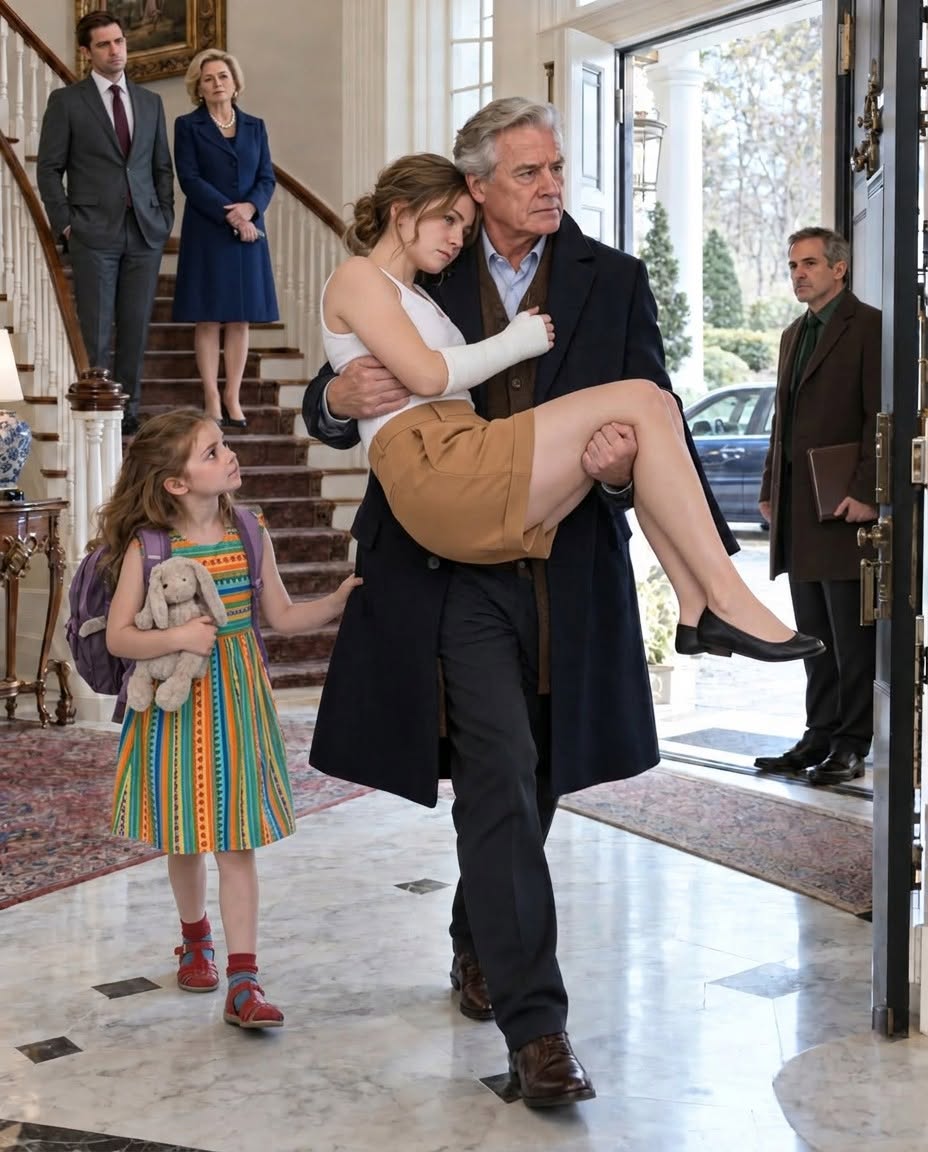
PART 1 TITLE: The Morning My Husband Let His Mother Explain Away My Injuries While I Lay on the Floor and Wondered Where Lily Was
The first thing I understood was that I couldn’t move without pain. The second was that my mother-in-law had already decided what everyone would be told. I lay twisted at the foot of the staircase, one cheek pressed against cold marble, while Eleanor Whitcomb stood near the entrance hall making a telephone call. Her voice carried through the enormous house with perfect clarity. There was no panic in it. No concern. She sounded irritated, as though someone had delivered the wrong flowers for a dinner party.
“Arthur, you need to come and collect your daughter,” she said. “We’ve been extraordinarily patient with her, but this situation has become impossible. She’s a burden we can no longer reasonably accommodate.” I tried to speak, but drawing a full breath sent a sharp pain through my left side. My husband, Preston, stood beside the console table, his eyes fixed on his mother’s back. He had watched me fall. He had heard the terrible noise my shoulder made when I struck the lower steps. Yet he hadn’t asked whether I could breathe.
Eleanor listened briefly, then gave a small, incredulous laugh. “You seem to misunderstand the position you’re in, Arthur. My family has resources you couldn’t possibly imagine.” She shifted the telephone away from her ear. From where I lay, I could hear my father’s reply. His voice was low and unusually deliberate. “Eleanor, listen carefully. If my daughter has been hurt, I expect the truth about what happened. From everyone involved.” For a moment, Eleanor’s mouth tightened. Then she ended the call without answering him.
I had spent almost nine years married to Preston Whitcomb, and in that time I had learned to interpret the smallest changes in his mother’s expression. A lifted eyebrow meant I had disappointed her. A particular smile meant she intended to embarrass me in front of guests. Silence usually meant something unpleasant was being arranged without my knowledge. But that morning, what frightened me most was Preston’s stillness. He adjusted the cuff of his shirt while I tried to push myself upright. When I asked him to help me, he looked toward his mother before taking a single step.
The argument had begun less than half an hour earlier, in a house that always appeared immaculate from the road. Sunlight fell across the polished banister, and someone in the kitchen was preparing fresh coffee. Lily, our seven-year-old daughter, was upstairs arranging her stuffed animals before breakfast. I had asked Preston a question about some financial correspondence that had arrived in my name. It wasn’t the first time I had questioned documents connected to his family’s property business. His patience had disappeared almost immediately. Eleanor had joined the conversation, insisting that my inability to understand business arrangements was becoming embarrassing.
I remembered standing near the upper landing with the letter in my hand. Preston had told me to stop creating problems where none existed. Eleanor had accused me of treating their generosity with suspicion. I remembered backing away from the argument, the edge of the staircase coming into view, and a sudden confusion of movement. After that, my memories became fragments: the handrail slipping beyond my reach, the hard edges of the stairs against my body, a sound that might have been my own voice. I couldn’t yet say exactly how I had lost my balance.
What I could remember was the silence afterward. I had landed near the bottom of the staircase, unable to get enough air into my lungs. Preston came down several steps and stopped. Eleanor remained above us long enough to examine the scene before descending. Neither reacted as I had imagined people would when someone they loved was injured. Their first exchange concerned what should be said when help arrived. I heard Eleanor tell Preston that I had always been careless when upset. He didn’t agree aloud. He didn’t object, either.
By the time the ambulance arrived, Eleanor had composed a complete account. I had become emotional during a minor family disagreement, she told the paramedics. I had rushed toward the staircase without watching where I was going. My husband had tried to calm me. It was an unfortunate accident made worse by my tendency to overreact. The words reached me through a haze of pain, each one precise enough to sound rehearsed. When a paramedic crouched beside me and asked what I remembered, Eleanor began answering. He gently interrupted her and turned his attention back to me.
“My name is Daniel,” he said. “I’m going to help you, but first I need to know whether you can feel your fingers.” I moved them. He checked my breathing, then asked whether I’d struck my head. I said I wasn’t certain. He didn’t seem troubled by the gaps in my account. He spoke slowly, gave me time, and explained each movement before he made it. It was the first time that morning anyone had treated my pain as something real rather than an inconvenience.
When they lifted me onto the stretcher, I looked toward the staircase. “My daughter,” I managed. “Lily is upstairs.” Preston came forward, finally showing something close to alarm, but his response was directed at the paramedic rather than me. “She’s with the household staff. There’s no need to upset her.” I wanted to insist that someone bring Lily to me, that she should know I was conscious and that I hadn’t simply disappeared. Another surge of pain stopped the words. The ambulance doors closed before I saw her.
Richmond passed outside the windows in pieces of gray pavement and pale morning sky. Every uneven stretch of road made me brace against another wave of discomfort. The paramedic asked whether there was someone I wanted contacted. I said my father had already been called, although I couldn’t explain why that thought made me feel more secure than knowing my husband remained at the house. As the siren rose above the traffic, I kept picturing Lily at the top of the staircase, wondering whether she had heard the argument and whether someone was telling her I had caused it.
The hospital confirmed that two ribs were fractured and my shoulder had been badly strained. Other bruises would take time to settle, and the doctors wanted to observe me because of the force of the fall. When the examination ended, I lay in a narrow hospital bed with an unfamiliar heaviness spreading through my chest. The medication reduced the sharpest pain, but it couldn’t quiet my thoughts. My daughter was still somewhere in the Whitcomb household. I had no assurance that Preston would allow her to call me.
My life before that morning had been full of ordinary responsibilities. I worked part-time as a speech therapist at an elementary school, helping children find words that didn’t come easily to them. I arranged my schedule around Lily’s classes, dentist appointments, and school performances. I knew which foods she refused to eat, which bedtime stories she wanted repeated, and how she tucked the corner of her blanket beneath her chin when she was worried. None of those things appeared impressive beside the Whitcombs’ wealth, but they were the substance of our days together.
Preston had once admired that part of me. When we met, he said he liked how seriously I took my work and how comfortable I seemed in a room full of children. During our early marriage, he would sometimes appear at my school with coffee and wait while I finished meeting a parent. Gradually, those small kindnesses became less frequent. His family’s opinions began influencing where we lived, how we spent holidays, and which friends were welcome at dinner. Whenever I resisted, Preston described my discomfort as evidence that I didn’t understand what being a Whitcomb required.
Eleanor never concealed her belief that marrying into the family had elevated me beyond my natural station. She mentioned the size of their property holdings with the same casual certainty other people used to discuss the weather. At family gatherings, she introduced me as Preston’s wife, then added that I worked with children, as though my career were a pleasant hobby. When Lily was born, she announced that the child would benefit from proper Whitcomb guidance. I had swallowed those remarks for years because disagreeing always seemed to create more trouble than enduring them.
There had been occasions when I had almost told Dad everything. He lived outside Charlottesville in a modest brick house with an uneven front path and a porch railing he insisted on repairing himself. He drove a sedan old enough that Lily called it Grandpa’s dinosaur. When I visited, he made tea in mismatched mugs and asked about my work before asking about Preston. Sometimes he would look at me across the kitchen table and say, “You seem tired, sweetheart. Is everything all right?” I always found a reason to reassure him.
I told myself that Dad simply couldn’t understand Preston’s family. My father had spent his working life in government service, doing what he described as administrative legal work. He cared little about expensive clothes, private clubs, or the elaborate dinner parties Eleanor considered essential. When I mentioned Preston’s business obligations, Dad listened without displaying much interest. When he encouraged me to keep control of my own savings and read documents before signing them, I assumed he was offering the ordinary caution of a parent who had never experienced substantial wealth.
Lying in the hospital, I began examining those assumptions with an honesty I had avoided at home. Eleanor’s contempt had never been subtle. Preston’s unwillingness to contradict her had become so familiar that I rarely expected him to try. Yet I had continued interpreting each humiliation as a separate misunderstanding. A difficult holiday. An unfortunate remark. A stressful business quarter. I had defended the marriage by treating the pattern as a collection of exceptions. Now, remembering his expression beside the staircase, I found that explanation impossible to maintain.
Shortly after lunch, a nurse entered to check my blood pressure. I asked whether my husband had called. She glanced at the notes beside my bed and said the hospital had received inquiries, but she couldn’t tell me who had made them. A moment later, my telephone vibrated on the bedside table. Preston’s name appeared. I stared at it until the screen went dark. I wasn’t ready to hear him explain what had happened, especially when I didn’t yet understand it myself. I wanted to hear Lily’s voice before anything else.
A little after two, someone knocked softly on the door. The man who entered wore a charcoal suit and carried an aged leather portfolio, the kind softened at its edges by years of use. He was perhaps in his late fifties, with silver at his temples and the composed manner of someone who had learned not to fill silence unnecessarily. For a moment, I feared Preston had sent a lawyer to make sure my statement matched Eleanor’s account. The thought made my hands tighten around the blanket.
“Mrs. Whitcomb? I’m Jonathan Hale,” he said. “Your father asked me to come.” I looked toward the corridor, half expecting Eleanor to appear behind him. Jonathan seemed to understand my hesitation. He pulled a chair beside the bed but remained standing until I invited him to sit. “Before we discuss anything else, I have news about your daughter.” The room seemed to narrow around those words. I tried to sit up, forgetting my injured ribs, and gasped. He waited while I settled back against the pillows.
“Lily is with Arthur,” Jonathan told me. “She’s safe, and he’s making sure she has everything she needs.” I asked how she had left the Whitcomb residence and whether Preston had objected. Jonathan explained that my father had acted promptly after receiving Eleanor’s call, and that arrangements had been made for Lily to remain with him while my condition and the family situation were assessed. The details were still being addressed, but she was no longer at the house. Relief moved through me so abruptly that I began crying before I could thank him.
Jonathan gave me a moment and then opened his portfolio. “I need to show you something difficult,” he said. He placed several sheets on the bedside table, turned them so I could read, and explained that Preston’s family had initiated emergency proceedings concerning Lily’s care. At first, I assumed the papers related to hospital permissions or temporary arrangements while I recovered. Then I saw the words referring to my emotional stability, my financial judgment, and my supposed inability to provide a safe environment for our daughter.
I read the first page twice. The petition presented me as a woman whose unreliable behavior had culminated in a serious accident. It described concern for Lily’s welfare and emphasized the Whitcombs’ ability to provide a stable home. The language was courteous, almost sympathetic, but its purpose was unmistakable. They wanted the court to place Lily under their control. My injuries, which had left me dependent on hospital staff for something as basic as getting out of bed, were being used as evidence that I couldn’t care for my child.
“They’re saying I’m unfit,” I whispered. Jonathan didn’t soften his answer. “They’re asking the court to accept that position on an emergency basis. Asking isn’t the same as proving it.” I pointed to a passage describing my lack of financial independence. “Preston handles the investments because he insisted on it. I have a job. I have savings. I take care of Lily every day.” My voice began to shake. “They know all of that.” Jonathan looked down at the document. “The people who prepared this selected the facts that suited their argument.”
I thought of Eleanor standing over me that morning, measuring my injuries with her eyes before deciding what story to tell. I remembered Preston agreeing, or refusing to disagree, when his mother described me as irresponsible. Suddenly the custody filing didn’t seem like a desperate decision made after my fall. The language was too specific. The accusations reached too far into our past. Someone had gathered information, arranged it, and waited for the right opportunity to use it. The possibility left me colder than the hospital air.
I asked Jonathan why Dad had chosen him, and whether he truly understood what we were facing. Jonathan closed the folder carefully. “Your father has spent much of his life examining what happens when powerful people expect their word to be accepted without scrutiny,” he said. “He knows the difference between a convincing account and an account supported by evidence.” I frowned. My father’s former job had never sounded especially important. Jonathan noticed my confusion, but before I could ask another question, footsteps approached the door.
Dad entered carrying his familiar brown cardigan over one arm. His hair looked slightly disordered, as though he’d driven without stopping, and there was a crease between his eyebrows that I recognized from childhood. He didn’t look at the documents first. He didn’t ask Jonathan for an update. He came straight to my bedside and took the hand I could move comfortably. For a moment, all the questions about his career and the Whitcombs disappeared. I was a frightened daughter, and my father had arrived.
“I’m sorry,” I said. I wasn’t sure what I was apologizing for. Marrying Preston, ignoring Dad’s concerns, or allowing Lily’s future to become a subject for strangers to debate. Dad pulled his chair close enough that I could see the small nick on his thumb from some household repair. “There’s nothing you need to explain to me right now,” he answered. “You’ve been hurt. That’s what matters.” I tried to tell him about the petition, but my voice broke. He squeezed my fingers and waited.
When I had recovered enough to speak, I asked whether Eleanor had frightened him on the telephone. Dad’s expression changed almost imperceptibly. “She was very certain of herself,” he said. “People often are when they’ve only considered the questions they want to answer.” I looked at Jonathan, who was watching him with an unfamiliar degree of respect. For the first time, I wondered whether the quiet man who clipped grocery coupons and never discussed his government career had deliberately allowed Preston’s family to underestimate him.
Dad reached for the glass of water beside my bed and helped me drink. Then he turned to Jonathan. “Show her the rest,” he said. Jonathan hesitated. “Arthur, she’s had a difficult day.” My father looked at me rather than him. “I know. But withholding information is precisely what brought us here. She gets to decide what she can bear.” I nodded, although my pulse had begun beating harder. Jonathan drew a second folder from the portfolio and placed it over the custody petition.
The first page contained the name of a Whitcomb property company. Beneath it, in an official-looking block of text, was my own full name. I recognized the address and the date, but not the document itself. There were several attached schedules and a signature page. Jonathan opened that final sheet, then looked at me steadily. “Before you read any further,” he said, “I need you to tell us whether you have ever agreed to assume a personal financial obligation for Preston’s family business.” I shook my head.
Jonathan moved the page closer. At the bottom was a signature that looked almost exactly like mine.
END PART 1
PART 2 TITLE: A Forged Signature Exposed the Financial Trap My Husband Had Prepared Long Before His Family Tried to Take My Daughter
I recognized my name immediately, but the handwriting unsettled me. At a casual glance, the signature seemed authentic. The letters leaned slightly to the right, the first name flowed into the surname, and the final stroke extended beneath the line. Yet something about it was wrong. I had spent years signing therapy reports, school assessments, permission forms, and ordinary household paperwork. My hand knew the movement instinctively. The document Jonathan placed before me looked like the work of someone who had studied that movement without understanding it.
“May I see it closer?” I asked. Jonathan lifted the paper to a comfortable angle so I wouldn’t strain my shoulder. My maiden name was Dawson, and although I used Whitcomb professionally now, I had never changed the way I formed the capital D in my signature. I always began with a small upward movement before bringing the pen down. On the page, the letter started with a straight vertical line. The final flourish also curled in the wrong direction. These were small differences, but they belonged to a different hand.
“I never signed this,” I told him. I expected Jonathan to ask whether I was certain. Instead, he wrote something on the legal pad balanced against his knee. “Tell me what you notice.” I explained the capital letter and the incorrect ending, then described how the pen pressure changed in places where mine normally remained consistent. He didn’t interrupt. When I finished, he underlined a sentence and said, “That’s useful. A qualified examiner can assess the document, but your observations help identify what needs to be compared.”
According to the agreement, I had supposedly guaranteed a substantial obligation incurred by an affiliated Whitcomb company. The business operated within a network of commercial property developments extending across Virginia and into the Carolinas. Preston’s family had interests in shopping centers, medical offices, and residential construction. Their name appeared on buildings throughout the region. I knew the broad outlines because Preston talked about projects during dinner, often while answering messages on his telephone. Whenever the conversation turned toward financing, however, he would tell me the details were unnecessarily complicated.
I used to believe that explanation because my own work demanded a different kind of expertise. I understood how a child might struggle to distinguish certain sounds, how language difficulties could affect confidence, and how patient encouragement could accomplish what constant correction never would. I wasn’t trained to interpret development loans or financial guarantees. Preston knew that. Over time, he had begun treating my lack of specialized knowledge as though it meant I lacked sound judgment altogether. Questions about agreements became evidence, in his eyes, that I had no business asking them.
Jonathan explained the document in plain language, pausing whenever a term was unfamiliar. The guarantee could expose me personally to financial demands connected to obligations I had never knowingly accepted. Several transactions involving related companies were already attracting attention from financial investigators. Payments had moved through consulting businesses whose activities were difficult to verify, and certain loans contained arrangements that deserved closer examination. Jonathan was careful not to announce conclusions the evidence couldn’t yet support. What mattered immediately was that my name appeared on a legally significant document I denied signing.
I tried to remember the first time Preston had asked me to put my signature on company paperwork. There had been an evening the previous October when Lily was in the kitchen decorating a school project with colored pencils. Preston arrived home late and spread several pages across the table beside her supplies. He kissed the top of my head and said the accountants needed to update a few routine documents. I was making sandwiches for the following day, and Lily wanted help spelling the word butterfly.
When I reached for the papers, Preston covered part of the first page with his hand. “It’s nothing worth spending your evening on,” he said. “Insurance adjustments, mostly.” I remember looking at the dense paragraphs and asking why a household insurance update carried the name of one of his family’s property companies. He exhaled sharply, the way he did when I asked a question he considered beneath him. “Because that’s how the assets are organized. It’s all been reviewed.” Lily called me from the other side of the table, and I put the page down.
There had been other evenings like that. Documents arrived in thick envelopes or were brought home in folders with the Whitcomb company logo. Preston explained some and dismissed others. If I asked to read something before signing, he accused me of distrusting him. If I requested a copy, he said the accountants would keep one. Sometimes I stood my ground. Sometimes I signed because the conversation had become exhausting and I wanted the evening to return to something ordinary. I couldn’t immediately remember which papers belonged to which occasion.
“That doesn’t mean you signed this,” Jonathan reminded me when I described those evenings. I looked down at my hands. My fingernails were short because I worked with young children and disliked the feeling of long nails against paper. A faint mark crossed my right index finger where a drawer had caught it the week before. These were familiar hands. It was difficult to understand how someone could have used my name, perhaps even copied the movements of those hands, to create obligations I knew nothing about.
Dad had listened without interrupting. When I admitted how ashamed I felt for accepting Preston’s explanations, he leaned forward. “You asked questions in good faith,” he said. “He was the person responsible for answering them truthfully.” I told him that I should have insisted on reading every page. He didn’t argue that greater caution would have been useless. Instead, he said, “There are things you may wish you’d done differently. That doesn’t excuse someone who deliberately gives you false information.” The distinction was simple, but I needed to hear it.
Jonathan opened another section of the folder. It contained copies of credit records and inquiries I didn’t recognize. Some entries were connected to businesses whose names meant nothing to me. He explained that they were still determining the significance of each item and that a credit inquiry alone did not prove fraud. Nevertheless, the records provided a reason to investigate further. My confusion deepened as I considered how many ordinary financial decisions Preston had insisted on handling himself, often presenting his control as a generous way of protecting me from unnecessary burdens.
The custody petition made disturbing use of that arrangement. Preston’s lawyers emphasized that he administered the family’s investments and household accounts. They portrayed my part-time employment as insufficient evidence of independence, although I had continued working by mutual agreement so that I could be present for Lily. One late utility payment from the previous winter was described as proof of unreliable financial management. I remembered that bill. Preston had changed the account used for automatic payments and forgotten to update the instructions. I had been the one who discovered the problem and arranged for it to be corrected.
Seeing that small mistake turned into an accusation made my stomach tighten. I knew how convincing paperwork could appear when its context was removed. At school, I often reviewed evaluations that reduced a complicated child’s needs to a few numbers. Responsible interpretation required understanding the person behind the records. Preston’s family was doing the opposite. They had collected isolated facts from our lives and arranged them into a portrait of a mother who couldn’t be trusted. Someone reading the petition without knowing me might assume I was careless, confused, and dependent.
Jonathan had already begun obtaining records from my employer and Lily’s school. He asked whether I could identify people who understood my daily responsibilities. I mentioned Lily’s teacher, the school office administrator, and the colleague who covered my therapy sessions when Lily was ill. I gave him names and contact information, then remembered the attendance forms I signed at the beginning of each school year. Jonathan wrote everything down. For the first time since the fall, I was doing something more useful than trying to defend myself against the Whitcombs’ version of events.
When Jonathan left to make a call, Dad remained beside me. I looked at the papers scattered across the hospital table and asked how long he had known something was wrong. He rested both hands on his knees before answering. “I’ve had concerns for several months.” The admission hurt more than I expected. “And you didn’t tell me?” He looked toward the window. Outside, clouds were gathering above the parking garage. “I tried to understand what I was seeing before bringing you an accusation I couldn’t yet support.”
I wanted to know what he meant by concerns. Dad reminded me of a conversation we had shared the previous spring. Preston had asked me to sign an authorization allowing him broad control over certain financial decisions made in my name. I remembered telephoning Dad from the kitchen, embarrassed that I needed advice about something my husband described as routine. Dad had asked whether an independent professional had explained the document to me. When I said no, he encouraged me to request clarification before signing anything.
Preston had been furious about that conversation. He didn’t shout, at least not immediately. His anger took the form of small, deliberate withdrawals. He spoke to me only when necessary. He arranged dinner with his parents without mentioning it until the last moment. When I asked what was wrong, he said I had embarrassed him by inviting outside interference into private family affairs. Eleanor later remarked that marriages failed when wives began treating their husbands like strangers. The authorization disappeared from the kitchen counter, and Preston never raised it again.
Until that afternoon, I had considered the incident another argument we had managed to put behind us. Now I wondered whether refusing the authorization had prevented Preston from gaining access he couldn’t otherwise obtain. I asked Dad whether he believed the disputed guarantee was connected. “It’s possible,” he answered, “but we’ll need the records to establish that.” His restraint frustrated me. I wanted certainty. I wanted him to tell me exactly what Preston had done and why. Dad wouldn’t give me an answer simply because I desperately needed one.
I asked about his former career. Jonathan had described him as someone experienced with sophisticated financial investigations, yet Dad had never told me much beyond his government employment. He shifted uncomfortably in his chair. “I worked with teams that examined financial misconduct and public corruption,” he said. “Some of the cases involved institutions that were accustomed to having their explanations accepted without challenge.” I stared at him. “You made it sound as though you spent your days reviewing administrative forms.” He gave a faint smile. “There were certainly plenty of forms.”
As he explained further, I understood that he had spent decades supervising and coordinating complex federal investigations. His work involved financial records, disputed transactions, public officials, and organizations whose influence complicated the search for reliable evidence. He had retired without much ceremony, at least as far as I knew. He had never used professional accomplishments to impress Preston’s family. When I asked why, Dad shrugged. “I wanted to be your father when I came home. I didn’t want every conversation to become a story about my office.”
That explanation sounded so much like him that I almost laughed. He was the same man who could spend an entire afternoon helping Lily assemble a model of the solar system and then apologize because he had painted Saturn’s rings slightly crooked. He bought discounted groceries without embarrassment and insisted that an old car was worth keeping if it ran reliably. Eleanor had always regarded those habits as evidence of limited ambition. I remembered her laughing at his shoes during one Christmas visit. Dad had simply thanked her for noticing that he kept them polished.
“Does Jonathan know you from your government work?” I asked. “Our paths have crossed professionally,” Dad said. “But he’s here because he’s experienced in complicated family cases, not because of anything I used to do.” I studied him for a moment. “Are you going to call someone and make all this disappear?” His expression grew serious. “No. I don’t have that right, and it wouldn’t help you in the long run. What I can do is make sure you have good advice and that nobody gets to decide the facts without examining the evidence.”
The answer disappointed a small, frightened part of me. I had imagined, for an instant, that Dad possessed some hidden authority capable of stopping everything. Instead, he offered a slower path: documents, witnesses, legal protections, careful questions. It sounded exhausting. My ribs ached, my daughter was sleeping in a house that wasn’t hers, and my husband had already presented me as an unstable woman. Yet there was something reassuring about Dad’s refusal to promise a miracle. His confidence rested on work that could actually be done.
That afternoon, Jonathan returned with preliminary information about the business inquiry. Some transactions appeared to involve consulting companies that had little visible history of providing the services listed on their invoices. Certain loan arrangements also contained guarantees attributed to individuals who might not have understood or approved them. He stressed that the investigators had not completed their work. The significance of the disputed documents depended on additional records and testimony. I listened carefully, asking him to repeat unfamiliar terms until I understood what was known and what remained uncertain.
While we talked, I remembered Preston’s father closing his office door whenever certain business associates visited. I remembered Eleanor referring to financial difficulty as a matter of appearance rather than substance, saying a respected family never allowed temporary setbacks to become public knowledge. Those details hadn’t seemed important at the time. Wealthy families, I assumed, handled business privately. Now I wondered how often privacy had served as a convenient excuse for withholding information. I mentioned the conversations to Jonathan, who recorded them but warned against assuming they proved anything.
My telephone vibrated again. This time the message came from Preston. He hoped I was resting comfortably, he wrote, and wanted us to avoid making the situation more difficult for Lily. He asked me not to discuss private business matters with outsiders while I was recovering. The words were polite, but I recognized the demand beneath them. He was still trying to set the boundaries of what I could question. I showed the message to Jonathan. He photographed the screen with my permission and advised me to preserve the conversation.
Another message arrived almost immediately. Preston wrote that his family was concerned about my judgment and that he hoped I wouldn’t force matters into an unnecessarily hostile direction. I remembered how often he used the word hostile when I disagreed with him. A request for an explanation became an accusation. An objection became an attack. Refusing to sign something I didn’t understand became a threat to the family. I had spent years adjusting my tone, searching for words gentle enough that he couldn’t claim to feel offended.
For the first time, I chose not to answer. I placed the telephone facedown beside my water glass. Dad noticed but didn’t comment. The nurse arrived to check my medication and helped reposition the pillows behind my shoulder. Outside, rain began tapping against the glass. It was an ordinary sound, and I found myself thinking of Lily, who loved thunderstorms when she could watch them from a safe window. I wanted to call her, but Dad suggested giving her a little time to finish dinner before we spoke.
Before that call could happen, Jonathan’s telephone rang. He checked the number, stepped into the corridor, and remained there longer than usual. Through the half-open door, I could see him listening without speaking, occasionally glancing toward the nurses’ station. When he returned, he had the controlled expression I was beginning to recognize as a sign that something had gone wrong. Dad straightened in his chair. “What happened?” Jonathan closed the door before answering.
Someone claiming to represent the Whitcomb company’s insurance provider had contacted the hospital. The caller wanted information about my admission, my medical condition, and the identities of people who had visited me. Hospital personnel had refused to provide private information and had documented the request. Jonathan explained that the caller’s identity had not been established. It might have been connected to an ordinary insurance inquiry, but the questions went beyond what hospital staff were prepared to disclose.
Dad asked whether the caller had specifically requested visitor information. Jonathan confirmed it. My father looked down at the legal documents, then toward the corridor where hospital staff were moving quietly between rooms. “Make sure the hospital understands that no one is authorized to receive information without her consent,” he said. Jonathan agreed and began recording the details. I watched them work, suddenly aware of how vulnerable it felt to have strangers discussing my medical condition while I could barely cross the room unaided.
“They want to know who’s been here,” I said. Dad didn’t dismiss the possibility. “They may be trying to find out what you’ve told someone, or what documents have been examined,” he replied. “We don’t know enough to say. But we should be careful.” I looked at the fraudulent guarantee, the custody petition, and Preston’s messages. The pieces had begun to form a pattern I could no longer explain as coincidence, even if the motive behind each action remained uncertain.
I remembered Eleanor’s composure beside the staircase. She had described my fall as proof that I was unreliable before anyone knew the extent of my injuries. Preston had allowed that description to stand. Within hours, legal papers were being used to challenge my ability to raise Lily. The disputed financial agreement suggested that my name might also have been used for purposes I had never approved. I couldn’t prove that my fall had been planned or that anyone had deliberately exploited it, but I could no longer ignore how quickly the family had turned the incident to its advantage.
That evening, Dad helped me arrange a call with Lily. When her face appeared on the screen, she was wearing her favorite lavender sweater and sitting at his kitchen table. A box of colored pencils stood beside her. She asked whether the hospital had good food, whether I could still hug her, and whether she was allowed to bring me a drawing. I answered each question as steadily as I could. Then she hesitated, looking past the camera toward something outside the frame.
“Mommy,” she said, “why did Grandma tell Daddy to get the papers before the ambulance came?” I stopped breathing for a moment. Dad leaned closer to the telephone, but neither of us interrupted her. Lily looked puzzled by our silence. “She said he needed the things from the blue room,” she added. “I thought you already knew.” I promised we would talk more when I saw her, and after the call ended, I turned toward Jonathan. He had gone completely still.
END PART 2
PART 3 TITLE: My Daughter Remembered a Locked Room, a Blue Record Book, and the Warning I Had Somehow Forgotten Writing to Myself
After Lily’s call ended, nobody spoke for several seconds. I could still see her small face in my mind, the way she had tilted her head while asking why her grandmother wanted papers collected before the ambulance arrived. Seven-year-olds often remember details adults dismiss, but they also confuse the order of events. I knew that from my work. Children needed space to explain what they recalled without someone supplying the missing pieces. I asked Jonathan whether we should call her back. He advised against questioning her over the telephone.
“She’s already told us something potentially important,” Jonathan said. “We should record exactly what she said and allow the appropriate people to speak with her carefully if necessary.” Dad wrote down Lily’s words as nearly as we could remember them. I watched his pen move across the paper and felt a strange mixture of gratitude and dread. I was relieved that someone had listened to my daughter. I was frightened because her innocent observation suggested that, while I lay injured, Preston and Eleanor had been thinking about documents.
The blue room was part of the Whitcomb family estate, a sprawling property outside Richmond where Eleanor and her husband entertained business associates and old friends. It wasn’t the house where Preston, Lily, and I usually lived. The estate had an entire wing devoted to offices and sitting rooms, spaces furnished with antiques that visitors were expected to admire without touching. Eleanor’s private room stood beside her husband’s office. Pale blue walls, heavy curtains, and locked cabinets gave it the quiet appearance of a place intended for confidential conversations.
I had entered that room only a handful of times. Eleanor disliked anyone moving through her private rooms without an invitation, and she usually made her displeasure apparent. One Christmas, however, Lily ran out of drawing paper while we were visiting. The nearest supply cabinet stood inside Eleanor’s sitting room, and I went looking for a few sheets. On the desk was a large blue record book, thicker than an ordinary notebook, with a brass-colored fastening along its edge. I remembered moving it slightly so I could reach the paper beneath it.
At the time, I barely considered what the book contained. The Whitcombs kept ledgers, folders, contracts, and financial reports in nearly every office. Preston’s father still preferred certain handwritten records despite the company’s elaborate accounting systems. He said important transactions deserved a permanent paper trail. I thought of that remark now, remembering the weight of the book beneath my fingers. Its cover had been scuffed near one corner, suggesting it was used often rather than displayed. I couldn’t explain why Lily’s mention of the room brought that particular object so vividly to mind.
When Jonathan asked whether I knew what the blue book recorded, I shook my head. I had never opened it. I remembered only a few sheets protruding from beneath the cover, one marked with a date and another bearing what looked like columns of numbers. Dad asked whether the book was normally kept in Eleanor’s sitting room or whether someone might have brought it there temporarily. I wasn’t certain. I could remember seeing it that Christmas, but I hadn’t been invited into the room often enough to know where it belonged.
My uncertainty frustrated me. For years, Preston had described me as someone who remembered conversations incorrectly or attached too much meaning to insignificant details. Sometimes he contradicted me about things as ordinary as restaurant reservations. If I insisted that we had agreed on a particular time, he would produce a different account with such confidence that I eventually apologized. I had never understood how those small exchanges could leave me exhausted. Now, while Jonathan asked careful questions, I found myself automatically softening each answer before he had even challenged it.
Dad noticed. “You can say you’re uncertain,” he told me. “That doesn’t make the things you do remember unreliable.” I looked at him, surprised by how accurately he had identified my hesitation. He explained that people often felt compelled to create a complete account when they were frightened, filling gaps without realizing it. A responsible investigation needed something different. It needed the details a person genuinely recalled, alongside an honest acknowledgment of what remained unknown. I began distinguishing what I had actually seen from what I was merely beginning to suspect.
The following evening, a nurse helped arrange a brief visit with Lily. I heard her shoes in the corridor before she appeared, moving cautiously beside Dad. She carried a folded drawing against her lavender sweater, holding the edges so tightly that the paper had begun to crease. When she saw me, she stopped. For a moment, she looked at the hospital equipment, the pillow supporting my arm, and the small marks on my face. Then she asked, “Can I come close, or will it hurt you?”
I told her she could sit beside me, and Dad positioned a chair near the bed. Lily climbed onto it with unusual care. Normally she greeted me by throwing both arms around my waist. Watching her restrain herself was harder than I expected. I reached for her hand and felt her fingers curl around mine. She wanted to know whether bones could repair themselves and how long I would need to sleep in the hospital. I answered with the same patience I used when one of my students was frightened by something unfamiliar.
Eventually Lily unfolded her drawing. It showed a little house surrounded by flowers, with a yellow front door and blue windows outlined in thick crayon. Three figures stood outside. One had long hair, one wore glasses, and the smallest held a stuffed rabbit. “I made this for when we have our own place,” she said. I looked at the picture, then at Dad, who was quietly adjusting the chair. I hadn’t told Lily that our living arrangements might change permanently. She seemed to have reached that conclusion herself.
“What made you choose blue for the windows?” I asked. Lily studied the picture before answering. “Blue feels quiet. I want our house to be quiet when people are upset.” I felt something tighten behind my ribs that had nothing to do with the fractures. Our beautiful Whitcomb home had never lacked space, expensive furniture, or carefully maintained gardens. Yet my daughter had drawn a smaller place and chosen its colors according to how she hoped people would behave inside it. I placed the drawing beside my pillow.
We spoke about her day at Grandpa’s house. She had helped him prepare breakfast, discovered that he kept an unreasonable number of pencils in his desk, and persuaded him to let her arrange the books on his lowest shelf. When she described the pancakes he made, she complained that one had looked like a potato instead of a rabbit. Dad objected that the resemblance had been perfectly respectable. Lily laughed, and for a few minutes the hospital room seemed less frightening. I realized how long it had been since I had heard her laugh without someone telling her to lower her voice.
Then Lily noticed a photograph among the papers on the small table. It showed the staircase where I had fallen. Jonathan had left the picture there after reviewing the available information, and I regretted not putting it away before her visit. Lily leaned forward. “Why did somebody take a picture of our stairs?” she asked. I explained that adults were trying to understand what had happened and that photographs could help them remember important details. I didn’t say anyone had caused my fall. I didn’t want to give her an answer before I possessed one myself.
Lily examined the photograph for a moment. “Daddy was angry,” she said quietly. I asked whether she wanted to tell me what she remembered. She nodded. She had been upstairs when she heard raised voices. Eleanor had told her to remain in her room, although Lily wanted to find out why we were arguing. She remembered a loud noise from the staircase, followed by footsteps moving quickly below. She hadn’t seen me fall. She hadn’t seen what anyone did immediately afterward. I thanked her for telling me and resisted the urge to ask questions that might shape her account.
After a pause, she mentioned the blue room again. “Grandma said Daddy needed the papers,” she explained. “She told him they were important, and he was supposed to get them.” She couldn’t say whether Eleanor had given the instruction before or after the ambulance was called. The words she remembered were ordinary enough that someone could interpret them in several ways. But I pictured Eleanor standing beside the telephone, utterly composed while I struggled to breathe. The possibility that business documents had mattered to her at that moment disturbed me deeply.
I changed the subject before Lily became uncomfortable. She showed me a drawing of her stuffed rabbit and described the book Dad had promised to read that evening. When the visit ended, she approached my bed carefully and kissed the uninjured side of my face. “You won’t forget to come back, will you?” she whispered. I told her I would be coming back to her as soon as the doctors allowed it. She considered that answer, then placed the drawing against my blanket. “Keep the windows,” she said. “So you’ll remember what we want.”
After she left with Dad’s longtime neighbor, who had offered to help while he attended to the legal arrangements, I lay looking at the blue windows. My daughter had understood something about our family that I had spent years trying to explain away. She had noticed the raised voices, the careful silences, the way conversations changed when Eleanor entered a room. I wondered how many times Lily had retreated upstairs because an adult told her she was too young to understand. The thought made me feel determined to be more honest with her, even when honesty required difficult explanations.
Jonathan returned after the visit and asked whether I remembered seeing anyone else near the blue room. I thought about the Christmas afternoon, the large record book, and Eleanor’s warning not to disturb her desk. Then another image came to me. Several months earlier, Lily had dropped her stuffed rabbit near the entrance to Preston’s father’s office while we were visiting the estate. I had bent to retrieve it and noticed that the door was partly open. Two people were speaking inside, their voices low enough that I couldn’t distinguish their words.
One was Preston’s father. The other was a woman with reddish-brown hair gathered loosely behind her head. She wore a dark jacket and held what appeared to be a folder against her chest. Both stopped talking when I appeared in the doorway. Preston’s father immediately closed a desk drawer, while the woman looked toward a blue folder resting beside him. I apologized for interrupting and explained that Lily had dropped her toy. He smiled politely, but his attention remained on the doorway until I stepped away.
I had assumed the woman was an accountant or senior employee. The Whitcomb business employed people whose names I never learned, and Preston seldom included me in office conversations. What stayed with me now was her expression. She hadn’t looked irritated by the interruption. She had appeared uneasy, almost as though she wanted to speak but had been instructed not to. I described her to Jonathan, including the loosely tied hair and the small mark I thought I had noticed near one eyebrow. He asked me not to guess at her identity.
As I spoke, another memory surfaced. The evening before my fall, Preston had asked whether I still kept the appointment notebooks I used when Lily was younger. Those notebooks contained therapy schedules, school dates, personal reminders, and details of our early years as parents. They were not valuable, and I hadn’t looked through most of them for a long time. Preston’s question had seemed peculiar because he normally dismissed my habit of keeping old calendars. When I asked why he wanted them, he said he was merely helping organize the house.
I kept the notebooks in a wicker basket beneath our staircase, alongside leftover wrapping paper, old school supplies, and some of Lily’s belongings. It was an untidy collection by Whitcomb standards, which was why Eleanor regularly suggested throwing everything away. I had refused because many of the objects held small memories of Lily’s childhood. Her first school backpack was there, along with a stuffed rabbit whose stitching had come loose near one ear. Preston knew the basket existed. He had complained about it often enough.
Jonathan’s attention sharpened when I mentioned the notebooks. “Do you remember making any notes about the business?” he asked. I frowned. I had never intentionally kept company records among Lily’s school supplies. But I sometimes wrote down questions when something troubled me, particularly if Preston refused to discuss it at the time. An appointment journal would have been a natural place to record a date or reminder. I told Jonathan I wasn’t certain what the notebooks contained. He asked whether I would authorize investigators to preserve any relevant materials if they obtained the necessary permission to examine the property.
I agreed. The idea of strangers searching through my possessions made me uncomfortable, but I was more frightened of allowing important evidence to disappear. Jonathan explained that an examination had to follow the proper legal procedures and that any potentially relevant items should be documented carefully. Dad supported that approach without pressing me to make decisions more quickly. When Jonathan began arranging the necessary steps, I asked whether Preston would know which belongings were being examined. He said the answer depended on the authorization and the investigators’ procedures, and he wouldn’t speculate.
Later that evening, an investigator contacted Jonathan with preliminary photographs from the examination of our home. Several showed the staircase, the position of furniture, and the area where I had landed. I recognized a small side table near the bottom steps, its polished surface usually occupied by flowers or decorative objects. Beneath it, investigators had found an envelope bearing my name. The envelope was partly concealed, apparently having slipped or been placed beneath the table. Jonathan enlarged the photograph so I could examine the writing.
The name on the envelope was in Eleanor’s handwriting. I recognized the disciplined, elegant letters from years of birthday cards, dinner invitations, and instructions left for household staff. Below my name, however, someone had written a short message in smaller, less regular letters. I leaned closer, trying to understand why two different hands appeared on the same envelope. The smaller writing seemed familiar, but I was distracted by the presence of Eleanor’s carefully formed name. I asked Jonathan to enlarge the lower portion of the photograph again.
The message was brief: For the day you begin questioning what you remember. I stared at it, suddenly aware of the shape of the individual letters. The uneven spacing. The way the final stroke curved slightly upward. The capital letter beginning with a movement almost identical to the one I had described when examining the disputed financial guarantee. This handwriting was mine. I knew it with the same certainty that had allowed me to recognize the forged signature as wrong. Yet I couldn’t remember writing those words or placing them beneath my mother-in-law’s handwriting.
I asked Jonathan whether investigators had opened the envelope. He explained that they were documenting its condition and contents according to the applicable procedures, and that he would share verified information as soon as it became available. I felt an almost physical urge to reach through the photograph and turn the envelope over. Why had I written a warning to myself? Why had I chosen those particular words? And how had an envelope marked by Eleanor ended up near the staircase where I had fallen?
Dad returned to the bedside as I studied the image. He listened while I explained what I recognized, then pulled his chair closer. “You don’t need to force yourself to remember everything tonight,” he said. “Sometimes the safest thing is to preserve what you have and let the other pieces come into view.” I wanted to accept that advice, but the message seemed to speak from a part of my own history I had somehow lost. It suggested I had already questioned Preston’s explanations seriously enough to leave myself a written reminder.
I lay awake long after the corridor lights were dimmed. The envelope’s handwriting stayed with me, along with Lily’s recollection of the blue room and the memory of the auburn-haired woman near Preston’s father’s office. I tried to connect them without inventing answers. The effort was exhausting. Each time I closed my eyes, I saw Preston standing beside my car in the rain, although I couldn’t remember when that encounter had occurred. I had the unsettling impression that my mind was circling something I had once understood.
Shortly before midnight, Jonathan sent a message confirming that investigators were preserving the relevant materials and that additional information might be available the following morning. I set the telephone down beside Lily’s drawing. The little house with its blue windows looked impossibly peaceful beneath the hospital light. I reached toward the envelope’s photograph one last time and whispered the question I had been afraid to ask aloud: What had I discovered about the Whitcombs that made me think I might someday need to warn myself not to forget?
END PART 3
PART 4 TITLE: The Former Whitcomb Employee Finally Revealed Why I Had Hidden a Blue Folder, and the Search for It Changed Everything
Rebecca Sloan arrived at the hospital the following morning carrying a narrow folder and looking as though she hadn’t slept properly in weeks. An investigator accompanied her, introduced himself to the nurse, and waited until I was comfortable before explaining the purpose of their visit. I recognized Rebecca before she said her name. The auburn hair was gathered at the back of her head, and a faint mark near her eyebrow confirmed what I remembered from Preston’s father’s office. She looked at me carefully, then lowered her eyes.
“I hoped you wouldn’t have to find out this way,” she said. Her voice was softer than I expected. I looked from her to Jonathan, who had arrived shortly before the meeting, and then to Dad. “Find out what?” Rebecca pulled a chair toward the bed but didn’t sit immediately. Her fingers rested against the edge of the folder. She seemed to be deciding where to begin. At last, she said, “You came to see me last October. We talked about documents bearing your name. I should have contacted you again sooner.”
I tried to place her words within my memories. October had been an ordinary month filled with school meetings, autumn activities, and Lily’s excitement about Halloween. I remembered a disagreement with Preston about a letter I had received, but the details were indistinct. Rebecca watched my face and seemed to understand that I couldn’t immediately reconstruct the conversation. “It’s all right if you don’t remember the whole appointment,” she said. “I brought the records I kept. You can examine them without relying on my description alone.”
Rebecca explained that she had worked as a senior financial records specialist for the Whitcomb family’s commercial property business. Her responsibilities included reviewing supporting documentation, checking transaction entries, and making sure the information recorded by different departments remained consistent. She had spent years doing that work without serious concerns. The company developed substantial projects, and complicated arrangements were not unusual. But certain transactions had begun appearing in the records without the supporting information she expected to find. At first, she assumed the problems resulted from errors or incomplete communication between departments.
The irregularities became harder to explain when she examined payments involving consulting companies. Some businesses received substantial amounts for services that were not clearly documented. Others appeared repeatedly in agreements despite having little evidence of significant operations. Rebecca had asked for explanations through ordinary internal channels. Sometimes the answers were delayed. Sometimes she received incomplete records that didn’t match the original entries. She began keeping careful notes, not because she had already concluded anyone had acted dishonestly, but because the discrepancies needed to be understood.
Then she discovered questionable financial guarantees attached to several arrangements. Certain obligations were attributed to individuals who, as far as the available records showed, had not clearly authorized them. My name appeared among those individuals. Rebecca had noticed the discrepancy when comparing versions of a document and examining correspondence associated with the transaction. The agreement in Jonathan’s folder was one of the records she had questioned. Hearing her confirm the connection made the room feel suddenly smaller. The signature I had denied was part of a larger problem, not an isolated clerical mistake.
She opened her folder and removed an earlier draft of the agreement. A paragraph halfway down the page contained my initials in the margin. Beside them, in handwriting I recognized immediately, was a request for clarification about the responsibility described in the clause. I remembered sitting at our kitchen table, holding a pen while Preston prepared to leave for an evening appointment. I had asked what the paragraph meant. He told me it concerned temporary insurance arrangements associated with a company project and promised that the accountants would explain anything necessary.
That memory was clearer than the others because I could recall Lily sitting beside me, trying to sharpen a colored pencil that kept breaking. Preston had been impatient. He had glanced at his watch twice while I read the clause. When I refused to sign immediately, he told me I was making a routine process unnecessarily difficult. I wrote my question in the margin so it wouldn’t be forgotten. He watched me do it and said the notation wasn’t needed because the accountants already understood the arrangement. I left it there anyway.
Rebecca showed me another version of the same document. The page containing my handwritten question had been replaced with a clean page, and the accompanying signature material was different. She explained that she had saved copies after noticing the alteration. She didn’t claim to know exactly who had produced the questionable signature or who had authorized the changes. Those were matters the investigation would need to establish. But the existence of the earlier draft supported my statement that I had raised concerns rather than knowingly accepting the obligation presented in the later agreement.
I stared at my initials until the letters blurred. Preston had told me the question was unnecessary. He had said he would ask the accountants. I couldn’t remember ever receiving the promised explanation. What I now held was evidence that the concern had existed and that the version I examined had not remained intact. Rebecca cleared her throat. “I should have reported it sooner,” she said. “I convinced myself there might be an explanation I hadn’t seen.” Dad looked at her steadily. “What matters now is that the records are preserved and you’re willing to explain what happened.”
Rebecca sat back in the chair, her shoulders lowering slightly. She said she had eventually resigned because the discrepancies continued and she no longer believed they could be dismissed as ordinary errors. Before leaving, she secured copies of documents she considered important and sought appropriate advice about how to report her concerns. She was now cooperating with investigators. It had taken her time to decide how to proceed, partly because she feared the consequences of challenging a family with extensive business connections. Her resignation had not ended her responsibility to explain what she knew.
I asked how she remembered me. Rebecca looked at the document in her hands. “You were worried about letters addressed to you that you hadn’t received,” she said. Last October, I had apparently discovered that my name appeared on financial correspondence sent through the company. When I asked Preston about it, he told me the letters were routine notices handled by his office. I had become uncomfortable because I couldn’t obtain copies. Eventually, I visited the business premises and asked to review the underlying records myself.
As Rebecca spoke, more of the encounter returned. I remembered entering a reception area that smelled faintly of fresh paint and coffee. The receptionist had looked surprised when I asked to speak with someone responsible for financial records. Preston hadn’t accompanied me. I had deliberately chosen a time when he was attending a meeting elsewhere. I told myself I was merely clarifying something that had become unnecessarily confusing. In truth, I had been frightened of how angry he would become if he learned I had gone to the office without informing him.
Rebecca had agreed to meet me because my name appeared on documents that deserved an explanation. She remembered how carefully I spoke, repeatedly reassuring her that I wasn’t accusing anyone. She showed me the relevant correspondence, then helped me compare several entries with the underlying agreements. When I asked how certain transaction dates and guarantees had been recorded, she brought out the large blue record book kept among the company’s private documents. I remembered its cover immediately. It was the book I had seen in Eleanor’s sitting room the previous Christmas.
The ledger contained transaction dates, names, amounts, and handwritten instructions associated with selected business arrangements. Rebecca did not claim that every entry was improper. She explained that the important issue was whether the records matched authentic agreements and whether the people named in them had consented to the obligations attributed to them. Some entries appeared inconsistent with other documents. I had apparently noticed those differences during our meeting and asked why a payment associated with one company appeared beside a guarantee carrying my name.
I remembered the feeling of sitting across from Rebecca as she turned the pages. There had been a clock ticking somewhere behind her desk. She had asked whether I wanted a glass of water, and I had declined because I was concentrating on the figures. I hadn’t understood every financial term, but I could read names and dates. I could recognize correspondence I had never received. I could identify a signature that wasn’t mine. The realization that something might be seriously wrong had frightened me enough that my hands began trembling.
Rebecca told us I had insisted on obtaining copies of the relevant pages. She had helped organize them with the correspondence and earlier draft agreements, placing everything into a blue folder. She remembered my concern that Preston would dismiss the discrepancies as misunderstandings. I had asked her to explain the documents twice, then written down several points in my own words. I wanted a record of what I had seen before allowing anyone else to interpret it for me. Hearing that description, I felt a painful recognition of the person I had been trying to become.
After the meeting, I had left the office carrying the folder. Rain was falling hard enough to blur the car park beyond the windows. I remembered reaching my vehicle and sitting behind the steering wheel without starting the engine. The blue folder rested on the passenger seat. Water moved across the windshield in irregular streams, and the heater gave off a faint dusty smell. I had taken out a pen and written something on a sheet of paper because I was afraid that, by the time I reached home, I would begin inventing excuses for what I had discovered.
Preston appeared beside my car before I drove away. I remembered the surprise of seeing him there and the immediate sinking feeling in my stomach. He tapped on the window, and I lowered it. His expression was controlled, almost gentle. “You should have told me you wanted to understand the paperwork,” he said. “I could have saved you the trouble.” I told him I had seen documents that didn’t make sense. He leaned toward the window and said there were temporary financial difficulties involving his father’s business interests, but nothing that justified involving outsiders.
He spoke about family embarrassment, reputations, and the damage careless questions could cause. When I mentioned the guarantee bearing my name, he assured me it was a standard arrangement and that no one intended to place me at risk. I remembered wanting desperately to accept his explanation. His calmness was familiar, and so was the relief that usually followed when I stopped disagreeing. Yet something about the documents made it impossible to surrender my doubts completely. I closed the blue folder before he could examine everything inside.
Rebecca remembered that I had later contacted her to say I wanted the copies kept somewhere safe. I didn’t tell her precisely where I intended to store them. I mentioned Lily’s old kindergarten backpack and an appointment notebook in which I had written a reminder. At the time, Rebecca assumed I was simply organizing personal papers away from the business office. She hadn’t realized how strongly Preston’s reassurances were affecting my confidence. She said I had sounded determined during our final conversation but also exhausted by the prospect of another argument.
Jonathan asked Rebecca to explain the reference to the appointment notebook. She said I had wanted to preserve both the original questions and the dates on which I raised them. My notebooks were familiar enough that I could locate information quickly, and unlikely to attract attention from someone searching only for business files. I remembered the wicker basket beneath our staircase, the stack of old calendars, and Lily’s faded purple backpack tucked among the school supplies. A detail surfaced: I had once repaired the backpack’s inner lining because Lily kept losing small objects through a torn seam.
I looked toward Jonathan. “There’s a pocket inside the backpack,” I said. “A narrow one behind the larger compartment.” He asked whether I thought I had put the folder there. I closed my eyes and imagined sitting on the floor beside the wicker basket, moving old notebooks out of the way. The image felt familiar, but I couldn’t be sure whether it came from memory or from knowing what I was hoping to find. I told him precisely that. He wrote down the location without treating my uncertainty as a problem.
Dad asked whether the envelope discovered near the staircase might also be connected. Rebecca looked puzzled until Jonathan showed her the photograph. She recognized the smaller handwriting as the kind of personal reminder I had described writing after our meeting. I still couldn’t explain why Eleanor’s handwriting appeared on the envelope or how it had ended up beneath the side table. Rebecca couldn’t either. Jonathan said investigators would preserve that question separately rather than assume the envelope had been placed there deliberately by any particular person.
The investigator accompanying Rebecca contacted the team responsible for examining the property. Jonathan confirmed that the appropriate legal authorization was being used and asked whether the basket and backpack could be inspected carefully. I signed the necessary consent concerning my personal belongings. Then we waited for confirmation. I found the waiting almost unbearable. Every movement in the corridor made me look toward the door. Rebecca remained beside us, answering Jonathan’s questions about document dates and explaining which copies came from the company’s records.
At one point, she apologized again for not contacting me sooner. I looked at her, trying to understand whether I felt angry. Part of me did. She had recognized troubling discrepancies while I was still living with Preston, and she had waited. Yet I also understood the fear in her face. She had worked for a family that expected loyalty to mean silence. I knew how difficult it was to contradict them. “I wish we had both been braver earlier,” I said. “But I need to know what happened now.” Rebecca nodded and opened her folder again.
Toward evening, Jonathan arranged for me to observe part of the authorized examination through a secure video connection. Dad sat beside my bed while an officer positioned the camera near the staircase. The polished banister and pale marble were painfully familiar. Seeing them from that angle made my injured shoulder tighten. The officer approached the wicker basket and began recording its contents. There were rolls of wrapping paper, several old notebooks, school drawings, a stuffed rabbit with worn ears, and the purple backpack Lily had carried when she first began kindergarten.
The officer examined the notebooks before turning to the backpack. I watched him open the main compartment and remove a few forgotten crayons and a small photograph. Then he located the narrow inner pocket I had described. Its zipper caught briefly against the fabric. I remembered Lily complaining about that zipper when she was younger, and the familiarity of the detail made my eyes sting. The officer eased it open and reached inside. When his hand emerged, he was holding a blue folder, its corners softened and slightly bent.
For several seconds, I couldn’t speak. Dad moved closer, but he didn’t interrupt my concentration. The officer placed the folder on a clean surface and began documenting its contents. There were copied financial statements, correspondence carrying my name, and several pages from the disputed agreements. Some bore handwritten annotations. Others contained figures that matched the records Rebecca had described. Between an old drawing and a school photograph lay a sheet of paper folded twice. When the officer opened it, I recognized my handwriting before I could read the words.
The note reminded me that uncertainty didn’t mean I had imagined what I saw. It told me to ask for explanations rather than accept someone else’s confidence as proof. I remembered writing it in my car after meeting Rebecca, when rain blurred the windshield and I was frightened of how easily Preston could persuade me to abandon my questions. I had wanted to preserve not only the documents but the conviction I felt while examining them. The note was a message from the version of myself who had understood the danger of doubting her own judgment.
I began crying quietly. I wasn’t relieved because every question had been answered. The records still required examination, and I couldn’t yet explain why Preston’s family had acted as they had after my fall. But I no longer had to depend entirely on memories that years of contradiction had taught me to distrust. The folder existed. My questions existed. Rebecca could confirm that I had raised them. Dad held my hand while I watched the officer place the note carefully with the other preserved materials.
Then the officer discovered a smaller envelope tucked inside the back of the folder. Unlike the one found beneath the staircase, this envelope carried no name. It contained a small brass key. The officer turned it over for the camera, showing its plain metal head and the worn teeth along one side. Neither I nor Rebecca could immediately identify it. Jonathan asked the investigators to preserve it with the other evidence and determine whether any available records connected it to a relevant location.
Later, further authorized inquiries linked the key to a secured container inside a commercial storage facility leased through a Whitcomb-affiliated business. The investigators arranged the necessary legal steps to prevent relevant materials from being removed while the container was examined. I learned that the location had been used to hold company records, although no one could yet tell me everything stored there. The connection mattered because the original blue record book had not been found among the documents recovered from Eleanor’s sitting room.
I spent the following hours remembering the ledger’s scratched cover and brass fastening. Rebecca helped Jonathan identify the kind of entries the investigators should look for, while Dad remained careful to distinguish her recollections from the documents already verified. Nobody promised that the key would lead to the missing book. Nobody claimed that locating it would establish every disputed transaction. Yet for the first time, the investigation had a clear path beyond the copies I had hidden in my daughter’s abandoned schoolbag.
That night, Jonathan returned to my room with news. The secured container had been examined under the appropriate authority, and investigators had recovered the original blue record book. Its condition and contents were being documented. Rebecca’s copies could now be compared with the source material, along with the disputed agreements and correspondence. I listened without interrupting, my gaze fixed on the brass clasp visible in the photograph he showed me. It was the same book I had seen in Eleanor’s private room months earlier.
Jonathan explained that the financial evidence would require detailed review and that questions about responsibility remained unresolved. The custody hearing, meanwhile, was approaching. Preston’s family still intended to portray me as incapable of caring for Lily, and the court would need to examine the evidence relevant to her immediate welfare. I understood that recovering the ledger did not automatically settle the custody dispute. But it changed the context in which their accusations would be considered. The people questioning my honesty now faced serious questions about their own records.
After Jonathan left, Dad helped me put Lily’s drawing beside the hospital lamp. The blue windows shone beneath the warm light. I looked at them for a long time, thinking about everything I had accepted simply because Preston and Eleanor spoke with certainty. Their confidence had once seemed more persuasive than my questions. Now I had documents, witnesses, and an opportunity to explain what had happened in my own words. None of that made the coming legal proceedings easy, but I was no longer prepared to remain silent for the sake of protecting the family’s reputation.
Before going home, Dad asked whether there was anything else I needed. I looked at the recovered records, then at the telephone beside my bed. “I want to speak for myself at the hearing,” I told him. “I know Jonathan will handle the legal arguments. But if the judge needs to hear what happened, I don’t want anyone deciding my answer for me.” Dad pulled his chair closer and listened while I explained what I wanted the court to understand about Lily and the life we had shared.
He didn’t tell me what to say. He asked whether I was comfortable enough to participate and reminded me that Jonathan could explain the procedure. Then he smiled, tired but unmistakably proud. “That’s your decision,” he said. “And it’s one you’re entitled to make.” I looked once more at the photograph of the blue ledger, remembering the months I had spent wondering whether my concerns were unreasonable. The next day, I would face the consequences of telling the truth in a room where the Whitcombs had expected their version to prevail.
END PART 4
PART 5 TITLE: The Emergency Custody Hearing Began With My Husband Describing a Woman I Barely Recognized, While My Father Waited for One Important Question
The morning of the emergency custody hearing, a nurse found me sitting upright in bed with my hands folded over a blanket I had been straightening for nearly twenty minutes. The doctors had cleared me to participate by secure video connection, provided I took breaks when necessary. My ribs still punished every deep breath, and my shoulder had been immobilized to prevent unnecessary movement. None of that frightened me as much as the prospect of hearing Preston describe our marriage to a judge. For nine years, he had possessed an extraordinary ability to make his choices sound reasonable and my objections sound irrational. I wondered whether that ability would be just as effective in a courtroom.
Jonathan arrived before eight carrying two folders and a paper cup of tea. He set the tea within reach, checked that the video equipment was working, and explained what the hearing could and couldn’t accomplish. The court would consider immediate arrangements for Lily while our broader family dispute was resolved. It wasn’t a criminal trial, and the judge wouldn’t be deciding who had committed financial misconduct. Jonathan had submitted medical information, records concerning my work and Lily’s schooling, and documents showing that several accusations in Preston’s petition lacked proper context. His instructions were straightforward. I should answer only what I knew, acknowledge uncertainty when necessary, and resist the temptation to explain everything at once.
Dad arrived shortly afterward wearing the same navy jacket he had worn to Lily’s school concert the previous spring. He brought a small bag containing my glasses, a hairbrush, and the cardigan I preferred when hospital rooms became cold. Watching him arrange those ordinary belongings steadied me more than his professional experience ever could. He asked whether I wanted him beside me during the hearing. I said yes. Then I admitted that I was afraid Preston would persuade the judge I had always been unstable. Dad pulled the chair close. “Your husband’s confidence isn’t evidence,” he said. “You don’t have to defeat it with louder confidence. You only have to answer truthfully.”
At nine, the court connection opened. Jonathan appeared at a counsel table inside a modest hearing room. Across from him sat Preston and his attorney, a polished man named Charles Mercer, whose expression suggested that every development had already been anticipated. Eleanor occupied a seat behind them. She wore a cream-colored suit and pearl earrings, the same restrained combination she favored when attending charity events. From the hospital screen, I could see her leaning toward Preston to adjust the collar of his jacket. She didn’t look like a woman whose daughter-in-law had been seriously injured beneath her staircase. She looked like someone waiting for a business presentation to begin.
Preston’s attorney spoke first. He described a household that had supposedly endured months of emotional volatility. According to him, Preston had struggled to provide stability while I became increasingly suspicious, withdrawn, and incapable of managing ordinary responsibilities. He referred to my decision to question financial paperwork as evidence of an escalating preoccupation with matters I didn’t understand. He mentioned my hospital admission, the uncertainty surrounding my fall, and Lily’s temporary stay with Dad. Each fact was recognizable. The interpretation attached to it was not. I listened as normal disagreements were converted into symptoms and ordinary precautions were presented as signs of instability.
What disturbed me most was the precision with which Preston’s attorney selected details from our life together. He knew I had reduced my working hours after Lily started school. He knew I had once missed a medical appointment after Preston changed our family calendar without telling me. He knew about the late utility payment I had corrected the previous winter. He even mentioned an occasion when I left a family dinner early because I had developed a severe headache. None of those events had troubled Preston when they occurred. Now they were arranged into a history of poor judgment. I felt as though someone had taken the contents of our home, removed their labels, and rearranged them into evidence against me.
When Preston began speaking, I recognized the quiet, concerned tone he used whenever he wanted other people to believe he was being patient with me. He said he loved Lily deeply and wished to protect her from unnecessary conflict. He acknowledged that I was a devoted mother in certain respects but insisted that my recent behavior had become unpredictable. Then he looked briefly toward the camera and said he hoped I would accept appropriate professional support. It sounded compassionate. Only I knew how often he had described my objections as something that required correction rather than discussion. I gripped the edge of the blanket until the movement hurt my shoulder.
Jonathan waited until Preston finished. He didn’t interrupt or accuse him of lying. Instead, he asked when Preston had first become concerned that I couldn’t care safely for Lily. Preston mentioned a series of disagreements during the preceding months. Jonathan asked whether Lily had missed school because of my conduct. Preston said no. Had a doctor advised that I couldn’t supervise her? No. Had a teacher raised concerns about neglect? Preston admitted there had been no such report. Had he sought an independent assessment before filing for emergency custody? He hesitated, then said the accident had made immediate action necessary.
The questions continued. Jonathan asked whether Preston understood that I had remained employed throughout the marriage and that my reduced hours had been arranged to accommodate Lily’s schedule. Preston agreed reluctantly. He acknowledged that I attended parent conferences, handled Lily’s medical appointments, and communicated with her teachers. When Jonathan asked why those responsibilities were almost entirely absent from the petition, Preston said the lawyers had focused on the most serious concerns. I watched him glance toward Eleanor. She remained perfectly still, her hands resting together in her lap, but I noticed the faint tightening around her mouth.
The court then reviewed information from Lily’s school. Her teacher had confirmed that I attended meetings, followed up on assignments, and remained consistently involved in her education. Records from my employer showed that I maintained my professional responsibilities and had received positive evaluations. Jonathan also presented evidence that the utility payment used against me had resulted from an account change Preston initiated. The judge didn’t treat any single document as decisive. She asked why the petition characterized my financial management as unreliable when the records appeared to provide a different explanation. Charles Mercer answered carefully, saying the family had acted on the information available at the time.
My own turn came after a brief recess. The nurse adjusted the camera so I could speak without leaning forward, and Dad moved his chair beyond the screen. I gave my name and answered questions about my work, Lily’s ordinary schedule, and the arrangements I had made while hospitalized. I explained that she was staying with her grandfather because I couldn’t yet move safely without assistance, not because I had abandoned my responsibilities. I described the school lunches, bedtime routines, reading practice, and weekend activities that made up our daily life. None of those details was impressive in isolation. Together, they explained something Preston’s petition had almost entirely omitted: I was the parent who cared for Lily most of the time.
Mercer asked whether I had experienced increasing anxiety about Preston’s finances. I said I had questioned documents that appeared to involve obligations in my name. He suggested that I lacked the financial training necessary to interpret those documents correctly. “That’s why I asked for explanations,” I answered. He then asked whether I believed my husband and his family had conspired against me. I felt the familiar pressure to defend every suspicion I had ever expressed. Instead, I remembered Jonathan’s advice. “I believe certain documents require independent examination,” I said. “I don’t know who prepared all of them, and I won’t claim that I do.”
The judge asked whether I had a clear memory of my fall. I told her I remembered the argument, moving near the staircase, and losing my balance during a moment of confusion. I couldn’t say with certainty what had caused me to fall. I also explained that neither my uncertainty nor my injuries prevented me from understanding Lily’s needs. Mercer tried to connect the gaps in my memory to his client’s broader concerns. The judge interrupted and noted that memory difficulties immediately following a serious fall were not, by themselves, evidence of a longstanding inability to parent. I hadn’t realized how desperately I needed someone neutral to make that distinction.
Jonathan then asked permission to address the circumstances surrounding the custody filing. He explained that the petition relied heavily on my accident but contained language suggesting that the family had been preparing a substantially similar application before the accident occurred. Mercer objected to the implication that advance planning was improper. Jonathan agreed that considering separation or custody arrangements wasn’t automatically suspicious. His concern was narrower. The papers represented the fall as the event that unexpectedly required urgent intervention, yet several accusations had apparently been collected and organized well before anyone knew I would be injured.
The judge examined the document history and supporting correspondence. The evidence wasn’t complete enough to establish every preparation date, but it showed that legal discussions about potential custody arrangements had begun earlier than Preston’s testimony suggested. When asked about that discrepancy, Preston said his mother had encouraged him to obtain advice because our marriage was under strain. Jonathan asked whether Eleanor had participated in those conversations. Preston paused. “She was concerned about Lily,” he answered. The judge asked him to distinguish his own observations from concerns reported by other family members. For the first time, his carefully prepared account began to lose its smoothness.
During another short recess, I turned away from the screen. My ribs ached and my mouth felt dry. Dad handed me the water glass without speaking. I thought about all the evenings I had tried to persuade Preston that we could resolve disagreements without involving Eleanor. He always insisted that his mother only wanted what was best for us. Yet the hearing revealed how thoroughly she had participated in preparing a legal account of my shortcomings. I remembered her standing above me on the staircase and saying I was more trouble than I was worth. Those words seemed less like a spontaneous insult now and more like an expression of something she had already decided.
When proceedings resumed, Eleanor was invited to explain the observations attributed to her. She spoke beautifully. She described a grandmother’s concern for a vulnerable child, a mother’s wish to protect her son, and the painful responsibility of intervening when a family member appeared unable to recognize her own difficulties. She acknowledged that my accident was distressing but characterized it as the culmination of poor judgment. I watched her face while she spoke. There was no visible anger, no obvious cruelty. She sounded so reasonable that I briefly understood why strangers might believe every word.
Jonathan began by asking about the telephone call she had made to Dad while I lay injured. Eleanor confirmed that she had called him. She said she believed contacting my father was the responsible thing to do. Jonathan asked whether she had requested medical assistance before making that call. She looked toward Mercer, who reminded her to answer only what she remembered. She said she couldn’t recall the exact sequence. Jonathan didn’t argue. He asked whether she had described me as a burden during the conversation. Eleanor’s expression sharpened. “I may have used unfortunate language under stress,” she admitted. “That doesn’t mean I wished her harm.”
Jonathan asked one further question. Why had she told Arthur Dawson to come and take his daughter back when I was visibly injured and might require emergency medical care? Eleanor answered that she had been overwhelmed and concerned for the household. Her reply was plausible enough to stand alone. But when Jonathan asked whether she had spoken to Lily or checked on her after the fall, Eleanor couldn’t give a clear answer. She remembered conversations about lawyers and medical arrangements. She remembered contacting my father. She didn’t remember whether she had reassured the frightened child who was upstairs listening to the confusion.
The judge listened without making any finding about Eleanor’s motives. She reminded both sides that the hearing concerned Lily’s immediate welfare rather than the character of every adult involved. When the evidence was complete, she took time to review the documents. The silence that followed felt longer than the arguments themselves. I watched Preston straighten a stack of papers while Eleanor leaned toward him and whispered something I couldn’t hear. Dad remained beside me, his hand resting against the arm of the chair, waiting without trying to predict the decision.
The judge declined to grant the emergency transfer of custody Preston had requested. The materials presented did not establish that I was unable to provide appropriate care for Lily or that removing her from my legal and primary parental care was necessary. The existing arrangements would remain in place temporarily, with Lily staying at Dad’s house under my authorization while I recovered. Neither parent was permitted to remove her from the agreed temporary residence without further direction from the court. The judge also established provisions for appropriate contact with Preston, subject to the safety concerns and practical arrangements that still required examination.
I should have felt triumphant. Instead, I began shaking. The ruling protected Lily from the immediate disruption Preston had sought, but it didn’t resolve our marriage or establish what had happened at the staircase. Preston remained her father. We would need further hearings, evaluations, and decisions about contact and long-term arrangements. The court encouraged both sides to avoid involving Lily in adult accusations. I agreed without hesitation. From the screen, I saw Preston lower his eyes to the table. Eleanor leaned forward as though she intended to speak, but Mercer touched her sleeve and she sat back.
After the connection ended, I sat motionless until the nurse asked whether I wanted the equipment removed. Dad helped me settle against the pillows, and I finally allowed myself to cry. I wasn’t crying because the hearing had gone badly. I was crying because I had spent several days imagining that someone might take Lily away before I could recover enough to stand beside her. The judge’s decision meant my daughter could continue sleeping beneath Grandpa’s roof, surrounded by familiar people, rather than being moved into an environment where she might be told I had failed her.
Jonathan returned from court later that afternoon. He was pleased with the temporary ruling but warned against assuming that Preston’s application had been the family’s only strategy. The financial investigation remained separate, and the disputed guarantee required its own legal response. He had already arranged for a forensic document examiner to compare the questioned signatures with verified samples. Rebecca’s records and the recovered blue ledger were being reviewed through appropriate channels. The important thing, he said, was that the evidence now existed outside the Whitcombs’ exclusive control.
I asked whether Preston might try to contact Lily directly and persuade her to return home. Jonathan explained the temporary contact provisions and assured me that any disputes should be handled through the court rather than through arguments at my father’s house. I told him I didn’t want Lily to feel she had to choose which parent to love. Jonathan nodded. “Then make that clear in the way you speak to her,” he advised. “She needs reassurance, not a role in the case.” His answer reminded me that protecting my daughter required more than winning legal arguments. It also required giving her permission to remain a child.
That evening, Dad brought Lily to the hospital for another short visit. She entered carrying a paper bag containing three oatmeal cookies and a small packet of stickers. She had helped bake the cookies herself, she announced, although Grandpa had done the difficult part involving the oven. I thanked her and examined the stickers with appropriate seriousness. They showed rabbits, stars, and bright yellow flowers. She chose one shaped like a blue butterfly and carefully attached it to the corner of my water cup. Then she climbed onto the chair beside my bed and asked whether I would be home soon.
I told her the doctors were pleased with my progress, although I still needed time to heal. She considered that answer and asked whether Grandpa’s house could be our home for a while. I said yes. She looked relieved but then asked whether Daddy would be sad. I took a moment before responding. “Adults can feel disappointed about arrangements they didn’t choose,” I said. “That’s something the adults have to work through. You don’t have to fix it.” Lily nodded, though I could see she was still thinking. After a while, she asked whether she could bring her stuffed rabbit to our next visit.
Dad watched the conversation from the doorway. Later, when Lily had gone with his neighbor to collect her jacket, he said quietly that I had handled her question well. I looked at him and almost laughed. My father, who had spent decades working through complicated investigations, seemed genuinely impressed that I had managed to answer a seven-year-old without making her feel responsible. He explained that in his experience, people often underestimated how much damage could be done when adults treated children as instruments in their disputes. I thought of Eleanor’s petition and understood what he meant.
After Lily left, Jonathan telephoned with an update from the investigators examining the Whitcomb property. The estate had an extensive security system covering entrances, exterior approaches, and several internal corridors. The main staircase camera had reportedly stopped recording shortly before my fall. At first, I wasn’t surprised. Preston’s father complained constantly about technical problems, and the household staff often had to contact maintenance contractors. But Jonathan added that the interruption didn’t appear to have affected the entire system. Other cameras had continued recording normally.
The investigators had obtained records identifying when the staircase camera stopped transmitting. They were now comparing those records with system maintenance logs and footage stored elsewhere. Jonathan emphasized that an interruption didn’t establish deliberate interference. Equipment failed for ordinary reasons, and digital records could be misunderstood without proper examination. Nevertheless, the timing deserved attention. I remembered Preston standing at the foot of the stairs after I fell, looking toward Eleanor instead of calling for help. The possibility that a camera might have recorded part of those minutes made my stomach tighten.
The following morning, an investigator met with Jonathan and reviewed preliminary technical findings. A technician had confirmed that the staircase camera’s interruption was associated with a manual change made through an authorized user account. That account was assigned to Preston. The finding did not establish who had actually used the account, because passwords and devices could be shared. It did, however, contradict the family’s initial explanation that a general equipment malfunction had affected the area. Jonathan shared the information cautiously, reminding me that technical attribution required more than identifying a username.
I sat with the report on my lap, reading the recorded times. The camera had been disabled shortly before the argument escalated. It had not been restored until after the ambulance left. Other cameras covering adjoining corridors continued operating throughout the morning. The report listed the sequence plainly, without conclusions or accusations. I found that plainness more disturbing than any dramatic explanation could have been. Someone had accessed the system at a time that mattered, and the person responsible had not yet provided an account consistent with the available evidence.
Near the bottom of the report, an investigator had included a note about an older security archive. The Whitcomb system retained certain recordings on separate storage equipment, including footage from a narrow passage connecting the upper corridor to the staircase landing. That camera had not been affected by the change to the main staircase camera. Its view was limited, and no one yet knew whether it would show the incident itself. Specialists were examining the archive to determine what remained available and whether the recordings were complete.
I asked Jonathan whether he thought the footage would answer how I fell. He refused to promise that it would. The camera might show only people passing through the corridor. It might establish times without showing the crucial movement. But if the recording was intact, it could help distinguish what I remembered from what Preston and Eleanor had said. I looked at the pale bandage around my shoulder and remembered the sensation of reaching for the handrail. I had replayed that moment countless times, trying to find the missing movement between standing upright and tumbling down.
The investigator’s next message arrived shortly before dinner. The separate archive had been recovered, and its recordings appeared sufficiently intact for examination. The passage camera did not face the staircase directly, but the first review suggested it captured more of the upper landing than anyone had expected. Jonathan called to ask whether I wanted him to review the material before describing it to me. I considered letting him decide what I should know. Then I thought of all the years Preston had answered my questions by telling me the truth was too complicated or upsetting.
“No,” I said. “I want to see what the camera shows. And if there’s something it doesn’t show, I want to know that too.”
END PART 5
PART 6 TITLE: The Recovered Security Footage Showed What Happened Before Anyone Called for Help, and a Housekeeper Finally Explained the Silence That Followed
I watched the recording three times before I could make myself speak. The picture was slightly grainy, filmed from a camera mounted above the doorway to the upstairs linen corridor. It showed only part of the landing and the first few steps of the staircase. There was no sound. The timestamp in the lower corner advanced steadily while familiar figures moved through a space I had crossed thousands of times. Knowing what would happen didn’t make the images easier to watch. It made every ordinary movement unbearable.
Jonathan had arranged for the investigators to present the recording in a private meeting at the hospital. Dad sat beside me while a digital evidence specialist explained the limits of the camera’s view. Some parts of the landing were concealed by a structural column. The position of anyone outside the visible area couldn’t be established from the recording alone. The specialist also cautioned that the camera angle might distort distances between people. I understood the warnings, but when Preston appeared on the screen, I felt my shoulders tighten instinctively.
He entered the visible portion of the landing carrying a folded document. His movements were quick, his jaw set. Several seconds later, I came into view behind him, holding the same letter I remembered questioning before the argument. Eleanor appeared near the corridor entrance. She didn’t move toward us. Instead, she stood beside the wall, watching. The three of us were visible for less than a minute before Preston stepped closer to me. His back partly obscured the camera’s view of my right arm.
I saw myself retreat a small distance. Preston moved with me, still facing me. Then his right arm rose toward my upper body, and part of his hand disappeared behind the column. My shoulders turned abruptly. For one terrible instant, my body seemed suspended between resisting his movement and trying to recover my balance. The edge of the handrail appeared beside me. I reached toward it, missed, and disappeared down the stairs. The camera didn’t show the fall itself. It showed Preston turning sharply toward the staircase after I vanished from view.
The specialist paused the recording. Jonathan asked whether I needed a break. I shook my head, unable to look away from the frozen image of my husband standing where I had been moments earlier. I remembered the sensation of something tightening around my arm, but I couldn’t yet distinguish memory from the movement I had just watched. The investigator explained that the footage established close physical interaction immediately before the fall but did not conclusively show the force involved or establish anyone’s intention. His caution mattered. I didn’t want the evidence exaggerated, even when exaggeration might have helped me.
When the recording continued, Preston remained on the landing for several seconds. Eleanor stepped toward him, looked down the stairs, and then turned toward the blue room. Preston followed her. Neither disappeared for long, but their movements were strikingly different from what I remembered hearing afterward. I lay somewhere below the camera’s view, unable to stand. They moved toward the offices. Eleanor returned carrying a thin folder, which she passed to Preston before approaching the staircase again. Only then did he begin descending toward me.
I asked the specialist to show the timestamps. The interval between my disappearance from view and the first recorded emergency call was more than six minutes. Jonathan confirmed that the call records had been obtained and checked against the security system’s clock. The investigators were still determining whether anyone had attempted another form of assistance during that interval. Nevertheless, it was clear that the emergency call had not been placed immediately after my fall. I remembered trying to breathe, listening to Eleanor and Preston discuss what should be said. I hadn’t realized how much time had passed.
Dad had watched the recording without interrupting. His expression remained composed, but I noticed that he had pressed one thumb against the opposite palm, a habit he developed when concentrating on something difficult. After the specialist finished explaining the timestamps, Dad asked whether the hallway camera had captured anyone else moving through the area. The investigator showed us a later section. A housekeeper emerged from the linen corridor carrying towels, stopped when she saw the activity near the staircase, and hurried away. I recognized her immediately. It was Marta Ruiz, who had worked for the Whitcomb family for nearly twelve years.
Marta had always been kind to Lily. When my daughter was younger, Marta sometimes helped her find misplaced toys or persuaded the kitchen staff to save a small piece of cake after family dinners. Eleanor referred to her as dependable, though she rarely used the word warmly. I had spoken with Marta many times but knew surprisingly little about her life outside the house. Seeing her on the recording filled me with a new kind of discomfort. She had been close enough to know something was wrong. I wondered why no one had mentioned her presence.
Jonathan explained that investigators had already contacted several household employees. Marta had initially provided only a limited account, saying she heard a noise and later saw emergency personnel arrive. She hadn’t claimed to witness the fall. After reviewing the recovered footage, investigators intended to ask additional questions about where she had been and what she observed. I was tempted to telephone her myself. Jonathan advised against it. He wanted her account collected independently, without the risk that an emotional conversation between us might influence what either of us remembered.
By the following afternoon, I had watched the recording enough times to know its sequence almost by heart. I could identify the moment Preston stepped closer, the movement of my shoulders, and the instant I reached for the handrail. Yet the crucial sensation remained uncertain. Had he pulled me? Had I twisted away from him? Had I already begun to fall when his arm moved? I wanted the camera to show something it couldn’t. The more I examined those blurred seconds, the more I understood why Jonathan insisted that physical evidence needed careful interpretation rather than certainty imposed by fear.
A physician reviewed photographs of the bruising along my upper arm and the medical findings recorded after the fall. There were marks consistent with pressure from a hand, but the doctor explained that bruising could have several causes, particularly during a fall involving hard surfaces. The location and shape deserved attention alongside the video and witness accounts. Neither the images nor the medical findings independently established exactly how my balance had been lost. Hearing that distinction disappointed me, but I accepted it. I wanted to know what happened, not merely obtain a conclusion that favored me.
Marta agreed to a further interview two days later. Jonathan received a summary after investigators documented her statement. According to Marta, she had been working in an upstairs room when she heard raised voices near the staircase. The argument was loud enough for her to distinguish Preston’s voice from mine, though she couldn’t make out every word. She remembered hearing me say that I wanted to take the documents and have someone explain them independently. Preston had responded that I wasn’t taking company property anywhere. Eleanor told us to stop making a scene.
Marta approached the corridor entrance just as Preston reached toward me. She saw his hand close around my arm, though part of his body blocked her view. She described me turning away from him and stepping backward. Then I disappeared beyond the upper landing, and she heard the sound of the fall. She hadn’t seen the exact movement that caused me to lose my balance. That limitation was recorded plainly. But she was certain that Preston had taken hold of my arm during the argument, despite his earlier account describing no physical contact.
Marta also explained why she hadn’t spoken openly sooner. After the ambulance left, Eleanor had gathered the household employees and told them that I had experienced an unfortunate accident caused by my own agitation. She instructed them to avoid speculation and to refer outside inquiries to the family’s legal representatives. Marta interpreted the warning as a threat to her employment, especially because Eleanor reminded the staff how damaging rumors could be. She needed her income and had been frightened of making an accusation she couldn’t fully substantiate. Her silence troubled her, she told investigators, but she had not believed anyone would take her word against the family’s.
I sat with the summary for a long time. My first reaction was anger. Someone had seen Preston take hold of me, yet I had spent days wondering whether the entire event existed only in fragments of an unreliable memory. Then I thought about Marta’s position in the household. She had watched Eleanor dismiss employees for small mistakes, and she knew how easily the family’s displeasure could affect someone’s livelihood. I understood fear better than I wanted to. I couldn’t pretend I had always spoken openly when Preston demanded silence.
Dad read the statement beside me. “Her account matters because she describes what she personally observed,” he said. “And she’s clear about what she didn’t see.” I asked whether he thought Marta should have come forward sooner. He considered the question before answering. “I wish she had. But I also think it’s important to understand what people risk when they challenge someone who controls their income.” The answer didn’t erase the consequences of her silence. It helped me separate those consequences from the circumstances that had made silence seem necessary.
Later that afternoon, Marta sent a short message through Jonathan asking whether I would be willing to speak with her after the investigators had completed their work. I agreed. When we eventually spoke, she apologized before I could say anything. Her voice trembled as she explained that she hadn’t understood the extent of my injuries until she learned I was hospitalized. I told her I wished she had felt able to speak sooner, but I was grateful she had told investigators what she remembered. We didn’t pretend the conversation repaired everything. It simply allowed us to acknowledge what had happened.
The evidence specialist continued examining the security records. The command disabling the main staircase camera had originated from a device associated with Preston’s regular use. The device had been connected to the estate’s network that morning. Investigators were checking whether other people had access to it. Again, the technical findings didn’t prove who had made the change, but they substantially narrowed the possibilities. Preston had maintained that the camera stopped functioning because the system was unreliable. The recorded command showed that explanation was incomplete.
I remembered Preston complaining the previous month that the security system recorded too much. He had argued with his father about camera placement near the offices, saying guests shouldn’t feel watched while discussing private financial matters. His father preferred extensive monitoring because the property contained valuable equipment and sensitive records. At the time, I dismissed the argument as another disagreement between two men accustomed to control. Now I wondered whether Preston’s frustration had something to do with the documents I had been trying to examine.
Jonathan cautioned me against treating earlier remarks as evidence of a plan. Preston could have disliked the cameras for ordinary privacy reasons. What mattered was the specific access record and its relationship to the morning of my fall. I appreciated his insistence on that boundary, even when it made our progress feel slower. For years, Preston had asked me to accept conclusions because he spoke with certainty. I didn’t want to replace his certainty with my own assumptions. I wanted the evidence to be strong enough to withstand questions, including questions I didn’t enjoy hearing.
The investigators also examined the unexplained inquiry made to the hospital by someone claiming to represent the Whitcomb company’s insurer. The hospital had preserved the telephone information and the employee’s notes. The caller had asked about my condition, the identities of visitors, and whether documents had been brought into my room. An authorized insurance representative might reasonably seek information through appropriate channels, but those particular questions required explanation. Jonathan arranged for the inquiry to be reviewed without granting access to any private medical records.
The telephone number was eventually linked to a communications consultant who had performed work for a Whitcomb-affiliated business. The consultant maintained that he had been asked to confirm the seriousness of the incident for business-risk purposes. He hadn’t been authorized by me to receive medical information and had not established that he was entitled to represent the insurer. The finding didn’t prove a larger conspiracy, but it confirmed that the hospital inquiry was not an ordinary request from my own medical insurance provider. Someone connected to Preston’s business circle had been trying to learn who was visiting me.
That evening, Dad and I reviewed the events without trying to force them into a single explanation. Preston’s family had prepared custody materials before my fall. My name appeared on financial guarantees I denied signing. Eleanor had described me as unstable while I lay injured, and the security records showed her retrieving documents before the emergency call. Marta had seen Preston take hold of my arm. Each fact raised serious concerns, yet the reason the family was so determined to control the story remained partly unresolved. We still needed to understand how the documents, the business, and the custody petition fit together.
I asked Dad whether the financial investigation could threaten the Whitcomb family’s entire company. He said the answer depended on the scale of the irregularities and the evidence ultimately established. A disputed guarantee might affect one obligation. Systematic false documentation could raise much broader concerns. He didn’t speculate about criminal charges or business collapse. Instead, he asked what I wanted regardless of the company’s fate. I thought about Lily sleeping at his house, then about returning to a marriage in which I was expected to apologize for asking questions.
“I don’t want to go back,” I said. It was the first time I had spoken the decision without surrounding it with conditions. I didn’t say unless Preston explained himself or unless Eleanor apologized. I didn’t imagine a future in which we all agreed to forget what had happened. I simply said I wouldn’t return to the Whitcomb household as Preston’s wife. Dad looked at me for a moment, then asked whether I wanted Jonathan to begin discussing the practical arrangements for a formal separation. I said yes.
Making that decision brought a surprising kind of quiet. It didn’t eliminate my grief. I still remembered the man who once waited outside my classroom with coffee and listened to stories about my students. I mourned the family life I had expected to give Lily. But I no longer had to spend each day deciding whether Preston’s behavior was serious enough to justify leaving. The question had been answered by what I had seen, experienced, and learned. Whatever the investigations eventually established, I couldn’t rebuild trust by ignoring the evidence before me.
The next morning, Jonathan received a supplementary statement from Marta. After her interview, she had remembered a conversation that occurred in the service corridor shortly after the ambulance departed. She had gone to collect cleaning supplies when she heard Eleanor speaking to Preston through a partly open office door. Eleanor was angry that the disputed documents might still be somewhere in the house. Preston told her he had already looked in the places his wife normally kept papers. Eleanor then instructed him to make certain that no personal copies remained accessible.
Marta couldn’t identify which documents they meant. She hadn’t heard them mention the blue ledger or my signature. But she remembered one phrase distinctly because of how coldly Eleanor spoke it. “Before she can explain herself, we need to know what she kept.” Marta had written those words in a small notebook that evening, troubled by the conversation. When investigators asked whether she possessed any contemporaneous notes, she remembered the notebook and provided it. The entry carried the date of my fall.
I read the statement twice, then remembered the envelope discovered beneath the side table. The investigators hadn’t established exactly how it arrived there, but it now seemed possible that someone had searched my belongings after I was taken away. I thought of the wicker basket, the appointment notebooks, and the purple backpack that had protected my copies. The folder had remained hidden not because Preston respected my privacy, but perhaps because he never imagined I would place important financial documents among Lily’s old crayons.
Jonathan arrived later with the results of another document comparison. One of the photocopied agreements from the blue folder contained a handwritten notation directing that an updated signature page be obtained. The instruction appeared beside an internal date preceding my fall. Investigators had identified a related company communication discussing the need to complete a revised financial package before a lender’s scheduled review. The documents suggested that my disputed guarantee had become important to a business obligation facing an approaching deadline. Jonathan still couldn’t say whether the person who wrote the notation intended forgery or lawful correction.
He turned the page and showed me a message associated with that financial package. It referred to the importance of obtaining my cooperation before the lender reviewed the records. If cooperation couldn’t be obtained, the matter would need to be handled through another arrangement. The language was carefully written, but the implication made my chest tighten. Someone had anticipated that I might refuse to participate. Someone had discussed alternatives before my fall. I looked at Jonathan and understood that the financial documents were not simply an embarrassment the Whitcombs hoped to hide.
For the first time, I began to see how my questions might have threatened something much larger than family pride. If the obligations had been recorded without my informed consent, a lender’s review could expose the discrepancy. If the company depended on those records, disclosure might jeopardize its financing. The pressure to keep me silent had existed before the staircase argument. My fall had given Preston’s family a new story to tell about why I shouldn’t be believed.
Jonathan placed the communication back in its folder. “We now have a reason to examine the timing much more closely,” he said. I looked at the date on the page, then at the photograph of the blue ledger beside it. The meeting with the lender had been scheduled for the following week. Eleanor and Preston had known the review was approaching. I had been preparing to question the very documents they needed accepted. What had seemed like a marriage collapsing during an argument was beginning to look like a financial crisis in which my refusal to sign had become an obstacle they couldn’t ignore.
END PART 6
PART 7 TITLE: The Lender’s Records Explained Why My Signature Had Become So Valuable, and Eleanor Offered Me Peace at a Price I Could Not Accept
The forensic document examiner’s report arrived four days after we learned about the lender’s review. By then, I had begun recognizing the different sounds associated with information that might change my life. Jonathan’s telephone vibrating against the hospital table made me look up immediately. The soft click of his briefcase opening could tighten my stomach. Even Dad’s careful silence while reading a document carried a meaning I hadn’t noticed before. I was recovering physically, but my days had become organized around evidence, legal questions, and the uneasy understanding that ordinary family routines had concealed matters I never imagined.
Jonathan read the report before discussing it with me. The examiner had compared the disputed signature with several verified examples from earlier years, including documents I had signed at my workplace and an original agreement retained by a bank. The questioned financial guarantee existed in the lender’s files as a scanned document. No original bearing a wet-ink signature had yet been produced. When the examiner compared the questioned image with an older verified signature, the contours aligned with unusual precision, including several minor irregularities that would not normally repeat in separate handwritten signatures.
The result suggested that an image of my genuine signature had been transferred from another document rather than written independently on the guarantee. The examiner explained the technical findings and their limitations, avoiding claims about who had performed the alteration. The evidence supported my denial that I had personally signed the disputed version, but identifying the person responsible would require additional records. Jonathan showed me the comparison images. Seeing my real signature placed beside its apparent reproduction made me feel as though someone had taken a piece of my identity and used it without my permission.
I remembered the older document. It concerned a routine household insurance renewal that Preston had brought home two years earlier. I had read the pages, asked several questions, and signed while Lily was eating breakfast at the kitchen counter. The agreement was ordinary enough that I had almost forgotten it. Its date and the minor imperfections in the handwriting matched the sample used in the examiner’s comparison. Someone with access to our legitimate records could have obtained that signature. I had never imagined that the simple act of signing an insurance document might provide material for a later deception.
The investigators also examined the digital file associated with the guarantee. Available records suggested that the page containing the questioned signature had been assembled separately from portions of the underlying agreement. Certain formatting differences and file-history details supported the possibility that it had been modified after the rest of the document was prepared. The investigators were working to establish who controlled the relevant files and how the revised page entered the lender’s records. I wanted a name immediately. Jonathan reminded me that strong evidence of alteration and proof of individual responsibility were separate matters.
Rebecca helped explain why the guarantee mattered. One of the Whitcomb-affiliated companies had borrowed substantial funds to finance a commercial development. The lender expected continuing security for those obligations, including interests connected to the family’s property holdings and additional guarantees associated with particular transactions. My name appeared on a document intended to satisfy one of those requirements. If accepted, the guarantee could expose me to demands involving obligations I had never knowingly undertaken. It also made the company’s financing package appear more complete than it would have been without my participation.
I asked why the Whitcombs would risk using my name when they controlled so much property. Rebecca answered carefully. A family’s visible wealth wasn’t the same as money available to meet current obligations. Commercial buildings could be valuable and heavily indebted at the same time. Several developments had required refinancing while construction costs increased and projected income arrived more slowly than expected. The business could own impressive assets and still face serious pressure when lenders demanded repayment or additional security. Her explanation made me remember Eleanor dismissing financial difficulties as matters of temporary appearance.
The blue ledger contained entries that helped investigators reconstruct certain movements of funds between affiliated companies. Some payments described as consulting expenses were associated with entities that appeared to have little independent activity. Other transactions raised questions about whether money had been transferred to satisfy obligations that weren’t clearly disclosed in the lender’s records. Rebecca had preserved notes about those discrepancies before resigning. The original ledger now allowed investigators to compare her copies with the company’s own handwritten records, rather than relying solely on documents provided by former employees.
I expected Dad to become animated by the financial details, given his years investigating similar matters. Instead, he remained careful about his role. He asked Jonathan whether the appropriate investigators had obtained the records through proper channels and whether Rebecca’s cooperation was being documented accurately. He didn’t telephone former colleagues or suggest that his past position entitled him to direct anyone’s work. When I asked why he remained so restrained, he told me that evidence had to survive independent examination. His involvement as my father already made impartiality important. He wouldn’t weaken the case by pretending he possessed authority he no longer held.
His answer reminded me of the years Eleanor had mocked his modest habits. She believed influence existed to be displayed and favors existed to be collected. Dad had spent much of his working life dealing with people who thought their relationships could alter the rules. He understood how easily a legitimate investigation could be damaged if someone tried to influence it improperly. Sitting beside him, I realized that his restraint wasn’t a lack of power. It was a professional habit developed from knowing exactly how much damage misplaced confidence could cause.
I was discharged from the hospital the following afternoon. The doctors gave me instructions about medication, breathing exercises, and movements that might aggravate my injuries. Jonathan arranged for the relevant legal documents to reach Dad’s house, while Dad prepared the downstairs guest room so I wouldn’t need to climb stairs. The drive away from the hospital frightened me more than expected. Every turn made me aware of my ribs, and each sudden movement of the car brought back a fragment of the fall. I kept my eyes on the road ahead until we reached the familiar brick house.
Lily was waiting on the porch with the stuffed rabbit tucked under one arm. She had placed a paper sign against the front door welcoming me home, using so many colored stars that some of the letters were difficult to read. When Dad helped me out of the car, she remembered not to run into my arms. Instead, she walked slowly beside me and offered to carry the lightest bag. I thanked her for being careful. She seemed proud of the responsibility, though I noticed her watching my face whenever I winced. That evening, I reassured her that healing could sometimes hurt without meaning something new was wrong.
The guest room smelled faintly of cedar from the old wardrobe. Dad had washed the sheets and placed a glass of water beside the bed. Lily’s drawing of the house with blue windows stood on the dresser in a simple frame. I recognized the frame from Dad’s study, where it had held an old photograph of his parents. When I asked about the missing picture, he said it was safely in a drawer. He had decided the drawing belonged somewhere I could see it. I looked around the modest room and felt more at home than I had in the Whitcombs’ carefully decorated mansion.
Our days settled into a different rhythm. I attended medical appointments, reviewed documents with Jonathan, and helped Lily with homework when I had enough energy. Dad cooked meals that were occasionally excellent and occasionally experiments he admitted had gone wrong. He tried to keep conversations about the investigation away from the dinner table, especially when Lily was present. At night, after she was asleep, we sometimes sat in the kitchen discussing practical matters: my employment, housing, financial access, and the work required to end the marriage legally.
I insisted on reviewing my own finances rather than allowing Dad to assume every expense. Some accounts remained accessible to me, but several household arrangements were still controlled by Preston. Jonathan helped me identify which records I needed and what protections could be requested through the appropriate proceedings. I was determined not to exchange dependence on my husband for unquestioning dependence on my father. Dad understood. He offered assistance without trying to take control. When I explained that I wanted to handle certain bills myself, he handed me the relevant information and asked whether I needed an envelope.
The first formal separation discussions began while the financial inquiry continued. Preston’s attorney proposed temporary arrangements that sounded reasonable until Jonathan examined the conditions attached. Certain financial disputes would be reserved for later negotiation, and both parties would be expected to refrain from making statements that could damage the family’s business interests. The proposal also contained broad language limiting further challenges to existing financial agreements. Jonathan advised against accepting terms that might compromise my right to contest the disputed guarantee. I agreed, although I could already imagine how Preston would describe that refusal.
Preston began sending messages that alternated between tenderness and accusation. One morning, he wrote that he missed the sound of Lily eating breakfast and hoped we could remember the good years. By evening, he accused me of allowing outsiders to destroy everything his family had built. He said the investigation was causing unnecessary financial problems and suggested that Dad was encouraging me to believe the worst. I preserved the messages without answering most of them. When communication concerned Lily’s scheduled contact, Jonathan helped establish a clear method for responding without reopening arguments about our marriage.
The hardest messages were the affectionate ones. I could still remember Preston teaching Lily to ride a bicycle on the quiet road behind our house. I remembered him staying awake with her through a fever and laughing when she insisted on calling the stuffed rabbit her medical assistant. Those moments had been real. Their existence didn’t excuse the later deception, but I couldn’t make them disappear simply because I needed to leave. I found it possible to grieve the husband I had loved while recognizing that the man he had become was no longer someone I could trust.
A week after my discharge, Jonathan received additional records concerning the lender’s financial review. The original blue ledger contained handwritten references to revised guarantee documents, including one notation beside my name. The entry didn’t establish who had altered the signature page, but it showed that the question of obtaining my authorization had been discussed internally. A later communication stated that the financing package needed to be completed before the lender reconsidered its terms. The relevant dates fell before my accident, strengthening the conclusion that pressure over my signature had existed for some time.
Rebecca identified one particularly important discrepancy. A draft agreement I had reviewed in October included language limiting the scope of any personal obligation. The version later submitted to the lender contained broader language and an apparent signature that I denied providing. A separate internal communication discussed replacing pages to reflect revised terms. The investigators still needed to determine whether the document had been altered improperly and who authorized any changes. Nevertheless, the comparison showed why my demand for independent advice had been such an obstacle. I had not merely delayed a routine signature. I had questioned terms that materially affected my exposure.
I asked Jonathan whether the lender might pursue me while the authenticity of the guarantee was being investigated. He explained that the matter required a formal legal response and that we shouldn’t rely on the existence of an investigation alone to protect my interests. He was arranging the appropriate challenges and notices to preserve my position. I felt overwhelmed by the number of proceedings developing around me. The custody dispute, separation, financial agreements, and potential misconduct were connected in practice, but each involved different questions. There was no single hearing that could settle everything.
One afternoon, while Lily was at school, Eleanor called my telephone. Her name appeared on the screen, and for a moment I considered letting it ring. I had avoided direct contact since the accident. But I wanted to know why she was calling now, after weeks of leaving communication to attorneys. I answered without putting the conversation on speaker. Eleanor greeted me as though we were arranging a family luncheon. She asked how my shoulder was healing and whether Dad had made the guest room comfortable. Her politeness was so complete that I almost wondered whether she had mistaken the number.
Then she said she wanted to spare Lily further distress. The family, she explained, was prepared to make generous arrangements if I stopped treating a private marital disagreement as a public business matter. I asked what she meant. She replied that Preston could agree to certain custody and financial terms, provided I acknowledged that my injuries resulted from an accident and withdrew my objections to documents the family considered valid. She used the word peace several times. Each repetition sounded less like an offer and more like a condition I was expected to accept.
I told her I couldn’t acknowledge signing documents I had never signed. Eleanor sighed. “You have always struggled to understand the difference between a technicality and a real problem,” she said. I looked toward the kitchen window, where Dad’s small herb garden had begun growing unevenly beneath the afternoon sun. I asked whether she believed a signature copied onto another agreement was merely a technicality. For the first time, her voice changed. She warned that I was making accusations without understanding their consequences. I reminded her that independent investigators were examining the documents and that I had no intention of interfering with their work.
Eleanor spoke more sharply. She said I had allowed my father and an ambitious lawyer to turn a difficult family situation into something destructive. She suggested that people who challenged established institutions rarely understood how expensive the process could become. I felt the old instinct to apologize for upsetting her. It rose so naturally that I almost spoke before realizing what was happening. Then I remembered the staircase recording, the medical bills, and Lily’s careful question about whether adults became sad when she stayed with me. I told Eleanor that all further discussions about legal arrangements would go through Jonathan.
She was silent for several seconds. When she spoke again, her voice had regained its polished calm. “You’ll regret making this harder than it needs to be.” I didn’t argue. I ended the call and sat with the telephone in my hand until Dad entered the kitchen. He noticed my expression and asked whether something had happened. I told him exactly what Eleanor had proposed, including the parts I couldn’t quote word for word. He suggested I make a contemporaneous note while the conversation was fresh, identifying what I remembered clearly and what I could only paraphrase.
Jonathan reviewed my account and later received a written proposal from the Whitcombs’ attorney. The document didn’t repeat Eleanor’s language, but it contained similar conditions. It offered certain concessions regarding Lily’s primary residence while seeking broad assurances about disputed financial matters and the circumstances of my fall. Jonathan explained why accepting one agreement in exchange for unrelated concessions could compromise my position. I read every page slowly, asking questions whenever a sentence seemed to grant more than it first appeared to. Unlike the agreements Preston had brought home years earlier, these papers would not leave my hands until I understood them.
I refused the proposal. The refusal frightened me because Eleanor had always made consequences follow disobedience. There might be more litigation, more expense, and further attempts to question my judgment. But I couldn’t purchase temporary peace by validating a document I believed had been falsified. Nor could I tell Lily, someday, that I had accepted a story about my injuries merely because the truth was inconvenient for powerful people. Jonathan prepared a response rejecting the improper conditions while remaining open to reasonable arrangements concerning our daughter.
That evening, Dad found me sitting at the kitchen table with the correspondence spread before me. I told him I was worried about the cost of continuing. He didn’t dismiss the concern. He explained that legitimate claims could be difficult and expensive to establish and that protecting myself would require persistence. Then he asked whether I had considered what accepting Eleanor’s offer might cost in other ways. I looked at the documents beside my hand. The answer was obvious, but saying it mattered. I would be agreeing that my concerns were inventions and giving the family permission to continue using my name as though it belonged to them.
The next day, a formal communication from the lender’s representatives reached Jonathan. The lender had received information questioning the authenticity of certain supporting documents and was conducting its own review. It requested additional records from the Whitcomb companies and was reassessing whether the existing financing arrangements had been properly represented. The communication did not accuse any particular person of criminal conduct. It did establish that the matter had moved beyond an internal family dispute. The institution whose money depended on the agreements was now asking questions the Whitcombs could no longer answer solely among themselves.
Jonathan explained that the lender’s review could affect refinancing arrangements and other obligations. I thought about the grand buildings Eleanor liked to mention whenever she wanted someone to feel insignificant. For years, those properties had seemed like permanent evidence of the family’s importance. Now their stability depended on records that might not withstand examination. I didn’t take pleasure in the possibility of financial losses. Employees, contractors, and other people with no involvement in the misconduct could be affected. What I wanted was accountability grounded in evidence, not the destruction of everyone associated with the Whitcomb name.
Late that afternoon, Jonathan received notice that Preston intended to challenge the existing contact arrangements concerning Lily. His attorney argued that continued restrictions were unnecessary and that the disputes over financial documents should not affect his relationship with his daughter. Jonathan acknowledged the distinction but explained that the court would also need to consider the evidence concerning the staircase incident and the circumstances of Preston’s conduct afterward. A further hearing was scheduled. This time, the security recording and Marta’s statement would be central to the questions before the judge.
I looked at the notice until the words stopped feeling abstract. Preston would be asked, in a formal proceeding, to account for what had happened on the landing. He would have to address the physical contact visible in the recording, the delay before emergency assistance, and the difference between his first account and the evidence now available. I was still afraid of seeing him. I was afraid of how familiar his voice would sound and how easily old habits might return. But the prospect no longer made me want to retreat.
I placed Eleanor’s proposal beside Jonathan’s response and closed the folder. The house was quiet except for Lily reading aloud in the next room and Dad washing dishes in the kitchen. I knew the coming hearing would not decide every accusation or end the financial investigation. It would, however, require Preston to answer questions he had avoided for years. I had spent much of our marriage believing that keeping the peace meant accepting his explanation. For the first time, I understood that peace built on silence had never protected Lily or me. It had protected the people who benefited when I stopped asking questions.
END PART 7
PART 8 TITLE: Preston Finally Answered Questions About the Staircase Under Oath, but His Father’s Unexpected Request Revealed That the Family Was Beginning to Break Apart
The morning of the second hearing, I stood in front of the guest room mirror and fastened the last button of a dark blue jacket. My shoulder was improving, but certain movements still produced a sharp warning beneath the joint. I had chosen clothing that wouldn’t pull against the injured area and shoes comfortable enough for a long day. The bruises along my arm had faded to yellow and brown. From a distance, I looked almost as I had before the fall. Only I knew how carefully I had to move when reaching for a glass or turning toward an unexpected sound.
Dad offered to drive me to the courthouse. Jonathan had arranged the hearing schedule with my medical limitations in mind, and I had been cleared to attend in person if I avoided unnecessary strain. I wanted to be there. Appearing by video had been appropriate while I was hospitalized, but this time I needed to sit in the room where Preston would speak and hear his answers without watching them through a screen. Dad didn’t try to persuade me otherwise. He carried my bag to the car, checked that I had my medication, and waited while I adjusted the seat belt around my ribs.
Lily was eating breakfast when we prepared to leave. She looked at my jacket and asked whether I was going to work. I explained that I had an appointment with people helping us make arrangements for the family. She considered that explanation and asked whether Daddy would be there. I told her he would. Her expression became serious, but she didn’t seem frightened. “Can you tell him I still like the bicycle he bought me?” she asked. I promised that I would pass along the message when it was appropriate. Then I reminded her that she didn’t have to send messages between adults.
On the drive, I watched familiar neighborhoods pass beyond the window. Richmond looked entirely ordinary. Delivery trucks stopped outside shops, people carried coffee along the sidewalks, and traffic lights changed with patient regularity. I wondered how often other families traveled through those streets toward hearings that might alter the shape of their lives. Before my accident, I had imagined courtrooms as places where conflicts became clearer because everyone was required to speak honestly. Now I knew the process was more complicated. Evidence could clarify events, but people could still disagree about their meaning.
Jonathan met us outside the hearing room. He reviewed the limited questions the judge was expected to consider: Preston’s request for expanded contact with Lily, the safety concerns surrounding the staircase incident, and the practical arrangements necessary while our separation proceedings continued. The financial investigation remained separate. Jonathan reminded me that even disturbing evidence didn’t automatically determine parental fitness. The court would focus on Lily’s welfare and the protections appropriate at that stage. I appreciated the distinction, although part of me wanted every document and every lie examined in one place.
Preston entered with Mercer shortly before the hearing began. He looked thinner than I remembered, and there were dark marks beneath his eyes. For a brief moment, seeing him stirred an instinctive wish to ask whether he had been sleeping. That impulse startled me. I had spent nine years caring about the small details of his days. The habit remained even when trust had disappeared. He noticed me sitting beside Jonathan and stopped for a fraction of a second. His expression softened, then hardened when he saw Dad. He passed without speaking.
Eleanor followed him, dressed in another carefully tailored suit. She avoided looking directly at me. Instead, she studied the seating arrangements and spoke quietly to Mercer. I noticed that she no longer behaved as though the outcome were predetermined. Her movements had become measured, and she carried a folder she checked twice before placing it on the table. I wondered whether the lender’s review was affecting the family’s confidence or whether she was simply adjusting to a setting in which her ordinary methods of persuasion carried less weight.
The hearing began with Preston’s attorney arguing that the existing contact arrangements placed unnecessary distance between father and daughter. He emphasized Preston’s longstanding involvement in Lily’s life, including school events, family holidays, and recreational activities. Some of what he said was true. Preston had participated in important moments, and I wasn’t prepared to erase those memories simply because our marriage had failed. Yet the attorney’s description omitted the immediate circumstances that had led the court to impose temporary protections. Jonathan acknowledged Preston’s relationship with Lily while explaining why the unresolved safety concerns could not be ignored.
The security recording was introduced with the necessary information about its source and preservation. The evidence specialist explained the camera’s position, the period it covered, and the limitations of its view. I listened while the judge examined the images. Watching the scene in the courthouse felt different from watching it in the hospital. There was no nurse waiting nearby, no familiar blanket over my knees, and no private room where I could close the door. Every movement on the screen had to stand on its own, without the intensity of my memories to give it meaning.
When Preston was questioned about the contact shown on the landing, he initially described reaching toward me because he feared I was becoming unsteady. He said he had been trying to prevent an accident, not cause one. Jonathan asked whether Preston had touched my arm before I lost my balance. Preston hesitated, then acknowledged that he had. The admission contradicted his earlier account, which had attributed the fall to my agitation without mentioning physical contact. Mercer tried to distinguish incomplete recollection from deliberate omission. The judge asked Preston to explain the difference in his accounts.
Preston said the morning had been chaotic and that he hadn’t considered the contact important because he intended to help me. Jonathan then directed his attention to the timing. The recording showed Preston moving toward me while I was still upright. My shoulders turned, and I stepped backward immediately afterward. Jonathan asked why Preston had not mentioned taking hold of my arm when medical personnel and investigators first sought information. Preston looked down at his hands. He said he had been frightened that the incident would be misunderstood. His answer remained quiet, but the confidence had gone out of it.
Marta’s documented observations were then addressed through the appropriate testimony. She explained that she heard an argument about financial papers and saw Preston take hold of my arm before I moved backward near the stairs. She could not say whether he pushed me or whether my movement away from him caused me to lose my balance. She described the event exactly as she remembered it, without extending her account beyond what she had seen. Her restraint made her testimony more compelling. She hadn’t arrived to condemn Preston. She had come to explain what she could reliably remember.
Preston listened without looking at her. When his attorney questioned whether she might have misinterpreted the scene because she observed it briefly, Marta agreed that the view was limited. She maintained, however, that Preston’s hand had been on my arm before I disappeared from sight. Mercer asked whether Eleanor had threatened her employment. Marta explained that Eleanor instructed staff not to discuss the incident and that she feared losing her position if she contradicted the family’s account. She didn’t claim Eleanor had explicitly promised to dismiss her. She simply described the warning and the atmosphere in which it had been delivered.
The question of the delayed emergency call followed. The investigators had established the relevant timestamps, including Preston and Eleanor’s movements toward the offices after my fall. Preston said he had been disoriented and had believed his mother was arranging assistance. Eleanor maintained that she couldn’t remember the exact sequence of telephone calls. Jonathan asked why documents appeared to have been collected before emergency services were contacted. Neither provided a clear explanation. The judge did not decide that the delay was deliberate or malicious, but she noted that it raised legitimate concerns about the adults’ priorities immediately after a serious injury.
I was asked to explain my own recollection. I described the argument, the disputed documents, and the sensation of Preston taking hold of my arm. I said I remembered trying to move away, then reaching for the handrail as I lost my balance. I couldn’t state that he intended to push me down the stairs. I hadn’t seen an expression or heard a statement that established such an intention. But I was certain he had physically interfered with my movement while we stood beside a dangerous drop. I also explained that his initial account omitted the contact altogether.
Mercer asked whether my memory had improved only after I watched the recording. I acknowledged that seeing the footage had helped me recover details, while making it important to distinguish recollection from what I learned afterward. I explained which sensations I remembered independently and which observations came from the video. He asked whether I had discussed the incident extensively with Dad and Jonathan. I said I had, but neither had instructed me to invent certainty. My answers weren’t perfect. I paused several times to collect myself. Yet I didn’t feel ashamed of those pauses.
The judge asked about Lily’s current circumstances. I described her school attendance, her activities with Dad, and the routines we had established while I recovered. I explained that Lily continued to care about Preston and that I supported appropriate contact under safe arrangements. When asked whether I wanted to prevent her from having a relationship with her father, I said no. I wanted that relationship to exist without exposing her to adult conflict or pressure to choose sides. I also wanted Preston to understand that being her father didn’t exempt him from responsibility for his conduct toward me.
Preston looked toward me as I spoke. For a moment, his expression resembled the man who had once held Lily’s bicycle seat while she learned to balance. Then he looked away. I wondered whether he understood that I wasn’t trying to punish him by insisting on safeguards. I was trying to protect a child who had already heard far too much. I had no intention of teaching Lily that love required forgetting harm or that loyalty meant accepting whatever an adult said. Those were lessons I had spent years struggling to unlearn.
After reviewing the evidence and the parties’ positions, the judge maintained protective conditions around Preston’s contact with Lily while allowing a structured process for appropriate visits. The precise arrangements would be reviewed as additional information became available. Neither Eleanor nor any other family member could disregard the court’s directions or use informal pressure to change Lily’s temporary residence. The judge emphasized that the ruling was not a criminal determination about the fall. It was a temporary family-court decision based on the child’s welfare and the unresolved concerns presented.
I listened carefully. The result wasn’t the complete separation from Preston that fear sometimes made me want. It was also not the unrestricted access he had requested. It acknowledged that Lily’s relationship with her father mattered while recognizing that serious questions remained about his behavior. Jonathan explained that we would continue cooperating with the appropriate procedures and review the arrangements as the case developed. I understood that the judge had not given either side a simple victory. She had established boundaries where there had previously been too few.
When the hearing ended, I remained seated while the room emptied. My ribs ached from sitting upright, and I needed a moment before standing. Dad waited beside me, keeping the corridor clear while Jonathan gathered our papers. Through the open doorway, I saw Preston speaking quietly with Mercer. Eleanor stood nearby, her face pale beneath carefully applied makeup. She looked toward Dad, then away. For the first time since I had known her, she seemed uncertain about how to approach him.
We encountered her near the courthouse entrance. She stepped into our path with a composure that appeared practiced rather than natural. “Arthur,” she said, “I believe there has been a great deal of confusion about your previous work.” Dad regarded her without visible surprise. Eleanor glanced toward Jonathan, then back at him. “Apparently, you held a more substantial position than you ever indicated.” The remark was carefully phrased, but I recognized the discomfort beneath it. She had spent years treating Dad as someone who couldn’t understand the institutions her family relied upon.
Dad answered simply. “I never discussed much of my career at family gatherings.” Eleanor said she understood he had supervised significant federal financial investigations and maintained professional relationships with people familiar with complex corporate misconduct. She seemed to be searching for the correct tone, balancing deference against her usual certainty. I remembered her laughter on the telephone after my fall, when she told Dad that her family’s resources were beyond his imagination. She had assumed that a man who lived modestly must also lack experience, knowledge, and professional standing.
“You might have told us,” Eleanor said. Dad looked at her for a long moment. “You never asked me what I did,” he replied. “You were usually more interested in telling me what I couldn’t understand.” The words were spoken quietly enough that people passing through the entrance wouldn’t notice. Eleanor’s expression tightened. She began explaining that she had only wanted to protect the family’s interests. Dad interrupted gently. “I understand that. But your first responsibility that morning was to a person who needed medical help. Everything else should have come later.”
Eleanor glanced toward me. For a brief second, I thought she might apologize. Instead, she said that the situation had been complicated and that people should avoid making judgments until all the facts were established. Dad agreed that facts mattered. He also reminded her that the medical records, security footage, and witness accounts were now available for independent examination. “You told me to come and take my daughter back,” he said. “I came because she needed me. What happens next should be decided through the proper process, not by whichever family can exert the most pressure.”
He didn’t threaten her, mention old colleagues, or suggest he could influence an investigation. That restraint seemed to unsettle Eleanor more than an angry confrontation might have. She had prepared herself to answer accusations and defend the family’s reputation. She hadn’t prepared for someone who refused to compete with her. After a moment, she stepped aside. Dad placed a steadying hand near my elbow without touching the injured arm, and we continued toward the car. I didn’t look back until we reached the pavement outside.
During the drive home, I asked how Eleanor had learned about Dad’s career. He said his professional history wasn’t secret, although he had never regarded it as particularly relevant to family introductions. Certain former positions and public proceedings could be located through ordinary records. Jonathan suspected the Whitcombs’ attorneys had reviewed the backgrounds of people involved in my case. I considered that explanation and almost smiled. Eleanor had evaluated people for years according to what they wore, where they lived, and whom they appeared to know. She had mistaken my father’s unwillingness to boast for a lack of experience.
Back at the house, Lily wanted to know whether I had brought the stickers she requested from the stationery shop near the courthouse. I had forgotten them. She looked disappointed for approximately three seconds before deciding she could use the stickers already in her desk. We spent the afternoon reading together on the sofa while Dad prepared dinner. I was grateful for her ability to return to ordinary concerns. The hearing had occupied my thoughts for days. For Lily, the afternoon was mostly about finishing a book and deciding whether her stuffed rabbit needed a new ribbon.
That evening, Jonathan telephoned with further news from the financial investigation. The lender had requested additional explanations from the Whitcomb companies, and independent reviewers were examining the documentation associated with the disputed guarantees. Some company representatives were cooperating, while others had been advised to provide information through counsel. Jonathan warned that significant financial consequences remained possible, but no final determination had been reached. The documents connected to my signature were among those being examined, and the available evidence increasingly supported the need to challenge their authenticity.
I asked whether the review meant I could finally stop worrying about the guarantee. Jonathan said we had made substantial progress, but we still needed the appropriate legal determinations and formal confirmation of my position. I accepted the answer. Months earlier, I would have been impatient with his refusal to offer certainty. Now I understood why he chose his words so carefully. The Whitcombs had built their defense around explanations that sounded complete before the evidence was examined. I wanted my own case to rest on something stronger.
Later that night, after Lily was asleep, Dad and I sat at the kitchen table reviewing the practical decisions ahead. I would need to determine where Lily and I would live permanently, how to return to work safely, and what financial arrangements were necessary during the separation. Some questions could be answered quickly. Others depended on proceedings that might continue for months. Dad asked whether I was frightened of managing everything without Preston. I admitted that I was. Then I told him that remaining dependent on explanations I couldn’t trust frightened me more.
Dad listened while I described the kind of home I wanted. It didn’t need marble floors, a formal dining room, or gardens maintained by a staff. I wanted enough space for Lily to invite friends over without worrying that a spilled drink would become a family incident. I wanted a kitchen where we could leave a school project unfinished overnight. I wanted rooms in which people could disagree without threats, and where an ordinary question about money received an ordinary answer. Dad smiled when I mentioned the blue windows from Lily’s drawing.
We were clearing the table when Jonathan called again. This time his voice was more guarded. Preston’s father had contacted him through an attorney and requested a confidential preliminary discussion about the company records. He was prepared to consider providing information concerning the blue ledger and the preparation of certain financial documents. Jonathan made no promises about cooperation or the value of any potential statement. He explained that the communication would need to be handled carefully, with the proper distinction between family proceedings and any independent investigation.
I leaned against the kitchen counter, trying to absorb the news. Preston’s father had spent years standing beside Eleanor at public events, rarely contradicting her and seldom speaking to me directly about the business. I had assumed he shared her determination to keep everything private. Now he was seeking a discussion that could expose matters the family had worked hard to conceal. I asked Jonathan why he might be willing to speak. Jonathan said he didn’t know. The company’s financial position might have changed, legal advice might have influenced him, or he might finally be prepared to clarify what he had witnessed.
The following morning, Jonathan received confirmation that the proposed discussion concerned more than the lender’s records. Preston’s father wanted to address certain events at the estate on the morning of my fall. He indicated that he had been present during part of the conversation in the offices after I was injured. That information surprised me because I had believed he was away from the property until later that day. The security recording hadn’t established everyone who occupied the rooms beyond the staircase, and no one had yet provided a complete account of the conversations held there.
I asked Jonathan whether Preston’s father intended to accuse Eleanor or Preston of wrongdoing. He refused to speculate. The attorney’s communication stated only that his client possessed relevant information and wanted to discuss the proper way to provide it. Any statement would need to be evaluated against records already preserved. The investigators would decide what significance to attach to it. Jonathan was especially careful not to suggest that a family member seeking to cooperate automatically became a reliable witness. I understood. The Whitcombs had already shown how easily self-interest could shape an explanation.
That afternoon, I returned to Lily’s drawing and placed it on the desk beside the financial folders. I thought of the staircase, the blue room, and the six minutes when Preston and Eleanor had moved through the offices before emergency assistance was requested. I remembered the original ledger, the disputed guarantee, and the envelope addressed in Eleanor’s handwriting. There were still gaps between those facts. Preston’s father might be able to explain some of them. Or he might offer another version designed to protect himself. I was determined to listen without allowing hope or anger to determine what I believed.
Before our next meeting, Jonathan forwarded a short written statement authorized for disclosure by Preston’s father’s attorney. It contained only a preliminary description of the subjects he intended to discuss. One sentence stood out. He stated that he had witnessed a disagreement concerning the location of documents belonging to me, and that decisions made in the blue room after my fall had not been accurately described by the family. I read the sentence several times, feeling the familiar tightening beneath my ribs. Someone who had been inside the offices was finally willing to explain what happened.
I looked across the kitchen at Dad. “He was there,” I said. “He knew something was happening while I was lying downstairs.” Dad read the statement and set it carefully beside the other records. He didn’t offer an explanation for Preston’s father’s silence. He reminded me that we would need to hear the full account before deciding what it meant. I nodded, but I could feel the direction of the investigation changing. Until then, we had relied primarily on documents, security footage, and the recollections of people outside the family’s inner circle.
Now someone from that inner circle was preparing to speak.
I turned to Jonathan’s message one last time. Preston’s father hadn’t yet explained what was said in the blue room, who handled the missing papers, or why he had allowed the family to give an incomplete account of the morning. Those answers might affect the financial investigation, the separation proceedings, and my understanding of the man I had married. I closed the folder and moved it away from Lily’s drawing. Whatever Preston’s father intended to tell us, I would hear it without surrendering the judgment I had fought so hard to recover.
END PART 8
PART 9 TITLE: Preston’s Father Broke His Silence About the Six Missing Minutes, and His Account Exposed the Decision Eleanor Made While I Lay Injured
Richard Whitcomb had asked to speak with investigators before he would agree to meet anyone representing me. That condition was the first thing Jonathan explained when he telephoned the following morning. Richard wasn’t offering a private family confession or proposing an arrangement in exchange for my silence. Through his attorney, he had indicated that he possessed information relevant to both the financial records and the events following my fall. He wanted his account documented formally. I agreed that it was the proper approach, although I wondered how much of his sudden willingness to cooperate came from conscience and how much came from fear of what the investigators might discover without him.
I had known Richard for nearly a decade without ever having an honest conversation with him. At dinner, he spoke about construction schedules, tax assessments, and whatever negotiations occupied the company that week. He asked Lily about school and sometimes brought her small gifts, usually expensive enough to make me uncomfortable. With me, he was courteous but distant. When Eleanor criticized my upbringing or questioned my judgment, Richard generally lowered his eyes to his plate. I had interpreted that silence as agreement. Now I wondered whether it had concealed disagreement, indifference, or simply a preference for avoiding anything that disturbed his comfortable life.
Two days later, Jonathan arranged for me to receive an authorized summary of Richard’s initial statement. Richard had already spoken with investigators and provided supporting records through his attorney. His account remained subject to verification, and he had not been promised immunity or special treatment. Those details mattered to Dad, who read the accompanying information carefully before handing it to me. I watched his eyes move across the page. He didn’t appear surprised by the precautions. “He’s making a serious decision,” Dad said. “That doesn’t mean he’s telling the whole truth yet. But it gives the people examining the evidence something they can test.”
Richard’s statement began with the morning of my fall. Contrary to what I had believed, he had been at the estate throughout the argument. He had arrived before breakfast and was working in the private office adjoining Eleanor’s blue room. His car had been parked behind the service wing, and he hadn’t attended the family meal. The household staff knew he was there, but Preston had apparently assumed I understood. I remembered Eleanor mentioning that Richard was occupied with business elsewhere. I had interpreted that as meaning he was away from the property. His actual location placed him close enough to hear part of what happened after I fell.
Richard described hearing raised voices from the upper landing. He couldn’t distinguish every sentence, but he remembered Preston demanding documents and me refusing to surrender them without independent review. Eleanor’s voice followed, sharp and impatient. Then came a heavy succession of impacts, so loud that Richard rose from his desk. He had scarcely reached the office doorway when Preston entered the adjoining room. According to Richard, his son’s face was pale and his breathing uneven. Richard asked what had happened. Preston replied that I had fallen down the staircase during an argument.
That was the beginning of the account Richard had withheld. He said Preston admitted taking hold of my arm when I tried to move away with the paperwork. Preston insisted that he hadn’t meant for me to fall. Richard couldn’t determine whether that was true because he hadn’t witnessed the physical contact himself. What he did remember was his son’s agitation and Eleanor’s immediate response. She asked where the documents were. Preston said he didn’t know whether I still had them. Instead of directing him downstairs, Eleanor told him to search the office and determine what copies might be missing.
I stopped reading and looked toward Jonathan. I had seen part of that sequence on the recovered security footage. The camera showed Preston and Eleanor entering the office area while I remained below the stairs. It couldn’t reveal what they said. Richard’s statement supplied words that could now be compared with the movements already recorded. I felt no satisfaction in discovering that my suspicions had been reasonable. The six minutes represented pain, fear, and unanswered cries for help. Knowing that the adults upstairs were discussing business documents during that time made those minutes feel longer than they had on the screen.
Richard acknowledged that he hadn’t immediately gone downstairs either. He said he was frightened by Preston’s condition and confused by the argument over the missing papers. Eleanor told him that I was conscious and that assistance would be arranged. He accepted her assurance for a short time before deciding to check for himself. By then, the emergency call had been placed. He described seeing me on the marble floor, struggling to move. He remembered the sound of my breathing and the way my hand searched the floor for something to hold. His statement didn’t attempt to make that delay appear admirable.
I had expected Richard to blame Eleanor for everything. Instead, he acknowledged that he should have insisted on immediate medical assistance and that he had allowed his wife to control the response. He admitted that his silence afterward helped preserve an inaccurate account. When investigators asked why he hadn’t corrected the story given to the paramedics, he said he feared the consequences for Preston and believed the matter could be handled privately. He also admitted that he had been concerned about the financial records I was trying to preserve. Protecting the company had influenced his judgment when someone was lying injured in his home.
Dad read those admissions without speaking. After a while, I asked whether Richard’s acknowledgment of his failure mattered legally. Dad reminded me that the investigators and courts would determine the significance of his conduct. An admission of poor judgment wasn’t automatically proof of a particular offense. What mattered was whether his account was supported by independent evidence. I understood the answer, but emotionally I wanted something simpler. I wanted Richard to explain why a woman he had known for nine years could lie in pain while everyone around her calculated the effect of helping her.
The statement continued into the financial dispute. Richard explained that the company had been under pressure to meet obligations associated with a commercial development whose projected income had fallen short. Several related businesses had transferred money among themselves, and certain consulting expenses lacked adequate supporting documentation. Some decisions had been made by Preston and senior employees, while others bore Richard’s own approval. He didn’t claim that every entry in the blue ledger reflected misconduct. He did acknowledge that the ledger contained information the lender hadn’t necessarily received in the same form.
My disputed guarantee had become part of the effort to satisfy the lender’s requirements. Richard said he knew I had questioned the proposed obligation and requested an independent explanation. He remembered receiving a report that I had refused to sign the revised agreement until someone clarified the scope of my responsibility. At the time, he had regarded my refusal as an obstacle to completing the financial package. He hadn’t considered whether the family had any right to ask me to accept such an obligation in the first place. His statement included that acknowledgment without trying to excuse it.
Richard also admitted he had seen discrepancies between versions of the guarantee before my fall. He couldn’t identify who placed the questioned signature on the final version, but he remembered asking Preston whether I had approved the revised terms. Preston told him the matter had been resolved. Richard didn’t obtain confirmation from me. Instead, he relied on his son’s assurance because questioning it would have delayed the lender’s review. I remembered how often the Whitcombs had described trust within the family as a duty. In practice, their definition of trust seemed to require that I accept explanations they hadn’t bothered to verify themselves.
Rebecca’s name appeared several times in Richard’s account. He confirmed that she had raised concerns about missing documentation and inconsistent transaction records before leaving the company. He had met with her and listened to some of her questions, but he hadn’t initiated the independent examination she recommended. When she resigned, he allowed Preston to describe her departure as a routine professional disagreement. Richard now acknowledged that he had known her concerns were more substantial. Hearing that made me think of the fear in Rebecca’s face when she first entered my hospital room.
One detail finally explained the small brass key hidden in Lily’s old backpack. Several months before my fall, after learning that I had requested copies of company documents, Richard had spoken to me privately in the corridor outside his office. I remembered fragments of that conversation: his lowered voice, the sound of a clock behind him, and his unusually serious expression. He had told me that original records sometimes moved between the blue room and a secured business archive. He gave me a spare access key, saying I should keep it separate from anything Preston might ask me to sign.
I hadn’t understood why Richard offered the key if he wasn’t prepared to answer my questions directly. According to his statement, he had already begun worrying about the way Preston handled company records. He feared that important documents might disappear if disputes intensified. Yet he wasn’t ready to confront his son openly or place the company under independent scrutiny. Giving me the key had been a half-measure, an attempt to protect a possible route to the originals without taking responsibility himself. I remembered slipping it into the blue folder when I returned home, then hiding the folder among Lily’s old belongings.
Richard confirmed that the ledger had been in Eleanor’s sitting room when I saw it the previous Christmas. It was later transferred between offices as the financial review approached. After my fall, Richard instructed an employee to move the original to the commercial archive because he feared it might otherwise be altered or removed. The key I had preserved happened to fit that location. I had forgotten the earlier conversation amid months of arguments, conflicting explanations, and efforts to convince myself the financial dispute would eventually resolve. The recovered ledger now gave investigators access to a record Richard could no longer control through silence.
That revelation complicated my feelings toward him. Part of me wanted to thank Richard for placing a key in my hands before I understood its importance. Another part wanted to ask why he hadn’t simply told me what he knew. He had recognized enough danger to offer a means of preserving evidence, yet he continued attending family dinners while Preston described me as confused and unreasonable. The key had protected the possibility of recovering the truth. It hadn’t protected me from the staircase, the injury, or the attempt to take Lily away.
Jonathan encouraged me to continue reading before drawing conclusions. The next section addressed the envelope discovered beneath the side table near the staircase. Richard remembered seeing Preston retrieve several papers from the area after my fall. Among them was an envelope Eleanor had previously used to return correspondence addressed to me. I had apparently written a private reminder on its outside and kept it with papers I carried between our usual home and the estate. Preston brought the envelope into the blue room while searching for records I might have copied.
Richard couldn’t say exactly when the envelope slipped from Preston’s papers. He remembered Eleanor examining it, recognizing my handwriting, and asking why I had written a warning to myself. Preston told her I had become increasingly distrustful and was collecting notes about family business. Eleanor instructed him to gather anything else I might have kept. The envelope was not among the materials Richard later saw in the office. Its discovery beneath the side table was consistent with it having been dropped during the movement between rooms, though the precise moment remained uncertain.
I pictured the envelope lying near the place where the paramedics had lifted me onto the stretcher. I had spent days wondering whether its presence meant someone had deliberately tried to frighten me or confuse my memory. Richard’s account suggested something less theatrical and more revealing. Preston had handled my private papers while I was unable to object. Eleanor had examined a reminder meant for me alone. The envelope had been lost because the people searching for evidence of my questions were moving too quickly to keep track of everything they touched.
Richard also described a telephone conversation Eleanor made shortly after the ambulance departed. She contacted an attorney who had previously advised the family about possible marital separation and custody arrangements. Richard heard her explain that the incident could support concerns she had already expressed about my stability. She asked what immediate steps might be available to protect Lily and the family’s interests. Richard admitted that he did not object. He had been frightened by the fall, but he had also allowed himself to accept Eleanor’s argument that controlling the legal response was necessary.
That statement explained why the emergency custody petition had been prepared so quickly. The family hadn’t needed to invent every accusation after my injury. Eleanor and Preston had already collected examples they intended to use if our marriage collapsed. My fall gave them an event they could present as confirmation of an earlier story. Richard couldn’t say whether Eleanor had intended from the beginning to take Lily away from me. He could say that she treated the accident as an opportunity to advance legal measures that had been discussed before anyone knew I would be injured.
When I reached the end of the summary, I put it down and asked Jonathan whether Richard had signed his statement. He had. The original interview had been recorded and documented, and the supporting materials were being examined independently. Richard had also agreed to provide testimony through the proper proceedings. Jonathan warned that a willingness to cooperate didn’t erase his involvement in questionable decisions or guarantee that everything he said would be accepted. I understood. I didn’t need Richard to become a hero. I needed him to stop protecting the false account of what happened.
That evening, Dad and I sat together while Lily worked on a school project in the next room. I told him I was angry with Richard, even though his cooperation might strengthen my case. Dad didn’t suggest forgiveness. He said people sometimes made partial attempts to prevent harm while refusing the harder choices that prevention required. Richard had given me a key, but he hadn’t challenged the altered paperwork. He had preserved a route to the records, but he hadn’t insisted on medical help when I fell. The contradictions belonged to him. I didn’t need to resolve them on his behalf.
The investigators then began comparing Richard’s account with communications recovered from the company’s electronic records. Several messages supported the dates he had supplied. One documented an internal discussion about the missing guarantee authorization. Another referred to Rebecca’s requests for explanations. A third concerned transferring records to the secured archive after my accident. None of those messages alone established every disputed fact. Together, they narrowed the room for the Whitcombs to claim that the financial questions were inventions produced by my emotional instability.
A separate inquiry examined the management of the estate’s security system. Technical records confirmed that a device associated with Preston had accessed the camera controls shortly before the argument. Investigators were still determining who operated the device, but Richard recalled Preston saying earlier that morning that certain cameras near the offices were being turned off while documents were moved. Richard had assumed it was a privacy measure related to business records. The explanation didn’t establish an intention to cause my fall. It did show that the interruption was no ordinary system failure and that Preston had reasons unrelated to maintenance for disabling surveillance.
The distinction mattered to me. I had no evidence that Preston planned to injure me when he changed the camera setting. What I knew was that he had sought control over the documents, made physical contact with me near a staircase, and then concealed that contact while I struggled with the consequences. His family had offered explanations that minimized his conduct and questioned my judgment. Whether the fall had been intentionally caused remained a question for the appropriate authorities. The dishonesty afterward was already visible in the records.
A few days later, Jonathan obtained a more complete account of Richard’s recollection from the blue room. Richard described Preston pacing beside the desk while Eleanor searched through papers. Preston repeatedly said he had not meant for me to fall and insisted that I had pulled away while he was trying to stop me from leaving. Eleanor told him to compose himself before speaking to anyone. She warned that an admission of physical contact could damage his position if the marriage ended. Richard remembered her saying that people would believe the version they could support with documents.
I read that sentence several times. Eleanor had treated evidence as something to be arranged rather than discovered. The custody petition, the missing documents, and the delayed medical response now appeared connected by a consistent priority: protect the family’s position before acknowledging what had happened to me. I thought of the paramedic who had crouched beside me and asked whether I could feel my fingers. He had sought information because it mattered to my care. Eleanor had sought information because she wanted to control what others believed.
Richard’s statement ended with an admission he had apparently struggled to make. He said he understood that remaining silent had allowed an inaccurate account to be presented to medical personnel and later to the court. He was prepared to correct that account even if doing so harmed his son or exposed his own failures. Jonathan told me that investigators would evaluate his statement alongside other evidence and that any formal consequences would proceed independently. I didn’t ask whether Richard would be forgiven or punished. Those questions no longer belonged to me alone.
The final material accompanying his cooperation included a contemporaneous note Richard had written after the ambulance left. His attorney had located it among records he maintained during the company’s financial difficulties. The note described the sequence in the blue room and recorded Preston’s statement about grabbing my arm. It also included Eleanor’s response, written in Richard’s concise handwriting. She had instructed Preston not to describe the contact and to emphasize my instability if anyone asked what happened. The note was dated the morning of my fall, before the emergency custody petition was filed.
I looked at the date, then at Richard’s signature beneath the page. For months, I had lived with the consequences of people claiming that my uncertainty made me unreliable. Now the family’s own records documented the effort to shape the account before anyone had properly examined the evidence. I passed the page back to Jonathan. My hands were steady, although my heart was beating hard. The next hearing would not depend solely on whether Preston seemed more believable than I did. It would have to confront what his father had recorded while the family still believed its private decisions would remain private.
END PART 9
PART 10 TITLE: The Statement Preston Could Not Explain Changed the Custody Decision, but Hearing Him Admit What He Did Was Not the Relief I Expected
When Preston learned that his father had provided a formal statement, he telephoned me six times in one afternoon. I watched his name appear on the screen while Lily was at school and Dad repaired a loose cabinet hinge in the kitchen. I had already asked that legal matters be handled through Jonathan, and I saw no reason to abandon that boundary now. After the sixth call, Preston sent a message saying we needed to talk before other people destroyed what remained of our family. He didn’t ask how my injuries were healing. He didn’t mention the documents. He wanted me to intervene.
I showed Jonathan the message. He advised me to preserve it and avoid discussing Richard’s statement privately with Preston. I agreed, though I found it difficult not to answer. There were questions I had carried since the morning of my fall. Had Preston intended to hurt me? Why had he watched his mother construct an account he knew was incomplete? What had he felt while I lay on the marble floor? The recorded evidence supplied movements and times, but it couldn’t tell me what passed through his mind. I was beginning to accept that I might never know.
The next family-court hearing took place several weeks later. My physical condition had improved enough that I no longer needed medication throughout the day, although the stiffness in my shoulder returned whenever I became tired. Lily had settled into school routines and was spending time with Preston according to the temporary arrangements. The visits were structured and supported, and reports concerning them were being provided through the appropriate channels. I made a point of asking Lily whether she had enjoyed herself without pressing for details of adult conversations. She usually talked about books, snacks, and the occasional game of cards.
Preston sometimes sent Lily home with expensive gifts. I recognized the habit from our marriage. Whenever something troubled him, he tried to repair the discomfort by purchasing an object that could be admired. I didn’t criticize the gifts in front of her. She was allowed to enjoy a new drawing set or a book from her father. But I also reminded her that presents didn’t create obligations and that she never needed to manage anyone’s feelings in return. She listened with the seriousness she brought to instructions she didn’t fully understand.
Before the hearing, Jonathan reviewed the evidence with me once more. The court had received properly submitted materials concerning the staircase recording, Marta’s observations, the emergency call timeline, and Richard’s account. Not everything from the financial investigation was relevant to parenting arrangements. Jonathan resisted efforts to turn the family hearing into a broad examination of corporate conduct. His focus was Preston’s treatment of me, his initial failure to provide an accurate account, and the effect those behaviors might have on Lily’s safety and well-being.
Richard entered the hearing room through a side door with his attorney. He looked older than I remembered. His hair had become almost entirely gray, and he walked with the deliberate care of someone conscious that every movement was being watched. Eleanor sat several seats away from him. They didn’t exchange a greeting. I had never seen them occupy the same public space without presenting a united front. The distance between them was small enough to go unnoticed by strangers, but after years of family dinners, I understood exactly what it meant.
When Richard was asked about the morning of my fall, he spoke quietly and consulted his notes only when necessary. He confirmed that he was in the office adjoining Eleanor’s blue room. He explained what he heard before the fall and what Preston told him afterward. His account matched the principal sequence visible in the security recording. He repeated that Preston had said he grabbed my arm but hadn’t intended for me to fall. Richard couldn’t verify his son’s intention. He could verify that the contact was discussed before the family offered its first account to emergency personnel.
Mercer questioned Richard about his decision to cooperate. He suggested that the financial investigation had given Richard a reason to distance himself from his son and wife. Richard acknowledged that his own conduct was under scrutiny and that he understood cooperation didn’t guarantee protection from consequences. He also admitted that he had previously concealed information to protect the family. Those admissions made his testimony uncomfortable to hear. He wasn’t presenting himself as a trustworthy man who had suddenly discovered wrongdoing in others. He was admitting that he had participated in decisions he now regretted.
When asked why he wrote a note immediately after the ambulance left, Richard said he had been frightened by the contradiction between what he heard in the office and what Eleanor later told the paramedics. He had written the account because he wanted a record of the words while they were fresh. Then he had placed it among his private papers and failed to act on it. Mercer asked whether the note could have been written later. Richard explained where he had kept it and how the surrounding records supported its date. Investigators had already examined those circumstances independently.
I watched Eleanor while her husband spoke. She remained upright, her hands folded over a leather handbag. Only once did she show an obvious reaction. When Richard repeated her instruction that Preston should emphasize my instability rather than mention the physical contact, she turned toward him sharply. Richard didn’t return her gaze. He continued answering the question before him. I wondered what it cost him to contradict the woman he had supported for decades. Then I remembered the cost of his earlier silence and found I couldn’t feel much sympathy.
The court reviewed the recovered security footage again. The evidence specialist explained the camera angle and the preserved timestamps. Preston was then questioned about the discrepancy between his original account and the physical contact now visible. This time, he didn’t deny taking hold of me. He said he had panicked when I refused to hand over the documents and turned away from him near the staircase. He reached for my arm because he wanted to stop the argument from ending before he could persuade me to cooperate. He insisted he hadn’t intended to injure me.
Hearing those words affected me more than I expected. For months, I had replayed the moment when his hand moved toward mine. I had tried to understand whether the movement was meant to restrain me, frighten me, or stop me from falling. Now Preston acknowledged that he had grabbed me to prevent me from leaving with papers he wanted returned. His admission didn’t prove that he intended the fall. But it established that his first explanation had concealed a consequential part of the incident. I was no longer defending a suspicion unsupported by anything except an injured woman’s uncertain memory.
Jonathan asked why Preston hadn’t called emergency services immediately. Preston stared at the table before answering. He said he had been frightened and had allowed Eleanor to direct his response. He believed someone else would call for help while he searched for the documents. Jonathan asked whether his mother’s instructions prevented him from going downstairs. Preston said no. The answer came so softly that the judge asked him to repeat it. “No,” he said again. “I could have gone down.”
I looked at him across the room. For years, he had described himself as a man trapped between a demanding wife and an overbearing mother. He portrayed his choices as reactions to conflicts other people created. That morning, however, he had possessed the same ability as anyone else to call for help. Eleanor could have been angry. The business could have been in trouble. None of those circumstances prevented him from descending the stairs. His admission didn’t change the minutes I had spent injured on the floor, but it ended one excuse I had been afraid he would never abandon.
The judge asked Preston why he originally described my fall as a consequence of emotional instability rather than acknowledging the argument over financial documents. Preston admitted he had worried that the physical contact would reflect badly on him. He said his mother had advised the family to provide a consistent account until they understood what had happened. The judge reminded him that consistency wasn’t a substitute for accuracy. Preston lowered his head. He didn’t answer immediately. Then he said he understood that his account had left out important information.
Eleanor’s counsel sought to clarify her involvement, emphasizing that she had been distressed and concerned about the possible consequences of the accident. She acknowledged contacting attorneys after the ambulance left but denied deliberately inventing concerns about Lily’s welfare. The judge didn’t attempt to resolve every dispute over Eleanor’s motives. She focused on the documented sequence: a serious injury, incomplete initial accounts, delayed medical assistance, and a custody application relying on the very account now shown to be materially deficient. The significance of those circumstances was no longer easy to dismiss.
The court’s decision preserved my role as Lily’s primary residential parent and continued the protective arrangements concerning Preston’s contact. The judge also directed that further review consider his acknowledgment of physical interference and the inaccurate statements made afterward. Preston’s relationship with Lily wasn’t severed. The court emphasized that future arrangements would depend on demonstrated reliability, appropriate boundaries, and the child’s welfare rather than the outcome of the parents’ personal dispute. It was a careful ruling, not a sweeping declaration that one parent had won and the other had lost.
I listened to every word, trying to distinguish what the ruling meant from what I wished it meant. Lily would remain with me. Preston would not be allowed to decide unilaterally where she stayed or use Eleanor’s wishes to override court arrangements. Further assessments and hearings could still be necessary. The judge hadn’t determined criminal responsibility for the fall, and the financial questions remained separate. Yet the immediate danger that Lily might be removed from my care on the strength of an inaccurate account had diminished substantially. I felt my shoulders loosen for the first time that morning.
Afterward, Preston approached Jonathan near the corridor. He asked whether he could speak to me for a minute. Jonathan looked toward me rather than answering on my behalf. I considered refusing. Then I agreed to a brief conversation in a public area, with Jonathan close enough to intervene if necessary. Preston stood several feet away, his hands empty, his face drawn. He looked at the sling I no longer wore and then at the way I continued protecting my shoulder when turning.
“I didn’t want you to get hurt,” he said. I believed he wanted me to accept the sentence as the beginning of forgiveness. Instead, I asked why he hadn’t told the truth when I was injured. He looked down the corridor. “Everything was happening so quickly,” he answered. I reminded him that several minutes passed before anyone called for medical assistance and that he had then supported a custody petition portraying me as unstable. Preston said his mother believed those steps were necessary. I waited. After a while, he stopped trying to explain.
“I let her handle it,” he said. “I thought if I could keep the business from falling apart, everything else would settle down.” His voice was tired, almost bewildered. I realized he still saw the financial crisis as the central problem and our marriage as something damaged along the way. For me, the order had changed. The deception wasn’t collateral damage. It was the reason I could no longer live with him. I told Preston that I intended to proceed with the divorce and that future discussions needed to concern practical arrangements rather than promises about returning to our old life.
He asked whether there was any possibility I would reconsider after the investigations ended. I thought of our wedding, Lily’s birth, the school concerts, and the ordinary mornings when Preston had been kind. Those memories remained part of my life. But I also remembered Eleanor’s telephone call while I lay on the floor and Preston looking toward his mother before deciding whether to help. “No,” I said. “I don’t want to rebuild the marriage. I want us to make responsible decisions about Lily.”
Preston’s expression tightened, but he didn’t argue. He said he would speak with his attorney about the parenting arrangements. When he walked away, I realized I hadn’t asked him whether he still loved me. Once, that question would have occupied every corner of my thoughts. Now I understood that his feelings couldn’t resolve what his choices had caused. Loving someone, or claiming to love them, didn’t make their behavior safe. I could mourn the marriage without leaving its future undecided.
The financial matters advanced separately. The lender’s independent review continued examining the altered guarantee, the different versions of the agreement, and the supporting records. After receiving the forensic findings and the available document history, the lender formally stated that it would not rely on the disputed instrument to pursue obligations against me while the authenticity issues were resolved. Jonathan continued the necessary legal steps to obtain a definitive determination concerning the guarantee. The notice didn’t erase the fear I had felt when I first saw my signature on the page, but it confirmed that the institution was no longer treating the document as unquestionably valid.
The investigators also examined the consulting payments identified by Rebecca and Richard. Some entries required further explanation from the companies involved. Others raised serious questions about how obligations had been presented to the lender. Jonathan reminded me that the business review could lead to several different outcomes and that the investigators would decide what action was justified by the evidence. I no longer wanted to predict who would be accused or how severely the Whitcombs might be affected. My immediate responsibility was to preserve my rights and give accurate information when asked.
At home, Lily noticed that I seemed quieter after the hearing. She sat beside me on the sofa and placed her rabbit between us. “Did you and Daddy argue again?” she asked. I told her we had talked about important things and that adults were helping us make arrangements. She looked at the rabbit’s worn ears before asking whether people could stop being married without stopping being parents. I answered yes. Then I explained that her father would remain her father, and that our disagreement didn’t change how much she deserved to be loved and cared for.
She thought about that while smoothing the rabbit’s fur. “So I can still like him?” she asked. I felt a painful tenderness toward the child who had begun treating affection as something requiring permission. “Of course,” I said. “You don’t have to choose who you love. You just need to tell us if something worries you.” Lily nodded, then asked whether we could finish the library book we had started the previous evening. I agreed. Her ability to move from a difficult question to an ordinary pleasure reminded me that childhood shouldn’t be consumed by adult explanations.
Over the following weeks, the temporary parenting arrangements became more predictable. Lily attended school, visited Preston under the established conditions, and returned to Dad’s house without the uncertainty that had surrounded the earliest days. I continued physical therapy and gradually increased my working hours. Jonathan filed the necessary documents to proceed with the divorce. The contested financial guarantee remained under formal challenge. Those developments didn’t settle every question, but they changed my daily life. I was no longer waiting for the Whitcombs to decide whether I would be allowed to move forward.
The day Jonathan confirmed that the divorce proceedings were properly underway, I took Lily for a short walk along the street outside Dad’s house. The air smelled of damp leaves, and several neighbors were preparing gardens for colder weather. Lily walked ahead, stopping to examine a small stone shaped vaguely like a heart. She asked whether we might eventually have a home with a garden. I told her I hoped so. She wanted to know whether the windows could be blue. I said we could choose the color together.
That evening, I placed the framed drawing beside the folder containing my legal papers. For months, documents had frightened me because they seemed to contain decisions other people had made about my future. Now some of those papers recorded decisions I had made myself: to challenge a false obligation, to protect Lily through lawful arrangements, and to leave a marriage I could no longer trust. I wasn’t free of uncertainty. The business investigation and divorce still had consequences ahead. But the most important decision no longer depended on what Eleanor, Preston, or Richard wanted from me.
END PART 10
PART 11 TITLE: As the Whitcomb Business Faced Its Own Questions, I Learned That Protecting Lily Meant Refusing One More Convenient Arrangement
The first morning I returned to the elementary school, I stood in the empty therapy room and listened to the heating system rattle beneath the windows. Colored picture cards lay in their labeled boxes, a stack of assessment forms waited on my desk, and the small chairs were still arranged around the circular table. Nothing had changed enough for a stranger to notice. Yet I had spent months imagining I might never return. I placed my bag beside the desk, adjusted the chair to support my recovering shoulder, and allowed myself a few minutes before the children arrived.
My colleague Anne had covered most of my appointments during the recovery period. She greeted me with a hug that stopped just short of touching my injured side, then handed me a folder containing updated schedules. She didn’t ask intrusive questions about Preston or the court proceedings. Instead, she told me which students had made progress, which families needed follow-up meetings, and where someone had moved the extra scissors. Her ordinary kindness was unexpectedly difficult to receive. For so long, every conversation about my life had seemed to conceal a demand or judgment. Anne simply wanted to help me resume my work.
The first student I saw was a boy who had struggled for months to produce certain speech sounds clearly. He entered carrying a notebook decorated with dinosaur stickers and immediately informed me that he had learned a new joke. His pronunciation wasn’t perfect, but he delivered the punch line with such confidence that I laughed before considering the effort behind it. We spent the session practicing difficult words and celebrating small improvements. When he left, I sat quietly for a moment. I had forgotten how much I valued being useful in ways that had nothing to do with defending myself.
Returning to work also gave me a clearer picture of the practical future ahead. My part-time income wouldn’t support the lifestyle Preston’s family had considered normal, but I no longer wanted that lifestyle. I reviewed my savings, projected expenses, and potential housing costs with the same care I now gave every legal document. Dad offered to let Lily and me remain with him indefinitely. I was grateful, but I wanted to establish a home where my daughter and I could develop routines of our own. Moving slowly seemed more sensible than choosing a property simply to prove I could manage without Preston.
Jonathan continued working through the disputed financial obligations. The lender had received the forensic examiner’s conclusions and reviewed the available versions of the guarantee. Questions remained about how the altered document entered its records, but the institution was increasingly unwilling to treat my signature as authentic. Its representatives requested further confirmation from the Whitcomb companies and relevant employees. Jonathan ensured that my denial of authorization was preserved in the formal proceedings. He reminded me that even when the evidence strongly favored my position, written determinations mattered more than private assurances.
The business investigation had begun affecting the Whitcombs’ ordinary operations. Publicly available records showed delays in certain refinancing arrangements, and several companies were required to provide additional documentation to lenders and reviewers. Rebecca continued cooperating with investigators, explaining the records she had preserved and the discrepancies she had reported before resigning. Richard supplied further information through his attorney. I learned about these developments only when they affected my interests or became part of properly disclosed proceedings. Dad refused to treat his former career as a source of private updates, and I respected that boundary.
One afternoon, Jonathan showed me a formal notice concerning the disputed guarantee. The lender had completed enough of its review to confirm that it would not seek payment from me under the questioned document. Additional legal steps were underway to remove any continuing uncertainty about my responsibility. I read the notice slowly. The language was technical, cautious, and far less dramatic than the consequences it addressed. For months, I had feared being held responsible for obligations that could consume everything I had worked to save. Now the institution itself was acknowledging that the document couldn’t simply be used against me.
I asked Jonathan whether I should celebrate. He smiled faintly. “You can certainly be relieved,” he said. “But we’ll finish the formal process before declaring the matter closed.” His caution had become familiar enough that I no longer found it disappointing. I understood the difference between a favorable development and a completed legal result. When I told Dad, he suggested making dinner together. We prepared roast chicken, potatoes, and a vegetable dish Lily insisted required more butter. No one gave a speech. The meal mattered because, for once, we had received encouraging news without needing to pretend the difficulties were over.
Preston’s communications became less frequent after the second hearing. Most messages concerned Lily’s schedule, school events, or arrangements for visits. Occasionally he wrote something personal, asking whether my shoulder had healed or whether I remembered a particular family holiday. I answered practical questions and left the rest alone. I didn’t hate him. That was sometimes the most confusing part of leaving. I could recognize the harm he had caused without wishing to spend every day angry. My energy was better used building the life Lily and I needed.
There were moments when the old habits returned. If Preston sounded disappointed about a parenting arrangement, I sometimes caught myself trying to compose a long explanation that would persuade him not to be upset. Once, after he objected to a scheduling change required by Lily’s school activity, I drafted three versions of a message before realizing that a simple factual answer was enough. I deleted the extra paragraphs and sent the relevant information. The exchange ended without an argument. I stared at the screen, astonished by how much effort I had previously invested in preventing reactions that weren’t mine to control.
Lily was adjusting in ways I hadn’t anticipated. She enjoyed her time with Dad and had begun asking questions about his childhood, his old photographs, and the years before I was born. She sometimes wanted to know why Preston and I couldn’t live together again. I answered without blaming her father or pretending reconciliation was possible. I explained that adults needed to treat one another safely and honestly, and that our marriage had problems we couldn’t repair. She didn’t always like the answer. I allowed her to be disappointed without trying to change her feelings.
At the suggestion of the professionals involved in the parenting arrangements, Lily also began having age-appropriate conversations with someone experienced in helping children through family separation. I supported the process without treating it as proof that something was wrong with her. The goal was to give her space to express worries that she might hesitate to share with either parent. She sometimes returned from appointments wanting to talk. Other times she preferred to draw quietly or ask for a snack. I learned not to demand an explanation for every mood.
One evening, Lily asked whether Grandma Eleanor was angry with her because she had told us about the blue room. The question stopped me while I was folding laundry. I put the towel aside and asked what made her wonder. Lily explained that she remembered adults becoming upset when people repeated private conversations. She had been afraid that her observation about the papers might have caused trouble. I told her that she had done nothing wrong by describing something she remembered. Adults were responsible for their own decisions, including how they handled important documents.
She looked relieved, but not entirely convinced. “Even if Grandma doesn’t like it?” she asked. “Even then,” I said. “You are allowed to tell someone when you’re confused or worried.” I resisted the urge to explain everything Eleanor had done. Lily didn’t need a detailed account of the custody petition or the financial records. She needed to know that speaking truthfully wasn’t an act of disloyalty. We finished folding the towels together. Later, she asked whether she could choose a new ribbon for her stuffed rabbit. The question felt like a small sign that the conversation had given her enough reassurance for the moment.
Eleanor continued to communicate through her attorney. She sought opportunities to see Lily and argued that the restrictions surrounding family contact were unnecessarily harsh. Jonathan advised that any changes should be considered through the established parenting process, with attention to Lily’s emotional safety and the need to avoid pressure about the litigation. I didn’t want to use my daughter as punishment against her grandmother. I also wouldn’t ignore the way Eleanor had attempted to turn my injury into evidence against me. Contact needed clear boundaries, not promises that everyone would behave better without oversight.
The first proposed arrangement from Eleanor’s side included language encouraging the family to avoid discussing the disputed events with Lily. That principle sounded sensible. Children shouldn’t be burdened with adult legal conflicts. But another provision was broader, suggesting that all parties should refrain from statements that might undermine the Whitcomb family’s reputation. Jonathan advised that the language could create unnecessary restrictions on truthful communication and cooperation with lawful proceedings. I agreed. I would protect Lily from inappropriate details, but I wouldn’t accept a condition that made the family’s public image more important than honesty.
The revised arrangement focused on practical behavior. Adults were not to question Lily about court matters, criticize either parent in her presence, or ask her to carry messages between households. Appropriate contact could be considered as professionals and the court evaluated what was best for her. Eleanor’s attorney eventually accepted that the broader reputation language would not be included. The result wasn’t a dramatic defeat for my mother-in-law. It was a small but meaningful correction to the way she had always approached family problems: begin with a respectable principle, then use it to demand more control than anyone should surrender.
During the same period, Richard requested permission to send me a letter. Jonathan reviewed the request and asked whether I wanted to receive it. I thought about the key he had given me and the statement he finally provided. I wasn’t certain that I wanted an apology. Apologies could become another form of obligation if the person offering them expected immediate forgiveness. Still, I agreed to read his words. Jonathan made clear that receiving the letter didn’t require any response or affect the independent investigations.
Richard wrote in a restrained style that resembled the way he had always spoken. He acknowledged failing to challenge the altered documents when the first discrepancies appeared. He admitted that he had allowed Eleanor and Preston to present my fall inaccurately, even though he knew important details had been omitted. He didn’t ask me to excuse him because he was frightened for the company. Instead, he wrote that his fear had influenced decisions he should have made differently. The letter contained no request to withdraw claims or protect his son.
One sentence remained with me. Richard wrote that he had spent years believing the family could preserve its reputation by keeping its disagreements private, and that he now understood how much harm could grow inside that privacy. I read the sentence several times before folding the paper. It was the closest anyone in the Whitcomb household had come to identifying the habit that had shaped my marriage. Questions were treated as threats. Silence was treated as loyalty. The person who refused silence became the problem, even when the underlying conduct remained unchanged.
I didn’t write back immediately. Instead, I placed the letter in a folder separate from the legal documents and continued with the ordinary work of the day. I collected Lily from school, helped her choose a library book, and prepared dinner with Dad. I wanted to decide what Richard’s apology meant without allowing his wishes to determine my response. Eventually, I sent a short acknowledgment through Jonathan. I thanked Richard for cooperating with the proper inquiries and told him that rebuilding trust, if it ever became possible, would depend on consistent conduct rather than another promise.
Winter approached, bringing shorter afternoons and cold rain against the kitchen windows. My shoulder continued improving with therapy, although sudden movements sometimes reminded me of the fall. I learned that recovery wasn’t a simple return to the person I had been before the injury. Some muscles needed strengthening, some movements required patience, and certain memories still made me uneasy near stairs. I discussed those difficulties with the professionals helping me recover instead of pretending they didn’t exist. Accepting support had begun to feel less like weakness and more like ordinary care.
Dad noticed that I avoided carrying heavy laundry baskets upstairs. One afternoon, he found me standing at the bottom of his staircase, looking toward the landing. He didn’t ask whether I was frightened. He simply offered to carry the basket. I almost refused, embarrassed by the ordinary task I still struggled with. Then I handed it to him. We climbed together, slowly enough that I could place one hand on the rail and move without rushing. At the top, Dad continued toward the linen closet as though nothing unusual had happened. His refusal to make the moment dramatic helped more than reassurance would have.
A housing opportunity appeared through a colleague who knew of a small rental home becoming available near Lily’s school. It was modest, with two bedrooms, a narrow kitchen, and a patch of garden that needed considerable attention. The owner was willing to allow reasonable changes to the interior, including repainting. I visited after work with Dad and Lily. The front steps were uneven, and one window overlooked a neighboring fence. Lily walked from room to room with the solemn concentration of someone inspecting a castle. Then she found the second bedroom and asked where her rabbit would sleep.
I didn’t agree to rent the house immediately. I reviewed the terms, calculated the monthly expenses, and asked questions about maintenance, utilities, and the repairs promised before move-in. The process took longer than Preston would have tolerated. He used to become impatient whenever I insisted on understanding a contract. This time, nobody hurried me. The owner answered my questions, and I made the decision after confirming the arrangement was affordable. It felt strange to choose something so ordinary without being told that my caution was unreasonable.
Lily asked whether we could paint her window frames blue. I explained that the owner had approved certain interior changes but not everything could be altered. She considered the restriction and suggested blue curtains instead. We measured the windows together, wrote down what we needed, and chose fabric from a small shop near Dad’s house. The curtains weren’t expensive, and the pattern wasn’t particularly sophisticated. Lily loved them because she had helped decide. Watching her hold the sample against the light, I thought about the elaborate rooms in the Whitcomb estate, where almost every choice had been made before I arrived.
The rental agreement was signed in my name. I examined the signature line longer than necessary before placing my pen against the paper. The action reminded me of the forged guarantee, the financial records, and the years Preston had encouraged me to sign documents without asking questions. But this paper was different. I had read it, understood the obligations, and chosen to accept them. No one had represented my hesitation as disloyalty. When I finished, I asked for a copy and placed it carefully in my folder. The owner handed me the keys with a smile.
That evening, Jonathan called with the result of the formal challenge concerning the disputed guarantee. The relevant parties had accepted that the document would not bind me, and the necessary legal record was being completed to establish that I had no personal responsibility under it. Any questions about how the altered signature had been created remained part of the separate investigation. I listened while he explained the decision, making sure I understood its scope. The obligation that had frightened me from the first hospital meeting was no longer hanging over my future.
I set the telephone down and looked around Dad’s kitchen. Lily was coloring at the table. Dad stood at the stove stirring soup, occasionally consulting a recipe he had already decided to change. Nothing in the room suggested a dramatic turning point. Yet I felt the weight of the disputed financial document lifting from my shoulders. It had been used to make me doubt my judgment and to threaten the security of everything I owned. Now its lack of validity was recognized through a process that didn’t depend on whether Preston or Eleanor approved.
I told Lily we would be moving into the little house after the remaining repairs were complete. She asked whether Grandpa would still visit and whether his pancakes would remain as strange as before. Dad assured her that both were almost certain. She laughed, then returned to coloring a rabbit with enormous blue ears. I watched her for a moment before asking whether she wanted to help pack her books over the weekend. She nodded eagerly. For the first time in months, we were preparing for a change that had nothing to do with someone trying to take something away from us.
END PART 11
PART 12 TITLE: The Divorce Papers Were Finally Signed, but the Moment That Told Me We Were Safe Happened Far From Any Courtroom
On the morning Lily and I moved into our new house, the movers carried our boxes through a front door that stuck slightly whenever the weather was damp. I stood in the hallway directing them toward the bedrooms while Lily supervised the arrival of her books and stuffed animals. The kitchen was small enough that two adults had to move carefully around each other, and the garden contained more weeds than flowers. Nothing matched the grandeur of the Whitcomb estate. Yet when Lily asked where she should put her schoolbag, I could answer without imagining Eleanor correcting me.
Dad arrived with a toolbox, sandwiches, and three rolls of paper towels. He inspected the loose kitchen handle, tightened two screws, and announced that the house was now slightly more respectable than when we signed the rental agreement. Lily informed him that respectability wasn’t the important thing. The important thing was whether her blue curtains would fit. Dad agreed to help hang them after lunch. Watching the two of them argue gently about measuring the brackets, I felt a quiet gratitude for the ease of their affection. Nobody needed to win the conversation.
The move didn’t complete our legal separation. Preston and I still had financial arrangements to resolve, and the final parenting order required careful attention. Jonathan had explained each stage and helped me prepare for the decisions ahead. Some matters could be settled through negotiation. Others depended on the court’s assessment of Lily’s welfare and the evidence surrounding the family dispute. I approached those proceedings differently from the way I had once approached conflict with Preston. I read the documents, asked questions, and accepted that an answer might take time without treating the delay as a personal failure.
The financial investigation continued along its own course. The lender had formally declined to rely on the guarantee bearing my copied signature, and the relevant legal determination confirmed that I wasn’t bound by that instrument. Investigators were examining how the altered documents entered the company’s records and whether other transactions had been improperly represented. Rebecca remained available to explain the discrepancies she had identified. Richard continued providing information through his attorney. I wasn’t entitled to every detail of the inquiry, and I stopped trying to predict each development from fragments of news.
The Whitcomb business nevertheless experienced consequences. Certain financing arrangements were suspended while lenders reviewed their exposure, and outside advisers became involved in assessing the company’s records and operations. Preston withdrew from some management responsibilities during the investigation. Richard’s cooperation didn’t erase questions about decisions he had approved, and Eleanor’s influence over company affairs diminished as the family faced scrutiny it could no longer control privately. I heard these developments through formal disclosures and information relevant to my case, rather than through gossip. Their importance lay in the end of the assumption that the family’s name alone would settle every question.
Jonathan explained that the financial proceedings could continue long after my divorce was complete. Some allegations might result in civil remedies, others could require further investigation, and not every troubling transaction would necessarily establish a criminal offense. I appreciated the distinction. For months, I had been tempted to imagine one final judgment that would explain every document, assign responsibility for every decision, and restore everything I had lost. Real life wasn’t arranging itself around that kind of conclusion. The guarantee was no longer enforceable against me. The evidence had been preserved. The people responsible for reviewing the business were doing their work.
The incident on the staircase also remained subject to its own evaluation. Preston had acknowledged grabbing my arm during the argument, and the recovered video, Marta’s observations, and Richard’s statement supported the essential sequence. The evidence had corrected the account originally presented by the family. It hadn’t established beyond question that Preston intended to make me fall. I accepted that uncertainty without excusing his conduct. He had tried to stop me from leaving, physically interfered with me near the stairs, and then failed to provide an accurate account while I was seriously injured. Those facts were enough to explain why the marriage could not continue.
One afternoon, several months after the second hearing, Preston requested a conversation through Jonathan concerning the final parenting arrangements. I agreed to attend a meeting with our attorneys, provided the discussion remained focused on Lily. The appointment took place in a plain conference room with a round table and a window overlooking a parking lot. There was no family portrait on the wall, no polished Whitcomb emblem, and no one sitting at the head of the table. I found the neutrality comforting. It was a room designed for discussion rather than deference.
Preston arrived on time. He greeted me politely and asked whether my shoulder had healed. I told him it was improving. Then we reviewed the proposed arrangements for school holidays, routine communication, decision-making, and future contact. Preston had been participating in the structured visits and following the directions established by the court. The reports didn’t erase his earlier conduct, but they provided information about how he behaved with Lily under clear expectations. I wanted the final arrangement to recognize her relationship with him while preserving safeguards appropriate to what had happened.
The discussion lasted longer than I expected. We disagreed about certain dates and how much notice should be required before changes. Preston wanted additional flexibility during business travel. I preferred predictable schedules that wouldn’t leave Lily waiting for plans that might change at the last moment. Jonathan helped distinguish practical disagreements from questions that required legal determination. At one point, Preston began explaining why his work obligations were unusually complicated. He stopped when he saw my expression and said he understood that Lily needed dependable arrangements. We returned to the calendar.
There was no apology during that meeting, and I was relieved not to have to decide what one would mean. We were no longer negotiating whether I would come home. We were negotiating how to raise our daughter after the end of our marriage. The distinction mattered. I didn’t need Preston to agree with my interpretation of every event before we could establish responsible arrangements. I needed him to respect the rules, communicate accurately, and stop allowing Eleanor to direct decisions that belonged to Lily’s parents and the court.
The final parenting order was completed after further review and approval. Lily’s primary residence remained with me, and Preston’s contact followed a defined schedule with conditions reflecting the court’s assessment of the circumstances. The arrangement included clear expectations about communication, future changes, and protecting Lily from adult conflict. Eleanor had no authority to alter the schedule or make decisions on Preston’s behalf. Any involvement she had with Lily would be subject to the appropriate boundaries. I read the order several times before placing it in the folder I kept beside my desk.
I thought about the emergency petition Preston’s family had filed while I lay in the hospital. They had portrayed me as an unreliable mother who couldn’t care for her child. The final arrangements reflected a much fuller examination of our lives. Lily’s school records, the accounts of people who knew our routines, the medical evidence, and the events surrounding my injury had all been considered. I hadn’t needed to become a different person to protect my role in her life. I had needed the opportunity to show who I had been all along.
The divorce itself was completed after the required proceedings and financial arrangements were resolved. The final agreement addressed the assets and obligations properly belonging to our marriage without imposing the disputed business guarantee on me. Jonathan reviewed the provisions carefully, and I asked for clarification on several points before signing. The process wasn’t pleasant, but it was orderly. I didn’t experience the signing as a victory over Preston. It felt more like the conclusion of a long administrative task whose emotional consequences had begun much earlier.
When the papers were finalized, I returned to the little house instead of going somewhere to celebrate. Lily was at school, and Dad had left a container of soup in the refrigerator with a note reminding me to heat it properly. I placed the documents in a drawer and sat at the kitchen table. For a while, I listened to the refrigerator humming and a neighbor working in the garden. I had imagined that the legal end of my marriage would produce some unmistakable emotion. Instead, I felt tired, relieved, and unexpectedly sad.
I remembered the beginning of our life together. Preston had once been a young man who made me laugh while we waited for coffee and who listened patiently when I spoke about children struggling with language. I had married him because I believed we would remain curious about each other’s lives. Those memories didn’t become false because the marriage ended. They remained real, alongside the decisions that had destroyed my trust. I allowed myself to grieve what had been good without using those memories to question the necessity of leaving.
A few weeks later, Preston sent a letter through Jonathan. It was shorter than I expected. He acknowledged that he had grabbed my arm during the argument and had concealed that detail because he feared the consequences. He admitted that allowing Eleanor to control the account of my fall had caused further harm. He wrote that he was continuing to follow the requirements connected with Lily’s visits and understood that rebuilding trust would depend on conduct rather than assurances. There were explanations in the letter, but fewer excuses than I had grown accustomed to hearing.
I read it twice and placed it beside Richard’s earlier apology. I didn’t answer immediately. Preston’s acknowledgment mattered, especially because he had spent so long minimizing what happened. But it couldn’t restore the marriage or give me back the months of fear. I eventually sent a brief response confirming that I had received the letter and that our communication would continue to focus on Lily. I wished him success in meeting the responsibilities he had accepted. I didn’t offer forgiveness as a promise, and I didn’t ask him to explain his feelings further.
Eleanor never apologized to me directly. Through her attorney, she continued to express concern for Lily and occasionally requested changes to the boundaries governing family contact. Some requests were appropriate for consideration; others appeared intended to restore the influence she had previously exercised. I responded through the established process and declined to turn every communication into another confrontation. Her opinion of me no longer determined whether I was allowed to make decisions about my daughter. That change mattered more than hearing her admit she had been wrong.
I thought sometimes about the telephone call she made while I lay injured. She had told Dad to collect his daughter because I was more trouble than the family could tolerate. He had warned her that the truth would need to be examined, and she had laughed because she believed his modest appearance reflected limited experience. In the end, Dad hadn’t needed to threaten the Whitcombs with influence or intervene improperly in any investigation. He had helped me obtain reliable advice, preserve evidence, and insist on lawful procedures. The difference between his response and Eleanor’s expectations told me more about him than any account of his career could have done.
Dad remained a constant presence after we moved. He came by to help with small repairs, brought vegetables from his garden, and occasionally collected Lily from school when my appointments ran late. He didn’t insist on supervising our finances or deciding how I should organize the house. When I asked for advice, he gave it. When I made a different choice, he accepted that it was mine. I began understanding how much that ordinary respect had been missing from my marriage. It was possible to care for someone without needing to control the decisions they made.
Richard continued cooperating with the investigation, and I received only occasional updates through the proper channels. His decision to speak had helped explain the blue room, the delayed medical response, the movement of the ledger, and the key hidden in Lily’s backpack. He had also confirmed that Eleanor’s account of the morning was incomplete and that Preston acknowledged physical contact before anyone provided an official explanation. Those facts did not make Richard innocent of his own failures. They made his eventual cooperation useful. I no longer needed to decide whether he was a good man in order to recognize what his testimony had established.
Rebecca eventually returned to a different position outside the Whitcomb business. She sent a short message saying she was relieved that the records she preserved had helped clarify the disputed transactions. I thanked her for being willing to explain what she knew and wished her well. Marta also found employment elsewhere. Before leaving the estate, she sent Lily a small embroidered rabbit she had made during her free time. I told Lily it came from someone who had been kind to her for years. I didn’t use the gift as an opportunity to reopen the details of the fall.
Spring arrived with warmer mornings and sunlight that reached farther into our kitchen. My shoulder had recovered enough for most ordinary activities, although I still paid attention when lifting heavy objects or moving too quickly. I continued working at the school and gradually resumed a schedule that suited both my professional responsibilities and Lily’s needs. The house remained imperfect. The front door still stuck during damp weather, and the garden required more effort than I had anticipated. But each small repair belonged to a home I had chosen, rather than a place where I was expected to be grateful for someone else’s generosity.
Lily made friends with two children on our street. They rode bicycles along the quiet sidewalk, exchanged drawings, and invented elaborate games involving imaginary shops and animals that needed rescuing. Sometimes I sat outside with a book while they played. I noticed how readily Lily laughed when she wasn’t waiting for an adult argument to interrupt the afternoon. She still had questions about the separation, and some days she missed the routines of our former home. I listened when she wanted to talk and allowed her to enjoy the new life we were creating without requiring her to describe it as better.
One Saturday, Dad helped us plant flowers along the narrow front path. Lily insisted on choosing blue and yellow varieties because they matched her drawing. She knelt in the soil with a small plastic trowel, carefully lowering each plant into the ground. Dad showed her how to loosen the roots and press the earth gently around them. I carried water from the kitchen and watched them argue about the spacing. Lily believed flowers should be planted close together so they wouldn’t feel lonely. Dad explained that roots needed room to grow. She considered that, then agreed to leave small spaces between them.
When we finished, Lily went inside to wash her hands. Dad remained beside the garden, brushing dirt from his trousers. He looked toward the house, where the blue curtains moved slightly behind an open window. “You seem comfortable here,” he said. I told him I was. He asked whether I missed the old house. I thought about the marble staircase, the enormous rooms, and the family photographs arranged to impress visitors. “I miss some things that happened there,” I answered. “But I don’t miss living there.” Dad nodded, as though the distinction made perfect sense.
That evening, Lily found the original drawing she had made in the hospital. I had kept it in the simple frame Dad gave me, and she noticed that the house on the paper resembled ours more closely than she remembered. The windows were blue, the flowers stood along the front path, and three figures appeared beneath a bright yellow sun. She asked whether we should add a fourth person to the drawing because Grandpa visited so often. I told her she could change it however she liked. She thought for a moment, then drew a smaller figure near the garden gate.
“That’s Grandpa,” she said. “He’s bringing the pancakes.” I looked at the uneven lines and smiled. Dad’s rabbit-shaped pancakes had become a family joke, though Lily now admitted that one of them had almost resembled a rabbit. She placed the updated picture back inside the frame and asked whether it could remain on the kitchen shelf. I agreed. The drawing wasn’t an exact representation of our household or our future. It was a child’s picture of people she trusted, standing in a place where she felt secure.
Later, after Lily was asleep, I sat at the kitchen table with the framed drawing beside me. I thought about the papers that had occupied so much of the previous year: the forged guarantee, Rebecca’s copies, Richard’s note, the custody petitions, the security records, and the documents that finally ended my marriage. Some had exposed deception. Others had protected rights I had nearly lost. I had once believed that paperwork belonged to a world of business arrangements beyond my understanding. Now I knew that ordinary people needed to understand what others asked them to sign, especially when trust was being used as a reason not to ask questions.
I also thought about the woman who had written a reminder to herself on the outside of an envelope, frightened that she might eventually doubt what she had discovered. At the time, she had been trying to hold on to a few clear facts while the people closest to her insisted she was mistaken. I wished I could tell her that the records would be found and that her questions deserved answers. I couldn’t change what happened to her on the staircase. I couldn’t recover the months she spent trying to make an unsafe marriage feel normal. But I could live differently because she had refused, however uncertainly, to abandon what she knew.
The house grew quiet. Outside, the new flowers were barely visible beneath the porch light. A glass sat beside the sink, Lily’s schoolbag rested near the door, and one of Dad’s tools lay forgotten on the counter. Nothing had been arranged for anyone’s approval. I turned off the kitchen light and walked toward the bedrooms, passing the drawing with its blue windows and the small figure carrying pancakes. From Lily’s room came the soft sound of her breathing. I paused at the doorway, grateful for something so ordinary that I would once have overlooked it.
There was no argument waiting upstairs, no one demanding that I surrender a document I hadn’t finished reading, and no reason to measure my words before asking a question. Tomorrow would bring work, school, laundry, and whatever small difficulties ordinary families faced. Some consequences of the past would remain, and there would be days when the memories returned. But Lily was safe in her bed, our home belonged to the life we were choosing, and I no longer needed anyone else’s permission to trust my own judgment.
END PART 12
