
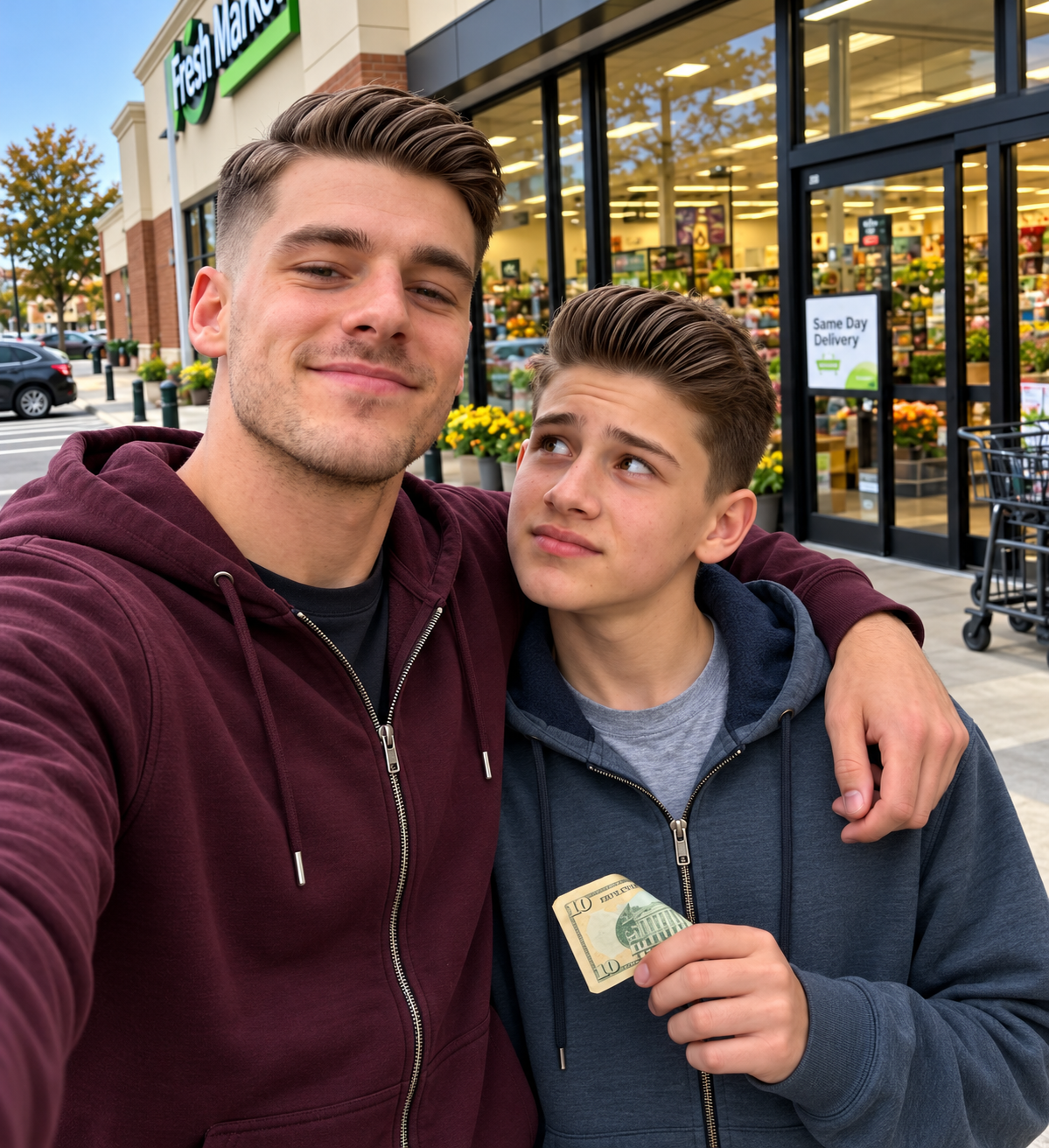
PART 1 TITLE: I Had Spent Six Years Protecting My Little Brother, but One Ordinary Saturday Would Challenge Everything I Believed About Keeping Him Safe
The cashier was crying when she came through the automatic doors. I recognized her immediately, although I had never seen her look so frightened. Mrs. Bennett had worked at the grocery store on Fourth Street for years. She knew my little brother, remembered his favorite chocolate, and understood why he sometimes needed an extra moment to answer a question. Now she was hurrying across the pavement toward me, one hand pressed against her chest. My brother had been inside alone for fifteen minutes. The first thing I thought was that something terrible had happened.
She called my name before she reached me. I stood up from the low wall where I had been waiting, my phone still in my hand. I asked where Theo was. She tried to answer, but her voice caught. Tears had left narrow tracks down her cheeks. At last, she managed to tell me that I needed to come inside and see what my brother had done. She did not say whether he was hurt. She did not say whether he was safe. And because I knew how quickly an ordinary situation could become overwhelming for Theo, those few unanswered seconds were almost unbearable.
To understand why I was so frightened, you have to understand what it had taken for Theo to walk through those doors without me. He was fifteen that Saturday. I was twenty-five. Six years earlier, I had become responsible for him when I was barely old enough to understand how to take care of myself. Our parents had decided they could not continue raising him. They had spoken about that decision as though they were discussing a difficult household expense, something unfortunate that could be transferred somewhere else.
Our father left first. I remember watching him carry his belongings to the car while Theo stood at the living-room window. Theo was nine then. He watched the vehicle reverse out of the driveway and asked when Dad would return. I had no answer. Eventually, I told him I did not know. He accepted those words more quietly than I expected, but for weeks afterward, whenever a car slowed outside our house, he went to the window. Nobody had told him what to expect, and uncertainty was one of the hardest things for him to manage.
Our mother remarried the following year. I had hoped the change might bring some stability. Instead, she began talking about Theo as though his needs were an obstacle to the life she wanted. One evening, she asked me to sit with her at the kitchen table. Her new wedding ring caught the light as she folded her hands. She explained that she and her husband had been considering arrangements for Theo. She believed he might be better off in a place designed to care for children with needs like his.
I asked her whether she had discussed any of it with Theo. She looked surprised by the question. Then she explained that he was too young to understand such decisions and that the adults needed to be practical. I remember looking toward the hallway, where Theo was sitting on the floor arranging his pencils by color. He was humming quietly to himself. His schoolbag rested beside him, exactly where he always left it. Nothing about that ordinary scene suggested a child who needed to be removed from his family.
I told our mother that I would take care of him. She said I did not understand what I was promising. Perhaps she was right about that part. I did not understand the paperwork, the school meetings, or the exhausting process of arranging support. I knew very little about managing money beyond paying my own expenses. My friends were making plans for college, jobs, and weekends away. I was nineteen, frightened, and stubborn. But I understood something my mother seemed unwilling to consider: Theo was a person who deserved to know that someone would stay.
The first months were difficult in ways I had not anticipated. Theo could recognize a change in a familiar routine long before I noticed it. If breakfast was late, he became anxious. If somebody moved an object he expected to find in a particular place, he could spend a long time searching for it. Certain sounds hurt his ears. Unexpected physical contact made him recoil. When too many things happened at once, words sometimes became difficult for him to use. None of those challenges meant he could not learn. They meant I needed to pay attention.
I began keeping a notebook. I wrote down medication schedules, school appointments, foods he could tolerate, and situations that tended to overwhelm him. I learned which cereal he preferred and why a different package could make breakfast unexpectedly difficult. I learned that he disliked being hurried when he was trying to explain something. I also learned to tell him when plans were changing instead of assuming he would adjust without warning. The notebook grew thick. Eventually, I no longer needed to consult most of it because the information had become part of our everyday life.
There were evenings when I made mistakes. Once, after a particularly tiring day, I answered three of Theo’s questions too sharply. He stopped speaking and went to his room. I found him sitting beside his bed, looking at the carpet. I apologized and asked whether he wanted me to stay. He thought for a moment before saying that he did, provided I would stop talking for a while. So I sat against the wall and kept quiet. That was one of the first times I understood that supporting Theo did not always mean doing something. Sometimes it meant making room for him.
He had a remarkable memory for dates. He remembered birthdays, appointments, and ordinary conversations that I had forgotten entirely. When I lost track of my keys, he could often tell me where I had last placed them. He liked tasks with clear beginnings and endings, and once he understood how something worked, he took pride in doing it properly. He was also funny, although people unfamiliar with his dry, literal observations sometimes missed the humor. Living with him taught me to notice abilities that strangers frequently overlooked.
As Theo grew older, his independence increased. He learned to make scrambled eggs, checking the stove carefully before beginning. He could sort laundry, operate the washing machine, and fold his clothes. We practiced using public transportation together, taking familiar routes until he felt comfortable recognizing stops and knowing when to get off. None of those accomplishments happened because I pushed him through his discomfort. We worked at a pace that allowed him to understand what he was doing and feel confident enough to try again.
The problem was that the world outside our home did not always offer him the same patience. At school, other children noticed the differences in his behavior and sometimes used them against him. Some imitated the way he spoke. Others deliberately interrupted his routines or asked confusing questions just to laugh at his answers. Theo understood far more of their cruelty than they imagined. He simply did not always respond in the way they expected, which seemed to encourage them to continue.
A boy named Dylan became particularly troublesome. He discovered that sudden noises and repeated teasing could overwhelm Theo, and he used that knowledge to provoke him. One day, during a period when Theo was already distressed, Dylan and several other boys continued bothering him until he struggled to cope. Theo covered his ears, cried, and knocked pencils and papers from a desk. Instead of helping, Dylan recorded what happened. The video showed the visible result of Theo’s distress while leaving out the behavior that had caused it.
The recording spread among students. Some treated it as entertainment. Others watched it without understanding what they were seeing. One boy described Theo as defective, as though a cruel label could explain an entire human being. I remember the expression on Theo’s face when he realized classmates had been watching the video. He did not ask whether they liked it. He wanted to know why Dylan had kept recording after he asked him to stop.
I contacted the school and attended meetings. I explained what had happened and why the recording was misleading. I wanted the students involved to understand the harm they had caused. During one meeting, I encountered Dylan’s mother. She listened to the discussion with a guarded expression and appeared more concerned about the accusation against her son than about Theo’s experience. I left feeling that I had explained myself carefully but had not changed her understanding. I would remember her face much later, under circumstances I could never have anticipated.
After the incident, Theo became more cautious around unfamiliar people. He sometimes waited for me to answer questions directed at him. If somebody laughed nearby, he occasionally looked toward them to determine whether he was the reason. I noticed these changes because I knew how he behaved when he felt comfortable. At home, he still joked with me and talked enthusiastically about things he enjoyed. Outside, he often seemed to be measuring the possibility that someone might embarrass him.
My immediate instinct was to protect him from every situation that could cause distress. I began speaking for him before strangers had time to misunderstand his replies. I positioned myself between him and impatient people. If a place looked crowded, I suggested that we leave. I told myself that I was preventing unnecessary harm, and sometimes I probably was. But gradually, I noticed that Theo was looking to me for permission to do things he already knew how to do.
One afternoon, while we were putting groceries away, he asked whether he would always need me to stand beside him when he paid for something. I told him he would probably become comfortable doing it alone eventually. He considered my answer before asking when eventually would arrive. I did not know what to say. I had spent so much time preparing for things that might go wrong that I had avoided deciding how he could move forward.
That question stayed with me. Theo was fifteen, and he was becoming increasingly aware that other teenagers were allowed freedoms he had not yet experienced. He was not demanding that I leave him without support. He wanted opportunities to try things himself. I realized I had been treating independence as a destination we would reach once every possible danger had disappeared. But no ordinary life worked that way. Uncertainty could never be eliminated entirely.
We began discussing activities he wanted to manage independently. I asked him to identify situations he understood well enough to practice. He chose shopping. The grocery store on Fourth Street was familiar, and we had visited it together for years. Theo knew where the cereal was kept, how the checkout worked, and which entrance we used. He also knew Mrs. Bennett, who worked at register three. She had always treated him as a customer rather than a problem to be managed.
Mrs. Bennett was patient without being patronizing. When Theo was younger, he sometimes hid behind me while I paid. She never insisted that he look directly at her or answer more quickly. Eventually, he began handing her the money himself. Later, he learned to collect the receipt and check that he had received the correct change. She noticed each improvement without making an embarrassing announcement about it. Her quiet consistency made the checkout counter one of the few public places where Theo rarely appeared uneasy.
We practiced a simple shopping sequence. Theo would choose one item, bring it to the register, pay for it, take the receipt, and return to me. At first, I stood beside him. Later, I remained a few steps behind. Sometimes he asked a question, and sometimes he completed the entire process without speaking to me. We repeated the exercise over several visits until he could describe every step and explain what he would do if something unexpected happened.
The most difficult part was not teaching Theo how to shop. He understood the process. The difficult part was preparing myself to remain outside when he went in. I knew how easily strangers could misinterpret his behavior. I had seen how a recording could transform a frightened child into somebody else’s frightening story. I understood the risks, but I could also see how much the practice mattered to him. Each successful visit made him stand a little straighter.
Eventually, Theo told me he wanted to try the entire shopping trip alone. I asked whether he meant without me following him through the aisles. He nodded. I reminded him that he could change his mind at any point. He said he understood, but he still wanted to try. He was not asking for a dramatic declaration of independence. He wanted to buy one chocolate bar without his older brother supervising every movement.
We agreed on Saturday. I told him I would remain outside the store, close enough that he could find me immediately. We would use a familiar route and the same checkout routine we had practiced. I would give him ten dollars. His task would be simple: select the chocolate, pay, collect the receipt, and come back. He repeated the arrangement carefully, then asked whether Saturday was still three days away.
On Friday evening, I checked whether he still wanted to go through with it. He looked up from his pencils and asked why I was checking again. I admitted that I was nervous. He told me that he was nervous too, but that being nervous did not mean he wanted to cancel. I recognized the distinction immediately. It was one I had been trying to teach him for years, and now he was explaining it to me.
That night, I lay awake longer than I intended. I thought about our mother’s decision, the school video, and the years Theo had spent learning to manage a world that was often unnecessarily difficult for him. I also thought about the way he had asked when he would be allowed to do things on his own. I could not guarantee that Saturday would go smoothly. I could only decide whether I trusted the progress we had made together.
In the morning, Theo was dressed before I finished breakfast. He had his shoes on, his coat zipped, and the shopping sequence ready to recite. He asked whether I had remembered the ten-dollar bill. I showed it to him. He smiled briefly, then checked the clock. For once, neither of us suggested postponing the trip. We left the apartment together, heading toward Fourth Street, where a small chocolate purchase was about to become the most difficult test of our six years together.
END PART 1
PART 2 TITLE: The Ten-Dollar Shopping Trip Was Supposed to Be Simple, Until a Familiar Cashier Came Outside in Tears and Refused to Explain
The store looked exactly as it always did. Shopping carts rattled near the entrance, and the automatic doors opened and closed as customers passed through. A delivery vehicle stood beside the building. Nothing about the ordinary Saturday morning suggested that it would become a memory I would revisit for years. Theo paused near the entrance and looked through the glass. He could see the first aisle and part of the checkout area. He had walked through those doors with me more times than I could count. Today, he would do it without me.
I took the ten-dollar bill from my pocket and held it out. Theo accepted it carefully, then checked that it was unfolded and easy to handle. I asked whether he wanted to review the plan. He nodded. We stood away from the entrance so that people could pass. I reminded him that he needed only one chocolate bar, the same kind he usually chose. After finding it, he would go to a checkout, pay, collect his receipt, and return directly outside.
Theo repeated the instructions aloud. He said them once, then again, keeping the order identical. He had a habit of doing that when something mattered to him. It helped him organize the task and make the next step predictable. I listened without interrupting. When he finished, I told him I would remain beside the low wall near the entrance. If he decided he wanted help, he could come back without buying anything.
He looked at me closely. Then he asked whether failing to buy the chocolate would mean the attempt had been unsuccessful. I told him that entering the shop and making his own decision would already count as progress. He considered that answer but did not seem entirely satisfied. For Theo, finishing a task mattered. He liked knowing that every step had been completed. I could see that he wanted more than the experience of trying. He wanted evidence that he could manage something independently.
Before he went inside, I asked whether he felt ready. He glanced toward the doors, then back at the money in his hand. His shoulders rose slightly as he took a breath. He said yes. I wanted to repeat every instruction and warn him about every possible difficulty, but I stopped myself. We had already practiced. Adding new information at the last moment would not help him. I stepped aside and gave him enough room to walk forward.
Theo crossed the pavement and approached the entrance. The doors opened, and he went through without looking back. He did not rush. His steps were measured, and he held the bill against his palm. I watched until the shelves blocked my view. Then I moved to the low wall and sat down. I had promised not to follow him, and keeping that promise suddenly felt much harder than making it.
For the first minute, I watched the entrance as though Theo might reappear immediately. He did not. A woman pushing a cart came outside, followed by two children arguing over a packet of biscuits. Someone returned an empty basket. A customer asked me whether the store was busy, and I answered without really knowing. Every movement through the doors made me look up. I kept reminding myself that Theo was doing something entirely ordinary.
I checked my phone after a few minutes. There was no reason to expect a message. Theo did not have a phone yet, and we had agreed he would come directly back outside. Still, I looked at the screen, then put it away. I tried to imagine his progress through the store. He would have located the sweets by now. Perhaps he was comparing wrappers, making sure he had selected the chocolate he wanted. Perhaps the checkout queue was longer than expected.
Five minutes passed. I told myself that five minutes was nothing. Even a quick visit could take longer if several customers were waiting. Theo was careful with money, and he preferred to count it without being rushed. I tried to remember how long our practice trips usually lasted. The answer was different every time. Sometimes he completed everything quickly. Sometimes he needed more time to adjust to noise or a change in the queue.
At ten minutes, I stood up. I walked a short distance toward the doors, then stopped. I could see a portion of the checkout area through the glass, but not enough to locate him. I considered going inside. My first instinct was to make sure he had not become overwhelmed. Yet I remembered how seriously he had taken my promise to remain outside. If I entered without giving him the opportunity to finish, he might conclude that I did not trust him.
I returned to the wall and sat down. A car pulled into the parking area, its tires crunching against loose gravel. Someone laughed near the carts. The ordinary sounds of the street seemed sharper because I was listening for something else. I thought about the school and the way people sometimes reacted when Theo needed extra time to speak. He knew how to ask for help, but knowing the words and feeling comfortable using them were not always the same thing.
The possibility that someone might misunderstand him had troubled me long before that morning. Theo could become quiet when frightened. His posture sometimes changed, and he might repeat part of an explanation instead of answering a new question immediately. People unfamiliar with him occasionally assumed that silence meant defiance. Others spoke louder, believing volume would make their meaning clearer. I had learned to recognize the signs that he was becoming distressed. A stranger might not.
I tried to push those worries aside. This was a familiar shop, and Mrs. Bennett had always been kind. Theo knew the arrangement of the aisles. He understood the checkout procedure. The goal was not to prove that the world would always behave perfectly. It was to give him room to use skills he had worked hard to develop. I reminded myself of that as another minute passed, and then another.
At fifteen minutes, I saw Mrs. Bennett come through the automatic doors. At first, I thought she might be taking a break. Then I noticed her expression. Her cheeks were wet, and she was moving quickly enough that she nearly collided with a customer entering the store. She looked around the pavement, searching. When she saw me near the wall, she raised her hand and called my name.
I went toward her before she reached me. She asked whether I was Marcus, Theo’s older brother. I answered yes, although she already knew who I was. The fact that she had asked frightened me more than I expected. It was as though she needed to be absolutely certain before saying whatever had brought her outside. I asked whether Theo was all right. Her lips parted, but for a moment she seemed unable to speak.
She told me to come inside. I asked what had happened. She repeated that I needed to see what my brother had done. Her voice shook. I looked past her toward the open doors, trying to find Theo. He was nowhere in sight. I asked whether he had been injured, whether somebody had frightened him, whether there had been an accident. Mrs. Bennett only reached toward my arm and urged me to follow.
I did not wait for another explanation. I ran through the entrance, with Mrs. Bennett following close behind. My shoes struck the smooth floor, and the fluorescent lights made the interior seem unnaturally bright. The shopping carts and carefully stacked products appeared exactly as they had on every other visit. Yet something in the atmosphere had changed. The usual movement near the checkout area had stopped.
Several customers were standing together near the registers. Nobody seemed to be unloading groceries or searching for a wallet. Their attention was fixed on something I could not yet see. I heard a woman’s voice rising above the ordinary hum of the refrigerators. She sounded furious. I could not distinguish every word, but I heard enough to recognize an accusation. My pace quickened.
I knew what public attention could do to Theo. Being watched when he was distressed made it harder for him to organize his thoughts. At school, the students who gathered around him had often made a difficult situation worse. As I approached the checkout area, I remembered the recording Dylan had shared. I had seen how Theo looked when he was overwhelmed by noise and surrounded by people. The possibility that something similar was happening again made my stomach tighten.
I moved around a display near the registers and saw the customers standing in a loose semicircle. Some looked uncomfortable. Others appeared unsure whether they should intervene. Mrs. Bennett called something from behind me, asking people to make space. I barely heard her. I was searching the faces ahead, trying to identify the one person I had promised to meet outside.
Then I found him. Theo was on the floor near the checkout counter. He was kneeling on the tiles, his body held rigidly upright. His hands were behind his back. I could see tears on his face. He was not struggling or trying to get away. He was holding himself still with an effort that frightened me more than any movement would have.
A woman stood several feet away from him. She had a young girl close against her side and was pointing toward Theo while speaking loudly to the people around her. The little girl had tucked herself partly behind the woman’s hip. A shopping basket stood nearby. I noticed those details without understanding them. My attention kept returning to Theo’s hands, carefully positioned behind him.
For a dreadful instant, I thought someone had ordered him to kneel. The posture was so strange and deliberate that I could not explain it otherwise. Had an employee restrained him? Had somebody accused him of stealing? Had he been frightened into obeying a stranger? I looked for a security guard and saw none nearby. My mind supplied possible explanations faster than I could reject them.
Theo had practiced paying for chocolate. He had prepared himself to speak to a cashier, handle his money, and return outside. Nothing in that sequence explained why he was kneeling in front of strangers. He had not even reached the point of coming back through the doors. I was looking at a scene that seemed to contradict everything we had planned, and I did not yet know which part of it mattered most.
The woman raised her voice again. She said Theo was dangerous and demanded that somebody keep him away from her daughter. Her words reached me clearly this time. I looked from her to the little girl, then back to Theo. He remained motionless. His face was wet, and his breathing looked uneven. Whatever had happened, he was frightened enough to stop responding to the people around him.
I crossed the remaining distance and crouched directly in front of him. I spoke his name quietly. He flinched before recognizing my voice. When he looked up, I saw an expression I knew well: he was trying desperately to understand what everyone expected from him. I told him I was there and that he did not have to remain on the floor. I offered my hand and waited for him to decide whether to take it.
He stared at my fingers, then glanced toward the woman. His lips moved, but I could not hear the words. I leaned closer without touching him unexpectedly. He asked whether she was still frightened. The question made me look over my shoulder. The woman was still pointing at him. I turned back and told Theo we could discuss everything once he was standing.
For several seconds, he did not move. I could feel people watching us, and I hated how exposed he looked. I wanted to tell them to step away, to lower their voices, to stop treating my brother as though he were an object of public curiosity. Instead, I kept my attention on him. His hand finally moved from behind his back, and his fingers closed around mine.
I helped him stand. His knees were stiff, and he leaned against me for balance. I placed one arm around his shoulders, allowing him to settle before asking another question. He was trembling. The woman continued talking, but Theo was looking at the floor. I asked him whether he was hurt. He shook his head. Then he said something that made the scene even harder to understand.
He wanted to know whether he had behaved badly. I told him we would work out what had happened. He swallowed and repeated that he had not meant to frighten anybody. Behind us, Mrs. Bennett began explaining that there had been a misunderstanding. The woman interrupted her immediately. I stood beside my brother, feeling his shoulders tighten against my arm, and realized that the most important question was no longer why he had taken so long to buy chocolate.
I needed to understand why a boy who had entered a shop to complete a harmless task now believed he had to prove he was safe to be around.
END PART 2
PART 3 TITLE: My Brother Had Offered a Stranger His Last Ten Dollars, but the Woman Who Accused Him Knew More About His Past Than I Realized
I asked the woman to stop shouting. She looked at me as though my request were unreasonable and tightened her arm around her daughter. Theo moved closer to my side. I could feel the quick movement of his fingers against his trousers, a sign that he was struggling to manage the noise and attention. I wanted to take him outside immediately, but I also needed to know what had happened. If somebody had hurt or threatened him, I could not simply leave without understanding the situation.
Mrs. Bennett stepped forward and explained that the woman’s payment card had been declined. She had been trying to buy groceries, including a box of cereal for her little girl. When the transaction failed, she began deciding which items to return. The child became upset about losing the cereal. Theo had been nearby and had heard the exchange. He had ten dollars, and he apparently believed that money could solve at least part of the problem.
I turned toward him. He was still looking down. I asked whether he had offered to help. He nodded. Then, in a small voice, he explained that he could share his money. He said it as though the explanation should have been obvious. I remembered placing the bill in his hand outside the store. It had been intended for one chocolate bar. To Theo, the sight of a child losing something she wanted had presented a different use for it.
Mrs. Bennett said Theo had approached politely and offered the money. He had not demanded anything or interfered with the transaction. He had simply held out the bill. The cashier’s voice broke again as she described it. I could see why she was distressed, but I still did not understand the woman’s reaction. An unexpected offer might have been embarrassing. It did not explain accusations of danger or my brother kneeling on the floor.
I asked the woman what she believed Theo had done. She replied that he had approached her daughter and that she knew enough about him to be concerned. Her eyes remained fixed on his face. Something about that expression seemed familiar. I looked more carefully at her, searching my memory. Then I recognized her. I had seen her at a school meeting after the video of Theo’s distress had circulated.
She was Dylan’s mother. The recognition changed the entire conversation. I remembered sitting across from her while school staff discussed the incident involving Theo. She had listened without appearing particularly interested in how her son’s behavior had contributed to his distress. Now she was standing in a grocery store, looking at the same boy through the assumptions she had carried away from that meeting.
I said her son’s name. She recognized me then, although she did not seem pleased. She told me she had seen the school recording and knew how Theo could behave when he became upset. I asked whether she understood what had happened before Dylan began filming. She replied that her son had been frightened. Her certainty disturbed me because I knew how incomplete the recording was. It began after Theo had already become overwhelmed.
I reminded her that Dylan and other boys had provoked Theo. They had continued bothering him until he was distressed, then recorded his reaction and shared it. The footage showed a child struggling with an intolerable situation. It did not show an unprovoked attack. I explained that distinction carefully, trying to keep my voice level. The woman interrupted before I finished and insisted that the recording proved Theo could be dangerous.
Theo’s fingers began moving faster. I noticed and stopped speaking for a moment. He was listening to every accusation, and I could see the effort it took for him to remain beside me. He had heard strangers make judgments about him before, but this was different. The woman was pointing at him in front of customers, using an old recording to interpret something he had done only minutes earlier.
I wanted to argue. I wanted to explain every detail of Dylan’s behavior and describe what the school had failed to prevent. Instead, I asked the woman one simple question: had Theo threatened her or her daughter? She did not answer directly. She said he had approached them and that she had reason to be afraid. Mrs. Bennett immediately stated that she had witnessed the interaction and had seen no threatening behavior.
The woman became more defensive. She insisted that she had been protecting her child. I understood the instinct to protect a child; it had shaped my entire adult life. What I could not accept was the suggestion that fear automatically made every accusation reasonable. Theo had offered money. The woman had recognized him from a misleading video and reacted as though the earlier incident defined everything he might ever do.
I turned toward Theo and asked what had happened after he offered the bill. His breathing was still uneven, so I gave him time. He explained that the woman began shouting. People looked at him. He did not understand why she was angry, because he had only wanted to help the little girl get her cereal. He had tried to say he was not going to hurt anyone, but the woman kept speaking over him.
Then he explained why he had knelt on the floor. He thought that keeping his hands behind his back would show everyone that he was not going to touch anybody. If he stayed still and made himself appear harmless, perhaps the woman would stop being frightened. He had not been ordered to kneel. He had chosen the position because he believed it would make the adults around him feel safer.
For a moment, I could not speak. I looked at my brother’s hands, now moving anxiously beside his legs, and pictured him deciding that his safest option was to kneel in front of strangers. He was fifteen. He had been carrying ten dollars and trying to buy chocolate. Somewhere between offering help and hearing the woman’s accusations, he had concluded that he needed to demonstrate he was not a threat.
I had spent years teaching Theo practical ways to manage distressing situations. We practiced asking for help, moving away from loud noises, and explaining when he needed time. I had never imagined he would feel compelled to make himself smaller on a public floor so other people would stop fearing him. The realization hurt more than the woman’s accusations because it showed what those accusations had already done to him.
Mrs. Bennett covered her mouth with one hand. Her eyes filled again. I saw several customers turn away, their expressions changing as they understood Theo’s explanation. Nobody appeared frightened of him. They looked troubled by what they had witnessed. But knowing that did little to comfort Theo. He was still pressing himself against my side, trying to follow a conversation that had become too loud and confusing.
The woman demanded to speak with the manager. She said she intended to file a complaint. I asked what she would be complaining about. She repeated that Theo had approached her daughter and that his history made her uncomfortable. I reminded her that discomfort was not proof of wrongdoing. She responded that I could not expect a mother to ignore a possible threat. The argument had begun circling the same few points, growing louder without becoming any clearer.
I felt anger rising in my chest. I wanted someone in authority to make her acknowledge what she had done. I wanted the people watching to understand how badly she had misunderstood Theo. Yet every additional sentence made him more distressed. His breathing became shorter. He leaned closer, and I could feel his body trembling. I realized that continuing the argument might satisfy my need to defend him while making the experience worse for him.
The manager arrived before I had decided what to do. The woman repeated her version of events. She emphasized the old school recording and her concern for her daughter. Mrs. Bennett tried to describe the declined transaction and Theo’s offer. I could see that the manager was listening carefully, but I could also see Theo reaching the limit of what he could tolerate. He had stopped looking at the speakers altogether.
I told the manager that my brother was distressed and needed to leave. I also said I wanted the incident examined properly. I would return the following day to discuss what had happened. The manager agreed. The woman continued speaking, apparently dissatisfied that the conversation was ending without an immediate judgment. I did not respond. I had already spent too much time attending to her accusations instead of my brother.
I guided Theo toward the entrance. Mrs. Bennett moved aside to let us pass. As we walked, I noticed that Theo was holding nothing. The chocolate bar was gone, or perhaps he had never reached it. He still had not completed the shopping sequence he had prepared so carefully. I did not ask about the money. At that moment, getting him out of the crowded checkout area mattered more than any purchase.
Outside, the familiar pavement looked almost unreal after the tension inside. Customers continued coming and going. The same shopping carts rattled near the entrance. Theo stopped beside the low wall where I had waited for him. He stared at the ground, trying to steady his breathing. I remained beside him without asking questions. I had learned long ago that talking immediately after an overwhelming experience could make it harder for him to recover.
When he was ready, we went home. The journey was quiet. Theo looked through the window and held his hands together in his lap. Usually, after shopping, he liked to compare the items we had bought with the list we had prepared. Sometimes he talked about the prices or whether the store had rearranged a shelf. That afternoon, he said almost nothing. I did not force conversation. I could tell he was still processing what had happened.
At home, he went to his room and sat on the edge of his bed. I brought him a blanket and asked whether he wanted it. He nodded. He folded it over his knees, smoothing the edge until it lay straight. I sat nearby, leaving enough space that he could move comfortably. After a long silence, he said he had been trying to help the little girl. He wanted to know why the woman had become angry.
I told him that the woman had misunderstood his intentions. I explained that she had seen the school recording and formed an inaccurate opinion of him. He listened, then asked whether the recording meant people would always think he was dangerous. I did not want to give him a promise I could not keep. I said some people might misunderstand him, but that did not make their judgments correct.
He looked at the blanket for a while. Then he repeated the shopping sequence we had practiced: choose the chocolate, pay, collect the receipt, return outside. He paused after each step, counting them on his fingers. Finally, he told me that he had not finished. I said that what happened was not his fault. He agreed quietly, but then explained that the task remained incomplete. He seemed to need both facts to be understood.
I told him that offering help had not been wrong and that he had not deserved the woman’s reaction. He asked whether she would still be frightened if she saw him again. I admitted that I did not know. The uncertainty troubled him. He had approached someone with a kind intention and received a response that seemed to contradict everything he believed about helping people. I could not explain the woman’s behavior in a way that made it reasonable.
Later, after Theo had settled, I stood alone in the hallway outside his room. I thought about our mother’s decision years earlier, the school meeting, and every occasion when I had promised him that practice would make new experiences easier. I had believed the greatest challenge would be teaching him how to manage unfamiliar situations. Now I was beginning to understand that some of the most damaging obstacles had nothing to do with his abilities.
I considered whether sending him into the store alone had been a mistake. Perhaps I should have stayed close enough to intervene. Perhaps I should have anticipated that somebody who recognized him might react badly. The questions were impossible to settle because I could not change what had happened. I could only decide what to do next, and whether my response would help Theo or teach him to fear independence even more.
The following morning, I planned to return to the store alone. I wanted to speak with the manager, hear the employees’ accounts, and find out whether any security footage could establish what had happened. Theo had already explained his actions, and I believed him. But the woman’s complaint might leave a record that misrepresented him, just as Dylan’s video had done at school. I was not prepared to let another incomplete account become the accepted truth.
Before leaving the hallway, I looked back into Theo’s room. He had fallen quiet beneath his blanket, his pencils arranged neatly on the bedside table. I remembered how confidently he had walked through the store entrance the previous morning. Then I pictured him kneeling on the checkout floor. I understood that proving he had done nothing wrong would be necessary, but it would not be enough. The harder task would be helping him believe that the world still contained places where he was welcome.
END PART 3
PART 4 TITLE: The Security Footage Cleared My Brother of Every Accusation, Yet the Hardest Decision Came After I Returned Home and Told Him the Truth
I returned to the grocery store the following morning without Theo. The entrance looked ordinary, but I hesitated before going through the doors. I could still picture the customers gathered around the checkout area and my brother kneeling beneath the bright lights. The scene had occupied my thoughts throughout the night. I had replayed parts of the argument until I could almost hear the woman’s voice again. Entering the building meant facing the place where something important had been damaged.
The manager was available when I arrived. He looked tired, but he greeted me respectfully and invited me to speak away from the checkout area. I appreciated that he did not make me explain the entire incident in front of customers. I told him I wanted to know what his investigation had found. I was prepared to describe Theo’s account again, although I hoped the store’s own records would make that unnecessary.
The manager explained that he had reviewed the security footage and spoken with the employees who witnessed the incident. He did not hesitate before telling me the result. Theo had approached the woman after her card was declined and offered her money. The footage showed no threatening movement and no attempt to touch either the woman or her daughter. The cashier’s description was consistent with what the cameras recorded.
I listened carefully, almost afraid to interrupt. The manager added that nothing in the available evidence supported the woman’s complaint. He apologized for what had happened and assured me that Theo remained welcome in the store. I had spent the previous evening imagining the possibility that the woman might persuade others to view my brother as dangerous. Hearing the manager reject that interpretation brought relief, but it was a smaller relief than I had expected.
I thanked him for investigating. Then I asked whether the footage showed Theo kneeling. The manager confirmed that it did. I did not request to watch the recording. I already knew how Theo had looked on the floor, and I had heard his explanation. Seeing it from another angle would not make the memory easier. What mattered was that the manager understood the difference between my brother’s actions and the accusations made against him.
The manager said Theo had done nothing wrong by offering to help. He acknowledged that the confrontation should not have escalated the way it did. I could tell he was choosing his words carefully. Store employees had tried to explain the situation, but the woman’s reaction had drawn attention quickly. By the time I arrived, a small crowd had gathered. He recognized that the attention itself had been distressing for Theo.
I told him what my brother had explained about kneeling with his hands behind his back. The manager’s expression changed. He leaned back slightly and looked toward the door of his office. For a moment, neither of us spoke. Then he said he was sorry Theo had felt he needed to do that. The apology was simple. He did not suggest that the situation had been equally difficult for everyone or ask me to understand the woman’s intentions.
I appreciated his response because I was exhausted by explanations that seemed to excuse the people who had frightened Theo. At school, I had repeatedly heard that children sometimes made mistakes or misunderstood differences. Those statements were not entirely false, but they rarely addressed the responsibility of the people causing harm. Here, at least, the manager was willing to describe what the evidence showed and acknowledge the consequences.
Still, I knew that an accurate account would not automatically restore Theo’s confidence. The store could welcome him, and the manager could dismiss the complaint, but my brother had already experienced the humiliation of being surrounded by strangers. He had watched a kind gesture become an accusation. No investigation could remove that memory. I thanked the manager again, but I did not feel ready to tell Theo that everything was fine.
As I prepared to leave, Mrs. Bennett approached. She had apparently heard that I was there and wanted to ask about Theo. Her face showed the concern I had always associated with her, though she looked embarrassed when she remembered how she had rushed outside crying. She apologized for frightening me. I told her she had done the right thing by coming to find me. She had recognized that Theo needed somebody familiar.
She asked how he was doing. I told her he had been very quiet since we returned home. He was still trying to understand why the woman had reacted so angrily to his offer. Mrs. Bennett looked down at the checkout counter. She said it had been painful to watch him become frightened after working so hard to learn how to shop independently. She had seen his progress over several years, from standing behind me to handling money and receipts himself.
Then she suggested that I bring him back on Thursday. She would be working at register three, and the store was usually quieter at that time. We could shop together, just as we had before the incident. There was no pressure to repeat the independent trip. If Theo wanted to come, she would be pleased to see him. Her suggestion was practical and gentle, precisely the kind of support that had helped him learn in the first place.
I wanted to agree immediately. I also wanted to tell her that I would never bring him back. Those two impulses existed at the same time, and neither felt entirely reasonable. I knew that avoiding the store indefinitely might reinforce Theo’s fear. But I could not bear the thought of him experiencing another public confrontation. He had already spent years dealing with cruelty at school. I wanted this familiar place to remain something safe for him.
I thanked Mrs. Bennett and said I would consider Thursday. She accepted the answer without pressing me. Before I left, she asked me to tell Theo that she hoped he was doing well. I promised I would. Walking toward the entrance, I passed register three. The conveyor belt was moving, and a customer was placing groceries beside the scanner. It looked like any ordinary checkout. Only the memory of what had happened made it difficult to watch.
Outside, I stood beside the wall where I had waited on Saturday. I looked at the doors and tried to imagine Theo entering them again. He had been so proud of the plan. He had rehearsed each step and counted his money carefully. The moment he disappeared behind the shelves, I had believed I was giving him something important. Now I wondered whether I had exposed him to a situation he should never have faced alone.
That thought brought back our mother’s words. She had believed Theo would be better somewhere equipped to care for him. For years, I had rejected the implication that his needs made ordinary family life impossible. I still rejected it. Yet standing outside the grocery store, I understood how fear could persuade someone to narrow another person’s world while claiming to protect them. The resemblance between our mother’s decision and my own anxiety disturbed me.
I could not control how strangers behaved. I could teach Theo how to ask for help, recognize difficult situations, and use familiar routines, but I could not guarantee that somebody would not misunderstand him. The woman in the store had not reacted to something he had done wrong. She had reacted to what she believed she knew about him. No amount of preparation could have made that prejudice disappear.
When I returned home, Theo was sitting at the table arranging pencils in a straight line. He looked up as I entered. I told him I had spoken with the manager. He listened without interrupting. I explained that the security cameras had recorded what happened and that the manager had confirmed he had not threatened anyone. I repeated that he remained welcome in the store.
Theo looked down at the pencils, then back at me. He asked whether the manager had seen him offer the money. I said yes. He wanted to know whether the manager had seen the woman shouting. I confirmed that he had reviewed the incident and spoken to witnesses. Theo considered this information for a long moment before asking whether the woman knew he had not been trying to hurt anybody.
I told him I did not know what she now believed. I could not offer certainty where none existed. He seemed disappointed but did not argue. Instead, he returned his attention to the pencils, touching each one lightly as though checking its position. I stayed beside the table and waited. He had received information that contradicted what the woman had told everyone, but that did not mean he could immediately stop feeling frightened.
I told him that he did not have to return to the store until he wanted to. I explained that I could take care of the shopping for a while. We had plenty of other things to do, and there was no need to make a decision that day. I spoke gently, believing I was giving him permission to rest. He nodded, but something in his expression made me wonder whether I had misunderstood what he needed.
For the next two days, I avoided mentioning the grocery store. We followed our usual routines. Theo helped prepare breakfast and took care of his laundry. He spoke about ordinary things, but he did not volunteer to discuss Saturday. I told myself that leaving the subject alone was considerate. In truth, I was relieved whenever an entire afternoon passed without either of us having to face the question of returning.
I kept remembering the way he had stood beside me during the confrontation. When the woman raised her voice, his fingers moved rapidly, and his breathing became uneven. That image made the idea of another shopping trip feel almost irresponsible. I wanted to wait until the memory had faded. I wanted him to regain confidence without having to risk another difficult experience. Yet I knew that confidence rarely returned simply because somebody avoided the thing that frightened them.
On Tuesday evening, Theo appeared in the kitchen doorway while I was putting away dishes. He stood with his arms close to his sides, watching me for a moment before speaking. I turned off the tap and gave him my attention. He asked whether he had done something wrong at the store. I told him no, just as I had several times before. This time, he did not let the conversation end there.
He asked why he could not try again if he had done nothing wrong. I stared at him, surprised by the question. I had spent two days reassuring him that the incident was not his fault, yet I had quietly removed the activity he wanted to do. From his point of view, those two messages did not agree. He was trying to understand why a stranger’s behavior had changed what he was allowed to attempt.
I began explaining that I did not want him to be frightened again. He listened, then asked whether the woman would be there. I admitted I could not guarantee that she would not return. He looked worried. I told him that we could go together and that he would not have to approach anyone alone. He remained silent for a few seconds, apparently considering whether the arrangement would feel manageable.
Then he said he liked the store. The statement was quiet, but I knew how much it meant. He liked knowing where things belonged. He liked choosing familiar products and following the checkout procedure. He liked Mrs. Bennett because she gave him time to answer and never made him feel foolish. The woman had frightened him, but she had not changed everything about the place. I realized I had begun treating the entire store as dangerous because of one person’s behavior.
I asked what he wanted to do. He said he wanted to go back, although he was afraid he might see the woman again. I thanked him for telling me. I explained that Mrs. Bennett had suggested Thursday because it would be quieter and she would be at register three. We could do our usual shopping together. Theo listened closely, asking whether I would remain beside him and whether he would be allowed to take the receipt.
I said yes to both questions. He considered the arrangement, then told me he wanted to try. I could see that he was still worried, but I could also see that he had made a deliberate decision. He was not pretending Saturday had been harmless. He understood that returning might be uncomfortable. He simply did not want the experience to become the final word on what he was capable of doing.
I wanted to promise that Thursday would be easy. Instead, I told him we could leave whenever he needed to and that he would not have to complete every step. If he only managed to enter the store, that would be enough for the day. Theo nodded, then asked whether he could still choose the chocolate if he felt ready. I smiled and said of course. The unfinished shopping trip clearly remained important to him.
That evening, after Theo went to his room, I sat at the table thinking about our conversation. For six years, I had believed that protecting him meant anticipating every difficulty and positioning myself between him and the world. Sometimes that was necessary. But I had also begun to see how easily fear could make me take decisions away from him. He was not asking me to ignore the risks. He was asking me to recognize that the choice belonged partly to him.
Thursday was now two days away. Mrs. Bennett would be waiting at register three, and Theo had decided he wanted to return. I could not know whether the experience would help restore his confidence or reveal how deeply the confrontation had affected him. I only knew that he deserved the opportunity to try. So I agreed to take him back, not because I had stopped being afraid, but because I was finally beginning to understand that my fear could not be the only thing guiding his future.
END PART 4
PART 5 TITLE: On Thursday My Brother Walked Back Into the Store That Had Humiliated Him, and One Small Question Changed What We Were Trying to Accomplish
On Thursday afternoon, Theo stood in front of his bedroom mirror for nearly ten minutes, fastening and unfastening the zipper of his jacket. I watched from the doorway without saying anything. He had already dressed once, checked the weather, and placed his shoes beside the front door. Nothing about his preparation was unusual except the number of times he repeated it. When he finally noticed me, he asked whether Mrs. Bennett would definitely be working at register three. I told him she had said she would be there. He looked at his reflection again and asked whether cashiers sometimes changed registers without warning.
I could have reassured him with a confident answer, but I had learned that false certainty usually created more anxiety than an honest explanation. I said that employees sometimes changed stations, though Mrs. Bennett knew we planned to visit. If she was somewhere else, we would ask where to find her. Theo considered this adjustment carefully. Then he asked whether we would leave immediately if the woman from Saturday appeared. I told him we would step somewhere quiet and decide together what to do. He nodded, apparently satisfied that there was a plan which allowed him to make a choice.
The journey to Fourth Street took less than fifteen minutes, but I experienced every turn differently from the way I had experienced it before. On Saturday, Theo had talked about the chocolate he intended to buy and whether he would receive coins as change. This time he sat beside me quietly, holding the ten-dollar bill I had given him. He had insisted on using the same amount because he wanted to complete the task as originally planned. I had offered to buy the chocolate myself. He had declined without sounding angry. He simply wanted the purchase to remain his responsibility.
When we reached the store, I parked and turned off the engine. Theo did not move immediately. Through the windshield, we could see people entering with shopping bags and leaving with full carts. A delivery worker was guiding a trolley near the side entrance. Everything looked ordinary. Theo asked how many days had passed since Saturday. I told him five. He repeated the number quietly, then said that five days was not a very long time. I agreed. He looked toward the automatic doors and asked whether people would remember what had happened. I said some might, but that remembering an incident did not mean they would judge him.
He sat with that answer while I checked that we had everything we needed. I had brought no special supplies beyond our usual shopping bag and the short list we kept on my phone. We were not going to attempt a complicated trip. The plan was to walk inside together, find the chocolate, and use the checkout. If Theo needed a break, we would take one. If he wanted to leave without buying anything, we would leave. I explained those possibilities once, then stopped talking because I could see him concentrating.
At the entrance, Theo paused in almost the exact spot where he had stood on Saturday. I remembered how proud he had looked before entering alone. That memory arrived so sharply that I nearly asked whether he wanted to go home. Instead, I waited beside him. He watched the doors open for an elderly customer, then close after her. He took a slow breath, straightened the cuffs of his jacket, and stepped forward. I walked at his side, close enough to help but careful not to move ahead of him.
Inside, the familiar smell of bread and floor cleaner greeted us. A refrigeration unit hummed near the first aisle. Theo looked toward the checkout area before examining anything on the shelves. Register three was open. Mrs. Bennett stood behind it, scanning groceries for a customer. She noticed us almost immediately. For a moment, her expression changed with recognition, but she did not call across the store or interrupt her transaction. She raised one hand in a brief greeting and returned to her work. Theo watched her for several seconds, then said he wanted to get the chocolate.
We walked along the aisle where sweets and small snacks were displayed. Theo knew precisely where his preferred chocolate bars were kept, but he still studied the shelf labels. I waited behind him. There were several similar wrappers, and he compared them carefully before selecting one. When he turned around, he held the bar with both hands. I asked whether it was the right one. He showed me the label and pointed out a detail on the packaging that distinguished it from another version. I recognized the familiar seriousness in his explanation. For a few moments, he sounded like himself again.
As we approached the checkout area, his pace slowed. The store was quieter than it had been on Saturday, but there were still several customers waiting. One person was unloading groceries while another searched through a handbag. Theo stopped beside a display of batteries and asked whether we had to join the queue immediately. I said we could wait until he felt ready. He looked toward the floor near the registers, and I realized he was standing close to the place where he had knelt. His face became tense, and he moved one step backward.
I asked whether he wanted to stand somewhere else. He nodded. We moved a short distance away, near the end of an aisle where the sounds were less concentrated. I could see him trying to regulate his breathing. His fingers pressed against the edge of the chocolate wrapper, making a faint crackling noise. I resisted the urge to fill the silence with encouragement. Theo did not need a speech about courage. He needed the opportunity to recognize what he was feeling and decide what he wanted to do next.
After a minute, he asked whether Mrs. Bennett had seen the video. At first I thought he meant Dylan’s school recording. Then I understood that he was referring to the store’s security footage. I explained that the manager had reviewed it and spoken with the employees. Theo wanted to know whether Mrs. Bennett had watched him kneeling. I said I did not know. He lowered his eyes and told me he hoped she had not. He had always liked her, and the thought of her remembering him in that position seemed especially painful.
I asked why it mattered whether she had seen him. He looked uncomfortable with the question, but eventually explained that he did not want Mrs. Bennett to think he was the same as he had been when he was nine. That answer surprised me. I realized he was connecting the grocery-store incident with the school video and perhaps with years of being seen primarily through moments when he was distressed. He wanted the people who knew him to recognize the skills he had developed. He did not want one frightening afternoon to replace six years of progress.
I told him Mrs. Bennett had watched him grow more confident with every visit. She knew he could handle money, choose his own purchases, and speak for himself when he felt comfortable. He listened without looking up. Then he asked why people seemed to remember the times he struggled more easily than the times he did something correctly. I had no neat answer. I told him that unfair impressions could be difficult to change, but that the people who paid attention to him over time had more information than a single recording could provide.
He looked back toward register three. Mrs. Bennett had finished with her customer and was arranging items beside the scanner. There was no queue at her station. I could see Theo considering the short distance between us and the checkout. I asked whether he wanted me to carry the chocolate while we walked. He shook his head. He adjusted the bill in his other hand, checked that both items were secure, and began moving. I stayed beside him, matching his pace instead of setting it.
Mrs. Bennett greeted Theo by name when we reached the counter. Her voice was warm but ordinary, the same tone she had used before Saturday. She asked whether he had found what he wanted. Theo nodded and placed the chocolate bar on the conveyor belt. He hesitated before answering aloud, then said yes. Mrs. Bennett scanned the item and told him the price. I watched his fingers tighten around the money. He glanced at me once, but I did not reach for the bill or offer to finish the transaction.
He counted his money before handing it across the counter. Mrs. Bennett accepted the note and placed the change where he could collect it easily. Theo gathered the coins, checking them against the amount displayed on the register. The entire exchange lasted less than a minute, but I was aware of every movement. There was no audience gathering behind us. Nobody raised a voice. Mrs. Bennett waited while he counted and did not comment on how long he was taking. The ordinary simplicity of the interaction was almost difficult to believe.
When she printed the receipt, Theo reached for it immediately. He folded the paper once, then stopped and unfolded it again. He wanted to check the total. Mrs. Bennett waited. After confirming the numbers, he put the receipt into his pocket beside the coins. He lifted the chocolate bar from the counter and stepped backward. I expected him to smile or look relieved. Instead, he glanced around the checkout area, apparently making sure that nobody was approaching us. His body remained tense even though the purchase was complete.
Mrs. Bennett noticed. She asked whether he would like a little time before leaving. Theo nodded. She indicated a quieter space beside the checkout where we would not obstruct other customers. We moved there together. I wanted to congratulate him, but I knew he was still working through the experience. He stood holding the chocolate in one hand and touching the receipt through his pocket with the other. After a while, he looked at me and announced that he had finished all four steps.
I told him he was right. He had chosen the item, paid for it, taken the receipt, and reached the end of the transaction. He seemed pleased that I could confirm the sequence. Then he asked whether the attempt counted even though I had walked beside him. I said that returning after Saturday had been difficult and that he had completed the shopping process himself. He considered my answer but did not entirely accept it. His original goal had been to enter the store without me, and he knew this was not quite the same thing.
Mrs. Bennett came over when another employee took her place briefly at the register. She did not begin with an apology or ask Theo to describe Saturday. Instead, she told him she was glad to see him. Theo looked at her shoes before answering that he was glad she was working. Her expression softened. She said he had handled the purchase carefully and asked whether the chocolate was his favorite kind. He showed her the wrapper, explaining the difference between this version and another one on the shelf. She listened as though the distinction mattered, because to him it did.
Eventually, Theo asked her whether she had been frightened on Saturday. The question seemed to catch her off guard. She looked toward me, then answered him directly. She said she had been worried when she saw how upset he was. She had not been afraid that he would hurt anybody. Theo asked whether she believed he had done something wrong. Mrs. Bennett shook her head and told him that offering to help someone with groceries was not wrongdoing. She spoke calmly, without the exaggerated reassurance that sometimes made Theo uncomfortable.
He thought for a moment before asking why the woman had shouted. Mrs. Bennett did not pretend to understand every part of the woman’s reasoning. She said some people made decisions about others before taking the time to understand what was happening. She added that such decisions could be unfair and that Theo had not caused the woman to behave that way. He listened carefully, turning the chocolate bar over in his hands. Then he asked whether the woman had paid for the cereal in the end.
I had forgotten about the cereal. During the confrontation, I had been so concerned about getting Theo away from the crowd that I had stopped thinking about the little girl. Mrs. Bennett looked surprised by his question. She explained that the transaction had been interrupted and that she did not know exactly what happened to the groceries afterward. Theo looked disappointed. He said the girl had been crying because she wanted the cereal, and he had thought ten dollars might help her mother pay for it.
Mrs. Bennett asked whether he had intended to give away the entire amount. Theo nodded. He said he could buy chocolate another day, but the girl had wanted cereal that morning. He explained the choice without presenting it as a sacrifice. To him, it had been an immediate practical problem with a possible solution. I looked at the bar in his hand and realized that I had never asked him whether giving away the money had been a difficult decision. I had assumed it was only an impulsive act of kindness.
Theo seemed puzzled when I asked whether he had minded giving up his chocolate. He said he had wanted the chocolate, but the girl was upset, and he knew he could wait. Then he added something I had not considered. He said the girl had looked frightened when her mother started shouting, and he had been trying to make her feel better. His first concern, even while he was being accused, had been the child whose distress he noticed. I felt ashamed of how little attention I had given that part of his explanation.
Mrs. Bennett thanked him for telling her. She did not describe him as extraordinary or turn the exchange into a performance. She simply said that his intention had been thoughtful and that she was sorry the situation became frightening. Theo accepted the words with a small nod. Then he asked whether he could ask her another question. She agreed. He wanted to know whether someone who made a mistake about another person could correct it afterward.
Mrs. Bennett considered the question before answering. She said people could change their minds when they learned more, although not everyone was willing to admit they had been wrong. Theo looked toward the entrance, thinking. He asked whether the store’s security recording could show what had actually happened. I told him it already had. The manager had reviewed it, and the employees understood that he had done nothing threatening. He nodded, but I could tell another question was forming.
He asked why the woman had been allowed to say he was dangerous when the recording showed something different. I explained that the recording had only been reviewed afterward. He understood that, but he wanted to know what would happen if she repeated the accusation somewhere else. The question brought us back to the school video and the way Dylan’s recording had followed him beyond the original incident. Theo had already experienced what happened when somebody else’s version of events became more familiar than his own.
I realized then that returning to the store had never been only about completing a transaction. Theo wanted to know whether he could trust his own understanding of what had happened. He wanted to know whether an adult’s accusation automatically carried more weight than his explanation. He wanted to know whether a person could be judged by an incident without ever being given the opportunity to describe it. These were questions I could not settle with a successful chocolate purchase.
We thanked Mrs. Bennett and prepared to leave. She told Theo she hoped to see him again soon. He replied that he would probably return, although he did not yet know when. I smiled at the precision of his answer. Mrs. Bennett seemed to understand. She wished us a good afternoon and went back to her register. As we walked toward the exit, Theo checked his pocket once more to make sure the receipt was there. He held the chocolate carefully, but he made no attempt to open it.
Outside, we stopped at the same low wall where I had waited on Saturday. Theo stood beside me and looked toward the entrance. I asked whether he was pleased with how the visit had gone. He said he was glad he had finished the steps. Then he asked whether we could do something else when we got home. I expected him to mention his favorite television program or ask to organize his pencils. Instead, he said he wanted to write down what happened on Saturday.
I asked whether he meant a private note for himself. He shook his head. He wanted the manager to have his explanation, not only the security recording and the accounts of the adults who had been there. He wanted somebody to know why he had offered the money and why he had knelt on the floor. I felt an immediate urge to tell him I would write the statement for him. I could have produced a clear account in a few minutes, using the information I already knew.
But Theo had asked to tell the story in his own words. The distinction mattered. On Saturday, a stranger had shouted accusations while he struggled to explain himself. Later, I had spoken to the manager, interpreted his behavior, and described his distress. Much of that intervention had been necessary, but Theo was now asking for something different. He wanted his perspective to exist independently of mine. I asked whether he would like me to help organize the statement, and he said yes, provided I did not change what he meant.
We drove home with the chocolate unopened between us. Theo spoke only occasionally, asking whether we had enough paper and whether the statement needed a date. I answered each question, aware that he was already planning how to explain the experience. Five days earlier, he had entered the grocery store hoping to demonstrate that he could buy something alone. He had returned home frightened and uncertain whether he had done wrong. Now, after completing the purchase, he was preparing to explain what had happened without allowing somebody else’s fear to define him.
That evening, when he brought his notebook to the kitchen table and asked me to sit across from him, I understood that the next step would require a different kind of courage from both of us. I would have to listen without taking over. Theo would have to revisit a painful memory and decide which details he wanted other people to understand. He opened the notebook to a clean page, wrote Saturday’s date at the top, and placed his pencil beside the first line. Then he looked at me and asked whether I was ready to hear his version.
END PART 5
PART 6 TITLE: When Theo Finally Explained What Happened in His Own Words, I Discovered How Much He Had Been Hiding From Me Since the School Video
Theo did not begin writing immediately. He sat at the kitchen table with his notebook open, watching the blank page while the refrigerator hummed behind us. His pencil was positioned parallel to the notebook’s edge. Every few seconds, he adjusted it slightly, then returned his hands to his lap. I wanted to ask what was troubling him, but I remembered his request that I listen before offering suggestions. Eventually, he looked up and asked whether a statement should begin with what somebody did or with what the person writing it had been thinking.
I told him there was no single correct way to begin. If he wanted the manager to understand his actions, he could start with what he had seen and why he had decided to help. Theo considered this for a moment. Then he wrote that he had entered the grocery store intending to buy chocolate and that he had been using ten dollars supplied by his older brother. He stopped to check the spelling of a word, corrected it carefully, and continued. The sentences were plain and precise. I realized that he was trying to preserve the order of events because the order itself mattered to him.
He described walking through the aisle where the chocolate was displayed and approaching the checkout area. He remembered hearing a cashier explain that a payment had not been approved. He remembered the woman looking through her groceries and the little girl becoming upset when the cereal was among the items her mother might have to leave behind. Theo explained that he understood what it felt like to expect something familiar and then discover that it would not happen. He had not known whether the girl’s cereal was important for the same reasons his own foods were important, but he had recognized her disappointment.
I looked at him when he paused. He was concentrating on the page, not on my reaction. I asked whether he had considered speaking to the cashier before approaching the woman. He said he had thought about asking Mrs. Bennett, but the woman was standing closer. He had believed offering the money directly would be faster. I explained that some strangers might feel uncomfortable accepting money from somebody they did not know. Theo nodded and wrote a note in the margin. He was willing to consider how his approach might have been interpreted, but he did not believe that made the accusations reasonable.
After several minutes, he reached the part of the statement describing the woman’s reaction. His writing slowed. He pressed the pencil against the paper hard enough to leave a dark mark. I waited while he erased part of a sentence and began again. He wrote that the woman recognized him from a video made at school. She said he was dangerous, and he had been unable to make her listen when he explained why he was offering the money. The more loudly she spoke, the harder it became for him to answer.
Then he stopped writing altogether. I asked whether he needed a break. He shook his head but did not pick up the pencil. He stared at the page for so long that I wondered whether he had become overwhelmed by the memory. Finally, he said he was unsure how to explain why he had knelt down. He knew exactly what he had been thinking, but he worried that other people would consider his decision strange. I told him the purpose of the statement was not to make his behavior sound ordinary. It was to explain what it meant to him.
He looked relieved by that distinction. Slowly, he wrote that he had wanted everyone to see his hands. He believed that if he kept them behind his back and remained still, the woman would understand that he was not going to touch her or her daughter. He had hoped she would stop shouting so he could explain himself. I read the sentences when he asked me to check them. They were clear, and their simplicity made them painful. Nothing in his account suggested aggression. He had been trying to reduce another person’s fear while experiencing fear himself.
When he finished the paragraph, Theo asked whether he could write about the school video even though it had happened earlier. I said he could include anything that helped explain the incident. He began describing the day Dylan recorded him. As he wrote, I discovered details he had never shared during our conversations with school staff. He had asked Dylan to stop bothering him before the recording began. He had repeated the request when other boys joined in. He had understood that they were trying to provoke him, but he had not known how to leave without drawing more attention.
Theo said he remembered the laughter more clearly than the individual words. When he covered his ears and struggled to respond, somebody continued speaking directly into his face. He had tried to protect himself from the noise and confusion. Later, when the recording circulated, students focused on his visible distress and treated it as evidence that he was unpredictable. The behavior that came before the recording was absent, and his own explanation seemed to matter less than the images everyone had already watched.
I had known that Dylan and the others had provoked him. I had attended meetings and insisted the recording was misleading. But hearing Theo describe the incident in sequence made me recognize how much of his experience had been reduced to a handful of details. I remembered arriving at the school and finding adults discussing his reaction rather than the events that caused it. Even when they acknowledged the bullying, the conversation repeatedly returned to how Theo should respond differently in the future. He had been expected to manage his distress while the boys responsible were treated as though they had merely made a poor decision.
Theo asked whether he should include all of that in the grocery-store statement. I suggested that we separate the two incidents so the manager could understand Saturday without having to examine everything that happened at school. We could mention the recording because the woman had referred to it. If Theo wanted to document the school incident more fully, we could prepare a separate account. He considered that arrangement carefully, then asked whether the school would actually read something he wrote. I said we could make sure they received it. I could not promise what they would do afterward.
He closed the notebook for a few minutes and rested his hands on the cover. I brought him a glass of water and sat quietly while he drank. When he reopened the pages, he read the statement aloud from the beginning. His voice was hesitant at first, but the familiar sequence of his own words seemed to help him continue. He stopped twice to correct sentences that did not convey exactly what he meant. I offered suggestions only when he requested them. By the time he reached the end, he had produced an account that was more detailed and more personal than anything I could have written for him.
He finished by explaining that he had wanted to help the little girl and had not intended to frighten anyone. Then he added a final sentence saying he wanted to keep learning how to shop independently. I asked whether he was certain he wanted that included. He looked surprised. To him, the sentence was essential. The incident had interrupted an activity he had spent months practicing. He wanted the manager to understand that he did not regard the interruption as a reason to abandon the goal.
The following morning, I contacted the store and arranged to deliver the statement. I explained that Theo had written it himself and wanted it included with the manager’s record of the incident. The manager agreed. When I told Theo, he asked whether he could bring the notebook in person. I reminded him that we had visited only the previous day, and I did not want to rush him into another difficult situation. He replied that this visit would be different because he already knew what he intended to say. After considering his request, I agreed that we could go together.
We returned that afternoon, choosing a quieter time when the store was less crowded. Theo carried the statement in a plain folder. He had copied it carefully from his notebook so that the manager could read it easily. When we entered the office, he sat beside me and placed the folder on his knees. The manager greeted him and thanked him for coming. I was about to explain why we were there when Theo opened the folder and began speaking. I closed my mouth and let him continue.
He told the manager that he wanted his account kept with the other information about Saturday. He did not speak quickly, and he paused several times to find the correct words. The manager listened without interrupting. When Theo finished, he handed over the pages and asked whether they could be read before any decision was made about the complaint. The manager assured him that his explanation would be considered and confirmed again that the store had found no evidence of threatening behavior. Theo appeared relieved to hear the conclusion directly rather than through me.
The manager asked whether there was anything the store could do to make shopping easier for him. Theo looked at me, then back at the manager. He said he wanted employees to speak to him directly when possible and allow him time to answer. If he became upset, he would prefer a quiet place away from a crowd. He did not want people gathering around to watch him. The manager listened closely and said those were reasonable requests. He also asked whether Theo wanted Mrs. Bennett nearby during future visits, which Theo said would help.
As we left the office, Theo asked whether the manager believed him. I told him that he had listened carefully and had already reviewed the security footage. Theo corrected me. He knew the manager believed the recording. He wanted to know whether the manager believed the explanation of what he had been thinking. The difference mattered. A camera could show where he stood and how he moved, but it could not reveal why he made those choices. I admitted that I could not know everything the manager thought, though he had taken Theo’s account seriously.
On the way home, Theo asked whether we could prepare the separate statement about the school incident. His request made me uneasy. Reopening the matter might mean more meetings, questions, and attention. We had already spent considerable time trying to address Dylan’s behavior, and I remembered how exhausted Theo became after those conversations. Part of me wanted to tell him that we should concentrate on the progress he had made at the store. But I could see that the two incidents remained connected in his mind. The woman’s accusations had brought the old humiliation into the present.
That evening, I found the folder containing the school’s earlier correspondence. I had kept copies of emails, meeting notes, and messages about the video. Reading them again was uncomfortable. The documents described Theo becoming distressed and acknowledged that other students had been involved, but they rarely gave the same attention to what those students had done before he became upset. The language was careful and administrative. It seemed designed to close the incident without requiring anyone to reconsider the first impression created by the recording.
I showed Theo the documents and explained which parts reflected information the school had gathered and which parts contained my own comments. He read slowly, asking me to clarify several terms. At one point, he stopped and pointed to a sentence describing him as having become disruptive. He asked whether the word meant he had frightened the other students. I explained that it could refer to behavior interrupting a classroom or activity, but that the document did not explain everything that had happened. He looked dissatisfied. He said he wanted the school to describe what Dylan had done before describing his reaction.
I agreed. The request was reasonable, and it exposed a problem I had overlooked while concentrating on preventing future bullying. I had wanted the school to protect Theo, but I had not insisted strongly enough that its account of the incident reflect the full sequence. I contacted the school and requested a meeting to review the earlier response. I explained that the grocery-store confrontation had shown the consequences of allowing a misleading impression to remain uncorrected. I asked that Theo be included in the discussion if he wished to participate.
The reply arrived later that day. A school administrator acknowledged my concerns and offered a meeting the following week with staff familiar with the original incident. The message stated that the school would review its previous documentation and discuss what further steps might be appropriate. I read it twice. The wording was cautious, and I knew better than to interpret it as a promise of change. Still, the school was willing to reopen a matter it had previously treated as settled.
I asked Theo whether he wanted to attend. He looked worried. He remembered the earlier meetings, particularly the one involving Dylan’s mother. He said he did not want people arguing about whether he was dangerous while he sat in the room. I told him we could ask to speak with school staff separately and that he did not have to meet with Dylan or his mother. We could also submit his written account without requiring him to answer questions in person. I wanted him to understand that participation did not have to mean enduring another confrontation.
Theo thought about the options while arranging the papers on the table. Then he asked whether the school would explain the difference between being frightened and trying to hurt somebody. I told him I intended to raise that distinction, because his reactions had repeatedly been interpreted without enough attention to their causes. He nodded and said he wanted to attend part of the meeting. He wanted to read his statement, but he would prefer not to remain if the discussion became loud. I agreed that we could arrange it that way.
Over the weekend, we prepared together. Theo worked on the school statement in short sessions, taking breaks when the memories became tiring. He described Dylan’s actions in chronological order, avoiding guesses about motives he could not know. I helped him distinguish between what he remembered directly and what he had learned afterward. We made a list of questions he wanted answered, including why his requests for the recording to stop had not received more attention and what the school could do if another student used the video against him.
The preparation changed our conversations at home. Instead of repeatedly asking whether Theo was afraid, I began asking what information he needed and what choices would make a situation manageable. He responded more readily to those questions. Sometimes he wanted reassurance, but often he wanted practical details: who would be present, where he could sit, how long the meeting might last, and whether he could leave. Those questions reminded me that he was not simply waiting for me to make difficult experiences disappear. He was trying to learn how to participate in them.
On Monday evening, Theo placed his finished statement inside the folder beside the account of the grocery-store incident. He checked that the pages were in order and that his name appeared at the top. Then he asked whether I would promise not to speak for him while he was reading. I told him I would remain quiet unless he asked me to help. He considered the promise and asked what would happen if somebody interrupted. I said I would ask them to let him finish. That answer seemed to satisfy him.
Just before going to bed, he returned to the kitchen with one final question. He wanted to know whether telling the truth would make Dylan angry. I admitted that it might. Theo looked down at the folder and said he did not want another argument. He only wanted the school to understand what had happened. I told him he was allowed to describe his experience even if somebody else disliked hearing it. He stood silently for a moment, then placed the folder on the table where we would find it in the morning.
The next day, as we prepared to leave for the meeting, I noticed that Theo had added one sentence at the bottom of his statement. He had written that he wanted to be treated as someone who could learn from difficult situations, not as someone whose most difficult moments explained his entire character. I read the line without correcting it. For years, I had tried to persuade other people to see that distinction. Now Theo had found a way to express it himself, and he was preparing to say it in a room where adults had once spoken about him without fully listening.
END PART 6
PART 7 TITLE: At the School Meeting Theo Refused to Let Adults Explain His Feelings for Him, and His Quiet Questions Forced Them to Reconsider Their Decisions
The school meeting began fifteen minutes later than scheduled, and I could see the delay affecting Theo before anyone entered the room. He had placed his folder on the conference table and arranged the pages in the order he intended to read them. When the administrator apologized for keeping us waiting, Theo asked whether the meeting would still finish at the agreed time. She assured him that we could leave whenever necessary. He nodded, then checked the clock again. I knew he was trying to preserve as much predictability as possible in a situation that already required considerable effort.
We were seated in a small conference room away from the main corridor. The administrator, a teacher familiar with the earlier incident, and a member of the student-support team joined us. I had requested that Dylan and his mother not attend, and the school had respected that condition. Even so, Theo remained tense. His hands rested beneath the table, where he pressed his fingertips together. I sat beside him with my notebook closed. I had promised that he would speak first, and I intended to keep that promise even if the silence became uncomfortable.
The administrator began by acknowledging that the original incident had been distressing and that the school wanted to understand our concerns. Her language was polite but general. I recognized the familiar rhythm of a meeting where everyone hoped to reach an agreement without revisiting difficult details. Before she could continue, Theo raised his hand slightly. She stopped and asked whether he wanted to speak. He nodded, opened his folder, and explained that he had prepared a statement. He wanted everyone to listen until he finished reading it.
The administrator agreed. Theo looked at the first page and began. His voice was quiet, but he read carefully, pausing at the end of each sentence. He described the students who had approached him, the questions they repeated, and the way Dylan continued provoking him after he asked to be left alone. He explained that the noise and attention made it increasingly difficult to respond. By the time somebody began recording, he was already overwhelmed. The video therefore showed only the final part of a much longer interaction.
Nobody interrupted. I watched the teacher’s expression change as Theo continued. She had been involved in the school’s earlier response, but I was not certain how much of the full sequence she had understood. Theo described the moment he realized the recording had circulated among students. He remembered hearing laughter when he entered a classroom and noticing classmates watching him with expressions he could not interpret. Some had asked whether he was going to become angry again. Others repeated insulting descriptions of his behavior.
He reached the section about the grocery store and paused. His fingers tightened on the page. I glanced at him, wondering whether he wanted me to take over, but he shook his head slightly and continued. He explained that a woman had recognized him from the school recording and used it to describe him as dangerous. He had offered to help her daughter buy cereal. When the woman began shouting, he became frightened and knelt on the floor because he hoped remaining still would reassure everyone. He read the account without dramatic emphasis.
The administrator asked whether he needed a break. Theo checked the next page and said he had two paragraphs remaining. He wanted to finish before stopping. He described how the store’s security recording had supported his account and how the manager had confirmed that he had done nothing threatening. Then he read the sentence he had added the previous evening, explaining that he wanted other people to consider his whole character rather than judge him only by moments when he struggled. When he finished, he placed the papers neatly together and looked at the administrator.
For several seconds, nobody spoke. I had attended enough meetings to know that adults often rushed to fill silence, particularly when a young person had said something uncomfortable. This time, the administrator allowed the pause to remain. Then she thanked Theo for explaining his experience. She said she had not understood how strongly the grocery-store confrontation was connected to the earlier recording. Theo replied that the connection was important because the woman had recognized him before he recognized her. She had known the video but had not known him.
The teacher asked whether Theo remembered requesting that Dylan stop before the recording began. Theo said he remembered making the request more than once. He explained where the boys had been standing and how their behavior had changed when he became distressed. The teacher listened and took notes. I could see that she was comparing his description with what the school had previously documented. She asked two questions to clarify the sequence, then apologized for not having gathered the information as carefully during the original investigation.
The apology was not elaborate. It did not attempt to erase what had happened. The teacher simply acknowledged that the school’s earlier account had focused too heavily on Theo’s reaction and had not fully described the students’ actions that preceded it. Theo looked at her for a moment, then asked whether the written record could be corrected. He did not ask for a speech about inclusion or a promise that everybody would suddenly understand him. He wanted the document to reflect what the school now knew.
The administrator said they would review the original documentation and determine how to add his account and correct any inaccurate or incomplete descriptions. She explained that the school could not control every copy of the recording already shared, but it could address misuse of the video on school grounds and respond to further harassment. Theo asked whether that meant students would be told to stop circulating it. She said the school would reinforce its rules and investigate any new incidents brought to its attention. He listened carefully, separating what she could promise from what she could not.
I asked how the school planned to address Dylan’s involvement. The administrator explained that individual disciplinary matters involved privacy considerations, but she acknowledged that the students’ behavior needed to be examined in light of the fuller account. I disliked the limitations of that answer, although I understood that I would not be given unrestricted information about another student. I asked for confirmation that the school would not treat Theo’s distress as equivalent to deliberate provocation. The administrator agreed that those behaviors needed to be assessed differently.
Theo turned toward me when I finished speaking. I thought he might want me to explain something further. Instead, he quietly said he had another question. I apologized for interrupting his opportunity and let him continue. He asked the administrator what he should do if someone began bothering him again and the nearest adult did not immediately understand what was happening. The question brought the conversation away from past blame and toward the practical problem he faced every day.
The student-support staff member suggested that Theo identify a trusted adult and use a short, clear request for assistance. She also offered to work with him on a plan for leaving overwhelming situations without being treated as though he were misbehaving. Theo listened, then asked whether he would have to explain his autism every time somebody was unkind. The staff member said no. He could describe the behavior he needed help with, and adults should respond to that behavior rather than requiring him to justify why it was distressing.
I watched him consider the answer. He asked whether the plan could be written down so everyone involved would know what to do. The staff member agreed. They discussed where he could go if a corridor became too crowded, how he could request space, and who would help if another student refused to leave him alone. The details were ordinary, but they mattered because they shifted some responsibility back to the adults. Theo would continue learning ways to manage difficult situations, but he would not be expected to handle deliberate harassment by himself.
As the discussion continued, I recognized how often I had concentrated on teaching Theo to endure situations that should have been addressed by somebody else. I had practiced calming techniques with him after the school video, but I had spent less time demanding that the students responsible change their behavior. I had helped him prepare responses to strangers who misunderstood him, yet I had rarely asked those strangers to reconsider their assumptions. My efforts had been driven by love, but sometimes they had placed too much of the burden on him.
The administrator asked whether Theo wanted to make any additional comments before the meeting ended. He checked his pages, then looked directly toward her for a brief moment. He said that he did not expect everyone to understand everything about him. He knew people sometimes became confused when he answered questions literally or needed extra time. But he wanted them to ask what was happening before deciding he was doing something wrong. He spoke quietly, without anger. The simplicity of the request made it impossible to dismiss.
The administrator thanked him. She agreed to follow up about the documentation and the support plan. I asked that the important points be confirmed in writing so we would not have to rely on our memories of the discussion. She said the school would send a summary. Theo then asked whether he could leave. We had been in the room longer than expected, and I could see he was tired. I thanked the staff, gathered my notebook, and followed him into the corridor. He walked quickly until we reached a quieter area near the exit.
Outside, Theo stood beneath the shade of a tree and took several slow breaths. I waited beside him. He did not appear pleased or relieved in the way I had imagined he might. Instead, he looked exhausted. I asked whether the meeting had been too difficult. He said it had been difficult but that he was glad he had read the statement. He wanted to know whether I thought the teacher had listened. I told him she had taken his account seriously and had acknowledged the earlier documentation was incomplete.
He nodded, then asked whether she had listened because I was there. The question caught me off guard. I asked why he thought that might matter. He explained that adults sometimes responded to me more readily than they responded to him. When I described something, they treated it as information. When he described the same thing, they sometimes asked me whether he had understood correctly. He was not accusing me of doing anything deliberately wrong. He was describing a pattern I had witnessed so often that I had stopped noticing it.
I admitted that I sometimes answered questions before he had the opportunity. I told him I had been trying to make situations easier, but that I now understood how it could make people overlook his own explanations. Theo considered my words. He said he liked having me nearby when something was difficult. He did not want me to stop helping. He simply wanted people to recognize when he was capable of answering for himself. I promised to pay more attention to that distinction.
On the way home, we stopped for something to drink. Theo selected a seat away from the busiest part of the café and placed his folder on the chair beside him. He looked through the pages one more time, checking that none had been left behind. I asked whether he wanted to keep the school statement with the grocery-store account. He said yes. He liked having a record of what had happened because memories could become confused when different people described the same incident.
Several days later, the school sent the promised follow-up. The message confirmed that Theo’s statement had been added to the relevant records and that staff would address the bullying concerns and prepare the support arrangements discussed in the meeting. It did not claim that every problem had been solved. It did not guarantee that Dylan would apologize or that the video would disappear. I read it with cautious relief. The response was imperfect, but it was more substantial than the general assurances we had received before.
I showed Theo the message and explained what each section meant. He checked whether his statement was included and whether the plan allowed him to ask for a quieter space when needed. When I confirmed both points, he appeared satisfied. He did not ask whether Dylan had been punished. He wanted to know whether the teachers would be able to tell the difference between somebody provoking him and him becoming distressed. I told him the written plan was intended to make that distinction clearer, and we would keep asking questions if it was not followed.
That evening, Theo brought the chocolate bar from Thursday into the kitchen. He had kept it unopened in his room. I assumed he had been saving it because completing the purchase had made it important. He placed it on the table and asked whether we could divide it. I fetched a knife, and he watched while I broke it into two pieces. He handed me one half, then sat down with the other. For several minutes, we ate without speaking. It was the first time he had shown any interest in tasting the chocolate he had worked so hard to buy.
Afterward, he asked whether we could try another shopping trip. I said we could go together whenever he wanted. He corrected me. He wanted to attempt the original task again, with me remaining outside the entrance. I felt the same tightening in my chest that I had felt before Saturday. I knew he had become more confident, but I also knew how quickly a familiar place could become frightening when somebody behaved cruelly. I asked whether he might prefer to practice with me nearby for a little longer.
Theo looked at me for a moment and asked what additional practice I believed he needed. I began listing the skills he had already demonstrated: choosing items, handling money, asking for help, and using a checkout. As I spoke, I realized I was describing abilities he possessed. I could not identify a specific skill he needed to learn before trying again. What I wanted was more certainty that nothing bad would happen, and that was a condition neither of us could ever satisfy.
He listened to my explanation, then said he understood why I was afraid. He was afraid too. But he had gone back into the store, spoken with Mrs. Bennett, completed a purchase, and explained the incident to the manager. He had attended the school meeting and read his statement. He did not believe repeating those experiences would become easier if he waited indefinitely. He wanted to choose the next step while he still remembered why it mattered.
I asked whether he would be comfortable if I waited in the same place as before, close enough that he could come outside whenever necessary. He nodded. We discussed what he could do if Mrs. Bennett was not at register three or if the queue became crowded. Theo said he could choose another checkout, wait somewhere quieter, or return to me without buying anything. His answers were thoughtful and practical. He was not demanding independence without support. He was asking to use the support we had developed.
We agreed to try again the following Saturday. I wrote the date on our calendar and told Theo that he could change his mind at any point. He accepted that condition, then added one of his own. This time, he did not want me to go inside in advance or ask Mrs. Bennett to watch him. He wanted the experience to be an ordinary shopping trip, with help available only if he requested it. I hesitated before agreeing, aware that I was surrendering the comforting illusion that I could manage every detail.
Later that night, I stood in the kitchen looking at the calendar. The appointment we had made for Saturday was written in Theo’s careful handwriting. Beside the date, he had added four short instructions, the same sequence he had practiced before the first attempt. Nothing about the list was new. What had changed was the meaning of the exercise. We were no longer trying to prove that Theo could carry out a predictable transaction. We were learning whether I could respect his ability to make decisions even when I could not control the outcome.
END PART 7
PART 8 TITLE: The Second Time I Let Theo Enter the Grocery Store Alone, Something Unexpected Happened at the Checkout That Showed How Far He Had Come
Saturday arrived with low clouds and a damp wind that carried the smell of rain across the parking lot. Theo had been awake since early morning, although he had not said much during breakfast. He checked the shopping list twice, placed his money in the front pocket of his jacket, and examined the small cloth bag he intended to carry. I watched him prepare without offering unnecessary instructions. We had discussed the plan several times during the week. He knew what he wanted to buy and what he could do if something unexpected happened. My task was to remain available without turning his attempt into another supervised exercise.
When we reached Fourth Street, Theo asked me to park near the same wall where I had waited during the first visit. He said knowing exactly where to find me would make the return easier. I followed his request. We sat in the car for a few minutes while he looked toward the entrance. Several customers were coming and going, and the store appeared moderately busy. I asked whether he still wanted to continue. He nodded, then said he needed another minute. I turned off the engine and waited without speaking.
Theo took the shopping list from his pocket and read it aloud. He wanted to buy a chocolate bar and a small carton of milk. Adding the second item had been his own idea. He said carrying two products would make the trip more useful because he would need to keep track of both. He had checked that ten dollars would be enough for the purchase. I had offered additional money in case prices changed, but he preferred to work within a familiar amount. We agreed that if the total was higher than expected, he could put an item back or ask for help.
Before leaving the car, he asked whether I would come inside if he took longer than fifteen minutes. The question brought back Saturday’s frightening memory. I told him I would pay attention to the time, but that a delay did not automatically mean something was wrong. We agreed that if I became concerned, I would first look through the entrance and try to determine whether he was simply waiting in a queue. If he needed help, he could return outside. He listened carefully, then reminded me that he was allowed to take his time. I agreed.
We walked to the entrance together. Theo stopped a few feet from the automatic doors and adjusted the strap of his bag. I held back the familiar urge to repeat the shopping instructions. Instead, I asked whether there was anything he needed from me before going in. He thought briefly and said no. Then he looked toward the low wall, confirming that I would be able to see him when he returned. I pointed to the place where I intended to sit. He nodded and stepped forward.
The doors opened. Theo crossed the threshold, and I watched him disappear behind a display near the front aisle. For a moment, the scene seemed almost identical to our first attempt. The same bright lights, the same shelves, the same sound of shopping carts passing over the entrance tiles. But I knew Theo was not the same boy who had entered the store on that earlier Saturday. He had returned once with me, completed the checkout process, spoken with the manager, and addressed school staff about the recording that had caused so much harm. He was still afraid, but he understood his choices more clearly.
I sat on the low wall and checked the time. I had promised myself that I would not stare at the entrance every few seconds, but the promise lasted barely a minute. My attention kept returning to the glass doors. People passed in both directions, carrying grocery bags and pushing carts. A man stopped near the entrance to answer his phone. Two children ran ahead of their mother before she called them back. Every ordinary movement reminded me how little control I had over what happened inside.
I thought about the years after our parents left. At nineteen, I had measured my success as Theo’s guardian by how effectively I prevented problems. If he avoided a frightening situation, I considered that a good day. If nobody misunderstood him, I felt relieved. As he became more capable, I celebrated the new things he learned but continued positioning myself beside him whenever he tried them outside our home. I had taught him to prepare for independence while often behaving as though independence itself were too dangerous to attempt.
The first five minutes passed slowly. I looked at the entrance whenever it opened, then reminded myself that Theo had practiced navigating the store many times. He knew where the chocolate was kept. He knew how to find the milk. He had enough money for both items and understood how to ask a cashier for assistance. Those were not imaginary abilities I was hoping he might develop. I had watched him demonstrate them repeatedly. The problem was that my memory of Saturday’s confrontation was competing with everything else I knew about him.
At seven minutes, I stood and walked a short distance from the wall. I could see the nearest registers through the glass but not the shelves where Theo was shopping. I considered moving closer. Then I remembered his request that I remain outside unless he needed help. I returned to the wall, annoyed with myself for how difficult I found it to honor such a simple agreement. My anxiety was real, but it was not evidence that Theo was in trouble. I had to keep those two facts separate.
Inside the store, Theo was following the plan we had developed, although I did not know that until he explained the details afterward. He found the chocolate without difficulty and placed it carefully inside his bag. The milk took longer because the carton he usually selected was not in its expected position. He checked the nearby shelves, read several labels, and discovered that the store had rearranged part of the refrigerated section. Instead of becoming overwhelmed by the change, he used the signs above the aisle to locate what he needed.
He later told me that the change had made him uncomfortable. He had expected the milk to be in one place, and finding it somewhere else disrupted the sequence he had prepared. For a moment, he considered leaving without it. Then he remembered that he was allowed to adjust the plan if necessary. He decided to search the surrounding section before making another choice. The milk was only a short distance away. Once he found it, he checked the price and added it to his bag.
The greater difficulty came when he approached the checkout. Mrs. Bennett was not at register three. Another employee was working there, and the neighboring stations were busier than usual. Theo had expected that possibility, but seeing the familiar register occupied by a stranger still unsettled him. He stopped near the end of an aisle and considered his options. He could wait for Mrs. Bennett, choose another checkout, or abandon the purchase and return outside. None of those choices was wrong. What mattered was that he recognized he had options.
Theo chose the shortest queue. The cashier was a young man he did not recognize. He had a friendly manner but worked quickly, calling customers forward as soon as space became available. Theo watched the transaction ahead of him, paying attention to where the customer placed the money and collected the receipt. He noticed that the cashier occasionally spoke while scanning items, asking routine questions about bags and payment methods. Theo rehearsed how he would answer if asked the same questions.
When his turn came, he placed the chocolate and milk on the conveyor belt. The cashier greeted him and asked whether he wanted a bag. Theo hesitated. He already had a cloth bag, but the question arrived more quickly than he expected, and he needed a moment to decide how to answer. The cashier repeated it, apparently assuming Theo had not heard. Theo became tense. He remembered the woman who had shouted at him when he struggled to explain himself, and for a brief instant he wondered whether the same thing might happen again.
Instead of retreating into silence, he used a sentence we had practiced. He told the cashier that he needed a little time to answer. The young man stopped moving for a moment, then nodded and said there was no hurry. Theo explained that he had brought his own bag. The cashier accepted the answer, scanned the items, and told him the total. There was nothing dramatic about the exchange. The cashier did not know how much effort those few words had required, and Theo did not need him to know.
He counted out the payment and waited for his change. When the cashier placed the coins on the counter, Theo collected them carefully before reaching for the receipt. The young man was about to begin the next transaction, but Theo asked whether he could check the total first. The cashier said yes. Theo examined the printed numbers, confirmed that they matched what he had paid, and folded the receipt into his pocket. He placed the chocolate and milk inside his cloth bag, making sure the carton stood upright.
As he prepared to leave, a customer beside the neighboring register dropped a small packet while rearranging her shopping bags. Theo noticed it fall near his feet. He stopped, looked at the packet, and then looked toward the woman. On the first Saturday, he had responded to somebody else’s difficulty immediately, without considering how his offer might be received. This time, he remembered what we had discussed about asking before helping. He pointed toward the packet and asked whether she wanted him to pick it up.
The woman looked down, realized what had happened, and thanked him. She said she would appreciate the help. Theo bent to retrieve the packet and handed it to her. She smiled and placed it inside her bag. Then she returned to her shopping without paying any unusual attention to him. Theo told me later that the interaction had surprised him. He had expected to feel frightened when approaching another customer, but asking first had made the situation easier to understand. He knew what she wanted, and she knew what he intended to do.
Outside, I was still waiting beside the wall. I checked the time again and realized that nearly fifteen minutes had passed. The familiar number made my stomach tighten. I stood, watching the doors. A couple emerged carrying groceries, followed by a man pushing a trolley. Theo was not among them. I began walking toward the entrance, telling myself I would only look inside. Then the doors opened again, and I saw him coming toward me with the cloth bag hanging from his hand.
He was walking slowly, checking that the milk remained upright. When he noticed me, he raised his free hand in greeting. I stopped where I was. I had imagined that the next time he emerged alone, I would feel immediate relief. Instead, my emotions arrived in an untidy rush. I wanted to run toward him and ask every possible question. I wanted to examine his face for signs of distress and make certain nobody had spoken cruelly to him. But Theo was approaching with a calm, concentrated expression, and I knew I needed to let him finish the journey.
He stopped in front of me and took the receipt from his pocket. Without prompting, he explained the purchase. He had bought both items, received the correct change, and checked the printed total. He showed me the chocolate and milk, then put them back into the bag. I thanked him for telling me and asked how he felt. He considered the question before answering. He said he had been nervous, especially when he reached the checkout, but that he was pleased he had completed the task.
I asked whether Mrs. Bennett had been working. He explained that she had not been at register three and that he had chosen another cashier. He described how the young man asked about a bag and how he requested extra time to answer. I listened carefully, recognizing that the unexpected change had required him to make decisions we could not rehearse exactly. He had not simply followed a memorized sequence. He had adapted it while remaining aware of his own needs.
When Theo told me about helping the woman who dropped her packet, I became quiet. He noticed and asked whether he had made a mistake. I assured him that asking whether someone wanted help was entirely appropriate. He explained that he had remembered the cereal incident and wanted to avoid another misunderstanding. I told him I was glad he had found a way to offer assistance without feeling that he needed to take responsibility for a stranger’s reaction. He seemed pleased by that distinction.
We sat together on the low wall for a few minutes. Theo placed his bag between his feet and looked toward the entrance. I asked whether he wanted to open the chocolate. He said he would rather wait until we got home because he did not want the wrapper to become difficult to manage outside. I smiled at the familiar precision of his answer. He then asked whether I had come inside while he was shopping. I told him I had remained outside, although I admitted that I had nearly approached the doors when he took longer than expected.
Theo considered my answer and said he had taken extra time because the milk had been moved and because the checkout queue was different. He reminded me that we had agreed a delay did not automatically mean something was wrong. I acknowledged that he was right. He did not sound annoyed. He seemed interested in whether I had followed the arrangement as carefully as he had. I realized that my reliability mattered to him just as much as his growing independence mattered to me.
After a while, he asked whether the trip counted as successful. I told him he had completed everything he planned, handled an unexpected change, and asked for the time he needed at checkout. He nodded, satisfied with the practical explanation. Then he asked whether that meant he could shop alone again. I said we could discuss future trips and decide what arrangements would make sense. He looked at me closely, apparently recognizing that I was trying to avoid making an immediate promise.
He asked what additional skills I thought he needed before another attempt. The question was familiar. He had asked something similar after the school meeting. I thought about the events of the morning. Theo had found the products, compared prices, handled a change in the store’s layout, used an unfamiliar checkout, and completed the payment. He had also asked another customer whether she wanted help. I could identify areas where he would continue learning, as anyone would, but I could not honestly claim he was incapable of repeating the trip.
I told him I was proud of the way he had handled the experience and that we could plan more independent visits. He seemed relieved. Then he asked whether I would always wait outside the doors. I said that for now I wanted to remain nearby, particularly while he continued building confidence. In the future, we could discuss other arrangements. He accepted that answer but reminded me that his goal was not simply to shop while I waited. He wanted to learn how to manage ordinary activities without always needing somebody to watch.
The statement made me think about the difference between being present and being necessary. For six years, I had been the person who managed appointments, school meetings, transportation, and countless small problems. I had taken pride in being dependable because Theo needed consistency and support. But I was beginning to understand that my role could change without becoming less important. I could remain his brother and a reliable source of help while allowing him to make decisions that did not require my direct involvement.
We returned to the car, and Theo placed his shopping bag carefully on the seat. Before fastening his belt, he removed the receipt from his pocket and examined it again. I asked whether something was wrong. He said no. He wanted to keep it because it showed that he had completed the purchase. I suggested putting it in the folder with his statements. He agreed, then corrected himself. The receipt did not belong with the records of what other people had done to him. He wanted to keep it separately because it represented something he had accomplished.
At home, he placed the receipt inside his notebook on a clean page. He wrote the date and listed the two items he had purchased. Beneath them, he added a short description of the unexpected changes he had managed. I watched him work from the doorway, remembering the first time I had seen him write down a routine as a way of making sense of the world. Now he was recording an experience in which the routine had changed and he had still succeeded. The distinction felt important, although I did not interrupt to explain it.
Later that afternoon, we shared the chocolate. Theo told me he had enjoyed helping the woman at the checkout because she had clearly explained what she needed. He said he did not want to stop helping people simply because the mother with the cereal had reacted badly. I told him he did not have to stop being kind, but that he was also allowed to protect his own comfort and safety. He could offer assistance, accept that somebody might decline, and move away if the situation became unpleasant. He listened carefully, treating the advice as another practical skill rather than a moral rule.
Then he asked a question I had not anticipated. He wanted to know whether I would have allowed him to return to the store if he had never asked. I considered giving him an easy answer, but I remembered how important honesty was to him. I admitted that I probably would have postponed another attempt for a long time. The first incident had frightened me, and part of me wanted to prevent him from facing anything similar again. Theo looked at me for several seconds, then asked whether I had been trying to protect him or protect myself from being afraid.
I had no immediate response. The question was not cruel, and he did not ask it to accuse me. He was trying to understand the difference between the help he needed and the decisions I made because I worried about him. I thought about how often I had spoken on his behalf, changed plans without consulting him, or assumed that avoiding discomfort was always the safest option. I had wanted to spare him pain, but sometimes I had also wanted to spare myself the helplessness of watching him struggle.
I told him both things had probably been true. I had wanted him to be safe, and I had also been frightened of making a mistake as his guardian. He listened quietly, then said he understood that I worried because I cared about him. But he wanted me to ask what he thought before deciding something was too difficult. I promised I would try. He accepted the promise without demanding that I become perfect at keeping it. Then he returned to his notebook and placed the receipt carefully between the pages.
That evening, after Theo had gone to bed, I sat alone at the kitchen table. His shopping bag rested on a chair, and the empty chocolate wrapper lay in the bin. The day had passed without a confrontation, an accusation, or another crowd gathering around him. He had entered a familiar store, encountered ordinary difficulties, and found ways to manage them. The most important change was not that he had avoided every uncomfortable moment. It was that he had experienced discomfort without losing the ability to choose what happened next.
I looked toward his closed bedroom door and remembered the nine-year-old boy who had stood at our living-room window waiting for a father who did not return. I remembered the notebook I had started when I was nineteen, filled with instructions I was terrified of forgetting. I remembered the first time Theo made his own breakfast and the day he asked when he would be allowed to do things independently. Each memory belonged to the same long process, one that had never been as simple as teaching him to follow routines.
Now Theo was fifteen, and he was beginning to tell me what support meant from his perspective. He wanted preparation, patience, and somewhere to turn when things became difficult. He did not want his life arranged entirely around my fear. The distinction challenged much of what I had believed about being responsible for him. I could not promise to stop worrying, and I knew we would still disagree about some decisions. But I could begin listening before assuming that I understood what was best.
Before going to bed, I opened my own notebook and wrote down what Theo had asked me that afternoon. I wanted to remember his words because they described a problem I had spent years avoiding. Then I turned to the page where I had once listed the things he could not yet do without assistance. The list was old, and several entries no longer applied. I crossed out the ones he had mastered, including shopping at a familiar store, and left the remaining items for us to discuss together.
I closed the notebook and placed it beside Theo’s on the kitchen shelf. Mine had begun as a record of everything I needed to manage for him. His now contained evidence of the choices he could make himself. The difference was visible even in the way we kept our notes. For the first time, I understood that helping my brother become independent would require me to give up some of the certainty I had worked so hard to create. And I knew that the next decisions would be harder, because they would involve more than a grocery store.
END PART 8
PART 9 TITLE: A Message From Theo’s School Brought Back the Video We Thought Was Behind Us, and This Time He Refused to Remain Silent
The message arrived on a Wednesday morning, just as Theo was finishing breakfast. I had been rinsing his plate when my phone vibrated against the kitchen counter. The subject line contained his name and a reference to the earlier school incident. I opened it expecting an update about the support arrangements we had discussed. Instead, the administrator explained that several students had recently brought the old recording to another teacher’s attention. The video had not disappeared, and its continued circulation was causing renewed concern. I read the message twice before looking toward Theo, who was carefully folding his napkin beside his empty cereal bowl.
My first impulse was to keep the news from him until I understood exactly what had happened. I knew how deeply the original recording had affected him, and I dreaded the possibility that classmates were still treating his distress as entertainment. But we had made a promise after the grocery-store incident. I would not make important decisions about his experiences without giving him an opportunity to participate. I put the phone down, pulled out a chair, and asked whether he had time to discuss something from school. He looked at the clock, confirmed that we were not running late, and sat opposite me.
I explained that the administrator had contacted me about the recording Dylan made. Theo’s face changed, but he did not interrupt. I told him that the school had learned the video was still being shared and wanted to review the situation. He looked toward the window for several seconds. Then he asked whether the recording had changed. I said I had no reason to think it had. He nodded slowly and asked why people kept watching the same incident when they already knew what had happened. The question was so direct that I found myself searching for an equally direct answer.
I told him that people sometimes shared things without thinking carefully about the consequences, and that others might continue believing a misleading impression even after receiving better information. Theo seemed dissatisfied. He said the school knew Dylan had provoked him. He had explained it in writing, and the administrator had accepted his statement. He wanted to know why the recording remained more interesting to students than the explanation. I admitted that I could not answer for their choices. What we could do was ask the school how it intended to address the renewed circulation and whether anyone had used the video to harass him.
Theo thought about that for a while. Then he asked whether I would contact the school before he arrived. I said I could, but I wanted to know what he preferred. He asked me to find out which students were involved and whether any of them had spoken about him directly. He also wanted to know whether the school planned another meeting. I wrote down his questions and showed him the list. He checked each point before adding one of his own: he did not want the video played in front of him without warning. I promised to make that request.
When I called the administrator, she sounded genuinely concerned. She explained that a teacher had become aware of students discussing the recording again, apparently after someone found an old copy. The school had not yet determined how widely it had been shared. Staff were speaking with the students involved and reviewing the earlier response. She assured me that Theo would not be required to watch the footage. I thanked her, then repeated his question about whether classmates had directed comments toward him. She said the investigation was continuing and offered to meet with us after gathering more information.
The conversation left me unsettled. I appreciated the school’s willingness to address the problem, but I could not ignore how easily the recording had returned. We had spent weeks helping Theo rebuild his confidence, and now the same incomplete images were being passed around again. I thought about the woman in the grocery store and how readily she had relied on the old video to justify her accusations. The recording had already caused harm outside school. Its continued circulation meant the possibility of another misunderstanding had not disappeared simply because we had corrected the official account.
That afternoon, Theo returned home quieter than usual. He placed his bag in its designated spot and went directly to the kitchen table. I asked whether anything had happened during the day. He said a boy in one of his classes had asked whether he remembered being recorded. Theo had answered that he remembered. The boy then asked whether he was embarrassed. Theo did not know what response the boy expected, so he said the recording had been made without his permission and did not show the whole incident. According to Theo, the conversation ended there.
I asked how he felt afterward. He looked down at his hands and said he had been uncomfortable, but he had not become overwhelmed. He had used the explanation we prepared for the school meeting. I wanted to praise him immediately, yet I hesitated. I did not want him to believe that every difficult encounter needed to become a test of his progress. Instead, I asked whether he had wanted help from a teacher. He said no. The boy had stopped asking questions, and Theo had been able to continue with his work. He seemed satisfied that the situation had ended without further confrontation.
Later, while preparing dinner, I found myself thinking about that answer. A year earlier, I might have contacted the school immediately and demanded that someone speak to the other student. This time, Theo had described an uncomfortable conversation that he believed he had managed. Intervening without asking him might undermine the very confidence I had been trying to support. I still wanted the school to address the continued circulation, but I recognized that not every awkward question required me to act on his behalf. Sometimes the most respectful response was to listen, clarify what he wanted, and accept his judgment.
Two days later, the administrator sent another message. The school had confirmed that copies of the video were being shared among a small group of students. Staff had instructed those involved to stop circulating it and were addressing the behavior under the school’s rules. The administrator also acknowledged that the renewed attention could affect Theo’s sense of safety and offered to review his support arrangements with him. I read the message aloud at his request. He listened carefully, then asked whether the students had been told why the video was misleading.
I checked the wording. The message said staff had discussed the circumstances of the incident, but it did not describe exactly what had been explained. Theo asked whether we could request a clearer answer. I agreed. He wanted to know whether the students understood that Dylan’s recording began after he was already distressed. He also wanted to know whether they had been told that asking someone to stop recording should be respected. I typed the questions as he dictated them, then read the email back before sending it. He corrected one sentence because he felt it suggested that he was asking for special treatment rather than ordinary respect.
The administrator replied the following afternoon. She confirmed that the students involved had been told the recording lacked important context and that sharing footage of a classmate’s distress could cause harm. She explained that the school would continue addressing reports of harassment and reinforce expectations about recording and sharing images without permission. Theo read the message on my phone. He seemed relieved that the explanation had finally been stated plainly, but he asked whether the school could make sure the instructions were followed. I told him no adult could guarantee that every student would behave well, though the school remained responsible for responding when problems occurred.
That evening, he took out the folder containing his statements and placed the new correspondence beside them. He had begun keeping his records in chronological order, using small labels to identify the grocery-store incident, the school meeting, and the follow-up. I watched him organize the pages and realized that the folder served a purpose beyond remembering dates. It gave him a stable account of events when other people offered conflicting interpretations. He could return to the documents and see what had been established, what remained uncertain, and which questions still needed answers.
He asked whether I had kept the earliest school emails. I told him I had. They were in the older folder I had shown him before the meeting. He asked to compare them with the recent correspondence. We spread the pages across the kitchen table, arranging them by date. Theo noticed immediately that the language had changed. The earliest messages focused on his behavior and the disruption caused during the incident. The newer ones addressed the actions of other students, the incomplete recording, and the school’s responsibility to respond to harassment.
He pointed to two sentences and asked why the school had not used the clearer explanation from the beginning. I told him that adults sometimes made judgments too quickly and that institutions could be slow to correct their own mistakes. He listened, then said the correction mattered because somebody reading only the first report might misunderstand what happened. I agreed. He asked whether the school would keep the original document. I explained that records often remained in place with additional information attached rather than being erased. He thought that was reasonable, provided the correction remained available.
For the first time, I heard him talk about the incident without automatically blaming himself for becoming distressed. He described the boys’ actions, his requests for them to stop, and the difficulty he experienced when the situation escalated. He did not pretend he had remained calm throughout. He acknowledged that he cried, covered his ears, and knocked things from a desk. But he no longer spoke as though those reactions erased everything that happened beforehand. He seemed to understand that an honest account could include his distress without accepting the accusation that he had caused the entire situation.
I asked whether he felt any differently about the woman from the grocery store. Theo considered the question carefully. He said he still did not understand why she had shouted at him, especially after he offered to help her daughter. He also did not know whether she had changed her opinion. But he was beginning to understand that her judgment had been based on limited information. He said he did not want to spend all his time wondering what she believed. The statement surprised me because I had spent far more time imagining what I would say if I ever encountered her again.
Theo asked whether the manager had kept his written account. I reminded him that the manager had accepted it and agreed to include it with the incident record. He nodded, then said he was glad the store had a camera. Without the recording, he wondered whether people would have believed him. I told him his account deserved to be heard regardless, but that independent evidence could help resolve disagreements about what happened. He accepted the distinction. Then he asked whether a person should need a camera recording to prove that offering help was not dangerous.
I had no satisfying answer. The question exposed something troubling about the entire experience. Theo had been treated with suspicion not because of anything threatening he did, but because somebody recognized him from an earlier moment of distress. The store’s footage had made the facts easier to establish, yet the original accusation should never have been considered proof in the first place. I told him that people ought to examine what someone actually does before judging them. He said that seemed obvious. I agreed, although our experiences had taught us that obvious principles were not always followed.
The following week, I received a brief call from the store manager. He wanted to confirm that Theo was doing well and that we had not encountered further difficulties during our visits. I explained that Theo had successfully completed another independent shopping trip and had been pleased with how it went. The manager sounded glad. He said the staff had been reminded to respond calmly to misunderstandings and to give customers the opportunity to explain themselves. He did not present this as a major new program. It was simply a reminder of how employees should treat people.
I thanked him, then asked whether the woman had pursued her complaint. He said the matter had not progressed after the footage was reviewed. I did not ask for information he could not reasonably disclose. It was enough to know that the accusation had not become an ongoing dispute. When I told Theo about the call, he asked whether the manager had mentioned the little girl’s cereal. I said no. He looked thoughtful but did not press the matter. The child remained an important part of his memory, even though the adults’ argument had overshadowed her.
A few days later, Theo asked whether he could buy groceries for dinner. He wanted to choose the ingredients for scrambled eggs and toast, a meal he knew how to prepare. We made a short list together. I expected him to ask me to accompany him through the store, but he suggested that I remain outside as I had done during his previous successful trip. He had been considering a more complicated purchase and wanted to see whether he could manage several items rather than only one or two. I agreed that we could practice, provided we checked the list and the amount of money together.
We sat at the table estimating prices. Theo looked up each item on the store’s printed advertisement and calculated the approximate total. He included a little extra in case prices differed from what we expected. I watched him work through the numbers, remembering how long it had taken us to reach the point where he could manage a simple checkout without assistance. Now he was planning an ordinary family meal and considering the practical details himself. It felt less dramatic than his first independent purchase, but in some ways it represented a greater change.
On the morning of the trip, Theo checked the weather, selected his bag, and asked whether I had remembered to bring my own phone. I showed it to him. He explained that he wanted me to remain reachable even though he would be shopping independently. We reviewed the route through the store and discussed what he could do if an item was unavailable. He suggested choosing a suitable alternative only if he understood the difference. Otherwise, he would leave the item and tell me afterward. I agreed that this was a sensible plan.
At the entrance, he paused briefly and looked toward the checkout area. I wondered whether he was remembering the confrontation. He told me he was checking which registers were open. The distinction reminded me how easily I continued interpreting his behavior through my own anxiety. He was not necessarily frightened simply because he stopped to observe something. Sometimes he was gathering useful information. I asked whether he was ready, and he said yes. Then he walked inside with the shopping list folded in his hand.
I remained outside, watching people come and go. The wait felt different from the previous attempts. I was still aware of the time, and I still looked toward the doors, but I no longer imagined disaster with every passing minute. I pictured Theo reading labels, comparing prices, and deciding which checkout to use. Those were activities he understood. If a problem occurred, he had options and knew where to find help. I realized that trusting him did not require me to stop caring about his safety. It required me to distinguish realistic concerns from fears created by earlier experiences.
Theo returned carrying the ingredients and a neatly folded receipt. One item had cost slightly more than expected, so he had chosen a smaller package rather than exceed the amount we had agreed upon. He explained the decision carefully, showing me how he had compared the prices. I listened as he described the transaction and the question the cashier asked about his bag. He had answered without difficulty. Nothing dramatic had happened, and he seemed almost disappointed that I was so interested in every detail. To him, it had simply been another shopping trip.
That evening, he prepared dinner while I stayed nearby to help only when requested. He cracked the eggs, heated the pan, and checked that the stove was switched off when he finished. We sat down together, and he asked whether the toast was cooked properly. I told him it was. He seemed pleased, then began discussing what ingredients he might buy next time. The conversation moved naturally from food to money and from money to planning future errands. I realized that independence was becoming part of our routine rather than a special event we needed to celebrate.
After dinner, I found Theo placing the new receipt into his notebook. He had already written the date and listed the ingredients. Beneath the list, he added a sentence explaining that he had changed one purchase because of the price. I asked whether he planned to record every shopping trip. He said he would do it while the information was useful. Eventually, he might not need to. He spoke with the same calm practicality he brought to learning any new skill. The notebook was not a collection of trophies. It was a tool that helped him understand his progress.
Before going to bed, he asked whether we could review the remaining items in my old notebook. He had noticed that I crossed out the skills he no longer needed me to manage. He wanted to know what else was on the list and whether we could decide together which things he might practice next. I told him we could look through it over the weekend. He seemed satisfied and went to his room. I remained at the table, thinking about the notebook I had begun when I was nineteen, convinced that being responsible meant having an answer for everything.
I had never imagined Theo would ask to examine that list. For years, it represented my private fears, the practical tasks I struggled to understand, and the responsibilities I believed I had to carry alone. Now he wanted to participate in deciding what came next. I opened the notebook and turned to the pages I had not reviewed in months. Some entries were outdated. Others described tasks he was already practicing successfully. A few still represented real areas where he needed support. I realized that the list had changed less quickly than he had.
I closed the notebook and placed it beside his folder. On Saturday, we would examine the remaining entries together, and I would have to explain why I believed each one still mattered. I knew the conversation might be uncomfortable. It would require me to acknowledge that some restrictions reflected my own uncertainty rather than Theo’s abilities. But after everything he had accomplished, I could no longer justify making those decisions without him. The next stage of our lives would begin with a simple question I should have asked much earlier: what did he want to learn next?
END PART 9
PART 10 TITLE: When Theo Asked to Read the Notebook I Had Kept Since He Was Nine, I Had to Confront the Fear Behind My Rules
On Saturday morning, Theo placed two notebooks on the kitchen table before I had finished making coffee. One was his, with the grocery receipts tucked between carefully labeled pages. The other was mine, the worn notebook I had begun six years earlier when our mother decided she could no longer care for him. He had arranged them side by side, their spines aligned with the edge of the table. When I entered the kitchen, he asked whether we could begin our discussion after breakfast. I told him we could, and he checked the clock to make sure we would have enough time.
I had not opened the earliest pages of my notebook in years. The cover was bent, and several corners had curled from being carried in bags and coat pockets. Inside were medication schedules, school telephone numbers, reminders about appointments, and observations about foods and sounds that sometimes overwhelmed Theo. I recognized my nineteen-year-old handwriting immediately. Some entries were written carefully, while others slanted across the page in hurried lines. I remembered the exhaustion behind them. At the time, writing things down was the only way I could convince myself I would not forget something important.
Theo opened the notebook to the first page and began reading. I watched his expression change as he encountered descriptions of routines he had long since mastered. He smiled when he found a note about needing help with the washing machine. He reminded me that he could now sort clothes, measure detergent, and choose the correct settings. I agreed. He turned another page and found instructions about preparing breakfast. He pointed out that he had cooked scrambled eggs for both of us several times during the previous week. I crossed a line through the old entry, leaving the words readable beneath it.
We continued in this manner for nearly an hour. Some entries had already been crossed out, while others remained untouched simply because I had not thought to review them. Theo noticed the difference immediately. He asked whether an item remained on the list because he still needed help or because I had forgotten to remove it. I admitted that both explanations were possible. He suggested we examine each entry rather than assuming it was still accurate. I agreed, although I felt strangely uncomfortable watching him question a document that had once seemed so essential to our lives.
He found an old note about avoiding unfamiliar checkout counters when possible. I remembered writing it after a difficult shopping trip several years earlier, when Theo became overwhelmed by a long queue and several impatient customers. At the time, the instruction had made sense as a temporary way to reduce unnecessary distress. But I had never revisited it. Theo pointed to the sentence and reminded me that he had recently completed purchases with an unfamiliar cashier. He asked whether the instruction should still apply. I told him it should not remain as a general rule.
He drew a neat line through the entry himself. The movement was small, but it affected me unexpectedly. I had written that instruction during a period when Theo was nine and struggling with changes in routine. The boy sitting opposite me was fifteen, capable of explaining how he managed discomfort and identifying when he needed assistance. I had known he was growing, of course. I had celebrated each new skill. Yet parts of my thinking remained attached to the frightened child I had first promised to protect.
Theo moved to a section about public transportation. We had practiced using the bus together, and he knew the familiar route between our neighborhood and the places we visited regularly. He could recognize the correct stop, follow the route, and tell me when we needed to get off. But he had never made the journey independently. I expected him to ask about that next. Instead, he wanted to know why I had written that he should not travel without me. He asked whether something specific had happened to justify the rule.
I thought carefully before answering. There had been no single incident that established he could not travel independently. The rule reflected my concern that unexpected delays, route changes, or difficult interactions might overwhelm him. Those were real possibilities, but I had treated them as reasons not to attempt the activity rather than problems we could prepare for. I explained this to Theo as plainly as I could. He listened, then asked whether we could begin practicing more complicated situations while I was still nearby. I agreed that would be a reasonable next step.
We discussed what might happen if a bus arrived late, if the route changed, or if somebody asked him a question he did not understand. Theo suggested several responses. He could ask the driver for information, return to a familiar stop, or contact me when possible. He also recognized situations in which seeking immediate assistance would be important. I wrote down his suggestions beside my old instructions. For the first time, the notebook contained not only what I believed Theo needed but also what he believed would help him manage the same challenges.
The conversation continued through the morning. Theo identified tasks he wanted to practice, including shopping from a longer list, asking employees where to find products, and completing errands without having every step explained in advance. He did not ask to do everything immediately. He understood that some activities required more preparation than others. What mattered to him was having a clear path toward learning rather than being told that independence might become possible at some undefined point in the future.
I asked whether there were activities he preferred to continue doing with me. He answered without hesitation. He liked cooking together, watching our usual television programs, and going to certain places where we both enjoyed spending time. He did not want independence to mean that we stopped sharing those routines. I felt a small relief at hearing this, although I recognized that the fear belonged to me. Somewhere beneath my concern about his safety was another worry: that as he became more independent, the relationship that had organized my entire adult life would change beyond recognition.
Theo noticed my silence and asked whether I was upset. I told him I was thinking about how much had changed since he was nine. He said he remembered some of that time, particularly the uncertainty after our father left and the conversations surrounding our mother’s remarriage. He did not speak bitterly. He described the memories in the same direct way he described other events. He remembered people discussing where he might live and whether he would need to go somewhere unfamiliar. He remembered being frightened because he did not understand who would decide.
I had rarely asked him how much he remembered about that period. I had assumed that the best way to help was to build a stable life and avoid reopening painful memories. Now I realized that he had carried his own understanding of those events for years. He asked whether I had been afraid when I told our mother I would care for him. I admitted that I had been terrified. I did not know how to manage school meetings, medical appointments, or the practical responsibilities of raising a child. I only knew that I did not want him to feel abandoned.
Theo looked at the first page of the notebook again. He said he remembered me making breakfast badly during the first few weeks. I laughed because he was right. I had overcooked eggs, forgotten grocery items, and once bought the wrong cereal despite checking the label twice. He remembered all of it. He also remembered that I apologized when things went wrong and usually tried again the following day. He said those repetitions helped him understand that mistakes did not always mean something terrible would happen.
His observation stayed with me. I had spent years worrying that mistakes would prove I was not capable of caring for him. Yet Theo remembered something different. He remembered that I stayed, paid attention, and corrected problems when I could. He did not require a guardian who anticipated every difficulty. He needed somebody reliable enough to admit uncertainty and work through it. I wondered how much easier our lives might have been if I had understood that distinction sooner.
After lunch, Theo asked whether we could create a new section in the notebook. He did not want to erase the older entries, because they showed what he had learned. Instead, he suggested writing down the skills he wanted to practice and identifying what support he would need for each one. I agreed. We labeled the section together and began with grocery shopping. He wanted to learn how to locate unfamiliar items, compare prices, and handle changes in the checkout process. Beside each goal, we wrote practical steps rather than arbitrary deadlines.
Theo insisted that the plans include a way to stop when necessary. He explained that sometimes he knew how to perform a task but became too overwhelmed to continue that particular day. He did not want returning home or asking for help to mean he had failed. I was glad to hear him articulate something we had discussed repeatedly since the grocery-store incident. We wrote that he could pause, ask for assistance, or try again later. The goal was to build confidence through experience, not force him to complete a task regardless of how he felt.
As we worked, I began noticing how frequently I used the word safe. I said I wanted him to feel safe when shopping, safe on public transportation, and safe when dealing with unfamiliar people. Theo listened patiently until I had repeated the word several times. Then he asked what I meant by it. I told him I wanted to reduce the likelihood that he would be hurt or frightened. He considered the explanation and said that sometimes he could be frightened without being in danger. He wanted us to make that distinction when deciding what he was ready to attempt.
His question reminded me of the first independent shopping trip. I had assumed that the worst outcome would be an event I could not prevent. In some ways, that had happened. A stranger had behaved cruelly, and Theo had experienced real distress. But the event had not erased his ability to learn, make decisions, or seek support. It had revealed a problem that needed to be addressed, both in how other people treated him and in how I responded to his fear. Protecting him could not mean promising that he would never experience discomfort.
We paused the discussion when Theo became tired. He went to his room for a while, leaving the notebook open on the table. I read through the new section and noticed how different it looked from the earliest pages. My original notes were filled with instructions directed at myself. I had written what I must remember, what I should prevent, and whom I needed to contact. The new entries described choices Theo could make, information he could request, and ways we could work together. The change was not merely in his abilities. It was in our understanding of responsibility.
That afternoon, we went for a short walk along a familiar route. Theo talked about the grocery store, explaining that he wanted to continue shopping there because he knew the layout and trusted several employees. He did not want the woman from Saturday to determine where he could go. At the same time, he did not want to encounter her again. I told him both feelings could be true. He did not have to seek another confrontation to prove anything. He could continue visiting the store for the ordinary reasons he had always enjoyed.
He asked whether the woman might eventually change her mind about him. I said it was possible, but we could not know whether she would. Theo was quiet for several steps. Then he asked whether somebody had to apologize before he could stop thinking about what happened. I told him no. An apology might be meaningful, but he did not have to wait for another person to acknowledge wrongdoing before continuing with his life. He could recognize that the experience was unfair and still choose what to do next.
Theo seemed relieved by that answer. He explained that he had been trying to imagine what he would say if he saw the woman again. Sometimes he wanted to tell her she was wrong. Other times he wanted to leave without speaking. I told him he could choose based on the circumstances and how he felt. He was not responsible for educating every stranger who misunderstood him. If somebody became threatening or abusive, he could move away and ask for help. He nodded, as though the permission to do nothing was as important as the possibility of speaking.
When we returned home, Theo opened his notebook and looked at the grocery receipts. He had kept the first successful receipt separate from the incident statements, exactly as he had intended. He asked whether the receipt proved he was independent. I said it showed that he had completed a shopping task, but independence was broader than one purchase. It involved making decisions, recognizing when assistance was needed, and participating in ordinary responsibilities over time. He listened carefully, then said he preferred that explanation because it meant asking for help did not automatically make him dependent.
That evening, we prepared dinner together. Theo handled the eggs while I made toast and set the table. We moved around the kitchen with the ease that comes from repeating familiar tasks. At one point, he asked me to check whether the pan was hot enough. I answered, and he continued cooking. The request did not interrupt his confidence or make him seem less capable. It was simply part of preparing a meal together. I realized that I was beginning to see assistance differently. It was something people exchanged, not always a sign that one person could not manage without the other.
After dinner, Theo returned to the notebook and asked whether we could add another goal. He wanted to practice asking unfamiliar employees for information rather than relying exclusively on Mrs. Bennett. He explained that he liked her because she was patient, but he understood she would not always be working. I agreed that the goal made sense. We discussed short questions he could use and ways to ask for clarification if somebody spoke too quickly. Then he added that he wanted to try without rehearsing every possible answer, because real conversations did not always follow a script.
I felt the familiar urge to prepare him for every possibility. I imagined impatient employees, confusing explanations, and strangers who might misread his hesitation. But I also remembered the cashier who had simply given him extra time when he requested it. Not every unfamiliar interaction would resemble the confrontation with Dylan’s mother. Some would be uneventful, some difficult, and others unexpectedly pleasant. Theo deserved opportunities to discover that range for himself.
Before bed, he asked whether I would still help him even when he could do more things independently. I turned toward him, surprised by the question. I told him of course I would. Being his brother did not depend on how many tasks he could complete alone. He considered my answer and said he was glad, because he liked knowing I was there even when he did not need me to do something. I understood what he meant. The relationship between us had never been only about schedules and responsibilities, although for years I had behaved as though those duties defined it.
After Theo went to his room, I closed the notebook and placed it on the shelf beside his. I thought about the promise I made when I was nineteen, when our mother spoke about sending him somewhere else. I had believed I was promising to manage his entire world. Six years later, I understood the promise differently. I was there to help him build a life in which he could make meaningful choices, receive appropriate support, and know that his place in our family was secure. I could not remove every obstacle, but I could stop becoming one myself.
The following morning, Theo came into the kitchen with a new shopping list. He wanted to make breakfast the next day and needed several ingredients. He asked whether I would take him to the grocery store so he could purchase them independently. I checked our schedule and said we could go. He smiled, folded the list, and put it in his pocket. For the first time, I did not feel that agreeing required an extraordinary act of courage. It felt like making an ordinary plan with my younger brother.
END PART 10
PART 11 TITLE: As Ordinary Errands Became Part of Theo’s Life, I Learned That Helping Him Sometimes Meant Allowing Him to Make His Own Mistakes
The next grocery trip began with a disagreement about tomatoes. Theo had written them on his shopping list because he wanted to help prepare dinner, but he had not specified how many to buy. I suggested four. He thought six would be better because some might be smaller than expected. We compared recipes, checked what was already in the refrigerator, and eventually agreed that he could choose the amount after examining the produce. It was an ordinary domestic conversation, the sort of small disagreement people have without remembering it afterward. Yet I noticed how different it felt from our earlier preparations. Theo was no longer simply following a sequence I had designed.
He had begun taking a more active role in planning meals. Every few days, he examined what we had at home and suggested items we needed. Sometimes he preferred familiar foods, particularly when school had been tiring or his schedule had changed. Other times he wanted to practice buying something unfamiliar, provided he had enough information about it. We discussed prices, quantities, and how long different foods would keep. I discovered that he enjoyed the practical logic of grocery planning almost as much as the shopping itself.
At first, I continued reviewing every list before we left. I checked prices, quantities, and whether he had enough money. Theo accepted the help, but eventually he asked whether I could explain which details I considered essential. He wanted to learn to perform the checks himself. I showed him how I estimated totals and allowed extra money for unexpected differences. Then I asked him to review his own list while I remained available to answer questions. The arrangement took longer initially, but it gave him an opportunity to understand the decisions rather than simply copy my routine.
One afternoon, he discovered that the price of an item had increased since our previous visit. He returned from the store without it and explained that buying it would have exceeded his planned amount. I asked why he had not selected a cheaper alternative. He said he had considered several products but was uncertain whether they would work in the recipe. He preferred to ask me before making a substitution. I told him that was a reasonable decision. He seemed relieved that returning without an item did not mean the trip had been unsuccessful.
We looked at the alternatives together and discussed how their differences might affect the meal. Theo wrote a note in his shopping notebook, identifying two options he could choose in the future. He did not treat the experience as a failure. He treated it as information he had not possessed before. I recognized the same careful approach he used when learning to operate the washing machine or prepare breakfast. Once he understood how a decision worked, he was usually willing to make it himself.
The change affected me in ways I had not expected. I no longer needed to accompany Theo through every aisle, but I still found myself listening for the sound of his footsteps when he returned. I sometimes imagined problems that had not occurred and rehearsed how I would respond if they did. Yet those worries gradually became less intrusive. Each ordinary trip gave me evidence that Theo could manage familiar responsibilities, adapt to manageable changes, and ask for help when necessary. Confidence developed through repeated experiences, not through a single dramatic achievement.
Mrs. Bennett remained an important part of that process. She greeted Theo when their paths crossed and treated his purchases as routine transactions. Occasionally, he asked her questions about where an item had been moved or whether a particular product was available. She answered directly and allowed him time to process the information. If she did not know, she said so and suggested another employee who might help. Theo appreciated that she did not pretend to have an answer merely to end the conversation quickly.
One afternoon, he returned from the store and told me he had asked an unfamiliar employee where to find a particular kind of bread. He had been nervous because the employee was moving quickly between shelves and seemed busy. Theo waited until the person finished arranging several packages before approaching. When he asked his question, the employee pointed toward another aisle and gave brief directions. Theo had difficulty remembering the second part, so he asked for it to be repeated. The employee repeated the information, and Theo found the bread.
He described the interaction carefully, emphasizing that he had not understood the directions immediately. I asked whether he felt embarrassed. He considered the question and said he had been uncomfortable for a moment, but the employee had not seemed annoyed. He then asked whether adults also needed directions repeated sometimes. I told him they did, including me. He appeared interested in that answer. For years, he had associated needing clarification with being different. Discovering that other people also misunderstood instructions seemed to make the experience less personal.
I began noticing how often ordinary life required people to ask for assistance. Customers asked cashiers about prices. Drivers requested directions. Neighbors borrowed tools or asked someone to collect a package. Nobody considered those interactions evidence that the people involved were incapable of independence. Yet I had sometimes treated Theo’s requests for help as signs that he was not ready. The inconsistency became increasingly difficult to ignore. I wanted him to develop useful skills, but I also wanted him to understand that needing support was not a personal failure.
At school, the written arrangements we had discussed began taking effect. Theo knew which staff members he could approach if another student bothered him or if an environment became overwhelming. He also knew how to request a quieter place when necessary. The system was not perfect. There were still days when corridors became too crowded or somebody spoke impatiently. But he had more confidence in explaining what he needed, and he was less likely to assume that difficulty meant he had done something wrong.
The administrator continued communicating with us about the earlier recording. The school confirmed that it had addressed the renewed circulation and reminded students about the harm caused by sharing footage of a classmate in distress. We did not receive every detail of the conversations with other students, and I understood that some information would remain private. What mattered was that Theo’s account had been added to the record and that staff were responding to the behavior instead of focusing solely on his reaction.
Dylan did not become a different person overnight. Theo still felt uncomfortable when he saw him at school, and there were occasions when he chose another route through a corridor rather than pass directly beside him. I did not insist that he confront Dylan or prove that he was no longer afraid. Avoiding an unnecessary interaction could be a sensible choice. Theo had learned that he could protect his comfort without surrendering every activity he valued. He did not have to turn each school day into a confrontation about the past.
Once, a classmate asked him why he had bothered writing a statement about the video. Theo told me about the conversation when he came home. He had answered that the recording did not show everything that happened and that he wanted the school to have an accurate account. The classmate apparently accepted the explanation and changed the subject. Theo was surprised by how quickly the conversation ended. He had expected questions or disagreement. Instead, the other student seemed satisfied with a straightforward answer.
I asked whether he wanted to discuss it further. He said no. The conversation had not been pleasant, but it had not become a problem. I respected his decision. There was a time when I would have asked for every detail, searching for evidence that someone had mistreated him. Now I understood that he needed privacy and space to interpret his own experiences. I remained responsible for supporting him, but that responsibility did not entitle me to manage every social interaction.
One evening, while we were cooking, Theo asked whether I thought our parents would be surprised by how much he could do now. The question arrived without warning. He was stirring eggs in a bowl, watching the mixture change as the yolks blended with the whites. I stopped cutting bread and looked at him. I told him I did not know what our parents would think. He asked whether they had expected him to learn these things when he was younger. I admitted that I could not speak for their expectations.
He continued stirring for several seconds. Then he said he sometimes wondered whether our mother would still have wanted him to leave if she had known what he would be able to do at fifteen. I felt a familiar anger toward her, but I did not want my feelings to become the answer to his question. I told him that his ability to cook, shop, or manage routines had never determined whether he deserved to remain part of a family. He deserved care and stability when he needed more help, just as he deserved them now.
Theo looked at me carefully. He asked whether that meant I would still have chosen to care for him if he had not learned to shop independently. I answered without hesitation. Of course I would. His value was not measured by the number of tasks he could complete. I was proud of his progress because those skills gave him more choices, not because they made him more worthy of love. He considered the explanation, then returned to stirring the eggs. After a moment, he said he was glad I understood the difference.
The conversation stayed with me long after dinner. I had spent much of the previous month celebrating Theo’s increasing independence, sometimes with more excitement than he wanted. I realized that I needed to be careful not to suggest that his worth depended on overcoming difficulties. He had been the same person when he was nine and overwhelmed by unfamiliar routines. He was the same person when Dylan recorded him. He was the same person when he knelt on the grocery-store floor. His abilities were developing, but his dignity had never been conditional.
Over the following weeks, Theo became more comfortable asking for information in stores. He continued using his notebook, although the entries gradually became shorter. Instead of recording every step of a transaction, he wrote about situations that required a new decision. He noted when a product had been moved, when a cashier asked an unfamiliar question, or when he needed to request assistance. Sometimes he included a sentence about what had worked well. Sometimes he wrote that a situation remained difficult and would need more practice.
I watched the notebook change from a record of carefully rehearsed routines into a record of choices. Theo still liked predictability, and familiar sequences remained helpful. But he was learning that an unexpected event did not always require abandoning the task. He could pause, consider alternatives, and decide what to do next. The progress was uneven, as learning often is. There were days when he felt comfortable with changes and others when a small disruption exhausted him. We began treating those differences as information rather than contradictions.
One rainy afternoon, Theo decided he wanted to visit the grocery store even though the weather had changed our original plan. I suggested postponing the trip because the roads were wet and the entrance would probably be crowded. He asked whether the rain created a specific safety problem or whether I simply preferred staying home. I considered the question and admitted that I disliked the inconvenience more than the actual risk. He smiled slightly and said he had a jacket. We went together, carrying an umbrella between us.
The store was busier than expected, and Theo decided not to shop independently that day. Instead, we walked through the aisles together, selecting what we needed and discussing prices. He did not appear disappointed by the change. When I asked whether he wanted to try alone another time, he said yes. That afternoon, he preferred company. I realized how important it was that the decision belonged to him. Independence did not mean refusing help or insisting on doing everything alone. It meant having a meaningful voice in how support was provided.
At the checkout, Mrs. Bennett asked whether we had found everything. Theo answered that we had, although one product had been more expensive than expected. She asked whether he wanted to know when it might be on sale again. He said yes. They discussed the store’s weekly advertisement while I packed our purchases. The conversation was ordinary, practical, and unremarkable to everyone else nearby. For Theo, it was another opportunity to ask a question and receive a respectful answer without feeling rushed.
As we left, Mrs. Bennett thanked Theo for helping with the groceries. He looked surprised because she had not seen him carry most of the items. She explained that planning purchases and asking questions were also forms of responsibility. Theo considered the idea while we walked toward the entrance. Outside, he told me he liked the way she described it. He said he sometimes thought people noticed only the final step of a task, such as paying for groceries, without recognizing the decisions required beforehand.
I agreed. Much of the work involved in independence was invisible. Theo had learned to estimate prices, recognize when he needed help, and decide whether a situation was manageable. He had also learned to communicate preferences and boundaries. Those abilities were not always dramatic enough to attract attention, but they shaped his everyday life. I thought about how easily strangers had focused on the most visible moments of his distress while overlooking everything that came before them. The contrast remained painful, but it no longer dominated every decision we made.
That evening, Theo put away the groceries and asked whether we could prepare dinner together. We worked quietly, moving through familiar steps without needing to discuss each one. At one point, he asked me to reach something from a high shelf. I handed it to him, and he thanked me. The exchange required no explanation. Neither of us treated the request as evidence that he could not manage the meal. It was simply one person helping another in a shared kitchen.
After dinner, Theo sat at the table with his notebook and turned to the page where he had recorded his first independent shopping trip. He read the entry silently, then placed a small mark beside it. I asked what the mark meant. He said he wanted to remember that the task had become ordinary. It was no longer something he needed to prepare for over several days. He still checked his money and shopping list, but he did not spend the night before worrying about every possible problem.
I watched him close the notebook and place it on the shelf. Six years earlier, our home had been organized around his need for stability and my fear of making mistakes. Those concerns had not disappeared, but they had changed shape. Theo was gaining confidence, and I was learning to offer support without automatically controlling the outcome. We still had difficult days. We still needed plans, patience, and occasional help from people who understood his needs. But our lives were no longer defined entirely by the problems we hoped to prevent.
Before going to bed, Theo asked whether we could visit the store again the following weekend. He wanted to buy ingredients for a meal he had not prepared before. I asked what he had in mind. He showed me a recipe and explained which steps he already understood. We discussed the unfamiliar parts and agreed to practice them together. Then he returned to his room, leaving the recipe beside the shopping list. I looked at the two pages and felt a quiet satisfaction. The next challenge was not a crisis. It was dinner.
END PART 11
PART 12 TITLE: Months After the Grocery Store Incident, My Brother Made One Final Choice That Changed How I Understood the Promise I Had Made to Him
By the time autumn arrived, the grocery store on Fourth Street had become an ordinary part of Theo’s week again. He no longer spent days rehearsing every visit, although he still preferred to prepare a list and check the amount of money he carried. Sometimes I accompanied him through the aisles. Sometimes I waited outside while he completed a purchase independently. On days when school had been particularly exhausting, he asked me to handle the shopping. None of those choices required an explanation or an apology. We had gradually learned to distinguish what he could do from what he felt able to manage on a particular day.
The change was most noticeable in the small details. Theo no longer looked toward the checkout floor every time we entered. He still remembered what happened there, and occasionally he mentioned it when something reminded him of the confrontation. But the memory had begun losing its power to dictate his behavior. He could stand near register three without automatically recalling the moment he knelt in front of strangers. He could hear a cashier raise their voice to call another employee without assuming somebody was angry with him.
Mrs. Bennett continued treating him as a familiar customer. She asked about products, answered his questions, and occasionally commented when a favorite item had returned to the shelves. Theo liked knowing that she remembered his preferences, but he no longer insisted on using her register. If she was busy, he chose another checkout. If an employee asked an unexpected question, he paused and requested clarification. The changes were modest, and perhaps that was why they mattered so much. They belonged to ordinary life rather than to a dramatic effort to prove something.
One Saturday, Theo asked whether we could visit the store earlier than usual. He wanted to prepare lunch and had noticed that we were missing several ingredients. I agreed, expecting him to follow our familiar arrangement. When we arrived, however, he asked whether I wanted to come inside. I told him I was happy to accompany him if that was what he preferred. He considered the answer, then said he thought he would shop alone. He was not making a declaration. He had simply decided that he knew what he needed and could manage the purchase himself.
I gave him the money we had prepared and checked that he had his shopping list. He placed both in his jacket pocket, then looked toward the automatic doors. For a moment, I remembered the first Saturday and felt the familiar pull of anxiety. I pictured Mrs. Bennett running outside, tears on her face, and the crowd gathered near the checkout. But the memory no longer seemed like a prediction. It was something that had happened, something we had addressed, and something that did not have to happen again.
Theo noticed that I was quiet. He asked whether I was worried. I told him I always felt some concern when somebody I loved was doing something important without me. Then I added that I trusted his preparation and knew he could ask for assistance if necessary. He listened carefully. He said he was a little nervous too, although not as nervous as before. Then he adjusted his bag and walked toward the doors. I remained beside the low wall, watching him enter the store without calling after him.
While he shopped, I thought about how much of our lives had been shaped by the word protection. When Theo was nine, protection meant providing a stable home after our parents withdrew from their responsibilities. It meant remembering appointments, preparing familiar meals, and learning how to recognize the situations that overwhelmed him. As he grew older, protection became more complicated. I wanted to prevent cruelty, but I also wanted him to learn how to navigate a world where other people did not always behave fairly.
The grocery-store incident had forced me to confront the limits of what I could control. I had prepared Theo carefully, chosen a familiar location, and remained close enough to help. Yet a stranger’s assumptions had transformed a small act of generosity into a frightening public confrontation. No amount of rehearsal could have prevented that woman’s reaction. The lesson was not that preparation was useless. It was that preparation could never replace the need for other people to act responsibly.
I remembered the way Theo had described the little girl and her cereal. He had noticed her distress and offered the only money he was carrying. The woman had interpreted his approach through what she believed she knew about him from Dylan’s recording. Her fear had become an accusation, and Theo had responded by trying to make himself appear harmless. For weeks afterward, I had struggled with the knowledge that he believed kneeling on the floor might persuade adults to stop fearing him.
That part of the memory still hurt. I could accept that people sometimes misunderstood behavior they had not encountered before. I could understand confusion, surprise, or a need for clarification. What I could not accept was the assumption that Theo’s autism made him inherently threatening. His differences did not erase his intentions or his right to be treated fairly. He deserved the same opportunity as anyone else to explain what he was doing before somebody decided what it meant.
I also remembered Mrs. Bennett’s reaction. She had seen the incident unfold and recognized that Theo needed help. Her tears had frightened me when she came outside, but she had not abandoned him to the crowd or accepted the woman’s accusations. Later, she welcomed him back without turning his return into a public performance. She listened when he asked difficult questions and allowed him to complete purchases at his own pace. Her kindness was not dramatic. It was consistent, and that consistency helped restore a place that had become frightening.
The store manager had contributed in a different way. He reviewed the available evidence, listened to employees, and accepted Theo’s written account. He did not pretend that the misunderstanding had been harmless. He acknowledged that the confrontation should not have escalated and made it clear that Theo remained welcome. The response could not erase what happened, but it established that the woman’s accusation was not the accepted version of events. For Theo, that distinction had been important.
At school, the written corrections and support arrangements had also begun making a difference. Theo continued encountering situations he found difficult, and not every student treated him respectfully. But he had more confidence in explaining what he needed and more assurance that staff understood the context of the earlier recording. The school’s response remained imperfect, yet the documents now reflected information that had been missing from the original account. Theo could point to his own statement rather than relying entirely on me to describe what happened.
I thought about the afternoon he asked to write that statement. Until then, I had believed that defending him meant explaining his behavior clearly enough that other people would understand. I had spoken in meetings, challenged inaccurate assumptions, and tried to anticipate questions before they became accusations. Much of that work was necessary. But Theo had needed something more than an effective advocate. He needed the opportunity to speak as the person whose experiences were being discussed.
He had shown me how important that opportunity was. His account of Saturday included details I had not known. He explained why he offered the money, what he heard the woman say, and why he believed kneeling would make the situation less frightening for everyone. I could have written a statement that described his actions accurately, but I could not have explained his reasoning with the same authority. He had taught me that understanding somebody required listening to their perspective, not merely observing their behavior.
A shopping cart rattled across the pavement, drawing my attention back to the entrance. I checked the time. Theo had been inside for several minutes. There was no reason for concern, and I returned the phone to my pocket. I noticed how different the waiting felt. I was not imagining a confrontation with every passing second. I was thinking about the ordinary decisions he might be making: comparing products, checking prices, and deciding which register to use. Those were tasks he had practiced and gradually made his own.
The doors opened, and Theo appeared carrying his cloth shopping bag. He glanced toward the wall, located me, and walked over. His expression was calm. He showed me the receipt and explained that one item had been unavailable, so he had selected a suitable alternative after comparing the labels. He had also asked an employee where to find a product that had been moved. The employee gave directions, and he followed them successfully. He described these decisions with the same straightforward manner he used when discussing any completed task.
I asked whether the checkout had gone smoothly. He said yes. The cashier was unfamiliar, but she had answered his question about a price and given him enough time to count his change. He checked the total before leaving, then put the receipt in his pocket. There had been no argument, no unexpected accusation, and no crowd gathering around him. He had gone shopping and returned with groceries. For a moment, I found myself almost disappointed by how little there was to discuss. Then I recognized the absurdity of that feeling.
This was what we had wanted all along. Not a spectacular achievement that would convince strangers Theo was extraordinary, but the freedom to participate in ordinary activities without being reduced to his diagnosis. He could buy groceries, make mistakes, ask for help, and change his plans. Sometimes he would need more support than other people. Sometimes he would manage tasks they found difficult. None of those differences required a public explanation.
We walked toward the car, and Theo asked whether I had been waiting in the same place the entire time. I told him I had. He said he liked knowing where to find me. Then he asked whether we might eventually arrange shopping trips where I did not have to remain directly outside. I said we could discuss that possibility and identify what preparations would make sense. He seemed satisfied. He was not asking me to disappear from his life. He was asking whether our arrangements could continue changing as his abilities and confidence developed.
On the drive home, he spoke about the meal he intended to prepare. He explained the ingredients, the order in which he would use them, and which steps he wanted me to handle. I listened while watching the road. It struck me that he was no longer merely learning tasks from me. We were increasingly sharing responsibilities, making decisions, and negotiating how to work together. He had become an active participant in the routines that once depended almost entirely on my planning.
At home, Theo unpacked the groceries and arranged them on the counter. He checked the receipt one final time before placing it in his notebook. I noticed that the pages containing his earliest independent shopping trips were filled with detailed descriptions. The newer entries were shorter. He no longer needed to document every movement because the process had become familiar. He recorded unusual situations and decisions he wanted to remember, then closed the notebook and returned it to the shelf.
I asked whether he still wanted to keep the first receipt. He looked surprised by the question. Of course he did. It reminded him of the day he returned to the store after the confrontation and completed the purchase he had been afraid to attempt. I asked whether keeping it made him remember the frightening incident. He said it did, but that was not the only thing it reminded him of. It also showed that the incident had not prevented him from learning. He wanted to remember both facts.
His answer made me think about the difference between forgetting and recovering. I had once hoped the grocery-store confrontation would fade completely from Theo’s memory. I wanted him to stop recalling the woman’s voice, the crowded checkout area, and the humiliation of kneeling on the floor. But forgetting was not something I could demand, and perhaps it was not even the most important goal. What mattered was that the memory no longer controlled every decision he made. He could acknowledge what happened and still choose to return.
I asked whether he ever thought about the little girl. Theo nodded. He wondered whether she eventually got the cereal she wanted. We still did not know. Mrs. Bennett had not been able to tell us exactly what happened to the woman’s purchases afterward, and I had never found a reason to pursue the family for an answer. Theo said he hoped the girl had not remained frightened. He remembered that she had been standing close to her mother during the confrontation. Even after everything, his concern for her had not disappeared.
I told him that he had tried to help and that the outcome of the woman’s transaction was not his responsibility. He considered that explanation. Then he said he wished the woman had allowed him to finish speaking. He wanted her to understand that he had not approached her daughter for any harmful reason. I told him his written account had preserved the truth of his intentions, even if the woman never read it. We could not force another person to listen, but we could refuse to accept an inaccurate description of what he had done.
Theo looked toward the window for a moment. Then he said he did not think he needed the woman to apologize before he continued shopping. He would have appreciated an apology, especially because she frightened him in front of so many people. But he was tired of wondering what she believed. He wanted to buy groceries, attend school, cook meals, and learn new things. Those activities mattered more to him now than convincing one stranger she had been wrong. I listened, aware that he had reached the decision without being pushed toward it.
We began preparing lunch. Theo washed the vegetables while I arranged the other ingredients. He asked me to check a measurement, and I did. When I reached for a utensil he was using, he reminded me that he had not finished with it. I apologized and waited. The exchange was ordinary enough that neither of us mentioned it again. Yet I noticed how naturally we were working together. He could request assistance and set boundaries in the same conversation, without treating either as a contradiction.
While the food cooked, he asked whether I remembered the first breakfast I made after he came to live with me. I laughed and told him I remembered burning the eggs and serving toast that had become almost impossible to chew. He remembered it too. He said he had been disappointed because breakfast was supposed to happen the same way every morning. But he also remembered that I tried again the following day and eventually learned to prepare it properly. He seemed amused that something once so difficult had become one of our most familiar routines.
I told him I had been frightened of getting everything wrong back then. He looked at me and said I had made mistakes, but I had always tried to correct them. I thought about our parents and how different our lives might have been if they had approached difficulties with the same willingness to learn. I did not say that aloud. Theo did not need another conversation about the people who had chosen to leave. He needed to know that the home we built together did not depend on either of us being perfect.
After lunch, we cleaned the kitchen. Theo loaded the dishwasher while I put away the remaining ingredients. When he finished, he stood beside the shelf where we kept our notebooks. He took down mine and opened it to the first page. The old instructions were still there, their ink faded in places. He traced one line with his finger, then looked toward the newer section where we had written the skills he wanted to practice. The contrast seemed to interest him.
He asked whether I regretted writing the original notebook. I told him I did not. At nineteen, I needed a way to organize responsibilities I barely understood. The notes helped me remember important details and made our early routines more manageable. What I regretted was allowing some of those instructions to remain unchanged long after his abilities had developed. Theo nodded. He said the notebook had been useful when he was younger, but he was glad we had begun updating it together.
Then he asked whether he could write something on the last page. I handed him a pencil. He sat at the table, considered the blank space, and began writing. I did not look over his shoulder. After a few minutes, he closed the notebook and handed it back. He had written that he wanted to keep learning how to make decisions and that he wanted help when he asked for it. He had also written that being afraid sometimes did not mean he should stop trying.
I read the sentences carefully. They were not a declaration that he would never struggle again. Theo knew better than that. There would be difficult school days, unfamiliar situations, and people who failed to understand him. Some activities would require practice, and others might remain challenging. He might need help with certain responsibilities for longer than either of us could predict. But he was beginning to understand that these facts did not prevent him from having a meaningful voice in his own life.
I placed the notebook on the shelf beside his. The two books looked ordinary together, their covers worn from use. One contained the instructions I had written when I was terrified of failing him. The other held the records he had created as he learned to make choices for himself. Neither notebook told the entire story of our lives, but together they showed how much our understanding had changed. We were no longer trying to make every day predictable. We were learning how to manage the unexpected without losing trust in each other.
That evening, Theo brought me a shopping list for the following week. He had written down the ingredients for two meals and estimated the total cost. He wanted to know whether the amount seemed reasonable. I checked his calculations and suggested a small adjustment. He considered the suggestion, made the change, and thanked me. Then he asked whether we could go shopping on Saturday. I told him we could. He smiled, folded the list, and returned to his room.
I watched him leave the kitchen, remembering the nine-year-old boy who once waited at the window for a father who did not return. I remembered promising that I would stay, even though I had no idea how difficult the following years would be. At the time, I believed keeping that promise meant protecting Theo from every possible source of pain. Now I understood that staying also meant allowing him to grow beyond the limits of my fear.
I could not guarantee that other people would always be patient. I could not erase the school recording or change what happened on the grocery-store floor. I could not make every stranger recognize Theo’s kindness before noticing his differences. But I could listen when he told me what he needed, respect the decisions he was ready to make, and remain available when things became difficult. Those were promises I could keep without pretending to control the world around him.
The next Saturday, I drove Theo to the grocery store and parked near the entrance. He checked his list, counted his money, and stepped out of the car. Before walking toward the doors, he turned back and asked whether I would be waiting at the usual place. I said yes. He nodded, adjusted his bag, and went inside. I watched him disappear behind the shelves, then sat down on the low wall beneath the morning sun.
For the first time, I did not spend the entire wait imagining everything that might go wrong. I thought about lunch, the errands I still needed to finish, and whether Theo would remember the extra milk we had discussed. When the doors opened a little later and he emerged carrying his shopping bag, I stood to greet him. He showed me the receipt and began explaining a small change he had made to the list. I listened, asked a question, and took one of the bags when he offered it.
We walked to the car together, talking about what we would cook that afternoon. Nobody around us paid any particular attention. We were simply two brothers returning home with groceries, sharing responsibilities in a life we had built one careful decision at a time. Six years earlier, I had promised Theo that he would not have to face the world without someone beside him. I finally understood that keeping my promise did not mean holding his hand through every doorway. It meant making sure he knew he could walk through it, and that I would still be there when he came back.
END PART 12
