
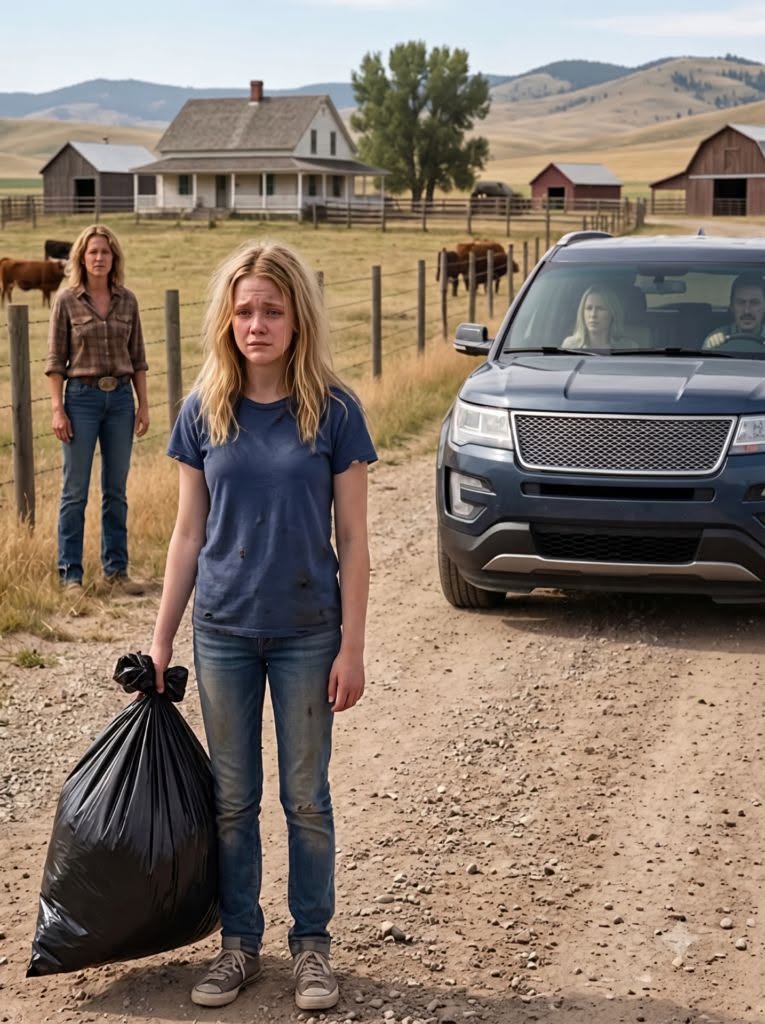
PART 1 TITLE: My Mother Left Me on a Dusty Ranch Road With Everything I Owned, and the Promise She Made Was Already Falling Apart
The black garbage bag split just as my mother turned toward the car. A sleeve slipped through the opening, followed by the corner of a faded blue sweatshirt. I dropped to my knees on the gravel and pushed everything back inside, trying to keep my clothes from touching the dirt. Behind me, the engine was already running. My younger sister, Claire, watched through the rear passenger window with a look I couldn’t quite understand. She was holding the pink travel pillow Mom had bought her that morning. I had been told there wasn’t room in the trunk for my suitcase.
“Come on, Hannah. Stop making such a production of everything.” Mom stood beside the open driver’s door, one hand resting on the roof. She wore sunglasses even though the sky had clouded over. “You’re going to spend the summer with your aunt. Plenty of children would be grateful for that.” I tied the torn plastic into a knot and looked toward the farmhouse at the end of the driveway. No one had come outside. The screen door remained closed, and the only movement was a loose section of fence wire stirring in the wind. I asked whether Aunt June knew we were coming. Mom looked at her watch instead of answering.
“Dad said we were going to the coast in July,” I reminded her. That had been the plan for months. I had heard Claire discussing the hotel swimming pool, the amusement park, and the restaurants she wanted to visit. My father had even shown us photographs of the beach house he had rented. I had packed my swimsuit before anything else. Mom’s expression tightened. “Your sister deserves a proper summer,” she said. “Every time we try to enjoy ourselves, you find some way to spoil it.” She spoke as though she were explaining something obvious to a particularly slow child. “You can stay here. We’ll collect you in August.”
I looked toward Dad. He was behind the steering wheel, his fingers resting on the dashboard. He had barely spoken during the drive, apart from reminding me not to leave crumbs in the car. When our eyes met, he turned toward the windshield. I waited for him to say something, to tell Mom she was being unfair or remind her that I was his daughter too. Instead, he started adjusting the air-conditioning vents. Claire lowered her window a few inches and said, “Will you still be here when school starts?” Mom answered before I could. “Don’t be ridiculous. Of course she won’t.” Then she opened her door wider and told me to get away from the car.
I can still recall the exact sound the tires made when Dad pulled out: gravel grinding under rubber, followed by the steady hum of the engine as the car reached the paved road. I stood with my bag pressed against my chest. At the cattle guard, the brake lights came on, and for one desperate second I thought they were stopping. Dad was only checking for traffic. The car turned left and disappeared between two rows of cottonwoods. No one waved. I was thirteen years old, standing miles from the nearest town, with a garbage bag full of clothes and a promise I had no reason yet to distrust.
For several minutes, I did nothing. A pair of horses moved behind a distant fence. Somewhere near the barn, a metal gate struck its post repeatedly in the wind. The afternoon smelled of dry grass, warm soil, and cattle. The ranch was much larger than I remembered from our few previous visits. At home, I knew every street around our neighborhood. Here, the roads seemed to continue until they vanished into the hills. I wondered whether I should walk toward the house or remain where Mom had left me. She had told me to wait. I had spent most of my childhood trying to do exactly what she said.
About twenty minutes later, the farmhouse door opened. Aunt June stepped onto the porch carrying a faded dish towel. She stopped when she saw me. Even from that distance, I noticed her posture change. June was my father’s older sister, a broad-shouldered woman whose skin had been browned by years outdoors. She usually moved with purpose, never wasting a step, but that afternoon she stood perfectly still. Then she came down the porch stairs, crossed the yard, and walked toward me. Her boots crunched over the gravel. She looked first at my face, then at the black bag in my hands. “Hannah,” she said quietly. “What are you doing out here?”
“Mom said I was staying until August.” My voice sounded strangely small. June looked toward the empty road, then back at me. “Did your parents just leave?” I nodded. “They said you knew.” She reached for the garbage bag, but I tightened my grip because I was afraid she might be about to send me away too. Her expression softened. “Honey, I haven’t spoken to your father in weeks.” I swallowed hard. “But Mom said you’d agreed.” June remained silent long enough for me to hear the flies buzzing around a nearby water trough. Then she said, “Let’s get you inside.” She didn’t ask me to explain anything else.
The farmhouse kitchen was cooler than the yard and smelled faintly of coffee, onions, and furniture polish. A ceiling fan turned above a wooden table marked by years of scratches. June set a glass of water in front of me and pulled out a chair. Only then did she ask whether I had eaten. I shook my head. We had stopped at a gas station during the drive, but Mom had bought sandwiches for herself, Dad, and Claire. She had told me there was food waiting at the ranch. June looked at the clock above the stove, then opened the refrigerator. She made two grilled-cheese sandwiches and cut an apple into pieces, placing everything on a chipped white plate.
I tried to eat carefully. At home, Mom criticized the way I held my fork, the amount of noise I made while chewing, and the speed at which I finished meals. June sat across from me without commenting. When she noticed I was hiding tears behind my glass, she quietly moved a box of tissues within reach. I asked whether she was angry that I had arrived without warning. “No,” she answered. “I’m concerned that nobody told me you were coming.” I wanted to explain that I hadn’t done anything wrong, that I hadn’t complained about the vacation or argued about the packing. But the words stayed somewhere behind my teeth.
That evening, June called my father’s number. She stood beside the kitchen window, the telephone cord looped loosely around her wrist. I sat on the stairs, where she couldn’t see me, and listened to her leave a message. “Robert, Hannah is here. I need to speak with you about the arrangements. Call me tonight.” After dinner, she tried Mom’s number. The call went straight to voicemail. By bedtime, neither of them had responded. June didn’t tell me they were probably busy or make excuses about poor reception. She simply showed me to the spare bedroom and opened the window to let in the cool air.
The room had cream-colored curtains, a narrow wooden dresser, and a patchwork quilt folded across the foot of the bed. June put fresh sheets on the mattress while I stood in the doorway holding my bag. When she finished, she asked if I wanted help unpacking. I said I could manage. Most of my clothes were wrinkled, and the plastic smelled of the inside of the car. I placed each item in a drawer, wondering how many would still fit when August came. At home, I had shared a bathroom with Claire and kept my belongings crowded into one small cabinet. Here, an entire dresser was empty. The thought made me uncomfortable rather than pleased.
Before turning out the light, June paused at my door. “You’ll be all right here,” she said. I asked whether she thought Mom might change her mind and return before August. June considered the question instead of offering the easy reassurance I wanted. “I don’t know what your mother intends,” she admitted. “But whatever happens, you won’t be standing out on that road waiting for somebody to decide what to do with you.” She left the hall light on. I lay awake listening to insects tapping against the window screen, still wearing the T-shirt I had traveled in because I felt too unsettled to change.
The next morning began before sunrise. A knock sounded on my bedroom door, followed by June’s voice asking if I was awake. She had already made breakfast. When I came downstairs, she handed me a pair of work gloves that were too large for my hands. “We have a few things to do before it gets hot,” she said. I stared at the gloves, certain I was about to discover what punishment looked like on a ranch. June noticed my hesitation. “You don’t have to know anything yet. I’ll show you.” She took me outside and began teaching me how to close the feed-room door properly so the calves couldn’t push it open.
We spent the morning carrying small buckets, checking water troughs, and collecting the loose pieces of wire that had fallen along one section of fence. June explained why cattle needed reliable water, why a broken latch mattered, and why it was important to put tools back where they belonged. She never raised her voice when I made mistakes. Once, I dropped a bucket and spilled half its contents across the dirt. I instinctively stepped backward and began apologizing. June picked up the bucket, checked that its handle wasn’t bent, and handed it back. “Water’s still in the well,” she said. “We’ll fill it again.” I waited for the rest of the lecture, but there wasn’t one.
During the following weeks, the ranch developed a rhythm I could understand. Breakfast before the heat, outdoor work in the morning, lunch at the kitchen table, and quieter chores after the worst of the afternoon sun. June kept careful notebooks filled with feed purchases, veterinary bills, equipment repairs, and the dates when particular pastures had last been used. At first, the numbers meant nothing to me. I was more interested in the animals and the strange independence of walking across open fields without anyone telling me I was in the way. But June treated every question seriously, even the ones that revealed how little I knew.
I counted the days until August in a small notebook I found in the bedroom drawer. Every evening, I crossed out another square on a calendar June had pinned beside the kitchen door. I imagined how the reunion would happen. Perhaps Dad would arrive alone, looking apologetic. Maybe Mom would say she had missed me. Claire might bring a seashell from the beach. I practiced what I would say so I wouldn’t sound angry or ungrateful. Mostly, I wanted to know whether they would let me return to the vacation house next summer. I hadn’t yet understood that I was planning a conversation no one else intended to have.
June kept calling. Sometimes she left messages while I sat beside her; other times she waited until I had gone outside. I knew because the telephone receiver was often beside the kitchen sink when I came back. Once, I heard her speak sharply into the answering machine. “Robert, she’s your child. Whatever problem you think you’re solving, you need to explain it.” There was no answer. June called again the next evening. Eventually, she stopped leaving long messages. She would dial, wait, and put the receiver down. Her face remained calm, but she began pressing her lips together whenever the telephone rang.
The first week of August arrived with oppressive heat. The pasture grass turned brittle, and dust coated the windowsills no matter how often they were wiped. I wore my cleanest shirt each morning, convinced that my parents might appear without warning. Whenever a vehicle approached along the county road, I stepped toward the porch to see whether it was our family car. Most belonged to delivery drivers or neighboring ranchers. One afternoon, a dark sedan slowed near the gate, and I ran so quickly that I nearly slipped on the porch steps. The driver was a man looking for directions to another property. I gave him the information June had taught me and watched him drive away.
By the middle of the month, I had stopped asking what time Mom and Dad would arrive. June never told me to abandon hope, but she also refused to build it out of guesses. When I finally asked whether she thought they were coming, she placed her pen on the table and said she hadn’t received any confirmation. “What if they forgot the date?” I asked. “They know where you are,” she replied. I understood that she was choosing her words carefully. I wanted her to say that parents couldn’t forget their children. Instead, she poured another glass of water and asked whether I wanted to help her check the north pasture.
August ended without a visit, a telephone call, or even a birthday card for Claire that I might have been asked to sign. The school year approached, and I began to panic. My parents had promised that I would return home before classes started. My textbooks, school supplies, and most of my clothes were still there. I imagined the first morning of school without me, my empty desk, my classmates asking questions. June contacted the district office and discovered that my enrollment hadn’t been transferred. She told me we would sort it out. I watched her gather documents at the kitchen table, noting that she seemed far more worried about the adults involved than about the paperwork itself.
A thick envelope arrived several days later. June recognized my father’s handwriting and opened it while standing beside the kitchen counter. Inside were copies of my academic records, a signed guardianship authorization bearing a notary’s seal, and a short typed note about school enrollment. There was no personal message for me. No explanation, no apology, and no suggestion of when I would be coming home. June read the papers twice, then sat down slowly. “They arranged for you to stay,” she said. I looked at the notarized document and tried to understand why my parents had prepared official paperwork for a summer visit that was supposed to end weeks earlier.
“How long?” I asked. June ran her finger along the page. The authorization was broad enough to let her handle my schooling, routine medical care, and daily decisions. She didn’t immediately answer. I asked again, louder this time. “How long am I supposed to stay?” She folded the paper and looked at me. “They haven’t given an end date, Hannah.” I felt the room tilt slightly. The refrigerator motor started humming behind us. Outside, a truck passed on the road. I could hear all of it clearly, yet June’s next words seemed far away. She said she would keep trying to reach my parents and that I did not have to worry about having somewhere to sleep.
That night, I asked June whether there was something wrong with me. She was washing dishes, and the question made her stop with both hands in the soapy water. “What makes you ask that?” she said. I told her about the arguments at home, about Mom saying I ruined outings by asking too many questions, about Claire being praised for things I was criticized for doing. I described the way Dad withdrew whenever Mom became upset and how I had learned to study everyone’s faces before speaking. June dried her hands slowly. “I don’t know every conversation that happened in your house,” she said. “But I know this. Nothing you’ve described makes it acceptable to leave you without an explanation.”
I wanted to believe her, but I had spent years watching my parents react to me as though I were an inconvenience. I remembered one holiday dinner when I accidentally knocked over a glass of juice and Mom refused to speak to me for the rest of the evening. Claire once broke a ceramic lamp while playing indoors; Dad laughed and said accidents happened. Such differences had always seemed too small to explain to anyone. Spoken aloud in June’s kitchen, they sounded less ordinary. She didn’t make me recount every painful memory. She simply listened, occasionally asking a question, until I ran out of words. Then she finished washing the dishes and asked whether I wanted tea.
September brought cooler mornings and a place for me at the local school. June bought notebooks, pencils, and two pairs of jeans sturdy enough for ranch work. She took me shopping herself and waited outside the fitting room without complaining when the first sizes didn’t fit. It was a small thing, but I remember it more clearly than most expensive presents I had received from my parents. At home, shopping trips usually ended with Mom accusing me of being difficult. June simply wanted the clothes to be comfortable. When we returned, she wrote my name inside the new school bag and placed it beside the front door.
On my first day, I sat in the passenger seat of June’s pickup while the sun rose over the grazing fields. I had been frightened of answering questions about my family. What was I supposed to tell the other students? That my parents had left for vacation without me and hadn’t come back? June pulled into the school parking lot and turned off the engine. “You can tell people you live with your aunt,” she said, as if she had guessed my thoughts. “That’s enough information for anybody who hasn’t earned the rest.” I looked at the building and the students gathering near its entrance. For the first time, I understood that I didn’t have to explain everything that happened to me.
Life at Cedar Ridge continued. I attended school, helped with evening chores, and learned which gates stuck after rain. June sometimes found me staring toward the road at sunset. She never embarrassed me by mentioning it. Instead, she would ask whether I wanted to help her bring in the tools or walk down to the cattle pens. Slowly, I stopped scanning every passing vehicle. I still thought about my parents every day, but the thoughts began arriving at predictable times rather than swallowing entire afternoons. The ranch had work that needed doing whether I felt happy or not, and June had a way of making me useful without making me feel indebted.
One evening, near the end of September, I discovered a second copy of the guardianship form inside the folder June kept for my school records. The date beside my father’s signature was several days before our drive to the ranch. I read it again, certain I had misunderstood. The document had been prepared and notarized while Mom was still telling me to pack for a short summer visit. My parents had known before we left home that I might not return in August. Perhaps they had never intended for me to return at all. I carried the paper into the kitchen, where June was balancing receipts, and placed it in front of her.
She examined the date. Her face changed, though only slightly. “I hadn’t noticed when they signed it,” she admitted. I asked whether she believed my parents had planned everything. June didn’t rush to answer. She checked the page once more, then laid it flat on the table. “I think they made arrangements they didn’t tell either of us about,” she said. I stared at the signature. It was my father’s handwriting, unmistakable in the way he formed the capital R. I had spent weeks imagining that they had forgotten to collect me. Now the evidence suggested something more difficult to accept: they had remembered every practical detail except the need to tell me the truth.
I went upstairs carrying nothing but the image of that signature in my mind. My unopened school bag stood beside the dresser. The garbage bag had been folded and stored in a trunk at the foot of the bed, where June had placed it after helping me unpack. I opened the trunk and touched the plastic. It still had the small tear near the knot. Until that evening, I had thought of it as the embarrassing thing my mother had used because she didn’t want to waste a suitcase. Now I saw it differently. Someone had prepared a bag, arranged papers, chosen a destination, and driven me there without explaining that my life was being divided into before and after.
At breakfast the next morning, June set down a plate of eggs and toast. She had made a fresh pot of coffee, and sunlight lay across the kitchen table. I asked her a question I had been afraid to ask since the afternoon of my arrival. “What happens if they never come back?” June pulled out the chair opposite mine and sat down. She didn’t promise that my parents would change. She didn’t tell me to stop worrying. She said, “Then we’ll figure out what comes next, one thing at a time.” After a moment, she pushed the work gloves toward me. They were no longer quite as loose around my fingers. I picked them up, ate my breakfast, and went outside with her.
END PART 1
PART 2 TITLE: The Years My Family Pretended I No Longer Existed Taught Me What Loyalty Costs and Who Deserves to Receive It
The first photograph arrived in December, although nobody had sent it to me. I found it on Claire’s social media page while using one of the school computers after class. She was standing beside our parents on the deck of a cruise ship, wearing a bright red sweater and smiling into the camera. Mom had one arm around her shoulders. Dad stood behind them, holding a paper cup and grinning at something outside the frame. The caption described a wonderful family holiday. I sat looking at the screen until the library supervisor reminded everyone that the computers would soon be shut down. What troubled me most wasn’t that they had gone away without me. It was how natural they looked doing it.
I studied the photograph for details. Claire had grown taller. Mom was wearing the silver necklace Dad gave her for their anniversary. The vacation looked expensive, the kind they had always discussed with excitement. I wondered whether someone had taken several pictures and my parents had chosen the one without me, or whether the idea of including me had never arisen. I searched through the other photographs. There were meals, excursions, brightly lit hotel interiors, and a picture of Claire standing between two enormous Christmas decorations. Not one comment asked where I was. Eventually, I closed the page and walked outside into the cold. I missed the afternoon bus and had to call June for a ride.
June found me sitting on a bench outside the school entrance. She didn’t ask why I had missed the bus until we were halfway home. I told her about the photographs, trying to sound indifferent. She listened while steering the pickup along the narrow road. When I finished, she said, “Would seeing more of those pictures help you?” I admitted that it probably wouldn’t. “Then you can decide how much of your time they get,” she replied. She didn’t tell me to stop caring about them. That would have been useless advice. Instead, she reminded me that curiosity could make a person return to something painful long after there was anything left to learn from it.
Christmas at the ranch was quieter than Christmas at home. There were no elaborate decorations, no coordinated family photographs, and no arguments over whether the dining table looked presentable. June brought a small tree into the sitting room and let me hang the ornaments she had collected over the years. Most were handmade or slightly damaged. One wooden horse had a missing ear. Another decoration carried a date from long before I was born. On Christmas morning, June gave me a warm winter coat, a pair of boots, and a secondhand camera she had carefully cleaned. “You keep pointing out things I ought to look at,” she explained. “Now you can show me what you’re seeing.”
I took photographs of the cattle standing against the white winter sky, the frost collecting on wire fences, and June’s hands sorting seeds at the kitchen table. The camera was nothing fancy, and I often wasted an entire roll trying to capture the right light. June never complained about the expense. She encouraged me to study what made one photograph different from another. Looking back, I think she was teaching me how to pay attention without realizing how much I needed the lesson. For years, I had watched my parents’ expressions to predict whether I was about to be criticized. Now I was learning to notice things that weren’t threatening: patterns in the grass, animal movements, changing weather, and the small beauty of ordinary work.
The following spring, June began involving me more seriously in the ranch. She showed me how to check the condition of fence posts, how to read the markings on feed bags, and how to tell when a young animal needed closer attention. She explained everything in practical terms. A loose wire could allow cattle to reach the road. A neglected water line could leave an entire pasture without drinking water. Poor records could turn a profitable-looking year into a financial disaster. I liked that the consequences made sense. At home, I had never understood why one mistake earned laughter from my sister and anger from my mother. On the ranch, a task was either completed properly or needed to be corrected.
June was demanding, but she was consistent. If I left a gate unsecured, she made me return and fix it. If I forgot to record a delivery, she expected me to find the paperwork. She didn’t praise me for every ordinary task, and she didn’t pretend I was naturally talented at work that took years to learn. Yet when I did something well, she acknowledged it without hesitation. Once, after I noticed a damaged water valve before it caused a serious leak, she placed the repair log in front of me and said, “Good catch. Write it down so we remember where the trouble started.” I kept thinking about those two words. Good catch. They contained no surprise that I had managed to be useful.
School presented its own difficulties. The other students knew I lived with June, and some assumed my parents had died. Others asked questions that made me wish I could disappear beneath my desk. I eventually developed a short explanation: my aunt was my guardian, and I lived on her ranch. Most people accepted it. A few continued pressing for details. June’s advice was useful. I learned to answer only what I wanted to answer. I made friends, joined study groups, and began looking forward to classes that required more than memorizing information. Mathematics came more easily once I connected it to the figures in June’s accounting books. Biology became interesting when I could recognize its principles in the animals I helped care for.
My parents remained silent. Sometimes June received mail addressed to me from organizations connected with my former school, but nothing personal arrived from our old house. On my fourteenth birthday, I waited until evening before admitting that I had hoped for a call. June had baked a chocolate cake and invited a few people from the ranch to share dinner. I enjoyed the celebration, but whenever the telephone rang, I felt a sharp expectation rise in my chest. It was always somebody else. By the time the dishes were washed, I had stopped pretending I wasn’t disappointed. June sat beside me on the porch and asked whether I wanted to talk. I told her I hated caring so much about people who didn’t seem to care about me.
“That’s a hard thing to stop doing,” she said. Her voice held no judgment. I asked whether she thought my father ever mentioned me at home. June looked across the dark pasture before answering. “I can’t tell you what happens in a house I haven’t visited,” she said. “I can tell you that he knows how to reach you.” That distinction mattered. She was careful not to invent explanations, even comforting ones. I had grown up in a family where people frequently insisted that their intentions were good, whatever their behavior suggested. June had another way of looking at things. She trusted what people repeatedly chose to do.
When I turned fifteen, June began showing me the financial side of Cedar Ridge. Until then, I had imagined that owning so much land meant she must be wealthy. The ranch stretched across rolling pastures, woodland edges, and a series of fields whose boundaries followed old survey lines. I thought of it as enormous. June thought of it in terms of taxes, loans, repairs, feed prices, wages, and the cost of maintaining equipment that could fail at the worst possible moment. She spread invoices across the kitchen table and asked me to identify which expenses were predictable and which depended on circumstances outside her control. I was surprised by how little remained after everything was paid.
“People look at land and see what they think it’s worth,” she said, tapping the edge of a ledger. “They don’t always see what it costs to keep it functioning.” I asked why she continued when the business was so difficult. June rested her elbows on the table. “Because it’s still worth keeping, if I can find the right way to manage it.” She didn’t speak romantically about ranching. She knew how exhausting it was. She had seen droughts, difficult markets, expensive repairs, and years when selling cattle brought less money than she’d expected. But she approached every problem as something to understand before deciding what to do. I began to think that competence was a form of independence.
That summer, I accompanied June when she inspected a section of land affected by poor irrigation. The ground was dry and uneven, and several patches of grass had stopped growing. She crouched beside an old pipe and showed me where sediment had accumulated. I asked why the system hadn’t been replaced years earlier. “Money,” she said without embarrassment. “And too many other problems that seemed more urgent.” We spent the afternoon recording measurements and marking the places that needed attention. Later, when I asked what a proper repair might cost, she let me work through the figures myself. I was beginning to understand how a series of apparently small decisions could shape the future of an entire property.
The realization that my parents had deliberately excluded me arrived gradually, but it became impossible to deny when I was sixteen. Claire had posted photographs from another elaborate family vacation. This time, she included several pictures taken inside our old house before they left. The living room furniture had changed. The walls were painted a different color. In one photograph, the doorway to my former bedroom stood open behind her. I enlarged the image and saw that the room had been redecorated. The familiar curtains were gone, and a tall shelving unit stood where my bed had once been. There was no visible trace that I had lived there.
I sat with that image for a long time. Three years had passed since Mom told me I was going away for the summer. During those years, my parents had traveled, celebrated birthdays, replaced furniture, and changed the house around themselves. They had managed all of it without speaking to me. I could no longer sustain the idea that something had gone wrong and they didn’t know how to repair it. They had made a decision and continued living with the result. I went downstairs, found June sorting paperwork, and told her what I had seen. She listened without interruption. When I said, “They don’t want me back,” she didn’t contradict me with a hopeful story she couldn’t support.
Instead, she asked whether I believed I needed to return to that house to have a future. I stared at her. Until then, some part of me had regarded Cedar Ridge as temporary, however much I loved it. My real life was supposed to resume when my parents remembered their responsibilities. June opened a drawer and took out a folder containing my school reports, medical records, and guardianship papers. Everything was organized. She had maintained it carefully because she knew these documents mattered. “You have a home here,” she said. “You have your education. You’ve got people who know you and work that you’re learning to do. Your parents’ decisions don’t erase any of that.”
I asked whether she had ever wanted to send me somewhere else. June’s eyebrows rose. “Why would I?” I reminded her that she hadn’t been prepared to raise a teenager. She had a ranch to run and bills to pay. She had never asked for the responsibility. “No,” she agreed. “I wasn’t expecting you. That doesn’t mean I didn’t want you here once you arrived.” The answer unsettled me because it separated two ideas I had always believed belonged together. I had assumed that being inconvenient made a person unwanted. June understood that responsibility could arrive unexpectedly and still be accepted freely. She had made room for me, not because her life lacked other demands, but despite them.
As I grew older, our work together changed. June stopped giving me only simple chores and began asking what I thought about larger decisions. We reviewed cattle breeding records, examined how different pasture conditions affected weight gain, and discussed whether particular repairs would produce enough long-term benefit to justify their cost. She taught me to read land contracts slowly and warned me never to assume that a friendly conversation could replace a properly written agreement. “The words on the page are what people will point to when memories become convenient,” she said. I thought about the guardianship form my father had signed and understood why June kept copies of everything.
My eighteenth birthday passed quietly, but it felt different from the earlier ones. I had finished school with grades good enough to consider agricultural college. June had encouraged me to apply even before I believed I could afford it. We sat at the kitchen table comparing programs, tuition fees, scholarships, and the kinds of training each institution offered. I worried about leaving the ranch. Cedar Ridge had become the first place where I could move through an ordinary day without wondering whether someone regretted my presence. June listened to my concerns and then said something that surprised me. “A home isn’t much good if you’re afraid to leave it. You ought to be able to go somewhere and know you can come back.”
The college application process was complicated, partly because my family situation required extra documentation. June helped me assemble the records, including the guardianship authorization and evidence of our household arrangements. As we organized the paperwork, I noticed how many forms she had signed on my behalf during the years my parents had been absent. Each signature represented some ordinary responsibility they had surrendered: school meetings, medical appointments, permission slips, emergency contacts. I had once considered those things boring. Now they looked like a record of quiet devotion. June had never asked me to appreciate them. She simply did whatever needed to be done, then filed the documents so we could find them later.
College challenged me in ways the ranch couldn’t. I studied agricultural economics, soil management, animal nutrition, and the practical realities of modern livestock production. I learned how carefully planned grazing could improve land use, how direct sales might increase returns, and how energy leases could produce revenue without requiring an owner to abandon agricultural operations. Many ideas sounded promising in lecture halls but less convincing when I pictured the uneven fields, aging equipment, and financial constraints at Cedar Ridge. I kept two sets of notes: one for my courses and another for possibilities that might eventually help June. Some plans were too expensive. Others demanded conditions the ranch didn’t have. But a few seemed worth studying further.
During breaks, I returned home and worked beside June. She was beginning to move more slowly, though she denied feeling older whenever I mentioned it. Her hands remained strong, and she could still identify a problem with a gate or water line almost instantly. Yet the long days took more out of her than they once had. I noticed her resting in the kitchen after work, stretching her fingers before picking up a pen, and leaving certain heavy jobs to the younger ranch workers. She didn’t complain. When I suggested we hire additional help, she brought out the accounts and asked how I proposed to pay for it. The question wasn’t meant to discourage me. She wanted an answer supported by numbers.
My relationship with my parents existed mostly in the form of occasional memories and photographs I no longer searched for regularly. I knew Claire had continued enjoying the comfortable life my parents provided. There were vacations, celebrations, and the usual signs of a family that wanted to display its happiness. I didn’t interfere with any of it. Sometimes I wondered whether she believed the story Mom had told about me, whatever that story might be. I couldn’t remember her ever asking me directly why I had disappeared from our household. We had been children when I left, and I knew she hadn’t made the decision. Nevertheless, with each passing year, the distance between us became more difficult to explain as an accident.
During my final years of college, I began preparing a serious proposal for Cedar Ridge. I reviewed the available grazing acreage, compared possible livestock schedules, and investigated opportunities to sell beef directly to customers rather than relying entirely on traditional channels. I also examined whether a section of underused land might support solar infrastructure under a carefully negotiated lease. The plan carried risks. It required investment, reliable partners, and changes to habits June had developed over decades. I didn’t want to return with grand ideas and treat her experience as something obsolete. So I called her often, asked questions, and revised my calculations whenever she identified a weakness.
One evening, June spread my latest figures across the kitchen table during a visit home. She read for nearly an hour, occasionally making a note in the margin. I grew increasingly nervous. Finally, she looked up. “You’ve thought about this,” she said. I nodded. “You still have some optimistic assumptions.” I felt my face warm. She pointed to several numbers and asked me to explain them. We went through each section until the kitchen clock had passed midnight. At the end, June closed the folder and leaned back. “I don’t know whether every part will work,” she admitted. “But this is the first plan I’ve seen in years that might change what the ranch can afford to become.”
I asked whether she would consider trying it after I graduated. June looked toward the window, where the yard lights illuminated the old barn. “What do you want, Hannah?” she asked. I told her I wanted to help Cedar Ridge remain viable. She shook her head. “That’s what you want for the ranch. I’m asking what you want for yourself.” I struggled to answer because the distinction felt unfamiliar. For years, my greatest ambition had been to become useful enough that nobody would send me away again. Now I had the education to work elsewhere if I chose. There were agricultural companies, consulting positions, and farms looking for people with exactly the training I was acquiring.
I went for a walk before giving her an answer. The night air was cool, and the cattle moved slowly across the nearest pasture. I could see the yellow light in June’s kitchen window, the barn doors we had repaired together, and the low line of trees following the creek. Every part of the place carried a memory. Some were painful, but most belonged to the life I had built after arriving. I realized that returning would no longer mean waiting for my parents to reclaim me. It would be a decision I could make as an adult, knowing that other choices existed. That difference mattered more than I had expected.
When I came back inside, June was still at the table. I told her I wanted to return after graduation, work on the ranch, and help implement the improvements. “Not because I owe you for taking me in,” I added. “I know I can’t repay you for that.” June gave me a look I remembered from childhood, the one she used when she thought I was making something unnecessarily complicated. “I didn’t raise you to collect a debt,” she said. “If you come back, you come back because this is the work you want to do.” I told her it was. She nodded once, then pushed the folder toward me. “Then we’d better make sure the numbers hold up.”
The months before graduation passed quickly. I revised the proposal, completed my coursework, and spent long evenings comparing possible outcomes. June mailed me updated financial statements whenever I requested them. Her handwriting appeared in the margins, occasionally accompanied by a question or a dry observation about an expense she’d already warned me to expect. I kept every page. Sometimes, while studying alone, I thought about the girl who had arrived with her possessions in a garbage bag. She had been taught to regard herself as an unwanted responsibility. The woman preparing to graduate had something that girl never imagined: a place where her judgment mattered.
At twenty-two, I returned to Cedar Ridge with my degree, several boxes of books, and a carefully developed business plan. June met me in the driveway, wiping her hands on the same sort of dish towel she had carried the day she found me there. She looked older, and the sight disturbed me for a moment. Then she took one of the boxes from my car and asked whether I’d eaten. I laughed because the question hadn’t changed in nine years. We carried everything inside together. That evening, she showed me the latest accounts. The ranch was surviving, but several expensive repairs were approaching, and our margins were narrowing. Education had given me ideas. Now those ideas would have to survive the reality of the land.
After dinner, June opened the ranch office and handed me a key. It was attached to a small brass ring worn smooth by years of use. “You’re going to need access to everything,” she said. I turned the key in my palm. The office held property maps, financial records, loan documents, and contracts reaching back decades. I understood that she wasn’t simply inviting me to help with chores. She was giving me a place in the decisions that determined whether Cedar Ridge would continue. June watched me for a moment and added, “Don’t confuse having the key with having all the answers.” I slipped it onto my own key ring. The next morning, we would begin examining every part of the business together.
END PART 2
PART 3 TITLE: I Returned to Save the Ranch My Parents Had Used to Discard Me, Never Imagining Its Future Would Become My Greatest Responsibility
The first disagreement June and I had after my return concerned a pasture she had used for nearly thirty years. I wanted to change the grazing schedule, allowing sections of grassland more time to recover between periods of use. June stood beside the fence with her arms crossed and listened while I explained the soil measurements, projected stocking rates, and possible benefits. When I finished, she asked whether I had accounted for the cost of moving the cattle more frequently. I showed her the figures. She examined them, then pointed toward a low area where water collected after heavy rain. “Your plan looks good on paper,” she said. “But you’ve forgotten what happens to that gate in November.”
She was right. The access route would become difficult when the ground softened, and moving livestock through it repeatedly could damage the land we were trying to improve. I revised the plan instead of defending it. June watched me make new calculations at the kitchen table that night. “That’s the part I wanted to see,” she said. I asked what she meant. “Whether you’d change your mind when the facts changed.” Her approval meant more than agreement would have. I was beginning to learn that a degree could provide knowledge without replacing experience, and that managing a ranch well required both. We chose a smaller trial area and agreed to evaluate the results before making broader changes.
Our first year was exhausting. I spent mornings in the fields, afternoons reviewing records or speaking with suppliers, and evenings examining the numbers that told us whether our decisions were producing results. June remained involved in everything, though she slowly allowed me to assume more responsibility. We installed additional temporary fencing, adjusted grazing periods, and improved our recordkeeping. Small changes produced benefits that were difficult to notice from one day to the next. Healthier grass covered several previously worn sections of pasture. Certain feed expenses became easier to predict. We identified water problems before they turned into costly emergencies. None of it happened as quickly as I had hoped, but the figures were moving in the right direction.
The financial pressure remained considerable. Some equipment was approaching the end of its useful life, and several ranch buildings needed repairs. We had to decide which expenses could wait and which would become more expensive if ignored. June and I sat through long evenings discussing priorities. Sometimes she reminded me that an apparently efficient idea could create hidden costs. Other times, I persuaded her that continuing with an old method simply because it was familiar made less sense than investing in an improvement. Our arguments rarely became personal. We had both seen what happened when people treated disagreement as disloyalty. At Cedar Ridge, we could challenge each other’s reasoning and still share breakfast the next morning.
One of my most difficult proposals involved unused portions of the property. The ranch included land that wasn’t especially productive for grazing, and maintaining it still required attention. During college, I had studied agricultural properties that earned additional income through carefully structured renewable-energy leases. I began contacting companies involved in solar infrastructure, asking about suitability, access requirements, and long-term obligations. June was skeptical. She had no intention of allowing a careless agreement to interfere with cattle operations or give another company control over land we might need in the future. Her concerns were reasonable, and I took them seriously. We reviewed the proposals with the same caution she brought to every contract.
Before signing anything, we examined property boundaries, easements, maintenance obligations, and what would happen when the lease ended. June insisted that every important promise appear in writing. “A pleasant salesman can leave town,” she reminded me. “The document stays.” I worked through several versions with professional advisers until we had terms that protected the ranch’s operations. The arrangement didn’t solve every financial problem, but it created a revenue stream less dependent on livestock prices and weather conditions. When the first regular payment arrived, June carried the bank statement into my office and placed it on my desk. She didn’t smile immediately. She checked the amount, then looked at me. “That,” she said, “is worth a second look.”
We also began changing how we sold part of our beef. Traditional market channels offered convenience but left us exposed to prices we couldn’t control. I wanted to build a direct-to-market operation, using clear production records and reliable customer relationships to earn a better return on selected animals. The process required careful planning. We needed appropriate processing arrangements, dependable scheduling, transparent pricing, and customers willing to trust a ranch they might never have visited. I spent hours preparing information, answering questions, and checking whether our projected margins reflected actual costs. June helped by asking the practical questions I sometimes overlooked. She had little patience for optimistic sales projections unsupported by signed commitments.
The early months were uneven. Some customers placed orders immediately; others expressed enthusiasm and never followed through. Processing schedules required more coordination than I expected. We discovered that delivering a dependable product involved far more than raising healthy cattle. Still, we kept detailed records and corrected mistakes instead of abandoning the idea. Gradually, repeat customers appeared. People recommended us to relatives and friends. Our sales became more predictable, and the additional margin began to matter. One evening, after I had spent most of the day on the telephone arranging deliveries, June brought me dinner in the office. “You sound like someone running a business,” she observed. I reminded her that we were running one. She glanced at the stack of invoices. “Now you’re beginning to believe it.”
As the ranch improved, our relationship changed in ways neither of us announced. June had once made every important decision because there was nobody else available to share the responsibility. Now we discussed investments, repairs, and future plans as partners. She still knew the land better than I did. I understood newer production methods and financial tools that hadn’t been available when she began. Together, we made decisions neither of us might have reached alone. Some worked beautifully. Others required adjustment. What mattered was that Cedar Ridge stopped depending entirely on one person’s ability to work harder whenever money became scarce. We were gradually building a business with enough structure to survive ordinary setbacks.
I also began reviewing the ranch’s older records. The office cabinets contained property surveys, loan papers, title documents, insurance information, and agreements accumulated over decades. Some were neatly filed, while others had been placed in folders whose labels no longer matched their contents. June had always been careful with important paperwork, but the volume had become difficult to manage. I organized documents by property, date, and purpose, creating an index that made them easier to retrieve. During that process, I came across records from a refinancing undertaken during an earlier drought. I remembered that period from my teenage years, when June had become particularly concerned about expenses and had spent many evenings studying loan statements.
The refinancing file was thick. It included bank correspondence, property descriptions, and several notarized documents. I did not examine every page closely at the time. Our immediate priorities were operational, and June assured me that the obligations connected with that loan had been handled properly. Nevertheless, I copied the relevant index information and returned the folder to a secure cabinet. June watched me label it. “Keep the originals where you can find them,” she said. “Especially anything involving ownership.” I asked whether she expected a problem. She shook her head. “No. But the time to locate a document is before somebody starts arguing about what it says.” I added the file to our permanent records.
By my mid-twenties, Cedar Ridge looked different from the place where I had arrived as a frightened child. The farmhouse remained recognizable, and the old barn still stood near the center of the property, but the business behind them had changed. Better grazing practices reduced pressure on vulnerable sections of land. Our solar lease helped stabilize income. Direct beef sales gave us a growing group of customers who knew the ranch by name. We continued improving fencing, irrigation, and recordkeeping. We were not suddenly wealthy, and there were still difficult seasons, but the ranch was becoming financially sustainable. For the first time, June could consider projects she had postponed for years without immediately wondering how she would cover the next month’s bills.
One afternoon, she and I drove to a high point overlooking the northern pastures. The sky was clear, and cattle moved through the green grass below us. June switched off the engine and sat looking at the land. “I used to come up here when things were bad,” she said. I asked what she thought about during those visits. She gave a short laugh. “Usually how to pay for something.” Then she became quiet. “There were years I thought I’d have to sell part of it just to keep the rest.” I looked across the fields and imagined her making those calculations alone. She had never described herself as brave. She had simply continued, doing the work that had to be done.
I asked why she hadn’t sold the property when the pressure became so severe. “There were times I came close,” she admitted. “But I wanted to be certain I wasn’t giving up something that could still be made useful.” She glanced toward me. “Turns out there were a few things I hadn’t tried.” I recognized the compliment, though she delivered it in her usual understated way. I told her I couldn’t have made the improvements without her knowledge. She nodded. “And I couldn’t have made them without yours.” We remained there for a while, watching the light move across the pasture. It was one of the rare moments when neither of us seemed to be planning the next task.
As the business grew more stable, I began receiving inquiries from people interested in acquiring portions of our land. Some were neighboring operators hoping to expand. Others represented investors attracted by the property’s size, location, and potential future value. We considered each inquiry carefully, but selling productive acreage didn’t fit our plans. June often reminded me that an attractive offer could become less attractive once the long-term consequences were understood. I learned to distinguish curiosity from a serious proposal and to ask questions before disclosing information about the ranch’s finances. The process strengthened my understanding of ownership. Land was more than a number on a valuation report. It was a complicated collection of rights, obligations, and decisions.
I occasionally thought about my father when people discussed property values. Robert Harper had always been interested in investments and the appearance of financial success. When I was younger, he talked about acquisitions with confidence, as though possessing something valuable proved that he had made better decisions than everyone else. I had not spoken to him in years, and I had no reason to believe he knew much about Cedar Ridge’s improvements. If he thought about the ranch at all, I assumed he remembered it as June’s difficult agricultural property. I never imagined he would one day want to buy it. More importantly, I never imagined he would consider himself entitled to any part of it.
Claire remained a distant presence in my life. I occasionally encountered news of her through public photographs or passing references, but I no longer searched for it. She appeared to have followed the path our parents had encouraged, building a life surrounded by the family’s support and approval. I didn’t resent her every happiness. For a long time, I had envied the easy way affection seemed to arrive for her, but the feeling had gradually lost its hold. What I couldn’t forget was the unequal standard that had governed our childhood. Claire’s desires were treated as important. Mine were treated as problems. On the ranch, I had learned that wanting something did not automatically create a right to possess it.
June and I rarely discussed my parents unless some practical matter made the subject unavoidable. By then, she had stopped trying to persuade Robert to behave differently. Years earlier, she had made repeated attempts to contact him about my welfare. He had chosen not to respond. She kept the records because they belonged to the history of my guardianship, but she never used them to remind me of what I owed her. Whenever I thanked her for taking me in, she redirected the conversation toward something ordinary. She was proud of the adult I had become, but she refused to describe my existence as an extraordinary burden she had nobly endured.
As June grew older, I assumed more of the physical work and administrative responsibility. She still came to the office most mornings, often before anyone else, and examined the day’s priorities. Her opinions remained sharp. She could identify a questionable expense from a single line in a report and remembered details about the land that no map recorded. But she began taking longer breaks, and I noticed that difficult weather affected her more than it once had. We made practical adjustments without turning them into arguments. I arranged for heavier tasks to be handled by the appropriate workers, while June focused on decisions where her judgment remained invaluable. She accepted the changes more readily when I presented them as sensible management rather than concern about her age.
We began discussing the future of Cedar Ridge more directly. June wanted the ranch to remain productive, properly maintained, and protected from careless decisions. She had no interest in turning it into an impressive property that looked prosperous from the road while failing financially behind the scenes. I shared those priorities. We reviewed long-term plans, including future water improvements, equipment replacement, and opportunities for training younger people who wanted to work in agriculture. June liked the idea of making room for students who lacked family connections in the industry. She understood better than most how much difference one person’s willingness to teach could make. We put the idea aside until the finances could support it responsibly.
One evening, while we were reviewing a contract, June asked whether I understood what it meant to own land rather than simply work on it. I thought she was testing my knowledge of property law and began explaining titles, boundaries, and liabilities. She let me finish before shaking her head. “That’s the legal part,” she said. “I’m asking about the responsibility.” I looked around the office at the maps, the records, and the accounts we had spent years improving. I told her ownership meant making decisions that would affect people and land long after the excitement of acquiring something had passed. June listened, then nodded. “Good. Don’t forget that when somebody comes along telling you what your property ought to be worth to them.”
I didn’t recognize how deliberate some of her questions had become until much later. At the time, they seemed like ordinary conversations between people who had worked together for years. June had always believed that experience should be passed on, not guarded as a way to maintain authority. She taught me how to evaluate offers, whom to consult when a legal issue arose, and why certain documents needed independent professional review. She also reminded me that family relationships and property rights were separate matters. A relative could have genuine affection for someone without owning that person’s belongings. The reverse was equally possible: people could claim family loyalty while showing remarkably little concern for the family member involved.
The years passed in a rhythm of seasons, financial statements, livestock schedules, and small improvements that added up to significant change. Some springs brought abundant grass. Others required careful management of limited water. We celebrated successful sales and worked through unexpected expenses. June remained the person I turned to whenever a decision troubled me. She was never sentimental about the business, yet she took quiet satisfaction in seeing it thrive. Occasionally, I would find her standing outside the office, looking toward the pastures with an expression I could not quite read. When I asked what she was thinking, she usually said, “Just checking on things.” I eventually understood that she was also measuring how much had changed.
Nine years after I returned from college, June died. There was no dramatic conversation in which she revealed a secret or demanded an impossible promise. Her final years had given us many opportunities to speak about the ranch, our work, and what mattered to her. Losing her was still devastating. I had known grief was approaching, but knowing did little to lessen the shock of entering the kitchen and realizing she would never again be sitting at the table with her coffee. I found myself listening for her boots on the hallway floor. I reached for the telephone to ask her a question before remembering there would be no answer. Ordinary habits became the places where her absence hurt most.
The days surrounding her funeral passed in a blur of practical arrangements and unexpected memories. Ranch workers, neighbors, and people who had known June for decades came to pay their respects. Many spoke about her dependability. She had helped them repair equipment, given advice when they needed it, or kept agreements long after circumstances made them inconvenient. I heard stories she had never mentioned. None surprised me. June was the same person in other people’s memories that she had been in my kitchen: practical, reserved, occasionally stubborn, and unwilling to abandon someone simply because helping them required effort. When the visitors had gone, I returned to the farmhouse and found the silence more difficult than all the conversations.
The estate process required careful attention. June had maintained clear records, and the professionals involved were able to establish her intentions without the confusion that sometimes follows an unexpected death. Her will left Cedar Ridge to me. The decision was explicit, properly documented, and consistent with the years we had spent building the business together. I sat with the papers for a long time before signing the necessary acknowledgments. I knew the ranch had substantial value, but that wasn’t what overwhelmed me. June had entrusted me with the place she had spent her adult life protecting. She had chosen me to carry that responsibility forward.
I thought about the thirteen-year-old girl who had stood in the driveway with a garbage bag, convinced that nobody wanted her. My parents had abandoned me at Cedar Ridge because they considered my presence an obstacle to the life they preferred. June had taken me in without warning and then spent years teaching me how to belong somewhere without surrendering my dignity. She didn’t leave the ranch to me as compensation for their cruelty. She left it to me because I understood the land, the business, the people who depended on it, and the decisions required to protect it. That distinction mattered enormously. I wasn’t inheriting a consolation prize. I was accepting a responsibility I had worked to become capable of carrying.
After the legal transfer, my name appeared on the property’s deed. I updated the business records, insurance documents, and necessary registrations, making certain everything reflected the new ownership accurately. Our attorney advised me to keep certified copies of the important paperwork and preserve June’s historical files. I followed that advice. The ranch covered approximately twelve hundred acres, and its combination of productive agricultural operations, established improvements, and valuable land made it worth considerably more than outsiders might have assumed years earlier. Still, I had no intention of selling. Cedar Ridge was my home, my livelihood, and the place where June’s work continued through mine.
One afternoon, I returned to the high pasture where June and I had once discussed the future. The grass moved under a steady breeze, and the cattle were scattered across the lower ground. I sat in the pickup with the engine off, remembering the first time she had asked what I wanted for myself. For years, I had answered that question through work. Now I had to answer it without her beside me. I decided that Cedar Ridge would remain a functioning ranch, not merely a valuable asset waiting for the highest bidder. The plans we had discussed would continue, though I would need to make decisions alone more often than I liked.
I went back to the office and placed June’s old key ring in the top drawer of my desk. I still carried the key she had given me at twenty-two, worn smooth from daily use. The records were organized, the business was stable, and the title was properly recorded. I had every reason to believe the greatest challenges ahead would be ordinary ones: weather, markets, maintenance, and the responsibilities of ownership. I hadn’t heard from my parents in eighteen years. I assumed the distance between us had become permanent, especially now that June was gone. What I didn’t know was that my father was about to discover exactly what she had left me. And when he did, he would mistake my inheritance for an opportunity to give Claire something else he believed she deserved.
END PART 3
PART 4 TITLE: Eighteen Years After Abandoning Me, My Father Tried to Buy My Home for His Favorite Daughter and Discovered Who Owned It
The telephone call came on an ordinary afternoon, while I was reviewing expenses for a planned irrigation repair. The office windows were open, and I could hear equipment moving near the barn. I almost ignored the unfamiliar number because I was concentrating on a set of figures that refused to balance. Then I recognized the caller’s name when he introduced himself. Tom Alvarez was a real-estate broker whose work included rural properties and agricultural land. We had spoken occasionally about local market conditions, though I had never asked him to list Cedar Ridge for sale. His voice was professional but unusually cautious. “Ms. Harper, I have someone interested in purchasing your ranch,” he began. I put down my pen.
“Cedar Ridge isn’t on the market,” I told him. Tom acknowledged that immediately. “I explained that to the prospective buyer.” I asked why he was contacting me if the answer had already been given. There was a short silence. I could hear him shifting papers on his desk. “The buyer insists he has a connection to the property,” he said. “He believes there may be circumstances you should consider before refusing to discuss an offer.” I leaned back in my chair. The wording sounded peculiar. Serious buyers sometimes approached owners directly, but they usually began by asking whether a price might change someone’s mind. They didn’t suggest that the owner had an obligation to consider them.
“What kind of connection?” I asked. Tom hesitated again. “He says it’s a family matter.” I felt a faint irritation. June had been gone only a short time, and I had already received more unsolicited interest in the property than I wanted. I told Tom that my ownership was properly recorded and that there was no family arrangement authorizing a sale. “I understand,” he replied. “But I think you should know who’s making the inquiry.” Something in his voice made me sit forward. He spoke the name slowly, as though he expected it to mean something. “Robert Harper.” For a moment, I couldn’t answer. The office seemed suddenly quiet, even though I could still hear the distant machinery outside.
My father. Eighteen years had passed since I watched his car disappear down the road, leaving me beside the garbage bag Mom had packed. In all that time, he had never called to ask whether I had finished school, found work, or built a life. He hadn’t contacted me when I graduated from college. He hadn’t written to June to ask how the ranch was doing. Yet now he had found a broker and made inquiries about buying the land. I gripped the edge of my desk and asked Tom to repeat the name. He did. Then, carefully, he added, “He says the property is intended as a gift for his younger daughter.”
“Claire,” I said. Tom confirmed it. I looked through the window at the cattle moving across the pasture. There was something almost absurd about the situation. My father had spent years treating Cedar Ridge as the place where his less-favored daughter could be left out of sight. Now he apparently considered it an appropriate gift for the daughter who had remained at home. I asked whether he knew June had died. Tom said Robert was aware of her death but had spoken as though the ranch still belonged to an older family arrangement. That phrase bothered me. June had owned Cedar Ridge outright, subject to the ordinary legal obligations reflected in its records. Her estate had been handled properly. There was no hidden agreement for my father to inherit it.
Tom explained that Robert had expressed particular interest in the property’s size and its suitability for a family residence. He had mentioned Claire and her husband, Mark, and said they wanted more space for their children. According to Tom, my father had described Cedar Ridge as a natural place for them to settle. I listened without interrupting. Each detail made the call more difficult to dismiss. Robert hadn’t simply noticed an attractive piece of land. He had formed a plan involving a property he had no reason to believe was available, then approached a broker as though completing the purchase would be a matter of arranging the paperwork.
“I’ve already told him it’s not for sale,” Tom said. “But he’s raising questions about who actually has the right to decide.” I asked him to explain. Robert had suggested there might be an unresolved family ownership interest dating from June’s earlier dealings with the property. Tom hadn’t seen evidence supporting that claim, but he wanted me to be aware that the buyer was making it. I felt my irritation sharpen into something more serious. June had spent decades keeping the ranch operating. I had helped turn it into a stable business and had inherited it through a valid will. My father had contributed nothing to that work. Now, without speaking to me, he was questioning whether I had the right to control it.
“Please don’t discuss any terms on my behalf,” I told Tom. “And don’t suggest that I’m considering an offer.” He assured me he wouldn’t. Then he mentioned that Robert had requested a meeting that evening to review the property’s ownership records. I told him the county records were public and that he was free to present the truth. Tom paused before asking whether I wanted to attend. The question surprised me. For a brief moment, I imagined sitting across a table from my father and watching him discover that the daughter he had abandoned was now the legal owner of the land he wanted to give away. I decided against it. I didn’t owe him an audience, and I wasn’t ready to turn a property inquiry into a family confrontation.
After ending the call, I remained at my desk with the irrigation figures spread in front of me. The numbers no longer held my attention. I thought about the last time I had heard my father’s voice. I couldn’t remember the precise words he had said during the drive to June’s ranch. I remembered only his silence when Mom told me I was ruining Claire’s summer. That silence had become one of the defining facts of my childhood. He could have objected. He could have returned later. He could have called June after the guardianship papers arrived. Instead, he had accepted the arrangement and continued with his life. Now, eighteen years later, he was willing to make an effort to obtain the property.
I opened the deed information on my computer and examined it again. My name appeared clearly as the owner. The transfer from June’s estate was complete, and the county records reflected the change. I checked the legal description, parcel information, and associated documents. Everything was consistent with the records our attorney had prepared. I knew that ownership wasn’t determined by a parent’s opinion or by which sibling had children. Still, Robert’s claim troubled me because people willing to distort a family story could sometimes be just as willing to distort a business transaction. I made copies of the relevant documents and placed them in a folder on my desk.
That evening, Tom sent a short message confirming that he had met Robert and shown him the current ownership records. I called to ask what had happened. Tom described the meeting carefully. My father had arrived expecting to discuss financing and purchase terms, but Tom had first presented the property information. When Robert saw the name on the deed, he stopped speaking. He studied the page for nearly a minute, then asked whether there had been a mistake. Tom explained that the records identified Hannah Harper as the legal owner. Robert reportedly stared at the document and said he couldn’t believe it. He asked when the transfer had occurred and whether the information could be challenged.
I listened, remembering the girl who had waited by the road in August because she believed her father would return. He hadn’t come then. But now, faced with a deed carrying my name, he seemed suddenly interested in locating me. Tom said Robert had become increasingly agitated as the conversation continued. He wanted to know whether June had left the ranch to me willingly and whether other family members had been notified. Tom reminded him that the estate documents were matters for the relevant legal professionals and that he couldn’t offer opinions about ownership disputes. The meeting ended without a purchase agreement. I thanked Tom for the information and asked him to forward anything else Robert submitted in writing.
My phone began ringing before midnight. I recognized the number, although it hadn’t appeared on my screen in almost two decades. I watched it vibrate across the bedside table until the call ended. A second call followed. Then a third. I turned the sound off and placed the phone face down. I had spent years wondering what I would feel if my father finally contacted me. I once imagined tears, anger, or a desperate need to explain how deeply he had hurt me. Instead, I felt an unfamiliar coldness. He wasn’t calling because he had suddenly remembered my existence. He was calling because my name stood between him and something he wanted.
When I woke before sunrise, the screen showed eighty-eight missed calls. Most came from my father. Others appeared to be from Mom’s number. There were several messages, but none began by asking how I was. The earliest demanded that I answer immediately. Later messages accused me of ignoring an urgent family matter. One insisted that June’s estate needed to be discussed before I made any irreversible decisions. Another warned me not to speak with outsiders until Robert had explained the situation. I sat on the edge of the bed, looking at the call history. Eighteen years of silence had been followed by dozens of demands in a single night. The contrast was so stark that I almost laughed.
The phone rang again while I was getting dressed. I watched the number appear and decided to answer. Robert didn’t greet me. “Hannah, you need to explain why your name is on June’s property.” His voice was sharper than I remembered, but the assumption behind his words was familiar. He spoke as though I had done something requiring his approval. I moved toward the bedroom window. Beyond the glass, the first light was appearing over the pastures. “Because I own it,” I answered. There was a pause, followed by an impatient sound. “Don’t play games. June’s ranch is family property.” I asked which family he meant. He didn’t answer immediately.
Then he began talking about June, about how long the property had belonged to her, and about decisions he claimed should have involved him. His explanation shifted several times. At first, he implied that I had misunderstood the inheritance. Then he suggested June might have been influenced by my presence on the ranch. Finally, he said that an arrangement made between relatives shouldn’t exclude other relatives from benefiting. I listened carefully. He mentioned nothing about the years I had spent helping June manage the business, the investments we had made, or the responsibilities I had assumed before she died. To him, my ownership appeared to be a technical obstacle rather than the result of a deliberate legal decision.
A familiar voice sounded in the background. Mom had apparently been listening. I heard her ask Robert to give her the phone. A moment later, she spoke directly to me for the first time since I was thirteen. “Hannah, don’t start all that old drama again,” she said. I closed my eyes. She hadn’t asked whether I was healthy or happy. She didn’t mention June’s death or acknowledge that the woman who had raised me was gone. Instead, she referred to my abandonment as though it were an argument I kept bringing up to inconvenience everyone. “What drama?” I asked. Mom sighed. “You know perfectly well what I mean. We’ve all moved on. You need to stop making everything difficult.”
I thought about the guardianship form my parents had signed before driving me to Cedar Ridge. I thought about the empty bedroom in Claire’s photographs and the years of birthdays without a call. Mom’s words were almost exactly what I would have expected from her when I was thirteen. The difference was that I was no longer a child trying to avoid punishment. “I haven’t contacted any of you,” I said. “You’re the ones calling me.” She began to respond, but Robert took the phone back. His patience had apparently ended. “This isn’t about the past,” he said. “It’s about doing what’s right for your family.” I waited to hear what he believed that meant.
Robert explained that Claire and Mark wanted to raise their children in a rural setting. They were looking for somewhere peaceful, with space for the children and room to build a comfortable life. Cedar Ridge, he said, was ideal. I asked why they didn’t look for property that was actually available. He ignored the question. Instead, he began listing reasons I should cooperate. I was unmarried. I didn’t have children. I had more land than I could personally use. Claire had a family to consider, and my parents wanted to help her establish a stable future. He presented each statement as though it reduced my right to keep what June had left me.
“You’re saying I should give up twelve hundred acres because Claire wants a bigger house?” I asked. Robert objected to my wording. He insisted that nobody had mentioned giving anything away. He was prepared to make a reasonable offer, he said, and he expected me to behave like an adult rather than hold old resentments against my sister. I looked out toward the nearest field, where several cattle were moving slowly through the morning light. The business required employees, equipment, careful planning, and constant management. Robert spoke as though the property were sitting empty, waiting for someone more deserving to make use of it. I wondered whether he knew anything about the operation he wanted to purchase.
Then he named his price. Two hundred thousand dollars. For a moment, I wondered whether I had misunderstood. “For what?” I asked. “For your interest in the ranch,” he replied. He described the payment as generous, considering that I had inherited the property rather than purchased it outright. I knew Cedar Ridge’s estimated value was approaching six million dollars, based on its land, improvements, and established operations. The gap between that value and his offer was extraordinary. I asked whether he had reviewed a current appraisal. He said he knew what the ranch was worth and didn’t need to be lectured about real estate. His confidence seemed completely disconnected from the financial reality.
I allowed a few seconds to pass before saying, “That’s very generous.” Robert immediately sounded relieved. “I knew you’d eventually be reasonable,” he said. He began discussing how quickly we could complete the transfer, whether I would need time to remove my belongings, and how Claire might use the existing farmhouse until new arrangements were made. I interrupted him. “I didn’t agree to sell.” His voice hardened. He accused me of misleading him and wasting his time. I replied that sarcasm wasn’t acceptance and that Cedar Ridge remained unavailable. He raised his voice further, reminding me that he was my father. I told him our relationship did not give him authority over my property.
The argument deteriorated quickly. Robert insisted that I owed the family an opportunity to discuss the sale. He accused June of filling my head with resentment and suggested that refusing his offer proved I was still the difficult child Mom had complained about years earlier. I felt the old instinct to explain myself rise, then deliberately resisted it. Nothing I said would change the central fact that he believed Claire’s desire mattered more than my ownership. I told him not to contact my employees or interfere with the business. He began shouting again. I ended the call. My hands were shaking, but I was surprised to discover that I didn’t regret hanging up.
For a while, I sat at the kitchen table with a cup of coffee growing cold beside me. I had imagined that hearing my parents’ voices again might reopen wounds I had worked for years to understand. Some of those feelings were certainly present. Mom’s dismissal had hurt more than I wanted to admit, and Robert’s accusations brought back memories of standing silently while he refused to defend me. But there was also clarity. Their priorities hadn’t changed. They wanted something for Claire, and they had decided my wishes were an obstacle to be overcome. I no longer needed to wonder what I could say to earn fair treatment. The conversation had shown me that fairness wasn’t what they were seeking.
An hour later, Tom sent an email with documents Robert had submitted in support of his proposed purchase. I opened the attachments expecting an ordinary offer, perhaps accompanied by financing information. Instead, I found a formal package that described Robert as having an equitable family interest in Cedar Ridge. The language suggested June had held title under a temporary family arrangement and implied that other relatives might possess rights that had not been reflected in the current deed. I read the paragraph twice. Nothing in my knowledge of June’s ownership supported it. She had maintained the ranch, borrowed against it when necessary, paid its expenses, and transferred it through her estate. Robert’s assertion contradicted everything I knew.
The next attachment was more troubling. It concerned financing. Robert intended to obtain funds using commercial property associated with him and Mom as collateral. The paperwork included statements about ownership interests and the absence of unresolved claims or disputes. I wasn’t a lending specialist, but I had spent enough years reviewing contracts to recognize that those representations mattered. A bank approving a loan needed accurate information about the property securing it and the borrower’s legal right to pledge that property. Robert was making claims about Cedar Ridge that appeared false, while also relying on financing documents whose contents I couldn’t independently verify. What had begun as an insulting purchase offer was becoming a question of whether my father was willing to misrepresent legal rights to obtain what he wanted.
I printed the documents and placed them beside June’s property files. My first impulse was to telephone Robert and demand that he withdraw the false statements. Then I remembered June’s advice about contracts: read them carefully, preserve the originals, and make certain you understood the consequences before responding. I didn’t know whether Robert genuinely believed he possessed some inherited interest or was simply using the claim as pressure. Either possibility required a measured response. If he intended to involve a lender, county officials, or other family members, I needed professional advice before he created a dispute that might interfere with the ranch’s operations.
I called Melissa Grant, the attorney who had helped with June’s estate and the transfer of Cedar Ridge. Melissa knew the property records and understood how carefully June had arranged her affairs. I explained Tom’s call, the discovery of my name on the deed, the eighty-eight missed calls, and Robert’s demand that I sell for two hundred thousand dollars. She let me speak without interrupting. When I described the claim of an equitable family interest, she asked me to read the exact language from the document. Then she requested the complete purchase package, including the financing attachment. I forwarded everything while we were still speaking.
Melissa reviewed the material before calling me back. Her first question was whether I had agreed to anything, verbally or in writing. I told her I had refused the sale and had not signed any document. She asked whether I had sent Robert a counteroffer. I said no. “Good,” she replied. She wanted copies of Tom’s correspondence, the current deed, June’s estate documents, and any older property records that might relate to Robert’s claim. Her tone was calm, but she was taking the matter seriously. I asked whether my father had any realistic basis to challenge the ownership. Melissa said the documents she had reviewed showed a valid transfer, but she wanted to investigate the history before making broader conclusions.
I told her about the older refinancing files in June’s office. They contained documents from the difficult period when the ranch had borrowed money during a drought. Melissa asked me not to discard or rearrange anything until we had identified what might be relevant. She also wanted all future communications from Robert preserved. I admitted that I was tempted to send him a message explaining exactly why his claim was false. Melissa discouraged it. “He has already made several statements in writing,” she said. “Before you respond, we need to understand what he’s relying on and where he intends to present it.” I could hear pages turning on her end of the call.
I asked whether she thought he might try to pressure me through the family. Melissa didn’t pretend to know his intentions. Instead, she asked what had happened when my parents abandoned me. I gave her a concise account, explaining the age at which I arrived, the guardianship papers, the years without contact, and June’s role in my education and career. She listened carefully, then asked whether Robert had ever contributed to the ranch or held any recorded ownership interest. I told her he had not, to my knowledge. She made a note and reminded me that emotional arguments about family loyalty would not replace valid legal evidence. If Robert was asserting an ownership right, he would have to support it.
The conversation brought back another memory: June sitting at the kitchen table with her carefully organized papers, telling me that documents mattered most when someone later decided to tell a different story. I had assumed she was giving general advice. Now I was beginning to appreciate how much protection those habits could provide. Every significant loan, property transfer, and agreement connected with Cedar Ridge had left a written record. Robert might tell people whatever he wished about June’s intentions, but the official documents would not change simply because his story became more convenient. I realized that fighting his accusations immediately might be less effective than understanding exactly what he had already committed himself to saying.
Before we ended the call, Melissa gave me a straightforward instruction. “Don’t do anything yet. Let him keep talking.” I asked why. She explained that premature arguments could give Robert an opportunity to revise claims before we knew whether he intended to rely on them formally. If he was asserting legal rights he didn’t possess, or providing inaccurate information in connection with financing, his own correspondence might become important. She wasn’t suggesting that we ignore him indefinitely. She wanted the situation documented properly before taking action. I understood the distinction. My parents had always tried to control the family story by speaking loudly and expecting everyone else to fall silent. This time, I could afford to listen.
After hanging up, I organized the emails and saved additional copies of the attachments. I placed the printed purchase package in a separate folder and wrote the date across the front. Then I opened the secure cabinet containing June’s historical property records. The folders were exactly where I had left them years earlier, arranged by transaction and date. I found the refinancing documents from the drought period and set them aside for Melissa’s review. The papers were old, but the original signatures and notarial markings were still clear. I had no idea yet whether they contained anything relevant to Robert’s assertions. I only knew June had believed they were important enough to preserve.
By late afternoon, the ranch had returned to its ordinary activity. Employees were finishing their tasks, equipment was being put away, and the cattle moved toward water as the temperature began to fall. I walked outside carrying the folder Melissa had asked me to prepare. The place looked exactly as it had the day before. My father’s sudden interest hadn’t changed the boundaries, the buildings, or the years of labor that kept Cedar Ridge operating. Yet something fundamental had shifted. For the first time since I was thirteen, my parents were actively trying to influence my life again, and they were willing to question my legal ownership to accomplish it.
I stood near the driveway and looked toward the road where Dad had driven away eighteen years earlier. Back then, I had waited because I thought my parents’ return would mean I still belonged somewhere. Now Robert wanted to return because he had discovered I possessed something valuable. The difference was painful, but it removed any uncertainty about what I needed to protect. I wasn’t going to sell Cedar Ridge to Claire, surrender part of it to satisfy my parents, or allow their accusations to dictate how I managed the business. I had given Melissa permission to investigate every claim in the purchase package. Whatever Robert intended to do next, I wanted the evidence in place before he did it.
Just before closing the office, another email arrived. Robert had copied additional people into a message questioning how June’s property had passed solely to me. He demanded records and suggested that the matter could not be considered settled until the wider family’s interests had been examined. I forwarded the message to Melissa without answering. Then I opened June’s old refinancing folder once more and looked at the documents bearing dates from the years after my arrival. Somewhere in those records lay the history my father was now trying to reinterpret. He appeared convinced that his position as June’s brother and my father gave him leverage over the ranch. He had forgotten that, while he was absent, June had spent years keeping careful records of every serious financial decision she made.
I turned off the office lights and locked the door. My phone vibrated again as I crossed the yard, but I didn’t reach for it. For eighteen years, my father had shown no interest in hearing from me. Now he couldn’t stop calling. I had finally understood that answering every demand would not make him reasonable, and silence was no longer something he could use to make me feel powerless. I returned to the farmhouse, placed the records where they would be ready for Melissa, and checked the next morning’s work schedule. My father had begun turning an ordinary refusal to sell into a claim about family rights. I had chosen not to argue with his version of events. I was going to let the documents answer him.
END PART 4
PART 5 TITLE: The First Document My Attorney Found Proved My Father Had Known the Truth Long Before He Tried to Claim the Ranch
Melissa arrived at Cedar Ridge shortly after nine the following morning, carrying a leather briefcase and a folder thick with printed correspondence. I had already been awake for hours. The ranch workers were moving cattle between pastures, and the office smelled of fresh coffee and the paper I had spent the previous evening organizing. Melissa greeted me, set her things on the conference table, and immediately asked whether Robert had contacted me again. I handed her my telephone. There were twenty-three additional missed calls, several increasingly hostile messages, and an email in which my father described my refusal to sell as an attempt to deny Claire her rightful place within the family. Melissa read everything without changing expression. Then she opened her notebook and wrote down the dates.
“Before we discuss his motives,” she said, “I want to establish exactly what the records show.” She spread the current deed, June’s probate documents, and several older property surveys across the table. Her methodical approach steadied me. She didn’t begin with my childhood or speculate about what my parents might do next. She started with ownership. Cedar Ridge consisted of approximately twelve hundred acres held under a clearly documented chain of title. June had controlled the property long before I arrived, and the transfer through her estate had been completed according to the applicable legal requirements. My name appeared in the county records without any competing ownership interest. Whatever Robert believed he deserved, his belief had not created a legal right.
Melissa placed a copy of Robert’s proposed purchase package beside the deed. “Notice what he doesn’t say,” she observed. The documents contained repeated references to a family understanding, an equitable interest, and a supposed expectation that June’s property would remain available to her relatives. Yet nowhere did Robert identify a valid agreement granting him the right to sell or control Cedar Ridge. He hadn’t produced a deed, a recorded lien, or an enforceable purchase option. I asked whether he might be relying on something from June’s earlier refinancing. Melissa said that was precisely what she wanted to examine. If an old obligation existed, we needed to establish its terms and whether it had been satisfied. We couldn’t answer an unsupported claim merely by assuming it was false.
We began with the oldest papers. June had purchased additional acreage during several different periods, gradually combining smaller parcels into the ranch I knew. Some documents predated my birth. Others recorded boundary adjustments, easements, and ordinary financial arrangements made to keep the operation functioning. Melissa examined each transaction and compared its legal description with the county records. She was especially interested in the difficult years when June had borrowed against the property during a drought. I remembered those years clearly. She had worked longer hours, delayed replacing equipment, and sometimes sat at the kitchen table long after dinner with a calculator beside her coffee cup. At the time, I had understood only that money was tight. Now I was learning how much depended on decisions she had made.
Near the back of the refinancing folder, Melissa discovered an envelope marked with a date from the period when I was fifteen. It contained a short series of letters and a notarized statement. The first letter had been written by the bank handling June’s refinancing. It referred to an inquiry made by Robert Harper concerning the status of the ranch and whether June could independently pledge the property as security. I stared at his name. My father had ignored June’s messages about my schooling and welfare, but he had apparently found time to inquire about her land. Melissa read the letter again and asked me whether June had ever mentioned the exchange. I shook my head. She had taught me about the loan, but never about Robert’s involvement.
The next document clarified the issue. During the refinancing process, Robert had questioned whether the land remained subject to an informal family expectation arising from earlier generations. The bank had required clarification before proceeding. June’s attorney had responded that no such interest existed and that ownership belonged to June alone. Attached to that correspondence was a notarized declaration bearing Robert’s signature. In it, he acknowledged that he held no ownership, beneficial, or enforceable financial interest in Cedar Ridge. The statement also confirmed that he had no authority to negotiate a transfer of the property. I recognized his signature immediately. The capital R and the long final stroke were identical to those on the guardianship authorization he had signed years earlier.
I asked Melissa to read the declaration aloud. She did, slowly, stopping when she reached the paragraph in which Robert expressly disclaimed any right to direct a sale. My father had signed the document while I was living at the ranch as a teenager. He had known that June owned the property independently. He had acknowledged it formally because a bank needed the issue resolved. And now, eighteen years after abandoning me, he was advancing almost the same family-interest argument he had already disavowed. I touched the edge of the paper. June had kept the original carefully, protected from moisture and fading. I wondered whether she had anticipated another dispute or merely considered it prudent to preserve a document involving her brother.
“This doesn’t mean every possible legal question disappears,” Melissa cautioned. “But it directly contradicts the position he’s presenting now.” She compared the notarial information with the other records and made copies for further verification. I was relieved by her caution. After years of watching my mother turn certainty into a weapon, I appreciated someone who distinguished evidence from assumptions. Melissa explained that we would confirm the document’s history and check for any later agreements that might have altered its effect. Still, the significance was difficult to overlook. Robert wasn’t merely mistaken about the identity of the current owner. He appeared to be disregarding a statement he had previously signed to allow June to conduct her financial affairs without interference.
Underneath the declaration lay another sheet of paper, this one written in June’s handwriting. It was a brief note addressed to her attorney, asking that the completed refinancing documents remain in the permanent property file. At the bottom, June had added a sentence: Robert had been told that Hannah was living with her and that the guardianship arrangement remained his responsibility as a parent. The words were ordinary, but I read them several times. Two years after leaving me, my father had communicated with June’s lender while avoiding direct communication about his own daughter. He had known where I was. He had known June was caring for me. His absence had not been caused by confusion or a lack of information.
Melissa noticed how long I held the page. She waited without interrupting. Finally, I asked whether it was wrong that the note upset me more than the property claim. She shook her head. “You spent years not knowing what he understood,” she said. “This answers part of that question.” I looked toward the kitchen, where June had once spread my homework beside her accounting records. I remembered waiting for Dad to call during my first Christmas at Cedar Ridge. Even then, he had known exactly where to find me. The discovery didn’t change what had happened, but it removed an explanation I had occasionally offered myself when the silence became difficult to bear.
We continued reviewing the refinancing file until midday. The bank statements established that June had completed the transaction, maintained the loan, and eventually satisfied the obligation. There were no outstanding rights attached to Robert. The property records showed no recorded interest in his name. Melissa assembled a chronological summary, placing every significant document beside its corresponding date. I watched her work and thought about June’s insistence that important decisions be recorded. She had never expected me to memorize every legal term. She had taught me to preserve the evidence that would allow someone knowledgeable to reconstruct what had happened. Without those files, I might have spent weeks trying to disprove a story Robert could change whenever it suited him.
Shortly after lunch, Tom called. Robert had contacted him again, this time asking whether the broker could arrange an independent valuation without involving me. Tom had refused to proceed as though Robert represented the owner. He also informed me that my father was discussing the purchase with another real-estate professional, apparently hoping to find someone who would treat the transaction as an ordinary family sale. I thanked Tom and explained that Melissa was handling the matter. He sounded relieved. “I don’t want to be drawn into an ownership dispute,” he admitted. I assured him that neither did I. The difference was that I already owned the property, while Robert was trying to invent a basis for transferring it.
Melissa asked Tom to preserve his communications with Robert. She didn’t want to rely on memories of telephone conversations if written records were available. Tom agreed to retain the emails and forward the relevant correspondence. When we ended the call, Melissa explained why the details mattered. An unauthorized person could express interest in purchasing land without necessarily committing any wrongdoing. A family member could also mistakenly believe an old agreement existed. But representing oneself as having authority to negotiate for the owner was different. If Robert was doing that, the precise words he used would be important. We needed to distinguish what he had actually claimed from what we suspected he intended.
I returned to the ranch accounts while Melissa prepared her notes. There were invoices to approve and employees expecting answers about the coming week’s schedule. Normally, those responsibilities helped me keep difficult emotions in perspective. That afternoon, concentration proved harder. I kept seeing the date on Robert’s notarized declaration. During the same year, June had helped me prepare for an important school examination. She had driven me into town for supplies, waited while I attended a school event, and celebrated when I received a scholarship recommendation. Robert had been close enough to participate in a financial transaction involving her ranch, yet apparently too indifferent to ask about my education. The comparison followed me through every ordinary task.
At four o’clock, an unfamiliar number appeared on my phone. I answered after confirming that it belonged to a local office rather than one of my parents. The caller introduced herself as someone assisting with a commercial financing inquiry. She explained that Cedar Ridge had been identified in preliminary materials connected with a proposed real-estate acquisition. Before discussing anything further, she wanted to verify whether I was the owner and whether I had authorized the property to be considered for sale. I asked her to send the inquiry in writing. She agreed. I gave her Melissa’s professional contact information and explained that any questions concerning a transaction involving the ranch should go through my attorney.
The call left me uneasy. I knew Robert had spoken about using his commercial property to secure financing, but I hadn’t understood that Cedar Ridge was already being presented in connection with a potential loan. When I told Melissa, she asked whether the caller had identified the applicant. I said she hadn’t confirmed it, although the circumstances pointed toward Robert. Melissa advised me not to draw conclusions before seeing the written inquiry. She also explained that a prospective lender might perform preliminary checks on a property without having established that a purchase agreement existed. The inquiry itself didn’t mean the bank intended to accept Robert’s claims. It did mean that his efforts had progressed beyond a conversation with Tom.
The written message arrived before evening. It referred to a proposed acquisition involving Cedar Ridge and requested confirmation of the seller’s identity and the status of negotiations. I forwarded it to Melissa. She read it and said we should respond promptly through proper channels. I asked whether we ought to provide every document immediately. She recommended beginning with the public ownership records and a clear statement that I had not entered into a sale agreement. More detailed responses could follow if the lender identified specific representations requiring correction. I agreed. The last thing I wanted was for anyone to proceed under the mistaken impression that my father had my permission to negotiate.
Mom called again while we were discussing the response. I declined the call, and she left a voicemail. Her tone was less angry than before, but the substance remained the same. She said Robert had worked hard to arrange a future for Claire and that I was humiliating the family by refusing to cooperate. She referred to the ranch as something I had received through fortunate circumstances and suggested that keeping it all for myself was selfish. Not once did she acknowledge the years June and I had spent protecting the business. I listened to the message with Melissa present. She asked whether I wanted it saved with the other correspondence. I said yes.
There was a time when Mom’s accusation of selfishness could make me question even a small decision. At thirteen, I had believed that wanting to accompany my family on vacation might be evidence of greed. At thirty-one, I owned a functioning agricultural business with employees, contracts, and long-term obligations. Selling it wasn’t comparable to sharing a toy or allowing Claire to choose the larger bedroom. It would affect people who relied on the ranch for work and customers who depended on our production. Yet Mom’s language remained rooted in the old family arrangement: Claire’s wishes were needs, and mine were unreasonable obstacles. I found myself less angry at the words than at how predictable they were.
Melissa completed her preliminary review and suggested we obtain an updated independent valuation. The most recent figures placed Cedar Ridge near six million dollars, but the exact value depended on assumptions about its agricultural productivity, improvements, and contractual income. She wanted current information before anyone attempted to characterize Robert’s offer as reasonable. I agreed. The valuation wasn’t about finding a price that would persuade me to sell. It was about documenting the scale of the proposed transaction. A two-hundred-thousand-dollar offer for a property worth many times that amount was not a normal commercial negotiation. It was an attempt to transfer substantial value from one person to another.
That night, I walked to the old barn after the workers had gone home. The structure had been repaired several times since I arrived, but some original boards remained visible beneath the newer sections. I ran my hand along one of them and remembered June explaining how to identify wood damaged by moisture. I had been fourteen and impatient to prove that I could help. She had given me a pencil, a measuring tape, and enough time to make mistakes without being embarrassed. Now her brother was attempting to take control of the land where she had taught me those lessons. I wondered what she would have said if she were standing beside me. Probably something practical about checking the records before losing my temper.
When I returned to the house, a message from Claire was waiting. It was the first direct communication I had received from my sister in eighteen years. She wrote that she understood I might have mixed feelings about the past, but that she wanted to approach the property issue without hostility. She and Mark hoped to provide their children with a peaceful home, and Dad had promised to help make that possible. She suggested that our family history shouldn’t prevent us from finding a solution that benefited everyone. I read the message twice. It was carefully phrased, almost courteous, but it assumed there was a problem to solve beyond my refusal to sell something I owned.
I replied that Cedar Ridge was not available for purchase and that she should not make plans involving the property. A few minutes later, Claire sent another message. She said she was surprised by my response because Dad had assured her the arrangement was nearly complete. She added that she had already begun researching schools near the ranch and discussing possible renovations with Mark. I stared at the screen. Robert had apparently allowed Claire to believe she would receive Cedar Ridge before securing either my agreement or a legal basis to proceed. I asked whether she had seen a signed contract. She didn’t answer directly. Instead, she said Dad was handling the financial details and that he wouldn’t have made such promises without knowing what he was doing.
I considered calling her, then decided written communication was safer. I explained that no contract existed, no sale had been authorized, and my attorney was reviewing claims concerning ownership. Claire responded with a single question: “Why are you making this so difficult?” The wording was painfully familiar. Mom had used almost the same sentence throughout my childhood whenever I objected to unequal treatment. I typed several replies and deleted them. Finally, I wrote that refusing to sell my home was not an act against her family. She could choose another property, but she could not choose mine. Claire didn’t respond. I saved the exchange and forwarded it to Melissa.
The following morning, Melissa contacted me with an update. She had verified that Robert’s old declaration had been notarized in connection with June’s refinancing and that the surrounding documents were consistent with the official records. There was no subsequent recorded transfer giving him ownership. She also confirmed that the estate proceedings had been completed and that my title was properly established. Her next concern was preventing inaccurate representations from spreading through the purchase and financing process. “We have a clear record of ownership,” she said. “Now we need to find out what he’s telling other people.” I looked at the folder on my desk and thought about the years June had spent teaching me to ask exactly that kind of question.
Before Melissa could end the call, another email reached her office. This one came directly from the financing institution. Its representative had reviewed the preliminary information and requested clarification because the proposed buyer’s statements about family ownership did not match the county deed. The lender wanted to know whether I had signed or authorized any agreement allowing Robert to negotiate for Cedar Ridge. Melissa read the request aloud. There was no accusation in the wording, only an effort to reconcile inconsistent information before proceeding. I told her the answer was unequivocally no. I hadn’t authorized Robert to sell the ranch, negotiate terms, or present it as family property available for transfer.
Then Melissa read the final sentence. The lender had received a written representation indicating that Robert was acting with the understanding and consent of the property’s owner. I felt a chill move through me. My father had never requested my consent. Our only conversation about the sale had ended with my explicit refusal. Yet somewhere in a financing package, he had allowed another party to believe I supported his plan. I asked Melissa whether we could obtain the exact document. She said she would request it through the appropriate process. I stood beside the office window, looking across the land June had left me, and understood that the conflict had entered a more dangerous stage. Robert was no longer merely asking me to surrender Cedar Ridge. He was presenting a version of events in which I had already agreed.
END PART 5
PART 6 TITLE: My Sister Came to Inspect the Home She Thought Was Hers, While My Father’s Financing Papers Revealed a Dangerous Misrepresentation
The document arrived at Melissa’s office late the following morning. I was in the equipment shed discussing a replacement pump when she called and asked whether I could return to my desk. Her voice was controlled, but I recognized the careful tone she used when something required immediate attention. The lender had supplied a copy of the representation concerning my supposed consent. It wasn’t an agreement signed by me. It was a statement signed by Robert, identifying himself as a family representative involved in the proposed purchase of Cedar Ridge. According to the statement, discussions with the current owner had established a shared intention to transfer the property to Claire. The language was formal enough to sound convincing and vague enough to conceal how little had actually been agreed.
I read the document while Melissa remained on the line. Robert had described June’s death as an event that required the family to settle its property arrangements. He claimed that my ownership was subject to those arrangements and that negotiations were proceeding with my knowledge. There was no reference to my direct refusal, the notarized declaration he had signed years earlier, or the fact that June had left the ranch to me through her completed estate. I asked whether he could claim misunderstanding after our telephone conversation. Melissa explained that intent would require more evidence, and she wasn’t prepared to make legal accusations from one document. But she agreed that his representations were materially inconsistent with what I had told him.
What troubled me most was the confidence with which he wrote about my intentions. He didn’t say I might be persuaded to sell or that he hoped to reach an agreement. He presented my cooperation as an established fact. I wondered how many other people he had persuaded to believe that I was simply delaying paperwork for a family transaction. Melissa advised me to prepare a signed statement confirming that I had never given Robert authority to represent me. She would review it and arrange for it to be delivered to the appropriate parties. I asked whether we should include the old declaration immediately. She said the response needed to be complete but proportionate. We would establish ownership and lack of authorization first, then provide historical evidence where relevant.
I had barely finished preparing the statement when one of the ranch workers called from the entrance road. A dark SUV had stopped beside the main gate. The driver said he had come with his wife to look at the property before renovation plans were finalized. I asked whether he had given a name. “Mark,” the worker answered. “Says his wife is the owner’s sister.” I closed my eyes for a moment. Claire and Mark had apparently decided that my message refusing the sale didn’t deserve the same weight as Dad’s promises. I told the worker not to admit them to the private areas of the ranch and said I would come down myself. Then I called Melissa to let her know what was happening.
The drive from the office to the entrance took only a few minutes, but it gave me time to think about the last occasion on which Claire and I had been physically close. She had been sitting in the back seat of our parents’ car, holding a pink travel pillow, while I stood beside the road with a garbage bag. Now she was a grown woman waiting outside the same ranch, apparently expecting to claim it as her family’s future home. When I reached the gate, she stepped out of the SUV. Her appearance startled me more than I expected. I recognized the shape of her face immediately, but there were fine lines around her eyes, and her hair was shorter than I remembered.
“Hannah.” She said my name cautiously, as though testing whether it still belonged to the person standing before her. I got out of the pickup and closed the door. Mark remained near the SUV, holding a folder and looking uncomfortable. Claire took a step toward me, then stopped. “It’s been a long time,” she said. I agreed. Neither of us moved to embrace the other. Behind her, the ranch road stretched toward the house, and I could see her looking past me at the buildings. She seemed impressed by the condition of the property. “I didn’t realize it was this big,” she admitted. I told her it was a working ranch and asked why she had come without arranging a visit.
“Dad said we should get familiar with the place,” Claire explained. “Mark wants to understand what changes might be possible.” I looked at the folder in his hands. He opened it slightly, revealing photographs of houses and several printed pages. “We haven’t made any decisions,” he said quickly. “Just ideas.” I asked whether they had read my message saying the property wasn’t for sale. Claire’s expression tightened. She had read it, she said, but assumed I was upset and needed time to reconsider. Dad believed an agreement could still be reached. I reminded her that an agreement required my participation. The fact that Robert had promised her a ranch did not create an obligation for me to provide one.
Claire glanced toward the nearest pasture. “It’s not as though we’re asking you to leave tomorrow,” she said. “Dad said there could be a reasonable transition.” I felt my patience thinning. She was discussing transition arrangements for a home I had no intention of leaving. I asked how she would feel if I arrived at her house with renovation plans and explained that I intended to take possession once our parents completed the financial arrangements. Mark lowered his eyes. Claire said the situations weren’t comparable because Cedar Ridge had belonged to Aunt June. I pointed out that June had left it to me. Claire responded that inheritances could be complicated and that family members sometimes needed to make sacrifices.
I asked what sacrifice she intended to make. She looked genuinely confused. “What do you mean?” I explained that our parents were asking me to surrender a business and land worth millions of dollars for a fraction of its value. Claire would receive the benefit, while I would lose my home, my livelihood, and the work June and I had invested in the ranch. She seemed uncomfortable with the numbers. Dad had told her the property was expensive to maintain and that his offer would relieve me of a financial burden. I asked whether she had seen Cedar Ridge’s accounts. She admitted she hadn’t. Mark shifted the folder under his arm and asked whether the ranch was profitable.
“It is,” I replied. “And it’s not an abandoned family property waiting for someone to rescue it.” I explained, briefly, that June and I had spent years improving grazing practices, developing direct beef sales, and negotiating a solar lease. Employees worked here. Contracts depended on the ranch remaining operational. Mark listened carefully. Claire seemed irritated that I was treating the place as a business instead of a family opportunity. She asked whether I couldn’t simply move the livestock to another property and allow them to use the farmhouse and surrounding land. I told her that wasn’t how the operation worked. Cedar Ridge was not a house with an unusually large yard. Its value came partly from the integration of land, infrastructure, and production.
For the first time, Mark appeared to understand why the visit had been a mistake. He closed his folder. “Claire, I think we should go,” he said. She turned toward him sharply. “We drove all this way.” He glanced at me, then at the closed gate. “And she has told us the property isn’t available.” The simple acknowledgment seemed to anger Claire more than anything I had said. She accused him of taking my side before hearing Dad’s explanation. Mark replied that he had no intention of involving himself in a dispute over a property someone else owned. I was relieved that at least one person recognized the obvious. Still, Claire remained beside the SUV, her expression caught between embarrassment and resentment.
I asked her one question before she left. “What did Mom and Dad tell you when they left me here?” Her face changed. She looked toward Mark, who said nothing. After a long silence, she answered that I had wanted to live with Aunt June because I preferred the ranch to our home. I felt something tighten in my chest. “I was thirteen,” I said. “They packed my clothes in a garbage bag and drove away.” Claire looked startled. She said Mom had explained that I was unhappy at home and that June had offered to give me a different environment. According to Claire, the arrangement had been my choice, and I had later refused to return.
I told her about waiting through August, about the guardianship papers arriving without an explanation, and about the calls June made that our parents ignored. Claire listened, but I could see her struggling to reconcile my account with the version she had heard for years. “Mom said you didn’t want us bothering you,” she finally said. I asked whether she had ever tried calling me herself. She looked away. At thirteen, she had been younger than I was and dependent on our parents. I understood that. But she was no longer a child, and many years had passed during which she could have asked what happened. I didn’t expect her to repair the past in one conversation. I did expect her to stop using it as a reason to take my property.
Mark touched Claire’s elbow. She pulled away, then reached for the SUV door. Before getting inside, she said, “You could still make this easier for everyone.” I almost answered with one of the arguments I had been making since Robert first called. Instead, I said, “You can make it easier by looking for a ranch that’s actually for sale.” Claire stared at me, then climbed into the passenger seat. Mark offered a quiet apology before returning to the driver’s side. I opened the gate only long enough to allow them to turn safely toward the county road. When their vehicle disappeared, I remained there for several minutes. I had expected anger from Claire. I hadn’t expected to discover that our parents had spent eighteen years presenting my abandonment as my own decision.
Back at the office, I wrote down the conversation while it was fresh. Melissa had already advised me to preserve communications, and I wanted a clear record of what Claire and Mark had said about the expected purchase. I also noted Claire’s explanation of why I had supposedly gone to live with June. It was painful to put the words on paper. My mother had accused me of ruining family outings, and my father had allowed her to leave me at the ranch. Later, they had apparently described the separation as something I wanted. The story protected them from responsibility while making my silence seem like stubbornness. I wondered how often Claire had repeated that explanation to people who asked why I wasn’t present.
Melissa called in the afternoon to review the signed statement I had prepared. She approved the substance after making several corrections to ensure it distinguished what I knew firsthand from what I had been told. We confirmed that I owned Cedar Ridge, had not agreed to sell it, and had never authorized Robert to negotiate on my behalf. We attached copies of the current recorded deed and the relevant estate documents. Melissa would send the response to the lender’s designated representative and notify Tom that any further inquiries should be directed through her. I felt relieved to take a concrete step. Until then, the dispute had consisted largely of demands from my family. Now there would be a formal record of my position.
Two days passed without another direct call from Robert. The silence made me uneasy, not because I missed his attention, but because I knew he had invested significant effort in the proposed purchase. He had spoken to brokers, arranged preliminary financing, and promised Claire that the property would become hers. Someone who had gone that far might not accept a refusal easily. I continued working, though I checked messages more frequently than usual. The independent valuation process began, and Melissa maintained contact with the lender. Our ranch operations continued uninterrupted. I reminded myself that a legal dispute, even an unpleasant one, didn’t make it sensible to abandon the ordinary responsibilities that kept Cedar Ridge functioning.
On the third morning, a letter arrived from an attorney acting for Robert. It asserted that June’s estate had failed to account for an informal family understanding concerning the ranch. The letter demanded copies of estate records and warned that Robert was considering legal proceedings if the matter couldn’t be resolved privately. It also suggested that my refusal to cooperate might increase the costs for everyone involved. I forwarded it to Melissa. She told me that threatening litigation was not the same as proving a claim. We would respond through the appropriate legal channels, providing records where required while refusing to accept unsupported allegations. She also reminded me not to contact Robert’s attorney directly.
I asked whether my father could prevent me from operating the ranch while the dispute continued. Melissa explained that he couldn’t simply declare a dispute and take possession. Any actual legal action would require procedures, evidence, and opportunities for response. Nevertheless, unsupported claims could still create practical problems if they caused lenders, buyers, or business partners to question the title. That was why she was documenting the matter carefully. She wanted to protect Cedar Ridge from confusion without turning every accusation into a prolonged confrontation. I was grateful for her discipline. My father seemed interested in creating pressure. Melissa was interested in establishing facts that would remain true regardless of how loudly he spoke.
The updated valuation arrived later that week. It placed Cedar Ridge’s estimated market value close to six million dollars, depending on the assumptions used for its operations and associated land rights. The appraisal considered the acreage, buildings, improvements, access, and income-producing arrangements. I read it with a strange combination of pride and discomfort. June had spent decades keeping the ranch alive through difficult years. We had worked together to improve it, often worrying about relatively small expenses. Now a professional report described a property whose value my father appeared to regard as something Claire should receive almost automatically. His offer of two hundred thousand dollars seemed even more insulting against the careful analysis in front of me.
Melissa advised against sending the entire appraisal to Robert. He wasn’t entitled to every financial detail of a business he didn’t own, and the value itself didn’t create an obligation to negotiate. Instead, she prepared a response to his attorney addressing the legal claims. The letter identified the current recorded title, the completed estate transfer, and the absence of any documented interest held by Robert. It also referred to his prior notarized declaration disclaiming ownership or control. Melissa requested that his attorney identify any later valid instrument on which Robert relied. The tone was firm and restrained. There were no insults, no references to family favoritism, and no invitation to debate whether Claire deserved the property.
I reviewed the letter before it was sent. Reading Robert’s old declaration again gave me a familiar sense of disbelief. He had signed it during a period when June was paying for my school supplies and teaching me to work with the cattle. He had acknowledged that Cedar Ridge belonged to her and that he could not direct its transfer. Then he had spent years absent from both our lives. Now he was acting as though the property had somehow become his concern because June had left it to me. I signed the necessary authorization and told Melissa to proceed. I didn’t know whether the response would change his behavior. I knew it would make our position unmistakable.
The lender contacted Melissa again the next morning. Its representative acknowledged receiving my statement and the public records. The institution was reviewing the differences between Robert’s application materials and the ownership documents before deciding how to proceed. That was reassuring, but the message also contained a new detail. Robert had identified his proposed acquisition of Cedar Ridge as a transaction supported by a longstanding family arrangement. According to his submission, the arrangement predated June’s death and remained enforceable despite the recorded transfer to me. I stared at that description. It sounded like an attempt to turn the same vague family expectation into a contractual right. Melissa requested the specific document on which he claimed to rely.
Robert’s attorney responded later that afternoon. Instead of producing a deed, signed option, or enforceable agreement, he supplied a written explanation prepared from information his client had provided. It described conversations within the family and an expectation that Cedar Ridge would eventually be used to benefit younger relatives. June’s name appeared several times, but no document bearing her signature established such an arrangement. I wondered how my father could speak confidently about June’s intentions after ignoring her for so long. Melissa studied the response and observed that it still didn’t identify a valid legal basis for his claim. She prepared a follow-up asking whether Robert possessed any actual instrument granting him an interest.
I thought the matter might begin to settle once his attorney confronted the weakness of the evidence. Instead, Mom sent another message. She wrote that Claire was devastated by my behavior and that Mark had been embarrassed during their visit. She accused me of turning a family opportunity into a public dispute. I read the message without responding. Claire had arrived at the ranch expecting to inspect a home I had repeatedly refused to sell. Robert had made financial representations without my authorization. Yet Mom described the consequences as something I had caused by insisting on my rights. Her words no longer confused me, but they still demonstrated how completely she expected me to accept responsibility for other people’s choices.
That evening, I found an old photograph while looking through June’s desk. It showed the two of us standing beside a repaired fence when I was about sixteen. June wore a faded work shirt, and I was holding a hammer awkwardly in one hand. Both of us were squinting into the sunlight. I remembered how pleased I had been that she considered me old enough to help with a substantial repair. I placed the photograph beside my computer and looked at the documents spread across the desk. The ranch had become valuable through years of ordinary decisions, many of them made when nobody else cared whether the business survived. The idea that my father could now rewrite that history because Claire wanted the land seemed less plausible each time I examined the evidence.
The next morning, Melissa forwarded a final message from the lender before its internal review. The institution wanted confirmation of whether Robert had been informed of my refusal before he submitted his written representation concerning my consent. That question was different from asking who owned the ranch. It concerned what my father knew when he described negotiations as proceeding with my agreement. I had the messages, the call history, and Claire’s acknowledgment that Dad expected me to reconsider after I had already refused. Melissa asked me to prepare an exact chronology, supported wherever possible by written records. I opened a fresh document and began recording the dates.
As I worked, I understood why June had been so insistent about preserving paperwork. My father had constructed a story in which family expectations mattered more than signed documents, and my objections could be dismissed as emotional resistance. But his own statements were now being compared with dates, records, and communications he couldn’t simply redefine. I finished the chronology, attached the relevant messages, and sent it to Melissa for review. A few minutes later, she called. She said the lender’s question suggested that it was examining the reliability of Robert’s representations, not merely the title. Then she added something that made me set down my pen: the institution had requested preservation of the original application materials, including the version submitted before anyone contacted me for verification.
END PART 6
PART 7 TITLE: The Bank Began Comparing My Father’s Promises With the Records June Had Saved, and His Carefully Constructed Story Started Unraveling
Melissa sent me the lender’s preservation request shortly after breakfast. The language was formal and measured, asking that original versions of the application, supporting statements, and related correspondence be retained during the institution’s review. I read it twice before calling her. “Does that mean they think he lied?” I asked. She answered carefully. The lender had identified inconsistencies that warranted examination, but neither of us knew what conclusion it would reach. There was an important difference between an unsupported assertion, a material misrepresentation, and a deliberate attempt to deceive. Our responsibility was to provide accurate information, not to decide in advance which explanation applied.
I appreciated her caution, although part of me wanted a quicker answer. Robert had treated the ranch as though my ownership were a minor inconvenience, and he had brought lawyers and financing representatives into a dispute that should never have existed. Now the consequences were developing through procedures I couldn’t control. I looked at the list of documents Melissa wanted me to organize and began another careful review. The current deed, June’s estate records, the old notarized declaration, and the chronology of my father’s communications were all available. I created separate copies for the legal file and left the originals undisturbed. Years of ranch management had taught me that precision was often more useful than outrage.
The chronology revealed something I hadn’t noticed when the calls first began. Robert had contacted Tom about Cedar Ridge before making any attempt to communicate with me. He had discussed the possibility of acquiring the property for Claire, made preliminary financing arrangements, and represented the transaction as a family matter. Only after Tom showed him my name on the deed did he begin calling. The order mattered. My father hadn’t approached me to ask whether I might consider selling. He had begun arranging a purchase based on his own assumptions, then treated my refusal as an obstruction. The eighty-eight missed calls were not an effort to reconnect. They were an attempt to force a transaction back onto the course he had already chosen.
I added the dates from Claire’s messages. She had researched schools near Cedar Ridge and discussed renovations with Mark before visiting the property. Dad had assured her that the arrangement was nearly complete. Yet no one had obtained my consent, and neither Claire nor Mark had seen a contract bearing my signature. I remembered the plans Mark carried to the gate and his embarrassment when he realized I had refused the sale. The encounter now seemed more revealing than it had at the time. Robert hadn’t merely exaggerated the possibility of buying the ranch. He had encouraged other people to make decisions based on an acquisition he lacked the authority to complete.
When Melissa reviewed the chronology, she asked whether I remembered the exact language of my telephone conversation with Robert. I told her what I could recall and distinguished direct quotations from my best recollection of the exchange. She approved of that distinction. “Don’t make the record sound more certain than your memory allows,” she said. I knew what I had told him: Cedar Ridge was not for sale, and he had no authority to represent me. I also remembered his response, because it had echoed the arguments he used when I was a child. He claimed that being my father entitled him to obedience. Melissa said the issue for the lender was whether his later statements accurately reflected what he knew about my position.
That afternoon, I received an email from Robert himself. It was shorter than his earlier messages and written in a noticeably different tone. He said the family should settle its disagreements privately and suggested that lawyers were making a simple matter unnecessarily complicated. He offered to discuss a revised purchase price if I would agree not to involve the lender further. I read the message with growing unease. Until then, he had insisted that his original offer was generous and that I owed Claire the opportunity to live at Cedar Ridge. Now he was apparently prepared to change the price if I stopped communicating through formal channels. I forwarded the email to Melissa without replying.
She called after reviewing it. “Don’t interpret this as a new offer you need to negotiate,” she advised. “You’ve already said you’re not selling.” I asked why Robert was suddenly concerned about the lender receiving information. Melissa said there were several possible reasons, including the ordinary desire to avoid complications in a financing application. We couldn’t know his motives from the message alone. Still, she wanted it preserved because it showed that he knew our concerns extended beyond an argument over price. I looked at the word privately in his email and remembered how frequently my parents had used family privacy to prevent uncomfortable questions. Their preferred solution had always been for the person raising a problem to become silent.
Before dinner, Mom called from a number I didn’t recognize. I almost ended the call when I heard her voice, but she spoke before I could respond. “Hannah, this has gone far enough.” She sounded tired rather than angry. She told me Robert was under considerable stress and that the dispute was affecting everyone. Claire was upset, Mark had become reluctant to discuss the property, and the entire family was tired of uncertainty. I asked why she was telling me. “Because you can end it,” she replied. I looked around the kitchen, at the familiar cabinets and the table where June had helped me with homework. “I already ended it,” I said. “I told you I wasn’t selling.”
Mom insisted that my refusal wasn’t the same as a solution. According to her, a reasonable daughter would recognize that Claire had a husband and children to consider, while I had more than enough room and financial security for myself. I asked whether she had ever considered the people who worked at Cedar Ridge or the business commitments that would be disrupted by a sale. She said those were details that could be managed later. I had heard that reasoning before. During my childhood, my needs had frequently been reduced to details whenever they conflicted with Claire’s plans. It was astonishing how little Mom’s assumptions had changed even after eighteen years.
Then she said something that made me grip the telephone more tightly. “June wouldn’t have wanted you tearing the family apart over money.” I looked toward the chair where June had sat during countless evenings of work. “You didn’t speak to her for years,” I replied. Mom began explaining that relationships between adult siblings were complicated. I interrupted her. “You don’t get to tell me what she wanted.” My voice was sharper than I intended, but I didn’t apologize. June’s intentions weren’t mysterious. She had written a will, preserved ownership records, and spent years preparing me to manage Cedar Ridge. Those were deliberate acts. Mom was trying to replace them with a convenient opinion attributed to someone who could no longer object.
She accused me of making June into a weapon against my own parents. I told her June had never encouraged me to hate them. She had helped me attend school, learn a profession, and build a life after they stopped communicating with me. Mom dismissed the past again, saying that families sometimes made difficult decisions for the good of everyone. I asked which good had been served by leaving a thirteen-year-old child without an explanation. There was a pause. Then she said I had always been sensitive and that she didn’t intend to revisit old arguments. I realized the conversation had reached the same point it always did: responsibility was something she expected from me but resisted when it approached her own decisions.
I ended the call after telling her that further questions about Cedar Ridge should be directed to Melissa. My hands shook as I placed the telephone on the table. I wasn’t frightened that Mom would punish me. That power had disappeared long ago. What hurt was how easily she dismissed June’s life and work in pursuit of something Claire wanted. I spent several minutes looking out the kitchen window before returning to the office. There was nothing useful in continuing the argument. I had stated my position, and my mother had heard it. Her refusal to accept it did not mean I needed to repeat myself until she approved.
The next day, Melissa received a response from Robert’s attorney. He acknowledged the notarized declaration but argued that it concerned only the refinancing transaction and didn’t necessarily resolve every later family understanding. Melissa examined the wording with care. She agreed that documents had to be interpreted according to their legal context, but the attorney still hadn’t identified any subsequent enforceable agreement granting Robert an interest. His response relied on conversations, expectations, and assumptions rather than a signed instrument. Melissa prepared another request for particulars. I asked whether we were going to spend months answering increasingly vague claims. She said that depended on whether Robert actually initiated proceedings and whether he could produce evidence supporting them.
Meanwhile, the lender’s review continued. Melissa learned that Robert’s proposed financing involved commercial property associated with him and Mom, rather than a mortgage already secured against Cedar Ridge. That distinction was important. My ranch had not been pledged as collateral by an authorized owner. Instead, its anticipated acquisition had been described as part of the proposed use of the borrowed funds. The lender needed to understand whether the transaction being financed was real and whether its applicant had accurately represented his authority to negotiate. I felt a measure of relief. Cedar Ridge wasn’t secretly encumbered by a loan Robert had arranged. But his inaccurate statements could still create confusion unless they were corrected.
Melissa explained the financing documents in terms I understood. When a borrower describes a commercial transaction, the lender may rely on information about the proposed purchase, the parties involved, and any conditions necessary for completion. A claim that the seller has already consented can affect how a transaction is evaluated. It doesn’t create ownership, but it can mislead people about whether the proposed purchase is likely to close. Robert had repeatedly described an agreement that didn’t exist. My signed refusal and the public records now directly contradicted those representations. Whatever conclusion the lender reached about his conduct would be its responsibility. My concern was making certain no one proceeded on the assumption that I was a willing seller.
While reviewing the records again, I found another letter from June’s refinancing period. It came from her attorney and confirmed that Robert’s notarized declaration had been requested specifically because he had previously raised questions about the ranch’s ownership. The letter explained that June wanted the matter resolved before the refinancing closed and that Robert had provided the declaration without acquiring any rights in exchange. I called Melissa immediately. She asked me to scan the letter and preserve the original with the rest of the file. “That helps establish the circumstances,” she said. It showed the earlier issue had been addressed rather than left unresolved, weakening Robert’s suggestion that a longstanding family claim remained open.
I read the letter once more after sending it. June had been managing a difficult financial period while caring for me, and Robert had chosen that moment to question her authority over the property. I didn’t know whether he had been motivated by concern, resentment, or an expectation that the ranch might someday benefit him. The records didn’t answer that question. They did establish that he had been told June owned the land and that he had acknowledged his lack of control. I found myself grateful that June hadn’t relied on a family conversation to settle the matter. She had insisted on a written statement because the bank needed certainty. Years later, that decision was protecting the ranch from the same uncertainty.
Claire contacted me again that evening. Her message was different from the earlier ones. She said Mark had reviewed the information I provided and was concerned that Dad might have misunderstood the ownership situation. She asked whether I would explain the legal history directly to her. I considered refusing. Our previous conversation had ended with Claire accusing me of making things difficult, and I had no desire to begin another argument. But there was a difference between demanding the property and asking for information. I replied that the deed was publicly recorded, June’s estate transfer was complete, and I had never agreed to sell. I suggested that she ask her own attorney to review the documents if she wanted independent advice.
Claire responded that she hadn’t realized how much of the ranch’s business depended on the improvements June and I had made. She said Dad had described Cedar Ridge as expensive land that I was struggling to maintain. I explained that the operation was financially stable and that the property was worth far more than his proposed price. There was a long pause before her next message. She asked whether I believed our parents had deliberately misled her. I didn’t answer the question for her. I told her exactly what they had done to me and what they were now asking me to do. She had the records available and could compare their statements with the evidence herself.
The following morning, Claire sent a message acknowledging that Mom had told her I chose to remain with June. She said she had accepted that explanation for years because no one in the family spoke about my absence. I read her words carefully. They weren’t an apology, but they were the first indication that she recognized a problem with the story she had inherited. She added that she hadn’t understood how young I was when our parents signed the guardianship authorization. I considered pointing out that she had been sitting in the car when they left me. Instead, I remembered how children often accept the explanations adults provide, especially when challenging them threatens the security they depend on.
I replied that I didn’t expect her to answer for our parents’ decisions when we were children. But I did expect her to take responsibility for her choices now. She was an adult, and she knew Cedar Ridge belonged to me. Whatever Mom and Dad had promised, she needed to stop treating my property as something awaiting her approval. Claire didn’t respond immediately. Later that day, she sent a short message saying she and Mark would no longer make plans involving the ranch unless I personally invited them to do so. I appreciated the change, but I didn’t mistake it for reconciliation. Eighteen years of separation could not be repaired by a few messages about real estate.
By the end of the week, Robert’s attorney had still produced no valid ownership instrument. Melissa informed me that the lender had suspended further consideration of the proposed Cedar Ridge acquisition while it examined the conflicting information. The institution had not reached a final determination concerning Robert’s representations, but it would not proceed on the assumption that I had agreed to sell. I felt some of the tension leave my shoulders. The financing process was no longer moving forward as though my father’s account were established fact. Nevertheless, Melissa warned me not to assume the dispute was over. Robert could abandon the purchase, revise his proposal, or continue pressing a claim. We needed to remain prepared for each possibility.
That afternoon, I reviewed the property’s recorded history with Melissa one more time. She had arranged the documents chronologically, from June’s earlier acquisitions through the refinancing, the satisfaction of the loan, her estate proceedings, and the final transfer to me. The record was consistent. Robert’s declaration occupied a particularly important place because it showed he had acknowledged the absence of any ownership or beneficial interest years before the current dispute. I looked at the file and thought about how easily family stories could change when nobody challenged them. My parents had told Claire I wanted to live at Cedar Ridge. Now Robert was telling prospective business partners that an agreement existed to sell it. Both stories depended on the people affected remaining silent.
Melissa suggested a final consolidated response to the lender, including certified public records and a concise statement of the facts. We had already provided the basic ownership documents, but this package would assemble the relevant history in a form that could be reviewed without relying on conflicting family explanations. She would ensure that the response remained factual and avoided accusations we couldn’t independently establish. I agreed. Our position was strong, and I wanted it presented with the same care June had brought to her own affairs. There was no benefit in exaggerating. Robert’s statements could be compared with the documents he had signed and the records available to anyone willing to examine them.
Before we finalized the package, Melissa received one more communication from Robert’s attorney. It requested that we postpone further contact with the lender while the family explored a private settlement. The proposal contained no documented ownership claim and no new purchase terms. It simply asked us to stop correcting the representations that had already been made. Melissa forwarded it to me with a short note asking for my instructions. I looked at the email for several minutes. The language was more polite than my father’s telephone calls, but the underlying demand was the same. He wanted my cooperation without accepting my refusal. I thought about June telling me that important promises belonged in writing and that silence could be mistaken for agreement.
I called Melissa and told her I would not participate in a settlement designed to conceal the ownership facts. She agreed that we should protect our rights and respond appropriately to the lender’s request. We discussed which records were public, which remained private estate or business materials, and how to avoid disclosing unnecessary financial information. I wanted the institution to have enough evidence to understand the transaction accurately, but I had no reason to give Robert access to Cedar Ridge’s confidential accounts. Melissa began preparing the final set of documents. As she worked, another message arrived from my father. It contained only one sentence: “Think carefully about what happens to this family if you keep going.”
I read it without answering. For the first time, I could see the pattern clearly without feeling compelled to solve it. Robert had abandoned me when my presence interfered with the family life he preferred. Years later, he had returned because my property interfered with the future he wanted to provide for Claire. In both situations, he expected me to absorb the consequences of his choices. But I was no longer a thirteen-year-old standing beside a road, wondering whether he would come back. I owned Cedar Ridge, I understood its records, and I had professional advice. His warning didn’t change any of those facts. I forwarded the message to Melissa and told her to retain it with the rest of the correspondence.
END PART 7
PART 8 TITLE: My Father’s Last Attempt to Control June’s Land Forced Me to Choose Between Family Silence and the Truth He Had Avoided
Robert’s warning remained on my phone the following morning. I had read it several times, not because the words were complicated, but because I was trying to understand what he expected them to accomplish. He hadn’t threatened a specific legal action or identified any new evidence supporting his claim. Instead, he had invoked the family as something fragile that I might destroy by refusing to cooperate. I remembered how Mom had used similar language when I was younger. Disagreement became disloyalty, and asking for an explanation meant causing trouble. The actual decision that created the problem was rarely discussed. I forwarded the message to Melissa and went outside to check the morning’s work.
The ranch was busy. A water line needed attention in the eastern pasture, and a delivery had arrived earlier than expected. I spent the first hours of the day answering practical questions and helping coordinate repairs. I welcomed the work. Every task had a recognizable purpose, and the people involved understood that decisions produced consequences. If a valve failed, we fixed it. If an invoice contained an error, we corrected it. Nobody accused the water line of being selfish or asked the delivery driver to pretend the problem didn’t exist. The contrast with my parents’ behavior was almost comical. They had turned a straightforward refusal to sell into an elaborate argument about loyalty, inheritance, and who deserved what.
Near noon, Melissa called to confirm that she had received my father’s latest message. She wanted to know whether I felt threatened or whether Robert had indicated any intention to come onto the property. I told her he hadn’t made a specific threat, though his persistence concerned me. She advised me to preserve the message and continue directing communications through her office. Then she explained that her team was completing the consolidated ownership package for the lender. The documents would establish the recorded title, the estate transfer, and the older declaration Robert had signed. They would also state that I had not authorized any sale. I asked whether the package needed to include the details of my childhood abandonment. Melissa said the property records were sufficient for the immediate ownership questions.
I was relieved. The history of what my parents had done to me mattered deeply, but I didn’t want to turn it into an argument about whether I deserved to own Cedar Ridge. I deserved to control the ranch because it was legally mine. June had left it to me, and the transfer had been completed. Whether my parents had been kind or cruel couldn’t change those facts. Melissa agreed. She said my family’s conduct might help explain the relationships involved, but it wasn’t necessary to make an emotional case where the records already established ownership. I thought June would have approved. She never confused being wronged with being entitled to something unrelated. She believed in responsibility, evidence, and keeping promises.
That afternoon, Claire called from her own number. I hesitated before answering. Our recent messages had been more constructive than the visit at the gate, but I had no desire to revisit the purchase argument. She sounded nervous. “I wanted to tell you something before Dad does,” she began. I asked what had happened. She explained that Robert was furious about the lender’s review and believed I was deliberately undermining his plans. He had spent much of the previous evening arguing with Mom about the financing. Claire said Mark wanted nothing more to do with the acquisition and had urged her to stop discussing Cedar Ridge as though it belonged to them.
I asked whether she agreed with Mark. Claire was quiet for several seconds. “I think Dad promised us something he couldn’t deliver,” she admitted. The words were carefully chosen, but they represented a change. Until recently, she had treated the purchase as a family arrangement I was unfairly delaying. Now she recognized that Robert had made promises without securing the property. She said Mark had reviewed the public deed and couldn’t understand how Dad expected to complete a transaction without my signature. I told her I couldn’t understand it either. Claire didn’t laugh. She sounded embarrassed, and for the first time, I believed she was beginning to see the situation independently of our parents.
Then she asked whether I had truly been left at the ranch without knowing I would stay. I told her again about Mom’s promise to collect me in August, the guardianship papers prepared before the trip, and the months I spent waiting for a call. Claire listened without interrupting. She said that for years, Mom had described my departure as a decision made because I was difficult to manage and preferred Aunt June’s company. Dad rarely discussed it. When Claire asked why I didn’t visit, she had been told I wanted distance from the family. “I believed them,” she said. I looked toward the window. The realization that my parents had rewritten my absence didn’t surprise me anymore, but hearing how completely the story had shaped Claire’s memories still hurt.
“I was a kid,” she said quietly. “I didn’t know what else to believe.” I told her I understood that part. She had been younger than me when our parents drove away. She wasn’t responsible for the guardianship documents or for Dad’s decision to remain silent. But I also reminded her that we had both become adults. There had been years when she could have tried to contact me, and she hadn’t. Claire didn’t argue. She admitted that accepting our parents’ explanation had been easier than questioning it. I appreciated the admission because it contained none of Mom’s usual insistence that everyone had done their best. Claire wasn’t asking me to pretend the past had been harmless.
Before ending the call, she said she was withdrawing from the proposed purchase. Mark agreed, and they intended to tell Robert that they wouldn’t accept Cedar Ridge under the terms he had pursued. I asked whether she expected Dad to stop. “I don’t know,” she answered. “He doesn’t like being told he’s wrong.” That was probably the most accurate description of my father I had heard in years. Claire added that she didn’t expect me to forgive everyone immediately. She only wanted me to understand that she no longer believed she had a claim to my home. I thanked her for telling me. It wasn’t reconciliation, but it removed one part of the conflict that had seemed impossible to resolve.
After the call, I sat for a while thinking about how differently Claire and I remembered our childhood. She had grown up with our parents’ affection and financial support, while I had learned to build a life without either. Her version of our separation had been shaped by people who wanted to justify their actions. Mine had been shaped by living through the consequences. Neither of us could change what happened, and I didn’t know whether we would ever develop a close relationship. But I could acknowledge that she was now making a decision based on information she hadn’t previously wanted to examine. It was more than Robert or Mom had managed.
Melissa contacted me again the next morning with an unexpected development. Robert’s attorney had sent a further notice asserting that his client was considering steps to protect a claimed interest in Cedar Ridge. The wording was broad, but Melissa took it seriously because of the potential effect on public records and business relationships. She explained that an unsupported claim didn’t create ownership, yet certain legal filings could still complicate transactions or require a formal response. I asked whether Robert had actually filed anything. She said she was checking. Until we knew, we would not assume that a threatening letter had the effect of a court order. I appreciated that distinction, though the uncertainty made me uneasy.
I spent the afternoon reviewing our pending business commitments. Several contracts required continued access to particular areas of the ranch, and the seasonal schedule depended on timely maintenance. Nothing Robert had done prevented normal operations, but I wanted to be prepared if his actions created questions from business partners. I told the senior employees only what they needed to know: there was an ownership dispute being asserted by someone outside the business, legal counsel was handling it, and no one should provide confidential documents or discuss a sale without authorization. I didn’t share the family history. It wasn’t necessary, and I didn’t want employees drawn into a personal conflict while doing their jobs.
The following day, Melissa confirmed that no court had recognized Robert’s claimed interest and that the county’s existing title records continued to identify me as owner. She was monitoring the situation and preparing to respond if any actual filing affected the property. I felt relieved, but I also recognized how much effort my father had forced us to spend defending an ownership position that should have been straightforward. Melissa had reviewed historical documents, answered letters, and communicated with the lender. I had prepared chronologies, preserved messages, and gathered records June had maintained for years. Robert had created all that work because he refused to accept that the property belonged to someone he had once chosen to disregard.
Mom sent another message shortly afterward. This one sounded almost conciliatory. She said everyone had become emotional and that perhaps the family should meet somewhere neutral to discuss what had happened. For a moment, I considered the possibility. I had spent much of my childhood wanting her to acknowledge the damage caused by leaving me at Cedar Ridge. Yet the message quickly returned to the proposed sale. Mom suggested that a private meeting could produce a compromise before the lender’s review harmed Robert’s reputation. I put the phone down. Her idea of reconciliation still required me to make the first concession, and the concession still involved my property.
I replied only that I was willing to receive genuine personal communication separately from the business dispute, but I would not negotiate a sale of Cedar Ridge. Mom responded almost immediately, asking why I insisted on drawing such harsh boundaries. I didn’t answer. The distinction seemed simple to me. If my parents wanted to discuss the past, they could acknowledge what they had done without attaching a financial condition. If they wanted to discuss the ranch, they could communicate through Melissa and accept that I wasn’t selling. Combining the two allowed them to treat forgiveness as a transaction, something I would supposedly prove by surrendering what June had left me. I refused to participate in that arrangement.
The lender’s representative contacted Melissa with another request. The institution wanted certified copies of the historical records relevant to Robert’s asserted family interest, especially the notarized declaration and the correspondence explaining why it had been prepared. Melissa explained that the documents would help clarify whether Robert’s description of an unresolved family arrangement was consistent with the available evidence. I authorized their release after confirming that they were appropriate to provide. The records contained no confidential operating information necessary to keep private, and the declaration concerned the exact question Robert had raised. I wanted the lender to evaluate the matter with the complete history rather than relying on either party’s interpretation alone.
Preparing the certified records required another visit to the county office and a careful comparison with June’s originals. I accompanied Melissa because I wanted to understand the process. We reviewed the chain of title, identified the documents available publicly, and separated them from private correspondence that needed to be supplied through proper legal channels. The work was detailed and occasionally tedious. But every date and signature had a purpose. My father had described a family expectation that supposedly survived June’s death. The records showed a different history: June had owned Cedar Ridge, handled its financing independently, and received a formal acknowledgment from Robert that he had no ownership interest.
As we left the county office, Melissa asked whether I was becoming exhausted by the dispute. I admitted that I was. The ranch required enough attention without my family creating a second job for me. She nodded. “Then remember what you’re actually responsible for,” she said. “You don’t have to persuade your father that he’s been unfair. You have to protect your rights and provide accurate information when it’s required.” The advice sounded familiar. June had often told me that trying to control another person’s opinion could consume time better spent doing useful work. I couldn’t make Robert acknowledge the truth. I could ensure that his claims didn’t go unanswered where they might cause harm.
That evening, I opened the old trunk at the foot of my bedroom bed. I had kept it after moving permanently into the farmhouse, though most of its contents had changed over the years. At the bottom lay the folded garbage bag Mom had used when she left me. The plastic was brittle now, and the tear near the knot remained visible. I sat on the floor holding it, remembering how ashamed I had felt when June first saw me standing beside the road. I had believed that arriving with my clothes in a garbage bag meant I was worth less than children who traveled with proper luggage. It had taken years to understand that the bag revealed something about my parents’ treatment of me, not about my value.
I thought about throwing it away. There was no practical reason to keep a damaged garbage bag for nearly two decades. But I had never treated it as an ordinary object. It reminded me of the day my life changed without my consent, and of the woman who came down the driveway to make certain I had somewhere to sleep. June had transformed that moment through thousands of ordinary acts: meals, school meetings, lessons, arguments, and work shared across seasons. I folded the plastic carefully and returned it to the trunk. I no longer needed it as proof that I had suffered. The records and my memories were enough. I kept it because it also marked where a different life had begun.
The next morning, Claire sent a short message confirming that she and Mark had told Robert they would not pursue the ranch. She said he had reacted angrily and accused them of abandoning a valuable opportunity. I wasn’t surprised. My father had never distinguished between someone rejecting his plan and someone betraying him personally. Claire added that he continued to insist June had intended the property to benefit the family more broadly. I told her that June’s will was clear and that legal documents mattered more than recollections of supposed expectations. Claire agreed. She said Mark had asked her to stop discussing the transaction with their parents, and she intended to respect that request.
I didn’t ask Claire to intervene further. She had already made a decision that removed her family from the purchase plan. Anything more risked turning her into a messenger between Robert and me, a role neither of us needed. I was willing to communicate with her about our own history, but I didn’t want every exchange to become another argument about Cedar Ridge. For eighteen years, we had been distant because our parents controlled the explanation for my departure. I didn’t intend to recreate that pattern by making our relationship dependent on who could persuade Robert to behave reasonably. The legal matter would remain with Melissa. Anything personal would have to develop separately.
Later that afternoon, Melissa called with the latest information from the financing institution. The lender had completed an initial comparison of Robert’s written representations with the documents we had provided. It identified substantial inconsistencies concerning ownership and seller consent. The proposed acquisition remained under review, and no financing approval connected with Cedar Ridge would proceed on the basis of the disputed assumptions. Melissa emphasized that this wasn’t a final determination about Robert’s intentions or a resolution of every possible legal question. Still, the practical significance was considerable. The lender was no longer treating his account of the transaction as reliable without independent verification.
I asked whether we could consider the matter finished. Melissa said not yet. Robert’s attorney had not formally withdrawn the asserted family claim, and the financing institution still had questions concerning the history he had described. She recommended delivering the consolidated package promptly and maintaining our position that no sale would occur. I asked whether Robert could simply submit another version of the story to a different lender. Melissa acknowledged that he could attempt further inquiries, but the public records and our written responses would remain available to establish the facts. Our best protection was a clear, consistent record, not an endless series of emotional arguments.
Before we ended the call, Melissa asked whether I had reconsidered any part of my decision not to sell. I looked around the office. June’s photograph stood beside my computer. The current business plan lay open on the desk, marked with notes about pasture improvements and equipment replacement. Outside, the cattle moved across land we had spent years restoring. My father had offered two hundred thousand dollars for something worth almost six million, but the difference in price wasn’t the reason I refused. Even a reasonable offer wouldn’t have changed what Cedar Ridge meant to me or the responsibilities I intended to fulfill. “No,” I told Melissa. “I’m keeping the ranch.”
She said she would finalize the documentary response and send it through the appropriate channels. I asked to review it first. The package contained the current deed, the completed estate transfer, the relevant historical ownership records, and Robert’s notarized declaration. It also included a concise statement confirming that I had never agreed to the proposed purchase or authorized him to negotiate on my behalf. I read every page before approving it. The language was factual, precise, and free of unnecessary accusations. There was no attempt to tell the lender what conclusion to reach about Robert’s conduct. We were supplying the information needed to evaluate his statements against an independently verifiable record.
A final message arrived from Robert while I was reviewing the documents. He wrote that he had been trying to do something good for Claire and her children, and that I was allowing old resentment to destroy his plans. He claimed June would be ashamed of the way I was treating the family. I read the message once and then saved it with the others. The accusation no longer carried the weight it would have when I was thirteen. June had shown me what responsibility looked like. She had kept a working ranch operating through difficult years, raised a child she hadn’t expected to care for, and prepared that child to manage the property after her death. Her actions were recorded in far more than a will.
I returned to the conference table and placed Robert’s old declaration beside the current deed. The signatures told a story that required no interpretation of his feelings. Years earlier, he had acknowledged that June owned Cedar Ridge without his involvement. Later, she had transferred it to me through her estate. Now he was asking people to believe he possessed a family interest strong enough to override those records. I thought about the girl who once searched passing cars for a father who never returned. She had spent years hoping he would explain why he left. The woman I had become didn’t need an explanation before protecting what belonged to her.
I called Melissa and told her I approved the final package. I wanted the lender to receive the complete public ownership history, including every document that directly contradicted Robert’s claim. I also wanted the record to state plainly that Cedar Ridge wasn’t available for sale and that nobody outside the business had authority to negotiate its transfer. Melissa confirmed that the submission would follow the institution’s procedures and that she would preserve proof of delivery. Then she asked whether I understood that providing the records might make any remaining relationship with my parents more difficult. I considered the question seriously. My parents had already allowed eighteen years to pass without contacting me. I couldn’t protect a relationship they had never tried to maintain by sacrificing June’s ranch.
After the call, I stood at the window overlooking the driveway. The morning light had begun to fade, leaving the fields in long bands of shadow. Somewhere beyond the trees lay the road where Robert had driven away when I was thirteen. I had once believed that being left behind meant my family had erased me. Instead, June had given me a life with work, choices, and a place where my presence mattered. Now the documents she preserved were becoming the answer to a claim my father had expected me to accept without question. I closed the file, knowing the lender’s review was still unfinished and that Robert hadn’t withdrawn his threats. But there would be no private settlement built on a false version of ownership. Whatever happened next, the records would speak for themselves.
END PART 8
PART 9 TITLE: When the Lender Examined the Records June Had Preserved, My Father Finally Faced Questions He Could No Longer Explain Away
The lender received our documents on a Monday morning. Melissa called shortly after nine to confirm that the submission had been acknowledged and assigned to a senior reviewer. I was standing in the ranch office with a cup of coffee that had already gone cold, watching a maintenance truck move slowly toward the eastern pasture. Nothing outside had changed. The irrigation system still needed repairs, the cattle still needed water, and three employees were waiting for my approval on purchases that couldn’t be postponed. Yet somewhere in an office miles away, strangers were examining records that could determine whether my father’s attempt to acquire Cedar Ridge would finally stop. For eighteen years, Robert Harper had avoided explaining what he had done. Now he had placed his own statements before people whose job was to ask questions.
Melissa had organized the submission with a precision June would have appreciated. The current deed came first, followed by the completed estate transfer, the earlier ownership records, and the notarized declaration Robert had signed during the refinancing. Behind those documents were the relevant correspondence and a statement confirming that I had never authorized him to negotiate on my behalf. The dates formed a sequence that required little explanation. June owned the ranch independently. Robert had acknowledged that fact years earlier. June subsequently left Cedar Ridge to me, and the transfer had been properly recorded. Robert’s recent claim that he possessed a family interest was unsupported by any later agreement we had been able to identify. I had learned that a clear record could be more persuasive than a long argument.
Before lunch, a message arrived from Mom. She wrote that I had embarrassed Robert by involving outsiders in a private matter and that the family deserved an opportunity to resolve its disagreements without interference. I read the message while standing beside the filing cabinet where June had kept her oldest papers. The irony was difficult to miss. Robert had introduced outsiders by approaching brokers, lawyers, and a financing institution before seeking my consent. I had contacted those parties only after discovering that he was presenting the proposed purchase as though I had approved it. Mom’s message ignored that sequence entirely. In her version, the problem began when I refused to cooperate with a decision someone else had already made for me.
I didn’t respond. Melissa had advised me to avoid unnecessary arguments, and I was beginning to recognize how much energy my parents could consume without changing anything. I returned to the irrigation figures and approved the replacement parts. By midafternoon, the repair crew had located the damaged section of pipe. I drove out to inspect it with our maintenance supervisor, who showed me where a coupling had deteriorated. The problem was straightforward, if expensive. We discussed the work, agreed on a schedule, and moved forward. Driving back toward the farmhouse, I wished family relationships could be handled with similar clarity. Unfortunately, my parents seemed determined to treat every boundary as an insult rather than an ordinary fact.
The lender’s first additional question concerned the timing of my refusal. Its representative wanted to establish whether Robert had been informed that Cedar Ridge was unavailable before he submitted the statement suggesting I had consented to the transaction. Melissa already possessed the chronology, but she asked me to verify the dates against my original messages and call history. I spent the evening reviewing them carefully. Robert had spoken with Tom before contacting me. After learning I was the owner, he had called repeatedly, demanding an explanation. When we finally spoke, I had refused the sale directly. Subsequent messages from both Robert and Claire acknowledged that I was resisting the transaction. The written representation suggesting an agreed purchase had not reflected those facts.
Melissa reviewed the material and prepared a concise response. She emphasized that we weren’t accusing Robert of a particular crime or attempting to determine what he had privately believed. We were providing evidence of what had actually been communicated. The distinction mattered to me. My parents had spent much of my childhood assigning motives to my behavior while ignoring what I said. I didn’t want to imitate them, even when doing so might feel satisfying. Robert’s own words were enough. He had demanded that I sell. I had refused. He had continued representing the purchase as a family arrangement moving toward completion. The lender could examine those facts without needing my opinion about the kind of person my father was.
Two days later, Robert’s attorney contacted Melissa with another proposal for a private resolution. This time, the letter suggested a substantially higher purchase price, although it remained far below the property’s estimated market value. Robert would pay six hundred thousand dollars for Cedar Ridge, with the transfer completed over a period intended to give me time to reorganize my affairs. The proposal described the increase as a major concession and asked us to suspend further challenges to the financing application. I read the letter twice, trying to understand how anyone could regard the offer as generous. Even setting aside the emotional significance of the ranch, the amount bore little relationship to its documented value or the income-producing business operating there.
I told Melissa that I wasn’t interested. She asked whether I wanted to make a counteroffer, and I said no. The question wasn’t whether Robert would eventually reach a number high enough to tempt me. I had decided to keep Cedar Ridge before he began calling. June had prepared me to run it, and I intended to continue. Melissa agreed that we should not enter negotiations merely because my father had increased his offer. We prepared a short response confirming that the property remained unavailable and that any future assertions concerning ownership needed documentary support. There was no reason to debate the price of something I wasn’t selling. I signed the letter and returned to work.
That evening, Claire called. She sounded uncomfortable, and I suspected she had been arguing with our parents. She said Robert had told her that I was trying to ruin his finances by challenging the loan application. Mark had reviewed the available paperwork and believed the proposed acquisition could not proceed without my cooperation, but Robert refused to accept that conclusion. Claire wanted to know whether I had asked the lender to investigate his other business dealings. I told her I had done no such thing. Melissa had responded to questions about Cedar Ridge because my father had represented himself as authorized to negotiate its purchase. What the lender chose to examine beyond that was not something I controlled.
Claire was quiet for a while. Then she said, “Dad keeps telling us you could make all of this disappear if you wanted.” I looked at the photograph of June beside my computer. “He could have avoided it by telling the truth,” I replied. Claire didn’t disagree. She admitted that Mark had become concerned about the way Robert described the financing and had asked him to stop using their names in connection with the transaction. Dad had reacted badly. He accused Mark of being ungrateful for the help he was trying to provide. Claire sounded exhausted by the conflict. I recognized the feeling, although our experiences of the family had been very different.
I asked whether she and Mark had found another property. Claire said they had begun looking again, this time at places listed for sale. The answer was ordinary, almost embarrassingly simple. She and Mark wanted a larger home with land around it. There was nothing wrong with that ambition. The conflict existed because Robert had decided they should obtain my ranch rather than purchase property from an owner willing to sell. I told Claire I hoped they found somewhere suitable. She thanked me, then hesitated. “Hannah, I really didn’t know what happened when you were thirteen,” she said. I believed her. But I also knew that learning the truth wasn’t the same as repairing what had been lost.
After we ended the call, I opened the folder containing my guardianship records. The authorization signed before my parents abandoned me lay near the top. Its date still disturbed me. Robert and Mom had prepared for my absence while assuring me that I would return after the summer. The document had been carefully notarized, just as Robert’s declaration concerning the ranch had been two years later. He understood the importance of formal records when they served his purposes. Yet he had behaved as though those same records could be dismissed when they interfered with his plans. I placed the documents side by side and recognized a pattern I had been too young to see at thirteen. My father had never been careless about arrangements that mattered to him.
The next morning, Tom Alvarez called with an update. Robert had contacted another broker, but the inquiry had apparently ended once the ownership situation became clear. Tom wanted to make certain I hadn’t changed my instructions. I assured him that Cedar Ridge remained off the market. He sounded relieved. “I deal with complicated family properties,” he said, “but I’ve never seen much benefit in negotiating a sale without the owner’s consent.” I laughed despite myself. His observation was so obvious that hearing it spoken plainly felt refreshing. Tom also offered to retain copies of the correspondence in case Melissa needed them. I thanked him. By then, his careful records had become part of the evidence showing when Robert began the proposed transaction and what he had been told.
Later that afternoon, Melissa received a formal acknowledgment from the lender confirming that the ownership information had been corrected in its review file. The institution no longer treated Robert as possessing authority to negotiate for Cedar Ridge, and it had recorded my refusal to sell. Its internal review of the proposed financing was continuing, but the immediate question of seller consent had been resolved. I read the message with considerable relief. For weeks, Robert’s claims had made the transaction seem more advanced than it was. Now the lender had a clear statement from the actual owner, supported by the public records. There was no sale agreement, no authorized representative, and no unresolved question about whether I wished to participate.
Melissa warned me that correcting the lender’s file didn’t automatically end Robert’s threatened legal claim. His attorney had suggested that he might pursue an ownership interest independently of the financing. We therefore continued monitoring the relevant public records and retained the documents needed to respond if formal proceedings began. I found the uncertainty frustrating, but Melissa reminded me that threats and lawsuits were not interchangeable. We couldn’t prevent Robert from making unsupported assertions, yet he couldn’t transfer Cedar Ridge merely by repeating them. The existing deed remained valid, and no court had ordered otherwise. I began to understand that defending property sometimes meant refusing to be hurried by someone else’s insistence that a crisis existed.
That weekend, I spent several hours in the northern pasture, checking the results of improvements June and I had begun years earlier. The grass had recovered well under the revised grazing schedule, and the soil held moisture more evenly than it had before. I stopped beside a fence we had repaired during my first summer after college. Several posts were beginning to weather, but the structure remained sound. I remembered June standing there with a notebook, questioning my calculations and pointing out how seasonal conditions might affect them. Her skepticism had never been an attempt to diminish me. She wanted plans that would survive contact with reality. I wished Robert had understood that disagreement could be a form of respect rather than rebellion.
When I returned home, an envelope was waiting in the mailbox. It contained a handwritten note from Mom. She rarely wrote letters, and the sight of her familiar handwriting brought back memories of grocery lists and school reminders left on the kitchen counter when I was young. The note began by saying that the family had been through enough conflict. She suggested that everyone had made mistakes and that the sensible thing now was to look forward. I read the first half without much reaction. Then she wrote that Robert had always intended to provide for both daughters, but circumstances had made certain decisions necessary. She didn’t identify those circumstances or explain why abandoning me had been one of them.
The final paragraph returned to Cedar Ridge. Mom said it would be a beautiful place for Claire’s children and asked whether I could find it in my heart to share June’s good fortune with the rest of the family. I folded the letter and placed it on the table. Once again, she had presented my inheritance as something that existed for everyone else’s benefit. She didn’t ask about the employees, the business, or my plans for the land. More importantly, she didn’t acknowledge that June had made a deliberate choice. My aunt hadn’t forgotten to include Robert in her will. She had left the ranch to the person who had worked beside her for years and understood how to preserve it.
I considered writing a long response. I could describe the day Mom left me at the driveway, the photographs of family vacations, the unanswered birthdays, and the years June spent teaching me the skills that made Cedar Ridge successful. I could explain that an inheritance wasn’t an apology for abandonment and that sharing something valuable didn’t require surrendering ownership. But I had already told my parents those things in different forms. Another letter would give Mom an opportunity to argue with my memories while avoiding the question of her own responsibility. I placed her note in the file and decided that if she ever wanted a genuine conversation about the past, she would have to begin without asking me for anything.
Three days later, Melissa called to say Robert had requested an in-person discussion. His attorney had proposed a meeting at Melissa’s office, ostensibly to determine whether any final compromise remained possible before further legal steps. I was reluctant. Robert had shown little interest in listening during our telephone conversations, and I had no intention of negotiating a sale. Melissa suggested that a carefully limited meeting might at least clarify whether he possessed any evidence supporting his claimed interest. She would be present, the discussion would remain focused on documented matters, and we could end it whenever necessary. I agreed, not because I expected reconciliation, but because I wanted Robert to hear my position without another family member interpreting it for him.
The meeting took place on Thursday afternoon. I arrived early and sat beside Melissa in a small conference room overlooking a parking lot. There was a glass pitcher of water on the table and a stack of documents arranged neatly in front of us. I hadn’t seen my father in person since I was thirteen. When the door opened, I recognized him immediately, though his hair had turned gray and his posture was less certain than I remembered. He wore a dark jacket and carried himself with the same careful importance he had displayed whenever he wanted strangers to take him seriously. His attorney followed him into the room. Robert looked at me briefly, then at the documents.
“Hannah,” he said. The sound of my name in his voice unsettled me more than I expected. For a moment, I was standing beside the driveway again, waiting for him to turn around. Then he pulled out a chair and sat down without asking how I was. Melissa introduced the purpose of the meeting and explained that we were prepared to review any documents Robert believed established an interest in Cedar Ridge. His attorney began speaking about family expectations and the need to resolve disagreements reasonably. Melissa listened, then asked him to identify the agreement granting Robert the right to direct a sale. He referred to discussions from many years earlier but produced nothing bearing June’s signature.
Robert interrupted before Melissa could finish her next question. He said everyone was becoming distracted by technicalities and that the ranch had always been understood as a family asset. I asked whether he had told June that when she was alive. He looked irritated. “Your aunt and I had our differences,” he said. “That doesn’t mean she intended to cut everyone else out.” I asked why he had signed a notarized declaration acknowledging that he held no ownership interest. His expression changed. He looked toward his attorney, who began explaining that the declaration arose during a specific refinancing transaction. Melissa acknowledged the context and asked whether any later enforceable agreement superseded it. Neither man supplied one.
Robert turned toward me. “You know what this is really about,” he said. “You’ve been holding onto that summer for almost twenty years.” I felt my stomach tighten. I had expected him to blame June or dispute the property’s value. Hearing him reduce my abandonment to a single summer was more painful than I anticipated. “You left me here,” I answered. “You didn’t collect me in August. You didn’t call when school started. You signed papers so June could raise me, then disappeared.” He glanced toward the window. “Your mother and I were dealing with difficult circumstances.” I asked what circumstances prevented him from contacting his daughter for eighteen years. He didn’t answer.
Instead, he said that June had given me opportunities I wouldn’t otherwise have enjoyed. I agreed. She had given me a home, an education, and a place in a business I loved. Robert seemed briefly encouraged by my response, until I added that her generosity didn’t erase his responsibility. He leaned forward. “I was your father,” he said, emphasizing the past tense without apparently noticing it. “I made decisions for this family.” I looked directly at him. “You made decisions for yourself and Claire. June made sure I had somewhere to belong afterward.” The room fell quiet. For once, there was no mother nearby to accuse me of being dramatic.
His attorney attempted to return the discussion to financial terms. Robert had increased his proposed price and was prepared to discuss additional conditions, he said. Melissa asked whether they understood that I wasn’t seeking a buyer. Robert answered before I could. He accused me of refusing to negotiate because I wanted to punish him. I considered the accusation carefully. There was a time when I would have rushed to deny having any anger toward my parents. But anger wasn’t the issue. “I don’t want to punish you,” I said. “I want to keep my home and continue running my business. You could have accepted that the first time I told you.” He stared at me as though the possibility had never occurred to him.
Then he made a request that changed the atmosphere in the room. If I wouldn’t agree to an immediate sale, he wanted me to sign a statement confirming that discussions about a possible transaction had taken place with his knowledge and involvement. He argued that such a statement could clarify the financing file and prevent what he called an unfair misunderstanding. Melissa asked to see the proposed wording. Robert’s attorney produced a single page. I read it carefully. The language did not merely acknowledge that Robert had contacted me. It suggested that he had acted with my authorization during preliminary negotiations. I pushed the document back across the table.
“I can’t sign that,” I said. Robert demanded to know why. I explained that it wasn’t true. He had begun arranging the purchase without my consent, and I had refused when he finally contacted me. Signing the statement would create another inaccurate record. Robert insisted that families often handled property discussions informally and that he was simply trying to correct the way outsiders interpreted the situation. Melissa pointed out that the proposed wording went beyond describing informal discussions. It concerned authority. If Robert wanted the lender to understand what happened, the accurate chronology had already been provided. There was no reason to replace it with a statement that contradicted the evidence.
Robert stared at the paper, then at me. “After everything I’ve done for you,” he began. I couldn’t help asking what he meant. He opened his mouth, closed it, and looked toward his attorney. I waited. There were things he could have said truthfully. He had provided for me during my early childhood. He had driven me to school and attended occasional family events before I turned thirteen. But those memories didn’t explain eighteen years of absence, and they certainly didn’t establish a right to my ranch. Finally, he said, “I’m still your father.” I nodded. “That’s the part I’ve never been able to understand.”
The meeting ended shortly afterward. Melissa reiterated that Cedar Ridge wasn’t for sale and that any ownership claim would need to be supported through appropriate legal procedures. Robert’s attorney collected his papers without making another offer. My father stood near the door for a moment, looking older than he had when he entered. I didn’t know whether he regretted anything or was merely frustrated that he hadn’t obtained the result he wanted. He said my name once more, then left without adding anything. I remained seated while the sound of his footsteps faded down the hallway. I had spent much of my childhood imagining a confrontation in which he finally explained himself. The real meeting had offered no such explanation.
Melissa poured a glass of water and placed it in front of me. She didn’t ask whether I felt better. Instead, she reviewed what had happened and confirmed that we would preserve the proposed statement Robert had asked me to sign. She said it was important that no one later characterize the meeting as an agreement to negotiate. I appreciated her attention to the practical details. My father had once again tried to turn an encounter into evidence of consent, and this time I had recognized the attempt immediately. The difference between thirteen and thirty-one wasn’t that I had stopped wanting my parents to care about me. It was that I no longer allowed that desire to determine what I would sign.
That evening, I returned to Cedar Ridge after sunset. The farmhouse lights were on, and someone had left a delivery invoice in the office mailbox. I carried it inside, checked the amount, and placed it with the other accounts. The ordinary task helped settle me. Robert had come to the meeting demanding recognition of a right he couldn’t document. He left without obtaining my agreement, but I knew the dispute wasn’t formally over. The lender was still completing its review, and his attorney had not yet withdrawn the threatened claim. I opened the office safe and checked the original property records one more time. They were exactly where June had left them, preserved long before anyone expected them to be questioned.
Before going upstairs, I sent Melissa a short message confirming my instructions. I would not sell Cedar Ridge, sign any inaccurate statement, or enter a private settlement that required me to conceal the ownership history. If the lender requested further public records, we would supply them through the appropriate channels. If Robert pursued legal action, we would answer with the documented facts. I closed the computer and looked at June’s photograph on the desk. The next decision no longer belonged to my father or me. The evidence was in the hands of people who had to evaluate it independently. For the first time since his calls began, I wasn’t wondering what Robert would demand next. I was wondering whether he was prepared to live with the truth he had put in writing.
END PART 9
PART 10 TITLE: The Bank Closed the Deal My Father Had Promised My Sister, but the Last Decision About Cedar Ridge Was Mine Alone
The lender’s final response arrived the following Tuesday, shortly before ten in the morning. Melissa called while I was standing beside the kitchen sink, watching steam rise from a freshly washed coffee cup. Her voice was composed, but I could tell she had news. The institution had completed the portion of its review concerning the proposed acquisition of Cedar Ridge. It would not proceed with financing the purchase under the application and representations Robert had submitted. The recorded ownership, the absence of my consent, and the conflicting statements concerning his authority made the proposed transaction impossible to treat as an agreed sale. I set the cup on the counter and sat down.
Melissa read the relevant portions of the written response. The lender acknowledged that Cedar Ridge belonged to me and that I had not authorized Robert to negotiate a transfer. It had retained the documents we provided, including the old notarized declaration and the correspondence surrounding June’s refinancing. Its decision concerned the proposed acquisition, and the institution would handle any questions about Robert’s other financial relationships through its own procedures. Melissa couldn’t tell me whether the review would affect his commercial property financing or lead to additional action. Those matters were confidential and beyond our knowledge. What she could confirm was the result that mattered to Cedar Ridge: my father’s proposed purchase would not be financed through that application.
I asked her to repeat the part about the acquisition. She did, patiently. For weeks, Robert had behaved as though the transaction would go forward once I stopped resisting. He had promised the ranch to Claire, approached brokers, made financing arrangements, and challenged my ownership. Now the lender had examined the records and refused to proceed on his version of events. There was no dramatic courtroom announcement or public confrontation. A formal review had simply reached a decision consistent with the documents. I looked toward the kitchen window, where sunlight fell across the wooden table. June had spent countless evenings there making sure her numbers were correct. The papers she preserved had done exactly what she intended them to do.
The following morning brought another development. Robert’s attorney informed Melissa that his client was withdrawing his present demand concerning the alleged family interest in Cedar Ridge. The letter didn’t admit wrongdoing. It didn’t apologize for the accusations or acknowledge that Robert had known about June’s ownership for years. Instead, it stated that he would not continue pursuing the proposed acquisition under the existing circumstances. Melissa explained that the wording didn’t prevent him from making a future claim if he believed he had a lawful basis, but nothing in the records we had examined supported the interest he had asserted. She would continue monitoring the title and preserve our documentation.
We checked the county records again. Cedar Ridge remained titled in my name, and no recorded transfer or court order had altered my ownership. There was no unauthorized mortgage against the ranch arising from Robert’s financing proposal. Melissa confirmed that the business could continue operating without taking additional action to unwind a sale, because no sale had occurred. I signed the final documents she needed for our file and asked her to retain the correspondence in case Robert raised the same claim later. The dispute had consumed time, money, and attention, but it had not cost me the land. I looked at the deed and felt something settle inside me. The document hadn’t changed. What had changed was that Robert’s attempt to disregard it had failed.
I had expected to feel triumphant. Instead, I felt tired. During the preceding weeks, I had spent hours gathering documents, answering questions, and preparing for possible legal action. My work at the ranch had continued around the dispute, often stretching ordinary days late into the evening. Now the urgent calls had stopped, and the silence seemed unfamiliar. I walked through the office, putting away folders that no longer needed to cover the conference table. The room gradually returned to its usual appearance. Irrigation plans took the place of legal correspondence. Delivery schedules replaced the chronology of Robert’s claims. It was an unremarkable transformation, but I welcomed it more than I could have imagined.
Robert called that afternoon. His number appeared on the screen while I was reviewing a repair estimate. I watched it ring, then decided to answer. He sounded different from the man who had demanded an explanation for my ownership. There was less force in his voice, though the frustration remained. “I suppose you’re satisfied now,” he said. I put down my pen. “I’m relieved the transaction has stopped,” I answered. He accused me of taking something that could have remained within the family and turning it into a legal dispute. I reminded him that Cedar Ridge remained in the family. It belonged to June’s niece, the person she had chosen to inherit it. He dismissed the distinction with an impatient sigh.
Robert said Claire had withdrawn from the arrangement and blamed me for creating conflict between him and her household. I told him Claire and Mark had made their own decision. He insisted that I had influenced them by discussing our childhood and presenting an unfair picture of his parenting. I listened until he finished. “You left me at thirteen,” I said. “You signed the guardianship papers before you brought me here. You didn’t return.” He began saying that the situation had been complicated. I asked him to explain it. There was a pause, followed by the same familiar complaint that I was refusing to move forward. Even after everything, he still treated a request for accountability as an unreasonable demand.
I realized there was nothing more to accomplish through the conversation. My father knew where I stood. The ownership documents were clear, the proposed acquisition had ended, and his legal claim had been withdrawn. If he wanted a relationship with me, he would have to approach it without making my property the price of admission. I told him that plainly. He didn’t answer for several seconds. Then he said I had become stubborn, just like June. For the first time, I heard the comparison without feeling criticized. “She taught me to make decisions I could defend,” I replied. Robert ended the call without saying goodbye.
Mom sent a message later that evening. She accused me of humiliating my father and destroying Claire’s chance at a better future. According to her, I had allowed childhood resentment to matter more than family unity. I read the message while sitting on the porch, listening to the wind move through the cottonwoods. Years earlier, a few sentences like those could have kept me awake for nights. I would have searched my memories for evidence that she was right. Now I noticed what her message omitted. She didn’t mention the inaccurate financing representations, Robert’s old declaration, or my repeated refusal to sell. She spoke as though I had deliberately taken something from Claire rather than declined to give her what was already mine.
I wrote a short response. Cedar Ridge wasn’t for sale, and the ownership matter was closed as far as I was concerned. I would not debate June’s intentions or accept further demands involving the property. If Mom wanted to discuss what happened when I was thirteen, I was willing to consider a genuine conversation that didn’t involve money or a request for favors. Otherwise, I needed distance. I read the message before sending it, checking that I hadn’t slipped into accusations or explanations I had already made. Mom replied that she wouldn’t beg for a relationship with someone so unforgiving. I didn’t answer. A relationship couldn’t be repaired by forcing one person to surrender every boundary.
Claire contacted me several days later. She and Mark had found another property, smaller than Cedar Ridge but suitable for the life they wanted. It had enough land for a garden, room for their children, and a house that wouldn’t require major alterations before they moved in. She told me they were arranging an independent inspection and reviewing the financing themselves. I smiled at the practical details. Those were the same steps any sensible buyer would take when purchasing property that was actually available. Claire said Mark had insisted they handle the transaction without involving our parents. I told her I hoped the purchase worked out. She thanked me, sounding relieved that we could discuss her plans without another argument.
Before ending the call, Claire apologized for coming to the ranch with renovation ideas. She said she hadn’t understood how much the business meant to me or how much work June and I had invested in it. I appreciated that she was beginning to look beyond the physical beauty of the property. Cedar Ridge wasn’t merely a farmhouse surrounded by land. It employed people, produced food, supported carefully negotiated contracts, and required constant decisions. Even more importantly, it represented years of trust between June and me. Claire couldn’t have known every detail of that history, but she could recognize that it existed. Her apology was specific, and for that reason it meant more than a general request to forget the past.
Then she returned to the day our parents left me at the ranch. She remembered sitting in the back seat with her pink travel pillow, although she hadn’t realized I had noticed it. She remembered Mom being angry during the drive and Dad refusing to discuss what was happening. She had believed the explanation that I wanted to stay with Aunt June. “I never asked why you didn’t come home,” she admitted. “After a while, it felt like something we weren’t supposed to talk about.” I listened without interrupting. Her memories didn’t replace mine, but they helped explain how our parents had maintained their version of events. Silence had become another part of the story.
Claire asked whether I hated her. I considered the question carefully. “I was angry for a long time,” I said. “But you were a child when they left me. I don’t blame you for their decision.” She seemed relieved, until I added that the years afterward still mattered. We had both grown up, and she had accepted our parents’ explanation without trying to find me. Claire didn’t defend herself. She said she had taken the easier path because questioning Mom and Dad would have made her life uncomfortable. I respected the admission. It didn’t erase eighteen years of separation, but it offered a more honest place from which we might begin speaking.
I told her I wasn’t ready to pretend we were close sisters. We had lived entirely different adult lives, and our recent conversations had begun because Dad wanted my property. If we were going to know each other, it needed to happen without the expectation that I would provide money, land, or forgiveness on demand. Claire agreed. She asked whether she could send an occasional message about her children or the house they were buying. I said she could. We ended the call without making promises about holidays or family reunions. It was enough to allow a small opening without pretending the distance had disappeared.
The next morning, I returned to work before sunrise. A cool breeze moved across the nearest pasture, carrying the smell of damp soil from the irrigation repairs. The cattle were gathering near a water trough, and one of the ranch workers waved as I drove past. We had completed the replacement of the damaged line, and the system was functioning properly. I stopped to inspect the work and made a few notes about future maintenance. The repair had required money and careful scheduling, but it had been completed without disrupting the entire operation. I found satisfaction in that ordinary result. For weeks, my family had occupied too much of my attention. The land was still here, requiring the kind of care June had taught me to provide.
That afternoon, I opened the business plan we had begun developing before June’s death. Several projects had been delayed during the dispute, including improvements to water distribution and a modest training opportunity for young people interested in agricultural work. June had especially liked the second idea. She believed people deserved a chance to learn useful skills even when they hadn’t grown up around farms or ranches. I remembered her telling me that competence wasn’t something people were born possessing. Someone had to teach them, and someone else had to be willing to learn. The thought brought back my first morning at Cedar Ridge, when she handed me oversized gloves and showed me how to secure a feed-room door.
I began reviewing the numbers for a paid seasonal training position. The ranch couldn’t support a large program, and I had no intention of creating an expensive project simply because it sounded meaningful. June would have challenged every unsupported assumption. I calculated wages, supervision time, insurance considerations, and the work a trainee could safely perform. Our senior employees offered suggestions about which tasks would provide useful experience without placing too much responsibility on someone new. We agreed to begin modestly, evaluate the results, and expand only if the business could sustain it. I thought June would have approved of the caution. She had always believed that a good intention still needed a workable plan.
I named the opportunity in her honor, but I avoided turning it into something sentimental or grand. The purpose was straightforward: give a young person structured experience in ranch operations, basic recordkeeping, and the responsibilities that connected land management with financial decisions. I wanted the participant to understand that ranching wasn’t simply riding across beautiful fields. It involved difficult weather, livestock care, repairs, contracts, and countless small choices that could affect an entire season. June had taught me those things patiently, never pretending the work was easier than it was. If I could provide even a fraction of that education to someone else, the effort would be worthwhile.
Several weeks later, Melissa sent the final correspondence for our records. Robert’s attorney had confirmed that the proposed purchase negotiations were discontinued and that his client was not presently pursuing the asserted family ownership claim. The lender’s decision remained unchanged. There was no pending sale agreement, and Cedar Ridge’s title continued to identify me as the sole owner. Melissa advised me to retain the complete file because property disputes could resurface even after the immediate controversy ended. I placed the papers in the secure cabinet beside June’s historical records. The new folder joined the old refinancing documents, estate papers, and carefully preserved agreements that had protected the ranch through decades of changing circumstances.
I didn’t know whether the lender’s review had affected Robert’s business finances beyond the failed acquisition. No one from the institution had provided that information, and I had no reason to seek it. I also didn’t know whether my parents would eventually reconsider their behavior. They had been given opportunities to acknowledge what happened, and so far they had chosen to defend themselves instead. Those uncertainties no longer determined my future. The central questions were settled. Robert couldn’t sell my ranch, Claire wasn’t acquiring it, and I had no obligation to surrender June’s inheritance because my parents believed my sister deserved it more.
One Sunday afternoon, I visited June’s grave. I brought a small bunch of flowers from the garden beside the farmhouse and placed them carefully near the stone. The cemetery was quiet, with dry leaves collecting along the paths. I stood there for a while without speaking. I had visited many times since her funeral, usually when a difficult decision made me wish I could ask her advice. This visit felt different. The question that had occupied me for weeks was no longer unresolved. Cedar Ridge was still ours in every way that mattered to me, although the deed now carried only my name. I wanted to tell her that the records she had preserved had protected the land.
I remembered the day she found me standing in the driveway. She hadn’t known I was coming. She had no reason to expect a thirteen-year-old girl with a torn garbage bag would become part of her life for nearly two decades. She could have contacted the authorities, demanded an immediate explanation from my parents, or regarded me as an inconvenience. Instead, she first asked whether I had eaten. That small question had marked the beginning of everything. Over the years, she gave me more than shelter. She showed me that responsibility didn’t require constant announcements of sacrifice. It meant doing what needed to be done, especially when someone depended on you.
I had once believed that receiving Cedar Ridge was the final proof that June loved me. Standing beside her grave, I understood that the inheritance had only confirmed what her life had already demonstrated. She had loved me when the ranch was struggling and when the improvements began to work. She had loved me when I made mistakes, argued over plans, and left for college. She had encouraged me to build a future beyond her property, even though she knew I might choose not to return. When I did return, she treated me as a partner whose ideas deserved consideration. The will was one decision among thousands. The years preceding it were the real legacy.
I drove home by the northern road, passing fields where June had taught me to identify the earliest signs of poor drainage. The late afternoon sun stretched across the grass, and a few cattle stood beneath the cottonwoods. I stopped near the entrance and turned off the engine. The driveway looked familiar, although the fences had been repaired and the old gate replaced years earlier. I could still picture my thirteen-year-old self standing there, clutching a torn bag and watching our parents’ car disappear. For a long time, I had thought that was the moment my family ended. Now I saw it as the moment one version of family failed and another, quieter one began.
When I reached the farmhouse, I opened the trunk at the foot of my bed and took out the garbage bag. The plastic had become thin and stiff with age. I unfolded it carefully, smoothing it across my knees. I remembered the humiliation of carrying my belongings in something meant for rubbish. Mom had told me there wasn’t room for my suitcase, even though Claire’s vacation things filled the car. For years, I had kept the bag because I wanted evidence that the day had happened exactly as I remembered. My parents had later described my departure as a choice, and I had sometimes wondered whether the world would believe them over me. The bag had felt like a witness.
I sat with it for several minutes before folding it again. I no longer needed to prove my memories to anyone who refused to listen. The guardianship papers, June’s records, and my own experience told the truth. But I didn’t throw the bag away. I placed it inside a small archival box with a few photographs from my early years at the ranch. It belonged to my history, though it no longer had to define it. Beside it, I placed a picture of June and me standing by the fence when I was sixteen, both squinting into the sun. One object showed how I had arrived. The other showed what happened after someone chose to let me stay.
As autumn approached, Cedar Ridge entered another busy season. The cattle required attention, customer orders had to be scheduled, and the accounts needed careful review before the end of the year. We completed the irrigation improvements and began preparing for our first seasonal trainee. Claire occasionally sent photographs of the house she and Mark had purchased. I responded when I wanted to, without feeling obligated to turn every exchange into a family discussion. Robert and Mom remained distant. I didn’t chase them, and they didn’t offer the kind of acknowledgment that might have allowed a different relationship to begin. I accepted the distance without pretending it was painless.
One evening, I sat in June’s old chair at the kitchen table, reviewing the next month’s budget. The ceiling fan turned slowly above me, and the windows were open to the cool air. A stack of invoices lay beside my notebook. I found myself reaching for a second cup out of habit, then stopped. June had been gone long enough that I no longer expected her to walk into the kitchen, yet certain gestures still belonged to the life we had shared. I smiled faintly and returned to the figures. There was enough money for the planned repairs, though one equipment purchase would need to wait until the following quarter. June would have approved of the decision.
The final letter from Melissa lay in the office cabinet, available whenever I needed to confirm what had happened. It recorded a simple conclusion. Robert’s attempt to acquire Cedar Ridge had failed, the financing proposal had not proceeded, and no valid family interest had displaced my ownership. The ranch remained mine. My parents had spent eighteen years behaving as though leaving me behind had erased my place in the family. Instead, they had left me with the one person who preserved every important promise, every difficult decision, and every document needed to establish the truth. June hadn’t known what my father would someday attempt. She had simply lived carefully enough that her work could speak after she was gone.
At sunset, I stepped onto the porch and looked toward the road. The cattle were moving across the lower pasture, and the last light caught the roof of the old barn. I no longer watched for my father’s car. There was no promised return to wait for and no explanation I needed before continuing with my life. Tomorrow would bring repairs, deliveries, and decisions that required my attention. Cedar Ridge was still a working ranch, not a prize my parents could award to whichever daughter they preferred. I went inside, turned on the kitchen light, and closed the screen door behind me. For the first time since I was thirteen, the sound of that door closing meant exactly what it should have meant all along. I was home.
END PART 10
