
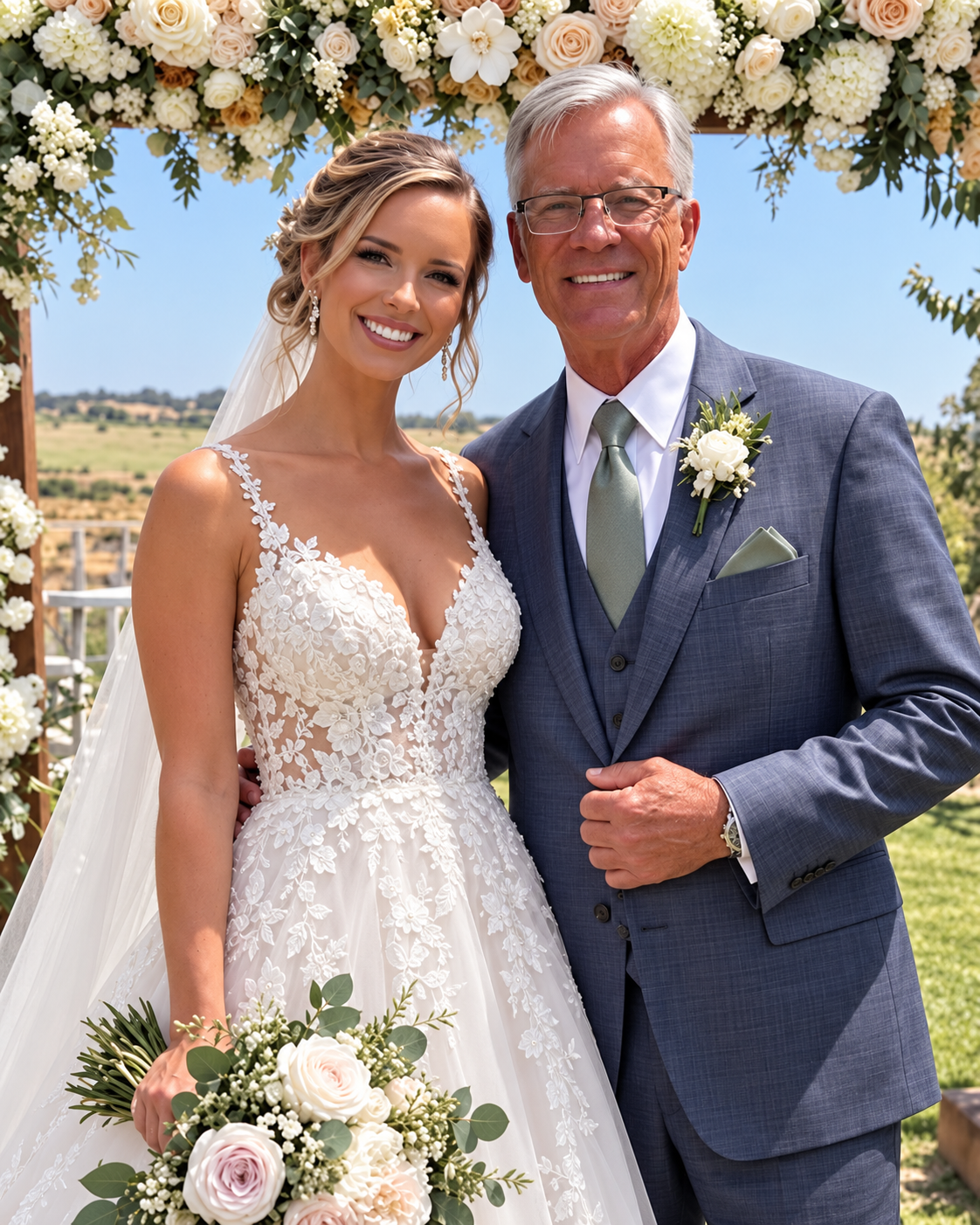
PART 1 TITLE: The Night I Married a Wealthy Old Man, I Learned That the Most Dangerous Secret in His House Concerned My Own Family
The first time my husband warned me that leaving him would not make me safe, we had been married for less than three hours. I was standing beside the enormous bed in his country estate, struggling with the buttons on a wedding dress that had cost more than three months of my salary. Arthur stood near the bedroom door, still wearing his dark wedding suit. He was seventy-six years old. I was young enough to be his granddaughter. And although I had agreed to marry him for financial security, I was beginning to suspect that money had never been the real reason he wanted me there.
He had been unusually quiet throughout the drive from the reception. When I asked whether he was tired, he gave the kind of answer people offer when they are trying to finish a conversation without telling a lie. Now, in the bedroom, he looked at me with an expression I could not place. It wasn’t tenderness or satisfaction. His left hand rested against the closed door, and I noticed the slight tremor in his fingers. Whatever he intended to tell me had been waiting much longer than our wedding day.
I asked whether something was wrong. Arthur didn’t answer immediately. Instead, his eyes traveled to the antique writing desk beside the window. He seemed to be deciding whether he had any right to open a particular drawer. Then he said that before I could understand our marriage, I needed to understand something about my father. I hadn’t spoken to anyone about my father in years. I hadn’t even told Arthur the whole story. Yet he said the word as though he had known the man personally.
To explain why that frightened me, I need to explain what my life looked like before I met Arthur. I grew up believing there were two kinds of girls: the ones people noticed when they entered a room and the ones people remembered only when they needed someone to embarrass. I belonged to the second group. I had an uneven smile, shoulders that curved inward whenever I felt watched, and an unfortunate habit of answering questions too quickly when I was nervous.
Children at school were particularly inventive about my appearance. A photograph taken during a class presentation became a joke that survived an entire semester. Someone once copied the way I walked and earned enough laughter to make our teacher stop writing on the board. I learned to keep my hair over part of my face and to avoid speaking in crowded hallways. On mornings when the bathroom mirror caught the light badly, I left home convinced that everyone would find something new to laugh about.
Home offered little relief. My mother worked long hours and returned exhausted, with little patience for questions about why I looked different from other girls or why I had no friends. She believed that most childhood problems disappeared when people stopped discussing them. If I came home upset, she asked whether I had finished my homework. If I cried, she reminded me that we had bills to pay. I don’t think she intended every silence as punishment, but I learned to experience them that way.
My father was the subject nobody wanted discussed. My earliest memories of him were fragmentary: his watch ticking against my ear when he carried me, the smell of paper and rain on his coat, and a tune he sometimes hummed without realizing it. Then he was gone. My mother said he had chosen to leave us. Later, when I asked whether he might return, she told me to stop waiting for a man who was effectively dead to our family. Eventually, I began telling people that my father had died.
There was one possession connected to him that I refused to give away. It was a small blue music box, its painted surface worn pale along the corners. I had owned it since I was eight, and I kept it wrapped in an old scarf whenever we moved. Its melody had become thin and slightly uneven over the years, but I could still recognize it after hearing only three notes. My mother disliked the box. She once caught me examining the underside and told me sharply never to tamper with its base.
I didn’t understand her reaction. The little brass screws looked ordinary, and I wasn’t trying to break anything. Still, the severity in her voice stayed with me. She took the box away for almost a week before returning it to my dresser, and afterward I treated it as something fragile. I wound it occasionally, listened until the music stopped, and put it away again. It was easier to preserve that small connection to my father than to ask questions that nobody answered.
By sixteen, I had become skilled at making myself unobtrusive. I chose seats near classroom walls, carried books against my chest, and pretended to be busy whenever groups formed for school projects. I had stopped expecting anyone to invite me somewhere simply because they wanted my company. Then Chloe sat beside me during a chemistry lesson and asked whether I understood an assignment. I explained it to her, expecting her to move away as soon as she had the answer.
She didn’t. She stayed through the entire lesson, then followed me into the corridor and continued talking about the experiment. Chloe was attractive in the effortless way that always seemed to escape me. She had a quick smile, a confident voice, and the ability to laugh at herself without worrying that other people might join in for the wrong reason. When two girls made a remark about my hair, Chloe turned around and asked them to explain the joke. Neither could.
After that, we began spending time together. She invited me to sit with her at lunch and called when she needed help studying. We went to inexpensive cafés, watched terrible movies, and argued about whether the endings made any sense. I discovered that I could be funny when I wasn’t terrified of being laughed at. Chloe liked my dry observations, and for the first time I had someone who noticed when I wasn’t in class. I mistook the relief of being included for proof that I was finally becoming someone different.
There were differences between us that friendship could not erase. Chloe had parents who remembered appointments, a house full of family photographs, and relatives who sent money on birthdays without being asked. She complained about her mother’s interference and her father’s insistence that she consider a business career. I listened without telling her how much I envied having two people interested enough to interfere. Her complaints were real to her, but the life surrounding them seemed astonishingly secure to me.
Occasionally, when we were alone, Chloe made remarks that left me uncertain how to respond. She would tell me that I was fortunate not to attract shallow men or that my plain clothes meant I didn’t have to worry about appearances. Once, before a school event, she offered to lend me a dress and added that nobody would recognize me if I made the effort. When I looked uncomfortable, she hugged me and insisted she had meant it kindly. I always accepted the explanation.
Our friendship continued through university. We rented a small apartment together, divided the bills, and learned the particular irritations of sharing a kitchen. Chloe could leave wet towels anywhere and somehow forget that they existed. I organized our expenses in a notebook because I was frightened of owing money I couldn’t repay. She laughed at the notebook but relied on it whenever the landlord questioned a payment. We were different, yet our days fitted together so naturally that I couldn’t imagine living without her.
During those years, my relationship with my family deteriorated further. My mother remarried and seemed relieved when I stopped visiting. My attempts to maintain contact often ended with reminders that I was old enough to support myself. When I asked about several belongings from childhood, she said she had already disposed of most of them. Fortunately, I had taken the music box with me when I first left for university. It sat in the back of my wardrobe, wrapped in the same faded scarf.
After graduation, Chloe announced that she intended to return to her hometown. Her family had contacts there, and she believed she could find work quickly. I congratulated her, then spent the evening staring at the thin walls of our apartment. I could remain in the university town, where I knew almost nobody, or return to a house where I had been made to feel unwelcome. Neither option felt like a future. Chloe noticed my silence and suggested that I look for jobs near her.
I followed her, although I knew how that decision might appear. I didn’t move into her family home or ask anyone to support me. I found a modest apartment above a row of shops, accepted an administrative position, and began building a life around work schedules and careful budgeting. But the truth was that I had chosen the city because Chloe was there. If she needed someone to meet for dinner, I came. If she canceled, I rearranged my evening without complaint.
My apartment was narrow and cold in winter. The bathroom tap leaked, the refrigerator made an alarming noise whenever the compressor started, and I could hear my neighbor’s television through the bedroom wall. Each month I placed rent money aside before buying groceries. I wasn’t starving, but unexpected expenses frightened me. When a dental bill arrived, I spent three evenings calculating which purchases I could postpone. I sometimes lay awake wondering how long a person could keep living so close to having nothing.
Chloe visited when she could. She brought food from her parents’ kitchen and described parties attended by people whose names appeared in business magazines. Occasionally, she invited me to family dinners. I refused the first few times because I didn’t own anything suitable to wear, but she insisted. She said her grandfather was lonely and would appreciate having someone new to talk to. I imagined a stern patriarch who would forget my name before dessert. Instead, I met Arthur.
He was sitting at the far end of a long dining table when Chloe introduced us. He wore a dark cardigan, and a pair of reading glasses hung from a cord around his neck. His hair was silver, but his gaze was startlingly attentive. While everyone else discussed a property development, he asked me what I had studied. I answered briefly. He followed with a question that showed he had listened. When I admitted that my job involved organizing records, he wanted to know what kinds.
I told him about the invoices, contracts, and payment schedules that filled my working days. He asked whether I enjoyed it. I said I liked work that required patience and careful attention, although it wasn’t particularly exciting. Arthur disagreed. He said people often discovered what mattered only after someone had taken the trouble to examine what everyone else considered boring. I thought he was being polite, but there was something deliberate about the remark. He watched my reaction before asking another question.
I began seeing him more often. Sometimes Chloe brought me to dinner. Other times Arthur invited me for tea when she was occupied. We sat in a library that smelled of old leather and furniture polish, with windows overlooking broad lawns and a garden maintained with almost military precision. Arthur liked tea served very hot and disliked anyone hovering over him. He would wave away an assistant and ask me to pour it myself, then complain good-naturedly if I made it too weak.
Our conversations moved gradually beyond work. He asked about university, the city I had left, and my plans. I found it difficult to speak about myself, and he seemed to recognize when a question made me uncomfortable. Instead of pressing, he often told me something from his own past. He spoke about business decisions he regretted and people he had trusted too easily. I learned that his family had once controlled several successful companies. I also learned that he disliked discussing what those companies had become.
After several visits, Arthur asked about my parents. I explained that my mother had remarried and that my father had been absent since childhood. I kept my answer short. Arthur rested his cup on its saucer and asked what sort of work my father had done. I told him I believed it had involved finance, although I knew little about the details. His expression changed so briefly that I nearly missed it. Then he asked whether I remembered my father’s full name.
I told him. Arthur repeated it quietly, as though testing the sound of it against a memory. When I asked whether it meant something to him, he said that he had encountered many people during his business career. He made no further comment, and I assumed the conversation had simply reminded him of someone. Looking back, I remember that he barely touched his tea afterward. He stared at the garden until I asked whether he wanted the curtains partly closed.
Six months passed in this way. Arthur was generous with his time but rarely offered money, which suited me. I was ashamed of needing help and even more ashamed of how intensely I admired his comfortable surroundings. The polished floors, quiet rooms, and unhurried meals represented everything I could not afford. Yet I enjoyed talking to him when the rest of the family was absent. He asked questions nobody else asked, and he never treated my answers as evidence that I was foolish.
Then my landlord informed me that the rent would increase when my lease expired. It wasn’t an impossible amount, but it destroyed the small margin I had worked so hard to preserve. I began looking at cheaper apartments farther from work. During one visit, Arthur noticed an advertisement folded inside my notebook. I tried to put it away. He asked whether I was planning to move, and I admitted that I might have to. He listened without offering the financial rescue I secretly wanted.
A few evenings later, he invited me to the estate on a day when Chloe would not be present. I arrived expecting another quiet conversation. Instead, I found him in the library with two cups of tea untouched beside him. He asked me to sit, then said he intended to make a proposal that I might find insulting. I laughed because I thought he meant a job or some arrangement involving household records. He corrected me without smiling.
Arthur asked me to become his wife. He explained that he understood the difference in our ages and had no intention of pretending that our marriage would resemble an ordinary romance. I stared at him, certain I had misunderstood. He spoke calmly about companionship, mutual respect, and the security his position could offer. I wanted to ask why he would choose someone like me, but a more shameful thought arrived first. I imagined never fearing another rent increase.
I looked at his hands resting on the polished table. They were old hands, marked by veins and age spots, yet steady enough to lift the teapot without spilling a drop. I knew there would be gossip. I knew Chloe might never forgive me. I also knew that Arthur possessed an estate, a family business history, and a reputation for considerable wealth. For years I had considered myself unwanted. Now someone powerful was offering me a permanent place in his life. I asked whether he understood what people would say about my motives.
Arthur said he understood more than I realized. He didn’t ask me to claim romantic feelings I didn’t possess, and he didn’t promise that everyone would approve. He simply wanted a considered answer. When I told him I needed time, he agreed. As I stood to leave, however, I noticed an old photograph partly hidden beneath a folder on his desk. He placed his hand over it before I could see more than a corner of a school building. At the time, I thought nothing of it.
Outside, the late-afternoon air was cool enough to make me pull my coat tightly around myself. I walked down the estate’s gravel drive with Arthur’s offer turning over in my mind. I knew what accepting would cost, even if I couldn’t calculate the price precisely. I would have to explain myself to Chloe, endure the judgment of people who barely knew me, and live beside a man old enough to have known my grandparents. Yet I could not stop imagining a home from which nobody could casually dismiss me.
That evening, I sat at my kitchen table and spread out the bills I had been postponing. Beside them lay my rental agreement and the notebook containing every expense I expected over the next three months. I tried to think of Arthur’s proposal without seeing the figures. I couldn’t. Then I went to the wardrobe and took out the blue music box. I wound it, listened to the thin, wavering melody, and wondered what my father would have thought of the decision I was considering.
By midnight, I had persuaded myself that affection could grow from respect and that security was a reasonable thing to want. I was still frightened, but fear had governed enough of my life. I picked up my phone and called Arthur. He answered after the second ring. I told him I would marry him. There was a long silence. Then he asked whether I was certain. When I said yes, he thanked me so quietly that I barely heard him. Only later would I understand that his relief had very little to do with acquiring a wife.
END PART 1
PART 2 TITLE: Chloe Called My Engagement an Unforgivable Betrayal, but Arthur’s Strange Behavior at Our Wedding Suggested Another Reason for His Urgency
I told Chloe about the engagement in the café where we had celebrated our university graduation. We sat at the same small table near the window, although the place had changed owners and the walls had been painted a darker color. I had rehearsed several ways to begin. None survived the moment she asked why I looked nervous. I placed my hands flat on the table and said that Arthur had proposed to me. She gave a surprised laugh. Then I told her I had accepted.
The laughter stopped. Chloe stared at me for several seconds before asking whether I was playing some kind of joke. I shook my head. She glanced toward the neighboring tables, lowered her voice, and asked whether her grandfather was ill. The question unsettled me because it sounded less like concern and more like suspicion. I told her I had no reason to believe anything was wrong with his health. She leaned back and folded her arms, her expression closing.
She wanted to know when the relationship had started. I explained that there had been no secret romance, no meetings designed to deceive her, and no sudden confession of passionate love. Arthur had made an offer, and I had accepted it after considering what marriage to him would mean. I tried to be careful with my words. Chloe listened until I mentioned security. Then she interrupted, asking whether I could hear how my explanation sounded.
I said I wasn’t pretending money had played no part. I had struggled financially for years, and Arthur knew that. We had discussed our expectations openly. Chloe looked toward the window, her jaw working as though she were trying not to say something cruel. Finally, she asked whether I imagined inheriting everything when he died. The bluntness embarrassed me. I said I hoped Arthur would live a long time, which was true, but I could not honestly deny that his wealth had influenced my decision.
Chloe pushed her untouched coffee away. She told me that she had defended me for years whenever people underestimated me, and that she had never believed I would use someone close to her for financial advantage. I wanted to remind her that I had never asked her grandfather for money. Instead, I asked whether she thought Arthur was incapable of making decisions for himself. She said he was perfectly capable, which made the situation worse. In her view, I should have refused even if he had asked a hundred times.
I watched her gather her handbag. There had been arguments between us before, but they had always ended with apologies, jokes, or messages sent too late at night. This felt different. I told her that I loved her and didn’t want to lose our friendship. She looked at me with an expression I recognized from childhood: the mixture of disappointment and embarrassment people displayed when they discovered that someone they had defended could behave badly.
Chloe said she could not remain friends with a woman who intended to marry her grandfather for his fortune. Then she left. I sat alone until a server approached to ask whether I wanted anything else. I paid for both coffees and walked home without opening my umbrella, although rain had begun to fall. By the time I reached my apartment, water had soaked through the shoulders of my coat. I stood in the hallway for a long time, trying to decide whether I had just destroyed the only lasting friendship in my life.
I called Arthur that evening. He listened while I explained what had happened. I expected him to express surprise or offer to speak with Chloe. Instead, he said that he had anticipated a difficult reaction. His certainty made me uncomfortable. When I asked why he hadn’t warned me more strongly, he said that some people could accept an unexpected decision only after they had exhausted their anger. I suggested postponing the engagement announcement. He said he would respect my wishes, but he didn’t think delay would help.
Over the following week, Chloe refused my calls. The messages I sent remained unanswered. I drafted an apology several times, deleting any version that sounded as though I regretted the marriage itself. I did regret hurting her. I regretted the way she had learned about it. But I was not prepared to surrender the future I had accepted simply because she thought I should. The distinction troubled me, especially when I remembered the many occasions on which she had helped me without expecting anything in return.
Arthur’s family received the news with controlled hostility. His relatives were too accustomed to expensive social occasions to raise their voices during formal conversations, but their politeness had edges. At a gathering arranged to discuss the wedding, Chloe’s mother, Eleanor, studied me over the rim of her glass and asked whether I had considered how much responsibility came with marrying someone of Arthur’s age. I said that I had. She smiled without warmth and asked whether I had ever cared for an elderly relative.
I admitted that I had little experience. Eleanor seemed pleased by the answer. She began describing the demands of medication schedules, medical appointments, and household management. I listened carefully because these were genuine responsibilities, regardless of her intentions. Arthur interrupted when she suggested that I might find the arrangement less attractive without the privileges of his estate. He said that he and I had already discussed practical matters. Eleanor’s fingers tightened around her glass before she changed the subject.
There was something unusual about the family’s conversations whenever finances arose. They discussed properties as though ownership were complicated, and Arthur’s business interests came up only in fragments. Eleanor once complained about delayed transfers from an account she described as belonging to the family. Arthur told her that it was not available for personal expenses. The exchange lasted less than a minute, but it silenced the table. Later, when I asked him about it, he said financial boundaries had become a persistent problem.
Arthur did not behave like a man enjoying a late-life romance. He was considerate, but his attention seemed focused on arrangements beyond the ceremony. He spent long mornings meeting legal advisers in the library. Documents arrived by courier and were taken into his private study. More than once, I saw him reviewing old files with the kind of concentration that made him forget whether he had eaten lunch. Whenever I entered, he closed the folder and asked about my day.
I wondered whether he was preparing a prenuptial agreement. I told myself that it would be reasonable. Arthur had assets to protect, and his family had every right to worry about someone newly arrived in their lives. Yet he had not asked me to sign anything beyond the ordinary marriage paperwork. When I raised the subject, he said that the estate had existing legal arrangements and that his advisers were reviewing them. He promised that I would be informed of anything requiring my signature.
The promise was not entirely reassuring. I had agreed to marry a man I respected, but there were obvious gaps in what I knew about him. Arthur had mentioned his late son, Chloe’s father, only occasionally. He said the man’s death five years earlier had caused serious difficulties for the family businesses. He never described those difficulties in detail. If I asked about them, his expression became distant, and he steered the conversation toward safer subjects. I assumed the loss remained painful.
Two weeks before the wedding, I visited Arthur while he was sorting through photographs. Some showed him as a much younger man, standing outside office buildings with people in dark suits. Others captured family celebrations, holidays, and formal dinners. I asked whether Chloe’s father appeared in any of them. Arthur found a picture and handed it to me. I recognized the resemblance immediately. Chloe had inherited her father’s eyes and the slight crookedness of his smile.
There were other people in that photograph whose names Arthur didn’t explain. One stood close to Chloe’s father, wearing an expression of easy confidence. Arthur studied the picture before putting it aside. When I asked whether the men had worked together, he said that businesses often became difficult to separate from families. It was an oddly evasive response. Then he turned the photograph facedown and asked whether I had chosen flowers for the ceremony.
I began to notice how often he questioned me about my childhood. His inquiries were never aggressive, but they returned to the same subjects: my father’s work, the places we had lived, and the possessions my mother had kept after he disappeared. He asked whether I had anything written in my father’s handwriting. I told him I had no letters. He appeared disappointed, although he tried to hide it. When I mentioned the music box, his pen stopped moving across the paper.
He asked me to describe it. I said it was painted blue, with a small mechanical tune and a base that had once been repaired. Arthur’s eyes remained fixed on me. He wanted to know whether I still owned it. I explained that it was packed among my childhood belongings. For a moment, he looked relieved. Then he asked whether anyone else knew where I kept it. I laughed nervously and said that a music box was hardly valuable enough to attract a thief.
Arthur didn’t laugh. He said only that objects sometimes mattered for reasons unrelated to their price. I thought he was being sentimental. He was old enough to have watched ordinary possessions become family keepsakes, and I assumed he understood why I had preserved something connected to my father. I didn’t ask why the question seemed so important. By then I had become accustomed to his habit of falling silent when a conversation approached something he did not want to explain.
As the wedding approached, I prepared to leave my apartment. Arthur suggested keeping the lease for a little while, even though the monthly cost worried me. He offered to cover the rent during the transition. I asked whether that was necessary. He said it would be useful to retain a place where my belongings could remain undisturbed until we had settled into married life. I found the suggestion considerate. I didn’t realize how important that decision would become.
I packed slowly, taking particular care with the things that reminded me of childhood. The music box remained in a small drawer beneath folded clothes. I decided not to take it to the estate until I had arranged my new room. I didn’t want an old, chipped object damaged during the move, and I was embarrassed by how little of my own I possessed. Most of the furniture belonged to the landlord. My life could be packed into a few boxes.
Chloe sent a message three days before the ceremony. For one hopeful moment, I thought she might be ready to talk. Instead, she asked whether I understood how humiliating the marriage would be for her family. She said people were already whispering that I had pursued Arthur deliberately. I started to explain that he had proposed, but stopped. She knew that. The accusation was not about the sequence of events. It was about the person she now believed me to be.
I wrote that I was sorry for hurting her but could not continue defending myself against motives she had already decided upon. After sending the message, I sat with the phone in my hand, waiting for her reply. None came. I considered showing the exchange to Arthur, then decided against it. I had made my choice and needed to accept its consequences without asking him to manage them. Even so, I hoped she might appear at the wedding and offer some small sign that our friendship had survived.
The ceremony took place in a private hall with high windows and pale flowers arranged along the aisle. There were fewer guests than I had expected. Arthur’s relatives sat together, dressed in dark suits and carefully chosen formal clothes. I recognized several faces from family dinners. Others were unfamiliar, although I could feel them studying me. No one from my family attended. Chloe was present, but she sat beside Eleanor and avoided looking in my direction.
I wore a simple ivory gown selected with the help of a seamstress Arthur recommended. It fitted beautifully, and I felt uncomfortable each time someone complimented it. The dress was elegant, but I couldn’t stop thinking about the cost. When I entered the room, Arthur stood waiting with his hands folded before him. He looked older under the strong light. Then he saw me, and his expression changed. He seemed relieved, almost painfully so, as though he had expected something to prevent the ceremony.
During the vows, I noticed that his attention kept moving toward the guests. He watched Eleanor when she shifted in her seat. He watched a tall man standing near the rear of the hall. At one point, his gaze met Chloe’s, and something unspoken passed between them. I wondered whether he was afraid his granddaughter might interrupt. She remained silent. When the officiant asked whether I accepted Arthur as my husband, I hesitated only long enough to hear someone cough behind me.
I said yes. Arthur answered with a firm voice, and the ceremony continued. His ring was warm from being held in the attendant’s hand. When I placed it on his finger, he briefly closed his eyes. We exchanged a restrained kiss, and polite applause filled the room. I looked toward Chloe. She was speaking quietly to her mother. I had imagined that marriage might make me feel as though I had crossed into a better life. Instead, I felt suspended between the security I had chosen and the friendship I had lost.
The reception passed in a blur of congratulations, formal photographs, and conversations that ended whenever I approached. Arthur remained beside me for much of the evening. He drank little and ate almost nothing. When I asked whether he felt unwell, he said he was simply tired. Near the end of the reception, I saw him speaking urgently with one of his legal advisers. The man handed him a sealed envelope, which Arthur slipped into the inner pocket of his jacket.
We left as daylight began to fade. The estate looked different at night, its windows bright against the dark grounds. Inside, the staff had prepared our rooms and placed fresh flowers on the bedroom table. I stood before the mirror, searching for the fastenings on my dress, while Arthur remained near the door. The silence stretched until I asked whether he was regretting the marriage. He shook his head and said that regret was not what troubled him.
He approached the writing desk, removed the envelope from his pocket, and placed it beside a drawer that was already partly open. Then he looked at me with an expression I had never seen during our months of conversation. He said there were facts he should have told me before the ceremony and that I might despise him once I heard them. I asked whether he had concealed an illness or financial trouble. He said neither explanation would make sense until I understood his connection to my past.
Arthur opened the drawer and removed an old photograph. He offered it to me without explanation. In the picture, Chloe and I stood outside our high school. I was holding a backpack against my chest, my eyes lowered toward the pavement. I remembered the day because someone had made an unkind remark immediately before the picture was taken. I had never seen this particular print. When I asked how he had obtained it, Arthur said he had been receiving information about my circumstances for years.
I felt the blood leave my face. He insisted that he had not followed me personally, but that someone had kept him informed of where I was living and whether I was safe. I demanded to know why a man I had met only six months earlier would have taken an interest in me as a teenager. Arthur looked down at the photograph, then back at me. He said that our meeting had not been the beginning of his concern. It had begun with a promise made to my father.
END PART 2
PART 3 TITLE: Arthur Knew Why My Father Vanished, but the Letter He Had Hidden for Years Raised a More Frightening Question
For several seconds, I could only look at Arthur. The photograph in my hand had been taken when I was seventeen, long before I knew him. I remembered the backpack, the cracked pavement outside the school, and Chloe laughing about something moments before the camera clicked. I remembered believing that nobody was paying attention to me. Yet Arthur had possessed this image for years. I placed it on the writing desk and asked him to explain what he meant by a promise to my father.
Arthur lowered himself into a chair. He moved carefully, one hand gripping the wooden armrest until his weight settled. The confidence he normally displayed at the dinner table had disappeared. He looked like an elderly man facing a conversation he had postponed beyond any reasonable excuse. When he finally spoke, he told me that my father had worked for one of his companies. Not as a junior employee, as I had always assumed, but as a financial director with access to its most sensitive accounts.
I asked when this had happened. Arthur said the trouble had begun approximately twenty-two years earlier. At that time, his companies were growing quickly, and he relied on a small group of executives to manage the increasing flow of money. My father was responsible for examining financial records, checking transactions, and questioning discrepancies. Arthur described him as patient, meticulous, and stubborn about details. The description startled me because it sounded uncomfortably familiar. Those were qualities I had spent years assuming nobody valued.
He told me that my father had discovered substantial sums disappearing from company accounts. The transactions had been concealed through complicated transfers, false expenses, and records designed to make stolen money look like legitimate business spending. At first, my father believed the irregularities might be errors. He continued examining them until the pattern became impossible to dismiss. Millions had been diverted, and the person responsible appeared to have access to information that only trusted members of the organization should have possessed.
I stood beside the desk, still wearing my wedding dress, trying to reconcile this account with the story I had heard throughout childhood. My mother had always described my father as unreliable. According to her, he had disliked responsibility and disappeared when family life became inconvenient. I had imagined him leaving with a suitcase, perhaps moving to another city and beginning a new life without us. Arthur was describing a man who had risked his career to investigate something dangerous. I asked why nobody had told me.
Arthur said that my father had intended to expose the theft. Before he could do so, someone learned what he had discovered. Threats followed, first indirectly and then with enough precision to make him believe they were serious. The people responsible knew where we lived. They knew my mother’s working hours. They knew which school I attended. Arthur paused before explaining that my father had been warned against involving the authorities. If he continued, his wife and daughter would be made to suffer.
The room seemed to grow smaller around me. I remembered my mother checking the front door repeatedly during one period of my childhood. I remembered her refusing to let me attend a birthday party because she said the journey was unsafe. Those incidents had always seemed like examples of her excessive worry. Now I wondered whether she had been frightened of something she couldn’t explain. Arthur watched me struggling with the memories and said he had no expectation that I would accept his account without evidence.
I asked whether the threats had come from someone outside the company. Arthur shook his head. The person responsible had been close enough to understand the business and the family. That was why the situation had become so difficult. My father could not simply approach the people who ordinarily handled internal investigations, because some of those people might already have been compromised. He had taken copies of important records and begun arranging a way to preserve them beyond the company’s control.
I wanted a name. Arthur told me that he would explain everything, but that I needed to understand what my father had been attempting first. I objected. I had spent nearly my entire life receiving fragments of information from adults who decided how much I deserved to know. I was no longer a child waiting outside a closed door. Arthur acknowledged my anger. Even so, he asked me to examine what he had brought before deciding whether to believe his account.
He opened the drawer again and removed a thin brown envelope. Its edges were softened by handling, and the flap had been carefully folded rather than sealed. Arthur placed it on the desk. He said the contents had come from my father during the period when the financial investigation became dangerous. I reached for the envelope, then hesitated. For years, I had wanted proof that my father remembered me. Suddenly, the possibility of finding it felt almost unbearable.
Inside were several papers. The first was a copy of a financial document with columns of figures and handwritten notes in the margins. Another contained dates and account references. Beneath them lay two photographs, one showing people gathered outside an office building. The last item was a folded letter. I recognized the handwriting before I read a word. My father had written my name on birthday cards when I was little, and I remembered the distinctive way he formed certain letters. I sat down because my knees had begun to tremble.
The letter was addressed to his daughter. He wrote that if the message ever reached me, he had probably been prevented from returning home. He wanted me to know that whatever explanation I had been given, he had not left because he stopped loving me. He had uncovered criminal activity at work, and the people involved had threatened our family. He had made a decision he hoped would keep us alive, even though it might mean losing the chance to watch me grow up.
I read the letter slowly. There were places where the handwriting became less even, as though my father had been writing in a hurry. He mentioned my mother and begged that I not blame her for the choices she might have to make afterward. He wrote that he hoped I would grow into a woman with opportunities he could no longer promise to provide. Near the bottom, he named Arthur as someone who understood the danger and might be able to help if circumstances became desperate.
I had imagined discovering a message from my father countless times. In those imaginary conversations, he apologized for abandoning us. I asked why he had been willing to forget me. He struggled to explain himself, and I decided whether to forgive him. The letter destroyed those rehearsed scenes. It suggested that he had left because remaining might have endangered us. I wanted to believe every word, but believing it meant accepting that my childhood had been shaped by deliberate concealment.
I asked Arthur whether my father was alive. He did not pretend to know. He said he had learned of my father’s disappearance and had spent years without reliable information about what happened afterward. The distinction mattered. My family had treated my father’s absence as something settled, as though a man could simply be erased from conversation until everyone agreed he no longer existed. Arthur was telling me that the circumstances remained unresolved. I asked whether anyone had ever identified a body. He said there had been no confirmation he trusted.
I looked again at the letter. My father had written about danger, but not about giving up hope. He had expected someone to understand why he disappeared, even if I could not. I thought of the years I had spent examining my appearance in mirrors, searching for evidence that I was somehow defective. I had imagined my father rejecting me because I was disappointing. Now those memories seemed to belong to a child who had been trying to explain events far beyond her understanding.
Then another thought displaced the grief. Arthur had known something about my father long before our first conversation in his library. He had asked questions about my childhood while already possessing answers I desperately needed. He had listened as I described feeling abandoned and had allowed me to continue believing it. I set the letter down and asked why he had remained silent during all those afternoons together. The question came out more quietly than I intended, which made it no less serious.
Arthur said he had wanted to be certain of my circumstances before revealing anything. The explanation angered me. I asked whether he had considered what certainty had cost me. He admitted that he had been afraid of exposing me to danger before understanding who might still be involved. I reminded him that I had been living independently, working, and making decisions for years. He answered that independence did not prevent someone from becoming a target. I told him that neither did ignorance.
I asked how long he had known where I was. He said he had received occasional information while I was growing up, including details about my schooling and living arrangements. He insisted that the purpose had been to ensure I remained safe. I asked whether he had ever considered speaking to me directly. He had, he said, but every attempt seemed to carry risks. I told him that whatever his intentions, keeping watch from a distance was not the same as helping a frightened child understand her life.
He accepted the criticism without arguing. I found that more upsetting than if he had defended himself. Arthur was accustomed to making decisions that other people obeyed, yet he seemed unable to explain why this particular decision had been right. I asked whether my father had personally requested that I be kept uninformed. Arthur hesitated. He said my father had wanted me protected, but that many of the choices made afterward had been his own. His admission left a heavy silence between us.
I rose and walked toward the bedroom door. The house beyond it was quiet. Somewhere downstairs, a clock struck the hour. I imagined removing the wedding dress, collecting my handbag, and returning to my apartment before morning. I had entered this marriage because I believed it would provide a stable future. Instead, Arthur had made me question almost everything I knew about the past. I told him I wanted to leave. He looked alarmed, although he made no attempt to block the door.
Arthur said leaving the estate would not necessarily remove the danger. The people who had threatened my father had never stopped wanting the records he had collected. Some of the evidence had disappeared with him, and those involved were still trying to determine where it had been hidden. I asked how he knew they were still searching. He said there had been inquiries, indirect approaches, and attempts to locate people connected to the old investigation. He had reason to believe that my marriage had renewed their interest.
I turned to face him. I asked whether our wedding had been intended to protect me or to draw someone into the open. Arthur said he wanted to prevent certain people from gaining control of what remained of his business interests, but he refused to explain the legal arrangements in full. He admitted that he had made decisions about our marriage with knowledge I did not possess. I told him that was a serious betrayal. His response was that he understood why I would see it that way.
I pressed him for the identity of the person responsible for the theft. He said the matter was more complicated than a missing sum of money. There had been records altered, employees pressured, and relationships destroyed by the efforts to conceal what happened. The original evidence might establish not only who had stolen from the company but also who had helped suppress the investigation. Arthur said he had preserved copies of several documents, yet one crucial piece had remained beyond his reach.
He looked directly at me and said my father had entrusted that final piece to me. I almost laughed. I had been a child when he disappeared. I knew nothing about corporate accounts or financial crimes. I told Arthur that whatever my father had intended, I had never received a folder of documents or been given instructions about an investigation. Arthur asked whether I was certain. I reminded him that I had kept only a few objects from childhood, none remotely valuable.
He asked me to think about anything my father had given me or anything my mother had insisted I preserve. I considered an old photograph album, a small necklace, and the box of letters I had once found among my mother’s belongings. None seemed important. Then I remembered the music box. I thought of my mother’s reaction when she discovered me examining the screws beneath it. The memory was so ordinary that I had never associated it with danger.
Arthur watched my expression change. He asked whether the music box had been painted blue. I nodded. He described its size, the pattern around the lid, and the small compartment beneath the mechanism. I stared at him. Nobody outside my family should have known those details. Arthur said my father had arranged to conceal something inside the box, where it could remain unnoticed among a child’s possessions. I asked what exactly had been hidden there. He said he believed it contained information the people responsible had never managed to recover.
I remembered carrying the music box from one home to another. It had sat beneath my bed at university and later inside my wardrobe, never receiving more than casual attention. I had protected it because it reminded me of my father. I had not known that someone else might value it for a very different reason. Arthur asked whether the base had ever been opened. I said no. My mother had forbidden it, and I had never found a reason to disobey.
Arthur asked where the box was now. I told him it remained in my apartment, inside the drawer where I kept a few childhood belongings. He stood so quickly that his chair shifted against the floor. He wanted us to go there immediately. I asked whether waiting until morning would matter. Arthur said that if the wrong person had learned of our marriage, the apartment might no longer be secure. I looked toward the window, imagining someone searching through the small rooms I had left only hours earlier.
I told him we should contact the police. Arthur agreed that authorities would eventually need to be involved, but he said the evidence first had to be secured and examined by people who understood what they were handling. His reluctance made me uneasy. I wondered whether he feared that someone within the investigation might still be protecting the thief. He did not answer when I suggested it. Instead, he asked me to put the letter back inside its envelope and keep it with me.
I folded the papers carefully. My hands were steadier now, although I could feel a headache developing behind my eyes. I had entered this room expecting an awkward first evening with a husband I barely knew. I was leaving it with evidence that my father had been threatened, that Arthur had concealed the truth for years, and that an object in my old apartment might connect both men to an unresolved crime. I no longer knew whether I could trust Arthur, but I knew I could not abandon the chance to discover what had happened.
As I reached for my handbag, my phone began ringing. The number was unfamiliar. Arthur stopped beside the desk and watched me answer. At first, I heard only a faint sound of traffic and someone breathing near the receiver. Then a man’s voice spoke. He said I should have accepted the financial arrangement and disappeared instead of becoming Arthur’s wife. I demanded his name. He ignored the question and told me that the elderly man beside me had concealed more than I could imagine.
The call ended before I could respond. Arthur asked what the caller had said, and I repeated the warning. His face lost its color. He reached for the back of the chair, steadying himself, and told me not to touch the bedroom door. Somewhere on the floor below, a door closed with enough force to echo through the hallway. We stood listening. Arthur turned toward the sound, then looked at me with a fear I had never seen in him before. He said that the people searching for my father’s evidence had reached the estate.
END PART 3
PART 4 TITLE: A Voice on the Phone Warned Me About My Husband, and the Man Who Entered Our Bedroom Explained Why I Had Been Chosen
The silence after the downstairs door slammed seemed to last longer than the sound itself. I held my phone against my chest, listening for footsteps. Arthur remained near the writing desk, his gaze fixed on the bedroom entrance. We had been married that afternoon, and I was still wearing the dress he had helped me choose. Only minutes earlier, I had been wondering whether our marriage could survive the truth about my father. Now I was wondering whether someone had entered the house because of me.
I asked Arthur whether the estate had security. He said there were arrangements in place, but he did not know who had opened the downstairs door or why it had been allowed to close so violently. Most of the household staff had finished their work after the wedding. I remembered seeing lights in the entrance hall when we arrived, and I tried to recall whether anyone had been waiting there. My attention had been on the staircase and the awkwardness of returning to the estate as Arthur’s wife.
Arthur moved toward the door and turned the key. The sound of the lock engaging made me feel no safer. He asked me to remain away from the entrance while he examined something in his private safe. I told him that I was tired of being instructed without explanation. He stopped and looked at me. I said my father had disappeared after people decided what I should and shouldn’t know. My mother had continued that silence. Arthur had done the same. I would not cooperate blindly again.
He accepted the rebuke. His face was drawn, and the effort of standing seemed greater than it had been earlier that evening. He told me that if someone had entered the house looking for the missing evidence, there might be little time to establish what they already knew. He needed to retrieve records that had been kept secure for years. I asked why he had not shown them to me with the letter. Arthur said the documents were part of a larger collection, some of which he feared could endanger people if handled carelessly.
He crossed the room toward a painting hanging beside the fireplace. I had noticed it during earlier visits because it seemed oddly modest among the expensive furnishings. Arthur lifted it from its hook, revealing a small safe built into the wall. He entered a combination and opened the heavy door. Inside were several envelopes, a packet of documents, and a black case about the size of a thick book. He removed the case and carried it to the writing desk.
The case had a metal clasp and a surface worn smooth at the corners. Arthur opened it just far enough for me to see papers, an old photograph, and a small electronic device. He said the contents came from the original investigation into the missing company funds. Some had been provided by my father before he vanished. Others had been collected afterward. I reached toward the papers, but Arthur asked me to keep the collection together until he could explain how the pieces related to one another.
I asked whether the case contained enough evidence to identify the thief. He said it might, particularly when combined with what remained hidden inside the music box. The two collections had been separated for a reason. My father had feared that a single discovery could destroy everything he had gathered. Arthur said he had preserved the records because he wanted the truth established before anyone connected to the theft could acquire control of the estate or its business interests.
I looked at him sharply. Until then, I had assumed the marriage was intended to provide companionship and a secure home. Arthur was describing a complicated arrangement involving financial evidence, family property, and people willing to intimidate anyone who challenged them. I asked whether he had planned to tell me all this before the ceremony. He looked toward the door and said that he had intended to explain once the legal arrangements were in place. I told him that intention did not excuse the deception.
A faint movement came from the corridor. It was not the sound of someone walking past the room. I heard a shoe scrape against the floor, followed by a pause. Arthur closed the black case and placed it in my hands. It was heavier than I expected. He told me not to give it to anyone without knowing exactly who was asking. I asked whether he intended to call the police. He said he would, but first he needed to understand who had entered the house.
I moved toward the telephone beside the bed. Arthur reached out as though to stop me, then withdrew his hand. He knew I would interpret another unexplained prohibition as confirmation that he wanted control over me. I called the emergency number and reported that an unauthorized person appeared to have entered the property. I gave the estate’s location, explained that we were upstairs, and said that we believed someone might be approaching our room. The operator instructed us to remain in a secure place.
Arthur listened as I gave the information. When I finished, he nodded, but his expression remained troubled. He said that whoever was downstairs might know the estate well enough to avoid the staff and the ordinary security arrangements. That possibility made the hallway feel less like part of a familiar home and more like a place containing someone who had already planned his movements. I kept the black case against my body and searched the room for somewhere to stand beyond the direct line of the door.
The handle turned. Once, slowly, then again with greater force. Someone tried the locked door and stopped. Arthur asked who was there. There was no answer. I heard a brief movement, perhaps a step backward, followed by a low sound of someone speaking too quietly for us to distinguish the words. The handle moved again. I told the emergency operator what was happening. Arthur stood between me and the door, although I could see that his age made him poorly suited to confronting an intruder.
I asked whether there was another way out. Arthur indicated a narrow door leading toward the dressing room, but he said it did not provide a separate exit from the upper floor. I considered opening a window, then rejected the idea when I looked at the distance to the ground. The house was large, and the bedroom had always seemed wonderfully private. That privacy now worked against us. Nobody downstairs could hear us without being near the room, and I had no idea whether help was already on the way.
Arthur told me to place the documents out of sight. I refused to let them leave my hands. He asked me to trust him for a few minutes. I said trust was exactly what he had failed to earn. For a moment, he looked as though he might argue. Instead, he said that whatever happened next, I must remember that my father’s disappearance had never been proof that he stopped loving me. The remark was so unexpected that I almost forgot the person outside the door.
I asked whether Arthur was preparing to tell me something worse. He glanced toward the black case and said there were decisions he had made years earlier that he wished he could reverse. I wanted to ask what those decisions were, but the door shook under a sudden impact. I stepped backward. Arthur raised his voice and ordered the person outside to identify himself. This time, a man answered. He said Arthur knew perfectly well who had come to visit.
The voice sounded familiar, though I couldn’t immediately place it. I had heard it during family gatherings, among the confident conversations of men who discussed investments and business opportunities as though other people’s lives were numbers on a balance sheet. The man outside said there was no reason to involve the police. Arthur answered that anyone attempting to enter a locked bedroom had already provided a very good reason. Then the man struck the door again.
I wondered whether the caller and the intruder were the same person. The voice on the phone had seemed prepared, almost rehearsed, while the man outside sounded impatient. I looked at my phone and saw the unfamiliar number still displayed in the recent-call list. I memorized it as best I could. Arthur noticed what I was doing. He said quietly that keeping a record of every contact would matter if we survived the immediate confrontation without losing the evidence.
Another impact made the doorframe creak. I moved behind the writing desk, gripping the black case so tightly that its metal edge pressed into my palm. Arthur told the intruder that the authorities had been contacted. The man laughed and said that Arthur had always been fond of making threats when he lacked better options. That remark revealed something the telephone caller had not. Whoever was outside knew Arthur intimately enough to challenge him without hesitation.
The latch finally gave way. The door opened abruptly, striking the wall. A tall man entered, breathing heavily, with his suit jacket hanging open and his expression fixed in irritation rather than fear. I recognized him from family gatherings. Everyone referred to him as Uncle Daniel, although the title came from his place within Chloe’s extended family rather than any relation to me. He had spoken to me briefly before the wedding and had seemed friendly enough. Now his eyes went immediately to the case in my hands.
Daniel’s first words were directed at Arthur. He asked whether the old man had finally decided to tell me what the marriage was really about. Arthur stood straighter, despite the strain visible in his face. He said Daniel had no right to enter our room. Daniel dismissed the objection with a glance at the broken latch. Then he looked at me and asked whether I understood what I was holding. I said I had been told the papers concerned a financial investigation. His expression changed.
He asked whether Arthur had mentioned my father. I told him that he had. Daniel gave a short laugh that contained no amusement. He said Arthur had always preferred to reveal the part of a story that made himself appear honorable. I looked toward my husband. Arthur’s jaw tightened, but he did not interrupt. Daniel seemed encouraged by the silence. He moved closer to the desk and said there were details Arthur would never volunteer unless someone forced him.
I asked Daniel why my father had been threatened. He looked surprised that I knew that much. Then he said that my father had been good at his job, perhaps too good for his own safety. He had examined financial records that other employees ignored. He had continued asking questions after being advised to leave certain accounts alone. Daniel spoke about those decisions with contempt, as though my father’s insistence on accuracy had been an unforgivable inconvenience.
I felt anger rise beneath my fear. I told him that discovering stolen money was not a reason to threaten a man’s family. Daniel studied me for a moment, then said that people who interfered with important business arrangements often failed to appreciate the consequences. Arthur told him to stop. Daniel ignored him. He said my father had been warned repeatedly, and that the warnings might have ended the matter if he had been willing to cooperate.
I asked whether Daniel had personally known my father. He said he had worked with him for years. They had attended meetings, reviewed company accounts, and disagreed about financial decisions. I asked whether Arthur had known about those disagreements. Daniel replied that Arthur had known more than he was prepared to admit. I looked between the two men, trying to understand why neither seemed surprised by the other’s accusation. They were not discovering a shared history. They were resuming an argument that had been suspended for decades.
Daniel reached toward the black case. I stepped back, keeping the writing desk between us. He told me that the documents belonged to the company and that I had no authority to retain them. I answered that if they were ordinary corporate records, he could explain their contents to the authorities. His face hardened. Arthur moved closer to my side and told Daniel that the evidence would not be surrendered. Daniel responded that Arthur had already caused enough trouble by interfering with the company’s future.
I asked what he meant by the company’s future. Daniel said that Arthur had spent years preventing legitimate decisions because he believed the old investigation could still damage the family. He described money tied up in complicated arrangements and properties that could not be transferred without legal review. His resentment was immediate and personal. Whatever had happened to my father, Daniel’s concern now appeared to be the wealth he expected Arthur to leave behind.
Arthur told me that certain inheritance arrangements had existed before the wedding. Under those arrangements, Daniel stood to acquire substantial control over family assets if Arthur died without changing his legal position. Daniel looked irritated but did not deny it. Arthur said the marriage had altered the situation. Legal documents prepared before the ceremony protected the estate from immediate transfer while outstanding financial questions were examined. The arrangement also placed me in a position Daniel had not expected to confront.
I stared at Arthur. He had never mentioned that marrying him would affect another person’s inheritance. He had spoken of security, companionship, and a future in which I would no longer struggle to pay rent. He had not explained that my presence as his wife might prevent Daniel from taking control of the remaining family assets. I asked whether that had been one of his reasons for proposing. Arthur hesitated long enough to answer before he spoke.
Daniel laughed when he saw my expression. He said I had believed I was entering a wealthy family and securing my own inheritance. In reality, he claimed, Arthur had married me to interrupt the distribution of his estate. The prospect of money had made me useful. Daniel said the wedding had achieved something a legal argument alone might not have managed quickly enough. I looked at Arthur, waiting for him to contradict the accusation. He did not.
I asked whether there had ever been an inheritance intended for me in the way I imagined. Arthur said that the marriage had not been designed to make me wealthy. His estate and business interests were entangled with legal questions, and the arrangements he had made were intended primarily to prevent Daniel from obtaining control before the old financial wrongdoing could be examined. He said he had wanted to protect me as well, but he could see that the explanation offered little comfort.
I thought of the wedding reception, the empty seats where my family might have sat, and Chloe’s expression when she learned about the engagement. I had accepted Arthur’s proposal partly because I wanted a life without constant financial fear. I had been ashamed of that motive, but at least I had acknowledged it when he asked. Arthur had known his own intentions from the beginning. He had watched me struggle with guilt over Chloe while withholding the information that could have changed my decision.
I told him he had made me part of a conflict without asking whether I was willing to take that risk. Arthur said he believed the danger existed before our marriage and that becoming his wife offered protection. I asked whether he had considered that the marriage itself might make me a more obvious target. He looked at Daniel, then returned his attention to me. He admitted that he had underestimated how quickly the people involved might act.
Daniel said Arthur had underestimated nothing. According to him, the old man had known precisely what he was doing and had chosen a woman unlikely to question the arrangement until it was too late. I wanted to reject the insult, but I could not forget the questions Arthur had asked about my father or the care with which he had concealed the photographs and documents. Our relationship had contained genuine conversations. That did not mean he had been honest about why he encouraged them.
I asked Arthur whether he had deliberately approached me because of my father’s connection to the investigation. He said that he had wanted to know me, but he could not deny that the past influenced his decision. I asked whether he would have proposed if I had not been my father’s daughter. He looked exhausted. For a long moment, he said nothing. Then he admitted that he could not answer the question in a way that would make me feel better.
The answer hurt more than I expected. I had never truly believed Arthur married me because I was beautiful or charming. I knew our relationship was unconventional, and I had accepted that affection might take a different form from romance. But I had believed he respected me enough to allow an honest choice. Now I understood that he had presented me with a future while concealing the circumstances that made it necessary for him.
Daniel took another step toward the writing desk. He said we had discussed the marriage long enough and demanded the black case. Arthur moved between us. The two men faced each other at close range, one angry and impatient, the other old and visibly tired but unwilling to retreat. I looked at the broken bedroom door, the papers scattered across the desk, and the envelope containing my father’s letter. There was no simple way to separate my marriage from the old crime anymore.
I asked Daniel one final question before he could reach for the case again. I wanted to know whether he had been involved in the missing money my father had discovered. He looked at Arthur first, as though deciding whether another denial would serve any purpose. Then he turned back to me. The confidence in his face settled into something colder. He said my father had uncovered payments Daniel had arranged for his own benefit, and that the investigation had threatened to expose him.
I stared at the man who had attended our wedding and offered polite congratulations only hours earlier. He had stood among Arthur’s relatives while I promised to become part of their family. Now he was admitting that he had helped create the danger surrounding my father’s disappearance. I asked what had happened after my father refused to abandon the investigation. Daniel’s eyes moved toward the case again. He said my father should have understood that protecting his family required knowing when to stop.
Arthur ordered him to remain where he was. Daniel ignored the warning. I tightened my grip on the case and looked toward the corridor, hoping the authorities would arrive before the confrontation became physical. But another question was already forming, one I could no longer avoid. If Daniel had stolen from the company, and Arthur had known about the danger for so many years, what exactly had Arthur done when my father disappeared?
Then Daniel looked straight at me and said that my father had not simply walked away. Someone had arranged for him to vanish, and the man standing beside me knew how it had happened. Arthur’s expression changed. He did not deny the accusation. Instead, he asked Daniel to leave me out of what had occurred years earlier. Daniel smiled and said that was no longer possible.
I turned toward Arthur, waiting for him to explain. He had promised to protect me. He had married me without revealing why. He had known my father, preserved his letter, and watched my life from a distance while I believed myself abandoned. Now Daniel was suggesting that my husband’s involvement reached beyond concealment. I asked Arthur whether he had helped make my father disappear. The question seemed to drain the remaining strength from him. He lowered his eyes, and for the first time since the wedding, I was afraid of the answer more than I was afraid of Daniel.
END PART 4
PART 5 TITLE: Arthur Finally Confessed What Happened the Night My Father Disappeared, but His Admission Exposed a Betrayal Neither of Us Could Undo
Arthur kept his eyes lowered for so long that I began to think he might never answer. Daniel stood beside the broken bedroom door, watching him with an expression of grim satisfaction. I was still holding the black case, its metal clasp pressing painfully into my palm. I repeated my question, this time more slowly. Had Arthur helped arrange my father’s disappearance? My husband lifted his head. The answer was yes. He had assisted my father in leaving the city, provided money, and arranged transportation to a place where he was supposed to remain beyond Daniel’s reach.
For a moment, the admission seemed to remove every sound from the room. I had imagined many explanations for my father’s absence, but never one in which the man I had married had personally helped him disappear. I asked Arthur why he had not told the police. He said he had believed that exposing the arrangement would reveal my father’s location to the people threatening him. I reminded him that I had spent my childhood believing my father had abandoned us. Arthur closed his eyes briefly and said that this was the consequence he had never managed to forgive himself for.
Daniel gave a contemptuous laugh. He accused Arthur of presenting a cowardly decision as an act of protection. According to Daniel, the company had been facing serious financial difficulties, and a public investigation would have endangered employees, investors, and the family’s reputation. My father had refused to consider those consequences. Arthur interrupted, saying that theft could not be justified by the inconvenience of being discovered. Daniel answered that Arthur’s principles had developed considerably since the night he agreed to help remove the man who had uncovered the missing money.
I demanded to know how the arrangement had been made. Arthur told me that my father had telephoned him after receiving a threat involving my school. He had discovered that someone knew my classroom schedule and the route I walked home. Arthur arranged for a driver to collect him outside the city and take him to a private property several hours away. The house belonged to someone Arthur trusted. My father was supposed to remain there until the immediate danger passed and a safer way to disclose the evidence could be established.
I asked whether my mother had known. Arthur said she had been told that my father needed to leave temporarily, although he could not say how much she understood about the investigation. The plan had been to keep us somewhere safe while Arthur found a way to stop Daniel. Instead, the situation had become more complicated. The records my father had copied were incomplete, and several people who might have supported his account suddenly refused to speak. Arthur had begun to suspect that the theft involved more than the transactions my father initially uncovered.
Then something went wrong. My father reached the temporary house, but he disappeared from there before Arthur’s arrangements were complete. Arthur said the owner reported finding the property empty, with no signs of a struggle. My father had taken a small bag and left behind several personal belongings. Arthur searched for him through private contacts and received occasional information suggesting that he remained alive. None of it was reliable enough to establish his location. Eventually, those reports stopped. Arthur had never discovered where he went.
I stared at him, trying to understand how a man with his wealth and influence could accept such uncertainty for decades. Arthur said he had not accepted it. He had spent money, followed leads, and approached people who might have known something. Yet he had also avoided a public investigation because he feared the consequences for the company and my family. That admission mattered more than his assurances that he had searched. He had chosen which risks were acceptable, and I had lived with the results without ever being consulted.
Daniel claimed that Arthur had concealed the disappearance to protect himself. He said the elderly man knew the company’s accounts would reveal questionable transactions authorized during the same period. Arthur didn’t deny that his signature appeared on some documents. He said the payments had been intended to protect people caught in the investigation, not to enrich himself. Daniel asked whether he expected a court to distinguish between authorized payments and money diverted without explanation. The exchange made me realize that both men understood the financial records far better than either had admitted.
I asked Daniel whether he had threatened my father. He hesitated, and I saw the calculation pass across his face. He said the company had been under enormous pressure and that conversations could become unpleasant when people refused to cooperate. I told him that threatening a child’s safety was not an unpleasant conversation. His expression hardened. He asked whether Arthur had actually shown me proof of who made the threats. I answered that he had already admitted arranging unauthorized transfers. Daniel said that financial decisions were not the same as admitting violence.
My phone was still connected to the emergency operator. I had nearly forgotten it until the voice on the line asked whether the intruder remained in the room. I answered yes and described Daniel, who turned toward me with sudden anger. He demanded that I end the call. I refused. The operator instructed me not to approach him and said officers were responding. Daniel glanced toward the corridor. Until that moment, he had behaved as though his position within the family placed him beyond ordinary consequences. Now he seemed less certain.
Arthur moved closer to the desk, putting himself between Daniel and me. Daniel ordered him aside. He insisted that the black case contained company property and that removing it from the estate would compromise its legal status. I told him the contents could be examined by the authorities and that he had no reason to fear an investigation if his explanation was truthful. He looked at the case, then at the open safe. I understood that he was considering whether he could reach either before help arrived.
He lunged toward the desk. I stepped backward, striking my hip against a chair, and the case slipped against my ribs. Arthur grabbed Daniel’s sleeve, but his grip was too weak to restrain him. For an instant, all three of us were caught in a clumsy struggle involving the chair, the case, and Arthur’s attempt to keep Daniel away from me. Then a voice sounded from the corridor. Someone ordered us to separate. Two officers appeared beyond the broken door, one with a hand near the equipment on his belt.
Daniel stopped immediately. He straightened his jacket and began explaining that the incident was a private family disagreement. Arthur’s hand remained braced against the desk. I could see him struggling for breath. An officer directed Daniel away from us while the other asked whether anyone was injured. I told them that Daniel had forced his way into our room and attempted to take documents from me. I showed them the damaged doorframe and explained that I had called because we believed someone had entered the estate without permission.
The officers separated us to establish what had happened. I gave my account in the adjoining sitting room, where the remains of the wedding decorations were still visible through the doorway. One of the officers asked about the black case. I explained that it contained documents connected to a suspected financial crime and the disappearance of my father many years earlier. He asked me not to alter anything and said investigators would need to assess the records through the proper process. I agreed, although surrendering the case without understanding its contents frightened me.
Daniel protested loudly when the officers questioned him about the damaged door. He claimed Arthur had become confused and that he had been trying to prevent valuable records from disappearing. I could hear fragments of his explanation through the open sitting-room door. The officers did not immediately accept or dismiss his claims. They documented the damage and took our statements. Daniel was eventually escorted away for further questioning, still insisting that the matter would be resolved once his lawyers became involved.
When the noise subsided, I returned to Arthur. He was sitting in the bedroom, his jacket open and his hands resting on his knees. I asked whether he needed medical attention. He said he was exhausted but otherwise unharmed. I called for someone to examine him anyway. His age had never seemed particularly important during our conversations in the library, but the struggle had revealed how vulnerable he was. I watched him attempt to stand and wondered whether the marriage he had arranged had placed him in danger as well as me.
Arthur apologized. I asked him to be specific. He looked at me for a long moment before saying he was sorry for concealing his role in my father’s disappearance, for approaching me without explaining the connection, and for allowing me to enter a marriage whose legal consequences I had not understood. The apology was more complete than anything he had offered before. It did not settle my anger. I told him that he had treated my trust as something he could request after making the important decisions alone.
He said he had believed marriage would protect me from the people who wanted my father’s evidence. He had also wanted someone legally connected to him who could insist on an independent review of the estate if he became incapacitated or died. His advisers had warned him that changing the existing arrangements would provoke opposition. Marrying me had been his attempt to create an additional safeguard while giving me the financial security he knew I needed. I asked why he had not simply told me. He admitted that he feared I would refuse.
The answer made me feel strangely calm. I had spent so many years imagining that people rejected me because there was something inadequate about my appearance or personality. Arthur had approached me because I was connected to a problem he desperately wanted to resolve. My loneliness and financial insecurity had made his proposal attractive, and he had known it. I told him that whatever else happened, he would never again use my circumstances as permission to withhold information. He agreed without asking whether I intended to remain his wife.
Not long afterward, Chloe arrived at the estate. She came through the entrance hall with her coat half-buttoned and her hair disordered, looking unlike the carefully composed woman who had attended the ceremony. Eleanor had heard that the police were there and contacted her. Chloe found me in the sitting room and demanded to know whether her grandfather had been attacked. I told her Arthur was safe, then explained that Daniel had entered our bedroom and tried to take documents connected to my father’s disappearance.
Her expression changed when I mentioned my father. She asked what I meant. I told her that he had worked for Arthur’s company and vanished after discovering financial misconduct. Chloe looked toward the staircase. For a moment, she seemed less concerned with my marriage than with the possibility that her family history contained something she had never been told. She asked whether Arthur had known my father before we became friends. I said yes. Then I told her about the photograph he had kept of us outside our school.
Chloe sat down slowly. She remembered that photograph, although she could not recall who had taken it. She asked whether Arthur had arranged for us to become friends. I said I had no evidence of that. Our friendship had begun naturally, and I was unwilling to rewrite every memory simply because Arthur had concealed other things. Still, I admitted that his interest in my life had begun long before our introduction. Chloe rubbed her forehead and said she no longer understood what her grandfather had been doing.
I wanted to ask her whether Daniel had ever spoken about my father, but she seemed overwhelmed. Instead, I asked whether anyone in her family had mentioned a blue music box. She looked up sharply. The movement was brief, but I noticed it. I explained that the box might contain records my father had hidden before disappearing. Chloe asked whether I still had it. I told her it was in my apartment. She lowered her eyes and said she needed to speak with Arthur.
Before she could leave, I asked why she had reacted to the box. Chloe said she remembered it from university. She had seen it on my dresser and heard its melody when I occasionally wound it. She added that she hadn’t known it was connected to the company investigation. I believed that part. Her confusion seemed genuine. But I had known Chloe long enough to recognize when she was holding something back, and I told her that this was not a night for protecting anyone through silence.
She said we should speak privately after the police had finished. I refused to promise that I would conceal anything relevant to the investigation. Chloe looked wounded, but she did not argue. For the first time since our disagreement at the café, she seemed to understand that I was no longer asking her to approve of my choices. I needed the truth, even if it damaged the last remaining pieces of our friendship.
Arthur’s lawyer arrived shortly before midnight. He examined the documents, spoke with the officers, and explained that evidence connected to a historical financial crime required careful preservation. He recommended securing the case, recording who had handled it, and arranging a formal review through investigators independent of the family’s business interests. I insisted that my father’s disappearance be treated as seriously as the financial records. The lawyer agreed that the matters appeared connected, although the available evidence was not yet sufficient to establish exactly how.
I asked Arthur whether he had told anyone that the music box remained in my apartment. He said he had mentioned it only to me, although people in the household might have overheard parts of our conversations. Chloe was standing near the doorway when I asked. She looked away. I realized that the box was the one item Daniel had wanted badly enough to risk entering our bedroom. If someone knew where it was, waiting until morning could give them time to reach it.
I told the officers about the box and asked how best to protect it. They advised me not to return to the apartment alone or confront anyone I suspected of searching for it. One officer took down the address and said the information would be passed to the investigators handling the complaint. Arthur’s lawyer offered to arrange for the apartment to be secured and for the item to be documented once recovered. I insisted on being present. It was my property, and I no longer intended to let others make decisions about it without me.
Chloe offered to accompany me. I asked why she wanted to come. She said she knew how important the music box had been to me at university and didn’t want it damaged or lost. I studied her face. Earlier that evening, I would have welcomed the offer without question. Now I wondered what she knew about the object and whether her desire to help came from friendship, guilt, or fear. I told her I would contact her after speaking with the investigators.
We left the estate in a car arranged by Arthur’s lawyer. The driver knew the address, and I spent most of the journey watching unfamiliar streets pass under the streetlights. My wedding dress had been replaced with ordinary clothes borrowed from the estate, but the ring remained on my finger. I kept turning it with my thumb. By the time we reached my apartment building, the hour was approaching two in the morning. I had never felt so far from the quiet life I had occupied only a day earlier.
The building’s entrance was locked. The superintendent met us after a telephone call and accompanied us upstairs. My apartment door showed no obvious signs of force, but the lock turned more easily than I remembered. Inside, everything appeared ordinary at first. A cup stood beside the sink. My notebook lay open on the kitchen table. The curtains were still drawn as I had left them. I walked toward the bedroom, aware of the others following several steps behind.
The wardrobe door was partly open. I knew I had closed it before leaving for the wedding. I pulled out the lower drawer and moved the folded clothes aside. The faded scarf was there, but the music box was gone. I searched the surrounding drawers, although I already knew it would not be there. Then my phone vibrated. Chloe’s name appeared on the screen. I answered without speaking. Her voice was unsteady as she told me that she had the box, and that she had taken it because Daniel had asked her to.
END PART 5
PART 6 TITLE: Chloe Returned the Music Box She Had Taken, and the Evidence Inside Forced Her to Choose Between Her Family and the Truth
I held the phone away from my ear for a moment, uncertain whether I had understood Chloe correctly. The drawer remained open in front of me, its folded clothes pushed aside and the faded scarf lying across my knees. Behind me, Arthur’s lawyer was speaking quietly with the superintendent. I asked Chloe when she had entered my apartment. She said she had come the day before the wedding, using the spare key I had given her months earlier when a leaking pipe threatened to flood my kitchen. She had never returned that key.
I felt an anger sharper than anything I had experienced during our argument about the marriage. Chloe knew how protective I was of the few belongings connected to my father. She had watched me carry that music box from one apartment to another. She had listened to its uncertain melody when we lived together at university. I asked how she could have entered my home and taken something so personal without asking me. She answered that Daniel had convinced her the object might be connected to Arthur’s deteriorating judgment and the strange circumstances surrounding our engagement.
I told her that explanation made no sense. Chloe admitted that it sounded absurd now, but insisted she had been frightened. Daniel had approached her several days earlier, claiming that Arthur was concealing important family documents and that I might be helping him remove them from the estate. He said an old object in my possession could establish whether Arthur was being manipulated. Chloe knew about the music box and mentioned it. Daniel immediately became interested. He asked her to retrieve it discreetly before the wedding.
I asked why she hadn’t confronted me. Chloe said she had already decided that I was marrying her grandfather for his money. The more she thought about the engagement, the easier it became to believe that I might be involved in something dishonest. She hadn’t wanted to hear another explanation. Daniel had told her the investigation was a private family matter and that involving me would only encourage Arthur to destroy evidence. She admitted that she had accepted his account because it matched what she already wanted to believe.
I closed my eyes. The betrayal was painfully ordinary beneath all the extraordinary circumstances. Chloe had not entered my apartment because she hated me. She had allowed resentment to make her careless with my rights. She had listened to a man she trusted, ignored the obvious questions, and persuaded herself that protecting her family justified stealing from her closest friend. I told her I wanted the box returned immediately, but that I would not meet her alone or conceal how she obtained it.
Chloe agreed. She said she had kept the box at her own apartment rather than handing it to Daniel. That morning, he had telephoned three times demanding it. When she told him she wanted to speak with Arthur first, he became angry and accused her of jeopardizing the family’s inheritance. His reaction frightened her. She had begun to suspect that he wanted the box for reasons unrelated to my marriage. After learning that the police had been called to the estate, she realized she needed to tell me what she had done.
I asked whether she had opened it. She said no. The box remained exactly as she had found it, wrapped in a clean towel inside a cupboard. I told her to leave it there until arrangements could be made for its recovery. Arthur’s lawyer listened while I described the conversation. He advised contacting the officers handling Daniel’s intrusion and arranging a documented transfer rather than allowing the box to pass through several more hands without a record. For once, I was grateful to have someone explain a procedure without insisting that I surrender control.
The superintendent changed the lock on my apartment door before we left. I insisted that the old key be retained and documented because Chloe had used a copy without permission. The action felt harsh, especially given our history, but the friendship I remembered could not excuse what had happened. I had trusted her with access to my home during an emergency. She had used that trust to remove something valuable to me because another family member asked her to. There was no way to make that harmless by calling it a misunderstanding.
We returned to the estate shortly before dawn. Arthur had been examined by a medical professional and instructed to rest. His lawyer told him where the box had been found, and I watched his face carefully. He appeared relieved but not surprised that Daniel had tried to obtain it through someone close to me. I asked whether he had suspected Chloe’s involvement. Arthur said he had considered the possibility after seeing her reaction to the box. He had not wanted to accuse his granddaughter without evidence. I told him that protecting her feelings had nearly cost us the object my father had preserved.
Arthur accepted the criticism. He seemed more willing to listen now that his secrecy had become impossible to defend. I asked him whether Daniel knew exactly what was hidden inside the box. Arthur said he doubted it. My father had been careful not to place all his evidence in a single location. Daniel might know that the music box mattered without understanding the method used to conceal its contents. Arthur had never opened it himself. He said my father had specifically instructed that the object remain untouched unless the investigation became unavoidable.
I asked why the evidence had been left with a child. Arthur said my father believed that an ordinary possession would attract less attention than a briefcase, bank account, or formal document. He had also wanted to leave something that could remain close to me without exposing me to the underlying danger. I struggled with the explanation. My father may have intended the music box as protection, but its hidden contents had placed me at risk without my knowledge. I wondered how differently my life might have unfolded if someone had explained even a small part of the truth.
Later that morning, Chloe surrendered the box to the investigators through an arranged meeting. I was present with Arthur’s lawyer. She arrived pale and exhausted, carrying a plain shopping bag. She placed it on the table and removed the towel wrapped around the familiar blue wooden case. For a moment, I forgot the argument and saw only the scratches along its lid, the small brass winding key, and the faded flowers painted around the edges. It looked exactly as it had when I was a child.
Chloe said she was sorry. I asked whether she was apologizing for stealing the box or for discovering that Daniel had deceived her. She seemed hurt by the distinction, but after considering it, she admitted that both were true. She had violated my privacy before learning anything about the financial investigation. Even if the box had contained nothing, she would still have been wrong. I appreciated that admission more than the tears gathering in her eyes. It was the first time since our engagement argument that she had accepted responsibility without defending her intentions.
An investigator photographed the music box and documented its condition. Because it might contain evidence connected to financial offenses and a long-unresolved disappearance, the decision was made to have it examined carefully rather than force the base open. I was asked to describe its history, including my mother’s warning about the screws beneath it. I explained that I had never attempted to remove the mechanism. The investigator recorded the detail and asked whether I knew of anyone else who might have handled the box. I said my mother had possessed it before I took it to university.
The examination took place the following afternoon. By then, the wedding felt like something that had happened weeks earlier. I had barely slept, and the ring on my finger seemed increasingly unfamiliar. Arthur remained at the estate under medical advice. Chloe stayed away from him at his request while investigators gathered statements about Daniel’s actions. His lawyers were already challenging the allegations, but the damaged bedroom door, the emergency call, and his attempt to seize the case were being documented independently of the historical financial investigation.
I accompanied Arthur’s lawyer to the examination. The music box was placed on a clean work surface under bright lighting. Its mechanism was old but well preserved, and the person examining it worked slowly to avoid damaging the wood. When the base was removed, I saw a shallow space beneath the musical movement. It was narrower than I had imagined, barely deep enough for a few folded papers. Yet something had been fitted into it with extraordinary care.
Inside was a small sealed packet wrapped in protective material. The examiner photographed it before removing it with a pair of fine instruments. There was also a narrow brass key and a folded strip of paper. The packet contained several pieces of photographic film bearing images of financial documents. Their details were too small to interpret with the naked eye. The paper contained a sequence of numbers, an account reference, and a short note written in the handwriting I recognized from my father’s letter.
The note instructed whoever found the evidence to compare the transfers with the original authorizations. It warned that a signed payment order did not always identify the person who ultimately received the money. Beneath that sentence, my father had written that the truth depended on following the funds beyond the company’s internal records. The words were practical rather than sentimental. I could almost imagine him sitting at a desk late at night, attempting to leave instructions that would remain useful long after he was no longer there to explain them.
I asked about the brass key. The examiner said its markings might identify a secure storage compartment or deposit facility, although no conclusion could be drawn without further research. Arthur’s lawyer recognized a sequence stamped near its head and said it resembled an older form of numbered storage key. He would ask investigators to determine whether the numbers corresponded to any institution associated with the accounts in the documents. I resisted the urge to take the key. Every object had become evidence, and I understood that preserving it mattered more than satisfying my immediate curiosity.
The film was examined and copied using appropriate equipment. The first images showed portions of company ledgers, account statements, and transaction authorizations. Several records carried Arthur’s signature. Others contained initials associated with people who had worked for the company during the period before my father’s disappearance. The amounts varied, but a pattern emerged: money had passed through several business entities before reaching accounts that did not appear to belong to the stated recipients.
One series of transactions was particularly troubling. It showed substantial payments approved for financial consulting, property services, and administrative work. Yet the accompanying descriptions were vague, and several recipient companies had been registered only months before the transfers began. My father had marked these entries with small handwritten symbols. The symbols corresponded to the account numbers on the folded paper. He had been building a map of the money, leaving enough information for someone else to reconstruct the path.
Arthur’s lawyer explained that the records were evidence of suspicious activity, not proof of every person’s guilt. Some signatures might reflect legitimate authorization based on false information supplied by others. Other signatures could establish direct involvement. Investigators would need bank records, corporate filings, and independent verification before drawing conclusions. I listened carefully. I no longer wanted reassuring interpretations. I wanted an account that could withstand scrutiny, even if it revealed wrongdoing by people I had once trusted.
Then an image appeared that included Eleanor’s name. It was attached to an instruction authorizing payment through an account described as a family support arrangement. The paperwork referred to a dependent and contained a date from the year my father disappeared. The amount was far larger than anything my mother had ever received, as far as I knew. Eleanor’s signature appeared beside a notation confirming that the recipient details had been verified. I asked why Chloe’s mother would have been involved in a payment connected to my family.
Arthur’s lawyer said the document alone could not establish the purpose of the payment. He would need to determine whether Eleanor had been acting in an official capacity or signing on behalf of a family-controlled account. I asked whether the money could have been intended for my mother. He said that was possible. It might also have been part of the attempt to conceal the missing funds. The uncertainty made me uneasy because the document placed another person close to Chloe inside the financial arrangements surrounding my father’s disappearance.
I asked whether Eleanor had ever managed Arthur’s businesses. The lawyer said she had handled selected administrative responsibilities after marrying Arthur’s son, particularly when family property and charitable accounts required coordination. She had not been a financial director, but she had access to information that ordinary relatives would not. I remembered Eleanor questioning my ability to care for Arthur during the engagement dinner. At the time, I had thought her hostility came entirely from concern over inheritance. Now I wondered what else she had feared I might discover.
The final film images contained a document bearing my father’s own handwriting. It listed several transfers and ended with a notation about an address. The location was partially obscured, but enough remained to identify a property outside the city. Arthur’s lawyer recognized the general area as one where the family had once maintained business holdings. I asked whether it could be the house where my father had been taken. He said he couldn’t know. The investigators would have to compare it with the records Arthur had preserved.
That evening, I called my mother. We had spoken only occasionally since she remarried, and I expected her to answer with the weary impatience I remembered. Instead, she sounded almost frightened when I told her I needed to discuss my father. I said I had learned about his work and the financial investigation. There was a long silence. Then she asked who had told me. I said Arthur. She repeated his name as though it carried a meaning I had never understood.
I asked about the blue music box. My mother inhaled sharply. She wanted to know whether I still had it. I said investigators had examined it and discovered documents hidden beneath the mechanism. She made a small sound I couldn’t interpret. Then she asked whether I had shown the contents to Eleanor. I told her no, and asked why Eleanor mattered. My mother told me not to speak to that woman alone under any circumstances.
I demanded an explanation. My mother said there were things she had agreed to keep private because she believed silence would protect me. She admitted that Eleanor had visited her after my father disappeared and brought paperwork connected to financial assistance. I asked whether she had signed anything. My mother said yes. I asked whether she had received money. She answered that she had received some, but not the amount shown in the documents. Her voice began to shake as she tried to explain.
I told her I wanted to see every paper she had kept. She said she had destroyed most of them after being warned that retaining copies could create problems. I asked who had issued that warning. She hesitated, then said Eleanor had been the person who delivered it. I felt the old anger returning, but this time it was directed at something larger than my mother’s refusal to discuss the past. She had allowed me to believe my father had abandoned us while other adults exchanged documents and money over his disappearance.
My mother began crying. She said I didn’t understand what had happened and that she had believed people who promised to keep us safe. I told her I could no longer accept that as a complete answer. Then I asked whether my father had contacted her after leaving. She went silent again. I could hear the faint hum of a television in the background. Finally, she said there had been messages, but that she had been instructed not to respond.
I asked who had instructed her. She did not answer immediately. When she spoke again, she said my father had once written that someone close to Arthur’s family was watching our movements. He had warned her against making contact until he could establish whom to trust. She said she had spent years expecting him to return, then gradually stopped believing that he would. I asked whether she still possessed those messages. After another long pause, she admitted that she had kept a small number hidden.
I told her I was coming to see her and that the documents needed to be preserved. She begged me not to involve Chloe. I asked why. My mother said Chloe’s family had been connected to the original threats in ways she had never fully understood. She had known about my friendship with Chloe during university, but by the time she learned who Chloe’s grandfather was, she had been too frightened to interfere. She feared that drawing attention to the connection would expose me again.
After the call, I sat with the copied records spread before me. My childhood memories were beginning to form a different picture: my mother’s abrupt silences, the forbidden music box, the money she never explained, and the strange coincidence of my friendship with Chloe. I did not know which parts were connected by intention and which were the result of decisions made under fear. But I knew that Eleanor had played a role larger than the one she presented at family dinners.
Then Arthur’s lawyer telephoned with information about the key. Investigators had traced its markings to a private deposit facility associated with an institution that had handled several of the suspicious transfers. The compartment had been registered under an arrangement established during the period of my father’s disappearance. Its access records were incomplete, but the registration included a name Arthur recognized. It was not my father’s name, nor was it Daniel’s. The account had been opened under Eleanor’s authority.
END PART 6
PART 7 TITLE: My Mother’s Hidden Letters Revealed Why She Lied for Twenty Years, While Eleanor’s Private Records Pointed Toward Someone Still Alive
When Arthur’s lawyer told me that Eleanor’s name appeared on the deposit registration, I immediately wanted to confront her. He advised against it. The records were historical, and possession of a storage compartment did not by itself establish involvement in theft or threats. Investigators needed to determine who had access, what had been stored, and why the arrangement remained active after so many years. I understood the caution, but patience had become difficult. Eleanor had questioned my motives, criticized my marriage, and behaved as though she knew nothing about my past.
I asked how the brass key could have ended up in my father’s possession if Eleanor controlled the account. The lawyer explained that the institution’s older records were incomplete and that the key might have been issued to an authorized representative before the facility changed its procedures. My father had worked with sensitive company documents, so he might have encountered the compartment during an audit. But the explanation remained speculative. Until investigators obtained access records and examined the storage arrangement, no one could say whether he had placed anything there himself.
I returned to Arthur with the new information. He was resting in the library, a blanket across his knees and a glass of water on the table beside him. The room looked much as it had during our first conversations, but I could no longer see it as a place where an elderly man had simply enjoyed my company. Every shelf and locked drawer seemed capable of holding another withheld truth. I told him about Eleanor’s deposit account and watched him consider the information without immediate surprise.
Arthur said Eleanor had been entrusted with selected administrative duties while his son was alive. The family’s businesses had grown too complicated for one person to supervise, and he had delegated responsibilities to relatives whose judgment he believed he could trust. He knew that Eleanor had handled payments and records connected to family-controlled accounts. He did not remember authorizing her to establish a private storage arrangement for the investigation. His uncertainty made me wonder how many decisions had been made under his authority without his understanding their consequences.
I asked whether he had suspected Eleanor of helping Daniel. Arthur admitted that he had questioned her judgment over the years, but he had never established the full extent of her involvement. She often presented herself as someone trying to preserve family unity after difficult events. He had accepted that explanation more readily than he should have. I asked whether he had ever questioned the money supposedly paid to my mother. Arthur said he had approved financial assistance, but the figures shown in the recovered documents were larger than the amounts he remembered authorizing.
The discrepancy mattered. If Arthur was telling the truth, someone had redirected part of the money intended to support my mother and me. If he was lying, the payments might have been part of his own effort to keep us silent. I told him both possibilities remained open. He nodded and said investigators should examine his role as thoroughly as anyone else’s. I asked whether he would cooperate even if it meant exposing his own decisions. He said yes, although I could see the difficulty of that promise in his face.
I went to see my mother the following morning. She lived in a modest house outside the city, where a row of identical windows faced a narrow garden. I had visited only a handful of times since she remarried. She opened the door before I knocked twice. Her hair had grown thinner, and she looked older than I remembered. She studied my face, then glanced toward the street as though checking whether someone had followed me. I told her that I had come alone.
We sat at the kitchen table. The room smelled faintly of coffee and furniture polish, familiar scents from my childhood. My mother had prepared tea, but neither of us touched it. I told her I needed the complete story, beginning with the first time she learned my father was in danger. She folded her hands together and stared at the table. For several minutes, she spoke in fragments, returning repeatedly to how frightened she had been. I listened, but I did not allow her to avoid the questions.
She said my father had become increasingly anxious during the months before he disappeared. He worked late, carried documents home, and warned her not to discuss his job with anyone. At first, she thought he was under ordinary professional pressure. Then he began checking the street before leaving the house. One evening, he found a note attached to the windshield of his car. It contained my school’s address and the time classes ended. After that, he insisted that my mother collect me personally whenever possible.
I remembered those weeks only as a period of unnecessary restrictions. I had been angry that I couldn’t visit friends without permission. My mother said my father wanted to contact the police, but he feared that someone inside the company might learn of the complaint before protective arrangements were made. He had spoken with Arthur, whom he believed could help separate the investigation from the family. Arthur promised resources and temporary shelter. My father accepted because he thought the danger would last only until the financial records could be examined independently.
My mother opened a kitchen cupboard and removed a small metal tin. Inside were several folded letters, an old photograph, and a receipt stained along one edge. She said she had kept them hidden through two moves and her second marriage. I stared at the papers. They were not valuable in the ordinary sense, yet they contained answers I had spent most of my life searching for. I asked why she had never shown them to me. She said that every time she considered it, she remembered the threats.
The first letter was from my father. It had been written shortly after he left home. He described the temporary property where he was staying and said he expected to make contact again once the situation was safe. He asked about me, including whether I was still frightened by thunderstorms and whether I had learned the song he used to play on the music box. Those small details nearly undid me. I had spent years wondering whether he remembered my birthday. He had been worrying about whether I slept well.
The second letter was shorter. My father wrote that the location arranged for him could no longer be trusted. He believed someone had learned where he was staying and had begun watching the property. He did not accuse Arthur directly, but he expressed concern that information was passing through people who should not have known his movements. He planned to leave without informing everyone involved. He promised to contact my mother again when he found somewhere secure.
I asked whether she had shown the second letter to Arthur. She said no. At the time, she had begun doubting everyone connected to the company. Eleanor had visited shortly after the letter arrived and offered financial assistance in exchange for keeping certain matters private. My mother was told the payments would continue while the investigation remained unresolved. She was also asked to sign documents acknowledging that my father had left voluntarily. She claimed she initially refused.
Eleanor returned several times. According to my mother, she became less sympathetic when the first assurances failed to persuade her. She warned that public accusations could harm my father’s chances of returning and might expose me to further danger. My mother said Eleanor never openly threatened to hurt me, but she repeatedly referred to where I went to school and how difficult it would be to protect a child if the situation became public. Eventually, my mother signed the paperwork.
I asked how much money she received. She named an amount that had seemed substantial to her at the time but was far smaller than the sum shown in the recovered authorization. She said some payments stopped unexpectedly, and when she questioned Eleanor, she was told the family had fulfilled its obligations. My mother had no lawyer and no access to the underlying accounts. She was frightened, isolated, and supporting a child alone. I understood how those circumstances made her vulnerable. I still struggled to understand why she had continued hiding the truth after I became an adult.
She told me that shame had become part of the silence. Once she had allowed me to believe my father abandoned us, explaining what happened would require admitting that she had accepted money and signed documents she did not fully understand. Each year made the confession more difficult. She had watched me grow angry with a man who might have been trying to protect us, and she had been unable to correct the story without confronting her own role in it.
I asked whether she had ever loved my father. The question surprised her. She looked toward the window before answering. She said she had loved him deeply, but fear and resentment had changed the way she remembered him. She blamed him for bringing danger into our lives, even though she knew he had not intended it. Over time, telling me he had chosen to leave became easier than explaining that she did not know whether he was alive. I told her the easier explanation had caused damage she could not measure.
My mother lowered her head. She did not ask me to forgive her. For once, she seemed to understand that an apology would not restore the years I had spent believing myself unwanted. I asked to take the letters so investigators could examine them. She agreed. Before placing them back in the tin, she showed me one more item: a postcard without a return address. The handwriting was my father’s, and the message was brief. He said he was safe enough to continue living, but not free to return.
The postcard had been sent several years after his disappearance. Its date contradicted the assumption that he had vanished immediately into some unknown tragedy. He had remained alive long enough to write after the original investigation began to fade from public memory. I asked whether there had been later messages. My mother said there were none she could verify. She had received occasional anonymous calls, but the callers never identified themselves. She had learned to stop answering unfamiliar numbers.
I asked about the phone call I received on my wedding night. My mother listened carefully as I repeated the warning. She said she did not recognize the words, but she believed someone had been watching developments around Arthur’s estate. The marriage might have disrupted financial arrangements that were still important to Daniel. I told her that Arthur had admitted helping my father leave and that Daniel had acknowledged arranging suspicious payments. My mother covered her mouth, then asked whether Arthur had finally decided to testify.
I said he had promised to cooperate with investigators. She seemed relieved, but I could not tell whether that relief came from hope or exhaustion. Before leaving, I asked her one final question: had she known Chloe’s family was connected to my father’s disappearance while we were friends? She admitted that she had eventually discovered the connection. She had wanted to warn me, but feared drawing attention to us. I told her that withholding the truth had left me vulnerable to the very people she feared.
When I returned to the city, investigators were examining the recovered financial records alongside the documents from my mother’s tin. Arthur’s lawyer arranged for copies to be preserved and for the original letters to be handled carefully. The correspondence provided a clearer timeline of my father’s movements after he left home. It also established that the support payments and confidentiality documents were not simply family gossip. There were signatures, dates, and account references that could be compared with the records hidden in the music box.
Chloe called that afternoon. She had learned that investigators wanted to interview Eleanor. Her mother was angry and claimed that Arthur had become confused about events from decades earlier. Chloe said Eleanor wanted the family to present a united front against what she called an opportunistic attempt to reopen settled matters. I asked Chloe whether she believed that explanation. She hesitated, then said she no longer knew what to believe. I told her the documents existed regardless of anyone’s preferred interpretation.
Chloe asked to meet. We sat in a quiet room at Arthur’s lawyer’s office, where nobody from the family could interrupt. She looked exhausted. She said she had begun reviewing old family photographs and remembered how frequently Daniel visited when her father was alive. He had always been treated as someone whose advice mattered, particularly in financial decisions. After her father’s death five years earlier, Daniel became even more involved in family affairs. Chloe had assumed he was helping Eleanor manage responsibilities that had become overwhelming.
I asked whether she had ever heard her parents discuss my father. Chloe said no, at least not by name. She remembered arguments about company records and old obligations, but she had been young when the original investigation occurred. Her father disliked discussing business conflicts at home. She said she had spent much of her adult life accepting her family’s explanations because questioning them seemed disloyal. Now she was beginning to see how easily that loyalty had been used to prevent uncomfortable questions.
I told her about Eleanor’s visits to my mother. Chloe looked sick. She insisted that her mother had never described participating in a financial settlement connected to a missing employee. I believed she was telling the truth about what she knew. That did not excuse the way she had treated me, but it changed the conversation. For the first time, we were both examining the possibility that people we loved had concealed serious wrongdoing. Chloe asked whether I intended to accuse Eleanor publicly. I said I intended to let the evidence determine what could be proved.
We agreed that investigators should interview Eleanor without either of us attempting to negotiate privately. Chloe offered to provide access to family correspondence and financial records she lawfully possessed. She also agreed to give a complete statement about Daniel’s request for the music box, including the messages he had sent and the timing of her visit to my apartment. I told her that cooperation mattered, but it would not automatically repair our friendship. She said she understood. I wasn’t certain she did, but I appreciated that she did not demand forgiveness.
Several days later, investigators obtained the necessary authorization to examine the private deposit arrangement. The institution confirmed that the compartment had remained active through regular payments made from an account associated with Eleanor’s administrative responsibilities. The brass key corresponded to an older access mechanism, although the facility had since changed its procedures. Its continued operation suggested that someone still considered the contents important enough to preserve. I wondered whether Daniel knew what Eleanor had stored there.
The compartment contained several sealed envelopes and a collection of financial records. Some documents duplicated material from the music box, but others extended the transaction history and identified accounts that had received money after my father vanished. There were records of payments to intermediary companies associated with Daniel. There were also documents suggesting that part of the money intended for my mother had been diverted into accounts she had never controlled. The pattern did not prove every allegation, but it gave investigators concrete paths to follow.
Then they found a packet of correspondence. Most letters were old, but one envelope carried a much more recent date. It had been received only eighteen months earlier and stored with the older documents. The handwriting resembled my father’s, and the contents referred to details of the original investigation that had not been made public. The letter warned that the financial wrongdoing remained unresolved and that the people involved were still benefiting from arrangements established years before.
The letter also contained a personal message. My father wrote that he had continued following my life from a distance and regretted allowing me to believe he had forgotten me. He knew I had completed university and begun working. He described the pain of watching those milestones from afar without being able to share them. He said the silence had become harder to justify with every passing year, but that he still feared the consequences of returning before the financial records were secured.
I read the verified copy in Arthur’s lawyer’s office. My hands shook as I reached the final paragraph. My father had written that if the evidence ever reached the right people, he wanted the opportunity to explain his choices to me himself. He did not ask for forgiveness in advance. He understood that I might hate him for remaining away. He only wanted me to know that his absence had never meant indifference.
The letter had not established where my father was living, and investigators still needed to authenticate its origin. But it transformed the question that had haunted me since childhood. I had spent years asking why my father abandoned me. Now I was looking at evidence suggesting that he had survived for decades and had continued trying to ensure the truth could eventually be established. The possibility was almost too large to trust.
Arthur’s lawyer approached me after the examination. He said investigators had identified a continuing financial arrangement linked to the more recent correspondence. The payments passed through a legal structure created years earlier, but the person authorized to receive them had submitted updated identification within the last year. Investigators were working to establish whether that person was my father. I asked whether they had a name. The lawyer said they did, but it was not the name my father had used when he lived with us.
END PART 7
PART 8 TITLE: The Man Living Under Another Name Had a Message for Me, and Arthur Finally Faced the Cost of His Silence
The name on the financial records meant nothing to me. It belonged to a man whose identification had been updated within the previous year and whose payments were processed through a legal arrangement established long after my father disappeared. Investigators were examining whether the documents reflected a genuine identity change or merely another layer of concealment. I stared at the unfamiliar name, trying to imagine my father answering to it, signing it on official forms, and building a life in which nobody knew he had once been my father.
Arthur’s lawyer cautioned me against treating the records as proof that he was alive. Documents could be renewed by representatives, payments could continue after someone died, and identities could be misused. The recent letter was encouraging, but its handwriting and origin still required verification. I understood every qualification. Yet after years of being told my father had chosen to disappear, even the possibility of finding him felt like a door opening onto a room I had never believed existed.
I asked whether investigators could contact the person receiving the money. The lawyer said they were already tracing the arrangement through its administrators and would need to establish whether the recipient was willing and legally able to communicate. The payments were connected to a private structure rather than an ordinary personal account. That complexity had helped preserve the man’s anonymity. It also made the arrangement difficult to examine without disturbing information that might expose someone who had been living under threat.
I returned to the estate that evening. Arthur was sitting in the library when I arrived, surrounded by files he had asked his lawyer to retrieve. He looked older than he had on our wedding day, although only a short time had passed. The confrontation with Daniel, the police investigation, and the possibility of his own involvement becoming public had exhausted him. When he saw me, he attempted to rise. I told him to remain seated and placed a copy of the recent letter on the table.
Arthur read it carefully. His expression changed when he reached the passage mentioning my university graduation. He ran a finger along the edge of the paper, then looked up. I asked whether he recognized the handwriting. He said it resembled my father’s. I asked whether he had known that my father was alive eighteen months earlier. Arthur said he had not received that letter and had not been informed of the more recent financial arrangement. I wanted to believe him, but his previous omissions made every answer difficult to accept.
I asked how my father could have followed my life from a distance. Arthur admitted that he had occasionally arranged for information about my education and circumstances to reach a trusted intermediary connected to the original investigation. He said the intermediary had promised to pass updates along if contact with my father was ever reestablished. Arthur had never received reliable confirmation that the information reached him. I asked why he had not told me about that arrangement. He said he had feared raising hopes he could not fulfill.
I told him he had made that decision for me just as he had made so many others. He had decided what I could bear, what I should know, and which risks justified keeping me uninformed. He had considered my protection without ever asking what protection meant to me. Arthur listened without interruption. I said that even if he had acted with good intentions, he had taken away my opportunity to understand my own history. No amount of money could replace the years I had spent believing my father didn’t want me.
Arthur said he knew. The admission was quiet, and I believed he meant it. But belief did not erase the consequences. I asked whether he intended to cooperate fully with investigators, including providing records that might expose his own role in concealing the financial investigation. He said he had already instructed his lawyers to preserve and disclose the relevant material through the proper process. He understood that his decisions could be examined as possible wrongdoing rather than excused as efforts to protect the family.
I told him that I would remain involved only if he stopped treating me as someone who needed to be managed. He agreed. Then I asked about the inheritance arrangements. For the first time, he gave me a clear explanation. His estate contained assets, liabilities, family-controlled interests, and legal obligations connected to several business entities. The marriage had changed certain rights and triggered provisions requiring additional review before major transfers could occur. It had not automatically made me the owner of his fortune.
Arthur said he had established protections intended to provide for me, but those provisions were subject to legal review and could not be used to conceal wrongdoing. I asked whether he had expected me to inherit everything when he died. He said no. His intention had been to prevent Daniel from gaining control of assets while the unresolved financial matters were examined, and to provide me with security independent of the family’s approval. I told him that I should have understood those arrangements before agreeing to marry him.
He accepted that. I asked whether he had ever considered how the marriage would affect Chloe. Arthur looked toward the window. He said he had hoped she would eventually understand that protecting the family’s future sometimes required decisions she disliked. I told him that was precisely the kind of reasoning that had caused so much harm. Chloe had been expected to accept circumstances she didn’t understand, just as I had. Her actions were her responsibility, but Arthur’s secrecy had created the conditions in which Daniel could manipulate her.
Arthur seemed deeply troubled by that observation. He had spent years trying to prevent Daniel from controlling the family’s wealth, yet he had allowed Daniel to influence the people closest to him through incomplete information. Chloe had known only that her grandfather was marrying her friend under unusual circumstances. Eleanor had encouraged her suspicion. Daniel had offered an explanation that matched her anger. By the time she realized something was wrong, she had already entered my apartment and taken the music box.
I told Arthur that I would not continue living in the estate while the investigation unfolded. I needed space to decide what the marriage meant now that I knew why he had proposed. He looked disappointed but did not object. His lawyer confirmed that I could retain independent legal representation and that my decisions about residence did not require surrendering my rights. I asked for copies of the marriage-related documents so an adviser working solely for me could explain them. Arthur agreed immediately.
The following morning, Chloe contacted me about Eleanor. Investigators had approached her mother regarding the deposit account and the financial records. Eleanor had retained a lawyer and was insisting that she had acted under instructions from senior family members. Chloe said her mother was angry that the investigation had reached her and blamed Arthur for allowing private matters to become public. I asked whether Eleanor had explained the letters. Chloe said she had admitted receiving correspondence, but claimed she had been holding it because the sender’s identity needed to remain confidential.
I asked whether Chloe believed her. She said she believed her mother was frightened, but fear no longer seemed sufficient to explain the choices she had made. Eleanor had kept correspondence from a man who might have been trying to contact his daughter. She had also been involved in payments that did not match what my mother received. Chloe said she had spent the previous evening asking questions and receiving answers that changed whenever she challenged a detail. She was beginning to understand how exhausting uncertainty could become.
Chloe told me she had decided to provide investigators with everything she lawfully possessed that related to Daniel’s request for the music box. That included messages, call records, and notes she had made after speaking with him. She also intended to preserve correspondence from Eleanor rather than allowing family members to delete or alter it. I thanked her for cooperating. She asked whether I thought we could ever become friends again. I said I didn’t know. The answer hurt us both, but it was the only honest one I had.
Several days passed while investigators examined the financial arrangements. Daniel’s lawyers challenged the allegations, arguing that many transactions were too old to establish wrongdoing without additional records. Eleanor maintained that she had performed administrative duties without understanding the larger scheme. Arthur continued cooperating, although each disclosure exposed more of his own questionable decisions. The investigation was no longer a private disagreement about inheritance. It involved financial records, possible fraud, concealed payments, and the circumstances surrounding my father’s disappearance.
Then investigators confirmed that the account connected to the unfamiliar identity had been used by a living person. The individual had maintained contact with the administrators of the financial arrangement and had supplied information that could be checked against older records. That did not automatically establish his connection to my father, but it allowed investigators to pursue direct verification. I received the update through the appropriate representatives, who emphasized that any contact would need to respect the man’s safety and wishes.
The waiting became difficult. I tried to return to ordinary routines, but the apartment where I had once worried about rent now contained reminders of everything that had changed. The wardrobe drawer remained empty except for folded clothes. The blue music box was still being held as evidence. My notebook of expenses sat on the kitchen table, its pages filled with calculations that seemed to belong to someone else’s life. I looked at the familiar handwriting and realized how much of my identity had been built around avoiding dependence on anyone.
I called my mother again. She asked whether there was news about my father. I told her investigators were examining a possible connection to someone living under another name. She began crying before I finished. I asked whether she had ever known that he might have survived for so long. She said she had hoped it was possible, but she had stopped trusting hope after years of silence. I told her that whatever happened, I would need time before discussing forgiveness. She said she understood.
I asked whether she would be willing to provide a full statement about Eleanor’s visits and the financial assistance she received. My mother agreed. She said she was frightened of being judged for accepting money and signing documents, but she no longer wanted fear to determine what she told me. I reminded her that investigators would need the facts, including anything she had done that might reflect badly on her. She said she would answer truthfully. It was the first promise of that kind I had heard from her.
Arthur’s lawyer arranged for an independent adviser to review the marriage documents with me. The adviser explained that my rights were more complicated than either Daniel or I had assumed. Some provisions were designed to protect Arthur’s assets from improper transfer. Others provided limited financial support for me. Several depended on circumstances that were now under investigation. I asked whether remaining married could expose me to legal trouble. The adviser said there was no indication I had knowingly participated in wrongdoing, but urged me to maintain clear records and independent counsel.
I thought about the moment Arthur proposed. I had imagined becoming wealthy enough to stop worrying about bills, clothing, and whether I could afford to leave a job I disliked. I had not considered what it meant to enter a family where money had become a weapon. Arthur’s fortune had attracted loyalty, resentment, secrecy, and threats. It had also allowed him to conceal difficult decisions for years. I began to understand that financial security and personal safety were not the same thing.
The investigation into the private deposit records produced another important development. The recent correspondence had been delivered through an intermediary who maintained confidential contact with the man using the unfamiliar identity. Investigators verified details that matched my father’s employment history, the original financial records, and information known only to people involved in the old investigation. A handwriting comparison provided additional support. The evidence was still being formally assessed, but the possibility that the man was my father had become much stronger.
I was asked whether I would agree to a carefully arranged communication if his identity could be confirmed. I answered yes immediately, then asked whether he had requested contact. The representative said he had been informed that I knew about the investigation and had expressed a desire to speak with me. He also wanted assurances that Daniel and others connected to the financial wrongdoing would not be given access to his location. I understood the concern, although part of me resented that danger might still stand between us after so many years.
I asked whether he had known about my marriage to Arthur. The representative said the man had recently learned of it and had been deeply disturbed. He feared that the marriage might expose me to the same conflicts he had tried to escape. I wanted to ask why he had not contacted me before, when I was an adult and capable of making my own decisions. I wanted to know whether the danger had truly remained so great or whether fear had become an excuse for staying away. Those questions could not be answered through an intermediary.
Later that afternoon, I received a carefully arranged telephone call. A representative explained that the person on the line had agreed to speak briefly while the identity verification process continued. I sat at my kitchen table with my notebook pushed aside and waited. There was a faint sound of movement, then a man’s voice. It was older and rougher than the voice I remembered from childhood, but something in its rhythm unsettled me. He said my name with a hesitation that made it sound as though he had practiced speaking it and still feared the result.
I did not answer immediately. The man said he understood that I had questions and that he had no right to expect an easy conversation. He told me he had wanted to contact me many times, but had believed the people responsible for threatening our family could still reach me. He said he had followed my life through occasional information passed by trusted people. He knew about my education and my work. He also knew that the story I had been told about him leaving voluntarily had caused terrible harm.
I asked him what he remembered about the music box. He described the small painted flowers, the uneven melody, and the afternoon he had repaired its winding mechanism while I sat beside him on the floor. He remembered that I had complained because the music stopped before I finished counting the notes. The memory was so precise that I pressed my hand against my mouth. I could see the room from childhood, the sunlight across the carpet, and my father’s fingers carefully adjusting the little brass mechanism.
I asked why he had hidden evidence inside it. He said he had been frightened that the records would be destroyed if he kept them in an obvious place. He believed the box would remain among my belongings and that its contents could eventually be recovered if something happened to him. He admitted that leaving evidence near a child had created risks he had not properly considered. He said he had spent years regretting that decision, particularly once he realized how thoroughly our family had been separated.
I wanted to ask everything at once. Had he truly been threatened? Had Arthur betrayed him? Why had he not returned after I finished school? Did he know how my mother had described his absence? The questions crowded together until I could barely speak. He asked me to begin with whatever mattered most. I chose the question that had followed me since childhood. I asked whether he had ever stopped wanting to be my father.
The silence lasted several seconds. Then he said no. He told me that remaining away had begun as an attempt to protect us, but that with time it had become a burden of fear, guilt, and uncertainty. He had been ashamed of allowing so many years to pass. He did not claim that danger explained every decision. He said there were choices he should have reconsidered much earlier, and he would not ask me to excuse them simply because he had been frightened.
I listened without moving. For years, I had imagined that hearing my father’s voice would resolve the loneliness I carried. Instead, it opened an entirely different kind of pain. He sounded like a real person, older and uncertain, capable of regret but unable to give back what had been lost. I realized that reunion would not erase the child who believed she was unwanted. We would have to learn how to speak to each other as strangers connected by memories neither of us had entirely forgotten.
He said he was prepared to provide investigators with information about the financial scheme and the circumstances that forced him into hiding. He had preserved additional records independently of the evidence in the music box. Some involved Daniel’s transactions. Others concerned decisions Arthur had made after learning the investigation was compromised. My father said he would explain those matters to me, but he wanted the records handled through proper legal channels rather than exposed in another private confrontation.
Before the call ended, he asked whether I would be willing to meet him. The question frightened me more than I expected. For so long, my father had existed as an absence that I could imagine however I wanted. Meeting him would replace that imagined figure with a living man who had aged without me. I said I wanted to see him, but I needed the meeting arranged safely and without pressure from Arthur, Eleanor, or anyone else in the family. He agreed.
Afterward, I remained at the table for a long time. The apartment was quiet except for traffic passing outside. I looked at my wedding ring, then at the empty drawer where the music box had rested. Arthur had offered me security and drawn me into a conflict I did not understand. Chloe had betrayed my trust and was beginning to confront her actions. My mother had finally admitted that fear and shame shaped the story she told me. And my father, whom I had believed lost, had spoken to me.
I telephoned Arthur and told him that contact had been made. He was silent for several moments, then asked whether the man had confirmed his identity. I told him the verification process was continuing, but that the voice, memories, and information strongly supported what investigators had found. Arthur sounded relieved, yet I heard apprehension beneath it. I told him my father was willing to cooperate and had additional evidence concerning the old financial investigation. Arthur said he would make no attempt to interfere.
I told him that the future of our marriage could not be decided while so much remained unresolved. I would not continue pretending the wedding had been an ordinary beginning. Arthur said he understood. He asked whether I regretted marrying him. I thought about the question carefully. The marriage had brought danger and exposed betrayals, but it had also forced the truth about my father into the open. I told Arthur that I regretted being denied an informed choice. Whether the relationship could become something honest was a separate question.
The next morning, a meeting was arranged through the representatives handling my father’s contact with investigators. I was given instructions intended to protect his location and prevent interference with the inquiry. I read them several times, then placed them beside the copied letter he had written years earlier. I no longer expected a simple reunion or an explanation that would make everyone innocent. I wanted to hear the truth from the man who had lived with its consequences longer than anyone.
As I prepared to leave, I received a final message through the representative. My father had agreed to provide a formal statement about the financial records before our meeting. He had also asked that Arthur’s involvement be examined without special protection or family influence. The message included one sentence intended for me: he would answer every question I chose to ask, even if the answers made forgiveness impossible.
I folded the paper and slipped it into my handbag. For the first time since Arthur’s proposal, I was making a decision that belonged entirely to me. I would meet my father, hear his account, and decide what place—if any—he could have in my life. I would also insist that the investigation continue regardless of what it revealed about Arthur. The money that had once seemed capable of rescuing me no longer determined what I was willing to accept. I walked out of the apartment knowing that the next conversation would change my understanding of both men forever.
END PART 8
PART 9 TITLE: When I Met the Father I Thought Had Abandoned Me, His Records Exposed What Arthur Had Sacrificed to Protect His Own Name
The man waiting inside the private meeting room stood when I entered, then seemed to forget what to do with his hands. His hair was nearly white, his shoulders narrower than I remembered, and there were deep lines around his mouth. He wore a plain gray sweater over a collared shirt. Nothing about him suggested the wealthy executives, concealed accounts, or powerful family whose decisions had dominated my life. He looked like an ordinary aging man who had spent too many years preparing for a meeting he feared might never happen.
I stopped a few feet from the table. He said my name, and the sound brought back a memory I hadn’t expected: standing in our old kitchen with a broken toy, waiting for him to examine it. He had always spoken to me gently when I was upset, as though a frightened child deserved the same patience he gave difficult problems at work. I recognized that manner now, beneath the age in his voice. I wanted to move toward him. Instead, I asked whether we could sit down.
He nodded immediately. Neither of us attempted an embrace. A representative who had helped arrange the meeting explained that we could speak privately while assistance remained available nearby if necessary. When the door closed, my father studied my face with an expression that made me uncomfortable. He seemed to be searching for features he remembered from childhood. I looked at his hands. They were larger than mine, with thickened knuckles and a small scar near his right thumb. I remembered that scar from the days when he repaired things around the house.
He noticed where I was looking and turned his hand over. He said he had cut himself repairing an old cabinet when I was six. I remembered sitting on the floor beside him, holding a packet of bandages while he insisted the injury was insignificant. The memory arrived with such unexpected clarity that my eyes filled. He reached across the table, then stopped before touching me. I appreciated the restraint. I had spent too much of my life having other people decide what would comfort me.
I told him I needed answers before we could discuss anything else. He said he expected nothing different. I opened the notebook I had brought and read the first question. Why had he stayed away after the immediate danger passed? His face tightened. He said the danger had never disappeared as completely as Arthur and he had hoped, but that explanation was only part of the truth. The longer he remained hidden, the harder it became to imagine returning without exposing everything he had done.
I asked him to begin with the financial investigation. He described his work for Arthur’s company and the growing discrepancies he noticed between approved expenses and actual payments. At first, he believed the accounting department had made errors while consolidating records from several business entities. He examined invoices, bank confirmations, and consulting agreements. Certain payments repeatedly passed through companies with almost no identifiable business activity. The transfers were structured so that each individual transaction appeared routine, while the combined movement concealed substantial losses.
Daniel had been involved in approving several of those arrangements. My father said Daniel was persuasive, socially confident, and skilled at presenting complicated transactions as ordinary business necessities. Employees rarely challenged him because he maintained close relationships with Arthur’s family. Whenever questions arose, Daniel produced plausible explanations, often supported by paperwork that appeared complete. My father became suspicious because the numbers continued to disagree, even when the explanations sounded convincing. He began comparing original bank confirmations with the internal records Daniel’s department circulated.
The discrepancies revealed that money was being redirected through intermediaries before reaching accounts associated with Daniel and people working with him. My father had prepared a report for Arthur, expecting the company’s leadership to support an investigation. Arthur initially appeared disturbed and promised to examine the matter. Then the situation changed. Daniel learned that the records were being reviewed, and several employees who had previously cooperated became unwilling to discuss the accounts. My father realized that someone had disclosed the investigation before the evidence could be secured.
He described the first threats without dramatizing them. A caller warned him that continuing the review would harm his career. Another mentioned our home address. Then someone left a note on his car naming my school and the route I walked home. He showed the note to Arthur and demanded that the company report the matter. Arthur agreed that the threats were serious but insisted they needed to establish the source before alerting authorities. My father said he accepted that argument because Arthur had always treated him fairly at work.
I asked what happened at the temporary house. My father looked down at his hands. He said Arthur had arranged transportation and provided a secluded property where he could remain while the investigation was examined. The driver left him there with enough food and supplies for several days. The house was comfortable but unfamiliar, surrounded by trees and reached by a narrow road. My father spent the first night organizing the documents he had brought. He intended to return once Arthur confirmed that the evidence was safe.
On the second evening, he noticed a vehicle parked beyond the property entrance. Its driver remained inside for nearly an hour. My father recognized the vehicle as one used by people associated with Daniel. The next morning, the same vehicle appeared again. He telephoned the contact Arthur had provided and asked whether his location had been disclosed. The response was evasive. He realized that someone with access to Arthur’s protective arrangements had learned where he was staying. He left through the rear of the property before anyone could stop him.
I asked whether Arthur had betrayed him deliberately. My father said he had no evidence that Arthur wanted him harmed. But Arthur had entrusted practical arrangements to people within the family business, including Eleanor, who handled administrative payments and property-related records. My father believed the information had passed through those channels to Daniel. Arthur had relied on the same internal structure that the investigation was beginning to implicate. What Arthur considered ordinary delegation had created an opportunity for the people under suspicion to discover the safe house.
My father left the property without informing Arthur because he no longer knew whom to trust. He contacted an independent professional who had previously assisted him with the financial records, then arranged to live under another identity while the danger remained unresolved. He carried copies of the most important documents but left portions of the evidence in separate locations. The arrangement was imperfect and frightening, yet he believed returning home would expose my mother and me to the people who had already demonstrated that they knew where we lived.
For the first several years, he expected the situation to change. He believed Arthur would eventually establish the theft, remove Daniel from the business, and create conditions in which he could return openly. Instead, the investigation faded. Employees changed positions, documents became difficult to obtain, and Arthur’s attempts to resolve the matter remained private. My father received information suggesting that Daniel’s influence within the family was continuing. Each time he considered contacting us directly, he imagined someone tracing the communication and discovering where he was.
I asked whether he truly believed the danger remained so great after ten years, or fifteen. He took a long time to answer. Finally, he said that fear had become a way of life. He had learned to avoid familiar names, places, and records. Returning would require abandoning every precaution he had practiced for years. He also feared facing the consequences of his absence. The longer he remained away, the less he could explain why he had not returned sooner. He admitted that those fears had become excuses.
I told him what his silence had done to me. I described believing that my father had looked at his family and decided we weren’t worth the trouble of remaining. I told him about the way I compared myself with other girls, convinced that something about me made people leave. I spoke of school humiliations, my mother’s impatience, and the years I spent trying to be useful enough that nobody would abandon me. He listened without defending himself. When I finished, he was crying.
He said he had received occasional updates about me through the intermediary Arthur had mentioned. He knew when I completed university and when I began working. He had been proud of those achievements, but pride had been no substitute for being present. He said he sometimes wrote letters he never sent because he feared they would be intercepted. I asked whether he understood that I would have preferred imperfect contact to decades of silence. He answered that he understood it now, although he could not claim he had always understood it then.
I asked about my mother. My father said he had initially believed she was receiving the financial assistance Arthur promised. He had left her a letter explaining the danger, but she was asked to keep certain matters confidential. He did not know that Eleanor had persuaded her to sign documents declaring that he left voluntarily. When he later learned of those papers, he was furious. Yet he still did not return to challenge them. He admitted that his failure to act had allowed a false account of his disappearance to become accepted.
He opened a folder and showed me copies of payments connected to the assistance arrangement. The original authorization was considerably larger than the amount my mother received. Several transfers passed through an administrative account controlled by Eleanor before the remaining money reached my mother. Other payments moved into entities associated with Daniel. My father had marked the discrepancies years earlier, but he lacked access to complete bank records. The documents recovered from the music box and Eleanor’s deposit compartment now filled many of those gaps.
I asked whether Eleanor had knowingly helped Daniel steal the money. My father said the records established her involvement in processing and approving transfers, but her intentions would need to be examined through testimony and independent evidence. She might have understood the scheme from the beginning, or she might have followed instructions before recognizing what was happening. Either way, she had continued handling the accounts after receiving warnings about irregularities. My father said the financial trail would show what happened more reliably than anyone’s explanation of why.
We discussed the deposit compartment. He explained that the storage arrangement originally belonged to a company-controlled facility used for sensitive financial records. He had been authorized to access it during his employment and retained an older key. When he became concerned that documents might disappear, he copied crucial records onto film and placed some material beyond the ordinary accounting system. Later administrative changes transferred responsibility for the account to Eleanor. That change helped explain how she gained access to correspondence that had been intended for independent review.
The recent letter found in the compartment had been sent through a confidential intermediary. My father had intended it to reach Arthur or someone capable of reopening the investigation without exposing his location. He had not known that Eleanor still controlled part of the arrangement. The letter was retained rather than forwarded. He learned only recently that it had never reached the people he intended. I asked why he had not contacted me directly once I became an adult. He said the failure of that correspondence should have convinced him to reconsider his methods. Instead, he withdrew again.
I asked why the original evidence was divided between the music box, the deposit compartment, and the records he kept himself. He said he had feared a single discovery could destroy the entire investigation. The film hidden beneath the music mechanism contained copies of transaction records that established suspicious transfers. The deposit records preserved account references and correspondence. His own files contained bank confirmations and notes identifying the people who authorized important payments. Together, they offered a fuller picture than any one collection could provide.
Then he showed me the documents I had been dreading. Arthur’s signature appeared on several financial authorizations issued after my father vanished. Some were connected to legitimate protective expenses, including temporary accommodation and efforts to secure records. Others involved confidentiality agreements and payments intended to prevent public discussion of the disappearance. Arthur had approved those arrangements while knowing the investigation remained unresolved. My father said he believed Arthur initially acted from fear, but later became concerned with protecting the company and his own reputation.
I asked whether Arthur had stolen money. My father said he had found no evidence that Arthur personally benefited from Daniel’s diverted funds. That distinction mattered. But Arthur had permitted questionable arrangements to continue after receiving warnings, and he had signed documents that misrepresented important circumstances. One statement described my father’s departure as voluntary and unrelated to misconduct within the company. Arthur knew that account was incomplete. He had chosen a version of events that reduced the immediate danger to the business while leaving my family to live with the consequences.
The revelation hurt because it was more complicated than the betrayal I had imagined. Arthur had not necessarily wanted my father harmed. He had provided resources, attempted to arrange protection, and preserved evidence. Yet he had also protected the organization that created the danger. He had allowed reputation and financial stability to outweigh the right of a missing employee’s family to know the truth. I understood why he might have convinced himself that silence was temporary. I also understood how temporary choices became decades of harm.
My father said Arthur’s son, Chloe’s father, had later questioned several financial arrangements himself. The two men disagreed about how to handle the old records. Arthur’s son wanted greater transparency, but his efforts were incomplete when he died five years earlier. My father knew of no evidence connecting that death to the financial wrongdoing. Still, the loss weakened Arthur’s ability to challenge Daniel within the family. Daniel became more influential afterward, particularly in matters involving property, inheritance, and company management.
I asked whether Arthur’s marriage to me had been planned because he knew my father might still be alive. My father said he could not speak for Arthur’s intentions. However, he believed Arthur had begun reconsidering the old investigation after discovering that Daniel was gaining greater control over family assets. Arthur may have hoped that placing me in a legally protected position would prevent further transfers while the evidence was examined. My father said that if Arthur had truly wanted to protect me, he should have explained the risks before proposing.
The statement echoed my own anger. I looked at the man across from me, who had also decided what I could safely know. He seemed to recognize the contradiction. He said he had no right to judge Arthur without accepting responsibility for his own silence. Both men had convinced themselves that protecting me justified withholding the truth. Both had allowed fear to become a habit. The difference was that Arthur had remained close enough to help directly, while my father had watched from a distance.
My father asked whether I wanted him to provide a formal statement. I told him that decision belonged to him, but I needed him to understand that I would not conceal evidence to protect anyone. He said he had already agreed to cooperate. His records had been preserved specifically because he wanted the truth established. He would testify about the theft, the threats, the safe house, and his own decisions. He understood that his actions might be examined critically, including the use of another identity and his failure to report certain developments.
Before we separated, he asked whether he could see me again. I looked at his face, searching for the father I remembered and the stranger he had become. I told him I was willing to continue talking, but I could not promise what our relationship would eventually look like. He nodded. He said he hoped for the opportunity to earn a place in my life, not to reclaim one simply because of our shared history. I believed that he meant it, although I knew belief would need to be supported by time.
We stood together near the door. For a moment, I considered embracing him. Then I reached for his hand instead. His fingers closed gently around mine. We remained that way for several seconds, neither attempting to turn the moment into something larger. I felt grief for the childhood we had lost, anger over his choices, and a cautious affection I had not expected to survive. When I released his hand, he did not try to hold on. That small act of restraint mattered.
Outside the meeting room, an investigator asked whether I would provide a statement concerning my childhood, the letters, and the circumstances under which the music box had remained in my possession. I agreed. I explained the warnings my mother had given me, the years of silence, and the way Arthur had approached me before revealing his connection to my father. The investigator recorded my account without treating my emotions as proof of anything. I appreciated the distinction. Facts needed to stand independently of how deeply they had hurt me.
Later that day, Arthur’s lawyer informed me that my husband’s signed statements would be included in the formal review. Arthur had acknowledged approving confidentiality arrangements and documents that concealed aspects of my father’s disappearance. He was prepared to accept scrutiny of those decisions. The disclosure meant the investigation could no longer be presented as a simple dispute between Arthur and Daniel. It would examine the actions of everyone who had participated in the financial arrangements, including the man whose wealth had once seemed capable of rescuing me.
I returned to my apartment exhausted. The city outside continued its ordinary routines while my understanding of the past shifted beneath me. I made tea and sat beside the window, watching people hurry home with grocery bags and umbrellas. I thought about my father’s hand in mine and Arthur’s silence during our wedding night. Neither man was entirely the person I had believed him to be. Both had made choices that injured me. The difference now was that I could decide what those choices would mean for my future.
The following morning, I signed the statement authorizing the use of my evidence and confirming my willingness to testify if required. I knew the investigation could become public and that people might question my marriage, my motives, and my family’s history. I knew Chloe might suffer when Eleanor’s role was examined. I also knew that withdrawing would preserve the silence that had harmed us all. I placed my signature beneath the final paragraph and returned the papers. Whatever the investigation revealed next, I would no longer help anyone hide it.
END PART 9
PART 10 TITLE: When the Truth Finally Reached the Court, I Had to Choose Between the Inheritance I Wanted and the Life I Deserved
The investigation continued for months after I signed my statement. At first, the waiting was almost unbearable. I had imagined that recovering my father’s evidence would produce a swift explanation, followed by consequences for everyone responsible. Instead, investigators worked through years of account records, interviewed former employees, and compared documents that had been created under different financial systems. Some witnesses remembered very little. Others remembered enough to contradict statements they had made years earlier. The truth emerged gradually, not as a single revelation, but as a collection of facts that could finally be examined together.
The financial records established that Daniel had arranged a continuing system of improper payments through companies that provided little or no genuine service. Money intended for legitimate business expenses, family obligations, and protective arrangements had been redirected into accounts he controlled or benefited from. The scheme was not confined to the years before my father’s disappearance. Certain arrangements had remained active much more recently, allowing investigators to pursue transactions supported by contemporary banking records. My father’s original discoveries had been accurate, but they represented only part of what Daniel had done.
Investigators also examined the telephone call I received on my wedding night. Records connected the number to a device obtained through an intermediary associated with Daniel’s business activities. Additional messages showed that Daniel had discussed offering me money to withdraw from Arthur’s life before the marriage became legally significant. No such proposal had reached me. Daniel had apparently believed that Arthur could persuade me to accept a private financial arrangement instead of becoming his wife. The caller’s warning reflected that assumption, not an offer I had knowingly refused.
Daniel continued denying responsibility for the threats against my father. He acknowledged certain financial transactions but claimed they were authorized arrangements that had become difficult to understand after so many years. The recovered account records weakened that explanation. Several recipient companies were linked to individuals who had performed no identifiable work corresponding to the payments. Documents had been altered after the original authorizations, and money had moved through accounts in ways inconsistent with the stated business purposes. His lawyers challenged portions of the evidence, but the newer transactions were harder to dismiss.
Eleanor’s position became increasingly difficult. She initially described herself as an administrator who followed instructions without understanding their implications. Yet investigators recovered correspondence showing that she had been warned about discrepancies in the assistance payments intended for my mother. She had also approved changes to the records after those warnings. During a later interview, she acknowledged that Daniel had pressured her to maintain the arrangements and that she feared losing access to the family income and property on which she had become dependent.
Her admission did not explain away everything she had done. Eleanor had visited my mother, encouraged her to sign misleading documents, and helped preserve the story that my father left voluntarily. She had kept correspondence that might have allowed him to reconnect with us. She had also retained access to the deposit arrangement containing records and letters relevant to the investigation. Some of those choices were made while she was frightened. Others appeared designed to protect her financial position and prevent questions about the money she had handled.
Chloe found the revelations devastating. She had always believed her mother was the person who kept the family together after her father’s death. Now she had to confront the possibility that Eleanor had helped conceal wrongdoing long before that loss. Chloe provided investigators with the messages Daniel sent asking her to retrieve my music box. She also gave a complete account of entering my apartment without permission. Her cooperation exposed decisions she was ashamed of, but she refused to withdraw her statement when Eleanor accused her of betraying the family.
I met Chloe several times during that period. Our conversations were careful and sometimes uncomfortable. She apologized again for taking the music box and for assuming my marriage was nothing more than an attempt to obtain Arthur’s fortune. I told her that I had indeed wanted financial security, and I would not pretend otherwise simply because the circumstances had become more complicated. What hurt was that she had decided my motives made me incapable of honesty. Chloe acknowledged the distinction without trying to defend herself.
Arthur’s cooperation proved equally important. He provided original company records, correspondence with his former advisers, and details about the arrangements made when my father first reported the theft. He admitted authorizing payments and confidentiality documents that had concealed the seriousness of the investigation. He also acknowledged signing a statement that inaccurately characterized my father’s departure. Investigators examined whether his actions had obstructed the original inquiry and allowed the improper transfers to continue. His wealth and age did not remove those questions.
One afternoon, Arthur asked me to visit the estate. I had not been there for several weeks. The damaged bedroom door had been repaired, but I avoided looking toward the staircase as I entered. We met in the library, where our friendship had once developed over tea and conversations about ordinary things. Arthur appeared frailer, though his mind remained alert. He told me that the investigation had forced him to examine decisions he had spent years describing to himself as necessary compromises.
He said he had been terrified of losing the company his family built. When my father uncovered the theft, Arthur believed a public scandal might destroy the business, cost employees their livelihoods, and fracture the family. He attempted to resolve the matter privately, then concealed the failure of those efforts because admitting them would expose his own judgment. Every subsequent decision required another explanation, another document, another silence. He had not intended the concealment to last decades. That intention did not change what it became.
I asked why he had chosen marriage rather than telling me the truth and asking for help. Arthur said he believed he was running out of time to prevent Daniel from gaining greater control. His advisers had prepared legal arrangements for an independent review of disputed assets, and our marriage altered certain estate provisions in ways Daniel could not easily ignore. Arthur had also hoped to secure my future because he felt responsible for what happened to my father. He admitted that he had used the promise of financial stability to make an arrangement I might otherwise have rejected.
I told him I could understand his fear without accepting his decision. He had known I was vulnerable to the promise of security. He had known that my friendship with Chloe would suffer. Most importantly, he had known that the marriage would place me directly inside a conflict involving people who had once threatened my family. Arthur said he had persuaded himself that he was finally doing something useful for me. I answered that helping someone while withholding their right to choose could become another form of control.
We discussed our marriage more openly than we ever had before the wedding. I told Arthur that I respected the companionship we had shared, but I could not build a lasting partnership upon the concealment that had brought us together. I no longer wanted to remain married for inheritance, protection, or gratitude. Arthur listened with his hands folded in his lap. Then he said he would not ask me to stay. If ending the marriage allowed me to reclaim my independence, he would cooperate with whatever lawful process we chose.
I asked whether he feared Daniel might regain control once we separated. Arthur explained that the disputed assets were now subject to independent oversight and legal review. The safeguards no longer depended solely on our marital status. His advisers were restructuring the arrangements to prevent improper transfers while the investigation and related claims continued. I insisted that any decision about the estate be handled transparently, with independent professionals examining the money’s origin. Arthur agreed. For the first time, our conversation about the future did not require me to accept assurances I couldn’t verify.
The legal proceedings developed over the following year. Daniel eventually entered a guilty plea to charges arising from the financial scheme, after investigators established a documented pattern of improper transfers and concealed beneficial interests. The resulting judgment included financial penalties, forfeiture and recovery measures, and a custodial sentence. Not every historical allegation could be pursued in the same way, particularly where evidence or legal time limits created difficulties. But the central financial wrongdoing my father had uncovered was formally established.
Eleanor also faced consequences. Her admissions, signatures, and correspondence were examined alongside the financial records. She accepted responsibility for falsified administrative records and improper handling of certain payments. The outcome included penalties and obligations to cooperate with the recovery of diverted funds. She continued insisting that Daniel had pressured her, and the evidence supported that pressure in some circumstances. It did not excuse the occasions when she knowingly concealed information from people who were entitled to receive it.
Arthur’s actions were reviewed separately. He accepted responsibility for inaccurate documents and for decisions that had compromised the original investigation. The legal and financial consequences were substantial, including restrictions on his control over certain business interests and obligations connected to the reconstruction of the records. He did not emerge as an innocent hero who had simply been misunderstood. He had helped preserve evidence and attempted to protect my father, but he had also participated in concealing facts that should never have been hidden.
Some of the diverted money was recovered. The process was complicated because funds had passed through multiple companies and accounts over many years. Claims connected to the unpaid assistance intended for my mother were examined and eventually resolved through documented financial arrangements. I refused to treat the recovered money as compensation for losing my father during childhood. It could address financial wrongdoing. It could not return a single birthday, school ceremony, or ordinary evening we should have shared.
My mother’s response to the outcome was quieter than I expected. She no longer tried to defend the false story she had told me. During one visit, she apologized for making me believe my father had chosen to abandon us. She admitted that fear, resentment, and shame had shaped the way she raised me. I told her I understood more about the circumstances now, but understanding did not erase the loneliness I remembered. We began speaking occasionally, without pretending that our relationship had been repaired by one conversation.
My father continued cooperating with investigators. His identity and records were examined carefully, and the circumstances surrounding his disappearance became part of the formal account of the case. He provided the documents he had preserved while living under another name and explained the precautions he had taken. His prolonged absence was questioned, as it should have been. He never claimed that fear justified every year he stayed away. He accepted that some of his decisions had become harmful long after the immediate threat had changed.
Our relationship developed slowly. We met for coffee, walked through public gardens, and spoke about ordinary subjects that had once seemed impossible to share. He asked about my work, the books I liked, and the places I wanted to visit. I asked about his life during the missing years. Sometimes his answers made me angry. Sometimes I laughed at something he said and heard an echo of the father I remembered. We learned to end difficult conversations without treating disagreement as another abandonment.
One afternoon, he brought a small envelope containing photographs he had kept. Some showed places where he had lived. Others were ordinary scenes he had wanted to share with me but never dared send. There was a picture of a coastal road, a modest kitchen, and a garden he had tended for several years. None was remarkable. Yet I studied them carefully because they represented the life he had lived while I was growing up. I wanted to understand that life without pretending it had been separate from mine.
My parents eventually agreed to speak with each other in a carefully arranged meeting. I chose not to attend. Their history contained grief and decisions that belonged to them, and I no longer wanted to become the person responsible for repairing everyone else’s relationships. My mother later told me they had discussed the letters, the financial assistance, and the years of silence. Neither expected to rebuild their marriage. They did, however, begin confronting the harm their choices had caused me.
Chloe’s relationship with Eleanor changed after the proceedings. She continued caring about her mother, but she stopped accepting loyalty as a reason to ignore wrongdoing. We spoke about that during a walk through the neighborhood near our old university apartment. Chloe admitted that she had often enjoyed being the confident friend who helped someone less socially comfortable. She hadn’t realized how easily that role could become patronizing. I told her that I had allowed it too, because I was frightened of losing the friendship.
We did not promise to become inseparable again. There was too much history for that, and trust required more than regret. But we continued meeting occasionally, and our conversations became more equal. Chloe asked questions without assuming she already knew my answers. I disagreed with her without worrying that she would disappear. Sometimes we spoke about the past. More often, we discussed work, books, and the ordinary complications of adult life. The friendship survived in a different form, less dependent on either of us pretending to be someone we weren’t.
I also began reconsidering my career. For years, I had treated work primarily as a means of avoiding financial disaster. The investigation reminded me how much I valued careful records, accurate information, and the patience required to understand complicated systems. With professional guidance and additional training, I began moving toward work involving financial compliance and investigative documentation. The transition was not glamorous or immediate. It required studying after long days and accepting that I still had much to learn. But the choice belonged to me.
Arthur and I eventually ended our marriage through a lawful, mutually agreed process. Our independent advisers reviewed the financial arrangements so that neither of us was pressured into an unfair agreement. I did not receive the vast inheritance I had once imagined, nor did I seek to claim ownership of wealth whose origins and obligations required careful examination. Arthur offered a reasonable settlement reflecting our circumstances, which I considered with independent advice. What mattered most was that I could accept or refuse without needing his approval to feel secure.
Before the separation was finalized, I visited Arthur once more. He was sitting near the library window, watching the gardeners work outside. The estate had become quieter since the investigation. Several family gatherings had stopped entirely, and the business responsibilities that once occupied his days were now handled under independent supervision. Arthur greeted me warmly but without the expectation that I would resume the role of his wife. We drank tea and spoke about my father, Chloe, and the changes that had followed the case.
He told me he was grateful that the truth had finally emerged. I asked whether he would still have married me if he had known how everything would unfold. Arthur considered the question carefully. He said he would like to believe he would have found a more honest way to help. He could not undo the choices he made, and he would not pretend their consequences had been harmless. He said he hoped I might someday remember our good conversations without feeling obligated to excuse the rest.
I told him I already remembered them. The afternoons in the library had been real, even though he had concealed important facts. I had enjoyed his humor, his patience, and his curiosity about my work. Those qualities did not disappear because he had behaved wrongly. But affection did not require me to remain in a marriage built upon incomplete consent. Arthur nodded. He said that was a distinction he wished he had understood before asking me to become his wife.
The blue music box was eventually returned to me once its evidentiary role had been completed. Its base had been carefully reassembled, and the little brass mechanism still worked. I placed it on a shelf in my new apartment, where morning light fell across the faded painted flowers. The first time I wound it, the melody sounded exactly as I remembered: delicate, slightly uneven, and ending before I wanted it to. I listened without trying to force the tune to continue.
My father visited that weekend. When he saw the box, he stopped speaking. I asked whether he wanted to hear it. He nodded, and we sat together while the music played. Afterward, he examined the repaired base and smiled faintly at the workmanship. He told me he had never expected the object to survive so many moves. I said I had kept it because it was the only thing I owned that made me feel close to him. He lowered his eyes and told me he wished he had given me more than an object to remember.
I told him that he could not change the past, but he could be present now. He asked what that might look like. I said it would begin with ordinary things: answering the telephone, keeping promises, telling the truth when conversations were uncomfortable, and allowing me to make decisions he might not understand. He listened carefully. Then he said he could do that. I did not ask him for a grand gesture. After everything that had happened, reliability seemed far more meaningful than dramatic declarations.
A little more than a year after the wedding, I looked through the photographs taken that afternoon. In one, Arthur stood beside me beneath the pale flowers while members of his family watched from their seats. Chloe was visible near Eleanor, her expression guarded. Daniel stood toward the back, looking composed. I remembered how desperately I had wanted the ceremony to mark the end of my financial fear. I had thought becoming the wife of a wealthy man would finally make me important enough to be protected.
The photograph meant something different now. Arthur had married me because of an unresolved promise, a threatened inheritance, and a past he had failed to confront. I had married him because I wanted security and believed money could provide it. Neither of us had understood how much damage could result when people made decisions from fear while pretending those decisions were acts of love. The marriage had uncovered the truth, but that did not mean it needed to continue after its original purpose had ended.
I placed the photograph back in its envelope. My apartment was smaller than Arthur’s estate, and I still had to manage my expenses carefully. There were bills on the kitchen table and work waiting for me the next morning. But my father had called that afternoon to ask whether I wanted dinner on Sunday. Chloe had sent a message about a book she thought I would enjoy. My mother had written a letter I could read whenever I felt ready. None of those relationships was perfect, and none required me to surrender my judgment in exchange for belonging.
I went to the shelf and wound the music box one last time before bed. The familiar melody filled the room, carrying memories of the father I lost, the husband who concealed the truth, and the people who had finally been forced to answer for their choices. When the music ended, I closed the lid gently. I had married a wealthy old man believing his inheritance would give me a future. What I gained instead was the truth about my past—and the freedom to build a life that no one else had chosen for me.
END PART 10
