
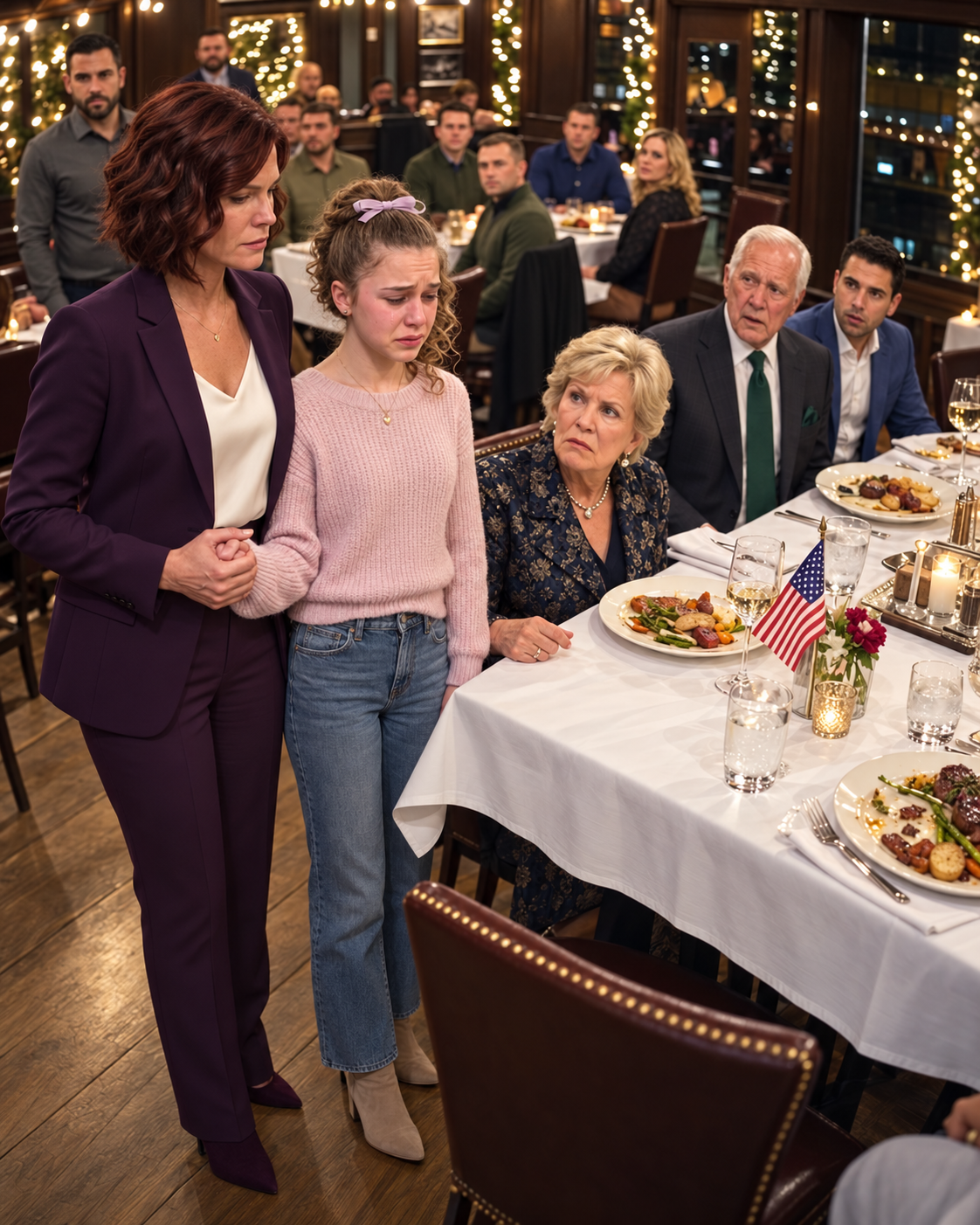
PART 1 TITLE: For Six Years, My Daughter Tried to Earn a Place in Our Family, Until One Small Question Exposed What I Refused to See
The first time Sole asked whether my father actually knew her name, she was nine years old. She asked while I was putting away the dinner dishes, her voice so quiet that I nearly missed it beneath the running water. I turned off the faucet and looked at her. She stood in the kitchen doorway, holding the sleeves of her sweater over her hands. I answered immediately, telling her that of course her grandfather knew her name. I wish I had taken another moment before speaking. I might have realized she wasn’t asking for information. She was asking whether she mattered to him.
My name is Marlo. By then, Sole had been my daughter for two years, officially and without qualification. I had watched her grow from a frightened little girl into someone who could fill our house with questions, unfinished drawings, and the sound of her laughter. Yet whenever we visited my parents, something in her changed. Her shoulders tightened. She watched people’s expressions before speaking. She thanked them for things no one would ordinarily think to acknowledge. I noticed these changes, but I kept finding explanations that were easier to live with than the truth.
To understand how I allowed that to continue, I have to go back to the day Sole first came to live with me. She arrived carrying a bag of clothes and a stuffed rabbit with one eye missing. She held the rabbit against her chest while I showed her the room prepared for her. She didn’t ask whether she could put her clothes in the dresser or whether the bed was hers. She asked where she should leave her bag. I told her she could unpack whenever she felt ready. She placed it beside the bed and kept her rabbit close.
Sole was my foster child for eleven months before the adoption became final. Those months taught me that trust rarely announces its arrival. At first, she moved cautiously through the house, as though everything belonged to someone else and might be taken away if she touched it without permission. She asked before opening the refrigerator. She stood beside the couch until I invited her to sit. When I bought groceries, she watched me put them away, paying particular attention to the things she liked. It took time before she stopped checking whether they would still be there the next day.
I learned about her in pieces. Thunderstorms frightened her, especially when the noise woke her unexpectedly. She preferred having a light on in the hallway. She liked cereal prepared a particular way, with just enough milk to soften it without making it soggy. She could disappear into a mystery novel for an entire afternoon, but she also loved films with animals, even when the plot was predictable. When something genuinely amused her, she laughed without restraint, her eyes narrowing and her whole face changing. Those moments became the ones I waited for.
One evening, after she had been with me long enough to recognize my footsteps, I came home and heard her moving toward the door before I had finished turning the key. She stopped a few feet away, suddenly shy about having hurried to greet me. I pretended not to notice her hesitation. I put down my things, asked about her day, and watched her begin to tell me something she had read. It was an ordinary exchange, the sort most parents forget by bedtime. I remember it because she had started expecting me to come home.
There were difficult days, too. Sometimes Sole withdrew without explaining why. Sometimes a small disappointment seemed to upset her far more than the situation warranted. I learned not to demand immediate explanations. We found ways to sit together without requiring conversation, and I became better at recognizing when she needed reassurance rather than questions. I never believed that loving her would erase everything she had experienced before coming to me. I did believe she deserved a home where those experiences would not be used to define her for the rest of her life.
When the adoption was finalized, Sole was seven. I remember the official documents, the signatures, and the peculiar feeling of seeing something so important expressed in such formal language. Her last name was changed on her school records. Our legal relationship was settled. But the strongest proof that we belonged to each other came afterward, in the habits that had developed without either of us noticing. She knew where I kept the bandages, what my morning coffee smelled like, and which side of the couch I preferred when we watched television together.
I didn’t expect my parents to understand every part of foster care or adoption. Before Sole came into my life, neither of them had much experience with it. I expected questions. I expected some awkwardness while they adjusted to having a granddaughter whose early years they hadn’t witnessed. What I didn’t expect was that they would continue treating her arrival as something temporary long after the law, our daily lives, and Sole herself had made it clear that she belonged with me.
My mother had always placed tremendous importance on appearances. She was active in church activities, prepared food for community fundraisers, and remembered details about people she considered important. She could greet someone she had met only once and ask after their relatives with astonishing accuracy. My father had spent fifteen years coaching Little League. He enjoyed being recognized around town by men who had played on his teams decades earlier. They were admired for their generosity and involvement. Their public reputation was not fabricated, but it concealed parts of them that strangers rarely encountered.
In my childhood, our family had placed an almost ceremonial importance on staying together. We attended gatherings even when arguments from the previous week remained unresolved. We smiled for photographs after spending hours disagreeing in the kitchen. We were expected to help relatives financially when they struggled, and refusing was considered evidence of selfishness. I grew up believing that loyalty meant continuing to show up, especially when it was inconvenient. I carried that belief into adulthood without examining who benefited from it or who was expected to bear its cost.
When I told my parents that I intended to adopt Sole, my mother asked several questions about her background. I answered what I could and explained that some parts of Sole’s history were private. My father listened without offering much. Neither gave the response I had hoped for, but I persuaded myself they simply needed time. I had already learned how much my parents valued family relationships. Surely, I thought, once they got to know Sole, they would come to love her.
They never openly refused to acknowledge her as my daughter. That would have been too obvious. Instead, they established a distance small enough to deny whenever I challenged it. My mother referred to the adoption as an admirable thing I had done, placing the emphasis on my generosity rather than on Sole becoming a member of the family. My father occasionally asked how the little girl was doing instead of using her name. If I corrected either of them, they seemed surprised that I considered the distinction important.
The first birthday after the adoption passed without a card, a telephone call, or even a brief message from my mother. I waited through the afternoon, then through dinner. Sole was busy enjoying her presents and didn’t seem concerned. We had a small celebration at home, and she was delighted with the books and art materials I had chosen. I told myself that was what mattered. Still, after she went to sleep, I checked my phone once more before turning out the lights. There was nothing from my parents.
When I mentioned the omission a few days later, my mother sounded genuinely annoyed that I had brought it up. She said she had been occupied with other things and suggested that I was making an unreasonable issue out of an oversight. I accepted her explanation, partly because arguing felt exhausting and partly because I wanted her to be telling the truth. People forget birthdays. It happens. I reminded myself of that several times. I didn’t yet recognize how easily an isolated oversight could become a pattern when no one was required to correct it.
The following year made that explanation harder to defend. My mother sent money to my brother Chris’s sons, remembering their birthdays and including messages suited to their individual interests. Sole received nothing. This time, I brought it up directly. My mother said she still wasn’t certain what would make Sole happy and didn’t want to send something unsuitable. I told her Sole enjoyed drawing, reading mysteries, and watching films about animals. My mother listened as though she were hearing this information for the first time.
I had already told her those things on several occasions. I knew because I had made a deliberate effort to help them become acquainted. I had talked about Sole’s interests during visits, mentioned the books she was reading, and suggested simple ways they could spend time together. My mother could remember the details of my nephews’ activities without prompting. Yet when it came to Sole, even the easiest information seemed to disappear as soon as the conversation ended. I began to suspect that the difficulty wasn’t a lack of knowledge.
Chris’s boys were never made to feel uncertain about their place. My parents knew their preferences and celebrated their achievements. They spoke about them with an ease that came from assuming they belonged. I loved my nephews and didn’t resent the affection they received. What troubled me was the contrast. My daughter lived in the same extended family, attended the same gatherings, and addressed the same two people as her grandparents. But she was treated as though she were still waiting for membership to be approved.
I started compensating in ways that seemed harmless at the time. Before visits, I reminded Sole that her grandparents might be distracted. I prepared her for disappointing gifts by emphasizing the importance of gratitude. If a conversation excluded her, I found a way to bring her into it. When she asked why Grandma had remembered something about her cousins but forgotten the same information about her, I invented explanations that made the discrepancy sound accidental. Each explanation relieved the immediate discomfort without changing the situation.
Sole rarely complained. That was one of the reasons I failed to appreciate how much the treatment affected her. She didn’t demand better presents or ask why her cousins received more attention. She watched, listened, and made adjustments. If a question received a short answer, she stopped asking. If someone overlooked her, she moved closer to me. I mistook her restraint for resilience. I thought that because she could endure these visits without protest, they weren’t doing lasting harm.
I should have paid more attention to what happened after we returned home. Sole sometimes remained unusually quiet until bedtime. She became careful about asking whether we would be visiting my parents again, presenting the question as ordinary curiosity. If I told her we had a family dinner coming up, she wanted to know who would attend and how long we expected to stay. These were reasonable questions, but she asked them with the concentration of someone preparing for an examination whose rules kept changing.
My father contributed to the problem differently from my mother. He wasn’t inclined toward elaborate explanations or indirect questions. He could be dismissive with a few words and then behave as though nothing important had happened. When he was irritated, he sometimes referred to Sole without using her name. He generally avoided doing so when I was close enough to object. That made it easier for me to believe he was simply awkward around children he hadn’t known since birth.
Then Sole overheard him.
She was nine. I hadn’t witnessed the precise moment when he used that dismissive description, and she didn’t repeat it to me immediately. We finished our visit, gathered our belongings, and returned home. She behaved normally through the drive. She answered when I asked whether she was hungry and helped carry something inside. It wasn’t until later that evening, while I was cleaning the kitchen, that she appeared in the doorway with the question that has remained with me ever since.
She wanted to know whether her grandfather remembered what she was called. I answered too quickly, assuring her that he did. Sole studied my face for a moment, then asked why he sometimes spoke about her without saying her name. I felt a small, unmistakable movement of shame. I hadn’t known she had heard him. More importantly, I hadn’t understood that she had noticed the difference often enough to develop a question about it.
I told her that adults sometimes spoke carelessly and that she should never conclude anything about her own worth from another person’s manners. The advice wasn’t wrong, but it avoided the question she was actually asking. She wasn’t wondering whether she was valuable in some abstract sense. She wanted to know why a man who could name every player he had coached seemed unwilling to make the same small effort for his granddaughter.
Sole nodded and returned to what she had been doing. I watched her go, knowing that the conversation had ended without giving her much reassurance. I considered calling my father that night. I even picked up my phone. Then I imagined the argument: he would claim I had misunderstood, accuse me of exaggerating, and complain that I was turning the child against him. My mother would support his version. I put the phone down and decided to address it another time.
Looking back, that decision troubles me more than the excuses I made before it. By then, I had enough evidence to understand that Sole’s discomfort wasn’t imaginary. She was not unusually sensitive or confused by the circumstances of her adoption. She was accurately describing the way the adults around her treated her. I had encouraged her to trust me when she was frightened, yet when she showed me where she was being hurt, I responded by explaining away the people responsible.
A few days later, I found Sole drawing at the table. Her paper contained several figures, carefully outlined and arranged beside one another. She was concentrating on the smallest details, giving each person hair, clothing, and recognizable features. I asked about the picture, and she told me it was our family. I didn’t question her about who was included. Instead, I sat beside her and watched her finish. I remember thinking that it shouldn’t require so much effort for a child to feel certain about the people who claimed to love her.
I had wanted Sole to have grandparents, cousins, holiday gatherings, and all the ordinary experiences that make a child feel connected to a larger history. That desire had seemed generous. It took me years to understand that I had become attached to the picture of family I hoped to give her, even while the real people in that picture kept disappointing her. Every visit offered another opportunity for them to behave differently, and I continued arranging those opportunities long after Sole had stopped expecting anything from them.
At nine, my daughter had already learned to question whether her own grandfather considered her important enough to remember. I understood the cruelty of that question, but I still didn’t recognize what my silence was teaching her. I was asking her to remain patient with adults who had never been required to earn her patience. And by insisting that we continue visiting, I was showing her that their comfort could outweigh her own.
I didn’t know then that the forgotten birthdays and careless remarks were only the beginning. My parents would become more practiced at making Sole feel unwelcome while insisting that nothing was wrong. Worse, I would discover that my mother was capable of turning the language of concern into something far more damaging. But the first warning had already been placed in front of me, in my own kitchen, by a little girl who wanted to know whether her grandfather knew her name. I should have acted on it.
END PART 1
PART 2 TITLE: Every Christmas Gift Carried a Message My Daughter Was Too Polite to Name, and My Mother’s Questions Became Harder to Ignore
Christmas made the difference impossible to overlook. My mother enjoyed giving gifts, especially to Chris’s sons. She selected things that reflected their interests, remembered which one preferred a particular color, and occasionally had their names embroidered onto presents. She took pleasure in watching them unwrap everything, asking whether she had chosen correctly. I enjoyed seeing the boys happy. What disturbed me was how differently she behaved when it was Sole’s turn to open something.
One year, my daughter received a packaged collection of scented soaps. The following year, it was a candle, still in its inexpensive plastic wrapping. Neither gift had anything to do with a child’s interests. Sole enjoyed art supplies, adventure stories, and films about animals. My mother knew all of that. Yet when the presents were distributed, Sole received something that appeared to have been chosen without even a moment’s consideration of who would be opening it.
She never made a face. She peeled away the wrapping, thanked her grandmother, and placed the present carefully with her other belongings. If she felt disappointed, she concealed it. Meanwhile, her cousins discussed their gifts excitedly and compared what they had received. My parents joined those conversations, offering explanations for why they had selected particular items. Sole listened without interrupting. When someone addressed her directly, she smiled and responded politely, as though nothing about the situation seemed unusual.
Afterward, Sole wrote thank-you notes. She had developed the habit herself, using colored pens and taking time to make each card look attractive. Even for the soap and the candle, she found something pleasant to say. I watched her lean over the kitchen table, carefully forming her letters, and felt both proud and uncomfortable. Her kindness deserved a response. My parents never acknowledged receiving the notes. When Sole asked whether they had arrived, I told her that they probably had.
That small question stayed with me. She wasn’t asking for a second gift or a larger expression of affection. She wanted to know whether a gesture she had made had reached the people for whom it was intended. My mother could remember to thank someone for bringing food to a church event, but she could not manage a few words to a granddaughter who had written to her. I began to see how many times I had stepped into that silence, supplying the affection my parents had withheld.
Chris didn’t seem troubled by the imbalance. My brother had always been comfortable letting our parents arrange things according to their preferences, especially when those arrangements benefited him. His sons were unquestionably their grandchildren, and he had no reason to challenge the way they were treated. I didn’t expect him to understand every difficulty Sole had experienced, but I sometimes wished he would notice how carefully she behaved around our parents. He never asked why she had become so reserved in their company.
At home, Sole was entirely different. She left her shoes wherever she happened to remove them, despite my repeated requests that she use the space beside the door. She talked to herself while drawing and occasionally sang along to music in a key that had little relationship to the melody. She would curl into the corner of the couch with a book until sleep overtook her, leaving the pages open across her face. She was curious, funny, occasionally stubborn, and fully at ease in the familiar disorder of our home.
I began to notice how much energy she spent preparing for family visits. She chose her clothes carefully and asked whether they looked appropriate. She reminded herself to sit properly and not interrupt. Sometimes she wanted to know what my parents were likely to ask her about, so she could have answers ready. I told her she didn’t need to prepare for a conversation with her own grandparents. She nodded, but the questions continued. Somewhere along the way, being herself had stopped feeling sufficient.
The adults responsible for that change seemed completely unaware of it. My father still spoke warmly about the children he had coached in baseball, remembering their strengths and the positions they preferred. He could describe boys who had grown into middle-aged men with extraordinary affection. When I watched him struggle to find anything personal to say about Sole, I wondered whether he understood how obvious the contrast had become. I wanted to believe that he would be ashamed if he recognized it.
My mother presented a more complicated problem. She seldom said openly hostile things when Sole was present. Instead, she waited until my daughter was occupied elsewhere and asked questions that sounded reasonable unless someone considered their implications. She used a concerned tone, leaning toward me as though she were offering a private opportunity to discuss a difficult subject. In the beginning, I answered sincerely because I assumed she wanted to understand Sole’s needs.
She asked whether children with difficult early experiences ever completely recovered from them. I explained that people responded differently to hardship, and that Sole wasn’t a condition or a collection of symptoms. She was a child developing at her own pace, with strengths and worries like anyone else. My mother listened without much expression. A few weeks later, she raised essentially the same question, only this time she wanted to know whether children who had been in foster care could form lasting attachments.
The way she framed those questions began to bother me. She spoke as though Sole belonged to a separate category of people whose ability to love required special examination. Other children were simply children. My daughter was someone whose feelings, loyalty, and future behavior remained open to suspicion. I corrected my mother when she used language that implied Sole was less capable of ordinary affection. She would soften her expression and say she was only trying to understand.
Then she began directing the questions toward me. Had I considered how much responsibility I had accepted? Was I certain I hadn’t sacrificed opportunities I might otherwise have enjoyed? Did I ever imagine what my life would be like if I had chosen differently? Eventually, she went so far as to suggest that adopting Sole might have prevented me from having the kind of family I was supposed to want. I asked her what she thought Sole and I were if not a family.
My mother looked offended. She said I was deliberately misinterpreting an expression of concern. I told her that I didn’t need to be warned about the sacrifices of parenthood, and certainly not in a way that treated my daughter as the reason my life might be incomplete. I loved Sole. I was proud to be raising her. Whatever difficulties came with parenthood were part of a responsibility I had willingly accepted. My mother ended the conversation by suggesting that I had become unnecessarily defensive.
That became her preferred explanation whenever I objected. If I challenged a remark, I was sensitive. If I pointed out unequal treatment, I was searching for reasons to take offense. If I declined an invitation because I didn’t want Sole exposed to another uncomfortable gathering, I was accused of depriving my parents of a relationship with their granddaughter. The contradiction was extraordinary. They defended their right to see her while refusing to make her feel wanted when she was there.
I fell into the habit of arguing about intentions rather than consequences. My mother insisted that she had meant well; I tried to explain why good intentions did not erase a hurtful result. She would focus on a single word or detail and accuse me of exaggeration. By the time the conversation ended, the original problem often remained untouched. I would leave feeling tired, and she would behave as though my objection had been satisfactorily resolved.
During those years, I was also providing financial assistance to my family. After my divorce, I had become more financially secure than my parents, and there were expenses they struggled to cover consistently. Helping them seemed like a reasonable use of the stability I had worked to establish. I didn’t regard it as proof of devotion or expect special gratitude. I had been raised to believe that family members supported one another when circumstances allowed, and I was fortunate enough to be able to do so.
Over approximately three years, that assistance expanded. I began covering the payments on my parents’ car. I contributed to their utility expenses and helped my mother pay the portion of her pharmacy costs that she said was beyond her immediate budget. I also paid Chris’s phone bill. Each arrangement had its own explanation, and each was presented as a practical solution to a problem. My mother’s pharmacy shortfall was repeatedly described as temporary, although the need never seemed to end.
At first, I paid attention to each expense. Eventually, the transfers became routine. Some were scheduled automatically, and others were settled through accounts linked to my banking information. My parents came to know when the payments would be made. Chris understood that his phone bill would be covered. I rarely received questions about whether the arrangements continued to suit my circumstances. The money moved from my accounts to their expenses with the regularity of something everyone had begun to consider permanent.
I didn’t use the financial assistance as an argument when I disagreed with them. I didn’t want Sole to believe that money determined whether someone deserved respect. I also didn’t want my parents to feel that accepting help gave me the right to dictate their lives. Those principles mattered to me. What I failed to examine was the opposite possibility: that I had allowed people to depend on my generosity while treating my child as though she were an unwelcome obligation.
My mother could discuss an upcoming payment with complete confidence. She remembered the amount, the due date, and whether it needed to be processed before a weekend. Yet she struggled to remember the most basic things about Sole. That contrast bothered me more as the years passed. It suggested a level of attention that was carefully distributed according to usefulness. My parents were perfectly capable of remembering what mattered to them. They simply didn’t regard the same things as important.
Occasionally, I considered ending the visits altogether. Then there would be a family occasion, or my mother would speak pleasantly on the telephone, and I would tell myself that perhaps the worst of the tension had passed. I thought about how Sole might feel if I separated her from grandparents she had known for years. I worried she might interpret their absence as another relationship that had failed because of her. Those worries kept me negotiating with people who showed little interest in changing.
The result was that I spent increasing amounts of time trying to protect Sole from experiences I continued allowing her to have. I watched conversations for offensive remarks. I anticipated which subjects might lead to trouble. I offered explanations after visits and encouraged her to focus on people who treated her kindly. None of those measures addressed the obvious problem. I could make an unpleasant visit shorter or explain why someone’s words were unfair. I could not make my parents treat her as their granddaughter.
About a month before the restaurant dinner, I finally reached the end of my willingness to negotiate. There hadn’t been one spectacular argument that brought me to that point. I was exhausted by the accumulation of small indignities and by the knowledge that Sole had spent years learning to accommodate them. I wanted to state a clear consequence while everyone was calm, so there could be no later claim that I had spoken impulsively in anger.
I went to my mother’s kitchen and sat opposite her. She had a cup of coffee in front of her and was stirring it while we talked. I told her that I was no longer prepared to explain away insulting remarks or unequal treatment. Sole was my daughter. Anyone who wanted a relationship with us had to accept that without exceptions or qualifications. I kept my voice level because I wanted my mother to understand every word.
Then I made the consequence explicit. If either of my parents treated Sole cruelly again, we would stop seeing them. I told her that I wasn’t proposing a temporary disagreement followed by another round of apologies and promises. There would be no waiting period during which everyone could pretend nothing had happened. I wanted her to understand that I would not bring Sole back for another opportunity to be hurt.
My mother stopped stirring for a moment. She regarded me over the rim of her cup, then gave a small nod. She said she understood what I was saying. There was no argument, no protest, and no attempt to discuss Sole’s feelings. She didn’t ask which past incidents had troubled me most or how she might repair the relationship. Her calmness might have been reassuring if I hadn’t known how readily she could dismiss something she didn’t consider important.
I stayed for a while, waiting for her to say more. She resumed drinking her coffee. The conversation shifted toward ordinary matters, and I eventually left. On the drive home, I found myself wondering whether I had finally communicated the seriousness of the situation or whether my mother had simply agreed because disagreement would have prolonged an uncomfortable discussion. I wanted the first explanation to be true, but there was little in her behavior to support it.
I had issued warnings before, although never one so definite. My parents were accustomed to hearing my objections and then watching me return. I still attended family occasions. I still helped with expenses. I still encouraged Sole to write her thank-you notes and behave politely. From their perspective, nothing meaningful had changed after the previous disagreements. I had objected to their conduct without requiring them to experience any consequence for continuing it.
That realization should have prompted me to change our arrangements immediately. Instead, I decided to give them one final opportunity to show that they respected the boundary I had drawn. I hoped that being direct would accomplish what years of patient explanations had not. I didn’t want another confrontation. I wanted Sole to sit beside her grandparents without thinking about every word she said.
As the next family dinner approached, I remained cautiously hopeful. Sole seemed less enthusiastic. She asked who would be there and listened when I told her. I assured her that she didn’t have to impress anyone and that we could leave if she felt uncomfortable. She accepted the reassurance without questioning it. I didn’t realize how much she needed that promise to mean something.
There was one important difference between this dinner and all the gatherings that had come before it. I had finally told my mother exactly what would happen if she mistreated Sole again. No one could claim afterward that they hadn’t known the consequence. The responsibility for following through would rest with me. I had spent years asking my daughter to trust that I would protect her. Now, whether I was ready or not, I would have to prove it.
END PART 2
PART 3 TITLE: At a Family Dinner, My Mother Finally Said What She Had Been Hiding for Years, and My Daughter Waited to See What I Would Do
The restaurant looked like a pleasant place for a family gathering. Small lights glowed along the windows, music played softly beneath the conversations, and the warmth inside was a welcome contrast to the cold evening. I remember those details because there was nothing about the setting to suggest that we were about to reach the end of something. People were laughing over their meals. Servers moved between the tables with trays of drinks. Near the entrance, a small seasonal arrangement had been placed where customers could see it as they arrived.
The hostess led us to a table near the front window. My parents settled into their seats, and Chris sat across from me. Sole took the chair beside mine. She was wearing a cream-colored blouse and had carefully arranged her hair before we left home. I had told her she looked lovely. She had smiled, but she continued checking the way her collar lay against her shoulders until we reached the restaurant. Now she sat very straight, her hands resting near the folded napkin in her lap.
My father found something wrong with his drink almost immediately. He called the server back and asked for another one before anyone had seriously examined the menu. The exchange was brief, but the irritation lingered in his expression. My mother adjusted her silverware, moving the pieces into alignment with the edge of the table. Chris glanced at his phone beneath the tabletop, his attention drifting away from the conversation whenever a new message arrived. I looked at Sole and wondered whether anyone else noticed how carefully she was behaving.
She thanked the server when her water was poured. She answered questions politely and waited for pauses before speaking. When my mother asked something about school, Sole gave a short, accurate response and then looked toward me. I encouraged her to say more, but she shook her head slightly. I knew that hesitation. At home, a question about school could lead to a ten-minute account of something she found interesting. Here, she seemed determined not to risk saying anything unnecessary.
I tried to draw her into the conversation without making her the center of attention. I mentioned a book she had been enjoying and asked what she thought of the ending. She began explaining, then stopped when my father spoke to Chris about an unrelated subject. Neither man appeared to notice that she had been interrupted. Sole lowered her eyes to the menu and remained quiet. I felt the familiar urge to repair the moment, but I also remembered the warning I had given my mother.
For years, I had tried to make these occasions work by anticipating everyone’s reactions. I could redirect a conversation, soften a remark, or give Sole a reassuring look when someone ignored her. That evening, I wanted to see whether my family could behave with ordinary kindness without my constantly arranging it. It wasn’t an unreasonable expectation. We were sitting together for dinner. My daughter was thirteen, and the people around her were adults who had known her for six years.
The meal continued without an open argument. Plates arrived, glasses were refilled, and my parents discussed matters that interested them. Chris occasionally looked up from his phone to contribute. I ate more slowly than usual, paying attention to Sole without wanting her to notice that I was watching her. She kept her elbows close to her sides. When she wanted something from the table, she asked instead of reaching for it. Nothing she did was wrong, yet her constant self-monitoring made me uneasy.
I thought about the difference between the child beside me and the girl who filled our home with noise. Sole could become completely absorbed in a drawing, forgetting that dinner was ready until I called her a second time. She loved telling me the plots of mystery novels, always withholding the solution until she could see whether I had guessed correctly. She wasn’t naturally timid. The solemn little figure at the restaurant table was someone she had learned to become around my parents.
My mother seemed pleased with the evening. She smiled when she addressed the server and spoke pleasantly to Chris. She had the composed expression she often wore in public, the one that made disagreements with her difficult to explain afterward. If I had described her behavior to someone who didn’t know our family, they might have imagined a warm, attentive grandmother enjoying dinner with her children and granddaughter. I had spent years allowing that appearance to outweigh what Sole actually experienced.
Eventually, the server cleared the plates and brought dessert menus. Sole looked at the choices without saying anything. I was considering whether to suggest sharing something when my mother leaned slightly toward her. The movement was small, almost intimate. My mother lowered her voice, as though she were about to offer a private piece of advice. That familiar posture immediately caught my attention. I had seen her use it before when she wanted an unpleasant remark to sound considerate.
She looked directly at Sole and told her that, in this family, there was no place at the table for someone considered a mistake. She said it quietly, with enough clarity that everyone nearby at our table could understand. There was no raised voice or visible anger. The cruelty came from the meaning of the words and from the confidence with which she delivered them. My daughter was thirteen. She understood precisely whom her grandmother was describing.
Sole stopped moving. Her spoon touched the edge of its dish with a small metallic sound as her fingers tightened around it. I saw her shoulders draw inward and her gaze fall toward the table. She didn’t look confused. She looked as though someone had finally confirmed something she had been afraid to believe. That expression affected me more than my mother’s words. It showed how long the possibility had already been living in Sole’s mind.
For a moment, I remained seated with my hand around my water glass. I wanted to demand an explanation. I wanted my mother to repeat the statement clearly enough that every person in the restaurant could hear it. I imagined asking whether she had any idea what it meant to say something like that to a child who had already experienced uncertainty about belonging. I had arguments prepared from years of practice. None of them seemed capable of undoing what had just happened.
Then I looked at Sole again. She was staring downward, trying to hold herself together while the adults around her decided what to do. I understood that if I stayed and argued, she would have to remain in that chair while her grandmother defended the insult. My father would probably insist that I was overreacting. Chris might tell everyone to calm down. The discussion could continue for twenty minutes without anyone asking how Sole felt. I didn’t want her to sit through another minute of it.
I placed my glass on the table and stood. The legs of my chair moved against the floor. I reached for Sole’s hand, which was trembling beneath mine, and told her we were going home. I didn’t make an announcement to the other diners. I didn’t explain the family history to the server. I wanted my daughter away from the table before my mother could turn the situation into another argument about her intentions.
My father looked up with an expression of irritation. Chris finally put his phone aside. My mother stared at me, seemingly astonished that I had interrupted the evening. She told me to stop behaving as though something terrible had happened. I asked whether she understood that she had just described my daughter as an error. My mother replied that Sole was intelligent enough to understand what she really intended. Her answer made it clear that she had no intention of withdrawing the remark.
I told her that the problem wasn’t a misunderstanding. She knew exactly what she had chosen to say, and the responsibility for those words belonged to her. Then I turned toward the entrance with Sole beside me. I heard movement behind us, but I didn’t stop to see who had stood or whether anyone intended to follow. The most important thing in that moment was the small hand gripping mine, and the fact that I was finally taking her away from people who had made her afraid to occupy a chair.
We passed the hostess stand and the tables nearest the entrance. A few customers glanced toward us, then looked away. The decorative lights continued glowing around the windows, and the music played as though nothing unusual had occurred. The normality of it felt strange. Inside that restaurant, people would finish their desserts and leave without knowing what had happened at our table. For Sole and me, the evening had divided our lives into something that existed before my mother’s remark and something that would come afterward.
Outside, the cold reached us immediately. Sole walked beside me without speaking. She opened the passenger door and climbed into the car, moving with a carefulness that made me ache. I waited until she had fastened her seat belt before getting behind the wheel. For several moments, neither of us said anything. I could hear the ventilation system and the faint sounds of traffic beyond the parking lot. Sole kept her eyes directed toward the windshield.
I wanted to reassure her, but I was afraid that speaking too quickly would make my words sound like another adult’s attempt to smooth over something painful. I had done that too many times. I had repeatedly told her that my parents cared about her, even when their behavior offered little evidence. This time, I needed to speak about what had actually happened. I turned toward her and waited, giving her room to decide whether she wanted to talk.
After a while, she asked whether her grandmother’s description was true. Her voice was so small that I had to lean closer. I asked what she meant, although I already understood. Sole looked at her hands and asked whether I thought adopting her had been a mistake. She didn’t ask whether Grandma was rude or whether the evening had gone badly. She went directly to the fear beneath the insult: that I might privately agree with what my mother had said.
I told her that I had never regretted adopting her. I explained that becoming her mother was a choice I was grateful to have made and that nothing my parents said could change it. I didn’t pretend they had meant something innocent. I told her they were wrong, and that their opinions did not determine where she belonged. I wanted her to hear the distinction clearly. Someone had treated her cruelly. That did not mean there was anything wrong with her.
Her lips began to tremble. I reached across the space between the seats and held her hand. At first, her fingers remained stiff. Then she turned her palm into mine and began to cry. I stayed with her, allowing the tears to come without trying to stop them. There was nothing I could say that would immediately repair six years of exclusion. What I could do was remain present and make certain she understood that I wasn’t asking her to excuse what had happened.
When she was calmer, I told her that we would not be returning to the restaurant or pretending that my mother’s words were acceptable. She listened carefully. I didn’t make elaborate promises about what the future would look like, because I hadn’t yet worked through every consequence. I simply told her that she would not have to keep sitting with people who made her feel unwanted. She pressed my hand once before letting go. It was the first sign that something I had said had reached her.
We drove home in relative silence. I kept thinking about the expression on my mother’s face when I stood up. She had seemed more troubled by the disruption than by what she had done to Sole. I had expected her to deny the meaning of her words, but some part of me had still imagined that seeing my daughter’s reaction might make her reconsider. It hadn’t. My father and brother had offered no meaningful objection. Their silence was another answer I could no longer ignore.
At home, I prepared hot chocolate. Sole sat at the kitchen table while I warmed the milk, watching without much interest. She accepted the mug but drank very little. I brought two blankets into the living room and found a film she had watched many times before. She settled on the couch, pulling the blankets around herself. I sat beside her. The familiar voices from the television filled the room, but neither of us paid much attention to the story.
I remained there until her breathing became regular and her posture relaxed. Every so often, I looked at her and remembered how carefully she had held herself at the restaurant. I wondered how many times she had waited for me to notice what was happening. I had told myself that preserving relationships was good for her, but the expression on her face when my mother spoke had revealed the cost of that reasoning. She had been preparing for rejection while I kept arranging another visit.
I was angry, but there was little satisfaction in it. I could not undo the birthdays, the uncomfortable holidays, or the years of trying to explain why my parents behaved as they did. I could only decide what happened next. I had warned my mother that another cruel remark would end our relationship. If I softened that consequence now, Sole would learn that even the clearest promises could be negotiated away when adults found them inconvenient.
At 10:14 that night, my phone vibrated. I was still in the living room, with Sole resting beside me. The message was from my father. I opened it expecting, perhaps foolishly, some acknowledgment of the evening. He might have asked whether Sole was all right. He might have said that my mother had behaved badly. He might even have asked to speak with me privately about what had happened. Instead, he wanted confirmation that I would still make the next day’s payment on his car.
I read the message several times. The wording was practical, almost casual, as though we had parted after an entirely ordinary dinner. My father knew I had walked out with a trembling child. He had witnessed the insult, my response, and the sudden end of our evening. Yet the only consequence that interested him was the possibility that his scheduled payment might be interrupted. I looked at Sole beneath the blankets and then at the phone in my hand.
For the first time, I understood that my parents had never expected my warning to affect anything important to them. They believed I would continue paying their expenses, answering their calls, and returning to the family table because that was what I had always done. My father had written about the car because he considered the arrangement secure, regardless of how my daughter had been treated. He expected me to separate their behavior toward Sole from the benefits they received from me.
I didn’t answer him. I carefully eased myself away from the couch, checked that Sole was comfortable, and carried my phone into the kitchen. My laptop was on the table. I opened it and signed into my banking account. I had spent years making certain that my parents and brother could rely on my financial help. That night, looking at the scheduled transfers, I decided they would need to make different arrangements.
END PART 3
PART 4 TITLE: My Father Asked About His Car Instead of My Daughter, and the Messages on Her Phone Revealed Something Far Worse
The banking page loaded with the ordinary familiarity of a screen I had visited hundreds of times. I knew where to find the scheduled payments and how to review the accounts connected to mine. Until that night, these tasks had been part of the background administration of my life. I paid what needed paying, checked the balances, and moved on. Sitting at the kitchen table after what had happened to Sole, I looked at the same information and began to understand how much responsibility I had accepted without questioning whether it was still appropriate.
I had never considered myself particularly wealthy. After my divorce, I had achieved a level of stability that allowed me to meet my obligations and maintain a comfortable home for Sole. I was careful with money because I valued the independence it gave us. I didn’t have to rely on someone else to make basic decisions about our lives. When my family needed assistance, I had enough room in my budget to provide it. At the time, helping had seemed like a natural extension of the responsibilities I already accepted as a daughter and sister.
The car payment was the first arrangement I examined. My parents had been relying on me to make it for years, and the next transfer was due the following day. I could remember the conversations that had led to my taking on the expense. At first, it had been presented as something they needed help managing while they dealt with other costs. Eventually, no one discussed when the arrangement might end. My father simply expected the payment to appear when it was due.
I stared at the scheduled transaction and thought about his message. He had not asked how Sole was doing. He hadn’t acknowledged that his wife had insulted a child who called them her grandparents. He hadn’t even attempted to persuade me that the evening was a misunderstanding. The only question he considered urgent concerned the money. It was difficult to interpret that priority as anything other than a declaration of what mattered most to him.
I canceled the automatic payment. The banking system asked me to confirm the change, and I read the information carefully before proceeding. I wasn’t confused about what I was doing. The transfer had been arranged voluntarily, and I was ending my participation. When the confirmation appeared, I remained seated for a moment, looking at the screen. My father would have to take responsibility for his car payment. I didn’t feel pleased about creating that inconvenience. I simply no longer believed it was mine to prevent.
Next came the utilities. I reviewed the amount I contributed and the transfer schedule, then removed the arrangement. I thought about all the times my mother had called to discuss household expenses, speaking with the familiarity of someone confident that I would help. Those conversations had rarely included questions about my own circumstances. She knew whether I could cover a payment because she assumed my financial situation would remain stable enough to accommodate hers. I had done little to discourage that assumption.
The contribution toward her pharmacy expenses required another decision. My mother had initially explained that she was struggling to cover a portion of her costs. I had agreed to help because I didn’t want her to go without what she needed. Month after month, the assistance continued, always accompanied by the suggestion that the difficulty was temporary. I had never demanded proof of hardship or asked her to justify every expense. I trusted her, and the money had become part of my regular budget.
That night, I ended my voluntary funding arrangement. I wasn’t making decisions about her medical care or interfering with her ability to purchase medication. Those responsibilities remained hers. What I was withdrawing was the automatic financial support she had grown accustomed to receiving from me. The distinction mattered. I wasn’t entitled to control her choices because I had helped pay her bills, but neither was she entitled to continued assistance while deliberately harming my child.
Chris’s phone bill was next. I looked at the account information and remembered how casually that expense had become my responsibility. My brother was an adult with children of his own, yet I had continued covering his service because the arrangement was convenient and I could afford it. At dinner, he had watched our mother humiliate Sole without meaningfully objecting. He hadn’t even asked whether she was all right when we left. I removed his payment from my account.
As I worked, I considered whether I was acting out of anger. Of course I was angry. I would have been concerned if I could watch someone hurt Sole so deliberately and feel nothing. But I had also spent years examining this family’s behavior and repeatedly deciding that the relationships were worth preserving. I had already warned my mother that the next incident would end our contact. Continuing to finance my parents’ expenses while refusing to see them would only preserve a connection they could use to pull me back into the same arguments.
The more accounts I reviewed, the clearer that pattern became. There had always been another expense to consider, another occasion when someone needed my help, another reason to avoid a disagreement that might complicate the family’s arrangements. Money hadn’t caused my parents to mistreat Sole, but it had helped maintain a structure in which they could behave badly without losing anything they valued. My support continued regardless of their conduct. They had no reason to believe that would change.
I went through each linked payment method and stored card, making sure that future charges would not be processed through my accounts without my approval. I checked the arrangements individually rather than assuming that canceling one transfer would end every financial connection. Some required more attention than others. I had been generous for so long that I needed to reconstruct the full extent of what I was paying. Seeing those expenses together made me realize how little I had asked of anyone in return.
Then I began securing my accounts. I changed passwords, removed unnecessary access, and reviewed the security settings associated with my financial information. I didn’t know whether anyone would try to challenge the cancellations or use payment details that had previously been available to them. I wasn’t prepared to find out through an unexpected transaction. Whatever happened after that evening, I wanted a clear separation between my finances and theirs.
When I reached the security questions, I paused. Some of the possible answers concerned ordinary details from my life: a childhood pet, a former street, or personal information that someone close to me might know. I found myself considering which questions my parents would actually be able to answer. They remembered dates associated with money. They could discuss their own bills with extraordinary precision. But I doubted they could identify Sole’s favorite breakfast or recall many of the small things that made our daily life what it was.
That realization was uncomfortable. I had spent years believing that my parents knew me well because we had known one another for so long. Yet they often seemed more familiar with the obligations I fulfilled than with the experiences that mattered to me. My life with Sole had grown around school mornings, books, conversations, and the steady work of raising a child. My parents knew the practical arrangements that benefited them. They appeared much less interested in the person I had become.
I finished updating the security information and checked that the changes had taken effect. The kitchen was quiet. The light above the table illuminated my laptop and the notes I had made while reviewing the accounts. Through the doorway, I could see the living room where Sole was resting beneath the blankets. The television was still playing softly. I considered going to bed, but I wasn’t finished. Ending the financial arrangements was only one part of the decision I had made.
Before midnight, I blocked my mother’s number. I stared at her contact information longer than I had expected. The familiar photograph and name carried years of memories, some pleasant and some painful. I thought about the woman who had once comforted me when I was young, and the same woman who had looked at my daughter across a restaurant table and deliberately questioned her right to belong. I could acknowledge that both memories were real without allowing the first to excuse the second.
At 12:07, I blocked my father. Seven minutes after that, I blocked Chris. There was no announcement, no long message explaining why I had reached my limit. I had already made my position clear at the restaurant. Another explanation would only give them an opportunity to argue about individual words while avoiding the central issue. I didn’t want to spend the night defending Sole’s right to be treated with basic decency by people who should never have questioned it.
For several minutes, I remained seated without touching the computer. The exhaustion I had been ignoring began to settle over me. I had taken decisions that would change the relationships I had known all my life, and I understood that my parents were unlikely to accept them quietly. Still, I didn’t feel uncertain about the direction I had chosen. I was more troubled by how long it had taken me to reach it.
I looked toward the living room again and remembered something Sole had mentioned weeks earlier. She had told me, almost in passing, that her grandmother had sent messages to her phone. At the time, I had asked whether everything was all right. Sole had indicated that it was, and I hadn’t pursued the conversation. I assumed my mother was making an effort to communicate with her granddaughter, perhaps trying to improve a relationship that had been strained for years.
Under ordinary circumstances, I respected Sole’s privacy. She was thirteen and beginning to develop the independence that comes with adolescence. I wanted her to know that I trusted her. We had rules about phone use, and I paid attention to her safety, but I didn’t habitually read her conversations simply because I could. That night was different. My mother had crossed a serious boundary in person, and I could no longer assume that private communication with Sole had been harmless.
I retrieved her phone and returned to the kitchen table. Before opening the messages, I sat for a moment considering what I hoped to find. Perhaps Grandma had asked about school. Perhaps she had finally shown an interest in Sole’s drawings or books. If the messages were ordinary, I would be relieved. I wanted to believe that even after the restaurant incident, there might be some evidence that my mother understood Sole was a child with feelings, interests, and a life beyond the circumstances of her adoption.
The conversation was shorter than I expected. My mother had sent three messages over the previous month. There was nothing openly threatening in them, and none contained the kind of insult she had delivered at dinner. Each was phrased as a question. I read the first one, then moved back to the beginning because I wanted to be certain I understood it. Grandma had asked Sole whether children at school ever treated her as though she were different from everyone else.
On its own, the question might have come from someone trying to understand whether an adopted child had experienced unkindness from classmates. But my mother had shown little interest in Sole’s ordinary school experiences. She rarely asked about her friendships, assignments, or the books she was reading. Why would she suddenly choose that particular subject? I looked at the date. It had been sent after my conversation with her in the kitchen, when I had warned that further mistreatment would end our relationship.
The second message disturbed me more. My mother wanted to know whether Sole ever suspected that I regretted taking on the responsibility of raising her. The wording was indirect, but the implication was unmistakable. She was asking my daughter to consider the possibility that I regarded motherhood as a burden and wished I had chosen another life. I read the question several times, unable to understand how an adult could think it appropriate to introduce that doubt into a child’s mind.
I knew the history that made the question especially painful. Sole had spent nearly a year in my care before her adoption became final. Building trust had required patience and consistency. I had worked to show her that ordinary disagreements, difficult days, and the inconveniences of parenting did not place our relationship in danger. My mother knew how important that security was to both of us. She had watched us become a family, yet here she was encouraging Sole to wonder whether the person raising her might secretly wish she hadn’t.
The third message asked whether Sole ever questioned where she truly belonged. I put the phone down for a moment, then picked it up again. The questions formed a progression that I couldn’t dismiss as coincidence. First, my mother invited Sole to consider whether other people saw her as different. Then she suggested I might regret becoming her mother. Finally, she raised the possibility that the home and family Sole trusted might not be where she was meant to be.
I went back through the dates. All three messages had been sent during the month before the restaurant dinner. My mother hadn’t simply made one thoughtless remark after becoming irritated at the table. She had been contacting Sole privately and directing her attention toward the very insecurities that her behavior had helped create. I couldn’t know every intention behind those questions, but I could see their likely effect. They encouraged a thirteen-year-old girl to doubt whether she was accepted, wanted, or safe in her own family.
I remembered Sole standing in my kitchen at nine, asking whether her grandfather knew her name. I remembered the carefully written thank-you cards that received no acknowledgment. I remembered her straight back and neatly folded napkin at the restaurant. Those memories had once seemed like separate examples of an uncomfortable relationship. Now I understood that they were connected by the same persistent message: Sole was expected to prove she deserved a place that my parents had never required anyone else to earn.
And I thought about the little girl who had first arrived at my door with a bag and a damaged stuffed rabbit. I remembered how long it had taken her to stop asking permission for ordinary things, and how much trust she had placed in me when she finally allowed herself to settle into our home. My mother’s questions had targeted precisely the kind of uncertainty that Sole and I had spent years working to overcome. The cruelty at dinner had been public. These messages had entered my daughter’s life when I wasn’t there to respond.
I found myself wondering how Sole had felt when each one arrived. Had she dismissed the questions and continued with her day? Had she stopped to consider them while doing homework or getting ready for bed? Had she wanted to tell me, then decided it would create another disagreement between me and my parents? I couldn’t answer those questions, and I didn’t want to invent her feelings. I needed to speak with her when she was ready. But I knew enough to understand that my failure to notice the messages had left her facing those suggestions alone.
I had believed that my mother’s treatment of Sole consisted mainly of exclusion, dismissive remarks, and unequal affection. The messages revealed something more deliberate. She had reached around me to speak privately to my daughter about whether our relationship could be trusted. Whether her goal was to influence Sole or simply to express her own doubts, the result was the same: she had taken a vulnerable part of my daughter’s history and turned it into a subject of suspicion.
I remained at the kitchen table with Sole’s phone in my hand. The banking accounts had been secured, the financial transfers ended, and my family’s numbers blocked. Until that moment, I had thought those were the essential decisions of the night. Now I understood that protecting Sole would require more than refusing another family dinner. I needed to preserve what I had found, make sure my daughter understood what had happened, and prevent my mother from using private conversations to undermine our relationship again.
I looked once more at the three messages and realized that the remark at the restaurant had not been an isolated explosion of cruelty. It had been the clearest expression of an attitude my mother had been communicating for years, including when Sole and I weren’t together. I had left the restaurant because I would not allow my daughter to be humiliated in front of me. Sitting there with her phone, I faced a harder truth: the harm had continued even when I wasn’t watching, and I could no longer protect her by assuming that what I didn’t see wasn’t happening.
END PART 4
PART 5 TITLE: By Morning, Twenty-Nine Calls Were Waiting, but the Message That Changed Everything Arrived on My Daughter’s Phone
The first thing I did after reading my mother’s messages was check the dates again. I wanted to be certain I hadn’t mistaken the order or misunderstood how the conversations had begun. All three questions had arrived during the month before the restaurant dinner, after I had warned my mother that another act of cruelty toward Sole would end our relationship. I sat beneath the kitchen light, moving slowly through the conversation, trying to understand why a woman who had been given one last opportunity to repair things had chosen instead to contact my daughter privately.
There was no indication that Sole had invited those questions. My mother had initiated each exchange, and the subjects were remarkably similar. She wanted Sole to consider whether other children saw her as different, whether I might regret adopting her, and whether she truly belonged in our family. None of these were ordinary attempts to learn about her granddaughter’s life. They weren’t questions about schoolwork, friendships, favorite books, or the drawings Sole spent hours making. Each one directed her attention toward a possible reason she might be unwanted.
I looked toward the living room. Sole was asleep beneath the blankets, her face turned toward the back of the couch. One corner of the blanket had slipped onto the floor, and her hand rested where the fabric had fallen away. I remembered the effort it had taken for her to become comfortable sleeping in a house where someone else was responsible for keeping her safe. I had spent years helping her understand that affection wasn’t something she needed to repay through perfect behavior. Now I wondered how often she had been questioning that security without telling me.
I wanted to wake her and ask why she hadn’t shown me the messages. The impulse came from fear rather than impatience. I needed to know whether my mother’s questions had hurt her, whether they had changed the way she understood our relationship, and whether there were things she had been carrying alone. But the hour was late, and she had already endured enough that evening. Waking her to discuss another betrayal would satisfy my need for answers while giving her another reason to feel responsible for an adult’s distress.
Instead, I remained at the table and considered what I knew. Sole had once mentioned receiving messages from her grandmother. I hadn’t asked to see them because I believed that encouraging communication might help improve their relationship. I had also wanted Sole to develop the ordinary independence appropriate for her age. Neither intention was unreasonable. What troubled me now was that I had treated my mother’s access to my daughter as though it were automatically beneficial simply because they were related.
I opened the conversation again and began preserving what I found. I took screenshots that included the messages and their dates, making certain that none of the important context was cut off. I forwarded copies to my email and checked that they had arrived. The task was simple, but my hands moved carefully. I wasn’t collecting evidence because I wanted revenge. I had watched my mother deny the meaning of things she had said for years. I wanted an accurate record before anyone could persuade me that my memory was unreliable.
Then I set Sole’s phone beside my laptop and wrote down what had happened at the restaurant. I included the order of events, who had been seated at the table, and the words that had caused us to leave. I described my mother’s refusal to acknowledge the insult and my father’s message about his car payment later that evening. Writing it down felt uncomfortable. It required me to examine an evening I wanted to forget. Yet I knew that time could make unpleasant details less precise, especially when other people insisted that events had occurred differently.
I also recorded the financial changes I had made. The car payment had been canceled, along with the utility contribution, Chris’s phone arrangement, and the recurring assistance for my mother’s pharmacy expenses. I noted that the payments had been voluntary and that I had secured the accounts afterward. Until that evening, I had never expected to need a record of my own generosity. Now I wanted a clear account of what had belonged to me, what I had agreed to provide, and when I had decided to stop.
The room had grown cold by the time I finished. I closed the laptop, returned Sole’s phone to a place where she could find it, and checked on her once more. She stirred when I adjusted the blanket, then settled again. I stood beside the couch for several seconds, watching her breathe. I couldn’t promise that what had happened would stop hurting her by morning. I could promise, at least to myself, that I would no longer place her in situations where she had to endure cruelty for the sake of preserving my parents’ comfort.
I slept badly. Every time I closed my eyes, I saw Sole sitting at the restaurant table, her fingers tightening around her spoon. Other memories followed: the unopened gifts, the birthday cards that never arrived, and the careful way she had learned to answer questions during family visits. I had once considered those incidents separate disappointments. Now they formed a pattern that seemed impossible to deny. The worst part was not discovering that my parents could be cruel. It was recognizing how much evidence I had already possessed.
Morning arrived without the relief I had hoped sleep might bring. I went into the kitchen, made coffee, and checked my phone. There had been twenty-nine attempts to reach me. Calls and voicemail notifications crowded the screen, along with indications that my family had been trying to get around the boundaries I had established. I stared at the number before opening anything. Twenty-nine contacts in the hours following a family dinner would ordinarily suggest genuine concern. For a moment, despite everything, I wondered whether someone had finally recognized the seriousness of what had happened.
My father’s messages answered that question. He demanded to know why the car payment had been interrupted and why he could no longer reach me normally. He sounded offended by the inconvenience, as though a financial arrangement had been altered without the notice he believed he deserved. At no point did he ask how Sole had slept or whether she was recovering from the humiliation she had experienced. He had witnessed his granddaughter being insulted, but he spoke as though the evening’s significant injury had been done to his bank account.
I listened to the messages again, paying attention to what he chose to emphasize. He spoke about obligations, consistency, and the expectation that people should honor arrangements they had made. Those were principles he had taught me when I was young. I had believed them sincerely, which was one reason I continued supporting him long after the original financial difficulties should have been addressed. Yet he didn’t seem to recognize any obligation to treat Sole with dignity. His understanding of responsibility ended precisely where another person’s needs began to inconvenience him.
My mother approached the situation differently. Her messages were full of injured feelings. She described my decision as a betrayal and presented herself as someone who had been treated with extraordinary ingratitude. She referred to the sacrifices she believed she had made for me and the embarrassment of being excluded from my life. At moments, she sounded tearful. I listened carefully, searching for even the smallest acknowledgment that she had said something unforgivable to a thirteen-year-old child.
There was none. My mother discussed her own pain with considerable detail, but she didn’t address Sole’s. She didn’t ask whether her granddaughter was frightened, whether she had cried, or whether she had understood the insult as a rejection. She made no reference to the private messages I had discovered, although she had no reason to know I had read them. What mattered to her was that I had interrupted the familiar arrangement in which she could say what she liked while expecting me to restore the appearance of peace afterward.
Chris’s messages were shorter and angrier. He accused me of tearing the family apart because of a single remark. The phrase irritated me more than I expected. A single remark suggested an isolated lapse, something regrettable that could be forgiven after an apology. It erased six years of exclusions, the conversations in which my mother had questioned Sole’s ability to form attachments, and the repeated differences between how she treated Sole and Chris’s sons. It also erased my warning a month earlier, which had made the consequence unmistakable.
I wanted to ask my brother whether he would have accepted the same treatment directed at one of his boys. I tried to imagine our mother leaning across a restaurant table and telling one of them that he didn’t deserve to sit with the family. Chris would have been furious. He wouldn’t have needed years of examples to recognize the cruelty. Yet because Sole was not his child, and because the insult concerned her adoption, he seemed capable of reducing the incident to an unfortunate misunderstanding.
The impulse to answer him lasted several minutes. I could have explained the messages, reminded him of the forgotten birthdays, and described how Sole had cried in the car. I knew exactly which details would make a compelling argument. But I also knew my family had received explanations for years. Information had never been the missing ingredient. They had watched my daughter struggle and had chosen not to regard her distress as important. Providing another account would give them fresh material to dispute, not a reason to reconsider.
I continued listening until I had heard every available voicemail. The repetition made the family’s priorities increasingly clear. My father returned to money. My mother returned to what she considered my disloyalty. Chris returned to the inconvenience of conflict. Their tones varied, and some messages were more emotional than others, but the subject remained remarkably consistent. Each person wanted me to reverse a decision that affected them. None expressed meaningful concern for the child whose humiliation had caused me to make it.
After the last message ended, I sat with my coffee growing cold between my hands. I thought about how often I had apologized for disagreements simply to make our family gatherings possible again. Sometimes I had apologized even when I believed I was right, because I considered the relationship more important than the argument. That habit had trained my parents to expect access to me regardless of how they behaved. They were angry now because, for the first time, my refusal was producing consequences they could not explain away.
I deleted the voicemails after confirming that my important records were preserved. I didn’t need to hear the same accusations repeatedly. Keeping them available for constant review would only invite me to spend the day preparing responses to arguments I had already decided not to have. I washed my cup and began putting breakfast things on the counter. Sole would wake soon. I wanted the first part of her morning to feel ordinary, even if our family circumstances had changed overnight.
Then her phone lit up beside me. My mother’s name appeared on the screen. She could no longer reach me through my regular number, but I had not yet addressed her ability to contact Sole directly. I looked at the notification and felt an immediate tightening in my stomach. My mother had spent the night leaving messages about what I had supposedly done to her, and now she was contacting the person who had already been hurt most deeply.
Only the beginning of the new message was visible. I didn’t need to invent a meaning for the words that remained concealed. The previous three messages provided enough reason for concern. I opened the conversation and examined the new contact alongside the older questions. My mother had never shown this level of interest in communicating with Sole when there were birthdays to remember, achievements to celebrate, or ordinary conversations to have. Yet after our departure from the restaurant, she was reaching for my daughter again.
I took another screenshot and sent it to the same email folder. I wasn’t willing to let my mother’s version of events become the only record of what had occurred. If she later claimed that she had merely tried to help, I wanted to remember the sequence exactly: the warning in her kitchen, the private questions about belonging, the insult at dinner, and the attempt to contact Sole after I had removed our family’s financial support.
I also understood that documenting the messages did not settle what I needed to do next. Sole had a relationship with her grandmother, however strained and painful it had become. I didn’t want my daughter to discover that I had made decisions about her phone without an explanation. She deserved to know that I had seen the messages and why I considered them troubling. More importantly, she deserved an opportunity to tell me what they had meant to her, without being pressured to defend either me or my mother.
I put the phone down and considered how easily the situation could be turned against us. My mother had spent years dismissing my objections as overreactions. Now she could point to the canceled payments and claim that I was punishing the family financially because of a disagreement. My father could repeat that I had promised to cover his car, omitting the fact that the arrangement was voluntary. Chris could tell relatives that I had become unreasonable. I had no control over what they would say.
What I did control was whether my decisions rested on a sound foundation. I had supported my parents for approximately three years, but I had never signed anything requiring me to continue indefinitely. Still, I didn’t want to rely solely on my own understanding. Financial connections could be complicated, and I had allowed several recurring arrangements to develop without examining all their implications. I wanted someone familiar with the law to review what I had done and identify anything I might have overlooked.
I found the contact information for a family attorney and prepared to arrange a consultation. As I gathered the payment records, screenshots, and a brief account of the situation, I noticed how different I felt from the person who had sat across from my mother a month earlier. Back then, I had been asking her to choose kindness because I wanted to preserve our relationship. Now I was preparing to protect the boundary she had ignored. The difference was not anger. It was the absence of an expectation that she would change.
Sole began moving in the living room while I was organizing the documents. I heard the blanket shift, followed by the soft sound of her footsteps. She appeared in the kitchen looking tired, her hair flattened on one side. For a moment, she watched me without speaking. I closed the laptop and asked what she wanted for breakfast. She considered the choices, then named something familiar. I was grateful for the ordinary question. It gave us a way to begin the morning without making the restaurant the first subject she had to face.
While I prepared her food, I studied her expression without wanting her to feel examined. She was quiet, but she didn’t seem frightened of me. When I asked whether she had slept, she nodded. I told her we could talk about the previous evening whenever she wanted and that she didn’t need to manage my feelings about it. She looked at me for several seconds, then returned her attention to breakfast. I let the conversation rest there. I had spent too long expecting her to adjust to adults’ needs; I wasn’t going to replace that burden with another.
By the time the morning had properly begun, I had preserved the messages, reviewed the financial decisions, and arranged to obtain legal advice. My relatives were still attempting to reach me, but I no longer felt compelled to answer them. The important conversation wasn’t with my parents or Chris. It was with Sole, and I wanted to approach it with enough care that she could tell me the truth about what she had experienced.
I returned to the kitchen table after breakfast and looked at the documents I had collected. Six years of strained family gatherings had ended in one terrible evening, but the consequences would not be resolved by blocking three telephone numbers. My parents had depended on my money, my willingness to forgive, and my reluctance to contradict their account of events. I had withdrawn the first two. Now I needed to make certain they could not use the third to pull me back.
I opened my laptop and placed the screenshots beside the account records. Then I prepared for the consultation with the attorney. I was no longer looking for the right words to make my mother understand what she had done. I was looking for a clear answer to a different question: whether I could finally separate our lives without leaving a financial obligation or an open channel through which my family could continue reaching my daughter.
END PART 5
PART 6 TITLE: The Attorney Confirmed My Family Had No Claim to My Money, but Their Attempts to Reach Me Exposed What They Still Believed
The attorney listened without interrupting while I explained the financial arrangements. I began with the car payment, then described the utility contributions, my mother’s pharmacy expenses, and Chris’s phone bill. I told her how long I had been paying them and why the arrangements had started. I wanted her to understand that I hadn’t borrowed money from my parents or entered into an exchange of services. I had simply helped because I could afford to, and because I believed supporting family was one of the responsibilities that came with financial stability.
She asked practical questions. Had I signed an agreement to make payments for a specified period? Were any of the debts legally mine? Had I guaranteed a loan or accepted responsibility as a co-signer? Had anyone transferred property to me in exchange for continued support? I answered each question carefully. I had made voluntary payments toward expenses belonging to other adults. I hadn’t promised a lender that I would be responsible for the car, and my parents had no written agreement requiring me to keep supporting them.
I had expected the consultation to focus on the unpleasant circumstances that led to my decision. Instead, the attorney kept returning to the structure of the financial obligations. She wanted to separate my family’s expectations from anything legally enforceable. That distinction was more important than I had realized. My father could believe I owed him a payment because he had become accustomed to receiving it. My mother could feel entitled to assistance because I had provided it repeatedly. Neither belief automatically created a legal duty.
When I mentioned the restaurant dinner, the attorney listened with a different kind of attention. I described my mother’s remark to Sole and explained that I had left immediately. I also mentioned the earlier warning and the messages I had discovered on my daughter’s phone. I made clear that I wasn’t seeking to punish anyone through the courts. Sole was safe at home, and I wasn’t reporting threats of physical violence. I wanted advice about protecting our privacy and ending financial relationships that had become a source of pressure.
The attorney confirmed that, based on the facts and documents I had provided, my canceled payments had been voluntary assistance rather than enforceable obligations. There was no contract requiring continued support, no personal liability for the bills I had stopped covering, and no apparent basis for my relatives to compel me to resume. She advised me to preserve records of the transfers and the communications surrounding my decision. I was relieved that I had already begun doing exactly that.
I asked whether my parents could claim that I had harmed them by allowing them to depend on my help and then withdrawing it. The question sounded almost absurd when I said it aloud, but my father had spoken so confidently about the car payment that I wanted to be certain. The attorney explained that reliance on another person’s generosity did not, by itself, make that generosity permanent. My parents remained responsible for expenses that legally belonged to them. I had been assisting them, not assuming ownership of their financial lives.
I thought about the years of conversations that had led to this point. Each payment had begun with a request presented as temporary or necessary. I had said yes because the money was available and I didn’t want anyone to struggle. Gradually, the requests had become expectations. The attorney’s explanation gave me permission to recognize something I had been unwilling to admit: I could have cared about my parents’ circumstances without accepting indefinite responsibility for them.
When the attorney finished reviewing the arrangements, she told me that I was free to stop paying. She didn’t dramatize the statement. She was describing a legal reality, not offering a judgment about whether estrangement was the right emotional choice. Yet the word stayed with me. Free. I had spent so long treating my family’s financial needs as obligations that I had almost forgotten I was allowed to decide where my resources went.
I thanked her and left the consultation with a clearer understanding of my position. The advice didn’t repair the relationship between Sole and her grandparents. It didn’t remove the things my mother had said or the years I had spent overlooking them. But it took away one possible source of uncertainty. I no longer needed to worry that stopping the payments had created a legal problem I didn’t understand. My next decisions could be made without that particular fear.
At home, I organized the attorney’s information with the screenshots and payment records. I checked the account settings once more and confirmed that the recurring transfers had remained canceled. Then I closed the folder. I didn’t want the effort of protecting ourselves to occupy every hour of our lives. There were meals to prepare, schoolwork to discuss, and ordinary responsibilities that Sole and I still needed to manage. Our lives had not ended because our relationship with my parents had.
The first several days were strange in their quietness. I was accustomed to periodic calls from my mother, some about family matters and others about bills. My father occasionally contacted me when he needed to confirm a payment. Chris reached out when an expense or practical question required attention. With those channels closed, my phone became noticeably less demanding. At first, I caught myself checking it out of habit. Then I realized there was nothing I needed to do.
I had expected to feel guilty immediately. Instead, I felt tired. The exhaustion seemed to have been accumulating for years beneath all the small acts of accommodation I had considered normal. I had organized family dinners, explained away insults, and tried to encourage affection where very little existed. I had also kept the financial arrangements functioning so smoothly that nobody needed to consider my circumstances. When those responsibilities stopped, the amount of attention they had consumed became unexpectedly obvious.
Two weeks after the restaurant dinner, my father tried a different route. A cousin contacted me on his behalf, explaining that Dad wanted me to reconsider and behave reasonably. The message suggested that my decisions were damaging the family and that I ought to think carefully about the consequences. I could hear my father’s reasoning in the way the request was phrased. Once again, the central question wasn’t what had happened to Sole. It was whether I would restore the arrangement everyone else preferred.
I considered explaining the full story to my cousin. I could have described Sole’s childhood, the forgotten birthdays, and the private messages on her phone. But this relative had not asked to hear those details. The request was to convince me to resume contact, not to understand why I had ended it. I didn’t want to turn my daughter’s experiences into evidence presented before a family audience. She had already endured enough scrutiny from people who had shown little concern for her feelings.
I sent a brief response making clear that I would not discuss the matter through intermediaries. I didn’t accuse my cousin of wrongdoing. I simply refused the invitation to reopen a decision I had made deliberately. It was a small exchange, yet it felt different from the way I had handled family pressure in the past. Ordinarily, I would have softened my position with explanations and assurances that I loved everyone. This time, I allowed the boundary to stand without asking anyone to approve it.
My mother chose another intermediary. She contacted a woman from my church who knew both of us, apparently hoping that a familiar and respected voice would persuade me to reconcile. I understood why she had chosen this person. My mother was accustomed to being regarded as generous and devoted to family. A woman who volunteered at church and maintained a pleasant public manner could easily present herself as the injured party in a disagreement with an ungrateful daughter.
The woman called me gently. She didn’t begin by making accusations or demanding that I forgive my mother. She asked whether I was doing all right. I could hear that she was concerned, and I appreciated the difference. Still, I hesitated before answering. I had spent years protecting my parents’ reputation by discussing their behavior only in the most general terms. Telling someone outside the family what had happened felt like breaking an old and deeply ingrained rule.
I gave her a straightforward account of the restaurant dinner. I explained that my mother had directly insulted my thirteen-year-old daughter and that we had left. I also told her about the messages my mother had sent Sole during the previous month, asking whether she felt different from other children, whether I regretted adopting her, and whether she questioned where she belonged. I didn’t embellish the facts or speculate about hidden motives. The messages were disturbing enough without additional interpretation.
The woman became quiet. I gave her time to respond, uncertain whether she would suggest that I had misunderstood my mother’s intentions. Instead, she acknowledged that she hadn’t known any of this. She expressed sympathy for what Sole had experienced and apologized for approaching me without understanding the situation. She didn’t insist that we reconcile. She didn’t quote familiar advice about respecting parents or preserving family unity. She listened, and then she allowed my decision to remain mine.
That conversation affected me more than I expected. I had become so accustomed to defending myself against accusations of oversensitivity that I almost anticipated them from everyone. Hearing an adult respond to Sole’s mistreatment as something genuinely serious was a relief. The woman hadn’t witnessed years of family gatherings or known the private details of the adoption. Yet once she heard what had happened, she understood that the problem could not be reduced to a disagreement about manners.
After the call, I thought about how often my mother had relied on other people’s favorable opinions to protect herself from criticism. She could be attentive, charitable, and considerate in public. Those qualities were real enough to persuade acquaintances that she would never deliberately hurt a child. I had struggled with that contradiction for years. Now I was beginning to accept that a person’s kindness in one setting did not erase the harm they caused in another.
Chris made one final attempt to provoke me. A message arrived from a number I didn’t recognize. When I opened it, I knew immediately who had written it. He accused me of believing I was superior to the rest of the family and suggested that I should enjoy the life I had chosen for myself. His words were meant to sting. He wanted me to defend my character, explain my financial success, or insist that I had never considered myself better than anyone.
I read the message once. My brother had always known how to turn disagreement into a question of loyalty. When we were younger, I often found myself explaining that setting a boundary did not mean I thought poorly of him. In adulthood, the same pattern had continued. If I disagreed with something our parents did, he treated my objection as an accusation against the family. If I made a decision he disliked, he implied that I had become arrogant.
This time, I didn’t answer. Chris had been present at the restaurant. He knew what our mother had said, and he had watched me take Sole away. Nothing prevented him from asking how she was doing or acknowledging the insult. He had chosen instead to defend the family structure in which his sons received affection and his phone bill remained my responsibility. I didn’t need to persuade him that my decision was justified. I needed to stop arranging my life around his willingness to understand it.
I blocked the unfamiliar number and returned to what I had been doing. There was no dramatic feeling of victory. The message simply became one more reminder that I was no longer available for arguments designed to make me abandon my own judgment. I had spent enough years explaining why Sole deserved ordinary respect. My brother was welcome to disagree with my choices, but he would no longer have the opportunity to turn that disagreement into another obligation for me.
The greater challenge was maintaining that boundary without allowing resentment to dominate our home. I didn’t want Sole to grow up hearing daily accounts of how badly her grandparents had behaved. She already knew enough to be hurt by them. Repeating their failures at every opportunity would keep them present in our lives even after contact had ended. I needed to acknowledge what happened without allowing the subject to occupy all the space where Sole’s ordinary childhood should have been.
We continued our routines. I made breakfast, reminded her about school responsibilities, and listened when she talked about books or assignments. We watched familiar films and occasionally argued good-naturedly about where she had left her shoes. I didn’t pretend everything was normal in the sense that nothing had changed. Instead, I tried to make the ordinary parts of our lives dependable. The world outside our home could be complicated, but she shouldn’t have to wonder whether my affection depended on a family disagreement being resolved.
Sometimes Sole brought up the restaurant indirectly. She asked whether we would be attending an upcoming gathering or whether she needed to prepare a gift for someone. I answered plainly. We wouldn’t be visiting my parents, and she wasn’t responsible for maintaining a relationship that had repeatedly hurt her. I tried not to speak with triumph or bitterness. I wanted her to know the decision came from concern for her well-being, not from a desire to make her choose sides.
I also told her that she didn’t need to feel the same way I did. If she missed something about her grandparents or felt sad about losing contact, she could say so. I wouldn’t interpret those feelings as disloyalty. Family relationships can contain conflicting emotions, especially for a child who has worked hard to be accepted. Sole listened to me seriously, as she often did when a conversation mattered. I couldn’t tell how much she was ready to share, so I didn’t press her.
One afternoon, I noticed her sitting quietly with a book closed across her lap. She had been reading only a few minutes earlier. Now she seemed occupied by something else. I sat nearby without immediately asking what was wrong. It was an approach I had learned during her early years with me. Sometimes she needed an opening, not a series of questions. After a while, she resumed reading. I accepted that she wasn’t ready to speak and reminded myself that patience was different from avoidance when it made room for the person who was hurting.
As the days passed, I began to understand that our freedom from my family’s demands didn’t mean the emotional effects would disappear immediately. Sole still carried years of memories. I still had to face the fact that I had allowed those experiences to continue because I wanted our family to be different. The attorney had clarified that I owed no further financial support. She couldn’t answer the more personal question that troubled me: how to help Sole believe, after so many years of conditional acceptance, that she no longer needed to earn her place.
I found myself returning to the moment in the car after dinner, when Sole had asked whether I regretted adopting her. I could still hear the uncertainty in her voice. I had answered truthfully, but the question had not appeared from nowhere. My mother’s messages had been directed toward exactly that fear. If I wanted to repair the damage, I would need to do more than repeat that my daughter was loved. I would need to make sure my everyday choices supported that promise.
The next stage of our lives was quieter than the confrontation that began it. There were no more restaurant scenes and no new arguments that required me to defend my decisions. My relatives had tried several ways to reach me, and I had declined to participate. Yet the absence of conflict left room for questions I hadn’t had time to consider. I was no longer preoccupied with what my parents would say next. I could finally pay attention to what Sole had been trying to tell me.
One evening, while we were together at home, she looked at me with the careful expression I had come to recognize. I could tell she wanted to ask something important but wasn’t certain how to begin. I put aside what I was doing and waited. She glanced down, then raised her eyes again. Her question was simple, but it reached beyond the canceled payments and the relatives we no longer visited.
She wanted to know whether losing contact with my family made me unhappy.
END PART 6
PART 7 TITLE: When Sole Asked Whether I Regretted Losing My Parents, I Finally Understood How Long She Had Been Carrying Their Rejection
Sole asked the question while we were sitting together in the living room. She had been quiet for most of the evening, occasionally turning a page in her book without appearing to read it. When she finally spoke, she didn’t ask whether my parents would apologize or whether we would see them again. She wanted to know if I was unhappy because of what had happened. The question was gentle, almost apologetic, and I recognized the old habit behind it. She was trying to determine whether the cost of protecting her had become another burden I might regret.
I put down what I was holding and considered my answer. I didn’t want to tell her that losing contact with my parents meant nothing to me. They were people I had known all my life, and the relationships carried memories that couldn’t simply be erased. But I also didn’t want to suggest that her mistreatment had forced me into a decision I secretly wished I hadn’t made. She deserved an answer that separated disappointment in my parents from regret about standing beside her.
I told her that I was disappointed by the people I had hoped they could become. For years, I had imagined that if I gave them enough opportunities, they might develop the same affection for her that I felt every day. I had wanted our family gatherings to become easier and our relationships more genuine. Letting go of that hope was painful in its own way. But choosing not to expose her to further cruelty was not something I wished to undo.
Sole listened without interrupting. I could see her thinking through the distinction, trying to understand how I could be unhappy about the past without wanting to return to it. I explained that adults sometimes grieved the relationship they had wanted rather than the one they actually experienced. My parents had given me reasons to hope and reasons to be disappointed, often in the same conversation. I had spent too long treating hope as evidence that the next visit would be better.
She looked down at her book. After a moment, she admitted that she didn’t regret leaving either. The words were quiet, but they didn’t sound uncertain. I felt a complicated mixture of relief and sadness. I was grateful that she no longer believed we needed to return to the restaurant table or continue visiting her grandparents. At the same time, I wondered how long she had wanted our family visits to end and how carefully she had concealed that preference because she thought it would hurt me.
I asked whether she wanted to tell me more. She considered it, then shook her head slightly. I resisted the urge to ask another question. I had enough experience with Sole to know that silence didn’t necessarily mean she was withholding something dangerous. Sometimes it meant she was finding a way to express feelings she had never been permitted to examine openly. I told her that she could return to the subject whenever she wanted. She nodded and moved a little closer to me on the couch.
We sat together for a while without speaking. The house made its familiar evening sounds: the ventilation system starting, a faint noise from the kitchen, traffic moving somewhere beyond the windows. Sole opened her book again but didn’t immediately begin reading. Her shoulder rested against mine. I understood that she wasn’t asking me to produce a solution or deliver a speech about family loyalty. She wanted to know whether our decision would remain safe after my anger had faded.
I thought back to the years when she had attended gatherings without complaint. She had always dressed neatly and answered my parents politely. She wrote thank-you cards even when their gifts suggested they knew almost nothing about her. She accepted invitations because I told her it mattered to keep family connections alive. I had praised her good manners without fully considering what they cost. She had learned to behave beautifully in an environment where the adults responsible for welcoming her were failing to do so.
The possibility that she had been waiting for me to act was difficult to accept. I had imagined myself protecting her by softening my parents’ behavior and intervening when something became openly insulting. In reality, I had often protected the adults from the consequences of their choices. I changed subjects, supplied charitable interpretations, and encouraged Sole to look for signs of affection where there were very few. She may have understood the situation more clearly than I did, because she hadn’t spent decades convincing herself that my parents’ intentions were fundamentally good.
I wanted to apologize for the years it had taken me to recognize the pattern. I could have told her that I should have left sooner and that I regretted asking her to continue visiting. Both statements were true. But I also knew that an elaborate apology could shift the conversation toward my guilt, requiring Sole to comfort me or assure me that I hadn’t failed. She had enough to process without becoming responsible for helping me forgive myself.
Instead, I told her simply that I wished I had recognized sooner how uncomfortable those visits had made her. I said she had never been responsible for making her grandparents behave kindly, and that she should not have had to work so hard to be accepted. Sole didn’t rush to tell me everything was fine. She leaned against me for a little longer, and eventually she asked whether we could watch something together. I welcomed the change of subject. Sometimes a conversation can be important without continuing until every feeling has been explained.
Later that night, after she had gone to bed, I sat alone and considered what she had said. She didn’t regret leaving. The certainty of that response told me something I should have learned from her behavior years earlier. Children don’t always describe uncomfortable family relationships in the language adults use. They may not announce that they feel excluded or explain exactly why a relative makes them anxious. Sometimes they become unusually quiet. Sometimes they ask what time they will be allowed to go home.
Sole had been communicating in those ways for years. She asked who would be attending gatherings and how long we would stay. She became careful about her clothing and speech. She seemed relieved when visits ended without an argument. I had interpreted those behaviors through the assumption that a relationship with grandparents was inherently beneficial. I hadn’t considered whether the particular grandparents in her life were giving her anything that justified the emotional effort she spent around them.
I also reconsidered the word family. My parents had used it whenever they wanted me to overlook something. They described family loyalty as though it were a duty independent of conduct. If I disagreed with them, I was expected to remember everything they had done for me. If I considered withdrawing, they reminded me that family relationships were supposed to survive ordinary disagreements. But the principle seemed to operate in only one direction. Sole was expected to absorb criticism, while my parents were not expected to change.
The restaurant incident had exposed that imbalance with extraordinary clarity. My mother had insulted Sole in front of everyone, then accused me of making a scene when I stood up. My father had watched us leave and later contacted me about money. Chris had described the confrontation as an overreaction. All three treated my refusal to continue participating as more objectionable than the cruelty that caused it. I had spent years trying to make these people understand the distinction between disagreement and harm. Now I no longer needed their agreement to act on it.
As the weeks passed, I noticed small changes in Sole’s behavior. They weren’t dramatic, and I was careful not to examine every ordinary action as evidence of recovery. She still had difficult evenings and moments when she became unusually thoughtful. But she also seemed less concerned about upcoming family obligations. She no longer asked whether we would need to buy gifts for people who rarely acknowledged her. The calendar contained fewer occasions that required her to prepare herself for uncomfortable conversations.
I didn’t immediately fill that space with new activities. I wanted her to experience the simple relief of having time that belonged to us. We could spend an evening at home without wondering whether someone would call to criticize a decision. We could plan a weekend without organizing it around a family gathering that might leave Sole feeling excluded. I began to understand how much of our schedule had been arranged to accommodate people who contributed very little to our happiness.
Our familiar routines became important in a new way. Sole continued leaving her shoes where she shouldn’t, and I continued reminding her to put them away. She read long after she was supposed to be asleep and occasionally tried to conceal a book when I appeared at her doorway. At home, she didn’t need to maintain the careful posture she adopted at family dinners. She could be forgetful, enthusiastic, messy, and occasionally annoyed with me. None of those things threatened her place in our family.
I found myself appreciating those ordinary imperfections. My mother had seemed most comfortable with Sole when she was silent and impeccably polite. She treated my daughter’s natural curiosity and need for reassurance as inconveniences. In our house, those same qualities belonged to the child I loved. Sole could disagree with me about a household rule without wondering whether I would stop being her mother. I wanted her to understand that belonging wasn’t dependent on behaving perfectly, and that a secure relationship made room for ordinary conflict.
The more relaxed our home became, the more I recognized the difference between peace and avoidance. For years, I had believed I was keeping the peace by attending family events and minimizing my parents’ remarks. Yet Sole had been carrying the tension of those encounters long after we returned home. Our new quiet was different. It didn’t depend on everyone pretending to agree. It came from knowing that no one in the house was waiting for an opportunity to question whether another person deserved to be there.
I began considering the things Sole had wanted to do but that we had repeatedly postponed. She had mentioned a museum she was interested in visiting, and the idea had remained on our list for far too long. There were books she wanted to find, places she wanted to explore, and activities she was curious about trying. None required extraordinary expense. They required attention, planning, and a willingness to treat her interests as important enough to make time for them.
I was surprised by how often I had postponed those plans while accommodating someone else’s needs. A family dinner would be scheduled, or one of my parents would require help with an expense, and I would decide that Sole’s interests could wait. She seldom complained. That had made the postponements easier to overlook. I didn’t want to respond by filling every weekend with expensive outings, as though experiences could compensate for years of discomfort. I wanted to begin keeping promises that were important to her.
One afternoon, I asked whether she still wanted to visit the museum. Sole looked genuinely surprised that I remembered. She reminded me of the exhibits she had wanted to see and asked whether we could spend enough time there to look around properly. I told her we could plan the day without rushing. Her expression brightened, and she began discussing what she hoped to find. The conversation was ordinary, but it showed me how much pleasure there was in paying attention to something she cared about.
Around the same time, I began thinking about her bedroom. Sole had grown considerably since the room was first arranged for her. The space still contained choices I had made when she was younger, including colors and furnishings that no longer reflected her tastes. She had never insisted on changing them. I realized that I could offer her the opportunity to make the room feel more like her own, without turning the project into a reward for enduring our family’s behavior.
When I brought up the idea, she immediately became interested. She wanted to consider colors, shelves, and better lighting. Her books had accumulated in uneven stacks, and the art supplies she used most often competed for space on the furniture. I told her we could work out a practical arrangement together. She began imagining where things might go, measuring the room with her eyes and talking through possibilities. I enjoyed listening to her make decisions without worrying that someone would criticize them.
I thought about the first time she entered that room carrying her bag and the rabbit with one missing eye. She had been afraid to assume that anything belonged to her. Now she was choosing how she wanted the walls to look and where her books should be kept. The difference wasn’t simply a matter of age. She had developed a sense of ownership over her life, and I wanted our home to reflect it. A bedroom could not erase the past, but it could become another place where her preferences mattered.
We began discussing the project during meals and while doing ordinary household tasks. Sole considered different paint colors and changed her mind more than once. She wanted a warm light that would make reading comfortable at night. She also needed shelves that could hold her growing collection of books without crowding everything else. I let her explore the choices rather than deciding for her. Watching her take the process seriously reminded me how capable she was when adults treated her ideas as worth considering.
Meanwhile, contact from my family remained closed. I didn’t check whether my parents were managing their bills or whether Chris had arranged to pay his phone provider. Those were adult responsibilities that belonged to them. I had been tempted, in the first days, to wonder whether the canceled payments were causing immediate hardship. But asking those questions without intending to change my decision would only keep me emotionally attached to obligations I had already ended.
I wasn’t indifferent to suffering. I simply recognized that my concern for other adults could not take priority over protecting Sole from deliberate humiliation. My parents had options I wasn’t required to manage. Sole, by contrast, depended on me to establish a home where she could feel safe and valued. The obligations were not equivalent, regardless of how often my family had tried to present them as competing claims on my loyalty.
One evening, Sole spread several possible room colors across the kitchen table and asked for my opinion. I offered one, and she disagreed immediately. Then she explained why she preferred a different shade, speaking with the confidence she rarely displayed around my parents. I listened to her reasoning and changed my mind. She grinned as though she had won a small but satisfying argument. I found myself smiling too, grateful that she felt free to disagree.
I had once believed that giving Sole a larger family meant preserving every possible connection, regardless of how those relationships affected her. Now I was learning that a family could be smaller without becoming less complete. Our home didn’t need an audience of grandparents, uncles, and cousins to prove that the two of us belonged together. It needed consistency, affection, honesty, and the willingness to protect each other from people who treated those things as optional.
By the end of those weeks, Sole had settled on the direction she wanted for her room, and I had begun arranging the changes. We also made plans for the museum and talked about an art class she might enjoy. Nothing about these decisions looked especially significant from the outside. We were choosing paint, arranging books, and finding time for activities. But for Sole, the ordinary freedom to decide what she liked without asking whether someone else approved was becoming part of daily life.
As I watched her explain where she wanted the new shelves, I realized that the most important change had already begun. She was no longer using every family interaction to measure whether she deserved affection. She was thinking about her own interests, her own space, and the future in front of her. I couldn’t give back the years she had spent trying to earn her grandparents’ approval. I could make sure the years ahead were no longer organized around that impossible task.
END PART 7
PART 8 TITLE: My Daughter Began Laughing Without Looking Over Her Shoulder, Until a Letter Arrived from the Man Who Had Ignored Her Pain
The first time Sole saw her bedroom after we finished changing it, she stood in the doorway for several seconds without speaking. The new paint had altered the feeling of the room, making it brighter and calmer than before. Shelves lined one wall, giving her books a proper place instead of leaving them stacked on every available surface. A new light cast a soft golden glow across the furniture. She had selected it herself after comparing several possibilities, taking the decision far more seriously than I had expected.
I watched her look around, taking in the details. She went first to the shelves, touching the edges and examining how much space she had for her books. Then she crossed to the light and switched it off and on again, observing the difference it made. I had spent years giving Sole things she needed and occasionally things she wanted. Yet the pleasure of this room came from something beyond the purchases. She had been involved in every decision, and the finished space reflected her preferences rather than anyone else’s idea of what she ought to like.
When she finally turned toward me, she was smiling. She began talking about where she would put particular books, which drawings she might display, and how she wanted to organize her art materials. I listened while she rearranged things she had only just arranged. There was no urgency to finish, and I didn’t insist that everything remain in the places we had originally chosen. It was her room. I wanted her to experience the simple satisfaction of making it her own.
I remembered the bedroom I had prepared when she first came to live with me. Back then, she had been hesitant even to open the dresser without asking permission. She kept her belongings close because she wasn’t certain how permanent anything would be. Over the years, those fears had eased, but traces of the early uncertainty sometimes appeared in unexpected moments. Watching her move confidently around the newly arranged room, I was struck by how far she had come without either of us noticing every stage of the journey.
That evening, she sat on her bed beneath the new light with a book open across her knees. I passed the doorway and saw her looking entirely at ease. She wasn’t waiting for someone to tell her where to sit or whether she was allowed to use the room as she pleased. She simply belonged there. I continued down the hallway without interrupting. Some moments are best preserved by allowing them to remain ordinary.
The bedroom was only one of several changes we made in the months after leaving my parents’ dinner. I had promised Sole that we would visit the museum she had been asking about for nearly two years. This time, I didn’t let the plan disappear beneath other obligations. We chose a day, made the necessary arrangements, and set aside enough time that we wouldn’t have to hurry from one exhibit to the next. Sole helped decide what she wanted to see first.
On the morning of the visit, she was ready before I expected her to be. She checked that she had everything she needed and asked about the day’s schedule while we prepared to leave. I recognized the familiar excitement she displayed whenever something connected with books, history, or art captured her attention. During the journey, she talked about the exhibits she hoped to explore and asked questions I couldn’t always answer. I enjoyed not knowing everything. It gave us discoveries to make together.
At the museum, Sole moved with the concentration of someone determined not to overlook anything important. She stopped to read descriptions, examined details I might otherwise have passed, and returned to pieces that interested her. When she wanted to spend longer in one section, we stayed. When she was ready to move on, we did. I had promised her a day without rushing, and I intended to keep that promise. There was no family dinner afterward, no relative waiting impatiently, and no obligation competing for our attention.
Several times, she called me over to show me something she had noticed. Sometimes it was a small detail in an exhibit. Sometimes she wanted to compare two objects or ask what I thought about an artist’s choices. I answered as thoughtfully as I could, even when her questions required me to admit that I didn’t know. She seemed pleased by that. We could examine something together without either of us needing to perform certainty or expertise. Her curiosity was enough to justify the conversation.
During a break, we sat together and discussed what we had seen. Sole spoke enthusiastically, moving from one observation to another. I found myself thinking about the restaurant table where she had barely spoken unless someone addressed her directly. The contrast was painful, but it also clarified something. Her silence around my parents had never indicated a lack of confidence or intelligence. It was a response to an environment where she couldn’t trust that her contributions would be welcome.
We spent the rest of the visit following her interests. By the time we left, she was tired in the pleasant way that comes after a full and satisfying day. She talked about returning someday and described the exhibits she would want to see again. I didn’t make extravagant promises. I simply told her that I would like to come back too. For once, I wasn’t calculating how a plan might fit around another person’s expectations. The day had belonged to us, and that had been enough.
Not long afterward, we made another trip, this time to see a band Sole loved. The performance was three hours away, and under our old routine I might have considered the journey too inconvenient. There would have been questions about the expense, the travel time, and whether we should save the weekend for a family obligation. Without those interruptions, the decision was simpler. Sole wanted to hear the band, I could arrange the trip, and we would enjoy doing something together.
She prepared a selection of music for the drive and discussed the songs she hoped the band would play. I knew some of them well enough to recognize the opening notes, while others were familiar mainly because I had heard them coming from her room. Sole was amused by the gaps in my knowledge and insisted on explaining which songs mattered most to her. I listened, occasionally asking questions that made her laugh. She seemed delighted to have my undivided attention for such an ordinary conversation.
The concert itself was everything she had hoped it would be. I spent as much time watching her face as I did watching the stage. She recognized songs immediately, joined in when she knew the words, and looked around with an expression of almost disbelieving happiness. She wasn’t concerned about appearing too enthusiastic. Nobody was waiting to criticize her or suggest that her interests were unimportant. She could simply enjoy the music.
On the drive home, we sang together. The journey was long, but neither of us seemed eager for it to end. At one point, we lowered the windows and let the night air move through the car while the music continued playing. Sole sang with complete confidence, unconcerned about whether she was perfectly in tune. I joined her, making no greater effort at musical accuracy. We laughed when one of us forgot the words and kept singing when we remembered them.
I thought about how many times I had seen Sole apologize for taking up space around my family. She had been careful not to speak too much, laugh too loudly, or ask for attention. During the drive home, none of those restrictions seemed to exist. She could fill the car with her voice, change the song, and make an observation without checking whether I was annoyed. I understood that those freedoms were ordinary parts of childhood. That was precisely why they mattered so much.
We continued making room for activities that interested her. Sole had always loved drawing, and I wanted her to have an opportunity to develop that ability with someone who understood it. I enrolled her in an art class, choosing an arrangement that would fit comfortably around school and our other responsibilities. She was interested but cautious at first. She wanted to know what the class would be like and whether the other students would have more experience than she did.
I told her that she didn’t have to prove she was the best person in the room. She could attend because she enjoyed making art and wanted to learn. The explanation seemed simple, but I knew it addressed something she had spent years struggling with. Around my parents, attention often felt conditional. They noticed achievements when those achievements belonged to children they already favored. Sole had learned to wonder whether her interests were worthy of attention before she allowed herself to share them.
The first several classes gave her plenty to talk about. She described techniques she was learning and the challenges of making a drawing look the way she intended. Sometimes she came home pleased with what she had produced. On other occasions, she was frustrated because an idea hadn’t worked. I tried to listen without turning every conversation into praise. She needed room to evaluate her own work, make mistakes, and improve. I wanted her to enjoy the process rather than feel that she had to produce something impressive to justify the opportunity.
At home, her interest began spreading into our ordinary routines. She used the new space in her bedroom to organize supplies and examine drawings she had brought back from class. Books about art joined the mystery novels on her shelves. She occasionally asked me to look at something she was working on, then explained which parts she wanted to change. I watched her develop the language to describe her choices, and I was struck by how seriously she approached the work.
Six weeks after Sole began the class, her teacher asked to speak with me. I wondered briefly whether there was a problem. Sole had been enjoying herself, but I knew that enthusiasm didn’t necessarily mean every lesson went smoothly. The teacher’s expression reassured me before she said anything. She told me that Sole possessed genuine artistic ability and that I should understand how much promise she was showing. She spoke with the thoughtful certainty of someone who had been watching a student closely.
I thanked her and asked what Sole seemed to enjoy most. The teacher talked about her attentiveness and the way she approached her work. I listened carefully, grateful that someone who wasn’t connected to our family could see my daughter as an individual with talent and interests worth encouraging. The praise mattered because it was specific. The teacher wasn’t complimenting Sole out of politeness or because she wanted something from me. She was describing what she had observed.
On the way home, Sole wanted to know what her teacher had said. I shared the encouraging comments, making sure she understood that the praise reflected her work rather than a requirement to keep performing perfectly. She looked pleased and a little embarrassed. Then she began discussing the next project she hoped to attempt. I was glad that her attention moved toward what she wanted to create rather than becoming fixed on whether she had earned someone’s approval.
I had always believed Sole was capable of remarkable things. Not because I expected her to become famous or achieve something that would impress my parents, but because I had watched her curiosity and determination grow over the years. Her teacher’s recognition was meaningful because it came without any knowledge of the family history that had made so many ordinary moments difficult. She saw a talented young person in front of her and responded accordingly.
As the months passed, our home began to feel different. The change wasn’t visible in any dramatic way beyond the bedroom paint and new shelves. The furniture stood where it always had, the kitchen still needed cleaning, and Sole still left her belongings in places that required reminders. Yet I no longer experienced the same tension when the phone rang or when the weekend approached. I wasn’t anticipating another gathering where I would spend hours protecting my daughter from people who resented my efforts.
I noticed the difference in myself as well. I had believed that ending contact with my parents would produce overwhelming sadness. I expected to miss family celebrations or regret the absence of familiar voices. Instead, I felt relief. It wasn’t the satisfaction of seeing someone punished. It was the quieter experience of living without constant pressure to excuse behavior I knew was wrong. I had stopped negotiating with people who regarded my daughter’s dignity as optional, and the silence left behind was unexpectedly peaceful.
I considered whether the relief would eventually give way to guilt. I had been raised to believe that estrangement was a failure of loyalty, especially when parents were involved. But each ordinary day with Sole confirmed why I had made the decision. She was more relaxed, and our conversations were no longer shaped by anxiety about the next family gathering. I didn’t have to remind myself of my mother’s words every morning to remain certain. I simply had to look at the difference in our lives.
Sole began laughing more freely. It wasn’t that she had suddenly become a different person. She had always been funny, curious, and capable of delighting in small things. What changed was how often those qualities appeared without hesitation. She laughed at something in a book, made jokes while we prepared dinner, and sometimes began singing before she realized I was nearby. I no longer saw the same careful pause before she decided whether it was safe to be enthusiastic.
One evening, I found her asleep on the couch with a book open across her face. Her shoes were sitting in the middle of the floor, exactly where I had asked her not to leave them. I moved the book carefully and placed it beside her, then took the shoes out of the walkway. I stood there smiling at the familiar scene. For years, she had tried to become the kind of perfectly behaved child my parents might accept. At home, she no longer needed to prove anything.
Those small moments reminded me that I wasn’t trying to create a childhood without disappointment. Sole would still encounter unfairness, conflict, and people who failed to recognize her qualities. I couldn’t protect her from every painful experience. What I could provide was a secure place to return to, where mistakes were ordinary and affection didn’t disappear because someone was frustrated. I wanted that certainty to become so familiar that she would eventually stop thinking about it.
We began building a life in which the absence of my parents no longer required constant explanation. We didn’t spend every evening discussing the restaurant or the messages on Sole’s phone. Sometimes we talked about school. Sometimes we disagreed about chores. Often we simply occupied the same room while doing different things. The ease of those moments mattered. They showed that our family could exist without continually responding to the damage others had caused.
I kept the screenshots and financial records in a folder, but I stopped opening it unless there was a practical reason. I didn’t want to rehearse my family’s behavior until bitterness became part of our daily routine. The documents remained important because my parents had repeatedly minimized what happened. Still, preserving evidence and living inside it were different things. I could retain an accurate record without allowing the people who had hurt Sole to dominate my attention.
By the fourth month after the restaurant dinner, our new routines felt established. Sole was enjoying her art class, her room reflected her growing interests, and we had shared experiences that would remain ours regardless of what happened with my relatives. I hadn’t heard anything meaningful from my father. His earlier efforts to reach me through other people had failed, and I assumed he had finally accepted that I wasn’t going to resume the payments or return to the family gatherings.
Then a handwritten letter arrived at the house. I recognized my father’s handwriting before I opened it. The envelope was ordinary, addressed directly to me, with no indication that its contents were especially urgent. I held it for several moments, surprised by the reaction it produced. I wasn’t frightened, but I felt the old expectation returning: the sense that I was about to be asked to solve a problem someone else had created.
I carried the envelope to my desk and sat down. I had spent years wishing my father would show genuine concern for Sole. Even after the restaurant dinner, some part of me had wondered whether time might allow him to recognize what he had witnessed. A handwritten letter required more effort than a text message, and I couldn’t deny a small curiosity about what he had chosen to say. Perhaps, after months without contact, he had finally considered the person who had been hurt most.
I opened the envelope carefully and unfolded the paper. My father’s handwriting filled the page in familiar lines. I began reading, giving him the opportunity to explain himself without interruption or argument. For a moment, I allowed myself to consider the possibility that he had written something I hadn’t expected.
Then I reached the part where he explained what he was sorry about, and I understood that the months of silence had changed far less than I had hoped.
END PART 8
PART 9 TITLE: My Father Finally Wrote After Four Months of Silence, but the Apology He Offered Revealed Whose Loss He Truly Mourned
The first sentence of my father’s letter was an apology, but not for anything he had said or allowed to happen at the restaurant. He regretted the trouble surrounding the car payment. I read the sentence twice, wondering whether he intended to begin with a smaller issue before addressing the reason we had stopped speaking. His handwriting was familiar, slightly uneven in places, with certain letters formed exactly as I remembered from childhood. I followed the lines across the paper, waiting for him to mention Sole.
He explained that the situation had caused unnecessary difficulties. According to him, my mother’s behavior needed to be understood in the context of the stress she had been experiencing. He suggested that people sometimes spoke carelessly when they were overwhelmed, and that disagreements within families should not become permanent divisions. His argument was presented as reasonable advice from a father to his daughter. Yet every sentence moved around the event that had caused the division without actually acknowledging it.
I continued reading. He reminded me that no family was perfect and seemed to assume that this observation would be enough to settle the matter. Of course, I knew families were imperfect. I had never expected my parents to agree with every decision I made or to manage every conversation gracefully. I had accepted their faults for most of my life. What I could no longer accept was the suggestion that deliberate cruelty toward a child belonged in the same category as ordinary human mistakes.
At the bottom of the page, he returned to the importance of family. His words carried the familiar expectation that relationships should survive disagreements because of the history shared between people. I understood the argument. It was the principle I had followed for years, even when doing so required me to overlook things I should have challenged. But there was something absent from his appeal that made the letter more revealing than any angry voicemail he had left after the dinner.
He never mentioned Sole’s name. Not once. He didn’t ask whether she was recovering from the humiliation she had experienced. He didn’t acknowledge that my mother had described her as someone who didn’t deserve a seat among us. He made no attempt to understand why the incident had affected her so deeply. The three private messages my mother had sent were absent too, though I hadn’t told him about finding them. His concern extended to the disruption of family arrangements, not to the child whose rejection had caused it.
I lowered the paper onto my desk and looked at the envelope. Four months had passed since we walked out of the restaurant. That was enough time for an angry person to reconsider an impulsive response. It was enough time to wonder whether a frightened thirteen-year-old girl had been carrying the effects of a remark made in front of her relatives. My father had chosen to spend some of that time preparing a handwritten letter. He had been able to think, revise, and decide what mattered enough to include.
He had chosen the car payment. I wasn’t surprised that the financial arrangement still troubled him. For three years, he had relied on money from me, and the interruption required him to take responsibility for an expense he had become accustomed to treating as someone else’s concern. What surprised me was his continued inability to recognize the contrast. He could describe his own inconvenience in writing, yet he couldn’t spare a sentence for the granddaughter who had left that restaurant in tears.
For a moment, I imagined replying with a detailed account of everything he had ignored. I could remind him of Sole asking whether he knew her name when she was nine. I could describe the Christmas gifts chosen without any consideration of her interests, the birthday cards that never arrived, and the way she had learned to sit silently at family dinners. I could tell him about the messages on her phone and explain why their timing had changed my understanding of the entire situation.
I could also ask him a question I had avoided for years. What would he have done if my mother had spoken that way to one of Chris’s sons? I knew my father was capable of fierce loyalty. I had watched him defend relatives and former baseball players against criticism he considered unfair. He knew how to recognize an insult when it was directed toward someone whose dignity mattered to him. I wanted to understand why the same instinct had never extended to Sole.
But as I reached for a pen, I recognized the familiar beginning of a familiar argument. I would write carefully, choosing words that made my position impossible to misunderstand. My father would select whichever detail allowed him to take offense. My mother would insist that I was exaggerating. Chris would accuse me of making the disagreement larger than it needed to be. Eventually, I would be expected to apologize for the discomfort caused by describing what had happened.
I put the pen down. There was no shortage of explanations in our family history. I had told my parents what Sole needed, described the ways they hurt her, and asked them to change their behavior. A month before the restaurant dinner, I had stated the consequence of another cruel incident with complete clarity. My mother had acknowledged the warning. Afterward, my father had contacted me about money rather than my daughter’s well-being. The letter did not reveal that they were confused. It revealed what they continued to consider important.
I read the page once more, not because I expected its meaning to change, but because I wanted to be certain I wasn’t overlooking a genuine attempt at responsibility. There was an expression of regret, certainly. Yet the regret concerned the inconvenience of our separation. There was an explanation for my mother’s conduct, but no admission that it had been wrong. There was an appeal to family loyalty, but no acknowledgment that Sole belonged to the family whose unity he wanted restored.
A meaningful apology would not have required elaborate language. My father could have said that he had witnessed something cruel and failed to intervene. He could have acknowledged that remaining silent while a child was humiliated had made him part of the problem. He could have expressed concern for Sole without asking me to reconsider the canceled payments. Even if those words had not changed my decision, they would have shown that he understood the person whose feelings mattered most.
Instead, he had offered a route back to the arrangement we had maintained before the dinner. I could resume contact, overlook my mother’s behavior, and restore the financial assistance that had become part of their lives. The family would appear united again. Perhaps we would even sit around another restaurant table and avoid discussing the incident. Everyone would be expected to behave as though the problem had ended because I had agreed to stop mentioning it. I knew exactly how that version of reconciliation would work.
The part that troubled me most was how easily I could imagine my former self accepting it. A year earlier, I might have treated the handwritten letter as evidence of effort. I would have focused on the fact that my father had written rather than on what he had said. I might have thanked him, suggested a conversation, and persuaded myself that restoring contact would be better for Sole than allowing the separation to continue. I had spent much of my adult life mistaking the smallest gestures of accommodation for meaningful change.
Now I had something more reliable than hope. I had watched Sole become more comfortable in our home after we stopped visiting my parents. I had seen her laugh freely, express opinions without hesitation, and make plans without first asking whether some family obligation would interfere. Her teacher had recognized her artistic ability. She was enjoying activities that interested her rather than preparing herself for gatherings where she would be treated as an outsider. Those changes mattered more than my father’s preference for reconciliation.
I thought of her new bedroom. The shelves were already filling with books and drawings, and the warm light she had chosen made the room inviting in the evenings. She had participated in deciding how everything should look, changing her mind about small details and explaining her preferences with growing confidence. When she first came to live with me, she had been afraid to assume that anything in our house belonged to her. Now she was comfortable making decisions about a room she considered entirely her own.
That was the kind of progress my father’s letter failed to recognize. He seemed to imagine that our separation was a disagreement between adults, one that could be resolved by appealing to the importance of family. But the consequence of returning would fall most heavily on Sole. She would be expected to visit people who had questioned her place for six years and had shown no understanding of the damage they caused. She would have to wonder whether my promise to protect her had been temporary.
I refused to put her in that position. I folded the letter along its original creases and placed it inside the folder containing the payment records and screenshots of my mother’s messages. I wrote down when it had arrived and kept the envelope with it. The act was deliberate and unemotional. I wasn’t saving the letter because it offered comfort or because I intended to reread it when I missed my father. I was preserving an accurate record of what he had chosen to say.
For years, I had allowed my parents to rewrite the meaning of conversations after they occurred. A hurtful remark became a misunderstanding. A forgotten occasion became an oversight. My objections became proof that I was too sensitive. Keeping records had become a way of protecting myself from that familiar confusion. The documents couldn’t change anyone’s behavior, but they could prevent me from accepting a softened version of events simply because time had passed and an argument had become exhausting.
I closed the folder and returned it to my desk. I didn’t write back. I didn’t call my cousin to ask whether my father expected an answer, and I didn’t contact the woman from church to explain why the letter had changed nothing. There was no need to recruit anyone into another discussion. My parents already knew the reason we had left. If they had spent four months refusing to acknowledge it, another explanation from me would not supply the willingness they lacked.
The decision felt quieter than I had anticipated. I had expected a letter from my father to reopen some painful uncertainty, perhaps making me question whether ending contact had been too severe. Instead, his words confirmed that he still understood the situation primarily through its effects on him. I was sad that he had chosen not to recognize Sole’s experience. But sadness about his limitations was different from believing I should allow those limitations to harm her again.
That evening, Sole was working on a drawing when I passed her room. She had arranged several pencils beside the paper and was concentrating on a difficult section. I stopped at the doorway, and she looked up briefly before returning to the page. She asked whether I could look at something when she finished. I said I would be glad to. Then I continued down the hallway, leaving her to work without interrupting the concentration she enjoyed.
I didn’t tell her about the letter that night. I wasn’t trying to conceal an important threat or make decisions she had a right to understand. The letter contained no request directed toward her and no acknowledgment of what had happened. It was another attempt to reach me about the relationship between adults. I could keep that administrative burden away from her without pretending that the larger family situation had disappeared. If she asked about her grandparents, I would answer truthfully.
At dinner, Sole described something she had been learning in art class. She was dissatisfied with part of a drawing and explained what she wanted to improve. I listened as she moved between technical details and the ordinary frustrations of learning a skill. There was no need for me to tell her she was brilliant or insist that every effort was wonderful. She was allowed to be disappointed with her work without interpreting that disappointment as evidence that she had failed.
That freedom seemed increasingly important. My parents had measured worth through achievement, appearance, and usefulness. Around them, Sole had tried to become someone who couldn’t be criticized. At home, she was learning that affection did not depend on producing a perfect result. She could make mistakes in her drawings, forget a chore, or disagree with me about a rule. We could address those things without either of us questioning whether she deserved to belong.
After dinner, she asked whether I would sit with her while she worked. I carried my own things into the living room, and she settled nearby with her sketchbook. For a while, we occupied ourselves separately. Occasionally, she showed me a detail or asked what I thought about a choice she was considering. The conversation moved naturally between her work and unrelated observations. I found myself enjoying the ease of it, the absence of any need to prove that our small family was complete.
The memory of my father’s letter returned when I looked at her. I wondered whether he could have understood what he was asking me to risk if he had seen Sole in that moment. She wasn’t doing anything extraordinary. She was simply comfortable in her home, pursuing something she loved while trusting that I would remain nearby. It was the kind of security I had wanted for her since the day she arrived with her little bag. I would not trade it for another attempt to satisfy adults who refused to recognize her dignity.
Later, while putting things away, I noticed the paper folder on my desk and considered whether keeping it would become a form of attachment to the conflict. I decided there was a difference between remembering and reliving. I could preserve the documents without opening them. I could acknowledge that my parents existed and had once been important to me without allowing them access to Sole. I didn’t need to erase our history to make a responsible decision about our future.
The money I no longer sent them remained available for our household and the things that mattered to us. I didn’t consider it compensation for what Sole had endured. No amount of financial security could erase the knowledge that her grandparents had questioned her place. But I could use my resources consistently with the responsibilities I had chosen. I could support her education, give her opportunities to develop her interests, and maintain a home where she didn’t have to worry about being treated as an inconvenience.
I thought again about the words my father had written concerning family. I still believed relationships carried responsibilities. I still believed people should help one another when they could. What had changed was my understanding of how those obligations worked. Family could not mean that one person supplied money, patience, and forgiveness while everyone else retained the freedom to behave without consideration. A relationship worthy of loyalty had to contain some measure of mutual care.
By the time I turned out the lights, I knew I would not answer the letter. It wasn’t a punishment designed to produce a better apology. I wasn’t waiting for my parents to find the correct words or planning a future reunion if they behaved appropriately for a prescribed period. My decision was no longer organized around whether they might change. It was based on what I had witnessed, what Sole had experienced, and the responsibility I had to protect the life we were building.
Before going to bed, I checked on Sole. She was reading beneath the warm light in her room, already deeply absorbed in the book. She looked up when I appeared and asked whether she could finish the chapter. I reminded her of the time and agreed to a few more minutes. She smiled and returned to the page. I stood there long enough to see her settle comfortably against the pillows, then closed the door most of the way.
My father had written that family was family. For most of my life, I would have accepted those words as a reason to return. That night, I understood them differently. Sole was my family. She had been since the moment I chose to become her mother, and nothing about her early history made that relationship less complete. I had spent years inviting people to recognize what was already true. I was finished asking. The letter would remain unanswered, and the decision to leave would remain exactly as I had promised.
END PART 9
PART 10 TITLE: One Year After My Mother Rejected My Daughter, the Smallest Moments in Our Home Finally Answered Every Question She Had Planted
Sole is fourteen now. She still prepares hot chocolate and sometimes leaves half of it untouched on the kitchen counter. She still reads long after bedtime, using a small flashlight she believes I haven’t noticed. When something genuinely amuses her, she laughs with her entire face, just as she did when she first came to live with me. These are ordinary details, but they have become important to me. They remind me that the little girl who once questioned whether she belonged has grown into someone who is increasingly comfortable being herself.
The change didn’t happen overnight. Leaving the restaurant, canceling the payments, and blocking my relatives were decisions I made within hours. Helping Sole recover from years of rejection required something entirely different. It required consistency when there was no argument to win and no dramatic gesture to make. She needed to experience the same security on ordinary Tuesday evenings that I had promised her in the car after dinner. I couldn’t simply tell her she was wanted. I had to make that truth dependable.
Sometimes I think about the questions my mother sent to Sole’s phone. She asked whether other children made her feel different, whether I regretted adopting her, and whether Sole wondered where she belonged. At the time, I was horrified by the deliberate way those questions directed my daughter’s attention toward her deepest uncertainties. Now I also understand something else. My mother had been asking Sole to evaluate our relationship through the possibility that love was temporary, conditional, and easily withdrawn.
The only lasting answer I could give was to live differently. I couldn’t erase the messages or guarantee that Sole would never doubt herself again. I could make sure she didn’t have to examine my expression every time she made a mistake, searching for evidence that my affection had changed. I could disagree with her without threatening our relationship. I could make plans with her and keep them. Most importantly, I could stop placing her in situations where the people around her treated basic acceptance as something she needed to earn.
Our house has its usual inconveniences. School mornings can be rushed, chores sometimes remain unfinished, and Sole has a remarkable ability to leave her shoes exactly where someone is most likely to trip over them. Occasionally, I become irritated and remind her to put things away. She doesn’t always appreciate being corrected. Sometimes she argues her case with impressive determination. None of that worries me. The ability to be an occasionally difficult teenager in her own home is one of the freedoms she deserves.
I remember how differently she behaved during visits to my parents. She held herself upright, checked her clothing, and waited to be invited into conversations. Even her gratitude sounded rehearsed, as though she were afraid that an insufficiently enthusiastic response might confirm someone’s low opinion of her. I used to admire her composure. Now I wonder how exhausting it must have been to maintain that careful version of herself while her cousins moved through the same gatherings without questioning their place.
She doesn’t behave that way at home anymore. She talks while making breakfast, sings when she thinks nobody is listening, and occasionally interrupts herself because another thought has occurred to her. She can become so involved in a book that she forgets what I asked her to do. These things don’t mean the past has disappeared. They mean she no longer spends every moment protecting herself from the possibility that someone will decide she is unwelcome.
Her art has become an important part of her life. The class I enrolled her in gave her an opportunity to explore something she had enjoyed since childhood, but the greatest pleasure has been watching her develop her own judgment. She can look at a drawing and explain what works, what doesn’t, and what she intends to change. When her teacher recognized her ability, Sole was pleased. Yet she didn’t abandon the work once someone praised her. She continued because creating things interested her.
Sometimes she spreads her materials across a table and works quietly for an extended period. I have learned not to interrupt simply because I am curious about what she is making. If she wants an opinion, she asks. If she prefers to finish before showing me, I respect that. I remember the girl who carefully wrote thank-you notes to grandparents who never acknowledged them. I want her to know that her time and attention belong to her, and that she doesn’t owe everyone access to the things she creates.
Her room is another reminder of the life we have built. The bookshelves are more crowded than when we installed them, and her drawings have gradually occupied spaces that were once empty. The warm light she selected still glows beside her bed in the evenings. Sometimes I pass the doorway and see her reading beneath it, completely absorbed. I remember how uncertain she was about using the dresser when she first arrived. The difference between those two versions of Sole is visible in the way she inhabits her own space.
The stuffed rabbit she brought with her at seven remains part of my memory of those early days. I can still picture its missing eye and the way she held it tightly while looking around an unfamiliar room. I knew then that welcoming her would require more than providing a bed and clean clothes. I needed to give her enough time to believe that the home wasn’t temporary. I didn’t understand how strongly some of the people closest to me would resist that sense of belonging.
I have thought often about the first birthday my mother forgot. At the time, I told myself it was an oversight. Then came the next birthday, the thoughtless Christmas presents, and the questions about whether a child with Sole’s history could form genuine attachments. Each incident seemed small enough to explain when considered separately. Together, they taught my daughter that she occupied a different position from the other children in our family. My failure was continuing to treat that lesson as an unfortunate side effect rather than the central problem.
I can’t return to those years and make different choices. I can’t stand beside nine-year-old Sole in the kitchen and give her a better answer when she asks whether her grandfather knows her name. I can’t send the birthday cards my mother should have remembered or turn the inexpensive gifts into evidence of affection. Those moments happened, and I have stopped trying to soften them through explanations that were never supported by my parents’ behavior.
What I can do is acknowledge them without allowing them to determine Sole’s future. I have told her that she was never responsible for earning her grandparents’ acceptance. I have explained that adults sometimes fail children, even when those adults are respected by others. I haven’t asked her to forgive my parents or insist that she should hate them. Her feelings belong to her. My responsibility is to give her truthful information, listen when she wants to talk, and make decisions that protect her well-being.
I haven’t resumed contact with my parents. My father’s letter remains in the folder where I placed it, alongside the records of the canceled payments and the messages my mother sent. I haven’t answered it. There has been no reconciliation, no family gathering where everyone finally acknowledges what happened, and no moment when my mother explains why she thought her granddaughter deserved such treatment. I used to imagine that a satisfying ending would require one of those events. I no longer believe that.
My parents don’t need to agree with my decision for it to remain valid. They may continue describing the restaurant incident as a single unfortunate remark. My father may still believe that family obligations required me to keep making his car payment. Chris may prefer to remember my departure as an act of unnecessary hostility. I can’t control which version they tell themselves or other people. I can only refuse to allow their version to dictate what Sole and I do next.
I don’t miss the financial arrangements either. For three years, I helped pay for expenses that belonged to other adults because I believed generosity was part of being a good daughter and sister. I still believe generosity can be valuable. But I no longer confuse giving money with maintaining a healthy relationship. Supporting my parents did not require them to love Sole, and they demonstrated that they were willing to receive my help while treating her as someone who didn’t belong.
The money was never the real injury. If my parents had treated Sole kindly and simply struggled with their finances, I might have continued helping them for years. The payments became significant because they exposed the imbalance between what my family expected from me and what they were willing to offer my daughter. My father could remember when his car payment was due but couldn’t bring himself to ask whether Sole was all right after hearing his wife insult her.
When I think about that message arriving at 10:14 on the night of the dinner, I still remember my disbelief. It was such an ordinary request, written as though nothing remarkable had happened. That was what made it revealing. He didn’t need to express his priorities in a long argument. He simply asked about the money because that was the part of the evening that concerned him. By morning, the financial assistance had ended, and I had finally established a boundary that carried a consequence.
I haven’t regretted that decision. People sometimes expect estrangement to produce a particular sequence of emotions: anger, sadness, guilt, and eventually the desire to reconcile. My experience has been different. I was disappointed by what my parents revealed about themselves, and I was deeply troubled by the harm Sole had experienced. But I haven’t spent the months since our separation wishing I could restore the old arrangements. The absence of their demands has brought a kind of peace I didn’t realize we were missing.
There is no constant anticipation of the next offensive comment. I don’t prepare explanations before family gatherings or spend the journey home trying to reassure Sole that someone’s behavior wasn’t intended to hurt her. I don’t wonder whether my mother will remember a birthday or select another gift that has nothing to do with the child receiving it. Those concerns once occupied an astonishing amount of my attention. Without them, our home feels more spacious, although nothing about its physical size has changed.
I remember the museum trip, when Sole took her time examining exhibits she had wanted to see for nearly two years. I remember the concert three hours away and the long drive home with music playing through the open windows. Those memories are important partly because they were enjoyable, but also because nobody required Sole to justify her interests. She could be enthusiastic about a painting or a song without worrying that someone would dismiss it. Her pleasure was sufficient reason to be there.
I once believed that a large extended family automatically gave a child greater security. I wanted Sole to have grandparents who remembered her birthdays, an uncle who took an interest in her life, and cousins with whom she could share ordinary family experiences. That desire wasn’t wrong. The mistake was allowing the picture I wanted to create to become more important than the relationships that actually existed. A family connection can be valuable, but its value depends on what happens within it.
My parents were respected in their community. My mother contributed to church activities, and my father spent years coaching children. Those things remain true. I don’t need to deny the good they may have done for other people in order to acknowledge how they treated Sole. What matters is that a person who knows how to be kind in public is capable of understanding the importance of kindness at home. My daughter deserved the same consideration they gave people whose approval mattered to them.
I have also stopped searching for a single explanation that would make their behavior understandable. Perhaps they couldn’t accept an adopted child as fully belonging to our family. Perhaps they resented a decision I had made without their approval. Perhaps they simply considered Sole less important because she didn’t share our blood. I can’t know exactly how they justified their conduct to themselves. Whatever their reasons, the result was a thirteen-year-old girl who wondered whether becoming my daughter had been a mistake.
That question is the part I will never minimize. I remember Sole sitting beside me in the parked car, trying not to cry while she asked whether my mother was right. She had already spent years becoming secure in our home. She knew our routines, recognized my footsteps, and trusted me with the small details of her day. Yet one remark, reinforced by years of quieter rejection, made her wonder whether the relationship she depended on was something I secretly regretted.
I told her that night that adopting her was the best decision I had ever made. I meant it. I had meant it when she was seven and frightened to unpack her belongings. I meant it when she was nine and asked whether her grandfather knew her name. I meant it when she was thirteen and holding back tears in the car. I mean it now, when she is fourteen and capable of filling an entire evening with questions about a book or an art project.
But I understand that the words alone were not enough. For years, I said Sole was my daughter while continuing to expose her to people who treated that relationship as less legitimate than the bonds they shared with Chris’s sons. I should have understood the contradiction sooner. When I finally stood up in the restaurant and took her hand, I stopped asking her to endure that difference for the sake of keeping everyone else comfortable.
That is what I wish I had recognized earlier. The most consequential part of the evening wasn’t the argument I could have had with my mother. It wasn’t the financial assistance I canceled afterward or the relatives who tried to persuade me to reconsider. It was the decision to take Sole out of the room before another adult could explain why the insult supposedly didn’t matter. For once, I placed her experience ahead of their objections without preparing an apology for doing so.
I know I acted later than I should have. Sole had given me reasons to intervene long before that dinner. Her silence, her anxious questions, and her careful manners around my parents were signs I did not interpret correctly. I won’t pretend that the final decision erased my earlier hesitation. I have to live with the knowledge that I kept hoping my parents would improve while my daughter continued paying the emotional cost of those hopes.
Yet I refuse to let regret about the timing obscure the importance of what changed. Sole no longer has to prepare herself for gatherings where she might be excluded. She doesn’t have to write thank-you notes to people who treat her as an obligation or listen to questions that undermine her confidence in our relationship. She doesn’t need to become the most polite, accomplished, or accommodating child in the room to deserve ordinary affection. She belongs before she does anything to earn it.
Recently, I watched her sitting on the couch with another book open across her lap. She was so absorbed in the story that she didn’t notice me immediately. Her shoes were on the floor, and a mug of hot chocolate sat nearby, only partly finished. When something on the page amused her, she began laughing. She didn’t look around to see whether anyone approved. She simply laughed, her whole face changing in the familiar way I have loved since she was little.
I stood there for a moment, allowing myself to appreciate what the scene represented. Nothing dramatic had happened. Nobody had delivered an apology, revealed a secret, or admitted wrongdoing. Sole was simply at home, relaxed enough to forget that anyone might be watching her. I used to think the ending of this story would come when my parents finally recognized their granddaughter’s worth. Now I know their recognition was never necessary for her to have it.
That evening, I sat beside her. She moved slightly to make room without closing her book, and I settled into the familiar corner of the couch. The house was quiet except for the ordinary sounds of our evening. I thought about the restaurant, the folded letter, and the years I had spent trying to preserve a family relationship that repeatedly injured the person I most wanted to protect. Then Sole turned a page and leaned comfortably against me, and my attention returned to the life in front of us.
I used to believe that keeping a family together was always worth the effort, regardless of who had to compromise. I no longer believe that. A shared history doesn’t give someone unlimited opportunities to be cruel, and generosity doesn’t require a person to finance relationships that cause harm. The important distinction isn’t whether people are related. It’s whether they can be trusted to treat one another with respect, especially when someone is vulnerable.
My mother once made Sole feel that she had no rightful place at our table. She was wrong. Sole’s place in my life was never hers to approve or withdraw. It wasn’t something that could be questioned by an uncle, neglected by a grandfather, or diminished by the circumstances of her adoption. It was established through the life we had built together, through ordinary mornings and difficult evenings, through every time she trusted me to return and every time I did.
I cannot change the six years it took me to understand that. I cannot give Sole different grandparents or recover the celebrations that should have been happier. What I can give her is the certainty that our home is hers, that her feelings matter, and that I will not ask her to endure deliberate cruelty in order to maintain an appearance of family harmony. That promise is more important than any reconciliation my parents might one day request.
Sometimes Sole still falls asleep on the couch with a book covering part of her face. I move it carefully, pull a blanket over her, and leave the room quiet. I don’t see a child who needs to prove she deserves my love. I see my daughter, with her unfinished hot chocolate, her drawings, her messy shoes, and all the small habits that make her unmistakably herself. She isn’t a mistake. She never was. And when I think about the night I took her hand and walked away from my parents, I know I chose the right direction. I have never wanted to turn back.
END PART 10
