
PART 1 TITLE: The Empty Chair Beside My Mother Felt Familiar Until Claire’s Bridesmaid Passed Me With a Face That Made No Sense
Half an hour before I was supposed to marry Claire, one of her bridesmaids hurried past the room where my brother was straightening my tie, and the expression on her face made me forget everything Aaron had just said. Jenna wasn’t crying. She wasn’t smiling either. She had the pale, concentrated look of someone carrying a glass filled to the rim and trying not to spill it. When she noticed me watching from the doorway, she stopped so abruptly that the skirt of her dress swung around her legs.
“Everything all right?” I asked. It was a simple question, and I expected a simple answer. A broken zipper. Missing earrings. A disagreement about flowers. Weddings seemed to manufacture tiny emergencies every ten minutes, and by that point I had already dealt with a late photographer, an uncle who couldn’t find the venue, and two misplaced boutonnières. Jenna glanced toward the bridal room before answering. “Claire’s okay,” she said. Then she disappeared down the corridor before I could point out that I hadn’t actually asked whether Claire was okay.
Aaron stepped into the hallway behind me. He was thirty-seven, three years older than me, and had spent most of the morning behaving as though his duties as best man consisted primarily of insulting my tie and stealing pastries from the catering trays. Now even he looked curious. “That seemed normal,” he said. “Very reassuring.” I watched the corner where Jenna had vanished. “Maybe something happened with the dress.” Aaron shrugged. “Then somebody fixes the dress. That’s why there are twelve people running around with safety pins.”
I tried to laugh because I didn’t want to become the groom who panicked over every strange glance. Claire and I had been together for five years. I was thirty-four; she was thirty-one. We had survived job changes, one miserable apartment with pipes that rattled all winter, the death of my father, her mother’s surgery, two moves, and the eighteen-month period when both of us seemed to work opposite schedules. If there was one thing I trusted, it was the ordinary steadiness of our relationship.
I had proposed the previous autumn during a weekend away that had gone wrong in nearly every logistical sense. The restaurant lost our reservation. Rain ruined the walk I had planned. My hotel-room key stopped working while the ring was locked inside. By the time I finally asked her, we were sitting beneath the awning of a closed bookstore eating takeout noodles from cardboard boxes. Claire had stared at me for two seconds, started laughing because I was soaked, then cried before I finished the question. That imperfect evening had always felt more like us than any polished proposal could have.
The wedding itself was never supposed to be extravagant. I wanted something recognizable, warm and uncomplicated: the people we loved, decent food, photographs we would later embarrass our children with, and a dance floor where none of us needed to be good at dancing. Most of all, I wanted the moment I had imagined since the engagement—the doors opening, Claire appearing in a wedding dress, and the strange realization that the woman walking toward me would leave the ceremony as my wife.
Claire knew how much I was looking forward to that moment. She teased me about it because I had once claimed weddings were “basically expensive dinners with paperwork.” Once we started planning our own, I developed opinions I hadn’t known I possessed. I cared about where the ceremony faced because the afternoon light would be better. I cared about whether the dinner tables felt crowded. I cared, absurdly, about lemon cake. Claire found this transformation deeply entertaining and reminded me of it whenever I pretended to be easygoing.
We chose an old garden estate roughly forty minutes outside the city. The ceremony space sat beneath tall trees behind a weathered stone house, with rows of wooden chairs facing a simple arch. Claire chose white roses softened with eucalyptus. We debated cake flavors long enough for the baker to begin smiling whenever we arrived. Claire wanted lemon. I argued for chocolate. She won, partly because she had better reasons and partly because I eventually realized I didn’t care enough to die on that particular hill.
She considered three different hairstyles, changed her mind about the table linens twice, and spent one entire Sunday rearranging place cards across our dining table. Yet whenever I asked about her dress, she became almost theatrically secretive. “Absolutely not,” she would say if I came near a garment bag. If she had a fitting scheduled, I was told only when she would be gone and approximately when I was allowed to expect her home. According to Claire, the first time I saw the dress had to be at the ceremony.
There was nothing suspicious about that. Her mother had gone shopping with her. Jenna attended at least one fitting. More than once I came home to find a garment bag hanging somewhere it hadn’t been when I left, only for Claire to steer me out of the room with both hands on my shoulders. Once she caught me reaching for a coat beside one of those bags and shouted from the kitchen, “Daniel, I swear to God.” I hadn’t been trying to peek, but her outrage was so dramatic that I laughed for ten minutes.
So that morning, when Jenna rushed past me looking as if she knew something I didn’t, the dress was the obvious explanation. Maybe it had torn. Maybe a seam had come loose. Maybe Claire had changed her mind about something at the last second. None of those possibilities seemed catastrophic. Claire was practical under pressure. If a dress problem was the worst surprise waiting for us, then we were doing better than most couples on their wedding day.
Still, Jenna’s wording bothered me. Claire’s okay. Not everything’s okay. I found myself checking the time more often. Aaron caught me at it and finally took my phone away. “You’re getting married, not waiting for test results.” He tucked the phone into his inside pocket. “If there is a disaster, someone will find us. Until then, stop trying to invent one.” I told him he was enjoying his authority too much. “Best man,” he said, patting his jacket. “Enormous constitutional powers.”
That helped. For several minutes, anyway. My two closest friends drifted in and out. Someone delivered water. The photographer took pictures of cuff links, shoes, watches and other objects I had never realized required individual portraits. I stood by the window and looked down at the garden, where guests were beginning to fill the rows. From upstairs they appeared relaxed, chatting beneath the trees, turning in their chairs whenever someone familiar arrived.
My mother was in the front row. Even at a distance I recognized the way she sat when she was trying not to wrinkle formal clothes—back straight, handbag balanced neatly beside her shoes. The chair next to her was empty. No sign marked it. We had never officially designated it for anyone. But from the moment the seating arrangement had been finalized, that chair had belonged to my father in my head.
Dad’s name was Richard. Four years earlier, he had died from a heart attack at sixty-two. Nothing about it had been gradual enough to prepare us. I spoke to him on a Tuesday night. We discussed my car because he thought the brakes sounded wrong and because cars were one of the subjects on which he believed no adult child should ever stop needing his advice. The next morning my mother called, and for several seconds all I could hear was her trying to force words through panic.
By the time I reached the hospital, there was nothing to do. One day my father was arguing that I should buy better brake pads; the next, people were asking us about funeral arrangements. Sudden loss does something strange to memory. Certain ordinary details become sharper than the supposedly important ones. I could barely remember some of the service, but I remembered the chipped mug beside his kitchen sink. I remembered his reading glasses folded on a newspaper. I remembered thinking someone ought to call him and explain what had happened before remembering there was no one to call.
Claire had known him, though not for nearly long enough. Dad liked her almost immediately, which he demonstrated by teasing her with the same mercilessness he reserved for family. He once spent an entire dinner pretending to be offended because she corrected his directions to a restaurant and turned out to be right. Later, when she left the room, he leaned toward me and said, “Don’t screw this up, Danny.” I told him I was thirty and he had to stop calling me that. He smiled and said, “No.”
Nobody had called me Danny since he died. My mother occasionally started to, caught herself, then used Daniel instead. Aaron had never used it. Claire knew about the nickname because she had heard Dad say it, but she never adopted it herself. I was grateful. It belonged so specifically to him that hearing it from anyone else would have felt like somebody borrowing his coat without asking.
During wedding planning, people occasionally asked whether it was difficult knowing my father wouldn’t be there. I always answered with some version of the obvious truth. Of course it was difficult. Of course I wished he could come. Then I changed the subject. I didn’t want our wedding to become a public memorial. I didn’t want every happy moment followed by someone touching my arm and reminding me of the missing person in the room.
Claire understood that—or at least I thought she did. She never pushed. Once, while we were choosing music, she asked whether I wanted to include anything that reminded me of Dad. I said no too quickly. She studied me for a second, then nodded and moved on. At the time I appreciated her restraint. Standing at the upstairs window on my wedding day, staring at the empty chair beside Mom, I wondered whether I had mistaken silence for strength.
Aaron came up behind me and followed my gaze. He didn’t say Dad’s name. He just rested one hand between my shoulder blades for a moment. That was how my family handled certain things. Brief contact. Few words. Then he said, “You ready?” I nodded. Below us, the last guests were settling into place. The officiant had moved toward the arch. Somewhere downstairs, a door opened and closed.
The ceremony coordinator appeared and told us it was time. We made our way outside. The air smelled faintly of grass and eucalyptus, and the late-afternoon light flickered through the branches above the chairs. As I reached the front, my mother smiled at me. Her eyes were already wet. I kissed her cheek, then took my place beside Aaron. For the first time all day, everything inside me became quiet.
The bridesmaids began their walk. One by one, they came beneath the trees. Jenna was among them. When she reached the front, her smile looked real this time, but she avoided my eyes for the first few seconds. I noticed. Aaron noticed me noticing. He murmured without moving his lips, “Stop investigating your own wedding.” I almost smiled.
Then the music shifted.
Everyone rose.
I turned toward the far end of the aisle, expecting white fabric, Claire’s face, and the moment I had replayed in my mind for months.
A figure appeared at the entrance.
For several seconds, I could see Claire clearly and still could not understand what I was looking at.
END PART 1
PART 2 TITLE: When Claire Appeared in a Black Suit Instead of White, I Thought Our Wedding Had Become Someone Else’s Joke
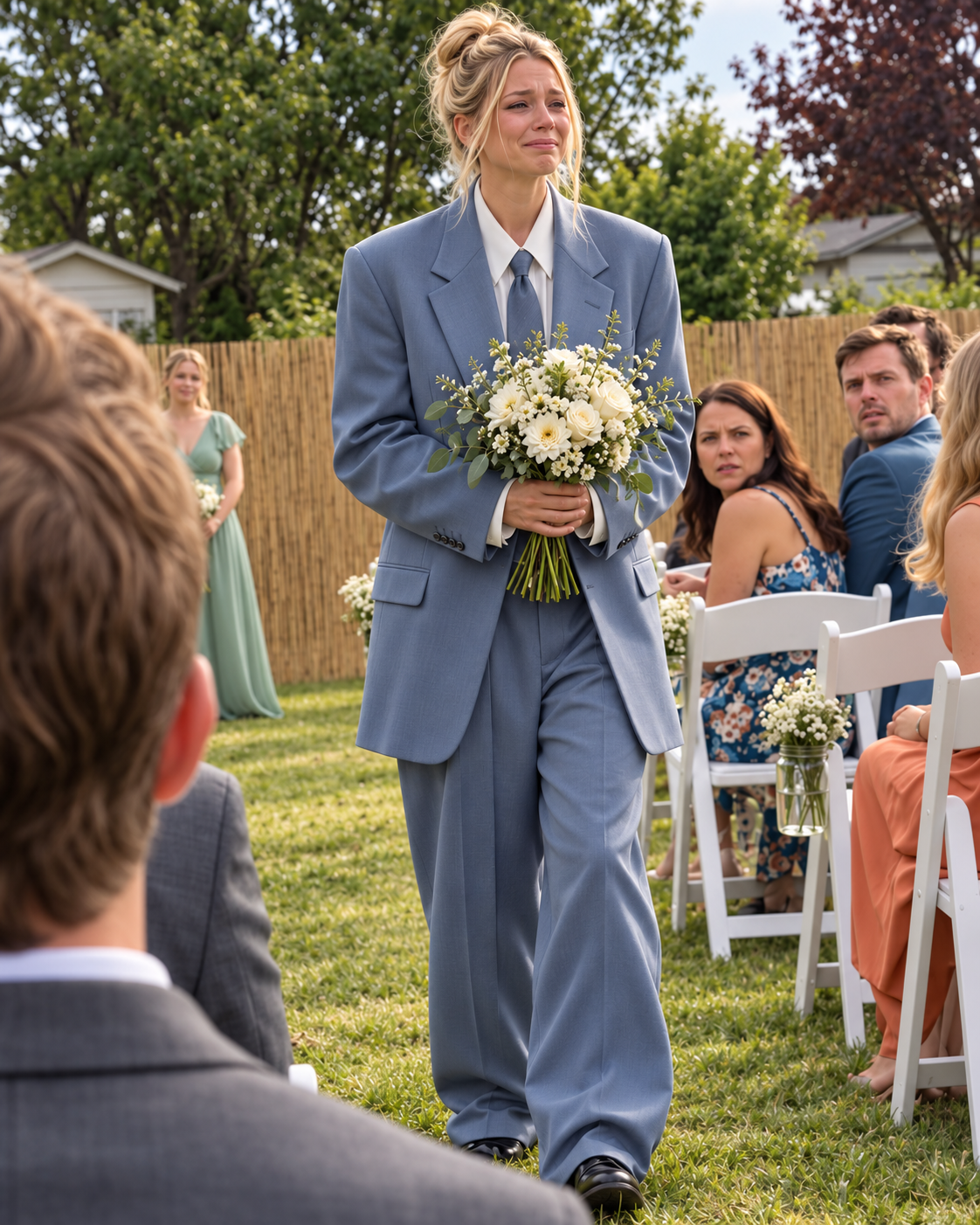
Claire stood at the far end of the aisle holding a bouquet of white roses, and almost every detail above her shoulders looked exactly as I had imagined. Her hair was pinned up. A few loose strands moved in the breeze. Her makeup was subtle. She looked nervous and happy at the same time, the expression she wore whenever she was trying not to laugh in a serious moment. From the neck down, however, nothing made sense.
She was wearing a black men’s suit that looked at least two sizes too large for her. Maybe three. The shoulders extended beyond her own. The sleeves swallowed part of her hands. The trousers gathered heavily over her shoes instead of falling cleanly to the ground. Beneath the jacket was a white shirt and a dark tie. It wasn’t a fashionable oversized tuxedo or some deliberate bridal reinterpretation. It looked old. Soft with age. A suit taken from another person’s closet.
For one stunned second, my mind refused to connect Claire with the clothes. I actually looked behind her, as if perhaps the bride I was expecting would appear next. Then I looked back at Claire. She was still there. Bouquet in her hands. Black jacket hanging from her narrow shoulders. Looking directly at me.
The whispers began almost immediately. They moved through the guests in little currents. I couldn’t make out every word, but I heard a confused “What?” somewhere behind my mother. Someone else gave a small nervous laugh and stopped when nobody joined them. A phone lowered. Another rose slightly. I became acutely aware of the photographer positioned a few feet from the aisle and the fact that whatever was happening was being permanently documented from multiple angles.
My first feeling was not tenderness. It was embarrassment. I wish I could rewrite myself more generously, but that would be dishonest. I was standing in front of everyone we knew, waiting for the traditional moment I had openly told Claire mattered to me, and she had appeared wearing what looked like an elderly man’s clothes without giving me the slightest warning.
A dozen thoughts arrived at once. Had she decided the wedding dress was ridiculous? Was this some protest against wedding expectations she had never mentioned? Was it a joke? Had something happened to the actual dress? Had she lost a bet? The more I tried to find a reasonable explanation, the less reasonable the scene became.
I glanced toward Claire’s mother. She had one hand pressed against her lips. She was emotional, but what struck me was that she wasn’t surprised. Not really. Whatever this was, she had known enough to brace herself for it. Jenna was watching Claire with the rigid attention of someone waiting to see whether a dangerous plan would work.
Then I looked at my own mother.
Mom was staring.
Her reaction was completely different. Her eyebrows had lifted, and she leaned forward in her chair as if distance were preventing her from confirming something. She wasn’t looking primarily at Claire’s face. Her eyes moved over the jacket, the lapels, the sleeves.
A strange unease replaced some of my irritation.
I looked back toward Claire. She had started walking.
The suit changed with every step. What had looked merely oversized from a distance now looked unmistakably old. The fabric had a dullness that came from years rather than fashion. One trouser leg seemed to break differently at the ankle from the other. The jacket was broad through the chest, built for someone much larger than Claire.
People continued whispering, although more quietly as she came closer. I could hear the music beneath it all, elegant and absurdly normal. Claire’s bouquet moved slightly with each step. Her grip was tight enough that I could see the tension in her fingers.
I searched her expression for some sign that she regretted this. She met my eyes, then gave me the smallest smile. It was not mischievous. That confused me more. Claire loved jokes, but she was terrible at hiding when she was enjoying one. If she had planned some elaborate prank, I would have seen it immediately. Instead she looked almost frightened.
By the time she had covered half the aisle, the part of me that wanted to be angry was competing with something else. Recognition was tugging at me from nowhere. Not recognition of the suit exactly. I couldn’t remember ever seeing it in person. Yet something about the cut, the wide lapels, the shape of the shoulders felt familiar in the way an old photograph can feel familiar even when you have never stood inside the room it captured.
I looked at Mom again.
Her hand had moved from her mouth to her chest.
That was when I knew whatever Claire was doing had something to do with my family.
I turned toward Aaron. He gave me a tiny shake of his head. He didn’t understand either. His expression had lost every trace of amusement. If he recognized the suit, he wasn’t showing it. I faced the aisle again and waited.
Claire reached the final row.
Then the next.
Then she was only a few steps away.
Up close, the jacket looked even stranger on her. The cuffs extended almost to her knuckles. One sleeve was slightly more worn than the other. I noticed faint creases in the fabric that no pressing could remove because they had been there too long.
She came to a stop beside me.
For a moment neither of us spoke.
Jenna stepped forward and took Claire’s bouquet. Claire handed it over without looking away from me.
I leaned closer. I tried to keep my voice low enough that the nearest guests wouldn’t hear, though I suspected the microphones would capture everything anyway. “Claire,” I said, “what are you wearing?”
Her lips trembled with what might have been nerves.
She didn’t answer.
That made my embarrassment flare again. “Seriously,” I whispered. “What is this?”
Instead of speaking, Claire lifted her left arm between us.
She used her other hand to draw back the oversized cuff.
There was a fabric label sewn inside the sleeve. It was faded, the printed logo almost worn away. I stared at it, waiting for an explanation that did not come. Then I noticed handwriting beneath the old label.
The ink had blurred slightly with age but remained readable.
Richard’s Wedding Suit.
My chest tightened before my mind finished processing the words.
Richard.
I looked at the handwriting again.
I had seen it on birthday cards, toolboxes, notes left on kitchen counters, grocery lists my mother refused to throw away, and the margins of instruction manuals because Dad never trusted manufacturers to explain anything properly.
My father’s name.
My father’s suit.
I raised my eyes to Claire.
“No,” I said, barely making a sound.
She nodded.
I looked past her at Mom. Tears had begun spilling down her face. Her expression answered the question before Claire could.
The black jacket around Claire’s shoulders was the suit my father had worn when he married my mother.
I remembered photographs from their wedding. Dad at twenty-eight, standing too stiffly for the camera, with a thick head of hair and a mustache Mom had spent decades mocking. I remembered one framed picture in the hallway of my childhood home: Dad laughing at something outside the frame while Mom stared up at him. He had been wearing a dark suit.
This suit.
The whispers around us disappeared from my awareness. So did the trees, the rows of chairs and the camera shutter clicking somewhere to my right. My attention narrowed until there was only the cuff between Claire’s fingers and the faded handwriting beneath the label.
Then Claire turned the fabric a little farther.
There was another word beneath my father’s old handwriting.
This one wasn’t written in ink.
It had been stitched carefully into the lining with newer thread.
Danny.
My hand rose to my mouth before I knew I was moving it.
Nobody called me that.
Nobody except him.
For one impossible instant, I heard my father’s voice in my head with such clarity that I nearly turned toward the empty chair.
END PART 2
PART 3 TITLE: The Name Inside the Cuff Turned My Confusion Into Grief, but Claire Still Had One More Choice to Explain
I had spent four years learning how to encounter reminders of my father without falling apart in public. A song in a hardware store. Someone driving the same model truck he had owned. A stranger with his posture. The smell of the aftershave he used. Usually the shock passed quickly enough that no one noticed. Standing beneath those trees with Danny stitched inside his wedding suit, every piece of practice deserted me.
I cried before I could say anything. Not the discreet kind where your eyes fill and you blink rapidly until you recover. My face folded. I covered my mouth and bent my head because there was nowhere else for the emotion to go. Aaron’s hand landed firmly on my shoulder. Somewhere behind Claire, I heard someone sniff. The photographer lowered his camera for a moment, then seemed to reconsider and quietly lifted it again.
Claire’s eyes filled too. “I’m sorry,” she whispered.
I shook my head because I didn’t yet know whether I wanted her to apologize.
Mom pushed herself out of her chair so quickly that one of the wooden legs scraped against the ground. For a second I thought she was coming toward us. Instead she stopped beside the front row, staring at the jacket as though she had just seen a person step out of an old photograph.
“How?” I managed.
Claire looked toward my mother.
“I asked her.”
That answer raised more questions than it settled. I wiped my face with the side of my hand. “Asked her what?”
Mom let out a broken little laugh through her tears. “She called me months ago.”
Claire nodded. “I wanted something of your dad’s for the wedding.”
The words landed gently compared with everything else. She explained that the idea had begun as something small. She knew how determined I was not to turn the wedding into a day about grief, and she had respected that. But she also knew my father’s absence had been following me through every stage of the planning, even when I refused to name it.
She had called Mom without telling me and asked whether there was anything of Dad’s that could be included quietly. It could have been a handkerchief tucked around the bouquet stems. A scrap of fabric sewn somewhere inside her dress. Something small enough that nobody needed to notice unless we chose to tell them.
Mom had apparently gone quiet on the phone. Then she told Claire she might have something.
A week later, Claire visited her alone.
Mom brought out a storage box.
Inside was the suit.
My mother had kept it for decades. Dad had worn it at their wedding, then a handful of times afterward before age, changing styles and changing waistlines retired it permanently. Eventually it had been cleaned, folded and stored with other things she could never quite bring herself to discard.
“I told her she could take whatever she needed from it,” Mom said from beside the chairs.
Claire looked down at the jacket. “She did.”
I stared at my mother. “You told her to cut up Dad’s wedding suit?”
Mom lifted both hands in surrender. “I said she could use some of the material. I assumed she knew what that meant.”
Despite myself, a sound escaped me that was somewhere between a laugh and another sob.
Claire pointed at my mother. “For the record, I was horrified by the suggestion.”
That earned the first real ripple of laughter from the guests. The tension loosened just enough for me to breathe.
“I brought it home,” Claire continued. “I kept thinking I could take fabric from somewhere no one would see. The lining, maybe. Or a tiny section inside the pocket.”
She had spread the suit across our spare bed on an afternoon when I was at work. Scissors sat beside it. She measured places where a piece might be removed without changing the shape. Every time she positioned the blades, she stopped.
“It felt wrong,” she said. “Not logically. Your mom had given me permission. I knew I wasn’t destroying something she expected anyone to wear again. But it still felt like I was taking this thing your dad had lived in for one of the biggest days of his life and reducing it to material.”
Mom wiped her cheeks. “I told her Richard wouldn’t have cared.”
“I know.” Claire looked at her. “That didn’t help.”
Two weeks before the wedding, after staring at the suit far too long, Claire had done something impulsive. She put it on.
At that, Aaron made a noise behind me.
Claire glanced toward him. “Yes, it looked ridiculous.”
Aaron looked at the trousers gathered around her shoes. “Past tense?”
Several people laughed again. Claire narrowed her eyes at him. “I’m still technically the bride. Be careful.”
The exchange was so ordinary, so completely Claire and Aaron, that it steadied me. I rubbed my thumb across the jacket sleeve. The wool felt softer than I expected. I wondered how many times my father had buttoned those cuffs, whether Mom had helped him straighten the collar on their wedding morning, whether his own hands had trembled before he walked into the ceremony.
Claire said she had originally put the suit on as a joke to herself. She stood in front of the mirror with the shoulders drooping and the trousers pooled around her feet. Then she saw her reflection and stopped laughing.
“What did you see?” I asked.
She took a breath.
“You.”
The answer confused me enough that I looked directly at her.
“Not literally,” she said. “I saw how much you were trying not to need him.”
I started to object. “Claire—”
“You were.”
There was no accusation in her voice. That made it harder to dismiss.
She reminded me of the way I had changed the subject whenever my father came up during wedding planning. When the photographer asked whether there were family members we wanted remembered in the ceremony, I had said no before Mom could answer. When Claire asked about a song, I refused. When she suggested leaving a small place in the program, I told her it would make the day sad.
“I thought I was handling it,” I said.
“I know.”
“I didn’t want everyone looking at me like I was supposed to be grieving during my wedding.”
“I know that too.”
My throat tightened again.
Claire moved closer. “And I wasn’t trying to make today about losing him.”
“Then why this?”
She glanced down at herself.
“Because after I put the suit on, cutting out one little square suddenly felt like the wrong thing.”
She told me she had stood in our spare room for several minutes, looking at the absurd reflection. At first she imagined taking a photograph and sending it to Mom. Then she pictured our ceremony. She pictured me standing exactly where I was now, with my mother in the first row and the empty chair beside her.
“That’s when the idea came to me,” she said. “And I hated it immediately.”
A laugh moved through the guests.
“I thought it was too much. Your mom thought it was too much at first. Jenna definitely thought it was too much this morning.”
Jenna raised a hand from behind her. “I asked many reasonable questions.”
Claire smiled briefly. Then her eyes returned to mine.
“I had a wedding dress ten feet away. I knew you wanted to see me in it. I knew you had pictured that moment. I also knew if I told you what I was thinking, you’d probably stop me.”
I couldn’t deny it.
She reached for my hand.
“I can’t bring your father here, Daniel. I know that. I would never pretend a piece of clothing could do that.”
I looked at the cuff again.
Richard’s Wedding Suit.
Danny.
“But I kept thinking about him wearing this when he married your mom. About him being part of the beginning of your family. And I thought maybe, for five minutes, this suit could be part of the beginning of ours.”
My mother made a sound behind us and sat down again, pressing a tissue against her face.
Claire’s grip tightened.
“I wanted something of him to come down the aisle today.”
There it was.
Not a prank. Not an attempt to shock anyone. Not a rejection of the wedding we had planned.
A gesture so risky and strange that only Claire would have made it, aimed directly at the part of me I had spent months hiding.
I lowered my head and laughed once through the tears. “You know I thought you’d lost your mind when you appeared back there.”
“I could tell.”
“I was genuinely horrified.”
“I could also tell that.”
“You could have warned me.”
“I almost did.”
I looked at her.
“Almost?”
She nodded. “Several times.”
The officiant, who had been standing patiently beside us with the expression of a man who understood his schedule was no longer relevant, leaned slightly closer. “I’m happy to give you a few minutes.”
I looked around then, really looked, for the first time since Claire reached me. Nobody seemed impatient. My mother was crying openly. Aaron’s eyes were red despite the determined expression on his face. Claire’s mother held Jenna’s hand. Even guests who had been whispering at first were completely silent now.
I turned back to Claire.
The jacket was too wide. The tie sat slightly crooked. The trousers were ridiculous. Her carefully pinned hair and delicate earrings made the old suit look even more out of place.
And somehow it was the most Claire thing she had ever done.
“No,” I said.
Her face tightened, just slightly.
I realized she thought I was answering some question she hadn’t asked.
I squeezed her hand.
“No break.”
She blinked.
I took a breath that felt like the first full one I had managed since seeing the label.
“We’ve already disrupted everybody’s afternoon enough.”
A few people laughed.
Then I looked at the woman wearing my dead father’s wedding suit and said the only thing that suddenly mattered.
“Let’s get married.”
END PART 3
PART 4 TITLE: We Finished the Ceremony With My Father Between Us, and My Carefully Rehearsed Vows Suddenly Felt Too Small
The officiant gave us several seconds to compose ourselves before he resumed. I used most of mine unsuccessfully. Every time I thought I had regained control, I looked at the folded cuff and felt the pressure return behind my eyes. Claire left the sleeve turned back so the handwriting remained visible between us. Richard’s Wedding Suit. Danny. Two small inscriptions, separated by decades, somehow holding more of my family history than anything else at the ceremony.
We faced each other beneath the arch. Claire slipped her bouquet back into Jenna’s hands rather than taking it again. She wanted both of her hands free. I understood why when she reached for mine. Her fingers were cold despite the warm afternoon. “You okay?” she whispered. I nodded. “No,” I whispered back. “But in a good way.” Her mouth twitched.
The officiant began again with a gentleness that avoided turning what had happened into a performance. He didn’t explain the suit to the guests. He didn’t make a speech about fathers or memory. He simply returned to the ceremony, speaking about partnership, promises and the ordinary work hidden inside a lifelong commitment.
That restraint made everything more powerful.
I had attended weddings where officiants described marriage almost entirely in grand declarations. Standing there, I thought instead about Tuesday dinners, shared laundry, flat tires, canceled plans and nights when one person was sick and the other slept badly because of it. Claire and I had already lived enough ordinary life together to know that love was often less cinematic than people wanted it to be.
Except, apparently, when your fiancée arrived at the altar dressed as your father.
Aaron must have been thinking something similar because I heard him clear his throat behind me. When I glanced sideways, he was staring determinedly at a tree rather than at us.
The officiant invited Claire to say her vows.
We had decided months earlier to write our own. We set rules because Claire believed unrestricted vows encouraged public oversharing. No embarrassing stories involving bodily functions. No jokes about former partners. Nothing longer than three minutes. We had even practiced approximate lengths separately so neither person would deliver a speech while the other offered six sentences.
Claire looked at me for a moment before beginning.
“Daniel,” she said, “I promise to love the person you are, not the person I sometimes think would be easier to organize.”
The guests laughed.
I shook my head. That line had clearly been planned before the suit.
She continued, her voice steadier now. She promised to be honest when honesty was uncomfortable. She promised to make decisions with me instead of merely around me. She promised to treat the people and experiences that had shaped me as part of the life we were building rather than as competition with it.
That sentence caught me.
Claire felt my hands tighten around hers.
She kept going.
She promised there would always be room in our marriage for the people we missed, the people still with us, and the versions of ourselves we would eventually outgrow. Then her expression shifted slightly.
“And,” she said, “I promise to stop allowing you to claim you aren’t emotional.”
Laughter rolled through the chairs.
“That wasn’t in the approved draft,” I said.
“It became necessary about twenty minutes ago.”
Even the officiant laughed.
Claire looked down once, gathered herself, then finished quietly. She promised that when life changed shape unexpectedly, she would try to meet it beside me rather than pretending everything could remain exactly as planned.
I thought about the suit.
I thought about Dad.
I thought about how aggressively I had tried to keep grief outside the boundaries of this day, as though happiness would become contaminated if sadness entered the same room.
Then it was my turn.
I had good vows.
They were in my jacket pocket on a folded sheet of paper I had rewritten five times. I had practiced them while driving. I had read them aloud in the shower. The night before the wedding, Aaron listened to them once and said, with obvious disappointment, “Those are annoyingly decent.”
Now I remembered perhaps half of what I had written.
I reached toward my pocket anyway, touched the folded paper, and stopped.
Claire noticed.
“You forgot them?” she whispered.
“Completely.”
That wasn’t entirely true, but it was close enough.
I left the paper where it was.
“I had something prepared,” I told her. “And it sounded much smarter than whatever is about to happen.”
She laughed softly.
I looked at her, really looked at her. The oversized shoulders. The old tie. The cuff carrying my father’s handwriting. The face of the woman who had spent months planning a secret she knew could either devastate me or make me understand something I had been avoiding.
“You see things I don’t say,” I began.
Claire’s smile disappeared, replaced by the expression she wore when emotion arrived before she was ready for it.
“I don’t always make that easy. Actually, I almost never make it easy.”
Aaron murmured, “Correct,” behind me.
I heard the guests laugh, but I kept my eyes on Claire.
“I thought loving somebody meant making sure they didn’t have to carry the difficult parts of you unless absolutely necessary. I thought if I kept certain things quiet, I was protecting the good parts.”
Claire blinked hard.
“Today you walked toward me wearing the most ridiculous thing I have ever seen at a wedding.”
A laugh escaped her through the tears.
“And for maybe twenty seconds, I wondered whether marrying you had been a serious error in judgment.”
She squeezed my fingers painfully.
“But then you showed me the cuff.”
I had to stop.
The silence under the trees became enormous.
“I spent this whole engagement thinking about who wouldn’t be here,” I said. “You were thinking about how to make room for him without asking me to perform being sad in front of everyone.”
Claire’s face crumpled.
“That’s what you do. You notice people. You notice what they need even when they are working very hard to convince you they don’t need anything.”
My voice broke on the final word.
I swallowed and continued.
“I promise I’m going to spend our life trying to notice you with the same care.”
Claire lowered her head for a second.
“I promise I’ll tell you things instead of expecting you to guess them. I promise I will make room for your sadness as carefully as you’ve made room for mine. I promise to laugh with you when life is ridiculous, which apparently includes our wedding ceremony.”
She laughed again.
“And I promise that when you do something completely insane for a reason that comes from love, I will try to wait longer than twenty seconds before judging you.”
“Generous.”
“I’m a generous man.”
Her thumbs brushed across my knuckles.
Then I said the simplest part because it needed no improvement.
“I love you. I want the life we’ve been talking about. I want the ordinary days and the bad ones and the days we haven’t imagined yet. And I want them with you.”
The officiant allowed the silence after that to remain for a moment.
Then he moved us toward the rings.
Aaron handed mine over with suspiciously red eyes. Jenna gave Claire hers. My hands were still trembling enough that I nearly dropped the ring before sliding it onto Claire’s finger. She raised one eyebrow. “Strong start,” she whispered.
“Please don’t make me laugh right now.”
“No promises.”
When she put my ring on, she paused with it halfway down my finger. For an instant we both stared at the narrow band. It was such a small object compared with everything we had just said.
Then she pushed it gently into place.
The officiant completed the final words of the ceremony.
When he told me I could kiss my wife, the phrase my wife hit harder than expected. Claire must have felt something similar because her expression changed just before I leaned toward her. We kissed beneath the trees while the guests applauded, and I could hear my mother crying and laughing at the same time.
The photographer captured the seconds immediately afterward.
I wouldn’t understand how perfect one of those photographs was until weeks later.
In that moment, all I knew was that Claire had wrapped her arms around my waist, I was laughing despite tears still on my face, and the enormous jacket bunched between us. Behind her shoulder, Mom was wiping her cheeks. Aaron was clapping with the expression of a man determined to deny he had cried.
The ceremony that I had imagined so precisely had turned into something I could never have planned.
And it was better for that.
Once the guests began moving toward the reception area, Mom came straight to Claire. She didn’t hug her immediately. First she touched the sleeve.
Her fingers stayed there.
For a second I could see my mother at two ages at once: the woman standing in front of me now and the young bride from the photographs, looking at my father in the same dark fabric.
“Are you angry?” Claire asked quietly.
Mom looked up. “For wearing it?”
Claire nodded. “For doing this without telling Daniel. For turning it into… all of this.”
Mom glanced at me, then back at her.
“Richard would have thought it was hilarious.”
Claire smiled uncertainly.
“I’m serious,” Mom said. “He’d spend the rest of the night telling everyone you wore it better.”
That sounded so exactly like Dad that I laughed.
Mom finally hugged Claire. Because of the oversized jacket, the embrace looked awkward, but neither of them seemed interested in correcting it.
When Mom stepped back, she turned toward me.
Her eyes were still bright.
“He would have loved this,” she said.
I knew she wasn’t talking only about the suit.
Then she looked at my ring, at Claire, and finally at me.
“He’d be proud of you, Danny.”
The name went straight through me.
I stared at her.
Mom seemed startled by her own choice of words. She hadn’t called me that since Dad died.
Before I could answer, Claire quietly folded the cuff back over the stitched name.
Not to hide it.
To protect it.
A few minutes later she disappeared inside to change for the reception, leaving my father’s suit in my mother’s hands.
And for the first time that day, I finally saw the white wedding dress hanging beyond the open doorway—the dress I had thought I was waiting for all along.
END PART 4
PART 5 TITLE: The Dress I Had Waited Months to See Was Beautiful, but One Missing Detail Made Me Understand Claire’s Secret Differently
The white dress stayed visible through the doorway for only a moment before Jenna noticed me looking and pulled the door nearly shut. I caught one last glimpse of ivory fabric, a fitted bodice, and a row of covered buttons before it disappeared.
I should have felt cheated.
For months, that dress had represented the moment I believed I was waiting for. I had imagined Claire walking toward me in it so many times that the picture had become part of the wedding before the wedding even existed. Yet standing in the hallway outside the bridal room, still carrying the imprint of my father’s suit in my mind, I felt no disappointment at all.
Mom stood beside me holding the black jacket carefully over both forearms. Without Claire inside it, the suit looked smaller somehow. Not physically smaller, but less theatrical. It was simply an old garment again—creases in the sleeves, slightly softened shoulders, fabric polished faintly along the edges from years of wear.
She ran her thumb across one lapel.
“I haven’t seen this out of the box in years,” she said.
I looked at her. “You really didn’t know she planned to wear the whole thing?”
Mom gave me an exhausted little smile. “I knew about the suit. I knew she was struggling with what to do with it. I did not know she intended to walk down the aisle looking like your father after shrinking six inches.”
I laughed.
“She told me this morning,” Mom continued. “About ten minutes before you saw her.”
“That explains Jenna.”
“It explains everyone in that room.”
Mom adjusted the jacket in her arms. “Claire asked if I wanted her to stop. She had the dress ready. Everything was ready. I could tell she was frightened she had gone too far.”
“What did you say?”
“I told her if she was going to do something that strange, she had better be certain why she was doing it.”
That sounded like my mother.
“And?”
“She said she was.”
Before I could answer, the bridal-room door opened again. Jenna stepped out and pointed at me.
“You’re not supposed to be standing here.”
“We’re married now.”
“That doesn’t mean you suddenly have access to every room.”
“Pretty sure it does.”
“No.”
She shut the door behind her.
Mom smiled. “Go see your guests.”
I started to protest, but music had begun drifting from the reception lawn, and through the windows I could see people carrying drinks beneath strings of lights. The formal photographs were supposed to begin soon. I took one more look at the suit.
“Are you keeping it with you?”
Mom nodded. “For now.”
“Good.”
I kissed her cheek and went outside.
The reception area looked transformed from the ceremony space even though it sat only a few hundred feet away. Round tables stood beneath a wide canopy, each arranged with the white roses Claire had chosen. Glasses caught the lowering sunlight. Someone from the catering staff moved between tables with trays of champagne. Guests had already begun retelling the ceremony to each other as though they hadn’t all witnessed the same event twenty minutes earlier.
Aaron found me almost immediately.
“Well,” he said.
“That’s your opening?”
“I have had an eventful afternoon.”
“You stood behind me.”
“I stood behind a man discovering that his bride had arrived dressed as his dead father. I think that qualifies.”
I laughed despite the absurdity of hearing the sentence summarized that way.
He handed me a drink.
“Seriously,” he said, quieter now. “You okay?”
I looked toward the building where Claire was changing.
“Yeah.”
He waited.
“I think so.”
“That sounds more accurate.”
We stood together for a moment.
Then Aaron said, “I recognized the suit eventually.”
I turned to him.
“When?”
“Right before you did. Maybe ten seconds before.”
“You didn’t say anything.”
“What was I supposed to say? ‘Hey, that appears to be Dad’s wedding suit and your bride is wearing it’?”
“Would have been useful.”
“Would have ruined the reveal.”
I shook my head.
Aaron looked toward Mom, who was speaking with one of our aunts while still holding the folded jacket.
“I’d forgotten she kept it.”
“So had I.”
“I remember Dad wearing it once.”
That surprised me.
“When?”
Aaron thought for a moment. “Maybe I’m remembering a picture. I don’t know. But I recognized the lapels.”
We both watched Mom.
Then Aaron said something that made me look at him again.
“You know what got me?”
“What?”
“The label.”
I assumed he meant Dad’s name.
Instead he said, “Danny.”
My chest tightened again.
Aaron stared into his drink.
“I haven’t heard anyone call you that since him.”
“Mom just did.”
His eyes flicked toward me.
“When?”
“After the ceremony.”
He looked away again, jaw shifting slightly.
For several seconds neither of us spoke.
Grief had always behaved differently between us. Aaron could talk about Dad more easily than I could. He told stories. He kept old voicemail messages. He still used one of Dad’s tools even though the handle was cracked and a new one would cost twenty dollars. I had done the opposite. I had removed most of the reminders from daily view because I believed that was how moving forward worked.
Neither of us had ever discussed whether one approach hurt less.
The photographer interrupted before either of us tried.
“Family photos in five minutes.”
Aaron groaned.
“You love photographs,” I said.
“I tolerate evidence of my existence.”
He walked away toward Mom.
I was still smiling when I heard Claire behind me.
“Worth the wait?”
I turned.
For several seconds, I forgot to answer.
The dress was simple. No enormous skirt, no dramatic train, no glittering detail designed to catch attention from fifty feet away. The fabric fell cleanly from her waist. Thin embroidery traced the edge of the bodice. Her shoulders were bare now, and without the oversized suit around her, she suddenly looked like the bride I had imagined.
Except not quite.
Something had changed.
Maybe it was because I had already seen her walk toward me once. Maybe because nothing could now make this dress the centerpiece I had assumed it would be.
Claire lifted her eyebrows.
“Daniel?”
“You look incredible.”
“Good recovery.”
“I’m serious.”
She smiled.
I stepped closer and looked down the dress.
“Is this the one you had all along?”
“Yes.”
“No secret second dress?”
“This wedding has reached its quota for surprise clothing.”
I laughed.
Then I noticed something near her wrist.
A narrow strip of dark fabric had been tied around the stems of her bouquet.
Not ribbon.
Wool.
I touched it lightly.
“Is that—”
Claire nodded.
“One tiny piece.”
I stared at her.
“You cut it?”
“From inside the trouser hem. Your mom showed me where it had already been altered decades ago. Nothing visible was damaged.”
I ran my thumb across the strip.
“So you did use part of it.”
“I decided I wanted something from the suit with me after I changed.”
That detail affected me more quietly than the ceremony had. There were no guests whispering now. No shock. No sudden recognition.
Just Claire standing in the dress she had chosen, carrying a nearly invisible piece of my father with her.
“You could’ve done this from the beginning,” I said.
“I could have.”
“And skipped the part where half the guests thought you’d had some kind of breakdown.”
“True.”
“So why didn’t you?”
Claire looked at me for a moment.
“Because this would have been for me.”
I frowned slightly.
She touched the dark fabric around the bouquet.
“This would have meant I knew he was there.”
Then she looked toward the ceremony lawn.
“Wearing the suit was for you.”
That answer stayed with me through the photographs.
We posed with my mother, Claire’s mother, Aaron, Jenna, our friends, cousins, aunts, uncles, and combinations of relatives I could no longer identify by the end. The photographer rearranged people endlessly. Shoulders turned. Chins lifted. Hands moved. Smiles reset.
At one point, Mom brought the suit over.
“Can we do one?” she asked.
The photographer looked at me.
I knew exactly what she meant.
We stood together—Mom, Aaron and me—with the suit between us.
At first Mom held it.
Then Aaron took one sleeve and I took the other.
It should have felt staged.
Instead, the moment the photographer raised the camera, Mom began laughing.
“What?” I asked.
She pointed at Aaron.
“Your father would be furious you’re holding it like that.”
Aaron looked down. “Like what?”
“You’re crushing the shoulder.”
“It’s a jacket, Mom.”
“It’s older than you.”
“So are you.”
She hit his arm.
The photographer caught that exact moment.
Later, it would become one of my favorite pictures from the entire day.
By dinner, the story of the suit had spread through every table. Guests who hadn’t understood the inscription came over to ask. Some cried when Mom explained. Others told stories about my father.
That was the part I hadn’t anticipated.
I had spent months avoiding mentioning Dad because I thought once his absence entered the wedding, it would take over.
The opposite happened.
He became present without becoming the center.
My uncle told Claire about the time Dad locked himself out of a rented cabin in winter and tried to climb through a bathroom window. One of my cousins remembered how he cheated shamelessly at cards. Mom told Jenna that Dad had once worn the wedding suit to a company dinner and spilled gravy down the front.
People laughed.
Nobody lowered their voices like they were discussing a tragedy.
For the first time in four years, I heard stories about my father in a room full of happy people.
And I realized how much I had missed that.
Later, as the catering staff cleared the dinner plates, Mom came to sit beside me.
Claire was across the room talking with friends.
Mom watched her for a moment.
“She was worried you’d hate it.”
“The suit?”
Mom nodded.
“So was I.”
“She nearly changed her mind three times today.”
That surprised me.
“When?”
“Once before you arrived. Once after she was dressed. Once right before the ceremony.”
“What stopped her?”
Mom looked at me.
“You.”
“That doesn’t make sense.”
“She saw you through the upstairs window.”
I stared at her.
“She could see me?”
“Apparently.”
Mom smiled.
“You were standing with Aaron near the chairs before the ceremony. She said you looked toward the empty seat beside me.”
I remembered that moment.
The front row.
Mom’s handbag.
The chair.
“She saw that?”
“Yes.”
I looked across the reception at Claire.
She was laughing at something Jenna had said.
Mom touched my hand.
“I think that’s when she decided.”
For a long time I didn’t move.
Then Claire happened to glance across the room.
Our eyes met.
She smiled.
And suddenly I understood that the most important part of what she had done wasn’t the suit itself.
It was that she had seen me looking at an empty chair from a distance and understood exactly who I was searching for.
END PART 5
PART 6 TITLE: During the First Dance, My Mother Handed Me Something Dad Had Written Long Before He Ever Knew Claire Existed
The band began setting up after dinner, and the reception shifted from speeches and plates to music and movement. Lights came on beneath the canopy as the sky darkened. The garden beyond the tables faded into deep blue. Glasses clinked. Chairs scraped. Children who had spent two hours being instructed to behave finally escaped toward the edge of the lawn.
Claire and I were supposed to have our first dance before the floor opened to everyone else.
I had worried about that part almost as much as the vows.
Neither of us could dance particularly well.
We had taken three lessons because Claire became convinced that “swaying in a slow circle like confused teenagers” would look terrible in the video.
After the third lesson, we concluded that confused teenagers were probably our natural level.
When the bandleader announced us, everyone gathered around the floor.
Claire placed one hand on my shoulder.
I put mine at her waist.
“You remember anything?” she whispered.
“Absolutely not.”
“Excellent.”
The music began.
For the first few seconds, we attempted the steps we had practiced.
Then I nearly stepped on her dress.
Claire laughed.
“That’s enough choreography.”
“Agreed.”
We reverted to swaying.
People applauded anyway.
Halfway through the song, I became aware of the dark strip of fabric still tied around Claire’s bouquet, now resting on our table.
I nodded toward it.
“You planning to keep that?”
“Forever.”
“Good.”
She studied my face.
“You’re thinking about him.”
It wasn’t a question.
“Yeah.”
“Bad?”
“No.”
That answer surprised both of us.
I looked past Claire toward Mom.
She stood near the dance floor beside Aaron.
“Actually,” I said, “not bad.”
Claire rested her cheek against my shoulder.
We finished the song without trying another rehearsed step.
When everyone joined the dance floor, Aaron immediately dragged me into an argument over whether the band could play anything written after 1995. Claire disappeared with Jenna. I danced badly with cousins, friends and one elderly aunt who was far more coordinated than I was.
Eventually Mom found me.
“Walk with me.”
Something in her tone made me follow without asking.
We left the music behind and went toward the stone house. The hallway inside was quiet, lit by small wall lamps. Our footsteps sounded strange after the noise outside.
Mom carried her handbag.
She led me to a small sitting room the venue had given us for personal belongings.
Dad’s suit lay folded across a chair.
Seeing it there stopped me.
Mom closed the door.
“I wasn’t going to give you this today.”
She opened her handbag.
“What?”
“I wasn’t sure I ever would.”
She removed a small envelope.
It was yellowed slightly at the edges.
My name was written on the front.
Daniel.
Not Danny.
The handwriting was Dad’s.
I stared at it.
“What is that?”
Mom sat down.
“I found it with the suit.”
I didn’t take it.
“When?”
“When Claire asked me to look for something of your father’s.”
“Why didn’t you tell me?”
“Because I didn’t know what it was.”
“You didn’t open it?”
“It wasn’t addressed to me.”
That was exactly the kind of answer my mother would give.
I reached for the envelope.
The paper felt softer than new stationery, as though it had been moved from drawer to drawer for years.
“Dad wrote this?”
“Yes.”
“When?”
“I’m not certain.”
There was no date on the outside.
I sat opposite her.
“Why would it be with the suit?”
Mom looked at the jacket.
“I think he put it there after your grandfather died.”
That added another layer I wasn’t prepared for.
My father’s father had died when I was twenty-three.
Grandpa Thomas had been quiet, stubborn and enormously important to Dad, though Dad rarely said so directly.
Mom folded her hands.
“Your father had a difficult time after the funeral. He didn’t talk about it much.”
That sounded familiar.
“One night he went through old boxes. Photographs. Clothes. Things from our wedding. He had the suit out.”
She nodded toward the envelope.
“I think he wrote that then.”
“Why?”
“He never told me.”
I turned the envelope over.
It was sealed.
A ridiculous instinct told me not to open it.
As long as the paper remained folded, Dad’s words still existed in a state where they could be anything.
Once I read them, there would be no more.
Mom seemed to understand.
“You don’t have to read it tonight.”
I looked through the window toward the reception lights.
Claire was somewhere outside.
People were dancing.
This was supposed to be one of the happiest evenings of my life.
Part of me wanted to put the envelope away and protect the day.
Then I remembered how well that strategy had been working.
I slid my finger beneath the flap.
The adhesive resisted, then released.
Inside was one folded sheet.
Dad’s handwriting covered both sides.
The first line nearly undid me.
Daniel,
If you’re reading this because I’m dead, then your mother ignored whatever sensible storage system I probably tried to invent.
I laughed so suddenly that Mom jumped.
“What?”
I handed her the first line.
She read it and covered her mouth.
“That man.”
“Sounds right.”
I continued.
Dad wrote that he had been thinking about his own father and realizing how many things men in our family left unsaid because they believed saying them would be awkward.
He called this “a stupid tradition.”
Then he wrote that he had no intention of continuing it.
I read slowly.
Dad said he didn’t know when I would find the letter or what my life would look like when I did.
Maybe I would be married.
Maybe I wouldn’t.
Maybe I would have children.
Maybe I would still be arguing with him about cars.
That line blurred.
I stopped.
Mom looked away to give me whatever privacy was possible in a room with two people.
I continued.
Dad wrote about Aaron first.
He said my brother had always entered rooms as if he already belonged there.
Then he wrote about me.
Daniel was different, he said.
Daniel watched before he entered.
Daniel carried things longer than he should because he preferred fixing problems privately to letting other people see there was a problem.
I lowered the letter.
Mom was crying silently.
“He knew,” I said.
“Of course he knew.”
I looked back at the page.
Then came the sentence that made the entire day feel impossible.
If you ever get married, don’t spend the whole day thinking about who isn’t there.
I stopped breathing.
Mom covered her face.
I read it again.
The words had been written years before Dad died.
Years before Claire and I became engaged.
Maybe before I had even met her.
Yet the sentence seemed aimed directly at the empty chair I had stared at that afternoon.
The rest was simpler.
He wrote that weddings were for the people still living.
That love deserved attention while it was in front of you.
That grief would always find a chair without being assigned one.
I pressed the heel of my hand against my eyes.
There were more words.
Dad told me to look at my mother if I ever doubted whether marriage was worth the trouble.
Mom laughed through her tears when I read that aloud.
“He complained about me every day.”
“He says that too.”
“Of course.”
The final paragraph was shorter.
Dad wrote that if he wasn’t present for whatever important moment I was living when I found the letter, I should assume he would have been proud unless I was doing something “spectacularly stupid.”
Then he added:
And if someone loves you enough to stand beside you when you’re being difficult, let them.
I lowered the page.
For several minutes, the room was silent.
The music outside was faint through the walls.
Eventually I looked at Mom.
“You really found this because Claire asked for the suit?”
“Yes.”
“And you’ve had it for months?”
“Yes.”
“Why today?”
She looked at me steadily.
“Because after what happened at the ceremony, I thought maybe you were finally ready to hear him.”
That was such a painful sentence that I almost argued.
Instead I looked at the suit.
Then the letter.
Then the window.
“What did you think I’d do if you gave it to me before?”
“Exactly what you always do.”
“What’s that?”
“Put it somewhere safe and not read it.”
I smiled despite myself.
She was right.
I folded the letter carefully along the original creases.
“Does Claire know about this?”
“No.”
I stood.
Mom reached for my wrist.
“Daniel.”
I looked down.
“You don’t have to turn everything into a lesson tonight.”
That was also a very Mom thing to say.
“I know.”
“Just have your wedding.”
I slipped the envelope inside my jacket.
“That’s what Dad said.”
She smiled.
When I returned outside, the dance floor was crowded.
Claire spotted me immediately.
She came over.
“Everything okay?”
I considered saying yes.
Then I stopped myself.
“No.”
Concern crossed her face.
I took her hand.
“Not bad.”
“What happened?”
I touched the inside pocket where the letter rested.
“My dad left me something.”
Claire went still.
I could have told her later.
I could have protected the moment.
Instead I said, “Come with me.”
We stepped away from the music together.
And for the first time in years, I chose not to carry my father alone.
END PART 6
PART 7 TITLE: Claire Read Dad’s Letter Under the Garden Lights, Then Told Me the One Part of Her Plan She Had Hidden From Everyone
We found a quiet bench beyond the reception canopy where the music softened into background noise. Small lights were wrapped around the nearest tree trunks, and from where we sat, we could see guests moving between the tables without being drawn back into the center of everything.
Claire waited while I took the envelope from my jacket.
“This was in the suit,” I said.
Her eyes dropped to the handwriting.
“Is that his?”
“Yeah.”
She didn’t reach for it.
“What does it say?”
I handed it to her.
“Read it.”
Claire hesitated.
“Daniel, are you sure?”
“Yes.”
She unfolded the page carefully.
I watched her eyes move down the first paragraph.
A smile appeared almost immediately.
“Your mother ignored his storage system?”
“Apparently.”
“That feels accurate.”
“You knew him long enough.”
She kept reading.
The smile faded.
When she reached the part about Aaron and me, she glanced up.
“He really saw you.”
“Apparently everyone does except me.”
“That’s not fair.”
“It’s becoming statistically difficult to argue.”
She returned to the letter.
Then she reached the sentence about weddings.
I knew the exact moment.
Her breathing changed.
She read it again.
If you ever get married, don’t spend the whole day thinking about who isn’t there.
Claire lowered the paper.
For several seconds, she said nothing.
Then she looked toward the reception.
“Daniel.”
“I know.”
“No. I mean—”
She looked back at the letter.
“This is…”
“I know.”
She pressed her fingers against her mouth.
All day, I had been the person surprised by what Claire had planned.
Now she looked genuinely shaken.
“When did he write this?”
“Mom thinks years ago.”
“Before we were engaged?”
“Probably before we met.”
Claire shook her head slowly.
“That’s ridiculous.”
“In the technical sense, yes.”
“No, I mean the coincidence.”
“I know.”
She finished reading.
At the final line, she laughed softly through tears.
“And if someone loves you enough to stand beside you when you’re being difficult, let them.”
She folded the letter.
“I feel personally attacked by your dead father.”
“He was efficient.”
Claire leaned against me.
For a while neither of us spoke.
The party continued without us.
Someone cheered near the dance floor.
A waiter carried empty glasses toward the house.
The ordinary movement around us made the moment easier to hold.
Eventually Claire said, “There’s something else.”
I turned toward her.
That phrase had become dangerous.
“What?”
She twisted her wedding ring once around her finger.
“I didn’t tell anyone.”
“About what?”
“The suit.”
“You told Jenna and Mom.”
“Not this part.”
Her expression had changed.
Not guilt exactly.
Apprehension.
I waited.
Claire looked toward the dark lawn.
“When your mom gave it to me, there was something in one of the pockets.”
My stomach tightened.
“What?”
“A receipt.”
That was not what I expected.
“For what?”
“A tailor.”
She gave a small, nervous smile.
“From thirty-four years ago.”
“Okay.”
“Your dad had the suit altered before their wedding.”
“That seems normal.”
“Yes.”
She paused.
“Except there were measurements written on the back.”
I stared at her.
“What does that have to do with anything?”
“Nothing at first.”
She took my hand.
“The chest measurement was almost exactly yours.”
I blinked.
“You measured me?”
“We ordered your suit together.”
“Right.”
“The waist wasn’t. The shoulders were close. The length was different.”
She watched my face.
“I started wondering.”
“Wondering what?”
“Whether your father’s suit could be altered again.”
I looked toward the house where it lay folded.
“Claire.”
“I know.”
“No.”
“I didn’t do it.”
“Good.”
“I asked.”
“Asked who?”
“A tailor.”
I closed my eyes.
“Of course you did.”
“She specializes in restoration.”
“That sentence is somehow worse.”
Claire laughed.
“I brought her photographs. I never gave her the suit. I just asked whether something that old could be adjusted temporarily without permanently changing it.”
I opened my eyes.
“And?”
“She said maybe.”
I stared at her.
“Why?”
Claire’s expression softened.
“I had another idea.”
“What idea?”
She looked embarrassed now.
“I thought maybe you could wear it.”
That silenced me.
“At the reception?”
“No.”
“When?”
“For one photograph.”
I kept staring.
Claire rushed ahead.
“I knew it might be too much. I knew you might hate it. That’s why I didn’t tell your mom. I didn’t want her thinking I was planning to dismantle the suit. I just kept picturing one photo.”
She swallowed.
“You, wearing what your dad wore when he married your mom.”
The bench felt suddenly too narrow.
“Claire.”
“I know.”
“And you decided not to?”
“I thought so.”
That last phrase made me suspicious.
“What does that mean?”
She reached into the small pocket hidden in the side of her dress.
Of course her dress had pockets.
She had spent months bragging about that feature.
Claire pulled out a business card.
A tailor’s name was printed across the front.
On the back was handwriting.
Temporary alterations possible. No cutting. Fully reversible.
I looked at it.
Then at her.
“You brought this to the wedding?”
“Yes.”
“Why?”
“Because I’m apparently incapable of abandoning an idea responsibly.”
I laughed despite myself.
Then she became serious.
“I wasn’t going to ask you.”
“What changed?”
She touched the envelope in my hand.
“This.”
I looked down at Dad’s letter.
Claire spoke carefully.
“I don’t think the letter means you’re supposed to put on the suit.”
“Good.”
“I think it means you should stop being afraid that remembering him will ruin something.”
That struck harder.
“I’m not afraid.”
She gave me a look.
“Fine.”
“Daniel.”
“I know.”
She waited.
I looked toward the reception.
People I loved were dancing.
Mom was laughing at something Aaron said.
My wife—my wife—sat beside me in the wedding dress I had imagined for months.
Dad was not there.
That fact had not changed.
Yet the day had not collapsed under the weight of it.
If anything, naming his absence had made the joy feel more complete.
I turned the business card over again.
“No cutting?”
“None.”
“Fully reversible?”
“That’s what she said.”
“You already talked to someone about doing it tonight?”
Claire’s silence answered.
“Claire.”
“She’s here.”
I nearly stood.
“She’s what?”
Claire winced.
“She’s one of Jenna’s cousins.”
I stared at her.
“You invited a tailor?”
“She was already coming with Jenna.”
“Convenient.”
“I know how this sounds.”
“Like a conspiracy.”
“A very respectful conspiracy.”
I laughed again.
For the first time, I understood how absurd the day must look from outside.
“Does she have equipment?”
“In her car.”
“Of course she does.”
Claire squeezed my hand.
“You can say no.”
I looked at the letter.
I pictured Dad’s wedding photograph.
Then I pictured myself wearing the same suit.
The idea made my chest hurt.
Not because it felt wrong.
Because it felt dangerously close.
I had spent years maintaining distance from anything that could collapse the wall between remembering Dad and needing him.
The suit had already cracked that wall.
The letter had finished the job.
“Mom has to decide,” I said.
Claire nodded immediately.
“Absolutely.”
“And Aaron.”
“Of course.”
“No surprises.”
“Agreed.”
I pointed at her.
“That is rich coming from you.”
She smiled.
We returned to the reception.
Mom and Aaron were together near our table.
When Claire explained, both of them went silent.
Mom looked at the suit.
Aaron looked at me.
“You want to wear it?”
“I don’t know.”
Mom walked over and touched the jacket.
Her expression was unreadable.
Finally she said, “Your father was slimmer than you.”
Aaron burst out laughing.
“Thank you, Mom.”
“I’m being practical.”
Claire covered her mouth.
I shook my head.
Mom looked at me again.
“If it can be done without damaging anything…”
She stopped.
Her fingers tightened on the fabric.
Then she smiled.
“I’d like to see it.”
That settled it.
Not completely.
But enough.
Jenna’s cousin appeared ten minutes later carrying a small sewing kit and the calm expression of someone who had been warned she was entering a complicated family situation.
She examined the seams.
Measured me.
Measured the suit.
Then looked up.
“I can make it wearable for a photograph.”
“How long?”
“Twenty minutes.”
My pulse jumped.
Claire reached for my hand.
The tailor carried the suit inside.
I watched it disappear through the doorway.
And suddenly I understood that for the second time that day, I was waiting to see my father’s wedding suit walk back into my life.
Only this time, I was going to be the one inside it.
END PART 7
PART 8 TITLE: Wearing Dad’s Suit Changed One Photograph Into a Moment None of Us Expected, and Mom Finally Told Us Why She Kept It
The tailor worked in the same small sitting room where Mom had given me Dad’s letter.
That felt appropriate.
Claire came with me at first, then was banished when the tailor discovered that having a bride hovering nervously over her shoulder did not improve precision.
“You are making me anxious,” she told Claire.
“I’m not doing anything.”
“You’re breathing at the fabric.”
Claire pointed at me. “He’s the emotional one.”
“Out.”
Claire left.
The alterations were surprisingly simple.
The suit had originally been cut generously through the chest and shoulders. Dad had been only slightly shorter than me when he married Mom. The biggest problem was the waist of the trousers.
The tailor loosened old stitching from a previous alteration, adjusted a hidden seam, and used temporary hand stitches that could later be removed.
Nothing was cut.
Nothing new was permanently attached.
I stood awkwardly while she worked around me.
“You look terrified,” she said.
“I am.”
“It’s cloth.”
“It’s not just cloth.”
She nodded.
“Fair.”
When the jacket finally settled over my shoulders, the first thing I noticed was the weight.
It wasn’t heavy.
I had simply expected something more dramatic.
Instead it felt like any suit jacket.
Wool against my shirt.
Sleeves ending near my wrists.
A faint smell of cedar from decades of storage.
The ordinariness nearly overwhelmed me.
I looked at myself in the mirror.
For a moment I saw only myself.
Then I noticed the lapels.
The same shape I had seen in my parents’ wedding photograph.
I turned slightly.
The shoulders were close.
Not identical.
Close.
I opened the cuff.
Richard’s Wedding Suit.
Beneath it:
Danny.
My vision blurred.
The tailor pretended to examine a pin cushion.
“Take your time,” she said.
I touched the inside of the sleeve.
Dad had worn this.
Not symbolically.
Literally.
His arms had gone through these sleeves.
His hands had buttoned this jacket.
He had stood somewhere on his own wedding day, perhaps nervous, perhaps pretending not to be.
I suddenly wondered whether he had been thinking about his own father.
The door opened slightly.
Claire’s voice came through.
“Can I see?”
The tailor looked at me.
I nodded.
Claire stepped in.
She stopped.
Her face changed so completely that I nearly laughed.
“What?”
She shook her head.
“Nothing.”
“Claire.”
“You look like him.”
That sentence landed strangely.
“I don’t.”
“A little.”
“Mom always says Aaron does.”
“In the face, yes.”
She walked closer.
“You look like him in the shoulders.”
I looked back at the mirror.
Maybe.
Or maybe memory wanted resemblance badly enough to create it.
Claire stood behind me.
For a second, our reflection showed exactly what she had imagined months earlier.
Me in Dad’s suit.
Her in her wedding dress.
I looked at her through the mirror.
“This is completely insane.”
She smiled.
“You married me.”
“Apparently.”
We went outside.
The reception had quieted.
Word had spread again.
Of course it had.
Guests gathered near the edge of the dance floor.
Mom stood in front.
The moment she saw me, both hands rose to her face.
She did not cry immediately.
That was worse.
She simply stared.
I walked toward her.
“Too much?”
Mom shook her head.
She reached out.
Her fingers touched the lapel.
Then the collar.
Then one shoulder.
“You look nothing like him.”
I laughed.
Claire laughed.
Mom smiled through tears.
“Thank God.”
Aaron appeared beside her.
He looked me up and down.
“That waist is doing heroic work.”
“Everyone in this family is supportive.”
“I’m trying.”
The photographer came over.
“What are we doing?”
Claire answered before I could.
“One picture.”
Mom corrected her.
“Several.”
We began with the photograph Claire had imagined.
Just the two of us.
I stood beside her in Dad’s suit.
She held the bouquet with the dark strip of fabric tied around the stems.
The photographer positioned us beneath the same trees where we had married.
“Look at each other.”
We did.
Claire smiled.
I didn’t need to.
It was already happening.
The camera clicked.
Then Mom joined us.
Then Aaron.
Then both mothers.
Then Jenna.
Then half the family apparently decided history required photographic participation.
Eventually the photographer raised both hands.
“One more.”
People groaned.
“This one matters.”
He positioned Mom between Aaron and me.
Claire stood beside me.
Dad’s suit stretched across my shoulders.
Mom put one hand on my arm and one on Aaron’s.
The photographer lowered the camera.
“Actually,” he said, “don’t look at me.”
“What?”
“Talk to each other.”
Aaron immediately said, “Your trousers are too short.”
Mom laughed.
I shoved his shoulder.
Claire leaned into me.
The shutter clicked repeatedly.
That photograph would later become the one we framed.
Not because any of us looked polished.
We didn’t.
Mom was laughing with her eyes closed.
Aaron was half turned toward me.
Claire’s head rested against my shoulder.
I was looking at my brother.
Dad wasn’t in the photograph.
And yet everything in it existed because he had been.
Afterward, I changed back into my own suit.
The tailor removed enough of the temporary work that Dad’s suit could be folded safely for the night.
Mom took it again.
This time she didn’t place it in the box.
She carried it with her to the table.
We sat together after most guests returned to dancing.
Claire had gone to speak with the band.
Aaron was getting drinks.
For several minutes, Mom just looked at the suit.
Then she said, “I almost gave it away.”
I turned.
“When?”
“After your father died.”
That surprised me.
“I thought you said you couldn’t throw anything out.”
“I couldn’t.”
“That’s different.”
She nodded.
“I had a box for donations. His shirts. Two coats. Shoes.”
Her fingers traced the folded sleeve.
“I put this on top.”
“What stopped you?”
Mom’s expression changed.
“I found something in the pocket.”
I almost laughed.
“Another letter?”
“No.”
She reached into her handbag.
For a second I thought she had somehow kept one more secret all day.
Instead she pulled out an old photograph.
I recognized it immediately.
My parents on their wedding day.
The hallway picture from my childhood.
Dad was laughing at something outside the frame.
Mom was looking up at him.
I took it.
“What was this doing in the pocket?”
“Turn it over.”
I did.
There was handwriting.
Dad’s.
For Margaret, so you remember I cleaned up well once.
I smiled.
Beneath that was another line.
Different ink.
Different handwriting.
Mom’s.
I kept the suit because this was the happiest I had ever seen him.
I looked up.
Mom wiped beneath one eye.
“I wrote that after he died.”
She stared at the jacket.
“I found the photograph in the pocket and realized I couldn’t give the suit away.”
“Why didn’t you tell us?”
“There wasn’t anything to tell.”
“There was.”
She shook her head.
“No, Daniel. Grief turns ordinary objects into evidence. You start thinking every shirt, every receipt, every stupid broken tool has to be kept because throwing it away feels like losing the person again.”
She looked at the suit.
“I knew that wasn’t true. But I kept this anyway.”
I handed back the photograph.
“Because of the wedding?”
“Because of the look on his face.”
Her voice softened.
“He was happy.”
That simple statement silenced me.
Not perfect.
Not symbolic.
Happy.
Mom folded the photograph into her palm.
“When Claire asked for something of his, I thought maybe I had kept the suit long enough.”
“You were willing to let her cut it.”
“Yes.”
“That still surprises me.”
Mom smiled.
“I wasn’t preserving Richard by keeping fabric in a box.”
The sentence stayed between us.
She continued.
“And today, for the first time in years, it wasn’t in a box.”
I looked toward the dance floor.
Claire was laughing with Jenna.
Aaron was returning with drinks.
The photographer was showing someone an image on the back of his camera.
Dad’s suit had spent decades folded away.
Then, in one day, it had been worn by my wife and by me.
It had made Mom laugh.
It had brought back stories.
It had led us to a letter Dad wrote when none of us knew we would need it.
Mom touched my sleeve.
“I think that’s enough for one piece of clothing.”
I smiled.
“What happens to it now?”
“I don’t know.”
“You keeping it?”
She looked at Claire.
Then at me.
“No.”
That surprised me.
“Who gets it?”
Mom’s expression became almost mischievous.
“You do.”
“I don’t have anywhere to put it.”
“That sounds like your problem.”
I laughed.
Then I became serious.
“You’re sure?”
“Yes.”
She placed the folded suit in my hands.
The weight was ordinary again.
That mattered.
I didn’t need it to feel sacred every second.
It was a jacket.
It was Dad’s jacket.
Both could be true.
Aaron sat down beside us.
“What did I miss?”
Mom nodded toward the suit.
“I gave it to Daniel.”
Aaron looked offended.
“Why him?”
“You mocked the trousers.”
“I was trying to keep him humble.”
“Too late.”
Claire came back then.
She saw the suit in my hands.
“What happened?”
“It’s ours.”
Her eyes widened.
“Really?”
Mom nodded.
Claire sat beside me.
For a moment all four of us looked at the folded fabric.
Then Aaron lifted his glass.
“To Dad’s terrible old suit.”
Mom slapped his arm.
Claire laughed.
I raised my glass.
“No.”
They looked at me.
I thought about Dad’s letter.
About the empty chair.
About the ceremony.
Then I said, “To not keeping everything in boxes.”
Nobody spoke for a second.
Then Mom lifted her glass.
Claire did the same.
Aaron nodded.
We drank.
And later that night, when Claire and I left the reception as husband and wife, my father’s suit traveled with us—not as a substitute for the man we had lost, but as something far less fragile.
A piece of family history that had finally been allowed to live again.
END PART 8
PART 9 TITLE: The Morning After Our Wedding, Claire Finally Explained Who Stitched “Danny” Into Dad’s Cuff and Why She Nearly Removed It
The morning after our wedding, I woke before Claire.
For several seconds I had no idea where I was. Pale light came through unfamiliar curtains, one of my shoes lay on its side near the bathroom door, and somebody had abandoned a glass of water on the bedside table with exactly one sip left in it.
Then I saw the garment bag hanging from the wardrobe.
Dad’s suit was inside.
Everything came back at once.
The aisle. Claire in the oversized jacket. My mother crying. The inscription inside the cuff. Dad’s letter. The photographs beneath the trees. The temporary alterations. The four of us raising glasses over a piece of clothing that had spent most of my adult life forgotten in a box.
And, beneath all of that, one simple fact I was still getting used to.
Claire was my wife.
She was asleep on her side beside me, her hair mostly out of the pins that had held it in place the previous day. One hand rested beneath her cheek. The wedding ring caught a thin strip of morning light.
I stayed there longer than necessary.
Dad’s letter was on the bedside table.
I had read it again after we returned from the reception.
Claire had been taking pins out of her hair while I sat on the edge of the bed with the paper in my hands.
Neither of us had said much.
There were days so full that adding more words only diminished them.
Eventually I got up.
I took the garment bag down carefully and laid it across a chair.
I should probably have left it alone.
Instead I unzipped it.
The jacket was still slightly rumpled from being worn twice the day before. The tailor’s temporary stitching had been removed, and the shoulders had returned to their original shape.
I reached inside the sleeve.
Richard’s Wedding Suit.
And beneath it:
Danny.
I touched the newer thread.
Something about it had bothered me since the ceremony, though yesterday had offered too many other things to think about.
Dad had never embroidered anything in his life.
He could barely sew a button back onto a shirt.
So who had stitched my nickname inside the cuff?
I heard movement behind me.
“You’re supposed to be sleeping.”
Claire’s voice was rough with exhaustion.
I turned.
She was sitting against the headboard, squinting at me.
“I could say the same thing.”
“You’re the one conducting an early-morning inspection.”
I lifted the cuff.
“Who did this?”
She understood immediately.
The sleepy expression disappeared.
“Oh.”
“That doesn’t sound promising.”
She pushed the blanket aside and came over.
For some reason, she didn’t answer right away.
That alone made me suspicious.
“Claire.”
“I was going to tell you.”
“You’ve said that about approximately fifteen things since yesterday.”
“That feels exaggerated.”
“Who stitched Danny in here?”
She sat on the edge of the chair beside the suit.
“I did.”
I had expected that.
Still, hearing it changed something.
“You?”
She nodded.
“With help.”
“From Jenna’s tailor cousin?”
“No.”
“Mom?”
Claire shook her head.
“Your mother didn’t know.”
I stared at her.
“You put my dad’s nickname for me inside his wedding suit without telling anyone?”
“When you say it like that, it sounds alarming.”
“How else would I say it?”
She smiled faintly, then became serious.
“I almost took it out.”
That caught me.
“Why?”
Claire ran one finger beside the embroidery without touching the thread directly.
“Because once I had it done, I thought I’d crossed a line.”
The room became quiet.
She told me the idea had come months earlier, after Mom gave her the suit.
Claire already knew Dad had called me Danny.
She had heard him use the name when he was alive, though she said she never truly understood what it meant until after his death.
“It wasn’t just a nickname,” she said.
“No.”
“I figured that out because nobody else used it.”
I looked down.
Dad had shortened my name automatically.
Not Daniel.
Not Dan.
Danny.
Even when I was thirty.
Even when I complained.
Especially when I complained.
Claire said she had once asked Mom about it.
Not because she planned to use the nickname herself, but because she noticed the silence around it.
Mom told her Dad had begun calling me Danny when I was a toddler and never stopped.
“Your mom said you hated it when you were seventeen.”
“I did.”
“She said you threatened to change your legal name.”
“That sounds dramatic.”
“She said you were dramatic.”
“She lies.”
Claire smiled.
Then she explained that when she began considering wearing the suit, the gesture still felt incomplete.
Dad’s name was connected to the garment.
Mine wasn’t.
She wanted one quiet detail that joined the two.
So she took the jacket to a small embroidery shop across town.
Not the whole suit, she clarified.
Just the jacket.
She asked an older woman there whether four letters could be stitched by hand inside the cuff, small enough that they would remain hidden unless someone deliberately folded the sleeve back.
“Why by hand?”
“Machine stitching looked too clean.”
I laughed softly.
“That is an absurd level of planning.”
“I know.”
The woman asked Claire to write the name down.
Claire couldn’t.
She had never seen Dad write Danny.
So instead, she went to Mom’s house.
“I told her I was looking for handwriting samples.”
“What did she think that meant?”
“I was doing something sentimental for the wedding.”
“And she didn’t ask?”
“She absolutely asked.”
“What did you tell her?”
“That she would find out later.”
I groaned.
“So Mom had warning that some kind of ambush was coming.”
“Technically.”
Claire searched through old cards with her until they found one Dad had given me on my thirtieth birthday.
Mom had kept it because I had accidentally left it at her house after Dad died.
On the inside, Dad had written:
Happy birthday, Danny. Thirty is not old, regardless of what Aaron tells you.
I remembered the card.
I remembered Dad saying essentially the same thing over dinner.
What I hadn’t remembered was leaving it behind.
Claire photographed the handwriting.
The embroiderer copied the shape as closely as possible.
Not perfectly.
But enough.
I looked at the stitching again.
Suddenly the letters resembled his handwriting more clearly.
The slant of the D.
The narrow a.
The way the final y dropped slightly.
“You copied his handwriting.”
Claire nodded.
“That’s why I panicked afterward.”
“Because?”
“It stopped feeling like a little tribute.”
She looked at me.
“It felt like I was putting words in his mouth.”
That was exactly the danger.
She knew it too.
“I brought the jacket home and stared at it for an hour,” she said. “I thought about removing the thread.”
“Why didn’t you?”
“Because he actually called you that.”
I ran my thumb near the letters.
“He did.”
“And I wasn’t trying to pretend he had embroidered it or planned any of this.”
She paused.
“I just wanted you to see the name the way he might have written it.”
The answer sat strangely inside me.
Yesterday, when I first saw Danny in the cuff, I had instinctively connected it to Dad.
Not because I believed he had literally sewn it there.
Some part of me had known the thread was new.
What hit me was seeing the name attached to something that had belonged to him.
Claire had understood the distinction before I did.
“You really thought I might be angry.”
“Yes.”
“Were you planning to tell me at the altar that you had done it?”
“No.”
“When?”
“I hadn’t gotten that far.”
“Strong planning.”
“I was busy secretly wearing a dead man’s suit.”
I laughed.
Claire rested her head against my shoulder.
For a while we looked at the jacket together.
Then another question occurred to me.
“Did Mom ever find out where that birthday card went?”
Claire winced.
“Oh no.”
“What?”
“I still have it.”
I turned.
“You stole a card from my mother?”
“Borrowed.”
“For months?”
“Borrowed inefficiently.”
I stared at her.
She started laughing.
That was how our first morning as husband and wife began: sitting beside my father’s wedding suit while I accused Claire of committing sentimental theft against my mother.
It felt appropriate.
After breakfast, we met Mom and Aaron in the hotel restaurant.
Mom looked as tired as I felt.
Aaron looked offensively normal.
He had always been one of those people who could stay awake until two in the morning, drink too much champagne, and appear at breakfast looking prepared to attend a business meeting.
Claire placed Dad’s old birthday card beside Mom’s coffee.
Mom stared at it.
Then at Claire.
“I knew you had that.”
Claire stopped.
“You did?”
Mom took a sip.
“You are not as subtle as you think.”
I laughed.
Claire looked betrayed.
“You let me believe I had secretly borrowed it.”
“I assumed you had a reason.”
“You didn’t ask?”
“You were planning my son’s wedding. I was trying to interfere less.”
Aaron pointed his fork at her.
“This is the same woman who called me six times because she didn’t approve of my refrigerator.”
“Your refrigerator was disgusting.”
“It was a refrigerator.”
“It was a public-health event.”
Claire laughed so hard she had to put down her coffee.
Then Mom opened the birthday card.
She looked at Dad’s handwriting.
Her amusement disappeared.
Not dramatically.
Just enough.
She traced the line with one finger.
Happy birthday, Danny.
Then she looked at me.
“I forgot he wrote that.”
“So did I.”
Mom turned toward Claire.
“You used this for the stitching?”
Claire nodded.
“I hope that was okay.”
Mom looked toward the garment bag resting beside my chair.
“You should have asked.”
Claire’s expression fell.
Then Mom added, “I would have said yes.”
Claire breathed out.
Mom reached across the table and squeezed her hand.
“Next time you plan to embroider my late husband’s handwriting into something, inform me first.”
“I will put that in the marriage calendar.”
Aaron leaned back.
“How frequently do we anticipate this situation?”
“Hopefully rarely.”
We laughed.
And there it was again.
The thing I had spent four years believing could not happen.
Dad’s name entered the room.
His handwriting sat on the table.
Nobody stopped being happy.
After breakfast, Mom gave me the card.
“You should have this.”
I started to refuse.
She pushed it toward me.
“It was yours in the first place.”
I opened it.
The paper had yellowed only slightly.
Dad’s signature sat beneath the joke about turning thirty.
I remembered reading it the morning he gave it to me and barely thinking about it.
That had been the privilege of believing there would always be another card.
Another birthday.
Another joke.
I closed it.
This time I didn’t feel the desperate need to preserve every object connected to him.
But I wanted this one.
So I slipped it into the same envelope as his letter.
Dad’s past words together.
No altar.
No display case.
No dramatic ceremony.
Just paper.
Before we left breakfast, Mom asked what I planned to do with the suit.
“Take it home.”
“And then?”
“I don’t know.”
She nodded.
That answer seemed to satisfy her.
Claire and I had no intention of putting it behind glass.
We weren’t going to frame it or construct some shrine.
At home, I hung it in the back of our bedroom closet inside a breathable garment bag.
That was all.
For the first few weeks, I occasionally opened the closet and noticed it.
Eventually I stopped.
Then one Sunday afternoon, while searching for a winter coat, I brushed against the garment bag and remembered the wedding.
Not Dad’s death.
The wedding.
Claire walking toward me with those ridiculous trousers dragging near her shoes.
Mom crying.
Aaron complaining about the waist.
The sound of everyone laughing while we tried to take family photographs.
That was the first time I understood what Mom had meant when she said she kept the suit because Dad looked happy in it.
Objects don’t preserve people.
But sometimes they preserve a moment well enough to lead you back there.
And now Dad’s wedding suit carried two weddings.
His.
And ours.
END PART 9
PART 10 TITLE: Months Later, Our Wedding Photographs Arrived and One Image Showed Me What Claire’s Strange Choice Had Actually Given Back to Us
The wedding photographs arrived on a rainy Saturday nearly two months later.
Claire was in the kitchen making coffee when the photographer emailed the gallery link.
I opened it on my phone, saw the first image, and called her name.
She came into the living room carrying two mugs.
“What happened?”
“Pictures.”
She abandoned both coffees on the table.
Within minutes we were sitting shoulder to shoulder on the couch, scrolling through more than eight hundred photographs.
There were the expected ones first.
Flowers.
Rings.
My cuff links.
Claire’s dress hanging near the bridal-room window.
Aaron pretending to fix my tie while clearly making it worse.
Mom sitting in the front row before the ceremony, her handbag beside her feet.
Then we reached the aisle.
Claire stopped scrolling.
The first image showed the exact second she appeared.
From the photographer’s angle, I could see her at the far end beneath the trees wearing Dad’s oversized suit.
I could also see myself.
My expression was extraordinary.
Claire began laughing.
“Oh, Daniel.”
“I look terrified.”
“You look offended.”
“I was offended.”
“You look like someone announced a tax audit during the ceremony.”
“Your trousers looked insane.”
“They did.”
We moved to the next photograph.
Claire had taken two more steps.
My face had changed from horror to confusion.
In another, Mom was leaning forward, clearly recognizing the jacket before I did.
Then came the photographs from when Claire reached me.
One showed her lifting the cuff.
Another captured me staring down at the label.
The photographer must have been shooting continuously because the next few frames documented every stage of understanding.
Confusion.
Recognition.
Disbelief.
Then grief.
I almost skipped them.
Claire put her hand on mine.
“You don’t have to.”
I looked at the photograph.
My face was turned away slightly, one hand covering my mouth.
Aaron stood behind me with his palm on my shoulder.
Mom was visible in the first row, crying.
Claire stood directly in front of me.
The suit swallowed her.
Nothing about the image was elegant.
It was probably the least conventionally beautiful wedding photograph anyone in our family had ever taken.
“Keep it,” I said.
Claire looked at me.
“You sure?”
“Yes.”
We kept scrolling.
The ceremony looked different in photographs than it had felt while living it.
I could see things I had missed.
Jenna crying during Claire’s vows.
Aaron wiping one eye and immediately pretending to adjust his collar.
Claire’s mother squeezing Mom’s hand.
A little boy in the second row paying absolutely no attention and digging in the grass beside his chair.
One photograph caught Claire smiling at me while the turned-back cuff remained visible between us.
You couldn’t read the stitching unless you knew it was there.
I knew.
That was enough.
Then came the kiss.
The reception.
Dinner.
Speeches.
Our awkward first dance.
Claire stepping on my shoe.
Me laughing.
Mom telling stories at the table.
Guests holding Dad’s suit after they learned what it was.
Eventually we reached the pictures taken after the tailor adjusted the suit for me.
Claire became quiet.
The first frame showed me coming outside.
Mom stood in the foreground with both hands over her mouth.
I hadn’t seen her face from that angle.
The sight stopped me.
There was recognition there.
But also something harder to name.
Not confusion.
Not grief exactly.
Maybe memory arriving faster than she could prepare for it.
In the next photograph, Mom’s hand was on my lapel.
She was saying something.
I remembered.
You look nothing like him.
I laughed again.
Claire leaned against me.
“She needed that joke.”
“So did I.”
Then we reached the family photograph.
The one taken after the photographer told us not to look at the camera.
Mom was in the middle.
Aaron stood on one side.
I stood on the other wearing Dad’s suit.
Claire was beside me.
Aaron had just made the comment about my trousers.
Mom was laughing with her eyes closed.
I was looking toward him.
Claire had her head against my shoulder.
Nobody was posed properly.
Nobody was ready.
Nobody looked solemn.
We stared at it.
Claire spoke first.
“That one.”
I nodded.
“That one.”
We ordered a large print.
When it arrived, I assumed we would hang it in our bedroom or hallway.
Claire had another idea.
She wrapped it carefully and took it to Mom’s house.
Mom opened the package at her kitchen table.
When she saw the photograph, she didn’t say anything for a long moment.
Then she got up.
“Wait.”
She disappeared down the hallway.
When she returned, she carried the framed photograph from my childhood home.
My parents on their wedding day.
Dad laughing outside the camera frame.
Mom looking up at him.
The same photograph she had once found hidden in his suit pocket.
She set the two images side by side.
Thirty-something years separated them.
In one, Dad wore the suit.
In the other, I did.
What struck me wasn’t the clothing.
It was the laughter.
Dad wasn’t looking at the camera either.
Neither was I.
Mom noticed at the same moment.
Her fingers went to her mouth.
“Oh.”
Claire leaned closer.
“What?”
Mom pointed.
“Look at Richard.”
I did.
Then I looked at myself.
Our faces were different.
Our bodies were different.
Dad had been younger in his photograph than I was in mine.
But both pictures had caught us between poses, distracted by people we loved.
The resemblance Claire had claimed to see in the mirror wasn’t physical.
It was something less exact.
A posture.
A moment.
Maybe simply happiness.
Mom sat down.
“That’s why I kept the suit.”
I remembered what she had told me at the reception.
This was the happiest I had ever seen him.
I pulled out the chair beside her.
“For the picture?”
“For that version of him.”
She looked at Dad’s photograph.
“After somebody dies suddenly, the last day can become too important.”
I knew exactly what she meant.
My final phone call with Dad had replayed in my mind for years.
Brakes.
Car maintenance.
His warning that I always waited too long to replace things.
Nothing meaningful.
Nothing cinematic.
The last conversation I would ever have with my father had been about brake pads.
For a long time, that bothered me.
I wanted final words worthy of being final.
Mom continued.
“You start remembering the hospital. The phone call. The funeral. People telling you they’re sorry.”
Her finger rested beside Dad’s photograph.
“I kept this because I needed proof that his life wasn’t the way it ended.”
No one spoke.
The rain tapped softly against the kitchen window.
Then Claire said, “Put them together.”
Mom looked at her.
“What?”
“The photographs.”
Claire moved them side by side.
“Don’t replace the old one.”
Mom stared at the pair.
Dad laughing on his wedding day.
Us laughing on ours.
She nodded.
That was where they stayed.
Months passed.
Marriage, unsurprisingly, became ordinary very quickly.
There were bills.
Groceries.
Laundry.
Work deadlines.
An argument about whether we actually needed three different streaming subscriptions.
Another argument about why Claire believed wet towels belonged on the bed.
The wedding gradually stopped being the center of every conversation.
Thank-you cards were mailed.
Flowers dried.
My suit returned from the cleaner.
Claire’s dress went into storage.
Dad’s wedding suit remained in our closet.
Sometimes weeks passed without me noticing it.
That turned out to be healthy.
I didn’t want grief to become a daily ritual.
I wanted Dad to exist inside my life the way he had when he was alive: sometimes central, sometimes background, often invoked through a joke or remembered sentence rather than tragedy.
One evening, several months after the wedding, Aaron came over for dinner.
After Claire went upstairs, he asked if I still had Dad’s letter.
“Yeah.”
“You read it again?”
“A few times.”
He nodded.
Then he stared into his drink.
“Could I read it?”
I hadn’t expected that.
The letter was addressed to me.
But Dad had written about Aaron too.
I went upstairs, retrieved the envelope, and handed it over.
Aaron read quietly at our dining table.
He smiled at the joke about Mom’s storage system.
Then his face tightened.
When he finished, he folded the page along the original crease.
“He was right about you.”
“Which part?”
“You carry things too long.”
“I’ve been informed.”
Aaron handed it back.
“He was wrong about me.”
“What part?”
“That I always know I belong in a room.”
I looked at him.
For once, my older brother didn’t cover discomfort with a joke.
“I just get there before anyone notices I’m nervous.”
That surprised me.
We talked about Dad for nearly an hour.
Not the funeral.
Not the hospital.
Dad.
The man who exaggerated fishing stories.
The man who became furious whenever somebody touched the thermostat.
The man who insisted on giving directions even after GPS became commonplace.
Aaron told me Dad had once quietly loaned him money during a period when I thought Aaron was doing perfectly well.
I told Aaron about the conversation Dad had with me after meeting Claire.
Don’t screw this up, Danny.
We laughed.
It occurred to me that Claire’s decision at the wedding had done something neither of us had understood at the time.
She hadn’t brought Dad back.
Nothing could.
She had reopened the door we had closed around his memory.
That was all.
But it was enough.
Our first anniversary came sooner than expected.
Claire suggested we return to the garden estate for dinner at a restaurant nearby.
Before leaving, I opened the closet.
Dad’s suit hung at the back.
Claire saw me looking at it.
“Absolutely not.”
I smiled.
“What?”
“You are not wearing that.”
“I wasn’t planning to.”
“You were considering it.”
“I was looking.”
“The trousers barely survived the first time.”
I laughed and closed the closet.
We left the suit where it was.
That mattered too.
It had served its purpose.
We drove to dinner in completely ordinary clothes.
Afterward, we walked near the property where we had married.
The garden wasn’t hosting a wedding that evening.
The chairs were gone.
The arch was gone.
Without decorations, the place looked smaller.
We found the tree near where we had stood.
Claire slipped her hand into mine.
“Do you regret it?”
“What?”
She didn’t need to clarify.
“The suit.”
I considered the question carefully.
“I regret the first twenty seconds.”
She laughed.
“I knew it.”
“I genuinely thought something had gone horribly wrong.”
“I could see that.”
“But no.”
I looked across the empty lawn.
“I don’t regret it.”
Claire leaned against me.
“I almost wore the dress instead.”
“I know.”
“I was standing upstairs completely dressed in the suit with the wedding dress hanging beside me.”
“You could see me at the chairs.”
“Yes.”
“And the empty seat.”
“Yes.”
I thought about that.
“You know what Dad wrote.”
“Don’t spend the whole day thinking about who isn’t there.”
“Exactly.”
I shook my head.
“I was doing exactly that before the ceremony.”
Claire squeezed my hand.
“And then?”
I smiled.
“Then my fiancée appeared wearing my dead father’s clothes and gave me a completely different problem to think about.”
She laughed so loudly that a couple walking along the path turned toward us.
We kept walking.
At home later, I opened Dad’s letter one more time.
Not because I was sad.
Because I wanted to check one line.
If someone loves you enough to stand beside you when you’re being difficult, let them.
I looked toward the bedroom where Claire was changing.
Then at the garment bag in the closet.
For years after Dad died, I believed moving forward meant learning how to need him less.
Maybe that was partly true.
But I had confused needing someone with remembering them.
Those weren’t the same thing.
Remembering him didn’t diminish the life I was building.
It didn’t make my wedding less joyful.
It didn’t make my marriage belong to the past.
The opposite was true.
The woman I married had understood something I hadn’t.
You can make room for the people who are gone without asking the living to stand outside.
I folded the letter.
Put it back with the birthday card.
Closed the drawer.
Then I went to find my wife.
Dad’s suit stayed hanging quietly in the closet.
No shrine.
No ceremony.
No empty chair waiting for someone who could never sit there again.
Just an old black suit that had been worn by a young man marrying the woman he loved, stored for decades, worn again by the bride his son loved, and finally placed on that son’s shoulders for a photograph filled with laughter.
It could not bring my father back.
It did something more honest.
It reminded us that he had been here.
And that we were still here too.
END PART 10
