
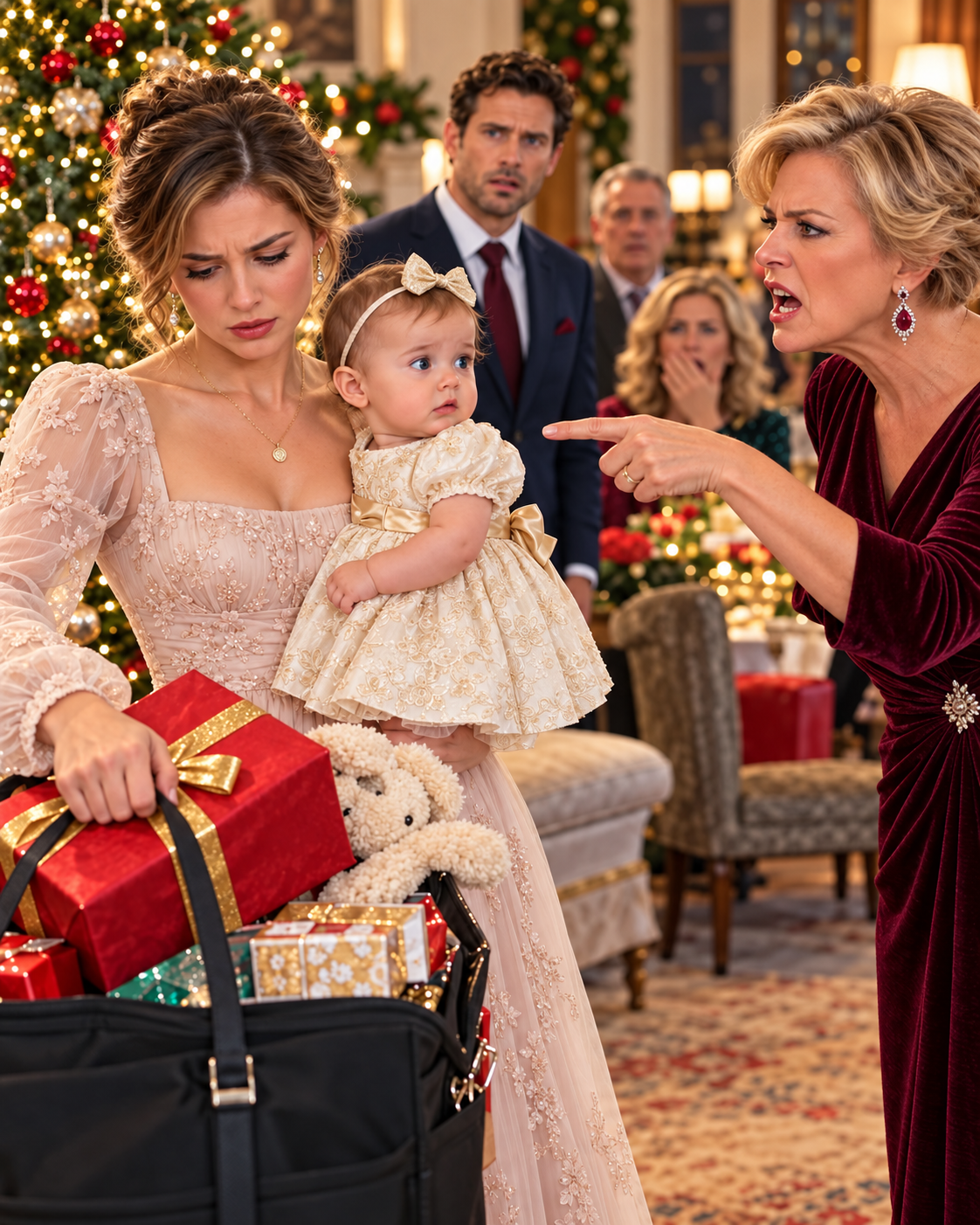
À Noël, ma mère a critiqué mon bébé devant toute la famille.
Ses paroles m’ont frappée si fort que, pendant un instant, je suis restée incapable de parler.
Puis je me suis levée, j’ai rassemblé tous les cadeaux portant le nom de ma fille et j’ai déclaré :
« Ce sera son dernier Noël ici. »
C’est à ce moment-là que ma mère a soudain commencé à revenir sur ses paroles.
Mais avant le Nouvel An, elle comprendrait que je pensais chacun de mes mots.
Au moment où j’ai fini d’habiller ma fille dans sa tenue de Noël en velours rouge, je m’étais déjà raconté trois mensonges.
Le premier, c’était que cette année serait différente.
Le deuxième, que ma mère se comporterait correctement.
Et le troisième, que si elle ne le faisait pas, je serais assez forte pour l’ignorer.
Ma fille, Lily, était assise sur le lit entre deux couvertures pliées, agitant joyeusement ses petits pieds couverts de chaussettes.
Elle avait huit mois.
Les gens pensaient souvent qu’elle était plus jeune parce qu’elle était très petite.
Ses joues étaient douces et rondes, mais ses poignets étaient encore si fins que je vérifiais parfois deux fois les manches avant de les fermer.
Lily était née six semaines avant terme.
Pendant trois longues semaines après sa naissance, ma vie s’était déroulée sous les lumières fluorescentes de l’hôpital.
J’avais appris le langage des moniteurs.
Les niveaux d’oxygène.
Les horaires des biberons.
Les conversations à voix basse avec les infirmières.
J’avais découvert à quel point une toute petite machine pouvait devenir terrifiante à trois heures du matin.
Et à quel point une chambre d’hôpital pouvait rester associée à la peur.
Mais Lily était en bonne santé maintenant.
Son pédiatre le répétait à chaque rendez-vous.
En bonne santé.
Petite, mais en bonne santé.
Elle grandissait régulièrement selon sa propre courbe.
Éveillée.
Forte.
Parfaitement elle-même.
Pourtant, tandis que je lissais sa robe sur son ventre, mes mains hésitèrent.
Mon mari, Evan, entra dans la pièce avec le sac à langer dans une main et plusieurs cadeaux emballés dans l’autre.
« Ça va ? » demanda-t-il.
« Oui. »
J’avais répondu trop vite.
Il me lança ce regard de quelqu’un qui savait que je ne disais pas toute la vérité, mais qui savait aussi que je n’étais pas prête à en parler.
« Ce n’est que Noël, dit-il doucement. On mange, on ouvre les cadeaux, on sourit et on part avant que quelqu’un commence à se disputer à propos de politique. »
Je ris.
Surtout parce que j’aurais aimé que la politique soit notre plus gros problème.
« Ma mère n’a pas besoin de politique, répondis-je. Elle pourrait déclencher une dispute familiale à propos d’un gratin. »
Evan embrassa le sommet du crâne de Lily.
« Alors on reste près des sorties. »
J’essayai de sourire.
Mais j’avais l’estomac noué depuis le matin.
Chez mes parents, Noël semblait toujours magnifique vu de l’extérieur.
Des lumières blanches le long du porche.
Des chaussettes assorties au-dessus de la cheminée.
Des bougies à la cannelle dans chaque pièce.
Ma mère, Carol, portant des boucles d’oreilles festives et se comportant comme si elle avait personnellement inventé l’idée de réunir la famille.
Mais sous toute cette chaleur apparente, il y avait toujours eu quelque chose de tranchant.
Quand j’avais dix ans, elle avait regardé ma photo d’école et l’avait qualifiée de « malheureuse ».
À seize ans, elle m’avait dit que ma robe de bal faisait paraître mes bras trop gros.
Lorsque j’avais été admise à l’université avec une bourse partielle, elle avait voulu savoir pourquoi je n’avais pas visé plus haut.
Quand je lui avais présenté Evan, elle avait déclaré :
« Eh bien, il a l’air stable. »
Comme si elle évaluait un appareil électroménager.
Et pourtant, d’une certaine manière, j’espérais encore que devenir grand-mère la changerait.
Peut-être que Lily l’adoucirait.
Peut-être qu’elle finirait par regarder ma fille sans chercher quelque chose à améliorer.
Peut-être qu’elle me regarderait enfin avec fierté.
C’était toujours le piège dans ma famille.
Croire que la prochaine étape importante finirait par changer ma mère.
Nous sommes arrivés chez mes parents un peu après midi.
Le ciel d’hiver était bleu pâle et la lumière du soleil se reflétait sur les plaques de glace le long du trottoir.
Sur la banquette arrière, Lily gazouillait en direction d’un renne en peluche.
Mon téléphone vibra.
Un message de maman.
N’oublie pas le gratin de haricots verts. Et mets un nœud au bébé, s’il te plaît. Les photos, c’est important.
J’ai fixé le message jusqu’à ce que l’écran s’éteigne.
Evan jeta un coup d’œil vers moi.
« Quoi ? »
« Rien. »
Lorsque nous sommes arrivés devant la maison, l’allée était pleine.
Le SUV de mon frère Mark.
La berline de ma tante.
La vieille Buick de ma grand-mère.
Plusieurs cousins s’étaient garés à moitié sur la pelouse.
À l’intérieur, la maison sentait la dinde, le produit nettoyant au pin et le parfum floral hors de prix de ma mère.
Dès que nous avons franchi la porte, tout le monde s’est rassemblé autour de Lily.
« Oh là là, regardez cette robe ! »
« Elle a grandi. »
« Quels yeux ! »
Ma belle-sœur Jenna fut la première à tendre les bras vers elle.
Jenna avait trois enfants et cette confiance tranquille qui mettait immédiatement les bébés à l’aise.
« Elle est adorable, dit-elle. Joyeux Noël, ma puce. »
Pendant presque une heure, tout sembla normal.
Presque.
Puis Jenna me rendit Lily au moment où ma mère entra dans la pièce avec un plateau de boissons.
Maman s’arrêta.
Elle observa Lily de la tête aux pieds.
Puis elle sourit de cette façon qui faisait toujours se tendre tout mon corps.
« Elle est vraiment minuscule, dit-elle. J’imagine que c’est compréhensible après un début aussi difficile. »
Je forçai un petit rire.
J’espérais qu’elle s’arrêterait là.
Elle ne le fit pas.
Maman se pencha et ajusta le nœud sur la robe de Lily sans demander la permission.
« Tu devrais vraiment essayer de lui faire prendre un peu plus de poids. Les bébés sont censés avoir l’air en bonne santé, pas ressembler à de fragiles petites poupées. »
La pièce devint silencieuse.
Je baissai les yeux vers Lily.
Elle mâchouillait joyeusement le coin de son jouet, totalement inconsciente de ce qui se passait.
À côté de moi, l’expression d’Evan changea.
« Elle est en bonne santé, dis-je avec précaution. Son médecin est très satisfait de son développement. »
Maman agita une main.
« Les médecins disent ce genre de choses pour éviter que les mères s’inquiètent. Je suis simplement honnête. »
Ma tante se mit soudain à trouver son café fascinant.
Mark fixa le sapin de Noël.
Même Jenna ne dit rien.
Puis maman ajouta :
« Tu sais, si tu m’avais écoutée pendant ta grossesse, elle ne serait peut-être pas née aussi tôt. »
Cette phrase me frappa autrement.
Pendant huit mois, j’avais rejoué ma grossesse dans ma tête.
Chaque décision.
Chaque rendez-vous.
Chaque instant où je m’étais demandé si j’aurais pu faire quelque chose différemment.
J’avais porté cette culpabilité pendant les premières semaines terrifiantes qui avaient suivi la naissance de Lily.
Et maintenant, ma mère venait de plonger directement la main dans cette blessure.
Je regardai ma fille.
Ses minuscules doigts s’étaient refermés autour des miens.
Chauds.
Confiants.
Et soudain, le dîner de Noël n’avait plus aucune importance.
Les photos de famille non plus.
Ni le fait de préserver le confort de tout le monde.
Je me rappelai la promesse silencieuse que j’avais faite près du lit d’hôpital de Lily.
Je la protégerais.
Même si la protéger signifiait décevoir les autres.
Je me levai.
Puis je tendis Lily à Evan.
« Tiens-la pour moi. »
Maman cligna des yeux.
« Où est-ce que tu vas ? »
Je me dirigeai vers le sapin et commençai à ramasser chaque cadeau portant le nom de Lily.
« Qu’est-ce que tu fais ? » demanda maman.
Son assurance commençait à disparaître.
Je la regardai droit dans les yeux.
« Je ramène ma fille à la maison. »
Elle eut un rire nerveux.
Comme si elle s’attendait à ce que je rie avec elle.
Je ne le fis pas.
Puis je prononçai la phrase qui changea tout cet après-midi-là.
« Ce sera son dernier Noël ici. »
Maman pâlit.
« Oh, Claire, ne sois pas dramatique. Je ne voulais rien dire de mal. »
Mais pour la première fois de ma vie, je ne me justifiai pas.
Je ne discutai pas.
Je ne m’excusai pas.
Je pris le sac à langer.
Je récupérai Lily des bras d’Evan.
Et je me dirigeai vers la porte.
Derrière moi, maman continuait à m’appeler.
Soudain, elle promettait de faire plus attention.
D’être plus gentille.
De changer.
Pour une fois, je ne restai pas assez longtemps pour découvrir si elle le pensait vraiment.
Avant le Nouvel An, elle comprendrait que je ne bluffais pas.
Les dix premières minutes du trajet vers la maison se déroulèrent en silence.
Lily dormait paisiblement dans son siège-auto, une petite main posée près de sa joue.
Les lumières de Noël devenaient floues derrière les vitres pendant que nous roulions.
Evan gardait les deux mains sur le volant.
Finalement, il tendit la main et serra la mienne.
« Tu as fait ce qu’il fallait. »
Je regardai par la fenêtre.
« Je me demande toujours pourquoi je la laisse encore me faire du mal. »
« Parce que c’est ta mère, répondit-il. Aimer quelqu’un ne t’apprend pas automatiquement à cesser d’espérer qu’il changera. »
Quand nous sommes rentrés, j’ai porté Lily à l’étage.
Je lui ai retiré sa robe de velours rouge et l’ai couchée sous la couverture douce qu’elle utilisait lorsqu’elle était nouveau-née.
Pendant plusieurs minutes, je suis simplement restée là à la regarder respirer.
Pour la première fois de toute la journée, la pression dans ma poitrine commença à diminuer.
Puis mon téléphone se mit à sonner.
Maman.
Je laissai sonner.
Une minute plus tard, elle rappela.
Puis encore une fois.
Finalement, les messages commencèrent à arriver.
Le premier disait qu’elle était désolée.
Le deuxième disait que j’avais mal compris.
Le troisième disait qu’elle s’inquiétait seulement pour Lily.
Puis arriva le message qui m’arrêta.
S’il te plaît, ne punis pas toute la famille à cause d’une seule remarque stupide.
Je le fixai.
Elle ne demandait pas si Lily allait bien.
Elle ne disait pas qu’elle comprenait pourquoi j’étais blessée.
Elle s’inquiétait de la fête.
Du rassemblement.
De tous les autres.
Evan descendit et me trouva assise sur le canapé, mon téléphone à la main.
« Qu’est-ce qu’elle a dit ? »
Je lui montrai les messages.
Il les lut.
« Tu n’es pas obligée de répondre ce soir. »
« Je sais. »
Puis je le regardai.
« Mais je crois que je viens enfin de comprendre quelque chose. »
« Quoi ? »
« Toute ma vie, j’ai essayé d’obtenir les excuses de quelqu’un qui n’a jamais cru m’en devoir. »
Le lendemain matin, maman rappela.
Cette fois, je répondis.
Elle commença immédiatement à se justifier.
Elle était stressée.
Les gens regardaient.
Elle voulait seulement dire que Lily paraissait petite.
Je la laissai terminer.
Puis je dis :
« Maman, Lily n’est pas un problème que tu dois résoudre. »
Silence.
« C’est ma fille. Elle est en bonne santé. Elle est aimée. Et elle ne grandira pas en croyant qu’être petite, différente ou imparfaite signifie qu’elle mérite moins de gentillesse. »
Ma voix trembla.
« Et moi non plus. »
Maman commença à pleurer.
Elle promit de changer.
Promit qu’elle réfléchirait avant de parler.
Promit qu’elle ne dirait plus jamais quelque chose de ce genre.
Pour une fois, je ne promis rien en retour.
À la place, je lui expliquai exactement ce qui devrait changer si elle voulait avoir une relation avec Lily.
Aucun commentaire sur son corps.
Aucune critique déguisée en inquiétude.
Aucune accusation à mon égard concernant ce qui s’était passé pendant ma grossesse.
Et surtout, ne jamais donner à Lily l’impression qu’elle devait changer pour mériter l’amour de sa grand-mère.
Trois jours plus tard, un colis apparut devant notre porte.
À l’intérieur se trouvait une petite décoration de Noël en bois représentant une petite fille.
Il y avait également une lettre manuscrite.
Je la lus deux fois.
Elle n’était pas parfaite.
Mais pour la première fois, ma mère présentait ses excuses sans immédiatement ajouter une excuse derrière.
Je ne savais pas si notre relation pouvait réellement changer.
Peut-être que oui.
Peut-être que non.
Mais quelque chose d’autre avait déjà changé.
J’avais enfin cessé de m’apprendre à moi-même que je devais tolérer la douleur simplement parce qu’elle venait de ma famille.
Le soir du Nouvel An, maman se présenta devant notre porte.
Le vent hivernal traversait le porche pendant que je la regardais debout devant moi.
Ses cheveux argentés étaient légèrement décoiffés.
Sans son parfum habituel, son maquillage impeccable et cette assurance qu’elle portait comme une armure, elle semblait plus petite.
Dans ses mains, elle tenait un simple sac en papier provenant d’une boulangerie.
« Est-ce que je peux entrer cinq minutes ? » demanda-t-elle.
« Je ne voulais pas que l’année se termine comme ça entre nous. »
Mon premier réflexe fut de m’adoucir.
Puis je me rappelai Noël.
« Evan et moi avons décidé que les visites sans prévenir ne fonctionneraient plus. »
Elle cligna des yeux.
« Si tu veux parler, nous pouvons nous asseoir dehors pendant dix minutes. Ou nous pouvons prévoir un autre jour. »
À ma grande surprise, elle hocha la tête.
Aucune dispute.
Aucune tentative de me culpabiliser.
Nous nous sommes assises sur le porche.
Elle posa le sac de boulangerie sur ses genoux.
« J’ai apporté des scones aux pêches, dit-elle doucement. Tu les aimais quand tu passais une mauvaise journée au lycée. »
Je la regardai.
« Des scones n’effacent pas vingt-cinq années de remarques blessantes. »
Elle baissa les yeux.
« Et ils n’effacent pas ce que tu as dit à propos de Lily. »
Des larmes apparurent dans ses yeux.
Puis elle dit quelque chose que je ne l’avais jamais entendue dire auparavant.
« Quand Lily est née prématurément, j’étais terrifiée. »
J’attendis.
« J’ai cru que j’allais vous perdre toutes les deux. »
« Alors pourquoi ne me l’as-tu pas dit ? »
Ma voix resta calme.
« Pourquoi ta peur se transforme-t-elle toujours en critique ? »
Elle couvrit brièvement son visage de ses mains.
« Parce que si quelque chose est la faute de quelqu’un, alors le monde paraît moins imprévisible. »
Je fronçai les sourcils.
Elle continua.
« C’est comme ça que j’ai survécu à ma propre mère. »
Pour la première fois, elle me parla de son enfance.
De la façon dont sa mère critiquait tout.
Rien n’était jamais assez propre.
Assez joli.
Assez convenable.
Elle avait grandi en croyant que corriger constamment quelqu’un était une manière de le préparer à la vie.
Je l’écoutai.
Puis je dis :
« Et tu m’as transmis exactement la même chose. »
Son visage se décomposa.
« Je pensais que je te rendais plus forte. »
« Lily n’a pas besoin de cruauté à la maison pour se préparer à la cruauté du monde extérieur. »
Je me penchai légèrement vers elle.
« La maison devrait être l’endroit où elle se sent suffisamment en sécurité pour ne pas avoir à jouer un rôle. »
Maman resta silencieuse pendant un long moment.
Puis elle demanda :
« De quoi as-tu besoin de ma part ? »
Alors je lui expliquai.
J’avais passé trois nuits à écrire mes limites sur un bloc-notes.
Aucune remarque sur le corps de Lily.
Aucune comparaison concernant son développement.
Aucune critique de ma façon d’être mère devant les autres membres de la famille.
Ne jamais utiliser l’inquiétude comme excuse pour humilier quelqu’un.
« Si tu franchis l’une de ces limites, la visite se termine. »
Je soutins son regard.
« Pas de débat. Pas de dispute. Nous partons. »
« J’accepte. »
Elle répondit immédiatement.
« J’accepterai tout ce que tu seras prête à m’accorder. »
Je secouai la tête.
« Je ne veux pas que tu sois assise dans mon salon terrifiée à l’idée de dire quoi que ce soit. »
« Alors qu’est-ce que tu veux ? »
« Une mère qui me voit vraiment. »
Je marquai une pause.
« Et une grand-mère qui aime Lily sans conditions. »
Avant de partir, elle demanda si elle pouvait voir Lily à travers la fenêtre.
Je répondis non.
« Pas aujourd’hui. Aujourd’hui, cette conversation concernait toi et moi. »
Pour une fois, elle accepta la réponse.
Cela comptait.
Lorsque je rentrai à l’intérieur, Evan me tendit une tasse de thé à la menthe poivrée et m’enlaça.
« Comment ça s’est passé ? »
« Elle a écouté. »
Je posai la tête contre lui.
« Et je n’ai pas cédé. »
Cette nuit-là, lorsque la nouvelle année commença, Lily dormait paisiblement entre nous sur le canapé.
Pour la première fois, les fêtes semblaient calmes.
Sûres.
À nous.
Le mois de janvier passa lentement.
Maman gardait ses distances.
De temps en temps, elle envoyait de courts messages.
Je pense à vous deux. J’espère que Lily va bien. Pas besoin de répondre.
Elle ne me mettait aucune pression pour obtenir une visite.
Elle ne se plaignait pas.
Cet espace me donna le temps de réfléchir.
Vers la fin du mois de janvier, Jenna vint nous voir avec une soupe faite maison.
« Tout le monde était sous le choc quand tu es partie à Noël, me dit-elle.
— Je pensais que tout le monde m’en voulait d’avoir gâché le dîner. »
Jenna éclata de rire.
« Claire, ta mère franchit les limites de tout le monde depuis des années parce que personne ne voulait faire de scène. »
Elle secoua la tête.
« Te voir partir, c’était comme voir quelqu’un enfin briser le cycle. »
Ces mots restèrent avec moi.
Protéger Lily n’avait pas été un acte de rébellion.
C’était simplement être sa mère.
En février, Lily s’épanouissait.
Elle se retournait toute seule.
Gazouillait sans arrêt.
Souriait à tout le monde.
Un matin, je décidai de franchir l’étape suivante.
J’appelai maman.
Elle répondit presque immédiatement.
« Claire ? Tout va bien ? Lily va bien ?
— Elle va très bien. »
Je pris une inspiration.
« Est-ce que tu voudrais nous retrouver demain pour prendre un café au parc ? »
Il y eut un silence.
Puis je l’entendis pleurer doucement.
« J’adorerais. »
Le lendemain matin, elle était déjà assise sur un banc lorsque j’arrivai.
Deux cafés étaient posés près d’elle.
Elle se leva lorsqu’elle nous vit mais ne tendit pas les bras vers Lily.
Elle attendit.
« Bonjour », dit-elle.
Puis elle regarda ma fille.
« Elle a l’air merveilleusement bien. »
C’était tout.
Aucune critique cachée.
Aucun conseil.
Simplement un compliment.
Pendant vingt minutes, maman resta assise à côté de nous à regarder Lily.
Lorsque Lily fit tomber son anneau de dentition, maman le ramassa et me le tendit au lieu de le remettre directement dans ses mains.
Un geste minuscule.
Mais je le remarquai.
Lorsque nous sommes parties, elle dit :
« Merci de m’avoir permis d’être là.
— C’était un bon début. »
Et c’était vrai.
Au cours des deux mois suivants, les courtes rencontres au parc devinrent des après-midi autour d’un thé sur notre terrasse.
Maman apportait parfois de petits cadeaux, mais elle me les donnait toujours d’abord.
Elle avait cessé de considérer l’accès à Lily comme quelque chose qui lui était automatiquement dû.
Un après-midi d’avril, maman était assise par terre et regardait Lily essayer de ramper vers un jouet en bois.
« Elle est déterminée », dit maman.
Puis elle sourit.
« Elle tient ça de toi. »
Je m’arrêtai dans l’embrasure de la porte.
Pendant toute mon enfance, ma détermination avait été l’une des choses qu’elle critiquait le plus chez moi.
« Avant, tu disais que j’étais têtue.
— Je sais. »
Elle baissa les yeux.
« Je crois que ta confiance en toi me faisait peur. »
Cette conversation changea quelque chose.
Pas tout.
Mais quelque chose.
Maman commença à parler honnêtement de la peur qu’elle avait elle-même héritée de sa propre mère.
Et lentement, je cessai de la voir comme une critique toute-puissante.
Je commençai à la voir comme une femme imparfaite qui avait enfin choisi d’affronter ce qu’elle portait en elle depuis des décennies.
En mai, Lily rampait partout.
Son médecin était ravi de ses progrès.
Pour la fête des Mères, Evan suggéra d’inviter nos deux familles pour un barbecue dans le jardin.
Cette idée me rendait nerveuse.
Ce serait notre premier grand rassemblement depuis Noël.
Mais maman avait respecté toutes mes limites pendant plusieurs mois.
Alors nous l’avons invitée.
Elle arriva avec une salade de pommes de terre.
Elle attendit que je l’invite à s’approcher de Lily.
Elle ne fit aucun commentaire sur son poids.
Son apparence.
Son développement.
Ma façon de l’élever.
Rien.
À un moment, Mark me chuchota :
« Je n’ai jamais vu maman aussi calme.
— Ce n’est pas moi qui l’ai changée.
— Alors qu’est-ce que tu as fait ?
— J’ai simplement arrêté de lui permettre de mal nous traiter. »
Ce soir-là, tandis que le soleil descendait derrière le jardin, maman vint s’asseoir à côté de moi.
« Je dois t’avouer quelque chose. »
J’attendis.
« Quand tu es partie à Noël, je pensais que tu étais égoïste.
— Je sais.
— Pendant trois jours, j’étais furieuse. »
Elle regarda Lily.
« Puis je me suis retrouvée seule dans cette maison avec tous ces cadeaux sous le sapin. »
Sa voix s’adoucit.
« Et j’ai compris que mes propres paroles avaient fait fuir les personnes que j’aimais. »
Une larme coula sur sa joue.
« J’ai compris que si je ne changeais jamais, Lily pourrait grandir en ne me connaissant que comme la grand-mère qui faisait pleurer sa mère. »
Je pris sa main.
« Elle ne te connaîtra pas de cette façon. »
Maman me regarda.
« Elle te connaîtra comme la grand-mère qui tenait suffisamment à elle pour apprendre à être gentille. »
C’est à ce moment-là qu’elle pleura vraiment.
Pas sur la défensive.
Pas de manière théâtrale.
Simplement avec sincérité.
L’été arriva.
Lily fit ses premiers pas.
Maman célébra chaque étape sans jamais en faire une compétition.
Elle acheta un cadre photo numérique et le remplit de photos de Lily en train de rire.
Lorsque ses amis venaient lui rendre visite, elle ne se vantait plus de la perfection physique de Lily.
Elle racontait à quel point elle était intrépide.
Drôle.
Heureuse.
Pour le premier anniversaire de Lily, maman était assise sur l’herbe dans son élégant pantalon en lin tandis que Lily se couvrait de glaçage à la fraise.
Maman rit jusqu’aux larmes.
« Regarde-la », murmura-t-elle.
« Elle se fiche complètement de son apparence.
— Oui. »
Je souris.
« Elle sait qu’elle est en sécurité. »
Maman devint silencieuse.
Puis elle déclara :
« Tu es une meilleure mère que je ne l’ai été. »
Je secouai la tête.
« Nous avons brisé ce cycle ensemble. »
Je la regardai.
« J’ai posé une limite.
— Et moi, je l’ai respectée. »
À mesure que décembre approchait de nouveau, Noël devint la question qu’aucun d’entre nous n’avait encore posée.
Un soir, Evan finit par aborder le sujet.
« Est-ce qu’on retourne chez tes parents cette année ? »
Je regardai Lily.
Elle avait maintenant dix-huit mois.
Elle courait.
Elle parlait.
Elle riait dans toutes les pièces de notre maison.
« Je pense que oui.
— Vraiment ? » demanda Evan en levant un sourcil.
« À Noël dernier, nous sommes partis parce que nous devions nous protéger. »
Je souris.
« Cette année, je crois que nous pouvons y retourner parce que les choses ont changé. »
Evan serra ma main.
« Alors nous irons. »
Il sourit.
« Mais on se garera quand même près de la sortie. »
Je ris.
Le matin de Noël, j’habillai Lily d’un simple pull vert et d’un pantalon confortable en velours côtelé.
Pas de velours rigide.
Pas de nœud parfait.
Pas d’angoisse à propos des photographies.
Lorsque nous sommes arrivés chez mes parents, maman ouvrit la porte avant même que j’aie le temps de frapper.
Elle portait un simple pull bordeaux.
Ses yeux se remplirent de larmes.
« Joyeux Noël. »
Puis elle s’accroupit pour se mettre à la hauteur de Lily.
« Regarde-toi. »
Elle sourit.
« Tu es la plus merveilleuse chose que cette maison ait vue de toute l’année. »
Lily lâcha ma main et passa ses bras autour du cou de maman.
Ma mère la serra contre elle.
Puis elle se releva et me prit dans ses bras.
« Merci d’être revenue. »
Sa voix tremblait.
« Merci de m’avoir donné la chance de te prouver que je pouvais faire mieux. »
À l’intérieur, la maison semblait différente.
Le même sapin.
Les mêmes personnes.
Les mêmes odeurs.
Mais aucune tension cachée derrière les décorations.
Lily déchira le papier cadeau.
Maman était assise par terre à côté d’elle et riait.
Personne ne se souciait de savoir si les photos étaient parfaites.
Plus tard dans la soirée, je me tenais devant la fenêtre avec Lily dans mes bras tandis que la neige commençait à tomber dehors.
Evan passa ses bras autour de moi par derrière.
« Tu avais raison, murmura-t-il.
— Elle a vraiment changé. »
Je baissai les yeux vers Lily, blottie contre ma poitrine.
Un an plus tôt, je croyais que poser une limite signifiait détruire un pont.
À présent, je comprenais autre chose.
Parfois, s’éloigner ne signifie pas détruire.
Parfois, cela crée simplement l’espace nécessaire pour permettre à quelque chose de plus sain de grandir.
Lily n’aurait jamais à apprendre que l’amour signifiait tolérer des critiques constantes.
Elle n’aurait jamais à prouver qu’elle méritait la gentillesse.
Et ma mère avait enfin compris qu’aimer quelqu’un signifiait lui permettre d’être pleinement lui-même.
Lorsque l’horloge de grand-père sonna huit heures, maman s’approcha et embrassa doucement Lily sur le front.
Puis elle me regarda.
« Joyeux Noël, Claire. »
Je souris.
« Joyeux Noël, maman. »
Et pour la première fois depuis très longtemps, le mot « maison » semblait enfin avoir retrouvé son véritable sens.
END PART4
PART 5 TITLE: THE THIRTY DAYS
The silence after the restaurant meeting followed us all the way to the parking lot. Ethan walked beside me with one hand resting lightly at the center of my back, while Lily clutched her stuffed rabbit beneath one arm and dragged the toe of her boot through a strip of dirty snow. Nobody said Diane’s name until we were inside the car with the doors locked.
Ethan stared through the windshield for several seconds before starting the engine. “My father knew,” he said. His voice carried more exhaustion than anger. “Not everything. But enough. He knew your company owned the house, and he let Mom keep acting like she controlled it.”
“He said he thought keeping quiet would preserve the peace.”
Ethan gave a humorless laugh. “There hasn’t been peace in that family for years. There’s just been everybody trying not to upset her.”
Lily leaned forward as far as her car seat straps allowed. “Daddy?”
Ethan turned immediately.
“Is Grandma mad at Mommy?”
I felt something tighten inside me. The question was simple. The answer wasn’t.
Ethan reached back and touched Lily’s mitten. “Grandma made some bad choices. Mommy didn’t do anything wrong.”
Lily considered that with the solemn concentration only a three-year-old could give a sentence. Then she hugged the rabbit to her chest.
“Grandma said Mommy was trash.”
Ethan closed his eyes.
That single sentence destroyed whatever remained of his hesitation.
When we reached the rental house, he carried Lily inside while I stayed in the driveway for another minute. Snow had begun to collect along the windshield wipers. My phone showed seven missed calls from Diane, four from Vanessa, and one voicemail from Robert.
I deleted none of them.
My attorney, Marissa Cole, had been clear that morning.
Save everything.
Do not argue.
Do not threaten.
Do not explain.
People who believed consequences could still be negotiated often became careless when silence replaced resistance.
Inside, Ethan was heating milk for Lily. Her stuffed rabbit sat upright on the counter as though supervising him.
I opened my laptop at the dining table.
The thirty-day notice had already been delivered to the house.
Diane and Robert’s occupancy agreement had contained fewer than six pages, but one paragraph mattered more than all the others: threatening, assaulting, or harassing an employee, representative, officer, or owner of Whitmore Residential Holdings constituted an immediate material breach.
I was the majority owner of Whitmore.
The cameras had recorded Diane striking me.
Three times.
The recording also captured her telling Lily to take “that trash” out of her house.
There was no interpretation required.
No family version.
No claim that emotions had simply run high.
The footage showed exactly what happened.
At 8:14 that evening, Diane finally sent a message instead of calling.
You are really going to throw your husband’s parents into the street over one family disagreement?
I read it twice.
Then I forwarded it to Marissa.
Her answer arrived less than a minute later.
Do not respond.
I didn’t.
The next morning, Robert called.
Unlike Diane, he did not begin with accusation.
“Claire,” he said, “I need to ask you something.”
I walked into the laundry room so Lily wouldn’t overhear.
“If this is about the notice, you should speak to Marissa.”
“It isn’t.”
His breathing sounded uneven.
“It’s about Vanessa.”
I leaned against the dryer.
“What about her?”
He hesitated.
“At the restaurant, when you mentioned the loan application… you said the signature was supposed to be mine.”
“It is your name.”
“I never signed anything.”
“I know.”
“No,” he said. “I mean I need you to understand. I never even knew she was applying for a loan.”
I closed my eyes.
The documents my compliance team had uncovered were worse than a single suspicious page. Vanessa’s design company had been deteriorating for months. Eight months of unpaid payroll taxes. Vendors paid late or not at all. Personal travel charged through the company. Invoices that didn’t match delivered work. Then the $180,000 loan application.
Robert’s signature appeared on the guarantee.
A guarantee he now insisted he had never seen.
“What did Vanessa tell you she needed money for?” I asked.
“Nothing.”
“Did she ever ask you to guarantee a loan?”
“No.”
“Did you give her copies of your financial statements?”
A pause.
“Your mother keeps copies of everything.”
That sentence answered more than Robert realized.
Two hours later, Marissa arranged for a forensic document examiner to review the signature.
By that afternoon, Vanessa had stopped calling me.
Instead, she sent an email.
You have no idea what you are doing to this family.
I forwarded that too.
Ethan found me reading it in the kitchen.
“Vanessa?”
I nodded.
He looked toward the living room, where Lily was lying on the rug arranging wooden blocks into a crooked tower.
“What happens if the signature is forged?”
“That won’t be my decision.”
“But you uncovered it.”
“My company uncovered it during due diligence because Vanessa had tried to use Robert’s supposed guarantee in a transaction connected to one of our lenders.”
He rubbed both hands over his face.
“I feel like every door we open has another disaster behind it.”
“That’s because everyone kept the doors closed for years.”
The following day, Diane hired an attorney.
Her lawyer sent Whitmore Residential Holdings a letter accusing the company of retaliatory eviction, emotional abuse of elderly occupants, and an attempt to weaponize corporate ownership against a private family dispute.
Marissa read the letter aloud during our call.
When she finished, she asked, “Would you like the polite interpretation or mine?”
“Yours.”
“She has almost no case.”
I smiled despite myself.
Marissa continued, “The agreement gives them unusually favorable occupancy terms, but it also contains clear behavioral conditions. We have security footage, an emergency alert from Ethan’s watch, contemporaneous messages, and witnesses. She can challenge the termination. She probably will. But she cannot turn an assault into a protected tenancy simply because you’re related.”
“What about Robert?”
“That depends on Robert.”
The answer arrived before sunset.
Robert signed a statement confirming he had witnessed Diane strike me and confirming that Lily had been present.
Ethan read it twice.
Then a third time.
“He actually did it,” he said.
“He told the truth.”
“For Dad, those have not always been the same thing.”
The next morning, Diane called Ethan directly.
He put the phone on speaker after telling her I was in the room.
Her voice was softer than I expected.
“Ethan, sweetheart, your father is confused.”
“No, Mom.”
“He doesn’t understand what Claire has been doing.”
“He understands exactly what happened on Christmas.”
“I lost my temper.”
“You hit my wife.”
“She provoked me.”
Ethan’s expression changed.
“Stop.”
Diane went silent.
He stood beside the kitchen window with one hand gripping the edge of the counter.
“You don’t get to do that anymore. You don’t get to hurt someone and then make the injury proof that they caused it.”
“Ethan—”
“You called Claire trash in front of our daughter.”
“I was angry.”
“Lily heard you.”
Diane’s voice cracked.
“She’s three. She won’t remember.”
Ethan looked at me.
Then toward the hallway, where Lily had taped one of her drawings to the wall with far too much tape.
“I remember things you said when I was five,” he replied quietly. “Vanessa remembers things you said when she was six. Kids remember more than you think.”
Diane began to cry.
A year earlier, that sound would have changed the entire conversation.
Ethan would have softened.
Apologized.
Backtracked.
This time, he waited.
When she realized he wasn’t rescuing her from the discomfort, her voice hardened again.
“So this is what Claire wanted.”
“No.”
“What?”
“This is what I should have done years ago.”
He ended the call.
For nearly a minute, neither of us moved.
Then Ethan sat down.
“I kept telling myself that protecting you from her would mean choosing sides.”
I pulled out the chair beside him.
“And now?”
He stared at his hands.
“Now I understand I chose a side every time I asked you to tolerate something I knew was wrong.”
That was the first apology he gave me that week.
Not the last.
Three days later, the forensic examiner sent a preliminary assessment of Robert’s signature.
Strong indicators of simulation.
Different pen pressure.
Different letter formation.
Unnatural pauses.
Someone had likely copied the signature from another document.
Robert received the same report.
At 6:42 that evening, Vanessa called him.
He recorded the conversation after being advised that doing so was legal where he was.
Her first words were not a denial.
They were:
“Dad, please don’t do anything until I explain.”
By the next morning, Robert had retained his own attorney.
The $180,000 loan was no longer a family secret.
Neither were Vanessa’s tax problems.
And while Diane spent those days telling relatives that I was evicting her because I hated her, an entirely different problem was beginning to move toward Vanessa with the slow, deliberate weight of something she could no longer talk her way out of.
On the tenth day of the notice period, I drove past the Whitmore house for the first time since Christmas.
I didn’t stop.
Through the bare trees, I could see the white columns Diane had decorated every December, the upstairs windows, and the front steps where she had once stood telling me I should be grateful to be welcomed into her family.
For years, the house had seemed like evidence of her authority.
It was where holidays happened.
Where everyone returned.
Where Diane decided who was included, who was criticized, who needed to apologize, and who had ruined dinner.
But the deed had never given her that power.
We had.
I kept driving.
Beside me, Lily was singing softly to her stuffed rabbit.
I looked at her in the mirror.
She would not grow up learning that family peace depended on the quietest person swallowing the most pain.
Whatever happened during the remaining twenty days, that part was already over.
END PART 5
PART 6 TITLE: WHAT THE RECORDS SAID
On day eleven, Vanessa’s company missed payroll.
I learned about it from a lender, not from her.
One of my analysts forwarded an email from a supplier requesting verification of several invoices Vanessa had submitted as receivables. The amounts were large enough to matter and inconsistent enough to trigger concern.
I called Marissa before answering anything.
“Do not become the investigator,” she warned. “Give them what your company legitimately has. Nothing more.”
So we did.
The documents told their own story.
Vanessa had built her design firm around the appearance of constant growth. New office. New hires. Industry events. Photographs from expensive restaurants. A leased vehicle that cost more per month than some of her employees paid in rent.
From the outside, she looked successful.
The books showed something else.
Revenue had been declining for nearly a year.
Several major clients had left.
Payroll taxes had gone unpaid for eight consecutive months.
Some vendors had been paid only after threatening collection.
And approximately six weeks before Christmas, Vanessa had applied for the $180,000 loan using Robert as a personal guarantor.
The loan proceeds had arrived three days later.
Within ten days, more than forty thousand dollars had been transferred into accounts that did not appear connected to ordinary business expenses.
Ethan sat beside me as I reviewed the timeline.
“Did she steal it?”
“We don’t know that.”
“But it looks bad.”
“It looks like something regulators and her lender will ask her to explain.”
He leaned back.
“Mom knew she was struggling.”
“How much?”
“I don’t know.”
“Think.”
His jaw tightened.
“She made comments. Said Vanessa had cash-flow problems. Said Robert needed to stop acting like his money was more important than his daughter.”
I looked at him.
“When?”
“Before Thanksgiving.”
That placed Diane’s knowledge weeks before the loan application.
It didn’t prove involvement.
But it mattered.
Robert called later that afternoon.
His voice sounded older than it had at the restaurant.
“I searched the home office,” he said.
“For what?”
“Anything with my signature.”
My hand tightened around the phone.
“What did you find?”
“A folder missing.”
“What folder?”
“Old tax returns. A copy of the trust documents. Banking forms. Things Diane kept because she said we should have duplicates.”
“Did you ask her?”
“Yes.”
“And?”
“She said she doesn’t know where it is.”
We both knew that wasn’t an answer.
Robert’s lawyer advised him to document the missing records and notify the lender that he disputed the guarantee.
By evening, Vanessa’s attorney had entered the picture too.
His first letter claimed the signature issue was a “family misunderstanding” and asked everyone to refrain from making statements that could damage Vanessa’s reputation.
Robert’s attorney responded with seven words.
My client did not sign the guarantee.
Nothing about those words was dramatic.
That made them stronger.
While Vanessa’s financial problems widened, Diane focused on the house.
Her attorney requested an emergency injunction to stop the occupancy termination.
The filing painted her as a woman being expelled from her longtime home by a vindictive daughter-in-law after an emotional Christmas disagreement.
It did not mention that Whitmore Residential Holdings had purchased the property after foreclosure.
It did not mention the reduced occupancy rate Diane and Robert had enjoyed for years.
It did not mention the behavioral clause.
And it described the physical confrontation as “incidental contact.”
Marissa read that phrase twice.
Then she looked at me over her glasses.
“Incidental contact?”
“She slapped me three times.”
“Yes.”
“In front of Lily.”
“Yes.”
“And it’s on video.”
“Yes.”
Marissa closed the filing.
“I enjoy documents like this.”
I stared at her.
“You enjoy them?”
“They make opposing counsel’s credibility expensive.”
The hearing was scheduled for the following Tuesday.
I barely slept the night before.
Not because I believed Diane would win.
Because I knew I would have to watch the recording again.
The video had become evidence almost immediately after Christmas, which meant I had never really processed it as a memory.
Marissa had preserved it.
Security had copied it.
The police had reviewed it.
Lawyers had reviewed it.
Now a judge would.
But I had avoided seeing it since the night it happened.
Tuesday morning, Ethan found me standing in the bathroom in my slip, staring at my own reflection.
“You don’t have to be made of steel today,” he said.
“I know.”
“Do you?”
I looked at him.
He adjusted the collar of my blouse with careful fingers.
“My mother taught everyone in that family to believe the strongest person was whoever could dominate the room.”
He smoothed the fabric.
“You don’t need to dominate anything.”
At the courthouse, Diane sat with her attorney two rows ahead of us.
She wore navy blue and pearls.
The same pearls she had worn at Lily’s baptism.
For several minutes, she didn’t look back.
Then Lily’s name was mentioned during a conversation between the attorneys, and Diane turned.
Her eyes met mine.
There was anger there.
But something else too.
Fear.
Not fear of me.
Fear of losing the ability to control what everyone else believed about her.
The judge began with the ownership records.
Whitmore Residential Holdings had acquired the property four years earlier after a bank foreclosure.
Robert and Diane had been offered a long-term occupancy agreement at substantially below-market cost.
The agreement identified neither of them as owners.
Diane’s attorney attempted to argue that the arrangement was functionally permanent because of family representations.
Marissa produced emails Diane had signed acknowledging the occupancy terms every year.
Then came the behavioral clause.
Then the video.
The courtroom screen showed the living room exactly as I remembered it.
Christmas decorations.
Lily’s stuffed rabbit on the floor.
Ethan near the fireplace.
Me standing near the doorway.
Diane moving toward me.
The first slap.
My head turning.
The second.
Ethan shouting.
The third.
Then Lily crying.
I felt Ethan take my hand.
On-screen, Diane pointed toward the door.
“Get out of my house.”
Then she looked toward Lily.
“Take that trash with you.”
The video ended.
No one spoke for several seconds.
Diane’s attorney asked for a recess.
The judge refused.
“Counsel,” she said, “I would like to hear your argument as to why this conduct does not constitute a material breach of the occupancy agreement.”
There wasn’t a good answer.
The temporary injunction was denied.
The termination remained in effect.
Diane had nineteen days left.
Outside the courtroom, she finally approached me.
Her attorney tried to stop her.
She ignored him.
“I hope you’re satisfied.”
I said nothing.
“You took my son. Now you’re taking my home.”
Ethan stepped between us.
“Mom.”
She stared at him.
He didn’t raise his voice.
“Claire didn’t take me.”
Diane’s mouth tightened.
“I left because of what you did.”
For the first time, she looked uncertain.
Then Robert emerged from the courtroom.
He did not stand beside her.
He stopped several feet away.
“Diane,” he said, “we need to talk.”
“What now?”
His face looked almost gray.
“My attorney received something this morning.”
Her eyes flicked toward me.
“This has nothing to do with Claire,” Robert said.
He held up his phone.
“The lender produced the electronic records from Vanessa’s loan application.”
Diane’s expression changed.
Robert continued.
“The application was submitted from your home computer.”
Nobody moved.
Diane looked at him.
Then at Ethan.
Then at me.
“That doesn’t mean anything.”
Robert’s voice broke.
“The authentication code was sent to your phone.”
The courthouse corridor seemed to go silent around us.
Diane’s attorney touched her elbow.
She pulled away.
“I was helping my daughter.”
Robert stared at her.
“You helped her forge my signature?”
“I didn’t forge anything.”
“Then what did you do?”
She looked toward Vanessa, who had just stepped from the elevator with her lawyer.
And in that instant, before anyone said another word, I saw the truth pass between mother and daughter.
Recognition.
Fear.
And the knowledge that whatever story they had agreed to tell was beginning to collapse.
END PART 6
PART 7 TITLE: THE GUARANTEE
Vanessa stopped walking when she saw Robert holding the phone.
Her attorney noticed before she did.
He placed one hand near her arm, not quite touching her, and said something quietly. Vanessa’s eyes never left Diane.
“Mom?”
Diane answered too quickly.
“Don’t say anything.”
Robert gave a small, stunned laugh.
“You know, that might be the first good legal advice you’ve given anyone.”
Vanessa’s lawyer immediately asked where the electronic records had come from.
Robert told him.
The lender’s fraud department.
Not me.
Not Whitmore.
Not Marissa.
The lender.
That distinction mattered because it removed the explanation Diane had been using since Christmas—that everything happening to the family existed because I was orchestrating revenge.
I could not manufacture an authentication log.
I could not invent the device used to submit an application.
I could not place Diane’s phone beside Vanessa at the moment the guarantee was confirmed.
Records were cruel that way.
They did not care who cried first.
Vanessa’s attorney took her downstairs without another word.
Diane stayed behind.
Robert looked at her for a long moment.
“How much did you know?”
“I knew she needed help.”
“How much?”
“Robert—”
“How much did you know?”
His voice echoed against the courthouse walls.
Diane looked around, embarrassed by the attention.
That reflex told me more about their marriage than any answer could have.
Even then, she cared that strangers were watching.
“She said the company would collapse if she couldn’t bridge a few months.”
“That isn’t what I asked.”
“I helped with paperwork.”
Ethan’s hand tightened around mine.
Robert seemed to shrink in front of us.
“What paperwork?”
Diane looked at her attorney.
He shook his head once.
She finally understood enough to stop talking.
Three days later, the lender formally referred the disputed guarantee to its internal fraud unit.
The following week, Vanessa received notices from two tax authorities concerning unpaid payroll obligations.
Her employees learned about the missed taxes after one of them received a government notice.
Within forty-eight hours, three resigned.
Two filed wage complaints.
A vendor sued for nonpayment.
By the end of that week, Vanessa’s office had locked doors and handwritten instructions taped inside the glass telling employees to work remotely.
She called Ethan that Friday night.
He answered because he wanted to hear what she would say.
I sat across from him at our kitchen table but stayed silent.
“You happy?” Vanessa asked.
Ethan frowned.
“What?”
“Claire finally destroyed me.”
“No.”
“Don’t do that.”
“Do what?”
“Pretend she isn’t behind this.”
“She didn’t make you stop paying payroll taxes.”
Vanessa inhaled sharply.
“She had people digging through my company.”
“Your records crossed one of her lenders.”
“She could have looked away.”
That sentence hung between them.
Ethan glanced at me.
Then he said, “Is that what you wanted everyone to do?”
Vanessa didn’t answer.
“Look away?”
“You don’t understand.”
“Then explain it.”
She began crying.
Not dramatically.
Not like Diane.
She sounded exhausted.
“The business was supposed to recover.”
Ethan waited.
“We lost two clients at once. Then another project got delayed. I had employees depending on me. Rent. Insurance. Everything. I needed time.”
“So you borrowed money.”
“I tried.”
“With Dad’s name.”
“He would have said no.”
“That usually means you don’t get to use his name.”
“You sound like Claire.”
“No,” Ethan said quietly. “I sound like someone who finally understands what boundaries mean.”
Vanessa hung up.
For several minutes, Ethan stared at the phone.
“She really believes needing something made her entitled to it.”
I thought of Diane.
“People usually learn that somewhere.”
Meanwhile, the remaining days on Diane and Robert’s occupancy notice moved quickly.
Robert rented a small furnished apartment across town.
He did not ask Diane to come with him.
When Ethan heard, he called his father.
“Are you leaving Mom?”
“I’m leaving the house.”
“That isn’t what I asked.”
Robert sighed.
“I don’t know what I’m doing yet.”
For most of Ethan’s life, Robert had survived conflict through delay.
If Diane became angry, he went quiet.
If Vanessa needed money, he wrote a check.
If Ethan objected, Robert told him to keep the peace.
He treated decisions as dangers that might disappear if ignored long enough.
But the house had nineteen days.
Then twelve.
Then seven.
Time was making a decision for him.
On the final weekend, Robert moved his clothes, personal documents, tools, and several boxes of photographs into the apartment.
Diane refused to pack.
Her attorney filed one final request for reconsideration.
It was denied.
She told relatives I planned to have sheriff’s deputies drag her onto the lawn.
In reality, Marissa arranged everything to avoid exactly that.
A professional moving company was available.
Storage had been prepaid for sixty days.
Diane was offered transportation to Robert’s apartment, a hotel, or any address she provided.
She refused all three.
On the final morning, I stayed away.
That decision surprised people.
Even Marissa asked if I wanted a representative present.
“No.”
“You’re entitled to one.”
“I know.”
The house had been the stage for too much already.
I didn’t need to stand on the porch to prove I had won something.
There had been no victory in being slapped in front of my daughter.
No triumph in watching Ethan confront his childhood.
No satisfaction in seeing Robert discover his signature on a loan he had never agreed to guarantee.
Consequences were necessary.
That didn’t make them entertainment.
At 11:26 a.m., Marissa texted.
Possession returned without incident.
I read the message while Lily sat at the kitchen table pressing cookie cutters into modeling clay.
“That’s it?” Ethan asked.
“That’s it.”
He nodded.
Then he walked outside.
I gave him fifteen minutes before following.
He was sitting on the back steps without a coat.
I draped mine around his shoulders and sat beside him.
“She raised me there,” he said.
“I know.”
“Christmas mornings. Birthdays. Vanessa’s graduation party. Dad teaching me to drive in the driveway.”
His eyes were wet.
“I know what she did was wrong. I know this had to happen. But part of me still feels like something died.”
I took his hand.
“Something did.”
He looked at me.
“The idea that keeping the house the same could keep your family the same.”
He lowered his head.
I rested mine against his shoulder.
We stayed there until the cold forced us inside.
Diane moved into an extended-stay hotel.
Robert paid for the first two weeks.
After that, according to Ethan, she rented a small apartment near her sister.
She told everyone Robert had abandoned her.
Robert did not defend himself publicly.
He did something more significant.
He hired a family-law attorney.
Ethan discovered it when Robert asked him to meet for coffee.
“I’m filing for legal separation,” Robert told him.
Ethan called me from the parking lot afterward.
“He actually said the words.”
“How do you feel?”
“I don’t know.”
That answer became common over the next month.
Vanessa’s company entered formal restructuring, then failed to secure emergency financing.
The lender froze the remaining loan funds.
A forensic review found that part of the money had covered business debts, part had paid overdue operating expenses, and part had gone toward personal expenditures that Vanessa could not credibly classify as business-related.
The guarantee became only one issue among many.
Her attorney negotiated rather than pretending none of it had happened.
Robert agreed not to pursue a separate civil action immediately if Vanessa cooperated with the lender and restitution process.
The criminal question belonged to authorities, not the family.
That distinction mattered to me.
We were done holding private trials at dinner tables.
The strangest change came from Ethan.
He stopped defending people before anyone criticized them.
When Robert admitted cowardice, Ethan let the word remain in the room.
When Vanessa said she was scared, he could feel sorry for her without pretending fear made the forgery harmless.
When Diane accused him of betraying her, he did not produce a speech proving he was a good son.
He simply said, “I love you. My answer is still no.”
I watched him become calmer each time.
So did Lily.
Children notice tension even when adults think they are hiding it.
For weeks after Christmas, Lily had asked whether Grandma Diane was angry.
By February, she stopped asking.
She began drawing again without making every family picture a question.
Mommy.
Daddy.
Lily.
Rabbit.
House.
Sun.
Sometimes Grandpa Robert.
Never Diane.
I noticed.
I said nothing.
Then one afternoon, Lily handed me a picture with a new figure at the edge.
The figure had gray hair made from six crooked purple lines.
“Who is this?” I asked.
Lily looked down.
“Grandma.”
I waited.
“She’s far away because she was mean.”
My throat tightened.
“Okay.”
Lily picked up a yellow crayon.
“Maybe she can be nice later.”
I looked at Ethan across the room.
He had heard.
Neither of us corrected her.
Neither of us promised anything.
Because “later” was not ours to guarantee.
It belonged to Diane.
END PART 7
PART 8 TITLE: A HOUSE WITHOUT GHOSTS
By early spring, the Whitmore house was empty.
The first time I entered after Diane left, I expected to feel something dramatic.
Relief.
Vindication.
Maybe anger.
Instead, I noticed dust.
A pale rectangle on the dining-room wall where a painting had hung for years.
Small marks on the hallway floor from furniture being moved.
A forgotten ornament beneath the radiator shaped like a silver bell.
Without Diane’s perfume, Christmas music, polished serving dishes, and constant voice, the house looked unexpectedly ordinary.
That unsettled me more than grandeur ever had.
For years, I had allowed the building to represent the family itself.
Walking through it empty exposed the mistake.
A house was wood, stone, wiring, taxes, maintenance, and legal ownership.
Family was behavior.
The two things had never been interchangeable.
Whitmore Residential Holdings had several options for the property.
Sell it.
Renovate it.
Lease it at market rate.
My management team prepared numbers.
I read the reports at my desk and felt nothing.
When Ethan asked what I wanted to do, I answered immediately.
“Sell it.”
He studied me.
“You’re sure?”
“Yes.”
“You don’t want to keep it for Lily someday?”
“No.”
The answer surprised him.
I explained.
“I don’t want to hand her a building and tell her it’s meaningful because people suffered inside it for decades.”
He smiled faintly.
“When you say it like that…”
“I want her to inherit choices. Not obligations disguised as tradition.”
The house went on the market in April.
Diane learned through a relative and called Ethan that night.
He listened for almost five minutes without interrupting.
Then he said, “Mom, Claire does not owe you consultation about property owned by her company.”
Another pause.
“No. I’m not asking her to reconsider.”
He hung up.
“What did she say?” I asked.
“That selling it erases the family.”
Lily was nearby coloring a dinosaur green.
I lowered my voice.
“And what did you say?”
“That if a real-estate listing can erase us, we weren’t much of a family.”
The house received an offer within nine days.
A young couple wanted it.
They had two children, a dog, and no interest in its history beyond the inspection report.
I liked that.
The closing took place six weeks later.
I signed the final documents without ceremony.
No photograph.
No champagne.
No last walk through the rooms.
When the wire confirmation arrived, I closed the email and went outside because Lily wanted help finding worms after the rain.
That was enough.
Vanessa’s situation moved more slowly.
Her company eventually filed for bankruptcy protection.
Several assets were sold.
She entered a repayment arrangement connected to the loan.
The investigation into the guarantee remained active, but her attorney had persuaded her to cooperate fully rather than continue denying what the electronic records showed.
Robert told Ethan she had finally admitted using an old copy of his signature.
Diane had helped her complete the application.
According to Vanessa, Diane had convinced herself Robert would forgive everything once the business recovered.
That detail stayed with me.
Not because it surprised me.
Because it explained so much.
Diane had spent years treating forgiveness as something other people owed after she decided her intentions had been good.
If the outcome eventually pleased her, she believed the method could be rewritten.
Cruel comments became concern.
Control became help.
Secrecy became protection.
Forgery became saving a daughter.
The words changed.
The actions did not.
Robert filed for legal separation in May.
He moved from the furnished apartment into a modest two-bedroom condo near a public park.
The first time we visited, he seemed embarrassed by the furniture.
“Most of it came with the place,” he explained.
Lily ran past him carrying her rabbit.
“Grandpa, where are your toys?”
Robert laughed.
“I don’t have many.”
She looked genuinely concerned.
“We can bring some.”
That was the first time I had seen Robert laugh freely in months.
He made grilled cheese for lunch.
Burned two.
Lily ate hers anyway.
Afterward, while Ethan helped him assemble a bookshelf, Robert asked me to sit on the balcony.
“I owe you an apology.”
I looked at him.
He did not hide behind a smile.
“I spent years telling myself Diane’s behavior wasn’t my responsibility because I wasn’t the one saying the cruel things.”
I waited.
“But silence can become participation.”
“Yes.”
He nodded.
“I know that now.”
The old version of me would have made his apology easier.
I would have said he had done his best.
That everyone made mistakes.
That Christmas had been stressful.
Instead, I let him carry the full weight of what he was admitting.
After a moment, he said, “I’m sorry I left you alone in rooms where I knew what she was doing.”
“Thank you.”
His eyes filled.
That was all I gave him.
And it was enough.
Ethan’s relationship with Robert slowly changed too.
Not back to what it had been.
Something more honest.
They talked without Diane translating one man’s intentions to the other.
Robert admitted that he had often pushed Ethan to apologize because calming Diane had been easier than challenging her.
Ethan admitted he had repeated the pattern with me.
One Sunday night after Robert left, Ethan stood at the sink washing dishes and said, “I thought being a good husband meant keeping everyone connected.”
I handed him another plate.
“What do you think now?”
“That connection without safety is just proximity.”
I looked at him.
He smiled slightly.
“Your lawyer would be proud of that sentence.”
“Marissa bills by the hour. She’d charge me for using it.”
We laughed.
The laughter felt strange at first.
Then necessary.
Our rental had been meant to last six months.
By June, I realized I did not want to return to any house connected to the old arrangement.
So Ethan and I began looking.
Not for something impressive.
Not something that looked like proof.
A home.
We found it on a quiet street lined with maple trees.
Three bedrooms.
A small office.
A backyard that was mostly weeds.
The kitchen cabinets were outdated, and one upstairs window stuck whenever humidity rose.
Lily loved it immediately because there was a wooden bench beneath the front window.
“That’s Rabbit’s bed,” she announced.
We bought the house.
The first night there, we ate pizza on the floor because the dining table had not arrived.
Lily fell asleep before finishing one slice.
Ethan carried her upstairs while I sat among cardboard boxes listening to the unfamiliar quiet.
No portraits of previous generations watched from the walls.
No room had a history I was expected to respect.
No one had assigned meaning to where people sat.
I could hear Ethan walking upstairs.
A truck passing outside.
The refrigerator turning on.
That was all.
I thought about Christmas.
Diane’s hand.
Lily crying.
The security camera.
The notice.
The restaurant.
Robert’s signature.
The courthouse.
So much damage had grown out of the belief that protecting appearances mattered more than naming what was happening.
I had spent years telling myself I was being mature whenever I stayed quiet.
Now I knew maturity and silence were not the same thing.
Sometimes silence was wisdom.
Sometimes it was fear wearing good manners.
In July, a letter arrived.
Not an email.
Not a text.
A cream envelope with my name handwritten across the front.
I recognized Diane’s writing immediately.
I left it unopened on the kitchen counter until Ethan came home.
He looked at it.
“Mom?”
“Yes.”
“Do you want me here when you read it?”
I thought for a moment.
“Yes.”
We waited until Lily was asleep.
Then I opened the envelope.
The letter was four pages long.
Diane did not begin by asking to see Lily.
That was the first thing I noticed.
She began with Christmas.
I struck you.
I humiliated you.
I said something cruel enough for my granddaughter to remember.
There was no “but” after those sentences.
No explanation about stress.
No accusation that I had pushed her too far.
She wrote about Vanessa.
About Robert.
About the house.
She admitted helping Vanessa with the loan application.
She said she had believed Robert would forgive them once the business survived.
Then she wrote a sentence I read three times.
I have spent most of my life confusing being needed with being loved.
I lowered the paper.
Ethan was crying silently beside me.
I continued.
Diane wrote that when Ethan married me, she had felt herself losing importance.
When Lily was born, she became terrified that the family could exist without her at the center of it.
So she criticized.
Managed.
Corrected.
Interfered.
Created emergencies she could solve.
And when people resisted, she treated resistance as betrayal.
I reached the final page.
I am not asking you to forgive me.
I am not asking you to bring Lily to me.
I am not asking Ethan to choose me.
I am trying, for the first time, to understand why I kept hurting people and calling it love.
At the bottom, she had written only:
I’m sorry.
Diane.
Ethan looked at me.
“What are you going to do?”
I folded the pages carefully.
“I don’t know.”
And for once, not knowing did not make me anxious.
I placed the letter back in its envelope.
I did not throw it away.
I did not answer.
The next morning, Lily climbed onto the window bench with Rabbit and announced that our new house needed flowers.
“What kind?” I asked.
“Yellow.”
“Why yellow?”
She shrugged.
“Because yellow is happy.”
So that afternoon, we went to the garden center.
Lily chose marigolds.
Ethan chose herbs he would later forget to water.
I bought nothing symbolic.
Nothing connected to healing or forgiveness or new beginnings.
Just flowers.
We planted them beneath the front window while Lily dug holes far too deep and Ethan complained dramatically about the soil.
At one point, Lily threw a handful of dirt onto his shoe.
He chased her across the yard.
Her laughter carried down the street.
I sat back on my heels and watched them.
The letter remained inside.
So did everything that had happened.
Setting boundaries had not erased the past.
Consequences had not magically turned damaged people into different ones.
But the past no longer controlled the shape of every room we entered.
That evening, after Lily was asleep, I stood at the front window looking at the crooked row of marigolds.
Ethan came beside me.
“You okay?”
“Yes.”
“You believe her?”
I knew exactly what he meant.
Diane’s apology.
Her promise without actually making a promise.
Her claim that she was finally looking at herself instead of blaming us.
“I believe she meant it when she wrote it.”
“That isn’t the same as trusting her.”
“No.”
He nodded.
Then he took my hand.
For years, I had thought forgiveness was the door people walked through to regain access to you.
Now I understood that forgiveness, trust, and access were three different things.
Diane might someday receive one.
Maybe two.
Maybe none.
But that decision would not be made because she cried, because relatives pressured us, because Christmas was approaching, or because Lily deserved a grandmother.
It would be made by watching what Diane did when nobody rewarded her immediately for changing.
I turned off the porch light.
Behind the glass, our uneven row of yellow flowers moved gently in the summer wind.
For the first time, silence between Diane and me did not feel like punishment.
It felt like space.
And I intended to protect it until I knew what deserved to grow there.
END PART 8
PART 9 TITLE: WHAT CHANGE LOOKED LIKE
I did not answer Diane’s letter that week. I did not answer it the next week either. The envelope stayed in the back of the kitchen drawer beneath takeout menus and spare batteries, close enough that I knew where it was but far enough that I did not have to see it every morning. For once, silence did not feel like a strategy. It felt like permission to decide slowly.
Ethan never pressured me. He read the letter once more on his own, folded it along the same creases, and put it back exactly where he had found it. When Diane texted him three days later asking whether I had received it, he answered only, “Yes.” She did not ask what I thought. That mattered more to me than any paragraph she had written.
By August, Robert’s legal separation was moving forward. He had stopped referring to his condo as temporary. Lily had acquired a plastic box of toys there, along with two cups with cartoon frogs printed on them, and Robert kept apple juice in the refrigerator because she had once asked for it. None of those things were dramatic. That was precisely why I noticed them.
Vanessa’s life had become quieter too. Her company was being dismantled piece by piece under the supervision of attorneys, accountants, and creditors. She had moved out of the expensive apartment she had once photographed constantly and into a smaller place closer to her remaining consulting work. According to Robert, she had started meeting regularly with the lender’s investigators and had signed a formal acknowledgment concerning the falsified guarantee.
Ethan asked me one evening whether I felt sorry for her. I was trimming dead leaves from the marigolds beneath the front window while Lily drew chalk circles on the driveway. I considered the question longer than he expected.
“I feel sorry that she was scared enough to believe fraud was her best option,” I said. “I feel sorry that she learned asking for help meant manipulating people until they gave it. But I don’t feel sorry that she has to repair what she did.”
Ethan nodded slowly. “I think I’m learning those can exist at the same time.”
“They have to.”
A week later, Vanessa sent him an email. She did not send it to me. I appreciated that. It was the first sign that she understood I was not the family’s complaint department.
She apologized for blaming me after Christmas. She admitted that she had known the loan application was wrong before she submitted it. She wrote that Diane had helped because both of them believed Robert would eventually forgive them if the money saved the company. Then she wrote that what frightened her most was not the legal process but recognizing how natural the lie had felt while she was telling it.
Ethan showed me the message because she had told him he could.
“I don’t know what to say back,” he admitted.
“You don’t have to reward an apology with reassurance.”
He leaned against the kitchen counter. “That sounds harsh.”
“It isn’t. You can appreciate the truth without telling her everything is fine.”
He eventually wrote three paragraphs. He told Vanessa he hoped she followed through with restitution. He said he loved her. He also told her that love did not erase what she had done to Robert. There was no invitation to dinner, no promise that Christmas would return to normal, no sentence designed to relieve her guilt.
Vanessa answered the next morning.
I understand.
That was all.
September arrived with cooler nights and the first school enrollment forms for Lily’s preschool program. One afternoon, while I was sitting at the kitchen table trying to decipher a medical-history page that somehow required more information than my mortgage application, Ethan received a call from Diane.
He looked at the screen for several seconds before answering.
“Hi, Mom.”
I kept writing.
She spoke long enough that he eventually sat down.
“No, Lily’s fine.”
Another pause.
“Yes, Claire’s here.”
His eyes met mine.
Then he said, “You can ask.”
I stopped writing.
Diane’s voice was too faint for me to hear from across the table, but Ethan repeated the request afterward.
“She wants to know if she can send Lily a birthday book. Not come over. Not call. Just send one through me.”
Lily’s birthday had passed months earlier, so I frowned.
“Why a birthday book?”
“She said she realized she never gave Lily the book she had bought before everything happened. She found it while moving.”
My first instinct was suspicion.
Not because a book was dangerous.
Because gifts had always been one of Diane’s ways of reopening doors she had not been invited to approach.
“What kind of book?”
Ethan asked.
A minute later, he covered the phone.
“It’s the illustrated edition of The Velveteen Rabbit. She said she remembered Lily carrying Rabbit everywhere.”
I looked toward the living room. Lily’s stuffed rabbit was lying upside down beneath the coffee table.
“Tell her she can give it to you. We’ll decide whether Lily gets it.”
Ethan relayed the message.
Diane agreed immediately.
No argument.
No wounded silence.
No “I’m her grandmother.”
Three days later, Ethan came home with the book in a plain paper bag. There was no letter tucked inside. No photograph. No message asking for a phone call.
On the title page, Diane had written only:
For Lily. Love, Grandma Diane.
I stared at those five words for longer than I expected.
Not “Your Grandma Who Misses You.”
Not “I hope Mommy lets me see you.”
Not “Remember our Christmases.”
Nothing that placed responsibility on a child.
That evening, I read the book to Lily.
She listened with her head against my shoulder until we reached the end.
“Who gave it?” she asked.
“Grandma Diane.”
She became still.
“The grandma who was mean?”
“Yes.”
Lily rubbed one finger over the edge of the page.
“Is she still mean?”
Children had a way of asking for answers adults spent years avoiding.
“I don’t know,” I said. “She’s trying to make better choices.”
“Can people stop being mean?”
“Sometimes. But they have to practice for a long time.”
Lily thought about that.
“Like riding a bike?”
“Something like that.”
She accepted the answer and asked me to read the rabbit story again.
Afterward, I went downstairs and found Ethan loading the dishwasher.
“I think I’m ready to answer the letter.”
He shut the dishwasher.
“What do you want to say?”
“I don’t know yet.”
That night, I wrote four versions and deleted all four.
The first sounded too angry.
The second sounded too forgiving.
The third read like something drafted by a lawyer.
The fourth sounded like a motivational poster.
Finally, close to midnight, I stopped trying to explain everything.
Diane,
I received your letter. I appreciate that you took responsibility without asking me to make you feel better about it. I am not ready to return to the relationship we had before Christmas. I don’t think that relationship was healthy enough to return to.
If there is ever a new relationship, it will have to be built slowly. That means respecting our decisions about Lily without arguing, communicating directly instead of through relatives, and understanding that an apology does not create immediate access.
I am willing to meet you for coffee sometime next month. Just you and me. No promises beyond that.
Claire.
I showed Ethan before sending it.
He read it once.
“That sounds like you.”
“I’m not sure if that’s good.”
“It is now.”
Diane waited almost six hours before replying.
Thank you. I understand. You choose the day.
No heart emoji.
No tears.
No speech.
I stared at the message and realized how much energy I had once spent managing her reactions before they even happened.
We met on the first Saturday in October at a café halfway between our houses.
I arrived early and chose a table near the window.
Diane arrived exactly on time.
She looked different.
Not transformed.
Not suddenly humble.
Simply less constructed.
Her hair was shorter. She wore a gray sweater, dark jeans, and no jewelry except her wedding band, which surprised me until I noticed how loosely it fit.
“Hi, Claire.”
“Hi.”
She sat across from me and folded her hands around a paper cup.
For the first several minutes, we talked about neutral things. Weather. Traffic. The café’s terrible parking lot. I could feel both of us resisting the temptation to force the conversation toward something meaningful before either of us was ready.
Finally, Diane said, “I’m seeing someone.”
I raised an eyebrow.
“A therapist,” she added quickly.
Despite myself, I almost smiled.
“She told me last week that I apologize like I’m negotiating a hostage exchange.”
That actually made me laugh.
Diane’s mouth curved slightly.
“She wasn’t wrong.”
“No.”
She looked down at her coffee.
“I spent the first month trying to convince her that everyone had overreacted.”
I did not rescue her from the admission.
“She kept asking why I needed everyone else to be unreasonable before I could survive being wrong.”
I sat back.
“What did you tell her?”
“That I didn’t know.”
“And now?”
Diane took a slow breath.
“I think being wrong always felt dangerous to me. When I was growing up, if my mother decided I had failed, she withdrew affection until I fixed whatever she disliked. I learned to defend myself before anyone could decide I wasn’t worth loving.”
I watched her carefully.
“That explains something,” I said. “It doesn’t excuse it.”
“I know.”
The answer came without hesitation.
She told me about Robert. They were still communicating through attorneys about finances, though they had begun meeting with a mediator. She said she did not know whether the marriage would survive. For once, she did not blame me for that uncertainty.
She also told me she had stopped speaking to Vanessa every day.
That surprised me.
“Why?”
“Because I realized I was still trying to manage her consequences for her.” Diane traced the rim of her cup. “She called after a meeting with the lender and started telling me what I should say if anyone asked questions. I heard myself agreeing. Then I stopped.”
“What did you do?”
“I told her she needed to handle her own case.”
“How did she take that?”
“Badly.”
A small, sad smile crossed Diane’s face.
“I suppose I trained her to expect rescue.”
That sentence stayed with me.
We talked for nearly an hour.
She never asked when she could see Lily.
Eventually, that absence became so noticeable that I brought it up myself.
“You haven’t asked about her.”
Diane’s eyes filled immediately, but she did not cry.
“I think about her every day.”
“That wasn’t what I said.”
“I know.”
She swallowed.
“I’m afraid that if I ask, it will sound like the apology was only a way to get access to her.”
I studied her.
“Was it?”
“No.”
The answer was quiet.
“I want to see Lily. Of course I do. But I’m beginning to understand that wanting something doesn’t make it mine.”
For the first time since Christmas, I felt something inside me loosen.
Not trust.
Not yet.
Possibility.
When we stood to leave, Diane did not hug me.
She said, “Thank you for meeting me.”
I nodded.
Then, before I could overthink it, I added, “Maybe we can do this again.”
Her eyes widened slightly.
“I’d like that.”
We met twice more before Thanksgiving.
Once for coffee.
Once for a walk around a public garden.
Diane never arrived with gifts.
Never pressed for dates.
Never asked Ethan to influence me.
Robert later told us she had continued therapy even after her insurance stopped covering part of the cost.
That detail mattered because nobody was watching her do it.
In November, Ethan and I made another decision.
Not because a holiday was approaching.
Because four months of consistent behavior had given us enough information to try one small thing.
We invited Diane to meet Lily at a public park.
Thirty minutes.
Just Diane, Ethan, me, and Lily.
No Robert.
No Vanessa.
No extended family.
No audience.
When I told Diane over the phone, she went silent.
“Are you still there?”
“Yes.”
Her voice shook.
“What should I bring?”
“Nothing.”
“Okay.”
“And if Lily doesn’t want to hug you, you don’t ask twice.”
“I understand.”
“If she wants to leave, we leave.”
“Yes.”
“No questions about why she hasn’t seen you.”
“Yes.”
I waited.
Diane added, “Claire?”
“What?”
“Thank you for telling me the rules before I get there.”
That answer settled something in me.
The following Saturday, Lily wore a yellow jacket and carried Rabbit beneath her arm.
When Diane appeared at the edge of the playground, Lily stopped beside me.
“That’s Grandma.”
“Yes.”
Diane walked toward us slowly.
She stopped several feet away and crouched.
“Hi, Lily.”
Lily stared at her.
Diane smiled but did not open her arms.
“I like your yellow jacket.”
Lily looked down at it.
“Yellow is happy.”
“I think you’re right.”
There was another pause.
Then Lily held up Rabbit.
“You remember him?”
Diane’s face changed.
“Yes,” she whispered. “I remember him.”
Lily stepped closer.
Not all the way.
Just enough to show Diane one of Rabbit’s worn ears.
“He sleeps on my window seat now.”
Diane nodded as though Lily had given her something precious.
“That sounds like a very good place for him.”
Twenty-seven minutes later, Lily asked for hot chocolate.
We left.
Diane did not ask for more time.
She simply stood beside her car and said, “Goodbye, Lily.”
Lily waved.
Then, just before Ethan closed her car door, she called out, “Grandma?”
Diane froze.
“Yes?”
“Maybe you can come again.”
Diane pressed her lips together.
She looked at me.
I gave her nothing except a small nod.
Then she looked back at Lily.
“I’d like that very much.”
On the drive home, Ethan cried so quietly I pretended not to notice until he reached for my hand.
“She did it,” he said.
I knew what he meant.
Diane had done something that would once have been almost impossible for her.
She had been given twenty-seven minutes.
And she had not tried to steal the thirtieth.
END PART 9
PART 10 TITLE: THE NEXT CHRISTMAS
December arrived without anyone mentioning the previous Christmas until almost two weeks into the month.
That alone felt remarkable.
A year earlier, every conversation had revolved around Diane’s house, Diane’s traditions, Diane’s expectations, and the question of whether I could keep everyone happy long enough to survive the day. Now our biggest disagreement was whether Lily was old enough to put chocolate ornaments on the tree without eating them before breakfast.
She was not.
We learned that at 6:15 one Tuesday morning.
By then, Diane had seen Lily three more times.
Each visit remained short and planned.
The second happened at the same park.
The third was lunch at a family restaurant where Lily spent most of the meal arranging french fries by size.
The fourth took place at our house.
That one had frightened me more than I admitted.
Inviting Diane through our front door felt different from sitting across from her in public. Our new house had become the first place in years where I did not associate any room with caution. I did not want the walls to absorb an old pattern simply because I had become hopeful.
Before the visit, Ethan asked whether I wanted to cancel.
“No.”
“You look like you want to cancel.”
“I look like I want her to prove I don’t have to.”
He understood.
Diane arrived at two exactly.
She carried no bag.
No surprise presents.
No food we had not asked for.
She stood on the porch until I opened the door.
“Hi.”
“Hi.”
“Can I come in?”
It was such a small question that for a moment I almost missed what it meant.
Diane had once entered every room in our lives as if she owned a key.
Now she waited.
“Yes.”
She stepped inside.
Lily came running from the hallway wearing one purple sock and one green sock.
“Grandma!”
Diane crouched.
Lily stopped three feet away.
For a second, I saw the hesitation.
Then Lily moved forward and hugged her.
Diane closed her eyes.
She wrapped her arms around Lily gently but did not hold on when Lily pulled away.
“Come see Rabbit’s bed,” Lily announced.
Diane looked at me.
“Go ahead,” I said.
For the next hour, I watched from the kitchen while Lily gave Diane a tour of things that had existed for months.
The window bench.
Her toy kitchen.
A cardboard castle Ethan had built badly and refused to admit was structurally unsound.
Diane treated every object as though it deserved attention.
When Lily climbed onto the sofa and asked her to read The Velveteen Rabbit, Diane looked toward me again.
I nodded.
She read slowly.
No performance.
No exaggerated voice designed to make Lily choose her over anyone else.
When she reached the last page, Lily rested her head against Diane’s arm.
I turned toward the kitchen counter because I suddenly needed something to do with my hands.
Later, while Lily colored at the table, Diane joined me near the sink.
“Thank you.”
“You already thanked me when you came in.”
“I know.”
She looked toward Lily.
“I’m trying to learn to say it without treating gratitude like a down payment on something else.”
That sounded exactly like something her therapist might have told her.
I smiled faintly.
“Keep practicing.”
“I will.”
When the visit ended, Diane put on her coat.
Lily asked, “You coming for Christmas?”
Every adult in the room became still.
Diane did not answer first.
She looked at me.
That was the correct choice.
I crouched beside Lily.
“We haven’t decided Christmas yet.”
Lily frowned.
“But Grandma likes Christmas.”
Diane made a tiny sound that might have been a laugh.
“I do.”
Lily looked between us.
“Can we decide yes?”
Children were ruthless negotiators because they did not understand why adults needed twelve conversations to reach a conclusion.
“We’ll talk about it,” I said.
Lily accepted that only because she had spotted a sticker on the floor.
After Diane left, Ethan and I sat in the living room.
“So,” he said.
“So.”
“Christmas.”
I sighed.
He waited.
This was another change.
He no longer began difficult conversations by telling me what outcome would make everyone else happiest.
“What do you want?” he asked.
I looked at the tree.
“I don’t want to go back to pretending.”
“We won’t.”
“I don’t want twenty relatives here watching to see whether Mom behaves.”
“Then we don’t invite twenty relatives.”
“I don’t want Lily’s Christmas to become a test.”
Ethan nodded.
“What if it isn’t?”
I looked at him.
“What are you thinking?”
“Christmas lunch. Here. Dad comes. Mom comes. Maybe Vanessa if we think that’s okay. No extended family. Two hours. We make our own food. Nobody gets to control the schedule.”
I considered it.
“And if it goes badly?”
“We end it.”
No hesitation.
I believed him.
That mattered more than the plan itself.
Robert accepted immediately when Ethan invited him.
Then he asked, “Is Diane coming?”
“Yes.”
There was a long pause.
“Are you okay with that?” Ethan asked.
Robert exhaled.
“I can be in a room with her for two hours.”
They had been separated for nearly seven months. Mediation had become divorce proceedings in November after both finally admitted neither wanted to rebuild the marriage. Strangely, once that decision was made, they had become more civil.
“And Vanessa?” Robert asked.
“We haven’t decided.”
That conversation was harder.
Vanessa had continued cooperating with the lender. She had sold her remaining ownership interest in the failed company and was working for another design firm, no longer in management. A restitution agreement had been approved. The legal consequences were not finished, but she had stopped pretending they were anyone else’s fault.
She and Ethan had met for lunch twice.
I had not seen her since the courthouse.
Then, one evening, Vanessa emailed me directly.
Claire,
Ethan told me you may be having a small Christmas lunch. I’m not asking to come. I wanted to tell you before you make any decision that I understand why you might not want me there.
Last year, I blamed you because it was easier than admitting what I had done. I also stood by for years while Mom treated you badly because I benefited from being the person she protected instead of the person she criticized.
I am sorry for both.
If the answer is no, I will respect it.
Vanessa.
I read the message twice.
Then I handed my phone to Ethan.
“Well?” he asked.
“I think she can come.”
His eyebrows rose.
“You’re sure?”
“No.”
He smiled.
“That’s reassuring.”
“But I don’t need to be completely sure. I need enough evidence that she understands the boundary.”
So Vanessa was invited.
Christmas morning was nothing like the previous year.
There was no velvet dress.
No pressure to arrive somewhere by noon.
Lily wore red pajamas until almost eleven and ate cinnamon rolls with frosting on her nose.
Ethan burned the first tray of potatoes.
I forgot to chill the cranberry sauce.
At 11:42, the doorbell rang.
Robert stood outside holding a bottle of sparkling cider and a small wooden puzzle for Lily.
Five minutes later, Vanessa arrived.
She looked nervous.
She handed me a box.
“What is it?”
“Dessert.”
I raised an eyebrow.
“Purchased. Professionally. I am not trying to poison anyone with my baking.”
I laughed before I could stop myself.
The tension eased.
Diane arrived last.
Not late.
Just last.
She stood on the porch wearing a burgundy coat and holding nothing.
When I opened the door, she smiled carefully.
“Merry Christmas, Claire.”
“Merry Christmas.”
She glanced inside.
Robert was helping Lily with the puzzle.
Vanessa was setting plates on the table.
For a moment, Diane’s face showed something raw.
Not jealousy.
Grief.
The reality of a family continuing in a different shape.
Then she looked back at me.
“May I come in?”
“Yes.”
Lily heard her voice.
“Grandma!”
She ran through the hallway.
Diane crouched just in time.
Lily hugged her.
“Rabbit has a Christmas hat.”
“I need to see that immediately.”
The afternoon did not become magically perfect.
That mattered.
Robert and Diane were awkward around each other.
Vanessa became quiet when the conversation drifted toward business.
Ethan watched his mother more closely than he watched anyone else.
And I noticed every time Diane looked as though she wanted to correct something.
But wanting to control and choosing not to were different acts.
At lunch, Lily refused carrots.
Diane inhaled.
I saw the old sentence forming.
Then she stopped.
Lily pushed the carrots to one side.
“I don’t like orange food.”
Diane nodded solemnly.
“That sounds inconvenient if you ever meet a pumpkin.”
Lily laughed.
So did Robert.
The moment passed.
Later, Vanessa knocked over a glass of cider.
It spread across the tablecloth and dripped onto the floor.
Diane jerked back.
For half a second, her mouth tightened exactly the way it had when Ethan and Vanessa were children.
Vanessa froze too.
I realized they were both waiting for the same old scene.
Diane reached for a towel.
“It’s cider.”
Vanessa looked at her.
“What?”
“It’s just cider.”
Together, they cleaned it up.
No accusation.
No humiliation.
No story about how careless Vanessa had always been.
Ethan met my eyes across the table.
We said nothing.
After lunch, Robert took Lily outside to inspect the marigold bed, which was mostly dead stems now. Vanessa helped Ethan with dishes.
Diane remained in the living room beside the Christmas tree.
I sat across from her.
“Different house,” she said.
“Yes.”
“Different Christmas.”
“Yes.”
Her eyes moved around the room.
“I kept thinking about the old house.”
I waited.
“When it sold, I thought you had taken something from me.”
She looked down.
“Then I realized I spent years acting as though the building proved the family belonged to me.”
I thought about my first walk through those empty rooms.
“I used to think it controlled all of us.”
“Maybe I wanted it to.”
She was quiet for a moment.
“It was easier to believe everyone came home because the house mattered than to ask whether they actually wanted to be around me.”
That sentence would have devastated her a year earlier.
Now she could say it without demanding that I contradict her.
“You’re here today,” I said.
She looked at me.
“Yes.”
“Not because of the house.”
Her eyes filled.
“No.”
A little later, Lily came running inside with Robert.
“Grandpa says flowers sleep in winter.”
“That’s one way to describe it,” I said.
She climbed onto the sofa beside Diane.
“Will yellow flowers wake up?”
“Some will,” Diane answered.
“And if they don’t?”
“We plant new ones.”
Lily seemed satisfied.
I wasn’t sure Diane realized what she had said.
I did.
At three o’clock, the visit was supposed to end.
Nobody mentioned the time until Diane stood.
“We should go.”
Vanessa looked surprised.
“It’s only three.”
“I know.”
Diane put on her coat.
“Claire said lunch. Not an entire day.”
I had not actually given her a strict end time.
Still, she was leaving before anyone had to ask.
Robert gathered his things.
Vanessa followed.
At the door, Lily hugged each of them.
When she reached Diane, she wrapped both arms around her neck.
“Come next Christmas too.”
Diane closed her eyes.
Then, instead of answering for me, she said, “We’ll see what your mom and dad decide.”
I almost laughed.
A year ago, that sentence would have been impossible.
After everyone left, the house was a disaster.
Wrapping paper under the sofa.
A sticky patch of cider on the floor.
Dishes stacked across the counter.
Rabbit’s Christmas hat hanging from a lamp.
Ethan stood in the middle of the kitchen and looked around.
“Well.”
“Well what?”
“Nobody got slapped.”
I stared at him.
Then I started laughing.
He laughed too.
We laughed until Lily came running in demanding to know what was funny.
“Grown-up stuff,” Ethan said.
“That’s boring.”
“Yes,” I agreed. “Very.”
That night, after Lily fell asleep, I found Diane’s original letter in the kitchen drawer.
I read it one last time.
Not because I needed proof that she had apologized.
Because I wanted to compare the woman who had written it with the woman who had spent Christmas in our home.
The difference was not dramatic.
She had not become perfect.
She had simply become responsible for herself.
I folded the pages and placed them in a small box with other family papers.
Not hidden.
Not displayed.
Just kept.
Ethan found me by the window a few minutes later.
Outside, the first snow of the season had begun to fall.
“You okay?”
“Yes.”
“Really?”
I leaned against him.
“Last year, when I walked out of your parents’ house, I thought I was ending something.”
“You were.”
I looked up.
He smiled.
“Just not what you thought.”
That was true.
I had ended the version of our family that required someone to remain uncomfortable so everyone else could call the day peaceful.
I had ended the rule that older relatives automatically deserved access no matter how they behaved.
I had ended the habit of treating apologies as magic words that erased consequences.
But I had not ended the family.
Robert had learned that silence could wound people.
Vanessa had learned that panic did not give her permission to use someone else’s name.
Ethan had learned that avoiding conflict was still a choice.
Diane had learned that love could not be measured by how successfully she kept everyone orbiting around her.
And I had learned something too.
A boundary was not a wall built to punish someone.
It was a door with a lock.
The people inside were allowed to decide when it opened, how wide, and for whom.
Sometimes the person outside never changed.
Sometimes they walked away.
Sometimes they stood there demanding the key.
And sometimes, slowly, painfully, without guarantees, they learned to knock.
The following Christmas morning, before anyone else arrived, Lily climbed onto the window bench beside Rabbit.
The marigold bed outside was buried beneath snow.
“Mommy?”
“Yes?”
“Are the yellow flowers dead?”
I sat beside her.
“Some of them.”
Her face fell.
“But remember what Grandma said?”
Lily thought.
“We plant new ones.”
“Exactly.”
She looked out at the snow.
“Can Grandma help?”
I smiled.
“If she keeps practicing.”
Lily nodded as though that made perfect sense.
Maybe it did.
Because change had never been one apology.
It had never been one letter, one therapy session, one quiet lunch, or one peaceful Christmas.
It was what someone chose the next time the old reaction would have been easier.
And the time after that.
And the time after that.
Outside, snow covered the yard where our crooked row of yellow flowers had grown.
Inside, our house was warm.
Lily leaned against me.
Ethan called from the kitchen that he had burned breakfast again.
I laughed.
Then the doorbell rang.
Nobody rushed.
Nobody tensed.
Nobody wondered who had permission to belong.
I stood, took Lily’s hand, and walked toward the door.
This time, opening it was my choice.
END PART 10
