
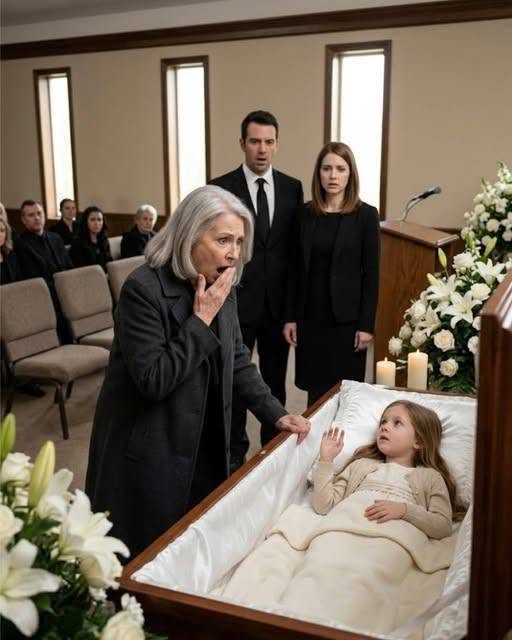
PART 1 TITLE: The Quiet Scraping Beneath the Satin Forced a Grandmother to Question Every Word Her Son Had Told Her About His Daughter
The first sound was so faint that I almost mistook it for the rustling of someone’s clothes. I was standing beside my six-year-old granddaughter’s coffin, one hand resting against the polished wood, trying to gather enough courage to kiss her goodbye. The funeral chapel had gone nearly silent. Behind me, people were speaking in hushed voices, and the heavy scent of white lilies hung in the air. Then something moved beneath the satin covering Chloe’s hands. I bent closer, and a tiny voice reached me from inside the coffin. “Grandma, please don’t leave me here.”
For a moment, I could neither move nor speak. My granddaughter had supposedly been dead for two days. Her parents had arranged this funeral, accepted condolences, and explained to everyone that a sudden illness had taken her life. Yet the child lying before me had just called my name. I stared at her face, searching for another sign that I was not imagining things. Her eyelids trembled. One finger shifted against the white fabric. Then she whispered something even more disturbing. “Daddy told me I’d spoil everything if I woke up.”
My name is Margaret Harrison. I’m sixty-eight years old, and for most of my adult life, I worked as an elementary school teacher. I spent decades helping frightened children find their voices, teaching them that questions were not something to be ashamed of. I believed I had learned to recognize when a child needed help. Yet, as I stood beside that coffin, I was forced to confront how many warning signs I had overlooked in my own family. The truth had been approaching for months, quietly enough that I had mistaken it for ordinary unhappiness.
My son, Julian Harrison, was thirty-nine and worked as a financial consultant in a prosperous suburb outside Chicago. He lived with his wife, Victoria, and their daughter, Chloe, in a large house with an immaculate lawn and a driveway wide enough for several cars. Julian had always cared about appearances. His expensive suits were carefully pressed, his vehicles spotless, and his conversations filled with references to successful clients and important meetings. Whenever he spoke about his career, he gave the impression that nothing could possibly threaten the life he had built.
Victoria seemed equally accomplished at presenting a perfect family. She organized charity fundraisers, remembered everyone’s birthdays, and decorated their home with the sort of precision I had only seen in magazines. Their photographs showed carefully arranged happiness: holidays beside the fireplace, summer afternoons in the garden, and Chloe smiling between her parents. I admired those pictures once. Later, I would find myself studying them differently, wondering how much a camera could conceal when everyone understood exactly when to smile.
Chloe was the one person in that household who never seemed interested in impressing anybody. She liked butterflies, picture books, and drawing strange animals with far too many legs. When she visited me, she often followed me into the kitchen and insisted on helping with whatever I was preparing. Her pancakes came out misshapen, and she believed every batch of cookies needed additional chocolate chips. My husband had died eight years earlier, leaving my house painfully quiet. Chloe had gradually filled that silence with questions, laughter, and the constant sound of little feet running across the floor.
During the six months before the funeral, however, something in my granddaughter began to change. She no longer rushed toward me when I arrived at her parents’ house. Sometimes she remained close to the stairs until Victoria called her forward. Her smiles became brief and uncertain. I noticed that she frequently checked the hallway before answering even harmless questions. When I asked about school, she said it was fine. When I asked about her friends, she offered a few names and then changed the subject. I attributed her behavior to growing older and becoming more reserved.
There were other things I should have taken seriously. Chloe began complaining that she was tired, even on afternoons when she had done very little. During one visit, she sat beside me with a coloring book and filled an entire page with gray pencil marks. When I asked what she was making, she shrugged. Victoria explained that school had been demanding and that Chloe wasn’t sleeping well. Julian dismissed my concern before I could finish describing it. “She’s going through a phase, Mom. Every child has one.” His tone made it clear that he considered the conversation finished.
Three weeks before the funeral, Chloe came to my house for an afternoon of baking. It was a cool day, and rain tapped gently against the kitchen window. She stood on a wooden stool beside the counter, wearing the little apron I kept for her, while I measured flour into a mixing bowl. At first, she behaved like herself. She asked whether we could make the cookies extra large and laughed when a little flour settled on the end of my nose. Then, without warning, she put down her spoon and looked directly at me.
“Grandma, can you find somebody who’s sleeping?” she asked. I assumed she was talking about a game. I told her I could probably find anyone who was hiding in my house, especially if that person left cookie crumbs behind. She didn’t smile. Instead, she pressed her fingertips into the soft dough and asked whether I would still look for her if someone told me she had to sleep for a very long time. I remember the uneasy feeling that passed through me, although I couldn’t have explained it then.
I crouched beside her stool so we were at the same height. “Are you having bad dreams, sweetheart?” She shook her head. “I just want to know if you’d come.” I assured her that I would. After a pause, she asked whether I would come even if her father told me not to. That question changed the atmosphere in the kitchen. I asked why Julian would ever keep me from helping her. Chloe stared at the mixing bowl and began twisting the corner of her apron around one finger.
She told me that her father had been speaking about secrets. According to Chloe, he said children were not supposed to interfere in adult matters and that asking too many questions could cause trouble. I asked whether he had been angry with her. She said she didn’t know. Then she requested another handful of chocolate chips as though our conversation had never happened. I let her change the subject, but the words stayed with me. For the rest of the afternoon, I watched her more closely than I had before.
That evening, after Victoria collected her, I called Julian. I explained what Chloe had said and asked whether anything unusual was happening at home. He sounded irritated almost immediately. He told me she had an active imagination and accused me of encouraging her to turn ordinary conversations into frightening stories. I tried to remain calm. “I’m not accusing you of anything,” I said. “I’m asking because she sounded scared.” Julian sighed heavily. “Mom, you’re making something out of nothing again. Please let us raise our daughter.”
I wish I could tell you I challenged him. I wish I had driven to their house, insisted on speaking to Chloe alone, or asked someone experienced with frightened children to help me understand what she meant. Instead, I apologized for upsetting him. Julian had become increasingly impatient whenever I questioned his decisions, and I was afraid that pushing too hard would cause him to restrict my visits. I convinced myself that remaining close to Chloe was more important than winning an argument with her father. At the time, that reasoning seemed sensible.
The last ordinary conversation I had with my granddaughter happened only days before the telephone call that changed everything. She wanted to know whether the butterflies would return to my garden the following spring. I told her they would, provided we planted enough flowers for them. She asked if she could choose the colors. “Every single one,” I promised. She began listing yellow, purple, and pink, then asked whether butterflies ever became frightened. I told her they probably did, but they also knew when to fly somewhere safer.
On Thursday morning, at precisely 5:17, my telephone rang as I was turning on the kitchen light. Julian’s name appeared on the screen. I expected him to be calling about a forgotten school item or some scheduling problem. Instead, he told me Chloe had died during the night. His voice sounded strangely controlled, almost emptied of feeling. I asked him to repeat himself. He explained that she had suffered a serious breathing complication and that attempts to save her had failed. I remember gripping the edge of the counter because my legs had suddenly become unreliable.
I asked which hospital had treated her. Julian answered that events had moved too quickly for him to explain everything. When I pressed him, he mentioned a respiratory condition that supposedly had not been diagnosed properly. I wanted to know who had examined her, when she had stopped breathing, and whether I could come see her. He told me Victoria was overwhelmed and that they needed time alone. He asked me to wait until the following afternoon before visiting. I could hear him breathing on the other end of the line. I couldn’t understand why he sounded so distant.
I spent the next hours moving uselessly from room to room. I opened the cupboard containing Chloe’s favorite cereal and stood looking at the box. Her small apron was hanging behind the kitchen door. On the refrigerator, one of her drawings showed a blue butterfly perched on a flower larger than the sun. I tried calling Julian again, but he didn’t answer. When I contacted Victoria, the call went unanswered as well. I told myself they were dealing with arrangements no parent should ever have to make. Even then, I knew I was accepting explanations because the alternative was unbearable.
When I was finally allowed into their home, white flowers filled the entrance hall. Sympathy cards covered a table near the staircase. A framed photograph of Chloe stood beside several candles, arranged as carefully as the decorations at Victoria’s charity events. Victoria embraced me briefly. Her eyes were swollen, and she held a tissue tightly in one hand, but she seemed preoccupied with who was arriving and where people should sit. Julian approached wearing a dark sweater and spoke about funeral arrangements before I had even taken off my coat.
I asked to see the medical records. Julian explained that the funeral director was handling the paperwork. I asked whether anyone had performed an autopsy, since Chloe had never been diagnosed with a serious respiratory illness as far as I knew. Victoria began crying and demanded to know why I couldn’t allow them to mourn without asking painful questions. Several relatives turned toward us. I felt suddenly ashamed of having raised my voice. Julian placed a hand on his wife’s shoulder and told me that he would explain everything when they were ready.
The funeral arrangements moved with astonishing speed. Julian said the ceremony would take place privately on Saturday morning. He discouraged distant relatives from traveling and insisted that the family needed an intimate gathering. He also told us that Chloe’s physical condition made a traditional open-casket viewing inadvisable. I found that especially distressing. I wanted one last opportunity to touch her hair and see the face that had brought me so much happiness. Julian responded that the professionals knew best and that arguing would only upset Victoria further.
Saturday arrived under a dull, colorless sky. I wore the black dress I had last worn at my husband’s funeral. The fabric felt heavier than I remembered, and I struggled to fasten the clasp of my necklace because my hands wouldn’t stop trembling. Only twenty-three people attended the service. My younger sister, Helen, sat beside me and kept one hand over mine. The minister spoke about Chloe’s kindness, her curiosity, and the butterflies she loved. I heard his voice without absorbing his words. My attention remained fixed on the coffin at the front of the chapel.
To my surprise, its lid had been left partially open. I couldn’t understand why Julian had insisted that no one should see Chloe when the funeral home had prepared her for a final viewing. Her face was visible above the satin, and her dark hair had been carefully arranged around her cheeks. She wore a white dress with small embroidered flowers. Something about seeing her there seemed wrong in a way I couldn’t describe. She looked terribly pale, but she also looked like the little girl who sometimes fell asleep on my sofa after an afternoon in the garden.
When the service ended, mourners approached the coffin one by one. Julian remained close to the entrance, accepting embraces and shaking hands. Victoria sat with her head lowered, her tissue crushed between both palms. Helen offered to accompany me, but I told her I needed a moment alone. I walked slowly toward Chloe, aware of the hard floor beneath my shoes and the faint fragrance of polished wood. I rested my fingertips against her cheek. It was cool, though not as cold as I had expected. I whispered that I loved her.
That was when I heard the faint scraping. I raised my head and listened. The sound came again, a small dragging movement somewhere beneath the satin near Chloe’s hands. At first, I thought the fabric had shifted when I touched her. Then one of her fingers moved. I leaned over her face, hardly daring to breathe, and saw her eyelids flutter. Her lips parted. She tried to form my name, and the sound that emerged was so fragile that I had to bend almost against her ear to understand it.
She was alive. My granddaughter, whom everyone had gathered to bury, was struggling to wake up inside her own coffin. When she told me her father had warned her not to awaken, I looked across the chapel toward Julian. He was speaking to a family friend, holding a glass of water. I called Chloe’s name once more, and her fingers reached weakly toward mine. I took her hand and felt the faint pressure of her grip. Whatever else happened in that room, I knew I could not allow anyone to close the lid.
I shouted for an ambulance. My voice echoed through the chapel, interrupting every conversation. Mr. Lawson, the funeral director, hurried toward me with two employees. I showed him Chloe’s moving fingers and demanded that he call emergency services immediately. He bent over the coffin, checked for signs of breathing, and instructed his staff to clear the area. People backed away in confusion. Someone began crying. Helen hurried to my side, saw Chloe’s hand inside mine, and covered her mouth. Mr. Lawson was already speaking rapidly to the emergency dispatcher.
Across the room, Julian dropped his glass. It struck the floor and broke, scattering water around his shoes. He stared at the coffin before pushing through the gathering crowd. Victoria stood abruptly, gripping the back of her chair. I heard her say that Chloe couldn’t possibly be awake. Julian’s expression changed so quickly that I almost failed to recognize him. His mouth tightened, and his eyes moved from Chloe to the funeral director’s telephone. Under his breath, he muttered that things were not meant to happen this way.
I stepped between him and the coffin. Julian demanded to know why I was keeping him away from his own daughter. I told him Chloe was frightened of him and repeated what she had whispered. He offered no explanation. When he moved closer, Chloe’s grip tightened around my fingers. She made a small, distressed sound and tried to turn her face away. I told Julian not to come another step. For the first time in his life, my son obeyed me without argument, but the look he gave me made my skin prickle.
Paramedics arrived within minutes. They examined Chloe, supported her breathing, and prepared to move her as carefully as possible. I released her hand only when one of them assured me that she needed space for treatment. Another paramedic turned toward Mr. Lawson and asked which medical professional had formally confirmed the child’s death. The funeral director looked at Julian. Julian looked toward Victoria. No one produced a name. No one offered a hospital. In that terrible silence, I understood that Chloe had not simply awakened from an inexplicable medical crisis. Someone had brought a living child to her own funeral, and the adults responsible for explaining how it happened were refusing to answer.
END PART 1
PART 2 TITLE: At the Hospital, a Missing Death Record Exposed the First Lie and Left Margaret Wondering Who Had Signed Away Chloe’s Life
I watched the paramedics carry Chloe through the funeral home’s entrance, her small body almost disappearing beneath the blankets on the stretcher. The ambulance doors closed with a heavy metallic sound, and for several seconds I stood motionless on the pavement. I had spent two days believing my granddaughter was dead. Now I had seen her breathing, heard her voice, and watched strangers rush to keep her alive. The relief I should have felt was tangled with something far more frightening. I had no idea what had happened to her.
Helen appeared beside me and took my car keys from my shaking hand. She said she would drive, and I did not argue. As we followed the ambulance toward the children’s hospital, I kept looking at the road ahead, searching for its lights through the traffic. Helen asked whether Chloe had truly spoken to me. I repeated the warning about her father, then wished I hadn’t. Saying it aloud made it impossible to dismiss. Helen kept both hands on the steering wheel and asked me one question. “Margaret, what exactly has Julian done?”
I couldn’t answer. Julian was the boy I had raised, the child who once brought injured birds into our kitchen because he couldn’t stand seeing them suffer. I remembered kneeling beside him in the backyard, helping him bury a goldfish that had died, while he cried so hard he could barely speak. Those memories felt close enough to touch. Yet another memory kept interrupting them: my grown son standing in a funeral chapel, looking at his daughter with an expression I had never seen before.
The emergency department was painfully bright. Nurses moved quickly around the stretcher while a physician called out instructions, and someone guided Helen and me into a waiting area. I tried to follow Chloe, but a staff member gently blocked my path. She explained that the medical team needed to examine her immediately. I asked whether my granddaughter could hear me. The woman couldn’t promise anything. She did, however, say that Chloe had arrived alive. I held onto those words because they were the only certainty anyone had offered me.
Julian arrived roughly twenty minutes later. Victoria came separately and sat several chairs away from him. Neither approached me. My son stared at his telephone, occasionally typing messages and then looking toward the reception desk. Victoria twisted a tissue between her fingers until it began to tear. Their silence disturbed me more than an argument would have. These were parents whose daughter had just been discovered alive inside a coffin. I expected frantic questions about her condition. Instead, they seemed to be waiting for something else.
Two uniformed officers entered the waiting room. A woman in a dark jacket accompanied them, carrying a small notebook. She introduced herself as Detective Rebecca Collins and asked to speak with the family. Her voice was steady and courteous, without the false comfort people sometimes offer when they cannot understand another person’s distress. She explained that police had been contacted because a child reported dead had been found alive during a funeral. Investigators needed to establish how that could have happened and whether anyone had committed a crime.
Julian immediately protested that there must have been a medical misunderstanding. He said he was as shocked as everyone else and complained that police involvement would only make a traumatic situation worse. Detective Collins allowed him to finish. Then she asked for the name of the hospital where Chloe had supposedly died. Julian mentioned a sudden respiratory emergency but did not identify the hospital directly. The detective repeated her question. His jaw tightened. “I’ve already explained that everything happened very quickly,” he said.
Victoria began crying. She told the detective that she couldn’t bear to revisit the night Chloe had stopped breathing. Collins didn’t challenge her grief. Instead, she explained that medical records, times, and the identities of the professionals involved were necessary facts, not accusations. She requested permission to speak with each adult separately. Julian objected to the suggestion that their accounts required comparison. I watched the detective note his response without changing her expression. It was the first time that morning I saw someone refuse to be hurried or intimidated by him.
When Collins turned to me, I described what had happened beside the coffin. I told her about the faint noise beneath the satin, the movement of Chloe’s fingers, and the words she had spoken. My voice shook when I reached the moment Julian tried to approach her. I explained how Chloe clutched my hand and turned away from him. The detective asked whether I was certain I had heard the warning correctly. I said I was. I had spent my career listening to children speak softly. I knew what my granddaughter had told me.
Collins then asked about Chloe’s recent health and behavior. I described the changes I had noticed during my visits, including her withdrawal and the way she watched the hallway before answering questions. I mentioned her tiredness, the conversations Julian refused to discuss, and the afternoon when she asked whether I would come looking for her if she were made to sleep. The detective stopped writing for a moment. She asked when the conversation had occurred. I gave her the approximate date and explained that Chloe had appeared unusually serious.
I also admitted that I had contacted Julian afterward. Collins wanted to know what he said, whether he offered an explanation, and whether anyone else heard the conversation. I told her he had accused me of misinterpreting a child’s imagination. Hearing myself repeat his words was humiliating. I had accepted his dismissal because I wanted to preserve peace within our family. The detective did not criticize me. She simply asked me to describe what Chloe had said as accurately as I could remember, without adding what I now believed it meant.
Helen sat beside me throughout the interview. Occasionally, she reached for my hand when I struggled to continue. After Collins stepped away, Helen said she remembered my telephone call following that baking afternoon. I had mentioned Chloe’s strange questions but had allowed Julian’s reaction to convince me they were harmless. Helen’s reminder was painful. It showed how easily adults can reassure one another when acknowledging the truth would demand action. I told her I didn’t want reassurance anymore. I wanted to know what had happened to Chloe.
Hours passed without meaningful news. I stared at a vending machine across the waiting room, watching its fluorescent light flicker. Someone offered me coffee, but I couldn’t drink it. Victoria remained in her chair, occasionally glancing toward Julian. Whenever their eyes met, one of them looked away. I remembered how often they had presented themselves as perfectly united. Now, under the hospital lights, their practiced composure seemed to have deserted them. I couldn’t tell whether I was watching two frightened parents or two people afraid of being questioned.
When a physician finally approached us, I stood so quickly that my chair struck the wall. He told us Chloe was receiving intensive care and that her condition, although serious, had stabilized enough for further assessment. She was severely dehydrated, and the medical team had found signs suggesting exposure to a substance capable of suppressing alertness and normal responsiveness. They were conducting additional tests to identify what she might have been given. He carefully avoided claiming more certainty than the evidence allowed.
I asked whether she could recover. The physician explained that the team was monitoring her breathing, hydration, and neurological condition. He couldn’t guarantee the absence of complications, but he said Chloe was responding to treatment. I listened to every word, trying to separate what he knew from what he still needed to discover. The fact that she was alive no longer seemed sufficient. I wanted to know whether she was hurting, whether she was frightened, and whether anyone had explained why she was in a hospital instead of at home.
Julian interrupted to ask whether the substance might have been part of an ordinary medical treatment. The doctor told him it was too early to determine its source. Victoria lowered her head. I turned toward my son and asked why he was talking about treatments when he had told me Chloe died from a breathing disorder. He responded sharply that both things could be true. The physician stepped between our competing questions and reminded us that medical conclusions would depend on testing rather than speculation.
Detective Collins returned soon afterward and spoke privately with the physician. When she rejoined us, her expression was more guarded. She explained that investigators were checking the medical circumstances Julian had described. The hospital had no record of Chloe being admitted or pronounced dead during the period he claimed she had received emergency treatment there. The physician confirmed that no corresponding record had been found. This did not establish precisely what had happened elsewhere, but it directly contradicted the account Julian had given.
For a long moment, nobody spoke. I thought of the sympathy cards arranged on the entrance table, the candles burning beside Chloe’s photograph, and the relatives who had cried over her coffin. Every detail had depended on one essential claim: that qualified medical professionals had confirmed her death. I looked at Julian, waiting for him to name another hospital or explain some terrible clerical error. He remained silent. Victoria began rubbing the tissue between her palms again, although there was almost nothing left of it.
I asked Julian where Chloe had actually been taken that night. He glanced at Detective Collins before answering that he needed time to gather the information. I told him there was nothing to gather. A father would know where his child had died. His face hardened. “You don’t understand what we’ve been through,” he said. I replied that I understood exactly what I had seen at the funeral home. Chloe had been alive, and she had been afraid of him. I could hear my own voice rising, but I no longer cared who listened.
Collins asked Julian whether he could provide the original medical paperwork used to arrange the funeral. He said the funeral director had handled those matters. I reminded him that he had used the same explanation when I asked to see Chloe’s records on Friday. He accused me of trying to make him appear guilty. I asked why a straightforward question should sound like an accusation. Before he could answer, the detective said investigators would obtain the funeral home’s records directly and determine what documentation had been supplied.
That was when I remembered Julian’s insistence on a quick, private burial. He had discouraged relatives from coming, refused my requests for medical details, and told me that Chloe shouldn’t be viewed in an open coffin. At the time, I believed he was protecting Victoria from unnecessary suffering. Now I wondered whether the small guest list and the limited viewing had served another purpose. I told Collins everything I could remember about those arrangements. She asked me not to draw conclusions yet, but she recorded the details carefully.
Mr. Lawson had followed the emergency dispatcher’s instructions without hesitation once Chloe began moving. I remembered the alarm in his voice and the way he had demanded that the room be cleared. Whatever errors had brought Chloe into his care, his shock seemed genuine to me. Still, I wanted to know what he had been shown before accepting her body. A signature, a medical declaration, or a formal certificate should have existed somewhere. I had signed enough school documents over the years to know how important a piece of paper could become when no one questioned its contents.
Collins explained that investigators would examine every stage of the process. They needed to establish who had reported Chloe’s death, what records supported that report, and how the funeral had been authorized. She did not promise a quick answer. She also warned me that certain information might remain confidential while evidence was collected. I disliked hearing that, but I understood the reason. If someone had deliberately deceived professionals, the truth would require more than frightened relatives arguing in a waiting room.
The physician returned briefly with an update. Chloe had opened her eyes for a few moments, though she remained weak and confused. She was not ready for visitors, and the medical team wanted to avoid exhausting or upsetting her. I asked him to tell her that her grandmother was nearby. He said the staff would reassure her. I felt a sharp ache at the thought of Chloe waking among unfamiliar faces, perhaps believing she had broken some rule by opening her eyes. I wanted the first thing she heard to be that she had done nothing wrong.
Victoria suddenly stood and announced that she needed fresh air. Julian told her to sit down. His words were quiet, but the command in them was unmistakable. She looked at him, then at Collins, and slowly returned to her chair. The detective appeared to notice the exchange. I did too. During their marriage, I had seen Victoria yield to Julian over holidays, finances, and family visits. I had dismissed it as their private way of making decisions. In that waiting room, I began wondering how much of her obedience came from fear.
As evening approached, Collins asked Julian to remain available for additional questions. He stood and said he wanted legal representation before discussing anything further. The detective acknowledged his right to consult an attorney and made no attempt to argue. I watched him gather his belongings with hands that were not entirely steady. He did not ask whether Chloe had requested him. He did not approach me or attempt to explain the missing records. For the first time, I saw him leave a room without being able to control the conversation.
I remained in the hospital after he left. Helen brought me a bottle of water and insisted that I drink some. Beyond the waiting-room windows, daylight had faded and the parking lot lights had switched on. Somewhere behind the double doors, my granddaughter was fighting to recover from something no one had adequately explained. A funeral had been held for a child who had never been medically confirmed dead at the hospital her father had implicated. The paperwork was under investigation, her parents’ explanations no longer agreed with the facts, and the police were considering the possibility that this had been arranged deliberately. I finally understood that discovering Chloe alive was only the beginning.
END PART 2
PART 3 TITLE: As Chloe Fought to Recover, Investigators Followed the Money and Discovered Why Her Father Needed Everyone to Believe She Was Dead
The next morning, I returned to the hospital before the breakfast trays had been collected. I had barely slept. Every time I closed my eyes, I saw Chloe lying beneath the funeral home’s satin lining, struggling to move her fingers while the people who loved her stood a few feet away. Helen accompanied me again, carrying a clean cardigan and a paper bag containing sandwiches I had no appetite for. We were told Chloe remained under close medical observation. Her condition was improving, but she was still too weak for the kind of visit I desperately wanted.
A nurse allowed me to stand briefly outside the room where Chloe was being treated. Through the glass, I could see her dark hair against a white pillow and a monitor glowing beside the bed. She looked terribly small. Medical equipment surrounded her, and the blankets reached almost to her chin. I placed my palm against the glass before remembering that she couldn’t see me. The nurse assured me that the staff were watching her carefully. I asked whether Chloe had been frightened when she woke. The woman answered gently that they were doing everything possible to help her feel secure.
I returned to the waiting area and sat with Helen, who had been making telephone calls to relatives. News of the funeral had spread faster than any of us could control. People wanted to know how a dead child could suddenly be alive. Some wondered whether Chloe had a rare medical condition. Others suggested that the funeral home must have made an extraordinary mistake. Helen had stopped trying to offer explanations. She told everyone the same thing: Chloe was alive, she was in the hospital, and the authorities were investigating.
I found myself remembering Julian as a young man entering the financial world. He had always been ambitious, even as a teenager. In school, he kept meticulous records of his spending and talked about earning enough money never to worry about bills. After college, he found work advising clients on investments and eventually established himself as a successful consultant. When my husband was alive, the two of us had been proud of his achievements. We believed that his determination came from wanting to provide stability for his future family.
Over the years, however, Julian’s idea of success had become increasingly expensive. There was the large suburban house, the luxury SUV, and the tailored clothing he wore even to casual family gatherings. He attended charity functions, donated publicly to community causes, and spoke confidently about investment opportunities. At dinner, he occasionally mentioned clients with substantial portfolios, although he rarely explained what he actually did for them. Whenever I expressed concern about the pressures of his work, he reassured me that everything was under control.
I had no reason to examine his finances. I was his mother, not his accountant. Still, I remembered occasional hints that the confident picture might have been incomplete. He sometimes became distracted during meals, checking his telephone repeatedly. On one visit, I heard him speaking sharply from another room before he returned to the table wearing his usual pleasant expression. Victoria would glance at him, then continue serving dinner as if nothing had happened. Those incidents seemed unimportant at the time. Only after Chloe’s rescue did I begin reconsidering them.
Detective Collins contacted me later that day. She said investigators were reviewing the documents connected to Chloe’s reported death and were also examining whether the family’s financial circumstances might be relevant. The second subject surprised me. I asked why money had anything to do with a child being placed inside a coffin. Collins explained that the investigation needed to consider possible motives without deciding too early which explanation was correct. She asked whether Julian had recently mentioned unusual financial pressure, outstanding debts, or difficulties with his business.
I told her he had not confided anything of that kind. In fact, he had always spoken as though his company was flourishing. Collins asked whether I knew of recent changes in his spending or his relationship with Victoria. I described the household’s expensive lifestyle and the growing tension I had noticed between them. I admitted that I had never seen their accounts and could offer only personal observations. The detective thanked me for distinguishing what I knew from what I merely suspected. Her care with that distinction made me trust her judgment.
After the call, I stood near the window looking down at the hospital parking lot. I tried to imagine Julian sitting at his office, surrounded by polished furniture and financial statements, while some terrible problem approached. Even if his business had failed completely, why would that endanger Chloe? There were legal ways to deal with debt, humiliating though they might be. People lost homes and businesses every day without harming their children. I could not connect financial desperation to the sound of my granddaughter struggling for help from inside a coffin.
Helen listened as I repeated the conversation. She reminded me that people often concealed serious financial problems from their families. I knew that was true, but I resisted applying it to Julian. He had been educated, professionally successful, and capable of earning a respectable living. I wanted to believe any trouble was temporary and unrelated to what had happened. Helen did not argue. Instead, she asked me whether I would accept the same explanations from someone who wasn’t my son. I couldn’t answer her immediately.
During the following days, investigators began uncovering a different picture of Julian’s business. His polished public image concealed serious financial deterioration. Several clients had already sought explanations for money that was missing from accounts under his management. Records indicated that funds had been moved between accounts in ways that obscured losses and withdrawals that had not been properly authorized. The financial activity was complicated, and no single document explained the entire situation. But the evidence suggested that the confident consultant who spoke endlessly about success had been trying to prevent his clients from seeing how badly things were going.
Detective Collins later explained the broad findings to me as the case developed. Julian had not simply suffered an unsuccessful investment period. Investigators were examining transactions that appeared designed to cover problems in one account with money from another. As demands for explanations increased, the amount of time available to conceal those transactions decreased. Clients wanted answers, records required reconciliation, and the possibility of criminal charges had become increasingly real. The world Julian had built around his reputation was beginning to collapse.
I thought of how he behaved whenever anyone questioned him. He had always preferred to deliver explanations rather than receive advice. At family gatherings, he corrected small inaccuracies in other people’s stories. When Victoria disagreed with him, he often ended the discussion by insisting he had already considered every possibility. I once mistook that certainty for maturity. Now I wondered what he did when facts could no longer be rearranged to make him appear right. The thought led me back to Chloe and the strange warning she had given me over cookie dough.
Victoria had known more than she initially admitted. Investigators were examining communications and financial records connected to both parents, although the extent of her knowledge remained uncertain. I remembered her reluctance to speak at the hospital and the way she had obeyed Julian when he ordered her to sit down. Fear might have explained some of her behavior. It could not explain why she had allowed funeral arrangements to proceed while her daughter was still alive. The distinction troubled me, because I had once considered Victoria a devoted mother.
I returned to Chloe’s room whenever the medical staff permitted it. The visits were brief, and at first she was often asleep. I sat quietly beside her bed, careful not to disturb the wires and equipment. I spoke about ordinary things: the weather, the flowers waiting to be planted, and the cookies we would make when she felt better. Sometimes her eyelids moved when I spoke. Once, her fingers shifted against the blanket, and I took her hand with the same care I had used at the funeral. I wanted her to associate waking up with someone she trusted.
One afternoon, her eyes opened while I was sitting beside her. She looked at me without speaking. I smiled and told her that she was in a hospital where people were helping her recover. She seemed confused by her surroundings, and I did not attempt to explain everything. I only told her that I was close by and that she could rest. Her small fingers closed around mine before her eyes drifted shut again. I sat there long after a nurse quietly suggested that I take a break.
The medical team continued evaluating her condition. Physicians were concerned about dehydration and the effects of a substance that appeared to have suppressed her normal responsiveness. The precise circumstances remained under investigation, and the doctors were careful about discussing possibilities as though they were established facts. I appreciated their caution, even when it frustrated me. Too many people had already treated unverified claims as certainty. A child’s supposed death had been accepted without the explanations her family deserved, and Chloe had nearly paid for that failure with her life.
The funeral home’s records also came under scrutiny. Mr. Lawson cooperated with investigators and supplied the documents he had received from Julian. Authorities were examining whether the paperwork used to support the funeral arrangements had been falsified. I remembered standing in Julian’s living room and asking to see proof of Chloe’s death. He had insisted that the funeral director possessed everything necessary. I had believed him because it seemed inconceivable that someone would arrange a child’s funeral without genuine medical confirmation. Now the very documents I had requested had become potential evidence.
What disturbed me most was how ordinary the deception had looked from the outside. There had been flowers, sympathy cards, a minister, and relatives dressed in black. Mr. Lawson had conducted a solemn service. People had spoken about Chloe’s kindness and offered prayers for her parents. Every gesture had appeared familiar because we all understood what funerals were supposed to mean. Yet those rituals had surrounded a living child whose weak movements could easily have gone unnoticed. The thought made me physically ill.
A few days after Chloe’s rescue, Detective Collins asked to meet with me again. Helen accompanied me. The detective explained that investigators had uncovered another financial detail requiring closer examination. Several months before the funeral, Julian and Victoria had arranged a substantial life insurance policy covering Chloe. I listened without immediately understanding its significance. Families sometimes obtained insurance for children, and Collins was careful to acknowledge that having such a policy was not itself evidence of wrongdoing.
The timing and scale of the coverage, however, had attracted investigators’ attention. The amount was unusually large, and communications associated with Julian’s financial circumstances suggested that he was anticipating a considerable payment. At the same time, the insurance arrangement contained verification requirements and exclusions that could affect any claim. Collins explained these details without speculating beyond the evidence. But I began to see the possible connection between the false announcement of Chloe’s death and the financial disaster Julian had been trying to conceal.
I asked whether he expected to receive money because Chloe was dead. Collins answered that investigators were examining precisely that possibility. They needed to determine what Julian had believed, what actions he had taken, and whether he had deliberately placed his daughter in danger to obtain a financial benefit or conceal other misconduct. She reminded me that a suspected motive was not the same thing as proof. I understood her professional caution. Emotionally, however, I was struggling to comprehend why my granddaughter’s life had appeared anywhere in her father’s financial plans.
Helen reached across the table and covered my hand. I didn’t remember beginning to cry. I could only see Julian at family gatherings, lifting Chloe onto his shoulders and smiling for photographs. I remembered him giving her elaborate birthday presents, sometimes more expensive than anything a child her age needed. He had enjoyed looking like a generous father. I wondered whether those gestures had ever been about her happiness or whether he valued the admiration they earned him. Then I stopped myself. I could not erase every decent thing he had done simply because I was discovering terrible evidence against him.
The detective asked whether Chloe had ever mentioned money, insurance, or anything resembling a special arrangement with her parents. I told her Chloe had spoken about secrets and about needing to sleep, but she had never described financial matters to me. At six years old, she would scarcely have understood them. Collins agreed. Children often described experiences in the language available to them, she explained, without understanding the adult purposes behind those experiences. Chloe’s words therefore mattered, but they needed to be explored carefully by people trained to interview children.
That distinction struck me deeply. Julian had dismissed Chloe’s questions as imagination. I had nearly done the same. Investigators were now considering the possibility that her apparently strange remarks had been fragments of something real. The warning about sleeping, the demand for secrecy, and her fear of angering her father were no longer disconnected incidents. They pointed toward a possible sequence of events that adults around her had either failed to understand or had chosen not to acknowledge.
Before we left, Collins told me that Chloe might soon be well enough to speak with a specialist trained to interview children about frightening experiences. The conversation would not be conducted in front of family members. Investigators wanted to avoid influencing what she remembered or placing pressure on her to accuse anyone. I agreed immediately. I wanted the truth, but not at the cost of making Chloe feel responsible for explaining everything that had happened. She had already been frightened into silence once.
That evening, I sat beside Chloe’s bed while the last daylight faded across the hospital floor. She was sleeping peacefully for the moment, and I watched her chest rise and fall beneath the blanket. I thought about the insurance policy, the missing client funds, and the documents Julian had supplied to the funeral home. I still did not know exactly what he had done. But I could no longer pretend these were unrelated accidents. My son had been facing financial ruin, and someone had arranged for his daughter to be declared dead. Two days later, investigators would ask Chloe what she remembered about the night she was told to close her eyes.
END PART 3
PART 4 TITLE: When Chloe Finally Described the Game Her Father Invented, the Last Innocent Explanation Began to Fall Apart
Two days after Detective Collins told me about the insurance policy, Chloe was considered strong enough to participate in a short, carefully supervised interview. The hospital staff had explained that recovering from her physical condition was only part of what she needed. Whatever had happened before the funeral had left her frightened and confused, and nobody wanted to make that worse by demanding answers before she was ready. I agreed with them. Still, when I learned that investigators hoped she could describe what she remembered, I felt a knot tighten in my stomach.
The specialist who came to speak with Chloe was experienced in interviewing children about potentially traumatic events. She explained that her responsibility was not to make Chloe confirm anyone’s suspicions. She would ask open questions, allow silence, and stop when Chloe became tired or distressed. The process mattered because children could be influenced by adults who unintentionally supplied details while trying to help. I listened carefully. I had spent years teaching young children, but this was different. My granddaughter was being asked to describe experiences that may have placed her life in danger.
I asked whether I could remain with Chloe during the conversation. The specialist explained that the formal interview needed to take place without family members present. She assured me Chloe would be treated gently and that the session would be kept as brief as her condition required. I understood the reasoning, although accepting it was difficult. Since the funeral, I had wanted to remain within reach of her at every moment. Letting someone else ask the questions meant trusting that Chloe could be heard without me speaking for her.
Before the interview, I sat beside Chloe’s bed and helped her arrange the blanket around her shoulders. She was awake and more alert than she had been the previous day. Her eyes followed the movements of a nurse across the room, and she asked whether she would be allowed to go home soon. I told her the doctors needed to make sure she was well enough first. She considered that answer, then asked whether I would still be there afterward. I assured her that I wasn’t going anywhere.
I wanted to ask a hundred questions. I wanted to know what Julian had given her, why she had been afraid, and what had happened in the hours before her parents announced that she was dead. Instead, I asked whether she was comfortable and reminded her that she could tell the specialist whenever she needed a rest. Chloe nodded. She seemed more interested in the pattern on her blanket than in the adults moving around her room. I was grateful for that small piece of ordinary childhood.
Helen waited with me while the interview took place. We sat in a quiet hospital area where a clock ticked above the doorway. Every few minutes, I looked toward the corridor, expecting someone to appear with news. Helen tried to distract me by describing the flowers blooming in my backyard. I could scarcely concentrate. I kept remembering the afternoon in my kitchen when Chloe had asked whether I would come find her if she had to sleep for a very long time. I wondered how close she had come to telling me everything.
There was a particular cruelty in that memory. Chloe had not approached me with an obvious accusation. She had asked a question that sounded almost like a game. I had answered it affectionately, believing reassurance was enough. She had then returned to helping me bake cookies while I continued worrying about whether Julian would be annoyed by my interference. I could not change that afternoon, but I wished I had understood that a child’s indirect questions could sometimes be the only way she knew how to describe something frightening.
When the interview ended, the specialist did not emerge carrying some dramatic revelation. She spoke quietly with the investigators and the medical staff. Chloe was tired, and they wanted her to rest. I was allowed to return to her room, but I was asked not to question her about what she had said. I agreed. When I entered, she was lying on her side, looking toward the window. She reached for my hand as soon as I sat down. I told her I was glad to see her and asked whether she wanted me to read to her.
She shook her head. For a while, we simply sat together. A nurse came in to check her condition, and Chloe watched the familiar routine without complaint. After the nurse left, she asked whether it was all right to be tired. I told her she could rest whenever she needed to. Her expression softened slightly. I wondered how long she had been afraid that sleeping or waking might make somebody angry. I wanted to tell her the danger was over, but I knew recovery would not be as simple as offering one reassuring sentence.
Later, Detective Collins explained what investigators had learned from Chloe’s account. The information was troubling, although it was still being considered alongside the medical evidence and other records. Chloe remembered hearing her parents argue late at night. She could not recall every word, but she understood that the argument involved money. Victoria had been crying in the kitchen, and Julian had repeatedly insisted they were running out of time. Chloe had heard enough to recognize that something was wrong, even if she could not understand the reason for their distress.
I pictured that kitchen. I had stood there many times while Victoria prepared meals and Julian spoke about business. The counters were always spotless, and the family photographs on the refrigerator were carefully arranged. I imagined Chloe nearby, listening to the rising voices of the two people she depended on most. Children often sense trouble before they know how to describe it. I remembered the way she had watched the hallway during my visits. Suddenly, her anxious silences made more sense.
Chloe had also described her father telling her that she needed to participate in a special game. According to her account, Julian explained that she would be given something to help her sleep. Afterward, she was supposed to remain very quiet. The details were frightening because they appeared to connect her earlier questions with the medical findings. Investigators had already been examining evidence that she had been exposed to a sedating substance. Now Chloe was describing an adult who had prepared her to expect an unusually prolonged sleep.
I asked Collins whether Chloe understood what her father intended. The detective answered that a child her age could not reasonably have understood the financial circumstances or the possible consequences of what she was being asked to do. Chloe had described the experience in simple terms: a game, a promise to be quiet, and instructions from her father. That was why investigators were concentrating on the actions of the adults. Chloe’s task was not to explain their motives. It was to describe what she remembered in her own words.
Her memory of the following period was incomplete. She recalled becoming very sleepy and having difficulty responding. She remembered hearing adults speaking somewhere nearby while she struggled to open her eyes. She could not describe the passage of time reliably, nor could she identify every voice or reconstruct everything that happened around her. The specialist had not tried to force those missing details into a complete story. I was relieved to hear that. Chloe had already suffered enough without being made responsible for supplying answers she did not possess.
One part of her account, however, was especially clear. She remembered hearing Julian warn her that waking up would spoil what he was trying to accomplish. She had understood the warning as a command. She believed her father needed her to remain asleep and that opening her eyes would make him angry. The same fear had surfaced in the coffin when she recognized me. I remembered how carefully she had whispered, as though speaking too loudly might bring punishment. My hands began trembling again.
I asked whether investigators believed Julian had known she was alive. Collins answered cautiously. Chloe’s recollections were important evidence, but investigators still needed to establish what Julian understood about her condition and what he intended when he arranged the funeral. They were examining communications, medical findings, the financial records, and the paperwork supplied to the funeral director. She refused to reduce the case to a single statement, even one as disturbing as Chloe’s. I respected her care, although the uncertainty was difficult to bear.
The funeral director’s records were becoming increasingly significant. Mr. Lawson had provided investigators with the documentation Julian supplied to support Chloe’s supposed death and subsequent funeral arrangements. Authorities were examining whether those documents contained false information or had been improperly created. I remembered how confidently Julian had told me that the funeral director possessed everything necessary. At the time, I had interpreted that confidence as evidence that the procedures were legitimate. Now it seemed possible he had relied on my willingness to accept his word.
I thought again about the partially open coffin. Julian had discouraged an open-casket viewing, yet I had been able to approach Chloe closely enough to hear her. That difference had saved her life. Had I remained in my seat, had the lid been fully closed, or had the service ended without anyone noticing the faint movement beneath the satin, the outcome might have been irreversible. I tried not to imagine what could have followed. The possibility was enough to leave me awake at night.
Investigators continued reviewing the chain of decisions that had allowed a living child to be prepared for burial. The funeral director was cooperating, but cooperation could not erase the fact that the circumstances of Chloe’s reported death had not been adequately verified. The paperwork, the absence of corresponding hospital records, and the speed of the arrangements all required explanation. Mr. Lawson had responded immediately when he discovered Chloe was breathing. Yet before that moment, the formal procedures surrounding her funeral had failed to protect her.
The more I learned, the less I could accept the idea of a single unfortunate mistake. A medical emergency might have explained why Chloe became unresponsive. It did not explain why Julian could not identify the hospital that supposedly pronounced her dead. It did not explain the questionable documentation, the unusual insurance policy, or his attempts to prevent relatives from viewing her. Nor did it explain why Chloe believed her father wanted her to remain unconscious. Each unanswered question pointed toward decisions made by adults who understood far more than she did.
Victoria initially continued denying that anything deliberate had happened. She claimed that Chloe’s medical condition had been misunderstood and maintained that Julian had handled the important medical and funeral arrangements. Her explanation placed responsibility for the documents and decisions largely on her husband. At the same time, it left unanswered questions about her own behavior. She had been present while the family prepared to bury Chloe. She had accepted condolences from relatives. She had watched the funeral begin without stopping it.
I struggled to reconcile that silence with the woman I thought I knew. I remembered Victoria choosing Chloe’s birthday cakes and carefully arranging her school photographs. She had always spoken about wanting the best opportunities for her daughter. But I also remembered her standing in the funeral chapel, whispering that Chloe could not possibly be awake. She had sounded less astonished than terrified. Perhaps she had been frightened of Julian. Perhaps she had been frightened of what the truth would mean for herself. Neither possibility erased her obligation to protect her child.
Detective Collins was careful not to share more of the investigation than she could properly disclose. She explained that Victoria’s statements were being assessed alongside messages, financial information, and the other evidence collected. Investigators had not accepted her explanations simply because she appeared distressed. Nor had they assumed that fear necessarily meant innocence. Collins wanted to establish what each parent knew, when they knew it, and what opportunities they had to prevent Chloe from being placed in danger.
That distinction mattered to me. Julian was my son, and Victoria was the mother of my only granddaughter. I had trusted them both. I had watched them build a household that appeared comfortable, respectable, and loving. It was painful enough to imagine that Julian had deliberately endangered his daughter. Considering Victoria’s possible participation was another kind of grief. I wanted to believe she had been deceived completely, but the image of her sitting silently beside Chloe’s coffin would not leave me.
Back at the hospital, Chloe’s recovery continued slowly. Her color improved, and she began responding more readily to the nurses who cared for her. There were moments when she seemed like the child I remembered, especially when someone mentioned drawing or butterflies. Other moments were quieter. She would look toward the doorway before speaking or ask whether I planned to leave. I did not press her to explain those fears. I answered her questions plainly and tried to make each visit predictable. She needed adults whose words matched their actions.
One evening, I sat beside her while she watched the fading light on the windowsill. She asked whether the flowers in my garden would still be there when she came to visit. I told her the garden would be waiting, even if we needed to plant new flowers together. She seemed satisfied. A few minutes later, she reached across the blanket and held my hand. She didn’t ask about the funeral or her parents. I was grateful she could still think about something as ordinary as flowers growing outside my kitchen window.
After she fell asleep, I remained beside her for a while. I listened to the soft sounds of the hospital and watched her breathing. I thought of the difficult months ahead: further medical care, unanswered questions, and the possibility that my son would face serious criminal allegations. Nothing about our family would return to what it had been. I also understood that Chloe could not be expected to carry the emotional consequences of decisions made by adults. Whatever happened to Julian and Victoria, protecting her had to come first.
Several days after Chloe’s rescue, Detective Collins contacted me with another development. Victoria had requested a further interview with investigators. This time, she intended to have her attorney present. Collins would not discuss what Victoria planned to say, but she confirmed that investigators were taking the request seriously. I remembered Victoria’s trembling hands at the hospital and the way she had avoided answering direct questions. Until then, she had insisted that Chloe’s condition was a tragic misunderstanding and that Julian had controlled the arrangements.
I looked through the hospital-room window at my granddaughter, who was sleeping peacefully beneath a clean white blanket. Somewhere beyond those walls, her mother was preparing to speak again about the events that had nearly ended her life. I did not know whether Victoria intended to protect Julian, protect herself, or finally acknowledge what had happened. But her decision meant the original account was no longer the only one investigators might hear. For the first time since the funeral, someone who had been inside that house during Chloe’s final conscious hours was preparing to tell the authorities what she knew.
END PART 4
PART 5 TITLE: The Questions Chloe Could Answer Only After We Stopped Asking Her to Explain What the Adults Had Done
The insurance documents lay between Detective Rebecca Collins and me, their pages held down by a paperclip that had left a small dent in the corner. I had spent the last hour trying to understand how my son’s failing financial business could have anything to do with Chloe’s supposed death. Now I knew that Julian and Victoria had taken out a substantial insurance policy on their six-year-old daughter. What I could not understand was how two people who tucked that child into bed each night could have allowed her to be carried into a funeral home while she was still breathing.
Rebecca watched me carefully from the other side of her desk. She had a quiet way of speaking that I was beginning to recognize. When the evidence was straightforward, she explained it without hesitation. When it was incomplete, she refused to let anyone turn suspicion into certainty. That afternoon, she made a distinction I desperately needed to hear. The existence of the insurance policy did not prove that Julian intended to harm Chloe. The timing, the unusual amount of coverage, and the financial records were reasons to investigate, not substitutes for evidence.
“Then what happens now?” I asked. My hands had been resting in my lap so long that the fingers felt stiff. Rebecca closed the folder without putting it away. “We establish exactly what happened to Chloe. We examine the medical findings, the documents used to arrange the funeral, and the information your son and daughter-in-law provided. And when Chloe is well enough, someone specially trained to speak with children will listen to what she remembers.” I looked toward the office window. Outside, people were walking across the parking lot, carrying coffee and talking on their phones. The ordinary movement of the world seemed almost offensive.
Two days after the funeral, Chloe was finally strong enough to speak for more than a few minutes without becoming exhausted. She was still under close medical observation, and the doctors remained concerned about her dehydration and the substance detected in her system. Her voice had returned, though it sounded thin and rough, as if she had spent days with a bad throat infection. She asked for water frequently. She wanted the television turned down. Most of all, she wanted somebody she recognized to be nearby when she opened her eyes.
Helen and I had been taking turns sitting outside her room. My younger sister carried a canvas bag filled with things she believed might make the hospital less frightening: a soft blanket, two picture books, a packet of washable crayons, and the little stuffed owl Chloe had once left at my house. I remember watching Helen arrange those things on the bedside cabinet with unnecessary care. Neither of us could repair what had happened. Straightening a blanket and opening a picture book were the only useful acts available to us at that moment.
The specialist assigned to interview Chloe arrived shortly after lunch. She introduced herself to me in the corridor and explained that the conversation would be conducted gently, with Chloe’s medical needs taking priority. She would not ask the child to guess, fill in missing memories, or agree with suggestions about what her parents might have done. I understood the importance of that approach. During my years as an elementary school teacher, I had watched frightened children change their answers simply because an adult asked the same question twice. Chloe needed permission to remember honestly, including permission not to remember.
I was not allowed to sit through the formal interview, and I did not argue. That surprised Helen. She knew how difficult it had become for me to let Chloe out of my sight. But there was something more important than my desire to be present. If the truth was going to protect her, it had to belong to Chloe, not to a grandmother who already feared the worst. I kissed her forehead, told her I would be nearby, and left with her stuffed owl tucked beneath one arm because she had asked me to hold it.
Waiting was harder than I expected. The hospital corridor smelled faintly of disinfectant and warmed food from the lunch carts. Every time a door opened, I looked up. Helen sat beside me without speaking for several minutes before finally asking whether I had eaten anything. I shook my head. She disappeared and returned with a sandwich and a bottle of water. I managed two bites. Then I found myself staring at a small mark on the wall where someone had bumped a wheeled bed against the paint, wondering how many other families had sat in those chairs waiting for news that would change their lives.
When the interview ended, Chloe was tired but calm. The specialist did not bring us a dramatic account. She first explained that parts of Chloe’s memory remained uncertain and that a child recovering from a serious medical episode should not be expected to provide an orderly timeline. Certain details, however, had emerged without prompting. Chloe remembered her parents arguing at night. She remembered hearing her mother cry in the kitchen. She remembered her father using the same words repeatedly, telling Victoria that there was no more time.
Rebecca joined us for the explanation. She had brought a notebook, but she did not open it immediately. “Chloe described her father telling her they were going to play a special game,” she said. “She understood that she would be given something to make her sleepy. She believed she was supposed to remain quiet afterward.” I looked from Rebecca to the specialist. The statement was simple enough for a six-year-old to make. Its meaning was so terrible that, for a moment, I could not make myself accept it.
I thought of the afternoon Chloe and I had made cookies together, three weeks before the funeral. She had stood on a wooden stool beside my kitchen counter, flour dusting the sleeves of her pink sweater. While I folded chocolate chips into the dough, she had asked whether I would come looking for her if someone told me she was going to sleep for a very long time. At the time, I had thought she was describing a nightmare. Now the memory returned with painful clarity, including the way she had lowered her voice when she asked whether I would still come if her father forbade it.
“Did she say what happened after the game?” I asked. Rebecca paused before answering. Chloe remembered becoming very sleepy. After that, there were gaps. She had described hearing people nearby, but she could not consistently identify where she was or how much time had passed. At some point, she had tried to open her eyes and could not. The effort frightened her. She remembered wanting to call out but being unable to make her voice work. I closed my eyes as Rebecca spoke, imagining that small child surrounded by adult voices she could hear but could not answer.
Then Rebecca told me the detail I had been dreading. Chloe remembered Julian speaking close enough for her to recognize his voice. He had warned that waking up would spoil everything. The words were not a new discovery; I had heard Chloe repeat their meaning beside the coffin. But now they stood within a sequence of memories involving an unexplained sleeping game, frightened conversations about money, and a child struggling to respond while adults believed she would remain unconscious. What had sounded impossible on Saturday morning was becoming increasingly difficult to dismiss.
Helen reached across the space between our chairs and took my hand. Her fingers were cold. “She didn’t understand what he was doing, did she?” she asked. The specialist answered carefully. Chloe understood that her father expected obedience. She did not understand the financial or medical circumstances surrounding the event. More importantly, nothing in the interview suggested that she believed she had been given a choice. She thought she was following instructions from someone she trusted. I looked down at my hands and remembered the number of times I had told Chloe that her parents knew how to keep her safe.
For much of my adult life, I had believed that children needed to learn when to listen to grown-ups. I had taught pupils to respect instructions, follow classroom rules, and ask permission before doing something unfamiliar. Those lessons suddenly felt incomplete. Chloe had followed the directions she was given, and obedience had nearly killed her. Yet I did not want her to leave this experience believing every adult was dangerous. She still needed teachers, nurses, doctors, and people willing to help. She needed to know the difference between someone keeping her safe and someone demanding silence.
Rebecca explained that Chloe’s account would be considered alongside the medical evidence rather than treated as proof of every disputed fact. Investigators were already reviewing the funeral home’s records and the documentation Julian had provided. There were questions about the purported medical certification of Chloe’s death, including where it had originated and who had verified it. Mr. Lawson, the funeral director, had been cooperating. He had handed over the documents, his correspondence with Julian, and the records of arrangements made before Saturday’s service.
I remembered Mr. Lawson rushing toward the coffin when I screamed. His expression had changed the instant he understood Chloe was alive. I could still see him speaking urgently to the emergency dispatcher while one of his employees cleared space around us. He had seemed as frightened as everyone else. Now I wondered whether he was sitting somewhere asking himself what he should have noticed. Rebecca told me that the investigation would examine the responsibility of every person involved, but she would not assign blame before the records were checked.
The hospital’s finding remained especially important. No record had been located showing that Chloe was admitted or pronounced dead at the hospital Julian claimed had treated her. That did not, by itself, explain every step that followed. It did remove the foundation of his original account. I remembered his irritation when I asked which hospital had cared for Chloe and why I could not see the paperwork. At the time, he had presented my questions as an insult to his grief. I had apologized to him for asking. Sitting in the corridor, I felt ashamed of that apology.
Rebecca seemed to understand what I was thinking. “Mrs. Harrison, you asked reasonable questions,” she said. “Your son’s reaction is not evidence that those questions were wrong.” I told her I had known something was different about Chloe for months. She had become quiet whenever Julian entered a room. She no longer ran to greet me. Sometimes she looked down the hallway before answering the simplest question. I had explained those changes away as school worries, tiredness, or an ordinary phase of growing up. No one could tell me how to live comfortably with those memories.
Before Rebecca left, I asked whether Julian had admitted anything. She said he had requested legal counsel and that investigators were continuing to pursue documentary and witness evidence. Victoria had been questioned separately, but her account remained limited. She maintained that Chloe’s condition had been misunderstood and that Julian had handled the medical arrangements. Rebecca did not hide her concern about the inconsistencies. Still, she insisted on the distinction between what someone claimed and what could be established. The restraint in her voice made me trust her more than any dramatic assurance could have done.
That evening, I went into Chloe’s room while she was awake. She was sitting upright against two pillows, holding the stuffed owl against her chest. The nurse had helped her wash her face, and someone had loosely tied her dark hair away from her eyes. She looked much younger than six, especially beneath the hospital blanket. When she saw me, she held out her hand. I crossed the room and took it, careful not to disturb the medical tubing near the bed.
“Did I do okay?” she asked. I knew she meant the conversation with the specialist. I sat beside her and smoothed the corner of her blanket. “You did very well. And it’s all right if there are things you don’t remember.” Chloe considered that. “I couldn’t remember the middle part,” she said. “I tried.” I told her that remembering was not a test. No one expected her to earn a good mark or make the adults happy. She gave a small nod, but her fingers continued worrying the edge of the owl’s cloth wing.
For a few minutes, she talked about a cartoon she had watched earlier. There was a rabbit that kept losing its shoes, apparently a very funny problem. I listened, asked where the shoes had gone, and let her tell the story in her own time. Then she fell quiet. Her eyes moved toward the closed door. “Grandma,” she whispered, “are people allowed to stop a game when they don’t like it?” I felt something tighten beneath my ribs. I did not ask which game she meant. I simply said yes.
“Even when a grown-up says you have to finish?” she asked. I leaned closer so she could see my face clearly. “Especially if something frightens you or makes you feel unsafe. You can tell another grown-up. You can tell me, or your teacher, or somebody who helps children.” She thought about that for a long time. Then she asked whether she had been naughty for making a noise. I remembered the scrape of her fingers beneath the satin and had to steady my voice before replying.
“No, sweetheart. Making that noise helped me find you.” I held her hand against my cheek. “You can always call for help.” She looked at our joined fingers. “I didn’t know if anybody could hear.” There was no answer that made what she had endured less frightening. I told her I had heard, that I was there now, and that the people taking care of her knew she needed protection. She moved closer and rested her head against my arm. I stayed until her breathing became slow and regular.
I did not sleep much that night. Whenever I closed my eyes, I saw the white lining of the coffin and Chloe’s hand moving beneath it. But the memory that troubled me most was from earlier, before anyone believed she had died. Julian had told me to stop filling his daughter’s head with frightening ideas. I had stepped away because I did not want an argument. For years, I had been proud of keeping peace in our family. I was beginning to understand that peace maintained by refusing to ask questions could become something far more dangerous.
Over the following days, investigators continued reviewing financial transactions, insurance records, funeral arrangements, and communications between Julian and Victoria. Rebecca did not share every development with me. She explained that some information had to remain confidential while witnesses were being interviewed and documents verified. What she could confirm was that the case no longer concerned a simple mistake in identifying a child’s medical condition. There were serious questions about deliberate deception, the source of the sedating substance, and the adults who had controlled Chloe’s care.
One afternoon, Rebecca invited Helen and me to meet with her again. She explained that investigators had found additional discrepancies between Julian’s description of Chloe’s medical emergency and the records associated with the funeral. The information he had supplied was being examined for possible falsification. Financial evidence also showed that his business difficulties had become increasingly urgent during the weeks before Chloe’s supposed death. Rebecca did not give us a precise sum or present the insurance policy as an easy solution to his problems. She simply said the financial motive was being examined alongside the physical evidence.
“Could he really have thought no one would discover it?” Helen asked. Rebecca looked at her for a moment. “We don’t know everything he believed,” she replied. “People sometimes build plans around assumptions that don’t survive even a basic investigation.” I thought about Julian insisting on a private ceremony, discouraging relatives from attending, and claiming that an open viewing would be inappropriate. Yet the coffin had been partially open when I arrived. That one inconsistency had allowed me to lean close enough to hear Chloe. Whatever Julian thought would happen, he had failed to account for his mother’s need to say goodbye.
I wanted to confront him. The desire came over me suddenly and intensely while Rebecca was speaking. I imagined standing across from Julian and demanding that he describe every decision he had made, from the first mention of insurance to the moment he watched strangers gather around his daughter’s coffin. I wanted him to answer without a lawyer, a polished explanation, or the confident expression he used when speaking at charity events. But Rebecca warned me that direct contact could complicate the investigation. More importantly, I had to think about what such a confrontation would actually accomplish.
When we left the station, Helen drove because my hands were shaking too badly to hold the steering wheel comfortably. We passed a school just as the afternoon bell rang. Children streamed toward waiting parents, dragging backpacks and calling to friends. A small girl in a purple jacket ran into her father’s arms. He lifted her from the ground and spun her once before setting her down. I watched until the traffic light changed. It seemed unbearable that the same word, father, could describe that ordinary tenderness and what investigators feared Julian had done.
Back at the hospital, Chloe was sleeping. I sat beside her and listened to the quiet electronic sounds around the bed. Her medical team had begun discussing the next stage of treatment and recovery. Although her condition was improving, they wanted to be certain that the effects of the substance and dehydration had resolved sufficiently before discharging her. Child protection specialists were also considering where she could live safely. I told them without hesitation that my home was available. They explained that the decision required assessment and legal approval, and I agreed to cooperate with whatever was necessary.
The following morning, Rebecca called earlier than usual. Her voice was calm, but I could hear that something had changed. Victoria had contacted investigators through her attorney. After repeatedly insisting that Julian had made every important decision, she was now asking for another formal interview. She had indicated that she wanted to explain how the scheme began and what her husband had told her would happen to Chloe. Rebecca could not promise that Victoria’s account would be complete or reliable. It would have to be compared with the independent evidence.
I stood beside Chloe’s empty breakfast tray, holding the phone against my ear. For days, I had wanted Victoria to speak, to admit that she knew more than she had told us. Now that she was ready, I felt no relief. I remembered her standing near the funeral-room doorway, staring at the child she had helped carry toward burial. I remembered how she had whispered that Chloe could not possibly be alive. Whatever explanation she offered, it would have to account for the fact that she had remained silent while her daughter struggled to wake.
Rebecca said she would contact me again when she could share verified information. Before ending the call, she asked that I avoid discussing the investigation with Chloe. I told her I understood. Afterward, I returned to the bedside and found my granddaughter watching me. She held the stuffed owl against her cheek. “Was that about Mommy?” she asked. I put the telephone into my handbag and sat down. “The adults are working out some important things,” I said. “You don’t have to solve them.”
Chloe looked toward the window, where sunlight was falling across the pale blue curtain. “Mommy was crying before I went to sleep,” she said quietly. “I thought she wanted me to be good.” I waited, careful not to turn her remark into another interrogation. Chloe rubbed the owl’s fabric between her fingers. “I was trying really hard.” I moved my chair closer and took her free hand. Somewhere across the city, Victoria was preparing to describe what she had known. Beside me sat the child who had believed her silence was helping her parents. For Chloe’s sake, I hoped her mother was finally ready to tell the truth.
END PART 5
PART 6 TITLE: Victoria Finally Told the Detectives What Julian Had Promised, and Every Explanation Made Her Silence More Difficult to Forgive
Victoria’s second interview lasted longer than anyone had expected. I learned that much from Rebecca Collins, who telephoned me late that afternoon. She did not repeat everything Victoria had said. Statements given during an active investigation had to be examined carefully, particularly when one suspect was attempting to explain another suspect’s actions. But Victoria had acknowledged that Julian’s financial troubles were connected to the decisions surrounding Chloe. She was no longer claiming that the entire tragedy had been an unforeseeable medical emergency. For the first time, she was admitting that there had been a plan.
I was sitting at my kitchen table when Rebecca called. I had gone home to collect fresh clothes and make certain the house was ready if Chloe could eventually stay there. A half-empty cup of tea stood beside the telephone, and a grocery list lay beneath my elbow. I had written down strawberries, pancake mix, and the particular yogurt Chloe liked. Hearing Rebecca describe Victoria’s statement while looking at those ordinary items made the distance between the two worlds almost impossible to comprehend.
According to the account Victoria gave with her attorney present, Julian had been increasingly desperate about his business. Clients were asking difficult questions about their money. He had transferred funds between accounts to conceal losses and unauthorized withdrawals, and those arrangements were becoming harder to maintain. At home, the expensive furniture, landscaped garden, and luxury vehicle still created the impression of success. But behind closed doors, Julian was worrying about exposure, creditors, and the possibility of losing everything he had built.
Victoria described arguments that had become more frequent and more frightening. She said Julian sometimes remained awake until the early hours, reviewing financial statements and making calls he refused to explain. When she asked questions, he accused her of misunderstanding business matters. When she raised concerns about the family’s future, he told her she was making an already difficult situation worse. Rebecca emphasized that these details came from Victoria’s statement and had not all been independently confirmed. I listened without interrupting, remembering how carefully Julian had always controlled the version of his life he allowed other people to see.
The insurance policy had become a central concern. Months before Chloe’s supposed death, Julian and Victoria had arranged substantial coverage on their daughter. Investigators were examining both the circumstances in which it had been established and communications suggesting Julian anticipated a payment. The policy included exclusions and requirements for verifying a claim, which made the apparent attempt to bypass legitimate medical procedures especially suspicious. Rebecca would not speculate about whether Julian genuinely believed the scheme could succeed. She said his understanding of the policy and his intentions were questions the prosecution would have to establish through evidence.
Victoria claimed Julian had convinced her that Chloe would only be made to sleep temporarily. She described the plan as a staged emergency connected to his efforts to escape his financial predicament. He had assured her, she said, that he could control what happened and that Chloe would not suffer permanent harm. The explanation was disturbing in part because Victoria appeared to have accepted it despite the obvious danger. Whatever she had believed in the beginning, the actual circumstances had involved a living child being treated as dead and placed in a coffin.
“Did she know Chloe was alive?” I asked. The question came out more sharply than I intended. Rebecca did not pretend there was a simple answer. Victoria’s knowledge at different stages was precisely what investigators were trying to establish. Her statements would be compared with messages, medical findings, funeral records, and the accounts of other witnesses. What was already clear was that she had participated in circumstances that placed Chloe at extraordinary risk. Claiming fear or confusion did not resolve the question of her responsibility.
I thought about Victoria as I had known her before Chloe was born. She was organized, socially confident, and attentive to how things looked. She remembered birthdays, sent handwritten thank-you cards, and could arrange a complicated family gathering without appearing flustered. When Chloe arrived, she had sent me photographs almost daily. I remembered one picture of her asleep in an armchair with her newborn daughter resting against her chest. I had looked at that photograph and believed I understood the kind of mother she intended to be.
During the months before the funeral, however, Victoria had changed in ways I had been reluctant to interpret. She seemed tense when I visited, quick to interrupt Chloe’s conversations, and unusually concerned that everything in the house remain undisturbed. Once, when Chloe spilled juice near the dining-room table, Victoria reacted with a sharpness that surprised both of us. She apologized almost immediately. Julian laughed and said she had been working too hard. I had accepted that explanation because it was convenient and because the alternative required asking questions I did not know how to begin.
Rebecca told me that Victoria had described being frightened of Julian’s temper and financial threats. I did not dismiss the possibility that she had been afraid. Fear can shape a person’s choices, sometimes in ways outsiders cannot easily understand. But I kept returning to Chloe, who had been given no meaningful choice at all. Victoria had been an adult who could recognize danger and seek help. Chloe had been six, trusting the people responsible for her care. The difference mattered, even if the investigation eventually established that Julian had exerted serious pressure on his wife.
“Was there any point when she tried to stop it?” I asked. Rebecca answered that Victoria had provided information about her concerns and the events surrounding Chloe’s condition, but investigators were still assessing the sequence of actions and omissions. She could not responsibly give me a simplified account. I respected that. Yet the question remained with me after we ended the call. At what point had Victoria understood that the promises Julian made could not possibly justify what was happening? And once she understood, why had she failed to protect her daughter?
I remembered the funeral service with a clarity that made my kitchen seem to disappear around me. Victoria had remained seated while mourners approached the coffin. Her eyes were lowered, her hands clasped so tightly that the knuckles showed pale against her black dress. I had interpreted her stillness as grief. Later, when Chloe’s fingers moved and I began shouting, Victoria had seemed not merely shocked but terrified. Her whispered denial had troubled me ever since. Now I wondered whether she had been frightened of Chloe’s suffering, of Julian’s reaction, or of the truth becoming visible to everyone gathered there.
That night, Helen came to stay with me. She arrived carrying a small bag of groceries and found me standing in front of the open refrigerator without knowing what I wanted. She took the door from my hand, closed it gently, and guided me toward the table. “You need to sit down,” she said. Helen had never been particularly sentimental. When our father died, she had handled the funeral arrangements while I struggled to speak. Her practical kindness was one of the few things I could still depend on.
I told her what Rebecca had shared. Helen listened without interrupting, though her expression grew steadily harder. When I finished, she remained quiet for a long moment. “I keep thinking about the child who asked whether you’d come find her,” she said. “She knew she was frightened, Margaret. She tried to tell somebody.” I looked toward the counter where we had once baked cookies together. There was a pale scratch in the wood made by Chloe’s mixing bowl. I had never noticed how clearly the mark remained until that evening.
“She told me enough,” I said. “I simply didn’t understand.” Helen shook her head. “You understood that something bothered her. You called Julian. He gave you an explanation and made you feel foolish for asking.” I wanted to argue, but she was right about the sequence. Julian had not needed to convince me that Chloe was entirely happy. He had only needed to persuade me that questioning him would damage our relationship. It was a familiar pressure, and I had yielded to it more often than I wished to admit.
I had raised Julian largely in a house where disagreements were resolved through patience and conversation. His father, who died eight years before Chloe’s funeral, had been a gentle man who disliked arguments. Our son grew up surrounded by books, weekend outings, and a dependable routine. He had shown affection readily as a child. When he found an injured bird in the garden, he insisted that we make it comfortable until we could find someone to help. I had carried those memories into his adulthood as proof of the person he must still be.
But memories were not character references, and affection from the past could not cancel evidence from the present. I was beginning to see how much effort I had spent reconciling the successful man Julian appeared to be with the dismissive remarks and controlling behavior I had witnessed. Whenever the two versions disagreed, I had chosen the one that preserved my sense of family. The discovery was painful not because it made me responsible for his actions, but because it forced me to recognize how much of his behavior I had explained away.
The next morning, I returned to the hospital before Chloe woke. A nurse was checking her temperature when I entered. Her color had improved, and she no longer seemed to struggle with every word. The medical team was encouraged by her progress, although the physicians still wanted to monitor her carefully and review additional test results. A social worker had already spoken with me about the possibility of temporary family placement after discharge. There were forms to complete, questions about my home, and arrangements that would have to be approved by the appropriate authorities.
I answered everything as honestly as I could. I was sixty-eight and retired. I lived alone in the house where Julian had grown up. My younger sister lived nearby and could help whenever necessary. I had a spare bedroom, reliable transportation, and enough financial stability to provide for Chloe’s daily needs. None of those details seemed extraordinary, yet I understood why they mattered. After what Chloe had experienced, the people responsible for her care needed to be sure that the next home she entered would be a safe one.
A child protection specialist asked how I intended to handle questions about Chloe’s parents. I took time before answering. “I won’t ask her to take sides,” I said. “I won’t make her responsible for what happens to Julian or Victoria. But I won’t tell her that everything is fine when it isn’t.” The specialist nodded and asked what I would do if Chloe wanted contact with her parents. I explained that any contact would have to follow the legal arrangements and professional advice, with Chloe’s safety placed first. I would not use my relationship with Julian as a reason to ignore her fear.
The conversation left me unsettled. I had never imagined becoming my granddaughter’s primary caregiver under circumstances like these. Years earlier, when Julian and Victoria brought her home from the hospital as a newborn, I had helped prepare meals and wash tiny clothes. I had assumed I would be the grandmother who baked treats, attended school performances, and sent her home with a small gift after weekend visits. Now I was discussing guardianship, medical follow-up, and how to reassure a child who had been terrified inside a coffin.
Rebecca contacted me again later that day. Investigators were continuing to review Victoria’s admissions alongside records obtained from Julian’s business and the funeral home. The documentation supplied in connection with Chloe’s death was under particular scrutiny. Mr. Lawson had provided his records and was assisting with the inquiry into how a child without a verified hospital death had been accepted for funeral arrangements. Rebecca said authorities were examining potential failures in verification as well as deliberate actions by those who had provided the information.
I asked whether Victoria’s willingness to speak meant she would avoid prosecution. Rebecca explained that cooperation did not automatically eliminate legal consequences. Investigators and prosecutors would assess her conduct separately from Julian’s, including what she knew, what she did, and whether she failed to protect Chloe. I found a measure of steadiness in that answer. For days, I had feared the truth might become a competition between two adults, each attempting to place the greatest responsibility on the other. Chloe deserved a more careful accounting than that.
Later, when I went to collect a few things from my house, I entered the spare bedroom and stood there wondering where to begin. The walls were a soft cream color. A bookcase held old novels and framed photographs, and a folded quilt lay at the foot of the bed. I opened the curtains and looked toward the backyard. There was enough space for a desk, a small shelf of children’s books, and perhaps the butterfly decorations Chloe liked. For the first time since the funeral, I allowed myself to imagine something beyond the next medical update.
Helen arrived with clean bedding and helped me clear the bookcase. We found a photograph of Chloe at four years old, standing between Julian and Victoria at a summer picnic. She was grinning beneath an oversized sunhat while her father held a paper plate and her mother reached to straighten the brim. I stared at it for so long that Helen quietly took it from my hands. She did not put it away. Instead, she placed it on the dresser and asked whether I wanted to leave the decision about family photographs until later.
“Yes,” I said. Chloe had loved that afternoon. I could remember her chasing bubbles across the grass and laughing when one burst against her nose. I did not want every happy memory contaminated by what had happened afterward. Neither did I want to surround her with reminders of people she was presently afraid to see. The room would have to become hers gradually, with choices she could make herself. I had spent too many days hearing about adults making decisions over her head.
Near the end of the week, the social worker brought encouraging news. Subject to the remaining discharge requirements and legal arrangements, I had been approved as Chloe’s temporary caregiver. Her doctors were pleased with her physical recovery, though they emphasized that emotional healing would take longer and should not be rushed. I signed the necessary documents and listened as the specialist explained appointments, follow-up care, and the importance of keeping Chloe’s routines predictable. I wrote everything down in the small notebook I carried in my handbag.
After the meeting, I sat alone for a few minutes in the family waiting area. A television was playing a cooking program without sound. Someone had left a newspaper folded on a chair. The hospital was full of people managing their own emergencies, yet I found myself overcome by the simple possibility that Chloe might soon sleep in a room where she did not have to fear the adults around her. I had no illusions that bringing her home would make the memories disappear. But it would give us somewhere to begin.
I called Helen and told her the news. She asked whether I wanted help buying a few things for the bedroom. I told her to wait until Chloe could choose the colors herself. Helen laughed softly, the first genuine laugh I had heard from either of us since the funeral. “Then you’d better prepare yourself,” she said. “That child once told me she wanted every wall in the world painted purple.” I smiled despite the exhaustion. I could manage purple walls if purple walls helped her feel that the space belonged to her.
When I returned to Chloe’s hospital room, she was sitting up with a picture book open across her knees. I told her the doctors were pleased with how she was doing and that, once they said it was safe, she would be able to stay with me. She looked at my face for several seconds, as though deciding whether the news could be trusted. Then she asked whether the little owl could come too. “Of course,” I said. “And every other toy you want to bring.”
She smiled faintly, then closed the book. Her expression changed with such sudden seriousness that I knew the question had been waiting. She pulled the blanket higher over her lap and glanced toward the door before looking back at me. I moved my chair beside the bed. Whatever she needed to ask, I would not interrupt or dismiss her. I had promised myself that much. Chloe took my hand, rubbed her thumb across my wedding ring, and finally spoke in a voice barely louder than a whisper.
END PART 6
PART 7 TITLE: The First Question Chloe Asked Me in the Hospital Was the One No Grandmother Should Ever Have to Answer
“Grandma, is Daddy angry because I woke up?” Chloe asked. She was watching my face so closely that I knew any hesitation would frighten her. Her small hand remained wrapped around mine, and the hospital blanket had slipped from one shoulder. I had spent days wondering how to explain the danger she had survived without giving her more than a six-year-old could bear. Now she had reduced all that danger to a single terrible possibility: that her father might be upset with her for staying alive.
I pulled the chair nearer to her bed. “You haven’t done anything wrong, Chloe. Not one thing.” She looked down at our hands. “But he told me not to wake up. I tried, Grandma. I really did.” I felt the familiar sting behind my eyes, but I kept my voice steady. “You don’t have to obey an instruction that hurts you or makes you unsafe. What happened was not your responsibility.” She looked up again, searching for some sign that I meant it. “Even when it’s Daddy?” she whispered.
“Even then.” The words felt heavier than anything I had said in my life. I had spent thirty-nine years being Julian’s mother, protecting him when he was young and worrying about him when he grew older. Now I was sitting beside his daughter, telling her that she did not have to follow his instructions. There was no pleasure in it, no sense of victory over a man who had disappointed me. There was only the responsibility to make certain she understood that being loved by a parent should never require surrendering her safety.
Chloe considered my answer. “Will he come here?” she asked. I told her that the people caring for her were making sure she stayed safe and that she would not have to face anyone who frightened her while those arrangements were in place. I did not promise things beyond my control, but I assured her that I would follow the rules established to protect her. She nodded and moved closer. When I put my arm around her shoulders, she leaned against me with the tired trust of a child who had been holding herself together for too long.
A few minutes later, she began crying. It was not the loud, frustrated crying I remembered from scraped knees or lost toys. She made almost no sound at first. Her face tightened, her breathing became uneven, and tears gathered against my sleeve. I held her carefully and allowed her to cry without demanding an explanation. After a while, she whispered that she had tried very hard to stay asleep because she thought that was what her father wanted. I told her again that she had not failed anyone. She had needed help, and asking for it was the right thing to do.
The doctors were satisfied with her physical progress over the following days. They continued to monitor her and discuss the effects of the sedating substance, but her strength was returning. She began eating small meals more willingly and showed interest in coloring again. Her questions also became more frequent. Some were ordinary: whether there would be pancakes at my house, whether Helen could visit, whether she was allowed to choose her own bedtime story. Others arrived without warning and reminded me how uncertain her world had become.
One afternoon, she asked whether people could be asleep without being dead. I told her that sleeping and dying were different, and that the doctors could help us understand the medical questions. She asked how the people at the funeral home had made such a mistake. I said the adults responsible were trying to establish what had happened, and that it had been wrong for her to be placed there. I wanted to answer honestly without making her responsible for explaining the failure. She accepted my reply for the moment and returned to drawing flowers.
I began keeping a notebook of the questions she asked so I could discuss them with the professionals helping her. It was a habit from my teaching years, when I had learned that children’s worries often appeared indirectly. Chloe might ask whether her bedroom door would stay open at night, then spend ten minutes talking about butterflies as if nothing were wrong. I did not press her to explain the connection. Instead, I listened, answered what I could, and asked her care team how best to reassure her.
The day she was discharged, Chloe wore the soft blue cardigan Helen had brought from my house. She insisted on carrying the stuffed owl herself. A nurse bent down to say goodbye, and Chloe gave her a careful hug. I thanked the medical staff, the social worker, and everyone who had helped arrange her care. Then I watched my granddaughter walk toward the hospital entrance holding my hand. The sunlight outside was bright enough to make her squint. She stopped beneath the awning and looked at the cars passing in the street before asking whether we could go straight home.
I had cleaned the house so thoroughly that Helen accused me of preparing for an inspection. Fresh sheets covered the spare bed, the refrigerator held food Chloe enjoyed, and a stack of picture books sat beside a small bedside lamp. I had deliberately left the decorations unfinished. When Chloe stepped into the bedroom, she looked around slowly, touching the quilt and examining the empty space above the dresser. “Can I put butterflies there?” she asked. I told her she could choose where the decorations went. She smiled, then asked whether she was allowed to change her mind afterward.
“Of course you can.” She seemed surprised by that answer. I wondered how many small decisions had become sources of anxiety for her. We spent part of the afternoon arranging her books and choosing a place for the owl. Helen arrived with a small basket of crayons and paper, which Chloe immediately carried to the desk. She drew a butterfly with uneven purple wings, added yellow circles along its edges, and taped the picture beside the window. It was the first thing she had chosen to put on the wall.
That evening, I made pancakes for dinner because Chloe had been asking about them since she left the hospital. She stood on a stool beside the counter while I mixed the batter, and for a moment the scene resembled the afternoon we had baked cookies three weeks before her supposed death. Then I noticed the way she watched my hands whenever I reached for an ingredient. I told her what I was adding and let her stir. She relaxed gradually, though she declined to taste the batter when I offered her the spoon.
We ate at the kitchen table, the same one where she had asked whether I would come looking for her if she slept too long. I had considered replacing it after everything happened. Instead, I decided to keep it. There had been happy afternoons at that table, and I wanted there to be many more. Chloe told me the pancakes needed more strawberries. I promised to remember next time. Then she asked whether she could help make breakfast on Saturday. I told her I would save the first pancake for her to flip.
Bedtime was difficult. Chloe chose a picture book, brushed her teeth, and changed into pajamas without complaint. But when I reached for the bedside lamp, her body became rigid. “Please don’t turn it off,” she said. I left it on. She asked whether her door could remain open. I opened it wide enough for her to see the light in the hallway. Then she asked whether I would still be in the house when she woke. “Yes, sweetheart,” I said. “I’ll be right here.” She looked at me for a long moment before lying down.
I sat beside her until she fell asleep. Around midnight, I heard her call my name. She was sitting upright, clutching the blanket to her chest. She said she had dreamed that she could hear people talking but could not make them hear her. I sat on the bed and helped her recognize the room around us. We looked at the butterfly drawing, the books, and the little owl lying beside her pillow. I reminded her where she was and that she could speak to me whenever she needed help.
Those nights became part of our routine for a while. Sometimes Chloe woke frightened and needed reassurance. Other times she simply wanted me to sit nearby until she could fall asleep again. Her therapist explained that recovery would not follow a predictable schedule. A good day did not mean the fear was gone, and a difficult night did not erase progress. I learned to treat each question as important, even when she had asked it several times before. The repetition seemed to help her discover that my answer would remain the same.
The legal arrangements remained temporary while investigators and child protection officials continued their work. I attended meetings, completed paperwork, and followed instructions about Chloe’s care and contact with her parents. Rebecca Collins contacted me periodically with updates that could be shared. The investigation continued to focus on the financial scheme, the suspected falsified documentation, the sedating substance, and the circumstances that had allowed a living child to be treated as deceased. Victoria’s cooperation had provided investigators with information, but that information still required corroboration.
Julian remained a figure in my life even though I did not speak with him. Letters and official communications reminded me that I was both his mother and a witness in an investigation involving his daughter. Some evenings, after Chloe had gone to bed, I took out old family photographs. I would find Julian at seven, grinning with a missing front tooth, or at eighteen, standing awkwardly in a graduation gown beside his father. I looked for some sign I might have missed, something that explained how a child I had loved became an adult capable of such harm. The photographs gave me no answer.
I eventually put most of them back into their boxes. I was not trying to erase the years we had shared. I simply recognized that searching those images could not change the evidence being gathered or Chloe’s need for stability. My grief for the son I thought I knew had to remain separate from the decisions I made for his daughter. It was an uncomfortable distinction. Sometimes I missed him and felt ashamed of missing him. Other times, the memory of Chloe’s frightened whisper made me angry that I could miss him at all.
Helen continued helping with practical things. She took Chloe to the library when I had appointments, helped organize the kitchen, and kept extra clothes at my house in case we needed her overnight. She also made a point of discussing ordinary matters with Chloe. They compared recipes, argued playfully about the best flavor of ice cream, and planned a small patch of flowers near the back fence. I watched those conversations with gratitude. Chloe needed more than protection from danger. She needed adults who could be trusted with everyday disappointments, questions, and pleasures.
As the months passed, the house began to change. Colored pencils appeared beneath the sofa. Small shoes were abandoned beside the back door. The refrigerator collected drawings of flowers, butterflies, and smiling animals. Chloe sometimes laughed so hard at Helen’s jokes that she had to sit down. On other days, a loud sound or an unexpected change in plans made her retreat into silence. I learned not to celebrate her improvements so enthusiastically that she felt she had disappointed me whenever she struggled.
Her therapist helped us develop a simple bedtime routine. We talked about the next day’s plans, made sure Chloe knew where I would be, and allowed her to choose whether the lamp stayed on. I also learned to let her describe frightening memories without immediately trying to erase them with reassurance. Sometimes she needed to tell me that she had been scared. My job was to listen and remind her that what happened was wrong, not to persuade her that she should already feel better.
One afternoon, Chloe asked whether she could plant flowers that butterflies would visit. We chose a sunny patch beside the fence and prepared the soil together. She took the work seriously, pressing the earth around each young plant with both hands. Then she stood back and said the butterflies would need somewhere to rest. I told her we could put a shallow dish of stones and water nearby. She considered that idea carefully. “They should have a safe place,” she said. I agreed and handed her the watering can.
The investigation moved forward while our domestic life found a fragile rhythm. Rebecca told me that prosecutors were reviewing evidence concerning Julian’s financial misconduct, the alleged attempt to cause Chloe’s death, and the dangerous circumstances of the staged funeral. Victoria’s involvement was being assessed separately. There would be formal legal proceedings, challenges to evidence, and questions that could not be settled by a single witness statement. Rebecca was careful never to promise me a particular verdict. I appreciated that, even when uncertainty became difficult to bear.
More than a year would pass before the criminal case reached its conclusion. During that time, I saw how slow the legal process could feel to someone whose life had changed in a single morning. Statements were reviewed, records examined, and hearings scheduled. Chloe continued receiving professional support, and I worked with the appropriate authorities to keep her routines stable. I did not tell her every development. She was a child trying to recover, not an investigator responsible for ensuring the adults around her were held accountable.
Eventually, I received formal notice that my testimony would be required. The prosecutor wanted me to describe the events at the funeral, the questions Chloe had asked before her reported death, and what I personally witnessed when she began moving inside the coffin. I sat at my kitchen table reading the notice. My name was printed neatly above the details of the proceeding. Beneath it were dates and instructions written in the ordinary language of the legal system. For me, those pages meant that I would have to speak publicly about the most frightening morning of my life.
Helen read the notice after I did. “You can tell them what happened,” she said. I shook my head. “I know I can tell them. I’m worried about seeing him.” She knew I meant Julian. I had not seen my son face to face since the hospital, when he demanded a lawyer after investigators questioned the account of Chloe’s death. For years, I had watched him walk into rooms with the confidence of a man who expected people to admire him. I did not know what he would look like in a courtroom where that confidence no longer protected him.
The night before I met with the prosecutor to prepare for my testimony, Chloe found me standing beside the kitchen window. She had come downstairs for water. I poured her a glass and asked whether she wanted me to sit with her when she went back to bed. She shook her head, then studied my face. “Are you worried about something?” she asked. I told her there were some adult responsibilities I needed to take care of. She considered that before asking whether I would still be there in the morning.
“Of course,” I answered. Chloe nodded and carried her glass to the sink. Then she came back, wrapped her arms around my waist, and rested her cheek against my sweater. “You can tell the truth,” she said. “That’s what you tell me.” I held her for a moment after she spoke. My granddaughter had no idea what those words would ask of me. The next day, I would begin preparing to testify against the son I had raised, and I knew that protecting Chloe would require me to stop searching for a version of the truth that spared him.
END PART 7
PART 8 TITLE: When I Took the Witness Stand Against My Son, I Understood What It Would Cost to Keep Chloe Safe
The first time I entered the courtroom, I saw Julian before he saw me. He was sitting beside his attorney, wearing a dark suit that looked familiar enough to make the scene feel briefly unreal. For years, I had watched him wear similar clothes to business meetings, charity dinners, and family celebrations. Now he was facing serious criminal allegations connected to the financial scheme and the circumstances that had nearly ended his daughter’s life. He was looking down at a document when I entered, one hand resting flat against the table. I stopped just inside the doorway.
Helen touched my elbow. “Keep walking,” she murmured. I moved toward the seating area and sat beside her. The courtroom was smaller than I had imagined. There were wooden benches, a clock on the wall, and a slight smell of old paper beneath the polished furniture. People spoke quietly as they arranged files and prepared for the hearing. I had expected the room to feel dramatic. Instead, its ordinary details made everything more difficult to accept. My son’s actions would be examined beneath fluorescent lights by people who had never known him as a child.
The prosecutor had explained what I would be asked to describe. My testimony concerned events I had personally witnessed: Chloe’s strange questions in the weeks before the funeral, the telephone call announcing her death, the obstacles I encountered when requesting information, and the moment I realized she was alive. I was not expected to provide expert medical conclusions or interpret financial records. That distinction mattered. I had spent months wondering what Julian intended, but the courtroom required me to separate what I knew from what I feared.
As the proceedings continued, prosecutors presented evidence about the problems in Julian’s financial consulting business. Records revealed substantial irregularities involving client accounts, losses, and transfers that investigators believed had been used to conceal unauthorized withdrawals. The comfortable life Julian displayed publicly had concealed a business under serious financial pressure. I listened as documents were identified and explained. Figures appeared in testimony that bore little resemblance to the reassuring accounts Julian had once given me about his professional success.
I remembered him telling me that his clients trusted him because he understood responsibility. He liked the word. He used it when discussing investments, school fundraisers, and the importance of providing for his family. Sometimes he spoke as though financial success were evidence of good character. I had been proud of his achievements without asking much about the work itself. Now the prosecution was examining whether he had used other people’s money to maintain the appearance of prosperity. It was painful to recognize how easily I had confused outward success with integrity.
The evidence surrounding Chloe’s insurance policy was even harder to hear. Prosecutors examined the timing of the coverage, its substantial value, and communications suggesting Julian anticipated receiving funds following his daughter’s reported death. They also addressed requirements and exclusions within the policy that made a legitimate claim dependent on proper verification. The prosecution alleged that Julian’s actions were part of a deliberate scheme connected to his financial desperation. His attorneys challenged the interpretation of the evidence and disputed allegations concerning his intentions. I sat through those arguments, trying to understand how such calculations could have entered a father’s thinking about his child.
The medical evidence returned me to the hospital corridor where I had first heard that Chloe had been exposed to a sedating substance. Physicians described the concerns raised by her condition and the findings available from her treatment. Investigators presented the discrepancies in Julian’s account of the supposed medical emergency, including the absence of hospital records supporting his claim that Chloe had been admitted and pronounced dead. Questions also arose about the documentation supplied for her funeral arrangements. Mr. Lawson’s records became part of the effort to establish how those arrangements had proceeded without legitimate confirmation of her death.
I watched people handle the documents carefully, identifying dates, explaining procedures, and distinguishing verified findings from allegations. There was something almost unbearable about hearing the most frightening event of my life divided into separate pieces of evidence. To the court, each piece had a specific purpose. To me, they all returned to a child lying beneath white satin while I leaned over her coffin. I reminded myself that careful examination was necessary. Emotion could explain why the case mattered, but it could not replace proof.
Victoria’s role was considered separately. Evidence included the information she had provided after initially refusing to cooperate, along with communications and records investigators had examined. Her account placed significant responsibility on Julian, claiming he had pressured her to participate and convinced her that Chloe would merely be sedated temporarily. The prosecution also examined Victoria’s actions and failures to intervene. Whatever fear she said she experienced, the court had to consider her responsibility as a parent and participant in the events that endangered Chloe.
I looked toward Victoria during one of the proceedings. She seemed smaller than I remembered, her shoulders drawn inward beneath a plain jacket. Her appearance no longer carried the polished confidence she once displayed at neighborhood functions. Part of me wanted to ask whether she had ever truly believed Julian’s promises. Another part knew that the answer would not change what Chloe had endured. A mother had watched her daughter become the center of a fraudulent tragedy and had not stopped it. Fear might help explain her choices, but it could not erase their consequences.
When the day of my testimony arrived, I hardly slept. Helen made tea while I dressed and insisted that I eat a piece of toast before leaving. I wore a navy jacket and a simple blouse. The black dress from the funeral remained at the back of my wardrobe. I had considered wearing it again, then decided I could not bear the associations. I wanted to speak as Chloe’s grandmother, not as someone still trapped inside the moment when everyone believed she had died.
Before leaving the house, I checked on Chloe. She was eating breakfast at the kitchen table and drawing a flower on a sheet of paper. Helen would be with her while I was away. We had explained that I needed to attend an important meeting concerning adult matters, without burdening her with the details of the testimony. She asked whether I would be home for dinner. I promised I would. Then she held up her drawing and asked whether purple tulips could grow in our garden. I told her we could find out together.
The walk to the witness stand seemed much longer than it was. I took the oath and sat down, folding my hands in my lap. The prosecutor began with ordinary questions about my age, my former work as a teacher, and my relationship to Julian and Chloe. Saying that Julian was my son felt unexpectedly difficult. For a moment, I saw him at five years old, sitting on the kitchen floor with a toy train. I had to remind myself that the man in the courtroom was not that little boy, and that affection for the child I remembered could not determine how I described the adult’s conduct.
I told the court about Chloe’s behavior in the months before her reported death. She had become quieter during visits and seemed worried when adults entered the room. Three weeks before the funeral, while baking cookies, she asked whether I would find her if someone said she was going to sleep for a long time. I explained how I had questioned Julian afterward and how he had dismissed my concerns. I did not attempt to make those incidents sound more dramatic than they had seemed at the time. Their importance lay in the connection investigators later established, not in anything I had understood immediately.
Then I described the telephone call at 5:17 on Thursday morning. Julian had told me Chloe was dead following a sudden respiratory complication. I recalled his reluctance to identify the hospital directly and his insistence that I wait before coming to the house. I spoke about the flowers, the candles, Victoria’s distress, and the speed with which the funeral had been arranged. When I explained that I had asked about medical documents and an autopsy, I remembered how quickly I had apologized after Victoria accused me of making her grief worse.
The prosecutor moved to Saturday morning. I described the small gathering at the funeral home, the minister’s words, and the white dress Chloe wore. My voice slowed as I reached the moment I approached the coffin. I remembered touching her cheek and thinking that something about it did not match what I expected. Then I heard a faint movement beneath the satin. I had initially assumed it came from someone nearby. When the sound occurred again, I leaned closer. Chloe’s eyelids moved. Her fingers shifted beneath the cloth. I knew she was alive.
The prosecutor gave me time before asking what Chloe had said. I looked down at my hands. I remembered her lips moving, the effort required to produce even a whisper, and the terrible fear in her eyes when she recognized her father. Then I repeated the words she had spoken beside the coffin. She had told me that her father warned her not to wake because doing so would ruin everything. The courtroom became very quiet. I kept my eyes on the prosecutor because I was afraid that looking at Julian would make it impossible to continue.
I described calling for help and Mr. Lawson’s response. I explained how the funeral staff contacted emergency services, how Chloe showed signs of life, and how Julian reacted when I told him his daughter was alive. I remembered Victoria standing near the doorway and the disbelief in her voice. Most clearly, I recalled Chloe tightening her fingers around mine when her father approached. I had stepped between them because she was frightened. Whatever Julian might later say about his intentions, I could testify truthfully about the fear I had witnessed in his daughter’s face.
The defense questioned my recollections and the conclusions I had drawn from them. I answered as carefully as I could. I did not know what Julian was thinking when he arranged the funeral. I did not personally witness anyone giving Chloe a sedating substance. I could not identify who created every document. Those were questions for the other evidence and witnesses. What I knew was that my granddaughter had been alive in her coffin, that she had spoken to me, and that she had reacted with fear when her father came near.
At one point, I looked directly at Julian. He had lowered his gaze toward the table. His expression gave me nothing I could understand. I searched for remorse, anger, shame, or some sign that the gravity of what happened had reached him. He did not look back. For a brief moment, I wanted him to stand and explain how everything had gone wrong. I wanted a version of events in which he had made a terrible mistake without deliberately placing his child in danger. But wanting that explanation did not make the evidence disappear.
After I finished testifying, I returned to my seat beside Helen. She pressed my hand once, then left it alone. I was grateful she did not tell me I had been brave. I did not feel brave. I felt tired and deeply sad. I had done something I had once believed unimaginable: spoken under oath about actions that could send my son to prison. Yet I knew I would have regretted protecting him at the expense of the truth. Chloe had spent long enough living under instructions to remain silent.
The proceedings continued, with both sides presenting their positions and the court considering the evidence through the formal legal process. The prosecution maintained that the medical, financial, and documentary findings supported serious criminal offenses. Julian’s defense challenged important aspects of that account. Victoria’s participation and responsibility were also addressed. I attended when required and followed the case as closely as I could, although some days left me physically exhausted. At home, I tried to keep those proceedings from consuming the ordinary hours Chloe needed.
When the court ultimately found Julian guilty of multiple offenses arising from the scheme, including serious wrongdoing connected to his financial misconduct and the danger to Chloe, I did not experience the triumph I had imagined other people might feel. He received a lengthy prison sentence. Victoria was also given a custodial sentence for her role. The legal decisions established consequences for their actions, but they did not return Chloe’s lost sense of security. No verdict could give her back the night she had been instructed to sleep or remove the memories of being unable to call for help.
Helen sat beside me after the outcome was announced. I looked toward the place where Julian had been sitting and felt a grief unlike the grief that followed my husband’s death. My husband was gone because his life had ended. Julian was still alive, but the relationship I had believed we shared could not continue unchanged. I had loved him as a child, trusted him as an adult, and defended him when others questioned his behavior. None of those things could restore what he had destroyed. I could only acknowledge the truth and accept that protecting Chloe mattered more than preserving my image of him.
The legal arrangements for Chloe’s future continued through the appropriate process. By the time she turned seven, she was living permanently with me under a court-approved guardianship arrangement. We had already spent months establishing routines, attending appointments, and helping her feel comfortable in the house. The permanent decision did not suddenly change our everyday life, but it provided something we badly needed: a stable understanding of where she belonged and who was responsible for her care. I placed the relevant papers in a folder, then returned to the kitchen to help her with a school project.
Chloe chose pale yellow for her bedroom walls. I had expected purple because of her enthusiasm for butterfly drawings, but she explained that yellow made the room feel like morning. Helen helped me move the furniture, and Chloe supervised with the seriousness of someone managing an important renovation. We added butterfly decorations near the window and arranged her books where she could reach them. The stuffed owl sat on the bed beside a growing collection of soft animals. For the first time, the room looked less like a place prepared for a visitor and more like a child’s own space.
Recovery remained uneven. Some nights Chloe slept peacefully until morning. On others, she woke frightened and called for me before she was fully awake. Her therapist continued helping her understand that she had not caused what happened and that the danger was no longer present. I learned to sit quietly when she needed company, to answer familiar questions without impatience, and to avoid treating every difficult day as a setback. Sometimes she wanted to discuss her memories. Other times she wanted to talk about cartoons, books, or what kind of flowers we should plant next.
She returned to school with support and gradually became comfortable among classmates again. She made friends, joined an art class, and discovered that she especially enjoyed painting flowers. Purple tulips became a favorite subject. Her teacher told me she was thoughtful with other children, sometimes noticing when someone was upset before anyone else did. I was pleased to hear it, though I hoped she would also learn that she did not have to carry everyone else’s worries. She had already been given too much responsibility for the feelings and decisions of adults.
One afternoon, Chloe came home carrying a folded piece of paper in her backpack. She refused to show it to me until after dinner. Then she placed it on the kitchen table and carefully smoothed the creases. The drawing showed a small girl beside an older woman beneath an enormous yellow sun. Butterflies hovered above them, and purple flowers grew along the bottom of the page. Chloe had colored the woman’s hair gray and given her a blue sweater that looked remarkably like one I owned.
At the top of the drawing, in large, uneven letters, she had written, “My Grandma Is My Safe Place.” I read the words twice before looking at her. She was watching me with a shy smile, uncertain whether I would like her work. I told her it was beautiful and asked whether I could hang it on the refrigerator. She nodded enthusiastically and helped me choose the right magnet. Then she ran into the living room to find Helen, who had promised to help her finish a puzzle.
I stood in the kitchen after she left, looking at the picture. There was no coffin, no hospital bed, no suggestion of the people who had frightened her. She had drawn sunlight, flowers, and two people standing close together. I knew better than to believe that a happy picture meant she had forgotten everything. But I could see something changing. Chloe was beginning to imagine herself in a world where ordinary happiness did not have to be interrupted by fear.
I went into the laundry room and closed the door for a moment. There, among the folded towels and the familiar smell of clean cotton, I finally allowed myself to cry. I was grieving the family I had once believed we were, but I was also relieved that Chloe had reached a point where she could describe my house as somewhere safe. When I returned to the kitchen, her drawing was still on the refrigerator, held in place by a small yellow magnet. I left it there, not knowing that a letter from Julian would one day force me to decide how firmly I intended to protect the peace she was beginning to find.
END PART 8
PART 9 TITLE: Two Years After the Funeral, a Letter From Prison Forced Me to Decide Whose Peace I Was Willing to Disturb
The letter arrived on a Thursday morning, almost two years after the day I had heard Chloe moving inside her coffin. I recognized Julian’s handwriting before I noticed the return address. He had always formed the capital M in my name with a peculiar downward stroke, a habit dating back to the years when I taught him how to write at our kitchen table. I stood beside the mailbox with the envelope between my fingers, looking at that familiar letter until the sounds of the neighborhood seemed to fade. My son had written to me from prison. For the first time since his sentencing, I was holding something he had touched.
The envelope was thin, cream-colored, and marked with the address of the correctional facility where Julian was serving his sentence. There was nothing threatening about its appearance. A postal stamp crossed one corner; my address was written neatly beneath my name. Yet I carried it into the house with the caution I might have shown an object that could break. Chloe was at school. Her yellow bedroom door stood open at the end of the hallway, and a pair of small purple shoes had been left beside the stairs. I put the envelope on the kitchen table, then immediately turned it over so that the prison address faced downward.
For nearly an hour, I found reasons not to open it. I rinsed a cup that was already clean, folded two dish towels, and rearranged the mail beside the refrigerator. Every few minutes, my eyes returned to the white rectangle on the table. I knew Julian had a right to write to me. I also knew that receiving a letter did not create an obligation to answer it. Nevertheless, I could feel the old expectations returning: the expectation that a mother would listen, that she would comfort her child, that she would find a way to forgive whatever he had done. I was seventy now, but those expectations had lost none of their force.
I finally sat down and slipped a finger beneath the sealed edge. Four handwritten pages unfolded onto the table. Julian had used blue ink, pressing harder in some places than others. The first page contained an apology. He wrote that he regretted what had happened to Chloe and that he had spent countless hours thinking about the consequences of his decisions. He described financial desperation, fear of exposure, and a growing conviction that he could manage an increasingly impossible situation. He admitted that his judgment had become distorted. The words were carefully chosen, almost painfully so, and I heard his familiar voice beneath them.
I read the first page twice before moving to the second. Julian wrote about the collapse of his business and the humiliation of the criminal proceedings. He said he had believed he could prevent lasting harm, that the arrangement involving Chloe had somehow seemed manageable when he first considered it. He did not offer a believable explanation for the most terrible part: how a father could watch his living daughter being prepared for burial. Instead, he returned to the language of pressure, panic, and decisions he now recognized as indefensible. I put the page down and stared through the kitchen window at the butterfly garden.
The flowers were beginning to emerge after winter. Chloe had helped me clear the dead stems the previous weekend, kneeling in the soil with a pair of gardening gloves that were still slightly too large. She had complained about the cold earth beneath her knees, then insisted on finishing the last section herself. At eight, she was developing an unmistakable sense of independence. She wanted to choose her clothes, pack her own schoolbag, and decide whether the tulips looked better beside the fence or near the path. The garden outside my window had become evidence of a life moving forward, while the letter in front of me seemed determined to reopen a door I had spent two years trying to close.
On the third page, Julian wrote that he thought about his daughter every day. He wondered whether she still loved butterflies and whether she had learned to ride a bicycle. He asked if she was doing well at school. I felt an involuntary tightening in my chest because I knew the answers. Chloe had recently learned to ride without training wheels, although she still disliked sharp turns. She loved painting flowers, particularly purple tulips, and had begun borrowing chapter books from the library. She had friends who came over for afternoon snacks. She sometimes slept through the night. At other times, she still woke frightened and needed to hear my voice before she could settle again.
The questions hurt because they sounded like the questions an ordinary father might ask. For a moment, I remembered Julian teaching Chloe to catch a ball in their backyard, patiently tossing it until she managed to close both hands around it. I remembered his laughter when she ran toward him, delighted by her success. That scene belonged to our family history, just as the funeral did. I could not deny that he had once shown tenderness. But tenderness at one point in a person’s life does not make later cruelty impossible. I had learned that lesson too late to protect Chloe from the harm itself.
The final page contained the request I had been expecting without wanting to acknowledge it. Julian hoped that, in time, Chloe might be willing to speak with him. He did not demand an immediate visit. He suggested that a short letter or conversation might be a beginning. He said he understood if she was not ready, yet he asked me to consider whether permanent separation would serve her best interests. I stopped reading at that sentence. Once again, he was presenting a choice about Chloe as something that could be discussed between adults before she was capable of understanding its consequences.
I folded the pages together and sat without moving. I had imagined that an apology might bring some relief, perhaps even an answer to the question that had tormented me since the funeral. But the letter did not explain how Julian had crossed the distance between loving his child and placing her life at risk. It described his desperation without fully confronting the helplessness he had inflicted upon Chloe. I believed he could regret what he had done. Regret, however, was not the same as accountability, and neither automatically gave him a place in his daughter’s daily life.
Helen arrived shortly before noon. She had come to bring me a loaf of bread from the bakery and found the letter spread across the kitchen table. She looked at the return address, then at my face. “Julian?” she asked. I nodded. She pulled out the chair opposite mine but did not touch the pages. That restraint was one of the things I loved about my sister. She understood that the letter was mine to read and that even a family catastrophe did not eliminate the need for ordinary boundaries.
I told her what Julian had written. She listened while I described his apology, the financial excuses he had offered, and the request for contact with Chloe. When I finished, Helen looked toward the refrigerator. Chloe’s drawing of the two of us beneath the enormous yellow sun was still there, although the corners had begun to curl slightly. Beside it hung a newer painting of purple tulips. “He wants to speak with her,” Helen said quietly. “Has he said anything about what speaking with him might do to her?” I shook my head. Helen pressed her lips together, then asked whether I intended to show Chloe the letter.
“I don’t know.” Saying it aloud brought an unexpected sense of relief. I had spent the morning feeling that I must already have an answer because I was the adult responsible for her. But guardianship did not make me a psychologist, and love did not guarantee good judgment. I knew what I feared. I feared that Chloe would read her father’s words and believe she was responsible for comforting him. I feared that she would feel guilty for being happy in my home while he sat in prison. Most of all, I feared that an apology written for an adult might return her to the belief that her own safety mattered less than her father’s wishes.
Helen reached across the table and touched the edge of the envelope. “Then don’t decide today,” she said. “Talk to the people who have been helping her.” I looked at my sister and realized how much our relationship had changed over the past two years. Before the funeral, I had often been the one offering advice. I was the retired teacher, the mother, the grandmother who believed she knew how families worked. Now I understood that asking for help was not an admission of failure. It was sometimes the most responsible thing I could do.
That afternoon, I telephoned Chloe’s therapist and explained that Julian had written. I was careful to describe the contents without exaggeration. His letter contained an apology, references to his financial problems, and a request for possible future contact. I asked whether I should tell Chloe immediately. The therapist did not give me a simple instruction. She asked how Chloe had been doing lately, whether she had raised questions about her father, and whether any existing legal arrangements permitted or restricted communication. We agreed that the issue deserved a proper conversation rather than a hurried decision over the telephone.
I arranged to speak with our attorney as well. The guardianship order had given Chloe a stable home, but I wanted to understand what obligations, if any, came with receiving unsolicited correspondence from a parent who had been convicted of harming her. The attorney explained the importance of following the existing court orders and documenting any attempted communication. She also reminded me that questions about future contact should be handled through appropriate legal and professional channels. I was not required to deliver the letter simply because Julian had sent it, nor could his request override the protections established for Chloe.
That evening, Chloe came home carrying a painting from art class. She had covered the page with tall purple flowers and painted a bright orange butterfly near one corner. She was indignant because one of her classmates had called the butterfly a moth. Helen and I listened to her explanation of the difference while she placed the painting on the kitchen table. I watched her move through the room, setting down her backpack, taking off her shoes, and asking whether there were any strawberries left in the refrigerator. The sheer ordinariness of those movements made my throat ache.
I had put Julian’s letter inside a folder before Chloe returned. It was not hidden because I believed the truth should remain hidden forever. I simply wanted her childhood to have some protection from the urgency of adult needs. She had spent so much of her sixth year obeying instructions whose consequences she could not comprehend. Now she was beginning to exercise ordinary choices without fear. I wanted to preserve that progress while making a thoughtful decision about what information she should receive and when.
After dinner, Chloe asked whether we could look through the photographs on my telephone. We had taken pictures in the garden the previous Saturday, and she wanted to choose one to send to Helen. I sat beside her on the couch and allowed her to scroll slowly through the images. She stopped at a picture of herself kneeling beside a row of young tulips, her hair falling into her eyes. “That one,” she announced. Then she looked at me and asked why grown-ups always wanted children to smile in photographs. I laughed and told her they probably liked seeing happy faces, though children were allowed to look serious if they wanted.
She considered that answer with interest. “Then I want a serious picture next time.” I promised she could have one. She leaned against my shoulder and continued examining the photographs. I wondered whether Julian understood how many small things he had forfeited. He had asked whether she still liked butterflies, but he did not know the stubborn girl who argued about insects or the thoughtful child who checked whether Helen had enough tea. He knew the daughter he remembered. Chloe was becoming someone new, and she had the right to grow without being summoned back into the role he expected her to occupy.
At the appointment with her therapist, I brought a copy of Julian’s letter. We discussed the difference between allowing Chloe to make informed choices and giving her information she was not yet equipped to manage. The therapist explained that children who have experienced serious betrayal by caregivers may feel conflicting emotions about those adults. Affection, fear, longing, anger, and guilt can exist together. None of those feelings obliges a child to establish contact. Decisions needed to take account of Chloe’s developmental stage, her sense of security, her own wishes when she could express them meaningfully, and the safeguards required by law.
I described the nights when Chloe still asked whether I would be there in the morning. I told the therapist about the drawing on the refrigerator, her progress at school, and the way she sometimes froze when an adult spoke sharply. I explained that I did not want to teach her that forgiveness was dangerous, but neither did I want to imply that it was required. The therapist listened and said that a child could learn compassion without being asked to excuse harmful behavior. Rebuilding trust, if it were ever appropriate, would require much more than a parent’s expression of regret.
We also discussed my role. I admitted that part of me wanted to answer Julian because he was still my son. I did not want him to believe that every memory of our life together had been erased. The therapist asked whether responding to him would serve a purpose separate from Chloe’s needs. I found the question uncomfortable because I had not considered it clearly. My relationship with Julian was mine to evaluate, within the boundaries of the legal circumstances. Chloe’s safety was a separate matter. I could not make decisions about her contact with him in order to ease my own grief.
Driving home, I thought about the years after my husband’s death. Julian had helped me with paperwork, repaired a leaking faucet, and insisted that I call him whenever I needed anything. Those memories remained real. So did the evidence presented in court. Holding both truths was exhausting. I had once believed that loving someone meant continuing to defend their essential goodness. Now I was learning that love could survive in a changed form, stripped of excuses and expectations, without giving the person access to those they had harmed.
I spent the next few days observing Chloe’s ordinary routines with renewed attention. She practiced reading aloud at the kitchen table, sometimes stumbling over a word and starting again. She helped Helen prepare muffins, insisted that our dog deserved a corner of the garden to sit in, and spent nearly an hour deciding which of her paintings should go above her desk. She had difficult moments too. One evening, a television advertisement featuring a funeral procession made her leave the room abruptly. I turned it off and sat with her until she was ready to speak. Nothing about her recovery was simple enough to fit into Julian’s request for a brief conversation.
Eventually, the therapist and our attorney agreed that there was no reason to place the letter before Chloe at that stage. We would preserve it and reconsider matters only if her circumstances changed and if appropriate legal and professional guidance supported doing so. I was relieved, but I was also aware that the decision carried responsibilities of its own. I would have to resist the temptation to offer comforting half-truths if Chloe asked questions about her father. I would also have to avoid making his remorse the center of her story. She was not required to decide whether he deserved forgiveness while she was still learning how to feel safe.
That evening, I unfolded the letter one final time. I read Julian’s apology slowly, noticing where he spoke directly about his actions and where his sentences shifted toward explanations of his circumstances. I did not deny that his financial desperation had been real. The trial had established that much. But the people whose money he had misused, the wife who had participated, and the child whose life he had endangered could not be reduced to obstacles in a story about his suffering. His circumstances explained the pressure he experienced. They did not remove his responsibility for what he chose to do.
I took a clean envelope and placed the four pages inside it. On the front, I wrote the date it had arrived and a brief description of its contents. I included the original postmarked envelope so that the correspondence would remain complete if it ever needed to be reviewed. Then I carried it to the small desk in my bedroom and opened the bottom drawer. Inside were the guardianship documents, important records, and a few personal letters from my late husband. I placed Julian’s envelope in a separate folder and locked the drawer.
The sound of the key turning seemed louder than it should have been. I stood there for a moment with the key in my palm, thinking of the difference between secrecy and protection. Julian had taught Chloe that grown-ups kept secrets and that little girls should not ask questions. I would not repeat that lesson. If Chloe asked about her parents, I would answer truthfully in a way she could understand. But withholding a letter that asked her to consider her father’s needs was not the same as demanding silence. It was a decision to keep an adult responsibility with the adults.
I returned to the kitchen and found Chloe sitting at the table with a fresh sheet of paper. Our dog lay beneath her chair, occasionally lifting its head whenever she moved her feet. She was drawing the animal with great concentration, trying to capture the shape of its ears. When she saw me, she turned the page so I could inspect her work. “I think his nose is too big,” she said. I leaned closer and told her I thought the expression was exactly right. She grinned and asked whether we could put it on the refrigerator beside the purple tulips.
I fetched another magnet while she added a few final strokes to the picture. The refrigerator door was becoming crowded with evidence of her changing interests. There were paintings, school reminders, a photograph from the garden, and the drawing that called my house her safe place. I moved two older papers aside to make room. Chloe stood beside me, deciding precisely where her newest masterpiece belonged. She chose the center, just below the yellow sun. Then she stepped back and smiled at the small gallery we had created.
I looked at her face, at the seriousness with which she considered the placement of a child’s drawing, and understood what I had been trying to protect all day. Not a perfect childhood. That possibility had been taken from her before I knew she was in danger. I wanted her to have a childhood in which her thoughts mattered, in which she could make mistakes without terror, and in which no adult’s disappointment was more important than her safety. Julian’s letter remained locked away. Chloe’s drawing stayed on the refrigerator. For now, that was the decision I could live with.
END PART 9
PART 10 TITLE: The Year Before Chloe Turned Nine Taught Me Why Telling the Truth Matters More Than Offering a Child Easy Answers
The morning after I locked Julian’s letter away, Chloe asked why our dog sometimes barked at the mail carrier. We were eating breakfast when the familiar sound came from the front window, followed by a hurried tapping of paws against the floor. Chloe put down her spoon and frowned. “He knows the mailman comes every day,” she said. “Why does he still get scared?” I explained that animals sometimes reacted to sounds or movements they associated with something unfamiliar, even when no danger existed. She considered this while watching the dog settle beneath the table. “Maybe he needs someone to tell him it’s okay,” she said.
Her observation stayed with me throughout the day. Chloe was often more perceptive about frightened animals than she was about her own feelings. She could recognize when our dog needed quiet or when a bird outside the window was startled by a passing vehicle. But when fear caught her unexpectedly, she sometimes struggled to explain it. She might insist that nothing was wrong while clutching the edge of her sweater, or become unusually concerned about a small change in our plans. I had learned to notice those signs without forcing her to discuss them before she was ready.
The letter remained in my locked drawer. I did not carry it around the house or reread it whenever I felt troubled. That was a deliberate choice. Julian had occupied enough space in Chloe’s life through his actions, and I did not want his words to become another invisible presence controlling our routines. There were school lunches to prepare, appointments to attend, and a garden that required more attention as the weather grew warmer. Some days, the practical demands of caring for an eight-year-old were a relief. They required me to concentrate on what was happening rather than on what could no longer be changed.
Chloe’s therapist encouraged me to continue making room for questions without arranging conversations around the trauma. Children recover through ordinary experiences as well as through deliberate therapeutic work. A predictable breakfast, a patient response to disappointment, and the freedom to disagree safely could gradually strengthen her understanding of relationships. That advice helped me resist the urge to inspect every cheerful moment for hidden sadness. If Chloe was laughing at a cartoon, I did not need to ask whether she was thinking about her parents. I could simply laugh with her.
School provided its own mixture of pleasure and difficulty. Chloe enjoyed art lessons, read more confidently, and had developed a close friendship with two girls who shared her interest in animals. She came home with elaborate descriptions of classroom disagreements over crayons and playground rules. Occasionally, an assignment involving family relationships caused her discomfort. Her teacher had been thoughtful about offering flexibility, but even a simple request to describe one’s parents could bring questions Chloe had not previously considered. We worked with the school to ensure she could participate without being forced to explain private circumstances to classmates.
One afternoon, she brought home a worksheet asking students to describe the people who cared for them. She placed it on the table beside her snack and studied the instructions without picking up a pencil. I sat nearby sorting a basket of clean laundry. After several minutes, she asked whether a grandmother counted as a parent. “A grandmother is a grandmother,” I said, “but she can also be the person who takes care of you every day.” Chloe tapped the paper. “So I can write about you?” I told her she could write about whoever helped her feel cared for, according to the assignment.
She began writing slowly. She described how I made pancakes on Saturdays and allowed her to choose books from the library. She wrote that Helen visited often and helped with the garden. Then she stopped and asked what she should write if someone wanted to know where her father lived. I put down the folded towel in my hands. This was the kind of question I had discussed with her therapist, but no preparation made it entirely comfortable. I told her that her father was serving a prison sentence because of serious things he had done and that she could speak privately with me or another trusted adult whenever she wanted to understand more.
Chloe listened without looking up. “Was it because of me?” she asked. The question struck the same place it had struck in the hospital, almost two years earlier. I moved into the chair beside her. “No. It was because of choices he made. You didn’t cause them, and you couldn’t have prevented them.” She pressed her pencil against the paper until the point broke. I took the sharpener from the drawer and placed it beside her without comment. She watched me for a moment, then asked whether he had known what he was doing was wrong.
I answered carefully. “He was the adult. He was responsible for keeping you safe, and what he did was dangerous and wrong. The court considered the evidence and held him responsible.” Chloe’s expression tightened. She remembered fragments of the events, and I knew that vague explanations could leave her imagining things even more frightening than the truth. Yet she did not need the full details of the criminal proceedings. When she asked whether he had wanted her to stay asleep forever, I admitted that I could not know every thought he had, but that what happened had put her life in danger. I reassured her that the adults responsible for protecting her now would not allow her to return to that situation.
For a while, she remained quiet. Then she asked about Victoria. I told her that her mother had also been held responsible for her part in what happened. Chloe looked toward the backyard, where Helen had planted a row of flowers beside the fence. “Mommy used to brush my hair before school,” she said. I remembered Victoria standing behind Chloe with a small hairbrush, carefully gathering the dark strands into a ponytail. “I know,” I replied. “It’s all right to remember things you liked about her.” Chloe’s shoulders relaxed slightly. She had been afraid, I suspected, that admitting a happy memory would mean she was excusing the harm.
We talked for only a few more minutes. Chloe asked whether people could do something kind and something terrible, and I told her that they could. People were responsible for the choices they made, including choices that hurt others. Caring about someone did not require pretending those choices were acceptable. She thought about that, then returned to her worksheet. She wrote that she lived with her grandmother and that her aunt Helen helped care for her. Under the question about favorite activities, she listed painting, reading, gardening, and playing with the dog. The pencil moved steadily across the page.
Later that evening, after Chloe had gone upstairs, I called Helen. I described the conversation and admitted that I was worried I had said too much. Helen listened, then reminded me that Chloe had asked direct questions and that I had answered them without giving details beyond her understanding. I knew she was right, but I still wished childhood questions could receive uncomplicated answers. For most of my teaching career, I had believed that good explanations made children feel secure. Chloe was teaching me that sometimes security came from discovering an adult would remain present even when the explanation was painful.
At her next therapy appointment, I discussed the worksheet and our conversation. The therapist asked whether Chloe had shown signs of distress afterward. I explained that she had eaten dinner, played with the dog, and gone to bed at her usual time, although she had asked me to leave the hallway light on. The therapist encouraged me not to assume that temporary discomfort meant the conversation had been harmful. Truthful, developmentally appropriate explanations could help Chloe organize memories that had previously made little sense. The important thing was to remain attentive to her responses and allow her to control how much she wanted to discuss.
I also raised the question of Julian’s letter again. The therapist asked whether Chloe had requested contact with him. She had not. She had asked where he lived and why he was there, but she had not expressed a wish to communicate. We agreed that the letter should remain with the adults for now, subject to the legal arrangements and her ongoing needs. I began to understand that I did not have to make one permanent decision about every future possibility. Protecting her in the present did not require predicting what she might want at fifteen, twenty, or thirty.
The summer brought longer afternoons and more opportunities to spend time outside. Chloe became deeply interested in the butterflies visiting our garden. She borrowed a book from the library and began identifying different kinds by the markings on their wings. She would sit on the porch with her notebook, drawing careful outlines and recording where she had seen each one. Sometimes she asked me to join her, but she grew increasingly comfortable observing them alone. I watched through the kitchen window, pleased by the ordinary concentration on her face.
One warm afternoon, Chloe noticed a butterfly resting on a damp stone beside the garden path. She crouched nearby, careful not to disturb it, and waited while it slowly opened and closed its wings. I stood a few feet away, holding the watering can. “It’s not flying,” she said. I told her that butterflies sometimes rested and that the best thing we could do was give it space. She nodded. After several minutes, it lifted from the stone and moved toward the flowers. Chloe followed it with her eyes until it disappeared over the fence.
“Maybe it just needed time,” she said. I agreed. Then she picked up the watering can and continued tending the plants. I did not turn the butterfly into a lesson about her own recovery. She had enough adults explaining the meaning of things. But later, when I thought about how often I worried that she should be progressing more quickly, I remembered her patience beside the garden path. She had not tried to make the butterfly fly. She had simply waited until it was ready.
There were still difficult days. Once, during a family gathering with Helen, a relative casually remarked that Chloe was lucky to have such a devoted grandmother. Chloe smiled politely, then became withdrawn for the rest of the afternoon. That evening, she asked whether being lucky meant something bad had to happen first. I realized that adults sometimes used comforting words without considering what they might mean to a child. I told her she was loved, but she had not been lucky to experience what happened. She deserved safety before the funeral, during it, and afterward. She did not need to be grateful for having survived something no child should endure.
The conversation changed the way I responded when people praised me. Neighbors sometimes called me a hero because I had heard Chloe moving inside the coffin. I knew they meant well, but I did not want her to believe that her survival depended on some extraordinary ability of mine. I had been standing close enough to notice a sound. I had paid attention and called for help. Those actions mattered, but they should not have been necessary in the first place. The adults who arranged the funeral and failed to verify her death had placed her in danger. My intervention did not make the situation acceptable.
I told Chloe that whenever she asked why I had found her. I did not claim that I had known she was alive before approaching the coffin. I had been preparing to say goodbye, overwhelmed by grief and confused by the speed of the funeral arrangements. Then I heard something unusual and investigated. I wanted her to know that listening could be an ordinary choice rather than a mysterious gift. Children should be able to expect adults to pay attention when something seems wrong, even when the explanation is inconvenient.
As autumn approached, we prepared for another school year. Chloe chose a backpack decorated with small flowers and insisted on packing her own pencil case. She had grown taller over the summer and no longer wanted me to accompany her all the way to the classroom door. On the first morning, she stopped beside the school entrance and gave me a quick hug. Then she ran toward her friends, turning only once to wave. I stood there longer than necessary, watching the doors close behind her.
When I returned home, the house felt unusually quiet. I made tea and sat at the kitchen table where so many important conversations had taken place. I thought of Julian’s letter, still locked in the bedroom drawer. I wondered whether he had expected a response by now. Perhaps he had interpreted my silence as cruelty. Perhaps he understood it as a boundary. I could not know. What I did know was that Chloe had walked into school that morning without asking whether I would disappear while she was gone. That small change was more important to me than any answer I might send her father.
One evening, Chloe found me sorting photographs for a school project. She pointed to a picture of herself at four, standing between Julian and Victoria beneath a summer sky. I felt my shoulders tighten, expecting a painful question. Instead, she said she remembered the hat she was wearing. It had blown away twice that afternoon, and Julian had chased it across the grass. She laughed softly at the memory. I told her I remembered too. We looked at the picture together without pretending the afternoon had been unhappy.
Afterward, she asked whether she could keep a copy in a box of her own. I said yes. Her therapist had explained that allowing children to retain appropriate memories of their past could help them understand their lives without forcing them to choose between affection and truth. Chloe put the photograph into a small cardboard box beside drawings, birthday cards, and other keepsakes. She did not place it on her wall or ask to show it to friends. She simply wanted it available. I respected that choice.
The weeks passed, and the garden gradually lost its summer brightness. Helen helped Chloe cut back the plants while I prepared the beds for winter. We talked about which flowers had grown best and whether we should plant more tulips next spring. Chloe suggested adding a few yellow ones beside the purple. “They might look nice together,” she said. I told her we could try. There was something comforting about making plans that depended on ordinary seasons rather than emergency decisions. We could plant bulbs, wait for spring, and expect the garden to change.
As her ninth birthday approached, Chloe began discussing a small party in the backyard. She wanted to invite several classmates, decorate the table with butterflies, and help bake her own cake. She insisted that the cake should be shaped like a butterfly rather than simply decorated with one. Helen volunteered to help, although she warned that she had never successfully cut a cake into symmetrical wings. Chloe produced a drawing of her proposed design and began explaining how the frosting should be arranged. I listened, pretending to be concerned about the technical difficulties.
During one of our conversations about the party, Chloe asked whether it was all right if her birthday was happy even though her parents could not attend. The question came while we were choosing balloons. I put down the packet in my hand and looked at her. “Your birthday belongs to you,” I said. “You don’t have to make it sad because someone else isn’t here.” She thought about that, then asked whether she was allowed to miss them sometimes. I told her she could miss them, feel angry with them, or think about them without needing to change the plans she made for herself.
She nodded and returned to arranging balloons by color. A few minutes later, she held up two packets, one blue and one yellow, and asked which would look better beside the butterfly decorations. I told her the choice was hers. She chose blue. Watching her make that small decision, I felt the familiar ache of knowing how much had been taken from her. But there was also pride in the way she was learning to separate her own wishes from the expectations of others. She did not have to organize her birthday around her parents’ absence.
The night before we began preparing the garden for the celebration, Chloe came downstairs carrying her notebook of butterfly drawings. She sat beside me and showed me a page filled with carefully colored wings. At the bottom, she had written three things she wanted to do when she was older: paint a real picture for a museum, help animals, and make frightened children feel safe. I read the list and asked which mattered most to her. She shrugged and said she had not decided. Then she added another line beneath the others.
I watched her write slowly, sounding out the words under her breath. When she finished, she turned the notebook toward me. The new sentence said that she wanted people to listen when somebody needed help. I looked from the page to her face. She seemed pleased with the addition, as though it completed the list. I knew the thought had grown from experiences no child should have been forced to endure, but it was becoming something she could choose for herself. The next morning, we would begin preparing for her ninth birthday, and I realized she was no longer simply waiting for the frightened part of her childhood to end. She was beginning to imagine the person she wanted to become.
END PART 10
PART 11 TITLE: On Chloe’s Ninth Birthday, One Quiet Question Brought Us Back to the Coffin and Changed How She Understood Her Survival
On the morning of Chloe’s ninth birthday, she appeared in my bedroom before seven o’clock, carrying the stuffed owl she had kept since the hospital. Her hair was tangled from sleep, and she wore the bright blue dress she had chosen for the party. I had heard her moving around upstairs but had not expected her to be dressed so early. She stood beside my bed and announced that she was nine now, as though I might have forgotten. I laughed, opened my arms, and pulled her into a hug. She smelled faintly of the lavender shampoo we had used the evening before.
“Do I look older?” she asked, stepping back to inspect my reaction. I studied her with exaggerated seriousness. She had grown taller, and the roundness of her childhood face was beginning to change. The baby teeth she had lost left small gaps that made her smile wonderfully uneven. But I could still see the little girl who once climbed onto my lap demanding another bedtime story. “You look exactly nine,” I said. She rolled her eyes, clearly aware that I was teasing. Then she reminded me that we had a cake to decorate and several balloons to inflate before her friends arrived.
The backyard was cool when we stepped outside after breakfast. Moisture clung to the grass, and the butterfly garden had begun to show new growth. Helen arrived carrying bags of decorations and a box of strawberries. She had promised to help prepare cupcakes while Chloe and I worked on the butterfly-shaped cake. The kitchen filled with the sounds of bowls being moved, cupboards opening, and Chloe issuing cheerful instructions from her place at the counter. Every few minutes, she consulted the drawing she had made of the cake, insisting that the two wings should be almost the same size.
We made several mistakes before achieving anything that resembled her design. One wing broke when I moved it onto the serving board, and Helen accidentally mixed a shade of purple frosting that Chloe declared too dark. For a moment, I worried she would become upset. Instead, she laughed at the lopsided cake and suggested covering the broken edge with strawberries. Helen called it an excellent engineering solution. Chloe looked pleased with herself and began arranging the fruit along the damaged section, carefully covering the cracks without trying to disguise every imperfection.
I watched her work and remembered how frightened she had once been of making mistakes. After the funeral, even spilling a little water could cause her to apologize repeatedly. She had learned to watch adults’ faces for signs of anger, and it had taken months to persuade her that ordinary accidents would not bring punishment. Now she could laugh when a cake broke. It was a small change, but I understood how much trust lay beneath it. She believed that Helen and I would still be kind to her even when things did not go according to plan.
By late morning, the garden was ready. Blue balloons bobbed above the table, yellow ribbons hung from the porch railing, and paper butterflies were attached to the fence. We placed the cupcakes beneath a cloth to protect them from insects and carried the cake into the refrigerator until it was needed. Chloe inspected everything twice before announcing that the decorations were finished. Then she disappeared upstairs to brush her hair. I stood beside Helen on the porch, looking at the bright colors scattered across the yard.
“Three years,” Helen said softly. I knew what she meant. Nearly three years had passed since the funeral, when we had stood in a room filled with white flowers and believed Chloe was gone. The memory returned without warning: the polished coffin, the satin lining, the terrible stillness of her small face. I gripped the porch railing and watched a butterfly settle on one of the flowers beside the fence. Helen did not try to distract me. We stood together until the sound of Chloe’s footsteps on the stairs brought us back to the present.
The first guests arrived shortly after noon. Chloe ran to the gate to greet them, her blue dress moving around her knees. Soon the garden was full of children talking at once, carrying paper plates, and competing to see who could identify the most butterflies. Our dog remained near the porch, watching the activity with patient curiosity. I had worried that a gathering might overwhelm Chloe, but she moved comfortably among her friends. When one girl became shy about joining a game, Chloe went to sit beside her rather than calling attention to her hesitation.
I noticed that gesture because it was so natural. Chloe did not lecture her friend or demand an explanation. She simply offered to help arrange the game and waited until the girl was ready. Moments later, they were laughing together beneath the balloons. I thought about Chloe’s wish to help frightened children and wondered whether she already understood something important about comfort: that sometimes the best assistance begins by respecting another person’s pace. I did not say anything. She was celebrating her birthday, and I wanted her kindness to remain hers rather than become another lesson from an adult.
The afternoon passed in a blur of ordinary happiness. The children played, ate cupcakes, and argued cheerfully about whose balloon was the brightest. Helen brought out the butterfly cake, which looked remarkably successful once the strawberries were arranged across the broken wing. We sang to Chloe while she stood beside the table, her face illuminated by nine small candles. She closed her eyes before blowing them out. I wondered what she had wished for, then reminded myself that she was entitled to keep some thoughts private. Not every secret was dangerous. Children needed places where their imaginations could belong entirely to them.
After the candles were extinguished, Chloe cut the first slice with my help. She gave Helen a particularly large piece because she said Aunt Helen had worked hardest on the frosting. Helen protested that I had done just as much, but Chloe insisted that my contribution had mostly involved holding things steady. I accepted the judgment. We served the children, cleaned sticky fingers, and retrieved a balloon that had escaped beneath the table. The day contained all the small disorder that belongs to a successful birthday party.
When the guests began leaving, Chloe stood beside the gate and thanked each one for coming. Her teacher had once told me she was unusually attentive to other children’s feelings, and I saw that same thoughtfulness in the way she said goodbye. She remembered who had brought which gift and promised to show her friends the photographs of the cake at school. After the last car drove away, she came back into the garden and looked around at the scattered paper plates and fallen ribbons. “That was really good,” she said, sounding pleasantly exhausted.
Helen helped me clear the tables while Chloe gathered the remaining balloons. We saved several cupcakes for the following day and wrapped the rest of the cake carefully. When the garden was tidy, Helen kissed Chloe goodbye and promised to visit again soon. Chloe hugged her for a long moment, then watched from the porch as she drove away. I could see that the excitement of the party was beginning to settle into tiredness. Her shoulders had relaxed, and the bright energy that carried her through the afternoon was giving way to quiet contentment.
Inside, Chloe changed into comfortable clothes and carried her birthday gifts to the living room. She sat on the carpet, examining each one without hurry. There were art supplies, books, and a small notebook decorated with flowers. She particularly liked a set of watercolor paints from one of her classmates. She opened the lid and studied the colors, then looked toward the refrigerator where her older drawings were displayed. “I think I’m getting better,” she said. I agreed, though I told her I had liked her pictures even before she learned to paint flowers so carefully.
As evening approached, I prepared a simple dinner while Chloe rested on the couch. The house was quieter than it had been all afternoon. Through the window, I could see the remaining blue balloons moving gently in the breeze. I thought again about the funeral home and the silence that had surrounded Chloe three years earlier. The contrast was almost painful. That day, I had believed her life was over. Today, she had run through the garden laughing with friends, blown out candles, and argued about frosting colors. The ordinary details felt more precious than anything I could have planned.
After dinner, Chloe climbed onto the couch beside me and tucked her feet beneath a blanket. She had brought the stuffed owl downstairs, although she rarely carried it during the day anymore. I turned off the television so we could talk without distraction. For several minutes, she described her favorite parts of the party. She liked the butterfly game, the strawberries on the cake, and the watercolor paints. Then she fell quiet. Her fingers moved slowly over the fabric wing of the owl, and I recognized the thoughtful expression that often preceded a difficult question.
“Grandma,” she said, “can I ask you something?” I turned toward her. “Anything you want.” She studied my face for a moment before speaking. “Why did you hear me when nobody else did?” I had wondered whether this question would come again. We had spoken about the funeral before, always in pieces she could manage. But this time she seemed to be asking something different. She was not worried that she had done wrong by waking. She wanted to understand how I had known to help her when so many other adults had not.
I took a moment before answering. I could have told her that a grandmother has a special instinct or that love had guided me toward the coffin. Those explanations might have sounded comforting, but they would not have been true. I had been grieving, confused, and nearly unable to stand. I had approached the coffin because I wanted to say goodbye. The sound I heard was faint, and I had almost mistaken it for someone moving nearby. There had been no mysterious certainty, no warning that only I could understand.
“I think I was close enough to hear you,” I said. “And when I heard something unusual, I paid attention.” Chloe looked down at the owl. “But there were other people there.” I nodded. “There were. Some of them were farther away, and some may not have noticed the sound. I wish the adults responsible had made sure you were safe long before that moment. They should have.” She thought about this carefully. Then she asked whether I had been scared when I realized she was alive.
“Very scared,” I admitted. “I didn’t understand what was happening at first. But I knew you needed help, so I called for it.” Chloe turned toward the window. The last of the evening sunlight had turned the curtains pale gold. “I was scared too,” she said. I put my arm around her shoulders. “I know you were.” She leaned against me, holding the owl between us. For a while, neither of us spoke. I had learned that silence could be peaceful when it was not imposed, when a child knew she could break it whenever she wished.
Eventually, Chloe lifted her head. “I’m glad you listened,” she said. Her voice was quiet but certain. I kissed the top of her hair. “So am I, sweetheart.” She settled against my shoulder again. Outside, a car passed slowly along the street, and our dog shifted beneath the coffee table. The ordinary sounds of the evening surrounded us. I remembered the scraping beneath the coffin’s lining and felt a sudden gratitude that those faint movements had been enough to interrupt the terrible ceremony.
A few minutes later, Chloe reached for my hand. “When I grow up,” she said, “I want to help kids who are scared.” I looked at her. She had written something similar in her notebook before the birthday, but hearing her say it aloud made the wish seem more real. “What would you like to do?” I asked. She thought for a moment. “Maybe be a doctor,” she said. “Doctors help children when they’re sick.” Then she considered another possibility. “Or a teacher. Teachers can tell when somebody isn’t okay.”
I smiled. “Both are wonderful choices.” Chloe continued thinking. “Or maybe I could do something where I make sure nobody gets forgotten.” The seriousness of her expression touched me. I knew the wish had grown partly from what she remembered of the funeral, but I did not want her to feel that her future had to be defined by that experience. She had survived something terrible. That did not mean she owed the world a particular kind of service. She could grow up to become a painter, a gardener, a scientist, or anything else that interested her.
“You have plenty of time to decide,” I told her. “You can choose something that makes you happy, too.” She nodded. Then her face brightened. “What about a superhero?” I laughed. “A superhero sounds possible, especially if you keep practicing your painting.” She grinned and asked whether superheroes needed to be good at mathematics. I told her it probably depended on the kind of problems they wanted to solve. She considered that answer with the grave attention she brought to questions about butterflies and cake decorations.
Then she jumped from the couch and announced that she was going to find another cupcake. I watched her run toward the kitchen, the stuffed owl tucked beneath one arm. She moved easily through the house, calling back to ask whether Helen had left any strawberry frosting. I told her to check the refrigerator. The sound of the door opening was followed by a delighted exclamation. I reminded her to take a plate. She returned a moment later with a cupcake and a small smear of frosting on her finger.
The evening continued without ceremony. Chloe ate her cupcake, helped put the dishes in the sink, and chose a book for bedtime. She was tired enough that she barely made it through the first few pages before her eyes began closing. I sat beside her beneath the soft light of the bedside lamp, listening to her breathing settle. The room was warm, the yellow walls covered with butterflies and paintings. Her newest watercolor set rested on the desk, ready for whatever she wanted to create the following morning.
I remained beside her for several minutes after she fell asleep. I thought about how much had changed since she first arrived at my house. At six, she had been frightened of closing her eyes. At seven, she still asked whether I would be there when she woke. At eight, she began questioning the decisions her parents had made and learning that she could remember moments of affection without excusing harm. Now, at nine, she was beginning to imagine a future in which she might help others. None of those changes had happened quickly or without difficulty.
Before leaving, I straightened the blanket around her shoulders. She stirred slightly but did not wake. The stuffed owl lay near her pillow, its fabric worn from years of use. I looked at it and remembered the hospital room where she had once asked whether her father was angry because she had survived. The question had nearly broken my heart. Yet the child sleeping before me was no longer measuring every choice against her parents’ approval. She was learning to trust her own thoughts, and I wanted to protect that freedom as fiercely as I had once protected her fragile breathing.
Downstairs, I passed the refrigerator and stopped beside the drawing of the two of us beneath the yellow sun. It had been there for more than a year, surrounded by newer paintings and birthday photographs. I straightened one curling corner and stepped back. The picture was not a record of a perfect family. It was a child’s description of where she felt safe. I knew there would be difficult questions in the years ahead, including questions about Julian’s letter and whether she ever wanted contact with her parents. Those decisions would require patience, guidance, and respect for the person Chloe was becoming.
I turned off the kitchen light and went upstairs. As I passed her bedroom, I heard her moving beneath the covers. She called my name softly. I opened the door and found her sitting up, blinking sleepily. “Will you still be here in the morning?” she asked. The question was familiar, though she needed to ask it less often now. I walked back to the bed and took her hand. “Yes,” I said. “I’ll be here when you wake.” She nodded, lay down, and closed her eyes again.
I stayed until she was asleep. Standing in the doorway afterward, I thought about the promises adults make to children. Some are impossible to guarantee, even when spoken with love. I could not promise Chloe that life would never frighten her again or that she would never be disappointed by someone she trusted. But I could promise to tell her the truth, to seek help when she needed it, and to take her fears seriously. Her birthday had shown me that safety was not merely the absence of danger. It was also the freedom to laugh, question, disagree, and imagine a future without asking permission to exist.
END PART 11
PART 12 TITLE: Every Night Chloe Asks Me the Same Question, and My Answer Is the Promise I Will Keep for the Rest of My Life
The morning after Chloe’s ninth birthday, I found her sitting at the kitchen table with a piece of leftover cake and a book about butterflies. She had changed out of her pajamas without being asked and had tied her hair into a loose ponytail that leaned noticeably to one side. The house was quiet except for the sound of the dishwasher. I stood in the doorway for a moment, watching her turn a page with one hand while holding a fork in the other. Three years earlier, I had stood beside a coffin believing I would never see her eat breakfast again. Now she was asking whether birthday cake counted as a proper meal.
I told her it counted as a birthday exception, provided she ate something more substantial afterward. She grinned and moved her plate aside to make room for the pancake batter I had begun preparing. Saturday mornings had become one of our most dependable traditions. Chloe helped measure ingredients, insisted that the first pancake belonged to the cook, and usually discovered some reason the strawberries had to be arranged in a particular pattern. The kitchen often ended up messier than necessary. I no longer minded. There had been a time when that room felt unbearably empty, and I welcomed the evidence that a child lived there.
As we worked, Chloe talked about the birthday party. She wanted to know whether Helen had taken photographs of the butterfly cake before anyone cut it. She wondered if we could plant more flowers next spring and whether butterflies preferred yellow blossoms to purple ones. I answered what I knew and promised to help her look up the rest. She moved from one subject to another with the quick curiosity of a nine-year-old who expected questions to receive answers. I remembered how carefully she had once watched the hallway before speaking and felt grateful for every question she asked without fear.
Her recovery had not been a straight path from terror to happiness. There were still nights when a dream disturbed her sleep and afternoons when an unfamiliar sound made her unusually quiet. Sometimes she asked about the funeral, then changed the subject before I could answer. Other times she wanted to understand a detail she had been too young to consider before. Her therapist continued providing support, and I had learned to accept that the work might change as Chloe grew older. Memories can take on new meanings when a child develops the ability to understand them differently.
I had also learned that protecting her did not mean pretending the past had vanished. The photograph of Chloe with Julian and Victoria remained in her keepsake box, where she could look at it whenever she wished. Julian’s letter remained locked in my bedroom drawer. I did not open it again. The decision about possible future contact had not changed: Chloe’s safety came first, and any reconsideration would require appropriate professional and legal guidance. I would not ask her to comfort her father, promise him forgiveness, or carry responsibility for repairing a relationship he had damaged.
Occasionally, I wondered what Julian was doing while we went about our ordinary routines. I pictured him reading in his cell or sitting through another long evening at the correctional facility. I wondered whether he had finally begun to understand what he had taken from Chloe. Those thoughts did not disappear simply because I refused to answer his letter. He remained my son, and the memories of raising him belonged to my life. But I had stopped believing that my love could excuse his choices or entitle him to influence decisions about his daughter.
Victoria occupied a different place in my thoughts. I remembered the young woman who had entered our family with such confidence, the mother who had once sent me photographs of Chloe sleeping in her arms. Her participation in the scheme had been difficult to understand, particularly because she described being frightened of Julian while continuing to follow his instructions. The legal process had established consequences for her actions, and I could not rewrite those findings to make the family history easier to bear. Chloe might someday want to understand more about her mother. If that day came, she deserved truthful answers rather than a version designed to protect the adults.
For now, our lives were shaped by school schedules, library books, gardening, and the small responsibilities of keeping a household running. Chloe had started leaving notes on the refrigerator reminding me to buy strawberries or return her library books. Sometimes she drew a flower beside the words. On Fridays, she helped Helen decide which recipes we should try during the weekend. She was learning to care for the dog, although I still supervised the less interesting chores. These were ordinary experiences, but they gave her something the funeral had threatened to steal: the expectation that tomorrow would arrive and contain familiar things.
One afternoon, Chloe came home upset because another child at school had laughed when she answered a question incorrectly. She placed her backpack beside the stairs and announced that she hated making mistakes. I sat with her at the kitchen table while she described what had happened. She had misread a word during a classroom activity, and the laughter embarrassed her. I listened until she finished, then asked what she thought she might do if it happened again. She considered several possibilities, including asking her teacher for help and telling the other child that laughing had hurt her feelings.
What mattered to me was not which solution she chose. It was that she could describe the problem, consider her options, and understand that being embarrassed did not make her responsible for someone else’s unkindness. I had watched her move through an extraordinary fear of displeasing adults. Now she was beginning to disagree with people, admit frustration, and ask for help without expecting punishment. Those changes were less dramatic than the rescue that had brought her to my house, but they were essential to the life she was building.
Sometimes people asked how I had known Chloe was alive at the funeral. They seemed to expect a story about instinct, a sudden certainty, or a mysterious connection between grandmother and granddaughter. I understood the appeal of such an explanation. It made an unbearable event sound as though some extraordinary force had intervened. But the truth remained much simpler, and more troubling. I had approached the coffin to say goodbye. I heard a faint scraping sound. I paid attention because the sound did not belong in that room. When I leaned closer, I discovered that the child everyone believed was dead was struggling to move.
There had been no secret knowledge. I had not recognized the danger before the funeral, despite Chloe’s strange questions and the unease I felt around Julian. I had allowed myself to be reassured when he dismissed my concerns. I had apologized for asking about hospital records because I feared upsetting the family. Those failures belonged to my memories as surely as the moment I called for an ambulance. I could not change them. What I could do was allow them to change the way I listened, questioned, and responded when something seemed wrong.
The investigation had revealed a combination of deliberate deception and serious failures in the arrangements surrounding Chloe’s supposed death. Financial pressure, the insurance policy, misleading medical claims, and questionable documentation had formed part of the scheme. People who should have verified essential information had relied on what they were told. A living child had been treated as dead. The legal consequences for Julian and Victoria were significant, but those consequences did not undo the frightening hours Chloe had spent unable to make anyone hear her.
I sometimes thought about Mr. Lawson, the funeral director who rushed toward us when I began shouting. He had followed the emergency dispatcher’s instructions and helped clear space for the paramedics. His cooperation with investigators had been important in establishing how the funeral arrangements were made. I remembered his shocked expression when he saw Chloe move. Whatever responsibility the investigation assigned to the failures in verification, I could never forget the question the paramedic asked upon arriving: who had declared this child dead? The silence that followed remained one of the most disturbing memories of that morning.
For Chloe, however, the future could not be spent continually revisiting the mistakes of adults. She needed room to discover things that had nothing to do with the funeral. She was beginning to love chapter books about animals and often read aloud to our dog, who seemed perfectly content to listen regardless of the story. She collected pictures of flowers and arranged them in a notebook. Her school friends came over to paint, play games, and eat snacks. Sometimes I listened to their laughter from the next room and felt a happiness that was quiet rather than overwhelming.
The butterfly garden became a place where she could concentrate without feeling watched. In spring, she checked the soil for emerging shoots. During summer, she carried water carefully between the rows and watched for insects among the blossoms. In autumn, she helped Helen collect the dry stems and prepare the beds for colder weather. She had learned that plants could fail to grow despite our efforts and that flowers sometimes returned in unexpected places. She accepted those disappointments with growing patience, though she still protested when rabbits damaged the young leaves.
On a cool evening several weeks after her birthday, I found her sitting on the porch with her notebook open across her knees. She had been drawing a butterfly resting on a purple tulip. The dog lay at her feet, and the last sunlight was moving across the grass. I sat beside her and asked whether she wanted help identifying the insect. She shook her head. “I already found it in my book,” she said. Then she studied the drawing, added two small marks to one wing, and announced that it was finished.
I told her I liked the way she had captured the shape of the flower. She smiled, then asked whether I thought she could become a doctor when she grew up. I remembered our conversation on her birthday. “If that’s what you want, you can work toward it,” I said. She considered this, then asked whether doctors ever got frightened. I told her I was certain they did, just like teachers, firefighters, and everyone else. Being brave did not require never feeling fear. Sometimes it meant recognizing fear and still taking the responsible next step.
Chloe looked at the garden. “I want children to know they can ask for help,” she said. There was no sadness in her voice, only determination. I placed my hand beside hers on the porch bench. “That’s a good thing to want,” I replied. “But you don’t have to decide your whole future now.” She nodded and closed the notebook. A few moments later, she asked whether we could have pancakes for dinner. I laughed and told her we already had a meal planned. She negotiated for pancakes the following morning instead.
I was careful not to turn every expression of kindness into evidence that Chloe had recovered. Her compassion belonged to her, not to the people who had hurt her. She had always loved animals and noticed when others were upset. The funeral had given some of those qualities a painful new significance, but it had not created them. I wanted her to understand that she was more than the child who survived a coffin. She was curious, funny, stubborn about frosting colors, and capable of being wonderfully impatient when a butterfly refused to land where she wanted it.
Our bedtime routine gradually became one of the most reassuring parts of the day. When Chloe first came home from the hospital, she could not bear to sleep without a lamp burning beside her bed. She needed the hallway door open and often asked me to sit nearby until she fell asleep. Over time, she became comfortable deciding when the lamp could be turned off. Some nights she still preferred a little light. I let her choose. The important thing was that she understood the room belonged to her and that she could ask for what she needed.
One evening, after we had finished reading, I asked whether she wanted to turn off the lamp herself. She reached across the bed and touched the switch, then withdrew her hand. “Can you do it after we talk?” she asked. I agreed. She settled beneath the blanket, holding the stuffed owl beside her pillow. I had been thinking about a simple question her therapist once suggested asking when Chloe felt worried. It was meant to remind her of what she knew about her own safety, without requiring her to discuss frightening memories.
“What is the most important thing you know?” I asked. Chloe looked at me thoughtfully. We had spoken about safety many times, but I wanted to hear her answer in her own words. She considered it for several seconds before saying that she deserved to be safe. I smiled and asked whether there was anything else. She said she could tell me the truth, even if she was frightened or thought I might be disappointed. I told her she was right. We stayed together for a few minutes, letting the words settle into the quiet room.
The conversation became a little tradition. It did not replace the stories, the kisses goodnight, or the occasional questions about school. Sometimes Chloe answered immediately. On other evenings, she changed the wording or added something new. Once she said she was allowed to ask questions. Another time she told me that people who loved her should help keep her safe. I welcomed those additions. The ritual was not a test with one correct answer. It was a way of reminding her that her voice mattered and that she did not have to earn protection by being obedient or agreeable.
There were evenings when she did not want to talk at all. On those nights, I tucked the blanket around her shoulders and allowed the silence to remain comfortable. I had learned how important it was not to demand reassurance from a child simply because the adult felt worried. Chloe did not owe me a cheerful answer or proof that she was healing. She could be tired, irritated, sad, or quiet. My responsibility was to remain dependable through all those ordinary changes in mood, not to make her perform happiness for my sake.
As she grew more confident, she sometimes asked difficult questions about the past. I answered what I could and sought guidance when I was uncertain. I did not tell her that her parents had never loved her, because I could not claim to know everything they had felt. I told her that the things they had done were wrong and that adults who love children are still responsible when they hurt them. I made certain she understood that affection did not cancel danger and that she was never required to expose herself to harm in order to prove forgiveness.
One afternoon, while looking through her keepsake box, Chloe found the photograph from the summer picnic. She studied the image of herself between Julian and Victoria, then asked whether I had been happy that day. I told her I had. She smiled slightly and said she remembered her hat blowing away. We spoke about the picnic for a few minutes before she put the photograph back. I was relieved that she could preserve a pleasant memory without believing it changed the truth about what happened later. Childhood should not require erasing every good moment simply because the adults involved eventually betrayed her trust.
I knew that someday she might ask about the letter Julian sent from prison. When she was older, she might want to read it, respond to it, or decide that she wanted no contact at all. I could not make that choice for the person she would become. My duty was to preserve the information, protect her while she was still a child, and ensure that any future decision was made with appropriate guidance and without pressure. Forgiveness, if she ever chose it, would belong to her. So would the decision not to forgive.
The longer Chloe lived with me, the less I thought of our family as something temporarily rearranged by tragedy. We had become a household with our own habits, obligations, and small pleasures. Helen joined us for dinner several times a week. The dog followed Chloe from room to room. School paintings accumulated on the refrigerator until there was hardly room for the grocery list. I still missed my late husband and sometimes wished he could have seen the young girl Chloe was becoming. But I knew he would have been grateful that she had somewhere secure to grow.
I had once imagined my later years as a quiet retirement spent gardening, reading, and visiting my granddaughter whenever Julian and Victoria had time. That future disappeared at the funeral. In its place came school meetings, medical appointments, bedtime stories, and the unexpected privilege of watching Chloe discover her own opinions. There were exhausting days, particularly when painful memories interrupted her sleep. Yet I did not regard caring for her as a burden that had been unfairly placed upon me. It was a responsibility I had accepted because she needed someone dependable, and because I loved her.
I could not undo what Julian had done. I could not return to the afternoon when Chloe first asked whether I would come looking for her and give the answer the situation deserved. I could not stop the false announcement of her death, the hurried funeral arrangements, or the hours in which she lay unable to make her body respond. Those events would remain part of our history. But they did not have to determine every page that followed. Chloe was alive, growing, and increasingly certain that her thoughts and feelings were worth expressing.
One night, after a long day at school, she climbed into bed with the stuffed owl tucked beneath her arm. Her watercolor painting of purple tulips hung near the window, and her latest chapter book lay on the bedside table. I pulled the blanket around her shoulders and kissed her forehead. She looked up at me, already smiling because she knew what I was going to ask. “What’s the most important thing you know?” I said.
“That I deserve to be safe,” she answered. Her voice was clear and unhurried. I smiled and asked what else she knew. “That I can always tell you the truth.” I switched off the bedside lamp, leaving the door partly open as she preferred that evening. She settled against her pillow, and I turned toward the hallway. The room was quiet except for the soft movement of the curtains. Then she called to me, her voice carrying gently through the darkness.
“Grandma?” I stopped and looked back. “Yes, Chloe?” She was lying beneath the blanket with the owl beside her cheek. For a moment, she seemed to be considering whether she wanted to say anything more. Then she smiled. “Thank you for finding me.” I crossed the room and kissed her forehead again. “I’m grateful I heard you, sweetheart.” She reached for my hand and held it for a moment before letting go. I stayed until her eyes closed and her breathing became calm.
I stood in the doorway, remembering the day I leaned over her coffin and thought I was saying goodbye forever. I had expected to touch her cheek one final time. Instead, I heard a faint sound beneath the satin and discovered that the little girl I loved was still fighting to be heard. I had been given a chance to help her when the people responsible for protecting her had failed. Nothing could erase the terrible circumstances of that rescue, but the years afterward had given us something more important than a moment of survival: the opportunity to build a life in which she knew she was safe.
I closed the door halfway and walked toward my bedroom. Downstairs, her drawings covered the refrigerator, her shoes waited beside the stairs, and the breakfast dishes were drying near the sink. Tomorrow there would be pancakes to make, books to return, and flowers to water. There would be new questions and perhaps some difficult memories. I could not promise her a life without fear or disappointment. But I could keep listening, keep protecting her, and make certain she never again believed that staying silent was the price of being loved. Whatever the years ahead brought, that was the promise I intended to keep.
END PART 12
