
PART 1 TITLE: I Came Home Before Sunrise and Discovered My Husband Had Given Away the One Room He Knew I Could Never Replace
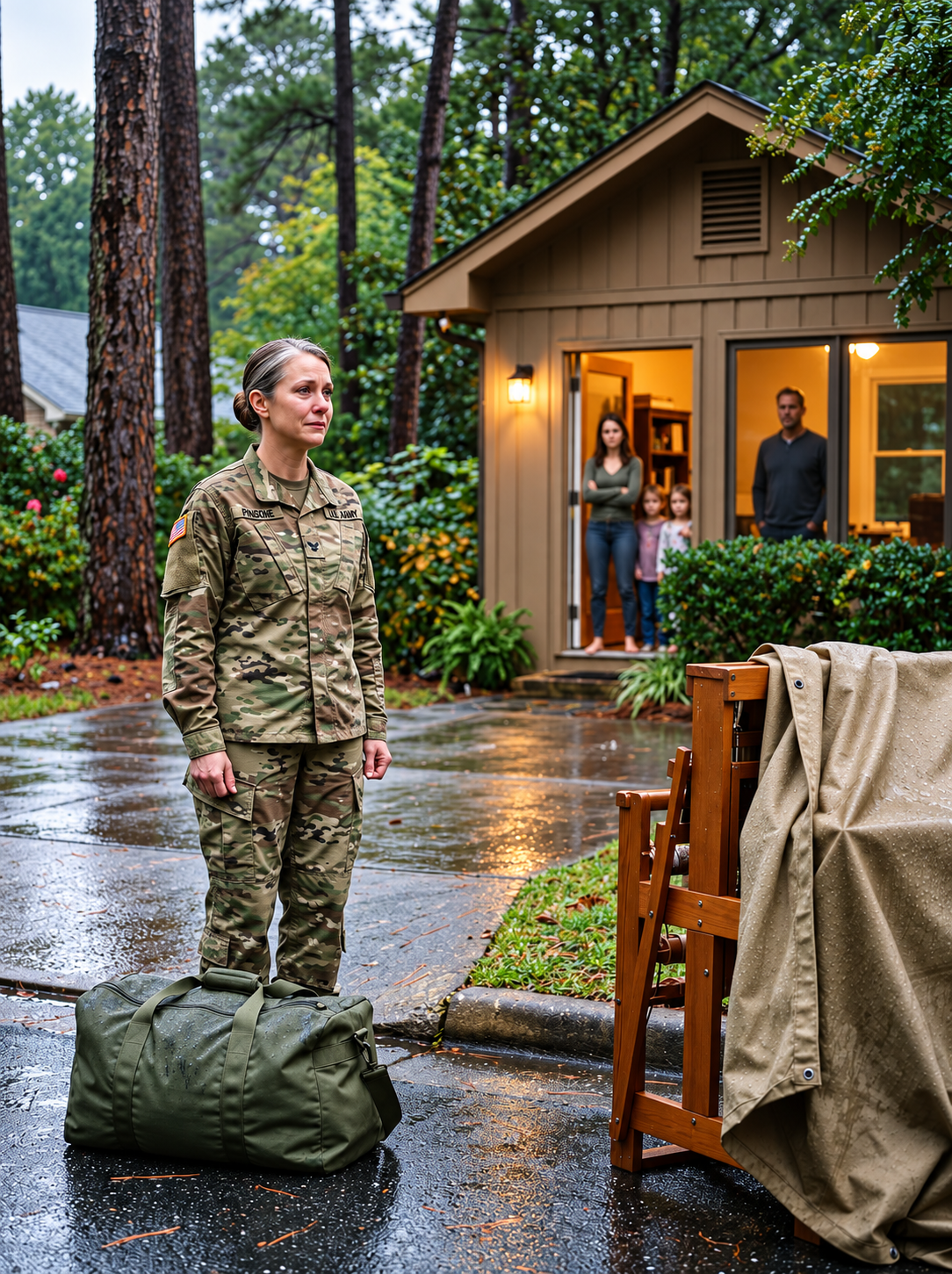
At 5:38 that morning, I pulled into my driveway and saw my mother’s weaving loom standing beside the garbage bins. Rain had soaked through the canvas draped over its upper frame. One wooden leg rested in a shallow puddle, and a dark line ran across the front beam where the walnut had split. I stopped the car without turning off the engine. For several seconds, I could hear nothing except the wipers dragging across the windshield. Twelve days earlier, that loom had stood safely inside my garden studio. Now someone had carried it to the road as though it were furniture waiting for collection.
My name is Rachel Donovan. I was a colonel in the United States Army, with twenty-six years of service behind me and a career spent coordinating complicated logistics operations. I had learned to make decisions when communications failed, equipment disappeared, and hundreds of people were depending on the next instruction. Yet I remained seated in my car, staring at a piece of wood that had belonged to my mother for eight decades. The damage was small enough to overlook from a distance. I knew better. That particular beam held the tension of an entire weaving project. My mother had shown me how to check it every time we worked together.
I had returned from a twelve-day field exercise, expecting a shower, breakfast with my husband, and perhaps two hours of sleep before reporting to Fort Liberty. Michael knew I was coming home that morning, although I had not called to announce the precise time. I wanted to arrive quietly. After nearly two weeks surrounded by engines, radios, and people requiring immediate decisions, I had been looking forward to the ordinary sounds of our house. I imagined Michael asleep upstairs and the kitchen smelling faintly of the coffee he always prepared before leaving for work. Instead, I stepped into the rain and found the first indication that my absence had been used for something neither of us had discussed.
I walked around the loom without touching it. A corner of the covering had slipped beneath the rear support, allowing water to collect along the lower frame. My mother had once repaired that same support after a moving accident, smoothing the wood with sandpaper until the joint was almost invisible. I remembered her standing in our garage, wearing an old blue sweater, refusing to let me replace the damaged section. She said new wood was sometimes necessary, but the marks left by years of use were part of what made a tool worth keeping. I had believed the loom would remain in our family long after I was gone.
Behind the house, a light burned inside my garden studio. I had built the cedar-sided structure eight years earlier with my mother, before Michael entered my life. She helped choose the wide windows that faced the dogwood trees because morning light made it easier to distinguish colors in the thread. We installed shelves for fabric, cabinets for patterns, and a broad cutting table beneath the largest window. My retirement plan was simple. When my Army career ended, I wanted to spend more mornings there, making quilts and woven blankets without checking a clock. My mother’s handwriting filled the labels on several storage boxes. Even after her death, opening that door had always felt a little like finding her waiting inside.
The windows were different now. Pale pink curtains covered the glass, where I had always kept the blinds open to admit daylight. Something brightly colored stood near the doorway. As I approached, I recognized a plastic children’s scooter. A pair of tiny shoes rested on the step. My key went into the lock but would not turn. I tried again, gently at first, then with enough pressure to confirm what I already suspected. The lock had been replaced. I stood beneath the narrow porch roof, my uniform wet at the shoulders, looking at a door to a building I owned and could no longer enter.
I knocked three times. There was movement inside, followed by a long pause and the sound of someone approaching. My stepdaughter, Kelsey, opened the door with a coffee mug in her hand. She was twenty-nine, with her father’s brown eyes and the same habit of lifting her chin whenever she expected an argument. Her hair was loosely tied back, and she wore pajamas I recognized from a Christmas visit. She looked at my uniform, then past me toward the driveway. Her first expression was surprise. I waited for embarrassment to follow, but it never did. “I thought you were getting back later,” she said, moving her mug away from the doorframe.
Behind her, the room I remembered had almost vanished. My cutting table was gone. A folding table stood beneath the window, supporting a microwave and several plastic containers. A narrow mattress lay across the floor beside a dresser. Seven-year-old Noah was sitting beneath a blanket, watching cartoons on a tablet. Four-year-old Mia slept on the small sofa that my mother used to occupy while I worked. Someone had taped colorful drawings to the cedar wall. A laundry basket stood where my fabric shelves had been. Nothing about the arrangement suggested a visit lasting one or two nights. Kelsey had unpacked as though she expected to remain.
I looked at the children’s faces before asking the question that had brought me there. “Why is my mother’s loom sitting in the rain?” Kelsey followed my gaze toward the driveway and gave a small shrug. She explained that the furniture had to be rearranged and the loom took up too much floor space. She said she had tried to fit it near the back wall, but Noah needed somewhere to sleep and Mia could not share the sofa with boxes piled around it. She spoke in the practical tone of someone describing an inconvenient shelving unit. When I asked where my other belongings had gone, she said some had been moved into storage and others were in the garage.
Michael appeared in the doorway before I could ask another question. His shirt was fastened one button out of alignment, and his hair was still flattened on one side from sleep. He looked first at Kelsey, then at me. I had been married to him for seven years, long enough to recognize the difference between genuine confusion and an explanation being assembled in haste. “Rachel,” he said, “you’ve just come back. Why don’t we go inside the house and talk?” I glanced past him into the crowded studio. “We’re already standing in the place I need to talk about.” He exhaled sharply and rubbed his hand over his face.
Kelsey stepped forward, apparently deciding the discussion had gone on long enough. She said her father had told her she and the children could stop feeling like temporary visitors. Her apartment was gone, she explained, and the children were tired of not knowing where they belonged. I knew she had been having financial difficulties. Michael had mentioned late rent and disappointing business contracts, always presenting them as setbacks she would soon overcome. But no one had told me she was moving into my studio. No one had asked whether I would allow it. I turned to Michael and asked exactly what he had promised. He hesitated, then admitted that Kelsey could remain there for the foreseeable future.
The words changed the conversation. A brief emergency arrangement would have been serious enough. A long-term decision made behind my back was something else entirely. Michael explained that Kelsey had lost her apartment, that two children needed stable surroundings, and that I was away so frequently the studio often sat unused. He presented each point as though it were a reason I should have reached the same conclusion. I reminded him that the property had belonged to me before we married and that the building had been constructed and approved as a workspace, not a residence. He knew its limitations. He had been present when an electrician explained why the studio was unsuitable for sleeping accommodation.
The building had one exterior door and no proper emergency escape route from a separate bedroom, because there had never been a bedroom. The electrical layout was intended for sewing machines, task lighting, and studio equipment. There was no appropriate kitchen ventilation or plumbing for a residential conversion. Michael knew all of that. Still, he told me the children needed a proper home more than I needed somewhere to pursue a pastime. The word he chose for my work was “hobby.” It landed harder than he expected. I had never demanded that he share my interest in weaving, but I believed he understood what the room represented. He had watched my mother grow weaker there during the final months of her cancer treatment.
I remembered one afternoon when she had been too tired to stand for more than a few minutes. She sat beside the loom, guiding my hands through a complicated pattern and stopping whenever the pain in her fingers became difficult to hide. Instead of asking for help, she would inspect the thread and tell me to loosen my grip. She believed good weaving depended on balance. Pulling one strand too tightly could distort an entire row. That lesson had stayed with me long after she was gone. Looking at Michael now, I wondered how someone who had been part of our family could forget so completely what those afternoons had meant. The studio was not sacred because I refused to share it. It mattered because every object inside had been placed there with intention.
Michael lowered his voice and asked me not to turn the situation into an Army-style confrontation. I watched Noah lift his head from the tablet. He was listening despite the cartoons. Mia stirred on the sofa, pulling her blanket over one shoulder. Whatever anger I felt toward the adults, neither child deserved to wake up in the middle of a family argument. I told Michael we would continue outside. Kelsey objected immediately. She wanted an answer about whether they could stay. I said I would discuss the children when I had finished understanding what had happened to the building and my belongings. Michael followed me out, closing the door quietly behind him.
The rain had eased to a fine mist. We stood beside the hydrangeas my mother planted during the studio’s first summer. Michael told me he had intended to explain everything when I returned. I asked why the locks had been changed before that conversation. He said the old lock sometimes stuck and he had arranged a replacement. When I asked who possessed the new keys, he admitted that Kelsey had one and he had another. Neither had thought to leave one for me. He attempted a reassuring smile, saying he could get a copy made later that morning. I stared at him until the smile disappeared. He had apparently convinced himself that restoring access afterward would somehow excuse removing it first.
I asked him to explain how long Kelsey intended to stay. He said they had not settled on a date, then admitted he had told her she would have enough time to rebuild her finances. I asked whether that meant months or years. He answered that putting a deadline on her would only increase her anxiety. At that point I understood he was not simply avoiding a difficult discussion. He had placed himself in charge of a future involving my property, my savings, and my retirement without treating my opinion as necessary. I asked whether he would have allowed me to give away his private office under similar circumstances. His answer was that the situations were different.
I returned to the studio and photographed everything before anyone could change it. I took pictures of the replaced lock, the mattresses, the microwave, the obstructed window, the furniture arrangement, and the narrow path between the children’s belongings. I recorded the condition of the loom from several angles, including the cracked beam and the standing water around its supports. Kelsey watched silently as I worked. When I finished, I asked whether she truly believed I had authorized her move. She glanced toward Michael, then down at the mug in her hands. She said Dad had assured her he was handling things. It was not the answer I had asked for, and I did not mistake it for one.
I did not order Kelsey to pack while the children watched. Instead, I went into the house, changed out of my wet uniform, and called Diane Walsh, the attorney who handled my property matters. Diane had helped review paperwork when I built the studio, and she knew the house was mine before my marriage. I described what I had found, distinguishing between what I had witnessed and what Michael had told me. She listened without interruption. Then she asked whether the children were currently sleeping inside the studio. When I confirmed that they were, she said the first issue was their safety. Property disputes could be addressed through proper procedures, but the possibility of children occupying an unsuitable structure needed immediate attention.
Diane advised me to document the situation, avoid a physical confrontation, and contact the county building office about the unauthorized residential use. She explained that I should not attempt to remove anyone’s belongings myself. There were proper procedures for recovering possession, and I intended to follow them. I called the county office and reported the building’s actual condition, including its lack of approved residential facilities and the fact that two young children were sleeping there. I did not exaggerate the danger. I did not need to. The measurements, permits, and photographs would speak for themselves. An inspection was arranged for that morning. The person taking the report confirmed the address twice before ending the call.
Before anyone could accuse me of wanting the children on the street, I opened my laptop and booked an extended-stay hotel suite for seven nights. It had beds for all three of them, a functioning kitchen, and enough space for the children to keep a few familiar belongings nearby. I paid for the reservation myself and requested written confirmation. I also asked Diane to coordinate a licensed moving crew and secure storage for my studio property, so the contents could be handled professionally and documented. My priority was to end an arrangement I had never approved without making Noah and Mia responsible for it. I knew Kelsey might not understand the distinction immediately. I made it anyway.
When I returned to the garden, Michael was speaking quietly with his daughter. They stopped as I approached. I told them an inspector was coming, that I had arranged temporary accommodation, and that Diane would supervise the handling of my property. Kelsey’s expression shifted from disbelief to indignation. She asked whether I was really forcing her children to leave after they had finally unpacked. I said they could not remain overnight in a building that had never been approved as a home. The reservation was already waiting for them. She could collect clothes, toys, school supplies, and whatever else the children needed. I would not interfere with their personal belongings.
Michael said the children would see this as a rejection. His voice carried an accusation that might once have made me reverse myself. I asked him who had told the children they could live in the studio permanently. He looked away. I reminded him that he had made that promise without first securing permission, and that his decision had created the disappointment he now wanted me to prevent. If the children were frightened, he could tell them the truth in language suitable for their ages: the adults had made a mistake about where they could live, and a safer place had been arranged while their mother worked out a plan. There was no reason to tell them their grandmother had thrown them away.
Kelsey was still angry. She said it was easy for me to make rules because I had a secure career and a large house. I did not challenge her description of my circumstances. I had worked hard for financial stability, and I was grateful for it. But I asked whether she would accept another person deciding how to use her belongings simply because that person believed they needed them more. She answered that family was supposed to help. I agreed. Then I asked whether help still counted as generosity if the person supposedly offering it had never been given a choice. She had no answer, but the anger remained in her face. I knew the conversation was not finished.
At 6:22, I put a small suitcase in my car. The sky was beginning to lighten behind the trees, turning the wet driveway a pale gray. Michael followed me down the steps and asked where I intended to go. When I said I was reporting for duty, he stared as though the answer made no sense. He asked how I could leave in the middle of what he called a family emergency. I told him the emergency had been created while I was away and that professionals were now involved. Diane would contact him about the inspection, and the hotel confirmation had been sent to Kelsey. He said I was acting as though the matter could be solved by checking items off a list.
I told him there were things a checklist could accomplish and things it could not. It could ensure the children had beds. It could preserve evidence of damaged property. It could establish who was responsible for the furniture being moved and who had authority over the building. It could not tell me why my husband had decided I was someone whose permission could be ignored. That answer would have to come from him. Michael stood beside the car for several seconds, watching water run down the windshield. Then he asked whether I was going to forgive him. I said I had not yet heard a truthful explanation, and forgiveness was not a question I could answer that morning.
The drive to Fort Liberty gave me too much time to consider the previous year. Michael had grown increasingly anxious whenever Kelsey called about money. Some evenings he left the dinner table to speak with her outside, returning with his shoulders tense and his appetite gone. I remembered asking whether she needed help and receiving vague assurances that he had matters under control. I had assumed he was supporting her within reasonable limits, using his own resources where appropriate. I had never tried to supervise his relationship with his daughter. She had lost her mother when she was young, and I respected the bond they shared. Now I wondered how much of that privacy had concealed decisions that affected us both.
At the base, I changed into a clean uniform and attended the morning briefing. Maps and schedules covered the conference table. Officers reported on equipment readiness, transportation requirements, and personnel movements. I asked the necessary questions and gave instructions where decisions were needed. No one in the room knew what I had found outside my house. I was accustomed to separating personal concerns from professional responsibilities, but that morning my concentration required unusual effort. Whenever the conversation paused, I saw the loom standing in the rain. I pictured my mother’s hands resting on the dark walnut frame. I could not remember the last time I had felt so angry without raising my voice.
At 8:15, my phone vibrated beside the briefing folder. Diane had sent a photograph from the property. A bright red notice was attached to the studio door, identifying the building as unsuitable for residential occupancy and prohibiting its use as sleeping accommodation. The county inspector had documented the safety violations and explained the requirements to Michael and Kelsey. A licensed moving crew was waiting to begin work under Diane’s supervision, with a deputy present to keep the process orderly. In the photograph, the studio door was open. Through it, I could see the pink curtains and the edge of Noah’s mattress. The notice was official. The living arrangement Michael had created was over.
I studied the photograph longer than necessary. Part of me had expected to feel relief, but the red paper merely confirmed what I already knew. My husband had placed two children in an unsuitable building, moved my mother’s belongings without permission, and counted on my affection for the family to prevent me from objecting. The immediate danger could be addressed through an inspection. The broken trust would require something else. Before returning to the briefing, I sent Diane a brief instruction: document every item removed from the studio, especially anything belonging to either of our families. I wanted nothing lost, discarded, or opened without proper care.
A few minutes later, Diane replied that Michael had agreed the children needed to leave after hearing the inspector’s findings. Kelsey was gathering their clothes. The movers had begun cataloging boxes and photographing furniture before transporting anything. I read the update and placed the phone face down. Then another message arrived. Diane said the crew had discovered a cedar chest beneath several boxes belonging to Kelsey. It appeared to be an old family possession, and she wanted to know whether I recognized it. I had seen that chest before, years earlier, in Michael’s former house. It had belonged to Emily, his first wife, who had died when Kelsey was twelve.
The next photograph showed the cedar chest resting on the studio floor, its lid partly raised. Inside were carefully folded papers and a sealed envelope bearing Michael’s name beside Kelsey’s. The handwriting was Emily’s. I recognized it from the birthday cards Michael kept in a drawer upstairs. Diane had not opened the letter, and neither had I. But the sentence written across the front made me read it twice. Emily had left instructions for the day when helping someone became an excuse for concealing the truth. I looked up from my phone toward the officers waiting for my decision on a transportation matter, and for the first time that morning I understood that the damage in my garden might have begun long before I ever married Michael.
END PART 1
PART 2 TITLE: An Old Letter from My Husband’s First Wife Exposed the Difference Between Protecting a Child and Teaching Her to Fear Nothing
By 8:37, Michael was calling my phone. I had stepped out of the briefing room to review a logistics update when his name appeared on the screen. I answered in the corridor. He did not ask whether I was all right after the field exercise or whether I had slept. He wanted to know why I had involved the county and a lawyer instead of resolving the matter privately. His voice was controlled, but I could hear Kelsey speaking angrily somewhere behind him. According to Michael, the inspection had embarrassed her in front of the neighbors. She had been forced to pack while a moving crew worked nearby, and the children were asking why they had to leave.
I leaned against the corridor wall and listened until he finished. Then I reminded him that I had arranged a hotel suite before making the report, and that the inspector had made the decision about the building’s safety. He said paying for a hotel did not excuse the humiliation. I asked what he would have preferred: that I overlook a dangerous living arrangement because acknowledging it made his daughter uncomfortable? He accused me of making everything unnecessarily formal. I answered that I had tried to have an ordinary conversation when I discovered the children living in my studio. He had already made the decision without me. Formal intervention became necessary because he had left no legitimate arrangement for me to accept.
He fell silent for a moment, then said Kelsey had nowhere else to go. I asked whether she had checked into the hotel. He admitted she was preparing to leave for it. I reminded him that the suite was available for a week and that Diane could provide the confirmation if Kelsey needed another copy. He said seven days would pass quickly. I agreed. That was precisely why Kelsey needed to begin making a realistic housing plan immediately. The hotel was meant to protect her children during a transition, not conceal an arrangement that could not continue. Michael seemed unable to hear the distinction. Whenever I mentioned planning, he returned to how frightened Kelsey had been when she lost her apartment.
After the call, I stood looking through a narrow window toward the parking lot. I had known Michael for almost a decade. He was a considerate man in many ways, the sort who stopped to help strangers change tires and remembered the birthdays of people he had worked with years earlier. When my mother was dying, he brought her favorite soup to the hospital without being asked. After the funeral, he sat with me for hours while I sorted photographs. His kindness had never seemed performative. That made his behavior harder to understand. A man could be generous and still make deeply selfish decisions. Michael seemed to believe the urgency of his daughter’s need erased the rights of anyone whose resources he intended to use.
Diane called shortly afterward to explain what had happened at the property. The inspector had reviewed the studio’s layout and confirmed the obvious deficiencies for residential use. There was no approved bedroom arrangement, no adequate kitchen setup, and no appropriate alternative means of escape. The children had been sleeping in a space designed for daytime work. Michael had initially argued that the situation was temporary, but when asked about the duration and proposed improvements, he could provide no authorized plan. Kelsey had become upset when the red notice was posted. Nevertheless, both adults eventually acknowledged that the children could not remain there overnight. Their personal belongings were being separated from mine and documented before the move.
The discovery of Emily’s cedar chest raised a different concern. Diane explained that the movers had been shifting Kelsey’s boxes away from the studio wall when they found it tucked behind a plastic dresser. The chest was old and had apparently been stored beneath other household items. It was not damaged, although several boxes resting against it were damp from condensation near the window. Diane recognized that the contents might be personal and stopped the workers from handling them further. She photographed the exterior and called me because I had instructed her to protect family possessions. I told her the chest belonged to Emily and should not be treated as abandoned property. Michael and Kelsey needed to be informed, and the contents should remain sealed until they decided what to do.
I remembered Emily through photographs and the stories Michael told about her. She had died after a prolonged illness, leaving him to raise Kelsey, then twelve years old. He described her as practical, thoughtful, and unusually good at recognizing when someone was telling her only the part of a story they wanted her to hear. Her cedar chest contained keepsakes from the marriage: photographs, letters, and other things Kelsey hoped to preserve. I had never asked to see those private belongings. My place in the family had never required replacing someone who was gone. Whatever was written in the envelope, I had no intention of opening a dead woman’s personal message without permission.
Diane agreed to keep the chest secure until its owners could collect it. She also mentioned that Michael had reacted strangely when told about the envelope. He had asked where it was found, then stood quietly for several seconds before saying he had forgotten the letter existed. Kelsey had wanted to see it immediately, but Michael suggested taking it home first. Diane advised that, given the tension between them and the possibility that the contents concerned both recipients, they should arrange to read it together when everyone was prepared. I did not ask her to tell me more than she knew. Still, I wondered why an envelope apparently written during Emily’s final illness would contain such a specific warning about help becoming a way to conceal the truth.
By late afternoon, the studio was empty of the mattresses and the equipment Kelsey had brought in. Noah and Mia were at the hotel with their mother. Diane had arranged secure storage for my belongings, and a written inventory would follow. The loom had been moved indoors by workers instructed not to lift it by the damaged beam. I authorized an assessment by a restoration specialist before anyone attempted a repair. Michael remained at the house, although he was no longer welcome to make decisions about the studio’s contents. Diane advised me to address access to the property through written agreements rather than impulsive demands. I understood that protecting my rights would require patience, even when every instinct told me to change the locks immediately.
I returned home after work and walked through the garden. The studio looked larger with Kelsey’s furniture removed, but the empty places made the invasion impossible to ignore. There were adhesive marks on the wall where the children’s drawings had been attached. A faint scent of laundry detergent lingered near the sofa. The floor bore scratches from the plastic dresser, and my cutting table was missing from its usual position. In the main house, the kitchen appeared almost normal. Two mugs stood beside the sink, and Michael had left a dishcloth folded over the faucet. I wondered how many mornings he had walked past the new arrangement without once considering what I would feel when I returned.
Michael sat at the kitchen table. He had prepared dinner, though neither of us was hungry. He asked about my day, and for a few minutes we spoke like strangers attempting politeness. Then he said he had never meant to hurt me. I told him intention did not explain why he had changed a lock, authorized the removal of my property, and promised someone else long-term use of my studio. He insisted he had believed there would be a way for everyone to be satisfied eventually. I asked whether he had considered telling me while I was away. He said the exercise had been important, and he had not wanted to distract me. That explanation might have sounded considerate if he had not used my absence to complete the move.
I asked whether he would have informed me before the children arrived if I had stayed home. He hesitated. At last he admitted that Kelsey had been frightened I would object. “And you?” I asked. He studied the table. He said he had expected a difficult conversation but hoped I would understand once I saw the children’s situation. I told him the children were not the problem. I cared about Noah and Mia. I had attended birthdays, school performances, and holiday dinners. I had helped Noah with reading assignments and taught Mia how to choose fabric colors. Their need for stability mattered to me. What I could not accept was being placed in a position where proving that affection required surrendering something I owned.
Michael asked whether I intended to make him choose between his daughter and his wife. I told him no such choice had been required. He could love Kelsey, assist her financially within honest limits, and help her find somewhere suitable to live. The only thing I expected was that our shared commitments and my property would not be offered without discussion. He looked relieved for an instant, as though he had heard permission to continue helping in whatever manner he considered necessary. I corrected that misunderstanding immediately. We would need to review any commitments affecting joint funds. His expression changed. He said the financial arrangements were complicated and should not become part of an argument about one room.
That remark stayed with me after he went upstairs. I had not accused him of spending money without my knowledge. I had simply asked how much assistance he was providing. His resistance suggested that the question was overdue. I opened my laptop and reviewed the documents available to me: our household budget, the renovation plans, and the shared account established to pay for roof work, drainage improvements, and electrical upgrades. We had postponed those projects more than once because Michael said the contractor was having scheduling difficulties. I had accepted the explanation during a busy training cycle. Looking at the projected costs now, I realized I had not reviewed the account in detail for several months.
The next morning, I spoke with Diane about the possibility of a broader financial problem. She advised me not to draw conclusions before examining the records. We agreed that a complete review of the renovation account was appropriate because both Michael and I had contributed funds for improvements to my property. She also recommended that future withdrawals require written approval from both account holders until we understood what had happened. I contacted the bank and began gathering statements. The process was straightforward, but I felt an unexpected reluctance as the files downloaded. I had faced financial discrepancies in professional settings without hesitation. This was different. The person whose transactions I needed to examine was the man I had trusted with my home.
During the same morning, Kelsey sent a message asking when her belongings would be returned. I replied with the inventory information and asked her to coordinate collection through Diane. She accused me of treating her as though she had committed a crime. I told her I was ensuring that nothing belonging to her children was lost and that my own property was handled responsibly. Her next message asked whether she could have the studio’s folding table, since she had been using it for food preparation. I explained that it belonged to my mother and would remain with my studio equipment. She responded that I seemed determined to punish her over every small object. I put the phone down without replying. The table was not the issue, and another argument would not make her understand that.
Two days after the inspection, Michael and Kelsey agreed to read Emily’s letter at a mediator’s office. Diane attended as my attorney, and we arranged for Noah and Mia to remain with a sitter at the hotel. I did not want them overhearing a discussion that might involve their grandfather’s grief or their mother’s financial difficulties. The meeting room was plain, with a long table, a pitcher of water, and a window looking toward a parking lot. Michael arrived carrying the envelope inside a folder. Kelsey sat beside him. She seemed tired, and the sharpness in her manner had faded somewhat. Neither looked eager to begin. I took a chair across the table and waited.
The mediator explained that Emily’s letter was private property addressed to Michael and Kelsey. They could read it together, and either could decide what portions, if any, they wished to share with me. I made clear that I had no claim to the contents. Michael placed the envelope on the table but did not open it immediately. The paper was yellowed, and the seal remained intact. His hands rested on either side of it as though he feared what would happen once he moved them. I knew he had preserved many letters from Emily, but this one had remained unread for years. Eventually he looked at Kelsey, who gave a small nod. He broke the seal carefully with his thumb.
There were six pages, written in Emily’s familiar, slightly slanting handwriting. Michael read the beginning quietly, then stopped to clear his throat. The letter had been written during the last months of her illness, when Kelsey was still a child. Emily had addressed them both, but much of what followed was meant for the husband she would leave behind. She wrote about the tenderness she admired in him and the fear that tenderness could become harmful when he could no longer bear to see the people he loved disappointed. She had watched him solve every problem before Kelsey had an opportunity to find her own answer. Illness, Emily believed, would only intensify that habit.
The letter recalled incidents Michael had apparently forgotten. When Kelsey struggled with schoolwork, he would stay awake helping until the assignment was perfect. When a friendship ended, he called the other child’s parents, attempting to repair a relationship that Kelsey herself needed to understand. If she used all her allowance, he quietly replaced it. If she became upset over an unfair consequence, he searched for a way to soften it. Emily did not condemn his kindness. She described it as one of the reasons she loved him. But she feared that he was teaching their daughter to regard discomfort as an emergency someone else should always resolve. Kelsey listened with her eyes fixed on the pages.
Michael reached a passage where Emily described the future she feared most. She knew Kelsey would grieve her death, and she knew Michael would feel responsible for every moment of that grief. But she wanted him to understand that a surviving parent could not repair the loss of the other by guaranteeing a life without disappointment. Some experiences would be painful, and their daughter would need to learn that pain did not mean abandonment. When Michael came to the sentence about building a bridge for Kelsey without taking the materials from another person’s home, his voice failed. He set the page down and covered his face with one hand.
For a long time, nobody spoke. I watched Kelsey trace the edge of the table with her finger. The mediator offered Michael some water, but he shook his head. He looked older than he had that morning, and I could see the years of grief in the way he held himself. I felt compassion for him. That surprised me, because the anger had not diminished. Both feelings could exist together. Emily had understood something about Michael that I was only beginning to recognize: he did not always know where caring for someone ended and controlling the circumstances around that person began. In trying to spare Kelsey hardship, he had become willing to impose hardship on other people.
The letter continued with words directed to Kelsey. Emily described her daughter as capable, stubborn, imaginative, and stronger than she realized. She hoped Kelsey would be given the freedom to make mistakes without interpreting every failure as evidence that she was alone. She asked her to listen when someone offered help but also to remember that help could have conditions. Accepting an answer she disliked would not diminish her worth. I watched Kelsey’s expression change as Michael read. She seemed to recognize a version of herself that existed before the habits of adulthood had settled around her. When the final page was finished, she asked whether her mother had really written all of it while she was sick.
Michael said she had. He explained that Emily had been organizing papers during a period when her condition briefly improved. She had asked him to keep several envelopes for Kelsey to read when she was older. Some had been opened on birthdays or important occasions. This one, however, he had put away because he was not ready to confront what it said. He admitted that he remembered seeing the envelope but had eventually allowed himself to forget it. Kelsey stared at him. “You knew she was worried about this?” she asked. He said he knew Emily had been concerned he might become overprotective. Kelsey asked why he had never told her.
He answered that she had already lost enough, and he could not bear to add the burden of her mother’s worries. It was the same explanation he had offered me about the studio: he wanted to spare someone a difficult experience. I wondered whether he heard the repetition. Kelsey certainly did. She looked down at the letter and said her father had always assured her he could handle whatever went wrong. She had believed him, even when one difficulty followed another. The mediator suggested they consider what Emily was asking of both of them rather than treating the letter as an accusation. Michael nodded, but I could see that something in him had been unsettled.
I waited until they had finished discussing the letter before speaking. I told Kelsey I had never wanted her children to be homeless, and that I still wanted them safe while she worked toward a stable arrangement. But I could not allow Emily’s fears for her daughter to become a justification for ignoring my rights. Michael had made a promise using something that was not his to give. Kelsey had accepted the arrangement without verifying that I agreed. Those choices needed to be acknowledged separately from the hardships that preceded them. Michael started to apologize, then stopped himself. I had heard enough apologies that morning. What I needed was an honest accounting of what had happened.
Diane opened the folder she had brought with her. She explained that the review of our shared renovation account had revealed withdrawals requiring further clarification. Michael straightened in his chair. Kelsey looked between us. Diane said the transactions had been described as payments for contractors, supplies, permits, and other property improvements. Yet several entries did not correspond to any invoice or completed work we could identify. I remembered the roof repairs that had been postponed repeatedly. I remembered Michael telling me the contractor was waiting for materials. Suddenly those delays looked different. Diane placed the statement summary on the table and asked Michael to explain where the money had gone.
The total had accumulated over fourteen months. Thirty-six thousand four hundred dollars had left an account intended to preserve and improve my home. Some payments had been routed through descriptions that appeared related to construction, but the records pointed toward expenses outside the renovation project. I stared at the total before looking at Michael. He had grown pale. He did not ask Diane whether she had made a mistake. He did not protest that the money was still available somewhere else. Instead, he lowered his gaze and clasped his hands so tightly that his knuckles whitened. Whatever the statements contained, he had known I would eventually find them.
I asked him about the roof contractor. He admitted that the work had not been delayed for the reasons he had given me. He said he had expected to restore the money before I noticed the missing balance. I asked how he intended to replace such a large amount. He opened his mouth, then closed it. Kelsey leaned forward and asked what the withdrawals had to do with her. Michael said her name quietly, almost as a warning. I turned toward him and understood that the studio had not been the beginning of his deception. It was merely the first part I had been able to see. The financial records suggested that our home had been supporting Kelsey for far longer than anyone had admitted.
The mediator asked whether Michael needed a moment before continuing. He shook his head, but he did not speak. Diane slid the next set of papers toward me. The pages contained transfers linked to Kelsey’s business and living expenses. I saw payments corresponding to commercial rent, business obligations, and credit accounts. For months, Michael had apparently been telling me our renovation plans were delayed while sending money elsewhere. I looked at Kelsey, who had stopped touching her mother’s letter. She was staring at the bank statements with an expression I could not yet interpret. I no longer knew whether she was surprised by the source of the money or simply shocked that I had discovered it.
I folded my hands and asked Michael one final question before we continued. I wanted to know whether the money had been taken during a sudden emergency or whether this was something he had been managing for months without my knowledge. He looked from me to Emily’s letter, still lying open on the table. Then he admitted that he had been helping Kelsey repeatedly, each payment intended to solve a problem created by the previous one. I thought about the studio, the changed lock, and the promise of long-term housing. They were no longer isolated decisions. They formed a pattern. And the figure printed at the bottom of Diane’s statement told me that I had been paying for that pattern without knowing it.
END PART 2
PART 3 TITLE: The Missing Renovation Money Led to a Failing Business, and Every Payment Revealed Another Promise My Husband Had Kept from Me
Kelsey pushed her chair away from the conference table so abruptly that its legs scraped against the floor. Until that moment, she had been watching her father with a mixture of apprehension and disbelief. Now she looked directly at me. “My children needed somewhere to sleep,” she said. “And you’re talking about bank accounts.” Her voice trembled, but she did not lower it. I glanced at the statement in front of me, then at the six pages of Emily’s letter lying beside Michael’s hands. We had spent the morning discussing the difference between assistance and avoidance. Kelsey’s accusation showed how difficult that distinction remained for her.
I did not raise my voice. I reminded her that I had paid for a suitable hotel suite before involving the building inspector. Noah and Mia had not been left without shelter, and I had never suggested they should be punished for decisions made by adults. But thirty-six thousand four hundred dollars had been removed from an account established for specific property improvements. The disappearance of that money affected the maintenance of my home, the studio, and the financial plans Michael and I had made together. Those facts did not become irrelevant because Kelsey was frightened. She folded her arms and said I could make anything sound reasonable if I described it like an official report.
Diane allowed the silence to settle before returning to the statements. She had organized the withdrawals chronologically, beginning with the earliest payment fourteen months earlier. Some were relatively modest. Others were large enough to have funded substantial portions of the planned roof and drainage work. Each carried a description that made it appear connected to the renovation project. One referred to a contractor deposit. Another suggested building materials. Several were recorded as payments toward permits or other preparations. Yet the supporting invoices were missing, and the bank records showed that the funds had been directed toward expenses unrelated to improving my property.
Michael watched Diane turn the pages without attempting to stop her. I asked when Kelsey’s business first began having serious financial problems. He said it had started with a series of disappointing contracts. Her party-decoration company had been growing, and she believed larger premises would allow her to accept more ambitious orders. She rented a warehouse, purchased additional equipment, and committed to inventory that required a steady flow of profitable bookings. When revenue failed to meet expectations, she borrowed money to cover the shortfall. Michael initially described the situation as a temporary cash-flow problem. I recognized the phrase from several conversations we had had over dinner, when he assured me his daughter was close to turning things around.
Kelsey objected to his description. The company had not been failing from the beginning, she insisted. Customers liked her work, and several event planners had praised the decorations she produced. She talked about weddings, birthday celebrations, and corporate functions where her arrangements had received compliments. I asked whether those projects had generated enough profit to cover their costs. She hesitated before admitting that some had not. She had accepted jobs at reduced prices because she expected the publicity to lead to better contracts. To prepare for that future demand, she ordered more supplies. The warehouse filled with inventory that looked promising on paper but required money she did not have.
Michael began helping before the situation became critical. At first, he covered a payment Kelsey expected to reimburse within weeks. When another expense arrived, he supplied that money too. The business required payroll, warehouse rent, transportation, and replacement materials. Kelsey continued taking orders that barely covered direct costs because stopping felt like admitting defeat. Michael paid her employees on two occasions when the business account could not meet payroll. He assisted with rent and a vehicle payment. Eventually, as her personal credit became strained, he helped with household expenses. Each payment was supposed to buy enough time for the next contract to restore stability. Instead, the obligations multiplied.
I asked whether he had ever reviewed a complete financial statement for the company. He admitted that he had seen estimates and individual bills but never insisted on a reliable accounting of its losses. Kelsey had repeatedly assured him that a profitable season was approaching. When he became worried, she told him closing the business would waste everything she had invested. He feared that refusing assistance would make him responsible for its failure. I listened without interrupting, struck by how closely their reasoning resembled the pattern Emily had described. Michael had spent years preventing his daughter from experiencing disappointment, and Kelsey had learned to treat his willingness to intervene as evidence that recovery remained possible.
The mediator asked Kelsey what she had believed about the money her father provided. She said she assumed he had savings available. Michael had never told her that he was withdrawing funds from an account shared with me. She acknowledged knowing he was helping her repeatedly but said she had not asked which account the money came from. I did not know whether her explanation was complete, and I refused to speculate. The relevant facts were already serious enough. Michael had concealed the transfers from me and disguised their purpose in records associated with our renovation plans. Whether Kelsey knew the source of the money would require a separate, honest conversation.
I turned to Michael and asked why he had not told me when the business first needed help. He said he knew I would want to examine the numbers before agreeing to contribute. I told him that was precisely what responsible use of shared money required. He answered that Kelsey could not afford delays while bills were overdue. I asked whether she could afford to continue operating a business that lost money on its contracts. He looked toward his daughter. Kelsey stared at the wall, her jaw tight. I understood that Michael had not simply hidden payments because the situation was embarrassing. He had avoided discussing the business because an honest review might have led to the one recommendation he could not bring himself to make.
For months, I had believed our home improvements were waiting on contractors. The roof had needed attention before the next heavy-rain season. Drainage repairs were intended to protect the foundation and prevent water from collecting near the studio. Electrical upgrades would have supported the additional equipment I hoped to use after retirement. These were not ornamental improvements. We had discussed them carefully, estimated their cost, and placed money aside to complete the work. Michael had reassured me repeatedly that the projects remained funded. Now I could see that the delays had protected his deception. As long as no contractor arrived, he could postpone explaining why the account balance had fallen.
I asked him what he had planned to do when the work could no longer be delayed. His answer was almost inaudible. He hoped he would find a way to put the money back. I asked from where. He mentioned future income, possible business improvements, and the expectation that Kelsey would eventually repay him. None of those possibilities had been formalized. There was no repayment schedule, no evidence of sufficient profits, and no realistic plan to restore the renovation fund. He had exchanged an established financial commitment for a series of hopes, then concealed the exchange from the person whose agreement he needed. I could forgive a bad estimate. What frightened me was how accustomed he had become to making promises without verifying whether he could honor them.
Diane requested that Michael provide complete records of the transfers, including any payments made from accounts not yet reviewed. She explained that we needed to distinguish joint funds, personal funds, and obligations for which either of us might be responsible. Michael agreed, although he appeared uncomfortable. When she asked whether he had signed financial agreements on Kelsey’s behalf, he looked down at the table. He admitted he had co-signed an apartment lease after Kelsey could no longer qualify on her own. I asked when that happened. It was months earlier, during a period when he had told me she was becoming more financially independent. The discovery left me wondering how often reassurance had been used to end a conversation rather than communicate the truth.
Kelsey explained that she had taken the apartment because the children needed a stable place while she worked. When she could no longer pay the rent, Michael helped until he could not keep up with the obligations. The landlord eventually gave her ten days to resolve the situation or leave. That deadline had triggered the move into my studio. She spoke about packing toys, explaining the move to Noah, and trying to keep Mia from noticing her anxiety. I believed those experiences had been frightening. But I also saw how each short-term rescue had delayed a necessary decision. The warehouse, the inventory, the apartment, and finally the studio had all been maintained through promises that could not support them.
When the mediator suggested a break, Kelsey left the room to get water. Michael remained seated. Emily’s letter lay open beside him, and I noticed that one corner of the final page had curled where his fingers had pressed against it. He said he understood why I was angry. I corrected him. Anger was only part of it. I had made retirement plans around money we had agreed to preserve. I had entrusted him with access to my property. I had believed that if he disagreed with me, he would tell me. Instead, he had built a separate arrangement behind those assumptions. I could no longer rely on ordinary statements from him without asking what he had omitted.
He told me that he had not wanted to deceive me. I asked when he first realized that I would disapprove of the withdrawals. He admitted he had known from the beginning that I would expect a discussion. That answered the question more clearly than any explanation about good intentions could have done. I told him secrecy had not been an unfortunate side effect of his efforts. It was what allowed those efforts to continue without opposition. He had repeatedly made choices that depended on my remaining uninformed. Michael opened his mouth, then closed it. For the first time since my return, he stopped trying to defend the decisions by describing the people he hoped to protect.
The afternoon ended with an agreement to obtain additional records and restrict future withdrawals from the shared renovation account. Diane assisted me in arranging safeguards requiring written approval from both account holders before further funds could be transferred. I also requested complete financial disclosure from Michael. He would need to provide information about the business payments, the apartment lease, and any other obligations affecting our finances. I made clear that these measures were not a threat. They were necessary because the ordinary trust that had previously governed the account no longer existed. Until we understood the full extent of the problem, there could be no more unexplained payments.
When I left the mediator’s office, Kelsey was standing near the entrance, looking at her phone. She asked whether I intended to make her repay the entire amount. I told her Diane would help establish what each person was responsible for, but that Michael and I needed to address the unauthorized withdrawals first. She said her company could not produce that much money. I asked what she planned to do with the remaining warehouse inventory. She admitted that much of it was still sitting unused. Selling it would mean accepting losses and closing contracts she had hoped would eventually become profitable. She spoke as if that decision would erase the work she had already done.
I told her the money already spent would not return merely because she continued making the same choices. She said I did not understand how much the company meant to her. I thought of the loom waiting for restoration and the studio that had been dismantled to provide her with space. I understood perfectly well that work could hold memories, pride, and a sense of identity. But I also understood that loving something did not excuse making other people responsible for sustaining it indefinitely. I asked whether she had considered taking temporary employment while winding down the business. She said she had thought about it, though she looked ashamed to admit that the idea had become necessary.
That evening, Diane called with an update that complicated the situation further. While reviewing the property arrangements and communications relevant to the studio, she had identified photographs and messages showing that Michael had discussed the building with Kelsey well before my Army exercise. I initially assumed he had sent her pictures while considering whether the studio could be used briefly during an emergency. Diane said the material was more detailed than that. There were measurements, furniture suggestions, and discussions about moving existing equipment. Several exchanges predated the ten-day deadline Kelsey had described. They suggested that the studio had been considered as a housing solution long before the final apartment crisis.
I asked Diane to explain exactly what she had seen. Michael had sent Kelsey measurements of the interior walls and estimates of the available floor space. He had photographed the windows, identified areas where furniture could fit, and suggested moving the cutting table to create room for the children. One photograph showed the corner where my loom had stood. Beneath it was a message discussing whether a dresser would fit after the equipment was removed. Reading the description, I remembered Michael walking through the studio with his phone several weeks earlier. He had told me he wanted photographs of the cedar siding because we might need them when arranging exterior repairs. I had not questioned him.
Diane explained that she wanted to establish a complete chronology before drawing conclusions. The studio was not a legal residence, and any proposal to convert it would have required permits, structural changes, and my agreement as the property owner. Yet Michael and Kelsey had discussed furniture placement as though the decision had already been made. Diane asked whether I recalled approving any preliminary renovation plan intended to accommodate them. I told her I had not. The only projects we had discussed were maintenance and improvements for my existing workspace. No additional living quarters, kitchen, bathroom, or bedroom had ever been proposed to me. The messages indicated that my husband was making plans in which my participation was not considered necessary.
I sat at the kitchen table after ending the call, examining photographs I had taken before the exercise. My cutting table stood beneath the large window. The loom occupied the corner where the morning sun fell across its wooden frame. Several folded quilts rested on a shelf my mother had helped install. I compared those images with the photographs from my return. The room had been transformed efficiently. Boxes had been removed, furniture shifted, bedding installed, and curtains hung. This had required more than a hurried decision made after a landlord issued a notice. Someone had measured and planned. Someone had chosen what to keep and what to remove. The twelve days I had been absent had simply provided the opportunity.
Michael came downstairs while I was looking at the images. He saw the photographs on my screen and stopped. I asked whether he had been planning the move before I left for the exercise. He said he had been considering several possibilities because Kelsey needed help. I asked when the studio became his preferred solution. He said he could not remember exactly. I turned the laptop toward him and showed him the dates Diane had identified. His expression changed. He asked whether I had been investigating his private messages. I told him the question was not who discovered the planning but why he had arranged it without telling me. He had no reasonable explanation.
I asked him whether he had intended to tell me before the children’s belongings arrived. He said he believed we would eventually discuss it. I reminded him that discussion after a decision was carried out was not the same as obtaining permission. He said he had hoped the situation would feel less alarming once everyone had settled. I looked at him across the table, trying to understand how he had persuaded himself that the presence of two children would make the arrangement acceptable. He knew I loved them. He also knew I would be reluctant to upset them. The thought that he had taken both facts into account made the room feel suddenly unfamiliar.
Later that night, Diane forwarded the relevant communication records for my review. I read them in chronological order, beginning with seemingly ordinary conversations about Kelsey’s housing difficulties. The messages gradually became specific. Michael suggested which pieces of furniture could be removed. Kelsey described the children’s sleeping needs. There were references to adding a small kitchen and bathroom at some future point. None of those improvements had been discussed with me, and the financial records gave me little confidence that Michael could have funded them. Still, the conversations treated the studio as a space waiting to be converted, not as something whose owner might reasonably refuse.
Near the end of the first group of messages, I found a sentence that made me stop scrolling. Michael had described the studio to Kelsey as the place she could remain permanently after I became accustomed to the arrangement. I read it several times. His language was not uncertain or exploratory. He had not written that he would ask whether I agreed, or that the studio might be available if the county approved suitable changes. He had offered Kelsey a future that depended entirely on my eventually accepting a decision made without me. The promise was older than the move. It had existed while he was still telling me the renovation projects were merely delayed.
I closed the laptop and looked toward the dark window. Until then, I had been trying to separate Michael’s poor judgment from deliberate deception. The financial records had made that difficult. The messages made it nearly impossible. My husband’s plan depended on access to a property he did not own, money we had agreed to use elsewhere, and a decision he expected me to accept after it became inconvenient to refuse. I thought about the children sleeping in the studio and the way Michael had accused me of humiliating Kelsey when I arranged safe accommodations. His indignation had concealed something much more calculated than a desperate response to an emergency.
Before going upstairs, I sent Diane a message asking her to preserve the full conversation history, not merely the photographs and measurements. I wanted to know exactly when Kelsey realized I had never approved the arrangement. I also wanted to know whether Michael had explicitly told her to move in before asking me. Those questions mattered because they would distinguish mistaken assumptions from deliberate decisions. Diane replied that she would examine the remaining messages with me. I placed my phone on the table beside the renovation statements. The money had exposed the scale of the deception. The messages were beginning to explain how Michael expected to escape its consequences.
END PART 3
PART 4 TITLE: I Found the Messages They Exchanged Before I Came Home, and Learned Exactly Why They Thought I Would Never Say No
The next morning, I read the message that finally removed any possibility of misunderstanding. It had been sent by Michael two days before Kelsey moved into my studio. By then, he had already measured the rooms, discussed furniture placement, and assured his daughter that the building could become her long-term home. Kelsey had asked whether I knew what they were planning. Michael’s answer acknowledged that I had not been told. He did not propose contacting me or waiting for my agreement. Instead, he told her that once Noah and Mia were settled inside, I would be unwilling to make them leave. I stared at those words until the screen dimmed.
There was nothing ambiguous about the calculation. Michael expected my affection for the children to prevent me from objecting after the move. He had not simply underestimated how important the studio was to me. He had identified the thing most likely to make me surrender it. I remembered seeing Noah beneath his blanket on the first morning and Mia asleep on the sofa. Their presence had hurt because I cared about them. Michael had anticipated that reaction and used it as part of his plan. For years, I had trusted him with the knowledge of what mattered to me. Now I was looking at evidence that he had used that knowledge to shape a situation I would find almost impossible to refuse.
I called Diane and read the message aloud, although she already had a copy. She confirmed that the date and surrounding conversation would be preserved with the rest of the records. I asked whether there was any indication Kelsey had challenged her father’s plan after learning I was uninformed. Diane explained that the exchange continued with practical questions about moving day and which items could be relocated. There was no message showing that Kelsey insisted on obtaining my permission. The evidence suggested she knew the arrangement had not been approved and proceeded anyway. That did not establish every motive, but it resolved the question I had asked her repeatedly since coming home.
My first impulse was to call Michael and demand an explanation. Instead, I sat with the evidence for several minutes. I had spent much of my Army career learning not to make consequential decisions during the first surge of anger. That discipline did not prevent me from feeling betrayed. It prevented the betrayal from determining every action that followed. I wanted Michael to understand precisely what he had done, and I knew a telephone argument would allow him to retreat into familiar defenses. He would talk about Kelsey’s financial problems, the children’s needs, and his intention to keep everyone together. I needed a conversation in which those facts could not be used to avoid responsibility.
I printed the relevant messages and placed them beside the financial statements. The documents formed a chronology that was more revealing than any single confession. Fourteen months of transfers had weakened the renovation account. Kelsey’s business continued losing money while Michael covered expenses that should have forced difficult decisions. When her apartment became unaffordable, he began treating my studio as the solution. He surveyed the building while I still believed it was being prepared for repairs. Then he waited for my scheduled absence, moved my possessions, replaced the lock, and installed the children. The final step was supposed to be my reluctant acceptance. I could no longer describe the situation as a family emergency mishandled in haste.
That afternoon, Michael came into the kitchen while I was reviewing the photographs of my mother’s damaged loom. The restoration specialist had confirmed that an inspection of the frame was necessary before any attempt to repair the crack. Moisture had reached several wooden components, and the extent of the damage could not be established from photographs alone. Michael asked whether the loom could be saved. I told him I hoped so. He offered to pay for repairs, and I asked whether he intended to use money from the account he had already depleted. The question visibly hurt him. I had not meant it as a clever remark. I genuinely no longer knew which promises he could afford to keep.
He sat across from me and said we needed to find a way forward. I agreed. Then I placed the printed messages between us. His eyes moved over the first page, and his shoulders tightened. He recognized the conversation immediately. I asked whether he had written the message predicting I would allow the children to stay once they were inside. He nodded. I asked whether he understood, when he wrote it, that I had not agreed to the move. He said yes. His answer came so quietly that I almost missed it. For a moment I wanted him to offer some unexpected explanation that would change what the evidence meant. He did not.
I asked why he had thought that strategy was acceptable. He said Kelsey had been overwhelmed, the apartment situation was deteriorating, and he was frightened about what would happen to the children. I listened, then asked what any of those circumstances had to do with concealing the move from me. He said he believed I would object before seeing the children’s need. I reminded him that I had offered safe accommodation immediately after discovering what happened. I would have considered reasonable temporary help if he had asked honestly. What I could not accept was being denied the opportunity to decide. Michael admitted he had known I would insist on reviewing the legal and financial problems first.
He began describing how much Kelsey had suffered after Emily died. I stopped him gently. I knew her history mattered. I had never dismissed the fear she carried from childhood. But losing her mother did not entitle her to another person’s property, and Michael’s grief did not authorize him to surrender something I had built with mine. I pointed toward the garden, where the studio stood beyond the kitchen window. My mother had also died. That room was one of the few places where I could still see the results of our years together. He knew what it represented. He had nevertheless decided that preserving Kelsey’s comfort mattered more than asking whether I could bear to lose it.
Michael said he had never intended to take the studio away permanently. I showed him the earlier message promising Kelsey a long-term place once I adjusted. He read it and looked away. He admitted he had imagined converting the building into living quarters eventually. I asked who would pay for that construction, obtain the permits, and approve the change in use. He had no detailed answer. He said he had hoped we could work those matters out after the children were settled. I told him that he had been planning improvements to my property before obtaining permission to use it. The sequence mattered. He had treated my agreement as the final inconvenience rather than the first essential requirement.
He asked whether I believed he had deliberately set out to hurt me. I told him that was not the question. He had deliberately set out to obtain an outcome without my consent. Whether he enjoyed the harm it caused was irrelevant. I explained that he had crossed a boundary because he believed I would struggle to enforce it once children were involved. His expression changed. He tried to speak, then stopped. I could see that the distinction unsettled him more than being accused of selfishness. He had always described himself as someone who helped. The possibility that his method of helping could exploit another person’s compassion challenged something central to the way he understood himself.
We sat in silence while rain began tapping against the kitchen window. Michael finally asked what I wanted him to do. I said I needed full financial disclosure, a clear accounting of the studio move, and an end to promises made on my behalf. I also needed space to determine whether I could continue trusting him as my husband. He asked whether that meant I wanted him to leave. I told him I had not yet decided the future of our marriage, but I could not pretend our relationship remained unchanged. He looked frightened for the first time. I understood that fear. Still, I would not offer reassurance simply to spare him the consequences of what he had chosen.
Later, Kelsey requested a conversation without her father present. She said she wanted to explain what had happened before I formed a permanent opinion of her. I agreed to meet somewhere the children could remain nearby without hearing an argument. She suggested the hotel lobby, where Noah and Mia could sit with coloring books while we talked. I chose a table far enough away to give us privacy while keeping them in sight. Kelsey arrived carrying a folder of apartment information. She appeared exhausted, and the confidence she had displayed in the studio doorway was gone. She looked at me for a moment before sitting, as though she was unsure which version of me to expect.
I began by asking whether she had known I had not approved the move. She said her father had initially assured her he would handle the discussion with me. She had assumed he meant he would ask and obtain permission. But as the move approached, his answers became less specific. Two days before carrying her belongings into the studio, she asked him directly whether I knew. He acknowledged that I did not. I asked what she thought when she learned the truth. She looked toward the children. Noah was showing Mia how to draw a straight line with a ruler. After a long pause, Kelsey admitted she had considered stopping. She had already told the children the studio would be their new home.
I asked why she continued. She said she was frightened of returning to another temporary arrangement. The children had endured weeks of uncertainty, and she could not face explaining another change. She believed that once I saw their beds and clothes inside the studio, I would allow them to remain. I recognized the reasoning immediately. It was Michael’s plan repeated in her own words. I asked whether she understood that she had been relying on my unwillingness to disappoint the children. Kelsey wiped her eyes and said yes. She did not accuse her father or claim she had no choice. She admitted that knowing I would feel pressured had made the plan seem more likely to succeed.
I looked at the two children, both absorbed in their drawings, and felt the sharp ache of wanting to protect them from the consequences of every adult mistake. They had not chosen where their mother placed their mattresses. They had not examined building permits or questioned who owned the studio. Their world consisted of familiar blankets, toys, meals, and the adults who told them where they would sleep. I told Kelsey that I would not accept being described to them as the person who had taken their home. The studio had never been a lawful or suitable home for them. Their father and grandfather had made promises without authority, and those promises had created the disappointment they now needed to manage.
Kelsey said Noah had asked why Grandma Rachel was angry. She had told him there was a disagreement about the building. I appreciated that she had not blamed me directly. I suggested she explain that the adults had misunderstood what arrangements were possible and that the hotel was a safe place while she found something permanent. The children did not need a detailed account of financial transfers or family betrayal. They needed truthful reassurance that their mother was working on a suitable home. Kelsey nodded. For the first time, she seemed willing to separate her children’s welfare from the argument about my property. That distinction had been missing when she stood in the doorway wearing pajamas and claiming a room she had no permission to occupy.
She opened the folder she had brought and showed me two rental applications. Both were for smaller apartments than the one she had lost. She said she had begun contacting property managers who offered rentals within the income she could reasonably expect from employment. She had also been considering administrative work while closing the decoration business. I asked whether she had made any decisions about the warehouse. She admitted that selling the inventory would be painful but necessary. I did not congratulate her as though reviewing a realistic budget were an extraordinary achievement. I told her the decisions were sensible and that I hoped she followed through. The important part would be what she did after leaving the hotel.
Kelsey asked whether I would help with the children’s housing if she could not secure an apartment within the week. I said I would consider reasonable assistance that protected Noah and Mia, but that any arrangement would need to be openly discussed and limited to what everyone could genuinely afford. I would not offer another space in my studio. I would not agree to indefinite financial support. Nor would I allow Michael to make commitments in my name. She looked disappointed but did not argue. I could see how difficult it was for her to hear an answer that contained limits. Emily had written about the importance of that experience years earlier, when Kelsey was still young enough for the lesson to have changed everything.
She then asked about my mother’s loom. I told her the restoration specialist was assessing the damage. The cracked beam might be repairable, but moisture had affected several components. Her gaze fell to her hands. She admitted that she had known the loom was important to me. She had seen me working with it during earlier visits and remembered how carefully I covered it after each session. Still, when the room became crowded, she decided the loom could be moved outdoors until other arrangements were made. She said she had expected someone to collect it before the weather worsened. I asked whether she would have placed her mother’s belongings beside the road under the same circumstances. She did not answer.
I did not press the comparison. She understood it. For several minutes we sat without speaking, watching Noah and Mia arrange their crayons by color. Eventually Kelsey said she had spent so much time thinking about what she needed that she stopped considering what her father was asking someone else to give up. I told her that her father had encouraged that way of thinking, but she was responsible for the choices she made after learning the truth. She nodded and acknowledged that she had continued with the move even after discovering I knew nothing about it. The admission did not undo the damage. It did, however, give us somewhere honest to begin.
When I stood to leave, Kelsey asked whether I hated her. I told her I was hurt and angry, but I had never hated her or her children. I cared about them, and that was why the deception had been especially painful. She looked relieved, then uncertain. I explained that affection did not automatically restore trust. If she wanted a different relationship with me, it would depend on whether she could respect my decisions even when they disappointed her. She said she understood. I hoped she did. I had heard enough promises from both her and Michael to know that understanding could only be measured through actions.
On the drive home, I thought about Emily’s letter and the conversation in the hotel lobby. Emily had feared that Michael would spend his life rescuing Kelsey from every difficulty. That fear had become reality, but not through a single dramatic mistake. It developed through years of small decisions. A missed payment covered without discussion. A business expense explained away. A lease guaranteed despite the warning signs. Eventually, someone else’s property became the next available solution. Every rescue postponed a difficult choice until the consequences grew too large for Michael to manage alone. He had mistaken the absence of immediate suffering for evidence that his efforts were succeeding.
That evening, I spread the account statements and the printed messages across the dining table. I placed Emily’s letter, with Michael and Kelsey’s permission, beside them. I wanted to understand the pattern without confusing explanation with excuse. Michael’s grief helped explain why he feared disappointing his daughter. Kelsey’s childhood loss helped explain why she sought certainty through her father’s promises. Neither fact justified the use of my money or the unauthorized occupation of my studio. Understanding their motives did not require accepting the results. The distinction was becoming essential, because I still loved them. Without it, love itself could be used to persuade me that enforcing reasonable boundaries was an act of cruelty.
Michael came downstairs and found me studying the records. He asked whether Kelsey had spoken with me. I told him she had admitted knowing I was unaware of the move before it happened. He lowered himself into the chair opposite mine. I asked whether he understood what that meant. He said it meant he had made a terrible mistake. I corrected him. A mistake might have been believing the studio was suitable for a brief stay. A mistake might have been overlooking an important permit requirement. What he had done was make a deliberate choice to conceal information until reversing the arrangement would be painful. Calling it a mistake without acknowledging the decision would only protect him from understanding it.
He looked at the messages and admitted that he had expected me to give in. He said he had known I loved the children and could not bear seeing them frightened. I asked whether he had ever considered how I would feel finding my mother’s loom outside or discovering that my retirement plans had been changed without a conversation. He said he had convinced himself I would eventually understand. I told him he had confused understanding with surrender. I could understand Kelsey’s circumstances completely and still refuse an arrangement made without my consent. He nodded, but I could see he was struggling to accept a world in which loving his daughter did not entitle him to eliminate every obstacle she faced.
For several moments, he sat staring at Emily’s letter. Then he said quietly that he had promised her, near the end of her illness, that Kelsey would always have a home. He had spent years trying to fulfill that promise by making certain their daughter never experienced another loss she could not bear. I asked whether Emily had actually wanted him to guarantee that nothing difficult would ever happen. He did not answer. Instead, he looked at the pages she had written and traced the crease in the paper with his thumb. I wondered how many years he had carried that promise without examining what it truly required. The question belonged to him, and I could not answer it on his behalf.
Before going upstairs, I told Michael I needed a separate conversation about our marriage, away from the house and the studio. We needed to discuss not only the money and the property but the assumption that my strength made me responsible for absorbing consequences he was unwilling to face. He suggested the small café beside the Cape Fear River, where we had often gone during quieter weekends. I agreed to meet him there the following morning. He asked whether we could still repair what had happened. I said I did not know. For once, I refused to offer certainty simply because someone I loved was frightened by its absence.
After he left the room, I gathered the statements and placed them in a folder for Diane. The house was quiet. Beyond the window, the garden studio stood dark, its door locked and its windows uncovered again. I could still see the empty corner where my mother’s loom belonged. I had spent years believing that keeping a family safe meant being capable enough to solve whatever problem appeared. Now I understood that the people closest to me had begun treating that capability as an unlimited resource. The next morning, Michael would have to face something no financial transfer or carefully arranged room could solve. I was going to ask him whether he could remain my husband without expecting me to carry the consequences of choices he refused to make.
END PART 4
PART 5 TITLE: A Small Wooden Box on My Kitchen Table Forced Me to Decide Whether Regret Could Ever Become Real Change
I stood at the kitchen table long after Michael had driven away, looking at the small wooden box he had left beside the flowers. The house was quiet except for the refrigerator humming against the far wall and rainwater dripping from the porch gutter. Inside the box lay the shuttle from my mother’s loom. Its walnut surface had been cleaned and polished, but the shallow scratch near the pointed end remained. My mother had made that mark years earlier when her wedding ring caught against the wood. I ran my thumb over it, recognizing the familiar imperfection. Beneath the shuttle was Michael’s handwritten note, promising that nothing would return to my home without my permission, including him. I read it twice. Then I closed the box and left it where he had placed it.
There had been a time when a gesture like that would have persuaded me to forgive almost anything. During our early marriage, Michael had possessed an extraordinary talent for recognizing when I was exhausted. He would bring me coffee before sunrise, warm my hands between his when winter exercises left them stiff, and leave little notes in my luggage before I departed for training. Those acts had never been imaginary. He had loved me in ways I could feel. That was part of what made his betrayal so difficult to understand. The same man who remembered exactly how I liked my coffee had spent weeks planning to give my private workspace to his daughter, fully aware that I had not agreed.
I returned the wooden box to the table after breakfast the following morning. Before leaving for Fort Liberty, I photographed the note and placed the original inside my desk drawer. I did not immediately call Michael. His temporary door code had already expired, and I saw no reason to renew it. He had honored the agreement by leaving at the arranged time after dinner. That mattered, but it was one evening. What troubled me was how badly I wanted to believe him simply because he had finally acknowledged the damage. I had spent twenty-six years learning to evaluate actions rather than assurances. Applying that discipline to someone I loved required more courage than I expected.
At the installation, I spent the morning reviewing transportation readiness figures and equipment maintenance reports. A junior officer presented a revised movement schedule that contained several correctable weaknesses. Instead of telling him how to fix each problem, I asked him to explain his assumptions. He studied the document, recognized the errors, and began making corrections without further instruction. Watching him work reminded me of something I had tried to explain to Michael. Supporting another person did not mean removing every difficulty from their path. Sometimes it meant standing close enough to help while allowing them to do the necessary work themselves. I had practiced that principle with soldiers for decades. Somehow, at home, it had become a source of conflict.
Diane Walsh called shortly before lunch. She had received another financial disclosure packet from Michael, including statements from accounts I had never previously examined. Nothing in those records suggested another hidden transfer from the renovation fund, but the original $36,400 remained an obligation. Diane had checked the figures carefully. Some money had covered warehouse rent for Kelsey’s failed party-decoration business. Other transfers had paid credit-card bills, transportation expenses, and the payroll Michael had quietly covered when the company could no longer support its own employees. Diane explained that Michael had supplied documentation voluntarily, without being asked a second time. I appreciated the distinction. A man who cooperated after getting caught was not necessarily transformed, but voluntary disclosure was more useful than another apology.
The following afternoon, Michael called to ask whether I would discuss the repayment schedule. He began by checking whether the conversation was convenient, something he once would have considered unnecessary between husband and wife. I was sitting in the garden with a cup of tea, watching sunlight move across the empty studio windows. I told him he could speak. He explained that his financial counselor had helped him separate essential expenses from optional spending. He had reduced his personal expenditures and arranged monthly payments that would restore the renovation account without disrupting his ordinary bills. There was no claim that he could erase everything at once. For the first time, he was describing a realistic commitment instead of offering an impossible solution to make discomfort disappear.
I asked whether Kelsey understood that he would no longer rescue her whenever the numbers became difficult. Michael was quiet for several seconds. Then he told me she had been angry when he refused to pay an additional business debt. She had reminded him that he had always helped before. He had answered that he still intended to help her become stable, but he would no longer conceal money, make promises on someone else’s behalf, or preserve a failing business simply because closing it would hurt. Kelsey had ended the call. He told me this without accusing her of being ungrateful. That change caught my attention more than anything else he said. He was beginning to recognize her fear without treating it as an order.
Two days later, Kelsey sent me a message asking whether I would accept a copy of the inventory she was preparing. She had started selling the remaining decorations, tables, equipment, and unused supplies from her warehouse. The proceeds would reduce what she owed, although they would not cover everything. She also wanted to document the belongings removed from the studio. I replied that Diane should receive the inventory first. Kelsey answered almost immediately, agreeing without objection. I stared at the exchange longer than necessary. Months earlier, every boundary had become an invitation to argue. Now there was a short request, a clear answer, and an acceptance. It was an ordinary interaction, yet ordinary interactions had become strangely unfamiliar in my family.
I had never wanted Kelsey to fail. When Michael introduced us, she was twenty-two, sharp-witted, restless, and capable of filling a room with conversation. She had inherited her mother Emily’s quick smile, according to Michael, and his habit of believing she could solve a problem through sheer persistence. I had attended school performances, helped with childcare when she needed it, and celebrated the first profitable season of her business. I admired her determination until determination became refusal to acknowledge reality. By the time she lost her apartment, she had stopped distinguishing temporary assistance from the permanent support she assumed someone would provide. I had seen the consequences, but I had not understood how carefully Michael was hiding their extent.
That weekend, I visited the studio for the first time without carrying a clipboard or making a list of repairs. The pink curtains were gone. So were the mattresses, the plastic dresser, and the folding table Kelsey had placed beneath the windows. The room felt larger, though several shelves remained empty. A faint rectangular shadow marked the wall where my cutting table had stood. Near the doorway, I found one small piece of blue painter’s tape that the movers had missed. Written on it in childish block letters was NOAH. I peeled it away carefully and held it in my palm. My anger toward the adults had never extended to the children. They had entered that room believing their family was giving them somewhere safe to live.
Noah had called me twice since Kelsey moved into the extended-stay hotel. The first time, he asked whether I was angry because he had taped drawings to the studio wall. The question made me sit down. I told him that drawings were not the problem and that he had done nothing wrong. He wanted to know why they could not stay. I explained, in words suitable for a seven-year-old, that the building had never been made safe for sleeping and that adults needed to make those decisions properly. I did not tell him his mother had known I disagreed. He had enough uncertainty without becoming responsible for the mistakes of three grown people.
The second conversation was harder. Noah asked whether I still wanted him and Mia to visit. I looked through the kitchen window toward the hydrangeas my mother had planted years before. Their flowers had begun turning the muted colors of late summer. I told him I cared about both children and hoped to see them when we had made arrangements that worked for everyone. He seemed satisfied, although I knew children sometimes accepted answers simply because adults sounded certain. After we hung up, I called Kelsey. I asked her not to explain the studio dispute as though the children had lost their home because I disliked them. She said she had already begun correcting what she had told Noah. I asked her to keep doing it.
The restoration specialist contacted me the following Monday. He had examined the loom more thoroughly after allowing the damp wood to stabilize. The cracked front beam could be repaired, and two smaller supports would need replacement. Several pieces had swollen from the rain, but most of the original frame remained sound. He explained the available approaches with patient attention, showing photographs of damaged joints and describing how much original wood each repair would preserve. I knew the loom was valuable to me for reasons no insurance assessment could measure. Still, I wanted it restored as a working instrument rather than turned into a fragile display. My mother had spent her life making things with her hands. She would have disliked the idea of her loom becoming untouchable.
I asked him to preserve the worn places where my mother’s fingers had rested and the slight discoloration near the shuttle track. Those details made the loom recognizable. The specialist understood immediately. He said the challenge would be balancing structural integrity with historical character. I nearly smiled at the phrasing. My marriage had become a similar problem, though I knew better than to tell him that. The damage could not be ignored, and covering it with a fresh surface would not make the underlying structure strong. Nor did repair require pretending that every mark represented failure. Some marks were evidence of years of useful work. The difference lay in knowing which ones belonged and which ones threatened the whole.
That evening, Michael asked whether he could pay the restoration invoice. I listened without answering. He quickly clarified that he was not offering the money in exchange for forgiveness or asking to choose the specialist. He believed he was responsible for the damage because he had authorized the move. He wanted to cover the reasonable cost and document the payment separately from the renovation debt. I told him I would discuss the arrangement with Diane. For once, he did not try to settle the question before the conversation ended. He said he understood and thanked me for considering it.
Diane reviewed the estimate the next morning. She recommended keeping every payment traceable and ensuring that no part of the restoration expense was confused with Michael’s existing repayment obligation. We agreed that I would continue supervising the work and authorizing changes. Michael could reimburse approved costs without acquiring any decision-making authority over the studio. It seemed almost absurd to require such precision for something that should have been straightforward between spouses. But the absence of precision had allowed the original betrayal to happen. Michael had acted as if marriage converted my separate property into a resource he could allocate. I was no longer willing to let affection blur that distinction.
The restoration shop emailed photographs after the first repairs. In one, the loom stood partially assembled beneath fluorescent lights, its front beam supported by clamps. In another, the specialist had placed a narrow section of matching walnut beside the original frame to show how the repair would look. The new wood was slightly darker. I approved it. My mother had always believed that useful objects should be maintained, not discarded simply because they had suffered damage. She patched quilts until their older fabrics formed patterns she had never planned. She repaired chair legs with my father’s old tools. When I was young, I sometimes complained that the repaired places looked different. She would tell me different was not necessarily worse.
I wondered what she would have thought of Michael. She had met him before her final illness became severe, and she had liked his gentleness. He brought her groceries without announcing the favor and listened attentively when she talked about weaving. Yet she had also watched him interrupt Kelsey whenever his daughter described a problem, immediately offering a solution before she finished. Once, after he left the studio, Mom asked whether Michael understood that other people needed room to make mistakes. I had dismissed the question as the observation of someone who had raised three children through lean years and wanted everyone else to learn the same lessons. Standing alone in the studio now, I wished I had asked what else she had noticed.
Near the end of that week, Kelsey contacted Diane to arrange a meeting at Fort Liberty. She had completed the inventory and wanted to hand it over herself. Diane offered to accept it electronically, but Kelsey explained that there were things she needed to say in person. I agreed, with the understanding that the meeting would not become an argument about access to the studio. She accepted that condition. I chose a small visitor conference room near my office rather than inviting her into the private space where I worked. I wanted us to speak as family members, but I also needed her to understand that a relationship could continue without erasing every boundary.
Kelsey arrived ten minutes early. Her hair was pulled into a loose knot, and she wore a plain blouse with dark trousers. She looked tired, though not in the frantic way I remembered from the hotel. She carried a folder thick with printed receipts. I offered her water, and she thanked me before sitting down. For a moment, neither of us spoke. Through the window, soldiers moved between buildings beneath a cloudless sky. I had held difficult meetings with people whose decisions affected entire units. Yet sitting across from my stepdaughter, waiting for her to begin, I felt more uncertain than I had during any official investigation.
She opened the folder and pushed it toward me. The inventory listed the studio items she had moved, the belongings placed into storage, and the materials damaged during the transition. She had matched them with photographs, estimates, and receipts wherever possible. There was a separate section concerning the loom. She told me she understood that Michael had already agreed to cover the restoration, but she wanted her own responsibility recorded. She had asked the specialist for a description of the damage caused by exposure to rain. He had explained it in language she could understand. She had included his explanation without changing or minimizing it.
I examined the papers while Kelsey sat with her hands folded. The inventory was imperfect, and several entries needed clarification. But it was an honest effort. She had stopped treating what happened as a disagreement over an unused room. She was acknowledging that she had removed objects belonging to someone else, exposed a family heirloom to weather, and occupied a building without its owner’s approval. When I looked up, her eyes were wet. She said she had thought about buying a replacement loom, then realized how insulting that would be. No store could sell another object carrying decades of her step-grandmother’s work. She understood that now.
She told me she had known the loom mattered even before moving it. She remembered watching my mother weave during one of her visits, years before the illness took her. She remembered the room smelling of wood and wool and the sound of the shuttle passing through tightly held threads. When she and Michael rearranged the studio, she had told herself the loom would be safe beneath a tarp until they found somewhere else for it. Then the rain began, and nobody went outside to bring it back. She did not blame the movers or the weather. She said she had chosen convenience because admitting the loom belonged inside would have meant admitting she was taking something she had no right to take.
I asked why she had not called me when she realized Michael had hidden the plan. Her answer came slowly. She had been afraid I would refuse, and she had already promised Noah and Mia that their next home would have a garden. She imagined they would run through the flowers, and she would work at the folding table while they played. Her business was collapsing, but the studio seemed to offer a way to avoid acknowledging that collapse. The prospect had become so attractive that she stopped asking whether it was legitimate. She said she had allowed herself to believe my eventual forgiveness was guaranteed because I had always been generous with the children.
I told her that generosity was something a person chose, not a permanent authorization anyone could claim. She nodded, looking down at her hands. I could see how badly she wanted me to soften the conversation, perhaps tell her she had suffered enough. There was a time when I would have offered those words to make her comfortable. Instead, I asked what she planned to do with the rest of her business debt. She outlined the inventory sales, her administrative job, and a repayment amount she could manage without asking Michael to cover her ordinary living expenses. She had withdrawn her applications for apartments beyond her budget and was searching for something smaller. The plan was modest. That was its strength.
We spent almost an hour reviewing the inventory. When we reached the final page, Kelsey asked whether I could ever forgive her. I considered the question carefully. Forgiveness, I told her, might become possible as we continued repairing the relationship, but it would not automatically give her permission to enter my studio or use my belongings. She listened without interrupting. Then she said something I had not expected. She did not want access to the studio. She wanted to reach a point where she could look at me without remembering that she had deliberately used my love for her children to get what she wanted. She knew that was not something I could accomplish for her.
Before leaving, she removed one final document from the back of the folder. It was a written acknowledgment that she had moved into the studio despite knowing I had not consented and that she had participated in removing my belongings. She had signed and dated it herself. I asked whether Diane had advised her to prepare such a statement. Kelsey shook her head. Her father had not suggested it either. She had written it because she was tired of describing her choices as if they had simply happened around her. I read the statement slowly. Then I looked at the young woman across from me and realized that, for the first time, she was no longer asking someone else to protect her from the truth.
END PART 5
PART 6 TITLE: When My Mother’s Loom Finally Came Home, the Repaired Wood Revealed Something I Had Been Afraid to Admit
Diane read Kelsey’s signed statement twice before placing it beside the inventory. She sat across from me in her office, surrounded by carefully labeled folders and the quiet ticking of an old brass clock. She said the document could be useful if there were ever a dispute over who had authorized the move or caused the damage. I knew that. What interested me more was the absence of excuses in Kelsey’s account. She had described her own decisions without trying to shift responsibility entirely to Michael. Diane reminded me that an admission did not eliminate the need for safeguards. I agreed. We had spent too many months confusing compassion with permission, and neither of us intended to repeat that mistake.
Kelsey did not contact me again immediately. She continued working at the administrative office where she had accepted a temporary position, sorting invoices and scheduling deliveries for a small local company. Michael mentioned that she was learning more about bookkeeping than she had understood while running her own business. She had always been comfortable designing elaborate decorations, negotiating event themes, and persuading clients that their celebrations would be unforgettable. She had been less interested in calculating what those promises cost. Now she spent her workdays entering figures she could not ignore. Her supervisor expected accuracy rather than enthusiasm, and Kelsey was beginning to appreciate the difference.
I received periodic updates through Diane rather than asking Michael to report every detail of his daughter’s life. That distinction mattered. I did not want to become the new authority responsible for monitoring Kelsey’s progress, nor did I want Michael to treat her improvement as evidence that our marriage should automatically return to normal. Kelsey needed independence for her own sake. If she became capable of supporting herself, it would not erase the decisions that had brought her into my studio. It would simply mean that she was making different decisions now. I was learning to let that be enough without turning each small success into a promise about the future.
At the restoration workshop, the specialist invited me to examine the repaired front beam before he applied the final finish. I arrived on a bright Thursday afternoon and found the loom standing in the center of a room filled with wooden frames, antique chairs, and half-restored spinning wheels. The air carried the smell of sawdust, oil, and freshly worked walnut. He showed me the section where the original beam had split during its exposure to rain. The new support was strong, but its color differed slightly from the surrounding wood. He asked whether I wanted the replacement stained until the repair became almost invisible. I studied the seam, remembering the crack I had first noticed beneath that useless tarp.
I told him to leave the difference visible. He looked relieved and explained that trying to imitate eighty years of natural aging could sometimes make a repair look less convincing rather than more. We examined the remaining supports together. Two pieces had been replaced because prolonged moisture had weakened them beyond safe use. The specialist had kept the original hardware wherever possible, cleaning each fitting and carefully reinstalling it. I appreciated his restraint. He understood that the loom’s value came not from appearing new but from remaining itself. When he moved the shuttle through the empty frame, I heard the familiar soft movement of wood against wood. My throat tightened before I could stop it.
He showed me photographs taken during the restoration, including one in which the loom lay partly disassembled on his workbench. The sight disturbed me. I had spent months remembering it as a single wounded object beside the road. Seeing every damaged component laid out separately made the consequences more tangible. Yet the photographs also showed how patiently the specialist had worked. He had measured each joint, tested the strength of the frame, and repaired only what truly required attention. I thought about the conditions Michael and I had written for rebuilding our marriage. They were not romantic, but neither were they cruel. They represented an attempt to identify what was damaged without destroying everything that remained worth preserving.
The specialist told me the loom would be ready for collection within days. I thanked him and stood for another moment beside the frame. My mother had taught me to weave long before I joined the Army. As a child, I loved choosing colors but disliked the preparation. Threading the warp seemed unbearably slow, and I wanted to reach the interesting part immediately. Mom would never hurry for my benefit. She insisted that the tension had to be right before any pattern could hold. If the threads were arranged carelessly, the cloth might look acceptable for a few inches, but the weakness would reveal itself later. I had forgotten that lesson while trying to believe our marriage could be repaired through a single conversation.
Michael called that evening to ask about the restoration. I described the remaining work and told him the specialist expected the frame to be fully functional. He listened quietly. Then he asked whether the final invoice had been issued. I explained that Diane would forward the approved amount according to our arrangement. He thanked me for letting him cover the expense. I corrected him gently. I was not granting him a favor. He was paying for damage resulting from a decision he had made without permission. He accepted the correction. Then he asked whether the repair looked satisfactory. I told him it looked honest. He seemed to understand what I meant.
Later that week, Diane confirmed that the restoration payment had been arranged separately from Michael’s regular contributions toward the $36,400. His installments were arriving on schedule, and the account records showed no unexplained withdrawals. She warned me not to confuse financial compliance with emotional recovery. I assured her I did not. Still, I could not deny that each correctly documented payment relieved a small part of the tension I had carried since discovering the missing money. Michael was no longer asking me to trust an invisible process. I could examine what he said, compare it with what he did, and make decisions based on evidence rather than affection alone.
The loom returned to the studio on a clear morning nearly four months after the original damage. The specialist arrived with two assistants and a padded transport vehicle. I had cleared the room beforehand, leaving the familiar space beside the wide windows open. They carried the loom inside carefully, moving around the cutting table and the shelves I had begun restoring. When the feet touched the wooden floor, the sound was so ordinary that I almost laughed. I had imagined the return as something dramatic. Instead, three men adjusted a heavy piece of equipment until it stood level, checked the bolts, and asked me to test the movement. There were no speeches. The loom was simply home.
I sat on the bench and pressed one foot against the treadle. The familiar mechanism responded beneath me. I guided the shuttle slowly, listening to the sound of the newly repaired frame. It moved smoothly, though I could feel a faint difference in the tension. The specialist showed me how to adjust it and suggested allowing the wood to settle before beginning anything large. I nodded, grateful for instructions that concerned something tangible. After the men departed, I remained on the bench. Sunlight crossed the floorboards and touched the front beam, illuminating the narrow join between old and new wood. I rested my hand there and finally let myself feel relieved.
That afternoon, I opened a box of my mother’s weaving patterns. Her handwriting filled the pages in blue ink, sometimes accompanied by brief reminders about thread weight or color combinations. In the margin of one pattern, she had written that an uneven edge could often be corrected before the next row, provided the weaver noticed it early enough. I stared at the sentence. My mother had never intended it as advice about marriage. She had been recording a technical observation for a project she expected to complete. Nevertheless, I copied the pattern onto my worktable and spent an hour sorting thread. I had missed the simple satisfaction of choosing what I wanted to make without wondering whether someone would decide my time or space should be used differently.
Kelsey moved into a two-bedroom apartment before the end of the month. It was smaller than the place she had lost, and the kitchen opened directly into the living room. She sent me a photograph after unpacking. Noah had a narrow desk beside his bedroom window, with his schoolbooks arranged in an uneven stack. Mia had insisted on yellow curtains because, according to Kelsey, they made the room look like sunshine. The furniture was modest, much of it secondhand, but there was enough space for the children to sleep safely and keep their belongings. Kelsey wrote that the rent was within her budget even without help from Michael. I read that sentence several times.
Michael helped her carry boxes on moving day, but he did not sign the lease or pay a deposit behind my back. He told me afterward that Kelsey had been disappointed when she realized how much she would need to sell from her warehouse inventory to cover the move. He had wanted to make the problem disappear. Instead, he helped her compare prices and arrange transportation. She made the payments herself. He admitted that watching her struggle with an ordinary financial decision was unexpectedly difficult. He had spent so many years measuring his love by how quickly he could remove obstacles that allowing her to manage one felt almost like abandonment. His therapist had asked him to consider whether he was protecting Kelsey or protecting himself from witnessing her discomfort.
I appreciated that he told me about the conversation without presenting it as proof of extraordinary progress. Grief was not a problem he could solve once and place behind him. Emily’s death had left a wound in their family, and I was beginning to understand how much of Michael’s behavior had been shaped by promises he made while helplessly watching her decline. But understanding did not mean excusing. He had married me as an adult who was capable of honesty, and I had entered that marriage expecting a partner. I could respect his grief without allowing it to justify decisions that harmed me. That distinction had become the foundation of every serious conversation we shared.
One Saturday, Kelsey invited me to see the children’s new apartment. I considered the invitation before accepting. She assured me that Michael would not be there and that she was not arranging a confrontation or expecting financial assistance. When I arrived, Noah opened the door before his mother reached it. He was wearing socks with little green dinosaurs and carrying a cardboard model he had made for school. Mia followed him, talking excitedly about the curtains. The apartment smelled of pasta sauce and freshly washed laundry. There were unpacked boxes near the hallway, but the children seemed comfortable. Kelsey had taped their drawings above a small table, and Noah was particularly proud of a shelf he had helped assemble.
I stayed for lunch. Kelsey served sandwiches and sliced apples, apologizing because she had not prepared anything elaborate. I told her I had not come to inspect a restaurant. She gave a small, embarrassed smile. During the meal, Noah asked whether the garden studio was fixed. I said the loom had returned and that I was slowly arranging the room again. He looked pleased. Then he asked whether they could sleep there when they visited. The question silenced Kelsey, but she did not look toward me for an answer. Instead, she told Noah that the studio was a place for making things and was not designed for sleeping. If they visited overnight someday, the adults would arrange suitable accommodation. Noah accepted the explanation and returned to his sandwich.
After lunch, Kelsey showed me the household budget she had been preparing. I had not asked to see it. She said her new job involved reviewing expense categories, and she wanted to apply the same discipline to her own finances. The pages were handwritten, with several figures crossed out and corrected. She had allocated money for rent, utilities, groceries, transportation, and the children’s needs. There was a small amount set aside for emergencies. I noticed she had also listed a monthly payment toward the outstanding debt. She told me it would take time. I answered that repayment was not a competition. A realistic arrangement sustained over months was worth more than a dramatic promise that collapsed after the first difficulty.
Before leaving, I stood in the doorway while Mia searched for the tiny shoes she had misplaced beneath the sofa. Kelsey found them and knelt to help her put them on. The gesture was so ordinary that I almost missed what it represented. These children were not sleeping in a converted workshop because adults had refused to acknowledge financial reality. They were living in a safe apartment their mother had chosen within her means. It was not luxurious. It was not the future Kelsey had imagined. But it belonged to their actual lives rather than to another person’s unwilling sacrifice. I hugged both children goodbye, and Kelsey walked me to the parking lot.
She thanked me for visiting. I told her the apartment seemed comfortable and that Noah and Mia looked settled. Then she asked whether she had done enough to make things better between us. Her voice was careful, almost formal. I told her that I did not want our relationship to become a series of tests she had to pass. What mattered was whether she continued making responsible choices when nobody was evaluating her. She considered that for a moment. Then she admitted she sometimes became angry that everything was taking so long. I appreciated her honesty. Change did not require her to enjoy its consequences. It required her to respect them.
Michael and I continued meeting twice a week, sometimes for dinner and sometimes for a walk along the Cape Fear River. We chose public places more often than my house. I found the neutral ground useful. At restaurants, he no longer assumed what I wanted to order or interrupted when I was explaining something difficult. On our walks, he allowed silence to exist without rushing to fill it with reassurance. Occasionally, we laughed. I had almost forgotten that we were capable of making each other laugh without one of us trying to smooth over a disagreement. Those moments surprised me, but I tried not to build too much expectation around them.
One evening, while we walked beneath trees whose leaves were beginning to lose their summer color, Michael asked whether I regretted marrying him. The question was so different from his earlier demands for forgiveness that I stopped walking. I told him I did not regret the years in which we had treated one another well. I regretted that he had made choices that forced me to question things I once believed were secure. He listened, looking toward the river. Then he said he had spent much of his adult life trying to keep Kelsey from feeling the kind of loss she experienced when Emily died. In the process, he had made himself unable to distinguish a genuine emergency from the ordinary difficulties of growing up.
I asked whether he believed he could change that pattern permanently. He took time before answering. He said he could not promise never to feel the impulse to rescue her. That impulse might remain for years. What he could promise was that he would no longer treat the impulse as sufficient reason to act. He would pause, examine what was being requested, and consider whether his response respected the people affected. If money or property belonged to both of us, decisions would require both of us. If something belonged solely to me, it was mine to decide. His answer lacked the comforting certainty of a grand declaration. I found it more credible because of that.
On the drive home, I realized I had begun to anticipate our conversations rather than dread them. The recognition frightened me. Trust had once been effortless, and I was discovering that rebuilding it could make even ordinary affection feel risky. At the house, I walked through the studio and checked the new thread I had stretched across the loom. The first narrow section of fabric was uneven. I considered removing it and beginning again, then decided to continue. The irregularity was small enough to correct gradually. More importantly, the loom was working, and I was making something with it. I had not felt that particular satisfaction in months.
The following morning, Michael sent me a message confirming that his next repayment had been transferred. He attached the account reference and asked whether I needed anything else. I checked the records, found everything correct, and replied that I did not. A few minutes later, he wrote that he hoped I would have a pleasant day. There was no request to visit, no question about moving home, and no implication that another payment entitled him to something. I placed the phone beside my coffee and went outside to water the hydrangeas. For the first time, the absence of pressure felt less like a temporary ceasefire and more like a new habit.
That evening, I called Michael. I told him I wanted us to have a conversation about what returning home might eventually look like. I was not inviting him back immediately, and I was not withdrawing the separation agreement. I wanted to know whether we could build an ordinary life around the boundaries he had been practicing. He was quiet for a moment, then asked where I would feel comfortable meeting. I suggested Diane’s office first, followed by dinner somewhere we could speak privately. He agreed without bargaining for an earlier date or asking what conclusion I expected us to reach. After the call, I stood beside the restored loom and understood that the next decision would be mine alone. I could keep the door closed. I could also consider opening it without giving up the right to close it again.
END PART 6
PART 7 TITLE: Six Months After My Husband Left, I Held a New House Key and Faced the Decision Neither of Us Could Rush
Diane arranged our meeting for a Tuesday afternoon, six months after I had come home from the Army exercise and discovered my mother’s loom beside the road. Michael arrived carrying a thin folder and a notebook. He had dressed carefully, but he looked nervous when he entered the conference room. I understood why. For months, our conversations had concerned individual decisions: a repayment, a visit, an apology, a boundary respected. Now we were considering whether those decisions could form the foundation of a shared life again. Diane welcomed him, offered coffee, and explained that the discussion would not alter any existing agreement unless we both chose to make changes. Michael said he understood. He placed his notebook on the table but did not open it.
I had prepared a revised household agreement. The original separation document remained in effect until we signed something different, but I wanted to discuss how ordinary decisions would work if Michael returned. Financial information would remain available to both of us. Any shared spending beyond our agreed household budget would require discussion beforehand. Financial help for Kelsey and the children would be transparent, limited, and separate from obligations connected to the renovation account. My property would remain mine, and neither marriage nor family emergencies would change that without my consent. These conditions seemed straightforward when Diane read them aloud. Yet I remembered how completely Michael had once ignored every one of them.
Michael asked whether we could include an explicit procedure for genuine emergencies involving Noah and Mia. I studied him carefully before responding. Months earlier, he would have presented an emergency as a reason to suspend all boundaries. Now he was asking us to decide in advance how such situations should be handled. We discussed medical care, unexpected childcare needs, and circumstances in which the children might require immediate shelter. I said that their safety would always deserve prompt attention, but urgent needs did not automatically authorize using my home or studio. If one of us was unavailable during a real emergency, the other could take reasonable temporary action while communicating as soon as possible. Diane helped us put the distinction into language neither of us could later misunderstand.
The next question concerned Kelsey’s finances. Michael explained that his counselor had encouraged him to establish a realistic amount of support for the children during their transition, rather than responding to requests whenever they arrived. He showed us a proposed monthly limit. It was smaller than the sums he had previously transferred, and it would not interfere with his repayment obligation or our household expenses. He also suggested that any assistance beyond that amount should require a fresh conversation. I asked whether Kelsey knew about the proposal. Michael said he had discussed it with her and that she had accepted it, though she disliked needing such clear limits. I understood her reaction. Limits often felt uncomfortable to people who had lived without them.
Diane asked Michael directly whether he believed his fatherly responsibilities gave him authority over property belonging to me. He shook his head. Then he asked to explain something. He had once treated the house and studio as part of a collective family resource because he lived there, helped maintain it, and considered my relatives his own. He now recognized that sharing a life did not mean dissolving every distinction between the people involved. I listened without interrupting. He acknowledged that the studio had belonged to me before our marriage and that he had known its importance long before he offered it to Kelsey. He had not misunderstood the ownership. He had chosen to disregard it.
That admission mattered because it left no convenient explanation for the past. Michael could no longer claim that he had been confused about what we owned together. Nor could he reduce the problem to a generous father making an innocent mistake. I told him I needed to hear him acknowledge that distinction whenever we discussed the incident. He agreed. Then he said he had been ashamed of the plan almost from the beginning, which was why he had hurried to complete it while I was away. He believed that once Kelsey and the children were settled, the practical difficulty of moving them would force me to accept the arrangement. He had counted on my reluctance to hurt two children. Hearing the calculation described so plainly made my stomach tighten, even though I already knew it was true.
Diane allowed a brief silence before asking what would prevent Michael from making a similar decision under pressure. He did not say that love would be enough. He explained the process his therapist had been teaching him: identify the request, separate the immediate feeling from the practical problem, consider who else would be affected, and postpone any irreversible promise until the relevant people had been consulted. He had already used that approach when Kelsey needed transportation for the move and when she asked for help managing an unexpected expense. He admitted he sometimes resented the delay. Then he added that his resentment did not make the process unnecessary. I wrote that sentence in the margin of my copy.
We also discussed what would happen if rebuilding the marriage failed. I wanted that possibility acknowledged without drama. Michael could return for a trial period while we continued counseling and maintained the financial safeguards. If either of us concluded that living together was no longer healthy, the existing arrangements would provide a way to separate again without another chaotic dispute. Diane made certain Michael understood that my willingness to try was not a waiver of the rights I had protected. He accepted the terms. He did not ask me to soften them, and he did not insist that marriage should operate without written agreements. When we finished, Diane gave us time to review the pages separately before signing.
At dinner afterward, Michael seemed relieved but cautious. We had chosen a quiet restaurant where the tables were far enough apart that nobody could easily overhear our conversation. He ordered grilled fish and spent several minutes watching the traffic beyond the window. Eventually, he asked whether I had expected him to refuse the agreement. I told him I had prepared myself for that possibility. He nodded. Then he said he had once believed that signing formal conditions would mean admitting our marriage had become a transaction. Now he saw that we were documenting boundaries he should have respected without needing paperwork. The documents did not create respect. They made our expectations impossible to hide from.
I asked how he felt about returning to a house where certain doors would remain closed unless I invited him inside. He considered the question. The studio, he said, had always felt welcoming when I chose to share it with him. He remembered evenings when my mother sat beside the loom while he helped carry boxes of fabric, and mornings when I invited him to drink coffee near the windows. Those memories had not given him ownership of the space. He wished he had understood that before he damaged it. I watched his face as he spoke. There was sadness, but no effort to make me responsible for comforting him. I began to think we might be learning how to have difficult conversations without turning pain into another demand.
For the following two weeks, we practiced the proposed household routines while continuing to live separately. We planned meals together and discussed ordinary expenses. Michael came to the house when invited, brought groceries we had agreed upon, and left at the arranged time. We also attended a counseling session together. I found that meeting particularly uncomfortable. Speaking openly about betrayal in front of another person felt more exposing than discussing it with Diane. Yet the counselor asked questions neither of us had managed to formulate alone. She wanted to know what I needed in order to feel secure, and whether Michael could respect those needs even when he disagreed with them. His answer was measured rather than defensive.
I admitted during that session that I feared becoming responsible for his recovery. Every time Michael made progress, part of me felt pressure to reward him with greater intimacy, as though I had become the supervisor of his improvement. The counselor asked whether I had communicated that concern. I had not. Michael looked surprised, then troubled. He said he did not want his therapy or repayments to become arguments for taking him back. He understood that making responsible choices was something he owed regardless of whether our marriage survived. I believed he meant it. More importantly, the counselor helped me recognize that I was allowed to appreciate his progress without making immediate commitments in return.
Kelsey continued taking responsibility for her finances during this period. She had sold most of the remaining warehouse inventory and applied part of the proceeds toward the money Michael had diverted from the renovation fund. Her administrative job remained steady, and she was preparing to seek a permanent position. Michael told me she had begun keeping monthly records of her expenses and had stopped treating credit as an extension of income. He seemed proud of her, but he did not claim her improvement as his achievement. When I asked whether he felt tempted to increase his support now that she was trying harder, he admitted that the thought had crossed his mind. Then he said that changing the arrangement simply because he felt proud would undermine the stability she was building.
One Saturday afternoon, we invited Noah and Mia for a short visit to the garden. Kelsey brought them at the agreed time and stayed for coffee. The children played on the lawn while Michael helped me carry a table onto the porch. He asked where I wanted it placed, and I pointed toward the shade. The question was ordinary, but I noticed Kelsey watching us. She had grown up seeing her father make decisions quickly and assume responsibility for everyone around him. Now he was asking rather than directing. When Noah wanted to explore the studio, Michael told him to check with me. I explained that I was still arranging the weaving equipment and would show him inside another day. Noah accepted the answer and returned to his game.
Later, while the children were occupied, Kelsey thanked me for allowing the visit. She said she had been afraid family gatherings would remain uncomfortable forever. I told her they might sometimes be uncomfortable and that this did not mean they should stop. She considered that. Then she said she had started explaining the situation differently to Noah. Instead of telling him that his grandfather and I had argued about where they could live, she had told him the adults made a decision without asking the person who owned the building. She had also explained that she was responsible for agreeing to that decision. I appreciated the correction. It gave the children a way to understand what happened without turning me into the person who had taken something from them.
When Kelsey and the children left, Michael remained on the porch beside me. He said he had been relieved that Noah accepted my answer about the studio. I asked whether he had expected trouble. He admitted that he had felt the old impulse to promise Noah a visit immediately, simply to avoid seeing the boy disappointed. But he had recognized the impulse and stayed quiet. I told him I noticed. He looked almost embarrassed by the acknowledgment. There had been no dramatic sacrifice, no confrontation, and no speech about family loyalty. He had simply allowed me to make a decision concerning my own property. I wanted that behavior to become so ordinary that neither of us felt the need to mention it.
The following week, I received another update from the restoration specialist about maintaining the loom’s repaired supports. He recommended checking the humidity in the studio as the weather changed and adjusting the warp tension gradually during the first few projects. I installed a small monitor and reorganized my shelves to keep delicate materials away from moisture. The county’s earlier prohibition concerned residential use, not my original workroom activities, but I wanted every safety issue documented. I had no intention of letting the studio become a source of uncertainty again. It would remain a properly used workspace, with the necessary maintenance and inspections handled openly rather than postponed or hidden.
My return to weaving was slower than I expected. At first, my hands remembered the motions but not the rhythm. I pulled some threads too tightly and left others loose. I had to stop repeatedly, examine the pattern, and adjust. My mother would have made me laugh about how impatient I was. I could hear her telling me that skill did not vanish simply because it had gone unused. It returned through practice. One afternoon, I completed a small strip of fabric in blue, gray, and pale gold. The edges were not perfect, but the weave held together. I placed it on the cutting table and felt an unexpected satisfaction. I was creating something that belonged to me without needing anyone else to approve its purpose.
As our six-month separation reached its end, Michael asked whether we should choose a date for him to return. I told him I wanted another week before deciding. He accepted the delay without questioning my reasons. During that week, I paid attention to how I felt in the house. I had grown accustomed to the quiet. My evenings belonged entirely to me, and I could leave books on the table or work in the studio until midnight without explaining myself. I did not want to surrender that freedom. Yet I also missed the simple companionship of marriage: hearing another person move through the kitchen, discussing a difficult day over dinner, and having someone remember small details that mattered. I needed to know whether those experiences could coexist with the independence I had reclaimed.
On Sunday morning, I called Michael and asked him to come for dinner the following evening. He asked whether there was anything special I wanted him to bring. I told him to bring himself and perhaps some bread from the bakery near his office. After hanging up, I took a new house key from the drawer where I had kept it since the locks were changed. I set it on my desk beside the signed household agreement. The key was a simple object, cut from ordinary brass. Yet I knew what handing it over would mean. It would allow Michael to enter our shared home again, but it would not undo the months we had spent apart. I wanted him to understand both truths.
We cooked dinner together on Monday. Michael arrived with warm bread wrapped in paper and a small bag of vegetables. He asked whether I wanted him to chop them while I prepared the main dish. We worked side by side, occasionally brushing shoulders in the narrow kitchen. I noticed how familiar his movements felt. He knew where I kept the knives and which saucepan I preferred, but he no longer treated familiarity as permission to rearrange everything. We talked about work, the children, and a book he had recently finished. Nothing about the evening felt like a test until dinner ended and I placed the key on the table between us.
Michael stared at it without reaching forward. I told him I was willing to try living together again under the agreement we had signed. He asked whether I was certain. I said I was certain about the decision to try, but I would not pretend certainty about everything that might follow. He nodded. Then he picked up the key and held it in his palm for a moment before placing it beside his plate. He did not immediately attach it to his key ring. He told me he understood that returning was something I had chosen, not something his repayments or apologies had purchased. I believed him more because he seemed to recognize how easily that distinction could be forgotten.
We discussed the practical details of his return before allowing ourselves to become emotional. His belongings would come back gradually. We would continue counseling, maintain separate personal spending records, and review shared finances together each month. Kelsey and the children would visit by invitation rather than assumption. The studio remained my workspace, and Michael would not enter it without checking with me. He asked whether I wanted him to continue paying the restoration-related expenses through Diane. I said yes, until the remaining obligations were satisfied. He agreed. Only after those ordinary matters were settled did he reach across the table and ask whether he could hold my hand.
I allowed him to take it. His hand was warm, familiar, and slightly unsteady. We sat quietly while the kitchen clock marked the minutes. I had expected some overwhelming sensation of relief, but what I felt was more complicated. I was glad he was there. I was also aware that trust would require continued attention long after the excitement of returning home faded. I told him that I still had moments when I remembered the loom in the rain and felt angry all over again. He did not ask me to stop bringing it up. He said he expected those memories to remain and hoped his future actions would make them easier to carry.
Michael returned to the house at the end of that week, exactly six months after moving into the furnished apartment. He brought two suitcases, a box of books, and the few personal items he had taken with him. I met him at the door. He paused on the threshold, looking past me toward the familiar hallway. Then he asked whether he could come in. I stepped aside and said yes. He carried his belongings upstairs while I returned to the kitchen. Outside, the garden studio stood beneath the early autumn light, its windows clear and the restored loom visible inside. When Michael came back downstairs, he did not ask to go there. Instead, he joined me at the table and asked what I wanted to do with the rest of our afternoon.
END PART 7
PART 8 TITLE: The First Autumn After Our Separation Brought New People Into My Studio and a Choice I Had Never Expected to Make
Living with Michael again did not immediately restore the rhythm of our old marriage. During the first week, we occasionally moved around each other with the politeness of people sharing unfamiliar space. He asked before inviting anyone to dinner. I explained when I planned to spend an evening in the studio. We reviewed household expenses at the kitchen table, checking figures that once would have remained unspoken. Some of these routines felt awkward, and I occasionally wondered whether we had made our relationship unnecessarily formal. Then I remembered the months of concealment, the missing renovation money, and the loom abandoned beside the road. The awkwardness seemed a reasonable price for knowing where we stood.
Our first financial review took less than an hour. Michael had prepared the household statements, including the remaining repayment balance and the agreed support he provided for Noah and Mia. Every transaction had a clear explanation. There were no mysterious contractor deposits, no unexpected withdrawals, and no promises waiting to be discovered after they became impossible to reverse. We discussed the roof repairs that had originally been delayed because the renovation money disappeared. The work still needed to be completed, and we agreed to obtain updated estimates before choosing a contractor. It was an ordinary household decision, but I appreciated being included before anything happened rather than informed afterward.
The first real test of our new arrangement came on a Thursday morning. Kelsey called while we were eating breakfast. Michael answered, listened for several minutes, and told her he would need to check his schedule before making a commitment. After ending the call, he explained that she had been asked to work additional hours and needed help collecting the children from school on two afternoons. He was willing to assist, but he wanted to make certain the arrangement did not interfere with plans we had already made. I told him that helping his grandchildren was not something he needed to apologize for. We reviewed the calendar together and found that one afternoon was free. For the other, Kelsey would need to arrange an alternative.
Michael called her back and explained what he could offer. She accepted without argument. I watched him put down the phone and return to his breakfast. Months earlier, he would have agreed to everything immediately and expected me to accommodate the consequences. Now he had made a commitment he could fulfill without making another person’s time available by assumption. I realized that this was what meaningful change looked like in practice. It was rarely dramatic. It was a small pause before answering, a willingness to consider the people affected, and the ability to accept that helping someone did not require giving them whatever they requested.
I also had adjustments to make. I was accustomed to managing my home alone, and after months of separation, even Michael’s harmless habits sometimes unsettled me. He left his reading glasses on the kitchen counter and occasionally forgot to replace the lid on the coffee container. These things had never bothered me before. Now I caught myself interpreting every small inconvenience as a possible return to the disrespect I had experienced. During one counseling session, I admitted that I was struggling to distinguish ordinary imperfections from genuine warning signs. The counselor encouraged us to discuss those reactions without turning them into accusations. I found the advice more useful than I expected.
One evening, after Michael left a stack of mail on the dining table, I asked him to put it away. My voice was sharper than necessary. He complied, then asked whether something else was troubling me. I considered denying it. Instead, I told him that I sometimes became anxious when the house felt disorderly because the disorder reminded me of returning home to find my belongings displaced. He listened carefully. Then he said he would make more effort to keep our shared spaces organized, but he also hoped I would tell him when a memory was influencing my reaction. I agreed. Neither of us needed another household where difficult feelings went unspoken until they became impossible to manage.
The studio was a separate matter. I had begun spending several evenings each week there, weaving small samples and sorting the materials my mother had left behind. The repaired loom worked beautifully after a few adjustments, and the specialist had taught me how to maintain the new supports as the seasons changed. I installed better storage for the fabric and moved the cutting table closer to the windows. A county representative confirmed that the space could continue being used for its original permitted purpose, provided we maintained the relevant safety requirements and did not convert it into a residence. I kept the documentation with the property records. There would be no informal arrangements or hidden changes to the building again.
As autumn settled over North Carolina, I began thinking about inviting other people to use the studio for its intended purpose. My mother had always enjoyed teaching. Even during her illness, when chemotherapy made her hands tremble, she welcomed visitors who wanted to learn basic weaving techniques. She believed that people understood patience differently after working with thread. I had watched her teach neighbors, friends, and young relatives to prepare a loom, and I remembered how the conversations often became easier once everyone had something to do with their hands. The idea of continuing that tradition stayed with me. I started researching how to organize a small monthly textile workshop without turning the studio into a commercial operation.
I decided the workshops would serve military spouses, teenagers, and families coping with long separations. I knew from years in the Army that deployments and extended training exercises affected more than the people wearing uniforms. Families learned to organize their lives around absence, shifting routines, and uncertain schedules. Sometimes the simplest activity offered relief from the constant effort of adjusting. I did not want to present weaving as a solution to complicated family problems. I wanted to offer a quiet place where people could learn a practical skill, speak when they wished, and spend an afternoon making something tangible.
Michael listened while I explained the plan. He offered to help move furniture and prepare refreshments, then stopped and asked whether I actually wanted his assistance. I told him I would appreciate help with the tables and chairs but wanted to manage the workshop itself. He accepted the distinction. We discussed how many participants the room could safely accommodate and what equipment would be suitable for beginners. I checked the building’s permitted use and kept the first gathering deliberately small. I wanted the studio to feel welcoming without losing the qualities that made it important to me. Its purpose would not be decided by whoever arrived with the most urgent request.
Kelsey heard about the workshop through Michael and sent me a message asking whether I planned to open it regularly. I explained that I hoped to hold one session each month once I understood what was manageable. She said she remembered watching my mother teach and thought Noah might enjoy learning someday. I agreed that he probably would. Then she asked whether she could bring the children to the first session. I considered the request. The opening gathering was intended for people who had registered, and I wanted to establish the format before inviting family members. I told her that I would prefer to arrange a separate visit for Noah and Mia later. She replied that she understood.
Her acceptance relieved me more than I wanted to admit. The studio had become the place where our family’s assumptions about love, obligation, and ownership collided. Allowing anyone inside carried emotional significance beyond the practical question of space. I did not want the workshop to become another situation in which I felt compelled to accommodate every request because refusing might cause disappointment. Kelsey’s response suggested that she had begun to understand this. She could want something, ask for it, and accept a different answer without treating the refusal as an attack. That was a skill she had been denied for much of her childhood, and she was finally learning it as an adult.
The first workshop took place on a cool Saturday morning near the beginning of autumn. I arrived early, opened the windows for fresh air, and arranged the chairs around the weaving equipment. Small bundles of yarn lay on each worktable, sorted by color and thickness. I had prepared simple patterns that beginners could complete without becoming overwhelmed by complicated techniques. Outside, the hydrangeas had begun fading toward purple and brown. The dogwood leaves were changing color, and sunlight fell across the cedar siding. I stood in the doorway for a moment, remembering the same view on the morning I came home from training. The building had looked occupied then, but it had no longer felt like mine. Now it was ready to welcome people because I had chosen to invite them.
The participants arrived in small groups. There were military spouses familiar with the uncertainty of long absences, two teenagers interested in learning a traditional craft, and several people who simply wanted to spend a few hours making something useful. I introduced myself without emphasizing my rank. Inside the studio, I was not responsible for directing a logistics operation. I was a woman who had learned to weave from her mother and wanted to share what she knew. I showed everyone how to handle the materials, explained the importance of consistent tension, and invited them to begin with simple patterns. Before long, the room filled with the gentle sounds of conversation and wooden tools moving against thread.
One participant struggled to maintain an even edge. She became frustrated after pulling several threads too tightly and asked whether she should start again. I moved beside her and showed her how to loosen the tension without undoing all her work. She watched carefully and tried the movement herself. The fabric gradually straightened. She smiled with the quiet satisfaction of someone discovering that a mistake could be corrected without discarding everything that came before it. I thought about how often my mother had offered the same lesson. She rarely gave speeches about perseverance. She simply showed people how to identify a problem and continue working.
Another participant chose shades of blue and gray that reminded me of the first fabric I had woven after restoring the loom. She asked about the darker section of the front beam, noticing that the wood appeared different from the rest of the frame. I explained that the loom had suffered water damage and that a specialist had repaired it while preserving as much of the original material as possible. She leaned closer to examine the joint. I did not tell the entire family story. The workshop was not a place for me to turn my private conflict into a public performance. I simply showed her how the repair supported the working frame. She nodded and returned to her weaving.
Michael arrived near the end of the session with refreshments we had arranged beforehand. He knocked on the open door and waited until I acknowledged him. Then he carried the trays inside, placed them where I directed, and greeted the participants without making himself the center of attention. When someone asked whether he also knew how to weave, he laughed and said his abilities were limited to carrying supplies and appreciating the results. I smiled because the remark was true. He had never possessed my mother’s patience for detailed handwork, but he had often enjoyed watching her teach. The difference now was that he understood appreciation did not grant him authority over the space.
After the participants left, Michael helped me fold the chairs and clean the tables. He noticed that several people had asked about returning and wondered whether I might want to expand the workshops. I told him I preferred to keep them small until I knew how much time they required. He agreed without offering a larger plan. Then he said my mother would have enjoyed seeing the room filled with people learning from me. I stood beside the loom, examining a length of unfinished fabric, and felt the truth of his words. My mother had loved that room because of what could happen inside it. I had nearly lost it because two people treated its purpose as less important than their immediate needs.
Over the following weeks, the workshops became a monthly event. I kept the gatherings modest and refused invitations to expand beyond what I could comfortably manage. My military responsibilities remained demanding, and I still wanted time to weave alone. I learned that preserving a space did not require keeping everyone outside. It required deciding how the space would be used and allowing others to participate under clear, respectful conditions. The studio began feeling less like a site of conflict and more like the place my mother and I had originally built. That change mattered deeply. I was no longer spending every visit remembering what had happened there. I was creating new memories that belonged to the present.
Kelsey continued working and managing her household expenses. She made regular contributions toward the outstanding debt, although the payments were modest. Michael maintained his own repayment schedule, and Diane continued monitoring the records. The process was slow, but it was real. Kelsey occasionally asked practical questions about budgeting or employment, and Michael helped her consider the options without immediately offering money. She had begun applying for permanent administrative positions, using the experience she gained from the temporary job. I could see that she still disliked admitting limitations, but she was no longer pretending the numbers would solve themselves if she ignored them long enough.
I visited her apartment again in October. Noah showed me the desk he had reorganized for the school year, and Mia proudly announced that she had helped her mother choose new kitchen towels. The apartment was comfortable in a way the studio could never have been. There were separate sleeping spaces, a proper kitchen, and room for the children to play without blocking an exit or moving delicate equipment. Kelsey told me she had once felt embarrassed that she could afford only a small apartment. Now she appreciated knowing the rent could be paid from her actual income. She did not have to wonder whether someone would secretly cover the difference.
During that visit, Kelsey asked whether I thought she had become a better mother. I took time before answering. I told her that I had always seen how much she loved Noah and Mia, but love alone could not protect them from the consequences of irresponsible choices. Their stability depended on decisions she could sustain, not promises that required other people to surrender their resources. She looked toward the children, who were building a tower from wooden blocks. Then she said she had spent so much energy trying to give them an impressive home that she had nearly overlooked what they really needed. They seemed happiest now that she was no longer constantly frightened about bills she could not pay.
Michael and I were also learning to live with a different understanding of marriage. He continued attending therapy, and we maintained our regular conversations about finances and family responsibilities. We sometimes disagreed. There were evenings when I remained angry about the past and mornings when he struggled with the guilt he carried over Emily’s death and his years of overprotecting Kelsey. But we had stopped using discomfort as a reason to hide information. When something troubled us, we tried to describe it before resentment accumulated. Our relationship was not the effortless arrangement we once imagined. It required more attention, but that attention was beginning to feel like care rather than surveillance.
One evening in early November, Michael and I sat at the kitchen table discussing the approaching holidays. The trees outside had shed most of their leaves, and the air carried the first real chill of the season. He mentioned that Kelsey was planning a small Thanksgiving meal for Noah and Mia but had asked whether we might spend part of the day together. Then he stopped and clarified that he had not agreed to anything. He wanted to know what I thought. I looked at him across the table. Months earlier, a request from Kelsey would have become a promise before I heard about it. Now he was giving me the space to decide whether I wanted to welcome the family.
I told Michael I would think about it. Thanksgiving had always been important to my mother, and I remembered years of crowded tables, mismatched serving dishes, and arguments about whether the sweet potatoes needed more cinnamon. I had imagined celebrating quietly that year, perhaps with Michael alone. Yet I also missed Noah and Mia, and I wanted them to have memories of our family that were not defined by the studio dispute. Inviting them would not undo what happened. It would not mean Kelsey could move her belongings back into the property or assume future permission. It could simply mean that we were ready to share a meal without demanding that the past disappear.
The next morning, I called Kelsey. I told her Michael and I would be glad to host Thanksgiving dinner, provided we planned the arrangements together. She sounded surprised and then pleased. I asked her to bring the sweet-potato casserole, remembering how much her children enjoyed helping in the kitchen. She agreed. We discussed arrival times and whether Noah and Mia needed anything special. Before ending the call, Kelsey hesitated. She said Mia had been asking about the restored loom and hoped she might see it someday. I told her that I would consider a visit to the studio, but Thanksgiving dinner was not an automatic invitation to every part of the property. Kelsey answered that she understood and would make no promises to the children on my behalf.
Afterward, I walked to the studio and unlocked the door. The loom stood near the windows, its repaired beam catching the morning light. A narrow strip of fabric remained stretched across the frame, woven in pale gold, blue, gray, and deep green. I sat on the bench and touched the threads. Six months earlier, the idea of inviting Michael back into the house had seemed almost impossible. Now we were planning a family holiday, and the prospect no longer felt like surrender. The difference was not that I had forgotten the damage or stopped caring about my boundaries. The difference was that the people around me were beginning to understand that an invitation had meaning precisely because it could not be taken for granted. On Thanksgiving, I would decide whether to open the studio door again.
END PART 8
PART 9 TITLE: Before Thanksgiving Dinner, a Question About My Mother’s Studio Made Me Reconsider What Forgiveness Should Look Like Inside Our Family
Three days before Thanksgiving, I found Michael standing outside the garden studio with a folded sheet of paper in his hand. He was not trying to enter. He had stopped beside the hydrangeas, studying the narrow path that led from the back porch to the cedar-sided building. When he heard me approaching, he turned and explained that he was checking whether the outdoor lights worked properly. Kelsey and the children would be leaving after sunset, and the path had become slippery beneath the fallen leaves. He showed me the list of small maintenance tasks he had prepared. At the bottom, beneath replacing a porch bulb and clearing the gutter, he had written one simple question: Ask Rachel before touching anything near the studio.
I took the paper and examined it. Six months earlier, that sentence would have seemed unnecessary to him. He had believed that living in my house entitled him to decide how every part of the property should be used. When Kelsey needed somewhere to live, he had treated the studio as an available solution rather than as something belonging to another person. Now he was asking whether he could trim the branches near its entrance. I told him the branches could wait until spring, but I appreciated his concern about the lighting. We walked back toward the house together. Neither of us mentioned the morning I returned from training and found the loom in the rain. We did not need to. The building stood between us, carrying the memory without requiring either of us to speak it aloud.
Inside, the kitchen smelled of cinnamon and oranges. I had been preparing the ingredients for my mother’s cranberry relish, a recipe she had made every Thanksgiving for as long as I could remember. She never measured the sugar carefully and always complained that store-bought cranberries were too sour until she tasted the finished mixture. As a child, I had considered the relish unnecessary. As an adult, I made it partly because the sharp fragrance brought back the sound of her moving around the kitchen. Michael found the recipe card beside the cutting board and offered to help. I handed him the oranges and asked him to grate the peel. He sat down without changing the proportions or suggesting an easier method.
While we worked, he asked whether I wanted to prepare anything special for Noah and Mia. They were accustomed to Kelsey’s relatively simple holiday meals, and he worried they might become overwhelmed by a formal gathering. I told him there was nothing formal about my Thanksgiving table. My mother had once served dinner with three different patterns of plates because she refused to postpone a family celebration while waiting for a complete set of dishes. The children could eat what they liked, help where it was safe, and leave the table when they became restless. I wanted the meal to be comfortable. What I did not want was to spend the afternoon pretending that everything between the adults had become simple again.
Michael put down the grater and asked whether I expected a difficult conversation with Kelsey. I told him I did not know. She had made considerable progress since moving into her apartment, and I admired the practical responsibility she was developing. But Thanksgiving would be the first major family holiday we had celebrated in our house since the studio incident. The children might remember the argument, the sudden move to the hotel, or the explanations they had overheard. Kelsey might feel embarrassed. Michael might become anxious about protecting her feelings. I might find myself reacting more strongly than I intended. None of those possibilities justified avoiding the gathering. They simply meant we needed to enter it without making promises about how everyone would feel.
He asked whether I had decided about opening the studio. I shook my head. I wanted to see how the afternoon unfolded. I had invited Kelsey and the children to share dinner, not to tour every room on the property. That distinction mattered. Michael said he understood and would not raise the subject unless I chose to. Then he returned to preparing the oranges. I watched the narrow curls of peel gather on the cutting board. I had once mistaken his eagerness to solve problems for evidence that he would always protect our marriage. Now I was learning to appreciate a different quality: his willingness to leave a question unanswered when the answer belonged to someone else.
The following morning, Diane sent an updated summary of the renovation account. Michael’s monthly payments remained current, and Kelsey’s contributions from her warehouse inventory sales had been properly recorded. A substantial balance was still outstanding, but the repayment arrangement was functioning as agreed. The statement also showed the cost of the approved loom restoration, which remained separate from the money taken out of the renovation fund. I examined every entry before closing the document. There had been a time when I would have felt uncomfortable checking my husband’s financial activity so closely. I understood now that transparency was not an insult. It was a practical condition we had both accepted after secrecy caused measurable harm.
The roof repairs were becoming more urgent as winter approached. Water had begun collecting near one section of guttering, and the contractor recommended completing the work before prolonged cold weather made the schedule difficult. Michael and I reviewed two estimates over dinner. He preferred the contractor who could begin sooner, while I favored the one whose inspection report included a more thorough drainage assessment. We disagreed for almost twenty minutes. Then Michael suggested calling both companies with the same questions. It was such an ordinary solution that I smiled. Six months earlier, he had concealed contractor-related transfers from our account and used the paperwork to disguise financial assistance to Kelsey. Now he was asking to verify every number before we committed a dollar.
We selected the contractor after receiving clearer explanations. Michael offered to manage the scheduling because my work at Fort Liberty would be demanding during the final weeks of the year. I agreed, provided we reviewed the written contract together before signing. He did not interpret that condition as a judgment on his competence. The difference between accountability and punishment was becoming visible in our daily lives. I did not need to supervise his every action. I needed reliable access to information and the confidence that he would not proceed when a decision required both of us. He was beginning to understand that trust was supported by such habits rather than weakened by them.
That evening, Kelsey called to confirm the Thanksgiving arrangements. She had prepared the sweet-potato casserole twice during the previous week, hoping to avoid making something the children would refuse to eat. I laughed and told her Noah would probably be more interested in dessert regardless of what we served. She asked whether she should bring additional chairs. I told her we had enough. Then she hesitated and said she wanted to discuss something before Thursday. Her voice changed in the way I had learned to recognize when she was uncertain how I would respond. I sat at the kitchen table and waited. Michael glanced toward me from the doorway, but I motioned for him to continue what he was doing.
Kelsey explained that Noah had been asking questions about the time they spent in the studio. At school, his class had been discussing different kinds of homes, and he had mentioned sleeping in his grandmother’s workshop. His teacher apparently asked whether the building had a kitchen and bedrooms. Noah had answered honestly, describing the mattress, the folding table, and the curtains his mother had hung. Later, he asked Kelsey why they had been required to leave if his grandfather had promised the building could become their home. She had tried to explain that the studio was not intended for residential use. Noah understood the practical explanation, but he remained troubled by one thing. He believed I had been angry with him for sleeping there.
I closed my eyes for a moment. Noah had asked a similar question after the move, and I had reassured him that he had done nothing wrong. Apparently, the uncertainty had remained. I asked Kelsey exactly what she had told him. She said she had explained that she and Michael made the decision without my permission and that the building did not meet the safety requirements for people to live there. She had also told him that I cared about him and Mia. But Noah kept returning to the same question: if I loved them, why had I wanted them to leave? Kelsey admitted she had struggled to answer without making the situation sound like a dispute between me and the children.
I told her the explanation needed to be simple and consistent. The children were not responsible for choosing the studio. They had been brought there by adults who knew the arrangement was unauthorized. The building was unsafe for sleeping, regardless of anyone’s affection. Their departure had not been a punishment. Kelsey listened quietly. Then she said Noah might ask me directly during Thanksgiving. I told her that was all right. I would rather answer his question than allow him to build a frightening explanation from fragments of adult conversations. What mattered was that nobody tried to make the children responsible for comforting us.
Kelsey thanked me. Before ending the call, she said she had been thinking about Emily’s letter again. Her mother had written it during the final months of her illness, when Kelsey was still a frightened child. For years, Kelsey had believed her father’s constant assistance meant he was honoring a promise to keep her safe. Reading Emily’s words had forced her to confront a different possibility: Michael had sometimes protected her from the experiences she needed in order to become capable of protecting herself. She said the thought still made her angry. I asked whether she was angry with her mother. She answered no. She was angry that she had mistaken being rescued for being prepared.
After the call, I sat alone for several minutes. Through the kitchen window, the studio lights glowed faintly against the dark garden. The building had once been the center of my plans for retirement. I imagined long mornings weaving while rain moved through the dogwood branches, afternoons organizing fabric, and occasional visits from people who wanted to learn. Those plans had been interrupted, but they had not disappeared. The monthly workshops were beginning to resemble something my mother would have loved. I wanted Noah and Mia to understand that the studio held value beyond its walls. It was not simply a building I had refused to share. It was a place shaped by years of work, memory, and deliberate choices.
Michael came into the kitchen and found me looking through photographs of my mother. One showed her seated at the loom during its early years in the studio. She wore a dark blue sweater, and her hair had been cut short after treatment. Her hands rested on a partially completed blanket. Another photograph showed her teaching a young visitor to pass the shuttle between the threads. Michael recognized the second picture immediately. He remembered taking it during one of his first visits to the property. He sat beside me, studying the image without speaking. I asked whether he remembered what my mother had said to him that afternoon. He shook his head.
I told him she had asked whether he understood that Kelsey needed room to make mistakes. I had dismissed the question at the time because their relationship seemed affectionate and close. Michael leaned back in his chair. After a while, he said my mother had been more observant than either of us realized. He remembered how quickly he stepped in whenever Kelsey struggled, even with something she could easily have managed herself. He had considered that instinct a virtue. Now he wondered how often he had interrupted her growth because watching her feel disappointed reminded him of the grief he could not prevent after Emily died.
I told him the past could be understood without becoming an excuse. Emily had died when Kelsey was twelve. That loss was real, and the fear it created had shaped both father and daughter. But Kelsey was now twenty-nine, responsible for two children of her own. She could no longer build her life around the assumption that her father would prevent every consequence. Michael agreed. Then he told me something he had discussed recently in therapy. He was beginning to recognize that he had feared being seen as an inadequate father more than he had feared allowing Kelsey to make poor decisions. Every rescue offered temporary relief from his own guilt. The realization had been painful because it meant some of his generosity had served his needs rather than hers.
I appreciated his honesty, though I found no comfort in imagining how many years that pattern had continued. When he moved into my home after we married, he had brought those habits with him. I had been delighted by his kindness and willingness to help. It took me too long to recognize how often he assumed that another person’s problem automatically became his responsibility to solve. I had also underestimated how easily my independence could be mistaken for endless capacity. Because I rarely asked for assistance, he assumed I could absorb any additional burden. The studio had become the place where those assumptions finally caused damage neither of us could ignore.
The next day, I visited the studio to prepare materials for December’s workshop. I sorted skeins of yarn, checked the loom’s tension, and arranged several unfinished samples on the cutting table. The restored front beam held firm. Its repaired section remained slightly darker than the surrounding walnut, especially when the afternoon sun crossed the grain. I ran my fingers along the join and remembered the restoration specialist asking whether I wanted it disguised. I was glad I had refused. The visible difference did not diminish the loom’s beauty. It told the truth about what had happened to it and the care required to make it useful again.
I found a small bundle of thread my mother had labeled for a child’s first weaving lesson. The colors were pale yellow, soft blue, and a deep green that reminded me of the garden after summer rain. She had tied the strands with cotton string and tucked a handwritten instruction beneath them. The note explained how to begin with a simple narrow strip, leaving enough space between the threads for small hands to guide the shuttle. I remembered her teaching a neighbor’s daughter with those same materials. The child had been impatient, dropping the shuttle repeatedly, but Mom never hurried her. She believed children learned confidence when adults allowed them to discover what their own hands could do.
I placed the bundle on the worktable and considered whether Noah or Mia might enjoy a similar lesson. The idea pleased me. Then I noticed how quickly I had begun imagining what would happen if the children entered the studio on Thanksgiving. I had not promised them a visit. Kelsey had specifically agreed not to make that promise either. I could prepare materials without committing to use them. I could hope for a pleasant afternoon without making it compulsory. The distinction seemed almost ridiculous when I examined it so carefully, but I had learned how easily expectations became obligations when nobody was willing to leave room for an honest answer.
That night, rain began tapping against the bedroom windows. I woke shortly after two and lay listening to water moving through the gutters. For a moment, I was back beside the road at dawn, staring at the beige tarp covering my mother’s loom. I remembered the narrow crack in the wood, the cold dampness of my uniform, and Michael’s attempt to dismiss the building as an unnecessary luxury. The memory arrived with such force that I sat upright. Michael stirred beside me and asked whether I was all right. I told him what I had been remembering. He turned on the bedside lamp but did not reach for me until I moved closer.
He said he still thought about that morning. He remembered seeing me standing in the rain and understanding, even before the inspector arrived, that something important had changed between us. I asked whether he would have admitted the mistake if the county had allowed Kelsey to remain in the studio. He looked at me carefully. Then he said he could not be certain. At the time, he had been so determined to justify his decision that he probably would have continued arguing until I accepted it or left the marriage. The answer hurt, but I preferred it to a comforting lie. He had not been a man who simply needed more information. He had been a man who knowingly placed his wishes above my consent.
I asked why he had changed after that. Michael considered the question for a long time. He said the red notice had forced him to acknowledge the safety problem, but it had not immediately changed his thinking. The turning point came when Diane uncovered the financial transfers and Emily’s letter made him confront how long he had been confusing protection with control. Seeing the separation agreement had finally convinced him that I was not going to preserve the marriage at the expense of my dignity. He had realized he could lose me even if his intentions felt loving to him. That recognition frightened him, but fear alone had not been enough. Therapy, repayment, and learning to tolerate Kelsey’s disappointment had gradually changed the habits behind his decisions.
We remained awake for another hour. At one point, Michael asked whether I was sorry I had invited everyone for Thanksgiving. I told him I was not. I wanted our family to share a meal. I wanted Noah and Mia to feel welcome, and I wanted Kelsey to know she could rebuild a relationship with me through honesty rather than dependence. But I also wanted the right to feel cautious. A celebration should not require me to erase memories or make decisions before I was ready. Michael said he understood. Then he turned off the lamp, and we lay quietly while the rain continued outside.
By Wednesday evening, most of the food was prepared. The turkey rested in the refrigerator, the cranberry relish had settled into its sharp sweetness, and the dining table was covered with the mismatched plates my mother had loved. Michael had cleaned the porch and checked the outdoor lights. I had arranged flowers in a low vase so the children could see across the table. We reviewed the following day’s schedule without turning it into a military briefing. Kelsey would arrive at two with the casserole. We would eat in the late afternoon, allowing the children time to play before dark. There were no overnight arrangements and no reason for anyone to assume otherwise.
Before going to bed, I returned to the studio. The air inside smelled faintly of cedar and wool. I turned on the lamp beside the loom and examined the bundle of children’s yarn still resting on the worktable. I could put it away and keep the building closed throughout Thanksgiving. Nobody had the right to object. I could also invite the children inside if the moment felt right. The possibility no longer frightened me as much as it had a few months earlier. What mattered was that the choice remained mine. I left the yarn where it was, switched off the lamp, and locked the door behind me.
Thanksgiving morning arrived cold and bright. By eight, I was moving between the stove and the kitchen counter while Michael prepared coffee. Sunlight fell across the table, illuminating the recipe cards and the faint scratches left by years of family meals. We worked comfortably together. Occasionally, he asked where I wanted something placed, and I answered without feeling that every question carried hidden meaning. There was ordinary conversation, a little laughter, and the practical confusion that accompanies cooking several dishes at once. I found myself enjoying the preparations. The house felt familiar again, though not identical to the home I remembered before the separation.
Shortly before noon, Kelsey sent a message confirming that the casserole was ready and the children were excited. She added that Noah might still ask about the studio, and she hoped I would not feel pressured to answer anything beyond what I wanted. I read the message aloud to Michael. He nodded and returned to checking the oven. I replied that we would welcome them for dinner and take the afternoon as it came. Then I placed the phone face down beside the cookbook. For the first time since discovering the unauthorized move, I was preparing to welcome Kelsey into my home without feeling that her arrival might cost me something I was unwilling to give.
At one fifty-eight, a car turned into the driveway. Through the kitchen window, I saw Kelsey step out carrying a covered casserole dish. Noah climbed from the back seat, followed by Mia, who held a small bundle of colorful yarn against her chest. There were no suitcases beside the car, no folded mattresses, and no cardboard boxes waiting to be carried into the studio. Kelsey looked toward the house before approaching, and Michael remained beside me rather than hurrying outside to take charge. I watched Mia carefully adjust the yarn in her arms. Something about the sight touched me more than I expected. Then the doorbell rang, and I went to welcome them.
END PART 9
PART 10 TITLE: When My Grandson Asked Why We Had Sent Him Away, Every Adult at the Thanksgiving Table Had to Answer Honestly
Noah reached the front door before Kelsey had finished taking the casserole from the car. When I opened it, he wrapped his arms around my waist with enough force to make me step backward. Mia followed, pressing her cheek against my coat while carefully protecting the yarn she carried. I bent to greet them both, noticing how much they had changed since the morning I found them sleeping in the studio. Noah seemed taller, and Mia had begun speaking with the confidence of someone who expected adults to listen. Behind them, Kelsey waited on the porch with the casserole balanced against her hip.
I invited them inside. Kelsey thanked me before crossing the threshold, a small courtesy that might once have passed unnoticed. Michael helped her carry the casserole into the kitchen while I took the children’s coats. Mia refused to surrender her yarn, explaining that she had chosen the colors herself. There was soft yellow, blue, and a little green. She told me the green reminded her of the garden and that she wanted to make something for a person she loved. I smiled and said the colors were beautiful. I did not ask what she planned to make. She was four years old, and her intentions could change before dinner.
The house filled quickly with the sounds of children. Noah inspected the books on the living-room shelves while Mia settled beside the fireplace with a collection of wooden animals I had kept for their visits. Kelsey followed me into the kitchen and removed the lid from her casserole. The surface was golden brown, with a scattering of pecans arranged in an uneven pattern. She admitted that Noah had helped sprinkle them and had eaten several before they reached the dish. I laughed. My mother had always insisted that food prepared with children should be judged generously, particularly when the finished result looked less orderly than expected.
Michael placed the casserole beside the other dishes and asked whether I wanted to begin serving at four as planned. I told him that would be fine. He returned to the living room, where Noah wanted help finding a missing piece from a wooden puzzle. Kelsey remained beside the counter, turning the casserole lid between her hands. She seemed uncertain whether she should say something. I asked whether she needed anything. She shook her head, then quietly thanked me again for inviting them. I told her she was welcome. I had chosen to host Thanksgiving because I wanted to share the day, not because I had forgotten everything that happened.
Kelsey looked toward the garden through the kitchen window. The studio stood beneath the bare dogwoods, its windows reflecting the afternoon sky. She said it was strange seeing the building again after months away. I asked what she meant. She explained that she had spent so much time imagining the studio as a solution to her financial problems that she had stopped noticing what it was before she moved in. Looking at it now, she remembered the cutting table, the shelves of fabric, and my mother’s loom beside the windows. She said she had known all those things mattered. She had simply convinced herself that her needs mattered more.
I told her the important question was whether she understood that distinction now. She nodded. Then she said she had almost brought a box of decorations as a Thanksgiving gift because she remembered how much I enjoyed arranging the house for holidays. Before packing it, she had realized the remaining decorations came from the warehouse inventory she was selling to reduce her debts. She needed the money more than I needed another centerpiece. Instead, she had brought the casserole and helped the children make cards. I appreciated the choice. It suggested that she was beginning to separate generosity from the impulse to give away something she could not afford.
We were interrupted when Mia entered the kitchen holding a folded paper. She had drawn the house with a red roof, two tall trees, and five people standing beneath an enormous yellow sun. Beside them was a smaller building with a rectangular window. She explained that it was the place where I made fabric. I studied the drawing carefully. She had given the studio a green door and surrounded it with flowers much larger than the building itself. I told her I recognized the garden. She looked pleased and asked whether I would put the picture somewhere safe. I placed it on the refrigerator with a magnet shaped like a little blue bird.
For the next hour, the afternoon unfolded gently. Michael and Noah worked on the puzzle, then went outside to collect a few fallen leaves for Mia’s drawing. Kelsey helped me prepare the vegetables, and we talked about her administrative job. She had been offered a longer contract and hoped it might become permanent. Her supervisor had praised her organization but wanted her to become more confident handling difficult conversations with customers. Kelsey admitted she still disliked telling people no. I suggested that refusing an unreasonable request could be part of doing a job properly. She smiled and said she had recently begun to understand that lesson outside work as well.
At three thirty, I set the table while Michael checked the turkey. He asked whether I wanted him to carve it before everyone sat down. I told him to wait until we were ready. Kelsey arranged the serving dishes, and Noah carried napkins to each place. Mia insisted on placing one beside every plate, although she kept forgetting which seats she had already visited. Nobody rushed her. When she finished, she stood back and admired her work. The table looked slightly untidy, with napkins folded in several different shapes. My mother would have approved. She believed a family meal should show evidence of the people who prepared it.
We sat down shortly after four. Outside, the light had begun turning golden against the trees. Michael took the seat beside me, while Kelsey settled between the children. For a few minutes, our conversation concerned ordinary things: Noah’s school project, Mia’s favorite stories, and the unexpected cold weather. Kelsey complimented the cranberry relish, and I explained that the recipe belonged to my mother. Noah asked whether she had made the big wooden machine in the garden. I told him she had not built it, but she had spent many years working with it. He seemed fascinated by the idea that something so old could still be useful.
Then Noah put down his fork and looked at me. He asked why we had been sent away from the garden building when they moved in. His question was quiet enough that I almost missed it. Kelsey stopped serving Mia. Michael lowered his glass. I could feel the adults around the table waiting to see who would answer first. Noah looked concerned by our silence, and I realized that hesitation might make the question seem more frightening than it was. I placed my napkin beside my plate and told him he had not done anything wrong. The building had not been designed for people to sleep in, and we had needed to find somewhere safe.
Noah frowned. He said he understood that part because his mother had already explained it. What he did not understand was why his grandfather had told them they could stay if I did not want them there. I looked toward Michael. Months earlier, he might have answered quickly, searching for a version of events that protected everyone from embarrassment. Instead, he set down his fork and turned toward his grandson. He admitted that he had made a promise he was not allowed to make. He had wanted Noah and Mia to have somewhere comfortable, but he had chosen a place that belonged to me without asking. That had been wrong.
Noah considered the explanation. Then he asked whether his grandfather had forgotten to ask me. Michael shook his head. He said he had known he needed my permission but had convinced himself that I would eventually agree. Noah looked puzzled by the distinction. Kelsey leaned closer and explained that sometimes adults know they should ask before using something but avoid asking because they are afraid of hearing no. She said she had made the same mistake. She had helped move the furniture into the studio even after realizing that I had not agreed. Neither of them had been honest, and the children had been caught in the middle.
I watched Noah absorb their words. He was old enough to recognize unfairness but too young to understand every financial and emotional decision behind it. I did not want him burdened with the details of the missing renovation money or the disagreement that nearly ended our marriage. I told him that the adults had made poor decisions and then had to correct them. The studio was not a proper home for children, and leaving it had been necessary. But I had never wanted him or Mia to feel unwanted. I had paid for their hotel because I wanted them somewhere safe while their mother arranged another place to live.
Noah asked whether I had been angry. I told him I had been. He seemed uncomfortable, so I added that being angry with adults for their choices did not mean I had stopped caring about him. He had not asked to move into the studio. He had believed what his mother and grandfather told him. There was no reason for him to apologize. Kelsey reached for his hand and said she was sorry she had made the situation confusing. Michael apologized too. Neither of them tried to explain away the mistake. Noah listened, then asked whether he could have another piece of turkey. The ordinary request relieved everyone, though I knew he might return to the subject later.
Mia had listened without fully understanding the conversation. She looked from one face to another and asked whether the garden building was still broken. I told her the loom had been repaired and the studio was being used again. She seemed satisfied. Then she announced that she liked her new bedroom because the curtains were yellow and she could see the morning sun. Kelsey smiled and described how much effort Mia had put into choosing the fabric. Noah added that he liked his desk near the window because he could watch birds while doing homework. Their new apartment was smaller than the place they had lost, but it had become a home they recognized as their own.
Dinner continued more comfortably after that. We talked about the children’s school activities and Kelsey’s plans for the coming months. Michael told Noah about a book he had enjoyed as a boy, and I promised to look for a copy in the upstairs shelves. At one point, Mia spilled water beside her plate. She stared at the spreading puddle, expecting someone to become upset. Kelsey calmly moved the dishes, handed her a towel, and helped her clean it. There was no lecture about carelessness. I noticed how naturally she handled the situation. Months earlier, she had been overwhelmed by financial problems so severe that every minor difficulty seemed to threaten her ability to cope.
After dinner, Michael and Noah carried plates into the kitchen while Mia helped collect napkins. Kelsey remained at the table, carefully scraping leftover food into containers. She asked whether the conversation had upset me. I told her it had been difficult but necessary. The children deserved an explanation that did not turn them into the cause of the conflict. She agreed. Then she admitted that hearing Michael tell Noah he had deliberately avoided asking my permission had been painful. For years, she had relied on her father’s certainty. Understanding that he could be wrong was unsettling, but she was beginning to see why that understanding mattered.
I told her she did not need to stop loving him in order to recognize his mistakes. Michael had been a devoted father in many ways. He had supported her through terrible grief and remained present during difficult years. But he had also prevented her from experiencing consequences, and she had learned to rely on him instead of developing the confidence to make difficult decisions herself. Kelsey said she had been frightened when he first refused to pay another business bill. Now she was grateful he had stopped. She had discovered that an uncomfortable problem was sometimes manageable once she examined it without expecting someone else to make it disappear.
We carried the remaining dishes into the kitchen. Michael was helping Noah rinse glasses, and Mia had begun arranging wooden animals along the windowsill. I looked at the four of them and felt something settle inside me. The scene was not a perfect portrait of a family that had overcome every difficulty. Michael still owed money to the renovation account. Kelsey was still rebuilding her finances. I still carried memories that could make an ordinary conversation unexpectedly painful. Yet everyone was participating in the afternoon without pretending that those realities had disappeared. For once, nobody needed to be the strongest person in the room.
Kelsey asked whether she could help put the leftovers away. I handed her several containers and showed her where I kept the labels. She laughed when she discovered that I wrote dates on nearly everything in the refrigerator. I told her twenty-six years in Army logistics had made certain habits difficult to abandon. She replied that her administrative job was slowly teaching her the same approach. We worked side by side, occasionally discussing whether a dish should be refrigerated or frozen. The cooperation felt natural. I had missed that ease, though I had not realized how much until it returned without anyone demanding it.
When the kitchen was nearly clean, Michael suggested making coffee. Noah wanted to return to his puzzle, and Kelsey offered to help Mia put away the animals. I carried the dessert plates to the dining room. Through the window, I saw the last sunlight crossing the garden. The studio stood quiet beneath the trees, its door closed and the restored loom visible behind the glass. I had spent much of the afternoon deliberately avoiding decisions about that building. The conversation with Noah had reminded me why the distinction between invitation and entitlement mattered. But it had also shown me that the children were capable of hearing the truth without becoming responsible for the adults’ pain.
Mia came running into the dining room with her yarn. She had been holding it throughout the day, setting it beside her plate during dinner and carrying it from room to room afterward. She asked whether the big wooden machine could make a scarf. I told her it could help make many kinds of fabric, depending on the threads and the pattern. She wanted to know whether her yellow yarn would work. I explained that we would need to prepare it properly. She looked toward the garden, where the windows reflected the fading sky. Then she asked whether the machine remembered my mother. I paused, surprised by the question, and told her it had belonged to my mother for many years.
Mia considered that answer while twisting a strand of blue yarn between her fingers. She said she wished she could have met the woman who made beautiful things in the garden. I told her my mother would have enjoyed meeting her too. Then Mia asked whether she could see the loom from outside. I said she could walk with me to the garden. I did not promise anything more. She accepted the answer and hurried to find her coat. Noah heard her and asked whether he could come along. I agreed. Kelsey appeared in the doorway, looking concerned that the children might have assumed something I had not offered. I reassured her that I had invited them to walk outside.
We stepped into the cool evening air together. The garden smelled of damp leaves and earth. Mia held my hand as we followed the stone path, while Noah walked beside Michael and asked about the dogwood trees. Kelsey remained a few steps behind us. The outdoor lights illuminated the edges of the path, and the studio windows glowed faintly with reflected light from the house. As we approached, Mia became quiet. She stopped beneath the wide front window and pressed her free hand against the glass. Inside, the loom stood exactly where my mother had wanted it, surrounded by shelves of fabric and thread.
Mia looked up at me. She had not tried the door or asked anyone else to open it. Her small hand remained against the window while she studied the dark wooden frame. Then she asked, very carefully, whether I might let her go inside. The question carried none of the calculations that had once brought her family into the building. She was simply a child asking permission to see something beautiful. Behind her, Michael stayed silent. Kelsey waited without offering an answer. I reached into my coat pocket and felt the studio key beneath my fingers. For the first time, everyone was waiting because the decision truly belonged to me.
END PART 10
PART 11 TITLE: My Granddaughter Waited Outside the Door Her Mother Once Claimed, and I Finally Understood What an Invitation Could Mean
I stood beside Mia with the studio key in my palm, watching her reflection move across the dark window. She was small enough that the sill reached almost to her shoulders. Her yellow coat had slipped open, and one strand of blue yarn hung from the bundle beneath her arm. I remembered another morning at this same door, when Kelsey had opened it in pajamas and looked surprised that I wanted to enter. That morning, I had been the owner standing outside my own property, trying to understand how my family had decided I no longer needed it. Now a little girl was asking for the privilege of seeing what belonged inside.
Mia waited without repeating her request. I glanced toward Michael, who stood several feet behind us with his hands in his coat pockets. He did not move toward the lock. Kelsey remained near the path, holding Noah’s jacket while he examined the leaves caught beneath the garden bench. Nobody urged me to make the children happy. Nobody reminded me that it was Thanksgiving or suggested that refusing would hurt their feelings. The silence was unfamiliar in the best possible way. It gave me room to discover what I wanted instead of forcing me to defend what I did not want.
I knelt beside Mia and asked whether she would be willing to follow a few rules if we went inside. She nodded immediately. I explained that the loom was old and had delicate parts, so she could touch it only when I showed her where. The shelves held sharp tools and materials that needed careful handling. She would stay beside me, and if I asked her to stop something, she would stop. Mia repeated the rules with solemn concentration, stumbling slightly over the word delicate. I smiled and told her she had understood them perfectly. Then I stood and fitted the key into the lock.
The door opened with a faint creak. Warm air met the cold evening, carrying the familiar scents of cedar, cotton, and polished wood. I had left a small heater on its safe low setting earlier in the afternoon to protect the room from sudden changes in temperature. The lamps remained off, but the fading daylight made the outlines of the equipment visible. I switched on the lights and stepped aside. Mia looked up at me once more, waiting. I held out my hand and invited her to enter with me. She took it carefully, carrying her yarn against her chest as though it were something precious.
Inside, she stopped almost immediately. The loom occupied the center of her attention, its dark frame rising beside the wide windows. Around it stood the cutting table, shelves of fabric, baskets of thread, and small pieces completed during the autumn workshops. Mia moved slowly, studying everything without reaching toward it. I watched her gaze travel from the loom’s wooden supports to the narrow strip of fabric stretched across its working frame. She asked whether the threads would become a blanket. I told her they could become many things, but the fabric I was making would probably be a small table runner. She considered this and said a blanket would take much longer.
I agreed and showed her the difference between the thin strips of fabric on the table and the larger pieces folded on the shelves. She wanted to know whether every color had to be placed in a particular order. I explained that a weaver could choose a pattern, although some arrangements worked better than others. When I showed her a sample with uneven edges, she immediately noticed the irregularity. I told her it had been one of my first attempts after the loom returned from restoration. She asked why I had kept something that was not perfectly straight. I said it reminded me how to improve the next piece.
Mia looked satisfied with the explanation. She placed her bundle of yarn on the worktable after asking whether the surface was clean. I told her it was. Then she asked if the loom had made the fabric her grandmother once wore. The question surprised me because she had never met my mother. I realized she was thinking about the photographs displayed near the studio entrance. One showed Mom wearing a woven shawl while sitting beside the loom. I lifted the picture from the shelf and brought it closer. The shawl had been one of her favorite projects, made in shades of brown and green that reminded her of the mountains where she grew up.
I told Mia that my mother had made the shawl herself and had worn it during cold evenings in the garden. She examined the photograph, tracing the outline of the garment without touching the glass. Then she asked whether I had one like it. I opened a drawer and removed a folded piece of fabric wrapped in tissue paper. It was not the shawl from the picture, but another small work my mother had completed shortly before her final illness. The edges were slightly uneven, and the colors had faded from repeated handling. Mia looked at it with careful curiosity. She said it felt softer than the yarn in her arms.
I explained that the softness came from the kind of thread and the way the fabric had been woven. My mother had spent years learning those differences, sometimes making the same pattern repeatedly until she understood how each material behaved. Mia listened with more attention than I expected from a four-year-old. She asked whether the loom could make something soft for Noah. I told her it could, although we would need the correct yarn and enough time. Her face brightened. She suggested making him a blue scarf because he liked blue and often forgot his jacket when the weather was cold. I promised only that I would show her how weaving worked.
From the doorway came the faint sound of Noah asking whether he could see inside. I turned and found him standing just beyond the threshold. Kelsey had followed him to the entrance, but she remained outside. She looked at me and asked whether Noah could join us or whether she should take him back to the house. I appreciated the question. I told Noah he could come in if he followed the same rules as Mia. He listened while I explained them, then entered carefully, looking around as though the room had become unfamiliar. In a sense, it had. The mattresses and plastic dresser were gone, and the studio had returned to the purpose he had never been old enough to understand.
Noah recognized the place where his mattress had stood. He pointed toward the open section of floor near the window and said that was where he had watched cartoons during their brief stay. I nodded. He looked at the cutting table and asked whether it had been moved when they came. I explained that several of my belongings had been removed to make space for the temporary furniture. He seemed troubled. Then he asked whether the loom had been outside because there was nowhere else to put it. I told him that was what the adults had decided at the time, but it had not been a safe or respectful place for the loom.
He looked at the repaired frame. I could see him trying to connect the object before him with the wet wooden machine he vaguely remembered from the morning they left. I did not want to turn his visit into another lesson about his family’s mistakes. Instead, I showed him the front beam and explained that a specialist had repaired it so the loom could work properly again. Noah noticed the darker section immediately. He asked whether the new wood was stronger than the old wood. I told him both were important. The original pieces held most of the loom’s history, while the replacement provided the support needed after the damage. He examined the join, apparently satisfied that the two sections worked together.
Mia moved beside us and gently touched the section I indicated. She asked why the repaired wood was not exactly the same color. I explained that the original walnut had darkened naturally over many years and that the replacement wood would change with time. The difference did not prevent the machine from working. She frowned, considering the explanation. Then she said perhaps it was good that the darker place remained visible, because otherwise nobody would know the loom had once been left in the rain. Her words were not intended as a judgment. She was simply making sense of an object that had been damaged and restored. Nevertheless, I felt the truth of what she said.
I told her I had chosen to keep the repair visible because I wanted the loom to remain recognizable. She asked whether I was sad whenever I looked at it. I thought before answering. Sometimes I was. Other times, I remembered my mother working beside the window, or I felt grateful that the restoration specialist had saved so much of the original frame. The same object could carry more than one feeling. Mia seemed to understand that better than many adults. She placed her small hand near mine on the beam and asked whether my mother would be happy that the loom worked again. I told her I believed she would.
Noah wanted to see the mechanism move. I explained how the treadle lifted selected threads and created a passage for the shuttle. He watched closely as I demonstrated the motion, then asked whether the threads ever became tangled. I told him they sometimes did, particularly when someone rushed. He laughed and admitted he had become impatient while helping his mother untangle holiday lights. I showed him a small knot in a sample piece and explained how carefully loosening the fibers prevented further damage. He seemed impressed that a problem could be corrected without cutting everything apart. I remembered my mother teaching the same lesson to me when I was barely older than Noah.
I brought two beginner frames from the storage shelf and placed them on the worktable. These were simpler than the main loom and suitable for children working under supervision. I showed Noah how to pass a strip of yarn over one thread and beneath the next. He tried, missed the pattern, and immediately wanted to pull everything out. I encouraged him to examine what had happened first. Together, we found the misplaced strand and corrected it. He looked pleased, then tried again. Mia watched closely, occasionally reminding him to move slowly. I had to suppress a smile. She had already begun acting like an experienced instructor despite having learned the rules only minutes earlier.
Kelsey remained near the doorway, quietly observing. She had not stepped fully inside, although the door stood open. When I glanced toward her, she asked whether I wanted the children to return to the house. I told her they were behaving well and could continue for a little while. She nodded. Then she looked toward the loom, and I noticed the expression that crossed her face. It was not the easy embarrassment I had seen during earlier conversations. She seemed to be remembering the room as she had found it before moving in: the shelves, the cutting table, and the equipment arranged for work. She had known what she was displacing, even while telling herself the building was underused.
I asked whether she wanted to come closer and see the restoration. Kelsey hesitated. She said she did not want to intrude. I told her I was inviting her to look, not offering the studio for another purpose. She accepted the distinction and stepped inside. Her eyes moved toward the front beam. She approached slowly, stopping beside Noah’s chair. I showed her the repaired section and the two supports replaced after the rain damage. She examined them without touching. Then she said she had not understood how much work the restoration required until she read the specialist’s report. Seeing the finished loom made the cost of her decision more real.
I told her the repair had been successful and that the loom was functioning again. Kelsey nodded, but her eyes remained fixed on the wood. She said she had spent months imagining an apology that would finally sound adequate. Every version seemed either too small or too dramatic. Standing in the studio, she understood that no sentence could reverse what happened. She could acknowledge it, help repair what could be repaired, and stop expecting the past to disappear simply because she disliked remembering it. I did not tell her to stop feeling guilty. I told her that guilt would be useful only if it helped her continue making better decisions.
Noah looked up from his weaving frame and asked whether adults could make mistakes as large as children. Kelsey knelt beside him. She told him adults could make much larger mistakes because they often controlled more things. She said being grown did not mean always knowing what was right. It meant taking responsibility when you made the wrong choice. Noah considered this and pointed toward his uneven weaving. He asked whether that meant he should fix the misplaced thread himself. Kelsey smiled and said she thought he should try, although asking for help was allowed. I watched them return to the frame together, pleased by the simplicity of the exchange.
For a while, the studio was filled with quiet activity. Noah concentrated on his weaving, Mia arranged colors beside him, and Kelsey helped keep the loose yarn from tangling. I moved between the worktable and the loom, answering questions and demonstrating small techniques. Outside, the garden darkened beneath the approaching evening. The lights along the path became more visible, casting pale circles across the fallen leaves. I thought about the workshops held here since autumn began. I had opened the studio to strangers who respected its purpose, and those gatherings had brought me genuine pleasure. Welcoming family members could be just as meaningful when the invitation came freely.
Mia eventually grew tired of watching Noah work and asked whether I could show her how to move the larger shuttle. I explained that she could help guide it while I controlled the loom. She stood beside me, placing her hand lightly over mine. Together, we moved the shuttle through the prepared opening. The action required only a few seconds, but her face brightened when she saw the thread settle into place. She asked whether she had made part of the fabric. I told her she had helped with one pass. She looked toward her mother and announced that she was learning to make something beautiful without breaking it. Kelsey smiled, though her eyes were damp.
I allowed Mia to help with several more passes before asking her to rest. Noah came beside us and watched the mechanism, fascinated by the way the threads rose and fell. He asked whether I would teach him properly another day. I told him we could arrange a lesson when everyone had time and the studio was prepared. He seemed satisfied with that answer. I did not promise a weekly activity, and he did not demand one. The possibility of returning belonged to the future, where we could discuss it honestly instead of turning an affectionate moment into an obligation.
When I looked toward the doorway again, Michael was still outside. He had moved beneath the porch light, where he stood watching through the open entrance. He could have stepped forward while the children were occupied. He had a key to the house, and I knew he wanted to see what we were doing. Yet he remained beyond the threshold. I recognized the restraint for what it was: not a performance, but a decision to respect the agreement we had made. He smiled when he saw Mia guide the shuttle, then looked away toward the garden, giving us room to continue.
Kelsey noticed him and offered to take the children back to the house so Michael and I could speak privately. I told her there was no need. The children were welcome to finish their small projects, and the room was comfortable. She returned to helping Noah. I stood beside the loom, watching Michael through the doorway. For months, I had wondered whether allowing him home again would mean losing the independence I had fought to protect. Now he was standing outside a building he once gave away without permission, accepting that my invitation was necessary. The contrast was so clear that I felt an unexpected tenderness toward him.
I walked to the doorway. Michael asked whether the children were enjoying themselves. I told him they were learning quickly, although Noah had already discovered that weaving required more patience than he expected. Michael laughed softly. Then he asked whether there was anything he could carry back to the house when we finished. I told him everything could remain where it was. He nodded and looked toward the loom. I could see that he wanted to enter, but he did not ask. Perhaps he understood that the question would be easier for me to answer if it came from my own willingness rather than from another request.
I stood there for a moment, listening to the children talking behind me. The studio was no longer silent, and I did not feel that its purpose had been threatened. The loom remained where it belonged. The shelves held my materials, and the people inside were there because I had welcomed them. I looked at Michael’s hands, remembering how they had once carried my mother’s supplies and later helped move the same belongings out. Both memories were true. Neither erased the other. I reached toward him, stopping just short of the threshold, and made a choice I had not been ready to make when the afternoon began.
END PART 11
PART 12 TITLE: The Evening I Invited My Husband Back Into the Studio, I Understood Why My Mother Had Never Hidden Its Scars
I extended my hand toward Michael and asked whether he wanted to come inside. He looked at me for a moment, as though he needed to be certain he had heard correctly. Then his gaze moved past my shoulder to the restored loom. He did not immediately step forward. Instead, he asked whether I was comfortable with him joining us. I told him I was. The invitation was not an attempt to pretend the past had disappeared. It was a decision I could make because the room belonged to me again, and because he had spent months demonstrating that he understood what that meant. Michael took my hand and crossed the threshold beside me.
Inside, Noah was concentrating on the narrow strip of fabric stretched across his beginner frame. Mia had arranged the remaining yarn into small piles, insisting that each color needed its own place. Kelsey sat beside them, helping her daughter separate two tangled strands. Michael paused near the entrance, taking in the familiar surroundings. The cutting table stood beneath the windows, the shelves were filled with neatly organized materials, and my mother’s loom occupied its original position. I watched his eyes settle on the repaired front beam. He had seen photographs of the restoration, but this was the first time he had entered the studio since the work was completed. The difference between seeing an object in a photograph and standing before it seemed to affect him deeply.
He approached the loom slowly and stopped beside the bench. I showed him the section of walnut that had been replaced, explaining how the specialist preserved the original frame while reinforcing the damaged joint. Michael studied the narrow seam, tracing its outline with his eyes. He asked whether the new support had changed the way the loom worked. I told him the mechanism needed a few adjustments after restoration, but it now moved smoothly. He looked toward the shuttle resting beside the frame. For several seconds, he said nothing. Then he told me the wood looked beautiful. I could hear the sadness beneath his words, but he did not turn that sadness into another apology.
I appreciated his restraint. We had discussed the damage so many times that another expression of regret would have added little. The repair remained visible, and the financial consequences were still being addressed. What mattered in that moment was that Michael could stand beside the loom without trying to justify what happened to it. He understood that the studio had never been an empty luxury awaiting a more important purpose. It had been a place where my mother worked, where I intended to spend part of my retirement, and where other people could learn when I chose to welcome them. He was finally seeing the room through those meanings rather than through the problems he once believed it could solve.
Mia interrupted our silence by announcing that she had helped make part of the fabric. Michael knelt beside her and asked her to show him what she had learned. She demonstrated with exaggerated care, moving her fingers above and beneath the threads of the small practice frame. Noah corrected her when she skipped one, and Mia immediately protested that he was not the teacher. I laughed and reminded them that mistakes were expected during a first lesson. Michael watched the exchange with obvious pleasure. He had always loved his grandchildren, but this time he did not take over the activity or attempt to make it easier by doing the work for them.
When Noah struggled with a tangled section, Michael asked whether he wanted assistance. Noah nodded. Instead of pulling the yarn free himself, Michael held the frame steady while Noah worked the loose strand through the others. The knot gradually opened. Noah smiled with satisfaction and thanked him. I saw Michael glance toward me, perhaps recognizing the significance of what he had just done. He had helped without taking control. The distinction was small enough that a visitor might not have noticed it. For us, it represented months of difficult conversations, therapy appointments, and choices that had slowly altered the way our family responded to problems.
Kelsey watched her father for a moment before returning to Mia’s yarn. I wondered whether she was remembering all the times he had rushed to fix things she could have managed herself. He had been generous with his time and resources, but his assistance often arrived before she had identified what she needed. She had grown accustomed to interpreting every difficulty as an emergency someone else should resolve. Now she was learning that uncertainty could be endured. Her new job, apartment, and repayment schedule were not impressive in the way her old business had once appeared. They were modest, practical achievements. Yet I had never seen her look more capable than she did sitting beside her children, helping them learn something unfamiliar.
After a while, Noah asked whether his grandmother had taught me to weave when I was little. I told him she had begun teaching me before I was old enough to appreciate how much patience the work required. He wanted to know whether I had been good at it immediately. I laughed and said I had been terrible. I pulled threads too tightly, forgot the pattern, and complained whenever the fabric looked uneven. My mother never pretended the mistakes were beautiful. She showed me what had happened and helped me understand how to correct them. Noah looked relieved. He said he had thought grown-ups learned everything quickly when they were children.
I showed him one of my mother’s earliest weaving samples, a narrow strip of faded fabric that had survived because she kept it in a small wooden drawer. The edges were irregular, and several threads had been pulled more tightly than the others. My mother had made it when she was learning the craft herself. I explained that she kept the sample as a reminder of where she began. Noah examined it carefully, then held his own unfinished strip beside it. His work was even less orderly, but he seemed encouraged by the comparison. He asked whether he could keep his sample when it was finished. I told him it would belong to him.
Mia immediately wanted to know whether her piece would belong to her too. I assured her it would. She looked pleased and asked whether she could give it to someone else if she wanted. I told her she could because it would be hers to give. She considered that for a moment before declaring that she wanted to make something for her mother. Kelsey smiled and thanked her. I watched the two of them exchange a hug, struck by the simplicity of the moment. There was no complicated promise, no borrowed resource, and no expectation that another person would sacrifice something important. A little girl wanted to give her mother something she had made with her own hands.
We continued working until the children began losing concentration. Noah had completed several rows, while Mia’s frame contained a short, uneven strip of yellow and blue. I suggested leaving the projects in labeled baskets until another visit. Noah asked whether that meant they could return. I told him we could arrange another lesson when our schedules allowed. Kelsey confirmed that she would check with me before promising anything. The children accepted the arrangement without disappointment. I found myself smiling at how ordinary the conversation sounded. Nobody treated a possible future visit as a right, and nobody needed to disguise a request as an emergency.
Michael helped Noah carry the practice frames to the storage shelf after asking where I wanted them placed. Kelsey gathered the loose yarn and returned it to the correct containers. Mia followed me to the worktable, where her original bundle remained beside my mother’s photographs. She asked whether she could leave the yarn there until her next lesson. I told her she could, provided we kept it properly stored. She watched while I placed it inside a small cloth bag and wrote her name on a label. Then she asked whether my mother had kept the things I made as a child. I said she had saved several pieces, including some I had completely forgotten.
I opened a drawer and showed her a small woven square made from red and brown threads. My mother had written my name and the year on a paper tag attached to one corner. The fabric was crooked, and one edge had begun to fray. I remembered making it during a rainy afternoon when I wanted to go outside and had complained throughout the lesson. Mom had kept it anyway. Mia examined the square and announced that it looked like something a child had made. I laughed and agreed. Then she asked why my mother had saved it. I told her that people sometimes keep imperfect things because they remind them of someone they love.
The question lingered after Mia returned to her mother. I looked around the studio, noticing details that had survived the disruption: the scratch on the shuttle, the worn place on the loom bench, and the faded labels written in my mother’s handwriting. These objects mattered because they carried evidence of ordinary years. They were not valuable simply because they were old. They represented afternoons spent learning, conversations interrupted by laughter, and the steady work of hands that would never touch them again. Michael had not understood that when he ordered the loom moved outside. He had treated it as furniture occupying space that could be used for something more urgent. Now he stood beside the children, helping them protect the very materials he once displaced.
As the evening darkened, Kelsey suggested returning to the house for dessert. Noah wanted to stay a little longer, but she explained that the studio needed to be closed properly and that they could continue another day if I invited them. He nodded and began putting away the remaining supplies. Mia carefully checked that her labeled bag remained on the shelf. Michael switched off the small work lamp after asking whether I was finished with it. The ordinary cooperation filled me with a quiet sense of relief. When the last frame was stored, I walked everyone toward the door. Nobody tried to extend the visit beyond what I had offered.
Outside, the air had grown colder. The garden lights illuminated the path, and a light breeze moved through the bare branches. Mia slipped her hand into mine as we walked toward the house. She asked whether the loom would be lonely when nobody was inside. I told her it had spent many years waiting patiently between projects and seemed quite content to remain quiet. Noah said machines could not feel lonely. Mia disagreed, insisting that old things might remember more than new ones. Their argument continued all the way to the porch, where Kelsey helped them remove their coats. I listened with amusement, grateful that their memories of the studio were beginning to include something other than the sudden move that had frightened them.
We served dessert in the dining room. Noah chose pumpkin pie, while Mia insisted on trying a little of everything. Michael made coffee, and Kelsey helped me arrange the plates. Conversation returned to ordinary subjects. Noah described a school project he hoped to complete before winter break. Mia talked about the yellow curtains in her bedroom and the bird she had seen outside her window. Kelsey mentioned that her supervisor had offered to review her application for a permanent administrative position. Michael congratulated her but did not immediately offer to contact anyone or improve her chances. He asked what she planned to do next. She explained her approach, and he listened.
Later, when the children moved into the living room, Kelsey remained beside me at the table. She said she had been nervous about entering the studio. She expected to feel as though every object accused her of something. Instead, watching Noah and Mia learn had reminded her that the building existed for a purpose long before she needed somewhere to live. She thanked me for allowing them inside. I told her I was glad they had enjoyed the visit. Then I reminded her that the invitation did not change the practical boundaries we had established. She said she understood. Her voice carried neither resentment nor disappointment.
Kelsey admitted that she had once believed forgiveness should mean returning immediately to the relationship that existed before a mistake. She had expected people to prove they had forgiven her by removing every restriction and avoiding any mention of the past. Now she was beginning to understand that forgiveness could happen alongside boundaries. She still owed money, still needed to make responsible decisions, and still had to respect my property. None of those obligations meant I wished her harm. I told her that rebuilding trust was not a single exchange in which an apology purchased unlimited access. It was a process of behaving differently, especially when nobody was demanding proof.
She looked toward the living room, where Michael was helping the children gather their toys. Then she said her father seemed happier than he had been during the months when he was constantly trying to rescue her. I thought about that. He had certainly been anxious and exhausted during the collapse of her business, but his determination to solve every problem had prevented him from admitting how overwhelmed he felt. Now he could care about Kelsey without assuming responsibility for every decision she made. She could ask for advice without expecting financial rescue. Their relationship had become less dramatic, though perhaps more honest. I told her that was worth protecting.
Before leaving, Kelsey helped pack leftovers into containers I had already labeled. She thanked Michael for the afternoon and hugged me without lingering or asking for reassurance. Noah collected his schoolbook from the sofa, while Mia checked that her drawing remained on the refrigerator. I told her it would stay there for a while. She looked pleased. At the front door, Noah asked whether he could call me if he had questions about his weaving project. I told him he could, although I might not always be available immediately. He accepted that without concern. Mia hugged my legs and promised to remember the studio rules next time.
Their car disappeared down the driveway shortly after seven. Michael and I remained on the porch until the taillights turned onto the road. The cold air carried the smell of wood smoke from a neighboring house. I felt tired, but it was the ordinary fatigue of preparing a large meal and spending a busy afternoon with children. Months earlier, family gatherings had left me tense and resentful, anticipating what someone might demand next. This evening had been different. We had shared food, answered difficult questions, and entered the studio without allowing old assumptions to govern our actions. The difference did not erase the past, but it made the future feel less threatening.
Inside, Michael began washing the remaining dishes. I dried them and returned each one to its place. We worked without much conversation. Eventually, he thanked me for inviting him into the studio. I told him I had wanted him there. He nodded, then said he knew the invitation did not erase his responsibility for what happened. The repayment agreement remained in force, and he would continue honoring it. I appreciated that he understood. The studio was restored, but the financial obligations would take longer to resolve. Trust could improve while consequences remained. I no longer needed everything settled before allowing myself to enjoy an ordinary evening with my husband.
When the kitchen was clean, Michael asked whether I wanted to sit with him or spend some time alone. I considered the question. I loved him, and I was glad he had returned home, but I still needed periods of solitude. I told him I wanted to visit the studio briefly before bed. He smiled and said he would make tea while I was outside. He did not offer to accompany me unless invited. I watched him move toward the kettle, remembering the months when I had wondered whether we could ever live together again without one person’s needs swallowing the other’s. Tonight, the answer seemed visible in something as simple as his willingness to let me go.
I crossed the garden alone. The night was quiet, and the path lights shone against the fallen leaves. When I unlocked the studio, the familiar smell of wood and wool greeted me. The children’s beginner frames rested on the shelf, each labeled with its owner’s name. Mia’s bundle of yarn sat safely in its cloth bag. Noah’s unfinished strip remained uneven, but the pattern had begun to take shape. I stood for a moment, looking at the evidence of their visit. Nothing had been moved without permission. Nothing had been promised on my behalf. The room had welcomed people without ceasing to belong to me.
I sat at my mother’s loom and turned on the small lamp beside the bench. The repaired front beam gleamed softly in the light. I touched the darker section of walnut, remembering the morning I found it exposed to rain. That damage had been real, and no amount of polishing could make the replacement wood identical to what had been there before. Yet the loom was strong enough to work. Its mechanism moved smoothly, and the new supports allowed the old frame to continue doing what it had been made to do. I had once wished the repair could make the damage disappear. Now I was grateful that it had preserved the loom without pretending nothing happened.
The fabric stretched across the frame contained pale gold, blue, gray, and deep green threads. I had chosen those colors during the first weeks after the restoration, when I was uncertain whether Michael would ever return home. The early rows were slightly uneven because my hands had been out of practice. Farther along, the tension became more consistent. I could see where I had adjusted my technique, learning to work with the restored mechanism rather than forcing it to behave exactly as it had before. I ran my fingertips across the cloth and remembered my mother’s patience. She had never expected a damaged object to become new again. She wanted it cared for honestly and used with attention.
I thought about Emily’s letter, the $36,400 removed from the renovation account, and the message proving Michael had planned to keep Kelsey in my studio without consent. Those discoveries had nearly ended our marriage, and I would never describe them as harmless mistakes. Michael had acted deliberately. Kelsey had participated after learning the truth. Their later remorse did not change those facts. But they had also taken responsibility through repayments, honest disclosures, therapy, and sustained changes in behavior. I had not needed to sacrifice my home or my mother’s legacy in order to give our relationships another chance. That realization mattered more than any perfect apology.
I moved the shuttle slowly through the threads and pressed the treadle beneath my foot. The mechanism responded with the familiar sound I had known since childhood. Another row settled into place. I looked toward the doorway, remembering Mia waiting outside with her yarn, Noah asking difficult questions at dinner, and Michael standing patiently beyond the threshold until I invited him in. For years, I had believed that protecting my home required being strong enough to manage everyone else’s needs. I understood now that a home remained safe when people respected one another’s choices, even when those choices disappointed them.
I worked for several more minutes before setting down the shuttle. Through the window, I could see warm light coming from the kitchen. Michael was moving around inside, preparing the tea he had promised. I knew there would still be difficult conversations ahead. Financial obligations would continue, Kelsey would face challenges of her own, and our marriage would require the same care we had begun practicing. But I no longer felt responsible for preventing every disappointment or repairing every problem by myself. The studio belonged to me, our marriage belonged to both of us, and the children were learning that love did not require unlimited permission.
Before switching off the lamp, I touched the fabric once more. No single thread carried the weight of the entire pattern. Each had its own place, and the cloth held together because none was forced to replace the others. My mother had spent years teaching me that lesson with her hands. It had taken the loss of my studio, the near collapse of my marriage, and months of difficult choices for me to understand its meaning beyond the loom. I closed the workshop, locked the door, and walked back toward the house. Inside, Michael looked up from the kitchen table and asked whether I was ready for tea. I smiled and told him I was. This time, when I stepped inside, I knew exactly what I was choosing.
END PART 12
