
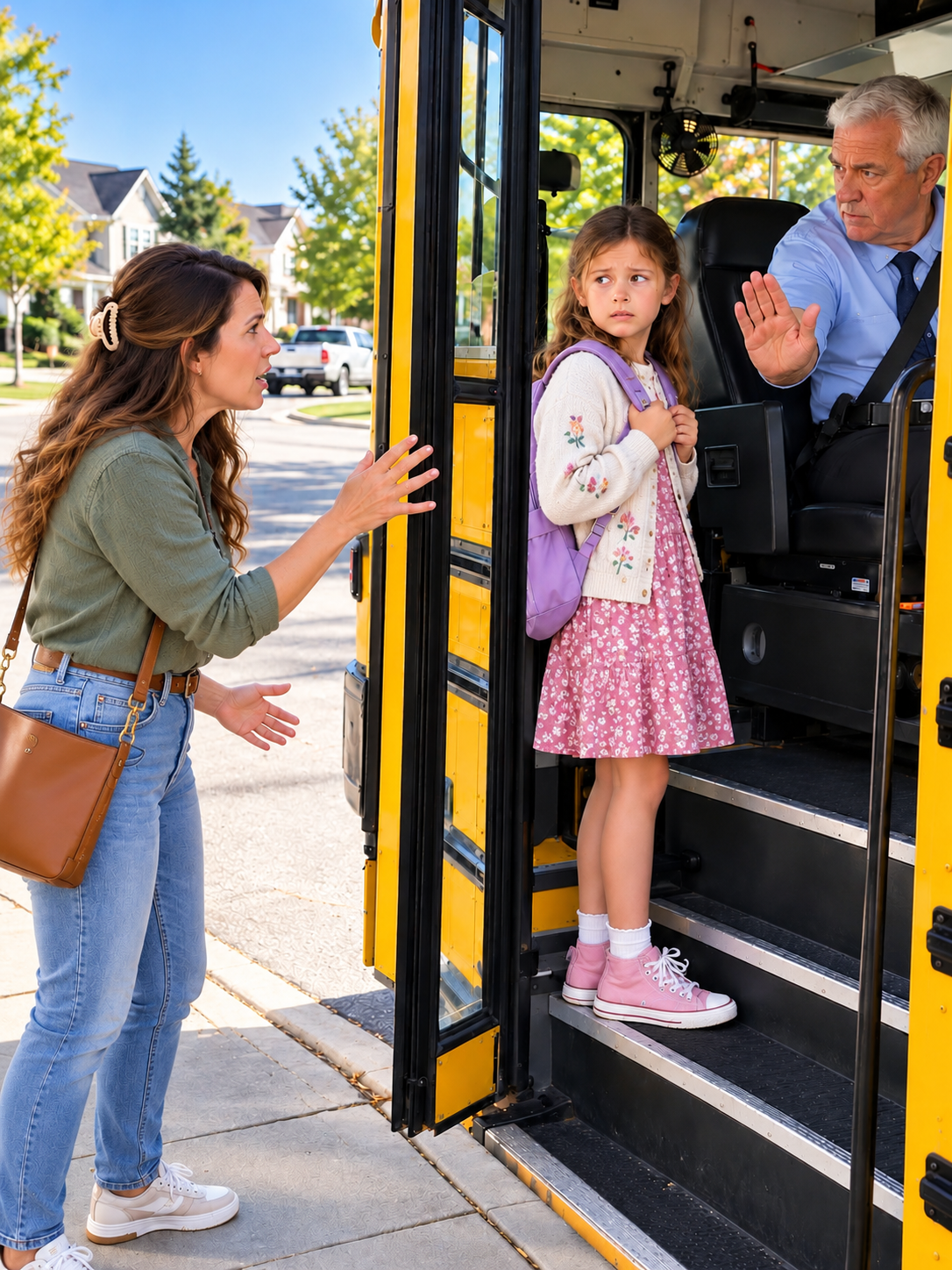
PART 1 TITLE: At the Corner Where I Always Met My Daughter, One Closed School Bus Door Turned a Familiar Afternoon Into a Nightmare
The school bus doors closed so abruptly that I almost caught my fingers between the folding panels. On the other side of the glass, my nine-year-old daughter stood frozen near the front steps, her purple backpack slipping from one shoulder. Frank Lawson, the silver-haired man who had driven her home for nearly two years, was standing between her and the exit. His face was tight with an expression I had never seen before. I shouted for him to open the doors. Instead, he reached for the gearshift.
For one impossible second, I expected him to laugh, explain some misunderstanding, and let Ellie climb down. He did none of those things. The engine growled, the bus eased away from the curb, and my daughter hurried to the window with tears running down her cheeks. I ran alongside the vehicle, striking the glass with my palm while calling her name. Ellie pressed her little hand against the window. Her mouth moved urgently, but the noise of the engine swallowed whatever she was trying to say.
I had been standing there less than two minutes earlier, waiting for another ordinary afternoon to begin. Now I was watching my child disappear around the bend in a yellow school bus driven by a man who had refused to return her to me. The thought that he might be taking her somewhere against my wishes was so terrifying that I could barely organize the words in my head. I stopped in the middle of the road, dragged my phone from my pocket, and called emergency services.
Before that Tuesday, Route 24 had been one of the most dependable parts of our lives. Ellie had ridden the school bus since kindergarten, and she knew the route almost as thoroughly as I knew the short walk from our front door to the intersection of Willow Lane and Briar Street. She was usually the final passenger to get off. The other children disappeared into their neighborhoods along the way, and by the time the bus reached our corner, she often had the front seats nearly to herself.
I was thirty-eight and raising Ellie alone. My position as a scheduling coordinator at a dental clinic kept me busy managing appointments, cancellations, and the small emergencies that could rearrange an entire afternoon. My supervisor understood that I needed to be home when Ellie returned from Maple Ridge Elementary, so I was permitted to finish the last hour of my shift remotely. That arrangement had made an enormous difference. It meant I could do my job without making my daughter wait alone at a bus stop.
Most afternoons, I closed my laptop a few minutes after three, checked the time, and walked to the corner. Ellie would see me through the windshield, smile as though we had been apart for weeks, and begin talking before she reached the pavement. Sometimes she told me about a classmate. Sometimes she had a question about homework. Often she wanted a snack and had already decided what it should be. I had become so accustomed to those conversations that I rarely considered what it meant to have her home safely.
That Tuesday began with precisely the same routine. At 3:17, I finished updating the following day’s appointment schedule and shut my laptop. My phone was beside a half-empty glass of water. I slipped it into my pocket, checked that I had my keys, and stepped outside. The Ohio afternoon was mild enough that I didn’t bother with a heavy coat. A breeze stirred the leaves near our driveway, and somewhere along the street a lawn mower was running.
By 3:19, the yellow bus appeared at the far end of Briar Street. I recognized it immediately, along with the man behind the wheel. Frank Lawson had broad shoulders, deeply lined cheeks, and thick silver hair. He carried himself with the stiff, economical movements of someone accustomed to handling large machinery. Even when he was in a perfectly ordinary mood, his naturally serious expression could make him look annoyed. Our conversations had never involved much more than greetings and occasional remarks about the weather.
I had no reason to distrust him. For almost two years, he had delivered Ellie to the same corner without incident. Sometimes he waited until she reached me before pulling away. Other times, when traffic was backing up, he acknowledged me with a brief nod and continued his route. I had never asked about his family, his career, or what he did when he wasn’t driving. He was simply Mr. Lawson, the driver who brought my daughter home.
Through the windshield, I spotted Ellie in the second row. Her purple backpack rested against her legs, and she was leaning forward to see past the seats. When our eyes met, her face brightened. I raised my hand, and she waved enthusiastically. The bus slowed, its brakes released a familiar hiss, and the folding doors opened. I stepped a little closer, already preparing to ask how her school day had gone.
Ellie stood and pulled one backpack strap over her shoulder. She had barely entered the aisle when Frank turned sharply in his seat. His attention went past the open doors, toward something outside my line of sight. He looked forward again, then rose with a suddenness that made Ellie stop. One hand gripped the seatback. The other moved toward the entrance. His expression had changed so completely that I wondered whether he had noticed a mechanical problem.
“Ellie, stay where you are,” he called. His voice was louder than I had ever heard it. My daughter blinked, one foot still ahead of the other. I stepped closer and asked what was happening. Frank didn’t answer me. He extended an arm across the aisle and instructed Ellie to move away from the stairs. I could see the confusion spreading across her face. She glanced at me, then back at him, as if waiting for one of us to explain.
“She’s getting off here,” I said, trying to keep my voice reasonable. “This is her stop.” Frank remained focused beyond the doorway. I followed the direction of his gaze but noticed nothing that explained his behavior. There were houses, driveways, and the familiar corner where I stood every afternoon. I looked back at Ellie. She had taken another tentative step, clearly expecting that her driver would let her come to me.
Then Frank shouted a warning that seemed to transform him into a stranger. “Stay away! You’re not taking her!” The words came from somewhere deep in his chest. I stood motionless, unable to believe what I had heard. My daughter was behind him, and I was the only person I could see outside the bus. Naturally, I assumed he was speaking to me. I told him again that I was Ellie’s mother. This time, my voice was sharp enough to carry down the street.
Frank reached for the door controls. The panels folded together between us before I could react. My palm struck the glass, and I heard myself demanding that he open up. Ellie hurried toward the front window. Her face was wet, her eyes wide. She looked from me toward something beyond the driver’s seat, then back at me. I thought she was pleading for help. The sight of her crying made any remaining patience vanish.
I tried the doors, although I knew perfectly well they could not be opened from outside. The rubber seals pressed together. Frank was looking through the windshield, his jaw set. “What are you doing?” I yelled. “She belongs with me!” The bus rocked slightly as he released the brake. For a moment, I wondered whether some regulation prevented him from opening the doors again. But no school policy I knew of could justify leaving a mother on the sidewalk while her child cried inside.
The vehicle began moving. I stumbled backward to avoid the side mirror, then followed it, raising both hands. Ellie kept her face close to the window. She appeared to be trying to tell me something, but the diesel engine and the rattling windows made her words impossible to understand. I remember seeing the outline of her fingers against the glass. I remember the yellow body of the bus moving steadily away. Everything else seemed to fall out of focus.
At some point, I heard another engine accelerating behind me. I also heard someone calling from across the street, possibly a neighbor who had seen me running. Neither sound registered as important. All my attention was on the bus. I wanted Frank to stop. I wanted Ellie to be allowed off. When the vehicle rounded the curve and vanished from sight, I remained near the center of the road for several seconds, still holding my arms away from my body.
The dispatcher answered while I was walking in circles beside the curb. I gave her our location, then told her that the school bus driver had left with my nine-year-old daughter instead of allowing her to get off. My voice kept rising despite my attempts to control it. She asked whether Ellie was injured. I explained that I had seen her crying but hadn’t been able to speak to her. She asked for the school’s name, the bus route, and the driver’s identity.
“Maple Ridge Elementary,” I said. “Route twenty-four. Frank Lawson is driving.” The dispatcher repeated the information and asked whether I knew where he might be going. I didn’t. The fact that I had no answer made me feel even more helpless. I knew where the bus was supposed to stop. I knew when Ellie should have stepped down. Everything beyond that had become uncertain. I pressed the phone harder against my ear, hoping that doing something physical might steady my thoughts.
The dispatcher explained that officers were being contacted and that she would notify the school district’s transportation office. She wanted me to remain in a safe place where someone could reach me. I looked down Briar Street again. Every second spent standing there felt like a second I should have been using to find my daughter. I considered driving after the bus, but I no longer knew which direction it had taken beyond the curve.
“What if he doesn’t bring her back?” I asked. The dispatcher didn’t dismiss the question or offer a promise she couldn’t keep. She told me that the school district would be asked to locate Route 24 immediately. I remember being grateful for the steadiness of her voice and resenting it at the same time. My own world had turned upside down, yet she could still speak in measured sentences and ask for information in a particular order.
I started toward our house, stopped, and turned around. I could not bear the thought of going inside without Ellie. Her shoes were beside the doorway, where she had left them that morning. Her breakfast bowl was probably still in the sink. The ordinary evidence of her life was everywhere in that house, and I suddenly couldn’t imagine walking through those rooms while not knowing where she was. Instead, I remained outside, watching every vehicle that appeared.
The dispatcher asked me to describe the incident from the beginning. I told her about Frank standing up, preventing Ellie from reaching the stairs, and shutting the doors after I had identified myself. I explained that he had shouted something about not letting anyone take her. Saying the words aloud made my anger flare again. I believed I had witnessed a school employee deliberately refusing to hand over a child to her own mother.
She let me finish before asking whether anyone else had been present. I told her no. She asked whether I remembered other adults standing close to the bus. Again, I said there had been nobody. She clarified that she wasn’t asking about the driver or my daughter, but about anyone on the sidewalk or near the intersection. I glanced around, impatient with the direction of her questions. Nothing about another pedestrian seemed relevant to what Frank had done.
“I was right there,” I insisted. “I would have seen somebody.” The dispatcher acknowledged my answer and asked whether I had noticed any unusual vehicles. There were often cars along Briar Street, especially in the afternoon. Some residents parked on the curb. Delivery vehicles stopped briefly near driveways. I couldn’t remember anything distinctive. I told her that I had been watching Ellie, not taking notes about traffic.
As we spoke, a small memory surfaced without becoming clear enough to understand. There had been the sound of an engine behind me, stronger and rougher than the usual quiet traffic. I remembered it only because the bus had already begun leaving. Perhaps it had been a pickup passing through the neighborhood. Perhaps it had belonged to someone who lived nearby. I did not mention it, because I had no reason to connect it to the incident.
The dispatcher asked me to repeat the driver’s name, then said the responding authorities would need to speak with me. I looked down at my hand. There was a pale mark across my palm where it had struck the folding door. My sleeve had slipped up my wrist, and I realized I was shivering even though the afternoon wasn’t particularly cold. I had spent years teaching Ellie to speak up whenever something frightened her. Now I could hardly make myself speak calmly.
I asked whether Frank could be arrested for refusing to release her. The dispatcher said an officer would assess the circumstances. That answer frustrated me. I wanted someone to declare that the driver’s actions were wrong, that Ellie would be returned, and that the situation was already under control. Instead, I had questions, a rapidly emptying street, and the uncomfortable knowledge that I could not do anything more until someone contacted me.
I kept looking toward the curve where the bus had disappeared. I pictured Ellie in the second row only moments earlier, smiling when she saw me. I pictured Frank standing between us. Most of all, I remembered the certainty in his voice when he shouted that warning. Whatever he had believed was happening, he had acted without hesitation. At the time, that certainty seemed to make him more frightening. I had no idea it might have come from something he could see and I couldn’t.
Then the dispatcher asked one final question before ending the call. She wanted to know whether I had been facing the bus during the entire confrontation. I told her I had. She asked whether my back had been toward the road behind me. I hesitated, trying to reconstruct where I had stood. Yes, I admitted, I supposed it had. There was a short pause before she thanked me and said the deputy would speak with me soon.
After the call ended, I stood staring at the black screen of my phone. Until that moment, I had been certain of every detail I had reported. I had seen my daughter, the driver, the closed doors, and the bus leaving. Yet a small uneasiness settled beneath my anger. Twice now, someone had asked about a person I was sure hadn’t been there. And for the first time, I wondered why anyone investigating Frank Lawson’s actions cared so much about what might have been happening behind my back.
END PART 1
PART 2 TITLE: I Reached the School Prepared to Accuse the Driver, but the Deputy Wanted to Know What I Had Failed to See
Six minutes after the bus disappeared, my phone rang again. I answered before the second vibration ended. The woman identified herself as Mrs. Shaw, the supervisor responsible for school transportation. She addressed me as Mrs. Carter and immediately told me that Ellie was safe. Route 24 had been located and was returning to Maple Ridge Elementary. For a moment, I felt the strength leave my knees. Then I asked why my daughter wasn’t simply being brought home.
Mrs. Shaw explained that Frank had encountered a possible safety problem during his afternoon route. I was already walking toward my car when she said it. I stopped with my hand on the door handle and asked her to repeat herself. A safety problem? Ellie had been standing a few feet from me. I had been waiting at the designated location. There was no obvious traffic hazard, no accident, and no reason I could understand for the driver to leave.
“Mrs. Carter, I know this has been distressing,” she said. Her tone was polite, but I could hear that she was choosing her words carefully. That only made me angrier. I told her that distressing was an inadequate description of watching my daughter cry as a school employee drove away with her. I wanted to know whether Frank had been instructed to keep Ellie aboard and, if he had, who had given the instruction. Mrs. Shaw paused before answering.
She said Frank had contacted transportation dispatch before reaching our intersection. I went still. Until then, I had imagined some sudden misunderstanding at the stop, perhaps a driver losing his temper or becoming confused about who was authorized to collect a child. Now I was hearing that Frank had already spoken to his supervisors before Ellie and I had even seen each other. I asked whether the refusal had been planned. Mrs. Shaw said that wasn’t what she meant.
“Then tell me what he reported,” I demanded. She explained that the department was verifying information and that the full circumstances could not yet be established. For the moment, the safest arrangement was to return Ellie to the school. I heard her words, but they didn’t answer the question that mattered most to me. If the school had been concerned about my child, why hadn’t someone called me before the bus reached our stop?
I asked whether Ellie had spoken to anyone. Mrs. Shaw said school staff would be with her as soon as the bus arrived. I asked whether she had been frightened. There was another careful pause. The supervisor acknowledged that Ellie had been upset, but she repeated that the child was safe and being brought back under the district’s supervision. I knew Mrs. Shaw was trying to help. At the time, her refusal to say more felt like another door closing in my face.
I told her I was coming to Maple Ridge and ended the call. The drive ordinarily took very little time, but that afternoon every red light felt deliberate. My hands were clenched around the steering wheel. I checked the clock repeatedly, although the numbers did nothing to help me. I tried to imagine what Ellie was thinking. She had seen me waiting, had been prevented from joining me, and had watched me run after the bus. She might believe I had abandoned her, even though I had done everything I could.
While waiting at an intersection, I remembered her face at the window. Her mouth had been moving quickly, with an urgency I couldn’t understand. Perhaps she had been asking me to follow. Perhaps she was calling for help. I rehearsed what I would say when I found her: that I had never chosen to leave her, that I had been trying to bring her home, and that she hadn’t done anything wrong. Those sentences became something to hold on to while the traffic light changed.
I reached the school parking area at approximately 3:42. The last of the afternoon traffic was thinning, leaving empty spaces between cars. I pulled into one of them and went straight inside. The familiar school entrance looked strangely different. Children’s artwork still decorated the walls, and a laminated notice reminded visitors to sign in. Ordinarily, I appreciated the cheerful clutter of an elementary school. That afternoon, I barely registered it.
A secretary was speaking on the telephone behind the front desk. She looked up when I approached. I gave her my name and asked for Ellie. She stood immediately and told me my daughter was waiting with the assistant principal in a conference room. That answer should have reassured me, but I wasn’t ready for reassurance that came secondhand. I asked why Ellie was in a conference room instead of being allowed to come straight to me.
The secretary began explaining that several people were reviewing an incident. I interrupted her. I don’t remember exactly how loudly I spoke, but I remember the woman looking toward the hallway and lowering her own voice. I asked again where Ellie was. Before she could respond, a door opened farther down the corridor. My daughter appeared beside the assistant principal, carrying her purple backpack by one strap. Her cheeks were blotchy, and her eyelashes were still wet.
She saw me and stopped walking. “Mom?” There was something cautious about the way she said it, as though she needed to make sure I was truly there. I crossed the distance between us almost at a run. Ellie dropped her backpack, and I gathered her against me. Her small arms wrapped around my waist so tightly that I could feel the pressure through my sweater. I held her face against my shoulder and kissed her hair, breathing in the familiar scent of shampoo.
I kept telling her that I had come for her. She didn’t answer immediately. Her body was warm and tense, and I could feel the uneven movement of her breathing. When I finally loosened my embrace enough to look at her, she wiped her cheeks with the back of one hand. I asked whether she was hurt. She shook her head. I asked whether Frank had grabbed her or done anything to frighten her physically. Again, she said no.
“Then why wouldn’t he let you off?” I asked. Ellie looked toward the assistant principal instead of answering. I followed her eyes, convinced that someone had already instructed her not to talk about what happened. The woman suggested that we sit down and allow Ellie to have some water. My immediate instinct was to insist on answers first. Then I noticed how tightly my daughter was holding the strap of her backpack, twisting the purple fabric between her fingers.
I agreed. We returned to the conference room, where a small table stood beneath a bulletin board. The assistant principal brought Ellie a bottle of water and offered me a chair. My daughter sat beside me, her knees drawn close together, and drank in small sips. I put my hand on her back. She seemed to relax a little each time I touched her. Whatever had happened on the bus, I could see that repeated questioning was making it harder for her to settle.
After several minutes, Ellie told me Frank had instructed her to sit down when she tried to leave. I asked whether he had explained himself. She nodded slowly. “He said I couldn’t get off because it wasn’t safe.” I wanted to ask what that meant, but her eyes were filling again. Instead, I told her she didn’t have to answer any more questions right then. I could see relief in the way she set down the bottle.
I turned to the assistant principal. If Frank believed the stop was dangerous, I wanted to know why. She said the school was reviewing a report involving someone who had approached Route 24. I assumed she meant me. I told her that I was the person who had approached the doors, and that I had every right to collect Ellie. She listened without contradicting me, then explained that a deputy was on his way and would be able to discuss the incident further.
I asked to see Frank. She said he was meeting with transportation officials and that any conversation with him would have to be arranged. Her refusal rekindled my anger. From my perspective, the adults around me were treating the driver’s actions as a complicated administrative issue rather than the terrifying experience my daughter and I had just endured. I said that I wanted a formal account of why a school employee had disregarded a child’s mother at an authorized stop.
The assistant principal didn’t argue. She asked whether Ellie wanted something to draw on while we waited. My daughter accepted an old worksheet and turned it over to the blank side. A few minutes later, she was making circles with a pencil, pressing so hard that the point nearly tore through the paper. I watched her for a moment. She had always liked drawing when she was uncertain what to say, and I was grateful for anything that gave her a little comfort.
Then I took out my phone and opened the school district’s transportation complaint page. I had used the district website before to check schedules and school announcements, but never to report an employee. The form requested a route number, the date, the location, and a description of the behavior. I entered Frank Lawson’s name. My fingers were still trembling, and I had to correct several mistakes before moving to the section where parents could describe their concerns.
I wrote that Frank had prevented Ellie from leaving at her usual stop, closed the doors while I was standing outside, and departed despite my daughter’s visible distress. I explained that I had identified myself and asked him to stop. I requested an immediate review of whether he should continue transporting children. I believed every word. At that moment, submitting the complaint felt like the only meaningful action I could take to prevent another family from experiencing the same terror.
Before pressing the final button, I looked at Ellie. She was still making circles, some neat and some overlapping, on the back of the worksheet. It occurred to me that I could wait until I had spoken with the deputy. But I remembered her crying through the glass, and my hesitation disappeared. I submitted the form. A confirmation number appeared. I saved it and returned the phone to my lap, experiencing the brief relief of having done something definite.
The deputy arrived several minutes later. He was a calm-looking man in his early forties, carrying a small notebook. He introduced himself as Deputy Reed and asked whether he could speak with me and Ellie about the afternoon. I immediately told him that I wanted Frank held responsible. Reed acknowledged my concern without agreeing with my conclusion. He asked whether Ellie was physically safe, and I told him that she was, but that being safe now did not erase what had happened.
He turned toward my daughter and lowered himself enough to meet her eyes. His manner changed subtly, becoming gentler and less formal. He introduced himself again and asked whether she remembered the bus driver requesting that she leave the vehicle with anyone. Ellie shook her head. He asked whether Frank had tried to take her somewhere himself. She said no. “He told me to stay inside,” she added, glancing at me to see whether that answer was acceptable.
Reed thanked her and did not press further. He straightened, opened his notebook, and asked about our stop. Had I been alone when Route 24 arrived? I answered yes. Had I been waiting in my usual place near the intersection? Again, yes. Then he asked whether I remembered a silver pickup truck parked or moving nearby. The question seemed so unrelated to Frank’s conduct that I stared at him, certain I had misheard.
I told him there were usually several vehicles along Briar Street, and that I couldn’t name every one of them. He asked me to think specifically about a silver pickup. I tried. Something stirred in my memory: the rough sound of an engine, the possibility of a truck near the vacant house across the intersection, and the sense of movement behind me while I was watching the bus. But none of it formed a clear picture. I told him I didn’t honestly remember seeing such a vehicle.
Reed wrote something down. Then he asked whether I had seen anyone get out of a truck or approach from behind me. I felt my frustration returning. I explained that I had been standing directly in front of the bus and that Frank was the only adult I remembered seeing. The deputy allowed me to finish. He didn’t challenge my account, but neither did he move on to the accusations I wanted him to investigate.
“Why are you asking about a truck?” I said. “My daughter was right in front of me. That’s what matters.” Reed closed his notebook and rested it against his knee. He said the transportation department had provided information about an encounter before the bus reached Briar Street. According to that report, Frank Lawson had already expressed concern about a vehicle and a man who was attempting to arrange an unauthorized pickup.
I felt my mouth go dry. I had been assuming the driver acted without reason, but Reed was describing a problem that apparently existed before I reached the bus. He explained that Frank had reported an unfamiliar adult approaching Route 24 and claiming a family connection to one of the children. The man had tried to persuade him to release a student. Frank had refused and contacted dispatch because the request did not match the school’s authorized arrangements.
“Which child?” I asked. Reed glanced toward Ellie, who had stopped drawing. Her pencil lay across the worksheet. He looked back at me and asked whether I had any relatives who might have tried to collect her that afternoon without telling me. I said no. My brother was working in Columbus, and the other uncle in Ellie’s family lived in Michigan. Neither would arrive unannounced at her bus stop. Neither had contacted me.
The deputy gave a small nod, as if my answer confirmed something he had already been considering. I could hear the faint sound of a telephone ringing somewhere in the school office. Ellie moved closer to my chair. I placed my arm around her shoulders, still struggling to understand how a stranger could have anything to do with Frank refusing to release her to me. Reed waited until I looked at him again.
“The person Mr. Lawson reported wasn’t trying to collect just any passenger,” he said. “He specifically asked for Ellie Carter.” I looked at my daughter. She stared at the drawing in front of her, her pencil untouched. In the space of a few seconds, my anger at the driver gave way to a different, colder feeling. Someone I didn’t know had approached my daughter’s school bus before it reached our street and had asked to take her away.
END PART 2
PART 3 TITLE: My Daughter Remembered a Stranger at an Earlier Stop, and Every Detail She Shared Made Our Ordinary Route Feel Less Safe
Ellie was picking at the paper label on her water bottle when Deputy Reed explained that an unfamiliar man had asked for her by name. Until then, I had been studying the deputy’s face, trying to understand how his questions connected to the afternoon. Now I looked at my daughter. She had become unusually quiet. Her fingers moved along the edge of the label, loosening a thin strip that curled around her thumb. I recognized the behavior. Ellie often occupied her hands when she was worried about saying the wrong thing.
“Sweetheart,” I asked, keeping my voice low, “did you see somebody who wanted you to leave the bus?” She didn’t look up. For several seconds, she concentrated on the bottle. Then she nodded. That small movement affected me more than anything Reed had said. My daughter had been carrying information I knew nothing about, and I had spent the last hour asking her questions that hadn’t given her a chance to explain it.
I started to ask who the man was, but Deputy Reed gently interrupted. He pulled a chair closer without crowding her and explained that she was not in trouble. He told her she could take her time, that there were no answers she was supposed to invent, and that it was perfectly acceptable to say she couldn’t remember something. His calmness made me realize how quickly I had been speaking since the moment the bus left our street. I moved my chair nearer to Ellie’s and held her hand.
She looked at me first. I nodded, trying to give her the reassurance she needed without suggesting what she should say. “It happened before we got home,” she began. Her voice was so quiet that Reed leaned forward slightly to hear. She explained that the bus had stopped on Oak Street, where her classmate Mason usually got off. I knew the location. It was approximately ten minutes from our neighborhood, part of a route I had traveled often enough when driving Ellie to school.
Mason had left the bus, and Ellie had remained in her seat. She remembered looking through the window while Frank waited for the stop to clear. There had been a pickup truck nearby. A man stood outside it, wearing a brown jacket. Ellie did not recognize him. She hadn’t initially thought much about his presence. Adults waited for children along the route all the time, and she had assumed he might have been there for another passenger or someone living on the street.
Then the man approached the front of the bus. Ellie said he raised his hand toward Frank, who leaned toward the window rather than opening the folding doors. The man began speaking to him. From her seat, Ellie couldn’t hear every word, but she heard enough to realize that the conversation involved her. She looked down at her backpack and then toward the front. “He wanted to know if I was on the bus,” she said, tightening her grip on my fingers.
Reed asked whether the stranger had actually used her name. Ellie nodded. She remembered hearing him ask for Ellie Carter. I felt an unpleasant tightening in my chest. Our surname was hardly secret, and the school had many ordinary reasons to use a child’s full name. Still, hearing my daughter repeat it in connection with an unfamiliar adult waiting beside a pickup truck made the whole situation feel intentional. The man had not simply mistaken Ellie for another child.
“Did Mr. Lawson ask who he was?” Reed continued. Ellie said yes. The driver had wanted to know why the man was asking for her and whether he was supposed to collect her. According to Ellie, the stranger replied that he was part of her family. She paused before giving us the particular relationship he had claimed. I watched her swallow. “He said he was my uncle,” she finally told us.
For a moment, I could only stare at her. Ellie had two uncles, and I knew where both of them were supposed to be. One lived in Michigan. The other, my brother, was working in Columbus that afternoon. Neither drove a silver pickup, as far as I knew. Neither would appear at an elementary school bus route without contacting me first. My brother understood how carefully our pickup arrangements were organized because he knew I was raising Ellie alone.
I asked whether she had recognized the stranger as either of them. Ellie shook her head with unusual certainty. “It wasn’t anybody I know,” she said. I asked whether the man had looked familiar in some other way, perhaps someone she had seen at school or in our neighborhood. She said no. The answer should have been reassuring, because it meant she hadn’t mistaken a stranger for a relative. Instead, I found myself thinking about how confidently the man had claimed to know her.
Reed asked what Frank had done when the stranger identified himself as an uncle. Ellie remembered the driver turning toward the passenger area and asking whether she recognized the person outside. She had told him she didn’t. Frank had then faced the man again. He remained in his seat, and the bus doors stayed closed. Ellie had noticed that because she was surprised he didn’t let the man come closer. She had expected adults to settle the misunderstanding between themselves.
The stranger had not appeared satisfied with her answer. Ellie said his voice became sharper, although she couldn’t remember the exact words. He continued talking to Frank and seemed irritated that the driver wouldn’t cooperate. Frank asked questions she couldn’t entirely hear. Then the stranger mentioned her classroom. “He knew Mrs. Benton,” Ellie said. I looked at her in surprise. Mrs. Benton was her third-grade teacher, someone Ellie talked about almost every evening.
Ellie explained that the man had referred to her being in Mrs. Benton’s class. That detail disturbed her because it suggested he knew more about her than a complete stranger should. I understood why. A teacher’s name could be learned in perfectly ordinary ways, from school conversations or public information, but a child hearing it from an unknown man could easily interpret it as proof of a genuine connection. I was beginning to understand how carefully the stranger’s words had been chosen.
“What else did he know?” I asked. Ellie took a slow breath. She said he had claimed there was an emergency involving our family. I expected her to mention a problem at home or some vague reason for being collected early. Instead, she looked straight at me and said he had told Frank that something terrible had happened to me. The room seemed to narrow around us. I asked her to explain exactly what she meant.
“He said you were hurt,” she answered. Her voice wavered. “He said I needed to go with him.” I felt her hand tighten in mine. The idea that my daughter had spent those final minutes of the journey worrying about my safety was almost unbearable. I had been waiting happily at our stop, expecting to hear about school. Meanwhile, Ellie had been sitting aboard the bus with the possibility that her mother was seriously injured hanging over her.
I asked whether the stranger had said where I was. Ellie remembered something about a hospital, although she wasn’t certain whether he had said it directly to her or while speaking to Frank. Reed made a note of that uncertainty rather than pressing her to choose. She knew the man had claimed an accident had occurred, and she knew he wanted her to leave with him. Beyond that, some parts of his explanation had blurred together in her memory.
“Did he tell you where he planned to take you?” Reed asked. Ellie shook her head. She hadn’t been given an address or a clear destination. The man had only insisted that there was a family emergency and that she needed to accompany him. I looked toward the assistant principal, who was standing quietly near the doorway. The thought of Ellie stepping into an unfamiliar truck because she believed I was waiting for her at a hospital made my stomach turn.
Reed asked whether the man had boarded the school bus or managed to reach Ellie directly. Before he finished, my daughter answered. “Mr. Frank didn’t let him inside.” There was a little more strength in her voice when she said it. She explained that the doors had remained shut throughout the exchange. The stranger had spoken from outside, and Frank had kept himself between the man and the students. When the conversation ended, the man returned toward his vehicle.
I remembered Frank standing in the aisle at our stop, extending an arm to prevent Ellie from reaching the stairs. An hour earlier, that movement had seemed cruel and unreasonable. Now I realized he had behaved in a similar way toward the stranger on Oak Street, keeping a physical barrier between a child and an adult whose identity he couldn’t verify. The similarity unsettled me. I still didn’t understand everything about his conduct at Briar Street, but I could no longer dismiss his concern as imaginary.
Ellie said that after the encounter, Frank had continued driving. She remembered hearing him speak into his radio, although she hadn’t understood the conversation. He had told her to remain seated, and she had obeyed. She didn’t remember him raising his voice at her. In fact, he had seemed more serious than angry. I asked whether he had tried to explain why she couldn’t leave with the stranger. She said he had only assured her that the school would handle any legitimate emergency.
That answer brought another question to mind. If the driver had known someone was trying to collect Ellie without permission, why hadn’t I been told immediately? Why had the bus continued toward my stop? I started to ask Reed, but Ellie shifted beside me. She looked exhausted. Her shoulders had rounded, and the water bottle lay forgotten on the table. I realized she had been answering adult questions for much longer than was comfortable for her.
Reed seemed to notice the same thing. He thanked her for helping and offered to let her sit with the assistant principal while he and I discussed the transportation records. Ellie immediately moved closer to me. “I want to stay with Mom,” she said. He accepted her decision without hesitation. I assured her that she could remain beside me and that no one was going to send her anywhere else without my knowledge.
After Reed stepped into the hallway to make a telephone call, I turned toward Ellie. I wanted to know why she hadn’t mentioned the man when we first reunited. The question came out more abruptly than I intended, and she lowered her eyes. I corrected myself, telling her I wasn’t upset with her. She admitted that she had been frightened and confused. By the time we reached our stop, she had heard a stranger claiming I was hurt and had seen Frank refusing to let her leave.
Then the bus doors had closed, and I had begun shouting. Ellie had never seen me react that way. She said she didn’t know which part of the afternoon she was supposed to explain first. I had been angry with Frank, and she had worried that I might become angry with her if she couldn’t make sense of what happened. Hearing that hurt. I had wanted to protect her, yet my desperation had made it harder for her to speak.
I moved my chair close enough to embrace her. “You can always tell me when something scares you,” I said. “Even when I’m upset. Especially then.” Ellie rested her forehead against my shoulder. I didn’t ask her to promise anything or explain herself further. She was nine years old. The adults were responsible for sorting out the facts. She had already done something important by telling Frank she did not recognize the person claiming to be her uncle.
While we sat together, I reconsidered the morning’s ordinary preparations. Ellie had left for school carrying the same backpack she carried every day. We had discussed nothing more serious than what she needed for class. I had expected her to come home with homework and questions about dinner. Somewhere along the route, someone had used information about her to invent a crisis involving me. I could not understand his purpose, but the details made it difficult to believe the encounter had been accidental.
I also thought about how close I had come to accusing Ellie of hiding information. When I asked whether Frank had hurt her, she said no. When I asked why he hadn’t allowed her off, she repeated his explanation that it wasn’t safe. Those were truthful answers. They simply hadn’t contained everything she had experienced. I had been asking questions that followed my assumption about Frank, instead of giving her enough space to describe the afternoon in her own order.
Mrs. Shaw returned to the conference room carrying a folder. Deputy Reed followed her and took his previous seat. The supervisor explained that the transportation department had retrieved the radio communications from Route 24. The records confirmed that Frank contacted dispatch at 3:11 that afternoon, shortly after the encounter on Oak Street. He reported an adult who was unfamiliar to the student but claimed to be related to her.
At 3:12, Frank confirmed that Ellie had explicitly said she did not recognize the man. A minute later, he requested guidance because the stranger had continued insisting that an urgent family problem justified taking her from the bus. Mrs. Shaw explained that the district had begun checking Ellie’s authorized pickup arrangements. No change had been approved. No relative had contacted the school. There was no verified report of an accident involving me.
I asked what explanation the stranger had given Frank. Mrs. Shaw looked toward Ellie, then back at me. She said the man had claimed I had suffered a serious injury and that he needed to take my daughter to me. The statement transformed Ellie’s earlier words into something more definite. This was not merely a child misunderstanding an adult conversation. The stranger had deliberately presented a false emergency and attached my name to it.
Ellie began crying again. I held her hand and told her I was safe, but I could see that the memory had frightened her all over again. I wanted to remove every trace of that man’s words from her mind. Instead, I listened as Mrs. Shaw explained that Frank had refused the request and continued toward the authorized destination while dispatch worked to verify the situation. He had not been instructed to release Ellie to anyone other than an approved adult.
The supervisor paused before moving to another sheet in the folder. I noticed a change in her expression and asked whether something else had happened. She explained that the encounter on Oak Street wasn’t the last time Frank had seen a vehicle matching the stranger’s pickup. My attention sharpened immediately. I had assumed that once he was refused, the man had driven away and ended his involvement with Route 24.
“Are you saying he came back?” I asked. Mrs. Shaw answered carefully. Frank had reported seeing what appeared to be the same silver pickup later along his route. The department was still reviewing the exact sequence and could not yet prove every movement of the vehicle. But Frank had recognized enough similarities to remain concerned. I remembered Deputy Reed asking whether I had noticed a pickup truck near our intersection.
I looked at the folder on the table. There were several times written beside short entries, and one of them fell just before the bus reached Briar Street. My thoughts went to the rough sound of an engine behind me, the one I had dismissed as ordinary neighborhood traffic. I asked where the driver had last noticed the vehicle. Mrs. Shaw placed a finger beside the entry and told me the pickup had appeared again near our neighborhood.
“How close to our house?” I asked. She glanced at Deputy Reed before answering. Frank had seen the vehicle near Willow Lane and Briar Street, at approximately the time I was waiting for Ellie. I looked toward my daughter, still holding her water bottle against her chest. The stranger hadn’t merely approached the bus ten minutes away. According to the driver’s report, a matching vehicle had been present at the very intersection where Ellie was supposed to return to me.
I had spent the afternoon believing that Frank Lawson drove away from our stop for no reason. Now I was learning that the man who had falsely claimed to be Ellie’s uncle may have followed the bus all the way to our street. Mrs. Shaw slowly closed the folder, but I couldn’t take my eyes off it. I asked whether Frank had actually seen the stranger again. The supervisor said he believed he had. And the place where he reported seeing him was directly behind where I had been standing.
END PART 3
PART 4 TITLE: The Bus Driver’s Radio Calls Revealed Who Had Followed Us, and Forced Me to Reconsider the Words I Thought Were Meant for Me
“Behind me?” I repeated. Mrs. Shaw nodded, but I could tell she didn’t want me to interpret that answer as proof of everything we feared. Deputy Reed moved his chair a little closer and explained that they were comparing the driver’s report with the available information. They knew an unauthorized adult had approached the bus at Oak Street. They knew a similar vehicle had appeared near our stop. What they did not yet know was precisely what the stranger intended to do.
I tried to picture our intersection as it had looked that afternoon. The sidewalk beside the vacant house, the stretch of pavement along Briar Street, and the place where the bus had stopped were all familiar. I knew the angle of the sun at that hour and the way vehicles tended to park near the curb. Yet my memory contained an extraordinary blank space. I could recall Ellie’s face through the glass but almost nothing of what lay behind me.
Mrs. Shaw opened the folder again and spread the transportation records across the table. The entries were brief, written in the practical language of people who needed to pass information quickly. There were times, route references, and short descriptions of the driver’s calls. Looking at them felt strange. While I had been working at my laptop, completing appointments for the following day, Frank had already begun dealing with a problem involving my daughter.
At 3:11, he reported the encounter on Oak Street. He described an adult claiming to be related to Ellie Carter and requesting that she be released from the bus. Frank had not recognized the individual as anyone authorized to collect her. At 3:12, he confirmed that Ellie herself had denied knowing the man. By 3:13, he was asking transportation dispatch how to proceed because the stranger had used a supposed family emergency to justify his request.
Mrs. Shaw explained that the man had never been allowed onto the bus. Frank had spoken to him from the driver’s position, with the folding doors closed. He had asked for identification and authorization, then checked directly with Ellie. When she said she did not recognize the stranger, Frank refused to release her. The man reportedly became impatient and continued insisting that something terrible had happened to me. None of those claims had been supported by information from the school.
The transportation office had then contacted Maple Ridge Elementary to verify the emergency contact arrangements. My name remained the authorized adult expected at the final stop. There was no approved substitute pickup, and no verified notification from a hospital or family member. Frank had been instructed not to release Ellie to the stranger. Mrs. Shaw said the driver continued toward our neighborhood while the department attempted to clarify the situation and reach me.
“Why not return straight to school?” I asked. She explained that Frank had initially expected to complete the final stop safely because he knew I usually waited there. Ellie was the last scheduled passenger. The driver was not trying to keep her from her mother. At that stage, he still believed he might be able to hand her over according to the ordinary arrangements. The difficulty arose when he began noticing signs that the stranger might not have abandoned his efforts.
Deputy Reed explained that Frank had reported seeing a silver pickup along the route after leaving Oak Street. He could not immediately confirm whether it was the same vehicle. Similar trucks were common, and a driver concentrating on a bus full of children could not follow every car behind him. Nevertheless, the resemblance troubled Frank enough that he continued checking his mirrors while speaking with dispatch.
I remembered how often I had seen drivers glance into their mirrors without giving the action any thought. It was simply part of operating a large vehicle. On Tuesday, I had noticed Frank looking beyond me and interpreted his expression as irritation. Now I wondered whether those movements were connected to something he had been watching for several minutes. The idea gave his seemingly abrupt behavior a different shape, although I still struggled to fit it into my memory.
Mrs. Shaw pointed to the entry made at approximately 3:18. Frank had reported that a silver pickup was approaching the area around Briar Street. He could not yet be certain of the driver’s identity. As the bus slowed toward the intersection, however, he noticed the truck stop near the location where I was waiting. He could see me standing at the usual corner, just where he expected Ellie’s mother to be.
“Then he knew it was me,” I said. Mrs. Shaw confirmed that he did. That was important to me. Until then, a small part of my mind had continued searching for some explanation involving mistaken identity. Perhaps Frank had failed to recognize me. Perhaps he believed I was another unauthorized adult. But the records did not support either possibility. He knew who I was, and he knew Ellie was supposed to come home with me.
I asked why he had opened the doors if he believed the truck might be suspicious. Mrs. Shaw explained that the situation had changed within seconds. Frank had been slowing into the stop, watching me and checking the nearby traffic. At first, the vehicle’s presence alone had not established an immediate threat. Then, as he prepared to let Ellie leave, he noticed movement near the truck and recognized the person who had approached him earlier.
The man wore a brown jacket. Frank remembered it from Oak Street. According to his account, the stranger had exited the pickup and begun walking toward the bus. He was approaching from a position just behind and to my right. Because Frank sat above the level of the sidewalk and had a broad view through the front windshield, he could see something I could not. The person who had claimed to be Ellie’s uncle was moving toward her authorized stop.
“How far away was he?” I asked. Reed said Frank estimated the man was only several steps from the entrance when the driver realized what was happening. There was no reason for me to have recognized that number of steps as dangerous from where I stood. I had been watching Ellie. But Frank was looking at the entire area around the doors, and he knew the stranger had already attempted to collect her using information he wasn’t authorized to use.
I moved my hands beneath the table to conceal their trembling. The first time Frank prevented Ellie from leaving, at Oak Street, I hadn’t been present. I had only heard about it afterward. The second time, I had stood directly outside the doors and believed I was watching the whole event. Now those two encounters were beginning to connect. Frank had not suddenly become unreasonable at Briar Street. He was responding to the return of someone he had already refused.
“Did the man say anything to me?” I asked. Reed said the available report did not establish that the stranger had spoken directly to me. Frank had described him approaching the bus, but he had not been able to account for every word or movement outside. I searched my memory again. I remembered the engine. I remembered someone calling from across the street after the bus had begun leaving. But I could not remember a man in a brown jacket standing only a short distance behind me.
The absence of that memory frightened me more than an explanation would have. I had always believed I was observant when it came to Ellie. I checked the time when she was due home, watched for unfamiliar people near the playground, and reminded her not to accompany anyone without permission. I had never considered how completely my attention could narrow when I saw her approaching after school. That Tuesday, my focus had been on her face and the steps beneath her feet.
Deputy Reed appeared to understand what I was struggling with. He said that concentrating on my daughter did not mean I had deliberately ignored the surroundings. It meant I had been facing the bus while the stranger came from another direction. The driver’s elevated seat had given him a different view of the intersection. Reed was not suggesting that either of us knew the man’s intentions. He was explaining why Frank’s reaction could have been based on information I hadn’t possessed.
I asked the question I had been avoiding. “Was that man trying to take Ellie?” Reed looked at me for a moment before answering. The investigation had confirmed an unauthorized attempt to have her released into his care. The stranger had falsely claimed a family connection and had given an explanation about my supposed injury that the school could not verify. Those were facts. Whether he intended to abduct her or pursue some other purpose remained under investigation.
I wanted certainty. I wanted Reed to tell me that the stranger had been identified, that he was far away, and that Ellie would never see him again. But the deputy would not invent a conclusion merely to reassure me. He explained that investigators still had work to do concerning the vehicle and the individual’s identity and intentions. His restraint was frustrating, yet I began to recognize the difference between what someone could prove and what I desperately wanted to believe.
Mrs. Shaw continued explaining the driver’s actions at our stop. Frank had initially recognized me as the approved person waiting for Ellie. Then he recognized the stranger moving toward the same entrance. Ellie was already standing and beginning to make her way forward. The doors were open, and the distance between the man and the bus was rapidly decreasing. Frank had to decide how to respond before the situation developed further.
He stepped up from the driver’s seat and positioned himself between Ellie and the stairs. His instruction for her to remain aboard was deliberate. He wanted to prevent her from stepping into the area where the unauthorized adult was approaching. Then he moved to close the doors. Once they were shut, the stranger no longer had a direct route to the child through the entrance. Frank could leave the stop and return Ellie to the school.
I remembered the force of my palm striking the glass. At the time, I had believed Frank was using those doors to separate Ellie from me. Now I understood that the same physical barrier had also separated her from the man approaching behind me. It was a horrible reversal. I had been demanding that the driver remove the very obstacle he had placed between my daughter and someone whose identity and intentions remained unknown.
“But I was standing right there,” I said. The words sounded weaker than when I had shouted them at the bus. Mrs. Shaw agreed that I had been present. My presence, however, had not made the stranger disappear. If Frank had allowed Ellie to descend while the man approached, the driver would have been releasing her into a situation he believed was unsafe. I began to see why he had chosen to keep her aboard, even knowing how frightening it would look to me.
I asked why he hadn’t simply told me to turn around. He could have called out that someone was approaching. He could have named the truck or shouted a clearer warning. Mrs. Shaw did not dismiss the question. She said it was reasonable to wonder whether a different instruction might have reduced the confusion. But the driver had been focused on keeping Ellie away from the open doors while responding to the unexpected appearance of the stranger.
“Didn’t he warn me at all?” I asked. Mrs. Shaw looked at Deputy Reed. Something passed between them, not a secret exactly, but the shared knowledge that they were approaching the most difficult part of the explanation. Then she said Frank had shouted a warning. I told her I remembered. I remembered it so clearly that I could still hear the anger in his voice. Those words were the reason I had believed he was refusing to hand my own child over to me.
Mrs. Shaw asked me to repeat what I had heard. I said Frank had shouted that nobody was taking Ellie. I explained that I had immediately answered by telling him she was my daughter. The memory embarrassed me now, although I still did not fully understand why. Reed asked where Frank had been looking when he spoke. I started to answer that he was facing me. Then I stopped. He had been facing the doorway, but his attention was fixed beyond it.
I remembered his head turning sharply. I remembered his gaze traveling past my shoulder. I had interpreted those movements as signs that he was ignoring me. But I could not honestly say that he had been looking directly into my eyes when he shouted. His attention had been on something farther away, something I had not bothered to identify because I was so determined to reach Ellie.
“Mrs. Carter,” Mrs. Shaw said quietly, “the driver wasn’t telling you to stay away from your daughter.” I stared at her. She explained that Frank had recognized the man from Oak Street and was warning him not to approach Ellie. The words I had understood as an accusation against me were directed toward the unauthorized adult moving toward the bus. I looked at Reed, hoping there was some other interpretation. He confirmed what Mrs. Shaw had said.
The room became painfully still. The assistant principal had taken Ellie’s worksheet and placed it beside her water bottle. My daughter was resting against my arm, listening without speaking. I looked down at her and imagined the stranger only a few steps behind me. I had been shouting that she was my child, while Frank was trying to stop a man who had already lied about being part of her family.
Suddenly, the sequence of events made sense in a way it never had before. Frank saw the stranger. He recognized the jacket. He knew the man had attempted to collect Ellie at Oak Street. He watched him approach a second time and prevented my daughter from moving into his path. The doors closed, and Frank departed with the child still aboard because returning to the school was safer than leaving her at a compromised stop.
For almost an hour, I had remembered those same actions as evidence that the driver had done something terrible. I had called emergency services, accused him of taking my daughter, and demanded his arrest. At the school, I had submitted a complaint that could threaten his job. Every step had felt justified because I believed I understood what had happened. But I had been working with only the narrow part of the scene visible from where I stood.
Ellie shifted against me, and I put my arm around her. I thought about how she must have felt when the stranger claimed I was injured, then saw me waiting at our stop, only to be told she couldn’t leave. She had been confused and frightened, just as I had been. Frank had been the one adult who could connect the earlier encounter to the danger unfolding at the intersection, and I had mistaken his urgency for hostility.
I asked Reed whether the man had remained at the corner after the bus left. He said investigators were working to establish the precise movements of the pickup. Frank’s report confirmed what he saw before driving away, but there were details still being checked. The uncertainty was difficult to accept. I wanted a complete account of the stranger’s actions, not another reminder that some questions could not yet be answered. Still, I understood that Reed was being careful for a reason.
Mrs. Shaw gathered the radio records and told me the transportation department was arranging a review of the relevant surveillance footage. I could be shown what the bus cameras had captured with the authorities present. Until then, the recorded communications and Frank’s account explained why he had acted. I looked toward the folder as she closed it, realizing that the same documents I might once have used to support my complaint now showed how badly I had misunderstood him.
I asked whether Frank knew I had submitted a complaint. Mrs. Shaw did not pretend otherwise. The district had received it, and it would be considered alongside the incident reports and other evidence. I felt heat rise into my face. I had written that Frank should not be trusted to transport children. I had sent those words without knowing about Oak Street, the false uncle, or the silver pickup. I could no longer defend the certainty with which I had written them.
For the first time since Route 24 pulled away from Briar Street, my thoughts turned fully toward the driver rather than toward my own fear. Frank Lawson had been responsible for a frightened nine-year-old girl, an approaching stranger, and a mother who was shouting at him to open the doors. He had made a decision within seconds, knowing it would alarm me. He had chosen to keep Ellie aboard until she could be returned to a supervised location.
I didn’t yet know every detail of what the cameras would show. I didn’t know who the man in the brown jacket was or why he had wanted my daughter. But one conclusion was becoming impossible to avoid. The person I had accused of endangering Ellie might have been the person who prevented her from being exposed to the real danger. I looked at the complaint confirmation on my phone and realized I could not leave the accusation uncorrected.
Before making that correction, I needed to understand exactly what had occurred. I asked Mrs. Shaw to arrange the surveillance review as soon as the investigation permitted it. Then I looked at Deputy Reed and told him I wanted the police to have an accurate statement from me, including the things I had assumed rather than actually witnessed. He nodded and opened his notebook.
I had arrived at the school demanding that Frank Lawson be arrested. I was leaving with a different obligation: to examine the evidence, acknowledge where my account had been wrong, and make sure the man who had protected my daughter was not punished because I had misunderstood his warning. As I gathered Ellie’s backpack, I remembered the words that had frightened me most. They had never been meant for me. Frank had been speaking to the stranger standing behind my shoulder.
END PART 4
PART 5 TITLE: The Camera Recorded Everything I Had Failed to Notice, and One Detail Made Me Question Every Angry Word I Had Spoken
I had accused the wrong man. That knowledge settled over me before Deputy Reed had even finished explaining what Frank Lawson had seen from behind the windshield. An unfamiliar man had been standing only a few steps behind me when the school bus stopped. He had already tried to collect my daughter at another location, claiming to be her uncle. And while I stood in the street demanding that Frank open the doors, the stranger had been moving toward my nine-year-old child. I looked at Ellie, who was sitting beside me in the school conference room, and wondered how close we had come to losing something neither of us could replace.
Deputy Reed gave me a moment to absorb what he had said. Mrs. Shaw remained at the other end of the table, her transportation records spread neatly in front of her. I stared at the times recorded beside Frank’s radio calls. At 3:11, he had reported the stranger. At 3:12, he had confirmed that Ellie did not recognize him. At 3:13, he had requested instructions. Every entry represented another minute in which Frank had been thinking about my daughter’s safety. I had spent those same minutes at home, finishing my work at the dental clinic and assuming the afternoon would be ordinary.
“Did that man actually try to take her?” I asked. Deputy Reed did not answer immediately. He seemed careful about separating evidence from conclusions. “He attempted to persuade the driver to release her into his custody,” he said. “That much we know. We don’t yet know what he intended to do afterward.” I wanted a more definite answer, something terrible enough to explain my fear or reassuring enough to make it disappear. Instead, the deputy offered only what could be established. The stranger had lied about being family. He had provided no authorization. When Frank refused him, he had appeared again near our usual bus stop.
Ellie shifted against my shoulder. Her purple backpack lay beneath her chair, one strap twisted around a metal leg. She had been listening quietly, but I could feel how tense she remained. I asked Deputy Reed whether we could finish the conversation without requiring her to answer more questions. He agreed immediately. The assistant principal offered to sit with Ellie in the nearby office, but my daughter tightened her grip on my hand. “I want to stay with Mom,” she whispered. Nobody argued. We remained together until the deputy had explained the next steps of the investigation and Mrs. Shaw had confirmed that the district was reviewing the driver’s report.
On the way home, I drove more slowly than usual. The afternoon sun shone through the windshield, making the dust on the dashboard visible. Ellie sat behind me, her shoes resting against the edge of the seat. Normally, she would have filled the car with stories about Mrs. Benton’s classroom, her friend Mason, or whatever had happened during recess. This time, she watched the passing houses without speaking. At a traffic light, I glanced into the rearview mirror. “Would you rather have pasta or grilled cheese tonight?” I asked. “I don’t care,” she answered. That frightened me more than I expected.
When we reached Willow Lane, I noticed the vacant house across the intersection. Its driveway was empty. The silver pickup was gone, although I had no clear recollection of seeing it there in the first place. I pulled into our driveway and remained behind the wheel after turning off the engine. Ellie waited patiently. “Mom?” she said at last. I turned around. “I’m here.” She studied my expression. “Are we going inside?” I realized I had been staring through the windshield for nearly a minute. I got out, opened her door, and took her hand. We walked into the house together.
That evening, I made dinner without remembering much of the preparation. The water boiled over once. I forgot to put the cheese back in the refrigerator. Ellie ate a few bites and asked whether she could watch television. I agreed, then sat beside her while an animated movie played. My phone remained on the coffee table. I kept expecting another call from Deputy Reed, although he had made no promise to contact me that night. Every time a vehicle traveled down Briar Street, I turned toward the window. Ellie noticed. After the third time, she moved closer and tucked her feet beneath my leg.
By bedtime, I understood that the danger had not ended simply because we were home. Ellie was safe, and the stranger was nowhere near us, but the uncertainty had entered ordinary moments. She asked whether the front door was locked. Then she asked whether someone could come into the backyard. I checked the locks with her watching. I showed her that the back door was secure and explained that Deputy Reed and the school were investigating what had happened. I did not promise that nothing frightening could ever happen again. I told her I would listen whenever something worried her, even if she could not explain it clearly.
At almost midnight, I heard small footsteps in the hallway. Ellie appeared in my bedroom carrying the stuffed rabbit she had owned since preschool. She stood beside the bed, her hair falling across one cheek. “Can I sleep here?” she asked. I lifted the blanket. She climbed in without another word and curled against my side. Within minutes, her breathing slowed. I remained awake, looking at the pale strip of light beneath the bedroom door. Each time I remembered Frank raising his arm to block the aisle, the meaning of that gesture changed. He had not been preventing a reunion. He had been preventing an encounter.
I kept returning to the words he had shouted. On Tuesday afternoon, I had heard them as an accusation against me. I had answered by shouting that Ellie belonged with her mother. I had been furious because Frank appeared to be challenging the one fact I knew with absolute certainty. Now Deputy Reed’s explanation made another interpretation unavoidable. Frank had seen someone behind me. He had recognized the brown jacket. He had understood that the man at our stop might be the same person who had approached the bus on Oak Street. His warning had been meant for that stranger, not for me.
Sometime after two in the morning, I got up for water. My laptop was still on the kitchen table beside a stack of appointment schedules from work. I opened it, thinking I might distract myself with something routine, but instead I found the confirmation email for my complaint against Frank Lawson. The message showed the date, the time, and my request for immediate administrative action. I read the statement slowly. I had written that the driver refused to return Ellie to me without justification. I had described his conduct as threatening. I had asked the district to reconsider whether he should be responsible for transporting children.
The person who wrote that complaint had been a frightened mother. I knew that. What disturbed me was how confidently I had described events I had not fully understood. I had reported Frank’s behavior accurately in certain respects: he had closed the doors, he had refused to let Ellie leave, and he had driven away. But I had interpreted those facts without knowing about the stranger. The difference mattered. My complaint was now part of an official record, and somewhere a sixty-eight-year-old driver might be explaining why he had made a decision that put him in conflict with a parent.
The following morning, I called the dental clinic and told my supervisor I needed some flexibility because of a family emergency. She had already heard enough the previous afternoon to know something serious had occurred. She agreed to rearrange my appointments and asked whether Ellie was alright. “She’s home,” I replied. The words were true, but I heard myself hesitate before saying anything more. I didn’t want to explain the entire incident while Ellie was eating cereal within earshot. After ending the call, I sat across from my daughter and watched her push three blueberries around her bowl without eating them.
Ellie stayed home with me that Wednesday. She did not argue when I suggested it. Mrs. Benton had sent a kind message saying she would make sure Ellie could catch up on the day’s lessons, and the school had already been informed. We spent the morning moving through familiar routines without much enthusiasm. Ellie completed a few multiplication problems at the kitchen table. I answered work emails. At one point, she asked whether Frank would still be driving Route 24. I said I did not know. Her pencil stopped moving. “I didn’t want him to get in trouble,” she said. I looked away from my screen.
Deputy Reed telephoned shortly before eleven. Investigators were reviewing available video from the school bus and following leads concerning the silver pickup. They had not yet established the stranger’s intentions. He asked whether Ellie had remembered anything further and whether I had noticed suspicious activity near our house. I answered carefully. This time, I did not try to fill gaps with assumptions. I told him what I recalled about an engine accelerating after the bus departed and about the vacant house near the intersection. He wrote down the information and explained that the recording might help clarify the sequence of events.
Later that day, Mrs. Shaw contacted me with an offer that made my hands turn cold around the telephone. The district could arrange for me to view the relevant bus footage at the transportation office, with Deputy Reed present. Because the video involved students and an active investigation, I would not receive a personal copy. But I could watch the sequence they had reviewed. I agreed. After arranging for Ellie to remain with a trusted neighbor for a short time, I changed into a clean sweater and drove toward the depot. For the first time since Tuesday, I was going somewhere because I wanted to understand Frank’s actions rather than challenge them.
The transportation office occupied a low brick building behind the district’s vehicle yard. Several yellow buses stood in long rows outside, their windows reflecting the pale afternoon sky. Inside, the air smelled faintly of floor cleaner and coffee. Mrs. Shaw met me near the reception desk and led me into a room containing a conference table and a wall-mounted screen. Deputy Reed was already there. A laptop sat open in front of him. He greeted me, then explained that video could show what people did without proving exactly what they meant to do. “I understand,” I said. I wanted to believe I did.
Mrs. Shaw began with the recording from Oak Street. The picture showed the front of Route 24, its yellow handrail, the stairwell, and a portion of the sidewalk beyond the doors. I recognized the worn gray seats that Ellie had been riding past every school day. At the curb stood a man wearing a brown jacket and a dark baseball cap. A silver pickup was parked nearby. The stranger walked toward the driver’s window and indicated that he had come for Ellie Carter. Hearing my daughter’s full name spoken by someone I did not recognize made me grip the edge of my chair.
Frank’s voice came through the speakers, low and measured. He asked the man who he was and whether the school had approved a different pickup arrangement. The stranger claimed to be Ellie’s uncle and insisted that an emergency had occurred. According to him, I had been injured and needed someone to collect my daughter. Frank did not open the bus doors. Instead, he turned toward the passenger seats and asked Ellie whether she recognized the person outside. Her small voice answered that she did not. I heard the uncertainty in her words. She had been asked to judge a man who already knew her name.
The stranger grew impatient. He mentioned Mrs. Benton and Ellie’s third-grade classroom, then repeated that the situation was urgent. Frank explained that the school would verify any emergency through its usual channels. He asked the man to move away from the vehicle. Nothing in the driver’s manner suggested cruelty or panic. His instructions were short and clear. The stranger stood beside the window a moment longer before turning toward the pickup. I watched him go, unsettled by how ordinary he looked. There was no dramatic disguise, no obvious sign that he intended harm. He resembled someone waiting impatiently for a late delivery.
Mrs. Shaw paused the recording. “That’s when Frank contacted dispatch,” she explained. She described the communication between the driver, the transportation department, and the school. Nobody had reported an accident involving me. Nobody had approved an uncle or another family member to collect Ellie. The stranger’s claim had remained unverified, and Ellie herself had denied knowing him. Frank had continued along the route under instructions to remain cautious. As I listened, I tried to imagine managing a large school bus, speaking with dispatch, reassuring a frightened child, and watching the road all at once. I had previously imagined only a stubborn man refusing my demands.
The next section showed the bus traveling toward our neighborhood. Traffic moved steadily through the intersections. At one point, a silver pickup appeared behind several cars. It vanished briefly, then came back into view near another turn. The footage alone could not confirm who was driving it. Deputy Reed pointed out the resemblance to the vehicle reported at Oak Street. Frank had apparently noticed it as well. By then, he knew that someone had already attempted to collect Ellie under false pretenses. The possibility that the same vehicle was following the bus had changed what an ordinary stop might require.
Then Briar Street appeared on the screen. I recognized the corner immediately, including the cracked pavement beside the storm drain and the familiar stretch of sidewalk leading toward Willow Lane. A woman in a pale blue sweater stood waiting with her phone in one hand. It took me a second to recognize myself. I looked relaxed, even slightly impatient, shifting my weight as I waited for the bus. I remembered that moment with painful accuracy. I had been thinking about dinner, laundry, and whether Ellie had remembered her reading folder. Nothing about my expression suggested that another adult’s behavior was about to change our afternoon.
Ellie came into view near the front seats. She was smiling when she first recognized me. Frank looked toward the stop and began preparing to open the doors. His gaze then moved sharply to the right. At the edge of the image, the silver pickup came to a halt behind where I stood. The driver’s door opened. The same brown jacket appeared, followed by the dark baseball cap. The man stepped onto the road and began walking in our direction. I leaned forward. On the screen, I did not turn around. My eyes remained fixed on my daughter.
The stranger approached the bus while its entrance stood open. Ellie had already moved toward the steps. Frank looked from the man to the child, then rose from his seat. His arm went across the aisle, creating a barrier Ellie would have to pass before reaching the stairwell. I heard him tell her to remain behind him. The man raised one hand as if trying to attract her attention. Then Frank shouted that he would not be allowed to take her. My recorded voice answered immediately, indignant and bewildered. I watched myself move closer to the doorway, completely unaware that the warning had been meant for someone else.
Frank reached for the controls and shut the doors. My palm struck the glass. I heard myself demanding that he open them again. Ellie appeared near the front window, crying so hard that her mouth trembled. For an instant, the old panic returned. Then I noticed something I had missed even while the scene was unfolding. Frank did not keep looking at me. His attention returned repeatedly to the stranger. He was checking the man’s movements while trying to secure the bus. Once the doors were closed, he reached for the radio and drove away from the stop.
The recording continued. I ran several strides beside the bus, waving my arms and calling Ellie’s name. She pressed her hand against the window. Behind me, the stranger stopped walking. He did not attempt to explain himself or approach me as a concerned family member might have done. Instead, he turned around and walked back toward the silver pickup. A moment later, the camera lost sight of him. Mrs. Shaw paused the video. Nobody in the room spoke. I could still hear my own voice from the recording, angry and desperate, even though the speakers had fallen silent.
“Could you show me that last section again?” I asked. Mrs. Shaw moved the recording backward. I watched the truck stop. I watched the brown jacket approach. I watched Frank place himself between the stranger and Ellie. And this time, I noticed the direction of my daughter’s gaze. She had not been looking only at me. Her attention had shifted toward the man behind my shoulder. When she reached the window and pressed her palm against it, her mouth formed words the camera could not make entirely clear. I had assumed she was begging me to stop Frank. Now I wondered whether she had been trying to tell me something else.
Deputy Reed asked whether I needed a break. I shook my head. “He was looking at that man the whole time,” I said. Mrs. Shaw nodded. I asked whether Frank had been afraid. She answered that he had acknowledged being frightened when she spoke with him afterward. The information struck me unexpectedly. I had spent almost a full day thinking of his stern expression as evidence that he was angry with me. The recording showed something entirely different. He had been watching a possible threat approach a child standing near an open door, and he had chosen to act before anyone else understood why.
I left the transportation office with no new certainty about what the stranger had intended to do. Deputy Reed made that limitation clear. But I no longer had any uncertainty about Frank’s immediate purpose. He had recognized an unauthorized man, prevented Ellie from reaching him, and followed safety instructions under pressure. In the parking lot, I sat in my car and opened the complaint confirmation on my phone. My accusations were still there, attached to an official review. I had seen enough to know they did not tell the whole truth. Before driving home, I decided that whatever happened with the investigation, I would not allow my version of Tuesday afternoon to remain uncorrected.
END PART 5
PART 6 TITLE: My Daughter Finally Explained What She Had Been Trying to Tell Me Through the Glass, and Her Answer Changed Everything Again
When I returned home from the transportation office, Ellie was sitting at the kitchen table with her markers arranged in careful rows. The neighbor who had stayed with her said she had eaten half a sandwich and spent most of the afternoon drawing. I thanked her and closed the front door, then stood for a moment listening to the familiar sounds of our house. A faucet dripped in the kitchen. The refrigerator motor started. Ellie bent over her paper, entirely absorbed in choosing between two shades of purple. I had just watched a recording that changed my understanding of the most frightening afternoon of our lives, but my daughter still had questions I had not answered.
I took off my coat and sat across from her. “How did your afternoon go?” I asked. She showed me a drawing of a tree with unusually large orange leaves. One branch held a bird’s nest, although the bird itself was missing. “He’s out getting food,” she explained when I asked. I smiled and looked more closely. She had drawn the trunk with the precision she used for school assignments, each line pressed firmly into the paper. I could tell from the number of eraser marks that she had changed her mind several times. It was a small reminder that Ellie was still a child whose ordinary concerns deserved space.
After a while, she looked up. “Did you see Mr. Frank?” I explained that I had watched the video from the bus but had not spoken to him in person. She considered this. “Was the man there?” she asked. I knew which man she meant. “Yes,” I said. “The camera showed him.” Her hand stopped moving. For a moment she stared at the marker between her fingers. “Was he really behind you?” I answered that he had been. Ellie lowered her head. “I thought you couldn’t see him,” she murmured. That sentence made me pull my chair closer.
I asked whether she wanted to talk about Tuesday. She hesitated, so I told her that we could stop whenever she wanted. She continued coloring one orange leaf, then placed the marker aside. “Is Mr. Frank going to lose his job?” she asked. I felt the same uncomfortable pressure in my chest that I had experienced while reading my complaint. “Why are you worried about that?” I asked. “Because you were yelling at him. And you told the lady at school he shouldn’t drive us anymore.” She had heard more of my angry conversations than I realized. I answered carefully. “I was frightened, Ellie. But I misunderstood what was happening.”
She looked at me with the serious expression she sometimes wore when trying to understand an adult’s mistake. “So he wasn’t doing something bad?” I shook my head. “He was trying to keep you away from the stranger.” She pressed both hands flat against the table. “That’s what he told me.” I asked what Frank had said. Ellie replied that he had instructed her to stay behind him when they reached our stop. She remembered his voice becoming louder when the man approached. At the time, she had been terrified because she was caught between people telling her different things. Her mother was outside, the driver was blocking the aisle, and the stranger had returned.
We talked first about Oak Street. Ellie remembered Mason leaving the bus and the man approaching the front window afterward. She had been sitting with her backpack against her knees. She noticed the stranger because he leaned toward the driver’s side and said her name. “I thought maybe he worked at school,” she explained. “Then he said he was my uncle.” She had listened because the word sounded familiar and safe, although the person using it was not. She knew her real uncles. One lived in Michigan, and my brother had been working in Columbus that afternoon. Neither resembled the man wearing the brown jacket.
“What made you nervous?” I asked. Ellie twisted the cap of her purple marker. “He said you got hurt.” I waited. “He said you had to go to the hospital and I needed to come with him.” She was quiet for a moment. “I didn’t know if it was true.” I reached across the table and touched her hand. My daughter had spent those minutes imagining me injured somewhere she could not reach. I had not understood that when I saw her crying through the bus window. I had believed her tears were directed entirely at Frank’s refusal to open the doors.
Ellie explained that the man had mentioned Mrs. Benton, too. He knew she was in her third-grade classroom and acted as though that information proved he belonged there. “How did he know her name?” she asked. I told her I did not know. She seemed unsatisfied, and I could not blame her. We had spent years telling her which adults she could trust. I had explained that familiar names and family relationships mattered. Now she had encountered somebody who possessed pieces of true information but was using them in a false story. I told her that a person could know her name without having any right to collect her from school.
She remembered Frank asking whether she recognized the man. “I said no, but the man kept talking.” She paused and looked toward the window. “Mr. Frank told him he had to ask the school.” I nodded. From the recording, I knew Frank had done exactly that. Ellie had not understood why an adult who seemed to know her circumstances was being turned away. She only knew that the driver was refusing to let her go with him. “Were you mad at Mr. Frank then?” I asked. She gave a small nod. “A little. I thought if you were hurt, he was making me wait.” Her voice became embarrassed.
I told her she had no reason to feel ashamed. She had been given frightening information by a stranger and asked to make sense of it while adults argued outside. What mattered was that she had answered Frank’s question truthfully. She had said she did not recognize the man. Ellie glanced at me. “I thought maybe I should know who he was.” I explained that not recognizing someone was important information, and that she had been right to say so. Then I asked her what she remembered about the journey from Oak Street to our corner. Her answer came slowly, with long pauses between details.
She said Frank had spoken into his radio, then driven away from Oak Street while the stranger remained outside. Ellie had returned to her seat, but she had kept thinking about the claim that I had been injured. At one point, she looked out the window and noticed what appeared to be the silver pickup farther behind the bus. She could not remember exactly where they were. I made no attempt to fill in the location for her. I had learned enough from Deputy Reed to understand the difference between helping a child remember and accidentally telling her what she was supposed to remember.
“When we got near home, I saw you,” she said. Her face brightened for an instant. “You were standing where you always stand.” I imagined myself in the pale blue sweater, looking toward the bus and smiling when I saw her. “Were you happy?” I asked. “Really happy,” she said. “Because I knew the man was lying.” She told me she had wanted to run down the steps and hug me. For several minutes, she had imagined something terrible might have happened. Then, through the windshield, she had seen the person she feared losing. Her relief had been so complete that she stopped worrying about the stranger.
“And then?” I asked quietly. Ellie placed the marker beside her paper. “I saw the truck.” She remembered it stopping near the sidewalk and someone getting out. “He had the same jacket,” she said. “I looked at him and he was looking at the bus.” I let her finish without interruption. “I told Mr. Frank, ‘That’s the man.'” The words were simple. Yet they explained a movement I had noticed on the recording. Frank had glanced toward Ellie just before standing. He had not acted on his own suspicion alone. My daughter had recognized the person who had approached the bus earlier and spoken up.
I asked whether Frank had heard her. “Yes. He looked out the window and told me not to go down the steps.” She drew her knees up onto the chair, imitating how she had stood back from the stairwell. “He moved in front of me.” I thought about the broad-shouldered driver positioning himself between the child and the open doorway. “Then the man got closer,” Ellie continued. “Mr. Frank shouted really loud.” She glanced toward me. “I thought he was mad.” I explained that people sometimes raise their voices when they need somebody to stop immediately. Being frightened and being angry can sound similar, especially when a child cannot see everything an adult sees.
I wanted to ask Ellie whether the stranger had reached for the bus, but the recording did not establish that, and I did not want her to imagine something that might never have happened. Instead, I asked what she remembered next. “The doors closed,” she said. “You put your hand on them. You were yelling.” Her eyes grew wet. “Then the bus started moving, and you ran after us.” I remembered the engine, the vibration through the pavement, and the terrible sight of her palm against the window. I had replayed that moment so many times that I thought I understood it completely.
“I was trying to tell you something,” Ellie whispered. I felt my shoulders stiffen. “What were you saying?” She looked directly at me. “I kept saying, ‘Mom, look behind you.'” I could not answer. All afternoon Tuesday, I had believed she was calling for me to open the bus doors or stop the driver. I had interpreted her tears as a request for rescue. Now I learned that she had been looking past the glass, beyond my shoulder, frightened by the stranger who had moved toward us. She had been warning me while I shouted at the only adult who could hear what was happening inside the bus.
Ellie rubbed her eyes. “I thought he was going to hurt you,” she said. My daughter had not only been afraid of being taken away. She had been afraid for me. She had seen the stranger approaching from a position I could not see, then watched me run after the departing bus without looking back. She could not know whether the man would come toward me once Frank drove away. I moved around the table and knelt beside her chair. She leaned into me before I could speak. I held her and felt the dampness of her cheek against my neck.
For several minutes, we stayed there. I did not tell her that everything was fine. Nothing about Tuesday had been fine. The stranger had lied, the driver had faced a dangerous uncertainty, and my daughter had been frightened in ways I had barely understood. But the immediate danger was over, and Ellie was home. I could give her that truth without pretending the rest had never happened. When she finally pulled away, she looked at my face as though checking whether I was upset with her. “You didn’t hear me,” she said. “No,” I admitted. “I couldn’t hear you through the glass.”
She lowered her eyes. “I tried.” I took her hands. “I know you did.” I told her she had done something important by recognizing the stranger and telling Frank. I wanted her to understand that she had not failed simply because I could not understand her warning. The bus engine had been loud. We had been separated by closed windows. I had been frightened and focused on the wrong person. Those were circumstances beyond her control. When she seemed to accept that, I asked whether she had been upset with Frank for taking her back to school. She nodded. “I wanted to come home.”
“I know,” I said. “He knew that, too.” I explained that Frank had not been trying to keep her away from me. He was making sure she did not step off the bus while the unauthorized man was nearby. Ellie thought about it, then asked whether adults got scared when they were responsible for children. I told her they did. “Even Mr. Frank?” she asked. “Even him.” She looked surprised. In her world, bus drivers controlled large vehicles, managed traffic, and knew exactly where every student belonged. I realized she had seen Frank’s loud voice as proof that he was angry, not evidence that he was frightened.
For a while, Ellie returned to her drawing. She selected a yellow marker and began outlining a long rectangular shape on a fresh sheet of paper. I recognized the beginning of a school bus. She added a windshield, windows, and four wheels. I almost corrected the number of wheels, then decided against it. When I asked who was inside, she drew a small figure behind the steering wheel and colored its hair gray. “Mr. Frank,” she said. She spent several minutes trying to make the driver’s hand fit around the wheel. The determination in her expression reminded me of how carefully she approached school projects when the subject mattered to her.
“Can I give this to him?” she asked. I told her she could. She considered adding passengers but changed her mind, leaving the windows mostly empty. “I want him to see it,” she explained. “I think he was trying to help me.” I sat beside her and watched the picture take shape. I had spent the previous evening demanding punishment for the same man my daughter now wanted to thank. Ellie had reached that conclusion without seeing the recording or hearing every explanation from the deputy. She remembered Frank keeping the stranger outside, moving between her and the door, and taking her back to the school where adults could help.
My phone vibrated on the table. The message came from the school district’s transportation department. I opened it and saw that my complaint had been accepted for administrative review. The email repeated the statement I had submitted in anger, including my request that Frank be removed from transporting children. I read it once, then again. The language sounded severe now that I understood what he had seen. I had described the man who protected Ellie as though he had deliberately endangered her. Whatever the administrative process might determine, my words could influence how others understood his actions. That responsibility belonged to me.
I considered writing a quick reply saying that everything was resolved, but the matter was not that simple. I had complained formally, accusing Frank of conduct serious enough to question his employment. A casual message would not adequately correct the record. I needed to explain which facts I had witnessed, which conclusions I had drawn incorrectly, and what the subsequent investigation had established. I also needed to make sure the district understood that my revised position was not merely the result of embarrassment. I had seen the video. I had heard Frank refuse the stranger. I knew the reason behind his decision.
Ellie glanced at my phone. “Is that about Mr. Frank?” she asked. I nodded. “I’m going to tell the school I made a mistake about him.” She watched me closely. “Will they believe you?” It was a fair question. I had spoken with certainty when I filed the original complaint. The district might reasonably want to know why I was changing my account. “I’ll explain everything I know,” I said. “And I’ll make sure they understand that he was trying to protect you.” She seemed relieved, but she still had another question. “Can you tell him I’m not mad at him?”
I promised that I would. Then I paused, realizing a promise to Ellie was not the only reason I needed to speak to Frank. He deserved to hear from me directly. I had stood outside his bus and accused him of taking my child. I had called the police and demanded his arrest. I had submitted a complaint threatening his position, all before learning why he had acted. Fear explained my behavior, but it did not erase the consequences. I could not undo what I had said on Tuesday. I could, however, take responsibility for correcting it.
That night, after Ellie had gone to bed, I opened a blank email addressed to Mrs. Shaw. I wrote that I wished to amend my complaint and provide a complete account of what I now understood. I asked how to submit a formal correction. Then I added a second request: I wanted to meet Frank Lawson, provided he was willing. My fingers rested over the keyboard for a long moment. I imagined his reaction when he learned the woman who had demanded his arrest now wanted to speak with him. He had no obligation to accept my apology, and I knew that. I sent the message anyway.
Before turning off the kitchen light, I looked at Ellie’s unfinished drawing on the table. She had given Frank a large windshield and a small gray-haired face, his eyes looking straight ahead. I thought of the perspective he had from his elevated seat, the approaching pickup, and my daughter standing at the top of the stairs. He had seen what I could not. More importantly, he had acted despite knowing that the child’s mother might misunderstand him. I went to bed knowing the video had answered one question, but the next responsibility was mine. I had to face the man whose judgment I had condemned.
END PART 6
PART 7 TITLE: I Went to Apologize to the Driver I Had Wanted Fired, but His Explanation Revealed the Choice He Had Faced
Mrs. Shaw returned my message shortly after eight on Thursday morning. I was standing beside the kitchen counter, watching Ellie finish her breakfast, when the telephone rang. The transportation supervisor had read my email and understood that I wanted to change the complaint. She explained that the district could attach a corrected statement to the official record. It would not erase the original submission, but it would ensure that anyone reviewing the incident could see the additional information. I told her that was exactly what I wanted. Then I asked whether she had spoken with Frank. Mrs. Shaw said she would contact him and ask whether he was comfortable meeting me.
I did not expect an immediate answer. Frank had every reason to refuse. I had been furious with him in front of my daughter, then carried that fury into telephone calls, conversations with school administrators, and a formal complaint. He might reasonably prefer to leave the matter with the district. After hanging up, I returned to the kitchen table, where Ellie was carefully peeling an orange. She looked up when I sat down. “Was that Mrs. Shaw?” I nodded. “She’s going to ask Mr. Frank if I can talk to him.” Ellie separated two orange slices. “Tell him I made him a picture,” she said. I promised I would.
While we waited, I tried to finish the corrected statement. Writing it proved more difficult than submitting the accusation. On Tuesday, I had described everything with the certainty of someone who believed she had witnessed the entire event. Now I had to distinguish observation from interpretation. Frank had refused to release Ellie. That was true. He had closed the bus doors while I stood outside. Also true. But I had not seen the unauthorized man approaching from behind me, had not known about the earlier incident on Oak Street, and had misunderstood the target of Frank’s warning. Each of those missing details changed the meaning of the events I had reported.
My first attempt sounded defensive. I explained that I had been frightened, that no one had told me what was happening, and that any mother might have reacted similarly. All of those statements were understandable, but I noticed how much space I had devoted to justifying myself. I deleted the paragraph. The school district did not need a lengthy defense of my emotions. It needed a reliable correction. I began again, this time describing the information I had learned from Deputy Reed, Mrs. Shaw, Ellie’s account, and the surveillance recording. I made it clear that I had personally reviewed the video and that it showed an unauthorized man approaching the bus.
The telephone rang again a little before ten. Frank had agreed to speak with me. Mrs. Shaw said we could meet at the transportation depot after lunch, provided I understood that he was not required to discuss the ongoing police investigation. I agreed immediately. When she gave me the time, I wrote it on the back of an envelope lying beside the refrigerator, although I knew I would remember it. After ending the call, I sat quietly for a moment. An apology delivered over the telephone would have been easier. Meeting him beside the bus where he worked meant seeing the person behind the complaint, not merely a name on a district form.
Ellie watched me gather my things. “Are you scared?” she asked. I considered saying no, then decided to answer honestly. “A little,” I admitted. She looked puzzled. “Why? Mr. Frank isn’t mean.” I smiled faintly. “I know that now.” I explained that sometimes it was difficult to tell another person we had treated them unfairly. Ellie listened, then picked up her drawing. The yellow bus was still unfinished. She had colored the windshield and added several windows, but the inside of the card remained blank. “Can he wait for this?” she asked. I told her there was no hurry. She should finish it when she was ready.
Driving to the depot, I thought about how little I knew of Frank Lawson beyond our daily encounters. For almost two years, he had driven Route 24. We had exchanged greetings at the bus stop and occasionally spoken about weather delays or changes to the route. I knew he had silver hair, a broad frame, and a naturally stern face. I knew he remembered Ellie’s name. I had never asked much about his life or the work required to carry other people’s children safely through busy streets. For me, the bus had simply arrived at 3:19, opened its doors, and delivered my daughter. Until Tuesday, I had rarely considered the decisions being made behind that windshield.
The depot was busier than it had been on Wednesday afternoon. A mechanic stood beside an open engine compartment, examining something with a flashlight. Another employee was washing dirt from the side of a parked vehicle. Rows of yellow buses stretched across the paved yard under a gray Ohio sky. I parked near the office and walked toward Route 24. Frank stood beside it wearing an old navy jacket. He was cleaning the windshield with a cloth, moving his arm in slow circles across the glass. When he noticed me approaching, he lowered his hand and waited. His face revealed little. That made the first words especially difficult.
“Mr. Lawson,” I said. “Mrs. Carter,” he answered. His voice was the same steady voice I had heard every school day, although it had sounded different over the surveillance recording. He folded the cloth carefully before asking about Ellie. The question surprised me. I had expected him to mention the complaint or the meeting, perhaps even to demand an explanation for my accusations. Instead, he wanted to know whether my daughter was recovering from what had happened. I told him she was sleeping better and that we had talked about the man who approached the bus. Frank nodded. “That’s good,” he said. “I was worried about how she took it.”
For a moment, I struggled to speak. I had rehearsed several versions of an apology during the drive, and none seemed appropriate now. Frank stood quietly, giving me time. Finally, I told him I had seen the video. He looked toward the bus. “Mrs. Shaw mentioned that,” he said. I explained that I had watched the stranger approach on Oak Street, heard Frank question him, and seen the silver pickup arrive behind me at our corner. Frank’s expression changed slightly when I mentioned the pickup, but he did not interrupt. I said that I understood why he had prevented Ellie from leaving. Then I looked directly at him and told him I was sorry.
The words were not enough by themselves, so I continued. I apologized for shouting at him, accusing him of taking my child, contacting the police with the expectation that he would be arrested, and submitting a complaint that questioned his ability to transport students. I said I had believed he was endangering Ellie, but I had been wrong about what his actions meant. “You were trying to keep her safe,” I finished. Frank looked down at the cloth in his hands. He did not rush to reassure me or pretend the experience had been insignificant. After a moment, he said he could understand how the situation had appeared from where I was standing.
“I was watching Ellie,” I admitted. “I didn’t see anybody behind me.” Frank nodded. “That fellow came up quickly,” he said. I asked how he had recognized him. Frank explained that the brown jacket had caught his attention and that he had already been concerned about the silver pickup. He had seen a matching vehicle near the route after leaving Oak Street. He could not be certain it was the same driver until the man stepped out near Briar Street. By then, Ellie was standing near the front and the bus doors were opening. I thought about how little time he had been given to assess the situation.
Frank described the earlier encounter without dramatizing it. The man at Oak Street had spoken as though he expected immediate cooperation. He said he was family and that Ellie’s mother had been injured. When Frank asked whether the school had authorized him to collect her, the stranger grew impatient. Frank had driven children long enough to know that genuine family emergencies required verification, not exceptions made because an adult sounded convincing. “He knew her teacher’s name,” Frank said. “But Ellie didn’t recognize him. That was the part I wasn’t going to ignore.” I remembered the recording of my daughter answering from her seat. Her quiet honesty had mattered more than the stranger’s confident claims.
I asked whether he had considered calling the police himself. Frank explained that he had contacted transportation dispatch and followed the procedures available to him while continuing along the route. The school could verify emergency contacts, and the district could coordinate with authorities if necessary. His immediate responsibility was to keep the students under his care safe. Ellie was the last child aboard by the time the bus approached our neighborhood. Frank had hoped to release her to me as usual. He recognized me at the corner and knew I was her mother. The problem was not my presence. It was the other adult moving toward the same open doorway.
“Why didn’t you tell me to look behind me?” I asked. It was the question that had troubled me since seeing the video. Frank lowered his eyes briefly, then looked back at me. “I wish I’d been clearer,” he admitted. “I’ve thought about that myself.” His answer surprised me because I had expected a defense. Instead, he acknowledged that, given more time, he might have communicated differently. He explained that Ellie was near the stairs and the man was approaching quickly. Frank had needed to get her back from the entrance and close the doors. His attention was divided between the child, the stranger, the controls, and the roadway.
“I knew you were her mother,” he continued. “I knew you’d wonder what I was doing.” He stopped and glanced toward the folding doors. “But the man was coming toward the bus, and she was standing right there.” I remembered Ellie telling me how she had recognized the brown jacket and warned him. Frank confirmed that she had said she saw the same man again. That warning had reinforced his concern. He could not know whether the stranger would try to reach Ellie or simply speak to her. He knew only that the man’s earlier explanation had been false and that no approved change in transportation arrangements existed.
We stood quietly for a moment while an engine started somewhere across the yard. I asked whether he had been afraid. Frank considered the question before answering. “Yes,” he said. “I was.” The admission came without embarrassment. He explained that the most difficult moments in his work were not always dangerous road conditions or mechanical problems. Sometimes they involved deciding what to do before there was enough information to feel certain. Tuesday had been such a moment. He had a child who did not recognize the adult claiming to collect her, an unverified emergency story, and a vehicle that appeared to follow the bus. He could not afford to wait until the danger became obvious.
I thought about his expression in the recording. His eyes had moved repeatedly between the stranger and the bus entrance. The sternness I once interpreted as anger was concentration under pressure. I asked what he thought the man intended to do. Frank shook his head. “I couldn’t tell you,” he said. “Maybe he would have left if somebody challenged him. Maybe he had something else in mind.” He paused. “But I wasn’t going to find out by letting Ellie step down while he was standing there.” I appreciated that he did not exaggerate the threat. What he knew was already enough to explain his decision.
The conversation turned to my complaint. I asked whether it had caused difficulties for him. Frank gave a small, tired smile. He said he had been questioned by the district and had provided an account of the incident. His radio communications and the vehicle recording were being reviewed. I told him I had formally requested that he lose his position, and he answered that he was aware. The directness of his response made me uncomfortable. He had not been protected from my anger simply because he had acted appropriately. He had gone from managing a frightening incident to explaining himself to administrators while knowing a parent wanted him removed.
“Were you worried about losing your job?” I asked. Frank looked at me as though the answer should have been obvious. “Of course,” he said. I studied the weathered skin of his hands and the silver hair above his temples. At sixty-eight, he was still working, still responsible for transporting children safely through town. A complaint serious enough to threaten that work could not be dismissed as a minor inconvenience. “Then why didn’t you open the doors?” I asked quietly. “I was right outside. You knew I was her mother.” He took a moment before replying, and when he did, his voice was firmer than at any other point in our conversation.
“Because Ellie was still inside,” he said. “And I could keep her safe there.” I looked toward the bus entrance. It was an ordinary folding door, made of metal frames and narrow glass panels. On Tuesday, I had treated it as the thing separating me from my daughter. Frank had seen it as the barrier he could close between her and an unauthorized stranger. He had understood that keeping Ellie aboard might make me furious. He had also understood that opening the door could expose her to a situation he could not control. His choice had not required certainty about the man’s intentions. It had required him to recognize that a child’s safety came first.
I felt tears forming and looked down, embarrassed by how easily they came. Frank waited while I found a tissue in my handbag. I told him again that I was sorry. This time, I did not add an explanation about being frightened or confused. He already knew those things. What mattered was that I accepted responsibility for the way I had treated him. “Thank you for saying it,” he replied. There was no grand declaration of forgiveness, no attempt to make the conversation more emotional than it needed to be. He accepted the apology plainly, like someone who preferred actions to speeches.
I told him I had already contacted Mrs. Shaw and was preparing a detailed correction. I would explain the information I had lacked, describe what the video showed, and withdraw my request that he be removed from driving. Frank nodded. “I’d appreciate that,” he said. When I told him he had done something important for Ellie, he glanced toward the bus. “I did what we’re trained to do,” he answered. I respected his modesty, but I also understood that training did not eliminate the need for judgment. Instructions could tell a driver not to release a child to an unauthorized adult. They could not make every difficult second disappear.
Before leaving, I mentioned Ellie’s drawing. Frank’s expression softened noticeably. “She made something for me?” he asked. I explained that she had started a picture of Route 24 and wanted to finish it before giving it to him. He smiled. Then he asked whether she felt nervous about returning to the bus. I admitted that she had been frightened and still had questions. “That’s understandable,” he said. “Tell her she can sit up front for a while if she wants.” He pointed through the windshield toward the first row. “I can keep an eye on her there, and she can see where we’re going.”
I told him Ellie had worried he might be angry with her for crying. Frank’s reaction was immediate. “With Ellie? No.” He shook his head. He asked me to reassure her that she had done nothing wrong. She had told him she did not recognize the stranger, and she had pointed him out when he appeared again. Those actions had helped him make the right decision. “Children shouldn’t feel they have to apologize for being scared,” he said. I thanked him. I had spent the previous two days trying to help Ellie understand her fear, and Frank seemed to recognize that need without being told. His concern was still directed toward the child, not the complaint.
As I prepared to leave, I asked whether he would be driving Route 24 the next morning. He said that was the current plan. I pictured Ellie standing at our corner again, waiting for the same yellow bus that had frightened us both. I wanted her to feel secure enough to return, but I knew I could not demand that she be ready before she was. Frank said there was no need to rush her. We could work with the school if she needed more time. His answer made me feel less pressured to turn Friday morning into a test of courage. It could simply be the next step, whenever Ellie felt prepared.
I had taken only a few steps toward my car when Frank called after me. I turned. He was standing beside the open service door, the folded cleaning cloth still in his hand. He told me not to regret contacting the police when I genuinely believed my daughter was in danger. Parents needed to report situations that frightened them. What mattered now, he said, was making sure the authorities and the school had an accurate account of what happened. I looked at him for a long moment. I had expected an apology to end with him telling me what I had done wrong. Instead, he reminded me of the responsibility we shared.
Driving home, I replayed his explanation. Frank had not been fearless, indifferent to consequences, or unusually certain about what the stranger intended. He had been frightened. He had been aware that I might misunderstand him. He had worried that the complaint could threaten his employment. Nevertheless, he had refused to allow Ellie through an open door when an unauthorized man was approaching. I understood that courage could be quieter and less certain than I once imagined. Sometimes it looked like a tired driver making a difficult decision without knowing whether anyone would thank him afterward.
Back at my kitchen table, I opened the corrected statement again. This time, I knew exactly what it needed to say. I removed the last remaining defensive explanations, checked the sequence of events against the information Deputy Reed and Mrs. Shaw had provided, and described Frank’s actions without exaggeration. I acknowledged that my initial understanding had been incomplete and that the video supported a very different conclusion. Then I added a formal request that my accusation against his suitability to drive children be withdrawn. I read the document twice, thinking about the man cleaning his windshield and the little girl he had kept behind him.
Before submitting it, I wrote one final paragraph explaining why my position had changed. I said that Frank’s actions had terrified me because I could not see the danger approaching from behind. I stated that he had refused an unauthorized pickup, followed safety procedures, and kept Ellie aboard while a stranger moved toward the bus. I wanted the district to recognize that his decision had protected my daughter, even though I had initially interpreted it otherwise. Once I was satisfied that every sentence was accurate, I attached the statement to my reply and pressed Send. The original complaint could not be erased, but it would no longer stand alone.
END PART 7
PART 8 TITLE: The Police Finally Identified the Man in the Silver Pickup, but My Daughter Still Had One Difficult Decision to Make
The confirmation appeared on my screen a few moments after I submitted the corrected complaint. I read it carefully, making sure the district had received my statement. There was no triumphant feeling, no sudden relief that made the past two days easier to remember. I had simply completed something I should have done as soon as I understood the truth. The original report would remain in the administrative record alongside my correction. Anyone reviewing Frank Lawson’s actions would now have both accounts. I hoped that mattered. More than anything, I wanted the man who had kept Ellie safe to be judged by what he had actually done rather than by my frightened interpretation.
I closed the laptop and sat at the kitchen table. Sunlight from the late afternoon windows fell across a stack of unfinished work papers. For almost two years, I had organized my days around Ellie’s arrival from school. My job as a scheduling coordinator at the dental clinic allowed me to work from home during that final hour, and our afternoons usually began with the same comfortable ritual. She came through the door talking about school, dropped her purple backpack near the kitchen, and asked what we were having for dinner. Since Tuesday, the absence of that routine had been surprisingly difficult. I wanted it back, but I knew restoring it would require more than pretending nothing had happened.
Ellie was in her bedroom when I went upstairs. She was sitting on the carpet with her markers, studying the yellow bus she had drawn for Frank. I lowered myself beside her and told her I had met him. She looked up immediately. “What did he say?” I explained that he had asked how she was feeling. Ellie seemed pleased by that. Then she asked whether I had apologized. I told her I had, and that I had also corrected the complaint. She put down her marker and looked at me for a moment. “Was he mad?” she asked. “He was upset about the complaint,” I answered. “But he listened to me.”
I told her Frank had wanted her to know she had handled the situation correctly. She had told him she did not recognize the man on Oak Street. Later, when the stranger appeared again near our corner, she had warned him. Both decisions mattered. Ellie looked down at her drawing. “I was scared,” she admitted. “He knows,” I said. “He told me you don’t have to apologize for that.” She pressed her lips together, thinking. “I thought he was mad because I cried.” I explained that Frank had been frightened too, and that his loud voice had been meant to stop someone from approaching her. Ellie nodded slowly, as though she was still arranging the events into an order she could understand.
When I mentioned that Frank would let her sit near the front of the bus, she raised her head. “By the window?” she asked. I told her the first row was available and that she could ask him which seat would be best. She considered the idea for a moment. “Then I could see him,” she said. I understood what she meant. On Tuesday, she had been unable to understand why the driver was keeping her aboard. Sitting near him would make his presence familiar again. She would be able to hear his instructions and see what was happening near the entrance. It was a small adjustment, but to Ellie it seemed important.
“Would you like to go back to school on the bus tomorrow?” I asked. She did not answer immediately. She twisted the cap of a marker and looked toward her bedroom window. I could see that she wanted to return to her normal life. She missed her classroom, her friends, and the ordinary excitement of getting home after a full day. But the memory of Tuesday had not disappeared. “What if the man comes back?” she asked. I moved closer. “The police are trying to find out exactly what happened,” I said. “And the school knows we need to be careful.” She looked unconvinced, so I added that we could discuss whatever would help her feel more comfortable.
Ellie asked whether she could stay home another day if she changed her mind in the morning. I told her she could. She seemed relieved that the decision was not permanent. Then she wanted to know whether I would still be waiting at our corner. I promised that I would, as long as the school continued using that stop. “And will you look behind you?” she asked. The question was quiet, without accusation. I knew she remembered seeing the stranger approach while my attention remained on the bus. “Yes,” I answered. “I’ll pay attention to everything around me.” She accepted that, though I could tell she needed more reassurance.
We spent the next several minutes talking about what to do if an unfamiliar adult ever claimed I had sent them to collect her. I told Ellie that a person knowing her name, her teacher, or our neighborhood did not make that person trustworthy. If someone approached her at school or on the bus, she should remain with the responsible adult and ask that the school contact me directly. She would never be expected to make an important change to her transportation arrangements simply because somebody claimed there was an emergency. Ellie listened carefully. She asked what would happen if my telephone was unavailable. I explained that the school had approved contacts and procedures to follow.
She wanted the rules to be simple enough to remember. We worked through them together until she could explain them in her own words. She would not leave with someone she did not recognize merely because that person knew something about her. She would tell a trusted school employee if anyone made her uncomfortable. And she would not worry about being impolite when her safety was involved. These were conversations I had hoped to postpone until she was older. Now I understood that nine-year-old children could encounter situations that required more judgment than adults expected of them. The important thing was not frightening her with every possible danger but giving her clear choices she could rely on.
Afterward, Ellie asked whether she could finish Frank’s card before Friday. I told her she could take as much time as she needed. She had drawn a broad yellow rectangle, several windows, and a small gray-haired figure behind the steering wheel. The driver’s face looked unusually serious. I asked whether that was intentional. “He always looks like that,” she said. I laughed softly. She added a small curve beneath his nose and told me it was his mustache. Then she reconsidered the expression and made the mouth slightly less stern. “He smiled at me once,” she explained. “When I remembered to say good morning.” I had forgotten that moment, but she had not.
A little later, my telephone rang. Deputy Reed was calling. I stepped into the kitchen, though I kept the door open so Ellie could find me easily. He said investigators had made progress concerning the silver pickup. I held the telephone more tightly. “Did you find him?” I asked. Reed explained that authorities had located the vehicle and established the identity of the person associated with the incident. His tone remained measured. He did not suggest that identifying someone meant every question about their conduct had been answered. I asked whether he could tell me the man’s name. He said certain details could not be disclosed while the investigation continued.
“What do you know for certain?” I asked. Deputy Reed explained that the individual was not related to Ellie. He was not listed among her approved emergency contacts, and investigators had found no indication that I had authorized him to collect her. The statements he made to Frank about being her uncle and acting on my behalf did not match the information the school had verified. I gripped the edge of the kitchen counter. Those facts were consistent with everything I had learned since Tuesday, but hearing the police confirm them made the situation feel more real. This had not been an innocent misunderstanding involving a relative who failed to notify me.
I asked whether the man had explained why he wanted Ellie to leave the bus. Reed told me the investigation was continuing and that he could not establish a final motive from the information he was able to share. I wanted to push harder. I wanted him to tell me whether the stranger had planned to take my daughter somewhere, whether he had known our routine for days, or whether Tuesday had been an impulsive attempt. But the deputy could not give me answers he did not have. I remembered how Frank had spoken about that uncertainty. He had not needed to prove the stranger’s intentions before deciding the situation was unsafe. He had needed only to recognize that the man’s claims were unauthorized and untrustworthy.
Deputy Reed explained that the school district had been working with authorities on additional transportation precautions. Staff were reviewing how unauthorized adults should be handled at pickup and drop-off locations, and how information should be communicated when a driver encountered a concerning situation. I asked whether Route 24 would continue operating as usual. He said the district could provide the most accurate information about transportation arrangements, but he understood that Ellie wanted to resume her normal schedule. I thanked him for the update. Before the call ended, he asked how she was doing. I told him she was recovering, though she remained nervous. His response was simple: give her room to adjust.
When I hung up, Ellie appeared in the doorway. “Was that the police?” she asked. I nodded and told her they had found the silver pickup. Her eyes widened. “Did they find the man?” I explained that they knew who he was and were still investigating what he had done. “Is he really my uncle?” she asked. “No,” I said. “He isn’t related to you.” She was quiet for a moment. Then she asked whether he had known me. I told her I had never given him permission to collect her and did not recognize him as someone who belonged in our lives. She seemed to need that distinction more than any other detail.
Ellie sat at the kitchen table while I prepared dinner. After several minutes, she asked why the man had lied. I paused with the refrigerator door open. There was no answer that would satisfy her, and I did not want to invent one. “I don’t know why he did it,” I said. “The police are trying to understand that.” She frowned. “But he knew I was in Mrs. Benton’s class.” I closed the refrigerator and sat beside her. I explained again that knowing something about another person did not necessarily mean having a trustworthy reason for knowing it. Ellie listened, then asked whether she had been wrong to answer Frank when he questioned her. I assured her that telling the truth had helped him protect her.
After dinner, I contacted the school’s transportation office to confirm that Ellie’s emergency contact information was current. Mrs. Shaw went through the records with me. No unfamiliar person had been added. There were no approved changes to Ellie’s regular pickup arrangements. I asked how the school intended to handle transportation while the investigation remained open. She described the additional attention being given to student release procedures and assured me that drivers would continue following authorization requirements. I appreciated the explanation. I also asked whether my corrected complaint had been received. She confirmed that it had been attached to the incident record for review.
I hesitated before asking whether Frank was still assigned to Route 24. Mrs. Shaw confirmed that he was scheduled to drive the route Friday morning. I felt relieved, although I understood that the administrative review and the criminal investigation were separate matters. She could not promise that every process would be completed immediately, and I did not ask her to. What I wanted was an accurate record and a safe arrangement for Ellie. Mrs. Shaw said Frank had been informed of the corrected statement. I pictured him at the depot, standing beside the bus with his folded cleaning cloth. I hoped he understood that my apology was not merely something I had said to make myself feel better.
That evening, Ellie placed her purple backpack beside the front door. She had decided to try riding the bus the following morning. I did not make a celebration of the decision. We checked that her reading folder was inside, along with her homework and water bottle. Then she changed her mind about which jacket she wanted to wear and went upstairs to find another. The ordinary argument over clothing was unexpectedly comforting. I had missed the small disagreements that belonged to our everyday life. When she returned, carrying a sweater instead of the jacket, I told her the weather might be cool. She sighed with the familiar impatience of a nine-year-old who believed her mother worried too much.
Before bed, Ellie asked whether I thought Frank would still remember what happened. I told her I was sure he would. “Do you think it scared him for a long time?” she asked. I considered Frank’s weathered hands and his admission that he had been afraid. “Maybe,” I said. “Sometimes people need time after something frightening.” She lay back against her pillow and thought about that. “But he still has to drive tomorrow.” I nodded. She seemed impressed by the idea. It had not occurred to her that adults could return to the places where they had felt frightened, just as she was preparing to return to the bus.
I reminded her that she could change her mind in the morning. She looked at me for a long moment. “I want to go,” she said. “I think I’ll be okay if Mr. Frank is driving.” Then she added, “And if he tells me to stay on the bus, I’ll listen.” I smiled, but I also explained that she could always ask questions and tell him when she was frightened. Trust did not mean keeping quiet. It meant knowing which adults were responsible for helping her and being able to speak honestly with them. She nodded, then pulled her blanket higher. I stayed until her eyes began to close.
Friday morning arrived cold and cloudy. At 6:45, I heard Ellie moving around upstairs. By the time I reached the kitchen, she had already put on her sweater and was carrying her purple backpack. She seemed more energetic than she had been since Tuesday. She asked whether we had enough time for toast, then changed her mind and requested cereal. I prepared breakfast while she checked the clock several times. The familiar morning rush returned in fragments: a missing hair tie, an unfinished glass of water, a complaint about the temperature outside. It was not quite the same as before, but I welcomed every ordinary detail.
At 7:15, we stepped outside together. The grass was damp, and the air smelled of wet leaves. I locked the front door and checked the street before taking Ellie’s hand. We walked toward the corner of Willow Lane and Briar Street, the same place where everything had changed three days earlier. I noticed the vacant house, the driveway, and the section of road where the silver pickup had stopped. No truck was there. A neighbor was bringing garbage bins back from the curb. Farther down the street, someone started a car. These ordinary sounds helped me remember that our neighborhood had not become an entirely different place simply because something frightening had happened there.
Ellie stayed close beside me. She looked toward the road, then at the place where Frank’s bus usually stopped. “Mom?” she asked. “Are you nervous?” I thought about answering lightly, but I could feel the tension in my shoulders. “A little,” I admitted. She squeezed my hand. “Me too.” We stood together without trying to make the feeling disappear. A few moments later, I asked whether she still wanted to ride. She nodded. “I want to see my friends,” she said. “And I want Mr. Frank to know I’m okay.” Her answer was different from the one I had expected. She was not trying to prove she was brave. She simply wanted her ordinary life back.
At 7:26, Route 24 appeared around the bend. The familiar yellow bus moved steadily toward us, slowing as it approached the corner. I recognized Frank through the windshield. His silver hair was visible beneath the overhead light, and his hands rested in their usual positions on the steering wheel. For a moment, I remembered Tuesday’s recording so vividly that I could almost hear my own voice shouting. Then I watched Frank check his mirrors and examine the sidewalk before bringing the bus to a complete stop. The movement was calm and deliberate. I finally understood how much attention he gave to a place I had once considered unremarkable.
The folding doors opened. Ellie tightened her grip on my hand, then took a small step forward. Frank looked down from his seat. “Morning, Ellie,” he said. His voice was warm and familiar. She answered softly at first, then repeated the greeting more clearly. Frank gestured toward the first row. “There’s a place for you up front if you’d like it.” Ellie looked at the empty seat, then back at me. I could see her deciding whether she was ready. I told her I would be waiting that afternoon, just as I always had. She nodded, adjusted her backpack strap, and stepped onto the bus.
She stopped halfway up the stairs and turned. For an instant, the sight of her standing there brought back the image of Tuesday afternoon, when those same steps had seemed to separate us from one another. This time, nobody was shouting. Frank waited patiently, allowing Ellie to say goodbye without hurrying her. She gave me a small wave. “See you after school, Mom.” I waved back. “I’ll be here.” Then she moved into the first row and sat where Frank could see her easily. Her purple backpack settled beside her legs, and she looked through the window toward me.
Frank glanced in my direction. I met his eyes and gave a quiet nod. He returned it before checking the roadway and closing the doors. The bus pulled away, and Ellie continued waving until the vehicle turned the corner. I stood on the sidewalk, listening as the engine faded into the distance. Three days earlier, watching those doors close had left me certain I was losing my daughter. Now I understood that a closed door could mean something entirely different. Ellie had chosen to trust the driver again, and I had chosen to let her. The investigation was not finished, and questions about the stranger remained unanswered. But my daughter was back on Route 24, seated safely near the man who had refused to let her go with someone who had no right to take her.
END PART 8
PART 9 TITLE: When Route Twenty-Four Returned That Afternoon, My Daughter Had an Ordinary Question I Could No Longer Answer Carelessly
The yellow bus disappeared around the corner at 7:27 on Friday morning, leaving me standing at Willow Lane with my hands buried in the pockets of my coat. I had watched Ellie climb aboard, choose the seat behind Frank Lawson, and wave through the window until the bus turned out of sight. Nothing alarming had happened. No unfamiliar vehicle waited nearby. Nobody approached the doors. Yet I remained on the sidewalk long after the engine faded, staring at the place where Route 24 had vanished. Three mornings earlier, I would have hurried home without another thought. Now I understood how much could happen between a bus stopping and its doors closing.
A neighbor was bringing his empty garbage bins back toward his garage. He nodded as he passed, and I returned the greeting automatically. I noticed the rusted hinge on his gate, a puddle beneath the mailbox, and the damp leaves collected against the storm drain. Everything looked exactly as it had before Tuesday. That unsettled me. I had somehow expected the neighborhood to bear evidence of what had happened, as though the pavement might remember the silver pickup or the man in the brown jacket. Instead, the only visible difference was the way I examined every passing vehicle.
Back inside, I set my keys on the kitchen counter and opened the laptop I used for work. My supervisor had rearranged several appointments after I took time away from the dental clinic, and there were confirmation calls to make before the morning schedule became crowded. I tried to concentrate on the familiar work of matching patients with available appointments. Usually, I found the repetitive details comforting. That morning, I kept checking the clock. At 8:15, I wondered whether Ellie had reached Maple Ridge Elementary. At 8:30, I checked my phone for a message. By nine, I realized I was treating every minute without news as a reason to worry.
I resisted the urge to telephone Mrs. Benton merely to confirm that Ellie was sitting in class. The school had procedures for recording attendance, and nothing suggested that Friday’s journey had gone wrong. I had watched my daughter board safely. Frank had checked his mirrors and closed the doors as he always did. My fear was real, but it was not new evidence. I wrote that distinction on a scrap of paper and left it beside my keyboard. It felt slightly foolish, like leaving myself an instruction to remember something obvious. Still, the words helped whenever I found myself imagining a problem simply because I could not see Ellie.
At eleven, Mrs. Shaw sent a brief email confirming that my corrected complaint had been attached to the administrative record. She explained that the district would continue reviewing the incident according to its normal process and that my revised statement would be considered alongside the transportation logs and available video. I read the message twice. Nothing in it suggested that Frank was facing immediate removal, but neither did it promise that the review had ended. I had wanted the certainty of a final decision. Instead, I received confirmation that the district now had a more accurate account. For the moment, that would have to be enough.
I opened my original complaint again. The sentence asking for Frank’s removal remained there, followed by the confirmation number I had once regarded with satisfaction. Below it, in the newer correspondence, was my correction. Seeing the two documents together made the difference impossible to ignore. One had been written before I understood the danger. The other had been written after reviewing the evidence. I could not pretend the first statement had never existed. Its presence was uncomfortable, but perhaps that discomfort was necessary. If I had been allowed to erase my accusation entirely, I might have been tempted to forget how quickly I had turned uncertainty into judgment.
At lunchtime, I received a call from the school office. My stomach tightened before the secretary finished introducing herself. She explained that Ellie had completed her morning classes and was doing well, but Mrs. Benton wanted to pass along a small observation. During a classroom discussion, Ellie had become quiet when another student mentioned missing the bus. Her teacher had checked on her privately, and Ellie had said she was alright. I thanked the secretary for telling me. There had been no emergency and no request for me to collect her. The call was simply the school paying attention to a child who had recently experienced something frightening.
After hanging up, I considered driving to the school and bringing Ellie home myself. She had already taken the morning bus, I reasoned. Surely that was enough for one day. I could collect her from the office and spare her the afternoon journey. I even picked up my keys before remembering what she had said beside the bus stop. She wanted to see her friends. She wanted to ride with Frank. And she wanted him to know she was alright. If I collected her without asking, I would be making another decision based primarily on my fear. I placed the keys back on the counter and returned to work.
At 2:55, I shut my laptop. The final patient confirmation had been entered, and my supervisor had acknowledged the changes to the following week’s schedule. I put on my coat, checked that my phone was charged, and walked toward our usual corner. I arrived far earlier than necessary. The pavement was drying after the morning’s dampness, and the wind carried the smell of cut grass from a yard farther down Briar Street. I stood where I could see traffic approaching from both directions. The vacant house remained quiet, its front curtains motionless behind dusty windows.
Two neighbors were talking near their mailboxes. A woman walking a brown dog passed on the opposite sidewalk. A delivery van stopped briefly, left a parcel on a porch, and continued down the street. I noticed each person without assuming they represented a threat. That distinction required deliberate effort. Tuesday had taught me to pay attention, but I did not want it to teach me that every unfamiliar face deserved suspicion. The stranger had not been dangerous simply because I did not recognize him. The concern arose from what he did: falsely claiming to be Ellie’s uncle, attempting to change her transportation arrangements, and returning to her bus stop after Frank refused him.
At 3:16, I saw a yellow vehicle approaching in the distance. My shoulders stiffened before I recognized that it was a maintenance truck rather than a school bus. I exhaled and checked the time. A few minutes later, Route 24 came around the bend, moving at its familiar measured speed. I saw Frank behind the wheel. His silver hair caught the light from the windshield, and he leaned slightly forward as he examined the roadside. The bus slowed, its tires passing over the uneven seam in the pavement. I stood still. This time, I wanted him to have a clear view of everything around the stop.
Frank brought the vehicle to a complete halt. He checked the mirror above the windshield, looked toward the sidewalk, and glanced once more along Briar Street. Then he opened the folding doors. Ellie appeared near the front, her purple backpack hanging from one shoulder. Her face brightened when she saw me. She descended carefully, gripping the rail with one hand. When both feet reached the pavement, she turned toward Frank. “Bye, Mr. Lawson!” she called. He raised his hand. “Have a good weekend, Ellie.” His voice was calm, almost ordinary. I had never been so grateful for an ordinary exchange.
Ellie hurried toward me, and I crouched to embrace her. Her hair smelled faintly of the apple shampoo she had used the previous evening. The corner of her reading folder pressed against my arm through the backpack. She was warm, solid, and impatient to tell me something about school. Before she could begin, I looked up at Frank. He was waiting, one hand resting near the controls. I lifted my arm and thanked him. He gave a small smile beneath his silver-gray mustache. There was no need for a long conversation through the bus doorway. He had children on his route to consider and a schedule to complete, even if Ellie was the last passenger at our particular stop.
As Route 24 pulled away, Ellie began talking about a spelling activity Mrs. Benton had organized. One student had confused the words “weather” and “whether,” which apparently produced enough laughter to interrupt the lesson. Ellie reenacted the entire conversation as we walked home, imitating her teacher’s patient voice and Mason’s exaggerated surprise. I listened with relief. My daughter was not talking about the stranger, the police, or the closed bus doors. She was telling me about a classroom full of children who had argued over a word. The ordinary importance of the story made me smile more than she understood.
Halfway to our driveway, Ellie asked whether I had watched the bus arrive carefully. I told her I had. “Did you look behind you?” she continued. I said yes. She seemed satisfied, then asked whether Frank had looked too. I explained that I had seen him check his mirrors and the roadway before opening the doors. She nodded thoughtfully. “He always does that,” she said. I realized she was right. His careful movements were not new. I had simply begun noticing them. For almost two years, I had regarded his pauses as part of the routine rather than decisions that helped keep the route safe.
Inside the house, Ellie dropped her backpack near the kitchen table and asked for something to eat. I prepared apple slices and crackers while she described her afternoon. She had sat near Frank on both journeys. He had greeted her normally, asked whether the seat was comfortable, and reminded her to keep her belongings out of the aisle. He had not questioned her about Tuesday or made her explain how she was feeling. When another child asked why she had moved to the front, Ellie said she simply liked being able to see the road. Nobody argued. The detail relieved me because she had been allowed to return without becoming the center of attention.
I asked whether the afternoon ride had frightened her. Ellie considered the question while eating a cracker. “At first,” she admitted. “I kept looking for the truck.” I set down the knife I had been using and sat across from her. She explained that the bus had passed Oak Street, where Mason usually got off, and she remembered the stranger standing beside the silver pickup. Her stomach had felt strange when they approached that part of the route. Then Frank had stopped where he always stopped, opened the doors for Mason, and continued driving. Nothing else happened. By the time they reached our neighborhood, she was thinking about dinner.
I resisted the impulse to say she would never have to worry again. The police had identified the man, but I still did not know what he had intended or how the investigation would end. Ellie deserved reassurance based on what we could actually promise. I told her the school knew about the incident and that adults were working to keep the route safe. She nodded, then surprised me with another question. “Do you think Mr. Frank was looking for the truck too?” I said he probably remained attentive to his surroundings. Ellie looked pleased. “Good,” she said. “I looked out my window, so we both checked.”
I thought about the burden hidden inside that small statement. She was trying to participate in keeping herself safe, which was appropriate in some ways. But she was also nine years old. She should not feel responsible for monitoring every road or identifying every unfamiliar vehicle. I explained that noticing something unusual and telling a trusted adult was helpful, but it was not her job to protect the entire bus. Frank, the school, and other responsible adults had that duty. Ellie frowned slightly. “I can still tell him if something looks wrong,” she said. “Absolutely,” I replied. “You should always tell him.”
Later, she spread her drawing materials across the living room floor and began finishing the card for Frank. She had folded a sheet of yellow construction paper in half and glued the drawing of Route 24 to the front. The bus had four wheels, unevenly spaced windows, and a gray-haired driver whose arms seemed longer than his legs. Ellie carefully outlined the doors with a black marker. When I asked whether she wanted help, she shook her head. She preferred doing the lettering herself. I watched her erase the beginning of a sentence, try it again, and turn the paper sideways to check whether the words would fit.
“Mom, how do you spell ‘protect’?” she asked. I spelled it aloud while she wrote. She frowned at the result and said it looked too long. I offered to help her choose a shorter word, but she wanted that one. She said it described what Frank had done. After several minutes, she wrote a message thanking him for keeping her safe. Beneath it, she added that she was sorry she had cried. I read the sentence and gently told her again that crying was not something she needed to apologize for. She looked at me with mild impatience. “I know, Mom,” she said. “I just want him to know I didn’t mean to make things harder.”
I understood the distinction she was trying to make. Ellie was not ashamed of being frightened; she was worried that her tears had added to Frank’s difficulty. I told her that he understood what happened and did not blame her. She studied the card for a moment. “Can I leave it there anyway?” she asked. I considered insisting that she remove the sentence, but I realized that the message belonged to her. Instead, I asked whether she wanted to add something that explained how she felt now. She took the yellow marker and sat very still, thinking carefully about what she wished to say.
Eventually, she wrote one more sentence beneath her name. She wanted Frank to know she was glad he was her bus driver. She read the message aloud, checking each word with her finger. Then she folded the card and placed it in an envelope. Across the front, in large uneven letters, she wrote his name. I suggested she keep it somewhere safe until Monday. She slipped it into the front pocket of her purple backpack, then took it out again because she was worried it might become bent. We finally agreed to leave it on the shelf beside the front door.
That evening, after dinner, Ellie settled beside me on the couch. She had changed into pajamas decorated with small blue stars and was carrying the stuffed rabbit she had brought into my bedroom Tuesday night. The television was playing quietly, but she was not watching it. She looked toward the envelope on the shelf and asked whether I thought Frank would like the card. I said I was sure he would appreciate it. She leaned against my arm. For a while, we listened to the rain beginning against the windows. Then she asked the question I had been expecting since Deputy Reed’s telephone call.
“Mom, did that man really want to take me away?” I turned off the television. The room became quieter, and I placed the remote beside me. I could have tried to soften the conversation by telling her the police were handling everything. But she had asked something specific, and I knew she needed a truthful answer. “He wanted you to leave the bus with him,” I said. “That much we know.” She looked up. “But you don’t know why?” I shook my head. “Not for certain.” She considered my answer, holding the rabbit against her chest. “And he wasn’t my uncle.” I confirmed that he was not.
Ellie looked toward the window. “He knew my name,” she said. I told her knowing her name had not given him any right to take her. “He knew Mrs. Benton, too,” she continued. I acknowledged that. She remained thoughtful for several seconds. Then she said, “Mr. Frank didn’t believe him.” I nodded. “He asked the school. And he asked whether you recognized the man.” Ellie picked at a loose thread on her pajama sleeve. “Even when the man said you were hurt, Mr. Frank still didn’t let me go.” Her voice was soft but certain. I could hear that she was beginning to understand what had protected her.
She shifted closer. “I was mad at him,” she admitted. “When he wouldn’t open the doors, I thought he was being mean.” I placed my arm around her. “I thought that too.” She looked up in surprise. “You were really mad.” I gave a small, rueful smile. “Yes, I was.” For the first time since Tuesday, she laughed a little when remembering my angry voice. Then her expression grew serious. “But he was scared too, wasn’t he?” I remembered Frank admitting his fear beside the bus at the depot. “He was,” I answered. “He told me.”
Ellie rested her head against my shoulder. “He still didn’t let that man take me,” she said. I held her a little closer. There was nothing grand about the way she spoke. She was simply putting together the facts as she understood them. The stranger had claimed to be family. Frank had checked rather than believing him. When the same man appeared again, Frank had blocked the exit. He had been frightened, and so had she. Yet he had continued making the decision he believed would protect her. My daughter had recognized something important about courage before I had found the words to explain it.
A vehicle passed outside, its tires making a soft hissing sound on the wet street. Ellie did not turn toward the window. A few minutes earlier, she might have. Now she was becoming sleepy, her eyelids lowering as she leaned against me. I thought about Frank returning to work after an incident that could have ended very differently. He would still need to check his mirrors, watch traffic, and make judgment calls that other people might never fully appreciate. He had done those things for years without expecting special recognition. My accusation had forced him to defend a decision he made in seconds.
I looked toward the envelope on the shelf. The card was small, uneven, and made of inexpensive paper. There was nothing impressive about it except the care Ellie had put into every line. Yet I suspected it would mean more to Frank than any formal letter I could write. My correction to the district mattered because it repaired the official record. The card mattered because the child at the center of the incident understood that he had protected her. Those were different kinds of gratitude, and both deserved to reach him. On Monday, I decided, Ellie would give Frank the card herself if she felt ready.
Before carrying her upstairs, I glanced down at my sleeping daughter. Her cheek rested against my arm, and the stuffed rabbit had slipped onto the carpet. I remembered Tuesday afternoon, when I had stood outside the bus shouting at a man whose decision I could not understand. The memory would not disappear, nor should it. It reminded me how dangerous certainty could become when it outran the facts. But Friday had given us something else: an ordinary journey to school, an ordinary journey home, and a child beginning to trust the world beyond our front door again. I switched off the lamp and carried Ellie to bed.
END PART 9
PART 10 TITLE: The Card My Daughter Carried Back to the Bus Contained a Sentence That Made the Driver Forget His Prepared Reply
On Saturday morning, Ellie woke before seven and came downstairs carrying the envelope she had made for Frank. She had removed it from the shelf beside the front door during the night because she wanted to make certain the glue had dried. When I entered the kitchen, she was examining one corner where the construction paper had begun to curl. “Do you think he can still read it?” she asked. I told her the words were perfectly clear. She placed it beneath a heavy cookbook, deciding that a few hours of pressure would flatten the corner. Her concern over such a small imperfection made me smile. Three days earlier, I would have done anything to see her worry about ordinary things again.
We spent most of Saturday at home. I cleaned the kitchen, finished a load of laundry, and helped Ellie organize the worksheets she had missed during her absence from school. Mrs. Benton had placed them in a folder with a short note saying Ellie could complete them over the following week. There was no demand to catch up immediately. Ellie worked through the easier assignments while I folded towels at the other end of the table. Every so often, she asked a question about spelling or multiplication. Between those ordinary requests, she returned to the subject of Frank and wondered whether he might display her card somewhere on the bus.
I told her he might prefer to keep it at home, where it would not become damaged by the movement of the vehicle. Ellie considered that possibility. “Maybe he has a refrigerator,” she said. I laughed. “I’m sure he does.” She looked pleased by the idea and added a small yellow star to the corner of her drawing when we removed it from beneath the cookbook. Then she asked whether he had children of his own. I admitted that I did not know. It surprised me how many basic things I had never learned about the man who had driven her to and from school for almost two years.
I had been thinking about that since our meeting at the depot. Frank was sixty-eight, with weathered hands and a silver-gray mustache that made his stern expression look older than it probably was. Mrs. Shaw had mentioned that he had worked with engines before becoming a bus driver. When I asked him about it, he had said only that mechanical work taught a person to notice small problems before they became serious. I had not appreciated the remark fully until later. Now, as I watched Ellie straighten the paper edges of her card, I wondered whether that habit of paying attention had helped him recognize the silver pickup following Route 24.
Saturday afternoon brought another quiet challenge. Ellie asked whether the stranger knew where we lived. I was sorting clean clothes on my bed when she came into the room. Her question was so direct that I stopped folding a towel. I knew the man had returned to our usual bus stop, a short distance from the house. I could not honestly claim he had never seen our street. But I also did not know whether he had learned our address or intended to approach the house. I told her the police were aware of where the incident occurred and that we had checked our doors, our emergency contacts, and the arrangements at school.
She listened carefully, then asked whether we needed to move. The question startled me. Our house was modest, with a narrow backyard and a kitchen that became too warm in summer, but it was the only home Ellie remembered. Her height had been marked on the pantry door since she was five. We had planted flowers by the porch the spring she began kindergarten. I sat beside her on the bed and explained that there was no information suggesting we needed to leave our home. If the police advised additional precautions, we would take them. Until then, we could continue living here while remaining attentive.
“Can I still ride my bicycle outside?” she asked. I told her yes, with the same rules we had always used about staying within sight and telling me where she was going. She looked relieved, then asked whether I would stand in the driveway while she rode. I agreed. That afternoon, she circled the driveway and the short stretch of pavement near our house, moving cautiously at first and then faster as her confidence returned. I sat on the porch steps with a cup of tea, watching her steer around the cracks in the concrete. I was alert, but I did not call her back every time a vehicle passed.
Sunday passed more quietly. We went to the grocery store, where Ellie insisted on choosing the apples herself, and returned home before lunch. She helped me put away the groceries and asked whether she could prepare the sandwiches. I let her spread the peanut butter while I sliced fruit. Halfway through the meal, she mentioned that Mason had invited her to sit beside him at lunch on Monday. The conversation moved naturally from school friends to books and then to the upcoming spelling test. I recognized the rhythm of our life returning. The incident had not vanished from her thoughts, but it no longer occupied every conversation.
That evening, I checked the envelope again. Ellie’s name was written beneath Frank’s in small letters, and the yellow star she had added was visible through a slight gap near the flap. I thought about writing my own note to place inside, but I decided against it. My formal apology belonged in the district’s records, and I had already spoken directly with Frank. The card was Ellie’s message. She had made it because she wanted him to know what his decision meant to her. Adding my own explanation would turn something simple into another account of my mistake. I left the envelope untouched.
On Monday morning, Ellie woke with a clear purpose. She dressed before breakfast, packed her homework, and placed the envelope carefully into the front pocket of her purple backpack. She checked it twice while eating toast. I asked whether she wanted to give it to Frank when she boarded or wait until the afternoon. She thought about his morning responsibilities and decided that the afternoon might be better because there would be fewer children on the bus by the time they reached our stop. I agreed. It was a thoughtful choice, and I was glad she had made it herself.
We reached the corner several minutes early. The weather had improved, leaving the sidewalk dry beneath our shoes. Ellie stood beside me and talked about a book Mrs. Benton was reading aloud to the class. When the yellow bus came around the bend, she stopped mid-sentence and adjusted her backpack. Frank brought Route 24 to a careful stop and opened the doors. He greeted us, and Ellie climbed aboard with a small smile. She chose the first-row seat again. Before the doors closed, she leaned toward the window and called that she would see me after school. I waved and watched the bus leave without following it with my eyes beyond the bend.
Back at home, I found myself thinking less about the stranger and more about the official complaint. I had received confirmation that the corrected statement was attached, but I had not asked for an update on the review. I opened the district’s email and read the explanation again. The process was still underway. It seemed reasonable that administrators would take time to examine the recordings and communications, especially given the seriousness of the accusations. Yet I wanted to make certain Frank would not continue facing uncertainty because of a report I had submitted before understanding the circumstances.
I drafted a short message to Mrs. Shaw asking whether any additional information was needed from me. I did not demand that the review be closed or tell the district how it should evaluate its employees. That would repeat the mistake of assuming I understood a process from the outside. Instead, I confirmed that I stood by my corrected statement and remained available to clarify the sequence of events I had witnessed. I also thanked the transportation department for preserving the recordings that allowed the incident to be examined accurately. Without them, my account and Frank’s might have remained in conflict.
Mrs. Shaw replied later that morning. She said my additional statement had been included with the relevant materials and that the district was considering the transportation records, the driver’s account, the available video, and the information supplied by law enforcement. She could not discuss every employment matter, but she confirmed that Frank remained assigned to Route 24. I appreciated her discretion. A person’s work record was not something a parent should expect to inspect simply because she had filed a complaint. I wanted the process to be fair, not to become another means of exercising control over a man whose decisions I had initially misunderstood.
At lunch, my supervisor called to ask whether I was ready to return to my regular schedule. She had covered several of my responsibilities while I dealt with the incident and needed to know whether I could handle the coming week’s appointments. I told her I was ready. She asked about Ellie, and I said she had returned to school and was riding the bus again. My supervisor sounded relieved. Then she hesitated and asked about the driver. I explained that the evidence showed he had acted to protect Ellie from an unauthorized adult. “So he wasn’t the problem,” she said. “No,” I answered. “He was the person who noticed the problem.”
The exchange reminded me how quickly my first account had traveled. I had told my supervisor on Tuesday that a driver had refused to release Ellie. I had described the event while still convinced he had acted improperly. Even without posting publicly or discussing it with neighbors, I had allowed another person to form an opinion based on incomplete information. I clarified the facts carefully, including Frank’s earlier encounter with the stranger and the attempt to collect Ellie at Oak Street. My supervisor listened without interrupting. When I finished, she said she was glad the child was safe and that the driver deserved credit for his judgment.
At 3:05, I left the house and walked toward the bus stop. I did not hurry, though I still arrived early. A light breeze moved through the trees along Willow Lane. Across the intersection, the vacant house looked no different from the previous week. I noticed the silver pickup was absent, as it had been since Tuesday, but I did not dwell on the empty driveway. Deputy Reed had confirmed the vehicle had been located, and the investigation was continuing. There was nothing useful to be gained by imagining fresh dangers in every ordinary space. I concentrated instead on the practical task of collecting my daughter.
Route 24 arrived at 3:19. Frank slowed before the corner, checked his mirrors, and stopped with the folding doors facing the sidewalk. Ellie was already standing near the front, holding her purple backpack against her chest. When the doors opened, she stepped down carefully and turned back toward the driver. “Mr. Lawson?” she said. Frank looked at her. “Yes, Ellie?” She opened the front pocket of her backpack and removed the envelope. Its corners were slightly bent despite her efforts to protect it. She held it out with both hands. “I made you something,” she said.
Frank seemed surprised. He leaned forward but remained seated behind the wheel. Ellie took one step up and handed him the envelope, then stepped back down so the entrance remained clear. He read his name on the front and looked at her with a faint smile. “Well, this is very kind of you,” he said. Ellie glanced toward me, then back at him. “It’s because you helped me,” she explained. Frank held the envelope carefully between his broad fingers. For a moment, he seemed unsure what to say. Then he asked whether he could open it there.
Ellie nodded eagerly. Frank slid one finger beneath the flap and removed the folded yellow paper. He opened it slowly, careful not to tear the construction paper where the glue had dried. His expression changed when he saw the drawing of the bus. He studied the uneven windows and the little gray-haired figure behind the steering wheel. A smile began at the corners of his mouth. “Is that supposed to be me?” he asked. Ellie nodded. “That’s you driving.” Frank tilted the card slightly, examining the long arms she had given him. “You’ve made me look very busy,” he said, and Ellie laughed.
Then he read the message inside. I watched his eyes move across the lines Ellie had written. He paused near the sentence where she apologized for crying, and his expression softened. When he reached the last sentence, he stopped entirely. He read it again, then looked at Ellie. She stood beside me, one hand holding the strap of her backpack, waiting anxiously for his response. Frank cleared his throat. The man who had remained steady while a stranger demanded access to a child seemed momentarily unable to find a simple reply to a nine-year-old’s kindness.
“Ellie,” he said at last, “you don’t owe me an apology for being upset.” She looked down at her shoes. He continued gently. “What happened frightened you. I understand that.” She nodded. Frank touched the edge of the paper where she had written that she was glad he was her driver. “But this part here,” he said, “means a great deal to me.” Ellie raised her eyes. “Really?” He smiled. “Really.” She seemed relieved. “I wanted you to know,” she told him. Frank folded the card carefully and placed it beside him where it would not interfere with his driving.
I stood quietly, allowing the conversation to belong to them. A week earlier, I had believed Frank was an obstacle between my daughter and me. Now I was watching her thank him for keeping that same barrier in place when it mattered. The contrast was almost unbearable, but I did not interrupt with another apology. I had already said what I needed to say. Ellie deserved to hear his response without my feelings becoming the center of the moment. Frank thanked her again and promised to keep the card somewhere safe. Then he turned toward me and gave a small nod.
“She’s a good kid, Mrs. Carter,” he said. I smiled. “I think so too.” Ellie looked embarrassed by the praise and moved closer to my side. Frank glanced toward the mirrors, mindful of the road even while holding the card. “You have a good afternoon,” he told us. Ellie waved. I thanked him once more, and he returned his attention to the vehicle. The folding doors closed with their familiar mechanical sound. As the bus pulled away, I noticed the yellow card resting on the small shelf near his seat. He had placed it where he could see it without allowing it to interfere with his work.
Ellie talked about the exchange all the way home. She wanted to know whether Frank had liked the drawing, whether he thought the bus looked accurate, and whether he would remember the sentence at the bottom. I answered each question, though I suspected she already knew what I would say. What mattered was hearing that her effort had been understood. She had taken an experience that frightened her and made something with her own hands to express gratitude. The card could not change Tuesday afternoon, but it gave her a way to participate in what happened afterward rather than remaining only the child adults had been trying to protect.
At home, we sat at the kitchen table while Ellie ate a snack. She told me she no longer felt nervous when Route 24 turned onto Oak Street. She still remembered the man in the brown jacket, but she also remembered Frank asking questions and refusing to accept an unfamiliar person’s explanation without checking it. I asked whether she was comfortable remaining in the front row. She said she liked it and might stay there for a while. I told her that was fine. There was no deadline for moving back to her old seat, just as there was no rule requiring her to forget the incident quickly.
That evening, Deputy Reed returned a message I had left asking whether there was any updated safety information relevant to Ellie. He said the investigation remained active and that the authorities had confirmed the man was not an authorized family member or school contact. He could not provide a definitive explanation for the man’s intentions. I thanked him and did not press for details he was unable to share. The distinction between what investigators had established and what remained unknown was no longer frustrating in the same way. I had learned that accurate uncertainty was better than a confident answer unsupported by evidence.
After the call, Ellie asked whether the man would ever come back to the bus. I explained that the school and police knew about what happened and were continuing their work. She listened and then surprised me by saying she was glad Frank had asked whether she recognized the stranger. “What if he’d just believed him?” she asked. I looked at her for a moment. The question contained the central fact of the entire incident. A man had known her name, her teacher, and a convincing story about a family emergency. Frank had refused to substitute that information for proper authorization. Because of that refusal, Ellie had remained aboard the bus.
I told her that was exactly why his decision mattered. He had not needed to know everything about the stranger to recognize that the man had no established right to collect her. Ellie considered my answer, then asked whether she should still tell a driver if someone made her uncomfortable. I said yes, every time. She leaned against my shoulder and seemed satisfied. The investigation might eventually establish more about the stranger, but the most important outcome for Ellie was already clear: she had remained safe, the unauthorized pickup had failed, and the adult responsible for her transportation had fulfilled his duty.
Later, when Ellie was asleep, I received one final email from Mrs. Shaw confirming that the transportation office had completed its preliminary review of the incident. The available records supported the conclusion that Frank had followed established student-release safety procedures. My corrected statement remained attached to the original complaint, and the district was continuing to coordinate with authorities about the separate investigation. I sat with the email open for several minutes. It did not erase the fear of Tuesday or the uncertainty surrounding the stranger. But it established something that had been obscured by my anger: the driver I had accused had acted to protect my daughter.
I printed the email and placed it with the correspondence I had saved since Tuesday. The papers formed a strange record of one week: an emergency call, an angry complaint, a report about an unfamiliar man, a video review, an apology, and a correction. Each document reflected a different stage of understanding. I did not want to preserve them because I enjoyed remembering the experience. I wanted the record to remain complete. If Ellie ever asked why I had been so angry with Frank, I could explain that I made a mistake, discovered the truth, and took responsibility for correcting it.
Before going upstairs, I looked through the living room window. The street was quiet. A neighbor’s porch light illuminated a narrow patch of sidewalk, and a car moved slowly through the intersection. Nothing suggested the frightening events of Tuesday afternoon. I thought about Frank carrying Ellie’s card home after his shift, perhaps placing it on his refrigerator or somewhere near his keys. I imagined him reading the last line again, but I stopped myself before turning the thought into a certainty. What I knew was enough. He had received it, understood it, and thanked my daughter.
For the first time since the incident, I went to bed without checking my phone repeatedly. Ellie was safe in her room, Route 24 was operating, and my corrected account had reached the people responsible for reviewing Frank’s conduct. The stranger’s intentions remained unresolved, but the central question that had consumed me since Tuesday had been answered. Frank had not been trying to take my child away from me. He had been refusing to allow someone else to do exactly that. When he closed the doors, he made a choice I could not understand from the sidewalk. I finally understood it now.
END PART 10
PART 11 TITLE: An Administrative Letter Settled the Complaint Against Frank, but My Daughter Asked a Question That the Official Record Could Not Answer
The following week began with a kind of quiet I had almost forgotten. Ellie went downstairs each morning, complained about the temperature of her cereal, and searched for things she had put in her backpack the night before. Route 24 arrived at 7:26, and I walked home afterward without needing to check my phone every few minutes. I still looked at the road before crossing, still noticed unfamiliar vehicles, and still listened closely whenever Ellie spoke about her journey. But those habits were becoming part of ordinary attentiveness rather than the anxious examination of every shadow. I had not forgotten Tuesday. I was learning how to live after it.
On Wednesday, a letter arrived from the school district. Its return address was printed in the upper corner of an ordinary white envelope, and for a moment I felt the old tension return. I opened it standing beside the kitchen counter. The letter confirmed that the administrative review of my transportation complaint had been completed. The available video, communication logs, and supporting statements established that Frank had acted consistently with student safety and release procedures when he prevented Ellie from leaving the bus near an unauthorized adult. My corrected account was included in the record. The district found no basis in that incident for the disciplinary action I had originally requested.
I read the letter slowly, then placed it beside the first complaint confirmation I had printed. The two documents looked remarkably similar: official language, dates, identifying numbers, and the district’s letterhead. Yet they represented opposite conclusions. One contained my accusation that Frank was unfit to transport children. The other explained that his decision had complied with the procedures intended to protect them. I had imagined the review ending with relief, but what I felt was more complicated. I was grateful Frank could continue his work without that accusation determining his future. I was also confronted with a permanent record of how wrong I had been.
The letter did not tell me everything about Frank’s experience. It did not describe his conversations with administrators, the worry he had admitted feeling, or the nights he might have spent replaying the moment when he closed the doors. It could establish that the complaint did not support discipline, but it could not compensate him for the anxiety of being questioned after a difficult decision. I folded the paper and placed it back in its envelope. The official process had reached a conclusion. The more personal consequences were not something an administrator could resolve with a signature.
That afternoon, I brought the letter to the kitchen table while Ellie completed her reading assignment. I had not planned to discuss it immediately, but she noticed the district’s name printed across the top. “Is that about Mr. Frank?” she asked. I told her it was. She put down her pencil. “Is he in trouble?” I explained that the district had reviewed what happened and determined that he followed the safety rules. She smiled with immediate relief. “So he can still drive our bus?” I nodded. “Yes.” Ellie picked up her pencil again, then stopped. “Does that mean they know you were wrong?” she asked.
The question was so direct that I nearly smiled. Children often reach the point adults spend minutes avoiding. “Yes,” I answered. “They know I misunderstood what happened, and they have my corrected statement.” Ellie studied my face. “Are you embarrassed?” I thought about denying it. Instead, I told her I was. She seemed curious rather than judgmental. “Why?” I explained that it was difficult to admit I had blamed someone who was trying to help her. She considered this and said, “But you told them.” I nodded. “I did.” She returned to her worksheet, apparently satisfied by an answer I had been struggling to accept myself.
Later, I realized Ellie had asked a question that mattered more than my embarrassment. If children watched adults make mistakes, they needed to see what happened afterward. I had apologized privately and corrected the district’s record, but Ellie had witnessed my anger before either of those things occurred. She knew how quickly I had accused Frank. Now she needed to understand that admitting a mistake did not make a person weak or dishonest. It was part of being responsible for what one had said. I wanted her to remember that distinction if she ever found herself frightened, confused, or uncertain about another person’s behavior.
The next morning, Ellie asked whether I had told Frank about the letter. I said I had not spoken with him since she gave him the card, but the district would have communicated the results of its review through its own process. She appeared disappointed. “I wanted him to know he’s not in trouble.” I explained that he likely already knew, though I could not speak for him. Ellie thought about that while pulling on her shoes. Then she asked whether we could wave to him when the bus arrived. I laughed softly and reminded her that we did that every morning. “I know,” she replied. “I just want him to see we’re happy.”
At the bus stop, Frank greeted Ellie in his usual manner. His expression remained serious while he checked the road, but he smiled when she asked whether he had found a place for the card. He told her he had taken it home and put it where he could see it when he came in after work. Ellie looked delighted. She asked whether the yellow star was still attached. Frank assured her that it was. The conversation lasted less than a minute. Then he reminded her to sit properly, checked the mirrors, and prepared to continue his route. I appreciated the balance. He could accept her gratitude without allowing it to distract him from the work she was thanking him for doing.
After the bus left, I thought again about the card. Frank had taken it home, where it could remain separate from the transportation incident report and the official review. It was a child’s expression of trust, not a document requiring interpretation. I imagined him seeing it after a long day and remembering that Ellie understood why he had kept her aboard. The thought was comforting, though I tried not to attach more meaning to it than I knew. Frank had already shown me that he preferred simple actions to elaborate declarations. Perhaps a small card was precisely the kind of thanks he could accept without discomfort.
That afternoon, Mrs. Benton telephoned with a brief update about Ellie’s work at school. She said Ellie had been participating normally and appeared comfortable with her classmates. During a writing activity, however, she had chosen to describe an adult who helped someone. Mrs. Benton had recognized the subject immediately. Ellie wrote about a bus driver who would not allow a stranger to collect a child. Her teacher wanted to check whether I was comfortable with the assignment being shared privately as part of Ellie’s schoolwork. I appreciated that she asked rather than assuming the incident was a story everyone should hear.
I told Mrs. Benton I was comfortable with Ellie writing about her own experience, but I did not want her to feel pressured to explain frightening details in front of the class. The teacher agreed. She said Ellie had not seemed distressed while writing and had focused mostly on the driver’s actions. Then she mentioned one sentence Ellie had included: she wrote that adults should check things even when someone sounded convincing. I sat quietly for a moment. That was almost exactly what Frank had done on Oak Street. He had listened to the stranger’s explanation but refused to treat confident words as proof of authorization.
Mrs. Benton asked whether Ellie had been sleeping better. I told her she had returned to her own bed and had stopped waking during the night. She still occasionally asked questions about the stranger, but the conversations had become less urgent. Her teacher said children often returned to difficult experiences through stories and drawings because those forms gave them room to process events at their own pace. She was careful not to suggest Ellie needed to produce any particular response. I thanked her for allowing my daughter to participate in school without making the incident the defining feature of her identity.
Before ending the call, I asked whether the school had changed anything about the way unauthorized pickup requests were handled. Mrs. Benton explained that transportation procedures were managed by the district, but staff had been reminded to refer unexpected changes through established authorization channels. I knew there was only so much she could disclose, and I did not ask for confidential details. What mattered was that the adults responsible for students understood the importance of verification. The stranger’s knowledge of Ellie’s name and classroom had made his story sound plausible, but neither detail gave him permission to collect her.
After the call, I found Ellie sorting colored pencils at the kitchen table. I told her Mrs. Benton had mentioned her writing assignment. She seemed pleased, then asked whether her teacher had said it was good. I told her yes. Ellie pulled the paper from her backpack and handed it to me. Her handwriting leaned slightly to the right, and several words had been corrected in pencil. The story was straightforward. A driver noticed an unfamiliar person, asked questions, and kept a child on the bus when the answers did not seem right. At the bottom, Ellie had drawn a yellow rectangle with a small figure behind a large steering wheel.
I read the assignment carefully. Ellie watched my face. “Did I tell it right?” she asked. I told her she had described what she remembered clearly. She pointed to a sentence near the bottom. “I didn’t know what that man was going to do,” she said. “So I didn’t write that he was going to steal me.” I felt an immediate mixture of pride and sadness. She was making the distinction that had taken me several days to learn. We knew the stranger had lied about being family and attempted to change her pickup arrangements. We did not know everything he intended afterward. Ellie had chosen not to claim more than the evidence supported.
I sat beside her and asked how she had decided what to include. She said Mrs. Benton had reminded the class to write about actions they could describe rather than guessing what a person was thinking. Ellie had applied the instruction to Tuesday. “Mr. Frank didn’t know what the man was thinking either,” she observed. “He just knew I wasn’t supposed to go with him.” I nodded. It was a remarkably clear explanation of the choice Frank had faced. He had no need to read the stranger’s mind. He only needed to recognize that a person without authorization was trying to collect a child who did not recognize him.
Then Ellie looked worried. “Mom, what if I tell a teacher something bad happened and it turns out I was wrong?” I placed the assignment on the table. Her question explained the concern beneath the earlier conversation about my complaint. She had watched me report Frank and then discover that I misunderstood him. I did not want her to conclude that making a report was itself wrong. I told her that asking for help when something frightened or confused her was always appropriate. The responsibility of the adults receiving that information was to investigate carefully before reaching conclusions.
“But you were really sure,” she said. I nodded. “I was.” I explained that my mistake was not calling for help when I believed she was in danger. My mistake was deciding what Frank intended before I understood what he had seen. I had demanded punishment while important facts were still unknown. Ellie listened with the concentrated expression she wore during difficult math problems. “So I can say what happened,” she said, “but I shouldn’t say I know why someone did it unless I really know.” I smiled. “That’s exactly right.” Her shoulders relaxed, and she reached for her pencil again.
That evening, I reread the district’s final letter. I had been treating it as the conclusion of an embarrassing administrative problem, but Ellie’s question showed me a larger consequence. My response to fear could influence how she handled danger in the future. If she watched me become ashamed of reporting concerns, she might hesitate to ask for help. If she watched me refuse to correct an accusation, she might learn that certainty mattered more than truth. Neither was acceptable. I needed her to understand that people could speak up, discover new facts, and change their understanding without pretending their first reaction had been perfect.
I decided to write a short personal note to accompany the formal correction already on file. I addressed it to Mrs. Shaw rather than Frank because I wanted the district to understand exactly what I was acknowledging. I thanked the transportation department for reviewing the evidence carefully and for maintaining procedures that required drivers to verify unauthorized pickup requests. I also explained that the review had helped me distinguish between reporting an event and demanding a conclusion before the facts were established. I did not ask the district to publish the note or use it as a statement on my behalf.
The following morning, I sent the letter. Then I returned to the ordinary tasks waiting on my work schedule. There were appointments to confirm, forms to process, and a patient who needed a change in his afternoon booking. For the first time, I completed a full morning without reopening the transportation complaint. It was not because I no longer cared. I had corrected the record, spoken to Frank, and received confirmation that the incident did not justify discipline. There was nothing further I needed to do to defend him from an accusation I had already withdrawn. Continuing to examine the same documents would not make the original mistake disappear.
At school, Ellie continued sitting near the front of Route 24. Frank greeted her each morning and reminded her to keep her backpack beside her feet. She began waving to me from the same window every afternoon. Some days she talked about what happened in class before we reached the house. Other days she was tired and wanted a snack before saying anything at all. I noticed that she no longer asked whether every unfamiliar vehicle was the silver pickup. She still looked carefully at the roadway, but her attention gradually returned to her friends and the books she carried in her bag.
One Thursday afternoon, Ellie came home excited because she had received a good mark on her writing assignment. Mrs. Benton had written that her description was clear and thoughtful. Ellie held the paper out for me to see, smiling broadly. I congratulated her, then asked whether she wanted to put it on the refrigerator. She shook her head. “I want it in my school folder,” she said. “I might need it for our writing portfolio.” I respected the choice. The assignment belonged to her, and she was proud of it for reasons beyond the incident. She had written carefully, followed her teacher’s instructions, and earned recognition for her work.
That evening, she asked whether Frank would ever stop driving Route 24. I said I did not know what his future plans were. She seemed disappointed by the possibility. “He’s old,” she said. I reminded her that being sixty-eight did not mean a person was incapable of doing important work. Ellie agreed quickly. “He’s really good at driving,” she said. Then she added that she hoped he would remain her driver for the rest of third grade. I told her I hoped so too. Her wish was simple, and I knew better than to promise something neither of us controlled.
Before bed, Ellie returned to the subject of her writing assignment. “Mom, I think I want to keep the story,” she said. I asked why. She explained that she wanted to remember what happened, not because she liked the frightening parts, but because she wanted to remember that Frank had listened when she told him she did not recognize the stranger. I sat beside her on the bed and considered the importance of that detail. A nine-year-old child had spoken up, and an adult responsible for her safety had taken her seriously. That was something worth remembering even after the fear became less vivid.
Ellie reached for her stuffed rabbit and settled beneath the blanket. “If I see something weird again,” she said, “I’m still going to tell somebody.” I told her I was glad. She looked at me with quiet determination. “Even if I’m wrong about it.” I nodded. “Especially if you need help understanding it.” Her expression softened. I realized that this was the part of the experience no official letter could capture. The district had concluded that Frank followed the rules, but Ellie had reached a decision about her own voice. She would not allow the fear of being mistaken to stop her from asking for help.
After switching off her bedroom light, I stood in the hallway for a moment. The house was quiet except for the hum of the heating system. I thought about the Tuesday afternoon when I had insisted that I witnessed everything, even though the most important action had taken place behind my shoulder. I could never recover those missing seconds or undo the anger that followed. But I could make sure my daughter understood what happened afterward. We had asked questions, examined evidence, corrected mistakes, and acknowledged the person who protected her. And now Ellie had made a decision of her own: if danger appeared again, she would speak up.
END PART 11
PART 12 TITLE: Weeks After the Bus Doors Closed Between Us, a Small Change in Our Daily Routine Showed Me What Ellie Had Truly Learned
By the middle of the following month, the mornings had become colder, and the trees along Willow Lane were nearly bare. Ellie had begun wearing a heavier jacket to school, though she still argued about whether she needed gloves. Route 24 continued arriving at 7:26, sometimes a minute early and occasionally a minute late. Frank Lawson remained behind the wheel, his silver hair visible through the windshield as he checked the road before opening the doors. I still accompanied Ellie to the corner each morning, but the walk no longer felt like an inspection of a place where something terrible might happen. It had become what it was meant to be: the beginning of another school day.
The first meaningful change came on a Thursday when Ellie asked whether she could sit beside Mason again. Since the incident, she had chosen the first row near Frank. The arrangement had helped her feel comfortable, and nobody had pressured her to move. But Mason had asked whether she wanted to sit with him during the morning journey. I was helping her close her backpack when she mentioned it. “Would that be okay?” she asked. I told her the decision was hers, provided she followed the driver’s seating instructions. She seemed pleased, though she remained thoughtful for a moment before asking whether Frank would mind.
I explained that Frank had offered the front seat because she was nervous after Tuesday, not because she was expected to remain there forever. Ellie nodded. “I like sitting near him,” she said. “But Mason tells funny stories.” I smiled and told her she could appreciate both things. She appeared relieved. Watching her make that choice reminded me that recovery did not always announce itself dramatically. Sometimes it looked like a child deciding she wanted to laugh with a friend instead of watching the road from the safest-feeling seat. That small preference told me more about her growing confidence than any reassurance I could have offered.
At the bus stop, Ellie told Frank she hoped to sit with Mason. He looked toward the passenger seats and said that would be fine as long as she followed the usual rules. Then he added that she was welcome to sit up front again whenever she needed to. Ellie thanked him and climbed aboard. I watched her make her way toward the second row, where Mason moved his backpack to clear a space. Within seconds, the two children were talking animatedly. Frank waited until everyone was settled before closing the doors. Through the window, Ellie gave me a quick wave, then turned back to her friend.
As the bus drove away, I realized I had expected to feel anxious about seeing her move farther from Frank. Instead, I felt a quiet sense of relief. The front seat had been useful while she regained confidence, but it had never been the source of her safety. The driver, the procedures, and the boundaries around authorized pickup remained in place wherever Ellie sat. She did not need to remain physically close to Frank to know she could turn to him for help. That distinction mattered. We had been given a frightening reminder of the dangers children might encounter, but I did not want our lives to shrink permanently around that reminder.
Later that morning, I opened the folder where I had stored the district’s correspondence. I had not looked through it for more than a week. The pages were still arranged in the order I received them: the original complaint, the request for review, the notes from the investigation, my correction, and the letter confirming Frank had followed the proper procedures. I considered putting everything into a larger household file rather than leaving it beside my work papers. The documents were important, but they no longer needed to remain visible on the kitchen table. I placed them in a labeled envelope and moved them to the cabinet where I kept other significant records.
I did not throw them away. The complete sequence mattered because it showed how my understanding changed. On Tuesday, I had believed Frank had driven away with Ellie for reasons I could not explain. I had focused on the sight of her crying through a closed window and the terrible helplessness of watching the bus disappear. Later, I learned that an unfamiliar man had attempted to collect her at Oak Street, claiming to be her uncle and inventing an emergency. The same man had appeared at our stop, approaching from behind me. Frank had seen him, recognized the danger of an unauthorized pickup, and kept Ellie inside.
The police had identified the silver pickup and the man involved, but I had never received a complete account of his intentions. Deputy Reed had explained that certain investigative details could not be shared, and I had stopped asking him to provide answers he could not verify. I still wondered how the stranger learned Ellie’s name and classroom. I wondered what he might have done if Frank had opened the doors without questioning him. Those questions were troubling, but they were not evidence of events that had never occurred. I was learning to let uncertainty remain uncertainty rather than filling it with the most frightening explanation I could imagine.
One afternoon, Ellie returned from school carrying an assignment about people who help their communities. Mrs. Benton had asked the class to describe someone whose work mattered to other people. Ellie had chosen Frank. I was not surprised, but I was interested in how she described him. She wrote that he drove children safely, remembered their stops, checked his mirrors, and made certain they followed the rules. Only near the end did she mention the stranger who had approached Route 24. She described how Frank had refused to allow an unauthorized adult to collect her. Most of the assignment concerned the ordinary work he performed every day.
I read the paper while Ellie stood beside me, waiting for a response. “You included a lot of details about his job,” I said. She nodded. “Mrs. Benton said we should explain what people do, not just say they’re nice.” I smiled. That was exactly what made her description compelling. Frank was not simply a kind man who happened to be present on a frightening afternoon. He was a professional whose attention, training, and judgment mattered. Ellie had noticed things I once overlooked: the way he waited for students to sit, checked the roadway, and confirmed that children were getting off where they belonged.
I asked whether she wanted to show the assignment to Frank. She considered it, then shook her head. “I already gave him a card,” she said. “This one’s for school.” I agreed. Not every expression of gratitude needed to become a public event. Ellie had already thanked him directly, and he had accepted the card with genuine appreciation. The school assignment served a different purpose. It allowed her to recognize the importance of an ordinary job and explain that recognition in her own words. I put the paper back in her folder, where she wanted to keep it until Mrs. Benton collected the class portfolios.
A few days later, I saw Frank at the transportation depot while dropping off a form Mrs. Shaw had requested for Ellie’s records. He was standing beside Route 24, checking a tire before his afternoon shift. He looked up when I approached and greeted me by name. I told him Ellie was doing well and had begun sitting with Mason again. Frank smiled. “That’s good,” he said. “I was hoping she’d feel comfortable enough to move around the bus like the other children.” I thanked him for giving her the time and space she needed. He shrugged gently, as though the accommodation had required little thought.
We spoke briefly about his work. He told me he had spent many years repairing engines before taking a position driving schoolchildren. He liked mechanical problems because they rewarded careful observation. A strange sound, a change in vibration, or a small leak could indicate something more serious if ignored. Driving children required a different kind of attention, he said, but the habit of noticing details remained useful. I thought about the silver pickup and the brown jacket, the small observations that had caused him to become cautious before the situation at our corner unfolded. I told him I understood that better now than I had before.
Frank glanced toward the bus. “Most days, nothing unusual happens,” he said. “That’s how I like it.” I smiled because I knew exactly what he meant. There was no excitement in checking mirrors or waiting for children to sit properly. No applause followed a safe arrival at school. The work depended on repeating ordinary precautions even when everything appeared routine. I asked whether he still thought about Tuesday. He paused before answering. “Sometimes,” he said. “Mostly when we pass Oak Street.” He did not elaborate, and I did not press him. The memory belonged to him as much as it belonged to Ellie and me.
I told him the district had confirmed the outcome of its review and that I was grateful the evidence had been examined carefully. Frank nodded. “They were thorough,” he said. I wanted to apologize again, but I stopped myself. He had already heard my apology, received my corrected statement, and accepted Ellie’s card. Repeating my regret every time we met might force him to comfort me rather than allowing the relationship to become ordinary again. Instead, I asked whether he was enjoying the colder weather. He laughed and said he preferred it to August heat. We talked briefly about the coming winter before he returned to his work.
As I walked toward my car, I felt unexpectedly relieved that our conversation had ended with the weather. Frank had not become a symbol to be praised every time I saw him. He remained the man responsible for driving Route 24, with schedules to follow and children to transport. He could be thanked for a difficult decision without being expected to relive it endlessly. I had learned that gratitude sometimes meant allowing another person to return to their normal life. The incident mattered profoundly to me, but it did not need to dominate every encounter we would have afterward.
That evening, Ellie asked whether I had seen Frank. I told her I had. She wanted to know whether he still had her card, and I explained that he had previously told us he kept it at home. She seemed content with that answer. Then she asked whether he had mentioned her new seat. I said he was pleased she felt comfortable sitting with Mason again. Ellie smiled. “I told him if I get scared, I’ll come back up front,” she said. I asked whether he agreed. “He said that’s fine.” She returned to her homework, apparently satisfied that the arrangement required no further discussion.
A week later, a cold rain began falling shortly before the afternoon bus arrived. I took an umbrella and walked toward the corner, feeling the familiar chill of wet air against my cheeks. Water collected along the curb, and the wind pushed fallen leaves across the pavement. I stood beneath the umbrella while two cars passed slowly through the intersection. Route 24 arrived almost exactly on time, its windshield wipers moving steadily. Frank checked his mirrors before stopping. When the doors opened, Ellie appeared in her heavier jacket, her purple backpack pressed against her side.
She stepped down carefully, avoiding a puddle near the curb. Then she turned back and waved to Frank. He returned the greeting, waited until she was safely clear of the bus, and closed the doors. The vehicle pulled away, leaving a faint spray of water behind its tires. Ellie came beneath the umbrella and took my hand. “It’s freezing,” she complained. I told her that was why I had suggested gloves that morning. She rolled her eyes and said her hands were perfectly fine. We walked home arguing mildly about the weather, and I realized I had not felt a sudden rush of panic when the bus stopped.
The realization came gradually as we approached our driveway. I had watched Frank check the road. I had seen Ellie step down. I had paid attention to nearby traffic and the wet pavement. But I had not imagined the stranger returning, nor had I expected the bus doors to close unexpectedly. I had remained attentive without being overwhelmed. That was the balance I had been trying to find since Tuesday. I could not control every person who approached our street or every decision another adult might make. I could teach Ellie to recognize unsafe situations, listen when she spoke, and trust responsible people who followed the procedures designed to protect her.
Inside, Ellie hung her wet jacket on the hook beside the door and left her shoes on the mat. She asked for hot chocolate, and I agreed. While the milk warmed, she told me about a conversation with Mason. He had asked why she liked sitting near Frank after the incident. Ellie said she told him the driver had made a difficult decision because an unfamiliar man tried to collect her. Mason apparently asked whether Frank had been afraid. Ellie answered that he had. Then Mason asked why he didn’t simply open the doors when her mother demanded it. Ellie looked at me, waiting to see whether I wanted to hear her answer.
“What did you tell him?” I asked. She placed both hands around her mug. “I said he wasn’t sure what the man wanted, but he knew the man wasn’t supposed to take me.” I nodded. Ellie continued, “And I said you didn’t see the man, so you thought Mr. Frank was keeping me from you.” She looked down at her hot chocolate. “Was that okay?” I told her it was an accurate explanation. There was no reason to hide my misunderstanding or make her responsible for protecting my pride. She had described the event without turning me into a villain or pretending Frank’s decision had been easy.
Ellie stirred her drink slowly. “Mason said his mom would probably get mad too,” she told me. I smiled faintly. “Maybe she would.” Ellie looked thoughtful. “But getting mad doesn’t mean you know what happened.” I met her eyes. “No, it doesn’t.” She took a sip of hot chocolate, then asked for more marshmallows. I added two to her mug. The conversation moved on to school without any dramatic conclusion, but her words stayed with me. She had learned to distinguish between how something felt and what the available facts established. At nine years old, she had already begun practicing a kind of judgment that many adults found difficult.
That weekend, I cleaned out the kitchen drawer where we kept old school notices and receipts. Near the bottom, I found the small scrap of paper on which I had written a reminder to myself during the first Friday after the incident. My fear was real, but it was not new evidence. The ink had faded slightly where a drop of water touched it. I held the paper for a moment, remembering how difficult it had been to trust Ellie to ride the bus again. I had needed that sentence because I was confusing the intensity of my feelings with the likelihood of another danger.
I considered throwing the note away, then placed it inside the envelope containing the district records. It belonged with the other documents, though for a different reason. The complaint showed what happened when I reached a conclusion too quickly. The correction showed that I was willing to change it. The district’s final letter established that Frank had followed the appropriate safety procedures. And the small handwritten reminder captured the work that followed afterward: learning to remain careful without allowing fear to control every decision. I closed the cabinet and returned to preparing dinner.
As the weeks continued, Route 24 remained part of our daily routine. Ellie sat with Mason when she felt like talking and chose the front row when she wanted a quieter journey. Frank greeted her by name, reminded students to remain seated, and continued checking the roadway before opening the doors. Some afternoons she came home full of stories. Others she was tired, hungry, or irritated about homework. I welcomed those ordinary changes in mood. She was no longer a frightened child defined by one afternoon at a bus stop. She was Ellie again, with friends, schoolwork, questions, and small disagreements of her own.
One afternoon, as we waited for a break in traffic before crossing Willow Lane, Ellie asked whether I remembered the day Frank drove away with her still aboard. I told her I did. She looked toward the approaching cars. “I thought he was doing something wrong,” she said. I answered that I had thought the same thing. She slipped her hand into mine. “But he was trying to help me,” she continued. I nodded. She waited for the road to clear, then said, “I think he was brave because he did the right thing even when everybody was upset.” Her words were simple, but she had chosen them carefully.
I thought about Frank standing in the aisle, one arm extended between Ellie and the open doorway. I remembered my voice rising outside the bus and the stranger approaching from a place I could not see. I had wanted Frank to obey me because I believed I understood the entire situation. He had refused because he recognized a risk I had missed. He did not know what the stranger intended, and he had no guarantee that his decision would be appreciated. He understood only that a child in his care was being approached by someone without authorization. That was enough.
The traffic cleared, and Ellie tugged gently at my hand. We crossed together. On the other side, she began telling me about a science project Mrs. Benton had assigned, explaining that Mason wanted to build something far too complicated. I listened while we walked toward the house, her voice rising and falling with ordinary excitement. Behind us, the sound of another vehicle faded along Briar Street. I no longer turned automatically at every engine. I was aware of our surroundings, but my attention belonged to the child beside me rather than to every imagined danger.
At the driveway, Ellie stopped and looked back toward the corner. “Mom,” she said, “do you think Mr. Frank knows how much he helped me?” I considered the yellow card he kept at home, the corrected complaint in the district’s records, and the way Ellie greeted him each morning. “I think he does,” I answered. She seemed pleased. Then she asked whether we could have pasta for dinner. I laughed and told her we could. She hurried ahead to unlock the front door, her purple backpack bouncing against her shoulders.
I followed a few steps behind, remembering the afternoon when those same shoulders had been visible through the school bus window while I shouted for Frank to open the doors. At the time, I had believed my daughter’s safety depended on getting her off that bus as quickly as possible. I knew now that the opposite had been true. The man I demanded be arrested had been the person preventing an unauthorized stranger from reaching her. His decision was not easy, and it was not understood immediately. But it was careful, responsible, and made with Ellie’s safety in mind.
Inside, Ellie left her backpack beside the kitchen table and began talking about dinner. I hung up my coat, placed my keys on the counter, and listened. The house sounded exactly as it should: a child describing her day, the refrigerator humming softly, the faint noise of traffic beyond the windows. I could not change Tuesday afternoon or answer every remaining question about the stranger. I could only be grateful that Frank had recognized the danger before I did and that Ellie had remained safely behind the doors he closed. The memory would always be with us, but it no longer belonged only to fear. It also belonged to the quiet decision of a sixty-eight-year-old driver who protected a child when doing so was neither easy nor popular.
END PART 12
