
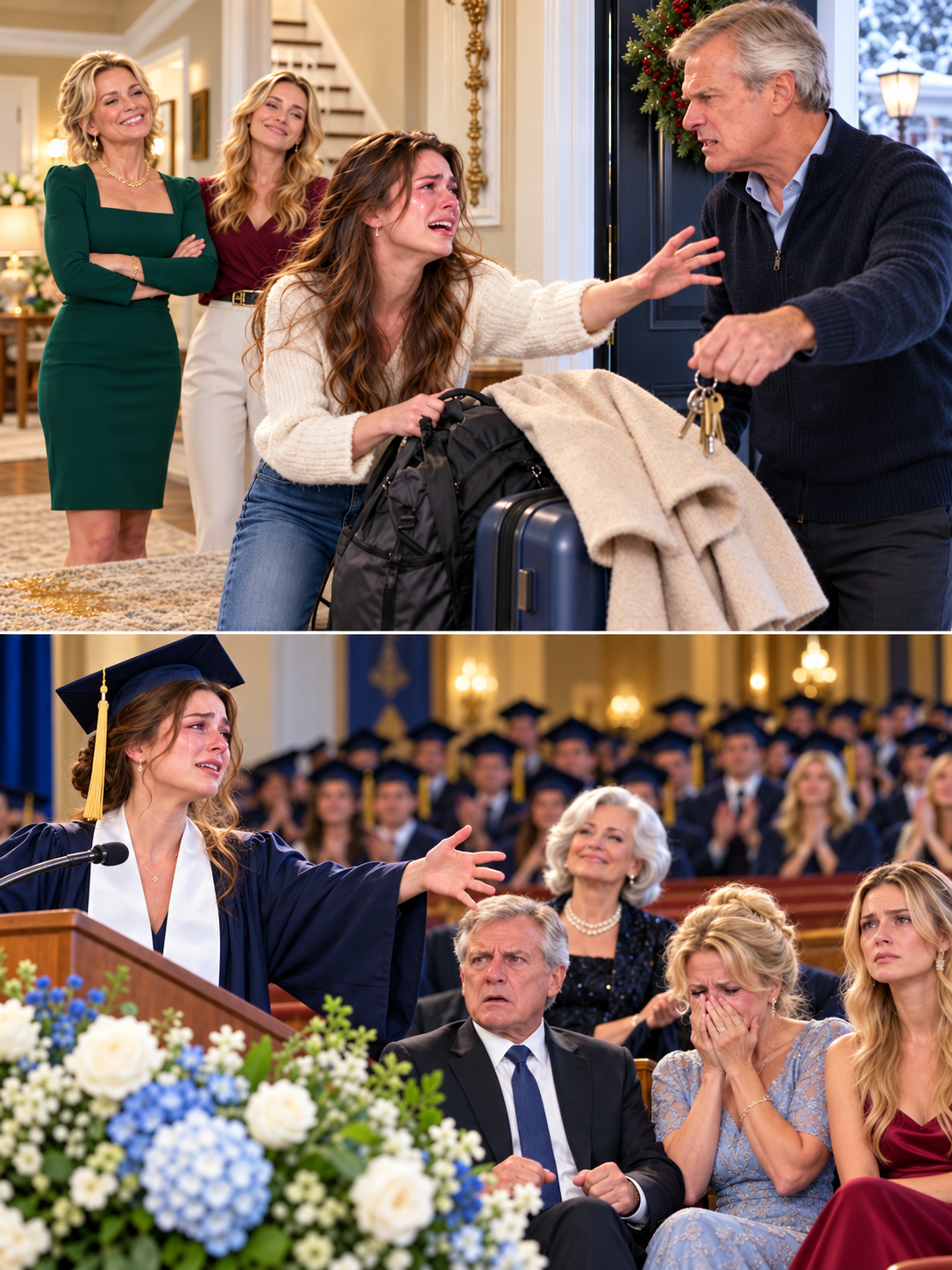
PART 1 TITLE: The Night My Father Took Away Our Home Over a Spilled Drink and Left My Little Girl Facing a Winter Storm
At 10:45 that night, my father stood in the hallway with my house key between his fingers, telling me that my five-year-old daughter and I were no longer welcome. Snow struck the windows so hard that I could barely see the porch beyond the glass. My daughter, Zoe, was trembling against my side, still holding the empty plastic cup that had started the argument. Behind my father stood my mother and my younger sister. Neither moved toward us. I remember staring at the little brass key, waiting for someone to say that things had gone far enough. Nobody did.
Less than fifteen minutes earlier, I had been upstairs trying to calm Zoe after another gust of wind had frightened her awake. Our bedroom was small, with a narrow bed pushed against the wall and a dresser whose bottom drawer never closed properly. Zoe slept beneath a faded quilt decorated with yellow stars. She had come into my bed carrying that quilt, her cheeks warm from sleep, and whispered that she thought something was scratching at the house. I explained that branches sometimes scraped against the siding when the weather turned bad. She listened carefully, then asked whether the trees were frightened, too.
My name is Clara Walker. I was twenty years old that winter, although most mornings I felt considerably older. I worked early shifts stocking shelves at a grocery store, washed my uniform in the evenings, and tried to raise Zoe without becoming another problem for my parents. We lived in the house where I had grown up, a place with clean furniture, expensive curtains, and rules that changed depending on who had broken them. My parents called our arrangement temporary. They had been calling it temporary since the day I brought Zoe home from the hospital.
That evening, the local weather reports had warned drivers to stay off the roads. Snow had begun falling before dinner and thickened steadily until the backyard fence disappeared behind a white blur. My father had spent most of the evening complaining about the electricity bill and the possibility of having to shovel the driveway before work. My mother worried about the carpets getting wet when people entered the house. Savannah, my seventeen-year-old sister, had announced that she needed absolute quiet because of an examination the following morning. I had promised all three of them that Zoe and I would remain upstairs.
But children cannot always be quiet simply because adults demand it. Zoe woke frightened shortly after ten-thirty. I rubbed her back, told her a story about a rabbit waiting out a winter storm, and offered her a few sips of water. She wanted orange juice instead. I hesitated, knowing the refrigerator door made a clicking sound and that my mother hated anyone using the kitchen late at night. Yet Zoe rarely asked for anything after bedtime. Her small voice sounded unusually desperate, and I wanted to settle her before she began crying. I told her we could get a little juice if we walked softly.
We descended the staircase with Zoe’s fingers wrapped around mine. I turned on the dim light above the kitchen counter rather than the brighter ceiling fixture. The house smelled faintly of furniture polish and the cinnamon candle my mother had extinguished after dinner. I took a plastic cup from the lower cabinet, poured a modest amount of orange juice, and put the carton away immediately. Zoe stood beside the counter in her socks, watching the snow whirl past the glass door. I told her to hold the cup with both hands. She reached forward before I finished speaking.
The accident happened in a second. Her fingertips caught the rim, the cup tilted sideways, and orange juice splashed across the edge of the living-room carpet where it met the kitchen floor. The cup bounced twice before rolling beneath a chair. Zoe froze, staring at the spreading orange stain. I fetched paper towels, knelt down, and began pressing them against the carpet. I assured her that accidents happened and that we could clean most of it before anyone noticed. She crouched beside me, offering one crumpled towel with both hands. I was still blotting the carpet when the stairs creaked.
My mother appeared wearing her pale dressing gown, with her hair pulled tightly away from her face. She looked first at the kitchen light, then at Zoe, and finally at the wet carpet. She asked what possessed me to bring a child downstairs so late. I explained that Zoe had been frightened by the wind and wanted a drink. My mother interrupted before I could finish. Savannah came down behind her, rubbing her forehead and complaining that she had been awakened. When Savannah noticed the stain, she gave a short, irritated laugh. She asked whether I had ever considered teaching my daughter to behave.
I kept pressing towels into the carpet while answering them. I said I would finish cleaning, that I would pay for a professional service if the mark remained, and that I was sorry for disturbing their sleep. It was a familiar routine: acknowledge whatever had gone wrong, accept more responsibility than necessary, and make promises before anyone demanded them. My mother stood with folded arms, watching the stain as though it were evidence of something far more serious. Zoe pressed herself against my shoulder. Her lower lip trembled, but she managed not to cry. Then we heard my father’s footsteps overhead.
He came downstairs without his slippers, his expression already tense. My father rarely raised his voice immediately. He preferred to begin with questions that sounded reasonable until you realized there was no answer he would accept. He wanted to know why we were awake, why the light was on, and whether I understood what carpeting cost. I pointed to the paper towels and explained that Zoe had accidentally knocked over her juice. He looked down at her, then at the orange mark. His face hardened. I offered to pay for the cleaning again, mentioning the money I had saved from my latest paycheck.
My father told me that money was not the issue. He began talking about the noise, the constant interruptions, the groceries we used, and everything he believed he had sacrificed by allowing us to live there. My mother added that the house was not meant to function as a nursery. Savannah leaned against the banister, her expression changing from irritation to curiosity as the argument became more serious. I stood slowly, keeping myself between my father and Zoe. I reminded him that I worked, paid for most of my daughter’s necessities, and tried to disturb the household as little as possible.
He took a step closer and pointed toward Zoe. He said he was tired of supporting the consequences of my poor decisions, and then he called my little girl a mistake he should never have been expected to help raise. The words landed more heavily than his shouting. Zoe looked up at him, confused by the sudden attention. She knew what a mistake was. At school, her teacher used the word when someone put a letter backward or counted incorrectly. She had never heard a person described that way. I felt her fingers tighten around my wrist and understood that she was trying to decide whether her grandfather meant her.
I told my father that he could be angry with me, but he would not speak about my child like that. My voice shook. I had spent years avoiding direct disagreement with him, and the unfamiliar firmness of my answer seemed to surprise us both. He stared at me for several seconds, then announced that he had reached the end of his patience. We were leaving. I thought he meant that we would have to arrange somewhere else to live over the following days. I began asking whether we could discuss it in the morning, when everyone had slept and the weather had improved.
He walked to the hallway closet instead of answering. My mother followed him and took Zoe’s winter coat from its hook. She placed it in my arms with a brisk movement, as though helping us prepare for an ordinary outing. I stared at her and asked whether she truly expected a five-year-old to leave in the middle of a snowstorm. She said that my father had warned me enough times about the household rules. When I reminded her that Zoe had spilled a drink by accident, she looked away. She had always preferred silence whenever defending me might require disagreeing with her husband.
Savannah remained beside the stairs. I watched her face, hoping that even she would understand how dangerous this was becoming. She had been raised with freedoms I never enjoyed. When she damaged something, my parents called it carelessness and moved on. When she struggled in school, they arranged tutoring and encouraged her to rest. I could remember evenings when she cried over assignments and our mother sat beside her until she felt better. Yet now my sister merely shifted her weight from one foot to the other. She murmured that perhaps leaving would teach me to take things seriously.
My father went upstairs and returned carrying two bags from our room. One held a few of Zoe’s clothes and the other contained whatever belongings he had grabbed from the top of my dresser. I knew immediately that he had not packed everything. There was no time to check what was missing. I pleaded with him to let us remain until daylight. I offered to take Zoe back upstairs and stay inside the bedroom without coming out. When he refused, I suggested sleeping in my car in the driveway, where we would at least be close enough to come inside if the cold became dangerous.
He told me the car could stay only long enough for us to leave. Then he demanded my keys. My hand moved instinctively toward my pocket, but I stopped. The key ring held my car key, a small grocery-store locker key, and the brass house key I had used since I was fourteen. I asked him not to do this in front of Zoe. He held out his palm without answering. When I finally handed over the ring, he twisted the house key free and returned the others. It took him only a few seconds. I had needed that same house for nearly my entire life, and he had reduced my place in it to something he could remove with his fingertips.
The front door opened onto a wall of bitter air. Snow blew across the threshold and gathered on the polished floorboards. I hurried to fasten Zoe’s coat, pulling her hood over her hair and wrapping her scarf around her neck. She had begun crying quietly. I could not find her gloves in either bag, so I tucked her hands into her sleeves. My mother stood a few steps away, holding her dressing gown closed. Savannah watched from the bottom stair. Neither offered to help carry the bags. I looked at their faces one final time, searching for something resembling doubt.
Before stepping outside, I asked my father whether he would genuinely prefer to see his granddaughter in danger rather than let me clean a carpet in the morning. He answered that I had made my own choices and could live with them. I wanted to argue about the choices he had made for me, too, especially the decisions that had ended my schooling and kept me financially dependent. But Zoe was shivering already, and the doorway was filling with snow. There would be no useful answer to anything I said. I picked up our bags and guided her onto the porch.
The door shut behind us. A moment later I heard the lock turn. Zoe immediately began apologizing, speaking between sobs about the juice, the cup, and the carpet. She promised she would never ask for another drink after bedtime. I knelt on the icy porch and took her face between my hands. I told her that she had done nothing to deserve this. She insisted that Grandpa would still be happy if she had kept the cup steady. I tried to explain that an accident could not make someone unworthy of a home, but the words caught in my throat. I was still struggling to believe them myself.
We crossed the driveway slowly, slipping where fresh snow concealed patches of ice. My old car sat beneath a growing layer of white. I brushed snow from the driver’s door with my sleeve and opened the back door for Zoe. Her car seat was still installed from our trip to the grocery store earlier that afternoon. I helped her inside, fastened the straps over her winter clothing as best I could, and adjusted the fit before placing her blanket across her knees. The engine hesitated before starting. When warm air finally came through the vents, I nearly cried from relief.
Our possessions were scattered between the backseat floor and the two bags my father had packed. My phone showed a low battery warning. I opened my banking application and stared at the balance, calculating what I could afford after the next insurance payment and my usual expenses for Zoe. A motel might be possible for one night, but I did not know which roads were still open. I considered calling a coworker, then looked at the time. Most were asleep, and I had never told them enough about my home life to explain why I would be asking for shelter. I felt ashamed of needing help, even while recognizing how absurd that shame was.
Zoe asked where we were going. I told her we would find somewhere warm, perhaps a place where people could sit until the weather cleared. She wanted to know whether Grandma would be worried. I looked toward the house. The porch light had gone out. My parents’ bedroom curtains were closed, and no figure stood at the window. I said I did not know. Zoe held her blanket beneath her chin and asked whether we would come back for her stuffed rabbit. I promised that we would retrieve it somehow. The promise frightened me because I had no idea whether my father would let us through the door again.
I backed carefully into the street. The tires slipped before finding enough traction to move forward. Snow obscured the edges of the road, and my windshield wipers pushed heavy slush across the glass. The heater blew unevenly. My fingers ached despite the warm air. I drove with both hands on the wheel and kept the speed far below the posted limit. Every few seconds, a gust shoved the car sideways. The neighborhood was deserted. There were no footprints on the sidewalks, no other cars leaving driveways, and no reassuring sign that anyone else had decided the roads were safe.
As I drove, memories I had spent years trying to bury began returning with uncomfortable clarity. I remembered being fifteen, sitting at the dining-room table while my father spoke about my pregnancy as though it were a scandal that had happened to him. I remembered my mother saying that the neighbors would gossip and that keeping me at home would spare everyone embarrassment. I remembered the university identification badge I used to wear during the research program that had once made me believe I might become a scientist. Somewhere in one of those bags was that blue lanyard, although I had not worn it in years.
I had believed my parents were helping me when they allowed Zoe and me to remain under their roof. Perhaps, in some practical sense, they had helped. There had been heating, running water, and a place for my daughter to sleep. Yet every necessity came attached to an accusation. I was reminded repeatedly of what I cost them, how much easier their lives would have been if I had behaved differently, and how fortunate I was that they had tolerated my mistakes. Driving through that storm, I understood that their generosity had never included the security of knowing we could stay.
Zoe stopped crying after several minutes. When I glanced in the rearview mirror, I saw her staring out at the darkness with a frightened, exhausted expression. She asked whether Grandpa had stopped loving her. I wanted to say that he had never meant what he said. That would have been easier, perhaps, than explaining why a grown man could behave so cruelly toward a child. Instead, I told her that adults sometimes say and do things they should be ashamed of, and that those things are never a child’s responsibility. She watched me carefully, then asked whether I still loved her. I told her there was nothing she could ever spill or break that would change that.
I remembered a twenty-four-hour diner on the other side of town. It was not an ideal shelter, but I imagined ordering something inexpensive and sitting in a booth where Zoe could rest beside me. I turned toward the main road, struggling to identify the intersection through the falling snow. My phone vibrated inside my coat pocket. I could not look at it while driving. For one foolish moment, I wondered whether my mother was calling to tell us to return. Then a strong gust swept across the intersection, scattering powdery snow directly into my headlights and wiping away what little visibility remained.
I eased off the accelerator and leaned forward, searching for the road markings. A pair of headlights appeared suddenly from the right, much closer than I expected. I pressed the brake pedal. The tires lost their grip and the car began sliding across the icy pavement. I turned the steering wheel gently, trying to correct our direction, but the car continued moving sideways. From the backseat, Zoe screamed my name. I saw the dark outline of another vehicle emerging through the snow. There was a scraping sound, the terrible crunch of metal against metal, and then everything stopped.
For several seconds, I could hear nothing except Zoe crying and the windshield wipers dragging across the glass. I twisted around to reach her, terrified that I would find blood or broken glass. She was frightened, shaking, and calling for me, but she appeared uninjured. I checked her face and arms, then ran my hands carefully over her legs. When I was certain she could move everything, I looked through the windshield at the other car. Its headlights were still on. A figure stepped out into the snow and began walking toward us. I gripped the steering wheel, convinced that I had just made our situation even worse.
END PART 1
PART 2 TITLE: The Stranger Whose Car I Struck Knew My Name and Carried a Memory of the Future I Had Lost
A gentle knock on my window startled me. I turned to find a woman standing beside the driver’s door, her dark coat dusted with snow and one hand raised to show that she was not angry. I lowered the window a few inches. Cold air rushed into the car, bringing the smell of wet asphalt and the sharp sting of winter. Before she could speak, I began apologizing. I told her I had tried to stop, that the tires had slipped, and that I would give her my insurance information. She glanced at my face, then past my shoulder toward Zoe, who was still crying in her car seat.
The woman asked whether my daughter was injured. Her voice was calm, but she sounded as though she expected a precise answer. I said that I had checked Zoe and could not find any injuries, although I was frightened that I might have missed something. The woman leaned closer to see her. She spoke directly to Zoe, asking whether she could move her fingers and whether anything hurt. Zoe shook her head and held up both hands. The woman nodded, then asked me to switch on my hazard lights. She explained that we needed to move away from the intersection before another driver lost control on the same stretch of ice.
I followed her directions into the small parking lot beside a closed business. My hands shook so badly that I could barely turn the wheel. The woman drove behind us and parked beneath a streetlamp, where we could see the damage more clearly. The front corner of my bumper was scraped and partly detached. Her vehicle had a dent near the rear wheel. Neither car appeared seriously damaged, but I knew even minor repairs could cost more than I had saved. I felt another wave of panic as I imagined missing work, paying an insurance deductible, or losing the only transportation I had.
She took several photographs of both cars, checked that no fluid was leaking onto the pavement, and asked again whether we needed medical assistance. I told her that Zoe seemed all right. When she noticed the bags in my backseat, she looked at me with a question I could already anticipate. She wanted to know why I had taken a small child onto the road during such dangerous weather. I opened my mouth to give a reasonable explanation. Perhaps I could say we had been visiting someone, or that an emergency had forced us to travel. But Zoe interrupted before I could invent anything. She said Grandpa had made us leave because she spilled her juice.
The woman became very still. She looked from Zoe to me and asked whether we had been put outside that evening. I nodded. She asked whether we had somewhere safe to go. I tried to answer confidently, but all I managed was to say that I had been looking for somewhere open. My throat tightened. I had spent so many years concealing my family’s behavior that speaking about it to a stranger felt like exposing something shameful. The woman did not ask what I had done to provoke my father. She simply wanted to know whether we had coats, enough fuel, and a safe destination. When I admitted that we had no destination, she studied me more closely.
Then she asked for my name. I told her it was Clara. She asked for my surname, and I said Walker. The change in her expression was immediate. Her eyes widened slightly, and she repeated my full name as though checking that she had heard correctly. I wondered whether she knew my parents or had somehow recognized me from the grocery store. She looked at me for several seconds, searching my face. Then she began to say that she had not seen me in a very long time. She stopped before finishing the sentence. I waited for her to explain, but she turned toward Zoe and said that our first concern should be getting out of the cold.
She fetched a thick blanket from her vehicle and helped me cover Zoe’s legs. Then she suggested that we leave my damaged car in the parking lot until the roads improved. She had a warm house nearby, she explained, and we could come inside while we figured out what to do. I hesitated. Accepting help from someone whose car I had just struck seemed unreasonable, and following an almost complete stranger home with my daughter was not a decision I could make lightly. I asked her name and where she lived. She answered plainly, pointed out the neighborhood, and offered to let me call someone before we left. Her willingness to answer every question without taking offense made it easier to think clearly.
I took a photograph of her license plate and sent it, along with the address she gave me, to a trusted coworker. Then I transferred Zoe’s car seat and our bags into the woman’s vehicle. She waited while I checked the straps and made sure Zoe’s blanket was secure. During the short drive, she kept both hands on the wheel and spoke only when necessary. She pointed out a particularly icy turn, warned me that the roads would probably remain closed until morning, and asked whether Zoe liked hot chocolate. Zoe gave a cautious nod. I watched the woman’s face in the rearview mirror, trying to place her familiar manner of speaking.
Her home was smaller than my parents’ house, with a narrow front porch and yellow light shining through the curtains. Inside, the air smelled of coffee, clean laundry, and something faintly sweet from the kitchen. Bookshelves covered one wall of the living room. A pair of reading glasses rested beside an open notebook on the coffee table. Nothing looked particularly expensive, but the house had the comfortable disorder of a place where someone actually lived. The woman helped Zoe remove her damp coat, found a pair of thick socks that could be folded down to fit her, and prepared warm chocolate in a ceramic mug.
Zoe sat on the couch with the mug balanced carefully between her hands. She looked at the woman and asked whether she was a nice person. I felt embarrassed by the question, but the woman did not laugh. She considered it seriously before saying that she certainly tried to be. Zoe seemed satisfied. She took a careful sip, then looked toward the light-colored rug beneath the coffee table. She asked what would happen if she spilled her drink. The woman answered that they would clean it up, and if the rug became stained, they would deal with that later. Zoe stared at her for a moment, evidently waiting for a condition or warning that never arrived.
I sat on the edge of the opposite chair without removing my coat. My mind was still moving too quickly. I needed to call my workplace, report the accident, find transportation, and determine where we could spend the following night. I had no idea where I would find enough money for a deposit on an apartment. The woman brought me a cup of tea and asked whether I would like something to eat. I thanked her but said I was not hungry. She accepted that answer and sat nearby rather than continuing to insist. It was such a small courtesy that I almost failed to recognize how unusual it felt.
Eventually, Zoe’s eyelids began to droop. I opened one of our bags to find her pajamas. My father had packed hastily, folding clothes into uneven bundles and leaving several drawers untouched. As I searched beneath a sweater, my fingers caught on something narrow and familiar. I pulled out a blue fabric lanyard with a plastic identification badge attached. The material was worn at the edges, and the photograph showed a younger version of me smiling nervously at the camera. Across the top were the words Future Scholars. I had not deliberately packed it. Somehow, among the belongings my father had thrown together, there remained one object from the future he had once helped me abandon.
The woman saw the badge and put down her tea. Her gaze moved from the faded photograph to my face. Something about that expression stirred a memory I had not examined for years. I looked around the room again, noticing the shelves of academic books and the handwritten notes beside the window. I remembered a university classroom filled with students, the smell of dry-erase markers, and a woman who had once waited patiently while I struggled to ask a question. I remembered a voice telling me that curiosity did not require an apology. Slowly, I looked back at the stranger. I asked whether her name was Dr. Simona Carr.
She smiled, and the missing years seemed to collapse between us. Dr. Carr had been my mentor during a university research program when I was fifteen. I remembered her standing beside a laboratory table, showing me how to record observations carefully and encouraging me to challenge results that did not make sense. She had always spoken to the younger students as though our questions mattered. I had admired her more than I admitted at the time. Then I became pregnant, disappeared from the program, and never answered the messages asking whether I intended to return. Now she was sitting across from me in her living room, five years later, after I had collided with her car in a snowstorm.
Dr. Carr said that she had recognized my surname but had needed a moment to be certain. I had changed since our last meeting, and the circumstances were hardly ones in which she expected to find a former student. She asked what had happened to me. It was a straightforward question, but I had no straightforward answer. I began by saying that life had become complicated. She waited without interrupting. I looked at the badge in my hands and remembered what my life had been like before I became a mother, when I believed I would finish school, earn scholarships, and spend my days studying problems that interested me.
I had been a strong student, particularly in science. My acceptance into the Future Scholars program had been one of the few achievements I truly wanted my parents to celebrate. Every Saturday, I traveled to the state university for research workshops, lectures, and meetings with mentors. Dr. Carr had noticed that I stayed behind after sessions to ask questions I was too nervous to raise in front of the group. She encouraged me to speak anyway. When she gave me the blue identification lanyard, I wore it proudly, even on the bus home. To me, it represented a place where adults expected something good from my future rather than waiting for me to disappoint them.
Then I met Brendan. He was seventeen and knew exactly how to make an insecure girl feel important. He listened when I complained about home, remembered things I had told him, and promised that we would face whatever happened together. I believed him because I wanted to. When I discovered I was pregnant at fifteen, I was terrified, but I did not immediately surrender my plans for school. I imagined finishing classes, making arrangements for childcare, and eventually applying to college. Brendan initially promised that he would help. Over the following months, his replies became less frequent. By the time he left to attend college in Europe, he had almost completely disappeared from my life.
Telling my parents about the pregnancy had been even more frightening than telling Brendan. My father wanted to know who else knew, whether anyone at school had heard, and how quickly the situation could become public. My mother worried about what relatives would say. Neither asked how I felt or whether I was frightened. At first, they told me I would miss a little school until things settled down. Then they decided I should study at home to avoid attention. Soon the lessons became irregular, and eventually they stopped altogether. When I begged to return to the research program, my father told me I had already demonstrated that I lacked the judgment necessary for higher education.
I had never finished high school. Saying those words aloud to Dr. Carr was more painful than I expected. She did not look shocked, and she did not ask why I had allowed it to happen. She wanted to understand what arrangements had been available and how much control I had possessed at fifteen. I explained that I had no money of my own, no transportation I could reliably use, and no adult willing to challenge my parents’ decision. After Zoe was born, my attention shifted toward keeping her fed, clean, and healthy. I began working when I could and eventually found regular hours at the grocery store. Every month, I intended to make a plan for returning to school. Every month, another necessity came first.
I looked toward Zoe, who had fallen asleep beneath the borrowed blanket, and told Dr. Carr that my daughter had been the best part of those five years. Caring for her had been difficult, especially when she was sick or I had to work early, but she had never been something I regretted. What hurt was knowing that my parents interpreted every ordinary struggle as proof that becoming a mother had destroyed my life. I described the arguments about money, the complaints about noise, and the constant reminders that we were guests in a house where I had grown up. Finally, I told her exactly what had happened with the orange juice.
Dr. Carr listened to the entire account, including my father’s words and the moment he removed the house key. When I finished, I expected her to tell me what I should have done differently. Instead, she asked what essential belongings remained at the house. I began listing things almost automatically: Zoe’s school papers, my wallet, several pieces of identification, and the rest of our clothing. Then I remembered my emergency medication. My stomach tightened as I realized that my epinephrine auto-injector was still in the drawer beside my bed. I had a serious shellfish allergy and had been instructed to keep the medication accessible in case of a severe reaction.
Dr. Carr’s expression became more serious. She asked where the medication was stored and whether I had another available. I shook my head. I could not believe I had forgotten something so important, but I had been trying to get Zoe into the car before she became dangerously cold. Dr. Carr explained that retrieving essential medical supplies could not simply be postponed because my father was angry. I said I could not face another confrontation at the house, especially with Zoe present. She asked whether I would be comfortable requesting assistance from the police through their non-emergency number. I hesitated before agreeing.
She called and described the situation carefully. She explained that a young mother and child had been removed from their residence during dangerous weather and that essential identification documents and emergency medication remained inside. She asked whether officers could help arrange a peaceful retrieval without another confrontation. I sat beside her, twisting the edge of Zoe’s blanket between my fingers. I was certain the police would consider the matter too small to warrant their attention. Instead, the person on the telephone took the relevant information and explained how officers would handle the request. Dr. Carr thanked them and ended the call.
My father called shortly afterward. His name appeared on my screen, and I felt the familiar tightening in my stomach. Dr. Carr said I did not have to answer. For several seconds, I considered letting the phone ring until it stopped. Then I thought about the documents still inside the house and the possibility that my father would refuse to hand them over. I answered. He began shouting immediately. I could hear my mother behind him demanding to know why police officers were standing on their porch. My father accused me of humiliating the family and making them look like criminals over an ordinary household disagreement.
I waited until he paused for breath. Then I told him that I needed my medication and Zoe’s documents, and that I had asked for help retrieving them safely. He continued talking over me, insisting that I had exaggerated what happened. My mother took the phone and complained that the neighbors might see the police car. Neither asked whether Zoe was warm, whether we had found shelter, or whether the car had survived the storm. I looked toward the couch, where my daughter slept with one hand beneath her cheek. Something about that sight made the conversation suddenly easy to understand. They were worried about being seen. I was worried about keeping my daughter safe.
I told my mother that I was ending the call. My father began shouting again in the background, but I pressed the button before he could finish. I placed the phone on the table and stared at it, half expecting another punishment to follow. My hands shook, and my mouth felt dry. Dr. Carr did not congratulate me or make a speech about courage. She simply moved the cup of tea closer and asked whether I wanted more hot water. I nodded. The ordinary question gave me something manageable to answer while my body slowly realized that my father could no longer order me to return to the kitchen and stand there listening.
An officer arrived later with my wallet, Zoe’s school papers, and the medication. He confirmed the items against the list we had provided, asked several questions about the circumstances of our departure, and checked that we were somewhere safe. I thanked him repeatedly, embarrassed that such a routine task seemed to require so much assistance. He treated the situation seriously without making me feel foolish. After he left, I arranged the recovered belongings on the coffee table. There were my identification cards, the school documents I had worried about losing, and the medication I should never have been forced to leave behind. I thought of the house key my father had kept and realized that nothing on the table would require me to return for it.
By then, the storm had eased slightly, although snow continued falling beyond the windows. Zoe slept soundly, exhausted by everything that had happened. I told Dr. Carr that I was grateful for her help and promised to find other arrangements the next day. I knew she had already done more than anyone could reasonably expect, especially after the damage to her car. She asked where I intended to go. I admitted that I did not know yet. She looked at the sleeping child on her couch, then back at me. She said we were welcome to remain in her home until I could make a stable plan for our future.
I asked whether she meant another night or perhaps a few days. She said she was not setting a deadline that evening. We would discuss practical details when everyone had slept. I struggled to understand how someone could offer help without immediately explaining what it would cost. Dr. Carr seemed to recognize the question before I asked it. She told me that accepting a safe place to sleep did not require me to surrender control of my life or make promises about what I would accomplish. We could take one necessary decision at a time. I looked at Zoe and imagined waking her in another strange place, then carrying our bags back into the cold. I could not bear to put her through that again.
Zoe stirred when I moved toward the couch. She opened her eyes and asked whether we needed to leave. I told her Dr. Carr had invited us to stay. My daughter looked directly at our host and asked whether she was certain. Dr. Carr said yes, then asked Zoe whether she preferred the couch or a small guest bedroom upstairs. Zoe considered the choice seriously before saying she would like to sleep near me. We arranged the blankets together. When I finally switched off the lamp, my daughter reached for my hand and asked whether anyone could make us leave because she spilled something. I told her that we were safe for the night.
I remained awake long after Zoe fell asleep again. On the chair beside me lay the blue Future Scholars badge, its plastic cover scratched and cloudy with age. I remembered who I had been when I first wore it, and I wondered whether that girl still existed somewhere beneath the exhaustion and embarrassment I had accumulated. Dr. Carr had recognized me after five years, even though my own family had spent those years reminding me of everything I had supposedly ruined. As I listened to the quiet house settle around us, I made a decision that frightened me almost as much as leaving my parents. If Dr. Carr was willing to help us find a way forward, I would stop pretending that survival was the only future I deserved.
END PART 2
PART 3 TITLE: My Former Teacher Offered Me a Second Chance at School, but First I Had to Face Everything My Parents Made Me Believe
I woke before sunrise with my neck aching from sleeping upright on Dr. Carr’s couch. For a moment, I did not remember where I was. The unfamiliar arrangement of furniture, the bookshelves, and the soft ticking of a clock made me think I had fallen asleep at someone else’s house after an ordinary visit. Then I saw Zoe curled beneath the blanket beside me, and the previous night’s events returned in fragments: orange juice spreading across the carpet, my father’s fingers twisting the house key loose, the sliding car, and a woman’s face appearing through the snow. I sat still, listening for footsteps that might mean we had overstayed our welcome.
Instead, I heard water running in the kitchen and smelled freshly brewed coffee. Dr. Carr entered carrying two mugs and asked whether either of us had slept comfortably. I started apologizing for taking up her living room. She interrupted gently to explain that blankets could be washed and couches were meant to be used. Then she asked about my work schedule. I told her I stocked shelves at the grocery store and usually began before most people were awake. The realization that I had missed my morning shift made me sit upright. I reached for my phone, expecting an angry message from my manager and wondering how I would replace the money from those lost hours.
Dr. Carr suggested calling immediately rather than allowing my imagination to make the situation worse. She remained beside me while I explained that my daughter and I had experienced a housing emergency during the storm, that I had been involved in a minor collision, and that we were now somewhere safe. My manager sounded irritated. The store had received deliveries despite the weather, and several employees had already called out. But he knew I rarely missed work, and after asking whether I could return the following morning, he agreed to adjust the schedule. I ended the call feeling exhausted by the effort of having told someone only a small portion of the truth.
Breakfast consisted of toast, scrambled eggs, and fruit Dr. Carr found in her refrigerator. Zoe ate cautiously, sitting with both feet tucked beneath her chair. Each time she reached for something, she asked permission first. When she accidentally knocked a crumb onto the floor, she immediately bent down to pick it up. I noticed Dr. Carr watching her. Rather than commenting on the behavior, she passed Zoe a napkin and told her she could finish eating before cleaning anything. My daughter looked puzzled by such a relaxed response. I wondered how many ordinary moments it would take before she stopped expecting punishment for every small accident.
Once the roads had been cleared sufficiently, Dr. Carr helped me arrange transportation to retrieve my car and determine whether it was safe to drive. We handled the accident report and insurance information without pretending the repairs would be inexpensive. I worried aloud about losing my job if the vehicle remained unusable. Dr. Carr helped me examine the immediate options: rides to work, transportation schedules, and what could be repaired first. She did not promise to solve everything. She helped me separate problems that required action that day from problems that could wait. It was surprisingly difficult for me to accept that not every worry demanded a decision within the next five minutes.
After Zoe went to school, I returned to Dr. Carr’s kitchen. She had placed a notebook and two pens on the table. I assumed we were going to make a budget, so I began listing expenses: food, car repairs, my daughter’s school necessities, and whatever rent I might eventually afford. Dr. Carr listened carefully and wrote down the figures. Then she turned to a clean page and asked a question I had not expected. She wanted to know whether I had completed high school after leaving the Future Scholars program. Although I had confessed the previous night that I had not, I felt embarrassed answering again in daylight.
I told her that I never received a diploma and had not taken the GED examinations. The admission sounded especially bleak in that quiet kitchen, with morning sunlight falling across the table. Dr. Carr asked whether finishing my education was something I still wanted. My first instinct was to explain why it would be impossible. I had a job, a child, limited savings, and years of missed lessons. I could barely remember the algebra I had once enjoyed, and I had forgotten much of the material that would appear on the examinations. She listened to each objection without arguing. When I finished, she asked whether any of those difficulties meant I was incapable of learning.
I almost laughed. She was speaking to me as though the student she had known at fifteen was still sitting across the table. I told her I had been clever once, but that was before everything changed. Dr. Carr said five years of raising a child and working did not erase a person’s intelligence. She reminded me of the research presentation I had prepared in our old program, how carefully I had examined contradictory results, and how many questions I had asked after everyone else had packed away their materials. I remembered that project. I had been proud of it, although my parents had barely looked at the finished presentation.
Then she proposed a schedule. We would begin with two hours of study each evening, four nights a week. Some sessions could take place after Zoe went to sleep, and others could happen while my daughter colored or completed activities at the same table. Dr. Carr offered to help identify free preparation materials and the requirements for taking the examinations. I asked what would happen if I failed. She said we would examine which subjects needed more work and try again. Her answer unsettled me. In my parents’ house, mistakes were often treated as evidence of permanent character flaws. Dr. Carr described failure as information that could help determine the next step.
I agreed to try, although I was not ready to believe I would succeed. That afternoon, we gathered the textbooks and practice questions I needed. When I opened the first mathematics section, familiar symbols appeared alongside topics I barely recognized. Fractions were manageable until the exercises became more complicated. Equations that once seemed straightforward made me stare at the page for several minutes. I felt the old embarrassment rising and began explaining that I had probably forgotten too much. Dr. Carr sat beside me and asked me to show her the last step I understood. We worked from there, one calculation at a time, without treating confusion as something shameful.
Our routine settled gradually into place. I left for the grocery store early, returned home tired, collected Zoe from school, and prepared whatever simple dinner we had planned. Once the dishes were washed, I brought my books to the kitchen table. Zoe spread coloring pages beside me and asked what I was learning. Sometimes I explained numbers or showed her how to identify words she had not encountered before. Other nights, she played quietly while I read passages aloud to improve my concentration. Dr. Carr often worked in another room, checking on us only when I had a question or when it was time for Zoe to prepare for bed.
The difficult evenings were more frequent than I wanted to admit. Once, after a particularly demanding shift, I spent nearly half an hour trying to understand a mathematics problem that I would once have solved easily. Zoe needed help finding a missing crayon, the laundry was still wet, and my eyes burned from exhaustion. I closed the textbook harder than I intended. Dr. Carr came into the kitchen and asked whether I wanted to stop for the night. I said I was tired of being behind everyone else. She suggested that the problem might not be my ability. Perhaps I was simply exhausted, and exhaustion made learning harder.
I resisted that explanation. I had become accustomed to treating every difficulty as a personal failure. When Zoe was sick, I told myself I should have prevented it. When a shift changed unexpectedly, I blamed my inability to prepare. When money became tight, I assumed I must have been careless somewhere. Dr. Carr asked me to consider whether I applied the same judgments to other people. I admitted that I did not. I would never tell another mother that she was unintelligent because she needed help understanding a lesson. I would never tell Zoe that one difficult afternoon meant she should abandon school. Hearing my own answers made it harder to defend the standards I had imposed on myself.
There were practical problems, too. My grocery-store shifts occasionally changed with little warning, and some evenings I returned too tired to complete the full study schedule. I worried about the inconvenience of having Zoe in someone else’s home and tried to make myself useful by cleaning more than necessary. Dr. Carr eventually asked me to stop scrubbing the kitchen counters whenever I felt nervous. She said contributing to a household was reasonable, but attempting to earn the right to remain through constant work was not. We agreed on ordinary responsibilities, including preparing meals and keeping our rooms tidy. For the first time, household rules seemed intended to help people live together rather than determine who deserved to stay.
My parents called several times during those early weeks. At first, I ignored the calls. Then my mother sent messages asking when I intended to retrieve the rest of my belongings and whether I planned to apologize for involving the police. She referred to the storm as an unfortunate disagreement and suggested that my father had acted more severely than usual because everyone was tired. She did not acknowledge that Zoe had been frightened or that sending us onto dangerous roads could have ended far worse than it had. I drafted several replies explaining what happened, then deleted them. Eventually, I sent a brief message requesting a time to collect our remaining possessions without another argument.
The collection was arranged carefully and took less time than I expected. I did not bring Zoe. I retrieved her stuffed rabbit, the clothing we needed, and the school materials that had remained in my room. My parents were distant, concerned mainly with how quickly the matter could be finished. My mother asked whether I was staying with a friend and whether that person understood what she was getting involved in. I told her we had safe accommodation. She began a lecture about gratitude, but I declined to discuss it. Leaving the house with Zoe’s rabbit tucked beneath my arm, I noticed that my father had already moved furniture across the area where the orange juice had spilled.
I returned to Dr. Carr’s home shaken but relieved. Zoe ran toward me as soon as she saw the rabbit. She hugged it against her chest and asked whether Grandpa had forgiven her. The question hurt more than the coldness of my parents’ behavior. I knelt beside her and told her again that forgiveness was not something she needed to request for having a drink accidentally spill. She seemed to accept the answer for a few minutes, then asked whether the carpet had been cleaned. I told her it had. She considered that information and said perhaps Grandpa would be happy now. I wished I could make her understand that his happiness was not her responsibility.
Weeks became months. As the days lengthened, I made measurable progress through the practice materials. Reading comprehension returned more easily than mathematics, and writing essays reminded me of the research assignments I had once enjoyed. I began keeping a notebook of errors, recording not only the correct answers but the reasons I had misunderstood particular questions. Dr. Carr encouraged the habit, saying it would help me recognize patterns. Gradually, I stopped hiding pages covered in corrections. They became evidence that I was working through difficult material instead of proof that I should never have begun.
My first full practice examination took an entire afternoon. I sat at the kitchen table with a timer beside me while Dr. Carr took Zoe to the park. When they returned, I had finished, but I could barely look at the results. I was certain I had performed badly. Dr. Carr checked the scoring requirements with me and pointed out that I had passed several sections. The areas where I fell short were close enough to the target that additional preparation seemed realistic. Zoe overheard us talking and asked whether her mother had won something. I explained that I had done well on an important practice test. She jumped up and down, shouting that her mommy was smart.
I laughed and pulled her into my arms. I told her I was learning, the same way she learned new things at school. She seemed dissatisfied with that modest explanation and insisted that learning difficult things was exactly what smart people did. Dr. Carr looked amused but did not interrupt. Later that evening, Zoe taped one of her drawings above my study desk. It showed three stick figures standing beside a large blue building. She identified them as herself, me, and Dr. Carr outside my future school. I asked why she had drawn the building so tall. She explained that grown-up schools must be enormous because they contained so many things to learn.
Preparing for the actual GED examinations required more discipline than I expected. I arranged time away from work for the scheduled sessions and made sure Zoe would be cared for while I was gone. I practiced answering questions under time limits, forcing myself not to spend too long on problems that resisted an immediate solution. Dr. Carr helped me organize the necessary documents and reminded me to eat properly before each examination. I remembered my father’s assertion that I would never be intelligent enough for college. For years, that sentence had appeared in my mind whenever I considered returning to school. Now I was preparing to challenge it with something more substantial than an argument.
On the morning of the final examination, Zoe woke early and insisted on helping me prepare breakfast. She stood on a chair beside the counter while I supervised, carefully placing slices of toast on plates. Before I left, she handed me the blue Future Scholars lanyard. She had found it on my desk and thought I might need it for school. I explained that it was an old identification badge, but I tucked it into my bag anyway. Dr. Carr drove me to the testing center. During the journey, she did not offer exaggerated encouragement. She reminded me that I had prepared thoroughly and that the result of one examination would not determine my worth.
I finished the test feeling uncertain about several answers. For days afterward, I replayed difficult questions while stocking shelves at work or folding Zoe’s clothes. When the results finally became available, I was sitting inside my car. I opened the message, read the scores, and then read them again because I did not trust my eyes. I had passed. Every required section. The qualification I had believed was permanently beyond my reach was now mine. I covered my mouth, trying to keep from crying, but the relief was too strong. Zoe, seated behind me, became frightened when she saw tears on my face. She asked what was wrong.
I turned around and told her I had passed my examinations. She asked whether that meant I was finished with school forever. I laughed through my tears and explained that it meant I had earned the opportunity to continue. Zoe considered this carefully before asking whether happy mothers were allowed to eat ice cream. I said that on this particular afternoon, I thought ice cream was an excellent idea. We bought two cones and sat together while the afternoon sun softened the last dirty piles of snow near the parking lot. Zoe got chocolate on her chin. I wiped it away and realized that, for once, a small mess had not made me anxious.
When we returned home, Dr. Carr examined the results and congratulated me with a warmth that made me uncomfortable in the best possible way. She asked how I wanted to celebrate. I told her the ice cream had been enough. But later, while Zoe played upstairs, I admitted that passing the GED had left me feeling strangely unsettled. I had spent so long telling myself that my education was finished that I did not know how to think about a future in which more doors might open. Dr. Carr listened, then asked whether I still wanted to attend college. My immediate answer was yes. It came out before I had time to hide behind practical objections.
We discussed community college first. Tuition, transportation, childcare, and work schedules would require careful planning. Dr. Carr made it clear that a degree would take time and that there would be difficult compromises along the way. She did not pretend that ambition could erase financial realities. We examined course schedules, admission requirements, and available assistance for students supporting children. I realized that no single decision would solve everything. But the problems were no longer vague obstacles arranged in an impossible wall. They were questions I could research, budgets I could calculate, and arrangements I could begin making.
For several evenings, I kept the application open on my computer without submitting it. Each time I reviewed the information, I imagined my father’s voice asking why someone in my position would waste time pursuing a degree. I imagined failing classes, losing wages, and disappointing the woman who had helped me. Then I looked at Zoe’s drawing above my desk, with the three of us standing outside the enormous blue school. I understood that I had already spent five years allowing other people to define the limits of my life. Continuing that habit would be a decision, too, even if it looked like doing nothing.
I completed the application after Zoe had gone to bed. I checked my personal information, confirmed the academic documents, and reviewed the courses I hoped to take. Dr. Carr sat across the table reading while I worked. When I told her I was ready, she looked up and asked whether I wanted company for the final step. I nodded. My hand hovered over the submission button, and I thought of the frightened fifteen-year-old who had once believed a university laboratory could belong to her future. Then I clicked. A confirmation appeared on the screen. For the first time since becoming a mother, I had formally asked the world for an opportunity that my parents had told me I no longer deserved.
END PART 3
PART 4 TITLE: I Returned to the University That Had Once Closed Its Doors to Me and Discovered Other Mothers Were Fighting the Same Battle
The acceptance message arrived on an ordinary afternoon while I was folding laundry. I had just finished a grocery-store shift, and Zoe was sitting on the living-room floor arranging her crayons by color. My phone vibrated beside the laundry basket. I opened the email expecting another routine notice about the application process. Instead, I found confirmation that I had been admitted to community college. I read the message twice before calling Dr. Carr into the room. She looked over my shoulder, smiled, and asked whether I was ready to begin choosing classes. I had imagined the moment for weeks. Now that it had arrived, I felt an unexpected mixture of excitement and fear.
The college admission did not change our financial circumstances. I still needed the grocery-store job, and Zoe still needed meals, school supplies, clean clothing, and a dependable routine. Dr. Carr helped me examine the course timetable alongside my work schedule. We identified classes I could realistically attend and discussed how much study time each would require. I quickly learned that enrollment involved more paperwork than I had anticipated. There were forms, deadlines, orientation materials, and questions about financial assistance. I kept everything in a folder because I was terrified that overlooking one small requirement would somehow cancel the opportunity I had worked so hard to obtain.
My first day on campus was nothing like the confident return I had imagined. I arrived early and spent several minutes checking the building numbers because I was afraid of entering the wrong classroom. Students moved past me carrying backpacks and coffee cups, talking about assignments and instructors. Some were older than I was, but many looked barely out of high school. I wondered whether they could tell I had a daughter waiting for me at home, or that I had earned my GED only recently. When I finally found the classroom, I chose a seat near the back and arranged my notebook carefully on the desk.
The instructor began by discussing the course expectations and asking students to introduce themselves. My heart beat faster as my turn approached. I considered saying only my name, but when the instructor asked why I had chosen the program, I found myself explaining that I had always been interested in research and wanted to return to the education I had interrupted several years earlier. I did not mention the circumstances of that interruption. Nobody demanded an explanation. The instructor welcomed me, moved to the next student, and continued the lesson. It was an ordinary exchange, but I left the classroom relieved that I had been allowed to belong without defending my presence.
College quickly became more demanding than I expected. The subjects interested me, yet interest did not create additional hours in the day. I worked early mornings, attended classes when my schedule allowed, and collected Zoe from school before returning home to prepare dinner. Some evenings, I studied until the words on the page began to blur. Other times, I fell asleep with an unfinished reading assignment beside me. I tried to make up lost time by working harder, but exhaustion eventually caught up with me. Dr. Carr noticed before I was willing to admit it and reminded me that planning rest was not the same as avoiding responsibility.
We developed a weekly routine around the demands of both school and work. On Sundays, I reviewed assignments, checked upcoming examinations, and planned meals that would not require much preparation during busy evenings. Zoe helped by decorating the calendar with small drawings. She put stars beside examination dates and flowers next to days when we could spend extra time together. Sometimes she became frustrated when I needed to study instead of playing. I learned to explain my schedule honestly rather than pretending I would always be available. We arranged short periods when my books stayed closed and she had my full attention.
One morning, my old car refused to start. I was already running late for work and had an important lecture later that day. I turned the ignition repeatedly, listening to the engine struggle without catching. My first reaction was panic. Missing another shift could affect my income, and I could not afford an expensive repair. Dr. Carr found me standing beside the driver’s door, holding my phone and trying to calculate which obligation I should abandon. She offered to drive me to work and help arrange transportation afterward. I protested that she had her own responsibilities. She replied that giving someone a ride was not a lifelong commitment and that we could discuss the car later.
Another week, Zoe became ill on the morning of an examination. She woke with a fever, refused breakfast, and wanted me to remain beside her. I considered missing the test immediately. Dr. Carr asked whether Zoe needed medical attention and helped me assess the situation before we decided what to do. Once we were satisfied that she could be cared for at home while resting, Dr. Carr offered to stay with her during my examination. Zoe agreed after we explained the arrangement. I sat through the test worrying about her, but when I returned, she was sleeping comfortably beneath a blanket while Dr. Carr read nearby.
Those experiences forced me to confront how deeply I feared depending on others. Whenever Dr. Carr helped, I tried to compensate by taking on additional household chores or apologizing repeatedly. Eventually, she asked why I treated ordinary assistance as something dangerous. I admitted that my parents had remembered every favor they performed for me. A ride, a meal, or an hour spent watching Zoe could become evidence against me during an argument weeks later. Dr. Carr listened, then told me that we could discuss responsibilities openly without turning every act of kindness into a debt. I wanted to believe her. It took repeated experiences before I began to do so.
I also had to learn how to ask instructors for help. During one course, I misunderstood the requirements of a written assignment and received a disappointing grade. My immediate reaction was to remain silent and work harder on the next one. Dr. Carr encouraged me to speak with the instructor, explain which instructions I had misunderstood, and ask how to improve. I expected criticism. Instead, the instructor reviewed my work, clarified the expectations, and suggested ways to strengthen my analysis. I left the meeting with practical advice and a revised understanding of what college demanded. Asking a question had not exposed me as incapable. It had helped me learn.
Gradually, my grades improved. I became more comfortable participating in discussions and began noticing connections between my coursework and the research exercises I had enjoyed as a teenager. The habit of recording observations, examining evidence, and questioning assumptions returned naturally. I kept the blue Future Scholars badge in a desk drawer, taking it out occasionally when assignments felt overwhelming. It reminded me of the person who had existed before I allowed my father’s judgments to define my future. Yet I no longer wanted to become exactly that girl again. I had changed, and some of those changes had made me more patient, resourceful, and aware of other people’s struggles.
Zoe changed alongside me. She became comfortable in Dr. Carr’s home and gradually stopped asking permission for every ordinary activity. Her drawings appeared on the refrigerator, and a shelf in the living room filled with books she borrowed from school. She learned which cabinet held her snacks and where Dr. Carr kept the extra coloring paper. She also grew increasingly interested in my classes. When I worked on mathematics, she brought her own arithmetic exercises to the table. When I read long articles, she sat beside me with a picture book. Sometimes she announced that we were both students and that Dr. Carr was our teacher.
I kept my distance from my parents during that period. My mother occasionally sent brief messages asking whether I was still working at the grocery store or whether Zoe was doing well in school. She rarely mentioned the night of the storm. My father did not contact me directly. Savannah continued with her own education, receiving the support and encouragement my parents had always considered essential for her future. I knew some of this through occasional family messages, but I no longer sought regular updates. I had neither the time nor the emotional energy to argue about the difference between how we had been treated.
Occasionally, I wondered whether they knew I was attending college. Part of me wanted them to hear about my grades and understand how wrong they had been. Another part wanted to protect the achievement from their criticism. I remembered my father’s response when I first expressed interest in continuing school after becoming pregnant. He had dismissed the possibility with such certainty that I eventually repeated his judgment to myself. Now I was completing college assignments while raising the child he blamed for my supposed failure. I began to understand that proving him wrong would not necessarily make him willing to acknowledge what he had done.
After accumulating enough credits, I became eligible to pursue a transfer to the state university where I had attended Future Scholars. The application brought back the anxiety of my first college admission, but it also awakened something I had not felt for years: anticipation. Dr. Carr helped me review the academic requirements and identify which credits could transfer. I prepared the documents carefully and submitted them without telling my parents. When the acceptance arrived, I was at the kitchen table with Zoe beside me. This time, I did not stare at the message in disbelief for quite as long. I smiled, printed it, and placed it where my daughter could see.
Returning to the state university stirred memories I had believed were permanently buried. The campus looked familiar and different at the same time. Trees I remembered as smaller had grown taller, and some hallways had been renovated. Students hurried between buildings with the same distracted energy I remembered from the research program. One afternoon, Dr. Carr accompanied me past the building where our mentorship meetings had taken place. I stopped outside the entrance and looked through the glass doors. I remembered walking through them at fifteen, holding my blue identification badge and believing I had found the beginning of my adult life.
I told Dr. Carr that I had never expected to return. She stood beside me without interrupting while I studied the building. I remembered how abruptly I had disappeared from the program and how ashamed I had felt about never explaining why. For years, I had assumed that the opportunity was gone forever, sealed behind decisions other people had made when I was too young to challenge them. Now I was enrolled at the same university as an adult student. I was responsible for a child, employed, and considerably less certain of my future than I had been at fifteen. Yet I had entered through the same doors on my own terms.
University introduced challenges that community college had only begun to reveal. Courses moved quickly, assignments overlapped, and instructors expected students to manage complicated schedules independently. Some of my classmates lived on campus and organized their evenings around study groups or social activities. I could not stay late whenever I wanted. I had to collect Zoe, prepare dinner, and arrive at the grocery store early enough to keep my job. I sometimes felt divided between two worlds, each demanding more time than I could provide. During one particularly difficult week, I considered reducing my course load because I could not imagine continuing at the same pace.
Then I met another student mother after a lecture. She was standing in the hallway, staring at her phone with tears in her eyes. Her usual childcare arrangement had fallen through, and she had an examination the following morning. She could not afford to miss work, but she also could not leave her child unattended. I recognized the strained expression on her face. I had worn it often enough myself. We talked for several minutes about possible options and exchanged contact information. I could not solve her problem immediately, but I helped her identify people she could ask and resources she had not yet considered.
That conversation made me notice how many students carried responsibilities that were invisible inside the classroom. A father in one of my courses worked overnight shifts and arrived exhausted. Another mother struggled to afford transportation after paying for childcare. Some students had elderly relatives who depended on them. Others were raising young children while trying to maintain scholarships that required strong grades. Their circumstances differed, but many shared the same fear: one unexpected expense or emergency could make continuing their education impossible. Listening to them reminded me how narrowly I had escaped a future in which every setback threatened my daughter’s security.
I began talking more openly with the student parents I met. At first, our conversations were informal. We exchanged information about affordable textbooks, class schedules, and which campus offices could answer particular questions. Eventually, I created a group chat so that people could share useful resources without needing to meet in person. A few students joined during the first week. More appeared after someone forwarded an invitation to a friend. I made it clear that the group was not an official university service. It was simply a place where students balancing education and family responsibilities could communicate and help each other when possible.
The group became useful more quickly than I expected. One student shared notes after another missed a lecture because of a child’s illness. Someone else posted information about a transportation option that several members had not known existed. Parents discussed ways to coordinate childcare with people they knew and trusted, while respecting each family’s boundaries. I learned to be careful about promises we could not keep. We were all balancing obligations, and nobody should feel pressured to provide assistance beyond what was safe or realistic. Even so, the conversations made difficult weeks feel more manageable. People who had been struggling privately began discovering that they were not alone.
One evening, I opened the group chat after a long shift and found several messages from students considering withdrawing from courses. A mother had missed multiple classes because her childcare arrangement failed. Another student was struggling to cover transportation costs. A father feared that asking for flexibility at work would put his job in danger. I sat at the kitchen table reading their messages while Zoe worked on a school assignment beside me. I wanted to respond to everyone, but I knew encouragement alone would not provide the practical support they needed. Our little group had grown beyond the casual exchange of advice I originally imagined.
Dr. Carr found me reviewing the messages and asked what was troubling me. I explained how frequently emergencies threatened other parents’ education and how limited our resources remained. She listened while I described the informal arrangements we had created. Then she asked me to explain which approaches were working, which problems repeated most often, and whether we had kept any records of the assistance students found useful. I told her that I had notes scattered through my planner and messages saved in the group. She suggested organizing the information more systematically. I began seeing our conversations not merely as individual problems but as evidence of needs the university could address.
Over the following weeks, I gathered feedback from group members and organized the issues into categories. Childcare emergencies appeared frequently, followed by transportation difficulties, missed coursework, and the challenge of identifying reliable resources quickly. Some parents needed only practical information. Others needed a temporary arrangement that could prevent them from abandoning an entire semester. I asked members what assistance had made the greatest difference and what remained missing. Their answers were specific, sometimes painfully so. Many were not asking anyone to make college easy. They wanted enough stability to remain enrolled when ordinary family responsibilities became unexpectedly complicated.
The work became important to me in a way I had not anticipated. I had spent years believing my own interrupted education was an isolated failure. Listening to other parents revealed how easily ambition could be derailed when support was unavailable. I remembered the night my parents locked Zoe and me outside, and I thought about what might have happened if Dr. Carr had not recognized me. I might have continued working without returning to school, convinced that there were no other possibilities. I could not provide every student with a safe home or a mentor. But perhaps I could help make some of the support I had received available in a more organized form.
One evening, Dr. Carr arrived home carrying an envelope. She waited until Zoe had finished dinner, then placed it on the kitchen table beside my notebooks. Inside was information about a funding opportunity for initiatives supporting students facing barriers to completing their education. I read the eligibility requirements carefully, expecting to discover that our small group did not qualify. The application required a proposal describing the need, the program’s objectives, expected outcomes, and how the funding would be used. I looked up and told Dr. Carr that we were only a group chat. She pointed to my notes and asked whether I genuinely believed that was all we had become.
I hesitated. Until that moment, I had regarded the group as a collection of people helping one another whenever they could. Writing a formal proposal meant admitting that the work could become something larger, with responsibilities beyond answering messages or sharing resources. It also meant exposing my ideas to evaluation by people who might reject them. I thought about the students who had trusted me with their difficulties and the mothers who had said they were close to withdrawing. Dr. Carr did not tell me that funding was guaranteed. She asked whether I was willing to describe the problem clearly enough to give the initiative a chance.
I began drafting the proposal that weekend. I worked around my grocery-store shifts, Zoe’s school schedule, and university assignments, often returning to the document after everyone else had gone to bed. I described the challenges student parents faced and the informal support network we had already established. I included practical goals and methods for determining whether the program helped students remain enrolled. Whenever I became tempted to make exaggerated promises, I returned to the actual experiences our members had shared. The proposal needed to be ambitious enough to matter and realistic enough to deserve the trust being placed in it.
Several times, I considered abandoning the application. The funding requirements seemed complicated, and I worried that I lacked the experience to administer a formal initiative. Dr. Carr helped me review the proposal without taking ownership of it. She pointed out unclear explanations, asked questions about the budget, and encouraged me to strengthen the evidence. But she left the important decisions to me. When I told her I was afraid of rejection, she reminded me that submitting a serious proposal would teach me something regardless of the outcome. I remembered how often my father had used the possibility of failure to justify preventing me from trying.
I submitted the application shortly before the deadline. For several weeks afterward, I checked my email more frequently than necessary. I continued working, attending classes, caring for Zoe, and helping members of the group when possible. Eventually, I tried to stop thinking about the funding altogether. Then, on an afternoon when I had almost forgotten to check my university messages, an email arrived with the funding program’s name in the subject line. I opened it while standing at the kitchen counter. The first sentence informed me that our proposal had been approved. I read the message again, then called Dr. Carr into the room.
She came downstairs expecting something had gone wrong because I could barely speak. I turned the screen toward her. She read the message slowly, looked at the approved funding details, and smiled. Zoe appeared behind her, asking why we were both standing so still. I knelt and explained that the university had agreed to help us create a program for students who were parents, so they would have a better chance of staying in school. Zoe asked whether that meant other mothers could finish their homework, too. I told her that was exactly what we hoped. Dr. Carr put a hand on my shoulder and asked what I intended to do first.
I looked down at the proposal, the budget, and the list of students who had already asked for assistance. The money meant we could begin replacing improvised favors with reliable procedures and resources. It also meant I could no longer think of the project as something I worked on only when time allowed. People would depend on the promises I had written into that application. I felt the weight of the responsibility immediately, along with an excitement I had not experienced since my first day in Future Scholars. I told Dr. Carr that I wanted to call a meeting, explain what we had received, and begin building the program properly. Then I opened my notebook and wrote the first item on a fresh page: Make sure the help reaches the parents who need it.
END PART 4
PART 5 TITLE: The Morning After My Father Locked Us Out, I Discovered That Accepting a Safe Place Was Only the Beginning of Starting Over
The police officer had been gone less than twenty minutes when my phone began vibrating against the coffee table again. My father’s name filled the screen, followed by another call from my mother. I watched the display light up and go dark while Zoe slept under a cream-colored blanket on Dr. Carr’s couch. My emergency medication sat beside my wallet and her school papers. Those ordinary belongings had required police assistance to recover. I kept looking at them, trying to understand how a spilled drink had ended with my five-year-old daughter sleeping in a stranger’s living room.
Dr. Simona Carr came from the kitchen carrying two mugs of tea. She set one beside me and glanced at the phone without asking who was calling. I had already told her enough about my parents for her to understand. Instead of advising me to forgive them or explaining what she believed I should do next, she sat in the armchair opposite me. The silence lasted until I finally turned the phone facedown. Only then did she ask whether Zoe needed anything before bed. The question was so practical that I nearly started crying again.
I had spent most of my life learning to anticipate what other people wanted before they said it. In my parents’ house, I knew which floorboards creaked, which cupboards closed too loudly, and how quickly my father’s mood could change when something interrupted his evening. I knew how to apologize before he finished accusing me. Sitting in Dr. Carr’s house, I realized I had no idea how to behave when nobody was angry. Even the ticking clock above her fireplace seemed unfamiliar because it wasn’t measuring how much longer I had before another complaint.
When she offered to let us stay until I could find stable housing, I immediately began thinking of reasons to decline. She was a university professor with a home of her own. I was twenty, had never finished high school, and earned barely enough from early grocery-store shifts to cover Zoe’s necessities. My car had a damaged bumper, my savings were thin, and I had no relatives I trusted to take us in. I could see all the difficulties waiting for us, and I couldn’t imagine asking someone else to share them. Dr. Carr listened without interrupting.
“Clara,” she said when I finished, “you don’t have to make every decision tonight. Your daughter needs sleep. You need sleep. Tomorrow we’ll look at the things that actually require attention.” I lowered my eyes to the untouched tea. “I don’t want you thinking I expect you to take care of us.” She rested her hands around her mug. “Then we understand each other. I can offer you a place to stay without deciding the rest of your life for you.” She said it without making me promise gratitude in return.
Zoe woke briefly when I carried her upstairs to the guest bedroom. Her hair stuck to her forehead, and her cheeks were still pink from the cold. The room smelled faintly of clean linen. There was a bedside lamp, a small wooden dresser, and a window overlooking a backyard buried beneath fresh snow. She looked at the neatly made bed and then at me. “Are we allowed to sleep here?” I told her we were. “Even if I make a mess?” Her question stopped me before I could turn off the lamp. I sat beside her and took both her hands.
“You can spill something here and nobody will send you outside,” I said. I could not speak for every rule in Dr. Carr’s house, but I was certain of that one. Zoe studied my face as though she needed to decide whether I believed myself. “Grandpa said I ruined everything.” I pulled her closer. “Grandpa was wrong. You didn’t ruin our home. He made a terrible choice.” She touched the sleeve of my sweater. “Did I make him do it?” I shook my head. “No, sweetheart. Adults are responsible for what they do.” She fell asleep with her fingers curled around mine.
I stayed awake for a long time afterward. At my parents’ house, I had always slept lightly, listening for footsteps and preparing explanations for anything they might complain about in the morning. That night, the quiet was different, but my body didn’t know what to do with it. I checked the window latch, the hallway, and the bedroom door, then lay down fully dressed on the far side of the bed. Somewhere downstairs, the heating system came on with a gentle hum. I watched Zoe breathe and wondered how many nights it would take before she stopped asking permission to feel safe.
Before sunrise, I was downstairs folding the blanket we’d used on the couch. Dr. Carr entered the kitchen wearing a cardigan over her pajamas. She looked at me, then at the perfectly folded blanket, and gave a small, tired smile. “You know that doesn’t need to be done before breakfast.” I explained that I was accustomed to getting up early because of my job. Then I remembered the schedule. My shift at the grocery store had started while I was lying awake upstairs. I reached for my phone, already imagining my manager replacing me.
Dr. Carr put the kettle on while I called. When my manager answered, his voice was clipped. I explained that we had been caught in the storm, that there had been a collision, and that Zoe and I were safe but I had been unable to get to work. I didn’t mention the orange juice or my father’s accusations. The silence on the other end made my stomach tighten. Eventually, he said the loading crew had covered the shift and that he expected me back the following morning. I apologized once, thanked him, and ended the call before I could begin pleading.
I stood in the kitchen holding the silent phone. Dr. Carr poured coffee into a plain blue mug and pushed it across the table. “You’re still employed,” she observed. I nodded, embarrassed by how close I was to tears. “I thought he’d fire me.” She opened the refrigerator and took out eggs. “He didn’t.” I knew she was trying to keep the situation in proportion, but it was difficult. One missed shift could mean less money for gas, school supplies, or Zoe’s lunches. It was the difference between paying for an unexpected repair and hoping the car would keep running.
When Zoe came downstairs, she walked cautiously into the kitchen, holding her blanket against her chest. Dr. Carr offered her toast and scrambled eggs, and Zoe immediately looked at me. She wasn’t asking whether she liked the food. She wanted to know whether accepting it might upset someone. I nodded, and she climbed onto a chair. After breakfast, she accidentally knocked her spoon onto the floor. Her shoulders rose toward her ears. Dr. Carr picked it up, placed it in the sink, and took another from a drawer without commenting. Zoe stared after her.
I saw the change in my daughter’s expression, but I didn’t mention it until we were getting dressed for school. She asked whether Dr. Carr was always that quiet. I told her I hadn’t seen my old teacher in years and couldn’t answer that yet. “She doesn’t yell,” Zoe said, slipping one arm into her coat. “Not when spoons fall.” I bent to fasten the buttons. “Some people don’t.” Zoe thought about that while I found her mittens. She was already old enough to distinguish between accidents and danger, and I hated knowing who had taught her to connect them.
Dr. Carr drove us to Zoe’s school because I wanted a mechanic to examine the damage to my car before I took it back onto the roads. The storm had weakened, leaving snow piled along the sidewalks and a gray crust of ice near the curbs. In the backseat, Zoe kept the blanket folded across her knees. At the school entrance, she hugged me with unusual force. “Are you coming for me?” she whispered. I knelt so our eyes were level. “Yes. Right here after school.” She searched my face. “Not Grandpa?” “No. Me.”
After Zoe disappeared through the doors, I remained on the sidewalk longer than necessary. Other parents walked past carrying lunch bags and children’s forgotten scarves. They seemed tired, hurried, ordinary. I wondered how many of them had spent the night deciding whether they could afford a motel, or whether someone might call the police because they needed to retrieve their own medication. Dr. Carr waited beside her car without pressing me to speak. When I finally returned, she asked whether I wanted to stop for groceries. I told her I had very little money. She shook her head. “I was asking what we need for breakfast tomorrow.”
Back in her kitchen, she brought out a notebook and a pen. “We should look at your immediate situation,” she said. She wrote three headings: work, housing, education. I expected her to begin by telling me I should earn more, save more, or learn to manage money better. My father had offered some version of those lectures for years. Instead, Dr. Carr asked for the facts. I told her my hourly pay, my usual shifts, the amount in my savings account, and the payments I made for Zoe’s clothing, school supplies, and transportation. She listened carefully enough to ask questions I hadn’t thought to answer.
We added the figures twice. Neither calculation changed the result. Even working regularly, I did not have enough saved to cover a rental deposit, the first month’s rent, utilities, and the repairs my car might need. Dr. Carr tapped the edge of the notebook. “That tells us where you are. It doesn’t tell us where you can go.” I wanted to believe there was a difference. For five years, my parents had made every financial difficulty sound like proof that I had failed. Seeing the numbers written without insults attached to them was strangely unsettling.
She pointed to the third heading. “What happened with school, Clara?” I told her I had been doing well before I became pregnant. I mentioned the research mentorship at the state university, the Saturday workshops, and the projects I had loved. Then I explained how my parents had decided it would be better for me to study at home, and how that arrangement eventually disappeared as well. I didn’t tell her everything at first. There were memories I had learned to mention as briefly as possible, as though making them smaller might make them less painful.
Dr. Carr remembered more than I expected. She recalled a research presentation I had helped prepare and the questions I used to ask after workshops, when other students were already putting away their notebooks. She remembered lending me a book because I had wanted to understand something beyond the assigned material. I stared at her. Those were details my parents had never considered important. “I thought you just stopped coming,” she said quietly. “We tried to reach you through the program contact information. Eventually, the messages stopped getting through.” I looked at the table. For years, I had assumed she had simply forgotten me.
I told her about the blue Future Scholars lanyard I had found in my bag the previous night. Its plastic badge had scratched against a zipper when I was searching for Zoe’s pajamas. Somehow, in all the hurried packing and moving, I had kept it. Dr. Carr asked whether I still liked studying. I hesitated before answering. “I don’t know,” I admitted. “I haven’t really done it since I was fifteen.” She considered that. “Liking something doesn’t always disappear because you’ve been kept away from it.” Then she asked a question that frightened me more than the numbers in the notebook. “Would you like to finish high school?”
I laughed, not because it was funny, but because I couldn’t picture it. I had a daughter, a job, and an old car that might need repairs I couldn’t afford. Other people my age were already studying at universities or beginning careers. I was trying to work out where Zoe and I would sleep next month. “I missed my chance,” I said. Dr. Carr leaned back in her chair. “You’re twenty.” I reminded her that I had not attended classes regularly in years. “That means there is work to do,” she replied. “It doesn’t mean the door is closed.”
She explained the GED qualification and how it could provide a path toward further education. She did not promise that I would pass quickly or pretend I could study whenever I wanted. We discussed preparation materials, possible test dates, and the subjects I would need to review. Some of the topics sounded familiar. Others belonged to a school life I had lost. I felt exposed admitting how little I remembered. Dr. Carr didn’t react with surprise. She just turned to another page and began making a list, separating what I already understood from what I needed to learn again.
I asked when she expected me to study. She wrote out a tentative schedule around my grocery-store shifts and Zoe’s bedtime. Two hours in the evening, four nights a week, with room to change things when work or parenting required it. I looked at the page for a long time. My parents had always described education as a reward I had forfeited. Dr. Carr was treating it as something I could work toward. “What happens if I fail the exam?” I asked. She clicked her pen closed. “We find out which areas need more work, and you try again.”
That afternoon, my father sent a message demanding to know whether I had told the police he’d abused us. I read it in Dr. Carr’s kitchen while Zoe was still at school. He said my mother hadn’t stopped crying and that Savannah was furious because officers had appeared at the house in the middle of the night. There was nothing about the snowstorm or whether Zoe had been injured in the accident. I began typing an explanation before I noticed what I was doing. My hands remembered the routine even when my mind understood that I didn’t owe him one.
Dr. Carr saw my expression but didn’t ask to read the message. I told her what it said. “You can decide whether to answer,” she replied. “But make sure you’re answering because it’s useful, not because you’re afraid of his reaction.” I erased the apology I had started. After several minutes, I sent one short message explaining that I had needed essential medication and belongings and had requested assistance so there would be no confrontation. I did not invite an argument. When he called immediately afterward, I silenced the phone and placed it inside my bag.
The mechanic called before I left to collect Zoe. My car needed attention to the bumper, but there was no sign of serious mechanical damage from the collision. I would be able to drive it once the necessary repairs were completed. It wasn’t good news exactly; repairs still cost money. But it was one less catastrophe than I had imagined. I told Dr. Carr the estimate, and we went back to the notebook. She helped me distinguish what had to be paid immediately from what could be planned. We didn’t solve everything. By the time I picked Zoe up, though, I could name the problems instead of fearing one enormous, shapeless disaster.
That evening, Zoe sat at the kitchen table coloring while I opened a GED preparation book Dr. Carr had found among her educational materials. The first mathematics problems were easier than I expected. Then I reached one I couldn’t remember how to solve. I stared at it so long that Zoe climbed down from her chair and came to look. “Are you doing homework?” she asked. I nodded. She smiled and pulled her chair beside mine. “I do homework too.” For twenty minutes, we worked quietly, interrupted only when she needed a different crayon or asked me to check the spelling of a word.
When I finally closed the book, Dr. Carr was standing in the doorway with a plate of cut apples. She looked at the pages covered in calculations and asked whether I wanted help with the problems I’d missed. I almost said I was sorry for taking up her time. The words were already forming when I stopped myself. “Yes,” I answered. “I think I do.” She sat beside me and worked through the first problem without making me feel foolish for having forgotten the method. Zoe watched us for a while, then returned to drawing.
After Zoe went to bed, I examined the notebook again. The housing numbers were still difficult. My grocery wages had not changed, and my father had not called to apologize. I couldn’t pretend that an offer of shelter and a study schedule had solved our future. But Dr. Carr had shown me something my parents had spent years insisting was impossible: I could make decisions without asking them to approve of my life. I found the GED registration information, entered my details, and paused with my finger over the final confirmation.
I thought of my father telling me I was no longer capable of going to college. I remembered the university classroom where I had once presented a research project, the blue lanyard in my bag, and Zoe’s face when she asked whether she was allowed to sleep in a warm bed. Then I completed the registration. An acknowledgment appeared on the screen. It was not a diploma, a scholarship, or a new apartment. It was simply the beginning of work I had chosen for myself. The following morning, I would return to stocking shelves before dawn, and that evening I would come home and study.
END PART 5
PART 6 TITLE: Between Grocery Store Shifts and My Daughter’s Bedtime, I Faced the Education My Parents Had Convinced Me I Could Never Finish
The next morning began in darkness, with the sharp smell of cardboard and produce filling the grocery store’s loading area. I arrived before the delivery truck had finished backing into its space, wearing gloves that were already beginning to fray at the fingertips. My manager looked up from his clipboard when I entered. He asked whether my daughter was safe and whether my car could be driven. I told him she was fine and that the repairs were being handled. He nodded, assigned me to the refrigerated section, and returned to counting boxes. I was grateful he didn’t ask where we were living.
By the time customers began arriving, my shoulders ached from lifting cartons. I moved carefully between the shelves, checking expiration dates and pulling older products forward. My phone remained in my locker, but I kept thinking about the registration confirmation waiting in my email. Part of me wanted to tell someone. Another part expected the familiar response that I should concentrate on keeping my job instead of chasing an education. At fifteen, I had believed my future would be shaped by the opportunities I earned. At twenty, I was still learning how to make a plan without hearing my father’s judgment inside it.
When my shift ended, I sat in the car while the windshield gradually cleared of frost. I opened the email again. It contained information about GED preparation and the steps required before scheduling the actual examinations. Nothing in it congratulated me or guaranteed that I would succeed. I appreciated that. I had spent too many years hearing people make sweeping statements about my abilities. This was a set of instructions. I could follow instructions. I took a photograph of the information, put the phone away, and drove to Dr. Carr’s house.
She had left a note on the kitchen counter explaining that she would be at the university until late afternoon. Beside it sat a spare house key, attached to a plain metal ring. I picked it up and turned it between my fingers. Less than two days earlier, my father had twisted a key from that same kind of ring while telling me that I no longer belonged in his home. I knew Dr. Carr’s key was meant to make practical things easier, but I found myself standing motionless beside the counter. She had trusted me with the door before asking whether I deserved to use it.
That evening, I asked whether she wanted me to pay rent immediately or sign something confirming our arrangement. I had calculated what I could contribute without leaving myself unable to feed Zoe. Dr. Carr listened while I explained. She told me we could discuss household expenses once I understood my budget and had paid for the car repairs. “I don’t want to live here for free forever,” I insisted. “I wouldn’t expect you to,” she said. “But I also don’t expect a young mother to solve a housing emergency in forty-eight hours.” She suggested that I take responsibility for certain ordinary household tasks without turning every favor into a bill.
We settled into a routine slowly. I cooked dinner on evenings when my shifts ended early enough, washed the clothes Zoe and I used, and helped keep the kitchen clean. Dr. Carr did some of those things too, often before I had a chance. At first, this bothered me. I wanted to prove that she wouldn’t regret allowing us to stay. Then I noticed that she didn’t keep track of who had washed the most dishes. One evening she cooked because I was studying. Another evening I prepared soup because she had spent the day at the university. Neither of us called it a sacrifice.
Our study schedule began with reading comprehension, social studies, and mathematics. I quickly discovered that remembering how to learn was almost as difficult as remembering the material. During the first week, I kept searching for reassurance that I had answered each question correctly. Dr. Carr would check my work, but she refused to interrupt every time I became uncertain. “Tell me why you chose that answer,” she would say. Sometimes I was wrong, and we worked through the mistake. Sometimes I was right. I began to understand that confidence was not something I had to possess before attempting a problem.
Mathematics was the hardest. I could manage everyday calculations at work, but algebraic expressions seemed to come from a language I had almost forgotten. One Thursday evening, I spent forty minutes on a set of questions and crossed out nearly every answer. I could feel the frustration climbing into my throat. When Dr. Carr approached, I pushed the workbook away. “Maybe Dad was right about college,” I said before I could stop myself. She sat down without reaching for the book. “What did he say?” I repeated the comment he had made when I was pregnant, about no longer being smart enough for school.
Dr. Carr’s expression tightened. She looked at the page covered in eraser marks, then back at me. “Getting pregnant did not make you less intelligent,” she said. “And struggling with material you haven’t studied for years isn’t evidence that he was right.” I told her that I felt as though I had forgotten everything I once knew. She pointed toward the earlier exercises I had completed correctly. “You haven’t forgotten everything. And the things you have forgotten can be learned again.” She handed me a fresh sheet of paper. We began with the first problem, not the whole chapter.
Zoe became accustomed to finding me at the kitchen table after dinner. She would spread her spelling worksheets and coloring pencils beside my books, occasionally turning a page to see what I was doing. Sometimes she wanted to help by reading the instructions aloud. Other times, she simply sat with her head resting against my shoulder. I learned to study through the small interruptions of parenting: a request for water, a missing crayon, a sudden need to describe something that had happened at school. I could not arrange my life into the uninterrupted hours I remembered from the university mentorship, so I learned to work with the hours I had.
The first serious interruption came when Zoe developed a fever. I missed two nights of studying and asked the grocery-store manager to shorten one shift so I could take her to a medical appointment. By the third day, she was recovering, but I was exhausted. The workbook remained closed on my bedside table. I looked at the study schedule and saw empty spaces where I was supposed to have finished entire sections. The old panic returned. I had made a commitment, and I was already falling behind. I imagined Dr. Carr deciding that I wasn’t serious enough to deserve her help.
Instead, she brought me a cup of tea and asked how Zoe was sleeping. When I showed her the unfinished work, she moved two study sessions to the following week. I protested that we would miss the schedule. “It’s a plan, Clara. It isn’t a punishment.” She drew a line through the dates and wrote new ones. “Your daughter was sick. You took care of her. Now you continue.” I kept staring at the crossed-out numbers. At home, any interruption had been turned into evidence of my irresponsibility. Dr. Carr treated it as part of having a life.
My parents continued calling during those first weeks. Sometimes my mother left messages claiming that my father hadn’t meant what he’d said about Zoe. Sometimes she complained that Savannah had been upset by the police visit and deserved an apology. My father never asked whether we had found safe housing. He wanted to know what I had told the officers and whether I intended to embarrass the family further. I saved the messages without answering them. It wasn’t a dramatic decision. I simply couldn’t spend the little energy I had trying to make the people who had shut us outside feel comfortable.
One afternoon, Zoe asked why she hadn’t seen her grandparents since the storm. We were putting away groceries, and she was helping me arrange apples in a bowl. I told her that Grandpa and Grandma had behaved badly, and that I needed time to decide whether it was safe for us to visit. She considered this while placing the last apple on top. “Do they still love me?” she asked. I resisted the urge to promise something I couldn’t know. “I don’t know how they feel, sweetheart,” I answered. “But their feelings don’t decide whether you’re important.”
She climbed onto the kitchen chair and looked at me with a seriousness that made her seem older than five. “What if I spill something again?” I took her small hands in mine. “Then we clean it up.” She watched me. “That’s all?” “That’s all.” She nodded, but I could tell she was measuring those words against what she remembered. I wished that one answer could erase the night she had stood on the porch in the snow, apologizing for an accident. Instead, I repeated the truth when she needed it, and I made sure my actions agreed with it.
A month into our routine, Dr. Carr gave me a practice examination. She set a timer on the kitchen counter, moved her own papers to the other end of the room, and told me to work without asking for help. I hated the silence almost immediately. When I reached a difficult mathematics question, my mind went blank. The old feeling of being watched and judged settled over me, even though Dr. Carr was reading quietly and Zoe was upstairs. I finished with several questions unanswered and handed the papers back expecting disappointment.
My reading and writing results were better than I had imagined. Social studies showed that I remembered more than I thought. Mathematics was another matter. Dr. Carr went through the missed questions, circling patterns rather than individual failures. Fractions, algebra, and certain word problems needed attention. She didn’t say I was ready for the actual examination. She didn’t tell me to stop worrying either. She showed me precisely where the gaps were. “Now we know what to work on,” she said. For the first time, a poor score felt like useful information instead of a final verdict.
We adjusted the schedule again. At work, I began using small moments to practice calculations in my head. I compared package prices, checked unit measurements, and worked through percentages while arranging products on the shelves. During lunch breaks, I read sections of my preparation book. I still made mistakes. Some days I returned to the same explanation three times before it made sense. But I gradually stopped interpreting difficulty as a sign that I should give up. The material became less frightening once I allowed myself to approach it in smaller pieces.
Dr. Carr occasionally told stories about her university students. She described how capable people sometimes arrived at her office convinced they didn’t belong because they had failed one examination or needed more time than their classmates. I asked whether students ever disappointed her. “Of course,” she said. “Sometimes they ignore advice or fail to do the work.” I waited for her to say that she had always expected better from them. Instead, she explained that teaching required distinguishing between someone who needed support and someone who needed to change a habit. She was careful not to confuse either with a person’s worth.
Her honesty mattered. She didn’t praise me merely for opening a textbook, and she expected me to keep the commitments I could reasonably manage. When I rushed through an assignment and handed in careless work, she made me review it. When I showed genuine improvement, she pointed out what had changed. I began to trust her assessments because they were specific. At home, praise and criticism had depended on my father’s mood. With Dr. Carr, an incorrect answer remained incorrect, but it did not become a judgment on my character.
As the weeks passed, my life developed a rhythm that would once have seemed impossible. I worked before dawn, brought Zoe home from school, prepared meals, and studied in the evenings. Some nights I was so tired that I read the same paragraph four times. Other nights, I finished a difficult section and stayed awake longer than planned because I wanted to understand the next one. Zoe began asking what kind of school I might attend after the examination. I told her I didn’t know yet. Saying those words no longer embarrassed me. There were possibilities I hadn’t considered.
I scheduled the actual GED tests only after my practice results had improved enough for Dr. Carr and me to believe I was prepared. The night before the first examination, I packed everything I needed into my bag and checked it twice. Zoe watched from the doorway. “Are you going to school tomorrow?” she asked. I explained that I would be taking a test to help me finish the education I’d left behind. She thought about this, then disappeared into the guest bedroom. When she returned, she handed me a folded piece of paper covered in stars and crooked letters wishing me luck.
I put her drawing inside my bag. On the morning of the examination, I drove through streets that were no longer buried in snow. The trees along the road were beginning to show signs of spring. I parked outside the testing center and sat for several minutes with my hands on the steering wheel. I thought about the last formal examination I had taken as a teenager, before Brendan, before pregnancy, before my parents decided I no longer belonged at school. Then I looked at Zoe’s drawing and went inside.
The testing room was quiet except for the soft movement of chairs and the occasional sound of someone turning a page. I followed the instructions, checked my work, and moved forward when I couldn’t immediately solve a question. There were moments when I felt certain I was failing. But I kept returning to the methods I had practiced at Dr. Carr’s table. I finished the sections one by one. When the final session ended, I walked out into the afternoon feeling drained rather than triumphant. I had completed something difficult, but I still didn’t know whether I had passed.
Waiting for the results was harder than I expected. I continued working and studying, partly because I didn’t want to lose the habits I had built. Whenever an email arrived, my stomach tightened. Dr. Carr refused to speculate about the outcome. She reminded me that we could make a new plan if I needed to retake a section. I knew she meant it, but the possibility frightened me. I wanted desperately to prove that the fifteen-year-old girl who had loved research hadn’t disappeared forever.
The results arrived on a clear afternoon several months after the snowstorm. I had just finished a grocery-store shift and was sitting in my car when the notification appeared. For a moment, I couldn’t bring myself to open it. Then I tapped the screen and read the first line. I had passed. I checked every section, certain I must have misunderstood something. My mathematics score was not extraordinary, but it was enough. So were the others. I had earned my GED. I lowered the phone into my lap and began crying in the grocery-store parking lot.
Zoe was waiting when I returned home. She ran toward me before I had put down my bag. “Did you find out?” she asked. I knelt and held her tightly. “I passed.” She pulled back to examine my face. “Then why are you crying?” I laughed through the tears and explained that sometimes people cry because something good has finally happened. She accepted this, then asked whether we could have ice cream. Dr. Carr, standing in the doorway behind her, smiled and reached for her coat. We went out together, and Zoe insisted that passing a big test deserved the biggest cone she was allowed to have.
That evening, I placed the result notice beside my old Future Scholars badge. Dr. Carr found me looking at them. “Does it feel different?” she asked. I told her it did, though I couldn’t explain exactly how. The certificate didn’t change my job, our housing situation, or my bank account. But it settled a question that had haunted me since I was fifteen. My father had said I lacked the intelligence to continue my education. The result in front of me was evidence that he had been wrong. More importantly, it proved that his opinion had never been a reliable measure of what I could achieve.
A week later, Dr. Carr brought home information about programs at the local community college. I read through the course descriptions while Zoe played nearby. The thought of entering a classroom with students who had followed more ordinary educational paths frightened me. I would have to work, study, arrange childcare, and make sure that Zoe still had the attention she needed. Dr. Carr did not pretend any of that would be easy. She showed me the financial aid information and suggested that we examine the application before deciding whether it was manageable.
I began filling out the form that night. It asked for educational history, employment details, and the program I hoped to pursue. I hesitated when I reached the section about my academic goals. Five years earlier, I had stopped attending the university mentorship because my parents had decided my future was over. Now I was applying to begin college while raising the daughter they had blamed for everything I’d lost. I reviewed the information, corrected two small errors, and submitted the application. When the confirmation arrived, I called Zoe over to see it. She looked at the screen and asked whether that meant we would both have homework. I told her it probably did.
END PART 6
PART 7 TITLE: When Community College Opened Its Doors, I Had to Learn How to Be a Student Without Failing the Little Girl Depending on Me
The acceptance message arrived while I was eating lunch in the grocery store’s break room. I opened it between bites of a sandwich, expecting another request for documents. Instead, I found confirmation that I had been admitted to community college. I read the message three times. My hands smelled faintly of oranges from the produce delivery I’d unloaded that morning, and I found myself remembering the juice spreading across my father’s carpet. That small accident had sent Zoe and me into a storm. Now, months later, another part of my life was beginning, though I had no idea how I would manage it.
I did not call Dr. Carr immediately. Before allowing myself to celebrate, I examined the enrollment instructions and tuition information. The figures frightened me. Although financial aid might cover some expenses, I still needed books, transportation, and time away from work. Zoe needed steady meals, clothing, and someone available when school ended. I had learned not to make promises I couldn’t keep, especially when those promises affected her. I wrote the numbers on the back of a grocery receipt and spent the remainder of my break trying to determine whether I could afford the opportunity I’d just been offered.
That evening, Dr. Carr helped me complete the financial aid paperwork. She asked what I understood about grants, loans, and the cost of attending part-time. I knew very little, and I admitted it. We reviewed the documents carefully rather than choosing the first option that appeared available. I had spent years believing college belonged to people whose families could pay their way. Dr. Carr showed me how to ask questions of the financial aid office and how to compare a course schedule against my actual working hours. She made me do the calculations myself, which frustrated me until I understood why.
I began with a manageable course load. That decision disappointed me at first. I wanted to make up for every year I’d lost, and enrolling in fewer classes felt like another kind of failure. Dr. Carr asked whether I would rather finish steadily or exhaust myself before the first semester ended. I looked across the kitchen at Zoe, who was cutting shapes from colored paper for a school project. She had already lived through enough instability. I chose the schedule that gave me a reasonable chance of being both her mother and a student.
On my first day, I stood outside a classroom holding a notebook so tightly that the wire binding pressed into my fingers. Students passed me carrying coffee, backpacks, and conversations about classes they had taken before. Some were older than I was; others looked barely out of high school. I wanted to tell them that I had been away from formal education because my parents had pulled me out when I became pregnant. Then I realized nobody had asked. I was simply another student standing outside a room, waiting for the door to open.
The instructor began with an explanation of course expectations, assignments, and office hours. I wrote everything down. When she asked whether anyone had questions, I nearly raised my hand to ask about a reading requirement. Instead, I hesitated, remembering how often my father had accused me of asking foolish questions. Another student asked almost exactly what I had been wondering. The instructor answered without impatience. I felt embarrassed by my relief, but it mattered. I was beginning to see how many ordinary classroom experiences had become frightening because of what I had been taught at home.
My routine grew more demanding once classes began. I continued working early shifts, sometimes arriving at the grocery store while Zoe was still sleeping. Dr. Carr helped with the school-morning schedule when necessary, but I remained responsible for arranging childcare and making sure nothing important was forgotten. After work, I attended classes or studied at the campus library before collecting Zoe. Evenings were crowded with dinner, laundry, homework, and the small emergencies of ordinary family life. There were days when the clock seemed to move faster than I could.
Zoe adapted better than I feared, though she occasionally complained that my textbooks occupied too much of the kitchen table. We made an agreement that I would stop studying during our evening meal and spend time with her before she went to bed. Sometimes we read together. Sometimes we played a board game with missing pieces or took a short walk around Dr. Carr’s neighborhood. I learned that protecting those moments was as important as protecting study time. My daughter did not need a mother who performed every task perfectly. She needed one who was present.
One morning, my car refused to start. I turned the ignition several times before admitting the battery was not going to cooperate. I had a class presentation scheduled later that day and no practical way to reach campus after my shift. Dr. Carr was preparing to leave for the university when I told her. She changed her route and drove me to work, then arranged to collect me afterward. I apologized repeatedly until she asked whether I would help her if our situations were reversed. “Of course,” I answered. “Then don’t make ordinary assistance harder than it has to be.”
The car trouble reminded me how fragile our arrangements still were. I could study diligently and complete every assignment, yet one mechanical problem could threaten a week’s schedule. When I received my next paycheck, I set aside what I could for repairs rather than spending anything on myself. I had become skilled at making small amounts of money cover necessities, but college introduced expenses I couldn’t always anticipate. I began keeping more careful records and asking questions before problems became emergencies. It was slow work, less dramatic than passing an examination, but it helped me remain enrolled.
During my first semester, I noticed several students who hurried out of class immediately after dismissal. One young mother checked her phone repeatedly because her childcare arrangements were unreliable. Another student worked overnight shifts and sometimes struggled to stay awake during afternoon lectures. We occasionally exchanged sympathetic smiles while waiting outside classrooms. Their circumstances differed from mine, but I recognized the calculation behind their expressions. We were all trying to meet academic expectations while managing responsibilities that continued whether or not a professor had assigned work.
I rarely mentioned my past unless someone asked. When classmates complained about living with their parents, I didn’t know what to say. Some described disagreements over curfews or household chores, and I remembered standing outside in the snow while my father locked the door. I learned not to compare every experience with my own. Yet the difference remained clear. Many students had families who considered education important enough to support. I had once been told that becoming a mother disqualified me from education. I was still trying to understand how completely I had believed that.
My first major writing assignment brought back memories of the university mentorship. I remembered how Dr. Carr had encouraged us to support claims with evidence and explain conclusions clearly. At community college, I applied the same method, revising my work after class and asking the instructor to clarify her feedback. When the assignment was returned, I stared at the positive comments in the margins. They praised the structure of my argument and the care I’d taken with sources. I brought the paper home and placed it beside my GED certificate.
Dr. Carr read the feedback while I prepared dinner. She didn’t act surprised. “You used to enjoy this part,” she said. I asked whether she really remembered me that clearly. She described my habit of staying after the mentorship workshops to discuss questions the group hadn’t reached. I remembered those conversations too. They had been the first time I could speak to an adult without feeling that I was wasting their attention. “I wasn’t always a very patient student,” I admitted. She smiled. “No. But you were curious. That’s a useful quality.”
The greatest test of our arrangements came during an examination week when Zoe became ill. She woke with a fever and refused breakfast, and I knew immediately that she couldn’t attend school. I had prepared for an important college examination that morning. Missing it would require explaining the situation to my instructor and possibly arranging another date. I was sitting beside Zoe’s bed, trying to decide what to do, when Dr. Carr appeared in the doorway. She had heard us moving. After checking Zoe’s temperature and discussing what she needed, she offered to stay with her while I attended the examination.
I wanted to refuse. Zoe reached for me whenever she felt sick, and leaving her seemed selfish. Dr. Carr understood my hesitation. “You know I can call you if she needs you,” she said. “And you know she feels safe with me.” I looked at Zoe, who was curled beneath her blanket. When I explained that I needed to take a school test, she nodded sleepily. “Dr. Carr can stay,” she whispered. “She knows where my medicine is.” I kissed her forehead and left written instructions beside the bed. During the examination, I concentrated as carefully as I could, trusting that she was being looked after.
When I returned, Zoe was asleep. Dr. Carr had checked on her throughout the morning and made sure she was comfortable. She handed me a brief account of how Zoe had been feeling and asked how the examination had gone. I sat down at the kitchen table, suddenly exhausted. I realized that without her help, I would have spent the entire morning choosing between two responsibilities that both mattered. The experience stayed with me long after Zoe recovered. It was the first time I began thinking seriously about how many students had no one to call when situations like that occurred.
Over the following semesters, my confidence improved. I learned how to approach instructors, arrange meetings, and ask for clarification before an assignment became overwhelming. Dr. Carr helped me practice writing professional emails when I was uncertain about the tone. She didn’t speak to professors on my behalf. She showed me how to explain what I needed, and then she expected me to do it. Gradually, I stopped feeling that asking for information was the same as admitting incompetence. I discovered that education depended partly on knowing how to seek help.
There were still days when I wanted to quit. Sometimes the grocery-store manager needed additional coverage, or Zoe had a school activity at the same time as a study session. I couldn’t afford to turn down every extra shift, and I refused to let my daughter believe that her needs were obstacles to my success. I learned to plan assignments earlier, revise my schedule when necessary, and accept that some evenings would be less productive than others. Dr. Carr occasionally reminded me how far I’d progressed. I preferred looking at the work still ahead, but I began to appreciate the evidence that I was moving.
My parents remained distant. Their messages grew less frequent after they realized I would not answer accusations or agree to return home. Occasionally, my mother sent a brief inquiry about Zoe. I responded only when I believed it was appropriate, without offering information about our location or plans. I wasn’t trying to punish her. I simply didn’t trust her to protect my daughter from another confrontation. Savannah never contacted me directly. Sometimes I wondered whether she remembered standing on the stairs that night, watching while Dad took the house key from my ring.
I began considering university transfer requirements near the end of my time at community college. An academic adviser reviewed my completed courses and explained which credits could transfer to the state university. When she mentioned the institution’s name, I felt the familiar tightening in my chest. It was the same university where I had once attended the Future Scholars program. I had not stepped inside those buildings since my parents withdrew me. The possibility of returning brought back memories I hadn’t thought about for years.
I took the transfer information home and spread it across the table. Dr. Carr examined the requirements with me. She worked at that university, but she made no promises about admission. My grades would be considered, along with the coursework I’d completed and the application materials. I asked whether it was worth trying. She glanced at my transcript. “You’ve already done the work that makes you eligible to apply. Why shouldn’t you?” I didn’t have a convincing answer. The old fear was there, but it no longer controlled every decision.
The application took longer than I expected. I had to describe my academic interests and explain my educational history without allowing shame to shape the entire account. I wrote about the research mentorship, leaving school during pregnancy, raising Zoe, earning my GED, and returning to formal study. I tried not to turn the account into a plea for sympathy. My circumstances were relevant, but so was the work I had completed since then. Dr. Carr read a draft and asked me to be more specific about what I wanted to accomplish at university. She was right.
I rewrote the statement, explaining how my experiences had changed the questions I wanted to explore. I was interested in education not merely as a collection of courses, but as a system that could open or close opportunities depending on the support available. I thought about the young mother I’d watched checking her childcare messages during class and the times I had needed someone to look after Zoe. I could not yet imagine building a program around those experiences, but I understood that academic ability alone did not determine whether someone could stay in school.
When the transfer application was complete, I submitted it and returned to my ordinary routine. Waiting was difficult, but I had learned not to suspend my life while hoping for an answer. I finished my remaining community college coursework, continued working, and spent time with Zoe. She was growing quickly. Her questions had become more complicated, and she had started borrowing books from the school library with stories she wanted us to read together. Dr. Carr attended a school activity with us one afternoon and stood beside me while Zoe proudly showed us a project she’d completed.
The acceptance notice arrived several weeks later. I had qualified to transfer to the state university. I sat alone at the kitchen table, staring at the message while Zoe was upstairs. Unlike the GED results, this news didn’t make me cry immediately. I felt an almost disbelieving stillness. I thought about the classroom door I’d walked away from at fifteen and the years when I had imagined that opportunity disappearing forever. Then Zoe came downstairs and saw the screen. “Is that your new school?” she asked. I nodded. “It’s the one I used to go to on Saturdays.”
She wanted to know whether there would be a library. I laughed and told her it was a very large one. She asked whether Dr. Carr worked there and whether I would still have time to help with her homework. I promised to make time for her, though I knew our schedules would become more demanding. That evening, we celebrated with a homemade dinner rather than spending money we needed for tuition and books. Dr. Carr raised a glass of water and congratulated me on earning the opportunity. I looked at Zoe, who was already asking whether university students received stars on their assignments.
The day we visited the campus, the air was warm enough for Zoe to leave her coat unbuttoned. Dr. Carr walked beside us past brick buildings and crowded sidewalks. Students hurried between classes, carrying notebooks and talking about examinations. I recognized the path toward the building where the Future Scholars workshops had taken place. When we reached it, I stopped. The windows had been replaced, and the entrance looked different, but I knew exactly where I was. Five years earlier, I had walked away believing I would never be allowed to return.
Dr. Carr waited while I looked at the doorway. She didn’t tell me to be proud or ask whether I was emotional. Zoe tugged gently at my hand. “Mommy, is this where you were smart when you were little?” I looked down at her. “I was a student here for a while.” She considered that. “And now you can come back?” I nodded. I took the old blue lanyard from my bag, where I’d kept it that day, and showed her the scratched identification badge. Then I placed it away again and walked through the entrance with my daughter beside me.
END PART 7
PART 8 TITLE: As My Small Student Support Group Began Changing Lives, Dr. Carr Finally Told Me Why She Had Never Asked Us to Leave
University challenged me in ways community college hadn’t. The courses moved quickly, and professors expected students to arrive prepared for discussions that extended well beyond assigned readings. I spent long hours in the library, learning to evaluate research and organize complicated arguments. I was no longer the frightened young mother who had struggled through her first GED mathematics workbook, but I still felt the weight of being behind. Most of my classmates were younger, with fewer responsibilities waiting when they left campus. I had classes, a grocery-store job, and a daughter who needed me every evening.
Zoe was growing into a curious, talkative child who loved reading and wanted to know why I spent so much time studying. She had developed her own friendships and school routines, but she still watched my schedule carefully. Sometimes she asked whether I would be home for dinner. Other times she wanted to know if an examination meant I might miss one of her school activities. I tried to answer honestly rather than making promises I couldn’t keep. Dr. Carr helped us coordinate the difficult days, but I wanted Zoe to understand that my education was something we were managing together.
Our home had changed almost without my noticing. Zoe’s drawings covered part of the refrigerator, her favorite cereal appeared in the pantry, and a pair of muddy shoes often waited beside the door. Dr. Carr had given us space for our belongings, and she treated our routines as part of the household rather than an intrusion. I no longer woke before sunrise simply to prove that I wasn’t lazy. I still rose early for work, but on mornings when I could sleep later, I did. The difference seemed small until I remembered how frightened I had once been of making ordinary household noise.
At university, I began noticing students whose struggles were easy to overlook. They arrived late after dropping children at school, missed study sessions because of unexpected work shifts, and sat in class worrying about childcare arrangements. During one lecture, a student near me spent several minutes staring at a message on her phone. When the class ended, she remained seated, looking close to tears. I asked whether she was all right. She explained that the person watching her toddler had canceled for the following day, leaving her unsure how she would attend an important laboratory session.
I listened while she described the options she’d already exhausted. She couldn’t afford another paid caregiver, and her family lived too far away to help. I didn’t have a solution to offer, but I knew the fear in her voice. I remembered Zoe’s fever during my community college examination and how Dr. Carr had made it possible for me to attend. Without that assistance, I might have fallen behind or missed a requirement. I asked the student whether she knew any other parents on campus who occasionally helped one another. She shook her head.
We spoke again the following week. She had managed to attend the laboratory session after rearranging several commitments, but the experience had left her exhausted. She mentioned another mother who was considering reducing her course load because transportation and childcare had become too expensive. I began wondering how many students were struggling through similar problems without knowing one another. Their difficulties weren’t unusual, yet everyone seemed to treat them as private failures. I knew what that felt like. For years, my parents had convinced me that needing help was evidence of irresponsibility.
I started by asking a few student parents whether they would find a shared group chat useful. The idea was simple: a place to exchange course notes, remind one another about deadlines, share information about campus services, and coordinate practical assistance when appropriate. I wasn’t trying to establish an organization. I barely had enough time to manage my own coursework. But I remembered how much easier my first semesters had been because Dr. Carr was willing to help with transportation and childcare. I wondered what might happen if students could offer one another smaller versions of that support.
At first, only five people joined. We exchanged information about assignments, textbooks, and university services. One student shared a reliable bus schedule. Another knew where parents could inquire about emergency assistance. A mother with an older child offered to exchange childcare help with someone she already knew and trusted. I was careful not to present the group as a substitute for professional childcare or official university support. We were students helping one another identify options, not promising services we couldn’t guarantee.
The conversations gradually became more frequent. Someone asked whether a class had been moved. Another student needed to know where to find a financial aid adviser. A father who worked evenings wanted suggestions for organizing his reading assignments around his job. People began answering one another before I had time to respond. That pleased me more than I expected. I didn’t want everyone depending on me. I wanted the group to become useful because its members understood one another’s circumstances and were willing to share what they knew.
One evening, I opened the chat after Zoe had gone to bed and found a message from a student who was considering withdrawing from two courses. Her childcare expenses had increased unexpectedly, and she could no longer afford the same schedule. Several members responded with information about campus offices, financial aid appointments, and possible changes to her timetable. I read the conversation carefully. Nobody accused her of poor planning or suggested she hadn’t tried hard enough. They were looking for solutions. It reminded me of Dr. Carr’s notebook the morning after the storm, when she had written down my problems without attaching blame to them.
The group helped me too. During a particularly demanding week, I missed part of a lecture because Zoe needed to be collected from school unexpectedly. Another student shared the notes I’d missed and explained an assignment requirement I hadn’t heard. I was grateful, but the experience also changed my understanding of what we were building. I had started the group because I remembered needing assistance. Now I was receiving it from people whose lives were as complicated as mine. There was dignity in that exchange. Nobody had to pretend they were always the person providing help.
As the academic year progressed, more students joined. Some learned about the group through classmates; others heard about it from parents they met on campus. I began keeping a record of the problems members mentioned most often. Childcare interruptions appeared repeatedly, followed by transportation difficulties, emergency expenses, and confusion about which university services could help. I recorded broad patterns rather than collecting unnecessary personal details. The more I listened, the more I understood that individual determination could not solve every practical obstacle that threatened a student’s education.
I showed Dr. Carr my notes one evening. She examined them while Zoe worked on a school project at the opposite end of the table. “This is more organized than I expected,” she said. I explained that the same difficulties kept appearing, and I wanted to understand which kinds of help made the greatest difference. She asked how many students were participating and whether I had spoken to anyone at the university about the needs we were identifying. I admitted that I hadn’t. I still thought of the group as something informal, created between classes because a few people needed help.
Dr. Carr didn’t tell me to establish an organization. Instead, she asked what would happen if the group had reliable access to more resources. I considered that question for several days. We could provide clearer information about university services, create better systems for sharing course materials, and help students find appropriate assistance before an emergency forced them to withdraw. But even modest improvements would require time, coordination, and money. I had never written a funding proposal. I wasn’t certain anyone would consider our small group important enough to support.
A few evenings later, Dr. Carr placed an envelope beside my laptop. Inside was information about a university funding opportunity for student-led projects. I read the eligibility requirements, the proposal instructions, and the selection criteria. Applicants needed to explain a problem, describe a practical response, and provide evidence that their idea could work. I looked across the table at her. “Do you think they’d support something this small?” She tapped the page listing the evaluation criteria. “They’ll decide that after reading a proposal. Your job is to explain what you’ve already learned.”
I began drafting the application after Zoe went to bed. The first attempt sounded like a personal account of how difficult my life had been. It was truthful, but it didn’t explain the program clearly enough. Dr. Carr read the opening and asked what problem I wanted the funding committee to understand. I began again. This time, I described the practical obstacles student parents faced, the ways those problems affected attendance and coursework, and the support our group was already providing. I included examples without exposing anyone’s private circumstances.
Writing the proposal required more patience than I expected. I had to identify achievable goals, estimate expenses, and explain how the program would operate. I contacted appropriate university offices to learn what services already existed so that we wouldn’t duplicate their work. I asked group members which resources were hardest to locate and what kind of information would help them remain enrolled. Their answers sharpened the proposal. Some needed guidance finding childcare support. Others wanted a clearer process for requesting academic accommodations when family emergencies occurred.
For several weeks, I worked on the application between classes, grocery-store shifts, and Zoe’s bedtime routine. Dr. Carr reviewed drafts when I asked, but she didn’t write the proposal for me. Sometimes her feedback irritated me because it revealed problems I had hoped were already solved. She would circle a statement and ask how I could support it, or point out a cost I hadn’t included. I remembered the research workshops I’d attended at fifteen. Back then, I had loved finding evidence and refining an argument. Now I was using those same skills to address problems I understood from experience.
When I finally submitted the proposal, I felt strangely vulnerable. I had explained difficulties that people often preferred to keep hidden, including the possibility that a responsible, capable student might leave university simply because childcare failed at the wrong moment. I knew some reviewers might dismiss the project as too limited or assume parents should handle those problems privately. Yet I had seen what happened when students found reliable information and practical support. The group was helping people, even with very little structure. I wanted to know whether we could do more.
The funding decision arrived while I was between classes. I opened the message on my phone and stopped walking. Our proposal had been approved. I read the decision twice, then went to a quiet corner of the building and called Dr. Carr. She answered from her office. I told her the news so quickly that she asked me to repeat it. Then she congratulated me and wanted to know what the next administrative steps would be. I laughed because, of course, she was already thinking about the work ahead. The funding wasn’t a prize to display. It was a responsibility to use carefully.
Our informal group gradually developed into a student-parent support initiative. With university guidance, we organized clearer information about available resources, improved communication among participating students, and established ways to direct parents toward appropriate campus offices when urgent difficulties arose. We continued sharing notes and practical advice, but the initiative gave our efforts structure. Students no longer had to depend entirely on chance conversations to discover assistance that might help them remain enrolled.
The work brought new demands. I had to attend planning meetings, coordinate with university staff, and explain why certain resources mattered. Sometimes I worried that I’d taken on too much. My coursework still required attention, and Zoe had not become less important because the initiative was expanding. Dr. Carr reminded me to keep my responsibilities manageable. I learned to share tasks with other participating students instead of trying to handle everything myself. The program improved when its members took ownership of different parts. It also became less vulnerable to my schedule.
Eventually, a second grant helped us extend the initiative’s reach. By then, students were approaching us with specific questions rather than simply asking whether anyone knew where to find help. Some needed assistance understanding university procedures; others wanted to connect with parents facing similar scheduling problems. Not every difficulty had an immediate solution. Sometimes all we could do was direct someone toward an adviser or help them prepare for a difficult conversation with an instructor. But I had learned that timely information could make an important difference.
One afternoon, a young mother remained after a meeting while the other students packed away their belongings. She had been attending irregularly because of childcare difficulties, and I knew she’d considered withdrawing. She approached me near the doorway, holding a notebook against her chest. “I thought I’d have to leave school,” she said. “I couldn’t see how to keep going. The information your group gave me helped me make a plan.” I asked whether she was able to remain enrolled. She nodded. “I’m still here.” She thanked me quietly and left for her next class.
I walked into the nearest restroom and stood at the sink with both hands resting against the cold porcelain. For several minutes, I couldn’t stop crying. I remembered being fifteen and begging my parents to let me continue the Future Scholars program. I had wanted someone to help me remain a student, to show me how I could keep learning while preparing to become a mother. Instead, I’d been told that education was no longer meant for me. Hearing another woman say she could stay in school made those memories unexpectedly sharp.
When I returned home, Zoe was working on a drawing at the kitchen table. She had drawn three people standing outside a house with flowers near the front steps. I recognized her, me, and Dr. Carr. She explained that the picture was for a school activity about the people who helped make a home. I looked at the paper longer than she expected. In my parents’ house, Zoe had been reminded that we were being allowed to stay. Here, she drew herself standing comfortably beside two adults who wanted her there. She hadn’t asked permission to include Dr. Carr.
That evening, I found Dr. Carr and Zoe sitting together on the couch. Zoe had been doing homework but had fallen asleep with a pencil still between her fingers. Dr. Carr gently removed it and covered her with a blanket, careful not to disturb her. I stood in the doorway watching them. For several years, this woman had helped us through examinations, illnesses, transportation problems, and ordinary disappointments. She had provided a place where my daughter could grow without fearing that one accident would cost her a home. I still struggled to understand why she’d opened so much of her life to us.
After Zoe was settled in bed, I asked Dr. Carr a question I’d avoided for years. “Why did you help us that night?” She looked up from the book in her lap. I explained that I understood why she’d stopped after the accident. Anyone responsible would have checked whether we were hurt. But she had recognized me, taken us home, and then allowed us to remain while I rebuilt my education. She could have helped me find temporary shelter and returned to her own life. Instead, she’d made room for everything that came with raising a child.
Dr. Carr closed her book. For a while, she studied the lamp beside her chair. “I spent a long time thinking there would always be another opportunity to have a family,” she said. She explained how her career had taken much of her attention, how years had passed while she pursued professional responsibilities and postponed personal plans. She had imagined that one day she would settle into a different sort of life. But the years had moved faster than she’d expected. “Eventually,” she said, looking toward the staircase, “I realized I had built a home and had nobody to share it with.”
I listened without interrupting. She wasn’t asking me to feel sorry for her. She was describing something I’d never suspected beneath her calm, orderly manner. I asked whether helping us had simply given her company. She shook her head. “I remembered you, Clara. I remembered the student who asked questions everyone else was too impatient to consider. And when I saw you that night, frightened and trying to protect your little girl, I couldn’t pretend you were a stranger.” She paused. “But you also need to understand that I didn’t bring you here because I needed someone to take care of.”
She glanced toward the staircase again. “You and Zoe brought something into this house I hadn’t realized I missed so much. There were school mornings, forgotten mittens, homework, meals that never went quite according to plan. It wasn’t always convenient.” She smiled faintly. “Sometimes I needed quiet to prepare a lecture, and Zoe decided that was the perfect moment to practice singing.” I laughed because I remembered those evenings. Then Dr. Carr became serious. “None of that changed my decision. You weren’t an obligation I was waiting to finish.”
For years, I’d assumed her generosity must have an explanation I hadn’t yet discovered, some expectation I would eventually be unable to meet. My parents had taught me that support came with conditions and that gratitude could be demanded long after a favor was given. Dr. Carr had never asked me to abandon my decisions or agree with her simply because she was helping us. She had encouraged me to become more independent, even when doing so meant I needed her less. Sitting across from her, I began to understand that she had been building a relationship with us, not collecting a debt.
“Are you saying we’re your family?” I asked. Dr. Carr’s eyes filled, though her voice remained steady. “I’m saying I wanted you here. Both of you. I still do.” I thought about Zoe’s drawing, the spare house key, and the years of ordinary mornings that had followed the snowstorm. Nothing about our relationship had been guaranteed when I entered her house with two bags and a frightened child. She had made a choice, then continued making it. I moved from the couch and hugged her. She held me firmly, and neither of us tried to turn the moment into a speech.
Later that night, I returned to the kitchen after checking on Zoe. My university books were stacked beside a folder of documents for the student-parent initiative. The grant approval was there, along with notes from our latest meeting. On the refrigerator, Zoe’s new drawing had joined dozens of older ones. I stood in the quiet room, looking at the evidence of a life I had once believed was beyond my reach. Dr. Carr had given us shelter, but she had never asked me to stay small in order to keep it. I understood that distinction more clearly now than I ever had before.
I opened my laptop and returned to work on the initiative. Graduation was approaching, and there were still assignments to complete, meetings to attend, and plans to make so the program could continue helping students after I finished my degree. I wanted to leave something useful behind, not merely a record of what I had accomplished. Zoe was getting older, and I knew she would eventually ask more difficult questions about the family we’d left. When that day came, I wanted to answer without shame. For the first time, I understood that the whole story could be told without making the worst night of our lives its ending.
END PART 8
PART 9 TITLE: With Graduation Approaching and My Daughter Turning Ten, One Invitation Forced Me to Decide How Much of Our Past I Was Ready to Reveal
The email arrived on a Tuesday afternoon while I was reviewing the final budget report for our student-parent support initiative. I almost overlooked it among the messages about meeting rooms, financial aid questions, and end-of-semester deadlines. The subject line mentioned commencement, which made me assume it concerned graduation paperwork. I opened it expecting instructions about collecting my gown. Instead, the university was inviting me to deliver an address at the graduation ceremony. I read the message twice before setting my laptop aside. For several minutes, I could hear the clock above Dr. Carr’s kitchen doorway more clearly than my own thoughts.
The invitation explained that the university wanted me to speak about the initiative I had founded and the experiences that had shaped my education. My academic record and the program’s work had brought me to the attention of the commencement committee. They believed my story would resonate with graduates who had reached this point through different circumstances. I understood what they were asking, but I couldn’t imagine myself standing before an auditorium full of strangers. Public speaking during class had become manageable. Telling thousands of people how I had arrived at university was another matter entirely.
I closed the email without replying and went upstairs to check on Zoe. She was ten now, with a habit of leaving books open beside her pillow and asking questions just when I believed she had fallen asleep. That afternoon, she was sitting cross-legged on her bedroom floor, trying to finish a drawing for school. She had drawn three figures beneath a tree, and one of them wore a graduation cap. When she noticed me, she held up the page. “That’s you,” she said. “Dr. Carr says the ceremony is going to be very important.” I sat beside her and studied the crooked black square perched on my head.
Five years had passed since my father locked us outside during the snowstorm. Zoe no longer woke crying because she had dreamed about his voice, and she didn’t immediately apologize when something fell from the dinner table. But certain memories remained. Loud arguments on television still made her uneasy. Whenever an adult became suddenly quiet, she sometimes watched their expression until she understood why. I had learned to recognize these moments without drawing unnecessary attention to them. Her childhood had become safer, but safety did not erase everything that had happened before.
She asked whether graduating meant I would stop doing homework. I told her I hoped to have fewer assignments, though I would probably keep reading and learning for the rest of my life. She laughed and said that sounded exhausting. Then she asked whether she could sit close enough to see me receive my diploma. I promised I would try to find out where graduates’ families would be seated. I hadn’t told her about the speaking invitation. Before I could explain it to my daughter, I needed to understand why the thought of accepting frightened me so much.
At dinner, Dr. Carr noticed that I was quieter than usual. I showed her the invitation after Zoe had gone upstairs. She read it carefully, then placed the phone on the table. “That’s a significant honor, Clara,” she said. I asked whether the committee had made a mistake. Her eyebrows rose. “You founded a program that helps student parents remain enrolled. You’ve completed your degree requirements while working and raising a child. What part of that seems accidental?” I stared at the table because I couldn’t immediately answer without repeating things my father had said years earlier.
“I know how to explain our program to students,” I told her. “But commencement is different. People will be listening because someone has decided my experience is worth hearing.” Dr. Carr folded her hands. “And you think that gives them the right to know everything?” I looked up, surprised. She shook her head. “It doesn’t. You can accept the invitation and still decide what parts of your life are private.” Her response unsettled me. I had assumed that receiving such an opportunity meant I had to justify every choice I’d made and every kindness I’d received.
We discussed what the committee might reasonably expect. They wanted a speech about education, persistence, and the support initiative, not a complete account of my family history. I could describe the barriers student parents encountered and explain how the initiative had developed. I could thank the people who helped me. None of that required describing my father’s cruelty or the night Zoe and I had been forced into the snow. Yet every possible version of the speech seemed to lead toward that memory. Without the storm, I might never have encountered Dr. Carr again.
The following morning, I visited the university office responsible for commencement arrangements. A staff member explained the length of the address, the rehearsal schedule, and the deadline for submitting a draft. She answered my questions about the ceremony without making the invitation sound mysterious. It was simply an opportunity accompanied by practical responsibilities. I left with a folder of instructions and an increasingly uncomfortable awareness that the committee expected an answer soon. I had already learned to speak on behalf of struggling students. I wasn’t certain I knew how to speak about myself.
On campus, I passed the room where our support group had first met in person. Two students were sorting information sheets into folders for the following semester. They greeted me and asked whether I could review the updated contact list before it was distributed. I sat down with them and checked the information. Some university offices had changed their appointment procedures, and we wanted to avoid sending parents to the wrong place. As we worked, I felt a familiar calm settle over me. Here, the purpose was clear. Someone had a problem, and we were trying to provide useful information.
One of the students mentioned that she had arranged her next semester’s courses around a newly available childcare schedule. She was relieved because she had thought she might need to interrupt her studies. Another described finding help with transportation after speaking to an adviser whose name appeared in our resource guide. Their conversations weren’t dramatic. Nobody claimed that the initiative had transformed the university overnight. But their continued enrollment mattered, and I could see the practical result of something that had begun with a handful of messages exchanged between exhausted parents.
After the meeting, I sat on a bench outside the building and opened the commencement invitation again. I considered the difference between being grateful for an opportunity and understanding how many circumstances had made that opportunity possible. My determination hadn’t repaired my car when it failed. It hadn’t cared for Zoe during her fever or shown me how to apply for financial aid. Dr. Carr had helped with those things, along with teachers, advisers, and other students. I wanted the audience to understand that effort mattered, but effort was not the entire story.
I began writing the speech that evening. The first paragraph described returning to education after several years away. It was accurate but lifeless. The second attempted to explain the initiative through enrollment statistics and program objectives. That sounded like one of our grant reports. I deleted both openings and tried again. This time, I wrote about sitting at a kitchen table after Zoe had gone to bed, trying to remember how to solve a mathematics problem. I described the uncertainty of beginning again while still having to earn enough money to support my daughter.
The words came more easily when I wrote about specific moments. I remembered the first examination I had completed without asking for reassurance, the instructor who had explained a difficult assignment without impatience, and the fellow student who had shared notes when Zoe needed me at home. These weren’t grand events. They were the ordinary forms of help that had allowed me to continue. I wrote about a mother who had considered withdrawing because her childcare arrangement collapsed and how the support initiative had helped her identify resources. The speech began to sound like something I could actually say.
Then I reached the question of how I had returned to school at all. I typed Dr. Carr’s name and stopped. I could introduce her as the professor who had mentored me during high school and later encouraged me to finish my education. That would be true. But it would leave out the reason she had become part of Zoe’s life again. I could describe our reunion as a coincidence. That would also be true, though it would make the circumstances seem gentler than they had been. I stared at the empty paragraph for so long that the laptop screen dimmed.
Dr. Carr found me still working after midnight. She brought a glass of water and asked whether I had reached a difficult section. I showed her the unfinished page. She read the opening without offering immediate criticism. When she reached the blank space after her name, she understood. “You don’t have to talk about that night,” she said. I explained that I wanted people to understand why the initiative mattered, and why a young mother’s ability to continue her education could depend on whether one person chose to help. But I didn’t want Zoe to feel exposed.
“Then think about what Zoe needs to hear,” Dr. Carr suggested. “Not what your parents deserve to have said about them.” I sat with that distinction. For years, I had imagined telling someone what my father had done, watching them react with the anger I had been too frightened to express. I had wanted witnesses. I had wanted him to understand that he couldn’t erase the danger he had put us in by calling it discipline. But standing at a university podium would not be the same as confronting him. The audience would include families, graduates, and children, including my own.
The next afternoon, I asked Zoe whether she remembered the snowstorm clearly. We were walking home after school, and the pavement was warm from the afternoon sun. She nodded without hesitation. “I remember the car sliding,” she said. “And Dr. Carr giving me a blanket.” I asked what else she remembered. She thought for a while. “Grandpa was really angry. He said something bad about me.” Her voice became quieter. “I thought we had to leave because I dropped my cup.” I stopped beside a low stone wall and sat down so we could speak without rushing.
I reminded her that spilling the juice had been an accident and that my father had been responsible for deciding to send us outside. She looked down at her shoes. “I know that now,” she said. “Sometimes I still think about it.” I asked whether she wanted to tell me anything she hadn’t said before. She shook her head, then leaned against my arm. We watched a bus pass before she spoke again. “Dr. Carr wasn’t mad when we got to her house. She just wanted us to get warm.” I held her hand, remembering how small those fingers had been.
I told her about the invitation to speak at graduation. Her eyes widened. She wanted to know whether I would stand on the same stage where I received my diploma. I explained that I would, and that I was thinking about telling people how I’d returned to school. “Would you tell them about me?” she asked. “A little,” I said. “Only if you’re comfortable.” She looked pleased at first, then asked whether I would mention the night Grandpa sent us away. I told her I was still deciding. She considered this seriously, with the concentration she used when solving a difficult school problem.
“I don’t mind if you tell them,” she said at last. “It really happened.” I asked whether she would feel upset hearing it in front of so many people. She admitted that she might. We talked about how it could be frightening to hear a painful memory spoken aloud, even when nobody was doing anything wrong. I explained that she would not have to answer strangers’ questions or speak about her grandparents herself. We could decide beforehand what parts of our story belonged in the speech. Zoe listened, then said she wanted people to know that Dr. Carr had helped us.
Over the following days, I rewrote the address with that conversation in mind. I removed details that belonged only to Zoe and me. I kept the essential facts: I had become a mother young, lost access to my education, and spent years believing I couldn’t return. Then, during a dangerous winter storm, my parents had forced us from their home. A former mentor had found us, given us shelter, and helped me rebuild a path toward education. I didn’t need to describe every insult or every moment of fear. The central truth was already serious enough.
I also wanted the speech to make clear that the initiative wasn’t a monument to my personal success. It had begun because other students faced barriers that determination alone couldn’t overcome. I wrote about the parents who organized their courses around childcare, the people who worked through nights and attended lectures during the day, and the students whose academic futures depended on whether they could manage an unexpected expense. I described the program as a network of information and mutual support that helped people reach appropriate resources rather than face every problem alone.
When I showed the revised speech to Dr. Carr, she read it slowly, stopping once to remove her glasses. She said the structure was clear and suggested a few changes to improve the transition between my experience and the initiative. She didn’t ask me to soften the description of my parents. She also didn’t encourage me to make it more dramatic. When she finished, she looked at me. “Are you comfortable saying these words?” I admitted that I wasn’t. “That’s different from believing they shouldn’t be said,” she replied. I knew she wasn’t going to make the decision for me.
I spent the next week reading the address aloud in the guest bedroom where Zoe and I had first slept. The furniture had changed over the years, and my belongings now filled the shelves. Zoe sometimes listened from the doorway, correcting my pronunciation when I stumbled over a word. She also offered unexpected advice. “You talk really fast when you get nervous,” she said one evening. I laughed and asked whether she could tell. She nodded. “Slow down so people can hear you.” I wrote the reminder in the margin of my printed pages.
As graduation approached, my academic responsibilities began winding down. I submitted my final assignments, met with the initiative’s student coordinators, and reviewed arrangements for the following semester. The university staff members who worked with us had agreed to help maintain continuity after I graduated. I felt relieved, but I also struggled with the thought of stepping away from something I’d spent so much time building. One coordinator reminded me that the initiative had become useful because many students contributed to it. Its survival shouldn’t depend on one person remaining enrolled indefinitely.
At home, Zoe helped Dr. Carr prepare a small celebration for the evening after commencement. They discussed food, flowers, and whether there would be enough chairs for anyone who visited. I overheard them laughing about the possibility of my falling asleep before dinner because the day would be so long. I wanted to join them, but I stood in the hallway for a moment longer. The sight of them planning together reminded me that neither had to earn the other’s attention. They had become family through years of ordinary care, and the celebration they were arranging belonged to all three of us.
My final university results arrived before the ceremony. I had completed the requirements for my degree. I printed the confirmation and placed it beside my GED certificate, the documents from community college, and the old Future Scholars badge. The collection looked almost absurdly modest considering how much effort each step had required. There were no grand declarations printed on the pages. They contained dates, course information, and official acknowledgments. Yet together they described a life my father had once insisted was no longer available to me.
The commencement committee confirmed the final rehearsal arrangements and asked me to approve the version of my speaker biography that would appear in the program. It identified me as Clara Walker, a graduating student and founder of the student-parent support initiative. I read those words aloud. For years, my identity had been reduced to being the daughter who embarrassed her family and the young mother who had supposedly ruined her future. The biography did not mention either judgment. It described work I had completed and responsibilities I had chosen.
I returned to the speech one final time. There was a sentence explaining that my parents had forced Zoe and me into a snowstorm when she was five. I considered removing it, not because it was untrue, but because speaking it would mean accepting that people might hear about what had happened. I would no longer be able to control every reaction or protect the story through silence. Then I remembered Zoe asking whether she could remain in Dr. Carr’s house even if she made a mess. I left the sentence where it was.
Before going to bed, I sent the approved address to the commencement committee. Then I put the printed copy inside the folder with my graduation documents. Zoe was already asleep, and Dr. Carr had turned off the downstairs lights. I stood for a moment in the hallway, listening to the quiet. In two days, I would walk across the stage of the university I’d once been forbidden to attend. I would speak about my daughter, the woman who had helped us, and the students who were still fighting to remain enrolled. I was no longer deciding whether my family’s past should be hidden. I had decided to tell the truth.
END PART 9
PART 10 TITLE: On the Morning I Finally Returned to the Stage My Father Said I Would Never Reach, I Found My Family Waiting There
I woke before my alarm on the morning of rehearsal. Outside, the sun was just beginning to reach the branches of the maple tree behind Dr. Carr’s house. For several minutes, I remained in bed listening to Zoe move around upstairs. She was searching for something in her closet, opening drawers and shutting them more loudly than usual. I knew she was excited about graduation, but I also suspected she was trying to occupy herself because she knew I was nervous. I had spent the previous evening checking my speech and packing everything I needed. Still, the first thing I did was reach for the folder beside my bed.
At breakfast, Dr. Carr placed a plate of toast in front of me and asked whether I’d slept. I told her I had slept enough, which was not quite true. She looked at the folder resting beside my coffee and raised an eyebrow. “The speech won’t improve because you read it another twenty times before noon,” she said. I explained that I was worried about losing my place. She suggested marking the transitions between sections more clearly. Zoe leaned over the table and announced that I should simply look at her if I became nervous. She sounded completely certain that this would solve the problem.
The university auditorium was quieter than I expected when I arrived for rehearsal. Most of the seats were empty, and a few staff members were moving between the rows with clipboards. Technicians were checking microphones near the stage. I had attended lectures and university events in the building before, but standing near the podium made it seem unfamiliar. From that position, the seating rose sharply toward the back of the room. I imagined the rows filled with graduates and their families, all listening while I described a night I’d once struggled to discuss even with Dr. Carr.
A member of the commencement team showed me where to wait before speaking. She explained the order of the ceremony, the signal I would receive, and how long I should allow for applause. I nodded and made notes, grateful for the practical instructions. When it was time to test the microphone, I stepped onto the stage and placed my printed pages on the podium. My hands trembled enough that the papers shifted against one another. I adjusted the microphone, looked toward the empty seats, and said the opening sentence of my address.
The words sounded different through the speakers. My voice returned to me from the back of the auditorium, slightly amplified and more formal than I had expected. I lost my place halfway through the second paragraph and had to begin the sentence again. Nobody reacted. The technician simply adjusted the volume and asked me to continue. I finished the passage about returning to education, then paused before reaching the section about the snowstorm. Even with the auditorium almost empty, I could feel my chest tightening. I looked at the marked transition and kept reading.
Afterward, one of the coordinators told me that my pace had been good except when I reached the more personal material. She suggested allowing a little more silence between those sentences. I thanked her and marked the relevant places on the page. It was useful advice. I had learned to rush through painful memories, partly because I wanted to reach the end before anyone interrupted. But the speech wasn’t a confession I needed to survive. I was choosing what to tell the audience, and I could take the time required to say it clearly.
When I returned home, Zoe wanted a complete report of the rehearsal. She asked whether the microphone was enormous, whether I had stood under bright lights, and whether the auditorium looked bigger from the stage. I answered each question while we prepared lunch. Then she asked whether I had told the people there about Grandpa. I explained that I’d practiced the words, but most of the seats had been empty. She looked thoughtful. “Did anybody get mad?” I told her no. She nodded and went back to arranging apple slices on her plate.
Her question stayed with me. At five, she had learned that saying something adults disliked could have immediate consequences. Even now, she sometimes measured honesty against the possibility of someone’s anger. I wanted her to understand that people could disagree with us without controlling our safety. After lunch, I sat beside her and explained that telling the truth respectfully did not mean everyone would approve. Some people might dislike what I said. That would not give them the right to frighten us or make decisions about where we belonged.
Zoe considered this while drawing circles on the edge of a scrap of paper. “What if Grandpa hears you?” she asked. I told her I didn’t expect him to be there. We had little contact with my parents, and I hadn’t told them about graduation. I wasn’t trying to prevent them from knowing; I simply no longer shared important family moments with people who had shown so little concern for our well-being. Zoe asked whether he would be angry if he heard what happened. “Maybe,” I answered. “But his feelings wouldn’t change what happened that night.”
The conversation didn’t end there. Zoe wanted to know why people sometimes said hurtful things when they were angry. I told her that anger could make people careless, but it didn’t excuse cruelty. She asked whether I had ever been so angry that I wanted to hurt someone. I admitted that I had felt furious with my parents after the storm. Sometimes I still did. But feeling angry was different from choosing to harm another person. I wanted to answer without pretending I had always responded perfectly to difficult emotions. She deserved something more useful than a simple rule.
Later that afternoon, I checked the final arrangements for our support initiative. The student coordinators had prepared a schedule for upcoming meetings, and a university staff member had agreed to serve as the continuing contact for administrative questions. We reviewed how new parents would learn about the group and where they could obtain information about official services. I had worried about leaving unfinished responsibilities, but the others had done careful work. One student reminded me that graduating wasn’t the same as abandoning the initiative. The program would continue because it belonged to the people who used and maintained it.
I gathered my personal notes and removed unnecessary duplicate files from the shared folder. I checked that the current resource lists were accurate and that the appropriate university offices had approved information presented under their names. The work wasn’t glamorous, but I had learned that good intentions were not enough when other people’s education might depend on accurate guidance. I had once been grateful simply to find someone who knew which office I needed to contact. Now I wanted future students to spend less time searching and more time getting the assistance they were entitled to request.
Before leaving campus, I walked past the building where Dr. Carr had first taught me in the Future Scholars program. I remembered the afternoon she’d given me the blue lanyard and explained that I could attend the Saturday workshops. Back then, I’d been so pleased to have an identification badge that I wore it around the house until my father told me to put it away. I had treated it as proof that someone outside my family expected something good from me. Years later, the plastic had become scratched, but I still carried it on important days.
At the entrance, I paused beside the glass doors. Students were leaving classrooms with backpacks slung over one shoulder, talking about summer plans and unfinished examinations. I watched them for a moment and thought about the fifteen-year-old girl who had stopped coming after becoming pregnant. I had once imagined that the university doors were closed to me forever. Now I had completed a degree there. The realization didn’t erase the lost years or the difficulties Zoe and I had endured. It simply made the old prediction impossible to believe.
That evening, Dr. Carr helped me arrange my graduation clothes across the bed. The gown was folded neatly, and the cap sat beside it with the tassel still attached. Zoe insisted on examining every piece. She tried to put the cap on her own head, then laughed when it slipped over one eye. I told her to be careful, and she handed it back with an exaggerated seriousness that made Dr. Carr smile. The room was filled with small, ordinary sounds: fabric rustling, hangers clicking, Zoe asking questions. None of us were preparing for an argument.
After Zoe went to bed, I sat with Dr. Carr in the living room. She asked whether I still felt comfortable delivering the address. I told her I did, though I couldn’t guarantee I would remain calm. She didn’t suggest changing the words. Instead, she reminded me that the audience wouldn’t be expecting perfection. They would be listening to someone who had done the work she was describing. I admitted that part of me still wanted to remove my parents from the story. “Then ask yourself what would be missing,” she said. I already knew the answer.
I told her that I was afraid of making graduation about the people who had hurt us. I wanted the day to belong to Zoe, the students we’d helped, and the people who had supported me. Dr. Carr listened, then said, “Your parents made a choice that night. You made thousands of choices afterward. The speech is about those choices too.” I thought about the mornings at the grocery store, the late-night assignments, and the small group that had become an initiative. She was right. The storm explained where the road had changed. It did not describe everything that followed.
The following morning, Zoe came into my room before sunrise carrying a hairbrush and a folded sheet of paper. She had written a short message for me in her careful school handwriting. It wished me luck and reminded me to look toward the front row if I became nervous. I hugged her, then asked whether she had finished getting dressed. She told me that Dr. Carr was helping her and that I wasn’t allowed to see the outfit until she was ready. I laughed and promised to remain in my room. It was the kind of harmless secrecy our household could enjoy.
When I finally emerged wearing my graduation clothes, Zoe stood in the hallway beside Dr. Carr. She had chosen a neat outfit she was visibly proud of, and her hair had been carefully brushed. Dr. Carr wore a formal jacket and held a small bag containing tissues, water, and the things she believed someone might need during a long ceremony. Zoe looked at me from head to toe, then reached up to straighten the edge of my gown. “There,” she said. “Now you look like somebody who finished university.” Her expression was so pleased that I forgot to be nervous for a moment.
We drove to campus together. The streets near the university were crowded with vehicles carrying graduates and their families. People were walking toward the auditorium with flowers, cameras, and carefully pressed clothes. Through the window, I saw students laughing nervously and parents stopping them to take photographs. I had never attended a graduation celebration with my own family. At fifteen, the idea of such a day had seemed impossibly distant. Now Zoe was in the backseat asking whether she would be allowed to wave when she saw me onstage.
Dr. Carr found parking, and we followed the signs toward the building. Near the entrance, she adjusted the collar of my gown while Zoe held my folder. People were gathering in clusters, calling names and embracing one another. I heard snippets of conversation about degrees, jobs, and plans for the summer. I should have been thinking about my speech, but I was distracted by the simple fact that I wasn’t standing alone. Zoe took my hand, and Dr. Carr walked on my other side. I had family with me, though not the family whose approval I had once worked so hard to earn.
Inside, a commencement coordinator greeted me and explained where I needed to wait before joining the other graduates. She showed Dr. Carr and Zoe toward the seats reserved for guests of the student speaker. I bent to kiss Zoe’s forehead. She reminded me to speak slowly and promised to wave when I looked toward her. Dr. Carr squeezed my shoulder and said she would see me afterward. I watched them walk down the aisle together. Zoe kept looking back until she reached her seat, and I waved one final time before turning toward the graduate assembly area.
I was following the coordinator when I heard a familiar laugh from several rows away. The sound was brief, almost swallowed by the surrounding conversations, but it made me stop. I looked toward the audience and saw a young woman in graduation attire standing beside an older couple. Her hair was styled differently, and there was something more mature about her face, but I recognized Savannah immediately. My younger sister, who had watched silently from the stairs while our father forced Zoe and me outside, was graduating from the same university.
For a moment, I couldn’t move. Savannah was talking to our mother, who was smoothing the front of her daughter’s gown. My father stood beside them, holding a camera and looking toward the stage. They appeared pleased, proud, and entirely comfortable among the families gathered to celebrate. I had imagined seeing my parents again at some distant point, perhaps in a grocery store or on a street corner. I had never imagined encountering them here, at the university where they had prevented me from continuing my education.
I looked at my father’s hands. They were larger than I remembered, with the same square fingers that had twisted the house key from my ring. The sight brought back a detail I hadn’t considered in years: the sharp metallic sound as the key separated from the others. I remembered the cold porch boards beneath my shoes and Zoe apologizing while snow gathered on her coat. Then a graduate brushed past me, and the present returned in a rush. The auditorium was warm. My daughter was safe. I was wearing the gown I had earned.
My first impulse was to turn away before they noticed me. I had spent years protecting our peace by keeping my distance, and seeing them unexpectedly unsettled that balance. Then I looked toward the front row. Zoe was sitting beside Dr. Carr, studying the program. She caught sight of me and lifted her hand. I waved back. The movement steadied me. I didn’t have to approach my parents, explain my presence, or ask whether they approved of my graduation. I was here because I had completed the requirements, and the ceremony would proceed whether they recognized me or not.
The coordinator returned and reminded me that the student speaker would be introduced after the opening remarks. I nodded, though I barely heard the rest of her instructions. From where I stood, I could see Savannah take her seat with the other graduates. Our parents settled several rows behind the reserved section. They still hadn’t noticed me. I looked down at the folder containing my speech. The paragraph about the snowstorm remained there, unchanged. Only now I understood that the people responsible for that night might hear every word.
I could have asked the coordinator to shorten the address or remove the personal section. There was still a little time before the ceremony began. Instead, I checked that the pages were in order and took my place. I thought of the question Dr. Carr had asked when I was writing: what did Zoe need to hear? She needed to know that an adult’s cruelty wasn’t her fault. She needed to know that telling the truth didn’t mean surrendering her safety. I had promised her that I would speak about what happened without shame.
The lights dimmed, and the opening procession began. Music filled the auditorium as graduates moved toward their seats. I stood with the others, aware of my heartbeat but no longer looking toward my parents. A university official welcomed the audience and spoke about the class’s achievements. Then the announcer introduced the student commencement speaker, identifying her as the founder of the student-parent support initiative. I heard my name through the speakers. Across the auditorium, Savannah stopped clapping. My mother’s expression changed, and my father leaned forward. I took my folder, stepped into the aisle, and walked toward the stage.
END PART 10
PART 11 TITLE: When I Spoke About the Snowstorm Before Thousands of Witnesses, My Parents Finally Heard the Story They Had Tried to Silence
The applause that accompanied my introduction seemed to come from somewhere beyond the auditorium. I walked toward the podium with my folder held firmly against my side, concentrating on the edge of each step. The lights were brighter than they had been during rehearsal, and the audience extended into rows I couldn’t clearly distinguish. I placed my pages on the lectern and adjusted the microphone. Before speaking, I found Zoe in the front row. She was sitting forward, watching me with the determined expression she wore whenever she wanted me to know she was paying attention.
Dr. Carr sat beside her, her hands folded in her lap. She gave me a small nod, the same kind of acknowledgment she had offered years earlier when I approached a difficult question during our Saturday research workshops. I remembered standing in those classrooms at fifteen, afraid that my curiosity would irritate someone. The contrast made my hands tremble. Now I was standing before an entire university community, invited to speak because people believed my experiences and work were worth sharing. I took a slow breath and began.
I introduced myself as Clara Walker, a graduating student and a mother. The statement was simple, but I had once believed those two descriptions couldn’t exist together. I told the audience that when I became pregnant at fifteen, my parents withdrew me from school and ended my participation in a university mentorship program. I had expected to continue studying, even if it meant working harder and following a different schedule. Instead, the decisions were made for me. I left formal education without finishing high school.
I explained that my daughter, Zoe, was born the following year. I loved her, but I struggled to support her while living in a household where our presence was treated as a burden. I worked early shifts at a grocery store and saved whatever I could, yet I remained financially dependent on my parents for housing. I had learned to measure every request before making it. If Zoe cried, I expected criticism. If something broke, I expected blame. I gradually stopped imagining a future beyond surviving the responsibilities of each day.
There was movement in the audience as people settled more quietly into their seats. I paused at the place I’d marked on my page. My father was somewhere among the rows, but I refused to search for him. I wasn’t giving this account to force a reaction from one man. I was speaking because there were people listening who might recognize the circumstances, and because my daughter deserved to hear her own history without being blamed for it. I continued, allowing the next sentence to stand without explanation.
“When Zoe was five,” I said, “she spilled a small amount of orange juice on my father’s carpet.” I stopped briefly, feeling the memory return in a rush of images. Her little plastic cup tipping sideways. The bright stain spreading toward the edge of the rug. My hands reaching for paper towels before anyone could complain. “It was an accident. But my father became furious. He called my daughter a mistake and told us to leave his house.” I could hear my own voice clearly through the speakers. It did not break.
I told them that a snowstorm was moving through our town that night. The wind was strong enough to make driving dangerous, and Zoe was already frightened by the weather. I had asked to remain until morning, promising to leave as soon as the roads were safe. My parents refused. My mother watched while my father took the house key from my ring and handed me two bags. My younger sister was present too. Nobody intervened. I carried Zoe outside, fastened her into her car seat, and drove away because we had nowhere else to sleep.
The room had become very still. I wasn’t certain whether the audience had expected a different sort of commencement address. I knew the story was difficult to hear. I had spent years avoiding those details because speaking them made the danger real again. But I had promised myself I wouldn’t rush through this section simply to escape it. “My daughter believed we’d been forced out because she spilled her drink,” I said. “She apologized to me while we stood in the snow. She was five years old.”
For one moment, I looked toward the section where my parents sat. My mother’s hand was covering her mouth. Savannah was looking down at her lap, and my father’s fingers were pressed tightly together. I couldn’t read their thoughts. I didn’t know whether they felt shame, anger, or disbelief at hearing the incident described in public. I turned back toward the front row before the uncertainty could distract me. Zoe was watching, her eyes bright but steady. She hadn’t lowered her head or turned away. I remembered what she’d said when we discussed the speech: it really happened.
I continued by describing the drive through the storm. The roads were nearly invisible beneath the snow, and I couldn’t afford a motel without worrying about the money we needed for food and transportation. At an intersection, my tires lost traction, and my car struck another vehicle. Thankfully, neither Zoe nor the other driver was injured. The collision was minor, but I was terrified. I had already lost the only home I knew, and now I was standing beside a damaged car in freezing weather with my frightened daughter.
I explained that the woman driving the other vehicle had asked where we were going. I had tried to answer sensibly, but there was no destination I could name. When I admitted that my parents had thrown us out, the woman stopped asking about the damage and began helping us find somewhere warm. She offered blankets, checked that Zoe was safe, and brought us to her home. Then, while I was searching through our bags, I found an old identification badge from the Future Scholars program. That was when I recognized the woman.
I lifted my eyes from the page and looked directly at Dr. Carr. She was sitting very still. “The person who helped us that night was Dr. Simona Carr,” I told the audience. “Years earlier, she’d been my mentor in this university’s research program. She remembered a student who had disappeared without finishing her education. She didn’t know why I’d stopped attending until we met again during that storm.” Applause began among the audience, growing as people turned toward her. Dr. Carr lowered her eyes, then looked up with a restrained smile.
I waited for the applause to settle. Dr. Carr had never enjoyed attention for ordinary acts of kindness, and I suspected she would have preferred to remain a quiet part of the story. But her role mattered. I wanted the audience to understand that she hadn’t simply offered a warm room for one night. She had asked what I needed to become stable and had listened carefully when I described the educational opportunities I’d lost. She had helped me find a way to begin again without making promises she couldn’t keep.
I described returning to study while working at the grocery store and raising Zoe. I told them about taking a GED preparation test and discovering that I had forgotten much of the mathematics I’d once understood. There had been evenings when I wanted to close the books permanently. Dr. Carr had helped me work through those difficulties, but she hadn’t taken the examinations for me. I earned the qualification through months of studying after Zoe went to bed. Then I enrolled in community college, where the challenges became more complicated.
I spoke about the mornings when my car wouldn’t start and the days Zoe became sick just as an important class approached. I explained how difficult it could be to continue an education when a single missed shift affected rent money or groceries. Determination did not produce childcare at the last moment, and intelligence did not repair a broken vehicle. Those were practical problems that could interrupt the work of capable students. I had been fortunate because Dr. Carr helped us through some of those emergencies. Many other parents had nobody to call.
I looked across the graduating class. I recognized several students who had participated in our support initiative. Some smiled when they realized where the speech was going. I described how the first conversations had begun, with a handful of parents exchanging information about coursework, transportation, and university services. We had discovered that many of us were struggling with similar problems without knowing where to find reliable assistance. Our group grew because people were willing to share what they knew and help one another navigate the systems around them.
The initiative eventually received university funding, allowing us to organize better resources and coordinate more effectively with campus offices. I was careful to explain that the program did not solve every problem. We couldn’t eliminate financial uncertainty or guarantee that childcare would always be available. But we could make information easier to find and help students reach appropriate services before a temporary crisis became a permanent interruption to their education. The program had survived because participating students treated one another’s difficulties seriously.
I told the audience about the young mother who had approached me after a meeting and said she had expected to withdraw. With help identifying available resources, she had managed to remain enrolled. I didn’t share her name or private circumstances. What mattered was the result. She was still pursuing her education. For me, that ordinary fact carried enormous weight. I remembered what it had felt like to leave school without any opportunity to discuss alternatives. The initiative existed because I wanted students facing difficult circumstances to know there might still be options.
At that point, my speech turned away from my personal history and toward the graduating class. I told them that completing a degree was an achievement, but the circumstances surrounding that achievement were rarely equal. Some students had family members who helped with tuition and transportation. Others worked long hours, cared for relatives, or studied while facing financial uncertainty. Many had received assistance from teachers, friends, advisers, or strangers who offered guidance at an important moment. Recognizing that support did not diminish the work they’d completed.
I explained that I had once mistaken independence for never needing anything from another person. My family had made help feel humiliating, and I had carried that expectation into adulthood. Dr. Carr showed me something different. She expected me to take responsibility for my decisions, but she didn’t treat every difficulty as evidence that I was undeserving. When I struggled academically, she helped me identify what needed improvement. When my daughter was ill, she helped us manage the situation. She gave me room to work toward a future that wasn’t defined by my family’s opinion.
The words were easier to speak now. I wasn’t describing the worst night of our lives anymore; I was explaining the work that followed it. I spoke about my instructors, the students who shared resources, and the people who helped turn a small group into a university initiative. I wanted every graduate in the room to consider what could happen if they offered someone practical assistance at a moment when it mattered. Not everyone could provide housing or financial support. Sometimes the useful thing was a clear answer, a reliable contact, or the willingness to listen without judgment.
Then I reached the final section. I looked toward Zoe, who was sitting with both hands clasped in her lap. Her hair had come loose slightly near one ear, and she had the serious expression I remembered from the night she asked whether she would be allowed to stay in Dr. Carr’s house. I thought of the years when she believed that spilling juice had ruined our lives. I wanted her to remember this day differently. I wanted her to see that her mother had completed university without treating motherhood as something to regret.
I told the audience that becoming a parent had changed the direction of my life, but it had never made my daughter a mistake. The opportunities I’d lost were the result of decisions made by adults who should have helped me find another way to continue. Zoe hadn’t caused those decisions. She hadn’t deserved the words spoken to her that winter night, and she hadn’t deserved to be frightened out of her home. I paused, looked at her, and said that no child should grow up believing they were responsible for an adult’s cruelty.
My voice trembled on the last sentence, but I didn’t look away. Zoe was crying quietly now, with Dr. Carr’s arm around her shoulders. I wanted to leave the podium and hold her, but I knew she could see me. I continued, explaining that I had earned my degree while raising a daughter who had accompanied me through the difficult years. She had colored beside my textbooks, celebrated examination results, and reminded me to rest when I was exhausted. I couldn’t imagine standing there without acknowledging how much of the journey she’d shared.
I finished by thanking the university community for supporting students whose circumstances didn’t follow a traditional path. I encouraged the graduates to remember that their future influence would be measured not only by what they achieved but also by whether they helped others find opportunities. I thanked the student parents who had trusted our initiative and the people who would continue its work after my graduation. Then I thanked Dr. Carr for opening her home and helping me return to an education I had believed was lost.
For several seconds after I finished, I stood with my hands resting on the podium. Then applause rose from the audience. It began near the front and spread through the auditorium until people were standing. I could hear chairs moving and voices calling out. Zoe was on her feet, clapping with both hands above her head. Dr. Carr stood beside her, wiping her eyes. I smiled at them, then looked briefly toward the section where my parents were sitting. They remained motionless. My father’s gaze was fixed on the stage, and my mother appeared unable to look away.
I stepped back from the microphone and collected my pages. The applause continued as I returned to my seat among the graduates. A woman nearby touched my shoulder and said she was glad I’d told the story. I thanked her, but I couldn’t immediately think of anything else to say. The intensity of speaking had left me strangely tired. I kept looking toward the front row, where Zoe was settling back into her chair. She caught my eye and grinned through her tears. I felt the tension in my shoulders begin to ease.
The rest of the ceremony continued with the formal recognition of graduates. When my name was called to receive my diploma, I walked across the stage and accepted it with both hands. The folder was lighter than I expected. I remembered the blue lanyard, the GED confirmation, and the community college application I’d submitted after Zoe went to bed. Each step had required work that nobody in the auditorium had witnessed. I carried the diploma back to my seat and placed it carefully on my lap, watching the remaining graduates receive theirs.
After the ceremony, the auditorium emptied into the bright afternoon. Families gathered in the corridors and outside the building, taking photographs and searching for graduates in identical gowns. Zoe saw me first. She ran through the crowd and threw her arms around my waist. I bent to lift her, though she was getting too big for that to be comfortable. “You did it!” she said, laughing and crying at once. I held her tightly. Dr. Carr reached us a moment later, and we embraced in the middle of the busy hallway.
We stood together for a while as the crowd moved around us. Zoe wanted to examine the diploma folder, and Dr. Carr insisted on taking a photograph before my gown became too wrinkled. I was still holding the speech pages when Zoe asked whether I’d seen her waving. I told her I had seen her every time I needed to feel steady. Dr. Carr put her arm around my shoulders, and I looked from one to the other, trying to absorb the fact that the day I’d once believed impossible had actually happened.
Then I heard my mother’s voice behind me. She said my name quietly, with the uncertainty of someone who wasn’t sure she would be welcomed. I turned. My parents stood several steps away, and Savannah was beside them in her own graduation gown. My mother’s eyes were red. My father held the camera he’d carried earlier, but it hung uselessly from his hand. Savannah looked from me to Zoe and then toward Dr. Carr. For five years, I’d imagined what I might say if we met again. Standing there with my diploma in my hand, I realized I no longer needed the conversation I’d once rehearsed.
END PART 11
PART 12 TITLE: After My Parents Asked for Forgiveness Outside the Graduation Hall, I Had to Choose Between the Family That Hurt Us and the Home We Had Built
My mother looked older than I remembered. The change was subtle: deeper lines beside her mouth, gray showing near her temples, and a tiredness around her eyes that hadn’t been there when I lived under her roof. She stood with one hand pressed against her handbag, as though she needed something solid to hold. My father remained beside her, his expression guarded. Savannah looked uncomfortable in her graduation gown. For several moments, none of us spoke. Around us, other families were laughing and taking photographs. Their celebrations continued while we stood in a silence five years had done little to soften.
“Clara,” my mother said again. “We didn’t know.” I looked at her without answering immediately. There were many things she might mean. She hadn’t known I would be speaking at commencement. She hadn’t known I’d completed my degree. Perhaps she hadn’t known about the support initiative or the woman who had helped me return to school. But she had known that Zoe was five when we were sent outside in dangerous weather. She had watched my father take the key from my ring. I couldn’t let her use the same sentence to excuse everything.
“You knew I wanted to finish school,” I said. My voice was quiet enough that she leaned closer to hear. “You knew I wanted to keep attending the mentorship program. I asked you both more than once.” Her eyes filled again. She opened her mouth, then closed it. I remembered how she used to respond when I reminded her of something painful. She would explain that I was remembering it incorrectly or that I hadn’t understood what the family was going through. This time, I waited without offering her an easier version of the conversation.
My father cleared his throat. “We made mistakes,” he said. “We were angry. We thought you needed to learn responsibility.” The words were delivered in the same controlled tone he’d once used when explaining why I couldn’t return to ordinary school. I could hear the old assumption beneath them: that every difficult decision he’d made had been necessary because I had disappointed him. I looked at the diploma in my hand, then at Zoe. She had moved closer to Dr. Carr and was watching the adults carefully.
“I was already taking responsibility,” I told him. “I was working. I was raising my daughter. I was trying to save enough money for us to leave.” He looked as though he wanted to interrupt, but I continued. “I became a mother young. That made things difficult, and I made choices I had to live with. But Zoe wasn’t responsible for any of that. You were the adults who decided what happened next.” My father shifted his weight. I saw his mouth tighten, but he didn’t argue.
My mother reached into her handbag for a tissue. “We never wanted you to end up like this,” she said. I looked at her, uncertain whether she understood what she’d just said. Around us were graduates carrying diplomas, families congratulating one another, and university staff helping people find exits. I had completed my degree. I had helped establish a program that supported other students. My daughter was safe, happy, and growing into herself. If my mother meant that she’d never wanted us separated, she hadn’t said so. The words sounded as though the life I’d built was still something unfortunate.
“Like what?” I asked. She looked startled. “I mean, we never wanted things to happen the way they did.” I nodded slowly. “Neither did I.” Her face crumpled. I could see that she was upset, and part of me still wanted to comfort her. That instinct had survived years of separation. When I was younger, I had been expected to manage the emotions of the adults around me. If my father became angry, I apologized. If my mother became distressed, I tried to make her feel better. Now I could recognize that habit without obeying it.
My father glanced toward the people moving past us. A few had recognized me from the speech, but nobody stopped to listen. He lowered his voice. “You didn’t need to tell all those people what happened in our house.” I felt the familiar pressure in my chest. There it was again: the concern about reputation, about what other people might think, about a family story becoming visible outside the front door. I looked at him steadily. “I told them what happened to Zoe and me,” I said. “I didn’t invent anything.”
He didn’t answer. I remembered the night of the storm with a clarity that made the graduation hallway seem momentarily distant. My father had been furious about the carpet. My mother had handed me Zoe’s coat. Savannah had stood near the stairs, saying nothing. I had carried our bags outside while the snow blew across the porch. None of them had stopped us. They could disagree with my decision to speak publicly, but their discomfort couldn’t change those facts. I wasn’t going to participate in making the night sound less dangerous than it had been.
Savannah shifted beside our parents. Her eyes met mine for a moment before she looked away. I wondered what she remembered. She had been seventeen when we left, old enough to understand that Zoe was frightened and the roads were unsafe. For years, I had thought about her silence almost as often as my father’s anger. She had received help with her education when she needed it, and our parents were now attending her graduation proudly. I didn’t resent her degree. I knew she’d worked for it. But I couldn’t pretend we’d grown up with the same opportunities.
My mother noticed where I was looking. “Savannah didn’t know you were graduating here,” she said. I hadn’t asked whether she did. I looked toward my sister and offered a quiet congratulations. She nodded, her expression unreadable. For a moment, I thought she might speak, perhaps apologize for what she’d witnessed or ask about Zoe. Instead, she looked down at the diploma folder in her hands. I felt a small, familiar sadness, but it didn’t require an answer from me. Her silence had been part of our family for a long time.
Zoe moved closer and slipped her hand into mine. I looked down at her, noticing how carefully she was studying my expression. She remembered my parents, though she hadn’t seen them in years. My father glanced at her, then away. My mother began crying again. “She’s grown so much,” she whispered. Zoe held my hand more tightly. I didn’t ask her to hug anyone or say hello. I wanted her to understand that recognizing relatives didn’t mean she had to offer affection. I squeezed her fingers and let her decide whether she wanted to speak.
Dr. Carr remained beside us without stepping into the conversation. I knew she was listening, and her presence made it easier to stay calm. She had helped me learn how to handle difficult discussions with professors and university officials, but she’d never tried to control what I said to my family. Even now, she didn’t interfere. I glanced at her and saw the same attentive expression I’d known since the Future Scholars workshops. For years, my parents had made decisions about my future without asking what I wanted. Dr. Carr had consistently helped me make those decisions for myself.
My mother reached toward me, then stopped before touching my arm. “Can we talk somewhere else?” she asked. I looked around the hallway. Families were beginning to leave, and Zoe was growing restless. I didn’t want to spend the afternoon revisiting every argument we’d had or explaining why the decisions of five years earlier had caused lasting harm. “We can talk here for a moment,” I said. “But I’m not going to argue about whether the snowstorm happened or whether you meant to hurt us. You know what you did.”
My father studied the floor. “People make mistakes, Clara.” I nodded. “They do.” For a moment, he seemed relieved. Then I continued. “But making a mistake doesn’t mean nobody gets hurt. You called Zoe something cruel. You sent her outside when she was five. You knew it was dangerous, and you did it anyway.” My voice shook slightly, but I didn’t raise it. I had imagined shouting those words for years. Now I wanted them to be understood, not used as the beginning of another fight.
My mother pressed the tissue against her eyes. “We were angry,” she said. “We didn’t think you’d actually drive away.” I looked at her. “Where did you think we’d go?” She didn’t answer. I waited, giving her time to consider the question. My father had specifically forbidden us from remaining anywhere on the property. He had taken the house key. They had closed the door behind us. Whatever they had imagined afterward, they’d left a young mother and a small child outside in freezing weather. Their intentions couldn’t make those choices safe.
There was a time when I would have accepted almost any explanation if it meant my parents wanted me home again. I had spent years hoping they would acknowledge my efforts, ask about Zoe, or tell me that I mattered even when I disappointed them. Standing there, I recognized how much that hope had changed. I no longer needed them to authorize my future. I had finished high school through the GED, completed college, and earned a university degree. More importantly, Zoe had grown up in a home where she didn’t have to apologize for existing.
My mother asked whether we could begin again. Her voice was tentative now, and I could see how badly she wanted the conversation to end with an embrace. I thought about what beginning again would actually require. It couldn’t mean pretending the past was misunderstood. It couldn’t mean returning Zoe to people who had never shown consistent concern for her safety. It would require responsibility, respect, and change that nobody could establish through a few words in a graduation hallway. I wasn’t prepared to offer a reconciliation simply because the moment was emotional.
“I forgive you,” I said. My mother looked up immediately. Her face brightened with such sudden relief that I knew she was expecting the words to mean something more. My father straightened slightly, and even Savannah raised her eyes. I let the silence settle before continuing. “I’m not going back. Zoe and I have a home. We’re happy there, and I’m not changing that.” My mother stared at me as though she hadn’t understood. I spoke gently but clearly. “Forgiving what happened doesn’t mean I can pretend it never happened.”
She reached toward my hand. “But we’re your family.” I looked at Zoe standing beside me, then at Dr. Carr. I thought about the difference between being related to someone and being able to trust them. My parents had given me a place to sleep, but they’d made it clear that our place could be taken away whenever they became angry. Dr. Carr had given us shelter, then helped us create a life in which Zoe could grow safely. She had never demanded that I surrender my choices to keep her affection.
“Family is also about who stays when things become difficult,” I said. “Who helps when somebody needs help. Who makes sure a child is safe even when they’re upset.” My mother looked toward Dr. Carr. I couldn’t tell whether she understood, but I no longer felt responsible for making her understand everything immediately. “Zoe and I have people we trust,” I continued. “We aren’t coming back to live with you. We need our distance.” My father lowered his eyes. Savannah remained silent.
For a moment, nobody moved. I had expected confrontation to feel like a victory or a defeat, something unmistakable. Instead, I felt tired and strangely calm. My mother was still crying. My father looked older and less certain than he had when I was a teenager. Savannah’s expression remained closed. I felt sadness for the years we’d lost, but the sadness didn’t make me want to return. I had spent enough time confusing other people’s disappointment with proof that I’d made the wrong decision.
I adjusted the diploma folder beneath my arm and turned toward Zoe. “Are you ready to go home?” I asked. She nodded immediately. Dr. Carr moved beside us, and together we began walking toward the exit. I didn’t demand another apology or promise to call. I didn’t turn back to see whether my parents were watching. I had said what I needed to say. If they ever came to understand the harm they’d caused, that understanding would have to develop without Zoe and me sacrificing the safety we’d built.
Outside, the afternoon air was warm, and sunlight reflected from the windows of the university buildings. Families were still taking photographs beneath the trees. Zoe asked whether we could take one more picture before leaving. Dr. Carr agreed, and we found a place near the path leading toward the old research building. Zoe stood between us while a passing graduate took the photograph with Dr. Carr’s phone. I held my diploma, and Zoe wrapped one arm around my waist. When the photograph was taken, she asked to see it immediately.
We looked at the image together. My cap sat slightly crooked, and Zoe was laughing with her eyes nearly closed. Dr. Carr stood beside us with one hand resting on my shoulder. It wasn’t a perfect photograph. The sunlight had made us squint, and someone was walking through the background. I loved it anyway. There was no need to arrange ourselves into something more impressive. The picture showed the three of us on a day we’d worked toward for years. That was enough.
During the drive home, Zoe was unusually quiet. I watched her in the rearview mirror while Dr. Carr drove. After several minutes, she asked whether Grandpa was angry again. I told her I couldn’t know exactly how he felt. “He didn’t look happy,” she said. I nodded. She thought about that for a while, then asked whether we were going to move back to his house. I turned in my seat as much as the seat belt allowed. “No, sweetheart. We’re going home with Dr. Carr. We’re staying together.”
Zoe’s shoulders relaxed. She looked through the window at the passing trees. “I like our house,” she said. I smiled. “So do I.” She began talking about the ceremony again, describing the moment everyone stood to applaud. She’d been surprised by how loud the auditorium became. Dr. Carr asked what part she’d liked best. Zoe considered the question seriously. “When Mommy said I wasn’t a mistake,” she answered. I turned toward the window before either of them could see the tears gathering in my eyes.
That evening, the house smelled of dinner and the flowers Dr. Carr had arranged on the kitchen table. We ate together, and Zoe insisted on telling us which parts of the ceremony she’d remember. She liked the music, the graduates’ colorful decorations, and the way everyone cheered when names were called. She also wanted to know whether I would ever wear the gown again. I told her probably not. She suggested keeping the cap somewhere safe anyway, because she wanted to borrow it when she became older. Dr. Carr laughed and promised to help us find a place for it.
After dinner, I placed the diploma on the table beside my old Future Scholars badge. The blue lanyard had faded slightly, and its plastic cover was scratched from years of being stored and carried in different bags. Zoe picked it up carefully. “Is that the one you showed me when we visited your old classroom?” she asked. I nodded. She examined the photograph of my younger face. “You look different.” I smiled. “I was fifteen.” She looked from the badge to the diploma, then back at me.
“Were you smart when you were fifteen too?” she asked. I thought about the girl who had loved research workshops and stayed afterward to ask questions. I remembered her fear when Brendan stopped responding, her confusion when her parents withdrew her from school, and the years she spent believing their judgment. “Yes,” I told Zoe. “I was. I just didn’t always know it.” She held the badge up beside my graduation photograph. “You’re still smart,” she said. Then she hugged me so tightly that the lanyard pressed between us.
Dr. Carr came into the kitchen carrying three mugs of warm drinks. She saw the diploma and the old badge lying together but didn’t comment immediately. Instead, she set down the mugs and asked Zoe to help put away the leftover dessert. When my daughter had left the room, Dr. Carr rested her hand briefly on my shoulder. “How are you feeling?” she asked. I considered the question. I was proud, exhausted, sad about the encounter with my parents, and relieved that it was over. “All of those things,” I said, and she understood without asking me to choose one.
Later, after Zoe had gone to bed, I returned to the kitchen and looked at the documents again. The diploma didn’t restore the years when I had been kept away from school. It couldn’t erase the night my father had forced us outside or the moment my daughter blamed herself for losing our home. I knew those memories would remain part of our lives. But they no longer determined what we were allowed to become. I had completed the education I’d once been denied, and Zoe had spent five years learning that accidents didn’t make her undeserving of love.
The student-parent initiative would continue at the university with new coordinators and students who understood why its work mattered. I hoped it would keep helping parents remain enrolled when childcare, transportation, or financial difficulties threatened their education. I couldn’t control every future decision or guarantee the program would never face challenges. But I had helped create something that could outlast my time as a student. That mattered to me almost as much as the degree itself. It meant the help I’d received had become a way to help others.
I no longer expected my parents to give me the childhood or support they hadn’t provided. Forgiveness, for me, meant I could acknowledge what had happened without arranging my future around their regret. I could wish them peace while maintaining the distance that protected Zoe and me. I didn’t have to turn their mistakes into lessons they were willing to accept. Their choices belonged to them. Mine belonged to me. And the most important choice I’d made was to build a life where my daughter would never have to earn her right to feel safe.
Before turning off the kitchen light, I picked up the old lanyard and placed it carefully beside my diploma. Five years earlier, I had heard a door lock behind us while snow blew across the porch. I had believed that sound meant everything ahead would become harder and smaller. But later that same night, another door had opened. Dr. Carr had invited us inside, given Zoe a blanket, and asked what we needed. She had not known how our lives would unfold. Neither had I. She had simply chosen to help.
Upstairs, Zoe was sleeping beneath her favorite blanket. Dr. Carr was reading in the living room. The house was quiet, but it no longer felt like a place where I had to listen for someone’s anger. I put away the dishes, checked that the doors were locked, and turned off the last light. Tomorrow would bring ordinary responsibilities again, and I was grateful for them. We had work to do, meals to prepare, and a future that wasn’t finished. I went upstairs knowing that the three of us would wake beneath the same roof, with no one questioning whether we belonged there.
END PART 12
