
PART 1 TITLE: The Night a Blizzard Trapped Me Between a Hospital Emergency and the One Door My Father Refused to Open
The emergency department was running out of beds when my supervisor told me I wouldn’t be going home on time. Outside, a Minnesota blizzard had swallowed the parking lot, and the ambulance bay doors kept opening onto walls of blowing snow. Inside, a cardiac monitor sounded its warning from room six while somebody called for help with a teenager’s dislocated shoulder. I had been working for nearly twelve hours. My feet ached, my hands were dry from repeated washing, and I had one more problem waiting beyond the hospital walls: my father expected me home before ten, regardless of what happened at work.
My name is Kayla Mercer. I was twenty-four years old, a licensed nurse, and still living with my parents in the house where I had grown up. That last detail embarrassed me more than I usually admitted. Eighteen months earlier, after graduating with thirty-eight thousand dollars in student loans, I had accepted my father’s offer to stay home while saving for an apartment. He called it a practical arrangement. I paid rent, contributed toward the car I drove, and followed the household rules. What I hadn’t fully understood was that he intended those rules to remain exactly as they had been when I was sixteen.
My supervisor came around the nurses’ station carrying a clipboard and wearing the expression she usually reserved for staffing disasters. “Kayla, I have to keep you here tonight. Two nurses can’t get through on Highway 10. There’s also a snowplow overturned outside Foley, and the county roads are getting worse. Brooke is trying to make it in, but I can’t tell you when she’ll arrive.” She lowered her voice as another alarm began ringing. “I know you’ve already done your shift. I’m asking because I don’t have anyone else who can safely take these patients.”
I looked toward the treatment rooms. The man with chest pain had begun describing a pressure beneath his ribs, and the frightened teenager across the hall was trying to hide tears from his mother. Another ambulance was expected within minutes. There wasn’t a reasonable choice to make. “I’ll stay until you have coverage,” I told her. She touched my shoulder in thanks and disappeared toward the ambulance entrance. I returned to my patient, adjusted the blood-pressure cuff, and concentrated on the monitor. I could manage emergencies in a hospital. It was the conversation awaiting me at home that made my stomach tighten.
At 8:15 that evening, I found enough time to send a message to our family group chat. I explained that the incoming nurses had been delayed by the storm, that the department was overwhelmed, and that my supervisor needed me to remain on duty. I apologized for the late notice, although there had been no earlier notice to give. My mother responded with a heart symbol. For a brief moment, I thought perhaps she would explain the situation to Dad. Then his reply appeared beneath hers. It consisted of a single word: “Red.”
I stared at the screen. My father had always liked systems that reduced arguments to simple categories. Green meant everything was acceptable. Yellow meant he expected an explanation. Red meant I had crossed a line, and further discussion would probably make the consequences worse. He used the same color language at the middle school where he worked as an assistant principal. It was efficient for controlling a noisy hallway. Applied to an adult daughter working in an emergency department, it felt considerably less reasonable.
Marisol, one of the senior nurses, noticed my expression while she prepared medication at the counter. “Is your father doing that thing again?” she asked. We had worked together long enough that she recognized the change in my face whenever his name appeared on my phone. I showed her the message. She gave a short, disbelieving laugh, then looked at me more carefully. “Kayla, the overnight position is still available. Seven in the evening to seven-thirty in the morning. Four dollars and fifty cents more per hour, and you’d get better trauma experience. You ought to apply.”
I knew the position she meant. Four months earlier, I had considered applying for it. The extra money could have accelerated my student-loan payments, and the experience would have helped with the emergency-care career I wanted. Dad had immediately objected. His curfew didn’t accommodate twelve-hour night shifts, and he had made it clear that choosing such a schedule would mean choosing against the family agreement. I told Marisol what I always told her. “I can’t work those hours while I’m living at home.” She rested her pen on the counter. “Then maybe the schedule isn’t the thing that needs changing.”
I returned to work before I had to answer. The following two hours passed in the disorderly rhythm of an overcrowded hospital. Someone needed pain medication. Someone else had slipped on icy concrete and arrived with an injured ankle. We checked oxygen levels, repeated vital signs, arranged imaging, and tried to make frightened people comfortable. I watched the clock more often than I should have. Every passing minute placed another distance between me and the version of the evening my father would consider acceptable. Yet I couldn’t simply hand my patients over to nurses who weren’t there.
Brooke finally entered through the ambulance doors at 10:15, her hair flattened by a winter hat and damp snow clinging to the shoulders of her coat. She apologized three times before reaching the desk. I told her it wasn’t necessary, then gave a careful report on each patient, including the tests still pending and the changes worth watching. By the time I collected my bag, walked outside, and scraped the ice off my Corolla, it was 10:25. The wind blew loose snow straight into my face. My fingers went numb before the windshield was clear.
I sat behind the wheel with the heater running and rehearsed an explanation. Dad had been an administrator for twenty-six years, and he could dismantle an excuse before a person finished speaking. I had learned to present information in order, without exaggeration, preferably with evidence. I would tell him when my supervisor made the request, why the night staff were delayed, and how long I had needed to complete the handover. I even practiced the opening sentence aloud. “Dad, I’m sorry. There wasn’t anyone available to replace me.” It sounded like the truth. It also sounded like pleading.
Highway 10 was closed, so I took County Road 75 toward Sock Rapids. Snow erased the edges of the pavement, and the headlights illuminated little more than the swirling white immediately ahead. I kept my speed near thirty miles an hour and left a generous distance from the occasional vehicle I could see. The Corolla was dependable but old, with tires that had seen more Minnesota winters than they deserved. Every few minutes, I checked the dashboard clock. By then, midnight seemed possible. I hated how much that frightened me when I had spent the evening helping people through genuinely dangerous situations.
About fifteen minutes into the drive, I caught a faint flash of orange to my right. At first, I thought it belonged to a maintenance vehicle farther down the road. Another flash emerged from the ditch, almost level with the snow. I slowed carefully. A sedan had left the pavement and come to rest nosefirst against a drift. Much of its rear window had disappeared beneath accumulated snow. Its hazard lights were still operating, but no one stood on the shoulder. I stopped some distance away, switched on my own hazard lights, and called emergency dispatch.
The dispatcher asked about injuries. I told her I couldn’t assess anyone from the road and gave our location as precisely as I could. She warned me that responders were having difficulty traveling through the storm. I promised not to approach unless I could do so without putting myself in immediate danger, then put on my gloves and stepped outside. The cold struck through my scrubs before I had closed the car door. Wind lifted the snow in sheets across the highway, making it difficult to see where the ditch began. I followed the faint outline of the stranded sedan.
An elderly man was sitting beside the driver’s door, partly sheltered by one wheel. Snow had collected on his shoulders. He had a white mustache, a cut above his eyebrow, and a left wrist that was bent at an angle no wrist should take. His teeth chattered so violently that he struggled to speak. I crouched beside him and identified myself. “I’m Kayla. I’m a nurse. An ambulance is coming. Can you tell me your name?” He blinked at me, then managed, “Walt.” After a pause, he added, “There was a deer. I tried not to hit it.”
Walt told me he had attempted to dig out his car after the accident. His engine had stopped, and when he tried climbing the ditch, he slipped and injured his wrist. He had been unable to get back up the slope. I examined what I safely could without moving him unnecessarily. The wound on his forehead had stopped bleeding heavily, but he seemed unusually slow to answer questions. His clothes were wet, and the shaking of his body concerned me. I asked about neck pain, dizziness, and whether he remembered losing consciousness. His replies were imperfect but coherent. He needed warmth, medical assessment, and help getting off the frozen ground.
The dispatcher remained available while I explained the situation. After confirming that Walt could move his legs and had no obvious reason to remain in the ditch, I helped him rise slowly. I positioned myself on his uninjured side, letting him rest his good hand against my shoulder. We climbed only a little at a time. Twice, his boots slid backward. Once, I nearly lost my own footing and had to brace a knee against the frozen bank. He apologized each time as if his injuries were an inconvenience he had imposed on me. “Save your apologies,” I told him. “I have enough people apologizing to me tonight.”
It took several exhausting minutes to reach my Corolla. I helped Walt into the passenger seat and turned the heat higher. His coat was soaked through, so I removed it carefully without disturbing his injured arm and wrapped my own winter coat around his shoulders. From the trunk, I retrieved the silver emergency blanket I kept beside a flashlight and jumper cables. I spread it over his legs, making sure his face remained uncovered. He looked at the arrangement with a tired little smile. “You always drive around prepared to rescue old fools?” he asked. “Only the ones who choose the worst possible weather,” I answered.
While waiting for help, I kept talking to him, checking his responsiveness and watching his breathing. He told me his wife’s name was Joanie. He used the past tense once, then quickly changed the subject. I didn’t press him. He said he had driven a county snowplow for thirty-one years and knew most of the roads in the area better than he knew his own kitchen. “Used to clear this stretch myself,” he murmured, glancing through the windshield. “Funny place to end up.” His laughter turned into a cough, and I watched him until his breathing settled.
I went back outside to clear snow away from the exhaust pipe. The drifting snow had already begun collecting behind the Corolla, and I knew how dangerous exhaust could become if the outlet was blocked while the engine ran. When I returned, Walt asked what I had been doing. I explained, and he nodded as though I had passed an examination he hadn’t announced. He tried to flex his cold fingers, but I asked him to keep still and conserve his energy. “You’re very particular,” he observed. “Occupational habit,” I said. “Joanie was particular too,” he answered. “She would’ve liked you.”
His words stayed with me. Walt was seventy-one years old, frightened, injured, and losing body heat. Yet he had found room in his thoughts to wonder whether my coat was warm enough for both of us. He asked if I was supposed to be somewhere. I glanced at the dashboard clock and saw that the hour was slipping away. “I was going home from work,” I said. “Hospital?” he guessed, noticing my scrubs. I nodded. “Long shift.” He settled deeper into the seat. “Well, I’m glad they kept you.” For the first time that evening, I was glad too.
State Trooper Hansen arrived at 11:20, his patrol vehicle moving slowly through the thick snow. He examined the scene, spoke with dispatch, and came over to my driver’s window for an update. I explained how I had found Walt, how long he might have been exposed, the visible injuries, and the changes I had observed while keeping him warm. The trooper wrote down my contact information and thanked me for remaining with him. The ambulance didn’t arrive until 11:38. Its crew worked carefully, protecting Walt’s injured arm while transferring him to a stretcher.
Before they closed the ambulance doors, Walt caught my sleeve with his good hand. “Your coat,” he said. I told him to keep it until he reached the hospital. He looked dissatisfied with that arrangement, but the paramedic was already adjusting the blankets around him. I leaned closer so he could hear me over the wind. “Tell Joanie I said hello,” I told him before remembering that she might no longer be alive. His eyes softened. “I would if I could,” he replied. Then he squeezed my hand once and allowed the crew to move him inside.
I stood beside the road watching the ambulance lights disappear. The trooper checked that I could continue safely and said Walt’s family might wish to contact me. I told him that was fine. After the emergency vehicles left, the road seemed impossibly quiet. Only the wind remained, pushing snow over the tracks we had made in the ditch. My scrubs were damp from kneeling, my boots were packed with ice, and my winter coat was traveling toward St. Cloud with an injured stranger. I felt exhausted, but I was relieved he would receive proper treatment.
When I returned to the Corolla, the dashboard displayed 11:55. I looked at those numbers for several seconds. I had missed curfew by nearly two hours, and I still had to drive home. Then I thought about what had happened. I hadn’t stayed out drinking. I hadn’t stopped somewhere without telling anyone. I had worked an emergency shift during a dangerous storm and helped a stranded man who might otherwise have remained in the ditch overnight. Surely even my father would recognize the difference between carelessness and responsibility.
That conviction grew stronger as I turned into Larksburg Court. The familiar houses emerged one by one through the snowfall, their windows dark and their driveways lined with fresh drifts. Our house stood near the end of the street. A porch light illuminated the walkway, and the living-room curtains were closed. I parked the Corolla in its usual place, shut off the engine, and gathered my bag. I was so tired that simply climbing the porch steps required concentration. As I reached the door, I could already imagine the relief of pulling on dry clothes and getting into bed.
My key turned normally in the lock. I pushed the door inward. It opened several inches and stopped with a sharp metallic sound. I pushed again, gently this time, and looked through the narrow opening. The brass security chain was stretched tight. Beyond it, the hallway light was off. I stood there with snow gathering on my shoulders, staring at a piece of hardware I knew far too well. My father hadn’t forgotten I was coming home. He had made certain I couldn’t enter.
I knocked, first lightly, then harder. Nobody answered. Through the gap, I could see the corner of the staircase and the rug my mother had placed near the entryway. Warm air brushed my frozen face. I called for my father, but the only reply was the faint ticking of the hallway clock. Eventually I stepped backward and let the door close. The chain remained on the other side. I went down to my car and called Dad. Five rings led to voicemail. I tried again. Then I called Mom, who didn’t answer either.
At 12:31, my mother’s name appeared on my screen. For a moment, hope rushed through me. I thought she had heard the phone and was coming downstairs. Instead, her message told me that Dad intended to enforce the rule. She apologized, advised me to keep the vehicle warm, and said the house would be opened at six in the morning. I read it three times. Mom was awake. She knew I was in the driveway without my coat. She knew a blizzard was raging and the temperature was dropping. She also knew exactly why the door was chained.
I looked up at my childhood bedroom window, dark above the garage. Somewhere inside that house were my dry clothes, my textbooks, the nursing diploma my father had proudly hung on the wall, and a bed I had paid to sleep in. I had helped get a freezing stranger safely into an ambulance, but I couldn’t get into my own home. Then another memory surfaced: a different night, seven years earlier, when the same brass chain had been drawn across the same door. I had spent years convincing myself that what happened then had taught me a necessary lesson. Sitting in the freezing Corolla, I began to understand that I had learned the wrong one.
END PART 1
PART 2 TITLE: While I Waited for Morning in My Freezing Car, a Stranger Discovered What My Own Family Already Knew
The first time my father locked me out, I was seventeen. It had been an autumn evening, not a blizzard, and I had come home forty minutes past curfew after a rehearsal for the school play. I wasn’t one of the actors. I worked backstage, keeping track of props, lighting cues, and the dozen small disasters that seemed to occur whenever the curtain was supposed to rise. That night, the dress rehearsal had finished late, and our director’s car refused to start in the school parking lot. Most of the students had already gone home. Fourteen-year-old Ava Linkfist remained beneath a single working light, waiting for her mother.
I could have left Ava there. Nobody had asked me to stay, and my father had already warned me that being late meant accepting the consequences. But she looked very young in her oversized jacket, with the rehearsal schedule folded between her fingers, and the parking lot had grown almost deserted. I sat beside her on the curb while she repeatedly called home. Her mother’s minivan finally arrived, nearly forty minutes after we had expected it. Ava thanked me and ran toward the vehicle. By the time I started my own car, I knew I couldn’t reach home by ten.
When I arrived at 10:40, the door was locked and the chain was in place. I knocked and saw a light come on upstairs. For several seconds, I waited, convinced that somebody would come downstairs. Then the bedroom light went out. I tried calling my parents, but neither answered. It was thirty-eight degrees that night, cold enough to make sleeping outdoors miserable but not cold enough to frighten a teenager who thought her parents would eventually relent. I found the protective tarp covering Dad’s patio furniture, wrapped it around myself, and curled up on the porch swing.
The chains supporting the swing squeaked whenever I shifted my weight. I remember that sound more clearly than almost anything else. I tried to keep still so I wouldn’t disturb the neighbors. Four cars passed while I was awake enough to count them. I wondered whether anyone inside noticed my presence. At six, the front door finally opened. Mom stood there with reddened eyes and a mug of hot cocoa. Dad was sitting at the kitchen table with his newspaper, exactly where he sat every Saturday morning. He waited until I stepped inside before delivering his explanation.
He told me that predictable consequences were an expression of parental responsibility. Then he spoke, as he often did, about his older brother Dany, who had died in a car accident at nineteen. Dad had been seventeen at the time. Dany had been returning from a party around one in the morning when his vehicle struck a tree. My father had never forgotten the funeral or the sound of his mother’s grief. In his telling, Dany’s death proved what could happen when young people had too much freedom. Rules, he insisted, were the only reliable way to protect a family.
I had developed bronchitis after that night. I still attended the school play rehearsals, coughing into my sleeve and drinking warm water between cues because I didn’t want to let the cast down. Ava gave me a handwritten thank-you card on opening night. I put it in my desk drawer and rarely looked at it. I was ashamed of the punishment, even though I couldn’t identify anything shameful about staying with a younger student until her ride arrived. For seven years afterward, I worked hard not to be late again. My father considered that proof his method had succeeded.
Now, sitting in my Corolla with the engine turned off, I understood how thoroughly I had organized my life around avoiding his disappointment. I had graduated near the top of my class, chosen a demanding profession, and accepted shifts other nurses preferred to avoid. At my nursing pinning ceremony, Dad had hugged me in front of everyone and said he was proud. I had treasured those words until he followed them with a warning against becoming arrogant. Even on the day I received my license, his approval had come with a condition.
My phone showed 12:46. I checked the outside temperature and rubbed my hands together. I had learned enough about cold exposure to understand that spending the entire night in an unheated vehicle would be dangerous. Yet running the engine continuously introduced other risks, especially with snow drifting around the exhaust. I needed to stay warm without allowing fumes to accumulate. I got out, cleared the area behind the Corolla, and checked that its exhaust pipe was unobstructed. Then I returned to the driver’s seat and established a routine of brief heating periods, frequent inspections, and alarms to keep myself awake.
The situation would have been simpler if I had owned the car. But the blue Corolla belonged to Dad. The registration and insurance were in his name, although I paid him one hundred and fifty dollars a month toward its use. Another six hundred dollars went to him on the first day of each month for room and board. He liked reminding me that renting elsewhere would cost considerably more. He wasn’t wrong about the prices. What I had failed to calculate was the price of living under rules that treated my independence as something he could revoke.
The rules were posted on our refrigerator, laminated beneath a cheerful school magnet. Weeknight curfew was ten, with an extra hour on Saturdays. Bedrooms could not be locked from the inside. My phone’s location had to remain available to my parents. Any guest required approval forty-eight hours beforehand. At the bottom, underlined in Dad’s neat handwriting, was the provision about doors opening at six. My twenty-year-old brother Tyler lived in the same house while attending community college and working at a tire shop. His schedule was considerably less restrictive.
When I had challenged the difference, Dad explained that Tyler wasn’t a young woman walking alone to her car after dark. He said his stricter rules reflected his greater concern for my safety. I had wanted to believe him because the alternative was difficult to accept. But I was the one who worked in a hospital, dealt with emergencies, and regularly traveled on dangerous roads. Tyler sometimes stayed out well past midnight without facing anything resembling the consequences I feared. I had gradually stopped asking why.
At 12:52, I checked my savings account through a credit union app that Dad didn’t know about. The balance was five thousand two hundred dollars. I had been setting money aside for months, carefully moving small amounts after paying my loans and household contributions. My plan was to leave in June, when I hoped to have enough for a used car, a rental deposit, and some emergency savings. I had also imagined telling Dad about my decision at the right moment, after explaining my budget and demonstrating that I was ready. I hadn’t realized how much power I was still allowing him over a choice that belonged to me.
An unfamiliar number interrupted my calculations. The message came from Walt’s daughter, Dana. Trooper Hansen had provided my contact information. Dana said her father was in intensive care but stable. The doctor believed he had been dangerously cold when the ambulance reached him and that remaining in the ditch until morning could have been fatal. She wanted to know the name of the person who had stopped. I introduced myself and asked about his temperature, head injury, and wrist. Her replies arrived quickly, full of small typing mistakes that suggested she was writing between conversations with the medical staff.
Walt had fractured his wrist in two places, Dana explained. His temperature was gradually improving, and the team was monitoring him closely. He kept mentioning a nurse who had lent him a blue coat and cleared the snow from her exhaust pipe. I could picture him beneath the hospital blankets, trying to persuade somebody that his rescuing nurse was unusually fussy. I smiled despite the circumstances. Dana thanked me several more times. Her father had been on his way home when the accident occurred, and his absence had frightened everyone who knew him.
At one o’clock, she sent another message. She wanted to make sure I had reached home and was somewhere warm. I looked at the front windows. No lights were visible. Snow had gathered on the porch railing since I last tried the door. I had reached my address, but I wasn’t safely inside it. Still, I typed that I was home and encouraged her to get some rest. I didn’t mention my father or the locked door. After sending the message, I felt an unfamiliar discomfort. I spent my working hours documenting details accurately. Yet outside the hospital, I had become practiced at concealing what happened in my own life.
At 1:20, headlights appeared behind me. I recognized Tyler’s red pickup as it turned into the driveway. Before he reached the garage, the overhead door began lifting. I looked toward the kitchen window and saw Dad standing beside the mudroom, wearing his robe and holding a coffee mug. One hand rested near the garage control. He was awake. He had been awake while I sat outside trying to keep the car warm. Tyler drove straight into the garage, and Dad lowered the door behind him.
I watched the light in the kitchen remain on for several more minutes. Then it went dark. My fingers hovered over Dad’s number. Part of me wanted to call and ask him directly why my brother could enter while I couldn’t. Another part already knew what his answer would be. Tyler had probably asked permission. I had merely explained what work required. Dad would describe those as different actions, one acceptable and one deserving correction. It didn’t matter that both of us had been delayed by the same storm. The important distinction was whether we had requested his authority before making a decision.
I texted Tyler instead. I told him I was parked outside and asked whether he could open the front door. His response arrived at 1:24. He had spoken to Dad, who had instructed him not to interfere. Tyler explained that he had contacted our father before ten to ask if he could wait at his friend Jake’s house until the roads improved. Dad had agreed. My brother apologized, then repeated that Dad was still awake in the kitchen. I read those words several times. Tyler hadn’t misunderstood my situation. He knew exactly where I was and had accepted the instruction to leave me there.
The wind shook the Corolla, and I pulled my damp sleeves over my hands. I was angry with Tyler, but the larger realization concerned Dad. He hadn’t simply forgotten about me. He hadn’t fallen asleep while I struggled with a frozen lock. He had opened the garage for one child and deliberately kept the other outside. The distinction was so clear that it was almost easier to think about the cold. Cold had recognizable symptoms and practical responses. My father’s reasoning required me to question years of explanations I had built my life around believing.
At 1:48, Dana contacted me again. Walt, she said, was refusing to settle because he wanted confirmation that I had reached home safely. He had noticed that I was traveling without my winter coat when the ambulance took him away. I stared at the message until the words blurred. A man who had known me for less than an hour, who was injured and hospitalized, was worrying about whether I was warm. Thirty feet away, my own father was enforcing a punishment that depended on my remaining cold.
I stopped trying to invent a reassuring version of events. I told Dana I was sitting in my parents’ driveway because the door had been chained after curfew. I explained that I was checking the exhaust, heating the vehicle periodically, and trying to manage until morning. I added that I was all right, although I no longer knew whether that was true. Her reply arrived almost immediately. She asked for the address and made it clear that she wasn’t interested in an argument about whether she should help.
I hesitated before answering. Dad would consider it a terrible embarrassment if somebody outside the family knew what was happening. He often warned us that private matters should remain private. But I had given Dana a truthful account, and she was offering help. I sent her the address. For several minutes, I watched the screen as if another message might explain what would happen next. Instead, I heard only the heater and the occasional scraping sound of snow drifting beneath the car.
Not long afterward, someone tapped gently on my passenger window. A woman stood outside in a purple winter parka, pajama pants, and heavy boots, carrying a thermos and a folded bundle. I lowered the window slightly, and she introduced herself as Dana. She looked tired, her face pale from the hospital lighting and the late hour, but her movements were brisk and determined. Before I could explain anything, she opened the passenger door and placed the bundle inside.
My blue winter coat lay folded on top of an old olive-green wool blanket. The blanket was heavy and smelled faintly of cedar and tobacco. Dana told me it had belonged to Walt during his military service. He had insisted she bring it to me. She poured coffee from the thermos and passed me the cup. It was much too sweet, but the heat against my hands was wonderful. She studied my wet scrubs, the fogged windows, and the dark house beyond the windshield. Her expression changed when she understood that nobody inside was coming out.
“Come with me,” she said. “I have a perfectly good couch and a working furnace. You don’t need to spend another hour out here.” I shook my head. Leaving felt like an enormous act of defiance, one that would turn a bad night into a lasting family conflict. I told her it would make everything worse. Dana looked at me without speaking for several seconds. Then she said, very quietly, that I was already sitting outside in weather twelve degrees below zero. Whatever happened afterward, she suggested, could hardly make that fact less serious.
She didn’t force me to accept her offer. Instead, she climbed into the passenger seat and stayed. She told me about the bakery she ran in Sartell, the early mornings, and her father’s stubborn habit of offering unsolicited opinions about the business. Walt apparently considered himself an expert on bread even though he had never baked anything more complicated than refrigerator biscuits. Dana smiled as she described him. Then her gaze returned to the house, and she asked whether my parents understood what I did at the hospital. I told her they were proud of my nursing degree. She didn’t ask why their pride had failed to open the door.
After about twenty minutes, Dana prepared to return to the hospital. She wanted to be present when the doctors came through the unit again. Before leaving, she repeated her offer of a warm place to sleep. I thanked her and said I would manage until morning. She accepted the answer reluctantly. As she stepped onto the snow, she looked once more at the house and said she couldn’t pretend the situation was normal. Somebody ought to know what had happened. I was too tired to ask exactly what she meant.
I spent the remaining hours beneath Walt’s army blanket, keeping my alarms and checking the exhaust whenever I used the heater. At three, the dashboard thermometer displayed twelve degrees below zero. My legs ached, and my fingers felt clumsy each time I handled the phone. I dozed briefly between alarms, never long enough to forget where I was. Occasionally, the porch light illuminated the snow falling beside the driveway. I wondered whether Dad was sleeping soundly upstairs. I wondered whether Mom could hear the engine starting. Mostly, I concentrated on making it to six.
The sound of the front-door chain woke me fully just as the clock reached six. I climbed out of the Corolla stiffly, holding the blanket around my shoulders, and made my way up the steps. Dad stood inside, showered and shaved, carrying his morning coffee. He greeted me as though I had just returned from a short walk. Then he observed that I had now seen how consistently the household rules were applied. The remark was delivered without anger. He sounded satisfied, like an administrator reviewing the successful implementation of a new policy.
I explained the emergency shift, Walt’s accident, the arrival of the trooper, and the ambulance. Dad listened until I finished. Then he asked why I hadn’t requested permission to come home late before ten. I reminded him of the family message I had sent at 8:15. He acknowledged receiving it but insisted that informing a parent was not the same as asking. When I mentioned Tyler entering through the garage at 1:20, Dad didn’t deny it. My brother, he said, had requested permission to remain at Jake’s until conditions improved. I had simply made my own decisions.
I went upstairs without continuing the argument. The shower water felt almost painfully hot against my cold fingers. Purple bruises had appeared across my knees where I had struggled in the ditch with Walt. I dried myself slowly, wrapped up in a towel, and sat on the bed beneath my nursing diploma. My phone still displayed the credit union balance. Five thousand two hundred dollars. I thought about the June moving date and the permission I had imagined seeking from Dad. Then I opened my work email and wrote to Marisol, asking whether the night-shift position was still open. I pressed send at 6:38.
Dana replied when I asked about Walt. His temperature was approaching normal, he had managed to eat some pudding, and he was entertaining the nurses by complaining about hospital coffee. He hoped I was sleeping in a proper bed. I told her that I was, and thanked her again for the blanket. She said he wanted me to keep it. I set the phone beside my pillow, pulled Grandma’s quilt over myself, and finally slept without listening for the front door.
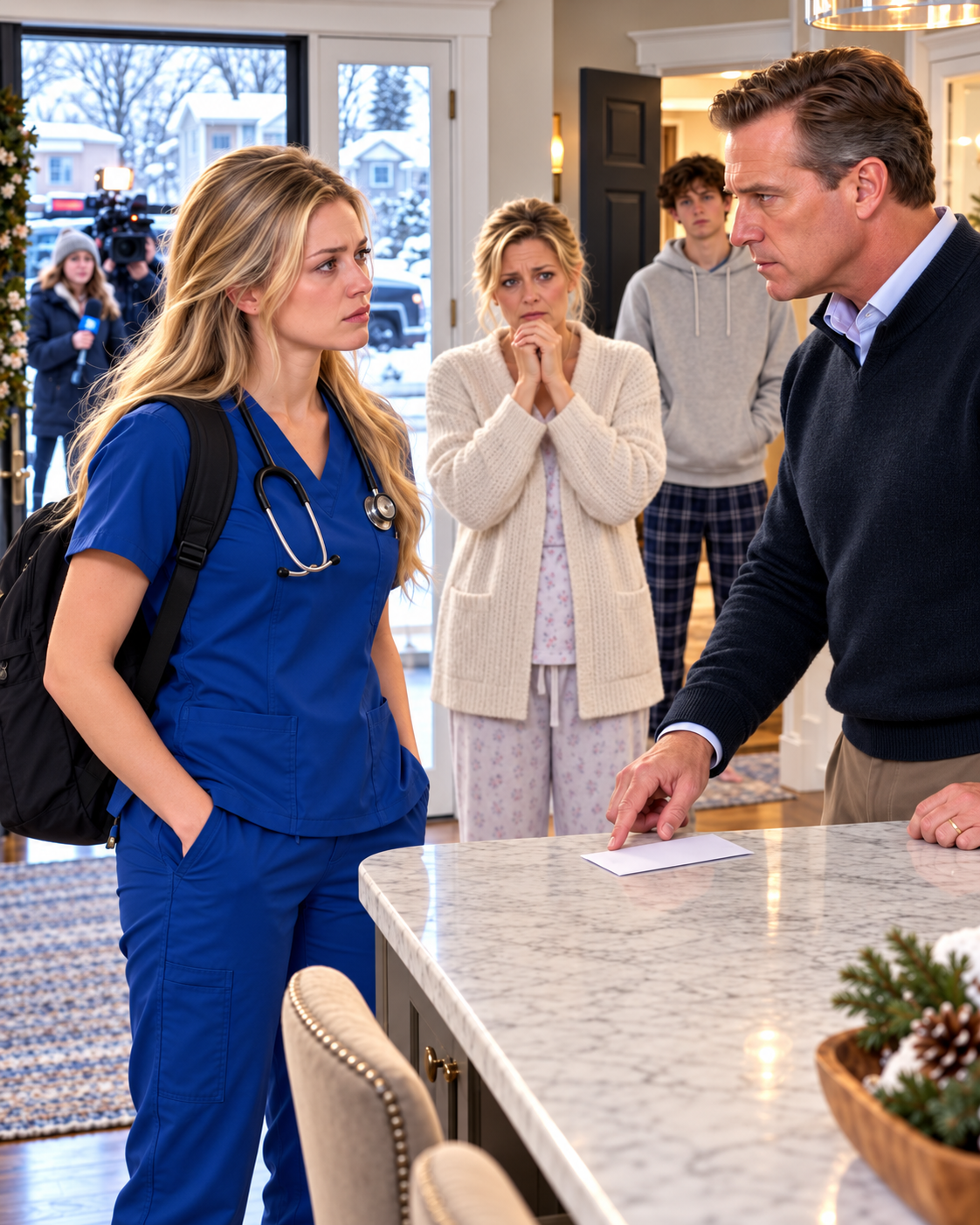
At 8:45, the doorbell rang downstairs. I heard Mom’s slippers crossing the entryway, followed by the deadbolt turning. A woman’s unfamiliar voice drifted upward. I slipped out of bed, put on a sweatshirt, and looked down from the landing. Mom stood in her pale-blue robe, one hand clutching the collar. Beyond the doorway was a woman in a bright red parka holding a microphone. A cameraman waited behind her, and a white Channel 7 news van was parked at the curb. The reporter introduced herself as Nina Alrech. Then she asked my mother a question that made the entire house seem to stop breathing: “Does the nurse who had to spend last night sleeping in her car live here?”
END PART 2
PART 3 TITLE: By Morning, the News Cameras Were Outside Our House, and My Father Had Already Prepared the Lie He Expected Me to Tell
For a moment, Mom didn’t answer the reporter. She tightened her robe around her chest and looked toward the staircase, where I was standing barefoot beneath the landing light. Nina Alrech followed her gaze and saw me. Her expression remained professional, but I noticed a small change in her eyes. She had found the person she was looking for. Outside, snow was still falling lightly, and the cameraman adjusted his equipment while a neighbor’s garage door opened across the street. I wondered how much he had already filmed before Mom answered the door.
Nina explained that a woman named Dana Brandt had published a message on the Facebook page for Brandt’s Bakery in Sartell. The post described how her seventy-one-year-old father had been rescued from a snow-filled ditch by a hospital nurse. It thanked the emergency responders and mentioned the unusually dangerous weather. But Dana had also described what happened to the nurse afterward. According to Nina, the post had been shared more than three thousand times since early morning. Channel 7 wanted to speak with the woman who had helped Walt, both about the rescue and about the night she had spent in her vehicle.
Mom placed one hand on the doorframe. “There must be some misunderstanding,” she began, but Dad appeared before she could continue. He was already dressed for the day in pressed trousers and a fleece bearing the name of his school. He took his place beside her with the ease of a man accustomed to managing difficult conversations. I recognized the expression immediately. It was the same face he wore when addressing angry parents who arrived in his office demanding explanations about discipline. He introduced himself politely and told Nina that I wasn’t available to speak.
Nina didn’t argue. She said the station could wait a few minutes and would appreciate an opportunity to thank me for helping Walt. I watched Dad weigh the situation. Telling the crew to leave might create a worse impression than letting them remain. He thanked Nina, asked for some privacy, and shut the door carefully. Then he turned the deadbolt. Across the street, Gloria Hogan had stopped shoveling her driveway. She stood with both hands resting on the handle, looking at our house with an expression that suggested she had heard enough to begin assembling her own explanation.
Dad turned toward the staircase. “Kayla. Downstairs. Kitchen.” His voice was quiet, but there was no invitation in it. I walked into my bedroom, pulled on a pair of socks, and joined the family downstairs. Mom was already seated at the island. Tyler stood near the refrigerator with his hands shoved into his pockets. He had apparently heard the doorbell and the conversation, although he wouldn’t look directly at me. Dad remained standing until I took my usual place. The familiar arrangement brought back years of family meetings in which he announced what had been decided and expected the rest of us to agree.
He began by describing the reporter’s arrival as an unnecessary embarrassment. He said people who hadn’t been present were making assumptions about the household and that a simple misunderstanding had escaped into the public. The important thing now, according to him, was to correct the account before anyone became more upset. He spoke with deliberate calm, as though he were resolving a complaint about a school bus route. I listened and waited for him to acknowledge that I had spent a night in a freezing car because he refused to open the door. That acknowledgment never came.
Instead, Dad outlined the explanation I was supposed to give Channel 7. The storm had caused the lock to freeze, he said. Rather than wake the family and create a disturbance, I had chosen to wait in the Corolla until morning. I should thank Walt’s relatives for their concern, express relief about his recovery, and avoid discussing private family matters. He stressed that the reporter’s main interest was the rescue, so there was no reason to prolong the conversation about the house. He spoke smoothly enough that somebody unfamiliar with the situation might have mistaken the story for something we had all agreed upon.
Mom touched my wrist across the counter. “Please, sweetheart,” she said. “Your father’s school is a small community. Parents talk to one another. Sometimes they take a piece of something and make it sound much worse.” She looked frightened, and I understood that she had already begun imagining the calls Dad might receive from work. I wanted to ask whether she’d imagined what could have happened if my car hadn’t started or if the exhaust had become blocked. Instead, I looked at her hand and remembered the message she had sent at 12:31. She had known enough about the danger to advise me on keeping warm.
Dad opened a kitchen drawer and removed an index card. Three numbered points had been written on it with a blue felt-tip pen. He placed it in front of me and explained that it would help me stay focused. The first point thanked the Brandt family and the emergency workers. The second referred to the supposedly frozen lock. The third returned the conversation to Walt’s condition. I recognized both the handwriting and the pen. Dad used the same blue marker on detention paperwork at school, and he had used it to write the household rules that hung on our refrigerator.
He had prepared the card before calling me downstairs. Perhaps before the reporter arrived. Perhaps while I was sleeping upstairs beneath Grandma’s quilt. I looked from the paper to my father and told him the lock hadn’t frozen. The key had turned without difficulty. The door itself had moved freely until the security chain stopped it. I had seen the chain with my own eyes. Dad’s expression tightened almost imperceptibly. “You’re focusing on the wrong detail,” he replied. “What matters is that nobody intended for you to be harmed.”
I asked whether refusing to open the door for six hours could really be described as an accident. He placed both palms on the counter and lowered his voice. He reminded me that the car outside was registered to him and that I was standing beneath a roof he owned. The meaning was unmistakable. My transportation, my inexpensive place to live, and the money I hoped to save depended on his willingness to continue our arrangement. He didn’t shout because he didn’t need to. He had spent years making those facts clear enough to summon without raising his voice.
Then Dad spoke about Dany. His older brother had died at nineteen, he reminded us, and Dad had attended the funeral when he was seventeen. He could still remember his mother grieving beside the grave. He said there were consequences for a family when young people refused rules, and he wouldn’t apologize for trying to prevent another tragedy. I knew the story. I also knew he had suffered deeply because of it. But the memory of Dany couldn’t explain why my father had been awake at 1:20 and had chosen to open the garage for Tyler while I remained outside.
I wanted to say all of that. I wanted to tell him his brother’s accident was not a reason to punish a nurse for stopping at another accident. But Mom’s face was pale, Tyler was staring at the floor, and a television crew stood in our driveway. I felt suddenly aware of how much the next few minutes might change. I was still exhausted from the night. My thoughts were clear, but my body felt shaky, and I didn’t want to make an important decision merely because I was angry.
“I need a few minutes alone,” I told him. Dad appeared ready to object, then looked toward the front window. The reporter and cameraman were visible beyond the curtains. He stepped away and told me to be quick. I left the index card on the counter, went upstairs, and closed my bedroom door. For several seconds, I stood beside the bed without moving. The room contained so much of my childhood that I had never thought to question: old photographs, the quilt from Grandma, nursing textbooks stacked against the wall, and a framed diploma Dad had hung himself. I wondered how a room could feel familiar and unsafe at the same time.
I called Dana. She answered immediately, sounding anxious. Before I explained why I was calling, she apologized for the news crew. Early that morning, after another update from the hospital, she had written about what happened to Walt. She had thanked the nurse who found him and described the effort required to get him safely into the ambulance. Then, still furious about discovering me in my car, she added the truth about the curfew and the chain. She hadn’t anticipated how quickly the message would spread. When Channel 7 contacted her, she confirmed the story and provided the street where I lived.
Dana admitted she should have asked before sharing details about my family. I sat on the edge of my bed, listening to her breathe on the other end of the call. Her regret sounded genuine. She wasn’t trying to persuade me that she had done nothing wrong. I told her I understood why she had been upset and that I hadn’t lied about what happened. Still, I needed to make my own decisions about what I told strangers. She agreed without hesitation. That simple acceptance startled me. I had become so accustomed to explaining myself that I wasn’t prepared for someone to respect a boundary the first time I stated it.
After a brief silence, Dana told me Walt was improving. His temperature was nearly normal, and the doctors expected to move him out of intensive care later that afternoon. He wanted to see me when visitors were permitted. I closed my eyes at the news. It was the first development that morning which didn’t require me to defend myself or worry about somebody else’s opinion. I promised to visit if his condition allowed it. Dana thanked me once more, then said she would speak to the reporter herself if I wanted her to. I told her that wouldn’t be necessary. I would decide what to say.
When the call ended, I looked at the coat folded on my chair. Dana had brought it back after leaving her father’s hospital room in the middle of the night. She had barely known me, yet she had crossed town in dangerous weather because she believed nobody should be left freezing outside a locked house. My mother had been upstairs in a warm bedroom, with a telephone in her hand and a door she could have opened. I didn’t think Mom was cruel. I thought she had been afraid of Dad’s reaction for so long that she had learned to treat inaction as the safest possible choice. Unfortunately, her safety had come at my expense.
I changed into clean clothes and pulled on my blue coat. Downstairs, Dad stood near the entryway waiting for my answer. I told him I was willing to speak about Walt and the rescue. He asked whether I understood the importance of the three points on his card. I didn’t take the card. Instead, I opened the front door and walked into the cold. He followed a few steps behind but didn’t try to stop me. Through the glass, I could see Mom standing beside the hallway table, both hands clasped against her chest.
Nina met me halfway down the driveway. She removed one glove to shake my hand and thanked me for agreeing to speak. Up close, she looked tired, with damp strands of hair escaping beneath her winter hat. She said she hoped to keep the interview brief because the temperature remained dangerous. I appreciated that she recognized the weather as a real hazard rather than a backdrop for a dramatic story. The cameraman checked the light and sound while I stood beside the Corolla. I could see fresh snow piled around the wheels, almost covering the marks left by Dana’s vehicle during the night.
Nina began by asking what I had seen on County Road 75. I described the barely visible hazard lights and the car lodged in the ditch. I explained why I had called emergency services before approaching, what I found when I reached Walt, and how I helped him into the heated Corolla while awaiting responders. I mentioned his history as a county plow driver and the way he kept making jokes despite his injuries. I avoided describing myself as a hero. The emergency crew had worked through dangerous conditions, and Walt’s survival depended on many people doing their jobs.
I also spoke about the nurses who had tried to reach the hospital through the blizzard. Several had traveled in nearly impossible conditions because the emergency department needed staff. I wanted viewers to know that Walt wasn’t the only person rescued or helped that night. There were ambulances moving through dangerous roads, dispatchers managing calls, snowplow operators clearing routes, and hospital teams caring for people whose names would never appear on television. Nina let me finish without interrupting. For the first time since coming home, I was speaking about something that made sense to me.
Then Nina lowered her microphone slightly. She said Dana’s post mentioned that I had been locked out because I arrived after a ten o’clock curfew. She asked whether it was true that I had spent the night in my car. Behind her, I heard the front door open. Dad had stepped onto the porch with his arms folded across his school fleece. Mom remained behind the storm door, and Gloria Hogan had appeared again beside the neighbor’s driveway. I looked toward my father. He gave me a small, controlled nod, the same signal he used when he expected me to repeat an answer we had practiced.
I turned back to Nina and said that I had reached home at about twenty minutes after midnight. The security chain had been in place, and I couldn’t enter. I confirmed that I had remained in my car until six. I didn’t describe Dad’s character, speculate about his motives, or ask the television audience to decide what kind of father he was. I told Nina I preferred not to discuss the rest of my family on television and would rather keep the attention on Walt and the people who helped him. My voice was steady. I hadn’t given the explanation Dad prepared, but I hadn’t attacked him either.
Nina accepted that boundary. She thanked me and gave me her business card, explaining that the report would air at noon and again at six. The cameraman recorded a final view of the snow-covered Corolla before lowering his equipment. As Nina prepared to leave, she said that I had done something worthwhile the previous night and that my decision to speak truthfully mattered too. I didn’t know how to respond. Behind me, the storm door closed quietly. Dad hadn’t slammed it. He never slammed doors. He preferred small, deliberate gestures that left everybody else to interpret the consequences.
Inside, the house had become unusually quiet. Dad went into his den and shut the door. Mom began wiping down a kitchen counter that was already spotless. Tyler crossed the hallway without speaking. I climbed upstairs, sat on my bed, and checked the messages arriving on my phone. Dana’s bakery post had drawn responses from people I didn’t know: a former county road worker who remembered Walt, a nurse in Duluth, and a grandmother in Fargo who said she was praying for both Walt and me. Most of the comments were kind, though some were sharper than I wanted to read.
One message came from Ava Linkfist. I hadn’t seen her in years, but I recognized her name immediately. She was twenty-one now and attending college in Mano. She asked whether I was the nurse in the story and mentioned the night I had stayed with her outside the school auditorium when her mother was late. She said she had never forgotten that I refused to leave her alone. I read her message several times. Seven years earlier, I had regarded that evening as the beginning of a humiliating punishment. Ava remembered it as the night an older student made sure she was safe.
Just before one in the afternoon, Marisol responded to my work email. The overnight position was still available, and she wanted me to take it. The start date would be February 9. She also said she was proud of me. I sat with the phone in my hands, considering how ordinary those words looked on the screen. There was no warning attached, no reminder not to become overconfident, and no condition requiring me to seek somebody else’s permission. I accepted the position before I could begin imagining how Dad would react.
Mom appeared in my doorway carrying an empty laundry basket. She stood there for several seconds before asking how cold it had actually been outside. I told her the temperature had reached twelve degrees below zero. Her eyes moved toward the bruises on my knees, then back to my face. She swallowed and nodded. I thought she might apologize or ask whether I had been frightened. Instead, she said she had some laundry to finish and walked away. I didn’t follow her. I was beginning to understand that I couldn’t keep doing both sides of every difficult conversation.
Later that afternoon, I drove to St. Cloud to see Walt. He had been transferred to a fourth-floor recovery unit, where I found him sitting upright in bed with a thick cast around his left arm and a dressing above his eyebrow. He was concentrating on a small bowl of red gelatin as though it demanded more skill than driving a snowplow. Dana sat near the window. When Walt recognized me without my scrubs, he put down his spoon and grinned. “There she is. The woman who thinks my car needs more attention than I do.”
I laughed for the first time since leaving the hospital the night before. Walt motioned toward the chair beside his bed and asked me to sit. Dana had told him what happened at my parents’ house, and he didn’t waste time pretending otherwise. He asked whether I had finally slept somewhere warm. I said that I had. He looked relieved, then began describing how often he had worked through storms during his thirty-one years on county roads. According to him, a snowdrift didn’t disappear because somebody had established a schedule. A person either dealt with the conditions in front of them or left somebody else in danger.
He reminded me that Minnesota expected motorists to report certain accidents and render appropriate assistance when it was safe to do so. Then he observed that I had fulfilled that responsibility while violating my father’s household curfew. Walt didn’t tell me what to do about my family. He simply pointed out that rules could have different purposes, and that an instruction meant to protect people shouldn’t become a reason to abandon someone in need. I listened because he was discussing consequences I understood. I had spent the night helping him survive. My father had spent it teaching me obedience.
Dana eventually leaned forward and said she wanted to propose something. Walt owned a duplex in Sock Rapids, approximately ten minutes from my parents’ home. The downstairs apartment was his, while the upstairs unit had been empty since Joanie died. His doctors wanted somebody nearby during the first several weeks of his recovery, especially while his wrist remained in a cast. Dana couldn’t stay there because her father insisted she hovered over him. Walt immediately confirmed that she did, which earned him a patient look from his daughter.
The last upstairs tenant had paid seven hundred and fifty dollars per month, Dana explained. She offered me the same rent and said they wouldn’t require an immediate security deposit. I looked from her to Walt, uncertain how to respond. The amount was more than I paid Dad for my room but far less than I had expected to spend on a separate apartment. The location would allow me to continue working in St. Cloud. More importantly, the arrangement would give me a place where the front door wasn’t controlled by somebody who considered my independence a disciplinary problem.
I told Dana I would pay a proper deposit if I moved in, but I needed some time to consider the offer. Walt accepted the answer without complaint. He told me that careful thinking was sensible, provided I didn’t do it while freezing in a driveway. When I stood to leave, he reached for my hand with his uninjured one. His grip was warm and surprisingly strong. I promised to visit again, and he reminded me to keep the army blanket until I needed it less than he did. I thanked both of them and left the room feeling that an actual decision, rather than an impossible wish, had finally become available.
The roads had been cleared when I drove back toward Larksburg Court. At 5:58, I parked the Corolla in its usual place and noticed the living-room lights shining through the curtains. I entered with my key, grateful that the chain was no longer fastened. From the hallway, I could hear a television announcer introducing the evening news. Dad, Mom, and Tyler were seated in front of the screen. Nobody turned to greet me. Then I heard the announcer mention an elderly man rescued from a ditch during the blizzard. The screen filled with the image of Walt in his hospital bed, smiling and raising his good hand. Dad picked up the remote, but he didn’t turn the television off. He waited for my interview.
END PART 3
PART 4 TITLE: My Father Offered to Change the Rules After His Secret Came Out, but He Still Expected Me to Ask Permission
The television report began with footage of County Road 75, where wind had pushed fresh snow across the shoulders and nearly erased the tire tracks from the previous night. Then the image changed to Walt sitting in his hospital bed, holding up his uninjured hand while the reporter described his rescue. Dana appeared outside her bakery, explaining how frightened she had been when she learned her father was missing during the storm. She described receiving a telephone call about the accident and discovering that a young nurse had found him in time. I stood near the living-room doorway, listening to a familiar event become somebody else’s news story.
The cameraman had captured me beside the Corolla, explaining why I called emergency dispatch before approaching the stranded vehicle. My face looked pale and tired, and the coat I wore seemed too large around my shoulders. I hadn’t realized how exhausted I appeared. The reporter included a brief explanation about keeping exhaust pipes clear during winter emergencies, followed by my comments about the other hospital workers who had struggled through the storm. I felt relieved that the segment treated their efforts respectfully. For several seconds, it seemed possible that Dad would watch the whole report and finally understand why I had been late.
Then Nina’s voice introduced the other part of the story. She explained that the nurse who helped Walt had been unable to enter her family home after arriving past a ten o’clock curfew. The camera showed our snow-covered driveway. My recorded voice followed, confirming that I had reached the house shortly after midnight and found the security chain fastened. Dad turned off the television before the rest of my answer could play. The sudden silence made the refrigerator in the adjoining kitchen sound unusually loud. I waited for him to say something about Walt or the danger of the storm.
Instead, Dad placed the remote beside his chair and looked down at his phone. A message had arrived while the report was airing. He read it without changing his expression, although his jaw tightened. After a moment, he stood and told everyone to come to the kitchen. Tyler rose immediately. Mom switched off a lamp and followed him. I remained near the doorway long enough to notice that my father hadn’t looked at me once since I entered the room. He wasn’t interested in my account of the rescue anymore. He was interested in what the television report might cost him.
Dad occupied his usual chair at the head of the kitchen table. Mom sat to his right, and Tyler took the chair nearest the hallway. I remained standing until Dad indicated that I should sit. He placed his phone facedown beside his plate, positioning it carefully against the edge of the table. I recognized the gesture from family discussions about grades, curfews, and decisions he considered settled before the conversation began. At school, he used a similar approach when interviewing students who had been sent to his office. The careful arrangement of ordinary objects made the room feel like an administrative hearing.
“The principal just contacted me,” he said. Dr. Kesler, he explained, had asked whether he would prefer to step away from Monday’s character counts assembly. He repeated the suggestion with visible disbelief. He had helped organize those assemblies for years, speaking to students about responsibility, honesty, and the importance of keeping commitments. Three parents had already called the school asking about the story. More people were commenting on Dana’s bakery page, and some appeared to recognize Dad as the assistant principal responsible for enforcing discipline at their children’s school.
He picked up his phone and read several comments aloud. One parent questioned whether he was the same administrator who regularly assigned detention to students arriving a few minutes late. Another expressed concern for the nurse in the story. Dad’s voice grew harder with each message. He reminded us that he had dedicated twenty-six years to education and had always believed rules were meaningful only when people followed them. Now, he said, strangers were laughing at him because his own daughter had allowed a private disagreement to become public entertainment.
I considered pointing out that I hadn’t contacted the news station, but I knew he had already heard that explanation. What troubled him was not how the story became public. It was the fact that people could judge his decision without first accepting his authority to make it. His reputation mattered enormously to him. He had built it through punctuality, controlled speech, and an almost obsessive attention to procedure. I could understand why the television report embarrassed him. I couldn’t understand why his embarrassment seemed more urgent than the possibility that I might have been seriously harmed.
Dad leaned forward and said the situation could still be corrected. He wanted me to return to Dana’s Facebook post and publish a statement explaining that the public had misunderstood the incident. According to the version he proposed, snow and ice had made the lock difficult to operate. I had decided not to disturb the family and had voluntarily remained in the car until morning. He expected me to apologize for the confusion and ask Dana to revise her post. Then, he believed, the school community would have little reason to continue discussing our family.
I told him that I couldn’t write a statement describing something that hadn’t happened. The lock had functioned properly, and the chain had prevented the door from opening. Dad held up his hand before I could finish. He said the exact mechanical details were unimportant. What mattered was explaining that the incident hadn’t been an intentional act of cruelty. I asked how he intended to explain Tyler entering the garage while I remained outside. My father ignored the question and continued discussing the statement, as though he hadn’t heard me.
Finally, he placed his phone on the table and gave me a choice. I could publish the correction that evening and put the matter behind us, or I could move out by the following Friday. If I chose to leave, the Corolla would remain at the house because its registration was in his name. He repeated that fact slowly, making sure I understood the consequences. There would be no extension, he said, and he didn’t want an argument about money I had already paid. I had agreed to follow the rules when I moved back home. If I no longer accepted them, I could arrange another place to live.
Mom’s hands were clasped so tightly that the skin around her knuckles had turned pale. Tyler looked down at the table. I thought of the savings account I had checked that morning and the apartment Dana had offered. Dad didn’t know about either one. For years, he had been able to end difficult conversations by reminding me that I depended on him for transportation and housing. Those reminders had worked because I believed losing either would be disastrous. Now, for the first time, I could picture a practical alternative. I wasn’t certain I could manage it easily, but uncertainty was different from impossibility.
Then Dad’s expression changed. He looked older suddenly, and the anger in his face gave way to an exhaustion I remembered seeing only a few times. He removed his glasses and set them on the table. When he spoke again, his voice was unsteady. He said I couldn’t understand what it had been like to attend his brother’s funeral at seventeen. Dany had been nineteen when he died in the crash. Dad remembered standing beside his parents while the casket was lowered, watching his mother become so overwhelmed that relatives had to hold her upright. He described the silence afterward, when nobody knew what to say.
He had spent years believing that the accident could have been prevented if Dany had faced stricter limits, he continued. The family had been too trusting, too willing to allow young people to make their own decisions. Every rule Dad established in our home grew from his determination never to stand beside another grave like that one. He looked at me as though this history should answer every question I had raised. His grief was real. I could hear it in his voice, and I believed that the memory still frightened him.
I had heard the story of Dany so often that it had become part of our family’s understanding of the world. I knew why Dad feared reckless driving, late-night parties, and situations he couldn’t control. For years, I had accepted the curfew as the imperfect expression of a father who loved his children. But I had been working at a hospital during an emergency. I had been driving cautiously through dangerous conditions. I had stopped because another person needed help. None of those actions resembled the careless behavior Dad feared, and sleeping in a car during a blizzard hadn’t made me safer.
I wanted to tell him that his brother’s death deserved compassion without becoming an explanation for every decision he made afterward. I wanted him to recognize that fear could lead a person to cause the very danger he claimed to be preventing. But I also understood that discussing Dany would allow the conversation to drift toward grief, responsibility, and all the things Dad believed he had done correctly. There was a simpler question waiting in the room. It involved a garage door, a kitchen light, and the fact that two children had come home late during the same storm.
I turned toward Tyler. “When did you get home last night?” I asked. My brother looked up, startled. He glanced at Dad before answering. Dad said the question wasn’t relevant because Tyler had called ahead to request permission. I kept my eyes on my brother and asked him to tell me the time. Tyler shifted in his chair. He had never enjoyed being placed between Dad and me. As children, he usually escaped trouble by remaining quiet until an argument ended. I could see that old instinct working in him now.
He looked at the salt shaker, then at his folded hands. After a long silence, he said he had arrived at 1:20 in the morning. His voice was barely audible. I asked whether he had opened the garage himself. Tyler shook his head. Dad, he explained, had already been standing near the control beside the mudroom. The door had begun lifting before Tyler reached for the remote in his truck. My brother stopped speaking and looked down again, as though the answer were something he could return to the table and leave there.
Mom turned toward Dad. The movement was slow enough that I noticed it before anyone spoke. She asked whether he had been awake when Tyler came home. Dad said Tyler had requested permission earlier in the evening and that he had simply followed the arrangement they made. Mom repeated her question. She wanted to know whether Dad had been awake inside the kitchen while I was sitting in the driveway. He adjusted his glasses and said the facts were being distorted. Then Mom told him that he had claimed to be asleep when she asked about opening the door.
I looked at her. I hadn’t known she had asked him. During the night, I had assumed she was following his rule without protest. Now I understood that she had at least raised the possibility of letting me inside. Dad had apparently told her his phone was off and that nothing could be done until six. She had accepted that explanation, even though she knew I was outside in the cold. The discovery didn’t erase her responsibility, but it made the events of the night more complicated than I had realized. Dad hadn’t merely enforced a rule. He had concealed how deliberately he was enforcing it.
Mom’s voice remained quiet. She asked him whether he had seen my car through the kitchen window. Dad answered that he knew I was safely parked on our property. Mom repeated the question. He didn’t deny looking outside. She reminded him that I had spent part of the night helping an injured man out of a ditch and had given away my coat. I watched her struggle to say the next words. Then she asked how he could stand in the warm kitchen, open the garage for Tyler, and refuse to admit his daughter while snow gathered around her vehicle.
Dad began to explain that Tyler had asked permission. Mom interrupted him. I had heard her raise her voice occasionally over the years, usually when somebody forgot an appointment or left a mess in the kitchen. This was different. She wasn’t shouting. She simply continued speaking after Dad tried to take control of the conversation. She told him that nobody in the family would publish a false statement about the storm. She looked at Tyler and then at me, making it clear that she included everyone in the decision. Dad stared at her, apparently more surprised by the interruption than by anything she said.
For several seconds, nobody moved. The kitchen clock ticked above the doorway. I remembered watching its hands during countless evenings when I had hurried through dinner or left social events early to be home before ten. Now it marked a silence my father couldn’t immediately fill. He leaned back, removed his glasses again, and rubbed the bridge of his nose. When he spoke, his voice had lost much of its sharpness. He said perhaps the curfew had become impractical for my work schedule. He was willing to reconsider the exact hours.
Dad rose and crossed to the refrigerator. He removed the laminated list of house rules from beneath its magnet and brought it to the table. Using his familiar blue marker, he crossed out ten and wrote eleven. Then he added an exception allowing me to return as late as midnight on work nights, provided I contacted him before ten. He explained that the arrangement would give me greater flexibility without abandoning the structure he considered necessary. If everyone accepted the adjustment, there would be no further discussion online, and perhaps Dr. Kesler would forget the controversy by spring.
Mom looked at the revised rules with visible relief. She said eleven sounded reasonable, particularly with the midnight exception for hospital shifts. Tyler remained silent, but his shoulders relaxed slightly. I knew what both of them hoped. If I accepted the new schedule, we could stop discussing the blizzard. Dad could return to his school duties. Mom could return to her familiar routines. Tyler would no longer have to answer uncomfortable questions. I could remain in my bedroom upstairs and continue saving money until June. The family would settle back into the arrangement we all knew.
I looked at the numbers on the laminated page. Eleven instead of ten. Midnight for work, as long as I sent a message beforehand. It was the largest concession Dad had ever offered me. A week earlier, I might have accepted it with genuine gratitude. I would have regarded the change as proof that I had finally persuaded him to understand the demands of nursing. I might even have thanked him for trusting me. The thought embarrassed me now, but it was true. I had spent so much of my life measuring independence by the amount of permission he granted that an additional hour seemed like a meaningful victory.
The practical advantages were real. Six hundred dollars in board was cheaper than renting Walt’s apartment for seven hundred and fifty. Staying would allow me to postpone buying another vehicle. I could continue saving while paying down my student loans, and I wouldn’t have to face the awkwardness of moving out immediately after a televised family dispute. Mom would still be nearby. Tyler and I could continue sharing the occasional late-night joke or argument in the kitchen. I might avoid becoming the daughter relatives whispered about during family gatherings.
For several moments, I almost accepted. I imagined the relief of telling everyone that we had reached an agreement. I imagined going upstairs, putting away my coat, and waking the next morning in the room I knew so well. I could even imagine explaining to Marisol that I had reconsidered the night position because things at home had improved. But then I remembered the people who had spent the previous night making different choices. Brooke had fought through the storm to relieve exhausted colleagues. Trooper Hansen and the paramedics had driven unplowed roads to reach Walt. Dana had left a warm hospital building to bring a blanket to somebody she barely knew.
I thought of Walt asking about my safety from his intensive-care bed. I thought of Ava’s message, thanking me for staying beside her in an empty parking lot seven years earlier. Those people hadn’t requested proof that helping was convenient. They had responded to the circumstances in front of them. My father, who insisted that rules were designed to protect me, had watched from his kitchen while the temperature dropped around my car. I couldn’t make those two facts fit together, no matter how many times he changed the hour on the refrigerator.
Dad slid the laminated sheet toward me. He explained that he was prepared to make this adjustment for my benefit and expected me to appreciate the compromise. Then he added that he was willing to allow the new schedule. The word stayed with me. Allow. He had not said he was sorry for leaving me outside. He had not said that an adult nurse should be able to work the hours required by her profession. He had offered to extend the limits of my freedom while reserving the right to withdraw it whenever he decided I had crossed another line.
My gaze moved toward the hallway, where my hospital bag rested beneath the coat rack. The identification badge attached to its lanyard had opened secured hospital doors all week. At work, I could make decisions that affected whether somebody received treatment quickly enough to prevent a serious complication. I was trusted to recognize emergencies, administer prescribed medications, and monitor people whose lives depended on careful attention. But in my father’s kitchen, I was being told that arriving home at midnight was a privilege granted by a man who had watched me endure dangerous cold.
I reached for the lanyard around my neck. My badge swung against the table when I laid it down. Attached to the same ring was the house key Dad had given me when I was twelve. I remembered how proud I had been to receive it. He had explained that carrying a key meant I was old enough to be trusted with a small responsibility. I had kept it through high school, nursing school, and the first eighteen months of my career. Now I worked it loose from the ring and placed it carefully beside his plate.
Dad watched without speaking. I took the Corolla key from my pocket and laid it next to the house key. The two pieces of metal made a small sound against the tabletop. Mom looked from the keys to my face, and Tyler sat up straighter. I told Dad he was right about one thing: the car was registered to him. He could keep it. The house belonged to him as well, and he had every right to decide who lived there. But I was twenty-four years old, and I could decide whether I wanted to remain somewhere that required me to earn permission to come inside.
Dad asked whether I understood what I was doing. I told him that the problem had never been the exact curfew. It was his decision to leave me outside when he knew I was in danger. He had stood beside the garage control while I struggled to stay warm because proving the authority of his rule mattered more to him than opening a door. I couldn’t continue pretending that was protection. I told him I would not live in a home where being denied shelter was considered an appropriate lesson.
His eyes moved toward the keys. Then he asked where I intended to go without a vehicle. The question was practical, and I knew he expected it to expose the weakness in my decision. For years, practical problems had been the reason I stayed. This time, I had an answer. I remembered Dana sitting beside Walt’s hospital bed, explaining that the upstairs apartment was empty. I remembered Walt accepting my request for time without attempting to control my decision. I took my phone from my pocket and found Dana’s number.
She answered on the second ring. I could hear movement and the distant sound of someone speaking in the background. I asked whether the apartment above her father’s home was still available. For a moment, she was silent. Then she said it was and asked whether I wanted to see it that evening. I glanced around the kitchen. Dad sat motionless, his hands folded beside the keys. Mom was watching me with tears gathering in her eyes. Tyler looked as though he wanted to speak but couldn’t find the words.
I told Dana I wanted to take the apartment, provided the terms we had discussed still stood. She said they did. There was no hesitation, no sudden condition, and no demand that I explain why I had changed my mind so quickly. She told me there was a spare key beneath the doormat and that she would drive over to help me move my belongings. I thanked her and ended the call. Dad pushed back his chair. He looked once more at the revised rules, then walked into his den and closed the door.
I remained at the table for several seconds, looking at the two keys. They represented a car I had used for years and the only home I had ever known. Leaving them behind would complicate my life immediately. I would need transportation, a lease, and a new budget. I would also need to accept that my father might never agree with the choice I had made. Mom reached across the table as though she intended to take my hand, then stopped. I stood, picked up my hospital badge, and left the keys where they were.
Upstairs, my bedroom looked unchanged. The nursing diploma remained crooked on the wall. My textbooks were stacked beside the desk, and Grandma’s quilt lay rumpled across the bed. I opened the closet and pulled out my suitcases. For once, I wasn’t packing because I had been ordered to go somewhere or because I was trying to meet a deadline imposed by my father. I was preparing to move into a place where I could return from work without asking whether I would be admitted. I unfolded the first suitcase and began choosing what to take.
END PART 4
PART 5 TITLE: With a Television Camera Waiting Outside, I Had to Decide Whether My Father’s Reputation Was Worth Another Lie
The index card remained on the kitchen counter after I walked away from it. Three numbered instructions, written in the blue ink my father used when signing disciplinary reports at school. He had arranged each sentence as carefully as he arranged everything else in our household. There was an explanation for the night before, an expression of gratitude for Walt’s rescue, and a polite closing that would send the television crew away. All I had to do was repeat the words. By lunchtime, he believed, everyone would have forgotten that his twenty-four-year-old daughter had spent a night in a freezing car because he refused to open his front door.
From my bedroom window, I could see the Channel 7 cameraman adjusting his equipment beside the driveway. His boots had disappeared into the fresh snow. The reporter, Nina Alrech, stood near the television van, speaking quietly into her phone. Across the street, Gloria Hogan had stopped clearing her sidewalk. She leaned on her shovel and watched the house with an expression I couldn’t read. For years, my father had told us that private family matters belonged inside the family. Now strangers were standing outside our home because something that happened inside it had become impossible to explain away.
My phone was still warm from my conversation with Dana Brandt. She had apologized for writing about my experience on her bakery’s Facebook page without asking permission. I believed her. When she arrived at my car in the middle of the night, carrying my coat, coffee, and Walt’s old military blanket, she had been concerned about whether I would survive until morning. The idea that somebody could have witnessed my situation and felt compelled to tell other people was unfamiliar to me. I had spent so many years protecting my father’s image that I had forgotten other people might consider the truth more important than his comfort.
Dana had also told me that Walt was improving. His temperature was approaching normal, his fractured wrist had been stabilized, and the medical team hoped to transfer him from intensive care later that afternoon. He had asked repeatedly about me. When she mentioned my name, he apparently wanted to know whether I had finally found somewhere warm to sleep. That concern stayed with me after we disconnected. A man I had known for less than an hour was worrying about my safety from a hospital bed, while my own father was downstairs deciding which parts of my night were acceptable for public discussion.
I sat beside my unmade bed and examined my hands. The skin around my knuckles was dry and cracked. A faint bruise had begun developing where I had caught Walt’s weight while helping him climb out of the ditch. My knees hurt whenever I bent them. None of those things surprised me. At the hospital, I regularly worked through physical discomfort without noticing it until my shift ended. What unsettled me was remembering that I had treated a stranger’s injuries with more consideration than my father had shown when I came home exhausted, wet, and frightened.
The voice I used to defend him was still present in my head. He had lost his brother Dany when they were young. He believed rules could prevent tragedy. He had paid for groceries, maintained the house, and encouraged me to finish nursing school. Those facts were real. So was the chain across the front door. So was Tyler entering through the garage at 1:20 while I sat outside. So was the little message from Mom instructing me to keep my engine running until six. I could acknowledge everything my father had done for me without pretending the previous night had been harmless.
I opened the small credit-union application on my phone and looked again at my savings. Five thousand two hundred dollars. For eighteen months, I had treated that number as the beginning of an escape plan I was not yet brave enough to call an escape. I paid six hundred dollars every month to live at home and another hundred fifty toward the Corolla, although the car remained registered to Dad. My student loans were still substantial. Moving would mean accepting expenses I had carefully avoided. Until that morning, I had imagined leaving in June, after collecting enough money to make the decision appear sensible to everyone, including him.
Downstairs, a cabinet door closed. I knew the sound of each one. Mom would be putting away cups that were already clean, searching for something practical to do while waiting for the problem to disappear. My father would be standing near the counter, perhaps checking the time, perhaps wondering why I had not returned with an apology. I thought about asking Mom to come upstairs and talk privately. But I had already asked her for help during the night, and her answer had been to leave me outside. Another conversation would not change what had happened.
I pulled on my returned coat. Its sleeves were still slightly damp around the cuffs, and the wool smelled faintly of the hospital laundry room. I slipped my phone into one pocket and went downstairs. Dad was waiting at the foot of the steps, precisely where I expected him. His expression softened when he saw that I was dressed to go outside. For a moment, I recognized the look he used when one of his students finally agreed to follow instructions after a lengthy conversation. He believed we had reached an understanding.
“Have you thought about what I said?” he asked. His voice was quiet enough that Mom, standing by the sink, probably couldn’t hear. I looked toward the front door. Through its glass, Nina was speaking to the cameraman. I told Dad that I intended to discuss Walt and the people who had helped us during the storm. He studied me, waiting for the rest. “And the other matter?” he asked. “I won’t turn Walt’s story into an argument about our family,” I said. That was the only promise I could honestly give him. His eyes narrowed, but he moved aside.
The cold outside caught in my throat. I had been warm for several hours, yet my body reacted to the air as though the night were beginning again. Snow had accumulated along the edge of the Corolla’s windshield. I noticed the exhaust pipe beneath the rear bumper, partly hidden by a small ridge of powder left by the wind. My hand moved instinctively toward my pocket, searching for the gloves I had worn while helping Walt. They were upstairs. I kept walking. Nina saw me coming and immediately stepped away from her equipment.
She introduced herself again, this time without the distance created by the doorway. Up close, she looked tired. Snow had melted along the shoulders of her red parka, and her eyes were slightly bloodshot. She shook my hand with a firm grip. “I appreciate you coming out,” she said. “Walt’s family is very grateful. We wanted to hear what happened from you.” There was no theatrical excitement in her voice. She spoke like someone accustomed to meeting people during difficult mornings and trying not to make those mornings worse.
I began with the road. Highway 10 had been closed, so I had taken County Road 75 toward home. Visibility was poor enough that I could barely distinguish the road’s edges. The orange hazard lights appeared first, glowing through the blowing snow from below the shoulder. I had pulled over, activated my own flashers, and called 911 before approaching the ditch. I described finding Walt beside his car with blood on his forehead, his left wrist badly injured, and his clothes soaked through. I remembered his teeth chattering so violently that he struggled to explain what had happened.
Nina listened without interrupting. She asked what had made me stop when the weather was already dangerous. I thought about the question longer than I expected. At work, I had learned that emergencies demanded decisions, not lengthy consideration. But that alone wasn’t the answer. I had recognized another person who couldn’t safely get himself home. The same instinct had kept me beside fourteen-year-old Ava Linkfist years earlier, after our school rehearsal ran late and her ride was delayed. I couldn’t remember ever deciding that helping someone was optional merely because it would inconvenience me.
“Anyone who saw that car should have called for help,” I answered. “I had training, so I could do more once I reached him. But the first thing was getting somebody there.” I explained how I had supported Walt up the slope, helped him into my passenger seat, replaced his wet outer layer with my coat, and wrapped him in an emergency blanket. I told her that he had spent thirty-one years driving a county snowplow, and that he had somehow found enough energy to joke about being rescued from a road he once kept clear.
The cameraman shifted to record the Corolla. Nina asked about the danger of remaining in a stranded vehicle during a blizzard. I described why I had checked the tailpipe, how accumulated snow could trap exhaust, and why someone waiting for assistance should avoid unnecessarily exposing themselves to the elements. I was more comfortable answering those questions than talking about myself. They were practical, useful things. I could imagine a frightened driver hearing them during another storm and making a safer decision. For a few minutes, the circumstances that brought the crew to our driveway seemed less important than the possibility that Walt’s experience could help someone else.
Then I mentioned the hospital staff. Two night nurses had been stranded on the roads, which was why my supervisor needed me to remain past my scheduled shift. Another nurse, Brooke, had fought through the weather to reach us. Marisol and the others had kept the emergency department functioning while patients arrived with injuries from the ice and snow. I explained that nobody had done anything extraordinary by choosing to care for those patients. We had simply refused to leave them without help. Nina nodded and asked whether I was worried about getting home after such a long shift. “Of course,” I said. “But there were people waiting for us.”
The question that followed was quieter. Nina lowered her microphone before raising it again. “Dana told us you couldn’t get into your parents’ house when you returned. She said you spent the night in your car because of a ten o’clock curfew. Is that accurate?” For a moment, I watched a little gust of snow travel across the driveway. I knew exactly where my father was standing without looking. The storm door had opened behind me, and I could hear the faint creak of its hinge.
I turned my head. Dad stood on the porch wearing his school fleece, arms crossed loosely in front of him. Mom was just inside the glass door. Gloria remained across the street, her shovel resting against her shoulder. My father gave me a small, familiar nod. He used to offer that same gesture from the bleachers before I stepped up to take a free throw. When I was younger, it had reassured me that he believed I could do what was expected. That morning, it meant something different. He was reminding me to obey.
I faced Nina. “Yes,” I said. “I arrived home shortly after midnight, and the security chain was fastened from inside.” I heard how evenly the words came out. At work, I had learned to give difficult information without allowing my voice to become another source of alarm. I continued before I could begin apologizing for telling the truth. “I don’t want to discuss my family on television. I’d rather keep the attention on Walt and the people who helped him.” Nina considered my answer, then nodded. She didn’t press for an accusation or ask me to explain why someone had left me outside.
Something moved behind me. The storm door closed. It made hardly any noise, just a small mechanical click as the latch settled. I had heard that sound thousands of times while coming home from school, carrying grocery bags, or leaving for work. Now it seemed almost deliberate. My father had heard me refuse his version of events. I couldn’t take back what I had said, and I had no desire to correct it. Still, the old fear arrived: what would he do when the cameras left?
Nina thanked me and handed over her business card. The report would air at noon and again at six that evening. She told me Walt’s family would likely be interviewed separately at the hospital or bakery. Before leaving, she looked toward the house and then back at me. “You handled a hard situation well,” she said. Her expression made clear that she wasn’t speaking only about the roadside rescue. I tucked the card into my coat pocket. I had accepted compliments from patients before, but this one embarrassed me because it concerned something I had barely allowed myself to consider an accomplishment.
Inside, the house had become quiet. Dad had closed himself in his den. Mom was wiping the kitchen counter with slow, unnecessary strokes. Tyler was nowhere in sight. I passed the island where the index card remained and went upstairs without touching it. In my room, I sat on the edge of the bed and waited for the familiar urge to repair the damage. Usually, after a disagreement, I would find Dad and explain that I hadn’t meant to upset him. I would apologize for my tone even when I had spoken calmly. The habit was so old that resisting it felt like forgetting an important duty.
My phone interrupted the silence. Dana’s bakery post had reached people far beyond Sartell. Former coworkers of Walt were sharing memories of driving snowplows with him. Nurses were offering encouragement. Some strangers were furious about the night I had spent outside; others wanted to know whether I needed somewhere to stay. I put the phone aside when the comments became overwhelming. I didn’t know those people, and I wasn’t prepared to surrender my private life to them simply because they were sympathetic. Their concern mattered, but it wasn’t a substitute for making my own decisions.
Then a message appeared from Ava Linkfist. I hadn’t seen her in years. She was attending college in Mankato, and her profile photograph showed a young woman with the same serious eyes I remembered from our school theater days. She had recognized my name in the news. Her message reminded me of the night I stayed in a parking lot with her until her mother arrived. She said she had never forgotten being frightened beneath that single working light, or my promise not to drive away while she was alone.
I remembered hiding her thank-you card after opening night because it referred to my father’s anger over coming home late. The card had remained in my desk through nursing school, folded between old programs and photographs. I stood, opened the bottom drawer, and found it almost immediately. Ava’s handwriting was uneven and enthusiastic. She had thanked me for making sure she was safe. I sat with the card in my hand for a long time. At seventeen, I had already known which mattered more: arriving home punctually or abandoning someone who needed help. Somehow, I had spent the next seven years pretending the answer was less clear.
Shortly before one, a message arrived from Marisol. I had almost forgotten the email I sent after my shower that morning. She answered my inquiry about the overnight nursing position without hesitation. The job was still available. The schedule would run from seven in the evening until seven-thirty the following morning, with the additional hourly pay she had mentioned. If I wanted it, she could arrange for my transfer to begin on February ninth. The message ended with a simple expression of pride. No warning followed it. No conditions. She wasn’t asking whether my father would approve.
I read the offer twice. Four months earlier, I had turned down the same opportunity because the hours were incompatible with Dad’s curfew. I had described my decision to coworkers as a matter of family convenience, and I had nearly convinced myself that was true. Now I pictured the trauma patients arriving overnight, the experience I could gain, and the confidence that might come from choosing work according to my professional abilities rather than household restrictions. The increased pay would help with rent and eventually a vehicle. More importantly, the position belonged to the life I wanted, not the one I had been permitted to consider.
Mom appeared in my doorway holding a laundry basket. There was nothing in it except a folded towel. She stood there for a moment, looking at the card in my hand and then at the bruises visible beneath the hem of my pajama pants. “Was it really that cold?” she asked. I looked up. She had read my message during the storm. She knew I was outside. Yet she seemed unable to reconcile the words on her phone with the reality of what the temperature had done to me. “Twelve below zero,” I said. “That was what the car showed.” She lowered her eyes. “I didn’t realize,” she whispered.
I wanted to ask how she could fail to realize what happened to a person sitting in a vehicle through a Minnesota blizzard. I wanted to know whether she had considered opening the door herself, or whether Dad’s rules had become so ordinary that she no longer recognized danger when it was directly outside her window. But the expression on her face told me she was only beginning to ask herself those questions. I wasn’t going to answer them for her. She left the room with her nearly empty basket, moving slowly down the hall.
After she was gone, I took my phone and opened Marisol’s message again. I could still hear my father telling me that accepting night work would be irresponsible, that respectable young women didn’t arrange their lives around the hours after dark. I remembered the approval in his voice when I had refused the position the first time. Then I thought of Brooke arriving through the ambulance entrance with snow in her hair, and of the patients whose care continued because nurses were willing to work when other people were sleeping. I typed my answer before I could reconsider. I accepted the job, thanked Marisol, and confirmed the February ninth start date.
When I pressed send, nothing dramatic happened. The house stayed quiet. No one knocked on my door. My savings remained the same, and the blue Corolla was still registered in Dad’s name. Yet I had committed myself to working twelve-hour nights, something his household rules could never accommodate. I opened my calendar and looked at the approaching start date. A place to live was no longer something I could postpone until June. For the first time, I had made a consequential decision without seeking permission, and now I would have to find somewhere that decision was allowed to exist.
END PART 5
PART 6 TITLE: The Man I Pulled From the Snow Offered Me Something My Own Family Had Never Allowed Me to Ask For
By midafternoon, I had made a decision about the next twelve months of my life and still had no idea where I would sleep when those months began. My father owned the Corolla I drove. He controlled the house where I kept my belongings. Even the arrangement that had allowed me to save money depended on accepting rules that could leave me outside in dangerous weather. I had spent the morning telling myself that the television interview was behind me. But when I looked toward the driveway, I understood that the difficult part had not yet begun. The consequences would arrive when Dad watched the report.
I needed to get out of the house before then. I changed into jeans and a clean sweater, pulled on my coat, and took my keys from the hook near the mudroom. They hung beside Dad’s keys, exactly where they had hung for years. I could hear voices behind his den door. He was speaking on the telephone in the measured tone he used with parents at school, a tone that suggested he was the reasonable person in any disagreement. I couldn’t make out the words. Mom was in the laundry room, and Tyler’s pickup was gone. Nobody asked where I was going when I opened the front door.
The roads had improved considerably since the storm. Plows had cleared the major intersections, and the late-afternoon light made the remaining drifts look almost harmless. I drove toward St. Cloud with both hands on the steering wheel, passing the roads I traveled every week for work. A familiar turn led toward the hospital. The building came into view beyond a parking lot filled with vehicles covered in salt and melting snow. I knew every employee entrance and most of the people inside, yet I felt strangely uncertain about walking through the doors without a shift to complete.
The receptionist at the main desk confirmed that Walt had been transferred out of intensive care. I made my way toward the fourth-floor step-down unit, carrying a small paper bag containing the personal things I had been able to collect for him. Dana had already returned my coat and brought his blanket to me. I had no gift or elaborate thank-you prepared. I wanted to see his face, make sure the staff was satisfied with his recovery, and tell him that I was grateful he had helped me endure a night that should never have happened.
When I reached his room, Walt was sitting upright in bed with a plastic spoon in his right hand. A dish of red gelatin rested on the tray in front of him. His left forearm was covered by a bulky cast, and a dressing marked the place where he had struck his head. Dana sat by the window, reading something on her phone. For one moment, neither of them noticed me. Then Walt looked up, studied my face, and gave a short, crooked grin. “Well,” he said, setting down his spoon, “there’s my roadside mechanic.”
I laughed before I could stop myself. It was the first time that day laughter had reached me without feeling like a disguise. Walt pointed toward the chair beside his bed. “Sit down before you decide there’s another emergency to handle.” I obeyed, moving the chair closer so he wouldn’t need to turn his injured arm. He asked whether my knees were all right and whether I had finally managed a proper meal. I answered both questions, then asked about his head injury and wrist. He waved away my professional concern. “The doctors have already told me I’m stubborn,” he said. “They didn’t charge extra for the diagnosis.”
Dana rolled her eyes, but the relief on her face was unmistakable. She had spent much of the night in intensive care, and the dark circles beneath her eyes were nearly as pronounced as mine. She told me the physicians were satisfied with his progress. His body temperature had returned to a safe range, and although the broken wrist would require weeks of healing, they were hopeful he could go home soon. Walt interrupted whenever he disliked the medical details. He preferred discussing the condition of the roads, the hospital food, and whether his daughter had remembered to keep the bakery running.
We talked about the accident. Walt recalled seeing a deer emerge through the snow and turning the steering wheel too sharply. The car had left the road before he could correct it. He remembered attempting to free the tires, losing his footing, and landing badly near the driver’s door. By the time I arrived, he had been struggling to remain conscious of his surroundings. Hearing him describe those moments made the danger feel immediate again. In the ditch, I had concentrated on his breathing, the coldness of his skin, and the safest way to move him. Now I could imagine what might have happened if the orange lights had disappeared beneath the drifting snow before another driver noticed.
Walt noticed my expression. “Don’t do that,” he said. I asked what he meant. “You’re sitting there inventing every terrible ending that didn’t happen.” His right hand rested on the edge of his blanket. “I know the business of bad roads. I drove through enough winters to know you can’t calculate every turn afterward. You found me. You called the people who could help. That’s the part worth remembering.” I looked toward Dana. She was watching her father with the patience of someone who had heard him give variations of the same advice for most of her life.
He spoke about his years operating county snowplows, including the long shifts when storms forced him to remain out until morning. His wife, Joanie, had disliked those nights but understood why he worked them. When he returned home, she would leave a light burning over the stove. Sometimes she slept through his arrival. Sometimes she met him with hot coffee. He told the story without sentimentality, pausing occasionally to complain about how difficult it was to use his spoon with the wrong hand. I listened because the details were ordinary. That was what made them important. In his household, a late arrival after dangerous work had not been treated as an offense.
Dana told him about the television interview. She described the reporter, the cameraman, and the way my father had attempted to dismiss the crew before I could speak. Walt’s expression changed. Until then, he had been treating the day as though he had merely acquired an interesting story to tell his friends. Now he studied me over the top of his reading glasses. “I hear you gave them the truth,” he said. I nodded. “Only the part they asked about.” He considered that. “That’s enough. You don’t owe strangers your whole life to prove you weren’t lying.”
I told him that Dad had been furious. I explained his position as carefully as I could, describing the death of his older brother Dany and the fear that had shaped our family rules. Walt listened without interrupting. When I finished, he looked down at the cast on his left arm. “Your father lost somebody,” he said. “That’s a hard thing. It can change a man.” He shifted against the pillows, searching for a comfortable position. “But being frightened for somebody doesn’t give you the right to put that person in danger. Those are two different matters.”
I remembered Dad standing beside the garage controls while Tyler entered at 1:20. I hadn’t told Walt that detail. When I did, Dana stopped scrolling through her phone. She looked toward her father, but he kept his eyes on me. “Was your brother injured?” he asked. “No.” “Was there some reason you couldn’t use the same entrance?” “Dad told him he could come in because he’d asked permission earlier.” Walt waited for a moment. Then he said, “I see.” He offered no further judgment, and I was grateful. I had spent the morning hearing people declare exactly what they thought of my father. Walt seemed more interested in whether I understood what his decision meant.
Dana moved her chair forward. She had been waiting for a chance to raise something, and I could tell from the way she positioned herself that she had discussed it with him already. “Kayla, there’s something we wanted to ask you,” she said. I felt an immediate tightening in my stomach. Offers of help had often come with obligations in my childhood home. I assumed she might need assistance with errands while Walt recovered, or perhaps help transporting him to medical appointments. I was already arranging my work schedule in my head when she continued. “Dad owns a duplex in Sauk Rapids. The upstairs apartment is empty.”
I looked between them. Walt picked up his spoon and pretended to be absorbed in the gelatin. Dana continued explaining. The previous tenant had moved out after several years, and they hadn’t decided when to rent the apartment again. It was a small place with a separate entrance, a kitchen, and enough room for one person. Joanie had enjoyed caring for it before she died. The last tenant paid seven hundred fifty dollars a month, and Dana was prepared to offer me the same arrangement without requiring a security deposit. She spoke quickly at first, then stopped, giving me time to understand.
“I can’t accept a free apartment,” I said. Dana shook her head. “It isn’t free. You’d pay rent.” I told her that I would insist on providing a deposit as well. She gave a tired little smile. “We’ll talk about paperwork. I’m not trying to put you in our debt.” Then she explained the practical part of the arrangement. Walt would need someone close by during his recovery, although he was fiercely opposed to having Dana move into the downstairs apartment with him. She ran the bakery and had her own responsibilities. A nurse living upstairs would be reassuring, but nobody expected me to become his private caregiver.
“She fusses,” Walt muttered. Dana turned toward him. “You fell into a ditch and spent the night in intensive care. I think a little fussing is permitted.” He made a dismissive noise, but the affection between them was plain. They argued without making the other person afraid. Dana could disagree with her father, and he could complain about her hovering, yet neither seemed concerned that the conversation would end with a punishment. Watching them was unexpectedly painful. Their disagreement was so ordinary that I realized how carefully I had always selected my words at home.
I asked practical questions. Was there parking? Could I use the laundry facilities? Did the upstairs entrance have a separate lock? How much notice would they require if I eventually found somewhere else? Dana answered without hesitation. The apartment had a place to park off the street, a working heating system, and its own entrance. There would be a written lease. They could arrange for me to see the rooms before deciding. Walt interrupted only once, when I asked whether I could come and go without disturbing him. “If you can climb stairs quietly, that’s your business,” he said. “If you can’t, I’ll put my hearing aids on the dresser.”
I explained that I had accepted a night position at the hospital, beginning February ninth. Dana smiled immediately. She said that made the upstairs arrangement even more sensible because Walt would be awake at unreasonable hours during his recovery anyway. Her father objected to being described as unreasonable, then asked whether the new position was a promotion. I told him it came with more trauma experience and better pay. He gave a satisfied nod. “Good. You know what you’re doing. Somebody ought to let you do it.” It was an unadorned comment, spoken between complaints about hospital dessert. I found myself staring at the window because I couldn’t trust my face.
The opportunity seemed almost suspiciously simple. I had spent a year considering rental listings, calculating deposits, and worrying about transportation. Now an apartment was being offered by people I had met because of a roadside accident. I didn’t want gratitude to become another form of dependence. I said so, although not quite in those words. Dana understood. “You don’t owe us for Dad,” she said. “You were doing what you thought was right. This is just a place we already have, and we need a tenant eventually. The timing works.” She reached across and touched my hand briefly, then withdrew it without requiring any response.
I promised to think about the offer. Walt seemed satisfied. “Thinking’s sensible,” he said. “Just make sure you do it somewhere warmer than a parked car.” He asked me to leave the army blanket where it was until the weather improved. I told him I would return it as soon as I had a chance. He pretended not to hear. Before I left, he made me promise to visit again after he was discharged. Dana walked with me toward the elevators. At the doors, she reminded me that the apartment would remain available while I considered my options. She didn’t give me a deadline.
Outside the hospital, the sky was already darkening. The parking lot reflected the last of the afternoon light in thin patches of ice. I sat in the Corolla for several minutes before starting the engine. My fingers rested against the steering wheel while I imagined the upstairs apartment: a separate door, a kitchen I could use without asking, a bed I could reach after a late shift. I tried to picture the monthly expenses. Seven hundred fifty dollars was manageable, especially with the increased pay. I would eventually need a car of my own, but that was a problem I could solve one step at a time. For once, a possible future felt practical rather than disloyal.
I returned to my parents’ house just before six. All the lights in the living room were on. Dad sat nearest the television, Mom beside him, and Tyler occupied the opposite end of the sofa. Nobody spoke when I entered. The arrangement looked so deliberate that I wondered whether my father had called everyone into the room to witness the broadcast. The television was already tuned to Channel 7. I removed my boots near the entrance and remained standing behind the sofa while the news anchor introduced a report about a nurse who had helped save a stranded driver during the blizzard.
The segment was shorter than I expected. It showed the storm-damaged roadway, Walt propped up in his hospital bed with his cast visible, and Dana standing outside the bakery. Then came the interview in our driveway. I watched myself describe the emergency call, the concern about exhaust fumes, and the need for enough nurses during dangerous weather. The picture changed to the Corolla under its covering of snow. Nina asked about the curfew. I heard my own voice confirm the time I arrived and explain that the chain had been fastened. Before I could hear the rest of my answer, Dad pressed the power button on the remote.
The screen went black. For several seconds, nobody moved. Dad’s phone vibrated on the coffee table. He picked it up, read the message, and set it down so precisely that I recognized the gesture. He was trying to contain his anger. Then he turned toward us. “Kitchen. All of you.” It was the same command I had heard when report cards were discussed, when a school administrator called about a missed assignment, or when Dad discovered somebody had failed to complete a household chore. I looked at Mom. She rose immediately, although her hands were trembling.
Dad took his customary chair at the head of the kitchen table. Mom sat to his right. Tyler chose the chair farthest from him, leaving the place beside me empty. The laminated household rules still hung on the refrigerator. Their edges had curled slightly beneath the magnet. I stood for a moment, then sat without waiting for Dad to instruct me. He noticed. His eyes briefly followed the movement before returning to his phone. “That was Dr. Kesler,” he said. I recognized the name of his principal. “She’s asking whether I should step aside from Monday’s character assembly. Three parents have already called the school.”
He read a comment questioning whether the assistant principal who punished students for arriving minutes late was the same man whose daughter had been locked outside. Another person wanted someone to check whether I was safe. Dad placed his phone on the table with the screen facing us. “Twenty-six years,” he said. “I have spent twenty-six years building a reputation as someone who takes responsibility seriously. And this morning, that reputation is being dragged through the comments beneath a bakery advertisement.” He looked directly at me. “Do you understand what you’ve done?”
I felt the familiar pressure to answer immediately and respectfully. But I had not written the comments, arranged the television report, or asked Dana to publicize the rescue. I had answered a question truthfully. I reminded Dad that I had specifically declined to discuss our family beyond confirming what happened. He leaned back in his chair. “You knew exactly how people would interpret that,” he replied. “You could have corrected the misunderstanding. Instead, you let them assume the worst.” Mom stared at her hands, and Tyler lowered his head. Nobody challenged Dad’s description.
Then he told me what he expected. Before the evening ended, I was to post a public message on Brandt’s Bakery’s page stating that the story had been exaggerated. I was supposed to claim the door had frozen, explain that I chose to remain in the car rather than disturb my sleeping family, and apologize for the confusion. He said it would be enough to stop the calls to his school and prevent the matter from spreading further. I could hear how much thought he had given the plan. He wasn’t asking what I needed after the storm. He was proposing another account of it, one he considered more useful than the truth.
I told him the lock hadn’t frozen. He looked almost weary. “Kayla, this isn’t a courtroom,” he said. “It’s a family trying to protect itself.” I thought about Walt’s bandaged forehead, Dana’s purple parka, and my father standing at the garage controls while I waited in the cold. The family he wanted to protect seemed to consist primarily of his professional standing and the authority he exercised over the rest of us. I asked whether he wanted me to say I had voluntarily remained outside when he had deliberately prevented me from coming in. His face hardened.
“I’m giving you a choice,” he said. “You can publish the correction, apologize to the family, and we can move on. Or you can be out of this house by next Friday. The car remains here. It belongs to me.” His voice was controlled, almost formal. He gave the deadline as though he were explaining a school policy to a student who had ignored repeated warnings. Mom pressed her hands together. Tyler’s face had gone pale. I sat still, listening to the clock over the kitchen doorway. Dad had finally placed a price on the truth, and it included my home and my transportation.
END PART 6
PART 7 TITLE: When My Brother Finally Described What Happened at the Garage, My Mother Saw the Difference Between Protection and Punishment
The deadline hung over the table. Next Friday. My father had given me less than a week to decide whether I would lie publicly or leave the house where I had grown up. He spoke as though the choice were generous. I could keep my familiar bedroom, the inexpensive arrangement that helped me repay my student loans, and the use of the Corolla, provided I accepted his explanation of the night before. The alternative was losing everything at once. I looked around the kitchen and realized how thoroughly he had arranged my circumstances so that disagreeing with him would become financially difficult.
Mom shifted in her chair. She had always been the person who attempted to soften Dad’s decisions after they were announced. When I was younger, she would slip into my room with a plate of food or quietly offer to wash a favorite sweater while I was grounded. She rarely challenged the punishment itself. Now she was watching Dad with an expression that suggested she knew the ultimatum had gone too far but didn’t know how to stop it. Tyler sat at the opposite end of the table, rubbing the edge of his thumbnail against his fingers. He had heard the same threat I had. His silence felt heavier than it had during the television report.
“Rick,” Mom began, “perhaps we could discuss this tomorrow.” Dad turned toward her. “There’s nothing to discuss tomorrow that we can’t settle tonight.” She glanced at me, hoping I would offer some compromise. I knew the part I was expected to play. I would say I hadn’t intended to embarrass anyone. Dad would remind me that intentions didn’t erase consequences. Mom would suggest an apology, and eventually the whole thing would become another lesson I was supposed to appreciate. I had participated in that arrangement for so long that I could predict everyone’s words before they spoke.
Instead, I asked Dad whether he genuinely believed the front door had frozen. He looked annoyed. “We’ve already covered that.” I told him I wasn’t asking about what the neighbors believed or what the television station might broadcast. I wanted to know whether he was prepared to look at me and say the chain hadn’t been fastened deliberately. He folded his hands on the table. “You knew the policy,” he replied. “You knew the consequences.” I waited. He met my eyes, and for the first time that evening, he seemed unable to turn the conversation into a simple correction of my behavior.
“The chain was on,” I said. “I pulled the door, and it stopped. You know that.” Dad straightened in his chair. “You were past curfew.” The sentence came with familiar authority, but I noticed what it avoided. He wasn’t denying the chain anymore. He wasn’t claiming the weather had damaged the lock. We had moved from his public explanation to the real reason he had kept me outside. Mom looked between us, and I saw the first signs of discomfort settling into her face. There was no longer a convenient mechanical problem to blame.
Dad brought up Dany. His older brother had died at nineteen after driving home from a party and losing control of his car. Dad had been seventeen. I had heard the story many times, although the details had changed depending on the lesson he wanted to teach. Sometimes it was about drinking, sometimes about irresponsible friends, and sometimes about parents who failed to impose clear boundaries. The tree Dany struck remained part of every version. So did the funeral, where Dad had watched his mother become almost unrecognizable with grief.
“I was there when they buried him,” he said. His voice was different now. He no longer sounded like an assistant principal delivering a disciplinary decision. “I remember my mother standing beside that grave. She wanted them to lower her into it with him. You have no idea what that does to a family.” He stopped and pressed his lips together. I had seen him speak about Dany before, but rarely with such visible difficulty. For a moment, the angry man at the end of the table seemed younger, closer to the frightened teenager who had lost his brother without warning.
I didn’t doubt his pain. Dany’s photograph had stood on the living-room bookshelf throughout my childhood. On certain anniversaries, Dad became unusually quiet, and Mom would remind Tyler and me not to disturb him. I knew that the accident had shaped the man he became. It explained why late-night driving frightened him, why he disliked unnecessary risks, and perhaps why he needed our household to operate according to predictable schedules. But understanding the source of his fear didn’t make his decisions safe. The night before, he had not kept me off the roads. He had left me in the cold after I had already returned.
“I know you loved him,” I said. “I know losing him changed things for you.” Dad nodded sharply, as though I had finally reached the correct conclusion. I continued before he could interrupt. “But you didn’t make me safer last night. I was home. My car was in the driveway. You could have opened the door.” He looked toward Mom, apparently expecting her support. She kept her gaze on the table. I added, “If you were worried about what might happen to me on the road, why did the rule matter more after I got back safely?”
For several seconds, nobody spoke. Dad reached for his water glass, took a drink, and placed it precisely in the center of the coaster. “Because exceptions become habits,” he said. “You make one exception for bad weather, then another for work, and eventually nobody takes the rules seriously.” I recognized the argument. It was the explanation he gave students who asked why an occasional late assignment mattered. Everything was connected to a larger principle. The individual circumstance rarely counted as much as what might happen if it became a precedent.
I could have debated the meaning of exceptions for another hour. I had done so before. Once, I argued that the occasional emergency shift should be treated differently from a social evening. Dad replied that rules ceased being effective the moment people decided their situation was special. Another time, I asked why a nurse old enough to administer medication and respond to cardiac emergencies needed an earlier curfew than some teenagers. He said living under his roof required respecting his authority. Each discussion ended with the same condition. If I wanted the benefits of living at home, I had to accept his decisions without question.
That evening, however, there was something different. I knew he had allowed Tyler to enter through the garage long after ten. I had watched it happen. I had seen Dad’s silhouette in the kitchen window and received my brother’s message confirming that he was awake. The memory was more revealing than any argument about safety. My father was capable of making exceptions. He had simply chosen not to make one for me. I turned away from him and faced Tyler.
“What time did you get home last night?” I asked. My brother’s head rose slowly. He looked from me to Dad, then back again. “Kayla,” Dad said, “leave him out of this.” I kept my voice steady. “I’m asking Tyler about something he did. He can answer.” Tyler lowered his eyes. He was twenty, attending community college and working at a tire shop. He had never been required to share his phone location or ask permission for overnight shifts. Until the blizzard, I had treated the difference as one more unfair rule I couldn’t change.
Dad struck the tabletop with his palm. The noise was sharp enough that Mom flinched. “His schedule has nothing to do with your behavior.” I felt my own shoulders tense automatically. As children, we had learned that the first loud sound meant the conversation was almost over. Tyler had learned to avoid those conversations by retreating or agreeing. I knew he wanted to disappear from the room. But the truth belonged to him as well as to me, and I wasn’t willing to continue pretending that Dad applied his rules equally.
“Tyler,” I said, more quietly, “please just tell us when the garage opened.” My brother stared at the salt shaker. He touched it, rotated it a fraction, and stopped. I remembered him at eleven, watching me receive a punishment for coming home late while he stood nearby with a half-finished bowl of cereal. He hadn’t created the rules. He had benefited from them, sometimes without thinking about what they cost me. I didn’t expect him to suddenly become fearless. I only needed him to say what happened.
“One twenty,” he answered. The words were barely audible. Dad sat back. Mom looked up sharply. I asked Tyler whether he had opened the garage himself. He swallowed. “No. Dad opened it.” My mother turned toward her husband. Tyler continued, each word coming more easily once he had begun. “I pulled into the driveway, and the door was already going up. Dad was standing near the controls in the kitchen. I hadn’t even used the remote.” He stopped and glanced at me, apologizing with his expression for something he hadn’t prevented.
The room seemed unusually still. The refrigerator motor switched off, leaving only the kitchen clock audible above us. Mom’s face changed slowly as she absorbed what Tyler had said. She looked at Dad, then toward the mudroom door. I could almost follow the calculation taking place in her mind. At 12:31, she had sent me a message telling me to remain in my car until six. She had believed there was no point attempting to persuade Dad because he had already gone to sleep and could not be disturbed. That was the account he had given her.
“You were awake,” she said. Dad opened his mouth, but she continued. “You told me you’d gone to bed. You said your phone was off.” He frowned. “I was checking on Tyler.” Mom shook her head. “You told me you were asleep.” It was a small distinction compared with the danger I had faced, but it mattered to her. Dad had not merely refused to admit me. He had concealed how deliberately he was enforcing the punishment, including from the person who might have tried to intervene.
“I didn’t want you arguing with me in the middle of the night,” Dad said. His voice was softer, as though he expected the explanation to settle her concerns. “She needed to understand that the rule would be enforced.” Mom looked toward the kitchen window. Through it, she could see the place where the Corolla had stood. The snow had been cleared from the driveway, but a pale outline remained beneath the outdoor light. “You watched her,” she said. “You were right here while she was outside.” Dad adjusted his glasses. “I knew where she was.”
That answer changed something in Mom. I watched her straighten in the chair, her fingers unfolding slowly. She had spent years helping Dad maintain order by telling Tyler and me that he was strict because he cared. She had repeated his explanations so often that I suspected she had stopped examining them. Now she was confronting an action that didn’t fit those explanations. If Dad had been frightened for my safety, he could have admitted me through the garage. If he had been asleep, he couldn’t have watched Tyler arrive. If the lock had frozen, the chain wouldn’t have prevented me from entering.
“She spent the evening helping an injured man,” Mom said. “She came home cold and exhausted. And you watched her from this kitchen.” Dad began to respond, but she raised her hand. I had rarely seen her interrupt him. “Rick, you let Tyler in.” He leaned forward. “Tyler had asked permission before he went to his friend’s place. Kayla simply informed us she’d be late.” Mom stared at him. I expected her to ask whether he could hear himself. Instead, she looked down at her hands and said, “You knew she was there. You knew she was cold. That’s what I can’t understand.”
Dad’s face tightened. He reminded her that he had always taken responsibility for keeping our children safe, that he was the one who enforced standards when other parents gave up, and that he had never abandoned us. Mom didn’t argue with the history of the household. She stayed with the previous night. “You told me there was nothing anyone could do until morning,” she said. “But there was. You could have opened the garage.” Her voice remained quiet, yet it carried an authority I hadn’t heard from her before. Dad looked toward Tyler for support. My brother kept his eyes on the table.
I thought of the moment when Dana had knocked on my car window carrying Walt’s blanket. A stranger had driven through dangerous weather because she couldn’t bear the idea of leaving me alone. At the time, I had felt embarrassed by her concern. I had worried about making the incident a larger problem. Now Mom was describing the same scene from a different position. For the first time, she appeared to understand that the problem had become serious long before the television crew arrived. The cameras had merely made it visible.
Dad tried to redirect the conversation toward the school. Dr. Kesler had already received calls. Parents were questioning his judgment. The character assembly was approaching, and the comments under the bakery’s post were spreading. He insisted that the family needed to prevent further embarrassment. Mom listened, then put both hands on the table. “Nobody is posting a correction,” she said. Dad stared at her. “Linda, we need to think about the consequences.” She shook her head. “Nobody is going to write something we know isn’t true. Not tonight.”
The silence afterward felt different from the earlier silence. Dad had been opposed in front of his entire family, and nobody rushed to repair his authority. Tyler sat with his shoulders hunched, but he didn’t contradict our mother. I stayed still. I didn’t want to turn her unexpected courage into another demand that she choose between us. She had already done something important by refusing to support the lie. Whether she could sustain that decision afterward was a question neither of us could answer yet.
Dad removed his glasses and rubbed the bridge of his nose. For a while, he looked exhausted. Then he spoke in a more conciliatory tone. Perhaps, he admitted, the curfew had become difficult to reconcile with my nursing schedule. He was willing to adjust it. Eleven o’clock could become the normal limit, and midnight would be acceptable on work nights if I sent a message before ten. He presented the change as a significant concession. If we could agree on the new schedule and stop the public discussion, the controversy at school would eventually fade.
Mom looked at me with cautious hope. Tyler’s posture relaxed slightly. They both recognized what Dad was offering. He had almost never revised one of his rules after someone challenged it. The laminated sheet had remained on the refrigerator through my nursing degree, the beginning of my career, and countless disagreements. Dad stood, took it down, and searched a drawer for his blue felt-tip pen. I watched him cross out the original curfew and write the new limits beside it. The movement was so familiar that I remembered him correcting my homework at the same kitchen table.
He placed the revised sheet before me. Eleven on most nights. Midnight when work required it. Advance notification remained mandatory. The provision about opening the doors at six was untouched. Neither the restrictions on locked bedroom doors nor the requirement to share my phone location had been removed. I stared at the ink. To Mom, it represented progress. To Dad, it was evidence that he could compromise. To me, it was a reminder that he still believed the problem concerned how much freedom he should grant me rather than whether he had the right to control my movements in the first place.
“Eleven seems reasonable,” Mom said gently. “And he understands you sometimes need to work late.” I wanted to believe her. The proposal would allow me to postpone moving, conserve my savings, and continue using the Corolla while looking for a vehicle of my own. It might even permit a few night shifts if I found ways around the remaining rules. I imagined returning to my room and closing the door, letting everyone believe the disagreement had ended. For several seconds, the temptation was strong. I had spent my life avoiding the uncertainty that followed a confrontation with my father.
Dad waited for my answer. He had put the pen down beside the laminated sheet and folded his arms. “I’m willing to allow this arrangement,” he said. He spoke with the satisfaction of someone who had found a fair solution. That single word exposed what hadn’t changed. He was still granting permission. If circumstances became inconvenient, he could withdraw it. Another late shift, another snowstorm, another emergency on the road, and I would be standing outside a locked door while he explained why the rule had to be maintained.
I touched the lanyard around my neck. My hospital badge hung from it beside the brass house key I had carried since I was twelve. I had worn that key through school, college, clinical placements, and my first year as a registered nurse. It represented the place I had always considered home. I unfastened it from the ring and placed it on the table. Then I removed the Corolla key from my pocket and laid it beside the first. Dad looked down at them without understanding. Mom’s lips parted, but she said nothing. Tyler stared at the two keys as though they were evidence of a decision he had never imagined I would make.
“The car belongs to you,” I said. “You can keep it.” Dad pushed his chair back slightly. “What exactly are you doing?” I looked at the revised rules, then at the window overlooking the driveway. “I came home last night,” I told him. “You knew I was outside, and you chose to leave me there because proving a point mattered more than whether I was safe.” He began to object, but I continued. “I can’t live under a rule that makes my own home unavailable when I need it.” I moved the keys farther across the table, beyond the reach of my hand.
Dad’s expression hardened again. “You think you can simply walk away from your responsibilities?” I had expected the question. It belonged to the same conversation we had repeated for years. But I wasn’t refusing responsibility. I had paid for my room, worked full-time, made my student-loan payments, and cared for people during emergencies. I was refusing an arrangement in which obedience mattered more than safety. I told him I would settle anything I legitimately owed and make other transportation arrangements. I wasn’t asking him to finance my independence. I was telling him that I intended to have it.
For a moment, I thought he might soften. Instead, he leaned forward, his voice sharp with disbelief. “Where are you going to live, Kayla? And how do you intend to get there without my car?” Mom looked at me anxiously. Tyler’s eyes moved toward the hallway, where my coat hung beside the mudroom. Dad believed those questions would bring me back to the table. They would have frightened me that morning. But I had already been offered an apartment, and there was somebody I could call without rehearsing an apology first. I reached for my phone.
END PART 7
PART 8 TITLE: I Left My Father’s Keys on the Kitchen Table, Then Made the Call That Would Change Where I Belonged
My father watched me unlock my phone. He seemed convinced I was about to call someone who would advise me to reconsider, perhaps a relative who would remind me how fortunate I was to have inexpensive housing and a reliable car. Instead, I scrolled to Dana’s number. My hands were steady. That surprised me. Only a few hours earlier, the thought of accepting help from Walt’s family had made me uncomfortable. Now I understood that accepting a fair rental arrangement was different from surrendering control of my life. I wasn’t asking somebody to rescue me from a disagreement. I was making the first practical decision required to leave.
Dana answered on the second ring. I could hear a vehicle passing somewhere behind her and the brief sound of a door closing. “Kayla? Everything okay?” she asked. I glanced toward Dad, who was sitting with his arms crossed. “The upstairs apartment you mentioned,” I said. “Is it still available?” There was a short pause. I imagined her looking at the time and understanding why I was asking so suddenly. She didn’t demand an explanation. “Yes,” she replied. “It’s empty.” I swallowed. “I’d like to take it, if you’re still willing to rent it to me.”
“Of course,” Dana said. Her answer came without hesitation. “Are you at your parents’ house?” I told her I was. She asked whether I could get there safely. I explained that I would no longer be using the Corolla because it belonged to my father. She was silent for an instant, then I heard keys jingling. “I’ll come get you,” she said. “Give me about twenty minutes. There’s a spare apartment key under the mat if you arrive before I do.” I thanked her. She interrupted before I could apologize for the inconvenience. “Pack what you need. We’ll handle the rest when you get here.”
I ended the call and placed my phone facedown beside me. Dad had listened to every word. His expression was difficult to read, but the rigid way he held his jaw told me he hadn’t expected an answer to his question. “Who was that?” he demanded. I told him Dana was Walt Brandt’s daughter and that her father owned a duplex with an available upstairs apartment. “You’re going to live with strangers?” he asked. His disbelief was genuine. For him, the fact that I had met Dana only the previous night should have settled the matter. I explained that the apartment was separate, that I would pay rent, and that we would sign a lease.
Dad shook his head. “You don’t know these people.” I looked at him, wondering whether he realized what he was saying. Dana had driven through a blizzard to bring me warm clothing when she learned I was trapped outside. Walt had been lying injured in a ditch when I met him, yet he had still asked whether I reached home safely. Neither had demanded obedience in exchange for concern. Their kindness didn’t mean I knew everything about them, and I would still take sensible precautions before signing a rental agreement. But I had enough information to begin making a decision. More information, in some ways, than I had ever been allowed to use when deciding how to live at home.
“Then I’ll get to know them,” I said. Dad let out a short, incredulous breath. “So that’s it? One television report and you abandon your family?” The accusation hurt because it was designed to. I hadn’t stopped loving him. I hadn’t forgotten the meals we shared, the school events he attended, or the pride in his face when I received my nursing diploma. I could still remember him teaching me to drive in an empty parking lot, patiently explaining how to check the mirrors. Those memories would not disappear because I was leaving. But neither would the image of him standing beside the garage controls while my car sat outside in the snow.
“I’m not abandoning anyone,” I answered. “I’m finding a place where I can come home after work.” Dad started to speak, then stopped. For a moment, I thought he might ask whether I was serious about moving that night. Instead, he pushed his chair backward and stood. “You’ve made your choice,” he said. There was no shouting. He collected his phone and glasses from the table, walked through the living room, and entered his den. A few seconds later, I heard the door close. Dad never slammed doors when he was angry. He preferred the complete silence that followed.
Mom remained seated. Her eyes were fixed on the place where I had left the keys. Tyler looked toward the hallway, then at me. Nobody seemed to know what to do next. I stood and picked up my lanyard, which now held only my hospital badge. The empty space where the house key had hung looked strange. For twelve years, I had carried that key without considering the possibility that it might be taken from me. Now I had given it back voluntarily. I slipped the lanyard over my head and told Mom I needed to pack.
She rose at once. “Tonight?” I nodded. “Dana’s coming.” Mom glanced toward the closed den door. “Your father is upset. Perhaps after everyone gets some sleep—” She stopped before finishing. We both knew what another night’s sleep would mean. Dad would have time to prepare another conversation, another revised rule, another explanation that made leaving seem irresponsible. By morning, I might begin doubting myself again. Mom appeared to recognize that possibility. She looked down at her hands, then quietly asked whether I wanted help gathering my things.
I told her I could manage. There was no anger in my answer. I simply needed to make decisions without somebody hovering beside me, suggesting which belongings were worth taking and which could remain for later. Upstairs, my bedroom looked exactly as it had that morning. The quilt was folded at the foot of the bed. My nursing diploma hung slightly crooked above the dresser. The books I used during training were stacked beneath the window. A half-empty bottle of hand lotion sat beside the lamp, where I had left it after my previous shift. Everything was familiar, and for a moment I felt the urge to sit down and pretend I wasn’t going anywhere.
Instead, I opened the closet and took out the two suitcases I had used during nursing school. One still had an old baggage tag attached to its handle. I placed it on the bed and began folding clothes. Work scrubs first, because they were essential. Then sweaters, jeans, socks, and the practical clothing I would need during the remaining winter. My movements became methodical. I had packed equipment for emergencies often enough to understand the difference between what mattered immediately and what could wait. The thought steadied me. I didn’t need to dismantle my entire life in one evening. I needed enough to begin the next part of it.
I carried the first suitcase toward the hallway and nearly collided with Tyler. He had climbed the stairs without making noise and was standing beside the banister, looking uncomfortable. “You really leaving?” he asked. I told him I was. He glanced toward Dad’s den downstairs. “He’s not going to like this.” I almost smiled. “I figured that out.” Tyler rubbed his forehead with one hand. He had been present during the conversation in the kitchen, and his admission about the garage had changed everything. Yet I knew he would still be living under the same roof after I left.
“I’m sorry about last night,” he said. His voice was low. I looked at him. He continued before I could respond. “I saw your car. I knew you were out there. I asked Dad if I could open the front door, and he told me no. I should’ve done something.” I remembered his message at 1:24, explaining that Dad wouldn’t allow him to help. At the time, I had felt abandoned by both of them. Now I could see how frightened Tyler had been of challenging the same authority that had shaped our childhood. It didn’t excuse his decision, but it made his hesitation understandable.
“You could have opened it,” I said. I didn’t raise my voice. Tyler nodded. “I know.” Neither of us tried to turn the moment into a complete reconciliation. We had spent years living in the same house under different expectations, and one apology couldn’t erase that. But he had told the truth at the kitchen table despite Dad’s warning, and now he was acknowledging the harm of his own silence. I appreciated both things. I handed him the suitcase. “Could you carry this downstairs?” He took it immediately, relieved to have something useful to do.
I found three cardboard boxes in the basement storage area and brought them upstairs. Into the first went my nursing textbooks, several reference guides, and the folders containing my professional records. I carefully removed my diploma from the wall and wrapped it in a clean towel. Dad had helped hang it after my graduation. I remembered him measuring the space between the dresser and the window, insisting that it should be straight. It had hung crooked ever since, a small imperfection he occasionally threatened to correct. I stood holding the frame longer than necessary, then placed it inside the box.
The second box filled with ordinary belongings: a reading lamp, photographs, notebooks, and the few dishes I had purchased when I imagined eventually renting my own place. At the back of the desk drawer, I found Ava’s thank-you card. I unfolded it once more and read the familiar handwriting. She had been fourteen when I refused to leave her alone in a school parking lot. That kindness had cost me a night on the porch swing and weeks of anxiety afterward. Now, years later, she had recognized my name and remembered the person who stayed. I slipped the card between two books where it wouldn’t be crushed.
The third box contained winter clothing, my spare shoes, and the small personal objects that made a room feel inhabited. I folded Walt’s olive-green military blanket and placed it across the top. Its weight brought back the night in the Corolla: the alarm sounding every fifty minutes, the cold plastic steering wheel, and the repeated need to check the tailpipe before using the heater. I remembered the moment Dana had handed me the blanket and urged me to come to her house. I had refused because I was afraid leaving would make the situation worse. Only now did I understand how much of my life I had spent avoiding consequences that other people created.
By the time I finished, Tyler had carried two boxes downstairs. He returned for the third without being asked. I followed with my coat and the smaller suitcase, pausing once at the bedroom doorway. There were still clothes in the closet, a few books on the shelf, and photographs I could collect later. I didn’t feel the need to empty every drawer. I was leaving the house, not erasing the years I had lived there. I switched off the lamp and stepped into the hallway, listening to the familiar creak of the floorboards beneath my feet.
Downstairs, Mom was waiting near the entrance. She had changed out of her pale-blue robe but still wore the same hair clip she had used that morning. In her hands was the coat I had taken off when I came home from the hospital. For a moment, she seemed unsure what to do with it. “You’ll need this,” she said. I was already wearing another coat. Rather than point that out, I accepted the garment and draped it across my arm. It was an awkward, unnecessary gesture, but it was also the only practical way she knew to show that she didn’t want me to be cold again.
“Do you have money?” she asked. I told her I had savings and that the rent was manageable. “What about your student loans?” I explained that the new night position would increase my income and that I had already begun planning for a used car. Mom listened, nodding slowly. I could see her evaluating the details, perhaps looking for a reason to insist I remain. She had worried about my finances since I graduated. I had always appreciated that concern. But I didn’t need her to approve every number before I could decide where to live.
Her eyes filled with tears. “I should have opened the door,” she whispered. The admission caught me off guard. I had imagined hearing it during a long conversation weeks later, if it came at all. Instead, she said it while standing in the hallway with a coat in her hands. I looked toward the den. Its door remained closed. I knew she was frightened of the disagreement that would follow my departure. I also knew that I couldn’t spend another night reassuring her that my father’s choices were reasonable. “Yes,” I said. “You should have.”
She nodded and wiped her cheek. I didn’t add anything. An apology was important, but I didn’t want to rush into forgiving her simply because she had finally acknowledged what happened. She had been awake during the storm. She had answered my message. She had known where I was sitting. Those facts deserved more than a few seconds of conversation beside the front door. There would be time to discuss them after I had somewhere safe to return to. For now, I picked up the handle of my suitcase.
Headlights appeared at the end of the driveway. Dana’s SUV pulled up beside the Corolla, and she climbed out wearing the same purple parka I had seen during the night. She didn’t ring the bell or approach the house immediately. She opened the rear hatch and waited, giving me the space to decide how the departure would happen. Tyler carried the first box outside. Dana stepped forward to help, but he shook his head and loaded it himself. I watched them move around each other in the snow, two people who had never met cooperating without discussing who was in charge.
Dad’s den light remained on. Through the front window, I could make out his silhouette near the curtains. He was watching us pack the SUV. Part of me waited for him to open the door and call me back. I imagined him stepping onto the porch, perhaps saying he had reconsidered the ultimatum or that we should talk before I left. I would have listened. I wasn’t leaving because I wanted a dramatic final argument. I was leaving because the arrangements he controlled no longer allowed me to feel secure. But the den door stayed closed, and no message appeared on my phone.
Tyler returned from the driveway after loading the final box. He stood in the hallway looking as though he wanted to say more. Then he reached toward me with one arm and pulled me into an awkward hug. It was the same kind of embrace he had offered when we were younger and neither of us knew how to express affection directly. I hugged him back. “Drive carefully when the roads are bad,” I told him. He gave a short laugh. “You’re the one who should be telling me that.” I stepped away, and he held the door while I lifted my suitcase.
Mom followed me onto the porch. The cold was sharp but manageable, and the wind had finally eased. The brass security chain hung loose against the inside of the front door. I looked at it as I passed, noticing how small it was. A few inches of metal had separated me from warmth, safety, and my own bed for nearly six hours. My father had used it to demonstrate authority. Tonight it was hanging unused, while I walked away through the same entrance I had spent the previous night trying to open.
“Text me when you get there,” Mom called. I turned toward her. She looked frightened, and I recognized the fear behind her request. The difference was that she wasn’t asking me to report my location so somebody could decide whether I had broken a rule. She simply wanted to know I was safe. “I will,” I said. “I’ll let you know when I’m inside.” Her face tightened at those words. She nodded once. Across the street, Gloria Hogan appeared behind her living-room curtain and lifted a hand. I returned the gesture before climbing into Dana’s SUV.
Dana didn’t ask what happened in the kitchen until we had turned onto the main road. Even then, she kept the question simple. “Did you get everything important?” I looked back at the boxes and two suitcases arranged behind us. “Enough to start.” She nodded. We drove through streets bordered by high banks of snow, past houses where porch lights illuminated cleared paths to the doors. The sight no longer made me envious in the same way it had during the night. I knew I was going somewhere I could enter without explaining myself.
I told Dana that I wanted a proper lease and that I intended to pay the agreed rent. She assured me we would handle the paperwork when the bakery opened and Walt was settled. I also explained that I would need to find a vehicle soon. She listened without offering to solve every problem. I appreciated her restraint. People had spent much of my life telling me what was best for me. Dana was offering practical help while leaving the decisions in my hands. That distinction mattered more than I could easily explain.
When we arrived at the duplex in Sauk Rapids, the downstairs windows were dark except for a small light near the kitchen. Walt was still in the hospital, and Dana had made sure the heating was running in the upstairs apartment. We carried my belongings to the outside staircase, taking our time on the steps where patches of ice remained near the railing. At the top, she lifted the doormat and retrieved a spare key. She placed it in my hand. It was a plain silver key attached to a small ring, without any labels or instructions.
The lock turned smoothly. Warm air drifted through the doorway. The apartment smelled faintly of dust, old radiators, and wood that had been heated through many Minnesota winters. The rooms were simple. There was a small kitchen, a living area, a bedroom, and windows overlooking the street. Nothing had been arranged to impress a prospective tenant. The walls were clean, the floorboards showed their age, and the furniture left behind was sparse. Yet every room felt larger than I expected because I could move through it without anticipating somebody else’s objections.
Dana showed me the thermostat, the bathroom light switch, and the place where the kitchen window sometimes needed an extra push to close properly. She pointed out a jar of peppermints on the counter and smiled. “Mom used to keep those here,” she explained. Joanie had loved the upstairs apartment. When the previous tenant moved, nobody had thought to remove the jar. I picked it up and studied the faded label. The small domestic detail made the space feel less anonymous. It had belonged to people who cared for it, and now I would be responsible for caring for it myself.
We discussed rent again, and Dana repeated the amount without changing the terms. Seven hundred fifty dollars a month. No deposit required, although I told her I wanted to pay one after my next paycheck if we agreed it was appropriate. She didn’t argue. She said we could decide when we signed the paperwork. Then she helped me carry the final suitcase into the bedroom. The mattress was bare, and the radiator beneath the window made a faint clicking sound as it heated. I placed Walt’s military blanket on the bed and smoothed it with both hands.
Dana stood in the doorway for a moment. “Do you need anything tonight?” she asked. I looked around the room. I needed furniture, groceries, a vehicle, and a plan for the next several weeks. There were countless practical details to manage. But none of them required an immediate answer. “No,” I said. “I think I’m all right.” She studied my face, perhaps checking whether I meant it, then nodded. “I’ll be downstairs if you need me. Dad’s going to be very pleased when he hears you’re here.” I thanked her, and she left me with the key.
Alone, I walked through the apartment again. I opened the kitchen cabinets, tested the bathroom faucet, and checked the bedroom window. The heat worked. The front door closed firmly. I turned the lock from inside and then opened it again, confirming that it responded to my hand. The action was almost absurdly ordinary. I had been using keys my entire life, but for the first time I was responsible for deciding when the door opened and closed. No laminated schedule governed its use. No one had asked me to surrender my location or announce when I expected to return.
At 9:40, I sat on the edge of the mattress and opened the message thread with Mom. Her last text from the previous night was still there, telling me to keep the engine running because Dad wouldn’t open the house until six. I read it once more. The words no longer frightened me, but they reminded me of what I had needed to understand before leaving. My parents could love me and still make choices that hurt me. Their fear, habits, and explanations did not erase the harm. I didn’t need to pretend otherwise to remain their daughter.
I typed a short message. “I’m inside.” I looked at the words before sending them. They were exactly what Mom had asked me to confirm, but they meant more than a routine arrival notification. I was inside a home where the entrance belonged to the person who lived there. I was warm, and nobody had required me to explain why I deserved to come through the door. Mom answered a minute later. “Good. I love you.” I believed her. I also understood that loving me would have to mean something different from now on.
I placed my phone on the floor beside the mattress, removed my shoes, and unfolded Walt’s blanket. It was heavier than the quilt I had left at my parents’ house, and it carried a faint scent of cedar. I lay down beneath it, listening to the old radiator click and settle. There were bills to arrange, a lease to sign, a car to find, and conversations with my family that I wasn’t yet ready to have. But none of those things needed to be solved before morning. For the first time in years, I didn’t set an alarm to make certain I would be somewhere by a time another person had chosen. I closed my eyes in a room I could enter whenever I returned, and slept.
END PART 8
PART 9 TITLE: Three Days After I Left Home, an Injured Stranger Returned to Find That His Empty Apartment Had Changed Both Our Lives
The first sound I heard in my new apartment was the radiator clicking beneath the bedroom window. For several seconds, I lay motionless under Walt’s heavy blanket, trying to identify what was missing. There were no footsteps in the hallway, no cabinet doors opening downstairs, no familiar warning that my father was preparing to check whether I had followed the household schedule. The room was warm. Pale winter sunlight reached across the floorboards. My phone lay where I had left it beside the mattress, and nobody had called to demand an explanation for my whereabouts. I had slept for nearly eleven hours. Instead of feeling refreshed, I woke with the peculiar uneasiness of someone who had forgotten an important obligation.
I checked the time twice. It was nearly nine in the morning, far beyond the hour when Dad expected everyone to be dressed and productive. I reached instinctively for the lanyard that usually hung beside my bed, then remembered leaving the house key on his kitchen table. My hospital badge was in my suitcase, and the new silver apartment key rested on the wooden windowsill. I picked it up and turned it between my fingers. Nothing about it distinguished it from a thousand other keys. Yet the little scratches along its edge represented a choice I had made without requesting permission, accepting conditions, or promising to behave better afterward.
In the kitchen, the jar of peppermints caught the sunlight. I opened the refrigerator and found a small carton of milk, a loaf of bread, eggs, and a covered dish of soup. Dana had quietly stocked the essentials while showing me the apartment the previous evening. A note beside the stove explained that the soup could be reheated and that I should replace whatever I used whenever I was settled. I stood holding the note for longer than necessary. The ordinary language was almost difficult to absorb. She had given me food without keeping a record of the favor or attaching instructions about when I should eat it.
I made toast and sat at the little kitchen table beside the window. Through the glass, I could see the driveway and the parking space Dana had pointed out the night before. It was empty. The blue Corolla remained at my parents’ house, registered and insured under my father’s name. I had returned its key voluntarily, but the practical consequence was already becoming clear. My job was in St. Cloud, the hospital operated around the clock, and public transportation would not accommodate every overnight shift. For a few hours, I had allowed the relief of leaving to outweigh the problems created by leaving. Now I needed to address them without surrendering the freedom I had just gained.
I opened my credit-union account and looked at the balance. Five thousand two hundred dollars. Eighteen months of careful spending had produced that number: fewer restaurant meals, overtime shifts when I could arrange them, and a constant calculation of how much I might need before moving. The apartment would cost seven hundred fifty dollars each month. Utilities, groceries, insurance, and student-loan payments would claim much of the remaining income. The new night position promised another four dollars and fifty cents an hour, but I wouldn’t receive that increase immediately. I began writing down expenses in the back of an old notebook, separating what I absolutely needed from what could wait.
I found myself calculating whether I could afford another vehicle and still maintain enough cash for an emergency. A used Subaru had appeared in a Sartell dealership advertisement several days before the storm. I had dismissed it because buying a car while living with my parents would have raised questions I wasn’t ready to answer. Now I searched for the listing again. The vehicle was still available, a 2011 Forester with winter tires, high mileage, and an asking price close enough to my savings that I hesitated. I wasn’t interested in a beautiful car. I wanted one whose title and keys would belong to me, even if its paint was scratched and its seats had been repaired with mismatched fabric.
While I was comparing insurance estimates, Mom called. Her name appeared on the screen, and my stomach tightened before I answered. That reaction embarrassed me. She had spent the previous evening helping me leave, and I had promised to let her know when I arrived safely. Still, for years a call from home had meant that someone expected an immediate explanation. I let the phone ring twice before answering. Mom asked whether I had slept. I told her I had. She sounded relieved, then asked whether the apartment was warm enough and whether the bathroom plumbing worked. She seemed to be searching for ordinary questions that wouldn’t expose how much had changed.
I described the radiator, the separate entrance, and the little kitchen. Mom listened without interrupting. Then she said she had made too much food for breakfast and wondered whether I wanted her to bring some over. I understood what she was really asking. She wanted to see the place where her daughter had moved after leaving home in anger, and she wanted reassurance that the decision wasn’t as final as it seemed. I told her I had food and would appreciate a visit another day, after I had unpacked. She accepted the answer, although I heard disappointment in the pause that followed. When she asked whether Dad had contacted me, I said no.
“He was quiet this morning,” she told me. “He left for school early.” I looked down at my notebook. Dad often arrived at school before everyone else. He liked quiet corridors, orderly desks, and the confidence of knowing the day was under control before students entered the building. I imagined him walking past colleagues who might have watched the television segment or read the comments about me. It was uncomfortable to picture him embarrassed. I still cared what happened to him. But I also remembered how easily he had threatened my housing and transportation when I refused to repeat his false explanation. His embarrassment did not create an obligation for me to return.
Mom hesitated before ending the call. “Kayla, I keep thinking about that window,” she said. I knew which one she meant. The kitchen window overlooked the exact place where my car had stood throughout the blizzard. She explained that she had gone downstairs late the previous night after everyone had gone to bed. The driveway was empty, but the security light still illuminated the patch of pavement where I had parked. She had stood there imagining me sitting beneath the snow-covered windshield, listening for the hour when the chain would finally be released. “I don’t know why I didn’t go to you,” she admitted.
I could have offered an explanation that spared her. Dad had always made the household decisions. He became cold and distant when challenged. She had spent years treating his anger as something the rest of us needed to manage. All of that might have been true, but it didn’t change the fact that she had chosen not to open the door. I told her I wasn’t ready to discuss the night in detail. She said she understood, and this time she didn’t ask me to make peace before ending the conversation. When I put down the phone, I realized that I had spoken to my mother for fifteen minutes without apologizing once.
I spent the next several hours unpacking. My nursing textbooks went onto the narrow shelf in the living room. I placed the photographs beside them and stood my diploma against the bedroom wall until I could find a proper hook. Ava’s thank-you card went inside the desk drawer, where I could reach it without searching through old school programs. I washed the few dishes Dana had left, wiped the counter, and folded my clothes into the dresser. The apartment was small enough that every decision seemed to matter. I had never realized how much pleasure there could be in deciding where a lamp should stand without having somebody inspect the result.
That afternoon, I called my insurance agent to ask about purchasing a car in my own name. When he asked whether I wanted to transfer coverage from the Corolla, I explained that I wasn’t the registered owner. He walked me through the documents I would need and suggested that I arrange independent coverage before taking possession of another vehicle. I wrote everything down. None of the steps was complicated, but each required something I hadn’t practiced while Dad handled the family’s transportation. I felt annoyed with myself for knowing so little. Then I reminded myself that learning was not evidence of failure. It was simply part of becoming responsible for decisions that had previously been made for me.
Dana called in the late afternoon with news about Walt. His medical team expected to discharge him in another two days if his temperature remained stable and no additional complications appeared. He was eating properly, complaining about the hospital coffee, and asking whether the upstairs apartment was occupied. Dana had told him I accepted the rental offer. His first response had been to ask whether the heating system was working. His second was to instruct her to leave me alone long enough to settle in. I smiled at that. Even from the hospital, Walt seemed determined to prevent his daughter from managing everybody else’s life.
I asked Dana when we could sign the lease. She said she had found the standard rental form among her father’s paperwork and could bring it to the bakery later in the week. I told her I wanted the usual terms in writing, including rent, notice, and responsibility for repairs. She didn’t sound offended. Instead, she said she would expect exactly the same if she were renting from someone she had only recently met. We also discussed Walt’s recovery. I offered to help with small things if I happened to be available, but I didn’t want the arrangement to depend on providing medical care. Dana agreed immediately. She was his daughter, the hospital team would manage his recovery, and I was renting an apartment, not accepting a nursing assignment.
That distinction became important to me as I considered everything that had happened. At my parents’ house, the inexpensive room had never been only a financial arrangement. It came with rules that extended into my work, friendships, location, and daily schedule. Dad had treated those conditions as inseparable from the roof he provided. I wanted this rental agreement to be different. Paying rent should mean I received housing under clear terms, not that somebody gained authority over my personal life. I was grateful to the Brandts, but I wasn’t willing to exchange one dependency for another simply because the new people were kinder.
The next morning, Marisol called before her shift. She had heard from several coworkers about the news report, although she avoided asking for details about my family. Instead, she wanted to confirm the paperwork for my transfer. My new schedule would begin February ninth, with the first few shifts arranged so that I could become familiar with the overnight trauma team’s routines. She warned me that the pace could be demanding, especially during winter when vehicle accidents and cold-related emergencies increased. I told her I understood. For the first time, I was considering the challenges of the position without calculating how they might conflict with my father’s curfew.
“You sound different,” Marisol said after a pause. I asked what she meant. “You’re asking about staffing and training instead of whether you can get home by ten.” I looked around my kitchen, where the notebook containing my budget lay open beside Joanie’s peppermint jar. “I moved,” I told her. She didn’t ask whether Dad approved. She asked whether I had enough help and whether I wanted her to arrange rides until I found a vehicle. That practical response nearly brought tears to my eyes. I accepted her offer to ask around about transportation for the next few days, promising that I was already looking for a car.
Later that morning, Tyler sent me a photograph of the kitchen refrigerator. The laminated rules were still attached, but Dad had returned them to their original place without adding anything about my departure. The revised curfew remained visible in blue ink. Tyler included a brief message: “Guess he’s leaving it there.” I stared at the photograph. The rules had governed my life for so long that seeing them displayed without me felt strangely unreal. They weren’t protecting anyone. They were simply instructions on a sheet of plastic. Their power had depended on my willingness to stay where Dad could enforce them.
I asked Tyler how he was doing. He answered that everything was normal, which told me almost nothing. Dad had gone to work. Mom was preparing dinner. Tyler had a shift at the tire shop and an assignment due for college. The household continued functioning, just as it had after I spent the night on the porch swing at seventeen. But this time I wasn’t there to help everyone pretend the disagreement had ended. I wanted to ask whether Dad had mentioned me. Instead, I told Tyler he could visit after I finished unpacking. He replied with a thumbs-up and then sent an absurd picture of a cat wearing safety goggles. I laughed despite myself.
The following day, I took a ride with Brooke to look at the Subaru. The dealership was small, with a row of used vehicles lined up behind a snowbank. The salesman seemed mildly surprised when I arrived carrying a notebook, a list of questions, and the name of an independent mechanic who could inspect the car. Brooke had suggested the mechanic after I explained my budget. We examined the vehicle carefully. Its driver’s seat showed years of wear, and one rear door required a firm pull to close. But the heater worked, the tires had useful tread, and the service records gave me reason to consider it seriously.
I didn’t buy it that morning. The inspection needed to be completed, and I wanted an accurate insurance quote before committing most of my savings. The salesman offered to hold the car briefly while those arrangements were made. Walking back to Brooke’s vehicle, I felt an unfamiliar satisfaction. I had asked questions, evaluated answers, and postponed a purchase until I possessed enough information. Nobody had accused me of being ungrateful or indecisive. Nobody had reminded me who owned the dealership or threatened to withdraw the opportunity because I asked for documentation. The experience was ordinary, but that was precisely what made it instructive.
By the third day after my move, Walt’s discharge was confirmed. Dana called from the hospital while he was receiving final instructions. I could hear him in the background objecting to something about lifting restrictions. She sounded exhausted but happy. I offered to help bring him inside when they arrived. The steps to the downstairs entrance were clear, although the railing had accumulated a thin crust of ice overnight. I swept the last snow from the walkway and scattered the sand Dana had left in a container beside the porch. The physical work felt useful. I wasn’t trying to earn my right to live there. I simply wanted to make the path safer for someone recovering from an injury.
Their SUV arrived shortly after noon. Walt sat in the passenger seat wearing a dark wool hat and an expression of profound irritation. His left arm was supported in a sling, and the cast protruded awkwardly from beneath his coat. Dana came around the vehicle to help him stand. He immediately told her to stop treating him like a piece of antique furniture. She ignored him. I approached from the other side and offered my arm. When he recognized me, the annoyance disappeared from his face. “There you are,” he said. “I hear I’ve got a new upstairs neighbor.”
He leaned lightly against my shoulder while stepping onto the cleared walkway. For an instant, the movement carried me back to County Road 75, where I had supported him through snow deep enough to hide our boots. The circumstances were completely different now. His temperature was normal, the path was visible, and we weren’t waiting for an ambulance. Yet the care required was much the same: move carefully, pay attention to his balance, and avoid making him feel helpless. Walt noticed my concentration and gave a small chuckle. “You ought to charge me for all this escort service,” he said. I told him the first few steps were included in the neighborly welcome.
Inside, the downstairs apartment smelled of coffee, furniture polish, and the faint woodsy scent I recognized from his blanket. Framed photographs covered one wall. I noticed Dana as a little girl beside a fishing boat, Walt in a county snowplow, and Joanie smiling beneath a broad summer hat. Her face appeared throughout the rooms, not as a shrine but as part of the ordinary history of a home they had shared. Walt lowered himself into his favorite chair and immediately began criticizing the hospital instructions Dana had placed on the table. She reminded him that a fractured wrist required patience. He answered that patience was more painful than the fracture.
I made coffee while Dana checked his medication schedule. Walt watched me move around the kitchen with an expression that was difficult to identify. Eventually he asked whether the upstairs rooms were comfortable. I told him they were warm, quiet, and more than adequate. He nodded, then looked toward the ceiling. “Joanie always liked somebody living up there,” he said. “She said an empty room made a house sound lonely.” Dana stopped sorting papers for a moment. I could see how much the memory meant to both of them. I told Walt that I intended to take good care of the place, and he accepted the promise without asking for anything more.
Before I left, Walt called me back from the doorway. Dana was in the kitchen, washing the cups. He waited until she couldn’t hear us clearly. “I want to tell you something,” he said. I sat in the chair across from him. His right hand rested on the arm of the recliner, the skin weathered from decades of working outdoors. “You helped me because I needed help. That’s all I knew about you. I didn’t know where you lived, what your father was like, or whether anybody would thank you. You stopped anyway.” His voice was steady, without the joking tone he usually preferred.
I shifted uncomfortably. Compliments still made me want to look away. Walt continued before I could dismiss what he was saying. “I’m glad you accepted the apartment. But understand me clearly. The rent pays for the rooms. You don’t owe me nursing care, and you don’t owe Dana explanations about where you go.” He paused, studying my face. “If you come downstairs because you want coffee, good. If you come downstairs because you’re worried about this old fool, that’s your decision. And if you need privacy, you close your door. Nobody here is keeping a list of your mistakes.”
I felt something tighten in my throat. I had been trying to explain that distinction to myself since leaving home, but hearing Walt say it made the difference concrete. He wasn’t offering a life without obligations. I would have rent to pay, a job to perform, and responsibilities of my own. He was offering a place where those obligations had reasonable limits. I thanked him, and he waved away the words before they could become emotional. “Now go upstairs and do something besides watching sick people,” he instructed. “You’re off duty.”
At the foot of the stairs, I stopped and looked back toward his window. Walt was visible in the chair, examining the remote control as though it had personally offended him. Dana moved through the kitchen behind him, putting away the hospital paperwork. The scene was domestic and imperfect. There were disagreements, worries, medical instructions, and ordinary household tasks. But nobody had been threatened with being left outside for failing to obey. I climbed toward my apartment with the understanding that I could care about these people without belonging to them, and they could care about me without controlling me.
That evening, the hospital sent confirmation of my new schedule. The first overnight shift was less than two weeks away. My car inspection would be completed soon, and the lease was ready for review. I placed the papers together on the kitchen table, where the peppermint jar stood beside my budget notebook. The problems ahead were real, but they were becoming manageable. I had arrived at this apartment with two suitcases, three boxes, and no vehicle. Now I had a place to live, work I had chosen, and the beginnings of a plan. The next step would require spending almost everything I had saved to make sure nobody else could decide whether I was allowed to leave or return.
END PART 9
PART 10 TITLE: I Spent Almost Everything I Had Saved on an Old Car, Then Faced the First Night Nobody Could Forbid Me to Work
The mechanic called the next morning with his assessment of the Subaru. The engine ran properly, the brakes were in acceptable condition, and the vehicle showed the predictable wear of a car that had already traveled many Minnesota winters. He recommended replacing a worn belt soon and keeping an eye on a small area of rust near the rear wheel well. Nothing he found made the vehicle unsafe for ordinary driving, but he was careful not to promise that a used car would remain trouble-free. I appreciated his honesty. At twenty-four, I was learning that responsible decisions did not require certainty. They required understanding the risks and accepting the ones I could manage.
I returned to the dealership with my notebook and the inspection report. The salesman reviewed the findings without arguing about them. After discussing the price and the work that would eventually be needed, we agreed on a total purchase cost of four thousand one hundred dollars. I wrote the amount on a separate page and stared at it before signing. For months, I had treated my savings as protection against the possibility of leaving home. Now most of that money was about to disappear in a single transaction. I felt the familiar urge to call Dad and ask whether he believed the purchase was sensible.
I didn’t make the call. I asked the salesman to explain the title paperwork, checked the vehicle identification number against the documents, and confirmed the registration requirements. The insurance company had prepared a policy in my name. Brooke waited nearby, occasionally offering advice when I requested it but otherwise allowing me to handle the details. At the final signature, my hand paused above the page. I had signed medication records, patient transfers, and hospital forms with complete confidence. Signing my name to the ownership documents of an eleven-year-old Subaru should have been easier. Instead, the moment carried the weight of everything I had been afraid to do.
When the salesman handed over the keys, they rested in my palm with a surprising heaviness. The ring held two keys, one worn and one newly cut. I examined them as though they might contain some proof that the transaction was real. The salesman pointed toward the car, offered a polite congratulations, and returned to his desk. Brooke grinned at me from across the lot. I walked to the Subaru, unlocked the driver’s door, and sat behind the wheel. The cloth seat was stiff, and the steering wheel had a small worn place where a previous owner must have rested a thumb. I turned the ignition. The engine started without hesitation.
I drove slowly through the lot before pulling onto the road. The car handled differently from the Corolla. Its steering required a firmer touch, the seat placed me higher, and the dashboard made a faint plastic rattle over rough pavement. None of those details bothered me. I knew they were things I could learn. At the first traffic light, I caught myself checking the clock. It was early afternoon, but the habit was automatic. For years, I had measured every errand against the hours remaining before curfew. Now the time told me only whether I had enough daylight to stop for groceries on the way home.
I followed Brooke to a gas station and filled the tank. While I waited, I checked the remaining balance in my credit-union account. The purchase had left me with a little over one thousand dollars. There was enough for immediate expenses, but not enough to feel comfortable. I would need to be careful until the next paycheck. The knowledge frightened me, especially because Dad had often warned that financial independence was impossible without a large reserve. Yet my old arrangement had not provided the security I believed it did. A single disagreement had nearly cost me both shelter and transportation. At least the expenses ahead were visible.
Before Brooke left, she walked around the Subaru with me once more. We checked the lights, tires, wipers, and emergency supplies in the cargo area. She suggested adding a flashlight, warm clothing, and a small shovel before the next storm. I already had a medical kit and understood the importance of keeping the exhaust system unobstructed in heavy snow. We made a short list of useful items. When I thanked her for helping, she shrugged. “You’re the one paying for the car,” she said. “I’m just making sure you know what you’re getting.” I had begun to notice how often people outside my family treated assistance as something that could be given without claiming authority afterward.
I brought the Subaru home to Sauk Rapids shortly before sunset. Walt was standing behind the downstairs window, watching as I parked beside the snowbank. By the time I had shut off the engine, he had opened his front door and stepped onto the porch wearing a thick sweater. His injured arm was still supported in a sling. I called for him to remain inside, but he ignored me long enough to inspect the vehicle from the steps. “Forester,” he said, nodding with approval. “Not fancy. It’ll take you where you need to go if you look after it.” I told him the mileage. He raised an eyebrow and advised me to keep the oil changed.
Dana arrived as we were talking. She was carrying a grocery bag and looked relieved when she saw the Subaru in the driveway. I showed her the keys, and she smiled without asking what I had paid. Walt, however, wanted every detail of the inspection. He listened while I described the rust, the belt, and the condition of the tires. Then he told me about a county mechanic who could recognize an engine problem by its sound. Dana interrupted before the discussion became another of her father’s long reminiscences. She reminded him that standing outside in the cold wasn’t part of his discharge instructions. He grumbled but returned indoors.
That evening, I placed the Subaru’s keys beside the apartment key on the kitchen table. The two small objects looked unrelated, but together they represented something I had never quite possessed before. I could leave for work when my schedule required it. I could return after sunrise. If a patient needed care or an emergency delayed my departure, I would be responsible for making safe decisions about the journey, not for convincing somebody at home that I deserved permission. The freedom was practical rather than dramatic. It consisted of keys, insurance payments, maintenance records, and a lease I intended to sign.
The following Tuesday, Mom called shortly after lunch. She asked whether I would be home in the afternoon. Her voice was cautious, and I understood that she was asking to visit without wanting to impose. I told her I would be there until five. She arrived carrying a casserole dish wrapped in a towel and a bag of fresh bread. Her reading glasses hung from a chain around her neck. When I saw her through the upstairs window, she was standing at the bottom of the outside staircase, looking up as though waiting for instructions. I opened the door and called that she could come up.
Mom climbed carefully, holding the railing with one hand and the casserole with the other. At the top, she stopped before stepping across the threshold. “May I come in?” she asked. I was struck by the difference between that question and the way my father entered my bedroom without knocking. Mom had never been as forceful as Dad, but she had rarely challenged his assumption that parents were entitled to control the family home. Now she stood outside a door that belonged to me, waiting for an invitation. I stepped aside. “Of course,” I said. “I’m glad you’re here.”
She walked slowly through the apartment. She inspected the radiator, admired the sunlight in the living room, and asked whether the bedroom window closed tightly enough to keep out drafts. Her concerns were ordinary and sometimes unnecessary, but they came without criticism. When she noticed my diploma propped against the bedroom wall, she offered to bring a picture hook the next time she visited. I told her I would appreciate it. We put the casserole in the refrigerator, made tea, and sat across from each other at the small kitchen table. Neither of us seemed eager to begin the conversation we both knew was waiting.
Mom noticed the Subaru keys beside the peppermint jar. I told her I had purchased the vehicle in Sartell after an independent inspection. Her face changed with surprise. “Already?” she asked. I nodded and explained the cost, the insurance, and the repairs I might need to make in the future. She listened carefully. Then she asked whether Dad knew. I told her there was no reason for him to be involved. The answer wasn’t intended to be cruel, but Mom looked down at her cup. For years, significant family decisions had gone through him. She was still learning that the arrangement was no longer appropriate for my life.
After a while, she told me that Dad had remained at school during the week and was still receiving occasional questions about the television report. Dr. Kesler had decided that someone else would lead the Monday character assembly. He hadn’t lost his position, and there was no formal disciplinary action. The school had apparently concluded that the matter belonged primarily to his family, though some parents had continued to express concern about the example he set. Mom described those developments with visible discomfort. I could hear how much she wished the story would disappear from public conversation.
I told her I hadn’t wanted Dad to lose his job. I had never asked Channel 7 to investigate him, nor had I encouraged anyone to confront the school. The only thing I had done publicly was answer Nina’s question honestly. Mom nodded, looking relieved to hear me say it. Then I added that I wouldn’t publish a correction or apologize for telling the truth simply to protect his reputation. She set down her teacup. “I know,” she said. “I told him that.” I looked at her in surprise. She explained that Dad had mentioned the possibility of contacting me again, but she had reminded him that the chain was not something we could pretend hadn’t been there.
We sat quietly for a moment. The radiator clicked beneath the window, and a car passed outside, its tires hissing over wet pavement. I could tell Mom wanted to discuss whether Dad might eventually apologize. I wasn’t ready to make predictions. His silence was familiar, and I knew how easily I could spend hours trying to interpret it. I told her that I didn’t want our visits to become a way for him to deliver messages or negotiate conditions. If Dad wished to talk, he could contact me himself. She watched me for a moment, then nodded. “I’ll come to see you as your mother,” she said. “Not to speak for him.”
The words relieved me more than I expected. I hadn’t wanted to lose my relationship with Mom when I left the house, but I knew it couldn’t continue unchanged. If every visit became an opportunity to persuade me to return, I would eventually begin avoiding her calls. I explained that I wanted us to talk about our own lives, not spend each afternoon examining my father’s anger. She seemed to understand. We spent the remainder of the visit discussing her garden plans, the groceries she had bought, and whether Tyler was enjoying his new classes. When she left, she hugged me at the top of the stairs and reminded me to call if I needed anything.
After she drove away, I stood in the kitchen looking at the casserole. For most of my life, I had associated family kindness with obligations that followed. A meal could be accompanied by a reminder to obey. A favor could become evidence that I owed someone an apology. This time, Mom had brought food, listened to my boundaries, and gone home without asking me to sacrifice anything in exchange. It was a small beginning, and I knew there would be setbacks. But it was the first interaction between us in years that felt like a conversation between two adults rather than a negotiation conducted beneath Dad’s rules.
A few days later, my paycheck arrived. I paid the deposit I had insisted on providing for the upstairs apartment and met Dana at the bakery to sign the lease. The counter was crowded with customers ordering cinnamon rolls and coffee, so we moved to a small table near the back window. Dana had brought two copies of the agreement. We reviewed the rent, the notice period, and the responsibilities for maintenance. Walt’s signature was already on the owner’s portion. I checked the details carefully, then signed my name. Dana signed as his authorized representative and handed me my copy.
She offered me a cinnamon roll afterward. I accepted it, although I insisted on paying. She looked amused but didn’t argue. We sat together for a few minutes while the bakery quieted between morning orders. The windows had fogged slightly from the warmth inside, and the smell of yeast and cinnamon filled the room. I told Dana that the arrangement meant a great deal to me. She answered that it was a good arrangement for them as well. Walt liked knowing somebody was upstairs, and the apartment had been empty too long. Her response was deliberately ordinary. I was grateful for that. She understood that I needed the rental to remain a straightforward agreement rather than a debt I could never repay.
As February ninth approached, I began preparing for the new position. Marisol sent a schedule of orientation topics and reminded me to review several updated trauma protocols. I arranged my sleep hours gradually, moving bedtime later and setting aside the afternoon before my first shift for rest. The apartment helped. I could close the curtains and sleep during the day without someone accusing me of being lazy. I could prepare a meal at four in the afternoon and leave at six without explaining why I wasn’t sitting down for dinner with the family. The absence of interference was so unfamiliar that I occasionally caught myself waiting for an objection that never arrived.
Tyler visited briefly one afternoon after finishing work at the tire shop. He looked around the apartment with open curiosity, examining the old radiator and the kitchen cabinets. When he saw the Subaru in the driveway, he asked whether I wanted help checking the fluids. I accepted. We spent half an hour outside inspecting the engine compartment while he explained which components tended to need attention in older vehicles. He was more comfortable discussing mechanical problems than family ones. I didn’t mind. For the first time, we were doing something together that didn’t require either of us to behave according to Dad’s expectations.
Before leaving, Tyler stood beside the Subaru with his hands tucked into his coat pockets. “He still hasn’t said much,” he told me. I knew he meant Dad. I asked whether things were difficult at home. Tyler shrugged. “Quiet mostly. Mom talks more now.” He seemed surprised by that development. I asked whether Dad had removed the revised curfew from the refrigerator. My brother shook his head. “Still there.” I considered the information, then realized it no longer affected me. The rules could remain hanging until the plastic yellowed. I was no longer organizing my work and sleep around them.
On February ninth, I woke shortly after noon. The room was dark because I had drawn the curtains before sleeping. For an instant, I wondered why I wasn’t preparing to leave for a day shift. Then I remembered the date. My first evening in the overnight trauma position had arrived. I made coffee, ate the remaining casserole, and spent an hour reviewing the hospital procedures. My blue scrubs were folded neatly on the chair, and my badge hung from its lanyard beside the bedroom door. I dressed slowly, not because I was uncertain about the work but because the significance of the evening kept interrupting my usual routine.
By six, the winter sky had begun to darken. I checked the Subaru’s tires and cleared the light snow from its windows. Walt stood near his downstairs doorway, watching with professional interest. He was wearing a thick cardigan and had a folded newspaper tucked beneath his uninjured arm. “Going somewhere important?” he asked. I told him it was my first overnight shift. His expression brightened. “Well, don’t let me keep you.” Then he looked toward the street and added that the roads had been plowed earlier in the afternoon. I thanked him, reminding him that he was supposed to be recovering rather than supervising county maintenance from his porch.
He laughed and held up his good hand in surrender. As I climbed into the Subaru, I noticed him standing beneath the porch light. He didn’t ask what time I would return. He didn’t demand a message before ten or remind me that his house had rules. He simply called for me to drive carefully. I answered that I would, started the engine, and waited for the windshield to clear completely. The heater made a low, familiar hum. I adjusted the mirrors and pulled away from the curb. For the first time in my working life, I was leaving home after dark without having to calculate whether I would be permitted to come back.
The hospital parking lot was busy when I arrived. Ambulances moved through the emergency entrance, and employees hurried across the salted pavement carrying bags and thermoses. Inside, Marisol greeted me near the nurses’ station with a clipboard and a tired smile. She introduced me to the overnight team, confirmed my assignments, and reviewed the expectations for the shift. The work began almost immediately. A patient needed assessment after a fall, another required monitoring following a highway collision, and the department was preparing for several ambulance arrivals. I slipped into the familiar rhythm of checking vital signs, reviewing orders, and communicating with colleagues.
At 9:58, I was documenting a patient’s condition when my phone vibrated in my pocket. I had kept it on silent during the shift, but I felt the movement against my scrubs. For a moment, the old fear returned so quickly that I nearly reached for it. Ten o’clock had once meant a final warning, the boundary beyond which explanations became accusations. I looked at the clock above the nurses’ station and realized that I had no reason to interrupt my work. There was no household deadline waiting to punish me for caring for a patient. I finished the chart before checking the message during a break.
It was from Mom. She had written only to wish me a good first night and tell me that she was proud of the position I had accepted. I read the words twice. There was no request for my location, no reminder to drive home before a particular hour, and no suggestion that I should reconsider the shift. I replied when I had time, thanking her and telling her the department was busy. Then I put my phone away and returned to work. The absence of conditions was still new enough to feel remarkable, but I was beginning to trust it.
Sometime after midnight, Marisol found me near the medication room. She asked whether I was adjusting to the schedule and whether I wanted a short break before the next ambulance arrived. I told her I was tired but comfortable with the pace. She studied my face for a moment, then smiled. “I knew you’d be good at this,” she said. The words were simple, yet they carried none of the caution that usually followed praise at home. She wasn’t reminding me not to become overconfident. She was acknowledging that I had earned the opportunity and was capable of meeting its demands.
By morning, my feet ached and my shoulders felt heavy beneath my scrubs. The final hour had been busy, with several patients requiring close observation and one delayed transfer that complicated our schedule. At seven-thirty, I completed my handoff and stepped outside into the pale winter daylight. The Subaru sat in the employee parking lot beneath a thin layer of snow. I brushed it clean, checked that the exhaust area was unobstructed, and started the engine. As I drove toward Sauk Rapids, the roads were already filling with people beginning their workdays. Mine was ending.
When I reached the duplex, Walt’s kitchen lamp glowed through the downstairs window. I parked in my own space and climbed the outside staircase with my bag over one shoulder. My hands were cold from clearing the car, and fatigue settled heavily behind my eyes. I reached the landing, took out the silver key, and opened the apartment without hesitation. The rooms were quiet and warm. Nobody stood inside waiting to ask why I was late, and nobody had made my entrance conditional on a satisfactory explanation. I placed my keys on the table, drank a glass of water, and went to bed knowing that the new schedule belonged entirely to me.
END PART 10
PART 11 TITLE: My Father Finally Invited Me to Sunday Dinner, but One Unanswered Question Stood Between His Table and Mine
During the first weeks of the night shift, I discovered that independence was less like a sudden transformation than a collection of small decisions repeated until they became ordinary. I learned to prepare meals when most people were finishing breakfast, to sleep while children played outside, and to keep an extra uniform folded in my locker because winter roads could delay the journey home. Some mornings I returned exhausted, with sore feet and a headache from the bright hospital lights. Other mornings I drove back to Sauk Rapids feeling unexpectedly alert. Whatever the night had brought, the apartment waited without judgment.
The change had not made my life effortless. I worried about the Subaru whenever it made an unfamiliar noise, checked my bank account more frequently than I wanted to admit, and spent evenings comparing grocery prices. The balance left after buying the car was modest, and I knew a major repair could create real difficulty. But the fear felt different from the anxiety I had experienced at my parents’ house. Money was a problem I could examine, plan for, and gradually improve. My father’s anger had been impossible to predict because the rules were never truly about the numbers printed on the refrigerator.
I began keeping a small notebook beside the kitchen table. On one page, I recorded the bills due each month. On another, I listed the work shifts I had completed and the additional income I expected. I added a section for car maintenance, including the belt the mechanic wanted replaced before it became a problem. The notebook wasn’t impressive. Its pages contained crossed-out calculations, reminders about appointments, and an occasional coffee stain. Yet I felt more responsible for my life with each entry. I was no longer trying to prove that I deserved to be treated as an adult. I was doing the work of being one.
Marisol noticed the change during a particularly busy night in the emergency department. Two patients arrived almost simultaneously after separate accidents on icy roads, and the team needed to distribute responsibilities quickly. I took the assessment of a patient with a possible shoulder injury, prepared the necessary equipment, and communicated what I found without waiting for someone to tell me every step. Later, when the department quieted, Marisol reviewed the shift with me. She pointed out one detail I could improve and several things I had handled well. I accepted both kinds of feedback without feeling that criticism threatened my place on the team.
“You’re getting comfortable,” she observed. I considered the word. Comfortable wasn’t quite how I felt after twelve hours in a crowded emergency department. But I was becoming confident that mistakes could be discussed and corrected without turning into judgments about my character. At home, Dad had treated obedience as proof of responsibility and disagreement as proof that I couldn’t be trusted. At the hospital, competent people challenged one another because patient safety required it. A question wasn’t necessarily disrespect. An emergency didn’t become more dangerous simply because it occurred outside an approved schedule.
Sometimes, while driving home after a night shift, I thought about the girl I had been at seventeen. I pictured the school parking lot after rehearsal, the lone working light, and Ava standing beneath it with her arms folded against the cold. I had stayed because leaving her alone felt wrong. That choice had cost me a night on the porch swing, but I had never regretted waiting for her mother. What I regretted was allowing the punishment afterward to teach me that helping someone required an apology. The memory no longer made me feel childish or ashamed. It reminded me that my judgment had been sound long before I possessed a nursing license.
Ava sent another message after seeing photographs from the television report. She asked whether I had found a safer place to live. I replied that I had moved into an apartment and begun a new hospital position. She answered with the kind of enthusiastic encouragement I remembered from our theater days. She was preparing for examinations at college and still considered the night of the delayed rehearsal important enough to mention. I told her that her old thank-you card had come with me to the apartment. She seemed surprised that I had kept it. I explained that the card helped me remember a decision I had never needed to apologize for making.
We exchanged a few more messages before returning to our separate routines. Nothing about the conversation solved my financial worries or changed the relationship with Dad. But it gave the past a different shape. For years, I had remembered that rehearsal night primarily as the occasion when I failed to meet curfew. Ava remembered it as the evening when an older student made sure she wasn’t stranded alone. The same event had lived in two people’s minds as entirely different stories. I began to wonder how many other memories I had accepted through my father’s interpretation without examining what had actually happened.
Mom continued visiting on Tuesday afternoons. Sometimes she brought food, sometimes a book she thought I might enjoy, and sometimes nothing more than her purse and an uncertain smile. The visits were still awkward at first. She occasionally asked whether I was eating properly or getting enough sleep, then apologized for sounding as though she were inspecting me. I told her concern wasn’t the problem. I didn’t mind being asked whether I was tired. I minded being told that fatigue was a consequence I deserved because I had chosen the wrong schedule. Gradually, she began asking questions without attaching judgments to the answers.
One Tuesday, she arrived while I was replacing a loose screw in the kitchen cabinet. She set her bag on the table and watched me work for a moment. Then she asked whether I had learned how to do repairs from Dad. I said he had taught me a few things, including how to hang shelves and check the oil in a car. Mom smiled faintly. “He was always proud when you could do something for yourself,” she said. I tightened the screw and closed the cabinet door. “As long as I did it his way,” I answered. She looked down, and I immediately worried that I had been too sharp.
The impulse to apologize was strong. I recognized it, allowed it to pass, and returned the screwdriver to its case. Mom didn’t challenge my observation. Instead, she said she had begun thinking about the differences between how Dad treated Tyler and me. She had accepted those differences for years because Dad framed them as protection. Tyler was permitted to come home later because he was a boy. I had restrictions because Dad considered the world more dangerous for girls. Mom had repeated those explanations without asking whether the resulting rules made either of us safer. Hearing her acknowledge that history was uncomfortable for both of us.
“I thought I was keeping the peace,” she said. We were sitting at the kitchen table, where a bowl of peppermints separated our teacups. She rolled one candy slowly between her fingers. “Whenever I disagreed with him, the whole house became tense. I told myself it was easier to let him have his way and make things better afterward.” I listened without interrupting. Her description was familiar. I had lived inside that strategy for most of my childhood. Mom had softened punishments, offered sympathy in private, and avoided challenging the decisions that caused the hurt in the first place.
“I understand why you did it,” I told her. “But it didn’t make things better for me.” She nodded. Her eyes filled, but she didn’t ask me to comfort her. That restraint meant more than an immediate apology would have. She was beginning to accept that her discomfort belonged to her, just as the consequences of Dad’s choices belonged to him. I didn’t need to take responsibility for making everyone feel better about what had happened. We finished our tea quietly, and before leaving, Mom asked whether she could come again the following week. I said yes.
The neighbors had also changed the way they approached her. Gloria Hogan, who had watched the television crew from across the street, had begun bringing Mom’s mail closer to the door whenever heavy snow covered the front walk. Mom mentioned the gestures with a mixture of gratitude and embarrassment. She suspected Gloria wanted to offer support without asking questions that might be painful. I remembered returning Gloria’s wave as Dana helped me leave. At the time, I had been too occupied with my departure to consider what the neighbors understood. Now I realized that people could witness a difficult event without turning it into gossip or demanding an explanation.
Dad remained at work. His position at the school had not changed, and the administration had no reason to dismiss him simply because people disapproved of a decision he made at home. I was relieved. I had never wanted my experience to become a campaign against his employment. Mom said he still attended meetings, handled student discipline, and maintained the routines he had followed for years. But Dr. Kesler had selected another administrator to lead the character assembly. Tyler later told me Dad hadn’t been asked to lead another one since. I could imagine how much that would trouble him, although I tried not to turn the thought into satisfaction.
My father had built his professional identity around consistency. He liked rules because they produced clear expectations, and he took pride in being someone who enforced them even when students complained. I had inherited some of that discipline. It helped me study, complete difficult shifts, and remain calm during emergencies. I wasn’t interested in rejecting every lesson he taught. But the blizzard had exposed the weakness in his reasoning. He treated the existence of a rule as sufficient proof that enforcing it was right. When the circumstances changed, he still defended the rule instead of considering whether following it would cause harm.
Walt had a different understanding of responsibility. He spoke about roads as problems that required judgment. A plow route might be planned in advance, but a fallen tree, a stranded vehicle, or changing wind could force a driver to alter the schedule. He told me once that stubbornly following a route while ignoring a dangerous obstruction wasn’t discipline. It was refusing to see what was directly ahead. He didn’t say this to criticize my father. We were drinking coffee downstairs while Dana was at the bakery, and Walt was describing the work he had done for thirty-one years. Still, the lesson stayed with me.
His wrist was gradually healing, although the cast remained inconvenient. He complained about buttons, jars, and the impossibility of carrying a mug and a newspaper at the same time. I occasionally helped when I happened to be nearby, but I was careful not to become responsible for every small task. Walt seemed to appreciate that distinction. He would ask whether I wanted coffee, not whether I was available to serve him. When I needed to sleep after a night shift, he left me alone. His affection expressed itself through practical consideration rather than demands for attention.
One February evening, I returned from buying groceries and found a message from Tyler. It was longer than his usual jokes and photographs. He wrote that he had been thinking about the night of the blizzard and the conversation at the kitchen table. He acknowledged that he had seen my car, known Dad was awake, and accepted the instruction not to open the door. He had been afraid of making Dad angry, but he understood that fear hadn’t made his decision right. He apologized without adding a justification or asking me to say the matter was settled.
I sat at the kitchen table reading the message. The words were more difficult to absorb than I expected. Tyler had apologized briefly while helping me move, but this was different. He had considered his actions after the immediate conflict ended and returned to the subject voluntarily. There was no audience watching him, no argument underway, and no advantage to admitting he had failed me. I thought about the years when he had been permitted freedoms I was denied. I had often blamed him for benefiting from Dad’s favoritism, even though he hadn’t created the arrangement. Now he was taking responsibility for the part he could have changed.
I answered that I appreciated his honesty. I told him I understood why he had been frightened, but I hoped he would remember the night differently from now on. If he ever found himself watching someone in danger because a person in authority said not to intervene, I wanted him to consider whether obeying was actually the responsible choice. I didn’t ask him to confront Dad or turn the household upside down. That would place him in another position I had spent years trying to escape. I simply wanted him to trust his own judgment when circumstances demanded it.
Tyler replied almost immediately. He said he had already been thinking about that. Then he sent a photograph of the tire shop, where a coworker had balanced a paper cup on a stack of enormous winter tires. The sudden change of subject made me smile. We had never been siblings who discussed our emotions easily. Our relationship had been shaped by household rules that encouraged us to avoid conflict rather than understand each other. Now we could begin learning how to speak directly without requiring every conversation to become a serious examination of the past.
The following week, Mom brought a small hook for my diploma. She had remembered the promise from her first visit. We measured the space above the dresser and hung the frame together. She stepped backward to check whether it was straight. Then she laughed softly and admitted that Dad would probably have insisted on measuring it again. I looked at the frame. It hung a little to the left, but I decided not to correct it. Mom noticed and smiled. For once, neither of us treated a minor imperfection as something that needed immediate attention.
While we were putting away the tools, she mentioned that Dad had been quiet about Sunday dinner. He still expected the family to gather at the table, although my empty chair remained obvious. I asked whether he had spoken to her about contacting me. She shook her head. “Not directly.” I reminded her of the boundary we had established. She looked embarrassed, then apologized. I knew she wasn’t deliberately trying to act as his messenger. The habit had been part of her marriage for decades, and changing it required more than a single promise. I told her I understood, but I needed her to keep practicing.
After she left, I considered what returning for dinner might mean. I missed certain things about my parents’ house. I missed the smell of Mom’s cooking, the familiar creak of the stairs, and the way Tyler used to steal potatoes from the serving dish before anyone sat down. I even missed some of Dad’s ordinary conversations about school and weather. But I couldn’t picture myself sitting at the kitchen table while the laminated rules hung on the refrigerator and everyone pretended the blizzard had been a misunderstanding. Returning without acknowledgment would turn my departure into an inconvenient episode that could be quietly forgotten.
I didn’t need Dad to agree with every decision I made. I didn’t need him to approve of the night shift, the Subaru, or the apartment. I would have been willing to disagree about those things for years, provided he accepted that the choices belonged to me. What I needed was more specific. I wanted him to acknowledge that he had been awake, that he had deliberately refused to admit me, and that the decision had endangered me. Until he could say those things without describing them as a necessary lesson, I couldn’t trust him to understand why I had left.
The message arrived on a Thursday evening while I was preparing to sleep before work. Dad’s name appeared on my phone for the first time since I moved. My stomach tightened, and I sat on the edge of the bed before opening it. The message contained only an invitation to Sunday dinner, with a brief indication that I could attend if I wished. There was no apology, no mention of the curfew, and no reference to the night I spent outside. I read it twice, searching for a meaning beyond the words. The old part of me wanted to answer immediately with gratitude because he had finally reached out.
Instead, I placed the phone beside me and considered what I would be accepting. Sunday dinner had always been more than a meal in our family. It was the setting where Dad reviewed the week, offered advice, and occasionally delivered judgments he believed we needed to hear. If I returned without addressing the storm, I suspected everyone would behave as though we had resolved the dispute. Mom would be relieved. Tyler would make jokes. Dad would ask about my job and perhaps offer a small compliment. Then the chain on the door would remain an event nobody was supposed to mention.
I opened the message again and began drafting a reply. My first attempt was too long. It explained the cold, the fear, the unfairness of Tyler entering through the garage, and the pain of realizing my father had watched me from the window. I deleted it. Dad already knew those details. Repeating them wouldn’t make him more willing to accept responsibility. I tried again, writing a shorter answer. I wanted him to know I was not refusing contact forever, but I wasn’t prepared to resume ordinary family dinners while the most important truth remained unspoken.
I sent him a single condition. I would come when he could describe what happened that night in his own words. Not the version he had prepared for television, not an explanation about frozen locks or household policies, and not another account of Dany’s death. I wanted him to tell me what he had done. After pressing send, I set the phone facedown on the bed and began arranging my uniform for the shift. The request was reasonable, but I knew it might be the hardest one I had ever made of him.
No answer came before I left for work. None arrived during my break after midnight. When I returned the following morning, the conversation remained unchanged. I checked once more after sleeping, then put the phone away. For years, Dad’s silence had been an instruction to repair the relationship before he would speak to me again. I knew how to fill that silence with apologies, explanations, and promises to behave differently. This time, I had said what needed to be said. Whether he could answer was no longer a problem I could solve for him.
END PART 11
PART 12 TITLE: On a Quiet March Morning, I Returned From the Hospital and Finally Understood Why One Ordinary Door Had Mattered So Much
By the beginning of March, I had stopped expecting my father to answer the message about Sunday dinner. At first, I checked our conversation every evening, even though I knew my phone would notify me if he replied. Then I began leaving it alone for entire days. His invitation remained on the screen, followed by my request that he acknowledge what happened during the blizzard. There was nothing after that. The silence no longer felt like a punishment I needed to end. It was simply evidence that Dad wasn’t ready to speak honestly about his decision, and I couldn’t make him ready by returning to the role he preferred.
I hadn’t stopped thinking about him. Sometimes I remembered the patient, meticulous man who taught me to check my tires before long drives. Other times I pictured him beside the garage switch, watching Tyler enter while I remained outside in the cold. Those memories belonged to the same person, and I was learning to hold them together without pretending one canceled the other. Dad had loved his children, worked hard, and carried the grief of losing his brother for decades. He had also used his authority to make me suffer when I failed to seek permission for circumstances I couldn’t control. Both truths mattered.
There were mornings when I wondered whether I should send another message simply to reassure him that I wasn’t angry forever. The urge usually came after a difficult shift, when exhaustion made the familiar seem comforting. Then I remembered how often I had been the person who repaired our disagreements without receiving any acknowledgment of what caused them. Dad could contact me whenever he wished. He had my number. He knew where I lived. The door to a future relationship wasn’t closed, but I wasn’t going to remove the condition that made it possible for me to feel safe in his company.
Mom continued visiting every Tuesday. She no longer brought a casserole each time, although she occasionally arrived with something she had baked. Some afternoons we drank tea and talked for an hour. On others, she helped me fold laundry or accompanied me to the grocery store. We discussed her plans for spring, the books she was reading, and the neighbors who had begun emerging from their houses as the days grew longer. When she mentioned Dad, I listened without asking her to report on his mood. I wanted our relationship to develop around the things we shared rather than remain organized around his approval.
One afternoon, Mom noticed that I had moved the small kitchen table closer to the window. She asked why. I told her I liked eating breakfast where I could see the street, especially after a night shift when the morning light helped me feel that the day wasn’t entirely lost. She smiled and said the arrangement suited the room. It was such an ordinary exchange that I almost missed its significance. At my parents’ house, changing the furniture often required a discussion about whether the new arrangement was sensible. Here, I had moved the table because I preferred it near the window. Nothing more needed to be said.
Mom eventually asked whether I regretted leaving. We were standing beside the sink, washing two cups after lunch. She kept her eyes on the dish towel as she spoke, as though she didn’t want me to feel compelled to give a comforting answer. I considered the question carefully. I regretted that the night had happened. I regretted spending so many years afraid to disagree. I regretted the distance between Dad and me, and the discomfort Mom now carried. But I didn’t regret leaving. The apartment had given me room to make decisions, and I was beginning to understand how much energy I had previously spent anticipating somebody else’s reaction.
“No,” I said. “I miss parts of home, but I don’t miss needing permission to be safe.” Mom dried the cup and placed it in the cabinet. She didn’t tell me I was being unfair or remind me of everything Dad had provided. Instead, she nodded slowly. “I can see that,” she said. We finished the dishes without discussing it further. Later, when she stood at the top of the stairs preparing to leave, she hugged me and told me she was glad I seemed happier. There was sadness in her voice, but she didn’t ask me to carry it for her.
Tyler kept in touch in his own way. He sent photographs from the tire shop, complained about college assignments, and occasionally stopped by to help me understand some unfamiliar sound from the Subaru. He never tried to persuade me to return home. After his written apology, the subject of the blizzard rarely arose between us, not because we were pretending it hadn’t happened but because he had acknowledged his part in it. We could begin building a relationship that wasn’t defined entirely by Dad’s different expectations of us. That felt like progress worth protecting.
He told me once that Dad still had the revised curfew hanging on the refrigerator. I pictured the laminated sheet, its original rules crossed out and replaced with new times that no longer governed anyone in particular. Tyler had never been required to follow the same restrictions. I almost asked whether Mom had taken it down, then stopped myself. The sheet’s continued presence said something about Dad, but it no longer determined anything about me. Whether he removed it or kept it for another ten years was his decision. I didn’t need to win an argument about the paper to know that leaving had been right.
Walt was recovering steadily. His cast had been removed, although he complained that the replacement brace was almost as inconvenient. He had regained enough movement to handle most ordinary tasks, and he was increasingly impatient with Dana’s reminders to avoid straining the wrist. I occasionally joined them for coffee downstairs, especially on afternoons when I wasn’t scheduled to work. Walt enjoyed describing old snowstorms and difficult plow routes, often repeating details I had heard before. I didn’t mind. His stories belonged to a life in which responsibility meant noticing what was happening around you and changing course when circumstances required it.
One afternoon, I brought his military blanket downstairs. I had washed it carefully and folded it across my arms. Walt was sitting beside the window reading a newspaper, his brace resting on the arm of the chair. When I placed the blanket beside him, he looked at it and raised an eyebrow. “What’s that doing here?” he asked. I told him it belonged to him and that I had kept it far longer than I intended. He shook his head. “Seems to me it belongs to the person who needed it.” I reminded him that it had helped keep me warm through the blizzard. “Exactly,” he said. “So keep it where it can do some good.”
I hesitated. The blanket had accompanied me from my parents’ driveway to the upstairs apartment. It had covered the mattress on my first night and remained folded at the foot of the bed afterward. Returning it felt like completing a journey, but Walt clearly wasn’t interested in receiving it. He told me Joanie had given it to him years earlier and that she would have approved of someone else using it. There was no ceremony in his explanation. He simply believed that an object capable of protecting somebody from the cold should remain with the person who might need it again. I carried it back upstairs.
Later that week, Dana stopped by with a bag from the bakery. She brought two cinnamon rolls, one for Walt and one for me, and insisted that the second was a thank-you for helping her father settle into his routine. I reminded her that I was only doing what any neighbor might do. She laughed and said she knew, but her father had been considerably easier to manage since someone upstairs was willing to listen to his stories about county roads. I accepted the pastry. We talked briefly about the bakery’s busy morning, her staffing concerns, and the difficulty of keeping sidewalks clear when the temperature rose and fell around freezing.
The conversation made me realize that I had developed relationships with Walt and Dana that existed beyond the extraordinary night when we met. They were no longer simply the injured stranger and the daughter who brought me a blanket. Walt was my landlord and downstairs neighbor, a stubborn retired plow driver who cared more about road conditions than his medical restrictions. Dana was a business owner balancing her father’s recovery with the demands of a bakery. They were kind people with ordinary frustrations, and I could know them without feeling that their kindness required me to surrender my independence.
At the hospital, my confidence continued to grow. I became more familiar with the overnight team’s routines and better at anticipating what might be needed during busy periods. Marisol still corrected me when necessary, but she also trusted me to make judgments within my responsibilities. I learned which coworkers preferred concise reports, who needed an extra minute to organize equipment, and which situations called for immediate assistance. The work was demanding, sometimes physically exhausting, and occasionally frightening. Yet it was also the reason I had wanted to become a nurse. I could give my attention to patients without worrying that staying to help them would cost me access to my home.
The evening I remember most clearly began with a fine snowfall. It was early March, and winter had not finished with central Minnesota. At six-twenty, I came down the outside staircase wearing blue scrubs beneath my coat. My badge hung from its lanyard, and the Subaru keys were in my pocket. The snow was light enough that individual flakes remained visible against the dark sleeves of my jacket. It looked harmless, but I knew conditions could change quickly once the temperature dropped. I paused beside the vehicle and examined the tires before opening the driver’s door.
Walt was sitting on his porch in a lawn chair, wearing a parka over his sweater. A weather radio crackled on his knee, and a small lamp illuminated the steps beside him. His left wrist was supported by the brace he complained about so frequently. I asked whether Dana knew he was sitting outside in the cold. He ignored the question and told me County Road 75 had already been cleared. I reminded him that he was retired and no longer responsible for checking plow routes. He gave me an indignant look. “Retired doesn’t mean I forgot how to read a weather report,” he said.
I laughed and told him to go indoors before his fingers became stiff again. He answered that I should concern myself with reaching work safely. Neither of us needed to explain the affection beneath the exchange. We had developed a habit of pretending to scold each other about sensible precautions. I knew he would return indoors as soon as he finished listening to the forecast. He knew I would inspect the car carefully before leaving. We didn’t make rules for one another. We shared information and trusted each other to make responsible choices.
Before starting the engine, I crouched behind the Subaru and brushed away the snow collecting near the exhaust outlet. There was very little accumulation, but the action had become part of my winter routine. I remembered doing the same thing with the Corolla during the blizzard, when every restart of the heater had required another check because drifting snow could trap exhaust gases beneath the vehicle. That night, the precaution had helped me survive. Now I performed it calmly, without the desperation of trying to endure until somebody decided to open a door.
The olive-green blanket lay folded across the Subaru’s rear seat. I had placed it there after my conversation with Walt, deciding it belonged with my winter emergency supplies. Beside it were a flashlight, warm clothing, and a small shovel. The items took up little room, but they reminded me that safety was something I could prepare for and practice. It wasn’t a favor bestowed by someone who controlled a household. I wasn’t immune to bad weather or unexpected trouble, and I never would be. But I had learned the difference between taking precautions and using fear to justify control.
I backed out carefully and drove toward St. Cloud. The roads were wet, with light snow moving across the cleared lanes. At a familiar intersection, I noticed the clock on the dashboard approaching seven. Months earlier, I would have been calculating whether I could finish an errand and still return before curfew. Now I was beginning a twelve-hour shift. Nobody was waiting at a window to decide whether I deserved to come inside afterward. The thought didn’t make me reckless. If anything, I drove more attentively because the responsibility was entirely mine.
The emergency department was busy that night. A boy arrived after falling from a sled and injuring his arm. He was frightened, embarrassed, and trying hard not to cry in front of his father. I helped assess him, explained the next steps in language he could understand, and stayed nearby while the staff prepared him for imaging. His father hovered anxiously, asking whether the injury would heal properly and whether the child had done something foolish. I could hear fear beneath the questions. I also noticed the boy becoming more withdrawn each time he was reminded that the accident might have been avoided.
After the necessary treatment arrangements were underway, I spoke to the father quietly. I told him that his son needed reassurance and that there would be time to discuss precautions once the immediate pain was controlled. He looked at me, then toward the boy. His expression softened. He moved closer to the bed and asked whether his son wanted him to stay. The boy nodded. The moment lasted only a few seconds, but it stayed with me. Concern could guide someone toward kindness or toward blame. Sometimes the difference depended on whether an adult remembered that a frightened child needed safety before a lesson.
Later, I cared for an older woman with pneumonia. She was tired, confused by the unfamiliar room, and uncomfortable whenever the medical equipment made noise. During a quiet moment, she caught my hand and called me Joanie. I recognized the name instantly. For a moment, I saw Walt’s late wife smiling beneath the summer hat in the photograph downstairs. I knew the patient wasn’t speaking about the same person. She was reaching for someone familiar in a moment of confusion. I reassured her gently, checked that she was comfortable, and remained beside her until she relaxed.
The name followed me through the rest of the shift. It reminded me of the peppermint jar on the kitchen counter, the photographs in Walt’s living room, and the apartment his wife had enjoyed keeping occupied. I had never met Joanie, yet traces of her remained in the place where I now lived. Walt had spoken of the light she left burning during his late returns from plowing. I thought about that simple gesture as I moved between patients. She hadn’t controlled when he came home. She had made sure there would be warmth when he did.
Two separate collisions on Highway 10 brought additional patients into the department before dawn. Fortunately, neither involved the kind of catastrophic injuries we feared when the roads became dangerous. We assessed the people who arrived, treated their immediate needs, and coordinated the necessary follow-up care. The work required concentration. I was tired, but the familiar sequence of observations and decisions helped me remain focused. When I had a moment to sit, I drank water and checked the time. Three in the morning. Once, that hour had meant I was trapped in a freezing car, counting minutes until the chain would be released. Now I was doing work I had chosen.
Marisol appeared beside me carrying a small paper bag from Dana’s bakery. She had stopped there earlier and saved a cinnamon roll for my break. I thanked her and asked whether she had seen Walt recently. She said Dana had mentioned his recovery and his growing impatience with the wrist brace. We laughed. Then Marisol looked at my uniform, my completed notes, and the steady flow of activity around the department. “You belong on this shift,” she said. Her words were matter-of-fact, almost casual, but I knew what they meant. I had accepted an opportunity I once believed impossible because of rules that had nothing to do with my ability.
I ate the cinnamon roll slowly during the few minutes available. Beyond the hospital windows, snowflakes moved through the light of the parking-lot lamps. I thought about how different the night would have been if I had accepted Dad’s revised curfew. Perhaps I could have negotiated occasional exceptions. Perhaps I would have spent every shift worrying about which circumstances he considered acceptable. The exact hour had never been the essential problem. It was the fact that another person claimed the right to decide whether my judgment counted. Leaving had forced me to take on greater responsibilities, but it had also given me room to meet them.
By seven-thirty, the early sunlight had begun spreading across the sky. I completed my handoff, gathered my belongings, and stepped outside. The snow had stopped. A pale band of pink and gold stretched above the hospital parking lot, and the plows had cleared the roads during the night. I stood beside the Subaru for a moment, breathing the cold morning air. I was tired enough that the warmth of my apartment seemed almost tangible. There were dishes in the sink and laundry waiting in a basket, but neither task needed my attention before sleep. I had earned the right to rest without first proving that I had obeyed somebody else’s schedule.
The drive home was quiet. I kept the heater running and listened to the radio at low volume. As I passed the turn toward my parents’ neighborhood, I felt the old mixture of affection and sadness. Dad might already be preparing for school. Mom would probably be making coffee. Tyler might be sleeping before an afternoon class. Their lives continued in a house where I had once believed I needed to remain until I could satisfy every possible condition for leaving. I hoped we would eventually find a way to share meals again. But I no longer confused that hope with an obligation to pretend the blizzard hadn’t happened.
When I reached the duplex, Walt’s kitchen light was glowing. Through the downstairs window, I could see the familiar outline of his coffee pot on the counter. The scent of fresh coffee drifted faintly into the hallway as I approached the outside stairs. I parked in my usual space, gathered my bag, and checked that the Subaru was locked. The blanket remained folded across the back seat. I knew it would be there if I ever needed it, just as I knew the new apartment key would open the door when I returned from any shift.
I climbed the stairs slowly, feeling the exhaustion in my knees. At the landing, I took the silver key from my lanyard and fitted it into the lock. For a moment, I remembered the front door of my parents’ house moving only a few inches before the brass chain stopped it. I remembered my calls going unanswered, Mom’s message telling me to keep the engine running, and Dad standing in his robe when he finally released the chain at six. Those memories would remain with me. They had changed the way I understood my family, and I no longer needed to soften them into something harmless.
I turned the key. The lock released, and the door swung inward without resistance. Morning sunlight lay across the kitchen floor. My coat hook waited beside the entrance, and Joanie’s jar of peppermints stood on the table near the window. Nobody was inside preparing to explain what I had done wrong. There was no list of approved arrival times, no requirement to justify an emergency at work, and no consequence waiting because I had chosen to help someone who needed me. There was only the apartment I rented, the responsibilities I had accepted, and the quiet comfort of arriving home.
I set down my bag, removed my shoes, and stood for another moment in the doorway. The storm had brought me to a decision I had spent years avoiding, but the result wasn’t a perfect life. I still had bills, difficult shifts, an aging car, and a relationship with my father that remained unresolved. I also had a mother learning to speak to me as an adult, a brother who had finally accepted responsibility for his silence, and neighbors whose kindness didn’t require obedience. Those changes were enough. I closed the door gently behind me, knowing I could open it again whenever I needed to.
END PART 12
