
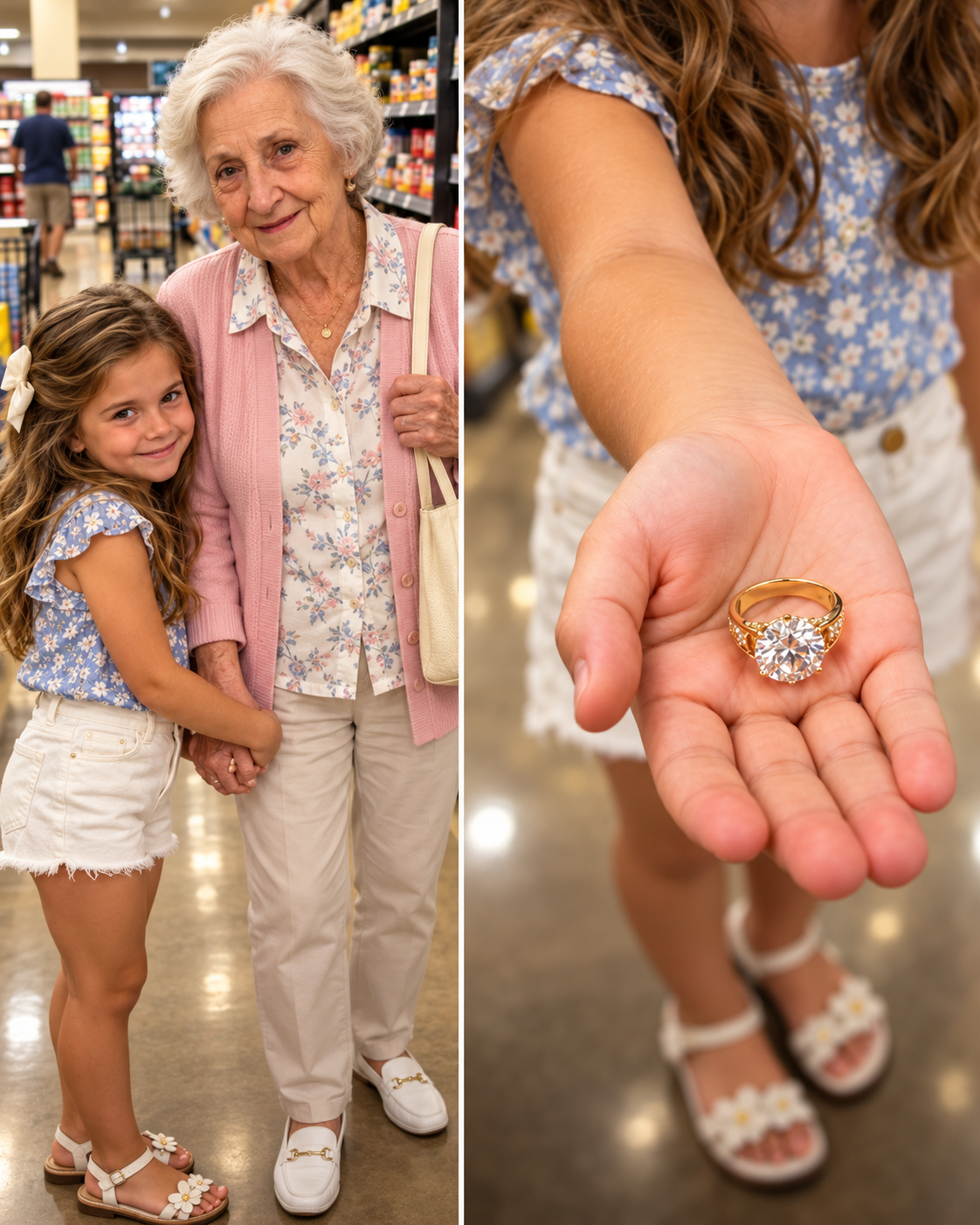
PART 1 TITLE: The Stranger at My Front Door Held a Photograph of My Dead Daughter, and the Name He Spoke Changed Everything The stranger arrived just after nine on a gray Thursday morning, carrying a thick envelope and looking at my house as though he had spent years trying to find it. I watched him through the narrow window beside the front door. A black SUV stood at the curb, its windows tinted so darkly that I couldn’t see who was inside. The man wore a charcoal suit that probably cost more than my monthly grocery budget. When he noticed me behind the glass, he didn’t wave. He simply removed his hat, stepped back from the porch, and waited. Something about his patience frightened me more than an impatient knock would have. I was seventy years old, a widow, and the sole guardian of my seven-year-old granddaughter, Harper. We lived in the house my husband and I had bought when we were young enough to believe that a mortgage was the largest problem we would ever face. The paint was peeling from the porch railing, two upstairs windows needed replacing, and every heavy rain sent water through a crack in the kitchen ceiling. I had learned to position three buckets beneath the worst spots before a storm. There was no money for a new roof, but we were managing. We had survived worse things than a little water. My first thought was that the stranger had come about a bill. Perhaps the insurance company had changed its mind about something, or the bank had made an error. I had been careful with money since my husband died, and even more careful after we lost our daughter, Emily, three years earlier. There were no unpaid loans or hidden debts that I knew of. Still, poverty has a way of making an unexpected visitor feel like a threat. I straightened my faded cardigan, checked that the security chain was fastened, and opened the door just far enough to speak. “Can I help you?” I asked. The man looked to be in his early forties. His expression was serious but not unfriendly, and there were small creases at the corners of his eyes, the sort that suggested long hours rather than easy laughter. “I hope so, ma’am,” he answered. “I’m sorry to arrive without an appointment. My name is Daniel. I’m an attorney, and I’m here on behalf of someone who has been trying to locate your family.” I tightened my hand around the edge of the door. “If this concerns money, you’ll need to explain exactly what you want. I don’t sign anything at my doorstep.” He glanced toward the SUV, then back at me. “This isn’t a collection matter. Nobody is asking you to pay anything.” I almost closed the door anyway. People who announced that they didn’t want money often turned out to want something more difficult to surrender. “Then who sent you?” I demanded. He didn’t answer immediately. Instead, he asked whether I had a granddaughter named Harper and whether her mother had been Emily. Hearing both names from a stranger made my stomach tighten. I looked past him toward the street. “My daughter has been dead for three years,” I said. “What does she have to do with this?” Before he could respond, I heard Harper moving upstairs. She had been awake for nearly an hour, arranging her stuffed animals in rows across her bed and deciding which ones were patients at her imaginary hospital. My granddaughter was small for her age, with dark hair that never stayed in its braid and enormous brown eyes that reminded me so strongly of Emily that I sometimes had to look away. She was the reason I got up every morning, even on days when my knees hurt and the house felt too quiet. I had promised her mother that she would always have a safe place to live. That promise was more important to me than anything the man on the porch might offer. “Grandma?” Harper called from the staircase. “Who are you talking to?” I turned my head. “Someone asking directions, sweetheart. Go finish getting dressed.” She appeared on the landing anyway, clutching the white rabbit she had carried everywhere since she was three. One ear had been sewn back on twice, and its pink nose had almost disappeared beneath years of kisses. Harper looked from me to the narrow opening in the door. “Is he lost?” she asked. “Not exactly,” I answered. “Then maybe we should help him.” I almost smiled. Even after everything she had lost, Harper still assumed that strangers deserved kindness. The thought brought back something that had happened less than twenty-four hours earlier. We had gone to the grocery store on Wednesday afternoon because I needed bread, milk, potatoes, and the cheapest chicken I could find. Harper had spent the entire drive talking about a drawing she wanted to make for her teacher. I had been thinking about a different problem: the pharmacy had called that morning to tell me one of my prescriptions was ready, and I wasn’t certain I could afford it after buying food. I had thirty-eight dollars in my purse and a few coins beneath the car seat. The following Monday, another bill would be due. The supermarket was crowded, and the air smelled of warm bread from the bakery near the entrance. I steered our cart past the flowers and toward the discount shelves, trying not to look at the prices of things we hadn’t bought in months. Harper walked beside me, occasionally lifting a package to inspect the pictures. She knew better than to ask for much. That knowledge troubled me more than her requests ever had. Children should be allowed to want things without first considering whether their grandmother can pay for them. But Harper had learned our circumstances by watching, and she rarely needed an explanation. Near the candy aisle, she stopped so suddenly that the cart nearly touched her heels. “Grandma, wait.” I looked down, expecting another brightly colored package. Instead, she was staring at something beneath the lowest shelf. “There’s something shiny under there.” I bent with difficulty, one hand pressing against my knee. A small object glittered between the shelf support and a strip of torn cardboard. Harper crouched, stretched her fingers into the narrow space, and drew out a gold ring. A large clear stone caught the fluorescent light. For a moment neither of us spoke. Even without knowing anything about jewelry, I could tell it wasn’t ordinary. Harper held it carefully between her thumb and forefinger. “Is it real?” she whispered. “I think it might be,” I answered. The gold had a warm, worn shine, and there were tiny markings inside the band. The diamond, if it was a diamond, was larger than anything I’d ever owned. Harper turned it over, fascinated by the way light moved through the stone. Then she looked up at me and asked a question that made me ashamed of my own first reaction. “Do you think whoever lost it is worried?” Until that moment, I had been thinking about the value of the ring and how much such an object might change our circumstances. I wasn’t proud of that thought. I wish I could say I had never imagined using money that wasn’t mine, but fear can make strange possibilities seem tempting. The roof needed repairing. Harper had complained about a sore tooth for several weeks, and I’d been postponing the dentist because I couldn’t face another bill. Sometimes I cut my medication tablets in half, hoping the supply would last longer. There were nights when I lay awake calculating how many months of savings remained. Standing beneath the supermarket lights with an expensive ring in my hand, I understood how easily desperation could dress itself up as an excuse. Harper watched me examine it. “We have to tell somebody,” she said. “What if it belonged to somebody’s grandma?” I looked into her earnest face and felt the familiar pull of grief. Emily had been much the same as a child. Once, when she was eight, she had walked half a mile back to the park to return a plastic dinosaur that another child had left on a bench. My husband had teased her about running a lost-property department, but he had driven her there himself. He believed honesty was something children learned by watching adults make inconvenient choices. His words came back to me as I closed my fingers around the ring. “You’re right,” I told Harper. “We’ll take it to the manager.” She smiled, relieved that the decision had been made, and held my hand while we pushed the cart toward the customer-service counter. A young employee listened while Harper explained where she’d found the ring. He called for the manager, a middle-aged man wearing a blue name badge. When he saw the jewelry, his expression changed. He brought out a small envelope and asked whether we would wait a moment. I insisted that he record where the ring had been found and who had handed it in. I wanted a proper record, not because I expected a reward, but because something so valuable deserved careful handling. We had been standing near the counter for several minutes when an elderly woman entered the store. She wore a pale coat and carried a handbag with both hands, her face strained with anxiety. A silver cane helped her across the polished floor. The manager spotted her and hurried forward. I couldn’t hear their first exchange, but I saw the woman press her palm against her chest as he showed her the envelope. He asked her several questions before opening it. Then he tipped the ring into his hand. The woman made a small sound that reached me across the counter, a sound I recognized immediately because I had made it myself after receiving terrible news. The manager returned the ring to her, and she held it against her heart. Tears slipped down her cheeks, leaving narrow tracks through her powder. Harper moved closer to my side. “She’s crying,” she whispered. “Yes, sweetheart.” The woman turned toward us after the manager gestured in our direction. She approached slowly and stopped a few feet away, studying Harper with an intensity that made me uncomfortable. Then she lowered herself as far as her stiff knees permitted. “Were you the little girl who found it?” she asked. Harper nodded. “It was under the candy shelf. I thought you might be sad because it was missing.” The woman’s lips trembled. She thanked Harper in a voice barely louder than a whisper. Then she explained that the ring had belonged to her mother and that she had feared it was gone forever. She offered Harper a reward, opening her purse before I could respond. My granddaughter shook her head. “It’s yours,” she said. “You don’t have to give me money for giving it back.” The woman went very still. For a moment she seemed unable to speak. Finally, she asked Harper’s name. “Harper,” my granddaughter answered. The woman’s hand tightened around the ring, but I assumed she was simply overcome with gratitude. “That’s a beautiful name,” she said after a moment. She looked toward me. “You must be very proud of her.” I told her I was, although pride hardly described what I felt. She asked whether we lived nearby, and I answered vaguely, unwilling to give personal details to a stranger. The manager was standing close enough to hear us, and I remember wondering why he seemed so interested in the conversation. The elderly woman thanked Harper once more. Before leaving, she pressed the child’s hand gently between her own, as though trying to remember the shape of it. I thought afterward that grief had made her unusually emotional about the ring. We finished shopping without further incident. At the register, I counted the last of my coins for a carton of milk and carried the bags to our old car. Harper talked about the woman all the way home. She wanted to know whether the ring had been a wedding present, whether diamonds could break, and whether someone’s mother could still love them after dying. I answered the questions I could. The last one required more care. “Your mother loved you very much,” I told her, glancing at her in the rearview mirror. “That doesn’t stop being true because she’s gone.” Harper looked down at the rabbit in her lap. “I know,” she said quietly. That evening, while I made soup from leftover vegetables, Harper sat at the kitchen table drawing a woman with silver hair and a bright yellow ring. The woman stood beside a little girl beneath a blue sky. I asked why she had included herself in the picture. “Because she looked lonely,” Harper said. “And when somebody is lonely, they need a friend.” She colored carefully around the woman’s face, leaving a white space for the smile. I watched her work and wondered how a child who had experienced such loss could still be so generous with affection. Perhaps she understood loneliness more clearly than I wanted to admit. After dinner, we climbed the stairs together. The wallpaper in the hallway had begun to loosen near the ceiling, and a cold draft slipped through the window frame. Harper stopped outside Emily’s old bedroom, which we now used for storing winter clothes and boxes of photographs. “Was Mommy nice when she was little?” she asked. “She was kind,” I answered. “And stubborn. Very stubborn.” Harper smiled. “Like me?” “Exactly like you.” She laughed and ran toward her room, but I remained in the hallway, looking at the closed door. Emily had once slept behind it. I could still remember the sound of her footsteps on the stairs, the smell of the shampoo she preferred, and the particular way she said my name when she had something important to tell me. My husband and I had adopted Emily when she was six months old. She arrived with a small bag of clothes, a folder of documents, and a serious expression that vanished when my husband made ridiculous noises at her. We were told her birth parents had died, leaving no relatives able to care for her. There had been questions the adoption agency couldn’t or wouldn’t answer, but we were so grateful to bring her home that we accepted the explanations we received. Over the years, Emily occasionally wondered about the family she had come from. I never tried to discourage those questions. I believed that loving a child meant making room for the parts of her story you hadn’t witnessed. By the time Emily became an adult, she knew everything we had been told about her adoption. It wasn’t much. A place of birth, an approximate history, a few official papers, and a promise from an agency representative that there was nothing more to discover. Sometimes she spoke about searching for distant relatives; at other times she said she had all the family she needed. My husband encouraged her to make whatever choice felt right. I did too, though privately I worried that a search might end in disappointment. Looking back, I wondered whether our willingness to trust incomplete records had cost Emily something she deserved to know. The years carried us forward. Emily married, and Harper was born. Then, one after another, the losses came, leaving my granddaughter in my care before she was old enough to understand why the adults she loved kept disappearing from her life. After Emily died, Harper woke crying almost every night for weeks. I slept in a chair beside her bed until she could rest without reaching for her mother. I learned to braid hair with fingers that ached from arthritis, to attend school meetings alone, and to answer questions about death without offering promises I couldn’t keep. There was no room for self-pity. Harper needed breakfast, clean clothes, and someone who would still be there when she came home. Yet being needed didn’t erase the fear. Some mornings my hands shook as I opened bills. I worried about my own health, about what would happen if I fell on the stairs, about whether anyone would understand that Harper liked the crust cut from her sandwiches but refused to eat apples without the peel. These were small details, ordinary details, the kind that formed a child’s sense of safety. I had spent three years trying to preserve them. If I couldn’t give Harper an easy life, I could at least give her a familiar one. That was why the unexpected visitor on my porch unsettled me so deeply. Now, with Daniel standing outside and Harper watching from the landing, I felt the fragile order of our lives beginning to shift. I asked my granddaughter to fetch her slippers from her room. She hesitated, then obeyed, dragging her rabbit along the banister as she climbed. I turned back to the man. “You have two minutes to explain why you’re here. Then I want you to leave.” Daniel nodded. He didn’t appear offended. Instead, he opened the envelope and withdrew a photograph, holding it where I could see without removing the chain. “Before I say anything else,” he told me, “I need to know whether you recognize these people.” The picture showed two women standing together in a sunlit garden. One was older, elegant, with silver hair arranged neatly around her face. She wore a white dress and had one arm around the shoulders of the younger woman beside her. The younger woman was Emily. Not someone who resembled Emily. Not a distant relative with similar features. My daughter herself, smiling toward the camera with the familiar slight tilt of her head. I knew that smile better than my own reflection. My fingers went numb against the door. For a moment, the edges of the photograph seemed to blur, and I had to brace myself against the frame. “Where did you get that?” My voice sounded strange to my ears. Daniel looked at the picture before answering. “It belongs to the woman I represent.” I stared at the older woman. There was something familiar about her posture, the shape of her mouth, perhaps the eyes. Then I understood why I recognized her. She was the same woman from the supermarket, the one Harper had helped the day before. The woman who had asked my granddaughter’s name and held her hand for just a little too long. I looked at Daniel, then toward the waiting SUV. “Who is she?” I demanded. Daniel took a breath, as though he had rehearsed his answer and still found it difficult to say. “Her name is Eleanor Whitmore. She’s been searching for Emily for many years.” I shook my head. “That doesn’t make sense. Emily was adopted. We were told her birth parents were dead.” His expression changed. He looked genuinely pained. “I’m afraid the information you were given was not true.” I reached for the chain, suddenly uncertain whether to open the door or lock it completely. Upstairs, Harper began humming to her rabbit, unaware that the world below her was changing. “Mrs. Whitmore isn’t a distant acquaintance,” Daniel continued. “She isn’t someone who happened to know your daughter.” He moved the photograph closer, and I saw the older woman’s hand resting protectively on Emily’s shoulder. “Eleanor Whitmore is Emily’s biological mother. She’s alive. She’s here today. And until very recently, she had no idea that her daughter had died or that she had a granddaughter.” My knees weakened. I gripped the doorframe to remain standing. For forty years, I had believed I knew the broad outlines of my daughter’s beginning. Now a stranger had arrived with one photograph and told me that the first chapter of her life had been built on a lie.
END PART 1
PART 2 TITLE: The Woman Who Lost Her Daughter Decades Ago Was Waiting Outside, but the Truth About Emily Was Harder to Accept I kept staring at the photograph, trying to make the two women separate in my mind. Eleanor Whitmore. Emily’s biological mother. The words belonged together in Daniel’s explanation, but they wouldn’t settle into anything I could understand. I had buried my daughter three years earlier, believing that every person who had loved her knew she was gone. Now I was being told that somewhere in the world, another mother had spent those same years searching for a child she would never see alive again. The cruelty of that possibility left me speechless. Then a more immediate fear pushed through the shock. I had a granddaughter upstairs, and I had no idea what these people wanted from her. “How can you prove any of this?” I asked. Daniel withdrew several papers from his envelope but kept them in his hands. “There are adoption records, identifying information, and documents that connect Emily’s birth to Mrs. Whitmore. I can show you everything. You’re also welcome to have an independent attorney examine them.” I glanced toward the SUV. “And she’s really in that car?” He nodded. “She insisted on coming herself.” I wanted to ask why she had waited so long, how she had found our address, and whether there was anyone else who knew. Instead, I heard myself say, “You should understand something. Harper has already lost enough people. I won’t let strangers walk into her life and make promises they can’t keep.” Daniel’s expression softened. “I understand.” “No,” I said, sharper than I intended. “You don’t. She’s seven years old. She still looks for her mother when she wakes from a bad dream. Sometimes she asks whether the people we love can disappear twice. Do you know what it’s like to answer that question?” He lowered the envelope. “I don’t have children,” he admitted. “And I won’t pretend I know what you’ve been through. But the woman waiting outside has spent most of her life living with a different kind of absence. She asked me to tell you that she isn’t here to disturb Harper’s home.” I looked at him carefully. “Then why is she here?” He considered his answer. “Because yesterday she met a little girl in a supermarket who returned something irreplaceable. When she heard that child’s name, she began to suspect something extraordinary. Last night we confirmed it.” My heart gave a heavy beat. “You mean the ring.” Daniel nodded. “Mrs. Whitmore told me about the child who found it. She described her appearance, and she remembered the name Harper. We had recently been trying to verify the identity of Emily’s surviving daughter. The coincidence was too specific to ignore.” I thought of the woman gripping the gold band as though it were a lifeline. I had been standing only a few feet from her. Neither of us had known we were connected. “Then you were already looking for us before yesterday?” I asked. “Yes. The search for Emily began long before that.” Daniel paused. “But the final connection to Harper wasn’t established until the store manager confirmed what Mrs. Whitmore remembered.” I felt anger rising through the confusion. If the woman had spent years searching, why hadn’t anyone found Emily while she was still alive? We had not hidden our family. Emily had attended school, married, and built a life in the same region where we had raised her. There had been birthdays and graduations, family dinners and ordinary Sunday afternoons. I remembered my daughter sitting at our kitchen table with a cup of tea, laughing about something Harper had said. All those years, another woman had been looking for her. I asked Daniel whether he had brought any document authorizing him to take Harper somewhere. The question startled him. “Absolutely not. No one intends to remove her from your care.” “People say many things when they first arrive,” I replied. “I need to know what they’re prepared to do afterward.” He placed the envelope on the porch railing and opened it where I could see. “Mrs. Whitmore has no interest in challenging your role as Harper’s guardian. She’s aware that you raised Emily and that you’ve cared for Harper since her mother’s death. She hopes only to meet you both, if you’re willing.” His answer was measured, but I noticed that he didn’t ask me to take his word for it. He offered proof instead. I examined the papers through the narrow doorway. The first was a copy of an old adoption document. Emily’s birth date appeared near the top, followed by the name of the agency that had handled her placement. My breath caught. I knew that agency’s name. It had appeared on every piece of paperwork we received when Emily came home. Below it was a reference number I recognized from the folder I kept in my bedroom closet. Daniel turned to another page. There, beside a date from decades earlier, was the name Eleanor Whitmore. I couldn’t judge the authenticity of the documents, but the details were too familiar to dismiss casually. “Why wasn’t her name on our copy?” I asked. “That’s one of the questions we’re still trying to answer fully,” Daniel said. “The records supplied to the adoptive family were incomplete. Mrs. Whitmore was also given information that didn’t match what actually happened.” I felt the old anger that had followed me through Emily’s childhood whenever official explanations failed to satisfy her questions. We had been told the adoption was straightforward. We had signed where we were asked to sign, trusted the people who spoke with authority, and taken our little girl home. For years, I had assumed there was nothing more to know. Now I wondered what had been removed from those records before they reached us. Footsteps sounded behind me. Harper had returned, wearing her slippers and carrying the rabbit beneath one arm. She stopped near the door when she saw the papers. “Grandma, is something wrong?” I turned quickly. “No, sweetheart. I’m just talking to someone about your mommy.” Her eyes widened. Emily remained a subject that could draw Harper into a conversation from the farthest corner of the house. “Did he know her?” she asked. Daniel looked at me, leaving the answer to my judgment. I appreciated that small restraint. “He knows someone who knew about her,” I said. “We’re trying to understand how.” Harper came closer and studied the photograph still in my hand. Her finger touched Emily’s face. “That’s Mommy,” she said. I nodded. “Yes.” She examined the silver-haired woman beside her. “Who’s that?” I hesitated. There were answers I wasn’t yet ready to give, not because Harper didn’t deserve them, but because I needed to be certain they were true. Children carried adult words into places adults couldn’t reach, turning them over at bedtime, fitting them into dreams and fears. I didn’t want to tell Harper she had another grandmother and then discover some misunderstanding that would leave her feeling abandoned again. “That’s what we’re finding out,” I said gently. “Can you give me a little time?” She frowned, but nodded. Outside, the rear door of the SUV opened. An elderly woman stepped onto the pavement, one hand resting on the doorframe while she arranged her footing. Even at a distance I recognized her from the supermarket. The pale coat had been replaced by a dark blue one, and her silver hair was pulled back from her face. She leaned on the same elegant cane. For a moment she remained beside the car, looking toward our porch. Daniel noticed her and straightened. “I asked her to stay in the vehicle until we’d spoken,” he said. “She knows she should wait for your permission.” But Eleanor had already taken several careful steps forward. I couldn’t tell whether impatience or fear had finally brought her out. She crossed the short distance from the curb slowly, gripping the cane with visible effort. At the bottom of the porch steps she stopped and looked up. Her eyes were wet. “I’m sorry,” she said. “I know I shouldn’t have come forward before you invited me. Daniel told me to give you time.” Her voice trembled, but there was nothing theatrical about her distress. She looked exhausted, as though sleep had been impossible. “I saw the house, and I thought perhaps she might be here. My daughter.” She swallowed. “Then I remembered what Daniel told me.” She looked down at the pavement, pressing her lips together until the trembling stopped. I had expected someone wealthy enough to arrive with a driver and a lawyer to behave with confidence. Instead, the woman before me seemed almost afraid of being noticed. Her coat was beautifully made, her shoes polished, her handbag expensive, yet none of those things could disguise her age or the effort it took her to stand there. I watched her glance toward the front window, where family photographs were visible above the mantel. Her attention fixed on the small framed picture of Emily holding newborn Harper. Her free hand rose toward her mouth. She seemed to forget the cold wind and the uneven pavement beneath her feet. “Mrs. Whitmore?” I called. She looked up immediately. “You met my granddaughter yesterday.” Eleanor nodded. “I did.” “Did you know who she was at the store?” “Not then,” she answered. “I knew her name was Harper, and I noticed how much she resembled someone in a photograph Daniel had shown me. But I was frightened of believing something that might not be true.” She looked directly at me. “I have followed mistaken leads before. Every time I thought I was close to finding Emily, I discovered another closed door. I didn’t want to frighten a child or approach her family on nothing more than hope.” I studied her face. The resemblance was difficult to ignore now that I knew what to look for. Emily had inherited her straight nose and the small crease that appeared between her brows when she concentrated. But resemblance wasn’t enough to establish trust. “Why did the agency tell us Emily’s birth parents were dead?” I asked. Eleanor’s expression tightened. “I didn’t know they had told you that.” “That’s what we believed when we adopted her. That’s what Emily believed when she was old enough to ask.” Eleanor closed her eyes briefly. “Then they stole more from us than I understood.” Her answer contained anger, but none of it seemed directed toward me. Harper stepped out from behind the door before I could stop her. “You’re the lady with the ring,” she announced. Eleanor’s face changed so abruptly that I felt a tightness in my chest. “Yes,” she said. “And you’re the little girl who found it.” Harper moved beside me and stared at the woman. “Did you lose it again?” For the first time, Eleanor smiled. It was a fragile smile, but it reached her eyes. “No, darling. I put it somewhere very safe.” Harper appeared satisfied. Then she tilted her head, looking at Eleanor with that serious expression she wore whenever a question mattered. “Why are you crying?” Eleanor opened her mouth but didn’t speak. Tears had gathered along her lower eyelids. I knew that if she told Harper too much too quickly, the child might misunderstand. Yet there was no cruelty in the woman’s silence, only the struggle to find words she could bear to say. “I’ve learned something important about your mother,” Eleanor finally answered. “And it’s made me very emotional.” Harper stepped closer. “Do you miss her?” Eleanor nodded, the movement almost imperceptible. “More than I can explain.” My granddaughter looked up at me. “Grandma misses Mommy too. Sometimes she gets sad when we look at pictures.” Those words unsettled Eleanor more deeply than anything Daniel had said. She stared at Harper, taking in the dark eyes and the small hands wrapped around the worn rabbit. She had spent decades imagining a daughter she’d never been permitted to raise. Now she was looking at that daughter’s child, who carried traces of a face she had searched for across a lifetime. Eleanor moved one step closer, then stopped, as if afraid her presence might cause harm. “You look so much like her,” she whispered. “Especially your eyes.” Harper glanced at the photograph in my hand. “Mommy had brown eyes like mine.” Eleanor nodded. “She did. And she was beautiful.” I felt Harper lean against my hip. She was curious, but the intensity of the woman’s attention had made her cautious. I rested a hand on her shoulder. “I think we should go inside,” I said. Eleanor looked startled. “Are you sure?” “I’m sure we shouldn’t discuss my daughter’s life on the sidewalk.” Daniel stepped forward to offer his arm, but she shook her head and climbed the porch steps herself, slowly and with considerable effort. I unfastened the chain, opened the door, and moved aside. It was a small gesture, but I understood its meaning. For the first time, I was allowing someone from Emily’s unknown past to enter the home where we had raised her. Our living room was warm, though the old furnace rattled whenever it started. There were mismatched cushions on the sofa and a basket of Harper’s toys beside the armchair. The wallpaper had faded around the photographs, leaving pale rectangles where frames had been moved over the years. Eleanor paused just inside the room. Her eyes traveled over the furniture, the worn carpet, the children’s books stacked near the window. I expected embarrassment to rise in me, the familiar discomfort of having someone wealthy examine the signs of our limited means. But she wasn’t looking at the damage or the faded upholstery. She was searching for Emily. She found her above the fireplace. There was a photograph from Emily’s wedding, one taken on the day she graduated, and another of her sitting in our garden with Harper as a baby. The last picture had been my husband’s favorite. Emily’s hair was loose in the breeze, and Harper was laughing so hard that her tiny hands had blurred in the photograph. Eleanor approached the mantel, then stopped before touching anything. “May I look?” she asked. I nodded. She lifted the wedding photograph with both hands and studied it in silence. Her thumb moved along the edge of the frame, careful not to touch the glass. “She was married,” Eleanor said at last. The words were barely audible. “Yes.” “Was she happy?” I considered the question. Emily’s marriage had not been free of difficulty, but she had known genuine happiness. There had been laughter in our kitchen, plans made around the dinner table, long conversations about the future. “She had good years,” I answered. “She loved Harper more than anything. She worked hard, laughed easily, and had a way of making people feel welcome. She could also be impossible when she thought she was right.” Eleanor looked at me with sudden attention. “She was stubborn?” “Terribly.” A faint smile passed over her face. “So was I.” Daniel remained near the doorway, allowing us the conversation without interruption. Harper had climbed onto the sofa with her rabbit and was watching Eleanor examine the photographs. “That’s me when I was a baby,” she announced, pointing toward the picture on the mantel. Eleanor turned. “I see that.” “I didn’t have much hair.” “Neither did my daughter when she was little,” Eleanor said, then looked at me uncertainly. “I mean, in the photographs I was allowed to see after she was born.” I heard the correction. There was something in it worth understanding. This woman had not simply misplaced contact with her child. She had been allowed only fragments of motherhood, pieces of information controlled by someone else. I asked Eleanor to sit before she exhausted herself. She lowered herself carefully onto the old sofa, setting her cane beside the armrest. I brought her a glass of water, and she thanked me with such seriousness that I wondered how many small kindnesses she was accustomed to receiving without conditions. Harper shifted closer, studying the unfamiliar woman. “Do you have a daughter?” she asked. Eleanor stared down at her hands. “I did,” she answered. “Her name was Emily.” Harper’s forehead creased. “That’s my mommy’s name.” Silence settled over the room. I looked at Daniel, and he looked back at me, waiting. There was no gentle way to continue indefinitely avoiding the truth. I sat opposite Eleanor, close enough to reach Harper if she became upset. “Sweetheart,” I said, “when your mother was a baby, she came to live with Grandpa and me. We became her parents and raised her. But another woman had given birth to her.” Harper knew that Emily had been adopted, though the subject had rarely interested her until now. She looked from me to Eleanor. “Is that you?” she asked. Eleanor nodded slowly. “Yes, Harper. I’m the woman who gave birth to your mother.” Harper considered this for a long moment, her fingers rubbing the worn ear of her rabbit. “Why didn’t you keep her?” The question fell into the room with a force no adult accusation could have matched. Eleanor’s face drained of color. I leaned forward, ready to intervene, but she raised one hand slightly. She wanted to answer. “I was very young,” she said. “Some people in my family made decisions that I didn’t know how to fight. They told me your mother would be safer and happier somewhere else.” Harper frowned. “But babies need their mommies.” Eleanor bowed her head. “Yes,” she whispered. “They do.” Her shoulders began to tremble. I watched her struggle against tears, and something in my judgment of her began to change. Harper glanced at me, confused by the woman’s distress. “Did you stop loving her?” she asked. Eleanor looked up immediately. “No. Never.” Her answer was quiet but absolute. “I loved her before she was born, and I loved her every day afterward. I just couldn’t find her.” Harper absorbed that explanation with the grave concentration children sometimes give to matters adults spend years making complicated. Then she asked whether Eleanor had known her mother was dead. The woman’s eyes filled again. “I only found out recently,” she said. “I’m very sorry,” Harper replied, repeating the words she had heard people say to us after Emily died. Eleanor reached for a tissue from the box beside the sofa. Her hands shook as she unfolded it. “I wanted to meet her,” she said, looking at me rather than Harper. “I wanted to tell her why I wasn’t there. I wanted her to know that leaving her wasn’t the choice I would have made if I’d been free to decide.” I thought about the years I’d spent believing that Emily’s biological parents were dead. It had never occurred to me that another mother might be alive, carrying guilt and grief while searching through records for the same person I was raising. We had been kept apart by an official story neither of us had questioned in the same way. “There’s something I need to understand,” I said. “If you wanted Emily, why did you sign the adoption papers?” Eleanor looked at the photograph in her lap. “Because my father made me believe I had no alternative. I was twenty when she was born. I trusted him, and I was frightened. He told me the arrangement would protect my baby and prevent consequences I didn’t fully understand.” Her voice became firmer. “He promised I could find her when I was older. By the time I realized how much had been hidden from me, the records were sealed and the people responsible were no longer willing to help.” She turned toward Daniel. “Show her what you found.” Daniel opened the envelope on the coffee table and arranged several copies in chronological order. He pointed to a birth record, an agency document, and a statement Eleanor had signed decades earlier. I recognized the name of the adoption organization and Emily’s date of birth, but the remaining details were unfamiliar. Daniel explained that the original records contained information omitted from the copies given to our family. Eleanor’s name had appeared in documents we were never shown. Other papers recorded her attempts to obtain information after the placement. Some had been denied. Others had simply gone unanswered. I stared at the dates, remembering the years when Emily was growing up in our house, unaware that someone was fighting to learn where she was. The realization was painful in an unexpected way. I had given Emily everything within my ability, but I had not been able to give her the truth about her beginning. She had once asked me whether her birth mother might have looked like her. I told her we didn’t know. She asked whether that woman had liked music, whether she had been tall, whether her laugh sounded like Emily’s own. We had imagined someone lost to the world. Now that woman was sitting on my sofa, wearing a blue coat and holding the photograph of the daughter she had never known. I could not reclaim the conversations we might have had if the information had reached us sooner. Eleanor watched me read. “I don’t expect you to forgive me for what happened,” she said. “And I certainly don’t expect you to give me a place in Harper’s life simply because I’m related to her by blood. You raised my daughter. You’ve raised her daughter too. Nothing I say changes that.” I looked up. “I’m not the person you need forgiveness from.” Her eyes lowered. “I know.” For several moments we sat without speaking. I wanted to be angry at someone, but the person before me seemed to have spent a lifetime bearing the consequences of decisions made by others. My anger had no simple place to land. Then I remembered the photograph Daniel had shown me at the door. Emily and Eleanor standing together in a garden, both smiling. If Eleanor had never found her daughter, how could that picture exist? I took it from the table and placed it between us. “You keep saying you didn’t know Emily,” I said. “Then explain this. You’re standing beside her. Someone took this photograph while she was alive.” Eleanor looked at the picture and closed her eyes. When she opened them, her expression held a fresh kind of sorrow. “That was the cruelest part of what Daniel discovered,” she said. “I did meet her once. Neither of us knew who the other was.” I waited while she gathered herself. “It was at a charity garden event many years ago. We spoke only briefly. She was helping with the guests, and someone photographed us together. I kept the picture because I remembered the young woman who had been kind to me.” Eleanor touched Emily’s face in the photograph. “When Daniel found her identity, he recognized her from that old image. All those years of searching, and for a few minutes she had been standing close enough for me to hold her hand.” Her voice faltered. “I went home that day and never understood what I had been given.” The memory seemed almost unbearable to her. I looked again at the two smiling women. Emily had never mentioned the encounter. Why would she? She had met hundreds of people over the years, and she had been especially good at making strangers feel at ease. For Eleanor, it had been one pleasant moment in a life full of obligations. Only afterward had it become something she could never forget. I thought of the ordinary opportunities we fail to recognize while they are happening, of the conversations we might have approached differently if we had known their meaning. There was no remedy for a missed chance. There was only the knowledge that it had existed. Harper climbed down from the sofa and stood beside Eleanor. “Are you sad because you didn’t get to say goodbye to Mommy?” she asked. Eleanor nodded. “Yes, sweetheart.” Harper held out her rabbit for a moment, then drew it back against her chest. She seemed to be considering how much comfort she could offer without giving up the toy that comforted her. Finally, she leaned forward and wrapped one arm around Eleanor’s shoulders. “Grandma says hugs help sometimes,” she murmured. Eleanor’s face crumpled. She looked to me for permission before returning the embrace. I nodded, unable to speak. The two remained that way for several seconds. Eleanor closed her eyes, and Harper rested her cheek against the woman’s shoulder with the uncomplicated tenderness she gave to people who seemed to need it. I turned toward the window. Outside, the branches of our old maple moved against the gray sky. I had spent so many years protecting Harper from further loss that I had almost forgotten she might someday receive something new. The thought was frightening. Hope could be dangerous when a child had already learned what absence felt like. But the woman holding my granddaughter wasn’t asking her to forget anyone. She was grieving someone they had both loved. When Harper finally stepped back, Eleanor wiped her face and thanked her. My granddaughter sat beside me and leaned close to whisper. “Grandma, is she my grandma too?” I looked across the table at Eleanor. The woman sat very still, her hands folded over the photograph, waiting for an answer that belonged partly to a child and partly to the person who had spent three years keeping that child safe. I could have told Harper we needed more time. I could have postponed the question until every document had been verified and every uncertainty resolved. Instead, I said, “It appears that she is, sweetheart. Her name is Eleanor.” Harper tested the name softly. Then she looked at the elderly woman. “Can I call you Grandma Eleanor?” Eleanor pressed a tissue to her lips. For a moment she seemed unable to answer. “If you’d like to,” she finally managed. “I’d be honored.” Harper nodded, satisfied, and returned to her drawings on the floor. The exchange lasted less than a minute, but it had altered something neither woman could easily undo. Eleanor looked toward me, searching my face for reassurance. I didn’t offer promises. I simply told her that any relationship with Harper would have to grow slowly, through patience and honesty. She agreed without hesitation. Daniel waited until Harper was busy coloring before speaking again. “There’s another reason Mrs. Whitmore asked to come today,” he said. I looked up sharply. I had expected the explanation to end with the adoption documents and the reunion. His tone suggested something more. Eleanor straightened on the sofa, and the warmth that had briefly entered her face gave way to anxiety. “Daniel,” she said, “perhaps we should leave the rest until another time.” But he shook his head gently. “She deserves to understand the full situation before deciding anything. Especially because you’ve already made certain arrangements.” I felt my protective instincts return immediately. “What arrangements?” Eleanor lowered her gaze toward the papers. “I have no other children,” she said. “For years I tried to find Emily because I wanted to know her, not because I wanted anything from her. But now I know she’s gone, and I know Harper exists. I can’t pretend that changes nothing.” Daniel slid a second group of documents across the table. The pages bore the letterhead of a financial institution and several unfamiliar legal terms. “Mrs. Whitmore has asked us to prepare a way of providing long-term security for Harper,” he explained. “She wants you to review it before any decision is made.” I stared at the papers. A wealthy woman had appeared in our lives with an extraordinary story, and now her attorney was discussing financial arrangements for my granddaughter. I thought of the leaking roof, the empty spaces in my medicine cabinet, and the bills stacked beneath the kitchen clock. I also thought of Harper sleeping in her small bedroom, trusting me to keep her safe. Money could solve certain problems, but it could create others. I looked directly at Eleanor. “Before I read another word,” I said, “I need you to tell me one thing. Are you offering help because you want to be part of Harper’s family, or because you expect this money to give you a say in how she’s raised?” Eleanor met my eyes. For the first time since entering the house, she seemed prepared to face a difficult question without breaking down. “I want to be her grandmother,” she answered. “But I know that isn’t something money can buy.” Daniel opened the first document and turned it toward me. At the top was Harper’s full name, followed by a heading I recognized from legal advertisements but had never expected to see associated with anyone in my family. A trust. Not a small savings account or a promise of future assistance, but a formal arrangement that had already been prepared in my granddaughter’s name. And before I could ask how much money it involved, Daniel said, “There’s something important about the way this has been structured. Mrs. Whitmore specifically requested that you remain in control of the decisions affecting Harper’s daily life.”
END PART 2
PART 3 TITLE: A Trust in My Granddaughter’s Name Raised Questions No Amount of Money Could Answer About Our Family and Emily’s Past I studied the legal document while Daniel explained what the arrangement was intended to accomplish. Harper’s name appeared repeatedly, followed by references to education, medical care, living expenses, and long-term financial protection. I understood individual words but not the complete meaning of the clauses. The figures were large enough to make my mouth go dry. I had managed household accounts for nearly fifty years, kept careful records, and learned to stretch every dollar. This was a different world, one in which money could be placed beyond ordinary reach and managed through rules written by people who earned their living understanding such things. “Who controls the money?” I asked. Daniel turned the document toward himself and indicated a paragraph near the middle. “An independent trustee would administer the fund under its terms. You would continue making Harper’s ordinary care decisions as her legal guardian. The trustee would review eligible expenses and arrange payment according to the trust agreement.” I wasn’t reassured. “And if I disagree with the trustee?” He nodded, acknowledging the question. “Then there are procedures for challenging a decision. You would also have the opportunity to obtain independent advice before accepting any part of this arrangement.” I looked at Eleanor. “Why didn’t you speak to me before having lawyers prepare all this?” She didn’t defend herself immediately. Her hands remained folded over the photographs on her lap. “Because I knew I might lose my courage,” she said at last. “When Daniel confirmed that Harper existed, I began thinking about everything Emily had done without help from me. I couldn’t change any of it. I wanted to make certain there was something practical I could offer, even if you decided you didn’t want me involved personally.” Her answer seemed sincere, but sincerity was not protection against complicated consequences. I had seen relatives fall out over far smaller amounts than the money being discussed. Harper was still a child. I couldn’t let a seven-year-old become the center of a dispute she had never asked to join. “She’s not a project,” I said. “She’s a little girl who sometimes forgets to put her shoes away and still wants a story before bed. I don’t want her growing up believing someone else’s fortune is the most important thing about her.” Eleanor nodded. “Neither do I.” Her answer came quickly enough that I suspected she had considered the same fear. “I don’t want her to know the size of the trust while she’s too young to understand it. I don’t want people treating her differently. And I certainly don’t want her to think she owes me affection because I’ve provided for her future.” She paused. “If there are terms you dislike, we can ask Daniel to change them.” I looked toward Harper, who was kneeling on the rug with her crayons arranged by color. She had drawn three houses beneath a row of trees and was explaining to her rabbit that one house belonged to a family of birds. Nothing about the legal discussion interested her. She was absorbed in determining whether the birds needed a garage. The contrast made my chest ache. Adults could spend years fighting over property, inheritance, and obligation. Harper measured security in bedtime routines, familiar faces, and whether someone remembered to pack her favorite lunch. I wanted her to remain that kind of child for as long as possible. Daniel followed my glance. “There’s no requirement to decide today,” he said quietly. “The documents are proposals. Mrs. Whitmore asked me to prepare them so you could see exactly what she had in mind.” I searched the pages for restrictions, obligations, or references to custody. There was no clause requiring Harper to visit Eleanor, no condition involving a change of residence, and no suggestion that my guardianship would be affected. Daniel pointed out each relevant section and invited me to mark anything I wanted reviewed. His willingness to be questioned helped, though I remained cautious. A document’s most important meaning was sometimes hidden in language a non-lawyer might overlook. I asked whether Eleanor understood how long it could take a child to trust a new adult. Harper had already endured the disruption of losing people who were supposed to remain in her life. She sometimes became anxious if I was late collecting her from school. Once, when I had been delayed by a flat tire, she had cried until the teacher assured her I was coming. “You can’t arrive for a few visits and then disappear,” I told Eleanor. “If you begin building a relationship with her, it has to matter to you after the excitement of discovering her has passed.” Eleanor listened without interrupting. Then she asked me what Harper enjoyed doing on ordinary afternoons. The question surprised me. I had expected promises about reliability, perhaps a solemn declaration that Eleanor would never leave. Instead, she wanted to know about school, hobbies, and routines. I told her Harper liked painting, collecting unusual leaves, and inventing elaborate stories about animals that could talk. She enjoyed mathematics when the teacher used colorful counters but disliked writing long sentences. She could spend half an hour explaining the habits of earthworms, information she’d learned during a school gardening activity. Eleanor smiled at that. “I know very little about worms,” she admitted. “Then you’ll probably have to learn,” I said. Her smile grew. “I would like that.” As we spoke, I noticed her looking around the room again. She studied the handmade cushion covers, the bookshelves my husband had built, and the marks on the doorframe where we had recorded Emily’s height during childhood. Those pencil lines were still there beneath the varnish. They began a little above my knee and rose gradually until the final mark, dated the summer Emily turned seventeen. Eleanor moved toward them after asking permission. She bent close enough to read the dates. “You kept these?” she asked. “My husband couldn’t bear to paint over them,” I replied. “After he died, neither could I.” Eleanor touched the wooden frame with two fingers. I could see her calculating the years between the marks, imagining a child growing taller in a house she had never visited. “I used to wonder whether she was healthy,” she said. “Whether she had enough to eat, whether she was frightened at night, whether someone read to her.” I remembered our daughter racing through the garden with scraped knees, laughing so loudly the neighbors could hear. “She was loved,” I answered. “She didn’t have a perfect childhood, because nobody does. But she was wanted every day.” Eleanor closed her eyes. “That was what I hoped for,” she whispered. “Even when I feared I would never know.” For a while we talked about Emily as though we were assembling a portrait from fragments. I told Eleanor about her fascination with books, her talent for making people laugh, and the day she had announced she wanted to paint her bedroom bright yellow. Eleanor remembered holding her as an infant, the warmth of her tiny hand wrapped around one finger, and the helplessness she had felt when the baby was taken away. She had been allowed so little time that some memories had faded around the edges. She spoke carefully, afraid of exaggerating details she could no longer recall. I understood that fear. Grief had taught me how precious a reliable memory could become. Daniel eventually returned our attention to the paperwork. He explained the difference between gifts made directly to a minor and assets held for future needs. I asked whether the trust would affect Harper’s ability to apply for financial assistance later, whether taxes or administrative fees might reduce it, and whether anyone could change its purpose after Eleanor died. Daniel answered what he could and identified questions requiring specialist advice. I appreciated that he didn’t pretend every answer was simple. The larger the sum involved, the more important it seemed to understand the details before accepting. I wrote my questions on the back of an old utility envelope. Eleanor watched me make notes. “Emily must have learned that habit from you,” she said. I looked up. “What habit?” “Writing everything down before making a decision.” I smiled faintly. “My husband used to say I could organize a thunderstorm if someone gave me enough paper.” Eleanor laughed, and for one brief moment she sounded younger. Then the laughter faded into sadness. “I wish I had known her as an adult,” she said. “I wish I could have heard her talk about the things that mattered to her.” I wanted to tell her that regret would become easier with time, but I knew better. Some absences remained sharp no matter how carefully life grew around them. Harper approached carrying her drawing. “Grandma Eleanor, do you like birds?” Eleanor turned toward her. “Very much.” “These birds are moving because their old tree got knocked down,” Harper explained, pointing to the little houses. “But I gave them a new one with strong branches.” Eleanor accepted the picture and studied every detail. “They look very comfortable,” she said. Harper smiled. “They can all live together, even the ones that aren’t related.” The words struck me unexpectedly. My granddaughter had been making space for people in her drawings long before we understood how complicated her own family history might be. Eleanor asked whether she might keep the drawing. Harper considered the request, then agreed on the condition that it be placed somewhere safe. “I wouldn’t want it to get wet,” she said. My face warmed because of the buckets in our kitchen. Eleanor noticed the glance I gave the ceiling, but she said nothing. Instead, she promised to take good care of the picture. She placed it carefully inside her handbag between two folders. The gesture was small and respectful. She didn’t photograph Harper without asking, offer her expensive presents, or make claims about all the activities they would share. I began to think she understood that relationships were built through attention rather than grand gestures. The conversation might have remained gentle if Daniel hadn’t mentioned the agency again. He had found several letters associated with Emily’s old adoption file, he said, though their exact history was complicated. I looked at him sharply. “Letters from whom?” “Some appear to have been written by Eleanor during the years when she was trying to make contact. Others were written by Emily when she was older.” My hands went cold. “Emily wrote to the agency?” He nodded. “There are copies in the reconstructed archive. We don’t have evidence that all of them reached their intended recipients.” I remembered Emily asking to see her adoption documents after her eighteenth birthday. She had spent several evenings reading through them, then said she wasn’t certain what to do next. I asked Daniel when the letters had been written. He gave me dates that reached from Emily’s teenage years into early adulthood. I knew where she’d been during those years: studying late at the kitchen table, leaving for her first job, coming home to celebrate promotions and birthdays. She had never told me about every letter. For a moment I felt hurt, then ashamed of the feeling. Emily had been entitled to questions and private thoughts that didn’t belong to me. Loving someone didn’t mean possessing every part of their inner life. I wished only that I could ask her what she’d hoped to find. Eleanor opened her handbag and removed a small packet of papers. The envelopes were protected inside clear sleeves, each labeled with a date. “Daniel found these while reconstructing the old records,” she said. “He thought I should see them, but he also felt they belonged to your family’s story.” I recognized Emily’s handwriting before I read a single word. The shape of her capital letters, the way she sometimes pressed too hard with her pen, the little curl at the end of her signature. I had preserved shopping lists written in that hand because throwing them away felt impossible. Seeing it on an unfamiliar envelope nearly brought me to tears. “May I?” I asked. Eleanor placed the packet in my hands. One letter had been written when Emily was sixteen. Another was dated several years later. They were addressed to the mother she had never met, though she apparently had no name or reliable address. Daniel explained that Emily had submitted inquiries through the adoption agency, hoping someone might forward her correspondence if contact ever became possible. The documents suggested that the letters had been retained rather than delivered. I thought of all the years Eleanor had spent requesting information, unaware that her daughter had also reached toward her through the same closed system. I opened the oldest letter carefully. Emily had begun by saying she didn’t know whether anyone would ever read it. She explained that she had grown up in a loving home and that she wasn’t searching because something was missing from her adoptive parents’ affection. She wanted to understand where she had come from, what her birth mother looked like, and whether there were medical or family details she ought to know. She wrote about enjoying school, about our old dog, and about the garden where my husband grew tomatoes. The ordinary details undid me. She had wanted the unknown woman to know the life she was living. Eleanor watched my face while I read. “When I first saw that letter, I couldn’t stop touching the paper,” she confessed. “I had wondered whether Emily ever thought about me. Then I learned she had tried to write.” I passed the letter to her. She held it as if it were fragile glass. We had spent decades loving the same child from opposite sides of a silence neither of us had chosen. The discovery didn’t erase the consequences, and it certainly didn’t restore Emily to us. But it changed my understanding of her curiosity. She had not merely wondered about her birth mother. She had made an effort to reach her. The second letter was more difficult to read. Emily was older, employed, and thinking about the kind of family she hoped to create. She wrote that she wanted any children she might have to grow up knowing they were loved without conditions. She described my husband as a patient father and me as someone who worried too much but always appeared when needed. I smiled through tears at that description. It was painfully accurate. She also wrote that she didn’t expect a meeting with her birth mother to provide all the answers. She wanted only an honest conversation, if such a conversation ever became possible. I lowered the pages into my lap. Emily had been so close to understanding the truth. Somewhere, perhaps not very far away, Eleanor had been writing letters of her own and receiving refusals. The thought filled me with anger, but also with a strange sense of tenderness toward the woman beside me. We had both done what we believed was necessary for Emily, and neither of us had known the full story. I couldn’t change the missed opportunities. I could, however, decide what to do with the connection that remained through Harper. That decision was no longer merely about money or legal documents. It was about whether we would continue living inside an old silence. “She wrote about us,” I said, looking at Eleanor. “She wanted you to know she’d been happy.” Eleanor nodded, unable to speak. I placed a hand over hers. It felt strange at first. We were almost strangers, linked by a daughter whose life had been divided between what one woman remembered and what the other had imagined. Yet Emily’s words had made the relationship feel less accidental. She had wanted to know where she came from without losing the family that raised her. Perhaps there was room for Harper to have both grandmothers without either of us diminishing the other’s place. Daniel allowed us a few moments before returning to the remaining documents. He explained that the trust was only one part of Eleanor’s proposed assistance. I heard him but couldn’t immediately concentrate. My mind remained fixed on Emily’s handwriting, on the years of lost correspondence, and on the knowledge that she had died before the truth reached her. I asked whether the original records would remain accessible to Harper as she grew older. Daniel said the family could retain verified copies and arrange for their preservation. That mattered to me more than I expected. Harper deserved a history she could examine for herself someday, not merely a collection of stories adults had chosen to tell her. “There’s one more document,” Daniel said. He withdrew a separate folder, smaller than the others, and placed it in front of me. My name appeared on the first page. I looked up, surprised. “I thought these arrangements were for Harper.” Eleanor sat forward. “The trust is for her,” she said. “This is something different.” I felt the old caution return. “I don’t want anything for myself.” She didn’t argue. Instead, she looked around the room, at the photographs and the furniture that had supported several generations of family life. “Emily wrote about how you cared for her,” she said. “I know you never did it expecting anything in return.” I pushed the folder back without opening it. “She was my daughter,” I replied. “Of course I cared for her.” Eleanor’s eyes shone. “That’s exactly why I want you to understand.” Daniel remained silent while she continued. “I spent a lifetime wishing I could thank the people who gave Emily a loving home. Now I’ve met one of them, and I know you’ve also been raising Harper without the support you should have had.” I wanted to protest, but the words caught. We had managed because there had been no alternative. Managing was not the same as being secure. Eleanor reached across the table and gently returned the folder to my side. “Please read it before you decide,” she said. “If you refuse, I’ll respect that. Nothing about Harper’s trust depends on your accepting anything personally.” I looked down at my own name on the page. For decades, every difficult decision had been about someone else’s needs. I had become so accustomed to putting my worries aside that the idea of anyone considering my future felt almost suspicious. At last I opened the folder. The first paragraph described a financial support fund intended for my living expenses and essential needs. Beneath it was a list of specific provisions that made me stop breathing for a moment.
END PART 3
PART 4 TITLE: The Gift Eleanor Offered Could Save Our Home, but Accepting It Meant Learning to Trust Someone I Had Just Met I read the first paragraph twice, then a third time, searching for some condition I had overlooked. The document described a fund established for my benefit, intended to cover essential living expenses, medical care, household repairs, and other needs connected with my well-being. It was written in formal language, but the meaning became clearer with every line. Eleanor wanted to make sure I could afford to live in my own home without constantly calculating which necessity to postpone. The idea was so far removed from my daily experience that I found myself studying the numbers as though a misplaced decimal might explain everything. “This can’t be right,” I said. Daniel leaned forward. “Which part concerns you?” I tapped the amount indicated in the document. “This. It’s far too much.” He examined the page, then shook his head. “The proposed funding is correct.” My cheeks grew warm. I had spent years refusing help unless there was absolutely no alternative. My daughter had inherited that stubbornness from me, and I knew it had sometimes made life harder for both of us. Yet I couldn’t simply accept a financial arrangement from someone I had met that morning, however compelling her story might be. Eleanor seemed to understand my hesitation. “I’m not asking you to agree today,” she said. “Daniel has included the name of an independent financial adviser. You can speak to that person, or choose someone else entirely. I want you to understand every detail.” I turned another page and saw references to prescriptions, repairs, and household necessities. “How did you know about these things?” I asked. Eleanor looked embarrassed. “I noticed the condition of the house when we arrived. Daniel also explained that you were raising Harper on a limited income. I didn’t ask him to investigate your private life beyond what was necessary to confirm the family’s circumstances.” I wasn’t entirely comfortable with that answer. Living with financial difficulty meant learning to conceal it. I kept the living room tidy, mended clothes before they became visibly worn, and never mentioned the nights when I worried about groceries. It seemed unfair that an unfamiliar woman could look at my house and understand so much. But there was no cruelty in Eleanor’s expression. She wasn’t examining our poverty with curiosity. She was looking at the life her daughter had known, the life Harper still occupied, and asking herself what she could do to make its burdens lighter. That distinction mattered, even if I wasn’t ready to accept it. “Emily never lacked love,” I said. My voice was firmer than I intended. Eleanor nodded immediately. “I know.” “My husband and I did everything we could for her. And I’m doing everything I can for Harper.” “I believe you.” Her answer was gentle enough that I felt my defensiveness sharpen. “Then understand why this is difficult. I don’t want anyone thinking we needed rescuing because we didn’t care for our family properly.” Eleanor leaned forward. “That isn’t what I think. I think you’ve carried responsibilities that should never have rested on one person’s shoulders. There’s a difference between failing someone and needing help.” For a moment I couldn’t answer. My husband had been the person who understood when I was exhausted without making me explain myself. After he died, there was no one to tell me to sit down while they finished the dishes or to remind me that a problem could sometimes wait until morning. Emily had offered help whenever she could, but she had her own responsibilities. Then she was gone too. I had continued because Harper needed me. Somewhere along the way, I had begun confusing endurance with independence. Eleanor’s words unsettled that belief, and I wasn’t sure whether I resented her for it or was grateful. Harper was still occupied with her drawings. She had begun cutting little paper birds from a sheet of construction paper, carefully placing each one inside the house she’d drawn earlier. I watched her smooth the corners with her fingertips. She had no idea what was being discussed a few feet away. In her world, the most important question was whether the birds would have enough room to sleep. I wanted to preserve that simplicity. Financial help could make her life easier, but I didn’t want her to become a child who believed kindness always required a transaction or that affection could be purchased. I turned back to Daniel. “If I accept this fund, does Eleanor gain any authority over Harper?” “No,” he replied. “The proposed arrangement is separate from Harper’s guardianship. It doesn’t transfer decision-making rights or impose visitation requirements.” I followed the relevant paragraphs while he explained. Then I asked what would happen if Eleanor and I disagreed about something important. He told me the documents were not designed to give her control over my household. I made him repeat the explanation slowly enough for me to write it down. He did so without showing impatience. I intended to have every word checked before signing anything. “And what if I decide the money is too much?” I asked Eleanor. “What if I want to accept only what is necessary?” She considered the question. “Then we’ll discuss what feels appropriate to you.” “Would that disappoint you?” “I’d be disappointed if you accepted something you didn’t understand or didn’t want.” I believed she meant it. Still, I couldn’t forget the enormous difference between us. Eleanor could arrange financial assistance through an attorney. I had spent the previous afternoon choosing between a carton of milk and a packet of biscuits. We were not entering this conversation as equals in material circumstances, however equal we might be in our love for Emily. I asked whether I could keep copies of everything. Daniel had already prepared them. He separated the documents into folders and explained which pages concerned Harper, which concerned me, and which contained the historical records relating to Emily’s adoption. I appreciated the order. It gave me a way to approach a situation that otherwise seemed impossible to absorb. I could review the documents, seek advice, and make decisions one at a time. The discovery of Eleanor’s identity didn’t have to force every other question to be answered immediately. For the first time that morning, I felt I might be able to proceed without surrendering my judgment. Eleanor asked whether I wanted her to leave. I looked toward the clock. Almost two hours had passed since Daniel first knocked. The soup pot from the previous evening still stood on the stove, and I hadn’t even made lunch. Yet sending her away felt abrupt after everything we had learned. “You can stay a little longer,” I said. “But I’d like to put the paperwork aside.” Relief crossed her face. Daniel closed the folders and placed them on the corner of the coffee table. Harper looked up, apparently sensing that the serious conversation was finished. “Can Grandma Eleanor see my room?” she asked. I hesitated. Eleanor waited without speaking. Finally, I told Harper she could show her drawings and toys, provided she remembered that Eleanor moved slowly on the stairs. My granddaughter hurried forward, then stopped when she noticed the cane. “You can hold my hand,” she offered. Eleanor smiled. “That would be lovely.” I followed them upstairs, watching Harper adjust her steps to match the older woman’s pace. She narrated the journey with complete seriousness, explaining which floorboard creaked and where she had once dropped a marble. Eleanor listened as though receiving directions through an unfamiliar city. I found myself smiling despite everything weighing on my mind. Harper’s bedroom was small, painted pale green, with a narrow bed beside the window. Her drawings covered one wall, and books were stacked beneath a lamp with a crooked shade. She showed Eleanor the stuffed rabbit, explaining its history and the many operations performed to repair its ears. Eleanor examined the stitches with appropriate concern. Then Harper opened a wooden box containing photographs of Emily. She took out one showing her mother holding her at a birthday party. “This is Mommy,” she said. “She used to sing when she brushed my hair.” Eleanor accepted the photograph and looked at it for a long time. “What did she sing?” Eleanor asked. Harper considered. “I don’t remember all of it. Grandma knows.” Both of them turned toward me. I felt suddenly self-conscious. Singing had belonged to the private routines Emily and I had shared with Harper, little songs without much significance to anyone else. But I began humming the familiar melody, softly at first. Harper joined in with the words she remembered. Eleanor listened, her eyes fixed on Emily’s photograph. When we finished, she didn’t ask us to repeat it. She simply said, “Thank you.” I understood that she had been given another small piece of the daughter she could no longer meet. We returned downstairs after Harper decided Eleanor needed to see her newest painting. While the child fetched it, Eleanor stood beside the mantel and looked at the family portraits once more. “I was afraid you’d hate me,” she admitted. I folded my arms. “I don’t know you well enough to hate you.” She accepted that without protest. “That’s fair.” I looked at the wedding photograph in her hands. “I spent decades believing Emily had no living biological parents. If I’d known you existed, I would have wanted to understand what happened. But I wouldn’t have allowed anyone to make her feel unwanted.” Eleanor turned toward me. “Neither would I have wanted that.” Her answer reminded me of the adoption papers. We had both relied on an agency that seemed to have concealed important information. I asked whether Daniel had discovered who authorized the false statements. Eleanor shook her head. “Not completely. Some records are missing, and people who were involved have died. Daniel has been trying to reconstruct what happened from the remaining documents.” She looked weary. “I once believed finding the right person would explain everything. Now I know there may be questions nobody can answer.” I understood that kind of uncertainty. After Emily’s death, I’d spent months revisiting conversations, searching for signs that something might have changed the outcome. Eventually I had to accept that answers couldn’t reverse a loss. There was one question I hadn’t asked. “Did Emily ever learn your name?” Eleanor glanced toward Daniel, who had followed us into the living room. He shook his head. “We haven’t found evidence that she did.” I looked at the letters again. Emily had addressed them to an unknown mother, without a name or destination she could trust. I thought of the woman who had stood beside her in the garden years earlier, smiling for a photograph without understanding their connection. The unfairness of it was difficult to bear. Two people had lived their lives with a missing piece of information, and the truth had arrived only after one of them was gone. “I wish I could tell her,” Eleanor whispered. I knew what she meant. She wanted to tell Emily that she’d been searched for, remembered, and loved. She wanted to explain the adoption and ask for the chance to know her. I had my own things I wished I could say to my daughter. Some were important. Others were ordinary: a forgotten recipe, a funny remark Harper had made, a request for advice about something only Emily would understand. Losing someone didn’t end the habit of wanting to speak to them. It simply left those conversations unfinished. I reached for Eleanor’s hand and held it briefly. When Harper returned, she carried a painting of a yellow sun above a garden filled with enormous purple flowers. She offered it to Eleanor with the announcement that it was a present. The older woman looked delighted. “Are you sure?” “Yes. You can put it in your house.” Harper paused. “Do you have a house?” Eleanor laughed softly. “I do.” “Does it have a garden?” “A rather large one.” “Then you should put some flowers there.” Eleanor promised to consider it. I watched them talking and realized that Harper hadn’t asked about money, houses, or anything expensive. She was interested only in whether this unfamiliar grandmother might share her love of painting. Before leaving, Eleanor asked whether she could visit again. I considered the question carefully. There were still documents to verify, decisions to make, and conversations Harper would eventually need to have about her mother’s history. But none of those matters required me to shut the door on a woman who had already lost so much. “We can arrange another visit,” I said. “Something simple. No surprises and no presents you haven’t discussed with me.” Eleanor agreed immediately. “Would Sunday be convenient?” Harper looked up. “Can we make pancakes?” I almost laughed at the speed with which she had adopted the idea. “We’ll see,” I told her. Daniel gathered the papers while Eleanor prepared to leave. At the front door, she stopped and turned toward me. “There’s something I want to say before I go.” I waited. “I know I can’t thank you adequately for raising Emily. And I know this morning must have been overwhelming.” Her voice trembled slightly. “But when I saw the photographs in your house, I understood something I couldn’t have known from any adoption record. My daughter wasn’t merely provided for. She belonged somewhere.” I looked past her toward the pictures above the fireplace. “She was our child,” I answered. “There was never a question about that.” Eleanor nodded. “I hope there can be room for me too.” I didn’t answer immediately. The request was modest, but it carried the weight of decades. I thought of the little girl who had once arrived in our home at six months old, of the young woman she became, and of the daughter she left behind. Family had never been a simple matter of biology for us. We had learned that through adoption, marriage, grief, and the responsibilities that remained after loss. Perhaps there was no reason to begin treating it that way now. “There may be,” I told Eleanor. “But we’ll have to find out slowly.” She thanked me and stepped onto the porch. Daniel helped her down the stairs, and I watched them reach the SUV. Before climbing inside, Eleanor turned for one last look at the house. Harper stood beside me and waved vigorously. Eleanor raised her hand in return. The car remained parked for another minute before pulling away. I wondered what she was thinking behind the dark glass. Perhaps she was looking at the little house where Emily had grown up, trying to imagine all the years she had missed. Perhaps she was simply exhausted. I knew I was. Yet the silence after their departure felt different from the silence that usually filled our home. Harper tugged my sleeve. “Grandma, is she coming back?” “We’ve talked about Sunday,” I answered. “Does she like pancakes?” “Apparently.” Harper smiled. Then her expression grew thoughtful. “Is it okay to have two grandmas?” I knelt with difficulty so we could look at each other. “Of course it is.” “But you’re still my grandma, right?” The question caught me by surprise. I held her face gently between my hands. “Always. Nothing changes that.” She wrapped her arms around my neck and squeezed hard. I held her until she let go, grateful that she’d asked the question rather than keeping it hidden. After lunch, Harper settled at the kitchen table with her coloring books. I returned to the living room and arranged Daniel’s folders in front of me. The financial proposals were still difficult to comprehend. I examined the provisions concerning medical care, then the sections about home repairs. I thought of the pharmacy waiting for me to collect my prescription and the dentist appointment I kept postponing. Accepting assistance would mean admitting that my determination alone couldn’t solve every problem. I wasn’t certain I could do that easily. But I was beginning to understand that refusing help out of pride might eventually hurt Harper more than accepting it. I picked up the telephone and called the number Daniel had written on his business card. When he answered, I told him I wanted copies of every relevant record, a clear explanation of the trust arrangements, and time to consult an independent professional before agreeing to anything. He assured me there was no deadline. I also asked him to preserve the letters written by Emily and Eleanor. Those documents mattered regardless of what happened with the money. They were part of Harper’s history, and I wanted her to have them when she was old enough to understand. Daniel promised to arrange everything. That evening, rain began tapping against the kitchen window. I placed the familiar buckets beneath the leaking ceiling, then prepared dinner while Harper told her rabbit about the grandmother who had appeared unexpectedly in our lives. She wanted to know whether Eleanor might enjoy painting butterflies, whether older people could ride bicycles, and whether she should make an extra place at the table on Sunday. I answered what I could. At bedtime, Harper asked if her mother would have been happy to know she’d found another grandmother. I thought of Emily’s letters, her unanswered questions, and the love she had expressed for both the family she knew and the one she hoped to discover. “I think she would have wanted you to know people who love you,” I said. Once Harper was asleep, I returned to the living room and looked at the two photographs resting beside the documents: Emily on her wedding day, and Emily standing unknowingly beside Eleanor in that garden. One showed the life I had shared with my daughter. The other represented a connection she had never been allowed to understand. I realized I didn’t have to choose between them. Nothing could change the years my husband and I had spent raising Emily, just as nothing could erase Eleanor’s love for the baby she’d lost. Harper could inherit both histories. The question was whether we adults had the courage to let that happen without allowing fear to govern every decision. I opened the folder containing the proposed assistance one more time. Then I took out a clean sheet of paper and began listing the people I needed to contact: an independent adviser, the pharmacy, the dentist, and someone who could assess the roof. I wouldn’t sign anything until I understood it, and I wouldn’t allow money to determine Harper’s relationship with Eleanor. But I also wouldn’t reject an opportunity to give my granddaughter a safer future simply because accepting help felt unfamiliar. I set the list beside the telephone and switched off the lamp. The rain was still falling, and the kitchen ceiling was still leaking. Yet for the first time in years, I could imagine a day when I wouldn’t have to put buckets on the floor before a storm.
END PART 4
PART 5 TITLE: THE DOOR HE NEVER OPENED
I left room 412 with the sound of Richard’s confession still lodged somewhere behind my ribs. The hospital corridor smelled of disinfectant and reheated coffee, and a cart with clean towels stood abandoned beside the elevators. People moved past me carrying flowers, paper cups, and overnight bags. Somewhere a nurse laughed at something a colleague had said. The ordinary life of the building continued while I stood against the wall, trying to understand how a man could watch his daughter standing on his doorstep, keep his hand on the lock, and then spend three years pretending there had been nothing he could do.
Meredith was waiting near the vending machines. When she saw my face, she set down her untouched coffee. Nate stood beside her, his coat folded over one arm. Neither asked what had happened immediately. Perhaps they already knew. Perhaps they had spent years studying their father’s silences and had learned to recognize the particular expression they left on other people. Meredith took one cautious step toward me. I looked at her and wondered how much of Claire’s final years had been lost because everyone in this family had been waiting for someone else to act.
“He told me about the night they died,” I said. Meredith’s eyes closed. Nate looked toward the elevator. That small movement answered a question I had not yet asked. “You knew?” I demanded. Meredith shook her head, but Nate said nothing. I turned toward him. “Your sister and my son drove ninety miles with the hope that your father might finally welcome them. He watched them from inside his house. They left. Forty minutes later, they were dead. Tell me exactly what you knew.”
Nate rubbed his thumb along the seam of his coat. “I knew Claire called him that afternoon. I knew he never answered the door. I found out about the camera recording months later.” His voice was low enough that I had to lean closer. “Dad told us she changed her mind about visiting. He said she drove past the house and kept going. I believed him until I found the footage.” Meredith stared at him. “You found footage?” she whispered. Nate nodded without looking at her. “He deleted it from the house system. I found a copy in the archived backups.”
For several seconds, I could only listen to the elevator doors opening and closing. “You should have told me,” I said. Nate accepted that without defending himself. Meredith’s face had gone pale. “I didn’t know about the recording,” she said. “I swear I didn’t.” I believed she was telling me the truth about that. It did not erase the unanswered letter Claire had sent her, or the years she had allowed their father’s anger to decide whom she could love. Their family had made so many accommodations for one man that each person seemed to know a different portion of the damage.
Nate reached into his briefcase and removed a narrow folder. “I brought copies. I thought you might want to see them after you spoke with him.” I looked at the folder but did not take it. “Why?” He considered the question carefully. “Because Claire was my sister. Because I should have gone looking for her when she stopped calling. And because there is a little girl living ten miles from us who has been told almost nothing about her mother’s family.” His voice tightened. “I can’t repair what happened. But I can stop pretending it happened without our participation.”
I finally accepted the folder. Inside were several printed photographs and a sheet identifying the date and time of the old security recording. The first picture showed Claire standing beneath the porch light in her winter coat. Daniel was beside her, his hand resting against the small of her back. I recognized the coat immediately. She had worn it to our house the previous Christmas, standing in my kitchen with flour on one sleeve while she helped Ellie decorate gingerbread cookies. I pressed my fingertips against the photograph, remembering the way she had laughed when Daniel accidentally crushed one of the little candy windows.
In the second image, Claire was looking toward the camera. Her expression was difficult to read, partly because of the poor lighting, but I could see how firmly she was holding Daniel’s hand. The final photograph showed them walking back toward their car. Daniel had turned his head toward her. Claire was looking down. I studied the pictures until the edges blurred. They did not tell me what she said that night. They did not tell me whether she cried in the car or tried to make Daniel laugh about the wasted journey. They simply proved that she had come, and that someone had chosen not to answer.
“Keep those,” Nate said. “They belong with the people who loved her.” I placed the photographs inside the folder and held it against my chest. Meredith asked whether I would let Richard meet Ellie. I looked at her sharply. “He knew where we lived,” I said. “He drove past our house three times. He saw the roof leaking and my granddaughter wearing a coat she had outgrown. He could have knocked. He could have sent a birthday card. He could have asked whether she needed shoes.” Meredith began to cry. I felt too tired to comfort her.
“He’s dying,” she said eventually. “I know,” I answered. “But dying doesn’t turn a cruel decision into a kindness. And it doesn’t give him a right to Ellie.” Nate nodded. “You’re right.” Meredith wiped her cheeks with the heel of her hand. “We aren’t asking you to forgive him,” she said. “We’re asking you not to let what he did keep us from knowing her.” That was a different request, and I could hear the difference. I told them I would think about it. Neither followed me when I walked away.
Outside, the afternoon had turned cold. Rain collected along the seams of the parking lot, and the wind carried the smell of wet pavement. I sat in my old car with the folder on the passenger seat and the velvet pouch inside my purse. For a long time I could not turn the key. I had spent three years telling myself that the accident was a terrible, senseless event. Now there was another detail attached to it: a closed door, a disappointed daughter, a man who had watched his chance to reconcile walk away. I knew Richard had not caused the collision. I also knew that his refusal had become part of the last evening of their lives.
I drove past the cemetery before going home. Daniel and Claire were buried beneath a maple tree at the edge of the grounds, their names engraved together on a gray stone. The grass was damp enough to soak the hems of my trousers. I stood in front of them holding the folder, unable to decide what I wanted to say. I had known my son’s voice from the moment he learned to speak. I knew how he cleared his throat when he was hiding a worry and how he hummed while repairing anything with a motor. I could almost hear him telling me not to waste my remaining years arguing with a sick old man.
But Daniel had never been as quick to excuse cruelty as people sometimes believed. He was gentle, yes. He was patient with children and elderly neighbors and strangers whose cars had broken down on the highway. Yet when someone mistreated Claire, he grew very still. The memory of that stillness helped me understand why he had accompanied her to Richard’s house. He had not gone there to plead for acceptance. He had gone because his wife deserved the chance to speak for herself, and he intended to stand beside her whether the door opened or not.
“I found her family,” I whispered. My voice sounded strange in the open air. “They say they want Ellie.” I looked at the two names on the stone. “I don’t know if I can trust them. I don’t know what you would want me to do.” Nothing answered except the wind stirring the branches overhead. I stayed until my hands became too cold to hold the folder comfortably. Then I went back to the car and drove home, carrying photographs of an evening I would never be able to change.
Pat had made tomato soup for Ellie and left a covered bowl for me on the stove. When I entered, Ellie was sitting at the kitchen table in her blue pajamas, drawing a picture of a house with more windows than walls. She lifted her head immediately. “Grandma, you were gone a long time.” I kissed her forehead and apologized. “Did you fix the thing?” she asked. I set down my purse. “What thing, sweetheart?” She shrugged. “The thing that made you look worried this morning.” I had forgotten how carefully she watched me.
I sat beside her and asked about her afternoon. She told me that Pat had helped her bake biscuits, that she had lost one of her purple hair clips, and that a boy at school thought birds slept standing on one foot because their other foot was tired. I listened to every detail. There had been a time when I might have hurried her through these small accounts so I could return to my own worries. That evening I wanted to hear them all. Her parents had died before she was old enough to understand what it meant to lose a future with someone. She deserved adults who listened while she was still here to speak.
After supper, Ellie noticed the velvet pouch on the counter. “Is that from the lady at the store?” she asked. I nodded. She reached toward it, then stopped. “Can I see?” I untied the cord and tipped the ring into my palm. Beneath the kitchen light, the diamond scattered pale reflections across the table. Ellie leaned closer without touching it. “It’s the treasure,” she whispered. “Does the lady want it back?” I explained that the ring had belonged to someone in her mother’s family and had been meant for her one day. She considered that in silence.
“Mommy’s family?” she asked. “Yes.” Ellie glanced toward the photograph of Daniel and Claire beside the refrigerator. “But you’re Mommy’s family.” “I am part of her family,” I said. “And you had other people who loved her before she met Daddy.” Ellie traced a circle on the table with one finger. “Did they go away too?” I wished I could give her an answer that was both gentle and simple. “Some people stopped talking to each other,” I said. “The grown-ups made mistakes. None of them had anything to do with you.”
Her next question arrived so quietly that I almost missed it. “Did Mommy know I had an aunt?” I nodded. “And an uncle?” “Yes.” She looked down at the ring again. “Then why didn’t they come to my birthday?” I could have blamed distance or said they had been busy. She was seven, and a believable excuse would have spared me a difficult conversation. But Ellie had already endured enough absences dressed up as something ordinary. “They should have tried harder,” I said. “I think they understand that now.”
Ellie folded her hands in her lap. “Are they nice?” I told her I did not know them well enough yet. She seemed satisfied with that answer. Then she asked whether they had children, and when I said Meredith did, her eyes widened. “Cousins?” The word came out almost reverently. She had watched classmates talk about sleepovers and family holidays with cousins, and I knew how often she had pretended not to mind. “Possibly,” I said. “But we are going to meet these people slowly. We’ll make sure they treat you kindly.”
She thought about that while I washed our dishes. When I returned, she had slipped the ring back into its pouch and pushed it carefully toward me. “You keep it safe,” she said. “Why?” “Because if it’s from Mommy, it’s important.” I placed the pouch in the drawer where I kept our most precious things: Daniel’s old wristwatch, Claire’s handwritten recipe for lemon cake, Ellie’s first school photograph, and the hospital bracelet from the day she was born. I added the ring without making a ceremony of it. Some things mattered too much to display.
Later, as I tucked Ellie into bed, she asked whether her mother had been happy when she was little. I told her about the photographs Nate had shown me, about Claire’s dark hair and the smile that looked so much like her own. I described the way Claire had loved books and how she always corrected Daniel’s attempts to sing along with the radio. Ellie smiled into her pillow. “Daddy sang badly on purpose,” she said. “Did he?” “Yes. Because Mommy laughed.” She said it with absolute confidence, and I let the memory belong to her.
When she was asleep, I opened the folder at the kitchen table. The photographs were still there, along with a copy of an old letter Meredith had mentioned. It was dated a year before the accident, written in Claire’s familiar handwriting. She had told her sister about Ellie learning to count, about Daniel working extra hours repairing school buses, and about her wish to stop being strangers. There were no demands, no accusations. Claire had asked for something far smaller than the money Richard had feared she might want. She had asked Meredith to call.
I read the letter twice. Then I opened my own kitchen drawer, the one filled with bills, appointment cards, old receipts, and envelopes I had been too exhausted to deal with after Daniel died. There were two letters from a law office I did not recognize. Their dates matched the period Nate had mentioned. I opened them carefully. Both requested that I contact the office concerning Claire’s surviving child. Neither explained the purpose. Both carried a return number. I sat looking at them, remembering how grief had made ordinary paperwork seem impossible. I had missed those letters, but I had not been the one who stopped the family from reaching out before the accident.
I called Nate that night. He answered on the second ring. “I found your letters,” I told him. There was a long pause. “I’m glad,” he said. “I’m sorry I didn’t open them.” “You had just lost two people,” he replied. “I should have come myself.” I looked at the pictures spread before me. “There’s something I need you to understand. If Ellie meets your family, it cannot be because Richard wants to settle his conscience before he dies. And it cannot involve people promising her things they might take away.”
“I understand,” Nate said. I was not finished. “No surprises. No photographs posted online. No gifts meant to make her love anyone faster. Nobody asks her to call Richard Grandpa unless she chooses to. And I stay her guardian. That is not up for discussion.” Nate listened without interrupting. When I finished, he said, “Those conditions are reasonable. I’ll put them in writing if it helps.” I told him I would like that. He asked whether he could see Ellie. I said I would speak with her first.
There was silence, then Nate said something I had not expected. “My sister talked about you.” I sat up straighter. “Claire?” “She said Daniel learned how to be a good man by watching his mother. She said your house was the first place where nobody asked what her family could do for them.” My throat tightened. Nate continued, “When I found out she was gone, I thought about all the times I could have called. I can’t undo that. I know Ellie doesn’t owe me another chance. But I’d like to earn one.”
After we hung up, I remained at the table for nearly an hour. I thought about Richard lying beneath the hospital sheets, too ill to walk to the door he should have opened three years earlier. I thought about Meredith hiding the ring in a store aisle, frightened by the driver her father had sent. I thought about Nate keeping a recording that should never have needed to be evidence of anything. None of those adults could restore what Ellie had lost. The best they could offer now was a different kind of future, one she would have the right to accept or refuse.
Before going to bed, I wrote three things on a sheet of paper. Ellie’s safety came first. Her right to know her mother’s family came second. Everything else, including forgiveness, money, and Richard’s remaining time, came afterward. I folded the paper and placed it beside the telephone. In the morning, I would call Meredith and ask her to meet me somewhere quiet. I wanted to hear what Claire had written, not merely what the others remembered. And before I brought Ellie anywhere near room 412 again, I needed to know what Richard had kept hidden for nine years.
END PART 5
PART 6 TITLE: THE LETTER CLAIRE NEVER RECEIVED
Meredith arrived at the public library carrying a canvas bag and the strained expression of someone who had rehearsed several explanations on the way. I had chosen the library because it was neutral ground. No hospital bed, no family portraits on expensive walls, no child waiting in the next room to overhear something she did not yet understand. Rain tapped against the windows of the reading room. At the far end, a librarian was helping an elderly man enlarge the print on a computer screen. Meredith sat opposite me and placed the bag between her feet without taking off her coat.
“I brought what you asked for,” she said. Her voice had the worn quality of someone who had slept very little. She removed a folder containing letters, photographs, and several greeting cards still sealed in their original envelopes. I recognized Claire’s handwriting on the first letter immediately. She had always written her capital letters with exaggerated loops, an old habit from childhood that Daniel used to tease her about. Seeing those familiar strokes across a page made me unexpectedly angry. These were ordinary messages from a woman who had wanted to remain connected to her family. They had been treated like contraband.
Meredith pushed the letters toward me. “She wrote more often than Nate realized.” I counted five letters, spread across several years. “Did you answer any of them?” I asked. Meredith shook her head. “Not one?” She lowered her eyes. “I bought cards. I wrote replies. Sometimes I even addressed the envelopes. But I never mailed them.” I waited, because there was nothing useful I could say to make that admission easier. At last she whispered, “I kept thinking there would be another birthday, another Christmas, another opportunity after Dad calmed down.”
I opened the oldest letter. Claire had written about their mother, Eleanor, who had died when Claire was young enough to still need her and old enough to remember nearly everything. She mentioned the smell of lavender soap in their mother’s bathroom, the way Eleanor sliced pears into thin pieces for the children, and a music box that had stopped working shortly before her death. Claire wanted to know whether Meredith still had it. She wondered whether the roses behind the family house had survived the winter. They were questions about a home she had been ordered to leave but had never stopped remembering.
The next letter was written shortly after Claire married Daniel. She described the ceremony in a small church, the flowers a neighbor had arranged, and the embarrassing moment when Daniel dropped the rings because his hands were shaking. I remembered that moment. Daniel had bent to retrieve them while half the congregation tried not to laugh. Claire had squeezed his shoulder and whispered something that made him smile. In her letter, she told Meredith that her new husband was kind, that he worked hard, and that she was happier than she had believed possible.
Meredith watched me read. “Dad called him a mechanic,” she said quietly. “As though working with your hands were something shameful.” I looked up. “Daniel repaired school buses,” I said. “When an engine failed, he stayed late because he knew children would need that bus in the morning. He wasn’t ashamed of his work.” Meredith nodded. “Claire said almost exactly that.” She reached across the table and pointed to a sentence near the bottom of the page. There, in Claire’s familiar handwriting, was a description of Daniel coming home with grease beneath his fingernails and stopping to kiss his wife before washing his hands.
The third letter contained a photograph of Ellie as a baby. Her cheeks were round, her hair stood up in unruly little tufts, and she was gripping Daniel’s thumb with extraordinary determination. On the back, Claire had written the date and added a note asking Meredith to tell her children they had a new cousin. I turned the picture over twice. “She never showed them?” I asked. Meredith’s mouth trembled. “I kept it in my dresser. I told myself I would explain when they were older.” I placed the photograph gently on the table. “You made the same mistake as your father.”
“I know.” She did not argue. “For a long time I told myself I was protecting my children from a family conflict. Dad controlled the business, the family accounts, even the house we lived in. He threatened to cut us off if we contacted Claire. My husband wanted no trouble. Nate was trying to keep the company running. Everyone had a reason to wait.” She pressed the heel of her hand against her forehead. “But the truth is that Claire paid for our comfort. We got to keep our lives unchanged. She lost her whole family.”
I read the next letter more slowly. Claire had written it during the year before the accident. Ellie had started walking and had developed an alarming habit of removing every book from the lowest shelf. Daniel had constructed a little wooden gate for the kitchen, which Ellie learned to open within three days. Claire described a birthday cake she had attempted to bake and ruined by adding salt instead of sugar. The story was so ordinary that I found myself smiling through tears. I remembered eating that cake. Daniel had insisted it was merely a very unusual kind of bread.
Near the end, Claire asked Meredith for a favor. She wanted a photograph of their mother, one she remembered hanging above the piano. The copy she owned had been damaged by water during a move. She said she hoped Ellie might grow up knowing the face of her other grandmother, even if the family never reconciled. Meredith had written a reply on pale blue stationery. She showed it to me now. Inside was a promise to send the photograph. The envelope had never been sealed. “I found it last week,” she said. “I didn’t remember writing it.”
I studied the unfinished reply. It began warmly enough. Meredith asked about Ellie, congratulated Claire on her marriage, and described her own children. Then the writing stopped halfway down the second page. I imagined someone calling Meredith downstairs, Richard arriving unexpectedly, or simply a wave of fear strong enough to make her put down her pen. The reason hardly mattered. An ordinary interruption had become years of silence. I folded the letter and returned it to her. “I want Ellie to see the photograph of Eleanor,” I said. “Not these letters yet. She can read them when she’s older.”
Meredith reached into her bag again and brought out a small framed photograph wrapped in a scarf. Eleanor stood beside a garden bench, smiling into bright sunlight. She had Claire’s eyes and a slightly crooked smile. On her hand was the diamond ring. I held the frame carefully, feeling the wooden edge press into my palms. The woman in the picture had never met Ellie, but she had apparently made a wish for her first grandchild long before anyone knew Ellie would exist. “You can keep it,” Meredith said. “Mom would have wanted Claire’s daughter to have it.”
We sat without speaking while the librarian wheeled a cart of returned books past our table. When Meredith finally spoke, she asked whether I had told Ellie about her aunt and uncle. “A little,” I said. “She wants cousins. She wants to know why nobody came to her birthday.” Meredith shut her eyes. “I don’t have a good answer for her.” “Then don’t manufacture one. Tell her you made a mistake. Tell her you should have written. You don’t need to explain your father’s business interests or your inheritance arrangements to a seven-year-old.” Meredith nodded, wiping a tear from the corner of her eye.
Before we left, I asked about Richard’s condition. Meredith said the doctors had adjusted his medication and that he was more comfortable, although nobody expected him to recover. “He asked for you yesterday,” she added. I looked at the photograph of Eleanor. “Did he ask about Ellie?” Meredith hesitated. “He asked whether she was happy.” I almost laughed at the inadequacy of the question. A man who had driven past our home and seen the state of the roof knew what our life looked like from the outside. Yet happiness was not measured by repaired shingles or the price of a winter coat.
“She is loved,” I said. “That is the answer he needs. Whether she is happy every moment is another matter. She misses her parents. She worries about me. She sometimes pretends she doesn’t want things because she knows they cost money.” Meredith listened closely. “And when she asks why other children have bigger families, I tell her families come in different sizes. I have spent three years helping her believe that our small family is enough. I will not let your father make her feel that she has been waiting to be chosen.”
That afternoon I returned home to find Ellie and Pat at the kitchen table making paper chains. Red, yellow, and blue strips lay everywhere, along with a glue stick whose cap had disappeared. Ellie immediately noticed the photograph beneath my arm. “Who’s that?” she asked. I set it down beside her crayons. “That’s Eleanor. She was your mommy’s mother.” Ellie leaned so close that her nose nearly touched the glass. “She looks like Mommy,” she announced. Pat smiled gently and rose to make tea, leaving us room to talk without announcing that she was doing so.
Ellie studied the picture for several minutes. “She has the treasure ring.” “She does.” “Was she rich?” I considered how to answer. “She had more money than we do,” I said, “but the ring mattered to her because it was connected to people she loved.” Ellie nodded as though that explanation was perfectly sensible. Then she pointed to the roses behind Eleanor. “Are those real?” “They were growing in her garden.” “Can we have roses?” I told her we could try planting some in the spring, provided we found a sunny enough place.
After Pat went home, Ellie helped me clear the table. She had grown more thoughtful since our conversation about her other relatives, though she was still prone to sudden bursts of seven-year-old energy. She ran upstairs to retrieve her stuffed rabbit, returned wearing one slipper, and announced that she had decided her aunt should be invited for cookies before anyone visited a hospital. I asked why. “Because hospitals smell funny,” she said. “And I want to know what she sounds like when she laughs.” It was a better test of a person than many adults would have devised.
I called Meredith and repeated the invitation. She sounded startled. “To your house?” “For an hour,” I said. “No other visitors. And no expensive presents.” She agreed at once. I then called Nate, because I did not want him hearing through Meredith that Ellie had begun meeting her mother’s family. He said he understood and asked whether he could come another day. I told him yes, after we saw how the first visit went. There was relief in his voice, but he made no attempt to push for more.
Meredith came on Saturday wearing jeans and a plain sweater. She brought a small tin of butter cookies, which Ellie immediately opened and inspected with great seriousness. I watched Meredith carefully. She knelt to Ellie’s height but did not try to embrace her. “Your mother was my sister,” she said simply. “I remember her when she was little.” Ellie looked her over. “Did she like cookies?” Meredith smiled. “She liked the ones with jam in the middle.” “Those are my favorite,” Ellie said, and the conversation began there, among crumbs and an unexpectedly successful plate of biscuits.
For nearly an hour, Meredith told stories that belonged to Claire’s childhood rather than her tragedy. She remembered Claire sneaking a stray kitten into the laundry room, losing a shoe in a muddy pond, and insisting that a crooked Christmas tree was more interesting than a straight one. Ellie laughed hardest at the kitten story and demanded to know what happened to it. Meredith explained that Eleanor found the animal asleep inside a basket of clean towels and eventually agreed to keep it. “Mommy got away with things,” Ellie said admiringly. “Sometimes,” Meredith answered.
I noticed that Meredith had begun speaking of Claire without lowering her voice. At the hospital, every mention of her sister seemed weighed down by guilt. Here, with Ellie listening, she remembered the girl Claire had been before Richard’s anger divided the household. The change did not absolve her of the years she had wasted. It did, however, give Ellie something valuable: a version of her mother that existed before marriage, before the accident, before grief made every story end at the same terrible place.
As Meredith prepared to leave, Ellie asked whether she could visit again. Meredith looked at me before answering. I appreciated that small pause. “If Grandma says it’s all right,” she told her. Ellie seemed satisfied. Then she surprised us both by wrapping her arms around Meredith’s waist. The embrace was brief and unceremonious. Meredith’s hands hovered for a second before settling lightly on the child’s shoulders. I saw the effort it cost her not to hold on too tightly, and I respected her for managing it.
At the front door, Meredith slipped a folded paper from her coat pocket. “There’s something else,” she said. I felt myself grow wary. She handed it to me. It was not a request for custody or a financial proposal. It was a copy of a note Claire had left among their mother’s belongings years earlier. The handwriting was unmistakable. Claire had written that if she ever had a child, she wanted that child to know where she came from, but she did not want family wealth to determine the kind of person the child became.
I read the note while Meredith stood on the porch. “Why are you giving me this now?” I asked. “Because Dad has already told his lawyer to prepare something for Ellie,” she said. “He thinks money is the only useful thing he has left to offer. I want you to know Claire didn’t see family that way.” I looked back into the kitchen, where Ellie was arranging the remaining cookies into uneven rows. “Neither do I,” I said. Meredith nodded. “I know. That’s why I think Claire would have trusted you.”
After Meredith left, I called Nate. He confirmed that Richard had asked his attorney to review an old provision of Eleanor’s estate and establish an education fund for Ellie. I told him no financial document would be signed or accepted without independent legal advice. “That’s sensible,” Nate said. “I’ll have the attorney send everything directly to someone you appoint.” We also discussed the conditions I had given him earlier. He had written them down and was willing to acknowledge them formally. For the first time, I believed he was beginning to understand that doing the right thing meant surrendering control, not merely offering reassurance.
That evening, Ellie sat beside me on the couch with Eleanor’s photograph on her knees. “Aunt Meredith says Mommy had a kitten,” she said. “She did.” “Do you think Mommy would have let me have one?” I smiled. “She probably would have tried to persuade Daddy.” Ellie considered that, then asked whether Richard had known her mother as a little girl. “Yes,” I said. “He knew her for a long time.” Her face grew serious. “Can he tell me stories too?” I looked at the photograph in her lap and understood that the choice I had been delaying was beginning to belong to her.
I asked whether she wanted to meet him, explaining again that he was very sick and might not have much time left. Ellie did not answer immediately. She wanted to know whether there would be needles, whether she would have to kiss him, and whether she could bring her rabbit. I answered each question. Finally she said, “Can I come home if I don’t like it?” I took her hand. “The moment you ask.” She nodded. “Then I think I want to go.” There was no grand decision in her voice, only a child’s cautious curiosity.
The following morning, I telephoned St. Luke’s and asked the nurse whether Richard was well enough for a short visit. She said he had been awake, alert, and asking for his family. I arranged to come the next day. Then I called Meredith and Nate and told them the conditions: no crowd, no cameras, no discussion of money, and no pressure on Ellie to make promises. Both agreed. After hanging up, I stood at the kitchen sink looking out at the bare branches in the yard. Tomorrow my granddaughter would meet the man who had once refused to open his door to her parents. This time, I intended to make certain the door remained hers to close.
END PART 6
PART 7 TITLE: THE GRANDFATHER SHE HAD NEVER MET
Ellie chose her yellow cardigan for the hospital visit because, she explained, yellow was a cheerful color and sick people probably needed cheerful things. She also insisted on wearing the red sneakers with one loose strap. I tried to persuade her to choose another pair, but she planted both hands on her hips and informed me that the sneakers were comfortable and that comfort mattered in hospitals. I could hardly argue with that. Before we left, she tucked her stuffed rabbit beneath one arm and slipped a drawing into the pocket of her cardigan.
I had barely slept. During the night I had imagined a dozen ways the visit might go wrong. Richard might mistake the opportunity for forgiveness. He might mention money or speak harshly about Daniel. Ellie might become frightened by the oxygen tube and the monitors. She might look at the man in the bed and feel an affection she could not explain, or feel nothing at all. I reminded myself that neither response would be a failure. My responsibility was not to direct her feelings. It was to make sure she could leave with them intact.
At breakfast, Ellie asked whether Richard was her grandfather even though she had never met him. “He is your mother’s father,” I explained. “So yes.” She spooned cereal into her mouth, thinking. “Does that mean I have two grandpas?” I told her that my husband, whom she remembered only through photographs and a few early memories, would always be her grandfather too. She considered this information with the seriousness she brought to arithmetic. “Then I have one grandpa in heaven and one at the hospital.” I nodded, unable to speak for a moment.
The drive to St. Luke’s took twenty minutes. We passed the elementary school, the little bakery where Daniel used to buy doughnuts on Saturday mornings, and the road leading toward the cemetery. Ellie watched the scenery from the back seat, occasionally asking questions about the hospital. She wanted to know if Richard could walk, whether he could eat cookies, and whether doctors were allowed to go home when they were tired. I answered as best I could. Her questions were practical. Mine had been circling the same injuries for days without finding a place to land.
Nate was waiting near the main entrance. He wore an ordinary gray jacket instead of the dark suit he had worn on my porch, and he had traded his polished leather shoes for something more comfortable. I noticed these things because I was still trying to understand what kind of man he was when he was not delivering extraordinary news to strangers. He greeted Ellie quietly and introduced himself as her mother’s brother. She looked at him and asked whether he was the person who sent the photograph. “Yes,” he said. “That was me.”
“Thank you,” Ellie replied. “Grandma said Mommy looked happy in it.” Nate’s expression changed. He bent slightly so they were closer to eye level. “She was happy,” he said. “I remember taking that picture. She made us wait because her hair kept blowing into her face.” Ellie smiled. “My hair does that too.” “I noticed.” He did not reach for her hand or attempt to escort her away from me. Instead, he showed us where the elevators were and waited while Ellie pressed the button herself.
Meredith met us outside room 412. She had brought a small paper bag of tissues and a bottle of water, practical things that suggested she knew the afternoon might not be easy. Ellie greeted her with considerably less reserve than she had shown Nate. “Aunt Meredith, I brought my rabbit.” Meredith smiled. “I see that.” “He doesn’t like hospitals, but I told him we’re just visiting.” The three adults exchanged a glance. Ellie seemed unaware of it. She was busy making sure the rabbit’s ears were arranged comfortably.
The nurse came out to speak with us before we entered. Richard had been having a good morning, she said, but he tired quickly and might need to rest after fifteen or twenty minutes. I asked whether Ellie would see anything frightening. The nurse explained the oxygen tubing and monitor in simple language and offered to let Ellie look at the equipment from the doorway before approaching the bed. I was grateful for her careful attention. She treated the visit as something happening to a child, not merely an event adults had organized.
When we entered, Richard turned his head. His face was thinner than I remembered from our confrontation, and the white hospital sheets made him look smaller still. He had asked for a clean shirt, Meredith told me later, and someone had combed his gray hair. A folded blanket lay across his knees. He looked first at me, then at Ellie. His mouth moved without producing a sound. I had imagined feeling satisfaction at seeing him humbled. Instead I felt a weariness that reached into every part of me.
Ellie stopped several feet from the bed. I placed one hand gently against her back. “This is Richard,” I said. “Your mommy’s daddy.” She looked at him for a long moment. Then she raised her free hand. “Hello.” Richard struggled to answer. “Hello, Ellie.” His voice was barely more than a whisper. She looked at the oxygen tube. “Does that help you breathe?” He nodded. “It does.” “My rabbit gets scared of machines,” she informed him. “But I told him they’re helping you.” Richard’s eyes filled.
I pulled a chair close enough for Ellie to sit comfortably without touching the bed. She climbed onto it, placed the rabbit on her knees, and examined Richard with an expression of open curiosity. “You knew my mommy when she was little?” she asked. Richard nodded. “I did.” “Was she good at drawing?” He managed a faint smile. “Better than I ever was.” Ellie reached into her cardigan pocket and produced her folded paper. “I made you something,” she said, holding it out. I took it and passed it to him.
The drawing showed a house with a bright yellow door. There were flowers beside the steps and four figures beneath an enormous blue sky. Ellie pointed to each person. “That’s me. That’s Grandma. Those are Mommy and Daddy, but I draw them as stars sometimes because they’re in heaven.” Richard looked at the picture so intently that his hand began to tremble. “And the yellow door?” he asked. Ellie shrugged. “I like yellow. It makes the house look friendly.” I saw Nate turn his face toward the window.
Richard laid the drawing across his blanket. His fingers rested over the door. “Your mother liked yellow too,” he said. “When she was six, she begged me to paint her bedroom that color. I told her it was too bright.” Ellie tilted her head. “Did you paint it?” Richard swallowed. “No. I should have.” I felt my shoulders tighten, but Ellie seemed more interested in the practical problem. “You could have used a little yellow,” she suggested. “Maybe just one wall.” Richard gave a small, broken laugh. “That would have been a good compromise.”
They spoke about Claire’s childhood for several minutes. Richard remembered a bicycle with a bent handlebar, a favorite storybook, and the summer she decided to rescue every injured bird she encountered. Ellie listened carefully, occasionally interrupting to ask for details. Some of his memories overlapped with Meredith’s, but others were new. He remembered Claire trying to teach herself to whistle and becoming furious when Nate learned first. He described her running barefoot across the garden despite her mother’s warnings about thorns. I watched Ellie collect these fragments with the same quiet attention she gave to photographs.
Then she asked the question I had been dreading. “Why didn’t you come to our house before?” The room became very still. Richard looked at me. I did not rescue him. I had promised myself that I would not tell Ellie lies to protect an adult from embarrassment. He took a slow breath. “I made some very bad choices,” he said. Ellie waited. “I was angry about things that should not have kept us apart. And I waited too long to make them right.” His eyes moved toward mine. “I’m sorry.”
Ellie looked down at her rabbit. “Were you angry at Mommy?” Richard nodded. “Yes.” “Why?” He closed his eyes briefly. “Because I wanted her to do what I thought was best, and I didn’t listen when she chose something different.” Ellie considered that. “Grandma says people can disagree and still love each other.” Richard’s jaw trembled. “Your grandmother is right.” There was a pause. Then Ellie asked, “Did Mommy know you loved her?” Richard looked toward the drawing, and I could see that he had no easy answer.
“I hope she did,” he whispered. I felt the weight of those words. Hope was the only thing he could offer now, because Claire was gone and could no longer tell him what she had believed. Ellie reached across the small space and touched the edge of his blanket. “My mommy loved people,” she said. “Grandma told me.” Richard nodded, tears moving into the creases beside his eyes. Ellie did not try to wipe them away or ask why he was crying. She simply sat with her rabbit in her lap until he had gathered himself.
When the nurse entered to check his monitor, I told Ellie it was almost time to leave. Richard looked alarmed for a moment, then restrained himself. “May I give her something?” he asked me. I knew what he meant. “You may show her,” I said. “I’ll decide where it stays.” He nodded immediately. Meredith opened the bedside drawer and took out the small velvet pouch I had left there during our earlier confrontation. She handed it to Richard. He loosened the cord and let the ring rest in his palm.
Ellie recognized it at once. “The treasure!” Richard smiled faintly. “It belonged to Eleanor, my wife. She was your mother’s mother.” Ellie leaned closer. “The lady in the picture?” “Yes.” He looked at the ring for several moments before continuing. “Eleanor loved this very much. She wanted it to belong to Claire’s child one day.” Ellie looked at me. I nodded. Richard extended the ring toward her, but I took it gently before she could reach. “I’ll keep it safe until she’s older,” I said.
Richard did not protest. “That’s exactly what Eleanor would have wanted,” he replied. Ellie looked slightly disappointed, so I explained that valuable jewelry was not a good thing to carry in a schoolbag or leave beside crayons. She accepted the explanation, though she suggested we put the ring somewhere her rabbit could guard it. Meredith smiled. For the first time since we entered the room, the atmosphere loosened enough for everyone to breathe comfortably. Richard watched Ellie as though he were trying to memorize the sound of her voice.
Before leaving, Ellie asked whether he could have cookies next time. The nurse, who had returned to the doorway, explained that she would need to check which foods were suitable. Richard thanked Ellie for thinking of him. Then he looked at me. “Will there be a next time?” I glanced at Ellie. She thought about it, then said, “Maybe Sunday. But I have to do my homework first.” Richard nodded solemnly. “Homework comes first.” She slid down from the chair and picked up her rabbit. “Goodbye, Richard.” He answered in a voice that scarcely carried beyond the bed.
In the hallway, Ellie walked beside me without speaking. Nate and Meredith remained several paces behind. I did not ask what she thought until we were outside, where the air was cool and smelled faintly of rain. “How was that?” I asked. She looked up at me. “He’s really old.” I smiled despite myself. “He is.” “And sad.” “Yes.” She took my hand. “But he knows things about Mommy that you don’t.” I squeezed her fingers. “He does.” She seemed pleased by this discovery, though she did not say she wanted to return immediately.
On the drive home, Ellie fell asleep with her rabbit pressed against her cheek. I drove slowly, avoiding the potholes along the familiar stretch of road. The visit had not produced the relief I had imagined. It had produced something quieter and more complicated. Richard had answered her questions without blaming anyone else, at least for those few minutes. Ellie had met him without fear. Neither fact erased what had happened. Yet I understood now that refusing every possibility of contact would make my granddaughter inherit a conflict she had not created.
That evening, Nate called to thank me. I told him gratitude was unnecessary. “You can thank me by keeping your promises,” I said. He assured me that he would. Then he mentioned the documents Richard had asked his attorney to prepare. I told him again that I would have them reviewed independently. The proposed education fund would have to belong to Ellie without conditions concerning visitation, family relationships, or public appearances. Nate agreed. “I know Dad has spent his life trying to solve problems with money,” he said. “I don’t want Ellie growing up with that lesson.”
I asked Nate whether Richard had ever spoken about Daniel after the accident. He hesitated. “He asked what kind of man Daniel was,” he said. “Not at first. Months later.” I waited. “I told him I didn’t know. I was ashamed of that. Claire had married him, had a child with him, and lived an entire life with him. I couldn’t describe my own brother-in-law because I had never bothered to meet him.” Nate stopped speaking for a moment. “I’d like to hear about him sometime.” I told him he could come to the house on Saturday.
After we hung up, I went upstairs to check on Ellie. She was awake beneath her blanket, holding Eleanor’s photograph. “Grandma?” she whispered. “Yes, sweetheart?” “Richard cried when I showed him my picture.” I sat on the edge of the mattress. “He did.” “Did I make him sad?” I smoothed her hair away from her forehead. “No. He was already carrying sadness. Seeing you reminded him of people he loved.” Ellie considered that. “I don’t want him to be lonely.” I kissed her forehead. “You can be kind to someone without being responsible for fixing their loneliness.”
She thought about that for a while. Then she said, “I liked hearing about Mommy’s bicycle.” I smiled. “So did I.” “Can we ask him what color it was?” “Next time, if you want to go.” Ellie nodded and settled beneath the covers. When I switched off the lamp, she called after me. “Grandma, I think Mommy would like that I know more about her.” I stood in the doorway for a moment, listening to the quiet of the house. “I think she would too,” I answered.
Downstairs, I placed the diamond ring inside its velvet pouch and returned it to the drawer. Beside it I set the photograph of Eleanor and Ellie’s drawing of the yellow door, which I had photographed before Richard kept the original. I thought of how many years had been lost because a door remained closed, and how little effort it had taken for a child to imagine one painted a welcoming color. I did not forgive Richard that night. I was not ready. But for the first time, I believed the visits might give Ellie something neither anger nor money could purchase: the chance to know more of her parents before their memories faded.
END PART 7
PART 8 TITLE: THE THINGS MONEY COULD NOT REPLACE
The first Saturday Nate came to our house, he arrived carrying a small toolbox. I had mentioned during our telephone conversation that the latch on the back gate had been sticking, and he had apparently remembered. When I opened the door, he held up the toolbox and looked slightly embarrassed. “I thought I could take a look, if you don’t mind.” I studied him for a moment. I had expected flowers, an expensive gift basket, perhaps another carefully worded apology. Instead, he had brought a screwdriver and a pair of pliers. “The gate is around back,” I told him.
I watched from the kitchen window as he examined the latch. He did not attempt to replace the whole gate or announce that he knew someone who could install a better one. He tightened two screws, adjusted the metal plate, and opened and closed it several times. Then he came inside to wash his hands. Ellie looked up from her coloring book. “Did you fix it?” she asked. “I think so,” he replied. “But you should test it.” She ran outside and returned delighted. “It works!” Nate smiled, and for a moment I saw something of Claire in the way his expression changed when he was pleased.
We sat at the kitchen table with coffee and the cinnamon rolls I had made that morning. Ellie continued coloring nearby, listening without pretending otherwise. Nate asked about Daniel, and I told him about my son’s apprenticeship, his first job at the bus depot, and the winter he spent three nights helping repair school vehicles after a heavy storm. Daniel had always been good with his hands, but he had also been a careful reader. He kept manuals beside his bed and borrowed books about history from the library. Claire had loved that about him. She said he was interested in things rather than appearances.
Nate listened without interrupting. When I described Daniel building a wooden bookshelf for Ellie’s nursery, he asked whether we still had it. I pointed toward the living room, where the small oak shelves stood beside the window. Several picture books leaned crookedly between stuffed animals and a jar of colored pencils. Nate rose and examined the joints. “He made this?” “From an old table someone left outside the depot,” I said. He ran his fingertips along the smooth edge. “Claire wrote that he could make something useful out of almost anything.” I nodded. “She wasn’t exaggerating.”
Ellie brought him a book from the shelf. “Daddy made this for me before I was born,” she announced. “Grandma says he worked on it after dinner.” Nate opened the book and studied the little drawing inside the cover, where Daniel had written a message to his daughter. He did not read it aloud. Instead, he returned the book carefully. “Your father must have been very proud to make this for you,” he said. Ellie nodded. “He was good at fixing things.” She paused. “He couldn’t fix the car accident, though.” Nate looked at me, and I understood that there were questions he had never learned how to answer.
“No,” I said gently. “Some things happen that even very capable people cannot prevent.” Ellie seemed to accept that. She settled beside the bookshelf and began arranging her toys. Nate remained quiet. I could see him looking toward the framed photograph of Daniel and Claire on the mantel. He had never met the man who married his sister. In his father’s house, Daniel had been reduced to a profession and a social judgment. Here, among the ordinary things he had made and repaired, he was a husband, a father, and a person whose absence had altered every room.
When Nate left, he asked whether he could take a photograph of the bookshelf. I considered it, then agreed. He explained that Richard had been asking about Daniel and wanted to understand more about the man Claire had chosen. “You can show him,” I said, “but tell him who made it. Don’t let him think these things appeared because money was spent.” Nate nodded. At the door, he hesitated. “I wish I’d known him.” I looked past him toward the gate, now hanging straight on its hinges. “So do I,” I answered.
Our Sunday visits to St. Luke’s became a cautious routine. Ellie would finish her homework after breakfast, choose a drawing or a storybook, and ask whether Richard was awake. I called the nursing station each time before we left. Some Sundays he was well enough to sit up and talk for twenty minutes. Other days he could barely manage a greeting. On those afternoons Ellie would show him a picture, ask one question, and let him rest. She never complained when we had to leave early. I think the predictability helped her. She knew we would return only if she wanted to, and that going home was always an option.
Richard changed too, although not in the dramatic fashion people sometimes expect when illness forces them to reconsider their lives. He did not become cheerful or wise overnight. There were days when he grew impatient with the nurses or complained about the food. Once, when Nate arrived late, Richard snapped at him in front of Ellie. I saw her shoulders tighten. Before I could speak, Richard stopped himself. He looked at his son and apologized. Then he turned toward Ellie. “That wasn’t kind,” he said. “I shouldn’t have spoken to him that way.” Ellie nodded gravely. “Everybody gets grumpy,” she told him. “Grandma says you still have to say sorry.”
I was grateful that Richard had apologized without making excuses. Children learn from what adults do after a mistake, not merely from what they say when everyone is calm. On the way home, Ellie asked whether Richard had always been grumpy. I told her that I did not know him well enough to answer fairly. “Aunt Meredith says he used to be very strict,” she said. “He was strict with your mommy,” I replied. Ellie looked out the window. “Maybe he should have played more.” I smiled sadly. “Maybe he should have.”
One afternoon Meredith brought several boxes of photographs from the family house. She had sorted them by year and written little notes on the backs where she could remember details. Ellie sat between us on the hospital sofa while Richard watched from his bed. There were pictures of Claire in school uniforms, Claire with a missing front tooth, Claire standing beside Eleanor beneath a flowering tree. In one photograph, Claire was about Ellie’s age and held a rabbit with floppy ears. Ellie gasped. “She had a rabbit too!” Meredith laughed. “That was Benjamin. He lived for nearly nine years.” Ellie immediately began asking whether Benjamin had liked carrots.
The photographs gave Richard something to talk about besides his illness. He remembered a summer picnic when Claire fell into a shallow stream and came home covered in mud. He remembered teaching her to ride a bicycle, although Meredith quickly corrected his version of events. “You didn’t teach her,” she said. “Mom did. You came outside when she was already riding.” Richard looked at the photograph in his hand. For a moment I thought he would argue. Instead he nodded. “You’re right.” The admission was small, but Meredith glanced at me as though she had witnessed something almost unbelievable.
Watching them, I began to understand the kind of household Claire had grown up in. Richard had not necessarily been cruel in every moment. He had provided comfort, education, and opportunities. He had probably believed those things were proof of good fatherhood. But somewhere along the way, he had confused providing for his children with owning their decisions. Eleanor had apparently softened that tendency while she lived. After her death, the family had learned to accommodate Richard’s anger rather than challenge it. Claire was the one who finally refused, and she had paid a terrible price for that refusal.
I did not tell Richard these thoughts. He knew enough of them already. What mattered now was whether he could spend his remaining time behaving differently. Sometimes he managed it. He listened when Ellie interrupted him, allowed Meredith to disagree, and thanked the nurses without being reminded. Other times old habits surfaced. He would begin giving Nate instructions about the business or ask Meredith to fetch something he could easily request from the staff. When he caught himself, he occasionally looked embarrassed. It was strange to watch a man learn ordinary consideration at an age when most people assume their habits are permanent.
The legal paperwork arrived during the third week of our visits. Nate had arranged for Richard’s attorney to send copies of the proposed education fund directly to the independent lawyer I had retained. I read the documents at my kitchen table after Ellie went to bed, with a notebook beside me and my glasses slipping down my nose. The fund would hold the portion of Eleanor’s estate that Richard said Claire should have received. I was relieved to see that the draft contained no condition requiring Ellie to visit Richard, use his surname, or maintain relationships with particular family members.
There were still questions. I wanted the assets clearly separated from Richard’s business interests. I wanted independent administration, proper accounting, and provisions ensuring that the money could be used for Ellie’s education and welfare without placing our guardianship arrangements in doubt. My lawyer explained the changes she recommended and sent them back to Richard’s attorney. The process was slow and sometimes frustrating, but I refused to rush. I had spent too many years stretching every dollar to feel comfortable signing documents simply because someone else assured me they were generous.
When Richard learned that I had requested revisions, he was offended at first. Nate telephoned me after a difficult conversation at the hospital. “He thinks you don’t trust him,” he said. I looked at the notes spread across my table. “I don’t,” I answered. Nate gave a weary laugh. “I told him that.” I appreciated his candor. “The money belonged to Eleanor’s estate,” I continued. “If Claire was meant to benefit from it, then Ellie should receive what is legally hers. It isn’t a favor, and it doesn’t purchase a relationship.” Nate agreed. By the following afternoon, Richard had instructed his attorney to cooperate.
I went to see him alone that evening. Ellie was spending the night with Pat, who had promised to help her finish a school project involving paper flowers and an unreasonable quantity of glitter. Richard was awake when I entered. The television murmured quietly in the corner, showing a cooking program neither of us watched. He gestured toward the chair. “Nate says you’re worried about the trust,” he said. I sat down. “I’m making sure it’s properly arranged.” He studied me for a moment. “Do you think I’d try to take her?” “I think you once let your anger decide what happened to Claire,” I replied. “I’m not willing to take chances with Ellie.”
He looked toward the window. “I understand.” I was not certain he did, so I continued. “Ellie likes you. She’s learning about her mother because of you. That matters. But you cannot use the time you have left to make her responsible for your regrets.” Richard lowered his eyes. “I know.” “Do you?” He did not answer immediately. Then he said, “Every time she comes through that door, I think about Claire standing outside my house. I want to tell Ellie I’m sorry for everything. But she’s seven. She shouldn’t have to carry what I did.”
For the first time, I believed he understood the difference between telling the truth and asking a child to repair it. “Then tell her stories,” I said. “Tell her about the bicycle and the garden. Tell her what made Claire laugh. If you want to apologize, do it simply and don’t expect Ellie to respond in a particular way.” Richard nodded. He rested his hands on the blanket, where the small drawing of the yellow door lay beside him. The paper had become creased from handling. “She gave me this,” he whispered. “I know.” “It’s the first thing anyone has given me in years that I didn’t have to ask for.”
I stayed another half hour. We spoke about Daniel, which was harder than I expected. Richard admitted he had spent years repeating dismissive things about a man he had never met. He asked what Daniel had been like with Ellie as a baby. I told him about the nights my son walked the floor with her when she had colic, whispering nonsense songs because he couldn’t remember the lullabies. I described the little shelf he built, the birthday cakes he decorated badly, and the way he always checked the car seat straps twice. Richard listened with his eyes closed.
“Claire chose well,” he said eventually. I felt a sharp ache in my chest. “She did.” He opened his eyes. “I should have told her.” I looked at him for a long time. “Yes,” I said. “You should have.” Neither of us tried to improve the moment with comforting words. There was nothing comforting about a truth discovered too late. Yet it mattered that he had finally spoken it aloud. I knew I would remember those three words, even if they could not reach the woman who deserved to hear them.
The following Sunday, Ellie brought her school project to show Richard. She had made a paper garden with bright flowers and a tiny yellow gate. Each flower had a name written beneath it. One was for Daniel, one for Claire, one for Eleanor, and one for my late husband. There were flowers for me, Meredith, Nate, and Richard too. He studied the little garden carefully. “That’s a lot of people,” he said. Ellie nodded. “I didn’t know I had so many.” She pointed to the empty space near the edge. “I saved room in case I find more.”
Richard smiled, but his eyes filled again. “You may,” he said. Ellie looked at him thoughtfully. “Aunt Meredith says I have cousins. Can they come over sometime?” Richard glanced at me. I appreciated that he did not answer on my behalf. “We’ll talk about it,” I told Ellie. She accepted the familiar parental phrase with a dramatic sigh. “Grown-ups say that when they don’t know yet.” “Sometimes,” I admitted. “And sometimes we need to make sure everyone is ready.” She returned to explaining the flowers, apparently satisfied that the question had been heard.
As the visits continued, I began noticing changes at home. Ellie no longer looked quite so wistful when classmates mentioned cousins. She started drawing more people in her pictures, though Daniel and Claire always remained near the center. She asked Meredith to teach her the lemon cake recipe her mother had loved, and she asked Nate whether he could help repair the wheels on an old toy wagon. They did these things in our kitchen or yard, with me nearby. Nobody tried to replace her parents. Nobody suggested that our old life had been inadequate because our family was small.
The roof still leaked when the rain came hard from the west. I continued watching grocery prices and reminding Ellie to turn off lights when she left a room. The education fund, once properly established, would be a meaningful protection for her future, but it had not suddenly changed the way we lived. I was careful about that. I wanted her to understand that the ring and the trust were connected to her family history, not evidence that wealthy relatives mattered more than the people who had cared for her every day.
One evening, after a particularly heavy rain, I found Ellie standing beneath the drip in the kitchen. She had moved the old metal pot into position without being asked. “I think it’s getting worse,” she said. I looked at the darkening patch on the ceiling. “It may be.” She considered it, then asked whether Richard could buy us a new roof. I crouched beside her. “He could probably help,” I said. “But money can come with complicated feelings, and I want us to make good decisions.” Ellie frowned. “I just don’t want you to slip on the water.” I hugged her. “Neither do I.”
The next morning, I called a local roofer and arranged an inspection. I would look at the estimate, review our finances, and decide how to proceed. If help from Claire’s family was offered, I would make certain it came without conditions. I did not want pride to become another kind of neglect. I had seen what Richard’s pride had cost him. There was no honor in making Ellie live beneath a failing roof merely because I was determined to prove I needed nothing. The difficult part was learning the difference between accepting care and surrendering authority.
That afternoon, Meredith telephoned with news from the hospital. Richard had suffered a difficult night, and his doctor wanted the family to prepare for the possibility that his condition might decline more quickly. Meredith’s voice was unsteady. “He keeps asking for Ellie,” she said. I looked toward the living room, where my granddaughter was reading to her rabbit. “I’ll speak with her,” I answered. “But we won’t rush her into a frightening situation just because everyone is worried.” Meredith agreed. Then she added that Richard had asked to see me privately before our next visit.
I arrived at St. Luke’s near dusk. Richard was propped against two pillows, his face pale beneath the yellowish hospital light. The oxygen tubing rested across his cheeks, and a glass of water stood untouched on the bedside table. He looked exhausted but alert. When I sat down, he reached toward the drawer and removed an old mobile phone. Its screen was scratched, and the case had worn smooth around the corners. “I’ve kept something for three years,” he said. “I should have shown it to you the first time we spoke.”
I recognized the phone from the photographs Nate had brought. Richard held it carefully, as though it were more fragile than the diamond ring. “Claire called before she and Daniel drove to my house,” he said. “She left a message. I’ve listened to it more times than I can count.” I knew about the voicemail, but I had never heard it. Richard looked down at the screen. “I want you to hear her voice. And then I want to ask you something about Ellie.” He did not press play immediately. He waited until I nodded.
I pulled my chair closer. The room was quiet except for the low hum of the ventilation system and the distant sound of someone moving a cart along the corridor. Richard found the recording and turned up the volume. For one brief second, there was only a soft crackle. Then Claire’s voice filled the small space, familiar enough to make me grip the edge of the chair. Three years had passed since I last heard her speak. I had photographs, letters, and memories, but I had forgotten the exact rise and fall of her voice until that moment.
“Dad,” the recording began, “it’s Claire. Daniel and I are coming through Riverton tonight. There’s someone we want you to meet.”
Richard stopped the recording and covered his eyes. I sat perfectly still, waiting for him to continue. Whatever else the message contained, those first words told me that Claire had approached his house with hope, not anger. She had wanted to introduce Ellie to a grandfather who had refused to acknowledge her existence. I reached across the bed and placed my hand near the phone. “Play the rest,” I said quietly. Richard lowered his hand, looked at me, and pressed the screen again.
END PART 8
PART 9 TITLE: THE HOUSE THAT FINALLY FELT SAFE AGAIN
The first heavy rain after the roofers finished their work arrived on a Thursday evening. I was standing at the kitchen counter, peeling potatoes for dinner, when the sound began against the windows. For a moment, I stood perfectly still, the peeler suspended above the sink. Three years of worrying about water stains and collapsing plaster had taught me to listen for the first drip. Usually, I would have hurried into the living room, pulled the old blue bucket from the cupboard, and positioned it beneath the damaged section of ceiling. That evening, I simply listened. Rain struck the roof, traveled along the gutters, and disappeared where it was supposed to go.
Harper appeared in the doorway carrying her stuffed rabbit by one ear. Her socks slid slightly on the kitchen tiles. “Grandma, aren’t you getting the bucket?” she asked. I turned to look at her, surprised by how ordinary the question sounded. She had grown up knowing that rain meant rearranging furniture and putting towels on the floor. “Not tonight, sweetheart.” She frowned toward the hallway. “But it’s raining hard.” I dried my hands and crouched beside her. “The roof is fixed. We don’t need the bucket anymore.” Harper considered that carefully, then ran into the living room to check for herself.
I followed a few steps behind. She stood beneath the spot where a yellow-brown stain had once spread across the plaster. The ceiling was freshly painted, although the new white was slightly brighter than the walls around it. Harper reached up as if she might touch the place where water used to fall. “So it won’t drip on my drawings?” she asked. “Not if the roofers did their job properly.” She looked at me with the practical suspicion of a child who had heard too many promises from adults. “Did you check?” I smiled. “Twice.” Satisfied, she settled onto the rug and began dressing her rabbit in a scarf she had made from an old ribbon.
The roof was only one of the changes that had arrived after Eleanor Whitmore entered our lives. Three months earlier, I had still been calculating how much medicine I could postpone buying without making myself ill. The dentist’s office had left messages reminding me that Harper’s tooth needed attention, and I had kept moving the appointment because I couldn’t comfortably pay the bill. I had told myself that a few more weeks would not matter. Looking back, I hated how accustomed I had become to measuring her needs against the contents of my purse. The appointment was now behind us. Her tooth had been treated, and the dentist had said the others looked healthy.
I remembered that morning clearly. Harper had sat in the examination chair with her hands gripping the armrests, trying to appear braver than she felt. The dentist showed her the instruments before using them and let her choose the flavor of toothpaste. She selected strawberry, then announced that it tasted nothing like actual strawberries. When the appointment ended, she received a small sticker shaped like a smiling tooth. In the parking lot, she asked whether we would have to wait so long the next time something hurt. I told her no. She accepted my answer and climbed into the car. I remained beside the open door a little longer, looking at the sticker on her coat.
The change in my own circumstances took longer to believe. I filled my prescriptions when they were due, without cutting tablets in half or rearranging the doses to make them last. I bought groceries without standing in the aisle comparing the price of bread against the price of medicine. When the weather turned cold, I adjusted the thermostat because the house was cold, not because I could afford only so much warmth. These were small liberties, invisible to anyone who had never lacked them. To me, they felt almost extravagant. I kept the receipts in a drawer for several weeks, as though someone might eventually arrive and ask me to explain what I had spent.
Eleanor noticed that habit during one of her Sunday visits. She had come carrying a paper bag from a bakery and found me at the kitchen table sorting receipts into envelopes. Harper was upstairs looking for a book she wanted to show her. Eleanor placed the bag beside the fruit bowl and watched me put away the paperwork. “You keep very careful records,” she said. “I always have.” She sat down without removing her coat. “Because you enjoy keeping records?” I looked at her. She was asking a gentle question, but there was no mistaking what she wanted to understand. “Because when money runs out, you need to know exactly where it went.”
Eleanor nodded. She did not offer another check or suggest hiring someone to manage my household. That restraint had become one of the things I valued most about her. “I used to keep a little notebook,” she said. “When Emily was born, I wrote down every expense. Milk, blankets, the doctor. I was twenty, and my father treated the notebook as evidence that I was incapable of raising a child.” Her fingers rested on the edge of the table. “He could never understand why someone with so much money would bother counting pennies.” I folded my last receipt. “Perhaps you were counting what mattered to you.” She looked at me for a long moment before answering. “Yes. I believe I was.”
We did not speak about Emily every Sunday. Sometimes her name entered the room naturally, prompted by a photograph or Harper’s resemblance to her mother. Other times, we spent an entire afternoon discussing ordinary things. Eleanor asked what Harper liked at school, whether the repaired windows opened easily, or how I managed to keep the geraniums alive through summer. She listened when I answered. I gradually stopped interpreting every question as preparation for another offer of money. A woman who owned an enormous house and a successful business could apparently be interested in a seven-year-old’s spelling test without having any intention of controlling the result.
The first time Eleanor tried to make pancakes for Harper, she arrived with a handwritten recipe and an expression of determined confidence. She had learned that Harper liked them small, with their edges slightly crisp. I offered to cook, but Eleanor insisted that she wanted to do it herself. Within ten minutes, the kitchen smelled strongly of burned butter. Harper climbed onto a chair to supervise, while I opened the window. Eleanor examined a blackened pancake with the same concentration she might have given an important business document. “I don’t think that’s right,” she admitted. Harper leaned forward, studied the damage, and declared, “They’re chocolate pancakes.”
Eleanor began laughing so hard that she had to put down the spatula. I hadn’t heard her laugh like that before. Her public composure, so carefully maintained during our first meeting, disappeared completely. She scraped the ruined pancake onto a plate and asked Harper whether chocolate pancakes were supposed to taste like charcoal. “Only the fancy ones,” Harper informed her. I made a fresh batch, and Eleanor stood beside me, watching closely as I adjusted the heat. By the time we sat down, the kitchen was flour-dusted, the first three pancakes were beyond saving, and Harper had decided that her new grandmother was a very interesting person.
After breakfast, Eleanor helped wash the dishes. I told her she could leave them, but she picked up a towel and stood at the sink beside me. Outside, the wet leaves of the rosebush brushed against the window. “Emily used to burn toast,” I said without thinking. Eleanor stopped drying a plate. I regretted the suddenness of the remark until she quietly asked, “Did she?” I nodded. “She said the toaster was unreliable. Your daughter could argue with an appliance and somehow make it sound as though the appliance had insulted her.” Eleanor smiled. “That sounds familiar.” We spent the next half hour exchanging stories about the same woman at different ages.
There were limits to what either of us could give the other. I could describe Emily’s first day of school, her habit of leaving books open facedown, the tears she shed over a wounded bird she found in the garden. Eleanor could tell me about the months she carried Emily, the little sweater she knitted before the birth, and the afternoon she was persuaded that another family could offer her baby something she supposedly could not. Between those memories lay years that neither of us could restore. We did not try to fill every silence. Sometimes one of us would stop speaking, and the other would simply remain there until conversation became possible again.
Harper had questions of her own. She wanted to know why Eleanor had not visited when her mother was alive, why the adoption agency had kept so many secrets, and whether two grandmothers were unusual. She asked these things while drawing, eating toast, or searching for a missing sock. Eleanor never treated the questions as disrespectful. Once, Harper asked whether her mother had known about Eleanor. The older woman took a moment before answering. “I don’t know exactly what Emily understood about me,” she said. “I wish I did.” Harper wrinkled her nose. “But you were looking for her?” Eleanor nodded. “For a very long time.” Harper returned to her drawing. “Then she would probably have wanted you to find her.”
That evening, after Eleanor had gone home, I found Harper sitting on her bed with the stuffed rabbit in her lap. The lamp beside her cast a warm circle over the patchwork quilt her grandfather had bought when she was a baby. “Grandma,” she said, “is Grandma Eleanor going to leave again?” I sat down beside her. “What makes you ask that?” Harper rubbed one of the rabbit’s ears between her fingers. “She says she looked for Mommy for a long time. What if she gets tired of visiting?” I knew enough about childhood grief not to answer that question with promises about a future I could not control.
“I think Eleanor likes being with you very much,” I said. “And she has been coming every Sunday, hasn’t she?” Harper nodded. “But people can disappear.” I put an arm around her shoulders. Her small body leaned immediately against mine. “Yes,” I admitted. “Sometimes people die, and sometimes things happen that we don’t expect. But Eleanor hasn’t given us a reason to think she wants to disappear. We can pay attention to what she does.” Harper thought about that. “She burned the pancakes.” “She certainly did.” “And she said she’d try again.” “Then I suppose we’ll find out next Sunday.” Harper smiled a little and let me pull the blanket around her.
Eleanor kept coming. Some Sundays she stayed for lunch; others she arrived in the afternoon and left before dinner. When Harper asked whether she could attend the school play, Eleanor wrote the date in a small leather diary and asked me twice about the time. The performance took place in a crowded school hall with folding chairs and a curtain that refused to close properly. Eleanor arrived early, wearing her hearing aids and carrying a program she had obtained from the front desk. She found a seat in the first row and waved when Harper peered through the curtain. I sat beside her, wondering what Emily would have thought of the sight.
Harper played a tree. She had wanted to be a speaking character, but her teacher had needed someone who could remember where to stand while the other children moved around the stage. Her costume consisted of brown trousers, a green shirt, and a cardboard arrangement of leaves attached to her shoulders. For most of the performance, she stood with grave determination, raising her arms whenever the wind was mentioned. When the play ended, Eleanor applauded until Harper spotted her in the audience. Afterward, Harper ran toward us and demanded to know whether we had seen her wave her branches. Eleanor assured her that she had watched every movement.
On the drive home, Harper fell asleep with a paper leaf still caught in her hair. Eleanor sat beside me in the back seat, watching the child’s reflection in the window. “I missed Emily’s school plays,” she said quietly. “I used to imagine sitting in an audience somewhere, not knowing which child was mine.” I glanced at her. “You couldn’t have recognized her.” “No,” Eleanor said. “But I sometimes thought I might feel something.” She smiled sadly at the sleeping child. “Today I knew exactly where to look.” I reached across the seat and touched her hand. There was nothing else I could offer that would not sound too small.
The trust Daniel had arranged for Harper remained a subject we discussed carefully. The documents were detailed, and I refused to sign them simply because Eleanor had been generous. I reviewed the proposed arrangement with an independent adviser, as the paperwork allowed, and asked questions about education expenses, medical care, and what authority I would retain as Harper’s guardian. Daniel answered without impatience. He understood that I had spent years making decisions for a child who depended entirely on me. No amount of wealth could make me surrender that responsibility without understanding what I was agreeing to.
At one meeting, I asked whether Eleanor expected Harper to attend particular schools or join the Whitmore business someday. Daniel looked genuinely surprised. “No. The trust is intended to provide choices, not prescribe them.” I turned to Eleanor. “I need to hear that from you.” She set down her tea. “Harper is seven. She likes painting and worms and asking questions about everything. I would consider it a terrible mistake to decide the rest of her life for her.” I believed she meant it. Even so, I asked that the arrangement preserve Harper’s independence and provide appropriate safeguards as she grew older. Eleanor agreed.
I had spent too many nights lying awake, frightened by the possibility of becoming too ill to care for Harper, to pretend those fears vanished once money was available. A trust could pay for a school or a doctor, but it could not sit beside a frightened child after a nightmare. It could not remember that Harper hated the scratchy blue sweater or that she needed the bedroom door left slightly open. I began reviewing our practical arrangements with greater care, including the documents identifying the people responsible for Harper’s welfare if something happened to me. Eleanor listened when I explained what I was doing and never asked me to make decisions faster than I could.
Our home changed in ways that were less obvious than the repaired roof. Harper began leaving her drawings on the dining table instead of carrying them upstairs whenever a visitor arrived. She stopped asking whether a trip to the store meant we could buy only the things on my handwritten list. When she needed a new pair of school shoes, we went together, and I let her try on three pairs before choosing. She selected sturdy shoes with purple laces. At the register, she looked up at me and asked, “Are these too expensive?” I told her they were the right shoes and that we could afford them.
I never wanted her to confuse financial comfort with permission to waste things. We still repaired what could be repaired, turned off lights when we left a room, and took care of our belongings. When Harper mentioned that some of her classmates wore more expensive clothes, I asked whether their clothes made them kinder or better at mathematics. She gave me an impatient look. “Grandma, clothes don’t do math.” “Exactly.” She laughed, but I saw her consider the question. Eleanor supported that approach. When Harper admired a costly toy in a shop window, Eleanor did not buy it. She asked what Harper liked about it, and they talked about making something similar at home.
One Sunday afternoon, Harper spread a large sheet of paper across the dining table and announced that she intended to draw her entire family. She chose a yellow crayon for the sun, a green one for the grass, and several different colors for the people. I watched her draw three figures standing side by side. She gave Eleanor silver hair, me a blue cardigan, and herself a purple dress with enormous pockets. When I asked whether she wanted to include anyone else, she added a small heart near the top of the page and wrote her mother’s name beside it. Then she considered the picture and added a second heart for her grandfather.
Eleanor arrived while Harper was finishing the letters. She stood quietly behind the chair, careful not to disturb the artist. Harper eventually held up the page. “This is us,” she said. Eleanor put on her glasses and examined every detail. Across the top, in uneven capitals, Harper had written MY FAMILY. THREE GENERATIONS OF LOVE. Eleanor read the words without speaking. Then she asked whether she might keep the drawing for a little while. Harper looked uncertain. “Are you going to put it in a drawer?” “No,” Eleanor said. “I was hoping to put it somewhere I can see it every day.” Harper nodded and began adding another flower.
The following Sunday, Eleanor brought a photograph of the picture in its new frame, hanging on the wall of her study. Behind it, I could see the edge of a large painting that probably cost more than my house. Eleanor seemed faintly embarrassed when I noticed. “I have collected paintings for years,” she said. “Most of them were chosen by people who know much more about art than I do.” She handed the photograph to Harper. “But this is the first picture I chose because I know every person in it.” Harper studied the frame. “You put it where everyone can see?” Eleanor nodded. “Where I can see it. That’s what matters.”
After Eleanor left, I stood beside the fireplace, looking at the photographs that had watched over our living room for years. Emily on her wedding day. Emily holding her baby. My husband smiling in the garden, his sleeves rolled up, unaware that someone was taking his picture. For a long time, those photographs had seemed like proof of everything we had lost. Now Harper’s drawing lay on the table beside them, its yellow sun extending across nearly half the page. I did not feel that the old pictures had become less important. Instead, there was room for one more, and perhaps eventually another. I had forgotten that a family could change without erasing what came before.
A few days later, Eleanor telephoned while Harper was doing her homework. She sounded unusually hesitant. “I was wondering whether you and Harper might come to dinner next month,” she said. “At my house.” I leaned against the counter. She had invited us before, but there had always been a reason to keep our visits familiar and simple. “Is there an occasion?” I asked. “Nothing formal. I thought Harper might enjoy seeing the garden.” Then she paused. “And I’ve been working on something I’d like to show her. I don’t want to make a fuss about it unless she’s interested.”
I looked through the doorway at Harper, who was carefully writing her spelling words, her tongue caught between her teeth in concentration. Emily used to do the same thing. “We’ll come,” I told Eleanor. She let out a breath that made me suspect she’d been more nervous than she wanted to admit. Before hanging up, she asked what Harper liked to eat for dinner and whether there were any foods she should avoid. I gave her a few suggestions, then asked her not to worry about preparing anything elaborate. “She’ll be happy just to see you.” Eleanor was silent for a moment. “I hope so,” she said. “I really do.”
That night, the rain returned. I found Harper asleep with her spelling book open on the blanket and the rabbit tucked beneath one arm. I closed the book, switched off the lamp, and stood beside her bed for a while. The house was warm. The ceiling was dry. Downstairs, the kitchen held enough food for the week, and my medicines were lined up in the cupboard where they belonged. None of these things could bring Emily or my husband home. I still missed them with an ache that sometimes arrived without warning. But as I listened to the rain, I realized I was no longer waiting for the next disaster. Tomorrow had begun to feel like a day we were allowed to plan for.
END PART 9
PART 10 TITLE: THE GIFT THAT COULD NOT BE BOUGHT
By the time the evening of Eleanor’s dinner arrived, six months had passed since Harper found the diamond ring in the grocery store. I had grown used to our Sunday visits, the occasional telephone calls, and the sight of Eleanor’s silver cane resting beside our front door. Visiting her home felt different. Harper was excited, but I spent most of the afternoon worrying about things I knew should not matter. Whether my dress looked too old. Whether I ought to bring a gift. Whether I would know which fork to use if dinner was served in one of those enormous dining rooms I had only seen in magazines.
Harper had none of those concerns. She wanted to know whether Eleanor kept horses, whether her house had secret passageways, and whether there would be enough space to ride a bicycle indoors. I told her that large houses did not automatically contain horses and that riding a bicycle through someone’s living room was generally considered poor manners. She accepted the second point reluctantly. Before we left, she insisted on bringing the picture book she had been making for Eleanor. Every page contained a different animal accompanied by an explanation in her untidy handwriting. The book was held together with ribbon and an extraordinary amount of glue.
The drive took us through neighborhoods where the houses became progressively larger and the gardens more carefully tended. Harper pressed her face against the window when we turned through the gates of Eleanor’s property. Beyond a long driveway stood a house with pale stone walls, broad windows, and a garden that seemed to stretch farther than I could see. The building was beautiful, but it made me think immediately of the woman who had spent so many years there searching for a daughter she could not find. I wondered which rooms had held her grief and how many family celebrations had passed without the child she had wanted beside her.
Eleanor was waiting at the entrance when we arrived. She had dressed in a simple navy outfit, and her silver hair was pinned loosely at the back of her head. The moment Harper stepped out of the car, Eleanor’s face changed. She came down the steps herself, steadying her cane carefully as Harper ran toward her. “You came,” she said, sounding almost surprised. Harper wrapped her arms around her waist. “Of course we came. You said you had a garden.” Eleanor laughed. “I do. And I thought we might see it after dinner.” Harper looked toward the enormous house. “Do you also have a room just for books?” “Several,” Eleanor replied. “But I think there’s another room you’ll like better.”
Inside, the house was quieter than I had expected. Our footsteps sounded softly against polished floors. The entrance hall held fresh flowers, an old wooden bench, and a portrait of a woman whose expression reminded me of Eleanor’s. I wondered whether it was her mother, the woman who had once given her the diamond ring. Along the corridor stood paintings in elaborate frames, but there were also photographs arranged on small tables. One showed Eleanor as a younger woman beside a group of employees. Another showed her standing outside a factory, laughing at something beyond the camera. It was strange to see evidence of an entire life that Emily had never known.
Harper reached for my hand as we passed through the hall. “Grandma, the floors are very shiny,” she whispered. “Then we’d better not slide on them.” Eleanor turned, having heard us. “I did that once when I was younger,” she confessed. “Slid all the way across the hall in my stockings. My mother was furious.” Harper stared at her with new interest. “Did you fall?” “Right beside that table.” She pointed toward a polished side table near the staircase. “I was extremely embarrassed.” Harper considered this information. “Maybe houses are better when the floors aren’t so shiny.” Eleanor smiled at me. “I think you may be right.”
We entered a sitting room overlooking the garden. The windows reached almost to the floor, and late sunlight fell across a sofa upholstered in soft green fabric. On a low table stood a vase of flowers that looked freshly cut. Eleanor invited us to sit, but Harper wandered toward a shelf of photographs. I recognized the one of her mother that Daniel had shown me during Eleanor’s first visit. Beside it stood Harper’s family drawing, framed exactly as Eleanor had promised. Harper pointed at it with delight. “That’s mine!” “It certainly is,” Eleanor said. “I see it every morning when I come downstairs.” Harper turned to me, looking pleased. “She really kept it.”
Eleanor showed us the garden before dinner. Stone paths curved among beds of flowers and small trees, and a bench stood beneath a spreading oak. Harper discovered a shallow pond and immediately began searching for signs of frogs. Eleanor walked beside her, answering questions about plants she did not always know how to name. I followed more slowly, enjoying the evening air. At one point, Harper ran ahead to examine a patch of flowers, leaving Eleanor and me together. “Are you comfortable here?” Eleanor asked. “I’m getting there.” She looked relieved. “I know the house can feel rather imposing. Sometimes it feels that way to me, too.”
I glanced at the windows behind us. “It’s a beautiful place.” Eleanor rested both hands on her cane. “It has been in the family for a long time. My father thought a house like this proved that a person had succeeded.” She looked toward Harper, who was kneeling beside a flowerbed. “For years, I thought about selling it. There were too many rooms I never used.” I asked what had changed her mind. Eleanor watched Harper stand and brush dirt from her hands. “I’m beginning to understand that an empty room doesn’t have to stay empty.” She said it without triumph. The words sounded more like a hope she had barely dared to express.
Dinner was served in a smaller room overlooking the garden rather than in the formal dining room I had imagined. There was roasted chicken, vegetables, warm bread, and a simple dessert. Eleanor had asked the cook to prepare food Harper would recognize, and the result was a pleasant meal rather than an occasion requiring complicated manners. Harper ate enthusiastically, interrupting herself occasionally to describe the school play and explain why her teacher had chosen her to play a tree. Eleanor listened with complete seriousness. When Harper demonstrated how she had raised her arms during the final scene, Eleanor gave her another round of applause.
After dessert, Harper presented the handmade animal book. Eleanor untied the ribbon slowly and turned each page as though opening something delicate. She paused at a drawing of a rabbit whose body was twice as large as its head. Beneath it, Harper had written that rabbits needed gentle handling and could become frightened by loud noises. “That’s very important information,” Eleanor said. Harper nodded. “And you shouldn’t pick them up by the ears.” Eleanor looked at the stuffed rabbit sitting beside Harper’s plate. “I hope your rabbit understands that.” Harper laughed. “He’s only pretend. Real rabbits are different.” Eleanor closed the book and held it carefully against her chest.
When dinner ended, Eleanor seemed unusually restless. She checked the time, adjusted her glasses, and then looked toward the hallway. “There’s something I’d like to show you,” she said. Harper immediately climbed down from her chair. “Is it the room you told me about?” “Yes, if you’d like to see it.” Harper took her hand. I followed them along a corridor and into a smaller wing of the house, where the windows faced the garden. Eleanor stopped outside a closed door. For the first time that evening, she looked directly at me before opening it. The glance was brief, but I understood that she wanted my approval as much as Harper’s excitement.
The room beyond the door was filled with soft afternoon light. A small wooden table stood near the window, surrounded by chairs sized for a child. Shelves held jars of brushes, boxes of colored pencils, stacks of paper, and carefully arranged bottles of paint. There were books about animals, flowers, and painting techniques. A cushioned window seat overlooked the garden. Everything was ready to be used, not merely admired. The room smelled faintly of fresh wood and clean paper. Harper stood motionless in the doorway. For once, she had no immediate question. She took one slow step inside and looked around as though afraid the room might disappear.
“Is this someone’s classroom?” she asked eventually. Eleanor shook her head. “Not exactly.” Harper approached the table and touched a jar of paintbrushes. “Who paints here?” Eleanor moved closer, her cane tapping softly on the floor. “I was hoping you might, when you visit. If you want to. I thought we could make things together, and perhaps you could teach me some of what you’ve been learning at school.” Harper turned toward her, eyes wide. “You made this for me?” “I had some help,” Eleanor admitted. “But I chose the things I thought you might enjoy.” Harper rushed across the room and threw her arms around her.
I watched them from the doorway, feeling something complicated settle in my chest. The room was more generous than anything I could have provided, and for a moment I was conscious of every small limitation in our own house. Then Harper looked back at me, her face bright with pleasure, and I understood that she wasn’t comparing the two homes. She was thinking about paper, paint, and the possibility of making pictures with someone who loved her. Eleanor met my eyes over Harper’s head. “I hope I haven’t overstepped,” she said quietly. I shook my head. “You’ve made her a place where she can be herself. That’s different.”
Harper began exploring immediately. She found a box of colored chalk, examined the easel, and settled onto the window seat with a book about birds. Eleanor sat beside her, listening as Harper explained how to recognize a robin and why nests should not be touched. I moved toward the shelves and noticed an empty space beside the painting supplies. “You’ve left room for more things,” I said. Eleanor looked up. “I don’t know yet what she’ll want to make. I thought we should leave that part to her.” It was a small decision, but it reassured me more than the expensive materials. Eleanor was learning to make room for Harper without deciding everything in advance.
A little later, Eleanor asked Harper to join her at the table. There was a small wooden box resting near the window, its surface polished smooth. Harper approached eagerly. “Is there something else?” Eleanor smiled. “Something I wanted to show you.” She opened the lid. Inside, resting on dark velvet, lay the diamond ring that had brought us together. I recognized its brilliant stone and distinctive setting. Harper leaned forward, her hands carefully behind her back. “That’s the ring,” she whispered. Eleanor nodded. “The one you found at the grocery store.” Harper looked pleased to see it again. “I thought it might be gone forever.”
Eleanor lifted the ring slightly, allowing the light to catch the stone. “It belonged to my mother,” she explained. “She gave it to me when I was twenty-one.” Harper leaned closer. “Was she nice?” Eleanor considered the question. “She loved me, although she didn’t always know how to stand up to my father. I think there were things she wanted to do differently.” She turned the ring in her fingers. “After she died, this was one of the things I kept because it reminded me of her.” Harper looked at the diamond. “That’s why you were crying when you lost it?” Eleanor nodded. “Yes. The ring reminded me of someone I missed very much.”
For a moment, I thought Eleanor might offer the diamond to Harper. I felt an instinctive uneasiness. A valuable ring was no ordinary present for a child, and I didn’t want Harper carrying something that would make her frightened of losing it. Eleanor seemed to understand without my saying a word. She placed the ring carefully back into its box. “I’m going to keep this safe,” she told Harper. “Perhaps when you’re much older, we can talk about its story again. But I have something else for you now.” She reached into the box and lifted a small gold pendant shaped like a heart.
Inside the pendant was a tiny photograph of Emily. I recognized the picture immediately. It had been taken when she was in her twenties, on an afternoon when she had insisted that everyone come into the garden because the sunlight was beautiful. Her hair was loosely tied, and she was looking slightly away from the camera, smiling at something my husband had said. Eleanor held the pendant so Harper could see it clearly. “I thought you might like to carry a picture of your mommy,” she said. Harper stared at it. “That’s really her?” “Yes, sweetheart.” Harper touched the edge of the little heart. “She’s so small in there.”
Eleanor knelt carefully beside her, and I moved closer in case she needed help getting up. “Would you like to wear it?” she asked. Harper nodded. Eleanor fastened the chain around her neck, taking her time with the small clasp. The pendant settled against Harper’s dress. She looked down, lifted it in her fingers, and examined the tiny photograph. Then she turned toward me. “Grandma, look.” I crouched beside her. “I see it.” Harper smiled, but her eyes were suddenly wet. “Now Mommy can come with me to school.” I put my hand over hers. “You can carry her memory wherever you go. The necklace is another way to remember her.”
Harper turned back toward Eleanor. “Do you think Mommy would have been happy that I found your ring?” The question was so simple that Eleanor seemed unprepared for it. She looked at me briefly, then returned her attention to Harper. “I believe she would have been proud of you.” Harper considered the answer. “Because I gave it back?” “Yes, but there’s more to it than that.” Eleanor brushed a loose strand of hair away from the child’s forehead. “You found something beautiful that didn’t belong to you. You could have thought about how much it cost or what someone might give you for it. Instead, you thought about the person who had lost it.”
Harper looked down at the pendant again. “I just didn’t want anyone to cry.” Eleanor closed her eyes for a moment. When she opened them, there were tears on her cheeks. “I know, darling.” She drew Harper into an embrace, holding her carefully so the pendant would not be pressed between them. I remained beside the table, looking at the ring in its box. It had once represented Eleanor’s connection to her mother. Then it had been lost in an ordinary grocery store, found by a child who had no idea what it was worth, and returned because that child imagined someone might be terribly worried. No one could have arranged what followed.
After a while, Harper wanted to try the paints. Eleanor gave her an apron, and I helped roll up her sleeves. She chose blue, yellow, and green, then announced that her first picture would be the garden outside the window. Eleanor sat opposite her with a blank sheet of paper. “What should I paint?” she asked. Harper thought carefully. “You can paint the house.” Eleanor looked toward the window. “I’ve never been very good at drawing straight lines.” Harper dipped her brush into the blue paint. “That’s okay. Houses don’t have to be perfect.” Eleanor laughed softly and began to paint.
For nearly an hour, the two of them worked at the little table. Harper talked continuously about colors and animals, while Eleanor followed her instructions with exaggerated seriousness. At one point, Eleanor mixed too much water into her paint, producing a pale streak across the paper. Harper leaned over to inspect it. “That’s rain,” she decided. “The house is getting wet.” Eleanor smiled toward me. “I think your grandmother knows something about wet houses.” Harper looked up. “Not anymore. Our roof is fixed.” There was no boast in her voice. She said it as an ordinary fact, the way children speak when a problem has finally stopped belonging to them.
I moved to the window seat and watched the evening deepen over the garden. Emily had loved to draw when she was small, although she eventually became more interested in writing stories than making pictures. I remembered sitting beside her at our kitchen table, helping her clean brushes and reminding her not to wipe paint on her clothes. She would have been astonished by the room Eleanor had prepared. Perhaps she would have laughed at its abundance. Perhaps she would have been touched. I wished, painfully and briefly, that I could ask her. Instead, I watched Harper bend over her painting with the same serious expression her mother had worn as a child.
When the pictures were finished, Eleanor suggested leaving them to dry. Harper insisted that hers should stay at the house so they could make a collection. Eleanor promised to find a safe place for it. As we prepared to leave, she accompanied us to the entrance and handed Harper a small cloth pouch for the pendant. “You can put it in here when you aren’t wearing it,” she explained. Harper slipped the pouch into her pocket. She kissed Eleanor goodbye, then hurried toward the car with her handmade animal book no longer in her hands. Eleanor had placed it beside the framed drawing in her study, just as she had promised.
Before I followed Harper outside, Eleanor touched my arm. “Thank you for bringing her.” I looked back toward the room where we had spent the evening. “She had a wonderful time.” Eleanor nodded, but her expression remained serious. “I want her to feel welcome here. I also want her to know that your home is her home and that nothing I do is meant to change that.” I studied her face. There had been a time when I would have regarded those words with suspicion. Now I could hear the care behind them. “Then keep doing what you’ve been doing,” I said. “Come on Sundays. Listen when she talks. Let her get paint on your table.”
Eleanor smiled. “I can manage that.” She glanced toward the car, where Harper was examining her pendant in the fading light. “I spent so many years imagining what I would say if I ever found Emily. I rehearsed apologies. Explanations. All the things I wanted her to understand.” Her voice tightened slightly. “Now I know there are some conversations I will never have.” I placed my hand over hers. “No. But Harper will grow up hearing about her mother from both of us. We can give her that.” Eleanor nodded slowly. “Perhaps that is more than I dared to hope for.”
On the drive home, Harper talked about her favorite things in Eleanor’s house. The pond came first, followed by the art studio, the room full of books, and the dessert. She told me that Eleanor had painted a crooked house and that she intended to teach her how to draw a bicycle next time. Eventually, she fell quiet and began rubbing the little pendant between her fingers. At a traffic light, I glanced in the mirror and saw her studying the photograph inside. She looked thoughtful rather than sad. When she noticed me watching, she smiled. “Mommy looks happy,” she said. “She was,” I answered. “She had many happy days.”
Back at home, Harper placed the pendant carefully in its pouch before changing into her pajamas. She brought the little cloth bag to me and asked whether I could keep it in my bedroom until morning. I found a safe place for it in the drawer beside my bed. Later, when the house was quiet, I took it out again and opened the tiny heart. Emily’s face looked back at me, familiar enough to make my throat tighten. I touched the edge of the photograph, remembering the afternoon it had been taken. I could still hear her laughter, although the garden and the woman standing in it were years beyond my reach.
I closed the pendant and returned it to its pouch. Eleanor had given Harper a room to create things, a necklace containing her mother’s photograph, and another place where she would always be welcome. The gifts were generous, but the most important part of the evening had occurred while the two of them sat painting crooked houses beside the window. Harper had made a mistake and painted over it. Eleanor had followed her example. They had laughed about the mess and left the pictures to dry. Tomorrow, neither painting would be worth anything to a collector. Yet I suspected Eleanor would treasure them longer than any of the expensive artwork hanging in her halls.
END PART 10
PART 11 TITLE: THE YEARS WE COULD NOT RECOVER
The weeks following our dinner at Eleanor’s house settled into a rhythm that would once have seemed impossible. Harper went to school, I attended to the house, and Eleanor continued visiting on Sundays. Occasionally, Harper spent an afternoon in the art studio, returning home with paint on her sleeves and elaborate explanations of what she had made. Eleanor never insisted that we come more often, although I knew she would have welcomed us. When Harper was tired or had schoolwork to finish, we stayed home. The arrangement worked because neither household tried to claim more of her than she was ready to give.
One Sunday, Eleanor brought two drawings rolled inside a cardboard tube. She spread them across the kitchen table while Harper removed her shoes in the hallway. The first showed a garden full of flowers, painted in colors far brighter than anything growing outside. The second was a picture of our house, complete with the repaired roof, the rosebush, and a small figure standing in the doorway. I recognized myself immediately. Eleanor pointed to a second figure near the window. “Harper told me that was Emily,” she said. The little painted woman had brown hair and a yellow dress. She was smiling.
I stood looking at the picture longer than I intended. Harper came into the kitchen and found us studying it. “That’s our house,” she explained. “And Mommy is looking out the window because she’s visiting in the picture.” I asked whether she wanted us to hang it in the living room. She nodded enthusiastically. We found a place beside the old family photographs, just far enough from the window that sunlight would not fade the colors. Harper stood on the sofa while I held the frame against the wall, instructing me to move it slightly to the left. When we finished, she declared that the room looked much better.
That night, after she was asleep, I studied the picture again. The Emily in Harper’s painting did not resemble the woman I remembered in any precise way. The face was round, the arms were too long, and the yellow dress had no sleeves. Yet the figure belonged there. For years, I had worried that Harper’s memories of her mother would become thinner with time, gradually reduced to photographs and stories she heard from other people. I began to understand that remembering was not always a matter of preserving details perfectly. Sometimes children found their own ways of keeping someone close.
Eleanor struggled with a different kind of absence. She did not have childhood memories of Emily to revisit. The adoption papers contained dates and official descriptions, but very little that told her what her daughter had been like. She asked me questions cautiously, as if afraid of demanding more than I could offer. What had Emily liked to eat? Was she frightened on her first day of school? Had she been a quiet child? I answered as well as I could, although I sometimes found the questions painful. Each answer reminded me how fortunate I had been to know Emily through all those ordinary years.
One afternoon, Eleanor arrived carrying a small notebook. The cover was worn, and the corners had begun to curl. “I found this among some old things,” she told me. “I used it when I was young.” She opened it carefully. Inside were dates, brief notes, and sketches made in a hurried hand. She showed me a drawing of a baby’s sweater and a list of things she had hoped to buy before Emily was born. I ran my finger along the edge of the page. “You kept it all this time?” Eleanor nodded. “There were years when I couldn’t bear to open it. But I couldn’t throw it away either.”
We sat at the kitchen table while Harper worked on a puzzle nearby. Eleanor told me about the hospital where Emily was born and the terrible confusion surrounding the adoption. Her father had insisted that she was too young to raise a child, that her future would be ruined, and that the family would be publicly humiliated. Other relatives had agreed with him. Eleanor had been exhausted and frightened, surrounded by adults who spoke as though her wishes were childish obstacles to a sensible arrangement. She had believed them when they promised that Emily would be safe and that she would eventually be allowed to find her.
“I signed papers I barely understood,” Eleanor said. Her voice was steady, but her hands remained clasped tightly together. “I remember asking whether my baby would know I loved her. Someone told me that it would be kinder if she didn’t know anything about me.” She looked toward Harper, who was fitting two puzzle pieces together. “I was ashamed for years that I didn’t fight harder.” I took a moment before answering. “You were very young, Eleanor. And the people around you made sure you believed you had no other choice.” She looked at me. “I still made the decision.” I nodded. “Yes. And you’ve lived with it. But that doesn’t mean you were given a fair chance to make it.”
The conversation stayed with me long after Eleanor left. I remembered the day my husband and I brought Emily home at six months old. She had been a solemn baby with dark eyes and a habit of gripping one finger while she slept. We had been told that her biological parents had died in an accident, a story we accepted because it came from an agency we believed we could trust. I thought about the forms we signed, the photographs we took, and the certainty with which we began making plans for her future. Somewhere else, a young woman had been trying to discover where her daughter had gone. Neither family understood what the other was living through.
I wondered how different our lives might have been if the truth had emerged earlier. Perhaps Emily would have known Eleanor when she was young. Perhaps the two women would have found a way to build a relationship alongside the family that raised her. My husband might have welcomed Eleanor. He had a generous heart and little patience for unnecessary secrecy. Emily might have had more people to celebrate her birthdays, comfort her after disappointments, and watch her become a mother. Those possibilities were painful because they were so ordinary. The tragedy was not that we had lost some extraordinary future. It was that we had lost years of simple human company.
I did not share all these thoughts with Harper. At seven, she needed an honest explanation of the past, not the full weight of our regret. When she asked why the adults had kept Eleanor and Emily apart, I told her that some people had made decisions they believed were right, but those decisions had hurt others. “Did they know it would hurt?” she asked. “I think some of them did.” Harper considered that. “Then they should have listened better.” I could not disagree. She returned to her puzzle, satisfied that the matter had been settled. I envied the clarity with which she sometimes saw things.
As the months passed, Harper became increasingly comfortable moving between the two homes. At our house, she knew where the biscuits were kept, how to find her favorite blanket, and which step on the staircase creaked. At Eleanor’s, she knew the path to the garden pond, the location of the colored pencils, and the exact cupboard where her painting apron hung. She never confused the two places. One belonged to the life she had always known; the other was becoming part of the life she was discovering. Both offered her something different, and she seemed content to enjoy them without deciding which was better.
Eleanor changed as well. She stopped arriving with carefully chosen presents and began bringing ordinary things: a library book she thought Harper might enjoy, a clipping about birds, or a packet of seeds for the garden. She learned that Harper preferred to explain her drawings before anyone praised them. She learned that the child sometimes needed a few quiet minutes after school before she was ready to talk. Once, Eleanor called to ask whether she could come over simply because she had found an interesting picture of a butterfly and wanted Harper’s opinion. I told her to bring it. Harper spent twenty minutes explaining the difference between butterflies and moths.
Watching their friendship develop eased a fear I had rarely admitted. I had worried that Eleanor’s wealth might gradually make me less important to Harper. It was not a noble thought, and I disliked myself for having it, but love can make a person protective in foolish ways. The fear faded because Harper never behaved as though affection were something she needed to divide. She could spend an afternoon painting with Eleanor and still want me to read to her before bed. She could admire Eleanor’s beautiful garden and complain about the absence of the old rosebush that grew outside our kitchen. Her world was growing larger without pushing me out of it.
One evening, Harper asked why I had never moved to a bigger house. We were folding laundry together, and she had just returned from Eleanor’s. I told her that her grandfather and I had bought our house because it suited us and that we had been happy there. “But Eleanor has so many rooms,” she observed. “She does.” “Don’t you want more rooms?” I held up one of her shirts and shook out the wrinkles. “Not really. I already have enough rooms to clean.” Harper laughed. Then she grew thoughtful. “I like our house.” I smiled. “So do I.” She folded a towel badly and placed it on the pile. “It smells like home.”
I thought of that conversation whenever someone spoke admiringly of Eleanor’s generosity. The financial help had changed our lives, and I was grateful beyond anything I could comfortably express. But I did not want gratitude to become the reason we surrendered the life we had built. Our house held Emily’s childhood, my husband’s jokes, the marks on the kitchen doorframe where we had measured Harper’s height. It held years of ordinary arguments and reconciliations, of meals prepared and dishes washed, of people arriving and leaving through the same front door. Repairing it had been a gift. Keeping it ours was equally important.
Daniel continued to handle the practical arrangements with care. When documents required my attention, he explained them plainly and gave me time to consult the independent adviser. He never suggested that Eleanor’s wishes should outweigh Harper’s welfare. I came to respect that about him. Once, after a meeting, I thanked him for his patience. He closed his folder and said, “Mrs. Whitmore has spent most of her life dealing with people who wanted something from her. I think she’s relieved to know that you aren’t one of them.” I considered his words. “I do want something from her,” I said. He looked up. “What?” “I want her to keep showing up for Harper.” Daniel smiled. “That part, I believe, will be easy.”
There were still difficult mornings. I sometimes woke expecting to hear my husband’s footsteps in the hallway. On certain days, the sight of Emily’s handwriting on an old birthday card could leave me unable to finish making breakfast. I did not speak about those moments every time they occurred. Grief had become part of the texture of my life, familiar but unpredictable. Eleanor understood that more than most people. We did not need to compare our losses or prove whose sorrow had been greater. When one of us grew quiet, the other could recognize the reason without demanding an explanation.
Harper’s eighth birthday began to appear in our conversations as the year moved forward. She made lists of friends she wanted to invite and changed her mind repeatedly about the cake. One week she wanted a cake shaped like a rabbit; the next, she wanted a garden full of flowers. Eventually, she decided that a homemade cake with pink icing would be sufficient, provided there were enough candles. I suggested a small party in the backyard. Harper approved immediately. She wanted games, balloons, and room to run. Eleanor offered to help, but I asked her to let me organize most of it. She agreed without protest.
A few days before the birthday, Eleanor telephoned and asked whether I still had photographs from the years when Emily was growing up. “Of course,” I said. “Boxes of them.” There was a brief silence. “Daniel has been reviewing some of the old adoption records,” she explained. “He has found several things I thought were lost.” I sat down at the kitchen table. “What sort of things?” “Letters, photographs, copies of documents. Nothing that changes what we already know. But some of it belongs with your family’s memories.” She sounded moved, and I asked whether she wanted to bring the papers over. “I will,” she said. “I’d like to choose the right moment.”
I did not press her. Eleanor had learned to share discoveries without turning them into sudden surprises, and I trusted her judgment more than I once had. Instead, I spent the afternoon sorting through photographs of Emily. I found one of her in a school uniform, missing a front tooth and grinning at the camera. Another showed her standing beside my husband in the garden, holding a watering can almost as large as she was. There were birthday photographs, graduation pictures, and a faded snapshot of her asleep on the sofa with a book open across her chest. The photographs reminded me how much of a life is made from moments no one thinks are important when they happen.
Harper helped me put the pictures back into their envelopes. She was especially interested in the ones showing her mother at approximately the same age she was now. “Mommy had the same kind of shoes,” she said, pointing to a photograph. “She did.” “Was she good at running?” I laughed. “Very good. Your grandfather could hardly keep up with her.” Harper studied the photograph. “Do you think I run like her?” I looked at her long legs folded beneath her on the carpet. “You have her determined expression when you’re trying to win.” Harper smiled. “Then maybe I’ll win the races at school.” I told her she could certainly try.
The night before her birthday, I finished preparing the cake after Harper had gone to bed. The kitchen smelled of vanilla, and a small bowl of pink icing stood beside the cooling layers. Through the window, I could see the decorations waiting on the garden table. I remembered the birthdays we had celebrated when Emily was little and the way my husband always insisted on making the first cup of tea before the guests arrived. For a moment, I missed him so sharply that I had to put down the spatula. Then I looked at the cake and imagined Harper’s face when she saw it. There would be people here tomorrow who loved her. That mattered.
Eleanor called that evening to confirm the time. She sounded cheerful, although there was a slight nervousness in her voice. “I have a present for Harper,” she said. “Nothing too elaborate, I hope.” I reminded her that the child already had a room full of paints at her house. Eleanor laughed. “I know. This is something for the garden.” I asked whether she needed help carrying it. “Daniel has arranged everything,” she assured me. Then, after a pause, she added, “And I found something for you.” I thought of the adoption records she had mentioned earlier. “You don’t have to give me anything.” “I know,” she answered. “But I believe you’ll want to see this.”
When I went upstairs, Harper was still awake. She had arranged her stuffed animals along the edge of the bed, apparently assigning each one a place at an imaginary birthday celebration. “Grandma,” she asked, “will Mommy know it’s my birthday?” I sat beside her and smoothed the blanket. “I can’t tell you exactly what happens after someone dies, sweetheart. But I know how much your mother loved you, and we’ll remember her tomorrow.” Harper touched the pendant around her neck. She had asked to wear it again for her birthday. “I wish she could see my cake.” I kissed her forehead. “I wish that too.”
Harper looked at me for another moment. “Grandpa would have eaten the icing before the party.” I laughed despite the ache in my chest. “He would have tried. And then he would have blamed you.” She giggled, pulling the blanket up beneath her chin. I switched off the lamp, leaving the bedroom door slightly open as she preferred. Halfway down the stairs, I stopped and listened to the quiet house. The decorations were ready. The cake was cooling. Tomorrow would bring another birthday without Emily and my husband, but it would also bring laughter, children running through the garden, and Eleanor arriving with whatever surprise she had been keeping. I continued downstairs and finished the icing.
END PART 11
PART 12 TITLE: THE FAMILY WE FOUND IN THE LIFE WE HAD LEFT
Harper woke before sunrise on her eighth birthday. I heard her footsteps cross the landing, followed by the familiar creak of my bedroom door. A moment later, she appeared beside my bed, wearing her pajamas and holding the stuffed rabbit against her chest. “Grandma,” she whispered. I opened my eyes. “Happy birthday, sweetheart.” She grinned. “How did you know what I was going to say?” I pulled back the blanket so she could sit beside me. “I’ve had eight years to learn your tricks.” Harper climbed onto the mattress and announced that being eight felt almost exactly like being seven, except that she was certain she had grown overnight.
We went downstairs together. I had decorated the kitchen with paper streamers and placed a small bunch of flowers beside her breakfast plate. Harper stopped in the doorway, delighted by the decorations. She inspected the flowers first, then the birthday card I had left beside them. Inside, I had written about the things I loved most about her: her curiosity, her stubborn kindness, the way she asked questions even when adults seemed reluctant to answer. She read the card slowly, sounding out one difficult word before looking up. “You think I’m brave?” she asked. I nodded. “Very.” She considered that, then slipped the card carefully back into its envelope.
By late morning, the backyard was filled with the untidy preparations of a children’s party. Balloons were tied to the fence, paper plates were stacked on the picnic table, and the homemade birthday cake waited safely indoors. Harper had invited a handful of classmates, enough to fill the garden with shouting but not so many that I would lose track of anyone. I moved between the kitchen and the patio, carrying pitchers of lemonade and checking that the chairs were stable on the grass. The repaired house stood behind me, its windows open to the mild air. I no longer had to worry that an unexpected shower would send everyone scrambling for buckets.
The first guests arrived carrying brightly wrapped presents and the unrestrained excitement of children who had been promised cake. Within minutes, Harper was running across the grass with two friends, explaining the rules of a game that seemed to change whenever someone was about to lose. I watched from the kitchen doorway, amused by her determination to remain in charge. Emily had been much the same at that age. My husband used to say that our daughter could organize a parade with three children and a dog. Remembering him made me smile rather than turn away, although I still wished he could have been standing beside me.
Eleanor arrived shortly before lunch, accompanied by Daniel. She had dressed for the occasion in comfortable trousers and a pale blouse, and she carried a large present wrapped in pink paper. Daniel brought a second package whose shape made me suspicious, although Harper was too busy with her friends to notice. Eleanor paused at the garden gate, looking around at the balloons and children. “Oh, this is lovely,” she said. I took her coat and invited her inside. “It’s rather chaotic.” Eleanor smiled. “Good. I was beginning to think the world had become too quiet.” She set her present beside the others and asked whether there was anything she could do.
I gave her the task of arranging plates on the picnic table. She accepted it with almost excessive seriousness, checking that every child would have a cup and that the napkins were within reach. Daniel helped carry the food outside. When Harper finally spotted Eleanor, she ran across the lawn and embraced her. “Grandma Eleanor! You’re here!” Eleanor bent to kiss her cheek. “I wouldn’t have missed it.” Harper looked toward the presents. “Did you bring something?” “I did.” “Is it a surprise?” “A very carefully wrapped one.” Harper laughed and returned to her friends, satisfied that whatever Eleanor had brought would remain a mystery until the proper moment.
The party unfolded with all the cheerful disorder I had expected. Someone spilled lemonade on the grass. Two children argued briefly over a game before forgetting the disagreement. A balloon escaped its ribbon and floated over the fence, prompting an elaborate attempt to retrieve it that I stopped before anyone climbed anything dangerous. Harper moved among her friends with flushed cheeks and grass-stained knees, entirely absorbed in her celebration. Eleanor watched her whenever she thought no one was looking. Several times, I saw her smile at something so ordinary that another person might not have noticed it: Harper sharing a biscuit, helping a younger guest find a lost toy, or stopping to tie a friend’s shoelace.
When it was time for the cake, I carried it outside with eight candles flickering in the breeze. The children crowded around the table and began singing before I had even set the cake down. Harper stood between Eleanor and me, her face glowing in the small flames. I remembered Emily’s eighth birthday, when my husband had accidentally bought candles that refused to go out. We had laughed until our sides hurt while she tried repeatedly to extinguish them. Today, I had ordinary candles. Harper took one enormous breath and blew them all out at once. The children cheered, and Eleanor applauded beside me.
I cut the cake while Harper distributed slices to her friends. The pink icing was slightly uneven, and one side had settled lower than the other, but no one complained. Eleanor accepted a piece and examined it appreciatively. “This is wonderful,” she said. I raised an eyebrow. “You’re being very kind.” “Not at all. I still remember the pancakes.” Harper overheard and burst into laughter. She proceeded to tell her friends about the morning Eleanor had burned breakfast, embellishing the story until it sounded as though the entire kitchen had nearly caught fire. Eleanor protested that this was an unfair description, but she was laughing too hard to sound convincing.
After the children had eaten, Harper began opening her presents. She received books, colored pencils, a puzzle, and several small toys that immediately attracted the attention of her friends. She thanked each child, sometimes with a hurried hug, and carefully set the gifts beside her chair. Eleanor waited until the others had finished before bringing her pink package forward. “I have something for you,” she said. Harper stared at the size of it. “It’s enormous.” Eleanor glanced at Daniel, who was standing near the gate. “I needed a little help bringing it.” Harper began tearing away the wrapping paper, her excitement rising with every piece she removed.
Beneath the paper was a bicycle. Its frame shone in the afternoon light, and a small bell was attached to the handlebars. Harper stopped speaking. For several seconds, she simply stared. Then she turned toward Eleanor. “Is that really mine?” Eleanor nodded. “If you like it.” Harper let out a delighted squeal that made several adults laugh. She threw her arms around Eleanor, nearly knocking the older woman off balance, before stepping back to examine the bicycle again. I moved closer, checking the height of the seat and the condition of the tires. It was an appropriate size for her, and Daniel had brought the helmet that went with it.
Harper wanted to ride immediately. I insisted that she put on the helmet first and remain where I could see her. She agreed with the impatience of a child who regarded every safety instruction as an unfortunate delay. Daniel adjusted the helmet strap while Eleanor watched, smiling. Harper climbed onto the bicycle, pressed one foot against the ground, and began pedaling cautiously across the grass. She wobbled at first, then found her balance and rode toward the far end of the garden. “Grandma! Look!” she shouted. “I’m looking!” I called. She turned in a wide circle and rode back, laughing so hard that she had to slow down.
Eleanor stood beside me, following Harper’s progress with her eyes. “Emily might have liked a bicycle like that,” she said. I smiled. “She did. Her father taught her to ride when she was about Harper’s age.” Eleanor looked interested. “Was she frightened?” “Terribly. She insisted she wasn’t, but she kept looking over her shoulder to make sure he was holding the seat.” I remembered my husband running behind the bicycle, breathless and determined, while Emily shouted for him not to let go. “Eventually she realized she was riding on her own,” I continued. “She was furious with him for letting go. Then she wanted to do it again.”
Eleanor watched Harper complete another circle of the garden. “I wish I could have seen that.” There was no bitterness in her voice, only a sorrow that had become familiar to us both. “I wish you could have, too,” I answered. We remained standing together while Harper practiced turning and stopping. When she finally climbed off, Eleanor asked whether she liked her present. Harper hugged her again. “It’s the best bicycle in the whole world.” Eleanor looked delighted. “Then I suppose we’d better make sure it has a safe place to live.” Harper immediately began explaining where it could be kept in our shed, and I listened as she planned its future with the confidence of someone who expected many years of riding ahead.
Later in the afternoon, as the last children were preparing to leave, Eleanor approached me with a small envelope. Her expression had changed. She looked almost shy. “I mentioned that Daniel had found something among the adoption records,” she said. I took the envelope, surprised by its weight. “Is this what you wanted to show me?” She nodded. “I thought today might be the right day.” I moved toward the quieter end of the garden, away from the remaining guests. Eleanor followed, leaving Daniel to help clear the table. I sat on the wooden bench beneath the rosebush and carefully opened the envelope.
Inside was an old family photograph. My hands stopped moving. I recognized the garden immediately, although the flowers in the background had grown and changed over the years. My husband stood beside me with one arm around my shoulders. Emily was smiling at the camera, holding baby Harper against her chest. The four of us looked warm, untidy, and completely unaware that anyone would one day consider the picture precious. I remembered the afternoon. We had been celebrating a small family occasion, and Emily had insisted that everyone come outside because the light was better. I thought the photograph had disappeared years ago.
I held it closer, studying the faces. My husband looked younger than I remembered him in his final years. Emily’s hair was falling loose around her shoulders, and Harper, barely more than a baby, had one small fist curled against her mother’s blouse. I could almost hear Emily telling us to stand closer together. “Where did you find this?” I asked. Eleanor sat beside me. “It was among the older agency papers. Emily must have sent a copy at some point. Daniel found it while reviewing the records.” Her voice softened. “I thought it belonged here, with you.” I tried to answer, but the words would not come.
For three years, I had carried the uncomfortable feeling that my family existed mostly in the past. My husband was gone. Emily was gone. Each birthday and holiday reminded me that the people who had once filled our house with noise were no longer there. I had kept photographs because I feared forgetting small details: the way my husband smiled before telling a joke, the tilt of Emily’s head when she listened, the color of the dress she wore the day Harper was born. Now Eleanor had placed another piece of that life in my hands. I held the photograph against my chest, unable to stop the tears.
Eleanor did not hurry me. She sat beside me, looking out over the garden while Harper rode her bicycle beyond the picnic table. After a while, I wiped my cheeks and turned toward her. “Thank you.” She shook her head gently. “Emily sent the photograph. I only brought it home.” I looked down at the four familiar faces. “You found her in the end,” I said. Eleanor’s eyes filled. “Not the way I hoped.” “No,” I agreed. “But you found her daughter. And you found the family that loved Emily while she was here.” Eleanor looked toward Harper. “I never imagined they would let me become part of it.”
I reached for her hand. “You didn’t ask us to forget anything. That made it possible.” Eleanor held my fingers tightly. For a moment, we sat without speaking. Across the garden, Harper rang the bell on her bicycle and called for us to watch another turn. We both looked up. Her laughter traveled across the grass, bright and unmistakable. Eleanor smiled through her tears. “She’s very good at that.” “At riding?” I asked. “At reminding people to look at what’s in front of them.” I squeezed her hand. “Yes,” I said. “She certainly is.”
By early evening, the guests had gone home. Daniel helped carry the remaining chairs inside before saying goodbye, and Eleanor stayed to assist with the last of the clearing. Harper was tired, but she refused to admit it. She walked around the garden collecting stray ribbons and telling us which game had been the most successful. Eleanor insisted that the treasure hunt deserved first place, while Harper argued that the race had been better because one of her friends had fallen over laughing. Their discussion continued until I pointed out that the birthday girl had been awake since before sunrise. Harper finally conceded that she might be a little tired.
We went inside, leaving the bicycle safely in the shed. Harper changed into comfortable clothes, then returned to the porch carrying her stuffed rabbit. The evening was mild, and I sat in my usual chair, enjoying the quiet after the day’s excitement. The garden smelled of damp soil and cut grass. A few balloons remained tied to the fence, moving gently in the breeze. Eleanor was in the kitchen preparing hot chocolate, having insisted that she could manage the task without burning anything. I could hear her moving cups across the counter. It was a simple domestic sound, but hearing another person comfortable in my kitchen filled me with unexpected gratitude.
Harper climbed onto my lap, although she was growing almost too large to fit there comfortably. She rested her head against my shoulder and watched the last light settle over the garden. For a while, neither of us spoke. Then she touched the heart-shaped pendant hanging around her neck. She had worn it throughout the party, occasionally showing the tiny photograph of Emily to her friends. “Grandma,” she said, “can I ask you something?” I brushed a loose strand of hair from her forehead. “Of course.” She looked toward the shed where we had put her bicycle. “If I hadn’t found that ring, would Grandma Eleanor still have found us?”
I considered the question carefully. Eleanor and Daniel had already been searching for Emily’s family before the ring was lost. Their investigation had been moving slowly, complicated by outdated records and missing information. Harper’s discovery had brought everything together unexpectedly, but it had not created Eleanor’s desire to find us. “I think she might have,” I answered. “She was already trying. Daniel had been working hard to find our address.” Harper looked thoughtful. “But the ring helped?” I nodded. “Yes. You found it, returned it, and helped them realize they were looking for the very same little girl who had been kind enough to give it back.”
Harper leaned against me. “I’m glad I gave it back.” I kissed the top of her head. “So am I.” She was quiet again, turning the pendant between her fingers. Then she looked up at the darkening sky. “Do you think Mommy knows we’re happy?” The question caught me off guard. I had spent so much of the past three years worrying about what Harper had lost that I sometimes forgot she could recognize what had been added to her life. I looked at the small heart resting against her shirt and remembered Emily holding her as a baby, laughing in the garden on the afternoon of the photograph.
“I can’t know everything about where your mommy is now,” I said gently. “But I know she loved you more than anything. And I believe she would be very glad to see how many people love you and how happy you are growing up.” Harper considered this. “Do you think she’d like Grandma Eleanor?” I smiled. “I think she’d have a lot of questions for her.” Harper laughed. “Like me?” “Exactly like you.” She looked pleased. “Then they would probably talk for a long time.” I nodded, imagining conversations the two women would never have, and felt the familiar sadness alongside something warmer.
Harper wrapped both arms around my neck. “I love you, Grandma.” I held her close, remembering how small she had been when Emily died and how frightened I had felt at the thought of raising her alone. “I love you more than anything,” I whispered. We sat together while the first stars appeared above the garden. Her birthday had been full of noise and laughter, but this quiet moment was the one I knew I would remember most clearly. She was safe, growing, asking questions, making friends, and discovering that the world could still hold unexpected kindness. I could not protect her from every sorrow, but I could give her a home where she never had to wonder whether she was loved.
From the kitchen, Eleanor called to us. “Are you two coming inside? The hot chocolate is ready!” Harper immediately lifted her head. “Did you burn it?” Eleanor appeared in the doorway with an expression of exaggerated indignation. “I have been practicing.” Harper slipped from my lap and ran toward her. “Coming, Grandma Eleanor!” I rose more slowly, gathering the blanket from the porch chair. Through the open door, I watched Eleanor bend to listen as Harper launched into another explanation of how to paint a bicycle. She was smiling, completely absorbed in the child’s words. The sight made me think of all the Sundays still waiting for them.
Before following, I turned for one last look at the house. My husband and I had spent so many years there that I could hardly imagine living anywhere else. The roof no longer leaked. The windows had been repaired. My prescriptions were filled, and the cupboards held what we needed. There was a new bicycle in the shed, a birthday cake with one slice remaining in the kitchen, and a newly recovered family photograph waiting to be placed beside the others. I had once feared that my final years would be spent trying to preserve what little remained of our family. Now there were still memories to make.
I thought about the afternoon at the grocery store when Harper had found the diamond ring. I remembered the way she had held it carefully and asked whether someone might be crying because it was lost. We had needed money badly. The ring was worth more than I could comfortably imagine, and returning it had seemed the only decent thing to do. I had never considered that its owner might be connected to us. Neither had Harper. She had simply seen something that belonged to another person and wanted to put it back into the right hands.
Inside, Eleanor was setting three mugs on the kitchen table. Harper had already climbed into her chair, the pendant resting against her pajamas, and she was explaining that she wanted to draw her new bicycle during their next Sunday visit. Eleanor promised to bring fresh paper. When I entered, Harper looked up and smiled. “Grandma, come sit with us.” I placed the blanket over the back of a chair and joined them. Eleanor slid a warm mug toward me. The kitchen light fell across Harper’s face, and for one passing instant I saw Emily in the shape of her smile.
The people I had lost were still gone. Nothing Eleanor owned, nothing Daniel discovered, and no gift we received could alter that. But I was no longer alone in carrying their memories. Eleanor knew the daughter she had searched for through the stories I told, and I knew the young mother who had loved Emily before her birth through the memories Eleanor shared. Harper had both of us. She had a future protected by people who wanted her to be safe, but more importantly, she had people who were willing to spend ordinary days beside her. The ring had brought us together. The time we gave one another would keep us close.
Harper lifted her mug carefully and took a small sip. A trace of chocolate remained above her upper lip. Eleanor noticed and handed her a napkin. Harper laughed, wiped her mouth, and began describing the next picture she intended to make. I listened to her plans, the soft clink of Eleanor’s spoon against her mug, and the comfortable sounds of our little kitchen. Outside, the night settled over the garden and the repaired roof. For the first time in years, I did not feel that our happiest days belonged entirely to the past. There were still birthdays to celebrate, pictures to paint, stories to tell, and ordinary evenings like this one.
I looked at Harper, then at Eleanor, and understood what the lost diamond had truly returned to us. Not wealth, although the financial help had relieved burdens I could scarcely describe. Not the years we had missed, because those remained beyond our reach. It had given us the chance to know one another while there was still time. A seven-year-old girl had made a simple choice to return something precious to its owner. In doing so, she had opened a door for a family that had been separated by secrets, grief, and circumstances none of us could change.
That evening, sitting with my granddaughter and the woman who had brought Emily into the world, I no longer thought of the diamond ring as the most valuable thing Harper had found. What mattered was the kindness that made her return it, the love that brought Eleanor to our door, and the family we had learned to become afterward. The ring was safely back with its owner. Emily’s photograph was close to Harper’s heart. And around our kitchen table, there was finally enough room for the past we carried and the future we still had together.
END PART 12
