
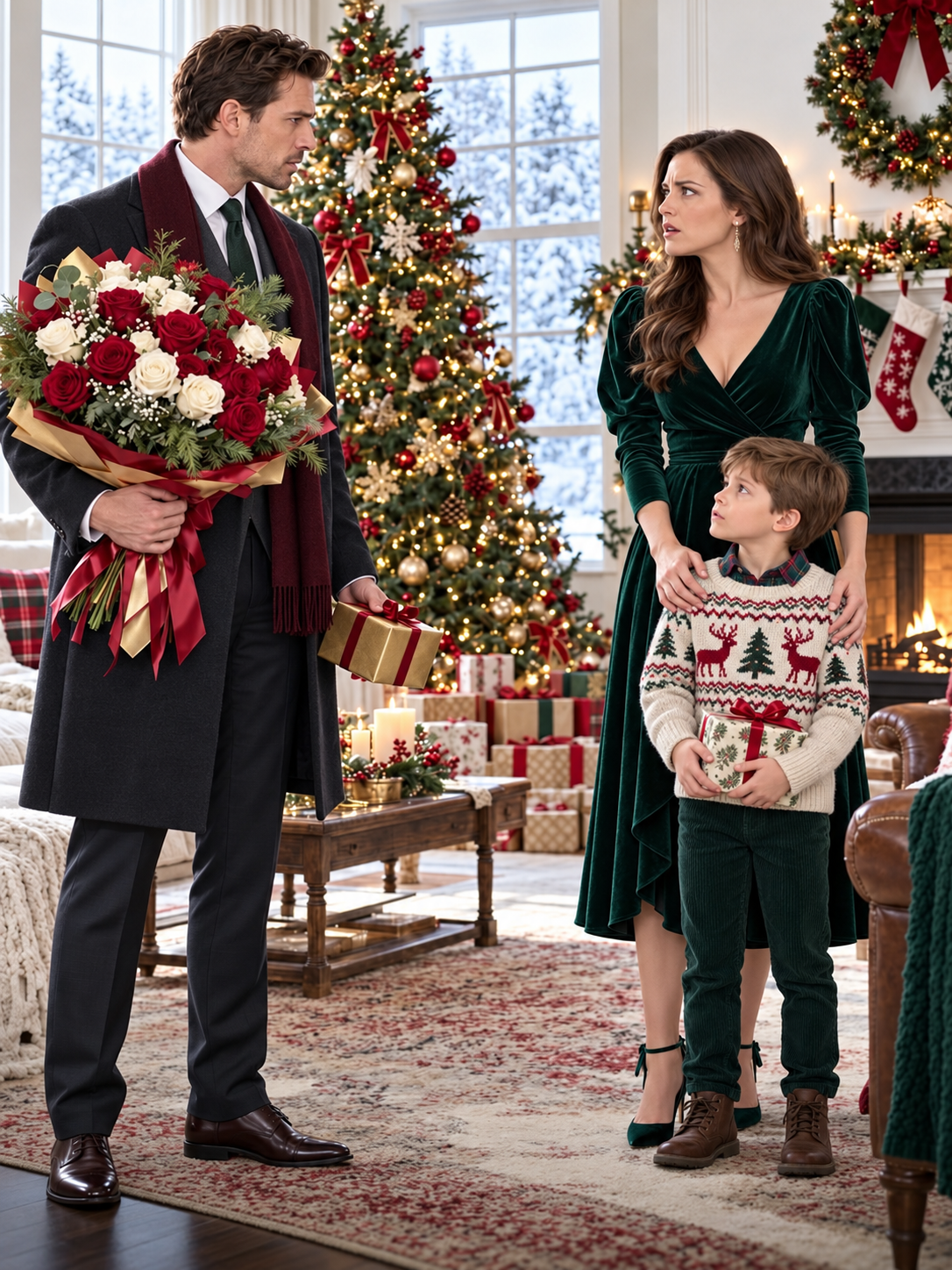
PART 1 TITLE: Seven Christmases After Walking Away From My Marriage, I Returned to Lauren’s Door With an Apology and a Truth I Could No Longer Escape
The porch light came on before I reached the front door, and I nearly turned around. Seven years had passed since I last stood outside a house where Lauren Keaton lived. Seven years since I convinced myself that leaving her was the only way to preserve what remained of my dignity. Yet on that Christmas Eve in Billings, Montana, with snow gathering along the seams of my winter coat, I was more frightened of facing my former wife than I had been during some of the hardest days of my military career. I had come to tell her that she had been right all along. The trouble was that I had no idea whether she would let me finish a sentence.
My name is Liam Albright. At thirty-eight, I had learned to make difficult decisions under pressure, to follow complicated orders, and to remain composed when circumstances turned against me. None of those abilities helped as I stood beneath Lauren’s porch light, staring at the brass house number beside her door. I had driven across Billings through streets glazed with freezing slush, repeating an apology I had practiced for almost two months. Now I could barely remember the first line. My overnight bag rested beside my boots, where I had set it down without thinking. The handle was wet with melting snow.
I had not come expecting to be welcomed. In fact, I had prepared myself for the possibility that Lauren would recognize me through the front window and refuse to answer. She would have been entitled to that. I had been the one who demanded our divorce. I had been the one who packed his belongings, stopped answering telephone calls, and treated every attempt at reconciliation as another opportunity for her to deceive me. For years, I had described the end of our marriage as something that happened to me. It had taken most of a decade to admit how thoroughly I had helped destroy it.
The neighborhood was quiet in that particular way residential streets become on Christmas Eve. A few houses displayed colored lights around their windows. Across the road, someone had arranged three illuminated deer beneath a pine tree, one of them leaning awkwardly toward the sidewalk. Music drifted faintly from a house farther down the block. Somewhere inside Lauren’s home, I imagined, there might be a radio playing while she prepared dinner. She used to cook with music on, moving around the kitchen in her stocking feet, occasionally singing the wrong words without realizing it. I had once found that habit irresistible. Near the end, I had stopped noticing it.
The woman I married at twenty-nine had never been someone who demanded grand gestures. Lauren appreciated things that required attention rather than money: remembering an appointment she had mentioned in passing, replacing the batteries in the smoke detector before it began chirping, putting a warm plate aside when she knew I would return late. She could spend an entire Saturday repairing an old piece of furniture and be delighted when the finished result looked almost the same as before. I used to tease her about keeping things long after they should have been discarded. Standing outside her door, I wondered what she would say about a former husband who had waited seven years to repair something he had broken himself.
There had been good years between us. That was part of what made remembering so difficult. We had not entered our marriage as strangers who discovered they were incompatible. We knew one another’s habits, weaknesses, and private ambitions. Lauren understood why I sometimes became quiet after long assignments. I understood that she needed a little time alone when she was upset, not because she wanted distance but because she preferred to choose her words carefully. We had talked about children, about where we might eventually settle, about having a small garden and a dog that would probably be spoiled beyond reason. Those conversations had once sounded like plans rather than wishes.
Then came the photograph. I could still picture it with uncomfortable clarity: Lauren seated at a restaurant table opposite a man I did not recognize, her face turned toward him as she smiled. The image had arrived while I was stationed away from home. A message accompanying it suggested she had been concealing something important. I never established who had taken the photograph, and I made almost no effort to discover why it had been sent. I saw a man beside my wife and allowed a few suggestive words to become evidence of betrayal. Looking back, I could scarcely recognize the certainty with which I reached a conclusion that had never been proved.
The man’s name was Patrick, an old college friend of Lauren’s. She told me that much when I confronted her. She also said they were organizing a surprise retirement celebration for my father. I remembered her standing in our kitchen, one hand resting against the counter, trying to explain the arrangements without ruining the surprise. At the time, every detail sounded suspicious because I had already decided what the truth must be. When she offered to show me messages, I accused her of preparing a convincing story. When she became upset, I called her reaction defensive. There was no answer she could give that I would accept.
I told myself that refusing to listen made me strong. I thought a man who had been betrayed should never permit himself to appear uncertain. The uglier truth was that certainty protected me from examining my own behavior. If Lauren was guilty, I could remain righteous. If she was telling the truth, I would have to acknowledge that I had injured the person I loved because I was afraid of looking foolish. I chose the explanation that demanded the least courage from me. It seemed easier to condemn her than to admit I was frightened.
Our arguments became shorter and more destructive as the weeks passed. Lauren stopped trying to make me understand every detail because I had turned each explanation into another accusation. I remember finding her seated at the dining table one evening, looking at a stack of unopened mail. She asked whether I truly wanted the marriage to end. I told her there was nothing left worth discussing. She nodded once, a small movement I interpreted as indifference. Only now did I understand how exhausted she must have been. She had been asking me for an answer, and I had given her a verdict.
The divorce proceeded with a speed that surprised even me. There were papers to review, property to divide, signatures to provide. Our marriage became a collection of dates and obligations. I kept expecting Lauren to make one final dramatic attempt to stop everything, though I would have resented her if she had. Instead, she handled the process with a composure that I mistook for proof she had never cared very deeply. She was twenty-nine when it ended. I was older, and I thought that made me wiser. In reality, I had simply become more experienced at defending a mistake.
Three weeks after the divorce was finalized, I left Montana on an overseas military assignment that would last more than a year. Before departing, I changed my telephone number during the transfer and made no effort to ensure Lauren could contact me. My mother, Patricia Albright, continued collecting correspondence sent to my permanent address. I considered that arrangement practical. There was no reason, I thought, for my former wife to have access to my new life. I had even taken a certain satisfaction in making our separation complete, as though silence could confirm that my judgment had been correct.
For a while, work gave me what I wanted. The structure of military service filled my days with responsibilities that required immediate attention. I traveled, trained, accepted new assignments, and learned how to sleep in unfamiliar places without complaint. When someone asked whether I was married, I answered that I had been divorced. The explanation seldom went any further. I developed the habit of mentioning the breakup with a brief shrug, suggesting it was an ordinary disappointment rather than an injury I had never properly examined. I could speak about it without raising my voice. I could not think about it without feeling a familiar pressure beneath my ribs.
Time did not remove Lauren from my thoughts in the clean, decisive way I expected. Instead, memories appeared in small, inconvenient moments. I would see a woman at an airport carrying the same canvas tote Lauren used to own, and suddenly remember how she organized receipts inside it. Once, during a cold morning abroad, I caught the smell of coffee mixed with cinnamon and remembered our kitchen in winter. A colleague mentioned his wife’s birthday, and I realized that for several years I had known exactly what gift Lauren would have wanted. I did not contact her. Remembering someone and having the courage to face them were very different things.
Eventually, the anger that had sustained my version of the divorce began to seem unreasonable even to me. I revisited the conversations I had spent years avoiding. Lauren had never changed her explanation about Patrick. She had never demanded that I believe her without looking at the details. It was I who had refused the opportunity to learn the truth. The photograph showed a lunch. The accompanying message contained an allegation. Everything beyond that had come from my imagination. I had treated suspicion as knowledge and punished Lauren for failing to disprove something I would not allow her to examine.
During the autumn before that Christmas, I finally admitted aloud what I had known privately for some time. I had been wrong about my marriage. I had not simply made a poor decision under difficult circumstances; I had prolonged the damage because I preferred pride to uncertainty. Hearing myself acknowledge it was unpleasant. It meant reconsidering seven years of explanations I had offered friends, colleagues, and my own family. But once I began, I found that the old story no longer held together. I could see how often Lauren had tried to reach me and how deliberately I had made myself unavailable.
I began rehearsing an apology during long drives. At first, the words were elaborate, full of explanations about military stress, distance, and the humiliating photograph. Each version seemed convincing until I imagined Lauren hearing it. Then I recognized the familiar sound of a man defending himself. I reduced the speech gradually. I removed the circumstances I had used as excuses. I stopped including sentences about how much I had suffered, because that was not what I had come to discuss. The apology became shorter and more difficult. I wanted to tell her plainly that she had deserved to be believed and that I had denied her that basic trust.
I had returned to Billings after leaving active military service three months earlier. The decision to come back had been made before I considered visiting Lauren. Yet once I was living near the streets we had known together, the past became harder to keep at a distance. I passed familiar intersections and remembered conversations that had taken place in the car. I recognized a grocery store where we used to shop late in the evening. Every ordinary landmark reminded me that the marriage had been real, not merely a regrettable chapter in a distant life. I could no longer pretend that being away had settled what I owed her.
I had found her address without difficulty. What proved difficult was deciding whether appearing at her home would be selfish. I understood that Lauren might have rebuilt her life. She might be married, engaged, or simply content without anyone. An unexpected visitor on Christmas Eve could disturb something she had worked hard to establish. I considered writing instead. Then I remembered how often she had tried to speak with me face-to-face while I hid behind accusations. I wanted, at least once, to stand before her without controlling the conversation or deciding what she was allowed to say.
In the end, I chose Christmas Eve partly because it was a day I knew would matter to her. Lauren loved the quiet hours before Christmas morning, when the practical work was finished and the decorations glowed against dark windows. I had also told myself that a holiday might soften the awkwardness of my arrival. By the time I reached her street, I realized how little sense that reasoning made. Christmas could be a particularly painful time to reopen an old wound. I almost drove past her house. Instead, I parked beside the curb and sat with both hands resting on the steering wheel.
A narrow ribbon of light showed beneath the curtains. I could see a decorated tree through one window, though the glass reflected too much of the street for me to make out the room clearly. There was a wreath on the front door, made of pine branches and dried orange slices. Lauren had once made a similar wreath for our first Christmas together. She spent an afternoon threading the fruit onto wire while I complained that the house smelled like a bakery. She told me to stop hovering and either help or make tea. I made tea. For reasons I could not explain, that small memory hurt more than most of our arguments.
I got out of the car, took my overnight bag from the passenger seat, and climbed the path toward her porch. Halfway there, I considered leaving the bag behind. It made my visit look more presumptuous than I intended. I had only brought it because I had been carrying it between places that afternoon and had not thought clearly before approaching the house. The last thing I wanted was for Lauren to believe I expected an invitation to stay. I put the bag beside the steps and wiped the snow from my gloves. My hands were trembling, though the cold was not entirely responsible.
I rang the bell once. The sound carried through the door, followed by movement somewhere inside. I heard a floorboard creak. Then the porch light brightened, and the lock turned. I had imagined this moment repeatedly during the previous weeks, but every imagined version ended before I had to meet Lauren’s eyes. When the door opened, I saw that seven years had altered her in ways both obvious and almost imperceptible. Her dark-blond hair now rested near her shoulders instead of falling halfway down her back. Fine lines had appeared beside her eyes. She wore a soft gray sweater and dark trousers, the sort of comfortable clothes she always preferred at home.
For an instant, neither of us moved. Her hand remained wrapped around the doorknob. She looked first at my face, then at the Army patch on my old winter coat, and finally at the overnight bag near my feet. Recognition arrived immediately, but surprise seemed to hold her in place. I noticed that she no longer wore the thin silver necklace I had given her on our second anniversary. It was an absurd detail to notice, considering everything between us, yet I could not stop looking for traces of the woman I remembered. Her expression remained careful, neither welcoming nor openly hostile.
“Liam?” she said.
Hearing my name in her voice was unexpectedly difficult. During our marriage, she had used it in a hundred ordinary ways: to call me into the kitchen, ask me to move my shoes, tell me something amusing, or draw my attention to a problem. Now it sounded like a question she had never expected to ask again. I managed a small nod. She looked past me toward the street, perhaps checking whether anyone had accompanied me. When her gaze returned, I recognized the steady concentration that once made it impossible for me to hide behind a convenient explanation.
“What are you doing here?” she asked. Her voice was low enough that I barely heard it above the wind. There was no sharpness in the question, only caution. I looked down at my boots, then forced myself to meet her eyes. I told her I had come to say something that should have been said years earlier. Lauren did not respond immediately. She shifted her weight slightly, keeping one hand on the door. From inside the house came the faint smell of cinnamon and evergreen branches, followed by the soft ticking of a clock.
“I don’t know what you expect from me,” she said at last.
“Nothing,” I answered. “I haven’t come to ask you to take me back. I haven’t come to explain why I behaved the way I did.”
Her mouth tightened, and she glanced toward the hallway behind her. I realized she might be preparing to end the conversation. There was no reason she should give me time simply because I had finally decided to seek it. I could feel my carefully prepared speech slipping away. I had imagined choosing my words with dignity, but the longer she stood before me, the more clearly I understood that a polished apology could become another way of avoiding the truth.
“I was wrong about you, Lauren,” I said. “You told me what happened with Patrick, and I wouldn’t listen. I wanted you to be guilty because admitting you weren’t would mean facing what I’d done. You didn’t deserve any of it. I know saying that now doesn’t repair anything. But you should have heard it from me a long time ago.”
The change in her face was slight. Her eyes moved from mine to the porch railing, where snow had collected in a narrow white line. She drew a breath as though she intended to answer, then stopped. I remembered how, in the final weeks of our marriage, I had repeatedly interrupted her before she could finish explaining herself. I made myself remain silent. If she wanted to tell me to leave, I would accept it. If she wanted to describe what my actions had cost her, I would listen without correcting a single word.
Lauren loosened her grip on the doorknob. For a moment, she appeared to be looking at something far beyond the porch, something neither of us could see. Then she looked at me again, and the caution in her eyes had acquired another quality I could not immediately identify. It might have been fear. It might have been the effort of making a difficult decision. I was about to ask whether I should go when a quick succession of footsteps sounded across the wooden floor behind her. Lauren turned sharply toward the hallway, and I heard a child’s voice calling for his mother.
END PART 1
PART 2 TITLE: A Little Boy Stepped Into the Hallway Wearing My Childhood Expression, and Suddenly Every Answer I Had Come Seeking Seemed Incomplete
The child appeared before Lauren could stop him. He was small and narrow-shouldered, wearing red pajama trousers and a navy sweatshirt decorated with a silver rocket. In one hand he carried a cardboard Christmas star, its edges covered in gold paint that had dried unevenly. A strip of transparent tape dangled from the back. He crossed the hallway with the determined stride of someone who had been given an important task and intended to finish it. Then he saw me standing outside, and his feet stopped together on the wooden floor.
“Mom, the tape came off again,” he announced. His eyes remained fixed on me, though he held the star toward Lauren. She turned fully into the doorway, her expression changing so quickly that I almost missed it. A moment earlier, she had been a woman confronting an unexpected visitor from her past. Now she was a mother assessing something that might disturb her child’s evening. I watched her move one hand toward his shoulder, not quite touching him. The gesture was protective, instinctive, and so familiar in its tenderness that I felt a sharp longing for the life I had once imagined sharing with her.
The boy looked directly at me. His eyes were blue-gray, a shade I had spent my entire life seeing in mirrors. They were not merely light eyes that resembled mine in passing. There was a darker ring around each iris, and the gray became more pronounced when he stood in the shadow of the hallway. My father had the same coloring. In photographs of us standing together, people often commented that our eyes were the one feature nobody could mistake. I had never expected to see that resemblance looking back at me from the face of a child I had never met.
I noticed other things before I could control where my attention went. His left eyebrow rose at an unusual angle, giving him a mildly skeptical expression even while he stood perfectly still. Mine did the same whenever I concentrated. My father had passed that small irregularity to me, along with a tendency to press my lips together while considering a difficult question. The boy did exactly that. He studied my coat, my face, and the overnight bag, then tilted his head slightly to one side. I felt the porch railing at my back and wondered why I suddenly needed something solid within reach.
“Who are you?” he asked.
It was a perfectly reasonable question. I was a stranger on his doorstep, interrupting Christmas Eve while his mother stood beside him looking uncomfortable. But I found myself struggling to give even the simplest answer. For seven years I had rehearsed what I might say to Lauren if I ever saw her again. I had never prepared for a child. I could not have explained why the sight of him made my carefully arranged thoughts fall apart. I only knew that the air seemed to have changed, becoming strangely thin despite the cold.
“My name’s Liam,” I said.
The boy considered this information and gave a small nod, as though filing it away for later use. He was not frightened. His curiosity appeared stronger than any concern about the unfamiliar man standing outside. I could see a smudge of gold paint near his thumbnail, probably transferred from the damaged ornament. He shifted the cardboard star into his other hand and peered at the faded military patch stitched to the upper sleeve of my coat. I had worn that jacket for years, long after newer ones became available, because it fit comfortably and reminded me of people I had served beside.
“Were you in the Army?” he asked.
“Yes. For quite a while.”
His face brightened. The careful expression disappeared, replaced by the unguarded enthusiasm children sometimes show when they discover an adult might know something interesting. He stepped closer to the threshold, and Lauren’s hand settled gently against his back. I could tell she wanted to redirect him without making the situation appear alarming. I stood motionless, conscious of the snow melting down the sides of my boots. A few minutes earlier, I had believed that my greatest difficulty would be apologizing to Lauren. Now I was struggling to remember how an ordinary conversation worked.
“Did you ever fly in a helicopter?” he asked.
“A few times.”
“Did you get to sit right next to the pilot?”
“Not usually. There were people with much more important jobs than mine.”
“Was it loud?”
“Very loud. You’d need special headphones.”
He nodded with such serious appreciation that I almost smiled. I recognized the expression of someone mentally comparing an answer with facts collected from books or television. On his sweatshirt, the little silver rocket had begun to crack along one edge from repeated washing. It occurred to me that he probably owned books about aircraft and space travel, perhaps models he liked to assemble. I wanted to ask him. I wanted to know whether he preferred helicopters to rockets, whether he had ever traveled outside Montana, whether he liked school, and who helped him with his homework.
Lauren interrupted before another question could follow. “Mason, honey, take your star back to the tree. I’ll help you fix it in a minute.”
Mason. The name settled somewhere in my mind and stayed there. He looked up at his mother, mildly disappointed that the conversation had ended just as it was becoming interesting. Then he examined the ornament, turning it over to inspect the loose tape. He had evidently been working on it for some time. “It won’t stay on the branch,” he explained, as though she might have forgotten the original problem. Lauren crouched slightly beside him and smoothed a wrinkle from his sweatshirt. Her voice softened in a way I remembered from our marriage.
“We’ll find a better way to attach it. Go see where you want it to hang.”
Mason glanced at me again. “Are you coming inside?”
The question arrived so unexpectedly that I looked toward Lauren before answering. She had gone still, and I understood immediately that any invitation belonged to her, not to me. I could not assume a place inside this house merely because I had once been her husband. The child waited with the uncomplicated expectation that adults could usually answer straightforward questions. I tried to give him one without making a promise Lauren might not want me to keep.
“I haven’t decided that with your mom,” I said. “But I hope you get your star fixed.”
He seemed satisfied. “It’s supposed to go near the top. I made it myself.”
“I can tell. You did a good job with the points.”
“One’s crooked.”
“That doesn’t mean it’s a bad star.”
Mason studied the uneven cardboard, then looked at me with a small, thoughtful smile. “That’s what Mom said.”
For reasons I did not understand until later, those words affected me more deeply than the sight of the Christmas tree or the photographs I could glimpse in the living room. Lauren had always been patient with imperfect things. She did not need every homemade decoration to resemble something from a store. She cared that someone had made it. Seven years had passed, and I was hearing that same philosophy repeated in the voice of a child who looked alarmingly familiar. I felt the first movement of a question I was not ready to ask.
Mason turned and made his way toward the living room. He did not run. He held the damaged star flat against his palm, carefully protecting the loose point as though it might break if he moved too quickly. At the end of the hallway, he paused and looked back. I could see him clearly beneath the warm light from the tree. His left eyebrow lifted again. Then he disappeared around the corner, and the soft sound of his footsteps faded into the house.
Lauren remained in the doorway. She had not moved her hand from the place where it had rested on Mason’s shoulder until he was out of reach. Now she folded her arms loosely, more against the discomfort of the conversation than the cold. Her gaze traveled over my face with an intensity I remembered from the difficult months before our divorce. I had once interpreted that look as an accusation. Standing there, I wondered whether she was searching for something else: the first sign that I had noticed what she could no longer hide.
“He’s a nice kid,” I said.
“He is.”
“You must be proud of him.”
“I am.”
The answers were brief, but not unkind. Lauren seemed to be choosing every word while listening for movement behind her. I realized she was not merely trying to protect herself from an uncomfortable conversation. She was protecting Mason from a situation he did not understand. The recognition made me more cautious. Whatever the boy’s connection to Lauren, he had a life before I appeared at the door. I had no right to turn that life upside down because an unexpected resemblance unsettled me.
I looked toward the Christmas tree, visible through the opening to the living room. Its lower branches carried handmade decorations, little paper figures, strings of colored beads, and shapes cut from folded cardboard. There was a bright red ribbon near the top. Beneath it sat several wrapped presents and a collection of plastic building blocks arranged into what appeared to be a small city. A school photograph stood on a nearby shelf beside a model rocket. The room was not extravagant. It was comfortable in the practical, well-used way Lauren had always preferred.
The scene reminded me of a conversation from the second year of our marriage. We had been walking through a store just before Christmas when Lauren stopped beside a display of children’s craft supplies. She lifted a package of colored paper and told me that when we had children, she intended to let them decorate the tree however they liked. I laughed and said the result would probably be a disaster. She answered that our tree did not need to impress anyone. It only needed to belong to us. I had forgotten the words for years. Now they returned with astonishing clarity.
We had talked about becoming parents more than once. At the time, I was concerned about deployments, transfers, and the uncertainty of where we might live. Lauren never pressured me, but she spoke openly about wanting a family. She imagined a child who would ask too many questions and leave toys on the stairs. I imagined teaching someone to ride a bicycle or fix a broken drawer. Those possibilities gradually disappeared from our conversations as the marriage deteriorated. By the time we separated, neither of us mentioned children at all. I had told myself that future belonged to another life.
Now a boy named Mason was inside Lauren’s house, constructing buildings beneath a Christmas tree. I could hear him humming faintly to himself as he worked. The sound was not enough to prove anything. Children resembled strangers every day. Eye color was not a legal document, and an unusual eyebrow could appear through coincidence. I knew all of that. Yet the careful part of my mind could not quiet the instinctive recognition that had come over me when he first looked up. There was something about the proportions of his face, the concentration in his expression, even the way he held himself, that made turning away almost impossible.
I tried to place his age without asking. He was old enough to speak clearly and old enough to be interested in complicated machines. He might have been six. He might have been eight. Children grew at different rates, and I had little practical experience judging their ages. I had spent most of my adult life among soldiers, not families with young children. The ignorance embarrassed me. I understood equipment inventories, transportation schedules, and operational planning. Yet I could not reliably estimate the age of a boy standing three feet away.
Lauren must have seen my expression changing. She stepped farther into the doorway, narrowing the space through which I could see the living room. I did not resent the movement. She was doing what any careful parent might do when an unexpected visitor appeared. But the action confirmed that she understood the direction of my thoughts. She had not seemed surprised when I noticed Mason’s eyes. Instead, she had looked as though something long anticipated and deeply unwelcome had finally occurred.
“Liam,” she said, “this really isn’t the time.”
I studied her face. “For my apology?”
“For a lot of things.”
There was a firmness in her voice that made me stop. I remembered how easily I used to mistake hesitation for dishonesty. Back then, if Lauren paused before answering, I accused her of calculating a response. I had been so determined to identify deception that I stopped recognizing distress. I would not make that mistake again. I remained quiet while she glanced toward the living room, waiting until Mason’s humming resumed before looking back at me.
“I didn’t know you had a child,” I said.
Lauren lowered her eyes. “There are many things you don’t know about my life.”
“That’s fair.”
“You were gone for a long time.”
“I know.”
Her answer carried no accusation, which somehow made it harder to bear. I had been absent by choice. I had refused the ordinary contact that might have allowed us to become two people who could at least speak civilly after their marriage ended. Instead, I had left a complete silence between us. I had no photographs from the intervening years, no knowledge of her work or friendships, no understanding of who had helped her through difficult times. I had treated that ignorance as proof of my independence. Now it felt like a locked door I had built myself.
I looked down at the snow collecting around my boots. A thin trail of melted water had begun to run toward the edge of the porch. Behind Lauren, the clock continued ticking, indifferent to the conversation. I wondered whether Mason had another parent waiting somewhere in the house. Perhaps his father was in the kitchen preparing dinner, or perhaps Lauren had married someone after our divorce. It was entirely possible. She had every right to move forward. I told myself that possibility should be the first one I considered, not the increasingly urgent calculation taking shape in my mind.
But Lauren wore no wedding ring. That detail proved little, and I knew it. She might remove her jewelry while working at home. She might be raising Mason with a partner she had never married. I disliked the speed with which my mind searched for answers. Years earlier, I had assembled a false story from incomplete evidence. I could not repeat that behavior now, especially when the person most likely to be hurt was a child. Still, I found myself glancing toward the hallway again, wanting one more look at Mason’s face.
A memory of my father surfaced without warning. He used to tell me that I had inherited his eyes and his stubbornness, though he was considerably prouder of the first than the second. When I was young, he would raise his uneven eyebrow whenever I offered an implausible explanation for something I had broken. I had always thought the expression belonged uniquely to the two of us. Seeing it on Mason was like discovering a childhood photograph in a house where it had no reason to be. The resemblance seemed to bridge years I had never lived.
Lauren moved her hand toward the door again. I knew that if she closed it, I could not simply return the following morning and demand answers. I had already caused her enough distress by appearing without warning. I could leave and arrange to speak with her another day, or I could ask the one question that had become impossible to ignore. I was painfully aware that the question might change the meaning of everything I had come to say. I was also aware that there might never be a gentler moment to ask it.
“Lauren,” I said.
She looked at me, and something in her expression told me she already knew what was coming.
I could hear Mason moving a chair across the living room floor. He was probably trying to reach a higher branch of the tree. I pictured his small hands holding the cardboard star, his blue-gray eyes narrowing as he concentrated. I thought of the seven Christmases that had passed since our divorce and the future we had once discussed so casually. Then I looked at Lauren and asked the question that neither of us could now pretend was unimportant.
“How old is Mason?”
Lauren did not answer immediately. Her eyes moved toward the hallway. Then she looked down at the threshold between us, and I saw her take a slow, deliberate breath. When she finally raised her head, her face had lost nearly all its color. I waited, hearing the wind scrape against the porch railing and the faint rustle of Christmas wrapping paper from inside the house.
“He’s seven, Liam,” she whispered. “Mason is seven years old.”
END PART 2
PART 3 TITLE: When Lauren Told Me Her Son Was Seven, the Marriage I Had Ruined Became the Beginning of a Much More Painful Discovery
For several seconds, I could not make myself respond. Seven. The number moved through my thoughts with a terrible precision. Our divorce had been finalized seven years earlier, and three weeks after that, I had left Montana for an overseas assignment. I remembered the airport, the cold morning, and the determination with which I boarded the aircraft without looking back at the life I had abandoned. Now Lauren was standing in front of me with a seven-year-old boy inside her house. The dates did not establish everything, but they made one possibility impossible to dismiss.
I gripped the porch railing. The metal was cold enough to sting through my glove. Lauren watched me without speaking, her arms folded across her sweater. From the living room came the sound of Mason laughing quietly at something he had accomplished. He was unaware that two adults were standing a few yards away, reconsidering an entire history. I wanted to ask Lauren to repeat her answer, not because I had failed to hear it, but because I hoped there might be some detail I had misunderstood.
“Seven?” I said at last.
She nodded.
I attempted to calculate more precisely. Seven years could mean different things depending on birthdays and the month of his birth. There were perfectly innocent explanations for the resemblance. I understood that. But Lauren was looking at me with the unmistakable expression of someone who had carried knowledge alone for far too long. She did not appear confused by my question. She appeared frightened by what might happen after she answered it. That frightened me more than the calculation itself.
“Lauren, I need to ask you something.”
“I know.”
“Please don’t answer because you think it’s what I want to hear.”
Her eyes sharpened. “You still think I would do that?”
The question stopped me. I had come to apologize for distrusting her, and within minutes I was choosing words that suggested the same suspicion. I lowered my head. “No. I’m sorry. That came out wrong.” She said nothing. I swallowed and tried again. “I just need to understand what’s happening.”
She looked over her shoulder. Mason was singing softly now, apparently occupied with his decorations. Lauren stepped onto the porch and drew the door almost closed behind her. A narrow strip of warm light remained visible beside the frame. She had left it open enough to hear her son if he called, but not enough for him to overhear us easily. I moved away from the entrance to give her room. We stood facing each other beneath the porch light, with snow gathering in the dark branches beyond the steps.
“Is Mason my son?” I asked.
The words were quiet. I had expected them to emerge with greater force, perhaps accompanied by anger or disbelief. Instead, they sounded almost unfamiliar in my own voice. Lauren looked at me for a long moment. Her expression contained neither triumph nor satisfaction. She had nothing to gain from watching me struggle. I could see her considering the consequences of an answer that would alter Mason’s life as much as mine. Finally, she closed her eyes briefly.
“Yes,” she said. “He’s your son.”
I felt something give way inside me. I had imagined many possible outcomes for my visit. Lauren might refuse my apology. She might forgive me without wanting further contact. She might have found a happiness that no longer included any place for me. I had not imagined learning that we had a child. The realization was so abrupt that I sat down on the porch step without deciding to do so. Snow soaked through the fabric of my trousers. I barely noticed.
I looked toward the living room window. Beyond the curtains, colored lights flickered against the glass. Somewhere inside that warm house was a boy who had inherited my eyes and apparently my father’s crooked eyebrow. A boy whose name I had learned less than ten minutes earlier. I knew nothing about his favorite breakfast, the subjects he enjoyed at school, or whether he slept with a nightlight. I had no memory of his first steps, no photograph of his first birthday, no recollection of holding him when he cried. All those ordinary experiences had happened without me.
“You’re sure?” I asked.
Lauren’s expression tightened. “Liam, I haven’t spent seven years wondering who his father is.”
I stared at the steps beneath my boots. “I know. I’m sorry.”
She remained silent while I tried to steady myself. I could not expect her to comfort me. Whatever shock I was experiencing, she had lived with the consequences for years. She had carried the pregnancy, given birth, and raised Mason through every illness and sleepless night. I had entered the situation only moments earlier, yet the realization already felt almost unbearable. I could not imagine what it had required of her.
“When did you find out?” I asked.
“Eleven days after you left for your assignment.”
I looked up. She remembered the exact number. That detail told me more than a lengthy explanation could have. For Lauren, the discovery had not been an indistinct event buried in the past. It had a place on a calendar. Eleven days after my departure, she had learned that the marriage I believed finished had left us connected in a way neither of us had understood. I wondered where she had been when she received the news. Whether she had been alone. Whether her first instinct had been to call me.
“You knew after I was gone,” I said.
“Yes.”
“And you went through the pregnancy without me?”
She looked at me with an expression I could not mistake. “I went through everything without you, Liam.”
There was no cruelty in her voice. She was stating a fact. I thought of all the moments during my military assignment when I complained about isolation or the difficulties of living away from home. I had written messages to colleagues about bad meals, inconvenient schedules, and the exhaustion of traveling. During those same months, Lauren had been preparing to become a mother. She had been making decisions about doctors, appointments, baby clothes, and the future. I had not known enough to ask a single question.
My mind returned to the last weeks of our marriage. The arguments had left us both exhausted, but there had also been moments when we stopped fighting and behaved like the people we once were. We had eaten dinner together without discussing the divorce. On one evening, Lauren had fallen asleep beside me on the sofa, her head resting briefly against my shoulder. I remembered sitting motionless because I did not want to wake her. The memory had embarrassed me afterward. Now I wondered whether Mason’s life had already begun during those last uncertain weeks.
I tried to imagine telling my younger self that the woman he was about to divorce would soon discover she was pregnant. Would he have listened? Would he have accepted the responsibility, or would he have found a way to interpret the news as another deception? I wanted to believe I would have behaved honorably. But remembering how I treated Lauren made that confidence impossible. I had questioned her honesty over an innocent lunch. I had treated her attempts to explain as further evidence against her. I could not claim to know what I would have done.
The photograph of Patrick returned to me with painful clarity. He had been seated across from Lauren in a restaurant near the center of town. She was smiling at something he had said, one hand resting beside a glass of water. Whoever sent the photograph had chosen words designed to encourage suspicion, and I had accepted them without seeking context. Lauren explained that Patrick was helping her arrange my father’s retirement dinner. She told me they had attended college together and that she had contacted him because he could assist with the preparations. I had heard every word and rejected it.
I remembered the afternoon I returned home and confronted her. Lauren was cutting vegetables at the kitchen counter. I placed my phone beside the cutting board with the photograph displayed on the screen. She looked at it, then at me, and immediately understood why I was angry. She tried to explain, but I demanded to know how long she had been meeting Patrick secretly. When she said there was nothing romantic between them, I accused her of insulting my intelligence. I had already decided that a confession was the only acceptable response.
Lauren had eventually stopped defending herself. Not because she admitted wrongdoing, but because nothing she said changed my expression. I could still hear her asking whether I genuinely believed she would arrange an affair in a public restaurant where anyone could photograph her. I dismissed the question. Later, I repeated our argument to my mother, who listened closely and told me to protect myself. I did not question the advice because it supported the conclusion I wanted to reach. Remembering that conversation now, I felt a fresh unease.
Standing on Lauren’s porch, I recognized how completely I had failed to understand the meaning of trust. I had demanded honesty while refusing to examine evidence. I had claimed to value loyalty while abandoning the woman who had offered it. The consequences were no longer confined to a failed marriage. A child had entered the world, grown old enough to attend school, and learned to build elaborate structures from plastic blocks without ever knowing my name. I had arrived expecting to confront a mistake in my past. Instead, I had discovered someone whose entire future might depend on what I did next.
“Does Mason know?” I asked.
Lauren understood immediately. “Not who you are.”
I glanced toward the door. “What does he think about his father?”
“He knows his father was in the military.”
“That’s all?”
“That’s what I’ve told him.”
Her answer left me with questions I did not yet have the courage to ask. Had Mason wondered why other children had fathers who attended school events? Had he asked whether his father would ever visit? Had Lauren been forced to invent gentle explanations when the truth was too difficult for a young child to understand? I imagined her sitting beside his bed, choosing words carefully, protecting him from questions she herself could not answer. My throat tightened.
“Did you tell him I didn’t want him?”
Lauren looked genuinely hurt. “No. I would never put that on him.”
I covered my face with one hand. She had protected Mason from a judgment she had every reason to believe was true. I remembered how casually I had described our divorce to other people, sometimes allowing them to assume Lauren had betrayed me. She had offered me more dignity in my absence than I had shown her when we were married. I could not find a way to thank her without making the moment about myself.
For a while, neither of us spoke. The snow had grown heavier, and white flakes gathered along the porch steps. I could hear a passing vehicle moving slowly through the slush. The ordinary sounds of Christmas Eve continued around us, untouched by what I had learned. I wanted to go inside and look at Mason again. I wanted to kneel beside his little city of blocks and ask him to explain every building. But I understood that desire was mine, not necessarily his. I could not become an unfamiliar presence in his life simply because I had discovered we shared blood.
“Lauren, why didn’t you tell me?”
She straightened. The change in her posture was immediate. Until then, she had been careful, almost gentle, as though trying to prevent the news from overwhelming me. Now something older and more painful entered her expression. She looked at me with the same directness I remembered from the day our marriage ended. I realized that the question I had just asked must have sounded very different to her than it did to me.
“I did try,” she said.
I stared at her. “What?”
“I tried to tell you about the pregnancy.”
“But I never heard anything.”
“I know.”
She drew her sweater more tightly around herself. The wind had begun pushing snow beneath the porch roof, and I noticed that she was wearing only thin socks inside her house slippers. She had been standing outside longer than she intended because I had kept asking questions. Yet she did not move toward the door. There was something she needed me to understand, something she had apparently carried for years without an opportunity to explain.
“I called you, Liam,” she said. “I wrote to you. I did everything I knew how to do with the information I had.”
My first impulse was to protest. I had never received a message about a pregnancy. I had never opened a letter announcing that I would become a father. If anyone had told me, surely I would have remembered. But before I could answer, I recalled the number I had changed, the contact details I had refused to share, and the way I had relied on my mother to manage correspondence during my deployment. I began to understand how much I had deliberately placed beyond Lauren’s reach.
“What happened to the letters?” I asked.
Lauren looked toward the hallway, then back at me. Her expression had changed from anger to something more difficult to bear: the exhausted patience of someone who had already explained the same truth to herself countless times. “There’s something I need to show you,” she said. She opened the door wider, letting a rush of warm air spill onto the porch. I stood slowly, brushing snow from my trousers, and followed her gaze toward the quiet kitchen beyond the hallway.
“Come inside,” she said. “You need to see what I received after Mason was born.”
END PART 3
PART 4 TITLE: The Letter Lauren Had Kept for Seven Years Carried My Name, but the Message Written Across It Was Never Mine
The warmth inside Lauren’s house struck me first. After the cold porch, the hallway felt almost too comfortable, filled with the smell of cinnamon, evergreen branches, and something baking in the kitchen. I stepped across the threshold carefully, conscious of the wet marks my boots left on the wooden floor. Lauren closed the door behind me and glanced toward the living room. Mason was sitting cross-legged beneath the Christmas tree, concentrating on the cardboard star he had been trying to repair. He looked up when he noticed me and offered a quick smile before returning to his work. He had no idea what his mother had just told me.
I stood near the entrance longer than necessary. On the wall beside me hung several framed photographs, including one of Mason standing in front of a school building with a backpack almost as large as his shoulders. Another showed him holding a paper certificate, smiling with the unmistakable pride of a child who had worked hard for something. I wanted to move closer and study every photograph, but I stopped myself. These were pieces of a life that belonged to Lauren and Mason. My sudden discovery did not give me permission to claim them.
“Come through to the kitchen,” Lauren said quietly.
I followed her past the living room. Mason was attempting to reinforce the star with a second strip of tape. His tongue pressed against the corner of his mouth while he concentrated, and I recognized another habit I had carried since childhood. The resemblance made my chest ache. I wondered how many times Lauren had watched him make those expressions and remembered me against her will. Perhaps the similarities had comforted her. Perhaps they had made difficult days even harder. I had no right to assume either.
The kitchen was smaller than the one we had shared during our marriage, but it possessed the same careful order Lauren always preferred. A ceramic bowl held oranges and walnuts near the window. Two mugs rested upside down beside the sink. On the refrigerator, drawings were secured beneath magnets shaped like animals. One showed a rocket rising above a crooked green landscape. Another contained three stick figures standing beneath a yellow sun. I could not tell who the figures represented. For the first time that evening, I felt the weight of my own absence without trying to explain it away.
Lauren pulled out a chair for me but remained standing. “I need you to listen before you decide what you think happened,” she said.
The words brought an uncomfortable memory. During our marriage, she had made similar requests whenever I confronted her with another suspicion. I had usually interrupted within seconds. This time I sat down, placed my hands flat on the table, and waited. Lauren noticed the gesture. Something flickered across her expression, but she did not comment.
“When I found out I was pregnant,” she began, “you had already been gone eleven days. I had no idea where you were staying, and the number you gave me before the deployment no longer worked.”
I remembered standing in an administrative office during my transfer and arranging the new telephone service. Changing my number had seemed like a minor practical decision. I had been determined to begin the assignment without reminders of the marriage I considered finished. When the opportunity came to leave the old number behind, I accepted it without hesitation. I never considered what might happen if Lauren needed to reach me for a reason unrelated to our divorce.
“I changed it during the transfer,” I admitted. “I didn’t give you the new number.”
“I know.”
“I should have.”
Lauren leaned against the counter. “At the time, I thought you wanted to make sure I couldn’t speak to you again.”
I opened my mouth, then closed it. That had been precisely what I wanted. There was no kinder explanation available. I had told myself distance would help us both move forward, but the decision had been shaped by resentment. Now the consequences sat between us at the kitchen table, larger than either of us could have imagined.
“I tried the old number more than once,” Lauren continued. “The first time, I thought there might be a technical problem. The second time, I understood it had been disconnected. I asked whether anyone could pass a message to you, but nobody would give me your new contact information.”
I could picture her holding the telephone and listening to an automated recording while trying to understand how she would tell me about the pregnancy. She would have been alone in a house recently divided by divorce. I wondered whether she had already purchased a pregnancy test, whether she had cried when she saw the result, and whether she had called someone she trusted before trying to reach me. These were questions I could ask later, if she wanted to answer them. For now, I kept quiet.
“When calling didn’t work, I wrote a letter,” she said. “I addressed it to the military mailing information I had. I explained that I was pregnant and that I wanted you to know before making any decisions about what happened next.”
“Did it reach the base?”
“No. It came back.”
She crossed to a drawer and removed a folded postal notice. The paper was worn along the creases. An official marking indicated that the address could not be used for delivery. I recognized the problem almost immediately. My assignment details had changed during the transfer, and the address she possessed was no longer reliable. I had known about the change. Lauren had not.
“I kept the notice,” she said. “I thought I might need it someday.”
I looked at the faded paper. Seven years earlier, she had attempted to send me news that would have changed both our lives. The letter had traveled part of the way toward me and then returned because the information I left behind was useless. I had spent those years believing the silence between us proved that neither of us had anything more to say. The postal notice showed how mistaken I had been.
“What did you do next?” I asked.
“I wrote another letter.”
Her voice remained steady, but I noticed her fingers tightening against the edge of the counter. She had probably rehearsed this explanation long before I appeared at her door. Perhaps she imagined confronting me if we ever met again. Perhaps she had abandoned that possibility years earlier. I wondered what it cost her to reopen the subject on Christmas Eve, when she should have been enjoying a quiet evening with her son.
“I sent the second letter to your mother’s house,” she continued. “That was still listed as your permanent mailing address, and I knew Patricia had been collecting your correspondence.”
I felt a cold pressure beneath my ribs. My mother had handled my mail during the overseas assignment. She had always been efficient about such arrangements, keeping important documents together and forwarding anything she considered urgent. I trusted her to decide which letters needed my attention. At the time, I regarded that trust as ordinary. My mother had been involved in practical matters throughout much of my adult life, and I rarely questioned her judgment when she claimed to be helping.
“Did Mom receive it?” I asked.
Lauren looked directly at me. “Yes.”
“Then why didn’t she send it to me?”
Instead of answering, Lauren walked toward a wooden cabinet beside the kitchen window. She opened the upper door and reached behind a stack of folded table linens. When she turned around, she was holding a small cedar box. The wood had darkened slightly with age, and one corner showed a shallow scratch. She placed it on the table between us without immediately opening it.
“I kept these things because I didn’t know what else to do with them,” she said.
The box gave off a faint scent of cedar when she lifted the lid. Inside were several carefully preserved objects: a tiny knitted cap, a hospital bracelet, faded photographs, and an envelope with yellowed edges. The objects were arranged in layers, with tissue paper separating the delicate items. I stared at them without speaking. For Lauren, they were pieces of Mason’s earliest days. For me, they were evidence of a life I had never known existed.
She lifted the knitted cap. It was pale blue, so small it could have rested inside my palm. “He wore this when we brought him home,” she said.
I reached toward it, then stopped. Lauren noticed and placed it gently in my hand. The yarn had softened with age, and one small loop had loosened near the edge. I tried to imagine Mason wearing something so tiny. I thought about the size of his hands now, the way he had held the cardboard star, and the confidence with which he questioned a stranger about helicopters.
Beneath the cap lay a hospital bracelet marked Benjamin Keaton. I glanced at the name, then at Lauren. She understood my confusion. “Benjamin was the name I first chose for him,” she explained. “But I started calling him Mason when he was little, and that’s the name he knows as his own.”
I nodded slowly. The explanation was simple, yet it made me painfully aware of how many ordinary decisions had happened without me. Even the name by which my son understood himself belonged to a history I had never shared. I had not been present to discuss names, sit through appointments, or hold him after his birth. Lauren had made those choices while raising a child who depended entirely on her.
She handed me one of the photographs. In it, a newborn lay wrapped in a white hospital blanket, his face turned toward the camera. His eyes were closed, and one tiny fist rested near his cheek. Another photograph showed Lauren seated in a hospital bed, holding the baby against her chest. She looked exhausted. Her hair was pulled away from her face, and there were shadows beneath her eyes. Yet she was looking down at him with such concentration that the rest of the room seemed unimportant.
I remembered the woman I had accused of dishonesty and abandoned when she was twenty-nine. In the photograph, she looked both familiar and entirely changed. She had become a mother, taken responsibility for a life we created together, and continued without knowing whether I would ever acknowledge what had happened. I traced the edge of the photograph with my thumb, careful not to touch the image itself.
“You should have been there,” I said.
Lauren lowered her gaze. “I wanted you to know.”
The difference mattered. She did not say she had wanted me back. She did not suggest that pregnancy would have repaired our marriage. She had simply believed I deserved to know I was becoming a father, and that Mason deserved whatever relationship might be possible. I had denied her the ordinary means of telling me.
Then she removed the envelope from the bottom of the box.
It was addressed to LIAM ALBRIGHT in Lauren’s familiar handwriting. I recognized the shape of the letters immediately. She had always written my name with a slight slant, the final stroke of the last letter extending farther than necessary. I had seen that handwriting on shopping lists, birthday cards, and notes she left beside my breakfast plate. Now it appeared on an envelope I should have received seven years earlier.
“That came back to me six weeks after Mason was born,” she said.
I turned it over carefully. An official postal marking crossed one corner. The paper had been handled repeatedly, and the fold beneath the flap showed signs of age. I could see that Lauren had preserved it for a reason beyond the announcement of Mason’s birth. There was writing across the lower portion of the envelope, darker than the address and formed in a distinctly different hand.
I recognized the handwriting before I finished reading the first sentence.
It belonged to my mother.
I had seen Patricia Albright’s handwriting throughout my childhood. She wrote notes to teachers, signed permission slips, addressed Christmas cards, and left reminders on the kitchen counter. Her letters were sharply angled, with heavy strokes and carefully spaced words. The message on Lauren’s returned envelope had those same unmistakable features.
Liam has moved forward with his life. Please respect his decision and do not contact him again about the child.
I read the sentence once. Then I read it again, much more slowly. For several seconds, the words seemed to resist their obvious meaning. My mother had not merely received a letter meant for me. She had answered it. She had told Lauren that I knew about our child and had deliberately chosen to continue my life without him.
“I never wrote this,” I said.
Lauren was silent.
“I never told my mother to say anything like this.”
“I understand that now.”
I looked up sharply. “But you didn’t know it then.”
“No,” she answered. “I didn’t.”
The words landed with greater force than any accusation she could have made. For seven years, Lauren had lived with the belief that I was aware of Mason’s existence and had rejected him. She had received a message written by my mother, a woman who knew how to reach me, and had reasonably understood it as the answer I was unwilling to give myself. I had made that interpretation possible by cutting off contact and allowing someone else to control the information reaching me.
I laid the envelope flat on the table. My hands were shaking. Part of me wanted to telephone Patricia immediately and demand an explanation. Another part wanted to insist that Lauren should have found some other way to contact me. I recognized both impulses for what they were: attempts to move the blame away from my own choices. My mother might have concealed the letter, but I had created the silence in which she could act. I had refused Lauren’s calls and disappeared behind a changed number. I had made myself difficult to reach because I wanted to punish her.
Lauren sat opposite me. She looked tired now, as though the conversation had required more of her than she intended to give. I wanted to reach across the table and take her hand, but I did not. Whatever we had once shared, I could not assume that kind of closeness still existed. Instead, I looked at the envelope and asked the only question I could manage.
“Did you really believe I knew?”
She considered her answer carefully. “For a long time, yes. I thought your mother had spoken to you. I thought you had decided it was better to stay away.”
I lowered my eyes. I wanted to tell her that I would never have abandoned my own child. Yet I could not make that claim with complete confidence. Seven years earlier, I had been a man so consumed by injured pride that he refused to hear an innocent explanation. I had not known about Mason, but the person I had been gave Lauren little reason to expect kindness from me.
From the living room came Mason’s voice. “Mom, I think I fixed it!”
Lauren turned toward the doorway. The tension in her face softened immediately when she answered him. “That’s wonderful, sweetheart. I’ll be there in a minute.”
I watched her listen for his response. She had spent seven years moving between responsibilities I never knew existed, protecting her son while carrying the consequences of our failed marriage. I looked again at the photographs, the tiny hospital bracelet, and the envelope with my mother’s handwriting. The evidence lay openly on the table. There was no longer anything to misunderstand.
Patricia had taken a decision that belonged to me and made it in secret. She had allowed Lauren to believe I had rejected our son. She had allowed me to remain ignorant of his existence. And for seven years, we had both lived according to a lie neither of us had chosen.
I picked up the envelope once more. My mother’s handwriting was as familiar as my own, but the words beneath Lauren’s address belonged to a person I suddenly did not recognize. I had come to Billings expecting to apologize for a marriage I destroyed through mistrust. Now I understood that the same mistrust had helped conceal my son from me.
I looked at Lauren across the kitchen table.
“I’m going to find out why my mother did this,” I said quietly. “But before I speak to her, I need you to know something. I never knew about Mason. Not for one day.”
Lauren studied me for a long time. Then she nodded, not as an offer of forgiveness, but as an acknowledgment that she had heard me. Behind her, the Christmas tree lights reflected in the dark kitchen window. Mason called again, asking whether someone could help him put his repaired star near the top of the tree.
I folded the envelope carefully and returned it to the cedar box. Whatever happened next, I knew I could no longer allow anger to decide my actions. There was a boy in the next room who had already lost seven years with his father. I would not turn his first Christmas with me into another argument he had no part in creating.
But the letter had changed everything. The question was no longer simply whether Lauren could forgive me for the husband I had been. It was whether I could become a father Mason could trust, while confronting the person who had deliberately kept us apart.
END PART 4
PART 5 TITLE: The First Promise I Made to My Son Was About a Paper Star, While His Mother Asked for Something Much Harder
Mason called for his mother a third time, and Lauren closed the cedar box before answering. I watched her tuck the yellowed envelope beneath the folded hospital photographs, protecting those pieces of the past with the same careful movements she had used when taking them out. The letter had changed everything I believed about the previous seven years, but inside the living room, a little boy was still waiting for someone to help him hang a Christmas decoration. Lauren touched the lid once, as though checking that it was properly shut, then looked toward the doorway. I understood that whatever we needed to discuss, Mason could not be expected to wait while the adults untangled their history.
“I’ll be right there, sweetheart,” she called. Then she turned to me. “Before we go in, there’s something you need to understand. He doesn’t know who you are. He thinks you’re a man I used to know.”
“I won’t tell him anything without you.”
“That’s not all I’m asking.”
I waited. Lauren placed both hands on the back of a kitchen chair, her expression serious. She told me that Mason had a stable life, a school he enjoyed, friends who came over on weekends, and routines that helped him feel secure. He was curious about his father, but he had never been encouraged to think of that absence as evidence that something was wrong with him. If I intended to become part of his life, she needed to know I understood the difference between making an emotional declaration and accepting a lasting responsibility.
“I don’t want you promising him the world because you’re upset tonight,” she said. “He’s seven. He’ll believe you.”
The warning reached a place in me that the letter had left painfully exposed. For years, I had been responsible for decisions affecting people under my command. I knew that confidence meant little without reliability. Yet here I was, desperate to make up for seven missing Christmases before I had even learned how Mason liked his breakfast. I looked toward the living room, where the branches of the tree trembled as he tried to rearrange an ornament. “You’re right,” I said. “I don’t know what he needs from me yet. But I want to learn. And I won’t make a promise I can’t keep.”
Lauren studied me for a moment. Her face softened slightly, though she remained guarded. “That’s a better place to start.” She opened the kitchen door, and we stepped into the living room together. Mason had dragged a dining chair beside the Christmas tree. He stood next to it, not on it, holding his repaired cardboard star above his head. The piece of tape had already begun peeling away. When he saw us, he lowered the ornament and looked directly at me.
“Mom says you were in the Army,” he announced.
“That’s right.”
“Then you probably know how to fix things.”
I almost laughed. It was the kind of conclusion only a child could reach with complete confidence. Lauren gave me a brief glance that suggested she was curious how I intended to respond. I knelt beside Mason, leaving enough space that he could move away if he wanted. “I know how to fix some things,” I told him. “But I usually have to look at what’s broken first.”
He placed the star in my hand. The cardboard was unevenly cut, and one corner had been reinforced with more tape than the others. Gold paint covered most of the surface, though a patch of brown showed through near the center. Mason explained that the star belonged near the top of the tree, but every time he attached it, the branch bent and the ornament fell sideways. He had tried using tape, string, and a paper clip. I examined the back while he described each failed attempt with the seriousness of an engineer explaining a complicated mechanical problem.
“Maybe the star isn’t the problem,” I said. “Maybe we’re asking the branch to hold it the wrong way.”
Mason frowned thoughtfully. “You mean it’s too heavy?”
“Not exactly. See how all the weight is pulling on this one corner? We could spread it out.”
I asked Lauren whether she had any spare ribbon. She brought a narrow strip of green fabric from a drawer near the fireplace. I folded it into a small loop, threaded it carefully through a reinforced opening, and secured the two ends behind the cardboard. The repair was simple. Mason watched every movement, occasionally leaning closer to inspect what I was doing. When I handed the star back, he turned it over twice before giving me an approving nod.
“That might work,” he said.
“There’s only one way to find out.”
He looked at the upper branches, then at the chair. Before he could try climbing, Lauren reached for the ornament. “I’ll hang it for you.” Mason considered the offer, but his eyes moved back to me. “Could Liam do it? He’s taller.” Lauren hesitated just long enough for me to notice. I did not move until she nodded. Then I took the star and attached it to a sturdy branch a little below the top of the tree. Mason directed me to turn it slightly to the left. I followed his instructions, and the ornament settled into place without tilting.
Mason stepped backward to inspect our work. His face brightened, and he raised both hands in triumph. “It stays!” he exclaimed. He glanced at Lauren as though she might need confirmation of the obvious achievement. She smiled, and for an instant I saw the young woman who used to become equally delighted when an old kitchen appliance began working again after she had repaired it herself. Mason looked up at me. “Thanks, Liam.”
“You’re welcome.”
The exchange lasted only a few seconds. Yet I knew I would remember it for the rest of my life. My first shared experience with my son had not involved an announcement, an embrace, or a dramatic revelation. We had fixed a homemade ornament. He had asked for help, I had offered it, and the result was hanging from a branch where he could see it. I could not recover the years I had missed, but that small moment showed me what the future might require: attention, patience, and the willingness to do ordinary things without expecting gratitude.
Mason returned to the floor and began arranging his plastic buildings around a small road made from blue construction paper. Lauren asked whether he wanted warm milk before bed. He said yes, provided she remembered to add cinnamon. I smiled despite myself. She used to prepare the same drink on winter evenings when neither of us wanted coffee. Mason looked up at my expression. “What’s funny?”
“Nothing bad,” I said. “I just know someone else who likes cinnamon in milk.”
“Mom does.”
“I remember.”
He accepted that explanation and returned to his buildings. Lauren watched me for a moment, and I wondered whether she was remembering those evenings too. There was a strange intimacy in discovering that some habits had survived our marriage and become part of Mason’s childhood. I had left believing I was closing a chapter that could never affect me again. Yet the house was filled with traces of the life Lauren and I might have built together. The realization was painful, but I reminded myself not to confuse regret with a claim upon her present life.
While Lauren warmed Mason’s milk, I sat on the edge of an armchair and listened to him explain the complicated arrangement of his miniature city. He had constructed a fire station, a hospital, and an airport. The airport consisted of two blocks arranged beside a strip of cardboard, but he described its operations with remarkable confidence. He wanted to know whether helicopters could land on hospital roofs. I answered carefully, explaining that some hospitals had landing areas designed for emergency aircraft. He asked another question, then another. Lauren eventually returned with the mug and told him the airport could wait until morning.
Mason drank his milk while sitting on the sofa, his legs tucked beneath him. When he finished, he carried the mug to the kitchen without being asked. At the doorway, he stopped and looked back at me. “Are you going home now?”
I glanced at Lauren. “I think so.”
“Do you live far away?”
“Not very far. I’m staying here in Billings.”
He nodded. “Then you could come see the star another time.”
The invitation was so innocent that I had to take a moment before answering. I wanted to say yes immediately. I wanted to promise that I would return every day, that I would never miss another Christmas, that he would never again have to wonder where his father had gone. But Lauren’s warning remained clear in my mind. Mason deserved something more reliable than a promise made by a man overwhelmed with guilt.
“I’d like that,” I said. “I’ll talk with your mom, and we’ll see what works.”
He seemed satisfied. “Good night, Liam.”
“Good night, Mason.”
Lauren led him down the hallway toward his bedroom. I heard the quiet exchange of questions and answers that followed. Mason wanted to know whether he could keep his small flashlight beside his pillow. Lauren agreed, provided he turned it off after reading. He asked whether Christmas morning would arrive faster if he went to sleep immediately. She told him that sleeping was probably the best way to find out. Their voices gradually faded, leaving me alone beside the tree.
I stood and examined the photographs on the mantel. There were pictures of Mason with missing front teeth, Mason holding a bicycle helmet, Mason standing beside Lauren in a field of autumn leaves. In one photograph, his hair had been cut unevenly, and he wore an expression of mild outrage. I wondered who had taken the pictures. Had Lauren’s friends helped celebrate his birthdays? Who had taught him to ride the bicycle? Who had carried him when he was sick? The questions came rapidly, each one revealing another ordinary moment from which I had been absent.
On a lower shelf stood a small framed drawing. It showed two figures holding hands beside a house. One was taller, with long yellow hair. The other was short and wore a blue shirt. Above them, Mason had written MOM AND ME in careful block letters. There was no third figure. I looked at the drawing until the words blurred. It was not an accusation. It was simply an accurate picture of the family Mason knew. The absence of a father was not marked by an empty space. It was the shape his life had always taken.
Lauren returned after nearly twenty minutes. She paused when she saw me studying the drawing. “He made that in first grade,” she said. “His teacher asked the children to draw the people they lived with.” I nodded and stepped away from the shelf. She folded a blanket that had been left across the sofa, then sat in the chair opposite me. The house had become quiet except for the low hum of the refrigerator and the occasional clicking of the heating system.
“I need to ask you something,” I said. “When Patricia sent that envelope back, did you ever try contacting her again?”
Lauren shook her head. “Not directly. I couldn’t see what good it would do. She had made her position clear.”
“Did anyone else know what happened?”
“My sister knew I was pregnant. A few close friends knew. But I didn’t make your absence a public argument. I had a baby to prepare for.”
I looked at my hands. Lauren continued, telling me that she had moved into the house when Mason was still very young. She had returned to work gradually, rearranged her hours, and accepted help from people she trusted. There had been difficult months, particularly when Mason was ill or money became tight. She spoke without dramatizing the experience. I could tell she was not trying to make me feel guilty. She was explaining the life I had missed because I had asked to understand it.
“Did you ever tell him his father didn’t want him?” I asked.
“No. When he was little, I told him that sometimes grown-ups make mistakes and don’t know how to find their way back. As he got older, I explained that his father was serving in the military and that I couldn’t answer every question he had.”
I swallowed. “And what did he ask?”
“The usual things. What you looked like. Whether you liked airplanes. Whether you were good at fixing bicycles.” She gave a sad little smile. “He wanted to know if you had the same eyes.”
I looked toward the hallway. “What did you say?”
“I told him you did.”
I sat with that answer for a long time. Mason had known about our resemblance before I did. He had asked questions about a father who existed somewhere beyond his daily life, and Lauren had answered without turning her pain into his burden. I thought again of the damaged star and the pride on his face when it stayed in place. I could not imagine how much trust he might place in me if he learned the truth. I also understood how easily that trust could be broken.
Lauren leaned forward. “Liam, I need to know what you intend to do about your mother.”
I looked up. “I intend to ask her why she kept the letter.”
“And then?”
“I don’t know yet.”
“That’s what worries me. You were always quick to act when you felt betrayed. I can’t have Mason pulled into another family argument because someone is angry.”
Her words were difficult to hear because they were accurate. I had spent much of our marriage making decisions under the influence of wounded pride. I had demanded immediate answers, accused people before understanding them, and treated disagreement as a threat to my dignity. Lauren had every reason to fear that discovering my mother’s deception might awaken the same behavior.
“I’m not going to confront her in front of Mason,” I said. “I’m not going to bring her here. And I’m not going to tell him about any of this until you and I agree on what he needs to know.”
Lauren nodded slowly. “That’s important.”
“I also need to understand whether anyone else was involved. My father may not know anything about Mason. I can’t assume he does.”
She looked down at the cedar box on the coffee table. “I wondered about that. But I couldn’t face asking.”
I reached for my telephone, then stopped. Calling Patricia from Lauren’s living room would be the easiest way to satisfy my anger, but it would also risk bringing an argument into the house where Mason was sleeping. I slipped the phone back into my pocket. “I’ll speak to them tomorrow,” I said. “Away from here. And I’ll tell you what happens before I make any decisions that affect Mason.”
Lauren considered me for a moment. “I want to believe you.”
“I know.”
“But belief doesn’t happen because you say the right things once.”
“I know that too.”
Her expression changed slightly. It was not forgiveness, and it was not a promise. But she seemed to recognize that I had heard her without trying to correct or defeat her. I stood and picked up my coat. The visit had lasted far longer than either of us expected. I could see the fatigue in her face. She deserved a quiet Christmas Eve with her son, not another hour spent explaining decisions made by my family.
At the door, Lauren handed me a small envelope. Inside were photocopies of the returned letters and the postal notice. “I made these years ago,” she said. “Keep them. If you’re going to ask Patricia what happened, I want you to know exactly what you’re asking about.” I took the papers without opening them. Their weight was almost nothing, yet they seemed more consequential than any military document I had carried during my service.
I stepped onto the porch, where the snow had begun to settle into smooth white ridges along the steps. Lauren remained in the doorway. For a moment, I wanted to ask whether she would allow me to see Mason on Christmas morning. Instead, I thanked her for letting me come inside and told her I would contact her after speaking with my parents. She nodded. “Liam,” she said as I turned away, “whatever you discover tomorrow, remember that Mason comes first.”
“I will.”
I reached my car and sat behind the steering wheel without starting the engine. The street was almost deserted. Colored lights glowed through the windows of neighboring houses, and I could see the faint outline of Lauren’s Christmas tree beyond the curtains. Somewhere inside, my son was asleep. He had gone to bed believing I was simply a visitor who knew something about helicopters and had helped repair his ornament. I wondered how long he would remember me if I never returned. The possibility made my chest tighten.
I took out my phone and opened Patricia’s contact information. My mother had called earlier that week to ask whether I would come for Christmas dinner. She had sounded cheerful, mentioning the roast she planned to prepare and reminding me that my father expected to see me. I had answered casually, unaware that she had concealed the existence of her own grandson for seven years. I stared at her name until the screen dimmed.
Instead of calling, I sent a short message. I told her I needed to speak with her privately the next morning about something important. I did not mention Lauren or Mason. I wanted to hear what she said before revealing what I knew. Less than a minute later, my phone began ringing.
I answered on the third ring. “Mom.”
“Liam, what’s happened?” Patricia asked. Her voice sounded sharper than usual. “Are you all right?”
“I’m fine. We need to talk tomorrow.”
“About what?”
“I’d rather discuss it in person.”
There was a pause. I heard a television playing faintly in the background, followed by my father’s voice asking whether something was wrong. Patricia moved away from him before answering. “Liam, don’t do anything foolish. Whatever Lauren has told you, there’s another side to it.”
I went completely still. I had not mentioned Lauren. I had not said where I had been. My mother could not have known that I had visited my former wife unless something about my message had awakened a fear she had carried for years. I looked toward Lauren’s house, where the porch light had just gone out.
“How did you know I was with Lauren?” I asked.
Patricia did not answer immediately. When she finally spoke, her voice had lost its usual confidence. “Come tomorrow morning,” she said. “Before your father is awake. There are things you don’t understand.”
Then she ended the call.
I sat in the dark car, the phone still pressed against my ear. My mother had spent seven years allowing me to believe I had left a marriage that contained no unfinished obligations. Now she wanted to speak before my father could hear us. I looked once more toward the house where Mason slept and understood that the next conversation would not simply explain a missing letter. It would reveal how many people had been denied the truth.
END PART 5
PART 6 TITLE: At My Parents’ Table, a Question About One Missing Letter Revealed Who Had Turned My Marriage Into a Lie
I reached my parents’ house shortly after seven on Christmas morning, carrying the copies Lauren had given me inside a plain folder. Snow covered the front lawn, and the wooden reindeer my father arranged beside the driveway were half buried beneath the fresh accumulation. I had hardly slept. Every time I closed my eyes, I saw Mason holding his cardboard star, followed by the handwriting on the returned envelope. During the night, I had repeatedly considered calling Patricia and demanding an explanation, but I had promised Lauren that I would act carefully. I wanted facts, not another argument built from accusations.
Patricia opened the door before I rang the bell. She wore a dark green cardigan over her nightclothes, and her hair was pulled back carelessly, something I almost never saw. My mother usually appeared composed regardless of the hour. That morning, she looked as though she had spent the night preparing for an emergency. She glanced toward my car before stepping aside. “Come in,” she said. “Your father’s still upstairs.”
I removed my boots and followed her into the kitchen. The familiar smell of coffee filled the room. A small wreath hung above the sink, and the dining table had already been set for breakfast with folded red napkins. I remembered countless Christmas mornings in that kitchen, opening presents with my father while Patricia prepared food and reminded us not to leave wrapping paper scattered across the floor. Those memories made the situation more disturbing. I had never imagined I would enter my childhood home wondering whether my mother had deliberately concealed the existence of my son.
She poured coffee into two mugs without asking whether I wanted any. “You saw Lauren yesterday,” she said.
“Yes.”
“And she told you about the boy.”
I placed the folder on the table. Patricia watched it settle against the wood. Her hand remained on the coffee pot for a moment before she put it down. There was no point pretending she did not understand why I had come.
“His name is Mason,” I said. “He’s seven years old.”
“I know his name.”
The casual certainty of her answer unsettled me. My mother knew the name of a child I had met for the first time the previous evening. She knew things about him that I had never been given the opportunity to learn. I sat opposite her and opened the folder, arranging the copies of Lauren’s returned letters on the table.
“Then you know he’s my son.”
Patricia pulled out a chair but did not sit. “Liam, you have to understand what things were like back then. You were angry. Your marriage had fallen apart. You were leaving for an assignment that mattered to your career. I didn’t want you dragged backward into another situation you couldn’t control.”
I looked at her. “You knew Lauren was pregnant.”
“She said she was.”
“She was telling the truth.”
“You know that now.”
“I know it because I met Mason.”
My mother crossed her arms. “You always had a tendency to believe whatever Lauren said when she knew how to appeal to your emotions.”
For a moment, I heard the familiar rhythm of an argument I had lived through many times. Patricia had always been skilled at presenting her opinions as warnings. She rarely issued direct commands. Instead, she described the consequences she believed would follow if I made the wrong choice. During my marriage, she had repeatedly warned me that Lauren would eventually resent the demands of military life. I had interpreted those conversations as concern. Now I wondered how much of my distrust had grown from suggestions I never thought to examine.
“I’m not here to discuss whether you liked Lauren,” I said. “I’m asking why you kept a letter addressed to me.”
Patricia finally sat down. She touched the edge of the folder but did not open it. “I was trying to protect you.”
“From what?”
“From another painful mistake.”
I waited. She looked toward the hallway, then lowered her voice. “You were finally moving forward. You had a chance to concentrate on your career. The last thing you needed was another argument with someone who had already caused you so much trouble.”
“Lauren hadn’t caused me trouble. I accused her of something she didn’t do.”
Patricia’s expression hardened. “You can’t know that for certain.”
“I can know that I never gave her a fair chance to explain.”
My mother leaned back in her chair, evidently frustrated that I was not accepting the familiar argument. I understood why she expected me to. For years, I had relied on her judgment whenever I felt uncertain. She had been the person who listened when I complained about my marriage and assured me I was right to defend myself. I had mistaken her confidence for knowledge, just as I had mistaken my own anger for evidence.
I took out the copy of the envelope bearing her handwriting and placed it before her. “Did you write this?”
She looked down. The message was plainly visible beneath Lauren’s address. Patricia read it without touching the paper. A long silence followed.
“Yes,” she said.
“Did I ever tell you to write those words?”
“No.”
“Did you ask me whether I wanted to know about the baby?”
“No.”
I closed my eyes briefly. Hearing her admit those facts did not bring the relief I expected. I had imagined that once I confronted her, there would be an explanation complicated enough to account for seven years of silence. Instead, the truth was becoming simpler and more disturbing. My mother had received information meant for me and decided that I should never hear it.
“Where was Lauren’s original letter?” I asked.
“In my desk.”
“For how long?”
Patricia looked away. “Several months.”
I stared at her. “Several months?”
“Yes.”
The answer explained a detail that had troubled me since Lauren showed me the envelope. She had sent the letter while she was pregnant, yet the reply came back only after Mason was born. Patricia had not responded immediately. She had kept the announcement throughout the remaining months of Lauren’s pregnancy, allowing the distance between us to grow while she watched me continue my life overseas.
“Why did you wait until after he was born to send it back?”
Patricia drew a breath. “I thought she might leave you alone if enough time passed. When I realized she wasn’t going to stop waiting for an answer, I sent the envelope back. I believed it would be kinder to give her something definite.”
“Something definite?” I repeated. “You told the mother of my child that I knew about him and wanted nothing to do with him.”
“I thought it was what you would have chosen.”
“You didn’t give me a choice.”
My voice had risen despite my effort to remain calm. Patricia glanced toward the ceiling. I lowered it again. I did not want my father drawn into the conversation by shouting before he understood what had happened. But I could feel the anger building, not only because my mother had lied, but because she continued describing her actions as an expression of love.
“I wasn’t a child, Mom. I was an adult serving overseas. I had responsibilities. You had no right to make that decision for me.”
Patricia pressed her lips together. “You don’t understand the position I was in.”
“Then explain it.”
She looked at the papers again. “Lauren was talking about having a family when you were supposed to be concentrating on your future. She wanted you to settle down. You were considering changes to your career because of her. I could see what was happening.”
I remembered conversations Lauren and I had shared about the practical difficulties of raising children while moving between assignments. She had never demanded that I leave the military. We had discussed possibilities, including what we might do when my service ended. Patricia had heard fragments of those conversations and transformed them into warnings that Lauren wanted to control me.
“She wanted us to make decisions together,” I said. “That’s what married people do.”
My mother shook her head. “You were never the same after you married her.”
“Maybe because I was building a life that didn’t revolve around this house.”
The words surprised both of us. Patricia’s face tightened, and she looked down at the table. I had never spoken to her so directly. For years, I had treated disagreement with my mother as disrespect. Now I understood that avoiding difficult conversations had helped preserve a relationship in which she expected her judgment to outweigh mine.
Footsteps sounded in the hallway. My father appeared wearing a blue sweater and reading glasses. He stopped when he saw us sitting opposite each other, the untouched coffee between us. “What’s going on?” he asked. “I thought we weren’t having breakfast until eight.”
Patricia stood immediately. “Nothing serious, Robert. Liam wanted to talk about something from years ago.”
My father looked at me. He had always been quieter than my mother, preferring to listen before offering an opinion. His hair had grown almost entirely white since retirement, but his expression remained the same, thoughtful and difficult to rush. I considered asking him to leave. Then I remembered Patricia’s insistence that I arrive before he was awake.
“Dad,” I said, “did you know Lauren had a child after our divorce?”
Robert frowned. “Lauren?”
“Yes.”
He shook his head. “No. Why?”
I watched my mother close her eyes.
“His name is Mason,” I said. “He’s seven. And he’s my son.”
My father gripped the back of a chair. The change in his face was immediate. He looked from me to Patricia, then back again. “Your son?”
I nodded.
He sat down slowly. “Liam, are you telling me I have a grandson?”
“Yes.”
The room became very quiet. Robert removed his glasses and placed them beside his coffee. He stared at the table for several seconds, as though attempting to understand how such a thing could have happened without his knowledge. Then he turned toward Patricia.
“Did you know about this?”
She remained standing. “Robert, please. It’s complicated.”
“Did you know?”
“Yes.”
My father looked at her with an expression I had never seen before. He was not shouting. His silence was more severe than anger. He asked when she had learned about the pregnancy, whether she had contacted me, and why she had never mentioned the child to him. Patricia answered reluctantly, repeating that she believed she was protecting me from unnecessary distress.
Robert listened until she finished. Then he said, “You kept a grandson from me.”
Patricia reached toward him. He moved his hand away.
I had expected to feel vindicated when my father learned the truth. Instead, I felt a deeper sadness. He had spent seven years enjoying his retirement, unaware that somewhere in the same city, a little boy with his eyes was growing up. He had not rejected Mason. He had simply never been told that Mason existed. Watching him struggle with that realization made me understand how far my mother’s decision had reached.
Robert turned to me. “Have you met him?”
“Yesterday.”
“How is he?”
I could barely answer. The question was so ordinary, so much like something a grandfather would ask, that my throat tightened. “He’s a good kid. He likes rockets and helicopters. He made a star for the Christmas tree, and I helped him fix it.”
My father smiled briefly, then covered his mouth with one hand. I saw his eyes fill. He looked away toward the window, where snow continued falling across the lawn.
“I’ve missed seven Christmases,” he said.
“So have I.”
Patricia sat down again. “I know you’re both upset, but none of this changes what happened between Liam and Lauren. Their marriage was already over.”
I turned toward her. “Our marriage ended because I believed something that wasn’t true.”
“You saw the photograph.”
“I saw a photograph of Lauren having lunch with Patrick. You were the one who kept telling me it proved she was hiding something.”
My mother became very still. I noticed the change immediately. Until that moment, she had defended her handling of the pregnancy and the letter. Now she looked as though I had approached a subject she hoped would remain untouched.
“Patrick was helping Lauren plan Dad’s retirement celebration,” I continued. “She told me that years ago. I didn’t believe her.”
Robert looked up. “That’s what she was doing?”
“Yes.”
My father frowned. “I remember hearing that Lauren had been arranging something. Then everything between you two fell apart, and the plans disappeared.”
Patricia rose from her chair and moved toward the sink. “This conversation isn’t helping anyone.”
I watched her. A memory had surfaced: the afternoon I received the anonymous photograph, Patricia called me almost immediately afterward. She asked whether everything was all right with Lauren and suggested I should pay attention to what was happening at home. At the time, I thought the timing was coincidence. Now, with the returned envelope on the table, I wondered whether it had been another deliberate intervention.
“Mom,” I said, “where did that photograph come from?”
She kept her back to me. “How would I know?”
“You called me the same day I received it.”
“I called you often.”
“Not usually to ask whether I trusted my wife.”
Patricia turned slowly. Her expression had hardened into something defensive and unfamiliar. “You’re looking for someone to blame because you made a decision you regret.”
“I’m asking a question.”
She looked toward Robert. He was watching her with the same steady concentration I had known since childhood. “Patricia,” he said, “answer him.”
For a moment, I thought she would refuse. Then she sat down again, folding her hands tightly in her lap. Her voice was barely above a whisper when she spoke.
“I sent the photograph.”
The words seemed to suspend the room around us. I stared at her, remembering the message that had arrived on my phone seven years earlier. I had assumed it came from someone who knew about an affair. I never imagined it had been sent by the person I trusted most.
“You took it?” I asked.
“Yes.”
“Why?”
“I saw Lauren with Patrick at the restaurant. I thought you should know.”
“But you didn’t tell me it was you.”
“I knew you wouldn’t listen if I did.”
I looked toward my father, but he seemed equally stunned. The anonymous message had not simply reported an event. It had presented an ordinary lunch as evidence of betrayal while concealing the sender’s identity. My mother had used that anonymity to make the photograph appear more credible than it was.
“Did you know why Lauren was meeting Patrick?” I asked.
Patricia lowered her eyes.
“Mom. Did you know?”
She did not answer.
Robert leaned forward. “Patricia, that retirement celebration was supposed to be a surprise. Were you helping them arrange it?”
My mother stared at the coffee mug in front of her. The silence lasted so long that I began to understand the answer before she spoke.
“Patrick had asked me about the guest list,” she admitted. “I knew they were discussing your father’s dinner.”
I felt the last remnants of my old understanding collapse. Patricia had known the lunch was connected to an innocent event. She had taken the photograph anyway, sent it anonymously, and encouraged me to believe Lauren was unfaithful. When the marriage failed, she allowed me to leave. When Lauren later wrote to tell me she was pregnant, Patricia concealed the news and answered in my name.
I stood, gathering the papers into the folder. My mother began speaking rapidly, insisting that she had never intended things to go so far, that she believed I would be happier without Lauren, and that everything had become more complicated than she expected. I listened without interrupting. For once, I could hear the difference between an explanation and an excuse.
Robert remained seated. His face was pale. He looked at Patricia and asked a question so quietly that I almost missed it.
“Did you ever think about the child?”
Patricia’s mouth opened, then closed. She had no answer.
I moved toward the hallway. My mother called my name, asking me not to leave on Christmas morning. I stopped beside the door and looked back at her. Seven years earlier, I had trusted her judgment more than my wife’s honesty. That mistake had cost me a marriage and the first years of my son’s life. I would not repeat it.
“Mom,” I said, “you didn’t protect me from a mistake. You created one, and then you made sure I couldn’t correct it.”
I opened the door, letting the cold air enter. Robert followed me into the hallway. He placed one hand briefly on my shoulder, his expression full of questions he was not ready to ask.
“Whatever happens next,” he said, “don’t let that boy pay for what we did.”
I nodded. Then I stepped into the snow, carrying the papers that proved my mother had helped destroy my marriage long before she concealed my son.
END PART 6
PART 7 TITLE: Lauren Asked Me to Tell Mason the Truth Without Making Him Carry the Weight of Seven Years of Adult Betrayal
I did not drive directly to Lauren’s house after leaving my parents. Every part of me wanted to return there, to see Mason and reassure myself that the child I had discovered was real. But I had promised not to let my anger determine what happened next, and arriving on Christmas morning with news of my mother’s betrayal would have broken that promise before it had even begun. Instead, I drove through the quiet streets of Billings until I reached a small park overlooking the frozen river. I sat in the car with the engine off, watching snow settle against the windshield, and tried to separate what I knew from what I felt.
Patricia had admitted sending the photograph that destroyed my trust in Lauren. She had known the meeting with Patrick concerned my father’s retirement celebration. Months later, when Lauren tried to tell me about the pregnancy, she concealed the letter and eventually returned it with a message written as though my rejection were certain. Those facts were clear. What remained difficult was accepting my own part in their consequences. My mother had manipulated me, but I had willingly accepted her suggestions because they confirmed what I wanted to believe. I had been the husband who refused to listen, the man who changed his telephone number, and the son who let someone else control his correspondence.
I sent Lauren a message shortly before noon. I explained that I had spoken to my parents, that Patricia admitted receiving the letter and sending the original photograph, and that my father had never known about Mason. I asked whether we could talk when it was convenient for her. Then I placed the phone on the passenger seat and waited. Christmas morning belonged to Mason, and I refused to interrupt it merely because I was struggling with what I had learned. Almost an hour passed before Lauren replied. She said Mason was opening the last of his presents and building a model rocket. She would call me after lunch.
When the call came, I answered immediately. Lauren listened while I described the conversation at my parents’ kitchen table, including Patricia’s admission that she knew Patrick was helping arrange the retirement dinner. She did not interrupt until I finished. Then she asked whether my father truly had no idea Mason existed. I told her he had looked devastated. For several seconds, there was only the faint sound of dishes moving on her side of the line. Finally, she said, “I thought your mother had told him. I assumed the whole family knew.”
“He didn’t know anything,” I answered. “She made the decision alone. He asked about Mason, but I told him I wouldn’t arrange anything without speaking to you first.” Lauren thanked me for that. Her voice sounded tired rather than surprised. When I apologized again, she stopped me gently. “Liam, I believe you’re sorry. I need to know what happens after that. Mason doesn’t need a father who’s only present while the discovery is new.” I told her I understood, though I knew understanding a responsibility and fulfilling it were not the same thing. We agreed to meet the following afternoon, without Mason present, and discuss how to tell him the truth.
I spent the remainder of Christmas Day alone. My apartment was still sparsely furnished after my recent return to Billings. A small artificial tree stood near the window, decorated with a handful of ornaments I had purchased without much thought. I looked at it now and remembered Mason’s handmade star. Until the previous evening, Christmas had meant a holiday meal, a telephone call to old colleagues, and perhaps a quiet walk if the weather allowed. I had never understood how thoroughly a child could shape a family’s traditions. Mason had built an entire city beneath his tree. I had spent seven years without knowing that city existed.
That night, I opened a notebook and began writing down practical questions. I wanted to know Mason’s school schedule, whether he had any medical concerns, how Lauren managed childcare, and what expenses I should begin sharing. I also wrote down questions about legal acknowledgment of paternity and the importance of arranging everything without creating unnecessary conflict. The exercise was uncomfortable because it revealed how little I knew. I could imagine buying toys or taking Mason to an aviation museum, but those gestures were easier than learning the details that make someone dependable. A father needed to remember appointments, respond when a child was ill, and be present when life was ordinary rather than exciting.
The following afternoon, Lauren met me at a quiet café near the center of Billings. She had arranged for Mason to spend two hours with a trusted family friend. When I arrived, she was seated beside a window overlooking the snow-covered sidewalk, stirring tea she had not yet tasted. She wore a navy coat and a pale scarf. For a moment, I was struck by how familiar she looked in a setting that had once been part of our everyday life. We had spent countless afternoons in places like this during our marriage. But the woman waiting for me was not the young wife I remembered. She was someone who had spent seven years making decisions without me.
I sat opposite her and placed my notebook on the table. Lauren noticed it immediately. “You’ve made a list,” she said. There was a faint suggestion of amusement in her voice. I admitted that writing things down helped me think clearly. She nodded. “Good. Because this needs more than emotion.” She took a sip of tea, then looked directly at me. “Before we talk about Mason, I want to know what you’re going to do about Patricia.”
I told her that my mother would not contact Mason or receive information about him without Lauren’s agreement. I had not promised Robert an introduction either, although I hoped one might become possible later. Lauren listened carefully. She did not ask me to cut my parents out of my life, and I did not offer dramatic declarations about never speaking to Patricia again. What mattered was establishing a boundary I could maintain. “She made decisions for both of us once,” Lauren said. “I won’t let her do it again.” I agreed. Whatever relationship I eventually had with my mother, it could not give her authority over my son’s life.
We spoke next about the letter. Lauren had brought the original envelope and the postal notice, along with copies of older correspondence she had kept from the period before our divorce. Among the papers were messages exchanged with Patrick while he helped organize my father’s retirement celebration. They contained ordinary details about restaurant availability, invitations, and a possible date for the gathering. I read them slowly. There was nothing romantic or secretive in the correspondence. The photograph that had convinced me of betrayal showed two people discussing an event my mother knew was being planned. The simplicity of the evidence was almost unbearable.
“I tried to show you these,” Lauren said. “You wouldn’t look at them.”
“I remember.”
“You told me I could have written them afterward.”
I closed the folder. “I was determined to be right.”
Lauren looked out of the window for a moment. “You were determined not to trust me. There’s a difference.” Her words were quiet, but they reached me more deeply than an angry accusation would have. I had framed our divorce as the consequence of an unfortunate misunderstanding. Now I understood that a misunderstanding could have been corrected. I had refused correction because doing so would have required humility.
We sat in silence while a server cleared a nearby table. I wanted to apologize again, but Lauren had already heard enough apologies to know their limits. Instead, I asked whether she would tell me about Mason’s early years. She smiled faintly and reached for her telephone. One by one, she showed me photographs: Mason asleep against her shoulder as an infant, Mason standing uncertainly beside a small bicycle, Mason holding a birthday cake decorated with rockets. She explained that he had always been curious and that he became frustrated when adults dismissed his questions. I recognized the habit immediately, though I kept the observation to myself.
She told me that Mason had struggled with ear infections when he was younger and had once spent three nights refusing to sleep unless she sat beside him. He loved anything related to flight, disliked mushrooms, and preferred reading about machines to playing competitive sports. He was good at mathematics but occasionally hurried through written assignments. He became quiet when he was embarrassed and tended to ask difficult questions just before bedtime. These details filled the empty spaces around the boy I had met, giving him a life beyond the resemblance that first startled me.
At one point, Lauren showed me a photograph from his fifth birthday. Mason was standing beside a cake shaped like a rocket, his face covered in frosting. She explained that he had insisted the rocket needed a small door so the astronauts could get out. I laughed, then stopped when I noticed her watching me. “What?” I asked. She shook her head. “Nothing. You used to argue about details like that when you built model airplanes.” I remembered spending an entire evening trying to make a small landing gear assembly work properly. Lauren had teased me for caring more about the wheels than the aircraft itself. The memory made us both quiet.
Eventually, we turned to the question neither of us could postpone. Mason had asked about me that morning. He wanted to know whether the man who fixed his star would return and whether I had flown helicopters during my service. Lauren had answered honestly that she knew me from years ago and that we were discussing whether I might visit again. But she did not want to continue giving incomplete explanations. “He’s old enough to notice when I’m avoiding something,” she said. “If we’re going to tell him, we need to do it carefully.”
I agreed. We discussed the language we might use, trying to imagine how a seven-year-old would understand a story involving divorce, distance, and a concealed letter. Lauren did not want Mason to believe his birth had caused our marriage to end. I did not want him to think his father had deliberately rejected him. We both agreed that Patricia’s actions were too complicated and hurtful to introduce during the first conversation. Mason needed a truthful explanation that did not make him responsible for judging his grandmother or repairing the damage between adults.
“We can tell him that we separated before we knew he was coming,” Lauren suggested. “That you moved away and didn’t receive the message I sent. That you’ve only just found out about him.”
“And if he asks why I didn’t get the message?”
“We tell him the adults made mistakes and that we’re working out the rest. We don’t lie, but we don’t hand him every painful detail at once.”
I nodded. The distinction mattered. I had spent years believing that honesty required immediate disclosure of everything I felt. Lauren understood that truth could be delivered with care. Mason deserved accurate answers, but he also deserved protection from information he could not yet use. Our history belonged to us. His childhood should not become a courtroom in which he was expected to decide who had been wrong.
I asked what Mason might call me. Lauren considered the question. “Whatever he’s comfortable with. Don’t expect him to say Dad immediately.” I assured her that I would not. She explained that Mason had sometimes referred to his father as someone distant, almost like a character in a story. Learning that I was real and living in the same city might be exciting, confusing, or upsetting. His reaction could change from day to day. I needed to accept that without taking it personally.
We discussed visits, holidays, school events, and the need for a stable arrangement. I told Lauren that I wanted to contribute financially and participate in practical responsibilities rather than appearing only for enjoyable outings. She appreciated the offer but insisted that we move carefully. She did not want Mason’s routine suddenly rearranged because I felt compelled to compensate for lost time. I agreed that we should begin with short visits and let his comfort guide us. We could seek professional guidance if he struggled with the news or needed help expressing what he felt.
By the time we left the café, the afternoon light had begun fading. Lauren stood beside her car, holding the folder against her coat. We had reached an agreement, but neither of us looked relieved. The conversation ahead would change Mason’s understanding of his family. There was no way to know exactly how he would respond. I asked whether she wanted me to come to the house that evening. She shook her head. “Tomorrow after lunch. I’ll talk to him first, then you can join us.” I accepted the plan without trying to change her mind.
The following morning, I arrived at Lauren’s house at the agreed time. The Christmas decorations remained in place, and Mason’s cardboard star hung securely near the top of the tree. Lauren opened the door and looked at me for a moment before stepping aside. “He’s in the living room,” she said. “We’ve already started talking.” I felt my pulse quicken. No military briefing had ever made me as nervous as the prospect of answering a seven-year-old’s questions about why I had not been present in his life.
Mason was seated on the sofa with a small model rocket resting on his knees. He looked up when I entered, and I saw that his usual curiosity had been replaced by something more uncertain. Lauren sat beside him and gestured for me to take the chair opposite. I moved slowly, careful not to make the moment feel like an interrogation. The room was warm, and the Christmas tree lights reflected in the window behind him. For a few seconds, none of us spoke.
“Mom says you’re my father,” Mason said.
The directness of the statement nearly took my breath away. I looked at Lauren, who gave a small encouraging nod. “Yes,” I answered. “I am.”
Mason studied my face. His eyes moved toward my eyebrows, then back to my mouth. “That’s why our eyes look the same?”
“That’s part of it.”
He nodded slowly, as though a puzzle had finally begun to make sense. Then he looked down at the rocket in his hands. He ran one finger along the plastic nose cone, turning it a quarter inch at a time. I wanted to fill the silence with explanations, but Lauren’s warning returned to me. Mason needed room to think. I waited.
“Where were you?” he asked.
I leaned forward slightly. “I was working far away for a long time. Your mom and I stopped living together before we knew you were coming. She tried to tell me about you, but I didn’t get the message. I only found out a few days ago.”
Mason frowned. “You didn’t know I was born?”
“No.”
“Not even when I was little?”
“No, Mason. I didn’t know.”
He looked at Lauren. She placed her hand over his, and he seemed reassured by the familiar contact. “Mom told me she tried,” he said. I nodded. “She did. None of this happened because of anything you did. It wasn’t your responsibility to find me or make the grown-ups talk to each other.”
He considered the explanation for a long time. Then he asked whether I was still in the Army, whether I would have to leave again, and whether I lived close enough to visit. I answered each question carefully. I told him I had left active service and was living in Billings. I did not promise that I would be present every day, but I explained that I wanted to get to know him and hoped we could spend time together if he was comfortable.
Mason looked toward the Christmas tree. “You helped fix my star.”
“I did.”
“Would you have helped if you knew I was your kid?”
The question caught me off guard. It was not accusatory. He seemed to be trying to understand whether the ordinary kindness he had experienced before learning the truth had been real. I thought carefully before answering. “Yes,” I said. “And I would have wanted to help with a lot of other things too.”
His face became serious. “Mom says people can’t go backward in time.”
“She’s right.”
“So you can’t come to my old birthdays.”
“No. I wish I could, but I can’t.”
He looked down at the model rocket again. I could see him struggling with the strange arithmetic of seven missing years. I wanted to tell him how sorry I was, how much I regretted the decisions that kept us apart. But those feelings were mine to carry, not his. I waited until he looked up again.
“Can you come to my next birthday?” he asked.
“If your mom agrees and you want me there, yes. I’d be very glad to.”
Mason glanced at Lauren. She smiled gently. “We can talk about that when it’s closer.” He accepted her answer, then placed the rocket beside him and leaned back against the sofa. For a moment, he looked younger than seven, a child overwhelmed by information he had not expected to receive during Christmas vacation.
I asked whether he wanted me to leave so he could think. Mason considered the offer, then shook his head. “You can stay a little.” He pointed toward the model rocket. “But you have to show me how the fins work.” I smiled and moved to the floor beside the coffee table, leaving him enough space to decide whether he wanted to come closer. After a minute, he slid off the sofa and sat opposite me.
We spent the next half hour examining the rocket. Mason asked about balance, wind, and whether a real rocket could fly without fins. I answered what I knew and admitted when I wasn’t certain. He seemed particularly interested in the idea that engineers sometimes tested several designs before discovering which one worked. I told him that making mistakes during a test was useful if people learned from them. The words sounded different to me than they might have a week earlier.
When it was time for me to leave, Mason followed me to the hallway. He stood beside Lauren, one hand resting against the wall. I crouched so we were at the same height. I told him I had enjoyed talking with him and that I would speak with his mother about another visit. He nodded, but his expression remained thoughtful.
“Do I have to call you Dad?” he asked.
“No,” I answered. “You can call me Liam for as long as you want. Whatever feels comfortable.”
He looked relieved. Then he surprised me with another question.
“If you go home today, will you still know I’m your son tomorrow?”
For a moment, I could not speak. I understood that Mason was not asking about memory in the ordinary sense. He had spent his entire life with a father who existed only in stories. Now that father was standing in front of him, and he needed to know whether the discovery would disappear as suddenly as it had arrived.
I met his eyes. “Yes, Mason. I’ll know tomorrow. And the day after that. Knowing you’re my son isn’t something I’m going to forget.”
He nodded slowly. Then he held out his hand, and I shook it with the same seriousness he offered. It was not an embrace or a declaration of love. It was a small agreement between two people beginning to learn how they belonged to one another.
As I stood, Mason looked up at Lauren. “Can Liam come back tomorrow?” he asked.
Lauren glanced at me. I did not answer before she had a chance. After a moment, she said we could arrange another visit if Mason still wanted one in the morning. He seemed satisfied and returned to the living room.
I stepped outside into the cold afternoon with the knowledge that the difficult conversation had not ended. Mason had accepted an explanation, but trust would require far more than words. He had asked whether I would remember him tomorrow. Now I had to prove, through ordinary actions repeated over time, that the answer I gave him was true.
END PART 7
PART 8 TITLE: My Son Gave Me One Ordinary Afternoon to Show Him What a Father Does When Keeping a Promise Becomes Difficult
The following morning, I woke before sunrise and checked my phone before getting out of bed. There was no message from Lauren yet. Mason had asked whether I could return, but I understood that a child’s enthusiasm could change overnight. He might wake feeling uncertain about our conversation or decide that having me visit again was more confusing than exciting. I made coffee, opened the notebook I had started on Christmas Day, and reminded myself that my job was not to persuade Mason to want me. My job was to become someone he could trust if he chose to let me into his life.
At nine seventeen, Lauren sent a message. Mason still wanted me to come. She suggested two o’clock, after lunch, and asked whether I could stay for about an hour. I answered that I would be there. Then I looked at the clock and realized I had nearly five hours to prepare for a visit that should not require any preparation at all. I considered buying him a present, perhaps a model helicopter or a book about aircraft. The impulse was immediate and understandable. I wanted to arrive carrying something that would make him happy. But I remembered Lauren’s warning about allowing guilt to become the foundation of our relationship.
Instead, I gathered a few ordinary supplies from my apartment: pencils, a ruler, several pieces of cardboard, and some leftover string. Mason had been interested in how rockets remained stable during flight, and I thought we could make a simple paper glider together if he wanted. The activity would give us something to discuss without requiring him to speak about our relationship. Before leaving, I checked that everything fit into a small canvas bag. I stood looking at it for a moment, embarrassed by how much importance I had placed on such ordinary objects.
I arrived at Lauren’s street ten minutes before the agreed time and remained in my car until two. I had spent years living by schedules, yet the simple discipline of arriving when invited felt newly important. I did not want to appear early and disrupt lunch or make Lauren feel that I considered her arrangements optional. At exactly two, I walked to the door with the canvas bag in one hand. Mason opened it before I finished knocking, then looked toward the kitchen to confirm that his mother knew I was there.
“You came,” he said.
“I said I would.”
He nodded with a seriousness that made me realize how much meaning he attached to those four words. Lauren appeared behind him and invited me inside. She looked less tense than during my previous visit, though I could still see her watching our interactions carefully. Mason led me directly to the living room, where he had cleared a space on the floor beside the Christmas tree. His model rocket stood in the center of a small arrangement of books and drawings. He explained that he wanted to understand why some rockets needed fins and others seemed to have different shapes.
I sat on the rug while he arranged the cardboard and pencils I had brought. We began making small paper gliders, adjusting their wings and testing how far they traveled across the room. Mason insisted on recording the results in a notebook. When one design failed almost immediately, he frowned and wanted to begin again. I suggested changing only one part at a time so we could understand what made the difference. He considered the idea, then carefully shortened one wing.
The next glider traveled farther before striking the edge of the sofa. Mason gave a delighted shout. Lauren looked in from the kitchen, smiling at the scene. I noticed that she did not immediately join us. She seemed content to let Mason direct the activity. That trust, small as it was, mattered to me. For seven years, she had been the adult responsible for every decision affecting him. Now she was allowing me to participate in something ordinary without controlling each moment. I knew she was watching to see whether I would respect Mason’s interests or turn the activity into a performance of my own knowledge.
After several experiments, Mason decided that the glider with the shortest wings was the most successful. I pointed out that one of the longer-winged designs had traveled almost as far and landed more smoothly. He looked at the measurements and admitted I was right. Then he smiled mischievously. “Maybe we should make one with three wings.” I told him we could try, though I wasn’t sure what would happen. He seemed delighted by my uncertainty. Apparently, being a father did not require knowing everything. It required being willing to discover things alongside him.
We worked for nearly forty minutes. Mason asked questions about my military service, but they were different from the ones he had asked on Christmas Eve. He wanted to know whether I had ever been afraid, whether soldiers missed their families, and whether I had friends who lived far away. I answered in ways he could understand, avoiding details that would burden him. When he asked whether I had missed him during those years, I had to think carefully. I could not claim to have missed a child whose existence I did not know about, but I also did not want him to believe he had been unimportant.
“I didn’t know you were here,” I said. “But now that I do, I’m sad about the time we didn’t get together. I wish I’d known you when you were little.”
Mason studied the cardboard in his hands. “I was really little once.”
“I’ve seen pictures.”
“Mom says I used to hate socks.”
I smiled. “Did you?”
“Apparently. I took them off all the time.”
Lauren called from the kitchen that this was true, especially during winter. Mason looked delighted to have his mother confirm the story. He began describing other things he knew about his early childhood, including a stuffed dinosaur he had lost in a supermarket and a birthday cake that collapsed before the candles were lit. I listened closely, letting him choose which memories to share. Each one was a small piece of the years I had missed, offered without accusation or expectation.
When our hour was nearly finished, Lauren entered with a plate of sliced apples. Mason took one, then asked whether we could test the gliders outside. I looked toward the window. Snow covered the yard, and the wind was pushing loose powder across the grass. I explained that strong wind would make it difficult to compare the designs fairly. Mason looked disappointed. “But you said we could test them,” he replied.
I felt the familiar temptation to solve the problem immediately. I could have put on my coat, taken him outside, and allowed the gliders to disappear into the snow. He might have enjoyed it for a few minutes. But I knew that teaching him to handle disappointment was part of being reliable too. I reminded him that we had already tested them indoors and suggested saving the outdoor experiment for a calmer day. He frowned, then looked at Lauren as though hoping she would offer a different answer.
She shook her head gently. “Liam’s right about the wind.”
Mason considered the decision and finally nodded. “Okay. But we have to remember.”
I took out my notebook. “Let’s write it down.”
He watched as I recorded the plan to test the gliders outdoors when the weather improved. Then he asked whether he could write his name beside the note. I handed him the pen. He printed MASON in large letters, pressing so firmly that the paper dented beneath the ink. When he finished, he looked at the page with satisfaction. The note was not a contract, but I understood that he would remember it. If I said we would return to the experiment, he would expect me to follow through.
That evening, after I returned home, my mother called. I stared at her name on the screen until the call ended. A few minutes later, she sent a message asking whether she could meet Mason. She wrote that he was her grandson and that whatever mistakes she had made should not prevent her from knowing him. I read the message twice. The same assumption remained beneath her words: that her desire to be involved should determine what happened next.
I replied that Mason’s well-being came first, that Lauren and I were deciding together how to introduce people into his life, and that Patricia would not contact him or Lauren without our agreement. I did not argue about her intentions or invite another explanation. My mother responded with several messages defending her actions. I left them unanswered. For the first time in my life, I recognized that setting a boundary did not require persuading the other person to approve of it.
Later that night, my father called. His voice sounded tired. He told me that he and Patricia had spent much of Christmas Day discussing what happened. He did not offer excuses for her. Instead, he asked whether Mason was well and whether Lauren knew he had learned the truth. I told him that she did. Robert said he hoped to meet his grandson someday, but he understood that the decision belonged to Lauren and me, with Mason’s comfort guiding us. His restraint moved me more than a dramatic apology would have.
“How is he?” my father asked.
“Curious. Very curious. We made paper gliders today.”
Robert gave a small laugh. “You used to do that when you were about his age. You’d cover the dining room floor with scraps and insist that every design needed another test.”
I looked at the cardboard pieces scattered across my own table. “I guess some things don’t change.”
“Some things shouldn’t,” he said. Then his voice grew serious. “Liam, don’t spend all your time mourning what you missed. That boy needs you to notice what’s happening now.”
I thought about his words long after the call ended. My father had lost seven years with Mason too, yet he seemed to understand that grief over the past could become another form of selfishness. If I focused only on birthdays I had missed, I might fail to appreciate the ordinary afternoons still available to us. Mason was not a reminder of my mistake. He was a living child with his own thoughts, preferences, and needs. I had to learn to see him as he was, not merely as evidence of what I had lost.
Over the next several days, Lauren and I began establishing a simple routine. I visited for short periods, usually in the afternoon, and we discussed each visit beforehand. Sometimes Mason wanted to work on his model rocket. Other times he preferred reading or playing a board game. I learned that he disliked losing when he thought the rules were unfair but accepted defeat surprisingly well when he understood what had happened. He asked questions constantly, often returning to subjects we had discussed days earlier. I began carrying the notebook whenever I visited, using it to remember the small details he considered important.
One afternoon, Lauren invited me to stay for dinner. The invitation surprised me, but I accepted without assuming it meant anything beyond what she intended. We ate chicken, roasted potatoes, and green beans at the small kitchen table. Mason talked about a science project his class would begin after the holiday break. Lauren reminded him to finish his vegetables. I listened to their conversation, occasionally answering a question or helping pass a dish. For a few minutes, the scene felt almost painfully familiar. I had once imagined eating meals like this with Lauren and a child of our own. Now it was happening, but the relationships were different, and I had no right to pretend otherwise.
After dinner, Mason went to his room to find a book. Lauren began clearing the table, and I stood to help. She allowed me to carry the plates to the sink. We worked quietly for a while before she spoke. “He’s been happier these past few days,” she said. “But he’s also asking more questions at bedtime.”
“What kind of questions?”
“Whether you’ll still live nearby next year. Whether you’ll come to school events. Whether he can tell his friends about you.”
I set a plate on the counter. “What did you tell him?”
“That we’re figuring things out together. And that you’re trying to be part of his life.”
I nodded. Lauren dried her hands and turned toward me. “Liam, I need to know whether you’re prepared for this to become ordinary. Not just Christmas visits and paper rockets. There will be homework, appointments, disagreements, and days when he doesn’t feel like talking. He may be angry with you sometimes. He may ask questions you can’t answer.”
“I know.”
“Do you?”
Her tone was not harsh. She was asking because the answer mattered. I thought of the past week, of how easily I had been moved by Mason’s excitement and how much I dreaded disappointing him. “I don’t know everything yet,” I admitted. “But I’m prepared to learn. I don’t expect him to make this easy for me.”
Lauren studied me for a moment, then nodded. “That’s what I needed to hear.”
We spoke about practical matters while Mason searched for his book. I told her I wanted to begin contributing regularly to his expenses and would work with her to establish a clear arrangement rather than offering occasional money when I felt guilty. She agreed that we should discuss the details after the holidays. We also talked about how to handle future contact with my parents. I explained that Robert hoped to meet Mason someday but would not press for an introduction. Lauren appreciated his restraint. Regarding Patricia, we agreed that any contact would require time, accountability, and a decision made with Mason’s well-being in mind.
Mason returned carrying a book about the history of space exploration. He opened it to a picture of an early rocket and asked whether I could explain why its shape differed from the models he had seen on television. I sat beside him on the sofa, and we spent another twenty minutes looking through the photographs. He leaned closer when I pointed out the differences between designs. I noticed that he no longer sat at the far end of the cushion when we talked. The distance between us had diminished without either of us announcing it.
A few days later, Mason asked whether I could help him prepare a small display for his school’s upcoming science evening. He wanted to present several glider designs and explain how changing the wings affected their flight. Lauren said he had already begun working on the project, though the event was still more than a week away. Mason looked at me with cautious excitement. “They let families come,” he said. “Mom always comes. But this time, I wondered if you could come too.”
I felt an immediate rush of emotion, followed by the familiar urge to promise everything before considering the details. Instead, I asked Lauren for the date and time. She showed me the notice from school. I checked my calendar and confirmed that I was free that evening. Then I looked at Mason. “Yes,” I said. “I’d like to come. I’ll be there at the time on the notice.”
He smiled, but he did not seem entirely convinced. “Even if you have something else to do?”
“I’ve checked. I can be there.”
“What if somebody from the Army calls you?”
“I’m not on active duty anymore. And if something unexpected happens, I’ll tell your mom right away. I won’t just disappear.”
Mason considered the answer. Then he nodded and returned to his project materials. I realized that he was testing more than my willingness to attend a school event. He was learning whether adults could make promises without leaving him uncertain about what came next.
Lauren found the school’s visitor form in Mason’s backpack. It asked for the names of family members who planned to attend. She placed it on the table and handed him a pencil. Mason wrote her name first, carefully forming each letter. Then he paused, looked toward me, and asked how to spell my last name. I told him slowly. He repeated the letters under his breath and wrote LIAM ALBRIGHT on the second line.
For a moment, he studied the two names. Then he added something beside mine in smaller writing. I leaned closer and saw that he had written MY DAD.
I did not speak. Lauren looked at the form, then at Mason, and I saw her eyes fill with tears. Mason seemed unaware of the weight of what he had done. To him, it was simply a way to help his teacher understand who would attend the science evening. He folded the paper and placed it back in his backpack, already thinking about which glider design he wanted to demonstrate.
But I remained seated, looking at the place where the form had been. Seven years earlier, I had allowed suspicion and pride to erase a marriage that deserved my trust. My mother’s deception had then stolen years I could never recover. Now a little boy had written my name beside his mother’s, not because anyone demanded it, but because he wanted me there.
That evening, before I left, Mason walked with me to the front door. He held the notebook containing our glider measurements against his chest. “Don’t forget science night,” he said.
I crouched beside him. “I won’t.”
He looked at me seriously. “I put your name on the paper.”
“I saw.”
“So now everybody will know.”
I glanced toward Lauren, who stood a few steps behind him. She nodded, giving me permission to answer the question beneath his words.
“Yes, Mason,” I said. “They’ll know I’m your father.”
He smiled, then reached forward and wrapped his arms around my neck. The embrace lasted only a few seconds before he pulled away, apparently satisfied that he had done what he intended. I held still until he released me, afraid that moving too quickly might somehow disturb the moment.
When I stepped outside, the evening air was cold and clear. Behind me, Mason was already asking Lauren whether they could test one more glider before bedtime. I walked toward my car carrying the knowledge that the next stage of our relationship would not remain private. Mason had chosen to introduce me to the people who shared his everyday world.
For the first time in seven years, my name would appear beside Lauren’s on a school form. And this time, I had every intention of being exactly where my son expected me to be.
END PART 8
PART 9 TITLE: On the Night My Son Introduced Me as His Father, I Learned That Showing Up Meant More Than Standing Beside Him
The morning of Mason’s science evening, I woke before my alarm and found myself staring at the date on my calendar. For seven years, I had moved through important days without knowing they belonged to my son. His birthdays had passed while I worked overseas. His first day of school had arrived while I was occupied with responsibilities I considered urgent. I had missed scraped knees, lost teeth, school photographs, and the countless small achievements that fill a child’s life. Now, for the first time, there was an event on my calendar with Mason’s name beside it. I had written the date in ink, although I knew I would not forget.
Over the preceding week, Mason and I had continued working on his paper gliders. We had tested different wing shapes in Lauren’s living room, recorded how far they traveled, and discussed why some designs remained stable while others turned sharply toward the floor. Mason insisted on doing most of the writing himself. His measurements were occasionally inaccurate, but he corrected them when we repeated an experiment. I resisted the temptation to take over. The project belonged to him. My job was to help him discover answers, not demonstrate that I already knew them.
Lauren had begun including me in the practical details of his schoolwork. She sent photographs of assignments when Mason wanted to show me something, and occasionally asked whether I could explain a difficult problem over the telephone. Those calls were usually brief. Once, Mason spent nearly ten minutes describing a model bridge he hoped to build, only to end the conversation abruptly because his dinner was ready. I had smiled at the disconnected call. Children did not arrange their affection around the emotional needs of adults. Mason was learning that I existed, but his ordinary life still moved according to its own rhythms.
I arrived at Lauren’s house shortly after five that evening, carrying the small folder of experiment notes Mason had asked me to keep. The school event would begin at six thirty, and Lauren had invited me to join them for an early dinner. When I entered the kitchen, Mason was already dressed in a clean blue shirt and dark trousers. His hair had been brushed carefully, though a stubborn section near the back stood upright. He was pacing beside the table, repeatedly checking that his gliders were arranged in the correct order.
“You’re early,” he said when he saw me.
“Ten minutes.”
“That’s good. Mom says late people make other people nervous.”
Lauren looked up from the stove with a faint smile. “I said that arriving on time shows consideration.”
“That’s almost the same thing,” Mason replied.
I laughed and placed the folder beside his display board. He examined the contents carefully, confirming that nothing had been misplaced. His concentration reminded me of the way I prepared equipment inventories during my military service. Everything had a designated position. Each item mattered because it contributed to something larger. I wondered whether I had passed that habit to him or whether he had learned it by watching Lauren organize their home.
During dinner, Mason talked so quickly that Lauren repeatedly reminded him to swallow before beginning another sentence. He was worried that one of his gliders might fail during the demonstration. I told him that the purpose of an experiment was not to guarantee success but to observe what happened. He considered this while moving a green bean around his plate. Then he asked whether adults ever became embarrassed when their plans failed. I looked at Lauren before answering.
“All the time,” I said. “The important part is what we do afterward.”
He frowned. “Do you mean trying again?”
“Sometimes. And sometimes admitting we made a mistake.”
Lauren lowered her eyes toward her plate. Neither of us commented on how closely the answer resembled the conversations we had been having about our marriage. Mason seemed satisfied. He finished his dinner, carried his plate to the sink, and hurried to collect his project materials. I watched him move around the kitchen with the comfortable confidence of a child who knew precisely where everything belonged. I was beginning to recognize the layout of the house myself, but I remained conscious that familiarity was something Lauren and Mason had allowed me to develop.
Before we left, Lauren asked Mason to put on his winter coat. He protested that the school building would be warm. She reminded him that the car ride and the walk across the parking lot would not be. I stood beside the door, listening to the exchange with unexpected interest. It was an entirely ordinary disagreement between a mother and her son, the kind of moment I once imagined would fill my own family life. I did not intervene. Mason eventually put on the coat, though he announced that he intended to remove it immediately upon entering the school.
We drove in separate cars because Lauren had explained that Mason sometimes wanted to leave school events early. She preferred to preserve that option rather than make him feel obligated to remain because I was enjoying myself. I followed them through streets lined with dirty snowbanks and parked near the entrance. Families were arriving with cardboard displays, plastic containers, and homemade models. Parents carried coats over their arms while children hurried toward the doors, eager to find their classmates. I stood beside my car for a moment, watching the scene. It was a world I had been absent from without knowing what I was missing.
Inside, the school gymnasium had been transformed into rows of tables covered with student projects. Colorful posters hung from temporary partitions. Somewhere nearby, a child demonstrated a homemade volcano, sending a small stream of foam across a tray while several adults laughed. Teachers moved between displays, offering instructions and helping younger students arrange their materials. The room smelled faintly of floor polish, cardboard, and popcorn from the refreshments table. Mason walked ahead of us, holding his glider box firmly against his chest.
His table stood near the far wall. A white paper sign displayed his name above the words HOW WINGS CHANGE FLIGHT. Lauren helped him unfold the cardboard display while I arranged the gliders in the order he requested. He checked the measurements, straightened one photograph, and stepped backward to inspect the result. After a moment, he moved one glider two inches to the left.
“Now it’s right,” he said.
I nodded solemnly. “Much better.”
Lauren concealed a smile behind her hand. Mason was too occupied to notice. He had spent days preparing for the evening, and I could see that he wanted everything to reflect the work he had done. When his teacher approached, he immediately began explaining how the experiment had developed. I remained beside the table, listening rather than interrupting. The teacher praised his careful observations and asked whether he had enjoyed working on the project.
“I did it with my mom and Liam,” Mason answered.
The teacher glanced toward me. Her expression was friendly but questioning. I could see that she was trying to place me within the family she knew from previous school events. Before I could introduce myself, Mason continued.
“Liam’s my dad. We only met recently.”
The sentence was delivered without embarrassment. Mason sounded as though he were providing an ordinary piece of information about his family. The teacher’s smile remained steady. She looked at me, then at Lauren, and said she was pleased I could attend. Mason had already turned back toward his gliders, apparently more interested in explaining the experiment than in discussing his unusual introduction.
I felt my face grow warm. It was the first time I had heard Mason identify me as his father to someone outside our small circle. He had written MY DAD on the visitor form, but hearing him say the words aloud was different. I had spent years referring to Lauren as my former wife, separating our shared history from the life I built afterward. Now a little boy was connecting our names again, not through marriage but through a relationship that existed regardless of what happened between us.
A few minutes later, two of Mason’s classmates arrived. One asked why his project included several gliders instead of a single airplane. Mason launched into an explanation about changing wing length and measuring distance. The other child noticed me standing beside Lauren and asked whether I was Mason’s uncle. Mason shook his head.
“That’s my dad,” he said.
The child looked surprised. “I thought you didn’t have one.”
Mason became quiet. His eyes moved toward me, then toward Lauren. For the first time that evening, I saw uncertainty replace his confidence. The question had not been intended cruelly, but it touched the part of his life he was only beginning to understand. I resisted the urge to answer for him. Lauren stepped closer, ready to help if he needed her.
“I always had a dad,” Mason said after a moment. “I just didn’t know him before.”
The other child accepted the explanation with the ease children often display when an answer seems sufficient. He immediately asked whether the longest glider could reach the opposite wall. Mason began discussing the experiment again, and the uncomfortable moment passed. But I did not forget it. I realized that Mason would face questions from people who had known him before I appeared. Some would be curious. Others might be careless. I could not shield him from every awkward conversation. What I could do was remain consistent enough that he never had to defend my absence again.
As the evening continued, Mason demonstrated his gliders several times. Some flights were successful. Others ended almost immediately when the paper caught an unexpected current of air. Each time, he returned to his notes and explained what he believed had happened. I watched him develop confidence with every demonstration. Lauren occasionally adjusted the edge of his display or reminded him to drink water. I found myself enjoying the simple pleasure of watching him speak about something he loved.
During a quieter moment, a teacher asked whether I had recently returned from military service. I confirmed that I had left active duty several months earlier and was now working in civilian logistics near Billings. She thanked me for attending and commented that Mason had been excited to introduce me. I glanced toward him. He was kneeling beside another child’s project, examining a miniature windmill. I had spent much of my adult life receiving recognition for professional responsibilities. Yet hearing that my son was excited simply because I had arrived felt more significant than any commendation I could remember.
Halfway through the event, my phone vibrated. Patricia’s name appeared on the screen. I had not heard from her since sending the message explaining that she must respect the boundaries Lauren and I established. She had continued writing occasionally, asking whether I was deliberately punishing her and reminding me that she was still my mother. I had responded only when necessary. Now, standing beside Mason’s science display, I watched her name appear and disappear.
I silenced the call and returned my attention to the demonstration.
A second message followed. Patricia wrote that she and my father were having difficulties and that she needed to speak with me immediately. I stepped away from the table long enough to read it carefully. There was no indication of a medical emergency or any practical situation requiring urgent help. The message appeared to concern their disagreement over what she had done. I replied that I was attending an important family event and would speak with her another day if she wanted to discuss something specific.
When I returned, Lauren was watching me. “Everything all right?” she asked.
“Yes.”
“Was that your mother?”
I nodded. “She can wait.”
Lauren looked toward Mason, who was explaining his longest-winged glider to a visiting parent. She did not smile or congratulate me. She simply said, “Thank you for staying.” I understood what she meant. In the past, conflict with Patricia had often consumed my attention and disrupted our plans. I had allowed my mother’s concerns to become more urgent than whatever Lauren needed from me. That evening, I had made a small but necessary distinction: an adult’s dissatisfaction did not automatically outweigh a child’s expectation.
Mason’s presentation received a certificate recognizing his careful experimentation. He carried it back to the table, holding it at the corners to prevent the paper from bending. He asked whether I thought his design would work outside when the wind became calmer. I told him we would test it together on a suitable day. He reminded me that the plan was already written in our notebook. I assured him I remembered. He looked pleased, but not surprised. I hoped that would become his ordinary expectation of me.
Near the end of the evening, Lauren suggested taking a photograph. Mason stood between us, holding his certificate in front of his chest. I hesitated before moving closer. For years, I had imagined seeing Lauren again, but I never pictured standing beside her at a school event with our son between us. She noticed my uncertainty and quietly told me to stand where Mason wanted. He reached for my sleeve and pulled me nearer.
“You’re too far away,” he said.
I stepped beside him. Lauren raised the phone, then asked another parent to take the picture so she could stand with us. Mason grinned at the camera, his uneven eyebrow lifting slightly as the flash went off. I looked down at him just before the second photograph was taken. When Lauren showed us the images, the first captured three people standing carefully together. In the second, Mason was laughing because I had been looking at him instead of the camera.
He preferred the second photograph. “That’s the real one,” he announced.
I looked at it again. He was right in a way I could not easily explain. The first picture showed what our family looked like when we tried to arrange ourselves properly. The second showed something less polished but more genuine: Mason delighted by an ordinary moment, Lauren smiling without restraint, and me watching a son I had only recently learned existed.
After we packed the gliders, Mason walked beside me toward the exit. His certificate was tucked safely beneath his coat. Outside, the air had grown colder, and thin snowflakes drifted through the parking lot lights. Lauren paused near her car to help him fasten his gloves. Mason looked at me.
“Do you think you could come to school again sometime?”
“Of course. If there’s something you’d like me to attend, we’ll put it on the calendar.”
He considered that. “What about the parent meeting next month?”
I glanced at Lauren. She had mentioned that the school would hold conferences after the winter break, but we had not discussed whether I should attend. I did not want to make an agreement that belonged to both of us.
“That’s something your mom and I should talk about,” I said.
Mason frowned. “But you’re a parent.”
The simplicity of the statement struck me. I had spent days thinking of parenthood as something I needed to earn, and in many ways that remained true. Yet Mason saw another part of the situation. If I was his father, then school meetings, homework, and ordinary responsibilities belonged to me as well. I could not accept the title only when it brought happiness. I also had to accept the work.
Lauren looked at me. “We can discuss it,” she said. “There’s some paperwork the school needs before they can include you in everything.”
I nodded. “Then let’s find out what has to be done.”
Mason seemed satisfied. He climbed into the back seat of Lauren’s car, still holding his certificate. I stood beside the open door while she adjusted his seat belt. Before she closed it, he looked at me again.
“Thanks for coming, Dad.”
The word was quiet, almost casual. He had not announced it with the importance I might have imagined. It came naturally at the end of an evening when I had arrived, helped, listened, and stayed. For a moment, I could not answer. Then I told him I was proud of how carefully he had worked on his project.
Lauren closed the car door gently. We stood facing each other in the falling snow.
“He hasn’t called you that before,” she said.
“No.”
“He may change his mind tomorrow.”
“I know.”
She studied me for a moment. “And if he does?”
“I’ll still be here.”
Lauren looked through the window at Mason, who was examining his certificate beneath the interior light. Then she turned back toward me.
“Tomorrow,” she said, “we should talk about making your place in his life official. Not because a piece of paper creates a father, but because he deserves the security of knowing the adults have taken responsibility.”
I agreed. As she drove away, I remained beneath the parking lot lights, remembering Mason’s voice and the way he had said the word Dad without fear.
For seven years, I had allowed other people and my own pride to determine the shape of my family. That evening, my son had given me a name I could no longer treat as a distant possibility. Now I had to make sure the life behind that name was worthy of his trust.
END PART 9
PART 10 TITLE: We Could Not Restore the Seven Years We Lost, but Lauren and I Finally Agreed on the Future Our Son Deserved
The morning after Mason’s science evening, Lauren sent me the photograph he had chosen. In it, the three of us stood beneath the bright lights of the school gymnasium, surrounded by cardboard displays and paper airplanes. Mason was laughing, his certificate held crookedly against his chest. Lauren looked toward the camera with a smile I had not seen since the earliest years of our marriage. I was looking down at our son. The photograph was imperfect, but Mason had insisted it was the real one. I saved it without altering anything and placed it where I would see it whenever I opened my phone.
Later that morning, I met Lauren at the kitchen table while Mason attended school. She had gathered the documents relating to his birth, including the hospital records, the original certificate, and the correspondence she had preserved. I brought my notebook and the folder containing copies of the letters. We arranged everything carefully, not because either of us intended to turn our past into another argument, but because we needed to understand what could be established formally. For the first time since our divorce, we were working on a problem together rather than trying to prove which of us was right.
Lauren explained that no father was listed on Mason’s original birth certificate. She had been unable to reach me during the pregnancy, and by the time he was born, she believed I had deliberately refused contact. She had chosen not to begin a legal dispute while recovering from childbirth and learning to care for him alone. I listened without asking why she had not fought harder to find me. The question would have been cruel. She had already explained how she tried, and I knew exactly how thoroughly I had made myself unavailable.
“I want to acknowledge him legally,” I said. “But I don’t want you to feel I’m trying to take control of his life.”
Lauren looked at the papers. “That’s what we need to discuss carefully. You have responsibilities, Liam, but you also have rights. Mason needs stability, and I need to know we can make decisions without turning everything into a contest.”
We agreed to consult a family-law attorney together. The purpose was not to begin a custody battle. We wanted advice about establishing parentage, arranging financial support, and making sure schools and medical providers knew who could act on Mason’s behalf. I also raised the possibility of genetic testing if it was necessary for the formal process. Lauren did not appear offended. She understood that legal procedures sometimes required evidence beyond personal certainty. I told her that whatever documents might be needed, I was not using the process to question her honesty.
The attorney we consulted several days later listened carefully to the unusual circumstances. She explained that establishing legal parentage involved specific documentation and that we should not assume a simple signature would resolve every issue. Depending on the applicable procedure, additional evidence or court approval might be required. She also advised us to put any parenting arrangements in writing, even if we currently agreed. Clear expectations could protect Mason from confusion if disagreements arose later.
I appreciated the practical tone of the conversation. My military background had taught me to value written procedures because people often remembered informal agreements differently once circumstances changed. Yet sitting beside Lauren, I realized that a document could not substitute for trust. It could clarify responsibilities, but it could not ensure I attended school events, answered late-night calls, or listened when Mason was upset. Those obligations would have to become habits rather than occasional gestures.
On the way home, Lauren asked whether I had been disappointed that the process would require more time than I expected. I told her I had spent seven years absent from Mason’s life and could hardly complain about taking the necessary steps carefully. She nodded, then looked out the passenger window. We drove for several blocks in silence before she spoke again.
“I need you to understand something,” she said. “I’m glad you’re taking responsibility. But it doesn’t erase what happened between us.”
“I know.”
“You hurt me before your mother ever answered that letter.”
I kept my eyes on the road. “I know that too.”
Lauren turned toward me. “I don’t want us pretending she was responsible for everything. She made terrible choices, but you were the one who refused to believe me when I tried to explain Patrick.”
I pulled into a quiet parking area before answering. She deserved my full attention. I told her that confronting Patricia had forced me to examine my own behavior more honestly. My mother had encouraged the suspicion and hidden the truth afterward, but I had been willing to believe the worst about Lauren. I had treated marriage like a contest in which admitting uncertainty meant losing. No one had forced me to reject her explanations or end the relationship. Those decisions were mine.
Lauren looked down at her hands. “For years, I wondered what I could have said differently. I kept replaying our last conversations, trying to find the sentence that might have made you listen.”
“I’m sorry I left you carrying that.”
“I eventually stopped,” she said. “Not because I understood your decision, but because Mason needed a mother who wasn’t spending every evening trying to repair the past.”
I thought of the photographs in her cedar box. While I had spent years defending my pride, she had been building a life around a child who depended on her. She had not waited for me to return. She had made decisions, accepted help, and learned to trust her own judgment. I could admire that strength without pretending it excused my absence.
“I don’t expect you to take me back,” I said. “I didn’t come here to ask that, and I still don’t.”
Lauren studied me carefully. “Then what do you want?”
“To be Mason’s father. To treat you with the respect I should have shown you when we were married. And to become someone you don’t have to worry about every time he asks whether I’ll be there.”
She nodded slowly. Nothing in her expression suggested that the conversation had repaired our marriage. Yet I sensed that she believed I understood the difference between seeking forgiveness and demanding reconciliation. That distinction mattered more than any romantic gesture I might have offered.
That weekend, Lauren agreed to let Robert meet Mason. We discussed the introduction with care. My father would come alone, and the visit would be brief. Mason knew that he had grandparents on my side of the family, but he had never met them. Lauren explained that Robert had only recently learned about him and wanted to say hello. She did not describe Patricia’s actions. Those details could be addressed later, when Mason was old enough to understand them without feeling caught between adults.
Robert arrived carrying a small wooden airplane he had made himself. He had once enjoyed woodworking during quiet weekends, and retirement had given him more time for it. The airplane was simple, with carefully sanded wings and wheels that turned freely. He told Lauren he hoped the gift was appropriate. She thanked him and invited him into the living room, where Mason was waiting beside the coffee table.
I watched my father see his grandson properly for the first time. He stopped a few feet away, his expression changing when Mason looked up. The resemblance was undeniable. They shared the same blue-gray eyes, uneven eyebrow, and thoughtful way of examining unfamiliar people. Robert crouched slightly and introduced himself. Mason looked at the wooden airplane, then at his grandfather.
“Did you make that?”
“I did.”
“Does it actually fly?”
Robert smiled. “Not this one. I made it so you could see how the pieces fit together.”
Mason examined the airplane with great interest. He turned the wheels, studied the joints, and asked whether the wings could be removed. Robert explained how he had assembled it. Within minutes, they were discussing different kinds of aircraft as though they had known each other much longer. I sat beside Lauren and watched them. For years, I had considered my resemblance to my father an ordinary family detail. Seeing the same features repeated across three generations made the missing years feel both more painful and less impossible to move beyond.
The visit lasted less than an hour. Robert did not ask Mason to call him Grandpa, although Mason eventually used the word after hearing Lauren introduce him that way. My father smiled but made no comment. Before leaving, he thanked Lauren privately for allowing the visit. She told him that Mason enjoyed meeting people who shared his interests. Robert answered that he hoped he could become someone Mason knew through ordinary time together, not merely through photographs and stories. I was grateful that he understood what the moment required.
After my father left, Mason placed the wooden airplane beside his model rocket. He asked whether Robert might help him build another one someday. Lauren said we could arrange that if everyone wanted to. Mason nodded and returned to his homework. I watched him for a moment, struck by how naturally he accepted the possibility of a larger family. He did not need every relationship explained through years of history. He needed to know who would arrive, who would treat him kindly, and who would come back.
Patricia remained a more difficult question. She had sent several messages since Christmas, some apologetic and others defensive. I answered one of them after discussing the matter with Lauren. I told my mother that I would not arrange contact with Mason while she continued minimizing what she had done. She needed to acknowledge that her choices had hurt Lauren, me, Robert, and a child who had never been given the opportunity to know his father. I did not ask her to perform remorse for our benefit. I asked her to stop describing deliberate deception as protection.
Her reply came the following evening. It was shorter than her previous messages. She wrote that she had been wrong to conceal the letter and that she understood why I did not trust her judgment. She said she wanted to apologize to Lauren directly but would respect our decision if Lauren did not wish to speak with her. I read the message several times. It was the first response that did not ask me to excuse her behavior before acknowledging its consequences.
I showed Lauren the message without suggesting what she should do. She read it carefully, then handed the phone back. “I’m not ready to speak with her,” she said.
“That’s fine.”
“And I don’t want Mason meeting her yet.”
“I understand.”
Lauren looked relieved. “Thank you for not arguing.”
The words stayed with me. During our marriage, disagreement had so often become a struggle for control. I used to believe that accepting Lauren’s decision without debate meant surrendering something important. Now I understood that respecting a boundary was one of the ways trust could begin returning.
Over the following weeks, our practical arrangements developed gradually. I began contributing to Mason’s expenses through a regular, documented arrangement we had discussed together. Lauren included me in school communications where the school’s procedures allowed it, and I attended a parent meeting with her after we confirmed the appropriate permissions. We continued following legal advice about formal parentage and future parenting responsibilities. Nothing changed overnight. But each small decision made the next one easier because we were no longer hiding information from each other.
Mason noticed changes in ways I did not expect. He began asking whether I could help him with mathematics over the telephone. He wanted to show me drawings he made at school and sometimes called simply to describe something funny that had happened during recess. I learned not to turn every conversation into a lesson. Occasionally, he wanted an answer. More often, he wanted someone to listen. I found myself looking forward to those brief calls more than I anticipated.
One evening, he became upset because a model he had been building collapsed after several hours of work. He blamed the instructions, the glue, and finally the table itself. I sat beside him without correcting his frustration. After a while, I asked whether he wanted help repairing it or whether he needed a break. He considered the question, then said he wanted to start again the next day. I agreed. Lauren watched from the doorway, and I could tell she had been curious whether I would lose patience. I did not. Mason was allowed to be disappointed without being accused of overreacting.
Later, while he prepared for bed, Lauren and I stood in the kitchen. She told me that he had once struggled when adults tried to solve every problem before he finished expressing himself. I admitted that I had done exactly that during our marriage. Lauren gave a small, tired smile. “You did,” she said. “But you listened tonight.”
I looked toward the hallway. “I’m trying to learn.”
“I can see that.”
There was no dramatic reconciliation in those words. Lauren did not reach for my hand or suggest that the seven years between us had disappeared. But I understood that she was beginning to recognize a difference between the man who left and the man standing in her kitchen. Whether that difference would ever change our personal relationship was uncertain. For now, it was enough that she could trust me to treat our son with patience.
By the end of winter, the legal steps toward acknowledging Mason as my son were underway, and our parenting arrangements had become more predictable. I knew which afternoons I would visit, which school events were approaching, and how to reach Lauren if something unexpected happened. Robert had begun seeing Mason occasionally with Lauren’s agreement. Patricia remained outside that circle while she considered the consequences of her choices. None of these developments restored the years we had lost, but they gave Mason a clearer understanding of who belonged in his life.
One afternoon, I arrived to find him sitting beneath the Christmas star, which Lauren had preserved after taking down the tree. He had placed it carefully on a shelf beside his wooden airplane. I asked why he kept it there.
“Because that’s the first thing we fixed together,” he said.
I looked at the uneven cardboard and remembered standing on Lauren’s porch, unaware that the boy holding it was my son. At the time, I had been searching for forgiveness from a woman I wronged. Now I understood that the more important task was learning how to become dependable for someone who had never known me.
Mason picked up the star and turned it over, inspecting the green ribbon we had attached on Christmas Eve. “It’s still holding,” he said.
“It is.”
He smiled and returned it to the shelf. Then he asked whether I would stay for dinner.
I looked toward Lauren. She nodded.
“Yes,” I told him. “I’d like that.”
And for the first time, the answer felt less like a promise about the future than a description of the life we were already beginning to share.
END PART 10
PART 11 TITLE: When Mason Finally Asked Why I Had Never Looked for Him, I Had to Answer Without Hiding Behind My Mother’s Deception
By the first week of March, the snow around Billings had begun retreating from the sidewalks, leaving narrow streams of water beside the curbs. The afternoons were growing longer, and Mason had begun watching the weather forecasts for the first calm day when we could test his paper gliders outside. The notebook containing our measurements had become thick with added pages, sketches, and corrections. He kept it in his school backpack and occasionally brought it to my apartment building when Lauren picked me up for an outing. Yet he had never been inside my home. Until then, most of our time together belonged to the familiar rooms where he lived with his mother.
Our visits had developed a comfortable pattern, though I was learning that comfort could be deceptive. Mason no longer treated me like a guest who required constant entertainment. He sometimes ignored me while reading, asked for help with homework, or complained when I reminded him to put away his materials. On one afternoon, he became annoyed because I insisted that we clean the table before beginning a new model. He muttered that his mother was already strict enough. I almost laughed, but he was genuinely irritated, so I simply explained that we needed a clear surface. Ten minutes later, he asked whether we could work on the wings together.
I had come to appreciate those ordinary disagreements. They suggested Mason was beginning to trust that I would remain even when he was frustrated with me. During our earliest visits, he had been careful, eager to show me things he thought I would enjoy. Now he felt free to be tired, impatient, or distracted. Lauren noticed the change too. She told me that Mason had stopped asking every evening whether I would return. Instead, he checked our shared calendar and assumed I would arrive unless we had discussed something different. The trust was still new, but it had begun taking the shape of routine.
The formal process of establishing my legal parentage was moving forward, with Lauren and me completing the documents and following the advice we received. We continued to discuss financial contributions, school access, and future parenting time without turning those conversations into arguments about our past. I discovered that paperwork could be exhausting even when both parents agreed. Some forms required information neither of us had immediately available. Others raised questions about how responsibilities should be shared. We handled them slowly, checking details rather than assuming agreement meant we understood everything the same way.
One evening, while Lauren and I reviewed a school notice at the kitchen table, Mason approached carrying a book about astronauts. He stood beside my chair and waited until I looked up. “Can I ask you something?” he said. I put down my pen. The seriousness in his expression made me suspect the question had little to do with space travel. Lauren noticed too. She folded the notice and gave him her attention.
“Of course,” I answered.
Mason turned the book over in his hands. “Did you ever try to find me before Christmas?”
The question was quiet, but it reached me with more force than any accusation Patricia had made. For several seconds, I could only look at him. I had explained that I did not know he existed, but Mason was beginning to understand time differently. Seven years was no longer merely a number to him. It contained birthdays, summers, school years, and all the experiences he remembered living through without me.
“No,” I said. “I didn’t try to find you before Christmas.”
His forehead creased. “Why not?”
“Because I didn’t know you had been born.”
He looked down at the book. “But Mom knew where you used to live. And you knew Mom.”
I felt Lauren move slightly beside me. She did not interrupt. We had agreed that Mason deserved honest answers as his questions became more complicated. I could see that he was trying to understand how two adults who once knew each other so well could lose contact completely. The explanation we had given him earlier was true, but it was no longer enough. He needed to understand my choices without carrying responsibility for them.
“Your mom tried to tell me about you,” I said. “Before you were born, I was angry about things that happened between us. I left and made it difficult for her to contact me. That was wrong. Later, a message she sent didn’t reach me because another adult made a very bad decision.”
Mason looked up. “Was that your mom?”
I hesitated. Lauren and I had not intended to introduce Patricia’s involvement so soon, but Mason had made the connection himself. He knew I had a mother and that Robert was his grandfather. He had probably noticed that Patricia had never visited. I glanced at Lauren. She gave a small nod, signaling that I should answer truthfully without overwhelming him.
“Yes,” I said. “My mom received an important letter about you and didn’t give it to me. She should have.”
Mason absorbed the information slowly. “Did she not like me?”
The question made my stomach tighten. I leaned closer, careful to keep my voice calm. “She didn’t know you. What she did was about decisions between adults. You didn’t cause it, and there was nothing wrong with you.”
“But if she gave you the letter, you would’ve known?”
“Yes.”
“And you could’ve come when I was a baby?”
I swallowed. “I could have. I wish I’d had that chance.”
He looked toward Lauren, who reached for his hand. Mason let her hold it while he considered what I had said. His face remained serious, and I could see him trying to fit the explanation into what he knew about his family. Then he asked another question.
“Were you really that mad at Mom?”
“Yes,” I answered. “I was angry, and I didn’t listen when she tried to explain something important. I was wrong about her.”
Mason glanced between us. “Did you say sorry?”
“I did.”
“Did Mom forgive you?”
Lauren took a moment before answering. “Liam has apologized, sweetheart. And we’re working together to take care of you. Forgiveness can take time. Sometimes people can be kind to each other even when they’re still hurt.”
Mason looked dissatisfied. He wanted a clearer answer, perhaps because children often prefer problems that can be solved by following a few understandable steps. He had spent weeks learning how small changes could make a paper glider fly more steadily. Our family history offered no equally reliable experiment. He sat down beside the table, hugging the astronaut book against his chest.
“I don’t like that you didn’t know me,” he said.
“I don’t like it either.”
He looked up sharply. “But you were the grown-up.”
The truth of the statement left me silent. Mason was right. Even though I had not known about the pregnancy, I was responsible for the decisions that made Lauren unable to reach me. I could not ask him to excuse those decisions merely because I regretted them now.
“Yes,” I said. “I was the grown-up. And I made mistakes I can’t undo.”
Mason’s eyes filled. He looked away, embarrassed by his own reaction. Lauren moved closer and offered him a hug. He leaned into her, keeping the book pressed between them. I remained where I was. Every instinct urged me to reach for him, but I understood that he needed the freedom to seek comfort from the person who had always been there.
For several minutes, Mason cried quietly against Lauren’s shoulder. He was not sobbing dramatically. His sadness seemed to come in small waves as he tried to understand the unfairness of missing a father he had only recently discovered. I watched him without attempting to explain away his feelings. My own grief had been enormous since Christmas Eve, but it belonged to an adult who could understand regret. Mason’s grief was different. He was mourning experiences he had never been given the chance to have.
When he finally sat upright, he wiped his eyes with his sleeve. Lauren handed him a tissue. He looked at me, still uncertain. “Are you going to leave again?”
“No,” I answered. “I’m living here in Billings. I want to keep being part of your life.”
“What if you get mad?”
“I might get upset sometimes. Everybody does. But being upset doesn’t mean I stop being your father. If I make a mistake, I’ll try to fix it. And I won’t disappear because we disagree.”
Mason considered that carefully. Then he asked whether I could still help him with his glider project the following Saturday. I said yes, and he nodded. The conversation had exhausted him. Lauren suggested he take his book to the sofa and rest for a while. He agreed without protest. As he walked away, he looked back once, as though checking that I remained in the room.
After he left, Lauren sat opposite me. Her eyes were tired. “I knew those questions would come eventually,” she said.
“So did I. I just didn’t know how much it would hurt him.”
“He may ask again. And he may be angry with you sometimes.”
“He has every right.”
Lauren shook her head gently. “Don’t make him responsible for your guilt either. If you spend every visit acting as though he has to forgive you, he’ll feel pressured to make you happy. He needs room to have whatever feelings he has.”
I thought about that for a long time. During my marriage, I had often expected Lauren to reassure me when my own decisions created problems. I would apologize, then become frustrated if she remained hurt. Mason deserved better. I needed to remain steady when he was disappointed in me, not turn his sadness into another situation he had to manage.
The following Saturday, the weather was unexpectedly mild. Mason and I took our gliders to a quiet grassy area near the park where I had sat after confronting Patricia. Lauren came with us, carrying a thermos of warm drinks. The ground was still damp in places, but the wind was light enough for testing. Mason placed our notebook on a picnic table and carefully arranged the gliders in a row. He seemed less talkative than usual, though he did not avoid me.
We began with the shortest-winged design. It traveled a respectable distance before landing near a patch of melting snow. Mason ran to retrieve it, returned to the table, and recorded the measurement. The second glider curved sharply to the left. He frowned and examined the folds. I suggested checking whether both wings were even. He adjusted one side and tried again. This time, it flew straighter. His expression brightened, and he asked Lauren to watch the next test.
For nearly an hour, we worked together. The activity gave Mason something familiar to concentrate on after our difficult conversation. I did not ask whether he was still upset with me. I allowed him to decide when he wanted to speak. Eventually, as we walked back toward the car, he slipped his hand into mine. The gesture surprised me, but I did not comment. We continued along the path, our footsteps leaving dark marks on the damp pavement.
“Your house is close to here?” he asked.
“About ten minutes away.”
“What’s it like?”
“It’s smaller than your mom’s house. I have a living room, a kitchen, and two bedrooms. One of them is mostly empty.”
Mason looked up. “Why?”
“I haven’t decided what to put in it.”
He considered that. “Do you have a table for building stuff?”
“Not a very good one.”
“You should get one.”
I smiled. “That’s probably a good idea.”
He walked several more steps before speaking again. “Could I come see your house sometime?”
The question was more significant than he seemed to realize. Until then, our relationship had developed within places where Mason already felt secure. Visiting my home would mean entering a space associated with me rather than Lauren. It would be another step toward understanding that his father had a life and a home he could share. I glanced toward Lauren, who was walking a few feet ahead.
“That’s something we can talk about with your mom,” I said.
Mason nodded. “I just want to know where you go when you’re not with us.”
The simplicity of the statement moved me. For years, I had disappeared from Lauren’s life without leaving a reliable address. Now my son wanted to see the place where I slept, cooked, and spent the hours between our visits. He was not asking for presents or a special outing. He wanted to make my existence less mysterious.
That evening, after Mason went to bed, Lauren and I discussed the idea. She was cautious but not opposed. She wanted to see my apartment first, understand where Mason would spend time, and make sure we agreed on transportation and schedules. I accepted every condition. We decided that Mason’s first visit would be short, with Lauren accompanying him. If he felt comfortable, we could consider future visits without her.
Before I left, Lauren handed me the notebook containing our glider measurements. Mason had asked her to give it to me because he wanted me to keep it safe until the next visit. I opened it and found a new page near the back. In large, uneven letters, he had written a title: THINGS I WANT TO DO WITH DAD.
Beneath it were three items: build a bigger airplane, see Dad’s house, and go fishing with Grandpa Robert.
I stood in the hallway reading the page. There were no grand wishes, no demands that I repair the entire past. Mason wanted ordinary experiences with people who were beginning to belong to him. I looked toward Lauren, who had followed me to the door.
“He wrote that after dinner,” she said. “I thought you should see it.”
I closed the notebook carefully. “I’ll make sure we do them.”
Lauren gave me a small, serious smile. “One at a time, Liam.”
I nodded. She was right. The past could not be recovered through a sudden collection of activities, no matter how much I wanted to compensate for it. Mason’s trust would grow through repeated experiences, each one small enough to be real.
When I returned to my apartment, I stood in the doorway of the unused bedroom. It contained a few cardboard boxes, an old chair, and a lamp I had never connected. I had treated the room as temporary storage because I could not imagine needing it for anything else. Now I looked at the empty walls and thought about a seven-year-old boy who wanted to know where his father lived.
For the first time since returning to Billings, the apartment no longer felt like a place where I was waiting for my life to begin. It felt like a home that might become large enough for someone else, not because I could fill it with furniture or toys, but because I was finally learning how to make room for another person’s needs.
END PART 11
PART 12 TITLE: The Day Mason Walked Into My Home, I Understood That Becoming His Father Would Be a Life of Small Choices
I spent the next several evenings clearing the unused bedroom in my apartment, but I resisted the temptation to transform it into a child’s room before Mason had even visited. I carried the storage boxes into a closet, repaired a loose drawer handle, and moved the old chair beside the window. Then I stopped. Seven years earlier, I had made decisions about Lauren without asking what she wanted. I would not repeat that mistake with our son. Mason had asked to see where I lived, not for me to create an elaborate space he might feel obligated to use. I wanted the room to offer possibilities rather than expectations.
I bought a sturdy wooden table large enough for model building and placed it near the living room window. Beside it, I arranged a small container of pencils, a ruler, paper, and several pieces of cardboard. I left the rest of the surface clear. When Robert called to ask whether I needed help with anything, I invited him over to inspect the table. He arrived carrying a toolbox and spent twenty minutes adjusting one uneven leg. We worked together quietly, checking the height and making sure the table did not wobble. It was the sort of ordinary project we had shared when I was young.
Afterward, my father sat at the kitchen counter and looked around the apartment. “You’ve made a place for him,” he observed.
“I’m trying.”
Robert nodded. “That’s more important than buying a room full of toys.”
He paused, turning his coffee mug between his hands. “I keep thinking about all the things I missed. His first steps. His birthdays. Teaching him something useful when he was little.”
“I think about those things too.”
My father looked at me. “We can’t give him the years back. But we can make sure he never feels responsible for our sadness.”
I knew he was right. Mason had already begun asking difficult questions about why I had not known him. I could not add the burden of comforting two adults grieving over experiences he had never shared with us. His childhood had been real and meaningful before I appeared. Lauren had made sure of that. Our responsibility now was to join his life without treating everything that came before as incomplete.
Robert finished his coffee and asked whether I had heard from Patricia. I told him she had sent another message, this time asking whether Lauren might accept a written apology. My father looked down at his hands. He and Patricia were still living together, but their relationship had changed since Christmas. He told me they had begun speaking more openly about decisions she once made without consulting him. He did not attempt to excuse her deception. He simply said that she was finally beginning to understand how many people had been affected by it.
A few days later, Patricia sent me a letter addressed to Lauren. I did not open it. Instead, I contacted Lauren and asked whether she wanted to receive it. She considered the question before agreeing, provided there was no expectation that she respond. I brought the sealed envelope to her house during one of our scheduled visits and placed it on the kitchen counter. Mason was in the living room building a model airplane. Lauren looked at the handwriting on the front but did not open it immediately.
“I don’t know whether I want to forgive her,” she said.
“You don’t have to decide.”
“She took something from Mason that she can never give back.”
“I know.”
Lauren looked at me. “And I don’t want her apology becoming another reason I’m expected to make everyone comfortable.”
“Then it won’t,” I answered. “Whatever she wrote, you get to decide what it means to you.”
She thanked me and put the envelope in a drawer. I did not ask whether she read it that evening. The letter belonged to her, and I had no right to make her response another measure of how well our family was healing. It was enough that Patricia had begun acknowledging the truth without being promised immediate forgiveness.
The following Saturday, Lauren brought Mason to my apartment shortly after lunch. He entered cautiously, carrying his notebook and the wooden airplane Robert had made for him. He looked around the living room with the concentration of someone inspecting an unfamiliar machine. I showed him where to leave his coat and asked whether he wanted a drink. He declined, explaining that he needed to see the rest of the apartment first.
He walked through the kitchen, examined the refrigerator, and asked why I had so few magnets. Then he noticed the photograph from science evening standing on a shelf. He picked it up carefully and studied our faces. “You kept this one,” he said.
“It’s my favorite.”
“Mine too.”
He returned the frame to its place, adjusting it until it stood straight. Then he continued toward the small bedroom. I followed a few steps behind while Lauren remained near the doorway. Mason looked at the empty walls, the chair beside the window, and the clear space where the storage boxes had once stood. He seemed puzzled.
“What’s this room for?”
“I haven’t decided yet,” I said. “I thought you might help me think about it.”
He considered the room. “It needs shelves.”
“What would you put on them?”
“Airplanes. Books. Maybe rocks.”
I smiled. “Rocks?”
“Interesting ones.”
He explained that he had been collecting stones from different places and wanted somewhere to arrange them. I told him shelves sounded useful, provided we chose a safe place to put them. He looked pleased that I was taking the suggestion seriously. Then he stepped back into the living room and discovered the building table beside the window.
For several seconds, he simply stared at it. He placed the wooden airplane on the surface, rolled it forward, and watched the wheels turn smoothly. Then he looked up at me.
“Is this for me?”
“It’s for building things together. I thought we could use a table that doesn’t shake every time we try to measure something.”
Mason pressed both hands against the edge and tested its stability. “It’s better than the kitchen table.”
“Your mom will be glad to hear that.”
Lauren laughed softly from the doorway. Mason examined the pencils and cardboard, then asked whether we could begin designing another glider. I told him we could, and he immediately started arranging the materials. The uncertainty he had shown when entering the apartment began to disappear. He had found something familiar inside an unfamiliar place.
We spent the next hour building a glider with adjustable wings. Lauren sat nearby reading a book, occasionally looking up when Mason called for her attention. I noticed that she seemed more comfortable as the afternoon progressed. She had inspected the rooms, seen where Mason would spend time, and watched us work without conflict. When the glider was finished, Mason carried it toward the window and examined the way the light fell across the wings.
“Can I leave it here?” he asked.
“Of course.”
“So it’ll be here when I come back?”
“Yes.”
He nodded. The question was simple, but I understood its importance. Mason wanted evidence that this home would remain connected to him after he left. The glider would be waiting, just as I intended to be. He placed it carefully on the shelf beside our science evening photograph. For the first time, something he had made occupied a permanent place in my apartment.
Before they left, Mason asked whether he could visit without Lauren next time. I looked toward her. We had already discussed the possibility, but I wanted her to answer in a way that made him feel secure. She said we could arrange a short visit the following weekend if he still wanted one. Mason agreed immediately, then began planning which materials he would bring. I helped him put on his coat while Lauren collected her bag.
At the door, he paused and looked around once more. “Your apartment feels different now,” he said.
“Different how?”
He considered the question. “Less empty.”
I looked toward the glider on the shelf. He was right. The furniture had barely changed, but the room no longer seemed arranged around a single person’s habits. There were pencils on the table, a model airplane near the window, and a child’s handwriting in the notebook resting beside them. I had spent years living in places that never felt permanent because I was always preparing to move again. Mason had made this one feel like somewhere worth staying.
The first visit without Lauren took place the following Saturday. She brought Mason shortly after ten and confirmed that she would collect him before lunch. I had prepared a simple meal and set out the materials for our model project, but Mason surprised me by asking whether we could do something else. He wanted to learn how to make pancakes. I had planned the morning carefully and felt a brief flicker of disappointment that he was changing it. Then I remembered that being a father meant accepting his interests, not insisting that every visit follow my preferred schedule.
We moved the cardboard aside and went into the kitchen. I showed him how to measure flour, crack eggs, and mix the batter without stirring too aggressively. He insisted on adding cinnamon because Lauren used it in warm milk. The first pancake came out uneven and slightly burned. Mason examined it critically, then announced that it resembled the surface of the moon. We laughed and made another. By the fourth attempt, he had learned how to recognize when the batter was ready to turn.
We ate at the kitchen counter, with Mason proudly comparing each pancake to the one before it. Halfway through breakfast, he asked whether I had ever cooked with Lauren when we were married. I told him we had, though she had usually been the more patient cook. He wanted to know whether we had laughed together. I answered that we had laughed often, especially before our disagreements became serious. Mason listened quietly, then asked whether people who used to be married could still be friends.
“Sometimes,” I said. “It depends on the people and what happened between them.”
“Are you and Mom friends?”
I thought carefully. “We’re learning how to work together again. I care about her, and I respect her. We both want what’s best for you.”
He nodded, apparently satisfied. Then he asked whether we would ever live in the same house again. The question was harder. I could not promise something Lauren and I had not discussed, nor could I dismiss his wish as childish. I told him that his mother and I had separate homes and that we did not have plans to change that. I also explained that families could care for one another even when parents lived apart.
Mason looked down at his plate. “So I can have two places?”
“Yes, if that’s what we arrange together.”
“And Mom will still be my mom?”
“Always.”
He looked up. “And you’ll still be my dad?”
“Always.”
He returned to his pancake, apparently reassured. I sat beside him, feeling the significance of the exchange. For years, I had believed that a family needed to preserve one particular shape or admit failure. Mason was teaching me something different. Relationships could change without losing their meaning. Lauren and I could remain divorced while sharing the responsibility of raising our son. He did not need us to pretend we were married. He needed us to be honest, reliable, and kind.
As spring progressed, the formal acknowledgment of my parentage was completed through the process advised by our attorney, and the school updated the information it was authorized to keep about Mason’s parents. Lauren and I finalized a practical arrangement for parenting time and expenses, leaving room to adjust it as Mason grew more comfortable. We continued communicating about homework, appointments, and activities. There were occasional disagreements, usually about schedules or how much responsibility Mason should take for his own belongings. But we had learned to discuss them without treating every difference as a personal attack.
One afternoon, Lauren told me she had read Patricia’s letter. My mother had admitted knowing the purpose of the lunch with Patrick when she sent the anonymous photograph. She acknowledged concealing the pregnancy letter and allowing Lauren to believe I had rejected Mason. She did not demand forgiveness, and she did not ask to meet him immediately. Lauren said the admission mattered, but it did not erase the harm. She had decided to keep the letter and consider whether a conversation might be possible in the future. For now, she wanted the boundaries to remain unchanged. I agreed.
Robert continued visiting Mason occasionally, sometimes joining us for model-building projects and once taking us to a small fishing area outside town. Mason was more interested in examining the equipment than catching anything. My father showed him how to hold the rod and explained why patience mattered. I stood nearby, watching the two of them talk. Robert had spent months grieving the years he missed, but he no longer mentioned that sadness during visits. He asked Mason about school, listened to his stories, and treated their time together as something valuable in its own right.
By late spring, Mason had become comfortable spending short afternoons at my apartment. He had chosen two shelves for his books and model airplanes and placed a small collection of stones in a wooden tray. The room remained simple, and we had not discussed overnight visits yet. I preferred to let that possibility develop naturally rather than turn it into another milestone we needed to reach quickly. Mason knew where his belongings were kept and that they would remain there when he returned. He had begun referring to the building table as ours.
One Saturday, we returned to the park to test a larger glider we had constructed together. Lauren joined us, bringing sandwiches and a blanket. The afternoon was mild, with a steady breeze moving across the open grass. Mason ran several practice launches, adjusting the wings each time. Some attempts ended badly, but he no longer became frustrated as quickly as he had during our first experiments. He examined what happened, changed one detail, and tried again.
At last, the glider caught the breeze and traveled farther than any design we had built before. Mason shouted with delight and ran across the grass to retrieve it. I watched him turn back toward us, the blue-gray eyes I recognized so well bright with excitement. Lauren stood beside me, smiling as he held the aircraft above his head. For a moment, the scene was so ordinary that I almost forgot how extraordinary it would have seemed only months earlier.
“He looks happy,” Lauren said.
“He does.”
She glanced at me. “You’ve been good for him.”
I looked toward Mason, who was already preparing another launch. “He’s been good for me too.”
Lauren remained quiet for a moment. Then she said something I had not expected. “I trust you with him now, Liam.”
I turned toward her. She was watching our son, not me. The words were not an invitation to resume our marriage, and I did not interpret them that way. They were something more practical and perhaps more difficult for her to offer. After years of believing I had deliberately abandoned Mason, she was acknowledging that I had become someone she could rely upon. I knew the trust was still developing and that I would have to protect it through continued actions.
“Thank you,” I said.
Lauren nodded. “Just keep doing what you’re doing.”
Mason returned carrying the glider. He asked whether we could try launching it from the small rise near the far end of the field. I checked the area and agreed, provided he stayed away from the path where people were walking. He took my hand as we climbed the slope. The grass was still damp from the previous day’s rain, and our shoes left shallow marks in the ground.
At the top, Mason paused. He looked across the park, then back toward Lauren, who was spreading the blanket beneath a tree. Robert had promised to join us later if he finished an errand in time. The afternoon stretched ahead with no particular urgency. There was no ceremony, no announcement, and no need to explain our family to anyone.
“Dad,” Mason said, “do you think this one will fly better?”
I examined the glider. “I think it has a good chance.”
“What if it doesn’t?”
“Then we’ll figure out why.”
He smiled. “Together?”
“Together.”
Mason raised the glider and waited for the breeze to settle. I stood beside him, close enough to help if he asked but far enough away to let him decide when to release it. He adjusted his grip, took two quick steps, and sent the aircraft into the air. It lifted, tilted slightly, then traveled across the field before settling into the grass.
Mason cheered and ran after it. I followed at a slower pace, watching him move through the afternoon sunlight. I knew there would be difficult days ahead. He would grow older and ask more complicated questions about the years we missed. Lauren and I would have disagreements, and my relationship with Patricia might never return to what it had been. Being a father would require patience when I was tired, honesty when the truth was uncomfortable, and the willingness to keep showing up when no one was watching.
But I was no longer standing outside a closed door, hoping an apology might change the past. I was walking across a field toward my son, who was waiting for me beside a paper glider we had built together. He had stopped looking back to check whether I was following.
He knew I would come.
END PART 12
