
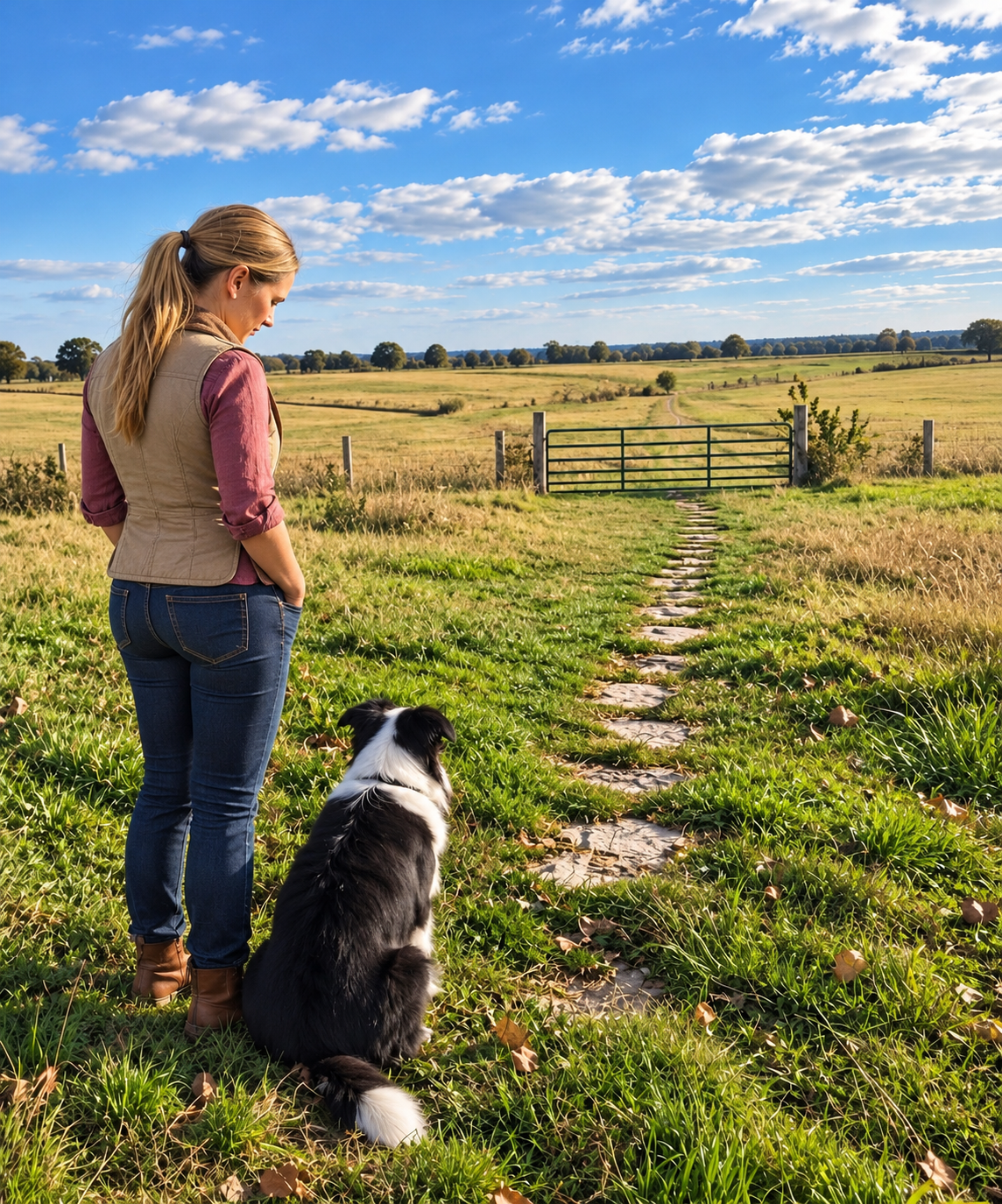
PART 1 TITLE: Three Days After Burying My Husband, I Discovered His Brother Had Sold Our Winter Hay and Was Already Planning What We Would Lose Next
The field was empty. Every one of the 212 hay bales my husband had worked through his final summer to produce had disappeared, leaving nothing but flattened circles of grass and deep tire marks in the dry Nebraska soil. I stood beside my pickup, looking across eighty acres that should have been covered with round bales, and tried to understand how an entire winter’s feed could vanish while I was burying the man who had grown it. The answer came that afternoon, when my brother-in-law walked into my kitchen and announced that he had sold everything.
Dwayne Haller didn’t look particularly troubled when he told me. He took off his cap, helped himself to coffee, and sat at the kitchen table where his older brother, Tom, had eaten breakfast for nearly thirty years. Three days had passed since the funeral. Eleven casserole dishes still crowded the counters, most of them untouched, and a vase of flowers from the church had begun dropping petals beside the sink. Dwayne noticed none of it. He stirred two spoonfuls of sugar into his cup and said he had taken care of the hay situation.
“What situation?” I asked, although the empty field had already told me something terrible had happened.
“The north eighty,” he replied. “I found some people willing to buy the cutting. Got seventeen hundred dollars for the lot. Not much, considering the work, but it’s handled now. One less thing for you to worry about.” He spoke with the confidence of a man explaining an ordinary business decision to somebody who wouldn’t understand the details. Then he added, “You’re on your own now, Karen. You don’t need to keep everything Tom kept.”
I looked at him for several seconds without answering. At the going rate, that hay was worth close to fifteen thousand dollars. More important, those 212 bales represented the winter feed supply for our forty cow-calf pairs. We were a small operation, and every animal mattered. Without sufficient hay, we would have to buy replacement feed at prices we couldn’t afford or sell cattle before the winter market improved. Dwayne had not merely disposed of some leftover crop. He had taken away the one thing Tom had insisted on finishing before he died.
“Seventeen hundred,” I repeated. “For the entire cutting?”
“That’s what the buyers offered.”
“And you accepted?”
“Somebody needed to make a decision.”
I could hear the refrigerator humming behind me. Outside, a loose piece of metal tapped against the machine-shed roof whenever the wind rose. Those were the only sounds for a while. Dwayne had always been comfortable taking charge of conversations, especially when he thought the other person might be intimidated. He was fifty-six, heavy through the shoulders, with sandy hair and the same long jaw as his brother. On Tom, that jaw had given an impression of patience. On Dwayne, it usually looked like disapproval.
“Did you ask me before you made this decision?” I said.
He gave a short, impatient sigh. “Karen, you had enough going on. I figured I was helping. You’ve got funeral expenses, bills, everything else. Cash is cash.” He pushed his cup aside. “Besides, there’s no sense pretending you’ll run this place exactly the way Tom did. You’re going to have to make changes sooner or later.”
There it was. He had already decided that widowhood meant I would no longer be capable of running the ranch. I wanted to tell him that I had managed our accounts for twenty-eight years, negotiated cattle prices, arranged feed purchases, paid the equipment loans, and learned to recognize a sick calf before many experienced ranchers could. I wanted to ask whether Tom would ever have allowed him to sell two hundred bales at a fraction of their value. But none of those arguments would bring the hay home. So I kept my voice level and asked him one question.
“Who bought it, Dwayne?”
He seemed relieved. Perhaps he had expected an argument and mistook my question for acceptance. He named three buyers: Arlen Voss, Gene Pokorny, and a young couple named Reyes who had recently bought the old Lindgren property. Arlen had taken eighty bales, Gene had bought a hundred, and the Reyes family had purchased the remaining thirty-two. Dwayne recited those quantities easily, as though the details proved that he had conducted a legitimate transaction. I wrote down the names on the back of a grocery receipt lying beside the telephone.
“Did they know I hadn’t authorized the sale?” I asked.
His expression changed. “Why would they think that? I told them the family was adjusting things after Tom’s death. People understand how these situations work.” He rose and reached for his cap. “Don’t make this complicated. I saved you the trouble of finding buyers. You’ll appreciate that eventually.”
He left without offering to return the money, discuss replacement feed, or ask how Ben and I were coping. I watched his truck travel down the long gravel driveway until the dust swallowed its taillights. Then I turned over the receipt. Three names. Three quantities. Two hundred and twelve bales. The figures added up perfectly, which made the whole thing feel even more deliberate. Dwayne had known exactly what he was selling. He simply hadn’t cared what its loss would mean to us.
Tom and I had purchased our 160-acre place in the Nebraska Sandhills in 1998. We were both thirty-one, newly married and sufficiently inexperienced to believe that enthusiasm might compensate for worn-out equipment and thin soil. The house needed a roof, the barn leaned east, and the fences had more repairs than sound wire. We borrowed eleven thousand dollars from Tom’s mother, Ada, and persuaded a cautious banker in Valentine to finance the remainder. The banker warned us that raising cattle on that land required more than affection for the countryside. Tom answered that we were prepared to learn the rest.
For years, we lived close to the edge of what the ranch could provide. We raised a modest herd, made hay on the northern acreage and near the creek, and sold calves each autumn. Tom hauled loads for the local agricultural cooperative when winter work was available. I taught third grade in Merriman until our son was born, then began keeping financial records for neighboring ranches. Some months, the work from those books paid the electric bill when the cattle hadn’t yet earned a dollar. We didn’t consider ourselves unfortunate. We owned a piece of land we loved, and we were building something we intended to leave behind.
Ben arrived when we had nearly stopped expecting children. He was born during a bitter February storm, and I still remembered Tom standing beside the hospital window, staring at the small bundle in his arms with an expression of astonishment that seemed beyond speech. Our son was seventeen now, tall and quiet, with his father’s shoulders and his grandfather’s pale gray eyes. He had grown up driving tractors, checking water tanks, and learning that livestock depended on people showing up regardless of weather, illness, or mood. Since the funeral, he had said very little. He moved through his chores with a concentration that frightened me.
Tom had always shown his feelings through work rather than conversation. If a gate began sticking, he repaired it before anyone complained. If I had a difficult day, he might leave fresh coffee beside my account books and go outside without comment. When he was worried, he became almost excessively busy. I understood that habit so thoroughly that, the night I found him dismantling a perfectly functional hydraulic cylinder, I knew we had received bad medical news before he told me. His doctor had found cancer in his pancreas. It had already spread. We were offered treatment, percentages, and estimates, but none of those things could make the words less final.
The doctors thought we might have six months. We had four. As Tom became thinner, the distance between the house and the barn seemed to grow longer for him. He tired easily. Some mornings, getting his boots on took an effort he tried to conceal by pretending to search for his gloves. Yet he continued thinking about winter feed. He studied weather forecasts, watched the grass, and calculated what the herd would need after the first hard freeze. I asked him repeatedly to let somebody else handle the cutting. Each time, he looked toward the north pasture and shook his head.
“That feed has to be put up properly,” he told me one morning in June. “You can’t spend money you haven’t got just because I don’t feel good.”
“We can hire help,” I answered.
“We might have to, but not before I try.”
He saw the expression on my face and reached across the breakfast table for my hand. His fingers felt lighter than they once had. “I’m not doing this to be stubborn, Karen. I need to know you’ll have enough. That’s all.” I wanted to insist that he was more important than a field of grass. Instead, I squeezed his hand and watched him drink coffee he no longer seemed to enjoy.
That summer, Tom spent every good day preparing the cutting. Ben helped with the equipment and drove the rake when his father grew exhausted. I brought water and sandwiches to the field, though Tom rarely ate more than a few bites. Some afternoons, he sat on the tractor steps for twenty minutes before climbing back into the cab. I would stand beside him, fighting the impulse to demand that he stop. He knew the ranch better than anyone alive, and he also knew his time was running out. Finishing the hay was his way of making plans for a future in which he would not be present.
The last cutting came in heavy. The grass had benefited from late summer rain, and when the bales were rolled and counted, there were 212. I walked the field with Tom and marked the number in his small notebook. He took the pencil from me and added a brief remark beside the tally, something about the north eighty yielding enough for our herd and leaving a little to spare. Then he closed the book, put it in his coat pocket, and looked toward the west boundary where an old windbreak had once stood. His expression was thoughtful, but when I asked whether something was wrong, he said the field had turned out well.
He died on a Tuesday. We buried him that Saturday under a sky so clear it seemed indecent. The church was full of people I knew, people whose children I had taught or whose cattle invoices I had prepared, but I remembered the service only in disconnected pieces: Ben gripping the edge of the pew, Ada sitting beside Marlene with a folded handkerchief, Dwayne adjusting his tie, and Arlen Voss holding my elbow when I stepped onto uneven ground near the grave. Somebody said Tom had been a dependable man. I nearly laughed at how small those words sounded beside the life he had lived.
After the funeral, the house filled with food and visitors. People meant well, but their questions made everything harder. Did we have enough money? Would Ben finish school? Had I thought about selling some cattle? Was the ranch too much for one woman and a teenage boy? I answered politely until I could no longer remember what I had said. At night, after the neighbors left, I sat at the table with Tom’s unpaid invoices and tried to persuade myself that numbers were easier to manage than sorrow. Numbers, at least, stayed where you placed them.
The morning I discovered the hay was missing, I had driven north to see whether the field needed clearing before winter. At first, I thought I had taken the wrong track. The bales had been so numerous that they formed a rough pattern across the grass, familiar from every approach to the pasture. Now only pale marks remained. Large trailer tires had cut fresh grooves into the dirt near the gate. The chain had been replaced carelessly, leaving it twisted around the post. I knew immediately that somebody had been there with heavy equipment. What I didn’t understand was why no one had asked permission.
I returned home and found Ben working in the equipment shed. When I told him about the field, his face tightened. He said he’d seen Dwayne speaking with a couple of men near the north gate earlier in the week. He had assumed they were arranging to help haul the bales into our storage yard. The thought that his uncle might have been selling them had never occurred to him. Tom and Dwayne had argued for years about money, but Ben still regarded his uncle as family. That made his expression, when I explained what Dwayne had admitted, particularly painful.
“Call the sheriff,” Ben said. He was standing beside the old tractor with a wrench still in his hand. “He stole from us, Mom. That’s what happened.”
“I know what happened.”
“Then why are we standing here talking about it?”
I had no answer that would satisfy a seventeen-year-old boy who had just lost his father. I told him I needed to think. He threw the wrench onto the workbench, not hard enough to damage anything, but hard enough to let me know what restraint was costing him.
By evening, I had spread our financial records across the kitchen table. The figures were plain. Replacing the missing bales at the prevailing market price would require nearly fifteen thousand dollars, before transportation. That was money we had not planned to spend and did not have available. Selling cattle would reduce our winter expenses but weaken the ranch for years afterward. An insurance claim was unlikely to provide a quick solution. Even a successful criminal case against Dwayne would not guarantee that the feed returned before the weather changed. I wrote down each option, crossed out two, and poured myself more coffee.
I knew Arlen Voss well enough to telephone him without an introduction. He was seventy-eight, a longtime neighbor who had known Tom since childhood. His wife, Dorothy, had died two winters earlier, and since then he had lived alone in a farmhouse west of Merriman. Arlen could be stubborn, but he was careful about other people’s property. Gene Pokorny was different: noisy, opinionated, and forever arguing with Tom about equipment, cattle prices, or the correct way to fix a broken fence. They had been friends since school. The Reyes couple I barely knew. I remembered seeing their pickup at the feed store and hearing that they were trying to establish a small cattle operation.
The more I considered those names, the less I believed all three families had knowingly participated in theft. Arlen would never deliberately take winter feed from a widow. Gene might have enjoyed securing a bargain, but he had stood beside Tom through droughts and machinery failures. The young couple had no reason to know our circumstances. Dwayne must have told them something that made the sale appear legitimate. I wanted to learn what it was, preferably before accusations turned people defensive and the bales became impossible to recover.
Shortly after midnight, I opened Tom’s notebook. The pages carried dates, field measurements, fuel quantities, and his square handwriting. He recorded practical things because they could be checked. On the page for the north eighty, I found the cutting tally again. Two hundred and twelve. Beside it was his assurance that the crop would cover Karen’s cattle through winter. Seeing my name written by his hand brought me closer to tears than any of the sympathy cards on the counter. I shut the book before I lost the ability to make decisions.
I could have driven to the sheriff’s office the next morning. Perhaps that would eventually have brought charges. But the hay might be moved, fed, mixed with other cutting, or resold long before a legal dispute was resolved. I needed to approach the buyers while their purchases were still identifiable. I also needed to give each of them an opportunity to explain what Dwayne had said. If any refused to cooperate, the law would still be available. For the moment, I intended to recover Tom’s work rather than spend our remaining money proving that his brother had stolen it.
I remembered something Tom had once told Ben after a neighbor damaged one of our gates. The boy had wanted to demand payment immediately. Tom had explained that first you asked the man what happened. If he was decent, he would repair the gate. If he wasn’t, you would know what sort of neighbor you had. I had sometimes criticized Tom for his patience, especially when money was involved. That night, sitting amid the funeral dishes and overdue paperwork, his approach seemed less like softness and more like a practical method for discovering the truth.
At one in the morning, I took flour from the cupboard, pulled frozen rhubarb from the freezer, and began making pie dough. My sister called while the first crust was baking. When I explained what I planned to do, she went silent. Then she asked whether grief had made me lose my judgment. I told her I intended to visit the people who had bought the hay. She said I should arrive with a deputy, not dessert. I said I would consider that option if the visits failed. Then I went back to rolling pastry.
By dawn, three pies sat cooling beneath clean dish towels. I placed the grocery receipt with the buyers’ names beside my truck keys and checked the weather. The forecast gave us several weeks before a serious cold front, but I had lived in Nebraska long enough to know how quickly an ordinary autumn could become a dangerous one. Ben watched me load the pies into cardboard boxes. He asked again whether I was really going to ask people nicely to return something they had paid for. I told him I was going to find out how much truth they had been given.
Arlen’s farmhouse was my first stop. As I turned into his driveway, I saw his old green Ford parked beside a flatbed fitted with a hay spike. The truck was large enough to move the bales, though its owner was nearly eighty. I carried one pie to the porch and knocked. Arlen opened the door wearing a faded work shirt, his glasses hanging from a cord around his neck. He looked at the pie, then at my face, and invited me inside. Before I could explain why I had come, he said something that confirmed Dwayne had told the buyers a story I knew nothing about.
“Karen, I was sorry to hear you were selling the ranch. Tom would never have wanted you pressured into a decision like that.”
I nearly dropped the box.
END PART 1
PART 2 TITLE: I Went to an Elderly Neighbor Expecting an Argument Over Stolen Hay, but His Explanation Exposed a Far Crueler Lie About My Husband’s Ranch
For several seconds, I remained standing in Arlen Voss’s doorway with a rhubarb pie balanced between my hands. The words he had just spoken were difficult to fit into what I already knew. Dwayne had sold the winter hay without permission, which was bad enough. Now I learned he had also told at least one buyer that I intended to give up the ranch. I had never discussed selling the property with Dwayne, or with anyone outside my immediate family. The possibility hadn’t even become a decision in my own mind.
“Who told you I was selling?” I asked.
Arlen’s forehead creased. He stepped aside to let me enter, then closed the screen door against the morning breeze. His kitchen smelled of fresh coffee and the lemon oil he used on his wooden furniture. A wall calendar displayed August even though September was nearly over. Dorothy had always been particular about changing the pages. I noticed the calendar because I needed something ordinary to look at while Arlen considered my question. Finally, he removed his glasses and set them carefully beside the sugar bowl.
“Dwayne said the family had decided to wind things down after Tom passed,” he answered. “Told me you’d spoken to him about moving the cattle and selling off what you wouldn’t need. I assumed you’d made up your mind.” He looked uncomfortable. “I thought it sounded sudden, but people do things differently after a death. It’s not my business to tell a woman how to manage her place.”
“I haven’t made that decision,” I said. “And I never asked Dwayne to sell our hay. Those bales were supposed to feed forty pairs until spring.”
Arlen stared at me. The color seemed to drain slowly from his weathered face. He pulled out a kitchen chair, sat heavily, and looked toward the window. His hands, thick-knuckled and spotted from years of outdoor work, rested on either side of his coffee cup. I had known him for decades, but I had rarely seen him at a loss for words. He was a man who preferred short conversations and firm conclusions. Now he seemed reluctant even to raise his eyes.
“How much did you pay him?” I asked.
“Eight dollars a bale.”
“Eighty bales?”
He nodded.
I had already calculated the figures, but hearing them spoken aloud made the situation more astonishing. Arlen had paid six hundred and forty dollars for hay worth roughly fifty-six hundred. If he had believed the sale was authorized, he might have thought he was helping me dispose of feed quickly. Yet the price was so low that I wanted to ask how he could have accepted it without wondering whether something was wrong. Before I found the words, he answered the question himself.
“I knew it was cheap,” he admitted. “Too cheap. Dwayne said you wanted cash immediately and didn’t want people making a fuss. I should have telephoned you. Instead, I told myself you were entitled to sell at whatever price suited you.” He rubbed his forehead. “I was at Tom’s funeral, Karen. I stood beside you at the cemetery. I could’ve asked you there, or any day afterward. I didn’t.”
I put the pie on the table and sat across from him. There was anger in me, certainly, but it did not feel quite the way I had expected. Arlen had made a poor decision, and his bargain had cost us dearly. Yet he was not trying to justify himself by questioning my competence or blaming Tom’s death. He was looking directly at his own part in the transaction. I had spent the previous day imagining how to persuade him to listen. Now I could see that he was already listening more honestly than Dwayne had.
“Did you move the hay yourself?” I asked.
“With the flatbed. Made several trips before noon. Dwayne helped get the first load ready.” He reached for his glasses, then changed his mind and left them on the table. “The bales are stacked behind my west barn. Haven’t fed a single one. I was going to save them for January.”
“Would you consider selling them back to me?” I said. “I can return what you paid, though I’ll need some time to arrange it.”
Arlen made a quiet sound that might have been a sigh. Then he stood, picked up his cap from the counter, and moved toward the door. His sudden change of direction caught me off guard. I thought, for one unhappy moment, that the conversation had ended badly and that he preferred not to discuss the matter further. He was halfway through the doorway before turning around.
“Stay here, Karen. There’s coffee in the pot. Help yourself to the pie. I’m going to bring your hay back.”
I followed him onto the porch, but he lifted a hand to stop me before I could speak. He explained that he had bought the bales under a false understanding and would not keep them now that he knew the truth. I tried again to discuss repayment. He refused to hear it. The transaction, he said, had never been mine to approve, and he had no intention of asking a widow to reimburse him for the consequences of his own carelessness.
“Arlen, you’re out six hundred and forty dollars.”
“That was my choice. Keeping the hay would be another choice. I’m not making the second one.”
He climbed into the old Ford with more effort than I remembered, settled himself behind the wheel, and started the engine. I stood on the porch as he backed toward the road. His truck was faded green, with rust along the wheel wells and a dent in the rear bumper. Dorothy used to tease him that he maintained the machinery better than he maintained himself. Watching him drive away, I wondered whether he had any idea how much relief his decision had already given me. Eighty bales would not carry the herd through winter, but they were eighty bales we would not have to replace.
Alone in his kitchen, I poured coffee into a clean mug and cut the pie in half. Arlen’s home had changed since Dorothy died. The same blue curtains hung above the sink, but one had slipped from its hook. Her recipe cards were still wedged beside the telephone, held together with a rubber band. A photograph of their wedding sat on the windowsill, the young couple laughing beneath a bright summer sun. Tom and I had attended Dorothy’s funeral two years earlier. I remembered Arlen standing beside the grave without tears, gripping his hat so tightly that the brim had bent.
Grief made strangers of people you thought you understood. Since Tom died, I had learned that I could become angry over a misplaced spoon and remain perfectly calm while hearing that someone had stolen thousands of dollars’ worth of feed. Arlen had apparently spent two years cooking meals for one person, leaving the calendar unchanged, and maintaining a house that still seemed arranged around someone who would never return. Perhaps that explained why he had accepted Dwayne’s story so readily. He knew how quickly an ordinary life could become a series of decisions no one wanted to make.
I finished the coffee but left most of the pie untouched. Before leaving, I washed my cup and placed it on the draining board. I had brought the pie as a way to begin a difficult conversation. Instead, Arlen had given me a clearer understanding of what Dwayne had done. He had not merely sold feed at a ridiculous price. He had used my husband’s death as evidence that our family was breaking apart. In Arlen’s mind, he had been buying a small part of a ranch being dismantled. I wondered how many other people had heard the same account.
When I returned home, Ben was standing beside the barn, repairing a loose chain on the gate. He looked up as I parked and immediately noticed that the pie box was gone. I told him what Arlen had said, including the claim that we intended to sell. He stopped working. The chain hung between his hands, forgotten. For a moment, he stared at the driveway, as though Dwayne might be coming back and he could settle the matter directly.
“He’s telling people we’re leaving?” Ben asked.
“That’s what Arlen understood.”
“Then he’ll tell everybody. By next week people will be making offers on the cattle.” Ben threw the chain across the gate and tightened it sharply. “Uncle Dwayne’s always wanted this place. Dad said he was jealous, but I never thought he’d do something like this.”
I told Ben we should concentrate on getting the hay home. He wasn’t satisfied, and I understood why. He was trying to protect his father’s memory in the only way available to him. Tom had spent almost three decades keeping that property going. To hear that another man was describing it as something we were ready to abandon felt like a second insult after the theft. But anger could not unload trailers or feed cattle. I asked Ben to check the loader tractor and clear the stackyard behind the barn.
“Arlen’s bringing eighty bales,” I explained.
Ben turned toward me so quickly that I almost smiled.
“He’s bringing all of them?”
“Every one. He said he hadn’t used any.”
“Did you have to threaten him?”
“No.”
“What did you say?”
“I told him what actually happened.”
Ben looked down at the gate chain. “That’s all?”
“For Arlen, it was enough.”
He didn’t answer. He picked up the chain again and went back to work.
The first truck arrived shortly before ten. I heard the diesel engine from the kitchen and hurried outside. Arlen came slowly through the yard, guiding his flatbed around the cattle pen and stopping near the stackyard. Behind the cab were sixteen large round bales, bound tightly and still carrying the grassy smell of late summer. I knew they were ours before he climbed down. Tom always kept his cutting height slightly higher on the north eighty because of the uneven sand. The resulting hay had a particular mixture of grasses I could recognize even after it had been baled.
Ben drove the loader into position while I showed Arlen where to place the stacks. The first bale swung clear of the flatbed and descended toward the ground. When it settled onto the dirt, a small cloud of dust rose around it. I had been looking at an empty storage yard for days. That single bale appeared almost impossibly substantial. I stepped closer, pressed my palm against its tightly packed surface, and felt the twine under my fingers. Tom had spent part of the summer working in the heat to make that bale. I had almost lost it to a man who considered his labor disposable.
Arlen climbed down and approached me while Ben prepared the next load. He glanced toward my son, then asked whether we could speak privately. I thought he might finally want to discuss money, but he stood beside the truck for a moment without saying anything. The wind lifted the brim of his cap. He pressed it down and looked toward the pasture before beginning.
“There’s something about Tom I’ve been meaning to tell you,” he said. “I don’t suppose he ever mentioned Dorothy’s truck getting stuck in that ice storm two winters ago?”
I remembered the storm. A stretch of highway near the creek had frozen solid, and several people had gone off the road. Dorothy had been ill and needed to get home after a medical appointment. Arlen had been at the hospital arranging a specialist visit, and I remembered Tom receiving a telephone call in the middle of the night. He had dressed quietly, taken a heavy chain from the shop, and driven away. When he returned near dawn, he had simply said someone needed pulling out of a ditch.
“It was Dorothy,” Arlen told me. “She was scared, and she couldn’t get the truck moving. Tom went all the way out there in the dark, got her back on the road, and followed her home. He stayed until she was safely inside. Didn’t tell me a word about it. Dorothy did, later.” Arlen’s voice grew rough. “She died the next night. I never thanked him properly.”
I remembered Tom standing in our kitchen after that trip, his jacket crusted with ice, warming his hands around a mug. He had been exhausted but unconcerned. I had asked whether the person he helped was all right, and he had nodded. He never mentioned Dorothy’s name. Listening to Arlen, I understood that an ordinary act my husband had barely discussed had remained important in another household for two years.
“I wanted to repay him somehow,” Arlen continued. “Then he got sick, and there was never a good time to offer anything without making him feel obliged. I watched him work that north field when he should’ve been resting. Couldn’t make the man take help.” He cleared his throat. “Maybe this isn’t much, considering everything, but at least I can return what belongs to his family.”
I told him that bringing the hay back was more help than he realized. He shook his head. There was no dramatic declaration, no elaborate promise. He returned to the truck, checked a loose tie-down strap, and asked Ben to be ready when he came back with another load. That was Arlen’s way of closing an emotional conversation. It reminded me so strongly of Tom that I had to turn away for a moment.
Over the next several hours, Arlen made repeated trips between the two ranches. Each return became a little more difficult for him. He moved carefully when climbing into the cab, and I noticed him stretching his lower back before pulling the tie-down straps free. I suggested finding someone younger to help. He said the truck already knew the road and he saw no reason to confuse it with a new driver. Ben grinned despite himself. I had not seen him smile at another man’s joke since the funeral.
By noon, a substantial stack had formed behind the barn. I kept count on a clipboard, noting each load as Ben arranged the bales in straight rows. The work felt reassuringly familiar. Hay needed to be positioned so moisture could drain away and the feed remained accessible once snow covered the ground. Tom had taught Ben how to arrange each row with enough space for the tractor. Watching my son follow those instructions, I saw that his father’s knowledge had not vanished with him. It lived in small decisions he made without needing to think.
I brought sandwiches and coffee outside. Arlen sat on the tailgate, chewing slowly, while Ben wiped dust from the loader’s controls. I asked whether Gene Pokorny had said anything about the sale. Arlen paused with his sandwich halfway to his mouth. He explained that Dwayne had approached Gene separately and made essentially the same claim about my plans. Gene had purchased a hundred bales for eight hundred dollars. The price was unusually low, and Gene knew the market well enough to understand that. Unlike Arlen, he had a reputation for finding opportunities wherever they appeared.
“He’s got the hay at his place?” I asked.
“Far as I know.”
“Then I’ll go see him tomorrow.”
Arlen considered that. “You could. But Gene’s known Tom since they were boys. Might be better if I spoke to him first. I’d hate for you to drive out there and hear something ugly while you’re still grieving.”
I appreciated the concern, but I refused to let anyone else handle the conversation entirely. The problem existed because Dwayne had persuaded people that my voice no longer mattered. I wasn’t going to repair that damage by allowing another man to speak for me. I thanked Arlen and said I would visit Gene myself. If he wanted to telephone ahead and explain what he had learned, I wouldn’t object. Arlen looked almost relieved.
Near the end of the afternoon, we reached eighty bales. Ben checked the final count twice, then shut off the loader and climbed down. The stackyard looked smaller than it once had, but it no longer looked abandoned. I stood beside Arlen’s truck and thanked him for the use of his equipment. He seemed embarrassed by the attention and began examining a loose bolt on the rear gate. I had the distinct impression that he needed a task to keep him from thinking about the difficult morning.
Before leaving, he handed me a folded piece of paper. It was the receipt Dwayne had written for the purchase. The writing was hurried, but I could make out the quantity, the payment, and Dwayne’s signature. More troubling was a line at the bottom stating that the hay was being sold as part of a family dispersal. Arlen pointed to those words and said they were why he had believed the transaction was legitimate. I placed the paper in my coat pocket. It was the first written evidence of the lie.
After Arlen drove away, I carried the clipboard into the kitchen and added the receipt to the notes already spread across the table. I wanted a record of what each person said and how many bales had been recovered. If the remaining buyers refused to cooperate, those details could matter. Ben came in a few minutes later and asked whether we should tell the sheriff about the document. I said we would keep it safe for now. He didn’t argue, but the silence between us held the disagreement plainly.
That evening, Gene called. His voice was louder than necessary, as it had always been on the telephone. He and Tom had argued over machinery since they were schoolboys, and I knew his tone almost as well as my husband’s. Arlen had told him about the hay and about Dwayne’s claim that I intended to sell the ranch. Gene said he wanted to come by the following morning. I told him I could drive to his place instead. He interrupted before I finished.
“No, Karen. I’ll come to you. There’s something I need to say, and I ought to say it looking you in the face.”
He paused. I heard a door closing at his end of the line. When he spoke again, the bravado had gone from his voice.
“Arlen might have believed he was doing you a favor. I can’t pretend the same thing. I knew that hay was worth far more than Dwayne wanted for it. I bought it anyway.”
Then the line went quiet, and I was left holding the receiver, wondering whether the next man on my list would give back a hundred bales or force me to fight for them.
END PART 2
PART 3 TITLE: The Second Buyer Admitted He Had Profited From My Grief, Then Returned With Something That Made My Son Question Our Entire Plan
Gene Pokorny’s truck came through our gate shortly after eight the following morning. I recognized the sound before I saw it, a low, uneven rumble that had been familiar on our driveway for more than twenty years. He was driving the same red pickup Tom had helped him repair after a disastrous harvest season, but today a long flatbed trailer followed behind it. The trailer carried round hay bales, stacked two high and secured with heavy straps. I watched from the kitchen window, counting what I could see, and felt the first cautious stirring of hope.
Gene stopped near the barn but didn’t immediately climb out. For almost a minute, he sat behind the wheel, looking toward our house. He was fifty-three, broad through the chest, with a sunburned face and a beard beginning to turn gray. Usually he approached every encounter with a joke, an argument, or a complaint about government regulations. When he finally opened the driver’s door, he moved with an unfamiliar hesitation. He removed his cap before coming toward me. That small gesture told me more about his mood than the telephone conversation had.
“Morning, Karen,” he said. His eyes moved past me toward the house. “How’s Ben doing?” I told him our son was keeping busy and that work seemed easier for him than sitting indoors. Gene nodded, studying the dirt near his boots. Tom had known him since childhood. They had competed at school, argued over girls, and spent decades disagreeing about everything from pasture management to tractor engines. Their friendship had survived because neither man was particularly interested in being agreeable, and each trusted the other when something genuinely important needed doing.
I invited Gene inside, but he shook his head. “I’d rather get this said out here,” he answered. He took a folded receipt from his shirt pocket. His hands were rough and dusty, but the paper looked as though he had handled it repeatedly. “Dwayne sold me a hundred bales for eight hundred dollars. Eight dollars apiece. I paid him cash, and I knew perfectly well that decent hay doesn’t sell for that unless something is wrong with the arrangement.”
He stopped to see whether I would interrupt. I didn’t. I had spent enough nights examining the ranch’s finances to understand precisely what his bargain had meant. At the usual market price, Gene had acquired about seven thousand dollars’ worth of winter feed for less than a thousand. It was the sort of opportunity a rancher might talk about for years. But bargains, I had learned, could carry costs that never appeared on the receipt. Gene folded the paper again, taking care to align the corners.
“Dwayne told me you were selling things off,” he continued. “Said you couldn’t handle the cattle after Tom died and needed money before the bills came due. I could’ve called to make sure. I didn’t. I figured somebody else’s bad luck had turned into a good deal for me.” He finally raised his eyes. “I can’t tell you I was fooled completely, Karen. I chose not to ask questions because I liked the price.”
I had prepared myself for excuses. I expected him to say that Dwayne had seemed authorized or that a completed sale could not simply be reversed. Gene did neither. His admission was uncomfortable because it gave me a choice. I could condemn him for accepting an obviously unfair transaction, or I could accept the fact that he was standing in front of me taking responsibility. Neither response erased what had happened. I asked whether the bales on his trailer were the ones he had bought from Dwayne.
“Every one I purchased is still at my place,” he said. “I’ve brought the first load. The rest will be here before supper if the equipment holds together.” He glanced toward the pasture. “There’s something else. I loaded a dozen of my own bales, too. They’re from my creek bottom. Good feed, no mold, tested fine. I want you to have them for the trouble this has caused.” He spoke quickly, perhaps afraid I would refuse before he could finish.
I told him I would gladly take back Tom’s hay but could not accept a gift made out of guilt. Gene’s expression grew impatient, and for a moment I recognized the man who had argued with my husband over dozens of minor disagreements. He said twelve extra bales would be useful if winter lasted longer than expected. I answered that his own cattle needed feeding. He told me his supply was adequate, then asked whether I intended to stand in the yard arguing while the sun climbed higher and his diesel engine burned fuel.
“You’re starting to sound like Tom,” I said.
Gene’s mouth moved into a brief, painful smile. “He’d have started arguing ten minutes ago.”
That was enough to make us both laugh, though neither of us seemed particularly comfortable with it. Gene rubbed a hand over his face and returned to the trailer. Ben had appeared at the barn entrance, watching without speaking. When Gene asked whether he could help unload, my son answered that the tractor was ready. His voice was flat, but he climbed into the cab and started the engine. I saw Gene look up at him, then lower his head. He understood that the boy had witnessed his father’s final summer and would remember who had profited from it.
As the first bales were lifted from the trailer, Gene worked alongside Ben without attempting conversation. He handled the straps, guided the loader, and checked that the stacks remained stable. From time to time, he glanced toward my son, clearly searching for a way to apologize. Ben gave him no opening. I understood the anger behind that silence. Gene had been one of Tom’s closest friends, a man who had shared meals at our table and helped pull calves during difficult births. Ben expected more from someone his father trusted.
By midmorning, the yard had become busy again. Arlen arrived in his green Ford, carrying a thermos of coffee and claiming he had only stopped to see whether Gene was making a mess of the stacking. Within minutes, the two men were arguing about how close to position the bales, their voices rising across the yard. It was an ordinary argument, the kind I had listened to for years. But Tom was missing from it. He would normally have stood between them, offering a dry observation that made both men more irritated and eventually brought the disagreement to an end.
I went inside to prepare lunch and found myself looking at the chair Tom had always occupied. His cap still hung beside the back door. I had tried moving it once, intending to put it with his other clothing, but Ben had quietly returned it to the hook. The sight reminded me that our son was carrying losses he could not explain. I wondered whether asking him to work beside men who had purchased the stolen hay was too much. Yet the ranch needed to function, and I could not protect him from every difficult encounter without teaching him that grief made ordinary responsibilities impossible.
Around noon, I carried sandwiches and cold water outside. Gene sat on the tailgate, eating slowly, while Arlen inspected a worn tire on the trailer. Ben remained standing beside the tractor. When I offered him food, he took a sandwich but did not sit with the others. Gene looked at him for a moment and then put down his own lunch. He called Ben over, not sharply but firmly enough that my son turned around.
“I owe you an apology,” Gene said. “I should’ve asked your mother before buying that hay. Your dad was my friend, and I knew the price wasn’t right. I let myself think I was being clever. What I was doing was taking advantage of people having the worst week of their lives.” Ben stared at him without answering. Gene continued, his voice quieter. “I’m returning it because it belongs here. Not because I expect you to feel better about me.”
Ben looked down at the sandwich in his hand. “Dad would’ve called you an idiot,” he said finally. Gene nodded. “He probably would’ve used a stronger word.” My son almost smiled, but the expression vanished before it settled. He walked back toward the tractor. Gene let him go. I was grateful that he did not press for forgiveness. Some apologies should be made without requiring anything from the person who receives them, and Gene seemed to understand that much.
The afternoon passed in repeated trips between the two properties. Gene brought his hundred purchased bales back in several loads, while Arlen helped with the unloading whenever he was needed. The extra twelve Gene had contributed were stacked separately so I could keep the original cutting accurately counted. That distinction mattered to me. Tom had produced 212 bales, and I intended to recover every one if possible. By late afternoon, all eighty from Arlen and all one hundred from Gene had returned. Thirty-two of Tom’s bales remained elsewhere, with the Reyes couple.
Before the men left, Gene asked to see the receipts I had collected. We sat at the kitchen table while Ben washed up outside. Gene examined Arlen’s paper and compared it with his own. Both described the transaction as part of a family dispersal. Dwayne had used almost identical language, presenting the sale as an authorized decision made after Tom’s death. Gene said this wording had helped persuade him that the low price was simply the result of my supposed need for immediate cash.
“He made sure nobody thought they were doing anything behind your back,” Gene said. “That’s why I should’ve questioned him harder. He didn’t sound like somebody helping a widow. He sounded like somebody trying to close a deal before anyone changed their mind.” I asked whether Dwayne had mentioned selling cattle or machinery. Gene remembered a passing remark about reducing the herd before winter. It was vague enough that he hadn’t attached much importance to it at the time. Now, hearing it, I felt a new concern settle over the old one.
Dwayne had always resented Tom’s ownership of the ranch. Their father had left Tom the family property years earlier, believing his oldest son was better prepared to maintain it. Dwayne had received far less, an arrangement he had mentioned bitterly at family gatherings whenever he drank enough to become careless. Tom rarely responded. He would leave the room, change the subject, or remind his brother that their father had made the decision. I had always believed the resentment belonged to the past. The events of that week suggested Dwayne had never stopped measuring what he thought he deserved.
Gene watched me consider his words. “You know, Dwayne asked whether I’d be interested in more feed if some became available,” he said. “I assumed he meant next year’s cutting.” He paused. “I wouldn’t make too much of it without talking to him. But you should know he said it.” I wrote the remark beside the receipts. I was not prepared to accuse Dwayne of planning additional theft, yet I had already learned the danger of dismissing his statements as harmless. I would check the machinery, the cattle inventory, and every account he might have been able to discuss without my knowledge.
When Gene and Arlen finally drove away, the yard seemed unusually quiet. Ben and I walked between the stacks, checking the count. The returned hay looked like a wall of pale gold against the dark barn siding. For the first time since the funeral, I could imagine feeding the herd through a substantial portion of winter without borrowing money. But thirty-two bales were still missing, and I knew almost nothing about the people who had bought them. Their situation troubled me in a different way from Arlen’s or Gene’s. They had recently invested in a ranch and might depend on that feed as much as we did.
Ben climbed down from the loader and stood beside me, looking toward the road. I asked whether he was hungry. He shook his head. Then he said, “I still think we should call the sheriff.” There was no anger in his voice this time. He sounded exhausted. I put the clipboard on a nearby bale and asked him to explain what he thought would happen if we reported Dwayne immediately. He answered that a deputy would take our statement, investigate the sale, and perhaps arrest his uncle. He spoke as though punishment itself might restore something we had lost.
“And what happens to the hay while the case is being investigated?” I asked. Ben shrugged. I explained that the cattle would still need feeding every day, whatever a judge eventually decided. We might be legally right and still lose animals or be forced into an early sale because the practical problem remained unsolved. That did not mean Dwayne deserved protection from consequences. It meant we had to choose the order in which those consequences were pursued. Our first obligation was to keep the ranch operating.
Ben listened, though I could tell he disliked the distinction. He pointed out that his uncle might hurt somebody else if no one stopped him. I agreed. I told him that if the remaining buyers refused to return the hay or if Dwayne tried anything further, I would go to the sheriff without hesitation. We had receipts, dates, quantities, and witnesses. There was no reason to surrender our legal options. But I wanted to recover the missing feed before turning the entire matter into a public fight that could last months.
“You’re making it sound like he’s just made a mistake,” Ben said.
“No. He knew what he was doing. That’s why I’m angry.” I looked toward the north field, where the grass lay flat beneath the fading light. “But getting angry doesn’t tell us what decision will help tomorrow. Your father taught me that much.” Ben’s face tightened at the mention of Tom. I regretted the words immediately, afraid he would think I was using his father to win the argument. I reached for his arm, but he stepped away.
“Dad would never have let Uncle Dwayne do this,” he said. I answered that Tom had not been here to stop it and that we had to decide what came next ourselves. Ben stared at the stacks. After a long silence, he admitted that he had wanted to call the sheriff partly because he felt helpless. He had watched his father become weaker for months, and there had been nothing he could do to change the outcome. Now something else was being taken from our family, and he wanted somebody to make it stop.
I had no useful answer for that kind of pain. I moved closer and put my arms around him. For a moment, he remained stiff, embarrassed by the embrace. Then he leaned against me with the exhausted weight of a boy who had spent too many days pretending to be older than he was. I held him until he drew away. Neither of us mentioned his tears. He wiped his face with his sleeve and said he would check the water tank before dark. I let him go, knowing he needed the work as much as I needed the quiet.
That evening, I telephoned the county agricultural office to confirm the current market price for comparable hay. The clerk gave me figures consistent with my calculations. The original 212 bales were worth almost fifteen thousand dollars, depending on weight and quality. Dwayne had received less than twelve percent of that amount. I wrote the numbers beside the three buyers’ names and sat staring at them. The difference was not merely financial. It represented fuel, machinery wear, Tom’s exhausting final weeks, and the future he had tried to prepare for us.
I checked the weather again. A cold front was expected within several weeks, and nighttime temperatures were already falling. The Reyes couple might move their bales closer to winter pasture or begin feeding early if conditions deteriorated. I decided to visit them the following morning rather than risk losing track of the feed. Arlen had offered to accompany me, but I preferred to go alone. I wanted the young ranchers to hear the truth directly from the person who owned the hay, without feeling surrounded by older neighbors demanding repayment.
Before going to bed, I returned to Tom’s notebook. His final cutting was recorded in the same careful handwriting he had used for decades. He had marked the number of bales, the condition of the grass, and a brief assurance that the winter supply should be sufficient. I ran my finger over the page. In earlier years, I had sometimes teased him about his endless records. Now those notebooks were evidence of how carefully he had thought about us, even while his health was failing. I closed the cover and placed it beside my keys.
The next morning, Gene called before breakfast. He had spoken to someone at the feed store who knew the Reyes couple. Their names were Daniel and Elena, and they had recently moved cattle onto the old Lindgren place. Gene also had one detail he thought I should hear before visiting them. Daniel had mentioned that Dwayne encouraged them to buy quickly because the Haller ranch was supposedly being emptied before an auction. There had been no announcement of an auction, no discussions with an auctioneer, and no intention on my part to hold one.
I thanked Gene and ended the call. Ben was standing in the doorway, having heard enough to understand the situation. He asked whether his uncle was trying to sell the entire ranch out from under us. I told him Dwayne had no authority to sell our land and that we had no evidence of any attempt to do so. Still, the false story was spreading farther than I realized. It was shaping decisions made by people who knew little about our family and trusted what they were told. I took a fresh sheet of paper and wrote down everything we had learned.
When I finished, Ben said he wanted to come with me to the Reyes property. I considered refusing, not because he would behave badly but because I knew the encounter might disappoint him. If the couple depended on those thirty-two bales, they might be reluctant to surrender them. He deserved to understand that recovering what belonged to us could create genuine difficulty for other people who had been misled. I told him he could come, provided he allowed me to speak first. He agreed without argument.
We carried the third rhubarb pie to the truck and drove toward the old Lindgren place. The road crossed open pasture broken by low sandy rises, and the morning wind pushed thin clouds across the sky. Ben watched the fields through his window, silent except when he pointed out a damaged fence or a distant group of cattle. After several miles, he asked a question I had not expected: “What if they bought the hay because their own cows won’t make it through winter without it?”
I kept my eyes on the road. That possibility had been troubling me since Gene mentioned the young couple. I told Ben I didn’t know what we would do until we understood their circumstances. He looked down at his hands and said quietly, “Then I guess this isn’t going to be as easy as Arlen and Gene.” I reached toward the cardboard box on the seat between us to steady the pie as the truck crossed a rut. Ahead, the Reyes farmhouse came into view, surrounded by unfamiliar equipment and freshly repaired fences. Thirty-two bales stood behind the barn, and I could see cattle feeding along the edge of a distant pasture.
They had our winter hay. But unlike Dwayne, they had paid for it believing they were helping a family that had already decided to leave.
END PART 3
PART 4 TITLE: The Young Couple Returned Our Final Hay Bales, but a Forgotten Note in My Husband’s Records Led Me to a Secret Buried Beneath the Prairie
Daniel Reyes met us in the driveway before I had finished turning off the engine. He was a lean young man with dark hair, wearing a faded jacket and work gloves coated in dust. A little girl watched from the kitchen window while a woman I assumed was his wife stepped onto the porch. Daniel glanced at the pie box in my hands, then at Ben sitting beside me. I could tell from his expression that our arrival surprised him. I introduced myself and asked whether we could speak about the hay he had purchased from Dwayne Haller.
His face changed immediately. “Are you Tom’s wife?” he asked. I nodded. He looked toward the thirty-two bales stacked behind the barn, then back at me. “Dwayne said you’d decided to sell everything before winter. He told us your family was moving and that the hay needed to go quickly.” I explained that none of those statements was true. We weren’t selling the ranch, moving away, or disposing of our winter feed. Daniel removed his gloves slowly, as though he needed time to understand what I was saying.
Elena came down from the porch and introduced herself. She was about thirty, with tired eyes and a practical manner that reminded me of younger women I had taught years earlier. After hearing my explanation, she asked whether Dwayne had been acting without permission. I told her he was Tom’s brother but had no authority to sell our property. Daniel looked appalled. He said he had paid two hundred and fifty-six dollars for the thirty-two bales, believing the Haller family wanted to clear the land quickly.
“I should’ve known something was wrong with that price,” Daniel admitted. “But we’ve only been here a few months. Everything costs more than we expected, and when Dwayne offered the hay, it seemed like a chance to get ahead.” Elena glanced at him, then toward their cattle. I recognized the look they exchanged. It was the expression Tom and I had shared during our first years on the ranch, when an unexpected expense could ruin an entire month’s careful calculations.
I told them I understood why they had accepted the offer. I also explained what losing the hay meant for Ben and me. Tom had finished the cutting while seriously ill, and we needed those bales to maintain the herd through winter. I spoke carefully, trying not to make the couple feel personally responsible for what Dwayne had done. Their little girl came onto the porch carrying a stuffed rabbit, and Elena bent to reassure her before returning to the conversation. Watching them, I could not ignore the uncomfortable fact that my problem had become part of theirs.
Daniel asked whether we were certain all thirty-two bales belonged to our cutting. I described the field, the harvesting date, and the quantity Dwayne had sold. He opened a small notebook from his jacket pocket and checked the figures he had recorded when the hay arrived. Everything matched. He told me none of the bales had been used. He had intended to move them into a covered storage area before the weather changed, but repairs to the barn roof had delayed him. I felt relief so sudden that I had to grip the handle of the pie box more tightly.
“We’ll return them,” Elena said before her husband could speak. Daniel turned toward her, surprised, but she continued. “We can’t feed our animals with something somebody took from another family. Not after hearing what happened.” She looked at Ben, who had climbed out of the truck and was standing near the front fender. “I’m sorry about your father. We didn’t know him, but people here have spoken well of him. We would never have agreed to this if we’d understood.”
Daniel nodded slowly. “She’s right. The hay goes back.” He hesitated, then added, “I won’t pretend it doesn’t hurt us. We’ll have to find replacement feed, and that won’t be cheap. But keeping it would mean knowing another family’s cattle might go hungry because we got lucky with a dishonest seller.” He glanced toward Elena. “We’ll figure something out.”
I thanked them, but the words seemed inadequate. Daniel had admitted that their finances were tight. Thirty-two bales at market price represented more than two thousand dollars, a substantial amount for a new rancher trying to keep his operation afloat. Yet they were choosing to return the feed without demanding that I first resolve the matter with Dwayne. I offered to reimburse the money they had paid, explaining that they should not have to absorb a loss caused by somebody else’s actions. Daniel refused at first, but Elena suggested we could discuss the payment after the hay was moved.
We sat on their porch with coffee while Ben helped Daniel prepare the trailer. Elena brought out a plate of cookies for her daughter, who was fascinated by the rhubarb pie and wanted to know whether it was sweet. I told her that it was sweet enough to make the sour fruit worth eating. The child accepted this explanation with serious interest. It felt strange to be discussing ordinary things after such a difficult conversation. But people who work with livestock understand that even the most upsetting situations exist alongside meals, weather forecasts, and children who need attention.
Elena asked about Tom. I told her he had loved the north field because it usually produced the most dependable cutting. She asked whether Ben intended to take over the ranch someday. I looked toward the barn, where my son was helping Daniel secure the first bales. He moved confidently around the machinery, checking the trailer straps and making sure nothing would shift on the road. I said Ben wanted to ranch, but he still had school to finish, and I hoped he would see something beyond our property before deciding what his future should be.
“That’s what my father told Daniel,” Elena said. “He said if you’re going to choose this life, you should know what other choices exist.” She looked toward her husband and smiled faintly. “We knew, more or less. Doesn’t make the bills easier, though.” I liked her honesty. There was no attempt to romanticize ranching or pretend that hard work always produced a comfortable living. She understood that a piece of land could be both a home and a financial burden, sometimes on the same afternoon.
When the trailer was loaded, Daniel asked whether Ben wanted to ride with him or follow in our pickup. My son looked at me for permission. I told him to go ahead. Elena and I followed, carrying the pie box now empty except for crumbs. During the drive, she spoke about their move to Nebraska, the difficulties of repairing old fences, and the kindness of neighbors who had helped them settle in. She also admitted that Dwayne had seemed unusually eager to complete the sale. He had told Daniel several times that waiting might mean losing the opportunity.
“He acted like somebody was going to change their mind,” she said. “We thought he meant you.” I told her that was precisely the impression Dwayne wanted to create. Elena shook her head. “He used your grief to make everyone hurry. That’s what bothers me most. None of us wanted to intrude on a widow, and he counted on that.” I glanced at her. She had expressed something I had been struggling to articulate since finding the empty field. Dwayne had exploited other people’s reluctance to question a grieving family’s private decisions.
We reached our ranch shortly before noon. Arlen was already there, having stopped by to check the stackyard. Gene arrived a few minutes later with his tractor, claiming he had heard we might need help arranging the final load. I suspected he simply wanted to make certain the remaining hay came home. Between the four of them, the unloading moved quickly. Ben operated our loader while Daniel guided the bales into place. Elena and I checked each one against the count. The final bale settled into the stack with a dull, solid thump that seemed louder than all the others.
I counted again, walking each row with my clipboard. Eighty bales from Arlen. One hundred from Gene. Thirty-two from the Reyes couple. Two hundred and twelve of Tom’s original bales, all returned. Gene’s additional twelve were stacked separately as a reserve. For the first time since I had driven into that empty field, the arithmetic ended where it was supposed to. I checked the figures twice more, unwilling to trust the relief until I was absolutely certain there had been no mistake.
The men gathered beside the barn while I returned the clipboard to the truck. I brought out coffee and sandwiches, and Elena distributed the remainder of the pie. Arlen insisted that the young couple take home a few jars of preserves he had made from Dorothy’s old recipes. Gene offered to help Daniel repair the roof on his hay shed the following weekend. I watched these arrangements unfold with an emotion I could not identify. The same neighbors who had accepted Dwayne’s false account were now helping one another repair the consequences. Nobody could undo what had happened, but each had chosen what to do after learning the truth.
Before leaving, Daniel quietly accepted reimbursement for the amount he had paid Dwayne, at my insistence. I wrote a receipt so our records would be clear. I also offered to help them locate reasonably priced replacement hay through contacts from my bookkeeping work. Elena thanked me, saying that information would be more valuable than another apology. We exchanged telephone numbers. I suspected we would see one another again, not because of the stolen feed but because shared difficulties have a way of making neighbors out of strangers.
After the trucks departed, Ben and I remained near the stackyard. The afternoon light had begun to soften, and a breeze moved through the dry grass. My son looked at the rows, then at me. “You got all of it back,” he said. I answered that the buyers had returned it. He shook his head. “They wouldn’t have known what happened if you hadn’t gone to them. You didn’t let Uncle Dwayne make the decision for everybody.” It was the closest he had come to acknowledging that my approach had worked.
I asked whether he still wanted us to call the sheriff. Ben considered the question for a long time. He said Dwayne deserved consequences and that he didn’t want his uncle believing he could take whatever he wanted. I agreed. We had recovered the hay, but the theft remained a serious matter. I told him I was not ready to decide whether to make a formal complaint until I had spoken with Dwayne again and understood why he had done it. Ben looked dissatisfied, though he did not argue.
“He’s always said Dad got everything,” Ben remarked. “But Dad worked for this place every day. Uncle Dwayne never wanted to do that part.” I glanced toward the north field. Tom had spent decades repairing fences, managing pasture, and making payments when the cattle market was poor. Dwayne had seen the property as something his father had given away unfairly. He seldom acknowledged what maintaining it required. I wondered whether his resentment had grown so large that he no longer recognized the difference between an inheritance and the work needed to preserve one.
Ben returned to the barn while I walked toward the house. I passed the spot where Tom used to park his tractor after cutting. For a moment, I remembered him standing there during his final summer, one hand resting against the fender while he caught his breath. I had asked whether he wanted to sit down. He shook his head, then told me to bring his notebook because he needed to record the cutting. I could still see him writing carefully, pausing between lines when his hand trembled from exhaustion.
That memory sent me back to the kitchen. I opened the drawer where I had placed his field records and removed the small notebook. Its cover was worn, the corners soft from years of use. Tom had carried it in his shirt pocket through rain, dust, and countless hours on the tractor. Some pages were stained with oil. Others contained hurried calculations or reminders about gates that needed repair. It was an ordinary collection of practical information, yet holding it made the house feel briefly less empty.
I turned to the entry for the north eighty. The cutting date and bale count were exactly as I remembered. Tom had noted that the grass was heavy and the yield more than sufficient for our herd. I had read the entry dozens of times, usually stopping at the figure 212. Now I looked at the remaining words. His final note suggested that the field contained enough to carry Karen’s cattle through winter, with something beyond what was needed. I had assumed that meant a small surplus of hay. Yet he had counted the bales precisely, and our expected winter consumption left very little excess.
Tom had been meticulous about measurements. He knew how much the cows ate during cold weather and how much feed disappeared through ordinary waste. If he intended to reassure me about the supply, why had he emphasized that there would be something more? I turned the notebook in my hands and studied the page under the kitchen light. The paper was thin, and faint pencil marks showed through from the reverse side. When I lifted the corner, I noticed writing I had overlooked because it was pressed close to the binding.
I turned the page over. Near the bottom, partially obscured by a smudge of dirt, were four words directing me to inspect the western corner of the field. I read them twice. Tom had never included directions like that without a reason. The western corner of our north eighty was a rough patch where his father had planted cottonwood trees in 1962. Most of the trees had died during the severe drought of 2012, and Tom had removed their stumps. The ground was uneven and unsuitable for haying, so we rarely went there.
I carried the notebook outside and looked toward that distant boundary. The western corner lay beyond a low rise, out of sight from the house. I remembered Tom stopping there several times during his final weeks, supposedly checking an old fence line. Once, he returned with dirt on his knees and told me he had been clearing debris. At the time, I thought little of it. He had always found minor work to occupy himself when he was anxious. Now I wondered what he had been doing in a section of the field that no longer required regular maintenance.
I decided to investigate at first light. I didn’t tell Ben immediately, partly because I had no idea what the note meant and partly because I wanted a few hours to consider it privately. That night, I laid out a shovel, a flashlight, and a thermos beside the back door. I went to bed but slept poorly, listening to the wind moving against the windows. Every time I closed my eyes, I saw Tom bending over his notebook with the concentration he used for important calculations. He had wanted me to find something. I was becoming certain of that.
Before sunrise, I dressed in work clothes and drove toward the north field. Dew clung to the grass, soaking the lower legs of my jeans as I walked toward the old windbreak. The eastern horizon was beginning to turn pale pink. A meadowlark called from somewhere near the fence, its song carrying across the quiet pasture. I found the western corner easily enough, guided by the scattered remains of the old cottonwood stumps. The ground was rough, dotted with weeds and patches of exposed sand.
I searched for several minutes without finding anything unusual. Then I noticed a square of turf beside one of the larger stumps. The grass had been replaced carefully, but its edges were straighter than the surrounding ground. I knelt and pressed my fingers into the soil. It felt firmer than the dirt nearby. Someone had dug there and covered the opening again. My heart began beating faster. I brought the shovel forward, worked its blade beneath the edge of the turf, and lifted.
A feed sack appeared beneath the first layer of dirt. It had been wrapped tightly around something solid, protected from moisture by another layer of material. I cleared the earth with my hands until I could pull the bundle free. It was heavier than I expected. Kneeling in the damp grass, I opened the outer sack and discovered a gray metal box with a broken latch and a dented corner. I recognized it immediately. It had belonged to Tom’s father and had once been used to store cattle money and old documents.
I sat back, trying to understand why Tom had buried that particular box in a neglected part of the field. I remembered seeing it years earlier in the workshop. He had said it was too useful to throw away, though I had never seen him put anything inside it. Eventually, I assumed it had been lost among the equipment and discarded parts that accumulated in the shed. Now it lay across my knees, packed with earth along the hinges, its surface cold against my hands.
I brushed away the remaining soil and opened the latch. Inside were several thick envelopes bound together with an old rubber band. They looked dry and carefully arranged. Resting above them was a folded sheet of paper, protected inside a clear sleeve. My name had been written on the outside in the same square capital letters Tom used in his notebooks. Beneath it was a date from his final summer. I stared at the handwriting, feeling the extraordinary discomfort of realizing that my husband had prepared something for me without ever telling me it existed.
For several moments, I could not bring myself to touch the envelopes. The hay was home, the cattle had their winter feed, and I had believed the hardest immediate problem was finally behind us. Yet here, in the same field where Tom had worked through his final illness, was evidence that he had been making another kind of preparation. I thought of the years we had spent sharing every financial worry, every difficult calculation, and every hope for the future. What could he have wanted to keep secret until after his death?
I slipped the folded letter from its sleeve. The first line was addressed to me, and the words beneath it were unmistakably his. He apologized for something he had never found the courage to explain while he was alive. Then, before describing what the box contained, he referred to a decision he had made during the terrible drought of 2016. I remembered that year immediately. Our creek bottom had dried up, cattle prices had fallen, and we had come closer to losing the ranch than Ben ever knew.
I looked from the page to the envelopes and felt my hands begin to shake. Tom had left more than instructions about winter feed. He had left an account of a secret that went back ten years, to a time when I thought we had told each other everything. And whatever was inside those envelopes, he had taken extraordinary care to make certain that I, not Dwayne, would be the one to find it.
END PART 4
PART 5 TITLE: Beneath the Old Windbreak, My Husband Had Hidden Ten Years of Fear, a Fortune in Cash, and One Request I Could Not Easily Grant
The first envelope contained twenty-dollar bills, packed so tightly that the paper had begun to split along one corner. I stared at the money without touching it. Beneath that envelope lay another, then several more, each marked with a year in Tom’s familiar handwriting. Some held fifties, others contained hundreds, and a few were thick with smaller bills folded into careful bundles. The sight was so unexpected that I closed the metal box and opened it again, half expecting the contents to disappear. My husband had spent years worrying aloud about the cost of feed, equipment, and repairs. Yet here was money I had never known existed, hidden beneath the ground of our own pasture.
I returned to the letter, holding it against my knee to keep the wind from folding the page. Tom had begun with an apology for his silence, but now I understood that he meant something more specific than the things he had failed to say during his illness. He had been keeping a secret since the drought of 2016, when the creek bottom dried out and our cattle began losing condition despite everything we did to keep them fed. That year, we had sold the old Case tractor. I remembered Tom telling me that he had found a buyer who offered a reasonable price. What I had never known was that he received twenty-two thousand dollars for the machine and kept the money instead of using it for the ranch.
The letter explained that he had been frightened we would lose the property. He had watched our operating debt increase as hay prices climbed and cattle prices weakened. Each month seemed to bring another expense, another repair, another reason to wonder whether we could keep going. Tom had become convinced that we needed money beyond the reach of our ordinary accounts, something he could use if the bank refused another extension or an unexpected disaster left us unable to feed the herd. He had hidden the proceeds from the tractor sale inside his father’s old cash box and buried it near the western fence.
I remembered that summer with painful clarity. We had sold thirteen cows earlier than planned, watched the creek shrink into isolated pools, and hauled water when the windmill failed. Ben was still a child, old enough to recognize that his parents were worried but too young to understand the numbers. Tom had worked until his shoulders stiffened and his hands developed deep cracks that refused to heal. I had believed we were facing every financial problem together. The discovery that he had concealed such a substantial amount of money unsettled me almost as much as the money itself.
There were explanations I could imagine but none I could accept without reading the rest of his confession. I had managed the ranch accounts for years. When invoices arrived, I paid them; when money was short, I told Tom precisely how short. He had trusted me to know the state of the business, and I had trusted him to tell me about anything that might change it. The tractor had been equipment he handled personally, and I had never insisted on examining every detail of the private sale. I now wondered how many decisions we had made under the assumption that our situation was worse than it actually was.
Tom had anticipated that reaction. In the next section, he acknowledged that he had been wrong to keep the proceeds from me. He hadn’t hidden the money because he doubted my judgment or believed I would spend it carelessly. He had done it because seeing the full extent of our financial danger frightened him, and concealing a reserve gave him the illusion that he could protect us from circumstances he could not control. When the cattle market recovered and we began paying down our debts, he meant to tell me. By then, he had concealed the cash for so long that admitting the truth seemed harder than maintaining the secret.
I read those sentences several times. Tom had never been a man who found confession easy. If he damaged something, he repaired it before I discovered the problem. If he worried about our finances, he worked additional hours. He preferred solving a difficulty to discussing how it had arisen. I had loved that quality in him when it made life feel secure, and resented it when it kept me from understanding what he was carrying. Now I saw how the same instinct had allowed him to bury thousands of dollars and live beside me for a decade without finding the courage to explain.
He had continued adding money to the box whenever the ranch produced enough to spare. Some years, according to his notes, he had contributed only a few hundred dollars. Other years, after a better calf sale or additional hauling work, he had put away considerably more. He wrote that he had never used the reserve. It remained untouched except when he opened the box to count it, add another envelope, or remind himself that we had something to fall back on. The total should be a little over forty-one thousand dollars, he believed, although his final illness had prevented him from verifying every figure.
That number stopped me. Forty-one thousand dollars was not a fortune to a large agricultural operation, but to our family it represented years of breathing room. The remaining note on the north eighty could be paid off with most of it. The monthly payments that had followed us through droughts, poor markets, and medical appointments would end. What remained could go toward an emergency reserve. Tom had calculated the figures before writing his letter, and he explained that he wanted the land free of that debt so I would have time to decide what kind of future I wanted.
He did not assume I would stay. That was what made the next passage difficult to read. He believed I loved the ranch, but he also knew the work was demanding and that managing it without him would be different. He wanted me to have enough security to choose, rather than remain because selling cattle or leaving the property seemed financially impossible. He admitted that he had never properly asked whether I wanted to continue ranching after his death. By leaving the money, he was trying to give me a choice he should have discussed with me while he was alive.
For a long moment, I could see nothing beyond the paper. I had spent the days after his funeral listening to people tell me what I ought to do. Dwayne assumed I would sell. Neighbors wondered whether a widow could manage forty pairs. Even sympathetic friends spoke of the ranch as though Tom had been its only owner and I was merely the person left to settle his affairs. Yet Tom, who understood better than anyone how much work I had contributed, had left me the means to decide for myself. His last financial calculation was not about controlling the property. It was about preserving my freedom.
The letter turned next to Ben. Tom knew our son wanted to ranch and that he had already begun treating the work as an obligation he could never abandon. He asked me to make certain Ben finished his education and experienced life beyond the county before choosing whether to remain. He wanted our son to return because the land mattered to him, not because he believed his father’s death had left him responsible for replacing the man who was gone. I thought of Ben standing beside the tractor, refusing lunch and working until dark, and understood why Tom had included those instructions.
I had never noticed how readily we allowed Ben to become indispensable during his father’s illness. He had driven equipment, checked cattle, and taken over chores that would otherwise have exhausted Tom. We praised him for his maturity because we needed it. But he was seventeen. He had friends he seldom saw anymore, subjects he enjoyed at school, and a life that should not be measured entirely by how many hours he could spend in a barn. I folded that portion of the letter carefully, already knowing it would lead to a difficult conversation with him.
The final section concerned Dwayne. I almost stopped reading when I saw his name. I had spent the previous week recovering what he had stolen and trying not to imagine his satisfaction when he learned that his brother’s widow had been forced to sell cattle. I wanted the discovery beneath the cottonwoods to remain between Tom and me. Dwayne had inserted himself into our grief often enough. I resented finding him here, too, inside what might be the last private message my husband had ever written.
Tom described his brother as a man who had spent most of his adult life feeling cheated. Their father’s decision to leave the family property to Tom had hardened into a grievance Dwayne could not release. He remembered receiving an old pickup and a small amount of money while his older brother received land and responsibility. Over the years, he had convinced himself that every success Tom achieved was evidence that someone had favored him unfairly. Tom believed that behind the resentment was fear: fear of failing, fear of being judged, and fear that the family would always consider him the lesser son.
I stopped to look toward the eastern ridge. I had heard versions of that history at countless family gatherings. Dwayne would make a remark about Tom’s supposed good fortune, and Tom would either ignore it or change the subject. I had always interpreted his silence as unwillingness to argue over something settled long ago. The letter suggested that he understood his brother more clearly than I realized. Tom was not blind to Dwayne’s jealousy. He had simply refused to let their father’s decision become the only measure of their relationship.
My husband had also left a warning. He believed Dwayne might try to take advantage of me once Tom was gone. He had seen enough over the years to know that his brother could mistake another person’s vulnerability for an opportunity. Tom urged me to protect our land and refuse any attempt to make decisions on our behalf. He did not ask me to overlook wrongdoing or surrender what we had built. Reading those words beside the stolen hay’s recently restored stackyard, I felt the uneasy satisfaction of discovering that Tom had anticipated the danger.
Then came the request that made everything more complicated. Tom wanted me, if I could manage it, to leave his brother a path toward repairing what he had damaged. He wrote that Dwayne was still family, despite his bitterness, and that he did not want their relationship to end with resentment as its only surviving legacy. He knew he was asking a great deal of me. He knew there were circumstances in which reconciliation would be impossible. But he hoped I might recognize the frightened boy still buried somewhere beneath the angry man.
I lowered the letter into my lap. For the first time that morning, I was genuinely angry with Tom. He had known that Dwayne might hurt us, yet he had left me the responsibility of deciding how to respond. He had hidden money that could protect the ranch, but he had also left behind an emotional debt no amount of cash could settle. I wanted to ask him why he had not confronted his brother while he was alive. Why he had allowed years of resentment to remain unspoken. Why I, already carrying the consequences of his death, should now be expected to attempt a reconciliation he had never achieved.
The anger lasted only a few minutes before something underneath it began to give way. Tom had not ordered me to forgive Dwayne. He had asked me to consider whether there was a way forward that did not require surrendering justice. The distinction mattered, though it did not make the request easier. I could refuse. Tom would never know. Nothing in the letter made me responsible for saving a grown man from the consequences of his own choices. Still, I knew my husband well enough to understand what he hoped. He wanted the living members of his family to have a chance at something better than the bitterness he had watched for half a century.
I read the final lines slowly. They were ordinary words of affection, written without elaborate promises or beautiful language. Tom had never been skilled at expressing love in conversation. He showed it by keeping the house warm, checking the cattle before breakfast, and making sure my pickup had fuel when he knew I had a long drive ahead. Now, through a few sentences written while he was dying, he had told me that his love had continued through every ordinary day of our marriage, including the difficult ones. The simplicity broke through the last of my resistance.
I pressed the paper against my chest and bent forward until my forehead nearly touched the grass. The tears came without warning and without dignity. I had cried once after the funeral, sitting on the kitchen floor with Tom’s coat across my lap, but that grief had been private and controlled by exhaustion. This was different. I wept for the years we would never have, for the things he had been too frightened to confess, and for the impossible tenderness of finding his final plans buried in a field he had struggled to cut while death was approaching.
I remained there until the sunlight reached the base of the old stump. The meadowlark moved farther along the fence, and somewhere beyond the rise a cow called to her calf. The land continued doing what it had always done, indifferent to the fact that my world had changed. Eventually, I folded the letter, returned it to its protective sleeve, and placed it inside my coat. I put the envelopes back into the cash box, wrapped the whole thing in the feed sack, and carried it toward the truck.
I stopped halfway across the field because I realized how heavy the box had become. The weight wasn’t merely the cash. It was the knowledge that Tom had lived with a secret for ten years and had finally entrusted me with both its value and its consequences. I set the box on a fence post and rested my hands beside it. From there, I could see the barn, the stock tanks, and the roof of our house beyond the hill. Nothing about the landscape had changed. Yet the financial future I had imagined just the night before was no longer the future we necessarily faced.
When I reached home, Ben was already outside checking the tractor’s hydraulic connections. He looked up as I carried the feed sack from the truck and asked what I had found. I told him it was something his father had left for us and that I needed to examine it before explaining. My answer was truthful but incomplete. Ben studied my face, and I could tell he was deciding whether to ask more. He finally nodded and returned to his work. The trust implicit in that small decision made me feel the weight of the secret even more.
I waited until he had gone to school before spreading the envelopes across the kitchen table. The bundles were marked by year, some in pencil and some in black ink. I made a preliminary count, then stopped because my hands were too unsteady to trust the figures. I took a fresh sheet of paper, wrote down the amounts already checked, and placed Tom’s letter beside them. The first entries suggested that his estimate was close. Whatever the exact total, the money appeared sufficient to change our financial position profoundly.
For nearly an hour, I stared at the notebook and the cash, considering what to do next. I could deposit it immediately, pay off the debt, and never mention the box to anyone beyond Ben. I could put off every difficult conversation until winter. I could even pretend that Tom’s request concerning Dwayne was no more than the wish of a dying man who had never seen what his brother would do after the funeral. But I knew delay would not make the decision disappear. Sooner or later, I would have to decide whether the man who had stolen our hay deserved an opportunity to make amends.
By late afternoon, I had reached one firm conclusion. Whatever happened with Dwayne, he would never again have access to our property, finances, or business decisions without my permission. I owed Tom that boundary, and I owed it to Ben. Before considering forgiveness, I would secure what my husband had left and establish exactly what the money could accomplish. I gathered the envelopes, replaced the rubber band, and prepared to count everything properly. For the first time since the funeral, the question was no longer whether we could afford to keep the ranch. It was whether I could find a way to protect it without allowing Dwayne’s betrayal to define the rest of our lives.
END PART 5
PART 6 TITLE: The Hidden Money Could Save Our Ranch, but Paying Off Tom’s Debt Forced Me to Face the Family History He Had Never Been Able to Mend
By the time I finished counting, there were forty-one thousand, three hundred dollars on the kitchen table. I had checked every bundle twice, arranging the money into separate piles and recording each amount on a sheet of lined paper. Most of the bills were twenties and fifties, with older hundreds tucked into several envelopes. The dates on the envelopes stretched back to 2016, beginning with the money from the Case tractor and continuing through the years when Tom had quietly added to his hidden reserve. I sat across from the money in the chair he had occupied every morning, unable to decide whether I felt relieved, grateful, or hurt.
The total matched his estimate closely enough to suggest he had counted the box shortly before his illness made walking to the western corner difficult. I wondered when he had last stood beside that old stump, lifting the turf and checking the envelopes. Had he been frightened someone would discover them? Had he imagined me finding the box after his death? Or had he once hoped to bring it into the house, admit what he had done, and let us decide together how to use it? Those questions had no practical value, but they followed me through the morning.
I pulled our most recent loan statement from the filing cabinet. The outstanding balance on the north eighty was a little under thirty-five thousand dollars. Tom had been right: the hidden money would cover the note and leave several thousand dollars for emergencies. I made the calculation three times, unwilling to trust an answer that altered our circumstances so completely. For years, the loan payment had appeared on every monthly budget, whether the cattle market was favorable or disastrous. Eliminating it would not make us wealthy. It would remove one of the pressures that had shaped nearly every decision we made.
I thought of all the conversations Tom and I had conducted across that table. During hard years, we had argued over whether to repair machinery or replace it, whether to keep extra heifers, and how long we could wait before selling calves. I had sometimes lain awake worrying about a payment while he slept beside me. At least, I believed he slept. Now I wondered whether he had been awake too, listening to the wind and thinking about the metal box beneath the cottonwoods. His secrecy had protected something valuable while placing an invisible distance between us.
It would have been easier to remember him as a man who had never made a mistake. People had been doing that since the funeral. They spoke of his patience, honesty, and steady judgment until I sometimes felt they were describing a stranger. Tom had been a good husband, but he had also been stubborn, secretive when frightened, and convinced that certain burdens belonged entirely to him. His letter acknowledged those failings more plainly than he ever had in conversation. I found myself missing the imperfect man far more than the faultless version people had begun constructing.
That evening, I told Ben about the box. I waited until he had finished his chores and eaten dinner, then placed Tom’s letter and the envelopes in front of him. He read slowly, moving his lips slightly over the difficult passages as he had when he was younger. When he reached the amount of money, his eyes widened. He looked from the letter to the envelopes and then back at me, checking whether I had somehow misunderstood what we had found.
“Forty-one thousand?” he asked.
“Three hundred more than that.”
He let out a low whistle. Then his expression became serious. “Dad had this the whole time?”
“Most of it. He added to it over the years.”
“Why didn’t he tell us?”
I said that Tom had tried to explain in the letter, though I wasn’t certain I understood every part of his reasoning. Ben read the section about the drought again. He remembered helping his father carry buckets to a sick calf that summer. He remembered the tractor disappearing from the shed and Tom saying they had finally found somebody willing to buy it. Those details had remained in his memory without any special significance. Now, like me, he was rearranging them around a truth neither of us had known.
Ben was quiet for a while. Then he said, “He was scared we’d lose the place.” I nodded. “He never looked scared,” my son continued. I almost smiled. Tom had rarely allowed fear to show on his face. He became busy instead, repairing machinery and inspecting fences with unnecessary concentration. Ben had inherited some of those habits without realizing it. I told him that his father had been afraid of many things, especially failing the people who depended on him. Courage, I said, did not mean he had felt certain of the outcome.
We discussed the loan and what paying it off would mean for the ranch. Ben wanted to know whether we could keep every cow, whether we still needed to sell calves that autumn, and whether he could eventually manage the property himself. I answered the practical questions first. The feed was home. The loan could be cleared. We would still have ordinary expenses, and the ranch would still require careful management. Then I asked him what he thought about Tom’s request concerning school and seeing more of the world.
He looked uncomfortable. “Dad wanted me to leave?”
“He wanted you to have a choice.”
“I already know what I want.”
“You might. But he didn’t want you deciding because you thought you had to replace him.”
Ben pushed the letter across the table. He said he had been ranching since he was nine and didn’t need to visit distant places to know he loved the land. I told him I wasn’t asking him to abandon anything. I wanted him to finish school, consider further training, and make his decision when grief wasn’t making every alternative feel like betrayal. He looked toward the dark kitchen window and said nothing. I could tell the conversation was not finished, but at least we had begun it.
The following morning, I drove to the bank in Valentine with the money secured inside a canvas bag and Tom’s letter folded in my purse. I had called ahead to explain that I needed to discuss a large cash deposit and a loan payoff. The bank manager, a careful woman who had handled our accounts for years, met me in a small office overlooking the street. She offered condolences before asking about the funds. I explained where Tom had found the money, why he had kept it, and how I intended to use it. She listened without interrupting, then explained the documentation required to deposit that much cash properly.
I had been a bookkeeper long enough to know that unexpected money needed an honest paper trail. The manager asked for the information necessary to document the deposit, and I gave her the records I had brought. We discussed the old equipment sale and the other amounts Tom had accumulated. I wasn’t embarrassed by the questions. If anything, I found the bank’s ordinary procedures reassuring. After days of dealing with Dwayne’s informal arrangements and misleading statements, it was a relief to work through a transaction where every amount would be recorded and every decision confirmed.
The manager reviewed the loan statement and calculated the payoff amount. It was close to the figure I had expected. She explained how the remaining interest would be handled and when the satisfaction of the lien would be recorded. I signed the necessary documents with a hand that trembled slightly. Tom had spent years making payments on the property, sometimes sending the check late enough that I worried about the consequences. Now, because of something he had concealed, I was preparing to make the final payment without him.
When the paperwork was complete, I remained in the office for a moment, staring at the receipt. The north eighty would be free of that debt. I remembered standing with Tom in front of another banker in 1998, both of us pretending to be more confident than we were. We had been thirty-one and convinced we could endure any amount of work if it meant keeping our own land. There had been summers when we nearly proved ourselves wrong. Yet the property was still ours. I folded the receipt carefully and put it beside his letter.
The remainder went into a savings account held in my name and Ben’s. It wasn’t enough to cover every possible emergency, but it provided a cushion we had never enjoyed during our hardest years. I also reviewed the ranch’s existing accounts to make certain Dwayne had no authority over them. He never had, but after the hay sale I wanted no uncertainty. I left the bank with copies of the documents and a sense of security so unfamiliar that I almost distrusted it.
Driving home, I passed the county courthouse and the feed store where Tom had purchased equipment parts for decades. I considered stopping at the courthouse to ask about filing a complaint against Dwayne. The idea remained tempting. His actions had been deliberate, and the fact that the hay was returned did not erase the theft. I knew Ben wanted an official acknowledgment that his uncle had done something wrong. Yet I also knew a criminal complaint would begin a process neither of us could fully control. I kept driving, deciding that securing the property came first and that no decision about Dwayne needed to be made in anger.
Over the next two weeks, ordinary work filled the days. We sorted cattle, checked fences, and prepared the feeding areas for colder weather. I arranged for the remaining financial paperwork to be completed and filed copies with our ranch records. Ben returned to school while continuing his chores before and after classes. We spoke occasionally about Tom’s letter, though neither of us discussed the section concerning Dwayne in much detail. My son knew it existed. He also knew I had not yet decided what to do with it.
I spent several evenings reading Tom’s words again. The more familiar they became, the harder it was to dismiss the request concerning his brother. Tom had known Dwayne’s faults better than I did. He had watched him complain, manipulate, and measure himself against an imagined injustice for most of his life. Yet he still believed there was a frightened man underneath those habits, someone who might respond differently if he were given a genuine opportunity to take responsibility. I wasn’t convinced Tom was right. But I couldn’t deny that he had left the request knowing I might eventually face exactly this situation.
One afternoon, Marlene telephoned. She sounded exhausted. She asked whether I had received all the hay and whether the Reyes couple had been difficult about returning their purchase. I told her every bale was back. She was silent for several seconds before saying that Dwayne had been almost unbearable since the neighbors learned the truth. He had stopped going to the feed store and spent most evenings sitting in the den without speaking. Marlene didn’t ask me to forgive him. She simply said she was ashamed of what had happened and sorry for the pain he had caused us.
I thanked her for calling. She added that Ada had heard about the situation and wanted to see me. My mother-in-law was eighty-four and had lived with Dwayne and Marlene in Cody since 2019. A small stroke the previous year had left her unsteady on her feet, and she used a four-legged cane to move between rooms. Tom had visited her regularly until his illness made the drive difficult. I had spoken to her since the funeral, but not about the hay. I told Marlene I would come the following afternoon.
Ada was sitting in the front room when I arrived, a television game show playing without sound while afternoon sunlight fell across the carpet. She looked smaller than I remembered. Her pale gray eyes, so much like Tom’s, examined my face before I had taken off my coat. She told me to sit because I was too thin and probably working too hard. I answered that I was managing. She gave me a look that made it clear she considered that statement both predictable and unconvincing.
We spoke briefly about the ranch and about Ben. Ada asked whether the winter hay had been recovered, and I told her it had. She closed her eyes for a moment, then said Marlene had explained what Dwayne had done. Her voice tightened with embarrassment. She wanted me to know that she had never encouraged him to interfere with the property and had no intention of defending the sale. I believed her. Ada could be fiercely loyal to her sons, but she had never been comfortable with dishonesty.
“He’s been angry about the land since his father died,” she said. “I thought he’d get over it eventually. Instead, he carried it around until it became part of him.” She adjusted the blanket across her knees. “Tom should’ve found some way to make him feel included. I told him that more than once.” I asked whether she believed Dwayne was entitled to part of the ranch simply because he had always wanted it. Ada shook her head. She admitted that Dwayne would probably have sold any land he received years earlier. Still, she thought the old decision had left him feeling unwanted.
I told her that feeling overlooked did not excuse stealing from a widow. Her eyes filled, but she nodded. “No, it doesn’t. He’s fifty-six years old. He knew exactly what he was doing.” She looked toward the hallway, where I could hear Marlene moving dishes in the kitchen. “I don’t expect you to protect him from what he’s done. But I wish he could understand that Tom never looked at him the way he thinks.” I remembered the letter in my purse and felt a tightness beneath my ribs.
Ada went on to explain that Dwayne had always compared himself to his older brother. When they were children, Tom learned to handle machinery quickly, while Dwayne often became frustrated and abandoned tasks. Their father praised the older boy’s reliability and criticized the younger one’s impatience. Those judgments had continued into adulthood. When the family property passed to Tom, Dwayne interpreted the decision as proof that his father had never believed in him. Over time, every achievement Tom made seemed to deepen the grievance.
“He thinks you’re going to shut him out completely,” Ada said. “He’s afraid you’ll sell the place someday and there won’t be anything left of his family.” I told her that the ranch belonged to Ben and me and that Dwayne had no right to treat it as his inheritance. Ada agreed immediately. She wasn’t asking me to give him land or money. She only hoped that I wouldn’t decide, while everything was still raw, that he could never be part of our lives again.
I sat with that for a while. Tom’s request and Ada’s plea were not identical, but they came from the same understanding of Dwayne. Both had watched him turn an old disappointment into something that damaged every relationship around him. Neither believed he was innocent. Neither asked me to forget the theft. They wanted me to leave open the possibility that he could become better than the man who had walked into my kitchen and told me he had sold our hay.
Before leaving, I told Ada that I couldn’t promise forgiveness. I could promise only that I would speak to Dwayne before deciding whether the door was closed. She reached for my hand and held it tightly. Her fingers were cool and thin, but her grip was stronger than I expected. She thanked me without adding another appeal. I was grateful for that. I had spent the previous weeks being told what a widow should do, and I had little patience left for anyone who mistook a difficult choice for an easy one.
On the drive home, I thought about the difference between allowing someone back into your life and allowing them to hurt you again. I had always treated those possibilities as nearly identical. Tom seemed to have believed there was a way to separate them. Perhaps he was right. I could demand accountability without pretending the damage hadn’t occurred. I could refuse Dwayne any authority over the ranch while offering him a chance to earn a place in the family through actions rather than claims. Whether he would accept those terms was another matter.
That night, I removed the final section of Tom’s letter from its protective sleeve and made a careful copy for Dwayne. I did not include the details about the hidden money or the bank. Those belonged to Ben and me. What Dwayne needed to read was his brother’s understanding of the resentment that had shaped his life and the hope that he might still choose something different. I placed the copied pages in an envelope and wrote Dwayne’s name on the front.
I sat at the table for a long time before sealing it. There was a part of me that wanted to destroy the envelope and forget the conversation I had promised Ada. I could keep the ranch secure, let Dwayne remain ashamed, and spend the winter without seeing him. No one could reasonably criticize me for doing so. But I thought of Tom working through his final summer, preparing our feed while knowing he would not be there to use it. I thought of the money he had hidden, the choice he had preserved for me, and the request he had left behind.
On Sunday afternoon, after the first cold front had pushed through the Sandhills, I drove toward Cody. The cottonwoods along the creek had begun turning yellow, and fallen leaves gathered in the roadside ditches. I carried the envelope on the passenger seat, weighted beneath my purse so it wouldn’t slide when I turned. Dwayne’s house came into view just beyond the edge of town, a neat gray building with a large garage and a boat covered by a blue tarp in the driveway. I parked beside the curb and sat for a moment, looking at the front door.
I had come to tell him the truth about what he had done, not to offer excuses. I had also come carrying words from the brother he believed had spent a lifetime looking down on him. Whether those words would change anything depended entirely on Dwayne. I took the envelope, stepped out into the cold air, and walked toward the porch. Before I reached the door, Marlene appeared behind the glass. She looked at my face, then at the envelope in my hand, and opened it without asking why I had come.
END PART 6
PART 7 TITLE: I Confronted the Man Who Had Stolen My Husband’s Final Harvest, and His Brother’s Last Letter Broke Through Fifty Years of Resentment
Marlene stepped aside without greeting me beyond a quiet hello. She wore a gray cardigan over a faded blouse, and her hair was pulled back carelessly, as though she had stopped paying attention to such things. The house smelled of coffee and furniture polish. A clock ticked somewhere down the hallway. I had been inside that house many times for birthdays, holiday dinners, and visits with Ada, but I had never arrived feeling so thoroughly unwelcome to the conversation I knew was waiting. Marlene glanced at the envelope in my hand and asked whether I wanted her to call Dwayne.
“I’d rather speak to him myself,” I said.
She nodded and led me toward the den. Dwayne was sitting in a leather recliner facing a dark television. His cap rested on the arm of the chair, and a half-empty glass of water stood on the table beside him. He looked older than he had in my kitchen two weeks earlier. His face was unshaven, his shoulders rounded, and his usual expression of impatience had given way to something harder to recognize. When he saw me, he sat upright so abruptly that the chair creaked beneath him.
“Karen,” he said. He looked past me toward Marlene, who remained in the doorway. “What’s happened?”
“The cattle are fine. Ben’s fine. I came to speak with you.”
He looked at the envelope. “About the hay?”
“Among other things.”
Marlene asked whether I wanted coffee, but I declined. She withdrew toward the kitchen, leaving the door open. Dwayne gestured toward the couch, and I sat across from him with the envelope resting on my knees. For several seconds, neither of us spoke. His eyes kept moving toward the paper. I had prepared what I intended to say during the drive, but sitting in front of him made the words feel less orderly. He was Tom’s brother. Their faces carried the same family features, yet I had never felt such distance between them.
I began with the facts. I told him that Arlen had returned eighty bales, Gene had returned one hundred, and Daniel and Elena Reyes had brought back the remaining thirty-two. All 212 were now in the stackyard. Gene had added twelve from his own supply. I described the work it had taken to move everything and the expense Daniel and Elena faced after surrendering hay they had purchased in good faith. Dwayne listened without interrupting, his hands folded over his stomach.
“They all told me what you said,” I continued. “You claimed I was leaving the ranch. You told them we were selling things off and that the hay had to be moved quickly. You made it sound as though I had authorized every part of the transaction.”
He looked down. “I was trying to help.”
“No, Dwayne. You were trying to get the hay sold before I found out.”
His head lifted slightly, but he didn’t argue. I told him I had seen the receipts and knew the buyers had paid far less than the market value. I knew he had collected close to seventeen hundred dollars. I also knew his explanation about expenses did not account for what he had taken. The details mattered because I was not going to allow him to describe the sale as an unfortunate misunderstanding. He had known the hay belonged to our household. He had known its importance to the cattle. And he had chosen to act without permission.
“The difference between what you received and what that feed was worth was more than thirteen thousand dollars,” I said. “But that isn’t the only thing you took from us. You made neighbors believe I had already decided to abandon everything Tom and I spent our lives building. You let them think I couldn’t manage the place because he was gone.”
Dwayne rubbed his palms against the arms of the chair. “I didn’t mean for it to sound that way.”
“You told Arlen I was selling. You told Gene the same thing. You gave Daniel a reason to think there might be an auction. What other meaning were they supposed to take from it?”
He opened his mouth, then closed it. I could see him searching for an explanation that might reduce what he had done to a mistake. There wasn’t one. His silence lasted long enough that I heard Marlene moving dishes in the kitchen. Finally, he said the hay had seemed like something that needed to be handled quickly, and he hadn’t thought I would want to deal with buyers so soon after Tom’s death. He looked almost relieved to have found a sentence that sounded reasonable.
I asked why he had sold it for eight dollars a bale. He admitted that he knew the price was low. I asked why he hadn’t discussed it with me. He said he thought I would object. That answer ended the discussion more effectively than any accusation I could have made. He had not misunderstood my wishes. He had anticipated them and decided they didn’t matter. I leaned back against the couch, exhausted by the effort of listening to a grown man explain away decisions he had made deliberately.
“Dwayne, you understood that I would say no, so you arranged things before I could answer. That’s the truth. You don’t have to like hearing it, but I’m not going to pretend otherwise.”
He stared at the floor. “I know.”
I let the silence settle. There was no satisfaction in having him admit it. I had imagined confrontation as something that might relieve the anger I carried, but the reality felt flat and tiring. The man in front of me was not a clever opponent who had been defeated. He was a frightened, resentful person who had made a cruel choice and was now struggling to look at its consequences. His shame did not erase the damage. It simply made the damage harder to separate from the family history that had produced it.
I told him Ben had wanted me to contact the sheriff. Dwayne closed his eyes briefly. I explained that I had considered it seriously and still regarded the sale as theft. Returning the hay did not transform the original transaction into something harmless. If any buyer had refused to cooperate, I would have reported the matter immediately. And if he ever attempted to interfere with our livestock, land, or finances again, I would not begin with a family conversation.
“Do you understand that?” I asked.
He nodded.
“I need to hear you say it.”
“I understand. You’d be right to report me.”
I believed he meant it at that moment. Whether he would continue believing it when the embarrassment faded was something only time could answer. I looked at the envelope again. It had rested on my lap throughout the conversation, growing warm beneath my fingers. I had considered giving it to him immediately, but I wanted him to acknowledge his own actions before hearing anything that might make him feel protected by Tom’s memory. My husband had not written a letter that could excuse his brother’s behavior. He had written one that might help him understand it.
“Tom left something for you,” I said.
Dwayne looked up sharply. “What?”
I explained that I had found a letter among my husband’s final papers and that part of it concerned his brother. I did not describe the buried cash or the financial arrangements Tom had made for Ben and me. Those were private matters, and Dwayne had already demonstrated that he could not be trusted with information that might affect the ranch. I told him only that Tom had thought carefully about the family before he died and had wanted me to share certain words if the time came.
“Why didn’t he tell me himself?” Dwayne asked.
“Because he was dying. And because the two of you spent years avoiding conversations neither wanted to have.”
He looked away. “He had plenty of time before he got sick.”
“So did you.”
That answer silenced him. I placed the envelope on the coffee table between us. Dwayne stared at it for several seconds before reaching forward. His fingers shook slightly as he opened it. He unfolded the copied pages and began reading. I watched his expression change slowly, beginning with confusion and moving into something more painful. He read the section about their father’s inheritance twice. Then he stopped at the passage describing the fear Tom believed had shaped his brother’s resentment.
I had expected Dwayne to become defensive. He had spent years insisting that the division of their father’s property was unfair, and Tom’s interpretation challenged the version of events he had told himself. Instead, he looked stunned. His mouth tightened, and he pressed one hand against the page to keep it from trembling. When he reached the passage about Tom wanting him to have an opportunity to repair their relationship, he stopped reading altogether.
“He knew,” Dwayne whispered.
I waited.
“He knew I thought Dad never believed in me.” His voice was rough. “He knew I hated him for getting the land.”
“He knew you were hurt. He also knew you had choices about what to do with that hurt.”
Dwayne looked toward the window. “I thought he considered me useless. Every time I came out to the ranch, he was fixing something or checking cattle, and I figured he was showing me how much better he was at everything. I used to leave furious.” He wiped his nose with the back of his hand. “Sometimes he’d ask if I wanted to help. I thought he was trying to embarrass me.”
I remembered those visits. Tom would offer Dwayne a task because working together was the simplest way he knew to spend time with someone. Dwayne usually refused or complained about the equipment. Tom would shrug and continue. I had interpreted their exchanges as evidence that they had nothing in common. Now I saw how easily two men could misunderstand each other when neither was willing to say what he actually needed.
“He wanted you beside him,” I said. “He didn’t know how to tell you that without making it sound like work.”
Dwayne gave a small, broken laugh. He looked down at the letter and continued reading. When he reached Tom’s request that I leave open the possibility of reconciliation, he covered his face with both hands. His shoulders began shaking. I turned my eyes toward the dark television, unwilling to make him feel watched. I had seen Dwayne angry, sarcastic, triumphant, and offended. I had never seen him cry. The sound was awkward and raw, a man trying to keep control of himself and failing.
Marlene appeared quietly in the doorway. She took one look at her husband and stopped. I shook my head slightly, asking her not to interrupt. She remained where she was, one hand resting against the doorframe. Dwayne lowered his hands after several minutes. His eyes were red, and he looked embarrassed by his own grief. He told me that he had spent years imagining Tom looking down on him, and that even after the cancer diagnosis he couldn’t bring himself to admit how much he wanted his brother’s approval.
“I thought there’d be time,” he said. “I thought maybe when he got better, we’d straighten things out.”
“He wasn’t going to get better.”
“I know that now.”
He looked at the letter again. “And then I took his hay.” His voice grew quieter. “I went into your kitchen and acted like I was doing you a favor. I knew what I’d done. I knew how much the feed was worth. I just kept telling myself Tom would have sold it eventually, or that you wouldn’t want to stay. Anything that let me feel like I was entitled to make the decision.”
I wanted to tell him that he had not taken only Tom’s hay. He had taken something from Ben, who had helped produce it while watching his father die. He had taken peace from me during the week I was least capable of defending it. He had taken the trust of neighbors who believed they were helping a family in difficulty. But he already knew those things. His confession was more complete than the excuses he had offered earlier, and I could see that he was finally looking at the consequences without trying to make them smaller.
“Why didn’t you come to me before I found the buyers?” I asked.
He hesitated. “I was ashamed. Then Arlen called and said he was taking the hay back. Gene called after that. I knew everybody would hear what I’d done.” He swallowed. “I thought if I came over, you’d have the sheriff waiting. Or Ben would tell me to get off the property. I couldn’t face either one.”
I considered the answer. Shame could make a person withdraw, but it could also become another excuse for avoiding responsibility. Dwayne had hidden in his house while other people corrected the damage he caused. He had allowed the buyers to absorb financial losses and left me to organize the entire recovery. If I gave him another chance, it could not consist of reassuring him that everything was forgiven. He would need to participate in repairing what he had broken.
“I’m not promising forgiveness,” I told him. “I don’t even know whether I’ll be able to give it. But Tom wanted me to leave you an opportunity, and I think I can do that without pretending this didn’t happen.”
Dwayne looked at me cautiously. “What do you want me to do?”
I told him he would come to the ranch on Saturday mornings and help with the work. He would assist Ben in preparing the winter feeding areas, moving bales where they were needed, and caring for the cattle. He would continue every Saturday until the beginning of the new year, without expecting payment or special treatment. He would also visit Arlen, Gene, and the Reyes family personally, acknowledge that he had misled them, and apologize without offering excuses. If any financial obligation remained from the sale, he would discuss it openly rather than leaving others to guess what he owed.
Dwayne nodded before I finished. I raised a hand to stop him. “There’s one more thing. You need to apologize to Ben. Not to me through him, and not because I demand it. You need to tell him what you did and why it was wrong. He watched his father struggle through that cutting. He knows what every one of those bales cost in time and effort. He’s the person who has been carrying the most anger.”
Dwayne’s face tightened. “Does he hate me?”
“He’s seventeen. His father just died. You made things worse when he needed his family most. I don’t know what he’ll say.”
“What if he won’t speak to me?”
“Then you accept that. You don’t demand forgiveness from somebody you’ve hurt.”
He stared at the envelope. After a while, he said he would do everything I had asked. He didn’t bargain over the Saturdays or question why he should work without pay. He simply said he wanted to try. I believed his intention was genuine, but I knew good intentions were easy to express in a warm room after an emotional conversation. The difficult part would come when the weather turned cold and he had to arrive before dawn, handle unpleasant chores, and face a nephew who might refuse to forgive him.
Before leaving, I told Dwayne that the ranch’s management would remain entirely in my hands. He was not to negotiate sales, make purchases, contact buyers on our behalf, or tell anyone what I intended to do with the property. He could offer help when asked, but he would not assume authority over anything belonging to Ben or me. Dwayne agreed. His acceptance was quiet, almost subdued. For once, he did not try to prove that he understood the business better than I did.
Marlene walked me to the door. She looked exhausted but relieved. She thanked me for bringing the letter and said she hoped Dwayne would finally understand what his brother had been trying to tell him for years. I answered that understanding was only a beginning. It would take work, and there was no guarantee of the outcome. She nodded, her eyes filling again. I could tell she had spent a long time living beside Dwayne’s resentment and had almost stopped believing it could change.
As I drove home, the sky darkened over the hills. I thought about Tom’s handwriting on the pages Dwayne had just read. My husband had wanted his brother to have a way back, but he had not described how difficult that path might be. Perhaps he knew. Perhaps he trusted me to establish boundaries he had never been able to maintain himself. I was not sure whether I had done the right thing. I knew only that I had acted without surrendering the ranch, excusing the theft, or asking Ben to pretend his anger had disappeared.
When I told Ben that evening, he listened with his arms folded across his chest. I explained the conditions and said Dwayne had agreed to them. My son looked toward the barn, where the last light was fading. He asked whether I expected him to forgive his uncle simply because Tom had written something about him. I said no. Forgiveness was his decision, and he could take as long as he needed. All I asked was that he allow Dwayne to do the work he had promised, provided he behaved respectfully.
Ben was quiet for a long time. Then he said, “He can come Saturday. But I’m not going to make it easy for him.”
“I don’t expect you to.”
He looked at me, searching for some sign that I intended to soften the arrangement. I held his gaze. Eventually, he nodded and went upstairs. I remained in the kitchen, listening to his footsteps move across the floor above me. The conversation had been harder than I expected, but it had also made something clear. Ben was not a child who could be instructed to feel differently. He was old enough to decide what his uncle’s conduct meant to him, and old enough to judge whether Dwayne’s apology was followed by action.
Saturday arrived cold and gray. I was standing at the kitchen window shortly before six when headlights appeared at the end of the driveway. Dwayne’s truck moved slowly toward the barn and stopped beside the equipment shed. He climbed out wearing new coveralls, carrying a thermos in one hand and his cap in the other. Ben was already inside, preparing the loader for the day’s work. I watched Dwayne stand alone for several seconds before walking toward the open barn door.
He stopped at the entrance. Ben turned to face him. My son was tall and rigid, his father’s cap pulled low over his eyes. Dwayne removed his own cap and began speaking. I couldn’t hear the words through the window, but I could see how difficult they were for him. Ben remained still, listening without offering any sign of acceptance. After several minutes, Dwayne lowered his head. The silence between them lasted so long that I began wondering whether the entire arrangement had failed before the work even started.
Then Ben pointed toward the tractor and said something brief. Dwayne nodded. My son turned away, climbed into the cab, and started the engine. Dwayne followed him into the barn, not as a man giving orders but as one who had finally agreed to begin at the bottom. I stepped back from the window and reached for the coffee pot. Whatever happened next would not be decided by another apology. It would be decided by what Dwayne did when nobody was watching.
END PART 7
PART 8 TITLE: My Brother-in-Law Returned Every Saturday to Face the Nephew He Had Betrayed, Until a Winter Storm Tested Whether His Remorse Was Real
For the first six hours, Dwayne and Ben spoke only when the work required it. I watched them from the kitchen window whenever I could, pretending to sort invoices while keeping an eye on the barn. Ben directed the loader with short gestures, and Dwayne followed without argument. They moved hay into the winter feeding area, repaired a section of fencing, and cleared debris from the gate near the south pasture. My son did not offer encouragement. Dwayne did not ask for it. The silence between them was uncomfortable, but it was also the first time I had seen my brother-in-law accept instructions without trying to take control.
At noon, I carried sandwiches and a thermos of coffee to the barn. Ben was sitting on the tailgate of the pickup, eating with his boots resting against the bumper. Dwayne stood a few feet away, rubbing his hands together for warmth. He looked tired. The new coveralls were already streaked with dust, and a fresh scrape marked the back of one hand. I offered him a sandwich. He thanked me quietly and sat beside Ben, leaving enough space between them that neither would feel crowded.
No one mentioned the morning’s apology. I had decided not to ask Ben what his uncle had said. If he wanted to tell me, he would. Dwayne had promised to speak honestly, and I believed their conversation belonged to the two of them. As we ate, the wind pushed loose hay across the yard. Ben talked briefly about a tractor part that needed replacing, then asked whether I had ordered mineral supplement for the cattle. Dwayne listened without interrupting. It was an ordinary lunch, except that everyone seemed carefully aware of what remained unspoken.
When the work was finished, Dwayne put away the tools he had used and asked whether there was anything else to do. Ben told him the gates were secure and the tractor was ready for the following week. Dwayne nodded and thanked him. My son looked surprised by the courtesy but answered in the same restrained tone. As Dwayne walked toward his truck, I noticed him pause beside the stackyard. He stood looking at the returned hay for several seconds, then continued without approaching us.
That evening, Ben came inside with his jacket covered in dust. He washed his hands at the kitchen sink and sat down for dinner without saying much. I asked whether the work had gone smoothly. He shrugged. “He listens better than he used to,” he said. I asked whether that was a good thing. Ben considered the question. “It’s better than having him tell me I’m doing everything wrong.” He went back to his meal. I didn’t press further. For the first time since the funeral, his anger seemed less like something that might burst without warning and more like something he was beginning to understand.
During the following week, Dwayne visited Arlen Voss. I heard about it from Arlen himself, who telephoned on Tuesday evening. He said Dwayne had arrived without warning, taken off his cap, and admitted that he had lied about my intention to sell the ranch. He acknowledged that he had no authority to dispose of the hay and had deliberately encouraged Arlen to act quickly. Arlen listened, then asked why Dwayne had behaved that way. According to Arlen, my brother-in-law had no satisfactory answer. He said only that he had spent too many years believing he deserved something he had never earned.
Arlen sounded thoughtful rather than pleased. He told me he had accepted the apology because he believed Dwayne was finally taking responsibility. He also warned me not to confuse one honest conversation with a changed character. “People can mean what they say on Tuesday and forget it by Friday,” he observed. I agreed. Dwayne would have to demonstrate his intentions through months of ordinary conduct. Arlen paused, then added that he had told Dwayne something else: Tom had never needed his brother to be as good a rancher as he was. He had simply wanted him to stop treating every difference as an insult.
Gene’s response was less gentle. When Dwayne went to his place, Gene apparently let him speak before delivering a long account of the trouble he had caused. Gene told him that the stolen hay had placed me in an impossible position and that the buyers had been made to participate in something dishonest. He also admitted his own greed in accepting the low price. By the time the conversation ended, according to Gene, neither man had much dignity left to protect. Yet Gene accepted the apology and told Dwayne he could prove its value by showing up when the work was hard.
The Reyes family received their visit later that week. Elena told me afterward that Dwayne had apologized for misleading them about the sale and acknowledged the financial difficulties his actions had created. Daniel asked several direct questions about why he had been so eager to complete the transaction. Dwayne answered without blaming me or claiming he had acted for the family’s benefit. Elena said that was the first thing she had heard about the sale that sounded completely honest. They accepted his apology, though Daniel made it clear that he hoped never to conduct business with him again under similar circumstances.
I was relieved by those conversations, but I did not celebrate them. Apologies were necessary, not sufficient. Dwayne had damaged relationships built over many years, and the people he had misled were entitled to decide whether they wanted to trust him again. I had no intention of instructing them to forgive him simply because Tom had asked me to provide a path toward reconciliation. That path belonged to Dwayne now. He would either walk it or abandon it. My responsibility was to maintain the boundaries that protected Ben and the ranch.
The second Saturday began with a sharp frost. The stock tanks had thin sheets of ice around their edges, and the ground crunched beneath our boots. Dwayne arrived before sunrise, wearing the same coveralls and carrying a battered lunch box. He didn’t come to the house for coffee. Instead, he went directly to the barn and asked Ben where he wanted him. My son handed him a pair of work gloves and pointed toward a section of fence damaged by cattle rubbing against the posts. They spent the morning replacing wire and tightening braces, their movements gradually becoming more coordinated.
I watched them from a distance while checking the feed inventory. Ben was still reserved, but he no longer seemed determined to make every task uncomfortable. He explained what needed doing, and Dwayne listened. When they encountered a stubborn post, Dwayne suggested using the tractor to pull it free. Ben considered the idea, then agreed. They worked together to remove it without damaging the surrounding fence. It was a small success, the kind that would once have passed unnoticed. Now I saw it as evidence that both were learning to occupy the same space without turning every exchange into a test of loyalty.
At lunch, Dwayne asked Ben whether he had given any thought to agricultural college. My son stiffened immediately. He had already begun resisting suggestions that he should leave the ranch, and I worried Dwayne had chosen the wrong subject. But my brother-in-law did not tell him what to do. He said Tom had once mentioned wanting Ben to learn more than they had been able to teach him at home. Ben looked surprised. Dwayne added that education might make him a better rancher, not a less committed one. My son said he would think about it, then changed the subject to the weather.
After Dwayne left, Ben asked whether I had told his uncle about the letter concerning school. I explained that Tom had written similar thoughts elsewhere and that Dwayne knew his brother wanted Ben to have opportunities. My son seemed irritated by the idea that adults were discussing his future without him. I told him he was right to expect a voice in those conversations. We agreed to visit a college information session later in the year, not because he had decided to leave but because knowing his options would cost him nothing. He accepted that compromise with the guarded seriousness of someone learning that choice could be a form of freedom.
The third Saturday brought warmer weather and a task none of us particularly enjoyed. A section of the north fence had developed a persistent sag, and the old staples kept pulling loose from a weathered post. Ben and Dwayne spent most of the morning replacing the damaged section. I heard them arguing from the yard about whether the wire should be tightened before or after the brace was secured. The argument rose briefly, then stopped. A few minutes later, laughter carried across the field.
I looked up from the feed ledger. Ben was leaning against the fence, laughing so hard that he had to remove his cap. Dwayne stood beside him holding a bent staple, wearing an expression of exaggerated offense. I couldn’t hear the joke, but I recognized the sound of my son’s laughter. It was the first time I had heard him laugh freely since Tom died. I remained where I was, unwilling to interrupt or make the moment feel important. Some things are damaged by being observed too closely. I went back to the ledger, though the numbers blurred for a while.
That evening, Ben told me what had happened. Dwayne had insisted on demonstrating a quicker way to drive a stubborn staple and had struck his own thumb with the hammer. The injury wasn’t serious, but the language that followed apparently shocked even Ben. My son had reminded him that Tom always said impatience caused more work than it saved. Dwayne had answered that his brother had been repeating that criticism since they were children. The absurdity of their argument had finally made them both laugh.
I was glad, but I resisted the temptation to treat it as proof that everything had been repaired. Laughter could make a difficult afternoon easier without erasing years of resentment. Ben still avoided discussing the stolen hay directly with his uncle. Dwayne still seemed uncomfortable whenever I approached him with financial paperwork or ranch decisions. Trust was returning in narrow, practical ways. It would have to grow slowly, and there were places it might never reach.
The fourth Saturday was wet and miserable. Cold rain blew sideways across the pasture, and the yard became a mixture of mud and flattened grass. Dwayne arrived despite the weather, pulling his cap low and carrying an old raincoat. Ben had already begun moving hay closer to the winter feeding area. They worked through the morning, unloading bales and checking the drainage around the stackyard. When I suggested stopping early, Dwayne shook his head. He said the cattle would need feed regardless of weather, and the work would only become harder if we postponed it.
His answer reminded me of Tom, though I kept that thought to myself. Dwayne had spent much of his life admiring his brother’s competence while resenting the comparisons it invited. Now he was discovering that reliability was not a mysterious quality bestowed on the favored son. It was the result of doing necessary work repeatedly, particularly when the work was unpleasant. I wondered whether he understood the connection. He gave no sign of having reached any great conclusion. He simply kept moving bales until Ben told him the job was finished.
By the fifth Saturday, November had settled firmly over the Sandhills. The grass had lost most of its color, and the wind carried the sharp smell of approaching snow. Dwayne and Ben worked in the barn, preparing several bales for feeding. Ben showed his uncle how Tom had taught him to remove the twine in one continuous length, keeping it from scattering across the ground where cattle might swallow it. Dwayne watched carefully, then attempted the technique himself. His first effort left several pieces tangled around his boots.
Ben demonstrated again, more patiently this time. Dwayne shook his head and admitted that Tom had always been better at such things. My son looked at him for a moment, then said his father had been good at almost everything on the ranch. Dwayne agreed. There was no bitterness in his voice, no attempt to qualify the praise or remind Ben of some old grievance. He simply acknowledged the truth as he saw it. I had heard Dwayne compare himself with Tom for years. This was the first time I heard him speak of his brother’s abilities without making them a measure of his own worth.
Ben picked up another length of twine and handed it to him. “You’re getting better,” he said. Dwayne seemed surprised. “At the twine?” he asked. My son shrugged. “At working with me.” The remark was quiet enough that I almost missed it. Dwayne looked down, winding the twine around his hand. He didn’t answer immediately. When he finally spoke, he said he was trying. Ben nodded, and they returned to the work. Nothing dramatic happened. Yet I saw my brother-in-law wipe his eyes with the back of his sleeve before turning toward the next bale.
Later that morning, I brought coffee and sandwiches to the barn. Dwayne was sitting beside Ben on the tailgate, discussing whether we would need to move additional feed before the next cold front. They had begun speaking to each other without hesitation. Ben still corrected his uncle when he made mistakes, and Dwayne still occasionally sounded impatient, but their disagreements no longer carried the weight of every argument Tom and his brother had ever had. They were beginning to treat one another as individuals rather than representatives of the past.
The weather forecast that evening was worse than expected. A strong winter system was moving toward western Nebraska, with heavy snow, dangerous wind, and temperatures low enough to freeze exposed water lines. I had lived through enough Sandhills storms to take those warnings seriously. Ben and I checked the emergency supplies, filled additional water containers, and made certain the tractor and loader were ready. We brought feed closer to the barns and inspected the cattle shelters. Dwayne offered to return the following morning if we needed more help, but I told him to remain near home unless the roads were safe.
The first snow arrived after midnight. I woke to the sound of wind pushing against the windows and the faint rattle of loose metal on the machine shed. By dawn, the yard had vanished beneath a shifting white layer, and the fence posts along the north pasture were already disappearing into drifts. Ben came downstairs dressed for work before I had finished making coffee. He looked toward the window and said we needed to check the stock tanks immediately. I handed him a thermos and told him to stay within sight of the buildings whenever possible.
Outside, the wind struck hard enough to make walking difficult. Snow collected against the barn doors, and the cattle stood close together in the sheltered area, their backs coated with fine white powder. We broke ice from the water tanks and checked the feed. The bales we had moved earlier in the week were exactly where we needed them. I thought of the empty field I had found after the funeral and felt a brief, cold recognition of what might have happened if the hay had never returned. There would have been no way to obtain replacement feed quickly in weather like this.
By the second day, the highway was closed. Snow piled against the fences, and the visibility beyond the yard was so poor that the far pasture disappeared entirely. Ben and I worked in short shifts, returning to the house to warm our hands and dry our clothing. We checked the cattle every few hours, breaking ice and making sure the youngest animals remained sheltered. The work was exhausting, but we had planned carefully. The hay was stacked, the equipment functioned, and the herd had enough feed to remain safe.
On the third morning, the storm intensified. I stood inside the barn, listening to the wind batter the doors while Ben examined a frozen water connection. He worked with his father’s concentration, carefully testing the line rather than forcing it. I watched him for a moment and thought of Tom’s final summer. My husband had worked to prepare us for winter because he knew he might not be here to help. Now Ben was carrying out those plans with a steadiness that had grown through grief rather than replacing it.
I stepped outside to look toward the stackyard. The bales were partly buried beneath drifting snow, their rounded tops visible beyond the barn. Every one of Tom’s 212 bales had returned before the storm arrived. The sight filled me with a gratitude too complicated for words. Arlen, Gene, Daniel, and Elena had each made a choice that allowed us to keep the herd safe. Dwayne had begun doing the work he had avoided for years. Ben was learning that responsibility did not require him to become his father. And I was beginning to understand that protecting the ranch involved more than defending its boundaries.
The wind rose again, driving loose snow across the yard. I turned back toward the barn, where Ben was calling for another wrench. There was no time to dwell on anything beyond the work directly in front of us. The storm would continue for another day, perhaps longer, and the cattle needed water regardless of how tired we became. I pulled my scarf higher, stepped through the drifting snow, and went to help my son. For the first time since Tom’s death, I was not wondering whether we could survive the winter. I was concentrating on making certain that we did.
END PART 8
PART 9 TITLE: When the Blizzard Cut Us Off From the World, My Son Faced the Kind of Decision His Father Had Always Made Alone
By the third morning of the storm, snow had worked its way beneath the north barn door, and the water line serving our main cattle yard had stopped running. Ben stood beside the frozen pipe with a wrench in one hand and his father’s old flashlight in the other. The wind hammered the sheet-metal siding hard enough to drown out his voice. I could see he was trying to work out whether the blockage was near the valve or farther underground. What frightened me wasn’t the broken line itself. It was the concentration on his face, the same expression Tom had worn whenever something went wrong and he believed there was no one else to carry the responsibility.
We had forty cow-calf pairs to keep watered and fed. Most were sheltered from the worst of the weather, and the hay stacks held enough feed to see them through the storm. Water was the immediate problem. The auxiliary tank near the south barn still held a usable supply, but its exposed fittings were beginning to ice over. We could manage for a while by drawing from that reserve and shifting animals into the adjoining yard. Beyond that, we would need the main line functioning again. I had lived through Nebraska winters for nearly thirty years, yet the calculations still made my stomach tighten.
Ben wanted to begin working on the buried connection immediately. I studied the blowing snow outside and told him we would first move the cattle to the section where water was available. He protested that the main line needed repairing and that his father would have handled it before doing anything else. I took the flashlight from his hand, set it on a shelf, and waited until he looked at me.
“Your father would have looked after the animals first,” I said. “Then he would have decided how to repair the pipe without making the rest of the situation worse.”
Ben’s jaw tightened. He didn’t enjoy being corrected, particularly when the correction involved Tom. But after a moment, he nodded. We worked together to open the interior gate and guide the cattle toward the south yard. Their bodies pressed together as they moved, steam rising faintly from their coats. One older cow balked at a snowdrift, and Ben patiently turned her until she followed the others. By the time the last animal reached the shelter, ice had formed along the edge of my scarf, and my fingers were aching inside my gloves.
We returned to the house long enough to warm ourselves and telephone the county road office. The highways were still closed. Crews were concentrating on major routes, and no one could say when our gravel road would be passable. I tried calling Dwayne, but the connection failed twice before I finally reached Marlene. She said the storm had damaged several power lines near Cody and that Dwayne had been helping a neighbor clear a blocked entrance. She promised to tell him about the water trouble. I asked her to make certain he stayed off the roads until conditions improved.
That last instruction was important. I did not want Dwayne attempting some dangerous journey to prove he was a changed man. Tom had always said a rancher who created a second emergency while solving the first was no help to anybody. I had no interest in testing Dwayne’s remorse by seeing whether he would risk his life in a blizzard. If he meant to become dependable, he would need to learn the difference between being useful and being dramatic.
By late afternoon, Ben and I had established a temporary arrangement for watering the herd. It took extra labor, and the cattle were unsettled by the change, but they were safe. We also managed to isolate the frozen section of the main line without damaging the remaining fittings. When darkness came, we closed the barn doors and walked back to the house through snow that reached above my knees in places. The porch light was a pale blur against the wind.
Inside, Ben removed his gloves and laid them on the radiator. He looked exhausted. His cheeks were red from cold, and a small cut had opened across one knuckle. I put soup on the stove while he sat at the table staring at his hands. For a while, neither of us spoke. The kitchen smelled of onions, broth, and the coffee I had forgotten to finish that morning. Tom’s cap still hung beside the door, untouched since the day of his funeral.
“I thought I knew what I was doing,” Ben said eventually.
“You did know what you were doing.”
“I wanted to fix the pipe first.”
“And then you changed your mind when we looked at the whole problem.”
He shook his head. “Dad wouldn’t have had to think about it.”
I set down the spoon. “Ben, your father thought about every decision he made. You just didn’t always see that part.”
He looked up, doubtful. I told him about the nights Tom had lain awake after a difficult calving season, the hours he spent checking figures before buying equipment, and the times he had asked my opinion because he wasn’t sure which choice was best. Our son had watched his father work confidently for so many years that he had mistaken experience for certainty. I wanted him to understand that competence was something learned through mistakes, questions, and decisions made under pressure. It wasn’t something a person inherited fully formed.
Ben lowered his eyes to the table. “I keep thinking that if I do everything the way he did, it won’t feel like he’s gone.”
The sentence came so quietly that I almost missed it. I sat opposite him and waited. He went on to explain that every familiar chore reminded him of Tom. When he drove the tractor, he could almost hear his father telling him to slow down. When he checked the fences, he remembered where Tom had placed each brace. Sometimes the memories comforted him. Other times, they made him feel as though he were failing a test nobody had explained.
I told him that the ranch would always carry traces of his father, but that he was not required to become Tom. He could do things differently. He could study agricultural science, learn new methods, and return with ideas his father had never considered. He could even decide, someday, that he wanted another life. None of those choices would diminish what Tom had built or the love he had given us.
Ben listened without interrupting. Then he asked whether I was truly willing to let him leave for college if he chose to go. I said yes, even though the thought of another empty place at our kitchen table hurt more than I wanted to admit. I told him we would make the ranch work through planning, hired help when necessary, and the support of neighbors who had already shown what kind of people they were. My son looked toward the window, where snow rattled against the glass.
“I might want to study agricultural engineering,” he said. “I’ve been looking at programs.”
It was the first time he had mentioned a specific interest outside the ranch. I asked what had attracted him to it. He spoke about irrigation systems, equipment design, and ways smaller operations could reduce waste. As he talked, his voice became more animated. I realized he had been thinking about these subjects for months without telling me because he feared I would interpret them as a desire to abandon the property. I listened, remembering Tom’s instruction that our son should be free to choose his future.
The following morning, the wind finally began to weaken. Snow still covered the fields, but visibility improved enough for us to see the fence line beyond the barn. We checked the cattle and found them uncomfortable but in good condition. The emergency watering arrangement had held. Later that day, electricity returned to the outbuilding, and we were able to begin restoring the main water system. The work was slow, but there was no indication that the underground line had suffered permanent damage.
The road crews reached our area the next afternoon. I heard the distant scraping of a snowplow and felt a relief that seemed disproportionate until I considered how isolated we had been. By evening, a narrow passage had been cleared along the main gravel road. We still had drifts around our own entrance, but the worst of the storm had passed. I telephoned Marlene to let her know we were safe. She said Dwayne had been asking about us every day and wanted to come as soon as travel was reasonably safe.
He arrived the following morning with a shovel, tools, and several containers of drinking water. His truck moved cautiously through the cleared entrance, its tires packed with snow. When he climbed out, he looked first toward the barn, then toward the cattle yard. He didn’t make a speech about the storm or how worried he had been. He simply asked whether the animals were watered and what still needed repairing. Ben handed him a shovel and pointed toward the buried connection we had exposed.
They worked together for several hours. Dwayne helped clear the remaining snow and hold the protective housing while Ben inspected the line. The damaged fitting was replaced, and by early afternoon the system was operating normally again. I watched my son test the water flow, shut the valve, and reopen it to confirm the repair. He seemed pleased, though he tried not to show it. Dwayne stood beside him, waiting until the work was finished before offering any comment.
“You handled that well,” he said.
Ben wiped his hands on a rag. “Mom figured out we could move the cattle until we had time to repair it.”
“Then you both handled it well.”
My son glanced at him, evidently surprised that his uncle had recognized my contribution. Dwayne had once spoken as though ranch work consisted almost entirely of machinery and cattle, with bookkeeping, planning, and household decisions somehow separate from the business. I had spent years correcting that misunderstanding without much success. Hearing him acknowledge my judgment without prompting was a small but noticeable change.
After lunch, we walked through the stackyard to assess what the storm had damaged. Several bales had collected snow along their exposed surfaces, but the rows remained stable and most of the feed was protected. The twelve additional bales Gene had contributed were still separated from Tom’s cutting. We would use them if the winter extended beyond our expected needs. The sight of so much feed, secure and accessible, brought the events after the funeral back with surprising force.
Dwayne stood near the western edge of the stack and looked at the hay for a long time. I knew what he was seeing. The original cutting had been returned through the choices of three buyers who could have made recovery far more difficult. He had watched our neighbors give up bargains, spend hours hauling feed, and acknowledge their own mistakes. Now a severe storm had shown exactly what those bales meant to us.
“If that hay hadn’t come back,” he said quietly, “you would’ve had to sell cattle before winter.”
“Probably.”
“Or buy replacement feed you couldn’t afford.”
“That’s what we were facing.”
He took off his cap and rubbed the back of his neck. “I kept telling myself it was just hay. Something Tom would’ve sold eventually. I didn’t think about the cows. Or Ben. Or what would happen when the weather turned.”
I looked at him. “You knew what hay was for, Dwayne. You grew up on a ranch. The problem wasn’t that you didn’t understand. It was that you didn’t want to think about what your decision would cost us.”
He accepted the correction without argument. That mattered more than the apology itself. For years, Dwayne had treated any criticism as an attack on his standing in the family. Now he seemed capable of hearing an unpleasant truth without immediately defending himself. It was still too early to call that transformation permanent, but I could see the effort.
Ben approached from the barn carrying a coil of rope. He had heard enough of the conversation to understand what we were discussing. He stopped beside the stackyard and asked Dwayne a question I had expected since the first Saturday they worked together.
“Why did you think Dad dying meant you got to make decisions for us?”
Dwayne looked at him. The question was direct, almost painfully simple. He could have answered by saying he had wanted to help or believed I was overwhelmed. Those were explanations he had already tried. Instead, he rested his hands against the fence and remained silent long enough that Ben began to look impatient.
“Because I thought the ranch should’ve been mine,” Dwayne finally said. “Not all the time, maybe. But some part of me kept thinking that if Tom wasn’t here, I deserved a say. I knew I didn’t. I just wanted it to be true.”
Ben looked down at the rope. “Dad worked for this place every day.”
“I know.”
“You could’ve helped him.”
Dwayne’s face tightened. “I know that too.”
My son didn’t respond immediately. He studied the hay, then the old barn where he had spent so much time with his father. Finally, he said, “You don’t get to take his place.”
Dwayne nodded. “I’m not trying to anymore.”
The words remained between them for several seconds. Ben turned toward the barn, then stopped. He asked Dwayne whether he could come the following Saturday to help repair the gate that had been damaged by drifting snow. The request was practical, almost casual. Yet I saw Dwayne straighten slightly. He said he would be there. Ben nodded and walked away.
I watched my brother-in-law return his cap to his head. For the first time, I believed he understood that he could have a place in our lives without possessing the ranch or replacing Tom. It would be a smaller place than the one he had once imagined, and it would depend on trust earned through ordinary work. But it was real. Ben had offered him a task not because I demanded it, but because he had begun to believe Dwayne might be useful and dependable.
Before leaving, Dwayne asked whether we could speak privately. We walked toward the house, where the snow had begun melting from the south-facing roof. He told me he had kept the money from the hay sale in an envelope, unable to spend it after Arlen began returning the bales. He had intended to give it back several times but had been ashamed to admit that he still possessed it. Now he wanted to settle every dollar properly.
He explained that he had collected six hundred and forty dollars from Arlen, eight hundred from Gene, and two hundred and fifty-six from the Reyes couple. The total was sixteen hundred and ninety-six dollars, not the rounded figure he had casually given me in the kitchen after the funeral. He wanted to repay the buyers directly and reimburse me for the money I had returned to Daniel and Elena. I asked whether he understood that returning the cash would not undo what he had done. He said he did.
“Then do it openly,” I told him. “Go to each person. Return what you took. Give them a written acknowledgment, and don’t ask them to pretend the sale was legitimate.”
He agreed. As he walked toward his truck, he paused beside the porch and looked back at me. “Karen, I spent most of my life thinking Tom got the better half of everything. I never thought about what he put into keeping it. Or what you did.”
I didn’t answer immediately. The wind had dropped, and for the first time in days the yard was almost still. “You can think about it now,” I said. “That’s where you start.”
After he left, I stood on the porch looking toward the stackyard. Snow lay in deep ridges across the pasture, and the old cottonwood stumps were barely visible beyond the western rise. The ranch had survived its first serious storm without Tom. We had done it through preparation, hard work, and help from people willing to correct their mistakes. I knew there would be more difficulties. But I also knew that Ben had begun making decisions for himself, and Dwayne had finally accepted responsibility for the money he had taken.
That evening, my son placed an agricultural engineering program brochure beside my account books. He had printed it at school several weeks earlier and kept it hidden in his room. I looked at the photographs of laboratories, tractors, and students standing beside irrigation equipment. Then I looked at Ben, who was waiting for my reaction with the same guarded expression he wore whenever something mattered deeply to him.
“I think I’d like to apply,” he said.
I put the brochure beside Tom’s notebook and told him we would look through it together after supper.
END PART 9
PART 10 TITLE: As the Stolen Money Finally Returned to Its Owners, My Son Made a Choice That Proved Our Family Was No Longer Living in Fear
The first receipt arrived on a Monday afternoon, tucked inside an envelope that Dwayne left beneath the windshield wiper of my pickup. It was a copy of a handwritten acknowledgment from Arlen Voss, confirming that Dwayne had repaid the six hundred and forty dollars he collected for the eighty bales. Beneath Arlen’s signature was a brief note saying he considered the financial matter settled. I read it twice before carrying it inside. For weeks, the hay sale had existed in our lives as a tangle of anger, favors, misunderstandings, and obligations. The receipt was the first evidence that Dwayne was beginning to close those obligations properly.
I telephoned Arlen that evening to make certain he had accepted the money freely. He sounded almost offended by the question. He told me he had taken it because Dwayne needed to learn that apologies should include restitution whenever possible. Then he added that he intended to use part of the money to repair a fence near his west pasture. I could hear the satisfaction in his voice when he described the project. Arlen had never liked leaving useful work undone, and the extra funds meant he could replace several damaged posts before spring.
“Don’t mistake this for me trusting him with another hay sale,” Arlen said.
“I won’t.”
“But he looked me in the eye and told the truth. That’s more than he managed in September.”
I thanked him and hung up, thinking about the difference between a settled account and a restored relationship. Dwayne could repay every dollar and still leave behind wounds that required time. Yet the repayment mattered because it required him to surrender something tangible. He was no longer asking people to absorb losses while he described himself as misunderstood. He was taking responsibility for the actual consequences of his choices.
Two days later, Gene telephoned. Dwayne had visited him and returned the eight hundred dollars he had received for the hundred bales. Gene accepted the payment, although he apparently insisted on giving Dwayne a lengthy lecture about dishonesty, pride, and the foolishness of trying to outsmart people who had known him since childhood. I could imagine the scene easily. Gene’s temper rarely remained quiet when he believed a moral lesson was being neglected.
“He stood there and took it,” Gene told me. “Didn’t interrupt once. I almost didn’t recognize him.”
I asked whether Gene believed the apology was sincere. He said sincerity was difficult to measure and that he preferred judging people by what they did repeatedly. Then he admitted that Dwayne had offered to help repair a damaged gate without expecting anything in return. Gene had accepted the offer for the following weekend. I smiled despite myself. Dwayne was discovering that making amends could involve a great deal of fence work. Tom would have appreciated the irony.
The final repayment came that Saturday. Dwayne arrived before breakfast with two copies of a receipt and two hundred and fifty-six dollars in cash. He had originally collected that amount from Daniel and Elena Reyes, and I had reimbursed the couple when they returned the hay. Dwayne placed the money on the kitchen table and asked me to count it. I did, then signed the receipt acknowledging that he had reimbursed my outlay. He signed the other copy, and we each kept one for our records.
It was a simple transaction, but the sight of his signature brought back the day he had sat in that same room drinking coffee and telling me he had sold our winter feed. Then, he had acted as though my consent was unnecessary and my objections were evidence that I didn’t understand ranch business. Now he waited while I checked the figures, accepted the terms without complaint, and asked whether anything remained outstanding.
“The money is accounted for,” I said. “All sixteen hundred and ninety-six dollars.”
Dwayne nodded. “And the hay’s back.”
“Yes.”
He looked toward the window. “Does that mean we’re square?”
I considered my answer. “Financially, yes. The rest takes longer.”
He accepted that without trying to negotiate. After a moment, he asked whether Ben had any work ready for him. I told him the west gate still needed reinforcing and that our son had prepared the materials. Dwayne put on his gloves and went outside. I watched him cross the yard, a broad-shouldered man who had spent years insisting he deserved more than he received. Now he was doing work without pay because he had finally begun to understand what he owed.
The winter settled into a pattern of cold mornings, feeding chores, and careful attention to the herd. The storm had reminded us how quickly conditions could change, but the recovered hay allowed us to manage without panic. We checked consumption weekly and adjusted the feeding schedule when temperatures rose or fell. Gene’s twelve extra bales remained in reserve, though I suspected we would eventually use at least some of them before spring. I kept the inventory in Tom’s notebook, adding my own figures beside his final cutting record.
At first, writing in the notebook felt like an intrusion. Tom had filled its pages with his small, square handwriting for years. My letters were rounder, and I used different abbreviations. The difference was obvious whenever I opened to a page where our entries met. Eventually, I stopped trying to imitate him. The notebook belonged to the ranch now, not only to the man who had carried it. Continuing the records in my own hand seemed a more honest way to honor him than preserving every blank page untouched.
Ben grew more interested in agricultural engineering as the weeks passed. He spent evenings studying course descriptions, tuition estimates, and scholarship requirements. Sometimes he asked me to review an application essay. Other times, he worked on a small project in the barn, measuring water flow through an old line and drawing ideas for improving the system. I recognized the concentration on his face, but there was something new about it. He was no longer working solely to preserve what his father had left. He was beginning to imagine what he might contribute himself.
One evening, he asked whether I thought Tom would have understood his interest in engineering. I reminded him that his father had spent half his life trying to repair aging equipment with tools that were never quite right for the job. The idea of designing better machinery would probably have appealed to him enormously. Ben laughed and said Tom would have complained that engineers made simple things too complicated. I agreed. Then I told him that disagreement would not have prevented his father from being proud.
We began discussing practical arrangements for the future. Ben would finish school and apply to programs that offered strong agricultural engineering courses. If he chose to attend one, I would continue managing the ranch with help from neighbors and occasional hired labor during the busiest seasons. We would not expand the herd simply because land was available or because someone believed a ranch needed to grow. We would keep the operation at a size we could manage responsibly. The loan payoff had given us flexibility, and I intended to protect it.
I also decided to establish clearer written procedures for anyone helping with the ranch. The hay sale had exposed how easily outsiders could be persuaded that someone speaking confidently on behalf of a family had legitimate authority. I prepared a simple document listing who could authorize livestock sales, equipment purchases, feed transactions, and access to financial accounts. My name appeared as the decision-maker, with Ben included in appropriate discussions as he approached adulthood. No one else had authority unless I provided written permission for a specific task.
Dwayne was the first person I showed the document. He read it carefully, then nodded. I expected him to feel insulted, but he said the rules were sensible. He had caused enough trouble by assuming authority he didn’t possess, and he understood why I wanted everything clear. I asked him to sign an acknowledgment that he had read the procedures and would follow them. He did so without hesitation. The act was not dramatic. It was simply another boundary, recorded in writing, that allowed us to move forward without pretending the past had never happened.
The first time Dwayne arrived with a list of supplies he thought we needed, he handed it to me rather than buying anything himself. I reviewed the items, crossed out two that weren’t necessary, and approved the rest. He accepted the changes without argument. That small exchange pleased me more than I expected. For years, he had treated being consulted as evidence that he should make the final decision. Now he was learning that offering information and accepting another person’s judgment could be useful without giving him control.
Ada noticed the change before anyone else mentioned it aloud. When I visited her shortly before Christmas, she asked whether Dwayne was still helping at the ranch. I told her he came most Saturdays and had repaid everyone involved in the hay sale. She looked relieved, though her expression remained thoughtful. She said he had begun speaking about Tom differently. Instead of complaining about the land their father had left him, Dwayne was remembering childhood incidents they had shared: fishing trips, broken machinery, and the time Tom had taken the blame for a window Dwayne shattered with a baseball.
I listened while Ada described those memories. Some were familiar; others I had never heard. She told me that Tom had always protected his younger brother when they were boys, sometimes too much. When Dwayne made mistakes, Tom often stepped in to repair the consequences before their father discovered them. Ada believed that habit had contributed to both men’s difficulties. Tom learned to carry responsibility silently, while Dwayne grew accustomed to having someone else make things right.
“Your husband was a good man,” Ada said. “But he wasn’t perfect. And Dwayne isn’t beyond saving just because he made a terrible choice.”
“I know,” I answered.
She studied me. “You sound tired.”
“I am.”
Ada reached for my hand. “You don’t have to save everybody, Karen. You have a ranch and a boy to look after. Dwayne has to do his own work.”
The words surprised me. I had expected another plea for reconciliation. Instead, she was reminding me of the boundary I had struggled to maintain. I squeezed her hand and thanked her. Ada looked toward the Christmas cards lined along the windowsill. One displayed a snowy barn beneath a bright red sky. She said Tom had always brought her a small evergreen branch in December because she liked the smell of pine. Her voice softened, and for a moment we sat together in the silence left by the same man.
Christmas itself was quiet. Ben and I decorated the house with the old ornaments Tom had collected over the years. Some were handmade, others chipped or missing hooks. We didn’t attempt the elaborate meal we once prepared when relatives gathered. Instead, we cooked a roast, baked potatoes, and ate at the kitchen table with the radio playing softly in the background. Tom’s chair remained empty. We didn’t place an extra setting or make a ceremony of his absence. We simply allowed the empty space to be part of the day.
In the afternoon, Dwayne and Marlene stopped by with Ada. They brought a small basket of food and several jars of preserves. I had invited them for coffee, making it clear that the visit was not a celebration of everything being forgiven. It was an opportunity for the family to spend time together without pretending that Tom’s death and the hay sale had not changed us. Dwayne appeared nervous at first. He stood near the doorway until Ben asked whether he wanted to see the repaired water system.
They went outside together, leaving Marlene, Ada, and me in the kitchen. I watched through the window as Ben showed his uncle the changes he had made after the blizzard. Dwayne listened, asked a few questions, and followed him toward the barn. Ada noticed my attention and smiled faintly. She said Tom had always been happiest when he could show someone how something worked. I looked at Ben bending over the equipment and saw the resemblance, but I also saw his own curiosity and confidence. He was becoming himself, not merely repeating his father’s habits.
When the men returned, Dwayne handed me a folded piece of paper. It was a list of additional work he thought might be useful before spring: checking the south fence, inspecting the old cattle chute, and replacing several worn boards near the loading area. He had written the suggestions neatly, without assuming he would carry them out. I thanked him and said we would discuss priorities after the holidays. He nodded and returned to his coffee.
Later, as the family prepared to leave, Dwayne lingered near the back door. He looked at Tom’s cap hanging on its hook and asked whether I ever intended to move it. I told him I hadn’t decided. Ben had returned it to that spot after I tried putting it away, and I wasn’t in a hurry to change anything. Dwayne reached toward the cap but stopped before touching it. He stood looking at it for several seconds, then said he still expected to hear Tom’s truck coming up the driveway sometimes.
“So do I,” I answered.
He looked at me. “I spent so much time being angry with him that I missed years I could’ve had.”
I didn’t offer reassurance. There was nothing comforting to say about time that couldn’t be recovered. Dwayne had lost those years through his own choices, and Tom had contributed through his silence. Neither man could change the past now. What remained was the opportunity to treat the living differently. Dwayne seemed to understand that. He put on his coat, thanked me for inviting him, and followed Marlene toward the truck.
After they left, Ben and I cleaned the kitchen. He washed dishes while I dried them, an arrangement we had followed for years. Halfway through the work, he asked whether I thought Uncle Dwayne had really changed. I told him I believed Dwayne was changing, but that the process wasn’t finished and might never be entirely predictable. Ben considered that answer. Then he said he no longer felt angry every time his uncle arrived, though he still remembered what had happened. I told him that was a reasonable place to be.
We finished the dishes and returned to the table with the college brochures. Ben had narrowed his interests to several programs and wanted to begin preparing applications. He was particularly interested in one that offered practical work with water systems and agricultural machinery. We discussed costs, housing, and the possibility of scholarships. I told him the ranch’s finances were stable enough for us to make plans without assuming he had to stay home. The hidden money had removed a debt, but its greater value was the freedom it created.
Ben picked up Tom’s notebook and opened it to the page recording the 212 bales. He studied the figures for a moment, then looked at me. “Dad did all that work because he wanted us to be okay,” he said. I nodded. “And he left the money because he wanted us to have choices.” Again, I nodded. My son closed the notebook carefully. “Then I think he’d want me to try something new.”
I reached across the table and touched his hand. I told him I thought so too. Outside, the winter wind moved gently through the bare trees. The cattle were fed, the accounts were in order, and every dollar from the unauthorized hay sale had been returned to the person entitled to it. We still carried grief, but it no longer determined every decision. For the first time, I could imagine a future in which Ben left for school and the ranch continued without either of us feeling we had betrayed Tom.
That night, after Ben went upstairs, I placed the receipts from Dwayne’s repayments in the filing cabinet beside the bank documents showing the loan had been satisfied. Then I took Tom’s letter from its sleeve and read the final page again. He had hoped I would protect the property, give our son freedom, and leave his brother a path toward making amends. None of those hopes had been easy to fulfill, and I knew the work was not finished. But the foundation was there. I folded the letter, returned it to the drawer, and turned off the kitchen light.
END PART 10
PART 11 TITLE: By Spring, My Son Had Been Offered a Future Beyond Our Ranch, and I Had to Decide Whether Love Meant Asking Him to Stay
January passed without another storm as severe as the one that had nearly frozen our water system, although the cold remained persistent. Each morning, I pulled on my coat before sunrise and walked toward the barn with a flashlight in one hand and Tom’s notebook tucked inside my jacket. The cattle were eating steadily, and the stacks of hay diminished in the ordinary way winter feed should diminish. I recorded what we used, checked the condition of the animals, and watched the remaining supply with the caution that had become second nature after the theft. For years, Tom had performed much of that morning routine. Now it belonged to me.
Ben continued helping before school and in the evenings, but I began deliberately taking over tasks he had assumed during his father’s illness. The first time I told him I would handle the early feeding while he studied for an examination, he looked uncomfortable. He offered to get up anyway. I reminded him that the cattle would not suffer because he spent an extra hour preparing for school. He reluctantly agreed, though I heard him moving around upstairs long before his alarm was supposed to ring.
I understood his resistance. Work had become a way of remaining close to Tom. Every repaired fence, every loaded bale, and every completed chore offered proof that he had not forgotten what his father taught him. Letting someone else handle those things felt like surrendering part of their relationship. I was learning to recognize the same habit in myself. Sometimes I insisted on doing a task alone because Tom had once shown me how, even when accepting help would have been easier and more sensible.
Dwayne continued coming most Saturdays after the original work arrangement ended at the beginning of the year. There was no longer an obligation requiring him to appear, but he usually called on Friday to ask whether anything needed attention. Sometimes I had a task. Other weeks, I told him we were managing and that he should spend the day with Marlene. He accepted either answer without resentment. That change was quiet enough that an outsider might not have noticed it, but I did. The man who once regarded our property as something he deserved access to was learning to wait until he was invited.
I remained careful about what that meant. Dwayne did not have keys to the equipment sheds, authority to purchase supplies, or permission to negotiate with anyone on our behalf. When he helped, he worked under arrangements we agreed upon in advance. Ben sometimes asked him to assist with machinery, and I occasionally requested help moving feed. We were becoming capable of spending time together without reliving the hay sale in every conversation. But I had no intention of testing our improving relationship by pretending that trust had fully returned.
One Saturday, Dwayne arrived carrying the old socket set he had used when he and Tom were young. The metal case was scratched and the hinges were loose, but every tool had been cleaned and placed in its proper slot. He told Ben the set had belonged to their father and that Tom had used it for years before buying better equipment. Dwayne had kept it after their father’s death. He wanted Ben to have it now, not because it was valuable, but because it belonged to the family’s history.
Ben accepted the case cautiously. He opened it and examined the tools, recognizing several familiar sizes. Dwayne pointed to a socket with a small notch in its edge and explained that Tom had damaged it while working on an old baler when they were teenagers. Their father had threatened to make both boys replace the entire set. Ben laughed. He asked whether his grandfather had actually followed through. Dwayne said no, but he had made them spend the following Saturday cleaning the workshop.
I listened from the doorway as the two of them exchanged stories. Dwayne spoke about Tom as a brother rather than an opponent. He remembered their father teaching them to drive, their first attempts at repairing machinery, and the trouble they caused when they decided they could improve an engine without understanding how it worked. Some memories were funny. Others carried traces of the family tensions that had shaped their adult lives. But for once, Dwayne did not turn those tensions into accusations.
Ben eventually asked why his uncle had kept the socket set for so many years. Dwayne looked at the old metal case. “I guess it reminded me of when we were boys,” he said. “Before everything became a competition.” He paused. “I didn’t know how much I missed those years until your dad was gone.” Ben closed the case gently and thanked him. The conversation ended there, without a speech about forgiveness. I preferred it that way.
In February, the college correspondence began arriving. Ben had submitted applications to several programs, including one that emphasized agricultural engineering and water management. He was careful about opening the envelopes, as though the contents might change if he handled them too quickly. One afternoon, he came home holding a letter from a university in Lincoln. His face was flushed from the cold, and he stood beside the kitchen table without removing his jacket. He handed me the envelope and asked me to read it with him.
He had been accepted.
For several seconds, we simply looked at the letter. The university welcomed him to its agricultural engineering program and outlined the next steps for enrollment. Ben read the opening paragraph again, then laughed in a way I hadn’t heard since before Tom’s illness. He wanted to know whether I thought he could manage the coursework. I told him he had already spent years solving practical problems under difficult conditions and that formal study would help him understand why some solutions worked better than others. He grinned, then grew serious when he reached the section about tuition and living expenses.
We spent the following evenings reviewing the financial information. Scholarships and other assistance would matter, and we would need to budget carefully, but the ranch was no longer carrying the loan that had consumed so much of our monthly income. The savings left from Tom’s hidden reserve provided additional security. I did not promise Ben that money would never be a concern. I told him we could make a realistic plan and adjust it as necessary. That was enough to begin imagining his departure without treating it as a threat to the ranch.
A week later, another letter arrived offering financial assistance that made the program substantially more manageable. Ben read the figures twice before bringing them to me. We spread the documents across the table and worked through the costs together. For the first time, he began speaking about dormitories, courses, and the possibility of returning home during summer breaks. He still referred to the ranch as his future, but the meaning had changed. It was no longer the only place he could imagine belonging.
I was pleased for him. I was also frightened in a way I hadn’t expected. After Tom’s death, Ben had become the other steady presence in the house. We ate together, shared the work, and understood one another’s silences. The thought of his room standing empty made me feel the loss of my husband all over again. I knew that fear was mine to manage. I had no right to place it on Ben’s shoulders and ask him to sacrifice an opportunity simply because I was afraid of being alone.
One evening, I found him sitting at the kitchen table with the university letter open in front of him. He looked up when I entered and asked whether I truly wanted him to go. I answered that what I wanted most was for him to choose a life he could respect. He studied my face, searching for hesitation. I told him I would miss him terribly, that some days would be difficult, and that I expected to feel lonely. None of those things meant he should stay.
“But the ranch needs work,” he said.
“The ranch has always needed work.”
“Dad isn’t here.”
“I know.”
“And you’re going to have to handle everything.”
I pulled out a chair and sat opposite him. I told him that I had handled more of the ranch than he realized even while Tom was alive. The accounts, purchases, contracts, and financial decisions had been my responsibility for years. I could operate machinery, manage cattle, and ask for help when a task required more than one person. We would plan for the busiest seasons rather than assuming every job had to be completed by family members working until exhaustion. The ranch would change, but change was not the same as failure.
Ben looked toward the back door, where Tom’s cap still hung. “I think he’d tell me to go,” he said.
“I think he would too.”
“But he’d want me to come back.”
I smiled. “He would hope you’d want to come back. There’s a difference.”
My son was quiet for a while. Then he said something that surprised me. He had begun to understand that his father’s determination to finish the hay had not been an instruction for Ben to spend the rest of his life repeating the same work. Tom had wanted us protected while we decided what came next. The cutting, the hidden money, and the letter were all parts of that effort, imperfect as some of them had been. Ben said he thought the best way to respect his father was to use the security he had provided rather than remain afraid of changing anything.
I reached across the table and squeezed his hand. I didn’t tell him how proud I was in that moment because I could see he was struggling to speak without becoming emotional. Instead, I asked whether he wanted another cup of coffee. He laughed and said I was avoiding a serious conversation the way his father used to. I admitted he was right. Then we sat together for a while, drinking coffee and discussing the practical details of moving to Lincoln.
March brought warmer days and the beginning of calving preparations. I reviewed our equipment, checked the condition of the pens, and arranged help for periods when several cows might require attention at once. Dwayne offered to assist during busy weekends, but I also spoke with neighbors about sharing labor when necessary. Arlen and Gene both said they were willing to help, provided I gave them reasonable notice. Daniel and Elena Reyes had become regular acquaintances, and Elena offered to exchange occasional help with recordkeeping for assistance during their own busy seasons.
Those arrangements reminded me that the ranch had never truly depended on one person. Tom had been its most visible worker, but many hands had contributed to keeping it alive. I had managed its finances. Ben had grown into its daily routines. Neighbors had helped during emergencies, and we had helped them in return. Dwayne’s mistake after the funeral had been assuming that the absence of one man made the entire operation helpless. I no longer felt the need to prove him wrong through argument. The ranch was continuing, and that was evidence enough.
During an unusually warm afternoon, I drove to the western corner of the north field. The snow had melted from the old cottonwood stumps, leaving the ground soft and damp. I walked to the place where I had found Tom’s buried cash box. The square of turf had settled back into the soil, and new grass was beginning to emerge along its edges. I stood there for a long time, remembering the morning I lifted the box from the ground and discovered how much my husband had concealed.
I still had complicated feelings about his secrecy. The money had changed our lives, but I wished he had trusted me enough to share the decision while he was alive. We could have discussed using part of it to reduce our debt years earlier. We could have created a reserve together, with both of us knowing what was available. His desire to protect us had been sincere, yet it had also denied me the chance to help carry his fear. I had begun to understand that loving someone deeply did not require approving of every choice they made.
Standing beside the old stump, I spoke aloud for the first time since the funeral. I told Tom I was grateful for what he had left us, but that I was still angry he had kept it secret. I told him Ben had been accepted into an engineering program and that the ranch was managing without the loan. I also told him Dwayne had repaid the buyers and was working hard to become someone we could trust again. The wind moved through the dry grass while I spoke. Nothing answered, of course. I hadn’t expected anything to.
When I returned home, Ben was repairing a gate near the barn. He looked up as I approached and asked where I had been. I told him I had visited the old windbreak. He nodded, understanding. Then he asked whether we should do something with the place where Tom had hidden the box. I considered planting a tree, setting a marker, or clearing the remaining stumps. Finally, I said I wanted to leave it alone for now. It was part of the ranch’s history, but it didn’t need to become a monument.
Ben agreed. He returned to the gate, and I stood beside him holding a length of wire while he tightened the brace. The work was familiar and unremarkable. Somewhere beyond the pasture, cattle moved through the spring grass. The afternoon smelled of damp earth and machinery oil. I realized I was beginning to appreciate ordinary days again, not because grief had disappeared but because it no longer prevented me from noticing what was still good.
In April, Ben received the final financial assistance information from the university. We reviewed it with the budget I had prepared, and the numbers were workable. He would need to be careful with spending, and we would contribute what we could without putting the ranch at risk. I asked him to consider the decision for several days before responding. He agreed, though I could tell his mind was nearly made up.
The following Sunday, Dwayne came for coffee. He had completed some fence work earlier in the week and wanted to discuss whether we needed help preparing the summer equipment. Ben told him about the university acceptance. Dwayne looked genuinely pleased. He asked about the program and listened while my son described the courses he hoped to take. Then he said Tom would have enjoyed hearing about the engineering work. He didn’t suggest that Ben should stay home or imply that the ranch would suffer without him.
After Dwayne left, Ben stood beside the kitchen window watching his truck disappear down the driveway. He said his uncle had changed more than he thought possible. I answered that Dwayne had worked hard to change certain habits, though there were still boundaries we would maintain. Ben nodded. He said he didn’t think he would ever forget the hay sale, but he no longer wanted it to determine every future interaction. I told him he didn’t have to forget. Remembering could help him recognize the importance of honesty and responsibility without requiring him to remain angry forever.
That evening, Ben sat at the kitchen table with his university acceptance letter. He read it one last time, then completed the enrollment response. His hand paused briefly before he signed. I could see the mixture of excitement and fear on his face. He looked at me and asked whether I was sure we would be all right. I told him the truth: some days would be hard, and we would have to adjust, but we had a plan and people willing to help. We were not making the decision blindly.
Ben signed the form.
For a moment, he simply stared at his name on the paper. Then he exhaled and smiled. We prepared the response for submission and placed the remaining documents in a folder beside his schoolwork. It was a small act, completed at the same table where Tom had once calculated feed costs and where I had counted the money from the buried box. Yet it felt like the beginning of a different life.
After Ben went upstairs, I opened Tom’s notebook and turned to the page recording the 212 bales. I looked at the figures, then at my own entries showing what we had fed through winter. The supply had carried us safely into spring. The remaining bales would be used carefully, and another cutting would come when the grass was ready. I closed the book and placed it beside the enrollment documents. My husband had prepared us for a winter he would never see. Now his son was preparing for a future Tom had hoped he would be free to choose.
END PART 11
PART 12 TITLE: One Year After My Husband’s Final Harvest, I Returned to the Field Where Everything Had Been Taken and Understood What We Had Truly Recovered
The first cutting of the new summer began beneath a pale Nebraska sky, with warm wind moving across the north eighty and the steady sound of machinery carrying over the grass. I stood near the gate watching Ben guide the tractor into position. The field had grown thick after a wet spring, and the grass bent in long waves toward the western rise. It was almost a year since Tom had struggled through his final cutting, pausing to catch his breath while insisting that he could finish the work. The landscape looked familiar, but nearly everything about the people working it had changed.
Ben was still seventeen when we began preparing the equipment, though graduation had made him seem older. He had finished school in May and was now looking toward his first semester in Lincoln. His university documents were organized in a folder on the kitchen table, and boxes had begun accumulating in his bedroom. The sight of them still unsettled me. But I had learned to separate that feeling from my decisions. He had earned the opportunity to study, and I intended to help him take it.
We had planned the cutting carefully. I arranged for additional help during the busiest days, and Gene agreed to assist with machinery if anything went wrong. Arlen offered the use of his flatbed for moving bales, although I told him I didn’t want him working long hours in the summer heat. Daniel Reyes had become more experienced with his own equipment and volunteered to help with hauling in exchange for assistance we had provided during spring repairs. Elena offered to keep track of load counts while I managed the rest of the work.
Dwayne called the evening before we started. He asked whether we needed another person and said he could take time away from his own work if it would help. I told him we had arranged enough assistance for the first day, but he could come later in the week to help move bales. He accepted the answer without trying to persuade me otherwise. I noticed how natural that exchange had become. A year earlier, he would have treated my decision as an invitation to argue. Now he understood that offering help did not give him the right to direct the operation.
The weather remained favorable through the first day. Ben worked with steady concentration, checking the equipment at intervals and adjusting the cutting height where the ground became uneven. I followed his progress from the edge of the field, remembering Tom teaching him to recognize the difference between productive grass and patches best left undisturbed. At one point, Ben stopped the tractor and climbed down to inspect a section near the old windbreak. He looked toward me, then pointed to the rough ground. I nodded. We would leave that area untouched, just as Tom had.
By evening, the field carried neat rows of cut grass. Ben parked the tractor beside the barn and climbed down, his shirt damp with sweat and his face streaked with dust. He looked tired but pleased. I handed him a bottle of water and asked whether the work had gone as expected. He said the equipment had performed well and that the grass looked promising. Then he glanced toward the western corner and asked whether I remembered the day we found the cash box.
I told him I remembered every detail. The cold metal against my hands, the envelopes marked with years, and Tom’s letter folded inside its protective sleeve were still clear in my mind. Ben said he had been thinking about that discovery while working near the windbreak. At first, he had been angry that his father kept the money secret. Now he understood how fear could make people behave in ways they later regretted. He wasn’t excusing the decision. He was recognizing that his father had been a human being who made mistakes while trying to protect the people he loved.
“I think Dad would’ve liked this cutting,” Ben said.
“He would.”
“He’d probably have found something wrong with the way I set the equipment.”
“Almost certainly.”
Ben laughed. Then he looked across the field and said he wished his father could see him going to college. I put a hand on his shoulder. I didn’t tell him Tom was watching from somewhere or promise that his father knew what he had chosen. I said only that Tom had wanted him to have options and would have been proud of the care he was taking with his future. That was something I could say without pretending to know what death had made unknowable.
The following days brought the usual work of turning, drying, and preparing the grass for baling. Gene arrived with advice that Ben accepted selectively, and Arlen stopped by with coffee more often than necessary. Daniel helped move equipment and spent part of one afternoon discussing water systems with my son. The two men had become friends through the aftermath of the hay sale, and their conversations often turned toward ways smaller ranches might improve efficiency without taking on unreasonable debt.
Elena and I kept the records. She had begun doing some bookkeeping for neighboring operations, and we exchanged practical advice about invoices, feed purchases, and tax documents. I enjoyed working with her. She asked direct questions and disliked vague answers, qualities I had always respected. Occasionally, she mentioned how fortunate they had been to find a place in the community despite their difficult start. I reminded her that they had helped establish that trust by returning the hay when they learned the truth.
One afternoon, she asked whether I regretted approaching the buyers instead of immediately involving the sheriff. I considered the question carefully. The answer wasn’t as simple as it once seemed. Reporting the theft would have been justified. Dwayne had acted deliberately, and I had never disputed that. But by speaking to the buyers first, I had recovered the feed before winter and learned what each person believed. Their willingness to correct the situation had prevented the loss from becoming permanent.
“I don’t regret asking them what happened,” I said. “But I wouldn’t tell another person that they should handle theft the same way. We were fortunate. You all chose to do the right thing.”
Elena nodded. She said she hoped she would have made the same choice even if our families had never become friends. I told her that she had already answered that question through her actions. We returned to the ledger, marking the loads as they came in. There was comfort in having honest figures on the page again. After the chaos of Dwayne’s unauthorized sale, every counted bale felt like a small restoration of order.
Dwayne arrived on Thursday morning. He wore his old work clothes rather than the new coveralls he had purchased when his restitution work began. He reported to Ben first, asking where the extra help was needed. My son assigned him to assist with moving bales from the field to the stackyard. Dwayne accepted the task and spent most of the day working beside Daniel. He did not attempt to negotiate sales or discuss what should be done with any surplus. He simply helped with the work we had arranged.
At lunch, the group gathered beneath the shade of the equipment shed. Arlen sat on a folding chair while Gene leaned against the tailgate, complaining that machinery was becoming too complicated for anyone with good sense. Daniel argued that newer equipment could save time if people learned how to maintain it properly. Ben listened with obvious interest and began explaining something he had read about hydraulic systems. I watched Dwayne follow the conversation, occasionally asking questions rather than trying to win the argument.
It was such an ordinary scene that its significance nearly escaped me. Arlen, Gene, Daniel, and Dwayne had all been connected by the stolen hay. Each had made choices that affected the others. There had been shame, anger, financial loss, and difficult conversations. Now they sat together discussing machinery while waiting for the afternoon work to begin. Nobody pretended the past had disappeared. It simply no longer occupied every available space between them.
Later, Dwayne approached me beside the barn. He asked whether I thought Tom would have been satisfied with the way the field looked. I said the cutting appeared good, though we wouldn’t know the final yield until everything was baled. Dwayne looked toward Ben, who was checking a trailer strap. He said he was proud of the boy and hoped college would give him opportunities neither he nor Tom had enjoyed. Then he hesitated, as though deciding whether to say something more.
“I wish I’d figured out sooner that Tom wasn’t trying to beat me at everything,” he said.
I looked at him. “He wanted a brother, Dwayne. Not a competitor.”
He nodded slowly. “I know that now. I just can’t tell him.”
The words carried a sadness I recognized. There were things I wanted to tell Tom too: that the hay had returned, that the loan was paid, that Ben was leaving for school, and that Dwayne had begun to behave differently. None of those conversations would happen. We had to learn to live with the unfinished parts of our relationships. I told Dwayne that he could not change what had happened between him and Tom, but he could continue treating the people who remained with more honesty and care. He said he intended to.
The baling finished two days later. We counted the new crop carefully, using the same clipboard and method I had relied upon during the recovery of Tom’s final cutting. The yield was good, though I didn’t compare it obsessively with the previous year’s 212 bales. Different weather, different growth, and different conditions made such comparisons less meaningful than they appeared. What mattered was that we had produced a dependable supply and that the ranch was entering another winter with a practical plan.
We stacked the bales where they could be reached safely and protected from unnecessary moisture. Ben marked the final count in Tom’s notebook, then handed it to me. His handwriting was different from his father’s, more slanted and less compact. I wrote the date beneath his entry and added a note about the weather during cutting. The page now carried three kinds of history: Tom’s final work, my records from the winter after his death, and Ben’s contribution as he prepared to leave for university.
That evening, we ate supper on the back porch because the house was still warm from the summer sun. Ben had worked hard and was hungry enough to finish his meal before I had eaten half of mine. He talked about the equipment, the weather, and a small improvement he wanted to make to the water system during a future summer break. I listened, pleased by the way he spoke about returning home without sounding trapped by the obligation.
After we finished eating, I asked whether he still felt certain about college. He looked toward the pasture and considered the question. He admitted he was nervous about leaving a place where he knew almost everyone and understood the rhythm of every season. He worried about difficult courses, unfamiliar people, and whether he would fit into a larger community. But he was excited too. He wanted to learn things he could not learn by repeating the same chores year after year.
“Then you’re ready,” I said.
He smiled. “I don’t feel ready.”
“Neither did your father when we bought this place. Neither did I.”
Ben looked toward the barn, then laughed softly. He said that was probably the most reassuring thing I could have told him. We sat together until the light faded and the first stars appeared above the prairie. The evening was quiet, with cattle moving somewhere beyond the fence and insects beginning their steady summer chorus. I wanted to preserve the moment, but I knew it would not remain unchanged. In a few weeks, he would leave, and the house would become quieter than it had ever been.
Before going inside, Ben asked whether I had decided what to do with Tom’s cap. It still hung beside the kitchen door, though the brim had begun collecting dust. I looked at it through the window and told him I hadn’t. He suggested taking it to college, then immediately seemed uncertain. I told him he could, if it would make him feel close to his father. But he shook his head. He said he wanted the cap to remain at home, where Tom had always left it after work.
I understood. Some objects become important not because they are valuable but because they remain in the places where ordinary life once touched them. The cap was one of those things. I would leave it for now, not as a shrine, but as part of the house we had shared. Someday, perhaps, I would put it away. I no longer felt that making such a decision would mean forgetting Tom.
In August, we loaded Ben’s belongings into the pickup for the drive to Lincoln. He had packed clothing, books, tools he wanted to keep, and the old socket set Dwayne had given him. The metal case was heavier than most of his luggage, but he insisted on taking it. I watched him place it carefully behind the seat and thought of the generations of hands that had used those tools. They were imperfect, worn, and still useful. That seemed appropriate.
Dwayne arrived before we left. He brought a small bag of food for the trip and asked Ben whether he had everything he needed. My son thanked him, then surprised us both by stepping forward and hugging him. The embrace was brief and awkward. Dwayne stood stiffly for a moment before returning it. When they separated, he looked toward the ground, clearly struggling to speak. Ben told him to keep an eye on the fences while he was gone. Dwayne promised he would help whenever I asked.
I watched the exchange without interrupting. It was not a declaration that the past had been erased. Ben had decided that his uncle could remain part of his life while the memory of the theft stayed where it belonged. Dwayne had accepted a relationship built on responsibility rather than entitlement. That was more than I had expected when I first found the north field empty.
We drove east beneath a bright morning sky. Ben talked about his classes, his roommate, and the machinery he hoped to study. I answered his questions about the ranch and reminded him that I would call if anything important happened. We did not spend the journey pretending separation would be easy. We spoke about the things we would miss and the things he was looking forward to. When we reached Lincoln, we carried his belongings into the residence hall and arranged the room as well as we could.
Before leaving, I hugged him tightly. For a moment, he held on with the same fierce grip he had used as a little boy when he was frightened. Then he stepped back and smiled. He told me to drive carefully and call when I reached home. I promised I would. I watched him walk toward the building, carrying the old socket set in one hand and a bag of books in the other. He looked back once and raised his hand. I waved until he disappeared inside.
The drive home was difficult. There were stretches of road where I had to concentrate deliberately on the traffic to keep from crying. Yet beneath the sadness was something steady. Ben was going where he had chosen to go. The ranch would remain, and he could return to it if he wished. Tom’s years of work had not ended with a demand that our son surrender his own future. They had made that future possible.
When I reached the house, the yard was quiet. The cattle grazed beyond the fence, and the newly stacked hay stood behind the barn. I carried my bag inside and placed the keys beside the telephone. Tom’s cap remained on its hook. The kitchen table was clear except for his notebook and a folder containing the final bank documents. I sat down and opened the notebook to the page recording his last harvest.
Two hundred and twelve bales. Every one had been taken. Every one had returned. The buyers had been repaid, the loan had been satisfied, and the ranch had survived its first winter without Tom. Dwayne had not become a perfect man, but he had begun taking responsibility for the life he still had. Ben was starting college. And I was still here, managing the property we had built together, not because I had no other choice but because I wanted to remain.
The following morning, I walked to the north field before breakfast. The grass had already begun recovering from the cutting, and the old windbreak stood quiet beneath the rising sun. I stopped at the place where Tom had hidden his father’s cash box. The soil had settled, and the square of turf was almost impossible to distinguish from the surrounding ground. I knelt briefly, pressing my palm against the earth.
I thought of the last summer we had shared, the arguments we had never finished, and the love that had lived in countless ordinary acts. I thought of the men who returned the hay, the young couple who chose honesty despite their own financial difficulties, and the brother who had finally understood what his resentment had cost him. Most of all, I thought of Ben walking into a future he had chosen for himself.
I stood and looked across the field. There was work to do: cattle to check, accounts to balance, and another winter to prepare for. I would still miss Tom in ways that surprised me. There would be mornings when the empty chair hurt and evenings when I reached for the telephone before remembering he would not answer. But grief no longer meant standing helpless while other people decided what became of our lives.
The day Dwayne told me he had sold the hay, I asked who had bought it because I needed to know where to begin. I had not expected that question to lead me through so much of our family’s history, or to reveal how many people were willing to do what was right when given the chance.
I turned toward the house and started walking. The field behind me was no longer a reminder of what had been stolen. It was evidence of what we had protected, what we had learned to release, and what we still had the freedom to build.
END PART 12
