
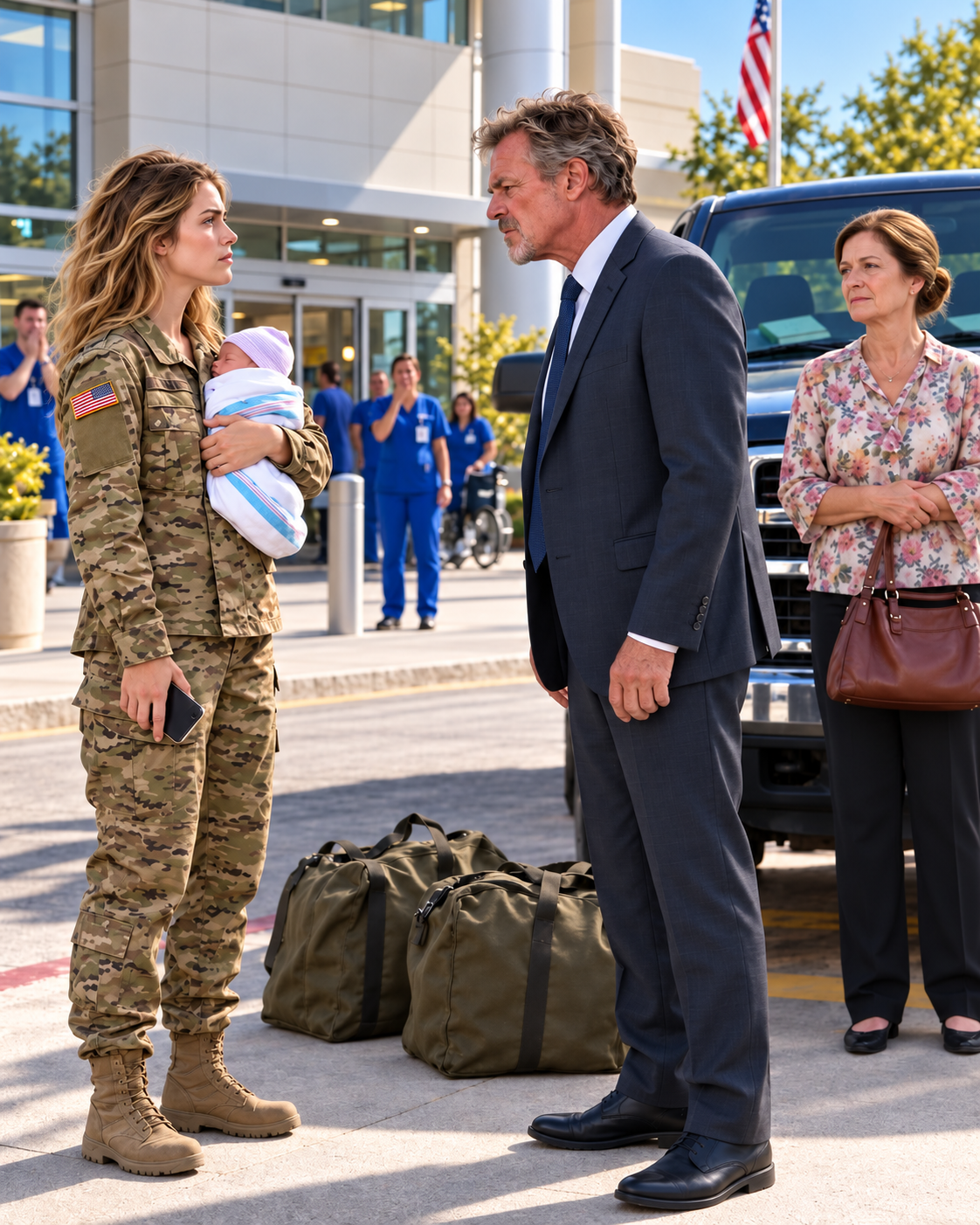
PART 1 TITLE: The Morning Two Uniformed Strangers Came Through My Father’s Door, He Tried to Control the News Before I Could Hear It
The first thing I noticed was the sound of two car doors closing outside my parents’ house. It was 7:40 on Wednesday morning, and I was lying on their worn living-room sofa, trying to find a position that didn’t make my back ache. At thirty-eight weeks pregnant, even breathing sometimes felt like work. Through the thin curtains, I could see the outline of a dark vehicle in the driveway. Then came footsteps on the porch, measured and unhurried. I knew those footsteps belonged to soldiers before anyone knocked.
My father, Richard Vance, was already standing near the front door. He had been drinking coffee in his work clothes, a faded flannel shirt carrying the familiar smell of motor oil from his repair shop. When he looked through the window, his expression tightened. He turned toward me and raised one hand, warning me to remain where I was. Then he opened the door, positioning his broad body across the entrance as though whatever stood outside could be kept from reaching me if he occupied enough space.
On the porch stood an Army captain in dress uniform and a military chaplain. The captain held a dark folder. The chaplain’s cap rested beneath one arm. Neither man needed to explain why he had come. For seven months, I had lived with the possibility of this particular visit. My husband, Sergeant First Class David Ellis, was a combat engineer deployed overseas. His work involved dangerous routes, explosives, and situations in which a few seconds could determine whether an entire convoy returned safely. I had trained myself not to imagine strangers delivering news about him. Now those strangers were standing outside my childhood home.
My father glanced between the two men and me. “Whatever this is, you can explain it to me,” he said. His voice had the rough certainty he used when arguing with customers over repair bills. “My daughter’s in no condition to deal with upsetting business.” The captain did not answer immediately. Instead, he looked past Richard and addressed me by my military surname. Hearing Ellis spoken in that formal tone settled something cold and heavy beneath my ribs. I pushed myself upright, one hand supporting the underside of my belly.
“Lauren, stay on that couch,” Richard ordered. I moved around the coffee table anyway. My feet were swollen, and a sharp pull traveled through my lower back, but my body remembered habits established long before pregnancy. I straightened my shoulders and faced the captain. I had served as a noncommissioned officer. I knew what a casualty notification team was required to do, and I knew the message belonged to the next of kin. My father could command his employees and intimidate his family. He could not stand between me and the truth about my husband.
The captain stepped into the room after I invited him inside. Behind him, the chaplain removed his cap. My mother, Martha, appeared in the kitchen doorway holding a dish towel, apparently irritated that the visitors had interrupted breakfast. The captain waited until I was facing him. His voice was steady, but I noticed how carefully he held the folder. He began the official notification, offering the Army’s condolences before explaining that David had been killed during an operation overseas. There had been an explosive device, hostile fire, and an emergency involving his unit. I heard the words individually. For several seconds, I could not make them fit together.
David had called me only days earlier. The connection had been poor, and I remembered pressing the phone tightly against my ear to catch his voice. He had asked whether the baby was still keeping me awake and whether I was remembering to eat proper meals. He had laughed when I told him our daughter seemed determined to kick through my ribs. Before hanging up, he had made me promise not to attempt anything strenuous. I had promised, then accused him of giving orders from halfway around the world. That ordinary conversation was now the last time I would ever hear him speak.
The captain continued, offering the information he was authorized to share about the operation. I saw his mouth moving and understood enough to know David would not be returning. The rest came through as if from the far end of a corridor. My daughter shifted inside me, pressing one small foot against my side. I put my hand over the movement without thinking. I had expected David to be there when she was born, or at least to see her face on a screen shortly afterward. Instead, I was standing in my father’s living room, listening to a stranger confirm that she would never meet him.
Martha made a sharp sound behind me and pressed the dish towel against her mouth. When I turned, I saw her eyes moving between the visitors, checking their reactions. She had rarely spoken to David during his deployment and had complained whenever I mentioned the difficulty of waiting for him. Yet now she seemed determined to perform the part of a devastated mother-in-law. Richard remained close to the doorway, his arms folded. He looked irritated that the captain had addressed me directly. Neither parent approached to hold my hand. Neither asked whether I needed to sit down.
The chaplain spoke quietly, offering to remain and help me contact someone I trusted. I wanted to tell him that the only person I trusted completely had just been taken from me. Instead, I asked about the arrangements for bringing David home and what information I would receive next. Years of military service gave me questions to ask even when I could barely feel my fingers. The captain answered what he could and explained that a casualty assistance officer would be assigned. I thanked both men. The words sounded impossibly formal, but they were all I could manage.
After the vehicle disappeared down the driveway, I stayed beside the front window. A few minutes earlier, I had been impatient for the day to begin. Now the kitchen clock seemed absurdly loud. Richard shut the door and slid the deadbolt into place. I heard Martha setting a cup into the sink, then turning on the faucet. Ordinary household noises continued around me, indifferent to what had happened. My father finally spoke. “Go lie down, Lauren. You shouldn’t get yourself worked up with the baby coming.” I turned toward him, surprised by the gentleness of his tone.
He stepped closer and rested a heavy hand on my shoulder. “There’ll be a lot of paperwork after something like this,” he continued. “You leave that to us. Your mother and I can deal with the officials while you concentrate on getting through the delivery.” I looked at his hand. Its nails were stained dark from years of working on engines. He squeezed my shoulder once, as though he had said something reassuring, and withdrew. I wanted desperately to believe that my parents might finally put aside everything that had separated us. For a moment, I let myself hope.
That hope came from an old place. I had spent much of my life trying to earn my father’s approval, usually by making myself useful when he needed money or help at the garage. His tenderness had always arrived with conditions attached, but grief made me careless with memories. I remembered being a little girl and waiting for him to come home, listening for his truck because I wanted to show him a school certificate. Sometimes he smiled. More often, he told me to move aside because he had bills to pay. Still, I had continued trying.
By midmorning, Richard had begun making telephone calls. I heard him speaking to someone at the repair shop, explaining that a tragedy had occurred in the family and that he might need to rearrange his schedule. He lowered his voice when I entered the kitchen. Martha asked whether David had left insurance and whether the Army covered funeral expenses. I stood with an untouched glass of water while they exchanged a look I recognized from previous discussions about unpaid invoices. It was the expression they wore when money appeared unexpectedly and they began deciding where it should go.
I said nothing about what I had overheard. There were funeral arrangements to consider, medical appointments to manage, and a child who could arrive at any moment. I was also too tired to defend myself against my parents’ familiar insistence that they knew best. My father had spent years convincing me that disagreement was disloyalty. I knew the pattern, even if I had never fully escaped it. David had helped me recognize how often Richard converted family obligations into debts that could never be settled. Now David was gone, and my father seemed to believe that old arrangement could resume.
That night, I lay awake on the sofa with one of David’s photographs illuminated on my phone. He was wearing fatigues, his face slightly sunburned, his smile crooked because he disliked posing for pictures. In the photograph, his left hand rested against my pregnant belly. We had taken it shortly before he deployed. I traced the outline of his face with one finger, then enlarged the image until I could see the little crease beside his eye. I had never understood how much pain an ordinary photograph could hold until I looked at one knowing no more would ever be taken.
Thursday afternoon, another government vehicle arrived. This time, Major Thomas Sterling stepped onto the porch with Sergeant First Class Elena Rostova. Sterling commanded David’s battalion. Rostova had been assigned to guide me through the casualty assistance process. She carried a thick envelope and a folder of official documents. My father came forward immediately, extending his hand and speaking with the exaggerated courtesy he reserved for men he considered influential. Sterling shook his hand briefly, then asked where he could speak with me. Richard’s smile remained in place, but his eyes hardened.
We gathered in the living room. The major sat at the edge of the sofa, leaving space beside him, while Rostova arranged her materials on the coffee table. My mother brought coffee nobody had requested. Richard remained standing near the hallway, where he could observe everyone without appearing to participate. Sterling waited until the small disturbances ended. Then he turned toward me and explained that he wanted me to hear more about David’s final mission before we discussed administrative matters. Something in his expression made me sit straighter.
The operation had involved route-clearance work during a night mission. Forty soldiers had become trapped during an ambush, with dangerous obstacles preventing their withdrawal. Enemy fire had pinned them in a vulnerable position. David recognized that the men could not reach safety unless someone opened a passage through the barrier. He moved forward carrying the equipment necessary to cut through it. The major explained the sequence carefully, without dressing the account in unnecessary heroic language. That restraint made the details harder to bear. Every decision sounded like something David would have made.
He had used bolt cutters to open the obstructing wire while exposed to enemy fire. He suffered multiple wounds but continued holding the opening long enough for the trapped soldiers to move through. Sterling stopped speaking for a moment and watched my face. I looked down at the edge of the table. David had been stubborn about finishing a job, whether he was repairing a loose cabinet hinge or clearing a route under dangerous conditions. I could hear him saying that you did not walk away while somebody else was still stuck. Forty men had made it out. David had not.
“Those soldiers are alive because he refused to leave them there,” Sterling said. His voice had lost some of its formal stiffness. “I thought you deserved to know that directly from me.” I nodded, but something broke through the composure I had maintained since Wednesday. A tear dropped onto the back of my hand. I wiped it away with my sleeve and apologized, an absurd reflex for someone who had just lost her husband. Sterling waited until I could look at him again. He did not tell me to be strong or promise that time would make the loss easier.
I asked whether David had known how many men were behind the barrier. Sterling said the reports indicated that he understood the scale of the emergency. I tried to imagine the moment he had chosen to move forward. He would have been thinking about the trapped soldiers, not the kitchen he would never return to or the baby waiting to be born. That was the part I could barely endure. He had made the kind of decision I admired most about him, and it had cost us every ordinary day we were supposed to have together.
Rostova began reviewing the support available to me as David’s surviving spouse. She explained the immediate administrative procedures, the documentation that would need my attention, and the financial protections associated with his service. I recognized much of the terminology from my own military experience, but she took care not to assume I could process everything while grieving. When she reached the Servicemembers’ Group Life Insurance policy, she explained that David’s coverage amounted to four hundred thousand dollars and that payment would follow the designated beneficiary information on file.
Richard moved away from the hallway before she had finished. “Four hundred thousand?” he repeated, leaning over the coffee table. His interest was so sudden that even Martha stopped shifting cups on the kitchen counter. He looked at Rostova rather than me. “When does that come through? Does the family get it all at once, or is it spread out?” His voice had the practical eagerness of someone examining an unexpected business opportunity. I watched Sterling’s expression close. The major had just described how my husband had died saving forty people, and my father was calculating the value of the insurance.
Rostova explained that the benefit belonged to the designated beneficiary and that all questions about its administration would be handled directly with me. Richard frowned. “She’s in no state to make decisions. Look at her. She’s about to have a baby, and her husband just died. Somebody has to keep her from making mistakes.” Martha immediately joined him, saying that I was exhausted, emotional, and liable to become overwhelmed. She spoke as though I were absent, reducing my military experience and adult independence to inconvenient details in a conversation about money.
Sterling rested his hands on his knees. “Mr. Vance, your daughter is the person we are here to assist. We will not discuss her private financial affairs without her authorization.” Richard gave a short laugh that contained no amusement. He told the major he had raised me, that he understood my limitations better than any stranger, and that families had a responsibility to protect their own. The words might have sounded reasonable if I had not spent years hearing them immediately before he asked me for money. I could feel the old pressure building, inviting me to agree merely to restore the peace.
Rostova looked directly at me. “Sergeant Ellis, do you want anyone else making financial decisions on your behalf?” The room became still. Richard’s eyes moved to mine. Martha stood in the kitchen entrance with both hands wrapped around a cup. I could almost hear the answer they expected. For most of my life, I had softened disagreements by offering something: a promise, an apology, a payment, an explanation. This time, my husband’s death stood between the request and the answer. I would not let his sacrifice become another source of income for my father’s garage.
“No,” I said. “I’ll handle my own affairs.” My voice was quieter than Richard’s, but I knew everyone had heard me. He turned toward the window, working his jaw as though chewing something bitter. Rostova closed the financial section of her folder and returned to the arrangements for the coming days. My father interrupted twice more, asking questions that had already been answered, until Sterling stood and brought the meeting to an end. The major thanked my parents for providing a place for me to stay. Richard managed a tight smile that vanished as soon as Sterling turned away.
I followed the officers onto the porch. The late-afternoon air carried the smell of wet gravel and exhaust from the trucks near my father’s garage. Sterling paused beside the steps and reminded me that I had his personal telephone number. David had insisted on putting it into my contacts before deploying. I touched the phone in my pocket and told the major I still had it. His gaze held mine for a moment longer than necessary. He seemed to understand something about the house behind me, although he was too careful to say it aloud.
When I returned inside, Richard was standing beside the coffee table, staring at the place where the documents had rested. Martha asked whether I had really meant what I said about handling the money myself. Before I could answer, my father turned toward me. His voice was low, almost conversational. “Four hundred thousand dollars, Lauren. That’s enough to solve a lot of problems in this family.” I looked at him, waiting for him to mention David, or the forty men who had survived, or the little girl about to be born. He mentioned none of them.
Instead, he began explaining the debts hanging over his mechanic shop. The second mortgage was becoming difficult to manage, suppliers were demanding payment, and he believed one sensible financial decision could keep the business operating. He spoke as though the insurance were already available to him and I merely needed to approve the transfer. Behind him, Martha nodded. Neither seemed to notice that I was standing in the same room where I had learned my husband was dead less than two days earlier.
I told Richard the money was not intended to rescue his business. The silence afterward was more frightening than his usual shouting. He studied me for several seconds, then looked toward the hallway where my hospital bag had been placed. His expression changed, not into anger, but into something more deliberate. He stepped aside and told me to get some rest before the baby arrived. I went back to the sofa, unsettled by how easily he had abandoned the argument.
Later, after the kitchen lights went out, I heard my father moving through the hallway. A floorboard creaked near the place where I had left my olive-green medical bag. I kept my eyes closed and listened until his footsteps retreated. There was something inside that bag David had insisted I keep close to me. Something he had prepared before leaving for his final deployment. I had thought of it as a precaution against a possibility too terrible to imagine. Now I understood why my husband had been so determined that my father never touch it.
END PART 1
PART 2 TITLE: Before My Husband Went Overseas, One Quiet Decision About My Pay Made My Father Regard Our Marriage as a Threat
The trouble with my father had never begun with David’s insurance. That money was only the largest amount Richard Vance had ever imagined taking from me. Long before I married, before I had a child on the way, he had taught me that being his daughter meant contributing to whatever crisis he was facing. There was always another overdue payment at the garage, another supplier threatening to stop deliveries, another explanation for why the family needed my help. The problems changed, but the person expected to solve them remained the same.
At nineteen, I walked into an Army recruiting office because I wanted a life that belonged to me. The office occupied a small storefront in a shopping plaza outside our Ohio town. A recruiter explained the enlistment process while traffic rolled past the windows, and I listened with an attention I had rarely given anything at home. My father had told me repeatedly that I would never manage without him. I wanted to find out whether that was true. When I signed the enlistment papers, I was frightened, but the fear came with the unfamiliar pleasure of having made a decision he could not reverse.
During basic training, I learned how much noise a person could endure and how little sleep could still be enough to function. I also learned that instructions could be demanding without being cruel. Drill sergeants expected discipline, effort, and accountability. Their standards did not change according to whether they liked you. At home, I had grown accustomed to guessing my father’s mood before speaking. In the Army, the rules were difficult but recognizable. I was beginning to understand the difference when Richard called, barely a month into my training.
He said the repair shop was close to losing an important account. Parts were becoming expensive, customers were delaying payments, and the bank had started asking uncomfortable questions. I stood near a row of vending machines, listening to the same complaints I had heard throughout childhood. Then he reminded me that he and Martha had paid for my food and clothing while I grew up. He talked about the sacrifices parents make and the disappointment of raising a daughter who leaves as soon as she earns a paycheck. By the time he asked for financial assistance, I had already begun feeling guilty.
I told him my pay was limited. He dismissed that immediately. He had heard about military allowances, he said, and he knew the government provided certain expenses. Surely I could manage four hundred dollars a month. He made the amount sound small, almost insulting to question. I asked how long he would need it. “Until the shop gets steady again,” he answered. There was no specific date and no promise of repayment. I knew that should have troubled me. Instead, I focused on how relieved he would be if I agreed.
I completed the necessary allotment paperwork and arranged for four hundred dollars to be deposited into his business account every month. The account ended in 4471, a number that eventually became as familiar to me as my own telephone number. At first, Richard called to acknowledge the transfers. He sometimes sounded almost proud, telling me I was finally learning to support the family. Those conversations were rare moments when I could speak to him without hearing criticism. I mistook the change in his manner for affection and continued sending the money.
The payments lasted five years. During those sixty months, twenty-four thousand dollars moved from my military earnings into Richard’s garage account. I could have used that money for savings, equipment, travel, or the beginning of a home of my own. Instead, it disappeared into the business without producing any visible improvement. Every time I returned on leave, the shop looked much the same. The same damaged vehicles occupied the yard. The same creditors called. My father still complained that nobody appreciated how hard he worked.
Only gradually did I understand how much of the money supported my older brother, Derek. He was thirty now, three years older than me, and had never managed to keep regular employment for long. In our parents’ home, he could sleep late, spend hours playing video games, and leave his expenses for somebody else to cover. Richard described him as talented but unlucky. Martha said the modern job market made things difficult for young men. When I asked why Derek could not contribute to the garage, my mother accused me of being resentful of my own brother.
Derek and I had never been especially close. As children, we occupied different positions in the household. He could fail and still be encouraged. I could achieve something difficult and be asked what more I intended to do. If Derek broke a household appliance, Richard called it an accident. If I forgot an errand, he treated it as evidence of selfishness. By adulthood, we had become strangers who shared a family history but little else. I did not hate him. I simply grew tired of paying for the freedom he enjoyed without responsibility.
My parents rarely asked about my military work unless they wanted to know when my next payment would arrive. They showed little interest in promotions, assignments, or the people I served beside. To Richard, the uniform was useful mainly because it meant I had a predictable income. Martha told neighbors that I had joined the Army because I was restless and difficult to manage. When I visited, she sometimes complained that the service had made me arrogant. Yet neither hesitated to accept the money that came from the same career they belittled.
I met David after I had begun establishing myself in the Army. He was a combat engineer, already experienced enough to recognize when a situation required patience rather than noise. He had a dry sense of humor and an almost infuriating ability to remain calm while other people argued. The first thing that drew me to him was not the uniform or the stories he could tell about deployment. It was the way he listened. When I said something mattered to me, he remembered. When I disagreed with him, he wanted to understand why.
During our first months together, I kept expecting David to become irritated by ordinary mistakes. Once, I accidentally left an important document in another building and returned to our quarters furious with myself. He listened to me describe the inconvenience, then asked how we could retrieve it. He did not question my intelligence or use the mistake against me later. I remember staring at him, waiting for the criticism that never arrived. He noticed and asked what was wrong. I told him I was simply tired. I did not yet know how to explain the difference between the household where I had grown up and the relationship we were building.
As we became serious, David noticed the monthly transfer to my father’s business. I mentioned it casually while organizing our finances, expecting him either to ignore it or to agree that helping parents was an obligation. He asked whether Richard had provided an agreement for repayment. I said there wasn’t one. David asked whether the garage had improved since I began sending money. I admitted that it hadn’t. Then he asked a question nobody in my family had ever considered worth asking: “What happens to you if you need that money someday?”
I had no answer. The assumption had always been that my father needed it more. David did not demand that I stop the payments or insist that he knew what was best for me. He only encouraged me to examine the arrangement honestly. We went through my records together, tracing the transfers across five years. Seeing the total written down unsettled me. Twenty-four thousand dollars was no longer a manageable monthly favor. It was a substantial part of my working life, given to people who still treated me as though I had never contributed enough.
Our wedding took place three years before David’s death. We arranged a rehearsal dinner at a Veterans of Foreign Wars hall, where folding chairs surrounded long tables and the kitchen smelled of coffee and reheated food. Nothing about the evening was extravagant. David preferred practical celebrations, and I wanted to spend the money we had saved on our life together rather than a single elaborate weekend. Friends from our military community attended, along with a few relatives. For several hours, I hoped my parents might behave graciously and allow the evening to belong to us.
Martha had been drinking wine before everyone finished eating. She stood near the tables, tapped her glass with a fork, and announced that she had something funny to say about military marriages. Her speech began with awkward jokes about long separations and lonely spouses. Then she suggested that men who went overseas sometimes returned in coffins, leaving their wives for other people to support. A few guests looked down at their plates. Others glanced at David. I felt heat rise into my face, but my mother kept smiling, apparently pleased to have everyone’s attention.
David placed his glass on the table and answered her in his usual quiet manner. “I’ll make every effort to come home safely, Martha. I’d rather not leave Lauren with that problem.” He offered a slight smile, enough to allow the conversation to move on without a public argument. Martha laughed too loudly and sat down. I knew he had protected me from an uglier scene, but I also knew he would not forget what she had said. Later, when we were alone, he asked whether those kinds of remarks were common in my family. I told him they were. He looked troubled.
That evening, Richard approached him outside near the fence. I had stepped away to retrieve something from the car and returned in time to hear my father asking who controlled the money in our marriage. He was trying to sound friendly, but his posture made the question feel like a challenge. David stood with his hands relaxed at his sides. He answered that we made financial decisions together and that I understood my own accounts perfectly well. Richard pressed further, asking whether David kept the bank cards. David said they were mine to keep.
My father studied him for a long moment. David did not look away. He had faced dangers considerably greater than an angry mechanic outside a rented hall, and he seemed unwilling to pretend the question was reasonable. Richard finally muttered something about young couples making foolish choices. He walked away without shaking David’s hand. In the car afterward, I apologized for the exchange. David reached over and rested his hand on mine. “You don’t have to apologize for him,” he said. “And you don’t have to ask my permission to manage money you’ve earned.”
Two weeks after our honeymoon, we returned to Fort Campbell. I opened the military pay system one evening and reviewed the automatic transfers. The familiar account number appeared on the screen, followed by the amount that had left my pay month after month. My finger rested on the mouse for a long time. Canceling the allotment seemed simple from a practical standpoint. Emotionally, it felt like breaking a rule that had governed my life since childhood. David was nearby organizing his equipment. He noticed my hesitation but did not approach the computer.
I asked him whether he thought I was being cruel. He considered the question before answering. “You’re not refusing to help someone in an emergency,” he said. “You’re choosing to stop an arrangement that has no end.” That distinction mattered. I looked at the account again and completed the cancellation. The confirmation appeared almost immediately. There were no fireworks, no sudden sense of triumph. I simply sat at the desk, staring at the screen, surprised that something which had frightened me for years could be accomplished with a few ordinary steps.
The response from my parents was immediate. Martha stopped answering my messages. Richard called repeatedly, leaving increasingly hostile voicemails about loyalty, sacrifice, and the garage’s financial problems. When I finally spoke with him, he accused David of turning me against my family. I told him the decision had been mine. He dismissed that explanation, insisting I had never behaved this way before meeting my husband. It was easier for him to imagine another man controlling me than to accept that I had begun making decisions for myself.
For five weeks, Martha refused contact. The silence was familiar enough that I understood its purpose. Throughout my childhood, she had withdrawn affection whenever I disappointed her, returning only after I apologized or found some way to make amends. This time I did neither. I continued working, building my marriage, and preparing for the future. When she finally called, she did not ask how I was. She warned that I should not expect the family to welcome me back if my husband’s support ever disappeared. I remember standing in our kitchen afterward, holding the silent phone.
David found me there and asked what had happened. I repeated Martha’s words as accurately as I could. He listened without interrupting, then asked whether I wanted to call her back. I shook my head. He didn’t tell me how to feel about my parents or insist that I cut contact. Instead, he asked what kind of relationship I would be willing to have if they respected my boundaries. I had never considered that I could establish conditions for how people treated me. He helped me see that love did not require unlimited access to my time, income, or decisions.
When I became pregnant, the conversation about family changed. David was delighted by the news. He listened intently during appointments, asked questions about the baby’s development, and spent an unreasonable amount of time comparing cribs. We chose the name Eevee for our daughter, although David occasionally pretended to lobby for alternatives just to make me laugh. As my pregnancy progressed, I found myself thinking about the grandparents she might know. Against my better judgment, I wondered whether holding a grandchild could soften my parents. David never mocked that hope. He only reminded me that a baby could not repair a relationship the adults refused to change.
About a month before his deployment, David came into our kitchen carrying a thick green tactical folder. He had spent much of the afternoon reviewing documents, and I assumed it concerned his military preparations. Instead, he laid it on the counter and told me the contents were for me. Inside were printed explanations of beneficiary rights, insurance procedures, relevant regulations, and important contact information. Major Sterling’s personal telephone number appeared on one of the pages. David had organized everything so that I could find what I needed without searching through complicated systems during a crisis.
I asked why he had taken so much trouble over paperwork I already understood. David looked at me for a moment before answering. He knew I was capable of handling administrative matters, he said, but he also knew that grief could make even familiar tasks difficult. He had seen what happened to families after sudden losses. People who meant well sometimes became confused, and people with selfish motives sometimes used that confusion. Then he mentioned Richard. My father had never forgiven us for stopping the payments. David was concerned about what might happen if he were not there to support me.
I told him I didn’t want to discuss the possibility of his death. He moved closer and placed one hand over mine. “Neither do I,” he said. “But avoiding the conversation won’t make the risk disappear.” He explained that nobody should pressure me into signing away authority over my finances or benefits. If my father offered to handle everything, I needed to remember that accepting help was different from surrendering control. David tapped the folder and asked me to keep it somewhere safe. He wanted me to know I could contact Sterling directly if anything went wrong.
He carried the folder to my olive-green medical bag and placed it inside the main compartment. The bag contained items I expected to need when the baby arrived, along with clothes, personal documents, and medical supplies. I watched him close the zipper carefully. He told me not to hand the folder over to Richard, regardless of how convincing his explanations sounded. Then he put his arms around me, resting his cheek against my hair. For the first time during the conversation, I heard uncertainty in his voice. It frightened me more than the paperwork itself.
I asked whether he had a reason to believe something might happen on the deployment. He told me no. He was preparing for contingencies because that was part of his work. Then he placed his palm against my belly and waited until Eevee moved. The baby kicked against his hand twice. David smiled and said she already had strong opinions about being disturbed. I wanted to remain in that ordinary moment, the three of us together in our kitchen, while his equipment waited by the door. I wanted to believe preparation could somehow prevent the worst outcome.
When David departed, I eventually returned to my parents’ house for temporary help during the later stages of pregnancy. It was an uncomfortable compromise. The arrangement was supposed to make the practical demands of pregnancy easier while he was overseas. I kept my financial accounts separate and reminded myself that staying under their roof did not give my parents authority over me. Richard tolerated those conditions while David was alive. He made occasional remarks about the expenses of having me there, but he had not yet discovered a way to turn my presence into another regular payment.
Now David was dead, and I was carrying the child he had never held. On Thursday night, after Major Sterling and Rostova had visited, I sat alone with the green folder resting on my lap. I reread the contact information, the instructions about beneficiary designations, and the notes David had included. Some pages carried small marks in his handwriting, guiding my attention toward procedures he thought might be important. There was also a sealed brown envelope tucked behind the documents. I knew it contained a personal letter, but I could not bring myself to open it.
From the kitchen, I heard Richard discussing the garage with Martha. His voice dropped whenever he mentioned the insurance. I put the folder back into my medical bag and zipped it shut. I had believed David was being excessively cautious when he assembled those papers. After watching my father’s reaction to the four-hundred-thousand-dollar benefit, I no longer thought so. The folder contained information Richard wanted to control, and he knew I was about to enter the hospital exhausted, frightened, and physically vulnerable.
Before going to sleep, I checked that the bag was still beside the sofa. My phone rested nearby with Sterling’s number saved among my important contacts. I pressed one hand against my belly and felt Eevee turn beneath my palm. The baby had been unusually active all evening. I told her quietly that her father had loved her long before she was born. Then I lay down and tried to rest. A few hours later, before dawn on Friday, I woke to sudden pain and realized my waters had broken. There would be no more time to prepare.
END PART 2
PART 3 TITLE: In the Operating Room, I Kept Saying David’s Name While Someone Else Was Already Searching Through the Bag He Packed
The pain that woke me shortly before three on Friday morning was different from anything I had experienced during pregnancy. I had been dreaming about David standing beside an open window, although I could no longer remember what he was saying. Then a tightening sensation spread across my abdomen, strong enough to bring me fully awake. When I shifted on the sofa, I felt a sudden rush of warmth. I reached beneath the blanket, touched the damp fabric, and understood that my waters had broken. Eevee was coming three days after her father had died.
For a few seconds, I remained perfectly still. The house was silent except for the refrigerator motor and the distant noise of a passing truck. David and I had discussed this moment repeatedly. He had wanted me to call immediately when labor began, even if the timing was inconvenient. We had joked about whether he could endure watching a delivery through a video connection without becoming more nervous than I was. I reached for my phone before remembering there was nobody to call. His contact was still near the top of my recent conversations.
Another contraction interrupted the thought. I gripped the edge of the sofa, waited for it to ease, and then called for Martha. She appeared in the hallway wearing an old robe, her hair flattened on one side. When I explained what had happened, she stared at the wet blanket with an expression of annoyance. Then she looked toward the medical bag I had kept beside the sofa. “You packed everything, didn’t you?” she asked. I nodded. She told me to wait while she woke Richard and found her shoes. Her first concern seemed to be the inconvenience of the hour.
Getting ready took longer than I expected. Every movement pulled against my abdomen, and the contractions came with increasing force. I changed clothes while Martha searched for her purse and complained that she had barely slept. Richard moved through the hallway muttering about hospital traffic and the work he was supposed to finish at the garage. I concentrated on securing the bag, making sure my identification and medical documents were inside. Beneath the clothing, David’s green folder remained where he had placed it. I touched the canvas cover briefly before closing the zipper.
The drive toward Blanchfield Army Community Hospital passed in a succession of red taillights, road signs, and painful intervals. I sat against the seat with both hands spread over my belly, breathing as evenly as I could. Martha offered occasional instructions about remaining calm, although she became irritated whenever I interrupted her conversation with Richard. My father talked about the garage, a customer who had not paid, and an engine that needed replacing. Once, between contractions, I wondered whether he had forgotten why we were traveling. Then another wave of pain arrived, and I stopped listening.
At the hospital, the staff took over with a reassuring efficiency I recognized from military medical facilities. A nurse checked my identification, asked questions about the timing of my contractions, and directed me through the initial assessment. I answered as clearly as possible, grateful for the familiar rhythm of precise questions. When someone asked whether my husband would be joining us, I felt the answer catch in my throat. “He was killed this week,” I managed. The nurse stopped writing for an instant, then thanked me for telling her. She did not ask for details.
The early hours of labor were exhausting but manageable. I counted contractions, adjusted my position, and followed the instructions of the medical staff. Martha sat nearby, scrolling through her phone. Richard came and went, complaining about the parking arrangements and the lack of decent coffee. At one point, I asked my mother to pass me some water. She handed me the cup without looking away from her screen. I told myself that her presence was still better than being entirely alone. The thought felt increasingly difficult to defend as the day progressed.
By late afternoon, the atmosphere in the room changed. A nurse studying the monitor asked me to shift onto my side. Another entered and checked the equipment. I noticed their expressions becoming more focused, the way soldiers look when an exercise suddenly stops being routine. Eevee’s heart rate had begun dropping. The medical team tried several measures to stabilize the situation, but the monitor continued showing concerning changes. My doctor explained that an emergency cesarean delivery would be necessary. The words reached me clearly. Understanding them did not make them easier to hear.
I had trained to handle emergencies, but no amount of professional experience could remove the terror of lying in a hospital bed while someone explained that my unborn daughter was in danger. I asked whether she would be all right. The doctor told me the team was acting quickly to give her the safest possible delivery. I wanted certainty, something nobody could honestly provide. My hands began to shake. Then I looked toward the doorway, expecting for one irrational instant to see David arriving with his familiar half-smile, ready to tell me we would manage whatever happened.
Instead, Martha stood there holding my olive-green bag. A nurse was preparing to move my bed toward the operating room, and I reached toward my mother as we passed. I did not need a speech or a promise. I wanted her to take my hand for a moment, to acknowledge that her daughter was frightened and that the child inside me might be in trouble. Martha glanced at my fingers, then stepped away from the bed. She said she had never been comfortable around blood and could not bear watching medical procedures. Her grip tightened around the bag.
I watched the operating-room doors close behind me. Martha remained on the other side, still holding everything I had brought from home. I remember that detail more clearly than some of the medical explanations that followed. David’s folder was inside the bag, along with the papers I needed and the ordinary objects packed for our daughter’s arrival. For a moment, I worried about leaving it unattended. Then another wave of fear displaced the thought. Eevee needed medical attention now. Nothing in the bag mattered more than getting her safely into the world.
The operating room was painfully bright. I remember the cold against my arms, the smell of disinfectant, and the metallic sounds of instruments being arranged beyond my view. Staff members moved around me with practiced coordination. Someone explained what would happen next while the anesthesiologist prepared the spinal anesthesia. I followed instructions and concentrated on remaining still. The procedure was familiar to the medical team, but to me it felt as though the world had narrowed to a surgical table, a monitor, and the possibility that something terrible might happen to the only part of David I had left.
When the anesthesia began taking effect, a strange heaviness spread through my lower body. I could still feel people working around me, but the sensations changed in ways that were difficult to describe. A drape separated my face from the surgical field. Beyond it, voices exchanged technical information. I tried to follow every word, searching for reassurance in details I only partly understood. Then panic rose unexpectedly. My breathing became uneven, and my hands tightened against the sheets. I wanted to ask them to stop, although I knew stopping was not an option.
A nurse moved beside my shoulder and leaned close enough for me to see her eyes above her mask. Her name was Captain Rachel Thorne. She had introduced herself earlier, but I remembered almost nothing of that first conversation. Now she placed her gloved hand around mine and asked me to focus on her voice. She told me I could squeeze as hard as I needed. I apologized for shaking. She said there was nothing to apologize for and reminded me that the team was watching both me and the baby carefully.
I told her my husband had been killed three days earlier. The words came out suddenly, with none of the control I had managed during the casualty notification. Rachel’s grip remained steady. She asked his name. When I told her, she repeated it softly, as though making room for him in the conversation. Then she encouraged me to think of him while I breathed. I closed my eyes and pictured David at our kitchen counter, standing beside the green folder and the small collection of baby supplies we had begun gathering before he deployed.
I remembered how seriously he had taken choosing a name. He had written possibilities on scraps of paper and left them where I would find them. Some were practical, others deliberately ridiculous. When we settled on Eevee, he tested the name aloud as though introducing her to an entire room. He had placed one hand on my belly and told her she was already loved. That memory returned while the surgical team worked beyond the drape. I repeated his name quietly, trying to hold on to the sound of it rather than the circumstances of his death.
The minutes stretched. I listened for any change in the staff’s tone and watched Rachel’s expression whenever she looked toward the monitors. She continued speaking to me, sometimes explaining what I was feeling, sometimes asking simple questions to keep me focused. I held her hand until my fingers ached. Then, at 7:52 in the evening, I heard a newborn cry. It was not the gentle sound I had imagined during pregnancy. It was sharp, immediate, and wonderfully determined. Someone told me my daughter had arrived. I began crying before they could say anything else.
Eevee was brought close enough for me to see her face. Her eyes were squeezed shut, and her mouth opened in protest at being disturbed. She had a small crease between her eyebrows that reminded me of David when he concentrated. I knew newborn babies changed quickly and that resemblance might have existed only in my exhausted imagination, but I loved it immediately. When she was placed briefly against my chest, I lowered my face toward her. Her skin was warm. Her tiny movements were real. After days of death and fear, I was holding someone who had just begun to live.
I wanted to tell David. The need was so sudden that I almost asked Rachel to bring me my phone. Then I remembered there would be no answer. I looked down at our daughter instead and told her that she had made it. My voice broke on the last word. I was relieved she was alive, frightened by how close the delivery had come to disaster, and grieving the person who should have been sharing the moment. None of those feelings displaced the others. They arrived together and remained while the medical team completed the procedure.
During the first hours of recovery, exhaustion overtook nearly everything. Nurses checked my vital signs, monitored the incision, and helped me understand what movement would be safe. I watched Eevee whenever she was near me, afraid to close my eyes for too long. The medication softened the worst physical pain but made concentration difficult. When someone explained a routine instruction, I sometimes needed to hear it twice. I disliked that helpless feeling. In uniform, I was accustomed to knowing what needed to be done. Here, even sitting upright required assistance.
Martha eventually returned to the room with my bag. She placed it on a visitor’s chair and asked whether the baby was healthy. I told her Eevee was doing well. She looked into the bassinet, remarked that newborns all seemed terribly small, and began talking about the spare room at home. She said she and Richard had been making arrangements so the baby and I could recover there. I wanted to believe that the birth had changed something. Perhaps the sight of her granddaughter would make my mother consider what I needed rather than what I might provide.
Saturday morning arrived through a haze of medication and broken sleep. Light slipped between the blinds while nurses moved quietly along the corridor. My incision hurt whenever I shifted, so I remained as still as possible. Eevee slept in the bassinet beside me. I watched her small chest rise and fall, fascinated by the ordinary work of breathing. The hospital room was peaceful for a while. Then I heard heavy footsteps approaching from the corridor. They were slower and louder than the rubber-soled steps of the medical staff. I recognized my father’s walk.
Richard entered without knocking. He wore work boots and a jacket that carried the smells of gasoline, old cigarettes, and machine oil. He glanced toward Eevee but did not approach her. He asked whether I had a phone charger, then looked around the room as though searching for something he expected to find. I tried to answer, but my mouth was dry and my thoughts moved sluggishly. He checked the windowsill and the bedside table, then turned toward the visitor’s chair. My olive-green medical bag was resting there, exactly where Martha had left it.
I watched him pull the bag closer. He opened the main zipper and moved aside the clothing packed for my hospital stay. At first, I thought he might genuinely be looking for a charger. Then his hand went directly to the compartment containing David’s green folder. He found it quickly, lifting it from beneath the other items. My heart began beating harder. I tried to tell him to leave it alone, but my voice came out as a weak sound. The medication made it difficult to raise my head, and the movement sent pain across my abdomen.
Richard turned when he heard me. For an instant, his expression revealed that he knew he had been caught doing something he should not have done. Then he studied my face, the IV line, and the monitor beside the bed. His shoulders relaxed. He seemed reassured by how little I could move. He brought a chair closer and sat beside me with the folder across his knees. “I’m taking this with me for now,” he said. “You don’t need to worry about complicated documents while you’re in this condition.”
I asked him to put it back. The words were barely audible. He leaned forward, forcing me to repeat myself. When I managed it, he gave an impatient sigh and told me I was being unreasonable. According to him, Major Sterling and Rostova had overwhelmed me with information I was in no condition to manage. He said I needed someone experienced to organize the paperwork and make sure my daughter’s financial future was secure. While he spoke, he kept one hand pressed over the folder, preventing me from reaching toward it.
I knew exactly why David had wanted those documents protected. Yet in that moment, I could barely manage the physical effort of speaking. I wanted to call a nurse, ask someone to witness what Richard was doing, or reach for my phone. The distance from my hand to the bedside table seemed enormous. My father noticed where I was looking and moved the folder beneath his arm. Then his voice softened. He said Martha had prepared the spare room, arranged a crib, and made sure there would be a comfortable place for us when the hospital released me.
He spoke about warm meals, clean blankets, and having people nearby to help while my incision healed. I was exhausted enough to imagine those things with painful longing. I wanted a quiet room where Eevee could sleep and someone would bring me water without being asked. I wanted to wake in the night and know that another adult was close enough to help if something went wrong. Most of all, I wanted my parents to stop seeing every need as an opportunity. For a brief moment, the picture Richard described seemed almost possible.
He leaned over the bed rail and patted the blanket near my knee. “You just get your strength back,” he said. “I’ll sort out the rest.” Then he stood and moved toward the door, taking the green folder with him. I tried once more to say his name. He did not turn around. The door closed with a soft click that sounded strangely final. I looked toward the empty space in my bag and understood that the promise of help had been attached to something he had already taken.
I lay awake for several minutes, unable to decide whether to call someone immediately or wait until I could think more clearly. The strongest pain medication was still affecting me, and every attempt to sit up made me dizzy. Eevee stirred in her bassinet, drawing my attention away from the door. I reached out and touched her blanket with my fingertips. David had left that folder because he feared I might be vulnerable during precisely this kind of crisis. My father had waited until I could scarcely speak before removing it.
As the morning wore on, I became increasingly aware of what was missing. The folder contained information I needed, but the deeper loss was the confidence that my family would respect even the simplest boundary. Richard had entered my recovery room, looked past his newborn granddaughter, and taken the one item my husband had specifically asked me to protect. I had not agreed. He had not needed my agreement. For years, that was how our relationship had worked. He decided what belonged to the family, and I was expected to accept his decision.
I watched Eevee sleep while I waited for the medication to clear. Her tiny fist rested beside her cheek. Once, she opened her mouth in a silent yawn, and I felt an ache of tenderness so intense that I had to look away. She depended on me completely. I could not make my parents become people who cared for us properly, and I could not bring David home. But I could still decide what kind of life she would grow up in. I placed my phone within reach and resolved to understand exactly what Richard intended to do with the papers he had taken.
END PART 3
PART 4 TITLE: A Warning From the Brother Who Never Called Me Forced Me to Decide Whose Hands Would Hold My Daughter’s Future
By ten o’clock Saturday night, the hospital had become quiet enough for me to hear the ventilation system clicking above the ceiling. Eevee was asleep in her bassinet, one small hand resting beside her face. The stronger effects of my medication had begun to fade, leaving a deep soreness around the surgical incision. I was grateful to think clearly again, even though clarity brought back everything I had been trying not to face. David was gone. My father had taken his folder. And the people who promised to help me recover were already discussing how to gain control over the financial protection he had left behind.
I reached for my phone and looked through the messages I had received since the delivery. There were congratulations from fellow soldiers, brief expressions of sympathy, and offers of practical assistance from people who knew David. Some messages were still unanswered because I could not bear writing the words that would explain what had happened. I was considering calling Sergeant First Class Rostova when another notification appeared. The sender was Derek, my older brother. Seeing his name surprised me. Fourteen months had passed since our last real conversation, and he had not contacted me after learning of David’s death.
The first message contained only a warning that I needed to be careful. I stared at it, wondering whether he had finally heard about Eevee’s birth. Then a second message arrived, longer and far more disturbing. Derek explained that Richard had spent the afternoon drinking beer with Uncle Ray at the garage. They had been talking in the office, apparently unaware that Derek could hear them. According to my brother, Dad believed David’s four-hundred-thousand-dollar insurance benefit would be enough to settle the bank’s claim against the repair shop and leave money for other family expenses.
I sat against the raised hospital bed and read the message several times. Until that moment, I had understood that Richard wanted access to the benefit, but I had not known how openly he was discussing spending it. Derek wrote that our father had already calculated how much was required to rescue the garage. He was making plans for money that had not been paid and over which he had no authority. My husband had died during a mission to save trapped soldiers. Within days, my father was calculating how that death might improve his own circumstances.
Before I could respond, another message appeared. This one mentioned Martha. Derek said she and Richard had discussed what to do if I refused to sign the documents they intended to bring to the hospital. Their plan was simple: they would withdraw every promise of assistance. They would not take me home, would not provide transportation, and would leave me to arrange my own recovery with a newborn in my arms. Derek said our mother believed a few hours of fear and inconvenience would be enough to make me surrender. They expected me to sign whatever papers Richard placed before me.
I looked toward Eevee. She had been alive for little more than a day, and my parents were already considering using her needs as leverage. I had undergone major abdominal surgery. I could not drive comfortably, lift heavy objects, or care for myself without some practical support. The car I ordinarily relied on was still under my father’s control, and he knew I was depending on him for transportation. Martha understood that I would need diapers, meals, clean clothing, and help moving around. They had discussed those vulnerabilities as though they were useful weaknesses in a negotiation.
I typed a short reply asking Derek whether he was certain. He answered almost immediately. He had heard Richard mention the account at the garage, the insurance money, and the documents Dad expected me to sign. Uncle Ray had apparently agreed that I would eventually cooperate if I were denied help. Derek added that he did not want to become involved in another family argument, but he thought I deserved to know what was being planned. The qualification sounded exactly like him. He wanted to warn me without committing himself to a confrontation with our parents.
I thanked him. Then I asked whether Richard had mentioned the green folder. Derek said he had heard something about military paperwork but did not know what documents were involved. That answer was enough to confirm my suspicion. My father was gathering whatever information he could find, hoping to identify a route around the beneficiary arrangements David had established. I imagined him sitting behind the desk at his garage, the folder spread among overdue invoices and empty beer cans, searching for a provision he could use. The picture made me feel physically ill.
I placed the phone beside me and stared at the ceiling. The hardest part was not discovering that my parents wanted money. That had been apparent since Thursday. It was realizing that they had reached a point where abandoning their recovering daughter and newborn granddaughter seemed acceptable if it helped them secure it. I remembered Martha talking about the spare room, the crib, and the supplies she claimed to have purchased. Those promises had sounded almost loving when I was exhausted and frightened. Now I understood they were conditional offers, designed to disappear if I refused to cooperate.
For several minutes, I considered confronting Richard by telephone. I imagined asking him whether he truly intended to leave me at the hospital and whether he had told Derek about his plans. I knew how the conversation would go. He would deny everything, accuse Derek of stirring trouble, and insist that he was only trying to protect me. If I challenged the financial arrangements, he would remind me how much he had done for me as a child. By the end, the discussion would be about my supposed ingratitude rather than his behavior.
I also knew that confronting him would give him time to change his approach. Richard had always been more dangerous when he understood exactly what I was resisting. He could become charming, angry, or wounded according to which tactic seemed likely to work. If I told him I knew about his plan, he might hide the folder, change the documents, or attempt to convince somebody else that I was incapable of making decisions. I needed to understand what he had already done before allowing him to know that I was preparing to protect myself.
I began by reviewing the insurance procedures I remembered from my own service. The important fact was that possession of David’s documents did not make Richard an authorized beneficiary. David’s designation had been established through official military records. My father could not change it merely by carrying a folder or claiming to be the head of the family. The distinction brought some relief, although not enough to make me comfortable. Richard did not understand the rules governing the benefit, and ignorance had never stopped him from applying pressure until someone yielded.
I made a short list in my phone of the immediate problems. Transportation was the first. I could not rely on my parents to take me anywhere if I refused their demands. Recovery was the second. I needed somewhere safe to stay and help that would not come with conditions about money. The third problem was David’s folder, which Richard had removed without permission. Finally, there was the possibility that my father might attempt to persuade officials to recognize him as my representative. He had already tried to speak for me during the casualty assistance meeting.
As I worked through the list, I remembered how David approached difficult situations. He never began by asking who was angriest or who had the loudest voice. He wanted to know what was actually happening, which resources were available, and what could be done without depending on the cooperation of someone who had already proved unreliable. During our marriage, he had helped me see that understanding a problem was not the same as surrendering to it. I looked at the photograph beside my bed and wished I could ask him what to do next.
Eevee stirred and began making the small restless movements that usually meant she would soon need feeding. I put the phone aside and called for assistance. A nurse helped me settle into a comfortable position, checked the incision, and made sure I could reach everything I needed. She asked how I was feeling. For a moment, I considered explaining the situation with my parents, but I could not yet organize the story into a few sentences. I told her I was tired and worried about the arrangements after discharge. She reminded me that I could ask the staff for help with practical planning before leaving.
After she went, I held Eevee and listened to the distant movement of carts in the corridor. My daughter was warm against my chest, her fingers opening and closing around nothing. I thought about David standing in our kitchen, insisting that I keep the green folder close. He had understood something I had struggled to accept: my father was not simply demanding or difficult. He was willing to exploit moments when I could not easily refuse him. I had spent years explaining away his behavior because admitting the truth meant giving up hope that he would eventually become the parent I needed.
Sunday morning, Sergeant First Class Elena Rostova came to my hospital room. She arrived shortly after eight, carrying her official materials and wearing the composed expression I remembered from Thursday. She asked how Eevee and I were recovering before drawing a chair closer to the bed. Then she told me there had been an unusual inquiry concerning David’s insurance. Her tone was careful, and I immediately recognized that she was trying to explain something serious without increasing my distress. I asked whether the inquiry had come from my father.
Rostova confirmed it. Richard had contacted the casualty assistance office and presented himself as the person authorized to manage my financial affairs. He had asked whether the initial insurance payment could be directed into a civilian business account rather than processed according to the beneficiary information already on file. When the office questioned his authority, he had referred to my emergency surgery, postpartum recovery, and recent bereavement. According to Rostova, he had suggested that I might be too medically or emotionally compromised to make financial decisions independently.
I felt my face grow cold. Richard had taken the ordinary consequences of childbirth and turned them into arguments against my competence. He had watched me struggle to speak under medication and decided that the temporary weakness might provide a way to take control of my benefits. I asked which account he had identified. Rostova consulted her notes and confirmed the final four digits. They were 4471. The same account that had received four hundred dollars a month from my military pay for five years. The same business account David had encouraged me to stop supporting after our marriage.
Rostova explained that the request had been rejected. Her office had not accepted Richard’s unsupported claim of financial authority, and no redirection of the benefit had been authorized. Major Sterling had made it clear that all relevant communications were to go through the proper channels and that my wishes, recorded beneficiary arrangements, and legal rights would be respected. I asked whether my father had obtained anything from the conversation. She said he had not. His questions had raised concerns, however, and she wanted me to know exactly what he had attempted.
I told her about the green folder. She listened while I described Richard entering the recovery room, searching my bag, and removing the documents while I was heavily medicated. Her expression tightened when I explained that he had ignored my request to leave them. I also told her about Derek’s messages and the threatened abandonment. She did not interrupt to offer opinions about my parents. Instead, she asked precise questions about what had happened, where the folder might be, and whether I had signed any financial authorization documents since David’s death.
I told her I had signed nothing. Rostova advised me to keep it that way unless I understood a document and genuinely wanted to authorize what it proposed. We discussed the protections associated with David’s beneficiary arrangements and the fact that my father could not gain financial authority merely by claiming I was grieving. I felt embarrassed that I needed these matters explained when I had military training of my own. Rostova seemed to notice. She reminded me that recovering from surgery while mourning a spouse was a difficult circumstance for anyone, regardless of professional experience.
Before leaving, she gave me updated contact information and explained how to reach the appropriate offices if Richard made another attempt. I asked her not to contact my parents about the conversation until I had decided what to do. She agreed to handle the matter according to the applicable procedures. After she left, I reread the notes I had made overnight. The situation was clearer now. Richard had attempted to redirect David’s benefit, failed, and was likely to increase the pressure on me. The next question was how far he would go once he realized persuasion had not worked.
My parents returned later that afternoon. Richard carried food from the hospital cafeteria, although he seemed more interested in placing a document on my bedside tray than in asking whether I had eaten. Martha stood near the window, adjusting her purse strap and watching him. The paper was a general power-of-attorney form, printed from an online legal source. Several sections had already been filled in. My father’s finger rested beside the space where my signature was supposed to go. He told me he had found a simple way to reduce my administrative burden.
I picked up the paper and began reading. The language was broader than the comforting explanation Richard had offered. He wanted authority to act on my behalf in financial matters, including dealings that could affect accounts and payments. When I asked why such extensive authority was necessary, he answered impatiently that I was making everything more complicated than it needed to be. He reminded me of the surgery, the baby, and the funeral arrangements still ahead. Then he said that a sensible daughter would accept help from the people who had raised her.
I looked at Martha. She nodded as though the matter were obvious. “Your father knows how to handle banks,” she said. “You’re worn out, Lauren. Let someone take care of the difficult things.” I thought about the five years of transfers to the garage and the account number Rostova had repeated that morning. My father certainly understood how to receive money. His ability to manage it responsibly was another question. I asked whether the form could wait until I had spoken with the casualty assistance office. Richard’s expression changed immediately.
He told me the Army would only complicate the matter and that there was no reason to involve strangers in family decisions. I pointed out that the money came from David’s military insurance and therefore involved the relevant authorities regardless of what he preferred. Richard leaned closer. His voice became quiet and insistent. He said he was not going to spend another day arguing about details while I allowed outsiders to tell me how to treat my own parents. Then he placed a pen beside the form and waited.
I picked up the pen slowly. Richard watched my hand with obvious satisfaction. I could feel my incision pulling as I leaned forward, and the medication had left me tired enough that holding the argument felt physically exhausting. For an instant, I understood why he believed the approach would work. He had chosen the moment carefully. My daughter was sleeping beside me, I was struggling to recover, and the people who had promised to provide a home were threatening to withdraw it. Signing would have been the easiest way to end the immediate discomfort.
I brought the pen toward the signature line, then stopped. David had not spent years helping me establish financial independence so I could abandon it because my father was impatient. More importantly, the money represented protection for Eevee’s future. I could not hand another person control over it merely to obtain a ride home. I put the pen on the tray and told Richard I would consider the document after getting independent advice. I tried to keep my tone neutral. I did not want him to know that I had already decided against signing.
His face tightened. For several seconds, he looked at the blank signature line as though it had personally insulted him. Then he straightened and announced that the hospital discharge was scheduled for the following morning. He said he and Martha would be ready to leave at ten o’clock, and I had until then to decide whether I intended to cooperate. His words were not presented as a negotiation. He expected me to understand the consequence of refusing. Martha moved toward the door without looking at me. Neither asked whether I needed anything before they left.
I watched them disappear down the corridor. Their threat had become immediate. In less than twenty-four hours, I would be expected to walk out of the hospital with a three-day-old baby and decide whether to submit to my father’s demands or manage without his assistance. I could not count on him to provide transportation, shelter, or even the medical bag he had already searched. My incision still hurt when I stood. I was exhausted enough to fall asleep between feedings. Yet I felt more certain about refusing the document than I had felt about almost anything since David’s death.
That evening, Captain Rachel Thorne checked my surgical dressing and reviewed my recovery. She explained what symptoms would require urgent attention and reminded me to avoid unnecessary strain. I asked about the discharge process, particularly what arrangements could be made if the person who had offered transportation became unavailable. Rachel said the staff could help me coordinate a safe departure and encouraged me to discuss my needs before leaving. I thanked her. I did not tell her that the person I was asking about was my own father.
After Rachel left, I began contacting people I trusted. Corporal Sarah Jenkins, a fellow soldier and neighbor from our military community, answered my message almost immediately. She had already offered support after hearing about David. I explained that I needed a reliable ride from Blanchfield on Monday morning and asked whether she could bring her Honda Civic near the main entrance around nine-thirty. Sarah agreed without demanding a detailed account of my family situation. She asked whether Eevee and I were safe. I told her we were, and that I would explain more when we met.
Arranging transportation removed the most immediate source of pressure. Richard believed I had no alternative to climbing into his truck. I now had one. But the green folder remained in his possession, and his attempt to gain control over the insurance concerned me. I reviewed the information Rostova had given me and considered what legal and administrative steps might be available if my parents refused to return the documents. They were visiting the installation as civilians through sponsorship associated with me. That arrangement had limits, and I wanted to understand precisely what those limits meant.
At eleven that night, I opened a new message to Rostova. I asked what procedure applied when a service member wished to withdraw sponsorship from civilian family members who were accessing a restricted military installation. I also asked whom I should contact if those visitors possessed documents taken without permission. I read the message carefully before sending it. The question felt consequential in a way that refusing the power-of-attorney form had not. I was no longer simply rejecting Richard’s demands. I was considering an official boundary that might remove his ability to approach me on the installation at all.
When the message disappeared from my screen, I sat quietly for a while. Outside the window, the hospital grounds were dark except for security lights and the occasional headlights moving through the parking area. Eevee shifted in her bassinet and settled again. I thought of David’s green folder and the sealed letter I had not yet opened. I wondered whether he had anticipated something this cruel, or whether he had simply known my father well enough to prepare for the worst. Either way, the information he left behind was beginning to matter in ways I had never expected.
I checked the discharge instructions one final time and placed the unsigned power-of-attorney form where I could find it if anyone asked what Richard had wanted me to approve. Then I saved Derek’s messages and made sure Sarah’s number was easy to reach. These were small acts, ordinary enough that nobody passing the room would have noticed their importance. Yet each one reduced the control my father believed he had over the following morning. He was still expecting me to arrive at his truck frightened, exhausted, and ready to make a bargain.
Shortly before midnight, my phone vibrated with an acknowledgment that Rostova had received my inquiry. I set it down beside the bed, close enough to reach without straining my incision. Tomorrow, my father would discover whether I was willing to exchange David’s legacy for a place in his house. He had given me until ten o’clock to decide. What he did not know was that I had already made my choice, and I was no longer relying on his permission to carry it out.
END PART 4
PART 5 TITLE: My Father Brought My Bags to the Hospital Instead of a Ride Home, Unaware That I Had Already Chosen Whom to Call
Monday morning began with a nurse asking whether I had someone who could help me into a vehicle. I was sitting on the edge of the hospital bed, one hand protecting the incision beneath my loose shirt, while Eevee slept in her bassinet. The nurse had reviewed my discharge instructions twice because she could see how difficult it was for me to concentrate. I had managed to dress without much assistance, but bending to fasten my shoes made me dizzy. I told her a friend was coming. For the first time since Friday, I could say that without wondering whether my parents would change their minds.
My phone showed a message from Sarah Jenkins at 8:42. She had left home and was on her way to the installation. She had installed a properly fitted infant car seat in the back of her Honda and packed a few extra blankets because she wasn’t sure what I had available. I stared at that last detail longer than necessary. Sarah had asked what I needed, listened to the answer, and taken care of it. There had been no lecture about gratitude, no demand that I prove I deserved her time. I wrote that I would contact her when I knew exactly where to meet.
Sergeant First Class Rostova had also replied to my questions about installation access and financial protection. She wanted to speak with me before I left the hospital, and she had arranged for someone from the appropriate assistance office to explain the procedures. Her message was concise, but the final line mattered: I did not need to negotiate with my father in order to receive support. I read it while the nurse checked Eevee’s discharge paperwork. Then I copied Major Sterling’s number into a separate note, even though David had already saved it in my contacts. I wanted no chance of losing it.
At nine-fifteen, Martha called. She began by asking whether I had reconsidered the form Richard wanted me to sign. She did not ask how the surgical wound felt or whether Eevee had fed well. I answered that I would not sign any financial authorization without independent advice. A long silence followed. I could hear my father’s voice somewhere behind her, asking whether I was cooperating. Martha covered the receiver imperfectly and repeated my answer. Richard said something I couldn’t distinguish, and she returned to the call with a colder tone. “Then don’t expect us to make everything easy for you.”
I asked whether they were still coming to the hospital. My mother replied that Richard was bringing my belongings because he wanted the situation settled. She said the baby and I were creating additional expenses at the house and that my father had grown tired of being treated like an outsider in his own family. I reminded her that I had paid him twenty-four thousand dollars during my military service, long before David and I married. She dismissed the amount as irrelevant, saying parents spent far more than that raising children. Then she ended the call without telling me whether they intended to take us home.
I stood beside the bed for a while, letting the pain from moving settle. I had expected hostility, but knowing it was coming did not make it pleasant. I looked around the hospital room, checking that nothing remained in the drawers. The unsigned power-of-attorney form was folded inside my medical paperwork. I had taken photographs of it, including the sections Richard had already completed. The original green folder was still missing. I also kept Derek’s messages and Rostova’s instructions available on my phone. They were evidence of what had happened, not weapons I intended to use in an argument.
Shortly before ten, Captain Rachel Thorne returned to help me prepare for departure. She watched while I stood, lifted Eevee carefully, and settled her against my chest. Rachel reminded me not to lift anything heavier than the baby and suggested using a wheelchair for the trip to the entrance. I agreed. Under ordinary circumstances, I might have protested that I could walk. After four days of pain, grief, and family pressure, I no longer had the energy to mistake refusing help for independence. Rachel found an orderly to assist us and made sure I had the prescriptions and instructions I needed.
The hallway outside the ward smelled faintly of disinfectant and fresh coffee. Staff members passed carrying charts and trays. Somewhere nearby, a newborn cried with the outraged determination I was beginning to recognize in Eevee. I held her against my chest while the orderly pushed the wheelchair toward the elevator. Her soft cap had slipped slightly over one ear, so I adjusted it with my free hand. I wondered whether David would have been nervous bringing her home. He had faced dangerous assignments with steady composure, but I could imagine him spending fifteen minutes checking the car-seat straps.
When the elevator opened on the ground floor, I saw Richard near the entrance through the glass doors. His truck was parked outside the designated pickup area. The engine was running, and the passenger door stood open. Martha waited near the curb, clutching her leather purse. For one brief moment, I thought they might have decided against carrying out their threat. Perhaps they had recognized that leaving a recovering woman and newborn without assistance was more than a financial tactic. I hated how quickly that small hope returned, even after everything I knew.
The orderly slowed the wheelchair near the doors. I asked him to stop while I checked my phone. Sarah had reached the hospital grounds but was looking for a permitted place to pull over. I told her to use the visitor parking area and said I would contact her again shortly. I wanted to speak with my parents away from the hospital staff if possible, not because I intended to hide their behavior, but because I was tired of having my grief examined by strangers. That decision lasted only until Richard noticed me and began walking toward the entrance.
He stopped directly in front of the wheelchair. His face was flushed beneath the brim of his cap, and his expression carried the strained impatience I remembered from the garage. “Have you signed it?” he asked. I told him no. He leaned closer and lowered his voice. “Lauren, I’m not spending another minute on this foolishness. You have a baby to think about. Your mother and I are offering you a roof, and you’re acting like we’re trying to rob you.” He glanced at the orderly, apparently concerned that the conversation might attract attention.
I told Richard that the insurance belonged to me as David’s designated beneficiary and that I would manage it through the official channels. I also asked him to return the green folder he had removed from my hospital bag. He looked past me toward the parking area before answering. “Those papers are complicated. You don’t even understand half of them.” I reminded him that my military duties involved administrative procedures and that the documents were my property. He gave a short, bitter laugh. “You’ve been in the Army long enough to think you know everything.”
Martha approached carrying one of my smaller bags. Instead of handing it to me, she placed it against the wall beside the entrance. She looked tired and irritated, as though I had made her miss an appointment. Richard asked one final time whether I was prepared to sign the authorization. I said I was not. He straightened, stared at me for several seconds, and turned away. The speed of his decision startled me. There was no last appeal, no discussion of the baby, no concern about the pain I was experiencing. He had reached the end of what he considered a useful negotiation.
He walked to the truck, climbed onto the running board, and dragged two duffel bags from the bed. I recognized them immediately. One contained the clothes I had brought to my parents’ house before the delivery. The other held personal belongings and some of the baby supplies David and I had purchased. Richard carried both to the edge of the sidewalk and dropped them onto the concrete. One bag landed with a heavy thud; the other tipped sideways, spilling a folded blanket and a packet of infant clothes. Several people near the entrance turned toward the noise.
“Take the baby and leave,” Richard said. “You’re not coming home.” He stood over the bags with his hands on his hips, waiting for the words to produce the reaction he expected. I looked at the clothing scattered across the pavement. My daughter moved against my chest, disturbed by the raised voices. I adjusted her blanket before looking back at him. There was no anger in me at first. Only the stunned recognition that my father had chosen a public place to demonstrate how completely he believed I depended on him.
Martha remained a few steps behind him. When I asked whether she agreed with what he was doing, she pressed her lips together and looked toward the truck. Then she said the decision was mine. According to her, I could resolve everything by cooperating with Richard, and nobody would have to suffer. She used the word suffer while looking at her three-day-old granddaughter. I had never heard anything so revealing. She was not describing a terrible circumstance the family had failed to prevent. She was describing an outcome they had deliberately created and expected me to end by surrendering.
The orderly leaned forward and quietly asked whether I wanted him to contact hospital security. I told him I needed a moment. My hands were steady when I reached for my phone, although my abdomen ached from holding Eevee upright. Richard saw the movement and assumed I was calling someone to complain. “Go ahead,” he said. “Tell everybody what terrible parents you have. When you realize nobody else is going to look after you, maybe you’ll learn some respect.” I did not answer. I opened the contact David had entered three weeks before his deployment.
The entry still appeared exactly as he had saved it: Major Sterling, call first. I remembered him sitting cross-legged on the nursery floor, attempting to assemble a crib while I teased him about the instruction manual. He had taken my phone after a long conversation about emergency arrangements and entered Sterling’s information himself. At the time, I thought the gesture unnecessary. Now I held the device in my free hand, listening to the call connect while my father stood beside the belongings he had thrown onto the pavement.
Sterling answered on the second ring. I told him where I was and explained that I had just been discharged after an emergency cesarean delivery. I said my parents had refused transportation and housing because I would not sign a financial authorization. My voice faltered when I mentioned the baby, but I kept the account factual. Then I told him Richard had removed the green folder David prepared and had already attempted to redirect the insurance benefit. Sterling did not interrupt. When I finished, he asked whether I was physically safe and whether hospital staff were nearby.
I told him the orderly was standing beside me and that my daughter was secure in my arms. Sterling asked me not to leave the hospital entrance until the immediate situation was assessed. He said he was coming and that the proper installation personnel would be notified. I explained that a trusted colleague had already arranged transportation. He approved of that plan but asked me to remain near the hospital staff until he arrived. His final words were calm and practical. He would ensure that I was not forced to negotiate with Richard simply to get myself and Eevee somewhere safe.
When I ended the call, Richard was watching me. He asked whom I had contacted. I told him Major Sterling. His expression shifted, but only slightly. He had met the major on Thursday and remembered that Sterling had refused to discuss my insurance with him. Still, he seemed determined to treat the call as another act of defiance rather than a serious request for assistance. He accused me of embarrassing the family and told Martha to get into the truck. Then he looked down at my bags and said I could collect them myself if I wanted them.
I looked at the two duffels, the scattered infant clothing, and the distance between the wheelchair and the curb. I could not bend safely to gather everything. I could scarcely stand without discomfort, and lifting those bags would have violated the recovery instructions I had just received. Richard knew that. He had carried them out and dropped them where I would have to look at them, assuming their presence would make me surrender. I asked the orderly whether the belongings could remain there until someone was available to help. He said he would make sure they were kept together.
The next twenty minutes passed with peculiar slowness. Richard remained beside the truck, arguing quietly with Martha and occasionally glancing toward the entrance. Twice, he approached me and offered to reconsider taking us home if I agreed to sign the form. Each time I declined. He seemed increasingly unsettled by my refusal to argue. I did not tell him that Sarah had already arrived nearby or that Major Sterling was on his way. I held Eevee, counted her small breaths, and waited beside the orderly while a hospital staff member brought us back just inside the doors.
Sarah appeared first. She entered carrying a small bag of supplies and stopped when she saw my father outside. She recognized him from photographs but had never met him. After taking one look at the duffels on the pavement, she came directly to me. She asked how I felt, whether the baby needed anything, and whether I wanted to leave immediately. I explained that Major Sterling was coming and that I needed to remain until the situation was properly documented. Sarah nodded, settled into a chair beside us, and began organizing the baby supplies she had brought.
Several minutes later, two government vehicles pulled into the hospital pickup area. Major Sterling stepped out of the first, accompanied by Sergeant First Class Rostova. A military police patrol arrived close behind them. None of the arrivals was dramatic. Doors opened, identification was checked, and the personnel approached the entrance with the deliberate composure of people who had been given a clear description of the problem. Yet I watched Richard’s posture change as he recognized Sterling. The confidence he had displayed while standing over my belongings disappeared.
Sterling greeted me first. He asked whether Eevee was well and whether my pain was manageable. I answered both questions, then pointed toward the bags outside. He studied the scene without commenting and asked Rostova to remain with me while he spoke to the appropriate hospital and installation personnel. Richard moved forward immediately, apparently determined to explain everything before anyone else could speak. He announced that it was a private family disagreement and that outsiders had no right to interfere. Sterling listened until he finished, then asked him to lower his voice.
Richard began another explanation about the insurance and the garage. He claimed I had become irrational after David’s death and that he had merely been trying to protect the family from poor financial decisions. Sterling asked whether I had signed any document authorizing Richard to act on my behalf. My father hesitated. I watched him reach into the inside pocket of his jacket. For an instant, I expected to see the same unsigned form he had placed on my hospital tray. Instead, he produced a folded sheet and announced that he had already obtained the necessary authorization.
I felt a sudden chill. The paper carried my name, a date, and a signature placed above a line identifying me as the person granting financial authority. Richard held it toward Sterling with the satisfied expression of a man who believed he had finally ended the argument. I had never seen that completed document before. The form on my bedside tray had remained unsigned, and I had photographed it for precisely that reason. I asked Richard where the signature had come from. He ignored me and insisted that the military should honor the paperwork.
Rostova stepped beside Sterling and examined the document without taking it from Richard’s hand. She asked when and where it had been signed. Richard answered that I had completed it in the hospital while recovering. When she asked who had witnessed the signing, he said Martha had been present. My mother stood near the truck with both hands pressed around her purse. She looked from the paper to my face and then toward the military police officers. For the first time that morning, she seemed to understand that Richard’s attempt to control the situation might have consequences beyond a family argument.
I told Sterling that the signature was not mine. My voice sounded thin, but it was unmistakable. I explained that Richard had presented an unsigned version of the document the previous afternoon and that I had refused to execute it. I showed Rostova the photographs on my phone, including the blank signature line and the timestamp. Then I held out Derek’s messages describing the plan to withhold assistance until I cooperated. Rostova looked at the material and asked whether I would be willing to provide a formal account. I said yes.
Richard began protesting immediately. He insisted that I was confused, that the medication had affected my memory, and that Martha could verify what happened. Sterling did not accuse him or attempt to settle the matter on the sidewalk. He simply told Richard that a disputed signature on a financial authorization was a serious issue and that the document needed to be examined through proper channels. A military police officer began documenting the circumstances and identifying the people involved. Richard’s face turned pale as he realized that his explanation would no longer be accepted merely because he was my father.
I looked down at Eevee. Her eyes were closed, and her cheek rested against the blanket David had helped me choose. The argument around us continued in low, controlled voices, but I was no longer listening for my father’s approval. The most important decision had already been made. I would not exchange my daughter’s security for a room in his house, and I would not protect Richard from the consequences of documents he had no right to sign. When Rostova asked whether I wished to make an official statement, I answered without hesitation.
“Yes,” I said. “And I want the folder my husband left me returned.”
Richard opened his mouth, then closed it again. One of the military police officers asked him to explain where the original documents were being kept. The question seemed to unsettle him more than anything that had happened so far. He looked toward Martha, waiting for help she could not provide. I realized then that the forged authorization might not be the only document he had prepared after taking David’s folder. The morning had begun with my father throwing our belongings onto the pavement. It ended with him being asked to account for paperwork he had never expected anyone to examine.
END PART 5
PART 6 TITLE: The Signature My Father Claimed Was Mine Led Investigators Back to the Garage Where My Military Pay Had Disappeared for Years
Richard tried to fold the disputed authorization and return it to his jacket, but the military police officer asked whether he would provide a copy for review. The request was delivered without accusation. That made my father more agitated. He was accustomed to arguments in which his volume and certainty eventually exhausted everyone else. Here, each answer seemed to produce another precise question. Where had the document been prepared? Who had completed its blank sections? What identification had been checked? Was there an independent witness? Richard answered some questions with irritation and avoided others entirely.
Martha stood beside the truck as though she hoped remaining still would make her invisible. When the officer asked whether she had witnessed me signing the document, she glanced toward Richard before answering. She said she remembered her husband bringing paperwork to the hospital but could not recall precisely when the signature had been written. That was not the answer Richard wanted. He turned toward her sharply and reminded her that they had discussed the matter. Martha lowered her eyes. I watched them from my wheelchair, surprised by how quickly their unity began to weaken when they were questioned separately.
Major Sterling moved back toward me while the initial information was recorded. He explained that the military police would document the incident and refer any suspected civilian criminal conduct to the authorities with jurisdiction. He did not promise that Richard would be arrested, and I appreciated the distinction. For days, my parents had treated legal and financial procedures as obstacles that could be overcome through pressure. Sterling was careful to explain what could actually happen. The disputed form would not be accepted as proof of authority merely because my father had presented it.
Rostova asked whether I had copies of the beneficiary documents elsewhere. I told her most of the official information could be retrieved through military channels, but David’s green folder included his own notes and a sealed personal letter. She understood immediately why the folder mattered beyond its administrative contents. She asked Richard whether he would return it voluntarily. He claimed he had left it at his garage because it contained complicated financial information. When she asked why he had taken those materials from my hospital bag, he said he was protecting them from being lost.
I looked at the concrete where he had dropped my belongings. A pink infant sleeper still rested partly outside one of the duffels, its sleeve caught beneath a zipper. Richard had shown little interest in protecting those things. Yet he wanted everyone to believe he had removed David’s folder out of concern for valuable documents. The contrast was so obvious that I stopped trying to challenge him. I had spent too many years arguing with explanations he changed whenever they became inconvenient. The people standing around us could judge his conduct without my assistance.
Sterling asked me what I wanted to do about transportation and accommodation. I told him Sarah was ready to drive us to the home David and I had shared near Fort Campbell. My parents had persuaded me to stay with them late in the pregnancy, but our place remained furnished, and I still had access. Sarah had already offered to help during the first days of recovery. Rostova said she would arrange follow-up assistance through the available military family support resources. There was no reason, she emphasized, for me to return to Richard’s house.
Hearing her say that made me unexpectedly emotional. My father had spent the morning insisting that refusal meant abandonment. He wanted me to believe that the only shelter available to my daughter came from him. Yet the alternative was already standing beside me, holding a bag containing diapers, water, and a clean blanket. Sarah was not wealthy or powerful. She was another soldier who had taken a day away from her normal obligations because someone needed help. She had asked for nothing in exchange, and that simple generosity unsettled assumptions I had carried since childhood.
A hospital employee helped gather my belongings while Sarah went to bring the Honda closer to the permitted loading area. Richard watched the duffels being collected. He appeared almost offended that other people would help me after he had refused. Once, he took a step forward as though intending to retrieve the bags himself, but he stopped when the orderly lifted them onto a luggage cart. I knew that expression. He had expected a scene in which I begged him to reconsider, demonstrating to everyone that his help was indispensable. Instead, ordinary cooperation had deprived him of the advantage he wanted.
Before I left, the military police officer asked whether I wished to provide a written statement about the folder, the disputed authorization, and my father’s conduct at the hospital. I agreed. Because I had just been discharged from surgery, the necessary interview would be arranged at a location and time appropriate for my recovery. I supplied the photographs and messages I had saved, along with the names of people who had witnessed relevant events. Rachel Thorne was among them because she had helped me during my hospital stay. I wanted the account to be accurate, even where accuracy was uncomfortable.
Richard announced that he would be speaking with his attorney. Sterling told him he was free to obtain legal advice. My father then demanded to know whether he was being prohibited from visiting the installation. The officer explained that his immediate access would be reviewed through the appropriate channels and that any restrictions would be communicated officially. The response offered Richard no opportunity to bargain. For a moment, I saw the same man who had intimidated me throughout childhood searching for someone he could shout into submission. There was nobody willing to play that role.
Martha approached as Sarah prepared the car seat. She asked whether she could hold Eevee before we left. I looked at my mother and tried to recognize the woman who had once sat beside my childhood bed during a fever. Those memories were real, but so was the conversation Derek had overheard. Martha had agreed to withhold help from me and my daughter unless I signed away financial control. I told her Eevee needed to be settled into the car and that this was not an appropriate time. She looked wounded, but I did not change my answer.
Getting into Sarah’s Honda required more assistance than I wanted. I moved slowly, protecting the incision while Rachel’s instructions repeated themselves in my head. Once I was seated, Sarah checked that Eevee was secure and placed my medication within reach. Through the window, I saw Richard speaking angrily to Martha. His truck remained beside the curb, the vehicle he had intended to use as a bargaining tool. I had expected leaving the hospital to feel like relief. Instead, I experienced a complicated mixture of exhaustion, sadness, and the first fragile sense that my daughter’s future might be different from my past.
Sarah drove without trying to fill the silence. The road away from Blanchfield passed familiar buildings, traffic lights, and stretches of roadside grass. I had traveled those roads hundreds of times as a soldier and military spouse. They had never looked as unfamiliar as they did that morning. David would not be waiting at home. His shoes would still be where he left them, his coffee mug would still be in the cupboard, and the crib he had assembled would stand ready for a child he never met. I asked Sarah to drive slowly over the uneven pavement.
When we reached the house, she carried both duffels inside before returning for the baby supplies. The living room was clean because we had left it prepared for my return after delivery. David’s jacket hung near the entrance. A pair of his boots stood beneath the bench, still bearing dust from his last training exercise before deployment. I stopped when I saw them. The hospital had allowed me to exist inside a narrow world of medical routines and immediate decisions. Now the quiet rooms confronted me with the ordinary life David and I had expected to resume.
Sarah noticed that I had stopped walking. She did not tell me to move on or distract me with conversation. She waited while I touched the sleeve of David’s jacket. The fabric was rough beneath my fingers, and I could still recognize the faint smell of detergent we used at home. I had imagined returning to this house with David carrying our daughter through the door. Instead, I stood beside a colleague, holding Eevee while my body ached and my husband existed only in photographs, clothing, and the unfinished plans scattered around us.
We settled Eevee in her crib, then arranged a recovery space where I could rest without repeatedly climbing stairs. Sarah made sure there was water nearby, along with medication, diapers, clean clothes, and my phone charger. She asked whether I had eaten since breakfast. When I said no, she prepared soup and brought it to the sofa. I tried to thank her for everything, but the words felt inadequate. She shrugged and said she would rather help with practical things than offer speeches. David would have liked that answer.
Later that afternoon, Rostova called with an update. The disputed authorization had been documented, and the appropriate agencies would determine whether further investigation was warranted. More importantly, no official insurance payment had been redirected to Richard’s account. My beneficiary status remained unchanged. I listened carefully, asking questions whenever something was unclear. Rostova explained that I should preserve records of any further demands or threats and avoid signing documents presented by my parents without proper review. She also confirmed that steps were being taken to recover the folder.
The following day, a representative involved in reviewing the allegations asked whether I still possessed records of the allotment I had once sent to Richard’s garage. I said I did. Those transfers had always been made through a documented financial arrangement, and I had saved copies when David helped me cancel them. I explained the history: four hundred dollars every month for five years, paid into the business account ending in 4471. The representative asked me to preserve the statements. I understood that the earlier payments were not automatically evidence of wrongdoing, but they established a connection between Richard’s financial demands and the destination he had proposed for the insurance.
Looking through the old records brought back memories I had rarely allowed myself to examine. Every monthly entry corresponded to another period of my military service. Some had been made while I was training far from home. Others had gone through during difficult assignments when I barely had time to sleep. I remembered buying inexpensive meals while telling myself that Richard needed the money more than I did. David had never insisted that I should resent the past. He had simply asked me to consider whether the arrangement reflected genuine help or a system that kept me financially obligated.
By Wednesday, I had spoken with a legal assistance representative who helped me understand the distinction between my father’s earlier demands and the newer allegation involving my signature. The voluntary allotments were one matter, although their history explained our relationship. A document falsely represented as bearing my signature was potentially far more serious. Its consequences would depend on the evidence, the applicable law, and whether anyone had attempted to use it to obtain financial authority. I appreciated the careful explanation. I did not want punishment based on anger. I wanted a reliable account of what had happened.
That afternoon, Derek called. His voice sounded strained, and I could hear the television playing somewhere behind him. He asked whether it was true that military police had questioned our parents. I told him they had documented an incident involving a disputed financial authorization. Derek exhaled slowly. Then he admitted that Richard had been furious since returning from the hospital. He had spent Tuesday blaming me for embarrassing him and accusing David of turning me into someone who no longer respected the family. The garage employees had apparently heard parts of the argument.
I asked Derek whether he was willing to repeat what he had overheard on Saturday if an investigator contacted him. He hesitated for a long time. I could imagine him sitting in the recliner at our parents’ house, glancing toward the doorway to make sure Richard could not hear. Finally, he said he would tell the truth. He would not invent anything or exaggerate what had been said, but he would confirm the conversation he had witnessed. That was more than I had expected. I thanked him without demanding anything further.
Before ending the call, Derek said something that made me put down the pen I had been holding. Richard had not only brought David’s green folder to the garage. He had placed several papers beside the office copier and asked Martha to find examples of my signature from old documents. Derek did not know exactly what they had copied, but he remembered hearing the machine running late on Saturday afternoon. The detail matched the timing of the authorization Richard presented outside the hospital. I asked whether Derek would include it in his account. He said yes, although his voice trembled.
I passed the information to the person reviewing the matter. The response was restrained. Investigators would determine what evidence could be collected lawfully and whether the document had been created or used improperly. I was told not to confront my father or attempt to recover the folder from the garage myself. That advice was easy to accept. I had no desire to enter Richard’s workplace with a surgical wound, a newborn, and years of unresolved arguments. I wanted my documents back, but I wanted them returned through a process that would not expose Eevee or me to another confrontation.
On Thursday, a member of the installation legal assistance team contacted me about retrieving the green folder. Richard had been informed of the request and had agreed to make the property available through an appropriate intermediary. I did not know whether legal advice, fear, or simple calculation had persuaded him. He had apparently insisted that the documents were harmless administrative papers and that returning them proved he had never intended to keep them. Whatever his explanation, I was relieved. The folder had become more than a collection of instructions. It was one of the last things David had personally prepared for me.
The folder was returned the following afternoon. Rostova arranged for it to reach me after the relevant information had been documented. Its canvas cover was slightly bent, and the papers inside were no longer in the careful order David had chosen. A few pages bore new creases. I spread them across the dining table while Sarah watched Eevee in the next room. The beneficiary explanations were present, along with the contact list and notes concerning financial protection. I checked each section carefully, feeling both relief and anger that I had been forced to examine my husband’s private preparations as possible evidence.
Near the back, beneath a sheet explaining the difference between assistance and legal authority, I found the sealed brown envelope. Its flap was intact. David had written my name across the front in the same deliberate handwriting he used on labels and equipment. I held it for a long time. During the months before his deployment, I had noticed him writing at the kitchen table, sometimes stopping when I entered the room. I had assumed he was completing ordinary correspondence. Now I understood that he had been preparing words he might never be able to say aloud.
I did not open the envelope immediately. I returned the other pages to their places and placed the folder beside David’s photograph on the table. Then I carried Eevee to the sofa and sat with her until the afternoon light began fading. The official investigation would continue, and my father would have to account for his conduct. But the envelope presented a different kind of uncertainty. Inside were words David had written while he was still alive, knowing there was a possibility I would read them only after his death.
When Eevee finally settled into sleep, I returned to the table. I turned the envelope over and saw a second line of handwriting on the back, smaller than the first. It was an instruction David had added in his familiar, slightly uneven script. I recognized the way he formed the final letter of my name. My throat tightened before I could read the sentence properly. The folder had protected information about money and legal rights, but the letter inside concerned something much harder to defend: the future David had imagined for his wife and daughter.
END PART 6
PART 7 TITLE: Inside the Letter He Prepared Before Deployment, David Had Left an Answer to a Question I Was Still Afraid to Ask
David’s message on the back of the envelope was only two sentences long. He wanted me to read the letter somewhere quiet, after I knew our daughter was safe. He also asked me not to let anyone decide what his words meant before I had considered them myself. I sat at the dining table with the envelope beneath my hands, listening to Eevee’s soft movements through the baby monitor. The instruction was typical of him. Even in the possibility of his own death, he had anticipated that other people might attempt to speak over me.
I made tea, although I knew it would probably go cold. Then I brought the letter into the living room and settled on the sofa where I had arranged my recovery supplies. My incision was healing, but standing too quickly still sent a sharp pull through my abdomen. I placed David’s photograph beside me and carefully opened the envelope along one edge. Inside were several folded pages. The paper carried faint impressions where he had pressed too hard with his pen. I recognized his handwriting before reading the first word.
He began by telling me how much he disliked writing a letter that might reach me under terrible circumstances. He had tried several times, he said, but kept finding himself addressing the wrong problem. At first, he wanted to explain every practical arrangement: insurance, military contacts, the location of documents, and how to find assistance. Then he realized those details belonged in the green folder. The letter needed to be something else. It needed to speak to the person who would remain after all the necessary forms had been completed.
He wrote about the afternoon we discovered I was pregnant. I had returned from an appointment carrying a small envelope, attempting to look casual while he prepared dinner. David noticed almost immediately that I was hiding something. He began offering increasingly ridiculous guesses until I finally handed him the ultrasound picture. He studied it for so long that I wondered whether he understood what he was seeing. Then he looked up, smiled, and asked if the tiny shape was really ours. I laughed at him for asking such an obvious question. He laughed too, but his eyes were wet.
In the letter, David admitted that becoming a father frightened him more than some of the assignments he had completed. He knew how to prepare equipment, follow procedures, and make decisions under pressure. He did not know how to comfort a crying baby or recognize when a child needed advice rather than instructions. He expected to make mistakes. He wanted Eevee to know that loving her had begun before he understood anything about raising her. I read those lines twice, picturing him sitting at the kitchen table while the house was still full of plans.
Then he wrote about my family. He did not insult Richard or Martha, even though he had ample reason to resent them. Instead, he described what he had watched happen whenever they demanded something from me. My shoulders tightened before I answered their calls. I apologized before disagreeing. I explained decisions that required no explanation and treated their disappointment as evidence that I had done something wrong. David said he had seen me face demanding military responsibilities with confidence, then become uncertain about my own judgment after a five-minute conversation with my father.
He wanted me to remember that those were learned responses, not permanent truths about who I was. He said he had never loved me because I obeyed him or because I made his life easier. He loved the person who could argue fiercely about a difficult decision and then spend twenty minutes rescuing an exhausted stray dog from the roadside. He loved my determination at work, my stubbornness over household repairs, and the way I checked on people who seemed lonely even when I was tired. He wanted me to trust those qualities without needing someone else to approve of them.
I stopped reading when I reached a passage about the insurance. David had written that the money was not compensation for his life. No payment could provide the years we had expected or restore the experiences our daughter might miss. It was a financial protection intended to preserve choices for the people he loved. He hoped I would use it for stable housing, medical needs, education, and the ordinary security that allowed a child to grow without constant fear. He did not want the benefit treated as an obligation to settle somebody else’s debts.
The passage was written with unusual directness. David knew Richard had regarded my income as a family resource for years. He feared that, if he died, my parents might convince me that accepting their help required surrendering control of the money. He asked me to distinguish between people who helped because they cared and people who offered help only after calculating what they might receive. Then he added that I was allowed to disappoint anyone who demanded an unreasonable sacrifice. I put the letter down and covered my eyes.
For years, I had believed family loyalty meant finding ways to prevent conflict. I sent money, apologized, visited, and tolerated remarks I would never have accepted from anyone else. Even after Richard took the folder from my hospital room, part of me had wanted him to explain that it was a misunderstanding. David had understood the pattern without pretending it was harmless. Reading his words did not eliminate my grief, but it helped me recognize that the decision I had made outside the hospital was not an act of betrayal.
The final page was addressed partly to Eevee. David admitted that he did not know what she would look like or which interests she would develop. He hoped she would be curious, kind, and unafraid of asking difficult questions. He imagined teaching her to repair a bicycle, showing her how to pack for a camping trip, and listening to her complain about school. Then he acknowledged that he might not be there for any of those things. If that happened, he wanted her to know she had never been an afterthought in his life.
He also asked me not to organize our daughter’s entire childhood around his absence. She should know who he was, but she should be free to become herself. He wanted photographs and stories, including the embarrassing ones, rather than a solemn account of a man nobody was allowed to laugh about. I could hear his voice in that request. David disliked being praised for ordinary things and always became uncomfortable when people described him in grand terms. He preferred practical kindness, small jokes, and finishing whatever work needed doing.
I finished the letter after sunset. Sarah had been in the kitchen preparing dinner, giving me privacy without leaving me alone. When she entered, she found me holding the pages against my chest. She asked whether I wanted to talk. I shook my head. She sat in the chair opposite me and remained there until I could speak. Eventually, I told her that David had anticipated more than I wanted to admit. Sarah listened while I explained the insurance instructions and his concerns about my father. Then she asked a simple question: did the letter help me understand what I wanted?
I thought about that for a long time. I wanted Eevee to grow up knowing her father had loved her. I wanted enough stability to recover, work, and raise her without fearing every unexpected expense. I wanted the insurance preserved for its intended purpose rather than consumed by the garage. I also wanted my parents to acknowledge what they had done, although I was beginning to understand that wanting accountability did not guarantee remorse. Finally, I wanted to stop organizing my life around the possibility that Richard might become angry. Saying those things aloud felt more consequential than I expected.
The following morning, Rostova contacted me about the continuing review of the disputed authorization. She said additional statements were being collected and that the appropriate investigators would determine whether the document had been falsely executed or presented to obtain financial authority. Derek had agreed to be interviewed. I asked whether Martha had provided a statement. Rostova could not discuss every detail, but she confirmed that the information available to the investigators was being considered through the proper process. Her caution reassured me. Nothing was being decided simply because Sterling held a senior rank.
I spent part of the day organizing my own records. The financial statements showed each allotment to the garage, the date it began, and the date I canceled it. My hospital photographs showed the unsigned power-of-attorney form shortly before Richard presented a completed version. Derek’s messages recorded what he had overheard about the plan to withhold housing and transportation. I also made a careful written account of the conversations at the hospital, separating what I personally witnessed from what others had told me. It was difficult work, but it reminded me that evidence could exist without my having to persuade anyone through emotion.
On Sunday afternoon, Derek came to the house. He stood on the porch holding a package of diapers and looking uncomfortable in a way I remembered from childhood. Sarah was nearby, and I had made it clear that I was not prepared for an argument. Derek accepted that without protest. He stepped inside, looked briefly at David’s photograph, and asked whether he could see his niece. I brought Eevee into the living room. He approached her cautiously, as though afraid his large hands might frighten her, then smiled when she opened her eyes.
We talked for nearly an hour. Derek admitted that Richard had spent years telling him I considered myself superior to the family because I had joined the Army. He had believed parts of it, mostly because accepting the explanation was easier than questioning the money that helped support his life. He knew about the allotment but had never considered how much I had paid. When I told him the total, he looked toward the floor. “Twenty-four thousand,” he repeated. “I didn’t know it went on that long.” I believed him, though ignorance did not erase his responsibility.
He said the garage’s financial problems had grown worse in recent months. Richard had postponed necessary payments and argued with suppliers, blaming customers and the economy for everything. Derek did not claim to understand the business accounts, but he knew his father was frightened of losing the shop. The insurance had appeared to offer an escape. I asked whether Richard had ever spoken about David’s death apart from the financial consequences. Derek looked ashamed. He said our father had mentioned the funeral only when discussing whether people from the Army might attend.
That answer hurt more than I expected. David had died trying to save other soldiers. His unit had lost a respected man, and our daughter had lost a father before she could know him. Yet Richard seemed unable to see the loss except through its possible financial value. I asked Derek whether he understood why I would not return to our parents’ house. He nodded. Then he said he had been afraid to challenge Dad because Richard threatened to put him out as well. For the first time, I saw how the same control had kept us both dependent, though in different ways.
Derek told me he intended to find work outside the garage and make arrangements to leave the house. I did not offer to fund that decision. He did not ask. Instead, he said he wanted to stop pretending that silence made him innocent of what our parents did. He had already given investigators the account he could support. When he left, he placed the diapers near the nursery and told me I could contact him if I needed practical help. I watched him walk to his car, uncertain whether our relationship would improve, but glad that he had chosen to tell the truth.
Later that week, Major Sterling arranged a brief visit from one of the soldiers who had survived David’s final mission. Staff Sergeant Oliver Hayes had been among those trapped behind the barrier. He arrived in uniform, carrying himself with the stiffness of a man recovering from wounds that were still painful. He asked whether I was comfortable hearing about what happened. I told him I wanted to know the truth, even if some details were difficult. Sarah offered him coffee and then withdrew, leaving us enough privacy to speak.
Hayes described the confusion of the ambush without turning it into a performance. Dust had reduced visibility, communication had been difficult, and the trapped soldiers could not move safely through the obstacle. David had recognized the problem and taken the equipment needed to open a route. Hayes remembered seeing him move forward under fire and hearing him insist that the others continue through the opening. There had been no speech about sacrifice, no dramatic farewell. He had been concentrating on a task that needed to be completed quickly.
I asked whether David had seemed afraid. Hayes considered the question seriously. He said he could not know what another man felt, but David had continued working despite the danger and his injuries. He did not describe him as fearless. He described him as dependable. The distinction mattered to me. David had never pretended that dangerous work was easy. He understood fear, calculated risks, and tried to protect the people beside him. Hearing Hayes speak allowed me to imagine his final actions without turning him into someone unrecognizable.
Before leaving, Hayes took a small photograph from his pocket. It showed David with several members of his unit, standing beside equipment after a long exercise. Everyone looked tired. David had one hand resting on another soldier’s shoulder, and his smile was the familiar crooked expression I loved. Hayes said the men wanted Eevee to have it someday. I accepted the photograph and thanked him. Then he told me that several of the survivors hoped to attend David’s funeral if their duties allowed. I could not answer immediately, so I nodded.
The arrangements for David’s funeral were progressing, and the Army expected to provide the appropriate honors. I had been consulted throughout the process, but each conversation required me to confront another part of the loss. Selecting readings, discussing the service, and considering where David would be buried were tasks I had imagined performing only many decades later. His parents had died years before our marriage, leaving few close relatives on his side. The military community had become much of his extended family. I found comfort in that, especially after what my own parents had done.
Richard apparently learned about the service through someone who knew the family. The next evening, Martha called and asked whether she and my father would be welcome. I told her I was not prepared to discuss an invitation while the matter involving the forged authorization remained unresolved. She became upset and accused me of denying them the chance to mourn their son-in-law. I asked what Richard had said about David during the days after his death. She did not answer directly. Instead, she said the family had suffered enough public embarrassment.
Then she told me that Richard believed the funeral would be an opportunity to explain the misunderstanding and restore our relationship. I knew what that meant. He wanted access to me in a setting where refusing him might appear disrespectful. He also knew that military officers and relatives would be present. I told Martha the service would not be used for financial negotiations or arguments about my decisions. If they wished to send condolences, they could do so in writing. She called me cold and said David would have been ashamed of how I was treating my parents.
I looked at the letter beside me. David had written, in his own hand, that I was allowed to refuse demands that harmed me or our daughter. For the first time, my mother’s attempt to use his memory against me had no force. I told her that she did not get to speak for him. Then I ended the call. My hands shook afterward, but not because I regretted the words. I was grieving a man I loved, caring for a newborn, and recovering from surgery. I could no longer spend what strength remained proving that my parents’ demands were unreasonable.
The following morning, I received a call concerning the investigation. The person handling my statement said further information had been obtained about the disputed document. Martha had acknowledged that the signature had not been placed on the form in her presence by me. She had also described helping Richard locate older examples of my signature among papers he kept at the garage. I listened without interrupting. Her account did not resolve every legal question, but it directly contradicted Richard’s explanation outside the hospital.
I asked whether my mother had volunteered the information. The answer was that she had provided it during questioning. I understood the difference. There was no reason to assume she had suddenly become concerned for my well-being. She had helped Richard pressure me, stood silently while he abandoned us, and supported his explanation until it became dangerous to maintain. Still, the new statement mattered. It meant the people reviewing the case were no longer relying solely on my account against my father’s. The evidence was beginning to establish its own sequence.
That evening, I placed David’s letter beside the photograph Hayes had brought. Eevee was asleep nearby, and the house was quiet. I thought about how many times I had been told that family matters should remain private, even when privacy meant allowing dishonesty to continue. Now the events at the hospital had entered an official record. My parents could no longer erase them by insisting everyone forget. I did not feel victorious. I felt tired, relieved, and deeply sad that reaching the truth had required so much.
Before going to bed, I received formal notice that the disputed authorization and related conduct had been referred for further review by the appropriate authorities. Richard had been informed that the matter was no longer simply a disagreement between relatives. I read the notice carefully and saved it with the other documents. Then I checked on Eevee, who had one hand resting against her cheek. My father had always believed he could control a family argument by deciding when it began and ended. This time, the next decisions would not belong to him.
END PART 7
PART 8 TITLE: As My Husband’s Funeral Approached, My Father Tried One Last Time to Turn Our Loss Into a Debt I Was Supposed to Repay
The first official consequence of Richard’s conduct was not an arrest or a public confrontation. It was a notice explaining that his unsupported claim of financial authority would not be recognized in the administration of David’s survivor benefits. I read the document at the dining table while Eevee slept beside me. It confirmed what Rostova had already explained, but seeing the decision in writing mattered. My father had entered the hospital confident that he could take control because I was recovering from surgery. Now his assertions were being measured against records and procedures he could not simply intimidate into changing.
The review of the disputed signature continued separately. I was informed that the document Richard had presented was being examined alongside the photographs I had taken in the hospital, the statements from people who witnessed relevant events, and the information concerning his attempts to redirect the benefit. No final criminal determination had been made. I understood that investigations could take time, particularly when several authorities might have different responsibilities. I was not expecting the system to resolve years of family conflict in a week. I wanted the false authorization prevented from harming me, and I wanted the evidence preserved.
Rostova helped me arrange a meeting with a legal assistance attorney to discuss the practical protections available to Eevee and me. I carried David’s folder, my financial statements, and a list of questions. The attorney reviewed the limits of the disputed document and explained the importance of keeping my accounts secure. We discussed updating access credentials, reviewing existing authorizations, and ensuring that nobody outside the appropriate process could claim to represent me. The advice was unremarkable from a legal perspective. To me, it represented something I had rarely experienced with my family: a system built around my consent.
I spent the following afternoon working through those tasks. I checked the contact details associated with my financial accounts, confirmed that Richard had no authorized role in them, and organized copies of the documents I might need while settling David’s affairs. I also asked about safeguarding money intended for Eevee’s future. The insurance benefit had not yet become a practical part of our daily life, and I was relieved there was no need to make immediate decisions about spending it. David had wanted the money to provide stability over time. I could honor that intention by refusing to rush.
Sarah sat at the opposite end of the dining table while I worked, sorting baby clothes into piles according to size. Every so often, she looked up to ask whether I needed water or a break. I noticed how different the afternoon felt from the years I spent reviewing expenses with Richard. At the garage, financial conversations usually ended with pressure and guilt. In my own home, I could examine a statement, ask questions, and decide what happened next. There was no need to defend every choice. The quiet competence of that afternoon gave me more confidence than any speech about independence could have done.
Eevee was developing a pattern of sleeping in short stretches and waking hungry at inconvenient moments. I was exhausted, but her needs created a rhythm that kept me connected to ordinary life. I learned which movements disturbed her, how she settled against my shoulder, and the particular sound she made just before crying. Sometimes I imagined David standing beside us, observing her with the same concentration he once gave complicated equipment. He would have wanted to understand everything about her. The thought hurt, but it also made me smile when she produced an unexpectedly serious expression.
One morning, I found the instruction manual for the crib tucked into a drawer. David had written a small note on the cover, complaining about a part he thought had been mislabeled. I laughed before I realized what I was doing. Then the laughter disappeared, and I sat on the nursery floor holding the manual. Grief had begun arriving in unpredictable ways. The official meetings were difficult, but I could prepare for them. A crooked label, an unfinished grocery list, or the sound of someone else’s voice in the hallway could undo me without warning.
I was still sitting there when Sarah came upstairs. She lowered herself onto the floor beside me without asking what had happened. I showed her the note. She read it and smiled. Then she told me about a time David had spent nearly an hour arguing with a broken folding chair during a unit gathering, refusing to admit the chair was beyond repair. The story was ordinary and slightly ridiculous. I had never heard it before. For several minutes, we spoke about David as a living person rather than a casualty, and the room felt less empty.
The next significant development came through the investigation. I was informed that Richard appeared to have presented the disputed financial authorization not only during the confrontation at Blanchfield but also in connection with an inquiry about financing for his business. The exact legal significance remained under review, and no payment from David’s insurance had been transferred to the garage. Nevertheless, the information established that the paper was not merely an argument he had intended to use within the family. He had attempted to make other people rely on the authority it claimed to grant.
I asked whether the proposed transaction had proceeded. I was told it had not been completed. The parties involved had been advised that Richard’s claimed authority was disputed and unsupported. That was the important outcome for Eevee and me. David’s survivor benefit remained protected from the attempted arrangement. I could not know every conversation that had taken place at the garage, but the pattern was increasingly clear. Richard had expected a large payment, treated it as the solution to his financial problems, and searched for a way to obtain access after I refused.
Derek called later that day. He had learned that the garage’s creditors were demanding answers about overdue obligations, and Richard had become increasingly erratic at home. He was blaming everyone except himself. Sometimes he accused me of destroying the business. At other moments, he insisted military officials had misunderstood his intentions and that the entire situation would disappear once he found the right person to explain it to. Derek said the employees were anxious about their jobs, and some had begun seeking work elsewhere. The shop’s difficulties were no longer something Richard could hide behind angry lectures.
I listened, but I did not offer money. The old reflex appeared almost immediately. I imagined suppliers waiting for payment, employees worried about wages, and Richard facing the loss of a business he had operated for years. I had spent much of my adulthood responding to those pressures. Yet this time, the problem was connected directly to his decision to exploit David’s death. Rescuing the garage would not correct the disputed signature, restore trust, or change the way he had treated my daughter. It would simply allow the same arrangement to continue.
Derek asked whether I hated Dad. I considered the question carefully. Hatred was not the feeling that came to mind when I pictured Richard standing outside the hospital. I remembered his boots beside my bags, Martha’s silence, and the concrete beneath the infant clothes he had thrown down. The memory made me sad and angry, but what I felt most strongly was distance. I no longer believed there was an explanation that would make his conduct acceptable. I told Derek I did not need to hate our father in order to refuse him access to my life.
My brother was quiet for a moment. Then he said he understood. He had accepted a position with another repair business and was preparing to move out of our parents’ house. It was not an impressive job, he admitted, but the pay was steady, and the employer expected him to arrive on time. He sounded nervous about the change. I told him it was a sensible beginning. I did not offer to manage his finances or solve the difficulties ahead. For once, helping my brother meant allowing him to take responsibility for himself.
Martha tried contacting me several times over the following days. Her messages began with complaints about the embarrassment Richard had suffered and gradually shifted toward questions about Eevee. She wanted photographs, updates, and reassurance that she would eventually be allowed to visit. I replied once, explaining that I needed time and that any future contact would depend on her willingness to acknowledge what had happened. She responded by saying I was punishing her for supporting her husband. I stared at those words for a long time, wondering whether she understood how accurately they described her choice.
I had not asked Martha to stop loving Richard or abandon him during a difficult period. I had expected her to recognize that threatening a newborn and recovering mother was wrong. She could have helped me leave the hospital even if she disagreed about the insurance. She could have refused to support the false authorization. She could have told Richard to return David’s folder. Instead, she had participated until the consequences became uncomfortable. I could acknowledge that she was frightened of her husband without pretending her actions had caused no harm.
I wrote a reply explaining that Eevee was safe and that I would not discuss visits while the financial matter remained unresolved. I asked her not to send messages through other relatives or approach the house without arranging it beforehand. The boundaries felt severe when I read them back, but they were specific and necessary. Martha answered that I would regret separating my daughter from her grandparents. I did not respond. I wanted Eevee to know what it felt like to be loved without conditions. I was not willing to teach her otherwise merely because the people making demands were related to us.
Meanwhile, preparations for David’s funeral continued. Major Sterling consulted me about the military honors and the participation of members of his unit. I learned that several of the soldiers who survived the final mission intended to attend. Some were still recovering from injuries, and others had difficult travel arrangements, but they wanted to be present. The Army was coordinating the formal elements of the service, while I worked through the personal details. I chose a photograph of David taken before deployment, one in which he looked relaxed and slightly amused by the camera.
I also selected a reading from a passage David liked, something we had discussed during long drives rather than a grand statement about courage. He had always believed that a person’s character became most visible in the ordinary choices nobody applauded. I wanted the funeral to acknowledge his sacrifice without reducing his life to the manner of his death. He had been a soldier, but he was also a husband who remembered my favorite meal, repaired things that did not need repairing, and looked forward to teaching his daughter how to ride a bicycle.
The day before the service, I received a call from an unfamiliar number. I almost let it ring unanswered, but I was expecting information related to funeral arrangements. When I answered, I heard Richard’s voice. He said he was calling from another telephone because I had stopped responding to him. Then he asked whether I had reconsidered allowing him and Martha to attend the funeral. I told him my decision had not changed. He responded with an exhausted sigh, as though I were forcing him to repeat a reasonable request.
Richard said he had spoken with an attorney and that the dispute over the financial authorization was being exaggerated. He claimed he had only wanted to prevent me from making decisions while distressed. I asked why he had used the document after I refused to sign it. He avoided the question and began talking about the garage. Its financial situation was becoming critical, he said, and the loss of the business would affect the entire family. I listened until he returned to the familiar argument that a daughter owed her parents help when they were in trouble.
Then he suggested that we could settle everything privately. If I agreed to assist with the business debts, he would cooperate with requests for information and stop arguing about the insurance. He spoke as though the disappearance of an official complaint was something he could offer in exchange for money. I told him that I would not purchase peace by giving him David’s benefit. The money was intended for my daughter and me. Whatever happened to the garage would have to be addressed through its own accounts, obligations, and the decisions he had made while running it.
Richard’s voice became hard. He accused me of caring more about strangers in uniform than the people who raised me. I thought of Sarah carrying my bags, Rachel holding my hand during surgery, Rostova protecting my beneficiary rights, and Sterling answering the call David had insisted I save. Those people had not replaced my parents. They had simply helped when my parents decided assistance should have a price. I told Richard that the difference between their conduct and his was visible to anyone who cared to look.
He said I would understand when Eevee grew older and began challenging my authority. I asked whether he was comparing my refusal to give him four hundred thousand dollars with a child’s disobedience. He ignored the question. Then he told me I was making a serious mistake by keeping him away from David’s funeral. He said people would notice his absence and ask why his own daughter had excluded him. I answered that I would not allow the service to become another place where he attempted to negotiate over money.
For a moment, neither of us spoke. I could hear machinery in the background and guessed he was calling from the garage. It reminded me of all the conversations I had taken during my early years in the Army, when he would describe a financial emergency and wait until I agreed to help. Back then, I had usually been frightened of losing his approval. Now, listening to the same voice, I realized I had already survived the loss of something far more important. David was gone. My father’s disappointment could not threaten me in the same way.
Richard said he would come to the funeral regardless of my wishes. He insisted that nobody could prevent him from paying respects to his son-in-law. Then he ended the call. I remained seated with the phone against my ear for several seconds, listening to the silence after the connection disappeared. I did not know whether he intended another confrontation or merely wanted me to worry. Either way, I refused to let him occupy the hours before David’s service. I saved the call details and contacted the person coordinating the funeral arrangements.
Major Sterling responded after I explained the conversation. He did not promise to personally control every guest or turn a memorial into a security operation. Instead, he helped me identify the appropriate people to inform and made sure the service organizers understood the existing dispute and my wishes concerning contact. Any installation access issues would be handled through the established procedures. I felt relief at the measured response. I wanted David’s funeral to be dignified and peaceful, not transformed into a public demonstration of power against my father.
That evening, Sarah helped me prepare Eevee’s clothing for the service. We selected a soft cream outfit and folded a small blanket over the back of the chair. I placed David’s photograph, his letter, and the picture from Oliver Hayes together on the table. There were still unanswered questions about the investigation and the future of my parents’ business. Those matters could wait. Tomorrow was for remembering David. I wanted to speak about his life without having to defend his death benefit or explain why his widow deserved basic respect.
After Sarah went home, I sat beside the crib and watched Eevee sleep. The nursery lamp cast a warm circle over the wall where David had planned to hang photographs as our daughter grew. I thought about the family she would know, the people who might teach her what kindness meant, and the questions she would eventually ask about her father. I had no way of knowing how I would answer everything. I only knew I would try to tell her the truth without making her carry the weight of adult failures.
Before bed, I checked that the funeral arrangements were settled and placed my phone beside David’s letter. Richard had threatened to appear, but I had informed the people responsible for the service and made my wishes clear. Nothing more could be accomplished by arguing with him that night. I turned off the living-room lights and went to check on my daughter one final time. The next morning, I would stand before the people who had served with my husband and say goodbye to him. For the first time since the casualty notification, I intended to let that grief belong entirely to us.
END PART 8
PART 9 TITLE: At David’s Funeral, the Soldiers He Saved Stood Beside Me While My Father Learned That Grief Could Not Be Bargained With
The morning we buried David, I woke before the alarm and found myself listening for him in the kitchen. For three years, the sound of a cabinet closing or a coffee spoon touching the counter had meant he was awake before me. Sometimes he would bring a cup upstairs and place it beside the bed, careful not to disturb me. That morning, the house was silent except for the baby monitor. I lay still for several minutes, watching the first pale light appear along the curtains, knowing that by evening there would be a grave with my husband’s name on it.
Eevee began stirring shortly after six. I went into the nursery and lifted her carefully, supporting her head while protecting the incision beneath my dress. She was still so small that I could settle her entire body against one forearm. Her eyes opened briefly, unfocused and solemn. I held her beside the window and told her where we were going. I explained that many people had known her father and that some had traveled a long distance to say goodbye. She could not understand the words, but speaking them helped me face what waited outside our home.
Sarah arrived at seven carrying breakfast and a dark coat she thought I might need. She had pressed her uniform the night before and tied her hair back neatly. When she entered the kitchen, she looked at the untouched bowl of cereal on the table but said nothing about it. Instead, she checked whether I had taken my medication and packed the baby’s supplies. She placed an extra bottle of water beside my handbag, then quietly adjusted the collar of my dress when I couldn’t reach it comfortably. It was the kind of practical tenderness David had always understood.
I wore a simple black dress with a loose waist that did not press against the surgical wound. On my left hand was the wedding ring David had placed there three years earlier. The metal had become slightly loose since delivery, and I kept turning it with my thumb. On the dresser lay the photograph Staff Sergeant Oliver Hayes had brought, along with the letter David had written before deployment. I considered taking both. In the end, I slipped a small copy of the photograph into my handbag and left the original letter safely at home.
Major Sterling had arranged for us to reach the service without unnecessary difficulty. He had also confirmed that the personnel responsible for the installation and ceremony understood my wishes concerning Richard and Martha. I had no desire to create a confrontation. I wanted a funeral where the men who loved and respected David could mourn him, where his daughter could be present, and where nobody would attempt to discuss insurance money. As Sarah drove, I reminded myself that keeping my father away from a private service was not an act of revenge. It was protection against behavior he had already threatened to repeat.
The sky was overcast when we arrived. Rain had fallen during the night, leaving the pavement dark and the grass wet. Several soldiers were gathered outside the chapel, speaking in low voices. Their uniforms were immaculate, but their expressions reminded me of men and women returning from an exhausting assignment. They straightened when they saw us. Some offered quiet condolences. Others simply nodded. I recognized a few from gatherings David and I had attended before his deployment. Seeing them brought back ordinary memories that hurt more sharply than I had expected.
Inside the chapel, a framed photograph of David stood beside the casket. The image showed him in uniform, looking directly at the camera with the controlled expression he always wore for official portraits. I wished someone had chosen a picture where he was laughing. That was how I remembered him most clearly: standing in our kitchen with a dish towel over one shoulder, teasing me about the number of lists I made. Yet I understood why the official photograph had been selected. Many people in the room had known him first as a soldier, and they had come to honor that part of his life.
Major Sterling approached before the service began. He offered his condolences again and asked whether I needed anything. I told him I was managing. He looked toward Eevee, who was sleeping in Sarah’s arms, and his expression softened. He said David had spoken about becoming a father whenever the opportunity arose. Then he reached into his jacket and produced a small folded note containing the names of several soldiers who wanted me to know they were available to help if I needed anything. I accepted it, unable to trust my voice.
Staff Sergeant Hayes sat near the front with other men from David’s unit. His movements remained careful because of the injuries he had sustained during the ambush. When he saw me, he stood and approached slowly. He did not repeat the details of the operation. We had already discussed them at my house. Instead, he told me he had been thinking about something David said during a difficult training exercise months before deployment. One soldier had apologized for falling behind the group, and David had replied that the purpose of a team was to get everyone through together. Hayes said those words had stayed with him.
I looked around the chapel at the soldiers gathering in the pews. Some had served with David for years. Others knew him only from a single assignment. Several were among the forty men who escaped through the passage he opened during the final mission. Each carried a separate memory of him. I realized that my husband had existed in dozens of lives beyond our marriage. I had known the man who forgot where he left his keys and spent too much time repairing old appliances. They had known the man who remained dependable when circumstances became dangerous. Both versions belonged to the person we had lost.
The service began with the measured formality of a military farewell. The chaplain spoke about David’s commitment to his fellow soldiers and the family he had been preparing to welcome. I listened to the words without trying to control my expression. Sometimes I cried. At other moments, I felt strangely detached, noticing the pattern of the chapel windows or the sound of someone shifting against a wooden pew. Grief did not behave consistently. It came in waves, occasionally retreating just long enough for me to see the room with painful clarity.
When Major Sterling rose to speak, he carried no elaborate notes. He described David as a man who could be trusted with difficult work and who rarely sought recognition. He mentioned the final mission without turning the circumstances into a performance. Forty soldiers had been trapped. David recognized that the route out was blocked. He moved forward with the equipment needed to clear it, remained exposed to enemy fire, and continued long enough for the others to escape. Sterling paused before saying that David had died fulfilling his responsibility to the people beside him.
I had heard the account before, but hearing it in the chapel was different. The men David had saved were no longer names or numbers in a report. They were sitting within a few yards of me, breathing, shifting in their seats, and struggling to remain composed. One held a tissue between both hands. Another stared at the floor. Hayes sat perfectly still, his jaw tight. I understood that gratitude and grief could exist together without canceling each other. They were alive because David had acted, and they would carry the knowledge of what it cost him.
Near the end of the service, I was invited to speak. I had prepared several sentences but had not decided whether I could deliver them. Sarah brought Eevee close enough for me to touch her cheek before I stood. I looked at David’s photograph and then at the people gathered before me. My hands shook when I unfolded the paper. For a moment, the words blurred. I waited until I could see clearly again. Nobody hurried me. That patience gave me enough courage to begin.
I told them David had a habit of checking every door before going to bed, even when he was half asleep. He claimed it was simply good practice, but I knew he wanted to make sure I felt secure. I told them he had assembled our daughter’s crib twice because he discovered a screw left over after the first attempt. He insisted the manufacturer must have included an extra part. I suspected he had missed a step. A few people smiled, and the sound steadied me. I wanted them to remember that the man who died in combat had also been wonderfully ordinary.
Then I spoke about Eevee. I explained that she had arrived three days after her father’s death and that she was healthy despite a difficult delivery. David had never held her, but he had already filled our home with plans for her childhood. He wanted to teach her practical skills, listen to her questions, and give her the confidence to disagree with him when she believed he was wrong. I said I could not promise to do everything as he would have done it. I could only promise that she would grow up knowing how much he had wanted to be her father.
When I finished, I looked toward the soldiers seated near the front. I thanked them for coming and for remembering David as a friend rather than only as a name in an official account. My final words were not about his courage or the circumstances of his death. I told them I had loved him during the ordinary mornings, the difficult separations, and the quiet evenings when nothing remarkable happened. I would miss those unremarkable moments for the rest of my life. Then I folded the paper and returned to my seat.
Afterward, we traveled to the burial site. The clouds had begun to break, allowing narrow stretches of sunlight to move across the grass. I walked slowly, accepting Sarah’s arm when the ground became uneven. Eevee remained bundled against her chest. I heard the commands of the honor guard, followed by the rifle volleys and the clear notes of taps. The ceremonial sounds were familiar from my own military service, but hearing them for David seemed to separate the world into everything that had existed before his death and everything that would follow.
When the folded flag was presented to me, I accepted it with both hands. I remember the weight of the fabric more than the words spoken during the presentation. The triangular folds were precise, the edges held firmly in place. David had handled flags throughout his military career, but this one represented the end of his service and the beginning of a life without him. I pressed my fingers against the cloth, thinking of how often those same hands had held his. Then I lowered my eyes because I could no longer keep my face steady.
People came forward afterward in small groups. Some shook my hand. Others told me stories about David that I had never heard. A young soldier recalled how David had stayed late after training to help him understand equipment he kept assembling incorrectly. Another remembered David bringing extra food because he knew someone in the unit had forgotten to eat. These were not grand gestures. They were details of a life spent noticing what other people needed. I listened carefully, storing each memory for the day Eevee would be old enough to ask.
Derek arrived near the end of the gathering. I had not expected him, although I had not specifically asked him to stay away. He approached wearing a dark jacket and an expression of obvious discomfort. He offered condolences without trying to explain our parents’ behavior. Then he stood beside me for a few minutes, looking toward the grave. I asked whether Richard and Martha had come with him. He shook his head. They had attempted to enter the installation earlier, he said, but had been directed to the appropriate personnel and had not been allowed to approach the private service.
I felt a brief tightening in my stomach. Richard had done exactly what he threatened, but the arrangements put in place before the funeral had worked. There had been no shouting in the chapel, no interruption during the military honors, and no demand for a conversation beside David’s grave. I was relieved, though part of me remained saddened that such precautions had been necessary. Derek told me our father had been furious when he could not enter. I asked whether he had threatened anyone. Derek said he did not know the details and did not want to speculate.
Before leaving, Derek looked at the small blanket covering Eevee and asked whether he might visit us again. I told him he could, provided he respected the boundaries I had established with our parents. He agreed. He said he had started his new job and was learning more than he expected. For the first time in years, he sounded interested in building something that belonged to him. I wanted to believe the change would last. I also understood that trust would have to develop through consistent actions, not a single useful conversation.
Sarah drove us home in the late afternoon. I placed the folded flag in the living room beside David’s photograph and sat down without removing my coat. The house smelled faintly of laundry detergent and the soup Sarah had prepared the previous evening. Eevee began fussing, and the familiar work of caring for her pulled me back into the present. I fed her, changed her, and settled her in the bassinet. There was something almost cruel about how ordinary those tasks remained after a funeral. The world had marked David’s death formally, but his daughter still needed to eat.
That evening, I received a short message from Martha. She said she was sorry the day had been difficult and wished she could have attended. She did not mention Richard’s attempt to enter the installation or the threats that made the restrictions necessary. I began writing a response, then deleted it. The service was over. I had no obligation to spend its remaining hours arguing about whose feelings had been hurt. Instead, I opened David’s letter and reread the passage where he asked me to preserve Eevee’s security. The words felt different now, anchored to the folded flag resting nearby.
Two days later, a representative involved in the financial investigation contacted me. Additional records had been obtained concerning the authorization Richard had presented. The review had identified inconsistencies between the document and the circumstances my father described. There were also records connecting his financing inquiry to the garage account ending in 4471. I was told the material would be evaluated by the appropriate authorities and that I might be asked to provide a further statement. I agreed. The call was professional and restrained, but I recognized that the matter was moving beyond competing family explanations.
The next week, I met with the investigator assigned to take my additional account. Sarah watched Eevee while I reviewed the timeline in a quiet office. I described the hospital delivery, the medication, Richard’s removal of the green folder, and the unsigned form he brought to my room on Sunday. I explained why I had photographed the document and how he presented a supposedly signed version at the hospital entrance the following morning. When the investigator asked whether I had ever given Richard permission to sign on my behalf, I answered clearly that I had not.
We also discussed the earlier military allotments. I explained that the twenty-four thousand dollars I had transferred over five years was money I had voluntarily agreed to send, although Richard’s pressure had influenced the decision. I did not attempt to portray those payments as something they were not. The important issue was the later attempt to obtain authority over David’s insurance. The investigator thanked me for distinguishing the facts. I left with the uncomfortable knowledge that truth could be both complicated and entirely sufficient.
Over the following weeks, I received fewer messages from my parents. Richard’s calls stopped after the investigators made clear that the disputed authorization was being treated seriously. Martha occasionally sent photographs of the house or asked whether Eevee was growing well. I answered only when there was something necessary to say. My attention shifted toward recovery, childcare, and the administrative work following David’s death. I began sleeping a little longer between feedings. The incision gradually became less painful. I could carry Eevee around the house without constantly calculating how far I would have to walk.
One afternoon, Derek visited with a small wooden rattle he had purchased after work. He admitted he knew little about babies but had asked a coworker for advice. I watched him sit on the floor beside Eevee’s blanket, carefully moving the toy where she could see it. He did not mention money or ask me to intervene with our parents. He talked about learning to repair a particular type of transmission and how much he liked having a supervisor who explained mistakes without shouting. Hearing that, I wondered how different his life might have been if Richard had expected responsibility from him sooner.
After Derek left, I found myself thinking about the family I had once imagined. I had hoped that David’s death might bring my parents closer to me, that holding Eevee would awaken something tender in them, and that grief would make our old disagreements seem unimportant. Instead, their behavior had exposed the terms on which they were willing to remain involved. I could no longer confuse the occasional kindness of my childhood with dependable love in adulthood. Both experiences belonged to my history. Only one could guide the decisions I made for my daughter.
The formal update arrived on a Thursday afternoon. I was folding baby clothes when my phone rang. The person handling the matter explained that the evidence concerning the falsified authorization and attempted financial diversion had been referred for prosecution, and that charges had now been filed against Richard through the appropriate civilian process. I asked the questions necessary to understand what had happened. A charge was not a conviction. Richard would have the opportunity to respond, and the matter would proceed according to law. Still, the distinction between family disagreement and alleged criminal conduct had become official.
After the call, I sat at the dining table with my phone resting beside David’s green folder. I had never wanted to see my father prosecuted. As a child, I had wanted him to notice when I did well at school. As a young soldier, I had wanted him to be proud of my service. As a pregnant woman, I had wanted him to ask whether I was frightened and whether I needed help. He had answered those hopes with demands, and the final demand had crossed a line that could not be repaired by pretending nothing happened.
I opened the folder and looked again at David’s handwritten instructions. He had prepared them to protect me from confusion, pressure, and the possibility of losing control over important decisions. He could not have known the exact circumstances that would follow his death. He could not have imagined every conversation at the hospital or every document Richard might produce. But he had understood that love required preparation as well as feeling. He had left me information, trusted contacts, and the confidence to use them.
That evening, I placed the formal notice beside the other records and closed the file. The investigation would continue into the legal process, and I would cooperate when required. I did not know what Richard would admit or what consequences the court might impose. Those decisions were no longer mine to make. Mine had been the choice to tell the truth, protect the insurance, and refuse to surrender my daughter’s future. I walked into the nursery, where Eevee was sleeping beneath the soft light, and understood that the hardest part of the case was still ahead: allowing the law to take its course without letting my father’s choices consume the rest of our lives.
END PART 9
PART 10 TITLE: Months After My Father Dropped Our Bags on the Pavement, I Finally Understood What David Had Been Trying to Leave Us
By the time my father’s case reached a courtroom, Eevee had learned to recognize my voice from across the room. She would turn toward me when I spoke, searching until she found my face. Sometimes she smiled before I reached her, and the sight could interrupt even the worst morning. I had begun measuring time differently. The first weeks after David’s death were marked by hospital appointments, official documents, and conversations I dreaded. Now the days also contained small discoveries: a new expression, a stronger grip, an unexpected laugh.
The insurance benefit had been processed through the established channels, with David’s beneficiary designation honored. None of the four hundred thousand dollars had been diverted into Richard’s garage account. After consulting qualified advisers, I placed the money in arrangements intended to protect our long-term security rather than treating it as income available for immediate spending. I kept an emergency reserve, made plans for Eevee’s education, and preserved the remainder while I considered our future. I did not feel wealthy. Every statement reminded me why the money existed and whose absence it could never repair.
Our house had become comfortable again, although certain rooms still hurt to enter. I moved David’s boots from the entrance into a closet, not because I wanted to hide them, but because seeing them every morning had become more than I could bear. His jacket remained on its hook for several months longer. I washed the baby clothes, paid ordinary bills, and gradually resumed the responsibilities of my military career as my recovery allowed. On difficult evenings, Sarah still came over with groceries or sat beside Eevee while I rested.
The legal process progressed more slowly than my father had expected. His attorney had access to the evidence, including the disputed authorization, the account information, and the statements describing how the document was prepared and presented. My photographs from the hospital showed the form before any signature appeared. Derek’s testimony established what Richard had said about pressuring me, while Martha’s account contradicted his claim that she had watched me sign. I understood that each piece served a different purpose. Together, they left little room for the explanation Richard had offered outside Blanchfield.
I received notice of an upcoming hearing while organizing the paperwork associated with David’s estate. I read it twice, then placed it beside the green folder. For a moment, I imagined Richard sitting across from me in court, staring with the expression he used when I disappointed him as a child. The prospect frightened me more than I wanted to admit. He could no longer control my bank accounts or housing, but I had spent years responding instinctively to his anger. I wondered whether seeing him would make me feel nineteen again.
I discussed those concerns with the person providing legal assistance. She explained what I could reasonably expect from the process and reminded me to answer questions accurately rather than trying to anticipate Richard’s reactions. That advice became important. I had developed a habit of explaining myself too thoroughly whenever my father challenged me. In court, I would not need to prove that I was a good daughter. The issue was whether he had used a document falsely claiming my authorization in an effort to obtain control over financial benefits.
Derek visited the weekend before the hearing. He had moved into a small apartment near his new workplace, and the change had made him unexpectedly proud. He described fixing a leaking faucet without asking anyone for help and laughed at himself for considering it an achievement. Then his expression turned serious. Richard had been telling relatives that I was destroying the family over money. Some believed him because they had heard only his version. Derek said he had stopped arguing with everyone. He was willing to tell people what he witnessed, but he could not force them to accept it.
I told him that was enough. For years, I had spent tremendous effort trying to make people understand my father. I supplied explanations, excuses, and carefully chosen details, hoping that someone would eventually confirm what I experienced. I no longer wanted to devote my daughter’s childhood to that struggle. People who wanted the truth could examine the facts. Those who preferred Richard’s version would make their own choices. Derek nodded and asked whether he could hold Eevee. She settled against him, gripping the collar of his shirt.
Martha called two days later. Her voice was quieter than usual, and she sounded tired. She said the garage was close to closing and that Richard had been meeting frequently with his attorney. Then she asked whether I could tell the prosecutor I no longer wished to pursue the matter. I explained that the decision was not solely mine and that I would not retract truthful statements. She began crying. For a moment, I felt the old urge to comfort her by promising something I could not provide.
Instead, I asked her one question. “When Dad threw our bags outside the hospital, did you believe I was going to sign because I had nowhere else to go?” She did not answer immediately. I listened to her breathing through the telephone. Eventually, she admitted that she had expected me to become frightened and agree to whatever Richard wanted. She said she hadn’t thought the situation would become so serious. I looked toward Eevee’s crib and told her the situation had been serious the moment they decided to use my recovery and newborn daughter against me.
Martha said she was sorry. It was the first apology I had heard from her that did not immediately become a complaint about how difficult I was making things. I wanted to believe she meant it. I also knew that one admission could not erase what she had done. I told her I appreciated the apology but was not prepared to resume our old relationship. If she wanted contact with me in the future, she would have to respect my decisions without asking for money or speaking for Richard. She cried again, but this time I did not change the subject.
On the day of the hearing, Sarah accompanied me to the courthouse and remained with Eevee outside the courtroom when necessary. The building smelled of polished floors, old paper, and coffee from a machine near the entrance. I arrived early because I wanted time to settle myself before seeing my parents. Derek was already there. He stood when I approached and offered a nervous smile. We spoke briefly about his work and the baby’s latest attempts to roll over. Ordinary conversation helped us pass the minutes without pretending the occasion was ordinary.
Richard entered with his attorney shortly afterward. He looked older than he had outside the hospital. His hair was grayer, and his jacket hung loosely around his shoulders. For most of my life, he had appeared physically enormous to me, a man who filled doorways and made every argument feel impossible to escape. Sitting beside his attorney, he looked like someone whose decisions had finally caught up with him. He noticed me, but I turned toward the front of the courtroom before he could attempt a conversation.
The hearing proceeded according to arrangements I had been informed about beforehand. Richard entered a guilty plea concerning his use of the falsified financial authorization and the attempt to obtain an advantage through it. The court reviewed the basis for the plea, including the fact that the document represented authority I had not granted. No insurance money had reached him, but the absence of a completed transfer did not erase the conduct. I listened carefully, surprised by how much relief came from hearing the essential facts stated without argument.
Richard’s attorney offered information about the garage’s financial difficulties and the pressure his client had been experiencing. I did not dispute that the business was struggling. I had known about those debts for years. What mattered was the choice Richard made when he saw a potential source of money after David’s death. He could have sought business advice, negotiated with creditors, or closed the shop. Instead, he tried to obtain control over a benefit intended for his widowed daughter and newborn granddaughter, and he supported the attempt with a document falsely bearing my authorization.
The court imposed a sentence involving supervised probation, financial penalties, and conditions addressing the conduct that had brought Richard before it. The precise obligations were explained to him in terms he could not easily misunderstand. I understood that the outcome would not satisfy anyone seeking a spectacular punishment. It was a legal consequence for a particular set of actions, not a judgment on every failure of his parenting. That distinction mattered. I did not need the court to declare that Richard had been a terrible father. I needed the financial wrongdoing addressed and the threat to Eevee’s security ended.
After the hearing, Richard approached while I waited near the corridor. His attorney remained a short distance away. My father looked at me for several seconds before speaking. He said he hoped I was satisfied. The bitterness in his voice was familiar, but it no longer made me want to explain myself. I told him I had never wanted the situation to reach a courtroom. He replied that I could have prevented it by handling matters privately. I watched his expression and realized that even after everything, he still believed responsibility belonged to the person who refused to conceal his conduct.
I told him he had choices at every stage. He could have respected David’s beneficiary designation. He could have left the folder in my hospital bag. He could have accepted my refusal to sign the authorization. He could have taken me and Eevee home without demanding anything in return. He could have stopped when the first attempt to redirect the money failed. Richard looked away before I finished. I did not raise my voice. The facts were painful enough without needing to make them sound larger.
For a moment, he seemed ready to answer with another accusation. Instead, he said the garage was finished. The debts had become unmanageable, and he had begun arranging the sale of equipment and the closure of the business. I felt a brief, genuine sadness. That shop had occupied most of his adult life and much of my childhood. I remembered sitting on an overturned bucket while he repaired engines, hoping he would notice how patiently I waited. Yet the loss of the business did not make me responsible for saving it. I told him I was sorry it had come to that.
Richard asked whether he would ever see Eevee. I looked toward Sarah, who was standing near the end of the hallway with the stroller. Our daughter was asleep, unaware that her grandfather was only a few yards away. I told Richard that I would not make promises about the future. He had treated her needs as leverage when she was three days old, and rebuilding trust would require more than regret over legal consequences. For now, there would be no visits. He stared at me, then nodded once and walked away.
Martha remained near the courthouse entrance. She did not approach until Richard had left. When she finally came over, she asked how Eevee was doing. I told her she was healthy and growing quickly. My mother looked toward the stroller but did not attempt to touch it. She said she had been thinking about the hospital and admitted that she should have stopped Richard before he took the bags from the truck. I thanked her for acknowledging that. Then Sarah and I left. The conversation was brief, but it was the first time Martha had spoken about what happened without asking me to excuse it.
The months that followed were quieter. The garage closed, and Richard’s financial situation remained difficult, but those problems no longer determined the choices I made for my household. Derek continued working and became increasingly reliable about visiting Eevee. He learned to change diapers, though he complained that she always seemed to need another one immediately afterward. Sarah remained part of our daily life, sometimes joining us for dinner after work. Major Sterling and Rostova checked on us when appropriate, making sure the practical support connected to David’s service continued.
I began gathering photographs and stories for a memory album about David. Hayes sent another picture from a training exercise, showing him standing with several soldiers beside a muddy vehicle. Other members of the unit contributed brief recollections. One remembered David insisting everyone inspect their equipment twice. Another described his habit of carrying extra pens because someone always forgot one. I copied the stories carefully, preserving their voices rather than turning them into grand declarations. I wanted Eevee to grow up with a father she could recognize as a person.
By the time she was nine months old, Eevee had developed an extraordinary ability to scatter toys across the living-room floor. She crawled toward the furniture, pulled herself upright, and laughed whenever Sarah pretended to be surprised. The house changed around her. We moved fragile objects higher, placed photographs where little hands could not reach, and learned to live with the constant sound of small things dropping. I sometimes caught myself looking toward the kitchen, expecting David to appear and comment on the chaos. The expectation hurt, but it no longer frightened me.
I still read his letter occasionally, especially on evenings when I questioned whether I was making the right decisions. The pages had softened from being unfolded and returned to the envelope. His words did not give me instructions for every difficulty I faced. They reminded me that he trusted me to decide. That distinction became increasingly important. I was not raising Eevee according to a script David left behind. I was using what we had built together to make decisions he would never have the chance to consider.
Martha continued sending occasional messages. Some asked about Eevee; others expressed regret without demanding an immediate response. I answered selectively and kept the boundaries clear. There had been no dramatic reconciliation, and I did not know whether one would ever be possible. I could recognize that my mother was making an effort without granting access she had not yet earned. Richard did not contact me again directly. I heard through Derek that he was complying with the conditions imposed by the court and adjusting to life without the garage. I wished him no harm, but I did not seek him out.
On Eevee’s first birthday, I invited Sarah, Derek, and several people from David’s military community to our home. The celebration was small. We set a cake on the dining table, hung a few decorations, and placed a photograph of David near the gifts. Hayes attended and brought a children’s book, explaining that David had once told him he wanted his daughter to grow up curious about the world. Eevee showed little interest in the significance of the occasion. She was far more fascinated by the wrapping paper than by anything inside the packages.
After everyone sang, I helped her touch the cake. She pressed two fingers into the frosting, examined the result with intense concentration, and then tried to place her entire hand against my cheek. People laughed. I laughed too, surprised by how natural it felt. For months, I had been afraid that enjoying my daughter’s childhood might somehow diminish my grief for David. Now I understood that sorrow and happiness could occupy the same afternoon. Her birthday was both a celebration of her life and a reminder of the man who should have been standing beside us.
That evening, after the guests left, I carried Eevee into the nursery and settled beside the window. The framed photograph of David stood on a shelf above the memory album. I showed her his face and told her about the day he assembled her crib, the first time he heard her heartbeat, and the way he talked to her before she was born. She reached toward the photograph with one small hand. I brought it closer and let her touch the frame. Then I told her that her father had loved her before he knew the sound of her voice.
I thought about the morning Richard dropped our bags outside Blanchfield. At the time, I had been holding a newborn while recovering from surgery, frightened of what would happen if I refused him. He believed he was leaving me with no choice. Yet David had prepared documents, trusted friends had offered help, and I had found enough courage to make one decision after another. None of that brought my husband back. It did, however, protect the life we had wanted for our daughter.
I looked around the nursery at the books, blankets, and photographs we had collected during her first year. The insurance money remained secure, our home was stable, and the people closest to us were there because they cared, not because they expected payment. Derek was building his own life. My parents were living with the consequences of their choices. The legal matter had reached its conclusion, and the documents David prepared had served their purpose. There was no longer a dispute about who controlled the future he had worked to protect.
Before turning out the light, I kissed Eevee’s forehead and placed her gently in the crib. She rolled onto her side, then settled with one hand resting beside her cheek. I watched her for another moment before returning to the living room. David’s folded flag stood beside his photograph, and his letter rested safely in the drawer beneath it. I touched the edge of the frame and remembered his voice in our kitchen, telling me that I was capable of making my own decisions. I wished I could tell him what had happened, how frightened I had been, and how much his preparations had helped.
Then I looked toward the nursery, where our daughter was sleeping in the home we had made together. David had died saving forty soldiers, and nothing could change the terrible cost of that choice. But the last things he left me were not only a flag, an insurance policy, or a collection of instructions. He left the knowledge that I could protect our child without surrendering myself. My father had tried to use our loss to take everything David intended for us. In the end, the money remained ours, the threats had lost their power, and Eevee would grow up knowing that her father’s love had reached her even after his life ended.
END PART 10
