
 PART 1 TITLE: At Three Seventeen in the Morning, a Young Woman Held the Baby We Had Waited Years to Love
For several seconds after Sophie was born, nobody in the delivery room spoke. I remember the steady ticking of a wall clock, the faint mechanical hum beside the hospital bed, and the way my husband’s fingers tightened around mine. The doctor lifted the baby, and I searched his expression for reassurance. Her tiny body moved, but there was no cry. After everything that had brought us to that room, I could not bear the thought that something might already be wrong.
A nurse stepped forward and began working gently but quickly. Beside me, nineteen-year-old Brianna lay exhausted against her pillows, her blond hair damp and tangled around her temples. She had been in labor for nineteen hours. She watched the nurse with an expression I recognized immediately, although we had lived very different lives. It was the helpless concentration of a woman waiting for someone else to tell her whether a child would be all right.
Then Sophie cried. It began as a thin, startled sound and grew into an outraged protest that seemed impossibly loud for someone so small. Brianna laughed, though tears were already running down her cheeks. Marcus lowered his head and pressed his forehead against my shoulder. I had imagined hearing our child cry countless times, but imagination had never included the sharp smell of antiseptic, the fluorescent lights, or the sudden weakness in my knees.
It was 3:17 in the morning at St. Vincent’s Hospital in Indianapolis. I had not given birth to the little girl who had just arrived, yet I was standing beside the woman who had, knowing that every person in the room had helped make this moment possible. There was joy, certainly, but there was also something delicate and difficult to describe. We were about to become parents because another young woman had made a decision that would change her own life permanently.
The nurse settled Sophie against Brianna’s chest. Her dark hair was flattened against her head, and one tiny hand rested beneath her chin. Brianna examined her daughter with the intense attention of someone trying to memorize a face. Marcus moved closer to the bed, but I stayed where I was. I did not want Brianna to feel that we were already waiting to take the baby away from her. She deserved whatever time she needed.
Brianna noticed my hesitation. She looked up, then shifted Sophie carefully in her arms. “Leah, would you come closer?” she asked. I crossed the room slowly. Her voice was hoarse from labor, but there was nothing uncertain about the way she held the baby. “I want you to meet her properly,” she said. I looked at Sophie, then back at Brianna. “Are you sure?” She nodded and began guiding the little bundle toward me.
Sophie weighed seven pounds and four ounces. I knew that number because I had watched the nurse read it from the scale, and I repeated it silently while adjusting my arms beneath her. She was warm, unexpectedly heavy, and still making small sounds of complaint. Then she became quiet. Her gray newborn eyes opened briefly, unfocused but searching, and I felt Marcus’s hand settle against my back. For the first time in five years, hope no longer felt like something that might vanish if I touched it.
Five years earlier, Marcus and I had believed that becoming parents would be simple. We had a house with a modest backyard, steady jobs, and a golden retriever named Waffles who slept wherever he pleased. We argued occasionally about ordinary things, such as whether dishes needed to be washed immediately after dinner and how much money was reasonable to spend replacing a perfectly functional sofa. Children were part of our future in the same unquestioned way that growing older together was.
The first pregnancy ended before we had chosen a name. I remember sitting in an examination room while a doctor explained what had happened, watching Marcus fold and unfold the corner of a tissue. He asked practical questions because neither of us knew what else to do. We returned home with instructions, pamphlets, and a silence that followed us from room to room. For several weeks, I could not walk through the baby section of a supermarket without changing aisles.
The second pregnancy lasted long enough for us to begin believing that the first loss had been terrible luck. Marcus assembled a small white crib we had bought earlier than we intended. I remember standing in the doorway and watching him tighten the screws, pretending to be irritated when he checked the instructions three times. After that pregnancy ended, he dismantled the crib without asking me whether I wanted him to. The box remained in the garage, beneath a folded camping chair.
By the third loss, our conversations with doctors had become painfully familiar. We understood the vocabulary, the treatment options, and the careful distinctions between what might help and what could never be guaranteed. I learned to arrange appointments around work and to recognize the way Marcus smiled when he wanted me to stop worrying about him. We were still affectionate with each other, but there were evenings when our exhaustion made even gentle questions feel difficult.
One night, after another appointment, I sat on the edge of our bed and told Marcus that I could not go through another treatment cycle. He had been taking off his shoes. He stopped with one shoe still in his hand and looked at me for a long moment. I had rehearsed explanations, expecting him to ask whether I wanted more time to decide. Instead, he set the shoe down and sat beside me. “All right,” he said quietly.
I started crying because his answer was so simple. “You wanted children as much as I did,” I told him. Marcus took my hand and held it between both of his. He said that he wanted a family with me, but he did not want another year of watching me suffer because we believed there was only one acceptable way to build it. We stayed there until the room grew dark, discussing adoption without treating it as a consolation prize.
When we contacted an adoption agency in Indianapolis, I expected a straightforward series of forms and interviews. Instead, we entered a process that forced us to examine almost everything we believed about ourselves. We discussed our childhoods, our marriage, our finances, the people we relied upon, and how we would respond if a child eventually wanted answers about their biological family. We learned that wanting to be parents was not enough; we also had to understand what a child might need from us.
Preparing our family profile took longer than either of us expected. The agency suggested that prospective parents include photographs reflecting their ordinary lives rather than trying to appear flawless. Marcus selected a picture of himself sitting on our living-room floor, laughing while Waffles attempted to climb into his lap. I thought his hair looked ridiculous and suggested a more flattering photograph. He refused. “At least that one looks like me,” he said.
We included pictures of the backyard, the kitchen table where we ate most evenings, and the small bedroom we hoped to turn into a nursery. Writing the accompanying letter was more difficult. Every sentence sounded either too formal or too eager. How could we explain our willingness to love a child without making promises no parent could honestly guarantee? Eventually, we wrote about the kind of home we wanted to provide: dependable, affectionate, and open to questions that might not have easy answers.
Six months after completing our profile, the agency called. An expectant mother who was five months pregnant had selected us from approximately forty families. Her name was Brianna. Our caseworker explained that the photograph with Waffles had caught her attention. She thought Marcus looked like someone who would enjoy being a father. I listened to the caseworker twice before trusting myself to speak. Marcus stood in the kitchen, watching my face, and knew something important had happened before I told him.
Our first meeting with Brianna took place at a diner near the agency. She arrived wearing an oversized sweatshirt and carrying a worn handbag. She looked younger than nineteen, particularly when she sat down and began twisting a paper napkin between her fingers. Marcus introduced himself, asked whether she wanted anything to eat, and then stopped talking when he realized she needed time. I ordered coffee I barely touched and tried not to stare at her pregnancy.
Brianna told us that her mother had died when she was fourteen. Afterward, she had moved between foster homes, never remaining anywhere long enough to feel entirely settled. She had left school before graduating and had been working at a gas station. At the time, she was staying with a friend because she could not afford a place of her own. The baby’s father was no longer involved. She described these circumstances without asking for sympathy, as though she were presenting facts that should speak for themselves.
When Marcus asked what she hoped for her daughter, Brianna finally looked directly at us. She wanted the child to have stability. She wanted someone who could take her to school, stay home when she was sick, and make birthdays feel important. She wanted her to grow up without wondering where she would sleep the following month. Brianna paused before admitting that she wished she could offer those things herself. Nobody at the table rushed to fill the silence.
I told her that adoption did not have to mean disappearing completely from the child’s life. The agency had already explained the possibilities of an open adoption, and Marcus and I had discussed them carefully. If Brianna wanted contact, we could work toward an arrangement that was safe, appropriate, and respectful of everyone involved. We believed that a child should not be required to feel ashamed of the people or circumstances connected to her birth.
Brianna stared at me for several seconds. She had apparently imagined that choosing adoption would mean never seeing her daughter again. I explained that we could exchange letters, arrange visits, and answer questions honestly as the child grew older. The precise arrangements would need thought and cooperation, but we did not intend to pretend that Brianna had never existed. Marcus agreed. He said that loving a child should not require erasing part of that child’s history.
That was when Brianna began crying. She pressed the napkin beneath her eyes and apologized, although neither of us understood why she felt she needed to. She said that she had spent much of her life feeling like a temporary presence in other people’s homes. The possibility that someone might continue to welcome her after the adoption seemed difficult for her to believe. I wanted to reach across the table, but instead I gave her room to compose herself.
We met several more times before Sophie was born. Each meeting made the situation feel both more hopeful and more serious. Brianna asked questions about our house, our family routines, and Marcus’s work. She wanted to know whether we planned to tell the child she was adopted. We told her that we would begin explaining the truth in age-appropriate language from the beginning. I never wanted our future daughter to discover her history as though someone had been hiding a shameful secret.
Some days, Brianna was cheerful and curious. On others, she seemed tired and uncertain. I understood that her circumstances had not suddenly become easier because she had chosen us. She was still nineteen, still pregnant, and still carrying a decision that would remain part of her life. Marcus was particularly good at allowing her to speak without pressing for reassurance. He listened when she talked about her childhood and remembered details I sometimes overlooked.
At home, I began preparing the nursery slowly. I washed tiny clothes, arranged diapers in a drawer, and resisted the urge to make everything perfect. The old crib came out of the garage, and Marcus inspected every piece before assembling it again. Neither of us spoke about the earlier pregnancies while he worked. We did not need to. When the crib stood beside the window, I ran my hand along its smooth wooden rail and allowed myself a cautious smile.
The final weeks before Brianna’s due date were unsettling. We had discussed our hopes and intentions, but the adoption was not something we could claim simply because we wanted it. Brianna remained the person giving birth and making an enormous decision about her child. I reminded myself of that whenever anxiety made me impatient. Marcus repeated the same thing when I checked my phone too often: we could prepare, offer support, and behave decently. We could not demand certainty.
Then the call came that Brianna was in labor. We drove to St. Vincent’s Hospital carrying a bag that contained changes of clothes, a phone charger, and several things we never used. Marcus kept both hands on the wheel. I remember noticing a coffee stain on the passenger seat and thinking absurdly that we should have cleaned the car. At the hospital, a nurse guided us through the arrangements Brianna had requested. She wanted us nearby when the baby arrived.
Nineteen hours passed. Brianna grew exhausted. Marcus brought water when she was allowed to drink, moved chairs when people needed space, and did whatever the medical team asked without trying to become the center of attention. I stayed close enough for Brianna to reach me when she wanted reassurance and far enough away when she needed privacy. At one point, she looked toward us and asked whether we were frightened. I admitted that I was. She gave a tired smile and said she was, too.
Now, standing in that delivery room at 3:17 in the morning, I held Sophie against my chest while Brianna watched from her pillows. Marcus brushed one finger over the baby’s cheek, and Sophie responded by turning her head slightly. I looked at her dark hair and tiny mouth, searching for signs of the person she would become. She was not an answer to our losses. She was herself, a new person whose life deserved more than the weight of our expectations.
I carried Sophie closer to Brianna’s bed so that all three of us could look at her together. We had already agreed on Sophie as her first name. I asked Brianna whether she would like to choose a middle name. She appeared surprised, then studied the baby for a moment. “Grace,” she said at last. “I think Grace would suit her.” Marcus repeated the name quietly, testing its sound. I looked down at the child resting in my arms.
Sophie Grace. It was the first decision about our daughter that all three of us had shared, and I wanted to keep that memory intact. Brianna reached forward and touched Sophie’s hand. I shifted closer so she would not have to stretch. For a few minutes, nobody talked about paperwork, the future, or the complicated feelings that would surely follow. We simply sat together, watching a newborn breathe, each of us understanding that the promise we had made would now have to become a life.
END PART 1
PART 2 TITLE: The Promise We Made to Sophie’s Birth Mother Worked Until Small Signs Began to Change the Shape of Every Visit
The first time we carried Sophie into our house, Waffles was waiting beside the front door. Marcus had gone inside ahead of us to keep him from bounding toward the baby, but the dog seemed to understand that something unfamiliar required caution. He approached slowly, sniffed the blanket, and settled on the floor beside my feet. I stood in the hallway holding Sophie, looking at the ordinary furniture and framed photographs, astonished that the rooms could appear unchanged when our lives had become so different.
Our first weeks as parents were not especially graceful. Sophie rarely slept for long, and Marcus developed the habit of preparing coffee before he had remembered whether he had already made a pot. We learned how to interpret her cries through trial, error, and an impressive amount of unnecessary worrying. I checked her breathing at night. Marcus researched every harmless noise she made. Sometimes we laughed at ourselves, but the laughter came from relief rather than confidence.
Brianna remained part of our thoughts during those early days. We sent photographs through the arrangements established with the agency and kept her informed about Sophie’s health and development. I wanted her to know that her daughter was safe, growing, and deeply loved. At the same time, I understood that receiving updates might bring feelings Brianna could not easily describe. There was no perfect way to honor the adoption without acknowledging the loss that accompanied it for her.
The first time Brianna visited after the adoption, she arrived carrying a small stuffed animal wrapped in tissue paper. She stood in our living room, looking around with the uncertain expression I remembered from the diner. I offered her tea while Marcus brought Sophie from the nursery. Brianna’s entire face changed when she saw the baby. She held out her arms instinctively, then glanced at me as though permission were still required. I nodded and placed Sophie gently against her shoulder.
For nearly an hour, Brianna sat on our sofa and studied every movement Sophie made. She laughed when the baby frowned in her sleep and listened closely when Marcus described her feeding schedule. Before leaving, Brianna asked whether she could take a photograph. I watched her position the phone carefully, making sure Sophie’s face was visible. When she thanked us for the visit, her voice was steady, but she held the little stuffed animal’s discarded wrapping in her hands until I offered to throw it away.
Afterward, Marcus and I talked about how the visit had gone. He thought Brianna seemed more relaxed than she had at the hospital. I agreed, although I had noticed how quiet she became when it was time to leave. Marcus reminded me that difficult feelings did not mean the arrangement was failing. A young woman could love her biological daughter, believe adoption had been the right choice, and still grieve what she was missing. I knew he was right.
We wanted Sophie to grow up with an honest understanding of her beginnings. When she was an infant, that meant keeping photographs of Brianna and telling her stories she could not yet comprehend. As she grew into a toddler, our explanations became simpler and more specific. Brianna had carried Sophie before she was born. Marcus and I were the parents who raised her every day. Both things were true, and neither truth needed to cancel the other.
By the time Sophie could speak in short sentences, she had begun calling Brianna “Bri.” The name emerged naturally during one visit when she struggled to pronounce Brianna and settled on the shorter version. Brianna laughed and repeated it, delighted. Soon Sophie was asking when Bri would visit again and identifying her photograph without prompting. I appreciated how easily children could accept a complicated arrangement when adults were willing to explain it without unnecessary secrecy.
The visits themselves became familiar. Brianna usually arrived with something small for Sophie: inexpensive picture books, a toy that made more noise than Marcus appreciated, or a stuffed animal chosen because of its ridiculous expression. We never expected gifts, but Brianna seemed to enjoy bringing them. She would sit cross-legged on the carpet while Sophie arranged toys around her, giving instructions with the solemn authority of a small child who believed adults existed primarily to follow her plans.
Marcus often joined them on the floor. He had a remarkable willingness to play the same game repeatedly, even when Sophie changed the rules halfway through. Brianna found this entertaining. Sometimes she watched him and smiled without speaking. Those moments reminded me of the photograph that had led her to choose us: Marcus laughing with Waffles, entirely comfortable looking foolish in his own living room. It was a small but meaningful connection between the life she had imagined for Sophie and the one Sophie was living.
For the first three years, the arrangement worked better than I had dared to expect. There were ordinary difficulties, of course. Visits had to fit around work, illnesses, and family commitments. Occasionally someone misunderstood a date or arrived later than planned. But we discussed problems and found solutions. I began to believe we had established something durable, a form of extended family that acknowledged its unusual circumstances without allowing them to dominate every interaction.
Sophie grew into a lively, observant child. She loved princess stories, although she often preferred the supporting characters to the princesses themselves. She insisted on feeding Waffles his breakfast, even when most of the kibble ended up beside the bowl. She asked endless questions about animals, weather, and why Marcus had to leave for work. Sometimes her questions about Brianna arrived without warning, usually while I was doing something completely ordinary.
One afternoon, while I folded laundry, Sophie asked whether she had lived inside my tummy. I sat beside her and explained again that she had grown inside Brianna’s body before Marcus and I brought her home. Sophie considered this for a moment. Then she asked whether Waffles had lived inside another dog’s tummy, too. I answered yes, and she accepted both explanations with equal seriousness. I remember smiling afterward at how naturally she had connected the two ideas.
Still, I knew her questions would become more complicated as she grew older. There would eventually be conversations about why Brianna had chosen adoption, where Sophie’s biological father was, and what the different relationships meant. Marcus and I agreed that we would answer honestly and carefully, without burdening her with adult problems she was too young to understand. I believed we were preparing for those conversations together. That belief would become important later.
Gradually, I began noticing changes in Brianna. At first, they seemed insignificant. She canceled a planned visit because she was tired, then another because of work. Sometimes she took longer to respond to messages. When she did arrive, she occasionally looked exhausted, with dark shadows beneath her eyes and clothes that appeared hastily chosen. I reminded myself that her life had never been easy and that exhaustion alone was not evidence of something dangerous.
Marcus was sympathetic. He pointed out that Brianna had very little dependable support, and we knew enough about her circumstances to understand why she might struggle. I agreed with him. I had never expected her life to become effortless after the adoption. But I also knew that keeping Sophie safe required paying attention to behavior rather than relying entirely on good intentions. I tried to ask Brianna how she was doing without making every conversation feel like an examination.
Sometimes she answered openly. She would mention a difficult week or say that work had been particularly unpleasant. Other times, she gave vague replies and changed the subject. She remained affectionate toward Sophie, but her attention seemed less consistent. During one visit, Sophie had to repeat a question several times before Brianna responded. I watched the confusion on my daughter’s face and gently redirected their game, uncertain whether I was witnessing fatigue or something more concerning.
I had seen addiction affect people in my extended family. I recognized certain changes in appearance, communication, and reliability, though I understood that none of those signs alone proved anything. I was careful not to accuse Brianna of something I could not establish. Nevertheless, a concern had taken root. I began discussing it with Marcus after visits, usually when Sophie was asleep and the house had become quiet enough for us to speak without interruption.
Marcus listened, but he interpreted the situation differently. He believed Brianna was going through a difficult period and needed compassion rather than suspicion. He reminded me of the frightened teenager we had met at the diner, the foster homes, and the mother she had lost. He thought withdrawing contact might reinforce the very abandonment she had spent her life fearing. I understood his argument because it appealed to the same compassion that had shaped our original agreement.
What troubled me was not his sympathy for Brianna. I shared it. I wanted her to have a stable life, supportive relationships, and the chance to become the person she hoped to be. But Sophie was a child, and children experienced unpredictability differently from adults. When Brianna promised to visit and failed to appear, Sophie waited by the window. When the telephone remained silent, she asked whether Bri had forgotten her. Those moments were becoming harder to explain.
I tried to protect Sophie without making Brianna seem unkind. Instead of announcing visits too far in advance, I began waiting until arrangements were confirmed. When Brianna canceled, I gave explanations that were truthful but appropriate for a young child. Sometimes grown-ups had problems with their schedules. Sometimes people were too tired or unwell to visit. Sophie accepted these explanations most of the time, although I could see her beginning to recognize the pattern.
One evening, Marcus found me standing beside the kitchen counter, reading a message from Brianna about another postponed visit. He asked whether I was angry. I told him I was worried, which felt considerably more complicated. Anger suggested that someone had deliberately chosen to hurt us. Worry meant I did not know what was happening or whether it might become worse. Marcus took the phone, read the message, and suggested that we give her more time.
I asked him whether he would feel the same if Sophie were not involved. He looked surprised. I explained that an adult could decide how much uncertainty to tolerate in a friendship, but Sophie could not make that decision for herself. She was attached to Brianna, and every broken promise meant something to her. Marcus said he understood, yet I could tell he was reluctant to discuss limits. We ended the conversation without a firm agreement.
There were still good visits. On those afternoons, Brianna appeared rested, laughed easily, and spent hours playing with Sophie. Watching them together made my concern feel almost unfair. I wanted to believe the difficult weeks were temporary. Brianna sometimes seemed completely like the young woman we had first met: awkward, affectionate, and genuinely moved by every new thing Sophie had learned. Those glimpses encouraged us to keep trying.
But the gaps between visits lengthened. Sophie noticed before we found a language for explaining it. She stopped asking every week whether Bri was coming and began asking more cautiously, as though she had learned that wanting something did not guarantee it would happen. I disliked seeing that hesitation in my daughter. Childhood contains enough ordinary disappointments without adults repeatedly making commitments they cannot keep.
Marcus and I continued discussing what boundaries might become necessary. I wanted visits to depend upon Brianna being reliable and well enough to spend time safely with Sophie. Marcus worried that conditions would feel punitive. Neither of us wanted to turn our home into a place where Brianna felt judged. But I kept returning to one question: if an arrangement intended to benefit Sophie was beginning to cause her distress, what responsibility did we have to change it?
Around Sophie’s fourth birthday, we decided to organize a party in the backyard. She wanted a princess cake, a bounce house, and several friends from preschool. Marcus took responsibility for arranging the inflatable equipment while I dealt with invitations, food, and the small complications that appear whenever young children gather in one place. Sophie helped decorate paper crowns at the kitchen table. She was excited enough to begin discussing her birthday weeks before it arrived.
Brianna had not visited for five months. There had been occasional communication, but nothing that gave us confidence she would attend the celebration. We did not promise Sophie that she would come. I was relieved when the subject seemed to pass without much discussion. The party was supposed to be about our daughter turning four, not about another adult’s uncertain plans. I wanted Sophie to spend the day with people she could count on.
The morning of the party was bright and warm. Marcus checked the bounce house, and Waffles became so excited by the arriving guests that we eventually settled him somewhere quieter. Children ran across the lawn wearing paper crowns, dragging balloons behind them and shouting over one another. Sophie wore a party dress she had chosen herself and greeted everyone as though she were responsible for the entire event. For a while, I forgot my worries.
Then I saw the side gate open. Brianna stood just inside the yard, holding a stuffed unicorn against her chest. She had not told us she was coming. Even from a distance, I could see that something about her movements was wrong. She was smiling, but her balance seemed uncertain, and she paused before taking another step. I set down the plate I was carrying and began moving toward her. Sophie saw her first.
END PART 2
PART 3 TITLE: A Birthday Party, Three Stitches, and One Unanswered Letter Left Us Believing a Difficult Chapter Had Finally Closed
Sophie ran toward the side gate before I could reach her. I called her name, but the garden was full of children shouting, and she either did not hear me or was too excited to stop. Brianna lowered herself to greet her, keeping the stuffed unicorn in one hand. Sophie stretched out her arms. Then Brianna lost her balance. The movement happened so quickly that I understood what I had seen only after both of them were falling.
Brianna pitched forward as Sophie reached her. Their bodies collided, and Sophie stumbled backward toward the edge of our patio. I heard a sharp cry, followed by the unmistakable sound of a child who had been hurt rather than merely frightened. For an instant, the entire yard seemed to become still. Then Marcus was running past me. He reached Sophie first, lifted her carefully, and turned her face toward the light.
There was blood near her hairline. Not an enormous amount, but enough to make my stomach tighten. Sophie was sobbing and trying to touch the injury. Marcus held her against his chest while I fetched a clean cloth. I remember speaking in a calm voice because I knew she was watching our faces, looking for evidence of how frightened she ought to be. I told her we were going to take care of the cut and that Marcus would stay right beside her.
Brianna remained on the grass, struggling to sit upright. The unicorn had landed a short distance away. She kept saying that she had not meant to hurt Sophie. Her voice sounded thick, and she seemed unable to focus on what anyone was asking. I felt a rush of anger, followed almost immediately by fear. I had imagined something going wrong during a visit, but imagination had not prepared me for seeing my daughter bleeding while the person responsible seemed unable to stand steadily.
Marcus’s older brother, Ryan, had been helping with the party. He came over when he saw the commotion and immediately understood that we needed assistance. Marcus and I were taking Sophie for medical care, and someone needed to manage the situation at home. Ryan offered to arrange a taxi for Brianna and make sure she could leave safely. I was grateful because I could not divide my attention between her and the child crying in Marcus’s arms.
Brianna asked whether Sophie was all right. I told her that we were getting the injury examined. She tried to move closer, but I asked her to stay where she was until Ryan could help. I did not raise my voice. I could not risk making Sophie more frightened, and there was nothing useful to be gained from an argument in front of a yard full of children. Still, the distance between Brianna and me had changed in that moment.
At the hospital, Sophie needed three stitches. She lay on the examination bed clutching Marcus’s hand and asking when she could go home. I remained beside her, answering questions while a medical professional cleaned and closed the wound. Sophie was brave in the inconsistent way four-year-olds often are: silent for several seconds, then suddenly frightened, then interested in something entirely unrelated. She wanted to know whether the stitches would disappear before her next birthday.
We assured her that she would heal. The injury was limited, and the medical team explained what to watch for during her recovery. I listened closely and asked questions because focusing on practical details kept me from replaying the fall. Marcus appeared composed, but I noticed that he had been gripping his car keys so tightly that their edges had left impressions in his palm. Neither of us said much about Brianna while Sophie was awake.
By the time we returned home, most of the party was over. The decorations still hung across the backyard, and abandoned paper cups sat on the patio table. The contrast was painful. That morning, Sophie had been concerned about whether the princess cake would have enough pink frosting. Now she had stitches near her hairline and was too exhausted to finish opening her presents. I helped her change into comfortable clothes while Marcus quietly cleared away the remnants of the celebration.
Before bed, Sophie asked what had happened to Bri. I chose my words carefully. I explained that Brianna had fallen and that the accident had caused Sophie to hit her head. Sophie touched the edge of her bandage. “She didn’t want to hurt me,” she said. I agreed. She seemed relieved to hear that. Then she asked whether Brianna would come back another day. I told her we would need to decide that later.
Once Sophie was asleep, Marcus and I sat at the kitchen table. The house had the peculiar silence that follows a difficult day involving a child. We were both exhausted, and I could see that Marcus was waiting for me to speak. I put the hospital instructions on the table between us. They were covered with practical information about wound care, but I wanted them there because the consequences of that afternoon needed to remain visible.
I told Marcus that Brianna could not visit Sophie again until she was sober and stable enough for contact to be safe. He looked down at the papers before answering. He agreed that the accident was frightening, but he worried that we were reacting too harshly. Brianna had not intended to hurt Sophie, he reminded me. I said I knew that. The problem was not whether she loved our daughter. The problem was whether our daughter could safely depend on her.
Marcus leaned back in his chair and rubbed his eyes. He argued that people struggling with addiction often needed help most when others were tempted to abandon them. I listened because I believed there was truth in what he said. Brianna had experienced enough rejection, and I did not want to become another person who disappeared when her life became difficult. But compassion did not require placing a four-year-old in situations she was too young to evaluate or escape.
I asked Marcus what he would have done if the person who fell against Sophie had been anyone else. He did not answer immediately. I could see that he understood my point, but understanding was not the same as accepting it. He had always felt a particular responsibility toward Brianna, perhaps because she had trusted us with her daughter when she had so little reason to trust anyone. I respected that loyalty. I needed him to recognize that it could not override Sophie’s safety.
Eventually, Marcus agreed that visits should stop until Brianna could demonstrate stability. We discussed how to communicate the decision without turning it into an accusation or an attempt to punish her. I wanted the message to be clear: this was about protecting Sophie, not denying Brianna’s place in her history. If circumstances improved, we could reconsider contact thoughtfully. Marcus insisted that the possibility of future visits should remain genuine. I agreed.
The following week, I wrote a letter through the adoption agency. I explained that Sophie had recovered from the immediate injury but had been frightened by what happened. I stated that we could not continue in-person contact unless Brianna was sober, reliable, and able to participate safely. I also made clear that we hoped she would obtain whatever support she needed. I read the letter several times before sending it, trying to remove any wording that sounded needlessly severe.
Marcus reviewed it with me. He suggested a gentler phrase near the beginning and asked whether the closing paragraph offered enough reassurance. We made changes together. I wanted him to feel that we were making a shared parental decision, not that I had forced him to accept mine. When the letter was finished, he sat beside me while I sent it to the agency. Neither of us spoke for a while afterward.
Brianna never replied. At first, I assumed she needed time. A letter like ours would have been painful to receive, even if its contents were justified. Weeks passed, then months. We did not obtain any explanation for her silence. Sophie occasionally mentioned Bri, usually when she came across one of the small toys Brianna had given her. We answered her questions without making promises. I hoped that someday Brianna would be well enough for us to have a different conversation.
The years that followed were full of ordinary family life. Sophie started school, learned to read, developed strong opinions about which foods belonged on the same plate, and became increasingly independent. She remained affectionate and curious. Her early questions about adoption grew more thoughtful as she became old enough to understand that families could begin in different ways. Marcus and I continued telling her the truth, including the fact that Brianna had loved her and had struggled with problems that were not Sophie’s responsibility.
Sometimes Sophie asked whether she might see Brianna again. I told her that I did not know. I explained that adults sometimes needed to work through difficulties before they could safely reconnect with people they loved. I was careful not to imply that Sophie had caused the separation or could somehow fix it. Marcus generally listened to these conversations quietly. Occasionally he added that Brianna had wanted Sophie to have a happy childhood. Sophie seemed comforted by that.
I believed Marcus and I remained united in our approach, although we did not often discuss Brianna privately anymore. The immediate crisis had passed, and there was little new information to consider. I never imagined that our silence might allow different assumptions to take root between us. I thought that the decision we had made at the kitchen table still meant the same thing to both of us. Looking back, I recognize how much I relied on that belief.
Four years after the birthday incident, Sophie was eight. She had grown into a thoughtful child who noticed when adults were uncomfortable and sometimes responded by becoming unusually quiet. She loved school projects, family visits, and the small rituals that made her feel included. She also adored Marcus’s younger sister, Jenna. Their relationship had always been particularly close, and I had never had reason to question Jenna’s affection for her niece.
Jenna was the sort of aunt who could spend an entire afternoon discussing an imaginary kingdom without appearing bored. She and Sophie watched princess movies together, ate ice cream, and occasionally arranged sleepovers that left Sophie talking excitedly for days afterward. Jenna remembered which characters Sophie liked and which ones frightened her. Their conversations were playful and affectionate. Sophie trusted her aunt in the unquestioning way children trust adults who have consistently made them feel welcome.
When Jenna became engaged to Chris, a high school chemistry teacher, Sophie celebrated as though the wedding were partly her own. Chris was kind, patient, and easy to talk to. He seemed amused by Sophie’s intense interest in the preparations and answered her questions with the same seriousness he might have given an adult. The ceremony was planned for June at a restored barn outside Bloomington, a setting Jenna had chosen for its open grounds and relaxed atmosphere.
One afternoon, Jenna invited Sophie to be a flower girl. She delivered the invitation with genuine enthusiasm, and Sophie accepted before anyone had finished explaining what the role involved. Jenna told her she would walk ahead of the bride, carrying a basket of petals. Sophie wanted to know where she should stand, what she should wear, and whether everyone would be watching. Jenna assured her that she would have plenty of time to practice.
The invitation transformed our household. Sophie began marching down the hallway with a small basket filled with torn construction paper, scattering imaginary petals while Waffles followed behind. She practiced turning at the end of the corridor and occasionally ordered Marcus to stand beside the staircase pretending to be a wedding guest. When he clapped too early, she made him start again. I would hear them laughing from another room and feel grateful that our daughter had such dependable affection around her.
For three months, Sophie looked forward to the wedding. She discussed dresses, shoes, flowers, and whether she should smile while walking or concentrate on staying straight. Jenna encouraged her excitement. Whenever they spoke, Sophie asked another question, and her aunt responded warmly. The promises seemed simple. Sophie had been invited to participate, and everyone understood how much the invitation meant to her. There was no reason for us to suspect that anything had changed.
During that same period, Marcus became more distracted. He had always worked hard, but now he sometimes stepped away to answer calls privately. He returned home later than expected and occasionally seemed preoccupied during conversations. If I asked whether something was wrong, he mentioned work pressures or said he had too much on his mind. I believed him more often than I questioned him. Marriage had taught me that people sometimes need space to handle ordinary stress.
Yet I noticed that his distraction extended beyond work. There were moments when I mentioned Brianna and he grew unusually quiet. He never directly contradicted the boundaries we had established, but he seemed reluctant to discuss them. I interpreted that reluctance as lingering sadness over what had happened. Marcus had always hoped Brianna would find stability, and I understood why the years of silence might trouble him. It did not occur to me that his discomfort could have another explanation.
One month before the wedding, I was preparing dinner when my phone rang. Jenna’s name appeared on the screen. I answered cheerfully, assuming she had another question about Sophie’s dress or the ceremony. Instead, she greeted me in a voice that sounded carefully controlled. She said there had been a change in the wedding plans. I lowered the heat beneath the pan and asked what she meant. Jenna hesitated before telling me that Sophie would no longer be a flower girl.
I stood motionless beside the stove. For a moment, I thought I had misunderstood. Jenna explained that she and Chris had decided to simplify the ceremony and eliminate the children’s roles. There would be no flower girls or ring bearers, she said. She spoke quickly, as though she wanted to finish before I could object. I looked toward the hallway, where Sophie’s practice basket stood beside her schoolbag. Then I asked Jenna why nobody had told us sooner.
END PART 3
PART 4 TITLE: When the Wedding Children Took Their Places, I Saw the Lie My Husband Had Helped Keep from Our Daughter
Jenna repeated that the ceremony would be simpler without children participating. I asked whether Chris had agreed to the change, and she said the decision was final. Her answers were strangely brief. I reminded her that Sophie had practiced for three months, that she had been counting down the days, and that removing her now would be deeply disappointing. Jenna said she understood. But she spoke as though acknowledging the disappointment were the only responsibility she had.
I tried suggesting alternatives. Perhaps Sophie could help distribute programs or accompany a family member to a designated seat. She did not need to carry flowers if that arrangement had become inconvenient. I was willing to compromise because I understood that weddings involved changing plans and conflicting expectations. Jenna rejected every suggestion. She insisted that the ceremony would be better without additional roles and asked me to explain the decision to Sophie as gently as possible.
The request unsettled me. Jenna knew how much Sophie admired her. She knew that a promise from her carried particular weight. Yet she was asking me to deliver the disappointment while refusing to explain what had changed. I asked whether there was something else I should know. For a moment, Jenna did not answer. I could hear faint movement on her end of the telephone, followed by a quiet breath. Then she repeated that the arrangements were final.
I ended the call reluctantly. The kitchen smelled of onions beginning to brown, and I realized I had been standing beside the stove with the wooden spoon still in my hand. I turned off the heat and leaned against the counter. There were far worse things than losing a place in a wedding party, and I knew that. But children do not measure promises by adult standards of importance. Sophie had trusted Jenna, and now I had to tell her that trust had been misplaced.
When I turned toward the doorway, Sophie was standing there. She had apparently heard enough of the conversation to understand that something was wrong. Her schoolwork lay open on the nearby table, and she was holding a pencil between both hands. She asked whether Aunt Jenna had called. I said yes. Then she asked why I sounded upset. There was no kindness in pretending that nothing had happened when she was already searching my face for an explanation.
I pulled out a chair and invited her to sit beside me. I explained that Jenna had changed the ceremony plans and that the flower girls would no longer be included. Sophie looked at me without speaking. I told her that I knew she had been looking forward to walking down the aisle and that it was all right to feel disappointed. She lowered her eyes to the pencil in her hands. Then she asked whether Jenna remembered promising her the role.
I said that I was certain she remembered. Sophie thought about that before asking why her aunt had changed her mind. I could not give her a satisfying answer because Jenna had not given me one. I explained that adults sometimes made decisions without understanding how deeply children would be affected. It was the most generous explanation I could offer. Sophie listened carefully, but I could see that it did not resolve the question troubling her.
She did not cry. That almost made the conversation harder. Sophie had always been expressive when she was excited or angry, but this disappointment seemed to make her retreat into herself. She nodded, stood up, and returned to her homework. I watched her erase an answer she had already written correctly, then begin again. I wanted to call Jenna back immediately. Instead, I sat beside Sophie until she seemed ready to continue working.
Later that evening, while putting away laundry, I found her little flower basket in the bathroom trash. The pieces of colored construction paper were still inside. A few had spilled across the bottom of the bin, and one strip of yellow paper clung to the handle. I lifted the basket out and brushed it clean. Sophie had spent weeks practicing with it. Seeing it discarded so quietly told me more about her disappointment than any tears could have done.
I placed the basket in a cupboard rather than returning it to her room. I did not want to force her to look at something she had chosen to put away. At the same time, I could not bear to throw it out. The basket had become a record of how seriously she had taken a promise. Its value had nothing to do with the wedding itself. It represented the pleasure of being chosen by someone she loved and the sudden confusion of being told that choice no longer mattered.
Marcus arrived home later that evening. Sophie was already upstairs, and I was cleaning the kitchen when he came in. He noticed that I was quiet and asked whether something had happened. I told him about Jenna’s call and explained how Sophie had responded. He listened without interrupting, but his expression barely changed. I expected him to be upset that his sister had disappointed our daughter. Instead, he shrugged and said weddings were complicated.
I stared at him. Marcus was normally the first person to defend Sophie when someone treated her unfairly. He remembered the small things that mattered to her, from a school presentation to the name of a favorite stuffed animal. Yet now he spoke about three months of anticipation as though Sophie had merely lost interest in an activity. He said Jenna had the right to arrange her wedding however she wanted and that Sophie would eventually forget the disappointment.
I told him that the issue was not Jenna’s authority over her wedding. Of course she could make decisions about the ceremony. What disturbed me was the careless way she had handled a promise made to a child. Marcus answered that we should not create unnecessary conflict so close to the wedding. His voice remained calm, but something about the speed of his response bothered me. He seemed more interested in ending the discussion than understanding why I was upset.
I asked whether Jenna had mentioned the change to him. He hesitated, then said that he knew wedding plans were still being adjusted. It was not a direct answer. I pointed that out, but he insisted there was nothing more to discuss. He reminded me that Sophie would still attend the wedding and enjoy the celebration. I wanted to believe he was simply tired. Still, I found myself watching him more closely than I had before.
Over the following weeks, Marcus remained distracted. He continued receiving calls that he answered away from the family. Sometimes he stepped outside or moved into another room when his phone rang. When I asked who had called, his answers were ordinary enough, but they rarely invited further conversation. He had been under pressure at work before, and I reminded myself that suspicion could damage a marriage just as easily as dishonesty. I did not want to manufacture a problem from small changes in behavior.
Sophie gradually stopped talking about the flower-girl role. She was still excited to see Jenna get married, but the unrestrained enthusiasm had disappeared. When relatives mentioned the ceremony, she smiled politely rather than asking questions. She no longer practiced in the hallway. I tried to reassure her that attending as a guest would still be enjoyable, but I avoided insisting that she feel happy about the change. She had already accepted the decision more gracefully than I thought any eight-year-old should have needed to.
As the wedding approached, Jenna remained friendly during brief family conversations, but she avoided discussing Sophie’s disappointment. I noticed that she seemed uncomfortable whenever the ceremony arrangements came up. Once, when Sophie asked what the wedding decorations would look like, Jenna answered warmly enough, then quickly changed the subject. It struck me as unusual. Jenna had always been willing to discuss wedding details with her niece, even when the questions were repetitive.
I considered speaking to Jenna privately again, but Marcus discouraged it. He said we should let the matter rest and focus on enjoying the celebration. I did not want to create tension between siblings or become the relative who turned someone else’s wedding into an argument. I also understood that Sophie needed to see adults handle disappointment without making every hurt into a public confrontation. So I agreed to leave the matter alone, although I remained troubled.
On the morning of the wedding, Sophie chose her favorite yellow sundress. I helped her dress and braided her hair, fastening it with a ribbon that matched the fabric. She looked beautiful and far more grown-up than I remembered her being only a few months earlier. While I worked, she asked whether Aunt Jenna would still take a photograph with her. I said I was sure Jenna would want one. Sophie studied herself in the mirror and smoothed the front of her dress.
Marcus was unusually quiet as we prepared to leave. He checked his phone several times and seemed impatient when I asked him to help gather our things. I attributed his mood to the ordinary pressure of a family wedding, but something in his manner made me uneasy. I asked whether he was all right. He said he was fine and reminded us that we should leave soon. Sophie climbed into the car without her usual cheerful commentary.
The drive toward Bloomington was peaceful. Fields stretched along the road, and sunlight moved through the trees. Sophie looked out the window while Marcus drove. I tried to draw her into conversation about the reception, asking whether she was more excited about the food or the dancing. She answered politely but returned her attention to the scenery. Marcus occasionally glanced at her in the rearview mirror. Each time, he looked away before I could read his expression.
The restored barn stood beyond a broad lawn, surrounded by trees and carefully maintained grounds. Flowers decorated the entrance, and rows of chairs faced an arch covered in roses. Guests were arriving in small groups, adjusting jackets, greeting relatives, and searching for their places. The setting was beautiful, exactly the kind of wedding Jenna had always described wanting. For a moment, I felt relieved. Perhaps the excitement of the day would help Sophie forget her disappointment.
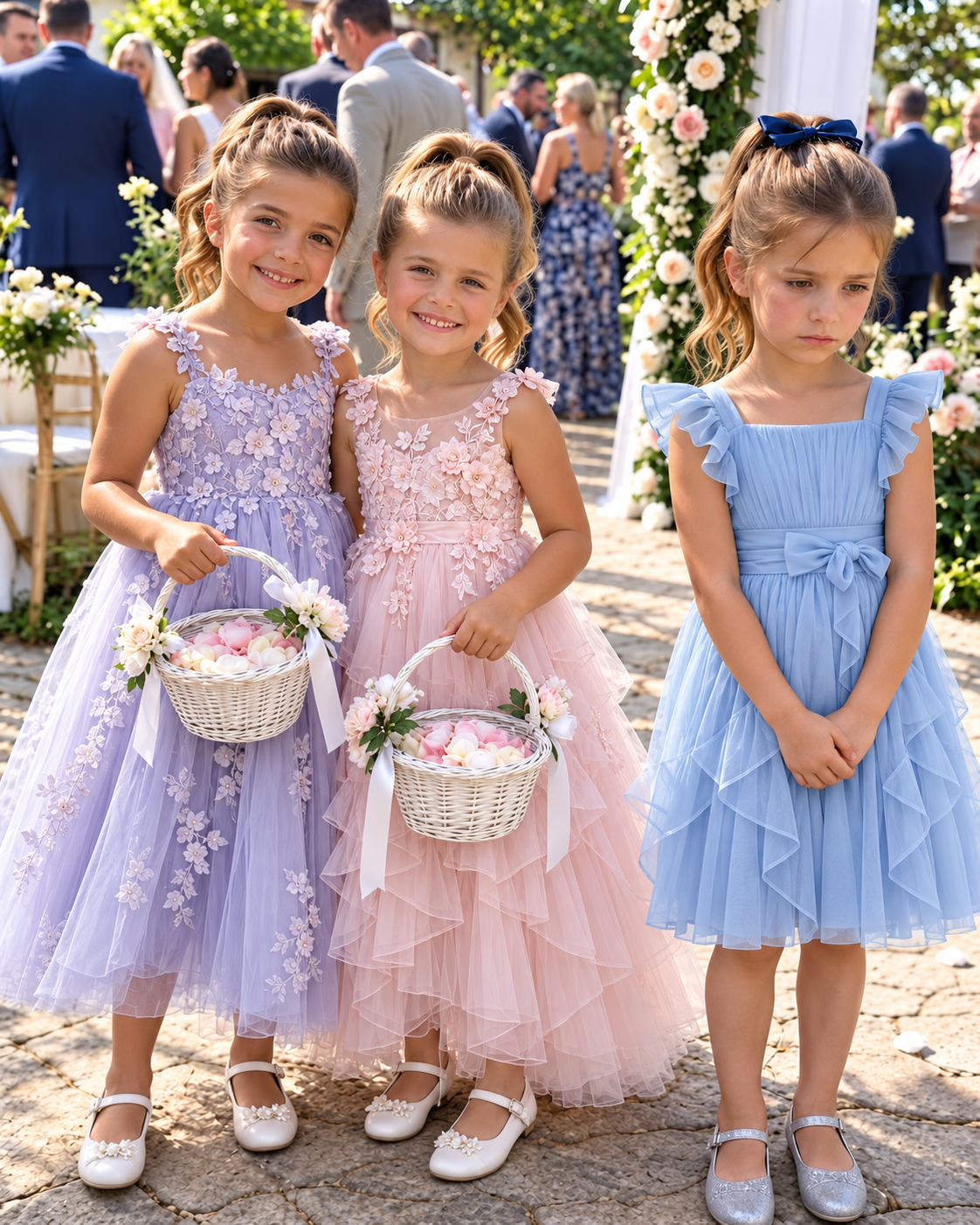
Then I noticed a little girl walking near the ceremony area. She wore a pale pink dress and carried a basket filled with rose petals. Her hair had been arranged neatly, and she appeared to be practicing a measured walk along the aisle. A second girl followed, dressed in the same shade of pink, with small white flowers woven into her blond curls. They were clearly preparing to participate in the ceremony.
I stopped walking. Marcus continued for another step before realizing I was no longer beside him. I looked from the two girls to the baskets in their hands. I remembered Jenna’s explanation with absolute clarity. She had said there would be no flower girls. I turned toward Marcus and asked whether the plans had changed again. He glanced toward the ceremony area, then immediately lowered his eyes to his phone.
He said he was not sure what Jenna had decided. I watched him for a moment, trying to understand his reaction. He had barely looked at the children, yet he did not appear surprised. There was no curiosity in his voice, no question about why we had been told something different. I asked whether he had known that flower girls would be participating after all. He said we should find our seats before the ceremony began.
As we moved toward the chairs, I noticed two boys dressed for the procession. One was Marcus’s nephew Max. Both wore formal clothes and appeared to be waiting for instructions about their role as ring bearers. Nearby, another young girl was helping distribute programs, and a five-year-old relative proudly displayed a badge identifying her as a junior bridesmaid. I looked around the ceremony grounds, expecting to discover some explanation for the inconsistency.
There was none. Children from both sides of the family had been included in different ways. Some carried flowers, others had small ceremonial responsibilities, and several were being photographed with the wedding party. Jenna had not eliminated children from the ceremony. She had not simplified the arrangements in the way she described. Sophie appeared to be the only child who had been invited to participate and then deliberately excluded.
My daughter noticed the flower girls as we approached our seats. She slowed down and watched them with quiet attention. I could see her recognizing the dresses, the baskets, and the walk she had practiced for months. She sat beside me and placed her hands neatly in her lap. For several seconds, she said nothing. Then she leaned closer and asked why Aunt Jenna had told her there would not be any flower girls.
I looked at Sophie’s face and realized that an explanation about changing wedding arrangements would no longer be enough. She had witnessed the contradiction herself. I could tell that she was trying to understand whether her aunt had forgotten the promise or deliberately chosen not to include her. She was eight years old, but she understood dishonesty. I put my arm around her and told her that I did not know why Jenna had said those things.
Across the lawn, Jenna was standing beneath the decorated arch, laughing with the two flower girls while a photographer adjusted his camera. She looked delighted, surrounded by relatives and carefully arranged flowers. I felt a surge of anger, but it was not the anger of someone disappointed about a wedding role. It came from watching my daughter sit quietly while the people she trusted behaved as though her exclusion required no explanation.
I stood up. Marcus immediately reached for my arm and asked where I was going. I told him I intended to speak with his sister. He urged me not to make a scene, reminding me that it was Jenna’s wedding day. I said I was not interested in humiliating anyone, but I wanted an explanation for the lie Sophie had been told. Marcus tightened his grip slightly before releasing it. His expression had changed from irritation to something closer to alarm.
That was when I asked him directly whether he had known Sophie would be the only child excluded from the wedding party. He looked away. I repeated the question, keeping my voice low so Sophie would not have to hear another argument. Marcus said that we should discuss the matter later. He did not deny knowing. I searched his face, waiting for him to tell me I had misunderstood, but he offered no reassurance.
I walked across the grass toward Jenna. She noticed me before I reached her. Her smile disappeared, and she excused herself from the photographer. She waited until the children had moved away, then stepped toward me with an expression that made it clear she knew why I had come. I asked whether she had deliberately removed Sophie from the ceremony while keeping the other children. Jenna looked toward the chairs where Marcus was standing.
She said she loved Sophie and had never wanted her to feel rejected. I told her that intention did not explain what she had done. She had promised Sophie a role, withdrawn it without a truthful explanation, and allowed her to arrive at the wedding believing no children would be participating. Jenna lowered her eyes. For a moment, I thought she might apologize and admit that she had handled an uncomfortable decision badly.
Instead, she glanced over my shoulder. I turned and saw Marcus approaching quickly. His face had lost its color, and he was looking at Jenna with an urgency I had never seen before. He called her name, but she raised one hand, asking him to stop. I faced her again and repeated the question I had been asking since the moment I saw the flower girls. Why had Sophie been singled out?
Jenna swallowed and looked directly at me. She said she had not wanted to make the decision. She had argued against it because she knew how much the flower-girl role meant to Sophie. But someone had insisted that Sophie be removed, and Jenna had eventually agreed because she believed she was preventing a more difficult situation. My chest tightened as I listened. I asked who could possibly have a reason to interfere in our daughter’s place at the wedding.
Jenna looked past me toward Marcus. Then she told me that my own husband had asked her to exclude Sophie. Marcus reached us at that moment and told his sister to stop talking. He did not deny what she had said. I turned toward him, suddenly remembering the private calls, his indifference when Sophie was hurt, and his refusal to let me question the wedding arrangements. I understood that Jenna’s lie had not begun with Jenna.
END PART 4
PART 5 TITLE: On a Wedding Lawn Filled with Flowers, My Husband Finally Admitted Why He Had Asked His Sister to Humiliate Our Child
Marcus stood between his sister and me, his face rigid with an expression I had never seen during our marriage. It was not simply embarrassment. He looked like a man who had spent months arranging something delicate and had just watched the entire arrangement collapse. Behind him, the wedding photographer was calling children into position beneath the rose-covered arch. The ordinary sounds of the celebration continued around us, almost obscenely cheerful. I could hear laughter, the clinking of glasses, and a little boy complaining that his formal shoes were uncomfortable.
I looked past Marcus at Jenna. She had gone pale, but she did not withdraw what she had said. Her hands were clasped tightly in front of her wedding dress, and the knuckles showed white beneath her skin. I asked her whether she was certain that Marcus had requested Sophie’s removal. Jenna nodded. She told me that he had called her several weeks before the ceremony and insisted that Sophie should not participate. He had described the request as a matter of family sensitivity, something he believed needed to be handled quietly.
Marcus interrupted her. He said the conversation had been more complicated than that and that Jenna was leaving out important details. I turned toward him and asked him to explain those details himself. He glanced at the guests gathering nearby and suggested that we continue the discussion somewhere private. I refused to move until he answered one question. Had he deliberately asked his sister to exclude our daughter after she had spent three months preparing for the wedding? He finally nodded. The admission was small, almost imperceptible, but it changed everything.
I thought about Sophie sitting beneath the white canopy in her yellow dress, watching the other children prepare for the procession. She was probably wondering what she had done wrong. I asked Marcus whether he understood that his own daughter believed Aunt Jenna had simply stopped wanting her. He opened his mouth, then closed it again. Jenna whispered that she had tried to warn him about that. Marcus looked at his sister sharply, and I realized that whatever disagreement they had been having was not new.
Jenna said Marcus had told her that I understood the situation. According to him, Sophie’s exclusion was something we had already discussed as parents, and he was merely asking Jenna to help us manage a sensitive family matter. Jenna had found the request unpleasant, but she had accepted his assurance that I knew the reasons behind it. When I had called to object, she had assumed Marcus would explain everything to me afterward. Her expression tightened as she spoke. She was beginning to understand that she had helped maintain a lie.
I asked why she had invented the story about removing every child from the ceremony. Jenna admitted that Marcus had suggested it would be easier than explaining why Sophie alone could not participate. I remembered asking whether my daughter might at least distribute programs. Jenna had rejected even that simple compromise. Now I understood why. The problem had never been the number of children in the wedding party or the length of the procession. Someone wanted Sophie to remain an ordinary guest, and my husband had persuaded his sister to accomplish it.
There were several questions I wanted to ask at once, but one mattered more than the others. I looked at Marcus and asked whom he had been trying to protect. He rubbed his forehead, glanced toward Jenna, and said that I needed to understand what had been happening during the previous several months. I told him I was listening. His voice dropped. He said he had been in contact with Brianna. For a moment, I heard the name without being able to attach it to the woman I knew. Then the meaning reached me.
Brianna. Sophie’s birth mother. The young woman who had placed our daughter in my arms at St. Vincent’s Hospital. The same woman who had fallen against Sophie at her fourth birthday party, leaving our little girl with three stitches near her hairline. We had heard nothing from her directly in four years. At least, that was what I had believed. I stared at Marcus and asked when the contact had begun. He looked toward the ground and said that he had spoken to her again about six months earlier.
I felt the first unmistakable sensation of betrayal, not because he had spoken to Brianna, but because he had deliberately hidden something that involved our child. I asked whether Brianna was safe and whether she had obtained help. Marcus said she had completed treatment and had been sober for approximately eighteen months. She was working again, living in stable accommodation, and attending recovery meetings. He spoke quickly, offering these details as though their reassuring nature might excuse the secrecy surrounding them.
I wanted to be glad for Brianna. I had worried about her for years, and the thought that she might finally have some stability should have brought relief. But I could not separate that news from what had happened to Sophie. Marcus had known that Brianna was recovering. He had known she wanted renewed contact. Instead of discussing the situation with me, he had decided privately how our daughter’s relationships should be managed. Worse, he had involved Jenna in the deception and allowed Sophie to bear its consequences.
I asked how Marcus had found Brianna. He explained that he had occasionally searched for information about her online. Several months earlier, he had discovered a message connected to a recovery community and recognized her name. He contacted her, initially to ask whether she was safe. They exchanged messages, then began speaking on the telephone. Over time, their conversations became more frequent. He said he had encouraged her to continue treatment and had helped her find information about employment opportunities. He described it as an attempt to keep a promise we had made years before.
That explanation would have moved me under different circumstances. I had never stopped wishing Brianna well. I had never told Marcus that she should be permanently excluded from our lives. Our letter had established conditions for safe contact, not an irreversible punishment. If he had come to me with evidence of her recovery, I would have listened. We might have spoken with the adoption agency, discussed appropriate boundaries, and considered how Sophie felt. Instead, Marcus had apparently decided that my concerns were an obstacle to be avoided.
He admitted that Brianna had asked about Sophie. She wanted to know whether our daughter still remembered her, whether she was healthy, and whether she had questions about the adoption. Marcus had answered. He had described Sophie’s school activities and interests, her growing affection for reading, and her habit of correcting adults when they made factual mistakes. He had told Brianna that Sophie still occasionally mentioned her. I thought about the private calls he had taken and the distracted evenings when he said work was demanding. Those conversations suddenly acquired an entirely different meaning.
I asked whether he had sent photographs. Marcus hesitated. The pause gave me my answer before he spoke. He admitted that he had shared several recent pictures, including one from Sophie’s school activities. My anger changed shape. Those images belonged to our daughter’s private life. Brianna’s connection to Sophie was meaningful, but that did not give Marcus the right to make unilateral decisions about what information to disclose. I asked whether he had ever considered that Sophie might want some control over how and when Brianna learned about her.
Marcus said he had been trying to make a future reunion less frightening for everyone. I asked him whether keeping secrets from Sophie’s mother was his idea of making things safe. He responded that every conversation we had ever had about Brianna seemed to end with my concerns about addiction. I reminded him that those concerns had not emerged from prejudice or resentment. They had emerged from watching our daughter fall onto a concrete patio while Brianna was visibly impaired. Marcus looked away, and neither Jenna nor I tried to rescue him from the memory.
Then I asked what any of this had to do with Jenna’s wedding. Marcus took a long breath before admitting that Brianna had been invited. He had arranged for her to attend as a guest, believing the celebration might provide an opportunity for Sophie to see her again. He said he had intended to speak to me before introducing them, but he had wanted Brianna nearby first. I could scarcely believe what I was hearing. He had brought the possibility of a reunion into a crowded family wedding without telling either the child involved or her mother.
Jenna confirmed that Marcus had approached her about the invitation. He had explained that Brianna was doing better and that he wanted her to feel welcome around the family again. Jenna had initially been uncomfortable with the plan, particularly because Sophie would be participating in the ceremony. She remembered the birthday incident and did not want anything to upset her niece. Marcus had reassured her that the situation was under control. Then he had asked Jenna to reconsider Sophie’s role.
I asked why Sophie could not remain a flower girl if Brianna was attending. Marcus said he had worried that Brianna might become overwhelmed by seeing Sophie at the center of the ceremony. He also feared that Sophie might notice Brianna among the guests and become distracted or distressed while walking down the aisle. Removing Sophie from the procession, he argued, would allow him to manage the first encounter privately. He had imagined speaking to us before the reception, explaining the situation, and arranging an introduction somewhere quiet.
I listened until he finished. Then I asked why a little girl had to surrender something she loved so that two adults could avoid an uncomfortable conversation. Marcus said that was not how he had thought about it. I told him that his intentions did not alter the result. Sophie had lost her place in the wedding party, been lied to by her favorite aunt, and spent weeks believing she was no longer wanted. Brianna had been invited into a situation she might not understand, while I had been denied any opportunity to prepare our daughter or assess whether the timing was appropriate.
Marcus insisted that Brianna had worked hard to recover. I told him I hoped that was true. I also told him that sobriety was not a debt Sophie could be required to repay. Brianna deserved acknowledgment for making progress, but Sophie deserved the security of knowing that the adults around her would protect her interests. Those two things were not mutually exclusive. Marcus had treated them as competing obligations and resolved the conflict by taking something from our daughter without asking her.
Jenna began crying. She said she had never wanted Sophie to feel unimportant and had trusted Marcus when he claimed that I knew what was happening. I told her that I believed she loved Sophie. I also told her that affection did not erase the choice she had made. She could have spoken to me directly. She could have refused to participate in a deception that hurt a child. Instead, she had delivered the false explanation herself and left me to comfort Sophie. Jenna lowered her head and did not argue.
The photographer called for Jenna again. Guests were beginning to gather in earnest, and the ceremony was approaching. I became aware that several relatives were watching us from a distance. I did not want Sophie’s pain turned into entertainment for an audience that knew nothing about the circumstances. I told Jenna that I would not disrupt her wedding, but I would not pretend everything was fine. She whispered that she understood. Marcus looked relieved for a fraction of a second, apparently mistaking my refusal to create a scene for a willingness to accept his explanation.
I turned toward him and asked one final question. Did Brianna know that Sophie had been removed from the wedding party because of her attendance? He shook his head. He said Brianna believed she had simply been invited to a family celebration where she might eventually have an opportunity to reconnect. That meant he had deceived her as well. She was entering an emotionally complicated situation without understanding what had been sacrificed to arrange it. I wondered whether she would have agreed to attend if she had known the truth.
I walked back toward Sophie. She was sitting beside Ryan, who had apparently noticed that something was wrong and had come over to keep her company. He was showing her something on his phone, and she was listening politely, but her eyes followed the little girls in pink as they gathered near the aisle. Ryan looked up when I approached. He saw my expression and stopped speaking. I asked him whether he could give us a moment, and he moved away without asking questions.
I knelt beside Sophie so we were at the same height. She asked whether I had spoken to Aunt Jenna. I said yes. She waited, her hands folded in her lap, trying to read my face. I told her that the adults had made a bad decision and had not been honest with her about it. I explained that there were reasons behind the decision, but none of those reasons involved anything she had done. Sophie asked whether Jenna was angry with her. I assured her that she was not.
Sophie looked toward the flower girls again. One of them was giggling as a bridesmaid adjusted her headband. My daughter watched silently before asking whether she could have done the job properly. I felt something tighten in my chest. She had spent weeks practicing because she wanted to make Jenna proud, and now she was wondering whether her efforts had been inadequate. I told her that she would have been a wonderful flower girl. The decision had nothing to do with her ability or her worth.
She asked whether we had to stay. The question was quiet, but it was the first time that afternoon she had expressed a clear preference. I told her no. We had come to celebrate Jenna and Chris, but she was not required to sit through an event that made her feel unwanted. Sophie looked surprised. She glanced toward the decorated aisle, then at her shoes. After a moment, she said she would rather go home. I told her that was enough for me.
Marcus reached us while I was helping Sophie stand. He asked whether we could talk before leaving. I told him that our daughter had decided she did not want to remain. He looked at Sophie, apparently expecting her to reassure him that everything was fine. She did not. Instead, she moved closer to me and took my hand. Marcus asked whether we might at least stay until the ceremony ended. I told him that he was welcome to remain if he wished, but Sophie and I were leaving.
For the first time since Jenna’s confession, Marcus seemed to grasp that his decisions had consequences he could not manage through another explanation. He asked whether I understood how much Brianna had hoped for this day. I looked at Sophie and answered that I understood exactly how much a child could hope for something. Marcus followed my gaze. His expression changed, and he said nothing more. I began walking toward the parking area with Sophie beside me.
We had almost reached the gravel drive when Sophie stopped abruptly. Her grip tightened around my fingers. I followed her gaze toward a woman standing beside a parked car near the entrance. She wore a simple blue dress and had her blond hair tied back. She looked older and healthier than the last time I had seen her, but I recognized her immediately. Brianna had arrived. Sophie stared at the woman for several seconds, searching her memory. Then she looked up at me and asked whether the woman near the car was Bri.
END PART 5
PART 6 TITLE: The Woman at the Gravel Drive Had Changed, but Our Daughter Was Still Waiting for Someone to Tell Her the Truth
Sophie’s question stopped me more effectively than anything Marcus had said. She was looking toward the parked cars, where Brianna stood with one hand resting on the strap of her handbag. Four years had passed since Sophie last saw her in person, yet something about her face or posture had awakened a memory. I knelt beside my daughter and followed her gaze. The woman in the blue dress had not moved. She appeared to be studying the entrance, uncertain whether she had arrived at the correct place.
“Yes,” I told Sophie. “That’s Brianna.” My daughter looked at me, then back toward the woman. She seemed surprised by how little Brianna resembled the person she remembered from her fourth birthday. The dark circles beneath her eyes were less pronounced, and she stood with a steadiness I had not seen during those difficult final visits. Sophie asked whether Brianna was coming to the wedding. I told her that she had been invited, but the adults had not handled the arrangement properly. I deliberately avoided offering an explanation that might shift responsibility onto Sophie.
Brianna noticed us. Her expression changed immediately, and she took an involuntary step forward before stopping herself. From across the gravel drive, I could see her looking first at Sophie and then at me. There was recognition in her face, followed by something that appeared to be uncertainty. She had probably imagined seeing Sophie again many times, just as I had once imagined becoming a mother. But whatever picture she had carried in her mind could not have included this moment, with our daughter standing beside me after discovering she had been deliberately excluded from a family celebration.
Marcus emerged from the direction of the barn. He had apparently followed us, though he stopped when he saw Brianna. For a brief moment, the four of us were connected by a silence that seemed more complicated than anything we could have said. Brianna looked toward Marcus, expecting some explanation. He raised one hand in greeting but did not approach her. I realized that he had imagined himself managing this reunion, yet now that everyone was present, he seemed uncertain what to do.
I asked Sophie whether she wanted to say hello. She considered the question without answering immediately. I could see that she was curious, but curiosity did not necessarily mean readiness. Finally, she said she would rather stay beside me. I told her that was perfectly fine. Then I raised my hand slightly toward Brianna, indicating that she should remain where she was. Brianna stopped moving and nodded. The relief I felt at that small gesture surprised me. At least one adult had recognized that Sophie needed time.
Marcus came closer and whispered that Brianna had been hoping to see Sophie. I told him that I understood, but Sophie had not been prepared for an encounter with someone who had been absent for half her life. I reminded him that a child’s relationship with a birth parent could not be repaired through a surprise appearance. He said Brianna had made substantial progress and deserved an opportunity. I answered that the opportunity might exist, but its timing could not be determined solely by the adults who wanted it.
Sophie looked between us. She asked whether Brianna knew who she was. I told her yes. Brianna remembered her and had asked about her during the past several months. Sophie frowned slightly, trying to understand why someone who had been asking about her had not simply come to visit. I could not answer without revealing the secrecy Marcus had maintained. I told her that we would talk about it at home, where she could ask questions without a crowd nearby. She nodded, but I could see that the explanation had not satisfied her.
Brianna lifted one hand in a tentative wave. Sophie hesitated, then raised her own hand for a moment. The exchange lasted perhaps two seconds. There was no dramatic embrace, no rush of tears, and no sudden resolution of the years between them. Brianna smiled faintly, but she did not move closer. I was grateful for her restraint. Sophie lowered her hand and turned toward the car. She had made her choice, and I intended to respect it even if the adults around her found it disappointing.
Before we left, I walked several steps toward Brianna while Sophie remained beside the car within my sight. I told Brianna quietly that we had not discussed a reunion with Sophie and that the wedding was not an appropriate place to begin. Brianna looked startled. She glanced toward Marcus, who was standing several yards away. Then she said she had believed I was aware that renewed contact was being considered. Marcus had apparently told her that we were working toward a family conversation. Her expression tightened when she realized that was not true.
I asked whether Marcus had explained why Sophie was not participating in the wedding party. Brianna looked genuinely confused. She said she had not known Sophie was supposed to be a flower girl. When I told her that Marcus had requested her removal, Brianna stared at him in disbelief. She said she had never asked for anything like that. She had hoped to see Sophie from a distance and, if circumstances allowed, speak with us privately. She had not wanted to interfere with the wedding or make the child uncomfortable.
I believed her. It was not that I had suddenly forgotten what happened at Sophie’s fourth birthday. Trust could not be restored through one conversation, and I had no independent knowledge of the full circumstances of Brianna’s recovery. But her surprise seemed real, and she had respected Sophie’s hesitation without trying to force contact. I told her that I was glad she was doing better and that I hoped we could eventually discuss the situation properly. For the moment, I needed to take my daughter home.
Brianna nodded. Her eyes were wet, but she did not ask me to change my mind. She said she understood that Sophie’s safety came first. I remembered the teenager sitting across from us at the diner, speaking about the childhood she wanted her daughter to have. For a moment, I saw that same young woman beneath the older face. She looked toward Sophie, who was waiting patiently beside the car, and asked whether I would tell her that Bri was happy to see her. I said I would pass along the message without expecting Sophie to respond.
Marcus approached as Brianna stepped back. He looked embarrassed, but he still seemed more concerned with the failed reunion than with the harm his secrecy had caused. I told him that Sophie and I were leaving. He asked whether I wanted him to come with us. I considered the question carefully. Part of me wanted him to follow us immediately and begin repairing what he had done. Another part knew that our daughter needed some distance from the adult conflict. I told him to remain for Jenna’s ceremony if he wished, but we would discuss everything at home.
He looked hurt by the suggestion, which might have affected me under different circumstances. I had spent years paying attention to Marcus’s feelings, particularly during the difficult years before Sophie’s adoption. But I was beginning to understand that his discomfort could not be my first concern every time he made a consequential choice. I helped Sophie into the back seat, checked her seat belt, and closed the door. Marcus stood beside the car for a moment, apparently searching for something useful to say. He finally promised that we would talk that evening.
The drive home felt longer than the journey to Bloomington. Sophie watched the fields passing beyond the window and occasionally touched the yellow ribbon in her hair. I did not try to fill the silence with conversation. When we stopped at a traffic light, I glanced at her in the rearview mirror. She was looking at the small scar near her hairline, examining it in the reflection of the glass. I wondered whether seeing Brianna had reminded her of the birthday accident or whether she was simply trying to understand why everyone had behaved so strangely.
After nearly half an hour, she asked whether Brianna was still sick. I told her that Brianna had struggled with a serious problem involving substances that affected her judgment and behavior, but she had apparently been working hard to recover. Sophie asked whether that was why Brianna had fallen at her birthday party. I said yes, explaining that Brianna had not been safe to hold or play with her that day. Sophie was quiet for a moment before asking whether people could get better from that kind of problem.
I explained that recovery was possible, but it required sustained effort and support. I did not want Sophie to imagine that Brianna was permanently dangerous, nor did I want to promise that everything would now be simple. I told her that adults could improve their lives while still needing time to rebuild trust. Sophie appeared to understand. She asked whether Brianna had been sad during the years they had not seen each other. I said I imagined she had experienced many difficult feelings, but Sophie was not responsible for making those feelings disappear.
Then she asked why Dad had not told us Brianna was getting better. The question was so straightforward that I almost answered too quickly. I could not protect Marcus by inventing another explanation. I told Sophie that he had been speaking with Brianna without telling me, and that he should have discussed it with us before making plans involving her. Sophie studied my face. She asked whether Aunt Jenna knew. I said she knew some of what Marcus was arranging. My daughter lowered her eyes and whispered that they had both lied.
I did not try to soften that conclusion. I told her that adults sometimes made mistakes because they were frightened of difficult conversations, but fear did not make dishonesty acceptable. Sophie asked whether I had known about the wedding arrangement. I said no. She looked relieved, and that relief hurt me more than I expected. She had been trying to determine whether the people closest to her had all agreed to exclude her. I reached back at the next stop and touched her knee, wanting her to know that she was not alone.
When we reached home, Waffles greeted us with his usual enthusiasm. Sophie knelt beside him and buried her face in his fur. I carried our things inside and placed the car keys on the kitchen counter. The familiar house felt different after the wedding. I had spent years believing that our family’s most important decisions were made through conversations between Marcus and me. Now I was questioning how often Marcus had presented us as united while acting independently. The uncertainty was exhausting because it reached backward into memories I had considered secure.
Sophie changed out of her yellow sundress and put on comfortable clothes. She asked whether we could eat dinner in the living room while watching a movie. I agreed. We ordered food, spread a blanket across the sofa, and allowed Waffles to settle nearby. Sophie laughed at several moments in the film, but her attention wandered. Twice she began asking a question and then stopped. I did not press her. I wanted the evening to include something ordinary, even if neither of us could forget what had happened.
At one point, Sophie asked whether being adopted was the reason Aunt Jenna had removed her from the wedding. I turned off the television. I moved closer and told her clearly that being adopted did not make her any less a member of our family. Jenna’s decision had been connected to a secret involving Brianna, but it had not been a judgment about Sophie’s place among her relatives. I reminded her that she had been wanted, loved, and welcomed from the beginning. She listened carefully, but I could see that the question had left a mark.
I told her about the photograph of Marcus and Waffles that Brianna had admired before Sophie was born. I explained that Brianna had chosen us partly because she believed Marcus would be a caring father. Sophie looked at the sleeping dog and smiled faintly. Then she asked whether Brianna had been right. I paused. Marcus had been a devoted father in countless ways, and I did not want one serious betrayal to erase those years. I told Sophie that her father loved her deeply, but he had made a decision that hurt her and needed to take responsibility for it.
Marcus returned after dark. I heard his car pull into the driveway, followed by the quiet sound of the front door opening. Sophie had already gone upstairs, though I was not certain she was asleep. Marcus entered the kitchen carrying his jacket over one arm. He looked exhausted. He asked how Sophie was doing, and I told him she was confused and hurt. He nodded, then stood silently while I finished putting away the dishes. Neither of us seemed eager to begin the conversation that had been waiting all afternoon.
I asked him to sit at the kitchen table. The location brought back an uncomfortable memory of the night Sophie needed stitches. Four years earlier, we had sat in those same chairs and agreed that our daughter’s safety mattered more than our desire to rescue Brianna from every consequence of her struggles. I reminded Marcus of that agreement. He said he remembered it. I asked why he had decided it no longer applied. He replied that circumstances had changed because Brianna was recovering. I agreed that circumstances might have changed, but the need for shared decisions had not.
Marcus admitted that he had avoided telling me because he expected resistance. He said he remembered how frightened I had been after the birthday accident and believed I would refuse to consider renewed contact. I told him he had never given me the opportunity to respond. He had treated an imagined refusal as permission to deceive me. Marcus looked down at his hands. For the first time, he did not argue. He acknowledged that he had been frightened of disappointing Brianna and had convinced himself that he could manage the situation until everything was ready.
I asked to see the messages. Marcus hesitated, then placed his phone on the table and opened the conversation. I read several exchanges while he sat opposite me. Brianna had written about her recovery, work, and hopes for the future. She had asked thoughtful questions about Sophie and repeatedly expressed concern about making contact too quickly. Those messages did not resemble the behavior of someone demanding immediate access. In several places, she had suggested speaking with the adoption agency or arranging a meeting with both of us before approaching Sophie.
One message stopped me. Brianna had asked Marcus whether I was comfortable with the possibility of renewed contact. He had answered that I understood what they were discussing and wanted what was best for everyone. I read the sentence twice. It was not merely an omission. He had allowed Brianna to believe I was participating in conversations I knew nothing about. I looked at Marcus, waiting for him to explain. He admitted that he had written it because he thought my position would eventually soften. I told him that he had substituted his wishes for my consent.
There were photographs in the conversation as well. Some showed Sophie participating in school activities; others were ordinary family pictures taken in our home. I recognized several that I had sent Marcus privately. Brianna had responded warmly, sometimes asking about details in the background or commenting on how much Sophie had grown. Reading her messages, I felt no particular anger toward her. My anger belonged to the man sitting across from me, who had decided that his access to our daughter’s life entitled him to distribute pieces of it without discussion.
I told Marcus that we needed professional guidance before anyone arranged further contact. We would speak with the adoption agency, seek advice from someone experienced with adopted children, and give Sophie the opportunity to express what she wanted. He agreed, but I could see that he was hoping agreement might bring the argument to an end. I told him it would not. The issue extended beyond Brianna’s return. He had lied repeatedly, involved his sister, and allowed our daughter to feel rejected rather than acknowledge what he was doing.
That night, I asked Marcus to give me some space. He agreed to sleep in the guest room while we considered what should happen next. Before going upstairs, he asked whether I believed our marriage could survive the situation. I looked at him for a long moment. I did not know the answer. I loved the man who had held my hand through infertility treatments and stayed awake with our newborn daughter, but I no longer knew how much of our recent life he had concealed. I told him that rebuilding trust would require more than an apology.
After Marcus left the kitchen, I sat alone with the photographs of Sophie still open on my phone. I was wondering how to explain the next steps to our daughter when a message arrived from an unfamiliar number. It was Brianna. She apologized for contacting me directly but said she had asked Marcus for a way to reach me because she needed to clarify something. She had believed I knew about the wedding invitation. She had never requested Sophie’s exclusion. And she wanted me to understand that, long before the wedding, she had asked Marcus to arrange a proper conversation with both parents.
END PART 6
PART 7 TITLE: After the Wedding, a Letter from Brianna Forced Us to Confront the Difference Between Protecting a Child and Controlling Her Life
I read Brianna’s message several times before answering. The kitchen was quiet except for the refrigerator motor and the faint sound of Waffles shifting in his bed. I had expected an apology, perhaps a request to see Sophie, but Brianna’s words revealed something more troubling. She had been trying to arrange a careful conversation for months. Marcus had repeatedly assured her that the time was not right, while privately making plans that neither of us had approved. He had controlled both sides of the conversation, giving each woman a version of the situation that supported his own intentions.
I replied that I appreciated her honesty and wanted to understand exactly what had happened. Brianna explained that she had first suggested a meeting with both parents after several weeks of speaking with Marcus. She knew that the birthday accident had damaged our trust, and she did not expect to return to Sophie’s life simply because her circumstances had improved. She wanted us to know about her recovery and to discuss whether any future contact would be appropriate. Marcus had told her that I was overwhelmed by family responsibilities and needed more time.
Her message continued with an account of the wedding invitation. Marcus had told her that Jenna’s celebration might offer a chance to reconnect with the family in a familiar environment. Brianna had been hesitant. She worried that an unexpected encounter with Sophie could be frightening or confusing, especially after such a long absence. Marcus assured her that the situation would be managed carefully and that I understood the possibility. Brianna now realized that those assurances had been false. She wrote that she was sorry for participating in something that had hurt Sophie, even though she had not understood the circumstances.
I did not answer immediately. I wanted to distinguish between what Brianna knew, what she had reasonably believed, and what Marcus had chosen to conceal. That distinction mattered because I refused to create another family narrative in which one person was blamed for everyone else’s decisions. Brianna had been responsible for the accident years earlier. Marcus was responsible for the secrecy surrounding her return. Jenna was responsible for agreeing to exclude Sophie and for lying about the wedding arrangements. None of those responsibilities disappeared because the others also existed.
The next morning, I called the adoption agency we had worked with when Sophie was born. I explained that we were considering renewed contact with her birth mother after a long interruption and that the situation had become complicated by decisions made without agreement between the adoptive parents. The caseworker listened and helped me identify appropriate resources. She suggested that we speak with a professional experienced in adoption and family relationships, particularly because Sophie was old enough to have meaningful opinions about contact.
I asked whether the agency could help us communicate with Brianna in a structured way. The caseworker explained that we could discuss possible arrangements and referrals, but everyone involved would need to participate honestly. I appreciated that. Our problem was not a shortage of affection or even necessarily a disagreement about Brianna’s recovery. It was that Marcus had made decisions while withholding information from the people affected by them. Any attempt to move forward would fail if we continued operating through private assurances and incomplete explanations.
After the call, I sat at the kitchen table and wrote down the questions I needed answered. What did Sophie remember about Brianna? What did she want now? How could we determine whether Brianna was stable enough for renewed contact? What arrangements would allow Sophie to feel safe without making her responsible for another adult’s recovery? I also wrote a separate question about Marcus: how could I make family decisions with someone who had concealed information because he disliked the possibility of disagreement?
Marcus came downstairs while I was writing. He looked at the notebook, then at my face. I told him I had spoken with the agency. He asked whether I had told them everything about the wedding. I said yes, including his secret communication with Brianna. He looked uncomfortable but did not object. I explained that I would no longer participate in arrangements that depended on secrecy. If he wanted to help rebuild the relationship between Sophie and Brianna, he would have to accept a process that included me and respected our daughter.
He sat opposite me and admitted that he had become emotionally invested in Brianna’s progress. During their conversations, she had described the difficulties of rebuilding a life after addiction, including the shame she felt about what happened at Sophie’s birthday. Marcus had remembered the frightened nineteen-year-old who trusted us with her baby. He wanted to reassure her that the decision had not permanently destroyed her connection to Sophie. I understood that impulse. What I could not understand was why he had allowed it to outweigh the needs of the child living under our roof.
I asked whether he had considered what Sophie would experience if Brianna attended the wedding unexpectedly. He said he had imagined a quiet conversation followed by a brief reunion, perhaps in a secluded area near the reception. I pointed out that Sophie had not been prepared for any of it. She had not been asked whether she wanted to see Brianna, and she had already endured the unexplained loss of her flower-girl role. Marcus admitted that he had focused so heavily on making the reunion possible that he had stopped considering how it might feel to her.
Later that morning, Jenna called. I nearly ignored the ringing phone, but I wanted to hear what she had to say without Marcus interpreting it for me. Jenna sounded exhausted. She told me that the wedding had gone ahead, though several relatives had noticed our absence and asked questions. Chris had apparently learned the fuller explanation afterward and was upset that Sophie had been hurt. Jenna said she had spent much of the evening thinking about the conversation on the lawn. She wanted to apologize, not only to me but directly to Sophie.
I told Jenna that an apology might matter eventually, but Sophie should not be required to accept it immediately. Jenna began explaining how strongly Marcus had insisted that the arrangement was necessary. I stopped her. She had been under pressure, but she had still made a choice. She had known Sophie well enough to understand how deeply the invitation mattered. She could have called me privately, asked questions, or refused to lie. Jenna was silent for several seconds before acknowledging that I was right.
She asked whether Sophie would speak to her. I said I would ask our daughter, but I would not persuade her to participate for Jenna’s sake. Jenna sounded close to tears. She said she missed Sophie and hated thinking that their relationship might be permanently damaged. I reminded her that Sophie was the person whose feelings deserved attention now. Jenna could show that she was trustworthy by accepting whatever boundaries Sophie needed. The conversation ended without reconciliation, but it was more honest than anything Jenna had said during the previous month.
That afternoon, Sophie came home from school carrying a folder full of drawings. She seemed tired but pleased with a project she had completed. I listened while she explained it, then helped her prepare a snack. I did not immediately raise the subject of Brianna. I wanted her to have ordinary afternoons that were not organized around adult problems. After she finished eating, however, she asked whether Aunt Jenna had called. I said yes. Sophie looked down at the table and asked whether Jenna was angry because we had left the wedding.
I told her that Jenna was upset with herself and wanted to apologize. Sophie considered that. Then she asked whether everyone at the wedding had been disappointed in her. The question made me realize how easily children interpret conflict as evidence that they have caused trouble. I explained that our decision to leave was not something she needed to defend. She had been hurt, and she had chosen not to remain in a place where she felt uncomfortable. I was proud that she had told me what she wanted.
Sophie asked whether she could see photographs from the wedding. I hesitated, uncertain whether the images would deepen her disappointment. But she had asked, and I did not want to control every difficult feeling she might experience. We looked at a few pictures Jenna had shared with relatives. Sophie studied the flower girls, the ring bearers, and the bridesmaids standing beneath the arch. She said the pink dresses were pretty. Then she asked whether Aunt Jenna had ever bought the dress Sophie was supposed to wear.
I told her I did not know. Sophie nodded and moved to the next picture. She was quiet for a long time before saying that she wished Jenna had told her the truth. She said she would still have been disappointed, but at least she would not have spent the wedding wondering why every other child had a job. I told her that made sense. Her observation captured something the adults had repeatedly failed to understand. The lie had not spared her feelings; it had left her without a way to understand them.
A few days later, we arranged an appointment with a family counselor who had experience supporting adopted children and their parents. Marcus and I attended the first conversation without Sophie. We described the open adoption, the early visits, Brianna’s apparent substance use, the birthday accident, and the years without contact. I explained the recent events carefully, including the wedding exclusion. Marcus listened while I spoke. When the counselor asked him why he had acted without telling me, he repeated his fear that I would prevent Brianna from reconnecting.
The counselor did not offer a quick judgment about whether contact should resume. Instead, she asked what Sophie understood, how she expressed uncertainty, and whether she had been allowed to make choices about her relationships. Marcus admitted that he had planned a reunion without consulting her. The counselor asked what outcome he had hoped to achieve. He said he wanted Brianna to feel that her recovery had made a difference and that Sophie had not forgotten her. The counselor asked whether an eight-year-old child should be responsible for providing that reassurance.
Marcus became quiet. After a moment, he said no. He looked genuinely shaken by the question. I knew he loved Sophie, and I knew that his compassion for Brianna had come from a place that was not entirely selfish. But he had taken responsibility for managing the emotional needs of everyone around him and had done so by restricting what the others knew. The counselor encouraged us to separate Brianna’s recovery from Sophie’s readiness. Both mattered, but neither could be measured through the other.
We discussed a gradual approach. Sophie would not be required to meet Brianna merely because the adults believed the time was right. If she wanted contact, it could begin with letters or a brief supervised conversation in a neutral setting. Brianna would need to accept clear boundaries, and Marcus and I would have to demonstrate consistent cooperation before expecting Sophie to trust our decisions. The counselor also suggested that Marcus and I address our marital conflict separately, so Sophie would not become the person managing tension between us.
When we returned home, I found Sophie sitting at the kitchen table drawing a picture of Waffles. She asked where we had been. I explained that we had spoken to someone who helped families work through difficult situations. Sophie wanted to know whether the person could make Dad stop lying. Marcus was standing beside me when she asked. He looked as though the question had physically struck him. I did not answer for him. I told Sophie that her father would have to make that choice himself.
Marcus sat down beside her. He apologized for asking Aunt Jenna to remove her from the wedding party. He told her that he had been trying to arrange something involving Brianna and had made a bad decision. Sophie listened without looking at him. When he finished, she asked why he had not simply told her about Brianna. Marcus said he had been afraid she would be upset. Sophie looked up and told him that she had been upset anyway. He nodded, acknowledging that she was right.
Then Sophie asked whether Brianna had been told about the flower-girl decision. Marcus said no. Sophie frowned. She wanted to know why he had lied to so many people when the problem seemed simple enough to discuss. Marcus did not have an answer that would satisfy a child. He admitted that he had tried to control the situation because he was frightened that an honest conversation might not go the way he wanted. Sophie seemed to consider this carefully. She said she did not like being part of plans she did not know about.
Over the following days, I exchanged several careful messages with Brianna. She told me more about her recovery and the support she had established. She was willing to communicate through the agency or counselor and understood that renewed contact would need to proceed at Sophie’s pace. I asked her to write a letter that Sophie could read if she wished. I explained that the letter should not pressure Sophie to respond or make promises about the future. Brianna agreed and asked whether she could apologize for the birthday accident. I said that would be appropriate if she did so without expecting forgiveness.
The letter arrived several days later. It was written by hand on plain stationery, with careful, slightly uneven lettering. Brianna began by telling Sophie that she remembered the day she was born and the little sounds she made while sleeping. She explained that she had struggled with a serious problem when Sophie was younger and had not been safe during the birthday party. She took responsibility for the accident and said that Sophie had done nothing wrong. She described working to become healthier and said she would understand if Sophie did not want to see her.
I read the letter before giving it to Sophie, checking that it was appropriate for her age and did not contain promises Brianna could not guarantee. Marcus read it as well. He became visibly emotional, but I asked him not to make the letter about his relief. Its purpose was to give Sophie honest information. That evening, after dinner, I told our daughter that Brianna had written to her. Sophie asked whether she had to read it. I said no. She could read it immediately, wait, or ask me to keep it somewhere safe.
Sophie chose to read it with me. We sat together on her bed while she followed the lines with one finger. Occasionally she asked what a phrase meant, and I explained without adding my own interpretation. When she reached the apology for the birthday accident, she touched the small scar near her hairline. She asked whether Brianna remembered that she had cried. I said the letter suggested she remembered hurting her and felt sorry. Sophie looked at the page again and read the final paragraph silently.
When she finished, she folded the letter carefully and placed it on her bedside table. She asked whether Brianna would disappear again if they met. I told her that nobody could promise what another adult’s future would look like, but we would make arrangements slowly and pay attention to whether Brianna kept her commitments. Sophie considered this, then asked whether she could talk to the counselor before deciding. I told her that was exactly the kind of choice she was allowed to make.
During her next appointment, Sophie spoke with the counselor about the wedding, Brianna, and the confusion of having adults make decisions she did not understand. She returned looking thoughtful rather than distressed. At home, she asked Marcus and me to sit with her at the kitchen table. She had written three questions on a piece of notebook paper. She wanted to know whether Brianna was safe now, whether she could leave a visit whenever she wanted, and whether her father would promise not to arrange another surprise.
Marcus answered the final question first. He promised that he would not make plans involving Sophie and Brianna without discussing them openly. I explained that any visit would happen in a place where Sophie felt comfortable, with me present and professional support available. She would not have to hug anyone, answer every question, or stay longer than she wanted. Sophie listened closely. Then she said she thought she would like to meet Brianna, but only if the first visit was arranged openly and nobody expected her to pretend everything was normal.
I told her we could work toward that. Marcus looked relieved, but Sophie had one more condition. She wanted me to arrange the meeting, not him. She said she still loved her father, but she was not ready to trust him with something so important. Marcus lowered his eyes and accepted her decision. Watching them, I understood that our family had reached a turning point. Sophie was no longer simply the child adults spoke about while making plans. She was beginning to decide how those plans affected her life.
END PART 7
PART 8 TITLE: In a Quiet Room Far from the Wedding, Sophie Asked the Questions Every Adult Had Been Too Afraid to Answer
The room where Sophie met Brianna again contained nothing that resembled the setting of a dramatic family reunion. There was a small sofa, several upholstered chairs, a low table, and a shelf filled with books and drawing materials. Soft daylight entered through a window overlooking a parking lot. The counselor had suggested a neutral location because it would allow Sophie to leave without feeling that she was rejecting someone inside her own home. I appreciated the practical simplicity of the arrangement. After the wedding, I wanted no more elaborate surprises.
We arrived fifteen minutes early. Sophie wore jeans, sneakers, and a blue shirt she had selected herself. She had rejected the idea of dressing up, explaining that she wanted to look like herself rather than someone attending a special ceremony. I understood. She was not preparing to perform a role for the adults around her. She was meeting a woman who had once been important in her life and whose absence had become part of her childhood. The distinction mattered more than anything she could have worn.
Before going inside, Sophie asked whether Brianna would be disappointed if she did not hug her. I told her that physical affection was entirely her decision. She could say hello, sit beside me, ask questions, or simply listen. The counselor had explained that children often felt pressure to provide reassurance during emotionally significant reunions, particularly when adults arrived visibly nervous. I wanted Sophie to know that she was not responsible for creating a beautiful moment. She only needed to be herself.
Brianna was already waiting when we entered. She stood beside one of the chairs, wearing a cream-colored blouse and dark trousers. Her blond hair was pulled back, and she held a folded tissue between her fingers. She looked healthier than she had at Sophie’s fourth birthday, although nervousness made her movements slightly awkward. When she saw us, she smiled, then seemed to reconsider whether smiling too broadly might be overwhelming. She greeted me quietly before turning toward Sophie. She did not reach for her.
Sophie stayed close to my side. I watched her examine Brianna’s face with an intensity that reminded me of our first meeting at the diner eight years earlier. She seemed to be comparing the woman before her with the photographs and memories she had carried since early childhood. Brianna waited without moving. Finally, Sophie said hello. The word was small, but Brianna appeared deeply affected by it. She answered gently and thanked Sophie for agreeing to meet.
The counselor invited us to sit. Sophie chose the end of the sofa nearest me, leaving enough space to move comfortably. Brianna took a chair across from us. There was no immediate conversation. Sophie looked at the carpet, then at the books on the shelf. Brianna folded and unfolded her hands, occasionally glancing toward the counselor. I resisted the urge to speak simply because the silence felt uncomfortable. Sophie had been given control over the pace of the meeting, and I intended to let her use it.
Her first question concerned the birthday accident. She asked Brianna whether she remembered falling. Brianna nodded. She said she remembered arriving with a stuffed unicorn, seeing Sophie run toward her, and losing her balance. She remembered the blood near Sophie’s hairline and the frightened expressions of the people who came to help. Her voice grew quieter as she spoke, but she did not look away from Sophie. She said she had been under the influence of substances that affected her ability to move and think safely.
Sophie touched the scar near her hairline. She asked whether Brianna had known she might fall. Brianna considered the question carefully. She said she had not expected to hurt Sophie, but she should have understood that she was not well enough to attend the party safely. She should have stayed away and sought help instead of approaching a young child while impaired. The distinction was important. She had not deliberately injured Sophie, but she had still been responsible for making a dangerous choice.
Sophie asked whether she had cried afterward. Brianna’s eyes filled with tears. She said yes, she had been frightened and ashamed, and she had cried after leaving the house. Then she added that her own feelings were not the most important part of what happened. Sophie had been hurt, and Brianna was sorry. She did not ask for forgiveness. She did not reach toward Sophie or attempt to turn the apology into an embrace. I could see the counselor watching that restraint with quiet attention.
For several moments, Sophie said nothing. Then she asked whether Brianna still had the stuffed unicorn. Brianna looked surprised. She explained that she had brought it as a birthday present, but it had fallen onto the grass during the accident. She did not know what happened to it afterward. Sophie told her that the toy had remained at our house for a while. She had eventually put it in a box with other old belongings because seeing it made her think about the hospital. Brianna listened without trying to offer a cheerful explanation.
The counselor asked whether Sophie wanted to talk about anything else connected to that day. She shook her head. I recognized the expression she wore when she had reached the end of something difficult. I expected her to ask for a break, but instead she turned toward Brianna and asked why she had not come back after the accident. The question was direct and entirely reasonable. Brianna looked down for a moment before answering.
She explained that her life had become unstable and that she had struggled for a long time before receiving effective help. She had known that Marcus and I wanted her to be sober before seeing Sophie again. For a while, she had not been able to meet that condition. Later, even as she began making progress, she had been frightened that too much time had passed. She admitted that shame had made it harder to reach out. But she told Sophie that none of those difficulties had been caused by her.
Sophie looked toward me and asked whether I had stopped Brianna from visiting forever. I told her no. I explained that we had suspended visits because she had been hurt and needed to be safe. We had hoped Brianna would recover enough for contact to become possible again. I reminded Sophie that the letter we sent years earlier had established conditions rather than declaring a permanent separation. She nodded slowly, connecting the explanation with the conversations we had recently had at home.
Then Sophie asked Brianna whether Dad had told her everything about the wedding. The counselor glanced at me, but I did not interrupt. Brianna said Marcus had told her that we were considering renewed contact and that the wedding might provide a chance to speak with the family. He had not told her Sophie was supposed to be a flower girl. He had not explained that Jenna removed her from the ceremony because of the invitation. Brianna said she discovered those facts only when we spoke beside the gravel drive.
Sophie examined Brianna’s face. She asked whether Brianna would have attended if she had known. Brianna answered that she would have preferred to arrange a separate meeting first. She would not have wanted Sophie to lose something she had been looking forward to. The answer appeared to matter to Sophie. She asked whether Brianna had wanted her to sit with the guests instead of walking down the aisle. Brianna shook her head. She said she had never wanted Sophie to feel excluded from her own family.
I felt a complicated relief hearing those words. I had spent several days separating Brianna’s actions from Marcus’s decisions, but I knew Sophie needed to hear the distinction directly. Her birth mother had not demanded a sacrifice. Marcus had imagined one was necessary and persuaded Jenna to enforce it. That did not remove Brianna’s responsibility for the past, but it clarified the events surrounding the wedding. Sophie had been trying to understand whether her presence had somehow become an inconvenience to the adults who claimed to love her.
Brianna then asked whether she could tell Sophie something about the day she was born. Sophie looked at the counselor, who reminded her that she could decline. After a moment, Sophie nodded. Brianna described the long night at St. Vincent’s Hospital, the nervous faces of the medical staff, and the moment Sophie finally cried. She remembered how Marcus had stood beside me, looking both delighted and terrified. She said I had asked her to choose a middle name and that she had chosen Grace because the word held a particular meaning for her.
Sophie smiled slightly. She knew the story, but hearing it from Brianna made the familiar details feel different. She asked whether the name had really been Brianna’s idea. Brianna said yes. Sophie repeated her full name softly, as though testing how it connected the people in the room. I watched her expression change from guarded uncertainty to thoughtful curiosity. For the first time during the meeting, she seemed less concerned with what the adults expected and more interested in her own history.
The counselor gently reminded us that we were approaching the agreed length of the visit. Sophie glanced at the clock, then at Brianna. She asked whether Brianna planned to keep working on her recovery. Brianna said she did. She explained that recovery was something she had to maintain through her own choices and support system, not something Sophie needed to manage. She could promise to keep making responsible decisions, but she would not pretend that trust could be restored instantly. Sophie listened and appeared satisfied with the answer.
When the meeting ended, Brianna stood but made no attempt to hug Sophie. She thanked her for coming and said she would understand if Sophie wanted more time before another visit. Sophie looked at me, then back at Brianna. She said she did not know yet whether she wanted to meet again. Brianna nodded and told her that was all right. I saw how much effort it took for her to maintain a steady expression, but she allowed Sophie to leave without asking for reassurance.
Outside, the afternoon sunlight was bright enough to make Sophie squint. We walked toward the car in silence. When we reached it, she stopped and looked back at the building. I asked how she was feeling. She said she was glad Brianna had answered her questions, but she was tired. I told her that both feelings could exist together. She climbed into the car and asked whether we could stop for ice cream. I agreed, grateful that she wanted something ordinary after such a difficult conversation.
At the ice cream shop, Sophie chose vanilla with chocolate sprinkles. She ate slowly while watching people pass the window. After a while, she said Brianna seemed different from the woman she remembered. I asked what she meant. Sophie explained that Brianna had looked at her carefully and answered questions without becoming angry. She had been nervous, but she had not tried to make Sophie feel bad for asking about the accident. I thought about how important that observation was. Sophie was beginning to recognize that respect could be demonstrated through behavior rather than promises.
Later that evening, I spoke with Marcus about the meeting. He listened closely while I described the questions Sophie had asked and the way Brianna responded. He seemed relieved, but I reminded him that one positive meeting did not establish complete trust. Sophie needed consistency over time. Brianna had made encouraging progress, and we could acknowledge that without rushing into frequent visits or allowing adult enthusiasm to determine the schedule. Marcus agreed, although I could see how difficult it was for him to remain outside the process he had once tried to control.
We also discussed the photographs he had shared. I told him that Sophie deserved age-appropriate information about what had been sent and that future communication should involve clear agreement. Marcus admitted that he had not thought carefully enough about the privacy implications. He had seen the photographs as harmless updates, but the larger problem was that he had distributed them while concealing the relationship itself. He agreed not to send additional images or information without discussing it with me and considering Sophie’s wishes.
The following week, Jenna asked whether she could apologize to Sophie in person. I passed along the request without trying to influence the answer. Sophie thought about it for an entire afternoon before agreeing to a short visit at our house. Jenna arrived without gifts. She sat beside the living-room window while Sophie remained on the sofa with Waffles. For several moments, neither spoke. Then Jenna said she was sorry for breaking her promise and lying about the wedding arrangements.
Sophie asked why Jenna had believed Dad instead of talking to Mom. Jenna admitted that she should have asked questions. She had wanted to avoid an argument with Marcus and had persuaded herself that the adults had already settled the matter. Sophie looked at her carefully. She said she had been excited to walk down the aisle and had practiced every day. Jenna’s eyes filled with tears. She said she remembered and that she had made a choice she regretted. She did not blame Marcus again or ask Sophie to forgive her.
The conversation did not end with an embrace. Sophie said she still felt sad when she thought about the wedding, and she was not ready for another sleepover. Jenna accepted that. Before leaving, she told Sophie that she would respect whatever time she needed. I walked Jenna to the door and thanked her for apologizing without trying to turn the moment into a celebration of reconciliation. Jenna looked at me and said she finally understood that saying sorry was only the beginning of making things right.
Marcus had begun attending counseling with me, though our conversations remained difficult. He admitted that he had wanted to see Brianna recover and had become attached to the idea that he could help repair the damage caused by years of separation. He had imagined himself bringing everyone together and believed that once the reunion happened, the secrecy would seem less important. The counselor asked him whether he had considered what would happen if Sophie simply did not want to participate. Marcus acknowledged that he had never seriously allowed for that possibility.
That admission helped me understand the deeper problem. Marcus had not stopped loving Sophie. He had confused love with the belief that he could choose the best outcome for everyone and arrange circumstances until they arrived there. He had forgotten that our daughter was a person whose feelings could not be planned in advance. I told him that I could not rebuild trust while he continued measuring decisions by whether his intentions were generous. He had to consider what he had actually done and accept the consequences.
At home, Sophie was adjusting to the idea that Brianna might become part of her life again. She sometimes asked questions and sometimes avoided the subject entirely. We made no promises about the frequency of future visits. Instead, we discussed how she could communicate her preferences, including the right to change her mind. I wanted her to understand that she could care about Brianna without being responsible for her happiness, and she could love Marcus while remaining disappointed in his choices.
One evening, Sophie came downstairs carrying the small flower basket I had rescued from the trash months earlier. She had found it in the cupboard while looking for art supplies. The handle was slightly bent, and several paper petals remained inside. She placed it on the kitchen table and examined it for a while. I asked whether she wanted to throw it away. She shook her head. She said she had practiced with it because she believed Aunt Jenna would be happy to have her in the wedding.
I sat beside her and waited. Sophie turned the basket slowly between her hands. Then she said she no longer wanted to keep it hidden in the cupboard. She wanted to use it for something else, though she had not decided what. I told her that was fine. The basket belonged to her, and she could decide what meaning it would have now. She looked at me thoughtfully before asking whether grown-ups were always supposed to make every important decision for children.
I explained that parents were responsible for safety and for choices children were not yet ready to make alone. But as children grew, they needed more opportunities to express their opinions and participate in decisions affecting them. Sophie nodded. She said she wanted to decide how she spoke with Brianna from now on. She also wanted Dad to understand that telling the truth mattered more than arranging a happy surprise. I told her those were reasonable things to ask.
The next morning, Sophie wrote two short notes. One was addressed to Brianna. She thanked her for answering the questions about her birthday and said she might like to meet again, provided they arranged the visit ahead of time. The second note was for Marcus. She placed it beside his coffee cup before leaving for school. When he opened it, he read the words silently and sat down. Sophie had written that she loved him, but she needed him to stop making secret plans about her life.
Marcus held the note for a long time. I watched him read it again before folding it carefully. He asked whether Sophie had written it herself. I said she had. Then he looked toward the hallway where her schoolbag had been hanging only minutes earlier. He told me that he had spent months trying to create a reunion that would prove he was helping everyone. Now he understood that the first thing his daughter needed from him was much simpler: she needed to know that he would tell her the truth, even when he was afraid she might not like it.
END PART 8
PART 9 TITLE: When Sophie Asked to See Brianna Again, We Discovered That Rebuilding Our Family Required More Than Confessions and Carefully Worded Apologies
Marcus was still sitting at the kitchen table when Sophie returned from school that afternoon. Her handwritten note lay beside his coffee cup, folded along the same crease he had made after reading it that morning. He had not moved it. When Sophie entered, he looked up from the newspaper without immediately speaking. She dropped her backpack beside the stairs and asked whether he had found her letter. Marcus nodded. His usual cheerful greeting was absent, and for a moment I wondered whether he would make the mistake of expecting our daughter to comfort him.
Instead, he asked whether he could answer her note. Sophie considered the request, then pulled out a chair. Marcus turned toward her and said he had understood what she was asking. He would not arrange visits, share photographs, or make decisions about Brianna without talking to us first. He would also stop asking Jenna or anyone else to keep information from me. Sophie watched him carefully. When he finished, she asked whether that meant he would tell the truth even when he thought she might become upset. Marcus said yes. She replied that she would remember his promise.
It was a small conversation, but I watched Marcus struggle to remain quiet after giving his answer. He wanted to explain himself further, to remind Sophie how much he loved her, perhaps to convince her that everything would improve. Instead, he allowed her to stand and go upstairs without demanding reassurance. I knew that restraint required effort. During our years together, Marcus had often tried to solve discomfort immediately. Now he was being asked to accept that some injuries could not be repaired by the person who had caused them simply deciding they were ready.
That evening, I told him I had noticed how he handled the conversation. He looked surprised, then admitted that he had wanted to ask Sophie whether she forgave him. I asked what he would have done if she had said no. Marcus stared at the kitchen window for a moment before answering. He said he probably would have tried to persuade her. I appreciated the admission more than another apology. At least he was beginning to recognize the difference between listening to our daughter and trying to direct her toward the response that would make him feel better.
During our next counseling appointment, that distinction became the center of the conversation. Marcus explained that he had always considered himself someone who protected the people he loved. He had stayed beside me through three pregnancy losses, supported our adoption, and spent years hoping that Brianna would find stability. Those were real parts of his character. But the counselor asked him to consider when protection had become control. Marcus sat quietly for several minutes before admitting that he sometimes treated another person’s distress as a problem he was entitled to solve, even without their agreement.
I told him that I had not needed a perfect husband. I had needed a partner who would allow me to participate in decisions involving our child, particularly when those decisions involved someone with a history of unsafe behavior. I was not asking Marcus to stop caring about Brianna. I wanted him to care about her honestly, without making promises on my behalf or using Sophie’s happiness as something he could negotiate. Marcus listened. Then he said he had been so determined to prove that our open adoption could succeed that he had refused to acknowledge the damage his own methods were causing.
We discussed the boundaries we would follow from then on. Communication with Brianna would take place through agreed channels, with both of us aware of any arrangements involving Sophie. Our daughter would be consulted in language appropriate for her age, and she would never be surprised by an adult visitor. If Brianna canceled a meeting or circumstances changed, we would tell Sophie the truth without making her responsible for the explanation. Marcus agreed to these conditions. More importantly, he stopped treating them as evidence that I distrusted Brianna simply because she had struggled with addiction.
Several days later, Brianna responded to Sophie’s note. She thanked her for writing and said she would be pleased to meet again whenever Sophie felt comfortable. She suggested they might look at books together because Marcus had told her Sophie enjoyed reading. Before replying, I asked Sophie whether she wanted Brianna to know more about her interests. My daughter considered the question and said books were fine, but she did not want anyone sending photographs of her schoolwork or telling Brianna about private conversations at home. I told Marcus what she had decided. He accepted it without argument.
The next meeting took place at a small public library with a quiet room suitable for family activities. The counselor had helped us prepare, and Sophie knew exactly what to expect. She chose a book about animals and another about a girl solving mysteries. Brianna arrived on time and brought nothing with her except a notebook. I noticed that she did not attempt to compensate for the lost years with presents. She seemed to understand that Sophie needed dependable attention more than objects she could carry home.
For the first twenty minutes, they discussed books. Sophie described a character she disliked because the character lied to avoid punishment. Brianna listened, occasionally asking questions rather than offering opinions. I wondered whether the subject made her uncomfortable after everything that had happened. If it did, she gave no sign. She asked Sophie what she thought the character should have done differently. My daughter replied that the truth might have caused an argument, but at least everyone would have known what they were arguing about. Brianna glanced briefly toward me, then nodded.
Later, Sophie asked about Brianna’s childhood. She knew that Brianna’s mother had died when she was fourteen, but she had never heard much about the years afterward. Brianna explained that she had lived in several foster homes and had struggled to feel settled. She described one family that kept chickens and another home where she had learned to cook simple meals. Sophie wanted to know whether she had been allowed to keep a pet. Brianna smiled sadly and said that most places had not allowed one. Sophie immediately began telling her about Waffles.
I watched the conversation unfold without trying to shape it. Brianna spoke about her childhood carefully, avoiding details that would burden an eight-year-old with problems she could not understand. Sophie asked whether moving between homes had been frightening. Brianna admitted that sometimes it had been. Then she explained that the adults responsible for children should do their best to make them feel safe and that children deserved to ask for help when something felt wrong. Sophie listened with the particular seriousness she reserved for answers that seemed important.
At the end of the visit, Brianna asked whether Sophie would like to choose the activity next time. Sophie said she might want to draw together. Then she added that she did not want a long visit yet. Brianna thanked her for saying so clearly. There was no embrace, although Sophie stood closer to her than she had during their first meeting. As we left, Brianna remained by the doorway, watching us go with a restrained expression. I was beginning to recognize how much work it took for her not to reach for reassurance.
On the drive home, Sophie said she had liked hearing about the chickens. She wanted to know whether Brianna could really cook without following a recipe and whether all foster homes were different. Then she asked why Brianna had become sick when she was older. I explained that addiction could develop through complicated circumstances and that no single childhood experience caused it. I reminded her that people could be responsible for harmful decisions while also deserving treatment and support. Sophie considered this before asking whether she could learn more when she was older. I told her she could.
Marcus listened to our account that evening without interrupting. He asked Sophie whether she had enjoyed the books, and she told him about the mystery story. She did not volunteer details about her conversation with Brianna’s childhood. After she went upstairs, Marcus asked whether anything important had happened. I said that Sophie had asked thoughtful questions and that I would share information relevant to her safety, but I did not intend to repeat every private word she had spoken. He accepted the distinction. I could see that he was learning to respect boundaries even when they left him uncertain.
Meanwhile, Jenna was trying to repair her relationship with Sophie. She called less frequently than before, but when she did, she asked whether Sophie wanted to speak rather than assuming she would. She sent a short letter acknowledging that she had broken a promise and explaining that she was sorry for allowing Marcus to persuade her to lie. Sophie placed the letter beside the one from Brianna. She did not respond immediately. When I asked whether she wanted help, she said she would decide after thinking about it.
One Saturday, Jenna invited us to a small family lunch with Chris and Ryan. Sophie agreed to attend after learning that no special activity had been arranged around her. I understood what she meant. She did not want everyone treating her as the center of a reconciliation ceremony. She wanted to spend an ordinary afternoon with relatives who would behave honestly. Marcus and I agreed that we would leave if she became uncomfortable. Before we went, he asked Sophie directly whether she wanted him there. She said yes, provided he did not speak for her.
The lunch began awkwardly. Jenna had prepared sandwiches and fruit, and Chris was trying to keep the conversation light. Ryan greeted Sophie warmly and asked about her latest school project. Nobody mentioned the wedding until Sophie herself asked whether Jenna still had the photographs. Jenna said she did. Sophie wanted to know whether there were pictures of the flower girls. Jenna looked at me before answering, but Sophie noticed the glance. She told her aunt that she could ask questions without needing Mom to approve them first.
Jenna admitted that the photographs existed. Sophie said she had seen some already and wanted to know why no one had told her the truth before the ceremony. Jenna answered more plainly than she had during her earlier apology. She had been afraid of upsetting Marcus and afraid that a disagreement would disturb her wedding plans. She had allowed herself to believe that Sophie would recover from the disappointment more easily than the adults would recover from an argument. Hearing it stated that way seemed to surprise Jenna herself.
Sophie asked whether Jenna would have excluded Max if Marcus had requested it. The question stopped the conversation. Jenna glanced toward her nephew’s empty place at the table before answering that she did not know what she would have done at the time. She said she hoped she would make a better decision now. Sophie looked disappointed by the uncertainty, but I was relieved Jenna had not invented a reassuring answer. For once, she was acknowledging that her judgment had failed without claiming she could prove how she would behave in every future situation.
Ryan spoke next. He said he had been confused when Sophie and I left the wedding and had not understood the circumstances until afterward. He had remembered carrying Sophie toward the car after her fourth birthday accident, and he knew how frightening that afternoon had been for all of us. He told Marcus that he was troubled by the decision to arrange a reunion at the wedding without speaking to Leah. Marcus accepted the criticism. He explained what he had done without disclosing unnecessary details about Brianna’s private recovery.
I watched Sophie listen to the adults take responsibility in front of one another. Nobody blamed her for leaving the wedding. Nobody suggested that she had ruined Jenna’s celebration or embarrassed the family. Chris apologized for not understanding the situation sooner and said he wished they had handled the ceremony differently. Sophie thanked him. Then she asked whether she could go outside with Ryan to see the garden. The conversation ended because she wanted it to end, not because the adults had reached a satisfying emotional conclusion.
Later, while Sophie helped Ryan water some plants, Jenna came into the kitchen where I was clearing plates. She said she had been thinking about offering Sophie a special afternoon to compensate for the wedding. I told her that I understood the impulse, but I did not think replacing one elaborate promise with another was the answer. Jenna looked down at the dish towel in her hands. She asked what she could do instead. I suggested she begin by keeping ordinary promises, asking before making plans, and accepting that Sophie might need time.
Jenna said she missed their sleepovers. I reminded her that Sophie had not forbidden them forever; she simply was not ready. Jenna nodded. She admitted that patience was harder than arranging an apology or buying something beautiful. She wanted a visible sign that she had been forgiven. I told her that Sophie’s trust was not a prize someone could earn through a sufficiently impressive gesture. It would become possible again through repeated experiences of being treated with consideration.
Over the next several weeks, Marcus and I continued counseling. Some conversations were uncomfortable enough that we returned home in silence. I admitted that I sometimes checked his expression when his phone rang, wondering whether he was hiding another conversation. He acknowledged that his secrecy had made ordinary behavior difficult for me to trust. Instead of demanding that I stop questioning him, he began telling me about relevant conversations before I needed to ask. The change did not erase what happened, but it gave us something concrete to measure.
One evening, Marcus received a message from Brianna asking whether Sophie might be interested in visiting a community art exhibition. In the past, he would have answered immediately, perhaps hoping to arrange a pleasant surprise. This time, he brought the message to me and asked how we should handle it. We showed Sophie the suggestion and explained that she was free to decline. She said she would rather continue meeting at the library for now. Marcus replied with that answer, without adding a promise about when she might change her mind.
I watched him set down the phone afterward. He looked disappointed, though he tried not to show it. I asked whether he felt excluded from the relationship he had worked so hard to restore. Marcus admitted that he sometimes did. He wanted to attend the visits, hear the conversations, and witness Sophie becoming comfortable with Brianna. I reminded him that this was precisely why he needed to step back. The relationship belonged to Sophie as much as anyone, and allowing her to decide its pace meant accepting that he would not experience every meaningful moment.
Marcus said he understood, but then he asked something I had not expected. He wanted to know whether I would eventually trust him enough to let him participate in a visit. I considered my answer carefully. I told him that trust was changing because his behavior was changing, but I could not set a date for when everything would feel normal. I also said that Sophie’s permission mattered independently of mine. Even if I were comfortable, our daughter might not be. Marcus nodded, acknowledging that he had finally learned to separate those questions.
As summer moved toward autumn, Sophie began speaking more easily about Brianna. She asked occasional questions about the early years of her adoption and wanted to see photographs from her infancy. We sat together with the old album, looking at pictures from St. Vincent’s Hospital and the first visits in our living room. In one photograph, Brianna was sitting on the carpet while toddler Sophie placed a plastic crown on her head. Sophie laughed at the picture and asked whether Brianna had always been willing to play silly games.
I told her that she had. Sophie studied the photograph for a while, then asked whether Brianna might like to see it again. I reminded her that Marcus had already shared some pictures without permission and that we could discuss what she wanted to send. Sophie chose that photograph because it showed a memory both of them shared. She wrote a short message on the back of a copy, asking whether Brianna remembered the plastic crown. Brianna replied that she remembered Sophie insisting everyone in the room had to be royal.
A few weeks later, while we were discussing plans for Sophie’s ninth birthday, she surprised us with a question. She wanted to know whether Brianna could come to the house again. Marcus became still. I asked Sophie whether she meant an ordinary visit or the birthday celebration itself. She said she had been thinking about the accident at her fourth birthday and wanted to see whether things could be different now. She did not want a large party with a bounce house. She wanted a smaller afternoon with people she trusted.
I asked whether she felt pressured to invite Brianna because of the time they had spent apart. Sophie shook her head. She said she was curious about having Brianna present for an ordinary family celebration and wanted to decide for herself whether the arrangement felt comfortable. She also wanted Jenna to attend, though she did not want anyone discussing the wedding during the party. I told her we could consider the idea carefully and make sure everyone understood the expectations. Marcus remained quiet, allowing Sophie to finish.
Then she added one final condition. She wanted the celebration to remain her birthday, not a reward for Brianna’s recovery, a test of Marcus’s apologies, or an opportunity for Jenna to prove that everything was forgiven. If anyone became upset, she wanted to be allowed to take a break without being questioned. I looked at Marcus, who nodded slowly. For the first time since the wedding, all three of us were discussing a difficult family decision without hiding information or trying to force agreement.
Sophie reached for the small flower basket she had brought downstairs weeks earlier. She had repaired its bent handle and removed the old paper petals. She said she might use it to carry small decorations or flowers into the backyard on her birthday. I watched her turn it over in her hands, examining the place where the handle had been damaged. Then she looked at us and asked whether we could promise that, this time, nobody would make a plan involving her without telling her first.
Marcus answered before I did. He said yes, and he did not add a speech about how much he loved her or how much he had changed. Sophie looked toward me, waiting for my answer as well. I gave her the same promise. She placed the basket on the table and said she would like to begin planning. The decision was not an attempt to erase what happened at Jenna’s wedding. It was our daughter choosing, with full knowledge of the past, to allow the people who had disappointed her another opportunity to behave differently.
END PART 9
PART 10 TITLE: On Our Daughter’s Ninth Birthday, Everyone Came with Their Own Regrets, but Only She Was Allowed to Decide What Happened Next
At two o’clock on the afternoon of Sophie’s ninth birthday, the doorbell rang. I was standing in the kitchen, placing the last candles beside a chocolate cake, when I heard Waffles hurry toward the front hall. Sophie looked up from the table where she had been arranging paper decorations. For a moment, neither of us moved. Then she set down her scissors and asked whether Brianna had arrived. I checked the clock and nodded. Her birth mother was exactly on time.
Sophie followed me toward the entrance but stopped several feet behind me. Brianna stood on the porch holding a small wrapped package and a birthday card. She wore a light cardigan over a simple dress, and the autumn breeze had loosened several strands of blond hair around her face. When I opened the door, she greeted me warmly but did not step inside. She glanced toward Sophie and asked whether she was still comfortable with the visit. My daughter considered the question before answering that she was.
That brief exchange mattered more to me than Brianna could have known. Four years earlier, she had entered our backyard without warning, visibly impaired, carrying a stuffed unicorn and unaware of the danger she presented. Sophie had rushed toward her, and the afternoon had ended at the hospital. Now Brianna was standing steadily on our doorstep, waiting for permission from the child she had once hurt. The difference was not measured by the neatness of her clothes or the calmness of her voice. It was visible in the choices she was making.
We had spent several weeks preparing for the celebration. Sophie had decided against another large backyard party. She wanted a smaller gathering with cake, homemade decorations, and enough room for everyone to sit comfortably. Marcus and I had offered several possibilities, but we allowed her to make the decisions that were appropriate for her age. She chose the guest list, the food, and the activities. Most importantly, she knew exactly who would be attending and when each person would arrive.
Before extending the invitation, we had spoken with the counselor and Brianna. Everyone understood that the party was not intended to mark Brianna’s return to the family or to demonstrate that Marcus had repaired his marriage. It was Sophie’s ninth birthday. If she wanted to spend part of the afternoon with a friend or take a break in her room, nobody would interpret that as rejection. Brianna accepted those conditions without hesitation. Jenna did the same when I explained them to her.
Marcus had handled most of the practical preparations. He cleaned the backyard furniture, checked the weather forecast, and helped Sophie repair the decorations she wanted to reuse. He did not attempt to surprise her with anything elaborate. When she changed her mind about the cake decorations, he adjusted the order without complaining. These were ordinary parental tasks, but I had begun to understand how much they revealed. He was practicing the discipline of allowing our daughter’s preferences to matter, even when they differed from his own plans.
Jenna had offered to help with the cake, but Sophie preferred that she bring fruit and drinks. Her aunt accepted the smaller responsibility without suggesting that something more impressive might make up for the wedding. Chris offered to help arrange the outdoor chairs, and Ryan volunteered to keep Waffles occupied when guests arrived. Their contributions were practical and unobtrusive. I appreciated that nobody seemed determined to transform the gathering into a public demonstration of how well our family was recovering.
On the morning of her birthday, Sophie had come downstairs carrying the flower basket she once used to practice for Jenna’s wedding. The handle was repaired, and she had decorated the rim with small paper leaves. Instead of rose petals, she filled it with folded cards bearing the names of the people she had invited. She arranged the cards carefully across the kitchen table, then placed the empty basket beside her decorations. When I asked why she wanted to use it, she shrugged and said she liked the basket.
I did not ask her to explain further. I knew what the basket had represented when I found it discarded in the bathroom trash, but I was learning that an object did not have to remain attached to its most painful memory. Sophie had repaired it herself and decided where it belonged. Perhaps that was enough. She was growing into someone who could acknowledge an unpleasant experience without allowing it to determine every choice she made afterward.
Now, standing inside the front entrance, Sophie looked at Brianna’s small package. She asked whether it contained another stuffed animal. Brianna smiled and said no. She remembered that the unicorn had become associated with a frightening day and had chosen something different. Sophie seemed relieved. She invited Brianna inside, then stepped aside to let Waffles investigate the visitor. Brianna crouched carefully and offered the back of her hand for him to sniff. He accepted her presence with considerably less ceremony than the humans had managed.
We moved into the living room, where Sophie showed Brianna the decorations she had made. She pointed out a paper garland featuring drawings of Waffles, several favorite books, and a crooked birthday crown she intended to wear while cutting the cake. Brianna listened closely, asking questions without pretending she remembered details from the years they had spent apart. When Sophie mentioned her school friends, Brianna asked only what Sophie wanted to share. There was no attempt to gather information she had not been invited to receive.
The package contained a book of illustrated animal stories and a small set of colored pencils. Brianna explained that she had remembered their conversation at the library and thought Sophie might enjoy drawing some of the animals afterward. Sophie opened the book immediately and examined the pictures. She thanked Brianna, then asked whether they could look through it together later. Brianna said she would enjoy that. The exchange was uncomplicated, and I felt myself relax for the first time that afternoon.
Marcus entered carrying a tray of drinks. He greeted Brianna and asked whether she wanted water or lemonade. She chose water. For a moment, I watched them standing near one another and remembered how much of their communication had once been hidden from me. The memory still hurt. Marcus seemed aware of the discomfort, but he did not try to explain it away. He placed the tray on the table and turned his attention toward Sophie, asking where she wanted him to arrange the remaining chairs.
When Jenna and Chris arrived, Sophie met them at the door. Jenna wished her a happy birthday and handed over the fruit she had promised to bring. She did not produce an unexpected gift or announce a special surprise. Sophie thanked her and asked whether she could help set out the plates. Jenna followed her into the kitchen. They worked beside each other for several minutes, discussing the cake and the paper decorations. I noticed that Sophie was more relaxed than during their first conversations after the wedding, although she still kept some distance.
Brianna remained in the living room while the others settled in. I approached her quietly and asked how she was feeling. She admitted that she was nervous. I told her that being nervous was understandable and reminded her that Sophie had chosen to invite her. Brianna looked toward the kitchen, where our daughter was laughing at something Chris had said. She told me that she had never expected to be welcomed into our home again after the birthday accident. I replied that the invitation reflected the work she had done and Sophie’s own wishes, not an obligation to forget the past.
Brianna nodded. She said she understood that trust could disappear quickly and return only through consistent behavior. She had learned that lesson during recovery, but experiencing it with Sophie made it more personal. She told me that she still remembered the letter I sent through the adoption agency and how painful it had been to read. At the time, she had felt rejected. Later, after beginning treatment, she understood why the boundaries were necessary. She said the letter had been honest, even when she was not ready to accept what it meant.
I told her that sending it had been difficult. I had been frightened for Sophie and angry about the accident, but I had also cared about the young woman who had trusted us with her daughter. I had never wanted Brianna to disappear. She looked at me carefully and said she knew that now. Neither of us tried to transform the conversation into forgiveness or reconciliation. There were years between us that could not be recovered through a few kind sentences. We simply acknowledged what had happened and returned our attention to the afternoon.
After lunch, Sophie invited everyone into the backyard. The weather was cool enough for light jackets but warm enough to sit outside comfortably. Waffles wandered between the chairs, hoping someone would accidentally drop food. Ryan helped Sophie arrange a simple game involving drawing cards from her repaired basket and answering questions about favorite animals, foods, and books. The rules were occasionally unclear, and Sophie changed them twice when she realized they favored adults who could read faster. Nobody objected.
Brianna joined the game without trying to attract attention. When Sophie asked her to name an animal she had never seen in person, she chose a penguin. Marcus argued that everyone had seen penguins in documentaries, but Sophie insisted the question meant seeing one with your own eyes. Brianna laughed and accepted her ruling. I watched the exchange carefully, remembering the earlier visits when Brianna had been too exhausted to respond consistently. This time, her attention remained steady, and Sophie appeared comfortable correcting her.
Later, while the others prepared the cake, Sophie asked Brianna to help her carry the book and colored pencils into the house. I followed at a distance, remaining available without intruding. At the kitchen table, Sophie opened the book to a drawing of a fox. She asked Brianna whether she knew how to draw one. Brianna admitted that she was not especially talented, but she would try. They spent several minutes drawing increasingly unusual foxes, and Sophie laughed when Brianna accidentally gave hers a tail that looked like a feather duster.
As they worked, Sophie asked whether Brianna could come back another day. Brianna looked up, surprised. She said she would be happy to visit again if Sophie wanted and if the arrangements worked for everyone. Sophie nodded, apparently satisfied. Then she asked whether they could continue meeting at the library as well. Brianna agreed. The conversation was brief, but it gave me hope because neither of them treated one successful birthday visit as permission to abandon the careful process that had brought us there.
When the cake was ready, Marcus carried it into the backyard while Chris helped arrange the chairs. Sophie put on her crooked paper crown and insisted that Waffles be allowed to sit nearby, provided he did not attempt to eat the frosting. We gathered around the table and sang to her. She smiled so broadly that the corners of her eyes narrowed. I looked at Marcus, standing beside me, and saw tears gathering in his eyes. He noticed my glance and gave a small, embarrassed smile.
Sophie blew out all nine candles. Then she opened her eyes and asked whether she could cut the first slice herself. Marcus handed her the cake knife with appropriate supervision and allowed her to make the first careful cut. She offered the initial slice to Ryan because he had helped with the game. The second went to Jenna, who accepted it with a quiet thank-you. Brianna waited while Sophie decided where each piece belonged. Nobody rushed her or suggested who should receive special treatment.
After everyone had eaten, Jenna asked whether Sophie wanted a photograph of the group. My daughter considered the idea before agreeing. She asked that nobody post the picture online without checking with her and her parents. Marcus said that was reasonable. Jenna took the photograph with her phone, then showed Sophie the result. Sophie approved it but asked Jenna to send it privately rather than share it publicly. I saw Marcus watching the exchange. He had once distributed photographs without asking. Now he let our daughter make the choice.
Brianna asked whether Sophie would mind if she kept a copy. Sophie looked at the image on Jenna’s phone. She said yes, provided Brianna did not send it to other people. Brianna agreed. Then Sophie asked for a second photograph with just the two of them, standing beside the garden fence. She did not hug Brianna, but she stood comfortably next to her. I took the picture and showed them both. Brianna smiled, though I could see how carefully she was controlling her emotions.
When the agreed time for Brianna’s visit ended, she gathered her handbag and thanked us for including her. Sophie walked her to the front door. I remained nearby while Marcus stayed in the kitchen, respecting our daughter’s preference. Brianna said she had enjoyed the afternoon and hoped Sophie had, too. Sophie nodded. Then, after a short hesitation, she stepped forward and gave Brianna a brief hug. Brianna returned it gently and released her as soon as she moved away. There was no attempt to prolong the moment.
After Brianna left, Sophie stood by the door for a few seconds. I asked whether she was all right. She said yes, but she felt tired. I told her that birthdays could be exhausting even without complicated family relationships. She smiled and asked whether she could change into pajamas despite the fact that it was still afternoon. I said she could wear whatever made her comfortable. She went upstairs, leaving me with a quiet sense of relief that the visit had ended exactly as we had planned.
Jenna and Chris stayed long enough to help clear the table. Before leaving, Jenna approached Sophie, who had returned downstairs wearing pajamas and carrying her new book. She asked whether Sophie might enjoy another movie afternoon sometime. Sophie thought about it, then said she would like that, but she wanted to choose the movie. Jenna agreed immediately. She did not ask about sleepovers or whether everything between them was forgiven. The smaller invitation seemed to suit both of them better.
In the months that followed, Brianna continued attending recovery meetings and maintaining the routines that supported her stability. Sophie saw her occasionally, usually in familiar places and for manageable periods. Some visits involved books or drawing. Others consisted mainly of conversation. There were times Sophie wanted to postpone a meeting because of schoolwork or because she simply preferred spending the afternoon with friends. Brianna accepted those decisions without treating them as personal rejection.
Marcus and I continued working on our marriage. We did not pretend that the wedding deception had become harmless because the reunion ultimately went well. He had violated my trust, placed Jenna in a dishonest position, and allowed Sophie to suffer for decisions she had not made. Those facts remained part of our history. But Marcus stopped hiding conversations and began asking questions before making plans. I gradually became less anxious when his phone rang. It was not a dramatic transformation. It was the slow accumulation of ordinary honesty.
One evening, several months after Sophie’s birthday, Marcus and I sat together at the kitchen table while she worked on a school project upstairs. He asked whether I ever wished we had handled Brianna’s return differently. I told him that I wished he had trusted me enough to begin the conversation openly. I would have wanted to know about her recovery and to help Sophie understand the possibility of renewed contact. We might have reached a similar outcome without forcing our daughter to experience the pain of being excluded from Jenna’s wedding.
Marcus acknowledged that. He said he had spent too much time imagining himself as the person who could make everyone happy. In doing so, he had made choices that removed other people’s ability to decide for themselves. I listened without interrupting. He told me that he was grateful Sophie had challenged him directly, although hearing her say she did not trust him had been one of the hardest experiences of his life. I reminded him that her honesty was a gift only if he continued behaving in ways that deserved it.
Sophie’s relationship with Jenna also changed gradually. They resumed their movie afternoons, followed eventually by shorter visits without us present. Sophie remained affectionate toward her aunt, but she no longer assumed that every promise would automatically be kept. Jenna learned to be careful about what she offered and honest when plans needed to change. The wedding remained a painful memory, especially when photographs appeared at family gatherings. Yet it stopped determining every interaction between them.
One afternoon, I found Sophie at the kitchen table with the repaired flower basket beside her. She was using it to hold colored pencils while working on a drawing. The original paper petals were gone, replaced by the ordinary clutter of an eight-year-old’s art supplies that had carried into her ninth year. I asked whether she remembered practicing for the wedding. She looked up and said of course she did. Then she added that she still wished Aunt Jenna had let her be a flower girl.
I told her that I understood. There was no need to pretend the disappointment had disappeared simply because other things had improved. Sophie turned the basket slightly and said she liked using it for drawing because it was the right size for her pencils. I smiled and returned to preparing dinner. The object that once represented a broken promise had become useful again, not through a dramatic ceremony or carefully arranged replacement experience, but because its owner had found another purpose for it.
Later that evening, Sophie asked whether Brianna could come to a school activity the following month. I told her we could discuss the details and make sure everyone understood the plan. She nodded and returned to her book. Across the room, Marcus looked toward me, waiting for my response rather than offering his own arrangement. I saw the question in his expression and invited him to join our conversation. This time, there would be no private agreements or hidden invitations. Sophie would know what was being considered from the beginning.
I sometimes think about the first photograph Brianna saw of Marcus, the one where Waffles was climbing into his lap. She had chosen us because she believed he looked like someone who would be a loving father. She had been right about many things. Marcus was patient, affectionate, and deeply devoted to Sophie. But loving a child did not prevent him from making a harmful decision, and being a devoted father did not exempt him from acknowledging it. The family we became afterward depended on his willingness to understand both truths.
I also think about Brianna at nineteen, exhausted in a hospital bed, asking me to come closer so I could hold the daughter she had just delivered. That moment began a relationship none of us could have predicted. There were years of affection, an accident that frightened us, a long separation, and a difficult return complicated by secrecy. Brianna’s recovery did not erase the injury Sophie suffered. But it allowed her to become someone capable of acknowledging that injury without asking a child to carry the burden of forgiveness.
As for Sophie, she remained the lively, observant child who corrected adults when they made mistakes and believed Waffles deserved a place at every family celebration. She knew more about disappointment than I wished she had learned at eight. Yet she also knew that she could ask difficult questions, refuse an invitation, request time, and expect people to respect her answers. She could care about Brianna without replacing the parents who raised her. She could love Jenna without pretending the wedding had been fair. She could love Marcus while expecting him to keep his word.
The wedding photographs still existed. Somewhere, there was a picture of the two flower girls in pink dresses, the ring bearers standing carefully beside them, and the junior bridesmaid smiling beneath the rose-covered arch. Sophie was absent from that image because adults had decided that excluding her would make their own plans easier. We could not change the photograph or return to the morning when she dressed in yellow and asked whether her aunt would still want a picture with her.
But we could decide what happened afterward. We could tell the truth about why she had been excluded. We could refuse to make her responsible for repairing the relationships adults had damaged. We could recognize Brianna’s progress without ignoring her past, and we could accept Marcus’s apologies without pretending that apologies restored trust automatically. Most importantly, we could continue including Sophie in decisions that affected her life, allowing her voice to become stronger as she grew.
Several evenings after her birthday, I passed the living room and found Marcus sitting on the floor with Waffles while Sophie showed him photographs from her celebration. Brianna appeared in one, smiling beside the garden fence. Jenna appeared in another, laughing while Chris tried to keep the birthday crown balanced on his head. Sophie moved from picture to picture, explaining which moments she liked best. Marcus listened without interrupting. When she finished, he asked whether she wanted to print any of them.
Sophie selected the photograph taken beside the birthday cake, with everyone gathered around her. She said she wanted it in a frame on the shelf near the family pictures. Marcus agreed. Then she chose the photograph of herself standing beside Brianna and asked whether she could keep that one in her bedroom. I told her she could. She carried it upstairs, leaving Marcus and me sitting beside the dog who had helped Brianna choose us so many years earlier.
I looked around our familiar living room and realized that the family we had worked so hard to build had not been preserved by avoiding conflict. It had survived because, eventually, we stopped pretending that love could excuse every decision made in its name. We had not recovered the wedding Sophie was promised, and the years without Brianna could not be returned to her. What we had regained was less visible but more dependable: the possibility of making decisions together without someone secretly deciding whose feelings mattered.
Upstairs, Sophie called for us to help choose a place for her new photograph. Marcus rose first, then paused and looked at me. I followed him toward the stairs. Our daughter was waiting in her bedroom, holding the frame against the wall and asking which position would catch the afternoon light. We offered suggestions, and she considered them before choosing for herself. When Marcus hung the picture where she wanted it, Sophie stepped back to inspect his work, smiled, and declared that it was exactly right.
END PART 10
