
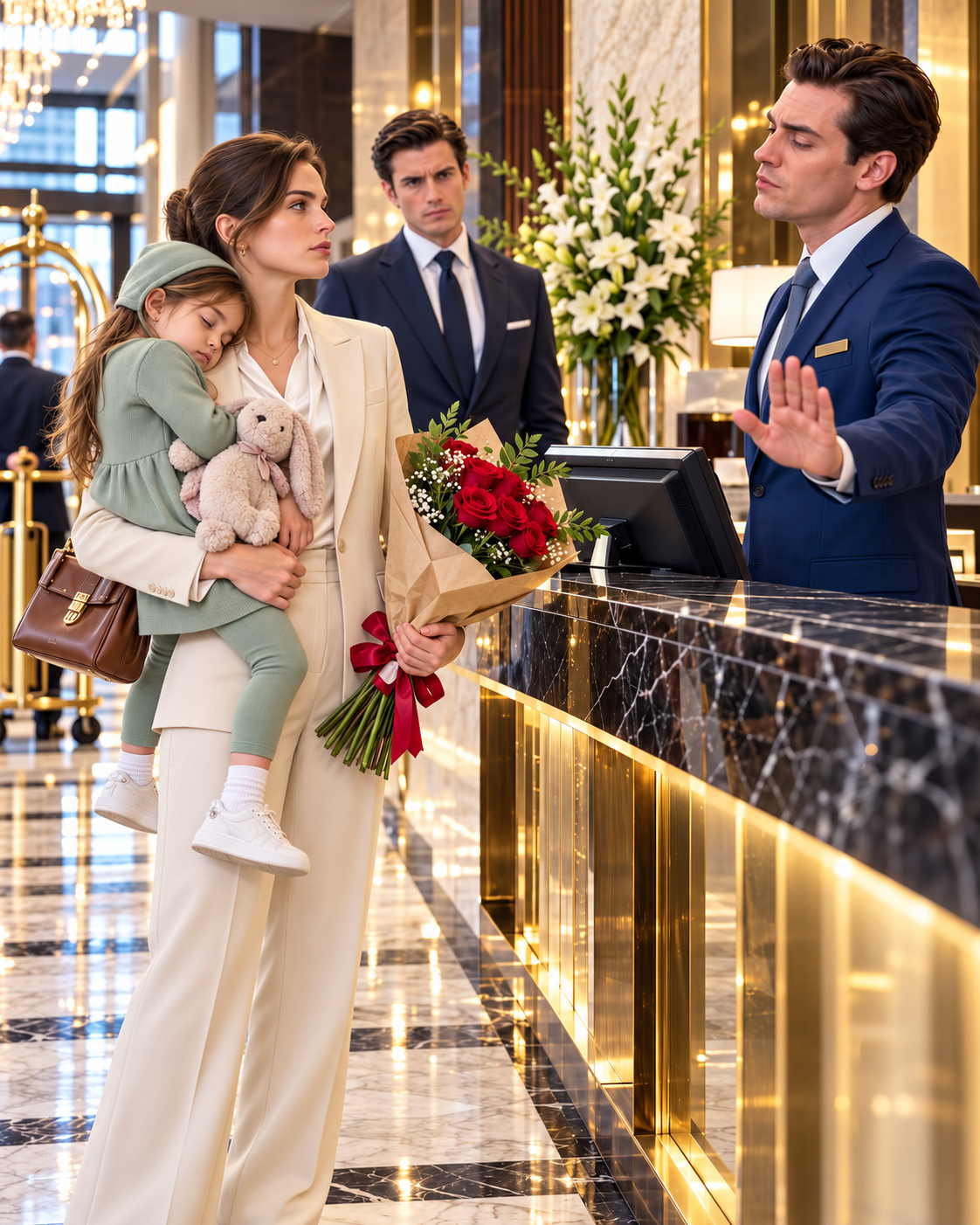
PART 1 TITLE: The Night a Tired Mother Walked Into Her Own Hotel and Discovered How Quickly a Welcome Could Turn Into a Judgment
The receptionist looked at my sleeping daughter, glanced at the damaged roses in my hand, and suggested we find somewhere less expensive to spend the night. He said it with the composed assurance of a man who believed he was being reasonable. Behind him, the Grand Regent’s name shone in polished gold against a wall of pale marble. I had approved that lettering myself. Eleven years of work had brought me to this building, and now an employee standing behind my own reception desk was explaining, without quite saying the words, that people like my daughter and me belonged somewhere else.
I didn’t answer immediately. Lily’s cheek was warm against my neck, and the weight of her sleeping body had begun to make my right arm tremble. Her stuffed rabbit was trapped between us, its worn ear protruding from beneath my jacket. Every time I adjusted my grip, she made a small protesting sound. I knew that sound. It meant she was close to waking, and after the day we’d had, I would have endured considerably more than an insulting receptionist to give her another hour of uninterrupted sleep. My name is Clara Vance. That night, I was simply trying to get my six-year-old child into bed.
Our journey from Denver had taken almost nine hours. A three-hour flight delay had stretched an already tiring afternoon into an evening of crowded waiting areas, repeated announcements, and increasingly uncomfortable airport chairs. Lily had been patient longer than I expected. She’d colored pictures, asked questions about the airplanes outside the windows, and watched cartoons until her tablet ran out of power. After that, she sat against me and tried not to cry. I offered her the last granola bar in my backpack. She ate half, wrapped the remainder carefully, and told me she wanted to save it for tomorrow.
By the time we landed in Chicago, the airport shops were closing and Lily could barely keep her eyes open. I had a backpack, a leather jacket that had seen better years, and a bouquet of red roses that looked considerably less elegant than they had when I bought them. Three stems had bent inside the paper wrapping during the flight. A few petals were bruised. I carried them anyway, refusing to leave them behind. We still had a taxi ride ahead of us, and I knew Lily would eventually ask about the flowers. She had been talking about them for days.
The following morning would mark three years since my husband, Daniel, died. He was thirty-seven when cancer ended his life after sixteen months of treatment, exhausted hope, hospital visits, and ordinary days that became precious because we knew how few remained. Lily was only three then. Some of her memories of him were clear, while others had been assembled from photographs and stories I told so frequently that they had become part of her own understanding. She remembered his laugh. She remembered how he sometimes carried her around the kitchen on his shoulders. Most of all, she remembered that he loved red roses.
We had developed a small ritual for the anniversary of his death. I bought flowers, Lily chose a vase, and we each shared something about Daniel that could still make us smile. Some years that was difficult. On our first anniversary without him, Lily spent nearly twenty minutes deciding which vase Daddy would like, and I cried while she examined them. The second year was easier in some ways and harder in others. This year, despite being away from Denver, I had promised we would keep the tradition. The flowers had survived the flight, even if they no longer looked perfect.
The taxi stopped outside the Grand Regent shortly before Lily finally surrendered to sleep. She had asked whether we were close, listened to my answer, and closed her eyes. Five minutes later, the driver pulled beneath the hotel’s covered entrance. I paid the fare, shifted my daughter carefully against my shoulder, gathered the roses, and managed to lift the backpack from the seat without dropping anything. The driver offered to help, but I told him I could manage. It seemed easier to carry everything myself than to wake Lily while rearranging it. That decision would become considerably less convenient once I reached reception.
The Grand Regent occupied an impressive building in downtown Chicago, with tall glass doors, warm lighting, and a lobby designed to make arriving guests forget the noise of the street outside. I knew the building almost as thoroughly as I knew my own home. Five years earlier, Daniel and I had approved its major renovation together. I remembered the discussions about the chandeliers, the long arguments over finishes, and the expense of replacing the old entrance flooring. Walking into that lobby should have felt reassuring. Instead, I became painfully aware of my scuffed boots, faded jacket, and the backpack sliding down my elbow.
I had never believed expensive clothes were necessary to establish my place in a room. Yet I could see the receptionist considering those details before I reached the counter. His eyes moved over my jacket, then to the flowers, then to Lily. He didn’t smile at my daughter or ask whether we needed assistance. His colleague, standing a short distance away, watched us with an expression that suggested he’d already reached a conclusion. I recognized both men from their name badges. The receptionist was Patrick. His colleague was Karl. Neither seemed particularly pleased that I had approached their desk.
I lowered my voice and told Patrick that I had a reservation under Clara Vance. He typed my name into the computer while I adjusted the roses against my hip. The keyboard made a few quick sounds before his hands stopped moving. He studied the screen for a moment, then looked back at me. There was no booking, he said. I asked whether he’d checked the reservation category used for corporate executive stays. My office had arranged everything, and I knew the booking was confirmed. Patrick’s expression changed just slightly, as though my suggestion had crossed an invisible line.
He explained that the hotel was fully occupied. A major corporate event was taking place downstairs, he said, and the remaining rooms had already been assigned. His manner was practiced, his words smooth, but he spoke as though I were requesting accommodation rather than asking him to locate an existing reservation. I told him the booking had been processed through our corporate office and that the executive block might not appear in the ordinary search. He glanced at my jacket again. The movement was brief, but I saw it. He had already decided how much weight to give my explanation.
I knew about the event in the ballroom. Six months earlier, Vance Hospitality Group had finalized a three-year agreement with the national conference organization hosting it. The negotiations had required several rounds of review, and I had personally authorized the final contract. Its financial projections were still familiar to me. Patrick, of course, had no reason to know any of that. From his perspective, I was an exhausted woman standing at his counter with a sleeping child and untidy flowers. But he did have a reason to believe me about my reservation: I was giving him the information he needed to locate it.
Karl moved closer while Patrick continued explaining that no suitable rooms remained. He gave a quiet laugh and observed that some people assumed persistence was enough to obtain a luxury suite. Patrick didn’t tell him to stop. Instead, he waited for my response, almost inviting me to prove Karl’s point by becoming difficult. I kept my voice low. I wasn’t asking for an upgrade, I explained. I wanted the room already reserved in my name. Karl exchanged a look with Patrick, a small acknowledgment between colleagues that seemed to exclude me from a conversation being conducted directly in front of me.
There had been a time when I might have reached into my bag, produced my identification, and ended the exchange immediately. I had spent eleven years building a hospitality company from a struggling twenty-eight-room property outside Denver into a group operating several major hotels. I employed people across departments, cities, and levels of responsibility. A call to corporate headquarters would have settled everything. Yet I stood with Lily asleep on my shoulder, listening to two employees discuss whether I deserved access to a room I had already booked. The difference between what I could do and what I chose not to do was beginning to matter.
Patrick finally suggested that we try one of the inexpensive places closer to the highway. He spoke as though he were offering practical travel advice. I stared at him for several seconds, trying to understand how he had moved so confidently from failing to locate my reservation to deciding what kind of accommodation I could afford. I had not mentioned money. I had not asked for a discount. Nothing about my request required him to consider my income. Yet the recommendation had come easily, delivered with a politeness that did nothing to soften its meaning.
Lily moved against me. Her fingers tightened around the rabbit, and she lifted her head just enough to murmur my name. I pressed my lips to her hair and told her we were almost finished. She relaxed again, but not completely. I could feel how restless her sleep had become. My right shoulder ached, and a pinched nerve sent an unpleasant sensation down my arm. I shifted the flowers and watched another petal detach itself, drifting onto the gleaming floor. For a moment, I wished Daniel were standing beside me. He would have taken Lily without needing to be asked.
Daniel had never been impressed by elaborate entrances or expensive furnishings. When we owned our first small hotel, he was the one who noticed when someone stood uncertainly near the front desk or struggled with a heavy suitcase. I concentrated on financing, renovations, and keeping the business alive. He watched people. During those early years, we had agreed on a sentence that eventually became the foundation of our company’s approach to hospitality: EVERY GUEST DESERVES TO FEEL SEEN. We printed it on ordinary paper and placed it behind the reception counter. At the Grand Regent, the same words were permanently engraved beneath the hotel crest.
I looked at that inscription now. Patrick stood directly beneath it, apparently unaware of the contradiction. I wondered whether he had ever considered what those words required from him on a difficult evening. Perhaps he saw them every day until they ceased to mean anything. Perhaps he could repeat them during training without recognizing when he was failing to live by them. The thought bothered me more than the original insult. A company’s principles were worthless if they existed only in its brochures, and I was beginning to suspect that the Grand Regent’s beautiful appearance concealed a problem I had failed to see.
Anonymous visits had always been part of how I evaluated our properties. Scheduled inspections produced results that were often too polished to trust completely. Managers prepared their departments, employees received reminders, and problems that guests encountered every day became temporarily invisible. On unannounced visits, I dressed casually, traveled without an entourage, and allowed myself to experience the hotel as an ordinary customer. Most of the time, those visits left me encouraged. I met thoughtful employees who took pride in their work. Occasionally, I discovered something uncomfortable. Nothing prepared me for being turned away from my own hotel while carrying my exhausted daughter.
I had arranged to arrive earlier than the Grand Regent’s management expected. Robert Haines, the general manager, believed my official visit was scheduled for Sunday, two days later. That gave me a chance to observe ordinary operations before anyone began preparing for a corporate inspection. There had been no plan to manufacture a confrontation. I had expected a routine check-in, some quiet observation, and an opportunity to examine how the property functioned without executives watching over anyone’s shoulders. Instead, I was discovering what happened when employees believed a guest had neither influence nor the appearance of wealth.
I asked Patrick whether he would contact the general manager. My request was straightforward. If a confirmed reservation was missing, someone with additional access could verify it. Patrick’s expression became less accommodating. Robert was occupied with the gala, he explained, and this was not a matter that required his attention. I repeated my name and asked him to pass along the message. Karl responded before Patrick could. He made it clear that the manager would not be interrupted over a guest’s inability to locate her booking. The implication was extraordinary: somehow, the missing reservation had become my responsibility.
I examined Patrick’s face while he answered. He wasn’t visibly furious. He didn’t shout or threaten me. That would have been easier to recognize and report. Instead, he spoke in the patient tone people sometimes adopt with someone they consider unreasonable. The more calmly I insisted that my reservation existed, the more he appeared convinced that I was trying to obtain something I wasn’t entitled to receive. He seemed to hear my words only as an obstacle to ending the conversation. Behind him, the computer screen remained open, waiting for the additional search he had declined to perform.
I considered leaving the counter and calling David Mercer, my chief operating officer. David knew where I was and understood why I’d arrived without notifying the property. A single message would bring him into the situation. He could contact Robert, locate the reservation, and ensure that Lily and I reached our room. It would also end my ability to see what happened when these employees believed they were dealing with someone whose complaints could be disregarded. I didn’t want to sacrifice Lily’s rest to satisfy my curiosity. But I also couldn’t pretend that what I had witnessed was merely a harmless misunderstanding.
The gala continued somewhere beyond the lobby. Through a set of doors, I could hear a swell of laughter followed by applause. A luggage cart moved across the marble behind me, its wheels whispering over the smooth surface. Near the entrance, a couple in formal evening clothes received immediate attention from another employee. One of them dropped a glove, and the attendant hurried to retrieve it before its owner noticed. I found myself watching that small exchange. The staff understood attentiveness perfectly well. The question was why Patrick and Karl had decided my daughter and I weren’t worth the same consideration.
Patrick turned slightly toward his colleague, as though our conversation had ended. I stood there holding Lily and wondered what would have happened if I really had been a mother with limited money, unfamiliar with the city, and nowhere else to go. Would I have carried my child back into the October night? Would I have believed the receptionist when he implied that the mistake was mine? Would the two men remember me an hour later? The answers mattered because the next person they dismissed might have no corporate badge, no influential colleague to call, and no practical way to challenge them.
A door opened behind the reception area. A woman emerged carrying a stack of folded white towels, her maroon housekeeping vest showing faint creases from a long shift. Gray threaded through the dark hair gathered into a braid at the back of her head. She looked to be in her mid-fifties. Her name badge read Lupita. She walked several steps before noticing us, then slowed. Her gaze settled on Lily, moved to the flowers crushed against my arm, and finally reached the two men behind the counter. She stopped beside a luggage cart and placed her towels carefully on its lower shelf.
Lupita asked whether I needed assistance. The question was simple, but the difference in her manner was immediate. She spoke directly to me rather than discussing me with her colleagues. I explained that the desk couldn’t find my reservation in its primary system. She turned to Patrick and asked whether the corporate booking section had been searched. Patrick responded that he had already checked. Lupita clarified that she meant the secondary executive tab, which sometimes held reservations not displayed in the initial results. I watched Patrick’s expression tighten. He seemed more offended that a housekeeper had questioned his procedure than concerned about a guest waiting with a sleeping child.
He told Lupita that reception procedures were not her responsibility. Karl added a dismissive remark about housekeeping employees involving themselves in matters beyond their department. I expected her to retreat. She had already finished a long shift, and neither man looked inclined to thank her. Instead, she remained beside the counter. Without becoming confrontational, she explained that the same reservation-system problem had occurred the previous month. It was possible, she said, that the booking existed exactly where I had suggested. Checking would take very little time. Patrick folded his arms briefly, then moved them back toward the keyboard.
The atmosphere had changed. Until Lupita arrived, Patrick and Karl had controlled the exchange because I needed something from them and they believed I had no way to insist. Now someone inside the hotel was questioning their decision. I could see that Lupita understood the personal risk. Her fingers rested against the edge of the cart, and she had the watchful expression of someone who knew precisely how much trouble an unsolicited opinion could cause. Yet she remained where she was. She looked at my sleeping daughter again, then told the men that helping a guest in distress shouldn’t depend on which department happened to notice her.
Patrick’s hand hovered above the computer mouse. Karl looked annoyed. Lupita waited, unwilling to withdraw what she had said. I realized that the most important thing I had learned that evening was not about a missing reservation or an insulting remark. A housekeeper had stepped outside her assigned duties to help someone she believed was powerless, and her colleagues were treating that kindness as misconduct. Patrick finally clicked into the additional reservation screen. I watched him begin typing again, knowing that whatever appeared next would settle the question of my room, but not the far more serious question of how this hotel treated its guests and employees.
END PART 1
PART 2 TITLE: A Housekeeper Finds the Reservation Two Men Refused to Search For, Then Makes a Discovery That Could Change Everything Upstairs
Patrick stared at the new screen for several seconds without moving. I watched the tension travel from his jaw to his shoulders. It was subtle at first, nothing more than a change in posture, but it told me enough. He had found something. Karl leaned closer to see what was displayed, expecting, perhaps, another opportunity to dismiss my request. Instead, he stopped smiling. Lupita remained beside the luggage cart, her hands still resting against its metal handle. Nobody spoke. The lobby carried on around us, indifferent to the silence gathering at the reception desk.
Patrick checked another field, then returned to the first. I could see him reading carefully now, with an attention he had not considered necessary when I first gave him my name. Finally, he confirmed that an executive reservation existed for Clara Vance. It had been entered two weeks earlier, was fully authorized, and assigned to Suite 904. I recognized the room number immediately. It was exactly the suite corporate reservations had secured. Nothing about the booking had been altered during our journey. The only thing that had changed was Patrick’s willingness to look in the correct place.
I asked whether the reservation had been available in the system throughout our conversation. Patrick hesitated before admitting that it had. He started explaining that the main search had failed to display the result properly, but I stopped him. The software had performed the function it was designed to perform. A secondary booking category existed for a reason, and I had mentioned it repeatedly. His earlier conclusion had not resulted from an exhausted search or a technical failure. He had searched once, reached an assumption, and treated every suggestion that followed as an attempt to challenge his authority.
For the first time, Patrick seemed genuinely uncertain about how to respond. His professional composure had become a collection of incomplete explanations. He offered an apology, then said he could complete the check-in immediately. I told him that was what I had been requesting from the beginning. I didn’t raise my voice, although I could feel anger settling into my chest. He looked relieved when I agreed to accept the room, as though the availability of a suite was the only question that needed resolving. I knew he wanted to close the incident before anyone else became involved.
Karl turned toward another workstation and began studying its screen. I asked him directly why he had laughed when I explained that my reservation existed. He insisted that he hadn’t been laughing at me. I gave him the opportunity to explain what had amused him instead. He looked toward Patrick, apparently hoping his colleague would intervene. Patrick remained occupied with the check-in. Karl offered no explanation. His silence reminded me that people sometimes recognize the cruelty of their behavior only when they must account for it without the reassuring laughter of someone standing beside them.
Lupita said nothing during that exchange. I noticed her expression, though. She looked less pleased that the booking had been found than relieved that Lily and I would finally have somewhere to rest. That distinction stayed with me. Patrick and Karl were focused on escaping an uncomfortable situation. Lupita was concerned about the person who had been left standing in it. She had helped without demanding to know why I was traveling, what I did for a living, or how much the suite cost. Those questions had never been necessary to determine whether I deserved assistance.
Lily stirred again just as Patrick began preparing the keycards. This time she opened her eyes and raised her head from my shoulder. Her hair had flattened on one side, and a faint crease marked her cheek where it had rested against my jacket. She looked around the enormous lobby with the puzzled concentration of a child waking somewhere unfamiliar. I told her we had reached the hotel. She followed the line of the chandeliers upward, blinking at the glass panels and warm lights above us. Her first observation was that the place looked beautiful.
I agreed, but I could barely speak. Daniel and I had stood in that lobby during the renovation, discussing whether the ceiling lights were too elaborate and whether the quieter seating areas would be comfortable for families. At the time, Lily had still been small enough to fall asleep in her stroller. I remembered Daniel holding a sample of the brass finish against the wall and asking whether people would notice such expensive details. He had preferred improvements guests could actually feel. Now our daughter was admiring the room he had helped create, unaware of how unwelcome we had been made to feel inside it.
Lily asked whether we could go upstairs. There was no accusation in her voice, only exhaustion. I touched her forehead and promised that we would. Patrick placed two keycards on the counter and confirmed the suite number. His hands moved with unnecessary precision, as though careful handling of the cards might compensate for everything that had happened. I thanked him because Lily was watching and because I did not want her to associate firmness with rudeness. My thanks acknowledged that he had finally completed his task. It did not mean I considered the matter resolved.
When I turned away, Lupita offered to take my backpack. I started to refuse, partly out of habit and partly because she had already done more than anyone else. But the strap was cutting into my arm, and the muscles beneath my shoulder blade had become painfully stiff. She assured me that carrying it would be no trouble. I let her lift it from my elbow. She checked that the zipper was closed, then fell into step beside us. We moved toward the elevators, leaving Patrick and Karl to resume their duties beneath the company’s carefully engraved promise.
I had almost reached the elevator when I heard Patrick release a long breath behind us. It was the sound of someone who believed an unpleasant incident had finally ended. A moment later Karl leaned toward him and made a remark about people who enjoyed causing trouble. He kept his voice low, but the lobby’s polished surfaces carried it farther than he intended. I looked back. Karl wasn’t watching me. He was waiting for Patrick to agree with him. Patrick didn’t openly respond, although he made no effort to correct his colleague either.
The elevator doors closed before I could decide whether to return to the counter. Lupita had heard the remark. Color drained from her face, and she tightened her grip on my backpack. She glanced at me in the mirrored wall, perhaps wondering whether I would demand that we go back. I looked at Lily instead. She had already settled against my shoulder again. I chose to continue upstairs. That decision wasn’t forgiveness. I wanted my daughter in bed, and I wanted time to consider what I had witnessed without allowing an exhausted moment to dictate my response.
We rode in silence until the elevator reached the ninth floor. The corridor beyond was quiet, its cream carpeting absorbing our footsteps. Brass wall lights cast a gentle glow over the doors. There was none of the noise from the gala below, only the faint mechanical hum of the ventilation system. Lupita began walking toward the far end of the hallway, then slowed beside me. She apologized for the treatment I had received. I told her she had nothing to apologize for. Her mouth tightened, and she said that I should have been helped as soon as I arrived.
I asked whether she had encountered similar booking problems before. She explained that the executive reservations sometimes transferred into a separate category, particularly when corporate arrangements were involved. The problem wasn’t common, but it was familiar enough that employees should know how to resolve it. She spoke carefully, avoiding direct criticism of Patrick. I understood her caution. In a hotel, the person who identifies a mistake is not always the person management appreciates afterward. I had seen that dynamic elsewhere, though I had not expected to encounter it so plainly in a property carrying my own name.
Suite 904 stood at the end of the corridor. Since my hands were occupied, Lupita used one of the keycards to open the door. The lights came on as we entered, revealing a generous sitting room, a dining area, two bedrooms, and windows that extended nearly from floor to ceiling. Chicago stretched beyond the glass in a pattern of illuminated streets and distant buildings. The room smelled faintly of fresh linen and the citrus cleaning products approved for the property. Everything appeared ready for our arrival. The contrast with our reception downstairs was almost absurd.
A bowl of fruit stood on the counter beside a small card from corporate reservations. I noticed it immediately, although I did not reach for it. The message welcomed me back by name. Lupita saw it while setting the backpack beside a chair. Her eyes paused on the card, moved briefly toward me, and returned to the printed words. Something in her expression changed. I knew she was beginning to connect details she hadn’t previously considered. I didn’t offer an explanation yet. Lily had become heavy again in my arms, and getting her settled mattered more than satisfying anyone’s curiosity.
I carried Lily into the smaller bedroom and lowered her onto the mattress. She protested softly when I tried to move her rabbit, so I left it tucked beneath her arm. I removed her shoes and carefully pulled the blanket over her legs. Her socks were decorated with small yellow stars. Daniel had bought them because they reminded him of the evenings when he used to take her outside and point toward the sky. Even before she could identify a constellation, he had invented one for her, insisting that somewhere above our home there was a star that belonged exclusively to Lily.
She had once corrected him with remarkable seriousness, explaining that she couldn’t find a star named after herself in her picture book. Daniel had answered that astronomy hadn’t caught up with his discovery. After his death, she asked me whether he lived on her star now. I had told her I didn’t know, but that she was welcome to imagine him there. I remembered the conversation as I watched her sleeping. Her father had given her a way to look at the night sky without feeling entirely alone. I would have traded every expensive room in the building to hear him tell that story again.
When I returned to the sitting room, Lupita stood near the entrance with her hands clasped. She looked uncomfortable, caught between the professional obligation to leave a guest in peace and a question she could no longer ignore. She asked whether I was the Clara Vance associated with Vance Hospitality Group. I smiled faintly and explained that I had founded the company, which now owned the Grand Regent and several other properties. Technically, the organization held the hotel rather than me personally, but I understood what she meant. Lupita stared at me with the expression of someone who had opened the wrong door and found the entire management team waiting inside.
Her first instinct was to leave. She glanced toward the hallway, visibly distressed by what had happened downstairs. I asked her to remain a moment and assured her that she had done nothing wrong. She began explaining that she hadn’t recognized me, that she had only wanted to help, and that she would never have allowed herself to become involved if she had known the situation was part of an official visit. I stopped her. That, I told her, was precisely what made her intervention valuable. She had offered help because help was needed, not because of my position.
I asked her not to reveal my identity to the front-desk staff that evening. She studied me, trying to understand. I explained that the hotel’s general manager was expecting me on Sunday and that my early arrival was meant to be an ordinary guest experience. I wanted to learn what happened without an executive entourage or carefully prepared welcome. Lupita considered the request, then asked whether I was trying to find out how employees behaved when they believed the person watching had no influence over them. I admitted that she had described my purpose more accurately than I could have.
She agreed to keep the information private, although she didn’t appear entirely comfortable with the responsibility. I made it clear that she was not being asked to conceal misconduct or lie to anyone. She simply didn’t need to announce a guest’s identity. My visit would become known soon enough. Until then, I wanted the employees downstairs to continue their normal routines. What happened afterward would depend on a fair review of the facts. Lupita nodded. I could see her relief when she realized that I was not planning to march back downstairs and humiliate the people who had humiliated me.
The roses lay on the kitchenette counter where I had placed them before taking Lily to bed. One stem was bent so badly that its flower hung sideways. I began searching for the vase I knew should be in the suite. Lupita found it in the cabinet, brought it over, and helped fill it with water. I opened the wrapping and examined each rose. We straightened the surviving stems and trimmed the worst damage with a small knife from the fruit tray. There was no reason for her to remain and help arrange flowers. She did so anyway, without making the moment seem like an inconvenience.
Lupita asked whether the roses were for a celebration. I explained that the next day marked the anniversary of my husband’s death. She stopped moving a stem and looked at me differently. Her sympathy was quiet and unperformed. She asked how long it had been. I told her three years. She placed the flower carefully into the vase, then said that her own husband had died eleven years earlier. He had suffered a heart attack at forty-nine. I looked up, surprised by the directness of her admission. She had offered a piece of her own history without demanding anything further about mine.
I asked how she had managed in the years immediately afterward. She considered the question for a moment. There hadn’t been much time to decide how to manage, she said. Life continued making its ordinary demands. People still needed meals, clean clothes, and someone willing to get up in the morning. Grief had accompanied her through all of it, sometimes quietly and sometimes with terrible weight. She didn’t speak as though she had discovered a secret method for surviving loss. Her answer was practical, almost dry, and it made me laugh for the first time since entering the hotel.
We talked a little longer while arranging the flowers. I told her that Daniel had always been the calmer person in our marriage. He could listen to an argument without immediately choosing a side, and he had a habit of asking questions that forced me to examine my assumptions. Lupita smiled as though she recognized the type. Her husband, she said, had been less patient with complicated discussions but knew exactly when she needed someone to sit beside her without talking. The details were different, yet I felt an unexpected familiarity in the way she described him.
After we finished with the roses, Lupita glanced at the time and said she should return to her duties. Before she left, I asked how long she had worked at the Grand Regent. Eight years, she answered. I asked whether she had always been assigned to housekeeping. Mostly, she said, although she had spent two years helping train new employees. She had enjoyed that responsibility. Then a supervisor had changed, and her training work gradually ended. She explained it without complaint, but I noticed the careful way she chose her words. The story seemed incomplete.
I asked whether she was happy working at the hotel. Lupita looked toward the flowers rather than answering immediately. She said she liked meeting guests, especially the ones who appreciated small gestures. Some returned every year and remembered employees by name. Others arrived frightened, tired, or uncertain about what to do next. Helping them could make a difficult day easier. I waited, expecting her to say something about the rest of her work. She didn’t. When I asked about the hotel itself, she adjusted the edge of her vest and said only that she was grateful to have a job.
I could have continued questioning her, but it was late, and the hesitation in her answers deserved respect. I thanked her for everything she had done. She told me that anyone in her position should have acted the same way. I agreed that they should have, then reminded her that the two people responsible for reception had chosen differently. Lupita gave me a tired smile. At the door, she paused as though considering whether to add something. In the end, she wished me and Lily a peaceful night and left quietly, taking the empty flower wrapping with her.
I stood beside the closed door for a moment, listening to her footsteps fade along the corridor. Then I returned to the table and looked at the roses. They were uneven, their stems shortened by damage, but they were standing in water. The shorter flower rested between two taller ones, supported by their leaves. I thought about Lily asleep in the next room, about Daniel and the woman who had just helped preserve our small anniversary tradition. It had taken me less than an hour inside my own hotel to encounter two very different versions of hospitality.
I walked to the window and looked down at the city. The Grand Regent’s lobby was hidden beneath several floors of guest rooms, but I could still picture Patrick and Karl beneath the engraved company motto. I could also picture Lupita standing beside them, refusing to walk away from a guest in difficulty. One encounter had exposed something about the front desk. Another had suggested that the trouble might extend beyond it. Lupita’s reluctance to discuss her working conditions had not escaped me. Neither had the way she seemed frightened by the possibility of being recognized as someone who had challenged reception.
The revelation that my identity was now known to Lupita created a different kind of responsibility. I could no longer pretend that the incident affected only me. An employee had put herself at risk to help a stranger, and I had asked her to keep a secret from colleagues who might resent her intervention. Whatever happened when I revealed myself, I needed to ensure that her kindness did not become the reason she suffered. I checked the time, confirmed that Lily was still sleeping, and reached for my phone. Tomorrow’s investigation would have to examine more than a lost reservation.
END PART 2
PART 3 TITLE: In the Quiet Hours Before Morning, a Child’s Questions Reveal the Damage No Hotel Complaint Form Was Designed to Measure
My phone showed fourteen unread messages when I picked it up from the dining table. Most concerned ordinary business matters: approvals, schedules, and questions that could wait until morning. One was from my mother, asking whether Lily and I had arrived safely. Another came from David Mercer, my chief operating officer. He hoped the Grand Regent visit was proceeding smoothly and confirmed that Robert Haines still expected me on Sunday. The corporate reservation team had secured Suite 904 without notifying the hotel about my earlier arrival. David had no reason to think the booking would cause trouble.
I read his message twice. The explanation for Patrick’s initial difficulty was sitting in front of me. My reservation had been placed in the executive allocation because corporate wanted the suite available without changing the published arrival schedule. Patrick’s first search would not necessarily have displayed it. That was understandable. The refusal to perform a second search was not. Nor was the decision to judge my appearance, dismiss my explanation, or turn my daughter and me toward a cheaper motel. A procedural inconvenience had become mistreatment because two employees preferred their assumptions to the available information.
I considered telling David what had happened. He would have taken the matter seriously, and I trusted his judgment. But contacting him immediately would almost certainly bring Robert into the situation before I had examined it properly. I typed a short reply confirming our arrival and asking him not to contact the property. I told him I would call the next day. Then I placed the phone facedown. I didn’t need an immediate corporate response. I needed to understand whether Patrick and Karl had behaved unusually or whether their conduct reflected something that had become acceptable inside the hotel.
The suite was quiet enough that I could hear the ventilation system switching between settings. I changed Lily into her pajamas without fully waking her, washed my face, and returned to the living room. The roses stood beside the window. Their reflection hovered over the lights of downtown Chicago, and the shorter stem cast an awkward shadow across the table. I found a hotel notepad near the telephone and uncapped a pen. Over the years, I had learned to document difficult encounters while the details remained fresh. Memory becomes unreliable when anger has time to reorganize it.
I wrote down the names of the three employees involved. Under Patrick, I recorded his incomplete reservation search, his repeated insistence that the hotel was full, the suggestion that I find cheaper accommodation, and his refusal to contact the general manager. I included his attempt to attribute the problem to the booking system after finding the correct reservation. I wrote down the exact sequence rather than my interpretation of his motives. If I expected employees to accept accountability, I owed them an investigation based on what they had done, not on what I imagined they were thinking.
Karl’s list was shorter but troubling. He had ridiculed my request, reinforced Patrick’s assumptions, treated Lupita’s assistance as inappropriate, and continued making dismissive remarks after our reservation was confirmed. I remembered how quickly he looked away when I asked him to explain his laughter. His reaction might have reflected embarrassment. It might also have been fear of disciplinary consequences. Neither possibility changed the words I had heard. Under Lupita’s name, I recorded the practical help she provided, her familiarity with the reservation system, and the fact that she had intervened before knowing my connection to the company.
I studied the page after finishing. Three names and a few lines were too small a record to represent three entire people. Patrick might be dealing with difficulties I knew nothing about. Karl was perhaps inexperienced, eager to impress someone whose approval mattered to him. Lupita could have weaknesses in her work that were invisible during our brief encounter. None of those possibilities excused misconduct, but I knew better than to pretend a single incident explained everything. Beneath the notes, I wrote a reminder to investigate before reaching conclusions. I could almost hear Daniel telling me not to let anger do all my thinking.
Daniel used to challenge me whenever I returned from work convinced that someone had acted with deliberate malice. He listened, usually without interruption, while I explained what had happened. Then he asked me to imagine the events from another person’s perspective, including details that might complicate my judgment. I found those conversations infuriating when I was younger. I wanted him to agree with me immediately. He often did agree eventually, but only after making me separate what I knew from what I assumed. After his death, his questions became part of the way I managed the company.
I looked toward Lily’s bedroom. Daniel would have cared about the employees, but he would have cared about our daughter first. He understood how children could absorb adult behavior without understanding its causes. During his illness, he had insisted that we explain each hospital stay in language Lily could manage, rather than allowing her to imagine she had somehow caused his absence. I had tried to continue that practice. Yet downstairs, while concentrating on remaining composed, I hadn’t noticed how much Lily heard. She had been half asleep against my shoulder. I wanted to believe the incident had passed without reaching her.
I went to bed shortly after midnight. Even exhausted, I slept lightly. My mind kept returning to the reception counter, the unfinished search, and Lupita’s cautious answers. At 2:17 in the morning, a small cry came from the adjoining bedroom. I knew immediately it was Lily. The sound was different from the startled noises she made in unfamiliar rooms. She was frightened. I crossed the hallway without turning on the overhead lights and found her sitting upright, both hands gripping her rabbit. Her hair had fallen across her face, and tears were gathering beneath her eyes.
She told me she had dreamed about Daddy. I sat beside her and asked what she remembered. Daniel had been at the airport, she said, waiting near the place where people boarded their airplanes. She had seen him clearly. He was smiling, and she wanted to go toward him. But then someone called our flight, and she had to follow me through the boarding gate. When she looked back, he was still standing there. She began crying again as she described the moment. The dream had ended before she could reach him.
I pulled her into my lap and held her until she could breathe comfortably. Dreams involving Daniel were rare enough that I paid attention whenever she mentioned one. She sometimes remembered his face from photographs more clearly than from life, but the feeling of being with him remained powerful. I told her that remembering him at the airport did not mean we had abandoned him. She pressed her forehead against my chest and asked why he couldn’t come with us. I explained gently that Daddy had died and that we couldn’t travel together in the way we once had.
Lily already understood what death meant. She knew he couldn’t visit, telephone, or come home. But understanding something at six years old doesn’t prevent a child from asking the same painful question in new ways. She wanted to know whether he would have enjoyed the hotel. I said he had helped choose some of the things inside it. She seemed surprised. I described him examining the lights during the renovation and making a face when someone suggested an expensive chair that looked terribly uncomfortable. She gave a small, reluctant laugh. I remembered his expression so clearly that it hurt.
After a while, Lily asked whether we could still have our flower day. I told her the roses were standing in water on the living-room table, ready for morning. She wanted to make sure I hadn’t thrown away the damaged ones. I assured her that I had kept them all. She was quiet for several moments, running her thumb along the rabbit’s stitched ear. Then she asked a question I hadn’t expected. She wanted to know why the men downstairs had been unkind to me. I felt my arms tighten around her before I could stop myself.
I had believed she was sleeping through most of the exchange. Apparently, she had heard enough to recognize that something was wrong. I considered how to answer without placing the weight of my anger on her. I said the men had been tired and hadn’t handled our arrival well. Lily lifted her head and looked directly at me. She reminded me that I had been tired too, yet I hadn’t spoken to them that way. It was such a simple observation that I couldn’t dispute it. I admitted she was right. Being tired explained nothing about how they had treated us.
Her next question was harder. She wanted to know whether we had broken a rule. Perhaps, she suggested, our flowers were not allowed in the lobby. Maybe she had done something wrong by sleeping on my shoulder. I felt a surge of anger so sharp that I had to wait before answering. Patrick’s attitude had humiliated me, but my daughter was now searching for a reason she might deserve the same treatment. She was trying to make sense of a world where adults could look at someone and decide that person didn’t belong.
I told her firmly that she had done nothing wrong. Neither of us had. We had arrived with a valid reservation, just as any hotel guest was supposed to do. The men had made guesses about us before taking the time to understand the situation. Lily considered that explanation. She asked whether they had guessed badly. I said yes. She compared it to a girl named Mia at school, whom she had once believed disliked her until discovering that Mia was simply shy. I said the situations weren’t identical, but the comparison was close enough for her to understand.
Lily leaned against me again. She had learned something about assumptions, but I could tell the explanation hadn’t completely satisfied her. She asked whether the men were going to be punished. I thought about the notepad in the next room and the corporate identification lying inside my jacket. I could have told her that I had enough authority to dismiss both employees. Instead, I explained that I would find out exactly what had happened and decide what consequences were appropriate. She asked whether that meant being fair. I told her it did, even when I was angry.
She accepted my answer with the trust children sometimes offer before they understand how difficult promises can become. I stayed beside her until her breathing slowed. The rabbit slipped from her fingers, and I tucked it beneath the blanket where she could find it in the morning. I remained sitting on the mattress long after she fell asleep. The city lights filtered around the curtains, making the yellow stars on her socks faintly visible. I wondered how many other children had heard adults dismiss their parents at hotel counters and quietly concluded that their families must have done something wrong.
By morning, I had slept very little. I made coffee in the kitchenette and stood beside the roses while Chicago gradually brightened beyond the windows. The anniversary had arrived. Three years without Daniel. There had been mornings when the date felt impossible to endure, but this one carried an additional responsibility. I needed to help Lily remember her father without allowing yesterday’s encounter to overshadow the ritual. I washed a few pieces of fruit, checked that her pajamas were within reach, and decided that the hotel’s problems could wait until she had eaten breakfast.
At seven-thirty, someone knocked. I hadn’t ordered room service, so I approached the door cautiously. Lupita stood outside with a breakfast tray and a young server waiting just behind her. She explained that the kitchen had prepared extra pancakes and that she had thought Lily might enjoy them. I could tell she was uncertain whether she had overstepped. Before I answered, Lily appeared from the bedroom, rubbing her eyes. She heard the word pancakes and became instantly alert. When Lupita mentioned blueberries, my daughter looked as delighted as though the hotel had arranged something extraordinary in her honor.
I thanked them and brought the tray inside. Lupita checked whether we needed anything else, then prepared to leave. I asked whether she had already begun her shift. She answered that she’d come in early and was helping with several morning tasks. There was nothing dramatic in her explanation, but I noticed the tiredness around her eyes. After she left, Lily arranged her rabbit beside the breakfast plate and insisted that he should be allowed to watch her eat. I poured her some water and sat opposite her. For twenty minutes, we were simply a mother and daughter eating pancakes above a waking city.
Lily examined the roses between bites. She asked whether we would tell our story about Daniel before or after lunch. I suggested we decide together later, when we were both more rested. She agreed and began explaining that the shorter rose should stand in the center of the vase because it needed help from the others. I smiled and let her rearrange the stems. Her interpretation was more generous than anything I had considered. I wanted to preserve that generosity, but I also wanted her to understand that being kind did not mean allowing people to treat others badly.
At eight-fifteen, Marisol arrived. She was an experienced childcare professional associated with our Chicago office and had looked after Lily during earlier business visits. My daughter recognized her immediately and went to fetch the books she had packed for the trip. I explained that I had hotel matters to attend to and might be occupied for several hours. Marisol assured me that they would be comfortable in the suite and that she would contact me if Lily needed anything. Before leaving, I bent beside my daughter and promised to return for our anniversary tradition.
I dressed without making any attempt to appear more important. I wore the same jeans and brown leather jacket from the previous night. My boots were still marked by the journey, and the jacket’s worn elbows remained plainly visible. I did, however, take my corporate identification from my bag and place it inside an accessible pocket. I hoped I wouldn’t need to use it immediately. I wanted to hear what the hotel’s managers believed had happened before they understood who was asking. That distinction had become essential to understanding the culture I was about to examine.
The elevator descended through the quiet upper floors. By the time it reached the lobby, the hotel had transformed from its late-night atmosphere. Guests moved between the breakfast area and the entrance, luggage carts crossed the marble, and reception employees handled departures with practiced efficiency. Patrick was behind the counter. Karl stood nearby, looking considerably more alert than he had the previous night. A third man was speaking with them. Tall, composed, and dressed in a charcoal suit, he appeared entirely comfortable occupying the center of the conversation. I recognized him immediately as Robert Haines.
Robert had managed the Grand Regent for eighteen months. His reports were among the strongest in our organization. Occupancy was healthy, labor expenses remained controlled, and guest satisfaction figures had improved under his leadership. The hotel performed well during large events, and his forecasts rarely required significant corrections. I had met him twice in person, both times during formal corporate meetings when I wore tailored business clothes and arrived with colleagues from headquarters. He had addressed me confidently and remembered details from our conversations. That morning, when I approached wearing my old jacket, he showed no sign of recognition.
What he did recognize was the incident. He glanced at Patrick, then at me, and asked whether I was the guest involved in the previous evening’s reservation problem. Patrick confirmed it. I noticed the exchange because it established something important before I spoke. Robert had already heard about me. The question was what version of the encounter he had been given, what he had done to verify it, and why he was discussing it with the two employees whose conduct was in question. I approached the desk and wished them good morning.
Robert greeted me politely and said he understood there had been difficulty locating my booking. I confirmed that there had. He assured me that he had reviewed the incident and that the problem had been corrected. I asked him to explain exactly what he understood. He looked briefly toward Patrick before describing a technical difficulty involving the reservation system. His explanation was polished and reassuring, the kind a hotel manager might give a guest whose room had been delayed by an innocent administrative error. It also left out nearly everything that mattered.
I asked whether the technical difficulty accounted for the suggestion that I should find a cheaper motel. Robert’s smile became less comfortable. He said he was confident that no deliberate offense had been intended. I asked how he explained Karl laughing at my request. This time, Robert reminded me that he had not been present. I agreed. He seemed to consider that an important concession. Then I mentioned Lupita, who had witnessed the exchange and had helped Patrick locate the reservation. Robert’s expression changed in a way I recognized immediately. He knew exactly who I meant.
He referred to her as the housekeeping employee who had become involved in a reception matter. Before asking what she had seen or how she had helped, he observed that she should have remained within the responsibilities of her department. I looked at Patrick. He lowered his eyes. Karl appeared relieved that someone else had become the subject of criticism. Robert continued explaining the importance of clear departmental boundaries in a busy property. I listened without interrupting. Each sentence moved us farther from the missing reservation and closer to the question I had begun asking the night before.
I asked Robert whether an employee should ignore a guest who clearly needed assistance simply because the guest was standing near another department’s counter. He hesitated, evidently uncomfortable with the wording. He explained that procedures existed to prevent confusion and maintain accountability. I understood procedures. I had approved hundreds of them. But Lupita had not attempted to override reception or give me unauthorized accommodation. She had identified the correct reservation category and asked her colleagues to look there. Robert’s insistence on treating that intervention as improper told me more about his management philosophy than anything in his impressive monthly reports.
Robert seemed ready to move the conversation toward a complimentary service gesture and close the incident. I could see it in the way he softened his voice and asked whether my suite met expectations. I told him the accommodation was excellent. That was not the issue. Then I returned to Lupita. I wanted to know why a staff member who had solved a guest’s problem was the first person he chose to criticize. He offered another explanation about assigned duties and maintaining order. This time, I understood that his response was not an unfortunate choice of words. It reflected what he had been teaching his employees.
I looked across the desk at the three men. One had failed to perform a routine search. Another had made a stranger’s difficulty into a joke. Their manager had reviewed the matter without speaking to the employee who resolved it, and his first concern was that she had crossed a departmental boundary. I had come downstairs prepared to investigate an insulting reception encounter. I was now facing a more serious possibility: in this hotel, employees could make guests feel unwelcome and still be protected by procedure, while those who helped might be criticized for interfering. Robert had not yet recognized me. I needed to hear what else he would say before that changed.
END PART 3
PART 4 TITLE: The General Manager Dismisses a Guest’s Complaint Until a Corporate Badge Reveals Who Owns the Hotel and What His Records Conceal
Robert was still explaining the importance of departmental boundaries when a woman approached the neighboring reception station. She wore a beautifully tailored cream coat and pulled a small leather suitcase behind her. Patrick noticed her immediately. His shoulders straightened, his expression softened, and the irritation I had seen on his face disappeared. He greeted her by name, asking whether she had enjoyed her stay. The woman, Ms. Bellman, answered pleasantly. Within seconds, Patrick was discussing her transportation arrangements and making certain that everything was ready for her departure. I watched the transformation without saying anything.
Karl emerged from behind the counter and offered to assist with her luggage. He lifted the suitcase as though the opportunity to carry it were a privilege. Patrick asked about her flight and assured her that the concierge would be happy to help with anything she needed. Their conversation was effortless, warm, and entirely professional. There was no impatience, no suggestion that she was asking too much, and no hesitation about providing additional assistance. Ms. Bellman thanked them and walked toward the entrance, looking satisfied. The two men returned to their stations as though nothing unusual had occurred.
What disturbed me was not that Ms. Bellman had received excellent service. She deserved it. Every guest deserved it. The problem was the contrast. Patrick and Karl were capable of exactly the attentiveness I had asked for the previous evening. They understood how to make someone feel welcome. Their behavior toward me had not resulted from an inability to provide good service or a lack of training in basic courtesy. They had chosen not to extend that courtesy to a woman whose appearance suggested she might have less money and influence than the guests they preferred.
I looked at Robert. He had witnessed the exchange too, although I doubted he understood why I was studying his employees so carefully. I asked whether he knew my name. He replied that my reservation was registered under Clara Vance. I asked whether he had examined the complete booking information before discussing the incident with Patrick. He acknowledged that he had read the internal note prepared after the check-in. That note, he explained, indicated that the reservation had initially been difficult to find but that the guest had ultimately received the correct accommodation.
I asked whether he had reviewed the executive booking profile itself. Robert hesitated before admitting that he hadn’t. He saw no reason to examine it, he said, because the room assignment had been completed successfully. I let him finish. The distinction was extraordinary. His investigation had consisted of confirming that the final administrative task was complete. He had not established why it had failed initially, why I had been treated dismissively, or why Lupita had needed to intervene. He considered the matter resolved because the system showed that two keycards had eventually been issued.
I asked Robert what information he would have needed before considering the incident serious. He frowned, evidently uncertain about the direction of the conversation. I reminded him that I had arrived carrying a sleeping child after a difficult journey. I had a valid reservation. Two employees had questioned my right to occupy the room, suggested that I find cheaper accommodation, and resisted a straightforward request to perform an additional search. A housekeeper had found the solution, yet Robert believed her involvement required correction. I wanted him to explain what part of that sequence he considered an acceptable guest experience.
Robert straightened his jacket. He said he understood my frustration and that the hotel took guest concerns seriously. I had heard the phrase often enough to recognize how little it meant without action. I asked whether he had preserved the reception records or spoken privately with anyone who witnessed the exchange. He acknowledged that he had not. I asked whether he intended to do so. He assured me the hotel was willing to review matters further if necessary. The answer was still conditional, as though determining what happened depended on how much pressure a disappointed guest was prepared to apply.
For a moment, I studied his face and remembered our previous meetings. Robert had sat across from me discussing profitability, staffing, and guest satisfaction. His presentations were precise. When I challenged his forecasts, he produced supporting numbers. When I asked about service improvements, he described procedures and training initiatives. He understood how to respond to the chief executive of Vance Hospitality Group. Standing before him in my old leather jacket, I was receiving a very different kind of attention. The contrast had become too significant to ignore. I reached into my pocket and removed my corporate identification.
I placed the badge on the marble counter between us. Robert glanced down casually, expecting perhaps a loyalty card or some form of personal identification. Then his eyes stopped moving. I watched him read my name, my title, and the company printed beneath it. Clara Vance. Founder and Chief Executive. Vance Hospitality Group. His expression changed so rapidly that the carefully prepared response seemed to vanish before he could speak it. Patrick leaned forward to see what had caused the silence. Karl turned from his workstation. For several seconds, nobody moved.
Robert looked at the badge again, then raised his eyes to my face. Recognition arrived slowly and painfully. I saw him comparing the woman standing in front of him with the executive he remembered from conference rooms and formal visits. The hair was the same. The voice was the same. Only the clothing and circumstances had changed. Finally, he spoke my first name, almost as a question. I confirmed it. Behind him, Patrick whispered something under his breath. His face had gone pale. Karl took a small step away from the counter, suddenly uncertain where to place his hands.
A telephone began ringing at the far end of reception. None of the three men moved to answer it. Robert was staring at me, clearly searching for the right response. I could imagine the calculations passing through his mind. His general manager position, his performance evaluations, the approaching corporate visit, and the consequences of what I had just described were no longer abstract matters. I had watched people react that way before. The sudden discovery of authority can transform a conversation in seconds. What concerned me was how easily concern replaced indifference once they realized who stood before them.
Robert began apologizing. He said that if he had known my identity, he would have handled the situation differently. I raised my hand before he could continue. I asked him to consider what he had just admitted. If he had recognized me as the company’s founder, he would have taken the complaint seriously, investigated the employees’ conduct, and ensured that I received appropriate assistance. Yet none of those actions should have depended on my position. His words were intended to reassure me. Instead, they revealed precisely the belief that had made the encounter possible.
I asked whether a guest needed to own the building before receiving a careful investigation. Robert’s face tightened. He said no, of course not. I asked why he had considered a complaint about humiliation less important than a completed room assignment. He attempted to explain that management had to assess the seriousness of incidents and prioritize its response. I understood that obligation better than he realized. But priorities had to be grounded in actual harm, not in a guess about how much influence the complaining person possessed. The correct response should not change when the guest’s name appears on a corporate badge.
People nearby had begun noticing the conversation. A bell attendant paused beside a luggage cart, and two employees at the neighboring station became unusually attentive to their screens. A family passing through the lobby slowed briefly before continuing toward the elevators. I kept my voice measured. I wasn’t interested in public humiliation. I had no desire to summon a crowd, announce my ownership over the loudspeakers, or turn an exhausted mother’s experience into a performance of corporate power. Those gestures might satisfy anger, but they would do little to establish the truth or improve the way ordinary guests were treated.
I told Robert that my failure to be recognized was not the offense. In fact, remaining unrecognized was one reason I had arrived early. What troubled me was the implication that recognition should have changed everything. A hotel was supposed to provide shelter, comfort, and practical assistance to people away from home. Some arrived wearing expensive clothes. Others came straight from airports, hospitals, difficult family gatherings, or exhausting journeys. Their circumstances were not always visible. Staff had no reliable way to measure what someone was carrying simply by looking at the clothes they wore.
I thought about Lily asking whether she had broken a rule by sleeping on my shoulder. The memory made me pause. I explained that my daughter had heard enough of the encounter to wonder whether we had done something wrong. Patrick looked down. Karl remained silent. Robert opened his mouth, then appeared to reconsider. I told them that an adult guest might leave an insulting encounter feeling angry or embarrassed, but a child could take something very different from it. My daughter had started questioning whether she deserved the treatment she had witnessed. That damage would not disappear because the correct room had eventually been found.
Patrick apologized again, this time with none of his earlier confidence. He said he had not intended to upset Lily. I believed he was distressed now, but I asked him to consider why. The previous evening, he had known that a child was involved. He had seen her sleeping in my arms. He had watched me struggle with our belongings while asking for help. None of that had prompted him to examine the reservation more thoroughly. Only after discovering my authority did he fully appreciate the seriousness of the situation. I wanted him to confront that difference rather than offer words designed to protect himself.
I turned back to Robert and returned to Lupita. He had criticized her without asking what she had accomplished. She had not recognized me as the company’s founder, and she had not known whether I could afford the room. She had simply noticed a problem and taken the trouble to help. I asked whether he understood why that mattered. Robert nodded, but I could see he was still absorbing the implications. I explained that Lupita’s conduct represented the very standard our training materials were intended to establish. She had treated a stranger’s difficulty as something worth addressing.
Robert admitted that he had not possessed all the details when he formed his opinion about Lupita’s involvement. I pointed out that she hadn’t possessed all the details either. She had intervened without knowing my position, without knowing whether I would complain, and without any assurance that her colleagues would appreciate the interruption. Yet her uncertainty had not prevented her from acting responsibly. Robert looked toward the service corridor. For the first time, I saw something beyond professional embarrassment in his expression. He appeared to be reconsidering an assumption about his own employee.
I picked up my badge but kept it in my hand. I told Robert that I wanted a proper investigation and that no employment decision would be made simply because I had been personally offended. The evidence needed to be examined consistently. Patrick and Karl were entitled to have their conduct evaluated against their records and company policies. Robert’s decisions required the same scrutiny. I was not going to substitute my anger for a fair process. But the existence of that process would not be used as an excuse to minimize what had happened or delay examining it.
I began with the previous evening’s security footage. I wanted the relevant recordings preserved before any routine retention process could affect them. Robert agreed immediately. I asked for the front-desk activity records showing which reservation screens Patrick had accessed and when. Those records would establish whether the booking was genuinely inaccessible or merely overlooked. I also requested the training history of the employees working that shift, including the procedures they had been taught for handling reservations that did not appear in the primary search. Robert nodded as he listened, now making a determined effort to appear cooperative.
Next, I requested the guest complaint records from the preceding six months. I specified front-desk behavior, disputed room assignments, unsuccessful reservation searches, guests directed to other properties, and complaints involving staff attitudes. I wanted cases that had been resolved with compensation as well as those that remained open. Robert’s reaction was immediate, though he tried to conceal it. His shoulders became rigid, and he glanced toward Patrick before answering. For the first time since revealing my identity, I had asked for something that seemed to concern him more than his own embarrassment.
I asked whether those files contained anything I ought to know about. Robert answered too quickly. He assured me there was nothing unusual. Patrick looked toward his manager and then returned his eyes to the counter. The exchange lasted barely a second, but it was enough to make me attentive. I wasn’t prepared to accuse them of concealing complaints without evidence. Still, I had managed hotels long enough to recognize the discomfort that sometimes accompanies a request for records someone hopes will never be examined together. I made a note to review the original case histories rather than rely on summary reports.
I reminded Robert that the investigation would include management decisions, not merely the conduct of two receptionists. Guest satisfaction percentages were useful, but they could conceal recurring problems if complaints were closed without understanding their causes. A resolved case did not necessarily mean the underlying behavior had changed. He acknowledged the distinction. I asked that all relevant records be made available without alteration and that corporate personnel receive unrestricted access. He agreed. I could tell he was beginning to appreciate that I wasn’t interested in an apology followed by a return to normal operations.
Before concluding the conversation, I gave Robert one explicit instruction. Lupita was not to experience retaliation for assisting me or for anything she might say during the investigation. She was not to be reprimanded, reassigned, or pressured because she had questioned reception procedures. I also asked that nobody approach her about my visit before I had spoken to her privately. Robert assured me that the employee would be treated fairly. His answer was technically satisfactory, but I found myself watching his face. He seemed uncomfortable whenever her name entered the conversation.
As I turned toward the elevators, Karl spoke. His voice was considerably quieter than it had been the night before. He apologized for laughing and acknowledged that his remarks had been unkind. I stopped and allowed him to continue. He said he had assumed I was trying to pressure Patrick into giving me accommodation without a confirmed reservation. I asked why he had reached that conclusion. Karl struggled to answer. He glanced briefly at my jacket, then looked away. He finally admitted that he had made a judgment based on my appearance and that he had no reasonable explanation for it.
I appreciated that he had stopped trying to deny his behavior. It did not erase what had happened, but it was the beginning of a more meaningful response. Karl then said he regretted that Lily had heard him. I noticed his use of her name. I hadn’t introduced my daughter to him directly, although it appeared in the reservation information. He must have noticed it afterward or heard Patrick mention it. Either way, he had at least considered the child who had been present during his remarks. I thanked him for acknowledging that and explained that the investigation would still proceed.
Patrick remained behind the counter, visibly shaken. He had not offered anything beyond repeated apologies, and I wasn’t yet sure whether his remorse came from recognizing the harm or fearing the consequences. I decided not to press him further in the lobby. Both men would have an opportunity to explain themselves through the formal review. Robert needed time to gather the requested materials, and I needed to speak with Lupita before drawing broader conclusions. I returned my badge to my jacket pocket and began crossing the lobby, feeling the exhaustion of the previous night returning beneath my carefully maintained composure.
I had nearly reached the elevators when the service door opened. Lupita emerged carrying a stack of clean linens. She glanced across reception and immediately noticed the unusual expressions. Robert stood rigidly beside Patrick. Karl was staring at the counter. I was walking away from them with my old jacket still on. Lupita looked from one face to another. I saw the moment she understood that my identity had become known. Her shoulders lowered, and the color drained from her expression. What I saw in her eyes was not relief that the men had finally been confronted.
It was fear. Robert noticed her and called her name. Lupita stopped so abruptly that the linens shifted in her arms. She turned toward him with the cautious posture of someone preparing to receive a reprimand. I moved closer before he could speak. I told her that I had been hoping to find her and asked whether she would have a few minutes to talk privately. She looked at Robert, then back at me. Her first question was whether she had done something wrong. I asked why helping a guest would make her think she was in trouble. She did not answer.
Robert looked away. That small movement confirmed that something about Lupita’s fear was familiar to him. I told her again that she was not being disciplined and suggested we use one of the private conference rooms near the executive offices. She agreed, though her expression remained guarded. We walked away from reception together. As we approached the corridor, I noticed that she kept the linens held tightly against her chest, as though they offered some protection. Her anxiety seemed disproportionate to the events of the previous night. She had solved a problem, not created one. I needed to understand why she expected punishment.
Inside the conference room, Lupita placed the linens on an empty chair and sat opposite me. She kept her hands together on the table. I assured her that she had done the right thing by helping us. She nodded, but her posture did not relax. I asked why she had seemed frightened when Robert called her name. She said that she had crossed into reception’s responsibilities. I reminded her that the reservation would not have been found without her suggestion. She acknowledged that, then explained that Mr. Haines did not like employees interfering in matters outside their departments.
I told her Robert had expressed the same opinion downstairs. Lupita shook her head. She wasn’t talking about what had happened that morning. He had warned her about it before. I asked when. She hesitated, looking toward the closed door as though someone might be listening. I assured her that she could speak freely and that no one would be punished for her honesty. She lowered her eyes and rubbed one thumb against the other. The silence lasted long enough for me to realize that this was not the first time she had feared consequences for helping someone.
Finally, Lupita explained that she had been reprimanded on previous occasions for assisting guests when doing so interrupted her housekeeping duties. She had tried to explain why those guests needed help, but the conversations always returned to schedules, productivity, and departmental boundaries. I asked how often it had happened. She gave a small, uncomfortable shrug and said more than once. Her reluctance told me that the incidents had left a lasting impression. I thought about the room-cleaning targets and staffing standards that appeared so reasonable in corporate presentations. Had our efforts to measure efficiency begun punishing the very behavior our values demanded?
I leaned forward and asked Lupita to tell me what had happened during those earlier incidents, without leaving out the details she thought management might dislike. She watched me for several seconds, weighing whether she could trust my promise. Then she drew a breath and began to speak. As I listened to the first few sentences, I understood that last night’s humiliation was not an isolated failure at the reception desk. The conditions that allowed it had been developing inside my hotel long before Lily and I arrived. And some of those conditions had been created by decisions I had personally approved.
END PART 4
PART 5 TITLE: The Housekeeper’s Account Exposes the Hidden Cost of Corporate Efficiency and Leads Clara Toward Complaints the Hotel Had Quietly Closed
Lupita began with an incident that had occurred six months earlier. An elderly man had been wandering along the ninth-floor corridor, stopping outside guest rooms and examining the numbers on their doors. His wife had experienced a medical emergency that morning, and in the confusion of paramedics, security officers, and unfamiliar hallways, he had lost track of where she had been taken. Lupita found him standing near the elevators with tears on his cheeks. He couldn’t remember the room number, couldn’t locate his telephone, and was growing increasingly frightened. She set aside her cleaning supplies and stayed with him until hotel security established where his wife had gone.
The account was ordinary in one sense. Hotels frequently accommodated people dealing with emergencies, illness, and unexpected disruptions. An employee helping a confused guest was precisely the response I would have expected. Yet Lupita described what happened afterward with the deliberate caution of someone who had rehearsed the explanation many times. She had missed the cleaning target for her assigned floor. Her supervisor questioned the delay, and Lupita explained that she had been assisting a guest who needed immediate help. The supervisor acknowledged the circumstances but warned that housekeeping schedules could not be interrupted whenever another department encountered a problem.
I asked whether the elderly man’s wife had been found. Lupita nodded. Security had located her in the care of the emergency responders, and someone had accompanied her husband downstairs. The man had thanked Lupita before leaving. That part of the memory seemed to comfort her. What happened afterward did not. Her supervisor reported the delay, and Robert eventually became involved. He hadn’t accused Lupita of mistreating anyone. Instead, he had instructed housekeeping employees to direct guests toward the appropriate department and return to their assigned tasks. The message, Lupita explained, was unmistakable even though nobody used the word punishment.
I sat with my hands resting on the conference table, considering the difference between the policy I believed existed and the one employees had learned to follow. Our housekeeping productivity standards had been revised the previous year after an extensive staffing review. I remembered approving the proposal. It contained detailed calculations about room turnover, cleaning time, supply costs, and occupancy demands. The numbers were plausible, and the financial projections suggested that the adjustment would protect service quality while limiting unnecessary overtime. At no point had I imagined a woman being reprimanded for helping an elderly husband find his frightened wife.
I asked Lupita what happened when someone fell behind schedule because of a guest emergency. She explained that supervisors occasionally adjusted assignments, but the flexibility depended on who was working and how busy the hotel happened to be. During large conferences, employees were expected to move quickly. Delays could affect room availability, and room availability influenced performance figures. A housekeeper who spent fifteen minutes helping someone might have to recover that time by rushing through the remaining rooms. If she couldn’t, the supervisor had to explain the discrepancy. The guest’s experience rarely appeared anywhere in those records.
The realization was uncomfortable because the pressure had begun far above the ninth floor. I had personally supported the efficiency program. David and I had discussed its likely benefits during an executive meeting in Denver. We believed that better scheduling would reduce wasted time and improve consistency. Somewhere between that conversation and Lupita’s daily work, the policy had become something narrower. It measured how quickly employees completed assigned tasks, while failing to recognize the time they spent helping people. We had created a system that could record a delayed room with perfect accuracy and overlook the frightened guest who caused the delay.
Lupita watched me closely while I considered her explanation. She seemed concerned that criticizing the policy might sound like an excuse for poor performance. I asked whether she believed housekeeping standards should be abandoned. She shook her head immediately. Rooms had to be clean, she said, and guests deserved to find them ready. Employees needed clear expectations, particularly during busy periods. She wasn’t asking to work without supervision. What she wanted was room for judgment. When someone was distressed or confused, she wanted to be able to help without calculating whether the interruption would appear on her performance report.
I asked whether the incident with the elderly man had been the first time management questioned her willingness to assist someone. Lupita looked toward the closed door. There had been smaller occasions, she admitted. She had helped guests carry belongings when no bell attendant was nearby. She had explained directions to visitors who became lost between conference rooms. Once, she had remained with a woman who was struggling to understand a telephone conversation about her family. None of those encounters had been complicated. Yet whenever they delayed housekeeping, Lupita felt required to defend herself afterward.
I wondered how many people had learned to walk past someone who needed help. Not because they lacked compassion, but because experience had taught them that doing the right thing could create trouble. The thought brought me back to Patrick standing behind reception, dismissing a reservation without completing the available search. His failure and Lupita’s predicament were not identical, but they belonged to the same environment. Employees were learning that measured efficiency mattered more than careful attention. If an interaction could be ended quickly, the system rewarded it. Whether the guest actually received what they needed was a separate question.
When I asked about differences in how guests were treated, Lupita took longer to answer. She said that employees often responded more quickly to visitors carrying expensive luggage or presenting recognizable loyalty credentials. Guests arriving in casual clothes sometimes waited longer for explanations. People who seemed unfamiliar with luxury hotels could receive impatient answers to ordinary questions. She had also noticed occasions when a person’s accent or skin color appeared to influence the warmth of the reception they received. Lupita was careful not to claim she understood every employee’s intentions. She could describe what she had witnessed, not what existed inside someone else’s mind.
I respected that distinction. I asked whether she had reported the pattern. She nodded and explained that she had mentioned it to her supervisor. The concern eventually reached Robert, who organized a staff meeting. I asked what the meeting addressed. Lupita gave a tired smile. It focused on maintaining departmental responsibilities, avoiding unnecessary interruptions, and resolving guest issues through established channels. Nobody discussed why certain guests received less patience than others. Nobody invited housekeeping staff to describe what they had seen. The meeting ended with instructions about efficiency, and the underlying problem remained untouched.
I asked Lupita whether she believed Robert wanted employees to discriminate against guests. Her answer was immediate. She didn’t think he did. He was demanding and intensely focused on the hotel’s performance, but she had never heard him instruct someone to mistreat a person because of their appearance or background. His weakness, she believed, was that he preferred results he could measure. If a complaint disappeared from the system and an angry guest stopped calling, he considered the matter addressed. If monthly scores improved, he rarely questioned the individual encounters behind them.
The answer troubled me precisely because it lacked a convenient villain. Robert had achieved many of the objectives corporate leadership placed before him. Occupancy was strong. Large business accounts were returning. Operating expenses were controlled. On paper, the Grand Regent looked healthier than it had eighteen months earlier. Yet a long-serving housekeeper was afraid of helping guests, reception employees made assumptions about who deserved attention, and management interpreted complaints as problems to close rather than experiences to understand. I had been praising the financial recovery while paying insufficient attention to what had made it possible.
I asked Lupita whether she would be willing to describe these experiences to our human resources team. She hesitated, then asked whether her supervisor would know what she said. I explained that investigators would handle her information carefully, although I couldn’t promise complete secrecy if specific incidents required follow-up. I could promise that retaliation would not be tolerated and that her employment would not suffer because she cooperated honestly. Lupita considered the difference between those assurances. Finally, she agreed. She wanted the hotel to improve, she said. She had worked there too long to enjoy watching employees become afraid of doing what they knew was right.
Before we ended the conversation, I asked whether she still enjoyed training new housekeepers. Her expression softened. She liked showing people how to organize a cart, prepare a room properly, and notice details guests might overlook. More importantly, she enjoyed explaining how to speak with people who were tired, embarrassed, or upset. New employees sometimes believed every complaint was an accusation against them personally. Lupita tried to teach them to listen first. I made a note of her answer but offered nothing. I didn’t want a promise of advancement to influence her testimony or make her think honesty required a particular reward.
When she returned to work, I remained seated for several minutes. The conference room was cold, and an untouched glass of water had collected moisture against the polished table. My phone contained messages about meetings, budget approvals, and an upcoming development proposal. Those concerns had occupied most of my working life. Yet I couldn’t stop thinking about a woman measuring her willingness to help an elderly guest against the number of rooms still waiting to be cleaned. A line in a spreadsheet had acquired a human consequence I had not considered when I approved it.
I called David and explained what had happened, beginning with my arrival the previous evening. He listened without interrupting while I described Patrick’s refusal to check the executive reservation category, Karl’s remarks, Robert’s response, and Lupita’s account of working conditions. When I finished, David asked whether Lily was all right. The question almost undid my composure. I told him she was safe with Marisol but had heard enough to wonder whether she had done something wrong. David was silent for a moment. Then he asked what assistance I needed to ensure the investigation would be independent.
I requested immediate preservation of the reception footage, the reservation activity records, and the guest complaint files for the preceding six months. I wanted corporate human resources involved, along with an operations representative who did not report to Robert. David agreed to arrange both. I also asked him to examine the language used in our productivity reports, particularly the distinction between premium customers and other guests. He reminded me that some categories reflected legitimate revenue analysis. I understood that. The problem was allowing commercial classifications to become an informal measure of whose dignity mattered most.
The security team provided the relevant footage shortly afterward. In a small office behind the lobby, I watched myself enter the hotel with Lily resting against my shoulder. Seeing the incident from a fixed camera angle was unsettling. I remembered the ache in my arm and the effort required to keep my daughter asleep. On the screen, those details were reduced to visible movements: a woman shifting a child, adjusting a bag, and standing before a receptionist who appeared reluctant to help. I watched Patrick enter my name, stop, and fold his hands while continuing to speak.
The reservation activity log established that his initial search had lasted eleven seconds. He had entered my name into the ordinary booking screen and received no match. The system recorded no attempt to examine the executive allocation until Lupita suggested it. That second search located Suite 904 almost immediately. There was no outage, damaged booking, or conflicting room assignment. The reservation had existed throughout the encounter. What had failed was the decision-making that should have followed an unsuccessful first search. The evidence confirmed what I had suspected, but confirmation offered less satisfaction than I expected.
I watched the remaining footage with greater attention. Karl’s laughter was visible in the movement of his shoulders and his exchange with Patrick. I saw Lupita emerge from the service corridor and pause when she noticed Lily. Her response was immediate. She set down the towels, approached reception, and remained there despite the two men’s dismissive gestures. The recording also showed something I hadn’t appreciated while exhausted: another employee passed through the area, glanced toward us, and continued without becoming involved. I couldn’t know what that person understood. Still, the image reflected how easily a distressed guest could become part of the background.
The footage contained no complete audio record, so I documented the spoken exchanges separately rather than claiming the camera established every word. David’s operations representative confirmed that the screen activity supported my account of the search. The investigators would interview the employees individually and consider their explanations before determining consequences. I requested copies of the standard reservation procedures in effect during the shift. A company could not fairly discipline someone for violating instructions that were unclear, contradictory, or poorly taught. I expected the procedures to establish that Patrick had been trained to check the secondary system.
The first complaint files arrived electronically shortly before noon. Most concerned ordinary hospitality problems: noise from neighboring rooms, disputed minibar charges, delays during check-in, and requests for early departure. Those were not automatically evidence of wrongdoing. Even excellent hotels made mistakes, and some disagreements resulted from circumstances outside an employee’s control. I began reading them chronologically, noting the complaint, the staff member involved, the investigation performed, and the final disposition. What interested me was not whether the hotel had ever disappointed a guest. It was whether the same harmful behavior could recur without attracting management’s attention.
A troubling pattern gradually emerged. Twelve complaints in six months involved reception employees who appeared to have dismissed reservations too quickly or treated guests impatiently when a booking required additional verification. Seven complainants specifically mentioned feeling judged by their clothing, payment method, appearance, or perceived financial circumstances. Three identified Patrick by name. Two mentioned Karl. The remaining reports involved other staff members or did not provide enough information for confident identification. I reviewed the numbers twice, reluctant to infer more than the files supported. But the recurrence was unmistakable.
One guest had arrived wearing work clothes after a delayed flight and reported receiving an unusually hostile response when asking for help with a reservation. Another had been questioned repeatedly about her ability to cover incidental charges, despite providing the required payment authorization. A third described being directed to a different property before staff completed the available booking checks. The descriptions were not identical, and I couldn’t verify every allegation from the written records alone. What concerned me was how similar they sounded to my own experience, particularly the assumptions employees appeared to make before investigating the facts.
Every one of those twelve cases carried the same final administrative status. The service recovery had been completed. In some instances, the hotel provided breakfast vouchers. Others received loyalty points, a bottle of wine, an upgraded room, or a late checkout. Those gestures were not inherently inappropriate. Hospitality businesses often needed practical ways to compensate guests for inconvenience. But compensation was not an investigation, and it certainly wasn’t proof that the underlying conduct had been corrected. I searched for follow-up interviews, training referrals, performance notes, or documented efforts to identify recurring causes. The files contained remarkably little.
I examined Patrick’s three cases more carefully. Each had been closed after an apology or compensation, and none was linked to the others in the summary presented to corporate headquarters. The records did not show any formal disciplinary action. Karl’s two cases were also marked resolved, although his shorter employment history made it harder to establish whether he was responsible for a repeated pattern or had been influenced by the behavior of more experienced colleagues. I made a note of that distinction. Fairness required examining individual actions without treating every employee at the desk as interchangeable.
The most revealing discovery was a field in the complaint-management system that I had barely considered during previous reviews. It recorded whether a guest had accepted the offered remedy. Once that box was checked, the incident disappeared from the unresolved-complaint totals used in our executive reports. The hotel could therefore report a strong closure rate even when the same type of complaint appeared repeatedly. I stared at the screen, remembering presentations in which I had praised Robert’s ability to improve guest satisfaction. The figures weren’t necessarily false. They were answering a narrower question than the one I thought I had asked.
I requested a comparison between the original complaints and the summaries sent to corporate. Several reports included only the final remedy and the confirmation that the guest had accepted it. The language describing humiliation, impatience, or assumptions about financial status had been reduced to administrative categories such as reservation difficulty or service dissatisfaction. I couldn’t yet determine whether anyone had intentionally hidden the severity of the incidents. The system itself encouraged employees to prioritize closure. But the result was clear: executives reading the monthly reports would have struggled to recognize the pattern I now saw.
By the time I finished reviewing the initial files, the conference room had grown warm despite the air conditioning. I closed the last document and looked at the handwritten notes beside my laptop. My own encounter was no longer a singular story about a receptionist who had insulted the wrong woman. It belonged to a series of complaints that management had repeatedly addressed without confronting their common cause. Lupita’s account explained why employees might remain silent. The records explained why leadership had believed everything was improving. Together, they described a hotel whose systems could make mistreatment almost invisible.
At two-thirty, I gathered the complaint summaries and walked toward Robert’s office. He stood near the window when I entered, his suit jacket hanging over the back of his chair. He looked tired, and for the first time that morning, he made no effort to greet me with a prepared explanation. I placed the papers on his desk. He glanced at the first page, then at the next. I asked whether he recognized the twelve complaints and whether he understood why they concerned me. Robert took a seat, looked directly at the evidence, and admitted that he had known about most of them. He had simply never examined them together.
END PART 5
PART 6 TITLE: The Manager Finally Explains His Silence, and Clara Must Decide Whether Accountability Means Removing People or Changing the Rules They Learned
Robert remained seated while I spread the complaint summaries across his desk. The windows behind him overlooked the traffic moving between downtown buildings, but his attention stayed on the pages. I asked why twelve similar concerns had been closed without a documented examination of their causes. He turned one sheet sideways and examined the notes at the bottom, as though the familiar administrative language might now provide an explanation he hadn’t considered. Eventually, he acknowledged that he had concentrated on obtaining resolutions quickly. Guests had accepted compensation, the complaints had been closed, and his managers had moved on to the next problem.
I asked what he believed a resolved complaint actually meant. Robert answered that the guest had received an acceptable remedy and that the business had fulfilled its immediate obligation. I agreed that compensation could be necessary. Then I reminded him that hospitality wasn’t simply a series of transactions corrected with vouchers when something went wrong. If an employee repeatedly made visitors feel unwelcome, offering those visitors free breakfast did nothing to prevent the next incident. Robert looked at the names appearing across several complaints. I asked why the repetition hadn’t prompted him to question the behavior behind the records.
He took several moments before answering. When he arrived at the Grand Regent eighteen months earlier, the property had been struggling. Staff turnover was high, operating expenses exceeded forecasts, and guest satisfaction scores were inconsistent. Large corporate accounts had begun questioning whether the hotel could handle their events reliably. Robert had inherited frustrated department heads and employees who no longer trusted management promises. His first priority was restoring financial stability. That work had been demanding, and by nearly every conventional measure, he had succeeded. I knew the history because I had reviewed the property before approving his appointment.
Robert described the long hours required to stabilize operations, the difficulty of retaining experienced staff, and the pressure to demonstrate improvement to corporate headquarters. I listened carefully. Those circumstances mattered, even though they didn’t excuse his decisions. He had been rewarded for reducing complaints, maintaining occupancy, protecting major accounts, and improving profitability. When he presented those achievements, senior leadership had congratulated him. I had been among the people offering praise. We had looked at the figures and concluded that the hotel was becoming stronger. We had not asked enough questions about how employees were encouraged to produce those results.
I asked Robert how he defined an important guest. He frowned, evidently uncomfortable with the wording. Every guest was important, he said. I asked which visitors received the most management attention when something went wrong. This time, he answered more thoughtfully. Major conference organizers, frequent luxury travelers, high-spending customers, and people whose dissatisfaction might damage important business relationships generally received priority. I understood the commercial reasoning. Protecting significant contracts was a legitimate responsibility. But protecting revenue was not permission to make ordinary visitors feel inferior, particularly when they were asking for services they had already purchased.
Robert insisted that he had never instructed reception employees to mistreat anyone. I told him I believed that. I had found no evidence of an explicit order encouraging discrimination. But managerial expectations often operated through what was praised, overlooked, and criticized. Patrick had been rewarded for speed and his ability to sell premium services. Lupita had been warned because helping a vulnerable guest interfered with her cleaning schedule. Reception complaints had disappeared after compensation, while monthly reports celebrated closure rates. Employees didn’t need a written instruction explaining which behavior mattered. They could learn the priorities by watching whose actions drew approval.
I asked him to imagine a new receptionist arriving for the first week of employment. The employee noticed that Patrick completed transactions quickly, secured upgrades, and received compliments for handling influential clients. The same employee saw Lupita questioned for leaving her assigned duties to help someone in distress. Which example, I asked, would appear safest to follow? Robert leaned back, his expression changing as he considered the question. He admitted that the message was likely clearer than anything contained in the training handbook. We had been teaching one standard in our written materials and rewarding another in practice.
For the first time since our conversation began, Robert offered an explanation without trying to soften it. He had become focused on preventing disruption. A complaint was a disruption until it was closed. A guest requiring extra attention could disrupt staffing schedules. An employee who questioned a colleague’s judgment could disrupt departmental boundaries. He recognized now that his desire for smooth operations had gradually made the hotel less responsive to the people it served. He had treated operational stability as an end in itself rather than a means of providing better hospitality. I appreciated that he could articulate the problem, though recognition alone would not be enough.
I asked whether he had known Patrick could be dismissive. Robert looked at the papers again. He admitted that concerns had reached him before. Patrick was regarded as one of the hotel’s strongest reception agents because he handled complicated transactions quickly and had excellent results with premium guests. His revenue from upgrades was consistently high, and regular business travelers frequently requested his assistance. Robert had discussed his attitude with him on two previous occasions, but the conversations were informal. No disciplinary documentation had been prepared, and the concerns had not been escalated to corporate human resources.
The admission clarified something that had troubled me while reviewing the files. Patrick’s conduct had been noticed, but management had treated it as an irritating weakness in an otherwise productive employee. His strengths had effectively protected him from closer scrutiny. I asked whether Robert would have ignored similar complaints about a slower receptionist with poor sales figures. He didn’t answer immediately. His silence suggested he understood the implication. Eventually, he said he could not honestly guarantee that he would have treated the employees identically. I appreciated the answer more than another assurance that company standards applied equally to everyone.
Karl was a different case. Robert described him as relatively new to the property, eager for approval, and inclined to imitate whichever colleague seemed most confident. That explanation matched the behavior I had witnessed. Karl laughed when Patrick dismissed my reservation, reinforced his comments, and looked to him for reassurance after being challenged. He had also apologized more directly once he understood what he had done. None of that erased his responsibility. Following another employee’s poor example remained a choice. But it suggested that a review of his short employment record might reveal different circumstances from Patrick’s established pattern.
I then asked about Lupita and the elderly man whose wife had suffered a medical emergency. Robert acknowledged knowing the incident. The housekeeper had stayed with the man until security located his wife, leaving several rooms unfinished when the afternoon schedule changed. Her supervisor had complained that other employees needed to absorb the remaining work. Robert supported the supervisor’s decision to remind staff about departmental responsibilities. At the time, he considered it an ordinary scheduling matter. Hearing the story now, he admitted how absurd that interpretation sounded. A frightened man had received help, and the person who provided it had been made to defend herself.
I told Robert that the problem wasn’t merely the wording of his instruction. It was the effect on employees who wanted to use reasonable judgment. Lupita had hesitated before helping me because she feared another reprimand. Her instincts told her to assist, while the lessons of the workplace told her that intervention might be costly. I asked how many employees might have chosen not to act in similar circumstances. Robert couldn’t answer. Neither could I. But the uncertainty didn’t make the consequences less serious. It meant we had no dependable measure of how many guests had been overlooked.
For a while, neither of us spoke. The office contained framed awards for service performance, photographs from corporate galas, and a display acknowledging the property’s recent financial turnaround. I remembered approving one of those awards through our executive committee. The recognition had been deserved according to the information available, but I now understood that our measurements were incomplete. Robert had made poor decisions, and corporate leadership had encouraged some of the pressures behind them. I couldn’t fairly demand that he accept responsibility while refusing to examine the role my own approvals had played in shaping his priorities.
I asked what he would recommend if he occupied my position. Robert gave a short, humorless laugh and said that dismissal would be understandable. I asked whether removing him would automatically correct the incentives influencing hundreds of employees. He admitted that it wouldn’t. I then asked why he believed termination was the obvious answer. He looked straight at me and said that a general manager was responsible for the culture of the property. That response mattered. He was no longer claiming that Patrick and Karl had created the entire problem on their own. He was acknowledging the choices he had made while supervising them.
I told him I would not dismiss him that afternoon. He appeared surprised, but I made it clear that remaining employed was not the same as escaping consequences. Robert would be placed under a ninety-day performance probation, subject to formal review. Corporate operations would supervise the property directly during that period, and the standards for evaluating his leadership would be broader than revenue and guest satisfaction averages. I wanted evidence of changed practices, documented responses to recurring complaints, and reliable feedback from employees across departments. If he failed to meet those expectations, his position would be reconsidered.
An external facilitator would also review the hotel’s service culture, including overnight shifts, housekeeping, reception, concierge operations, and management reporting. I specified that the review must allow employees to describe problems without having their comments filtered through supervisors who might be responsible for them. Robert agreed to cooperate. I asked that housekeeping productivity requirements be examined immediately, with particular attention to situations requiring reasonable guest assistance. Standards would remain, but employees needed discretion to respond to people in distress. We would no longer reward someone for ignoring a frightened visitor merely because it protected a numerical target.
There was another change I wanted made. The company had developed reporting categories that described certain customers primarily by their commercial value. Those terms helped finance teams analyze revenue, but employees had begun using similar language to distinguish which guests deserved immediate attention. Robert pointed out that such categories appeared in approved corporate reports. I told him I knew. I had approved some of them myself. We needed to preserve legitimate financial analysis without turning customer spending into a measure of human worth. The language used in service instructions would change, and the underlying priorities would be reviewed.
I informed Robert that Patrick and Karl would be suspended pending formal human resources investigations. Neither man’s employment would be terminated solely on the basis of my complaint or my position within the company. Their conduct would be assessed against established expectations, previous records, witness accounts, and the available evidence. Robert accepted the decision and agreed to cooperate. I also repeated that Lupita must not experience retaliation or be treated as though her assistance had caused the investigation. If anything, her intervention had allowed the hotel to avoid a more serious failure involving a child and an exhausted parent.
Before leaving the office, I asked Robert to look once more at the company’s service statement displayed on the wall. He had probably passed the words hundreds of times. I asked what they meant when the person seeking help appeared unable to influence the hotel’s reputation or finances. He considered the question rather than offering an immediate answer. Finally, he said that the guest’s apparent importance should have no bearing on whether the hotel fulfilled its responsibility. I agreed. I reminded him that our employees would judge the sincerity of that principle by what happened after our meeting, not by what either of us said during it.
Human resources had secured a small meeting room near the administrative offices. Patrick and Karl were waiting separately when I arrived, and both knew that the investigation could affect their employment. I asked that their interviews be documented and conducted without accusations about motives that the evidence could not establish. The reservation records were clear, but the men were entitled to explain their decisions. I had no intention of allowing the fact that I owned the company to become a substitute for a proper investigation. Whatever consequences followed needed to withstand scrutiny long after my visit ended.
Patrick entered first. Without the reception counter between us, he looked less imposing. His carefully arranged hair had become untidy, and his hands remained clasped so tightly that his knuckles appeared pale. He acknowledged failing to search the executive reservation category when I requested it. He also admitted that he had assumed I was unlikely to have a luxury reservation because of my clothing and luggage. His explanation was halting, but he did not deny the essentials. He said he had become impatient and had interpreted my insistence as an attempt to pressure him into making an exception.
I asked whether he understood that no exception had been requested. Patrick nodded. He had seen the confirmed reservation after Lupita’s intervention. He now understood that the problem had been his refusal to investigate beyond the first screen. I asked why he had suggested a cheaper motel. He struggled with that question, then admitted he had formed an impression about what I could afford. He looked deeply embarrassed. I told him that the impression had no relevance to his duty to verify a booking. He had converted a guess about a stranger into a decision affecting that person’s access to accommodation.
Patrick’s composure finally broke when he mentioned his father. The older man had spent more than thirty years working in service positions, often accepting difficult shifts so the family could manage financially. Patrick said his father had taught him to respect people regardless of their circumstances and would be ashamed to hear how he had behaved. Tears gathered in his eyes, and he stopped speaking for a moment. I didn’t interrupt or attempt to comfort him out of the discomfort. His regret might be genuine. I hoped it was. But the investigation had to consider the behavior he had demonstrated before learning my identity.
I asked about the earlier coaching conversations Robert had mentioned. Patrick acknowledged them. He remembered being told that some guests felt his manner was abrupt, particularly when complications arose during check-in. He had regarded the feedback as a minor issue because his sales performance remained strong and his overall evaluations were positive. He admitted that he had not made a sustained effort to change. The answer was significant. It suggested that management’s failure to document and escalate concerns had allowed him to dismiss warnings he should have taken seriously. He understood now that those earlier conversations formed part of the investigation.
Karl entered afterward. He appeared younger without the counter and other employees around him. He admitted laughing when Patrick challenged my reservation and acknowledged that his remarks were intended to amuse his colleague. When I asked why he had joined in, he said Patrick was experienced and seemed confident that the booking did not exist. Karl had wanted to fit in. I asked whether Patrick’s confidence made the laughter kinder. He shook his head. I asked whether he would have behaved the same way if I had arrived wearing expensive clothes and accompanied by corporate staff. He admitted that he probably wouldn’t have.
That acknowledgment mattered because it demonstrated an awareness of the assumptions behind his conduct. Karl did not claim that my daughter and I had deserved what happened. He said he had been careless, eager to impress someone he respected professionally, and unwilling to consider how the exchange might feel to the person standing across from him. I asked him to imagine hearing another employee speak to his own mother in the same way. He looked down. When he answered, his voice had lost its earlier defensiveness. He said he would have been furious and that I had every reason to feel the same.
Neither interview ended with an immediate disciplinary verdict. I told both men that human resources would examine their complete records, consider previous complaints, and determine appropriate outcomes after the facts had been reviewed. The decision would not be a public performance. They would not be required to apologize in front of the staff, and I would not use their distress as proof that justice had been achieved. They had already seen what happens when one person’s dignity becomes entertainment for another. I had no intention of repeating that behavior under the protection of executive authority.
By late afternoon, the suspension documents were prepared. Patrick and Karl surrendered their work badges and left the hotel separately before five o’clock. I watched from a distance as Patrick collected a few personal belongings and walked toward the employee entrance. Karl spoke briefly with an HR representative, then departed without looking back toward reception. Their absence altered the atmosphere at the front desk, though I knew the change was temporary. Other employees continued checking guests in, handling departures, and answering questions. The business did not pause because two people were no longer working that shift.
Standing near the lobby, I felt none of the satisfaction I had imagined during the previous night’s humiliation. The men had lost access to their jobs, at least temporarily. Robert faced intensive supervision. Lupita’s concerns were being taken seriously for the first time. Those were consequential actions, but they did not restore the evening Lily had spent wondering whether we belonged in the hotel. They did not establish whether similar behavior would recur after I returned to Denver. The difficult work was only beginning. I had to ensure the investigation distinguished repeated misconduct from a correctable mistake, and managerial negligence from deliberate malice.
As I prepared to return upstairs, David sent a message confirming that corporate human resources had begun its review. The investigators had requested Patrick’s personnel records and all original guest complaints held at the property, including documents not included in monthly summaries. I read the message beneath the marble inscription Daniel and I had approved years earlier. I was relieved that the process was moving, but an uncomfortable question remained. If Robert had coached Patrick twice without formally recording the incidents, what else might have remained outside the reports corporate leadership relied upon? I put away my phone and went to find my daughter, knowing I had promised her an answer about fairness that I still wasn’t ready to give.
END PART 6
PART 7 TITLE: While Clara Keeps a Promise to Her Daughter, Two Forgotten Complaints Reveal Why One Receptionist’s Behavior Had Continued for So Long
Lily was sitting cross-legged on the living-room carpet when I returned to Suite 904 shortly after six. Her stuffed rabbit occupied the space beside her, and a cartoon played quietly on the television. Marisol had helped her wash her hair, which was still damp at the ends, and the room carried the faint smell of children’s shampoo and breakfast syrup. When Lily noticed me, she abandoned the cartoon and ran across the carpet. I caught her beneath the arms and lifted her, grateful for the familiar warmth of someone who knew nothing about performance reports or disciplinary procedures.
Marisol gathered her belongings while Lily described their afternoon. They had read two books, drawn pictures of Chicago buildings, and ordered lunch from the hotel kitchen. Lily had wanted another serving of blueberries, which Marisol apparently persuaded the kitchen to provide. I thanked her for looking after my daughter on a day that had become far more complicated than expected. Once she left, Lily climbed onto the sofa and studied my face with the serious concentration she sometimes used when trying to understand adult emotions. She asked whether I had discovered what was fair to do about the men downstairs.
I sat beside her and explained that the investigation was underway. Patrick and Karl had been sent home while people examined what happened, and the hotel was also reviewing how its managers handled complaints. Lily listened carefully. She wanted to know whether the men had been fired. I told her that no final decision had been made. She frowned, evidently dissatisfied with my answer. I reminded her that I had promised to be fair, and fairness required listening to people even when their actions had hurt us. She considered that for several moments before saying she wished fairness were easier.
I understood exactly what she meant. Part of me wanted a simple answer that would make the previous evening disappear from our lives. Another part knew that acting from anger alone could create new injustice without preventing future harm. I explained that consequences were important, but so was understanding whether someone had made a single mistake or repeatedly ignored warnings. Lily asked whether a person who said something mean could become kind afterward. I told her people could change, although they had to show it through their behavior. She seemed reassured by that possibility, even if she didn’t entirely accept it.
Her attention shifted toward the vase on the dining table. While I had been working, she had moved several roses into new positions. The shortest flower stood near the center, supported by the leaves of its taller companions. A few damaged petals rested beside the vase in a small, carefully arranged circle. Lily told me she had been making the flowers look better for Daddy. I went to the table and examined her work. It was uneven and somewhat precarious, but she had been thoughtful with every stem. I told her Daniel would have appreciated the effort.
The anniversary had arrived that morning, and the day was nearly over. I felt guilty that business had consumed so much of it. Lily had been patient, but she had noticed my absence. I asked whether she was ready to continue our tradition. Her expression brightened immediately. She wanted to tell a story about Daniel before dinner and another before bedtime. I agreed and turned off the television. The city outside the windows was beginning to glow as the afternoon light faded. We sat together beside the roses, with Mr. Buttons placed between us as though he were an invited guest.
Lily chose the story about the pancakes. Daniel had once attempted to prepare breakfast during a winter trip when a severe snowstorm kept us inside a hotel. The kitchen was operating with limited staff, and he decided that a small electric skillet in our suite would solve the problem. He approached the task with confidence that far exceeded his cooking ability. By the time he finished, six pancakes had burned, the smoke detector had sounded, and Daniel was arguing that the skillet had been designed incorrectly. He had looked genuinely offended when I suggested reducing the heat.
Lily laughed before I reached the ending. She knew the story almost by heart, although she had been only two when it happened. In her version, Daniel stood heroically in front of the smoke detector holding a plate of charcoal-black pancakes. In reality, he had been waving a kitchen towel while I opened the windows. The difference didn’t trouble me. Family stories change a little through repetition, gathering the affection of the people who tell them. What mattered was that Lily could picture her father laughing at himself and offering us breakfast even when his attempt had gone disastrously wrong.
She asked whether he had ever learned to make pancakes properly. I told her he hadn’t, despite his insistence that he was improving. She considered that information and said she would have helped him. I knew she would have. Daniel had encouraged her to participate in everything, from watering plants to sorting receipts from our first hotel. He made ordinary tasks seem like important adventures. I looked at Lily, who had his eyes and the same habit of pressing her lips together while thinking. For a moment, the three years since his death seemed to fold into a single afternoon.
We sat quietly afterward. Lily reached for my hand and traced the lines across my palm. She asked whether Daddy knew we still remembered him. I told her I didn’t know exactly how such things worked, but remembering him remained important because loving someone didn’t end when their life did. She nodded and leaned against me. The flowers stood directly in front of us, imperfect and beautiful in the evening light. I thought about how close I had come to leaving them at the airport when the flight delays became unbearable. Their damaged stems now seemed inseparable from the journey.
Lily asked whether Daniel would have been angry about the men downstairs. I considered my answer. He would have been upset that someone had frightened her, I said, but he would also have wanted us to understand what happened before deciding how to respond. She looked doubtful. Her father had been patient, but she knew from my stories that he could become protective when someone mistreated people he loved. I told her he would probably have carried her upstairs first and asked uncomfortable questions afterward. That made her smile. She imagined him asking so many questions that the receptionists ran out of answers.
I laughed with her, then felt tears gathering unexpectedly. The emotion arrived without warning, as it sometimes did when an ordinary memory reminded me how much of our shared life Daniel had missed. I had managed major business negotiations, difficult staffing decisions, and years of grief. Yet I still longed for the simple relief of turning toward him after a hard day and hearing what he thought. Lily noticed my tears immediately. She moved closer, touched my cheek, and asked whether I was sad. I told her I missed him. She said she did too.
We remained beside the flowers until dinner arrived. Lily insisted that Mr. Buttons should sit where he could see the vase, and I let her choose the arrangement. We ate slowly, talking about her school friends and the things she wanted to do when we returned to Denver. For a while, I stopped thinking about the Grand Regent’s problems. I wasn’t an executive reviewing employee conduct. I was a mother sharing dinner with a child who still believed a toy rabbit needed a proper place at the table. That ordinary hour felt more valuable than anything I had accomplished downstairs.
My phone rang while Lily was arranging the rabbit’s ears. The caller was our corporate human resources director, who had been reviewing the records David requested. I glanced at the screen, reluctant to interrupt the evening, but answered when I saw the urgency attached to the call. She told me the preliminary examination of Patrick’s personnel file had uncovered information not included in the central reports. I moved toward the window, keeping my voice low so Lily wouldn’t become concerned. The director explained that the previous evening was not the first time Patrick had challenged a guest’s reservation in an inappropriate manner.
I asked her to describe the evidence. Two written complaints had remained in the hotel’s local personnel records without being forwarded to corporate human resources. One came from a young couple celebrating their anniversary. They had encountered difficulties during check-in and reported that Patrick treated their reservation as suspicious before adequately reviewing the booking details. The second involved a woman traveling with her elderly mother. She described being questioned with unnecessary hostility when the reservation did not appear immediately. In both cases, the guests eventually received accommodation, but their complaints concerned how they were treated before the problem was resolved.
The director emphasized that the allegations still required formal review. The written accounts were specific, but we needed to examine supporting records, determine what coaching had occurred, and give Patrick an opportunity to respond. I agreed. Their significance was already clear, however. Robert had described two informal conversations about Patrick’s attitude, and the newly located complaints appeared connected to those concerns. The information suggested that Patrick’s conduct had been noticed repeatedly, yet no meaningful corrective process had followed. Compensation was provided to the guests, and the cases remained at the property without broader examination.
I asked why the documents hadn’t appeared in the six-month complaint summary. The director explained that they were older personnel records, maintained separately from the current complaint-management dashboard. The system did not automatically link older written complaints to later incidents involving the same employee. Corporate investigators had requested the full personnel folder rather than relying only on monthly service reports, which was how the records had surfaced. There was no evidence yet that anyone had deliberately hidden them. Still, the separation between systems had allowed a repeated problem to escape the attention it deserved.
I asked about Karl’s history. The preliminary review showed no previous formal complaints in his short employment record, and there were no documented coaching sessions related to guest treatment. The director cautioned that an absence of complaints did not prove flawless conduct, but it was relevant when evaluating consistency and proportionality. I thought about the difference between the two men during our conversations. Patrick had defended his judgment until the booking appeared and had experienced similar concerns before. Karl had followed his colleague, behaved badly, and admitted that he wanted approval. The distinctions were becoming more important as the investigation developed.
After the call, I returned to Lily, who was examining the bruised petals beside the vase. She asked whether something bad had happened. I told her that the hotel was reviewing older complaints and that I needed to help ensure the employees were treated fairly. She asked whether the men had hurt someone else. I chose my words carefully. Other guests had described experiences similar to ours, I explained, but investigators were still checking the details. Lily looked down at Mr. Buttons. She said she hoped those people had somewhere comfortable to sleep afterward. I wished I could know that with certainty.
I called David once Lily had begun preparing for bed. We discussed the newly located records and agreed that the investigation needed to examine both individual conduct and management oversight. I wanted human resources to determine whether Patrick’s earlier coaching should have triggered formal action, whether Robert had followed company procedures, and why complaints involving similar circumstances were not connected. David also recommended examining whether our reporting systems unintentionally rewarded managers for closing incidents without documenting their causes. I agreed and asked him to prepare recommendations for changes across the hospitality group, not just the Grand Regent.
The following morning, Sunday, Robert’s originally scheduled inspection preparations became irrelevant. Everyone who needed to know my identity already knew it, and corporate representatives were now involved in the hotel’s operations. I reviewed the latest occupancy report, met with human resources, and discussed the next stages of the service-culture review. Robert remained professional, although he appeared exhausted. He had begun assembling departmental records without requiring repeated reminders. I recognized the effort but did not confuse cooperation under scrutiny with demonstrated long-term improvement. His ninety-day probation would require evidence gathered after the immediate pressure of my visit had passed.
During a brief meeting, I asked Robert whether he remembered the young couple and the woman traveling with her elderly mother. He did. His recollection of the exact details was incomplete, but he acknowledged that both incidents had contributed to his earlier concerns about Patrick’s manner. I asked why he hadn’t documented the coaching formally. He said he believed the problems could be corrected through conversation and that Patrick’s strong overall performance justified giving him time to improve. I reminded him that informal guidance became meaningless if repeated complaints produced no measurable change. Robert accepted the criticism without trying to shift responsibility.
On Monday, the investigation continued. Human resources examined the original written complaints, the reception records, employee training documentation, and Robert’s account of the coaching conversations. Patrick was given an opportunity to respond to the earlier incidents as well as my experience. Karl’s conduct was reviewed separately, including the complaints that had named him during his short tenure. Investigators distinguished allegations from verified facts and considered how the hotel’s failure to document previous interventions affected the available evidence. I insisted that their findings be complete before anyone recommended a final disciplinary outcome.
Meanwhile, corporate operations began reviewing the housekeeping targets Lupita had described. Supervisors were asked to explain how they recorded delays caused by reasonable guest assistance and whether employees felt permitted to respond to urgent situations. The answers varied by department and shift. Some supervisors routinely adjusted assignments when employees helped guests. Others treated any delay as a productivity failure. The inconsistency confirmed that the policy needed revision. We hadn’t established a reliable distinction between wasted time and necessary service. I asked the review team to preserve that distinction rather than simply lowering expectations without understanding the work.
I also requested changes to the way repeated service complaints were tracked. A guest accepting compensation should not erase the underlying issue from management’s attention. Incidents involving similar behavior, employees, or circumstances needed to be connected and reviewed. I wanted records to distinguish between resolving the guest’s immediate problem and determining whether the organization required corrective action. David cautioned that adding reporting obligations could create excessive administrative work if implemented poorly. He was right. We needed a practical system that would identify patterns without forcing staff to spend more time documenting service than providing it.
That evening, I returned to the suite earlier than I had on Saturday. Lily and Marisol had spent the afternoon reading and drawing, and my daughter greeted me with a picture of three people standing beneath a bright yellow star. She had drawn Daniel above us, smiling between the clouds, while she and I stood beside a vase of red roses. I sat with her as she explained every detail. She had given her father a blue jacket because she remembered him wearing one, and she had drawn Mr. Buttons near her feet. I carefully placed the picture beside our flowers.
I told Lily that some of the hotel problems were beginning to be understood. She asked whether understanding them would make people kinder. I said it could, provided the adults responsible were willing to change their behavior. She looked toward the window and considered that answer. Then she told me that her teacher sometimes asked students to explain what they would do differently after making a mistake. I said that seemed sensible. Lily added that promising to be nicer didn’t count unless they actually behaved differently the next time. I smiled, realizing that she had described the standard I was trying to establish.
Later, after Lily was asleep, I received the final preliminary findings from the human resources team. The records showed a meaningful difference between Patrick’s history and Karl’s, but they also revealed how consistently management had failed to respond to warning signs. The earlier complaints had not disappeared because they were unimportant. They had remained isolated because our reporting process made isolation easy. Robert’s informal coaching had allowed Patrick to continue without documented expectations. The company’s emphasis on rapid complaint closure had kept recurring conduct from becoming a visible management priority.
I sat beside the roses and read the findings again. There was enough evidence to support serious consequences, but the decision still carried weight. Terminating Patrick would end his employment at a company where he had developed valuable skills. Karl needed to understand that following someone else’s cruelty could not excuse his own behavior. Robert had to demonstrate that he could lead differently rather than merely behave differently while the company’s founder was watching. None of those decisions would be painless. Yet postponing accountability because it was uncomfortable would repeat the failure that had allowed the pattern to continue.
Just before midnight, David sent a final message. The formal review was ready for the next day’s decision, including recommendations for employee discipline and management oversight. I looked through the open bedroom door at Lily sleeping beneath her blanket, Mr. Buttons tucked near her face. She had asked me whether the men could change. The answer depended partly on what they chose to do, but also on whether I was willing to hold everyone, including myself, to the standards I expected. I closed the file, knowing that Tuesday would require decisions I could no longer leave to informal promises.
END PART 7
PART 8 TITLE: Three Different Decisions Reshape the Grand Regent, but the Employee Who Showed the Greatest Courage Refuses the Reward Clara Expected
The final human resources meeting began on Tuesday morning. Three days had passed since Lily and I arrived at the Grand Regent, and the investigation had moved beyond the question of whether Patrick made a mistake with my reservation. We now had security footage, booking activity records, employee statements, earlier complaints, training documents, and evidence of repeated failures in management oversight. I entered the conference room carrying a folder of notes and sat beside David. Robert joined us shortly afterward, looking tired but composed. The human resources director had prepared recommendations for each employee, together with a separate assessment of the hotel’s management practices.
Before discussing disciplinary action, I asked the investigators whether everyone involved had been given an opportunity to respond. The director confirmed that Patrick and Karl had participated in interviews, that their previous employment records had been reviewed, and that the relevant complaints had been examined against the supporting evidence. Robert had supplied explanations for his earlier decisions, including the informal coaching he gave Patrick. Lupita’s account had also been documented. I wanted that reassurance before reaching conclusions. The previous evening’s humiliation had been personal, but the consequences now had to be consistent with standards that applied throughout our company.
The findings concerning Patrick were the most serious. His conduct during my arrival was supported by the booking records and witness accounts. He had failed to use the available reservation procedure, dismissed reasonable information from a guest, and allowed assumptions about her appearance to influence his response. More importantly, investigators established that similar concerns had reached management before. Two earlier written complaints described comparable difficulties, and Robert had acknowledged discussing Patrick’s manner with him on two occasions. Those conversations had produced no sustained improvement. The problem could no longer reasonably be characterized as an isolated lapse during a demanding shift.
I listened as the director explained the recommendation. Patrick’s employment should be terminated because of the documented pattern, the previous attempts at informal correction, and the seriousness of the latest incident. The decision was not based on his failure to recognize me as the company’s founder. In fact, I insisted that my position be excluded from the reasoning wherever possible. If the same conduct toward an ordinary guest would not justify dismissal under our established standards, I had no right to demand a different outcome because the guest happened to own the hotel.
The conclusion was difficult to hear, despite my agreement with it. Patrick had spoken about his father and the years that man had spent working in service jobs. I remembered his embarrassment and the tears he had tried to conceal during our interview. I hoped his regret was genuine and that the experience would influence how he treated people in the future. But remorse could not erase previous warnings or establish that the conduct would not happen again. A company that overlooked repeated mistreatment because an employee was distressed by the consequences would fail the next guest who needed protection.
The director turned to Karl’s case. His actions had been unacceptable, and he had participated willingly in humiliating a guest. But the investigation found no established pattern comparable to Patrick’s. His employment history was shorter, his previous documented performance was otherwise satisfactory, and he had acknowledged his conduct without attempting to blame the guest. The recommendation was a final written warning, compulsory retraining, and sixty days of supervised daytime shifts. During that period, his interactions with guests would be evaluated, and any further serious misconduct could result in dismissal. I agreed that the distinction was justified by the evidence.
I thought about Karl looking toward Patrick before laughing, and the way he had struggled to explain himself once his colleague was no longer leading the exchange. Wanting acceptance did not make his behavior harmless. It revealed a weakness he would need to confront if he intended to build a career in hospitality. A workplace could not function if employees treated kindness as optional whenever someone more confident chose cruelty. Yet accountability also required recognizing the possibility of improvement. Karl would have an opportunity to demonstrate that he could make independent, responsible decisions when the people around him behaved poorly.
Robert’s case demanded a different kind of judgment. He had not personally denied my reservation or mocked my daughter, but his management decisions had contributed to the conditions that allowed those behaviors to persist. He knew about earlier concerns involving Patrick and failed to establish a meaningful corrective process. He prioritized complaint closure, overlooked patterns, and reinforced departmental restrictions that discouraged employees from helping guests. His responsibility was substantial because he influenced the standards followed by the entire property. The investigation recommended that his ninety-day probation remain in effect, with direct corporate oversight and specific performance requirements.
I asked Robert whether he accepted the findings. He looked around the table before answering. He said he did. He understood that his improvements in financial performance did not compensate for weaknesses in service culture and staff supervision. I asked whether he believed the requirements placed upon him were achievable. He said they would be difficult, particularly while maintaining the hotel’s ordinary operations, but necessary. I appreciated that he didn’t promise instant transformation. A manager who believed one meeting could repair eighteen months of misplaced priorities would probably repeat the same mistakes in a different form.
We reviewed the probation conditions in detail. Robert would be required to participate in the service-culture assessment, implement revised complaint procedures, document corrective coaching appropriately, and demonstrate that employees across departments understood their responsibility to assist guests. Corporate operations would monitor the property directly. Financial performance would remain important, but it would no longer dominate the evaluation of his leadership. I made it clear that success would be measured by sustained changes in behavior rather than by a sudden improvement in reports prepared for my attention. Robert signed the acknowledgment without argument.
Not everyone on the executive team agreed with the decisions. During a separate conference call, one senior colleague argued that Robert should be dismissed because he had allowed the problems to continue. Another worried that terminating Patrick would make reception employees afraid to make ordinary mistakes. I listened to both perspectives. There was merit in examining whether the consequences were proportionate, but neither objection changed the evidence. Patrick’s termination followed repeated misconduct and earlier coaching. Robert’s probation recognized serious management failures while allowing an opportunity to correct a recoverable system. The decisions were different because their responsibilities and records were different.
I reminded the executives that an honest reservation mistake was not the same as refusing to investigate a booking because a guest looked unlikely to afford it. Employees would continue making ordinary errors. Our responsibility was to train them to correct those errors promptly and respectfully. We had to distinguish human fallibility from a pattern of dismissive conduct. I also insisted that managers must not interpret the decisions as permission to conceal complaints out of fear that reporting them would produce automatic punishment. The entire purpose of the investigation was to make problems visible before they became repeated harm.
After the meeting, I walked through the lobby and observed the ordinary movement of the hotel. Guests were arriving with suitcases and travel bags. A family waited near the elevators while a bell attendant explained how to reach the breakfast room. At reception, an employee helped a man whose reservation required additional verification. She checked one screen, asked a colleague for assistance, and continued searching without making the guest feel that his request was unreasonable. I watched from a distance until the matter was resolved. There was no dramatic moment of recognition, only the quiet competence that should have characterized my arrival.
That ordinary exchange was encouraging, but I knew better than to interpret it as proof that the problem had been solved. The staff were aware that corporate leadership was present. Employees could be especially attentive during an inspection, just as they had been during formal visits for years. I needed changes that would remain effective when the executives went home and nobody important appeared to be watching. The next phase of our work therefore focused on procedures, training, and management expectations rather than visible displays of concern. A hotel could not depend on the owner’s presence to ensure that people were treated decently.
The complaint-management system was our first priority. Previously, a case could disappear from unresolved reports once a guest accepted compensation. Under the revised process, that immediate outcome would remain recorded, but the underlying issue would also be classified and examined for recurrence. Similar complaints involving the same employee, department, or service procedure would trigger additional review. Managers would be expected to document not merely what they offered the guest, but what the investigation revealed and whether preventive action was necessary. I wanted the system to identify patterns without turning each minor inconvenience into an elaborate disciplinary case.
David and I discussed the distinction at length. Guests sometimes complained because of genuine service failures, but they also encountered unavoidable delays, misunderstood policies, or requested things a hotel could not reasonably provide. The new process needed to preserve those differences. It should encourage employees to report problems honestly, not pressure them to agree with every accusation. We asked the operations team to develop straightforward categories and review thresholds. Most importantly, supervisors would be trained to examine what happened rather than judge success solely by whether a dissatisfied guest stopped complaining.
We also addressed the language used to distinguish customers by commercial value. Revenue analysis would still identify important business accounts, frequent travelers, and event partners. Those categories were necessary for financial planning. But service training would no longer suggest that a guest’s apparent wealth determined how quickly concerns deserved attention. Staff would be expected to verify reservations thoroughly, explain problems respectfully, and offer assistance without relying on assumptions about clothing, luggage, payment methods, or personal background. The procedures would emphasize what employees could actually know rather than what they imagined from appearances.
The housekeeping review produced its own changes. Supervisors would receive clearer instructions about adjusting assignments when employees spent reasonable time helping guests. The company would examine cleaning targets against the realities of each property rather than applying rigid expectations without regard for interruptions. Employees would be encouraged to contact the appropriate department when specialized help was required, but they would not be disciplined simply for remaining with someone who was frightened or vulnerable until assistance arrived. I wanted the distinction to be practical enough that a housekeeper could understand it during a difficult shift without consulting an entire policy manual.
Lupita’s experience remained at the center of those discussions. She had not challenged the need for organization, and she had not asked to escape her assigned responsibilities. She wanted permission to exercise judgment when a guest needed help. I recognized that our most useful training often came from employees who understood the consequences of policies at ground level. Corporate executives could calculate how long a room should take to clean. Lupita could explain what happened when an elderly guest became confused in the corridor while those minutes were being counted. Both kinds of knowledge were necessary, and we had been giving them unequal attention.
I asked the external facilitator to include employees from housekeeping, reception, security, and guest services in the review. The purpose was not to collect grievances for a report that would sit unread at headquarters. I wanted supervisors to understand where employees felt restricted from helping guests and where unclear responsibilities caused avoidable conflicts. Departmental boundaries were important for accountability and safety, but they should not become excuses for indifference. The facilitator agreed to conduct sessions across shifts so employees working overnight or early mornings would have the same opportunity to contribute as those on ordinary daytime schedules.
Robert attended the first planning session and listened while representatives from different departments described their concerns. He seemed uncomfortable when employees spoke about pressure surrounding cleaning targets and complaint closure, but he did not interrupt them. I considered that a modest beginning. The people who had spent months trying to satisfy his expectations needed time to believe that speaking openly would no longer carry a penalty. I instructed the corporate team to protect that process and make sure complaints about retaliation were handled independently. Employees could not help us identify problems if they believed honesty would threaten their livelihoods.
By Wednesday morning, the hotel had begun implementing the initial changes. None was particularly theatrical. Revised instructions appeared in supervisor briefings. The complaint records were being reorganized. Training materials were scheduled for review, and housekeeping managers were examining how they accounted for guest assistance. Some employees were skeptical. Others seemed cautiously hopeful. I understood both reactions. People who had heard management promise improvement before would judge us by what happened in the following weeks. There was no reason they should trust a new procedure simply because the founder had approved it.
I wanted to speak with Lupita before leaving Chicago. She had spent eight years at the Grand Regent and understood the demands of housekeeping better than many people who evaluated its performance. Her intervention during my arrival had demonstrated initiative, technical knowledge, and unusual steadiness under pressure. I had also learned that she previously helped train new employees, a responsibility she genuinely enjoyed. I asked human resources to review whether an appropriate position existed that would allow her to use those skills. I was determined not to invent a ceremonial promotion simply to reward the person who had helped me.
The personnel team identified a vacant Housekeeping Training Lead position. The role had existed at the Grand Regent for several years, and its most recent vacancy had remained unfilled for four months. It involved training new housekeepers, supporting quality standards, assisting supervisors, and helping employees understand guest-service expectations. It also carried a salary increase and more formal responsibility. The description permitted hands-on floor work, which I thought might appeal to Lupita. I requested the original job posting and confirmed the vacancy had been authorized before my visit. Only then did I arrange to speak with her.
Lupita entered the conference room that afternoon with a guarded expression. Before sitting, she informed me that she did not want Robert’s position. I stared at her, surprised, then asked why she thought I intended to offer it. She explained that people sometimes rewarded reliable employees by giving them jobs they hadn’t requested, with responsibilities that took them away from the work they enjoyed. Her tone was serious, but I recognized the humor beneath it. I assured her that I had no plan to make her general manager. She looked relieved and finally took a seat.
I asked what kind of work she actually wanted to do. Lupita seemed startled that I was interested in her preference. She said she liked housekeeping, particularly the satisfaction of preparing a room well and knowing that a guest would arrive somewhere comfortable. She also liked teaching new employees. She had enjoyed helping people learn the practical routines of the hotel and understand why small details mattered. I asked whether she would consider returning to a training role if the opportunity were available. She examined my face carefully, evidently searching for the hidden obligation behind the question.
I explained the Housekeeping Training Lead vacancy, its responsibilities, the salary adjustment, and the possibility of continuing hands-on floor work. Lupita listened without interrupting. When I finished, she shook her head. Her first answer was no. She didn’t want special treatment because she had helped the owner, and she wasn’t interested in becoming an example used to reassure everyone that management had changed. She had spent eight years earning respect from her colleagues and did not want them to believe her advancement came from recognizing someone important at the right moment.
I told her that she had helped me before knowing my identity, which was why her conduct deserved recognition. But I also understood her concern. A position offered without proper qualifications or a genuine vacancy could undermine everything we were trying to establish. Lupita asked whether the training role had been created specifically for her. I said it had not. She looked unconvinced. I offered to show her the original posting and the records confirming that the vacancy existed months before my arrival. She leaned back, folded her arms, and said she wanted to see them before considering anything.
I retrieved the documents and placed them on the table. The posting described the training responsibilities, required experience, reporting structure, and compensation range. The authorization date preceded our visit by four months. Lupita read every line slowly. She asked several practical questions about whether she would still work with the housekeeping team and who would supervise her. I answered what I could and promised that human resources would clarify anything requiring formal confirmation. Her expression changed gradually. She was no longer simply rejecting a reward. She was considering an actual opportunity.
When she finished reading, Lupita placed the papers carefully in front of her. She admitted that the role interested her, particularly the chance to train employees who were new to the hotel. But she wasn’t ready to accept. She wanted two days to think, discuss the responsibilities with her family, and make certain the decision was genuinely hers. I agreed immediately. The position had been vacant for four months; another forty-eight hours would not damage the business. She gathered the documents, stood, and thanked me without making any promise. At the door, she turned back and asked whether refusing the offer would change how I regarded her. I told her it wouldn’t. She studied me for another moment, then left with the papers held against her chest. For the first time since meeting her, I understood that the most meaningful thing I could offer Lupita was not a promotion, but the freedom to decide whether she wanted it.
END PART 8
PART 9 TITLE: Two Days After Refusing an Easy Promotion, Lupita Returns With Conditions That Force Clara to Prove Her Promises Are Real
After Lupita left the conference room, I remained beside the empty chair she had occupied. The documents describing the training position were gone, carried away by a woman who had every reason to question whether the offer was genuine. I had expected her to be pleased. Instead, she had reminded me of something important about the difference between recognizing someone’s abilities and using that person to demonstrate my own generosity. She didn’t want to become the employee everyone pointed toward when describing how the hotel’s culture had changed. She wanted work she could be proud of, colleagues who respected her, and the freedom to make a decision without wondering whether refusing would offend the person who signed her paychecks.
I understood her hesitation more clearly as I considered the circumstances. For years, Lupita had worked under managers who measured her performance through schedules and completed rooms. She had been reprimanded for helping frightened guests and discouraged from offering assistance outside her department. Now, because she had helped my daughter and me, the company’s founder was offering her a higher position. Even with an existing vacancy and appropriate qualifications, the sequence might appear suspicious to the people who worked beside her. Lupita would have to face those colleagues long after I returned to Denver. Their trust mattered more than my desire to reward her immediately.
I called the human resources director and explained Lupita’s concerns. I wanted the vacancy reviewed through an ordinary qualification process, with her experience evaluated against the written requirements. If another eligible employee wished to apply, that person deserved consideration. The director agreed, although she reminded me that Lupita had previously performed training responsibilities and possessed considerable institutional knowledge. I said that was precisely why a fair process was important. The appointment needed to withstand scrutiny without relying on my personal endorsement. I had already watched the damage caused when management decisions depended too heavily on who someone appeared to be.
The following morning, I met with David to review the implementation schedule for the hotel’s new procedures. The complaint-management changes were progressing, but he warned that the revised system would initially produce more unresolved cases. Employees were being instructed to document underlying service problems even after guests accepted compensation. As a result, incidents that previously disappeared from open reports would remain visible until management examined their causes. Some department heads were concerned that the figures would make their performance appear worse. I understood the concern, but it confirmed why the change was necessary.
I asked David whether we could distinguish between deteriorating service and improved reporting. He had already begun discussing that question with the analytics team. A sudden increase in recorded incidents might mean employees were becoming more careless, but it could also mean they finally felt permitted to document concerns honestly. We needed supporting evidence before interpreting the numbers. I wanted reports that described what happened, how it was addressed, and whether the same problem continued. A low complaint total was worthless if employees had learned to keep uncomfortable information out of the system.
Robert joined us for the second half of the meeting. He had prepared a detailed implementation plan and looked more settled than he had during our first conversations. He described adjustments to reception training, new procedures for escalating unresolved reservations, and clearer instructions for helping guests outside an employee’s assigned department. His proposals were sensible. I asked how he intended to determine whether the changes worked. He initially referred to service scores and complaint totals, then stopped himself. After a moment, he added employee feedback, review of actual guest interactions, and evidence that supervisors responded appropriately when problems occurred.
I was encouraged by the correction, but I didn’t praise him for understanding something he should have known earlier. Robert had been given ninety days to demonstrate a meaningful improvement in leadership. That process required sustained behavior, not a polished presentation prepared while senior executives were watching. I told him I expected department heads to challenge procedures that prevented reasonable guest assistance. If a policy forced employees to choose between meeting a numerical target and helping someone in distress, management needed to examine the policy rather than automatically blame the employee.
Robert acknowledged the expectation. Then he admitted that several housekeeping supervisors were uncomfortable with the new flexibility. They feared that adjusting cleaning assignments would create disagreements over workloads and allow employees to dispute legitimate performance concerns. I understood their practical worries. Housekeeping depended on careful coordination, and a poorly designed exception could place additional work on colleagues. I asked Robert to involve experienced housekeepers in developing the guidelines. They understood which interruptions were reasonable, which tasks required immediate assistance, and how to distribute work without treating kindness as an excuse for inefficiency.
On Friday morning, Lupita returned to the conference room. She had brought the job description, folded neatly inside a plain paper folder, with several questions written in blue ink along the margins. She sat opposite me and explained that she had spoken with her family and considered the responsibilities carefully. Her expression was composed, although I noticed that she kept her fingers pressed against the folder. I asked whether she had reached a decision. She said she was interested in applying for the training position, but only if I agreed to hear the concerns that had troubled her during the previous two days.
I told her I was listening. Her first concern involved the employees who would eventually report to or receive guidance from her. She did not want them believing that helping a wealthy person was the quickest route to advancement. I explained the qualification review human resources had established. Lupita appeared relieved, but she wasn’t finished. She wanted to continue working alongside housekeepers rather than spending every shift in an office preparing training documents. She also wanted the authority to raise concerns about unrealistic schedules without being accused of undermining supervisors.
Her final request was the most important. Lupita wanted employees to have a dependable way to report situations in which following departmental instructions prevented them from helping guests. She had seen colleagues remain silent because complaints were directed through the same supervisors whose decisions they questioned. A reporting system that offered no practical protection would change very little. She wasn’t asking for permission to bypass management whenever she disagreed. She wanted employees to know that raising a concern in good faith would not threaten their jobs.
I considered her conditions carefully. Some responsibilities would require coordination with human resources, and I couldn’t promise that every complaint would result in agreement with the person reporting it. But the underlying requests were reasonable. I told Lupita the training role would remain subject to ordinary selection procedures and that its responsibilities could include gathering feedback from housekeeping employees. I also confirmed that the broader review would establish a confidential channel for reporting concerns independently of immediate supervisors. She listened closely, asking what would happen if an employee reported retaliation after speaking up.
I explained that retaliation complaints would be reviewed by corporate human resources, with access to records beyond the property’s local management. Employees would still need to describe specific concerns, and investigators would examine the evidence before determining consequences. The purpose was not to create an environment where supervisors feared exercising legitimate authority. It was to ensure that employees could report problems without being punished merely for raising them. Lupita nodded slowly. She said that distinction was fair. Then she asked whether the same protection would apply to someone who criticized a decision I had approved.
The question caught me off guard. I looked at her across the table, remembering how the cleaning targets had been shaped by policies I supported. I told her it had to apply to those decisions as well. If employees could challenge only local managers but not corporate expectations, the reporting system would be incomplete. Lupita relaxed for the first time since entering the room. She opened the folder and placed her questions on the table. She wanted to apply for the position, she said, and she was prepared to demonstrate that she could do the work.
I asked what had finally influenced her decision. She glanced toward the window before answering. Her husband had always encouraged her to teach because he believed she was patient with people who needed time to learn. After he died, she had concentrated on maintaining a stable job and caring for her family. She had gradually stopped imagining that her work might change. The vacant training position reminded her of something she once enjoyed. She didn’t want it because I had offered it. She wanted it because, after examining the responsibilities, she could picture herself doing the job well.
I thanked her for explaining. The conversation was more meaningful than the gratitude I had expected when the opportunity first arose. Lupita had not accepted an award. She had considered a professional choice, identified risks, and established boundaries that mattered to her. I realized how easily I might have undermined her confidence by insisting that she take the promotion immediately. Instead, I asked human resources to proceed with the qualification review. Lupita stood, gathered her papers, and returned to work. Her expression was lighter than when she arrived, although she had received no final promise.
That afternoon, the formal employment decisions concerning Patrick and Karl were completed. Patrick’s termination was confirmed following review of the documented incidents and his previous coaching history. The human resources director informed me that he had acknowledged the findings, although he was deeply distressed by the loss of his job. I asked whether the process had followed company policy and whether he had received the information and opportunities to respond that he was entitled to. She confirmed that it had. The final decision rested on repeated conduct that previous informal intervention had failed to correct.
I thought about Patrick’s father again. I hoped the difficult consequences would not become the end of Patrick’s professional life, but I couldn’t make that possibility the basis for overlooking what he had done. Other guests had complained before I arrived, and their experiences deserved the same weight as mine. The fact that I was finally in a position to force management to act should not have been necessary. I wanted our procedures to ensure that the next employee facing repeated complaints received clear expectations and appropriate corrective action long before the situation reached a point where termination became justified.
Karl received his final written warning and the conditions of his continued employment. His supervised shifts would begin after the training team completed the initial sessions. I had asked that his development be evaluated by someone other than Patrick’s former immediate supervisor, so the assessment would not repeat the same informal patterns. He would receive direct feedback about his interactions, particularly his willingness to verify information and assist guests who appeared uncertain or distressed. If he improved, the company could retain a capable employee who had learned from a serious failure. If he repeated the misconduct, the consequences were clearly established.
Late that afternoon, human resources completed the review of the vacant training role. Lupita met the published qualifications, and the team confirmed that her previous training experience made her a strong candidate. Other eligible employees had been given an opportunity to express interest. After the evaluation, the department recommended appointing her Housekeeping Training Lead. I reviewed the supporting documentation and approved the appointment through the normal process. The decision felt considerably more appropriate than my original impulse to hand her a promotion as thanks for helping us.
When I told Lupita, she didn’t celebrate immediately. She read the appointment letter, checked the responsibilities, and asked whether she would be expected to begin before the revised housekeeping guidelines were completed. I assured her that the transition would be coordinated with her department. Only then did she smile. It was a modest expression, but it changed her whole face. She thanked me for considering her experience rather than treating her as the woman who had helped the owner. I told her she had earned the opportunity and that the work ahead would be demanding.
She laughed quietly and said she was already familiar with demanding work. Then she asked whether she could tell her colleagues herself. I agreed. She wanted them to hear the news from her, not through an announcement suggesting that corporate leadership had chosen a hero. I respected the request. There would be time for formal recognition later, but her advancement belonged to her professional life, not to my public account of a difficult weekend. When she left, I felt something close to relief. For once, a decision had ended without requiring someone to surrender their dignity in exchange for approval.
Saturday morning arrived with the clarity of a bright October day. Lily and I were scheduled to return to Denver, and Marisol helped us prepare our belongings before heading home herself. Our suitcase was packed, the rabbit had been rescued from beneath a pillow, and the room was almost ready for housekeeping. The roses stood on the dining table, their petals beginning to loosen around the edges. I considered how to carry them onto another airplane without damaging them further. Lily watched me examine the vase and insisted that we couldn’t leave Daddy’s flowers behind.
I explained that flowers eventually faded, even when we cared for them carefully. She looked troubled by the thought, so I suggested preserving one petal inside her drawing. She considered the idea and selected a rose whose outer petals were beginning to curl. I removed one gently and placed it between two sheets of paper. Lily watched as I tucked the paper into a book where it would remain flat during our journey. She asked whether we could still remember the flowers after they were gone. I assured her that we could. Then she asked whether remembering Daddy worked the same way.
I held her for a long time before answering. I told her memories changed as we grew older, but they remained part of the love we carried for someone. Sometimes we remembered precise details, such as the sound of a laugh or the color of a jacket. Other times we remembered how a person made us feel. Lily nodded and leaned against me. She said she didn’t want to forget the pancake story. I promised we would keep telling it, even when she was old enough to make better pancakes than Daniel ever had.
Before leaving the suite, I walked through the rooms and checked that nothing had been forgotten. The view from the windows had become familiar over the week, and the Grand Regent no longer felt like the building I had entered with a sleeping child and crushed roses. I knew too much about its weaknesses now. But I also knew the people who continued trying to make it a place of welcome. Lupita was beginning a new role, Robert faced a demanding probation, and the company was finally examining problems that had been hidden beneath favorable reports.
We returned to the lobby shortly before noon. A receptionist I hadn’t met greeted Lily warmly and asked whether she had enjoyed her stay. My daughter answered that the pancakes were excellent and that the flowers had been important. The woman listened without treating either observation as amusing or inconvenient. She checked our departure arrangements and asked whether we needed transportation. I appreciated the interaction but reminded myself that employees were aware of my identity. Their attentiveness was encouraging, not proof that the underlying culture had changed. That judgment would require time and evidence gathered after I left.
Robert came to say goodbye near the entrance. He looked more tired than when I had arrived, but he also seemed more attentive to the people moving around him. He asked whether I had any final instructions. I told him that the most important work would begin when the executive visitors were gone. Employees needed to see that he could accept criticism, review uncomfortable facts, and protect good judgment even when it complicated the schedule. He said he understood. I wished him success and reminded him that the ninety-day review would focus on what people experienced, not merely on what the monthly reports described.
Lupita appeared just before our car arrived. She was still wearing her housekeeping uniform, although her new responsibilities would begin the following week. Lily recognized her instantly and ran forward with Mr. Buttons tucked beneath one arm. She thanked Lupita for finding the pancakes and helping with the flowers. Lupita bent to speak with her, smiling when Lily explained how she had preserved a petal for the journey home. I watched them together, remembering that Lupita had intervened before knowing anything about my position. My daughter had experienced her kindness directly and would remember it longer than any corporate announcement.
As we prepared to leave, Lily asked Lupita whether she would still help people now that she had a different job. Lupita smiled and said that teaching people how to help was part of what she would be doing. Lily seemed satisfied with the answer. She hugged Lupita, then returned to me and reached for my hand. I thanked Lupita once more, not for protecting my company’s reputation but for caring about a tired child and her mother when doing so carried no obvious advantage. She wished us a safe journey and returned to her work.
The drive to the airport gave me time to consider what had changed and what remained uncertain. Patrick’s employment had ended, Karl was preparing to return under supervision, Robert was being evaluated, and Lupita had accepted an advancement she could defend on her own merits. Those were meaningful decisions. Yet policies written during a crisis often weakened once the immediate attention disappeared. I had witnessed it in other organizations. The challenge was ensuring that employees continued to make responsible choices when supervisors were busy, corporate executives were absent, and nobody expected a particular interaction to receive special scrutiny.
Three weeks after our return to Denver, the first substantial progress report arrived. The Grand Regent had recorded several additional service concerns under the revised procedures, including one involving a reservation that required extra verification. The guest had received assistance, but the interaction was still documented for review because the process had caused unnecessary confusion. Under the old reporting method, it might have disappeared after the guest accepted an apology. This time, the case remained visible, with a description of the procedural problem and the corrective action being considered.
I called David and asked whether Robert was worried about the increased number of recorded concerns. David said he had been, initially. Then the general manager reviewed the cases and began using them during staff training rather than focusing on removing them from the dashboard. It was a modest development, but an important one. The hotel was starting to treat honest reporting as useful information rather than evidence of failure. I asked David to preserve that approach and ensure that the same standard applied across our other properties.
After the call, I opened the photograph Lily had taken of our roses before leaving Chicago. The flowers leaned unevenly inside their vase, and one bruised bloom rested against the leaves of another. Beside the photograph was her drawing of Daniel beneath the yellow star. I studied both images, then returned to the progress report. The hotel’s problems would not be repaired by one disciplinary meeting, one promotion, or one revised policy. They required continuing attention after the people involved stopped feeling observed. I made a decision that afternoon: when Robert’s ninety-day probation ended, I would return to the Grand Regent without an announced ceremony or a prepared executive presentation. This time, I wanted to see whether the changes had survived ordinary life.
END PART 9
PART 10 TITLE: Ninety Days After the Humiliation, Clara Returns to Discover Whether Her Hotel Finally Welcomes People Without Asking Who They Are
The Grand Regent looked almost unchanged when Lily and I returned in January. Snow clung to the edges of the sidewalk, and the revolving doors turned steadily beneath the same brass lettering I had approved years earlier. Warm light spilled across the marble floor, catching the chandeliers and the polished surfaces of the reception counter. Three months had passed since an employee standing behind that counter suggested I take my sleeping daughter somewhere cheaper. The building was still beautiful. Its decorations, expensive furniture, and carefully designed entrance had never been the problem. I had come back to discover whether the people working inside it had learned to see beyond those things.
I hadn’t announced our arrival to Robert. David knew we were coming, and the corporate review team had already completed most of its ninety-day assessment, but the hotel management hadn’t prepared a special welcome. I didn’t want employees distracted by an inspection or rushing to demonstrate how much had improved. I wanted to observe the ordinary rhythm of the property before anyone realized I was present. I also wanted to give Robert the fairest possible evaluation. If he had genuinely changed his approach to leadership, the evidence would exist in daily operations, employee accounts, and decisions made during my absence.
Lily wore a thick blue winter coat and carried Mr. Buttons beneath one arm. She had grown a little taller since our previous visit, although she still held my hand whenever we entered an unfamiliar place. During the flight, she had asked whether Lupita still worked at the hotel and whether the roses from our last visit might somehow have survived. I explained that the flowers would have faded long ago, but the petal she preserved remained safe inside her book at home. Lily seemed satisfied with that answer. She had brought a new drawing for Lupita and kept checking that it hadn’t been bent inside her backpack.
We entered the lobby shortly before three in the afternoon. Several guests were waiting near the reception desk, and a concierge was speaking with a family beside a luggage cart. I immediately recognized Karl. He was assisting an older woman whose booking appeared under a different name from the one she expected. The woman held her confirmation email toward him, explaining that her daughter had arranged the reservation and might have used her married surname. Karl listened without interrupting. He examined the screen, asked a clarifying question, and checked another reservation category.
I stopped near a seating area while Lily studied the winter decorations. Karl hadn’t noticed me. The older woman seemed embarrassed that she couldn’t remember exactly how her daughter had entered the reservation. Karl reassured her that such confusion was common when someone else arranged a booking. He offered her a chair while he completed the search and asked whether she would prefer water or tea. She declined the drink but accepted the chair. The exchange was unremarkable in the best possible way. A guest had encountered a difficulty, and the employee responsible for helping her treated the problem as something to solve rather than a reason to question her competence.
The booking appeared a few moments later. Karl confirmed the details, explained the discrepancy, and completed the check-in. Before handing over the keycards, he asked whether the woman needed assistance reaching her room. She thanked him and said she could manage. He wished her a comfortable stay and returned to his workstation. I had watched the entire interaction without seeing anything exceptional enough to attract attention from nearby employees. That was exactly what I wanted. Courtesy had become part of the ordinary transaction. Nobody had needed to know the woman’s income, position, or reason for traveling.
Karl noticed me when I approached the counter. Recognition crossed his face, followed by a brief moment of uncertainty. He looked toward Lily, then back at me. I greeted him and asked how his afternoon was going. He answered politely, though I could see the effort required to maintain his composure. I had no desire to make him relive the previous incident in front of the guests waiting nearby. I simply asked whether our reservation was ready. He entered the details, confirmed the room, and completed the check-in without asking a colleague to intervene.
Before handing me the keycards, Karl said he appreciated the opportunity to remain employed after what happened in October. He spoke quietly, careful not to turn the conversation into a public performance. I told him that the opportunity had come with responsibilities and that I hoped he continued to take them seriously. He nodded. His supervised period had ended, he explained, and he was continuing regular coaching sessions. He didn’t claim to have become a completely different person. He said he was learning to question his first impressions and check the facts before deciding what a guest needed.
I appreciated the simplicity of his answer. The previous October, Karl had looked toward Patrick for approval before joining in an unkind remark. Now I had watched him handle an uncertain guest without impatience or ridicule. One successful interaction did not erase his earlier conduct, but it offered evidence of improvement. I thanked him for assisting us and took the keycards. As Lily and I walked toward the elevators, I looked back once. Karl had already turned toward another guest, listening carefully to a question about the hotel’s restaurant. He was doing his work. I hoped he would continue doing it well long after I left.
Upstairs, Lily hurried toward the windows and pressed her hands against the glass. Chicago looked different beneath the winter sky. The streets were pale around the edges, and the river reflected the gray afternoon light. Our suite was not the same one we had occupied in October, but it offered a familiar view across the city. Lily placed Mr. Buttons on a chair, unpacked her drawing for Lupita, and asked whether we could visit her before dinner. I promised we would. First, I needed to review the remaining information from the hotel assessment and speak privately with several employees.
The corporate review team had prepared a detailed report, but I wanted to examine the supporting evidence rather than rely on its conclusions. Complaint records were more complete than before. Problems that previously disappeared after compensation were now retained for assessment, and repeat incidents could be connected across reporting periods. Not every entry was flattering. Some guests still experienced delays, communication failures, or unsatisfactory interactions. The difference was that management no longer treated an accepted voucher as proof that nothing else required attention. Employees were documenting the causes, and supervisors were expected to explain the corrective steps they took.
One case concerned a guest who received conflicting information about an early check-in request. Under the previous system, the complaint might have been closed after the hotel apologized and offered a meal credit. This time, the investigation identified inconsistent instructions between reception and housekeeping. The departments revised their communication procedure, and the change was reviewed during staff training. Another case involved a delayed response to an accessibility request. Management documented what went wrong, spoke with the employees involved, and adjusted the escalation process. The incidents were not evidence of perfect service. They showed that the organization was beginning to learn from its mistakes.
I examined the housekeeping records next. The revised productivity guidelines were being used, although employees had identified several practical problems that required adjustment. Supervisors now recorded reasonable interruptions for guest assistance separately from avoidable delays. That distinction allowed managers to maintain cleaning standards without automatically penalizing someone who stopped to help. The system still required judgment, and some supervisors were more comfortable with it than others. I had expected that. Changing a written policy was relatively simple. Changing habits developed over months or years required continued supervision and a willingness to address inconsistencies.
Lupita had become an important part of that work. Her training sessions included practical examples drawn from ordinary hotel life: a guest who couldn’t find a room, a child separated briefly from a parent in a busy corridor, someone who needed help contacting another department, and a visitor frightened by an unexpected emergency. She taught employees when to remain with a guest, when to call security or medical assistance, and how to communicate delays to supervisors. The emphasis was not on turning housekeepers into receptionists. It was on helping employees recognize when basic human attention mattered more than rigid departmental boundaries.
I observed one of her sessions the following morning. She stood beside a demonstration room, explaining the importance of documenting interruptions accurately. Several employees asked questions about difficult situations they had encountered. Lupita listened to each one, sometimes asking for clarification before answering. Her manner was patient but practical. When someone described helping a guest who had lost a wallet, she explained which department should be contacted and what information should be recorded. When another employee asked about a person who appeared confused, Lupita emphasized remaining calm and seeking appropriate assistance rather than simply directing the person toward the lobby.
The trainees were engaged, but I noticed one employee hesitating before raising her hand. Lupita encouraged her to speak. The young woman asked what happened if a supervisor disagreed with the decision to stop and help someone. Lupita didn’t offer a comforting promise that every disagreement would end favorably. She explained the revised guidelines and the independent reporting channel available to employees. She said supervisors still had legitimate responsibilities, but concerns could be reviewed without requiring someone to remain silent out of fear. I watched the young woman nod. The answer was careful, and its credibility came from acknowledging the possibility of disagreement.
After the session, I spoke with Lupita privately. She looked comfortable in her new role, though she admitted that the first several weeks had been demanding. Some colleagues had needed time to understand the appointment, and she had worked hard to demonstrate that she understood their daily responsibilities. She still spent part of each week on the floors, helping employees and observing practical difficulties. That mattered to her. She didn’t want to become someone who wrote procedures without understanding how they affected the people expected to follow them. I told her that was one of the qualities that made her effective.
I asked whether she regretted accepting the position. Lupita laughed and said she sometimes missed the quiet satisfaction of completing a room without interruptions. Then she became serious. She enjoyed seeing new employees gain confidence and realizing that their judgment mattered. She had also appreciated being included in discussions about the housekeeping targets. Some of her suggestions had been accepted; others required further review. She wasn’t always satisfied with the answers, but management was listening. I considered that more meaningful than an account in which every disagreement vanished and everyone suddenly approved of every decision.
I met with employees from other departments later that day. Their feedback was mixed in ways I found encouraging. Reception staff appreciated clearer reservation procedures but wanted more time for training during busy shifts. Housekeepers supported the revised guidelines but warned that staffing shortages could still make unexpected interruptions difficult to manage. Some employees remained skeptical that management would accept criticism once corporate scrutiny ended. Those concerns were not failures of the review. They were information we needed to act on. I asked the team to document them and establish practical follow-up responsibilities.
Robert attended the final probation meeting that afternoon. He arrived with a folder containing his own assessment, not merely the material prepared by corporate operations. I could see that the preceding ninety days had been demanding. He looked older around the eyes, and some of the effortless confidence he once displayed had given way to a more measured manner. I asked him what had been most difficult. He answered that learning to welcome information that made his reports look worse had challenged him more than any financial turnaround he had managed.
He described the first month after our intervention. Recorded service concerns increased, and several department heads worried that their evaluations would suffer. Robert admitted that his instinct had been to demand an immediate reduction. Instead, he had reviewed the individual cases and discovered that many were problems previously hidden or minimized by the old reporting process. He began asking what the records revealed rather than how quickly they could be closed. The change required him to tolerate uncomfortable information. It also allowed supervisors to address recurring problems before they damaged more guest experiences.
I asked what he had learned about Lupita’s earlier reprimand. Robert looked down briefly. He said that he had been wrong to interpret her assistance to a frightened guest as a failure of departmental discipline. More importantly, he understood that the reprimand had influenced how she and her colleagues behaved afterward. His response had taught them to avoid situations where helping someone might interfere with their measured responsibilities. He had not intended to discourage compassion, but the effect was the same. He acknowledged that a manager’s intentions mattered less than the behavior those intentions produced.
We reviewed the probation findings carefully. Robert had cooperated with the independent assessment, implemented required procedural changes, documented performance concerns appropriately, and demonstrated improved responses to employee feedback. The financial performance of the hotel remained stable, although some operating adjustments required additional staffing flexibility. The review team recommended that he successfully complete probation while remaining subject to ordinary oversight and scheduled follow-up assessments. I accepted the recommendation. His conduct had improved sufficiently to justify continuing his employment, but the company would maintain the new accountability measures rather than returning to the previous reporting arrangements.
Robert thanked me, then stopped himself and asked whether he could say something without making it sound like an excuse. I agreed. He said he had spent so much time trying to run an impressive hotel that he had forgotten what made people want to stay in one. He had treated the lobby, the rooms, and the service reports as evidence of success while failing to notice how some guests felt when they entered. He knew that recognizing the mistake didn’t undo it. I told him that lasting improvement would be demonstrated by how he treated the next guest who had no important title and no reason to expect special attention.
We also reviewed Karl’s progress. His sixty-day supervised period had been completed without another substantiated incident of comparable misconduct, and subsequent feedback showed improvement in his approach to complicated reservations. His final warning remained part of his employment record under company policy. The coaching sessions would continue through normal staff development. I was satisfied that the response had been proportionate to the evidence and had created a genuine opportunity for correction. He had behaved badly in October, but he was not required to remain the person he had been at that moment.
Patrick’s termination remained final. Human resources confirmed that the employment process had been completed appropriately. I had received no further personal communication from him, and I did not seek details about his private circumstances. I hoped he would find another opportunity and carry a different understanding of hospitality into his future work, but I could not know what choices he would make. His repeated conduct had consequences, and other guests deserved to know that serious concerns would not be ignored indefinitely. I had learned to accept that accountability did not always produce a reconciliation or a satisfying final conversation.
The broader changes were not limited to Chicago. David had overseen revisions to complaint reporting and service training across Vance Hospitality Group. Other properties were reviewing how productivity targets affected employees’ willingness to help guests, and corporate leadership had begun examining recurring patterns rather than celebrating closure rates alone. We had not abandoned financial discipline. A hotel still needed to operate responsibly, pay employees, maintain facilities, and remain financially viable. But we were developing a clearer understanding that efficiency was not the same thing as excellent service, and that financial performance could conceal weaknesses if we measured only the easiest things.
I also changed how I approached my own responsibilities. During the first months after Daniel’s death, I had buried myself in work because decisions, budgets, and expansion plans gave structure to days that otherwise felt unbearably empty. Over time, I had become more distant from the ordinary experiences inside our hotels. I trusted reports because reports were manageable. They reduced complicated situations to figures I could examine, compare, and approve. The incident with Patrick forced me to confront the limits of that approach. Numbers mattered, but they could not tell me everything about the people whose experiences gave those numbers meaning.
That evening, Lily and I visited Lupita before dinner. My daughter held her drawing carefully as we approached the housekeeping office. Lupita greeted us with genuine delight and asked whether Mr. Buttons had enjoyed the flight. Lily explained that he had behaved very well but had needed to sit beside the window. Then she presented the drawing. It showed the three of us standing inside the Grand Regent, surrounded by red roses. Above the figures, Lily had drawn a bright yellow star. She explained that the star was for her father because he had always liked looking at the sky with her.
Lupita studied the picture for several moments before speaking. She thanked Lily and asked whether she could place it in her office. My daughter agreed immediately. Lupita found a place near her desk where the drawing would be visible without interfering with the training materials. I watched her smooth the paper carefully against the wall. There was no elaborate ceremony, no announcement about an exceptional employee, and no group of executives applauding themselves for recognizing kindness. A woman who had helped my daughter was receiving a drawing from a child who remembered her. The moment needed nothing more.
Lily asked whether Lupita still helped people who became lost. Lupita said she did, although part of her job now involved teaching others how to provide the same assistance. My daughter considered that answer with visible satisfaction. She told Lupita that the people downstairs had been much nicer during this visit. I watched Lupita’s expression soften. She said she was glad to hear it. Then Lily added that she hoped everyone received the same welcome, even if they wore old clothes or carried broken flowers. Neither of us answered immediately. The words were simple, but they reached the center of everything that had happened.
Later, back in our suite, Lily settled beside me on the sofa and opened the book containing the preserved rose petal. It had become thin and dark, its edges curling slightly against the paper. She touched it carefully with one finger. I told her it had survived remarkably well. She asked whether we could keep it forever. I explained that delicate things sometimes changed or faded, even when protected, but we could continue looking after it. She considered the answer, then closed the book gently and placed it beside Mr. Buttons.
Outside the window, snow had begun falling again. Chicago’s lights glowed through the moving flakes, and the distant buildings softened beneath the winter evening. Lily rested her head against my shoulder, just as she had on the night we first arrived. This time, she wasn’t exhausted or frightened. She was comfortable, warm, and curious about whether we could have pancakes for breakfast. I told her we could. She asked whether Daddy would have burned them again if he were there. I laughed and said he probably would have insisted that the skillet was to blame.
We talked about him for a while. Lily remembered the yellow star from her drawing and asked whether he would be proud of what we had done at the hotel. I thought about Daniel carrying her around our first property, greeting employees by name, and reminding me that every guest arrived with a life we knew nothing about. I believed he would have been pleased that Lupita could teach others, that Robert had learned to listen, and that Karl had been given a meaningful chance to improve. I also believed he would have reminded me that no successful business was ever finished learning.
Before bedtime, Lily asked one final question. She wanted to know whether we belonged at the Grand Regent now that the people working there knew who I was. I turned toward her and took both her hands. I told her we had belonged there the first night, when she was asleep on my shoulder and our flowers were damaged from the journey. We belonged because we were guests with a valid reservation, not because I owned the hotel. And the same welcome should be offered to every person who arrived needing a room, regardless of whether anyone recognized their name.
Lily thought about that for several seconds, then leaned against me. She said she was glad Lupita had helped us. I told her I was too. The encounter had been painful, and I wished my daughter had never heard those men question whether we belonged. But the choices that followed had changed the hotel in ways I could now see. Patrick’s repeated behavior had been addressed, Karl was learning to treat people differently, Robert had accepted responsibility for his management failures, and Lupita was helping establish the standards she had once been criticized for following.
I put Lily to bed and remained beside her until her breathing became slow and steady. Mr. Buttons rested beneath her arm, his worn ear folded against the pillow. Through the curtains, I could see the lights of the city Daniel had loved visiting with us. I thought about the previous October, when I had stood in the lobby carrying our daughter and wondered how people could make a stranger feel so unwelcome. Ninety days later, I understood that the answer was not simply to remove the people who had caused the harm. It was to change the conditions that allowed it to continue, while holding individuals responsible for their choices.
Before turning out the light, I walked to the window and looked down toward the entrance. A taxi stopped beneath the covered driveway. A woman climbed out carrying a small suitcase, followed by a child in a winter coat. A bell attendant approached them, took the suitcase after receiving her permission, and guided them toward the doors. I could not hear their conversation from nine floors above, and I had no way of knowing what kind of day they had experienced before arriving. I watched them disappear into the warm lobby, hoping they would receive the ordinary kindness that no guest should ever have to earn.
The Grand Regent was still mine to lead, but I no longer thought of ownership as the most important fact about the night Lily and I were turned away. The hotel belonged, in a different and more meaningful sense, to the people who worked within it and the guests who trusted it to welcome them. My responsibility was to protect that trust, even when doing so required questioning decisions I had made myself. I returned to Lily’s room, adjusted her blanket, and kissed her forehead. She slept peacefully, unaware that the place where she had once wondered whether she belonged was finally learning how to make strangers feel at home.
END PART 10
