
PART 1 TITLE: At 4:17, My Husband Made a Decision About Our Home, and the Silence After My Question Told Me More Than His Answer
The message arrived at 4:17 on Thursday afternoon, just as I was checking the final figures in a report for work. My husband had sent seven words that would turn an ordinary afternoon into something I would remember for the rest of our marriage: “Mom will be living with us. Everything’s arranged.” I looked at the screen, waiting for another message to explain what he meant. Nothing followed. Outside the kitchen window, the late sunlight fell across the driveway. The dishwasher hummed beneath the counter. Everything around me continued exactly as it had been, while I tried to understand how my husband had apparently made a decision about our home without speaking to me.
I read the message a second time. Then a third. Mark and I had certainly discussed his mother, Diane, before. At seventy-four, she had grown increasingly unhappy with her apartment. Her rent had risen, she disliked the building, and she often complained that evenings felt endless when she had nobody to talk to. I knew those things. I had listened to her describe them over family meals, sometimes with sympathy, sometimes while wondering whether she expected us to offer a solution. But knowing someone was unhappy with her living arrangements was not the same as agreeing to change your own. There was a considerable distance between concern and handing over a bedroom.
I set down my pen and called Mark. He answered after several rings, sounding distracted rather than concerned. I could hear movement in the background, followed by the brief rustle of something against his phone. “Hi, Claire,” he said. “I’m a little busy.” I asked him to explain the message. He gave a small sigh, the kind he used when he believed a conversation was becoming more complicated than necessary. “It’s about Mom,” he said. “She can’t keep living where she is. We talked it through, and she’s going to stay with us for a while.” I glanced toward the hallway leading to the rooms he had apparently already allocated.
“Who talked it through?” I asked. Mark paused. “Mom, Lisa, and me. We were trying to work out what would be easiest.” I waited, thinking he might hear the problem in his own answer. He didn’t. Instead, he began explaining Diane’s difficulties again, as though I had never heard about the increased rent or the complaints about her neighbors. His voice was patient in a way that made me feel strangely unwelcome in the conversation. He was describing a practical arrangement. I was apparently expected to assess whether it sounded reasonable, not whether I had agreed to it.
“How long are we talking about?” I asked. “Nothing permanent,” he said quickly. “Maybe several weeks. Possibly a month or two. We can see how things go.” The uncertainty bothered me more than a definite answer might have. Several weeks required planning. Two months required considerably more. Someone coming to stay for an afternoon needed a place to sit and a cup of coffee. Someone moving in for months needed a room, storage, access to the house, and an understanding of how everybody would live together. Mark was speaking as if the whole difference could be settled by choosing a convenient date.
I pushed my laptop away from the edge of the table. On the screen was the report I had spent most of the afternoon preparing, its figures still waiting for final approval. My work depended on concentration, and the kitchen was quiet enough that I could hear the refrigerator motor starting behind me. Normally I appreciated that quiet. Now it made Mark’s indifference harder to ignore. “When did you intend to talk to me about this?” I asked. “I’m talking to you now.” “No, you’re informing me of something you’ve already promised.” He didn’t respond immediately. I could almost picture him looking for a softer version of the same decision.
“Claire, she’s my mother,” he said at last. I knew that tone. He used it when he wanted the family relationship itself to settle an argument. In Mark’s mind, acknowledging Diane’s position as his mother seemed to establish an obligation that required no further explanation. “I understand who she is,” I replied. “That isn’t what I’m asking.” “She’s seventy-four. She needs some stability.” “And I’d like her to have that. But you’re telling me you’ve arranged for her to move into our house without asking whether it works for us.” He exhaled audibly. “I thought you’d understand.”
What unsettled me was that part of me did understand. Diane was getting older, and her circumstances were difficult. I had never wanted Mark to feel he had to choose between caring for his mother and maintaining his marriage. We could have looked at her finances together. We could have discussed whether a shorter visit might help, whether she needed practical assistance finding another apartment, or whether there was an arrangement that would preserve everyone’s space. I was not opposed to helping her. I was opposed to discovering that my participation in the decision had been reduced to an expectation that I would cooperate after the fact.
“Where is Lisa in all this?” I asked. Lisa was Mark’s sister, and she had been involved in most of the recent discussions about Diane’s apartment. She was perfectly capable of speaking for herself, sometimes at considerable length. If there was a family decision to make, Lisa usually ensured that everyone knew her opinion. Mark replied that Lisa had offered what assistance she could, but she wasn’t able to have Diane stay with her. I asked why. “She works from home,” he explained. “Her extra bedroom is set up as an office, and she can’t give that space away.” I looked slowly toward the room where I kept my own work equipment.
There was a particular unfairness in hearing Lisa’s explanation repeated without question. Everyone had apparently accepted that her professional needs mattered. The spare room was hers to use, and nobody expected her to dismantle it for an indefinite period. Yet my own work area seemed to have been placed in a different category. “Where exactly were you planning to put your mother?” I asked. Mark hesitated before answering. “We can shift your desk upstairs. There’s enough room if we organize things properly.” I stopped moving. He had not merely offered his mother accommodation. He had already begun rearranging my workday around her.
“You and Lisa decided her office couldn’t be disturbed, so you’ve decided to move mine?” I asked. Mark corrected me. He hadn’t decided anything about my office, he said. It was only a suggestion. But he continued explaining how easily it could be done, which furniture could be carried upstairs and how little I would notice the difference. He sounded almost pleased with the efficiency of his plan. “You aren’t home working every day,” he added. “It’s only three days a week.” That was true. It was also irrelevant. Three days of work still required a reliable space, and the other two did not turn my responsibilities into a hobby.
The room he wanted to rearrange was not an elaborate private suite. It was a practical place where I could close a door, spread out documents, and concentrate without disturbing anyone else. My laptop belonged on a desk where I could work comfortably. I had files, equipment, and notes arranged so I could find what I needed without interrupting a call or missing a deadline. Mark knew this because he lived with me. He knew how often I stayed there after dinner to finish reports. He knew that some conversations for work required privacy. Yet in the plan he had made with his mother and sister, all that had somehow become movable furniture.
I asked Mark whether Diane knew he intended to give her that room. He answered vaguely, saying they had discussed the available space and that she wouldn’t need much. “Does she think it’s ready for her?” I asked. He didn’t answer directly. Instead, he began explaining that we had more room than Diane did and that helping temporarily shouldn’t be such an enormous sacrifice. The word temporarily was doing a great deal of work in his argument. It made an uncertain stay sound contained. It made my objections appear excessive. It also avoided the question of what would happen if Diane remained unhappy with every alternative after arriving.
I could hear Mark becoming impatient. He was still speaking calmly, but his answers were growing shorter. “What do you want me to do?” he asked. It was such a revealing question that I took a moment before responding. I wanted him to recognize that I should have been part of the discussion from the beginning. I wanted him to understand the difference between asking me to help solve a problem and offering my living space as the solution. Most of all, I wanted him to stop treating my disagreement as an obstacle he could overcome with enough reassurance.
“I want you to tell your mother that nothing has been agreed to yet,” I said. “Then I want you to come home and discuss the situation with me properly.” Mark made a frustrated sound. “That makes it seem as though I’m taking back my word.” “You gave your word about something that affected both of us.” “I was trying to help her.” “Then help her. But don’t make commitments on my behalf.” I spoke more quietly as the conversation continued. Raising my voice would have given Mark a reason to focus on how I sounded rather than what I was saying. I needed him to hear the actual objection.
For several seconds, neither of us spoke. I looked at our kitchen, at the chairs where we had eaten countless ordinary dinners and the window that caught the afternoon light. I thought about how a home becomes familiar through hundreds of small agreements. You learn where the other person keeps the coffee, how much noise they tolerate in the morning, which room they use when they need privacy. Mark and I had developed routines together. Most of them were unremarkable because neither of us needed to announce every preference. But that quiet cooperation had always depended on a basic understanding: important decisions belonged to both of us.
His mother had never quite viewed our household that way. Diane tended to speak about the house as something Mark had provided for me. At family gatherings, she occasionally remarked that I was fortunate to have a husband who worked so hard and kept such a comfortable roof over our heads. I usually let those comments pass. They were irritating, but I had never considered them important enough to interrupt a meal. Correcting Diane’s assumptions often turned a harmless occasion into a long discussion about what she had meant and whether I was being overly sensitive. I had chosen peace often enough that she may have mistaken it for agreement.
There was more to those remarks than simple maternal pride. Diane admired the idea of a man taking responsibility for his household. She seemed comforted by believing that Mark occupied that position, and Mark rarely contradicted her. I had never needed him to perform authority for his mother. What mattered to me was how he behaved when we were alone. But as he continued arguing that afternoon, I began to wonder whether I had underestimated the consequences of letting his family’s description of our marriage go unchallenged. Perhaps they had become accustomed to thinking of my home as a place where Mark’s decision was sufficient.
I asked whether he had told Diane he was still waiting for my agreement. His response came too quickly. “She knows we’ll make it work.” That wasn’t an answer, and he knew it. “Did you tell her I’d said yes?” I asked. He started explaining that he hadn’t used those precise words. He believed I would be reasonable once he described the situation, and he had not wanted to worry Diane with unnecessary uncertainty. I stared at the table. Somehow, in trying to spare his mother discomfort, he had decided I could absorb all of it. He had protected her expectations by removing my opportunity to disagree.
“That’s not kindness, Mark,” I said. “You’ve allowed her to plan her life around an answer you never had permission to give.” He objected to my choice of words. Permission made him sound like a child, he said, and he wasn’t asking me to authorize every decision he made. “I’m not asking for that,” I replied. “If you want to invite her for dinner, invite her. If you want to spend the weekend helping her with errands, do it. But moving someone into our house is different. It changes the way I live here, and you know it.” He said I was making the matter unnecessarily formal.
I wondered whether he genuinely believed that or simply needed to believe it because he had already committed himself. Mark disliked conflict, especially when it involved Diane. He could be thoughtful and attentive in ordinary circumstances, but when someone wanted opposite things from him, he often tried to soothe both people instead of explaining that one of them would be disappointed. I had seen him do it over smaller family matters. He would promise to attend something before checking whether we had plans, then try to persuade me afterward that it wasn’t worth making a fuss. Usually the consequences were minor. This time, the promise involved a bedroom and an indefinite stretch of our lives.
I reminded him that Diane’s difficulties deserved an actual solution, not a rushed decision that might leave everyone resentful. If her rent had risen beyond what she could afford, we needed to know the figures. If she was lonely, we needed to understand what kind of company or support she wanted. If she simply disliked her apartment, moving into our home might not address the underlying problem at all. Mark listened, but I could tell that the practical questions were unwelcome. He had moved past the stage of considering options. In his mind, the solution had already been selected, and further discussion could only delay it.
“Claire, can you please make this easy?” he asked. That sentence struck me harder than anything else he had said. Easy for whom? Not for Lisa, apparently, because her workroom was too important to disturb. Not for Diane, whose immediate comfort had become everyone’s priority. Not even for Mark, who had made promises and now wanted to avoid admitting that he had spoken too soon. Making it easy meant I would carry the inconvenience, accept the interruption, and reassure everybody that they had done nothing wrong. I had become the one person in the arrangement whose discomfort was considered negotiable.
I stood and walked to the edge of the hallway, still holding the phone. Through the doorway I could see my desk, the chair pushed neatly beneath it, and the files I had arranged that morning. There was nothing luxurious about the space. Its value came from the fact that I could use it without asking whether someone else had already made plans for it. I imagined opening the door the following morning and finding my things stacked elsewhere, Diane’s belongings occupying the drawers, and everyone insisting that I should have expected it. The image was unpleasant precisely because it no longer seemed impossible.
“Listen carefully,” I told Mark. “I’m not agreeing to anybody moving in today. Call your mother and explain that we still need to talk.” He started to interrupt, but I continued. “She may come over. She may visit. I haven’t said she isn’t welcome in the house. What I’m saying is that she cannot arrive with her belongings and take possession of a room simply because you’ve told her she can.” There was another silence. I waited for him to say that he understood, or that he would call Diane, or at least that he recognized he had handled the conversation badly.
Instead, he asked me not to embarrass his mother. I had to close my eyes for a moment. “Mark, your mother doesn’t have to be embarrassed. You can tell her you’ve made a mistake. You can tell her we need to work out a plan together. You can tell her I’m concerned about her situation but that you’ve moved too quickly.” He made a low sound of disagreement. I realized he was more worried about having to explain himself to Diane than about having placed me in an impossible position. His fear of disappointing her had become the organizing principle of our afternoon.
Something else bothered me. He had spoken as though there was very little time to reconsider. Every time I proposed a discussion, he returned to the need to settle things immediately. He hadn’t asked whether I was free that evening to discuss Diane’s circumstances. He hadn’t suggested that we visit her apartment together. He had already told me how the rooms could be rearranged. I looked again at the message on my phone and noticed its absolute certainty. There had been no conditional language, no mention of an upcoming conversation, and no sign that my response might affect the plan.
“Where is your mother right now?” I asked. Mark did not answer. I heard him shift the phone, followed by a faint noise from somewhere around him. “Why?” he finally said. “Because you’re acting as though this can’t wait another hour.” He told me not to worry about the timing. That made me worry more. “Is she packing?” I asked. “Claire, please.” “Have you already told her to come here?” His breathing changed. It was a small sound, but the hesitation behind it was unmistakable. He had been willing to discuss every inconvenience except the one question that mattered most.
I moved back into the kitchen and looked through the window at the empty driveway. The light had shifted toward the side fence. I suddenly understood why Mark had chosen a text message instead of calling me first. If he had spoken to me before Diane made her arrangements, I could have said no to the proposed move. If he waited until everything was in motion, he could present my refusal as a needless disruption. The decision would no longer seem like something we needed to make. It would seem like something I was cruelly preventing from happening.
“Mark,” I said, keeping my voice steady, “has she already left her apartment?” A few seconds passed. I could hear him breathing, but he made no attempt to answer. I tried once more. “Is your mother on her way to our house right now?” The line went dead. I held the phone against my ear until the silence became unmistakable. Then I lowered it and looked at the screen. He had ended the call without saying another word. That was when I understood that my husband had not contacted me to discuss whether his mother should move in. He had contacted me because the move had already begun.
END PART 1
PART 2 TITLE: By the Time the Silver SUV Reached Our Driveway, My Mother-in-Law Had Already Chosen Which Room She Intended to Take
After Mark disconnected, I stood in the kitchen with the phone in my hand, deciding whether to call him again. I knew what another attempt would probably accomplish. He would repeat the same explanations, reassure me that everything could be sorted out, and avoid answering the question he had just refused. But doing nothing felt equally absurd. There was a woman potentially traveling toward my house with the expectation that she would be living there by evening. The person who had invited her was unwilling to tell me where she was. I placed the phone on the counter, turned the screen upward, and waited for a message that never came.
The report on my laptop remained open. I sat down and tried to finish the remaining work, but the figures no longer held my attention. I would read a line, realize I had understood none of it, and return to the beginning. After several attempts, I saved the document and closed the screen. The small click of the lid sounded unusually definite. My afternoon had changed without my consent, and I needed to decide what I would do when the consequences reached the front door. Anger could help me recognize that a boundary had been crossed. It would not, by itself, tell me how to handle Diane when she arrived.
I considered Diane’s position first. She had been complaining about her apartment for months. Sometimes the complaints were practical: the cost of living there, the difficulty of keeping everything comfortable, the inconvenience of feeling dependent on other people. Sometimes they were less specific. She was tired of returning to an empty place. She wanted the reassurance of having someone nearby. I had never doubted that those feelings were real. Loneliness is not less painful because the lonely person can also be demanding. Nor does financial strain disappear because someone behaves badly. Whatever happened that evening, I didn’t want to pretend her problems were imaginary.
Still, I needed to distinguish her needs from what Mark had promised. His mother might genuinely require assistance, but that did not automatically make our spare room the only suitable answer. And the way she was invited mattered. Had Diane known I hadn’t agreed? Had Mark allowed her to believe we had both welcomed the arrangement? Had Lisa encouraged the plan because it protected her own routines? I had no reliable answers. The more I examined the situation, the clearer it became that I could not make an informed decision while three other people controlled all the information. What I could control was whether I allowed their assumptions to become permanent simply because they arrived at my door.
I walked through the house, checking nothing in particular. In the hallway I stopped outside my office. The door was partly open, and my desk was exactly as I had left it. A folder rested beside the keyboard. My notebook lay open with a list of tasks for the following morning. I had made that list assuming I would begin work there, in my usual chair, with the door closed when I needed quiet. Mark had discussed relocating all of it as though he were suggesting a change of curtains. I found myself studying the room more carefully than usual, noticing how completely it reflected the ordinary arrangements of my life.
There was a difference between sharing a home and surrendering every claim to privacy within it. Mark and I understood that when we made routine decisions. If he wanted to invite people over, he usually mentioned it. If I needed the house quiet for work, I told him in advance. Neither of us treated these small exchanges as requests for permission. They were ordinary acts of consideration. The difficulty now was that Mark seemed to have forgotten the distinction between a family visit and a change in our household. He believed the seriousness of Diane’s situation excused him from involving me. I believed the seriousness made my involvement more necessary.
I pictured my mother-in-law standing in the doorway, her belongings already loaded into a vehicle, expecting to be shown where she would sleep. Diane was unlikely to accept a vague response. She had a habit of turning any hesitation into a question of affection. If someone didn’t immediately agree to something she wanted, she often asked whether she had become a burden. That approach could make an ordinary disagreement feel unnecessarily personal. But I wasn’t prepared to let a conversation about living arrangements become a referendum on whether I cared about her. I could acknowledge her distress without giving up the right to say that the arrangement had not been settled.
I decided on a simple distinction. Diane could enter the house as a visitor. She could sit down, have something to drink, and wait while Mark and I discussed the situation. Her luggage, however, would remain outside until there was an actual agreement about whether she would be staying. I knew that might sound rigid to someone who viewed the move as a harmless family favor. Yet once her belongings were placed in the room and her clothes were hung in the closet, Mark would have another reason to avoid a difficult conversation. Moving her out afterward would seem crueler than refusing to complete the move in the first place.
I rehearsed what I wanted to say, then stopped. A carefully prepared speech would probably collapse the moment Diane began talking. It was better to understand my own position than to memorize a response. I wasn’t declaring that she could never live with us. I wasn’t trying to punish Mark by humiliating his mother. I was refusing to treat a decision made without me as binding. That was all. If Diane asked reasonable questions, I would answer them. If she became upset, I would let her be upset. I didn’t have to turn every uncomfortable emotion into a problem I was responsible for fixing.
The minutes passed slowly. I checked the driveway more than once. At one point, I heard a vehicle approaching and moved toward the window, only to see it continue along the street. I felt foolish for reacting so quickly. This was my home, and I was behaving as though I expected to be challenged for standing inside it. I tried to remind myself that a conversation, however unpleasant, was still just a conversation. But Mark’s silence had changed the nature of what was approaching. If he had called and explained that his mother was upset, I could have prepared to help. Instead, I was waiting for people who believed the outcome had already been agreed upon.
At 5:11, a silver SUV turned into the driveway. I recognized the vehicle before it stopped. Lisa was driving, and Diane sat beside her. They had arrived less than an hour after Mark’s message. I stood beside the window as Lisa parked and switched off the engine. Neither woman seemed surprised to be there. There was no hesitation, no looking toward the house as though checking whether someone was expecting them. Lisa opened her door and moved toward the back of the vehicle with the efficient impatience of someone who had an unpleasant task to finish quickly.
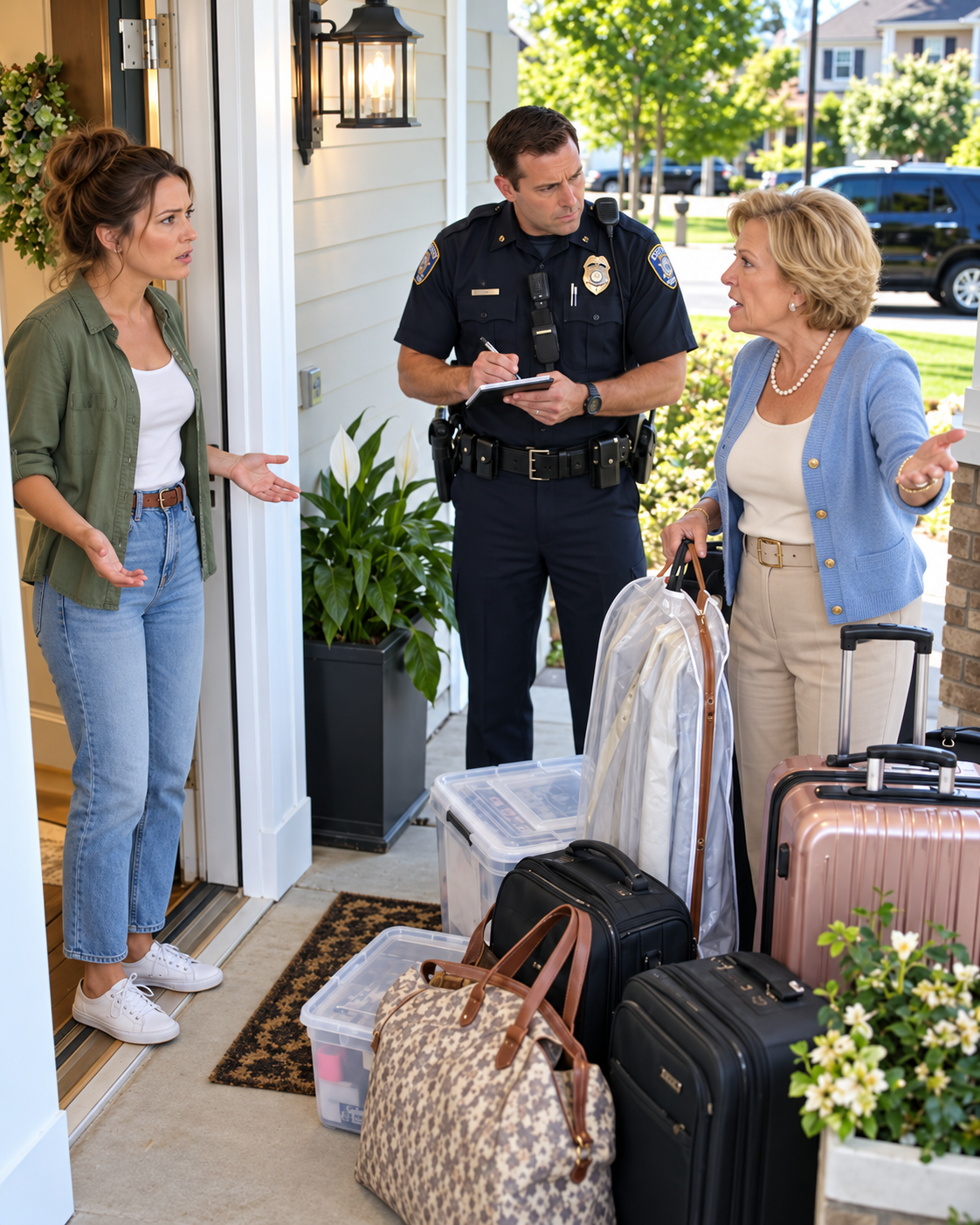
Diane stepped out more slowly. She adjusted the front of her jacket, looked toward the house, and began speaking to Lisa. I couldn’t hear the words through the glass. Lisa nodded, opened the rear hatch, and reached for a suitcase. The first one was large enough to suggest an extended stay. She set it on the driveway and rolled it toward the porch. Then she returned for another. I watched Diane carry a smaller bag while Lisa maneuvered a third suitcase out of the vehicle. For a moment, I tried to tell myself that people sometimes overpack, especially when they don’t know exactly how long they will be away.
Then the storage containers appeared. They were not the sort of bags someone brings for a weekend. They were meant to hold things that needed organizing rather than unpacking immediately. Lisa stacked them near the steps and went back for a garment bag. A tote followed, filled with the recognizable shapes of medication packages, toiletries, and other daily necessities. Diane supervised the unloading with small gestures, directing her daughter where to place each item. Finally, she lifted a peace lily from the vehicle. The plant’s leaves moved in the breeze while she carried it carefully toward the entrance.
The peace lily unsettled me more than the luggage. A person might bring several suitcases because she was uncertain about the weather or didn’t want to leave anything important behind. Storage containers could be explained as convenience. But a houseplant belonged to a different category of preparation. Diane had brought something she expected to settle into a new place and remain there. I looked from the plant to my office window. Mark had told me the arrangement was temporary. Outside, his mother was transferring the visible pieces of an established household to ours. Their actions told a more complicated story than his assurances.
I opened the front door before either woman knocked. Diane looked up and smiled immediately, relieved to see me. “There you are,” she said. “I was beginning to wonder whether we’d have to carry everything around to the other entrance.” She sounded cheerful, though a little breathless from the journey. Lisa stood beside one of the suitcases, one hand on its extended handle. I greeted them both. My voice was steady, and for an instant I hoped the conversation could begin without an argument. Diane looked past me into the hallway with the unmistakable expectation of someone arriving somewhere she believed she belonged.
“Which room did Mark get ready?” she asked. There was no preliminary question about whether he had spoken to me, no suggestion that the arrangement might need confirmation. She was interested only in the practical next step. I kept one hand lightly against the doorframe. “He hasn’t prepared a room for you,” I said. Diane’s smile faltered. “He told me there was plenty of space.” “There is space in the house,” I replied. “That doesn’t mean we’ve agreed on how to use it.” Lisa made a dismissive sound behind her mother. Diane looked at me as though I had answered a perfectly straightforward question in a foreign language.
Lisa stepped closer. “Could we please not turn this into a problem?” she asked. “Mom’s had a difficult enough day.” I looked at the luggage behind her. “I’m aware she’s dealing with a difficult situation.” “Then help us get her settled.” “Lisa, I haven’t agreed to her moving in.” Lisa pressed her lips together and glanced at Diane, apparently confirming something the two had already discussed. “Mark said it was sorted,” she replied. “He said he’d spoken to you.” The distinction mattered. He had spoken to me, but only after making the commitment. I wondered how carefully he had described our conversation to his sister.
“He did contact me,” I said. “He informed me that you’d made a decision. I told him I hadn’t agreed.” Diane turned her head toward Lisa. For a moment, I saw genuine uncertainty in her expression. Then she looked back at me, evidently deciding that the misunderstanding could be corrected by proceeding. “Well, I’m here now,” she said. “We can sort out the details once everything is inside.” I had expected that argument. It was precisely why I had decided the luggage would remain outside. Once the bags crossed the threshold, any later objection could be presented as an attempt to put an elderly woman out onto the street.
“You’re welcome to come in and sit down,” I said. “But we’re not moving your belongings into a bedroom until Mark and I have discussed what is happening.” Diane’s face tightened. “What do you mean, not moving my things in?” I repeated the distinction without raising my voice. She could visit. She could rest. I wasn’t leaving her on the porch because she needed a drink or somewhere to sit. But I had not approved an extended stay, and I wouldn’t pretend otherwise. Lisa looked astonished. “You’re actually going to make her stand here while you argue about furniture?” “I’m not arguing about furniture,” I told her.
Diane straightened her shoulders. “My son invited me.” “I know.” “He lives here.” “Yes, he does.” She looked at the space between me and the open doorway. “Then I think you should let us bring in the bags, dear. They’re not getting any lighter.” There was something familiar about the gentle command. Diane could make an instruction sound like a small favor until the person receiving it refused. Then the warmth disappeared. I moved neither toward her nor away from the door. “The bags can stay on the porch for now,” I said. “We’ll decide what happens after Mark gets home.”
Lisa laughed, although there was nothing amused about her face. “You cannot be serious. She’s seventy-four.” “I’m not disputing her age,” I replied. “I’m saying we need a conversation before anyone moves into the house.” Lisa lifted both hands. “What do you expect her to do? Keep moving from place to place?” “I expect us to figure out something sensible without making promises for other people.” Diane interrupted before Lisa could answer. “I raised two children,” she said. “I’ve spent my life looking after other people. I didn’t think I’d have to negotiate for a place to sleep in my son’s home.”
The words changed the atmosphere. Until then, Diane had seemed irritated by a practical delay. Now she was treating my refusal as a statement about her value within the family. I watched her grip the handle of her handbag, her fingers pressing into the leather. She was upset, and I believed the feeling was genuine. But I also noticed that she had not asked what Mark and I had actually discussed. She was repeating his invitation as though it outweighed everything I might say. “Nobody is saying you don’t matter,” I told her. “I’m asking why no one thought I should be involved before you packed.”
“Because Mark said you’d understand,” she answered. That gave me the first clear indication of what he had allowed her to believe. I looked toward Lisa, but she was checking the position of a suitcase and avoiding my eyes. Diane continued, saying she had already been through enough uncertainty and that Mark had promised she wouldn’t need to worry about finding a place immediately. Her words were not theatrical. They sounded like the explanation of someone who had accepted a reassurance and organized her day around it. For a moment, my anger shifted toward Mark. He had allowed his mother to reach my door with expectations he knew I had not accepted.
I tried again, more gently. “Diane, if Mark had told me beforehand that you were having trouble and asked whether we could make space for you, I would have listened. We could have worked through the details. I’m not refusing to discuss your circumstances.” She looked at me for several seconds. I hoped she might understand that the manner of the invitation had created the immediate problem. Instead, she shook her head. “I’ve already made the journey,” she said. “It’s a bit late for everyone to start reconsidering.” Her eyes moved toward the hallway, as though she was calculating how quickly the discussion could be ended if she simply stepped past me.
I remained in the doorway without closing the door. That distinction was deliberate. I didn’t want to prevent Diane from entering as a visitor, and I didn’t intend to create a physical confrontation over luggage. There was space for her to come inside. I had offered it repeatedly. But Diane seemed to regard the invitation without permission to move in as an insult. She did not want a chair in the kitchen while we waited for Mark. She wanted the room she believed her son had promised, with her possessions brought inside and her presence treated as settled. Lisa shared that expectation, or at least wanted the matter concluded before she had to carry anything back to the vehicle.
“Could you call Mark?” I asked Diane. “Perhaps he’ll answer you.” Lisa took out her own phone, looked at it, then put it away without making a call. Diane said Mark knew she was coming and that there was no reason to trouble him over something already arranged. I told her he hadn’t answered my last question before ending our conversation. Her expression suggested that she regarded this as a marital disagreement she should not have to accommodate. She was willing to accept Mark’s assurances, but not the possibility that those assurances had been given prematurely. Every attempt to separate the issues brought us back to the same obstacle.
Diane glanced toward the room at the end of the hallway. “I assumed I’d have somewhere quiet,” she said. “Mark told me you could reorganize your work things.” Hearing her say it was different from hearing the suggestion through my husband. He had spoken to his mother about moving my office while I was sitting at the kitchen table, unaware that they were considering its future. “That room is where I work,” I said. Diane gave a small shrug. “Lisa needs her office all week. Mark said you aren’t using yours every day.” I looked at Lisa, who stood silently beside the luggage. The family had not merely considered my inconvenience. They had compared it with hers and decided mine mattered less.
I asked Lisa whether she would be willing to move her own equipment out of her spare room for an uncertain period. She frowned. “That isn’t realistic. I need it for my job.” “So do I.” “Your situation isn’t the same.” “Why?” She opened her mouth, then looked away. I wasn’t asking to embarrass her. I wanted her to hear how little effort had gone into considering my needs. Diane intervened, saying this was not the time to argue about who worked harder. I agreed. The problem was not whose job was more demanding. The problem was that Lisa had been allowed to answer for herself while Mark had answered for me.
Diane’s patience finally broke. She lifted her chin and looked directly at me. “Mark doesn’t need to get his wife’s approval every time he wants to help his mother,” she said. Her voice carried across the porch with the assurance of someone who had reached the decisive point of an argument. I felt my face grow warm, but I made myself wait before answering. She was no longer discussing the rent increase, her loneliness, or the difficulty of finding another home. She was discussing authority. In her view, Mark’s invitation ought to be enough because he was her son and this was, as she understood it, his household.
“You have every right to ask your son for help,” I said. “But asking him doesn’t remove my right to be included in decisions about where I live.” Diane looked offended by the distinction. Lisa stepped between us slightly, though neither of us had moved toward the other. “This is getting ridiculous,” she muttered. “Mom, don’t waste your energy arguing.” I thought she might suggest returning to the vehicle or waiting quietly for Mark. Instead, she reached into her pocket and took out her phone again. She unlocked the screen and raised it in front of her, holding it so that the camera faced the doorway.
I looked at the phone, then at Lisa. She adjusted her grip and tilted it slightly upward. A small movement of her thumb suggested she had started recording. “What are you doing?” I asked. “Making sure there’s a record of this,” she replied. Diane stood straighter. The uncertainty I had noticed earlier vanished from her expression. She seemed reassured by the idea that someone would be able to see how the confrontation had unfolded. I looked at the suitcases, the open door, and the phone aimed at my face. Lisa appeared convinced that a recording would demonstrate my cruelty. Neither woman had considered what it might reveal about the arrangements they had made without me.
END PART 2
PART 3 TITLE: My Sister-in-Law Raised Her Phone to Record My Refusal, but One Familiar Claim Made the Scene Far More Dangerous
The moment Lisa began filming, the disagreement took on a different character. I was no longer speaking privately with two relatives about an arrangement I had never accepted. I was standing in my own doorway while my husband’s sister collected what she apparently considered evidence against me. Lisa held the phone at chest height, watching its screen rather than my face. Diane stood beside her, one hand resting on a suitcase as though it represented proof that she belonged inside. Neither woman asked whether the recording was necessary. To them, my refusal had become something that needed to be documented, and they seemed certain the camera would make their position stronger.
I asked Lisa what she intended to accomplish. She said she wanted everyone to see how her mother was being treated. “Then make sure you record the whole conversation,” I replied. “Including the part where I offered her somewhere to sit while we waited for Mark.” Lisa’s eyes narrowed. “You know perfectly well what Mom needs.” “I know what Mark promised,” I said. “Those aren’t necessarily the same thing.” She moved the phone slightly closer. I could see my reflection in the dark edge of its screen, framed by the doorway and the hallway behind me. The sight was peculiar. I looked like someone being interviewed about an incident that had already happened.
Lisa began describing the situation aloud, evidently for whoever might eventually watch the recording. She explained that Diane had nowhere suitable to stay, that Mark had offered his mother a room, and that I was preventing an elderly woman from entering her son’s home. Her account contained pieces of truth arranged to produce the wrong conclusion. Diane was having housing difficulties. Mark had offered accommodation. I was refusing to let them move her belongings inside. What Lisa omitted was the reason I was refusing and the fact that I had explicitly invited Diane in as a visitor. It was remarkable how quickly a dispute could be transformed simply by leaving out the words that made it understandable.
“You’re welcome to film,” I said, “but please stop saying I’ve barred your mother from coming inside. The door is open.” Lisa looked toward the gap beside me and then back at her screen. “You know what I mean.” “I do know what you mean. You want to bring everything in and make this her new address.” Diane’s expression hardened. “This is not some stranger asking for charity, Claire.” “I’ve never said it was.” “Then why are you behaving as though I need an appointment to visit my son?” I looked at the luggage again. “Because this isn’t a visit. You brought the things you need to live here.”
Diane pressed her lips together. For a moment, I thought she might acknowledge the distinction. Instead, she began listing the ordinary things Mark had told her. There would be a quiet place to sleep. She could settle in without constantly worrying about her apartment. There was room for her personal belongings. She would have people around instead of spending every evening alone. None of those promises sounded unreasonable when considered separately. The problem was that I had not been included in making them. I listened as Diane explained the home she thought she was entering, increasingly aware that my husband had described our future to her in considerable detail while telling me almost nothing.
“Did Mark tell you I’d agreed?” I asked. Diane hesitated. Lisa lowered the phone a fraction, then raised it again. “He told me it had been taken care of,” Diane replied. “That isn’t quite the same answer.” “I trusted my son.” I had no response to that. Trusting Mark was not, by itself, a mistake. I had trusted him too. He was my husband. The reason I was standing there, struggling to remain composed, was that he had placed two people who trusted him on opposite sides of a promise he could not honestly fulfill. Diane had every reason to expect that he would tell her the truth about whether she had somewhere to live.
I asked her to consider what would happen if we carried the luggage inside before reaching an agreement. Would she expect to sleep in the room Mark had described? Would she be upset if I needed the space for work the following morning? How would we decide how long she could remain? Diane looked impatient with the questions. “We’d manage,” she said. “Families make arrangements.” “They do,” I answered. “But they usually discuss them before somebody arrives with half their possessions.” Lisa gave an incredulous laugh. “So now you’re criticizing Mom for being organized?” “I’m asking why she was told to prepare for something I hadn’t agreed to.”
That was the difficulty with trying to explain myself. Every practical objection could be turned into a comment about Diane personally. If I questioned the duration of the stay, I was making her feel unwelcome. If I mentioned the disruption to my work, I was placing my career above family. If I refused to have her luggage moved inside, I was apparently condemning her to remain outside forever. None of those interpretations reflected what I had said. Yet Lisa seemed more interested in collecting statements that might support them than in understanding the situation. I stopped following her from accusation to accusation and returned to the only point that mattered.
“Mark needs to come home,” I said. “Then we can decide what happens.” Diane looked at her watch. “He knows I’m here.” “Does he know we’re having this conversation?” I asked. She took out her phone and called him. We waited as it rang. No answer. She frowned, held the phone away from her ear, and tried again. Lisa kept recording, though there was little to capture except the three of us standing in an uncomfortable silence. Diane ended the second call with an abrupt movement of her thumb. “He’s probably driving,” she said. “Then he can talk when he arrives,” I replied. “That doesn’t give us a reason to move your belongings now.”
I saw Diane look toward the doorway again. The room beyond was familiar to me, with the ordinary marks of a home that had been lived in and cared for. To her it seemed to represent something different: relief from uncertainty, an end to difficult evenings, and a promise that someone else would deal with what came next. I understood why she wanted to believe the move could go forward without complications. But I also understood that accepting her belongings under pressure would make it much harder to discuss what any of us could reasonably provide. A home could offer comfort only if the people living there weren’t quietly surrendering their needs to avoid disagreement.
Diane placed her phone back in her handbag. “This is getting out of hand,” she said. “Mark has worked hard for this house, and I won’t be made to feel like an intruder when my own son has asked me to stay.” I caught the familiar phrasing immediately. Mark had worked hard for the house. I was fortunate to live in it. His efforts had provided the security we enjoyed. Diane had made variations of those remarks so often that I usually treated them as background noise. Now, standing in front of a recording phone while she challenged my right to object, I realized those apparently harmless comments had created a very specific misunderstanding.
“Diane,” I began, “you may not have the whole picture about—” She interrupted me. “I know enough. My son is the one who owns this place.” She said it firmly, without uncertainty or any sign that she expected to be contradicted. Lisa gave a small nod, apparently agreeing. I looked from one woman to the other. There it was: the assumption beneath everything that had happened since the SUV arrived. They weren’t merely arguing that Mark had a right to invite his mother for a visit. They believed he possessed the final authority to decide who would live there, regardless of my wishes.
For a second, I almost corrected Diane immediately. The information was straightforward, and I could have spoken the truth in a single sentence. But something in the certainty of her statement held me back. I wanted to understand how she had arrived at a belief so different from the facts. Was it something Mark had explicitly told her, or had she constructed it from the way he spoke about our home? Had Lisa made the same assumption? Had they discussed moving my office because they genuinely thought I had no standing to object? The questions arrived in quick succession, and I realized that simply correcting the misunderstanding might leave its cause untouched.
I remembered the family dinners when Diane praised Mark for giving us a comfortable life. Sometimes she made those remarks while sitting in the kitchen I had just cleaned or enjoying a meal I had prepared. I never interpreted her words as an invitation to debate property ownership. I assumed she was expressing pride in her son, even when her praise failed to acknowledge my contribution. Lisa rarely challenged her. Mark usually smiled and changed the subject. Over time, their version of our household had become a family habit. I had not imagined that this habit might eventually be used to justify taking over part of the house without consulting me.
It would have been easy to dismiss Diane as simply arrogant. She certainly spoke with more authority than the situation justified, and she seemed unable to accept that my refusal deserved consideration. Yet the longer I watched her, the more I recognized something else. She believed she had been invited by someone with the power to guarantee the invitation. From that perspective, my disagreement must have seemed both surprising and offensive. She saw herself arriving at her son’s home after being promised a safe place, only to discover that his wife was standing in the way. That understanding did not excuse her behavior. It did, however, reveal how thoroughly Mark had failed to prepare anyone for the truth.
“Did Mark tell you he owned the house?” I asked. Diane gave an impatient little shake of her head. “Why are you splitting hairs?” “Because you just said it, and I’d like to know whether he said it to you.” Lisa moved the camera closer. “This is ridiculous. They live here together. It’s his home.” “He lives here,” I agreed. “But that doesn’t explain why you think he can move someone in without consulting me.” Diane looked offended that I was still questioning the matter. “I don’t need a lesson about marriage,” she said. “My son would never offer me somewhere to stay if he wasn’t entitled to do so.”
I let that statement settle. It was clear Diane didn’t intend to reconsider. She was treating Mark’s promise and the authority to fulfill it as interchangeable. Lisa seemed to share that view, although she framed it more practically. She pointed out that Mark paid his share of the household expenses and therefore had every reason to expect his mother could stay when necessary. I didn’t dispute that Mark had responsibilities within our marriage. I had never regarded him as a guest or suggested he had no voice in the household. But the fact that he lived there did not establish that he alone could impose an extended living arrangement on me.
The discussion became less about Diane’s immediate needs and more about whether my objection mattered at all. That was when I began to understand how different the conversation might have been if Mark had told his family the truth before they arrived. Diane could have expressed disappointment in private. Lisa could have offered suggestions without pointing a camera at me. Mark and I could have disagreed, perhaps even sharply, without forcing his mother to witness the argument. Instead, his assurances had made my cooperation seem inevitable. Now that I was refusing, the only explanation his family could accept was that I had become deliberately unreasonable.
“Let’s call him once more,” I suggested. Lisa glanced at Diane, who shook her head. “I’ve called enough,” she said. “I’m tired of standing here being talked down to.” “You don’t have to stand,” I replied. “You can come inside without the bags.” She looked toward the open door but made no move. I realized the offer itself had become unacceptable to her. Coming inside as a visitor would mean acknowledging that the move was not yet settled. Remaining outside, surrounded by luggage, allowed her to present the situation as one in which I was excluding her entirely. She seemed determined not to accept an arrangement that contradicted what she believed Mark had promised.
Diane folded her arms and stared at me. “Perhaps somebody else needs to explain that you cannot treat people this way,” she said. I assumed she meant another relative, perhaps someone who would telephone Mark or urge us both to calm down. “Who would you like to explain it?” I asked. She reached for her phone again. Lisa stopped shifting her weight and focused the camera more carefully. Something in their sudden composure made me uneasy. Diane was no longer trying to persuade me to carry her belongings inside. She was preparing to involve someone whose authority she expected me to recognize.
“Who are you calling?” I asked. Diane looked directly at me. “Emergency services. If you’re going to keep me out of my son’s house, I’ll ask the police to deal with it.” For a moment, I thought she was trying to frighten me into stepping aside. Calling 911 over a disagreement about moving into a spare room seemed so disproportionate that I couldn’t believe she intended to follow through. I told her there was no emergency. Nobody had threatened her. Nobody was injured or trapped. The front door was open, and she had been invited inside as a guest. Diane pressed her lips together and began dialing.
“Diane, please think about what you’re doing,” I said. “The police can’t decide our family living arrangements for us.” She looked away, concentrating on the call. I heard the faint sound of the connection through the phone. Lisa took a small step sideways to keep both of us within the frame. I felt a flash of anger at the sight, not because I feared being recorded but because she seemed to consider this a useful moment to preserve rather than an unnecessary escalation to prevent. I had expected Lisa to be defensive of her mother. I had not expected her to encourage a situation in which a family argument might summon an officer to our home.
When the dispatcher answered, Diane immediately described herself as a woman being refused entrance to her son’s residence by her daughter-in-law. She said Mark had invited her to stay and that I was preventing her from entering. I listened in disbelief. The statement was not simply incomplete. It presented the situation as if Diane already possessed a right to enter that I was unlawfully denying. “That’s not what happened,” I said, keeping my voice level. Diane turned away from me and continued talking. She told the dispatcher that her belongings were outside and that I was refusing to allow her to bring them into the house.
I looked down at the threshold. The door remained open, just as it had been when I first greeted them. A person standing in Diane’s position could have stepped inside without anyone needing to unlock a door or move a barrier. I had not told her to leave the property, nor had I prohibited her from visiting Mark. What I had refused was permission to establish a new living arrangement on the strength of a promise I had never made. Listening to her telephone account, I understood how easily those details could disappear when someone described only the result they wanted to change. Lisa was still recording, and I hoped her video showed enough of the conversation to preserve the distinction.
Diane listened to a question from the dispatcher and answered that she had come there to live with her son. She emphasized that he had personally made the arrangements. Her voice was controlled, almost formal. I could hear occasional small sounds from the phone but could not make out the dispatcher’s words. After another exchange, Diane repeated that this was her son’s house. She said it with the same confidence she had used earlier, evidently convinced that the statement would settle the matter. I stood very still. There was something troubling about hearing an assumption repeated to a person whose job was to establish facts rather than accept a family’s understanding of them.
I considered speaking directly into the phone, but Diane was holding it close to her ear and facing away. Interrupting would probably add confusion. Instead, I waited until she looked toward me and said clearly that she had been offered entry as a visitor. She gave me an irritated glance. “She keeps making excuses,” she told the dispatcher. I felt the familiar temptation to explain every detail, every omission, every inconsistency. But I remembered how Mark had responded when I tried to clarify the situation by telephone. Longer explanations had not helped because nobody wanted to reconsider the decision. I resolved to answer any officer’s questions plainly and let the facts speak for themselves.
At last Diane ended the call. Lisa lowered her phone enough to look at her mother. “Well?” she asked. Diane placed her phone in her handbag and adjusted its strap. “Someone is coming,” she said. There was satisfaction in her voice. She looked at me as though the argument had already been resolved in her favor. I looked at the luggage stacked beside the porch railing, the peace lily balanced carefully away from the steps, and the medication tote resting against a storage bin. The scene had become absurdly public, yet every object still represented a real person trying to solve a real housing problem.
I asked Diane once more to wait until Mark arrived before making any decisions. She shook her head. “We’ll see what the officer says.” Lisa raised the camera again. Neither woman seemed to understand that the police might ask questions they had never considered. I thought about the document that established ownership of the house, and about how little attention I had paid to Diane’s repeated assumptions over the years. There had never been a reason to produce paperwork at a family dinner. Now a police officer was coming to investigate a complaint based partly on a claim that simply wasn’t true.
I glanced toward the street and realized that, whatever happened next, Mark would have to answer for more than a poorly handled invitation. His mother had called 911 because she believed she was being denied access to property that belonged to him. Lisa had recorded my refusal because she apparently believed the same thing. Both women were acting on a certainty Mark had done nothing to correct. I could no longer protect him from the consequences by smoothing over the disagreement. For the first time that afternoon, I wanted him to arrive before anyone else did, not so he could rescue me from the confrontation, but because he needed to explain to his family exactly what he had promised.
END PART 3
PART 4 TITLE: When a Police Cruiser Pulled Beside the Luggage, My Husband Finally Faced the Question He Had Avoided All Afternoon
At 5:34, Mark’s car entered the driveway. I recognized the sound of the engine before I saw him turn in, and for one brief moment I felt relief. At least the person who had created the situation was finally here to explain it. But almost immediately, another vehicle approached from the opposite direction. A police cruiser slowed near the house, its lights visible against the fading afternoon brightness. Mark pulled to a stop and remained behind the wheel for several seconds. He looked toward his mother, then at Lisa holding her phone, and finally at the luggage occupying our porch. When his eyes moved to the police car, his expression changed completely.
He climbed out with his keys still in one hand. “What’s happened?” he called. Diane moved toward him at once. “Your wife refuses to let me in,” she said. “I’ve had to call the police.” Mark stared at her. “You called the police?” His voice carried genuine disbelief. Lisa stepped closer, apparently ready to supply her own explanation, but he barely looked at her. His attention moved back to the cruiser. I watched him take in the situation, noticing how quickly the confidence he had displayed on the phone disappeared. It was one thing to promise his mother a room and expect me to cooperate. It was another to arrive home and discover that his promise had produced an official complaint.
The officer stepped out of the cruiser and approached at an unhurried pace. He wore a nameplate identifying him as Ruiz. He glanced at the luggage before looking toward the three of us standing near the entrance. There was no dramatic announcement, no sudden accusation, and no indication that he regarded anybody as guilty of anything. He appeared to be assessing a situation that had been described to him but not yet explained. I found that steadiness unexpectedly reassuring. After nearly half an hour of people insisting that their version of events was the only reasonable one, someone had arrived who seemed willing to begin by asking questions.
“Who placed the call?” Officer Ruiz asked. Diane raised her hand slightly and stepped forward. “I did. Thank you for coming.” She sounded relieved, almost grateful, as though the arrival of a uniform had already settled the argument. Ruiz asked her to explain what had happened. Diane told him that her son had arranged for her to live at the house because she was having difficulty with her apartment. She said she had arrived with her belongings and had been refused entry by her daughter-in-law. She gestured toward me as she spoke. Her description was practiced by now, and she delivered it without hesitation.
Ruiz looked toward the open front door. Then he looked at the luggage. “You’re saying someone who lives here has prevented you from entering?” he asked. Diane nodded. “My son lives here,” she replied. “He’s invited me to stay, and Claire won’t allow me to move my things inside.” That answer was more accurate than the accusation she had made during the emergency call. The officer seemed to notice the distinction. He asked whether Diane was already a resident at the address. She answered that she was moving in that day. “Have you been staying here recently?” he continued. “No,” she said, “but my son made arrangements for me.”
Lisa stepped forward before Ruiz could ask another question. “This has been completely unnecessary,” she said. “Mom is seventy-four. She isn’t asking for anything unreasonable. Mark offered her somewhere to live, and Claire is turning it into a fight.” Ruiz looked at Lisa’s phone, which was still raised. “And you’re?” he asked. “Lisa. Her daughter. Mark’s sister.” She lowered the device slightly. The officer nodded and returned his attention to Diane. He seemed determined to identify everyone’s connection to the house before drawing conclusions. For the first time, Lisa’s running commentary was not controlling the conversation.
Ruiz asked Diane whether she had previously received mail at the address. She shook her head. Had she ever kept a permanent room there? No. Was she claiming that she had lived there before and had now been prevented from returning? Diane looked irritated. “I just told you I’m moving in today,” she said. “Mark said I could.” The officer’s expression remained neutral. “I’m trying to establish whether you’re being kept out of a residence you already occupy or whether there’s a disagreement about a proposed move,” he explained. Diane glanced toward Lisa, evidently dissatisfied with the distinction. To her, the situation was simple: she had been promised a place to live, and somebody was refusing to honor the promise.
The officer turned toward me. “Can I have your name, please?” “Claire Bennett,” I replied. “I live here with my husband.” He asked me to describe my understanding of the dispute. I pointed toward the doorway without stepping away from it. “Diane is welcome to come inside as a visitor. I’ve told her that several times. What I haven’t agreed to is having her move into the house today. Mark told me this afternoon that the arrangement had already been made. He hadn’t discussed it with me beforehand.” Ruiz listened without interrupting. He looked once toward Mark, who was standing beside the driveway with his keys still in his hand.
I continued carefully. “I’m not saying Diane doesn’t need help, and I’m not saying Mark shouldn’t help her. I’m saying we haven’t agreed on an extended stay or on which room she would use. There are things we need to discuss before anyone moves in.” Ruiz asked whether I had locked the door or otherwise prevented Diane from entering for a visit. “No,” I answered. “It has been open since they arrived. I’ve offered her a place to sit while we wait for Mark.” Diane shook her head. “That’s not the point,” she said. Ruiz looked toward her. “Then let’s make sure I understand what the point is.”
That question seemed to unsettle Diane more than any direct disagreement might have. She wanted the officer to instruct me to stand aside. Instead, he was separating the immediate complaint from the much larger family argument. Diane explained again that Mark had asked her to move in. Ruiz acknowledged the statement and turned toward my husband. “Sir, are you Mark Bennett?” Mark nodded. “Yes.” “You live at this address?” “I do.” “And you invited your mother to come here today?” Mark glanced at me before answering. “Yes, I did.” The officer waited, giving him an opportunity to explain further. Mark did not take it.
I watched my husband carefully. During our telephone conversation, he had been quick to present his mother’s needs as the answer to every concern I raised. Now, standing before an officer who was asking the same basic questions, he seemed unable to find words. I wondered whether it was the uniform, the embarrassment of having the police at our house, or the simple fact that he could no longer move between different conversations and give each person the answer they wanted. Everyone was present. Anything he said to reassure Diane would be heard by me. Anything he admitted to me would be heard by his mother.
Ruiz asked Mark what arrangements he had made. “Mom’s apartment situation has become difficult,” Mark explained. “Her rent went up, and she’s been unhappy there. We thought it might be easier for her to stay with us.” The officer glanced toward me. “When you say ‘we,’ who agreed to that?” Mark looked uncomfortable. “My sister and I talked about it with Mom.” Ruiz waited for the rest. “And your wife?” he asked. Mark rubbed the back of his neck. “I told Claire this afternoon.” “Before or after you arranged the move?” My husband stared at the ground for a moment. “After we’d discussed it,” he admitted.
Diane gave a sharp sigh. “He had every reason to assume Claire would be reasonable,” she said. “Nobody expected this.” I looked at Mark, hoping he might correct the implication. He remained silent. Ruiz did not adopt Diane’s description. He asked instead whether there had been a specific agreement about the length of her stay. Mark answered that it would be temporary. Diane nodded, evidently satisfied by the word. I knew how uncertain it was. I had asked Mark the same question less than an hour earlier and received a range that extended from several weeks to a couple of months. The lack of a definite arrangement was not a minor inconvenience. It was part of what we had failed to discuss.
“How temporary?” Ruiz asked. Mark looked surprised by the question. “We haven’t set an exact date.” The officer nodded and glanced at the belongings. I followed his gaze to the three suitcases standing beside the railing, the storage bins stacked behind them, and the garment bag hanging from a handle. Diane’s peace lily sat between the tote and the steps. Everything was arranged neatly, as though someone had expected it to be carried inside within minutes. The plant had begun to cast a long shadow across the porch boards. I wondered whether Ruiz noticed it as an indication of a planned move or simply as another object awaiting an answer.
Mark shifted his weight and spoke to me. “Claire, can we talk privately for a second?” I nearly agreed. Under ordinary circumstances, I would have preferred to discuss a marital disagreement away from his family, and certainly away from a police officer. But Mark had already had opportunities to speak privately with me. He had used the first to announce an arrangement and ended the conversation when I asked whether his mother was on her way. Now Diane had involved the police because she believed Mark’s invitation gave her a right I was improperly denying. Leaving the scene would not correct that misunderstanding.
“There’s nothing I’m saying here that you haven’t already heard,” I told him. “Your mother believes you’ve made an agreement that includes me. You need to explain what actually happened.” Mark looked toward Diane. She was standing with her hands clasped in front of her, waiting for him to defend her position. Lisa had stopped moving the camera around and was holding it almost still. I could see the tension in Mark’s face. He had spent the afternoon trying to prevent disappointment, and his efforts had ensured that everyone was now disappointed in public. I felt no pleasure in watching him struggle. I wanted him to tell the truth before the argument grew any more complicated.
Ruiz addressed Mark again. “There’s another point I need to establish. You said this is your residence. Are you also the owner of the property?” Mark’s expression changed. Until that moment, the questions had concerned who lived there, what arrangements had been discussed, and why the police had been called. Ownership was a different matter. It was a factual question, one that could not be settled by explaining that Diane was elderly or that Mark had been trying to help. I watched him glance briefly toward me, then toward his mother. Diane seemed to recognize the importance of the question, but not the difficulty it presented for her son.
“Of course he is,” Diane answered before Mark spoke. “This is his home.” Ruiz turned toward her. “I’d like him to answer, ma’am.” She looked offended but fell silent. Mark remained still. I could almost see him calculating which explanation would cause the least trouble. He might have tried to discuss the difference between living in a house and owning it. He might have said we were married and therefore shared responsibilities. He might have repeated that the arrangement was intended to be temporary. But none of those responses would answer the officer’s actual question. Ruiz waited with the patience of someone accustomed to people discovering that a straightforward inquiry could have an uncomfortable answer.
Lisa moved a little closer to Mark. “He lives here with his wife,” she said. “Surely that means something.” Ruiz acknowledged her without shifting his attention from my husband. “It establishes that this is his residence. I’m asking about the ownership.” Lisa frowned. “Why does that matter? We’re talking about his mother needing somewhere to stay.” “Because the complaint involves someone’s claimed authority to occupy a property,” the officer replied. His voice remained even. “I need to understand the circumstances before I can determine what, if anything, requires police involvement.” The explanation was not a judgment in my favor. It was simply an insistence on establishing facts.
Diane looked from the officer to Mark. “Tell him, sweetheart,” she said. “Explain that this is your house and that you’ve asked me to come here.” There was no hesitation in her voice. Whatever doubts she might have felt when I first refused to let the luggage inside seemed to have disappeared. She expected Mark to confirm her understanding and end the dispute. Lisa looked equally certain, though her expression had become more watchful. I could tell that neither woman understood why Mark was taking so long to answer. They had expected an officer to reinforce his authority. The questions were beginning to suggest that the matter was not nearly as simple as they believed.
Mark finally cleared his throat. “I have some documents,” he said. Ruiz asked what kind. “Property papers. Things that might explain it.” I looked at him sharply. The documents could settle the ownership question, but I was surprised that he had brought them in his vehicle. The reason was not apparent, and I had no intention of inventing one. Whatever had prompted him to keep them there, he now seemed relieved to have something concrete to offer. Ruiz told him he could retrieve the paperwork. Mark nodded and moved toward his car, looking at neither his mother nor me as he passed.
Diane watched him go. “There,” she said, apparently reassured. “He’ll show you.” Lisa lowered her phone a little, and I noticed that her hand had begun to tire from holding it in one position. I wondered whether she was still recording. I didn’t ask. The important question was no longer whether I could persuade her that she had misunderstood the situation. Mark was about to produce documents that would answer something none of his relatives had seriously considered. I knew what those records said. I also knew that Diane’s confidence rested on an assumption that had never been checked.
While Mark searched through his car, Ruiz asked a few more questions about what had happened when Diane arrived. He wanted to know whether there had been threats or physical contact. I said there had not. Diane had asked to bring her belongings inside, and I had refused until Mark and I could discuss the proposed move. There had been an argument, but no violence. Lisa confirmed that nobody had struck or shoved anyone, though she added that I had been cold toward her mother. Ruiz did not appear interested in evaluating my warmth. He wanted to know what actions had actually taken place. I was grateful for that distinction.
Diane said she had felt humiliated standing outside with her bags. I believed her. There was nothing dignified about arriving somewhere expecting to be welcomed and discovering that your arrangements had not been agreed upon. But her embarrassment did not erase the circumstances that had caused it. “I didn’t ask them to unload everything,” I explained. “And I didn’t tell Diane she had to remain on the porch. I said she could come inside and wait while we worked out what was happening.” Ruiz asked Diane whether that offer had been made. She looked away before acknowledging that I had invited her in without the luggage. It was the first time she had confirmed that detail to the officer.
Mark returned carrying a folder. He held it against his side as he approached, his movements slower than when he had first stepped out of the car. I watched him stop a short distance from Ruiz and open the folder. The officer accepted the first document and scanned it. Mark explained quietly what it was. Ruiz looked at the printed information, then asked a question about whether the record was current. Mark nodded. The officer turned a page and examined another section. Diane leaned forward slightly, apparently expecting him to find the confirmation she had wanted from the beginning.
The atmosphere had changed without anyone raising a voice. The argument about Diane’s age, Lisa’s office, and my supposedly unreasonable behavior had been replaced by a few sheets of paper and an officer examining them carefully. I noticed that Lisa was no longer narrating the situation into her phone. She held it at her side, watching Ruiz. Diane’s hands were still clasped tightly in front of her. Mark stood close enough to see the documents but made no attempt to explain them aloud. His earlier certainty had disappeared. He seemed almost to be waiting for the officer to say what he had been unwilling to tell his family himself.
Ruiz asked Mark for the other document in the folder. Mark separated two sheets, checked them, and handed one over. The officer compared the information, running his eyes across the names and the printed details. I recognized the document from where I stood, though I could not read every line at that distance. I knew what it established. I also understood why Mark was finding the moment so difficult. Until now, he had been able to describe the house in whatever way made the conversation easiest. His mother heard one version of his authority. I heard another. The document left very little room for interpretation.
Diane took a small step toward the officer. “Is there some problem?” she asked. Ruiz did not answer immediately. He examined the document once more and looked toward Mark. “You understand what this record establishes?” he asked. Mark swallowed before replying. “Yes.” Diane frowned. “Mark, what is he talking about?” My husband rubbed his forehead, then let his hand fall. It was a gesture I had seen many times when he wished a difficult conversation would end on its own. But there was no convenient way to end this one. His mother had summoned an officer to establish a right that she believed came from her son’s ownership of the house.
I felt the first real tremor in my hands and folded my arms to keep them still. I wasn’t frightened of the papers. The facts were familiar to me. What disturbed me was the realization that it had taken an emergency call and an officer standing in our driveway to make Mark face something he should have clarified long before Diane packed her belongings. I thought again of his message at 4:17, the confidence with which he had announced that everything was settled, and his refusal to answer when I asked whether his mother was already traveling toward us. He had wanted to avoid an uncomfortable conversation. Now everyone was standing inside the consequences of that avoidance.
Ruiz adjusted the document so he could see the information clearly, then looked at Diane. She was waiting with an expression of strained certainty. Lisa’s phone was no longer aimed at my face. Mark was staring toward the porch boards, saying nothing. For a moment, I wanted to interrupt and spare him the embarrassment of hearing the truth spoken aloud in front of his family. That impulse surprised me. Even now, after everything he had done, some part of me was accustomed to protecting him from difficult moments. But the truth did not belong to him to conceal, and I was no longer willing to help maintain an explanation that had brought the police to our home.
Officer Ruiz looked at the ownership information one last time. Then he raised his head, turned toward Diane, and asked Mark to stand where everyone could hear his response. Diane’s expression shifted from confidence to confusion. She looked at her son, waiting for the explanation he had failed to give her all afternoon. Mark remained silent. Ruiz held the document between them and began to read the name printed beside the property ownership details. I knew that once he finished the sentence, Diane would have to confront something far more consequential than whether her suitcases could be carried through the front door. She would have to confront what her son had allowed her to believe.
END PART 4
PART 5 TITLE: The Name on the Property Record Was Mine, but What Shook My Mother-in-Law Was Realizing Her Son Had Always Known
Officer Ruiz read my name from the ownership document, then looked directly at me. “Mrs. Bennett, according to this record, the property belongs to you.” The words were delivered without emphasis. He might have been confirming an address or checking a date. Yet the effect on our little gathering was immediate. Diane’s expression went blank, Lisa lowered her phone, and Mark suddenly became fascinated by the space between his shoes. I stood in the doorway with my arms folded, feeling strangely detached from the moment. There was nothing surprising about the information. I had known it all along. The only surprise was that everybody else seemed to be hearing it for the first time.
“Yes,” I answered. “The house is registered in my name.” Ruiz checked the document again, making certain he understood its contents. Then he asked whether Mark’s name appeared anywhere in the ownership information. “It doesn’t,” I said. Mark gave a slight nod, confirming my answer without looking up. The officer returned his attention to the document. Diane looked between us, waiting for someone to explain why the conversation had taken such an unexpected direction. For nearly half an hour, she had spoken as though Mark’s authority over the property was beyond dispute. Now an official record was establishing something entirely different, and nobody seemed willing to help her reconcile the two.
“That can’t be right,” Diane said. Her voice was quieter than before, but there was a hard edge beneath it. She turned toward Mark. “You told me this was your house.” My husband rubbed the back of his neck, a familiar gesture that usually appeared when he wanted to postpone an unpleasant answer. “I told you Claire and I lived here,” he replied. Diane stared at him. “That isn’t the same thing, and you know it.” He opened his mouth, then closed it again. For once, his mother had identified the exact distinction he had been unwilling to make all afternoon.
I watched Diane’s face as she considered his answer. She was not merely discovering that she had misunderstood a document. She was realizing that the version of our household she had repeated for years might have been fundamentally wrong. Her eyes moved toward the front door, then along the windows, as though the building itself might provide some explanation. She had visited us countless times. She had eaten in our kitchen, sat in our living room, and admired improvements to the house. None of those visits had required her to ask whose name was on the deed. Until that afternoon, the question had apparently never occurred to her.
“Mark,” she said, “you’ve always talked about this place as your home.” He glanced toward me. “Because it is my home.” “But it isn’t your property?” He hesitated before answering. “Not in the way you mean.” Diane looked genuinely bewildered. I almost felt sorry for her. Mark was still searching for language that would preserve a little of the authority she had attributed to him. He wasn’t lying when he said the house was his home. He lived there. We were married. He had routines and responsibilities within its walls. But none of that changed what the paperwork established, and none of it gave him the right to treat my agreement as unnecessary.
Officer Ruiz allowed the exchange to continue briefly before asking Mark to clarify the ownership arrangement. My husband finally acknowledged that the property belonged to me and that his name was not on the deed. The admission seemed physically difficult for him, though I couldn’t understand why. I had never regarded his living with me as something shameful. Marriage was not a competition over who possessed the more valuable assets. Our household had responsibilities we shared and decisions we were supposed to make together. I had never used the ownership documents to diminish Mark. Yet standing there, I began to wonder whether his reluctance came from a belief that telling his mother the truth would somehow make him appear less important.
The question reminded me of conversations I had dismissed over the years. Diane would praise Mark for giving us a secure home, and he would accept the compliment with a modest smile. Lisa would mention how fortunate I was to have a husband who provided such stability. I usually redirected the discussion or let it pass. I assumed everyone was speaking loosely, using familiar language rather than making a literal statement about legal ownership. Now I saw how those repeated remarks had built a shared understanding that excluded the actual facts. It hadn’t happened in one dramatic conversation. It had happened through a long series of small omissions, each one easier to overlook than the last.
Diane turned to me. “You never told me the property was yours.” Her tone suggested an accusation, as though I had withheld something she was entitled to know. I looked at her carefully before answering. “You never asked me.” She drew herself up. “That’s hardly fair.” “Neither is assuming that Mark owns everything because he’s your son.” Lisa made a small movement beside her mother, but she didn’t interrupt. I continued more gently. “I didn’t conceal the ownership. It wasn’t something I discussed at every family dinner. Mark knew the arrangement, and I assumed that was enough.” Even as I spoke, I recognized the uncomfortable lesson in my own assumption. The truth had been known within my marriage, but Mark’s silence had allowed another version to flourish outside it.
Diane looked back toward her son. “You knew all along?” Mark nodded. “Of course.” She seemed unable to accept that answer. “And you let me stand here saying Claire was keeping me out of your property?” He shifted his weight. “I didn’t know you were going to say that.” Her eyebrows rose. “You knew what I believed.” He started to object, but she continued. “You heard me say it before. Plenty of times.” That was true. I remembered several occasions when Mark had been present for exactly that kind of remark. He might not have encouraged Diane in so many words, but he had never corrected her either.
“I wasn’t trying to mislead you,” he said. It was the first defense he had offered that sounded less rehearsed than frightened. Diane shook her head. “Then what were you doing?” Mark looked from his mother to the officer and back again. “I didn’t think it mattered who owned the house when we were talking about helping you.” I felt the old frustration return. He still wanted the issue to be about his intentions rather than the authority he had assumed. “It mattered when you promised her a room without discussing it with me,” I said. “And it mattered when she called the police because she thought I had no right to refuse.”
For a moment, no one answered. A vehicle passed along the street, its tires making a soft sound against the road. Somewhere nearby, a dog barked twice. Those ordinary noises made the scene feel even stranger. My husband’s mother stood next to three suitcases and a houseplant while a police officer examined documents proving who owned the house. Lisa had been recording the entire confrontation as though she expected it to expose my wrongdoing. Mark had arrived hoping to smooth over an inconvenient family disagreement. All of them were discovering that the question they had avoided was not whether Diane deserved help, but who had been given the right to decide how that help would be provided.
Lisa recovered first. “Mark still lives here,” she said, stepping closer to Officer Ruiz. “Surely that counts for something.” The officer looked at her without irritation. “It does establish that this is his residence.” Lisa seemed encouraged. “Exactly. So if he invites his mother to stay, why is Claire allowed to turn her away?” Ruiz paused before responding. “Because the situation you’ve described involves more than someone visiting a resident. You’re asking about an additional person moving into the property. I’m trying to understand what agreement, if any, already exists.” His careful answer did not entirely satisfy Lisa. She had expected a simple rule that would vindicate her brother.
“But they’re married,” Lisa insisted. “They’re supposed to share a home.” I felt an unexpected sadness at hearing her describe our marriage that way. Sharing a home was exactly what Mark and I had intended to do. I had never told him that he couldn’t invite his mother for lunch or ask her to stay for an occasional visit. He had friends and relatives who came to the house, just as I did. The problem was the extent of the arrangement and the fact that he had already committed us to it. “Sharing isn’t the same as one person making every decision,” I replied. Lisa looked toward me, but for once she appeared uncertain how to answer.
Diane placed a hand against the nearest suitcase. “I wasn’t trying to take anything from Claire,” she said. The sentence surprised me. Until then, she had expressed very little interest in how the arrangement would affect my work or living space. I believed she was sincere in the limited sense that she hadn’t arrived intending to steal the building from me. Yet she had expected to occupy a room, move my belongings, and settle into our daily routines without asking whether I agreed. “I don’t think you came here to hurt me,” I told her. “But you expected me to accept a decision I hadn’t made. Those are two different things.”
Her eyes filled with frustration. “I was told there was space.” “There is space,” I answered. “That doesn’t mean every room is available without discussion.” She glanced toward the hallway. “Mark said you could move your work things upstairs.” Hearing those words in front of the officer made Mark visibly uncomfortable. He looked at me, then away. I wondered whether he had begun to understand how casually he had treated my professional needs. He knew how many hours I spent in that room. He knew that I depended on it. But when his family wanted an easy solution, he had treated the office as something he could offer because it was simpler than disappointing anyone.
Ruiz turned to Mark. “Were you planning to use a room that your wife currently occupies for work?” Mark nodded reluctantly. “We thought we could rearrange things.” “Who is ‘we’?” the officer asked. Mark glanced toward Lisa. She immediately looked annoyed, as though the question were unfair. “I said my own office couldn’t be used,” she explained. “I work there every day.” I waited, not intending to interrupt. Ruiz asked whether she lived at the address. “No,” Lisa replied. “I live at my own place.” He nodded and returned his attention to Mark. The simple sequence of questions exposed what hours of arguing had failed to establish: Lisa had protected her own space while assuming mine could be reassigned.
Diane seemed uncomfortable with the direction of the conversation. “This shouldn’t be about which one of them needs an office,” she said. “I just need somewhere to stay.” The officer acknowledged her concern. He did not dismiss it, but neither did he allow it to replace the facts he was trying to establish. He asked whether she had been living at the property before that afternoon. She repeated that she had not. He asked whether she had brought her belongings because she believed a move had already been arranged. She said yes. Then he looked toward Mark. “And you were the person who gave her that understanding?”
Mark answered so quietly that I barely heard him. “Yes.” Diane turned toward him again, but he continued before she could speak. He explained that his mother had been under considerable stress and that he wanted to relieve her uncertainty. He had spoken with Lisa, considered the available rooms, and believed we could make the arrangement work. The explanation was not entirely dishonest. Those were the practical steps he had taken. What he still struggled to say was that he had done them without including the person whose home and workplace would be affected. He described the plan as though its failure lay in an unexpected disagreement rather than in his decision to avoid seeking agreement.
“Did you consider asking Claire before making the offer?” Ruiz asked. Mark stared at the folder in his hand. “I should have.” It was a small concession, but I noticed it immediately. Throughout our earlier conversation, he had defended his decision as reasonable and treated my objections as unnecessary complications. Now he was acknowledging, however reluctantly, that something about the process had been wrong. Diane appeared startled. Perhaps she had expected Mark to defend his promise without qualification. Lisa looked down at her phone. For several seconds, the only sound was the faint movement of paper as my husband adjusted the documents against his palm.
I wanted to feel relieved. Instead, I found myself remembering how much trouble the omission had already caused. If Mark had spoken to me before contacting Diane, we might have disagreed about the best solution. I might still have refused an extended stay. He might have been disappointed, and his mother might have felt hurt. But those would have been ordinary consequences of people having different needs. Instead, he had hidden the disagreement until it became unavoidable, then allowed Diane and Lisa to treat me as the obstacle. The police hadn’t created the embarrassment. They had arrived because nobody had been willing to face a difficult conversation while it was still private.
Diane spoke again, this time directly to her son. “Why didn’t you tell me Claire hadn’t agreed?” Mark gave a helpless little shake of his head. “I thought she’d see how much you needed it.” “That’s not what I asked.” Her voice had changed. She was no longer speaking as the confident mother demanding that her son’s wishes be respected. She sounded like someone trying to determine whether she’d been misled by a person she trusted. “If you knew she hadn’t agreed, why did you tell me to bring everything?” Mark looked at the luggage. For the first time, he seemed to see the physical consequences of what he had encouraged.
He answered that he had believed we could settle the details once Diane arrived. I watched her absorb that explanation. In Mark’s mind, bringing his mother to the house had apparently been the final step in persuading me. Once she was standing outside, unpacked and exhausted, he expected I would find it too uncomfortable to object. Perhaps he hadn’t consciously planned to pressure me. I could believe that. But the result would have been the same. I would have been asked to accept the arrangement not because I agreed with it, but because refusing had become emotionally difficult. That was not a fair foundation for any household decision.
Lisa glanced toward the street, perhaps noticing that the argument was becoming longer and less useful to her mother than she had anticipated. “Could we please focus on what happens tonight?” she asked. “Mom can’t spend the evening standing in a driveway.” It was a reasonable question, although no one had suggested that Diane should remain there indefinitely. I looked toward the open front door. “I’ve offered her somewhere to sit,” I reminded them. “And I haven’t refused to discuss ways to help her.” Lisa seemed dissatisfied. “But you won’t let her stay.” “I won’t agree to an indefinite move simply because she’s already arrived.”
Officer Ruiz raised a hand slightly, bringing the overlapping voices to an end. “I need to clarify one remaining point before we discuss what anyone expects me to do,” he said. Diane straightened. Mark looked at the officer. Lisa lowered her phone completely, though I couldn’t tell whether she had stopped recording. I stood still, aware that the conversation had finally reached the matter Mark had avoided since 4:17. The property documents had established who owned the building, but ownership alone did not explain how the misunderstanding had become a police call. The officer needed to establish whether there had ever been an agreement about the move.
He turned directly toward my husband. “Mr. Bennett, before your mother brought her belongings here this afternoon, had Claire agreed that she could move in?” Mark looked at me. Then he looked toward the suitcase beside his mother. His expression was no longer defensive. It was the face of someone recognizing that a simple truthful answer would contradict everything he had encouraged his family to believe. He held the folder tightly against his side. Diane waited for him to defend her expectation. Lisa stood motionless with her phone. And I realized that the next sentence would determine whether Mark intended to keep protecting his promise or finally accept responsibility for making it.
END PART 5
PART 6 TITLE: My Husband Finally Admitted I Had Never Agreed, and His Mother’s Next Question Exposed How Differently He Had Described Her Stay
“No,” Mark said. The word was so quiet that I wondered whether Diane had heard it. Officer Ruiz did not ask him to repeat himself, but my mother-in-law did. She turned sharply toward her son, the handbag on her shoulder sliding down toward her elbow. “What did you say?” Mark looked at her with an expression I had seen whenever he was preparing to disappoint someone and wished he could find another answer. “Claire hadn’t agreed yet,” he said. Diane’s mouth opened slightly. She looked at me, then back at him. “You told me everything was arranged.” My husband didn’t contradict her. That silence confirmed more than another explanation could have.
Ruiz made a brief note. He seemed unconcerned with whether the admission embarrassed Mark, which was probably why it had finally been made. The officer had asked a factual question, and Mark had answered it. I wished our afternoon could have begun with that kind of simplicity. Instead, my husband had spent almost two hours replacing an unpleasant truth with reassuring language. He had told his mother she would have somewhere to live. He had told his sister a room was available. He had told me that everything had already been decided. Now, under the weight of one straightforward question, he was acknowledging that the agreement connecting those promises had never existed.
Diane’s confusion quickly became anger. “Why would you have me pack everything if you knew Claire might refuse?” she demanded. Mark looked toward the driveway, where Lisa’s vehicle waited with its rear hatch still open. “I didn’t think she would refuse outright,” he answered. I felt the familiar pressure building behind my eyes. He was describing my disagreement as something he had miscalculated, almost like an unexpected delay in a plan that otherwise made sense. “I didn’t refuse to consider helping your mother,” I said. “I refused to be informed of a decision after everyone else had made it.” Mark nodded without looking at me, but I couldn’t tell whether he understood the difference.
Diane folded her arms. “Then why didn’t somebody tell me there was a problem before I left?” I waited for Mark to answer. He knew I had asked him to call her. He knew I had questioned whether she was already on her way. He knew he had ended our conversation rather than responding. I wanted him to say those things without being prompted, not because I needed public vindication but because Diane deserved to know how the misunderstanding had continued. Instead, he explained that everything had happened quickly and that he hadn’t expected us to become so upset. His words were careful, yet they failed to identify the one decision that could have prevented the entire confrontation.
“Did Claire ask you to contact your mother?” Ruiz asked. Mark looked surprised that the officer had noticed the unresolved point. “Yes,” he admitted. “And did you?” Mark shook his head. Diane closed her eyes briefly. It was the first visible sign that she was beginning to separate her son’s intentions from his actual conduct. Her housing troubles had been real. Her need for reassurance had been real. But Mark’s reassurance had left her standing outside a house where nobody had agreed to receive her belongings. I watched her fingers tighten against her sleeve. She seemed less concerned with proving me wrong than with understanding why the person she trusted had allowed her to arrive unprepared.
“I asked you directly whether she was coming,” I told Mark. “You didn’t answer.” He looked toward me. “I was afraid you’d tell me to stop her.” The admission was so unexpected that I needed a moment to respond. There, at last, was the simplest explanation for his silence. He hadn’t failed to understand my objection. He had understood it well enough to avoid giving me an opportunity to act on it. “You were afraid I might disagree,” I said. “So you made certain there was nothing I could do before she arrived.” Mark started to protest, then stopped. I could see that he disliked the conclusion, but he could not entirely deny the sequence of events.
Lisa shifted beside her mother. “He was under pressure,” she said. “Mom’s situation has been difficult, and we were all trying to find somewhere she could feel safe.” Her tone was less aggressive than before. Perhaps the officer’s questions had made her aware that filming and accusation were not improving matters. I looked at her. “I understand he felt pressure. But you were involved in making the plan. You knew my office was being discussed. Did either of you ask what I thought?” Lisa pressed her lips together. “Mark said he’d handle that part.” I looked toward my husband. It was becoming clear that almost every uncomfortable question had been assigned to him, then quietly avoided.
The officer asked Lisa whether she had understood the arrangement to be confirmed before bringing Diane to the house. She answered yes. She had no reason to believe otherwise, she said, because Mark had spoken confidently about where his mother would sleep and how long she might need help. Diane nodded. “He told us the spare room would be available,” she added. Mark corrected her, saying he had only suggested that the room could be made available. I almost laughed at the distinction, but there was nothing amusing about the consequences. He was now trying to recover the uncertainty he had deliberately concealed when he first made the promise.
“You didn’t present it as a suggestion to me,” Diane told him. Her voice had become unusually controlled. I recognized the effort behind it. She was a woman who generally preferred to express displeasure immediately, often before considering whether the other person had finished speaking. Now she seemed to be choosing her words carefully because the answer mattered. “You said you’d worked it out. You told me I could bring my things. Lisa came because she believed I was moving today. If you weren’t certain, why would you let us do all that?” Mark looked at the packed vehicle and shook his head. “I thought once everyone was here, we’d find a way.”
The sentence made the officer glance toward me. I wondered whether he recognized the pressure built into it. Mark had assumed that the inconvenience of reversing the move would become greater than the inconvenience of accepting it. Diane had already packed. Lisa had driven her. The luggage was outside. A room could be cleared with a little effort. Surely, under those circumstances, I would decide that objecting was more trouble than allowing the arrangement to proceed. It wasn’t a complicated scheme. That was what made it so troubling. My husband had relied on my habitual willingness to accommodate other people and mistaken it for an unlimited resource.
“I might have agreed to something temporary after we talked,” I said. “I might have helped you find another option. I still want to help your mother. But you never gave me the opportunity to decide.” Mark looked at me then, and for a moment I saw genuine regret. It vanished when Diane began speaking again. She wanted to know where she was supposed to go now that she had made arrangements to leave her apartment. Her voice trembled slightly. I couldn’t tell whether the emotion came from anger, worry, or simple exhaustion. Probably all three. Whatever mistakes she had made on the porch, she was a seventy-four-year-old woman facing uncertainty about where she would sleep.
I asked whether her apartment was still available that evening. Diane gave me a wounded look. “I thought I wasn’t going back.” “That’s not what I asked,” I replied, keeping my tone gentle. “I’m trying to understand what choices you have tonight.” She looked away. Lisa answered that they had planned around the move and would need to reconsider their options if it didn’t proceed. I didn’t press them for details in front of the officer. The practical arrangements were important, but they could be discussed without treating an emergency response as a family planning meeting. Ruiz seemed to agree. He asked Diane whether she needed immediate medical assistance or whether anyone had threatened her. She said no to both questions.
The answers seemed to clarify the matter for him. He explained that he had been sent because the call suggested a person was being wrongfully prevented from entering a residence. What he had found was a disagreement about a proposed living arrangement. He asked Diane whether anyone had physically stopped her from entering the house as a visitor. She hesitated, then acknowledged that I had offered to let her come inside. “But not with my possessions,” she added. Ruiz nodded. “I understand. That’s the distinction we’re discussing.” Diane looked embarrassed. I could see that she was beginning to recognize how her description to the dispatcher had made the situation sound different from what had actually occurred.
Lisa seemed eager to move past the subject of the emergency call. “Nobody wanted to waste anyone’s time,” she said. “Mom thought she had a right to come in because Mark had invited her.” Ruiz did not argue with her intentions. He explained that he needed to establish whether there was an immediate safety issue or some other matter requiring police action, rather than decide how a family should allocate bedrooms. He did not offer to order anyone’s belongings inside. Nor did he suggest that a police report could replace a conversation between the people involved. The absence of that promised authority seemed to leave Diane uncertain what to do with her anger.
Mark took a small step toward me. “Can we find some middle ground?” he asked. I studied his face. He looked exhausted, and I knew I probably did too. “What are you suggesting?” I asked. He glanced toward his mother. “Just let her stay tonight. We can talk about everything tomorrow when we’re calmer.” The proposal sounded modest compared with the original plan, and I understood why he reached for it. One night was easier to defend than several months. It would allow Diane to put down her bags, Lisa to go home, and Mark to believe he had repaired the immediate damage. But the words ignored how the conflict had begun.
“Where would she sleep tonight?” I asked. Mark looked relieved that I was discussing details. “We could get your room ready.” “My office?” He hesitated. “Just for tonight.” I stared at him. The room still contained my desk, equipment, documents, and unfinished work. He was proposing to move those things at the end of an exhausting afternoon so that we could postpone an argument he had already avoided for too long. “And tomorrow?” I asked. “We’ll decide tomorrow.” “What happens if we still disagree?” Mark gave a tired sigh. “I don’t know, Claire. We can’t solve every problem right this second.”
“No,” I said. “But we can stop creating more of them.” He seemed stung. I explained that putting Diane into my office would change the circumstances of any conversation the next morning. She would already be unpacked. Her belongings would be in the room. Everyone would have slept under the assumption that she was staying, even if nobody had agreed how long. Asking her to leave afterward would feel much harsher than declining to begin the move. I could imagine Mark making the same argument again: she’s already here, her things are already inside, it would be cruel to make her move them. The supposed compromise was simply another way of turning my consent into something that could be postponed indefinitely.
Diane looked from Mark to me. “You don’t want me here even for one night?” she asked. I considered the question before answering. “I don’t want us to make a new arrangement while everyone is upset and the terms are still unclear.” She looked disappointed. “It sounds the same to me.” “I know it probably does right now,” I said. “But if we don’t understand what we’re agreeing to, we’re going to have another argument tomorrow. And you deserve to know whether a place is genuinely available before you start treating it as home.” I meant that sincerely. I didn’t want Diane to spend the night believing she had been accepted only to discover that the disagreement was still waiting for her in the morning.
Mark looked toward Ruiz, apparently hoping the officer might offer some practical suggestion. The officer remained calm. He was not there to determine the best family arrangement, and he had no knowledge of the circumstances beyond what we had told him. I respected that restraint. During the afternoon, nearly everyone had tried to settle the situation by insisting that their own interpretation was enough. Ruiz was the only person who seemed consistently interested in what had actually been agreed upon. His questions had not solved our disagreements, but they had removed the comforting uncertainty Mark had used to avoid facing them.
Lisa bent down to adjust one of the luggage handles, then straightened without lifting the suitcase. “This would all be so much easier if we’d known there was an objection before we loaded the car,” she said. For a moment, I wanted to remind her that she hadn’t asked me before helping plan the move. But she already knew that. What mattered now was whether anyone was prepared to make a different decision. “I agree,” I answered. She looked at me, evidently surprised by the lack of argument. “That’s why I wanted Mark to call before you arrived.” Lisa glanced toward her brother. He lowered his eyes.
Diane asked Mark whether he had any idea how humiliating it felt to stand outside with her belongings while an officer questioned her about where she lived. Mark began apologizing, but she interrupted. “I trusted you when you said I could come.” He nodded. “I know.” “I gave up the afternoon to pack everything because I thought there was somewhere for it to go.” Again, he nodded. The simple exchange made my earlier anger feel more complicated. Diane had behaved badly. She had called 911 unnecessarily and presented a misleading account of what had happened. But she had also acted on a promise from someone she believed would not place her in such a position.
I looked at Mark and realized the damage reached beyond our marriage. He had wanted to appear dependable to his mother. Instead, he had persuaded her to take a consequential step without making certain the arrangement existed. He had wanted to avoid disappointing his sister, so he accepted her office as untouchable and offered mine. He had wanted to avoid an argument with me, so he waited until the move was underway before informing me. Each avoidance had seemed easier in isolation. Together they had produced the very confrontation he had been trying to prevent, with a police cruiser parked outside and his mother questioning whether he had told her the truth.
“Mark,” I said, “what did you actually tell your mother about the length of her stay?” He looked at me warily. “That it would be temporary.” “That’s what you told me. What did you tell her?” Diane turned toward him. He hesitated. “We talked about getting you settled while we looked at options.” She frowned. “That’s not how you explained it.” Mark glanced toward Lisa, but she made no attempt to rescue him. I waited. During our telephone conversation, he had mentioned several weeks, perhaps a month or two. His mother had arrived with storage containers and a houseplant. The mismatch had concerned me from the beginning, and now I wanted to know whether it reflected overpacking or a more fundamental misunderstanding.
“I said we could see how things went,” Mark explained. Diane’s face tightened. “You said I could stop worrying about where I was going to live.” “I meant for the time being.” “You never said anything about a month.” Mark looked bewildered. “Mom, we were always going to have to work out what came next.” She stared at him. “No. You told me I wouldn’t have to keep changing places and wondering where I belonged.” Her voice shook on the final words. I saw Lisa’s expression change. Until then, she had defended the arrangement as a practical response to temporary difficulties. Now it appeared that Diane had understood something much more permanent.
The officer looked between them but said nothing. He had already established the facts necessary to understand the complaint. What remained was a family argument about promises and expectations. Yet I was grateful he had not left immediately. Without his presence, I suspected Mark would have tried to turn the conversation back into a vague agreement about helping his mother. Instead, Diane was pressing him for a precise answer, and her insistence prevented him from smoothing over the contradiction. She no longer seemed interested in proving that I was unreasonable. She wanted to know whether the home she had been promised had ever existed.
“Mark,” Diane said, “when you asked me to bring my belongings here, I believed I was finished looking for another place. I believed I could settle down without having to worry about moving again in a few weeks.” Mark opened his mouth, then stopped. His expression made it clear that he had not expected her to interpret his promise so broadly. I looked at the suitcases, the garment bag, the stacked bins, and the peace lily. Suddenly the amount of luggage made complete sense. Diane had not packed for a short stay while her son explored alternatives. She had packed for the beginning of a new life in our house. And Mark, who had been arguing with me about several weeks, now had to explain to his mother why she had understood his promise as something far closer to permanence.
END PART 6
PART 7 TITLE: When My Mother-in-Law Realized the Stay Was Never Defined, She Began Asking Her Son Questions I Had Been Asking All Afternoon
Diane looked at her son as though she were seeing him from a distance. The anger that had driven her to call 911 had not disappeared, but it had changed direction. She was no longer demanding that Officer Ruiz make me honor Mark’s invitation. She was asking why Mark had allowed her to believe that invitation offered security he had never arranged. “I told you I couldn’t keep wondering where I’d live next,” she said. “Do you remember that conversation?” Mark nodded. “Of course I do.” “Then why did you tell me I could come here if you meant I would have to start searching all over again?” He looked toward the house but found no answer there.
Mark explained that he had wanted to give her time to find something suitable without the pressure of her current living situation. He believed a temporary stay would make that process easier. Diane listened with an expression that grew steadily more disappointed. “You never said I’d be here just until something else came along,” she replied. “You said I could come and get comfortable.” Mark insisted he hadn’t meant the arrangement to be permanent. She shook her head. I could see that they were remembering the same conversation differently, each holding on to the words that had seemed most important at the time. The problem was that Mark had never required those understandings to meet.
Lisa finally lowered her phone to her side. “I thought we were all talking about giving Mom some breathing room,” she said. Diane turned toward her daughter. “You knew I was bringing everything I needed.” “I knew you were staying for a while.” “And you didn’t think to ask how long?” Lisa looked uncomfortable. She had apparently been willing to help organize the move without clarifying its most basic terms. Her concern for her own office had been precise. Her understanding of her mother’s accommodation had been remarkably vague. I didn’t point that out. The contradiction was already visible, and Diane was perfectly capable of recognizing it without my assistance.
Mark looked toward the luggage. “We can still sort this out,” he said. The familiar reassurance landed badly. Diane gave him a sharp look. “You keep saying that.” He appeared startled by her response. “Because we can.” “You said you’d sorted it out before we arrived. You said it again when I called you about the apartment. And now we’re standing in front of a police officer because apparently nobody sorted anything out.” Her voice grew unsteady. She drew a slow breath, trying to regain control. For the first time that evening, Mark seemed to understand that his mother’s anger was no longer something he could quiet by promising a comfortable outcome.
I thought about how often he had used similar reassurances with me. When a plan changed unexpectedly, Mark would tell me it would be fine. When Diane made a difficult request, he would assure me we could manage. I had usually accepted those words because I trusted him to help carry the practical burden afterward. But confidence was not a substitute for planning. A promise could soothe someone for an afternoon while leaving another person to deal with its consequences for weeks. Standing there, listening to his mother challenge the very habit that had irritated me throughout our marriage, I felt a strange mixture of sadness and recognition.
Officer Ruiz handed the documents back to Mark. My husband accepted them without speaking. The officer reminded us that the immediate issue was whether an emergency requiring police intervention had occurred. Based on what everyone had explained, Diane had come to the property expecting to move in, but she was not someone who had already been living there and was suddenly being locked out. I had offered to allow her inside as a visitor, and there had been no physical confrontation. The officer was not going to determine how our family should arrange its living space. That was something we needed to resolve ourselves, with an understanding of the relevant rights and agreements.
Diane looked disappointed, but she no longer tried to persuade him that he had a duty to make me surrender the room. She asked whether he was saying her son had no say in his own home. Ruiz answered carefully. Mark’s status as a resident mattered, he explained, but it did not automatically establish the new occupancy arrangement she had assumed was already in place. The question of how she could move in was not something the officer could settle by arriving at the door and instructing one family member to carry luggage upstairs. His explanation was plain and restrained. He was not deciding who deserved sympathy. He was declining to convert our disagreement into an order.
Lisa looked at the phone in her hand. The device had become oddly conspicuous now that the officer was no longer entertaining the possibility that her mother’s complaint would result in the outcome she wanted. I remembered the confidence with which she had raised it earlier. She had seemed certain the recording would show me behaving badly. Now she had several minutes of footage in which Mark admitted I hadn’t agreed, Diane acknowledged that the door had been open, and an officer confirmed that the ownership record carried my name. The camera had collected a more complete picture than Lisa appeared to have anticipated.
She tapped the screen and stopped recording. The movement was small, but I noticed it immediately. “You don’t have to stop on my account,” I said. Lisa looked up. “What?” “You wanted a record of what happened. There’s no reason the conversation should become less important now that it’s reached this point.” Her cheeks colored. “I’ve got enough.” “All right.” I wasn’t trying to humiliate her. I wanted her to understand that filming someone is not the same as proving them wrong. A camera can record an accusation, but it can also preserve the moment when the person making that accusation discovers the facts are different.
Lisa slipped the phone into her pocket. “I was only trying to protect Mom,” she said. Her tone had lost much of its earlier hostility. “I understand that,” I replied. “But when you began recording, you already believed I was being cruel. You weren’t trying to find out what happened.” She looked away. Diane remained silent. I continued, “You could have asked me why I was refusing. Instead, you started describing me as though I’d done something terrible.” Lisa folded her arms and looked toward the driveway. I didn’t expect her to apologize immediately. She was still embarrassed and worried about her mother. But I wanted the distinction to be clear.
The evening light had begun to soften, and the neatly stacked belongings cast shadows against the side of the porch. I noticed that Diane’s peace lily had tipped slightly in its pot. One of the broad leaves rested against a storage container, bent where it shouldn’t have been. I considered straightening it, then remained where I was. Everything about the scene seemed to invite some small gesture that would make matters easier: carrying a suitcase, offering to clear a room, arranging the plant in a sunny window. Those gestures were familiar to me. They were also exactly how an unagreed arrangement could become established before anyone had resolved the underlying questions.
Mark stepped closer. “Claire, could we please go inside for a few minutes?” His voice had lowered. “Just you and me.” I knew what he wanted. Away from his mother, his sister, and the officer, he would be able to explain himself without an audience. He might admit he had made mistakes. He might appeal to our marriage and ask me to reconsider for the sake of family peace. Under other circumstances, I would have welcomed a private conversation. But Diane was still standing beside her belongings, uncertain whether Mark had misled her or whether I had somehow changed my mind at the last moment. A private reconciliation between us would leave her confusion intact.
“Not yet,” I answered. Mark glanced toward Ruiz, evidently uncomfortable. “We shouldn’t be having our personal disagreements in front of everybody.” I looked at him. “I agree. But you made a decision involving your mother and sister without me, and then you let them arrive believing it had my approval. She called the police because she trusted what you told her. We can’t fix that by going into another room and leaving her to wonder what’s happening.” He looked down at the folder. I watched him consider my words. The officer remained a short distance away, allowing the family conversation to proceed without inserting himself into it.
Mark looked toward his mother. She was no longer standing quite so upright. The confidence she had shown when the cruiser arrived had been replaced by tiredness. Her handbag hung from one shoulder, and she kept one hand resting against the suitcase beside her. It occurred to me that she had probably spent much of the day preparing for what she believed would be the end of a difficult period in her life. She had packed, traveled, and imagined settling into a room where she wouldn’t be alone every evening. Now she was facing the possibility of reversing those preparations while everyone discussed what had gone wrong. I could understand her distress without accepting that it entitled her to stay.
“Diane,” I said, “I want to be clear about something.” She looked toward me without answering. “I haven’t been trying to punish you for needing help. I know you’ve been unhappy in your apartment, and I know the rent increase has been difficult. Those things matter. I don’t want you to feel that we don’t care what happens to you.” Her expression softened slightly, though she remained guarded. “Then why does it have to be so difficult?” she asked. I considered the question. She wanted a simple answer, and the truth was not complicated. “Because your son made an arrangement for all of us without allowing all of us to agree.”
Diane glanced toward Mark. I continued before she could interrupt. “If he’d come to me yesterday and explained how worried he was about you, I would have listened. We could have discussed what help we could offer and what arrangements might actually work. I might have had concerns. We might have needed time to find an answer. But at least we’d have been making the decision together.” I felt the strain of the afternoon in my throat and paused to swallow. “Instead, I was told you were coming after you’d already packed. I was expected to make my work and my home fit around a promise I never made.”
Diane looked at her son. “Why didn’t you ask her?” Mark answered that he should have. This time, he didn’t immediately add a defense. The absence of an excuse made his admission feel different. I watched him rub the edge of the folder between his fingers. He was a man who disliked confrontation so thoroughly that he often treated postponing it as a solution. Now there was no one left to reassure. His mother was angry, his sister was embarrassed, and I had refused to take responsibility for smoothing over his mistake. He had to address what he had done, not simply describe why he had hoped it would work.
“I thought I was making things easier for everyone,” he said. Diane looked at him with weary disbelief. “You made it easier for yourself, Mark. You didn’t have to tell me I might not be able to stay, and you didn’t have to ask Claire if I could. You just told both of us what we wanted to hear.” The words were sharper than anything I had planned to say. I watched Mark absorb them. He had no obvious answer. For a moment, I saw the possibility that he might finally understand the pattern, not because I had explained it more forcefully but because both women affected by his decision were now describing the same injury.
Lisa stepped toward her brother. “We all assumed Claire would be willing to help,” she said. I looked at her. “Helping isn’t the issue, Lisa. The issue is who gets to decide what help another person must provide.” She appeared ready to argue, but Diane raised a hand. “Enough,” she said quietly. “I don’t want everyone fighting about me.” The statement was almost painfully ironic after the afternoon we’d had. Still, I respected the fact that she was beginning to recognize the cost of the confrontation. Lisa looked down. Mark remained silent. The absence of raised voices made the conversation feel more serious than the earlier accusations.
Ruiz glanced toward his cruiser. He had gathered the information he needed, and there was no longer any suggestion of an immediate threat or physical exclusion. Before stepping away, he asked whether everyone understood that the officers had not come to decide where Diane would live. Mark acknowledged that he did. Diane gave a reluctant nod. I thanked Ruiz for taking the time to hear both sides. He offered no judgment about our marriage or our family obligations. I appreciated that more than I could easily express. The situation was painful enough without turning an officer into the final authority on what kind of daughter-in-law I should be.
As Ruiz moved toward the driveway, Mark looked at me again. “Could we at least bring the bags inside while we talk?” he asked. I studied him for several seconds. Even now, after everything, he was looking for one practical step that would make the immediate discomfort disappear. I understood his wish. The luggage was an accusation sitting in plain sight. Bringing it indoors would make the porch look normal again. But it would also create the impression that the proposed move had begun. “No,” I said. “We’re not going to carry the belongings inside and pretend we can decide afterward whether they should be here.”
He looked defeated. “What do you expect me to tell Mom?” I pointed gently toward Diane. “Tell her the truth. Tell her what you promised. Tell her what you actually had permission to offer. And tell her what you know about where things stand now.” Mark seemed surprised by the request. He had spent the afternoon moving between us, speaking to each person separately. I wanted that pattern to end. Diane deserved to hear directly from him that the room had never been agreed upon. I deserved not to be portrayed as the person who had unexpectedly destroyed a settled arrangement. The truth might hurt, but avoiding it had already hurt everyone more.
Diane looked at her son and waited. The officer had reached his vehicle but had not yet driven away. Lisa stood beside the open hatch of the SUV, watching without speaking. Mark took a slow breath. “Mom, I shouldn’t have told you the room was ready,” he said. “Claire hadn’t agreed to that. I thought she’d be willing once I explained why you needed help, but I didn’t ask her before I told you to come.” Diane’s eyes remained on him. He continued, his voice unsteady. “I gave you the impression everything had been settled. It hadn’t. I should have told you that before you started packing.”
For a moment, Diane didn’t move. I could see her taking in the admission. It was not an elaborate apology, and it did not solve her housing problem. But it removed the last excuse for treating my refusal as an unexpected act of hostility. Mark had finally acknowledged that he had created the expectation himself. Diane looked down at the suitcase under her hand, then toward the house. I wondered whether she was imagining the room she had expected to occupy, the belongings she had planned to unpack, the evenings she thought she would spend with us. Whatever those hopes had meant to her, she now understood they had been built on a promise that was never Mark’s to make by himself.
Mark took a small step toward his mother. “I’m sorry,” he said. Diane kept looking at the suitcase. “I know,” she answered, though her tone gave no indication that she was ready to forgive him. She seemed older than she had when she stepped from Lisa’s SUV, not because anything about her appearance had changed, but because the certainty that had supported her through the afternoon was gone. Then she lifted her hand from the suitcase, adjusted the strap of her handbag, and turned toward the belongings lined along the porch. The decision in her posture was unmistakable. She was no longer waiting for someone to carry them into the house.
END PART 7
PART 8 TITLE: Once the Officer Refused to Turn Our Argument Into an Order, My Mother-in-Law Had to Decide What Her Son’s Promise Was Worth
Diane stood beside the luggage for several seconds without touching any of it. The shadows had lengthened across the porch, and the peace lily she had carried so carefully from Lisa’s vehicle leaned against one of the storage containers. I watched her look at the collection of belongings as though she were seeing it differently now. An hour earlier, those suitcases had represented the beginning of a new arrangement. Their contents were meant to be unpacked into a room Mark had promised her, with the smaller things placed in drawers and the plant settled near a window. Now everything remained exactly where Lisa had left it, and Diane was confronting the possibility of loading it back into the vehicle.
Mark moved toward her. “Mom, I’ll help you with the bags.” She raised one hand without looking at him. “Not yet.” He stopped. The sharpness of her response seemed to surprise him, though I thought he should have expected it. She had spent the afternoon trusting his assurances, defending his authority, and arguing with me because she believed his promise had settled the matter. Now he had publicly admitted that he had never secured my agreement. Offering to carry a suitcase could not immediately repair that. Diane wasn’t ready to accept another reassuring gesture from him, however well intentioned it might have been.
Lisa stepped closer to her mother. “We should probably decide what we’re doing before it gets much later,” she said. Her voice was practical, almost brisk, but I noticed how carefully she avoided looking at me. She had stopped recording. The phone remained in her pocket, and the certainty with which she had narrated my supposed mistreatment had disappeared. Diane nodded without answering. I wondered whether they had any clear plan for the evening now that the proposed move was no longer proceeding. They had arrived believing the house was ready. No one seemed to have considered what would happen if it wasn’t. That absence of planning was painfully familiar.
I wanted to ask where Diane intended to go, but I hesitated. The question could sound like another attempt to send her away, and I had spent enough of the afternoon explaining that I wasn’t indifferent to her difficulties. Yet refusing to ask might make me seem cold when she genuinely needed a solution. I looked toward Mark, who stood with the folder in his hand, waiting for his mother to speak. This was the moment when his willingness to help needed to become something more substantial than promising what someone else would provide. He had insisted that Diane needed stability. Now he had to consider how he could actually help her obtain it.
“Mark,” I said quietly, “you need to work out where your mother can go tonight.” He nodded. I continued before he could interpret the statement as an invitation to reopen our earlier discussion. “I’m not saying that to abandon her. I’m saying she needs a definite answer, not another promise that depends on something we haven’t agreed to.” Diane looked up at me. For the first time since arriving, she seemed to hear the concern beneath my refusal. Her expression remained guarded, but she didn’t challenge the statement. Mark looked toward Lisa’s vehicle, then back at his mother. He appeared to be thinking about what was possible rather than what would make the argument stop.
Officer Ruiz was still nearby, finishing the necessary details of his visit. His presence had become less conspicuous as the conversation quieted. He had not treated Diane as a criminal for calling, nor had he scolded her in front of us. He had listened, asked questions, and made clear that the dispute was not something he could resolve by ordering a new resident into the house. I appreciated his restraint. A more dramatic intervention might have made the afternoon easier to retell, but it would not have helped us address the actual problem. We needed the people involved to accept what had happened, not another authority figure to supply a convenient substitute for an honest conversation.
Diane finally spoke. “I thought I’d be able to put all of this away tonight.” She glanced toward the garment bag and the storage containers. “I didn’t bring everything because I wanted to make a point. I brought it because I thought I was coming somewhere I could stay.” Her voice was steady, though the disappointment was unmistakable. I believed her. I had never imagined she packed the peace lily as a prop for an argument. She had brought the things that made an unfamiliar room feel personal. That didn’t give her a right to occupy my office, but it made the practical consequences of Mark’s promise painfully visible.
“I understand that,” I told her. “And I wish someone had made sure we all understood the arrangement before you packed.” She looked at me for a moment. “You could have called me yourself.” The suggestion caught me off guard. I hadn’t known until late that afternoon that she was already on her way, and Mark had ended our conversation before I could establish what was happening. Still, I recognized that Diane was searching for some way the embarrassment might have been prevented. “I could have tried,” I acknowledged. “But I asked Mark to contact you. He was the person who had made the offer. He needed to tell you it wasn’t settled.”
Mark lowered his eyes. Diane looked toward him. “I suppose that’s true,” she said reluctantly. The admission was small, almost swallowed by the evening sounds around us. I didn’t seize upon it. She was not suddenly agreeing with everything I had said, and I doubted she was ready to accept that her own conduct had made the situation worse. But she was acknowledging that Mark had been responsible for the promise she relied upon. That was an important difference from the woman who had arrived insisting that her son could authorize the move regardless of my wishes. I could work with disagreement. I could not work with a version of events in which my opinion simply did not exist.
Lisa turned toward Mark. “You should have told us there was a problem,” she said. I watched him absorb the criticism from his sister. Earlier, Lisa had dismissed my objections as unnecessary trouble. She had defended her mother, defended the arrangement, and used her phone to record what she considered my unreasonable behavior. Now she was recognizing that the plan had been incomplete from the beginning. I didn’t expect her to transform into a different person in the space of an hour. She was still protective of Diane and frustrated with me. But her anger had begun to make room for a more accurate understanding of how everyone had ended up standing there.
Mark looked exhausted. “I know I handled it badly,” he said. “I should have asked Claire first, and I should have explained things properly to you.” He looked at his mother. “I didn’t want you worrying about another place to live.” Diane’s expression tightened. “But now I have to worry about it anyway.” He nodded. “I know.” The exchange was painfully simple. He had tried to spare her a difficult uncertainty by promising a solution he couldn’t guarantee. The uncertainty hadn’t disappeared. It had returned with the added humiliation of a failed move and a police visit. Good intentions had not protected his mother from distress. They had merely postponed it until the consequences were harder to manage.
I looked toward the house behind me. The hallway was dimmer now, and the familiar outline of my office door stood at the far end. My work was still waiting on the kitchen table. The room Mark had planned to surrender remained untouched, but I knew that preserving it was only a small part of what had happened. The deeper injury was the ease with which he had assumed I would absorb the consequences of his decision. He hadn’t asked whether relocating my work would disrupt my schedule. He hadn’t discussed how Diane’s extended presence might affect our routines. He hadn’t even established how long she expected to stay. He had promised first and expected me to adjust later.
I thought about our marriage and the ordinary compromises that had made it possible. Mark was not a stranger in my home. I had never regarded him that way. We had shared meals, expenses, repairs, worries, and plans. He had a life there that mattered, and I had never needed the deed to remind him of his place in it. But the ownership record had become necessary because his family believed he alone could decide who belonged inside. I wondered whether Mark had mistaken my refusal to correct that belief for agreement with it. Perhaps he had grown accustomed to accepting praise for providing a home without considering what that praise implied about me.
Diane looked toward the front door. “I didn’t know the house was yours,” she said. Her voice carried a note of embarrassment she hadn’t expressed earlier. I considered telling her that she should have known, that she had spent years speaking confidently about something she had never checked. But the accusation would accomplish little. The misunderstanding had been encouraged by more than one person, and I had allowed some of it to pass because it seemed harmless at the time. “I know,” I replied. “But that was never the reason I objected to you staying without a discussion. Even if Mark and I owned the property together, I would still expect us to make an important decision like this as a couple.”
She considered that for a moment. It was a distinction I wanted her to understand. The officer’s discovery had established who held title to the property, but I did not want our marriage reduced to a contest in which ownership entitled one person to disregard the other. I had been objecting before Ruiz arrived, before anyone produced a document, and before Diane discovered the truth. My concern had been consistent from the beginning. A household could not function if one person treated the other’s life as something that could be rearranged after a promise was made. The deed had exposed the assumption behind the argument, but it hadn’t created my right to be consulted.
Mark seemed to understand at least part of that. “I wasn’t trying to take your house away from you,” he said. I looked at him carefully. “I know you weren’t trying to take ownership.” He nodded, relieved by the distinction. “But you were trying to decide how it would be used without me,” I continued. “That’s what you still need to understand.” His expression grew serious again. I didn’t expect him to resolve years of avoidance during one conversation on the porch. But I needed him to recognize that the problem was not whether his mother was a good person or whether her circumstances deserved sympathy. The problem was the authority he had assumed over a decision that belonged to both of us.
Diane shifted her handbag higher on her shoulder. “I suppose I thought that if Mark had invited me, everything else had been discussed.” She paused. “I didn’t imagine he’d make an offer without speaking to you.” I watched her face. She still seemed reluctant to acknowledge how forcefully she had defended that assumption, but the words mattered. She had trusted that her son wouldn’t put her in a position where arriving meant confronting his wife. I understood that expectation. If Mark had offered my mother a room, I would have assumed he’d spoken to me beforehand. The difference was that Diane had continued to insist on her interpretation after I told her the arrangement wasn’t agreed upon.
“And I should have listened when you said it wasn’t settled,” she added, though she spoke so softly that I wasn’t entirely certain Lisa heard. I looked at her. The admission came without an apology for the police call, without any indication that she wanted to discuss her own behavior in detail. Yet it was the first moment when she acknowledged that what I had said at the doorway deserved attention. I didn’t press her further. She had been defensive and angry for much of the afternoon. Demanding an elaborate confession while her belongings remained outside would only turn another difficult moment into a contest over pride.
Lisa glanced toward the officer’s cruiser. Ruiz had finished speaking with us and was preparing to leave. She seemed relieved that the official part of the incident was ending. I thanked him once more for listening to everyone’s account. He offered a brief acknowledgment and reminded us to handle the remaining arrangements calmly. No one asked him to return or intervene further. Diane stood quietly while he walked toward his vehicle. I noticed how different her posture was from the moment he arrived. Then she had hurried toward him, convinced he would make me step aside. Now she watched him leave knowing that no outside authority was going to make the decision for us.
The cruiser moved away from the curb. Without it, the driveway looked almost ordinary again, apart from the luggage scattered across the porch and the people standing around it. I heard the soft sound of the engine receding along the street. Diane watched until the vehicle disappeared. Then she turned toward Lisa. “We need to get these things loaded,” she said. Lisa nodded and walked to the rear of the silver SUV. She moved a few smaller items to make room for the containers that had been unloaded earlier. The practical sound of shifting belongings replaced the argument that had dominated the last hour.
Mark stepped toward the nearest suitcase, but Diane stopped him with a look. “I can manage this one.” He lowered his hand. “Mom, I’m trying to help.” She drew a slow breath. “Then help me work out what happens next. Carrying a bag isn’t the problem.” I looked away to give them a little privacy. Her words were not gentle, but they were fair. Mark had been willing to promise a solution and carry the visible burden afterward. Now he needed to address the actual uncertainty his mother faced. Whether he could do that without making another commitment on someone else’s behalf remained an open question.
Lisa returned from the vehicle and lifted one of the storage containers. Its weight made her adjust her grip before she carried it down the steps. Diane watched her daughter, then looked toward me. “I still think you could have approached this differently,” she said. I considered the statement. She was not entirely wrong. I could have been more patient at certain moments. I could have tried another way of explaining the boundary. I could have spoken with less frustration when Lisa began recording. Those possibilities did not erase the reasons I had refused. I didn’t need to pretend I had handled every second perfectly to believe the central decision had been necessary.
“Perhaps I could have,” I answered. Diane looked surprised that I didn’t argue. “But you and Mark and Lisa had other choices too.” She lowered her eyes. I wasn’t demanding that she agree with my assessment. I wanted her to recognize that the entire afternoon hadn’t been created by one woman standing in a doorway. Mark had made a promise without asking. Lisa had helped organize the move without checking my position. Diane had decided an emergency call was appropriate when I declined to let her belongings into the house. Every one of those decisions had contributed to the result. My refusal had not appeared out of nowhere.
Diane looked at the suitcase beside her. “I never expected this,” she said. There was no accusation in her voice this time. I believed her. She had probably imagined a very different arrival, with Mark helping carry her belongings inside and everyone discussing where to put the plant. I had imagined spending the evening finishing my report and having dinner with my husband. Neither of us had expected a police officer to stand in the driveway reading a property document. The difference was that I had been the only person excluded from the arrangements that brought us here. That was a fact I could no longer minimize merely because the consequences had become uncomfortable.
Mark reached for the folder he had placed near the steps and held it against his side. The papers inside had done what none of our arguments could accomplish. They had forced his family to distinguish what they believed from what was actually true. Yet I knew that the paperwork itself was not enough. Mark could acknowledge that the house belonged to me and still fail to understand why his unilateral decision had damaged our trust. He could apologize for embarrassing his mother while continuing to regard my refusal as an inconvenience. Whether he truly understood would depend on what he did after the luggage was gone and no one else was standing there to hear him.
I looked toward the kitchen, where the report I had abandoned earlier remained unfinished. It seemed strangely distant now. At 4:17, I had been thinking about figures, deadlines, and ordinary work. The message that interrupted me had contained a decision about my future presented as something that no longer required my opinion. Since then, I had been asked to justify a right I had always assumed was understood within my marriage. I had explained myself calmly, endured accusations, watched Lisa begin recording, and listened while Diane called emergency services. Now the belongings were finally being gathered for their return to the vehicle. I felt exhausted, but I no longer felt uncertain about what I should have said.
Diane bent down and took hold of the extended handle of the nearest suitcase. The wheels shifted slightly against the porch boards as she drew it toward her. Mark moved instinctively to assist, then stopped when she tightened her grip. Lisa stood beside the SUV, waiting for the next bag. Nobody was shouting. Nobody was threatening to call anyone else. The argument had ended not because we had found an easy arrangement, but because the people who had arrived expecting to move in could no longer pretend that their expectations constituted my consent.
Mark looked from his mother to me. There was an appeal in his expression, though he didn’t say anything. I knew he wanted some sign that the worst of the confrontation was over, some indication that I would help him make the next few minutes less painful. But I had already spent the afternoon refusing to become responsible for a promise he had made without me. I could care about what happened to Diane without taking ownership of his mistake. I could remain civil without surrendering my position. For the first time that evening, I was prepared to let the consequences unfold without rushing to soften them.
Diane pulled the suitcase toward the first step. Its wheels bumped lightly against the edge, and Mark reached forward once more. She shook her head. “Let me do it.” He stepped back. Lisa came toward them and took hold of the lower end, helping guide it down toward the driveway. I watched the two women begin carrying the belongings in the opposite direction from the one they had expected. It was not a triumphant sight. My mother-in-law still needed somewhere she could feel secure, my husband had damaged the trust between us, and our family would not return easily to the way things had been. But the move had stopped. No one was going to carry those suitcases into my office simply because Mark had promised a room he had never asked me to provide.
END PART 8
PART 9 TITLE: As the Last Suitcases Returned to the SUV, I Realized the Argument Outside Had Ended but the Hardest Conversation Was Still Waiting
Lisa lifted the second storage container from the porch and carried it toward the silver SUV. The plastic scraped against her jacket as she adjusted her grip. Diane followed with the smaller suitcase, its wheels catching in the narrow gap between two porch boards. Mark stepped forward again, but his mother gave him a look that stopped him before he touched the handle. I stood beside the open doorway, watching the belongings travel back toward the vehicle that had delivered them. There was nothing satisfying about the sight. An elderly woman still needed help, my husband had embarrassed her, and the people who had spent the afternoon accusing me of cruelty were now too uncomfortable to meet my eyes.
I stepped inside, leaving the front door open behind me. The house felt unexpectedly quiet, although I could still hear luggage being moved outside. In the kitchen, my laptop remained exactly where I had abandoned it. A pen lay across the notebook beside it, and the report I had intended to finish before dinner was still waiting. I looked at the clock. Less than three hours had passed since Mark’s message appeared on my phone. It seemed impossible that so much could change in one afternoon without a single piece of furniture being moved. My office remained intact, the kitchen was undisturbed, and yet I no longer felt certain that the marriage surrounding those ordinary rooms was as solid as I had believed.
I poured myself a glass of water and stood beside the counter without drinking. Through the window, I could see Lisa opening the rear hatch of her vehicle. She had begun fitting the containers back among the bags, turning them until everything occupied as little space as possible. Diane stood nearby with her arms folded, giving occasional directions. Mark hovered between them, visibly uncertain whether his help would be welcomed. The three of them had arrived at my home with a complete plan. Now they were trying to reverse it, and none seemed prepared for the practical difficulties that came with admitting the plan should never have been made.
Mark appeared in the kitchen doorway a few minutes later. He was still carrying the folder containing the property records. The sight of those papers made something tighten in my chest. They had been necessary only because he had allowed his mother to believe he possessed authority that was not his alone to exercise. He placed the folder on the counter and looked at me carefully. “Claire, I know you’re angry,” he said. His voice was quieter than it had been during our earlier phone call. I took a sip of water before answering. “I’m not interested in arguing about whether I have a right to be angry. I want to know why you thought this was acceptable.”
He pulled out a chair but remained standing behind it. “I didn’t think it would become anything like this.” I looked at him. “You expected your mother to arrive with her belongings, take over my workroom, and stay for an unspecified period. What did you think would happen?” Mark rubbed his forehead. “I thought we’d discuss the details when she got here.” I waited for him to hear what he had just said. He looked at the table, then back at me. “I understand how that sounds.” “It sounds like you wanted the decision made before I could disagree.” He didn’t deny it immediately, and that hesitation was more revealing than anything he could have said.
“I knew you’d have concerns,” he admitted. “I thought if you could see how difficult things had become for Mom, you’d understand why I made the offer.” I placed the glass beside the sink. “Mark, I’ve known about her difficulties for months. I’ve listened to her talk about her rent. I’ve heard her say how unhappy she is in that apartment. You didn’t have to bring her here with three suitcases to convince me that she needed help.” He looked tired. “I wanted to do something useful.” “Then why didn’t you talk to me about what we could actually do?” He opened his mouth, but the answer seemed to escape him.
For several moments, we stood in the kitchen without speaking. Outside, a car passed slowly along the street. I heard the familiar sound of the refrigerator motor starting behind me. These were the noises of an ordinary evening, and their normality made the conversation feel even more difficult. I had expected disagreements during our marriage. Two people could love each other and still have different priorities, different family obligations, and different ideas about how to solve problems. What frightened me was not that Mark wanted to help his mother. It was that he had apparently considered my consent something he could obtain after making the commitment, when refusing would be hardest.
“You could have called her after we spoke,” I said. “I asked you to. You knew she was coming.” Mark stared at the folder. “I was already on my way home.” “That wasn’t my question.” He looked up. “I didn’t want to tell her she couldn’t come.” I felt a weary recognition. At last, he had stopped searching for a complicated explanation. He had been afraid of disappointing Diane. That fear had guided every choice he made that afternoon, from the original promise to the moment he ended our telephone conversation. “So you allowed her to come,” I said, “and left me to be the person who disappointed her.” Mark’s face changed. He hadn’t considered it in quite those terms, or perhaps he had avoided doing so.
“I wasn’t trying to make you look bad,” he said. “But you let her believe I was the obstacle,” I replied. “You knew she expected to move in. You knew I hadn’t agreed. You could have corrected the situation before she arrived, but you didn’t. And when she began accusing me outside, you still wanted me to make the problem disappear by letting her bring everything inside.” Mark leaned against the counter. He looked toward the open doorway, where the sounds of loading luggage had briefly stopped. “I know,” he said quietly. The words were insufficient, but I recognized that he was beginning to listen instead of preparing his next defense.
What troubled me most was how easily he had offered my workroom. I reminded him that I had spent years arranging my professional life around a space where I could concentrate and work without interruption. He knew my schedule and understood the importance of the documents I handled. Yet when Lisa said she needed her spare room for work, Mark had accepted the explanation without argument. My office had immediately become the alternative. “You didn’t ask whether I could work upstairs,” I told him. “You simply decided I would.” He looked uncomfortable. “I thought we had enough room to manage.” “You thought I would make room,” I corrected. “Those aren’t quite the same thing.”
Mark looked toward the hallway. “I never meant to suggest your work wasn’t important.” I believed that he hadn’t consciously intended to insult my career. But intention did not erase the assumption beneath his choice. “Then why was Lisa allowed to say no before anyone even asked me?” I wanted him to answer rather than apologize again. He considered the question for several seconds. “Because she said she couldn’t,” he replied. The simplicity of the answer startled us both. Lisa had stated a boundary, and everyone respected it. I had never been given the same opportunity. Mark looked down, apparently recognizing what his explanation revealed.
I thought about the years of family dinners when Diane praised Mark for providing our home. Sometimes I had been tempted to correct her, but it always seemed easier to let the remark pass. I hadn’t realized how thoroughly those comments had shaped her understanding of our marriage. “Your mother genuinely believed you owned this house,” I said. Mark nodded reluctantly. “I know.” “And you knew she believed it.” He didn’t answer. “Why didn’t you correct her?” He ran a hand through his hair. “I didn’t think it mattered.” I studied him. “It mattered enough that she called the police expecting them to enforce the authority she thought you had.”
Mark pulled out the chair and finally sat down. “I didn’t want Mom to think less of me,” he admitted. The words were almost whispered, and for a moment I wasn’t sure I had heard correctly. He looked embarrassed, but he continued. “She has always been proud that I could provide for my family. When she talked about the house, I knew she didn’t understand the ownership arrangement. Correcting her felt like making a point I didn’t need to make.” I watched him carefully. The explanation was painful precisely because it was believable. He hadn’t needed the legal title to feel at home. He had needed his mother to see him as the person who provided it.
“Did you think I would respect you less if your mother knew the truth?” I asked. Mark looked up sharply. “No. Of course not.” “Then whose opinion were you protecting?” He stared at the table. I wasn’t asking because I wanted to humiliate him. I wanted him to recognize that the image he had preserved for Diane had eventually required me to surrender something real. As long as her misunderstanding remained harmless, he could pretend it didn’t matter. But the moment he promised her a room, that misunderstanding became a justification for excluding me from the decision. A convenient silence had turned into an exercise of authority neither of us had agreed he possessed.
Mark pressed his fingers against his eyes. “I should have told her years ago.” I nodded. “Probably.” Then I shook my head slightly. “But even that isn’t the whole problem. If you owned the house alone, I would still expect you to involve me before moving someone into our shared home. The deed isn’t the only reason I deserved a conversation.” He looked at me. “I know.” “Do you?” I asked. The question came out more sharply than I intended. I took a moment before continuing. “Because when Officer Ruiz read my name, everybody acted as though that was the only reason my opinion mattered. It should have mattered before anyone looked at a document.”
Mark sat very still. I could see that he was listening differently now. Earlier, he had been concerned about his mother’s embarrassment and the practical inconvenience of carrying the luggage back to the SUV. Now he seemed to be considering the marriage itself. “I never thought of you as someone who had to earn a say in the house,” he said. I leaned against the counter. “Then don’t make decisions that treat me that way.” He looked toward the hallway again, then returned his attention to me. “You’re right.” I wanted to accept the words immediately. But after an afternoon spent watching his assurances collapse, I knew that agreement spoken under pressure was only the beginning.
A noise from the driveway interrupted us. Lisa had apparently dropped something against the rear of the vehicle, followed by a brief exchange with Diane. Mark stood instinctively. “I should help them.” I nodded. “You should.” He hesitated near the kitchen doorway. “Are you coming?” I considered the question. Part of me wanted to remain inside, away from the embarrassment and the strained expressions. Another part recognized that Diane might interpret my absence as indifference to what happened next. “I’ll come out,” I said, “but I’m not going to pretend the move is still an option tonight.” Mark nodded. He didn’t argue. That small difference mattered.
When we returned to the porch, Lisa had loaded most of the containers. Only one suitcase, the garment bag, and Diane’s peace lily remained. The plant sat close to the railing, its broad leaves moving gently in the evening breeze. Diane was standing beside it, looking toward the street. She turned when she heard us. Her expression was tired but composed. Lisa looked at Mark first. “Everything should fit,” she said. “We just need to shift the larger case.” Mark offered to help, and this time Diane didn’t stop him. He took hold of the suitcase while Lisa moved the smaller bags to make space.
I remained near the doorway. Diane glanced toward me, then toward the room beyond. “I suppose there’s nothing else to discuss tonight,” she said. The sentence carried disappointment rather than accusation. “Not about moving in,” I replied. “But there are things we still need to work out about how to help you.” She looked at the ground. “I don’t want to become a burden.” I believed she meant it. I also remembered how often she had framed disagreement as evidence that she was unwanted. “Needing help doesn’t make you a burden,” I told her. “But we have to be honest about what kind of help we can provide.”
She seemed to consider that. “Mark told me I wouldn’t have to worry anymore,” she said. Her voice was quiet enough that Lisa stopped moving the bags to listen. I glanced toward my husband. He had one hand resting on the suitcase handle. “I shouldn’t have said it that way,” he admitted. Diane looked at him. “You shouldn’t have promised me a room you hadn’t asked Claire about.” Mark nodded. “You’re right.” I watched her expression change slightly. Hearing the admission from him seemed to matter more than anything I had said during the confrontation. She was beginning to understand that I had not withdrawn an invitation. I had never given one.
Diane looked toward the peace lily. “I brought that because the apartment has always felt so empty,” she said. “I thought if I had something familiar in the room, it might help.” I hadn’t expected the explanation, and something in it affected me more than the arguments about rent or living space. The plant was a small object, but it represented how completely she had imagined herself settling in. She wasn’t merely seeking somewhere to store her suitcases. She wanted a place where she could stop feeling uncertain and alone. I understood that need. What I couldn’t accept was the belief that my workroom and my consent were the natural price of satisfying it.
“I understand why you wanted that,” I said. Diane looked at me for several seconds. “I still wish things had gone differently.” “So do I.” I didn’t tell her that everything was forgiven. I wasn’t ready to say that, and I doubted she was ready to apologize for every accusation she had made. But we had moved beyond the point where she regarded my refusal as an attack on her worth. She glanced toward the open door again, then looked away. The gesture was small, but I noticed it. She had arrived believing she belonged inside because Mark had said so. Now she understood that belonging somewhere required more than one person’s promise.
Lisa closed the rear hatch partway to check whether the luggage would fit. Then she opened it again and shifted a container. Mark helped her lift the final suitcase into position. I watched him work without giving instructions, allowing his sister to direct the arrangement. It was such an ordinary scene that I almost smiled at the contrast. Lisa’s judgment about how to organize the vehicle was being respected without question. Nobody was telling her she was unreasonable for wanting the luggage placed correctly. Nobody suggested that because Mark had offered to help, he could ignore her preferences. I wished the same ordinary consideration had been extended to me before the afternoon began.
Diane stepped closer to her son. “What happens now?” she asked. He looked at her carefully. For once, he did not immediately offer a comforting answer. “We need to look seriously at your options,” he said. “I know you’re unhappy with the apartment. We should understand exactly what you can afford, what you need, and what kind of place might work better.” Diane frowned slightly. “That doesn’t solve tonight.” “No,” Mark acknowledged. “It doesn’t. Lisa and I need to help you work out tonight first.” He glanced toward his sister, who nodded. I watched Diane absorb the answer. It was less reassuring than his earlier promises, but at least it described something they could actually do.
Lisa said she would make sure their mother had somewhere safe to spend the evening while they reconsidered the arrangements. She did not offer another elaborate plan. She didn’t announce that everything had been settled. I appreciated the restraint. Diane’s housing problem deserved serious attention, but it did not require an answer invented in the driveway. The three of them could discuss practical alternatives without making commitments on my behalf. For the first time, that possibility seemed to have occurred to everyone involved. Mark looked toward me, perhaps expecting a contribution. I remained silent. He needed to learn that offering help did not mean volunteering someone else’s home or time without asking.
Diane seemed disappointed by the uncertainty. I couldn’t blame her. She had spent the day believing her immediate future was secure. Now she was being told the family needed to examine her circumstances carefully before choosing a solution. Yet there was a difference between the discomfort of uncertainty and the harm of a promise that couldn’t be honored. I hoped she might eventually recognize that. The alternative was to continue relying on reassuring statements until another crisis exposed their weakness. She deserved better than that, even if she wasn’t ready to hear it from me. Mark deserved to understand that truth too.
Lisa closed the hatch again. This time it latched properly. The sound was unexpectedly final. I looked at the peace lily, still sitting on the porch. Diane followed my gaze. “I nearly forgot it,” she said. She bent to lift the pot, but Mark reached it first. He paused, giving her time to object. When she didn’t, he carried it carefully toward the vehicle. Lisa opened a rear door and moved a bag so the plant could sit upright without being crushed. Diane watched them arrange it. The small effort seemed to ease something in her expression. They were finally helping her with a real task, one that didn’t require me to surrender a room.
Mark returned to the porch after placing the plant inside. Diane stood beside the passenger door, looking toward us. “Claire,” she said, “I’m sorry this became such a scene.” I looked at her. The apology was incomplete. It didn’t specifically address her call to 911 or the accusation that I had locked her out. But it was more acknowledgment than I had expected. “I wish we’d spoken before you packed,” I replied. She nodded. “So do I.” We stood in silence for a moment. I didn’t need to turn the exchange into a speech about respect. She knew what had happened. So did I. Whether our relationship could become less strained would depend on how we handled future disagreements.
Lisa remained beside the vehicle, one hand resting on the open passenger door. She looked toward me, then away. I suspected she was thinking about the recording on her phone. She had intended to document my unreasonable behavior and had instead captured the moment her family’s assumptions collapsed. I wondered whether she would ever watch the footage carefully enough to recognize that. I didn’t ask her to delete it. I didn’t demand an apology. The important thing was that I had not allowed the camera to change what I was willing to accept. Lisa’s disappointment could not make my boundaries less valid.
Diane climbed into the passenger seat slowly. Before closing the door, she looked toward Mark. “You need to talk properly with your wife,” she told him. He nodded. “I know.” Diane glanced toward me. “And you should listen when she answers.” The words were quiet, almost reluctant. I felt a small tightening in my throat. It was not the complete reversal I might once have imagined, but it showed that Diane had recognized something important. The person who called the police because she believed my opinion could be overridden was now telling her son to listen to it. I didn’t mistake that moment for a complete change in her character. Still, it mattered.
Lisa got into the driver’s seat but waited before starting the engine. Mark stood beside the vehicle, speaking quietly with his mother through the open window. I couldn’t hear everything he said, and I didn’t try. The important part was that he was speaking directly to her rather than making another promise that depended on my cooperation. I turned toward the house. The front door remained open, and the hallway light had begun to brighten against the evening shadows. I thought about how close I had come to allowing the luggage inside simply to end the argument. If I had done that, we might all have spent the evening pretending the arrangement had been settled.
Mark joined me at the bottom of the porch steps after Lisa started the engine. He looked toward the vehicle, then at me. “I really am sorry,” he said. I studied his face. He looked ashamed, but I had no way of knowing whether that shame would produce lasting change. “I believe you regret what happened,” I answered. “But regret isn’t the same as understanding.” He lowered his eyes. “I know I should have asked you.” “That’s part of it,” I said. “You also need to understand why you thought you could avoid asking.” He looked toward the driveway again. Diane was watching us through the passenger window.
“I was afraid Mom would be disappointed,” Mark admitted. “And I thought you’d eventually agree because you usually try to help.” I appreciated the honesty, though the words hurt. “You counted on me to make your promise possible,” I said. He nodded slowly. “Yes.” There was no point pretending that answer was anything less than painful. He had relied on the very quality he claimed to admire in me—my willingness to consider other people’s needs—and used it as a reason not to seek my agreement. I looked at the house behind him, then back at his face. “I need you to understand something before we go inside.”
Mark straightened slightly. I waited until he met my eyes. “Today wasn’t only about your mother moving in. It was about whether my answer mattered before you made a decision. I can’t live in a marriage where I only get a voice after you’ve already promised something to somebody else.” He swallowed and nodded. “I understand.” I wanted to believe him. But after hearing that phrase repeated so many times, I needed more than another assurance. I stepped toward the doorway and stopped. “Then we have to decide what changes now,” I said. “Because the luggage may be leaving, but what happened between us is not going away with it.”
END PART 9
PART 10 TITLE: After the Police Left and the Suitcases Were Gone, My Husband Had to Face the One Promise He Could No Longer Make for Me
Mark stood at the bottom of the porch steps, watching me as though he expected the next few sentences to determine what our marriage would look like afterward. Behind him, Lisa’s SUV idled quietly in the driveway. Diane sat in the passenger seat with her hands folded over her handbag, no longer looking toward the front door. I could see the dark outline of the peace lily behind her, its leaves pressed gently against the window. The plant had been the final thing unloaded from the vehicle and the final thing returned. Something about that small reversal made the evening feel painfully complete. We had prevented the move, but we were far from repairing what had led to it.
“What do you need me to do?” Mark asked. The question sounded different from the one he had asked during our earlier telephone conversation. Then, he had wanted instructions that would make me stop objecting to a decision he’d already made. Now he appeared genuinely uncertain how to begin repairing the damage. I considered my answer carefully. “I need you to stop treating an agreement as something that can be arranged after you’ve already promised it,” I said. “If a decision affects both of us, we discuss it before anybody else is told what will happen.” He nodded. I held his gaze. “And if we disagree, you don’t get to keep acting as though your answer counts for both of us.”
He looked toward the SUV. “I still have to help my mother.” “Of course you do,” I replied. “I’ve never asked you to abandon her.” He looked back at me, and I saw how much of his earlier argument had depended on treating those things as opposites. If he helped Diane, he seemed to believe I had to accept the consequences. If I refused the arrangement, he interpreted it as opposition to his mother’s needs. “You can love your mother without giving away somebody else’s time or space,” I told him. “You can help her find somewhere suitable. You can spend time with her. You can work out what support she needs. None of that requires you to promise her my office.”
Mark was silent for a moment. Then he said, “I thought saying yes would make her feel safe.” I looked at him. “For a few hours, it did. Until she got here.” He drew a slow breath. “I know.” It was one of the few answers that evening that didn’t need further explanation. His mother had arrived feeling reassured by his promise. She was leaving tired, embarrassed, and uncertain about what would happen next. The difference between those two conditions was not something he could blame entirely on me. He had given her certainty without establishing the facts that would support it, and that certainty had collapsed in front of everyone.
Lisa sounded the horn lightly, not as an impatient demand but as a reminder that she and Diane were ready to go. Mark turned toward the vehicle. I nodded for him to say goodbye. He walked to the passenger window and leaned down to speak to his mother. Their conversation was brief. I couldn’t hear the words, but I watched Diane place a hand over his for a moment before withdrawing it. She still looked upset. Whatever affection existed between them had not erased her disappointment, and I was glad Mark seemed willing to let that disappointment remain instead of rushing to reassure her with another promise.
Lisa glanced toward me through the windshield. I raised one hand in acknowledgment. She hesitated, then returned the gesture. It wasn’t an apology, and I didn’t pretend it was. Earlier, she had believed filming me would demonstrate that I was mistreating her mother. Now she had recorded an entire sequence of questions and answers showing that Mark had never obtained my agreement and that Diane had described the circumstances inaccurately to the dispatcher. I wondered whether Lisa would eventually review the footage with the same confidence she’d shown while recording it. Whatever she decided, I wasn’t going to spend the evening worrying about how she might present me to people who hadn’t been there.
The SUV reversed slowly down the driveway. Mark stepped aside and watched until Lisa straightened the vehicle into the street. Diane did not turn toward the house again. The red taillights moved past the neighboring properties and disappeared. I stood beside my husband without speaking. The departure was quieter than I had expected. Nobody shouted a final accusation. Nobody demanded that I reconsider before the car reached the corner. A few hours earlier, Diane had arrived expecting to begin a new life under our roof. Now she was leaving with everything she had brought, and her son had no comforting explanation left to offer.
Mark looked at the empty driveway. “I hate that she has to go through this,” he said. “So do I,” I answered. I meant it. Diane’s worries about money, housing, and loneliness hadn’t disappeared because the police had confirmed my ownership of the property. She still needed help, and Mark still had a responsibility to consider what he could realistically provide. But the fact that we couldn’t solve everything in one evening didn’t mean we had to accept the first arrangement someone announced. There were practical questions to answer, financial circumstances to understand, and alternatives to examine. Those things deserved more care than the hurried promise that had brought her to our door.
We went inside together. I closed the front door gently, noticing how different the movement felt from Diane’s accusation that I’d locked her out. The door had remained open throughout the confrontation. I had offered her somewhere to sit, and I had never denied that she could visit. Yet she had called emergency services because she wanted the right to carry her belongings through the doorway and establish herself as a resident. I rested my hand on the door for a moment, remembering how close the afternoon had come to becoming an arrangement that nobody would later feel comfortable challenging. The absence of luggage on the porch was a practical outcome. The reason it mattered reached much deeper.
In the kitchen, Mark placed the folder of property records on the table. The papers had become the unexpected center of the confrontation, though I had never imagined using them that way. They established a fact that had existed long before the police arrived: the house belonged to me. Mark knew it. I knew it. Until that afternoon, I had assumed we had no reason to discuss it with anyone else unless some practical matter required clarification. Now I understood how easily repeated assumptions could become a family’s accepted version of reality when nobody bothered to correct them. Diane had believed her son owned the house because that belief fit the way she understood him.
I opened the folder and checked that the documents were properly arranged. Mark watched without speaking. “I don’t want you to think I’m going to use these against you every time we disagree,” I said. His expression changed. “I don’t think that.” “Good. Because that’s not the kind of marriage I want.” I closed the folder. “You live here with me. This is your home, and I’ve always treated it that way. But living here doesn’t mean you can make decisions that change my life without asking. I wouldn’t do that to you.” Mark nodded. “I know you wouldn’t.” I looked at him for a long moment. “That’s why I expected better from you.”
He pulled out a chair and sat down. The exhaustion in his face had become more visible now that nobody else was watching. I took the chair opposite him. For the first time since his message appeared at 4:17, we were alone in the same room with enough quiet to hear each other. No luggage waited outside. No phone camera was aimed at us. There was no officer asking who owned the property. We had nothing left to distract us from the question that mattered: why had Mark found it easier to arrange several months of my life without consulting me than to tell his mother that he needed to speak to his wife first?
“I think I wanted to be the person who fixed it,” Mark said after a while. I waited. He looked toward the darkening kitchen window. “Mom was worried. Lisa kept telling me how difficult things were getting. I knew she couldn’t take Mom, and I thought we had enough space. I wanted to tell them I’d handled it.” His admission didn’t excuse what he’d done, but it sounded more honest than anything he’d said during the confrontation. “And when you realized you hadn’t actually handled it?” I asked. He gave a tired, humorless laugh. “I hoped you would agree before anybody noticed.”
“That was the part that hurt,” I said. “You knew I hadn’t agreed, but you were more concerned about your mother finding out than about how I would feel.” Mark looked at me directly. “Yes.” I hadn’t expected him to accept the accusation so plainly. He continued before I could speak. “I didn’t think of it as choosing her over you. I thought if I could get everyone into the house, we’d find some way to make it work.” He stopped, apparently hearing the weakness in his own explanation. “But I can see now that I was asking you to solve a problem I’d created by not asking you first.”
I leaned back in my chair. “And you were asking me to solve it in the hardest possible circumstances.” He nodded. I reminded him that refusing a proposed arrangement over the telephone would have been uncomfortable but manageable. Refusing it while his mother stood outside with three suitcases and a plant had been much harder. Once she was unpacked, asking her to leave would have become harder still. Mark had turned every stage of the process into another reason I should accept the decision. Whether he had consciously intended that pressure or not, he had created it. I needed him to understand the consequences, not simply apologize for the embarrassment.
Mark looked toward the hallway. “I never should have offered your office.” The statement was quiet, but it mattered. He had defended that part of the plan repeatedly, claiming I could work upstairs because I only used the room three days a week. Now he seemed finally to understand that the room wasn’t available simply because my needs appeared easier to rearrange than Lisa’s. “You could have asked whether I was willing to move things temporarily,” I said. “I might have considered it under different circumstances. But you didn’t ask. You just assumed.” He nodded. “I know.” This time, I believed the words reflected something he had actually begun to understand.
I thought about Diane’s expression when Officer Ruiz read my name from the ownership record. She had looked almost betrayed. For years, she’d apparently believed Mark’s position in our marriage was established by his supposed ownership of the house. He had never corrected her because he enjoyed the respect that belief brought him. I didn’t think he had spent years deliberately planning to mislead anyone. It was easier than that. He had accepted praise he didn’t quite deserve, avoided an awkward correction, and allowed the misunderstanding to become ordinary. Then, when his mother needed somewhere to live, the assumption helped him persuade her that he could offer the space without asking me.
“Your mother shouldn’t have needed a police officer to discover the truth,” I said. Mark looked ashamed. “I know.” “She shouldn’t have called the police in the first place,” I continued. “She should have listened when I told her I wasn’t refusing to let her visit. But you also had years to correct what she believed about this house.” He nodded. “I should have.” I was relieved that he didn’t try to explain away the omission again. The truth was unpleasant, but it was no longer complicated. His silence had protected an image of himself at the expense of a realistic understanding of our marriage.
Mark reached for his phone, then stopped. “I need to tell Mom and Lisa exactly what happened,” he said. I watched him. “You’ve already told them some of it.” “Not all of it,” he replied. “I kept saying I thought you’d agree. I need to acknowledge that I knew you hadn’t agreed and that I let them act as though you had.” He looked toward me. “I also need to make sure they understand I don’t own the property and that I shouldn’t have allowed them to believe I could make that decision alone.” His willingness to take responsibility without asking me to draft the explanation was encouraging. I didn’t want to become the manager of his apology as well as the person harmed by his decision.
“Don’t call your mother while she’s still upset and traveling,” I said. “Give her some time. But when you speak, don’t make me the reason she has to find another solution. Tell her the arrangement was never properly agreed upon.” Mark nodded. “I will.” I studied him. “And don’t promise her another solution before you’ve worked out whether you can actually provide it.” He lowered his eyes. “That’s fair.” The exchange was less dramatic than the confrontation outside, but it felt more important. We were discussing what he would do when there was no audience, no emergency, and no immediate pressure to defend himself.
We turned to the practical questions surrounding Diane’s housing. I asked what Mark knew about her increased rent, whether she had explored other places, and what kind of support she actually wanted. His answers were less complete than I expected. He knew she was unhappy and worried about her expenses. He knew she wanted to be closer to family. But he hadn’t gathered enough information to compare alternatives or determine what would genuinely help. I listened as he struggled to explain what he had considered. The conversation confirmed what I’d suspected since his first message. He had chosen the most emotionally reassuring answer before examining the practical problem.
“We need to understand her situation before deciding what to do,” I said. Mark nodded. I suggested that he begin by speaking with Diane directly about her finances, her immediate arrangements, and what she needed beyond company. We could consider what assistance was realistic once we had those facts. That might involve helping her look at more suitable housing, spending more time with her, or finding other ways to reduce the uncertainty she felt. I didn’t promise that every option would work. Neither did Mark. For the first time, our discussion consisted of possibilities to investigate rather than decisions announced as complete.
Mark looked relieved that I was willing to discuss his mother’s needs. I noticed it and felt a small irritation. “You see?” I said. “This is the conversation I wanted before she packed.” He looked at me for a moment, then gave a slow nod. “I know. You weren’t refusing to help her. You were refusing to be told how you had to help.” I felt some of the tension in my shoulders ease. That distinction had taken hours to establish, despite being the central point of everything I’d said. “Exactly,” I answered. “And I don’t want to keep proving that my concerns are reasonable every time somebody in your family needs something.”
He reached across the table, then hesitated before touching my hand. I appreciated the hesitation more than he probably realized. After an afternoon in which he had assumed my agreement, he was finally giving me room to decide something for myself, even something as small as whether I wanted his hand over mine. I turned my palm upward, and he took it gently. Neither of us spoke for a while. I wasn’t ready to treat the argument as finished simply because he understood it better. But I was willing to recognize that he had stopped defending the decision and begun considering what had led him to make it.
“Are we going to be all right?” he asked eventually. It was the question I had been avoiding. I wanted to tell him yes, that one difficult afternoon couldn’t undo everything we had built together. I wanted to believe we would wake up the next morning, return to our routines, and find the argument fading into an unpleasant memory. But I also knew that trust doesn’t return simply because the person who damaged it regrets the consequences. “I don’t know exactly how long it will take,” I said. “I know I want us to be able to talk honestly. But I need to see that this changes how we make decisions.”
Mark nodded. He didn’t demand reassurance or accuse me of making too much of the incident. He sat quietly, his hand still resting against mine. I remembered how confidently he had spoken when he first called me that afternoon, telling me we could rearrange the office and make his mother’s stay work. Now he seemed less certain of his ability to solve everything. I didn’t regard that uncertainty as weakness. For once, he was acknowledging that his wishes and good intentions were not enough to settle a question involving other people. I hoped the discomfort would remain with him long enough to change his habits.
After a while, I withdrew my hand and stood to check the time. My report was still unfinished, and I had responsibilities that hadn’t disappeared because of the argument. Mark looked toward the laptop. “I interrupted your whole afternoon,” he said. I gave him a tired look. “You did.” He almost smiled, then seemed to think better of it. “I’m sorry.” I nodded. The apology was ordinary, but it acknowledged a consequence he had ignored while planning his mother’s move. I had work to complete. My schedule mattered. My office was not simply empty space waiting to be claimed whenever someone else’s plans became inconvenient.
I opened the laptop and waited for the document to appear. The final figures were exactly where I’d left them. For several seconds, I stared at the screen without reading anything. My concentration hadn’t returned, and I doubted it would until I’d had some time to absorb the day. Mark began gathering the folder and the empty glass from the table. He asked whether I wanted him to leave me alone to work. I considered the question. “Not yet,” I said. “I think we should make sure we’re clear about one thing before we try to return to normal.” He stopped moving and waited.
“No more announcements about decisions that involve both of us,” I said. “Not about your mother, not about this house, and not about changing how either of us works or lives. If something needs to be discussed, we discuss it first. And if the answer isn’t settled, you don’t tell anybody that it is.” Mark listened without interrupting. “I agree,” he said. I looked at him carefully. “Even when you know somebody is going to be disappointed?” He took a moment before answering. “Especially then.” I hoped he meant it. The true test would come when his mother made another request and he had to tolerate her disappointment without passing the burden to me.
He placed the property records back in their folder and set them aside. The papers no longer needed to sit between us. They had answered the factual question Officer Ruiz asked, but they couldn’t resolve every question about our marriage. I didn’t need Mark to feel like a visitor in the house. I needed him to understand that being my husband did not entitle him to speak on my behalf without consulting me. The distinction was important, and I believed he was finally beginning to grasp it. Whether we could build on that understanding would depend on dozens of ordinary decisions made long after the memory of the police cruiser had faded.
I thought again of Diane standing on the porch, convinced that Mark’s invitation gave her the right to move in. Her assumption hadn’t appeared from nowhere. It had grown from years of remarks, omissions, and a family understanding that placed Mark at the center of decisions he didn’t always have the authority to make. Lisa had reinforced that assumption, and Mark had found it easier to accept than correct. I had contributed in a smaller way by allowing comments to pass because I didn’t want another uncomfortable conversation. I couldn’t change what any of us had done before that afternoon. But I could stop participating in the silence that had allowed the misunderstanding to become so consequential.
Mark rose from the table and looked toward the front door. “I should have stopped all of this before Mom came,” he said. “Yes,” I answered. He looked back at me. “And I should never have left you to deal with the consequences alone.” I nodded. There was nothing more I needed him to say that evening. He had finally identified the choices that mattered. He had admitted that his mother had never received an agreement from both of us, that his family misunderstood the ownership of the property, and that he had used my willingness to accommodate others as a reason to avoid seeking my consent. Those admissions did not erase the incident, but they gave us something truthful from which to move forward.
The kitchen had grown darker while we talked. I switched on the light above the table, and its familiar glow settled over the laptop, the notebook, and the chairs where we’d spent so many ordinary evenings together. Mark asked whether I wanted dinner. I realized I hadn’t thought about food for hours. We discussed something simple, without pretending that the day’s conversation had restored everything to normal. There would be more to say later. Diane still needed a suitable place to live. Lisa had to consider her own part in the confrontation. Mark and I had to determine whether the understanding we’d reached would survive the next difficult family decision. None of those matters could be resolved merely by agreeing that the afternoon had gone badly.
Before returning to my report, I looked at the phone lying beside the laptop. Mark’s message from 4:17 was still there, preserved in the conversation exactly as he’d sent it. I read it again. The certainty of the announcement seemed almost unbelievable now. He had treated a decision about my house, my work, and my life as something I only needed to be informed of after everyone else had agreed. That was what had changed. The afternoon hadn’t taught me that owning a home gave me power over my husband. It had shown me how important it was not to surrender my own voice simply because somebody I loved expected me to cooperate.
I set the phone aside and looked toward the hallway. My office door remained open. The desk was still in its usual place, with my files and equipment exactly where I needed them. There was no suitcase beside the chair, no clothing hanging in the closet, and no houseplant waiting for a sunny corner. Diane had left with everything she brought. Officer Ruiz had made no order requiring me to give up the room. Mark had acknowledged that he should never have promised it without speaking to me. The immediate conflict was over, though the emotional consequences would take longer to settle.
Mark stood near the doorway and asked whether I needed anything before he went to prepare dinner. I thought about the difference between that question and the message that had interrupted my afternoon. It was a small thing, almost too ordinary to notice. He was asking rather than deciding. I told him I was fine and wanted to finish a little work before we ate. He nodded and left me to it. I watched him go, aware that a single considerate moment couldn’t prove a lasting change. Still, it was the right kind of beginning.
I turned back to the laptop and opened the report. Outside, the driveway was empty, and the porch had returned to its usual quiet. No luggage remained by the railing. No one was waiting to be given a room. The house belonged to me, just as it had before Mark sent his message. But something about the way I understood my place within it had changed. I no longer believed that keeping peace required allowing other people to decide what I would accept. I could care about Diane, love my husband, and still refuse an arrangement that neither respected my work nor included my consent. That afternoon had made the distinction impossible to ignore.
I began reading the figures again, slowly recovering the concentration I’d lost. The conversation with Mark was not finished forever, and I wasn’t foolish enough to believe that a single apology could repair every failure of trust. But the essential facts were finally clear. Diane had not moved in. Lisa’s recording had not changed my answer. The ownership documents had corrected a mistaken belief, and Mark had acknowledged the promise he never had the authority to make alone. There was no public triumph to celebrate, only the quiet consequence of having refused to surrender a decision that belonged to me. As I continued working, I knew that whatever our family faced next, no one could reasonably claim that my silence meant I had agreed. This time, my answer had been heard.
END PART 10
