
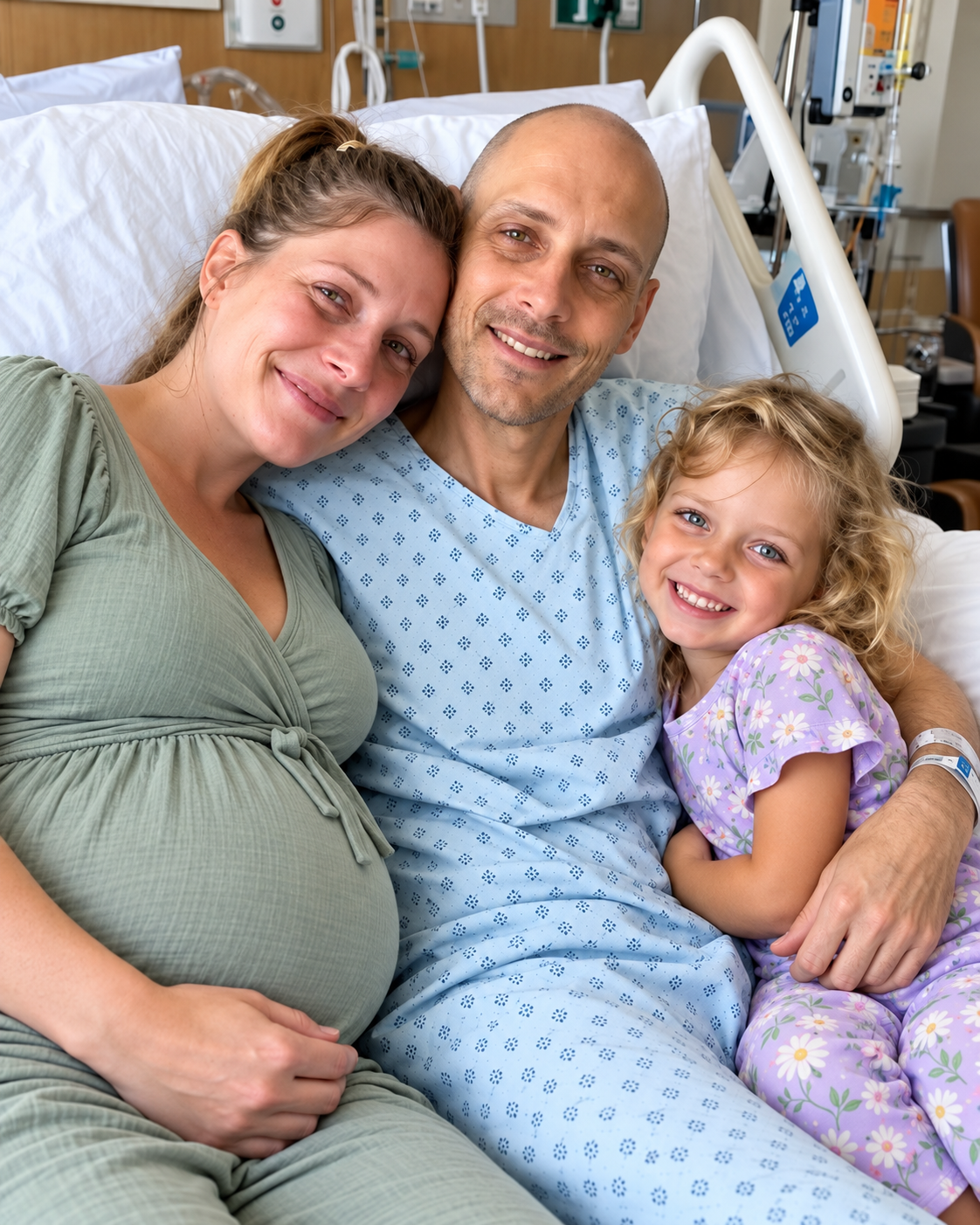
PART 1 TITLE: The Sweater in Jack’s Hospital Bag Made Me Question the Final Weeks of a Marriage I Thought I Understood
By the time the nurse handed me Jack’s belongings, I had already spent a week learning how cruel ordinary objects could become. His coffee mug was still beside the sink. His coat remained on the hook by the back door. A half-used bottle of shampoo stood on his side of the shower as though he might come home and complain that I had moved it. But nothing prepared me for the gray sweater folded on top of the things from his hospital room. I knew immediately it did not belong to me.
I was six months pregnant when Jack died. We had a four-year-old daughter who still asked whether Daddy would feel better after he slept for a long time. During the eight months of his illness, I had learned to answer questions without answering them. I knew medication names I had never heard before. I knew which hospital elevators were fastest. I knew exactly how much money remained in our checking account and how many days we could survive if another bill arrived. I did not know how to explain death to a child.
Cancer had reduced our life to appointments, numbers, and measured doses. Jack tried to resist that reduction with humor. Even after he became too weak to climb the stairs without resting, he could still make me laugh at the worst possible moment. Once, after an oncology appointment in which the doctor used the phrase “limited response,” Jack leaned toward me in the parking garage and whispered, “I’ve received worse reviews.” I laughed, then cried against his shoulder until he quietly rested his cheek on my hair.
Money disappeared faster than his strength. We used our savings first. Then I sold jewelry I had inherited and pieces Jack had given me over the years. When a specialist suggested another treatment that insurance would not fully cover, I signed papers against the house. Jack protested, but I refused to discuss it. I told him houses could be refinanced, jewelry could be replaced, and money could be earned again. He looked at me for a long time and said, “Emma, there has to be a point where saving me doesn’t mean destroying everything else.”
“There isn’t,” I answered.
I meant it.
Near the end, however, Jack started doing things I could not explain. He spent long stretches on his phone with the bedroom door partly closed. He asked for copies of insurance statements I thought we had already given the hospital. More than once, I woke after midnight and found him at the kitchen table with his laptop open, reading documents through narrowed eyes. The instant I entered the room, he would shut the screen or move the papers beneath another folder.
The first time I challenged him, he claimed he was organizing bills. The second time, he smiled and said he was trying to make my life easier. The third time, I lost patience. “You can barely sit up some days, yet somehow you have enough energy to run a secret accounting department at two in the morning. What are you doing?” Jack’s smile faded. He reached across the table and covered my hand. “Something I need to finish.” When I asked what, he said only, “Not tonight.”
His evasiveness angered me because secrecy had never been part of our marriage. We had been together since we were barely old enough to understand what a mortgage was. I had known Jack before the respectable job, before the house, before our daughter, before adulthood made everything more complicated. He knew that I ate the burnt edges of brownies first. I knew he hated sleeping with the closet door open. We had grown around each other so completely that the idea of a hidden portion of his life felt almost absurd.
Still, during those final weeks, I sometimes woke with the unsettling feeling that Jack was preparing for something without me. He began asking strange questions. Did I know where the deed was? Had I kept the paperwork from my old college enrollment? Did I remember the exact date we bought the house? Once he asked whether I would ever consider selling it. I stared at him so sharply that he raised both hands. “Just asking.” I told him the house was the first place that had ever truly felt like ours.
He nodded as if that answer mattered.
There were also visitors I never saw. At least, I knew there had been meetings because Jack occasionally mentioned that someone had stopped by while I was taking our daughter to preschool or attending a prenatal appointment. He was deliberately vague. “Someone helping with paperwork,” he would say. If I pressed, he would change the subject. I assumed it was an insurance representative, a hospital administrator, perhaps someone connected to his employer. There were so many people involved in his illness that one more name hardly seemed important.
Five weeks before he died, his condition declined sharply. His skin turned pale and almost translucent. His appetite vanished. Walking from the bed to the bathroom became an exhausting negotiation with gravity. The doctor eventually stopped discussing aggressive treatment and began using words like comfort and time. I hated those words. They sounded gentle while carrying the weight of a sentence. Jack listened quietly, then asked practical questions while I stared at a spot on the floor because looking at his face felt impossible.
That evening, after our daughter had fallen asleep, I sat beside him in the hospital room. Rain tapped against the dark window. The machines around him made small electronic sounds that had become the background music of our lives. Jack reached for my hand and rubbed his thumb over my wedding ring. “You’re frightened,” he said. I wanted to deny it, but neither of us had energy left for pretending. “Yes.” He gave my fingers a weak squeeze. “So am I.”
I told him I did not know how to do any of this without him. I did not know how to raise two children alone. I did not know how to pay the bills, explain his absence, sleep in our bedroom, or enter the grocery store without remembering the cereal he always bought. Jack closed his eyes for a few seconds before answering. “You’ll do it badly at first.” I stared at him. He opened one eye. “Then a little less badly. Eventually you’ll realize you’re doing it.”
I almost laughed. “That is a terrible inspirational speech.”
“I’m sick. Lower your standards.”
That was Jack. Even then.
But before I left that night, his expression became serious. He told me there were things he wished he had explained sooner. I immediately asked what he meant. He looked toward the sleeping hospital corridor, then back at me. “I’m trying to make sure you have something solid when I’m gone.” I told him he was not allowed to speak as if everything were already decided. He did not argue. He simply said, “I need you to trust that I’m thinking about you.”
I thought he meant love.
I had no idea he meant paperwork, property, money, promises, and a woman I had never met.
Three days before he died, Jack was barely awake. I sat beside him while our daughter drew a picture at home with my sister. The baby inside me moved so strongly that I pressed Jack’s hand against my stomach. His eyes opened. For one brief second, the old brightness returned. He felt another kick and smiled. His lips moved, but his voice was too weak to understand. I leaned closer. “What?” He tried again. I caught only two words.
“Little one.”
I kissed his forehead.
He died before dawn three days later.
The hours after his death were strangely administrative. There were signatures, phone calls, forms, arrangements, people asking questions in soft voices. Everyone behaved as though lowering their volume might make what had happened less brutal. I chose clothes for his funeral while my daughter sat on our bedroom carpet and asked whether Daddy needed shoes in heaven. I answered whatever I could and excused myself to the bathroom when I could not.
After the funeral, the financial reality arrived almost immediately. A hospital statement appeared in the mailbox before the flowers on our kitchen counter had wilted. Two automatic payments went through. The mortgage account showed a balance large enough to make my stomach tighten. I spent an afternoon at the kitchen table with a calculator, bank statements, and an untouched cup of tea. Even after removing every expense that was not essential, the numbers did not work.
The bank representative who called me was kind, which somehow made the conversation worse. She asked whether we had additional savings. I said no. Investments I could access? None that I knew about. Other assets? I stared around the kitchen as if an answer might be hidden behind the refrigerator. I had already sold almost everything valuable that belonged to me. When she asked whether the borrowing against the house had been for Jack’s treatment, I said yes.
After the call, I sat alone and looked at the chair where Jack used to drink coffee. For the first time, anger broke through the grief. Not anger at him for dying. Anger at the disease, at the bills, at every doctor who had offered one more possibility when I would have paid anything to hear the word chance. I remembered Jack asking me whether there should be a limit. I whispered into the empty kitchen, “No. I would still have spent it.”
A week after the funeral, I returned to the hospital to collect the last of his belongings. A nurse named Rachel met me near the station. I remembered her from Jack’s final days: steady voice, tired eyes, the kind of person who never touched a patient without first explaining what she was about to do. She offered condolences, then handed me a clear hospital bag containing Jack’s watch, charger, toiletries, a paperback novel, and several pieces of clothing.
The gray sweater lay on top.
I pulled it out slowly. It was soft, small through the shoulders, unmistakably a woman’s cardigan. For a second I assumed there had been a mistake. “This isn’t mine,” I said. Rachel glanced at it and her expression shifted in a way so slight another person might have missed it. “Oh,” she said. “I thought it belonged to the woman who was visiting Jack.”
Everything around me seemed to become unnaturally sharp—the fluorescent lights, the wheels of a passing cart, the cold plastic handles of the bag cutting into my fingers. “What woman?” Rachel stopped moving. Her face told me she had realized something a second too late. “I’m sorry. I assumed you knew.” I asked how many times the woman had been there. Rachel hesitated, then admitted it had not been once.
She had come repeatedly during Jack’s final weeks.
Sometimes she stayed for hours.
And suddenly every closed laptop, every unexplained document, every conversation Jack had refused to finish returned to me at once.
END PART 1
PART 2 TITLE: Hospital Records Showed the Stranger Returning Again and Again, Until She Appeared at My Door Carrying Jack’s Final Instructions
I stood in the hospital corridor holding another woman’s sweater while Rachel searched for a safe way to answer a question that no answer could make harmless. She finally said the visitor was dark-haired, probably around my age or slightly older, and usually arrived carrying a folder or a large handbag. Rachel remembered her because she did not behave like a casual acquaintance. She stayed. She spoke quietly with Jack. More than once, papers covered the tray table between them.
“Did he introduce her?” I asked.
“Not to me.”
“Did she touch him?”
Rachel’s eyes widened slightly. “Not in the way you mean.”
I hated that she knew exactly what I meant.
I asked whether they seemed affectionate. Rachel said she had seen the woman adjust Jack’s blanket once and hand him water. She had also seen her crying in the hallway. None of that proved anything, which made it worse. Evidence would have given me something solid to hate. Instead, I had gestures that could belong to a lover, a lawyer, a relative, or a friend. Jack had no sister. His mother was dead. He had always told me he had almost no family.
I asked Rachel why nobody had mentioned the visitor while Jack was alive. She reminded me, gently, that hospitals do not report every visitor to a patient’s spouse. Jack had been conscious. He had been free to see whomever he wanted. The words were reasonable, yet I heard them as an accusation against my own certainty. For years, I had believed I knew the boundaries of our marriage. Suddenly I was being reminded that even a dying husband retained doors his wife could not automatically open.
I carried the sweater home in the same bag as Jack’s watch.
That detail bothered me more than it should have. His watch was ours in the sense that I had bought it for his thirty-second birthday, after months of listening to him complain that his old one lost four minutes every day. The sweater belonged to somebody I did not know. Yet now both objects sat together on my passenger seat, touching as the car turned corners. I wanted to throw the cardigan out the window. Instead, I brought it home.
For two nights I barely slept. Pregnancy had already made rest difficult, and grief had finished the job. Now suspicion joined them. I lay on Jack’s side of the bed because mine smelled too familiar and replayed the previous months. His late-night computer work. The envelopes. His questions about the house. The afternoons when he said he needed to handle something alone. I tried to separate ordinary secrecy from betrayal, but memory becomes unreliable when fear starts editing it.
Once, about three weeks before his last hospitalization, I had walked into the kitchen while Jack was ending a phone call. He had said, “No, she can’t know yet.” At the time, I assumed he meant me and assumed the subject was medical. I had demanded an explanation. Jack smiled and said he was arranging something. “What kind of something?” I asked. “The kind that stops being useful if I explain it too soon.” I had rolled my eyes and called him impossible.
Now the sentence sounded completely different.
Another memory returned. I had found a business card beneath a stack of insurance papers. It belonged to a legal foundation. I barely looked at it because every week brought some new office, specialist, billing department, or charity. I remembered the logo but not the name. Jack had taken the card from me quickly and tucked it into his wallet. “I’m handling that,” he said. I had been too exhausted to ask what “that” meant.
On the third morning, I called the hospital again. I knew I was behaving like someone searching for proof of an injury she was already feeling, but uncertainty had become unbearable. After several conversations and a long explanation, I learned there were security records showing visitors entering Jack’s floor. Nobody could casually hand me private surveillance footage, but staff were able to confirm dates connected with the woman Rachel remembered.
She had visited more than once.
Far more.
The dates stretched across several weeks.
One visit took place on a morning I had been at a prenatal appointment. Another happened while I was home with our daughter, who had a fever. A third occurred the day after Jack and I argued about selling the last piece of jewelry I owned. I sat at the kitchen table writing the dates on the back of an overdue utility notice. Every line felt like a small betrayal, not because I knew what had happened, but because Jack had built an entire schedule around my absence.
Eventually, through hospital staff and a formal request, I was allowed to review limited hallway footage relevant to Jack’s room. The images were grainy and silent. Still, the moment the woman appeared, I felt my chest tighten. She walked quickly, as though she knew exactly where she was going. Dark hair. A plain coat. Large leather folder under one arm. She entered Jack’s room without hesitation.
Almost two hours later, she emerged.
On another recording, she stood outside his door with her back against the wall and pressed both hands to her face. Even without sound, I knew she was crying.
I watched that segment twice.
The employee beside me asked whether I wanted to continue. I said yes.
The next clip showed her carrying papers. Another showed Jack’s doctor briefly speaking with her in the corridor before she returned to the room. That complicated everything. If she were simply an affair partner, why was medical staff speaking openly with her? Had Jack authorized it? Was she representing someone? Had he placed her name on paperwork I had never seen?
By the time I left, I felt less certain rather than more.
At home, I opened drawers I had avoided since the funeral. I found receipts, treatment summaries, unused medication, notes Jack had written to himself. I disliked the feeling of searching his things. Marriage had never made me believe I owned his every private thought, but death had removed my ability to ask permission. I kept apologizing aloud as I opened folders. “I’m sorry, Jack. But you should have told me.”
Nothing obvious appeared.
Then I found a yellow sticky note attached to an old mortgage statement.
C — Thursday, 2:30.
Foundation.
Bring deed copy.
The first letter could have been anyone’s initial, but I stared at it until the ink blurred. Foundation. Deed. The house. Those were not the words of an affair. They were the language of finances, ownership, planning. Yet I could not make them fit with a woman crying outside Jack’s room or leaving her sweater behind.
I started to believe something worse than adultery might be hiding underneath the secrecy. Perhaps Jack had accumulated debt I did not know about. Perhaps he had signed away something. Perhaps he had borrowed against the house without telling me. Perhaps he had been trying to protect me from a financial disaster of his own making. When money is already scarce, imagination becomes frighteningly efficient.
My daughter interrupted me by asking whether Daddy’s watch could still tell time if Daddy was not wearing it. I looked at the watch beside the papers and nearly broke down. Instead, I fastened it loosely around her wrist. It slid almost to her elbow. She laughed. “Daddy had giant arms.” I told her Daddy had perfectly ordinary arms. She insisted they were enormous. For five minutes, grief was replaced by an argument about anatomy.
That night, after she was asleep, I placed the sweater across a kitchen chair. I studied it under the overhead light. No perfume remained. No initials. No clue. There was a small snag near one cuff and a faint coffee stain near the hem. It was just clothing, yet it had become a symbol onto which I had projected every fear I possessed.
I was considering throwing it away when someone knocked on the front door.
It was after six. Rain had started, fine and cold. I glanced toward the stairs, listening for my daughter, then opened the door only partway.
The woman standing on the porch was the woman from the hospital footage.
For a few seconds, neither of us spoke.
She looked more tired in person. Her dark hair was damp from the rain. She carried the same leather folder I had seen on the recordings, along with a sealed cream-colored envelope. When she saw my face, she seemed to understand immediately that I recognized her.
“Emma?”
My grip tightened on the door.
“Who are you?”
“My name is Clara.”
The name hit me with the force of confirmation. C.
I opened the door wider but did not invite her inside. “You visited my husband.”
“Yes.”
“How many times?”
She swallowed. “A lot near the end.”
“Why?”
Instead of answering, Clara looked down at the envelope. “Jack asked me to bring you this after his death.”
I stared at it but did not take it.
“I asked you why you were with my husband.”
“I know.”
“Then answer me.”
Clara’s jaw tightened. She looked less like a guilty lover than a person carrying an obligation she wished belonged to somebody else. “Because he needed help.”
“With what?”
“That is in the letter.”
I nearly shut the door.
She stopped me with one sentence.
“Emma, Jack knew you would assume the worst when you found out about me.”
I froze.
“How could he possibly know that?”
“Because he knew the sweater was still in his room.”
My pulse jumped. “So it is yours.”
“Yes.”
I laughed once, without humor. “Wonderful. At least one mystery is solved.”
Clara’s face changed. “Not in the way you think.”
“Every person who says that is usually about to explain exactly what I think.”
She did not defend herself.
Instead, she extended the envelope.
“Read this first. Then ask me anything you want.”
I took it.
Jack’s handwriting appeared across the front.
Emma.
Not my full name. Not “my wife.” Emma, written the way he wrote it on birthday cards and notes tucked into my lunch when we were younger.
My hands started shaking.
I tore the envelope open.
The first line began with the private endearment Jack used when he wanted me to remember the girl I had been before marriage, mortgages, motherhood, and hospitals.
Then came an apology.
He wrote that if I was reading his words, he had run out of time to explain everything himself. He knew I would have questions. He knew some of those questions would hurt. He asked only that I continue reading before deciding what his secrecy meant.
I reached the next paragraph.
Then I stopped breathing.
Jack had written plainly that Clara was not his lover.
He said she was the reason he had managed to leave something behind for me and our children.
I looked up at the stranger standing on my porch.
“What did he leave?”
Clara’s eyes filled, but she did not answer.
She nodded toward the pages in my hands.
“Keep reading.”
END PART 2
PART 3 TITLE: Jack’s Letter Cleared Clara of Betrayal but Exposed a Secret Decision He Had Been Making Since His Diagnosis Became Terminal
I moved from the doorway to the kitchen because my knees had begun to feel unreliable. Clara followed only after I stepped aside. She did not remove her coat until I pointed to a chair, and even then she sat stiffly, both hands around the leather folder on her lap. The gray sweater remained draped across the opposite chair between us like an accusation that had not yet decided whether it belonged there.
I returned to Jack’s letter.
His handwriting was steadier on the first page than it had been during the final week of his life. I could tell he had written it earlier, perhaps before his hands began trembling. He explained that when the doctors finally told him treatment was unlikely to change the outcome, the first fear that settled in him was not death itself. It was the picture of me standing alone afterward with two children, a mortgage, and debts we had created trying to keep him alive.
He knew how much I had spent.
He knew about the jewelry.
He knew about the loan against the house.
He knew that every time he suggested stopping an expensive treatment, I treated the suggestion as surrender.
The letter did not accuse me. That somehow hurt more. Jack wrote with the weary affection of someone who understood exactly why I had behaved that way because he would have done the same for me. He said he knew that if I discovered there was any other money available, I would pour it into one more specialist, one more experimental treatment, one more possibility.
I lowered the page.
“He hid money from me?”
Clara answered carefully. “Not exactly.”
“That sounds like exactly.”
“He protected assets you did not know were available.”
“That is a professional way of saying he hid money.”
She accepted the criticism without arguing.
I went back to the letter.
Jack reminded me of the summer after high school, when my father lost his job. I had been accepted to college but planned to give up my place because my family could no longer help with expenses. Jack had somehow found enough money to cover what I needed to begin. For years he claimed he had worked extra shifts and borrowed a little from someone he knew. I never questioned the story closely because we were eighteen, frightened, and too busy feeling heroic about surviving.
According to the letter, that story had never been entirely true.
Before Jack and I met, something from his father’s estate had eventually been placed in Jack’s name: a small property connected to the family he had lost. It was not a mansion or some dramatic inheritance. At the time, it was mostly land and an aging structure of limited use. Jack had kept ownership separate, partly because it was one of the few physical links he possessed to a childhood that had largely disappeared.
Years earlier, when I nearly abandoned college, he had sold a small interest connected with that property to help me. He never told me because he did not want gratitude to become a debt between us.
I read that paragraph twice.
Memories rearranged themselves.
Jack arriving outside my parents’ apartment with an envelope.
Jack telling me to stop asking where the money came from.
Jack laughing when I promised I would repay him.
“Marry me eventually,” he had joked. “We’ll call it even.”
At eighteen, I thought the line was ridiculous.
Years later, I did marry him.
I looked toward Clara. “Did you know about this property?”
“Yes.”
“Is that what all the paperwork was?”
“Part of it.”
The property had increased significantly in value over the years. Development had reached the area. What Jack had once considered an emotional relic became a real financial asset. He never sold it during our marriage because, as he explained in the letter, it represented something from his father that belonged to a life before ours. He felt strangely protective of it, even ashamed of that protectiveness. He worried I might think he had deliberately kept wealth from his own family.
I would have been angry.
Reading his words, I was angry.
But anger did not erase the fact that he had spent almost everything else we had on our life together.
When he learned he was dying, his feelings changed. Jack wrote that a sentimental attachment to property meant little if his wife might lose the home where their children were being raised. He began exploring how to sell or restructure the asset. That was when he found the organization connected with Clara.
I looked at her again.
“What organization?”
She finally opened the leather folder.
“I work with a legal foundation that helps families facing catastrophic illness. Mostly financial planning, insurance problems, estate documents, benefits, debt negotiations. We don’t make people wealthy. We try to stop illness from destroying whoever survives it.”
The explanation sounded painfully ordinary.
“So you weren’t some secret friend?”
“No.”
“You didn’t know Jack before this?”
“No.”
“You met because he contacted your foundation?”
“Yes.”
I felt foolish and relieved, then immediately angry at myself for feeling relieved. Jack had still lied by omission for months. Understanding the category of secret did not erase the secret itself.
Clara explained that Jack first contacted the foundation after his oncologist made it clear that the prognosis had changed. He had questions about what would happen to the mortgage, which medical debts could pass to an estate, how life-insurance benefits worked, whether accounts could be protected for the children, and how selling his separate property might affect everything else. He had arrived at their office with a notebook full of questions.
“That sounds like Jack,” I murmured.
Clara almost smiled. “He had tabs.”
I looked up despite myself.
“Color-coded?”
“Five colors.”
A laugh escaped me before I could stop it.
For one second, the kitchen became ours again. I could picture Jack buying office supplies during a terminal diagnosis because nothing serious could happen without labels. The laugh vanished almost as quickly as it came, but Clara had heard it. Her expression softened.
“He talked about you constantly,” she said.
“That does not make keeping this from me better.”
“No.”
“I need you to understand that.”
“I do.”
I returned to the letter.
Jack said Clara had originally advised transparency. He refused. He told her I was pregnant, exhausted, already balancing our daughter’s needs with appointments and insurance appeals. More important, he knew I would oppose any plan that directed money toward our future instead of his treatment. He wrote that he had watched me remove my wedding earrings before taking them to a jeweler and understood then that I would bankrupt myself without hesitation if I believed another dollar might buy him another day.
I remembered that morning.
I had hidden the sale from him until he noticed the earrings were gone.
He had been furious.
I had been more furious that he was furious.
We argued until our daughter started crying in the next room.
Later, Jack apologized.
So did I.
Neither of us changed our minds.
The letter said that was the moment he decided some decisions could no longer be made jointly because we were trying to protect different futures. I was trying to protect his remaining life. He was trying to protect the life that would continue after him.
I pressed my palm against the table.
“That was not his decision alone.”
Clara’s voice stayed quiet. “No.”
I looked up, surprised.
“You’re supposed to defend him.”
“I’m not.”
“He made you promise.”
“He did.”
“And you agreed.”
“Yes.”
“Then why aren’t you telling me he was right?”
“Because loving someone’s reason does not automatically make their method fair.”
That answer silenced me.
Jack’s letter moved into apology again. He admitted he had used meetings, phone calls, and hospital visits to complete documents without involving me. Clara had helped communicate with the insurance company and attorneys. She had also helped arrange the sale of the property. Jack insisted that I not blame her for the secrecy because he had been the one demanding it.
I looked across the kitchen at Clara.
“The sweater.”
She glanced at it.
“You really want that explanation now?”
“Yes.”
A faint, tired smile appeared. She explained that Jack was often cold during his last hospitalization. One evening, during a long meeting, she had taken off her cardigan and folded it behind him when he complained that the room felt freezing. Later, staff moved it with his things. Clara forgot it completely because Jack’s condition deteriorated soon afterward.
“So this entire nightmare started because you left a sweater?”
“Apparently.”
I covered my face.
For three nights I had imagined perfume, secret embraces, a hidden romance, perhaps another family. The truth involved paperwork and hospital air-conditioning.
When I lowered my hands, I was crying and laughing at the same time.
“Jack knew I would find it, didn’t he?”
Clara hesitated.
“He realized afterward that it was probably still there.”
“And he said nothing.”
“He said if you discovered it before he could explain everything, you would interrogate every person in the hospital until somebody told you who I was.”
I stared at her.
“That sounds insulting.”
“He seemed proud.”
That sounded like Jack too.
The letter was nearing its end, but one passage made me stop. Jack wrote that selling the property had allowed him to make arrangements I did not yet understand. He mentioned insurance, old investments, and something created for the children. He asked me not to decide how I felt until I had seen everything.
I looked at Clara.
“What exactly did you help him do?”
Instead of answering, she placed the leather folder on the kitchen table and opened it.
Inside were neatly separated sections.
Of course they were.
Jack’s handwriting appeared on several tabs.
HOUSE.
INSURANCE.
CHILDREN.
EMMA.
I touched the tab with my name.
“What is this?”
Clara’s eyes remained on my face.
“The part he was most afraid to tell you about.”
My stomach tightened.
I opened the section.
The first page was a legal document bearing my full name.
Beneath it were figures large enough that, for several seconds, I assumed I was misunderstanding the decimal points.
I looked up.
“Clara, what did my husband do?”
She pushed the folder gently toward me.
“He made sure dying wouldn’t take your future with him.”
END PART 3
PART 4 TITLE: The Numbers in Jack’s Hidden Folder Changed Our Financial Future, but Clara Said His Most Important Gift Was Still Unopened
I had spent months counting money in amounts that frightened me because they were too small. Forty-seven dollars left before payday. Three hundred dollars due to a specialist. Twelve hundred dollars for a test insurance rejected. A mortgage payment I was not certain I could make. When your life contracts around scarcity, large numbers begin to look fictional. That was why the figures in Jack’s folder made no sense to me at first.
I ran my finger down the first statement.
Then I checked the name.
Mine.
I looked at another document.
Then another.
There was money from the sale of Jack’s separate property. There were life-insurance arrangements connected to his employer. There were investments I had never known existed, modest when he began them years earlier but worth far more after years untouched. Some funds had already been designated for specific purposes. Others were held through structures Clara began explaining in careful language I barely heard.
“Stop.”
She stopped.
“I need you to tell me this like I am four.”
A slight smile crossed her face. “You are not going to lose the house because of Jack’s medical expenses.”
My throat tightened.
“Start there again.”
“The house is protected.”
“What does protected mean?”
“It means Jack used part of what he had to deal with the mortgage and arranged the remaining financial obligations so you would not have to sell simply to survive.”
I looked toward the hallway as if the house itself might have overheard.
For weeks, losing it had been one of the fears I refused to say aloud. I could imagine almost every step: missing a payment, asking the bank for time, packing boxes while pregnant, explaining to my daughter why we were leaving the room where her father used to read bedtime stories. I had rehearsed disaster so often that hearing it might not happen felt almost suspicious.
“How much is left on the mortgage?”
Clara reached for a document but stopped before touching it. “Jack wanted you to discover some of this from him.”
“He’s not here.”
“I know.”
The gentleness in her answer irritated me because there was nothing to argue against. I lowered my eyes to the folder again. A section titled CHILDREN contained trust paperwork. Another contained information about insurance benefits. There were notes from attorneys. There were handwritten questions in Jack’s narrow, slanted script.
What happens if Emma wants to sell?
What if baby is born after policy pays?
Education accounts?
Protect house first.
I pressed my fingertips against that final line.
Protect house first.
Jack had written it twice.
I remembered him asking whether I would ever sell. I remembered answering that it was the first place that had ever felt truly ours. At the time, I assumed he had been indulging a dying man’s curiosity about what would happen after him. In reality, he had been gathering instructions.
My daughter’s footsteps sounded above us.
I closed the folder instinctively.
Clara noticed. “She doesn’t know?”
“She knows Daddy died. She knows people keep bringing casseroles. She knows everybody suddenly hugs her too long. She does not know what mortgages, trusts, insurance benefits, terminal diagnoses, or widows are.”
“That seems reasonable.”
“She also thinks the moon follows our car.”
“Also reasonable at four.”
I almost smiled.
My daughter appeared in the doorway wearing mismatched socks and holding a stuffed rabbit by one ear. She looked at Clara, then at me. “Who is she?”
I opened my mouth and realized I had no prepared answer.
Clara rescued me. “I’m a friend who helped your daddy with some grown-up things.”
My daughter considered that. “Did you know he was funny?”
Clara’s face softened. “Yes.”
“He made bad pancakes.”
“He told me.”
I stared at Clara.
Jack had talked about Sunday pancakes too.
My daughter climbed onto my lap as if this strange woman in our kitchen required no further investigation. She examined the folder. “Is that Daddy’s homework?”
“Something like that.”
“Did he finish?”
The question landed harder than she intended.
I wrapped one arm around her.
“Yes,” I said after a moment. “I think he did.”
She accepted that answer, asked for apple slices, then returned upstairs with her rabbit and snack. When the stairwell was quiet again, I opened the folder. Clara waited without rushing me.
The HOUSE section contained property records and payment instructions. The INSURANCE section included policy information I had never seen because Jack had handled benefits through work. There were also notes showing he had reviewed old investment accounts. None of it suggested he had secretly been wealthy while watching me sell jewelry. Most of the value came from assets that were restricted, overlooked, or transformed only after the property sale.
That mattered to me.
I did not want the story rewritten into something simpler than it was.
Jack had not sat on a fortune while I struggled. We had truly spent what we could access on his treatment. He had simply discovered, near the end, that there were pieces he could arrange differently if he accepted that he was not going to survive.
That was the choice I had refused to make.
He made it without me.
“I would have stopped him,” I said.
Clara nodded.
“I would have taken this money and tried another hospital.”
“I know.”
“I might have found another trial.”
“Maybe.”
“A specialist somewhere.”
“Maybe.”
“You think it would have been useless.”
Clara looked at me steadily. “I think Jack believed the doctors.”
I turned away.
That answer hurt because I knew he had reached acceptance before I did. While I was searching medical journals at three in the morning and calling offices in other states, Jack had begun planning for the morning after his funeral.
I hated him for that for perhaps thirty seconds.
Then I missed him so badly I could barely remain seated.
Clara let the silence stretch.
Eventually I asked, “How much time did he spend doing all this?”
“A lot.”
“When?”
“Whenever he had energy.”
“In the hospital?”
“And before. Some calls from home. Some meetings at our office. A few from the hospital when he became too weak to travel.”
“That’s why you were there so often.”
“Yes.”
“And Rachel saw papers.”
“Probably.”
“And you were crying in the hallway.”
Clara’s eyes shifted.
“You saw that?”
“Security footage.”
She looked embarrassed. “That was the day he signed one of the final documents.”
“Why were you crying?”
“Because he asked me whether I thought his children would remember his voice.”
I looked down.
Clara explained that people in her work often became documents before they became memories. Names on claims. Beneficiaries. Signatures. Dates of death. She tried not to bring emotion into the process. Jack had made that difficult. He talked about our daughter constantly. He described the baby moving beneath my hand. He worried about whether the child would feel abandoned by a father who died before the birth.
“He thought about that?”
“Almost every meeting.”
I closed my eyes.
One evening, I had accused Jack of being emotionally distant during the pregnancy. He had been exhausted, sick, and preoccupied, and I mistook his silence for withdrawal. I remembered telling him, “Sometimes I think you’ve stopped imagining this baby as real.”
He had looked wounded.
Now I understood why.
Clara reached into her bag.
“There’s something else.”
I laughed bitterly. “You have said versions of that sentence enough times that I’m starting to hate it.”
“I don’t blame you.”
She removed a smaller envelope and placed it beside the folder.
My daughter’s name was written across the front in Jack’s handwriting.
I stared at it.
“What is that?”
“A letter.”
“For her?”
“Yes.”
“When did he write it?”
“Near the end.”
I touched the envelope but did not pick it up.
“What does it say?”
“I never read it.”
“Then why do you have it?”
“Jack asked me to keep it with the legal papers until you knew the truth about the arrangements.”
I swallowed.
“Why?”
“He was afraid you might find the letters before you understood why he had kept Clara—the foundation, the paperwork, all of it—from you.”
Hearing her refer to herself almost clinically made me realize how carefully she was separating her role from my marriage.
“What did he want her to know?”
Clara took a long breath.
“That he didn’t leave because he wanted to.”
I felt something inside me give way.
For days after Jack’s death, I had kept moving because movement was easier than grief. Funeral arrangements. Preschool. Bank calls. Laundry. Prenatal vitamins. I had cried, but always with one eye on the next thing that needed doing. Now I covered my face and sobbed without restraint.
Clara moved her chair nearer but did not touch me until I reached for her hand.
That surprised both of us.
We sat that way until I could breathe again.
When I finally looked up, another envelope had appeared beside the first.
This one was smaller.
There was no child’s name on it.
Only four words in Jack’s handwriting:
For my little one.
My hand moved to my stomach before I consciously decided to touch it.
“The baby?”
Clara nodded.
“He wrote one for the baby?”
“Yes.”
“He didn’t even know whether we were having a boy or a girl.”
“He knew.”
“Knew what?”
“That he loved the child.”
I looked away because another wave of tears threatened.
All those nights I had worried that cancer had stolen Jack’s connection to the pregnancy before it stole his life. He stopped discussing nursery colors. He stopped teasing me about names. He stopped placing his hand on my stomach every time the baby kicked. I had assumed he was protecting himself from wanting a future he might not see.
Perhaps he had been.
But apparently he had also been writing to that future.
I picked up the envelope addressed to our unborn child, then put it down again.
“I can’t.”
“You don’t have to open it tonight.”
“What if I never can?”
“You will.”
The certainty in Clara’s voice made me angry. “You don’t know me.”
She gave me a sad look.
“No. But Jack did.”
I stared at her.
She stood and put on her coat. Before leaving, she gathered none of the papers. “Those belong with you now.”
At the door, I asked the question that had been bothering me since she arrived.
“Why did you come yourself? You could have mailed everything. A lawyer could have delivered it.”
Clara rested one hand on the doorknob.
“Jack asked me to come.”
“What exactly did he ask you to do?”
She hesitated.
“He said you would read the first letter and immediately start trying to solve everything alone.”
A weak laugh escaped me.
“That sounds accurate.”
“He said if I could do one thing for him after he was gone, it was to stay long enough for you to understand that you were not being abandoned with the mess.”
I stared at her.
Clara’s eyes filled.
“He said, ‘When Emma finally opens everything, please don’t let her believe she’s alone.’”
Then she stepped into the evening and left.
I locked the door behind her.
The kitchen was silent except for the refrigerator motor and the soft ticking of Jack’s watch on the counter.
I sat on the floor beside the table because I no longer had the strength to sit upright in a chair. Around me lay the documents Jack had spent his final weeks arranging: insurance papers, trust records, property documents, notes for attorneys, the letter for our daughter, and the envelope for a child he would never meet.
For the first time, the secrecy no longer looked like another life.
It looked like preparation for ours.
That did not make every choice right.
It did not erase my anger.
It did not restore the conversations Jack should have trusted me enough to have.
But the shape of his secret had changed.
I held the envelope marked For my little one against my chest.
The baby moved.
A sharp kick beneath my ribs.
I laughed through my tears.
“Your father always had terrible timing.”
Another movement followed.
Upstairs, our daughter turned in her bed. The house settled around me, familiar and suddenly mysterious because I now understood that Jack had been fighting to keep us inside it while I thought he was slipping away from us.
I looked again at the envelope.
Clara had said the money was not the most important thing Jack left.
I had assumed she meant the letters.
But something about the way she said it told me there was still more hidden in his final instructions.
I slipped one finger beneath the sealed edge.
For several seconds, I could not move.
Then I opened the letter Jack had written to the child he knew he would never get to hold.
END PART 4
PART 5 TITLE: Jack’s Letter to Our Unborn Child Revealed the Fear He Had Hidden From Me and One Final Promise He Could Not Keep
The paper trembled in my hands before I reached the second sentence. Jack had begun simply. He wrote that he did not know whether the baby reading the letter someday would be his son or his daughter, whether the child would have my eyes or his crooked smile, or whether any photograph could adequately explain the man whose name would appear on a birth certificate beside the word father. He apologized for beginning with uncertainty. Then he wrote that uncertainty was all he had left.
I had expected something polished. A farewell perhaps, carefully shaped for a child old enough to understand it. Instead, the letter sounded unmistakably like Jack. He wandered. He corrected himself in the margins. At one point he crossed out an entire paragraph and wrote, “Your mother would tell me to get to the point.” I laughed through my tears because he was right. I would have said exactly that.
He told the baby about the first time he felt a kick. He described pretending it had not frightened him because I had laughed when he jerked his hand away. He wrote that the movement had been so small and so forceful at the same time that it made death briefly impossible to imagine. There was a person inside me who would exist after him. He called that realization both beautiful and unbearable.
He confessed something I had suspected but never understood. During the final weeks, he had sometimes stopped touching my stomach on purpose. Not because the baby felt less real, but because every kick made him calculate what he would miss. First steps. Feverish nights. School mornings. Bad jokes at the dinner table. The first bicycle. The first broken heart. He said he hated himself for withdrawing and hoped that one day I would understand it had been cowardice born from love rather than indifference.
I pressed the heel of my hand against my mouth.
The baby shifted again beneath my ribs.
“You hear that?” I whispered. “He knew.”
The empty kitchen offered no answer, but I no longer felt quite as abandoned inside it.
Jack wrote about our daughter next. He asked the unborn baby to be patient with an older sister who would probably insist that she remembered him better. “She will be right,” he wrote. “Let her have that. Memory is one of the few advantages older siblings earn honestly.” He asked them not to compete over who had received more of him, because neither child’s relationship with him could be measured in time.
Then the letter changed.
His handwriting grew tighter.
Jack wrote that there were things he had not managed to finish.
I sat straighter.
He explained that the money, property arrangements, and insurance were the practical part. They mattered because he had watched me wake at night to calculate bills while pretending I was checking on our daughter. He knew I had been frightened about losing the house. He wanted to remove that fear if he could.
But he had also wanted to leave something that could not be reduced to dollars.
For months, whenever he had enough strength, he had been making recordings.
I read the sentence twice.
Recordings.
Jack wrote that there were messages for birthdays, milestones, and ordinary days when one of the children might simply want to hear his voice. He had recorded some at home while I was sleeping, others in Clara’s office, and several from the hospital. They were imperfect. Some ended because he became tired. In one, he apparently spent three minutes coughing and then forgot what he had intended to say.
I immediately looked toward the leather folder.
Nothing inside resembled a hard drive.
I searched beneath the papers anyway.
There was no flash drive, no disc, no note with a password.
My heart began pounding with an urgency completely disproportionate to the quiet room.
Where were they?
I returned to the letter.
Jack anticipated the question. “Emma will be looking for them before you ever read this,” he had written. “If she has torn apart three drawers by now, tell her I’m sorry.”
I stared at the line.
“You are not funny,” I said aloud.
He had left the recordings with Clara until certain paperwork was completed. Some were still unfinished when his health declined. He intended to organize them himself, but he ran out of time. The letter asked me not to resent their roughness. He wanted the children to hear him as he actually was, not as some solemn dead father delivering perfect wisdom from beyond the grave.
My phone was on the table.
I almost called Clara immediately.
Then I saw another paragraph.
Jack asked me to wait until morning.
Of course he did.
He wrote that grief had already stolen enough sleep from me and that the recordings were not going anywhere. “Do not call Clara at midnight,” he had added. “She has done enough for this family, and you are terrifying when you are determined.”
I checked the clock.
It was 8:47.
“Not midnight,” I muttered.
Still, I did not call.
Instead, I kept reading.
The letter described his greatest fear. It was not that the children would forget his face. Photographs could preserve that. It was not even that they would forget his voice. The recordings might help. He was afraid they would mistake his absence for a choice.
That sentence made me stop.
Our daughter had already asked whether Daddy had gone away because hospitals were more important than home. I had corrected her gently, but children carry strange private explanations when adults give them incomplete ones. The unborn baby would have no memories at all, only stories supplied by other people.
Jack begged me to tell them the truth without turning him into a saint.
He wanted them to know he was impatient in traffic, terrible at assembling furniture, overly competitive at board games, and incapable of remembering where he left his keys. He wanted our daughter to remember that he once burned pancakes so badly the smoke alarm went off. He wanted the baby to know that he had been frightened of becoming a father the first time and even more frightened the second, because experience had taught him how much there was to lose.
“Don’t make me better because I’m dead,” he wrote. “Make me real.”
I cried then in a different way than I had before. Not with the sharp panic of discovering Clara or the crushing shock of seeing the financial documents. This grief was slower. It filled the room gradually until every ordinary object seemed connected to him: the chipped bowl he refused to throw away, the drawer handle he had promised to tighten, the refrigerator magnet from a vacation where it rained four days straight.
I read to the end.
The final paragraph was for the baby alone.
Jack wrote that if he had been given the choice, he would have traded every asset, every policy, every remaining possession for one ordinary morning holding that child while I complained that the coffee had gone cold. He knew that bargain was not available. So instead, he had done the only thing time still permitted.
He had tried to leave enough evidence that love had existed before memory began.
I folded the letter carefully.
Then I unfolded it because I could not bear to put it away.
For the next hour, I sat on the kitchen floor reading sections again. Eventually I moved to the couch and placed the letter against my chest. I must have fallen asleep there because I woke just before dawn with a blanket over me.
For one disorienting second, I thought Jack had placed it there.
Then I saw my daughter curled in the armchair.
She had dragged her small blanket downstairs during the night and covered me with half of it.
When she woke, she frowned at my swollen eyes.
“You cried.”
“Yes.”
“Because of Daddy?”
“Yes.”
She considered this, then climbed beside me.
“Did he do something?”
The question almost made me smile.
“He wrote something.”
“For me?”
“Some things are for you.”
“Can I read them?”
“Not all yet.”
“Why?”
“Because some are for when you’re older.”
She seemed offended by the concept of age restricting information. “I’m four and three quarters.”
“I’m aware.”
“That’s almost five.”
“Also aware.”
She leaned against my shoulder.
“Did Daddy know the baby?”
I looked down at her.
“What makes you ask that?”
“He never saw the baby.”
“He knew the baby was coming.”
“But did he know it?”
Children can ask questions adults spend entire philosophies avoiding.
I rested my hand on my stomach.
“Yes,” I said. “He knew the baby in the way he could.”
She nodded, satisfied.
After breakfast, I called Clara.
She answered on the second ring.
“Please tell me you did not call at three in the morning.”
“He told you I might?”
“He specifically predicted it.”
“I waited.”
“I’m impressed.”
“The recordings.”
Her tone changed immediately. “You reached that part.”
“Where are they?”
“Safe.”
“That is not an address.”
“No.”
“Clara.”
She sighed. “Some are digital files. Some are videos. Some are audio only. Jack also left written notes explaining when he imagined each one being used.”
“When can I get them?”
“There’s something we need to do first.”
I closed my eyes.
“There is always something.”
“I know.”
“What?”
“Jack attached instructions to the archive.”
“What kind of instructions?”
“Not legal restrictions. Personal ones.”
“That sounds worse.”
“It isn’t.”
She explained that Jack had created one final recording specifically for me. He had asked Clara not to hand over the complete archive until I had seen it. She said she had no intention of policing my grief, and legally I could probably insist on everything immediately, but Jack had been clear about the order.
“What is in the recording?”
“I don’t know.”
“You never watched it?”
“No.”
“Why not?”
“He said it was for his wife.”
The word landed heavily.
I looked at Jack’s empty coffee mug beside the sink.
“When?”
“Come to my office after lunch.”
I arranged for my sister to keep our daughter for a few hours. Before leaving, I changed clothes twice, which was ridiculous. I was not going to court or a funeral. I was going to watch my dead husband speak.
Clara’s office occupied the second floor of a modest building near the hospital. There were no polished marble floors, no grand conference rooms. The waiting area had mismatched chairs and a coffee machine with a handwritten sign asking visitors not to kick it. For an organization dealing constantly with disaster, the place felt stubbornly ordinary.
Clara met me in a small conference room.
A laptop sat on the table.
Beside it was a black storage case.
I stared at the case.
“All of them?”
“Copies. The originals are backed up.”
“How many?”
She hesitated.
“Forty-three recordings.”
My breath caught.
“Forty-three?”
“Some are less than a minute. Some are longer.”
I sat down.
Jack had been dying while creating forty-three different ways not to disappear.
Clara opened the laptop but did not start anything.
“There’s one other thing you should know.”
I gave her a tired look.
“If you say that again, I may throw something.”
“This one matters.”
“What?”
“Jack recorded the message for you twice.”
“Why?”
“The first time, he stopped halfway through and deleted it.”
“How do you know?”
“He told me.”
“Why did he delete it?”
Clara looked toward the black case.
“He said he had spent too much of his final months trying to make death easier for everyone else.”
I waited.
“He said the first recording was too careful.”
A chill moved through me.
“And the second?”
“He said the second one was the truth.”
Clara stood.
“I’ll give you the room.”
She reached the door before I stopped her.
“Did he look sick?”
She turned.
“Yes.”
“Very?”
“Yes.”
I stared at the dark laptop screen.
“Stay outside?”
“I’ll be right there.”
After she left, I put my hand on the trackpad.
The file name was simple.
FOR EMMA.
I clicked it.
The screen turned black.
Then Jack appeared.
He was sitting in the hospital room wearing the blue shirt I had brought from home because he hated hospital gowns. His face was thinner than I remembered. A blanket covered his legs. For several seconds, he did nothing except look directly into the camera.
Then he smiled.
“Hi, Em.”
I stopped the video.
My hand flew to my mouth.
His voice had filled the room.
Not imagined. Not remembered.
Present.
I cried until my shoulders hurt.
Eventually I wiped my face, pressed play again, and let him continue.
“First,” Jack said, “I need to tell you something you are going to hate.”
END PART 5
PART 6 TITLE: Jack’s Final Video Forced Me to Hear the Choice He Had Made Without Me and the Truth Behind His Last Hospital Conversations
For several seconds after Jack spoke, I could not move. His image remained frozen on the screen because my finger had hit the space bar instinctively. He sat with one shoulder slightly lower than the other, exactly as he always did when exhaustion was beginning to win. His wedding ring looked loose around his finger. Behind him, the hospital blinds were half closed against an afternoon glare.
I already knew about the property.
I knew about Clara.
I knew about the trusts, insurance, mortgage arrangements, letters, and recordings.
Still, the way Jack said, “You are going to hate this,” made my stomach tighten.
I pressed play.
“You’re probably angry that I kept all of this from you,” he began. “You should be. Don’t let anyone tell you that because I was sick, every decision I made was automatically noble.”
I stared at the screen.
It was exactly the kind of sentence Clara would never have invented for him.
Jack coughed, reached for water, then continued.
“I told myself I was protecting you. Some of that is true. Some of it is also because I was scared that if we talked honestly, I would have to admit I was dying before you were ready to hear it.”
I leaned back in the chair.
There it was.
Not sacrifice polished into virtue.
Fear.
He said the first time his oncologist privately told him the treatment was no longer working, he asked the doctor not to repeat the conversation in front of me until they had reviewed every remaining option. The doctor resisted. Jack insisted that he needed a few days.
I remembered that week.
Jack had seemed distant and irritable. I thought he was simply exhausted from treatment. I had spent evenings researching another specialist several hundred miles away.
Meanwhile, he already knew.
Eventually the doctor told us together that the cancer was progressing. I had believed we were both hearing the finality at the same time.
We were not.
Jack had carried it alone for nine days.
“Why?” I whispered toward the screen.
As though answering, he said, “I wanted nine more days where you looked at me like we still had years.”
I stopped the recording again.
Anger came faster this time.
I stood and walked to the window.
Outside, cars moved through the intersection. People carried coffee. Someone hurried across the street holding a folder over her head against a light rain. Ordinary life continued with offensive efficiency.
Nine days.
He had watched me make calls, research trials, discuss travel plans for consultations, and encourage him to eat more because he needed strength.
He had known.
I returned to the chair and pressed play.
Jack said he regretted that choice.
Not because the medical outcome would have changed, but because those nine days belonged to both of us and he had made himself their sole owner.
“I was trying to protect the version of us that still had hope,” he said. “But hope isn’t the same thing as truth, and I’m sorry.”
My anger softened without disappearing.
That was becoming the pattern of everything he had left behind. Every explanation resolved one wound and exposed another.
Jack then described the first meeting with Clara.
He had contacted the foundation after seeing a brochure in the oncology waiting room. He nearly threw it away because the words estate planning felt absurdly premature. Two days later, he retrieved it from his coat pocket and called.
Clara had asked him to list everything he owned, everything he owed, and everything he was afraid would happen after his death.
Jack laughed weakly in the recording.
“I told her the first two categories were easier.”
His greatest financial fear was the house.
He knew exactly how much debt I had taken on. He knew my income alone would not comfortably support the mortgage, two children, childcare, and remaining bills. He also knew I would refuse to sell while grief was fresh because the house was filled with him.
So he began investigating the old family property.
The more he learned, the more complicated it became.
Part of it had increased enormously in value because a development company wanted adjacent land. Jack could have accepted a quick sale, but Clara advised him not to rush. Instead, attorneys negotiated. The delay explained several of the hospital meetings I had mistaken for something personal between Jack and Clara.
One afternoon, the buyers tried to reduce their offer after learning how sick he was.
Jack rejected it.
I smiled despite everything.
Of course he did.
According to him, Clara wanted to handle negotiations through counsel. Jack insisted on joining one call himself. He told the company representative that cancer affected his liver, not his arithmetic.
I laughed so abruptly I startled myself.
“That was you,” I told the screen.
Jack continued.
The eventual sale produced enough to protect the house, establish funds for the children, cover certain debts, and leave me with financial breathing room.
But there was a problem.
The medical expenses were still growing.
If I knew the property was being sold, Jack believed I would insist on diverting the proceeds toward experimental care.
He was right.
I hated that he was right.
He looked directly at the camera.
“This is the part you’re going to hate, Em. I made Clara promise not to tell you.”
I whispered, “I already know.”
But he continued as though he could hear me.
“I chose the house and the kids over another treatment I didn’t believe would save me.”
My stomach dropped.
I had understood that generally.
Hearing the decision stated so plainly was different.
Jack explained that an out-of-state clinic had offered an experimental option. I remembered it immediately. I had discovered it online and spent days collecting records. The treatment was expensive, insurance would not cover most of it, and there was no guarantee Jack would even qualify.
I had thought the application stalled because the clinic rejected him.
That was not what happened.
Jack had withdrawn it.
I stood so quickly the chair rolled backward.
“No.”
The video continued.
“I’m sorry.”
“No.”
I hit pause.
My hands were shaking.
That clinic had become one of my private ghosts after his death. I wondered whether I should have fought harder, called more often, found another source of money. I imagined a parallel world where Jack received the treatment and lived.
He had withdrawn.
I left the conference room.
Clara was seated outside with paperwork.
She stood immediately.
“He withdrew from the trial.”
Her face changed.
“You reached that part.”
“You knew.”
“Yes.”
“You knew I was trying to get him in.”
“Yes.”
“And you said nothing.”
“Jack asked me not to.”
“That is not an answer.”
“No. It’s the reason.”
I paced the narrow hallway.
“Would he have qualified?”
“Possibly.”
“Would it have helped?”
“I don’t know.”
“How much money?”
She told me.
The number was enormous.
I did not care.
“I would have paid it.”
“I know.”
“I would have sold the house.”
“I know.”
“I would have sold everything.”
“Yes.”
“And he decided I didn’t get a vote.”
Clara did not defend him.
That made it difficult to direct my anger anywhere except where it belonged.
At Jack.
At a dead man.
I returned to the conference room because fury did not erase my need to hear his explanation.
When I pressed play, Jack seemed smaller than before.
“The doctors told me what the odds were,” he said. “Not the brochure. Not the clinic website. My doctors.”
He explained that his oncologist believed the treatment was extraordinarily unlikely to produce meaningful additional time given how far the cancer had progressed. The side effects could also be severe. Jack did not want his final weeks spent traveling, hospitalized away from us, or unconscious from another intervention undertaken mostly because neither of us could bear to stop.
“I wanted to die at home if I could,” he said.
He had not managed that.
His final decline required hospital care.
“But I wanted whatever time was left to belong to you and the kids, not to another waiting room.”
I covered my face.
That was when I understood the real conflict we had never been brave enough to name.
I had believed love meant fighting until there was nothing left to fight with.
Jack had eventually decided love meant stopping.
Neither choice felt cruel from the inside.
From the other side, both could.
In the recording, he admitted that withdrawing the application without telling me was the decision he regretted most.
“I should have told you,” he said. “I’m not apologizing for refusing the treatment. I’m apologizing for making you discover afterward that the decision existed.”
My anger cracked.
That distinction mattered.
He was not asking me to agree.
He was asking me to understand.
Jack spoke next about the mysterious conversations I had overheard. “She can’t know yet” had referred to the property valuation. The documents at night were estate plans. The questions about the deed, my college dates, and the house were connected to proving ownership, updating beneficiaries, and preparing trust documents.
Every clue that had looked sinister now had an ordinary explanation.
But ordinary did not mean painless.
He leaned closer to the camera.
Then his expression changed.
“There’s another thing.”
I almost laughed bitterly.
Even recorded, my husband had mastered the art of revealing information in stages.
Jack said the property sale contained a condition he had not explained in the first letter.
The buyer had purchased most of the land.
Most.
Not all.
One small portion remained in Jack’s name.
A modest parcel containing an old house.
I frowned.
I thought the property had been sold entirely.
Jack explained that the structure had belonged to his father and had been nearly unusable for years. The development company did not need it. Jack originally intended to sell that portion separately, but when he visited the site one final time with Clara and an attorney, he changed his mind.
My chest tightened.
He had gone there while sick.
Without me.
The remaining parcel had been transferred.
Not to the children.
Not to a trust.
To me.
I paused the video and stared at the screen.
There was another house.
Jack had left me another property.
But his expression in the frozen image told me that was not the important part.
I pressed play.
“There’s a room in that house,” he said.
He took a slow breath.
“I need you to see it before you decide what to do with the place.”
I leaned toward the screen.
He gave the smallest smile.
“And before you accuse me of leaving you a collapsing building, yes, I know the roof needs work.”
Despite myself, I laughed.
Then Jack’s face became serious again.
“Clara has the key.”
The recording ended.
I sat staring at the black screen.
After several minutes, Clara opened the door carefully.
“Are you all right?”
“No.”
She nodded as though that was the only reasonable answer.
Then I looked at her.
“When are we going?”
She knew exactly what I meant.
“The house?”
“Yes.”
“Jack thought you might need time.”
“I have spent months running out of time.”
I closed the laptop.
“I’m done waiting to find out what my husband left unfinished.”
END PART 6
PART 7 TITLE: The House Jack Kept From the Sale Held Pieces of His Childhood, but One Locked Room Was Meant Only for Our Family
We drove two days later because Clara refused to let me make the trip alone. The property lay a little over an hour outside town, beyond neighborhoods I knew and commercial roads that gradually narrowed into long stretches of trees, older houses, and fields turning green after winter. I sat in the passenger seat with Jack’s directions folded in my lap even though Clara knew the way.
My sister kept our daughter for the afternoon.
I had considered bringing her.
Then I remembered Jack’s instruction that I see the room first.
That made me nervous.
The remaining parcel sat at the end of a cracked gravel lane lined with bare-limbed trees. At first, I saw only an overgrown fence and a mailbox leaning several degrees toward the road. Then the house appeared.
It was smaller than ours.
Two stories, though the upper level looked more like an attic with dormer windows. The exterior paint had faded to a weathered pale gray. One shutter hung crooked. Vines had claimed part of the porch railing.
Jack had understated the roof problem.
I stared through the windshield.
“This belonged to his father?”
“Yes.”
“Why did he never bring me here?”
Clara turned off the engine.
“He told me he hadn’t been back for years until recently.”
“That isn’t an answer.”
“No.”
I looked at her.
She continued carefully.
“He said this place carried memories he had spent most of his adult life avoiding.”
That fit what little I knew about Jack’s childhood.
His father had died when Jack was young. His mother followed several years later after a long illness. He moved between relatives and rarely talked about those years except in fragments. I had learned not to push. Whenever I asked about childhood holidays or family traditions, he redirected the conversation toward something funny.
I assumed the memories were painful.
I had never realized pain had an address.
Clara handed me a brass key.
“You open it.”
The lock resisted.
I had to lean against the door while turning the key. It released with a metallic snap, and stale air rolled toward us.
Inside, dust softened everything.
The front room held furniture covered in old sheets. A narrow staircase rose along one wall. Sunlight came through thin curtains and revealed floating particles. The place smelled of dry wood, old paper, and the faint mineral scent of a house that had spent too many seasons closed.
I stepped inside slowly.
Jack had stood here.
That knowledge changed the room.
Near the fireplace hung a photograph in a simple wooden frame.
A boy of perhaps ten stood beside a man I recognized immediately as Jack’s father because the resemblance was unmistakable. Same eyes. Same crooked smile. The boy held a fishing pole and looked annoyed by the camera.
I lifted the frame from the wall.
“He never showed me this.”
Clara remained near the doorway.
“He found several photographs when we came.”
“We?”
“Jack, me, and the attorney.”
“How was he well enough?”
“He wasn’t, really.”
I turned.
“What does that mean?”
“He insisted.”
Of course he did.
Clara said the visit occurred about six weeks before his death. Jack had needed help climbing the porch steps. He rested repeatedly while walking through the house. Still, he refused to leave until he had checked several rooms.
I imagined him moving through this place while cancer weakened his body, confronting a childhood he had hidden even from me.
“Why keep it?”
“He changed his mind after going upstairs.”
The locked room was there.
At the end of the second-floor hall stood a narrow door painted dark green. A newer padlock had been fitted beneath the old knob.
Clara gave me a second key.
“Jack did this?”
“He had a locksmith come later.”
“What is in there?”
“I haven’t seen it.”
“You were here.”
“Not after he finished.”
My pulse quickened.
I inserted the key.
Before turning it, I noticed a small envelope taped to the door.
Emma.
Jack’s handwriting.
I removed it carefully.
Inside was one sheet.
If you are reading this, he wrote, you have already learned that I was capable of keeping far too many things from you. I am sorry this room became one more. I needed to finish it before you saw it, and I wasn’t sure I could.
Below that:
Whatever you decide about this house, please don’t decide today.
I looked at Clara.
“Did he finish?”
“He believed so.”
I unlocked the door.
The room beyond was brighter than the rest of the house.
Someone had cleaned it.
The walls had been painted.
Shelves lined one side.
For a moment, I could not understand what I was seeing.
Then I recognized our life.
Photographs.
Dozens.
Perhaps hundreds.
Jack and me at seventeen, standing beside my first terrible car. Our high school graduation. A cheap apartment with boxes stacked behind us. Our wedding. Our daughter’s birth. Christmas mornings. Beach trips. Ordinary dinners. Photographs I had forgotten existed.
The shelves contained labeled boxes.
EMMA — SCHOOL.
OUR FIRST APARTMENT.
WEDDING.
BABY.
MAYA — 0 TO 1.
MAYA — 1 TO 2.
MAYA — 2 TO 3.
I stopped.
Our daughter’s name looked almost shocking among the boxes because this room had turned our ordinary years into an archive.
On the opposite wall hung a large corkboard.
Notes were pinned across it.
Not legal notes.
Memories.
Emma burned pasta, 2008. Swore pan was defective.
Maya’s first full sentence: Daddy, move.
First ultrasound — baby #2.
I covered my mouth.
There were also blank spaces.
Lots of them.
At first I thought Jack had simply run out of time.
Then I saw headings.
FIRST DAY OF SCHOOL.
FIRST LOST TOOTH.
AGE 10.
AGE 16.
GRADUATION.
There were two columns.
One for Maya.
One marked LITTLE ONE.
He had built room for memories he would never see.
I sat on the floor.
The room blurred.
Clara remained outside the threshold.
“What is this?”
She answered softly.
“Jack called it the family room.”
I laughed through tears.
“That sounds like a room with a couch.”
“He knew.”
“He called it that anyway?”
“Yes.”
On a small desk sat a digital recorder, several sealed envelopes, and a notebook.
I opened the notebook.
Jack had written instructions.
Not commands.
Suggestions.
Print photographs.
Let the children add whatever matters to them.
Do not turn this into a shrine.
That final sentence was underlined.
Below it:
Life goes in here too.
I ran my fingers across the words.
He had not intended the room to preserve him unchanged.
He intended it to keep growing after him.
The realization hurt more than any sentimental monument could have.
A shrine would have frozen Jack at the center.
This room made space for his absence.
I opened one box.
Inside were objects I recognized instantly: the hospital bracelet from Maya’s birth, a movie ticket from our first date, the key from our first apartment, a napkin from the restaurant where Jack proposed.
“You kept this?” I whispered.
The napkin had a coffee stain across one corner.
I could see the table again.
Jack had planned an elaborate proposal but forgotten half the speech. He finally pushed the ring box across the table and said, “You already know the question.”
I had made him ask properly.
He did.
I said yes before he finished.
Another box contained things from Jack’s childhood.
A baseball glove.
Several photographs.
A school report card.
A letter written by his father.
I did not read it.
Not yet.
Near the bottom lay a small wooden car with one missing wheel.
I had seen it before.
Jack kept it for years in his desk drawer, then claimed he had lost it during a move.
He had brought it here.
On the desk, beneath the notebook, was another envelope.
This one read:
FOR WHEN YOU’RE ANGRY WITH ME.
I stared at it for a long moment.
Clara finally stepped into the room.
“You don’t have to open everything today.”
“That is exactly what he wrote.”
“Then perhaps listen to him once.”
I turned the envelope over in my hands.
“I am angry.”
“I know.”
“I’m also not.”
“I know.”
“That makes no sense.”
“It doesn’t have to.”
I placed the envelope back down.
For once, I followed instructions.
We spent another hour in the house.
Downstairs, I found pencil marks on a doorframe showing Jack’s childhood height. His father had written dates beside each line. At age twelve, Jack had apparently grown nearly four inches in one year.
I traced the marks.
He had done the same thing with Maya on our pantry door.
I had complained because we had just painted it.
Now I wanted to preserve every mark forever.
Clara found an old file box containing property records and brought it into the front room.
Among the documents was a recent contractor’s estimate.
Roof.
Plumbing.
Electrical.
Heating.
Jack had already investigated repairs.
“He planned for me to keep it.”
“He planned for you to have the option.”
“Different thing.”
“Yes.”
The sale proceeds included money reserved for restoration if I chose.
If I sold the place instead, the reserved funds would remain mine.
Jack had structured everything to avoid turning his final wishes into obligations.
That was both considerate and infuriating.
He still knew me too well.
Before leaving, I returned upstairs alone.
I stood inside the family room and imagined Maya pinning a school photograph to the board. I imagined the baby, years from now, rolling eyes at Jack’s recorded advice. I imagined birthdays he would miss and arguments he could not interrupt.
Then I noticed one more thing.
A tiny camera had been placed on a tripod in the corner.
Beside it sat a memory card in an envelope.
The label said:
LAST ONE.
I picked it up.
My first instinct was to watch immediately.
Then I remembered Jack had already left a video for me.
This one might be different.
I called Clara upstairs.
“Do you know about this?”
She looked at the envelope.
Her expression changed.
“I knew he wanted to record something here.”
“You didn’t see it?”
“No.”
“When?”
“The last day he came.”
“The day he could barely climb the steps?”
“Yes.”
My chest tightened.
“He recorded himself alone in this room?”
Clara nodded.
I looked at the camera.
“Why call it ‘last one’?”
“I don’t know.”
We took the memory card home.
That night, after Maya was asleep, I inserted it into my laptop.
The file lasted seventeen minutes.
Jack appeared seated on the floor of the family room, leaning against the wall.
He looked exhausted.
For almost a full minute, he said nothing.
Then he looked toward the camera.
“If this worked,” he said, “Emma has found the room.”
He smiled faintly.
“And if she has found the room, there’s one last secret I owe her.”
END PART 7
PART 8 TITLE: Jack’s Last Recording Explained Why He Had Preserved the Old House and Left Me With a Choice That Belonged to the Living
By the time Jack said the words one last secret, I almost closed the laptop. I had reached the point where secrets no longer sounded intriguing. They sounded expensive. Every hidden decision had forced me to rebuild some part of our marriage after his death, deciding again what I forgave, what I understood, and what I wished he had done differently.
But the man on the screen was Jack.
And there would never be another new sentence from him once I reached the end.
So I kept watching.
He shifted against the wall and winced.
“I need to begin by saying this isn’t another bank account.”
I laughed despite myself.
“Thank God.”
“I can hear you saying thank God,” he added.
My laugh became a sob.
He explained that when Clara first took him back to the old property, his intention had been to sell everything. The house meant little to him financially and too much emotionally. He had avoided it for years because it contained the last intact version of his family before illness and death separated them.
His father had died unexpectedly.
His mother later became ill.
Jack spent much of adolescence learning that the people and places you assume are permanent can disappear with shocking speed.
“I think that’s why I held onto this place,” he said. “Not because I wanted to come back. Because selling it felt like admitting there was nowhere to come back to.”
I listened quietly.
He said marrying me changed that.
Our first apartment was home.
Then the next one.
Then the house we bought.
Then wherever Maya left toys in dangerous places.
“I didn’t need this old building anymore,” he said.
So why keep it?
The answer came when he found the height marks downstairs.
His father had measured him against the doorway exactly as Jack later measured Maya.
Jack said he stood there with one hand against the wall and suddenly understood that the building did not have to remain a museum to people who were gone.
It could become useful again.
The family room began as an idea for preserving photographs.
Then it expanded.
He brought boxes from storage without telling me. He asked my sister for copies of childhood photos. He scanned documents. Clara helped retrieve items from his office. A friend transported several boxes when Jack became too weak to lift them.
I had noticed nothing.
That realization would once have frightened me.
Now it felt less like evidence of a secret life and more like proof of how much people had quietly carried while I was busy keeping our daily life upright.
Jack apologized again for involving my sister without telling me.
That explained her strange behavior after the funeral.
I made a mental note to confront her with significantly less anger than I might have used a week earlier.
Then Jack leaned toward the camera.
“The secret is why I kept the house.”
I waited.
He said it was not for me.
Not exactly.
Nor was it simply for the children.
The old house sat on enough land to be useful, but not enough to attract the developer buying the surrounding property. Jack’s attorneys had confirmed that the building could legally be renovated for several purposes.
He had considered leaving it as a vacation house.
Then dismissed the idea because I disliked maintaining one property and would certainly hate maintaining two.
Accurate.
He considered selling it and putting everything into the children’s trusts.
Also reasonable.
But during his work with Clara’s foundation, he met families who were facing the same nightmare we were living.
Parents driving hours for treatment.
Spouses sleeping in hospital chairs.
Children being moved between relatives because temporary housing near specialist centers was too expensive.
People choosing between medical appointments and mortgage payments.
Jack recognized us in them.
He also recognized something about our own experience.
We had received help.
Not enough to remove the fear.
But enough to change what came after.
Clara’s organization had given him knowledge at the moment ignorance could have cost our family everything.
He wanted the old house to become a place where that help could be extended.
Not necessarily as part of Clara’s foundation.
Not necessarily immediately.
He had spoken with attorneys about creating a small charitable arrangement if I wanted it.
The property could eventually become temporary housing for families whose loved ones were receiving long-term treatment in the region.
Or an office where legal and financial volunteers met with families.
Or both.
I stared at the screen.
Jack lifted one hand.
“Before you panic, I did not donate your inheritance.”
I laughed.
He said no binding commitment had been made.
The house was mine.
The renovation money was mine.
I could sell it tomorrow.
Keep it for the children.
Restore it privately.
Leave it empty.
Turn it into the world’s least profitable antique shop.
His words, not mine.
“No promise I made while dying gets to become a life sentence for you.”
That sentence made me sit straighter.
He said he had learned something during those final months.
People often tried to honor the dead by turning their wishes into commandments.
Jack did not want that.
He wanted to leave possibilities.
The financial arrangements were designed to give me choices.
The recordings were designed to give the children memories.
The old house was designed to offer one more choice.
“If making this place useful helps you, do it,” he said. “If it becomes another burden, sell it.”
He paused.
“And please, for the love of everything, fix the roof before putting children under it.”
I laughed again.
Then his expression changed.
He looked directly at the camera with such concentration that for a moment the months between us disappeared.
“Emma, none of this is what I actually wanted to leave you.”
I stopped breathing.
He said money was practical.
The house was practical.
Letters were an attempt to fight time.
But what he wanted was a life.
More years.
Our daughter complaining about homework.
The baby waking us every two hours.
Arguments about bills.
Bad vacations.
A dishwasher breaking on Christmas morning.
Ordinary things.
“I would take one boring Tuesday with you over every meaningful goodbye I’ve recorded.”
I lowered my head.
His voice continued.
“But I don’t get to choose that.”
When I looked up again, Jack was wiping his eyes.
It was the first recording in which I had seen him cry.
“I spent a while being angry that you would keep living,” he said.
The sentence shocked me.
He nodded slightly, as though he knew how ugly it sounded.
“I need to admit that because dying didn’t make me generous every second.”
He had imagined me eventually laughing without guilt.
Watching the children grow.
Perhaps moving.
Perhaps loving someone else.
Each possibility made him jealous before it made him grateful.
He hated himself for that too.
Then one night, he said, Maya fell asleep against his chest while I cleaned the kitchen. He could hear me humming badly from the next room. The baby kicked when he rested one hand against my stomach.
And suddenly the future he would miss no longer felt like something being stolen from him.
It felt like something he desperately wanted us to have.
“I want you to live long enough that some days you don’t think of me at all.”
I shook my head.
“No.”
He smiled faintly.
“Yes.”
He wanted the children to speak his name without lowering their voices.
He wanted birthdays that were not memorials.
He wanted me to stop measuring happiness against whether he was present to see it.
“If you build something in this house, let it be for living people.”
His breathing had become heavier.
He rested for several seconds.
Then he told me there was a sealed envelope beneath the desk in the family room.
I froze.
We had missed it.
He said the envelope contained one document and one photograph.
The document was not legal.
It was a list.
A list of things he hoped we would do after him.
Nothing dramatic.
Take Maya to the ocean again.
Teach the baby to make pancakes better than he did.
Replace the terrible couch.
Let my sister babysit even though she fed children too much sugar.
Travel somewhere I had always postponed because money was tight.
Plant the tree I kept talking about beside the back fence.
There were twenty-seven things.
“Do as many or as few as you want,” he said. “I’m dead. My enforcement authority is limited.”
I laughed so hard tears fell onto my hands.
Then he explained the photograph.
It was the last picture taken of the four of us.
Not technically four.
Three visible people and one unborn baby.
My sister had taken it in our backyard a few months earlier. Jack sat in a chair because he was already weak. Maya was on his lap. I stood beside him with one hand on his shoulder and the other against my stomach.
I remembered hating the photograph.
I thought I looked exhausted.
Jack looked too thin.
Maya had grass stains on her knees.
We never framed it.
Jack loved it.
“Everyone I care about is in that picture,” he said.
I closed my eyes.
When I opened them, his recording was nearing its end.
He thanked Clara.
He thanked my sister.
He thanked the doctors even though he wished they had better news to give.
Then he looked directly at me again.
“I’m sorry you had to learn some of this after I was gone.”
He did not excuse it.
He did not ask forgiveness as though forgiveness were owed.
“I made choices I believed were right. Some were. Some were probably wrong. You get to decide which is which.”
That was the closest thing to respect he could still give me.
Not a demand that I approve.
Permission to judge him honestly.
He lifted his hand toward the camera.
For one irrational second, I raised mine too.
“Take care of them,” he said.
Then he shook his head.
“No. That sounds like I’m assigning you a job.”
A tired smile appeared.
“Love them. Let them drive you crazy. Make them clean their rooms.”
He took another breath.
“And let them take care of you too.”
His eyes lowered.
When he looked up again, the smile was gone.
“I love you, Em.”
The video stopped.
The screen went black.
I remained at the kitchen table until after midnight.
No dramatic understanding arrived.
I did not suddenly forgive every secret.
I did not stop wishing Jack had trusted me with the truth about the trial.
I did not believe good intentions erased the pain of being excluded from decisions that belonged to our marriage.
But I no longer needed him to be entirely right in order to love him.
That realization changed something.
For weeks, I had been trying to solve Jack.
Was he faithful?
Was he hiding money?
Had he planned responsibly?
Had he betrayed me?
Had he protected me?
The answer to the final questions was inconveniently human.
Sometimes both.
The next morning, I called Clara.
“We missed an envelope.”
“I’m sorry?”
“Under the desk.”
There was a pause.
Then she laughed.
“Of course we did.”
We returned to the house that afternoon.
This time I brought Maya.
The moment she entered, she announced that the place smelled funny.
Jack would have appreciated the review.
Upstairs, she found the family room and stopped in the doorway.
Her eyes moved across the photographs.
“That’s me.”
“Yes.”
“That’s Daddy.”
“Yes.”
She pointed to a picture of Jack holding her as a newborn.
“I was tiny.”
“Very.”
She moved closer to the blank section marked FIRST DAY OF SCHOOL.
“Why is there nothing here?”
“Because it hasn’t happened yet.”
She thought about that.
“Can we put one later?”
My throat tightened.
“Yes.”
“That’s what it’s for.”
While Maya examined the shelves, I knelt beside the desk.
The envelope was exactly where Jack said it would be, taped beneath the bottom panel.
Inside was the photograph.
I sat on the floor looking at it.
Jack had written on the back.
All four of us.
Beneath the photograph was the list.
Twenty-seven ordinary things.
Some made me laugh.
Number six: Stop pretending you like that horrible green chair just because we bought it together.
Number eleven: Let Maya choose dinner sometimes, but not every time, because she will choose noodles until college.
Number sixteen: Take the kids somewhere with mountains.
Number nineteen: Buy yourself earrings again.
I stopped.
The earrings.
The ones I sold for his treatment.
Jack had remembered.
Near the end of the list was another line.
Make a decision about this house only after the baby arrives.
I frowned.
“Of course.”
Even dead, he was telling me not to make major choices while pregnant and grieving.
Annoyingly sensible.
The final item was different.
Number twenty-seven:
When you are ready, forgive yourself for surviving me.
I read it twice.
Then folded the page.
Maya was standing behind me.
“What does it say?”
“A list from Daddy.”
“Are there chores?”
“Some.”
She groaned.
I smiled.
Then she saw the photograph.
“That’s us.”
“Yes.”
She touched my stomach in the picture.
“And the baby.”
“Yes.”
She looked toward the blank spaces on the wall.
“Can the baby have pictures here too?”
“That’s the plan.”
She nodded.
Then, with the uncomplicated certainty children possess, she said, “So Daddy knew.”
The exact question she had asked days earlier.
This time I understood the answer more fully.
“Yes.”
I put one arm around her.
“Daddy knew.”
Before we left, I stood outside with Clara while Maya collected acorns from beneath the trees.
“What are you going to do with the house?” Clara asked.
I looked at the worn roof, the crooked shutter, the windows reflecting late-afternoon light.
“I don’t know.”
Jack had specifically told me not to know yet.
For the first time, uncertainty did not feel like danger.
The baby would be born soon.
There would be decisions after that.
Repairs.
Financial paperwork.
The recordings.
Letters to save for birthdays.
Anger that would return unexpectedly.
Grief that would probably change shape without ever disappearing.
And somewhere inside all of it, a future.
I looked toward Maya, who was attempting to fit twelve acorns into two tiny pockets.
Then I looked at the house.
“I think I want to fix the roof.”
Clara smiled.
“Only the roof?”
“For now.”
That evening, back home, I pinned Jack’s list to the refrigerator.
Maya immediately asked which item we should do first.
I scanned the page.
“Number six.”
She could not read it yet.
“What’s number six?”
I looked toward the green chair in the living room.
For years, Jack and I had pretended to like it because we bought it during our first month in the house and could not admit we had wasted money.
“Getting rid of something your father hated.”
Maya’s eyes widened.
“Daddy hated something?”
“Many things.”
She seemed delighted by this information.
We dragged the chair toward the front hall together.
Halfway there, I started laughing.
It was not graceful laughter.
I was pregnant, exhausted, and trying to move furniture with a four-year-old who contributed mostly commentary.
But it was real.
For the first time since Jack died, I laughed in our house without immediately feeling guilty afterward.
And somewhere beneath that small ordinary moment was the beginning of the choice he had tried so hard to leave me:
Not a choice about money.
Not a choice about property.
A choice about whether his death would become the center of everything that came next.
I was not ready to answer completely.
But that night, I slept in my own side of the bed.
END PART 8
PART 9 TITLE: When Our Baby Finally Arrived, Jack’s Voice Filled the Hospital Room and Forced Me to Decide What His Absence Would Mean
The weeks after I pinned Jack’s list to the refrigerator were not transformative in the dramatic way grief stories sometimes pretend life can be. I still woke some mornings expecting to hear him downstairs. I still reached for my phone when something ridiculous happened because my first instinct was to tell him. The mortgage stopped frightening me, but grocery shopping could still undo me because I would turn toward a cereal he liked and remember there was no reason to buy it anymore.
The green chair disappeared first. My sister helped me drag it to the curb while Maya supervised from the porch. When someone collected it less than an hour later, she ran inside shouting that Daddy’s ugly chair had been rescued. I laughed so hard I had to sit down. Then I cried because Jack would have corrected her and said rescued was a generous word. Grief had started behaving that way: laughter and pain arriving so close together I stopped trying to separate them.
I also began dealing with the practical aftermath of Jack’s arrangements. Clara introduced me to the attorney who had helped structure the sale and the trusts. He walked me through documents slowly, without speaking to me as though pregnancy had erased my ability to understand numbers. For the first time, I saw the complete financial picture. Jack had not left us extravagantly wealthy. He had left us secure. There was a difference, and I was grateful for it.
The mortgage could be cleared without touching the children’s protected funds. Outstanding medical balances had been reviewed, negotiated, or assigned to the estate as appropriate. Insurance benefits would cover expenses that had kept me awake for months. The remaining money from Jack’s property was enough to give me room to make decisions rather than react to emergencies. I kept thinking about the night I calculated whether skipping one payment might buy another month of treatment. That version of me felt both recent and impossibly far away.
The experimental treatment remained the hardest part to accept. Some days, I could understand Jack’s choice. Other days, anger returned so suddenly I would find myself standing at the sink arguing with him aloud. “You should have told me.” That sentence became less accusation than ritual. I needed to keep saying it because love did not require rewriting the truth. He should have told me. I also understood why he could not make himself do it. Both things remained true.
Clara never tried to rush me toward forgiveness. She became, almost accidentally, someone I trusted. Not a replacement for Jack, not a symbol of him, and certainly not the mysterious woman my grief had invented when I found her sweater. She was simply Clara: practical, dry, occasionally impatient, terrible at remembering to eat lunch, and unwilling to let me sign anything I had not fully read.
One afternoon, I brought the gray cardigan back to her office in a paper bag.
She looked inside and laughed.
“I wondered where that went.”
“You have no idea what this sweater did to me.”
“I have a fairly good idea.”
“For forty-eight hours, I thought you had been sleeping with my husband.”
Her expression became horrified.
“Emma.”
“I know.”
“He had a portable urinal beside his bed.”
“Again, I know.”
“He once made me hold a folder while he—”
“Stop.”
She laughed until she had tears in her eyes.
That was the first time the sweater became funny.
The old house changed slowly. I approved the roof repairs first, exactly as I had told Clara. Nothing else. I wanted to keep my promise to myself not to turn Jack’s wishes into commands. Contractors replaced damaged shingles, repaired flashing, and found more rot than Jack’s estimate had predicted. Apparently even dying husbands could underestimate construction costs.
Maya loved visiting. She treated the family room as though it had always belonged to her. Each time we went, she added something. A drawing. A sticker. A photograph my sister printed. Once she taped a leaf to the wall and insisted it was important because it was “the reddest one.” I almost removed it because it was already curling at the edges. Then I remembered Jack’s note.
Life goes in here too.
So the leaf stayed.
I listened to more of the recordings, but never in order. Jack had labeled them by possible moment rather than date. FIRST DAY OF SCHOOL. BAD DAY. BIRTHDAY 10. IF YOU HATE MATH. FOR WHEN MOM SAYS NO. That one lasted thirty-seven seconds and consisted largely of Jack explaining that I was probably right, followed by a whispered instruction to “ask again after coffee.”
I did not play them all.
That felt important.
I did not want Jack’s voice to become background noise simply because I was afraid of reaching the end. Some things needed to remain unopened until the children were ready. For the first time since his death, I stopped trying to consume every piece of him at once.
Then, late one night, the baby dropped.
At least that was what my doctor had told me would happen. My body felt different. Heavy in a new place. Moving became awkward even by pregnancy standards. Maya watched me struggle into the kitchen and said, with great seriousness, “You walk like a penguin.”
“Thank you.”
“Daddy said that too.”
I stopped.
“When?”
“When the baby was little.”
I stared at her.
“He said Mommy walks funny.”
I started laughing.
Of course he had.
Three days later, shortly before dawn, I woke with a pain that made me sit upright.
For several seconds, I waited.
Another came.
Different from the contractions I had been dismissing for days.
Stronger.
Lower.
Certain.
I looked at Jack’s empty side of the bed.
“This is it,” I whispered.
The realization filled the room.
The moment we had spent months imagining had arrived, and Jack was not there.
I called my sister first.
Then Clara, although there was no practical reason to call her. I simply did.
She answered on the third ring, sounding half asleep.
“Emma?”
“My water just broke.”
She became fully awake at once.
“Are you alone?”
“Maya is here.”
“Your sister?”
“Coming.”
“Hospital bag?”
“By the door.”
“Car seat?”
“Installed.”
“Contractions?”
I paused.
“Yes.”
“How far apart?”
“Clara.”
“What?”
“I’m having Jack’s baby.”
Silence.
Then her voice softened.
“I know.”
I started crying.
My sister arrived fifteen minutes later and found me standing in the kitchen gripping the counter through a contraction while Maya ate cereal in pajamas as though nothing unusual was happening. The hospital bag was beside the door. Jack’s list was still pinned to the refrigerator.
As I passed it, one line caught my eye.
Teach the baby to make pancakes better than I did.
I touched the paper once.
Then we left.
The hospital was the same building where Jack died.
I had known that would be difficult, but knowing did not prepare me for the first smell of antiseptic or the familiar elevator chime. My body remembered before my mind could intervene. For one terrible moment, I was back carrying his belongings, holding Clara’s sweater, wondering what part of my marriage I had failed to see.
Then another contraction hit.
The present became unavoidable.
Labor lasted most of the day.
There was nothing poetic about it. I was hot, exhausted, irritated by every person who told me to breathe, and increasingly convinced that the human body was badly designed. My sister stayed beside me. Maya was with a friend. Clara texted twice and, wisely, did not ask for updates every ten minutes.
During a quiet stretch, my sister asked whether I wanted to hear one of Jack’s recordings.
I had brought my phone.
The archive was there.
I had not planned to use it.
“No,” I said first.
Then another contraction came and went.
Afterward, the room felt unbearably empty.
“Actually,” I said, “find the one labeled BABY.”
My sister looked at me.
“There is one?”
“Yes.”
She handed me the phone instead.
“You choose.”
There were two files.
BEFORE BABY.
AFTER BABY.
I stared at them.
Of course Jack had separated the moment.
I selected BEFORE BABY.
His voice came through the phone speaker.
“Hi, Em. If you are listening to this during labor, I would like the record to show that I have absolutely no useful advice.”
I started laughing.
My sister did too.
Jack continued.
He apologized for not being there to let me crush his hand. He said I should yell at him anyway if it helped. He reminded me that I had once broken his finger during Maya’s delivery and then denied responsibility for three years.
“I did not break it,” I told the phone.
My sister looked at me.
“You absolutely did.”
“Not helpful.”
The recording became quieter.
Jack said he had tried to imagine this day and always failed at the same point. He could picture the hospital. He could picture me swearing at equipment. He could picture Maya asking questions nobody wanted to answer.
But he could not imagine the baby’s face.
“That part belongs to you,” he said.
I pressed the phone against my chest.
Hours later, when the room became busy and focused, I stopped thinking altogether.
There was pain.
Instructions.
My sister’s hand.
The pressure of people moving around me.
Then suddenly a cry.
Sharp.
Furious.
Alive.
Someone said, “It’s a boy.”
A son.
Jack had a son.
They placed him against me.
For a moment, I could only stare.
He was red, damp-haired, outraged by existence, and smaller than any future Jack and I had imagined.
Then his eyes opened briefly.
I knew newborns did not really look like anyone yet.
I knew grief was capable of creating resemblances where none existed.
Still, I saw Jack.
Not his whole face.
Something around the mouth.
Something in the stubborn furrow between the brows.
“Oh,” I whispered.
My sister was crying beside me.
“What?”
“He’s angry.”
She laughed.
“Most newborns are.”
“No. Jack angry.”
She laughed harder.
Later, after the room quieted and our son slept against me, I opened the AFTER BABY recording.
Jack appeared on the screen.
“If the baby is a boy,” he began, “please do not name him Jack out of guilt.”
I covered my mouth.
“If you actually like the name, fine. But I have had it for decades, and frankly there are better options.”
I laughed so suddenly the baby startled.
Jack said the same applied if the baby was a girl and I was considering any feminine variation out of obligation.
He wanted the child to have a name belonging to a living person, not to a memorial.
That settled something I had been afraid to decide.
Jack and I had discussed names before his illness became overwhelming.
One had remained our favorite.
Elliot.
I looked down at our son.
“Elliot,” I said.
He yawned.
“Your father approves of you not being named after him.”
I finished the recording.
Jack spoke about nothing profound. Diapers. Sleep deprivation. The strange terror of taking a newborn home. He told me not to compare Elliot’s milestones to Maya’s. He warned that if our son inherited Jack’s stomach, we would need twice as many burp cloths.
Then, at the very end, he became serious.
“Bring him to the old house when you’re ready.”
I stopped.
“I want him to have one picture there before you decide anything.”
The family room.
The unfinished future.
The house.
I looked at Elliot sleeping against my chest.
Jack’s instructions were not binding.
But for once, the request felt less like a burden than an invitation.
Two weeks later, after the first blur of feedings and no sleep, we drove to the old house.
Maya carried a drawing she had made for her brother.
Clara met us there.
The repaired roof looked almost too new against the weathered siding.
Upstairs, Maya carefully taped a photograph beside the heading LITTLE ONE.
It was a picture of me holding Elliot in the hospital.
No Jack.
Not visibly.
But beside it, she placed the backyard photograph Jack loved.
All four of us.
I stood there for a long time.
Then Clara asked the question everyone had been avoiding.
“Do you know what you want to do with the house now?”
I looked around the room.
At Jack’s childhood.
Our marriage.
Maya’s drawings.
Elliot’s first photograph.
Blank spaces waiting for futures none of us could predict.
“Yes,” I said.
For the first time, I did know.
But before I told Clara, I walked to the window and looked across the remaining land.
Jack had spent his final months making plans because death had taken control of everything else.
I did not want to spend my life obeying plans simply because he had made them.
Whatever came next had to be mine.
I turned back toward Clara.
“I want to keep the family room exactly what it is.”
She nodded.
“And the rest?”
I looked downstairs, toward the rooms Jack had once imagined might help families like ours.
“I think it’s time we find out whether this house can take care of someone who’s still here.”
END PART 9
PART 10 TITLE: A Year After Jack’s Death, the House He Nearly Sold Became Proof That His Greatest Legacy Was Never the Money
Renovating the old house took nearly a year, which was longer than every contractor predicted and shorter than every pessimistic friend warned. I learned that walls could conceal water damage, old wiring could frighten electricians into unusually creative language, and no renovation budget survives first contact with plumbing. Jack had left enough money to make the work possible, but I understood quickly why he had refused to turn his idea into a legal obligation.
There were days I wanted to sell the place.
On those days, I would stand in the middle of exposed studs with Elliot strapped to my chest while someone explained that another pipe needed replacing, and I would think Jack had escaped all the difficult parts by dying.
Then I would feel horrible for thinking it.
Then I would remember his video.
Some were probably wrong.
You get to decide.
So I allowed myself to be angry.
It helped.
The plan evolved because I refused to make the old house into a monument. Clara connected me with people who understood temporary medical housing. The attorney explained nonprofit structures. A social worker from the hospital described the problems families faced when treatment stretched over weeks or months. Parents slept in cars. Spouses spent nights in waiting rooms. Families traveled hours each way because hotels were too expensive.
I knew those people before I met them.
They were us, except we had been fortunate enough to live close enough to Jack’s hospital that distance had not become one more crisis.
The ground floor eventually became a small temporary residence with two private family rooms, a shared kitchen, laundry facilities, and a sitting area. Nothing looked institutional. That mattered to me. People entering the house would already be surrounded by appointment schedules, medication lists, fluorescent corridors, and medical vocabulary.
They deserved one place that simply felt like a house.
Upstairs remained different.
One office was reserved for visiting legal and financial volunteers connected with Clara’s foundation and other local services. Families could ask questions about insurance, employment leave, benefits, debt, wills, or the bewildering paperwork illness generates.
The family room stayed ours.
I made that condition absolute.
No one objected.
Maya continued filling it.
Her first school photograph went into the empty space Jack had labeled years earlier.
FIRST DAY OF SCHOOL.
She wore a backpack almost as large as she was and an expression of grave responsibility. Beneath the photograph, she insisted on writing her own caption.
I WENT AND I DID NOT CRY.
This was technically false.
She cried in the parking lot.
So did I.
But I let the caption stand.
Elliot’s section began with the hospital picture.
Then his first smile.
First tooth.
First attempt at crawling, which looked more like a controlled fall.
He grew quickly in the way babies do when the adults around them are too tired to notice time passing. Some mornings, I would look at him and feel an ache because Jack had missed everything. Other mornings, I would look at him and feel grateful that I had not missed it too.
That distinction became important.
Jack’s death was no longer the only measurement I used.
The house opened quietly.
I refused a large ceremony.
Jack would have hated speeches describing him as heroic.
Instead, we invited the people who had helped build the project, several hospital staff members, my sister, the attorney, Clara, and a few families connected with the foundation.
Rachel came too.
The nurse.
The woman who had accidentally started everything.
When she walked through the front door, I hugged her.
She looked surprised.
“I spent months wondering whether I should have kept my mouth shut.”
“No.”
“I caused you a lot of pain.”
“The pain was already there. You just pointed at the wrong sweater.”
She laughed.
Then I introduced her to Elliot.
She held him carefully and stared at his face.
“He has Jack’s expression.”
“That is what I keep saying.”
Rachel smiled.
“I’m glad you found out the truth.”
“So am I.”
That was not the same as saying I was glad Jack had kept secrets.
I never became grateful for that.
I understood him.
I forgave some things.
Other things I accepted without approving.
That felt more honest than turning our marriage into a perfect story simply because it had ended.
Clara stood in the kitchen speaking with one of the social workers when I found her.
She was wearing the gray cardigan.
I stopped in the doorway.
“You did that deliberately.”
She looked down innocently.
“What?”
“The sweater.”
“Oh, this?”
“You own other clothes.”
“Allegedly.”
I pointed at her.
“That sweater nearly destroyed my sanity.”
“And now it is attending a charitable opening.”
“Redemption arc.”
“Exactly.”
We both laughed.
Months earlier, the sight of that cardigan had made me feel physically sick.
Now it was just fabric.
That might have been one of the clearest signs that I had survived the worst part.
The first family arrived three days after the house officially opened.
A woman named Teresa came with her fourteen-year-old son while her husband underwent a complicated series of treatments at the hospital.
They had been driving nearly two hours each way.
Teresa apologized repeatedly for using the house.
That struck me hardest.
She kept saying other families probably needed it more.
I recognized the habit.
People in crisis often become embarrassed by their own need.
I showed her the kitchen, the laundry room, the bedroom, and the small shelf of donated groceries.
“You don’t need to apologize,” I told her.
She looked at me as though she did not quite believe it.
“My husband hates that we’re accepting help.”
“So did mine.”
“What changed his mind?”
I thought about Jack.
“Running out of time.”
She nodded.
No further explanation was necessary.
Later that evening, after Teresa and her son settled in, I went upstairs alone.
The family room was quiet.
Jack’s photographs lined the walls.
I sat at the desk where his list remained protected beneath glass.
Twenty-seven things.
We had completed eleven.
The terrible chair was gone.
Maya had chosen noodles for dinner far too many times.
We had planted the tree beside our back fence.
I bought earrings again.
Not expensive ones.
That was not the point.
My sister gave them to me for my birthday because I kept postponing the purchase. When I opened the box, I cried so hard she threatened to return them.
I wore them anyway.
The mountain trip had not happened yet.
Neither had the ocean.
There was time.
That thought still frightened me sometimes because time had once seemed like something only healthy people believed they possessed.
Now I tried not to borrow fear from the future.
On the anniversary of Jack’s death, I took Maya and Elliot to the cemetery in the morning.
Maya brought a drawing.
Elliot tried to eat a flower.
I stood in front of Jack’s name and waited for some dramatic feeling to arrive.
Nothing did.
There was sadness.
Love.
A little anger.
Even amusement because Maya complained that cemeteries needed better playgrounds.
Life refused to behave solemnly just because the calendar said it should.
I was grateful for that.
Back at home, we made pancakes.
Jack’s list had specifically requested that I teach Elliot to make them better.
At one year old, Elliot’s contribution consisted of hitting the highchair tray with a spoon.
Maya did the actual mixing.
The first batch burned.
Smoke rose.
The alarm started shrieking.
Maya covered her ears.
“Mom!”
“I know!”
“You made Daddy pancakes!”
That stopped me.
I looked at the blackened pan.
Then at both children.
Then I laughed.
Not a careful laugh.
Not the kind followed by guilt.
I laughed until Maya laughed too, even though she was still waving a towel beneath the smoke detector.
When the noise finally stopped, I opened a window.
The kitchen smelled terrible.
It was perfect.
That evening, I decided to watch the final recording in Jack’s archive.
Not the last one chronologically.
I had seen that in the old house.
This was simply the only file I had never opened.
Its label was:
WHEN YOU’RE READY.
For almost a year, I had treated those words seriously.
Too seriously, perhaps.
There was no magical moment of readiness.
I had finally understood that.
I put the children to bed.
Maya asked whether Daddy had another video.
“Yes.”
“Can I watch?”
“This one is for me.”
She nodded.
“Tell him hi.”
My throat tightened.
“I will.”
I sat at the kitchen table after the house became quiet.
The same table where I first read Jack’s letter.
The same room where Clara told me he had not betrayed me.
The same place where I once imagined losing everything.
I opened the recording.
Jack appeared.
He looked healthier than in many of the others, which meant he must have recorded it earlier.
He stared at the camera.
Then smiled.
“If you’re watching this, Em, I hope it’s been long enough that you’re annoyed I made so many videos.”
I laughed.
He knew.
He said there was no new information.
No secret account.
No property.
No final revelation.
“Sorry to disappoint you.”
I shook my head.
He told me the recording existed because he worried all the others had turned him into a voice giving instructions.
Do this.
Remember that.
Open this later.
He hated the idea that death would allow him to keep directing my life.
“So this is me resigning.”
I laughed again.
Jack said he hoped I ignored any advice that no longer fit.
If the old house made sense, keep it.
If not, sell it.
If the recordings comforted the children, play them.
If they became painful, close the files.
If the letters helped, save them.
If someday they felt like objects from another life, put them in a box.
“You don’t owe my memory constant attention.”
I stared at the screen.
He leaned closer.
“And you definitely don’t owe me loneliness.”
My chest tightened.
Jack spoke carefully.
He said he did not know what my life would become.
Maybe I would remain alone.
Maybe I would fall in love again.
Maybe I would move.
Maybe the children would grow into people neither of us could currently imagine.
His absence did not give him ownership over those choices.
“My part ends where yours keeps going.”
I wiped my eyes.
That sentence contained everything he had spent months trying to prepare me to understand.
The money was not the point.
The property was not the point.
Even the recordings were not the point.
He wanted to leave enough stability that grief would not decide every future choice for me.
Jack looked down briefly.
When he looked back, his eyes were wet.
“I wish I could stay.”
No joke followed.
“I really, really wish I could stay.”
I started crying.
Then he smiled.
“But wishing is not planning.”
That was Jack.
Practical even at the edge of something impossible.
He told me he loved Maya.
He loved the baby.
He loved me.
Then he asked me to do one final thing.
“Close the laptop after this.”
I laughed through tears.
“Go live whatever day comes next.”
The recording ended.
For several minutes, I sat in silence.
Then I closed the laptop.
The next morning was completely ordinary.
Elliot woke before sunrise.
Maya could not find one shoe.
I spilled coffee.
Someone had left crayons beneath the couch.
The washing machine made a suspicious noise.
There were forms from school on the counter.
A message from Clara waited on my phone about another family needing the old house.
Nothing about the morning would have seemed meaningful from the outside.
That was precisely why it mattered.
Jack had spent his final months trying to preserve our future.
But the future, when it finally arrived, did not look like a grand inheritance or a dramatic revelation.
It looked like this.
Noise.
Mess.
Children growing.
Bills I could pay.
Work that mattered.
A house still carrying his handwriting without being trapped in his death.
I drove Maya to school with Elliot behind us in his car seat.
At a red light, Maya suddenly said, “Mom?”
“Yes?”
“Do you still miss Daddy every day?”
I considered lying.
Instead, I said, “Yes.”
She watched the buildings outside her window.
“Me too.”
Then she added, “But not all day.”
I looked at her in the mirror.
“No,” I said.
“Not all day.”
That answer felt like something Jack would have wanted.
Months earlier, Clara had arrived at my door carrying an envelope and asked whether I knew what Jack had left me.
At the time, I thought the answer had to be money.
Then I thought it was the house.
Then the recordings.
Then the letters.
I had been wrong each time.
What Jack had left was choice.
Enough security to make one.
Enough truth to eventually understand his.
Enough memories to let our children know him.
Enough unfinished space to keep living without pretending that moving forward meant leaving him behind.
The woman I once feared had been his lover became my friend.
The sweater that looked like proof of betrayal became a joke.
The property he hid became a shelter for families who needed somewhere to breathe.
The baby he never held became a boy who laughed whenever Maya made faces at him.
And the house I thought I might lose remained ours.
Not because Jack had somehow defeated death with paperwork.
He had not.
Death still took him.
The loss remained real.
But it did not get everything.
One evening, near the end of summer, I took Maya and Elliot to the old house.
Teresa’s family had returned home. Another family would arrive the following week.
We went upstairs.
Maya added a photograph to the wall.
Elliot stood unsteadily while holding the edge of a chair.
Then he let go.
One step.
A second.
Then a third.
He fell onto his diaper and looked shocked.
Maya screamed.
“He walked!”
I grabbed my phone.
Too late.
The moment was gone.
For half a second, disappointment hit me.
Jack would never see it.
We had not even captured it.
Then Elliot stood again.
Maya crouched across from him.
“Come here.”
He took another step.
Then another.
I recorded this time.
Later, I placed a photograph beneath the heading Jack had left blank.
FIRST STEPS.
I stood back.
Beside it were photographs Jack had chosen.
Below it, Maya’s school picture.
Above it, the backyard photograph.
All four of us.
The room was no longer something he had made.
It had become something we were continuing.
I touched the edge of Jack’s final list.
Number twenty-seven remained the hardest.
Forgive yourself for surviving me.
I no longer thought forgiveness happened once.
Some days, survival still felt unfair.
Other days, it simply felt like life.
Maybe that was enough.
I took Maya’s hand.
I lifted Elliot.
We switched off the light and walked downstairs.
Outside, evening sunlight rested across the repaired roof and the trees beyond the fence.
Maya ran ahead.
Elliot rested his head against my shoulder.
I locked the door.
Not permanently.
Just for the night.
Then we went home.
END PART 10
