
PART 1 TITLE: My Daughter Punished Me for Choosing Surgery Over Babysitting, and an Old Green File Changed What I Saw
At 4:47 on a Thursday afternoon, while a late-May storm pressed gray light against my kitchen windows, my daughter sent me a message that made me forget the kettle screaming behind me. I had just told Caroline I could not keep her children over Memorial Day weekend because I had cataract surgery scheduled. Her reply was short enough to fit on one screen. She said I was choosing myself over my grandchildren and made it sound as though three days of saying no erased a lifetime of saying yes. I read it twice, set my phone beside the sink, and let the kettle whistle until it clicked itself silent.
My name is Margaret, and I was sixty-eight years old when this happened. I had worked forty-one years for the postal service, most of them beginning before sunrise. I knew what it meant to come home with aching feet and still make dinner. I knew how to stretch a paycheck across school clothes, electricity, groceries, and whatever emergency arrived without asking permission. Caroline had grown up seeing the results of those years, but perhaps not the cost. Her father, Royce, used to tease that I could turn an empty refrigerator into supper and a bad month into something that looked almost ordinary.
Royce had been gone long enough that I no longer expected to hear his key in the back door, but not long enough that I had stopped imagining what he would say when trouble came. He would have been especially irritated by Caroline’s message. Not because he thought she owed us obedience, but because he understood how difficult it was for me to refuse anybody I loved. Toward the end of his life he used to tell me, “Margaret, no is still a complete answer even when someone loves you.” I had always nodded. I had rarely practiced it.
The thing Caroline wanted was not small. She and Wade planned to spend Memorial Day weekend in Hilton Head with another couple from Wade’s firm. They wanted me to keep Hudson, who was four, and May, who was eight months old. Hudson was energetic from the moment his eyes opened. May still woke during the night and wanted to be held while she drank her bottle. I adored both of them. Hudson had once hidden a green plastic dinosaur inside my purse because he said anything important should stay with Grandma. May settled fastest when I hummed the hymn Royce used to sing badly while repairing things in the garage.
Normally I would have rearranged anything to keep them. This time my ophthalmologist had scheduled cataract surgery for the Tuesday immediately after the holiday. My preoperative appointment was Saturday morning. The clinic nurse had gone through the instructions carefully, then repeated several because she must have recognized my type: do not exhaust yourself, do not strain, arrange transportation, prepare your medications, and stop pretending age was negotiable. When she asked whether I had someone dependable to help me after surgery, I hesitated long enough that she looked up from her clipboard.
So when Caroline called about the trip, I tried to make my refusal sound temporary rather than personal. “Ask Wade’s mother this time,” I told her. “Or move the trip one week. I can help another weekend.” There had been a pause. Then Caroline said she would “figure something out,” but there was a hard edge under the words. An hour later came the message accusing me of choosing myself over my grandchildren. She never asked whether I was nervous about the procedure. She did not ask who was taking me home. She did not ask whether I had filled the prescriptions waiting on my kitchen counter.
I stood with my damp hands against the edge of the sink and felt something settle inside me. It was not quite anger. Anger would have made me call. Anger would have made me list every school pickup, feverish night, loan, casserole, and emergency babysitting request I had handled without complaint. What I felt instead was a strange clarity. I had said no once, for a medical reason, and Caroline had transformed it into a test of love. For the first time, I wondered how long she had been measuring my love by my usefulness.
I made tea anyway. The water had cooled enough to make it weak, but I drank it standing at the sink. Almost an hour later, my phone vibrated again. I expected Caroline, perhaps embarrassed by what she had written. Instead Wade’s name appeared. He had not written a message. He had sent a screenshot from the payment app we used. The eight hundred dollars I had transferred two weeks earlier to help with Hudson’s preschool tuition had been reversed. Underneath the screenshot was nothing. No explanation. No question. Not even a period.
I stared at the amount until the insult became clearer than the number. Wade was not simply returning money. He was making a point. Caroline’s text and his reversal belonged together. They had discussed me. They had decided my refusal required a consequence, and the consequence was to reject the very help they had accepted freely before. I could almost imagine the conversation in their kitchen: if she wants to put herself first, let her keep her money. Perhaps they thought I would panic, apologize, and volunteer for the weekend after all.
I did not respond to Wade either. That silence cost me more than either of them probably understood. I was accustomed to repairing things before they could become conflicts. When Caroline was little, if she slammed her bedroom door, I was the one who knocked first. When she was newly married and called after an argument with Wade, I listened until she had talked herself back into loving him. When money was tight, I offered before she had to ask. I had spent so many years keeping peace that I had confused peace with preventing other people from ever feeling uncomfortable.
The next morning I broke my own silence in the worst possible way: I drove to their house. I told myself I was checking on the children. In truth, I wanted Caroline to open the door, look embarrassed, and say we had all overreacted. Their Subaru was beneath the carport. Wade’s truck sat beside it. Hudson’s tricycle lay on its side near the walkway, one wheel slowly turning in the breeze. I climbed the porch steps and rang the bell.
No one answered. Then, from inside, I heard a cartoon playing. A moment later I heard Hudson’s high voice talking to one of his toys. I smiled automatically. Before I could ring again, Caroline said something too softly for me to understand. Hudson stopped talking. The television continued. Nobody came to the door. I stood there with my hand beside the bell and understood that they were not out, sleeping, or in the shower. They knew I was standing three feet away. My daughter had chosen not to open the door.
I waited longer than dignity required. An American flag clipped beside the mailbox fluttered in the humid wind. Somewhere down the street a lawn mower started. I could smell cut grass and rain. Finally I walked back to my car. I did not cry until I reached the Kroger parking lot, and even then I was irritated with myself for doing it. I bought milk although there was half a gallon at home, frozen peas I did not need, and a loaf of bread. Ordinary groceries gave my hands something to do while my mind caught up with what had happened.
I sat in the parking lot afterward for nearly forty minutes. Several times I picked up my phone. Each time I put it down. I could have called Caroline. I could have sent a message telling her exactly what I thought of using Hudson’s silence as part of an argument between adults. I could have called Wade’s mother and involved her. Instead I watched carts rattle across the asphalt and waited until I trusted myself to drive. By the time I returned home, the clouds had thinned and sunlight had reached my front steps.
A manila envelope was propped against my storm door. My name was written across it in Caroline’s handwriting. For one foolish second, I thought it might be an apology she had been unable to say face-to-face. I carried the groceries inside first, put the milk away, and left the envelope on the counter. I remember doing that because some part of me already knew it contained something I would not be able to unread.
The letter inside was typed. That detail hurt more than I expected. Caroline’s handwriting would at least have looked like my daughter’s. Instead the page spoke in careful phrases about our “family dynamic,” “healthy boundaries,” and the need for Caroline and Wade to make decisions independently “as a family unit.” It accused me of using financial help to create a transactional relationship. According to the letter, space would allow all of us to reconsider our expectations. At the bottom were two typed names and two signatures: Caroline and Wade.
I read it three times. Caroline did not speak that way. My daughter said y’all. She called complicated situations “a mess.” She did not say family unit unless someone had placed the words in front of her. Wade might have written it. Perhaps he had found the language online. That did not absolve Caroline. She had signed her name beneath it. She had watched Hudson go quiet when I rang the bell. Whatever influence Wade had, she had still participated.
I sat on the old church-pew bench Royce had built for our entryway in 1998. A laugh escaped me, dry and wrong. It startled me so badly I stopped. The refrigerator motor came on. Water dripped from the kitchen faucet. The whole house seemed occupied by small mechanical sounds that had no interest in whether my daughter had just reduced thirteen years of help to an unhealthy financial dynamic.
Then I remembered the green accordion file.
It was on the upper shelf of the spare bedroom closet behind an old quilt and a box of Christmas ornaments. Royce had written C&W on the tab years earlier. Caroline and Wade. He created the file after Caroline, at twenty-three, let a car loan we had co-signed fall behind without telling us. She had arrived at our kitchen table crying and humiliated. Royce had sat beside her rather than across from her. He told her everyone could make one serious mistake with money. Then we paid what had to be paid.
After Caroline left that night, Royce saved the collection notice, the cashier’s check receipt, and the loan paperwork. I had told him it felt unkind to keep evidence of something she regretted. He shook his head. “This isn’t ammunition,” he said. “It’s memory. Sometimes people rewrite the past when the present gets uncomfortable. Paper helps us remember what really happened.” At the time I thought the comment was unusually severe for him. Standing in my spare bedroom all those years later, I understood it differently.
I carried the green file to the kitchen and spread its contents across the table. There was the apartment deposit Caroline could not afford after college. There was the car loan. There were hospital statements from Hudson’s premature birth and checks we had written while Wade took unpaid leave. There were receipts connected to fertility treatments, part of their house down payment, a major repair on Wade’s truck, preschool costs, and expenses after Wade’s father died. Some payments I remembered instantly. Others surprised me because I had forgotten them entirely.
I found a grocery receipt in my purse and turned it over. Using the calculator on my phone, I added the amounts for which we still had records. The total stopped at $73,420. I checked it again because it seemed impossible. Then I realized it was incomplete. It did not include gas cards slipped into birthday envelopes, groceries I had left on their porch, nights I kept Hudson so they could work, diapers, Christmas emergencies, school pickups, or the dozens of times Caroline had said, “Mom, just until Friday.”
Seeing the number did not make me feel generous. It made me uneasy. Love was not supposed to be an invoice, and I had no intention of sending Caroline one. But the typed letter had accused me of creating a relationship controlled by money, while the records showed something more complicated. They had accepted my help repeatedly. I had offered it repeatedly. Somewhere along the way, assistance had stopped feeling like a gift and started becoming part of the machinery of their household. Maybe all of us had allowed that to happen.
For several minutes I considered calling Caroline and reading every amount aloud. I imagined telling her about the overtime shift that paid for one check, the savings account I emptied for another, the vacation Royce and I postponed after Hudson’s medical bills. I wanted the facts to sting. That desire frightened me. Royce had not kept the file so I could win an argument with our daughter. He had kept it so we could make decisions with clear eyes.
I stacked every document neatly, returned them to the green folders, and closed the elastic band. Then I called the number of Royce’s longtime attorney, Otis Beaman. His office still occupied the second floor above a dry cleaner downtown. Otis answered the phone himself. When I said my name, his voice softened. I told him I needed to review my will, my power of attorney, and a few financial matters. He did not pry. He only asked whether Tuesday at two would work.
I looked at the typed letter beside the green file and realized I no longer trusted myself to describe what had happened as merely a family argument. “Tuesday at two,” I said.
After I hung up, I slid the grocery receipt with $73,420 written across the back into the front pocket of the file. The number was not a weapon. It was not a bill. It was simply evidence of a history Caroline and Wade had suddenly described very differently. And for the first time since her message arrived, I stopped asking how to make my daughter less angry and started asking a more dangerous question: what else had I failed to see because I was always too busy helping?
END PART 1
PART 2 TITLE: My Husband’s Lawyer Asked One Quiet Question About Wade, and Suddenly the Family Argument Looked Like Something Much More Serious
Tuesday afternoon, I climbed the narrow stairs above the dry cleaner carrying the green accordion file in both hands. The stairwell smelled exactly as it had when Royce and I first came there years earlier: starch, old carpet, paper, and the faint chemical sweetness drifting up from below. Otis Beaman’s name was painted in gold on a frosted-glass door at the landing. I had expected the familiarity to calm me. Instead it made me miss Royce so sharply that I had to stand outside the office for several seconds before entering.
Otis was in his seventies by then, leaner than I remembered but still wearing the same wire-rimmed glasses. He rose when he saw me and did not offer the polite smile people use when they already know something is wrong. He took the green file from my hands, set it on the conference table, and pushed a box of tissues toward my chair without mentioning them. Then he sat with a yellow legal pad and a black pen. “Tell me what happened,” he said.
I began with Caroline’s request for Memorial Day babysitting. I explained the surgery, the nurse’s instructions, the message, Wade’s eight-hundred-dollar reversal, the unanswered door, and the typed letter. Otis listened without interrupting except to confirm dates. When I finished describing the letter’s accusation that I had created an unhealthy financial relationship, he opened the green file and began examining the records one by one.
He did not react to the amounts the way I expected. No raised eyebrows. No lecture about giving adult children too much money. He simply wrote dates beside numbers and asked whether each transfer had been a gift, a loan, or a payment made directly to a third party. I answered as accurately as I could. The down payment had been a gift from both Royce and me. The car debt had been paid directly. Some medical expenses had gone to the hospital. Preschool money usually went through Caroline because she handled the account.
When Otis reached the grocery receipt with $73,420 written on the back, he looked at me over his glasses. “Did you calculate this?”
“Friday night.”
“Does Caroline owe you this amount?”
“No.”
“Did you ever tell her she did?”
“No.”
“Then don’t start now,” he said.
The advice was so close to what Royce would have said that I almost smiled. Otis tapped the receipt with his pen. “This is useful for understanding the pattern. It isn’t useful as a club. If we’re going to protect you, we separate hurt feelings from financial facts.” The word protect caught my attention. I told him I had come mainly to change my estate documents, perhaps remove Caroline as power of attorney until things settled down.
“We’ll handle that,” he said. “But first I need to understand access.”
He asked whether Caroline had ever been on my checking account. She had, briefly, when Royce was sick, but I removed her afterward. He asked whether Wade had ever been listed on an account. Never. Whether I had co-signed anything for him personally. No. Whether either of them possessed copies of my identification documents. That question made me think. During Royce’s final hospitalization, Caroline had helped gather insurance papers, tax returns, and identification for several administrative matters. Some of those documents had been stored temporarily at her house.
Otis’s pen stopped.
“How long ago?”
“Almost four years.”
“Did you get everything back?”
“I thought so.”
He leaned into his chair. “Thought so and know so are different answers.”
I felt defensive even though his tone was not accusatory. “Caroline is my daughter.”
“I know.”
“She wouldn’t steal from me.”
“I didn’t say she would.”
The distinction did not comfort me.
Otis asked about Wade. Had he ever prepared financial forms for me? Helped with taxes? Used my computer? Borrowed my phone? I remembered a winter evening after Royce died when Wade spent nearly three hours fixing what he called a mess in my online banking. I had forgotten a password and locked myself out. He had been patient that night, sitting at my kitchen table with his laptop open while Caroline made coffee. I remembered thanking him twice.
“What information would he have seen?” Otis asked.
“I don’t know. Account numbers, I suppose.”
“Social Security number?”
“Maybe.”
Otis wrote something down.
The office suddenly felt warmer. I told myself we were wandering far beyond the actual problem. Caroline was angry. Wade was arrogant. Neither fact meant a crime had occurred. I said as much. Otis capped his pen and looked directly at me.
“Margaret, I’m not accusing anybody. I’m asking questions because the way people behave around money sometimes matters more than what they say about it. Somebody sends back eight hundred dollars to punish you for refusing a favor, then accuses you of using money transactionally. That contradiction deserves attention.”
I disliked the logic because it made sense.
We spent the next hour reviewing my will. Caroline had been named primary beneficiary after Royce’s death, with provisions for Hudson and May. She was also listed as successor agent on a durable financial power of attorney. Otis recommended changing that designation immediately, not as punishment but because anyone currently refusing contact should not hold authority to make financial decisions on my behalf. I chose my younger sister, Elaine, who lived two counties away and had spent most of her adult life telling me to stop rescuing everyone.
Signing the new papers was unexpectedly painful. My hand shook once when Otis placed the power-of-attorney document in front of me. He noticed but said nothing. Caroline had been the person I assumed would sit beside me in an emergency. Removing her name felt like admitting the distance between us might last longer than a weekend. I signed anyway.
Afterward, Otis returned to the financial questions. “One more thing before you go,” he said. “Pull your credit reports tonight.”
I frowned. “Why?”
“All of them. Look for inquiries you don’t recognize, addresses that aren’t yours, new accounts, anything odd.”
The request landed heavily. “Do you really think Wade opened something in my name?”
“I think assuming nothing happened is not a protection strategy.”
I asked whether he had seen situations like this before. His expression told me he had. “Most financial trouble involving relatives doesn’t begin with a stranger kicking in a door,” he said. “It begins with access, familiarity, rationalization, and someone convincing himself he’ll fix it before anybody notices.”
That sentence followed me all the way home.
My eye surgery instructions were still clipped to the refrigerator. Three prescription bottles stood beside the sink waiting for the schedule the clinic had given me. Tuesday’s operation was approaching, yet instead of worrying about the procedure I found myself thinking about old paperwork and the night Wade had helped with my bank password.
I made myself eat dinner before opening the laptop. Toast, scrambled eggs, and sliced tomato. Food that required almost no attention. I kept imagining Caroline as a little girl lining pennies across the kitchen floor, arranging them by shine rather than value. She had never been naturally careful with money. Royce and I had known that. We had also believed age, marriage, and children would eventually teach what our warnings had not.
Obtaining the reports took longer than I expected because I mistyped a security answer and had to start over. When the first report appeared, I almost laughed at myself. My mortgage showed paid. An old auto loan showed closed. My credit card balance was small. Nothing dramatic waited on the first page. Otis, I decided, had simply been cautious.
Then I saw an inquiry from a lender whose name I did not recognize.
I leaned closer to the screen. The date was from several months earlier. I tried to remember whether I had applied for anything then. New appliances? Insurance financing? A store card? Nothing. I wrote the lender’s name on the back of an envelope and continued.
There was a second inquiry.
This one was more recent.
I stopped reading and opened my desk drawer, looking for the notebook where I recorded major purchases. My glasses slid lower on my nose while I flipped through pages. I had replaced the washing machine the previous year and paid by check. I had bought new tires on my existing credit card. No applications. No loans. No reason for either inquiry.
A cold pressure formed beneath my ribs. I returned to the computer.
Farther down was an account I had never seen before.
At first I assumed it belonged to another Margaret with a similar name. I checked the last digits. Mine. I checked the listed address. It showed my previous mailing address, the house number correct but formatted the way Wade often wrote it when ordering things for me online. That detail was so small I nearly dismissed it as coincidence.
The account was a revolving line of credit.
I had never opened one.
I clicked for more details. The balance had not reached its limit, but it was far beyond anything I would have borrowed without remembering. Payments had been made, irregularly. Then the balance increased. Another payment. Another withdrawal. It looked less like one emergency than someone repeatedly buying time.
I printed the page. The printer made its slow mechanical pass while I stood beside it gripping the counter. When the sheet dropped into the tray, the numbers looked even more real in black ink. I checked the other report and found related activity. Different formatting, same problem.
My first impulse was to call Caroline.
I actually picked up the phone and pressed her name before stopping myself. If she answered and knew nothing, I would terrify her. If she knew something, I would warn her. If Wade answered instead, I would be talking before I had facts. I heard Otis’s voice in my head: separate hurt feelings from financial facts.
I ended the call before it connected.
The house was unusually quiet. Outside, rain had finally begun, tapping softly against the windows. I spread the printed reports beside the green accordion file and compared dates. Several transactions overlapped with periods when Caroline and Wade had told me money was tight. One appeared near the month Wade’s truck required repairs. Another lined up roughly with preschool enrollment. None of that proved anything. I kept repeating that sentence because the alternative made my hands tremble.
Then I noticed something else.
The account had been opened after Royce died.
That mattered because after Royce died, I had not authorized anyone to borrow against my name. There was no possibility he had signed something I had forgotten. There was no old joint agreement buried in paperwork. Whatever this account was, it belonged entirely to the years when I was living alone.
I called Otis at home. I apologized when he answered, but he stopped me.
“Tell me what you found.”
I read the lender’s name, the inquiry dates, and the balance. He asked me not to speculate about who had opened the account. He asked whether I had touched anything online besides viewing and printing it. I said no.
“Good. Put every page in the green file. Bring it tomorrow morning.”
“What happens then?”
“We request the application.”
My mouth had gone dry. “And if the signature is mine?”
“Then we’ll determine whether you signed it.”
“That doesn’t make sense.”
“It will.”
Before hanging up, Otis told me not to confront Caroline or Wade. His voice became firm enough that I stopped arguing. “Margaret, you have surgery coming. Your job tonight is to take care of yourself and preserve what you found. Let the paperwork speak before anybody has time to teach it a different story.”
I carried the new printouts into the kitchen and placed them inside Royce’s green file. The typed letter from Caroline and Wade rested in the front pocket. Behind it sat thirteen years of checks, bills, and receipts. Now there were credit reports too.
I closed the file but did not leave the table.
For most of my life, I had believed family trouble announced itself through shouting, slammed doors, betrayals large enough to recognize immediately. I had never considered that danger could arrive as an unfamiliar line on a credit report, quietly accumulating interest while everyone still came to Christmas dinner.
Before turning off the kitchen light, I looked one last time at the newest statement. The balance had climbed again since the previous reporting period.
Whoever had opened that account was still using it.
END PART 2
PART 3 TITLE: While I Prepared for Eye Surgery, a Certified Letter Started Moving Through the Bank—and Wade Suddenly Had Reasons to Panic
At nine the next morning, Otis had already cleared one side of his desk for me. He reviewed the credit-report pages without saying much, circled the lender information, and dictated a request to his assistant. He wanted the original application, signature page, payment history, identification documents, account-access records, and anything showing who had been added as an authorized user. When I asked whether that was excessive, he shook his head. “Not anymore.”
The letter was carefully worded. It accused nobody. It stated that I disputed having opened the account and requested documentation necessary to verify its legitimacy. Otis sent one copy by certified mail and another by fax. He trusted fax machines with the enthusiasm other people reserved for grandchildren. “Email gets ignored,” he told me. “A fax still makes somebody walk over and pick up a piece of paper.”
I almost laughed. It was the first genuinely normal moment I had experienced since Caroline’s text.
Then Otis asked whether I wanted to postpone the cataract procedure until the account issue was clearer.
“No.”
The answer came so quickly it surprised both of us.
I had spent years scheduling myself around other people’s emergencies. Royce’s illness had taught me how quickly a person could become a collection of delayed appointments. My vision had worsened enough that driving at night was difficult, and headlights spread into bright halos across the windshield. I had waited months for the procedure. I was not giving up another piece of my health because Wade and Caroline had created chaos.
Otis nodded once. “Good.”
The word stayed with me.
I went home and prepared exactly as the clinic had instructed. I filled the refrigerator with food that required little cooking. My sister Elaine agreed to drive down Monday evening and take me to the surgical center Tuesday morning. When I told her only that Caroline and I were “having trouble,” Elaine snorted.
“You’ve been protecting that girl’s feelings since she learned how to pout.”
“I am not protecting her.”
“You’re saying ‘having trouble’ instead of whatever actually happened, so yes, you are.”
That was Elaine. Subtlety had never slowed her down.
I told her about the Memorial Day request, the message, the letter, and finally the mysterious credit account. There was silence on the line after that. When Elaine spoke again, her voice had changed.
“Margaret, do not call them.”
“Otis already said that.”
“For once in your life, listen to somebody before the disaster instead of after.”
I wanted to object, but there was too much history behind the comment.
Caroline remained silent. So did Wade. Memorial Day passed without them. I saw pictures online through a mutual acquaintance’s page showing Caroline and Wade in Hilton Head after all. They had found someone to keep Hudson and May. Caroline stood beside a restaurant railing with sunglasses pushed into her hair. Wade had one arm around her waist. Looking at the image, nobody would have guessed there was a typed family-boundaries letter sitting in my green file beside a disputed credit account.
I closed the page rather than examine it for clues that were not there.
Monday evening, Elaine arrived carrying enough food to survive a hurricane. She put containers into my freezer, inspected my eye drops, and complained that my spare-room pillows were flat. She asked twice whether Caroline knew about the surgery time. I said yes. I had texted the appointment information before the argument because Caroline had originally offered to take me.
“Has she asked who’s taking you now?”
“No.”
Elaine’s jaw tightened.
“Don’t,” I said.
“I didn’t say anything.”
“You don’t have to.”
Tuesday morning smelled of wet pavement. Elaine drove while I watched the landscape blur through the passenger-side window. At the surgical center, fluorescent lights reflected off polished floors, and everyone spoke in voices designed to keep nervous people calm. A nurse drew a mark above my eye, checked my name twice, and asked whether I had someone staying with me afterward.
“My sister.”
The nurse glanced at the form. “Your daughter is listed as emergency contact.”
I hesitated.
“Please change that to Elaine.”
It was a small administrative request. It still felt enormous.
The procedure itself was less dramatic than all the worrying I had done beforehand. Bright lights. Instructions to stay still. Pressure without real pain. Voices above me. Then a recovery chair, a paper shield, and Elaine complaining that hospital coffee should be prosecuted.
When we returned home, the kitchen looked both familiar and oddly uneven through my recovering vision. Elaine made soup and stayed until evening. Before leaving the next day, she placed the green accordion file on the hall table.
“Why there?”
“So you don’t go climbing into closets with one good eye.”
I laughed. “I wasn’t planning to.”
“You once moved a refrigerator three weeks after giving birth.”
“It needed cleaning behind it.”
“Exactly.”
After she left, the house became quiet again.
Recovery forced me to move slowly. I hated that at first. I had to resist bending suddenly, lifting too much, rubbing my eye, or treating every ordinary chore as a contest. The quiet also gave my mind room to wander toward the bank account. Each morning I checked for messages from Otis. Each afternoon I told myself not to.
Two days after surgery, Caroline finally texted.
Hope everything went okay.
Four words.
No apology. No question about whether I needed anything. No mention of the letter.
I stared at the message for several minutes before replying.
Surgery went well. Recovering.
That was all.
An old version of me would have added a heart. I would have told her Elaine had brought soup. I might have asked about the children just to reopen the door between us. Instead I placed the phone facedown. I loved Caroline. I also needed to discover whether I could love her without immediately rescuing the relationship whenever she made it uncomfortable.
That afternoon, Otis called. The lender had acknowledged his dispute notice. Their fraud department was reviewing the account. He would not speculate about timing. He told me the original application appeared to have been completed electronically, which meant there could be digital records connected to its creation.
“What kind of records?”
“Device information. Login history. Internet addresses. Sometimes uploaded identification.”
The idea that a computer could remember who had done something long after a person denied it gave me a strange sense of relief.
“Do they know who opened it?”
“They know more than they told us yesterday.”
“What does that mean?”
“It means let them finish.”
Otis was infuriating when he decided patience was virtuous.
The balance appeared again in my thoughts that night. It had not yet reached the number that would later define the whole mess, but it was climbing. I tried to imagine a stranger using my information. That possibility should have been frightening, yet it was easier to tolerate than imagining someone I knew. A stranger stealing my identity would be a crime. A relative doing it would also rearrange years of memories.
The following morning, a representative from the lender called to verify basic information. She asked whether I had ever lived at the address shown on the application. Yes. Whether the email address belonged to me. No. Whether I recognized the phone number ending in four digits she read aloud.
I did.
My grip tightened around the receiver.
It was not Caroline’s number.
It was Wade’s old office number.
I had called it dozens of times when Hudson was born because Wade was working at a smaller firm then and his cell reception inside the building was terrible.
“Are you certain?” the woman asked.
“Yes.”
She made a note.
I wanted to ask a dozen questions. She would only say the matter remained under investigation and someone would contact me.
After the call, I sat at the kitchen table with my hands around a cup of coffee I forgot to drink. There could be an explanation. Wade might have been listed as a reference. He might have helped complete legitimate paperwork I no longer remembered. But if that were true, why did the account itself mean nothing to me?
I called Otis.
He listened, then said, “Write down exactly what she asked and exactly what you answered.”
“Do you think Wade did it?”
“I think we wait for the documents.”
His refusal to accuse anyone was beginning to feel less cautious and more ominous.
By the end of the week, my vision was improving. Shapes were sharper. Whites looked brighter. The old kitchen cabinets seemed more yellow than I remembered, which annoyed me enough to make Elaine laugh when I told her.
“Maybe the cataract was protecting you from your decorating choices.”
“Thank you for your support.”
“Anytime.”
It felt good to laugh. For several minutes I was simply Margaret again, not a mother locked out of her daughter’s house or a woman investigating an account she had never opened.
Then, early the following morning, I woke before seven with the gritty sensation the clinic had warned me about. I shuffled into the hallway wearing slippers, one eye still protected beneath the lightweight shield I used while sleeping. Coffee brewed in the kitchen. The green file sat on the hall table where Elaine had left it.
My phone rang.
The number belonged to the lender.
I answered immediately.
The woman identified herself from the fraud department and confirmed my name, date of birth, and the last digits of my Social Security number. Her tone was measured in a way that made each pause feel deliberate.
“We’ve completed an initial review of the account you disputed,” she said.
I leaned one hand against the hall table.
“All right.”
“There is currently an outstanding balance of nineteen thousand four hundred dollars.”
For a moment the number did not connect to anything real.
“Nineteen thousand four hundred?”
“Yes, ma’am.”
“I never borrowed that money.”
“I understand that’s your position, and your dispute has been noted.”
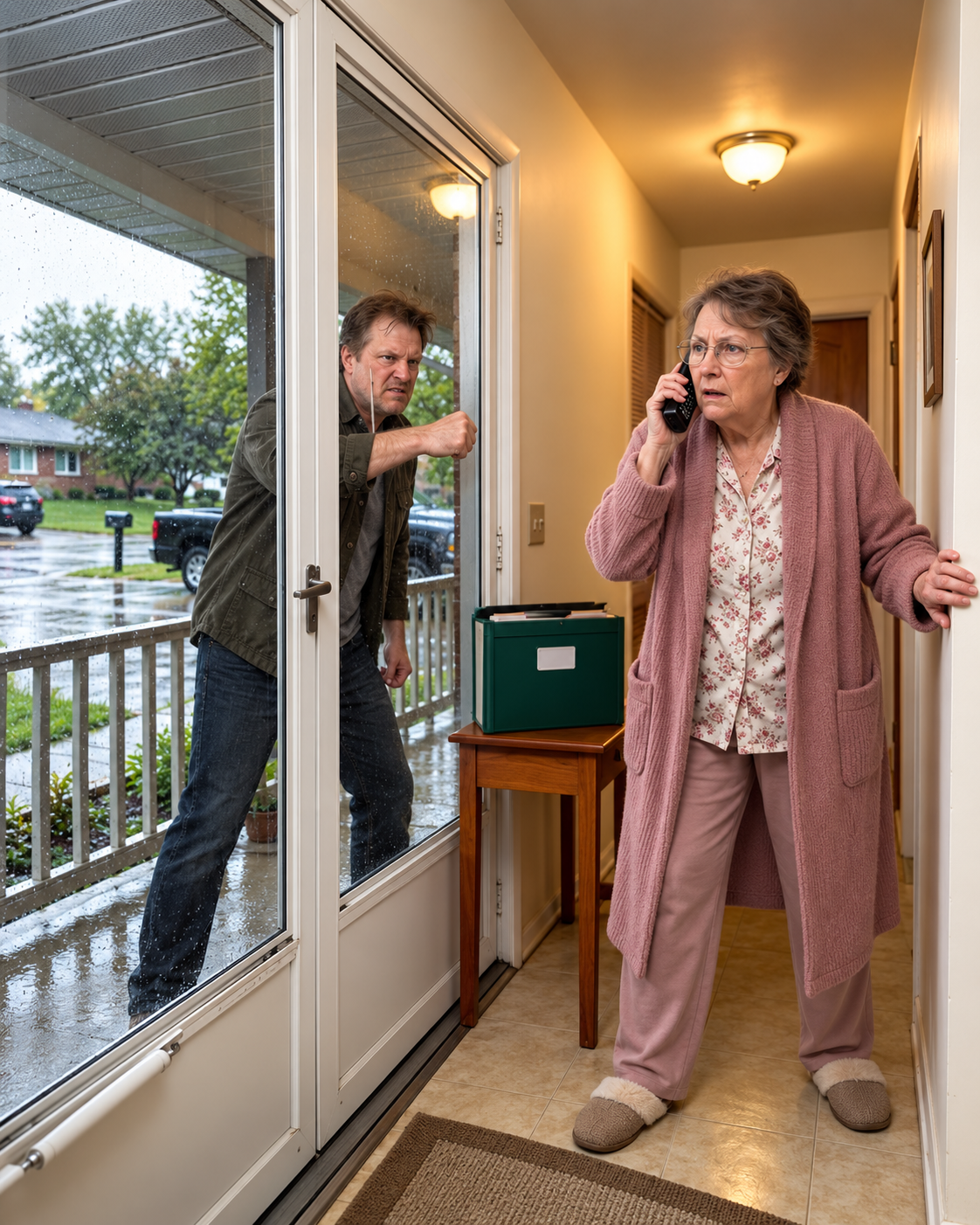
Before I could ask another question, someone struck my front door hard enough to rattle the glass.
I froze.
A second blow followed.
Then a third.
“Margaret!”
Wade.
His voice carried through the door with an edge I had never heard directed at me.
“Margaret, open up.”
The bank representative stopped speaking.
I stood in the hallway, phone pressed to one ear, heart hammering hard enough that I could feel it in my throat.
Wade hit the door again.
“We need to talk.”
I did not move toward him.
Through the narrow pane beside the door, I could see the shoulder of his shirt, then part of his face as he leaned closer. His truck was parked crookedly near the curb as though he had arrived too fast to bother with the driveway.
“Margaret,” he said. “Open the door before you do something stupid.”
The sentence settled everything inside me.
An innocent man would have asked what was happening.
An innocent man would not know there was something I could do.
I looked down at Royce’s green file.
Then I spoke into the phone.
“I need you to answer one question before we continue.”
The woman hesitated. “I’ll answer what I’m permitted to.”
“Whose name appears anywhere on that account besides mine?”
I heard typing.
Wade struck the glass with the flat of his hand.
“Margaret!”
The woman returned to the line.
“There is an authorized user associated with the account.”
My throat tightened.
“What name?”
Another pause.
Then she said it.
Wade’s full legal name.
Through the glass, I watched my son-in-law’s face while I repeated the name aloud.
He heard me.
The anger disappeared first.
What replaced it was fear.
END PART 3
PART 4 TITLE: Wade Came to My Door Before Sunrise, but the Bank Records—and Caroline’s Reaction—Told Me Why He Was Truly Afraid
Wade stepped away from the door so abruptly that for a moment he vanished from the narrow strip of glass. I stayed where I was, one hand gripping the phone and the other resting on the green accordion file. My recovering eye made the edges of the hallway look slightly soft, but there was nothing unclear about what I had just heard. My name was on a $19,400 debt I had never authorized. Wade was listed on the account. And before seven that morning, he had appeared at my house demanding I open the door before I did “something stupid.”
The woman from the bank was still speaking. She explained that because the account was under dispute, certain information could not yet be discussed in detail. I barely heard her. Wade moved into view again and pressed his palm against the storm door.
“Margaret, please.”
The change from command to plea was almost more disturbing than the pounding.
I raised the phone closer to my mouth. “I need you to make a note that Wade is standing outside my house right now.”
There was a brief silence.
“Wade, the authorized user?”
“Yes.”
“And he’s demanding entry?”
“Yes.”
Her voice became formal. “I’m documenting that.”
The word steadied me. Documenting. Not arguing. Not interpreting. Not smoothing things over for the sake of family. Simply recording what was happening while it happened.
Wade must have heard because he took another step backward.
“You’re making this bigger than it is,” he said through the glass.
I did not answer.
A car turned sharply into my driveway.
Caroline’s Subaru climbed one edge of the curb before stopping. She climbed out wearing pajama pants, sandals, and an old college sweatshirt. Her hair was pulled into a loose knot. She looked as if she had dressed while running from one room to another. She stared at Wade first, then at the house.
“Mom.”
I had heard that word from her thousands of times. Hungry. Frightened. Irritated. Sleepy. Happy. This version sounded almost unrecognizable.
She came toward the porch.
“Mom, please open the door.”
I stayed behind the glass.
Caroline looked at the shield beside my eye and seemed to register, perhaps for the first time, that I was still recovering from surgery. Her expression changed.
“Oh God. Your eye.”
“Yes. My eye.”
Wade turned toward her sharply. “Caroline, stop.”
She flinched.
It was a small movement, barely more than a tightening of her shoulders. I had seen it before and misread it. At dinners when Wade corrected her. During arguments when she started a sentence and abandoned it because he looked across the table. I had told myself they were married people with married habits. I had not wanted to become the mother who searched for problems in her daughter’s home.
Caroline ignored him and moved closer to the door.
“Did you call Otis?”
The question told me she knew more than I had hoped and less than I feared.
“I did.”
Her face crumpled.
Wade swore under his breath.
I heard the bank representative ask whether I felt physically threatened. I considered the question carefully. Wade had never hit me. He had never threatened violence. But he had arrived uninvited at dawn, pounded hard enough to shake the storm glass, and ordered me not to do something stupid while a bank investigated a debt carrying his name.
“I am not opening the door while he’s standing there,” I said.
The representative made another note.
Caroline looked at Wade. “What did you tell her?”
“Nothing.”
“Then why are you here?”
He rubbed both hands over his face. “Because this can be fixed if everybody stops panicking.”
Caroline’s eyes moved from him to me.
“What can be fixed?”
Wade did not answer.
I watched my daughter’s confusion closely. I had known Caroline every day of her forty-two years. She was capable of avoidance. She could minimize uncomfortable truths until they fit the version of life she preferred. She had signed that cruel letter and helped shut me out. But the fear in her face now did not look rehearsed.
I opened the inner wooden door but left the storm door locked between us.
“Caroline, did you know there was a credit account in my name?”
Her lips parted.
“What?”
Wade turned on her. “Don’t.”
Just that one word.
Caroline stared at him.
“Don’t what?”
He reached for her arm. She moved away before he touched her.
The bank representative remained silent on the phone, listening.
“There is a debt,” I told Caroline. “Nineteen thousand four hundred dollars. My name is on it. Wade’s name is attached as an authorized user.”
For several seconds Caroline made no sound.
Then she looked at Wade.
He stared toward the yard instead of at her.
“Tell me she’s wrong,” Caroline said.
Wade exhaled hard. “It’s complicated.”
“No. Tell me she’s wrong.”
“Caroline—”
“Tell me.”
He did not.
Caroline’s hand flew to her mouth.
The scene outside my door became strangely quiet. Morning traffic moved at the end of the street. A sprinkler clicked somewhere behind my neighbor’s fence. Birds hopped through the damp grass. I remember those details because my mind seemed determined to notice everything except the fact that my daughter’s marriage had just changed shape in front of me.
“When?” she asked.
Wade shook his head. “Not out here.”
“When did you open something in my mother’s name?”
“I said not out here.”
Caroline laughed once, without humor. “You came to her house.”
“I came here to fix it.”
“You were pounding on her door.”
“Because she called a lawyer instead of talking to us.”
Us.
Caroline recoiled as though the word itself had touched her.
“Don’t say us.”
Wade looked furious then, but underneath the anger I could see calculation. He kept glancing at my phone. At the green file. At the street. My neighbor across the road had stepped onto her porch carrying a mug and was making no convincing effort to pretend she was not watching.
I told the bank representative I needed to end the call but wanted confirmation that the account remained frozen during the investigation. She assured me it was restricted and that additional documentation had been transmitted to Otis’s office.
“Additional documentation?”
“Yes, ma’am. The application materials your attorney requested.”
Wade heard that.
Every bit of color seemed to leave his face.
“What application materials?” Caroline asked.
I looked at him through the glass.
“I suppose we’re about to find out.”
The bank representative said someone from their legal department had contacted Otis shortly before seven. After I ended the call, I immediately called him. He answered on the second ring.
“Are you safe?”
The question startled me.
“Yes.”
“Door locked?”
“Yes.”
“Keep it locked. I’m on my way.”
“How did you know something was happening?”
“The bank sent the file at six thirty-eight. I called you twice. Then their representative told me she reached you while Wade was there.”
I checked my phone and saw the missed calls for the first time.
“What did the file show?”
“I’ll explain when I arrive.”
Wade heard enough through the glass to understand.
He moved toward his truck.
Caroline stepped between him and the driveway.
“No.”
He stared at her.
“Move.”
“No. If you leave now, I swear to God, Wade—”
“Caroline, you don’t understand what’s going on.”
“Then explain it.”
He looked at me rather than her.
“This didn’t start because of me.”
I almost opened the storm door then. Not because I trusted him, but because fury made my hand reach for the latch. I stopped myself.
“What does that mean?”
“You helped us for years.”
“That is not an answer.”
“You said family helps family.”
Caroline shook her head. “What are you talking about?”
Wade’s words came faster. “Your mother gave us money constantly. She told us not to worry. She said if we ever needed something—”
“I never told you to sign my name.”
He fell silent.
There it was.
Not a confession. Not yet. But the first break in whatever story he had planned to tell.
Caroline backed away from him.
“You signed her name?”
“I didn’t say that.”
“You just defended it.”
“I said she knew we needed help.”
“That isn’t the same thing.”
For the first time since the conflict began, Caroline sounded entirely like herself.
Otis arrived twenty-three minutes after my call. His sedan pulled behind Caroline’s Subaru, blocking part of the driveway. He stepped out carrying a brown folder beneath his arm. Otis was not physically imposing, but something about the way he walked toward the porch made Wade stay exactly where he was.
“Morning,” Otis said.
Nobody answered.
He looked at Wade.
“Stay here.”
Wade’s jaw tightened. “You can’t detain me.”
“No. But leaving before your wife understands why you’re here would be an interesting choice.”
Wade remained.
Otis climbed the porch steps and positioned himself between Wade and my door before asking me to unlock it. Only then did I open the storm door. Humid morning air entered the house. Caroline looked at the protective shield near my eye again, and tears filled hers.
“Mom, I am so sorry.”
I wished the words could travel backward through the previous week and undo things.
They could not.
Otis stepped inside and placed his brown folder beside the green accordion file. The two folders looked almost absurdly ordinary. One contained thirteen years of family history. The other, I suspected, contained whatever Wade had been trying to prevent us from seeing.
“The lender sent the requested account packet,” Otis said.
Caroline’s voice trembled. “What does that mean?”
“It means we have the original application records.”
Wade said nothing.
Otis opened the folder.
The top page carried my name.
Below it was an address I had used years earlier.
My birth date.
My Social Security number.
Employment information outdated by several years.
And a signature.
I leaned closer.
It looked like mine in the way a sketch of a familiar face looks like the person until you study the eyes. The first letter of my surname curved incorrectly. I always crossed one stroke through the middle. Whoever had produced this signature had copied the shape without knowing the habit behind it.
Caroline gripped the porch railing.
“Oh my God.”
Otis turned the page.
“Wade is listed as an authorized user.”
“I already heard that from the bank,” I said.
“There is more.”
He removed several sheets clipped together.
“The application was electronic. That means the lender retained technical records connected with the submission.”
Wade closed his eyes.
Caroline noticed.
“What records?”
Otis looked directly at Wade.
“Internet connection data. Device information. Account-access history.”
Wade’s eyes opened.
Otis continued.
“The application originated from an internet connection associated with Wade and Caroline’s residence.”
Caroline’s knees seemed to weaken. She sat abruptly on the porch step.
“No.”
Wade spoke quickly. “That doesn’t prove who was using the computer.”
Otis nodded. “Correct.”
The agreement appeared to surprise him.
“Which is why the lender also provided the email account used during verification.”
He read it aloud.
Caroline stared at Wade.
I did not recognize the address.
She did.
“You still use that email.”
Wade’s face hardened.
“It was for work.”
“You told me you closed it.”
“That has nothing to do with this.”
Otis turned another page.
“The account was opened using identification documents uploaded electronically.”
My stomach tightened.
“What documents?”
“A copy of Margaret’s driver’s license and a tax document containing her Social Security number.”
I remembered the months after Royce died. The folders. Caroline helping me sort insurance papers. Wade using his laptop at my kitchen table.
Caroline remembered too.
Her face collapsed into her hands.
“You had copies,” she whispered.
Wade crouched slightly toward her.
“Caroline, listen to me.”
She looked up.
“How much?”
He did not answer.
“How much did you take?”
“Nineteen four is what’s outstanding. That’s not what I used.”
The distinction was so grotesque that no one spoke for several seconds.
Caroline stood again.
“You knew about Mom’s surgery.”
“What?”
“You knew she was having surgery, and you came here pounding on her door.”
“I came because Otis’s letter triggered a fraud review. I needed to explain before everything got frozen.”
“Explain what?”
“That it wasn’t supposed to stay like this.”
Otis’s expression sharpened.
“What wasn’t supposed to stay like this?”
Wade looked around as though he had only just realized every path out of the conversation required him to say something true.
“I needed temporary access to money.”
Caroline went completely still.
“For what?”
Wade swallowed.
He did not answer her.
Instead he looked at me.
“You weren’t using your credit.”
The sentence landed harder than shouting would have.
I stared at him.
“My credit belonged to me whether I was using it or not.”
“I know how that sounds.”
“You know how it is.”
“I made payments.”
“With my identity.”
“I was handling it.”
“Until you weren’t.”
Caroline whispered his name.
Wade turned toward her.
“I was going to replace everything before anybody knew.”
Otis closed the folder halfway.
“Before Margaret knew.”
Wade rubbed his forehead.
“Yes.”
“And the signature?”
Silence.
“Wade,” Caroline said.
He stared down at the porch boards.
The morning breeze lifted one corner of the typed boundaries letter inside the green file. I could see Caroline’s signature at the bottom. A week earlier, that letter had seemed like the center of the betrayal. Now it looked almost small.
Caroline took one step toward her husband.
“Did you forge my mother’s name?”
Wade’s shoulders dropped.
When he finally spoke, his voice was quieter than it had been all morning.
“It was temporary.”
Nobody moved.
Otis looked at him across the threshold.
“A temporary use of someone else’s identity is still fraud.”
Wade flinched.
So did Caroline.
I felt something inside me become strangely calm.
For thirteen years, I had avoided hard words because hard words could ruin dinner, damage relationships, or make somebody cry. I had called debts mistakes. I had called pressure stress. I had called manipulation family tension. I had called being used generosity because generosity sounded kinder.
But standing there with my recovering eye, my daughter’s signed letter, Royce’s green file, and a forged loan application between us, there was finally no softer word left that would still be true.
Fraud.
Caroline looked from the application to Wade and then to me.
For the first time since she accused me of choosing myself over my grandchildren, she seemed to understand that my decision to say no had never created the crisis.
It had only interrupted the system that kept the crisis hidden.
END PART 4
PART 5 TITLE: The Forged Signature Was Only the Beginning, Because One Old Document Connected Caroline to the Debt Wade Claimed Was His Alone
Nobody spoke for several seconds after Wade said the money had only been temporary. Otis remained inside my doorway with the lender’s folder open against his palm. Caroline stood on the porch staring at her husband as though she were waiting for him to turn back into the man she had believed she married. Wade kept his eyes on me. He seemed to think that if he could make me understand why he had done it, the question of whether he had the right would somehow become less important.
“Temporary money still has to belong to the person borrowing it,” I said.
Wade shook his head. “I wasn’t trying to steal from you.”
“What would you call signing my name?”
His mouth tightened. “I said I handled it wrong.”
Otis closed the folder. “Stop talking.”
Wade looked at him with open irritation.
“I wasn’t speaking to you.”
“I know,” Otis said. “I’m still advising you to stop. Every new explanation you’re offering Margaret contains another fact you may later wish you hadn’t volunteered.”
Caroline turned toward Otis. “Can he go to jail?”
Wade swore quietly.
Otis did not answer immediately. “That is not a question I can responsibly answer from a porch after reading three pages of a lender’s file.”
“But this is fraud.”
“The bank is investigating fraud.”
Caroline looked toward me, and I could see the instinct in her that I had seen since childhood. She wanted someone older to say the frightening thing would not happen. When she was six, it had been thunderstorms. At sixteen, a dented car door. At twenty-three, the missed loan payments that helped create the green file. Now she wanted me to make a federal crime feel like a family argument.
I could not.
Wade stepped off the porch and paced once along the walkway. “Can we please do this privately? Hudson is probably awake. May will be up soon. We can’t stand here while the entire neighborhood watches us implode.”
The mention of the children struck exactly where he intended it to. For years, Hudson and May had been able to redirect almost any conversation. If Caroline needed help, it was for the children. If Wade needed money, it protected the children. If I questioned an expense, someone reminded me that the children should not suffer because adults had made mistakes.
I looked toward his truck.
“Then go home to them.”
Caroline flinched.
Wade stopped pacing.
“That isn’t what I meant.”
“I know.”
Otis asked Wade and Caroline to leave until the lender completed its initial review. He told them not to destroy, alter, or delete anything connected to the account. Wade laughed bitterly and asked whether Otis thought he was in a courtroom.
“No,” Otis said. “I’m trying to make sure you don’t end up wishing you had treated this like one.”
Caroline remained on the bottom porch step after Wade walked toward his truck. She looked smaller sitting there, knees drawn together beneath her oversized sweatshirt. I wanted to go to her. Every part of my body remembered that movement before my mind could stop it: cross the room, sit beside Caroline, put one arm around her, tell her we would fix whatever she had broken.
Instead I held the doorframe.
“Did you know?” I asked.
She looked up. “About the account? No.”
“That wasn’t my question.”
She stared at me.
“Did you know Wade had any of my identification?”
Her gaze shifted toward the lawn.
That hesitation was enough.
“Caroline.”
“After Dad died, there was so much paperwork.”
“I remember.”
“You told me I could keep copies because we were handling things for you.”
“Insurance papers. Medical bills. Estate documents.”
“I know.”
“Did you give them to Wade?”
“He helped organize everything.”
The answer was not exactly yes. That mattered.
Otis stepped back toward the table and reopened his folder. “Caroline, I need you to be careful. I’m Margaret’s attorney. I do not represent you.”
She swallowed.
“I understand.”
“No, you probably don’t. If you knew about the use of Margaret’s identification or signed anything related to this account, you should speak with your own attorney before explaining it to me.”
Wade, who had reached his truck, turned around.
“Caroline, let’s go.”
She ignored him.
“I didn’t open the account.”
Otis said nothing.
“I didn’t.”
“Then get independent legal advice before saying more.”
Her face changed. I could almost see the moment she understood that Otis was not merely being formal. He thought there might be something she needed protection from too.
Wade walked back rapidly.
“She doesn’t need an attorney.”
“That decision isn’t yours,” Otis said.
“She didn’t do anything.”
“Then an attorney can help her document that.”
Wade stopped beside Caroline. “Come home.”
She did not move.
“What else is in that packet?” she asked me.
“I don’t know yet.”
Her eyes went to the folder.
“I want to see it.”
Otis shook his head. “Not now.”
Caroline looked almost offended. “It has my family in it.”
“It has Margaret’s private financial information in it.”
The correction hurt her. I watched it happen.
Only a week earlier, Caroline had behaved as though my money, time, home, and schedule existed within a shared family pool until I denied her access. Now, for perhaps the first time, someone had drawn a line around something that belonged to me alone.
Wade finally convinced her to leave. Before she climbed into the Subaru, she turned toward me.
“Mom, I really didn’t know it was nineteen thousand dollars.”
That was not the same as saying she had known nothing.
I waited until both vehicles were gone before asking Otis what he had heard in her sentence.
“The same thing you heard.”
My stomach dropped.
He carried the lender’s folder to the kitchen table and sat across from me. Because my eye was still healing, he enlarged several scanned pages on his tablet rather than making me strain over the small print. The original credit application had been submitted eleven months earlier. My personal information was complete enough that whoever filled it out had access to documents, not merely memories.
The initial limit had been ten thousand dollars.
I looked at him. “But the debt is nineteen four.”
“The lender increased the line twice.”
“Why?”
“Payment history. Additional requests. Updated verification.”
He scrolled.
The first months showed small withdrawals followed by payments large enough to keep the account looking healthy. Then the amounts increased. Eight hundred dollars. Fifteen hundred. A repayment. Two thousand. Another repayment. Four thousand. The pattern reminded me of somebody carrying water in a cracked bucket, pouring in just enough to hide how quickly it leaked.
Otis pointed to a certification page.
“This is where things become more complicated.”
Across the top was the phrase AGENT AUTHORITY VERIFICATION.
I read the name below it.
Caroline Bennett.
My heart seemed to lose one beat.
“What is this?”
“When the lender questioned whether Wade had authority to handle matters for you, someone provided a power-of-attorney document.”
I stared at him.
“I changed my power of attorney with you last week.”
“This isn’t that document.”
He removed another paper from the folder.
I recognized it immediately. Three years earlier, during the final months of Royce’s illness, Otis had prepared a limited banking power of attorney so Caroline could deposit checks, handle specific household payments, and communicate with two institutions while I was spending most days at the hospital. It had been canceled several months after Royce died when I resumed handling my affairs.
I remembered signing the cancellation in Otis’s office.
“You told the banks it was revoked.”
“I did.”
“And this lender has a copy of the old one?”
“Yes.”
“How?”
“That copy came from somewhere outside my office.”
A chill moved along my arms.
The form beneath it contained a certification stating that the power of attorney remained valid and had not been revoked.
At the bottom was a signature.
Caroline’s.
I leaned closer until the letters sharpened.
There was no mistaking her handwriting. Caroline made the upper loop of her C too large. She always had. I had seen the same shape on birthday cards, school permission slips, and the typed letter sitting six inches away in the green file.
“She signed this.”
“Yes.”
“When?”
“Seven months ago.”
Four months after the account had first been opened.
My first reaction was confusion.
“If Wade forged my signature eleven months ago, why did the bank need Caroline seven months ago?”
“Because the initial account appears to have been opened using your direct identity. Later, when Wade tried to increase the available credit and change certain access permissions, the lender requested additional authority.”
I stared at Caroline’s signature.
“She told me she didn’t know about the account.”
“She said she didn’t know it was nineteen thousand dollars.”
The precision of the distinction made me sick.
Otis turned another page.
There was a copy of the revoked power of attorney. Somebody had scanned only the original instrument, not the revocation filed later. The lender had asked the person claiming authority to certify that it remained effective.
Caroline had done exactly that.
“Maybe Wade told her it was still valid.”
“Possible.”
“She might not have remembered.”
“Possible.”
“She signed a lot of papers after Royce died.”
“Margaret.”
I stopped.
Otis folded his hands.
“You can love your daughter and still read what is on the page.”
I looked again.
The certification contained three statements directly above Caroline’s signature. I read each one slowly. She affirmed that I was alive. She affirmed that the power of attorney had not been revoked. And she affirmed that she was acting within the authority granted to her.
“She knew I had taken back control,” I said.
Otis did not answer.
“She knew.”
My voice sounded distant.
After Royce died, Caroline had complained when I canceled the temporary banking arrangement. She told me I was making things harder on myself. I remembered standing in her kitchen and telling her that handling my own bills gave me something normal to do. She had been irritated, but she had known.
There was no way she could honestly believe the old document remained active.
My phone rang.
Wade.
I let it ring.
He called again.
Then Caroline.
I watched her name glow across the screen.
For most of my life, I would have answered simply because she was my daughter.
This time I let that call end too.
A minute later, Wade sent a message.
Please don’t make decisions before you know the whole story.
Otis read it only because I showed him.
“What would you do?” I asked.
“If it were my daughter?”
“Yes.”
He removed his glasses and cleaned them slowly with a cloth from his pocket.
“I would stop asking what decision saves the relationship fastest.”
That was not the comfort I wanted.
“What would you ask instead?”
“What decision leaves you able to trust yourself afterward.”
The bank called that afternoon. The investigator asked whether I had ever authorized Caroline to represent that the old power of attorney remained valid. I said no. She asked whether I had authorized Wade to use my identity to open or draw upon the account.
No.
She asked whether I wanted the account frozen while the fraud investigation continued.
My answer came before fear could soften it.
“Yes.”
She confirmed the freeze.
Less than ten minutes later, Wade was back at my door.
This time I did not unlock it.
He stood on the other side of the glass with both hands visible, his anger temporarily replaced by a voice so gentle I almost hated it more.
“Margaret, think about Hudson and May.”
For years those names had opened my wallet faster than any key.
I slid only the upper deadbolt latch aside so he could hear me clearly through the door.
“I am thinking about them,” I said. “That is why I’m ending this.”
His palm struck the glass.
“You don’t understand what freezing it does.”
“I understand exactly what continuing it does.”
Behind me, the bank investigator was still on speakerphone, documenting the confrontation.
Wade’s face hardened.
Then, before the woman could finish recording my statement, he shouted the one sentence I had not expected him to admit.
“Caroline signed it, Margaret—not me.”
The hallway went silent.
I looked through the glass at my son-in-law.
Then I looked down at the certification carrying my daughter’s unmistakable signature.
Wade had meant to save himself.
Instead, he had just confirmed that the betrayal was no longer something I could place entirely on the man Caroline married.
END PART 5
PART 6 TITLE: Caroline Finally Told Me Why She Signed the Revoked Power of Attorney, but Her Explanation Exposed an Even Deeper Betrayal
Caroline arrived alone twenty minutes after Wade left. I watched her pull into the driveway from the kitchen window, stop badly, reverse, and straighten the Subaru as though ordinary parking still mattered. She remained behind the wheel for almost a minute with both hands gripping it. When she finally came to the door, she did not knock hard. She touched the bell once and waited.
I kept the storm door locked.
“Where is Wade?”
“At home.”
“With the children?”
“His sister came over.”
I looked behind her anyway.
“Mom, please.”
The word no longer worked automatically.
“I have Otis on the phone.”
Her face tightened.
“Okay.”
I opened the inner door but not the glass one.
“Did you sign the certification?”
She closed her eyes.
That was my answer.
“Caroline.”
“Yes.”
Something inside me had still been waiting for her to deny it. Even after seeing her signature. Even after Wade shouted the truth. Mothers can build remarkable structures out of denial when the alternative is admitting their children chose to hurt them.
I put one hand against the doorframe.
“Why?”
She looked down at the porch.
“Can I come inside?”
“No.”
Her eyes lifted sharply.
It was the first time in her life I had denied her entry to my home.
The shock on her face was almost childlike.
“I don’t trust what is happening yet,” I said. “Until I understand it, we talk here.”
She wrapped both arms around herself.
“Wade told me they needed proof that I had permission to help with some financial paperwork.”
“What paperwork?”
“He said he was restructuring debts.”
“Whose debts?”
“Ours.”
“And how did my old power of attorney become involved?”
Her silence stretched.
“Caroline.”
“He said the bank wouldn’t approve enough in his name.”
I felt my fingers press harder into the wood.
“So you gave them mine.”
“No. Not exactly.”
“What exactly did you do?”
She glanced toward the street, embarrassed by the possibility that a neighbor might hear. That small concern irritated me more than it should have. She had participated in putting nineteen thousand four hundred dollars under my identity, yet she still wanted the porch to look respectable.
“Wade said you had already helped us before,” she began.
“That isn’t an answer.”
“I know.”
“Then answer.”
“He said the old document meant I could sign some verification papers for you.”
“You knew it had been canceled.”
She shook her head too quickly.
“I knew we stopped using it.”
“Otis canceled it. I told you the day it happened.”
“I didn’t remember the legal part.”
“You argued with me about it.”
Her face flushed.
For several seconds she said nothing.
Then she whispered, “I remembered that later.”
“Later when?”
“After I signed.”
My stomach turned.
She continued quickly, words tumbling over one another.
“Wade brought me one page. He said the lender just needed confirmation that I’d handled your finances before. He told me it wasn’t a new loan in your name. He said it was connected to consolidating things and that your information was being used because you’d helped with some of the original expenses.”
I stared at her.
“That makes no sense.”
“I know that now.”
“It made no sense then.”
Her eyes filled.
“Yes.”
The admission landed differently from every excuse that came before it.
She was not claiming Wade had fooled her perfectly. She was admitting she had chosen not to examine something because examining it would have required saying no.
“How much did you think he was borrowing?”
She rubbed her hands together.
“Six thousand.”
The number almost made me laugh.
“You thought using my revoked legal document to obtain six thousand dollars without telling me was acceptable?”
“No.”
“But you did it.”
“Yes.”
Otis, still listening through my phone, remained silent.
I asked the question that mattered most.
“Why didn’t you ask me?”
Caroline looked straight at me then.
“Because you might have said no.”
There it was.
No confusion about legal wording. No husband manipulating an innocent wife. No misplaced file.
She had not asked because consent might interfere with the answer she wanted.
The porch seemed to sharpen around us: pale wood railing, damp doormat, tiny spiderweb beneath the mailbox. My recovering eye was still adjusting to brighter contrast after surgery. It occurred to me that I had spent months waiting to see the physical world clearly while avoiding what was directly in front of me inside my own family.
Caroline wiped her cheek.
“Wade had fallen behind.”
“On what?”
“Cards. The truck. Some medical payments. The house.”
“Hilton Head?”
She looked ashamed.
“That trip was already booked.”
“So you could afford a vacation while borrowing under my identity?”
“It wasn’t like that.”
“That sentence has done a lot of work in this family.”
She flinched.
I asked whether the eight hundred dollars Wade returned after I refused to babysit had come from their own money.
“I don’t know.”
“Think.”
“I don’t know, Mom.”
“Did you know he was using the account after you signed?”
She hesitated again.
“Some.”
“How much is some?”
“He told me he had drawn around eight thousand total.”
“When?”
“A few months ago.”
“And when did you learn it was more?”
“This morning.”
I believed that part. Her shock at the porch had looked genuine.
But partial ignorance did not erase deliberate participation.
“What did you think would happen to the debt?”
“He said he’d repay it before it affected you.”
“With what?”
“He was expecting a bonus.”
“Did the bonus come?”
“Not the amount he expected.”
“And then?”
“He moved things around.”
I almost smiled despite myself.
“That’s what he calls it?”
Her mouth tightened.
“He kept paying enough that nothing reached you.”
“That was the plan?”
“Yes.”
“Use my identity but hide it well enough that I never knew?”
Caroline’s shoulders folded inward.
“Yes.”
For a moment I had no words.
I had imagined many things during the previous week. Wade manipulating Caroline. Wade hiding everything. Caroline being selfish about babysitting. Caroline signing a cruel letter because she was angry. I had not imagined my daughter knowingly participating in a plan built around my ignorance.
“What did the typed letter have to do with this?”
She looked confused.
“What?”
“The boundaries letter. You accused me of using money to control you three days before the account came under review.”
Her face changed.
I saw recognition, then fear.
“Wade wrote most of it.”
“I know that.”
“He said we needed to stop depending on you.”
“After taking money through my credit.”
“I didn’t connect—”
“Don’t.”
My voice was quiet enough that she stopped immediately.
“Do not tell me you couldn’t connect those things. Maybe you didn’t know the full amount, but you knew you had signed a document involving my finances without telling me. Then you signed another document telling me my financial help had become unhealthy.”
Caroline started crying.
I did not open the door.
That was perhaps the hardest thing I had done since Royce died.
She pressed both palms against her face.
“I was angry.”
“About babysitting?”
“Yes.”
“Why?”
“Because I needed that weekend.”
“You wanted that weekend.”
“I needed a break.”
“So did I.”
The words came out before I planned them.
She lowered her hands.
“My eyes were getting worse. I was nervous about surgery. I had prescriptions to organize, transportation to arrange, and a doctor telling me not to exhaust myself. You knew all of that, and when I said no for three days, you punished me.”
Her mouth trembled.
“I wasn’t trying to punish you.”
“You ignored me while Hudson was inside the house.”
She closed her eyes again.
“I know.”
“You let my grandson hear me at your door and taught him that Grandma had done something wrong.”
“I know.”
“And all the while, you were hiding a financial decision that used my name because you were afraid I might say no.”
Caroline leaned against the porch railing.
“I don’t know how I let things get this far.”
I believed that too.
People rarely wake one morning and decide to betray someone they love in the largest possible way. More often they move one boundary at a time, always telling themselves the next step is temporary. A document kept after it should have been destroyed. A signature that feels technical. A loan that will be repaid. A lie postponed until tomorrow. Eventually they stand on a porch unable to identify exactly when they became the person who made all those choices.
Otis finally spoke through the phone.
“Caroline, you need an attorney.”
She looked toward the phone.
“Am I in trouble?”
“I cannot advise you.”
“I don’t have money for a lawyer.”
I almost offered to pay.
The words rose into my throat from forty-two years of habit.
I swallowed them.
Caroline noticed.
That hurt both of us.
“I’ll find someone,” she whispered.
Before leaving, she asked whether she could see me after my next eye appointment. I said I did not know.
She asked whether she could bring Hudson.
“No.”
Her face broke.
“Why?”
“Because Hudson isn’t going to become the bridge you walk across whenever you don’t know how to talk to me.”
“I wasn’t—”
“Yes, you were.”
She went quiet.
“I love him,” I said. “And May. That is exactly why I won’t use them to make this easier for either of us.”
Caroline nodded slowly.
She left without asking again to come inside.
The bank investigator called later that afternoon. The freeze had stopped further withdrawals. She explained that their legal team was comparing the original application, Wade’s account access, and Caroline’s certification against records showing the old power of attorney had been revoked.
“The revocation predates the certification by more than two years,” she said.
“Yes.”
“And your attorney has supplied evidence that notice of revocation was sent to the financial institutions you used at the time.”
“Yes.”
She paused.
“Mrs. Bennett’s certification stated the authority remained active.”
I looked at the green file.
“Yes.”
The investigator asked whether Caroline had spoken to me.
“She admitted signing it.”
“Did she say she believed she still had legal authority?”
I thought carefully.
“She said she knew we had stopped using it. She also admitted she did not ask my permission because I might refuse.”
The woman was silent while she typed.
The sound of those keys carried through the phone like tiny taps of a hammer.
Before we ended, she told me the lender had discovered one more request attached to the account.
“What request?”
“A credit-limit increase.”
My chest tightened.
“When?”
“Three days ago.”
I gripped the counter.
Three days ago was the morning after Caroline and Wade left the typed boundaries letter at my door.
“How much?”
“The request would have increased available credit by twelve thousand dollars.”
I sat down.
The bank had declined to process it automatically because the documentation on file required reverification.
“Who submitted it?”
“We’re still confirming.”
But I already knew what mattered.
This was not only an old mistake Wade and Caroline had been quietly repaying.
While they were telling me I used money to manipulate them, somebody in their house had been trying to gain access to twelve thousand dollars more under my name.
The family argument had not interrupted a finished deception.
It had interrupted one still growing.
END PART 6
PART 7 TITLE: The New Credit Request Forced Me to Choose Between Protecting My Grandchildren’s Parents and Protecting the Life I Had Left
Otis came to my house that evening carrying Chinese food and the expression of a man who had already decided I was not going to like his advice. He placed cartons of rice, chicken, and vegetables on the kitchen counter, then examined the eye-drop schedule taped to my refrigerator before discussing anything legal. Royce used to complain that Otis disguised affection as administration. I had never noticed how true that was until I became the person he was quietly checking on.
“The clinic called,” I said. “My follow-up is tomorrow morning. Everything feels fine.”
“Good.”
“I know what you’re doing.”
“Making sure you don’t neglect your surgery because your family decided to commit financial malpractice during recovery?”
I almost laughed.
“Something like that.”
We ate before opening the files.
The bank had emailed him details of the attempted credit increase. It was submitted electronically at 10:14 p.m. on the night after Caroline left the typed boundaries letter at my house. The request sought an additional twelve thousand dollars. According to the technical records, the device was the same one used repeatedly to access the account.
“Wade’s?”
“Appears to be.”
“Caroline?”
“No proof yet.”
I pushed the carton away.
“So after returning my eight hundred dollars to make some grand point about independence, he tried to borrow twelve thousand through my credit?”
“That appears to be the sequence.”
The cruelty of it was almost elegant.
Wade had returned money I willingly gave while trying to take money I never offered.
I asked whether the bank would remove the debt.
“If they conclude the account resulted from identity theft or unauthorized use, probably. But they will want a formal fraud affidavit.”
“And a police report.”
“Likely.”
I had known that was coming.
Still, hearing it aloud changed the room.
I looked toward the framed photograph of Hudson sitting on a pumpkin the previous October. He had been furious because Caroline wanted him to smile when he was trying to examine a worm in the dirt. Royce would have loved that stubbornness.
“What happens if I file one?”
Otis leaned back.
“You report what happened. Law enforcement decides what to investigate. Prosecutors decide what, if anything, to charge. You do not control all of the consequences.”
“That’s exactly what worries me.”
“I know.”
“If Wade loses his job—”
“Margaret.”
“If Caroline gets charged—”
“Margaret.”
“The children live in that house.”
Otis waited until I stopped.
Then he asked, “Who created that risk?”
I looked away.
“That isn’t the question I’m asking.”
“It needs to be part of it.”
I stood and carried our empty cartons to the trash, needing movement.
“Hudson didn’t forge anything. May didn’t sign a revoked document.”
“No.”
“So they suffer anyway.”
“Possibly.”
“That doesn’t feel like justice.”
“Consequences are not always distributed fairly.”
I hated the sentence because it was true.
After Otis left, I walked through my house turning off lights room by room. I stopped in the spare bedroom where the green file had once been hidden behind a quilt. Royce’s side of the closet still held one of his old winter coats because I had never found a reason important enough to remove it. I pressed my fingers into the sleeve.
“What would you do?” I whispered.
Of course the coat said nothing.
Royce had loved Caroline without illusion. That was one reason she went to him when she had truly made a mistake. He did not confuse love with pretending. During the old car-loan crisis, after we paid the overdue amount, he made Caroline sit at our table and call the lender herself. When she cried and asked him to do it, he said, “I can stand next to you, but I won’t become you.”
I had thought he was being hard.
Now I understood the gift inside it.
The next morning, Elaine drove me to the eye clinic. My surgeon pronounced the recovery excellent and reduced one set of drops. When the protective shield came off permanently, I studied the examination room with ridiculous fascination. The letters on signs looked crisp. The doctor’s coat was whiter than I remembered. Even the lines around Elaine’s eyes seemed deeper.
“You look old,” I told her.
She smiled. “I’m glad we spent all that money fixing your vision.”
We laughed hard enough that the technician leaned through the doorway.
For half an hour, my life belonged only to my eye.
It felt wonderful.
On the drive home, Elaine asked about the investigation. I told her everything, including Caroline’s admission and the twelve-thousand-dollar request.
Elaine gripped the steering wheel.
“File the report.”
“You didn’t even think about it.”
“I’ve been thinking about it since you told me somebody used your Social Security number.”
“What about the kids?”
“What about them?”
“They depend on Caroline and Wade.”
“So did you, once, emotionally. They used that.”
I looked out the window.
“Don’t turn Hudson and May into a reason nobody can ever hold their parents accountable,” she said. “That’s not protecting children. That’s teaching the adults that having children makes them untouchable.”
I did not answer for the rest of the drive.
At home, three envelopes waited in my mailbox. One was a utility bill. One was a charity request. The third came from the lender’s fraud department.
Inside was the affidavit.
The first page asked whether I had authorized the account.
No.
Whether I had received any benefit from the borrowed funds.
No.
Whether I knew the persons suspected of opening or using the account.
I stared at that question.
Yes.
The form did not care that one suspect had been at my side when Royce died or that the other had carved a turkey at my table. It offered a box beside YES and a line for names.
I put the form down.
Around noon, Caroline called.
This time I answered.
“Hi, Mom.”
Her voice was cautious.
“Hello.”
“I spoke with a lawyer.”
“All right.”
“She says I shouldn’t discuss details.”
“Then don’t.”
Caroline sounded surprised.
“I just wanted you to know I’m cooperating.”
“With the bank?”
“With everything.”
I waited.
She took a breath.
“I told them I signed the certification.”
“Good.”
“And I told them Wade showed it to me.”
“Good.”
Another silence.
“Mom, are you filing a police report?”
I looked toward the affidavit.
“Yes.”
She started crying immediately, but quietly.
I closed my eyes.
“Caroline.”
“What happens to the kids?”
There it was again.
“I don’t know.”
“They could lose their house.”
“Why?”
“Wade’s work could find out.”
“Why would that be my doing?”
“I didn’t say it was.”
“You called because you hoped I wouldn’t file.”
“I called because I’m scared.”
“So am I.”
She inhaled shakily.
“I made a terrible decision.”
“Yes.”
“I didn’t know Wade had already used your identity when I signed.”
“I believe you may not have known everything.”
The careful wording hurt her.
“Do you believe me at all?”
I thought about the daughter I raised, the woman on my porch, the signature under a false certification, and the truth she finally admitted: she did not ask because I might have said no.
“I believe you’re telling me more truth now than you did last week.”
She went silent.
It was not forgiveness.
But it was honest.
Caroline asked whether the police would arrest her.
“I don’t know.”
“Could you tell them Wade pressured me?”
“If they ask me what I know, I’ll tell them what I know.”
“What if my lawyer says I was manipulated?”
“Then your lawyer can make that argument.”
“Mom.”
“What?”
“I need you on my side.”
The old answer almost came automatically.
Instead I said, “I am not going to lie for you.”
She cried harder.
I held the phone but did not retract the sentence.
“I love you,” I said. “That is not the same as being your defense.”
She ended the call several minutes later without anger.
That mattered to me.
At two in the afternoon, I met Otis at the police station.
The building was smaller than I expected. No dramatic interrogation rooms. No shouting. A desk sergeant directed us to an officer who specialized in financial complaints. She was perhaps forty, with reading glasses hanging from a cord and a paper cup of coffee beside her keyboard.
Her name was Detective Lena Morris.
She listened to the timeline once without interrupting.
Then she asked me to begin again while she took notes.
I told her about the account, Wade’s connection, the forged signature, the old power of attorney, Caroline’s certification, and the attempted twelve-thousand-dollar increase.
“Did either individual admit involvement?”
“Both.”
Otis glanced at me.
I explained Wade’s statements and Caroline’s porch confession.
Detective Morris asked whether I had recordings.
“The bank representative heard part of Wade’s statement.”
That interested her.
She requested contact information for the lender and asked Otis about preserving the technical records.
When we finished, she gave me a report number.
That small string of digits frightened me more than anything Wade had shouted through my door.
It meant the matter now existed somewhere beyond our family.
On the way home, I felt physically ill.
Otis drove because Elaine had returned home. Halfway to my house, I asked him to pull into a pharmacy parking lot.
He did.
I sat there breathing slowly.
“Did I just destroy my daughter’s family?”
“No.”
“You don’t know that.”
“You reported what happened.”
“That’s lawyer language.”
“Yes.”
I looked at him.
“What is friend language?”
He considered.
“You finally stopped volunteering to absorb the damage so everyone else could avoid feeling it.”
That was worse because it sounded like Royce.
When I got home, I placed the police report number inside the green file.
Then I noticed a message from Wade.
You have no idea what Caroline actually did.
A second message followed.
Ask her whose signature is on the second authorization.
I read it three times.
There had been no second authorization in the pages Otis showed me.
I called him immediately.
He accessed the newest documents the lender had sent during our time at the police station.
There was, in fact, another authorization.
It had been submitted with the attempted twelve-thousand-dollar increase.
The document claimed Caroline still held authority to act for me.
And the signature at the bottom was not mine.
It was hers.
Dated three days earlier.
Caroline had not merely participated months ago and regretted it later.
She had signed again after I refused the Memorial Day babysitting request.
END PART 7
PART 8 TITLE: Caroline’s Second Signature Destroyed Her Last Excuse, and I Finally Learned What Happened the Night She Left That Cruel Letter
I did not call Caroline after seeing the second authorization. That surprised me. A week earlier, discovering anything painful had sent me reaching for my phone. I wanted explanations immediately, perhaps because quick explanations left less time for reality to settle into its full shape. This time I simply sat at my kitchen table with the document open on Otis’s tablet and read the date again.
Three days earlier.
The evening after I found the typed boundaries letter.
Caroline had stood with Wade in whatever room they used for bills, taken a document concerning my finances, and signed her name again.
The first certification could still be wrapped in confusion if she tried hard enough. She had an old power of attorney. Wade had told her something complicated. She believed the amount was smaller. She assumed they would repay it. None of those things made the act innocent, but I could understand the path of self-deception.
The second signature was different.
By then she had just accused me of making our relationship transactional.
By then she was angry because I would not provide free childcare while preparing for surgery.
By then she knew she was helping Wade access money through a document that belonged to me.
“What does it actually say?” I asked.
Otis enlarged the page.
It was not long. The lender had requested reverification before considering the credit increase. The form asked the person asserting authority to confirm that no event had occurred terminating or revoking the underlying power of attorney.
Caroline had checked the box marked CONFIRMED.
Below it she had signed and dated her name.
I pressed my fingertips against my forehead.
“She knew.”
“Yes.”
“No explanation this time.”
“Not one I can see from the document.”
The bank had also preserved the electronic submission time.
10:41 p.m.
The typed letter had been left at my house shortly before six that same evening.
For nearly five hours after telling me we needed healthier financial boundaries, my daughter had apparently discussed taking twelve thousand additional dollars through my identity.
“Why twelve?”
Otis scanned the transaction notes.
“Credit-card balances. A mortgage arrearage. Possibly other obligations. The request description is vague.”
“Hilton Head too?”
“I don’t know.”
I no longer cared much about the vacation itself. It had become only another symbol of a deeper problem: Wade and Caroline had built a life in which appearances were treated as obligations and I was treated as hidden liquidity.
My doorbell rang.
Both Otis and I looked toward the hallway.
Caroline stood outside.
Alone again.
She held a thick envelope against her chest.
I almost left her there.
Then I remembered the police report, the bank affidavit, and Royce telling twenty-three-year-old Caroline that he could stand beside her while she made a difficult call but would not make it for her.
I opened the wooden door.
The storm door remained locked.
“Did Wade tell you I know?”
She nodded.
“He showed me your message.”
“I didn’t message him.”
“He showed me what he sent you.”
That sounded more like Wade.
Caroline lifted the envelope.
“I brought everything I found.”
Otis came into view behind me.
Caroline saw him.
“Good,” she said quietly.
I unlocked the storm door but stepped aside only after Otis told me it was all right.
Caroline entered my house like a guest.
That was new.
She did not drop her purse on the chair. She did not open the refrigerator. She did not call toward the back rooms as if Hudson might somehow be there. She sat at the kitchen table and placed the envelope between us.
“What is it?”
“Copies. Emails. Statements. Things Wade kept.”
“Where?”
“In his desk.”
“Did he give you permission to take them?”
“No.”
Otis raised one hand.
“Before we go farther, you have an attorney now. Have you spoken with her about bringing this here?”
“Yes.”
“And?”
“She told me to make copies, give the originals to her, and cooperate with the investigation.”
Otis nodded.
“Then continue.”
Caroline looked at me.
“I lied yesterday.”
The sentence was so plain that I almost appreciated it.
“About what?”
“The second signature.”
“I know.”
Her face drained.
“How?”
“The lender sent it.”
She stared at the envelope.
“I was going to tell you.”
“When?”
“Now.”
“That isn’t what I asked.”
She looked up.
“I don’t know.”
At least she did not invent a time.
I folded my hands on the table.
“Tell me what happened that night.”
Caroline took a long breath.
After leaving the typed letter at my house, she and Wade returned home and argued. The Hilton Head trip had cost more than they expected. Two credit cards were nearly maxed out. Their mortgage payment was late. Wade had also borrowed money from a retirement account, something Caroline discovered only days earlier.
“Why did you sign that letter with him?”
“Because I was furious with you.”
“For saying no.”
“Yes.”
She looked ashamed.
“I’d spent weeks planning the trip. Wade kept saying we needed it. When you said you couldn’t take the kids, everything became complicated. I knew you had surgery, but I kept telling myself it wasn’t until Tuesday, so the weekend shouldn’t matter.”
I stared at her.
“You wanted me exhausted before eye surgery because your hotel was booked.”
“When you say it like that—”
“How else should I say it?”
She lowered her eyes.
“There isn’t another way.”
She continued.
After I refused, Wade told her my help had become unpredictable. He said depending on me gave me too much influence over their decisions. Caroline was already angry, so the idea felt reasonable. Together they found language online about boundaries and transactional family relationships. Wade drafted most of the letter. Caroline changed two sentences and signed it.
“And after you delivered it?”
“We went home.”
“Then what?”
“Wade got a notification that the credit increase needed reverification.”
My skin went cold.
“He showed you the form.”
“Yes.”
“What did you say?”
“I said we shouldn’t.”
“But you did.”
“Yes.”
“Why?”
Her fingers tightened around each other.
“Because he showed me everything due that month.”
“That still isn’t my debt.”
“I know.”
“Did you know the power of attorney was revoked?”
This time she did not hide behind memory.
“Yes.”
Otis shifted slightly in his chair.
Caroline looked toward him.
“My lawyer already knows.”
“I’m glad,” he said.
She turned back to me.
“I knew. I told myself it was just paperwork because I’d signed before and nothing happened. Wade said if the increase went through, he’d pay off the cards, catch up the mortgage, and then close your account completely.”
“My account.”
She winced.
“The account in your name.”
“Better.”
She wiped her face.
“He said one last draw would fix everything.”
The phrase sounded ancient.
One last draw.
One last favor.
One last time Grandma would cover preschool.
One last temporary use of a document.
People could build entire lives out of last times that never arrived.
“Did you think I would find out?”
“No.”
Her honesty hurt more than denial.
“Did you plan to tell me afterward?”
“No.”
“Did you think that was wrong?”
She began to cry.
“Yes.”
“When did you think it became wrong? Before signing or after?”
“Before.”
The room went very quiet.
There was no excuse left after that.
She had known before.
“What happened next?”
“The lender wouldn’t approve it immediately. Wade got angry. He said the account had always worked before.”
“Always.”
Caroline nodded.
“That was when I realized he’d been using it much longer than I understood.”
“How long did you think?”
“I thought the account started when I signed the first certification.”
Seven months ago.
“But it started eleven months ago,” I said.
“Yes.”
“And he forged my signature before involving you.”
“Yes.”
“So when you helped him later, you believed you were beginning something improper. You didn’t know you were joining something already fraudulent.”
She nodded miserably.
I understood why her attorney had probably told her to cooperate.
Caroline opened the envelope.
Inside were printed emails between her and Wade.
She pushed one toward me.
The subject line was MOM PAPERWORK.
I hated the casualness of it.
One email from months earlier showed Wade telling Caroline to sign a verification because the lender “only needs proof you can act for her.” Caroline replied: She canceled that after Dad died.
Wade answered: They don’t know that. It’s just for verification. We’ll have this paid down before it matters.
I stared at Caroline.
“You knew.”
“Yes.”
Another message came from the night of the boundaries letter.
Wade: Need you to reconfirm tonight or the increase dies.
Caroline: I don’t want to keep doing this.
Wade: Then tell me which bill isn’t getting paid.
Several minutes later, Caroline replied: Send it.
That was all.
No threats.
No coercion dramatic enough to remove her choice.
Pressure, yes.
Fear, yes.
Bad finances, yes.
And then a decision.
Caroline folded her hands.
“I kept thinking because you had helped us so many times, you would help if you knew how bad it was.”
“But you didn’t ask.”
“Because I was ashamed.”
“And because I might say no.”
“Yes.”
I looked at the typed boundaries letter.
“Do you understand why that letter hurt differently now?”
She nodded.
“I accused you of controlling us with money while we were secretly using yours.”
“My credit.”
“Yes.”
“You didn’t even need my money. You needed my name.”
She began crying again.
This time I let her.
Not because I wanted her to suffer.
Because stopping her tears had always been my way of stopping the truth shortly before it reached the part that hurt most.
After a while, she asked whether I hated her.
“No.”
Her face crumpled harder.
“I wish you did.”
“Why?”
“Because this feels worse.”
I understood.
Hatred would have simplified everything.
Love made accountability more complicated, not less necessary.
“I love you,” I said. “I do not trust you.”
She covered her mouth.
Those were perhaps the cruelest truthful words I had ever spoken to my daughter.
Otis quietly gathered the documents she brought and asked permission to copy them for the bank investigator and Detective Morris. Caroline agreed. Her lawyer had already sent some materials to the detective.
Then Caroline told us something else.
Wade had asked her that morning to say the signatures were entirely his.
I stared at her.
“He wanted you to claim he forged your name too?”
“Yes.”
“Why?”
“He said if everything stayed with one person, maybe I could keep the house and the kids wouldn’t have their whole life destroyed.”
Otis’s expression hardened.
“What did you say?”
“No.”
I believed her.
Perhaps because she had finally stopped decorating the truth.
“He got angry,” she continued. “Then he said if I wouldn’t protect him, he would tell everyone I signed the documents.”
“He already told me.”
“I know.”
For the first time, there was something almost like bitter humor in her expression.
“He keeps revealing the truth as a threat now.”
I understood that too.
When secrets lose their usefulness as protection, people sometimes start using them as weapons.
Before Caroline left, she handed me the spare key to my house.
I looked at it in her palm.
“You don’t have to give that back.”
“Yes, I do.”
“Why?”
“Because you didn’t take it from me when you should have.”
The admission struck deeper than any apology.
I accepted the key.
She stood at the door.
“Can I ask one thing?”
“Yes.”
“Will you still see Hudson and May?”
“I want to.”
Her eyes filled again.
“Not through you as leverage. Not through Wade. We figure out something stable.”
She nodded.
“I understand.”
“And Caroline?”
She turned.
“I will tell Detective Morris exactly what happened.”
“I know.”
“I will not change facts to protect you.”
She breathed in slowly.
“I know.”
“And if your lawyer tells you to take responsibility, listen.”
Her mouth trembled.
“I already am.”
She left.
That evening the bank investigator called again.
The evidence Caroline provided matched technical records already in the lender’s possession. The disputed account remained frozen. No further interest or collection activity would be directed toward me while the fraud claim was under review.
For the first time since the $19,400 appeared on my credit report, I felt a small portion of the weight lift.
Then the investigator asked one final question.
“Mrs. Bennett has acknowledged signing two certifications concerning the revoked power of attorney. Are you willing to provide a sworn statement that she had no authority to do so?”
I looked at the spare key Caroline had returned.
Beside it sat the green file Royce created years before because, as he once told me, paper helped people remember what really happened.
“Yes,” I said.
The word hurt.
It also felt clean.
When the call ended, I placed Caroline’s key inside the green file rather than returning it to the hook by the door.
The next morning, Detective Morris was scheduled to interview both Caroline and Wade separately.
Whatever happened afterward would no longer depend on which version of the family story was easiest for me to live with.
It would depend on what each of us was finally willing to tell when the truth cost something.
END PART 8
PART 9 TITLE: The Separate Police Interviews Ended Wade’s Story, but Caroline Had to Decide Whether Saving Her Marriage Was Worth One More Lie
Detective Morris interviewed Caroline first.
I knew only because Caroline sent me a message at 8:12 that morning saying she had arrived at the station with her attorney. There was no request for reassurance attached to it. No heart, no apology, no question about what I planned to say. Just one sentence telling me where she was.
I read it while sitting at my kitchen table with my prescribed eye drops beside a cup of coffee.
Good, I thought.
Then I hated myself for thinking the word sounded cold.
At 9:40, Otis called.
“Caroline’s lawyer contacted me.”
I straightened.
“Is she all right?”
“She gave a statement.”
“What kind?”
“A complete one, as far as her attorney understands it.”
My relief surprised me.
“Did she admit signing both certifications?”
“Yes.”
“Did she tell them she knew the power of attorney was revoked?”
“Yes.”
I closed my eyes.
There was no reason for that answer to hurt. I already knew the truth.
Still, hearing that my daughter had said it formally, in a police station, meant there would be no returning to the family version where the whole thing had been an unfortunate misunderstanding.
“What else?” I asked.
Otis hesitated.
“She told Detective Morris Wade originally said the first account was his idea.”
“That isn’t new.”
“No.”
“But?”
“She also turned over her phone.”
I looked toward the green file.
“For what?”
“Messages.”
The copies Caroline had brought me showed enough. Apparently her phone contained more.
Otis explained that Caroline had not deleted her text history with Wade. The investigator now had months of messages discussing balances, late notices, transfers, and the credit account attached to my identity.
Some texts supported what Caroline had told us.
Others made her involvement harder to minimize.
She had asked whether payments were current.
She had warned Wade not to “use Mom’s thing again” before Christmas.
She had complained that she hated seeing the account listed under my name.
She had also, on at least two occasions, told him to take money from it rather than let their mortgage payment bounce.
I stared at the floor.
“So she used it too.”
“She appears to have encouraged specific withdrawals after she knew how the account worked.”
That was worse than signing papers because Wade placed them in front of her.
Those messages showed participation.
Choice.
I pressed my fingers into my temple.
“How much?”
“We don’t have a final accounting.”
“How much did she tell him to take?”
“One message concerned twenty-three hundred dollars. Another discussed fifteen hundred.”
I remembered the transaction history.
Numbers that had once been anonymous suddenly acquired voices.
Caroline had not personally opened the account.
She had not forged my initial signature.
But she had eventually learned enough to understand what Wade was doing and had chosen to use the stolen access when her own bills frightened her.
“She lied to me again.”
“Not necessarily yesterday.”
“What does that mean?”
“She told you she knew Wade was still using it.”
“She said some.”
“Yes.”
“And now some has amounts.”
“Yes.”
I laughed once, sharply.
The word some had hidden almost four thousand dollars.
Otis let me be angry.
Then he said something I did not want to hear.
“Her decision to turn over the phone matters.”
“It doesn’t erase what is on it.”
“No.”
“Then why tell me?”
“Because accountability includes what someone does after being exposed.”
I did not answer.
That sounded irritatingly reasonable.
By late morning, Wade had arrived at the station with his own attorney.
Detective Morris did not tell us what happened in the interview. She called only to ask whether I had ever authorized Wade to redirect account correspondence away from my home.
“No.”
“Did you ever give him permission to use another email address for financial notices?”
“No.”
“Did you recognize an address on Briar Court?”
I did.
It belonged to a private mailbox store near Wade’s old office.
I had once sent a Christmas package there when he and Caroline were traveling.
“What does that have to do with the account?”
“I can’t discuss evidence from another person’s interview.”
The answer told me enough.
Someone had deliberately made sure statements did not reach my house.
That was not a temporary mistake.
That was concealment.
After we hung up, I walked to the mailbox at the curb even though I had checked it an hour earlier.
I think I simply needed to step outside.
The day was bright, almost aggressively so. My repaired eye made everything look edged in light. Leaves on the maple tree had individual shapes again. The white numbers on my neighbor’s mailbox looked freshly painted even though they had been there for years.
A week earlier, I had believed clearer vision would be the biggest adjustment of my summer.
Instead, the harder adjustment was learning how much I had refused to look at before surgery.
My phone buzzed.
Caroline.
Can I come by after the interview?
I considered saying no.
Then I wrote:
Come alone.
She arrived shortly after noon.
This time I opened the storm door before she asked.
She entered carrying nothing.
No envelope.
No children.
No explanation prepared on paper.
We sat across from each other at the kitchen table.
She looked exhausted.
“I gave them my phone,” she said.
“I know.”
Her eyes widened.
“Otis told me.”
She nodded.
“You saw the messages?”
“Not personally.”
“Then I should tell you.”
I waited.
Caroline looked at her hands.
“There were times I knew Wade was taking money.”
“How many?”
“I don’t know.”
“That’s not good enough anymore.”
“I know.”
She looked up.
“Three times that I clearly remember.”
“Did you ask him to?”
“Twice.”
I swallowed.
“What was the money for?”
“The mortgage once. The other was the credit card with the hospital charges from when May was born.”
“Those were your debts.”
“Yes.”
“You used my identity to pay them.”
“Yes.”
No excuses.
The simplicity of her answers made them almost unbearable.
“What about the third time?”
“I knew he was doing it and didn’t stop him.”
“For what?”
“His truck.”
I remembered the repair receipt in the green file.
Years earlier I had helped with one repair openly.
Apparently that history had become permission in their minds for another one I knew nothing about.
Caroline wiped at her eyes.
“I kept telling myself you’d helped before.”
“I had.”
“I know.”
“Because I chose to.”
She nodded.
“That was the part I stopped respecting.”
The sentence caught me.
She did not say Wade made her forget.
She did not say financial stress forced her.
She said she had stopped respecting my choice.
For the first time since all this began, she had described the betrayal accurately.
I looked at her.
“When did you realize how much the account had grown?”
“After Wade came here the morning the bank called you.”
“Not before?”
“I knew it was over ten thousand.”
I closed my eyes briefly.
“So when you told me you thought it was six thousand—”
“That was what I thought at first.”
“At first when?”
“When I signed the first certification.”
“And later?”
“I knew it got worse.”
“But you didn’t know nineteen four.”
“No.”
It was a narrow distinction.
Still true.
“What did Wade tell Detective Morris?”
“I don’t know. We were separated.”
“Your lawyer didn’t hear?”
“She said not to worry about his interview.”
That sounded wise.
Caroline sat very still.
Then she said, “Wade wants me to say he never told me the original signature was forged.”
“Did he?”
“No.”
“He didn’t tell you?”
“No. I figured it out later.”
“How?”
“The first time I saw a statement with your name as borrower.”
She swallowed.
“I asked him if you had signed something.”
“What did he say?”
“He said you didn’t need to.”
The room went cold around me.
“What does that mean?”
“He said he had enough information to handle it.”
“And you stayed?”
Her face crumpled.
“Yes.”
“Why?”
“I was terrified.”
“Of him?”
“No.”
That answer surprised me.
“Of what?”
“Of what our life actually cost.”
She covered her mouth.
“For years, every time something went wrong, you or Dad helped. Then Dad died, and we kept living like there would always be another rescue. Wade earned more, so we spent more. The house. The truck. Trips. Preschool. Cards. When May came, everything got tighter, but we didn’t change anything. I didn’t want to admit we couldn’t afford the life everyone thought we had.”
I thought of the Hilton Head photograph.
Sunglasses.
Restaurant railing.
Wade’s arm around her waist.
A polished little picture resting on top of unpaid bills and stolen credit.
“When Wade showed me the balances,” Caroline said, “I should have told you. I should have told someone. Instead I looked at what we owed and thought if we could just survive one more month, we’d fix it.”
“One more month became eleven.”
“Yes.”
“And when I said no to babysitting?”
She looked miserable.
“I think I got angry because you reminded me you could say no.”
That was perhaps the most important sentence she had ever said to me.
Not because it excused her.
Because it revealed the machinery beneath everything.
My help had become so predictable that my refusal felt like wrongdoing.
My generosity had stopped registering as generosity.
It had become expected infrastructure.
Caroline cried quietly for a while.
Then she said, “I’m leaving Wade.”
I looked at her sharply.
“Because of the investigation?”
“Because I don’t know who he is anymore.”
I almost told her not to make herself innocent by making him monstrous.
Instead I said, “You knew some of what he was doing.”
She nodded.
“I know.”
“If you leave, leave because the marriage is no longer one you can live honestly inside. Don’t leave just so everyone knows who the bad person was.”
Her eyes met mine.
“My lawyer said something similar.”
“I like her.”
That produced the smallest smile.
Then it vanished.
“Wade says he’ll fight me for custody if I cooperate against him.”
My chest tightened.
“Did he say that in writing?”
“Yes.”
“Your lawyer has it?”
“Yes.”
“Then listen to her.”
Caroline rubbed her arms.
“He says he’ll tell the court I committed fraud too.”
“You did.”
The words came softly.
She stared at me.
“I know.”
“Then your defense cannot be pretending you didn’t.”
She nodded.
“I know that too.”
For once, I believed she did.
Later that afternoon, Detective Morris called again.
This time her questions focused on the old power of attorney.
She asked when it had been created, when it was revoked, and whether Caroline was present when I made that decision.
“She wasn’t in Otis’s office.”
“Did you tell her afterward?”
“Yes.”
“Any written evidence?”
I opened the green file.
Royce’s filing habits had become almost eerie.
Behind the estate paperwork was a copy of an email I had printed years earlier because I was still uncomfortable trusting digital records.
To: Caroline Bennett.
I remembered writing it.
I told her I had canceled the temporary banking authority because I was handling my finances again. I thanked her for helping during Royce’s illness.
Her reply was printed beneath it.
Glad you’re feeling more like yourself. I’ll shred my copies.
I stopped breathing.
“Detective.”
“Yes?”
“I found something.”
Otis came over within the hour.
He read the email twice.
“She said she’d shred her copies,” I whispered.
“Yes.”
“She didn’t.”
“No.”
“Or Wade had already copied them.”
“Possible.”
I stared at Caroline’s old reply.
For years, that sentence had meant nothing.
Now it connected the entire chain.
She unquestionably knew the authority had ended.
She had promised to destroy the documents.
Years later, she certified the opposite.
Otis photographed the page and sent it to Detective Morris.
At 6:17 that evening, Caroline called me from her attorney’s office.
Her voice shook.
“Mom, the police showed me the email.”
I said nothing.
“I forgot writing it.”
“Maybe.”
“I know that sounds convenient.”
“It does.”
She took a breath.
“My lawyer says forgetting doesn’t change what I signed.”
“No.”
“She says I need to stop trying to explain away the part that’s mine.”
That sounded like a good lawyer.
Caroline began crying.
“I told Detective Morris everything.”
“What does everything mean?”
“I told her I knew the power of attorney had ended. I told her I signed anyway. I told her about the withdrawals I asked Wade to make. I told her about the second certification.”
I sat down.
“What happens now?”
“I don’t know.”
There was a pause.
Then Caroline said, “Wade’s attorney says he wants to blame the whole thing on me.”
My hand tightened around the phone.
“How?”
“He told police I was the one who suggested using your old documents.”
“Is that true?”
“No.”
“Can you prove it?”
“I think so.”
Another pause.
“The original application was created before I knew there was an account.”
That matched what we already knew.
“And his email was used.”
“Yes.”
“And his device.”
“Yes.”
“And the forged signature?”
“He says I did it.”
I stood.
“What?”
“He told them I forged your name.”
For one hot second, every part of me wanted to drive to the station and tell Detective Morris exactly what kind of man Wade was.
Then I stopped.
This was not mine to fix.
“What did your lawyer say?”
“To say nothing else unless she’s present.”
“Listen to her.”
“I will.”
That evening, Detective Morris asked Otis and me to come to the station the following morning.
When we arrived, she placed several printed pages on the table.
One was the original forged application.
Another was an older document from years earlier.
My daughter’s twenty-three-year-old car-loan problem.
Royce’s green file had contained the original.
The forged version of my signature on the credit application had been traced from a scanned copy of a check I wrote to settle that old loan.
The same check Wade had once seen while helping Caroline organize old financial records.
But there was more.
The metadata on the file used to create the forged signature showed it had been saved on Wade’s laptop months before Caroline’s first certification.
Detective Morris looked at me.
“We cannot tell you what charging decisions will ultimately be made.”
I nodded.
“But the evidence does not support Mr. Bennett’s claim that Caroline created the original fraudulent application.”
For the first time in days, I exhaled fully.
Not because Caroline was innocent.
She wasn’t.
Because one lie had finally reached the end of what the evidence would carry.
Then Detective Morris turned to Otis.
“The lender has completed its primary fraud determination.”
My heart started pounding.
“What did they decide?”
She slid a letter across the table.
The $19,400 balance would no longer be treated as mine.
But before I could absorb that, she added one more sentence.
“The financial matter may be leaving Margaret’s name, but the criminal investigation is not ending with it.”
END PART 9
PART 10 TITLE: The Debt Finally Left My Name, but Clearing My Credit Was Easier Than Deciding What Forgiveness Would Require From All of Us
The letter from the lender was only two pages long.
I read it three times in Detective Morris’s interview room.
The account had been determined to involve unauthorized use of my identity. Collection activity against me would cease. The balance would be removed from my responsibility, and the lender would contact the major credit bureaus to correct reporting associated with the account.
Nineteen thousand four hundred dollars.
For weeks the number had felt like something physically attached to me.
Then, in a few paragraphs of formal language, it was no longer my debt.
I expected triumph.
What I felt instead was exhaustion.
Otis put one hand over mine.
“Keep this letter.”
I almost laughed.
“You think?”
He smiled.
“Royce would put it in the green file.”
So we did.
The criminal side took longer.
There was no dramatic afternoon when everyone gathered in a courtroom and the truth was announced to gasps. Real consequences arrived through meetings, lawyers, documents, delayed decisions, and phone calls that rarely came when I felt prepared to receive them.
Wade was charged in connection with the fraudulent account, identity theft, and the forged application.
His attorney negotiated while the investigation continued.
The technical evidence hurt him badly. The account had originated from his device. His email had been used. Records showed he redirected correspondence. The forged signature file had existed on his laptop before Caroline’s documented participation.
He could no longer plausibly make her the author of the original fraud.
Caroline faced consequences too.
Her attorney never let her pretend otherwise.
She had signed false certifications regarding the revoked power of attorney. She had knowingly allowed later withdrawals after understanding the account existed under my identity. She had signed the second authorization only days before the bank froze everything.
The fact that she had not created the original fraud mattered.
The fact that she later participated mattered too.
So did her cooperation.
She turned over her phone voluntarily, produced emails, admitted the two certifications, and provided information about Wade’s concealed debts and account access.
None of that made her innocent.
It made the final legal outcome different from Wade’s.
Months later, Caroline accepted responsibility under an agreement arranged through her attorney. She was required to cooperate fully, complete financial-crime restitution requirements related to losses legally attributed to her participation, and remain under court supervision for a period that felt both serious and merciful compared with what she had feared.
When she told me, she did not say she had “gotten away with it.”
She said, “I have a lot to repair.”
That was the first sign I trusted.
Wade’s case continued longer.
His employer learned about the investigation before the legal process was finished. I never discovered who informed them, and eventually I stopped wondering. His job involved access to financial information. Once the allegations and supporting evidence became known, he was placed on leave and later lost the position.
Caroline filed for separation.
Wade blamed her.
Then he blamed me.
Then he blamed Otis, the bank, his employer, the lender’s security system, and the pressure of supporting a family.
According to Caroline, the only person Wade rarely blamed was Wade.
That became one of the reasons she did not return to him.
The house had to be sold.
I hated that part.
Not because Caroline loved the house. She had complained about the kitchen since the day they moved in.
I hated it because Hudson had marked his height on the doorframe beside the pantry. May had taken her first steps across the living-room rug. Their small lives had roots there, and adults had damaged those roots through choices the children had never made.
For several nights, I wondered whether I should buy the house for Caroline.
I had enough savings to help significantly.
The thought came so naturally that I almost called Otis before realizing what I was doing.
Rescue.
Again.
I sat at my kitchen table until the impulse passed.
The next morning, I called Caroline instead.
“I heard you’re listing the house.”
“Yes.”
“Do you have somewhere to go?”
“My lawyer’s helping me figure out a rental.”
“Can you afford it?”
“It’ll be tight.”
That word would once have opened my checkbook.
“What are you changing?”
She was quiet.
Then she told me.
No private preschool the following year.
No new car.
No trips.
She had canceled subscriptions, sold several expensive pieces of furniture, and started working additional hours.
She had met with a nonprofit credit counselor.
For the first time in years, she was building a life around money that actually existed.
“I can help you move,” I said.
She began crying.
“Really?”
“Yes.”
“But you’re not paying my deposit.”
“No.”
She laughed through the tears.
“I figured.”
That conversation changed something between us.
Not repaired.
Changed.
For years, help had meant money, childcare, access, availability, solving.
Now help meant carrying boxes.
Watching Hudson for two hours while Caroline attended a legal appointment she could not reschedule.
Bringing soup when May had a fever.
Sitting beside Caroline while she opened bills she had spent years avoiding.
Support without surrender.
It was harder than writing checks.
It was also more honest.
My credit took several months to clean completely.
One bureau corrected the fraudulent account quickly.
Another required additional documentation.
Otis sent letters.
I made calls.
The lender confirmed repeatedly that I bore no responsibility.
Eventually the account disappeared.
My score recovered.
I froze my credit with all three bureaus and added additional protections to my bank accounts.
Elaine insisted on helping me create passwords Wade could never guess.
Her first suggestion was so obscene I told her no computer deserved to contain it.
She chose another.
My cataract recovery continued quietly beside all of this.
The second eye was eventually treated too.
At the follow-up after that procedure, the technician asked me to read the smallest line I could manage.
I read lower than I expected.
“Very good,” she said.
Outside the clinic, I sat in Elaine’s car and looked across the parking lot.
License plates were crisp.
Tree branches had texture.
Clouds had edges.
I thought about how strange it was that seeing clearly could feel both like a gift and an accusation.
I had missed real things because of cataracts.
Other things I had missed because I did not want to see them.
Those were different kinds of blindness.
I stopped treating them as if they were the same.
Caroline and I began seeing each other once a week.
At first the visits were stiff.
She knocked before entering even after I eventually returned a house key to her.
The first time she opened my refrigerator without asking, she caught herself halfway and looked at me.
“Sorry.”
I almost told her she did not need permission.
Then I realized permission was exactly what we were both learning again.
“You can get water,” I said.
That small exchange felt more important than it should have.
Hudson asked why his father no longer lived with them.
Caroline gave him an answer appropriate for a child.
“Mom and Dad made some grown-up mistakes, and we’re living in different homes while we work things out.”
She did not make Wade a monster.
She did not make herself a victim.
I respected that.
One afternoon Hudson found the green accordion file on my kitchen table.
“What’s this?”
“Old papers.”
“Important?”
“Yes.”
He reached toward the elastic.
I slid the folder away gently.
“Boring important.”
He accepted that and went looking for crackers.
Inside the file were the old car-loan receipts, hospital bills, preschool checks, the grocery receipt with $73,420 written on the back, the fraudulent application, Caroline’s false certifications, the police report number, and the lender’s letter clearing me of the debt.
I considered throwing the whole thing away.
I did not.
Royce had once told me the file was not ammunition.
It was memory.
He had been right.
But I finally understood another part he never had the chance to explain.
Memory is useful only if you learn something from it.
Otherwise it is merely storage.
The $73,420 total stayed in the file, but I never showed it to Caroline again.
She did not owe me repayment for gifts I had freely given.
I refused to rewrite my own generosity into a loan simply because the relationship later became painful.
That distinction mattered to me.
I did not want accountability to turn me cruel.
I wanted it to make me accurate.
Caroline apologized many times during the first months.
Eventually I asked her to stop repeating the words unless something new belonged with them.
“I know you’re sorry,” I told her. “Show me what sorry changes.”
She nodded.
And over time, she did.
She stopped asking me to solve emergencies she could solve herself.
When she needed childcare, she asked rather than assumed.
If I said no, she said, “Okay.”
The first few times, I almost laughed from relief.
She created a real budget.
She paid bills on Fridays.
She brought statements to her financial counseling appointments instead of hiding unopened envelopes in a drawer.
She testified truthfully when Wade’s case required it.
Every one of those actions cost her something.
That was why I believed them more than apologies.
Wade eventually accepted a plea rather than take the full case to trial.
I did not attend every hearing.
The old version of me would have believed family required witnessing each consequence.
I had learned otherwise.
Otis kept me informed about matters that directly affected me.
Wade was ordered to pay restitution connected to losses, comply with criminal penalties, and remain under supervision after serving the portion of his sentence imposed by the court.
The exact punishment mattered less to me than I expected.
I had spent months thinking justice would feel like a scale balancing.
It did not.
Nothing restored the mornings I woke wondering whether my daughter had helped steal from me.
Nothing returned the trust that existed before I found the account.
Nothing gave Hudson back the version of his family he remembered.
Justice did not reverse damage.
It only stopped everyone from pretending the damage had not happened.
Nearly a year after the first cataract surgery, Caroline came to my house on a Sunday afternoon with Hudson and May.
Hudson was five then.
May had discovered that walking was less interesting than running.
She charged through my living room carrying a stuffed rabbit while Hudson sat at the kitchen table drawing dinosaurs.
Caroline washed dishes beside me.
No crisis.
No request.
No envelope.
Just dishes.
She dried a plate and said, “Do you remember that letter?”
I knew immediately which one.
“Yes.”
“I think about it all the time.”
“I don’t.”
She looked surprised.
“I used to.”
“What changed?”
I handed her another plate.
“I stopped letting the worst thing you did be the most important thing in my house.”
Her eyes filled.
I continued before she misunderstood.
“That does not mean I forgot it.”
“I know.”
“It means it doesn’t get every room.”
Caroline nodded.
We finished the dishes.
A few minutes later, Hudson called from the table.
“Grandma, look.”
He had drawn five dinosaurs standing beneath a tree.
One was much larger than the others.
“Which one is me?”
He pointed to the largest.
“You’re that one.”
“Why am I huge?”
“Because you’re the grandma.”
Apparently that explained everything.
I laughed so hard May began laughing too without knowing why.
Caroline stood by the sink watching us.
There had been a time when I would have mistaken that ordinary afternoon for proof that everything was back to normal.
It was not.
Normal had changed.
Trust came in smaller portions now.
So did help.
So did access.
And strangely, love became easier to recognize because it was no longer measured by how much I surrendered.
Before Caroline left that evening, she reached into her purse.
“I have something for you.”
She placed a key on the counter.
For one frightening second I thought it was the old spare key to my house.
Then I saw the label.
Her new apartment.
“What’s this?”
“Emergency only.”
I looked at her.
She smiled slightly.
“Real emergency. Fire. Hospital. Something like that. Not ‘Mom, can you let the cable guy in?’”
I picked up the key.
“You sure?”
“Yes.”
The gesture touched me because it was not access she was taking.
It was trust she was offering.
I put the key in a small drawer beside my phone charger.
Not in the green file.
Some things belonged to the record of what happened.
Others deserved the chance to become something new.
That night, after everyone left, I walked through my quiet house turning off lights.
When I reached the front door, I checked the lock once.
Not three times.
Once.
On the hall table sat the green accordion file.
I rested my hand on it but did not open it.
Royce had been gone several years by then, yet I could hear his old sentence clearly.
Paper helps us remember what really happened.
What really happened was not that my daughter became evil.
It was not that Wade had always been a monster.
It was not that I had been foolish for helping people I loved.
What happened was more ordinary and therefore more dangerous.
Generosity became expectation.
Expectation became entitlement.
Financial fear became secrecy.
Secrecy became rationalization.
And small dishonest choices became large enough to threaten an entire family before anyone was willing to name them.
My cataract surgery did not save me.
Neither did Otis.
Neither did the bank.
They helped.
But the thing that changed my life was much simpler.
I finally allowed no to mean no.
No to babysitting when my health required rest.
No to a debt I did not create.
No to legal authority I had revoked.
No to using grandchildren as leverage.
No to protecting adults from consequences they knowingly created.
For most of my life, I thought love was proven by how much inconvenience, expense, and pain a person was willing to absorb.
I know better now.
Sometimes love is a casserole carried across town.
Sometimes it is keeping grandchildren on a Saturday afternoon.
Sometimes it is paying a bill because you freely choose to.
And sometimes love is standing behind a locked door while someone you care about demands access they were never entitled to have.
The next morning, sunlight filled my kitchen before seven.
I poured coffee and stood beside the window.
The maple leaves outside were bright and sharply defined through my repaired eyes.
On the table sat my reading glasses, the day’s mail, and nothing urgent.
No fraudulent statement.
No demand.
No family letter waiting to tell me what I owed.
I looked toward the hall where the green file remained closed.
Then I turned back to the window.
For the first time in a long while, there was nothing I needed to rescue.
And nothing I needed to pretend not to see.
END PART 10
