
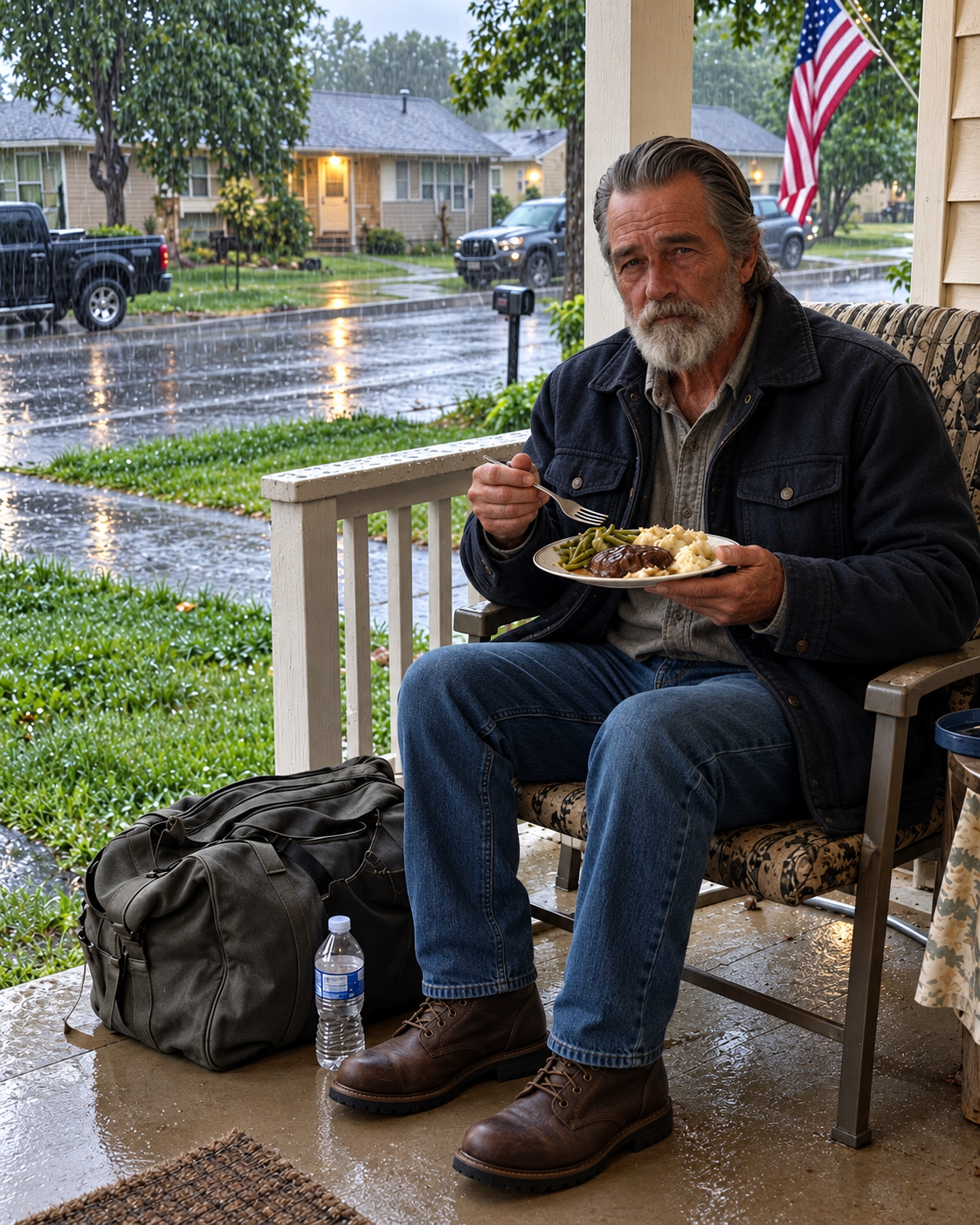
PART 1 TITLE: The Night the Storm Drove a Stranger to My Porch and Forced Me to Decide What Kind of Person I Still Was
The first time I saw the old man, rain was running from the shoulders of his coat in steady streams, and he was standing across the street as if he had nowhere he was permitted to go.
I remember that detail more clearly than the thunder. He wasn’t knocking on doors. He wasn’t waving at passing cars or searching the sidewalk for some hidden shelter. He simply stood beneath one of the old elm trees, clutching a battered backpack against his chest while the summer storm bent the branches above him.
For several seconds, I watched from behind my living-room curtain without moving. The sensible part of me said he was a stranger. I was alone in the duplex. My daughter, Lily, was spending the weekend with her father. Nobody would have blamed me for closing the curtain, checking the lock, and going back to the kitchen.
Two years earlier, I probably would have done exactly that.
Back then, I still believed safety came from having a husband in the next room, money in the bank, and a house with both our names attached to it. I had believed a lot of things in those days. Most of them turned out to be less permanent than I had imagined.
My name is Martha. I was forty-seven that summer, though there were mornings when I felt much older. Twenty-one years of marriage had ended with such efficiency that I sometimes wondered whether Daniel had been planning his exit while I was still planning our dinners.
Our marriage had run on a division of responsibilities that once seemed ordinary. Daniel handled the mortgage, investments, accounts, tax paperwork, insurance renewals, and anything else involving numbers or signatures. I handled almost everything that kept our daily life moving.
I knew Lily’s teachers, her allergies, which library books were overdue, when the dentist needed to be scheduled, which cereal she would actually eat before school, and exactly how long it took to get from our house to ballet practice during rush hour. I knew when the refrigerator filter needed replacing and which neighbor had our spare key.
Daniel knew the passwords to our financial life.
Whenever a document required my signature, he would slide it across the table and explain it in a sentence or two.
“Routine refinance.”
“Insurance adjustment.”
“Tax paperwork.”
I would sign.
That was marriage, I thought. You divided the work. You trusted the person who had promised to build a life beside you.
Only after Daniel announced that our marriage was finished did I understand how dangerous it had been to confuse trust with knowledge.
He knew exactly where the money was. He knew which accounts mattered and which paperwork would influence the settlement. He had retained a strong attorney before I had even finished telling my sister that Daniel wanted a divorce.
I arrived at my own lawyer’s office carrying a folder filled mostly with things I did not understand.
By the time the legal fighting ended, Daniel remained in the house we had lived in for years. The financial settlement left me with roughly eight hundred dollars I could immediately access, a car that still had two years of payments left, and the knowledge that continuing to challenge him could cost more than I might ever recover.
My attorney eventually leaned across his desk and said, carefully, “You need to decide whether you’re fighting for justice or fighting for survival. Sometimes you cannot afford both at the same time.”
I hated him for saying it.
Then I went home and admitted he was right.
The day Lily and I left, I packed two suitcases, a few boxes, her favorite stuffed rabbit, school clothes, medication, photographs, and the belongings I could prove were mine without starting another argument. Lily fell asleep in the backseat before we reached the motel where we would stay temporarily.
At a red light, I looked at her in the mirror.
She was eight years old, curled against the window with her rabbit tucked beneath her chin.
I remember gripping the steering wheel and thinking, You are not allowed to fall apart before she wakes up.
So I didn’t.
Not then.
I found the duplex in late October after weeks of checking listings that either cost too much or required financial records my married life had never prepared me to produce. The landlord, Grace, studied my application from behind a pair of narrow reading glasses.
“There isn’t much credit history in your name,” she said.
“I know.”
“Most of the mortgage records are connected to your former husband.”
“Yes.”
She looked at me.
Instead of inventing an excuse, I told her the truth.
I explained the divorce. I explained that I worked in the administrative office for the local school district. I showed her my pay stubs. I told her I could make the rent provided nothing catastrophic happened, and even as I said it, I realized how fragile that sentence sounded.
Grace removed her glasses and placed them on the desk.
“Can you pay the deposit?”
“Not all at once.”
“How much can you pay now?”
I told her.
She considered it, then agreed to split the remainder across the next two months.
I thanked her so many times she finally waved me toward the door.
“Just take care of the place,” she said. “That’ll be thanks enough.”
The duplex was modest, but after the motel it felt almost luxurious. Two bedrooms. One bathroom. A living room just large enough for a secondhand sofa and Lily’s small desk. A kitchen so narrow that opening the refrigerator blocked one cabinet.
And a covered porch.
That porch made the place feel like ours.
During warm evenings, Lily and I carried our plates outside. We watched people walk dogs beneath the elms and listened to bicycles click over cracks in the pavement. Some nights we talked. Other nights we simply ate.
Our old house had been larger.
Our new life was not.
Yet there was relief in knowing exactly what belonged inside it.
Two years passed.
Lily turned ten. She covered her bedroom in purple without asking anyone’s opinion. She made friends at school. She adored her fourth-grade teacher. She began borrowing mystery novels from the library and reading them beneath her blanket after bedtime, apparently believing the glow of a flashlight could not be seen beneath a door.
She also stopped asking so often when things would go back to normal.
I never told her that this was normal now.
When she asked about Daniel, I tried to give her only what a child should have to carry.
Her father loved her.
Adults sometimes hurt one another.
None of it was her responsibility.
She would always have a home with me.
The last promise frightened me the most.
I could pay our bills, but barely. Rent took the largest portion of my paycheck. The car payment arrived with depressing regularity. Groceries cost more every month. Lily needed new school clothes because children apparently had no respect for budgets when deciding how quickly to grow.
Then rumors of district budget cuts began circulating through the office.
Nobody knew whose positions might disappear.
Every time two supervisors shut a conference-room door, conversation around the desks became quieter.
That Thursday near the end of summer, I came home with those worries following me.
Lily had gone to Daniel’s for the weekend. She had packed a small overnight bag and reminded me twice that her green sweater needed washing before school started again.
After I dropped her off, I stopped for groceries and stood in the produce aisle calculating what I could postpone buying.
I put back the berries.
I kept the potatoes.
At home, I made chicken soup because soup was cheap, forgiving, and large enough to become several meals.
By late afternoon, the air had become heavy enough to feel physical. The sky dimmed from white to gray, then took on a strange yellow-green cast.
I stepped onto the porch.
Across the street, leaves were showing their pale undersides in the wind.
A storm was coming.
Within minutes, rain struck the windows in sheets.
I went from room to room closing them. A gust pushed water beneath the kitchen frame, and I stuffed an old towel along the sill.
Thunder rolled somewhere close enough to rattle a glass beside the sink.
That was when I noticed movement outside.
The old man stood beneath the elm.
At first, I thought he might simply be waiting for the rain to ease.
Then lightning flashed, and I saw him properly.
He looked to be in his seventies. His shoulders curved forward beneath a dark coat that had already absorbed more water than it could hold. His trousers clung to his legs. Gray hair lay flat against his forehead.
He kept one arm wrapped around an old backpack.
Not casually.
Protectively.
The storm intensified.
The tree was almost useless as shelter.
I stood with my hand on the curtain.
There were many reasons not to interfere.
I lived alone with a ten-year-old girl.
I did not know him.
I had learned enough about vulnerability to stop pretending kindness carried no risk.
Then the man shifted position, and I saw him press the backpack closer beneath his coat, trying to protect it while rain struck his face.
I thought about two suitcases in the back of my car.
About choosing which belongings could come with me.
About Lily asleep beside everything I still owned.
Before I had fully made the decision, I was walking toward the door.
I unlocked it and stepped beneath the porch roof.
“Sir?”
The man looked across the street.
He seemed surprised.
I raised my voice over the rain.
“Sir, are you all right?”
He hesitated before answering.
“Yes, ma’am.”
It was plainly untrue.
Rainwater was dripping from his chin.
“You’re getting soaked.”
He glanced upward as if this were merely a fact about weather rather than his own body.
“I’ll manage.”
Another gust drove rain sideways.
I looked behind me toward the living room.
There was a couch.
There was a lock on Lily’s bedroom door.
There was a phone in my pocket.
There was also an elderly man standing beneath a tree in a violent storm.
“You can come inside,” I called. “At least until this passes.”
He stared at me.
Then he shook his head.
“No, ma’am. I couldn’t do that.”
“You’ll catch pneumonia out there.”
“I appreciate it.”
“That wasn’t really an answer.”
For the first time, something changed in his expression. Not quite amusement, but close.
He wiped water from his eyes.
“I don’t want to make you uncomfortable.”
The sentence caught me off guard because discomfort was clearly the last thing he could afford to be concerned about.
I looked at the porch.
It stretched almost the full width of the duplex. Deep roof. Wooden floor. Dry except for a few feet near the steps.
The man followed my gaze.
“Would it trouble you,” he asked, “if I stayed there for a little while?”
He pointed toward the far end of the porch.
“Just until the rain settles?”
Something in the way he asked made my chest tighten.
Not entitlement.
Not expectation.
Permission.
He was asking permission to remain dry.
I stepped back and opened the gate.
“No,” I said. “It wouldn’t trouble me.”
He crossed the street slowly, carrying the backpack against his chest.
When he reached the bottom step, he stopped.
“Are you sure?”
I looked at him, at his soaked clothes, at the bag he refused to release.
Then I thought of how long it had taken me to stop feeling like I needed permission to occupy my own life.
“I’m sure.”
He climbed the steps.
And neither of us knew that by sunrise, he would be gone.
END PART 1
PART 2 TITLE: By Morning the Stranger Was Gone, but Beneath My Doormat He Had Left a Key With My Name Attached
Up close, the old man looked more exhausted than he had from my window.
His beard was mostly gray, clipped unevenly along his jaw. Rain had darkened his coat almost black. His hands were thin, the knuckles enlarged with age, and when he lowered his backpack onto the porch boards, he did so with extraordinary care.
“Sit down before you fall down,” I said.
“I’m all right.”
“You’re shaking.”
He glanced at his hands as though he had not noticed.
“Cold, I suppose.”
I went inside before he could object.
The warmest thing I owned was a quilt my mother had made years earlier. Squares of blue, cream, and faded red cloth had been stitched together by hand. It was one of the few possessions from my married home that nobody had disputed after the divorce because it had always unquestionably been mine.
For that reason, I almost reached for a cheaper blanket instead.
Then I felt embarrassed by the thought.
I carried the quilt outside with two old sofa cushions and a clean towel.
“You don’t need to give me all this,” he said.
“I’m not giving it to you. I’m lending it for the night.”
“The night?”
I looked past him.
The rain showed no sign of weakening.
“You think that storm is finishing in ten minutes?”
He looked toward the street.
“No.”
“Then stop arguing.”
That faint almost-smile appeared again.
“Yes, ma’am.”
He dried his face and hair. I placed the cushions near the wall where the wind could not reach them easily.
The backpack remained beside his feet.
I noticed one strap had been repaired with black electrical tape. A metal zipper was held closed by a short length of cord.
Everything about the bag suggested prolonged use.
I did not ask what was inside.
When I returned to the kitchen, the soup was still warm.
I stood over the pot with a ladle in my hand.
For several minutes, I considered whether offering food crossed some invisible line between hospitality and pity. The man had asked only for a dry porch.
Then I remembered my own first weeks after the divorce, when people kept saying, “Call me if you need anything.”
I had almost never called.
Asking had felt heavier than needing.
I filled a bowl.
Chicken. Carrots. Potatoes. Celery. Noodles I had broken in half so they would stretch farther.
I placed two pieces of bread on a plate and carried everything outside.
The old man had wrapped the quilt around his shoulders.
When he saw the bowl, his eyes rested on it for a moment too long.
“I can’t take your supper.”
“You’re not taking it. There’s a whole pot inside.”
“That doesn’t mean you don’t need it.”
I nearly laughed.
There was something strangely formal about being warned against generosity by a man sheltering on my porch.
“I made too much.”
“You sure?”
“Yes.”
He accepted the bowl.
Steam rose against his damp face.
“Thank you.”
I sat on the chair near the front door while he remained on the cushions.
For a few minutes, neither of us said anything.
He tasted the soup.
Then another spoonful.
“This is good.”
“It’s ordinary.”
“Ordinary can be good.”
That sentence stayed with me.
He ate slowly. Not the frantic way I might have expected from someone who had missed meals, but carefully, as though he had been taught never to appear hungry.
I asked if he wanted more bread.
He shook his head.
“Save it.”
“There’s plenty.”
He studied me.
“You’ve probably got your own worries.”
I looked through the window toward my kitchen table.
Bills were stacked beneath Lily’s green pencil case. The electric bill. Car insurance. A school supply list. A notice about an upcoming parent fee I had not yet budgeted for.
He was not wrong.
“Everyone does,” I said.
“That’s true.”
“Tonight I have enough soup.”
He looked down into the bowl.
“That’s a good way to count things.”
I didn’t fully understand what he meant.
Not then.
The storm settled into a steady roar.
From time to time, lightning illuminated the street so completely that every wet leaf flashed silver.
The man finished the soup and placed the bowl beside him.
I asked whether there was someone I could call.
His answer came gently but immediately.
“No.”
“Family?”
He lowered his eyes.
“Nobody you need to disturb.”
The wording told me enough to stop asking.
I offered again to let him sleep on the couch.
He refused.
“I’m grateful for the porch.”
“You’d be safer inside.”
“So would you, if I stayed outside.”
I studied him.
“That’s why you won’t come in?”
He adjusted the quilt around his shoulders.
“A person should know when he’s already been given enough.”
I thought of Daniel.
He had rarely believed there was such a point.
The comparison arrived unexpectedly, and I disliked myself for making it. This man had told me almost nothing about himself.
Still, his refusal to take one unnecessary inch of space made me trust him more than a dozen explanations might have.
“What’s your name?” I asked.
He hesitated.
“Albert.”
“I’m Martha.”
He nodded.
“Martha.”
He repeated it once, as though making sure he would remember.
We talked only a little after that.
He asked whether the elm trees always lost branches in storms.
I said they did.
I told him one had crushed a neighbor’s mailbox the previous spring.
He said that sounded exactly like an elm tree.
I asked if he needed dry socks.
He declined.
I brought some anyway.
He accepted them after a short argument.
At one point, he noticed a purple umbrella leaning beside the door.
“Your daughter’s?”
“How did you know?”
“No grown person chooses that much purple unless they’re very brave.”
I laughed before I could stop myself.
“Her name is Lily.”
“How old?”
“Ten.”
“Good age.”
“You remember being ten?”
“No. But I remember somebody else being ten.”
He did not explain.
The sentence seemed to close a door rather than open one.
I left it alone.
By ten o’clock, the rain was still falling.
I checked the weather report on my phone. Severe storms would continue past midnight.
Albert had arranged the cushions against the wall. His shoes sat beneath the porch bench to dry. His backpack remained within arm’s reach.
I brought another towel and a glass of water.
“You’ve done more than enough,” he said.
“You keep saying that.”
“Because you keep doing more.”
I leaned against the doorframe.
“Maybe you should let other people decide what enough is sometimes.”
He gave me a long, thoughtful look.
“Maybe.”
Inside, I locked the door.
I felt guilty about it for approximately two seconds.
Kindness did not require stupidity.
I carried my phone into the bedroom and placed it on the nightstand.
Then I lay awake listening to rain drum against the roof.
I thought about Albert outside.
I thought about the backpack.
I wondered where he had intended to sleep if he had not reached our street before the storm.
I wondered how a man his age ended up measuring his safety in porches.
Questions came easily.
Answers did not.
Around eleven thirty, I got up and checked through the front window.
Albert was lying beneath the quilt.
The backpack rested under his head.
For some reason, that image hurt more than seeing him in the rain.
When I returned to bed, I remembered the motel after my divorce.
Lily had slept in the other bed, surrounded by our luggage. I had placed my purse beneath my pillow because it contained our cash, documents, car keys, and the only credit card Daniel could no longer touch.
I had fallen asleep with one hand resting on it.
Maybe everyone had a version of Albert’s backpack.
Something containing whatever could not be lost.
The storm softened after midnight.
By one in the morning, thunder had moved farther away.
I finally fell asleep.
And strangely, I slept well.
Not because my worries had disappeared.
The district budget was still uncertain.
Rent was still due.
Lily still needed clothes.
But the evening had briefly removed me from the endless arithmetic of my own problems.
I had fed someone.
I had kept someone dry.
There was satisfaction in usefulness.
I had forgotten that.
Morning arrived bright and startlingly calm.
Sunlight came through the blinds.
For a few seconds, I could not remember why a soup bowl was missing from the cabinet.
Then I sat up.
Albert.
I pulled on a sweater and went to the kitchen.
The clock read 6:42.
I started coffee and automatically reached for a second mug.
Then I warmed some leftover soup before deciding soup at seven in the morning was probably excessive.
I found two slices of bread instead.
When the coffee finished, I poured both cups and unlocked the front door.
“Morning, Albert.”
No answer.
I opened the door.
The porch was empty.
The cushions had been stacked neatly against the wall.
The glass had been washed in the outdoor tap and placed upside down beside the bowl.
The socks were folded on top of the cushions.
My mother’s quilt lay on the doormat.
I stood there holding two cups of coffee.
“Albert?”
I stepped outside.
The street was nearly deserted.
Water ran slowly along the gutter. Broken twigs littered the pavement. Sunlight flashed on wet leaves.
There was no sign of him.
I put the cups down and picked up the quilt.
He had folded it with almost absurd precision.
Each edge aligned.
The fabric smoothed flat.
As I lifted it, something pale appeared beneath the corner of the mat.
An envelope.
I froze.
My first thought was that Albert had left money.
The idea irritated me immediately.
I bent down.
The envelope was old, slightly creased, and sealed.
Across the front, written in dark ink, was my name.
Martha.
Not “Ma’am.”
Not “Thank you.”
My name.
I turned it over.
Nothing else.
I sat on the porch step.
Inside was a folded sheet of paper.
When I opened it, something heavy slipped into my palm.
A brass key.
It was old enough that the metal had darkened along the grooves.
A small cardboard label hung from it on a piece of twine.
An address had been written on the tag.
I recognized the town. It was perhaps forty minutes away.
Below the address were five words.
Small box. Bottom shelf.
I read them twice.
Then I unfolded Albert’s letter.
The first line told me his full first name, as if he had decided that after accepting my porch, I deserved at least that much truth.
My name is Albert, he had written.
What followed made me forget the coffee cooling beside me.
Albert had been without a permanent place to live for eight months.
He had moved between shelters, temporary rooms, outdoor spaces, bus stations, church basements, and whatever safe corner he could find.
He wrote that he was not telling me this so I would feel sorry for him.
He wanted me to understand only one thing.
He had not always lived that way.
For forty years, Albert had owned a neighborhood hardware store.
He had known which customers would forget their wallets and return the next day.
He had cut duplicate keys, repaired lamps, ordered odd-sized screws, sharpened tools, and kept products on shelves long after large chain stores stopped carrying them.
His wife’s name had been Estelle.
They had been married for forty-three years.
Then she became seriously ill.
Insurance covered some of the bills.
Not all.
Albert sold the hardware store.
He used the money for her care.
He wrote one sentence about that decision.
I would do it again tomorrow.
Estelle died two years later.
Afterward, Albert stayed for a time with his adult son.
His relationship with his daughter-in-law had never been easy.
Eventually she changed the locks.
Albert did not describe a dramatic confrontation.
There were no accusations in the letter.
Only one line.
My son did not change them back.
I lowered the paper.
For several seconds, I stared at the elm tree across the street.
The same tree under which he had stood the night before.
Then I kept reading.
Albert could have fought.
He could have demanded help.
He could have forced his son to make a choice.
Instead, he left.
Eight months later, he was still carrying his essential possessions in the backpack he had protected from the rain.
But one possession had never been in that backpack.
Before Estelle died, the two of them had rented a small storage unit in another town.
Albert had continued paying for it every month.
Even after losing stable housing.
Even while counting dollars for meals.
He could not make himself open the boxes containing the remnants of their life together.
Until the storm.
Until my porch.
Until the bowl of soup.
Albert wrote that sometime during the night, while listening to rain strike the roof, he understood that he no longer needed to protect every object simply because Estelle had once touched it.
He was ready to let the unit go.
Most of the belongings could be donated, kept, discarded, or given away.
But one thing mattered.
A small wooden box sat on the bottom shelf.
Inside it was a leather notebook Estelle had kept for many years.
Albert called it her recipe book.
Then he explained that recipes were only part of it.
Estelle had written down what she knew about living through lean years.
How to feed people when food was scarce.
How to choose between expenses.
How to repair instead of replace.
How to keep moving when certainty disappeared.
Albert thought I might understand the book.
He had noticed the child’s umbrella by my door.
If my daughter wanted the notebook someday, he hoped she would have it too.
The storage unit had already been paid through the end of the year.
The key was mine.
I could decide what happened to everything.
Then I reached the final paragraph.
Albert wrote that I had helped him before knowing whether he was respectable, useful, employable, grateful, or capable of returning the favor.
I had simply seen him wet and cold.
To him, that mattered.
His final sentence was short.
He hoped my worries would become lighter.
I read the letter again.
Then once more.
The street around me had returned to ordinary morning life.
A woman walked a terrier on the opposite sidewalk.
Somebody started a car.
A sprinkler clicked to life two houses away, absurd after an entire night of rain.
I sat barefoot on my porch holding a brass key.
Forty minutes away was a storage unit belonging to a man who no longer had a home.
Inside it waited a notebook written by a woman who had been dead for two years.
I should have been suspicious.
Instead, I felt something more complicated.
Responsibility.
Albert had trusted me with the last physical pieces of a forty-three-year marriage.
I looked again at the address on the tag.
Then I went inside, turned off the coffee maker, changed my clothes, and picked up my car keys.
END PART 2
PART 3 TITLE: The Key Opened a Forgotten Storage Unit, Where a Dead Woman’s Notebook Seemed to Know Exactly What I Feared
The town on Albert’s tag was forty minutes away if traffic behaved.
That Saturday morning, it did.
I drove with his letter folded on the passenger seat and the brass key in the cup holder. Every few miles, I glanced at it as though it might somehow explain why Albert had chosen me.
It didn’t.
The storm had washed the air clean. Fields beyond the highway looked unnaturally green. Puddles reflected a bright blue sky that seemed incapable of having produced the night before.
I passed the exit twice in my mind before taking it.
Part of me still expected to discover that the address did not exist.
Maybe Albert had been confused.
Maybe I had misunderstood.
Maybe the entire situation would collapse into some explanation much simpler than the one in his letter.
The town was smaller than mine.
A pharmacy. Two gas stations. A diner with a hand-painted sign. Several storefronts whose windows looked unchanged since the nineties.
The storage facility sat near the edge of town behind a chain-link fence.
Rows of orange metal doors faced a gravel lane.
I parked outside the office.
A woman behind the counter looked up from a crossword puzzle.
“Can I help you?”
I placed Albert’s key tag on the desk.
“I was given access to this unit.”
She checked the number.
“Paid through December.”
That matched the letter.
She asked whether I was Albert.
“No.”
“Family?”
I hesitated.
“No.”
She looked at the key, then back at me.
“Do you have his permission?”
I removed the letter from my bag and showed her the paragraph giving me the contents.
She read only enough to confirm it.
“All right.”
She returned the letter.
“Row C. Near the back.”
I thanked her.
The gravel crunched beneath my shoes as I walked between the units.
I felt increasingly uncomfortable with every step.
There was intimacy in entering another person’s stored life.
People put objects into storage because they cannot use them but cannot release them either.
I understood that more than I wanted to.
After the divorce, I had filled three boxes with things I never unpacked. Family Christmas decorations. Wedding photographs. A set of wineglasses Daniel and I had received when we married.
I did not want them displayed.
I could not throw them away.
They sat in the back of my closet, occupying very little physical space and far too much emotional space.
Albert’s unit was C-17.
I inserted the brass key.
For one frightening second, it resisted.
Then the lock opened.
I raised the metal door.
The sound echoed along the row.
Dust floated through the shaft of sunlight.
The unit was perhaps eight feet by ten.
There was no hidden fortune.
No antique collection waiting to rescue me from rent.
No mysterious safe.
What stood inside was exactly what Albert had promised.
A life reduced to objects.
Two wooden chairs.
A table with removable legs taped beneath it.
Boxes of books.
Kitchen utensils wrapped in newspaper.
A sewing machine in an old wooden case.
A lamp.
Several framed photographs turned inward against the wall.
A ceramic mixing bowl.
Three cardboard boxes labeled WINTER.
I remained near the doorway for a while.
The objects were ordinary.
That made them harder to look at.
Somebody had once eaten breakfast at that table.
Somebody had once pushed those chairs beneath it.
Someone had folded winter clothes into those boxes believing another winter would arrive in the same house.
Then I saw the handwriting.
Several boxes near the back had been labeled in a smaller, quicker script than Albert’s.
KITCHEN NOTES.
PATTERNS.
LETTERS.
RECIPES.
Estelle.
I knew without being told.
On the lowest metal shelf sat a wooden box.
Small box. Bottom shelf.
I crouched beside it.
The lid was not locked.
Inside was a burgundy leather notebook.
The cover had softened with age. Its corners were worn pale. Several pages bulged from inside, making the notebook slightly thicker at the center.
I lifted it carefully.
A faint smell of old paper, spice, and dust rose from the pages.
I sat in one of the wooden chairs.
For a while, I only held the book.
Albert had carried grief for two years before deciding I should be allowed to open this.
That fact made turning the first page feel ceremonial.
The handwriting inside was compact and confident.
Estelle had written an introduction.
She said that if someone was reading the notebook, she hoped it had reached them when it was useful.
Not when life was easy.
Useful things rarely mattered most when life was easy.
Below that was another note.
Use the margins.
Correct me when I am wrong.
Add whatever you learn.
A book like this should improve as more people live with it.
I smiled despite myself.
She sounded less like a dead woman and more like somebody who had stepped into another room and expected to return shortly.
The first section contained recipes.
Chicken soup.
I stared at the heading.
Of course.
The ingredients were listed loosely.
Chicken, whatever pieces were affordable.
Onion.
Carrots.
Potatoes if available.
Celery if it was not overpriced.
Noodles, rice, or neither.
There were no precise instructions about teaspoons.
Instead, Estelle had written things like, Add until it smells right.
Taste before using more salt.
Leave it alone long enough for the vegetables to become friends.
I laughed aloud.
The sound surprised me inside the silent unit.
Beside the soup recipe was a note explaining why she liked soup.
It did not require pretending.
Soup could begin with very little and still become enough to feed several people.
I thought about the pot on my stove.
About Albert eating beneath my mother’s quilt.
I turned another page.
Bread.
Stew.
Biscuits.
A casserole made from leftovers.
Advice for keeping herbs alive on a windowsill.
Instructions for freezing stock in reused containers.
Then the notebook changed.
A page titled WHEN THE MONEY DOESN’T REACH THE END OF THE MONTH contained no recipe.
Estelle had drawn two columns.
Must happen.
Can wait.
Rent belonged in the first.
New curtains belonged in the second.
Medicine belonged in the first.
Embarrassment belonged nowhere.
I stopped.
The next pages were even more practical.
Call before the bill is overdue.
Ask whether payment can be divided.
Do not hide unopened envelopes from yourself.
Children should understand that money is limited, but they should not be made responsible for fixing adult problems.
Know what is in your own name.
That sentence felt aimed directly at me.
I read it again.
Know what is in your own name.
My throat tightened.
I could hear Daniel telling me paperwork was routine.
I could see my own signature at the bottom of pages I barely read.
Estelle had probably written her note for some younger relative decades earlier.
Yet in that storage unit, it felt personal.
I turned the page.
There was advice about making choices when both options were bad.
Choose the one that leaves you able to choose again tomorrow.
Advice about fear.
Do the next useful thing before deciding the whole future.
Advice about loss.
Some days surviving means only refusing to make tomorrow worse.
None of it sounded cheerful.
That was what I liked about it.
There were no promises that the universe rewarded good people.
No declarations that everything happened for a reason.
Estelle seemed to assume life could be unfair and still require breakfast the next morning.
I understood that language.
One passage stopped me completely.
She wrote about ownership.
People could take property.
People could take money.
People could take credit.
But the labor, judgment, and skill used to create a life remained inside the person who had done the work.
If those remained, rebuilding was possible.
I read the paragraph several times.
My first reaction was anger.
That sounded convenient.
Daniel had the house.
I had memories of cleaning it.
Daniel had accounts that had once seemed shared.
I had years of unpaid labor that never appeared on a statement.
What good was being told the work remained mine?
Then another thought arrived.
The duplex.
I had found it.
I had convinced Grace to rent it to me.
I had paid for it every month.
Lily’s room existed because I had built a new home out of almost no money and a collection of secondhand furniture.
The soup I had given Albert had come from groceries I bought with my own paycheck.
My life was smaller.
But I had made it.
Nobody had handed it to me.
I closed the notebook.
Sunlight had shifted across the floor.
Dust glowed in the air.
For the first time since entering the unit, I looked at the belongings not as evidence of an ending but as a set of decisions waiting to be made.
A table could become someone else’s table.
Books could be read.
The sewing machine could sew again.
Estelle’s notebook already had.
I opened it once more.
Near the back were pages in Albert’s handwriting.
Not many.
A note about which screw size worked best for repairing a loose chair.
Instructions for sharpening a garden tool.
A small correction beside one of Estelle’s household repairs.
Use a washer here, he had written. She always forgets the washer.
Beneath it, in Estelle’s handwriting, was an answer.
I do not forget. I know you like feeling useful.
I covered my mouth.
They had been talking to each other in those margins.
Years later, the conversation was still there.
That was why Albert could not throw the book away.
I understood.
I spent almost two hours in the unit.
I did not sort anything.
I was not ready.
I returned every object I had touched to its place and carried only the notebook with me.
Before closing the door, I stood looking inside.
“Thank you,” I said.
I was not sure whether I meant Albert or Estelle.
Maybe both.
At home, I placed the notebook on my kitchen table.
Albert’s letter went beside it.
Then I tried to find him.
I called the largest shelter in town.
A woman answered.
I described Albert.
Seventies.
Gray beard.
Old backpack with repaired straps.
She listened patiently.
“I’m sorry,” she said. “We can’t confirm whether someone has stayed here.”
“I’m not trying to get personal information.”
“I understand.”
“He left something important with me.”
There was a pause.
“If he comes in, I can pass along a message.”
I wrote one quickly before speaking.
“Tell him Martha from the porch got the notebook.”
“All right.”
“And tell him…”
I looked at Estelle’s soup recipe.
“Tell him the soup was one of the best things I’ve made in a long time too.”
The woman repeated the message.
I thanked her.
I called two other shelters.
The answer was similar.
Nobody could tell me where Albert was.
By Sunday afternoon, I had accepted that I might never see him again.
Then Lily came home.
Daniel’s car stopped outside.
She bounded through the door with her overnight bag, the purple umbrella she had somehow taken despite there being no rain in the forecast, and a complaint about how her father believed scrambled eggs should be “dry enough to bounce.”
“You’re exaggerating.”
“I am absolutely not exaggerating.”
She dropped the bag in the hallway.
Then she noticed the burgundy notebook.
“What’s that?”
The question began a story that took nearly twenty minutes to tell.
I told her about the storm.
Albert beneath the elm.
The porch.
The soup.
The folded quilt.
The envelope.
The key.
The storage unit.
Estelle.
Lily barely moved while I spoke.
When I finished, she touched the notebook with one finger.
“So she wrote all this?”
“Yes.”
“For who?”
“I don’t know. Maybe herself. Maybe Albert. Maybe whoever needed it later.”
She opened the first page.
Her lips moved slightly while she read.
Then she looked up.
“She says we can write in it.”
“She says we should.”
“Are you going to?”
“I don’t know.”
“Why not?”
Because the book seemed too important.
Because I did not feel qualified.
Because Estelle had survived things I did not know about and still managed to turn hardship into useful instructions, while I sometimes considered crying because grocery prices had gone up again.
Instead I said, “I think we should listen first.”
Lily nodded as though that were reasonable.
She turned several pages.
“Mom?”
“Yes?”
“Where is Albert now?”
“I don’t know.”
“You called the shelter?”
“Three of them.”
“And nobody told you?”
“They aren’t allowed.”
Her brow furrowed.
“Do you think he’s safe?”
“I hope he is.”
“That’s not the same.”
“No.”
She became quiet.
I watched her reading the soup recipe.
After a while, she closed the notebook.
“He gave us something important.”
“Yes.”
“He didn’t have to.”
“No.”
“You gave him soup, and he gave you the book.”
“That’s one way of looking at it.”
“And Estelle wrote the book because she thought someone might need it.”
“I think so.”
Lily stared toward the kitchen.
Then back at me.
Her face changed in the way it did when an idea had already become a decision.
“We should do something.”
“What?”
“Something useful.”
I waited.
She pushed Estelle’s notebook toward me.
“Albert helped us after you helped him. So now we help somebody else.”
“That sounds very organized.”
“I’m serious.”
“I know.”
She pointed to the soup recipe.
“We’re good at this.”
“At soup?”
“Yes.”
I smiled.
“That’s our special skill?”
“For now.”
Then she said the word that made me stop smiling.
“The shelter.”
She looked at me with complete certainty.
“We should make soup for the shelter.”
END PART 3
PART 4 TITLE: When My Daughter Read the Notebook, She Saw a Debt of Kindness I Had Been Too Afraid to Recognize
My first answer was no.
Not because I disliked Lily’s idea.
Because I had already begun calculating.
Chicken.
Vegetables.
Containers.
Gas.
Time.
Everything in my life had become arithmetic.
“How much soup are you planning to make?” I asked.
“A lot.”
“That is not a measurement.”
“The biggest pot.”
“We have one big pot.”
“Exactly.”
She opened a cabinet and pointed to it as though presenting evidence in court.
I leaned against the counter.
“Food shelters have rules, Lily. You can’t just show up carrying soup.”
“So we ask.”
She was infuriatingly reasonable.
Monday morning, before work, I called the shelter where I had left the message for Albert.
A woman named Ruth answered.
I explained that my daughter and I were interested in donating prepared food.
Ruth did not react with sentimental gratitude.
She asked practical questions.
Was our kitchen clean?
Could we follow their food-handling requirements?
Could we deliver early enough for lunch service?
How much could we realistically make?
“Realistically?” I repeated.
“Yes. People often offer an enormous donation one time and then disappear. That’s generous, but consistency helps us more.”
I looked at Lily, who was sitting at the table eating cereal and watching me.
“One large stockpot,” I said.
“How often?”
I almost said once.
Then Lily held up one finger and silently mouthed, Every week.
I shook my head.
She held the finger higher.
“Maybe twice a month,” I told Ruth.
“That would be wonderful.”
Lily frowned dramatically.
I turned away so Ruth would not hear me laughing.
Ruth explained what they could accept.
She told me which ingredients caused problems because of allergies, how the food needed to be cooled and transported, and what time deliveries worked best.
She never asked for our story.
I liked her immediately.
When I hung up, Lily said, “Twice a month?”
“We are not opening a restaurant.”
“Every Friday would be better.”
“Your mother has a job.”
“You have Thursdays after work.”
“Your mother also enjoys occasionally sitting down.”
She considered this.
“We’ll start twice a month.”
“That is exactly what I said.”
“Then if we’re good, we can do more.”
I sighed.
“You negotiate like your father.”
Her face changed.
The comparison had escaped before I could stop it.
I regretted it instantly.
But Lily only shrugged.
“Then I’m using it for soup instead of evil.”
I laughed so hard I had to sit down.
Thursday evening, we pulled Estelle’s notebook onto the counter.
The chicken soup recipe took less than one page.
The process occupied our entire kitchen.
Lily chopped carrots with the concentration of a surgeon while I handled the onions.
She insisted we follow Estelle’s instructions exactly.
“That’s impossible,” I said. “Half of these aren’t measurements.”
“She says a handful.”
“Your hand is half the size of mine.”
“Then use my hand.”
“That is not how recipes work.”
“That is how this recipe works.”
She won.
The soup simmered.
Steam fogged the window above the sink.
Lily stood on a chair and tasted the broth.
“Needs salt.”
“You said that ten minutes ago.”
“It still needs salt.”
“You’re ten.”
“I have taste buds.”
I added a little.
She tasted again.
Then she frowned.
“What?”
“Not ready.”
“How do you know?”
She pointed to Estelle’s note.
Cook until it smells right.
“You cannot possibly know what Estelle meant.”
“I know what soup is supposed to smell like.”
“That is a suspicious amount of confidence.”
We waited.
Twenty minutes later, Lily walked through the kitchen carrying a schoolbook, stopped, and lifted her head.
“Now.”
“What?”
“It smells right now.”
I tasted it.
She was correct.
Friday morning, we loaded the pot into the car before school.
Lily held towels around it as though transporting something fragile.
The shelter occupied an old brick building near downtown.
A small delivery entrance opened into a kitchen that was larger than mine but crowded with mismatched equipment.
Ruth met us wearing an apron over jeans.
“You must be the soup people.”
Lily smiled.
“That’s us.”
Ruth removed the lid and looked inside.
She did not perform exaggerated praise.
She simply nodded.
“Good amount.”
Then she looked at Lily.
“You helped?”
“I decided when it smelled right.”
Ruth glanced at me.
I pointed to Estelle’s notebook, which Lily had insisted on bringing.
“Apparently that is an official measurement.”
“In a good kitchen,” Ruth said, “it often is.”
Lily looked delighted.
Ruth showed us where the soup would be reheated.
She thanked us.
Before we left, she told Lily, “You can come back.”
“We will,” Lily answered before I had a chance.
On the drive to school, she watched buildings slide past the window.
She was unusually quiet.
I thought perhaps she was tired.
Then she said, “Albert didn’t have to leave the key.”
“No.”
“He could have just gone.”
“Yes.”
“He could’ve eaten our soup and slept there and kept his things.”
“Yes.”
“Why didn’t he?”
I slowed at a traffic light.
“I don’t know exactly.”
“But what do you think?”
I looked at her.
Children have a way of demanding clarity adults spend years avoiding.
“I think he had been carrying those things because he wasn’t ready to let them go.”
“The storage stuff?”
“And Estelle.”
“You can’t carry a person.”
“Not literally.”
“I know.”
The light changed.
I continued driving.
“Sometimes things become connected to people,” I said. “A chair. A photograph. A recipe. You start feeling like getting rid of the thing means losing part of the person.”
“But Estelle was already gone.”
“Yes.”
“So he was keeping the stuff because he missed her.”
“I think so.”
Lily thought about that.
“And then he gave us the notebook.”
“Yes.”
“Because of soup?”
I smiled.
“Maybe partly.”
“That’s weird.”
“It is.”
Another minute passed.
“The storm brought him to our street.”
“Yes.”
“You saw him because you were closing the windows.”
“Yes.”
“You made soup because you were sad.”
I glanced at her.
“How do you know I was sad?”
“You make soup when you’re thinking too much.”
I said nothing.
She continued.
“And he came on the night I wasn’t home.”
“That part is true too.”
“So a lot had to happen.”
“Yes.”
She nodded slowly.
“I think Estelle would like that.”
“Like what?”
“That her book got to somebody who makes soup when she’s sad.”
I laughed softly.
“Maybe.”
At school, Lily climbed out of the car.
Before closing the door, she leaned back inside.
“Don’t lose the notebook.”
“I won’t.”
“I’m serious.”
“So am I.”
She shut the door and ran toward the entrance.
That afternoon, when I came home from work, Estelle’s notebook lay on the kitchen table.
I opened it to the bread recipe.
A blank margin ran along the side.
For several days, I had resisted writing in the book.
Estelle’s handwriting seemed permanent.
Mine seemed intrusive.
But she had explicitly invited it.
Write in the margins.
I picked up a pen.
Beside the soup recipe, I wrote about Lily.
I wrote that a ten-year-old had somehow recognized the precise moment the kitchen smelled right.
Then I added another line.
Albert gave this book to Martha and Lily. We are trying to use it well.
I stared at the words.
My handwriting looked foreign beside Estelle’s.
Still, I did not erase them.
Nothing about my financial situation changed because of that first shelter delivery.
Rent arrived on schedule.
The car payment remained irritatingly large.
Lily needed new jeans.
The district budget meetings continued.
Yet my attention had shifted.
Before Albert, every uncertainty had seemed like evidence that my new life might collapse.
After reading Estelle, I began asking different questions.
What actually had to be solved today?
What could wait?
What could I repair?
What did I already have?
One evening I spread my bills across the kitchen table and sorted them.
Must happen.
Can wait.
I smiled when I realized what I was doing.
Estelle would have approved.
I called the electric company about moving my due date closer to payday.
They agreed.
I cancelled a subscription I had forgotten about.
I checked the car insurance instead of simply renewing it automatically.
None of those choices transformed my finances.
Together, they made the month easier.
More importantly, I knew what was happening with my own money.
That mattered in a way I could not explain to anyone who had never lost control of theirs.
I still thought about Albert every day.
Whenever I crossed the porch, I pictured the backpack beside his feet.
Whenever rain began, I wondered where he was.
I called Ruth once after two weeks.
“No news?” I asked.
“I’m sorry.”
“That’s all right.”
“If he comes through, your message is here.”
I thanked her.
Another two weeks passed.
Lily and I made soup again.
This time she was less careful with the carrots.
I told her consistency of size affected cooking time.
She accused me of becoming “a soup tyrant.”
We delivered the pot.
Still no Albert.
Summer moved toward September.
A sale at a department store solved the school-clothes problem.
Lily found a green jacket she loved.
She spent twelve minutes comparing two pairs of boots while calculating which would last longer.
Watching her, I realized she had inherited some of my new caution.
That frightened me at first.
Then I noticed she was not afraid.
She was simply paying attention.
There was a difference.
At work, no final decisions had been announced about staffing.
Every Monday felt like the Monday someone might know.
Every Friday ended without certainty.
I kept going.
The next useful thing.
Then the next.
Six weeks after the storm, my office phone rang during the afternoon.
I almost let it go to voicemail because I was entering attendance figures into a report.
Then I saw the number.
The shelter.
I answered immediately.
“Martha?”
It was Ruth.
“Yes.”
“I thought you’d want to know something.”
My hand tightened around the receiver.
“Albert?”
“He came in last week.”
I stood so quickly my chair rolled backward.
“He’s there?”
“He’s been staying here.”
“Is he okay?”
“He’s safe.”
I closed my eyes.
For six weeks, I had imagined him beneath bridges, on benches, walking in rain, carrying that backpack.
The pressure behind my ribs loosened.
“Did you give him my message?”
“I did.”
“What did he say?”
Ruth laughed.
“He asked for a pen.”
I sat down again.
“A pen?”
“He wrote something for me to pass back to you.”
Paper rustled on her end.
“He says he’s glad the notebook found the right kitchen.”
I covered my mouth with one hand.
Ruth continued.
“He says Estelle used to believe every recipe was the beginning of a conversation, not the end of one.”
I looked toward my bag where I had begun carrying the notebook to work on difficult days.
“There’s more,” Ruth said.
Albert wanted us to know that he expected to remain at the shelter for a while.
There was a bed available.
Some paid work might be possible through one of the shelter’s local programs.
But the part that made me laugh was the simplest.
Albert had started helping in the kitchen.
“Apparently,” Ruth said, “he has very strong opinions about stock.”
“That sounds like him.”
“You knew him for one night.”
“I know.”
“He’s already taught two people that they’re using too much heat.”
I laughed.
Then Ruth read the final sentence Albert had written for me.
He hoped my worries were getting lighter.
I did not cry.
I had cried over his first letter.
I had cried quietly in the storage unit while reading Estelle’s notebook.
This time, I stood in the hallway outside my office with the receiver pressed against my ear and felt something inside me settle.
Albert had a bed.
Albert had a kitchen.
Albert was arguing about stock.
For the moment, that was enough.
I thanked Ruth and ended the call.
Then I texted Lily.
Albert is at the shelter. He’s safe. He’s helping in the kitchen.
Her response appeared before I could put my phone away.
I TOLD YOU.
A second message followed.
Three soup emojis.
I laughed aloud.
A coworker passing the doorway looked at me.
“Good news?”
I looked down at the little orange soup bowls on my screen.
“Yes,” I said.
For once, the answer required no qualification.
It was good news.
That evening, Lily and I opened Estelle’s notebook again.
There was still plenty of room in the margins.
And for the first time since my marriage ended, the blank space ahead of me did not look quite so much like something to fear.
END PART 4
PART 5 TITLE: The First Time Albert Came Through the Shelter Kitchen Door, He Carried Nothing but an Apron and an Unfinished Piece of His Past
Two Fridays after Ruth’s phone call, Lily and I arrived at the shelter with our third pot of soup. The October morning was cold enough to fog the car windows, and Lily kept one hand on the lid during every turn as though the soup might escape if she stopped paying attention.
The shelter kitchen door was propped open with a crate of canned tomatoes. I expected to find Ruth inside. Instead, a man stood at the stainless-steel counter with his sleeves rolled past his elbows, peeling carrots with a short paring knife.
I recognized the shoulders before I saw his face.
“Albert?”
He turned.
For a second none of us moved.
The gray beard had been trimmed. His hair was shorter, and someone had given him a dark blue sweater that fit better than the storm-soaked coat I remembered. But the eyes were the same.
“Martha.”
He set down the knife.
Lily was still holding the soup pot.
Albert looked at her, then at the purple lunch bag hanging from her shoulder.
“This must be Lily.”
She glanced at me.
I nodded.
“You remember my umbrella?” she asked.
Albert’s mouth shifted into that almost-smile I knew.
“Hard to forget that much purple.”
That was enough for her.
She put the soup down and walked directly toward him.
I had time to say, “Lily—”
Then she hugged him.
Albert’s arms remained awkwardly at his sides for half a second. After that, one hand settled carefully against the back of her jacket.
“Thank you for the book,” she said into his sweater.
He closed his eyes.
“You’re welcome.”
When she stepped away, he cleared his throat and reached for the carrots again.
“I heard you’ve become difficult about stock,” I said.
“Only when people mistreat it.”
Ruth entered carrying a clipboard.
“There you are,” she said to us. “Good. He’s been pretending he isn’t waiting.”
Albert frowned.
“I have not.”
“He checked the clock four times.”
“I was timing broth.”
Ruth ignored him.
She looked at our pot.
“Chicken again?”
“Estelle’s recipe,” Lily said.
Albert’s knife stopped.
He looked at the pot as if something inside it might speak.
“You made hers?”
“With changes,” I said quickly. “The notebook says to make changes.”
“It does.”
His voice had gone quieter.
We moved the soup onto the prep counter.
Albert lifted the lid.
Steam touched his face.
He breathed in.
I watched him closely, suddenly worried that I had turned his wife’s memory into something too tangible.
He dipped a clean spoon into the broth.
Lily leaned forward.
“Well?”
Albert tasted.
For several seconds he said nothing.
Then he looked at her.
“Too much celery.”
Lily gasped.
I laughed.
“You said I was right about the celery.”
“I said you could add it.”
“You said it needed more.”
“Your memory is unreliable.”
“My memory is perfect.”
Albert tasted again.
“This is good.”
The teasing disappeared from Lily’s face.
“Like hers?”
He considered the question instead of giving the easy answer.
“No.”
Lily looked disappointed.
Then he added, “It tastes like yours.”
Something changed in her expression.
She seemed to understand that he had not offered criticism.
He had given her ownership.
Albert helped divide the soup into warming pans while I spoke with Ruth about the next delivery. The kitchen smelled of onions, coffee, dish soap, and toast. Around us, volunteers moved with quiet efficiency.
I kept glancing toward Albert.
Six weeks earlier he had been lying on my porch with his backpack beneath his head.
Now he was arguing with another volunteer about whether potatoes belonged in chowder.
He looked useful.
More importantly, he looked as though he knew it.
After the lunch rush, Ruth let us sit at a small table near the back of the kitchen.
Albert poured coffee for himself and me.
Lily drank cocoa.
For a while, we discussed ordinary things.
School.
Soup.
The shelter.
Albert’s temporary work.
A local nonprofit ran a maintenance program that paid shelter residents for repair and cleanup jobs around town. Albert had started three mornings a week.
“They keep giving me doors,” he said.
“Doors?”
“Cabinet doors. Closet doors. Hinges. Latches. People apparently stopped learning how hinges work sometime around 1998.”
Lily giggled.
“Maybe you could teach a class.”
“I might have to.”
I asked whether he liked the work.
He rubbed his thumb along the rim of his coffee cup.
“I like earning something.”
There was more beneath the answer.
I did not push.
Then Albert looked at me.
“You went to the storage unit.”
“Yes.”
“You found the notebook.”
“You knew I would.”
“I hoped.”
I pulled it from my bag.
The burgundy leather looked darker beneath the fluorescent kitchen lights.
Albert did not reach for it.
He simply stared.
Lily opened to the soup recipe.
“I wrote in it.”
His eyes moved to her.
“Did you?”
She showed him the margin where she had written: Needs more noodles when serving hungry people.
Albert read the sentence.
Then he laughed.
It was the first full laugh I had heard from him.
“Estelle would argue with you.”
“Why?”
“She believed noodles were a distraction from proper broth.”
“That’s ridiculous.”
“I agree.”
“So you argued with her?”
“Frequently.”
Lily brightened.
“Then write that.”
Albert’s expression changed.
He looked from Lily to the notebook.
“No.”
“Why not?”
“That was Estelle’s.”
“She told people to write in it.”
“She told family.”
I opened the front page and turned it toward him.
Use the margins. Correct me when I am wrong. Add whatever you learn.
“She didn’t say family,” I said.
Albert read his wife’s words.
His fingers tightened around the coffee cup.
I remembered the exchange about the washer.
She had written that he liked feeling useful.
Maybe she had understood something about him long before any of us did.
“Write about the stock,” Lily said.
He looked at her.
“That seems important.”
“Very.”
She pushed a pen toward him.
Albert stared at it.
Then, slowly, he picked it up.
His handwriting was larger than Estelle’s and slightly uneven.
Beside her chicken soup recipe, he wrote:
Broth needs patience. Heat is not the same thing as progress.
He paused.
I watched his face.
Then he added:
Estelle knew this. She pretended not to so I would explain it.
Lily read over his arm.
“She made you feel useful.”
Albert looked down at the page.
“Yes.”
The word was almost inaudible.
A few minutes later, he closed the notebook.
“Have you done anything with the storage unit?”
“Not yet.”
He nodded.
“I thought so.”
“I didn’t want to decide without you.”
“I gave it to you.”
“You gave me permission. That doesn’t mean I should erase forty-three years of your life.”
His jaw shifted.
“You’re paying for a unit you can barely afford while living in a shelter.”
“I know.”
“Then help me sort it.”
He looked toward the kitchen doorway.
“No.”
“Albert.”
“I said no.”
The firmness surprised me.
Lily became very still.
I lowered my voice.
“All right.”
He rubbed his forehead.
“I’m sorry.”
“You don’t owe me an apology.”
“Yes, I do. You didn’t deserve that.”
I waited.
Albert stared at his hands.
“I went there once after Estelle died.”
“To the storage unit?”
He nodded.
“My son took me.”
That was the first time he had mentioned his son in person.
“We put everything in there when I sold the house.”
I remembered his letter.
The medical bills.
The hardware store.
The house.
All the pieces of one life being traded to prolong another.
“I opened one box,” he continued. “Christmas ornaments. Estelle had wrapped every one in tissue paper. I saw her handwriting on the labels.”
He swallowed.
“I closed it and never went back.”
“That was two years ago?”
“Yes.”
“And you kept paying.”
“Yes.”
“Why?”
His eyes lifted to mine.
“Because as long as I paid, nothing disappeared.”
The answer was so simple that it hurt.
Lily looked down at her cocoa.
Albert continued.
“When my son’s house stopped being an option, I could’ve sold things from the unit. Some pieces are worth something. Not much, but something.”
“But you didn’t.”
“No.”
He gave a small, embarrassed shrug.
“I slept in bus stations while paying to keep two chairs nobody sat in.”
I wanted to tell him grief did not behave logically.
Instead, I said, “Then maybe you don’t need to do it alone.”
Albert looked toward Lily.
She was drawing circles in a drop of cocoa with her finger.
“You two already have enough to worry about.”
“So did you when you left the notebook.”
“That was different.”
“How?”
He opened his mouth.
Nothing came.
I let the silence answer for me.
Finally he sighed.
“When?”
“Tomorrow.”
He almost smiled.
“You move fast.”
“I spent twenty-one years letting somebody else decide when important things happened.”
Albert studied me.
“Tomorrow, then.”
Saturday morning we drove to the storage facility in my car.
Albert sat in the passenger seat.
Lily sat behind him with the notebook on her lap.
As we approached town, Albert became quieter.
He gave directions even though I already knew the way.
“Left at the pharmacy.”
“I remember.”
“Next light.”
“I know.”
“You’ve been here once.”
“So have you.”
“Long time ago.”
We stopped outside C-17.
Albert remained in the car.
I did not tell him to hurry.
Eventually he opened the door.
At the unit, I gave him the brass key.
His hand closed around it.
For several seconds, he simply held it.
Then he unlocked the door.
The metal shutter rolled upward.
The chairs.
Table.
Boxes.
Lamp.
Sewing machine.
Everything remained as I had left it.
Albert stood at the threshold.
His face emptied.
Lily slipped her hand into mine.
I felt her fingers tighten.
Albert took one step inside.
Then another.
He reached for the nearest chair and rested his hand on the back.
“Estelle refinished this.”
He traced a scratch near the top.
“She hated the color when we bought it.”
“What color was it?” Lily asked.
“Orange.”
She made a face.
“Exactly.”
Albert smiled.
The room slowly stopped being a tomb.
Objects became stories.
The lamp had belonged to Estelle’s mother.
The table had been bought secondhand when Albert and Estelle were newly married.
The sewing machine had repaired school uniforms, curtains, Halloween costumes, and one pair of Albert’s work pants so many times the original fabric was apparently no longer in the majority.
Lily asked questions.
Albert answered them.
We opened boxes.
Books went into one pile.
Kitchen goods into another.
Things Albert wanted to keep went near the wall.
At first that pile grew quickly.
Then it slowed.
By noon, he was holding objects before deciding.
Not whether Estelle had loved them.
Whether he still needed them.
A ceramic bowl went into the donation pile.
Three framed photographs stayed.
Most of the winter clothes went.
A red scarf remained.
Then we opened a box labeled LETTERS.
Albert stopped breathing for a moment.
Inside were envelopes tied in bundles.
Some bore his name.
Others belonged to Estelle.
Most were old enough that stamps cost less than a quarter.
“What are they?” Lily asked.
Albert sat down on the floor.
“Our letters.”
“You wrote letters to each other?”
“Before email.”
“People really did that?”
He looked offended.
“We weren’t prehistoric.”
I crouched beside him.
“Do you want to leave that box closed?”
Albert touched the top envelope.
“No.”
He untied the first bundle.
The letter on top was dated forty-five years earlier.
Albert read only the first line before laughing.
“What?”
He handed it to me.
I read Estelle’s handwriting.
Albert, if you arrive forty minutes late again, I am marrying someone with a watch.
Lily burst out laughing.
Albert covered his eyes.
“She never forgot that.”
We spent another hour sorting.
Then, beneath the letters, we found an envelope unlike the others.
Newer.
Unstamped.
Albert’s name had been written across the front.
He frowned.
“I’ve never seen this.”
The room grew quiet.
He turned it over.
The flap was sealed.
On the back, beneath his name, Estelle had written three words.
For when necessary.
Albert stared at the envelope.
His fingers trembled.
He looked at me.
Then at Lily.
Then back at the words his wife had written before she died.
He did not open it.
Not yet.
But he put it in his coat pocket.
For the first time, it seemed the storage unit had been protecting something Albert had never known was there.
END PART 5
PART 6 TITLE: Estelle’s Sealed Letter Forced Albert to Face the Son Who Had Failed Him—and the Truth He Had Been Avoiding About Leaving
Albert kept the envelope in his coat pocket for three days.
I knew because on Monday evening he called.
It was the first time he had ever called me.
“Did I wake you?”
I looked at the clock.
It was 8:17.
“No.”
“Lily asleep?”
“She’s doing math homework and pretending she isn’t listening.”
From the table, Lily whispered, “I am not pretending.”
Albert heard her.
“Tell her fractions are useful.”
“She says that makes you suspicious.”
“That’s fair.”
Then silence settled between us.
I waited.
Finally he said, “I haven’t opened it.”
“I guessed.”
“I carried it all weekend.”
“That sounds uncomfortable.”
“That’s why I called.”
I leaned against the kitchen counter.
“Do you want me to tell you to open it?”
“No.”
“Do you want me to tell you not to?”
“No.”
“What do you want?”
Another pause.
“I don’t know.”
That answer seemed to bother him more than the envelope.
Albert understood hinges.
Stock.
Wood.
Tools.
Repair.
Things that could be held and examined.
A sealed letter from his dead wife offered none of that certainty.
“You don’t have to open it tonight,” I said.
“What if she wrote it because she knew something?”
“Then whatever she knew has waited this long.”
“And if I don’t want to know?”
“That’s allowed too.”
He exhaled slowly.
“Estelle would hate that answer.”
“Why?”
“She believed unopened letters were cowardice.”
I smiled.
“I like her more every week.”
Albert made a sound that might have been a laugh.
Then he said, “Come tomorrow.”
“To the shelter?”
“Yes.”
“Why?”
“I’m opening it.”
The next evening Lily and I went after dinner.
Ruth let us use a small office near the kitchen. It contained three folding chairs, a desk, and a corkboard crowded with volunteer schedules.
Albert was already there.
The envelope lay in front of him.
His coat hung over the chair.
Without it, he looked smaller.
Lily sat beside him.
I sat across from both of them.
Nobody touched the letter.
Finally Lily said, “Estelle wrote ‘for when necessary.’”
Albert looked at her.
“Yes.”
“How do you know when it’s necessary?”
“I suppose you don’t.”
“Maybe when you’re scared to open it.”
I almost told her not to push.
Albert raised one hand.
“She’s probably right.”
He slid a finger beneath the flap.
The paper tore with a soft sound.
Inside were four handwritten pages.
Albert unfolded them.
I watched his eyes move across the first lines.
His face changed almost immediately.
Not shock.
Recognition.
He read silently for several minutes.
At one point, he removed his glasses and wiped them on his sweater even though they were clean.
Lily leaned against my shoulder.
When Albert finished the last page, he did not lower it.
He simply sat there.
“What did she say?” Lily eventually asked.
Albert looked at her.
“She told me to stop making grief into a job.”
I waited.
He stared at the letter.
“She knew me.”
“That seems obvious,” I said.
“No. I mean she knew exactly what I would do.”
He placed the first page on the desk.
“She wrote this before the last surgery.”
Estelle had known she might not survive.
She had written because Albert refused every conversation that sounded like goodbye.
Whenever she tried to discuss selling the house, the store, what he would do after her death, he changed the subject.
“He told me,” Albert said, reading from the page, “‘We are not planning a life without you.’”
He looked ashamed.
“That was me.”
I said nothing.
“Estelle wrote that love did not become more loyal just because I refused to imagine being alive afterward.”
His mouth tightened.
“She said I would try to preserve everything.”
The store.
The furniture.
Her clothes.
Letters.
Recipes.
Their routines.
“She said I’d turn remembering her into an obligation.”
Albert picked up the second page.
“She told me not to.”
Lily asked softly, “Why?”
“Because she said she did not spend forty-three years building a life with me so I could spend whatever remained pretending it had ended with her.”
No one spoke.
Albert’s voice broke slightly on the next sentence.
“She told me to find work if I wanted work. To live near people. To argue with somebody about soup. To sit outside. To help strangers if I could. To accept help when I couldn’t.”
I looked away.
The office suddenly felt too small for the three of us and the dead woman whose voice had just entered it.
“There’s something about your son?” I asked eventually.
Albert nodded.
Estelle had written a full page about him.
Their son’s name was Michael.
That was the first time Albert told us.
Michael had been forty-one when Estelle died.
Married to a woman named Karen.
Two children.
A mortgage.
A demanding job.
A history with his father that had always been loving but difficult.
“Difficult how?” I asked.
Albert folded the letter along the original crease.
“I expected him to be tougher than he was.”
“That sounds vague.”
“It’s supposed to.”
“Albert.”
He rubbed his palms together.
“When Michael was growing up, I believed being hard on him would prepare him.”
“For what?”
“For life.”
“How?”
“If he made a mistake, I corrected it. If he quit something, I pushed him back. If he complained, I told him complaining didn’t finish the job.”
He glanced toward Lily.
“Estelle said I treated childhood like apprenticeship.”
“What did Michael say?”
“Not much.”
“That doesn’t mean he didn’t feel it.”
“I know that now.”
The last page of Estelle’s letter told Albert not to use her death as one more reason to keep Michael at a distance.
She had apparently known father and son would hurt each other eventually.
She did not predict the locks.
She did not know Albert would become homeless.
But she knew both men were stubborn.
“She wrote that if Michael failed me, I should tell him,” Albert said. “Not disappear and call it dignity.”
That line landed hardest.
Because that was exactly what Albert had done.
When Karen changed the locks after an argument about how long Albert would remain in their house, Michael had told his father he needed “a few days to calm things down.”
Albert had packed his bag.
He left before Michael returned from work.
“He called?” I asked.
Albert nodded.
“Many times.”
My stomach tightened.
“You told me your son didn’t change the locks.”
“He didn’t.”
“But he called.”
“Yes.”
“How many times?”
Albert looked embarrassed.
“I stopped counting after twenty.”
Lily frowned.
“You didn’t answer?”
“No.”
“Why?”
“Because I was angry.”
“For eight months?”
Albert looked at her.
“Apparently.”
“You wrote in your letter that your son didn’t change the locks.”
“He didn’t.”
“But you didn’t tell Mom he tried to find you.”
Albert’s eyes dropped.
“No.”
Lily’s disappointment was quiet and devastating.
I recognized it because children believe adults should at least tell complete truths.
“What happened that day?” I asked.
Albert leaned back in his chair.
He had been living with Michael and Karen for almost six months.
At first everyone insisted there was no deadline.
Then ordinary tensions accumulated.
Albert corrected how Michael fixed things.
He reorganized their garage.
He commented on grocery prices.
He questioned how much the family spent eating out.
Karen finally told him she felt watched in her own home.
“She wasn’t entirely wrong,” Albert admitted.
They argued.
Albert called her irresponsible.
Karen told him he could not speak to her that way in her own house.
He left to walk.
When he returned, the locks had been changed.
“My bag was on the porch.”
My anger rose immediately.
“Albert, that was cruel.”
“Yes.”
“And Michael?”
“Was at work.”
“He knew?”
“Not until later.”
“So Karen did it herself.”
“Yes.”
“Then Michael called you.”
“Yes.”
“And you ignored him.”
“Yes.”
I stood and walked to the tiny window.
Outside, traffic moved through the dark.
I understood humiliation.
I understood refusing to give someone another opportunity to reject you.
But Albert had let one terrible moment become eight months of silence.
“Do you know what Michael wanted to say?”
“No.”
“You could find out.”
Albert looked at Estelle’s letter.
“I could.”
Lily leaned forward.
“You should call.”
He shook his head.
“I don’t know.”
“Why?”
“What if he only wanted to tell me not to come back?”
“Then you’ll know.”
Albert looked at me.
I almost laughed at the expression.
“She gets this from you.”
“No. I spent years avoiding hard conversations.”
“Then where does she get it?”
“Possibly the soup.”
That earned a brief smile.
But the question remained.
Call Michael.
Or continue hiding behind a version of events that preserved Albert’s pride more comfortably than the truth.
He folded Estelle’s letter.
“I’ll think.”
Lily groaned.
“What?”
“That’s adult language for no.”
“It is not.”
“It usually is.”
Two days later, something happened that shifted my own life before Albert had decided what to do with his.
At ten fifteen Thursday morning, my supervisor asked me to come into the conference room.
The same room whose closed door had frightened us for months.
Three people were waiting.
Human resources.
The district budget director.
My supervisor.
I knew before anyone spoke.
My position was being eliminated.
Not immediately.
I would remain through the end of the month.
There was a severance payment equal to four weeks of salary.
I could apply for three open positions, though two required certifications I did not have.
The third paid less.
I listened.
I nodded.
I asked sensible questions.
My hands were cold beneath the table.
Then I walked back to my desk and stared at the spreadsheet on my monitor.
Rent.
Car payment.
Groceries.
Insurance.
School expenses.
Every number in my life rearranged itself.
Must happen.
Can wait.
My first impulse was to call Daniel.
The thought disgusted me.
Not because asking for help was shameful.
Because some part of me still believed losing financial stability meant I had failed at independence.
Instead, I opened Estelle’s notebook.
It was in my bag.
I turned to the page about bad choices.
Choose the one that leaves you able to choose again tomorrow.
My breathing slowed.
I wrote down the facts.
Four weeks of salary.
Four weeks severance.
Savings: not much, but not zero.
Three internal openings.
A landlord who had once given me a chance.
A daughter who needed honesty, not panic.
Then I wrote one final item.
Do the next useful thing.
I applied for all three positions before I went home.
That evening, after Lily went to bed, my phone rang.
Albert.
“I called Michael,” he said.
I sat down at the kitchen table.
“And?”
There was a long silence.
Then Albert said something I had not expected.
“He’s coming tomorrow.”
END PART 6
PART 7 TITLE: Michael Arrived Expecting to Find a Broken Father, but Albert’s Anger Was Not the Only Thing Waiting for Him at the Shelter
Michael arrived at the shelter at eleven forty the next morning.
I knew because Albert had asked me to come.
I almost refused.
It was a workday, and losing my position had made every remaining hour feel valuable. But my supervisor told me to take a long lunch.
“Go,” she said. “The report will survive.”
I drove downtown with my stomach knotted for reasons that had little to do with my own problems.
Albert stood outside the shelter entrance.
He wore the blue sweater and a borrowed brown jacket.
His hands were buried in his pockets.
“You didn’t have to come,” he said when he saw me.
“You asked.”
“That doesn’t mean you had to.”
“You really need to improve your understanding of invitations.”
He almost smiled.
Then a dark sedan pulled to the curb.
Albert stopped moving.
The driver remained inside for several seconds.
Then the door opened.
Michael was younger than I expected, perhaps mid-forties, with Albert’s height and Estelle’s dark eyes from the photographs in the storage unit.
He closed the car door.
Neither man moved toward the other.
“Dad.”
“Michael.”
Eight months of unanswered calls sat between those two words.
Michael looked at me.
Albert introduced us.
“Martha helped me during the storm.”
Michael’s expression shifted.
“You’re Martha.”
I wondered what Albert had told him.
“Apparently.”
Michael extended his hand.
“Thank you.”
I shook it.
The gratitude in his voice made me uncomfortable.
“I gave him soup.”
Albert frowned.
“She did more than that.”
“Albert slept on my porch for one night. He did the rest himself.”
Michael looked at his father.
Something moved across his face.
Pain, probably.
We went inside.
Ruth had reserved the same office where Albert had opened Estelle’s letter.
I offered to leave.
Albert stopped me.
“Stay.”
Michael looked surprised but did not object.
The three of us sat.
Nobody knew where to begin.
Finally Michael said, “I’m sorry.”
Albert’s expression hardened immediately.
“For which part?”
Michael looked down.
“Fair.”
I expected defensiveness.
Instead, he continued.
“I’m sorry I let things get that far. I’m sorry Karen changed the locks. I’m sorry I didn’t come home when you called me that afternoon.”
Albert’s head lifted.
“You knew we were arguing.”
“I knew.”
“You told me you had meetings.”
“I did.”
“You could have left.”
“I should have.”
The words did not erase anything.
That seemed important.
Michael was not asking them to.
Albert stared at him.
“Why didn’t you?”
“Because I was tired.”
Albert flinched.
Michael rubbed both hands over his face.
“That sounds terrible.”
“It sounds true.”
“It is.”
He leaned forward.
“I was tired of being between you and Karen. I was tired of coming home and hearing what she said you said, then asking you, then hearing your version, then trying to decide which sentence each of you had made worse.”
Albert looked away.
Michael continued.
“I kept thinking one of you would calm down.”
“Instead she changed the locks.”
“Yes.”
“And you didn’t change them back.”
“No.”
The room went still.
Michael’s voice lowered.
“When I got home and saw your bag gone, I panicked.”
“You called.”
“Forty-three times.”
Albert looked startled.
“I counted twenty.”
“You stopped listening to voicemail after twenty.”
“I stopped carrying that phone.”
Michael stared at him.
“I called shelters. Hospitals. Your old friends. The church. Mr. Ramirez from the store. I drove to the bus station three nights in a row.”
Albert’s hands tightened.
“You knew where the storage unit was.”
“I went there.”
That surprised all of us.
“When?”
“The second week.”
Albert blinked.
“The lock hadn’t changed. Nothing looked disturbed.”
“You didn’t open it?”
“I didn’t have a key.”
Michael swallowed.
“I left a note under the door.”
Albert closed his eyes.
We had found no note.
It had probably blown away or been removed long before I arrived.
“I thought you were punishing me,” Michael said.
Albert’s eyes opened.
“I was.”
The admission was brutal.
Michael nodded once.
“I know.”
“But after a while…”
Albert looked toward the corkboard instead of his son.
“After a while I didn’t know how to come back.”
Michael’s expression softened.
“You could’ve answered once.”
“I know.”
“Once, Dad.”
“I know.”
Michael’s voice cracked.
“My kids thought you were dead.”
Albert looked at him.
“They asked where Grandpa went. What was I supposed to tell them?”
Albert had no answer.
I wanted to leave.
This conversation belonged to them.
Yet Albert had asked me to stay because perhaps he needed one person in the room who had known him after pride stripped away everything else.
Michael wiped his eyes angrily.
“I’m not defending Karen.”
Albert said nothing.
“She was wrong. Changing the locks was cruel. We fought about it for months.”
“Are you still together?”
“Yes.”
Albert’s face closed slightly.
Michael saw it.
“She is still my wife.”
“And I’m your father.”
“You are.”
“You chose her.”
“No.”
Albert looked at him.
Michael’s voice became steady.
“I chose my marriage. That is not the same thing as choosing what she did.”
Albert opened his mouth.
Michael continued before he could interrupt.
“You taught me that when I married Karen, she became my family. You told me not to run to you and Mom every time we had a problem.”
“I didn’t mean—”
“I know what you meant.”
Michael leaned back.
“But you also expected me to fix everything between you without making you hear anything you didn’t like.”
Albert was silent.
“You criticized her in her house. You corrected the kids constantly. You told me how much I should be saving, what car I should buy, how to repair my deck, how to discipline my son.”
“I was trying to help.”
“I know.”
Michael’s reply was gentle.
“That was the problem.”
Albert’s face changed.
The sentence resembled something Estelle might have written.
Helping could become another form of control when the person receiving it was never allowed to refuse.
Michael exhaled.
“Karen wants to apologize.”
Albert’s head snapped up.
“She’s not here.”
“I didn’t think bringing her without asking would be smart.”
“For once.”
Michael accepted the hit.
“She knows what she did was wrong.”
“Knowing is convenient.”
“Yes.”
“Did you tell her where I’ve been?”
“Not until last night.”
Albert stared.
Michael’s voice lowered.
“When you called me, I thought you were in another state. Maybe staying with someone. I didn’t know you’d been homeless.”
“You knew I had nowhere to go.”
“I knew you had friends.”
“Most are dead.”
“I know that now.”
“You knew I sold the house.”
“Yes.”
“You knew—”
“I knew enough to do more than I did.”
Michael’s voice rose for the first time.
“I know.”
Albert stopped.
Michael pressed his lips together.
“I should have found you. I should have kept searching longer. I should have gone to the police and filed a missing-person report even when they told me an adult has the right to disappear.”
His shoulders dropped.
“But you also had forty-three calls.”
Albert stared at the floor.
Neither man could claim innocence anymore.
That seemed to be the only place reconciliation could actually begin.
Michael finally asked the question I knew was coming.
“Will you come home?”
Albert answered immediately.
“No.”
Michael closed his eyes.
I expected him to argue.
He didn’t.
“All right.”
Albert seemed almost disappointed by the acceptance.
“I’m working.”
Michael looked surprised.
“At the shelter?”
“And through the maintenance program.”
“That’s good.”
“I have a bed here.”
Michael nodded.
“Okay.”
“I’m not asking permission.”
“I know.”
They sat facing each other.
Then Michael said, “What do you want from me?”
Albert’s eyes lifted.
The question seemed harder than all the others.
After a long time, he said, “I want you to bring the kids sometime.”
Michael’s face broke.
“Yeah.”
Albert looked away.
“And maybe Karen.”
Michael nodded.
“When you’re ready.”
“No promises.”
“I’m not asking.”
That was the first careful step.
Not forgiveness.
Not restoration.
Only another visit.
Sometimes another visit was enough.
After Michael left, Albert and I walked to the shelter kitchen.
He immediately began checking a tray of roasted vegetables because apparently emotional upheaval did not exempt anyone from overcooked carrots.
“You all right?” I asked.
“No.”
“Good answer.”
He glanced at me.
“How about you?”
I had not told him about my job.
I did then.
The budget cut.
End of the month.
Applications.
Lower-paid position.
Albert listened without interruption.
When I finished, he asked, “What are you going to do?”
“I don’t know.”
He pointed toward the notebook sticking out of my bag.
“That woman has been giving orders from the grave for weeks. What does she say?”
I opened it.
He waited.
I found the page.
Do the next useful thing before deciding the whole future.
Albert nodded.
“Annoying woman.”
“You married her.”
“I was young.”
At home that night, I told Lily about Michael.
Not every detail.
Enough.
She listened from her bed with the green quilt pulled beneath her chin.
“So Albert isn’t going home?”
“No.”
“Is Michael bad?”
“No.”
“Is Karen?”
I thought carefully.
“She did something bad.”
“That’s not what I asked.”
“I know.”
Lily frowned.
“Adults make everything complicated.”
“Yes.”
“Children too?”
“Constantly.”
She smiled.
Then she asked about my job.
I had planned to wait until I knew whether one of my applications succeeded.
But Estelle’s line about children and adult financial problems had stayed with me.
Children should understand that money is limited, but they should not be made responsible for fixing adult problems.
So I told her the truth without handing her the burden.
“My job is ending at the end of the month.”
Her face changed.
“Are we moving?”
“I don’t know yet.”
“Can we pay rent?”
“Yes.”
“For how long?”
Long enough was not a good answer.
“For the next few months, even if I don’t find another job immediately.”
That was technically true if we were extremely careful.
Lily nodded.
“Do I have to stop ballet?”
The question hurt because she had clearly gone straight to something she could sacrifice.
“No.”
“Mom.”
“Not yet.”
“What if—”
“If we need to change something later, we’ll talk about it. Right now your job is school, ballet, leaving towels on the bathroom floor, and criticizing my soup.”
“I don’t leave towels on the floor.”
“You absolutely do.”
She smiled weakly.
Then she reached for my hand.
“We’ll be okay?”
I could not promise what I could not know.
So I used the truth.
“We’ll keep making the next decision.”
She squeezed my fingers.
Two days later, I received an email from human resources.
I had been rejected for the two certified positions.
The third application remained under review.
The pay was almost twenty percent lower than my current salary.
I calculated what that meant.
Rent would still be possible.
Barely.
The car would become a problem.
Everything optional would shrink.
That night I opened Estelle’s notebook and stared at the blank margin beside her advice about lean years.
Then I wrote:
Sometimes the next useful thing still scares you.
I left the pen uncapped.
A minute later, Lily came into the kitchen.
She read my sentence.
Beneath it, she added:
Do it scared.
I looked at her.
“Where did you hear that?”
“I made it up.”
“I doubt that.”
“Fine. Somebody at school says it.”
I laughed.
Then the phone rang.
It was Grace, my landlord.
“I heard the district is cutting staff,” she said.
My stomach dropped.
News traveled quickly in small communities.
“Yes.”
“Are you affected?”
I considered lying.
Then I remembered every lesson the notebook had forced me to learn.
“Yes.”
Grace was quiet.
“I thought so.”
“I can still make rent.”
“I’m not calling about rent.”
“Then why?”
“Because my brother needs someone.”
“For what?”
“He manages a community center three blocks from your shelter.”
I sat down.
“They’re hiring an office coordinator.”
My heart began beating harder.
Grace continued.
“It pays a little more than the district position you’re losing.”
I stared at Estelle’s notebook.
“Why are you telling me?”
“Because two years ago you walked into my office with almost no credit history, told me the truth, and paid every rent payment since.”
She paused.
“And because sometimes people need somebody to put their name on the right desk.”
END PART 7
PART 8 TITLE: The Storage Unit Finally Emptied, but One Forgotten Photograph Revealed Why Estelle Had Never Wanted Albert to Measure His Life by What He Lost
Grace’s brother was named Thomas Mercer.
He called the next morning.
By noon, I had an interview scheduled for Monday.
The community center served families, seniors, teenagers, and people referred through local shelters. The administrative work sounded familiar enough that I knew how to speak about it and different enough to frighten me.
I spent Sunday at the kitchen table preparing.
Lily sat across from me holding a pencil like an interviewer.
“What is your biggest weakness?”
“I sometimes struggle to delegate.”
“Boring.”
“It’s an interview, not a talent show.”
“You need a better weakness.”
“What do you suggest?”
“You worry too much.”
“I am not telling a potential employer that.”
“You do.”
“Thank you for your support.”
She looked at her paper.
“Where do you see yourself in five years?”
“Hopefully not being interviewed by you.”
“Rejected.”
Albert called before she could ask another question.
“We’re finishing the storage unit Saturday.”
I was surprised.
“You’re sure?”
“No.”
“Good.”
“You’re enjoying this.”
“A little.”
He had visited Michael twice since their first meeting.
The second visit included his grandchildren.
Albert told me only fragments.
His grandson had grown almost three inches.
His granddaughter had started playing violin.
She hugged him hard enough to hurt his ribs.
He pretended to complain about the ribs.
He saved the paper flower she made him.
Karen had not come.
Not yet.
Albert did not say whether he was relieved or disappointed.
Monday’s interview lasted forty-five minutes.
Thomas Mercer was in his late fifties, with a habit of folding and unfolding his reading glasses while he listened.
He asked about the school district.
Budgets.
Conflict.
Record keeping.
Working with parents.
Then he asked why I wanted to work at the community center.
I had prepared an answer.
It disappeared.
Through his office window, I could see a hallway where a teenager was helping an older woman operate a vending machine.
A bulletin board advertised tutoring, food assistance, job training, tax help, and a winter coat drive.
“I spent a long time thinking stability meant keeping everything the same,” I said.
Thomas stopped moving his glasses.
“My marriage. My job. My finances. I thought if the structure stayed in place, I was safe.”
I immediately worried I had become too personal.
But he kept listening.
“Then the structure didn’t stay.”
I folded my hands in my lap.
“I learned I’m better at rebuilding than I thought. And I think I’d like to work somewhere rebuilding is considered ordinary work.”
Thomas leaned back.
“That wasn’t on your résumé.”
“No.”
“It should’ve been.”
He asked three more questions.
When I left, I had no idea whether I had helped myself or ruined the interview.
By Wednesday I received an offer.
The salary was slightly higher than my school district pay.
Health insurance would begin after thirty days.
The schedule allowed me to take Lily to school most mornings.
I read the email three times.
Then I walked outside the district office and stood beneath an elm tree.
The weather was cool and dry.
Traffic moved beyond the parking lot.
There was nothing dramatic about the moment.
No music.
No revelation.
Only a job offer on my phone and the sudden awareness that I had once believed losing my old life meant every new loss would finish me.
It hadn’t.
I called Grace first.
“You got it?”
“I got it.”
“I knew you would.”
“You absolutely did not.”
“I was fairly confident.”
“Thank you.”
“Pay your rent.”
“I will.”
Then I called Lily’s school and left a message for her to phone me during lunch.
Then Albert.
He answered on the fourth ring.
“Well?”
“How did you know?”
“You only call me during work hours for emergencies or news.”
“I got the job.”
There was a pause.
Then Albert said, “Good.”
That was all.
But his voice carried the kind of satisfaction that did not require decoration.
Saturday morning, Lily and I met him at the storage facility.
Michael’s sedan was already parked outside.
I raised an eyebrow.
Albert looked uncomfortable.
“He has a truck.”
“You didn’t tell me he was coming.”
“I’m allowed to surprise people.”
“Not after criticizing everyone else for it.”
Michael stepped from behind the row of units carrying flattened boxes.
“Morning.”
Lily waved.
Albert pretended to inspect the lock.
The change between father and son was small but visible.
They did not move carefully around each other anymore.
They still argued.
But now the arguments ended.
That mattered.
We raised the door to C-17.
The unit looked almost empty compared with my first visit.
Over the previous weeks, Albert had donated books, dishes, clothes, the sewing machine, lamps, and most of the furniture.
The two wooden chairs went to a young couple moving from the shelter into an apartment.
Albert had insisted they take both.
“Chairs shouldn’t be separated,” he said.
Lily had asked whether that was furniture advice or marriage advice.
He told her to stop being clever.
The table remained.
So did several boxes of letters, the photographs, Estelle’s red scarf, and a small toolbox.
Albert intended to keep those.
Michael had offered to store them.
Albert refused.
He had been approved for a transitional room above a church-owned property.
It was small.
One room.
Shared kitchen.
Private bathroom.
Six months at low rent while he saved money.
“They said I can bring furniture,” Albert told us.
“Then take the table.”
He looked at it.
“Too large.”
Michael measured it.
“If we remove the legs, it’ll fit against the wall.”
“I don’t need a table that large.”
Lily crossed her arms.
“Estelle wrote a whole book about feeding people.”
Albert looked at her suspiciously.
“So?”
“You need a table.”
Michael laughed.
Albert glared at him.
“Don’t encourage her.”
We took the table.
By noon, only a few boxes remained.
Michael loaded the donation truck.
Lily swept dust toward the door.
I opened the last carton near the back wall.
PHOTOS.
I expected albums.
Instead, hundreds of loose prints filled two shoeboxes.
Albert sat beside me.
“We were terrible about albums.”
One photograph showed the hardware store.
Albert stood beneath a faded sign wearing a canvas apron.
He was younger, broad-shouldered, dark-haired.
Estelle stood beside him holding an enormous pair of ceremonial scissors.
“What’s this?”
“Opening day.”
“You opened the store together?”
Albert nodded.
“She kept the books the first ten years.”
“That explains the notebook.”
“She could account for every dime.”
Michael leaned over.
“She also hid cash in coffee cans.”
Albert pointed at him.
“Emergency fund.”
“She had nine emergency funds.”
“Different emergencies.”
We laughed.
Then Lily found a photograph stuck to the inside wall of the box.
“Who’s this?”
She handed it to Albert.
The laughter disappeared.
The photograph showed a young man standing beside a truck.
Perhaps twenty.
His hair was long by the standards of the photograph’s era, and his expression was defiant.
Albert.
On the back, Estelle had written:
The day Albert came home.
I looked at him.
“Came home from where?”
Albert turned the photograph over.
For a moment, he seemed to decide whether to answer.
Then he sat on the concrete floor.
“My father threw me out.”
Michael stared at him.
“What?”
Albert looked at his son.
“I was nineteen.”
“You never told me that.”
“No.”
“Why did he throw you out?”
“I quit college.”
Michael blinked.
“You went to college?”
“For one year.”
None of us had known.
Albert’s father had expected him to become an accountant.
Albert wanted to work with his hands.
They fought.
Albert left school.
His father told him that if he refused the opportunity he had been given, he could pay for his own life.
“So he threw you out,” Michael said.
“Yes.”
“Where did you go?”
“Anywhere.”
The word sounded painfully familiar.
Friends’ couches.
A garage.
A borrowed truck.
A factory job.
For almost seven months, Albert had no permanent home.
Then he met Estelle.
“She was working at a diner,” he said.
“You met Mom when you were homeless?”
Michael asked.
“I had work.”
“That wasn’t my question.”
Albert sighed.
“Yes.”
Lily sat down cross-legged.
“Did she know?”
“Eventually.”
“What happened?”
“She got angry.”
“At you?”
“At my father.”
“That sounds like Estelle.”
Albert smiled.
“She told me I was spending too much time proving I didn’t need anybody.”
The sentence landed like a stone dropped into deep water.
Michael stared at his father.
Albert stared at the photograph.
History had repeated itself so precisely that it was almost cruel.
A father pushing out a son.
A son building his identity around independence.
That son becoming a father who believed toughness was preparation.
That son eventually leaving his own child rather than admit how deeply rejection had hurt.
Estelle had seen the pattern.
Maybe that was why she had written the letter.
“Did you ever reconcile with your father?” I asked.
Albert nodded.
“Years later.”
“How?”
“He got sick.”
“That was all?”
“No.”
Albert rubbed the photograph’s edge.
“He apologized.”
Michael waited.
“And?”
“I told him it was too late.”
Michael’s eyes narrowed.
“But you reconciled.”
“Eventually.”
“How?”
“Estelle.”
Of course.
She invited Albert’s father to dinner without warning either man.
“What did you do?”
“I nearly left.”
“Why didn’t you?”
“Estelle locked the back door.”
Lily laughed.
“She trapped you?”
“Essentially.”
“What happened?”
Albert looked at Michael.
“We ate.”
“Then?”
“We ate again the next week.”
“That’s it?”
“Mostly.”
Michael shook his head.
“All these years you told me family problems had to be confronted.”
Albert looked embarrassed.
“I may have oversimplified my own history.”
“You think?”
The exchange was sharp.
Then Michael smiled.
Albert smiled back.
The resemblance between them became impossible to miss.
Lily turned the photograph over again.
“Why did Estelle write ‘The day Albert came home’?”
Albert looked at the image.
“Because that was the day I moved into the first apartment we rented together.”
Not the day he returned to his father.
Not the day someone rescued him.
The day he stopped wandering.
Estelle’s definition of home had apparently never depended on returning to the place that had rejected him.
I thought about my duplex.
The small kitchen.
Purple bedroom walls.
A porch where a stranger had slept.
Home was not always recovery of what had been lost.
Sometimes it was the first place where the new life became real.
We finished emptying C-17 by three.
The storage manager inspected it.
Albert returned the lock.
Then he stood outside holding the brass key.
The same key he had left beneath my doormat.
“What do I do with this?” he asked.
“Keep it.”
“It doesn’t open anything now.”
Lily held out her hand.
“Then give it to me.”
Albert raised an eyebrow.
“Why?”
“Because it opened something important.”
He considered this.
Then he placed the key in her palm.
She closed her fingers around it.
On the drive home, Albert sat beside me while Lily slept in the backseat with the key tied around a piece of string.
The table was strapped into Michael’s truck behind us.
Albert’s letters were packed in two boxes.
Estelle’s notebook rested between the front seats.
Nothing remained in storage.
Nothing was being preserved simply because letting go felt like betrayal.
At a red light, Albert looked out the window.
“My father died fifteen years ago.”
I waited.
“I thought I had forgiven him.”
“Maybe you did.”
“Then why did I become him?”
“You didn’t.”
He looked at me.
“You made some of the same mistakes.”
“That’s a generous distinction.”
“It’s an important one.”
The light changed.
I continued driving.
“Your father threw you out. You spent years believing you needed nobody. When Karen changed the locks, it hit the same wound.”
Albert said nothing.
“So you left before Michael could decide what to do. You made the rejection final yourself.”
His jaw tightened.
“That doesn’t excuse Karen.”
“No.”
“Or Michael.”
“No.”
“Or me.”
“No.”
We drove another block.
Then Albert nodded.
“Good.”
“What?”
“You finally learned not to make everything sound nice.”
I laughed.
“That may be Estelle’s influence.”
“Dangerous woman.”
The following Friday, Albert moved into his room.
Michael brought the table.
Lily carried the red scarf.
I carried a box of letters.
The room was plain.
Single bed.
Dresser.
Small window.
Two chairs.
And once the table was assembled, barely enough space to walk around it.
Albert stood looking at the furniture.
“This is ridiculous.”
“You need a table,” Lily said.
“For what?”
She pulled Estelle’s notebook from her backpack.
“For dinner.”
Then she opened to a blank page.
“Also, I think we need to add a section.”
Albert groaned.
“About what?”
“Getting your own place after living in a shelter.”
He stared at her.
I watched something soften in his face.
Then he sat at Estelle’s table.
“All right.”
Lily handed him a pen.
“What’s the first rule?”
Albert thought.
Then he wrote slowly across the page.
Do not confuse starting over with starting from nothing.
We all read it.
I felt the words settle into the room.
Outside, evening light touched the window.
The storage unit was empty.
Albert had a key to a new door.
And for the first time, the key Lily carried was not the one that mattered most.
END PART 8
PART 9 TITLE: Albert Had a New Door to Unlock, but the Hardest Visit Still Required Him to Walk Back Through Michael’s
Albert’s room changed quickly once he stopped treating it like temporary shelter.
At first, almost everything he owned fit into two boxes and the small dresser beneath the window. The red scarf rested across the back of one chair. Estelle’s letters occupied the bottom drawer. His toolbox sat beneath the table as if it had been there for years.
Within three weeks, however, objects began appearing.
A coffee mug from the shelter kitchen.
A secondhand radio Michael found at a yard sale.
Two plants Lily insisted were “almost impossible to kill,” which sounded less like reassurance after Albert asked how often they needed water.
A framed photograph of Estelle went on the dresser.
Not a hospital photograph.
Not one from the final years.
Albert chose the picture from opening day at the hardware store, where Estelle stood beside him holding those ridiculous oversized scissors.
When I visited, I caught him straightening the frame.
“You know she can’t complain if it’s crooked,” I said.
“That woman could complain from another dimension.”
“You say that affectionately.”
“I say it accurately.”
He was working four days each week by then.
The maintenance program had expanded his hours after one of the supervisors discovered Albert could repair almost anything people had stopped manufacturing replacement parts for.
The pay was modest.
He treated every paycheck like proof.
He had opened a bank account.
That mattered more than he admitted.
The first time he showed me the debit card, he held it between two fingers as if it were a professional certificate.
“Look at this nonsense,” he said.
“What nonsense?”
“They gave me a card with a chip.”
“Welcome to this century.”
“I preferred checks.”
“Of course you did.”
“Checks required handwriting. Civilization declined when people stopped signing things.”
I reminded him that the storage-unit key had been tied to cardboard with string.
He told me string remained one of humanity’s better inventions.
My own new job at the community center began the following Monday.
The first week exhausted me.
Not because the work was beyond me.
Because I had forgotten how much energy it took to become unfamiliar again.
At the district office, I had known which printer jammed, which supervisor answered email at six in the morning, which forms parents always completed incorrectly, and where extra coffee filters were kept.
At the community center, I knew nothing.
The copier required a code.
The phone system had seven transfer buttons.
People used acronyms without explanation.
Thomas introduced me to so many names on the first day that I remembered perhaps four.
I came home each evening with my shoulders aching from concentration.
Still, something about the place fit.
People arrived carrying problems that rarely came one at a time.
A mother looking for childcare while starting a new job also needed help understanding a utility notice.
An older man registering for a meal program needed someone to help print a replacement insurance card.
A teenager asking about tutoring quietly mentioned he was sleeping on his aunt’s sofa.
The work required organization.
But it also required noticing what the form did not ask.
That was a skill I had been developing longer than I knew.
One afternoon Thomas stopped beside my desk.
“You’re good with people who don’t want to admit they need help.”
I looked up.
“That sounds oddly specific.”
“It is.”
“Is that good?”
“Very.”
I thought of Albert standing beneath the elm tree, insisting he would manage.
“Yes,” I said. “I’ve met the type.”
By November, the community center and shelter were collaborating on a winter program.
When Thomas learned I already knew Ruth, he assigned me to coordinate the administrative side.
I did not object.
It meant Albert began appearing at my workplace carrying repair lists, boxes of donated tools, and unsolicited opinions about door hardware.
Lily found this hilarious.
“You two work together now.”
“No.”
“You kind of do.”
“He argues with our maintenance manager.”
“That counts.”
“It absolutely does not.”
She continued making soup with me twice a month.
Sometimes Albert helped.
His criticisms had become part of the ritual.
Too much heat.
Not enough salt.
Carrots cut too thick.
Lily once handed him the spoon and said, “If you’re going to complain, you’re promoted.”
He took the spoon.
That Friday, the shelter received its best soup.
We did not admit this to him.
The only subject Albert avoided was Karen.
Michael had visited his room several times.
The grandchildren had come twice.
Karen had sent a small box containing winter gloves, toiletries, and a note.
Albert left the note unopened for an entire day.
I learned this from Michael, who called me because apparently I had become the unwilling diplomatic channel for a family I had met through bad weather.
“Should I tell him to read it?” Michael asked.
“No.”
“You told him to read Mom’s letter.”
“I did not.”
“Lily did.”
“That sounds more accurate.”
“What should I do?”
“Nothing.”
Michael was quiet.
“Nothing?”
“He knows the note exists.”
“I hate doing nothing.”
“Your father does too.”
“That’s not reassuring.”
“Maybe that’s why you both need practice.”
Albert eventually opened Karen’s note.
He did not tell me what it said.
I did not ask.
A week later, he told Michael she could visit.
The meeting was set for Sunday afternoon.
Albert spent Saturday pretending not to care.
He cleaned his already clean room.
Rearranged the chairs.
Moved Estelle’s photograph from the dresser to the table, then back again.
When Lily and I arrived with groceries, I caught him inspecting the window latch.
“That latch was fine last week.”
“It sticks.”
“It has never stuck.”
“It could.”
“You’re nervous.”
“I am checking a window.”
“Albert.”
He glared at me.
Lily carried the groceries to the tiny shared kitchen.
“Mom, let him fight the window.”
“Thank you,” Albert said.
“You’re still nervous,” she called from the hall.
He muttered something about children having no respect for age.
Sunday, I stayed away.
That conversation belonged to Albert and Karen.
At three thirty, however, my phone rang.
Albert.
I answered.
“You need anything?”
“No.”
“How did it go?”
A long silence.
Then: “She apologized.”
I waited.
Albert continued.
“Properly.”
“What does properly mean?”
“She didn’t say she was sorry I was offended.”
“That’s a good start.”
“She said changing the locks was wrong.”
I could hear voices faintly in the background.
“Is she still there?”
“Yes.”
“And you’re calling me?”
“She brought pie.”
I frowned.
“What does that have to do with anything?”
“It’s pecan.”
“Albert.”
“I don’t like pecan.”
I understood.
“You want a reason to step outside.”
“Yes.”
I smiled.
“What did you say to her?”
“The truth.”
“All of it?”
“Enough.”
He had told Karen that changing the locks had humiliated him.
That seeing his bag on the porch had brought back something he had spent decades pretending no longer mattered.
His father.
Nineteen years old.
Nowhere permanent to sleep.
“Did you tell her you ignored Michael afterward?”
“Yes.”
“And?”
“She said that part was on me.”
“Sounds properly apologetic.”
“I’m beginning to dislike both of you.”
I heard a woman laugh faintly behind him.
Albert lowered his voice.
“She heard that.”
“Good.”
“What am I supposed to do now?”
The question surprised me.
“With Karen?”
“Yes.”
“Do you want to forgive her?”
“I don’t know.”
“Then don’t decide today.”
Silence.
I continued.
“You can accept an apology without pretending the damage disappeared.”
“That sounds like something Estelle would say.”
“No. Estelle would probably say it more efficiently.”
He sighed.
“I should go back.”
“Yes.”
“Martha?”
“What?”
“Thank you.”
The call ended.
That evening, Michael sent me a single message.
They ate the whole pie.
I showed Lily.
She smiled.
“See?”
“What?”
“Soup fixes things.”
“That was pie.”
“Same category.”
I did not argue.
Winter came early that year.
The first snow arrived before Thanksgiving and melted by noon, but Lily still insisted on wearing boots.
Our porch looked different beneath cold weather.
The flowerpots were empty.
The chairs were covered.
The elm tree across the street had lost nearly all its leaves.
Sometimes, when I came home after dark, I remembered Albert standing beneath it.
That image had become the dividing line in my memory.
Before the storm.
After the storm.
Not because everything afterward became easy.
It didn’t.
My car needed a repair in November that cost nearly six hundred dollars.
I sat in the mechanic’s waiting room calculating whether I could manage it without touching the emergency money I had slowly begun rebuilding.
Two years earlier, that bill would have sent me directly into panic.
This time I opened Estelle’s notebook.
Must happen.
Can wait.
The repair had to happen.
A new winter coat for me could wait.
The emergency fund existed precisely because emergencies did not ask permission.
I paid the bill.
I disliked it.
Then I went home.
That was the difference.
A problem no longer automatically became proof that everything was collapsing.
Near the end of November, Albert asked Lily and me to come to dinner.
“Dinner where?” I asked.
“My place.”
“You have one chair.”
“I have two.”
“One of them holds your laundry.”
“Then the laundry will stand.”
“What are you cooking?”
“Food.”
“That is suspiciously vague.”
He told us six o’clock.
When we arrived, Michael’s car was parked outside.
Karen’s too.
Lily looked at me.
“Are we walking into a family event?”
“Apparently.”
“Can we leave if it’s awkward?”
“No.”
“Why?”
“Because Albert fed us his opinions for months. We can survive one dinner.”
Inside, the little room barely contained everyone.
Michael stood near the window.
Karen was setting plates on the table.
Their children, Noah and Sophie, sat cross-legged on the floor playing cards.
Albert was in the kitchen arguing with a roasting pan.
Karen looked at me.
We had never met.
“Martha?”
“Yes.”
She stepped forward.
For an instant, I wondered whether she would hug me.
Thankfully, she did not.
“I’ve wanted to meet you.”
“That sounds dangerous.”
She smiled nervously.
“Albert says you do that.”
“Do what?”
“Make jokes when people are uncomfortable.”
Albert called from the kitchen.
“She does.”
“Stop listening,” I called.
“Small apartment.”
Karen’s smile became more genuine.
Then she said quietly, “Thank you for helping him.”
I looked toward the kitchen.
Albert was pretending not to hear.
“He helped himself.”
“I know.”
Karen glanced at Michael.
“But someone had to open the gate.”
That brought the porch back so clearly that for a moment I could hear rain.
I did not know what to say.
So I said, “He nearly refused.”
“That sounds like him.”
Dinner was crowded and imperfect.
Albert overcooked the potatoes while lecturing everyone about broth.
Noah spilled water.
Sophie complained that the green beans squeaked against her teeth.
Michael and Albert argued about whether the table should be moved six inches closer to the window.
Karen laughed.
Not cautiously.
Really laughed.
At some point Lily brought Estelle’s notebook from her bag.
Albert had not known she was carrying it.
“Why is that here?”
“We need a dinner entry.”
“No.”
“Yes.”
“No.”
Sophie became interested.
“What book?”
Lily explained.
Estelle’s recipes.
Household advice.
Notes in the margins.
Albert’s additions.
Mine.
Lily’s.
Michael reached for it.
“Can I see?”
For the first time, Albert hesitated.
Then he handed the notebook to his son.
Michael turned pages slowly.
When he found Estelle’s handwriting, his face changed.
“Mom’s casserole.”
Albert groaned.
“That terrible thing?”
“It wasn’t terrible.”
“It used canned soup.”
“I liked it.”
“You were twelve. Your standards were criminal.”
Michael laughed.
Then he reached one of the pages Albert had added after moving into his room.
Do not confuse starting over with starting from nothing.
Michael read it twice.
“Dad?”
Albert looked over.
“Yeah?”
“This is yours?”
“Yes.”
Michael nodded.
“Good.”
One word.
But I saw Albert absorb it.
The approval of a son should not have mattered so much to a man in his seventies.
It did.
Maybe because parents remain vulnerable to their children long after children stop understanding how much.
After dinner, Lily opened to a blank page.
She wrote the date.
Then:
First dinner at Albert’s new place. Too many people for the room. Enough food anyway.
Below it, Sophie wrote:
Grandpa still burns potatoes.
Noah added:
Not burned. Crispy.
Michael wrote:
Mom would have laughed.
Karen stared at the page for a long time.
Then she asked Albert, “May I?”
He handed her the pen.
She wrote only one sentence.
Thank you for letting me sit at this table.
Albert read it.
His face did not change immediately.
Then he reached for the pen.
Beneath Karen’s sentence, he added:
There is room.
Nobody spoke.
Outside, wind moved through the bare branches.
Inside, six people sat too close around a table Albert had once believed he no longer needed.
I looked at Estelle’s notebook.
It was growing.
Not preserving a life.
Continuing one.
When Lily and I left later, Albert walked us downstairs.
At the entrance, she hugged him.
He no longer froze before hugging her back.
“See you Friday,” she said.
“Soup?”
“Obviously.”
He looked at me.
“Drive carefully.”
“Yes, Dad.”
He frowned.
“Don’t start.”
I laughed.
We reached the car.
Then Albert called my name.
I turned.
He stood beneath the porch light of his new building.
His own key was in his hand.
“I’ve been thinking about that night,” he said.
“The storm?”
“Yes.”
“What about it?”
He looked down at the key.
“I almost didn’t cross the street.”
“I know.”
“You called me twice.”
“I remember.”
“I was going to keep walking.”
“Where?”
He shrugged.
“That was the problem.”
For several seconds, none of us spoke.
Then he looked directly at me.
“I think people imagine the important moment was when you let me stay.”
I waited.
“It wasn’t.”
“What was?”
“The important moment was when I believed you.”
“Believed what?”
“That I wasn’t troubling you.”
He slipped the key into his pocket.
“Sometimes a person can survive needing shelter.”
He glanced back toward the building where his family was still inside.
“The harder thing is believing he’s allowed to take it.”
Lily climbed into the car.
I remained beside the open door.
Albert nodded once.
Then he went inside.
I watched until the door closed behind him.
Only then did I understand that the storm had never merely brought a homeless man to my porch.
It had placed two people who had spent years confusing independence with safety on opposite sides of one open gate.
And neither of us was finished learning what it meant to cross it.
END PART 9
PART 10 TITLE: Months After the Storm, Albert Returned to My Porch With One Last Gift That Changed What Estelle’s Notebook Would Become
By spring, the elm tree across from my duplex was green again.
The change happened gradually.
First small buds appeared along branches that had looked dead all winter.
Then tiny leaves.
Then, almost without my noticing, the street became shaded again.
One Saturday morning, I stood on the porch drinking coffee while Lily tried to repair the chain on her bicycle with techniques learned entirely from watching Albert.
“You’re making it worse,” I called.
“I’m learning.”
“You are spreading grease on three separate parts of your body.”
“That’s also learning.”
I smiled into my mug.
Seven months had passed since the storm.
Albert still lived in the church-owned apartment.
His original six-month placement had been extended because he was paying rent reliably and saving toward a permanent place.
The maintenance program had offered him steady part-time employment.
He refused more hours.
“I spent too much of my life believing work was evidence I deserved to exist,” he told me.
That sentence went into Estelle’s notebook.
Not because I asked.
Because Albert wrote it himself.
Michael and Karen visited regularly.
The relationship was not magically repaired.
There were still boundaries.
Karen no longer offered advice about where Albert should live.
Albert no longer reorganized their garage.
Michael had become extremely skilled at changing the subject whenever either of them approached dangerous territory.
Sophie and Noah visited their grandfather without needing a diplomatic summit.
That might have been the greatest progress of all.
My life had settled too.
The community center job became mine in a way the school district job never quite had.
I knew the phone system.
I knew the copier code.
I knew which donated-food forms people filled out incorrectly.
More importantly, I had started helping Thomas develop a small program for women returning to work after divorce, caregiving, or long absences from paid employment.
The idea came from a woman named Diane.
She was fifty-two.
Her husband had handled every financial document in their marriage.
When he died suddenly, she discovered she did not know which accounts were theirs, what passwords she needed, or whether the car title was in her name.
She sat at my desk crying from embarrassment.
I understood every word she could not finish.
So I helped her make a list.
Must happen.
Can wait.
When she asked where I learned to organize problems that way, I almost said from a dead woman I never met.
Instead, I told her about Estelle’s notebook.
Not every detail.
Enough.
Thomas heard the conversation.
A month later, we began building the workshop.
Basic budgeting.
Job applications.
Credit reports.
Rental paperwork.
Insurance.
Questions to ask before signing financial documents.
Not a program about becoming fearless.
A program about understanding enough that fear did not make every decision.
I wrote the first lesson on a whiteboard.
Know what is in your own name.
Estelle’s sentence.
Albert gave me permission to use it.
“Estelle would be furious if useful advice stayed locked in a notebook,” he said.
He was right.
Lily changed too.
At eleven, she was taller, louder, and convinced she understood nearly all adult contradictions.
She still attended ballet.
She still forgot towels on the bathroom floor.
She still corrected my soup.
The brass storage-unit key hung above her desk.
She tied it to a purple ribbon.
I once asked why she kept it.
“Because it opened the notebook.”
“The notebook wasn’t locked.”
“You know what I mean.”
I did.
That Saturday morning, a familiar car turned onto our street.
Michael drove.
Albert sat beside him.
Lily looked up from her bicycle.
“Grandpa Soup.”
I stared at her.
“Please never call him that to his face.”
“Too late.”
Michael parked.
Albert climbed out carrying a rectangular wooden object beneath one arm.
Michael lowered the window.
“He refused help carrying it.”
“I can see that.”
Albert shut the car door.
Michael called after him, “Call me when you want a ride.”
“I have bus fare.”
“That was not the question.”
Albert waved him away.
The car left.
I looked at what Albert was carrying.
A wooden box.
Not the storage box.
This one was new.
Beautifully made.
Dark wood.
Brass hinges.
“What is that?” Lily asked.
Albert climbed the porch steps.
“Something for your mother.”
My stomach tightened.
“Why?”
“Because apparently people have started using Estelle’s book.”
“That doesn’t explain the box.”
“It will.”
He placed it on the porch table.
The wood had been polished until sunlight reflected faintly from the grain.
A small brass plate was fixed to the lid.
No engraving.
Just metal.
“You made this,” I said.
“Yes.”
“For the notebook?”
“Yes.”
“I don’t need a box for it.”
“I know.”
“Then why did you make one?”
He looked at Lily.
“Because the notebook shouldn’t belong to only one person anymore.”
I stared at him.
Albert opened the lid.
Inside were several blank notebooks.
Not expensive ones.
Simple hardbound books in different colors.
There were also envelopes, pens, and small cards.
On each card Albert had written the same sentence.
Add what helped you. Pass it on when someone else needs it.
I looked at him.
“You want people to copy Estelle’s notebook?”
“Not copy it.”
He sat in the same chair he had once refused to occupy during the storm.
“Continue it.”
The idea had begun at the shelter.
Ruth frequently saw people arrive with no stable home, no organized papers, no list of phone numbers, no understanding of where to start.
Albert had begun repeating Estelle’s practical rules.
The next useful thing.
Must happen.
Can wait.
Ask before the bill becomes impossible.
Accept help without confusing it with ownership.
“You added that last one,” I said.
“Yes.”
“It sounds like you.”
“It should.”
He wanted the blank books to be used by people rebuilding.
Not as official manuals.
As shared working books.
Recipes.
Cheap meals.
Repair tips.
Phone numbers.
Advice about job interviews.
How to choose shoes that lasted.
How to wash clothes without a washing machine.
How to recognize when a landlord’s promise needed to be written down.
Anything practical enough to help the next person.
Lily opened one of the blank books.
“We can make copies.”
Albert shook his head.
“That makes it a handbook.”
“What’s wrong with a handbook?”
“Nothing.”
He touched Estelle’s notebook, which I had brought outside.
“But this survived because people wrote in it.”
He opened to a page where four generations of handwriting now occupied the margins.
Estelle.
Albert.
Michael.
Lily.
Me.
Even Karen.
“If you print everything neatly,” he said, “people start thinking the answers came from somebody who knew what they were doing.”
Lily frowned.
“Didn’t Estelle?”
“Sometimes.”
He pointed to her recipe note.
“She once ruined a pot roast so badly we ordered pizza.”
“I thought she was a good cook.”
“She became one.”
That distinction mattered.
People needed evidence that competence could be learned.
I understood immediately.
I thought of Diane sitting in my office ashamed because she did not understand insurance paperwork.
Of myself signing documents Daniel placed in front of me.
Of Albert refusing to enter my house because he did not want his need to become my danger.
Of Michael calling forty-three times.
Of Karen’s sentence at the table.
Thank you for letting me sit at this table.
There is room.
I picked up one of the blank notebooks.
“What do we call them?”
Albert looked horrified.
“We don’t need to call them anything.”
“Everything needs a name.”
“No.”
Lily brightened.
“Estelle Books.”
“No.”
“The Useful Life Project.”
“No.”
“Porch Books.”
Albert paused.
I noticed.
Lily noticed too.
“Porch Books,” she repeated.
He looked toward the elm tree.
“That’s terrible.”
“You like it.”
“I do not.”
“You paused.”
“I was searching for a polite refusal.”
“It’s Porch Books.”
I laughed.
Albert surrendered.
The first box went to the shelter kitchen.
The second went to the community center.
We did not announce a movement.
There was no launch.
No press release.
No inspirational poster with Albert’s face.
That would have embarrassed him enough to destroy the entire project.
We simply placed a blank notebook beside Estelle’s copied page of practical principles.
Ruth wrote the first entry at the shelter.
If someone asks for socks, give socks before asking how they lost theirs.
A resident named Carlos added:
Bus drivers know more about this city than maps do. Ask them.
Someone else wrote:
Keep important papers together even if the folder is ugly.
Another:
If you can afford one decent can opener, buy it. Cheap ones break when you are already angry.
At the community center, Diane added:
Do not pretend you understand a form because you are embarrassed. Ask twice.
I wrote beneath hers:
Ask three times if necessary.
Lily added:
Never let adults convince you noodles don’t belong in soup.
Albert crossed it out.
She wrote it again.
He gave up.
By early summer, the shelter notebook was nearly full.
We started another.
The first one had grease stains, bent corners, and several pages wrinkled from spilled coffee.
Albert examined it with obvious satisfaction.
“That’s how you know people used it.”
I thought of Estelle’s original notebook.
Its worn leather.
Soft corners.
Margins crowded with disagreement.
Maybe usefulness always left marks.
One Friday evening, Albert joined Lily and me for dinner on the porch.
The air was warm.
Not storm-heavy like the night we met.
Just summer.
Lily was telling him about a science project while he repaired the loose screw on the porch railing with a tool he had apparently carried specifically because my railing offended him.
“You came here for dinner,” I said.
“I can do two things.”
“You are proving my point about you.”
“What point?”
“That you cannot see a loose screw without developing a personal relationship with it.”
“That screw was dangerous.”
“It was mildly loose.”
“It begins mildly.”
Lily rolled her eyes.
“You two sound married.”
We both stared at her.
She immediately buried her face in her water glass.
“Absolutely not,” I said.
Albert looked equally horrified.
“Your mother is impossible.”
“You criticize celery.”
“Celery deserves standards.”
Lily laughed until she choked.
After dinner, she went inside for dessert.
Albert and I remained on the porch.
For a while, we listened to evening traffic.
Then he looked across the street.
“That tree saved me.”
I followed his gaze.
“No. The porch did.”
“No.”
He shook his head.
“The tree kept me there long enough for you to notice.”
“That is a very generous interpretation of poor shelter.”
“Still counts.”
I smiled.
Then he asked, “Do you ever think about your old house?”
The question surprised me.
“Yes.”
“Want it back?”
I considered carefully.
There had been a time when the answer would have been immediate.
Yes.
Not only the structure.
The proof.
The house represented the years I believed had been taken from me.
The garden.
Lily’s first bedroom.
The kitchen cabinets I painted twice because Daniel hated the first color.
The marks on the garage wall where we measured Lily’s height.
“I want some things that happened there back,” I said.
Albert nodded.
“That’s different.”
“Yes.”
I looked through the front window of the duplex.
Lily was inside, standing on a chair to reach something she had been explicitly told not to reach by standing on a chair.
The purple walls of her bedroom were visible down the hallway.
Estelle’s notebook sat on the table.
My work bag rested beside it.
This house was smaller.
Nothing about it had been part of the life I originally planned.
Yet every object inside had been chosen after I learned what choosing meant.
“No,” I said finally. “I don’t want the house back.”
Albert looked at me.
“You sure?”
“Yes.”
He nodded.
“Good.”
“Why good?”
“Because I never liked the way you talked about it.”
“You never heard me talk about it.”
“I heard enough.”
He had.
I asked about his hardware store.
“Would you want that back?”
He smiled.
“For ten minutes.”
“Why only ten?”
“To fix everything the new owner changed.”
“Then?”
“Leave.”
We both laughed.
Lily returned carrying three bowls of ice cream.
She handed one to Albert.
“Too much.”
“You say that about everything good.”
“That is not true.”
“It is.”
He accepted it anyway.
As darkness settled, porch lights appeared along the street.
The scene was so ordinary that I almost missed what it meant.
A year earlier, I would have described my life by what was absent.
Husband.
House.
Financial security.
Certainty.
Albert might have described his the same way.
Wife.
Store.
Home.
Son.
Both lists had been true.
Neither had been complete.
That was Estelle’s final lesson, though she had never written it in exactly those words.
A life could not be measured only by what survived losing.
Sometimes it had to be measured by what became possible afterward.
Near nine, Albert stood to leave.
Michael was picking him up.
Before he reached the steps, he stopped.
“I never thanked you correctly.”
I groaned.
“Not this again.”
“I mean it.”
“You already wrote me a letter.”
“That letter gave you a job.”
“It gave me a storage unit.”
“Same thing.”
“It absolutely was not.”
He ignored me.
“The night I came here, I had seventeen dollars.”
I had never known that.
“My shelter bed had fallen through. My son and I weren’t speaking. I had been walking most of the day.”
His eyes moved toward the place near the wall where he had slept beneath my mother’s quilt.
“I was tired enough that I had stopped making plans past morning.”
I understood what he was saying.
Not something dramatic.
Not a threat.
Only exhaustion so complete that tomorrow had become abstract.
“You didn’t fix any of that,” he said.
“I know.”
“You didn’t know about Estelle. Or Michael. Or the store.”
“No.”
“You gave me soup.”
“And socks.”
“Terrible socks.”
“They were clean.”
“They were pink.”
“They were mine.”
“Exactly.”
I laughed.
Then Albert’s expression became serious.
“That was why it mattered.”
“Why?”
“You weren’t solving me.”
The words silenced me.
“You weren’t making a plan for my life. You didn’t ask what mistakes I made or whether I deserved to be there.”
He glanced at the porch floor.
“You just made the place beside your door dry.”
My eyes burned.
Albert saw it.
He looked immediately uncomfortable.
“Don’t start crying.”
“You started this speech.”
“I regret it.”
“Too late.”
Lily came beside me.
Albert reached into his pocket.
For one second, I expected another key.
Instead, he placed something small on the table.
The cardboard tag from the storage unit.
Small box. Bottom shelf.
He had kept it.
“The key belongs to Lily,” he said.
“I know.”
“The tag belongs here.”
I touched the worn cardboard.
A tiny instruction written during one chapter of his life had led to everything after it.
The notebook.
The letter.
Michael.
Karen.
The apartment.
The Porch Books.
My job.
Not because the tag was magical.
Because someone acted on what it pointed toward.
Michael’s car turned onto the street.
Albert walked to the steps.
“Friday?” Lily asked.
“Friday.”
“Soup?”
“Yes.”
“More noodles?”
“No.”
She grinned.
He descended the steps.
Halfway to the sidewalk, he turned.
“Martha?”
“Yes?”
“Lock your door.”
I laughed.
“I always do.”
“Good.”
He crossed the street.
The elm tree cast a long shadow beneath the streetlight.
Michael leaned across the car and opened the passenger door.
Albert climbed in.
They drove away.
Lily sat beside me.
For a few minutes, we said nothing.
Then she picked up the cardboard tag.
“Mom?”
“Yes?”
“What happens to Estelle’s notebook when it’s full?”
I looked through the window toward the kitchen table.
More than half the original pages now carried additions.
Some margins were nearly crowded.
Others remained blank.
“I suppose we start another.”
“Who gets the first one?”
I thought about that.
Then I understood the answer.
“Nobody.”
She frowned.
“What do you mean?”
“It doesn’t belong to one person.”
I took the tag from her and set it beside my coffee cup.
“We keep using it until someone needs it more than we do.”
Lily considered this.
Then she nodded.
That seemed acceptable.
A breeze moved through the porch.
Somewhere nearby, someone was grilling dinner.
A dog barked twice.
The boards beneath my feet still carried faint marks where rainwater had blown in during that storm.
I never sanded them away.
Months later, when another summer storm arrived, Lily and I stood at the front window watching rain sweep across the street.
For a moment, I looked beneath the elm tree.
Nobody was there.
I was glad.
Then Lily went to the kitchen and started a pot of soup.
Not because somebody needed rescuing.
Not because we expected a stranger.
Simply because rain had become soup weather in our house.
She opened Estelle’s notebook.
I chopped carrots.
She added too many noodles.
I let her.
On the porch wall, beneath the hook where her purple umbrella hung, I had mounted the old cardboard tag inside a small wooden frame Albert made.
Five words remained visible.
Small box. Bottom shelf.
Anyone else would have seen meaningless instructions.
We knew better.
Sometimes the thing that changes your life does not announce itself as important.
Sometimes it is a soaked stranger beneath a tree.
A bowl of ordinary soup.
A folded quilt.
A brass key hidden under a doormat.
A dead woman’s handwriting waiting in a dark storage unit.
Or a door you open without knowing what will eventually come through it.
That night, Lily tasted the broth.
She frowned.
“Not ready.”
I looked at her.
“How do you know?”
She lifted the spoon again.
“It doesn’t smell right yet.”
I smiled.
Somewhere in the margins, Estelle was still winning arguments.
So we waited.
And when the kitchen finally filled with the right smell, Lily looked at me.
“Now.”
This time, I believed her immediately.
END PART 10
