
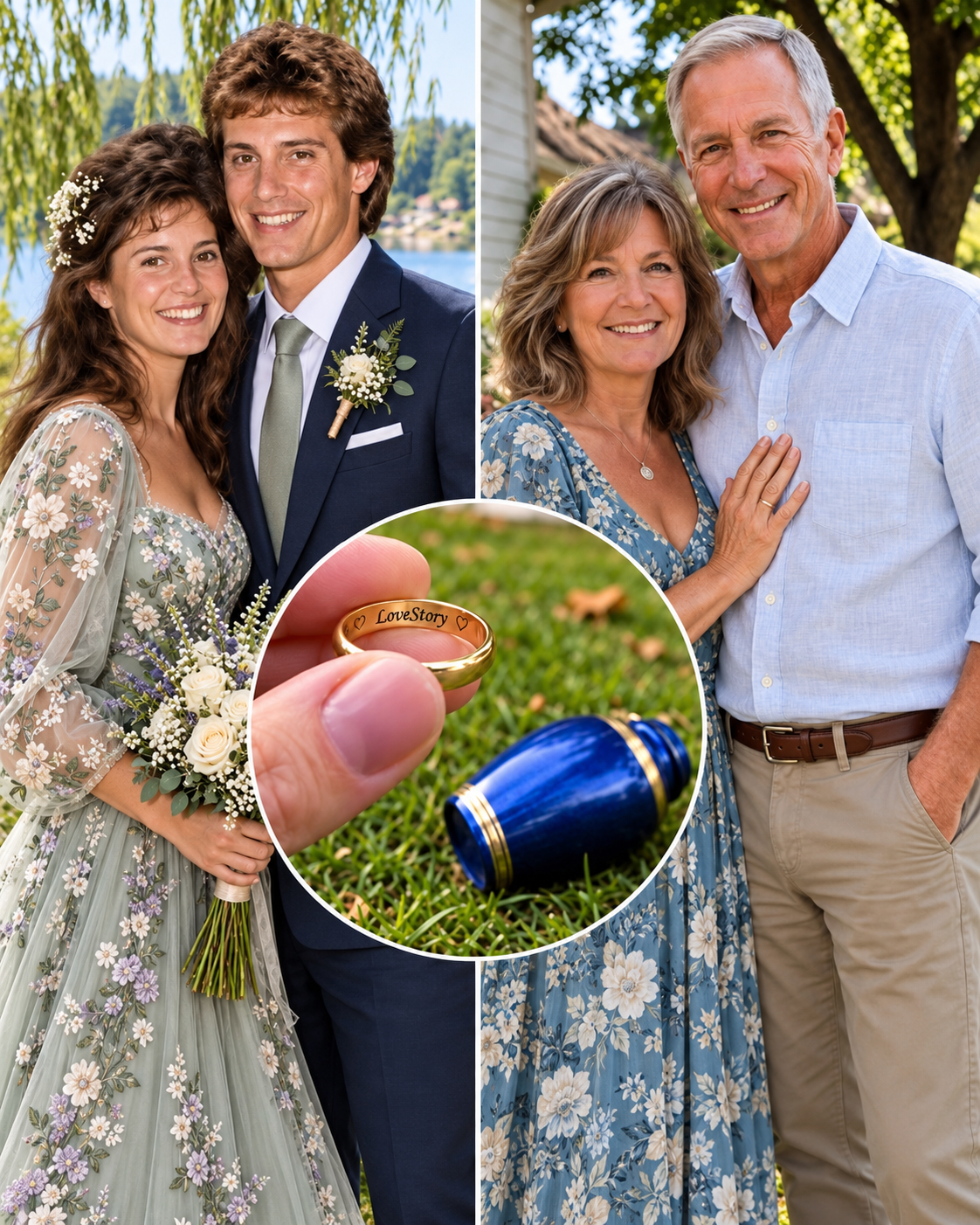
PART 1 TITLE: The Call From Overseas Arrived Six Days Into Frank’s Visit, and One Request From Claire Changed Everything I Thought Grief Would Be
“Please don’t get on a plane, Diane.”
Those were the words that fixed themselves in my memory. Not the first words Claire said when she called from overseas. Not the broken explanation about paramedics or the strange, careful tone people use when they are trying to tell you that the person around whom you built your life is dead. What I remembered afterward was Frank’s daughter telling me not to come to him. Six days earlier, I had kissed my husband goodbye at the airport. Now I was standing barefoot beside our kitchen table, gripping my phone so tightly that the edge hurt my palm.
“Say it again,” I told her.
Claire was crying hard enough that several seconds passed before she could answer. “Dad collapsed this morning.”
“I heard that part. Where is he?”
Silence came through the line, thin and enormous.
“Claire. Where is Frank?”
“He’s gone.”
My knees weakened. I pulled out one of the kitchen chairs, but I misjudged the distance and struck it with my leg before managing to sit. On the counter, Frank’s coffee mug was still upside down on the drying mat. He had used it the morning he left, rinsed it, and placed it there because he knew I hated finding coffee rings in the sink. That ridiculous blue mug became the only thing in the room I could look at while Claire explained that an ambulance had come, that people had tried to help him, that there had been nothing more anyone could do.
Frank and Claire had spent years making their relationship more complicated than it needed to be. She was his daughter from his first marriage, already old enough to remember the divorce when I entered his life. I had never expected her to call me Mom, and I had never asked her to. What I had wanted was something simpler: a place at the table that did not require anyone else to surrender theirs. For a while, when Claire was young, I thought patience would be enough.
It wasn’t. She carried anger toward Frank that she rarely explained and directed some of it toward me because I was easier to reach. Invitations were declined. Phone calls became shorter. There were birthdays when Frank sat beside the telephone long after it was obvious she would not call. He pretended not to care with a clumsiness that fooled no one who knew him. I learned not to say, “She’ll come around.” Hope, repeated too often, can sound like criticism.
Then something shifted. Nearly a year before his death, Claire began calling more often. At first, Frank would take the phone into his study and close the door. I noticed because he never closed that door unless he was paying bills or arguing with the cable company. Gradually, the conversations grew longer. He stopped hiding his happiness after them. Sometimes he would come into the kitchen afterward with a small, private smile and say, “Claire sounds good.”
I asked what had changed.
“She’s older,” he said.
“So are you.”
“That may be the problem.”
I waited for more, but Frank reached past me for an apple and changed the subject. Forty years of marriage teaches you which silences are temporary and which belong to someone else. I decided this one belonged to him and Claire.
When he announced that he wanted to visit her overseas for three weeks, I was surprised but pleased. He said it over breakfast as if proposing we replace the toaster.
“Three weeks?” I asked.
“If she can tolerate me that long.”
I looked across the table. “You want me to talk you out of it?”
“No.”
“Then why are you making that face?”
“What face?”
“The one that says you already bought the ticket and would like me to pretend this is a discussion.”
His mouth twitched. That was my answer.
I told him he should go. Whatever had happened between father and daughter had already consumed too many years. If Claire was opening the door, he needed to walk through it before pride found another excuse to close it. Frank reached across the table and squeezed my fingers. There was gratitude in his face, but something else too—something I later tried to name. Worry, perhaps. Or guilt. At the time, I mistook it for nerves about seeing a daughter he had disappointed.
The morning he left, he packed as badly as he had packed for every trip of our marriage. He brought three sweaters and forgot socks. He put his reading glasses into the suitcase, then spent ten minutes searching the house for them. I found them beneath a folded shirt and held them up.
“You would not survive without me.”
“I’ve been saying that for forty years.”
“You’ve been demonstrating it for forty years.”
At the airport, he kissed me twice. The second kiss came after he had already started toward security. He turned, walked back, placed both hands around my face, and kissed my forehead.
“What was that for?” I asked.
“Interest.”
“On what?”
“Forty years of putting up with me.”
I told him to call when he landed. Then I watched until the crowd swallowed his gray jacket.
For the first few days, everything sounded ordinary. Frank sent me a photograph of a street café. He complained that Claire kept buying a brand of coffee he considered undrinkable. He said they had taken long walks, talked more honestly than they had in years, and argued only once about whether he needed his cane on steep streets.
“What did she say?” I asked.
“That I’m stubborn.”
“She finally knows you.”
He laughed.
His last call came the night before he died. I was already in bed, reading with the lamp on his side because mine had begun flickering. Frank sounded tired. Not ill. Not frightened. Simply tired in the way travel made him tired now.
“Claire made dinner,” he said.
“Edible?”
“Technically.”
“Then praise her.”
“I did.”
“You said ‘technically edible,’ didn’t you?”
A pause.
“I may have phrased it poorly.”
I could hear Claire protesting somewhere behind him, and Frank laughed. It was such an ordinary sound that for weeks afterward I tortured myself with it. People like to believe that final conversations announce themselves, that some instinct tells you to listen differently. Ours gave me no warning. He complained about coffee, promised to find me a ridiculous souvenir at the airport, and told me he loved me before hanging up.
The following morning, Claire called.
After telling me that Frank was dead, she began describing paperwork. There were forms from the hospital, local authorities to contact, arrangements that apparently had to be made quickly. The words moved past me without meaning.
“I’m coming,” I said.
“Diane—”
“I’ll find a flight.”
“Please don’t.”
That was when I finally looked away from Frank’s coffee mug.
“What did you say?”
“There’s nothing you can do here.”
“My husband just died there.”
“I know.”
“Then don’t tell me there’s nothing I can do.”
Her breath caught. “That isn’t what I meant.”
I stood and walked toward the living room without knowing why. Frank’s slippers were beneath his chair. One had tipped onto its side. I wanted to straighten it and couldn’t make myself touch it.
Claire explained that the hospital process was complicated, that she was already speaking with officials, that I would arrive exhausted only to spend days waiting in unfamiliar offices while she handled documents. Her voice steadied as she talked, almost as if practical problems were easier for her than grief.
“I can take care of Dad,” she said. “Please let me do that.”
The sentence reached the part of me that still remembered every year Frank had wished for a better relationship with her.
“You’re sure?” I asked.
“No,” she whispered. “I’m not sure about anything. But I can do this.”
I stayed.
For a long time afterward, I blamed myself for that decision. I imagined every version of what might have happened if I had ignored her. I saw myself boarding a flight, arriving before the cremation, walking into whatever room held Frank and placing my hand against his one last time. In those imaginary versions, I was always decisive. Grief edits out hesitation. In reality, I was a woman who had just been told her husband was dead, and the daughter he had crossed an ocean to see was begging for the chance to take care of him.
The house changed within hours. Nothing physically moved, yet every room felt arranged around an absence. I called the few people who needed to know immediately. Each time I said, “Frank died this morning,” the sentence sounded like information about another family. Friends came. Someone brought soup. Someone else brought flowers with a card I could not read because the handwriting blurred before I reached the second line.
At night, I slept badly. My body kept expecting Frank beside me. Once, around three in the morning, I woke furious because I thought he had taken the blanket. I reached across the mattress and touched cold sheets. That was the first moment I understood that grief could ambush you before your mind was fully awake. I sat on the edge of the bed until dawn with my hand resting where his shoulder should have been.
Claire and I spoke every day. She told me the cremation had been arranged. She promised to send his ashes home as soon as she could. I asked about his belongings: his suitcase, coat, reading glasses, cane, phone.
“There’s been some confusion,” she said.
“What kind of confusion?”
“Things were moved between the house and the hospital.”
“Frank arrived with one suitcase.”
“I know.”
“How complicated can one suitcase become?”
“I’m trying to sort it out.”
I heard irritation in her voice, followed immediately by exhaustion. I told myself not to punish her for being the person nearest the disaster.
Then I asked about Frank’s wedding ring.
The question came naturally. He had worn the same plain gold band every day of our marriage. It was scratched near one edge from years of work around the house, and the surface had grown dull enough that a jeweler once suggested polishing it. Frank refused.
“It looks married,” he had said. “Leave it alone.”
Claire became quiet.
“His ring?” I repeated.
“Yes. He had it.”
“Where is it?”
Another pause.
“He was cremated with it.”
Something tightened inside me, but I did not understand why. Perhaps I had wanted the ring returned. Perhaps I had assumed without ever saying so that one day I would hold it. But I could hardly accuse Claire of doing something wrong when I had never told her.
“You’re certain?”
“Yes.”
“All right.”
“I’m sorry, Diane.”
“So am I.”
We ended the call politely.
Two weeks after Frank died, a courier carried a box to my door. The package was lighter than my mind expected. Death reduces a person in ways the living are not prepared to understand. I signed my name, brought the box into the living room, and left it unopened for nearly an hour.
Eventually, I cut through the tape.
Inside, protected by thick packing material, was a pale blue ceramic urn. The color stopped me. Frank had always loved blue—the deeper the better. Blue shirts, blue ties, blue coffee mugs, blue paint for a bathroom I had insisted should be white. I did not know whether Claire had chosen the urn because she remembered that or because it happened to be available.
I lifted it carefully and sat on the floor.
For forty years, Frank had occupied space everywhere. His coat on the banister. His newspaper folded badly across the table. His shaving cream on the bathroom counter. His shoes precisely where I could trip over them. Now I could hold what remained of him against my chest.
I cried then in a way I had not cried during the phone calls, paperwork, flowers, or condolences. There was no elegance in it. My nose ran. My throat hurt. I pressed my forehead against the cool ceramic and said his name until it stopped sounding like language.
Years earlier, on a summer evening beside the lake where we first met, Frank and I had made a promise. We were sitting beneath an old willow tree, older than both of us, watching insects skim the water. We had been talking about funerals because a friend of ours had died and left his family arguing over everything.
“No fighting over me,” Frank had said.
“I plan to go first.”
“Absolutely not.”
“Why?”
“Because you’d haunt me professionally.”
We finally agreed that whoever died first would be scattered beneath that willow. No grand ceremony. No marble. Just the lake, the tree, and whichever one of us was unlucky enough to remain.
But when Frank’s urn arrived, I could not go.
One week passed. Then another. I kept the urn on the table beside his chair. Sometimes I spoke to it. Sometimes I avoided looking at it for an entire afternoon. I began to understand that scattering the ashes felt too much like performing the last task anyone would ever ask of me as Frank’s wife.
A month after the urn came home, I woke before sunrise. The house was unusually still. I dressed without turning on the bedroom light, made coffee I did not drink, and stood in the living room facing the pale blue urn.
“All right,” I said aloud. “You win.”
I wrapped it carefully in Frank’s old wool scarf, carried it to the car, and drove toward the lake.
I thought I was going there to say goodbye.
I had no idea Frank had left one final thing for me to find.
END PART 1
PART 2 TITLE: At the Willow Tree Where We First Fell in Love, Frank’s Ashes Gave Me a Message He Could No Longer Explain
The lake was almost empty when I arrived. A thin morning mist rested over the water, and the parking lot contained only two other cars. I sat behind the steering wheel longer than necessary, both hands resting in my lap, watching the willow move in the distance. Its branches dragged lightly across the grass whenever the wind lifted. Forty-two years earlier, Frank had stood beneath that tree and asked if I wanted to get coffee. I had said no. He returned the next afternoon and asked again.
I carried the urn with both hands.
The path to the water had changed over the years. The gravel was smoother, the benches newer, and someone had added a small wooden railing near the steepest section. The willow, however, remained stubbornly recognizable. Its trunk had widened and one heavy branch had been cut away, but the long green curtain of leaves still made a private room beneath it.
I sat in the grass with the urn between my knees.
For several minutes I did nothing.
There was no ceremony to begin, no minister, no family gathered behind me, no printed program telling me what came next. I had imagined that simplicity would make the moment easier. Instead, I found myself wishing someone had written instructions for how to reduce forty years to an action performed with two hands.
“I’m angry with you,” I finally said.
My voice sounded embarrassingly loud in the quiet.
“You were supposed to give me some warning.”
A bird landed near the water and pecked at the mud.
“I know that isn’t how it works,” I continued. “I still think it was rude.”
That was the sort of thing Frank would have laughed at. I could almost hear the low grunt he made when he was trying not to encourage me. So I kept talking.
I told him the kitchen faucet had started dripping again. I told him our neighbor had bought a dog that barked at delivery trucks but was terrified of squirrels. I told him I had finally thrown away the mustard he insisted was still good despite the expiration date being three years old.
Then my voice broke.
“You were supposed to come home and argue with me about it.”
I wiped my face with the heel of my hand. The grief felt different there. At home, every object interrupted me with memory. Beneath the willow, the memories had room to arrive completely.
I remembered our first kiss, which Frank later claimed I had initiated and I maintained until his death was entirely his responsibility. I remembered bringing Claire there once when she was young, during one of the rare stretches when the three of us seemed almost effortless together. Frank had skipped a stone seven times across the water. Claire had tried to beat him until her arm hurt.
That memory made me think of her.
I had not spoken to Claire in three days. Our conversations had become shorter after the urn arrived. She said she was exhausted and needed to deal with Frank’s remaining paperwork. I believed her. I also sensed that something had shifted between us, though I blamed grief. People often withdraw when every conversation reminds them of what they have lost.
I put my palm against the urn.
“All right,” I whispered.
The lid was tighter than I expected. I turned it once and stopped, suddenly unable to continue. My fingers rested against the smooth ceramic while I stared across the lake.
This was the last threshold.
As long as the urn remained closed, Frank was somehow contained. Once I opened it, once the wind took him across the water and soil, I would have nothing tangible left except photographs, clothes, and memories that no longer had another witness.
I thought of the promise we had made.
Frank had kept enough promises for me to owe him this one.
I loosened the lid.
Inside sat a sealed bag containing the ashes. I looked away for a moment, surprised by how clinical it seemed. No one prepares you for the ordinary materials surrounding death: plastic, labels, tape, printed paperwork. I reached inside carefully and took hold of the bag.
As I lifted it, something struck the ceramic with a sharp little sound.
I froze.
The noise came again when I moved the bag—metal against pottery.
I lowered the ashes onto the grass beside me and looked into the urn.
Something small gleamed at the bottom.
For a second my mind refused to identify it.
Then I reached inside.
Frank’s wedding ring lay in my palm.
I knew it immediately, not because wedding bands are distinctive but because I had watched that one age with him. There was the flattened mark along one edge from the time he caught it against a toolbox. There was the shallow scratch from our kitchen renovation. The gold had softened in color after four decades against his skin.
I turned it between my fingers.
Claire’s voice returned with perfect clarity.
He was cremated with it.
I stopped breathing normally.
Perhaps she had been mistaken. That was the first explanation. Hospitals made mistakes. Grieving daughters misunderstood details. Maybe someone at the crematorium had removed the ring and placed it with the ashes afterward.
Except Claire had not sounded uncertain.
I remembered asking, “You’re certain?”
And Claire saying, “Yes.”
I held the ring closer.
That was when I noticed the inside surface catching the morning light in a way it never had before.
There were marks inside the band.
Letters.
I frowned and tilted it toward the sun.
Frank’s ring had never been engraved. I had purchased it myself before our wedding because Frank claimed that choosing jewelry was a task beyond his abilities. I remembered the smooth interior. I remembered joking on our twentieth anniversary that we should have something added and Frank saying forty years of wear was inscription enough.
Now words were carved into the gold.
I had to turn the ring twice before I could read them.
DON’T BELIEVE HER.
I stared at the sentence until the letters blurred.
Then I wiped my eyes and read it again.
DON’T BELIEVE HER.
Three words. No name. No explanation. Nothing to tell me when Frank had arranged the engraving or what he believed I should doubt.
But one pronoun had suddenly made the peaceful lake feel cold.
Her.
My first thought was irrational: perhaps Frank meant someone else entirely. A doctor. A lawyer. A stranger I had not yet met. Maybe the message had nothing to do with Claire.
Then common sense arrived.
Frank had spent the final six days of his life in Claire’s home. Claire had reported his collapse. Claire had asked me not to travel. Claire had handled the cremation. Claire had told me his belongings were missing or confused between locations.
Claire had told me the ring had burned with him.
Yet here it was.
I stood too quickly and became dizzy. The willow branches shifted above me while I pressed one hand against the trunk.
“No,” I said.
The word came out automatically.
I did not know whether I was arguing with Frank, Claire, or the ring itself.
I put the band on my palm again.
If Frank had been frightened, why had he sounded normal the night before his death? If he had discovered something about Claire, why had he not simply called me? Why hide a warning where I might never find it? Had he expected the ring to return to me? Had he known he was going to die?
That last thought frightened me enough that I sat down again.
Frank’s death had been sudden. Claire said he collapsed. The paramedics came. Nothing could be done.
Until that morning, I had accepted those facts because there had been no reason not to.
Now every detail seemed to contain a second possibility.
I put the ring into the pocket of my jacket and closed the urn without scattering a single grain of ash.
On the drive home, I replayed every conversation I had had with Claire since Frank’s death.
“There’s nothing you can do here.”
“Let me take care of Dad.”
“There’s been some confusion about his belongings.”
“He was cremated with the ring.”
Four statements that had once sounded reasonable now pressed against one another in my mind like pieces from different puzzles.
At home, I placed the urn back beside Frank’s chair.
Then I found a magnifying glass in his desk.
The engraving was clean, recent-looking, the grooves brighter than the worn gold surrounding them. I knew nothing about jewelry work, but it did not resemble an inscription that had spent decades inside a ring.
I searched through old photographs anyway.
There was Frank holding a fish, his left hand visible. Frank cutting our anniversary cake. Frank asleep in the garden chair with a book on his stomach. I enlarged photographs on my tablet until the pixels broke apart. Nothing proved when the engraving had been made, but one thing remained certain: I had seen the inside of that ring before, and those words had not been there.
I nearly called Claire.
My thumb hovered over her name.
Then I imagined asking, “Why did you lie about Frank’s ring?”
If she had an innocent explanation, waiting forty-eight hours would not harm it.
If she did not, I would be warning her that I knew something.
I put the phone down.
That evening I ate half a piece of toast and booked a flight instead.
The decision felt reckless only until I entered my payment information. Then it felt inevitable.
I chose the earliest reasonable departure and a return ticket several days later. Claire would not be expecting me. I did not tell her I was coming. I did not tell anyone except the neighbor who agreed to collect my mail, and even she believed I was visiting an old friend.
I packed lightly: clothes, medication, passport, charger, a folder containing the papers Claire had sent after Frank’s death.
The ring went into the zippered interior pocket of my handbag.
Frank’s ashes stayed home.
Before leaving for the airport, I stood beside the urn.
“I hope you knew what you were doing,” I said.
The pale blue ceramic gave me nothing back.
At the airport, I became aware of how absurd my plan might look from the outside. A newly widowed woman had found a cryptic inscription and decided to cross an ocean rather than make a telephone call. Perhaps grief had damaged my judgment. Perhaps I would arrive, confront Claire, hear some painfully ordinary explanation, and feel ashamed.
I hoped so.
I wanted the humiliation of being wrong.
Instead, as the plane climbed through the clouds, I found myself remembering the way Claire had resisted when I said I would come immediately after Frank’s death.
Please don’t.
Not, Wait until morning.
Not, Let me find you a hotel.
Don’t come.
I slept for less than an hour during the flight.
When we landed, my body felt heavy and disconnected from time. I collected my bag, found a taxi, and gave the driver Claire’s address from the Christmas cards she had sent us over the years.
During the ride, I rehearsed calm sentences.
I found Frank’s ring.
There was an engraving.
You told me something that wasn’t true.
By the time the taxi turned onto Claire’s street, I had almost convinced myself I could handle whatever waited behind her door.
Then I looked through the front window of her house.
A boy I had never seen before was kneeling beside Frank’s open suitcase.
And on his head was the battered baseball cap my husband had worn for nearly thirty years.
END PART 2
PART 3 TITLE: I Crossed an Ocean Without Warning Claire, and the First Thing I Saw Through Her Window Made Every Explanation Feel Dangerous
“Stop here,” I told the driver.
We were still several houses away from Claire’s address. I paid, pulled my suitcase onto the pavement, and stood beside it while the taxi disappeared around the corner. The air smelled faintly of rain and exhaust. After nearly a full day of travel, my body wanted a shower, food, and sleep. Instead, every nerve in me had sharpened around the sight of a boy wearing Frank’s cap.
He looked about twelve.
From the sidewalk, I could see only part of him through the front window. He was kneeling on the floor, lifting objects from an open suitcase and placing them into separate piles. A folded shirt. A book. A small toiletry bag. He moved with concentration, unaware of me.
The suitcase was unmistakably Frank’s.
We had bought it together before a trip five years earlier because Frank refused to stop using luggage with a broken zipper. I recognized the dark strip near one corner where he had spilled coffee while waiting for a delayed flight.
Claire had told me his suitcase had become mixed up among possessions moved after his collapse.
There it was.
Open in her living room.
I walked closer.
The cap on the boy’s head made my stomach tighten. It had once been navy blue but had faded almost gray. Frank loved it despite my repeated attempts to replace it. The brim had a slight bend on the left side because he always grabbed it in the same place.
I had packed that cap for him myself.
“Take the decent one,” I had said.
“This is the decent one.”
“You own three hats.”
“Exactly. I ranked them.”
Now a child I did not know was wearing it.
For one wild moment, I wondered whether Claire had already begun giving Frank’s possessions away. The thought angered me, but it was almost comforting compared with the message hidden in his ring. People behaved thoughtlessly after deaths. Thoughtlessness had explanations.
The front door stood partly open.
Near it, several cardboard boxes were stacked against the wall. Two men were carrying a small table toward a white van parked outside. A third box sat on the pavement.
FRANK was written across one side in thick black marker.
I stopped.
The boy glanced toward the doorway but did not see me. He removed a sweater from the suitcase—brown wool, one I had given Frank two Christmases earlier—and held it against himself as though checking the size.
I walked up the path.
More of Frank’s belongings became visible with each step.
His walking shoes rested beside the staircase.
His travel bag hung from the back of a dining chair.
His cane leaned against the wall.
A jacket I had been told could not be located was folded over the arm of a sofa.
The missing items had not been lost.
They had been here all along.
Something inside me became very quiet.
Until that moment, I had still been trying to construct explanations that allowed every person I loved to remain innocent. Perhaps Claire had misunderstood what the hospital staff said. Perhaps someone had placed the ring in the urn without telling her. Perhaps grief had scrambled details.
A missing suitcase can be confusion.
A suitcase, a jacket, shoes, a cane, and a phone all sitting inside the same house are something else.
I left my own suitcase near the doorway and stepped inside.
“Claire?”
The boy’s head snapped toward me.
Before he could speak, a woman appeared from the kitchen carrying a half-filled cardboard box.
Claire stopped so abruptly that a glass inside the box knocked against another.
For several seconds we simply looked at one another.
She had aged since the last time I saw her in person. There were new lines near her eyes, and her hair was shorter. Grief had left its mark too: her face was pale, her eyelids swollen.
But the emotion that crossed her expression when she recognized me was not simple grief.
It was alarm.
“Diane?”
I waited.
The box trembled slightly in her hands.
“You’re here.”
“Yes.”
“You didn’t tell me you were coming.”
“No.”
She lowered the box onto a nearby table.
Then she said the one thing she should not have said.
“You weren’t supposed to come.”
The sentence hung between us.
Claire’s face changed almost immediately, as if she heard it after speaking.
“I mean—I would have picked you up. You should have told me. You’ve traveled all this way alone.”
“That isn’t what you said.”
“Diane, you must be exhausted.”
“I am.”
“Let me make you something.”
“I don’t want anything.”
The boy stood slowly. Claire looked at him and made a small motion toward the hallway.
“Why don’t you take those things upstairs?”
He hesitated.
“Go on.”
He gathered two shirts and disappeared through another doorway. Frank’s cap remained on his head.
I watched him leave.
Then I turned back to Claire.
“Who is he?”
She reached for the box she had set down.
“We should sit first.”
“Who is he?”
“Diane.”
“Fine. We’ll come back to him.”
I pointed toward the living room.
“Why is Frank’s suitcase here?”
Claire looked at it.
“I was organizing his things.”
“You told me you couldn’t find it.”
“I said everything had gotten mixed up.”
“No. You said some of his belongings appeared to have been misplaced between the house and the hospital.”
“They were.”
“Yet somehow they all ended up here.”
Her jaw tightened.
“I found them.”
“When?”
“Over the last few weeks.”
“And you didn’t think I’d want to know?”
“I was going to send everything.”
“When?”
“As soon as I finished sorting the house.”
I looked around.
That was when I understood what the movers were doing.
Pictures had been removed from the walls. One bookcase was empty. Rolled packing paper covered the dining table. Through the open kitchen door, I could see boxes lined against the cabinets.
“You’re moving.”
Claire rubbed a hand across her forehead.
“Yes.”
“You forgot to mention that too.”
“It isn’t connected to Dad.”
“Everything seems connected to Dad today.”
She flinched.
My anger surprised me with its steadiness. I had imagined confronting Claire and losing control. Instead, each contradiction made me calmer, because fury had become less useful than observation.
I began looking around deliberately.
Frank’s reading glasses sat on a side table.
A small bottle of his prescription medication was beside them.
His toiletry bag was open near the suitcase.
I had asked Claire about all three.
Then I saw his phone.
It lay on the kitchen counter, plugged into a charger.
For a moment the entire room seemed to narrow around it.
“Is that Frank’s?”
Claire followed my gaze.
Her expression answered before her mouth did.
I walked toward the counter.
“Diane, wait.”
I picked up the phone.
The familiar case was scratched near the bottom. I had bought it after Frank cracked the previous one. Even the lock screen was familiar: a photograph of the lake beneath the willow tree.
Claire stepped closer.
“Give me that.”
I looked at her.
“What?”
“Please. I need to—”
“You told me his phone was missing.”
“I thought it was.”
“When did you find it?”
She opened her mouth and stopped.
I held the phone against my chest.
“When, Claire?”
“A few days after we spoke.”
“That was weeks ago.”
“I know.”
“You knew I wanted his things.”
“Yes.”
“You knew I was asking about them.”
“Yes.”
“And you said nothing.”
Her shoulders dropped.
“I didn’t know how to explain everything.”
At last, something close to honesty.
“Try.”
“Not like this.”
“How would you prefer it? Should I go home and make an appointment?”
“That isn’t fair.”
“Fair?”
My voice rose for the first time.
“My husband died in your house. You asked me not to come. You arranged his cremation. You told me his belongings were missing. I traveled thousands of miles and found every supposedly missing thing within thirty seconds of walking through your door.”
Claire looked toward the hallway.
“Keep your voice down.”
That stopped me.
“Why?”
She shut her eyes briefly.
“Because there’s a child here.”
The hallway creaked.
The boy reappeared at the top of the stairs.
He still wore Frank’s cap.
Up close, I could see dark-framed glasses and a narrow face. There was something about the way he stood—one shoulder slightly higher than the other—that tugged at a place in my memory.
He looked at me with open curiosity.
Then at Claire.
“Mom?”
One word.
My mind emptied.
Claire’s face went white.
“Go upstairs, Eli.”
He frowned. “Who is she?”
“Please.”
“But—”
“Upstairs.”
The boy looked at me once more. His hand rose to push his glasses higher on his nose.
My chest tightened.
Frank had done exactly that. Same finger. Same impatient little movement.
Then Eli turned and disappeared.
I stared at the empty staircase.
Claire did not speak.
Neither did I.
At last I looked at her.
“You have a son.”
She pressed her lips together.
I heard myself repeat it, slower.
“You have a son.”
“Yes.”
The answer was nearly inaudible.
I pointed toward the stairs.
“Frank knew him?”
Claire began to cry.
That was answer enough, but I needed words.
“Did Frank know that boy?”
“Yes.”
I had come there expecting to discover a lie about a ring, perhaps a lie about the hours surrounding my husband’s death.
I had not expected to discover a child.
“How old is he?”
Claire wiped her cheek.
“Twelve.”
The number landed harder than anything else she had said.
Twelve years meant this was not a secret born during Frank’s final visit.
It had lived inside my marriage for more than a decade.
END PART 3
PART 4 TITLE: The Boy in Frank’s Old Cap Called Claire Mom, and Nine Hidden Years Suddenly Became More Painful Than His Death
“Twelve?”
Claire nodded.
I sat because my legs no longer felt dependable. The nearest chair was one of the dining chairs that had not yet been packed. Frank’s phone remained in my hand, its screen dark now, reflecting a distorted version of my face.
Twelve years.
The number seemed too large to absorb at once.
I began measuring it against ordinary things.
Twelve Christmases.
Twelve birthdays.
Twelve first days of school.
Twelve summers in which Frank and I had sat on our back patio talking about Claire as though we knew the basic shape of her life.
For years I had mailed her birthday cards. Christmas parcels. Books. Scarves. Small gifts selected with enough care to say, I still consider you family, but not enough extravagance to make her feel obligated. I could see the packages lined up on our dining table while I wrapped them.
Somewhere during all those years, there had been a child.
“His name is Eli?” I asked.
“Yes.”
“And he’s twelve.”
“Yes.”
I looked toward the stairs.
The house had gone quiet except for the movers outside. A roll of packing tape tore with a harsh ripping sound.
“Did Frank know from the beginning?”
Claire’s fingers tightened around the edge of the table.
“No.”
Something in me almost relaxed.
Then I noticed she had not finished.
“When did he find out?”
“Eli was three.”
I stared at her.
“Three.”
Claire nodded.
I calculated without meaning to.
“Nine years.”
“I know.”
“No, Claire. Say it.”
Her eyes filled again.
“Diane—”
“Say how long my husband knew he had a grandson.”
Her mouth trembled.
“Nine years.”
The pain changed direction.
Until that moment, every suspicion had pointed toward Claire. The ring had warned me about a woman. Claire had lied about Frank’s belongings. She had hidden her son.
But nine years belonged to Frank too.
Frank had known.
Frank had come home after learning he was a grandfather and slept beside me.
He had eaten breakfast across from me.
He had celebrated anniversaries with me.
He had listened while I wondered aloud whether Claire might ever have children.
I remembered one conversation with humiliating clarity. We had been at a friend’s granddaughter’s birthday party. On the drive home, I had said, “Do you ever wish Claire had given you grandchildren?”
Frank had kept his eyes on the road.
“If that’s what she wanted.”
At the time, I had thought the answer respectful.
Now it felt surgical.
I put his phone on the table before I threw it.
Claire watched me carefully.
“I know what you’re thinking.”
“No, you don’t.”
“I know you feel betrayed.”
“Do you?”
“Yes.”
“You had nine years to imagine how I might feel.”
She winced.
The ring in my handbag suddenly seemed heavier than metal should feel. DON’T BELIEVE HER. I had crossed an ocean because I thought Frank had been warning me that Claire deceived him.
Now another possibility had emerged.
Perhaps he had been warning me because he knew exactly how practiced she had become at keeping secrets.
Or perhaps the warning was the final act of a man who had participated in the same deception.
“Tell me why,” I said.
Claire looked toward the stairs again.
“I can’t do this with Eli in the house.”
“He is already in the house. He has apparently been in your life for twelve years, so I don’t see why his existence should suddenly prevent a conversation.”
“That isn’t what I mean.”
“Then say what you mean.”
Her face tightened. For a moment I saw the younger Claire—the teenager who could turn silence into a weapon when she was hurt.
“I mean he loved his grandfather,” she said. “And he has already lost him. I don’t want him listening while you and I tear Dad apart.”
The sentence struck me because it was reasonable.
I hated that.
“I’m not tearing Frank apart.”
“No?”
“I’m trying to find out who I was married to.”
Claire looked down.
That silenced both of us.
I opened my handbag.
When I took out the ring, her eyes fixed on it immediately.
The color drained from her face.
“You have that.”
It was not a question.
“Yes.”
Her reaction chilled me more than surprise would have.
“You knew it existed.”
Claire said nothing.
I placed the ring on the table between us.
“You told me he was cremated wearing this.”
Her shoulders sagged.
“I know.”
“That was a lie.”
“Yes.”
The word came without defense.
I turned the band so the engraving faced upward, although from where she sat the letters were too small to read.
“Frank left me a message inside it.”
Claire looked sharply at me.
“What message?”
I studied her face.
“You don’t know?”
“No.”
For the first time since entering the house, I believed her immediately.
“What does it say?”
I picked up the ring and handed it across the table.
Claire hesitated before taking it.
She rotated the band toward the light.
Her lips moved as she read.
DON’T BELIEVE HER.
Her eyes closed.
“Oh, Dad.”
The words were soft, almost exhausted.
I took the ring back.
“That is why I’m here.”
Claire pressed both hands over her face.
“He actually did it.”
“Did what?”
She shook her head.
“Claire.”
“I need a minute.”
“You’ve had nine years.”
Her hands fell.
“That isn’t fair.”
“I’m beginning to think fairness was removed from this family without anyone telling me.”
She looked away.
I leaned closer.
“Did you lie about how Frank died?”
Her head snapped toward me.
“No.”
“Did he collapse here?”
“Yes.”
“Was an ambulance called?”
“Yes.”
“Was he alive when they arrived?”
Her voice cracked.
“Barely.”
That detail was new.
“You told me they could do nothing.”
“They tried.”
“What happened before he collapsed?”
Claire’s breathing changed.
“Diane, his death wasn’t—”
“I’m not asking what it wasn’t. I am asking what happened.”
She gripped the edge of the chair.
“We argued the day before.”
“About what?”
She looked toward the ring.
“About Eli.”
I felt the pieces shift again.
“Start at the beginning.”
Claire sat back slowly.
For several seconds she watched her hands.
“Eli’s father left before Eli was born.”
I waited.
“He didn’t die. There wasn’t some tragedy. He left. He decided he didn’t want a child, and by the time I understood he meant it, I was pregnant, scared, furious at everyone, and barely speaking to Dad.”
“Or me.”
“Or you.”
There was no accusation in her answer, which somehow made it more painful.
Claire told me that during the pregnancy she had been living overseas already. Pride did most of the rest. She had convinced herself she did not need Frank, did not need me, did not need anyone from the family she had spent years insisting had failed her.
“When Eli was born,” she said, “I told myself I would call after I had things under control.”
“And when was that supposed to be?”
“I don’t know.”
“A month?”
“I don’t know.”
“A year?”
“I said I don’t know.”
She wiped her cheek impatiently.
“Every week I waited made calling harder. Then months became years.”
“So Frank discovered Eli when he was three. How?”
“I called Dad.”
“Why?”
“Because I was tired of being angry.”
That answer was so ordinary I almost laughed.
Claire said she had reached a point where maintaining the estrangement required more energy than ending it. One evening she called Frank expecting a short, awkward conversation.
They spoke for two hours.
“He cried,” she said.
I looked away.
I could imagine that. Frank cried privately and denied it publicly, as though tears were parking tickets.
“He came to see you.”
“Three weeks later.”
“And met Eli.”
“Yes.”
I pictured Frank arriving at Claire’s door nine years earlier, discovering a three-year-old grandson on the other side.
“What did he do?”
Claire smiled despite herself.
“He stared at him for about ten seconds. Then Eli asked if he was old.”
A laugh escaped me before I could stop it.
That sounded like Frank’s luck.
“What did he say?”
“He said, ‘Apparently.’”
For one brief second, the room softened.
Then reality returned.
“And after that visit, he came home to me and said nothing.”
Claire’s smile disappeared.
“Yes.”
“Why?”
“I asked him not to tell you.”
There it was.
The answer I had been moving toward since the lake.
“Why me?”
Claire swallowed.
“Because telling you meant admitting everything.”
“That you had a child?”
“That I had shut you out after you spent years trying not to shut me out.”
I said nothing.
Claire looked directly at me now.
“You sent birthday cards even when I didn’t answer. You remembered stupid things I mentioned once. You invited me every Christmas after I had made it very clear I didn’t want to come. And I acted like you were the reason Dad and Mom’s marriage ended even though I knew that wasn’t true.”
Her voice became thinner.
“When Eli was born, I thought I’d tell you once I had my life together. Then I waited so long that telling you meant admitting I had deliberately let you believe I was alone all those years.”
“So you chose another year.”
“Yes.”
“And then another.”
“Yes.”
“And Frank helped you.”
Her eyes dropped.
“Yes.”
That answer cut more deeply than any excuse would have.
“Did he ever tell you to stop?”
“Many times.”
“But he never told me.”
“No.”
I stood and walked to the window.
Outside, one of the movers closed the rear doors of the van. The ordinary activity felt insulting. Somewhere upstairs was a twelve-year-old boy who shared Frank’s gestures. On the table was my dead husband’s phone. In my hand was the ring he had worn through four decades of marriage.
“How long had Frank been visiting Eli?”
“Not constantly. A few times over the years.”
“He told me those trips were for work or to see old friends.”
“Some of them were.”
“Some.”
Claire did not answer.
I remembered airport drop-offs. Changed itineraries. Weekends when Frank called from hotel rooms. None of those moments had seemed suspicious because trust rarely announces the occasions when it is being used against you.
“Was this trip about Eli?”
“Partly.”
“What does that mean?”
Claire rubbed her palms over her jeans.
“I’m selling this house.”
“I noticed.”
“Eli and I are moving back.”
I turned toward her.
“Back where?”
“Home. Your town.”
The surprise must have shown on my face.
Claire continued quickly.
“It’s been planned for months. I found work. Eli can start school there after the move. Dad knew.”
“Of course he did.”
“He was happy about it.”
“I’m sure.”
“But there was a problem.”
I looked at the ring.
“Me.”
“The secret,” she said. “Not you.”
“To me, those are currently the same thing.”
Claire nodded as though she deserved that.
She explained that Frank had become increasingly unwilling to let the lie survive the move. Living an ocean away had allowed everyone to postpone the inevitable. Moving back meant birthdays, holidays, ordinary visits. Eli could not remain invisible.
“Dad said I had to tell you before we arrived,” Claire said.
“And you refused.”
“At first.”
“He came here to convince you.”
“Yes.”
I studied her.
“So my husband crossed an ocean intending to tell me the truth if you wouldn’t.”
Claire’s eyes filled.
“Yes.”
“But after nine years, he still gave you another chance to do it first.”
“Yes.”
“He protected you right until the end.”
Her face crumpled slightly.
“Yes.”
I looked down at the ring.
Three words waited inside the band.
DON’T BELIEVE HER.
“You realize what this means,” I said. “Frank may have been angry with you, but he was not innocent. He had nine years to pick up the phone.”
Claire wiped her eyes.
“I know.”
“He came home to me every time.”
“I know.”
“He let me talk about you. Worry about you. Wonder whether we would ever be closer.”
“I know.”
“He lied.”
“Yes.”
The room went very still.
Then Claire said, “He loved you, Diane.”
My laugh was small and bitter.
“That is a strange defense.”
“It isn’t a defense.”
She met my eyes.
“He loved you, and he failed you. Both happened.”
I wanted to reject the sentence. I wanted love and betrayal to be mutually exclusive because that would make grief simpler.
But forty years had taught me too much about human beings for that.
I picked up the ring once more.
“If he came here planning to make you tell me about Eli, why engrave this?”
Claire looked at the band.
Her expression changed.
“What?”
“These words are new.”
“I know.”
“How do you know?”
She hesitated.
Then she said something I had not expected.
“Because that isn’t what the ring was supposed to say.”
END PART 4
PART 5 TITLE: Claire Said Frank Had Ordered Different Words for His Ring, but His Phone Contained the First Proof That She Was Still Lying
“What was it supposed to say?”
Claire did not answer immediately. She kept staring at the ring in my hand as if the three engraved words might rearrange themselves if she waited long enough. Outside, one of the movers called to another man. A cupboard door closed somewhere in the kitchen. Ordinary noises continued around us while my entire understanding of my marriage tilted again.
“Claire.”
She drew a slow breath. “Dad told me he was having something put inside the ring before he went home.”
“What?”
“He said, ‘Tell Diane the truth.’”
I blinked. “That was the engraving?”
“That was what he told me he had ordered.”
I looked down at the band.
DON’T BELIEVE HER.
There was a difference between those messages large enough to frighten me. The first was an instruction to Claire. The second was a warning to me.
“When did he tell you that?”
“The afternoon before he died.”
Claire sat down again. “We’d been arguing. He was furious that I still hadn’t called you. He said if I needed words placed permanently inside a piece of metal before I understood he was serious, then that was what he would do.”
“That sounds like Frank.”
“He wasn’t joking.”
“I didn’t think he was.”
She pressed her fingers together. “He’d taken the ring to a jeweler earlier because the inside edge had started bothering him. He said while they had it, he was going to add the message.”
“And you actually saw the order?”
“No. I only heard what he told me.”
“Then you don’t know what he ordered.”
“I know what he said he was going to order.”
I slid the ring back onto the table. “Apparently those are different things.”
Claire looked exhausted rather than defensive now, but after what I had learned, exhaustion no longer earned trust automatically.
“Did you see the engraving before Frank died?”
“No.”
“After?”
“No.”
“You handled the ring.”
Her eyes lifted.
“You must have. It didn’t magically enter the urn.”
She looked away.
I waited.
Claire rose and walked to the sink, though there was nothing there requiring her attention. She rested both hands against the counter.
“The hospital gave it to me with his personal belongings.”
“So you lied about that too.”
“Yes.”
“You said he was cremated wearing it.”
“I know.”
“Why?”
She kept her back to me. “Because I had kept it.”
The confession sounded almost childish.
“For how long?”
“Until the day I mailed the urn.”
“Why keep it at all?”
Claire turned.
“Because it was my father’s.”
“So was the watch you sent me.”
“I know.”
“So were his glasses.”
“I know.”
“But the ring was mine too, Claire. It represented my marriage.”
“I know that now.”
“You knew it then.”
Her mouth tightened.
“I wanted one thing that had been against him when he died.”
The anger I had prepared did not disappear, but it changed shape. I understood the impulse. I hated understanding it.
“So you kept it.”
“Yes.”
“And then?”
“I felt guilty. I knew it belonged with you.”
“Why put it inside the urn instead of the package?”
Claire’s eyes filled again. “I thought it would be meaningful.”
“To hide it in ashes?”
“I thought when you opened the urn, you would find it. I thought Dad had engraved what he told me he would engrave.”
“Tell Diane the truth.”
“Yes.”
“And you were willing for me to discover that sentence without knowing what truth it referred to?”
She lowered her voice. “I thought by then I would have told you.”
I laughed once, without humor.
“Your plans seem to contain an impressive number of future confessions.”
She accepted that without protest.
I picked up Frank’s phone.
The screen was still locked.
“What was his code?”
Claire hesitated.
I gave her a look.
“0427,” she said.
My breath caught.
April twenty-seventh.
Our wedding anniversary.
I entered the numbers.
The phone opened immediately.
For several seconds I could not move. Frank’s home screen was exactly as I remembered: the lake beneath the willow tree, taken on a bright October afternoon when the leaves were turning. A row of applications sat along the bottom. There were seventeen unread emails. Three weather alerts. A reminder about renewing the registration on his car.
Death had interrupted his life without tidying it.
I opened the call history first.
Claire stood across from me but did not attempt to stop me.
The final outgoing call had been to me the night before he died.
Before that, several calls were to Claire even though they were in the same city. A jeweler appeared once. An airline number appeared twice.
“Why was he calling the airline?”
Claire’s expression changed.
“I don’t know.”
I looked at her.
“You expect me to believe that?”
“He didn’t tell me.”
I tapped the number, then stopped before placing an international call.
Instead, I opened his email.
The search bar felt indecently intimate. Frank and I had never inspected each other’s devices. We knew each other’s passwords because forty years produces practical overlap, not because we monitored one another.
I typed the airline name.
A confirmation appeared.
FLIGHT CHANGE CONFIRMED.
The email had been sent at 4:18 p.m. the day before Frank died.
His original return date was still more than two weeks away.
The new flight was scheduled for the following afternoon.
I read it twice.
“He was leaving early.”
Claire sat down heavily.
“I didn’t know he’d actually changed it.”
“But you knew he threatened to.”
“Yes.”
“Why?”
“We argued.”
“About Eli?”
“Yes.”
“Only Eli?”
She looked away.
That tiny movement was enough.
I opened Frank’s messages.
My hands had started shaking now, not with grief but with the sick certainty that every answer would contain another locked room.
The thread with Claire stretched back months.
Not nine years.
Months.
I scrolled upward.
There were photographs of Eli at school, Eli holding a soccer trophy, Eli asleep against the car window. Frank had responded to each one with the kind of restrained enthusiasm he used when he was trying not to overwhelm someone.
Proud of him.
Tell him Grandpa says excellent work.
Does he still like astronomy?
I continued upward.
Eight months earlier, Frank had written:
I still think Diane deserves to know.
Claire’s reply appeared beneath it.
Not yet.
Then Frank:
You have been saying not yet since you told me.
I stopped.
The words were so simple that at first I did not understand what they proved.
Then I scrolled farther.
Seven months earlier:
CLAIRE: I’m asking you to give me time.
FRANK: I have given you four months.
Four months.
I counted backward.
If those messages were accurate, Frank could not have known for nine years.
He might not even have known for one.
My skin went cold.
I looked across the table.
Claire had gone completely still.
“You said Frank found out when Eli was three.”
She said nothing.
“He was three twelve years ago.”
“Diane—”
“You said Frank had known for nine years.”
“I can explain.”
“No.”
I turned the screen toward her.
“You can read.”
She closed her eyes.
The messages continued beneath my thumb.
FRANK: I won’t lie to her forever.
CLAIRE: You aren’t lying. You just aren’t telling her yet.
FRANK: That is a distinction people use when they want to feel better about lying.
I almost heard his voice saying it.
Another message, five months earlier:
FRANK: Every day this continues makes it worse.
CLAIRE: If you tell her before I’m ready, you’ll never see Eli again.
My stomach tightened.
I reread the sentence.
Then again.
“You threatened him.”
Claire shook her head immediately. “I was angry.”
“You threatened to cut him off from his grandson if he told me.”
“I didn’t mean it.”
“Did Frank know that?”
She opened her mouth.
Nothing came out.
I kept reading.
FRANK: Don’t use the boy to control me.
CLAIRE: Then stop trying to control me.
FRANK: Telling my wife the truth is not controlling you.
The conversation ended there.
I put the phone flat on the table.
The room was so quiet that I could hear the faint electrical hum of the refrigerator.
“You lied to me five minutes ago.”
Claire’s eyes were red.
“Yes.”
“You stood there and told me Frank had hidden Eli from me for nine years.”
“Yes.”
“You invented trips. You told me he had visited Eli secretly for years.”
She covered her mouth.
“Why?”
“I panicked.”
“That is not an answer.”
“I knew what this looked like.”
“It looks like you lied.”
“I knew you would hate me.”
“I don’t know what I feel yet.”
“That’s worse.”
“No, Claire. What’s worse is that I arrived here already grieving one person, and you tried to make me grieve a version of him that may never have existed.”
She flinched as if I had struck her.
I hated the satisfaction that gave me.
“When did Frank actually learn about Eli?”
Claire wiped both cheeks.
“Ten months ago.”
The truth fit the timeline perfectly.
Almost a year before Frank’s death, Claire had begun calling more frequently.
Private conversations.
Closed doors.
Frank coming into the kitchen afterward with a smile and saying, Claire sounds good.
Not nine years.
Ten months.
I stared at her.
“And the first time Frank met Eli?”
“Eight months ago.”
“The trip you claimed was one of several.”
“Yes.”
“Was it the weekend Frank said he was visiting Martin?”
Claire nodded.
Martin had been Frank’s college roommate. He lived less than an hour from the airport Frank had used.
The lie had been constructed carefully enough to survive casual questions.
“How much did Frank tell you about me during those months?”
Claire frowned.
“What?”
“When he was arguing that I deserved the truth, what did he say?”
Her voice softened. “That you would be hurt.”
“That wasn’t the question.”
“He said you would forgive me eventually.”
That hurt more than I expected.
Frank had known me well enough to believe generosity could be counted on even when truth could not.
“And you?”
“I wasn’t sure.”
“Because?”
“Because I knew I didn’t deserve it.”
I pushed away from the table and walked toward the window.
Outside, the movers had gone. The van was gone too. The street had become still.
Behind me, Claire said, “Dad was wrong to hide it for ten months.”
“Yes.”
“But he wasn’t trying to protect himself.”
“I haven’t decided what he was trying to protect.”
“He was trying to keep me from disappearing again.”
I turned.
She looked smaller now, stripped of the confidence she had used when I first arrived.
“I told him if he told you before I was ready, I’d stop answering his calls. I said I’d move again. I said he’d lose Eli.”
“And he believed you.”
“I had done it before.”
That was true.
For years, Claire’s absence had controlled Frank more effectively than any threat spoken aloud.
I looked at the phone again.
“There are two calls to an airline.”
Claire nodded slowly.
“One before the flight change. One after.”
“There was also a call to the jeweler.”
I opened the recent calls and tapped the jeweler’s entry.
There was a small information symbol beside the number. Beneath it, Frank had added a note.
RING READY THURS. CHANGE INSCRIPTION.
I stared.
“What day did he die?”
“Thursday.”
“What time?”
“A little after nine in the morning.”
The jeweler had called Frank Wednesday at 3:47 p.m.
The airline confirmation arrived at 4:18.
Whatever happened between him and Claire had moved quickly.
I opened Frank’s notes application.
Most entries were ordinary: grocery lists, passwords written in ways he imagined were impossible to interpret, book recommendations, measurements for the shelf he had promised to build in our laundry room.
Then I saw a note created Wednesday at 5:06 p.m.
DIANE.
Only my name.
I tapped it.
The note contained no text.
But there was an attached audio recording.
Claire saw it at the same moment I did.
“I’ve never seen that.”
I believed her.
The recording lasted eleven minutes and thirty-eight seconds.
My finger hovered above the play button.
Every instinct in me wanted to hear Frank’s voice.
Every part of me was terrified of what that voice might destroy.
I pressed play.
For several seconds there was only movement—fabric brushing against the microphone, the scrape of a chair.
Then Frank spoke.
He sounded tired.
“Diane, if you’re listening to this, then something went very wrong, or I lost my nerve and became exactly the coward I promised myself I would stop being.”
I gripped the edge of the table.
Beside me, Claire made a small sound.
Frank continued.
“There is something you need to know before Claire tells you her version.”
A pause.
Then the sentence that changed everything again.
“She may tell you I knew about Eli for years. I did not.”
END PART 5
PART 6 TITLE: Frank’s Final Recording Explained Why He Had Kept Eli Secret for Months, and Why He No Longer Trusted Claire to Tell Me Anything
Frank’s voice filled Claire’s half-packed dining room.
I had heard him speak thousands of times—in kitchens, cars, hotel rooms, hospitals, grocery-store aisles, dark bedrooms when neither of us could sleep. Yet hearing him through that small speaker felt almost unbearable. His voice belonged to a world in which he still existed, and my body responded before reason could intervene.
I sat down.
Claire remained standing.
On the recording, Frank cleared his throat.
“I learned about Eli ten months ago. Claire called me late one night. She said she had something to tell me and that I had to promise not to interrupt. Naturally, I interrupted almost immediately.”
Despite everything, my mouth tightened around the beginning of a smile.
That was Frank.
Even in confession, he could not resist accuracy.
“She told me I had a grandson. His name was Eli. He was eleven then. I thought I had misheard her. I made her repeat it. Then I got angry. Very angry. Not because the boy existed. Because eleven years of his life had passed without us.”
Us.
The word stopped me.
Frank had thought of me immediately.
I looked at Claire.
She had lowered herself into the chair opposite mine and folded her arms against her body.
Frank continued.
“My first question after the shouting was whether Diane knew. Claire said no. My second was when she planned to tell her. Claire said she didn’t know.”
There was a pause in the recording, followed by a breath.
“I should have called you that night.”
My throat closed.
“I know that. There’s no excuse that makes it right. There are explanations, but explanations are not excuses. I told myself I needed to understand what had happened first. I told myself Claire should be the one to tell you. Then she asked me for time.”
I closed my eyes.
“I gave her a month. Then another. By the third month, I knew exactly what I was doing. I was lying by omission because I was afraid that if I forced the issue, Claire would disappear again, and I had just found my grandson.”
Frank’s voice roughened slightly.
“That fear does not make what I did fair to you.”
Claire looked down at her hands.
“I met Eli two months after Claire told me. He asked if I was old.”
A sound escaped me—half laugh, half sob.
On the recording, Frank chuckled too.
“I told him apparently I was. He asked why he had never met me. Claire told him we lived very far apart. That was true, but not enough of the truth. I should have understood then what she was doing.”
I looked toward the staircase.
Eli was somewhere above us.
Perhaps listening.
Perhaps not.
Frank went on.
“Diane, you once told me that secrets become more expensive the longer you keep them. I thought you were talking about your sister hiding that dent in your father’s car. Turns out you were right about larger things too.”
My hand covered my mouth.
I remembered that conversation.
I had forgotten it.
Frank had not.
The recording moved into the months that followed. He described arguing with Claire repeatedly, urging her to tell me about Eli before another birthday passed. He admitted he had kept photographs hidden on his phone. He admitted the weekend trip eight months earlier had been to meet the boy.
“He likes astronomy,” Frank said. “He knows more about Jupiter than any sane twelve-year-old should.”
Claire whispered, “He loved that.”
I did not respond.
“I wanted to bring you with me,” Frank said from the phone. “I almost told you at the airport. Then Claire called and said if I arrived with you, she would not open the door. I went alone.”
There it was.
A choice.
Not nine years of choices.
But still a choice.
I felt grief and anger occupying the same space inside me, neither willing to leave for the other.
Frank continued.
“When I came home, you asked whether Martin’s wife was still growing tomatoes. I said yes. I had not even seen Martin.”
I remembered that conversation too.
Not because it mattered then.
Because it mattered now.
The mind is cruel that way. It preserves irrelevant details until the day they become evidence.
“I hated lying to you,” Frank said. “I also hated the idea of losing Claire again. I kept believing I could solve both problems without paying for either. That is probably the most dishonest thing I did.”
Claire wiped her face.
I stared at the phone.
Frank described learning that Claire planned to move home with Eli. At first, he believed the move would force the truth into daylight. He had been delighted.
“I thought proximity would make honesty unavoidable,” he said. “Apparently I remain optimistic in foolish ways.”
Then his tone changed.
“Three weeks ago, Claire told me she intended to introduce Eli slowly. Her word. Slowly. She suggested telling you he was the son of a friend she had taken in temporarily.”
My head turned sharply toward Claire.
She closed her eyes.
“You were going to do what?”
“Keep listening.”
On the recording, Frank sounded angrier now.
“I told her absolutely not. I said Diane would not participate in another lie without knowing it. Claire said she needed time to settle. I told her she had had twelve years.”
The chair under me felt suddenly hard.
Claire had not simply planned to postpone the truth.
She had planned to place Eli in front of me under a false identity.
“You would have brought him into my life as someone else’s child?”
Her voice cracked. “I was scared.”
“Of what?”
“You.”
I stared.
Claire shook her head quickly.
“Not because you’re cruel. Because you aren’t.”
That made no sense until she explained.
“You kept trying with me. For years. I ignored you, and you kept sending cards. I convinced myself you didn’t matter because if you mattered, then what I was doing made me terrible.”
The word hung there.
“I was afraid you would meet Eli and be kind to him.”
“That frightened you?”
“Yes.”
“Why?”
“Because then I would have no justification left.”
I looked away.
It was one of the few answers she had given that felt too ugly to be invented.
Frank’s recording continued.
“That is why I came here. This trip was not simply a visit. I told Claire I would stay three weeks, but I had one condition. Before I left, she would tell you everything herself. If she refused, I would.”
He paused.
“She agreed.”
Claire whispered, “I meant to.”
I did not answer.
Frank said they had spent the first few days well. He and Eli went for walks. They assembled a model of the solar system that currently sat somewhere upstairs. Claire showed him the school where Eli might enroll after the move. For brief periods, Frank allowed himself to believe the difficult part was behind them.
Then he asked Claire when she planned to call me.
“She said after we settled back home.”
Frank’s voice hardened.
“I reminded her that wasn’t our agreement.”
That argument occurred two days before his death.
The following morning, Frank brought up the subject again.
Claire tried to change it.
Frank refused.
“He told me,” Claire said quietly, “that I had until dinner.”
The recording confirmed it.
“I said if she did not call you by six, I would call at six-oh-one.”
A familiar stubbornness sharpened Frank’s voice.
“She accused me of choosing you over her.”
Claire’s shoulders folded inward.
“I told her that honesty was not a competition.”
Then came a longer silence in the recording.
When Frank spoke again, his voice had lowered.
“She said if I told you without her permission, she would tell you I had known about Eli since he was three.”
I stopped breathing.
Across from me, Claire began crying silently.
Frank continued.
“I asked why she would say something she knew was false. She said because you would believe her. She said I was dead to you the moment you heard I had hidden a grandson for nine years.”
I looked at Claire.
“I was furious,” she whispered. “I didn’t mean it.”
The recording did not permit her to edit the past.
Frank’s voice came again.
“She was angry. Maybe she did not mean it. I hope she didn’t. But in that moment, I understood I had made a terrible mistake by giving one person control over the truth for so long.”
My eyes dropped to the ring.
DON’T BELIEVE HER.
Now I understood.
Frank continued.
“I left the house. I went to the jeweler. The ring was already there for repair. Originally, I had told them to engrave ‘Tell Diane the truth.’ Petty? Yes. Dramatic? Also yes. You can laugh at me later.”
A sob broke loose from my throat.
There would be no later.
“At the shop, I changed it.”
I pressed my fingers against my eyes.
“I told the engraver to put three words inside instead: Don’t believe her.”
Claire bowed her head.
“Not because everything Claire says is a lie,” Frank continued. “Not because I think she is evil. She isn’t. She is frightened, ashamed, and very good at turning fear into distance.”
Claire’s crying became audible.
“But if this collapses before I get home, Diane, do not let her make me responsible for years I never knew existed.”
The wording was so Frank that it hurt.
Measured even while angry.
Protective of Claire even while warning me against her.
“I am responsible for ten months. Ten months is plenty. Be angry about every day of them.”
I wiped my face with both hands.
“I am,” I whispered.
The phone continued.
Frank explained that after leaving the jeweler, he called the airline and moved his flight. He had decided he would come home the next afternoon whether Claire spoke to me or not.
“I’m done postponing it,” he said. “When I get home, I’m telling you everything.”
Then came the part that made me look at Claire again.
“There is something else you need to know.”
Claire raised her head.
She seemed genuinely confused.
Frank said, “Claire has told me a story about Eli’s father since the first night she told me about the boy.”
Claire’s face changed.
Not guilt exactly.
Fear.
“She says he walked away before Eli was born.”
I looked at her.
Frank continued.
“I believed that until yesterday.”
Claire whispered, “No.”
I turned the phone slightly louder.
Frank’s voice became careful.
“I found something while helping Eli pack his desk. I wasn’t snooping. A bundle of old letters fell from the back of a drawer.”
Claire stood abruptly.
“Turn it off.”
I stared at her.
“What?”
“Please.”
Frank continued speaking beneath us.
“The letters were addressed to Claire.”
She reached toward the phone.
I pulled it away.
“Sit down.”
“Diane, this has nothing to do with you.”
“Apparently that sentence has been doing a lot of work in this family.”
Frank’s recording went on.
“The man who wrote them signed his name as Matthew.”
Claire turned away.
I had never heard the name.
Frank said he read only one letter before realizing what it was.
“I should not have read even that much,” he admitted. “But the first paragraph made one thing clear.”
I watched Claire’s shoulders.
“The man who fathered Eli did not leave because he knew about the pregnancy.”
Frank paused.
“He left because Claire never told him there was a pregnancy.”
I looked at her.
She shook her head.
“It was complicated.”
The recording continued.
“The letters indicate Matthew tried to contact Claire for years. He did not know he had a son.”
“Stop it.”
Claire’s voice had become sharper.
But I did not stop it.
Frank said, “Yesterday I confronted her. She told me Matthew was married when they met, that she ended the relationship after discovering he had lied to her. By the time she realized she was pregnant, he had returned to his wife.”
Claire covered her face.
“She decided he had forfeited the right to know.”
I felt no sympathy for a man who had deceived her.
But another person existed in the equation now.
Eli.
Frank understood that too.
“The issue is not whether Matthew deserved mercy,” he said. “The issue is whether Claire gets to decide forever which pieces of his own life Eli is permitted to know.”
A floorboard creaked above us.
Both Claire and I looked toward the stairs.
No one appeared.
Frank continued.
“I told Claire she has built her entire adult life by withholding painful truths until they become someone else’s emergency.”
That sentence landed so hard that Claire physically recoiled.
“I told her it had to stop with Eli.”
The recording had three minutes remaining.
Frank described the argument becoming worse. Claire accused him of judging decisions he had not lived through. Frank admitted she was right about that. He apologized for reading the letter.
“But I told her I would not participate in another lie.”
He said Claire ordered him to leave the room.
He went upstairs to pack.
He changed his flight.
He recorded this message.
Then his voice softened.
“Diane, if I am sitting beside you when you hear this, then I probably chickened out and handed you my phone like an idiot.”
My tears came faster.
“If I am not beside you, then I need you to know one thing clearly. I did not keep Eli from you because you were unimportant.”
He stopped.
When he resumed, his voice was rough.
“I kept him from you because you were the person I was most afraid to disappoint.”
I shut my eyes.
“That does not make it noble. It makes it cowardly.”
Claire was openly sobbing now.
Frank continued.
“I am sorry.”
Those three words contained forty years of his voice.
No dramatic speech.
No demand for forgiveness.
Just Frank.
“I love you. I have loved you through every stupid version of myself I managed to become.”
I laughed through tears.
“And if I get home tomorrow, I will tell you this in person.”
There was a rustling sound.
Then Frank said, almost as an afterthought:
“One more thing. If Claire tells you I died without trying to leave, check the airline.”
The recording ended.
The room became silent.
I stared at the black screen.
Frank had intended to come home.
He had intended to tell me.
He had already bought the ticket.
Claire sat with her hands pressed against her mouth.
After a long time, I asked, “What happened the next morning?”
She did not answer.
I put the phone on the table.
“No more edited versions.”
Her breathing grew uneven.
“He came downstairs around eight.”
“And?”
“We argued again.”
“About Matthew?”
“Yes.”
“About me?”
“Yes.”
“About leaving?”
“Yes.”
I waited.
Claire swallowed hard.
“Dad said he was done. He said he was going to the airport after breakfast.”
“And then?”
“He reached for his suitcase.”
Her voice broke.
“He stopped.”
I leaned forward.
Claire looked at me with terror in her face.
“He put one hand against his chest.”
I said nothing.
“He told me something was wrong.”
My skin went cold.
“What did you do?”
She began crying harder.
“I told him to sit down.”
“And then?”
“He said not to call anyone yet.”
The room seemed to narrow.
“Why?”
“He thought it was indigestion. He said it had happened the night before.”
My pulse quickened.
“You never told me he had chest pain the night before.”
“I know.”
“How long before you called the ambulance?”
Claire covered her face.
And this time, when she answered, the pause before her words frightened me more than the words themselves.
“Longer than I should have.”
END PART 6
PART 7 TITLE: When Claire Finally Admitted How Long Frank Had Really Known, Eli Walked Downstairs Holding the One Thing She Had Hidden From Us Both
“How long?”
Claire did not lift her head.
The question seemed to fill every corner of the dining room.
“How long did you wait before calling the ambulance?”
“I don’t know exactly.”
“That is not believable.”
“I wasn’t watching a clock.”
“You had a phone.”
“I know.”
“Then check it.”
She stared at me.
I pushed Frank’s phone aside.
“Use yours.”
Her face went pale.
“Diane.”
“If you want me to believe anything you say from this point forward, show me.”
She pulled her phone from her pocket with shaking fingers.
I watched her open the call history.
There it was.
Emergency services.
9:14 a.m.
“What time did Frank come downstairs?”
“A little before nine.”
“How little?”
“I don’t know. Maybe eight-fifty. Eight-fifty-five.”
“So perhaps fifteen or twenty minutes.”
Claire’s mouth tightened.
“Yes.”
I stood.
For a moment I could not remain seated across from her.
Fifteen minutes.
It was simultaneously nothing and enormous.
Fifteen minutes waiting for water to boil. Fifteen minutes in traffic. Fifteen minutes between a man pressing his hand to his chest and another person deciding the situation deserved an ambulance.
“You waited while he was having a heart attack.”
“We didn’t know it was a heart attack.”
“He was seventy-one.”
“I know.”
“He said something was wrong with his chest.”
“He also said not to call.”
I turned sharply.
“And you listened?”
“Yes.”
“You ignored everything else he had said for days, but that instruction you followed?”
Claire flinched.
I regretted the sentence as soon as it left me.
Not because it was untrue.
Because cruelty has a way of disguising itself as accuracy.
I looked toward the window.
“What happened during those minutes?”
“I got him water.”
“And?”
“He sat at the kitchen table. I asked if he wanted his medication. He said no. He said he’d had the same pressure the night before and it passed.”
“Was the night before during your argument?”
Claire nodded.
“Did you tell the paramedics that?”
“Yes.”
“Did they say the delay killed him?”
“No.”
“Did anyone say calling immediately would have saved him?”
“No.”
That mattered.
Not enough to erase the delay.
But enough to stop me from turning uncertainty into accusation.
“What happened at 9:14?”
Claire’s voice became small.
“He tried to stand.”
She looked toward the kitchen as if the scene were still there.
“He made it about two steps. Then he grabbed the counter.”
Her fingers curled against her palm.
“He looked at me and said, ‘Call now.’”
She inhaled shakily.
“So I called.”
“How long until they arrived?”
“Seven minutes. Maybe eight.”
“What did Frank do?”
“He collapsed while I was on the phone.”
Claire described lowering him to the floor under the dispatcher’s instructions. She tried chest compressions. The paramedics took over when they arrived.
“He was still alive?”
“Technically.”
That word struck me.
“Technically?”
“He had a pulse for part of it. They got it back once in the ambulance.”
I sat down again.
Claire whispered, “I went with him.”
The hospital worked on Frank for nearly an hour.
Claire waited in a hallway with blood on the sleeve of her shirt from where an IV line had come loose during the rush.
A doctor finally came to her.
Frank was dead.
I had imagined that morning many times since her call.
None of my imagined versions included Claire sitting alone under fluorescent lights while strangers tried to restart my husband’s heart.
I did not absolve her.
But hatred became harder when given details.
“Why didn’t you tell me about the delay?”
“Because I was ashamed.”
“Did you think I would blame you?”
“Yes.”
“Do you blame yourself?”
She laughed once, painfully.
“Every hour.”
I studied her.
“Did you think Frank’s recording accused you?”
“I didn’t know there was a recording.”
“You knew about the argument.”
“Yes.”
“You knew he changed his flight.”
“I knew he threatened to.”
“You lied about how long he knew Eli.”
“Yes.”
“Why?”
Her answer came slowly.
“When you arrived, I saw the ring.”
She rubbed her arms.
“I thought whatever Dad had left you would make me look like the person who caused everything.”
“So you changed the timeline.”
“Yes.”
“To spread the blame.”
Her eyes met mine.
“Yes.”
There it was.
No excuse.
No softening.
“I thought if you believed Dad had hidden Eli for nine years too, then maybe you wouldn’t hate only me.”
“And you were willing to let me hate a dead man who couldn’t defend himself.”
Claire’s face crumpled.
“Yes.”
The honesty made the admission uglier rather than cleaner.
I looked at Frank’s phone.
His warning no longer felt paranoid or dramatic.
It felt painfully precise.
Don’t believe her.
Not because Claire lied about everything.
Because when cornered, she lied about whatever would move some portion of the pain away from herself.
“How long did Frank really know?”
“Ten months.”
“No earlier contact?”
“No.”
“No secret visits before that?”
“No.”
“One trip to meet Eli eight months ago?”
“Yes.”
“Any others?”
“This one.”
I nodded.
I could work with facts, even ugly ones.
Facts had edges.
Then a voice came from behind us.
“Grandpa said you already knew.”
Claire froze.
I turned.
Eli stood halfway down the staircase.
He had removed Frank’s cap.
Without it, he looked younger.
His hair stuck up slightly where the hat had flattened it. His glasses had slid down his nose.
In one hand he held a thick envelope.
Claire rose.
“Eli, I told you to stay upstairs.”
“I heard you.”
Her face twisted.
“How much?”
“Enough.”
He looked at me.
“You’re Diane?”
I had prepared myself for many confrontations before traveling.
Not this one.
“Yes.”
His fingers tightened around the envelope.
“Grandpa called you Grandma Diane.”
Something broke quietly inside me.
I looked at Claire.
She covered her mouth.
Eli continued.
“He said we were going to meet you when we moved.”
I swallowed.
“Did he?”
“Yeah.”
He took another step down.
“He said you make terrible pancakes.”
Despite myself, I laughed.
“They are perfectly acceptable pancakes.”
“Grandpa said they bounce.”
“That happened once.”
Eli almost smiled.
The resemblance to Frank was not physical in the obvious sense. Frank had broader features, lighter eyes.
It was expression.
The little lift at one corner of the mouth before allowing himself a full smile.
I had seen it for forty years.
Eli came down the remaining stairs.
Claire moved toward him.
“Honey—”
He stepped away from her.
The movement was small but unmistakable.
“You told me she knew.”
Claire stopped.
“I was going to tell her.”
“You said she knew about me.”
“I know.”
“You said she just lived far away.”
Claire’s eyes filled.
“I know.”
His voice rose.
“So everybody lied.”
“No.”
Eli looked at me.
“Did Grandpa lie?”
I could have protected Frank.
The impulse came instantly.
I could have said his grandfather wanted to tell me. I could have separated Frank’s ten months from Claire’s twelve years and given the boy a simpler version of the man he loved.
But Frank had left me a recording because too many people had already chosen which truths other people were allowed to bear.
“Yes,” I said.
Claire looked at me.
Eli’s face tightened.
“He lied to me too?”
“I think your grandfather loved you very much.”
“That’s not what I asked.”
No.
It wasn’t.
“Yes,” I said again. “He kept something from me that he should have told me.”
Eli looked down.
“Why?”
“Because adults can be afraid and still be adults.”
He frowned.
“That doesn’t make sense.”
“It doesn’t make much sense to adults either.”
The boy stood silently for several seconds.
Then he lifted the envelope.
“He gave me this.”
Claire stared.
“What is that?”
Eli looked at her.
“He said if he left before I did, I had to keep it safe.”
“When?”
“Wednesday night.”
The night before Frank died.
Claire reached for it.
Eli pulled it closer to his chest.
“It’s not for you.”
Claire stopped.
He walked toward me.
On the front of the envelope, in Frank’s handwriting, was my name.
DIANE.
Nothing else.
My hands began shaking before I touched it.
“Grandpa said he was going home early,” Eli said. “He came into my room after you guys argued.”
Claire closed her eyes.
“He told me you might be mad at him.”
He looked at me.
“I asked if you were scary.”
A laugh escaped me through my tears.
“What did he say?”
“He said only when somebody loads the dishwasher wrong.”
I covered my eyes.
Frank.
Stupid, impossible Frank.
Eli waited.
When I lowered my hand, he was still holding out the envelope.
I took it.
It was heavier than I expected.
Something besides paper was inside.
“Did he tell you what this was?”
“He said it was something he should have given you himself.”
Claire whispered, “I didn’t know.”
I looked at her.
For once, I believed that immediately.
Eli sat on the bottom stair.
I ran my finger beneath the flap but stopped before opening it.
Something bothered me.
“Eli.”
He looked up.
“Did your grandfather say anything else Wednesday night?”
The boy thought.
“He told me not to be mad at Mom forever.”
Claire made a quiet sound.
“And?”
“He said people can do really bad things because they’re scared.”
His gaze shifted toward her.
“But they still did them.”
Claire cried silently.
Frank had managed, even while furious, to leave room for both truth and mercy.
It irritated me almost as much as it moved me.
“Anything about your father?”
Eli frowned.
“My dad?”
“Yes.”
He looked at Claire.
“I don’t have one.”
Claire’s eyes closed.
I felt the new secret enter the room.
Eli shrugged with the practiced indifference of a child repeating an adult explanation.
“He left before I was born.”
I looked at Claire.
She could not meet my eyes.
Eli continued.
“Grandpa was weird about that on Wednesday.”
“How?”
“He asked if I ever wanted to know him.”
“And what did you say?”
“I said Mom told me he didn’t want me.”
Claire stood abruptly.
“That’s enough.”
Eli flinched.
I turned on her.
“No.”
“He doesn’t need to hear this today.”
“That choice stopped belonging only to you years ago.”
Claire stared at me.
Then at Eli.
Her anger collapsed.
She sat again.
Eli looked between us.
“What?”
No one answered quickly enough.
His face changed.
“What?”
I hated Frank a little at that moment.
Not because he had caused this.
Because he had left and put the living in charge of finishing it.
I moved closer to Eli.
“I don’t know enough to tell you the whole story.”
His voice sharpened.
“But you know something.”
“Yes.”
“About my dad?”
“Yes.”
Claire whispered, “Diane.”
I ignored her.
“I know that some of what you were told may not be completely true.”
Eli stared at his mother.
“You said he left.”
Claire began to cry.
“He did leave.”
“But he didn’t know?”
Silence.
Children understand silence more quickly than adults like to admit.
Eli stood.
“He didn’t know about me?”
Claire reached for him.
“Eli—”
He stepped back.
“Did he?”
“No.”
The word barely existed.
Eli’s face went blank.
That frightened me more than tears would have.
“So he didn’t decide he didn’t want me.”
Claire shook her head.
“No.”
The boy swallowed.
“Then why did you tell me that?”
“I thought I was protecting you.”
“From what?”
“From someone who hurt me.”
“That’s you.”
Claire recoiled.
Eli looked horrified by his own sentence.
Then he ran upstairs.
A door slammed.
Claire put her face in her hands.
I sat with Frank’s envelope in my lap.
For a while neither of us moved.
Finally Claire whispered, “You think I deserved that.”
“No.”
She looked up.
“I think he deserved the truth before today.”
That was worse.
She nodded.
I turned the envelope over.
The flap was sealed with ordinary tape because Frank never trusted envelope glue.
I remembered teasing him about that habit.
My fingers found the edge.
Inside was a folded letter, several printed pages, and something small made of metal.
I tipped the envelope.
A key dropped into my palm.
Not a house key.
A small brass key with a rectangular blue tag.
On the tag, Frank had written two words.
HOME DESK.
Claire stared at it.
“What does that open?”
I closed my fingers around the key.
“I don’t know.”
Then I unfolded Frank’s letter.
At the top, he had written the date.
The day before he died.
And beneath it:
Diane, there is one truth Claire knows, one truth she doesn’t, and one final thing waiting for you at home.
END PART 7
PART 8 TITLE: Frank’s Letter Gave Me the Truth I Had Crossed an Ocean to Find, Then Pointed Me Toward One Last Secret Waiting at Home
I read Frank’s first sentence three times.
There is one truth Claire knows, one truth she doesn’t, and one final thing waiting for you at home.
The handwriting was unmistakably his. Frank wrote with a slight rightward slant, pressing hard enough that his pen often left impressions on the following page. Even when he was filling out a birthday card, his letters looked as if they had been written under protest.
I touched the paper.
Claire sat opposite me, staring at the envelope.
“What does it say?”
“I’m reading.”
She lowered her eyes.
For once, she did not push.
Frank’s letter continued.
Diane,
If I give this to you myself, I expect you will read the first paragraph, look at me over your glasses, and ask why I did not simply speak like a normal person.
I stopped.
That was exactly what I would have done.
And because I know you, I am going to answer before you ask: because I have already proven that speaking at the proper time is not currently one of my strengths.
A laugh broke through my grief.
Claire looked up.
I shook my head and continued.
Frank wrote that he had learned about Eli ten months earlier. The account matched the recording almost exactly. Claire called. Frank shouted. He demanded to know why she had hidden a child for nearly twelve years.
Then came a detail the recording had not included.
Frank had told Claire he was going to tell me immediately.
She threatened never to speak to him again.
I glanced toward her.
She looked away.
Frank wrote:
I wish I could tell you that I called your name, marched downstairs, and confessed everything that night. I did not. I sat in my study until almost two in the morning staring at photographs of a boy who had my chin and Claire’s temper.
I looked toward the stairs.
Eli had Frank’s expressions.
Perhaps his chin too.
I had not let myself examine him that closely.
Frank continued.
I chose fear.
That sentence stood alone.
No justification around it.
I chose fear.
He explained that Claire’s long estrangement had trained him to panic whenever she threatened distance. Every difficult conversation with her carried the possibility that she would disappear again.
That fear did not begin with Eli.
It had been present for decades.
I knew that better than anyone.
There were birthdays when Frank stood at the mailbox too long after work, hoping for a card from Claire.
Christmas mornings when he pretended not to notice her absence.
Phone calls he rehearsed before making and then abandoned.
I had thought patience would eventually repair what stubbornness had damaged.
Instead, patience had sometimes become permission.
Frank wrote:
You told me once that loving someone does not require helping them avoid every consequence. I should have listened.
I could not remember saying it.
Perhaps that was the strange thing about a long marriage. You leave pieces of yourself inside another person without noticing.
Frank described meeting Eli.
He wrote two full paragraphs about the boy’s fascination with space, his habit of reading cereal boxes at breakfast, and his refusal to eat tomatoes unless they were chopped too small to identify.
Claire began crying again when I read silently.
I realized she knew what part I had reached.
“He hates tomatoes,” she said.
“So did Frank at twelve.”
“He told me.”
I returned to the letter.
Frank admitted he enjoyed those first days with Eli so much that his guilt grew easier to postpone.
The phrasing hurt because it was honest.
He did not claim noble motives.
He had found a grandson.
He wanted access to him.
Keeping me ignorant helped preserve that access.
Love and selfishness had occupied the same choice.
Frank wrote:
The longer I kept it from you, the more difficult it became to confess—not because the truth changed, but because my part in the lie grew.
I folded the page briefly against my lap.
That sentence explained more than all of Claire’s excuses.
Secrets do not remain the same size.
Every day they are protected adds another layer.
By ten months, Frank was no longer merely confessing Claire’s twelve-year secret.
He was confessing his own.
I resumed reading.
He wrote about Claire’s planned move.
He had been thrilled when she first told him.
He imagined Eli nearby.
Weekends.
Birthdays.
School concerts.
Ordinary things grandparents spend years pretending are not sacred until they have been denied them.
Then Claire proposed introducing Eli to me as someone else’s child.
Frank’s handwriting became heavier on the page.
I told her no.
Two words had nearly torn the paper.
I looked at Claire.
“I’m sorry,” she whispered.
I nodded once.
Not forgiveness.
Acknowledgment.
Frank wrote that the argument over Matthew changed everything.
Until then, he had considered Claire’s secrecy primarily something she had done to us.
Finding the letters made him understand that Eli had been shaped by it too.
Matthew, according to Frank, had written Claire repeatedly for nearly three years after their relationship ended.
The printed pages in the envelope were copies.
I unfolded one.
The original letter was dated nearly twelve years earlier.
Claire recognized it immediately.
“You copied those?”
“I didn’t.”
“Dad must have.”
She looked ashamed.
I read only enough to understand.
Matthew apologized for the affair and for lying about his marriage. He did not ask Claire to forgive him.
He asked whether she was all right.
A later letter asked why she had disappeared completely.
Another, sent almost a year after Eli’s birth, contained a sentence that made me stop.
If there is something you have not told me because you think I do not deserve to know, perhaps you are right, but I wish you would let me know what I am being punished for.
I folded the page.
Claire stared at the floor.
“You never answered him?”
“No.”
“Not once?”
“No.”
“Does he know Eli exists today?”
“No.”
The answer felt enormous.
“Is he still alive?”
“As far as I know.”
“Still married?”
“I don’t know.”
“You haven’t checked?”
“Not in years.”
I studied her.
This was not my decision.
That realization mattered.
Matthew had lied to Claire. He had hurt her. I knew almost nothing else about him.
But Eli was twelve, old enough for the truth about his own beginning to matter.
Frank’s letter addressed that too.
Do not decide for Claire what she should do about Matthew.
I almost smiled.
He knew me well enough to anticipate that I might try.
But do not let her decide for Eli forever either.
Fair.
Frustratingly fair.
Frank then described the argument the night before his death.
He admitted he had read one of Matthew’s letters without permission.
He regretted that.
He did not regret confronting Claire.
According to the letter, Claire said everyone would be happier if old mistakes stayed buried.
Frank replied that buried mistakes had just spent twelve years growing legs.
That sounded so much like him that I could hear it.
Then the letter shifted.
Now I need to tell you the truth Claire does not know.
I looked up.
Claire had been watching my face.
“What?”
I lowered the paper.
“You don’t know this part.”
Her expression tightened.
“What part?”
“I don’t know yet.”
I kept reading.
Frank wrote:
Six weeks ago, after Claire told me she planned to move back, I met with Harold.
Harold was our attorney.
My pulse changed.
Frank continued.
Nothing is wrong with our finances. Do not panic.
“Typical,” I murmured.
Claire frowned.
I read on.
I changed my will.
I stopped.
The room became very still.
“What?” Claire asked.
I did not answer yet.
Frank explained that the change was small but deliberate.
He had created a trust for Eli.
Not from our shared home.
Not from my retirement.
Not from anything that would compromise my security.
Frank had a separate investment account inherited from his father decades earlier.
I knew the account existed.
I had never cared much about the balance because Frank handled it and we had more than enough for our needs.
He had directed a portion of it into a trust for Eli’s education.
Claire whispered, “He did what?”
I looked up.
“He created a trust for Eli.”
Her hand flew to her mouth.
“You didn’t know?”
“No.”
I believed her.
Frank had named me trustee.
That surprised me enough that I reread the sentence.
Diane, you are trustee because Claire has spent too many years making decisions for Eli based on what feels safest for Claire.
Claire’s face flushed when I read that aloud.
I had not intended to.
“I’m sorry.”
“No,” she said. “Keep reading.”
Frank’s instructions were specific.
The trust was for education, medical needs, and eventually a modest amount when Eli became an adult.
Claire could request funds.
She could not control the account.
I could approve or refuse distributions according to the trust terms.
Frank wrote:
This is not punishment. Claire is a good mother in many ways. But love does not automatically make every decision good.
I looked toward the stairs again.
For the first time, I wondered what kind of mother Claire had been when fear was not involved.
The evidence around me was complicated.
Eli appeared cared for.
The house was warm.
His school photographs were framed.
His interests were known.
He had trusted his mother enough to challenge her directly.
People are rarely one thing.
Frank understood that.
His letter continued.
If you want nothing to do with this arrangement after what I have done, Harold can appoint another trustee. I will not ask you from the grave to accept a responsibility that hurts you.
That sentence loosened something in my chest.
Even in planning for death, Frank had left me a choice.
Then came the truth I had most needed.
About the morning I die—if that is today, tomorrow, or twenty years from now—do not turn Claire into a murderer simply because she lies when frightened.
I stopped.
Claire saw my expression.
“What does it say?”
I read the sentence aloud.
Her face collapsed.
Frank had written the letter the night before his fatal heart attack.
He knew nothing of the fifteen-minute delay.
But he knew the argument had been severe enough that if something happened to him, suspicion might follow.
He wrote:
I have had chest pressure twice this week.
My hand tightened around the paper.
Claire stared at me.
“He never told me twice.”
“He wrote that he had.”
Frank continued.
I should have told you. I should have seen a doctor here. I told myself it was travel, heavy food, age, bad sleep—choose whichever excuse annoys you least.
My eyes burned.
“Idiot.”
Claire whispered, “Yes.”
The first episode occurred two days before his death while walking uphill with Eli.
Frank had stopped, rested, and felt better.
He told no one except Eli, whom he instructed not to worry Claire.
I almost laughed at the bitter symmetry.
Even while furious about secrets, Frank had created a small one of his own.
The second episode came during the argument Wednesday night.
That was the one Claire knew about.
Frank wrote:
If anything happens before I get home, the likely explanation is that I was stubborn and unlucky in the same week.
I pressed the page against my lips.
For the first time since finding the ring, a possibility loosened its grip on me.
Frank had not believed Claire intended to harm him.
He feared her dishonesty.
Not her violence.
The difference mattered.
The remaining paragraphs were addressed mostly to me.
He did not ask me to forgive him.
He said he hoped I eventually could, but he wrote that forgiveness demanded by the dead was still a demand.
He told me the forty years were real.
That sentence angered me first.
Then steadied me.
The secret did not erase every breakfast, trip, argument, illness, funeral, joke, ordinary Sunday, or hand held beneath hospital blankets.
But those years did not erase the secret either.
Both truths remained.
Frank ended:
I love you.
I am sorry that my last lesson in marriage may be that a person can love you deeply and still fail you badly.
Do not make the mistake of believing one cancels the other.
My vision blurred.
The last line was written below the rest.
The key is for the small locked drawer in my desk.
Go home before you decide what any of us deserve.
F.
I lowered the letter.
No one spoke for a long time.
Upstairs, I heard a faint movement.
Eli.
Claire wiped her cheeks.
“What’s in the drawer?”
“He doesn’t say.”
She looked at the key in my palm.
“You’re going home.”
It was not quite a question.
“Yes.”
“When?”
I thought of the return ticket I had booked.
I could have stayed several days.
Part of me wanted to.
There were questions still sitting in every room.
But Frank’s instruction was the first thing since his death that gave my grief direction rather than simply more weight.
“Tomorrow.”
Claire nodded.
“What about Eli?”
I looked toward the stairs.
“What do you mean?”
“He thinks you hate us.”
“I don’t hate him.”
“I know.”
“He shouldn’t be carrying any of this.”
“I know.”
“Do you?”
The question came sharper than I intended.
Claire accepted it anyway.
“Yes.”
I gathered the letter, the copies of Matthew’s correspondence, and the brass key.
Frank’s ring remained on the table.
I picked it up last.
“Why didn’t you look inside the ring before putting it in the urn?”
Claire gave a tired half laugh.
“Dad had worn it forty years. I thought the inside belonged to you.”
The answer startled me.
For once, her restraint had created the very discovery her lies were meant to avoid.
Had Claire examined the engraving, she might never have sent the ring.
I might never have come.
I might never have met Eli.
Frank’s warning had reached me because Claire had chosen not to read one private thing.
Human behavior refused to arrange itself neatly into good and bad.
I slipped the ring into my pocket.
Then footsteps came from the stairs.
Eli stood there again.
His eyes were swollen.
He looked at me, not his mother.
“Are you leaving?”
“Tomorrow.”
He nodded as if he had expected that.
“Are you coming back?”
The question hit harder than anything Frank had written.
Claire watched me.
I could not promise affection on command.
I could not turn twelve missing years into a relationship overnight.
I could not punish a child for the decisions of adults either.
“Yes,” I said. “I think I am.”
Eli pushed his glasses up his nose.
Frank’s gesture.
My throat tightened.
“Grandpa said you’d say that.”
I smiled despite myself.
“He was annoyingly confident about me.”
Eli looked almost amused.
Then he asked, “When you come back, can I see the lake?”
I knew which lake he meant.
Frank must have told him.
“Yes.”
“And the tree?”
“Yes.”
He nodded.
“Okay.”
He went upstairs again.
Claire stood silently beside the table.
I looked down at the key.
HOME DESK.
For the first time since Frank died, returning home frightened me more than staying in Claire’s house.
Because Frank had already confessed the lie.
He had explained Eli.
He had explained the ring.
He had explained the flight.
He had even left evidence that his heart had been warning him before the fatal morning.
Whatever remained inside that locked drawer was not something he needed in order to defend himself.
It was something he believed I needed before deciding what happened next.
The following morning, before dawn, Claire drove me to the airport.
We spoke very little.
At the terminal entrance, she opened the trunk and lifted out my suitcase.
“I don’t expect you to forgive me,” she said.
“I don’t know what I’m going to do.”
“I know.”
“I’m not cutting Eli out.”
Her eyes closed with relief.
“That is not the same as telling you everything is fine.”
“I know.”
“And Matthew cannot stay a lie forever.”
Her face tightened.
“We’ll talk about it.”
“No. You’ll talk to Eli about it.”
She nodded.
I took my suitcase.
Before I walked away, Claire said, “Diane?”
I turned.
“Dad really did love you.”
I thought of his letter.
His recording.
His ten months of cowardice.
Forty years of everything else.
“I know,” I said.
That answer surprised both of us.
The flight home seemed longer.
I did not sleep.
I kept Frank’s letter inside my handbag and the ring on my finger.
It no longer fit me correctly, so I curled my hand whenever I walked.
When I finally unlocked our front door, the house smelled exactly as I had left it.
Still.
Closed.
Faintly dusty.
Frank’s pale blue urn sat beside his chair.
I set my suitcase down without taking off my coat.
Then I walked directly to his study.
His desk faced the window.
I had sat across from it countless times while Frank paid bills, complained about passwords, or pretended our printer had betrayed him personally.
The lowest drawer on the right had always been locked.
I had never asked why.
Forty years of marriage had contained enough trust that one locked drawer never seemed interesting.
Until now.
I knelt.
The small brass key slid into the lock.
For one second I rested my hand against the wood.
Then I turned it.
The drawer opened.
Inside lay a blue envelope.
My name was written across the front.
Beneath it sat a photograph I had never seen.
I pulled it free.
Frank stood beside Claire.
Claire looked about seventeen.
Between them was another woman.
I knew her instantly.
Frank’s first wife.
Claire’s mother.
On the back, in Frank’s handwriting, were six words.
Diane never knew the real reason.
END PART 8
PART 9 TITLE: The Photograph in Frank’s Locked Drawer Revealed Why Claire Had Blamed Me for Forty Years—and Why He Had Let Her
I remained on the floor beside Frank’s desk with the photograph in my hand.
Diane never knew the real reason.
The sentence was written in the same firm handwriting as his grocery lists, birthday cards, and final letter. Frank had underlined real once. Not dramatically. Just enough to make clear that whatever followed mattered.
I turned the photograph toward the window.
Frank looked younger than I remembered him ever being. His hair was dark, his face leaner, his shoulders held with the uncomfortable stiffness of a man who knew someone had pointed a camera at him. Claire stood beside him at perhaps seventeen, arms crossed. On Frank’s other side was Margaret, his first wife.
I had seen only a handful of pictures of Margaret.
Frank never destroyed them. He never displayed them either.
When we married, Claire had already decided that I was the woman who had taken her father away from her mother. I spent years refusing to defend myself too aggressively because speaking badly about a child’s mother seemed crueler than accepting her anger.
Frank always said, “She’ll understand when she’s older.”
Claire was fifty now.
Apparently older had never arrived.
I opened the blue envelope.
Inside were six pages.
The first was not from Frank.
It was a letter from Margaret.
The date at the top was more than forty years old, written several months before Frank and I first met.
Frank,
I cannot keep pretending this marriage is something it stopped being years ago.
I stopped reading.
My pulse had quickened.
I knew the basic history Frank had told me: his marriage had been unhappy, they separated, and the divorce was already underway before he met me.
Claire never believed that.
Her version had always been simpler.
Frank met Diane.
Frank left Margaret.
Diane replaced her mother.
I had stopped correcting her after the first few attempts because each explanation sounded, in Claire’s ears, like self-defense.
I returned to Margaret’s letter.
She wrote without tenderness but also without cruelty. Their marriage, she said, had become a performance maintained for Claire’s sake. She had been unhappy for years. She had fallen in love with someone else.
A man named Robert.
I paused.
Frank had never mentioned him.
Margaret wrote that she intended to leave.
Not Frank.
The marriage.
The house.
Eventually, the country.
She had already accepted a position overseas where Robert was working.
Then came the line that made me sit back against the desk.
I know what this will do to Claire, and I am asking you to let her blame you if that is what she needs.
I read it twice.
Margaret admitted that Claire worshipped her.
At sixteen, she had already taken her mother’s side in every argument without knowing what those arguments were about.
Margaret feared that learning she had chosen another man and another life would destroy that relationship.
Frank, according to her, had agreed that Claire did not need every adult detail immediately.
But Margaret wanted more.
Please do not tell her about Robert until I am ready.
I turned the page.
A second letter was dated six months later.
By then Margaret had moved.
She wrote that Claire’s anger had become intense.
Claire had accused Frank of causing the separation.
Then she began asking about me.
I recognized the timing immediately.
Frank and I had met after Margaret left.
Not after the divorce became final, but after the marriage had ended in every practical sense.
Margaret knew about me.
She wrote:
If she needs to believe another woman explains everything, let her for now. I will tell her when things settle.
I closed my eyes.
For now.
Those two words had survived four decades.
Apparently everyone in this family had suffered from the same belief that truth became easier if postponed.
The next document was from Frank.
Not to me.
To Margaret.
I’m not comfortable letting Diane carry this.
My throat tightened.
He wrote that Claire had begun refusing invitations if I would be present. She had insulted me during phone calls. Once, she mailed back a Christmas gift unopened.
Frank told Margaret that the arrangement was no longer protecting Claire.
It was hurting someone innocent.
Margaret replied on the following page.
Please give me a little longer.
I almost laughed.
A little longer.
Claire had said it about Eli.
Frank had said it to himself about telling me.
Margaret had said it about Claire.
Three generations of people asking time to perform a job only truth could do.
I continued.
Margaret never gave Claire the full explanation.
Within two years of moving overseas, her relationship with Robert ended.
She became ill sometime afterward—not physically, as I had once assumed, but emotionally unstable enough that she withdrew from nearly everyone.
Her contact with Claire became sporadic.
Then, when Claire was twenty-three, Margaret died.
Frank had been left holding the truth.
And he kept it.
There was one final letter from him in the envelope.
This one was addressed to me.
Diane,
If you are reading this after the other things I left, then you already know more about my failures than I ever intended to make you discover all at once.
I sat in Frank’s chair.
The leather gave beneath me exactly as it had beneath him every evening.
He wrote that the photograph had been taken during one of the last times he, Margaret, and Claire had been together before Margaret left permanently.
Robert had taken the picture.
That detail stung strangely.
Frank wrote:
Claire believes you broke up my first marriage because I allowed that belief to survive.
There it was.
No excuse.
He explained that at first, he honored Margaret’s request because he believed a teenager did not need to know her mother had fallen in love with someone else.
After Margaret died, the reason changed.
Claire’s memory of her mother had become precious.
Frank could no longer bring himself to damage it.
So when Claire blamed me, he corrected the basic timeline but never gave her the proof.
He never showed the letters.
Never named Robert.
Never said, Your mother asked to leave me before Diane existed in my life.
He let ambiguity do the work.
I pressed my thumb against my forehead.
The pattern was suddenly impossible to miss.
Frank had spent much of his life protecting people from truths they had not asked him to hide.
First Margaret.
Then Claire.
Then me.
Then Eli.
Each time he called it kindness until the consequences became too large to ignore.
The letter continued.
I told myself that if I gave Claire enough time, she would recognize you for who you were without needing me to destroy her image of Margaret.
You did everything possible to make that happen.
I let you pay for my silence anyway.
I looked toward the doorway.
For decades, I had believed Frank’s unwillingness to confront Claire came from guilt over the divorce.
Now I understood it came from guilt of another kind.
He knew exactly why she hated me.
And he possessed the evidence that could have changed it.
“You should have told me,” I said aloud.
The empty study held the sentence.
I read on.
Frank admitted that meeting Eli had forced him to see the family pattern clearly.
Claire had done to Matthew what Margaret had once asked Frank to do to me: built someone’s entire identity around incomplete information.
Matthew became the father who abandoned Eli.
I became the woman who destroyed Claire’s family.
Both stories contained enough fragments of truth to survive.
Neither was true.
Frank wrote:
That is the final thing I wanted you to understand.
The secret is not Eli.
The secret is what we taught Claire about love.
We taught her that protecting someone means choosing which truths they can survive.
I stopped reading.
That sentence hurt because I could see evidence of it everywhere.
Margaret protected Claire by hiding Robert.
Frank protected Claire by preserving Margaret’s image.
Claire protected Eli by hiding Matthew.
Frank protected Claire by hiding Eli from me.
Each person believed silence prevented pain.
Instead, silence delayed it until the pain belonged to more people.
Frank’s final paragraphs asked me to give Margaret’s letters to Claire.
Not immediately if I could not bear it.
But eventually.
She deserved to know her mother had loved her even while making selfish choices.
She deserved to know I had not caused the divorce.
And she deserved to know Frank had failed to correct that belief.
He ended:
Do not let me become the good man in this story simply because I died first.
I stared at that sentence for a long time.
It would have been easy to idealize him.
Death encourages that.
People say the kindest versions of the dead out loud and carry the harder versions privately, ashamed that grief has not erased anger.
Frank was asking me not to do that.
So I didn’t.
“You were a coward,” I told his empty chair.
My voice shook.
“You were kind, and funny, and loyal in a hundred ways, and you were a coward when truth threatened someone you loved.”
Tears came.
I let them.
“And you left me to clean it up.”
I laughed through them.
“That is extremely like you.”
I folded the letter carefully.
Beneath the blue envelope was a thin folder from Harold’s office.
Inside was a copy of the trust Frank had created for Eli, exactly as described. There was also an amendment to his will confirming that our house, shared accounts, and ordinary estate remained mine.
Nothing sinister.
Nothing hidden for financial reasons.
No second family.
No unknown beneficiary.
Just a grandfather trying, imperfectly, to leave something useful behind.
At the bottom of the drawer sat one more object.
A small digital recorder.
I almost did not touch it.
After the phone recording, I did not want another voice from the dead.
But a label on the recorder read:
NOT FOR DIANE.
I frowned.
Below that:
FOR CLAIRE.
I should have stopped there.
Instead, I picked it up.
Then I realized what Frank was asking me to do.
Trust someone else with something I could access.
The irony almost made me smile.
I did not press play.
I put the recorder back into the drawer and locked it.
For forty years, other people had justified opening, withholding, redirecting, or editing truths because they believed they knew who should hear them.
I was finished participating.
The next morning, I called Harold.
He confirmed the trust.
He confirmed Frank had changed his will six weeks before the trip.
Then I asked a harder question.
“Did Frank tell you why?”
Harold was silent for a moment.
“He said he had learned he was a grandfather.”
“Did he mention Claire?”
“Yes.”
“What did he say?”
“That he loved his daughter and no longer trusted her judgment when fear was involved.”
That sounded consistent.
I asked whether Frank had seemed frightened for his safety.
“No,” Harold said immediately.
“Angry?”
“Yes.”
“Worried?”
“Very.”
“About what?”
“About dying before he got the family straightened out.”
I closed my eyes.
“Well,” I said, “he managed half of that.”
Harold exhaled softly.
“There’s something else.”
I stiffened.
He explained that Frank had asked him a hypothetical question during their meeting.
If someone experienced intermittent chest pressure while traveling, how stupid would it be to ignore it until returning home?
I gripped the phone.
“What did you tell him?”
“To see a doctor immediately.”
“Did he?”
“Apparently not.”
Frank’s stubbornness, not Claire, had begun the final sequence.
That did not erase her fifteen-minute delay.
But it placed those minutes inside a larger truth.
Frank had ignored symptoms for days.
I requested copies of the medical report Claire had authorized.
Harold helped me obtain them.
Two days later, I read the physician’s summary.
Acute myocardial infarction.
Severe coronary artery disease.
The report noted symptoms likely preceded the final event.
Nothing suggested poisoning, trauma, or outside interference.
I called the hospital and asked whether the delay before emergency services were contacted had caused Frank’s death.
The doctor would not speculate beyond the chart.
Earlier intervention can improve outcomes.
It does not guarantee them.
Frank’s condition had been serious.
There was no honest way to know whether calling at 8:55 instead of 9:14 would have saved him.
I sat with that uncertainty.
It would have been easier to find a villain.
Grief likes villains.
They give pain a direction.
But the truth was less satisfying.
Frank had warning signs and ignored them.
Claire hesitated when she should have acted.
His heart failed.
People tried to save him.
He died.
No hidden murderer waited at the end of the mystery.
Only human beings making choices whose consequences became clear too late.
Three days after I returned home, Claire called.
I stared at her name before answering.
“Hello?”
“Eli wants to talk to you.”
I heard him in the background objecting that she was making it weird.
Despite everything, I smiled.
“Put him on.”
His voice came through a second later.
“Hi.”
“Hi.”
A pause.
Then, “Mom told me about Matthew.”
I sat straighter.
“All of it?”
“She said she doesn’t know all of it.”
That was a better answer than I expected.
“She showed me some letters.”
I waited.
“She said she was wrong to tell me he knew about me.”
“How do you feel?”
“I don’t know.”
“That’s allowed.”
Another pause.
“Mom found him online.”
My breath caught.
“She did?”
“He lives in Oregon now.”
“Has she contacted him?”
“No.”
Eli lowered his voice.
“She said I get to decide if I want her to.”
There it was.
A change.
Small.
But real.
“What do you want?”
“I don’t know yet.”
“That’s also allowed.”
He was quiet again.
Then he asked, “Did you find what Grandpa left?”
“Yes.”
“Was it bad?”
I looked toward Frank’s study.
“Some of it hurt.”
“Oh.”
“Some of it helped.”
“Oh.”
“And some of it belongs to your mother.”
Eli was silent.
Then, “Are you still coming back?”
“Yes.”
“When?”
I looked at the calendar.
Claire and Eli were moving home in twelve days.
“Soon.”
After we hung up, I returned to the study.
I unlocked the drawer.
This time I took out Margaret’s letters, the photograph, and the recorder labeled for Claire.
I placed them together in a padded envelope.
I did not listen to the recording.
On the outside, I wrote:
Claire — These belong to you. I have read the letters. I have not listened to the recorder.
Then I hesitated.
For decades, I had tried to write notes to Claire that were warm without being intrusive.
This one required neither performance nor caution.
I added:
Your father should have told both of us the truth much sooner.
So should your mother.
So should you.
I am finished helping anyone hide it.
Diane.
I sealed the envelope.
But I did not mail it.
Claire and Eli were coming home.
Some truths deserved to arrive face-to-face.
END PART 9
PART 10 TITLE: Beneath the Willow Where Frank Promised Me Goodbye, Three Generations Finally Stopped Protecting One Another With Secrets
Claire returned twelve days later.
There was no dramatic reunion at the airport.
No music, no running embrace, no miraculous forgiveness created by distance.
I waited near the arrivals doors while people rolled suitcases past me.
Then Eli appeared.
He saw me first.
His expression changed with recognition, and he lifted one hand.
Claire followed several steps behind.
For a second, the three of us simply stood there.
Then Eli walked over and hugged me.
It was awkward because neither of us had planned it.
My handbag became trapped between us.
His glasses pressed against my shoulder.
He smelled faintly of laundry detergent and airplane air.
I put one hand against the back of his head.
“Hello,” I whispered.
“Hi.”
When he stepped away, he looked embarrassed.
I pretended not to notice.
Claire approached.
“Diane.”
“Claire.”
That was all.
It was enough for the airport.
They had rented a small house on the other side of town while Claire decided whether to buy. I did not offer my home. She did not ask.
Boundaries, I was discovering, were not the opposite of kindness.
Sometimes they were what allowed kindness to survive.
Over the following week, I saw Eli twice.
The first time he came alone after school while Claire dealt with paperwork.
He inspected Frank’s study as if it were a museum.
“That’s Grandpa’s chair?”
“Yes.”
“He said it squeaked.”
“It does.”
Eli sat in it.
The chair squeaked.
He smiled.
“He said you hated it.”
“I hated that he refused to replace it.”
“Why?”
“Because it squeaks.”
“That’s not a good reason.”
“Your grandfather said the same thing.”
He looked pleased by that.
On the second visit, I gave Claire the envelope.
We sat at my kitchen table.
The same table where Frank had announced his trip.
The same table beside which I had learned he was dead.
Claire read my note first.
Then she removed the photograph.
Her face changed immediately.
“I remember this.”
“You were seventeen.”
“Sixteen. Almost seventeen.”
She touched her mother’s face with one finger.
“Who took it?”
“Robert.”
She looked up.
I watched understanding arrive slowly.
“What?”
“Read the letters.”
Claire read.
I did not watch every reaction.
Some grief deserves privacy even when shared across a table.
I made tea.
By the time I returned, she had reached Margaret’s request that Frank allow Claire to blame him.
Tears ran silently down her face.
“She left him?”
“Yes.”
“For Robert?”
“Yes.”
“And Dad knew.”
“Yes.”
Claire read further.
Then she found the paragraph about me.
If she needs to believe another woman explains everything, let her for now.
Her hand began trembling.
“I thought—”
“I know.”
“For all these years.”
“I know.”
She looked at me.
“You never broke them up.”
“No.”
“Dad told me you met after they separated.”
“He did.”
“I thought he was protecting you.”
“He was protecting your mother.”
Claire closed her eyes.
“I was horrible to you.”
“You were hurt.”
“That doesn’t erase it.”
“No.”
She stared at the photograph.
“Why didn’t he tell me after Mom died?”
I considered giving her Frank’s explanation.
Then I realized she needed the simpler truth.
“He was afraid.”
Claire laughed bitterly.
“Apparently that’s hereditary.”
“Apparently.”
For the first time, we shared a smile without pretending the past was repaired.
Then she noticed the recorder.
The label faced upward.
FOR CLAIRE.
Her fingers stopped.
“You listened?”
“No.”
She looked at me sharply.
“You didn’t?”
“It wasn’t addressed to me.”
She stared at the recorder for a long time.
“You could have.”
“Yes.”
“Why didn’t you?”
“Because too many people in this family have decided that boundaries are optional when they believe their reasons are good enough.”
Claire lowered her head.
“That includes me.”
“Yes.”
“It includes Dad.”
“Yes.”
“My mom.”
“Yes.”
“And probably you.”
That surprised me.
I considered it.
“Yes,” I said. “Probably me too.”
She picked up the recorder.
“Do you want to stay?”
“No.”
Her eyes lifted.
“It’s yours.”
I left the kitchen.
Claire remained there for nearly forty minutes.
When I returned, the recorder was on the table and both her hands were wrapped around an untouched mug of tea.
Her eyes were swollen.
I did not ask what Frank had said.
Claire looked at me.
“He apologized.”
I waited.
“For letting me believe something about you that wasn’t true.”
My throat tightened.
“He said he thought he was protecting Mom’s memory.”
I nodded.
“He said that was cowardly.”
“That sounds like Frank.”
Claire laughed once through tears.
“He said if I was hearing it, you had probably figured everything out faster than both of us.”
“That also sounds like him.”
She wiped her face.
“He talked about Eli.”
I sat across from her.
“He said I had to stop deciding which truths people were strong enough to hear.”
The sentence settled between us.
“And are you?”
“Trying.”
That was all I wanted from her.
Not a declaration.
Not a transformation performed because Frank had died.
Trying.
A week later, Claire contacted Matthew.
She told Eli before she sent the message.
She showed him exactly what she wrote.
Then she let him decide whether his name would be included.
It was.
The response came two days later.
Claire called me afterward, crying so hard I thought something terrible had happened.
Matthew had answered.
He had not known about Eli.
Not suspected.
Not imagined.
His first response was anger.
His second was disbelief.
Then came questions.
Proof.
Dates.
A request for time.
Eli did not meet him immediately.
That mattered.
The old pattern would have rushed toward a dramatic resolution or hidden forever.
This time, nobody forced the ending.
Matthew and Eli exchanged emails.
Then phone calls.
Weeks later, a video call.
Claire stayed nearby but did not listen from the doorway.
At least that was what she told me.
I chose to believe her.
Trust after deception does not return as innocence.
It returns as a series of decisions.
Mine included accepting responsibility for Frank’s trust.
I met with Harold.
The documents were exactly as Frank described.
Eli’s education was secure without diminishing my own future.
When Claire saw the terms, she said, “Dad didn’t trust me.”
“He trusted you to be his daughter.”
I slid the papers toward her.
“He did not trust fear to make financial decisions.”
She considered that.
“Fair.”
Months passed.
The house slowly became mine rather than ours.
That was one of the hardest truths after a long marriage.
Frank’s absence did not freeze the rooms.
I moved his slippers from beside the chair.
I gave away some clothes.
I kept the blue coffee mug.
His desk remained.
So did the squeaky chair because Eli liked sitting in it.
The urn stayed beside Frank’s chair for nearly three months after I returned.
I had gone to the lake once intending to scatter him.
I brought him home instead.
At first I wondered whether that meant I had failed to keep our promise.
Eventually I understood the promise had not accounted for secrets hidden inside wedding rings.
I needed to know whom I was saying goodbye to before I could say goodbye.
Not the husband I thought I had.
Not the villain grief occasionally tried to create.
Frank.
The whole inconvenient man.
The one who loved me for forty years.
The one who lied for ten months.
The one who let Claire blame me for decades because he feared hurting her memories of her mother.
The one who crossed an ocean to correct one secret and discovered another.
The one who ignored chest pain because he was stubborn enough to believe he could finish everything first.
The one who changed his flight.
The one who engraved a warning inside his wedding ring.
The one who tried, too late, to tell the truth.
On the first cool Saturday of autumn, I drove to the lake again.
This time I was not alone.
Claire sat beside me.
Eli was in the back seat holding the pale blue urn carefully between both hands.
No one talked much.
When we reached the path, Eli carried Frank toward the willow.
I let him.
The branches moved gently over the water.
Leaves had begun turning yellow near their tips.
Eli looked upward.
“Grandpa said this tree was huge.”
“It seemed bigger when we were young.”
Claire touched the trunk.
“I remember coming here.”
I looked at her.
“You do?”
“Dad taught me to skip stones.”
“He cheated.”
“He absolutely cheated.”
Eli looked between us.
“How do you cheat at skipping rocks?”
“Your grandfather counted badly whenever he was losing.”
“I heard that,” Eli said solemnly.
I smiled.
We sat beneath the willow.
For a while nobody reached for the urn.
Then Claire spoke.
“I owe you an apology.”
I looked at her.
“You’ve apologized.”
“Not for this.”
She twisted Frank’s ring around her finger.
Not his ring.
A small silver ring of her own.
“For blaming you for Mom.”
I waited.
“For treating you like you stole something from me.”
Her voice became rough.
“You didn’t.”
“No.”
“I think part of me knew Dad’s timeline made sense. I just didn’t want it to.”
I understood more than I wanted to.
“Your mother left.”
Claire nodded.
“And hating me was easier than grieving her.”
“Yes.”
We sat with that.
Then I said, “I was angry at you for being angry.”
“You hid it well.”
“Not always.”
“No.”
“I also wanted you to appreciate how patient I was.”
Claire looked at me.
“That sounds exhausting.”
“It was.”
She laughed.
So did I.
That was perhaps the first completely honest conversation we ever had.
Eli was throwing pebbles into the lake.
Not skipping them.
Just throwing.
After a while, he came back.
“Are we doing it?”
I looked at the urn.
“Yes.”
My hands trembled when I removed the lid.
The sealed bag inside no longer frightened me.
I held it for a moment.
Then I noticed Eli staring at my left hand.
Frank’s wedding ring was there.
Too large for my finger, secured beside my own band with a small clear adjuster a jeweler had added.
“You’re keeping that?” he asked.
“Yes.”
“But Grandpa wanted his ashes here.”
“The ring isn’t ashes.”
Eli considered that.
“Okay.”
Children sometimes understand distinctions adults spend years avoiding.
We divided Frank’s ashes among three small containers.
I had not planned to.
At the lake, it felt right.
Claire held one.
Eli held one.
I held the last.
No speech had been prepared.
Frank would have disliked that.
He hated formal speeches unless someone else gave them.
Claire went first.
“Dad,” she said, then stopped.
Her mouth tightened.
“I’m sorry.”
She scattered the ashes slowly.
The wind carried some toward the water and some into the grass.
Eli stepped forward.
“Bye, Grandpa.”
His voice cracked on the second word.
He emptied his container.
Then it was my turn.
I stood beneath the willow where Frank and I had sat when we were young enough to imagine forty years as an impossible distance.
I thought of the last phone call.
The terrible coffee.
Claire’s dinner.
His promise to bring me a ridiculous souvenir.
I thought about the ring striking ceramic.
Three words.
DON’T BELIEVE HER.
For weeks, I had treated them as Frank’s final message.
They were not.
His final message was larger.
Do not believe the easy version.
Not of Claire.
Not of Margaret.
Not of Frank.
Not even of me.
People could love and lie.
Protect and damage.
Regret and still fail to repair what they had done.
Truth did not make those contradictions disappear.
It simply stopped us from building our lives around the wrong story.
“I’m still angry with you,” I said.
Claire looked toward me.
I kept my eyes on the lake.
“I expect that may continue for a while.”
Eli smiled faintly.
I continued.
“But forty years were forty years.”
My throat tightened.
“I’m not throwing them away because the ending got complicated.”
I emptied the ashes.
The wind caught Frank immediately.
Some drifted across the water.
Some settled beneath the willow.
A tiny amount blew backward onto my coat.
I laughed.
“Oh, for heaven’s sake.”
Claire began laughing too.
Eli asked, “What?”
“He always had to get the last word,” I said.
We stayed until the containers were empty.
On the way back to the car, Eli slipped his hand into mine.
I looked down.
He did not.
We walked several steps like that.
Then he asked, “Am I supposed to call you Grandma?”
Claire looked mortified.
“Eli, you don’t have to—”
“I’m asking her.”
I considered the question.
“No.”
His face fell slightly.
I squeezed his hand.
“Not supposed to.”
He looked up.
“If you ever want to, that’s different.”
He thought about it.
“Okay.”
A few weeks later, he did.
Not during a dramatic moment.
Not because anyone asked.
He was at my house doing homework at Frank’s desk when he called from the study.
“Grandma Diane, where’s the tape?”
I stood in the kitchen holding a dish towel.
For a second I could not answer.
Then I said, “Second drawer on the left.”
“Found it.”
That was all.
I turned toward the blue coffee mug drying beside the sink.
Grief was still there.
So was anger.
Neither had vanished because truth arrived.
But something else had joined them.
A future I had not planned.
Claire and I never became mother and daughter in the sentimental way people might have expected.
We became something more deliberate.
Two women who stopped pretending history could be repaired by pretending it had not happened.
She told me when she was afraid.
I told her when I did not believe her.
Sometimes she resented it.
Sometimes I was wrong.
That was progress.
Eli eventually met Matthew in person.
Slowly.
Carefully.
No one called it a reunion because there had never been a first meeting.
Matthew did not arrive as a replacement father.
He arrived as a man confronting the twelve years he had never known existed.
Claire apologized to him.
He did not forgive her immediately.
She learned to survive that.
I think Frank would have considered that progress too.
As for me, I kept his ring.
I never removed the engraving.
People occasionally noticed I wore two bands and asked about them.
I gave different answers depending on the person.
Sometimes I said one belonged to my late husband.
Sometimes that was enough.
But when I was alone, I turned the ring inward and ran my thumb over the tiny grooves.
DON’T BELIEVE HER.
For a while, I thought the words had exposed Claire’s secret.
Later, I understood they had exposed something larger.
For forty years, our family had confused silence with protection.
Frank’s death did not reveal a hidden murderer, a second marriage, or a life that made ours meaningless.
It revealed something more ordinary and more difficult.
A good man had made cowardly choices.
A wounded daughter had become a mother who repeated the very pattern that hurt her.
A woman blamed for destroying a family had spent decades trying to belong to it.
And a twelve-year-old boy, who had inherited none of the blame, became the person who finally forced all of us to stop lying.
Months after we scattered Frank’s ashes, I returned to the willow alone.
I sat beneath it until sunset.
The lake turned gold.
For the first time since Frank died, I did not ask what else he had hidden.
There was nothing left I needed to search for.
I placed my hand against the ring.
“Goodbye, Frank.”
Then I added, because forty years deserved accuracy:
“And thank you.”
I stood.
I walked back toward my car.
And this time, I left his ashes behind.
END PART 10
