
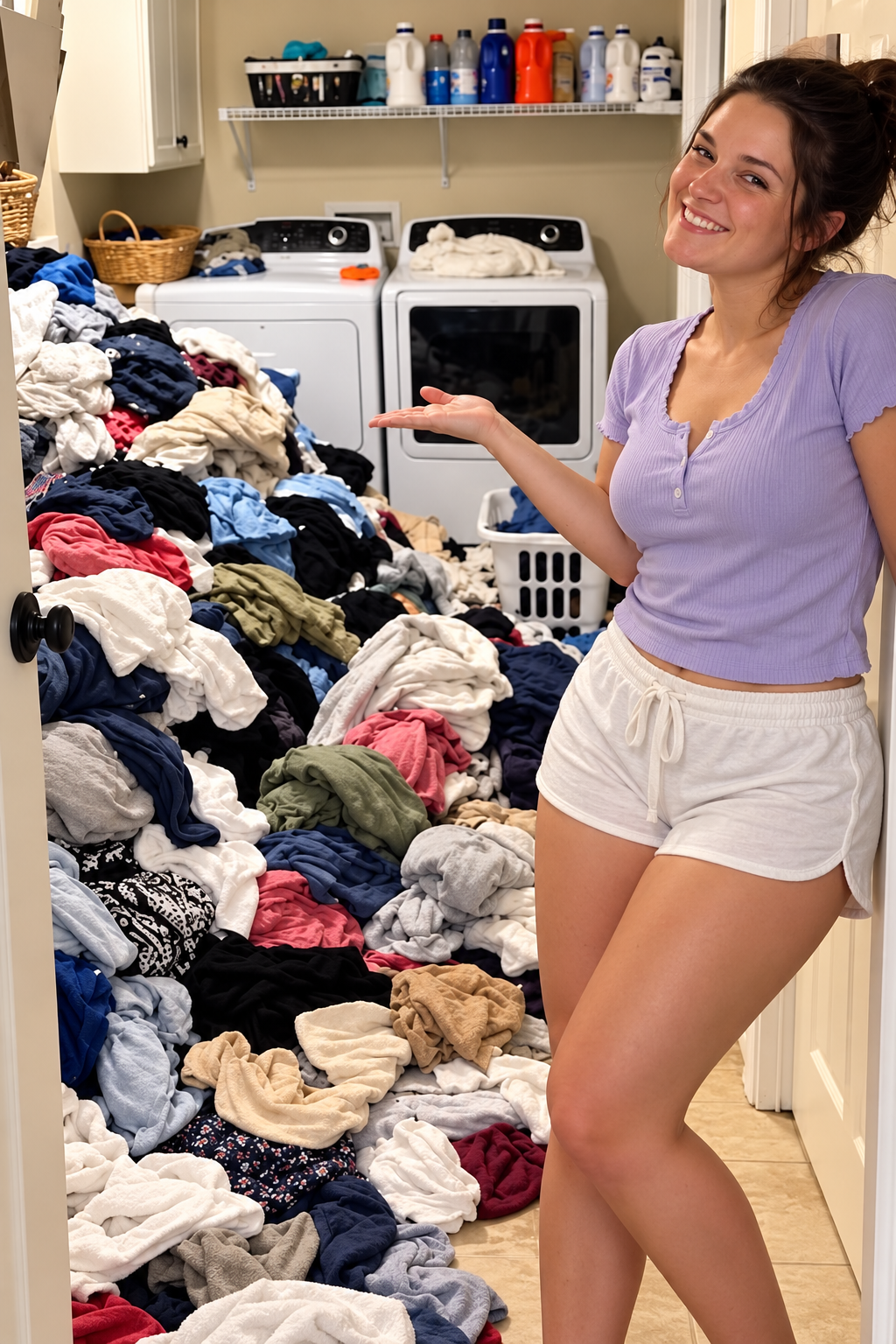
PART 1 TITLE: The Saturday Favor I Barely Noticed Became a Family Obligation No One Thought They Needed to Ask Me About
The first time Sabrina brought laundry to my house, it fit inside one ordinary plastic basket. She carried it through the kitchen with both hands, nudged the basement door open with her hip, and smiled at me as though she were asking for the smallest favor imaginable. “Marian, would it be terrible if I left these with your towels?” she asked. “The kids went through everything clean this week.” I was already heading downstairs with detergent under one arm, so I told her it was fine.
I was sixty-eight, recently retired, and still living in the house where I had raised my only son, Derek. The washer and dryer sat in the basement beneath the kitchen, beside shelves crowded with old paint cans, Christmas decorations, and boxes I had promised myself I would sort someday. Laundry had never bothered me much. I liked the smell of clean cotton, the low hum of the machines, and the quiet satisfaction of putting folded towels into neat stacks.
Derek and Sabrina had two children, seven and four, and I remembered exactly what those years were like. Children could wear three outfits before lunchtime without being able to explain how any of them had become dirty. Socks vanished. Pajamas appeared underneath couches. Towels multiplied on bathroom floors. I had lived through that stage myself, so washing a basket of shirts and leggings seemed like one of those harmless things mothers and grandmothers did for people they loved.
When Sabrina came downstairs that evening, everything was dry and folded. She looked genuinely relieved. “You saved me,” she said, gathering the children’s clothes against her chest. She kissed my cheek before they left. Derek carried the basket to their car. I went back inside feeling pleased that I had made their weekend a little easier.
The following Saturday, Sabrina arrived with two baskets.
I noticed, but I didn’t object. She had been working late that week, and Derek mentioned that one of the children had been sick for two nights. There were sheets this time, several towels, Derek’s jeans, and a collection of tiny socks that seemed capable of reproducing on their own. Sabrina asked before leaving them downstairs. I said yes again.
A month later, there were no baskets at all. There were bags. Three enormous laundry bags came through my kitchen while I was slicing tomatoes for lunch. Derek carried two, one over each shoulder, and Sabrina followed with the third. She opened the basement door and pointed downstairs as though the bags already knew where they belonged.
“Rough week?” I asked.
“You have no idea,” she said, laughing.
She didn’t actually ask whether I would wash them.
That should have been the moment I stopped the arrangement. Instead, I told myself they were family. Derek was working long hours at the engineering company. Sabrina had her own job, two children, school schedules, groceries, dinners, appointments, and everything else that filled a household. I had more control over my days now. Surely helping with laundry was not worth creating tension.
So I washed it.
The following week, the bags returned. Then again the week after that. Before long, Saturday visits developed an unspoken routine. Derek and Sabrina arrived late in the morning. The children raced through the back door toward my yard. Someone carried laundry downstairs. I cooked lunch. Then, while everyone else settled into the day, I began making trips to the basement.
At noon I would start the first load. Forty minutes later, I went down to move it into the dryer and start the second. Later came the third. Sometimes there were sheets that needed their own cycle. Sometimes towels. Sometimes children’s clothing covered in playground dirt. If something had to air-dry, Sabrina expected it draped neatly across the folding rack before they went home.
I began missing whole sections of my own Saturdays without realizing it at first.
From the basement stairs, I could hear my grandchildren shrieking with laughter outside. I could hear Derek opening the grill. I could hear Sabrina telling a story on the patio while glasses clinked against the table. I would stand under the fluorescent basement light untangling damp sleeves and wondering when I had become the only person in the house who wasn’t enjoying the visit.
The work itself wasn’t unbearable. That almost made it harder to explain why it began irritating me so deeply. No single load was difficult. No single trip downstairs ruined my day. It was the assumption underneath it—the quiet transfer of responsibility from their house to mine.
At first, Sabrina still thanked me.
Then the thanks became shorter.
Then they disappeared.
One Saturday she came downstairs near five o’clock, looked at three stacks of folded clothes on my table, and asked, “Is Derek’s blue polo still in the dryer?”
Not hello.
Not thank you.
Not even, “How much did you get through?”
Just a question about a missing shirt.
I stared at her for a moment before answering.
“It might still be in the second load.”
“Oh, good.”
She turned toward the dryer.
Something in me tightened.
I tried bringing the subject up indirectly with Derek. The following week, when he carried another bag through the kitchen, I said, “You know your washer at home still works, doesn’t it?”
He grinned because he thought I was teasing him.
“Sabrina likes yours better.”
“I doubt the machine cares.”
He laughed again and disappeared outside.
I watched him go and realized he truly had not heard what I was saying.
That bothered me because Derek had not been raised to assume that someone else would quietly clean up after him. When he was fifteen, I had shown him how to separate colors, measure detergent, clean the lint filter, and iron a shirt. He knew exactly how much work a household required. Somewhere between marriage, children, and a busy career, he had begun treating domestic labor as background noise—as something that happened while he was concentrating on more important things.
Sabrina was harder for me to read. She wasn’t cruel. She could be funny, attentive with the children, generous at birthdays, and quick to help when someone was genuinely in trouble. That was why I kept questioning myself. Maybe I was becoming irritable with age. Maybe I was making too much of a few loads of clothing. Maybe families were supposed to help without keeping score.
Then came the Sunday morning that changed the way I saw the entire arrangement.
They had stayed overnight after a family dinner. The children were watching cartoons in the living room. Derek was at the kitchen table with toast and eggs. Sabrina sat across from him in one of my old robes because she had forgotten pajamas. I was clearing breakfast plates when I decided I could no longer keep waiting for somebody to notice what I was doing.
“Sabrina,” I said, keeping my voice even, “I’m happy to help when you need it. But bringing most of your household laundry here every weekend is becoming too much.”
She looked up from her coffee.
For half a second, I thought she would apologize.
Instead, she smiled as if I had made a joke.
“Marian, you’re retired. You’re home all day.”
The room became strangely quiet.
It wasn’t the loudest insult anyone had ever given me. She hadn’t shouted. She hadn’t used an ugly name. That almost made it worse. She had said it casually, because to her it was simply obvious: I was home, therefore my hours were available.
I looked at Derek.
He lowered his eyes to his toast.
I waited.
He took another bite.
That silence hurt more than Sabrina’s sentence.
I didn’t expect my son to embarrass his wife at my table. I didn’t want him to begin an argument. I wanted one sentence. Something as simple as, “That’s not fair, Sabrina.” Instead, he studied the butter melting into the bread as though breakfast had suddenly become enormously complicated.
I gathered the plates and carried them to the sink.
Behind me, Sabrina must have sensed that something had shifted because she said, “I didn’t mean anything bad by it.”
I turned on the faucet.
“That’s exactly the problem.”
She didn’t answer.
Neither did Derek.
I washed the breakfast dishes slowly. The children laughed in the next room. Morning sunlight lay across the kitchen floor. Everything looked ordinary, but inside me a decision was taking shape with surprising clarity.
Arguing again would accomplish nothing.
As long as the laundry kept returning clean, nobody had any reason to change.
They left that afternoon. I stood in the doorway as Derek loaded the car and Sabrina buckled the children into their seats. She waved through the window before they pulled away. I waved back. Then I closed the door and went downstairs.
Three laundry bags had occupied the space beside my washer the day before. Now the floor was empty.
I stared at that empty patch of concrete for several seconds.
For the first time, I understood that I did not need permission to stop doing something I had never agreed to make permanent.
The next Saturday, I heard their car pull into my driveway shortly before eleven. The children burst through the front door first.
Behind them came Derek.
He was carrying two enormous laundry bags.
Sabrina followed with two more.
Four.
She caught me looking at them and gave a tired little laugh.
“Terrible week.”
I smiled.
“Leave them downstairs.”
Surprise crossed her face.
She had been expecting another complaint.
Instead, I held the basement door open for her.
And while she carried the fourth bag down the stairs, I already knew that not one piece of clothing inside those bags was going into my washing machine.
END PART 1
PART 2 TITLE: I Opened Four Bags Planning a Simple Boundary, Then Found Clothing That Made Me Question What Sabrina Was Hiding
Sabrina’s shoulders visibly relaxed when I told her to leave the bags downstairs. For the first time since our argument, she looked completely at ease in my house. “Thanks, Marian,” she said, almost brightly. Then she followed the children into the backyard, apparently satisfied that our disagreement had ended exactly the way she wanted it to end: with me surrendering.
I didn’t correct her.
That was deliberate.
If I announced my plan, she would argue before experiencing the inconvenience she had been handing me every Saturday. I didn’t want another conversation about whether four bags constituted “a lot.” I wanted her to stand in front of those four bags and answer the question for herself.
Derek helped me carry food outside. He had brought hamburger buns, and I had made potato salad that morning. The children chased each other across the lawn while he lit the grill. Sabrina sat under the patio umbrella with lemonade, scrolling through something on her phone between conversations.
Nobody mentioned laundry.
That alone told me how invisible the job had become.
Four swollen bags sat downstairs, full enough that Derek had needed both hands to carry them, yet everyone behaved as though the clothing would somehow wash itself while we ate.
For almost an hour, I stayed outside.
I played a card game with my granddaughter. I listened to Derek complain about a project deadline. Sabrina described a teacher at the children’s school who kept changing the schedule for an upcoming event. I laughed in the right places and ate half a hamburger.
It was the first Saturday in months when I had remained seated long enough to finish lunch while it was still warm.
That small pleasure irritated me more than I expected.
I should not have been grateful for permission to eat my own meal in my own backyard.
When the children began arguing over a ball, everyone’s attention shifted toward them. I carried my plate inside, rinsed it, and went downstairs without announcing where I was going.
The basement felt cool after the afternoon heat.
The four bags were waiting beside the machines.
I stood over them with my hands on my hips.
My original plan was uncomplicated. I would separate everything into baskets so Sabrina couldn’t claim I had made the mess worse. Her clothes would go into one. Derek’s into another. The children’s would have their own pile. I would leave detergent and dryer sheets where anyone could see them.
No sabotage.
No shrunk sweaters.
No red sock tossed dramatically into a load of whites.
I wasn’t interested in revenge.
I simply intended to stop.
I opened the first bag.
A pair of children’s jeans landed on the floor, followed by pajamas, towels, two of Derek’s work polos, Sabrina’s blouse, and a mountain of socks. I began sorting methodically, folding nothing and separating only enough to make the volume obvious.
The second bag contained more of the same at first.
Then I pulled out a pale blue dress shirt.
I knew almost immediately that it wasn’t Derek’s.
That wasn’t intuition. I had bought clothes for my son for decades. Derek had broad shoulders, and since changing jobs he rarely wore formal shirts at all. His engineering office had loosened its dress code years earlier. Most weekdays he went to work in polos or simple button-downs.
This shirt was narrower through the chest and several inches smaller at the waist.
I held it up.
Maybe Sabrina had accidentally included someone else’s clothing.
I put it to one side and continued.
Two minutes later, I found another men’s shirt.
Then gray trousers.
Those definitely weren’t Derek’s.
I checked the label, more out of curiosity than suspicion. The waist measurement confirmed what my eyes already knew.
A third shirt appeared beneath a child’s sweatshirt.
Then a fourth.
I stopped sorting.
The basement seemed quieter.
Above me, someone dragged a patio chair across the deck. One of the children shouted. The normal sounds of the afternoon felt strangely far away.
I looked at the unfamiliar clothes accumulating near my feet.
There were perfectly innocent explanations.
Maybe they belonged to Sabrina’s brother.
Maybe a friend’s washing machine had broken.
Maybe she had volunteered to help someone from work.
But those explanations created another question.
Why were somebody else’s clothes arriving in my basement without anyone mentioning them?
I picked up one white shirt.
A dry-cleaner’s tag was still attached near the bottom.
That made even less sense.
Why would something that had already been professionally cleaned be stuffed among dirty towels and children’s pajamas?
I found two more shirts carrying similar tags.
My imagination went somewhere I immediately disliked.
I thought of another man.
The thought arrived quickly enough to embarrass me.
I sat back on my heels and stared at the shirt.
Sabrina had irritated me. That did not mean she was unfaithful to my son. Strange clothing was not evidence of an affair. I had lived long enough to know what damage people could cause when suspicion was allowed to pretend it was certainty.
I was not going upstairs waving a shirt.
I was not whispering to Derek behind his wife’s back.
And I was not going to create an accusation simply because I had found a mystery inside a laundry bag.
Still, I couldn’t put the clothes into Sabrina’s pile.
They weren’t hers.
They weren’t Derek’s.
They weren’t the children’s.
I set them apart.
The deeper I went into the bags, the larger that fourth collection became.
Six men’s shirts.
Two pairs of trousers.
An old cardigan.
Several undershirts.
A pair of socks unlike anything Derek wore.
Everything looked like it belonged to the same person.
I sat on the basement floor for a moment, my irritation giving way to unease.
Someone else’s life had been mixed into those bags.
And Sabrina apparently expected me to wash it without ever knowing whose life it was.
I remembered her sentence from breakfast.
You’re home all day.
Perhaps that was what bothered me most. It wasn’t just that my daughter-in-law thought my own family’s laundry was automatically my responsibility. Somewhere along the way, she had extended that assumption to another person whose identity I did not even know.
I stood and went to the storage shelves.
Years earlier, when the grandchildren were babies, I had bought several plastic laundry baskets for towels and toys. Four were stacked behind a box of holiday lights.
I carried them to the folding table one at a time.
On four pieces of paper, I wrote labels in thick black marker.
SABRINA.
DEREK.
KIDS.
I hesitated before the fourth.
Then I wrote UNKNOWN.
I taped each paper to a basket.
Sabrina’s clothes filled most of hers. Derek’s collection was smaller. The children’s basket overflowed quickly enough that I had to compress several towels to keep them inside.
The UNKNOWN basket was different.
I placed each shirt into it carefully.
Seeing all the unfamiliar clothing together made it look more significant than it had scattered across the concrete.
The blue shirt lay across the top.
I stared at it for several seconds.
Should I call Sabrina downstairs privately?
That would have been the gentler choice.
But I knew myself well enough to recognize another motive hiding inside that idea. Part of me wanted to give her an opportunity to remove the basket before Derek saw it.
Why?
Because I was afraid of what the answer might be.
That wasn’t my responsibility either.
If the clothing had an innocent explanation, Sabrina could provide it.
If it didn’t, hiding it would only involve me in something I wanted no part of.
I finished sorting.
Then I placed the detergent on top of the washer.
Beside it, I set dryer sheets and stain remover.
I pulled the folding table away from the wall and put a chair beside it.
Everything required to wash four bags of clothes was available.
The only missing ingredient was me.
Before going upstairs, I looked once more at the UNKNOWN basket.
The situation had become something very different from the small lesson I had imagined that morning.
I had wanted Sabrina to understand the value of my time.
Instead, I had found a question sitting among her dirty clothes.
I went outside.
Derek handed me a fresh hamburger because mine had gone cold.
I took it without telling him where I had been.
“You disappear on us?” he asked.
“Just taking care of something downstairs.”
Sabrina looked toward me for half a second.
Then she returned to her conversation.
I watched her carefully.
There was no visible nervousness. No sudden question about the bags. No sign that she was worried about anything I might discover.
That reassured me.
A little.
For the next several hours, I did exactly what everyone else had been doing all summer.
I enjoyed myself.
I pushed my grandson on the swing. I sat in the shade. I helped my granddaughter draw chalk animals across the patio. I had coffee with Sabrina after lunch.
Meanwhile, the washer remained perfectly silent.
Around five-thirty, Sabrina checked the time.
“We should get moving soon,” she said. “The kids need baths.”
Derek began gathering toys.
I felt my pulse quicken.
For months, this was usually the point when I went downstairs, folded the final load, and packed their clothes into bags.
This time, I stayed where I was.
Sabrina disappeared through the kitchen.
I heard the basement door open.
Her footsteps descended.
Then there was silence.
Long enough that I imagined her standing in front of those four baskets, reading the labels.
A floorboard creaked above me as Derek came inside.
He had barely crossed the kitchen when Sabrina screamed from downstairs.
“What did you do?”
Derek stopped.
The children froze near the doorway.
I set down my coffee.
Derek looked at me.
“What happened?”
“I think Sabrina found the laundry.”
He frowned and started toward the basement.
I followed at a slower pace.
By the time we reached the bottom, Sabrina was standing beside the folding table, her face pale with anger.
The four baskets remained exactly where I had left them.
Nothing had been washed.
Nothing had been folded.
And on top of the fourth basket lay the pale blue shirt belonging to a man who was not my son.
END PART 2
PART 3 TITLE: Sabrina Expected Clean Clothes, but One Unwashed Basket Turned Our Argument Into a Question My Son Could Not Ignore
Derek reached the bottom stair before I did. “What happened?” he asked.
Sabrina didn’t answer him immediately. She was staring at the baskets arranged across my basement as though she had walked into the wrong house. Her eyes moved over the labels, the detergent, the silent washer, and finally back to me.
“What is this?”
“The laundry.”
“I can see that.”
Her voice was sharp enough that the children appeared behind Derek on the stairs.
I pointed upward.
“You two go back outside for a few minutes.”
My granddaughter looked from her mother to me.
“Are you fighting?”
“No, sweetheart. This is an adult conversation.”
Derek nodded toward the kitchen. “Go on.”
They retreated reluctantly.
When their footsteps disappeared, Sabrina looked at me again.
“Why is all of this still dirty?”
“Because I didn’t wash it.”
She blinked.
The answer seemed so impossible to her that for a second the anger fell away and pure confusion replaced it.
“You didn’t wash anything?”
“No.”
“But you told me to leave the bags downstairs.”
“I did.”
“You knew we needed this stuff.”
“I knew you brought it here.”
Her mouth tightened.
“We have to leave soon.”
“I know.”
“The kids need school clothes. Derek has work on Monday.”
Derek raised one hand.
“Sabrina—”
She ignored him.
“What exactly are we supposed to do now?”
I turned slightly and pointed at the washer.
The machine sat three feet from her.
She followed my gesture.
“You’re serious?”
“Completely.”
“You expect us to wash four bags of clothes tonight?”
I looked at the baskets.
“You expected me to wash four bags today.”
Her expression changed.
“That isn’t the same thing.”
“Why?”
She opened her mouth quickly, but whatever answer had been ready didn’t survive the question.
I waited.
Derek shifted his weight beside her.
Sabrina looked from him to me and finally said, “Because you always do it.”
There it was.
A more honest answer than anything we had said over breakfast the week before.
I nodded.
“That’s exactly why we’re standing here.”
She frowned.
“What does that mean?”
“It means somewhere between the first basket you asked me to wash and these four bags you didn’t ask about at all, my favor became your routine.”
“I never forced you.”
“No. You simply stopped checking whether I was willing.”
“I thought you didn’t mind.”
“I told you last Sunday that I minded.”
“That was one conversation.”
“It was a very clear conversation.”
Derek rubbed the back of his neck.
“Maybe we should just take everything home.”
“Yes,” I said. “You can.”
Sabrina turned toward him.
“And spend all night doing laundry?”
“If that’s what it takes.”
“The children barely have clean school clothes left.”
“Then we wash those first.”
“And your work shirts?”
“I have a couple.”
“You said yesterday you were out.”
Derek exhaled.
“Then I’ll wash them.”
Sabrina laughed once, without humor.
“You don’t even know which setting we use for half this stuff.”
That sentence hung in the basement.
Derek’s eyes narrowed.
“I know how to use a washing machine.”
“When was the last time you used ours?”
“I don’t know.”
“Exactly.”
I leaned against the dryer.
Neither of them seemed to notice me for several seconds.
Their argument had already begun widening beyond my basement.
Derek finally looked at the clothes.
“Fine. We’ll do it together.”
Sabrina stared at four full baskets.
“We’ll be here until midnight.”
I didn’t raise my voice.
“Now you know why I didn’t consider this a small Saturday favor.”
She looked at me.
For the first time, something close to embarrassment appeared behind her anger.
Then she hardened again.
“You could have warned me.”
“I did. You laughed and told me I was home all day.”
Derek looked at the floor.
I saw the memory land on him.
Sabrina folded her arms.
“That was rude. Fine. I admit that. But leaving us with all of this at six o’clock feels childish.”
“I didn’t damage anything. I didn’t hide anything. I didn’t make your problem worse. I simply stopped solving it for you.”
Her jaw moved as though she were grinding her teeth.
Behind her, the four labels seemed suddenly very large.
SABRINA.
DEREK.
KIDS.
UNKNOWN.
Her gaze stopped on the last one.
The color shifted in her face.
“What is that basket?”
I straightened.
“Clothes I couldn’t identify.”
She moved toward it.
Too quickly.
Derek noticed.
His eyes followed hers.
“What do you mean, couldn’t identify?”
“I separated your things, Sabrina’s things, and the children’s. Those didn’t fit anywhere.”
“It’s nothing,” Sabrina said.
Derek turned toward her.
“I didn’t say it was something.”
She stepped in front of the basket.
“We should just pack all this up and go.”
Her speed made everything worse.
Derek reached past her.
“Wait.”
“Derek.”
He lifted the pale blue shirt from the top.
I watched recognition fail to appear on his face.
He unfolded it.
“This isn’t mine.”
Sabrina’s hand tightened around the basket handle.
“It got mixed in.”
“With what?”
“The laundry.”
“I understand that.”
He looked at the collar.
“Whose shirt is it?”
Sabrina reached toward him.
“Give it to me.”
Instead, Derek lifted the gray trousers from beneath it.
He checked the waistband.
“These aren’t mine either.”
“Derek, stop going through everything.”
He stared at her.
“You brought these things into my mother’s house.”
“I know.”
“She found them mixed with our clothes.”
“I know.”
“So I’m asking a simple question.”
His voice had changed. It wasn’t loud, but the casual discomfort he’d shown during the earlier argument was gone.
“Whose are they?”
Sabrina looked at me.
Not accusingly.
Almost pleadingly.
For one terrible second, I wondered whether my effort to establish a boundary had exposed something that would alter their marriage.
I stepped closer.
“I found the clothes while sorting,” I said to Derek. “That’s all I know.”
“You didn’t ask her?”
“No.”
“Why not?”
“Because unfamiliar clothing isn’t proof of anything, and I wasn’t going to invent a story about your wife before she had a chance to explain.”
Sabrina’s eyes met mine.
Some of the panic left her expression.
Derek lowered the trousers but kept holding the shirt.
“How many things are in there?”
“Several.”
He looked into the basket.
Shirts.
Trousers.
The old cardigan.
His face tightened.
Sabrina rubbed both palms down the front of her jeans.
“I can explain.”
Derek looked at her.
“Then explain.”
“Not like this.”
“How should we do it?”
“I don’t want your mother standing here while we discuss our private life.”
I almost laughed at the irony.
“Sabrina, your private life is sitting in my laundry basket.”
Her face flushed.
“I didn’t mean—”
“I know what you meant.”
Derek put the blue shirt on the folding table.
“If this is innocent, just tell me whose clothes they are.”
“They are.”
“What?”
“Innocent.”
“That isn’t what I asked.”
Sabrina closed her eyes.
For the first time since coming downstairs, anger disappeared from her face completely.
What replaced it was exhaustion.
Not the dramatic kind people perform when they want sympathy.
Her shoulders simply dropped.
She sat in the chair I had pulled out earlier.
Derek remained standing.
“Sabrina?”
She pressed two fingers against the bridge of her nose.
“They’re my father’s.”
Derek stared at her.
“Roland’s?”
“Yes.”
I looked again at the clothing.
Once she said it, the pieces began making sense. Roland was slimmer than Derek. He favored dress shirts even for ordinary errands. The cardigan looked like something I had seen him wear at Christmas years earlier.
Derek seemed less relieved than I expected.
“Why do you have this much of your father’s laundry?”
Sabrina didn’t answer.
Derek’s brows drew together.
“Is something wrong with him?”
“He’s fine.”
“That doesn’t sound like fine.”
“He isn’t sick.”
“Then why are his clothes mixed into ours?”
Sabrina glanced toward the basement stairs, checking that the children were gone.
Then she stared at the concrete floor.
“Dad moved.”
Derek went still.
“What do you mean, moved?”
“Out of the house.”
“When?”
She hesitated.
“Three weeks ago.”
The silence that followed felt heavier than the argument about the laundry.
Derek’s confusion slowly turned into disbelief.
“Your father moved out of the house three weeks ago?”
“Yes.”
“To where?”
“A senior apartment near my office.”
He lowered himself onto the edge of the folding table.
“You never told me.”
“He didn’t want everyone knowing.”
“I’m not everyone.”
“I know.”
“I’m your husband.”
“I know.”
“Did the kids know?”
“No.”
“Your sister?”
“No.”
“Who helped him move?”
“I did most of it.”
Derek stared at her.
“You?”
“Yes.”
“By yourself?”
“Mostly.”
“Why?”
Sabrina looked up.
Something in her expression stopped him.
It wasn’t guilt.
It was fatigue so deep that her whole face seemed older.
“Because somebody had to.”
Derek glanced at me and then back at her.
“What happened?”
Sabrina took a slow breath.
“Dad fell on the back steps.”
Derek’s face changed.
“What?”
“He wasn’t badly hurt.”
“When?”
“A little over a month ago.”
“You didn’t tell me that either?”
“He made me promise not to make it a big family emergency.”
“A fall at his age is a family emergency.”
“He bruised his shoulder. Nothing broke.”
“That isn’t the point.”
“I know.”
“Then what is the point, Sabrina?”
She stood abruptly.
“The point is that he was scared.”
Her voice finally rose.
“He has lived in that house since Mom was alive. He didn’t want everyone looking at him like an old man who couldn’t take care of himself. After the fall, he admitted the stairs were getting difficult. He had already missed meals a few times. Laundry was piling up because carrying baskets between floors hurt his knees.”
She pointed toward the UNKNOWN basket.
“So I dealt with it.”
Derek looked down at the shirt in his hands.
“How?”
“After work. Before work. On lunch breaks. Whenever I could.”
He said nothing.
Sabrina’s eyes began to shine, though her voice stayed controlled.
“I found the apartment. I filled out paperwork. I helped him decide what furniture would fit. I bought groceries for the new place. I’ve been clearing rooms at the old house so he doesn’t have to go back there and face everything at once.”
Her breathing had become shallow.
“The clothes came from his bedroom closet. Some needed washing before I packed them. The shirts with dry-cleaning tags were already clean. I must have scooped them up with everything else.”
Derek looked at the basket again.
Three minutes earlier, he had been wondering whether the clothes belonged to another man in his wife’s life.
Now he was discovering something else entirely.
His wife had been carrying a second household on her back.
And somehow, he had not known.
END PART 3
PART 4 TITLE: The Strange Shirts Had an Innocent Owner, but Sabrina’s Explanation Exposed a Much Larger Problem Inside Our Family
Relief should have been the strongest feeling in the basement after Sabrina explained the clothes. There was no affair, no secret lover, no betrayal hidden beneath the children’s pajamas. The shirts belonged to Roland, her widowed father. Yet nobody looked relieved for very long.
Derek placed the pale blue shirt gently on the folding table.
“You moved your father into a senior apartment and never told me.”
Sabrina flinched at the word moved, as though hearing someone else say it made the last three weeks more real.
“He asked me not to tell people until he was settled.”
“You keep saying people.”
Derek looked straight at her.
“I’m your husband.”
“I know that.”
“Then why was I outside grilling burgers while you were apparently moving furniture and clearing out his house?”
“You weren’t outside grilling burgers while I was doing it.”
“That’s not what I mean.”
“I know what you mean.”
Their voices had softened, but the tension between them had become sharper.
I moved the chair closer to Sabrina.
“Sit down.”
“I’m fine.”
“You look exhausted.”
That almost made her laugh.
Instead, her mouth trembled.
“I am exhausted.”
Derek pulled another chair away from the wall and sat across from her.
“When did this start?”
Sabrina rubbed her palms together.
“The fall was five weeks ago.”
“And you found the apartment after that?”
“I had already been looking.”
That caught both of us.
Derek leaned forward.
“Already?”
“Dad had been having trouble for months.”
“What kind of trouble?”
“Small things.”
She paused.
“Until they stopped feeling small.”
Roland had forgotten meals more than once because he would begin a task and lose track of time. He had stopped carrying laundry downstairs because his knees hurt on the steps. He had let groceries run low rather than ask someone to shop. One afternoon Sabrina found unopened mail stacked beside his chair because bending over the desk to organize it bothered his back.
None of those things alone sounded catastrophic.
Together, they had frightened her.
“He kept telling me he was fine,” Sabrina said. “You know Dad. If the roof collapsed over his head, he’d tell you the house was getting better ventilation.”
Despite everything, I smiled.
That sounded exactly like Roland.
Derek did too, briefly.
Then the seriousness returned.
“So you started looking for somewhere smaller.”
Sabrina nodded.
“A place with an elevator. No yard. No basement. Somewhere close enough that I could check on him.”
“You could have told me.”
“I tried talking about Dad before.”
“When?”
“Do you really want a list?”
Derek sat back.
“I’m trying to understand.”
“So am I.”
Sabrina looked at him for several seconds.
“Do you remember that Tuesday when I told you Dad had almost fallen carrying groceries?”
Derek frowned.
“I remember you saying something about his steps.”
“You said we should order pizza because you were starving.”
He opened his mouth.
Then stopped.
“And the Saturday I told you he needed help going through Mom’s things?”
“I thought you and your sister were handling it.”
“My sister lives five hours away.”
“I know.”
“Do you?”
The question came out quietly.
Derek stared at her.
I could see that he wanted to defend himself. I could also see him deciding against it.
Sabrina looked toward the UNKNOWN basket.
“When Dad finally fell, I didn’t have the energy to organize a family meeting about whether everyone thought he should move. I found a place. I took him to see it. He agreed. After that, I just kept moving.”
“Why didn’t you ask me to help with the actual move?”
“Because you had that project deadline.”
“I would have made time.”
“Maybe.”
“I would have.”
“Derek, I asked you to pick up the kids twice that week because I needed to go to Dad’s.”
“I did.”
“You forgot the first time.”
His face tightened.
“I was late.”
“You were forty minutes late.”
“The meeting ran over.”
“And when I reminded you the second time, you asked me to text you again at four so you wouldn’t forget.”
Derek looked down at his hands.
Sabrina’s voice remained controlled, which somehow made every sentence land harder.
“That’s what I mean. Every time I needed help, asking for it created another job. Explain what I needed. Remind you. Check whether it happened. Fix it if it didn’t.”
“I didn’t realize you felt that way.”
“You didn’t ask.”
The words echoed strangely in the basement.
I looked at the four laundry baskets.
I had said almost the same thing to her.
For the first time since my frustration began, I saw the situation from an angle that made me uncomfortable.
Sabrina had been taking my labor for granted.
There was no excuse for that.
But someone had apparently been doing the same thing to her.
Derek leaned forward again.
“I do things around the house.”
“I know.”
“I’m not sitting around doing nothing.”
“I didn’t say you were.”
“I take care of the yard. I take out the garbage. I fix things. I pick the kids up from school.”
“On Tuesdays.”
“And sometimes Thursdays.”
“When I ask.”
He exhaled.
“What do you want me to say?”
“I don’t know.”
Sabrina pressed her fingers against her forehead.
“That’s the problem. I’m too tired to write instructions explaining how to notice what your own family needs.”
Derek glanced toward me.
For a moment, I recognized the same look he had given me at breakfast.
A silent request to rescue him from discomfort.
I didn’t.
Instead, I asked Sabrina, “What has a normal week looked like lately?”
She laughed softly.
“A normal week?”
“Yes.”
“Monday, I take the kids to school, go to work, leave during lunch to bring Dad paperwork, finish work, pick up groceries, make dinner, wash uniforms, answer school messages.”
She counted on her fingers.
“Tuesday, work, dentist appointment for our youngest, Dad’s pharmacy, dinner, homework. Wednesday, work, clean out part of Dad’s old bedroom. Thursday, work, take Dad to the new apartment because maintenance needs him there, pick up the kids, get groceries again because somebody finished everything I bought Monday.”
Derek started to speak.
She kept going.
“Friday, work, school forms, laundry, cleaning. Saturday, I bring everything here.”
Her eyes flicked toward me.
“And Marian washes it.”
The words came out smaller.
She looked ashamed.
I let the silence sit.
“That last part,” I said, “is exactly where you made me part of a problem I didn’t create.”
“I know.”
“You were overwhelmed.”
“Yes.”
“That doesn’t make it all right to hand the overload to me.”
“I know.”
She looked at me fully.
This time there was no defensiveness in her face.
“I know that now.”
Derek rubbed both hands over his knees.
“I knew you were stressed.”
Sabrina turned toward him.
“No.”
He frowned.
“What?”
“You knew I said I was stressed.”
“That’s what I just said.”
“It isn’t the same.”
Her voice remained quiet.
“You heard the words, but then you looked around. Dinner still appeared. The kids still had clean clothes. Permission slips still got signed. Groceries still showed up in the refrigerator. Birthday gifts got bought. Your shirts were clean.”
She pointed toward my washing machine.
“And when I couldn’t keep up with laundry, I brought it here, and your mother made that problem disappear too.”
Derek’s face lost color.
Sabrina swallowed.
“So from where you were standing, everything kept working.”
Nobody spoke.
The machines were silent.
Outside, faint through the basement ceiling, the children laughed at something.
Everything kept working.
The phrase settled over me.
I looked at Sabrina.
For months, I had been furious because she saw clean laundry appearing every Saturday and stopped thinking about the woman producing it.
Derek had apparently been doing something remarkably similar.
He saw a functioning house and stopped examining what it cost the person keeping it functional.
The comparison didn’t excuse Sabrina.
But it explained something I had been too angry to see.
I sat on the edge of the folding table.
“Sabrina.”
She looked at me.
“If you were drowning this badly, why didn’t you tell me what was actually happening?”
Her eyes dropped toward the floor.
“I don’t know.”
“Yes, you do.”
For several seconds she said nothing.
Then she picked at a loose thread on her sleeve.
“The first time I brought laundry, I asked you.”
“I remember.”
“You said yes.”
“Yes.”
“The next time, you said yes again.”
“That’s true.”
“And after that…”
She stopped.
“After that what?”
“I started telling myself you didn’t mind.”
I waited.
Her voice dropped further.
“Then it became easier not to ask.”
“Why?”
Sabrina’s face tightened.
“Because you might say no.”
The answer surprised me enough that I didn’t immediately respond.
She looked embarrassed by its honesty.
“I know how that sounds.”
“It sounds like you knew I had a choice.”
“I did.”
“But you preferred not to hear it.”
“Yes.”
Derek stared at his wife.
Sabrina blinked rapidly.
“I was behind on everything. Bringing laundry here took one thing off my list. Once you kept doing it, I convinced myself it was fine.”
“Even after I told you it wasn’t?”
Her eyes closed briefly.
“No.”
“And telling me I was home all day?”
“That was awful.”
“Yes.”
“I’m sorry.”
I believed she meant it.
But an apology, however sincere, wasn’t enough to solve what had brought us into that basement.
I turned toward Derek.
He stiffened.
“What?”
“When Sabrina told me my time didn’t matter because I’m retired, you stared at your breakfast.”
He looked down.
“I know.”
“Why?”
“I didn’t want to get between you.”
“You were already between us. You were carrying the laundry into my house.”
His face reddened.
“I should have said something.”
“Yes.”
“I’m sorry.”
I nodded once.
Then I looked from him to Sabrina.
“But I think there’s another conversation you two have been avoiding.”
Neither answered.
I pointed toward the baskets.
“You thought I was managing because the laundry kept getting done.”
Then I looked directly at Derek.
“And you thought Sabrina was managing because everything else kept getting done.”
Sabrina went completely still.
Derek’s eyes moved toward her.
For the first time that evening, he seemed to see the full weight behind what she had been saying.
“I didn’t know it was this bad,” he said.
Sabrina gave a tired, almost disbelieving shake of her head.
“I’ve been telling you for months that I’m exhausted.”
END PART 4
PART 5 TITLE: Derek Finally Took Over the Laundry That Night, and What He Learned Changed the Argument Neither of Them Could Avoid
Derek didn’t answer Sabrina immediately.
Her last sentence remained between them with uncomfortable precision.
I’ve been telling you for months that I’m exhausted.
He looked toward the four baskets again, but this time his expression had changed. The laundry was no longer evidence in an argument between his wife and his mother. It had become something closer to a diagram of how their household had been operating: tasks moving from one person to another until they disappeared from the view of whoever hadn’t done them.
“I heard you,” he finally said.
Sabrina gave him a tired look.
“That’s not the same as listening.”
“I know.”
“No, I don’t think you did.”
Derek started to defend himself, stopped, and looked down at his hands.
For most of his life, my son had been good at solving problems he could see. Broken cabinet hinge? He fixed it. Flat tire? He changed it. A leaking faucet? He was under the sink with a wrench before anybody had finished describing the drip. But if the problem involved remembering, anticipating, scheduling, noticing, or asking how someone was holding up, he often assumed the absence of catastrophe meant everything was fine.
Sabrina had apparently been doing the same thing with me.
That realization seemed to make her uncomfortable.
She looked at the laundry and said, “I shouldn’t have brought Dad’s things here.”
“No,” I said.
“And I shouldn’t have kept bringing ours after you told me it bothered you.”
“No.”
“I was overwhelmed.”
“I believe you.”
She nodded slowly.
“That’s not an excuse.”
“No.”
Her eyes met mine.
“I’m sorry.”
There are apologies people give because they want the room to become pleasant again.
This wasn’t one of those.
She looked miserable.
I believed her.
“I accept that,” I said. “But the arrangement is over.”
Her shoulders tightened.
“I understand.”
“Not just this week.”
“I know.”
“Not just until things calm down with your father.”
“I know.”
Derek glanced at me.
“What if there’s an emergency?”
“If there is an actual emergency, you can ask.”
I emphasized the last word.
“Ask.”
Sabrina nodded.
I continued.
“And sometimes I’ll say yes.”
That surprised her.
“Sometimes?”
“Yes. Helping family isn’t the problem. Being assigned a job without my agreement is the problem.”
For the first time in several minutes, something almost like relief appeared in her face.
Derek stood.
“All right.”
He rolled up his sleeves.
“What?”
I asked.
He pointed at the washer.
“We need school clothes for Monday.”
Sabrina stared at him.
“You’re going to start laundry now?”
“Yes.”
“It’s almost six-thirty.”
“I noticed.”
“You said you wanted to leave.”
“I changed my mind.”
She looked at him suspiciously.
“Why?”
Derek glanced toward the baskets.
“Because apparently I have spent several years not knowing how long four bags of laundry actually take.”
That was the closest thing to a useful sentence he had said all afternoon.
I moved away from the machines.
“Then they’re yours.”
Derek lifted the children’s basket.
“Which stuff do they need first?”
Sabrina folded her arms.
“You tell me.”
He stopped.
“What?”
“You said you’re doing it.”
“I am.”
“So figure out what they need.”
His eyebrows rose.
“Sabrina.”
She looked almost amused.
“What? They’re your children too.”
He gave her a long look.
Then he started sorting.
I went upstairs.
For once, I had no intention of supervising.
The children were sitting at my kitchen table with crayons. My granddaughter looked up immediately.
“Is Mommy mad?”
“Mommy is tired.”
“Is Daddy mad?”
“Daddy is learning to do laundry.”
She considered this.
“He knows how.”
I smiled.
“So I’ve been told.”
We made sandwiches because nobody wanted another heavy meal after the hamburgers. Every forty minutes or so, someone came upstairs.
First it was Derek asking Sabrina where the stain spray was.
She told him to look beside the detergent.
Ten minutes later, he returned and asked whether a red school sweatshirt could go in with dark clothes.
Sabrina stared at him.
“What does the tag say?”
“The tag?”
“Inside the shirt.”
He disappeared again.
Another half hour passed.
Then came the sound of the basement door.
“Mom?”
I was clearing plates.
“Yes?”
“How much detergent do you use?”
“Read the bottle.”
There was silence.
“I always thought you just poured some in.”
“That is why bottles have instructions.”
My granddaughter giggled.
Derek gave me a look that would have annoyed him greatly if I had worn it when he was sixteen.
He went back downstairs.
Sabrina sat at the kitchen table with both hands wrapped around a mug of coffee.
At first, she looked almost smug.
Then that disappeared.
“You know,” she said quietly, “watching him struggle isn’t as satisfying as I thought it would be.”
“No?”
“No.”
“Why?”
“Because I let this happen too.”
I leaned against the counter.
“How?”
“I stopped expecting him to learn things.”
That answer was more thoughtful than I expected.
She stared into her coffee.
“If I asked him to do laundry, he’d ask twelve questions. Which basket. Which setting. What gets hung up. What goes in the dryer. Which uniform needs to be ready first.”
She rubbed one thumb along the rim of the mug.
“It was faster to do it myself.”
“That’s usually how these arrangements begin.”
“Yes.”
“And then?”
“Then I got angry that he didn’t know.”
I sat across from her.
“That happens too.”
She gave a short laugh.
“I trained myself to think asking for help was more trouble than doing everything.”
“And Derek trained himself to think that if nobody asked, nothing needed doing.”
She looked toward the basement door.
“That sounds exactly right.”
For the next two hours, the house sounded different.
The washer filled.
The dryer buzzed.
Basement steps creaked.
Cabinet doors opened.
Derek moved continuously.
At eight-thirty, he brought a basket upstairs.
He looked offended by the amount of time clothing took to fold.
“How do four people own this many socks?”
Sabrina laughed.
“You’re asking me?”
“I swear the kids have thirty-seven feet between them.”
He sat on the couch with the basket.
The children helped match socks.
Several pairs were completely unrelated.
My grandson placed a striped sock beside one covered in dinosaurs and announced that they were close enough.
Derek stared at the pair.
“I’m starting to agree with him.”
Sabrina laughed again.
It was the first relaxed sound I had heard from her all day.
Around nine, Derek found one of Roland’s shirts.
He held it up.
“What do we do with your dad’s?”
Sabrina’s smile faded.
“I’ll take them home.”
“Home where?”
She looked confused.
“Ours.”
“No. I mean after they’re clean.”
“Oh.”
“He has a washing machine at the apartment?”
“Down the hall.”
“Can he use it?”
She hesitated.
“He can.”
“That wasn’t what I asked.”
Sabrina looked toward me, then back at Derek.
“He can physically use it.”
“What does that mean?”
“He forgets things sometimes.”
Derek stopped folding.
“You said he loses track of time.”
“Yes.”
“How often?”
“I don’t know.”
“Sabrina.”
“I don’t know.”
He laid the shirt across his lap.
“If he puts clothes in a washer and forgets them for three days, that matters.”
“I know.”
“What else is he forgetting?”
She became defensive immediately.
“He isn’t senile.”
“I didn’t say he was.”
“He’s seventy-four, not ninety-four.”
“I know how old your father is.”
“He remembers appointments.”
“Usually?”
She glared at him.
Derek did not back down.
“Usually?”
After several seconds, she said, “If I remind him.”
He looked at me.
I kept my expression neutral.
This wasn’t my answer to give.
Derek turned back.
“What about medication?”
“He takes blood-pressure pills.”
“Does he remember them?”
“Yes.”
“Sabrina.”
“He has one of those weekly containers.”
“That still isn’t an answer.”
She stood.
“I’m not doing this tonight.”
“You’re not doing what?”
“Turning Dad into a medical problem because you suddenly discovered I’ve been taking care of him.”
“I’m trying to understand what’s happening.”
“Well, you picked a great week to start.”
That landed.
Derek let the shirt fall back into the basket.
“You’re right.”
She hadn’t expected agreement.
He continued.
“I should have asked before now.”
Sabrina’s face softened slightly.
“But that means I’m asking now.”
The dryer buzzed downstairs.
Nobody moved.
Derek looked at his wife.
“When was the last time your father saw his doctor?”
Sabrina stared toward the dark kitchen window.
“Six months ago.”
“For a regular checkup?”
“Yes.”
“Before these problems started?”
She nodded.
“Then maybe we should take him again.”
“He won’t like that.”
“I didn’t ask whether he’d like it.”
“He’ll think we’re trying to take his independence away.”
“Are we?”
“No.”
“Then we tell him that.”
She shook her head.
“You don’t know him when he feels cornered.”
“No.”
Derek looked at her steadily.
“Because you didn’t tell me any of this.”
For once, he said it without accusation.
That mattered.
Sabrina sat again.
“I was scared.”
Her voice was barely above a whisper.
“Of what?”
“That if I told everyone, they would immediately start deciding things for him.”
“Like what?”
“Sell the house. Take his car. Move him somewhere he hates.”
“Is that what he thought?”
“It’s what I thought.”
She looked embarrassed.
“After Mom died, people treated him like he was made of glass for a year. He hated it.”
“And you thought protecting him meant handling everything yourself.”
“Yes.”
Derek nodded slowly.
“That sounds familiar.”
She knew exactly what he meant.
“So what now?”
she asked.
He looked at the pile of socks, the laundry room stairs, his father-in-law’s shirt.
“Tomorrow we go see him.”
Sabrina’s eyes widened.
“Tomorrow?”
“Yes.”
“With the kids?”
“If he wants them there.”
“He’ll know something’s up.”
“Something is up.”
She rubbed her temples.
“I don’t want to scare him.”
“Neither do I.”
Derek reached for her hand.
“But I also don’t want you secretly moving a seventy-four-year-old man while telling me everything is fine.”
She looked at their hands.
“You’re angry.”
“I’m worried.”
“Same face.”
That made him smile.
“A little angry.”
She nodded.
“Fair.”
They stayed at my house until almost eleven.
By then, two school outfits were clean, Derek’s work clothes were done, and half the remaining laundry was still waiting.
He carried the unfinished baskets to the car himself.
Sabrina picked up Roland’s clothes.
Before leaving, she hugged me.
Not the quick social hug she usually gave at the end of a visit.
She held on.
“I really am sorry.”
“I know.”
“I made you feel used.”
“Yes.”
She pulled back.
“I didn’t mean to.”
“I know that too.”
I looked toward Derek, who was wrestling a full basket through the doorway.
“Intent and effect aren’t always the same thing.”
She followed my eyes.
“No.”
Then she gave a tired smile.
“I think we’re all learning that.”
The next morning, I expected a quiet Sunday.
Instead, at nine-fifteen, my phone rang.
It was Derek.
“Mom?”
His voice made me straighten immediately.
“What happened?”
“We came to Roland’s apartment.”
“And?”
“He isn’t here.”
I frowned.
“Maybe he went for breakfast.”
“That’s what Sabrina thought.”
Derek paused.
“His wallet is on the kitchen counter.”
A cold sensation moved through me.
“What about his car?”
“Still downstairs.”
I heard Sabrina speaking urgently in the background.
Then Derek said, “Mom, we found his apartment door unlocked.”
END PART 5
PART 6 TITLE: Roland’s Unlocked Apartment Forced Everyone to Face the Difference Between Protecting His Independence and Pretending Nothing Had Changed
By the time I reached Roland’s building, Sabrina was standing outside the entrance with her phone pressed to one ear.
Derek was beside the curb speaking to a security guard.
I had broken more traffic laws than I cared to admit on the drive across town.
The moment Sabrina saw me, she ended the call.
“Nothing.”
“Who did you call?”
“The hospital. His old neighbor. The café near his house. Nobody’s seen him.”
“What about the building?”
“Derek is checking.”
Roland had moved into a six-story senior apartment complex near Sabrina’s office. It wasn’t assisted living. Residents had their own apartments, came and went freely, and lived independently. The building offered elevators, handrails, emergency pull cords, and a front desk during business hours.
Sabrina had chosen it precisely because Roland would still feel that his life belonged to him.
Now that freedom had become terrifying.
“When did you last speak to him?”
I asked.
“Last night.”
“What time?”
“Around seven.”
“How did he sound?”
“Normal.”
“What did he say?”
“That he was going to make soup and watch a baseball game.”
“Did he mention going anywhere this morning?”
“No.”
Derek came toward us.
“The guard working overnight saw him leave.”
Sabrina’s face went white.
“When?”
“About six-ten.”
“Where?”
“He walked out.”
“Alone?”
“Yes.”
“Did he say anything?”
“He told the guard he was going home.”
Nobody spoke.
Sabrina looked toward the building.
“This is home.”
Derek’s expression tightened.
“I know.”
She shook her head.
“No. Maybe he meant breakfast.”
“The guard asked if he needed a cab. Roland said he didn’t because he knew the way.”
“To where?”
“He didn’t say.”
Sabrina grabbed her keys.
“The old house.”
Derek caught her arm.
“Wait.”
“He said he was going home.”
“I know.”
“So that’s where he went.”
“It’s four miles away.”
“I know.”
“He can’t walk four miles.”
“I know.”
“Then why are you stopping me?”
“Because if he started walking and never got there, we need to know his route.”
She froze.
The security guard came outside.
He was a broad man with silver hair and an apologetic expression.
“I pulled the lobby camera,” he said. “He headed east.”
Sabrina closed her eyes.
The old house was east.
“How was he dressed?”
Derek asked.
“Brown jacket. Gray pants. Cap.”
“Phone?”
Sabrina looked at me.
“He barely uses it.”
“Does he carry it?”
“Sometimes.”
She called.
We all listened.
No answer.
Derek was already dialing again.
“Police?”
Sabrina asked.
“Yes.”
“He’s only been gone a few hours.”
“He’s seventy-four, possibly confused, on foot, without his wallet.”
She looked like she wanted to object.
Then she nodded.
That was the first important decision of the morning.
Nobody pretended anymore.
While Derek spoke to the dispatcher, I went upstairs with Sabrina.
Roland’s apartment looked tidy at first glance.
That was what frightened me most.
Nothing had been disturbed.
His wallet lay beside a bowl of keys.
His car keys were there too.
On the kitchen table stood an empty soup bowl from the night before.
Beside it sat his weekly medication box.
Sunday morning’s compartment was still closed.
Sabrina stared at it.
“He takes that when he wakes up.”
“Usually?”
She swallowed.
“Always.”
I didn’t correct her.
Not now.
His bedroom door was open.
The bed had been slept in.
A cardigan hung over a chair.
On the nightstand sat a photograph of his wife, Lorraine, taken years before cancer hollowed her face and eventually took her from him.
Sabrina picked it up.
“He keeps asking why I didn’t bring more pictures.”
“Did you?”
“They’re still at the house.”
Something in her expression changed.
“The house.”
“What?”
“I told him I’d finish packing Mom’s things this week.”
I waited.
“He kept asking whether I’d touched her closet.”
“And?”
“I told him no.”
“Did you?”
“Yesterday.”
Her breathing quickened.
“I started boxing things.”
“Did he know?”
“No.”
“Sabrina.”
“He told me eventually we’d have to.”
“That isn’t the same as giving you permission yesterday.”
“I know.”
Her face crumpled.
“What if he thought I was getting rid of her?”
“We don’t know that.”
“I should have told him.”
“Maybe.”
“I was trying to help.”
“I know.”
She laughed once, but there was nothing humorous in it.
“I keep saying that, don’t I?”
The words were painfully familiar.
I was trying to help.
I took her hand.
“This is not the time to put yourself on trial.”
“But—”
“We find your father first.”
Police arrived within twenty minutes.
Because Roland was considered a vulnerable missing adult, they took the report seriously.
An officer asked Sabrina questions at the kitchen table.
Height.
Weight.
Clothing.
Medical conditions.
Medication.
Any diagnosed memory problems?
“No.”
Any history of wandering?
“No.”
Any recent confusion?
Sabrina hesitated.
Derek answered.
“Yes.”
She looked at him.
The officer noticed.
“What kind?”
Derek explained the forgotten meals, the difficulty keeping up with the house, the occasional lost track of time.
The officer wrote it down.
Sabrina looked ashamed.
There was no reason she should have, but I understood.
Saying those facts aloud transformed them.
Inside the family, they had been manageable inconveniences.
On a police report, they became symptoms.
The officer asked where Roland might go.
“The old house,” Sabrina said immediately.
A patrol car was dispatched there.
We drove separately.
The route between the apartment and Roland’s old neighborhood followed a broad avenue lined with small stores, bus stops, and side streets.
All the way there, I stared through the windshield for a brown jacket.
Every older man made my pulse jump.
At a pharmacy.
At a bench.
At a crosswalk.
Nothing.
Roland’s old house sat at the end of a quiet street shaded by mature maple trees.
The patrol car was already outside.
The front door was locked.
No Roland.
Sabrina used her key.
Inside, the house smelled closed.
A lamp remained unplugged.
Furniture had been shifted toward walls where Sabrina had begun clearing rooms.
Half-filled cardboard boxes lined the hallway.
She moved quickly toward the bedroom.
“Dad?”
Silence.
“Dad?”
I followed her.
The closet door stood open.
Several of Lorraine’s dresses still hung inside.
Three boxes were on the floor.
Sabrina stared at them.
“I moved those.”
Derek came in behind us.
“Yesterday?”
“Yes.”
He didn’t comment.
A police officer checked the backyard, garage, basement, and upstairs rooms.
Nothing.
Then I noticed something on the dresser.
A framed photograph was missing.
Dust outlined the rectangle where it had stood.
“What was there?”
I asked.
Sabrina looked.
“Mom and Dad’s wedding picture.”
“Did you pack it?”
“No.”
Derek heard us.
“Could Roland have taken it?”
“With him?”
“Maybe.”
Sabrina’s eyes filled.
“He came here.”
The officer approached.
“We don’t know that yet.”
“He took the picture.”
“We don’t know who took it.”
“I didn’t.”
The officer nodded.
“We’ll check with neighbors.”
A woman across the street remembered seeing someone at the house around seven that morning.
An older man in a brown jacket.
He had stood on the porch for several minutes.
Then he walked away carrying something against his chest.
“Which direction?”
Derek asked.
The neighbor pointed north.
“Toward the church.”
Sabrina inhaled sharply.
Lorraine’s church was six blocks away.
We reached it in minutes.
Sunday service had already begun.
The doors were open.
Music drifted into the vestibule.
Sabrina went inside first.
I followed more slowly.
Heads turned as we entered.
The minister recognized her and stepped down from the side aisle.
“Is something wrong?”
“We’re looking for my father.”
“Roland?”
“Yes.”
“He was here earlier.”
Sabrina grabbed the back of a pew.
“When?”
“Before service. Maybe seven-thirty.”
“Where did he go?”
The minister frowned.
“I thought he was waiting for you.”
“Why?”
“He asked whether Lorraine’s memorial bench was still there.”
Sabrina closed her eyes.
The church had installed a small bench in a garden behind the building after Lorraine died.
We ran.
The garden was empty.
On the bench sat a wedding photograph.
Roland was gone.
Sabrina picked up the frame with trembling hands.
Derek looked toward the back gate.
“Where does that lead?”
The minister answered.
“The cemetery path.”
Lorraine was buried less than half a mile away.
We followed the path.
The ground was damp from rain overnight.
Sabrina walked so quickly that she nearly slipped twice.
Derek kept one hand near her elbow.
At the cemetery entrance, a groundskeeper was unlocking a maintenance shed.
Derek showed him Roland’s photograph on his phone.
“Have you seen this man?”
The groundskeeper squinted.
“Maybe.”
“When?”
“Twenty minutes ago.”
“Where?”
“He asked me where section twelve was.”
Sabrina made a sound halfway between a sob and a laugh.
Lorraine was in section twelve.
We found Roland sitting beside her grave.
He had lowered himself onto the wet grass.
His brown jacket was muddy at one elbow.
His cap lay beside him.
He was speaking softly to the stone.
Sabrina stopped ten yards away.
Every ounce of urgency left her at once.
“Dad.”
Roland turned.
For a moment, he looked surprised to see us.
Then embarrassed.
“What are you all doing here?”
Sabrina covered her mouth.
Derek walked toward him first.
“Looking for you.”
“For me?”
“Yes.”
Roland frowned.
“I told the fellow downstairs I was going home.”
Sabrina sank to her knees beside him.
“You walked out without your wallet or your medicine.”
“I didn’t need money.”
“You crossed half the neighborhood.”
“I know these streets.”
“You scared us to death.”
Roland looked toward Lorraine’s grave.
“I wanted to see your mother.”
Sabrina pressed both hands against her face.
Derek crouched beside them.
“Roland, why didn’t you tell Sabrina you wanted to come here?”
Roland’s expression grew stubborn.
“Because she would have said I shouldn’t.”
Sabrina lowered her hands.
“I would have driven you.”
“You’re busy.”
“I am never too busy to drive you here.”
Roland gave her a tired look.
“You’re always running.”
That silenced her.
He continued.
“Work. Children. My boxes. My pills. My groceries.”
He looked at the wedding photograph she had carried from the church.
“You already have enough.”
Sabrina’s eyes filled.
“Dad.”
“I can still walk.”
“You got lost.”
“I did not.”
“You left the apartment at six and it took you almost four hours to get here.”
Roland frowned.
“It didn’t.”
Derek checked the time.
“It did.”
For the first time, uncertainty appeared in Roland’s face.
He looked toward the cemetery gate.
Then back toward us.
“I stopped at the house.”
“We know.”
“I went to church.”
“We know.”
“I knew where I was.”
Nobody answered.
He stared at the grass.
His voice became quieter.
“I knew where I was going.”
That distinction broke something in Sabrina.
She sat beside him in the wet grass and leaned against his shoulder.
Roland resisted for half a second.
Then he put an arm around her.
“I’m sorry,” he said.
She shook her head.
“No.”
“I didn’t mean to frighten you.”
“I know.”
“I just wanted to see your mother.”
“I know.”
We stayed there until the police officer arrived and confirmed Roland was safe.
He declined an ambulance.
He insisted he felt fine.
But when he stood, he swayed.
Derek caught him.
That embarrassed him more than the police.
“I’m not helpless.”
“Nobody said you are,” Derek replied.
“You’re all looking at me that way.”
“What way?”
“Like I’m finished.”
Sabrina stood.
“You are not finished.”
Roland looked at her.
“Then stop packing my life into boxes without me.”
The sentence landed harder than any accusation.
Sabrina went still.
He looked toward the photograph.
“I know I had to leave the house.”
His voice shook.
“I know.”
He took a breath.
“But knowing something is necessary doesn’t mean you get to decide I’m not allowed to grieve it.”
Sabrina’s face crumpled.
“I’m sorry.”
Roland nodded slowly.
“So am I.”
On the drive back, nobody pretended the morning had been merely a misunderstanding.
That afternoon, Derek called Roland’s doctor.
An appointment was available Monday morning.
Roland initially refused to go.
Then Derek handed the phone to him and said, “You can tell the doctor yourself you’re fine.”
That appealed to Roland’s pride enough to make him agree.
The appointment revealed no dramatic diagnosis.
Not yet.
The doctor explained that medication, dehydration, grief, sleep, stress, hearing problems, and early cognitive changes could all contribute to confusion.
He ordered tests.
He also asked the family to stop assuming and start observing.
That phrase stayed with me.
Stop assuming.
Start observing.
It applied to more than Roland.
Before we left the clinic, the doctor asked who was managing Roland’s daily needs.
Sabrina answered automatically.
“I am.”
Derek spoke at the same time.
“We are.”
She looked at him.
He didn’t look away.
Then the doctor asked a question none of us had considered.
“And who is making sure Sabrina doesn’t become the next person in this family who quietly stops coping?”
END PART 6
PART 7 TITLE: Once the Emergency Passed, Derek Made One Change That Forced Sabrina to Confront How Completely She Had Been Carrying Everyone
The doctor’s question followed us home.
Who is making sure Sabrina doesn’t become the next person who quietly stops coping?
At first, Sabrina dismissed it.
She made a small embarrassed noise and told the doctor she was fine.
I almost laughed.
Fine had become the most suspicious word in our family.
Roland was fine while missing meals.
Sabrina was fine while working, parenting, managing her father’s move, and transferring four bags of laundry into my basement.
I was fine while spending every Saturday serving people who barely noticed I had left the table.
Derek had been fine because everyone around him kept the machinery moving.
The word had earned a temporary ban.
Tests for Roland would take time.
His doctor found nothing requiring hospitalization, but he recommended that someone check in daily for the next several weeks, make sure medication was taken, and accompany Roland to follow-up appointments.
Sabrina immediately opened her phone calendar.
Derek took it from her hand.
She stared at him.
“What are you doing?”
“Preventing you from assigning yourself seven more jobs.”
“I’m scheduling.”
“Exactly.”
“Give me my phone.”
“No.”
“Derek.”
He handed it to me.
I accepted it before either of them could object.
Sabrina looked betrayed.
“Marian.”
“Talk first.”
“About what?”
“Who can actually help.”
She folded her arms.
“My sister lives five hours away.”
“Five hours is not another continent.”
“She has work.”
“So do you.”
That stopped her.
Derek nodded.
“We call her.”
“She’ll feel guilty.”
“Good.”
Sabrina looked at him.
He corrected himself.
“Not good that she feels guilty. Good that she knows what’s happening.”
“She can’t come every week.”
“Maybe not.”
He counted on his fingers.
“But she can make calls. She can order groceries. She can deal with insurance. She can come one weekend a month.”
Sabrina frowned.
“I can do those things.”
“That sentence is the problem.”
She stared at him.
I nearly applauded.
Instead, I handed Derek the phone.
“Call her.”
Sabrina’s sister, Natalie, reacted exactly as predicted.
First shock.
Then guilt.
Then irritation that nobody had told her.
Then a burst of questions.
By the end of the call, she had volunteered to come the following weekend, handle Roland’s insurance paperwork remotely, and call him every evening.
Sabrina looked unsettled.
“That was too easy.”
Derek raised an eyebrow.
“You wanted it to be harder?”
“No.”
“You sound disappointed.”
“I’m not.”
She sat at the kitchen table.
“I just spent months assuming she couldn’t help.”
“Did you ask?”
“No.”
The answer embarrassed her.
Derek sat across from her.
“Runs in the family.”
She gave him a look.
“Don’t get confident because you learned where the detergent goes.”
“I also learned that dryer sheets are optional.”
“Look at you.”
For a moment, they both laughed.
Then Derek became serious.
“I made a list.”
Sabrina groaned.
“What?”
He pulled a folded page from his pocket.
“A real list.”
“Of what?”
“Everything I could think of that needs doing every week.”
Her skepticism returned.
“Why?”
“Because I wanted to see it.”
He opened the page.
There were columns.
Meals.
Groceries.
School drop-off.
School pickup.
Homework.
Permission forms.
Laundry.
Bathrooms.
Sheets.
Appointments.
Bills.
Medication pickups.
Roland visits.
House cleaning.
Birthday planning.
Car maintenance.
Yard.
Trash.
Children’s activities.
The list continued onto the back.
Sabrina stared at it.
“You made that?”
“Last night.”
“Why?”
Derek shrugged.
“I realized I could name every project deadline at work for the next two months but couldn’t tell you when the kids needed library books returned.”
She looked away.
“That isn’t unusual.”
“That doesn’t make it good.”
He tapped the list.
“So I wrote what I know.”
“And?”
“And I know about half of what happens in our house.”
“Less.”
“I suspected that.”
He handed her a pen.
“Add what I missed.”
Sabrina hesitated.
Then she began writing.
She added school emails.
Replacing outgrown clothes.
Scheduling haircuts.
Teacher gifts.
Vaccination records.
Cleaning lunch boxes.
Planning meals.
Checking prescriptions.
Maintaining emergency contacts.
Buying household supplies.
Remembering when the children needed new shoes.
Derek watched the page fill.
At one point, he said, “Seriously?”
Sabrina kept writing.
“What?”
“You clean the washing machine?”
“Yes.”
“Why?”
“Because washing machines get dirty.”
“I don’t like this new world.”
“You wanted to know.”
“I regret everything.”
But he kept listening.
When they finished, there was barely any white space left.
Derek drew a line down the middle of another page.
“Now we divide it.”
Sabrina looked suspicious.
“Fifty-fifty?”
“No.”
“What does that mean?”
“It means pretending every task takes equal time would be stupid.”
That was better than I expected.
He continued.
“I can do morning school drop-off three days a week because my office starts later those days. I’ll handle our laundry.”
“All of it?”
“All of it.”
She actually laughed.
“You’re still high from your first successful load.”
“I’m serious.”
“Children’s clothes too?”
“Yes.”
“Sheets?”
“Yes.”
“Hand-wash items?”
He paused.
“We negotiate hostile territory as necessary.”
She smiled.
He went down the list.
He took grocery planning every other week.
The children’s dentist appointments.
Car maintenance.
Half the homework supervision.
Trash and yard work remained his.
Sabrina kept meal planning because she preferred it, but Derek would cook three nights a week.
He would also take two of Roland’s weekly check-ins.
Sabrina stared at him.
“You work.”
“So do you.”
“I mean you’re in the office.”
“So are you.”
“I’m closer to Dad.”
“Then I’ll drive farther.”
She didn’t answer.
There is a moment when help stops feeling like help and begins feeling like loss of control.
I saw it happen on her face.
“What?”
Derek asked.
“Nothing.”
“Sabrina.”
“I said nothing.”
“Your nothing face looks exactly like your father’s.”
She glared.
Then she sighed.
“I don’t know how to let you do it.”
He looked surprised.
“What?”
“If you take Dad to an appointment, I’ll spend the entire time wondering whether you asked the right questions.”
“So write down what matters.”
“Then I’m still managing it.”
“Okay.”
He thought.
“You come to the first one with me.”
“That defeats the purpose.”
“Not if I learn.”
She looked uncertain.
“And then?”
“Then next time I go alone.”
“What if you forget something?”
“I probably will.”
“That’s not reassuring.”
“I’ve forgotten things at work too.”
“You’re not responsible for your father-in-law’s health at work.”
“No.”
Derek leaned forward.
“But you’re not the only adult allowed to be imperfect.”
That sentence hit Sabrina strangely.
She looked down.
I understood why.
People who carry too much often convince themselves that their competence is the only barrier between order and disaster.
Letting somebody else participate means accepting that they may do things differently.
Sometimes worse.
Sometimes better.
Either way, control changes hands.
The following week tested everyone.
Derek shrank one of Sabrina’s sweaters.
He apologized.
She was furious for seven minutes, then forced herself not to take laundry back permanently.
He forgot to buy milk.
He returned to the store.
He packed the wrong snack in their daughter’s school bag.
Nobody died.
He took Roland to a blood test and forgot to bring the insurance card.
He solved it without calling Sabrina.
That impressed her more than she admitted.
Meanwhile, Roland adjusted badly to being checked on.
He complained that everyone was treating his apartment like a train station.
Natalie called too often.
Derek asked too many questions.
Sabrina labeled medication.
I brought soup once and received a ten-minute lecture about how he could still cook.
“You walked four miles before breakfast,” I reminded him.
“I had a destination.”
“You also missed your medicine.”
“One morning.”
“You frightened your daughter.”
That silenced him.
Roland lowered himself into his chair.
“I know.”
His apartment had begun to look more like his own.
Sabrina had brought photographs from the house.
Not all of them.
She had learned something from the cemetery.
Now she asked before moving possessions.
A photograph of Lorraine stood beside his television.
The wedding picture was on his nightstand.
One afternoon, I found Roland holding it.
“You all think I’m losing my mind.”
“No.”
“You’re a terrible liar, Marian.”
“I think something changed.”
He looked at me.
“That’s different.”
“Yes.”
He traced the edge of the frame.
“You know what frightens me?”
“What?”
“Not forgetting.”
I waited.
“Being watched for forgetting.”
That was painfully precise.
“If I misplace my glasses now, everyone looks worried. If I tell a story twice, someone notices.”
He shook his head.
“I’ve told stories twice my whole life.”
“That’s true.”
“Lorraine used to say I could repeat myself professionally.”
I smiled.
He didn’t.
“What if every ordinary mistake becomes evidence?”
“That’s unfair.”
“Exactly.”
“But pretending nothing is changing is unfair too.”
He sighed.
“You sound like Sabrina.”
“She got it from somewhere.”
Roland looked toward the window.
“I know she’s trying.”
“She learned that from you too.”
His face tightened.
“What’s that supposed to mean?”
“You both treat accepting help like an admission of defeat.”
He almost smiled.
“Maybe.”
“And both of you would rather exhaust yourselves than inconvenience somebody.”
“That sounds noble.”
“It isn’t.”
“No?”
“It turns everyone around you into a mind reader.”
Roland laughed.
“All right.”
He nodded.
“That sounds less noble.”
His follow-up tests showed no major metabolic problem.
The doctor scheduled cognitive screening.
Roland hated the phrase.
Sabrina nearly canceled the appointment twice.
Derek stopped her both times.
“We said we wanted information.”
“What if the information is bad?”
“Then it’s already true whether we know it or not.”
That was the practical part of my son I recognized.
Still, something else had begun changing.
He no longer waited for Sabrina to assign him jobs.
He noticed.
When Roland needed groceries, Derek went.
When the children required clean uniforms, he started a load without announcement.
When the school sent an email, he read it.
This should not have seemed revolutionary.
Yet Sabrina watched him as though someone had replaced her husband with a more observant version.
One Saturday, three weeks after the confrontation in my basement, they came to my house.
No laundry.
I looked behind them theatrically.
Sabrina laughed.
“Nothing.”
“Are you sure?”
“Check the car.”
“I might.”
Derek lifted both hands.
“I have the scars to prove I’m doing it myself.”
“What scars?”
“Emotional.”
Their youngest ran past us.
We spent the afternoon outside.
Nobody disappeared downstairs.
At one point, I realized I had been sitting for nearly two hours.
It felt luxurious.
Sabrina sat beside me.
“Can I ask you something?”
“Of course.”
“Why didn’t you say no sooner?”
I considered lying.
Instead, I said, “Probably for some of the same reasons you didn’t tell Derek how bad things were.”
She looked at me.
“I thought helping was easier than creating conflict.”
Her eyes dropped.
“Until you hated helping.”
“Yes.”
She nodded.
“I understand that now.”
We sat quietly.
Then she said, “I don’t want to become someone who uses people because they’re too polite to stop me.”
“You don’t have to.”
“How?”
“Ask.”
“That simple?”
“Usually.”
She smiled faintly.
“And accept the answer.”
“That part is harder.”
“I’ve noticed.”
That evening, Roland called Sabrina.
I knew immediately from her face that something was wrong.
“What happened?”
Derek asked.
She held up one finger, listening.
“Dad, slow down.”
Silence.
“No, don’t touch anything.”
Her expression sharpened.
“What broke?”
Another pause.
Then she stood.
“We’re coming.”
Derek was already reaching for the car keys.
“What?”
Sabrina ended the call.
“He says somebody was inside his apartment.”
My stomach tightened.
“Was anything stolen?”
“I don’t know.”
She grabbed her purse.
“He found the kitchen drawers open, and Mom’s wedding picture is gone.”
END PART 7
PART 8 TITLE: The Missing Photograph Looked Like Proof Someone Had Entered Roland’s Apartment Until One Small Detail Changed What Everyone Feared
Roland was waiting in the hallway when we arrived.
He had not followed Sabrina’s instruction to stay inside and touch nothing.
That was the least surprising part of the evening.
His apartment door stood open behind him.
“I told you somebody was in there.”
Derek looked past him.
“Did you call building security?”
“I called Sabrina.”
“That wasn’t my question.”
“I knew she’d bring reinforcements.”
Sabrina pushed past him.
“Dad.”
“What?”
“I told you to stay put.”
“I am standing ten feet from my chair.”
“That’s not what stay put means.”
“I’m beginning to dislike how everyone in this family gives orders.”
I followed them inside.
Several kitchen drawers were open.
One cabinet door hung ajar.
A dish towel lay on the floor.
Nothing else looked obviously disturbed.
Derek stopped in the kitchen.
“What’s missing besides the photograph?”
“I don’t know.”
“Wallet?”
“In my bedroom.”
“Cash?”
“I don’t keep cash.”
“Medication?”
Roland frowned.
“Why would a burglar want blood-pressure pills?”
“People steal strange things.”
“They’re welcome to my cholesterol tablets too.”
Sabrina closed her eyes.
“Dad.”
“I’m trying to help.”
“Please don’t.”
The wedding picture had normally stood on Roland’s nightstand.
It was gone.
The lamp remained.
His glasses were there.
A book lay open facedown.
The rectangular patch where the frame had rested was unmistakable.
Sabrina’s anxiety escalated.
“That’s the second time that picture has disappeared.”
Roland looked offended.
“I took it the first time.”
“I know.”
“I told you.”
“I know, Dad.”
“Then don’t make me sound like someone keeps stealing the same photograph.”
Derek returned from the kitchen.
“Security is coming up.”
Roland groaned.
“I don’t need security.”
“You told Sabrina somebody broke in.”
“I said somebody was inside.”
“That qualifies.”
“I didn’t say they broke anything.”
“How did they get in?”
“That’s what I want to know.”
The security manager arrived with a younger employee.
They checked the door.
No damage.
The electronic entry log showed Roland’s key fob had opened the apartment at 2:14 that afternoon.
No other fob had registered until ours.
“That can’t be right,” Roland said.
The manager checked again.
“Maintenance didn’t enter.”
“What about a master key?”
“It would still record.”
“So nobody came in?”
“I’m saying the system doesn’t show another entry.”
Roland became angry.
“I know what my apartment looks like.”
“I’m not questioning you, sir.”
“You just told me I imagined somebody opening my drawers.”
“I didn’t say that.”
“You didn’t have to.”
Sabrina intervened.
“Dad.”
Roland turned on her.
“Don’t.”
Her face fell.
“Don’t what?”
“Look at me like that.”
“Like what?”
“Like you looked at me in the cemetery.”
The room became quiet.
Sabrina stepped back.
Roland seemed to regret the sentence immediately, but he didn’t apologize.
The security manager asked whether Roland might have opened the drawers himself.
“No.”
“For cooking?”
“No.”
“Looking for something?”
“No.”
“Were they open when you left earlier?”
“I didn’t leave.”
The manager glanced at the entry log.
“Your key entered at two-fourteen.”
Roland frowned.
“So?”
“That suggests you returned from somewhere.”
“I was here all day.”
Everyone went still.
Sabrina looked at Derek.
Roland noticed.
“What?”
Derek kept his voice neutral.
“You’re sure you didn’t go out?”
“Of course I’m sure.”
“The system says your fob opened the door this afternoon.”
“Then the system is wrong.”
The manager started to speak.
Derek lifted a hand.
“Could be.”
Roland looked slightly calmer.
Then I noticed his shoes.
Mud had dried along the edges.
“Roland.”
He looked at me.
“Did you go walking?”
“No.”
“Those shoes were clean yesterday.”
Everyone looked down.
Roland’s face changed.
He stared at his shoes as though they belonged to someone else.
“That doesn’t mean anything.”
“No.”
I kept my voice gentle.
“But it means you may have gone outside.”
“I would remember going outside.”
Nobody answered.
He looked from face to face.
“You all think I did this.”
Sabrina’s eyes filled.
“No.”
“The drawers.”
“We don’t know.”
“The photograph.”
“We don’t know.”
“You think I hid it.”
“No.”
Her answer came too quickly.
Roland heard that.
“So now I’m a thief in my own apartment.”
“Dad, stop.”
“I’m not stupid.”
“Nobody said you are.”
“You keep saying that because you keep thinking it.”
He walked toward the bedroom.
Sabrina started after him.
I touched her arm.
“Give him a minute.”
“He’s upset.”
“Yes.”
“I need to explain.”
“No.”
“What do you mean?”
“Right now, anything you explain will sound like correction.”
She looked toward the bedroom.
“I hate this.”
“I know.”
Security checked the hallway cameras.
At 1:43, Roland appeared on video leaving the building.
He wore the same shoes.
He carried a small canvas shopping bag.
At 2:14, he returned.
Alone.
Sabrina watched the video twice.
“Where did he go?”
The security manager shook his head.
“The exterior camera only covers the entrance.”
Derek asked whether there were cameras at nearby stores.
The manager said some businesses had them, but there was no obvious reason to request footage unless they filed a police report.
Roland emerged from his bedroom.
His anger had faded.
He looked pale.
“You have video?”
Sabrina hesitated.
“Yes.”
“Show me.”
She turned the screen toward him.
Roland watched himself leave.
Then return.
He watched it again.
“That’s today?”
“Yes.”
“What time?”
“One-forty-three.”
He sat down.
Nobody spoke.
After a moment, he asked, “How long was I gone?”
“About half an hour.”
“Where did I go?”
“We don’t know.”
The question terrified him more than anything else had.
He stared at his hands.
“I don’t remember leaving.”
Sabrina crouched in front of him.
“Dad.”
“I don’t remember.”
“That’s okay.”
“No, it isn’t.”
His voice cracked.
“I remember breakfast.”
He began counting the day backward.
“I made eggs.”
“Yes.”
“I watched the news.”
“Yes.”
“I called Natalie.”
“She told me.”
“I had soup.”
He stopped.
“Did I have soup?”
Sabrina looked at the kitchen.
There was a bowl in the sink.
“Yes.”
“I remember washing the bowl.”
He looked at the open drawers.
“Then what?”
No one could answer.
Roland pressed both palms over his face.
For a while, we simply sat with him.
No one tried to reassure him falsely.
Eventually Derek asked, “Can we look for the photograph together?”
Roland nodded.
We searched.
Bedroom drawers.
Closet.
Kitchen cabinets.
Living-room shelves.
The canvas shopping bag from the security video was hanging beside the coat rack.
It contained a receipt from a small pharmacy two blocks away.
The receipt was timestamped 1:52.
Roland had bought toothpaste and batteries.
Both items were in the kitchen.
The batteries were inside one of the open drawers.
That answered part of the mystery.
Roland had opened the drawer himself.
He simply didn’t remember doing it.
“What about the picture?”
Sabrina asked.
We kept searching.
Nothing.
Roland became increasingly distressed.
“That one matters.”
“We know.”
“It was Lorraine’s favorite.”
“We know.”
“She hated the way her hair looked in it.”
A faint smile crossed his face.
“She complained about that picture for forty-six years and then insisted it stay on the dresser.”
Sabrina smiled through tears.
“I remember.”
“I need to find it.”
“We will.”
Derek crouched beside the canvas bag.
He turned it upside down.
A small paper pharmacy envelope fell out.
No photograph.
Then my grandson, who had been sitting quietly with his sister near the television, called from the living room.
“Grandpa Roland?”
Everyone turned.
He was pointing at the bookshelf.
“Is that Grandma Lorraine?”
Sabrina followed his finger.
Between two large books, only a narrow strip of glass was visible.
She pulled them apart.
The wedding photograph was wedged upright behind them.
Roland stared.
“I didn’t put it there.”
No one spoke.
He looked at us.
“I didn’t.”
Sabrina carried the frame to him.
“I believe you don’t remember putting it there.”
His eyes flashed.
“That’s not what I said.”
“No.”
She swallowed.
“But I’m not going to lie to you either.”
Roland looked at the picture.
His anger slowly drained away.
“What if I did?”
Sabrina sat beside him.
“Then we tell the doctor.”
He laughed bitterly.
“So she can give me another test?”
“So we can understand what’s happening.”
“And then what?”
“We decide things with you.”
He looked toward her.
“With me?”
“Yes.”
“Not for me?”
“No.”
Her voice trembled.
“Not unless there ever comes a day when you truly can’t decide safely. And we’re not there.”
He traced Lorraine’s face through the glass.
“You already moved me.”
“I helped you move.”
“You packed her closet.”
“Without asking enough.”
“That was for me.”
“Yes.”
She took a breath.
“I’m sorry.”
Roland said nothing.
Sabrina continued.
“I was scared, so I started managing everything.”
He looked at her.
“Where do you think you learned that?”
Her mouth opened.
Then she laughed weakly.
“Apparently from every adult in this family.”
Even Roland smiled.
That did not solve the problem.
The cognitive screening happened two days later.
Derek and Sabrina attended together.
I watched the children.
They returned late in the afternoon.
I knew before they spoke that the result was complicated.
“Well?”
I asked.
Sabrina sat at my kitchen table.
“He didn’t fail.”
“That sounds promising.”
“It isn’t really pass-fail.”
Derek set his keys down.
“The doctor found enough concern to refer him for a full neuropsychological evaluation.”
My chest tightened.
“So they don’t know yet.”
“No.”
Sabrina nodded.
“He did well on some things. Not others.”
“What did Roland say?”
“He says the test was designed by sadists.”
That sounded like him.
“And after that?”
“He got quiet.”
Derek sat beside her.
“The doctor said we need practical safeguards now, before there’s a definitive answer.”
“Such as?”
“Medication reminders.”
“Transportation?”
“Yes.”
Sabrina’s eyes lowered.
“And no more driving until they know more.”
I winced.
“How did he take that?”
“Badly.”
“He gave Derek his car keys.”
“That doesn’t sound bad.”
“He threw them at him.”
“Ah.”
Derek touched his shoulder.
“He has surprisingly good aim.”
Despite herself, Sabrina smiled.
Then she became serious again.
“The doctor also wants someone to check his finances.”
“Why?”
“He may have missed payments.”
“How many?”
“We don’t know.”
Derek pulled a folder from his bag.
“Roland finally let us bring his mail.”
Sabrina stared at the folder.
“He made me promise we’d go through it together tomorrow.”
“That sounds good.”
“It is.”
She didn’t sound convinced.
“What’s wrong?”
She looked at Derek.
He opened the folder.
Inside were utility statements, insurance papers, unopened envelopes, and a bank notice.
“I saw this one before he made us stop.”
He handed it to me.
The notice was several weeks old.
Roland had attempted the same large electronic transfer three times.
Each had been rejected because the receiving account information was incomplete.
I looked at the amount.
$18,500.
“Who was he trying to send this to?”
Sabrina’s face was pale.
“That’s the problem.”
She pointed to the recipient line.
None of us recognized the name.
And when she had asked Roland about it, he insisted he had never tried to transfer any money at all.
END PART 8
PART 9 TITLE: The Failed $18,500 Transfer Led Us Back to Roland’s Old House and Revealed Who Had Been Taking Advantage of His Confusion
The bank notice lay in the middle of my kitchen table while none of us touched it.
Sabrina had read the recipient’s name three times, as though repetition might make it familiar. Derek searched his phone contacts. I tried to remember whether Roland had ever mentioned anyone by that name at church, in his old neighborhood, or among the people who had helped after Lorraine died.
Nothing.
The name meant nothing to any of us.
“What exactly did Dad say when you asked him about it?” I asked.
Sabrina folded her arms tightly.
“He said he never transferred eighteen thousand five hundred dollars to anybody.”
“Did you show him the notice?”
“Yes.”
“And?”
“He said the bank made a mistake.”
Derek pulled out the chair beside her.
“Then he got angry because I asked whether anybody had called him about money.”
“Did someone?”
“We don’t know.”
Sabrina rubbed her forehead.
“He said people call all the time. Telemarketers. Insurance companies. Charities. Someone claiming to be from his cable provider.”
My stomach tightened.
“What about the name on the transfer?”
“He says he’s never heard it.”
Derek reached for the notice.
“The bank rejected all three attempts.”
“Thank God.”
“Yes.”
He tapped the paper.
“But the question is whether Roland initiated them or somebody else did.”
Sabrina looked toward him.
“If somebody got into his account—”
“Then the bank needs to know immediately.”
She picked up her phone.
It was after regular business hours, but the fraud department answered.
Derek put the call on speaker after Roland gave permission over the phone for Sabrina to participate.
The representative could not give us a complete explanation without additional verification, but she confirmed that the transfer attempts had been initiated through Roland’s online banking credentials.
“From his computer?” Sabrina asked.
The representative paused.
“I can’t confirm device-level information on this call, but I can tell you the login appeared consistent with prior access patterns.”
“What does that mean?”
“It means our automated system did not flag the login itself as obviously unusual.”
Derek leaned closer to the phone.
“Could someone have been sitting in his house using his computer?”
“That would be one possibility.”
“Could Roland have done it himself?”
“That is also possible.”
The representative froze further electronic transfers, reset online access, and scheduled an in-person appointment for the next morning.
When the call ended, Sabrina stared at the black screen of her phone.
“I should have checked sooner.”
“No,” I said.
She looked at me.
“This is exactly what I should have been watching.”
“You were working, raising two children, moving your father, and trying to manage his daily needs.”
“That doesn’t change what happened.”
“It changes whether you should punish yourself for not noticing it.”
She didn’t respond.
Derek stood.
“We need Roland’s computer.”
Sabrina looked at him.
“Tonight?”
“Yes.”
“He’s already upset.”
“And someone may have tried to take nearly nineteen thousand dollars.”
“He’ll feel like we’re investigating him.”
“We are investigating what happened around him.”
“That distinction won’t matter to him.”
Derek picked up his keys.
“Then we make it matter.”
Roland was furious when we arrived.
Not confused.
Not frightened.
Furious.
“I told you I didn’t send that money.”
He stood in the middle of his apartment with both hands braced on his cane.
Derek remained near the door.
“I believe you don’t remember sending it.”
“That is not the same thing.”
“No.”
Roland looked at Sabrina.
“Do you believe me?”
Her hesitation hurt him.
I saw it immediately.
He gave a short nod.
“That answers that.”
“Dad.”
“It’s fine.”
“No, it isn’t.”
He turned away.
“I’m tired.”
Sabrina stepped closer.
“We’re not accusing you.”
“Then why are you here for my computer?”
“Because if someone got access to it, we need to know.”
Roland looked toward the small desk beside his living-room window.
The laptop was closed.
“I barely use that thing.”
“That’s exactly why we need to check.”
He was silent.
Then he said, “Your mother used to pay bills on it.”
Sabrina’s expression softened.
“I know.”
“I never liked doing that.”
“So who showed you?”
Roland frowned.
“Showed me what?”
“How to use the banking site.”
“I figured it out.”
“Recently?”
He looked irritated.
“I’m not an idiot.”
“Nobody said that.”
“There it is again.”
Sabrina caught herself.
She sat down instead of arguing.
“Okay.”
Roland watched her.
“Okay what?”
“I won’t tell you nobody thinks you’re struggling. We do think something is changing.”
His jaw tightened.
“But struggling is not the same as being stupid.”
He said nothing.
“And needing help doesn’t mean you caused this.”
That reached him.
A little.
He lowered himself into his chair.
“What do you want?”
“To look at the computer with you.”
“With me.”
“Yes.”
He nodded reluctantly.
“Fine.”
Derek connected the laptop to the apartment Wi-Fi.
The browser history was sparse.
News.
Weather.
A pharmacy site.
Online banking.
Then, farther down, several visits to a remote-support website.
Derek stared.
“Roland, do you know what this is?”
Roland leaned closer.
“No.”
Sabrina’s face changed.
“Dad, did anyone ever tell you they needed to connect to your computer?”
“No.”
“Think.”
“I said no.”
Derek pointed at a date.
“This was three weeks ago.”
Roland looked at the screen.
“That was before I moved.”
Sabrina sat beside him.
“Where were you?”
“At home.”
“Did anyone call?”
“People call.”
“Did somebody say there was a problem with your bank?”
Roland shook his head.
Then stopped.
His expression went distant.
“What?”
Sabrina asked.
“I don’t know.”
“What do you remember?”
“A man.”
Nobody moved.
“What man?”
“I don’t know his name.”
“On the phone?”
“I think so.”
Derek kept his voice calm.
“What did he say?”
Roland rubbed his forehead.
“There was something about a refund.”
Sabrina went pale.
“What refund?”
“Computer service.”
“You don’t have computer service.”
“I know that now.”
The room became still.
Roland looked embarrassed.
“He said Lorraine had paid for something.”
Sabrina’s hand went to her mouth.
“He used Mom’s name?”
“Yes.”
“How did he know it?”
“I don’t know.”
“Did you tell him?”
“Maybe.”
His voice grew smaller.
“He said there was an old account. He said they owed us money.”
Derek closed his eyes briefly.
It was a familiar scam pattern.
A caller claimed a refund was owed, convinced the victim to grant remote computer access, then manipulated banking screens or pressured the victim into sending money.
Roland listened while Derek explained it.
At first, he shook his head.
“No.”
“Roland—”
“No. He didn’t ask me to send money.”
“Maybe not directly.”
“He said they owed me.”
“That’s how some of these scams start.”
Roland’s face reddened.
“I would remember sending eighteen thousand dollars.”
Derek answered carefully.
“You might remember trying to correct what you thought was a mistake.”
Roland froze.
“What?”
“If someone made the screen look like they accidentally refunded too much money, they could have told you that you needed to send it back.”
Roland’s cane slipped slightly against the floor.
I picked it up and handed it to him.
For several seconds, he stared at nothing.
Then he whispered, “Twenty thousand.”
Sabrina sat completely still.
“What?”
Roland’s eyes filled.
“He said they put twenty thousand in the account instead of two thousand.”
Derek leaned forward.
“And he asked you to return the difference?”
Roland nodded.
“I told him that wasn’t my fault.”
“What did he say?”
“That the young man who made the mistake would lose his job.”
Sabrina’s eyes closed.
Roland continued slowly, memory arriving in pieces.
“He said he had a family.”
“Who did?”
“The employee.”
The shame in Roland’s face was painful to watch.
“I thought I was helping him.”
Nobody corrected him.
That phrase had already done enough damage in this family.
Derek asked, “Did you ever see twenty thousand dollars appear in your account?”
“I thought I did.”
The scammer had likely altered what Roland saw on his computer while connected remotely.
The money had never existed.
The eighteen-thousand-five-hundred-dollar transfer was not Roland paying a stranger voluntarily.
It was Roland trying to “return” money he had been convinced did not belong to him.
The bank’s verification system had rejected the destination information each time.
Pure luck had prevented the loss.
Roland’s hands began trembling.
“I tried three times?”
Derek nodded.
“I don’t remember three.”
“That’s okay.”
“No.”
Roland looked at Sabrina.
“That is not okay.”
She moved closer.
“No, Dad.”
He looked surprised by her answer.
“No?”
“No.”
She took his hand.
“It’s frightening. It matters. We’re going to deal with it.”
He stared at her.
“But I’m not going to pretend it’s nothing just to make you feel better.”
His eyes filled.
“And I’m not going to treat you like you’re incapable just because something bad happened.”
Roland looked down at their joined hands.
“That sounds difficult.”
“It probably will be.”
A faint smile appeared.
“At least you’re honest.”
The bank meeting the next morning confirmed the transfer attempts had been blocked before money left Roland’s account.
The fraud specialist reviewed the activity.
There had been remote access.
Several settings had been changed.
The destination account had already been associated with suspicious transactions involving other customers.
Roland was lucky.
But luck wasn’t a plan.
The bank recommended new account numbers, new passwords, additional transaction alerts, and a trusted contact for large transfers.
Roland immediately objected to Sabrina receiving alerts.
“She’ll call me every time I buy socks.”
The banker smiled.
“Only for transactions above a threshold you choose.”
Roland considered.
“How high?”
They settled on five thousand dollars.
Derek suggested two thousand.
Roland told him to mind his own business.
They compromised at three thousand.
It was the most normal argument we had had in weeks.
Afterward, we returned to Roland’s old house to collect financial files and inspect the computer he had used before moving.
The house felt different now.
Not abandoned.
Paused.
Sabrina no longer walked through the rooms selecting what would stay or go.
She asked Roland.
Every time.
“Do you want these tax records?”
“Yes.”
“This box of Lorraine’s recipes?”
“Definitely.”
“These magazines?”
“No.”
“You sure?”
“Unless you’re planning a museum exhibit about gardening in 2017.”
She threw them away.
In the small office off the dining room, Derek opened the desk drawers.
Bills.
Receipts.
Warranty papers.
Old checkbooks.
Nothing unusual.
Then Sabrina opened the bottom cabinet.
Inside sat a cardboard folder marked HOUSE.
“What’s that?”
Roland asked.
Sabrina looked at him.
“You tell me.”
He shrugged.
She opened it.
The folder contained the deed, insurance documents, property-tax notices, repair invoices, and several estimates.
One invoice was recent.
Very recent.
A company had charged Roland a $4,800 deposit for roof repairs less than two months earlier.
Sabrina frowned.
“Dad, you didn’t need a new roof.”
“I didn’t buy one.”
Derek took the paper.
“Did anyone come to the house?”
Roland stared at the company name.
“I don’t know.”
Sabrina’s voice became tense.
“This was paid by check.”
The check number was printed on the invoice.
They searched the check register.
Roland had written it himself.
His signature was clear.
He stared at it.
“I don’t remember this.”
Sabrina sat down.
The bank scam had not been the first incident.
We searched more carefully.
A $1,200 “driveway sealing” payment.
Two charges for appliance warranties Roland didn’t need.
A recurring monthly payment to a home-protection service none of us recognized.
Individually, none was catastrophic.
Together, they showed something that made Sabrina visibly ill.
People had already begun noticing Roland was vulnerable.
Maybe not because of cognitive decline specifically.
Perhaps because he was lonely.
Widowed.
Polite.
Trusting.
Living alone.
The kind of person who answered the door.
The kind who listened to sales pitches.
The kind who worried about being rude.
Roland sank into his desk chair.
“I thought I was managing.”
Sabrina knelt beside him.
“You were.”
He shook his head.
“No.”
“You were managing a lot.”
“That’s different.”
“Yes.”
He looked toward the stacks of paper.
“How long has this been happening?”
“We don’t know yet.”
He rubbed both hands across his face.
“I don’t want Natalie knowing.”
Sabrina hesitated.
Then shook her head.
“She has to know.”
His expression hardened.
“Sabrina.”
“No.”
It was the first time I heard her say no to her father without apologizing afterward.
“You don’t get to make me the only person responsible for knowing all of this.”
Roland stared at her.
She continued.
“I love you.”
Her voice shook.
“But I can’t be your daughter, your nurse, your driver, your accountant, your emergency contact, your house manager, and the only person allowed to know when you’re struggling.”
He looked wounded.
She nearly backed down.
I saw it.
Then she didn’t.
“Natalie is your daughter too.”
Roland looked toward the window.
For almost a minute, nobody spoke.
Finally he said, “She’ll worry.”
“Yes.”
“I hate people worrying.”
“I know.”
“You worry too much.”
“Probably.”
A faint smile touched his mouth.
“Your mother did that.”
“So I’ve heard.”
He sighed.
“Call Natalie.”
Sabrina’s shoulders dropped.
Not because she had won.
Because for once, responsibility had been allowed to move in more than one direction.
We spent the afternoon gathering documents.
Near sunset, Derek went into the garage to look for another file box Roland remembered storing there.
He returned holding something entirely different.
A white plastic laundry basket.
Sabrina stared at it.
“What?”
Derek set it on the floor.
Inside were several neatly folded shirts.
Roland looked confused.
Then his expression changed.
“Oh.”
Sabrina crouched beside the basket.
“These are yours.”
“Yes.”
“Why are they here?”
Roland looked sheepish.
“Your mother folded them.”
“Mom?”
“Lorraine.”
The room went quiet.
He touched the top shirt.
“Before she got very sick, she washed a load. I found the basket afterward.”
Sabrina’s face softened.
“You never put them away?”
“No.”
“Why?”
He swallowed.
“Because they still smelled like the detergent she used.”
Nobody spoke.
Roland gave a small embarrassed shrug.
“Stupid.”
“No,” Sabrina said.
She touched the shirt but did not lift it.
“No, Dad.”
He nodded toward the basket.
“That’s why I hated the laundry piling up after she died.”
Sabrina looked at him.
“I didn’t know that.”
“I didn’t tell you.”
For a moment, they simply stared at each other.
Then Roland said, “We’re very bad at that in this family.”
Sabrina laughed through tears.
“Yes.”
He looked toward me.
“I hear you started a revolution with four bags of dirty clothes.”
I smiled.
“Apparently.”
“Could have chosen something less complicated.”
“I tried.”
For the first time since all of this began, Sabrina laughed without exhaustion underneath it.
Then Derek’s phone rang.
He glanced at the screen.
It was Roland’s doctor.
The full neuropsychological evaluation had been moved forward after the bank incidents and wandering episode.
They had finished reviewing the preliminary results.
Derek put the call on speaker only after Roland agreed.
The doctor spoke carefully.
Roland’s pattern of memory difficulty was not explained by normal aging alone.
Additional imaging and follow-up were still needed.
But the findings were consistent with an early neurocognitive disorder.
Roland said nothing.
Sabrina gripped his hand.
The doctor continued.
They had caught it early.
Roland could still participate fully in decisions.
He could still live with significant independence.
But the family needed to plan while he could clearly tell them what he wanted.
After the call ended, Roland sat motionless beside the old basket of shirts Lorraine had once washed.
Then he looked at his daughters’ unfinished childhood photographs on the wall, his wife’s handwriting on a recipe box, and the papers spread across his desk.
“What happens now?”
Sabrina opened her mouth.
Then stopped.
She looked at Derek.
Then at me.
Finally, she looked back at her father.
And instead of deciding for him, she asked the question she should have asked from the beginning.
“What do you want to happen now, Dad?”
END PART 9
PART 10 TITLE: The Lesson Began With Four Bags of Dirty Clothes, but What Changed Our Family Had Nothing to Do With Washing Them
Roland did not answer Sabrina’s question quickly.
That was important.
A month earlier, she might have filled the silence for him.
She would have suggested a safer apartment, a schedule, a list of appointments, a plan for the house, and probably three things he hadn’t considered.
This time, she waited.
So did the rest of us.
Roland looked around the small office where he had handled taxes, written birthday cards, paid bills, and spent decades pretending paperwork was more interesting than it actually was.
Finally, he said, “I don’t want to go back to living here alone.”
Sabrina blinked.
“You don’t?”
“No.”
He sounded irritated by his own admission.
“The stairs are worse than I said.”
She nodded but did not interrupt.
“And the apartment is easier.”
Another pause.
“I like the elevator.”
Derek smiled.
Roland glared at him.
“Don’t look pleased.”
“I didn’t say anything.”
“Your face did.”
Roland turned back to Sabrina.
“I want to stay there.”
“Okay.”
“But I want my own furniture.”
“Okay.”
“I hate that little couch.”
“I told you not to buy it.”
“You bought it.”
She opened her mouth.
Then laughed.
“You’re right.”
“And I want Lorraine’s chair.”
“The blue one?”
“Yes.”
“It’s huge.”
“I know.”
“It may not fit.”
“Then something else can go.”
Sabrina nodded.
“Done.”
Roland continued.
“I want someone to help with the money.”
Her face softened.
“Okay.”
“Not only you.”
She seemed surprised.
“Natalie too?”
“Yes.”
“And Derek?”
Roland considered him.
“If he promises not to make a spreadsheet with thirty-seven categories.”
Derek looked offended.
“It would be twelve categories at most.”
“See?”
Roland pointed at him.
“This is exactly what I mean.”
We laughed.
The moment passed gently, but Roland’s next request was harder.
“I don’t want to drive until the doctor says it’s safe.”
Sabrina’s eyes filled.
He noticed.
“Don’t cry. I’m not giving up my license yet.”
“I know.”
“And if they tell me I can’t drive again, I reserve the right to be unbearable for at least two weeks.”
“Only two?”
“Three.”
“Reasonable.”
He looked toward the old house.
“I also want to sell this place.”
Sabrina’s mouth opened.
“Dad—”
“I’m not finished.”
She closed it.
“I want to decide what goes before anybody starts putting my life into boxes.”
The words were not cruel.
That made them more powerful.
Sabrina lowered her eyes.
“I understand.”
“I know you were trying to help.”
She looked at him.
He nodded toward the hallway.
“You moved everything because you were scared.”
“Yes.”
“I kept things from you because I was scared.”
“Yes.”
“Apparently fear makes both of us bossy.”
Sabrina smiled weakly.
“That seems possible.”
Roland touched her hand.
“You don’t have to carry me.”
Her face crumpled immediately.
“I don’t feel like I’m carrying you.”
“Yes, you do.”
“Dad—”
“You always have.”
She looked confused.
He continued.
“After your mother got sick, you started organizing everyone.”
Sabrina was silent.
“You handled meals. Appointments. Your sister’s flights. My medications.”
“You needed help.”
“Yes.”
“And I was there.”
“Yes.”
Roland squeezed her hand.
“But nobody told you to stop after your mother died.”
The truth of that landed slowly.
For years, Sabrina had been the person who noticed.
The one who remembered.
The one who anticipated what would go wrong.
That skill had become part of her identity.
Then she married my son, had children, built a career, and kept adding people to the list of lives she monitored.
Eventually, even I had become part of her system.
Not because she didn’t care about me.
Because she had begun seeing every available pair of hands as another way to keep the entire structure from collapsing.
The laundry had simply been where I finally refused my assigned role.
Over the next month, our family changed in small, practical ways.
Natalie came every third weekend.
She took over most insurance calls and began handling Roland’s online accounts with him.
Derek managed transportation to several appointments.
Sabrina went with Roland to the neurologist when results from the imaging were discussed.
The final conclusion was cautious but clear.
Roland had mild cognitive impairment, with patterns suggesting that a progressive condition was possible.
There was no dramatic moment when a doctor declared that everything would suddenly change.
Instead, we received instructions.
Monitor.
Plan.
Reduce risks.
Maintain routines.
Encourage activity.
Protect finances.
Preserve independence where safely possible.
Follow up.
Roland listened.
He asked questions.
Some days he accepted the situation calmly.
Other days he became furious because somebody had moved his keys.
Once, after searching for his glasses for twenty minutes, he found them on top of his head and laughed until tears ran down his face.
Another time, he forgot a conversation with Natalie and became frightened enough to shut himself in his bedroom for an hour.
There was no tidy emotional progression.
Real life rarely grants one.
But he was not alone anymore.
That mattered.
His apartment changed too.
The tiny couch disappeared.
Lorraine’s blue chair arrived.
It barely fit through the door.
Derek nearly injured his back getting it inside.
Roland supervised every inch of the process without lifting anything.
“Left.”
“We can’t go left.”
“Then rotate.”
“We are rotating.”
“Not correctly.”
Derek looked at me.
“I understand Sabrina much better now.”
Roland heard him.
“She gets it from her mother.”
Sabrina, standing in the hallway, said, “You blamed yourself last week.”
“I’ve reconsidered.”
By evening, the chair stood beside the window.
Roland sat in it with a cup of coffee.
For the first time, the apartment looked less like somewhere an elderly man had been moved and more like Roland’s home.
The sale of the old house took longer.
He wanted to touch everything.
Every drawer contained a memory.
A receipt from Lorraine’s favorite restaurant.
A holiday ornament Sabrina made in second grade.
Derek’s tie from their wedding.
A cracked serving dish nobody had used in fifteen years.
Sabrina’s instinct was still to move quickly.
I could see her hands twitch when Roland spent ten minutes deciding whether to keep a box of mismatched coffee mugs.
But she waited.
Sometimes he kept ridiculous things.
Sometimes he surprised everyone by letting go.
The laundry basket of Lorraine’s folded shirts came to the apartment.
Roland placed it in the closet.
Sabrina asked whether he wanted the shirts washed again.
He considered.
“No.”
“You’re sure?”
“They don’t smell like her anymore anyway.”
His voice trembled slightly.
“Time took care of that.”
Sabrina put an arm around him.
He leaned into her.
Neither tried to say something wise.
That was another improvement.
At Derek and Sabrina’s house, the changes were less dramatic but no less real.
Derek continued doing laundry.
He complained constantly.
That was his right.
He developed an elaborate system of separate baskets and insisted that everyone empty pockets before putting clothes in them.
One Saturday, he found melted crayon in the dryer.
He sent me a photograph accompanied by a message containing language I had not heard from him since college.
I laughed so hard I had to sit down.
Sabrina replaced the sweater he had shrunk and never took laundry back from him.
That mattered more than it sounds.
She had to learn that sharing responsibility meant tolerating methods she did not control.
He folded towels differently.
He paired socks incorrectly.
He bought detergent she disliked once.
The house continued functioning.
The children survived.
Eventually, he became competent enough that none of those things required discussion.
More importantly, he began noticing tasks before they became requests.
Not perfectly.
Nobody does.
But enough.
He checked the school calendar.
He scheduled appointments.
He called Roland without Sabrina reminding him.
He noticed when groceries were running low.
He knew which child needed a library book returned on Friday.
One evening Sabrina told me, “The strangest thing happened yesterday.”
“What?”
“I came home and nobody needed me immediately.”
I laughed.
“How terrible.”
“It was unsettling.”
“What did you do?”
“I sat down.”
“For how long?”
“Twenty minutes.”
“Scandalous.”
She smiled.
“I’m learning.”
So was I.
That surprised me.
I had spent years describing myself as helpful when sometimes what I really meant was available.
Those are not the same thing.
Helping is a choice.
Availability can become an expectation if nobody protects it.
I began saying no more easily.
Not cruelly.
Not automatically.
Just clearly.
When Derek asked if I could watch the children one Friday, I checked my plans before answering instead of immediately rearranging them.
When Sabrina asked whether I could pick up Roland’s prescription because she was stuck at work, I said yes because I genuinely could.
The difference was simple.
She asked.
I chose.
Nobody kept score.
A few months after the original laundry confrontation, Derek and Sabrina came over for Saturday lunch.
They carried food.
No baskets.
That detail still made me smile.
The children raced into the backyard.
Derek brought a salad into the kitchen.
Sabrina was carrying a small canvas bag.
She set it on my counter.
I raised an eyebrow.
“If that contains socks, you’re leaving.”
She laughed.
“No laundry.”
“Good.”
“It’s for you.”
Inside was a gift certificate to the garden center I liked and a handwritten card.
I looked at her.
“You didn’t need to buy me anything.”
“I know.”
“Then why did you?”
“Because I wanted to.”
I opened the card.
Her message was short.
Thank you for finally saying no.
I read it twice.
Then I looked up.
“That’s a strange thing to thank someone for.”
“No.”
Sabrina shook her head.
“It was the first honest thing any of us did.”
I knew what she meant.
My refusal had not magically repaired the family.
It had created an unpleasant afternoon.
Then an argument.
Then a frightening discovery about Roland.
Then more arguments.
What changed us was not that I taught Sabrina a clever lesson.
The real change came because, eventually, each of us stopped hiding behind the role we had chosen.
I stopped being the endlessly accommodating mother.
Sabrina stopped being the woman who had to manage everyone.
Derek stopped being the husband who waited to be told what needed doing.
Roland stopped pretending independence meant never admitting fear.
None of us became perfect.
We simply became harder to take for granted.
Later that afternoon, Roland arrived with Natalie.
He carried nothing except his cane and a bakery box.
“I brought dessert.”
Sabrina looked suspicious.
“You bought it?”
“Yes.”
“From where?”
“The bakery.”
“You walked?”
“I took the community shuttle.”
“By yourself?”
Roland stared at her.
She caught herself.
“Sorry.”
“Good.”
He handed me the box.
“Chocolate cake.”
“My favorite.”
“I remembered.”
He looked pleased.
Then he glanced at Sabrina.
“And I wrote it on my calendar.”
“That counts.”
“It absolutely counts.”
During lunch, Roland told the same story twice.
Nobody interrupted the second telling.
Maybe he had forgotten.
Maybe he simply liked the story.
There was no prize for deciding which.
Afterward, Derek began clearing plates.
Sabrina carried glasses inside.
I stood automatically.
She pointed at me.
“Sit.”
I raised an eyebrow.
“That sounds dangerously like an order.”
She laughed.
“Would you please sit?”
“Better.”
I sat.
Through the kitchen window, I watched Derek rinse dishes while Sabrina packed leftovers.
The children ran across the yard.
Roland sat beneath the patio umbrella arguing with Natalie about baseball.
Nothing about the afternoon was extraordinary.
That was what made it precious.
No crisis.
No secret.
No missing person.
No mysterious shirt.
No overflowing bags waiting beside my washer.
Just family.
Before they left, Sabrina walked into my kitchen.
“Can I ask you something?”
“Depends.”
She smiled.
“The kids have a school thing next Saturday. Derek and I have to be there early.”
I waited.
“Would you be willing to keep them Friday night?”
There it was.
Not an assumption.
Not a bag appearing in my basement.
A question.
I checked my calendar.
“I’d love to.”
“Really?”
“Yes.”
“Thank you.”
She hugged me.
Then, almost as an afterthought, she said, “And they’ll bring clean clothes.”
“They had better.”
She laughed against my shoulder.
When everyone left, the house became quiet.
I went downstairs.
My washing machine sat beneath the fluorescent light.
For months, I had resented the sight of it.
Now it was simply a machine again.
There were two towels from my kitchen waiting to be washed.
My clothes.
My home.
My choice.
I started the load.
As water filled the drum, I thought about the four bags that had begun all of this.
At the time, I believed I was teaching my daughter-in-law a lesson about respecting my time.
I had.
But the lesson had traveled farther than I intended.
Sabrina learned that desperation did not give her permission to turn someone else’s kindness into an obligation.
Derek learned that a household could function perfectly while one person quietly collapsed beneath the work.
Roland learned that accepting help did not erase his dignity.
And I learned that boundaries were not walls built to keep family away.
Sometimes they were doors.
They allowed love to enter deliberately instead of being dragged inside disguised as duty.
The washer began its steady rhythm.
For once, there were no voices calling from upstairs asking whether something was dry.
No one expected anything from me.
I turned off the basement light and climbed the stairs.
The laundry could finish without me standing beside it.
And so could the people I loved.
END PART 10
