
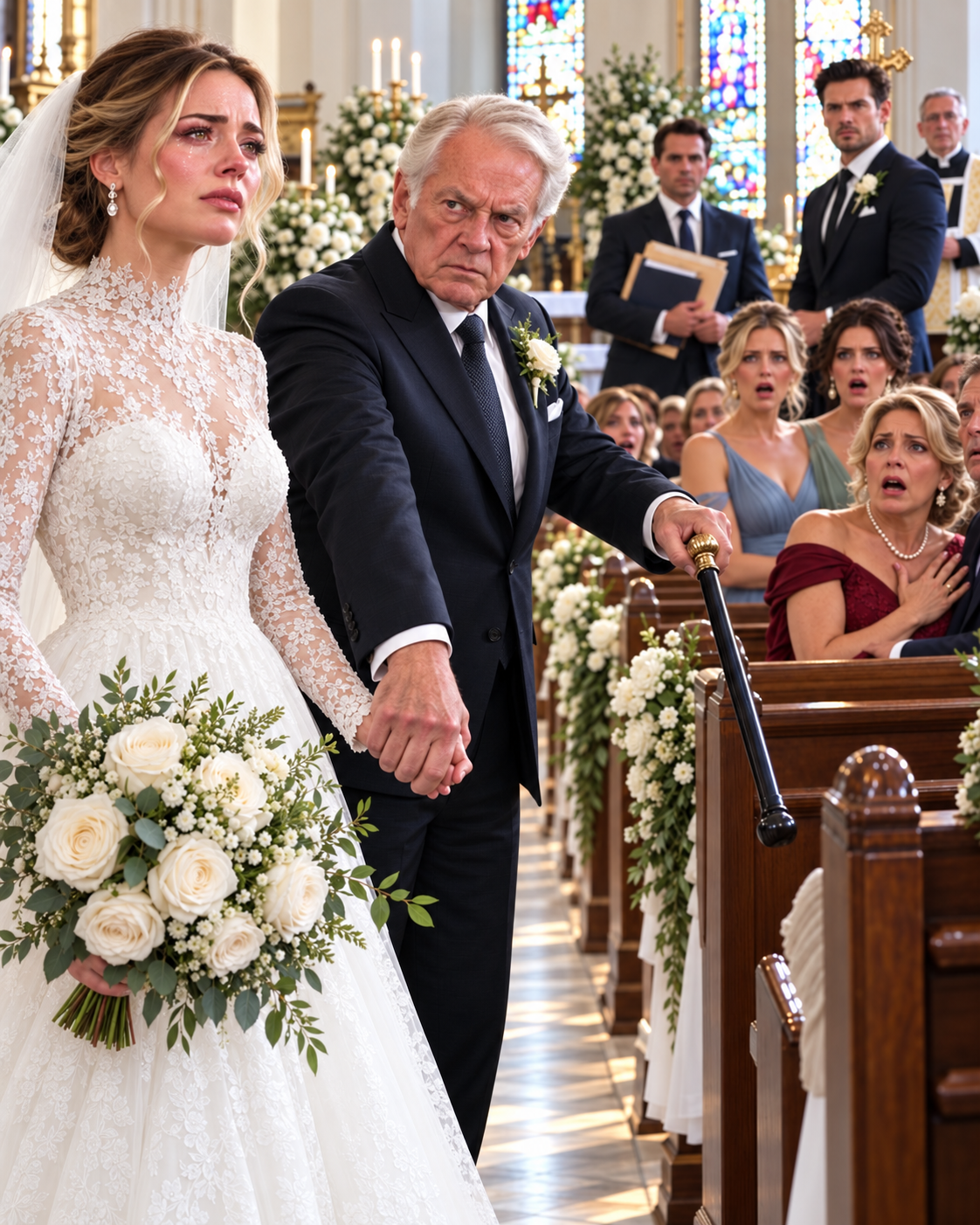
PART 1 TITLE: The Morning My Mother Called Me Her Greatest Regret, My Grandfather Quietly Stepped Forward Before Anyone Else Could Decide My Wedding
My mother chose eleven minutes before my wedding to tell me she would not walk beside me. She did it in the small bridal room behind the church vestibule, while someone outside tested the first notes of the processional and rain tapped lightly against the stained-glass windows. I was standing in front of a full-length mirror with one earring still unclasped when Margaret Stone looked at me, folded her hands over her navy dress, and said she could not pretend pride she did not feel.
At twenty-nine, I had learned that my mother’s calmest voice was usually the one to fear. She did not shout when she meant to wound. Shouting left room for other people to call you cruel. Margaret preferred precise sentences delivered at conversational volume. She glanced at my dress, then at the bouquet on the table, and told me she would not perform a loving gesture for a daughter who had spent years embarrassing the family. If I needed someone beside me, she suggested I ask an usher.
My older sisters, Paige and Lauren, stood near the window in matching pale dresses, although neither was in my bridal party. Paige stared down at her phone. Lauren picked at a loose thread near her wrist. Neither looked surprised. That hurt more than my mother’s words. Surprise would have meant this was impulsive. Their silence told me the conversation had happened before I entered the room.
My father, Thomas, remained beside the door. He had always possessed the remarkable ability to make passivity look like exhaustion. He rubbed his thumb over the edge of his wedding ring and said, “Emma, maybe today isn’t the day to turn this into something bigger.” I looked at him for several seconds before answering. “I’m not the one turning it into anything.” He lowered his eyes.
The irony would have been funny in a different family. Margaret had insisted on walking both my sisters down the aisle at their weddings. With Paige, she had worn silver and cried before they reached the first row. With Lauren, she had practiced the pace for two weeks because the train on Lauren’s dress was unusually long. In our family albums, there were dozens of photographs of my mother holding each daughter’s arm as if presenting something precious.
I had never assumed I was entitled to the same thing. I had asked her six months earlier over coffee. She had stirred her tea, considered the question, and answered, “Of course. Whatever else has happened between us, you’re still my daughter.” I should have noticed that she had made it sound like a concession. Instead, I thanked her.
Now she adjusted one pearl earring and said, “Your sisters understood what family means. They never made a career out of questioning every decision we made.”
That was the closest she came to naming the real problem.
I am a forensic accountant. I spend my working life following money through places where someone hoped nobody would look too closely. Shell companies, altered ledgers, private foundations, family partnerships, reimbursement accounts—the work is rarely dramatic. Most fraud does not look like suitcases of cash. It looks like a number placed in the wrong column and left there long enough to become part of the furniture.
For most of my life, I had applied none of that skepticism to my own family.
Paige was six years older than me, Lauren four. They had always been described as easy girls. Paige had been outgoing, pretty, socially effortless. Lauren could enter a room and make three friends before taking off her coat. I was the daughter who asked why. Why could Paige borrow the car after a bad report card while I lost privileges for missing curfew by twelve minutes? Why did Lauren’s business idea deserve family investment when my graduate-school application was called an expensive gamble?
My mother’s answer was consistent. “Different children need different things.”
For years I believed that meant I was the child who needed less.
Paige’s destination wedding had stretched across four days at a resort where even the welcome cocktails cost more than my monthly grocery budget at the time. My parents said they had saved for years. Two months afterward, Paige and her husband moved into a condominium with a down payment that seemed to appear from nowhere. When I asked how they managed it, Dad smiled and said, “Your sister has always been good with planning.”
Lauren opened a boutique three years later. She told everyone she had secured a private investor. My mother hosted the launch party and gave a speech about raising daughters brave enough to build things for themselves. I remember standing beside a rack of linen dresses, holding a glass of warm champagne, wondering why my own student-loan statements were sitting unopened on my kitchen counter.
I had worked through college. I borrowed for graduate school. I lived with roommates until twenty-six. None of those choices felt tragic. I was proud of what I had built. What bothered me was the family mythology that my sisters’ advantages had somehow materialized because they were wiser, kinder, or more deserving.
Daniel noticed the pattern long before I admitted it existed.
He never told me to cut anyone off. That was one reason I trusted him. Daniel asked questions instead. Why did my mother still receive copies of some of my financial correspondence? Why did Dad know the balance of an account I barely remembered opening? Why did my parents become angry when I asked ordinary questions about a family foundation that supposedly existed to help all three daughters?
The Stone Family Foundation sounded grander than it was supposed to be. Growing up, I understood it as a charitable structure my grandparents had helped establish. My mother spoke about scholarships, community grants, educational support. Its name appeared on plaques at local fundraisers. When I was a teenager, I thought all families had mysterious adult institutions that existed somewhere between banks and holiday dinners.
Then eighteen months before my wedding, my grandfather Arthur asked me a question that changed the shape of my childhood.
But that discovery belonged to another day. In the bridal room, my mother was still waiting for me to react.
She knew the version of me who would have reacted. At nineteen, I would have cried and apologized until she agreed to reconsider. At twenty-three, I might have asked Paige and Lauren what I had done wrong. At twenty-six, I would have called Daniel into the room and let him defend me because I had not yet learned that using someone else’s courage still leaves you dependent on permission.
At twenty-nine, I reached behind my neck and fastened my own earring.
“Okay,” I said.
Margaret blinked. “Okay?”
“You’re not walking me.”
“That’s your response?”
“You already decided. I’m not going to audition for the privilege of changing your mind.”
Lauren finally looked up. “Emma, don’t make this ugly.”
I turned toward her. “What part did I make ugly?”
She opened her mouth, then stopped.
Outside, the music changed. Someone knocked once and called through the door that we had seven minutes. My stomach tightened, but not because of the aisle. Daniel was at the other end of it. Whatever happened in this room, I still wanted the marriage waiting outside.
My mother moved toward the door as if the matter were settled. “Your father and I will take our seats. We can discuss your behavior after the honeymoon.”
There it was. Even now, she believed the injury belonged to her.
Dad paused beside me. His eyes were damp, though whether from shame or fear of Margaret I could not tell. “Em.”
I waited.
He whispered, “I’m sorry.”
I wanted to ask which part. Sorry she had refused? Sorry he had known? Sorry he had spent decades standing three feet away from every cruelty and calling the distance neutrality? Instead, I said, “Go sit down, Dad.”
Paige followed them first. Lauren hesitated long enough to touch my forearm.
“Please don’t do anything dramatic,” she murmured.
The request almost made me laugh. For eighteen months I had carried a secret large enough to split our family history in half. I had bank records stored in three locations, a lawyer sitting in the church, and documents proving that much of what I had been taught about my childhood was false. I had spent those months doing everything possible not to be dramatic.
“I’m getting married,” I told her. “That’s all I’m doing right now.”
When the room emptied, the quiet came down hard.
I stood alone beneath fluorescent lights that made my ivory dress look almost gray. Through the wall, I could hear guests settling into pews. A child laughed. Someone coughed. Shoes moved along the old church floor. Ordinary wedding sounds. I pressed both hands flat against the skirt of my dress until they stopped trembling.
Then the door opened again.
My grandfather Arthur filled the doorway with his narrow shoulders and charcoal suit. At eighty-one, he moved more slowly than he once had, but nothing about him seemed fragile. His silver hair was combed straight back. He carried the walnut cane my grandmother had bought him before she died, although he rarely leaned on it unless his knee bothered him.
He studied my face and closed the door behind him.
“She told me,” he said.
Of course Margaret had. My mother never wasted an opportunity to publish her own version first.
“I’m fine.”
Arthur’s mouth tightened. “You inherited that lie from your father.”
Despite everything, a small laugh escaped me.
He crossed the room and stopped an arm’s length away. For a moment neither of us spoke. My grandfather had not always been close to me. For years I thought that was his choice. I had believed he forgot birthdays, ignored graduations, and preferred my sisters. Eighteen months ago, I learned otherwise.
His eyes moved to the bouquet, then back to me. “Do you want to marry Daniel today?”
“Yes.”
“Do you want your mother’s approval before you do it?”
“No.”
“Good. One problem solved.”
I swallowed.
Arthur lifted his left arm slightly. “Then there’s only one question left.”
I looked at him.
“Would you permit an old man to walk with you?”
Something inside my chest gave way—not dramatically, not all at once. It loosened. For seventeen years, people had decided what I knew, what I received, who cared about me, and what I deserved. My mother had just tried to turn the same system into a wedding ritual.
Arthur was not asking to give me away. He was asking whether I wanted company.
I picked up my bouquet.
“Yes,” I said.
He offered his arm without another word.
I slipped my hand through it, felt the wool of his suit beneath my fingers, and together we turned toward the corridor leading to the church.
END PART 1
PART 2 TITLE: The Letters I Never Received Began to Explain Why My Family’s Love Had Always Felt Like Something I Owed
Eighteen months before my wedding, I believed my grandfather had ignored me for most of my adult life. That belief had become so ordinary I no longer examined it. Arthur lived forty minutes away, sent generic Christmas cards when he remembered, and appeared at major family events with the slightly formal warmth of a relative who knew he should recognize your life but had missed too many chapters.
Then he came to my apartment on a wet Thursday evening carrying a grocery bag full of letters.
Daniel was making pasta when the buzzer sounded. I checked the intercom screen and stared at Arthur’s face for several seconds before letting him in. He rarely visited without my parents. He arrived in a brown raincoat with water shining on the shoulders and refused Daniel’s offer to take it until he had placed the grocery bag carefully on my dining table.
“What’s wrong?” I asked.
Arthur looked at Daniel, then at me. “I need to know whether your mother can enter this apartment.”
The question made Daniel turn off the stove.
“No,” I said. “Why?”
He sat down slowly. “Can she access your email?”
“Not anymore.”
“Banking?”
“No.”
“Mail?”
I felt irritation rise before I understood it. “Grandpa, what is this?”
He reached into the grocery bag and removed three bundles tied with faded kitchen string.
The top envelope had my name on it.
Not Emma Stone, written formally. Just Emma, in the compressed block letters I recognized from old birthday cards.
The postmark was eight years old.
Across the front, in black ink that was not my grandfather’s handwriting, someone had written RETURN TO SENDER — REFUSED.
I stared at it.
Arthur placed another envelope beside it. Then another.
“I wrote every month after your grandmother died,” he said.
I looked at him. “No, you didn’t.”
His face changed.
“I’m sorry,” I added quickly. “I mean—I never got them.”
“I know that now.”
Daniel pulled out a chair beside me but did not sit until I did.
Arthur untied the first bundle. There were letters addressed to three different apartments I had lived in, my college dormitory, and even the townhouse I shared with Paige for one summer. Some were unopened. Some had been returned. Others contained photocopies Arthur had kept because, as he explained, my grandmother used to insist that important family correspondence should never exist in only one place.
I opened one dated eleven years earlier.
He had written about my freshman year of college. He asked whether economics was still my favorite class. He said Grandma would have been proud that I had earned a scholarship. He apologized for missing a campus family weekend because my mother told him I had specifically asked him not to attend.
“I never said that.”
Arthur nodded once. “I know.”
The next letter was from my twenty-first birthday. He mentioned enclosing a check.
There was no check in the copy, only a notation of the amount.
I remembered that birthday because my mother had complained that Arthur did not even send a card.
My mouth went dry.
Arthur watched me read. “Your mother told me you were angry with me.”
“For what?”
“She never said exactly. She said grief had made you difficult and that seeing me reminded you too much of your grandmother. She said I should give you space.”
The refrigerator hummed behind us. Rain ran down the windows.
Daniel asked quietly, “How long did you believe that?”
“Too long.”
Arthur’s answer held no self-pity. If anything, that made it harder to hear.
He told me that during my last year of college, he tried calling directly. My number had changed. Margaret told him I had asked the family not to share the new one. When I started graduate school, he asked whether I needed money. She said I had become fiercely independent and would consider an offer insulting.
I laughed then, but there was nothing funny in it.
“I was taking out loans.”
Arthur closed his eyes briefly.
“How much did you offer?”
“That isn’t the important part.”
“It is to me.”
He named a figure large enough to have covered nearly half of what I borrowed.
I stood up so quickly my chair scraped the floor.
Daniel came toward me, but I lifted a hand. I needed space around my body. My mother had watched me compare interest rates at her kitchen table. She had lectured me about debt. She had said adulthood meant accepting consequences for expensive ambitions.
All while my grandfather had apparently offered help.
“Maybe she thought I should pay my own way,” I said.
Arthur looked at me with such sadness that I hated myself for defending her automatically.
“Emma, that was not her decision to make.”
I went to the window.
Below us, headlights moved along the wet street. I remember focusing on a delivery cyclist because the yellow square of his backpack was easier to understand than anything happening behind me.
When I turned back, Arthur had taken one more envelope from the bag.
This one had never been mailed.
My grandmother’s handwriting was on the front.
For Emma, when she is old enough to ask questions.
I knew the handwriting immediately. Grandma had labeled every freezer container, Christmas ornament box, and family photograph in a looping script that leaned slightly left. Seeing my name written by her made the room tilt.
“She wrote that?” I asked.
“Yes.”
“When?”
“A few weeks before she died.”
My grandmother had died seventeen years earlier after falling at home. I was twelve. The story I had always known was simple: she slipped near the back staircase, struck her head, and was found too late for doctors to save her. My mother had been in the house that afternoon. She rarely discussed it because, she said, discovering your own mother that way changed a person.
Arthur did not hand me the envelope.
“Why do you have it?”
“Because she gave it to me.”
“Then why didn’t I get it?”
He looked at the unopened flap. “Because after she died, half the papers she told me existed were gone.”
That sentence sat between us.
Daniel returned to the stove and turned the burner completely off. The pasta water had boiled down enough to leave white starch along the rim.
I asked, “What papers?”
Arthur rubbed one hand over his knee. “Financial documents. Trust papers. Insurance correspondence. Records your grandmother had been keeping separately.”
“About what?”
“You.”
I thought I had misheard him.
Arthur explained carefully. Years before her death, my grandmother had insisted that certain funds intended for my education and future be protected separately from ordinary family assets. There had also been proceeds associated with a legal settlement that were supposed to remain designated for me. Arthur did not know every detail anymore because Margaret and Thomas had handled much of the administration.
“But there was a trust?” I asked.
“Yes.”
“In my name?”
“In your benefit.”
“Who controlled it?”
Arthur did not answer immediately.
That pause was my first real warning.
I sat down again.
“Grandpa.”
“Your parents had authority over some accounts while you were a minor. Your grandmother did not like how broadly that authority had been written. She was trying to change it.”
I felt the reflexive need to correct him. My parents were comfortable, not wealthy. They had paid for schools, vacations, weddings, family property maintenance. There were no yachts, no private planes, no hidden mansions. The idea of a stolen fortune seemed ridiculous.
Then another set of memories lined themselves up.
Paige’s wedding.
The condominium.
Lauren’s boutique.
The renovation of my parents’ lake property.
My mother telling me there simply was not enough money to help with graduate school.
I hated myself for noticing.
“What are you saying?”
Arthur’s voice softened. “I’m saying I don’t know enough yet.”
That answer saved the conversation. If he had accused Margaret outright, I might have thrown him out. Instead, he admitted uncertainty.
He told me he had spent years assuming the missing paperwork had been reorganized after Grandma’s death. He had trusted Thomas. He had allowed grief and Margaret’s anger to make investigation feel indecent. Recently, however, he had begun sorting an old storage unit. He found returned letters, photocopied correspondence, and a reference to an education account that should have produced annual reports.
It had not.
“Did you ask Mom?”
“Three weeks ago.”
“What did she say?”
“That I was confused.”
The phrase landed differently than it once would have.
My mother had used it about Arthur for years. Grandpa was aging. Grandpa misremembered. Grandpa had become suspicious after Grandma died.
Arthur looked directly at me. “I may be old, Emma. I am not confused.”
Daniel finally spoke. “What do you want Emma to do?”
Arthur answered him without looking away from me. “Nothing because I ask her to.”
That was the moment I believed he might be telling the truth.
He pushed the unopened letter from Grandma toward me.
“You decide.”
I did not open it that night.
Instead, after Arthur left, I sat at my dining table until nearly two in the morning with every returned envelope arranged by date. Daniel made coffee, washed the abandoned pasta pot, and stayed nearby without filling the room with advice.
Near midnight he asked, “What would you do if this belonged to a client?”
The question irritated me because I knew the answer.
“I would build a timeline.”
“So build one.”
I opened my laptop.
At first, I told myself I was proving Arthur wrong. I listed tuition payments, loans, family gifts, property purchases, foundation filings, and every account I could legally identify. I wrote down dates of Paige’s wedding and condo purchase, Lauren’s business launch, Grandma’s death, my graduate loans, and the years the Stone Family Foundation reported changes in assets.
At 1:38 a.m., I found the first inconsistency.
It was small. A public filing listed an educational disbursement in a year when I had received no family money at all.
The recipient category was not named.
The amount was large enough to pay one year of my tuition.
I checked the year again.
Then I checked my student-loan records.
Daniel saw my expression.
“What?”
I turned the laptop toward him.
For the first time that night, the word theft occurred to me.
I did not say it aloud.
I opened a new encrypted folder and named it STONE REVIEW.
That was how the next eighteen months began.
END PART 2
PART 3 TITLE: Seventeen Years of Missing Money Led Back to the Night My Grandmother Fell and My Mother Took the Papers
The first six weeks gave me nothing dramatic enough to confront anyone with. That was almost worse. I found mismatched dates, incomplete public filings, property transfers routed through ordinary-looking entities, and references to accounts I could not access without legal authority. Any single discrepancy could be explained. Together, they formed a pattern that made me uncomfortable but not yet certain.
I did not tell my mother I was looking.
Daniel knew. Arthur knew. No one else did.
Then I called Marcus Reed.
Marcus had been Daniel’s closest friend since college and would later stand as his best man. He was also an attorney whose practice included trusts, financial disputes, and probate litigation. I resisted involving him because I did not want my future husband’s friend turning a family suspicion into a legal war. Marcus listened to me for forty minutes and then said, “Good. Don’t make it a war. Make it a document request.”
He insisted on one rule from the beginning: we would distinguish what we knew from what we suspected.
Known fact: records showed an education-related trust structure had once existed for my benefit.
Known fact: some reporting described disbursements I never received.
Known fact: the Stone Family Foundation had received transfers from accounts associated with family trusts.
Suspected fact: those funds had been redirected for private family use.
“Do not accuse anyone until the paper can finish the sentence for you,” Marcus said.
It became the sentence I heard in my head for eighteen months.
The first major break came from an archived banking relationship Arthur remembered only after seeing the old trust correspondence. The original institution had been absorbed twice, but records had survived. Obtaining them required formal requests, identification, and weeks of waiting.
When the first packet arrived at Marcus’s office, he called me before opening it.
I drove there after work.
The pages smelled faintly of toner and old storage. Most were transaction summaries. Marcus placed yellow flags beside transfers that crossed from accounts designated for my benefit into entities controlled by my parents.
One name appeared repeatedly.
Stone Family Foundation.
I counted the transfers twice.
“This doesn’t prove personal use,” I said.
Marcus nodded. “Correct.”
It annoyed me that he agreed.
Then we traced where the foundation money went.
Some expenses were legitimate. Small scholarships existed. Community grants existed. Donations appeared exactly where annual reports said they would. That mattered. The foundation was not fictional. It was more effective than that. Real charitable activity provided cover for transactions that would otherwise have looked impossible to explain.
Over several months, Marcus obtained property records, old tax attachments, corporate registrations, and bank certifications. I built spreadsheets at night after Daniel fell asleep.
The same money kept changing names.
A transfer labeled educational reserve became a foundation contribution. A foundation account funded an “investment property.” That property was later refinanced. Proceeds moved into a family-controlled entity. Another payment appeared near the date Paige and her husband purchased their condominium.
I stared at that line for an hour.
I did not know whether Paige knew.
That distinction mattered to me.
Lauren’s boutique was harder to trace. She had always described her startup capital as private investment. Corporate paperwork eventually pointed to a holding company managed through my father’s accountant. The initial funding arrived less than two weeks after a large liquidation involving assets originally linked to the trust structure.
Again, that did not prove Lauren knew where the money came from.
My anger wanted everyone guilty. The evidence refused to cooperate.
So I kept working.
Arthur grew quieter as the numbers became clearer.
One evening, I took several summaries to his house. He lived in the same brick bungalow where my mother and her siblings had grown up, although Grandma had changed nearly every room before she died. Arthur sat at the kitchen table beneath a clock that chimed fifteen seconds late.
I showed him a sequence of transfers covering seventeen years.
His hands stayed flat against the table.
“How much?” he asked.
“I’m not ready to give you a final number.”
“How bad?”
“Bad.”
He nodded as though I had confirmed something he had been hoping not to know.
The money had not simply vanished after Grandma died. It continued moving for years. Some transactions appeared to support Paige and Lauren. Others benefited my parents more directly: property improvements, investment purchases, and expenses tied to the lake house that had supposedly been funded through Thomas’s business success.
At the same time, my mother had criticized me for borrowing.
I remembered sitting at her kitchen island at twenty-four while she explained compound interest as if my debt were evidence of immaturity.
That memory made me leave Arthur’s table and stand at the sink until I could breathe normally.
My grandfather came beside me.
“I should have protected you.”
“You didn’t know.”
“I knew your grandmother was worried.”
I turned.
That was different.
Arthur looked older in that moment than he ever had before. “I knew she and Margaret were fighting about paperwork.”
“What paperwork?”
He did not answer right away.
The old refrigerator clicked off, leaving the kitchen unnaturally quiet.
“Grandma’s fall,” I said. “Was it about the trust?”
Arthur sat again.
What followed was the first time anyone had told me there was an argument on the day my grandmother died.
The family story had always been that Margaret stopped by in the afternoon, found Grandma after the accident, called for help, and remained with her until the ambulance arrived. My mother had repeated that version so often it existed in my mind like a photograph.
Arthur said the truth was less clean.
Grandma had called him that morning while he was out meeting a contractor. She was upset. She said Margaret was coming over because she wanted access to documents Grandma had removed from the foundation office.
“Why had Grandma removed them?”
“She didn’t trust what she was seeing.”
My throat tightened.
“What was she seeing?”
“Transfers. Beneficiary changes. Things she said did not match what had been agreed.”
“Why didn’t you tell me this?”
“You were twelve.”
“I stopped being twelve seventeen years ago.”
He flinched.
I regretted the tone but not the question.
Arthur said that after Grandma died, grief destroyed his ability to separate suspicion from fact. Margaret told him the disagreement had been ordinary. Thomas said the finances were legitimate. Lawyers handled the estate. Everyone kept repeating that Grandma’s fall had been an accident.
“And you believed them?”
“I wanted to.”
That answer sounded painfully familiar.
Marcus later obtained emergency-response records.
The official report contained no accusation of wrongdoing. Grandma had suffered a severe head injury after a fall. Margaret was listed as the person present when emergency services were contacted. The timeline, however, contained gaps.
A call from Margaret’s phone to Thomas appeared before the emergency call.
That could mean anything.
I told myself so repeatedly.
There were also references in old insurance files to supplemental material we could not immediately locate. One index listed an audio attachment without a playable copy. Another notation referred to statements collected during claim review.
Marcus requested everything.
Months passed.
Meanwhile the financial case strengthened.
By the time Daniel and I sent wedding invitations, Marcus had independently verified losses tied to my beneficial assets that extended far beyond tuition money. The total was moving into seven figures. We still lacked a clean explanation of how the original authority had been abused, and I refused to confront my parents with anything incomplete.
Daniel asked whether I wanted to postpone the wedding.
“No.”
“Are you sure?”
“Yes.”
He studied me across our kitchen table. “Then promise me this investigation doesn’t get to own the day.”
I promised.
That promise was why I planned to say nothing at the wedding itself.
My intention was simple: marry Daniel, leave for our short honeymoon, then meet Marcus and Arthur afterward to decide how to approach the family. I wanted documentation first, confrontation second. I wanted no screaming beside a cake, no ruined ceremony, no spectacle my mother could later dismiss as emotional instability.
Then Arthur found the box.
It was in the attic of his house behind two suitcases and a broken floor lamp. Grandma had labeled it INSURANCE — EMMA / SCHOOL / TRUST.
He called me immediately.
Inside were photocopies, handwritten notes, old account statements, and a draft letter that had never been signed.
One page contained Grandma’s writing in the margins.
Ask Margaret why E. funds moved through Foundation.
Another note said:
Thomas says temporary. Not authorized.
My skin went cold.
Arthur sat beside me while I photographed every page.
At the bottom of the box was an empty folder.
Its tab read ORIGINAL TRUST DOCUMENTS.
Arthur stared at it for a long time.
“Were they missing when Grandma died?”
He nodded slowly.
“Who had them?”
“I didn’t know then.”
“And now?”
His fingers tightened around the edge of the table.
He told me that after the funeral, he had asked Margaret about the documents. She claimed Grandma must have placed them somewhere else. Arthur believed her because he had no proof otherwise.
“But before the funeral,” he said, “I saw something I should have understood.”
I waited.
“The evening your grandmother died, I came home after the hospital. Margaret was leaving.”
“With what?”
“A leather document case.”
My mouth went dry.
“I asked her what it was. She said insurance paperwork Thomas needed.”
Arthur looked at the empty folder.
“Years later, I remembered something your grandmother had said that morning.”
“What?”
His voice dropped.
“She said Margaret had come for the trust papers.”
I stared at him.
Arthur’s face had gone pale.
“Emma,” he said, “your mother took those documents before your grandmother fell.”
END PART 3
PART 4 TITLE: I Carried the Evidence Down the Aisle While My Mother Smiled, Certain I Still Did Not Know What She Had Done
On my wedding morning, I woke before the alarm and lay beside Daniel listening to him breathe. For eighteen months, numbers and documents had occupied nearly every quiet corner of my mind. That morning I decided they would not enter the church with me.
I was wrong.
Marcus called at 6:12.
I slipped from bed, took the phone into the hotel bathroom, and closed the door.
“Tell me nobody died,” I whispered.
“No one died.”
“Good start.”
“I got the certified records.”
I leaned against the marble counter.
He had been waiting for final authentication on several historical bank documents linking transfers out of my beneficial accounts to Stone Family Foundation transactions. Without certification, they were persuasive. With it, they were evidence.
“How bad?”
“Worse than the working copy.”
I looked through the bathroom door at Daniel asleep beneath white hotel sheets.
“Today, Marcus?”
“You told me to call when they came.”
“I did.”
“I can hold everything until after the wedding.”
That was what I wanted him to say.
“Yes. Do that.”
There was a pause.
Then Marcus said, “There’s one more thing.”
I closed my eyes.
A handwritten letter from Grandma’s box had been verified against estate documents and banking instructions. It did not accuse Margaret of a crime. It did something more useful.
It described what Grandma intended for me.
Education. Housing stability. Independence at adulthood.
Not parental discretion forever.
Not family expenses.
Not gifts to my sisters.
Me.
For years my mother had defended every imbalance by saying Grandma believed the oldest girls needed more support and that I had always been “the capable one.” The letter dismantled that story in two pages.
Marcus offered again to postpone the conversation.
I agreed.
By eight, I was drinking coffee with my bridesmaids while hair spray clouded the suite and someone played music too loudly. Daniel sent one text.
Still marrying me?
I wrote back:
Unless you escape through the kitchen.
His reply came immediately.
Checked. Window too small.
I laughed.
For several hours, I was simply a woman getting married.
Then Margaret arrived.
She kissed the air beside my cheek and inspected the room as though evaluating a hotel she had not chosen. Paige and Lauren came behind her. My father carried a garment bag nobody needed.
Margaret looked beautiful. That detail irritated me later because memory should have had the decency to make her monstrous. Instead, she wore navy silk, pearl earrings, and the perfume I had associated with childhood Christmas mornings.
“You look lovely,” she said.
“Thank you.”
Her eyes moved over my face. “Tired.”
“Big day.”
“Big consequences.”
At the time, I thought she meant marriage.
I did not know that she had already sensed the ground moving beneath her.
During photographs, Margaret kept pulling Paige and Lauren close. She asked the photographer for “one of my girls” and then clarified that she meant all three of us only after the photographer looked at me.
I took the picture.
I wanted a record of exactly who we had been before the truth entered the room.
Arthur arrived shortly before noon.
He hugged me longer than usual.
Inside his suit jacket was a large cream envelope containing copies of the most important documents. Not originals. Marcus would have murdered us both.
“Why did you bring that?” I asked quietly.
“Because your mother called me last night.”
My stomach tightened.
“What did she say?”
“She asked whether I’d been filling your head with stories.”
“What did you tell her?”
“That you have a head of your own.”
Despite myself, I smiled.
Arthur did not.
“She knows something is coming.”
I glanced across the room. Margaret was correcting a flower pin on Lauren’s dress.
“Not today.”
“That is your choice.”
“Yes.”
He touched the envelope through his jacket. “Then this stays closed.”
That was still the plan when we reached the church.
Marcus was already there in his dark suit, balancing two responsibilities that had become strangely incompatible: lawyer to the bride, best man to the groom. He caught my eye in the vestibule and made a small gesture toward his inside pocket.
I shook my head.
Later.
He nodded.
Daniel knew the broad truth but not every detail Marcus had uncovered. I had told him enough that no revelation about my family could threaten our marriage, but I refused to let my parents become the main subject of our engagement.
At 1:49, an alert reached Marcus.
He did not show me immediately.
Years later, he told me he stood in a side corridor staring at his phone, deciding whether a bride needed to know that someone appeared to be attempting a same-day transfer involving assets we had flagged.
The amount was $1.84 million.
At the time, he chose not to interrupt me.
That decision lasted nine minutes.
Because at 1:58, Margaret asked everyone except Paige, Lauren, Thomas, and me to leave the bridal room.
The photographer hesitated.
“Family moment,” Margaret said.
The door closed.
She stood before me and asked whether I had been speaking to Arthur about “old money.”
There was no reason for that question to exist.
I kept my face still.
“Why?”
“Because he’s been confused for years.”
Behind her, Dad looked at the floor.
“Is that what you came in here to discuss?”
“I came to prevent you from humiliating this family.”
Paige said, “Mom.”
Margaret ignored her.
She told me Arthur had always resented Thomas. She said Grandma’s records were outdated. She said lawyers could make innocent transactions look suspicious if they wanted fees.
I had not mentioned lawyers.
That was when my heart started beating differently.
“Who said anything about a lawyer?”
Her mouth tightened.
Lauren looked between us. “What is she talking about?”
“No one is talking about anything,” Margaret snapped.
I understood then that my mother had entered the church expecting confrontation.
Perhaps someone at a bank had called her. Perhaps Thomas had seen a legal request. Perhaps Arthur’s questions had frightened her enough to investigate.
Whatever the reason, she had decided offense was safer than waiting.
She pointed toward my dress.
“You have spent your whole life taking whatever this family gives you and turning it into an accusation.”
I almost laughed.
“What exactly have you given me, Mom?”
Her face changed.
Dad whispered, “Emma.”
“No. I want her answer.”
Margaret stepped closer.
“You had schools. A home. Vacations. Every opportunity.”
“So did Paige and Lauren.”
“They were grateful.”
That word.
Grateful.
It had functioned like a lock in our house for years.
I asked, “Is that why you walked them down the aisle?”
Paige closed her eyes.
Lauren whispered, “Please.”
Margaret looked at me with a kind of exhausted contempt.
She said walking a daughter down the aisle was an honor, not an entitlement. She said Paige and Lauren had never spent their adult lives searching for reasons to prosecute their parents. She said she could not stand beside me and pretend she was proud of what I had become.
Then she gave me the sentence that would follow us for the rest of our lives.
Not the exact words later repeated by guests. The meaning was worse in person.
She told me I was the daughter she most regretted raising.
Silence filled the room.
I heard the organ through the wall.
Dad did nothing.
Paige looked stunned but did not challenge her.
Lauren whispered, “Mom, enough.”
Margaret straightened the front of her dress.
“I won’t walk with you.”
She expected me to collapse.
I saw it.
For years, withdrawal had been her most effective punishment. Affection, invitations, financial help, family information—everything could disappear the moment I challenged her. She assumed the aisle would work the same way.
“Okay,” I said.
Her expression flickered.
When my family left, Arthur entered.
By then Marcus had decided I needed to know about the attempted transfer.
He showed me the alert on his phone.
$1.84 million.
Initiated that morning.
The destination account was linked to an entity we had already identified in our review.
I looked toward the closed door through which my mother had just walked.
“Can it go through?”
“Not without scrutiny now.”
“Did she initiate it?”
“I cannot prove that yet.”
“Dad?”
“Same answer.”
Arthur stood beside us listening.
I felt strangely calm.
“Not before the ceremony,” I said.
Marcus frowned. “Emma—”
“I am getting married first.”
He studied me, then nodded.
Arthur opened his jacket and removed the cream envelope.
The certified banking records were inside now. So were the trust copies, Grandma’s handwritten letter, transaction summaries, and a chronology Marcus had prepared.
He held it out.
“I thought we were keeping that closed.”
“We are.”
“Then why give it to me?”
“Because it belongs with the person they concern.”
I took it.
The paper felt absurdly light.
A lifetime of lies should have weighed more.
The coordinator appeared and told us the processional was ready.
Marcus left for the front of the church.
Arthur offered his arm.
This time there was no hesitation.
We moved into position behind the closed sanctuary doors.
Through a narrow gap near the hinge, I could see the first row.
Paige sat beside Lauren.
Thomas sat rigidly at the end.
My mother was in the center, one ankle crossed over the other, her chin lifted.
She was smiling.
She believed refusing to walk me had restored control.
She believed I was about to enter that church publicly rejected and privately ashamed.
She had no idea I was carrying seventeen years of records against my ribs.
The organ changed.
Arthur looked at me.
“Ready?”
I tightened my hand around the envelope.
“Yes.”
The church doors began to open.
END PART 4
PART 5 TITLE: My Grandfather Walked Me Into a Silent Church, and the First Person to Look Away Was the Father Who Knew Too Much
The sanctuary doors opened slowly enough for me to hear the room change.
Conversation disappeared first. Then came the soft rustle of people turning in their seats, followed by a silence so complete that Arthur’s cane striking the stone floor sounded louder than the organ.
My grandfather did not hurry.
His left arm stayed firm beneath my hand while his right held the walnut cane. I could feel the slight tremor in his forearm, though his face gave nothing away. At eighty-one, he understood something my mother never had: dignity did not require pretending not to hurt.
Halfway down the aisle, I looked toward the first row.
Margaret’s smile had vanished.
Paige sat rigid beside her. Lauren’s lips had parted slightly. My father stared at Arthur, then at me, then at the cream envelope tucked between my bouquet and my waist.
That was when Thomas looked away.
Not at my dress.
Not at Daniel.
At the envelope.
It lasted less than a second, but I had spent my career watching people when numbers became uncomfortable. Recognition has a particular rhythm. First the eyes stop. Then the jaw tightens. Then the person decides where else to look.
My father recognized what I was carrying.
I kept walking.
Daniel stood near the altar in a dark suit with Marcus beside him. When our eyes met, everything else lost its sharp edges. The bank transfer, my mother’s cruelty, seventeen years of missing records—none of it disappeared, but it moved to the perimeter.
Daniel smiled.
Not broadly. Not for the guests.
Just enough for me.
Arthur noticed. “Good man,” he murmured.
I squeezed his arm.
When we reached the front, our officiant began the words we had chosen together months earlier. There was no question about who was giving me away. Arthur simply leaned toward me, kissed my temple, and took the seat reserved for him on the aisle.
As he passed my mother, she did not turn her head.
The ceremony lasted twenty-three minutes.
I know because later, Marcus would tell me exactly how long he spent wondering whether to answer three calls from the bank while standing beside Daniel.
During those twenty-three minutes, I forced myself to remain inside my own life.
I listened when Daniel promised to tell me the truth even when truth was inconvenient. I heard the tiny break in his voice when he said my name. I felt the warmth of his thumb across my fingers as he slid the ring into place.
When it was my turn, I nearly lost my breath over something absurdly ordinary: the small scar beside his knuckle from cutting an avocado two winters earlier.
That scar steadied me.
This was real.
This was ours.
When the officiant pronounced us married, Daniel kissed me while our friends applauded, and for several seconds I forgot there were bank investigators waiting for callbacks.
Then we turned toward the aisle.
My mother was not clapping.
My father was.
Barely.
Paige’s expression had changed into something I could not yet name.
Lauren was crying.
We walked back through the church beneath a blur of smiling faces and camera shutters. At the vestibule, Daniel pulled me into a side corridor before the receiving line could form.
“You okay?”
“I married you.”
“I noticed.”
“Then I’m okay.”
He touched the edge of the envelope. “And this?”
“Still closed.”
“For how long?”
I looked toward the sanctuary.
“Apparently not long.”
Marcus appeared almost immediately.
He waited until the photographer and coordinator moved out of earshot.
“The transfer has been halted,” he said.
Daniel exhaled.
I asked, “Halted or reversed?”
“Halted pending review. The sending institution flagged it after receiving our prior notice regarding disputed trust assets.”
“Who initiated it?”
“They won’t tell me over the phone without additional authorization.”
Marcus glanced down the corridor before continuing.
“But there’s more.”
Of course there was.
“The destination account is held by Bellweather Asset Management.”
I knew the name.
It appeared twice in our chronology, both times beside transactions connected to my father.
“What does Bellweather manage?”
Marcus’s mouth tightened. “Among other things, an investment partnership where Thomas is listed as a beneficial participant.”
Daniel swore quietly.
I did not.
My father’s expression in the church returned to me.
“He knew about the transfer.”
“I didn’t say that.”
“You didn’t have to.”
Marcus raised one finger. “Emma. Evidence first.”
“Then get me evidence.”
“We will.”
The reception was being held in an old conservatory attached to a restored estate fifteen minutes from the church. By the time we arrived, the rain had stopped. Water shone on the stone paths, and late-afternoon light pressed silver against the glass roof.
I had imagined that room for nearly a year.
Long tables. White flowers. Greenery threaded through brass candleholders. Daniel’s aunt had made the place cards by hand. One of my closest friends had spent three evenings folding menus.
I refused to let my mother turn all of that into scenery for her punishment.
So we took photographs.
We drank champagne.
We laughed when Daniel’s nephew dropped an entire strawberry into his water glass and tried to retrieve it with a fork.
For almost forty minutes, Margaret stayed away from me.
Then Paige found me near the terrace doors.
“Can we talk?”
She was holding no drink, which for Paige at a wedding was unusual enough to qualify as an emergency.
“About?”
“You know what.”
I looked past her.
Lauren stood ten feet away.
Behind them was my father.
My mother was nowhere in sight.
“Where’s Mom?”
Paige folded her arms. “She went outside.”
“Why?”
“She says Arthur is trying to turn you against the family.”
Daniel, standing beside me, gave the smallest possible shake of his head.
I said, “Arthur didn’t have to.”
Lauren approached.
“Emma, what is in the envelope?”
“Documents.”
“What documents?”
I could have lied.
Instead, I said, “Records concerning money that belonged to a trust established for my benefit.”
Paige frowned.
“What trust?”
“The one Mom told me barely existed.”
My father moved closer.
“Not here.”
His voice was quiet but sharp.
I looked at him.
“That’s interesting.”
“What is?”
“The fact that you know enough to want this conversation hidden.”
His face tightened.
Daniel touched my elbow. “We can go somewhere private.”
Thomas seized on the suggestion.
“Yes. Do that.”
We moved into a small library off the reception hall. Dark shelves covered three walls, though most of the books had been selected for decoration rather than reading. Marcus joined us before the door closed.
Margaret entered last.
She had been crying.
Or had made herself look as though she had.
There was no difference I could reliably identify anymore.
“You couldn’t give me one day,” she said.
I stared at her.
“What?”
“My daughter’s wedding. I ask for one day without accusations, and you bring a lawyer and parade Arthur down the aisle like I’m some monster.”
Marcus said, “Margaret, I’m here as Daniel’s best man.”
Her eyes snapped toward him.
“You’re also her lawyer.”
“Yes.”
“So this was planned.”
“No,” I said. “What was planned was a wedding.”
Paige pointed toward the envelope.
“Open it.”
My mother turned toward her.
“Stay out of this.”
Paige’s expression sharpened. “I’m apparently already in it.”
That was the first crack.
I set my bouquet down.
Then I opened the cream envelope.
I did not remove everything.
The point was not to drown them in paper. I had learned better than that professionally. When people are confronted with too much evidence at once, they retreat into confusion.
I chose three pages.
The first showed funds leaving an account created for my benefit.
The second showed those funds entering the Stone Family Foundation.
The third traced a later distribution into a property transaction associated with Paige’s condominium.
I placed them side by side.
Paige stared down.
“No.”
No one answered.
She looked at me.
“No. Dad gave us that money.”
Thomas rubbed both hands across his face.
Paige turned toward him.
“Dad?”
“It was more complicated than that.”
Her voice changed.
“How?”
Margaret stepped between them.
“This is precisely why financial documents should not be interpreted by people who don’t understand the structure.”
Marcus spoke calmly.
“I understand the structure.”
She looked at him with open hatred.
He continued.
“And these transfers are not ambiguous.”
Lauren took Paige’s place at the table.
“What about me?”
I did not answer.
She looked at the remaining papers in the envelope.
“My store?”
Still I said nothing.
Her eyes found my face.
“Emma.”
I removed another page.
Lauren read the first line.
Then the second.
She pulled out a chair and sat.
For years, she had described the boutique investor as proof that someone outside our family believed in her.
The investment had not come from outside.
It had been routed through a holding company tied to my parents’ accountant after money originating from the same trust structure was liquidated.
Lauren placed one hand over her mouth.
“I didn’t know.”
My mother gave a sharp laugh.
“Of course you didn’t, because that isn’t what happened.”
“What happened?” I asked.
“Your grandmother created several pools of family money. They were never exclusively yours.”
Marcus opened his briefcase.
Margaret’s eyes dropped toward it.
He took out a photocopy.
“Then perhaps you can explain this.”
Grandma’s handwritten instructions lay on the table.
The room became very still.
My father backed toward a bookshelf.
Arthur entered without knocking.
He had apparently been waiting outside.
Margaret turned on him immediately.
“You had no right.”
Arthur said, “Neither did you.”
Her face drained.
It was the first time I had ever seen my mother look afraid of her father.
Paige picked up Grandma’s letter.
She read silently.
Then she looked at me.
“Why would Mom tell us Grandma wanted everything equal if this says—”
“Because Grandma did want fairness,” Arthur said.
Margaret snapped, “Do not twist your dead wife’s words.”
Arthur’s voice remained level.
“I was married to her for forty-six years. I know her words.”
Lauren began crying again, but this time quietly.
“I swear I didn’t know.”
I believed her.
Not because I wanted to.
Because her reaction was too disorganized to be useful. Lauren hated losing control in public. If she had known, she would have prepared a defense.
Paige was harder.
She shoved the documents away.
“This still doesn’t make sense. Why would you have a trust that large?”
“Because Grandma and Grandpa established it with money from several sources.”
“What sources?”
Arthur looked at me.
It was information we had planned to explain later.
I nodded.
He told them about the settlement, investment proceeds, and assets Grandma had specifically protected because she was worried about how my parents were handling beneficiary funds.
Paige stared at our father.
Thomas whispered, “I thought we were borrowing.”
Margaret turned.
“Tom.”
But the room had already changed.
I stepped closer to him.
“Borrowing?”
He swallowed.
“That’s what she called it.”
My mother said his name again, harder.
Thomas looked at her.
Then at me.
“I signed things.”
I could hear my pulse.
“What things?”
“Transfers. Authorizations.”
“How many?”
“I don’t remember.”
“You remember enough to recognize that envelope.”
His eyes shut.
That was answer enough.
Margaret moved toward the door.
Marcus shifted slightly, not blocking her but making it clear he was paying attention.
She stopped.
My father’s shoulders seemed to fold inward.
“I thought the money was being moved temporarily,” he said. “Margaret said your grandmother had structured it badly and we needed flexibility.”
Arthur stared at him.
“You never asked me?”
Thomas looked ashamed.
“Elizabeth didn’t trust me by then.”
It was the first time anyone had used Grandma’s name in the room.
Arthur’s grip tightened on his cane.
“Because she caught you.”
Thomas flinched.
I asked, “Caught him doing what?”
Arthur did not answer.
My father did.
“Moving money.”
Margaret made a sound between anger and disbelief.
“Enough.”
Thomas looked at her, and something in his face finally hardened.
“No.”
Everyone went silent.
He turned back to me.
“Your grandmother confronted us three days before she died.”
The air seemed to leave the room.
I said, “Us?”
Thomas nodded once.
“She knew money had been moved.”
“From my accounts?”
“Yes.”
Paige whispered, “Dad.”
He ignored her.
I asked the question I had been afraid to ask for eighteen months.
“What happened the day she fell?”
My father’s face changed again.
He looked at Margaret.
She stared back.
“Tom,” she said softly.
This time her voice was not angry.
It was a warning.
Thomas took one step away from her.
Then he said, “Your grandmother called me that afternoon.”
END PART 5
PART 6 TITLE: Before the Wedding Cake Was Cut, My Sisters Learned What Paid for Their Lives and My Father Finally Stopped Calling It Confusion
For several seconds, I could hear the reception continuing on the other side of the library doors.
Silverware touched china.
Someone laughed near the bar.
The band was playing something soft enough that the bass came through the wall as a faint vibration.
Inside the library, my father had just admitted my grandmother called him on the day she died.
“What time?” I asked.
Thomas looked at Marcus instead of me.
Marcus said nothing.
My father rubbed a hand over his mouth.
“I don’t know exactly.”
“Yes, you do,” Margaret said.
Every face turned toward her.
She seemed to realize her mistake immediately.
I asked, “Then tell us.”
Margaret folded her arms.
“This is grotesque.”
“No. Grotesque is using my wedding to call me your greatest regret while you’re trying to move almost two million dollars.”
Paige looked at her.
“What?”
My mother’s eyes flashed toward Marcus.
He remained expressionless.
Lauren stood abruptly.
“What transfer?”
I explained.
Not every detail.
Just enough.
That morning, someone had attempted to move $1.84 million into an account connected to Bellweather Asset Management. The bank had halted the transaction because Marcus had already challenged several assets as potentially originating from my trust.
Paige stared at our parents.
“You were moving money today?”
“No,” Margaret said.
Thomas did not answer.
That silence mattered.
Lauren noticed too.
“Dad?”
He sat in one of the library chairs.
His face had the gray, waxy quality of someone fighting nausea.
“I authorized Bellweather years ago.”
“That wasn’t the question.”
“I didn’t initiate anything today.”
Margaret spoke quickly.
“Neither did I.”
Marcus said, “Then the bank records will clear that up.”
She gave him a look I had seen dozens of times across conference tables: the look of someone who wanted uncertainty treated as innocence and investigation treated as persecution.
“You’ve poisoned her against us.”
Marcus’s reply was almost gentle.
“I met Emma after most of these transactions occurred.”
My mother turned toward me.
“So this is what you wanted?”
I genuinely did not understand.
“What?”
“Your sisters humiliated. Your father sick. Your grandfather dragged into something he barely understands.”
Arthur tapped the end of his cane once against the floor.
“I understand theft.”
Margaret’s nostrils flared.
“You don’t know what you’re talking about.”
“I know Elizabeth told me she was changing the trust.”
My mother went still.
Arthur continued.
“I know she took original documents out of the foundation office because she no longer trusted the people managing them.”
“Stop.”
“I know she said you wanted those papers back.”
Margaret looked toward the door.
I moved between her and it before I had consciously decided to.
I did not touch her.
“I’m not keeping you here,” I said. “Leave if you want.”
She stared at me.
“But if you leave, you don’t get to tell anyone later that we refused to hear your explanation.”
Her chin lifted.
“What explanation would satisfy you?”
“The true one.”
She almost smiled.
“You always did think truth was something you could put in a spreadsheet.”
“No. But lies usually leave numbers behind.”
Paige sat beside Lauren.
They looked less like my older sisters than they had at any point in my life. No polished certainty. No practiced superiority. Just two women watching the architecture of their childhood collapse.
Paige spoke first.
“How much of my condo came from Emma?”
My mother shook her head.
“That is an absurd way to phrase it.”
“How much?”
Thomas whispered, “Two hundred thousand.”
Paige stared at him.
Her face went blank.
“No.”
“It was not directly from her,” Margaret said.
Marcus reached toward the documents.
“It originated in assets designated for Emma’s benefit.”
Paige stood.
“You told me it was from Dad’s partnership.”
“It became partnership money.”
“After you moved it?”
No one answered.
She pushed her chair back so hard it struck the wall.
“I bragged to her.”
Her voice cracked.
I remembered.
The champagne toast in Paige’s new kitchen. Her joke about making responsible choices instead of collecting degrees.
I had laughed with everyone else.
Paige looked at me.
“I bragged to you about buying that place.”
“Yes.”
“I didn’t know.”
“I know.”
The words surprised both of us.
I did know.
Or at least I believed her.
She had benefited from what happened to me. That was different from causing it.
Lauren wiped her cheeks with the heel of her hand.
“How much for the boutique?”
Marcus looked at me.
I nodded.
“Initial capitalization tied to the traced funds was one hundred seventy-five thousand,” he said.
Lauren closed her eyes.
“I’m going to be sick.”
Margaret’s patience broke.
“For God’s sake, stop behaving as though your parents robbed a bank. Families move money. Families support each other.”
“Did the family support Emma?” Paige asked.
My mother turned toward her eldest daughter with genuine shock.
Paige did not back down.
“You told us she refused help.”
“She did.”
“No,” Arthur said. “You refused it for her.”
He explained the letters.
The checks.
The offer to help with graduate school.
Paige stared at him.
Then at Margaret.
“You said Grandpa stopped trying because Emma was rude to him.”
Margaret’s jaw hardened.
“She was difficult after Elizabeth died.”
“I was twelve,” I said.
That silenced even her for a moment.
My father bent forward with both elbows on his knees.
“I should have stopped it.”
Margaret rounded on him.
“Stopped what?”
Thomas raised his head.
“You know.”
“What I know is that you are panicking and saying things you’ll regret.”
“No.”
He stood.
For the first time that day, he looked directly at her without shrinking.
“I regret what I didn’t say.”
Something passed between them.
Old.
Private.
Arthur saw it too.
“Tell her about Elizabeth’s call,” he said.
Thomas inhaled shakily.
Margaret moved toward him.
“Tom, you are upset.”
He stepped back.
That small movement frightened me more than shouting would have.
My father had been married to Margaret for thirty-six years. I had watched him absorb her anger the way walls absorbed smoke. Seeing him physically create distance from her meant whatever he was carrying had finally become heavier than his fear.
He looked at me.
“Your grandmother called my office.”
“When?”
“The afternoon she fell.”
“What did she say?”
“She was furious.”
“At you?”
“At both of us.”
Margaret said, “She was confused.”
Arthur struck his cane against the floor.
“No more of that word.”
My father kept talking.
“Elizabeth said Margaret had come to the house demanding papers.”
The room seemed to narrow around my mother.
I asked, “What papers?”
“The trust documents. Account records. Something from the insurance file.”
My mother laughed once.
“This is ridiculous. We already knew she had those records.”
Thomas shook his head.
“You told me you didn’t.”
Margaret’s face changed.
He continued.
“You called me that morning and said you were going to get them back.”
Paige whispered, “Mom?”
Margaret ignored her.
“What exactly did Grandma say when she called you?” I asked.
Thomas looked toward Arthur.
“She said Margaret had taken some papers.”
Arthur closed his eyes.
My stomach tightened.
“Was Mom still there?”
“I don’t know.”
“Did Grandma say she was hurt?”
“No.”
“Was she afraid?”
Thomas hesitated.
“Yes.”
The word felt physical.
I pressed my palm against the table.
“What did you do?”
His face crumpled.
“Nothing.”
Arthur looked at him in disbelief.
“She called you frightened and you did nothing?”
Thomas’s voice dropped.
“I called Margaret.”
My mother went perfectly still.
“How long before 911?” Marcus asked.
Thomas looked at him.
“I don’t remember.”
“We have phone records,” Marcus said. “You don’t need to remember forever.”
My father swallowed.
“Maybe twenty minutes.”
My chest tightened.
We already knew Margaret called Thomas before contacting emergency services.
Now we knew Thomas had called her after hearing from Grandma.
The sequence began arranging itself.
Grandma called Thomas.
Thomas called Margaret.
Margaret later called Thomas.
Then someone called 911.
“What did Mom say when you called her?” I asked.
Thomas’s eyes found Margaret’s.
“She said Elizabeth was being dramatic.”
Margaret snapped, “Because she was.”
Arthur’s face drained of color.
“You knew she was distressed.”
“I knew my mother was angry. Those are not the same thing.”
“Did you know she had fallen?”
“No.”
The answer came too fast.
Marcus noticed.
“So you’re certain you did not know she had fallen?”
Margaret’s gaze shifted.
“I said no.”
Arthur stared at his daughter.
“You told me you found her.”
“I did.”
“When?”
“I don’t remember the minute.”
“You remembered every detail for seventeen years.”
Her voice rose.
“Because I was traumatized.”
For the first time, I saw something close to panic beneath her anger.
The photographer knocked.
Everyone froze.
A cheerful voice called through the door that we were expected for introductions.
The absurdity of it almost broke me.
Daniel looked at me.
“We can stop the reception.”
I considered it.
Then I looked at Paige and Lauren.
At Arthur.
At my father, who appeared twenty years older than he had that morning.
At Margaret, whose entire strategy had always depended on deciding when everyone else was allowed to live normally.
“No,” I said.
My mother gave a bitter laugh.
“Of course. The performance must continue.”
I picked up my bouquet.
“No. My marriage continues.”
We returned to the reception.
The next hour was one of the strangest of my life.
Daniel and I entered to applause.
We danced.
We listened to Marcus give a best-man speech that contained no hint that twenty minutes earlier he had questioned my parents about potentially misappropriated assets.
Arthur toasted Daniel for recognizing that love was not possession.
Margaret did not toast us.
My father remained seated through dinner and barely ate.
Paige drank water.
Lauren disappeared twice to cry in the restroom.
I cut the wedding cake with Daniel while my mother stood near the back wall watching me.
There are photographs of that moment.
In them, I am smiling.
People later assumed I must have been pretending.
I was not.
Grief and joy can occupy the same body without canceling each other.
I was angry with my family.
I was terrified of what we would uncover.
I was also married to the man I loved.
All three things were true.
At 8:17, Marcus approached while Daniel and I were standing beneath the conservatory lights.
His expression told me the call mattered.
We stepped onto the terrace.
The rain had begun again, softly.
Marcus held out his phone.
“The bank completed its preliminary authentication.”
I did not take it.
“Who?”
He looked at me.
“The transfer request was submitted using Margaret’s verified credentials.”
My breath left slowly.
“What time?”
“Five forty-three this morning.”
Before my hair appointment.
Before the church.
Before my mother had told me she regretted raising me.
She had tried to move $1.84 million on my wedding day and then accused me of humiliating the family.
Daniel stared through the glass wall toward her.
“Does Thomas appear on it?”
“Not on the initiation.”
“Can she move anything else?”
“Not from the identified accounts. Emergency restrictions are in place.”
I nodded.
Marcus did not leave.
“What?”
“There’s something else.”
I almost laughed.
He turned the phone screen toward me.
It showed an email from one of the researchers helping retrieve the historical insurance materials.
The subject line read:
ARCHIVED AUDIO INDEX LOCATED.
My hands went cold.
“What audio?”
Marcus scrolled.
The underlying claim file associated with Grandma’s death had referenced a recorded voicemail supplied during the original insurance review.
A recording.
Not a written statement.
Not someone’s recollection.
A voice.
Arthur came outside as Marcus explained.
When he heard the word voicemail, he gripped the terrace railing.
“Mine?” he asked.
Marcus looked down at the email.
“It appears so.”
Arthur whispered, “I never gave them one.”
“Maybe someone else retrieved it.”
“When?”
“We don’t know yet.”
I asked the question that mattered.
“Do they still have the recording?”
Marcus read the final line again.
“They think the original audio may still exist in a migrated archive.”
Behind the glass, Margaret stood alone near the dance floor.
She was watching us.
For the first time in my life, I watched my mother without wondering whether I had misunderstood her.
END PART 6
PART 7 TITLE: The Bank Froze My Mother’s Last Transfer, but an Old Insurance Index Pointed Us Toward the One Record Nobody Had Destroyed
Daniel and I left the reception shortly after ten.
We did not leave for the airport.
Our honeymoon had been planned as four quiet days on the coast before we returned to work, but neither of us had the energy to drive that night. We checked into the small hotel where several guests were staying and ordered sandwiches neither of us finished.
My wedding dress hung from the wardrobe door.
Daniel’s shoes sat beneath the desk.
The cream envelope lay unopened on the table between two room-service glasses.
For almost an hour, we did not discuss my family.
We talked about the ceremony.
Arthur’s whispered comment about Daniel being a good man.
Daniel’s nephew and the strawberry.
The fact that my veil had caught briefly on a pew and nobody told me until afterward.
Then Daniel asked, “Do you want to cancel the trip?”
I looked at him.
“No.”
“Good.”
“You sure?”
“I married you today, Emma. I did not marry the investigation.”
That sentence gave me permission I had not realized I needed.
We drove to the coast the next morning.
Marcus handled the emergency legal work.
He obtained temporary restraints affecting several accounts and notified the institutions connected to the disputed trust assets. The bank preserved records related to Margaret’s attempted transfer.
Arthur agreed not to confront anyone alone.
Paige and Lauren returned home separately.
My parents left the reception without saying goodbye.
For four days, Daniel and I walked beaches in cold wind, ate seafood from paper-lined baskets, and ignored our phones for hours at a time.
Not entire days.
I was not capable of miracles.
But hours.
On the second evening, Paige sent me a message.
I DIDN’T KNOW. I KNOW THAT DOESN’T FIX ANYTHING. I JUST NEED YOU TO KNOW.
I stared at it for several minutes.
Then I wrote:
I believe you.
Three dots appeared.
Disappeared.
Returned.
Her answer was only:
THANK YOU.
Lauren called the following morning.
I almost let it go to voicemail.
Daniel looked over the top of his coffee cup.
“You don’t have to answer.”
“I know.”
That was why I did.
Lauren’s voice sounded swollen.
“Can I ask you something?”
“Yes.”
“Did Mom tell you I knew about the boutique money?”
“No.”
“She told me yesterday that you think Paige and I helped steal from you.”
I closed my eyes.
“No, Lauren.”
“She said you’re coming after our homes.”
“I have never said that.”
“She said your lawyer is trying to take everything.”
“Marcus is trying to identify what belongs to whom.”
There was a long silence.
Then Lauren said, “She wants us to sign something.”
I sat upright.
“What?”
“A statement.”
“What kind of statement?”
“That Grandpa has been confused for years. That Grandma meant family money to be shared. That you always knew Mom and Dad managed everything.”
Daniel set down his cup.
“Did you sign it?”
“No.”
Relief came so quickly it made me dizzy.
“Don’t.”
“I wasn’t going to.”
“Send it to Marcus.”
Lauren hesitated.
“She said if we don’t support her, you’ll destroy the family.”
I looked out the hotel window at gray water pushing against the shore.
“Lauren, the family was damaged before I opened a single bank record.”
She began to cry.
“I know.”
That conversation changed something between us.
Not forgiveness.
Not yet.
But direction.
By the time Daniel and I returned home, Marcus had received copies of Margaret’s proposed statement from both sisters.
It contained several claims contradicted by existing records.
One sentence asserted that Grandma had suffered significant cognitive decline before her death.
Arthur read it twice.
Then he placed the page down carefully.
“That is a lie.”
I had rarely heard him sound so cold.
Grandma had been sixty-eight when she died. Nothing in her medical records suggested dementia or cognitive impairment. She managed household finances, attended foundation meetings, corresponded with lawyers, and maintained detailed notes until the week of her death.
Marcus added the false claim to the growing file.
My father did not sign Margaret’s statement either.
We learned that two days later.
He called me from an unfamiliar number.
I answered from my office.
“Emma?”
I closed the door.
“Where are you?”
“A hotel.”
“Why?”
He gave a short, humorless laugh.
“You know why.”
My parents had separated.
Not formally.
Not yet.
But after the wedding, Thomas had refused to return home with Margaret. He told me he had spent two nights with an old college friend before moving into a business hotel.
“Is Mom threatening you?”
“No.”
He paused.
“Not exactly.”
“What does that mean?”
“She wants everyone aligned.”
“With her version.”
“Yes.”
I leaned back in my chair.
“What version are you aligned with?”
The silence lasted long enough to hurt.
“I don’t know what happened after your grandmother called me.”
“That isn’t what I asked.”
“I signed transfers.”
“How many?”
“More than I admitted.”
My grip tightened around the phone.
He told me that the first transfer had been presented as temporary liquidity for the foundation. The second covered a family investment. Later transactions became easier because the money was already mixed across entities.
“How much did you know was mine?”
“At first?”
“Yes.”
“All of it.”
I closed my eyes.
He continued quickly.
“Later Margaret convinced me the structure gave us discretion.”
“Did you believe her?”
“I wanted to.”
Arthur’s answer again.
I began to understand how families sustain wrongdoing.
Not everyone must believe the lie.
They only need to prefer it.
“Why didn’t you help me when I was borrowing for school?”
My father inhaled.
“That is the thing I’m most ashamed of.”
“That doesn’t answer me.”
“Because helping you would have forced us to explain where your money went.”
There it was.
No accounting language.
No trust terminology.
Just cowardice.
I stared at the framed certificate on my office wall.
“I have to go.”
“Emma.”
“What?”
“I am sorry.”
I thought of the bridal room.
His apology then had been vague enough to protect him.
This one was not.
“I know,” I said.
I ended the call.
That afternoon, the insurance company produced the first useful archive report.
The original audio file itself had not yet been recovered, but metadata existed.
Date.
Timestamp.
Source number.
Duration.
Nineteen seconds.
The originating number belonged to my grandmother’s landline.
The destination was Arthur’s old mobile phone.
Arthur stared at the printout.
“I didn’t hear it.”
“Could someone have deleted it?” Daniel asked.
Arthur nodded slowly.
“Maybe.”
He used the same mobile phone for nearly six years. After Grandma died, Margaret helped him cancel accounts, sort bills, and change service providers.
The possibility settled over us without needing to be spoken.
Marcus said, “We do not know who deleted anything.”
I appreciated him for saying it.
Evidence first.
Always.
We reconstructed the day Grandma died.
Her call to Thomas occurred at 2:11 p.m.
Thomas called Margaret at 2:16.
Margaret called Thomas at 2:34.
Grandma’s voicemail to Arthur had been recorded at 2:38.
The 911 call was placed at 2:52.
Fourteen minutes after Grandma left the voicemail.
Forty-one minutes after she first called Thomas.
My grandmother had been alive during that gap.
Possibly conscious.
Possibly injured.
I looked at the timeline until the numbers stopped seeming like numbers.
“What was the medical estimate?” I asked.
Marcus understood.
“Regarding whether earlier treatment could have changed the outcome?”
“Yes.”
“We don’t have a reliable answer.”
“Can we get one?”
“Maybe. But seventeen-year-old records won’t become more certain because we want them to.”
I nodded.
It was a hard answer.
Therefore I trusted it.
Arthur did not speak for the rest of the meeting.
When everyone else left, I found him sitting in my kitchen.
He had Grandma’s handwritten letter in front of him.
“I should have been there,” he said.
“You couldn’t know.”
“She called me.”
“You didn’t hear it.”
“I should have.”
His voice broke.
I sat beside him.
For seventeen years, Arthur had believed his wife died in an accident while he was away.
Now he knew she had tried to reach him after something happened.
There was no spreadsheet for that.
No legal theory.
No clean category.
I put my hand over his.
He turned his palm upward and held on.
Two days later, Margaret’s attorney sent Marcus a formal response.
She denied misappropriating trust assets.
She asserted that all transfers had been authorized for legitimate family purposes.
She denied withholding correspondence from me.
She denied removing trust documents from Grandma’s house.
She denied delaying emergency assistance.
She described Thomas as emotionally unstable.
Arthur as forgetful.
Me as vindictive.
Paige called when she saw a copy.
“She’s going to blame everyone.”
“Yes.”
“I thought she’d blame you.”
“She is.”
“No. I mean only you.”
That was when Paige finally understood the structure she had spent her entire life benefiting from.
There was always another person available to carry Margaret’s consequences.
The next break came from an archivist named Nina Bell.
She called Marcus at 4:26 on a Tuesday afternoon.
I was in his office within forty minutes.
Arthur arrived before me.
Daniel came from work.
Marcus put the call on speaker.
Nina explained that the old insurer had migrated thousands of claim attachments from physical media during a system transition years earlier. Most were indexed poorly. Some file names no longer matched claim numbers.
She had searched by timestamp instead.
By duration.
By telephone number.
Her voice remained professional, but I could hear satisfaction beneath it.
“I believe we found your recording.”
Nobody moved.
Marcus asked, “Is the file intact?”
“It opens.”
My grandfather made a small sound beside me.
Nina continued.
“There is substantial background noise, but the speech is audible.”
My skin prickled.
“Have you listened to it?” I asked.
“Yes.”
“What does she say?”
The archivist paused.
“I think you should hear the original rather than my paraphrase.”
A secure file arrived ten minutes later.
Marcus downloaded it.
The waveform appeared on his laptop.
Nineteen seconds.
Arthur stood behind me.
Daniel held my hand.
Marcus asked, “Ready?”
I was not.
I nodded anyway.
He pressed play.
Static filled the speakers.
Then my grandmother took one ragged breath.
END PART 7
PART 8 TITLE: When We Finally Heard My Grandmother’s Voice, Seventeen Years of Family History Changed in Less Than Twenty Seconds
For seventeen years, I had remembered my grandmother’s voice incorrectly.
In memory, Elizabeth always sounded strong.
She called me Emmie. She sang badly while cooking. She pronounced “tomato” one way when speaking normally and another when imitating television chefs.
The woman who came through Marcus’s laptop speakers sounded weak and frightened.
But unmistakably herself.
“Arthur.”
Static crackled.
A breath.
Then:
“Margaret took Emma’s papers. Arthur, help me. I’m hurt.”
Something scraped near the receiver.
Grandma tried to say another word.
The recording ended.
No one spoke.
Nineteen seconds.
That was all.
No accusation about how she became injured.
No description of a fight.
No name attached to the injury.
Nothing a responsible person could turn into certainty about the fall itself.
But the things we did know had changed.
Grandma was conscious after she was hurt.
She knew Margaret had taken my papers.
She was frightened enough to call Arthur.
And fourteen minutes passed before emergency services were contacted.
My grandfather sank into the nearest chair.
I turned toward him.
His face had emptied of expression.
“Play it again,” he said.
Marcus hesitated.
Arthur looked at him.
“Please.”
The recording played again.
“Arthur.”
That single word broke him.
He covered his face.
I had seen my grandfather cry once before, at Grandma’s funeral, when I was twelve and did not understand what I was watching. This was different.
At the funeral, grief had been public and expected.
Now guilt had entered it.
“I wasn’t there.”
I knelt beside him.
“You didn’t know.”
“She asked me for help.”
“You did not hear the message.”
“I should have.”
“You couldn’t answer something you never received.”
He looked at me.
“Who deleted it?”
I had no answer.
Marcus did.
“We don’t know that anyone deliberately deleted it.”
Arthur’s grief flashed into anger.
“Then where was it?”
“The voicemail may have expired. Service could have changed. There are several possibilities.”
“Margaret handled my phone account after Elizabeth died.”
“I know.”
“You think that means nothing?”
“I think it means something worth investigating. That is different from saying we know.”
Arthur leaned back.
Evidence first.
Even now.
Especially now.
Daniel crouched beside me and placed a hand against Arthur’s shoulder.
No one spoke for several minutes.
I listened to the recording a third time alone.
Not because I enjoyed pain.
Because I needed to hear what Grandma actually said rather than what anger wanted to add.
“Margaret took Emma’s papers.”
That was direct.
“Arthur, help me.”
Direct.
“I’m hurt.”
Direct.
Everything after that was unknown.
I wrote those three facts on a legal pad.
Marcus watched.
“Good,” he said quietly.
“What?”
“You’re separating evidence from inference.”
“If I don’t, I’ll become her.”
He did not need me to explain who I meant.
We contacted law enforcement the next morning through counsel.
Not because the recording proved homicide.
It did not.
Not because we knew Margaret caused Grandma’s fall.
We did not.
We contacted them because a seventeen-year-old death investigation now had newly recovered evidence contradicting important parts of the family account and establishing a timeline that deserved review.
The response was cautious.
Old cases do not reopen like television dramas.
Records have to be found.
Personnel change.
Evidence disappears.
Memories degrade.
An investigator named Detective Lena Ortiz met us three days later.
She was in her early fifties, with close-cropped dark hair and a habit of leaving five quiet seconds after every answer.
People filled those silences.
I liked her immediately.
She listened to the audio twice.
Then she asked Arthur about his phone.
He described the model, service provider, and how Margaret had helped reorganize bills after Grandma’s death.
Ortiz wrote everything down.
She asked Thomas to speak separately.
He agreed.
Margaret declined.
Through counsel.
Of course.
The financial investigation moved faster than the death review.
Banks preserved records.
Accountants received subpoenas.
The $1.84 million transfer remained frozen.
Several additional assets were restrained after Marcus demonstrated probable links to the trust.
For the first time in my life, the money stopped moving.
Margaret did not.
She called Paige every day.
Then Lauren.
Then Arthur.
Nobody answered consistently.
She sent long emails describing herself as the victim of an ambitious daughter and an opportunistic attorney.
She sent my father photographs from happier years.
She sent me nothing.
I preferred it that way.
A week after we recovered the voicemail, Thomas asked to meet.
Not privately.
He wanted everyone there.
Arthur.
Paige.
Lauren.
Daniel.
Marcus.
Me.
He suggested Arthur’s house.
Margaret was not invited.
I almost refused.
Then Thomas said, “There are things I didn’t tell you at the wedding.”
We met on Sunday afternoon.
Arthur’s kitchen looked exactly as it had the night he first showed me the returned letters, except there were now too many chairs around the table.
My father arrived last.
He carried a file folder.
He seemed smaller without Margaret beside him.
Not physically.
Socially.
For decades, his role had been reaction. She spoke; he softened. She accused; he explained. She withdrew; he asked everyone to be patient.
Without her, he had to generate his own sentences.
He sat across from me.
“I lied.”
No one interrupted.
“At the wedding, I said I didn’t know how many transfers I signed.”
He opened the folder.
“I knew.”
He had created his own list.
Eleven transactions.
Different years.
Different amounts.
Some connected directly to my trust.
Others routed through foundation entities.
Paige read over his shoulder.
“Eleven?”
Thomas nodded.
Lauren turned away.
I asked, “Why are you giving us this now?”
“Because your mother’s lawyer sent me something to sign.”
“What?”
“A declaration saying I acted independently.”
Marcus leaned forward.
“Do you have it?”
Thomas removed another document.
Marcus read.
His eyebrows rose.
Margaret’s proposed declaration assigned Thomas primary responsibility for trust management and described her as minimally involved.
My father gave a dry laugh.
“She wants me to take it.”
No one needed to ask what.
The blame.
“How involved was she?” Marcus asked.
Thomas looked at me.
“She directed most of it.”
“Most?”
“I proposed the first transfer.”
The admission hurt more than I expected.
He saw that.
“It was supposed to be temporary. The foundation had a cash shortfall. I thought we could replace it in six months.”
“Did Grandma approve?”
“No.”
“Did you ask me?”
“You were eleven.”
“So the answer is no.”
“Yes.”
He continued.
Once the first money moved, Margaret realized the trust structure could be used more broadly. Grandma discovered inconsistencies. She confronted them.
“She told us to replace everything,” Thomas said. “She said she would change the trustees and tell Arthur.”
Arthur’s jaw tightened.
“Why didn’t she tell me immediately?”
“She was trying to gather the documents first.”
That matched her notes.
I asked, “What happened three days later?”
Thomas stared at the table.
“Margaret told me she was going to talk to her.”
“About the papers.”
“Yes.”
“What time did she leave?”
“Around noon.”
“Did you speak to her before Grandma called you?”
“No.”
“And when Grandma called?”
Thomas closed his eyes.
“She said Margaret had taken documents from the house.”
“Anything else?”
“She said they had argued.”
Arthur leaned forward.
“Did Elizabeth say Margaret hurt her?”
“No.”
“Did she say she had fallen?”
“No.”
Thomas looked at him.
“She sounded angry. Not injured.”
That mattered.
Grandma’s later voicemail sounded injured.
So something happened after the call to Thomas.
I could feel everyone in the room understanding the same thing.
Paige whispered, “What did you do then?”
“I called your mother.”
“What did she say?”
“That she had already left.”
My spine went rigid.
“What time?”
“Two sixteen.”
Marcus checked his copy of the timeline.
Grandma’s voicemail to Arthur came at 2:38.
If Margaret told Thomas at 2:16 that she had already left, there was now a question.
Was she telling the truth?
Thomas continued.
“At 2:34, Margaret called me back.”
“What did she say?”
His face tightened.
“She said Elizabeth had fallen.”
Nobody moved.
I heard the kitchen clock tick.
I asked, “Four minutes later, Grandma left the voicemail.”
“Yes.”
My mouth went dry.
“So Mom knew Grandma was hurt before Grandma called Arthur.”
Thomas nodded.
Arthur’s hands began shaking.
“Then why wasn’t 911 called until 2:52?”
My father looked sick.
“She said she was handling it.”
Paige stood so abruptly her chair scraped backward.
“Handling what?”
“Your grandmother was conscious.”
“That isn’t an answer.”
“I know.”
Lauren stared at our father.
“Did you tell police about that call?”
“No.”
“Insurance?”
“No.”
“Grandpa?”
Thomas’s voice dropped.
“No.”
Arthur stood.
For one terrible moment, I thought he might strike him.
Instead, my grandfather walked to the window.
His shoulders rose and fell once.
Then again.
Thomas watched him.
“I was afraid.”
Arthur turned.
“My wife was hurt.”
“I know.”
“She called for me.”
“I know.”
“And you protected yourself.”
Thomas’s face collapsed.
“Yes.”
There are moments when apology becomes almost obscene because the harm occurred too long ago for words to touch it.
This was one of them.
No one comforted my father.
After several minutes, Marcus asked the next practical question.
“When Margaret called at 2:34, where did she say she was?”
Thomas looked toward him.
“At the house.”
Paige’s face changed.
“But you just said she told you at 2:16 she had left.”
“Yes.”
“So she went back?”
“She said she did.”
“Why?”
Thomas swallowed.
“She said she forgot something.”
I already knew the answer before he spoke.
“The papers,” I said.
He nodded.
Grandma’s voicemail echoed in my head.
Margaret took Emma’s papers.
Arthur came back to the table.
“What happened to them?”
Thomas shook his head.
“I never saw the originals again.”
I looked at my father’s folder.
“Did Mom bring anything home that night?”
He hesitated.
“Yes.”
Arthur gripped the back of a chair.
“The leather case.”
Thomas looked at him.
“Yes.”
The same leather document case Arthur had seen Margaret carrying after Grandma’s death.
My father remembered more.
Margaret had locked it inside a cabinet in their home office. The next morning, Thomas found the cabinet empty.
“Where did she take it?”
“I don’t know.”
“Did you ask?”
“Yes.”
“And?”
“She said it was safer if I didn’t.”
That sentence seemed to finish whatever remained of Paige’s loyalty.
She sat down slowly.
“My whole life,” she whispered, “you both told us Grandpa couldn’t be trusted.”
Thomas said nothing.
“You made us think Grandma was confused.”
Nothing.
“You made Emma think nobody wanted her.”
My father began crying.
Paige did not stop.
“You let me think I earned everything she didn’t.”
I had never heard my sister sound like that.
Not angry.
Ashamed.
Lauren put her hand over Paige’s.
For once, Paige allowed it.
Thomas wiped his face.
“I don’t know how to fix any of it.”
“You probably can’t,” I said.
He looked at me.
That hurt him.
I did not say it to hurt him.
It was simply true.
The doorbell rang.
Arthur frowned.
He was not expecting anyone.
Detective Ortiz stood on the porch.
Marcus had sent her the voicemail timeline after Thomas called us.
She had asked to come if the meeting produced anything new.
Now it had.
Thomas agreed to speak with her.
For nearly two hours, she went through his account minute by minute.
At the end, she asked one question twice.
“Did Margaret ever tell you what caused Elizabeth to fall?”
The first time, Thomas said no.
The second time, after Ortiz waited through one of her silences, his eyes dropped.
My stomach tightened.
“Dad.”
He looked at me.
“What aren’t you saying?”
His chair creaked as he shifted.
“Years later,” he said, “we had an argument.”
Arthur went motionless.
“What argument?” Ortiz asked.
“About Emma’s money.”
“And?”
Thomas stared at his hands.
“Margaret said none of this would have happened if Elizabeth had just let go of the case.”
Nobody breathed.
Detective Ortiz’s voice remained controlled.
“What case?”
“The leather document case.”
My father lifted his head.
“She said they both had hold of it.”
Arthur’s face went white.
Thomas’s next words came slowly.
“She said Elizabeth pulled. Margaret pulled back.”
He stopped.
“And then?” I asked.
My father looked at me.
“She said your grandmother lost her balance.”
END PART 8
PART 9 TITLE: My Mother’s Version Finally Cracked When the Missing Document Case, the Delayed 911 Call, and My Father’s Memory Collided
For several seconds after my father spoke, nobody moved. The kitchen seemed to contract around the sentence he had just given us. Elizabeth pulled. Margaret pulled back. Then Grandma lost her balance. Detective Ortiz did not react the way the rest of us did. She did not gasp, accuse, or rush toward a conclusion. She leaned forward slightly, folded her hands over the notebook on her knee, and asked Thomas to repeat Margaret’s exact wording as closely as he could remember it.
My father swallowed. “She said, ‘She wouldn’t let go of the case. I pulled it back. She stepped wrong.’” His voice thinned. “Then she said Elizabeth hit the edge of the stairs.” Arthur sat down as if his legs had stopped taking instructions. I watched his hand search for the cane beside his chair and miss it once before finding the handle.
Ortiz asked when Margaret had told him this. Thomas said it had been about six years earlier, during an argument about me. I remembered the period immediately. I had been twenty-three, sitting cross-legged on the floor of my first apartment with graduate-school loan documents spread around me. I had called Dad to ask whether any education money Grandma once mentioned still existed. He promised to look into it. Two days later, Margaret phoned and told me there was no forgotten account waiting to rescue me from adult choices.
Thomas stared at the table. “I told Margaret we should tell Emma something. Not everything. Just enough to help. She said if Elizabeth had stopped interfering, none of this would have become a problem. I told her not to talk about her mother that way. She got angry. That’s when she told me what happened with the case.”
Detective Ortiz’s voice stayed even. “Did she say she intended to make Elizabeth fall?” Thomas shook his head. “Did she say she pushed her?” Again, no. “She said they were both holding the case,” he answered. “Margaret yanked it toward herself, and Elizabeth lost her balance.”
Arthur’s voice came low. “And then?” My father shut his eyes. “She said she checked on her.” Arthur waited. “And then?” Thomas’s face tightened. “She took the case.”
The silence after that felt heavier than the admission itself. Ortiz gave Thomas time to continue. He said Margaret believed Elizabeth was stunned but conscious. She carried the leather document case out of the room, called him, and later returned to find Elizabeth still on the floor. I could hear my pulse as I fitted his account against the timeline Marcus and I had studied for months.
“That was the 2:34 call,” I said. Thomas nodded. “And Grandma left Arthur the voicemail at 2:38.” Another nod. “So Mom knew Grandma was injured, walked away with the papers, called you, and still did not call 911.” This time he did not lift his head. “Yes.”
Arthur’s face had gone beyond anger. There was nothing dramatic left in it. He looked like a man staring across seventeen years at a decision he could never reach in time to change. When Ortiz asked why Margaret waited, Thomas gave the smallest answer in the room. “She said she panicked.”
Paige stood near the sink with both arms wrapped around herself. “Panic is forty seconds. Maybe two minutes. Not fourteen.” Lauren looked toward her. “And Grandma was awake enough to call Grandpa.” Neither of them sounded like Margaret’s daughters in the old way anymore. They were not defending the family story. They were trying to understand the woman who had authored it.
Ortiz asked whether any physical object connected to the struggle still existed. Thomas shook his head. The leather case had disappeared. The original trust papers had disappeared. Grandma’s home phone had long since been replaced, and the stair runner changed during a renovation. Then Arthur lifted his head sharply. “The lockbox.”
Marcus turned. Arthur explained that Elizabeth had kept copies in a metal safe-deposit box at a credit union. A week before she died, she told him that if anything vanished from the house, the originals were not the only record. He had never opened the box. After the funeral, Margaret told him all financial records had been consolidated through the estate, and grief had done the rest.
The credit union had merged years earlier, but Marcus and Ortiz began tracing successor institutions that afternoon. The box, if it still existed, became the first new physical lead in a case that had lived for seventeen years inside missing paper and corrupted memory.
Margaret learned Thomas had spoken to police before dinner. I know because she called me for the first time since the wedding. Daniel and I were home when her name lit the screen. He looked at me and said, “You don’t owe her an answer.” I knew. Again, knowing I had a choice made it possible to choose.
I answered. Margaret did not say hello. “What did your father tell them?” Her voice was controlled, but I could hear the thinness beneath it. I said she should ask her lawyer. “Emma.” She used the old tone, the one that turned obedience into a test of character. I let the silence stay where she put it.
Finally she exhaled. “Your father is frightened. Frightened people rewrite history.” I asked whether that was what Grandma had done too. The line went quiet. Then I told her we had found the voicemail. “She said you took my papers,” I said. “She said she was hurt.”
Margaret’s breath caught. Not much. Enough. “You found that?” she asked. I said yes. For the first time since I had known her, my mother seemed to have no prepared version of reality. When she finally answered, the words came lower. “You don’t understand what happened.”
“Then explain it.” She said Elizabeth had been angry. I asked whether she took the case. Silence. I asked whether Grandma fell while they fought over it. Her next breath shook. “It was an accident.”
Not denial. Not outrage. An accident. Daniel, watching from across the room, closed the distance between us without saying anything. I put the call on speaker. “What happened?” I asked.
Margaret realized too late that she had crossed a line she could not uncross. “I am not discussing this while you have people listening.” I reminded her that she had called me. Then I asked plainly whether Elizabeth fell because Margaret pulled the case away. She refused to answer that question directly. Instead she said, “I checked her.”
The phrase chilled me. “You checked her.” Margaret snapped that Grandma was breathing and had spoken. I asked why she still waited to call for help. “I was scared,” she said. “Of losing her?” I asked. The pause that followed was longer than any answer.
“You were scared of the papers,” I said. Her voice hardened. “Do not tell me what I felt.” So I asked her to tell me. The explanation came in pieces: Paige was eighteen, Lauren sixteen, I was twelve, Dad’s business was failing, the foundation had obligations, and Elizabeth judged every financial decision as though keeping the family afloat mattered less than rules written on paper.
I listened to seventeen years of justification settle into its familiar shape. “You used money set aside for me.” Margaret answered that they used resources the family needed. “You lied to me for years.” She called it protecting me from things I was too young to understand. I brought up Arthur’s letters. She said he had been turning me against them. “I was twelve,” I said. “You kept asking questions,” she replied.
That sentence explained more than she intended. My mother had not merely disliked the fact that I was difficult to manage. She had feared the habit I would eventually turn into a profession: questions, records, patterns, discrepancies that refused to disappear because someone older said they should.
“Did Grandma threaten to tell me?” I asked. Margaret’s voice dropped. “She said when you were old enough, she would make sure you knew what had been done.” There it was. Grandma had intended for me to know. My mother had spent seventeen years preventing that.
I asked one last time why she waited to call 911. Margaret began to cry. Real tears, perhaps. They changed nothing. “I thought if I called immediately they would ask why I was there,” she said. “They would see the papers. Thomas would lose everything. Your sisters would lose everything. You would all hate me.” I said, “So you waited.” She answered, “I was trying to think. I did not know she would die.”
For a moment I was twelve again, seeing black dresses, casseroles on our kitchen counter, and adults whispering about how terrible it was that Margaret had found her own mother after an accident. I had comforted her. We all had. “Mom,” I said quietly, “you didn’t find her. You were there when it happened.” The line went dead.
Daniel crossed the kitchen and took the phone from my hand because I had started gripping it hard enough to hurt. I stood still until the room felt solid again. Then I called Detective Ortiz. I did not embellish a word. I repeated what Margaret had said and nothing she had not.
Nine days later, the safe-deposit box was located in the records of the credit union’s successor bank. It had not been accessed since three months before Grandma’s death. A court order was required because ownership records were incomplete, but when the box finally opened, Ortiz, Marcus, Arthur, and I were present.
Inside were two sealed envelopes, a notarized trust amendment, copies of account statements, and a small spiral notebook. The amendment removed Margaret and Thomas from future discretionary authority over my funds. Grandma had signed it four days before she died.
The notebook contained transaction dates matching nearly every transfer we had traced independently. Beside one entry, Grandma had written that Margaret called the money temporary, Thomas signed the movement, and Emma had to be protected. Near the back was another note: Margaret was coming Thursday for papers. If she refused to return the funds, Arthur was to take the records to counsel. Thursday was the day Grandma fell.
Arthur read the line once, then walked out of the room. I found him in the hallway beneath a fluorescent light, one hand pressed against the wall. “She was fixing it,” he said. “She was trying to fix it.” I put my arms around him. This time he did not apologize for crying.
Two days later, Detective Ortiz executed a search warrant on my parents’ home. In a locked cabinet behind old tax files, investigators found the leather document case. Margaret had kept it for seventeen years.
The original trust papers were gone. But one compartment held a torn envelope in my grandmother’s handwriting. My name was still visible across the front. Beneath it, in faded ink, were the words: For Emma, when she is old enough to ask questions.
END PART 9
PART 10 TITLE: The Trial Could Return My Money but Not My Grandmother, and the Last Letter She Left Me Changed What I Chose to Keep
The search of my parents’ house did not produce the dramatic ending people imagine when they hear the word evidence. No detective emerged carrying a single object that explained seventeen years. Instead there were boxes, inventories, forensic copies of hard drives, old tax folders, account ledgers, and the leather case sealed inside a clear evidence bag. Truth arrived the way it usually had in my life: distributed across too many pages. What changed everything was not one discovery but the way the discoveries agreed with one another. Grandma’s notebook matched the bank records. Thomas’s list matched transfers Marcus had independently traced. The voicemail fit the phone metadata. Margaret’s accidental admissions on my call fit what Thomas remembered from their argument six years earlier. The leather case placed an object she had denied possessing inside her locked cabinet. Detective Ortiz never promised us the charge Arthur wanted. She was careful about that from the beginning.
A seventeen-year-old fall, an altered room, incomplete medical evidence, and no surviving eyewitness besides Margaret meant proving an intentional killing would be extraordinarily difficult. What investigators could prove was narrower and, in some ways, more devastating: Margaret had lied about the circumstances surrounding her mother’s injury, concealed documents connected to an ongoing financial dispute, delayed calling for emergency help, and spent years hiding the reason Elizabeth had been confronting her. A medical review could not establish with certainty that a fourteen-minute earlier emergency call would have saved Grandma. Arthur hated that uncertainty. So did I. For several weeks he returned to the question as though a different doctor might give him a different past. Eventually Ortiz told him, with more kindness than I had heard from her before, “Not knowing whether the delay changed the outcome does not make the delay harmless.” The financial case had no such ambiguity.
By the end of the forensic accounting, the total traced away from assets intended for me was larger than the number Marcus had first feared. Some money had been lost in bad investments. Some had funded legitimate foundation work without authorization. Large portions had benefited my parents, my sisters, or entities they controlled. Interest and appreciation made the civil calculations even more complicated. Margaret was charged first. The filing covered the financial scheme, false records, concealment of trust property, and conduct related to the evidence surrounding Grandma’s death. Thomas was charged separately for his role in authorizing and hiding transfers. Because he had cooperated, preserved documents, surrendered his own records, and given investigators information against himself before receiving any promise, his case moved differently. The day Margaret was arrested, Paige called me from her car.
“I thought I’d feel relieved,” she said. I was sitting at my desk at work, staring at a reconciliation schedule that had nothing to do with my family. “Do you?” I asked. Paige gave a broken laugh. “No. I feel like my mother was arrested.” That distinction mattered. Consequences did not erase relationship. Margaret had hurt us. She was still the woman who taught Paige to drive, sat awake with Lauren through pneumonia, made cinnamon rolls on Christmas morning, and braided my hair before school photographs. People wanted a version where discovering cruelty erased every ordinary kindness that came before it. It did not. It made those memories harder to hold. Lauren closed the boutique for three weeks. Then she reopened it under a restructuring worked out with her own attorney.
She insisted that whatever portion of the business had been funded through my stolen assets be included in restitution. “I can’t give you back the years,” she told me, “but I’m not keeping the benefit and calling myself innocent.” Paige did the same with the condominium. Selling it immediately would have created more financial damage than value, so the lawyers arranged a lien and repayment structure. She hated every meeting. She attended all of them. Neither sister asked me to forgive the debt because they had not known its source. I did not ask them to destroy their lives to prove they loved me. That would have repeated the same family logic in reverse: money as punishment, sacrifice as proof of loyalty. We let professionals calculate what could reasonably be restored, and we stopped treating suffering as a currency.
My father pleaded guilty to financial offenses before Margaret’s case reached trial. He accepted responsibility for authorizing transfers and helping conceal them. Part of his agreement required full cooperation, financial disclosure, and restitution. He lost his business interests, most of his retirement security, and the reputation he had spent decades protecting by staying quiet. He asked to see me before sentencing. We met in Marcus’s conference room because I no longer trusted family kitchens for difficult conversations. Thomas looked thinner. His wedding ring was gone. He did not ask me to write a letter for the judge.
“I kept telling myself I was protecting everyone,” he said. “Really, I was protecting the version of myself that didn’t have to admit what I’d done.” I watched him turn a paper cup between his hands. “That sounds accurate,” I said. His mouth tightened, but he nodded. “I don’t expect you to forgive me.” I told him that was good, because I did not know whether I ever would. Then I added something that surprised us both. “But I believe you’re telling the truth now.” For my father, who had spent most of his life making truth dependent on comfort, it was not redemption. It was a beginning. Margaret went to trial. I testified for two days.
The prosecutor asked about the trust, the loans I took, the letters I never received, the financial records, and the call after Thomas finally told us about the struggle. Margaret sat at the defense table in a gray jacket with her hair arranged exactly the way she wore it to formal dinners. She did not look at me until the recording of Grandma’s voicemail was played. “Arthur, help me. I’m hurt.” My mother closed her eyes. That was the only visible reaction she gave. Her defense did not deny that money had moved. It argued that the trust language gave my parents broad discretion, that family expenses benefited all of us indirectly, and that the struggle over the leather case had been an accident followed by panic rather than criminal intent.
Her attorney portrayed the missing letters as interference motivated by concern and the delayed emergency call as the irrational response of a frightened daughter. Some of that was probably true. That was the uncomfortable part. Margaret had panicked. She had cared about the family. She had probably never intended for her mother to fall. None of those facts erased the choices that followed. She took the case. She delayed the call. She lied. Then she spent seventeen years using new lies to protect the old ones. The jury convicted her on the financial and document-related counts the evidence supported.
On the charge connected most directly to Grandma’s death, the verdict was narrower than Arthur had hoped and less cinematic than strangers later wanted the story to be. The court did not declare that Margaret had murdered her mother. It found her responsible for the provable conduct surrounding the injury, concealment, and delay. When the verdict was read, I felt no triumph. Arthur sat beside me with both hands on his cane. Paige cried silently. Lauren stared at the floor. Thomas was not in the courtroom. Margaret finally looked at me. For once, I could not read what she wanted.
An apology from me? Mercy? Recognition? Perhaps only to know whether I still saw her as my mother. I did. That was part of the grief. At sentencing, Margaret spoke for eleven minutes. She apologized first to Arthur, then Paige and Lauren, then Thomas. My name came last. She said she had convinced herself that because I was capable, I could survive receiving less. Then less became nothing, and nothing became something she felt entitled to defend.
“I called Emma ungrateful because gratitude would have kept her from looking,” she said. It was the most truthful sentence I ever heard from her. She did not ask me to visit. I did not promise I would. The court ordered restitution and imposed a prison sentence. Civil orders followed, unwinding assets and returning what remained recoverable from the trust and related entities. The number on the final settlement was substantial. When Marcus showed it to me, I expected to feel restored.
Instead, I thought about being twenty-three on the floor of my apartment choosing which loan to sign. Money can be returned. Time cannot. Arthur understood that before I did. The week after sentencing, he came to our house carrying the sealed envelope he had brought to my apartment eighteen months before the wedding—the one Grandma had written for me when she realized I might someday need an explanation from someone other than my parents.
I had never opened it. At first, the investigation made opening it feel dangerous. Then it became evidence, photographed and preserved. After that, I kept postponing because as long as the envelope remained sealed, Grandma still had one thing left to say. Arthur placed it on our kitchen table. “I think you’re old enough to ask questions,” he said. I laughed through tears. The paper opened with a faint tearing sound along the old adhesive.
Grandma’s letter was six pages long. She did not predict her death. She did not accuse Margaret of violence. She wrote about money, but less than I expected. She explained the trust, why she had insisted on protecting it, and why she had become concerned about transfers Thomas and Margaret described as temporary. Then the letter became personal.
She wrote that I had always been the child who noticed when adults changed the subject. She said that quality would sometimes make people call me difficult when what they meant was inconvenient. She warned me not to confuse being loved with being easy to control. One line stopped me for several minutes.
You do not owe anyone ignorance in exchange for belonging.
I read it again. Then again. Daniel sat across from me without speaking. Arthur looked toward the window. The final paragraph was simpler. Grandma said that if the adults around me had made mistakes, I should not build my identity around correcting them forever. Money was meant to give choices, not become the center of a life. She hoped I would use whatever remained of it to build something no one could take by changing a signature.
I folded the letter carefully. For the first time since the investigation began, I cried for Grandma rather than for the case. Months passed. Daniel and I eventually took the honeymoon we had shortened emotionally, if not geographically. We returned to the same coast in spring, when the wind was warmer and neither of us checked bank alerts during breakfast.
Paige and I did not become instant best friends. We had too much history for that. But she began calling without needing a reason. Lauren stopped introducing me at family gatherings as “the serious one.” The first Christmas after the trial, the three of us cooked together at Arthur’s house and burned the first tray of rolls because nobody remembered Grandma’s timer had been broken since 2004. Thomas served his sentence and continued making restitution. I answered some of his letters. Not all. Our relationship became smaller and more honest. For us, that was healthier than the large false version we had lived inside before.
I did not visit Margaret during her first year in prison. Paige did. Lauren did once. Arthur never did. When people asked whether I hated my mother, I found the question too simple. Hate would have been cleaner. What I felt contained anger, grief, memory, pity, and a boundary I had no intention of surrendering. On our first wedding anniversary, Daniel and I returned to the church.
There was no event that day. We had asked permission to step inside for a few minutes. Arthur came with us. He was eighty-two now and using the walnut cane more often. We stood at the back of the sanctuary where, one year earlier, he had offered me his arm after Margaret refused. “You know,” he said, looking down the aisle, “I never gave you away.”
“I know,” I said. He glanced toward me. “I was just walking with you.” I smiled. “I know that too.” That was why the memory of my wedding changed for me. For months, when I thought about that day, I heard my mother calling me her greatest regret. I saw the envelope hidden against my dress. I remembered my father looking away and the bank alert waiting on Marcus’s phone.
Eventually those stopped being the strongest images. What remained was Arthur beside me. Daniel waiting. The church doors opening. And my own feet carrying me forward. My mother had believed refusing to walk me would prove I had no place in the family unless she granted it.
She was wrong. Grandma had tried to protect my future with documents. Arthur protected the truth by finally bringing me the past. My sisters chose to stop benefiting from a lie once they knew it existed. My father, far too late, chose confession over silence.
And I learned that belonging was never the thing my mother could give or take. On that anniversary, Arthur offered me his arm again. This time there was no audience. No music. No envelope. I took it anyway.
We walked the empty aisle together until Daniel met us halfway.
END PART 10
